Cambodia – More Indian than India
Trippingg Abroad
Siem Reap – The Temple Wonderland
Part I
Let’s do something different this time. Let this post be an Anthology of small posts that you wrote on the social media. While clearing up the desktop, you came upon this folder with all these photographs that you used with the small posts. And you say, why not use these photos instead of writing a post sometime in the future and again go trawling for suitable photos. The blog post will have a smattering of posts of your days across Cambodia and will give a nice feel of the wonderful people and country of Cambodia. The current endeavour is to have at least one post of each country that you visit these Wonder Days.
 |
| The Largest Temple - Angkor Wat in Cambodia |
Indianization of Cambodia
We really do not know for
sure how Cambodia got Indianized. David Chandler in his ‘History of Cambodia’
calls Indianization a centuries-long phenomenon when elements of Indian culture
were absorbed or chosen by Cambodians in a process that lasted more than a
thousand years. Nobody knows how the process transpired.
 |
| Entering the Temple Wonderland - Siem Reap |

The process of culture
change is complex. Why were the new elements adopted and were preferred to
local ones? Was there a pick and choose of elements? The caste system,
thankfully was not adopted wholesale but was limited to the court. Were the new
culture elements adopted by the royals and elite or did they percolate down to
the village level? Who were the Indians who went to Cambodia or was there an
exchange of people?
In the beginning of common
era, India was Buddhist – did both Buddhist and Hinduism elements made their
way together and Hindu elements were chosen first? Why would some later kings
choose Buddhism but later regimes would revert to Hinduism?
 |
| The Apsaras of the Bayon Temple - Siem Reap |


What made a people adopt
foreign elements? Cambodians are almost like Indians - costumes, jewellery,
alphabet and customs were adopted and are similar. You rather wish Indians now
need to learn from Cambodians of being kind, friendly and civil-sensible – a
subject for another post.
Cambodia or Kambuja or
Kambuja Des – More Indian than India
The Mind Games Begin
Angkor Wat is just a jumbo
meal-sized appetizer. The mind twisties will be served now. A twenty-minute
walk north from Angkor Wat brings you right in the middle of giant Samundra
Manthan. This is the causeway and one of the five gates of the last and most
enduring Khmer Capital of Jayavarman VII, the most prolific builder King. The
earlier capital was called Yashodharpura.
 |
| The Gateway with the Faces - Tonle Om |


 |
| Samudra Manthan on the Causeway - Tonle Om in Siem Reap Cambodia |
The nine sq km capital is
surrounded by walls and a moat. On this moat are built one of the most
fantastic renderings of Sagar Manthan. Rows of Devs and Asurs are pulling on
Vasuki. The Devs look serene and well, like Gods. The Asurs don’t seem to be in
good mood and apparently are fuming. And the gate seems to be out of the world.
Smiling faces on the towers look at you. Angkor Wat awed you with its grand
scale. This bridge and gate seem to be leading you straight into a wondrous
mythological portal. You can’t wait to enter.
 |
| Gods on one side and the Demons on the other side of the causeway |

Tonle Om – The South Gate of Angkor Thom (Great City), late 12th Century, Siem Reap, Cambodia
Indianized Cambodia;
Indigenous Temple Construction
While the Cambodians
wholeheartedly adopted Indian religions (Hinduism & Buddhism), alphabet
(Sanskrit) and customs but when it came to the design and scale of temples,
they were clearly unique and totally indigenous.

 |
| Ta Keo Temple - Siem Reap, Cambodia |
They might have started
with the Indian temple template in the early Pre-Angkor era during Funan and
Chenla periods but by 9th century the Cambodians will come into their own when
they will start erecting magnificent and awe-inspiring temples with designs
that will blow your mind. They might not have mastered the art of sculpting
images or it is totally possible they consciously avoided it and instead put
their energies in the size of the temples and this totally exquisite bas-relief
work ornamenting their walls, lintels and pediments.


Ta Keo will herald this
phase when the entire temple was built of large sandstone blocks cut from the
Phnom Kulen mountain range, 30 kms away. The temple would be built in the shape
of an enormous pyramid symbolising Mount Meru, with enclosures with galleries
and on the top five Prasats or Towers arranged in quincunx form. You are
conserving your energy in this sapping heat and will just go around the base of
the temple surrounded with dense trees.
Ta Keo (Hemagiri,
Hemasringagiri or Tower of Crystal), dedicated to Lord Shiv, state temple of
Jayavarman V (968-1001), son of Rajendravarman whose state temple was Pre Rup –
probably unfinished, conservation with Chinese support, Angkor Archaeological Park,
Cambodia
The Modern Indian
Connection
Cambodia has seen more than
1500 years of construction of some majestic temples across the country. Most of
these were found in ruin. Upon appeal by the Cambodian government, India was
the first country to respond in 1980. Since then. looking at the several
signages across the park you can see countries like France, Japan, Germany, USA
and China and agencies like UNESCO and WMF too have joined the monumental
conservation and restoration task.

 |
| India's ASI partnering with Cambodia government for conservation and restoration of Ta Phrom Temple - Siem Reap, Cambodia |
You can see the progress at
several sites while some sites are still simply mounds of ruins. The
conservation work could continue forever since there is so much to rescue.
India’s ASI started the conservation first at Angkor Wat from 1986-1993 during
time of extreme political instability.


 |
| The restored Eastern Gallery at Ta Phrom |
In 2002, ASI got another
mandate to conserve Ta Phrom at eight assigned places. Some have been completed
while you can see work progressing at some places. The difference here was that
the work involves conservation of both natural and built heritage. FRI Dehradun
too contributed in this multi-disciplinary work by treating the decaying and
diseased trees. Yes the trees look much healthier than the structures they are
strangling below! The now restored Hall of Dancers and Third Enclosure Gallery
seem to be good piece of work by ASI. Maybe now they can apply their learning
back home.
‘Tree Temple’ Ta Phrom,
12th Century, Jayavarman VII, Angkor Archaeological Park, Cambodia
The Killing Fields
On an average about 300
detainees were executed every day. Trucks filled with the unfortunate would
arrive from S-21 and other locations. Sometimes they were not able to execute
them all so there would be holdover prisoners awaiting their fate the next day.
Entire families will be finished off including babies. There was a storage shed
with killing tools and a chemical storage for DDT that would be thrown over the
mass grave.
 |
| Hope such horrors are never repeated - Killing Fields in Cambodia |
 |
| The Memorial at Choeung Ek |

About ten kms from
downtown, the city has expanded with highways and malls but fifty years ago the
Killing Fields were actually among the far from idyllic rice fields, a part of
the agrarian society being built by a hideous monster. You remember reading about
this in the newspapers and watching this movie. About 1.2 million people were
executed and buried here. You had to be here on your last day in this land of
beautiful people.
Village of Choeung Ek,
Killing Fields, Cambodia
That Soaring Khmer
Zeitgeist – of Moving Mountains
Cambodians absorbed Indian
culture as people from India – traders, sailors, immigrants and of course
priests - would bring ideas and customs right from the Neolithic period to
across the 1st, 5th and 11th centuries. Who were the people in Cambodia then –
were they indigenous people and if not then of what ethnicity? What influenced
or inspired them that they would adopt foreign customs, language and religion –
the epics, the purans, and the whole paraphernalia that came with it.
Mercifully, they probably rejected the caste system. But trust the Brahmins to
do their thing with the kings and end up with the largest landholdings along
with the royals. Well, the historians are still trying to figure this all out
and have been bringing out books on how all this Indianization happened.


 |
| Thommanon Temple - Siem Reap, Cambodia |
But you cannot find
anything on this mammoth exercise of temple building. Sure, the Khmers would
have received manuals and blueprints of temple building over the centuries. So
why did they depart from the Indian architecture of small temples and go on to
create their soaring temples? Were they trying to impress the Gods so they
would move here from their original homes? The Khmers would literally cut up
mountains, transport the stones and erect these huge mountain-like temples and
sprawling complexes that will tire out a visitor simply walking through them.
 |
| Thommanon Temple- Angkor Archaeological Park - Siem Reap |

It is apparent that the
interpretation of the purans and the epics was quite different and literally
monumental here. The Khmers did not incorporate sculpture as part of the
temples. The images though uncommonly large will not carry the typical
iconography and will find place either inside the sanctuary or at the gates and
gopuras. All their skill in sculpting would go into creating these wonderful
reliefs in galleries, ornamenting walls and pediments. How did they get this
skill of weaving the most wonderful reliefs on stone? The awe-inspiring
sculpted faces on the towers lift the Khmer imagination to dizzying heights.
So what brought this
brilliance and motivation to construct such superstructures that have their
equivalence in the Mayan and Egyptian civilizations.
Thommanon Temple – a temple
that finally has the scale of Indian temples and a contemporary of Angkor Wat –
was this temple built for the royals while the construction of Angkor Wat was
going on? Dedicated to Lord Vishnu & Shiv, King Suryavarman II (1113-1150),
Cambodia
Temple Run is No Walk in
the Park
In Cambodia, temple run can
be fatal. The tragic recent past of Cambodia is life threatening present. It is
said Cambodia might have upto 10 million unexploded landmines / ordnance (UXO)
in the country side. Cambodia today has the dubious distinction of having
largest number of UXO. Civil wars, the murderous Pol Pot regime, neighbouring
countries and superpowers are all to blame for this.

As you drive through the
expansive Koh Ker grounds, the reality of living with the landmines hits hard
when you see these red signs just a few metres away from the road, warning you
of the lurking danger beneath the ground. It is said that some landmines were
laid around the temple complexes to thwart looting. The challenge for the mine
removing agencies is that no maps are available to help in the demining
exercise which is a time-consuming and dangerous exercise here.
This country of smiling and
friendly people has seen so much bloodshed that it is unbelievable how nice the
people can be despite going through these horrific events. More of it in later
posts.
Koh Ker or Lingpura, 10th
Century, Preah Vihear Province, Cambodia
The Jewel in the Crown
The Cambodians love and
take pride in their Temples and Kings so much that they have Angkor Wat on
their flag; probably the only country to have a temple / religious structure on
its flag - 64 countries have depictions of religious symbols.
 |
| Angkor Wat, Siem Reap, Cambodia |
 |
| Vishnu and now Buddha - Buddha is one of nine avatar of Vishnu |
There are scores of temple
complexes in this province and neighbouring areas, but the first stop for every
visitor is the Angkor Wat. You have not seen anything this grand and sprawling
and like you will experience at every temple in Cambodia, the first visit is
shock and awe and fluster and incredulity. You need to come back again couple
of days later when some of it will slowly begin to make sense.

 |

Angkor Wat – City of
Temples (derived from Sanskrit – Nagara and Vata), or Vrah Visnulok,
Yashodharapur, early 12th Century, commissioned by Khmer king Suryavarman II
(1113-1150), originally dedicated to Vishnu and now a Buddhist temple, 402
acres, UNESCO site, Siem Reap Province, Cambodia
The Tragic Kingdom
Cambodia has seen it all –
from the triumphant highs of Khmer Empire to world’s worst genocide. Cambodia
would unfortunately get pulled into the Vietnam war as Viet Cong and the Powers
would use its territory to play out their war games in Indochina. Vast swathes
will get carpet bombed. You are not sure if Khmer temples were victims too. As
Saigon to the east will fall to Viet Cong, the darkest chapter in history of
humankind will play out here in Cambodia.

 |
| Lest We Forget - S21 Genocide Museum, Phnom Penh, Cambodia |

Homegrown radical Khmer
Rouge (1975-79), led by Pol Pot will unleash the worst killing of his own
people in pursuit of a purely agrarian society. Thinkers and intellectuals will
be rounded up, brought to this high school, detained, tortured and then killed
off. A total of about 3 million people will be killed by the time the brutal
regime will be brought down by Vietnam in 1979. An entire generation of
intellectuals and professionals will be lost. If not here, people will die
working long hours in the fields.

 |
| Tuol Sleng Genocide Museum or S 21, Cambodia |
As you enter the school
premises, the street sounds quieten into this peaceful place belying the horror
witnessed here as detainees would be tortured in these four three-storey
buildings. Visitors walk numbed listening to the distressing audio commentary.
You wonder if the birds still chirped here then or did they go away unable to
bear the atrocities in the cells behind the barb wires?
Tuol Sleng Genocide Museum,
formerly the Tuol Svay Prey High School that was turned into the infamous S-21,
the Interrogation and Detention Centre, Phnom Penh, Cambodia
The Vandalized Temple
In Cambodia, you don’t see
many signs of pillaging. Most of the ruins are attributed to time and nature as
vegetation moves in and reclaims even the built structures. What you see is
subtle – a Buddha image carved into a ling or ling moved from the central
shrine to one of the subsidiary shrines. The damage wreaked by the Chams or the
Ayuthiyyans is not apparent or has been built over.


Tam Som is similar to
Banteay Kdei but even more vibey. It has been literally reclaimed from the
vegetation and therefore more in ruins. Also, the temple saw intentional
destruction in the 15th-16th century. History is silent and you are not sure
what happened in this time. Anyway by this time Angkor had weakened, the place
depopulated and apparently there were no attempts to restore the damaged
temples.


 |
| Ta Som Temple, Siem Reap Cambodia |
Ta Som gives a glimpse on
how WMF is trying to restore the temples here – still standing walls and
passageways are supported by wooden props and a gopura has been freed from the
tentacles of a Strangler Fig. WMF started the conservation here in 1998 and it
is here the first batch of Cambodian staff was trained who would then move to
more challenging sites.
Ta Som, Buddhist, end of
12th & beginning of 13th Century, built by Jayavarman VII and dedicated to
his father Dharanindravarman II, Angkor Archaeological Park, Cambodia
Related Posts on this Blog
https://justrippingg.blogspot.com/2024/07/a-portrait-of-british.html - A Portrait of the British
https://justrippingg.blogspot.com/2025/02/japan-day-walking-tokyo.html - A Day in Tokyo
https://justrippingg.blogspot.com/2025/03/england-day-walking-london.html - A Day in London
Cambodia – More Indian than India - Part II
Trippingg Abroad
Siem Reap – The Temple Wonderland
Part II
The Groom and His Bride – Mind It
Never before a temple
complex has left you bewildered, awed, flustered, and soaking in sweat all in a
matter of couple of hours. You finally find your way out of the maze, perplexed
and little annoyed as if your brain has been put in a centrifuge and spun. This
is the central temple of Bayon built by Jayavarman VII in his city of Angkor
Thom – an inscription describes Jayavarman as the Groom and the City as his
Bride.
 |
| Bayon Temple, Siem Reap, Cambodia |
 |
| The fantastic fishes and animals - Bas reliefs on Bayon walls |
Yes, Jayavarman VII was on
a construction spree, but here in Bayon it seems even the architects went into
an overdrive and packed everything that they learned from the centuries of
building here in the Khmer Empire. Walking inside the galleries and passages is
not easy. The galleries run on several levels – sometimes you are caught in
total darkness and then you emerge into narrow passages under the sweltering
sun. Some passages have collapsed, while some are being propped up. It is quite
possible that the temple saw construction under successive kings and then
turned into this dense inscrutable place.

 |
| The enigmatic faces on temple shikhars - Bayon Temple, Cambodia |

When you are not watching your step or trying not banging your head on the low overhanging roof, you will look up to see one of the most amazing elements seen anywhere in a temple. Smiling faces look at the surroundings from every tower. Tonle Om provided a glimpse of what was to come. You will stop dumbfounded every now and then. And then you will raise your camera to click – but the tight spaces, alternating dark and fiercely bright spaces will make photography as confounding as trying to make sense of this. This will need several visits over several days including with a guide to decipher a bit of this.
The State Temple of Bayon
or Jayagiri (Victory Mountain or Mountain of Brahma) in City Capital of Angkor
Thom, Buddhist, established by Jayavarman VII, late 12th - early 13th century,
Siem Reap, Cambodia - Conservation being done with support from Japan
The Capital of Koh Ker
In the tradition of earlier
capitals of Mahendraparvat, Hariharalaya (late 8th CE), Yoshodharapura (late
9th CE), Jayavarman IV too would establish his capital rivalling the other
Khmer capital of Angkor. The site was laid out according to Hindu vaastu concept
symbolising the universe. The site was found hidden in the forests between
Dangrek and Kulen mountains, eighty kms NE of Angkor.
 |
| Prasat Krachap, Koh Ker, Cambodia |

The sprawling sacred site
has a number of temples and sanctuaries and will see groundbreaking initiatives
like using monolithic stone blocks, a number of inscriptions in large fonts,
wall paintings, hydraulic structures and some huge images, most of which were
looted and are being gradually repatriated.
 |
| Skand on his Peacock |
 |
| Child Skand with Father Lord Shiv |
Prasat Krachap Temple in
Koh Ker (Lingapura or Chok Gargyar) capital established in 921 by Jayavarman IV
(ruled 928-941), dedicated to Lord Shiv, conservation work by UNESCO, Kulen
District, Preah Vihear Province, Cambodia
Sometimes the Apsara Too
Needs to Let Her Hair Down
It is not easy holding the
demure and mysterious look with all that jewellery and hair-do. Even the
Apsaras need a break. It is said, early morning, when the crowds have left for
their hotels after enjoying the sunrise, Apsaras quickly change into street
clothes and comfortable sneakers and slip out of the gates into the city. Some
go into the woods to have a me-time away from the tourists. They usually go in
ones or twos so as not to attract attention.
 |
| The Apsara of Angkor Wat, Siem Reap, Cambodia |
You thought this was just
another apocryphal story associated with most historical sites. You are here
for the second time. So, you just wait in the shadows as the first golden light
falls on this corner of the central courtyard. And then the sculpture begins to
take form of a life even as you watch spell-bound and dumb-struck. It is only
when the Apsara begins to walk away you remember to raise the camera and click.
A proof is needed otherwise this cynic world would never believe.
As it happened, Angkor Wat,
Cambodia
Koh Ker – Another Surprise
Just like the capitals of
Angkor and Angkor Thom, Koh Ker is sprawling (81 sqkm) and full of surprises.
There are 184 temples here (mapped by Japanese researchers) but since the area
is wooded and mined, only about 25 or so temples are accessible to visitors.
You can see warning signs for mines and signs where areas have been cleared of
mines. Most of the temples you visited were ruined and were undergoing
conservation efforts. Since Koh Ker was capital for a brief period and because
of its distant location, the temples remained Hindu while temples in Angkor and
Angkor Thom would keep changing depending on the state religion.
 |
| Temple complexes in the grounds of Koh Ker, Cambodia |


Temples in Koh Ker
(Lingapura or Chok Gargyar) capital established in 921 by Jayavarman IV (ruled
928-941), dedicated to Lord Shiv, conservation work by UNESCO, Kulen District,
Preah Vihear, Cambodia
Yashovarman’s Capital of
Yashodharapura
On the road to Tonle Om
causeway with the Sagarmanthan depiction, stop on the left. Signs indicate this
is the Bakheng Temple. All you can see is a wooded mountain. The second capital
of Yashodharpura was centred at this Bakheng Mountain, north-west of the first
capital in Rolous. According to a Sanskrit inscription, the mountain was called
Sri Yasodharagiri and in ancient Khmer, it was called Phnom Kandal or Central
Mountain.
 |
| Phnom Bakheng, Siem Reap, Cambodia |
 |
| Nandi looking at his master on the hill |
A fifteen-minute climb
brings you to the top as you enjoy the scenic views of the woods and monuments
on the way with the spires of Angkor Wat rising to the south-east. If Angkor
Wat is the place to view the sun-rise, Bakheng is where the visitors come to
witness the sun-set. These are cloudy days and dusk falls early. You still have
some motivation left to come here after spending a sweltering day getting wowed
by Angkor Wat. The temple has been undergoing restoration for the past twenty
years with the support of World Monuments Fund and US State Department.
Restoration is time-taking since the scale of ruins is as huge as the temples
themselves here in Cambodia.

 |
| On top of Bakheng Temple in SiemReap |
Bakheng again symbolises
Mount Meru, the centre of Hindu Universe. While Bakong sits on flat ground,
Bakheng is built on the mountain - each of the seven tiers of the pyramidal
temple is built on the side of the natural mountain. Wooden steps have been installed
to bring the visitors directly to the top. The top tier has a central shrine
with four on the corners. A total of 108 subsidiary shrines are built on the
seven levels.
Since the evening does not
bring the promise of a sun-set, most visitors have left. You tiptoe around
trying to make sense of the shrines in the dark. Bakong and Bakheng are quite
similar. A lingam is spotted. Away from India, Cambodia seems so close and
similar.
Phnom Bakheng Temple
dedicated to Lord Shiv, Capital of Yashodharapura, established by King
Yashovarman I (889-910), late 9th Century, Siem Reap, Cambodia
The Apsara Wonderland
We have Scorpion Woman of Khajuraho, Madanika of Ramappa Temple, Shalabhanjika of Sanchi, Yakshi of Mathura, Darpan Sundari of Rani ni Vav, Alaskanya of Konark and many more celestial nymphs. Khmer temples have their Apsaras. It is said there are about 1850 Apsaras carved on walls, pillars and ceilings of Angkor Wat.

 |
| The pretty Apsaras on the walls of Angkor Wat, Cambodia |

You have not had time to
study the apsaras but just like India, there would be categorization of these
celestial nymphs. None of them look similar and are adorned with elaborate
head-dresses, hairdos, jewellery and see-through skirts with interesting trains.
They don’t smile but they do have beguiling looks which will be interesting to
decipher. There is only one Apsara who is smiling and showing teeth!


The Authority that is now
looking after maintenance and conservation of the temples, Authority for the
Protection and Safeguarding of Angkor and the Region of Angkor has its acronym
APSARA. While some sculptures are okay there are many that are seeing the
effects of time and nature and are decaying. The restoration work is being done
with support of Germany – GACP (German Apsara Conservation Project).
The Apsaras (also called
Devtas) of Angkot Wat, Siem Reap, Cambodia
The Storytelling Walls of
Angkor Wat
If Indian temples are all about iconography and life-like sculptures, Khmer temples are all about beautiful relief friezes on pediments and walls.


Most motifs in temples here
are based on Mahabharat and Ramayan. In Angkor, along the inner walls of the
outer galleries run magnificent relief work inspired by mythology. Originally,
the reliefs would have colour as some traces of red colour are seen. The work
done during Suryavarman II is the best while some walls were finished after his
death and lack the skill of previous ones.
 |
| Eye-popping relief carvings along the outer hallways - Angkor Wat, Siem Reap, Cambodia |

 |
| The death of Bhishm in Mahabharat - Relief on walls of Angkor Wat Temple |
An iconography-head can
perhaps spend days going over each yard and the three tiers of vertical
reliefs. You are not sure if relief work is done before building the wall or is
done after the stones have been placed. Either way relief sculpture takes as much
skill as the 3D sculptures. Some themes featured here are: Swarg & Narak
(Heaven and Hell), Sagarmanthan, Procession of Suryavarman II, War between
Asurs and Lord Krishna, Battles of Kurukshetra and Lanka.
Signs with identification
of major events and personalities help an ignorant like you and this is what is
special about museums and heritage places abroad – they are both aesthetic and
full of information, qualities that we lack in our country.
Bas Relief Friezes of
Angkor Wat, 600 metres in four galleries, early 12th century, Cambodia
Beng Mealea – Heap of
Stones
Beng Mealea is simply a
glorious heap of stones in stately ruin. All this is quite unbelievable. When
you are still trying to figure out how he was able to build Angkor Wat in
thirty years or so considering the scale of construction, here is Suryavarman replicating
the feat in Beng Mealea. The temple is as large as Angkor Wat with a similar
plan.
 |
| The ruined wonderland - Beng Melea, Cambodia |


And if Angkor Wat is
largely intact, what calamity befell here that nothing substantial seems to
have survived. Was it a construction deficiency? Or maybe the temple fell off
the radar and the worship and royal patronage shifted to Angkor Wat? Why would Suryavarman
build as big a temple? The Great Kings of Khmer Empire did have an incurable
itch to binge build. Was this temple a prototype to later construct Angkor Wat?
He would also build Phimai and Phanom Rung temples, both in Thailand.
 |
| The richly carved pediment of Beng Melea, Cambodia |

Conservation, whenever it
starts, is going to be a monumental task. For now, the archaeologists are just
trying to find some answers buried under the heaps of brick-like cut sandstone
heaps. The jungle mist hangs heavy over Beng Mealea.
Beng Mealea – Temple of
Lotus Pond, Hindu-Buddhist, 12th Century, built by Suryavarman II (r 1113-1150)
or Paramavishnuloka, about 60km NE of Angkor Wat, Siem Reap Province, Cambodia
Charge of the Elephant
Brigade
Angkor Thom is full of
wonders and they never stop coming. Next to the entrance of Baphuon Temple is
the Elephant Terrace that was part of the Palace of Phimeanakas. The Terrace
looked out into the Central Square. The King would sit here inspecting his armies
as they returned victorious. This was also a public audience hall. In the
middle, the terrace has Garuds and Lions while the outer flanks has elephants.
 |
| The Elephant Terrace in Angkor Thom, Siem Reap, Cambodia |

Bayon has the enigmatic
Smiling Faces, Baphuon has some interesting reliefs, this terrace shows a
parade of elephants. This needs to be figured out if the elephants were carved
after placing the stones on the platform or were the stones carved first and then
placed to form the platform of the terrace. Wonders in Angkor Thom will keep
coming.


Extensive restoration work
is going on. It all looks scientific and aesthetic. A shed has been installed
over the work area to protect the workers from the heat. From what you can see,
currently the Nag balustrade is getting new pieces.
Eastern Flank of Elephant
Terrace, built during the times of Jayavarman VII, The Great (1122-1218),
Angkor Thom, Cambodia
Jayavarman’s Capital of
Hariharalaya
Before entering the last
capital of Angkor Thom, let us go back in time and visit the first capital. A
thirty-minute drive to the south-east of Angkor Wat brings you to Rolous where
the first capital of Hariharalaya was established around the temple of Bakong,
just north of Tonle Sap Lake.
Just like Angkor Wat, the
flagship temples were depicted as Mount Meru. The inspiration might have come
from India but here the Cambodians let their creativity soar. While Angkor Wat
and temples in India have spires or shikhars denoting peaks, here multi-tiered
pyramidal architecture is used in the first two capitals.
 |
| Bakong Temple - Siem Reap, Cambodia |

The temple is built in a
beautiful setting that reminds you of Sukhothai in Thailand. Dusk is
approaching and you have the temple to yourself. Chanting from the active
Buddhist monastery on the grounds fill the rapidly darkening skies. On top of
the five-tiered pyramid is the central shrine that reminds you of Angkor Wat.
As you look around from the top, the central temple is surrounded by beautiful
subsidiary brick temples. Some are in excellent repair while others are
undergoing restoration.

 |
| Bakong Temple - Siem Reap, Cambodia |
These are beautiful
moments. You wish you had time to explore the grounds and the other two temples
here in Rulous. But that is what you seem to be running out of here in
Cambodia. So much to see and so little time.
Bakong Temple dedicated to
Shiv, Pre-Angkor, late 8th Century, Hariharalaya capital established by
Jayavarman II (810-850), Siem Reap, Cambodia
Temple Run Continues
A successor to Bakheng
Temple, Pre Rup is again monumental and pyramidal. Unlike Bakheng it is built
on plain ground and like Bakheng it has several towers or shrines built on the
different tiers. While Bakheng is quite ruined, Pre Rup is in better condition
with surviving Gopuras on the four sides.
 |
| Pre Rup Temple, Cambodia |

It is still morning but the sun is already burning hot. There is a long list of temples to visit on the last day here in Siem Reap. You will give climbing to the top a miss. Back to tuk-tuk and to the next temple.


Timeline of Temples so far
Bakong, Lord Shiv, King Jayavarman II (810-850)
Phnom Bakheng, Lord Shiv, King Yashovarman I (889-910)
Pre Rup, Lord Shiv, King
Rajendravarman II (944-968)
Baphuon, Lord Shiv, King
Suryavarman I (1010-1050)
Angkor Wat, Lord Vishnu,
King Suryavarman II (1113-1150)
Bayon Temple, Lord Brahm or
Buddhist?, King Jayavarman VII (1182-1218)
Pre Rup Temple dedicated to
Lord Shiv, established in 962 CE by King Rajendravarman II (944-968), Angkor
Period of Khmer Empire or Kambuja or Kambujades, Angkor Arch Park, Cambodia
earlier known as Kampuchea derived from Kambuja
People of Angkor Wat
If the people of Thailand
are nice, Cambodians are even nicer. You would request them to pose and they
would do smilingly.


You love this ritual in SE
Asia where the nice folks come dressed in their traditional best to their
temples.
Two Days at Angkor Wat, Cambodia
Related Posts on this Blog
England – A Day Walking London
Trippingg Abroad
London, the OG of World Cities
- June 2024
After spending few days among the pretty rolling grasslands and post-card beautiful villages of Cotswolds, you arrive in London. London for centuries was the nerve centre of the Empire where the sun never set. Long before England will go on to rule over quarter of the world’s people and land, England was itself invaded by the Romans. There is history everywhere in this wonderful city which you will uncover over three days walking the streets of London. Along with walking, you will be using the London Underground extensively; just like the locals. Away from Cotswolds, you won’t need to pause for just that moment to be able to pronounce places’ names correctly to the bus drivers or when asking for directions – yes, the British pronunciation of Cotswolds, Cirencester, Gloucestershire, Winchcombe and Burford is totally different from what an Indian or American will pronounce. And yes, you did take some time out to practise them before the trip to UK!
 |
| View of Tower Bridge from London Bridge - London UK |
 |
| The Church of St Dunstan in the East - The prettiest Garden Church in London |
London is a megacity that hums and throbs and barely pauses. London is in throes of a heat wave. The day is predicted to be a scorcher – it could touch 27 degrees today! The Underground is convenient and a station is always ten-minute walk away. The tube has a dense network with the metro lines running and criss-crossing the megapolis providing a no-brainer commuting option. And just like Tokyo, everyone – from workers to professors to suits hop on the tube. On the streets, the buses run like a charm, with their bus-stop numbers, time and arrival announced on the google maps that you really do not need to ask anyone for directions. In the city-centre, people walk and cycle to their work-places. The only vehicles on the roads are the taxis, delivery trucks, and a few private cars. And this is probably the reason that most people here are fit and healthy with hardly any out of shape people – just like Japan. Oh yes, Londoners love to dress up and the stylish ladies wear lots of colour on them instead of the dull greys.
It is a brilliant sunny day as you make your way from your little hotel room to the underground station – a perfect heat wave day to walk the city! Yes, hotels are extremely expensive and small just like Tokyo and you have just enough space to shower and get ready in these suburban hotels with the bare amenities. At least Japanese hotel rooms have heated toilet seats and hands-free operation orchestrated from an electronic pad – you missed them every January morning in cold Delhi.
When walking on London streets
history juxtaposed with beautiful buildings is everywhere. The morning starts
with these two magnificent train station buildings built across each other. The
brown building with the clock tower is the King’s Cross Railway Station in the
borough of Camden and is one of the busiest railway stations in UK. The station
façade with twin arches was built in 1852 with the classic muddy-yellow London
stock brick. You are not a Potter-head but the King’s Cross station was the
departure point for Hogwarts School of Witchcraft and Wizardry from the
Platform 9 3/4.

 |
| St. Pancras International Railway Station & Renaissance Hotel - London |
 |
| King's Cross Railway Station - London |
Across the Pancras Road is the
St. Pancras International Railway Station for the sleek Europe continental
trains that go through the channel tunnel. A glorious red Victorian era Gothic building –
St Pancras Renaissance Hotel - rises over the front of the station that was
originally built in 1873. The architecture is magnificent guaranteed to stop
you in your tracks and just stare. You would have loved to rummage through this
neighbourhood but you have to see so much today and these buildings were just
an unexpected beautiful surprise at the start of the day.
-----------------------------------------------------------------------------
Life in the Underground Tube
 |
 |
 |
 |
 |
 |
 |
 |
 |
 |
 |
| How Deep is your Station? Some stations on Underground are dizzyingly deep |
London Tube is a wonderful element of this great city. There is always a station ten minutes away. Google maps show you the detailed 'how to get there' instructions including the platforms and the interchange stations so that you really do not have to ask for directions (Londoners mostly do not make eye contact and will invariably have ear phones) and within couple of rides you will be comfortable travelling on the tube. And just like Tokyo, everyone from students to suits ride the tube.
--------------------------------------------------------------------------------------
Beneath the two stations is
the King’s Cross St. Pancras tube station (yes there is a whole lot that goes
on in London beneath the streets) from where you will ride the Circle line to Tower
Hill station and then walk towards Tower Hill. Today you will be largely exploring
the City of London. You have a list of places to see but knowing London you
know there will be plenty of distractions on the way. The first unlisted place
pops up right outside the station. This is the Tower Hill Memorial built in the
Trinity Square Gardens. The sanctuary bears the names of men and women lost at
sea belonging to Merchant Navy, Lighthouse & Pilotage Services and Fishing
Fleets. Usually, the CWGC cemeteries have graves with inscribed stones but here
since the seamen were lost or buried at sea, only names appear on the panels. A
sign exhorts the visitors to keep the memorial ‘Clean and Shipshape!’
 |
| Tower Hill Memorial and Trinity Square - London England |
 |
| Names of Seamen Lost at Sea - Tower Memorial |

The memorial is maintained by the familiar Commonwealth Graves Commission (CWGC), established in 1917 that commemorates more than 1.7 million dead of the two world wars in cemeteries across 150 countries. You have seen the graves here in New Delhi, Pune, Manipur, Nagaland and more recently in Kanchanaburi Thailand (The Death Railway built during WWII). The Tower Hill Memorial has an Indian association. The memorial was designed by Sir Edwin Lutyens who also designed the Seventh Capital of Delhi – New Delhi. The memorial is in the form of a vaulted corridor and made of Portland stone. You will spend few moments in this nicely maintained memorial with this aesthetic signage that you love seeing across England. Later an extension will be added with the names of seamen lost in WWII.
 |
| Tower of London with a Yeoman Warder Guided Tour in the background |
 |
| Munstead Blue Lavender or English Lavender - Wildflowers at Tower of London |
 |
| Planting these wildflowers here is a brilliant idea |
Now you will cross the Tower Hill Road and make your way to first of the two main attractions of the day – the Tower of London. The Tower of London gets its name from the its oldest building, the White Tower built with Kentish ragstone. The tower built in 1066 at a bend of River Thames was conceived as a fortress palace to both protect and rule the people of the developing City of London. William the Conqueror will announce the Norman conquest of England by building the iconic White Tower housing the royal palace (and a prison, menagerie and ravens) in the centre of this castle that would literally tower over the medieval city along with the dome of St Paul’s Cathedral. The tower was built within the existing Roman city walls for defence. More buildings will be built over the centuries and today it houses The Crown Jewels – a collection of royal diamonds and jewels. The Koh-i-Noor diamond set in the crown of Queen Elizabeth and other royal regalia can also be seen here. The regalia including the orb and sceptre were last seen during the coronation ceremony of King Charles III.
 |
| The Turrets and Towers of Tower of London |
 |
| The Imposing Tower of London under brilliant blue skies |
 |
| The Medieval and the Modern - Tower of London and Gherkin |
You will not enter the UNESCO
World Heritage Site fort since that will take up half day and time is in short
supply (and ticket prices are quite stiff!) here in UK. You will walk along the
raised parapet on the edge of the now dry moat. The castle with curtains of
defensive walls strengthened by serrated round and square turrets and a series
of towers is imposing and soon castles across England and Wales will adopt its
design template. You enjoy walking with the views of wildflowers and grass on
the moat bed as the ramparts rise beyond. In 2022, thirty million seeds were
planted in the moat to create a superbloom to commemorate Queen’s Platinum
Jubilee. The wildflowers you see here today and in gardens across Cotswolds
create a lovely grassland arboretum for butterflies and pollinators to thrive
and at the same time creating spaces in the cities that resemble the wild
before people moved in to create artificial spaces.
 |
| Tower Hill Medieval Postern Gate - London |
You start from the NW corner of the castle as you make your way east. Before you turn south you run into this excavated and now preserved Tower Hill Medieval Postern Gate that gave access to the City of London from the east. Turning south around the bend, you will walk on A100 that leads you to the second highlight of the day.
 |
| The Coat of Arms of the City of London seen on Tower Bridge and Boundary Markers of the City |

 |
| The View of River Thames from Tower Bridge - London |
 |
| An old metal box containing grit for spreading on icy roads |
 |
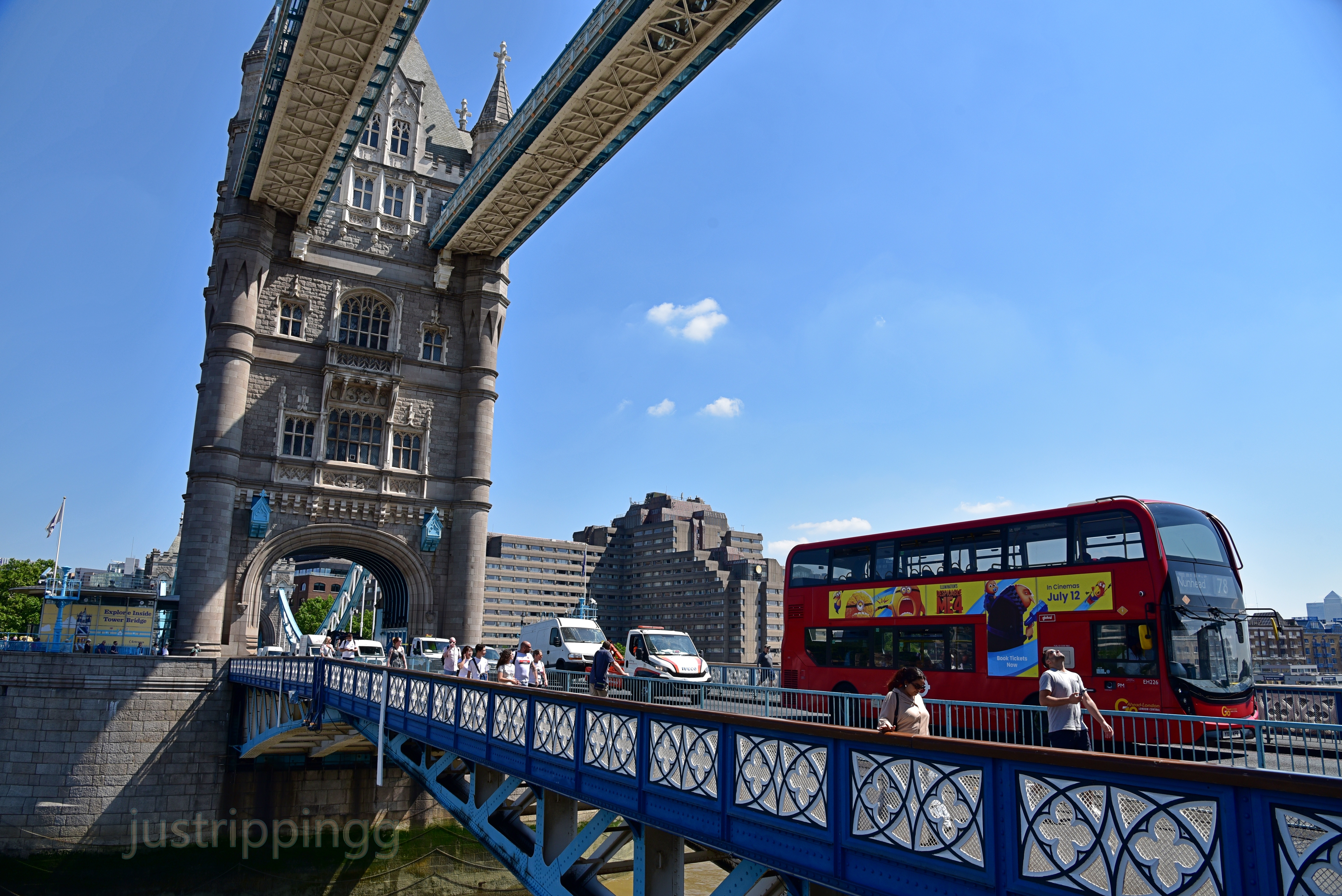
| The workers of Tower Bridge are immortalized on the Blue Line leading the visitors from the bridge to the historic Engine Rooms - love this idea and the aesthetic design and forged plaques installed here in 2016 that will last for a century along with the pavement - this is how great cities celebrates itself and its workers, builders, and inhabitants |
 |
| Two Symbols of London |
Tower Bridge is again one of London’s most iconic landmarks and a symbol of London. The majestic suspension bridge inaugurated in 1894 comprises of these two giant Victorian Neo-Gothic towers on either side of the River Thames connected by two walkways. The bottom walkway is a bascule drawbridge or lifting bridge that pivots up twice a day to let vessels through. No video clip of London is complete without showing the Tower Bridge. As you walk on the bridge it is finally time to make that leap from the virtual world of all those countless movies to actually walk over the River Thames on this architectural marvel. Queen Victoria had wished the Tower Bridge to blend with the Tower of London – the bridge does look like a castle too. Cornish granite clad towers hold the suspension cables as traffic and scores of happy tourists walk and click photos. Above the bridge deck there is an upper walkway with glass floors and mirror ceilings. You had tried that on the Dubai Frame. Now you need to find that little secret.
 |
| View of the Tower Bridge from the Horselydown Stairs - Shad Thames |
You have seen some amazing photos clicked from the river bed. You will go to the other side, east of the bridge, through a passageway under the bridge and come out on the south bank of Thames. This is Shad Thames, a historic riverside street that was home to warehouses which would close down in the 20th century. You will walk through the first building which housed Old Anchor Brewery leading to the Horselydown Stairs, a little-known secret of London. Going down the precarious stairs (sadly you forget to click the stairs), you come down to this little beach made up of rocks at low tide. Just to the left, the Tower Bridge looms offering amazing views.
 |
| Red Double Decker and London Tower and Gherkin - all symbols of London |
You will spend few moments here before backtracking over the bridge, through the Trinity Square Garden and then stepping back couple of centuries into Londinium just north of Tower of London fortress.
 |
| Roman Wall built around 200AD to protect Londinium |
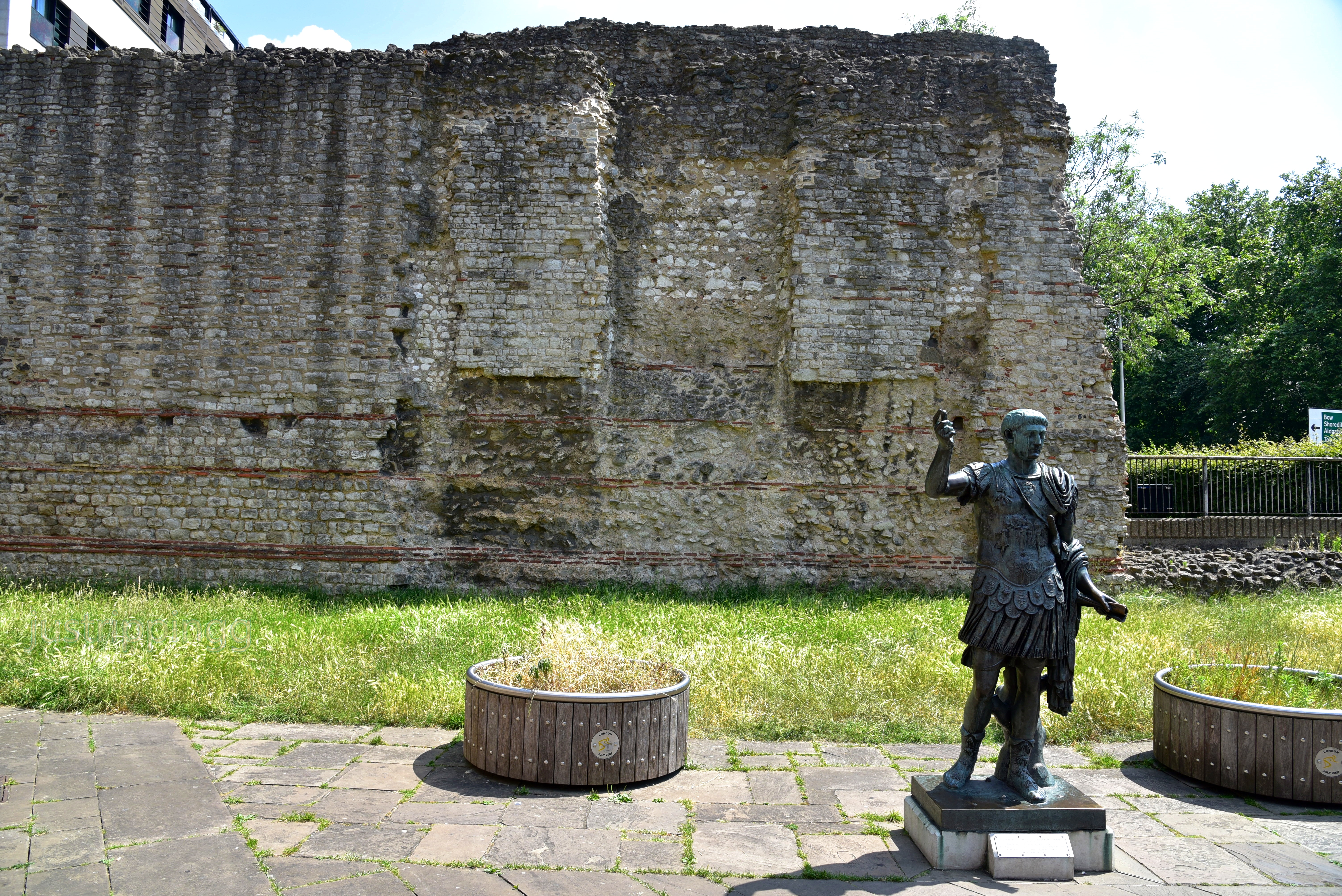 |
| perhaps Roman Emperor Trajan AD 98-117 |
 |
| Modern wall built on top of Roman Wall |
Before Great Britain
colonialized the world, the island of Great Britain itself was conquered by the
Romans from 43 to 87 AD and the Roman rule would last until 410 AD. Before
this, even Julius Caesar had invaded Britain in 55 and 54 BC. Anyway, the
Romans could not subjugate the Caledonians - Highlands of Scotland - to the
North and will therefore build two walls for protection (the piercing notes of
bagpipers perhaps disoriented the Roman troops). The remains of one that you
are seeing now was built in 200 AD around Londinium or London. London would
remain a walled city for the next 1,500 years. The wall was 3km long, 10m high
with regular bastions and a ditch on the outside.

 |
| Just like Shahjahanabad or Old Delhi, London too was once a Walled City |
 |
| The Multilingual Signs - Tower Hill witnessed several hundred public executions |
 |
| The updated Tower Hill sign |
Today, what you see is a
composite – the bottom 4m remains of the wall are Roman built with three rows
of red tiles and the top part was built in the medieval times. It is a miracle
that this section has survived. Modern buildings have come on all sides. A
little to the back and you see the modern wall resting on the Roman portion.
This small length of about 300 metres from here to the fortress outer wall is a
historiography of 2000 years – from the early Romans to William the Conqueror to
Edward I to Charles II and to the Shard gleaming under the morning sun! This is
what you love about the British. The concise and valuable information available
on the signs here, the signs themselves with excellent artwork and aesthetics;
this can only be done by the British (or the Japanese!). You have a fair idea
of their documentation prowess reading their masterful reports and gazetteers
written during the early days of Indian Archaeological Survey.


 |
| In three days in London, the only time you will try something Indian, okay Differently Indian! Wrapchick is a play on the Bambaiya word Rapchik meaning attractive or sexy |
 |
| All Hallows by the Tower - Oldest Church (?) in London founded in 675 AD - you are conserving your energy so will not cross the road! The crypt museum has several Roman era artefacts discovered after the fire bombing |
 |
| View from Great Tower Street - 30 Fincher Street or 'Walkie-Talkie' |
 |
| The Surviving Wren Tower of Church of St Dunstan in the East - London |
 |
| The prettiest lunch break spot for the local workers in the area |
You are making your way to St Dunstan Hill that houses the remains of the pretty The Church of the Dunstan in the East. The Church had stood here since the ancient times but was gutted in the Great Fire (will visit the memorial shortly) and then again got destroyed in WWII with only the Wren tower surviving. In the aftermath, a garden was laid out and today mostly office workers have gathered here in the lovely garden on their lunch break. The garden indeed is beautiful and seeing all these plaques on the wall it seems it is regularly getting awards in the small public garden category.
 |
| View from Lower Thames Street |
 |
| Old Billingsgate - Former Victorian Fish Market - now a premier event space |
 |
| Gotta love these blue ceramic plaques |
 |
| The Parish Church of St Magnus The Martyr - London England |

 |
| The Prettiest Church you saw in United Kingdom |
You will cross River Thames
again over the London Bridge (yes this is different from the Tower Bridge!)
this time. And then you run into this prettiest of churches – St Magnus the
Martyr Church is located at the head of the London Bridge and was visited by
everyone entering London. You just stand transfixed inside gazing at the small
and beautiful interiors built in this fine wood. The Church is dedicated to St
Magnus the Martyr, earl of Orkney who died in 1118 during a power struggle with
his cousin and was canonised in 1135. Though the church survived the London
fire but it was rebuilt by Sir Christopher Wren looking at the chequered floor
and the tall steeple. You have seen several churches and cathedrals in the
Cotswolds in the recent days but this church here is definitely the
prettiest.
 |
| River Thames from London Bridge |
 |
| London Bridge |
 |
| That is why everyone in England is fit, slim and healthy - taking public transport, cycling and walking dogs |
Now you will walk across the London Bridge for a quick inspection of Borough Market. London Bridge is upriver and about one km east of Tower Bridge. It is the oldest bridge here on Thames starting with a timber version during the Roman times and would be the only bridge here on Thames till 1750. Later it was built of stone and the current form is built of steel and concrete and was inaugurated in 1973. Midway on the bridge, you can see the Tower Bridge in the distance. These sights keep reminding you that yes you are in the city that was the nerve centre of the British Empire not too long ago.


 |
| The Atmospheric Borough Market - London |

At the south end of the London Bridge, the Borough Market has existed here for 1000 years and is still filled with eating places and retailers and wholesalers selling food and produce. This could be any market in India as shops and visitors jostle in the narrow aisles. Overhead, three different rail lines run completing a typical scene in a crowded market in Kolkata. You love the signs on the shops – it is quite possible that the city does not allow changing or painting over the old signs; something you saw in the beautiful city of Bath a few days ago.
 |
| Memorial for martyrs in The Great War - Southwark Borough |
 |
| The Borough High Street - Pret sandwiches keeping you alive here in London |
Of course, being a vegetarian, it is not easy to find food that you can eat. In London, you are subsisting on the sandwiches offered by the Tesco Express and Pret a Manger stores. There is always a Tesco withing walking distance and London has enough street furniture to sit on and enjoy the snack and catch your breath. Daily 25K steps need periodical nourishment.
 |
| The George Inn - London |
 |
| The George - Galleried Coaching Inn in London |
In front of a Lloyds Bank
branch, you see an interesting sign of this wonderful piece of living history.
In the cobbled courtyard at the rear is the last of London’s surviving
Galleried Coaching Inn. The George was established in 1542. It is here visitors
and travellers going to London in the stagecoach era would stop over for a
drink. Charles Dickens too would come here and has immortalized The George Inn
in his novel ‘The Little Dorrit.’ Inside, under the shadow of ‘The Shard,’ well-heeled
people of London enjoy their tipple. This is what you have been loving about
this country and this city – history is never far away and every effort is made
to reveal it to people like you through these signs and just by taking care of
the old even as new is everywhere or above like this gleaming glass skyscraper.
Charles Dickens would have approved.

 |
| How can public spaces be this perfect? |
Up ahead looms a massive pillar.
-----------------------------------------------------------------------
The Great Fire of London -
358th Anniversary Special
A sleepy King’s baker on
Pudding Street put a pudding in the oven to bake. Charles II probably felt
those midnight pangs for something sweet. The baker unfortunately fell asleep
and soon the oven was on fire and so was the medieval walled City of London.
The conflagration raged for four days and burned down two-thirds of the city
including St Paul’s Cathedral and the pudding in the oven. The Tower of London
however survived with the help of effective firebreaks. Charles II would have
been devastated if the Crown Jewels had suffered the same fate as the pudding.
He vowed never again to eat between 8 pm to 8 am.
 |
| Monument to the Great Fire of London |

Rebuilding efforts started
soon. The celebrated architect Sir Christopher Wren recommended a grid layout
for the warren like city with narrow streets, inspired by Baroque Paris.
However, he was overruled and the original layout was recreated. Wren though
got to rebuild a number of churches – including St Magnus the Martyr Church and
The Church of the Dunstan in the East that you just visited - and St Paul’s
Cathedral. Some of these rebuilt buildings would again be destroyed in World
War II.
Charles II commissioned a
monument to commemorate the great tragedy. The 61m tall Doric column is exactly
61m away from the site where the great fire started. Inside the column there is
a spiral staircase that can be climbed for panoramic views of the city. These
days you stay away from stairs, especially if they are in a narrow high column
of stone.

 |
| The interwoven brilliance of the aesthetics, signage, street furniture and the public spaces overall simply keeps astonishing you - got to love the city planners here in London |
You have walked from the Tower
of London, crossed the remnants of Roman Wall into this great warren of shiny
buildings co-existing with a smattering of old buildings. It is hard to believe
this city was first burnt down and then levelled during the Blitz of WWII. The
streets were never widened and the old buildings still look the same as they
did when you see those WWII photos popping up on Facebook. The buildings were
restored to their original designs while the cobbled streets with granite lined
footpaths are probably the same over all these centuries. You are amazed at the
longevity of these cobbled streets and the pavements. Back home the streets and
the footpaths are in a perennial state of getting torn and getting laid. The
streets where carts and horse carriages plied now have the red double-deckers
swishing through. There is so much here in London to love.
Monument to the Great Fire of London - Sep 2nd to Sep 5th 1666, London, UK
----------------------------------------------------------------------


 |
| The Old and New - London |
 |
| View from Lombard Street - on the right is Bank of England |
 |
| Statue of James Henry Greathead on Cornhill - He invented the Travelling Shield that made deep tunnelling for Underground possible |
 |
| Royal Exchange - View from Bank junction where the streets Threadneedle, Poultry, Prince, Queen Victoria, Cornhill, and Lombard streets meet - London, United Kingdom |
 |
| The interiors of the Royal Exchange - London |

 |
| Royal Exchange - established by England's Father of Banking, the wealthy merchant Sir Thomas Gresham for trading stocks - formally inaugurated by Queen Elizabeth I in 1571 |
Now
you will walk into the centre of the financial district. You have left most of the
tourists behind. Streets are empty barring a few double-deckers. Sharply
dressed men and women can be seen walking purposefully. The buildings here are
drool-worthy. Flanked by Cornhill and Threadneedle Streets is the trapezoidal
neo-classical Royal Exchange with grand portico and pediment that was first
established in the 16th century. Today, it hosts luxury stores and
upscale restaurants. Though intimidating, you must go inside to have a look and
maybe click a few photos. In the central courtyard, formally attired waiters serve
their high-end clientele. Upscale stores line up on all sides. Outside, Royal
Exchange is one of the places in London where a Herald or Crier reads out royal
proclamations like death or coronation of a king.
 |
| View of the Financial District of London with the Royal Exchange |
 |
| Signage in London and England keeps surprising you |
 |
| A London View |
 |
| No Building is ever forgotten in England - St Benet Fink site |

 |
| Bank of England |
 |
| All that Gold stored in the Bank of England |
Flanking
the Royal Exchange is the Threadneedle Street that was the centre of the Roman
London. It is here the Bank of England nicknamed ‘The Old Lady of Threadneedle’
has been standing since 1734. The Bank of England was recently in news when
India transferred about 100 tonnes of gold from ‘it is as safe as Bank of
England’ to back home. Currently, India’s 324 tonnes of gold reserves remain in
London. In 1990’s financial crisis, this gold reserve was put up as collateral.
But today, no you are not looking for this gold. You are looking for a company
that brought way more than all that gold and gems, cotton, spices, silk, ivory,
and other repatriations to this country.
 |
| Sir John Soane - English Architect whose best work is Bank of England, though mostly destroyed |
You have circled the Bank of England building halfway looking for the statue of its architect John Soane. You have already asked couple of guards at the two doorways but they are as clueless as villagers are in your travels when they are not even aware of this gem in their backyard. And it is in the back of the building on Lothbury that you find his statue. And right across is this narrow alley or court where history happened.
 |
| Lothbury Street and the Founders Court on right - London |
---------------------------------------------------------------------------------------
Gone East India Company
And the Beginning of British
in India
Maybe by design or with
evolving times, all connections to East India Company (EIC) have been wiped
clean off the London landscape. And this is the beauty of British sense of
aesthetic and heritage that when a new building comes up it will have this
beautiful blue plaque (metal / ceramic) with a lovely font indicating the
presence of the now deceased building. While other buildings will have a round
sign indicating if some notable personality lived in that house.
 |
| Founders' Court - This is where it all began |

 |
| East India Company Founder's Hall on Founders' Court in London |
So, this is Founders' Court
where the EIC founders – a group of eighty merchants & adventurers and Mayor
of London - met in Founder's Hall on 24 Sep 1599 to establish this startup with
a seed money of four million pounds, obtained royal charter from Queen
Elizabeth I for exclusive trade between England and India for fifteen years.
East India Company would soon rule the country with the highest GDP and funnel
back billions of pounds enriching Great Britain over the next few centuries.
You are happy with this
discovery and need to share it! This employee of Bank of England who is taking
a cigarette break here is happy with this history nugget you share with him as
the architect of the old building Sir John Soane looks at us from across the
street wondering if another startup discussion is taking place between this
English and Indian guy!
Founder's Hall on Founders' Court, London
------------------------------------------------------------------------------------------
 |
| Punjab National Bank on Moorgate - London |
 |
| State Bank of India on King's Street - London |
Just ahead of the Founders Court on the corner of Lothbury and Moorgate streets you spot a branch of one of your banks – Punjab National Bank, housed in the elegant 1 Moorgate building. You will step inside to see if it looks like the Dickensian hell-hole that your Delhi branch is. Inside it looks like a five-star hotel lobby. The lady in saree makes an immediate eye-contact and smiles - What! Is this really an Indian PSU Bank? Well, the location makes one heck of a difference. You just smile back: “I was wondering if this looks like my branch back home!” A little distance away on the King’s Street and in this lovely stone building is a SBI Branch. Inside it is plush and quiet. There is nobody here except a suited employee poring over his computer screen. Wow! Can our PSU Bank branches be like this back home? Fat chance! Our PSU bank branches and their employees will continue to be what they are just like our pavements – dangerous to walk on or in.

 |
| Parish Church of St Stephen Walbrook - Sir Christopher Wren's Masterpiece |
---------------------------------------------------------------------------------
This is the second Roman encounter of the day in the City of London and it turned out to be the most famous 20th Century Roman discovery in London. The temple is dedicated to the mystery religion Mithraism centered on God Mithras.
The London Mithraeum also called Temple of Mithras is a Roman Mithraeum. Today few parts of the original temple are displayed at the bottom of the new Bloomberg Building.
 |
| London Mithraeum |
It was closing time and you were unable to see the temple site but on the upper levels you can see some contemporary interpretation displays. Of course, the mother of all Roman discoveries in England is in the beautiful UNESCO City of Bath.


London Mithraeum, Bloomberg Space, Walbrook Street, London
------------------------------------------------------------------------------------
You will walk along Gresham
Street into Guildhall Yard to find another Indian connection. The Guildhall
Yard is the ceremonial and administrative centre of City of London. While
excavating for the new Art Building, London’s only Roman amphitheatre was found
here where the now open yard with black stones is. On the southern side is the
St Lawrence Jewry because the 12th century church stood next to a
synagogue. And like every other building, the original church was first burnt
in the Great Fire and then damaged in Blitz. Just like 51 other churches in
London, Sir Christopher Wren will also rebuild this church here in the
aftermath of the fire.
 |
| St Lawrence Jewry, Guildhall Yard, London |
 |
| Hindu Porch of the Guildhall - London |
Looking ahead towards the far side of the yard, the porch of the Guildhall looks familiar. The porch has Hindu architectural elements; a result of Empire’s rapid advance and the eastern influences finding its way in the architecture here. The porch was completed in 1789. You will pause here for some time to rest your sore feet and chat with a local lady who is a guide and is waiting for her group to arrive.
 |
| A restored Police Public Call Post - Introduced in 1930s and discontinued in 1960s after advent of Police transmitters. Possibly eight remain in the city - Near Postman's Park |
 |
| St Anne and St Agnes Church - Gresham Street, London |
 |
| Lord Raglan Pub named after the Waterloo hero the 1st Baron Raglan. Originally the pub was called The Bush and this site is one of the oldest taverns in the city, possible established in 1776, and the cellars incorporate the ancient Roman wall - 61 St Martin's Le Grand, London, United Kingdom. Yes history everywhere in this city. |
Gresham Street probably has the maximum number of churches. Next in line is the small and pretty brick St Anne and St Agnes Church. This too was gutted during the Great Fire and Blitz and now has been restored with a lovely garden.
 |
| The pretty and serene Postman's Park - London |
 |
| Postman's Park - Loggia with 54 plaques honoring ordinary citizens who gave up their lives to save others |
This walking route is letting you discover some little-known gems of London. Postman’s Park has the same calm vibe as St Dunstan in the East Church. In a beautiful landscaped park, people enjoy the sun sitting on these lovely wooden benches. The park got its name since postmen from the Portland stone General Post Office to the south would come here on their breaks. The artist George Frederic Watts was looking for a place to commemorate the heroic deeds of ordinary folks. In 1900, Watts’s wish came true and a Memorial to Heroic Self-Sacrifice came into being with a loggia containing 54 plaques highlighting the brave deeds of ordinary people who died saving others.
Reading the poignant messages
brings back the same feelings like it does reading the gravestones in CWGC
cemeteries. You are not sure if something similar exists anywhere else for
bravehearts who lost their lives to save others.
 |
| The Dome Beckons |
 |
| Christchurch Greyfriars Garden |
 |
| The lady guide you met in Guildhall Yard a few minutes ago |
 |
| The Dome gets closer |
From here you will turn left on King Edward Street. In the distance you can see this huge dome dominating over the skyline. Here in this part of the City of London, you are never far from a cathedral or a church. Just before you cross the Cheapside street, you see a garden, some walls and the tower of Christchurch Greyfriars Garden. The timeline of the church follows the same trend – an old church first built in 13th century, burnt during the Great fire, rebuilt by Wren and then again razed down by incendiary bombs during the Blitz with some walls and the tower surviving. Just like Dunstan in the East, it was decided not to rebuild the church but instead lay down a garden. You run into the same guide lady who is now leading a group of visitors and in the middle of explaining the origin and the history of this garden. The group seems to be comprised of locals perhaps sharing the common interest of history. The garden has rose shrubs and climbers with a palette of colours to bring the garden to life. The appreciative bees and birds chirping makes it worthwhile to spend a few moments here in Christchurch Greyfriars Garden.

 |
| of course this is the St Paul's Cathedral |
The iconic dome rising above the London skyline reels you in as you make your way through the concrete valley of Queens Head Passage. Hemmed in from all sides by modern buildings stands the majestic St. Paul’s Cathedral in all its splendour. Like most London buildings, churches and monuments, this cathedral also went through an almost humorous grind of a long procession of fires and destruction when finally, it was built in Portland stone by yes, Sir Christopher Wren in a Neo-classical, Gothic and Baroque style that took 35 years of his life and some withheld salary. At least Wren got his burial here, an architect of 51 churches in London. You guess he deserved this as he helped rebuild London after the Great Fire though the Blitz did undo most of the work. This cathedral has a long ancestral lineage probably beginning with the Roman temple to Diana and the first Christian cathedral to St Paul in 604 AD.
 |
| St Paul's Cathedral - London, United Kingdom |
The church façade is doused in the golden light hour. It is six in the evening here on Ludgate Hill. Yes, it has been a long fulfilling day in the City of London. In the forecourt outside the west front stands the statue of Queen Anne, in whose reign the rebuilding of the cathedral was completed. People mill around the Churchyard; some sit on the giant granite stone blocks while some are part of London Guided Walk tours.
 |
| The pedestrian Millennium Bridge over River Thames |
 |
| River Thames - looking east towards Tower Bridge |

You will take a walk on the Millennium Bridge for pedestrians which is the fourth bridge from the Tower Bridge and your third bridge over the Thames. You have the last few places to visit and will take a short ride on a bus to get down at the Strand.
 |
| London School of Economics and Political Science |

On the corner of Aldwych and A4200 stands the venerable London School of Economics and Political Science. LSE just like Delhi School of Economics and JNU in Delhi are those places you wish you had attended – at least in the next life! You walk around a bit trying to peep into the doors and windows.
 |
| King's College - Strand Campus, London |
 |
| Bush House - King's College, London |
Coming back to the Aldwych and A2400 corner
you look across the street at this imposing and stately Bush House. Completed
in 1935, the building was conceived as a Trade Centre by American industrialist
Irving Bush and at that time was the most expensive building in the world.
Later it housed the headquarters of BBC World Service and currently is owned by
King’s College. It is here at King’s College, Strand Campus that a family
member earned a business degree recently. King’s College might not have the
clout of LSE but the building is a lot grander!
 |
| High Commission of India, Bharat Bhawan, London |


From Bush House, you will walk to the last stop of the day. This is India House – India’s High Commission in London, designed by Herbert Baker and inaugurated in 1930 by Emperor George V. You do not remember seeing any cops in London except around Buckingham Palace these three days. But here at the gates of the High Commission you can see two cops stationed. Recently, the building has been a victim of political vandals and it seems London Police is not taking any chances today. You ask the cops if it is okay to take a few photos. They are totally ok with that – in Delhi, they would have rudely told you to bloody bugger off. And then you wonder how despite suffering multiple terrorist acts over the years, London is still open to everyone and all accessible. There are no security checks in the Tube. Here in the centre of this great city there are no armed security people looking at you suspiciously from the gates or from over the walls. New Delhi over the years has turned into a fortress pushing common folks and trees out and slowly turning into a concrete place for babus and politicians only. London is still open and free and you will hardly see any security apparatus breathing down your neck. Around the corner, Nehru’s bust is installed. Over the walls of the embassy, there appear twelve emblems representing the twelve provinces of undivided India.
Today’s walking route through
the City of London did feel like travelling across time: Londinium of Romans,
the castle of William the Conqueror, founding of EIC, the Great Fire, the
growing prosperity aided by appropriation and repatriation of huge wealth from
India, the razing down of city during Blitz of WWII, the independence of India,
and the first prime minister of independent India, Jawahar Lal Nehru. It is
time to step out of the time capsule that shrunk two millenniums into a
day-long walk through these frozen dioramas.
Thanks for the company!
---------------------------------------------------------------------------
King’s Cross St. Pancras tube
station
Tower Hill Memorial
Tower of London
Tower Bridge
Roman Wall
The Church of the Dunstan in
the East
St Magnus the Martyr Church
Borough Market
Monument to the Great Fire of
London
Royal Exchange
Founders’ Court
Guildhall Yard
Postman’s Park
Christchurch Greyfriars Church
St Paul's Cathedral
LSE & King's College
High Commission of India


------------------------------------------------------------------------------
Related Posts on this Blog:
References:
King’s Cross & St Pancras
https://en.wikipedia.org/wiki/London_King%27s_Cross_railway_station
https://en.wikipedia.org/wiki/St_Pancras_railway_station
The Tower of London
https://whc.unesco.org/en/list/488/
https://www.hrp.org.uk/tower-of-london/whats-on/the-crown-jewels/#gs.k3jsj2
https://www.hrp.org.uk/tower-of-london/#gs.k3hi06
https://en.wikipedia.org/wiki/Tower_of_London
https://en.wikipedia.org/wiki/Normans
Stones Used in London
Construction
https://goldholme.com/history-stone/the-stones-that-built-london/
Tower Bridge
https://www.london-tickets.co.uk/tower-bridge/facts/
https://en.wikipedia.org/wiki/Tower_Bridge
https://www.towerbridge.org.uk/discover/history/tower-bridge-and-london-bridge
https://www.towerbridge.org.uk/your-visit/blue-line
Horselydown Stairs
https://alondoninheritance.com/the-thames/horselydown-old-stairs/
https://www.discoveringbritain.org/activities/greater-london/viewpoints/horsleydown.html
https://paulcooper.uk/2022/04/25/how-to-find-horselydown-steps/
https://symbolsandsecrets.london/2024/05/09/exploring-the-crypt-museum-at-all-hallows-by-the-tower/ - All Hallows by the Tower Church
St Dunstan in the East
https://www.historic-uk.com/HistoryMagazine/DestinationsUK/St-Dunstan-in-the-East-Gardens/
https://en.wikipedia.org/wiki/St_Dunstan-in-the-East
https://secretldn.com/unesco-world-heritage-sites-london/
St Magnus the Martyr Church
https://squaremilechurches.co.uk/our-churches/church/st-magnus-the-martyr/
https://www.stmagnusmartyr.org.uk/the-history-of-the-church/
The Great Fire Monument
https://www.themonument.org.uk/history
Royal Exchange
https://www.theroyalexchange.co.uk/
https://en.wikipedia.org/wiki/Royal_Exchange,_London
Financial & Bank Junction
https://www.british-history.ac.uk/old-new-london/vol1/pp531-544
- Centre of Roman London
https://www.historic-uk.com/CultureUK/The-Old-Lady-of-Threadneedle-Street/
East India Company Founding
https://www.instagram.com/p/C7g94T1obMD/
Indo Genius Insta Post that brought you here
https://www.theguardian.com/world/2015/mar/04/east-india-company-original-corporate-raiders
Hindu Porch of Guildhall
https://footprintsoflondon.com/live/2020/07/top-ten-london-connections-with-india/
St Anne St Agnes Church
http://www.simonknott.co.uk/citychurches/009/church.htm
https://en.wikipedia.org/wiki/St_Anne_and_St_Agnes
Christchurch Greyfriars Church
Garden
https://alondoninheritance.com/london-churches/christchurch-greyfriars/
https://londongardenstrust.org/conservation/publications/guides/tour/stage/?tour=City&stage=15.00
St Paul’s Cathedral
https://www.londonremembers.com/memorials/queen-anne-statue-st-paul-s
India House
https://en.wikipedia.org/wiki/India_House,_London – 12 Emblems of India House
Japan - A Day Walking Tokyo
Trippingg Abroad
The Land of the Rising Sun - November 2024
Every morning when you wake up you have to pinch yourself. But then you really don’t need to. Your hotel room is almost as large as the small bed you have just woken up in. Yes, this is Japan! And you are living a dream. This is your third morning in Tokyo and you need to wake up from that dream no more as you have another long list of places to go see today. As you slowly immerse yourself in this incredible feeling called Japan, you are still not sure what exactly happened that made you wish to come to Japan in this incredible year and how everything fell in place and why the nice folks at the Japanese Embassy in New Delhi granted you a five-year multiple-entry visa. Japan just seemed like that place sweetly out of reach – something that you could only covet. Well now that you are here you are making the most of it and that includes extensive use of Tokyo metro and walking 25K steps each day.
 |
| Gingko Trees of University of Tokyo |
 |
| Dazzling Shibuya Streets - Tokyo, Japan |
Like the previous days you will walk the short distance from your hotel in Edogawa City to the Nishikasai metro station. Just like London, the air is fresh and sharp and the streets scrubbed clean and some more. The skies are blue now but will soon become overcast. Hint of fall colours can be seen outside the station. Of course, the fall blockbuster show waits for you in Nikko tomorrow. You have now become familiar with the ways of metro. You will charge your IC Suica card on the ticket machine as you watch it swallow the sepia yen billnotes. Suica metro card can be scanned to travel on the metro and will buy you the lunch sandwich at 7-11 or Lawson or Family Mart convenience stores - called konbini - located practically everywhere and can even be used on the vending machines. Japan is the land of Vending Machines and practically everything is available in these machines from colourful beverages to snacks and toys.

 |
| The ticket machine dispensing the IC Suica Card - Japan |
 |
| The Vending Machines are everywhere |
-----------------------------------------------------------------------------
Life in the Metro!
 |
| Nishikasai Metro Station, Tokyo - everything looks clean and washed |
 |
| The machines to buy metro tickets and charge cards - Japan |

 |
| Ginza Station, Tokyo |


 |
| Look how orderly the line is up the escalator and now compare it to home! |
 |
| The JR Nippori Station - Tokyo |
 |
| Helpful Signs Everywhere in English |
------------------------------------------------------------------------------
Today, the travel to the first location will take about 45 minutes and you will use three lines – Tozai (sky blue), Ginza (orange), and since you will be moving to suburbs, the JR (Japan Railways) JK Keihin-Tohoku line. The north gate will take you to the Nippori Fabric Town – a haven for DIY sewingheads! But you will exit from the south gate of the JR Nippori Station and will straightway walk up the stone pathway to Tenno-ji Temple and Cemetery.
 |
| Metro Map from Hotel to Nippori Station |
 |
| Today's tour map - will involve both walking and metro rides |
 |
| Tenno-ji Temple with Buddha - Yanaka, Tokyo, Japan |
 |
| Bishamonten Shrine at the Tenno-ji Temple, Yanaka |
 |
| Tennoji Temple - Copper Buddha |
Taito ward of Yanaka district is northeast of Tokyo and the furthest you have travelled so far in these three days. This is a historic part of Tokyo evocative of the Edo era (1603-1868). The quiet Tenno-ji Temple established in 1274 (oldest in Yanaka) belonging to Tendai sect of Buddhism does not have any visitors this early except an elderly man exercising. A beloved copper Buddha popularly called Tennoji Daibutsu created in 1690 sits on the edge on left. Like most temples here, this temple too suffered in the civil war and was rebuilt but the Buddha statue survived. A shrine on the grounds is the home of Bishamonten, the god of Bravery and Resources. You will spend some serene moments here soaking the vibes of Old Tokyo. Neon Tokyo will dazzle you in the evening.

 |
| The lady and the Pooch! |
A lady with her little pooch has just come in that reminds you of the small dogs of England. But here you discover another amazing Japanese thing that elevates Japanese civic sense to the unprecedented top level. While folks in England carry poop bags to clean up after their dogs, here in Japan, the folks carry a water squirt bottle. Not just poop, if the doggie pees, then the owner will spray the dog’s pee on grass or pavement with water to dilute it. Little things like this, elevate Japanese society and the country to the greatest level. Coming to Japan is not just about looking at the sights; it is about observing the people as they go about their daily lives whether it is the train driver pointing at the signals or the overwhelming warmth and respect shown by a shopkeeper.
 |
| Taito City - Yanaka Cemetery |
 |
| Yanaka Cemetery - The Cherry Blossom Alley |

 |
| Tokyo - Yanaka Cemetery |
It is time to walk through the Yanaka Cemetery or Reien that was called Yanaka Bochi before the nationalistic Meiji Restoration movement that involved separation of Shinto and Buddhism. The event that took place in 1868 overthrew the Tokugawa clan and restored the imperial family. This lovely cemetery along with the grave of the last shogun Tokugawa Yoshinobu who died in 1912, has Tokugawa family graves and some 7000 graves of noted personalities. You walk along the wet stone paths trying to make sense of this densely packed graveyard. The graves along with granite blocks have these wooden planks with messages. The arrangement is making you curious. Apparently, the wooden planks called sotoba engraved with name and date are added on every anniversary. A cherry blossom Sakura alley runs through the cemetery offering one of the most scenic spots in spring.

 |
| Tokyo Neighbourhoods |

This is a pretty neighourhood but then all neighbourhoods are this pretty and orderly in Japan. But then where are the residents? You don't hear the usual neighbourhood buzz or the sounds of babies. The great mystery is the street macadam. It is kind of bouncy and the colour seems to change every now and then. You are not sure but they could be using some recycled material. Even these narrow streets are marked immaculately along with the green pedestrian path.
 |
| Choan-ji Temple in Yanaka |
 |
| The Stone Slab Itabi in Choan-ji Temple - Yanaka Tokyo |
 |
| Hogai Kano Grave at Choanji Temple |
Just up ahead is the Choan-ji Temple that was set up in 1699. The temple has four Itabis – stone slab stupas with Buddha imagery and Sanskrit characters made during Kamakura and Muromachi periods (12th to 16th centuries). The temple also enshrines Jurojin, the deity of long life and the temple is part of circuit of seven temples here in Yanaka constituting the Yanaka Shichifukugin Meguri (Tour of Seven Deities of Good Luck). The graveyard contains the remains of Hogai Kano (1828-88), a celebrated Japanese painter who established the present-day Fine Art Faculty at University of Tokyo.
 |
| Tsukiji-bei Wall of Kannon-ji Temple |
 |
| Kannon-ji Temple - Yanaka, Tokyo |


 |
| Kanouin Temple, Yanaka in Old Tokyo |

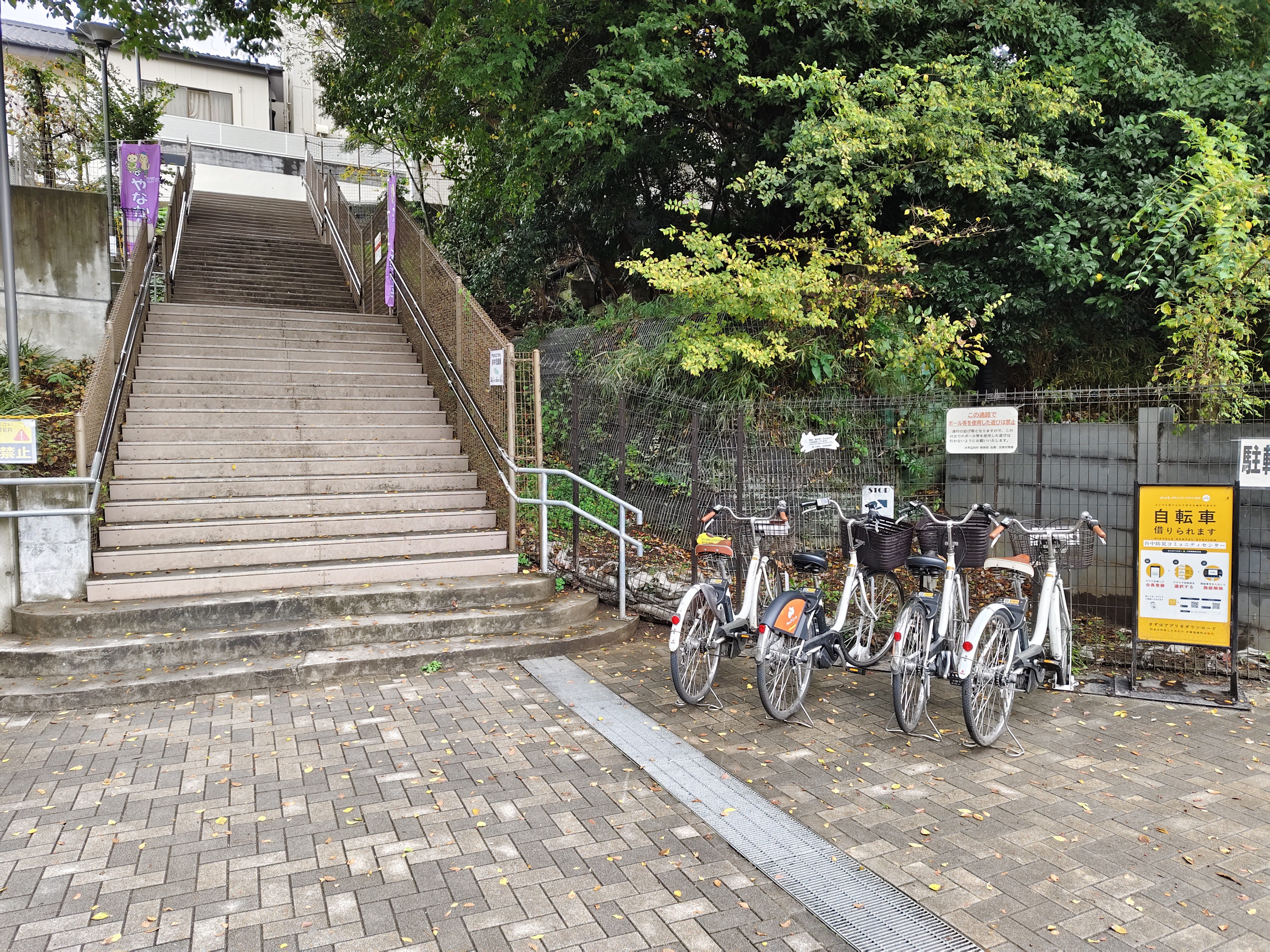
 |
| Love these detailed maps everywhere - aesthetic and full of trivia and knowledge - this is how it is done - Yanaka Neighbourhood - only sign of graffiti seems to be by some Western! |


You pass this wall of the likes you have not seen before. While researching this post and retracing the path you walked, you zoom in on the local map signboard (they are all so amazingly designed and aesthetic) and come upon this temple called Kannon-ji Temple, a Shingon sect temple built in 1648. This mud and tile wall called Tsukiji-bei Wall or Fence is a surviving section of the Edo period, of which very few have survived in Tokyo. The temple is associated with the story of 47 Ronins (a samurai has a master and when the master dies, samurai becomes a ronin) who got together here in this temple to plot the revenge for the killing of their master. The graves of these 47 Ronin are in the Sengkuji Temple cemetery, 15 kms to the south. This story called the Ako Incident of the 18th century is a popular theme for plays and films that portray loyalty and bravery. This is amazing how even little heard of historical places have so many stories to them.
 |
| Daenji Temple, Yanaka, Tokyo |
 |
| Kasameri Osen - wiki photo |
 |
| Stone Monuments of Kasamori Osen and Suzuki Harunobu - Daen-ji Temple, Tokyo |
The temple run continues and it seems Yanaka just like Kyoto is densely packed with temples on every street. This is Daienji Temple and it too has an interesting story. Kasamori Osen was a beautiful waitress at the tea-house Kagiya in front of Kasamori Inaya shrine (probably at this same spot). Suzuki Harunobu (1725-70) was a Japanese designer of woodblock print art in the ukiyo-e style. Osen was probably his muse and she would become popular in Edo after Harunobu depicted her in Nishiki-e colour prints. You are not sure if there was the angle of love but still its a lovely story. The temple has both their stone monuments – a beautiful temple for a renowned painter and his beautiful muse.

 |
| In Japan everything is a pure piece of art - the signboards, the trees, the gardens, these narrow streets, and even the sewer manhole covers. Apparently, every city, district, area has its own design! |
 |
| Most Japanese don't seem to own cars. But you will see plenty of bicycles here and on the roads. Women can be seen bicycling with their toddlers. And no wonder, the roads are mostly traffic free. Another Japanese enigma - while the world is full of Japanese cars, here in Japan there are very few private cars and that too are the small ones of Suzuki and Datsun make. |
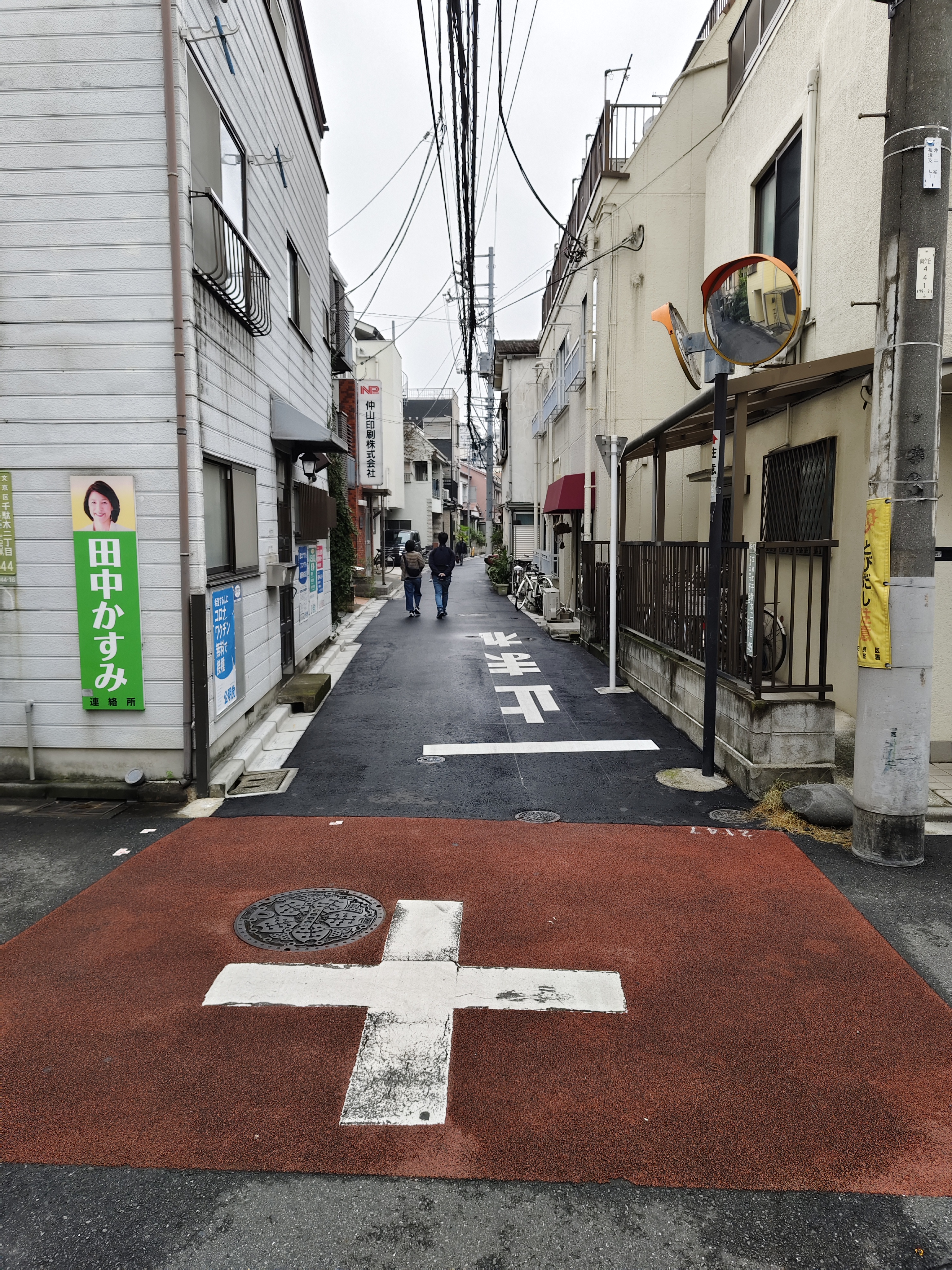


 |
| Like across Tokyo, most roads are traffic free. There are very few private vehicles on the road. What you see are mostly cabs, and trucks for assorted jobs of delivery and material transport. It is said even CEOs take metro in Tokyo. Can you even imagine that back home?! Most pedestrian crossings don't see any traffic by the time the red ticks down and it will be several moments when the lights switch and bird like chirps ring out before pedestrians and bicycles (more than vehicles) cross the road |

 |
| The Nepali restaurants and food that will sustain a vegetarian you in Japan. Japanese cuisine is not really rice based where meat can be substituted with eggs and tofu |

We are moving from Taito City to Bunkyo City. It is here that you run into your first Indo-Nepali restaurant in Japan. Japan is tough for a vegetarian and the cuisine is unlike Thai / Vietnamese / Khmer where you would ask for the meat to be replaced with egg and tofu. You have somehow managed so far but this is God-sent. For the remaining days in Japan, you will be lucky to find a Nepali restaurant across cities of Kawaguchiko, Kyoto, Hiroshima and several in Okinawa. Okinawa has a sizeable population of Nepali folks with who you would chat over the three days you will spend there before flying out of Japan.
 |
| The lovely ladies who posed for you - Nezu Shrine - Tokyo |

And then you chance upon
this gem of a temple. Nezu Shrine is one of Japan’s oldest shrines spread out
over interesting landscape with beautiful elements; a microcosm of temple
complexes you would encounter in Kyoto in the coming days. The lovely
architecture is Gongen-Zukuri style of the Edo period. Luckily, the temple was
unharmed during earthquakes and firebombing of Tokyo. Unlike the tourist
inundated Senso-ji Temple that you saw on the first evening, there are almost
no tourists here. Only few locals come, pray and leave. This is the Tokyo of
several decades ago when only the most intrepid of tourists would come to
Japan.
 |
| Komagome Inari - Nezu Temple |
 |
| Nezu Temple - Approach from Uramonsaka Slope, Tokyo |
A large otorii gate leads you into the complex. You will later realise this is on the opposite side of the main entrance. Entering through here means you will first see the Otome Inari Shrine first, dedicated to Shinto deity of rice, fertility and prosperity. You are amazed to see the foxes guarding the portal. The foxes or kitsune wearing red bibs are messengers of Inari and are believed to possess magical abilities.
 |
| The Four armed Deities similar to Indian iconography and the Three Wise Monkeys of Gandhiji - Nezu Shrine, Tokyo |
 |
| The Senbon Torii Tunnel - Nezu Shrine |
 |
| The red bib wearing Foxes or Kitsune, the messengers of Inari - Otame Inari Shrine - Nezu Shrine, Tokyo |
 |
| The pretty and so Japanese looking Oki Pond in Nezu Shrine - Tokyo Japan |
On the left you can see
four armed reliefs on a stone pillar. You are not sure what they are. You can
also see the Three Wise Monkeys of Gandhiji. You will see more of them in the
grand Toshogu shrine in Nikko. Is this symbolism rooted here in Japan or did it
come from India? From here the most Japanese of all, a vermillion Torii gate
tunnel goes up the hill. The gates are not too high and you will have to bow
down a bit as you go up and down several times. In Kyoto, of course Fushimi
Inari-Taisa shrine has the biggest Torii gate tunnels traversing over the
mountain. Like you said, this amazing temple seem to have all the elements
right here. On both sides of the gates is the Tsutsujien Garden with Azaleas bushes
that will turn into a riot of colour in spring. A viewing gallery looks down on
the pretty Koi Pond with the colourful fish.
 |
| The Omikuji fortune-telling paper strips - folded and tied to trees and fences and left behind by devotees |
 |
| You will buy an Ema, votive wooden tablet to make a wish |
 |
| The two-storeyed Romon Gate |
 |
| Karamon Gate |
 |
| Shaden - the main shrine - Nezu Temple in Tokyo |
Now walking to the other side, you will approach the main shrine through the two-storey Romon and Chinese-style Karamon Gates. The main shrine complex is enclosed by the latticed Sukeibei Wall. The main shrine Honden is ornate as few locals come to pray to the deity. You will spend few minutes just soaking in. This is how temples should be – just you and the deity and this tranquillity and beauty all around.

 |
| Gingko Trees of University of Tokyo, Japan |
Now you will walk about ten
minutes to the campus of University of Tokyo. It is a beautiful campus with a
mix of old and new buildings. But today you are interested in the avenue of
these tall Gingko trees whose leaves are turning yellow. The Gingko Trees are
putting on their fall show. Japan is
usually known for Cherry Blossom or Sakura season in spring when the trees turn
white and pink with these ephemeral flowers. No less beautiful is the fall
season in November when ginkgo, maple and other trees change colour turning the
landscape into vibrant shades of yellow and red. It is said the Gingko Tree
Avenue created here in 1906 was the inspiration for other ginkgo lined avenues
in Tokyo. No wonder ginkgo is the official tree of Tokyo and the green-yellow
fan-shaped ginkgo leaf the emblem of Tokyo.
 |
| University of Tokyo, Japan |

 |
| In the Gingko Wonderland - Japan |
 |
| The Colours of Fall - Japan |


It is a cloudy and wet
afternoon, as you walk across the avenue and the campus. The Gingko leaves have
turned golden yellow and every once in a while, breeze brings down a shower of
these wet and delicate two-lobed leaves on the ground below. This is nature at
its loving best sending love to this beautiful country and its beautiful people.
You will pick few leaves that you plan to bring back with you as a memory of
this beautiful tree. It is said the Ginkgo tree at the Hiroshima memorial
survived the blast and was the first plant to regrow. You will meet up with it
in a few days.
 |
| A Japan Post branch |
 |
| Walking on this 'macadam' is tad less tiring |

 |
| Only Japanese can do this - metro car-wise exit or amenities listing so you can board that metro car for quick exit |
 |
| The helpful sign of exit at Shibuya station! |
 |
| The labyrinthine Shibuya metro station - Tokyo |
The sky is darkening. It is time to make your way to the neon-lit district of Shibuya. You will catch the metro for the enormous Shibuya metro station in Central Tokyo and one of the busiest stations in Tokyo. The station has nine lines, fourteen platforms and five exits. People joke about how easy it is to get lost in the underground station and it could be months before you find your way out! But you do not have lot of time to get out and after properly researching you come out of the Hachiko gate into the square dedicated to Hachiko.
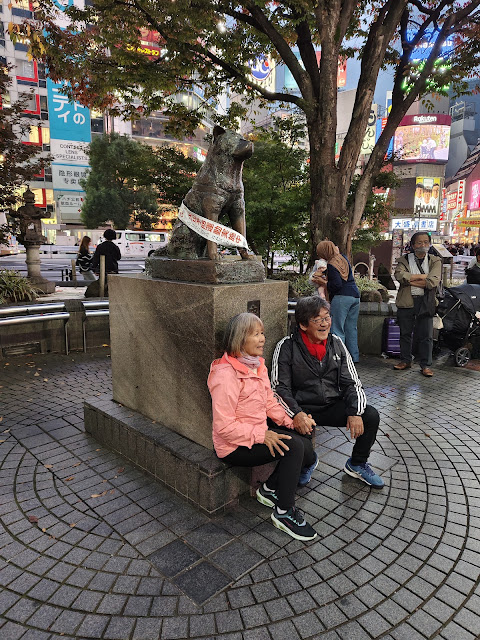
 |
| Hachiko and Professor - at University of Tokyo (wiki) |
 |
| People queuing to get clicked with Chuken Hachiko (Faithful Dog) - Hachiko Square at Shibuya station - Tokyo |
Hachiko was a white Akita
Inu dog who would accompany his master Ueno every morning to the Shibuya
station and then would wait for him in the evening. Ueno was an Agriculture Professor
teaching in University of Tokyo – the same place you are now coming from! Ueno
died in 1925 but Hachiko would still come to wait for him for ten years until
1935. A bronze statue of him was inaugurated here at the main entrance of the
station in 1934 once he gained national importance when articles on him were
published. His loyalty and fidelity are revered in Japan and the subject of
statues, books and movies. Today, the beloved dog’s statue is a meeting place
and where the tourists line-up to click photos with him. Stories like this can
only happen in Japan. Hachiko’s ashes lie next to Professor Ueno.
Just ahead is the most visited Activity in Japan – Getting Scrambled on the Shibuya Crossing that repeats every two minutes or so! You have just walked into neon-lit Tokyo. You take few moments to look around at this dazzling array of lit buildings with these huge ‘active’ and static neon signs, billboards and video screens as messages flash and light tones change dunking the streets in this kaleidoscope of colours.

 |
| Shibuya Crossing - Excitement Building - before the Scramble Games! |
Now it is time to participate in the most fun thing to do in Tokyo – walking on the pedestrian crossing called Shibuya Scramble Crossing or just Shibuya Crossing. Five streets converge here and it is said one million people in a day or 100,000 people per hour or 3000 people per green light cross the intersection making it the busiest pedestrian crossing in the world.

It is time to scramble. Crowd steadily builds all around as the traffic light turns red on all five streets at once and the pedestrian lights turn green with the familiar cuckoo or the bird chirp sounding across as people start walking. The crowd is mostly made up of tourists with some locals coming off their work at the end of the day. Everyone seems to be enjoying themselves clicking photos and making videos of this amazing Japanese experience. Just like everyone else you too are having the time of your life here smiling ear to ear. You will do several walk-throughs changing directions and lanes.
 |
| The neon lit streets of Shibuya - Tokyo |

 |
| The razzle-dazzle of Shibuya - Tokyo Japan |
 |
| Go-Karting on Tokyo Streets - such scenes are seen across Japan |
 |
| Gachapon vending machines that dispense capsule toys - very Japanese thing to do! |


 |
| Takeshita Street - where the young, trendy, hip, and weird hang out for food, fun and fashion |

 |
| Another Japanese invention! Sampuru or fake food made of plastic that is used in displays |
 |
| Takeshita Street is known for Crepes along with calbee chips and candy floss |
Once you have been
scrambled enough times, you browse through the futuristic neon-lit canyons of
Shibuya streets. From here you will walk about twenty minutes to Takeshita
Street, the youth fashion centre, where the young and edgy fashionistas hang out
and shop for gothic and grungy outfits.
 |
| These yellow Tactile tiles can be seen everywhere - metro stations and streets - they help guide visually impaired citizens |

 |
| Most kids have grown up watching Doraemon! |
 |
| The Entertainment Hub of Odaiba - Diver City, Tokyo |
 |
| The Life-Sized Unicorn Gundam - Odaiba, Tokyo |

The last stop is Odaiba.
You will ride the JY Yamanote and Yurikamome lines over the lit Rainbow Bridge.
Odaiba is a futuristic piece of real estate developed by landfilling several
islands in Tokyo Bay to house entertainment attractions and restaurants. You
walk from the metro station to the first attraction of DiverCity Tokyo Plaza
shopping mall that has the ‘Life-Sized Unicorn Gundam Statue.’ You arrive just
in time for the fictional manned robot (mecha) to perform for you live swinging
its arms and legs with lights flashing.
 |
| Odaiba - The Futuristic Entertainment and Food Hub in Tokyo |

From here you will walk to
the Aqua City shopping complex plaza. Up here on the upper levels you get
amazing views of Tokyo city lights and Tokyo Tower across the Tokyo Bay. In the
immediate foreground is a bronze Statue of Liberty outlined by the lit Rainbow
Bridge. Below is the Odaiba Marine Park with artificial beaches. Lit boats
cruise on the waters.
 |
| This is the feeling everyday here in Japan |

It has been a long and rewarding day in Tokyo. You have walked almost 25K steps today. You are hungry when you see this Hawaiian burger place Kua ‘Aina. You will order the only vegetarian burger on the menu. That really hits the spot. It is another day of amazement here in Japan. This is your third day here and every hour makes you fall in love with this land and the people. You are pretty sure this right here is the greatest country and society. And you the luckiest guy in the world living his dream. Yes, this is for real so you will stop pinching yourself now.

Related Posts on this Blog
References
https://www.culture.city.taito.lg.jp/bunkatanbou/landscape/index_e.html - Taito City
https://www.nippori-senigai.com/en/about/
- Nippori Fabric Town
https://www.byfood.com/blog/culture/guide-to-konbini-japanese-convenience-stores
Tennoji Temple
https://www.japan-experience.com/all-about-japan/tokyo/temples-shrines/tennoji
https://en.japantravel.com/tokyo/tennoji-temple/2191
https://www.tendai.org/tendai/what-is-tendai/
- Tendai Sect of Buddhism
Yanaka Cemetery
https://www.japan-experience.com/all-about-japan/tokyo/attractions-excursions/yanaka-cemetery
https://www.atlasobscura.com/places/yanaka-cemetery
https://en.japantravel.com/blog/cemeteries-in-japan/59311
Yanaka Temples
https://old-tokyo.info/yanaka-temple-walk/
https://old-tokyo.info/kannon-ji-temple-and-tsuji-bei-wall-history-in-yanaka/
https://en.wikipedia.org/wiki/Forty-seven_r%C5%8Dnin
https://old-tokyo.info/daienji-beauty-never-dies/
https://ukiyo-e.org/image/mfa/sc204060
- Suzuki Harunobu
https://en.wikipedia.org/wiki/Suzuki_Harunobu
Nezu Shrine
https://anotherglobaleater.wordpress.com/2023/05/25/nezu-shrine/
https://www.japan-experience.com/all-about-japan/tokyo/temples-shrines/nezu-shrine
https://tokyo-in-pics.com/nezu-shrine/
https://japan-shrine.info/en/nezu-shrine-and-otome-inari-shrine-tokyo/
https://www.travelingjapan.net/tokyo/nezu-shrine/ - Two Inari Shrines
https://mindtrip.ai/chat/909318 -
Foxes of Inari
https://www.oxfordreference.com/display/10.1093/oi/authority.20110803104448685
- Three Wise Monkeys
https://www.atlasobscura.com/places/three-wise-monkeys-of-toshogu-shrine - Three Wise Monkeys
https://www.japan-experience.com/plan-your-trip/to-know/understanding-japan/ema
- Votive Wooden Tablets
https://travel.rakuten.com/contents/usa/en-us/guide/omikuji/ - Omikuji
Gingko Trees
https://www.u-tokyo.ac.jp/en/whyutokyo/hongo_hi_002.html
https://en.japantravel.com/guide/tokyo-s-top-ginkgo-tree-destinations/69280
https://libraryexhibits.uvm.edu/omeka/exhibits/show/uvmtrees/ginkgo/introtoartlit
Shibuya
https://www.japan-experience.com/all-about-japan/tokyo/attractions-and-excursions/shibuya-station
https://japanupclose.web-japan.org/other/o20230428_1.html
- the Japanese Way
http://www.apsguide.org/chapter10_japan.cfm
- Pedestrian Crossing Sounds
https://edition.cnn.com/travel/article/maricar-tokyo/index.html - MariCAR
https://www.nippon.com/en/japan-topics/g01212/ - Gachapon
Hachiko
https://www.youtube.com/watch?v=ac4AliYHjnQ
https://en.wikipedia.org/wiki/Hachik%C5%8D – Hachiko Dog – Amazing Story
Takeshita Street
https://www.gotokyo.org/en/spot/48/index.html
https://tokyocheapo.com/entertainment/harajuku-takeshita-street-guide/
https://www.japan-experience.com/all-about-japan/tokyo/temples-shrines/togo-shrine-harajuku
https://arigatojapan.co.jp/delicious-looking-plastic-food/ - Sampuru
Odaiba
https://www.japan-guide.com/e/e3008.html
https://www.gotokyo.org/en/destinations/southern-tokyo/odaiba/index.html
https://thegaijinghost.com/blog/japan-life-sized-gundam-through-years
If you liked the blogpost then
Please follow Justrippingg on Instagram


.jpg)


No comments:
Post a Comment
Note: Only a member of this blog may post a comment.