झपाटलेला (?) किल्ला, भानगढ (Bhangarh , the most haunted (?) fort)
 |
| Hounted (?) Bhangarh |
सह्याद्रीत किल्ले भटकताना रात्रीचा मुक्काम किल्ल्यावर असला की, जेवण झाल्यावर शेकोटी भोवती भुतांच्या गोष्टींचा फड जमतो. ग्रुप मध्ये भुतांच्या गोष्टी रंगवून सांगणारा कोणतरी असतोच. खऱ्या खोट्याची शहानिशा नको म्हणून सहसा ही भूत दुसऱ्याला किंवा मित्राला दिसलेली असतात. रात्र चढत जाते तशा या गोष्टी रंगत जातात. हळूहळू खूप दमलोय, उद्या ट्रेक करायचा आहे इत्यादी कारणे सांगून काही धीट (?) लोक झोपायला जातात. जे घाबरले नाहीत असं दाखवत असतात तेही हळूहळू शेकोटीच्या जवळ सरकतात किंवा जंगल आणि उघड्यावरचा भाग सोडून पाठीमागे मंदिर किंवा आडोसा असेल अशा जागी बसतात.
 |
| बालेकिल्ला, भानगढ |
किल्ल्यावर रात्री चालणाऱ्या भुतांच्या गोष्टी पुन्हा आठवण्याच कारण म्हणजे त्यावेळेस सरिस्का व्याघ्र प्रकल्पाला भेट देतांना आजुबाजूला कोणते किल्ले पाहता येतील ते शोधत होतो. त्यात भानगढ दिसला . भारतातला सगळ्यात जास्त "हॉंटेड" म्हणजेच "झपाटलेला" किल्ला. या किल्ल्याबद्दल जेवढं वाचायला लागलो , व्हिडिओज बघितले त्यात किल्ला कसा हॉंटेड आहे. अनेक लोकांना तिथे कसे अमानवीय शक्तीचे अनुभव आलेत यावरच भर देण्यात आला होता. किल्ल्याच्या इतिहासा बद्दल किंवा त्याच्या सद्यस्थिती बद्दल फ़ारच कमी माहिती होती. त्यामुळे हा किल्ला प्रत्यक्ष जाऊन बघायण्यासाठी जयपुरहुन भानगढ गाठले.
जयपुर जवळील आमेर येथील कछवाह वंशाच्या राजा भगवंतदास (१५३७ - १५८९) यांनी भानगढ किल्ल्याची निर्मिती केली. राजा भगवंतदास मुघल सम्राट अकबराचे पंचहजारी मनसबदार होते. त्यांच्या पश्चात मुलांमधे वाटाण्या झाल्यावर मोठा भाऊ मानसिंह (अकबराच्या नवरत्नांतील एक) आमेरचा राजा बनले आणि धाकट्या माधोसिंहच्या वाटेला भानगढचा परिसर आला. त्यांनी या किल्ल्याला आपली राजधानी बनवली. भानगढ किल्ल्याची भरभराट झाली. किल्ल्यात आजही असलेल्या बाजारपेठेवरुन आणि किल्ल्यातील वास्तूंवरुन याची कल्पना येते. मग असा नांदता, भरभराटीला आलेला किल्ला अचानक ओस का पडला याचे कारण जनमानसात प्रचलित असलेल्या दंतकथां मध्ये सापडते..
 |
| टेहळणी चौकी (तांत्रिकाचा वाडा ? ) |
एका दंतकथे प्रमाणे आज भानगढ ज्या डोंगरावर आहे तेथे बाबा बालकनाथ नावाचे एक तपस्वी साधू राहात होते. किल्ला बांधण्यासाठी राजा त्यांचा आशिर्वाद आणि परवानगी मागण्यासाठी गेला. साधूने राजाला एका अटीवर किल्ला बांधण्याची परवानगी दिली ती म्हणजे , किल्ल्यावरील कुठल्याही वास्तूची सावली त्यांच्या कुटीवर पडता कमा नये. राजाने अट मान्य करुन भानगढ किल्ला बांधाला . पुढील काळात राजाचे वंशज साधूची अट विसरून राजमहालाची उंची वाढवत गेले. त्याची सावली साधूच्या कुटीवर पडून अट मोडली . त्याक्षणी किल्ल्यात असलेल्या संपूर्ण शहराचा आणि पर्यायाने किल्ल्याचा विनाश झाला. साधूच्या शापामुळे ही जागा निर्जन झाली . किल्ला का ओस पडला याचे उत्तर या दंतकथेतून मिळत असले तरी , भानगढ किल्ला अघोरी शक्तीच्या सावटाखाली कसा आला हा प्रश्न अनुत्तरितच राहतो.
त्याचं उत्तर आपल्याला दुसऱ्या दंतकथेत मिळतं. त्यानुसार सिंघा नावाचा एक वासनांध तांत्रिक होता. काही देणगी पदरी पाडून घेण्याच्या इराद्याने तो राजदरबारी गेला. तिथे त्याची नजर राणी रत्नावतीवर पडली. तिला बघून तांत्रिक वेडापिसा झाला आणि मग तिला मिळवण्यासाठी त्याने एक कारस्थान रचलं. मंत्राने भारलेली तेलाची कुपी त्याने राणीच्या दासीकडे दिली आणि निरोप पाठवला की हे तेल अंगास लावल्यास राणीला अलौकिक सौंदर्याचा लाभ होईल. दासी कुपी घेऊन राणीकडे गेली. तिने तांत्रिकाचा निरोप राणीला सांगितला. कुपीतून येणाऱ्या दुर्गंधीमुळे मंत्र, तंत्र जाणणाऱ्या राणीला शंका आली. तिने ती कुपी एका अजस्र शिळेवर आपटली. कुपी फुटली. त्यातील तेल शिळेवर सांडलं तत्क्षणी शिळा घरंगळत खाली गेली आणि नेमकी झुडूपामागे लपून राणीला बघणाऱ्या तांत्रिकाच्या अंगावर पडली. शिळे खाली दबलेल्या तांत्रिकाने मरण्याआधी शाप दिला. 'संपूर्ण भानगढ़ नष्ट होईल आणि या परिसरात यापुढे कोणीही मनुष्य जिवंत राहू शकणार नाही. असे म्हणतात की त्याचा शाप खरा ठरला आणि नंतर थोड्याच दिवसात किल्ल्यावर शत्रूने आक्रमण केलं. त्यात राजपरिवारातील मंडळीसह इथली सगळी रयत मारली गेली. एवढं होऊनही तांत्रिकाचा आत्मा मुक्त झाला नाही. तो आजही किल्ल्यात भटक्त असतो आणी त्याला अटकाव करण्यासाठी राणी रत्नावतीचा आत्माही किल्ल्यात अजून आहे.
जनमानसांत प्रचलित या दंतकथां पेक्षा इतिहास वेगळा आहे . माधो सिंहा नंतर त्याचा मुलगा छत्र सिंह भानगढचा राजा झाला. त्याच्या नंतर त्याचा मुलगा अजब सिंह ( जवळच असलेला अजबगढ किल्ला यानेच बांधला) आणि त्यानंतर हरीसिंह भानगढचे राजे झाले. औरंगजेबाच्या काळात हरीसिंहाची दोन्ही मुले मुसलमान झाली. त्याच काळात किल्ल्यात मशिद आणि किल्ल्याबाहेर मकबरा बांधण्यात आला.औरंगजेबाच्या मृत्यूनंतर मुघल सत्ता खिळखिळी झाली त्याचा फ़ायदा घेत महाराजा सवाई जयसिंहानी भानगढवर हल्ला करुन हरीसिंहाच्या दोम्ही मुलांना मारुन टाकले . युद्धात भानगढची अपरिमित हानी झाली. राज्याची घडी विस्कटली, किल्ल्याचा राजधानीचा दर्जा गेल्याने व्यापार उदीम थंडावला , परिस्थिती हळूहळू खालावली. त्यात अठराव्या शतकात आलेल्या दुष्काळाची भर पडली. त्यामुळे किल्ल्यातील जनता हळूहळू जयपूर, अजबगढ. अलवार इत्यादी जवळपासच्या समृध्द राज्यात स्थलांतरीत झाली.
 |
| भानगढ किल्ला |
आरवली पर्वताच्या पायथ्याला भानगढ किल्ला आहे. किल्ल्याला मागील बाजूने डोंगराचे संरक्षण आहे. भानगढ गावाच्या बाजूने किल्ल्याचे संरक्षण करण्यासाठी चार ठिकाणी वेगवेगळ्या उंचीवर किल्ल्याला तटबंदी बांधलेली आहे. किल्ल्याच्या सर्वात बाहेरील तटबंदीत चार दरवाजे आहेत. लाहोरी (पोल) दरवाजा, हनुमान पोल (दरवाजा) , फ़ुलवारी पोल आणि दिल्ली पोल. सध्या आपण हनुमान (पोल) दरवाजातून किल्ल्यात प्रवेश करतो. किल्ल्यात प्रवेश केल्यावर उजव्या बाजूला हनुमानाचे मंदिर आहे. या मंदिरावरुन दरवाजाला हनुमान (पोल) दरवाजा हे नाव पडलेले आहे. मुर्ती असलेले किल्ल्यातील हे एकमेव मंदिर आहे. तिथे आजही पूजाअर्चा चालते. किल्ल्यातील बाकीच्या चारही मंदिरात मुर्ती नाही. हनुमान गेट जवळ पूरातत्व खात्याचे कार्यालय आहे तिथून तिकिट घेऊन ( रोख रक्कम भरल्यास २५/- आणि ई पेमेंट केल्यास २०/- ) किल्ल्यात प्रवेश करता येतो. येथे पूरातत्व खात्याने किल्ला बघण्याची वेळ सुर्योदय ते सुर्यास्त अशी लिहिलेली आहे . इतर ठिकाणी वेळ लिहिलेली असते पण याठिकाणी अशी पाटी का लावली असावी. किल्ला झपाटलेला आहे म्हणणार्यांचा पहिला मुद्दा हाच असतो. पूरातत्व खात्याने किल्ला अतिशय सुंदर ठेवला आहे. परिसराची साफ़सफ़ाई , राखलेले गवत (लॉन), फ़ुलझाडं, ठिकठिकाणी खाजगी सुरक्षा रक्षक हे प्रसन्न वातावरण पाहून पहिल्या नजरेत हा किल्ला झपाटलेला आहे हे पटत नाही.
 |
| भानगढ |
किल्ल्याची अधिक माहिती मिळावी आणि मला पडलेले काही प्रश्न विचारता यावेत यासाठी सोबत गाईड घेतला, पण किल्ला किती भुताटकीने भारलेला आहे हे सांगण्याच्या नादात त्याने कथांचे जे चर्हाट सुरु केले ते एकट्या दुकट्या माणसाच्या मरणाच्या कथेपासून शेवटी शेवटी (आम्ही घाबरत नाही बघुन) एकाच वेळी हजारो माणस मरण्यापर्यंत प्रमाण त्याने वाढवत नेले. किल्ल्याचा इतिहास , वास्तू याबद्दल थोडक्यात सांगून तो जो भूतकथांमध्ये शिरला तो बाहेरच येईना. त्याची गाडी किल्ल्याकडे वळवण्याचा प्रयत्न अनेक वेळा करुन पाहीला पण तो अयशस्वी झाला. अशा कथांमुळे Dark tourism आणि Ghost tourism, Haunted Tourism उगम होतो आणि चालना मिळते. अमेरीका आणि युरोपात अशा प्रकारच्या Dark tourism ची परंपरा आहे. जुन्या किल्ल्यात आणि पूरातन वाड्यांमधे भूतकथा सांगत गाईड फ़िरवून आणतात. रात्र असली तरी त्याठिकाणी पध्दतशीरपणे लाईटस वगैरे लावलेले असतात. लोकांना काहीतरी वेगळ, रोमांचक (Exciting) म्हणून अशा टूर आवडतात. भानगढ पण त्याच्या भोवती निर्माण झालेल्या गुढ वलयामुळे Dark tourism च्या पंक्तीत जाऊन बसलेला आहे. इथे येणारे बहुतांश पर्यटक त्याच साठी ( घाबरवून घेण्यासाठी) आलेले असतात. भानगढ किल्ल्याला राजस्थानी लोकांनंतर , बंगाली लोक मोठ्या प्रमाणावर भेट देतात असे गाईडने आम्हाला सांगितले. काळ्या जादू (तांत्रिक) इत्यादी गोष्टींची तिथे परंपरा असल्यामुळे असेल कदाचित. युरोपातल्या आणि भानगढच्या गाईडना एकदा सह्याद्रीतील किल्ल्यावर नेऊन एक रात्र भूतकथा ऐकवायचा मोह आम्हाला झाला होता.
 |
| Bhangarh Fort |
किल्ल्यात शिरल्यावर किंबहूना भानगढ गावात शिरल्यावर सर्वात प्रथम किल्ल्याच्या डोंगरावर असलेली एक सुंदर वास्तू आपले लक्ष वेधून घेते. त्याचे स्थान आणि आकार बघता आजूबाजूच्या प्रदेशावर लक्ष ठेवणार्या टेहळ्यांसाठी ती बांधली होती हे स्पष्ट्पणे कळते . पण गाईडच्या कथेतील तांत्रिक तिथे राहात होता, आजही त्याचा आत्मा तिथे राहातो आणि किल्ल्यातील भूताटकीच्या घटना घडवून आणतो . त्याला राणी रत्नावतीचा आत्मा अडवत का नाही ? असे विचारल्यावर गाईडने बाजारपेठ दाखवायला सुरुवात केली. हनुमान दरवाजाने किल्ल्यात प्रवेश केल्यावर वाटेच्या दोन्ही बाजूला एक मजली इमारती दिसतात. याला 'जौहरी बाजार.' या नावाने ओळखतात. इथे आपल्याला रायगडाची आठवण आल्याशिवाय राहात नाही. अर्थात इथे दुकानांची/ पेढ्यांची संख्या जास्त आहे. बाजारपेठेच्या आकारमाना वरुन भानगढच्या एकेकाळच्या संपन्नतेचा आणि समृद्धतेचा सहजगत्या अंदाज बांधता येतो. सर्व दुकानांना तळ मजल्यावरुन पहिल्या मजल्यावर जाण्यासाठी अरुंद जीने आहेत. या पेठेतील एकाच दुकानाची सुंदर कमान अजूनही शाबूत आहे. एकाही दुकानांचे छ्त मात्र शाबूत नाही आहे. बाजारपेठेच्या मागच्या बाजूला व्यापार्यांचे वाडे आहेत. त्यात " मोडो की हवेली " ही त्याकाळच्या बड्या व्यापार्याची हवेली आहे .
 |
| बाजारपेठ , भानगढ |
दंतकथेतील साधूच्या शापामुळे भानगढ मध्ये मंदिरा व्यतिरिक्त कुठल्याही वास्तूंवर छत टिकत नाही असे गाईडने सांगितले. खरतर अठराव्या शतकात इंग्रजांनी किल्ले ताब्यात घेतल्या नंतर किल्ले ओस पडायला लागले . किल्ल्याना कोणी वाली राहीला नाही .त्यामुळे किल्ल्यावर राहाणार्या लोकांनी गावात घरे बांधण्यासाठी किल्ल्यातील वाड्यांचे वासे , दरवाजे इत्यादी सामान वापरले . त्यामुळे महारष्ट्रातील किल्ल्यावरच्या वास्तू उघड्या बोकड्या बिन छताच्या पाहायला मिळतात. या उलट राजस्थानात इंग्रज आले त्यावेळी तिथले राजे संस्थानिक बनले त्यामुळे राजस्थानात बहुतांश किल्ले आजही व्यवस्थित राहीलेले पाहायला मिळतात. त्यामुळे तिथल्या लोकांना असे छत नसलेल्या उघड्या बोडक्या वास्तू पाहायची सवय नाही . भानगड मध्ये अशा बिन छताच्या वास्तूंना पाहून साधूच्या दंतकथेचा उगम झाला असावा.
 |
| तीन पोल आणि वड , भानगढ |
बाजारपेठ जिथे संपते तिथे किल्ला आणि बाजारपेठ यांना वेगळे करण्यासाठी दुसरी तटबंदी आहे. याठिकाणी या तटबंदीत दरवाजा असावा . तटबंदीतून आत शिरल्यावर दुतर्फ़ा वास्तूंच्या अवशेषावर उगवलेली वडाची मोठमोठी झाड आहेत. वास्तूच्या भिंतीवर चढणारी मुळ आणि लोंबणार्या पारंब्या आणि साक्षात वडाचे झाड यामुळे इथे भूतांचे वास्तव्य असलेच पाहीजे. आमच्या गाईडने सुरुवात केली , सर आप जयपूरसे यहा तक आहे आपको रस्ते के बाजूमे एक भी ये पेड दिखा ? ये पिछे पहाडी है लेकीन उधर भी ये पेड नही है ,सिर्फ़ इधर ही क्यू ? मग त्याने "झाशी की रानी " या सिरियलची गोष्ट सांगितली त्याच्या शुटींगच्या वेळी कस इथे एका मुलीला भूत दिसल आणि तिला थेट जयपूरला नेऊन हॉस्पिटलमध्ये भरती कराव लागले इत्यादी. इत्यादी. गाईड सांगत होता त्यातला अर्धा भाग खरा आहे. याभागात पावसाचे प्रमाण कमी असल्याने वडासारखी झाड तुरळक आहेत . मागच्या डोंगरावरही खुरटी झुडप दिसत होती . वडाची झाडे मोठ्या प्रमाणावर याच भागात होती. त्याच कारण म्हणजे बांधकामासाठी वापरलेला चुना. वड - पिंपळ इत्यादी झाडांना चुनखडी पोषक असते. त्यामुळे ती झाड आपल्याला कंपाऊंड वॉलवर , पडक्या वाड्यांवर रुजलेली आणि फ़ोफ़ावलेली दिसतात. त्यांचा आकार, दाट सावली, लोंबणार्या पारंब्या, पानांची सळसळ ही भूतकथेसाठी योग्य वातावरण निर्मिती असल्यामुळे ही झाड भुतांशी जोडलेली आहेत. भानगढच्या भूतांसाठी ही वडांची झाड म्हणजे नंदनवनच.
 |
| Gopinath Temple Bhangargh |

हे गाईडला समजवण्याच्या भानगडीत न पडता पुढे तिसर्या तटबंदीत असलेला तीन कमानीचा दरवाजा (तीन पोल) ओलांडून आत गेलो. येथे उजव्या बाजूला उंच जोत्यावर बांधलेले नागर शैलीतील गोपीनाथ मंदिर आहे. मंदिराच्या भिंतींवर , खांबांवर, छतांवर अप्रतिम कोरीव काम केलेले आहे. मंदिरात मुर्ती मात्र नाही आहे. याठिकाणी "करण अर्जून" सिनेमातल्या एका प्रसंगाचे शुटींग झाल्य़ामुळे ते प्रसिध्द आहे. याशिवाय किल्ल्यात सोमेश्वर मंदिर, गणेश मंदिर, मंगलादेवी मंदिर, केशवराय मंदिर ही मंदिर आहेत पण मंदिरात मुर्ती नाहीत. " त्यामुळे किल्ल्यातल्या भूतांवर देवाचा वचक नाही”, इती गाईड. "अरे, पण किल्ल्याच्या प्रवेशव्दारातच हनुमानाचे मंदिर आहे, हनुमान स्तोत्रात तो "’भूत प्रेत समंधादी ..." चा बंदोबस्त करतो असे म्हटले आहे. त्यावर अर्थात त्याच्याकडे उत्तर नव्हते. याभागात लॉन , केवड्याची बाग इत्यादी लावून परिसर सुंदर ठेवला होता. एका वडाच्या झाडाखाली गणेश मंदिर मंदिर आहे. त्याच्या पुढे पुरोहिताच्या हवेलीचे अवशेष आणि आणि सोमेश्वर मंदिर आहे. सोमेश्वर मंदिरा जवळ पाण्याचा बांधीव कुंड आहे. किल्ल्यात मला आढळलेला हा एकमेव पाण्याचा स्त्रोत होता.
 |
| कोरीवकाम , राजवाडा |

हा परिसर पाहून चौथी तटबंदी ओलंडल्यावर वळणावळणाच्या, चढाच्या, फ़रसबंदी रस्त्याने आपण बालेकिल्ल्याचा बुलंद दरवाजापाशी पोहोचतो. बालेकिल्ल्यात राजवाड्याचे अवशेष आहेत. त्याच्या दरवाजांवर आणि खिडक्यांवर कोरीवकाम केलेले आहे. याठिकाणी पाण्याचा कोरडा हौद होता. मागेच असलेल्या डोंगरातून पाणी आणण्यासाठी कुठलीही सोय केलेली इथे आढळली नाही. राजघराण्यातील लोक , त्यांच्या दास दासी . अधिकारी यांच्यासाठी खालून पाणी आणले जात होते असे गाईडने सांगितले.

 |
| राजवाडा, भूत उतरवण्याची जागा |
राजवाड्याच्या खालच्या मजल्यावर छत असल्याने त्या खोल्या अंधार्या आहेत. कमानदार लांबलचक बोळ त्यांच्या टोकाशी असलेल्या खोल्या , त्यात वटवाघुळांचा वावर असल्यामुळे येणारा दर्प, पंखांच्या फ़डफ़डण्याचे आवाज यामुळे गुढ वातावरण निर्माण होते. त्यातल्या दोन खोल्यात नेऊन गाईडने तळघरात जाणारा जीना दाखवला आणि "यहा दस हजार के उपर लोक आज तक मरे है" अस सांगितले . एकावेळी एक माणुस आत जायची मारामारी असलेल्या अरुंद जीन्याने तळघरात जाऊन तिथे "दस हजार लोग मरे है" म्हटल्यावर आम्हाला हसू आवरेना. राजवाड्याच्या सज्जातून किल्ल्याचा परिसर, टेहळणीची चौकी , मागचा डोंगर आणि भानगड गाव दिसत होते.
 |
| तळघर, भानगढ |
किल्ल्यात फ़िरायला येणारे पर्यटक इथे पर्यंत येतात आणि परत जातात . आम्हाला बाहेरच्या तटबंदीत असलेले तीन दरवाजे आणि दोन मंदिर पण पाहायची होती. त्यासाठी वेगळा चार्ज लागेल असे गाईडने सांगितल्यावर त्याचा निरोप घेतला. जाण्यापूर्वी त्याने एक भूतकथा आम्हाला सांगितलीच. शुटिंगच्या युनिट बरोबर आलेल्या कलाकारांपैकी एक कलाकार एकटाच तिथे गेला तो मेला त्याच्या भूताने तिथे नंतर गेलेल्या एका माणसाला पछाडल, तो म्हणायला लागला "मै शहारुख हू, मै सलमान हू" कारण काय तर, त्याची अभिनेता बनण्याची इच्छा अपूर्ण राहीली. मग त्याला राजवाड्यात आणण्यात आले . तिथे भूत उतरवल. आजही राजवाड्यात भूत उतरवल जात . त्यामुळे तुम्ही तिथे जाऊ नका, असे निक्षुन सांगितले.
 |
| सोमनाथ मंदिर, भानगढ |
सह्याद्रीत वेळी अवेळी फ़िरण्याची सवय असल्याने आम्ही केशवराय मंदिराकडे निघालो, पायवाट व्यवस्थित होती. आजूबाजूला गुढघ्या एवढी वाढलेली खुरटी झुडप होती. लख्ख उन पडलेल होत. त्यामुळे भूतांसाठी एकदम "अयोग्य" वातावरण होत. हे मंदिरही नागरशैलीतील आहे. मंदिरात मुर्ती नव्हती. पुढे तटबंदीतल्या लाहोरी प्रवेशव्दाराजवळ पोहोचलो. त्या प्रवेशव्दाराच्या नावाचा आणि लाहोरचा संबंध नसून लोहाराशी संबंध आहे. याठिकाणी लोहारांची वस्ती असावी. उन खूप असल्याने एका झाडाखाली पाणी प्यायला बसलो. बाजूला एका वडाच्या झाडाखाली माकडांची एक टोळी बसली होती. अचानक त्यांच्या म्होरक्याने " खॅक " असा आवाज काढून इतरांना इशारा दिला आणि सगळी माकड सरसर झाडावर चढली. त्याचवेळी राजवाड्यातून झांजांचा आवाज आणि धूर यायला लागला . " माकडाला हजारो आत्म्यांपैकी एखादा आत्मा दिसला की काय ’? गाईडने सांगितलेल्या गोष्टीचा परिणाम असेल आम्ही दोघे ताडकन जागेवरुन उठलो . उठल्यावर दिसले, झुडपातून एक कुत्रा तोंडात टिटवी घेऊन पळत आमच्या दिशेने येत होता. माकडाने ते आधीच पाहिल्यामुळे त्याने आपल्या कळपाला सावध केले होते. किल्ल्यात आल्या पासून अंगावर काही क्षणांपुरते रोमांच आणणारा हा एकच प्रसंग होता ....आणि तो ही भूतावीना.
या जागा खरच झपाटलेल्या असतात की, आपल्याला आधीच मिळालेल्या माहितीमुळे आपणच झपाटलेलो असतो.
 |
| राजवाड्यातून भानगढ |
फ़ुलवारी आणि दिल्ली पोल पाहून किल्ल्याच्या प्रवेशव्दारापाशी आलो , आमचा गाईड तिथेच बसला होता. त्याला झांजांच्या आवाजा बद्दल विचारल, तो म्हणाला काही वेळापूर्वी भूत उतरवण्यासाठी एकाला घेऊन लोक आली आहेत. त्यांचा आवाज आहे. किल्ला पूरातत्व खात्याच्या ताब्यात असताना, एवढे पहारेकरी व बंदोबस्त असताना किल्ल्यात भूत उतरवण्याचे प्रकार असे राजरोस पणे चालत असतील तर किल्ला भूताच्या विळख्यातून कधीच सुटणार नाही.
किल्ला फ़िरुन झाला होता. भूक लागली होती गावात हॉटेलची चौकशी करण्यासाठी एके ठिकाणी थांबलो. तिथे काही बुजूर्ग लोक पण बसलेले होते. कुठून आलात वगैरे चौकशी झाली. मी भूताचा विषय न काढता त्यांना विचारल तुम्ही रात्री किल्ल्यात जाता का ? ते बोलले गावातल्या लोकांना जावच लागत. त्यांची गुर ढोर तिथे चरायला जातात एखाद चुकल आणि संध्याकाळी परत आल नाही तर काय, दुसर्या दिवशी पर्यंत वाट बघणार ? आम्ही रात्रीच जाऊन शोधून आणतो. हे उत्तर मिळाल्यावर अजून काही विचारण्याची गरज पडली नाही.
 |
| पाण्याचे कुंड, भानगढ |
किल्ला पाहिल्यावर अस म्हणता येईल की ,तो ओस पडण्याचे एक कारण पाणी हे असू शकते. या भागात पाऊस तसाही कमीच पडतो. त्यात या किल्ल्यावर पाणी साठवण्यासाठी जागो जागी सोय केलेली मला तरी दिसली नाही. किल्ल्याच्या आत राहाणार्या लोकांना पाण्याचा तुटवडा भासू लागल्यामुळे त्यांनी स्थलांतर केले असावे. अकबरालाही त्याने वसवलेली नवीन राजधानी फ़त्तेपूर सिक्री ही पाण्याच्या तुटवड्यामुळे सोडून पुन्हा आग्र्य़ाला परतावे लागले होते.
भानगढ किल्ल्याच्या भोवती असलेल्या भूतकथा सोडल्या तर किल्ला खरच सुंदर आणि एकदा तरी जाऊन पाहाण्यासारखा नक्कीच आहे.

जाण्यासाठी :-
भानगढ किल्ल्यावर जाण्यासाठी जवळचे रेल्वे स्टेशन आणि एअरपोर्ट जयपुर येथे आहे. जयपुर ते भानगढ हे अंतर ८५ किलोमीटर आहे. याभागात बसेस कमी आणि अनियमित चालत असल्यामुळे खाजगी गाडी करून जावे.
जयपूर - भानगड - अजबगड - टेहलागड - निळकंठ महादेव मंदिर - राजुरी फोर्ट हे पाहून एका दिवसात जयपूरला परत जाता येईल.
आम्ही हे सर्व पाहून दोन दिवस "सरीस्का व्याघ्र प्रकल्पा" जवळ मुक्काम केला होता. परतीच्या प्रवासात "विराट नगर" (विराट नगरवर वेगळा ब्लॉग लिहिला आहे, त्याची लिंक खाली दिलेली आहे ) पाहून जयपुर गाठले होते .


महाभारतातील विराट नगर ( Virat Nagar , the Ancient city in Mahabharat )
 |
| विराट नगर |
जयपुरला तिसर्यांदा जात होतो. त्यामुळे जयपुर मधील नेहमीची प्रसिध्द स्थळे पाहाण्या ऐवजी वेगळी ठिकाण शोधत असताना "विराट नगर" सापडल. महाभारतातील विराट पर्वात उल्लेख असलेले विराट नगर ते हेच असा येथिल लोकांचा दावा आहे. भारतात अनेक प्राचीन गावांशी रामायण , महाभारतातल्या कथा जोडलेल्या आहेत त्यापैकी हे एक गाव. जयपूरच्या आसपास फ़िरतांना महाभारतातल्या कथांशी संबंधित अनेक ठिकाण आढळली. त्यातही पाच पांडवां पैकी भीमाशी संबधित ठिकाण जास्त आढळली.
जयपुर जवळील प्रसिध्द मंदिर खाटू श्यामजी . याची कथाही महाभारत आणि भीमाशी निगडीत आहे. भीमाला हिडींबेपासून झालेला मुलगा घटोत्कच. घटोत्कच आणि त्याची पत्नी अहिलावती यांना अंजनपर्व , मेघवर्ण आणि बर्बरिक ही तीन मुले होती. त्यातील बर्बरिक हा देवी भक्त होता. त्याला देवीकडून तीन दिव्य बाण मिळाले होते. महाभारताचे युध्द चालू होण्यापूर्वी बर्बरिकने त्याच्या आईला वचन दिले होते, " युध्दात जो हरेल त्याच्या बाजूने मी लढेन". (हारे का सहारा)
ही गोष्ट श्रीकृष्णाला कळली , जर बर्बारिक आईला दिलेल्या वचना प्रमाणे हरणार्या कौरवांच्या बाजूने लढला तर, त्याच्याकडे असलेल्या तीन दिव्य बाणांमुळे तो युध्दाचा निकाल बदलून टाकेल . हे टाळण्यासाठी श्रीकृष्णाने ब्राह्मणाचे रुप घेतले आणि तो बार्बरिकला भेटायला गेला. त्याच्या कडील दिव्य बाणांची परिक्षा घेण्यासाठी श्रीकृष्णाने समोर दिसणार्या पिंपळाच्या झाडाच्या सर्व पानांना भोक पाडायला सांगितले. त्याप्रमाणे बर्बारिकने सोडलेल्या बाणाने झाडाच्या सर्व पानांना भोक पाडून तो बाण ब्राम्हणाच्या पाया जवळ आला. कारण श्रीकृष्णाने एक पान पाया खाली लपवलेले होते. श्रीकृष्णाने पानावरुन पाय काढताच बाणाने त्या पानाचाही वेध घेतला. बाणाची दिव्य शक्ती पाहून ब्राम्हणरुपी श्रीकृष्णाने बार्बारिककडे दान मागितले. बर्बरिकने काय हवे ते माग असे सांगितल्यावर श्रीकृष्णाने त्याचे शिर दान म्हणून मागितले. हे विचित्र दान ऐकल्यावर बर्बरिकला कळले या ब्राम्हणाच्या वेषात दुसरेच कोणीतरी आहे. त्याने ब्राम्हणाला मुळ रुपात प्रकट होण्याची विनंती केली. समोर साक्षात श्रीकृष्णाला पाहून त्याने आपले शिर त्याला अर्पण केले. श्रीकृष्णाने प्रसन्न होऊन त्याला वरदान दिले की कलियुगात तू माझ्या "श्याम" या नावाने पूजला जाशील. आता राजस्थानातील खाटू या गावात बर्बरिक म्हणजेच "खाटू श्यामचे" मंदिर आहे. बर्बारिकने श्रीकृष्णाला महाभारताचे युध्द पाहायचे आहे असे सांगितले. श्रीकृष्णाने त्याचे शिर खाटू जवळील उंच टेकडीवर ठेवले तेथून त्याने युध्द पाहिले
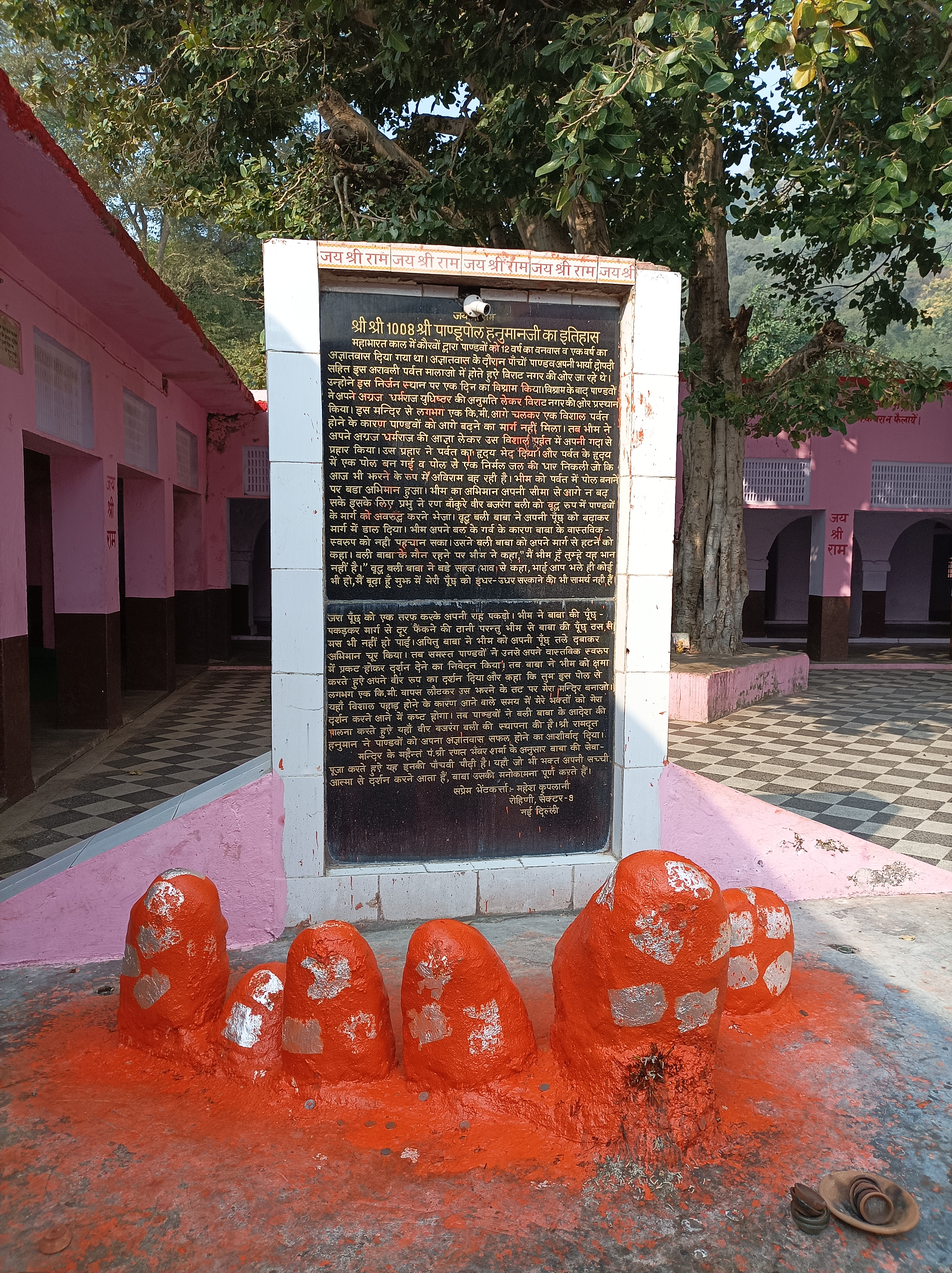 |
| पांडू पोल, सरिस्का |
महाभारतातील दुसरी प्रसिध्द कथा म्हणजे भीमाचे हनुमंताने केलेले गर्वहरण. ही सुध्दा याभागात घडली असे मानले जाते. सरिस्का अभयारण्यात " पांडू पोल " नावाची जागा आहे . (पोल म्हणजे दरवाजा इथे खिंड या अर्थी ) या खिंडीत ही प्रसिध्द घटना घडली असे मानले जाते. याठिकाणी हनुमान मंदिर आणि त्या जवळून वाहाणारा बारमाही झरा आहे.
महाभारतातील विराट पर्वात उल्लेख असलेली तिसरी घटना म्हणजे पांडव अज्ञातवासात वेष बदलून एक वर्ष विराट राजाच्या पदरी राहीले .अर्जुनाला मिळालेल्या शापामुळे त्याचे बृहन्नडा मध्ये रूपांतर झाले होते. त्याने राजकन्या उत्तरा हिची नृत्यशिक्षिका म्हणून भूमिका निभावली. युधिष्ठिराने कंक या नावाने विराट राजाचे मंत्रीपद हाती घेतले होते. द्रौपदी ही विराट नरेशाची पट्टराणी सुदेष्णा हिची केशभुषाकार म्हणून राहीली होती. नकुल हा अश्वपाल तर, सहदेव हा गोशाळा सांभाळत होता. भीम हा बल्लव म्हणुन भोजनगृहात काम करत होता. विराट नगर मध्ये एक टेकडी भीम डुंगरी नावाने प्रसिध्द आहे.
 |
| Remains of Stupa, Virat Nagar |
सध्याचे विराट नगर (बैराट) हे गाव हायवेच्या आसपास वसलेल्या टिपिकल गावांसारखेच आहे. गावातील सर्व प्राचीन , मध्ययुगीन अवशेष मात्र गावापासून दूर असलेल्या टेकड्य़ांवर व त्याच्या आसपास पसरलेले आहेत. प्राचीन मंदिर आणि बौध्द स्तुप असलेली "बिजक की पहाडी" , गणपती मंदिर आणि संग्रहालय, सम्राट अशोकाचा शिलालेख, भीम की डुंगरी, मुगल गेट आणि जैन मंदिर ही ऐतिहासिक ठिकाण आदिमानव काळापासून ते आज पर्यंत या मोठ्या कालखंडाच्या खूणा बाळगून आहे.
 |
| बिजक की पहाडीची पायवाट |
विराट नगर भटकंतीची सुरुवात "बिजक की पहाडी" या स्थानिक नावाने ओळखल्या जाणार्या टेकड्यांच्या रांगापासून झाली. गावाबाहेर असलेल्या या टेकड्यांच्या पायथ्याशी जाण्याकरिता पक्का रस्ता बनवलेला आहे . रस्ता जिथे संपतो तिथे मोठ मोठ्या खडकांनी बनलेल्या टेकडीच्या पायथ्याशी आपण पोहोचतो. पायथ्यापासून एक फ़रसबंदी चढणाचा रस्ता टेकडीवर जातो. पहिली टेकडी चढून गेल्यावर थोडी सपाटी लागते. इथून चारही बाजूला अरवली पर्वताची डोंगर रांग दिसते. उजव्या बाजूला एका टेकडीवर भगवा ध्वज फ़डकताना दिसतो. त्या दिशेने चढ चढतांना वाटेत अनेक वेगवेगळ्या आकाराचे खडक आजूबाजूला पाहायला मिळतात. या भागात लोकांचा वावर नसल्याने पक्षीही भरपूर प्रमाणात आहेत आणि तेही जवळुन पाहायला मिळतात. हे सर्व पाहात १५ ते २० मिनिटात मगरीच्या तोंडा सारख्या दिसणार्या एका मोठ्या दगडापाशी पोहोचलो. मगरीने जबडा उघडावा तसा त्याचा आकार होता. मगरीच्या नागपुड्याच्या भोकांसारख एक मोठा खड्डाही त्या दगडाला पडला आहे. या दगडाखाली असलेल्या गुहेत श्रीराम मंदिर आहे. पांडवांनी अज्ञातवासात असतांना याची स्थापना केली अशी लोकांची श्रध्दा आहे. गुहेत जाऊन श्रीरामच दर्शन घेऊन थोडावेळ आजूबाजूचा परिसर पाहात आणि शांतता अनुभवत बसून राहिलो.
 |
| श्रीराम मंदिर, बिजक की पहाडी |

 |
| Remains of Virat Nagar |
 |
| Water tank at Bijak ki Pahadi |
विराट नगरच्या इतिहासात डोकावल्यास , ख्रिस्तपूर्व पाचवे ते सहावे शतकातील घडामोडींनी प्राचीन भारत खंडाच्या इतिहासावर मोठा प्रभाव टाकलेला आहे. सिंधू संस्कृतीचा र्हास झाल्यावर तेथील लोक पूर्वेकडे यमुना आणि गंगेच्या खोर्यापर्यंत आणि दक्षिणेकडे पसरले. त्यांनी लहान वसाहती आणि खेडी तयार केली, त्या वसाहती किंवा गावांना 'जनपद' असे म्हणतात. कालांतराने ज्या जनपदांची अर्थव्यवस्था, व्यापार मजबूत होता. त्यांनी त्याच्या संरक्षणासाठी सैन्यदल उभारली.आणि शेजारील कमजोर व लहान जनपदे जिंकून आपल्या राज्यात सामील करून घेतली. अशी लहान लहान जनपदे मिळून तयार झालेल्या मोठ्या राज्यांना 'महाजनपदे' म्हणून ओळखले जाऊ लागले. अशी छोटी छोटी १६ राज्ये स्थापन झाली . ती "१६ महाजनपद" या नावांने ओळखली जातात. बौध्द आणि जैन ग्रंथात १)अंग, २) अस्माक,३) अवंती, ४) चेडी, ५) गंधर्व, ६)काशी, ७) कंबोज, ८) कोसला, ९) कुरु , १०) मगध, ११) मल्ल , १२) मत्स्य , १३) पांचाल, १४)सुरसेना, १५) वाज्जी, १६) वत्स या १६ महाजनपदांचा उल्लेख येतो.
 |
| १६ महाजनपद, Courtesy google.com |
प्राचीन भारतात १६ महाजनपदे होती. त्यातील मत्स्य महाजनपद हे आजच्या जयपुर, अलवार , भरतपुर या भागात पसरलेले होते . विराट राजाने स्थापन केलेले विराट नगर ही मत्स्य महाजनपदाची राजधानी होती. मौर्यांच्या काळात विराट नगर हे भारतातले प्रमुख शहर आणि बौद्ध धर्माचे मोठे केंद्र होते. त्याच काळात या स्तुपाची निर्मिती करण्यात आली.
 |
| Cave temple, Virat Nagar |
 |
स्तुपाचे अवशेष असलेल्या टेकडीच्या वर चढून गेल्यावर , एक गुहा मंदिर पाहायला मिळते. या परिसरात झालेल्या उत्खननात विटांचे काही चौथरे पाहायला मिळतात. येथून खालच्या टेकडीवर दिसणार्या स्तूपाच्या अवशेषाकडे पाहिल्यावर (Arial View) काहीतरी गुढ चिन्ह ,आकार दिसायला लागतो. पुरातत्व खात्याने हा संपूर्ण परिसर स्वच्छ, सुंदर , नीटनेटका आणि सुशोभित ठेवलेला आहे.
 |
| गणेश मंदिर, विराट नगर |
बिजक की पहाडी उतरुन संग्रहालय आणि गणपती मंदिर पाहाण्यासाठी गावात शिरलो. गावातील अरुंद रस्त्यावरुन वाट काढत . एका टेकडीच्या पायथ्याशी पोहोचलो . ही टेकडी पण मोठमोठ्या खडकांनी बनलेली होती. या टेकडीच्या पायथ्याशी एक तलाव व संग्रहालय आहे. टेकडीच्या अर्ध्या उंचीवर स्वयंभु गणेश मंदिर आहे. इथले वातावरण बिजक की पहाडीच्या एकदम विरुध्द होत. तिथे एवढ्या मोठ्या परिसरात आम्ही दोघच होतो. इथे मात्र प्रचंड गर्दी होती, टेकडी खालचे पार्कींग फ़ुल होते. प्रसाद, हार विकणारी दुकान आणि त्यामध्ये असलेली गर्दी यातून वाट काढत गणपतीचे दर्शन घेतले . पायथ्याशी असलेल्या संग्रहालयात शिरलो. संग्रहालय अतिशय सुंदर आहे. विराट नगरचा इतिहास वस्तू रुपात खूप चांगल्या प्रकारे मांडलेला आहे, सोबत पूरक माहितीही लिहिलेली आहे.
 |
| Clay Objects, Virat Nagar |
 |
| Punch Marked Coins, Virat Nagar |
 |
| Indo Greek Coins, Virat Nagar |
विराट नगरच्या आजूबाजूला असलेल्या डोंगरांवर अनेक गुहा आहेत. या गुहांमधून आदिमानवाचे वास्तव्य होते. इसवी सन १८७१ -७२ मध्ये कॅनिंग हॅम यांनी विराट नगर मधील अवशेष शोधून काढले. या गुहांमध्ये आणि या परिसरात पुरातत्व खात्याने केलेल्या उत्खननात मिळालेल्या अश्मयुगीन दगडी हत्यारांवरून अश्मयुगीन मानवाचे वास्तव्य या ठिकाणी एक लाख ते पन्नास हजार वर्षांपूर्वी पासून होते असे मत श्री एन.आर. बॅनर्जी यांनी मांडले आहे. त्यांनी कैलास नाध दीक्षित यांच्याबरोबर या ठिकाणी १९६०-६२ मध्ये उत्खनन केले होते . विराट नगर येथे केलेल्या उत्खननात विविध काळातील दगडी हत्यारे, मातीचे भांडी, मूर्ती, विटा, दागिने, लोखंडाची हत्यारे सापडली आहेत . याशिवाय अनेक प्रकारची आणि वेगवेगळ्या काळातील नाणी सापडलेली आहेत. यात Punch Mark coins, Indo Greek coins ( यावर ग्रीक आणि खरोष्टी लिपीत मजकूर लिहिलेला आहे ), मुघलांची नाणी इत्यादी आहेत. या सर्व गोष्टी या ठिकाणी व्यवस्थित मांडून ठेवलेल्या आहेत इसवी सन ६३४ मध्ये चिनी प्रवासी ह्यूएनत्संग (युआनच्वांग) विराट नगरला आला होता. त्याने त्याच्या प्रवास वर्णनात विराट नगरचा उल्लेख केलेला आहे. संग्रहालय पाहाण्यसाठी शुल्क नाही , तरीही बाहेर एवढी गर्दी असूनही संग्रहालय पहायला मात्र दोन चार जणच आले होते. आपल्याच संस्कृती, इतिहासा बद्दल असलेली अनास्था दुसर काय ?
संग्रहालय बघितल्यावर पुढची तीन ठिकाण गावाच्या दुसऱ्या भागात होती. भीम डुंगरीकडे जाणाऱ्या रस्त्यावर "सम्राट अशोक शिलालेख" अशी दिशा दर्शक पाटी पाहून त्या दिशेने चालत निघालो. पुरातत्व खात्याने तिथे जाण्यासाठी पायावाट व्यवस्थित बांधून काढलेली आहे. ज्या दगडावर शिलालेख होता त्यावरही काँक्रीटची शेड बांधलेली आहे. पण शिलालेख मात्र त्या ठिकाणी नाही.
 |
| सम्राट अशोक शिलालेख, |
पुन्हा रस्त्यावर येऊन भीम डुंगरीच्या पायाथ्याशी आलो. या डोंगरावर भीमाशी संबंधित अनेक गोष्टी आहेत. डोंगराच्या पायथ्याशी गुहा आहे त्यात भीम वास्तव्य करत होता, पाऊलाच्या आकाराचे पाण्याचे कुंड आहे. भीमाने लाथ मारून ते कुंड निर्माण केले असे समजले जाते. डोंगराच्या मध्यावर एका गुहेत ११ मुखी शिवलिंग आहे. तिथेच भीमाचे आणि हनुमंताचे देऊळ आहे. भीम आणि हनुमंत हे दोघेही पवनपुत्र, त्यांचे एकत्र देऊळ भारतात केवळ या ठिकाणी आहे. या डोंगरावर अनेक गोलाकार मोठ्या आकाराचे खडक आहेत त्यांना भीम गट्टे म्हणतात. भीम याने खेळत असे . या दगडांना पडलेले खड्डे त्याच्या बोटांमुळे पडले आहेत असे स्थानिक लोक मानतात.

भीम डुंगरी उतरुन मुघल गेट म्हणजेच पंचमहाल जवळ पोहोचलो. हा पंच महाल आमेरच्या राजाने शाही यात्रींसाठी बांधला होता. अजमेरला जातांना आणि या परिसरात शिकारीला आल्यावर अकबर या ठिकाणी थांबत असे. या दुमजली महालात घुमटाकार छत असलेल्या खोल्या आहेत. छतांवर आणि भिंतींवर नक्षीकाम केलेले आहे. महाला समोर कारंजे आहे. मुघल स्थापत्य शैलीत बांधलेल्या या महालावर असलेल्या पाच छत्र्यांमुळे हा महाल पंचमहाल म्हणून ओळखला जातो.
 |
| मुघल गेट (पंचमहाल) |

जैन मुनी विमल सुरी यांनी विराट नगरच्या डोंगरात तपश्चर्या केली. विराट नगर मध्ये आजही भव्य जैन मंदिर आहे. विराट नगर मध्ये असलेले जैन नासिया मंदिर १६ व्या शतकात बांधले होते. मुघल गेट समोर असलेल्या या जैन मंदिराच्या बांधणीवर मुघल स्थापत्य शैलीचा प्रभाव दिसून येतो.
 |
| Jain Temple , Virat Nagar |
 |
| Adinatha, Virat Nagar |
विराट नगर मधील हिंदू, बौध्द, जैन आणि मुस्लिम धर्माचे वेगवेगळ्या काळातील अवशेष, वास्तू पाहाण्यासाठी अर्धा दिवस लागतो.

जाण्यासाठी :-
विराट नगरला जाण्यासाठी जवळचे रेल्वे स्टेशन आणि एअरपोर्ट जयपुर येथे आहे. जयपुर ते विराट नगर हे अंतर १०३ किलोमीटर आहे. या भागात बसेस कमी आणि अनियमित चालत असल्यामुळे खाजगी गाडी करून जावे.
जयपूर - भानगड - विराट नगर हे पाहून एका दिवसात जयपूरला परत जाता येईल.
"सरीस्का व्याघ्र प्रकल्प" विराट नगर पासून १५ किलोमीटरवर आहे. त्यामुळे सरिस्का जवळ राहुनही "विराट नगर" पाहाता येते.
1) "झपाटलेला (?) किल्ला, भानगढ (Bhangarh , the most haunted (?) fort)" हा ब्लॉग वाचण्याकरिता खालील लिंकवर टिचकी मारा
https://samantfort.blogspot.com/2022/11/bhangarh-haunted-fort.html
2) "भीम - बकासूर युध्द आणि विखुरलेले तांदूळ" हा ब्लॉग वाचण्याकरिता खालील लिंकवर टिचकी मारा
https://samantfort.blogspot.com/2024/07/blog-post.html
3) "राणाप्रतापांच्या पाऊलखुणांवर" हा ब्लॉग वाचण्याकरिता खालील लिंकवर टिचकी मारा
https://samantfort.blogspot.com/2017/06/blog-post_16.html
 |
| Shree Ram Mandir built by Pandava |
Photos by :- Amit Samant, Asmita Samant © Copy right
कॅमेरा :- Nikon, P900 , Gopro Hero 5
32 comments:


नेहमीप्रमाणे वास्तूंचे / मंदिरांचे सुंदर परीक्षण आणि सुंदर माहिती
Reply- AnonymousDecember 1, 2022 at 9:05 AM
फारच सुंदर वर्णन, शिवकाळ तून महाभारत, बुद्ध काळा विषयी पण. अमित तुझी इतिहास मांडणी खूप छान. आणि प्रवास वर्ण आणि इतिहास खूपच छान मेळ घातला आहेस. सिंपली ग्रेट. धन्यवाद एका नवीन स्थानाची माहिती करून दिल्या बद्दल.
Reply अमित, नितांत सुंदर लेख.तू केलेले स्थळ वर्णन आणि सोबत पूरक छायाचित्रं यामुळे ही जागा भेट देऊन कधी एकदाचे पहातोअसे झाले आहे.तुला पुढच्या ट्रिप साठी शुभेच्छा!
Replyअतिशय सुंदर लेख आहे. विस्तारपूर्वक लिखाण आहे. महाभारत याचे मला खूप औत्सुक्य आहे. तुझे निरीक्षण आणि लिखाण जबरदस्त आहे. खूप छान वाटले.
Reply
विराट नगर हस्तीनापुरच्या इतके जवळ होते. (त्या काळात खूप दूर वाटत असेल), पण तरीही दुर्योधन पांडवांना शोधू शकला नाहीं याचे आश्चर्य वाटते. एक तर त्याची गुप्तहेर संघटना दुर्बल असावी. कारण कुरुसम्राट या नात्याने तो त्या काळातील आर्यावर्तात एक सामर्थ्यशाली युवराज होता. असो.- नरेंद्र बाळकृष्ण कुलकर्णीDecember 1, 2022 at 1:02 PM
अमित नेहमी प्रमाणे खूप छान आणि सखोल माहिती दिली आहे. महाभारतातील घटनांचा उल्लेख वाचनीय आहे.
Reply
किती दिवस लागले हे सर्व फिरायला? जस्ट माहितीसाठी.
👍👍🙏🙏 
व्वा.. हे फारच इंटरेस्टिंग आहे..खूप छान माहिती आहे..मला अशा पुराणातल्या कथा आणि त्या ज्याच्याशी जोडल्यात ती ठिकाणे पाहायला खूप आवडते. मी त्याच्या सत्य असत्यात पडत नाही. बकेट list मध्ये ठेवते.. कधी योग आला तर नक्की जाईन.फोटोही मस्त..
Replyअतिशय बारीक बारीक खुणा व त्या बाबतची माहिती दिली आहेस. मस्तच लिहिलं आहेस
Reply- Aarti DugalDecember 3, 2022 at 6:37 PM
नेहमीप्रमाणेच माहितीपूर्ण लेखन.. वर्णन मस्त.. बसल्याजागी विराट नगर फिरून आले..
Reply
- Aarti Dugal - AnonymousDecember 3, 2022 at 9:36 PM
अमित जी खूपच अभ्यास पूर्ण माहिती दिलीत.इतिहासात घेऊन गेलात. धन्यवाद
Reply - AnonymousDecember 10, 2022 at 3:33 PM
अभ्यास, निरीक्षण ,लिखाण ,मांडणी आणि वाचकांसमोर वास्तव चित्र कस उभाराव हे आपल्या कडून शिकतोय,,,, खूप छान माहिती ,,,,
Reply सुंदर लेख. सौंदर्य लेखनातील. सौंदर्य मांडणीतील. पौराणिक कथा व इतिहास याची सांगड घालत असताना चौकस बुद्धी काहीतरी पुराव्याच्या शोधात असते. आपले लेख वाचताना ते सापडते. सिंधू संस्कृती व महाजनपदे यांचा संबंध, आदिमानवाच्या अस्तित्त्वाचा काल, हिंदु बौद्ध व जैन या भारतीय संस्कृतींचा परस्पर संबंध विशेषत्त्वाने एकत्रित भूतकालाची जाणीव करुन देतात. अप्रतिम माहिती. पुन्हा एकदा धन्यवाद डोंगरभाऊ.
Reply- AnonymousMarch 18, 2023 at 7:35 PM
सुंदर लिखाण उत्कृष्ट छायाचित्रण महाभारतातील माहीत नसलेली माहिती दिल्याबद्दल धन्यवाद
Reply सुंदर लिखाण आणि फोटोज डोंगरभाऊ, तुमचा प्रतेक फोटोच अनेक कथा सांगतोय, आम्हाला सैर करुन आणल्याबद्दल धन्यवाद!
UNSEEN RAJASTHAN: AN OFFBEAT JOURNEY THROUGH THE RURAL RAJASTHAN! ONCE IN A LIFETIME!
Top Offbeat Things To Do In Rural Rajasthan: This
winter why not traverse through the less explored offbeat destinations
in Rajasthan. Be there before tourists throng it! Incredible India!

Every year in winter, tourists from across the world and India inundate the famous cities of Rajasthan. However, if you are bored of the cliched destinations in Rajasthan, I would suggest a detour to its rural landscapes.
There are so many offbeat places to see in Rajasthan such as Garadia Mahadev Temple near Kota , the nearby Bundi, Unexplored Chittorgarh, Ranakpur Jain Temple, Underrated Alwar and so many more. I can never get bored of Rajasthan!
In my solo road trip to the offbeat and rural Rajasthan, I realized that is where the true heart of Rajasthan lies. Offbeat Rajasthan is raw, real, quirky and hospitable! I hopped on to the ever reliable Rajasthan State transport buses and Indian railways to make this journey to the far interiors of Rajasthan happen. I discovered the true beauty of this Royal State like never before. I have seen so much of Rajasthan and it still never fails to surprise me. During my journey, I also happened to unearth the heartwarming stories of man and animal living in harmony, very unique to this state.
PUSHKAR
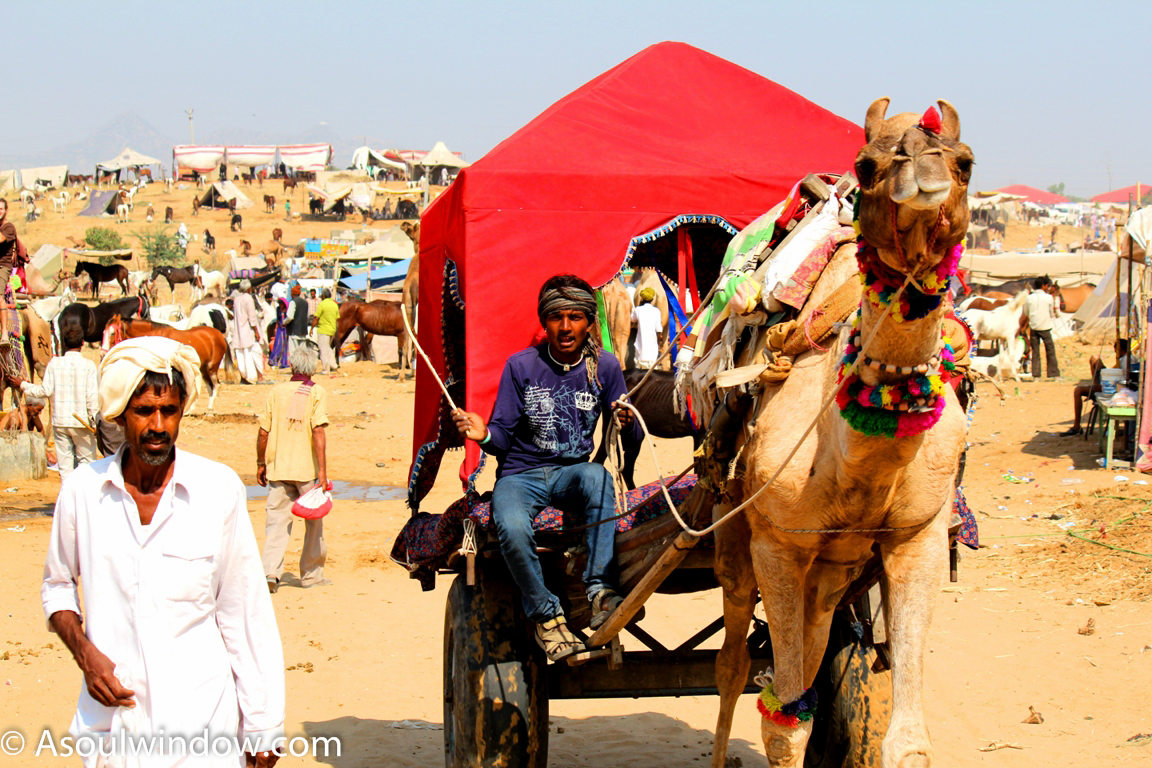
Pushkar fair needs no introduction. It is one of the most popular and largest cattle fair not only in India but in the world. There is plenty to do here. Hot air balloon rides, rural Circus shows, seedy magic shows, rural sports, and sumptuous food had me hooked for 2 days. I could not resist ODing on Daal-Bati-Churma (Dough Balls served with lentils and sweet powder), lasoon Ki Chutney (Garlic sauce) and gatte ki sabzi (Curry of gram flour cakes) in the many restaurants that line the streets.

An ‘open to all’ impromptu magic show on grounds (pay as you like!) had the audience riveted. My city bred mind was amused to see the spectacle. The snake charmer had his own stardom. After downing countless sips of tea from kulhad (mud cup), I headed to Pushkar lake. Claimed by humans and pigeons alike, the lake oozed spirituality as thousands thronged to take a dip in the holy water. Soon a religious procession at a road nearby distracted me.

Hundreds marched in colorful attires, crushing softly the fragrant rose and marigold flowers beneath their bare feet. Absorbing the hedonic scents, I moved to the bus stand for a quick stop at Ajmer. I spent some time admiring the sunset at the Anna Sagar lake in silence. Not far away was Ajmer Shariff Dargaah. I couldn’t resist a soul stirring qawwali session. Being a vegetarian, I stayed away from the restaurants, though binged on the sweets at street shops. ‘Dhai Din Ka Jhopra’ nearby is a must, but before sunrise.
KHICHAN
Sevaram Malli Parihar, who lives in the nondescript dusty village Khichan, has been awarded several times for his focused wildlife conservation efforts. Some 20,000 demoiselle cranes migrate to Khichan and surrounding areas from Siberia every year in winter. He has worked overnight to ensure that the birds are not harmed by human intervention, electric poles, the works!
He has a set routine every morning. His day starts with feeding countless number of cranes in a bird feeding ground facing his house. He often identifies any injured bird and gets them admitted to an animal hospital nearby if required. The birds have invented a routine for themselves as well. They feed in batches in a disciplined manner. I was amused to see how the second batch of cranes waited patiently outside the fence of the feeding ground until. They didn’t enter until the first batch is at least halfway through the feed. Such discipline!

After talking to Sevaram and spending quality time with him, I was impressed with the determination of a ‘powerless’ man. It’s humbling to see how an uneducated village man brought about enormous change in the attitude towards wildlife conservation. I have always maintained that only locals with the help of government can help sustain and bring momentum to wildlife conservation. Such stories restore my faith in humanity. It is heart-warming indeed to witness the one of its kind cordial relationship the cranes share with the local villagers and animals. Rajasthan sure knows how to extend its hospitality to human and animals alike.
OM BANNA TEMPLE

Om Banna is a unique temple, only one of its kind in India. The diety worshipped here is a 350 cc motorbike and not a clay idol. It is situated on the highway towards Pali and the nearest big city is Jodhpur. The owner of the motorcycle was one Om Singh Rathore. The folklore has it that some years ago, he met an accident and perished at the spot where a tree still stands (and worshipped). It is said that the police locked the bike many times in the station. Every time, the same bike re appeared at the accident spot, as if by magic! The word spread far and wide and today pilgrims throng the place and offer their prayers. The bike has finally been relocated to the spot, a little away from the tree, owing to the sentiments of the ‘pilgrims’. The much revered tree exists at the exact spot. The temple and the bike has been shifted a little beyond in order to avoid disruption in traffic.

Some of the thousands of devotees who throng every day, offer alcohol as a tradition. I saw many newly weds visiting the temple. It is considered auspicious to do so. The ‘God fearing’ passer byes often make a stop at the temple. The legend has it that doing so ensures safety on the road. I was amazed and amused to hear the customized Om Banna Aarti being belted passionately by the local singers. The roadside shops sold only Om Banna merchandise such as Om Banna stickers, Books, CDs and Decorative pieces. Faith has many faces in India.
BIKANER

The world knows Bikaner for its famous aaloo bhujia, but did you know about the secrets that it hides? The narrow lanes of the old city boast of many drop dead gorgeous havelis. As I made my way through the winding lanes, the ancient havelis struck with their grandeur. The exquisitely carved haveli display varied embellishments and architectural styles.

If you are attentive (and erudite), it’s easy to spot Mughal, Rajpoot and even British architecture style on the havelis’ façade. Some craning of neck helped me to appreciate the beauty of the delicate stone jaali, chajjas, windows, et al. The red sandstone gives the haveli a character of its own. I think it is best to make a visit early morning since there is not much traffic in the streets. That said, really early morning is the trick, lest be prepared to get embroiled in the morning rush hour. You can easily lose track of time as you explore the serpentine roads, admiring one haveli after the other. These havelis are unique to Bikaner. I found some havelis locked up. However, the locals still live in many of these.
Karni Mata Temple

In Rajasthan the curious can find many quirky places. Top position on that pyramid is perhaps claimed by the Karni mata temple world famous for the thousands of black rats it shelters. And worships! 30 kilometers away from Bikaner, Karni Mata temple at Deshnoke, is also known as, the temple of Rats. Rats rule here and how! There are theories galore on how and why the people of Rajasthan began worshipping the approximately 20, 000 rats in this temple.
It is said that despite such huge numbers the place has never fallen prey to any epidemic. I could not walk smoothly without bumping into a rat. In this temple if you step on a rat, you have to pay hefty fine. It is accepted that if a rat crosses your leg, luck will be on your side. That said, if you have been able to spot a rare white rat it is said to bring you even better luck. Many rats did cross my legs though I am not sure if it brought me any luck or not.
They were every-where, feeding off the milk pot, resting in the holes, fighting for a spot in the holes, sharing the abundant food quietly, the works!
TAL CHAPPAR BLACKBUCK SANCTUARY

So few wildlife sanctuaries in the world allow you to explore on your own, without a guide, on foot! Tal Chappar lets one walk in the sanctuary at your own pace. This is exactly what I did one fine winter morning. The haven for blackbucks and other species such as wild boars, neelgai and many birds, Tal Chappar is an under rated delight. Early morning and evening is the best time to appreciate the beauty of this land and its inhabitants.
FACT FILE
How to reach by Train (In logical order)
Pushkar:
Train Number: 19032, Yoga Express
Destination: New Delhi (21:25, day 1) to Ajmer (6:40 a.m., Day 2)
Khichan and Om Banna temple
Train Number: 15014, Ranikhet Express
Destination: Ajmer (13:40, Day 1 ) to Jodhpur (17:35, Day 1)
Bikaner
Train Number: 14708, Ranakpur Express
Destination: Jodhpur (10:00, Day 1) to Bikaner (15:35, Day 1)
Karni Mata Temple:
(Road Trip from Bikaner)
Tal Chappar : Reach from Bikaner
There is much more to see in Rajasthan, easily one of my favourite states in India. Rajasthan Tour Packages helps in traveling through the state hassle free.

Note – A different version of this article was published as a cover story in the official railway magazine of India called Railbandhu.
Spread the love, share this blog
Got any question/comments, ask in the comment section below so that it can benefit other readers.
Be a part of my journey on social media. The travel content I create there is different from this blog.

Pls subscribe/follow/like:

WARNING : COPYRIGHT TO ALL THE IMAGES AND TEXT HERE REMAINS WITH ME. YOU CAN NOT JUST LIFT THE CONTENT AND USE IT WITHOUT MY PERMISSION. STRICT LEGAL ACTION WILL BE TAKEN IF CONTENT IS STOLEN. YES, I AM SERIOUS.
Pushkar Fair: Biggest & Most Complete Guide on Internet
About Pushkar Fair
Just half an hour and a ₹20 bus ride away from Ajmer lies Pushkar, a little-known gem of a destination. Every year in November, this otherwise sleepy, low-profile town transforms into a magical cultural cauldron that showcases the very essence of Rajasthan. So, what can one expect in this vibrant melting pot? Endless parades of quirkily decorated camels and horses, festivities that bring rural life alive in its rawest form, music and dance echoing through the air, holy dips in the sacred lake, roadside magicians, madaris, entertainers, circus acts, seers and saints, wide-eyed foreign visitors soaking it all in, thrilling rides and swings, riots of colors, lip-smacking local food, and an unmistakable atmosphere of faith, spirituality, and joy.Most of these experiences are absolutely free, making Pushkar not just a traveler’s paradise but also a photographer’s dream. People from across the world flock here for this annual celebration of Indianness—and almost all leave with broad smiles and unforgettable memories. Truly, it’s a once-in-a-lifetime opportunity to experience India in its purest, most unfiltered form.
Visiting the Pushkar Fair as a solo Indian male traveler was a vibrant and unforgettable experience. The moment I entered the bustling fairgrounds, I was greeted by a riot of colors—camels decorated with bright ornaments, women in dazzling Rajasthani attire, and the aroma of local snacks like kachori and malpua. Being on my own gave me the freedom to wander through the camel trading areas, where herders bargained passionately, and to linger at the many cultural performances without worrying about anyone else’s schedule.
I spent hours watching folk dancers twirl to the beat of traditional drums and enjoyed impromptu conversations with locals who were eager to share stories about their camels and traditions. The fair felt completely safe, even late in the evening when the crowds grew thicker and the lights from the Ferris wheel sparkled across the desert night. I joined groups of fellow travelers around bonfires, exchanging travel tales while sipping hot chai. Exploring Pushkar town itself—its ghats, the sacred lake, and the Brahma Temple—added a spiritual layer to the adventure. Traveling solo allowed me to soak in the atmosphere at my own pace and connect deeply with the culture, making my visit to the Pushkar Fair both personal and enriching.
GO NOW: Many buses at regular interval ply from Ajmer to Pushkar. Best time to visit is during the fair.
My Experience of Pushkar Fair
I arrived alone at the Pushkar fair from Ajmer via public bus. That’s the fun of solo travel. You can choose your mode of transport and what time you want to reach a place. It was late evening when I booked a dingy room for INR 350. People scared me that Pushkar will be full and that no hotels will have availability of rooms. My experience in travelling across India is that, no matter where you are and what time it is, there is always a room available. My room had a great view of the ancient, ‘Old Rangji temple’. Built in 1844, it looked beautiful in the night lights. After admiring its beauty, the first thing that I did was to lock my luggage in the room and rush to the main event area, i.e. the Stadium and the Camel ground of the Pushkar fair. A 10 minutes’ walk away from my hotel, I expected the main ‘mela’ (fair) area to be buzzing with activity.

Even at 7:30 p.m., Stadium and the Camel ground of the Pushkar fair was not overcrowded. A moderate crowd had gathered around a stage in the sprawling stadium to enjoy some cultural programme which included Rajasthani folk songs and dances, Kathak, ‘hasya sammelan’ (stand-up comedy) etc. Though I am a sucker for Indian traditional performing arts but I was somehow disappointed and bored with the performances (It was too gimmicky and touristy for me). I had seen far better international level performances at annual Kala Ghoda Arts Festival (Every February) in Mumbai, India. Given the international stature of the Pushkar fair, the performances were mostly amateurish and of school – college level.
Bride competition was unfolding on the stage when I arrived. Girls of different nationalities except Indians dolled up in Indian bridal wear and sashayed on the stage competing for the Best Bride trophy. It was cute to see European , American , South East Asian girls dressed up like an Indian bride. The pageant was won by Ms. Japan and runner up was Ms. Netherland. Yawn!
Events at the Pushkar Fair, Rajasthan: Games Foreigners Play
This section of the blog is about how foreigners enjoy the Pushkar fair in Rajasthan. I would suggest assign an entire day in Pushkar fair to attend activities and sports organised by the Pushkar fair committee. The brochure which I picked up has a list of programmes scheduled to be held such as the kabaddi match, the milking session, the camel race etc. but not a single program started at the time mentioned on the brochure resulting in me missing many events. Last day though I got lucky and witnessed some sport events. Starting with ‘Matki-fod’ (Break the pot), two teams were formed on voluntary basis, one comprised of Indians (locals) and the other an eclectic mix of men from different nationalities. So, we had an American, A Spanish, a Japanese, an Australian etc.
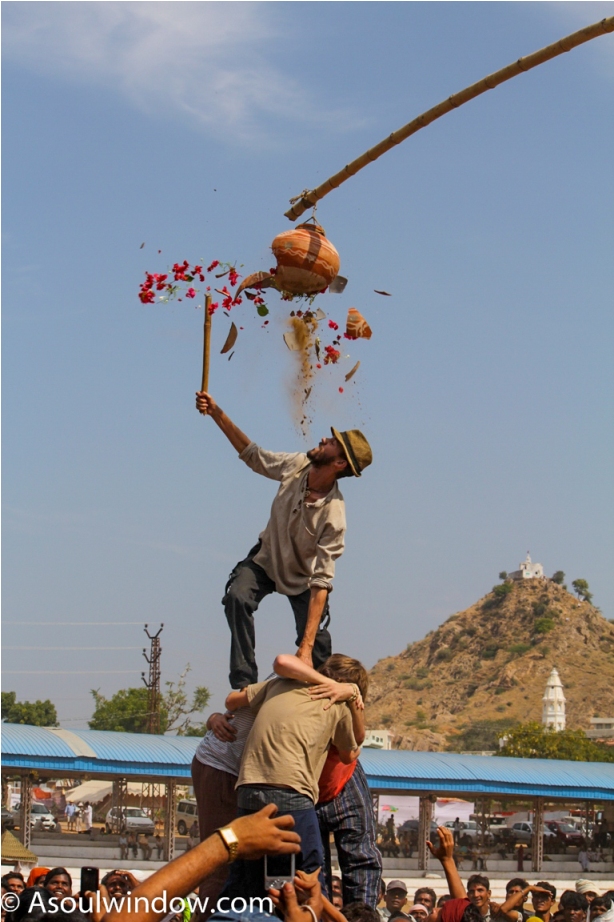
Two ‘matkis’ aka clay pots were hung up in the air. The game was simple: Form a human pyramid and break the matki hung high in the air. The team which breaks first is the winner! Few rounds of practise was allowed to rehearse the same because for most of the participants, it was a first time activity and most had volunteered to participate on a whim at last minute. That’s the spirit of Pushkar fair! Things are very spontaneous here. We even had a cheerleading group. Some foreign girls in their 20s got really excited with all the action and enjoyed hooting while our desi counterparts, i.e., the local Rajasthani girls also in their 20s were coy in their own land and watching the game covered in their translucent veil, hiding behind the pillars and shyly smiling at the going ons. I couldn’t help but marvel at this huge social-cultural-religious difference. Somehow, I was sure that the Indian team would bag the prize, but surprisingly the foreigners won the game by a whisker. But it was fun, prize was not the agenda here, having fun was! As they say, “When in Rajasthan, do as the Rajasthanis do.”
The all women race like no other: Then I witnessed another amusing game where women of mixed nationalities raced with each other. The Pushkar twist here is that they will have a large water filled clay pot on their head while they ran. On reaching the finishing line, the contestants have to remove the pot from the head and break on the dusty ground. Whoever does it first wins! The foreign woman who won could not contain herself and was delirious with joy. What fuelled her excitement was a news channel who interviewed her with platitudes like, “How do you feel?” to which she replied animatedly. So, do you want your proverbial 15 minutes of fame. Come to Pushkar fair!

Lagaan like hockey match between Indians and foreigners: I also got to see a kabaddi match and a hockey match involving the locals and foreigners. It is this involvement with local culture and a heady mix of activities, food, shows, performances, shopping and the bizarreness and quirkiness of it all that attracts foreigner traveller. All this at a shoestring budget! No wonder some tourists return to the fair like migratory birds year after year! It’s that addictive! Many of these foreigners come from countries from Europe and America such as U.S.A., Mexico, Denmark, Finland, Italy, Netherlands, Norway, Spain, Sweden, Switzerland, United Kingdom etc.

One of the most entertaining parts of the Pushkar Fair is watching the quirky games that attract foreign travelers. During my visit, I was amazed by the sheer enthusiasm with which visitors from all over the world joined in these friendly competitions. The moustache contest, usually a local highlight, suddenly became more exciting when foreigners tried to compete with Rajasthani men sporting magnificent moustaches. Laughter echoed through the fairgrounds as participants posed dramatically for the crowd. Another crowd-puller was the turban-tying competition. Watching foreign travelers struggle to wrap the long, colorful Rajasthani turbans was pure joy.
Some managed to create elaborate headgear, while others ended up with hilarious, lopsided results, cheered on by locals. Camel races, too, drew many adventurous foreigners who couldn’t resist the thrill of riding a decorated camel across the sandy arena, often waving to the spectators like royalty. However, as I keep repeating, I am against any animal rides. I also spotted impromptu yoga challenges, balancing acts, and even a tug-of-war between international visitors and local teams. These games were light-hearted but served a deeper purpose—they brought people from different cultures together. The playful energy and cross-cultural bonding turned the Pushkar Fair into more than just a camel and cattle festival; it became a global celebration of fun and friendship.
Also Read: Indian traveling to Pakistan to celebrate Mahashivratri in Katas Raj Temple

Foreigners Dressing as Indian Bride Is a Rage!
There were foreign women dressed up as Indian village belles. One of them was sitting pretty in a camel cart complete with bridal frills such as flowers, decoration and a ghoonghat. Ghoonghat is a veil worn by North Indian women to cover their face. And I have observed the more an Indian woman covers up, more shy she is! I was wondering what she was thinking in that ghoonghat. One of the most striking sights I encountered at the Pushkar Fair was the number of European and American women who dressed as traditional Indian brides. Walking through the bustling fairgrounds, I often saw foreign women draped in vivid Rajasthani lehengas, their hands decorated with henna, and their faces adorned with bindis and ornate jewelry.
Many of them had hired local makeup artists and photographers to recreate the full bridal look, complete with elaborate hair styling and glittering accessories. At first, I was surprised by how authentic they appeared. The colors of the lehengas—deep reds, vibrant pinks, and shimmering gold—looked stunning against the desert backdrop. I noticed groups of locals happily posing for pictures with them, treating the whole experience with warmth and curiosity.
The foreign women seemed equally excited, laughing and twirling as cameras clicked. For these travelers, dressing as an Indian bride was less about cultural appropriation and more about celebrating the beauty of Rajasthani tradition. Many foreigners told me they saw it as a once-in-a-lifetime chance to immerse themselves in Indian culture during the iconic fair. Watching them interact with locals, I felt the Pushkar Fair truly lived up to its reputation as a cultural bridge, bringing worlds together in colorful harmony.
Don’t Miss: Drayang Dance Bar Trail- The open Secret of Bhutan
Sex Sells in Pushkar Fair: Offbeat Solo Budget Trip in Rajasthan, sexual innuendos galore
This blog section is about the underbelly of Pushkar Fair, the sexual content of magic shows, vulgar video CDs and more. On one of the days at the Pushkar mela, I came across a seedy ‘Magic Show’ which ran every day in a makeshift tent. Large posters, kitschy and loud, promised that ‘Jaadugarni Zareena’ (magician Zareena) will move her magic wand and turn a skimpily clad bimbette into a skeleton or rose or even a man (Ardhanarishwara much?)! Phew! You name it, they have got it! The models on the posters rather dressed up provocatively, of course to serve as a bait for the sexually suppressed Indian male. The voluptuous ladies strutted their stuff with bursting cleavages, purposely malfunctioning dresses and garish make up. A badly photoshopped Michael Jackson gave the girls company in his outdated ‘Dangerous’ poster. Tired, I promised myself that I will attend this erotic magic show the next day. Who doesn’t want this village girl turn into a rose flower,eh!?

Then what caught my attention were the loud Video CDs blaring at full volume. To lure shoppers, vendors played the videos showing some weird dances and songs in Rajasthani. The lyrics were all double meaning laced with not-so-subtle sexual innuendos accompanied by some suggestive raunchy moves. Interestingly all the female models were bewitching beauties while males were all weirdoes doing weird things such as dancing suggestively and goofing around with the drawstring (‘naada’) of their pyjamas, much this this fun song that I love: Ganga Paar Se Udi Titahri.
The titles were just as cheesy and crying for attention. Sample this:
- Chammak Challo jalebi bai, Angrejan naache gela mein (The foreign lady dances in …….dunno??)
- ‘Jeeja saali bulaave jaldi aa ja’, • Pushkar mein dhincha-chika (Whatever!)
- “Main to Pushkar mein rapat padi’.
- Jeeja Aaja Kothe Mein- means “Hey Brother-in-law, come to the rooftop, wink wink!” (Got the drift, eh?)
Don’t ask me to translate these please! Priced at Rs. 25/- I bought 2-3 to show off to myfriends in Mumbai and to enjoy the weird dances later on. 3 days in Pushkar fair, Rajasthan gave me lots of good pictures, amusing moments and some great stories to share with friends and family. Though 2 things still eluded me. I was unable to find time to see the sexually charged magic show. Also, a friend of mine called up and told me that there were some vulgar dance shows going on surreptitiously in some dubious tents. The kind of shows where men lech and women dance suggestively and seductively. Think ‘bidi jalai le’. Think Billo Chaman Bahar for real. He said that the same was continuously flashing on the news channels. Having a knack to experience things done clandestinely, I was desperate to catch the show and the underbelly Of Pushkar fair. I enquired, even peeped inside some tents but erotica escaped me. And I gave up! Maybe it’s the excuse of my next Pushkar fair trip.
While most visitors associate the Pushkar Fair with camel trading, colorful bazaars, and devotional music, I was surprised to discover another side hidden inside some of the large temporary tents at the edges of the fairground. After sunset, a few of these tents host stage shows that are far more provocative than the family-friendly folk performances taking place in the main arenas. Curious, I stepped inside one such tent. The atmosphere was electric: flashing colored lights, pounding Bollywood remixes, and a crowd made up mostly of men.

On stage, dancers in shimmering outfits performed routines that were undeniably bold—full of flirtatious moves, hip sways, and suggestive gestures that pushed the line between traditional Rajasthani folk dance and outright cabaret. The audience responded with loud whistles and cheers, clearly treating it as entertainment rather than a cultural performance. Locals later told me that these shows are a long-standing, if unofficial, part of the Pushkar Fair, catering to those seeking nighttime thrills after a day of trading and festivities. Though not openly advertised, word of mouth draws large crowds. It’s an eye-opening contrast to the fair’s spiritual and rustic daytime character, revealing how Pushkar after dark offers experiences that are far more risqué and unexpected.
The view from my #SoulWindow is almost erotic!
Offbeat Rural Circus: Top Thing To Do In Pushkar Fair
“Bhaaiyo, maataon aur beheno…jaldi aaiye …Circus shuru aur chaalu ho gaya hai!” It translates to: Brothers, mothers and sisters, come fast. The circus has ‘begun’ and ‘started’. I can’t figure out what is the difference between chaalu and shuru though!
Translation: “Brothers, mothers and sisters…. come rushing…. The circus has ‘started and started’. Come, see a guy eat fire…see a 10 feet tall joker…and make it fast, the time is running out…” As soon as I exited the stadium, this ear piercing and irritating announcement meant to stir ‘Fear Of Missing Out’ and anxiety within you, drew my attention. And like a possessed snake enticed by the irresistible call of snake charmer, I got hypnotised and rushed towards the direction the sound was coming from. I had been resisting entering this circus for 2 days now. Especially after seeing all the chaos and experiencing real outdoor Circus (read Pushkar fair), I thought I had had enough. But not having anything else to do, I collected all my courage and decided to give it a shot. After confronting the ticket seller who tried to con me by Rs.20/- (Eh, big deal?), I entered ‘The Circus’. I am totally against animals working in Circuses and that’s why it was after 20 years that I entered one only after confirming there were no animals in this Circus.
But it was not the kind of Circuses I have seen so far. First thing that strikes me is there are no chairs here. Instead, you have to sit/sprawl/squat/lie down on the much soiled ‘dhurries’ (carpets) spread untidily on the floor. Priced at Rs.30/- it was a jam-packed houseful show. Audience was mostly full of rural folks. I could spot only 4-5 urban people in that circus, who, I am sure are pulled here by curiosity, like I was. There were also Lord Shiv and Goddess Parvati who had descended on Earth to watch this Circus. Well, they were actually small kids who earned money by dressing up as the Gods and Goddesses from the Hindu pantheon. Bored of their job, they must have decided to chill and watch the show. There was only one foreign couple in their early 30s sitting ‘althi-palthi’ (cross legged) right in front of me.

The Circus had several skimpily clad girls (One even from North East of India whom they were promoting as the exotic Japanese doll) who performed many familiar circus acts such as juggling bottles/plates/balls, blowing fire from mouth, rings looping round the performer’s arms, legs, waist etc. Even though I had seen most of these acts ad nauseum, yet it was riveting to watch it in a rural setting. The agility and perfection of the nubile teenager girls had me in splits. But I was wondering if they loved their job. I tried to dig deeper, beyond the ha ha and hi hi’s. Indians sure know how to juggle through life full of struggles. The only male performer in his early 20s looked like an angry young man, full of angst. The eldest (must be in her 40s) lady looked grumpy and angry (With life? Her circumstances? With breakfast?) and performed passionlessly the acts (though with perfection). Amidst nubile nymphets, she looked incongruous with her extra weight and tight clothes. Who knows in her prime she might have been a Circus star. And happier?
The other two girls looked glamorous but lifeless, trying hard to appear entertaining to a gobsmacked audience who has never heard of Moulin Rouge. The only happy looking girls were the two better looking girls (with little grooming, they could rock the fashion world). Maybe all the male attention and a super-star status helped bringing smiles to their faces. What irked me though were the clowns. Each and every joke by them fell flat. No one laughed at their slapstick buffoonery and histrionics, not even the kids. The only saving grace was the 10 feet tall joker, who brought some drama in the mundane proceedings.
Observing the ‘thanda’ (cold) response from the audience, the foreigner lady in front of me took the onus of cheering the performers on her shoulders. After every act, she and her boyfriend would scream ‘Bravo!’ earning glances by fellow audiences. She was continuously laughing hysterically, and at one point of time, she got carried away and French kissed her boyfriend for at least 30 seconds. In the process she almost laid down on the carpet, kissing and cuddling and frightening and scandalising the veiled rural ladies sitting next to her. Uncles didn’t seem to mind though! I almost laughed out seeing the freaked-out expression of the village ladies. No one raised an alarm or did moral policing though. Tolerance much in Incredible India! Pushkar fair is the right place to observe the juxtaposition of the East and the West, two cultures poles apart! As different as chalk and cheese! The circus was a quicky. It was over within 45 minutes. It was worth it!
Here is a summary: Tucked away from the camel auctions and the bustling handicraft stalls of the Pushkar Fair, I stumbled upon this ramshackle tent that housed what locals called a “rural circus.” Intrigued, I followed the sound of beating drums and excited chatter. Inside, the atmosphere was worlds apart from the vibrant folk music and devotional aartis elsewhere in the fair. Carpets surrounded a small dusty ring where performers—many of them teenagers or families—put on daring acts with nothing more than ropes, bamboo poles, and sheer grit. Acrobats swung from makeshift trapezes, balancing with remarkable poise despite the creaky equipment. A wiry young man rode a vintage motorcycle inside a “well of death,” its rickety wooden walls trembling as the crowd gasped. Fire-eaters, jugglers, and tightrope walkers took turns to keep everyone spellbound. There was no glitter or grand sets—just raw skill and centuries-old showmanship passed down through generations. What struck me most was how the performers engaged directly with the audience. They cracked jokes, improvised stunts, and invited children to join in simple games. This offbeat rural circus revealed a side of Rajasthan’s folk entertainment that felt authentic and unscripted, a living reminder of India’s grassroots artistry thriving far from the big-city glamour.
Also Read: Indian traveling to Pakistan and visits Daman-E-Koh in Islamabad
Photography Tips for Pushkar Fair
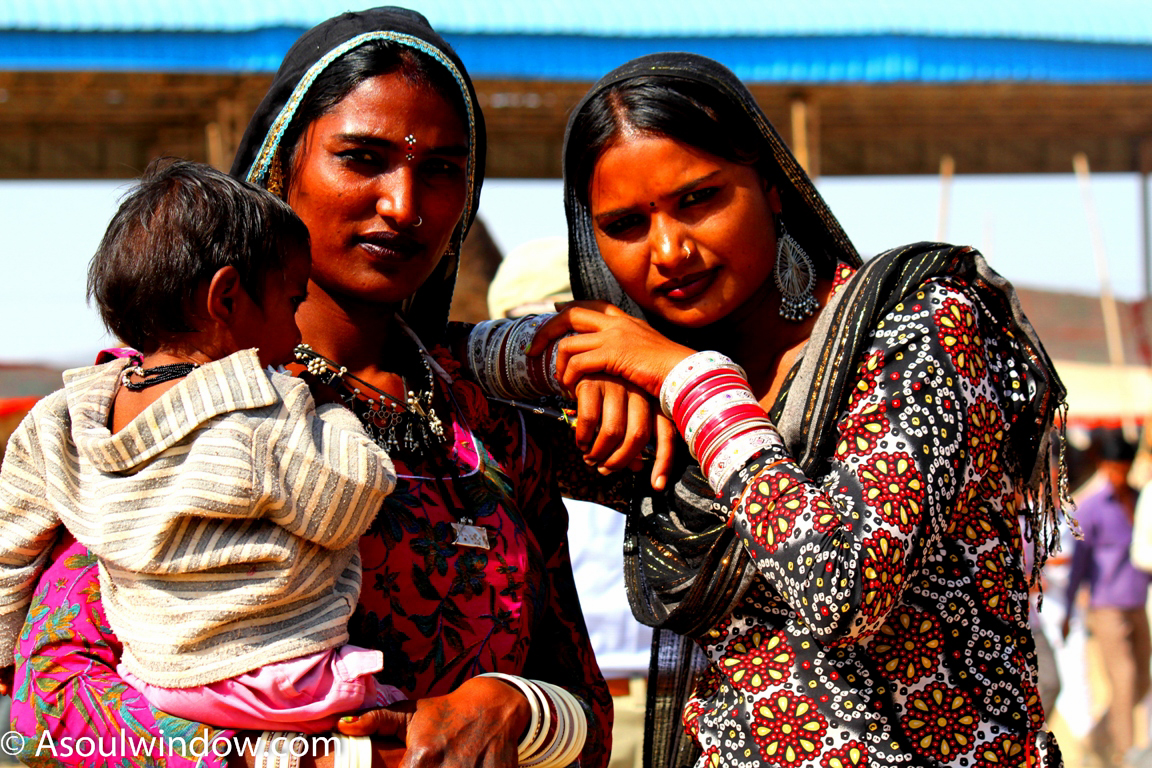
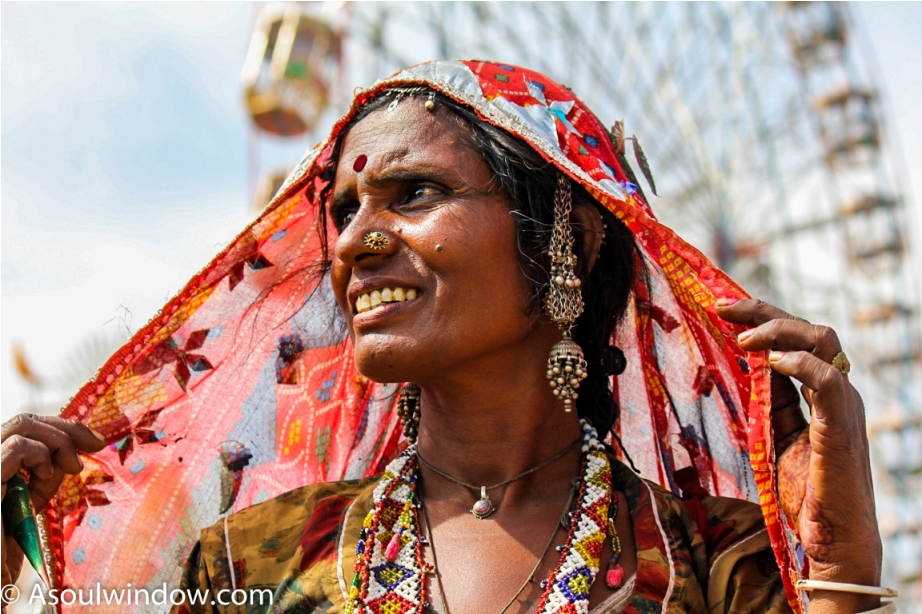
Pushkar fair is a photographer’s and sketcher’s delight! Especially the way people dress up in traditional attire with bizarre ornaments. Picture this: Bangles which cover every inch of the arm, making them look like as if they are wearing a water tumbler. I started shooting some of them in the stadium grounds. Once done, turned out they were charging to pose as models. Everyone from a ‘sadhu’ to a rural Rajasthani housewife and children were willingly posing if you paid them. Amused, I didn’t mind it as their fees ranged between a throw away Rs.30 – Rs.100. The more pictures you click and the more you waste their time, more the fees. The foreigners had it tougher. They had to dole out much more money than what I did. And like me, while clicking even they were not aware that these ‘models’ charge. So, I was amused observing them being stuck in this sticky situation. But once you pay them, they’ll give you good results. They even know some winner poses at the back of the mind which would make a top model run for her money. The local woman who doubles up as a model are indeed a rage in Pushkar fair. Here is another photography tip for Pushkar fair. For a vantage point which offer’s bird’s eye view, go for a ride in the Giant Wheel. When the wheel momentarily stops at the top, you can take amazing panoramic pictures of Pushkar. You can even pay the ride owners so that they stop the ride at the top most point for a longer duration.

Photographing the Pushkar Fair is an immersive experience where every corner brims with vibrant colours, dramatic textures, and fleeting human stories. To capture its essence, start early in the morning when the soft golden light enhances the desert landscape and the camel traders prepare for the day. This is the best time for wide-angle shots of the misty dunes dotted with camels and their herders. As the sun climbs, switch to a mid-range zoom to frame the intricate details of Rajasthani turbans, embroidered textiles, and the expressive faces of locals and visitors. Pushkar’s bustling lanes, with their painted facades and sacred ghats, offer endless opportunities for candid street photography—be patient and let moments unfold naturally. During the famous camel contests and cultural performances, use a fast shutter speed to freeze action while keeping an eye out for spontaneous interactions between performers, animals, and onlookers.
As a foreigner, for portraits, ask permission whenever possible, especially when photographing rural women or sadhus; a friendly smile or a few words in Hindi can open doors to genuine expressions. Evenings bring magical reflections on the Pushkar Lake during the aarti, where a tripod helps with long exposures of flickering diyas and illuminated temples. Don’t overlook the night markets lit by lanterns—perfect for experimenting with low-light techniques. Always carry spare batteries and memory cards, as the fair’s dynamic energy tempts you to shoot continuously. A lightweight camera bag, dust protection for your gear, and a versatile lens kit—wide-angle for landscapes, prime for portraits, telephoto for distant action—will serve you well. Above all, blend in and move slowly; the best photographs come when you connect with people and respect their space, allowing the fair’s timeless atmosphere to reveal itself frame by frame.
Portraits of Interesting People I Met in Pushkar Fair, Rajasthan
This section of the blog is about the stories and portraits of interesting people I met in Pushkar fair, Rajasthan. Nothing goes waste in resource deficient Rajasthan. At many places, I saw women making balls of Camel dung. On inquiring, one of them replied to me that on drying it will be used as a fuel for cooking. Al Gore and Greta Thunberg will be one happy person! Thanks to India still holding close to its chest, its traditions, its need-based habit of recycling and an old-world eco-friendly lifestyle (stemming out mainly from pragmatic reasons), we do unintentionally help in bringing down our carbon footprint on Earth. I enjoyed taking pictures of that woman, with permission of course and moved on to my next subject.

Portrait photography at the Pushkar Fair is a deeply personal experience for me, because every face tells a story of the desert. I always begin my day early, when the light is soft and golden, wrapping the fairground in a warm glow that flatters skin tones and adds depth to textures. Before I even lift my camera, I take time to connect with the people I want to photograph—camel traders, wandering sadhus, folk musicians, dancers, and visiting Hindu pilgrims. A warm “Namaste” or a simple smile often breaks the ice and earns me genuine expressions instead of stiff poses. I find that showing curiosity about their lives, or even sharing a cup of chai, makes them comfortable and lets their natural personality shine through.
I prefer using a fast prime lens, like a 50mm or 85mm, to isolate my subjects against the chaotic background of the fair. This creates beautifully blurred surroundings while keeping the focus on their intricate turbans, silver jewellery, or sun-worn features. When shooting women in traditional attire or travellers in vibrant costumes, I pay special attention to colours and patterns, waiting for a breeze to catch a veil or a playful glance to appear. I avoid harsh midday light by seeking shaded areas or positioning my subjects so the sun acts as a soft backlight, adding a gentle halo to their silhouettes. Some of my favourite portraits come from unplanned encounters—meeting a wandering fakir at the ghats, a child proudly holding a decorated camel, or a foreign traveller dressed in Rajasthani finery. I always ask permission before clicking, and I show them the image afterwards, which often sparks laughter and more candid moments. Patience is essential: the Pushkar Fair rewards those who linger, observe, and let people reveal themselves naturally. For me, each portrait is more than a picture; it’s a shared moment of trust and cultural exchange captured forever.

Soap Opera Drama Much on the Streets of Pushkar Fair
I spent all day exploring the shopping scene of Pushkar Fair in Rajasthan, India. But before I could bargain for a bag, a man yelled at me in excitement, “Safed daadhi, idhar aayiye, aapka ilaaj hai mere paas” (Hey, white stubble, come to me. I have the panacea of your woes.”) Confused/sad/angry/befuddled I said my ‘No Thanks!’ (I love my salt and pepper beard.) but to no avail. He still persisted and I laughed out loud when in a final desperate attempt, he stood up aggressively and yelled, pointing finger to me, “Aapko meri kasam!” Not knowing what hit me and visibly flabbergasted, I proceeded towards the main market area. He was also selling some dubious freaky looking ‘jadi-booti’.
Giant Wheels, Murga Dance & other Swings of Pushkar Fair
An interesting game I played at Pushkar Fair: Before rushing to Ajmer to catch a bus to Udaipur, I took a ride on the merry-go-round aka Giant Wheel. The last time I did it was some 5 years ago. Solo travel has its moments of boredom. I had a game in my mind to entertain myself. I decided that every time I went up on the wheel, I will think of one of the happiest moments of my life and every time the wheel went down, I will think of the saddest moments of my life, thereby assessing the happiness graph of my life. It had to be done in a jiffy, with little time to think as the wheel was moving really fast. To my surprise, I got the great epiphany that I had led a blessed life till now as I took less time to think of happy moments compared to the sad ones. At times, I struggled to recall sad moments. Though the sad moments were really sad and tragic ones but I had more happy ones to cherish. I keep complaining about my life but that day I realised I didn’t really have much to complain about. By the way, the Giant Wheel in Pushkar is a must do. It gives you a bird’s eye view and you can get some nice aerial shots of the fair. So, a night ride and a day ride is a must here!
Energised a bit, I moved further and discovered several other temporary swings. Usual suspects like Dragon boat, Merry-go-round, My fair lady, Giant Wheel, Dragon-train filled the mela ground. The kitschy ‘murga-dance’ (Chicken – dance) freaked me out. It had some metal cock shaped chairs (Don’t drop your jaws yet, cock as in: cock and hen), where you had to sit and go round and round and round. Of course I didn’t take the ride. I just ‘chickened out’!
The carnival vibe of Pushkar Fair swept me away the moment I stepped into the section with giant wheels, swirling rides, and the famous Murga Dance. I could hear the mechanical creak of the giant wheel from a distance, its colourful lights flashing against the desert sky. Riding it was a thrill—each slow climb revealed a sweeping view of the fairgrounds, the camel camps, and the sacred Pushkar Lake shimmering in the evening light. The cool breeze at the top made the chaos below look almost magical. I couldn’t resist trying some of the other swings too. From classic merry-go-rounds to faster, modern rides, every turn brought laughter and a shot of adrenaline. The highlight for me, though, was hopping onto the quirky Murga Dance swing. The crowd around the small stage roared with delight, and I found myself cheering and laughing along. What I loved most was how this carnival corner contrasted with the spiritual aura of Pushkar. After a day of camel trading and temple visits, these rides and performances added pure fun to the evening. It felt like a perfect mix of tradition and carefree festivity, something I’ll always remember.

Watch movie in a tent: Hands Down Or I will Shoot You!
Upon returning from the beautiful lake city of Udaipur, I loitered around aimlessly at Pushkar fair again. I overheard someone saying, “Khabardaar, agar bhaagne ki koshish ki to bandook chala doonga!” (Beware! I’ll shoot if you try to run!) I looked left, right, centre to find out where this threat was coming from. Turned out, the sound was coming from a tent. I peeped inside hesitantly and saw some 20 rural Gen Z boys seated on the floor and watching a trashy Bollywood film from the 80s on a huge colour T.V. It was paid and they had regular shows. Outside the tent a super angry Sunny Deol (Bollywood’s own home-grown Sylvester Stallone) in a Sikh turban was threatening to hit you hard with his ‘dhai kilo ka haath’ (A hand weighing 2 and a half kgs.) Impressive enough! It was a houseful show considering the clout and fan following of Sunny Deol and his histrionics in North India! Drum sounds and fancily dressed people distracted me from the madari (monkey charmer?) show. I rushed to the spot with my camera to where the main action was. That said, I am strictly against any type of animal entertainment.
One evening at the Pushkar Fair, I ducked into a small tent glowing with soft yellow bulbs to watch a late-night movie. Inside, there were no chairs or plush seats—only colourful carpets spread across the sand. I slipped off my shoes, found a corner, and settled down cross-legged like everyone else. Around me sat farmers in dusty turbans, women in bright Rajasthani ghagras, and children clutching paper cones of roasted peanuts. The air smelled of sand, incense, and buttered popcorn from a tiny stall outside. As the projector flickered to life, the crowd let out a cheerful murmur. I could feel the warmth of people sitting shoulder to shoulder, the kind of closeness that city theatres never offer. A little boy leaned against my arm for a while, too absorbed in the action on the screen to notice. The movie was a classic Bollywood potboiler, full of songs and fight scenes, and every dramatic twist earned whistles and laughter. I loved how the experience erased all barriers—traveller and local, stranger and friend. For those two hours, I was part of a shared desert cinema, the canvas tent billowing gently in the evening breeze. It was rustic, simple, and absolutely unforgettable, a side of Pushkar that tourists often miss. Do not miss this unique rural experience. It happens only at Pushkar!

When Hindu Gods Descend in the Stadium of Pushkar Fair, Rajasthan
Locals dolled up as Hindu mythological characters and even as peacocks and other animals and regaled the tourists in the famous Pushkar fair stadium where all the actions take place. A Hindu carnival of sorts this, eh! The scene stealer was Lord Krishna, who spun a steel plate on his index finger. The plate had flowers and it showered on the unsuspecting tourists as he spun it. The ‘Lord Shiva’ on the other hand, played with his damru as his pet snake (dummy) rested on his neck. I was surprised to see a Rajasthani dancer whom I had seen earlier in the famous Kala Ghoda Arts fest of Mumbai, way back in 2011. I instantly recognised him maybe because he wore same outfits and make up. I asked him, “You performed in Kala Ghoda, right?” He smiled and nodded in affirmation. He was equally surprised and maybe secretively patting his back for this temporary celebrity status I conferred on him. To entertain the crowd there was a fun ‘Kutchi Ghodi dance’ where a man enters a lifesize horse dummy and dances to traditional but upbeat and peppy Rajasthani tunes. The tunes and the enthusiasm of the dancer is such that even a non-dancer will be hypnotised to dance. And the crowd did enjoy it, esp. the foreigners who even danced with the dancer team.

One of the most striking sights I encountered at the Pushkar Fair was the sheer creativity of the local performers who dressed as Hindu gods, goddesses, and even exotic birds. As I wandered through the fairgrounds, I suddenly found myself face to face with a “Lord Shiva,” his body painted a brilliant blue, complete with a trident and a snake coiled around his neck. Nearby stood a radiant “Goddess Durga,” draped in a shimmering red sari and glittering jewellery, her expression regal as children bowed for blessings and photographs. What amazed me most were the young men and women who took on the roles of peacocks. Their costumes were handmade masterpieces—bright turquoise and emerald feathers fanning out dramatically as they danced in slow, graceful movements that mimicked the bird’s natural elegance. The performers were so lifelike that for a moment I forgot I was in a bustling fairground. Many of these artists are locals who spend hours applying makeup and perfecting their attire, and they often pose for photographs in exchange for a small tip. Watching them brought a sense of living mythology to the desert fair. It wasn’t just entertainment; it felt like stepping into a vibrant, moving tapestry of Indian folklore and devotion.
Also Read: Indian traveling to Pakistan and visits Krishna Temple of Lahore
Rural Entertainment at its best at Pushkar Fair
Myriad activities were going on simultaneously in the Pushkar fair stadium. While some of the activities were organised and were available on the festival calendar, many were impromptu gigs by the local talent. The kitschy ‘Baazigar’ show, it turned out, was the most popular. The teenaged girl performed Circus like acts in a corner of the open stadium. Her family of 5 which managed her performances sat by her side. Their livelihood was dependent on the girl’s talent. Some of the acts which she did was lying down and getting up on and from a table without allowing the bottle on her forehead to fall. And of course, the ‘ramp walk’ on the tight rope. Pushkar fair sure is one of its kind of festivals in India.
The Pushkar Fair introduced me to a side of rural entertainment I had only read about. Walking through the sprawling grounds, I felt as though I had stepped into a living carnival of Rajasthan’s countryside. The air was thick with the sounds of folk music, the rhythmic beat of dhols, and the laughter of villagers who had travelled miles to participate. I paused to watch acrobatic performers balancing on tightropes, their colourful skirts swirling with every daring step. Nearby, a group of Kalbeliya dancers twirled gracefully, their black-and-silver outfits sparkling under the desert sun. Children squealed with delight on giant Ferris wheels and hand-cranked merry-go-rounds, while elders sat on charpoys, clapping to the tunes of rustic instruments like the sarangi. Magicians entertained with sleight-of-hand tricks, snake charmers coaxed cobras from wicker baskets, and puppet shows narrated age-old Rajasthani tales. I even joined locals to cheer for impromptu wrestling matches and watched rural circus performers showcase incredible feats of strength and flexibility. What struck me most was the authenticity of it all—no fancy lights or elaborate stages, just raw talent and a genuine love for tradition. Experiencing this rustic joy made me appreciate the cultural heartbeat of Rajasthan that thrives far beyond the cities.
Also read: Memorable Few days in the sand dunes at India-Pakistan Border
Camels and other animals of Pushkar Fair: The Good, the Bad and the Ugly!
Say No To Touristy Camel Rides & Animal Entertainment: Camels are the biggest draw at the Pushkar fair. The foreign tourists lapped up the touristy camel rides and the grin on their faces told me they were even enjoying the mad rides in the sweltering heat of the Rajasthan hinterland. I personally never take a camel ride or ride on any animal for that matter. I find it unethical. Humans are not supposed to use animals as vehicles. Period! The families hopped on to another version of camel ride on a cart with a ‘room’ created on a wooden plank on the rear of the cart. The room was embellished with knick-knacks and decorated in ethnic Rajasthani tradition, along with kitschy curtains. The poor camel had the onus to pull this makeshift home and its temporary inhabitants in all sizes and forms. Personally, I find camel ride and other animal rides unethical and have always advised people to boycott it. The camels which were employed for the ‘entertainment’ of the tourists were painted in curious camel art. Their skin was shaved in interesting patterns such as moon, sun, mountains etc. The most outrageous though was a Giant ‘Merry Go Round’ painted on the poor camel, perhaps to blend with the Pushkar fair theme.

Painting on their body in black ink was also popular. Incongruous motifs were painted on them such as peacocks, faces, and sceneries. I saw ‘Ram Ram Sa’ (Rajasthani greetings!) written on one. It’s a way of greeting in Rajasthan. Tail art was also very prominent. Some camels were even wearing ‘ghunghroo’ in their legs. No stones were left unturned to doll them up so as to grab maximum eyeballs which translate, sadly into business.
The camels are the first thing you notice when you enter the Pushkar Fair. As a solo traveller, I was awestruck by the sheer number of them—thousands of tall, elegant animals decorated with colourful beads, mirrors, and intricate henna patterns. Early mornings were magical: the golden desert light, the silhouettes of camels against the Aravalli Hills, and the earthy smell of hay and sand created a dreamlike scene. But staying longer revealed a more complex picture. Many animals, not just camels but also horses and cattle, were clearly well cared for by their owners, brushed and fed lovingly as they rested between trades. At the same time, I couldn’t ignore the harsher realities. Some camels looked tired from long journeys, their legs bound with ropes or their mouths tied to keep them in control. The heat and constant noise can be overwhelming for them.I found myself torn—celebrating the heritage of Rajasthan’s camel trading while questioning the stress these animals endure for commerce and entertainment. Photographers, myself included, are drawn to their beauty, but I learned to keep a respectful distance and avoid intrusive shots. Pushkar Fair’s animals embody Rajasthan’s traditions, but their welfare is a reminder to travel responsibly and observe with empathy.
Expensive Marwari Horses at Pushkar Fair
Coming back to the stadium area, I saw a mob gathering around a tall sturdy horse. He looked majestic in his shiny golden-brown coat. He was a very well-built muscular horse. What made him more attractive was his shiny golden mane and hair falling on the forehead, like a Bollywood starlet. But instead of basking in the glory he got intimidated with all the attention and started jumping around nervously. For you he may be just a product, but for the horse, he’s a living breathing sentient being who just wants freedom. He was exhibited callously and made to parade in front of the prospective buyers. Before things could go out of hand, the seller brought the jumps of the horse to control.

The horse particularly got irked when his prospective buyers started touching his testicles repeatedly. Wonder why? My guess is that it is their way of judging the ‘quality’ of the horse. I am sure this particular horse must have fetched a handsome amount to the seller. Though the Pushkar fair belongs to predominantly camels but a ‘high-quality’ horse will any day fetch much higher price than what a camel would dream of. While a camel may be sold for between Rs.20,000 to 40,000/- a horse’s price range is more dramatic, falling in the range of Rs.15,000 to an astronomical Rs.4,00,000. How do you determine the quality and price? Factors like age, skin quality, hair, fitness, condition of muscles etc. count here. So, a lot is at stake here!
My eyes settled at a horse struggling to adjust the fodder bag. His upper jaw had somehow come out of the bag while lower jaw remained inside the bag. Not only was he not able to eat it but it was also an irritating situation for him to be in. The XL size heart that I am the owner of, I helped the poor chap re-adjust it and he chomped merrily ever after. Then suddenly I saw a black dog standing in peace in the middle of all the chaos. He stared at me and made me gloomy as he reminded me of my black Pomeranian pet Henry (aka Hen) who passed away due to old age. His face and mannerisms matched with that of Hen. It was amusing to see that in this cattle dominated fair, there were many dog owners, who pampered and loved their dogs despite being poor themselves.
Among all the sights at the Pushkar Fair, the expensive Marwari horses fascinated me the most. As I wandered through the bustling animal trading grounds, I was immediately drawn to the regal posture of these prized horses. Their distinctive inward-curving ears, glossy coats, and powerful build made them look like royalty of the desert. Owners proudly showcased them, often dressed in vibrant saddles and ornamental bridles, while potential buyers inspected their gait, stamina, and lineage with keen eyes. I overheard spirited bargaining sessions where prices soared to astonishing figures—some horses reportedly valued in lakhs of rupees, even crossing the ten-lakh mark depending on pedigree and training. It felt more like an elite auction than a rural fair. Wealthy traders, breeders, and even royalty from across India flock to Pushkar just to witness or participate in these deals. Watching these horses trot gracefully under the golden Rajasthani sun was something new to me. Their owners spoke passionately about their heritage, explaining how the Marwari breed is known for endurance and loyalty, historically serving Rajput warriors. I photographed them, capturing the mix of elegance and energy. These horses add a touch of grandeur to Pushkar, blending tradition, pride, and wealth in a truly spectacular way.
Also Read: Indian traveling to Pakistan to explore Hindu Heritage in Saidpur in Islamabad
The downside of Cattle Business in Pushkar Fair
There were all kinds of cattles there, old, weary, experienced, inexperienced. For many animals it was their 1st Pushkar fair. I could see a lot of baby horses and some baby camels. But for some, it was their last. My heart saddened at the sight of a crow feasting on a freshly dead camel. Perhaps, he was too old to take the arduous journey to Pushkar.
The medical facilities for animals were not up to the mark either. I could also see a lot of camel bones scattered around in the camp site area, revealing the unsaid state of animals. I noticed that most animals which I saw at Pushkar fair were made to stand in harsh sun for hours. Few lucky ones got the shade. There were huge cemented drinking troughs for cattle from where all animals quenched their thirst. However, some cattle owners also used it to wash themselves and their utensils etc. Eeewww!
Responsible Tourism: Walking through the cattle trading section of the Pushkar Fair was both fascinating and heartbreaking for me. At first, I was mesmerized by the sheer number of animals—camels, cows, goats, and horses—each decorated with colourful beads and bells. But as I wandered deeper, the glamour faded and the reality of the cattle business revealed itself. I saw animals tethered tightly with ropes, standing for hours under the scorching desert sun with little shade. Some looked visibly tired and thirsty, their ribs showing through their skin.
A few had wounds from the long journeys or from being handled roughly. The constant noise of bargaining, loudspeakers, and crowds seemed to stress them even more. As an animal lover, I felt a wave of sympathy and helplessness. I understood that livestock trading is an age-old tradition and a vital source of income for many families, but the lack of proper care and rest for the animals was hard to ignore. I chose to photograph only from a distance and avoided disturbing them further. The Pushkar Fair is undeniably vibrant and culturally rich, yet it also reminded me how important compassion and responsible tourism are. These animals deserve respect and better treatment, even in the midst of centuries-old traditions.
Is India Still a Land of Snake Charmers?
A COBRA, 2 GUINEA PIGS AND A KID WITH MOUSTACHE! ONLY AT PUSHKAR FAIR: I rushed to the Stadium aka ‘Pushkar Mela ground’. As soon as I entered the stadium, the first thing I saw was a mob arranged in a circle, all eyes down. Crowd mostly comprised of village folks and some curious foreigners. I made my way through the crowd and saw a man, a cobra, 2 guinea pigs and a child with a fake moustache. What on Earth is going on here? It was a snake charmer, the kind I had seen for the first time.
OK, I have seen the ones with monkeys and snake (Which Indian has not?). But this was different. Pushkar was full of them. Their income depends solely on the tips given by the onlookers. Later in the day, I saw another father-son duo with a snake, a plastic crocodile and a plastic frog. The child was casually goofing around with the snake and the father was busy defending his magic being challenged by some of the audiences.
More than the silly magic shows, what was amusing was the chemistry and funny banter between the duo. The child was precocious and good at witty retorts and repartees. I stood for around half an hour expecting something to happen between the real snake and the plastic snake, frog and the odd crocodile (what?). The snake charmer I had observed have this modus-operandi of creating a mystery over some object such as making the gullible crowd curious to find out what lies inside, say, a closed box.
Given the short attention span of people, they have to use this trick to keep the crowd glued to their ‘pay as you wish’ show. Plus, they speak very passionately and enthusiastically with right voice modulations to keep the interest level high. Some street art, this! I am sure they do this in rural Pakistan and Afghanistan as well.
The Audience Will Be Insulted, Be It Jama Masjid or Pushkar Fair: They don’t hesitate in insulting the people in audience (and getting away with it). The victims are usually those who are not paying attention/questioning his tricks/not willing to pay etc! I was amused at this headmasteresque disciplining he did. I remember, seeing one such show somewhere in the busy Meena Bazaar outside the Jama Masjid in Chandni Chowk, New Delhi. The snake charmer there was good at fooling people but more than that he was good at insulting people at slightest of provocation.
Magic show may include some card games (Taash), popping out a stone from your mouth (why?!) etc. It’s amusing but thanks to the repetitiveness it gets boring after a while. I have first time seen such shows. I had always known how India till some years ago was still perceived in the West as a land of snake charmers and madaris and sadhus. What I didn’t know that they still exist in all their finery.

The Snake Charmer Who Was Keen on Conning Me at Pushkar Fair: While exiting this area, I started photographing a sapera (snake charmer), thanks to his quirky dressing. He soon approached me and started reading some scary sounding mantra (what for?). Then he opened his wooden box, and pop came out a menacing looking Indian Cobra intimidating me with his raised hood.
Then he started playing his ‘been’ (musical instrument) for a special ‘snake dance’ for me. He took out some weird torn paper, very small in size, and claimed that if I kept it in my wallet, my ‘kismet’ (luck) will take a U turn for good. I said my ‘No Thanks!’ and ran away, not having the heart to tell him that I am a hard-core atheist and a wrong person to sell your superstition to. He and his snake did look offended when I turned down this ‘golden opportunity.’
I am against the use of snakes or any other animal/bird/reptile for use of human entertainment. This blog only documents what I saw. I don’t support such acts and wish for ban on the same. As a travel writer it’s my duty to report with detachment. I also condemn the use of camels and elephant for human entertainment. I reported about that in my other blog. (Pls see links below). I request you to not encourage snake charmers or take animal rides. If you do, you contribute to the misery of a living breathing animal who is supposed to roam free, just like you and me.
The view from my #SoulWindow is old world!
Scams & Tourist Traps at Pushkar Fair!
I noticed there were several hawkers, sadhus, local kids, fancily dressed adults harassing and amusing the clueless foreign tourists. I was sitting next to a foreign couple waiting for some program to start. They were entertained by a family of four locals dressed in traditional attire. They would do an impromptu jig seducing the old couple to dole out the money. More money…and then some more money…This couple was sweet enough to keep a smile on their faces despite being conned (and they knew they were being conned) but they actually enjoyed the private interaction with the locals. Some foreigners who were perhaps not too keen on the exotica, appeared miffed with all the harassment and pestering by the locals.
The French Gentleman Who Thought I was a Conman, duh!: While exiting the stadium, I approached some people to click my picture. One of the drawbacks of traveling solo is that I hardly have any of my pictures from my solo trips. Not that I care much, eh! Most people at Pushkar who I had approached were intimidated to see my huge DSLR camera and refused. Some who did click did a BAD job of it. That’s the problem of being a solo traveller. You struggle to get yourself clicked. Frustrated, I approached an elderly French man who was with 4 other French people. He didn’t understand a word which I said in chaste English.

Initially, he thought that I want to take his picture and his sceptical expressions told me that he thought that I wanted money from him (Thanks to all the nuisance by local hawkers and vendors.) Sign language came to rescue and he finally clicked a good picture of me. When I said, “Thank You!”, he looked confused maybe thinking , “See, I always knew t, he wants money from me!” Unfortunately, none of the people accompanying him understood English either. I didn’t know how to say Thank You in sign language. So, I put my palm on my heart and again said ‘Thank you’ but to no avail. Then a bolt of lightning struck me and in my mentos moment (Jo dimaag ki batti jala de!) I asked, “Which country? W-H-I-C-H C-O-U-N-T-R-Y?”
Thankfully, by the grace of Gods, he understood the meaning of country and replied, “France.”. Relieved, I put the education I received in my Hotel Management Institute (Institute of Hotel management, Lucknow. Chef Ranveer Brar is my senior!) to some use and said, palm again resting on my heart, “Merci.” (Thank You in French). It was the first time the group smiled and I got rid of the kalank (stain/disgrace) of being perceived as a conman out to loot foreigners of their riches. Phew! What a relief! No wonder that was my only picture in this 3 day and I didn’t have the heart and energy to ask someone else to take another picture of mine. But at times I do wonder how come people in European nations such as France, Spain, Italy are so bad with English in spite of living so close to England. I have seen some 10 years old from the famous slums of Mumbai speak fluent English.
As exciting as the Pushkar Fair is, it also has its fair share of scams and tourist traps that I personally encountered. Being a solo Indian traveller, I initially assumed these were issues faced mostly by foreign visitors, but I quickly realised anyone can be targeted. The most common trick is the “free” blessing near the ghats. A pujari (priest) will offer a flower or tie a red thread around your wrist, claiming it’s a welcome ritual, and then demand an outrageous donation after a quick prayer. I also came across self-proclaimed guides who insisted that certain areas were “restricted” unless I hired them, even though entry was completely free.
Bargaining for souvenirs is another challenge—shopkeepers often quote inflated prices, expecting tourists to haggle. Even camel rides can turn into a negotiation nightmare, with prices mysteriously doubling at the end of the ride if you don’t settle on a fare beforehand. Food stalls near the main fairgrounds sometimes serve overpriced or mediocre meals targeted at visitors rushing between events. My best advice is to stay alert, politely refuse unsolicited help, and always confirm costs upfront. Pushkar is wonderful, but keeping your wits about you ensures the fair remains a celebration, not an expensive lesson.
Also Read: TURTLE FESTIVAL IN VELAS, MAHARASHTRA
Chabad Pushkar: Jew Presence in Pushkar!
On one of the days, during the sports match. I sat through some yawn inducing, though passionate, exchange of platitudes shared on stage by organisers and local political and religious leaders. The Jew presence loomed large here. The bearded and garlanded Rabbi was speaking of brotherhood, co-operation and all that jazz in flawless Hindi. As soon as I got down at Pushkar after a short bus ride from Ajmer, I was surprised to see Pushkar’s connection with the small Jew community of India. Enjoying the November’s nip in the air, I peeped inside the Chabad House of Pushkar. I saw rows and rows of books, official spaces and bearded Jew men dressed in their trademark black attire and cap. They moved around peacefully, oblivious to the mayhem and madness of the Pushkar fair outside. An incongruous oddity indeed! Non-Jews were not allowed to enter the building and photography is prohibited, I noticed.

Pushkar has long been a crossroads for travellers, traders, and spiritual seekers from around the world, and that global character naturally includes people of Jewish heritage who come as visitors, not as a long-standing local population. There isn’t a historic Jewish community native to Pushkar the way you might find centuries-old Jewish quarters in cities such as Kochi or Mumbai. Instead, what you’ll encounter is a steady flow of international travellers—many from Israel and other countries—who visit for the same reasons others do: the sacred Brahma Temple, the peaceful ghats around the holy lake, and the famous annual camel fair.
Because of this regular Israeli and Jewish tourist presence, parts of Pushkar have developed a friendly, multicultural vibe. It’s common to see cafés and guesthouses offering Israeli dishes like hummus, falafel, and shakshuka alongside Rajasthani thalis and international cuisine. Hebrew signs appear on shopfronts and menus, and some yoga studios or music venues occasionally host Hebrew-language workshops or kirtans. During major Jewish festivals, small groups of visiting travellers sometimes gather informally to celebrate, creating a sense of temporary community.
Locals, meanwhile, welcome these guests much as they do visitors from Europe, Africa, the Americas, or elsewhere in Asia. Pushkar thrives on cultural exchange, and the mingling of traditions—from Hindu rituals on the ghats to conversations in Hebrew at a rooftop café—adds to the town’s unique atmosphere. So, while there isn’t a permanent Jewish “community” in the historical sense, Pushkar offers a warm, open environment where Jewish travellers, along with many others, can feel at home, share their culture, and participate respectfully in the town’s vibrant spiritual and artistic life.
Pushkar is a town where spiritual energy, desert serenity, and striking landscapes come together. Famous for being home to one of the world’s few Brahma Temples, it attracts countless Indian pilgrims who arrive to worship and soak in its sacred atmosphere. Yet Pushkar is more than just a pilgrimage centre—it has also become a favourite stop for international backpackers from Germany, Italy, Spain, the United States, and beyond. Among these travellers, Israeli visitors form a particularly vibrant community. Over the years, local cafés, homestays, and small restaurants have adapted to cater to their tastes, creating a unique cultural blend that sets Pushkar apart.
At the heart of this connection lies the less talked about Chabad Pushkar, a warm and welcoming Jewish centre situated on the main street near the historic Gurudwara. Founded by Rabbi Shimshon and Zelda Goldstein of Israel near Jordan, the Chabad House was established to give young Jewish travellers a place to celebrate their faith and traditions while exploring India. It provides a synagogue for prayer, a large hall for activities, and an open garden where Shabbos and holiday meals are served. Visitors are greeted with vegetarian dishes in keeping with Pushkar’s dietary customs, including freshly baked challah and homemade cheese. Chabad Pushkar is more than just a synagogue; it is a cultural hub.
Programs range from Yeshiva-style study for young men to a Midrasha (Chassidic college) for women called Beis Rivka, alongside Kabbalah courses and evening classes that anyone can join. Travellers can even stay on-site in the small guesthouse, making it a true home away from home. The centre welcomes guests of all backgrounds, inviting them to participate in meals, rituals, and lively discussions that offer insight into Jewish traditions. For those seeking to experience Pushkar’s remarkable diversity, Chabad House stands out as a symbol of global connection. Whether you are exploring the holy ghats, enjoying the town’s vibrant markets, or simply curious about different cultures, this centre offers an opportunity to engage, learn, and share. Visiting Chabad Pushkar reveals another layer of this sacred desert town, where ancient Indian spirituality and international influences coexist in harmony, creating a truly unforgettable travel experience.
CLICK TO SEE VIDEO OF BISHNOI WOMEN PRAYING

Don’t miss the Amazing Sunrise at Pushkar Fair
Since early morning is the perfect time for photography (esp. for silhouettes), thanks to a mellow Sun, I decided to explore the behind the scenes of the fair for unusual shots. Here I am talking about the camps and the makeshift tents which the merchants set up on the huge vacant ground overlooking the hills behind the stadium. No five-star luxury can match the fun these guys have here out in the open, left to brave the elements. It’s a huge colony of wanderers setting up a temporary household in the middle of nowhere.
They are mostly the cattle owners/sellers/buyers. When you come here then you realise that the fair is not only about the camel but also cows, ox, bulls, goats, horses and even donkeys were tied up neatly in temporary cattle buyers and stables. All I could see were wandering families, tents, cattles, their dung and their fodder. All the dung lying around made the air acrid but it was tolerable and I didn’t mind it. It reminded me of my village Baansgaon near Gorakhpur.
The sunrise I witnessed at the Pushkar Fair remains etched in my memory like a painting that shifts with every glance. I woke before dawn, the desert air still carrying a gentle chill, and made my way toward the fairgrounds where the camels were resting. A faint glow appeared on the horizon as the sky slowly softened from deep indigo to shades of pink and molten gold. The silhouettes of hundreds of camels and their handlers created a breathtaking outline against the awakening light.
As the first rays spilled over the Aravalli hills, the fair came alive in a quiet, magical rhythm. Camel bells jingled softly, vendors brewed their morning tea, and the earthy scent of sand and smoke mingled in the cool breeze. I watched traders prepare their animals, brushing their coats and adjusting saddles, while pilgrims began their early prayers by the ghats. It felt like the entire desert was holding its breath for a few moments of pure serenity. Standing there, camera forgotten in my hand, I felt connected to something timeless—beyond the bustle and the bargaining that would soon begin. Experiencing the Pushkar sunrise is not just about a view; it’s about feeling the soul of the fair before the day truly starts.
Do read my blogs on the exciting places of the Buddhist Circuit of Uttar Pradesh near Gorakhpur, such as Piprahwa, Kushinagar, Shravasti etc.
Behind the scenes at Pushkar Fair: Be A Voyeur of Lifestyle of Locals Respectfully!
This section of the blog is about the behind the scenes of the Pushkar fair. It was indeed interesting to see the lifestyle of the locals being played out in the open for everyone to see. There were men getting a shave out in the open. I wished to get it done but something stopped me. I liked the way the authoritative looking group of middle-aged men discussed business over hukka. Then there was a man who made a make shift ‘chulha’(stove) by lighting wood under the vessel settled on bricks from three sides.
The smell from the tea simmering on that ‘chulha’ on that wintery November morning was something else. The man happily posed for me. I exchanged smile with a kid tending to ‘Chulha’ – makeshift oven in the sand. Suddenly more local kids excitingly gheraoed me for their pictures. There were several heart-warming scenes which made me appreciate and understand the man-animal relationship in Rajasthan. Some owners were very lovingly feeding the cattle and talking to them as they would to their kids. Though animals for them meant only business but I could sense an emotional bond between the animal and their owner.
Also read: Leh to Nubra valley via Khardungla Pass
Hot Air Balloon Ride in Pushkar Fair: Rajasthan is unlike any other state of India!
This section of the blog is about Hot Air balloon ride in Pushkar fair. I personally didn’t take the ride. I just observed it and clicked pictures. However, I did take a memorable Hot Air Balloon Ride near Taj Mahal in Agra, in my home state Uttar Pradesh. That’s how mornings begin in Pushkar, with exotic hot air balloon rides. After a good night’s rest, on my first morning in Pushkar fair, I headed straight to the stadium area. The schedule of programs I picked up from the Pushkar fair helpdesk told me that a hot air balloon show was scheduled at 6:00 a.m. As I entered the stadium, the sight of huge air balloons hissing and puking out fire greeted me.

It was for the first time that I had seen a Hot Air balloon with such proximity. Curiously, all the balloons were occupied by the white European foreigners. They were in control of the things and trying hard to make it work, by trial and error. A group of curious Indians, mostly rural, had gathered around each ballon with eyes wide as if they had just seen Honey Singh singing bhajans. Soon, the balloons started to rise up majestically in the air, hissing and puffing. I looked at this beautiful scene over a hot cup of tea in a ‘kulhar’ (Clay cup). Perfect mornings are made up of these!
One of my most unforgettable experiences which I had at the Pushkar Fair was watching others take a hot air balloon ride over the sprawling desert and fairgrounds. I woke up before sunrise, full of anticipation, and joined a small group of fellow travellers at the launch site. The balloons were being inflated, their bright colours—reds, yellows, blues—illuminated by the early morning light, creating a spectacle even before the ride began.
As the riders slowly lifted off the ground, the view that unfolded was nothing short of magical. The camels, cattle, and traders below looked like tiny figures moving through a living diorama. The maze of tents, bustling market lanes, and Pushkar Lake reflecting the dawn sky created a surreal patchwork of colours and activity. I could see the distant Aravalli hills glowing golden as the sun rose higher, casting long shadows across the desert.
Floating quietly above the fair gives the riders a completely different perspective. You can notice details which you would have missed on the ground—the symmetry of camel camps, the patterns in sand tracks, and even the tiny clusters of performers entertaining the crowds. It felt peaceful despite the vibrancy of the fair below.
For photography enthusiasts, the balloon ride is a dream—every angle offers a new composition, every second a shifting canvas of light and motion. By the time we descended, I felt like I had experienced the Pushkar Fair in its entirety—from the ground-level energy to the bird’s-eye serenity. It’s an absolute must-do for anyone visiting this magical desert festival.
Also read: Hot Air Balloon Festival with views of Taj Mahal
The colorful markets of Pushkar Fair
This section of the blog is on the vibrant markets of the Pushkar fair of Rajasthan in Incredible India. I traveled solo in shoestring budget to Pushkar fair. Apart from many interesting aspects of Pushkar fair, this detailed blog lists down information like – Best time to go to Pushkar, Best things to eat in Pushkar Fair, How to reach Pushkar Fair, Offbeat things to do in Pushkar etc. This blog is about the vibrant and colorful markets of Pushkar fair, Rajasthan. It’s annual cattle fair after all! Incredible India indeed!
One of my favorite memories of visiting the Pushkar Fair in Rajasthan is wandering through its colorful markets. The entire town transforms into a vibrant bazaar, buzzing with energy, music, and the chatter of locals and tourists alike. As I walked through the narrow lanes, I was instantly drawn to the explosion of colors—bright turbans, embroidered fabrics, traditional Rajasthani attire, and sparkling jewelry stalls lining both sides. I loved browsing through the intricate handicrafts, leather bags, and embroidered footwear, each reflecting the region’s rich culture and artistry.
The aroma of local snacks and sweets like malpua and kachori added yet another layer to the sensory delight. I also came across stalls selling musical instruments, puppets, and decorative items that were hard to resist. Bargaining was part of the fun, and I enjoyed chatting with the friendly shopkeepers. What struck me most was how the market wasn’t just for shopping—it was a cultural experience, where every corner told a story of Rajasthan’s traditions. For me, the markets at the Pushkar Fair weren’t just about buying souvenirs; they were about soaking in the spirit of this grand celebration.
Also Read: COMPLETE GUIDE TO RANN UTSAV IN RANN OF KUTCH, GUJARAT
Must See Points of Interest in Pushkar Fair: Solo Budget Trip In Rajasthan
This section of the blog is about top points of interest in Pushkar fair. The places mentioned can also be visited even when the Pushkar fair is not going on.

Brahma Temple, Pushkar
The road leading up to Brahma Temple in Pushkar is crowded and mostly thronged by shoppers. Shops selling handicrafts, spices, religious things, ethnic clothes etc. inundate the streets. Also on sale were the beautiful but incongruous posters of The Pink Floyd, Elvis etc priced obscenely at Rs.5,000/-, Rs.6,000/-. Obviously, it was targeted at the foreigner travellers. Brahma Temple of Pushkar is much revered amongst the pilgrims and it is of much importance because it is one of the few temples dedicated solely to the Lord Brahma, credited in the Hindu mythology with the creation of the world. The temple is believed to be 2000 years old though the present building dates back to the 14th century.
International Business Times has identified Pushkar Lake and the Brahma temple as one of the ten most religious places in the world and one of the five sacred pilgrimage places for the Hindus, in India. Being a rationalist and more of a believer of the Big Bang Theory, I skipped visiting the temple. Though, in hindsight, I regret it. I should have visited this unique temple. The overflowing crowd and a no camera, no bags policy were the other deterrents. But I strongly recommend a visit to this remarkable pilgrim site, important from both historical and mythological perspective. I just saw the outer façade of the temple and rushed to Ajmer for my overnight solo budget trip via bus to Udaipur, also in Rajasthan.
The Brahma Temple in Pushkar, Rajasthan, is one of the very few Hindu temples in the world dedicated to Lord Brahma, the creator in Hinduism. Situated near the sacred Pushkar Lake, this temple is a major pilgrimage site and holds immense religious significance for devotees. Believed to have been constructed in the 14th century, the temple is an important part of Pushkar’s cultural and spiritual heritage. It is renowned for its red sandstone structure, which features a distinctive spire (shikhara) and intricately carved pillars, reflecting traditional Rajasthani architecture. Inside the temple, a black marble idol of Lord Brahma sits adorned with a garland and flowers. The idol depicts Brahma with four faces, symbolizing his omniscience and his role as the creator of the universe.
Devotees offer prayers, flowers, and incense to seek blessings, particularly during major festivals like Kartik Purnima, which marks an auspicious time for performing rituals at the lake. Pushkar Lake itself is considered highly sacred, and pilgrims often take a holy dip in its waters before visiting the temple. The temple complex includes smaller shrines dedicated to other deities, but Lord Brahma remains the central focus. Photography inside the sanctum is generally restricted, while the temple’s courtyard and exterior are open to visitors. Pilgrims and tourists alike are drawn not only by religious devotion but also by the temple’s architectural beauty and serene surroundings. The Brahma Temple plays a central role during the annual Pushkar Fair, attracting thousands of pilgrims and tourists from India and abroad. Its spiritual significance, combined with its historical and architectural value, makes it a must-visit landmark in Rajasthan. The temple continues to be an active center of worship, preserving centuries-old traditions in the heart of Pushkar.

Pushkar Lake Aka Pushkar Sarovar
Absorbed in the festival activities, I had almost forgotten that Pushkar is better known for being a pilgrim site for Hindus. Being an activity-oriented traveler, I kept postponing exploring this aspect of Pushkar. So, on the last day, I knew I had to do this. So, I rushed to the famous Pushkar lake aka Pushkar Sarovar. It is a very important site for Hindu pilgrims. Pushkar lake always reminds me of the ghats of Varanasi. This lake has more than 50 ghats where believers congregate to have a holy dip, in the hope of rinsing themselves of all their sins.
During the annual Pushkar fair, the lake sees maximum influx of people as it is considered auspicious in Hindu mythology to have a holy dip during Karthik Poornima, which generally falls in October-November every year. Like Dev Deepawali in Varanasi, the lake is dotted with diyas (mud lamps) on all the ghats. Also, much like Varanasi, the ghats at Pushkar are also full of busy Hindu temples. It is around the same time when Dev Deepawali in Goa andVaranasi takes placewith enthusiasm. It used to be a lesser-known secret of Varanasi where the ghats magically come alive with thousands of lit ‘diyas’ (earthen lamps), chanting of hymns and mantras and a ‘Maha aarti’.
It was disturbing for me to know that once wild crocodiles roamed the pristine lake and devoured the pilgrims. Before much damage, the British captured them and rehabilitated the crocodiles. Today the only wildlife you get to see here is fish in the shallow water and a huge number of pigeons. Photography is strictly prohibited here because often some women (mostly older) go topless while bathing here. I got to learn this while I had already taken some pictures of the lake. A man with authoritative stance accosted me for using my camera on the ghats. It was only when I expressed ignorance and showed him the innocent pictures I had clicked, was I and my expensive camera spared! Perhaps, since I was travelling solo, I was zeroed in on by him.
Pushkar Lake, also known as Pushkar Sarovar, is one of the most sacred water bodies in India and a central part of the town’s spiritual and cultural landscape. Believed to have been created by Lord Brahma himself, the lake holds immense religious significance for Hindus. Pilgrims from across India visit Pushkar Lake to take a holy dip, especially during auspicious occasions such as Kartik Purnima, when ritual bathing is believed to cleanse sins and bring blessings. The lake is surrounded by 52 bathing ghats, each with its own history and spiritual importance. A fun fact about Pushkar Lake is that it is considered one of the very few lakes in the world associated with Lord Brahma, making it a rare and highly revered pilgrimage site.
The ghats are not only used for bathing but also for performing various religious ceremonies, including cremation rituals, which are conducted with strict adherence to traditional customs. Another interesting aspect is the legend that Pushkar Lake’s waters remain perpetually pure because of its divine origin, and many pilgrims claim that floating diyas and offerings carry prayers directly to the heavens. The lake is also famous for its scenic beauty, especially at sunrise and sunset, when the waters reflect the golden hues of the sky, creating a mesmerizing backdrop for photographers and travellers. The surrounding hills of the Aravalli range add to the charm, offering panoramic views and serene spots for meditation. Pushkar Lake is thus a unique blend of devotion, mythology, and natural beauty, making it a must-visit destination for anyone exploring Rajasthan.
Pushkar Lake, also known as Pushkar Sarovar, is surrounded by 52 ghats, each holding religious and cultural significance. Some of the most prominent ghats include Varah Ghat, Ram Ghat, Brahma Ghat, and Ajmer Ghat, where pilgrims perform ritual baths and ceremonies. These ghats serve as focal points for devotees during festivals, especially Kartik Purnima, when thousands gather to take a holy dip. Each ghat has its own unique history and legend, with intricately carved steps leading down to the sacred waters. Together, these ghats form a spiritual corridor around the lake, blending devotion, tradition, and architectural beauty.
Old Rangji Temple, Pushkar
I quickly moved to the last stop, Old Rangji Temple. Established in 1844, the temple indeed looked ancient. It has a huge campus with a temple in the centre. I arrived at around 15:45 hrs. The temple still being closed, I took off my slippers outside the temple and started taking a round of the campus and admiring the temple from the outside. It has some beautiful paintings in the Rajpoot style depicting Lord Krishna, his consorts aka gopis and animal motifs such as peacock, cows, elephants, lions and other wildlife of India.
Soon the temple opened its gate and I took out my camera and started adjusting the settings. I was still in the campus when a super angry pujari (priest) stood up, pointed fingers at me and screamed at me at the top of his voice, “NO CAMERAS…PUT THE CAMERA INSIDE…NOW!!!!!!!” He was shivering in rage. It was straight out of Indian epics such as Mahabharata and Ramayana where holy men give ‘shraaps’ aka curses to the offenders and sinners at their whims and fancies.
Upset at the way he shouted at me, and scared if he would turn me into one of the peacocks on the walls, I put my camera in my bag and walked towards the shoe rack. And where the hell are my slippers? Turned out my slippers were literally and unceremoniously thrown out of the temple (in spite of me keeping them at designated place, sigh!). One slipper in the north, the other in the south. What for? I laughed at the way I was humiliated at this ancient temple for no reason. Told you God and me were never meant to be on stable terms. Angry and amused, I left the temple without seeing it from the inside and headed to catch a bus to Ajmer, from where I had a train reservation for Mumbai.
The Old Rangji Temple in Pushkar, Rajasthan, is a significant religious site dedicated to Lord Ranganatha, a form of Lord Vishnu, and Goddess Lakshmi. Constructed in the 18th century, the temple was built by the local Marwari community, reflecting their devotion and architectural sensibilities of the period. The temple is located a short distance from the sacred Pushkar Lake, making it accessible to pilgrims who often combine visits to multiple temples in the town.

The temple’s architecture is a unique blend of South Indian and Rajasthani styles. Its distinctive features include a pyramid-shaped tower, wooden pillars, and ornate carvings that depict scenes from Hindu mythology. Unlike the more famous Brahma Temple of Pushkar, which is built from red sandstone, the Old Rangji Temple combines brick and stonework with detailed woodwork, giving it a striking and somewhat exotic appearance in the desert landscape.
The main sanctum houses the idol of Lord Ranganatha reclining on the serpent Ananta, with Goddess Lakshmi seated nearby, symbolizing prosperity and divine protection. The temple is also known for its smaller shrines and intricately decorated ceilings, which display vivid frescoes and paintings that narrate various episodes from the Ramayana and Mahabharata.
Over the years, it has become a center for worship and festivals, particularly during Vaishnavite celebrations, attracting devotees from Rajasthan and beyond. Historically, the temple represents the cultural exchange between North and South India, as seen in its architectural influences and the rituals performed here. Though less visited than the Brahma Temple, the Old Rangji Temple remains an important spiritual and cultural landmark, offering a glimpse into the diverse religious traditions and artistic heritage of Pushkar.
Ayurvedic Massage Spa in Pushkar
As I exited the Pushkar lake, I came across massage parlours. I remember one dubious looking ‘Chandra Massage’. The kitschy promotional banner outside had a tense looking white pigeon (or was it a duck? Or was it a cross between pigeon and a duck?) spreading its wings wide the way Indian superstar Shah Rukh Khan spreads open his arms. The poster claimed “Chandra Massage READY TO FLY ….COME ONCE…..MUST TRY……….” It looked dubious and I had one more opportunity to say, ‘No thanks’ in this temple town.
Pushkar is not only a spiritual and cultural hub but also a place to relax and rejuvenate, and its massage and spa offerings provide a perfect break for travellers exploring the bustling fair or sacred sites. Several wellness centres and small boutique spas in Pushkar offer a range of treatments, from traditional Ayurvedic massages to reflexology and aromatherapy. These spas focus on holistic wellness, combining natural oils, herbal preparations, and expert techniques to relieve stress and fatigue. Many massage centres are tucked away in quiet corners near the main bazaar or in rooftop spaces overlooking the desert landscape. The serene environment, combined with soothing music and aromatic oils, creates a calming atmosphere that contrasts sharply with the vibrant energy of the streets below.
Treatments often include full-body massages, head and shoulder therapies, and foot reflexology sessions that help rejuvenate tired travellers after long walks through the sand-laden streets or camel rides at the fair. Several guesthouses and boutique hotels in Pushkar also offer in-house massage services, making it convenient for visitors to enjoy a relaxing session without venturing far. For those seeking a more traditional approach, Ayurvedic spas provide customized therapies based on age, constitution, and health requirements, using locally sourced herbs and oils. Visiting a massage spa in Pushkar is not only about relaxation but also a chance to experience India’s ancient healing traditions in a tranquil, desert-town setting. I had some of the best Ayurvedic full body massages in Fort Kochi in Kerala, the luxurious Khyber Resort in Gulmarg and in North Goa.
Also read: Souvenir Guide to Thanjavur
Souvenir Shopping Guide to Pushkar Festival: Colorful Animal Merchandise at Pushkar Fair
There were primarily two kinds of things being sold in the Pushkar fair. Most of the shops aimed the local villagers and stocked practical daily use items. After all, Pushkar was originally a cattle fair. It’s only now that it has become this huge monster of an event. The other shops are aimed at the gullible tourists, their eyes wide with all the exotica around. The villagers who still come to trade here are unperturbed by the touristy frills that Pushkar fair breeds. While Pushkar Fair might be an extravaganza of sensory delights to the urban Indian and domestic tourists, the focus of locals is their business. Thus, mostly cattle related items like camel faux ‘choti’ (ponytail), camel jewellery, chains, straps, leashes, and other utilitarian and decorative products were sold in the al fresco shops in Pushkar fair.
Old World Markets Still Exist in Pushkar Fair and how! It was indeed interesting to move around the old-world style ‘haat’ aka ‘bazaars’. India, centuries ago must have looked like this, I contemplated. There were options galore to buy. Makeshift tents selling cosmetics, clothes, bags, CDs, jewelleries, tools (yes even a screw driver), food, utensils, soft toys, farming equipment, hukkah, animal accessories and other such cheap knick-knacks dotted the streets. You name it, they got it!
Being a non-shopper, I didn’t buy anything. Though my eyes were set on a mud ‘hukkah’, but the price the vendor quoted sent me in a tizzy. A whopping Rs.700/- for mud and metal? No dude, thank you very much! Needless to say, it was the ‘Festival’ price, aimed mainly at gullible foreigners and well pocketed Delhi travellers. My roommates in Mumbai who hails from a village near Varanasi, told me sometimes back that such ‘hukkas’ are available in his village for a throw away Rs.50/-.
The Pushkar Fair is a paradise for souvenir hunters, offering a vibrant mix of handicrafts, textiles, and traditional Rajasthani items. As you wander through the narrow lanes around the fairgrounds, you’ll find stalls brimming with colourful turbans, embroidered bags, mirror work fabrics, and handcrafted jewellery. Local artisans sell assorted goods, pottery, brassware, and decorative items that make perfect keepsakes or gifts.
Camel-themed trinkets, miniature puppets, and Rajasthani paintings are also popular choices, reflecting the culture and spirit of the desert. Bargaining is an integral part of the shopping experience. Prices are often inflated for tourists, so be prepared to negotiate politely but firmly. Observing local shoppers and asking for recommendations can help you identify fair prices.
Small shops and roadside stalls sometimes offer better deals than larger, more prominent stores. If you’re looking for edible souvenirs, the fair also has stalls selling traditional Rajasthani snacks, poppadums, pickles, and sweets. Another unique option is camel milk-based soaps and handmade perfumes infused with local flowers. For the best experience, visit early in the morning or late in the afternoon when the crowd is thinner, giving you space to browse and interact with artisans. Shopping at Pushkar Fair is not just about buying items—it’s about engaging with the local culture, witnessing traditional craftsmanship, and taking a piece of Rajasthan’s vibrant spirit back home.

Also read: Souvenir Guide to Sri Lanka
Best Authentic Rajasthani Vegetarian and Vegan Food in Pushkar Fair
This section of the blog is about the best authentic Rajasthani Vegetarian and vegan food in Pushkar Fair. Incredible India.
POHA PARADISE: Hot Poha anyone? It is a popular breakfast item available easily. I woke up early morning in Pushkar and had fresh ‘Poha’ (flat rice flakes, fried with potatoes and peas) from a ‘thela’ (hand cart). All sorts of tourists and devotees, both foreign and Indians had inundated the narrow streets and alleys. I smiled when I saw a little boy struggling to paste this poster outside his home: ‘Urinating prohibited; fine Rs.10. A religious procession near the divine Pushkar lake distracted me. The roads were strewn with orange marigold flowers. The pleasant smell of marigold wafted through the air as people walked on the flower carpet.
One day one, I arrived late evening in Pushkar and headed straight to a ‘thela’ (hand-cart) and bought some freshly roasted groundnuts and tea. The perfect North Indian winter treat. These are the things that I craved in Mumbai where 25 degrees is dubbed as winters! The groundnuts when roasted with hot sand over fire emanated a very pleasing earthy aroma. The tea sellers had a very interesting set up. On a hour glass shaped portable stand, a copper vessel stocked with ready-made tea was placed. It was neatly surrounded by ‘Kulhad’ (traditional use and throw terracotta cups used widely in North India to drink tea and lassi). The earthy smell and taste imparted by the clay sent me in a food coma.
On day 2, after a long day at Pushkar fair, for dinner I wanted to taste something rural, preferably, farmer’s food. Hungry, I zeroed in on the rustiest looking ‘dhabha’ (No fuss basic restaurant in a tent). I sat on a plastic-steel chair and waited for food to arrive on the rough wooden plank. I had ordered a Rajasthani Thali (Pre portioned plate). There were bouts of tsunamis in my mouth just anticipating the food. The tsunami threatened to burst from my mouth when the Thali arrived. It had Baati , chopped radish , spiced up chillies, dal (lentils) , kadhi, and a very spicy and oily curry. I enjoyed dipping the baati in the assorted gravies. Baatis are thick spherical Rajasthani breads. Baatis are wheat dough rolled into balls and baked in wood fired oven. In some version they are baked in the heat of smouldering ‘kandiya’ aka ‘upla’ (dried cow dung cakes). It made me crave for one of those delightful al fresco winter bonfire parties at my home in Lucknow where we roast sweet potatoes, potatoes, paneer tikka , baati chokha etc. It tastes best on a chilly winter night. Water was served in a plastic mug, the kind that are used in India for taking baths, and washing the derriere after answering nature’s calls.
Before it turned dark on Day 3, I was back in Pushkar and had to leave for Udaipur the same night. It was an impromptu decision by me as I didn’t see any logic in staying in Pushkar for three consecutive days. So, I sacrificed the events of my third day to accommodate another gem of a city Udaipur. I still had time and was hungry too. I came across a cart selling “Farash, Sugar, Kean, Gus” (I am copying it verbatim here). Before you even begin to think it is some exotic dish, let me demystify the code language here. After applying spell check it should read, “Fresh Sugar Cane Juice”. Rejecting the idea due to the horrible spelling mistake, I instead opted for hot sweetened milk topped with frothy cream. It was served straight from a huge iron ‘kadahi’ (wok), still simmering romantically over gentle heat. It’s the perfect drink for a North Indian winter evening.
Then I dunked my fingers in sticky sugar syrup while trying to get hold on the fresh hot ‘Malpua’ (A sweet Indian pancake dipped in sugar syrup). It had me drooling and begging for more. But I was anticipating more gastronomic orgasms in the offing, so I had to keep space in the stomach.
After having packed my bag and checking out of my hotel, I rushed to the roadside Dhaba-ish restaurant I had been eyeing for the past two days. I ordered the combo of Makke di roti, Sarso Ka Saag and Lassi (Corn/Maize bread, Green Mustard curry and a thick sweetened Yoghurt drink). It was served with roughly chopped onions and green chillies. I ordered Lassan Chutney (Garlic chutney) as well. It exceeded my expectations. It was definitely the best makke di roti and sarso ka saag I have had in my entire life. Though makke di roti and sarso ka saag are essentially a Punjabi dish yet is popular in most North Indian cities. The butter drizzled on the sarso ka saag gave it that added zing.
It was for the first time that I had tasted Lassan Chutney and must say I am big fan since. I have failed to find lassan chutney (Garlic sauce) as delicious as the one I had in Shree Karni Maa Restaurant. Post this dinner, I have tried to find similar tasting lassan chutney in restaurants elsewhere with zilch success. It was deep red in color and had a pungent spicy taste to it. I ordered generously buttered Baajre ki roti (Bread made from Pearl millet, very popular in states of Rajasthan, Haryana, Madhya Pradesh, Uttar Pradesh. and Gujarat) to go with it. The sweet lassi was the perfect antidote to all things spicy. It was heavy, filling and delicious.
The breads were warm and crisp as they were taken out fresh from a wood fired oven tended by the women of the house. This open kitchen sort of added to the ambience and the whole dining experience of Rajasthan. Perhaps, it is this personal touch of local women which gave the dishes their taste and authenticity. The restaurant’s name is “Shree Karani Maa Restaurant” The huge green dot in a square (Can’t thank animal activist Maneka Gandhi enough for this innovative idea) screamed that it is a ‘Shudh shaakahari bhojanalaya’ (Pure veg eatery).
The ambience ain’t anything to write home about. Come here rather for the authentic rural cuisine at its best and at a throwaway price. My bill for all the orders didn’t exceed Rs.150/-. It’s located near the famous Brahma temple. Just take a right turn just before you reach the temple and you will see a lane dedicated to roadside eateries. Dodge the other eateries that mark the street (and attract more customers maybe because of being the first in the lane), and head to this restaurant for that perfect meal. You will not be disappointed! So impressed I was with the food that after the meal, I had to go to the restaurant manager and thank him for such lovely dinner.
Hungry for more, the day I returned from Udaipur, I returned to the same restaurant for an authentic Rajasthani lunch, Gatta masala with steamed rice. Gatte ki sabzi with steamed rice at Shree Karni Maa Restaurant was also amazing. It is traditional Rajasthani food. Gatta masala is cooked gram flour cakes cut in different shapes such as square/ diamond/rectangle and dipped in a yoghurt based tangy curry. It’s the signature vegetarian dish of Rajasthan and very delicious. Daal Baati Choorma is also a must try here.
Free langar food? I noticed that a sweet – Laddu was being distributed free of cost as per a tradition of free community meals in Hindu and Sikh community of India. On the 3rd day of me exploring Pushkar fair, hungry, solo and cash strapped, I lucked upon a free ‘langar’ bang opposite the quirky Rural Circus of Pushkar Fair. It seemed like God sent. Bhandara or Langars are free food for all, sponsored mainly by donations. I stood in the line (Surprisingly no stampede here!) and my plate was filled with ‘pulaav’ (Indian vegan spiced fried rice) and vegetables. Satiated, as soon as I exited another group was distributing free ‘laddus’ (a popular Indian sweet). What more can one want in life than free food along with free desserts? And who says there are no free lunches in this world? Drag them down to India.
I was pleasantly surprised to find that Western and international cuisine is widely available on the streets and in restaurants of Pushkar, all year round. The narrow lanes around the lake and ghats are bustling with hotels, restaurants, and religious shops, creating a lively atmosphere. To my delight, I discovered that many eateries serve dishes from around the world—pasta, pizzas, lasagna, baklava, hummus with pita bread, Thai curry, and, of course, the ever-popular Chinese fare, or as veteran journalist Vir Singhavi cleverly calls it, Sino-Ludhianvi, the Indianized version of Chinese food. This diversity in availability of various types of food, I realized, is driven by the steady influx of foreign tourists. Catering to them, several restaurants feature live bands or at least play Western music in their terrace gardens, making the dining experience as cosmopolitan as the food itself.

Vegetarian and Vegan Food Guide for foreigners in Pushkar Fair
Pushkar Fair is a delight for vegetarian and vegan travellers, offering an abundance of plant-based options that reflect the region’s culinary traditions. The town itself is predominantly vegetarian due to religious customs, so almost all restaurants and street food stalls cater naturally to vegetarian diets. For vegan visitors, many dishes can be easily adapted, making Pushkar an accessible and enjoyable destination for those avoiding animal products. Popular vegetarian dishes include dal baati churma, a hearty Rajasthani combination of lentils, baked wheat balls, and sweetened mashed wheat; gatte ki sabzi, gram flour dumplings in a spicy yogurt-based curry (which can often be made vegan by skipping yogurt); and ker sangri, a tangy preparation of dried desert beans and berries.
Street food stalls offer spicy samosas, kachoris, and mirchi bhajiyas, all typically vegetarian and often vegan-friendly. Fresh fruit juices, coconut water, and lassis made with plant-based milk are also widely available. Cafés near the fairgrounds and around Pushkar Lake cater specifically to international travellers, especially Israeli and European visitors, offering hummus, falafel, pasta, and other global dishes with vegan options. Many rooftop cafés serve organic salads, vegan wraps, and smoothies, giving travellers a break from traditional Indian fare.
Local sweets such as ghewar and mohanthal can sometimes contain dairy, so it’s important to ask before purchasing if you are strictly vegan. Some homestays and guesthouses also offer personalized meals upon request, making it easy for travellers to maintain a vegan diet while exploring the fair. Overall, Pushkar Fair is exceptionally vegetarian-friendly, and with a little attention to ingredients, vegan travellers can enjoy the vibrant flavours, spices, and street food culture without compromise, all while immersing themselves in the spiritual and festive atmosphere of the town.
Pushkar’s culinary scene caters impressively to international vegetarian and vegan travellers. Among the non-Indian dishes available, visitors can find hummus, baba ganoush, muhammara dip, tzatziki, labneh, falafel, shakshuka, pita bread, tabbouleh, couscous salads, Mediterranean wraps, vegan pasta, pizza with plant-based toppings, lasagna made without dairy, vegan burgers, vegan sandwiches, guacamole, vegan sushi, avocado toast, smoothies with plant-based milk, vegan pancakes, granola bowls, and fresh fruit salads.
Many cafés and rooftop restaurants, especially those popular with Israeli and European travellers, offer these global options, allowing visitors to enjoy familiar flavours alongside traditional Rajasthani vegetarian cuisine while exploring the Pushkar Fair.
Public toilet disasters at Pushkar fair: Sulabh Shauchalaya Stories
The last day at Pushkar fair turned out to be packed with action. It was definitely the most eventful day. Having reached Ajmer (from Udaipur) as a solo traveller, early morning (5:15a.m.), I rushed to Pushkar fair and reached by 6:00 a.m. I had no plan of checking in any hotel. It was my one of those days when I test myself and my endurance/adaptation level and my survival instincts by traveling with minimum resources.
I get a kick out of it. So, there I was, adjusting myself in a dirty Sulabh Shauchalaya (Indian public toilet), answering nature’s call while the expensive camera dangled from my neck. (I had asked the keeper of the public toilet to take care of the bag, while I get lighter by few grams in the paan-masala-stained loo. Much to my chagrin, there were no taps in the loo.
So, I had to fill water from a common tap area in a cleverly cut yellow plastic Dalda (vegetable oil) container. For some reason, Indians can not part with their Dalda containers. It is easily spottable and once the oil finishes it is used as toilet mug/kerosene container/petrol fillers, even as planters for growing flowers, fruits, the works! Told you, the way Indians recycle and don’t waste anything, it will make Al Gore one very happy man.
In Ajmer, I had weighed the bag (Yes, there were flabbergasted onlookers galore), which amounted to 12.5 kgs. So, my test that day was to move around with that heavy bag from 5:00a.m. to 9:00 p.m. in the scorching heat of Rajasthan. (It being onset of winter didn’t help!) And must say I did a good job of it! I hardly felt fatigued. Perhaps, my infinite love for travel took over. Tell me in the comments section, have you ever ended up in dirty toilets like this? I did!
Visiting the Pushkar Fair is a sensory delight, but one unavoidable reality for many travellers is the challenge of public toilets. During the peak of the fair, the enormous influx of pilgrims, tourists, and locals often overwhelms the temporary sanitation facilities, leading to long queues, unpleasant odours, and cramped, unhygienic conditions.
Many toilets are basic pit latrines or temporary structures with minimal maintenance, and the lack of running water or soap makes them difficult to use comfortably. As a solo traveller, I quickly learned to plan ahead and avoid using public toilets unless absolutely necessary. The worst experiences came in the crowded areas near the main ghats and market streets, where lines of people sometimes extended for tens of minutes.
Cleaning schedules are often inconsistent, and the sheer number of visitors makes it nearly impossible to maintain cleanliness throughout the day. For those visiting Pushkar Fair, carrying hand sanitizer, tissues, and disinfectant wipes is essential. Some hotels, cafés, and guesthouses allow non-guests to use their restrooms for a small fee, which can be a safer and more comfortable alternative. While public toilets at Pushkar Fair are far from ideal, careful planning and preparedness can help mitigate the discomfort, allowing travellers to focus on the vibrant energy, colors, and culture of the festival rather than sanitation woes.
Where to Stay in Pushkar?
Walking towards the main Pushkar fair area after arriving in Pushkar in the evening, I was relieved to see that rooms of all kinds were easily available. I settled for a room close to the Pushkar lake for a throwaway Rs. 350/- for 24 hours. I had to cajole him into renting it out for 24 hours as most hotels in Pushkar, I had tried at, had a 12 0’ clock check out policy. It was a dingy and seedy hotel, which I thought would be inundated with budget Indian travellers. But surprisingly, I was the only Indian in the hotel. It was occupied by western backpackers, traveling in Pushkar on a shoe string budget.
After a loud satisfied burp, post a delicious Rajasthani vegan meal, I was done for the day. Tired, I lazily walked to my hotel. The first thing I did on arriving at the hotel was to take a bath. I hadn’t bathed in 36 hours due to the long train ride from Mumbai to Ajmer. I had gathered all the dust, grime, grease during my worst train ride ever. No wonder when I washed the soap off my body the foamy liquid was all blackish. It strangely made me happy to see the black water on the bathroom floor. I felt liberated of all the filth I had gathered on my pious body.
I felt so mentally light, as if the amount of dirt I washed away, symbolised the traumatic train journey I just suffered. I had still not seen the holy Pushkar Lake (despite it being right adjacent to my hotel) , let alone take a dip in its magical holy waters, but I had attained my hygiene Nirvana right there in that dingy little bathroom. I was so tired that I didn’t even care to wear anything and fell on the bed in my birthday suit. Needless to say, I had a very good sleep!
Pushkar offers a diverse range of accommodations to suit every traveller’s needs, from luxurious resorts to budget-friendly guesthouses. Here’s a breakdown of the available options:

Best Accommodation in Pushkar
🏨 Luxury Hotels & Resorts
For those seeking opulence and world-class amenities, Pushkar boasts several luxury establishments:
- The Westin Pushkar Resort & Spa: A 5-star resort offering spacious rooms, a spa, and multiple dining options.
- Ananta Spa & Resort: Known for its serene ambiance and extensive spa services.
- Pushkar Fort – Luxury Heritage Resort: A heritage property combining royal architecture with modern comforts.
- Clarks Resort Serene Aravali: Nestled amidst the Aravalli hills, offering panoramic views and luxury services.
🏡 Mid-Range Hotels
These accommodations offer comfort and quality without the hefty price tag:
- Hotel Pushkar Legacy: Features modern amenities and is centrally located.
- Moti Mahal – A Heritage Haveli: Combines traditional Rajasthani architecture with contemporary facilities.
- Gulaab Niwaas Palace: Offers a royal experience with its palace-like setting.
- Bhanwar Singh Palace: A blend of luxury and heritage, providing a regal stay.
💰 Budget Accommodations
Ideal for backpackers and budget-conscious travellers like me:
- Rawai Luxury Tents: Provides a unique glamping experience with modern amenities.
- Hotel U Turn: A simple guesthouse offering basic facilities.
- Hotel Pushkar Palace: Located near the lake, offering affordable rates.
- Hotel Master Paradise: A budget-friendly option with essential amenities.
🛖 Alternative Stays
For a more immersive and local experience, try these:
- Ashrams: Some offer lodging with spiritual activities.
- Boutique Guesthouses: Provide personalized services and a homely atmosphere.
- Campsites: Available during the fair season, offering a unique desert experience.
- Whether you’re looking for luxury, comfort, or a budget-friendly stay, Pushkar has something to offer every traveller.
🏠 Homestays in Pushkar
Here are some notable homestays in Pushkar, offering a range of experiences:
- Pushkar Homestay: A family-run property blending North and South Indian styles, surrounded by nature and animals.
- Dia Homestay: Features family rooms with air-conditioning, private bathrooms, and garden or mountain views.
- Nature’s Art Homestay: Offers a variety of rooms, a library, and a swimming pool, with a focus on art and nature.
- Guru Homestay & Yoga Center: Provides clean rooms, a rooftop, and yoga facilities, with a charismatic hostess.
- Rajguru Guest House: A family-run homestay with basic but comfortable rooms, a garden, and great views.
- Suri Guest House: Known for its cleanliness, comfortable beds, and a welcoming host.
- Shree Savitri Palace: Offers simple, clean rooms with a lovely host family and taxi services.
- Ashraya Homestay: Located in Pushkar Valley, providing a peaceful environment
🎒Hostels in Pushkar
- Zostel Homes Pushkar: A modern homestay with a shared lounge and large garden area.
- Hostelavie: Popular for its lush green garden area and proximity to Pushkar Lake.https://www.thrillophilia.com/These homestays offer a variety of experiences, from spiritual retreats to artistic havens, catering to different preferences and budgets.
Also Read: History of Lahore Railway Station through the eyes of Indian Traveling in Pakistan
How to Reach Pushkar Fair?
Reaching the Pushkar Fair is fairly straightforward, and I’ve tried multiple modes of transport over the years, so I can share my personal experience.
By Train: By train, the nearest major railway station is Ajmer Junction, about 15 km from Pushkar. From Ajmer, I usually take an auto-rickshaw, taxi, or local bus to reach the town. Trains connect Ajmer to major cities like Jaipur, Delhi, and Mumbai, making it convenient for long-distance travelers.
By air: If I’m traveling by air, the nearest airport is Jaipur International Airport, roughly 145 km away.
By taxi: From airport, I hire a taxi or cab for a comfortable drive to Pushkar, which takes around 3–4 hours. Some luxury tours also arrange private transfers from Jaipur airport directly to desert camps near the fairgrounds. For road trips, I prefer using a car, either self-driven or rented, which allows flexibility to stop at scenic spots or nearby towns like Ajmer and Kishangarh.
By Bus: Bus services are also available from Jaipur, Ajmer, and other major cities. Both government and private buses run regularly, including AC and sleeper coaches for overnight travel.

Once in Pushkar, local transport is easy: I walk between the fairgrounds and markets for convenience, but for longer distances, taxis, cycle-rickshaws, or auto-rickshaws work well. For added comfort during the fair, some hotels and camps offer private cabs or shuttle services. Personally, I find a combination of train or flight to Ajmer/Jaipur and then a taxi or cab to Pushkar the most convenient, balancing comfort, cost, and efficiency. This way, I can focus on enjoying the fair without worrying about navigating crowded roads or parking.
The Bus Ride to Hell: There is another very unique way in which we bring down our carbon foot print, which is by stuffing any available public transport till it is overflowing with hands, legs and more! I had made up my mind to take a bus to Ajmer to see the city in the day and return by evening. But as soon as I reached the bus stand of Pushkar at around 1 p.m., I almost fainted on seeing over loaded buses, people fighting to get in and, in the process, kicking, shouting abusing. I even saw a man stuff his 10-year-old daughter from the window of the bus so that she can reserve a seat for the family while people were still fighting on the main door of the bus. The bus ride to Ajmer from Pushkar was indeed from hell.
Shared Taxi Ride from Pushkar to Ajmer
Conversations with strangers: I saw two foreigners, a lady and a man, looking dazed and confused and trying in vain to board the bus. Unlike them I knew I will not be able to board the bus so I didn’t even try. Meanwhile, the bus started and whizzed off in a jiffy (with people dangling from its door, windows, rear ladder, rooftop, the works!) No one seemed to care if their kin or family are left behind. As I waited for another bus to arrive (My strategy: To be ready to climb the moving bus and grab the seat even before the bus halts.), a man approached me offering the 11-kilometre ride to Ajmer for Rs.100/- in a Maruti Van. I readily agreed even if it costed me 10 times (The bus ride comes at Rs.10/-) as I was short of time. As I sat in the van, I could not help but smile on seeing that the two foreigners I mentioned earlier were also sitting in it.
The target market of the van operator was bang on. One of the European passengers was a lady who belonged to Switzerland. She was cribbing how she got separated from her friend who was sitting in the ‘CHAOS BUS’ that just left. Sadly they were not carrying any cellphones so she could not even call her friend. She had come to India to volunteer in an NGO and on weekends explore the state of Rajasthan and NCR (National Capital Region). She liked the Pushkar fair in part but despised the touristy aspect of it. I couldn’t help but agree. She also pitied the fact that how it had transformed into a giant money-making machine from Pushkar fair’s earlier days. There were 2 more co-passengers, one of them also belonged to Switzerland (No connection with the lady) and the other was a Spanish. One woman came to Pushkar, all the way from North Macedonia in East Europe. Thanks to the poor English of the Spanish gentleman, it was not easy communicating with him. I switched to the Swiss tourists and the spectacled Macedonian.
Ajmer to Pushkar Bus Ride: Anecdote
WHEN THE LOCALS THOUGHT I AM AN NRI: After an unforgettable and soulful trip to Ajmer, I was back in Pushkar by early evening to claim my 12.5 kg backpack from the hotel room. While on my way back, a local Ajmeri boy who was sitting behind me in a group in the bus to Pushkar (Yes, I got an EMPTY bus to Pushkar while returning, woo-hoo!!!!!) came and sat right next to me. He must be in his early 20s and started talking in English, “Which Country?”
“India!”, I said, surprised
“NRI???”
“No Pure Indian!” (Whoa! Who am I? Some breed of dog?), I smile here at his naiveté and immature over confident body language.
I know why he thought so. I blame my backpack, my expensive camera with a protruding and intimidating looking tele photo lens and my drop dead gorgeous looks ta-da!
Every time I would try to speak in chaste Hindi, even putting a fake Delhi accent to sound more local, he would stand his ground in English. In him I saw the aspiring Indian youth. English for them is a ticket to good fortunes. He talked of how he planned to do M.B.A and go to foreign for better career prospects. He reminded me of my early 20s. Although, I never wanted to settle out of India. After finishing his experiments with me and talking to his heart’s content, he went back to his group of rowdy friends and I was getting the feeling that they had a bet involving me. Something on the lines of “Talk to this man (In English?) and we pay you in dollars, eh!” I can say so as I heard them talking about me, “Aise hi aaya hai, ghoomne aaya hai. India se hi hai!”. (He hails from India and is here as a tourist!) More smiles!
ALSO READ: GUDI PADWA– THE GRAND SHOBHA YATRA OF DOMBIVALI, MUMBAI
Why is Pushkar fair so famous?
The Pushkar Fair has always fascinated me, and after experiencing it myself, I understood why it is so famous. What struck me first was its sheer scale—it’s one of the largest camel and livestock fairs in the world, where thousands of camels, horses, and cattle are traded. Watching the beautifully decorated camels paraded, groomed, and even raced was unlike anything I had seen before.
But the fair is not just about animals; it’s also a grand cultural celebration. I witnessed vibrant folk performances, traditional Rajasthani music, and colorful dances that kept the festive spirit alive. The fairground buzzed with competitions like turban-tying, moustache contests, and even camel beauty shows, all adding a unique charm. What made it even more special for me was how the fair brings together pilgrims, traders, villagers, and tourists from around the world, making Pushkar a melting pot of culture, devotion, and celebration.
Who is the main deity of Pushkar
Who are the main deities worshipped in Pushkar? During my visit to Pushkar, I was amazed to learn about its deep spiritual significance and the Hindu deities worshipped here. The most important is Lord Brahma, the creator in the Hindu trinity, and Pushkar is one of the very few places in the world with a temple dedicated to him. The Brahma Temple is the heart of the town, and pilgrims flock here to offer prayers, especially during the sacred Kartik Purnima.
Alongside Brahma, his consort Goddess Saraswati, the goddess of wisdom, is also revered. The sacred Pushkar Lake is believed to have been created by Lord Brahma himself, and devotees take holy dips to seek blessings. Around the ghats and town, there are also Hindu temples dedicated to Lord Shiva, Vishnu Bhagwan, and Goddess Savitri, further adding to the town’s sanctity. For me, the divine atmosphere of Pushkar made it clear why it is considered one of Hinduism’s holiest pilgrim sites.
Read my blog on the epic Kailash Mansarovar Yatra
Nomenclature/Etymology of Pushkar fair
The name Pushkar carries deep mythological and spiritual significance. Derived from Sanskrit, it combines two words—“Pushpa” (flower) and “Kar” (hand)—which together mean “the hand of a flower.” According to legend, Lord Brahma dropped a lotus flower from his hand onto the earth, and the spot where it fell created the sacred Pushkar Lake. Thus, the town was named Pushkar. Another interpretation links it to “blue lotus,” symbolizing purity and divinity. Rooted in Hindu mythology, the nomenclature reflects Pushkar’s identity as a holy place, home to the rare Brahma Temple, and a revered pilgrimage site for devotees worldwide.

Where is Pushkar fair located?
The famous Pushkar Fair is held in the small town of Pushkar, located in the Ajmer district of Rajasthan, India. Pushkar lies on the edge of the Thar Desert and is surrounded by the scenic Aravalli mountain ranges, which add a breathtaking backdrop to the festivities. The fairground spreads across the open desert plains near the sacred Pushkar Lake, where traders, pilgrims, and tourists gather in huge numbers. I was struck by how the golden sand dunes meet the rugged Aravalli hills, creating a dramatic landscape. The mountains not only enhance the town’s beauty but also hold mythological significance, with the Savitri Temple perched on one of the peaks offering panoramic views of the town and fair below. This unique combination of desert and mountains makes Pushkar an enchanting destination. Experiencing the fair here felt surreal, as the vibrant festivities unfolded against such a striking natural and spiritual setting.
Who started Pushkar fair?
When I explored the history of the Pushkar Fair, I learned that it doesn’t have a single “founder” in the modern sense, but its origins are deeply rooted in Hindu mythology and tradition. The fair is closely tied to Lord Brahma, who is believed to have created the sacred Pushkar Lake by dropping a lotus flower on the earth. Since then, Pushkar has been regarded as one of the holiest pilgrimage sites in India. Over centuries, pilgrims began gathering here during Kartik Purnima (the full moon of the Kartik month) to take a holy dip in the lake and worship at the Brahma Temple. To serve the influx of devotees, traders and herders also started bringing camels, cattle, and horses, gradually shaping the event into the grand fair we see today. So, the Pushkar Fair was not started by one person—it evolved organically through religious devotion, cultural practices, and trade.

When was Pushkar fair started?
While there is no exact recorded year for when the Pushkar Fair began, its origins go back thousands of years, deeply rooted in mythology and tradition. The fair is linked to the legend of Lord Brahma, who is believed to have created the sacred Pushkar Lake by dropping a lotus flower. Since ancient times, pilgrims have gathered at Pushkar during Kartik Purnima (October–November) to take a holy dip in the lake, which is said to cleanse sins and grant blessings. Over time, what began as a purely religious gathering gradually expanded as local herders and traders brought camels, horses, and cattle to sell or exchange during the pilgrimage. This blend of devotion and commerce eventually evolved into the massive Pushkar Camel Fair we see today. So, while we can’t assign a specific starting date, the fair’s history can be traced back to ancient Vedic times, making it one of India’s oldest cultural celebrations.
When and where Aarti takes place in Pushkar fair?
Here’s a concise section of the detailed guide, keeping the key facts about timing, location, and experience of the Pushkar Aarti during the famous fair:
Pushkar Aarti: When and Where to Experience It
Pushkar, a sacred town in Rajasthan’s Ajmer district, is known worldwide for its annual Camel Fair and for the serene Pushkar Lake (Pushkar Sarovar), said to have been created by Lord Brahma. Amid camel races, trading, and folk performances, the most moving daily ritual is the Aarti—an evening ceremony of light and devotion performed on the ghats of the lake.
Timings
The Aarti takes place every evening at sunset, generally between 5:15 PM and 6:45 PM, shifting slightly with the seasons. A quieter morning Aarti around 5:30 AM offers an equally spiritual but more intimate experience. During the Pushkar Fair (usually in October–November around Kartik Purnima), the evening Aarti becomes grander: priests chant extra hymns, play drums and conch shells, and the ceremony can extend late into the night, especially on the full-moon day.
Key Ghats
Pushkar Lake is lined with over 50 ghats, but the main Aarti is focused on a few important ones:
- Varaha Ghat – The heart of the ceremony, where priests wave multi-tiered brass lamps and devotees release floating diyas.
- Gau Ghat – Associated with the immersion of Mahatma Gandhi’s ashes; it often hosts overflow crowds.
- Brahma Ghat – Close to the famous Brahma Temple and a favored viewing point.
Although the core ritual occurs at Varaha Ghat, the ringing of bells and chants echo across the lake, so visitors at other ghats can still absorb the atmosphere.
The Ritual
Before sunset, priests sweep the stone steps and sprinkle holy water. Brass lamps are filled with ghee or oil, and Sanskrit mantras are recited. As the sun dips behind the Aravalli hills, priests rotate the flaming lamps in graceful circles toward the lake while devotees float small leaf bowls with flowers and a single diya, symbolizing prayers carried by the water. The ceremony ends with the resonant sound of conch shells.
During the Fair
When thousands of pilgrims and tourists descend on Pushkar for the Camel Fair, the Aarti provides a serene counterpoint to the day’s bustling markets and performances. The reflection of hundreds of lamps on the still water, combined with the golden twilight, makes this one of the fair’s most photogenic and spiritually uplifting moments.
Practical Tips
Arrive 30–45 minutes early, especially during the fair, to secure a good spot. Dress modestly, remove footwear before stepping onto the ghats, and keep voices low. Photography is welcome but avoid flash and ask for permission before close-ups. Small donations help maintain the ritual.
Year-Round Relevance
Although it shines brightest during the Pushkar Fair, the Aarti is a daily, year-round ceremony, making it a rewarding experience for pilgrims and travelers at any time.
Whether you’re a devotee seeking blessings or a traveler drawn to authentic cultural encounters, attending the Pushkar Aarti at sunset on Varaha Ghat—with Gau and Brahma Ghats as excellent alternatives—offers a perfect blend of sacred tradition, community spirit, and the mesmerizing beauty of light reflected on holy waters.
ALSO READ: The soulful Ganga Aarti In Benaras
Top things to do in Pushkar fair
In my opinion, below are the best things to do in Pushkar fair:
- Witness the grand camel trading and livestock fair
- Attend the sacred Kartik Purnima rituals at Pushkar Lake
- Explore the iconic Brahma Temple
- Watch the camel beauty contest
- Enjoy folk music and Rajasthani dance performances
- Participate in fun competitions like turban tying
- Watch the quirky longest moustache contest
- Experience hot air balloon rides over Pushkar
- Shop at the colorful Pushkar bazaars for handicrafts
- Taste authentic Rajasthani food and sweets
- Visit the Savitri Temple on Ratnagiri Hill
- Take part in desert safaris
- Watch the lively matka (pot) race
- Enjoy traditional puppet shows
- Attend cultural programs at the stadium grounds
- Witness tribal dances and music performances
- Capture photographs of colorful rural Rajasthan
- Interact with local traders and herders
- Visit the sacred Pushkar Lake ghats
- Enjoy evening aarti at Varaha Ghat
- Watch races in the desert
- Take part in horse shows and competitions
- Explore stalls selling jewelry, textiles, and other goods
- Experience street performances and acrobatics
- Try henna and traditional Rajasthani attire
- Visit temporary art and craft exhibitions
- Enjoy the fair’s Ferris wheels and rides
- Participate in spiritual yoga sessions
- Relax at terrace cafes with live music
- Witness the magical sunset over the Aravalli hills
Excursions from Pushkar fair
Ever since I first started traveling solo and independently in 2008, Rajasthan has time and again found its place on my travel plans. No wonder, I have explored much of what Rajasthan has to offer. Needless to say, I’ve made it a ritual to combine the Pushkar fair with excursions to nearby gems of Rajasthan, and over the years this has allowed me to see so much of the state. From Pushkar, I often make the short trip to Ajmer, where the serene Ajmer Sharif Dargah offers a completely different spiritual experience from Pushkar’s ghats.

On another visit, I continued towards Jaipur, soaking in the grandeur of Amber Fort, Hawa Mahal, and the vibrant bazaars. A few years later, my wanderings took me west to Jodhpur, where the mighty Mehrangarh Fort, Jaswant Hada, and blue lanes left me awestruck. I have also headed further into the desert to Jaisalmer, where the golden fort and endless dunes under starlit skies gave me some of my most unforgettable solo travel memories.
Once, I even ventured south towards Udaipur, where the tranquil lakes and palaces offered a perfect contrast to the desert towns. Each excursion I planned around Pushkar Fair opened up new layers of Rajasthan’s diversity—be it forts, palaces, markets, or desert landscapes. Traveling solo gave me the flexibility to wander at my own pace, linger where I felt connected, and strike up conversations with locals who often shared stories that no guidebook ever could. For me, Pushkar became more than just a fair; it was always the starting point of yet another journey into the heart of Rajasthan’s culture and history.
Night Life in Pushkar fair
The nightlife at the Pushkar Fair offers a unique blend of cultural entertainment and festive charm rather than loud parties or clubs. As evening falls, the desert grounds and ghats around Pushkar Lake glow with oil lamps and fairy lights, creating a magical atmosphere. Visitors can enjoy vibrant folk music and dance performances featuring Rajasthani instruments like the dholak and sarangi. Campgrounds often host traditional puppet shows, fire-dance acts, and open-air concerts where travelers from across the world mingle. Many cafés and rooftop restaurants remain open late, serving vegetarian and vegan delicacies with live music or relaxed jam sessions.
Spiritual seekers often head to the ghats for evening aarti, where chants and bells echo across the lake. Some luxury tents organize night safaris under a starlit sky, while bazaars stay lively with late-night shopping for handicrafts, silver jewelry, and textiles. For those looking for a mellow evening, chai stalls and hookah lounges provide quiet spots to unwind. Alcohol is generally restricted due to Pushkar’s sacred status, so the nightlife focuses on culture, conversation, and music. Whether you are watching folk performers or sharing stories with fellow travelers around a campfire, the Pushkar Fair’s night scene is serene yet captivating.
Is it safe to visit Pushkar fair?
From my experience as an Indian solo male traveller, I found the Pushkar Fair to be quite safe and welcoming. The town comes alive with pilgrims, traders, and tourists from across the world, and the atmosphere is vibrant yet friendly. I walked through the crowded markets, narrow lanes, and ghats without any issues, often stopping to chat with locals or shopkeepers who were always helpful. Of course, like any large gathering, petty theft or pickpocketing can happen, so I made sure to keep my valuables secure and avoided carrying too much cash. Even late in the evening, while attending cultural shows or strolling through food stalls, I never felt unsafe. Police presence is noticeable during the fair, adding to the sense of security. For me, staying alert, respecting local customs, and keeping to well-lit areas was enough to ensure a smooth and memorable experience at the Pushkar Fair.
What currency is used in Pushkar fair?
At the Pushkar Fair, the official currency used is the Indian Rupee (INR), just like everywhere else in India. Notes are available in denominations of ₹10, ₹20, ₹50, ₹100, ₹200, ₹500, and ₹2,000, while coins include ₹1, ₹2, ₹5, and ₹10.
ATM & Digital Payment in Pushkar fair
During my visit, I noticed that most of the bazaar stalls, food vendors, camel traders, and small shops preferred cash payments, so carrying enough loose change was very handy. ATMs are available in Pushkar town, but they often run out of cash during the busy fair days, so I made sure to withdraw money in advance, sometimes from Ajmer before arriving. Larger hotels, cafes, and a few handicraft shops did accept digital payments like UPI or cards, but they were not as common in the fairgrounds. For a hassle-free experience, I found it best to keep a mix of cash and digital options ready while exploring the Pushkar Fair.
Languages spoken in Pushkar fair
During my visit to the Pushkar Fair, I realized that it is truly a melting pot of languages and cultures. The local people of Pushkar mainly speak Rajasthani and Marwari, which are widely heard in the bustling markets and camel trading grounds. Hindi is the most common medium of communication, and I never faced any difficulty interacting with locals, shopkeepers, or fellow travelers since most of them understood Hindi well. What really surprised me was how English was also commonly spoken, especially in restaurants, hotels, and shops catering to the huge influx of international tourists. In fact, many locals had picked up conversational English over the years due to frequent interaction with foreigners. I even spotted vendors and guides using bits of French, German, and Hebrew, showing how global the fair has become. For me, the mix of languages at the Pushkar Fair added to its charm, vibrancy, and multicultural vibe.

Soul Window Travel Tips on Pushkar fair
Here are some useful travel tips for visiting the Pushkar Fair based on my experiences:
- Book your accommodation well in advance, as hotels and guesthouses get full quickly during the fair.
- Carry enough cash, since most vendors prefer cash and ATMs often run out of money.
- Wear comfortable clothes and footwear, as you’ll be walking a lot on dusty, uneven grounds.
- Keep yourself hydrated; carry a reusable water bottle.
- Protect yourself from the sun with hats, sunglasses, and sunscreen.
- Try the local vegetarian food but also be mindful of hygiene at roadside stalls.
- Bargain politely in the colorful bazaars to get fair prices for souvenirs.
- Be cautious of pickpockets in crowded areas.
- Respect local traditions, especially around temples and ghats.
- Carry a scarf or shawl if you plan to visit religious sites.
- Attend cultural programs in the evenings for a complete experience.
- Watch the camel trading and races – they’re the heart of the fair.
- Keep your camera ready for candid shots of people, animals, and festivities.
- Hire a local guide if you want deeper insights.
- Stay calm and patient; the fair can get chaotic but that’s part of its charm.
Entry fee for Pushkar fair
One of the best things about the Pushkar Fair is that there is no official entry fee to attend the main fairgrounds, cultural programs, or camel trading areas. As a visitor, I could freely walk around the bustling bazaars, ghats, and mela grounds without buying a ticket. However, certain special events such as camel rides, hot air balloon rides, or private cultural shows may have separate charges. Some luxury camps also organize exclusive activities that come at a cost. For a solo budget traveler like me, it was a relief to know that the fair itself is open and free for everyone.
Hire a local tourist guide in Pushkar fair
When I first visited the Pushkar Fair, I decided to explore it on my own, without hiring a guide, and honestly, I found it quite easy to navigate. The fairgrounds are buzzing with energy, and the colorful markets, camel races, and cultural performances are open for everyone to see. However, on my subsequent visits, I realized that hiring a local tourist guide can take the experience to a whole new level.
A guide not only shares fascinating insights about the rituals, history, and legends of Pushkar but also gives you access to places and events that general visitors are not allowed to enter. For example, some restricted areas near the camel camps or exclusive cultural gatherings became more accessible with a guide. If you’re someone who enjoys deeper cultural immersion and insider stories, hiring a guide is definitely worth it. For casual wandering though, Pushkar Fair is easy to enjoy solo.
How To Book a trip to Pushkar fair?
Booking a trip to the Pushkar Fair is quite straightforward, but planning in advance makes the experience smoother. Since the fair takes place every year in October–November during the holy Kartik month, I usually start by checking the exact dates online. The first step is to decide how I want to travel—Pushkar is well connected, with Ajmer railway station just 15 km away, and from there I can take a bus, taxi, or even an auto-rickshaw. For flights, I book tickets to Jaipur airport, about 150 km from Pushkar, and then arrange a cab.
Accommodation needs special attention because hotels, guesthouses, and desert camps fill up quickly during the fair season. I generally book through online platforms or directly with properties that offer packages including meals, cultural shows, and sometimes guided tours. For budget trips, I prefer booking hostels or homestays in advance. Some travel agencies also offer Pushkar Fair tour packages, which include transport, stays, and event access, making it hassle-free. Once travel and stay are secured, I keep an eye out for special activities like camel safaris or hot air balloon rides, which can be pre-booked online. A little early planning ensures I get the best out of the Pushkar Fair experience.
Backpacking Budget Travel Tips for Pushkar fair
When I visited the Pushkar Fair as a backpacker, I realized it’s one of the most budget-friendly festivals to experience in Rajasthan, provided you plan smartly. My first tip is to book accommodation early, as prices shoot up closer to the fair. I stayed in a budget guesthouse once and in a hostel dorm another time—both gave me a chance to meet fellow travelers without burning a hole in my pocket. Food is never an issue in Pushkar; I enjoyed affordable thalis, street food, and even international dishes at small cafes. Walking is the best way to explore the fair, so I avoided spending money on local transport unless it was for longer distances like Ajmer or nearby excursions. Bargaining in the bazaars is essential—I picked up souvenirs like jewelry, turbans, and fabrics at a fraction of the first quoted price. Carrying enough cash was important since smaller stalls rarely accepted digital payments. I also kept a refillable water bottle and basic snacks to save money during long days at the fairground. Honestly, the real joy of Pushkar Fair lies in its vibrant atmosphere, which is absolutely free to soak in, making it a perfect destination for budget backpackers like me.
Solo Trip Tips for Pushkar fair
Traveling solo to the Pushkar Fair turned out to be one of my most rewarding experiences. What I loved the most was the freedom to wander through the fairgrounds at my own pace—whether it was sitting by the ghats to watch evening aarti or spending hours clicking portraits of camel traders. As a solo traveler, I found it important to stay in the heart of Pushkar town rather than in remote areas, since it allowed me to walk everywhere easily and feel safe. I also made it a point to join group activities like cultural performances, folk music shows, and yoga sessions, which not only kept me engaged but also gave me a chance to connect with other travelers.
One tip I swear by is striking up conversations with locals—they are incredibly friendly and often share insider stories or guide you to lesser-known corners of the fair. I always kept a flexible itinerary so I could follow my instincts, whether that meant watching a sudden camel dance competition or joining a cooking class in a homestay. Solo at Pushkar, I never felt lonely—the energy, the colors, and the constant buzz of people made it feel like I was part of a giant celebration.

Luxury travel Tips for Pushkar fair
Experiencing the Pushkar Fair in luxury is a completely different affair, and I was lucky to try it once. Instead of staying in crowded town hotels, I booked a luxury desert camp, which offered spacious Swiss tents with private bathrooms, air-coolers, plush bedding, and even traditional décor. These camps often include curated cultural evenings with folk music, dance, and Rajasthani cuisine, giving the fair a regal touch.
Hiring a private car with a driver made commuting between the fairgrounds, ghats, and nearby excursions seamless and comfortable. Another tip is to pre-book exclusive experiences like hot air balloon rides, camel safaris, and private guided tours—these add immense value and comfort, while avoiding the chaos of large groups. Many luxury hotels and camps also provide wellness activities like yoga, spa treatments, and meditation, which balance the hustle of the fair.
For dining, I indulged in rooftop restaurants and fine-dining options that served both international and traditional Rajasthani meals with great hygiene and ambiance. Shopping in Pushkar can also be elevated by hiring a personal shopper or guide who helps source the best quality textiles, jewelry, and handicrafts. With thoughtful planning, the Pushkar Fair can be transformed into a luxurious yet cultural escape.
Books on Pushkar fair
Here are some books & visual works on Pushkar Fair:
- Pushkar – The Paradise: A Photo Travelogue by Pulkit Joshi — a collection of photographs from the 2014 fair capturing its color and charm.
- RAJASTHAN by Giuseppe & Gina Menzio — includes a chapter on Pushkar Fair, with travel photos, festivals, and local life.
- Pushkar Camel Fair by Philip Joyce — photographic portraits and moments of life at the fair, focused on herdsmen, livestock, pilgrims, and visual storytelling.
- Fairs & Festivals of Rajasthan by Kanika Anand, photography by Sandeep Biswas — a coffee-table book that covers multiple fairs and festivals of Rajasthan, including Pushkar.
What to wear in Pushkar fair?
During my visits to the Pushkar Fair, I quickly realized that what you wear can make a huge difference in comfort and experience. The fair takes place in October–November, when the weather is generally pleasant during the day but can get chilly in the early mornings and evenings. I always wore light cotton or linen clothes during the day—comfortable t-shirts, shirts, and loose trousers—since the fairgrounds and markets are crowded, dusty, and involve a lot of walking. A comfortable pair of shoes or sneakers is essential because I often walked for hours exploring camel camps, markets, and ghats.
I also carried a scarf or shawl to protect against dust or sun, and it doubled as modesty wear when visiting temples. For early mornings or late evenings, I packed a light jacket or sweater to stay warm. Sunglasses and a wide-brimmed hat helped during peak daylight hours. I also noticed that locals dress in vibrant traditional attire—bright turbans, sarees, and kurtas—so wearing comfortable, colorful clothes made it easy to blend in and enjoy photographs. Overall, practicality, comfort, and modesty guided my clothing choices for the fair.
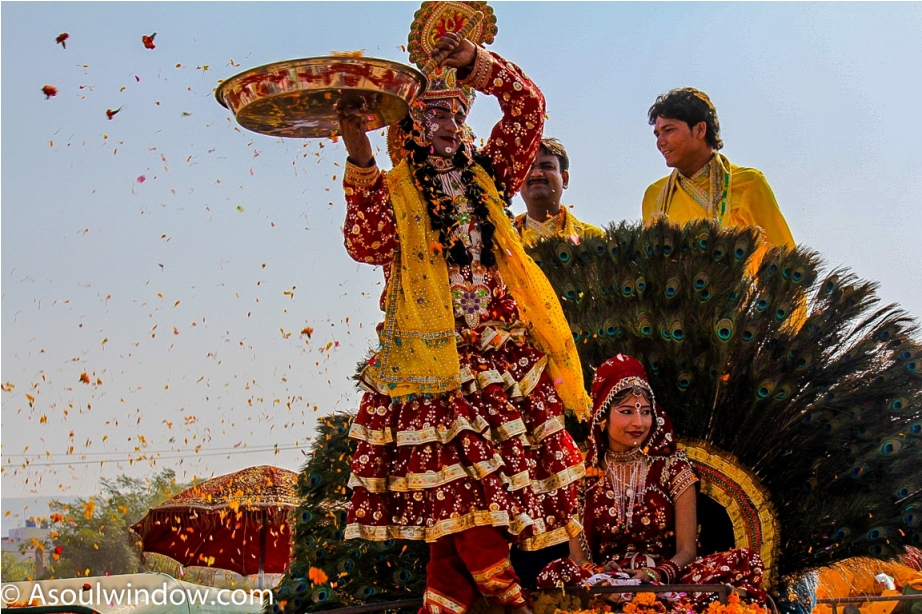
Timings of Pushkar fair
The Pushkar Camel Fair takes place in the first week of November. Below are the daily Timings:
Morning: 6:30 AM – 1:30 PM
Afternoon: 3:00 PM – 9:00 PM
These timings encompass the fairground activities, including livestock trading, cultural performances, and religious rituals. Notably, the evening Aarti (prayer ceremony) at the ghats typically commences around 7:00 PM during the summer months. If you’re planning to attend, it’s advisable to arrive early in the morning to witness the livestock trading and to secure a good spot for the evening cultural events.
Best Time to visit Pushkar fair
The fair reaches its peak on Kartik Purnima, the full moon night, which falls few days after Deepawali. This day is considered the most auspicious for pilgrims to bathe in the sacred Pushkar Lake. The best time to visit the Pushkar Fair is during the Kartik month (October–November), when the fair is held every year. The festival coincides with Kartik Purnima, the full moon day, which is considered highly auspicious for Hindu pilgrims to take a holy dip in the sacred Pushkar Lake.
Visiting during this period allows you to experience the camel and livestock trading, cultural performances, folk dances, music, and competitions in full swing. The weather at this time is also ideal—cool and pleasant during the day, with chilly but manageable evenings, perfect for exploring the fairgrounds, markets, and nearby attractions. If you want to avoid the peak crowds, arriving a day or two before the main events lets you explore the town, ghats, and local bazaars more leisurely. For photography and cultural immersion, the evening aarti at the lake and the colorful markets are unmissable highlights of this time.

Duration of Visit in Pushkar fair
How many days to spend in Pushkar fair? From my experience attending the Pushkar Fair, I realized that the duration of your visit depends on how deeply you want to experience it. For a quick visit, one full day is enough to witness the highlights—the bustling camel and livestock trading, the colorful bazaars, and the evening aarti at Pushkar Lake. I spent a day walking through the narrow lanes, sampling street food, and capturing the vibrant sights, which gave me a good taste of the fair. However, to truly soak in the atmosphere, I recommend 2–3 days.
This allows time to explore the fair at a relaxed pace, attend cultural programs like folk dances, puppet shows, and music performances, and even take part in competitions or camel rides. Staying longer also gives you the chance to explore nearby attractions such as the Brahma Temple, Savitri Temple on Ratnagiri Hill, and Ajmer Sharif Dargah.For serious photographers or cultural enthusiasts, 4–5 days can be ideal, providing opportunities to interact with locals, visit livestock camps in detail, and enjoy sunrise and sunset views over the fairgrounds. Personally, spending three days gave me a perfect balance of sightseeing, cultural immersion, and relaxation, making my Pushkar Fair experience unforgettable.
What can I do in 1 day in Pushkar fair?
If you have only one day at the Pushkar Fair, I found that planning your itinerary carefully helps make the most of it. I usually start early in the morning by visiting the camel and livestock trading grounds, where herders display beautifully decorated camels, horses, and cattle. Walking through the colorful bazaars next allows me to shop for handicrafts, jewelry, turbans, and souvenirs while enjoying the vibrant sights and sounds. Around midday, I explore the Pushkar Lake ghats and visit the Brahma Temple, soaking in the spiritual atmosphere.
Afternoon is perfect for catching folk performances, puppet shows, and traditional Rajasthani music. As evening approaches, I make my way back to the lake to witness the aarti at Varaha Ghat, a serene and spiritually moving ceremony. I end the day sampling local street food, from kachoris to sweets, and wandering through the lanes illuminated with lights. Even in one day, the fair offers a blend of culture, tradition, and excitement.
What can I do in 2 days in Pushkar fair?
Spending two days at the Pushkar Fair allows for a much richer experience than a single day. On my first day, I usually start early in the morning at the livestock grounds, watching the camels, horses, and cattle being traded and groomed. The energy of herders and traders is infectious, and I spend time photographing the vibrant scenes. Later, I explore the markets, buying handicrafts, Rajasthani jewelry, textiles, and souvenirs while bargaining and interacting with friendly shopkeepers.
By afternoon, I visit the Brahma Temple and take a peaceful walk around Pushkar Lake, soaking in the spiritual vibes. Evening is reserved for cultural programs like folk music, puppet shows, and traditional dances, ending with the mesmerizing aarti at Varaha Ghat.On the second day, I focus on experiences beyond the fairgrounds. I take a camel safari in the desert nearby, visit Savitri Temple on Ratnagiri Hill, and explore the quieter parts of town that are often missed by day-trippers. I also use this time to attend competitions, like turban tying or camel beauty contests, and photograph candid moments of pilgrims and locals. Two days let me balance cultural immersion, sightseeing, and festival highlights without feeling rushed, making the Pushkar Fair truly memorable.

Quick Itinerary for Pushkar fair
Here’s a quick itinerary for experiencing the Pushkar Fair efficiently:
Day 1 – Arrival & Exploration
- Morning: Arrive in Pushkar, check into your hotel or guesthouse.
- Late Morning: Visit the camel and livestock trading grounds to see decorated camels, horses, and cattle.
- Afternoon: Explore the colorful markets for handicrafts, jewelry, textiles, and souvenirs.
- Evening: Visit Pushkar Lake ghats and the Brahma Temple, followed by the evening aarti at Varaha Ghat.
- Night: Enjoy street food and casual exploration of lit-up lanes.
Day 2 – Cultural Immersion & Excursions
- Morning: Attend folk performances, puppet shows, and traditional music at the fairgrounds.
- Late Morning: Take a short camel safari or visit nearby attractions like Savitri Temple on Ratnagiri Hill.
- Afternoon: Explore quieter streets, interact with locals, and attend competitions like turban tying or camel beauty contests.
- Evening: Capture sunset views of the fairgrounds, enjoy cultural programs, and revisit favorite spots for photographs.
- Night: Relax with traditional Rajasthani cuisine or rooftop dining before departure.
This itinerary balances festival highlights, cultural experiences, and sightseeing, making a short visit highly rewarding.
Local Transport for sightseeing in Pushkar fair
During my visits to the Pushkar Fair, I found local transport to be convenient but varied depending on where you want to go. Within the town and fairgrounds, most of the streets are narrow and crowded, so I preferred walking, which allowed me to explore markets, ghats, and cultural performances at my own pace. For longer distances or trips outside town, I used auto-rickshaws, taxis, and cycle-rickshaws, which were easy to find near hotels and bus stops. Renting a scooter or motorbike is also a great option for exploring nearby attractions like Savitri Temple on Ratnagiri Hill or camel safari points in the desert.
Some luxury camps and hotels offer private car services for sightseeing, which is especially useful if you want comfort and flexibility. I also noticed a few shared cabs and mini buses connecting Pushkar to Ajmer and Jaipur, ideal for budget travelers. Overall, combining walking with autos or hired vehicles worked best for me to cover both the fair and surrounding areas efficiently.
Distances from Pushkar
Below are distances of Pushkar from other major tourist cities nearby in ascending order of distance and time taken. This distance chart will help you plan a longer itinerary and add more exciting destinations to your travel plan.
Distance between Ajmer to Pushkar is 16 kilometers and it takes around 45 minutes to reach via NH58
Distance between Nagaur to Pushkar is 134 kilometers and it takes around 2 hours and 51 minutes to reach via Nagaur Road and Sardarshahr – Ajmer Road
Distance between Jaipur to Pushkar is 142 kilometers and it takes around 2 hours and 51 minutes to reach via NH48
Distance between Bundi to Pushkar is 180 kilometers and it takes around 4 hours and 32 minutes to reach via Ajmer – Kota Road/Kota Road
Distance between Jodhpur to Pushkar is 183 kilometers and it takes around 3 hours and 45 minutes to reach via NH25
Distance between Chittorgarh to Pushkar is 214 kilometers and it takes around 4 hours and 10 minutes to reach via NH48
Distance between Kota to Pushkar is 217 kilometers and it takes around 5 hours and 21 minutes to reach via NH52
Distance between Kumbhalgarh to Pushkar is 227 kilometers and it takes around 4 hours and 36 minutes to reach via NH58
Distance between Bikaner to Pushkar is 253 kilometers and it takes around 4 hours and 36 minutes to reach via Sardarshahr – Ajmer Road
Distance between Jaipur to Pushkar is 277 kilometers and it takes around 5 hours and 21 minutes to reach via NH58
Distance between Sawai Madhopur to Pushkar is 296 kilometers and it takes around 5 hours and 10 minutes to reach via NH48
Distance between Ranthambore National Park to Pushkar is 308 kilometers and it takes around 5 hours and 36 minutes to reach via NH48
Distance between Alwar to Pushkar is 340 kilometers and it takes around 5 hours and 21 minutes to reach via NH48
Distance between Bharatpur to Pushkar is 345 kilometers and it takes around 6 hours to reach via NH21
Distance between Jaisalmer to Pushkar is 457 kilometers and it takes around 8 hours and 21 minutes to reach via NH11 and Nagaur Road
Distance between New Delhi to Pushkar is 457 kilometers and it takes around 7 hours and 36 minutes to reach via NE4
Distance between Ahmedabad to Pushkar is 540 kilometers and it takes around 10 hours to reach via NH48 and NH58
Distance between Mumbai to Pushkar is 1062 kilometers and it takes around 21 hours and 25 minutes to reach via NH48

What I liked about Pushkar Fair?
Here is the bottomline! What I liked most about the Pushkar Fair was the way it brought so many different worlds together in one vibrant space. The moment I stepped onto the fairgrounds, I was swept into a whirl of color, music, and laughter. The decorated camels and horses, each more elaborately adorned than the last, were a spectacular sight, and I loved watching the spirited competitions and animal parades. The folk music and dance performances under the open desert sky felt magical, with the rhythms of the dholak and the haunting tunes of the sarangi creating an atmosphere unlike anywhere else.
I also enjoyed wandering through the bustling bazaars, where every corner revealed something new—handcrafted jewelry, bright Rajasthani textiles, leather goods, and quirky souvenirs. The food was another highlight; from spicy chaats to freshly made malpuas, every bite told a story of Rajasthan’s rich culinary heritage. But beyond the visual and culinary delights, what truly stayed with me was the sense of community. Hindu Pilgrims performing rituals at Pushkar Lake, travelers exchanging stories by campfires, and locals sharing their traditions all made me feel like I was part of something timeless. The Pushkar Fair isn’t just an event; it’s an experience that celebrates culture, devotion, and human connection.
A half an hour and Rs.20 bus ride away from Ajmer is the little visited gem of a destination. Every year in November, the otherwise low-profile sleepy city metamorphoses into a magical cultural cauldron of all things Rajasthani. So, what all can one expect to see in this melting pot? Endless quirkily decorated camels, horses, festivities, rural life in its rawest form, music, dance, dip in the holy lake, roadside magicians, madaris, entertainers, circus, seers and saints, amused and happy looking wide eyed foreigners, rides and swings, riots of colors, great food , faith, spirituality, engaging activities, the works! Surely a travel freak’s and a photographer’s delight! And most of the things to do and see are free ! People from many countries take the road to Pushkar for this annual celebration of Indian-ness and all of them leave with a broad smile on their faces. It’s a good opportunity to experience India quickly.
GO NOW: Many buses at regular interval ply from Ajmer to Pushkar. Best time to visit is during the fair which falls in October and November every year.
What I didn’t like about Pushkar Fair?
WHAT DIDN’T WORK for me? Here are my views in a nutshell! Some animals were in bad health condition. I also saw 2-3 dead camels. The activities like matka race, kabaddi, wrestling etc. rarely started at their scheduled time. Also, the hotel rates were too high. Plus, buses to Ajmer were always FULL. And not to mention the ubiquitous conmen masquerading as Godmen, sadhus who were out to rob you. While the Pushkar Fair is undeniably vibrant and unforgettable, a few aspects left me uncomfortable. The biggest disappointment was the sheer overcrowding, especially during peak evening hours. Navigating through narrow lanes packed with tourists, traders, and animals often felt overwhelming and even unsafe at times.
Dust from the desert floor added to the chaos, coating my clothes and camera gear in a fine layer of grit despite my best efforts. I was also saddened by the condition of many animals. Camels, horses, and cattle—so central to the fair—were sometimes tethered for long hours in the harsh sun with little water or shade. Seeing thin, tired animals forced to perform or carry heavy loads for entertainment made me uneasy. The hygiene situation was another low point. Public toilets were few and often poorly maintained, creating an unpleasant experience for both visitors and locals.
Litter scattered around the fairgrounds and near Pushkar Lake detracted from the otherwise spiritual atmosphere. Lastly, I encountered a few tourist traps—overpriced handicrafts, aggressive touts, and vendors inflating rates for foreigners. Bargaining was essential but exhausting. Despite these issues, the fair’s cultural richness is undeniable. Still, these drawbacks reminded me that large-scale events need better management to truly honor their heritage and participants.

Conclusion: Is Pushkar fair worth visiting?
Why visit Pushkar fair? From my experiences visiting the Pushkar Fair over the years, I can confidently say that it is absolutely worth visiting. For me, the fair is more than just an event; it’s a vibrant celebration of Rajasthan’s culture, tradition, and rural life rolled into one. The sheer energy of the fairgrounds is infectious—everywhere you look, there are colorful camels, horses, and cattle being traded, herders in traditional attire, and pilgrims performing rituals at the sacred Pushkar Lake. Walking through the narrow lanes lined with handicraft stalls, jewelry shops, and local eateries feels like stepping into a living postcard. What makes Pushkar Fair truly special for me as a solo traveler, is the blend of spirituality and festivity.
You can witness pilgrims taking a holy dip in the lake, perform rituals at the Brahma Temple, and at the same time enjoy folk dances, puppet shows, camel races, and turban-tying competitions. The fair is a photographer’s paradise, offering endless opportunities to capture vibrant colors, candid human moments, and the dramatic desert landscapes framed by the Aravalli hills. For a solo traveler like me, the fair is also incredibly welcoming. It’s easy to explore on your own, yet every interaction—with local vendors, performers, or fellow travelers—adds depth to the experience. Whether it’s tasting local cuisine, bargaining in the bustling markets, or watching the sunset over the fairground, Pushkar Fair leaves a lasting impression. For anyone seeking culture, adventure, and spiritual insight, it is a must-visit destination that never disappoints.
While the Pushkar Fair is undeniably vibrant and culturally rich, I also couldn’t ignore the issues related to animal welfare. The fair revolves heavily around camels, horses, and cattle, many of which are used for trading, rides, and performances. I noticed that some animals were overworked, tethered for long hours, or displayed in ways that caused them discomfort, which made me feel uneasy at times. As a traveler, I think it’s important to support ethical practices—choosing rides or interactions only where animals are treated well, and avoiding vendors who appear to neglect their animals. Awareness of these issues adds responsibility to the enjoyment of the fair, encouraging tourists like me to appreciate the culture without compromising the welfare of living beings. Observing both the beauty of the fair and the humane treatment of animals helped me develop a more thoughtful, balanced perspective on this incredible festival.
The view from my Soul Window is so colorful and vibrant!
Pin this blog to save the blog and plan a trip later!
Related Blogs on Rajasthan
Unseen Rajasthan for offbeat travel lovers
Spread the love, share this blog
Got any question/comments, ask in the comment section below so that it can benefit other readers.
Email me for collaboration: 21abhinav21@gmail.com
Be a part of my journey on social media. The travel content I create there is different from this blog.
Pls subscribe/follow/like:
JUSTA LAKE NAHARGARH PALACE CHITTORGARH: LUXURY HERITAGE HOTEL
JUSTA LAKE NAHARGARH PALACE CHITTORGARH: LUXURY HERITAGE HOTEL
Me and my parents visited Jaipur, Udaipur and the offbeat Haldighati, Nathdwara, Nahargarh, Chittorgarh, Kota, Bundi. We could have included Kumbhalgarh Fort, Ajmer and Pushkar since these destinations were on our way, but we wanted to take it easy. The 10 days long road trip with my parents through different regions of Rajasthan was a memorable one. The stay at the picturesque jüSTa Lake Nahargarh Palace, Chittorgarh was preceded by stay at the luxurious Justa Sajjangarh, Udaipur.

It’s the kind of place which can inspire you to write a poem or two. The timeless beauty of Justa Lake Nahargarh Palace Chittorgarh is enhanced by the comforting quiet and abundant greenery, punctuated by an occasional turtle or emu or an ostrich (yes, you read that right, more on that later). It is in the middle of nowhere. Ok, it’s in the middle of a gorgeous lake, if you insist.

Everything moves here at a languorous pace. The placid water of the lake mirrors the sunrise and sunset at either ends. Sunset by the pool, sunrise by the roof or my suite window. Both breathtaking!

I had always wanted to stay in a real heritage haveli and that dream has been fulfilled here. This property is an ancient restored hunting lodge used by the royal family of Salumber & Parsoli.
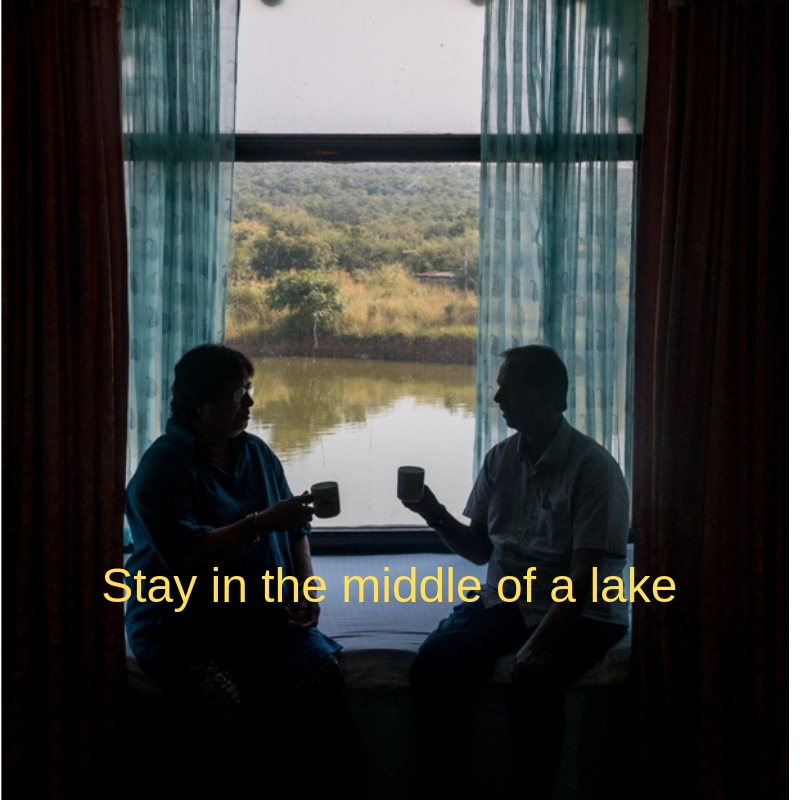
The best part of my stay was that my parents enjoyed the stay to the core. Their suite had many windows which faces the lake. The dining room in our suite was much loved by us because we can peacefully eat in privacy when we don’t feel like walking upto the restaurant.

All the rooms of the entire property face a garden and the lake. The huge garden in the middle of the property acts as courtyard and doubles up as a stage for stage performances and general public place for socializing or spending time with the family and friends.

A group of couples from New Delhi mostly hung out either at the swimming pool area or at the gardens. So, did we!

The network is not very good here (Thank God for that) so this meant that I interacted more with my parents and bonded strongly without any distraction.

SUITE OF JUSTA LAKE NAHARGARH PALACE CHITTORGARH:
The suite I had stayed at in jüSTa Lake Nahargarh Palace, Chittorgarh was at one corner of the property. Just like my stay in the luxurious Justa Sajjangarh property in Udaipur, I had booked two suites in jüSTa Lake Nahargarh Palace, Chittorgarh as well which is just a few hours away from the former. One suite for me and another one for my parents.

The interiors of the room evoked a bygone era akin to its exteriors. The door built entirely with stained glass separated the bed room with the dining and living area. We used to close the door only so that we were able to appreciate its real beauty. Being at the corner of the property, the room was circular and had window on all its walls.

All the windows opened to different views of the lake. While one window offered the brilliant view of sunrise on the lake, the other window had us stare at the spectacular sunset by the pool. Yes, the pool area was also visible from the windows of the suite room. Both, the room as well as the suite had separate air conditioning.

MY FAVOURITE CORNER OF THE SUITE AT JUSTA LAKE NAHARGARH PALACE CHITTORGARH:
I spent most of my waking time in my parents’ rooms, talking to them, admiring emus and ostriches for hours from their lake facing window, dining, watching TV or just reading a book by the window side couch which I used mostly as bed for reading and even writing.

It was a peaceful corner to let the creative juices flow. At times while I put my thoughts to paper (OK laptop!) by the window seat, I would be distracted by a turtle moving gently in the lake or by a beautiful setting sun or just a lone shepherd and his sheep calling it a day in the faraway fields.

OSTRICH, EMUS AND TURTLES GALORE AT JUSTA LAKE NAHARGARH PALACE CHITTORGARH:
The owner of the property, who lives in a bungalow near the boarding station for boats, owns a dog, horses, geese and even ostriches and emus. The Emus and Ostrich would forage for food most of the morning facing our suite window across the lake.

This was the daily entertainment for me and my parents. We would spend hours just watching their behavior and petty fights with a childlike curiosity. You will also be able to spot many peacocks in the morning. Keep your eyes peeled for fish and turtles in the pond as well.

LAKE VIEW DINING: RIGHT INSIDE MY SUITE AT JUSTA NAHARGARH
The living room was large, minimalist and thanks to two lake facing windows on two sides we didn’t need to switch on any lights whenever we ordered room service for lunch.

Enjoying delicious Rajasthani food, in the comfort of our suite, with the breathtaking views of the lake is just what I had envisioned when I received the booking confirmation from jüSTa Lake Nahargarh Palace, Chittorgarh.

It is exactly what I got. And more! In the evening, we would sit there for tea and biscuits. The room now lit with 4 stained glass lamps made the room even more ambient. I promised myself, I will later get those lamps for my home as well.

The living room also had 2 desks. One of the desks was empty and another had drawers and tea/coffee/kettle routine. It also helped us keep our daily use items and medicines for parents. The large luggage rack just at the entrance of the suite was large and was useful on the unpacking and packing days respectively.

The suite had 1 washroom which was again large and well ventilated. The toiletries (shampoo, soaps, body lotion, body gel) were of high quality and in good quantity. The bathtub had a very unique design. Built entirely of small mosaic tiles in different hues of blue, its base was in curve shape which enabled lying down in the tub comfortably. That was the first time I saw this feature in a bath tub. A welcome change!

LOCAL RAJASTHANI FOOD AT JUSTA LAKE NAHARGARH PALACE CHITTORGARH:
I have been to Rajasthan ample number of times. It is in fact my top most visited state of India followed by Maharashtra. I am not sure why I had failed to taste Ker Sangri yet! No it has nothing to do with Sangria. Ker Sangri is a local spicy dish eaten by people in villages of Rajasthan.

So, when I saw it in the menu, I jumped at the phone and ordered it along-with another favourite Rajasthani delicacy called Gatte Ki Sabzi. Both the vegetarian dishes had me polishing them off the bowls. Yes, of course we shared. I ensured, I savoured every bit of the lip smacking dishes.

On another day, we ate dinner at their dining area, decorated in the theme of peacock blue. We daily ate at the seat facing the huge chandelier in the lobby. It was a table for 3 and with the best view- perfect for me and my parents. The dishes I ordered and liked were soups (dhania-tamatar shorba, hot and sour soup), malai kofta, dal tadka, aalu jeera etc. They had more fancy items, but we kept it simple.

The breakfast buffet was impressive. I chose healthy options like idli, poha, upma etc. I tasted baked beans too which was good. I avoid filling my face with chola bhaturas mostly because it is not a healthy thing to eat. I also refrain from eating fried food in the morning. But when I took a bite of chola bhatura off my mom’s plate, I couldn’t help but serve some to myself. The one they served was very nice. The bhatura was crisp, had less oil and was mixed with ajwain which gave it an extra zing.

And DO NOT miss the tiny but super delicious desert gulab jamun, which they source from a famous shop nearby. The unbelievably soft gulab jamuns are quite popular. Our cab driver was instructed by one of his employees to bring back some. We could not help but buy 1 kg of gulab jamun as well, for ourselves and for gifting!

DO NOT MISS THE SUNRISE AND SUNSET BY THE POOL AT JUSTA LAKE NAHARGARH PALACE CHITTORGARH:
As we know that the property is in the middle of a lake. I am no fan of sunrise and sunsets. But that changes every once in a while!

Everyone was talking about the ethereal light and shadow play of sun in and around the property. This piqued my interest and I wanted to find out.

My stay at jüSTa Sajjangarh, Udaipur and jüSTa Lake Nahargarh Palace, Chittorgarh improved my sleeping patterns manifolds. The soothing atmosphere and calming air helped me sleep early and wake up before dawn daily.

It was a beautiful feeling which I am trying to continue in my daily routine. On one of the day, I woke up early morning and enjoyed the glorious sun rise from the other end of the property. It was indeed breathtaking.

A large flock of pigeons kept flying in large numbers in set pattern and perfect synchronization, adding drama to the stunning visual. At one corner, another family bonded over tea and sunrise.

On other morning, we got lazy and just enjoyed the sun rise from the comfort of our suite. On the last day, we walked bare-feet on the grass in the sprawling courtyard of the property without cameras, phones or any gadgets. It was a precious moment.

The sunset at jüSTa Lake Nahargarh Palace, Chittorgarh is equally bewitching! On first day, we huddled around the windows in the suite and saw the shades of sun change before the final meltdown. On the second day, we decided to spend some time in the pool area. Because that was where the best sun set views were.

Me and my parents sat there, talked sweet nothings softly, clicked some selfies while the sun drowned poetically. The multiple colors it had cast on the sky, the water in the lake an in the infinity pool was a sight to behold. Now, I knew what they were talking about! I told you, this place can turn you into a poet!

PLACES TO VISIT NEAR JUSTA LAKE NAHARGARH PALACE CHITTORGARH:
We visited the famous Chittorgarh. It’s a fantastic destination. My jaws dropped when I visited it. And don’t you want to see the famous place from when Aluddin Khilji looked at the reflection of the face of queen Padmavati with permission of Maharaja Ratan Singh? It was goose-bumpy!

I also visited Bundi and Kota which is nearby. While Kota impressed me with its ancient but well maintained palace, Bundi fort left me speechless with its old paintings, still intact and in brilliant condition. The baoli was also huge! Must visit places. The roads here are smooth barring few patches.

Distances from jüSTa Lake Nahargarh Palace, Chittorgarh to nearby places of interest:
Justa Sajjangarh to jüSTa Lake Nahargarh Palace,– 3 hours , 167 kms
Chittorgarh to jüSTa Lake Nahargarh Palace by car: 1 hour, 49 kms.
Bundi to jüSTa Lake Nahargarh Palace, Chittorgarh by car: 2 hours, 15 minutes, 149 kms
Kota to jüSTa Lake Nahargarh Palace, Chittorgarh by car: 1.5 hours, 131 kms.
Kota to Bundi by car: 50 minutes, 38 kms.

The view from my Soul Window is so rejuvenating!

Spread the love, share this blog
Got any question/comments, ask in the comment section below so that it can benefit other readers.
Email me for collaboration: 21abhinav21@gmail.com

Be a part of my journey on social media. The travel content I create there is different from this blog.
Pls subscribe/follow/like:

WARNING : COPYRIGHT TO ALL THE CONTENT SHARED HERE REMAINS WITH ME. THE IMAGES AND TEXT IN THIS BLOG ARE BY ME UNLESS MENTIONED OTHERWISE. YOU CAN NOT JUST LIFT THE CONTENT AND USE IT WITHOUT MY PERMISSION. STRICT LEGAL ACTION WILL BE TAKEN IF CONTENT IS STOLEN. YES, I AM SERIOUS.
Check my Instagram posts:
https://www.instagram.com/p/BpUZK8XHtJ0/?hl=en&taken-by=asoulwindow
https://www.instagram.com/p/BpRdxIBH3I2/?hl=en&taken-by=asoulwindow
Check out my tweets:
MORE PICTURES:


FEEL LIKE A ROYAL AT ALWAR BAGH BY AAMOD: WEEKEND BREAK FROM DELHI NEAR BHANGARH FORT!
This blog is about my quick weekend break from New Delhi (India). Alwar Bagh, the luxurious property was my base to visit magnificent cenotaphs in Alwar, the haunted Bhangarh Fort and Siliserh Lake and periphery of Sariska National Park. New Delhi based Escape Route helped me plan the trip. Alwar Bagh is 14 kms away from Alwar City.
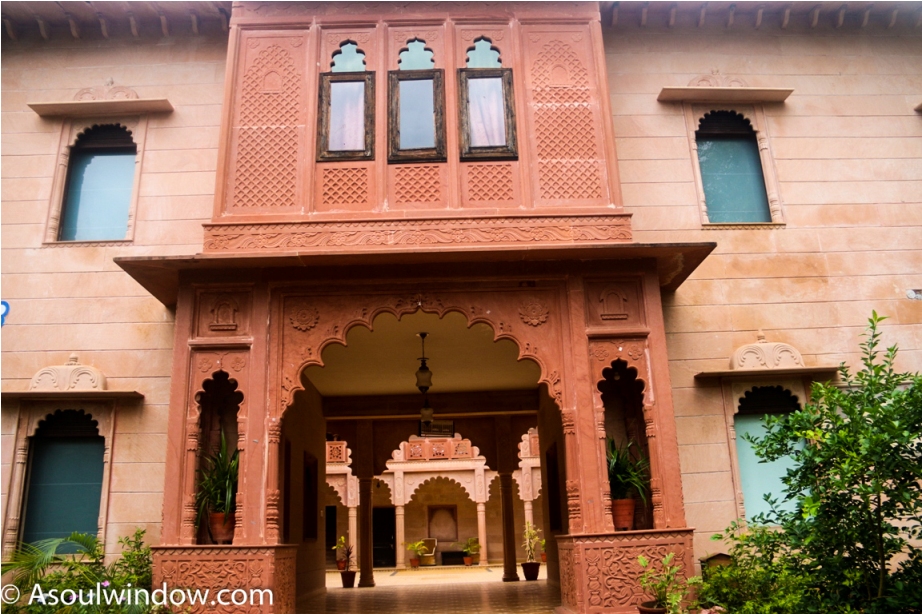
Pleasant breeze welcomed me as I stepped out of Alwar railway station early morning. Monsoon had reached the North of India in its full glory. Traveling during Indian monsoon has a romance of its own. The cab sent by Alwar Bagh picked us. As we passed by lush green pastures and mighty Aravali mountain ranges flush with monsoon grass, Rajasthan exposed a new side to us. My friend Jeetendra Sharma was surprised to see a green Rajasthan. He always associated Rajasthan with sand dunes and dry landscapes. It was Jeetendra’s idea to plan a quick weekend break from Delhi before he shifts his base to Mumbai. He enjoyed his experience so much, that much to my amusement; he visited Alwar Bagh again the next week with another friend.

Despite my extensive travel in rural and urban Rajasthan, I was surprised that just 3 hours away from New Delhi, Alwar offers you most of the quintessential Rajasthani experiences. It reminded me of offbeat trip to rural Rajasthan I did some years ago. Some of the typical Rajasthani features which marked my 2 day visit to Alwar – people wearing colorful clothes, women adorned with bangles on arms, cattle and camels usurping the roads, countless peacocks, shops overflowing with milk cakes and pyaz kachoris, abandoned havelis, ancient forts, tractors playing upbeat Rajasthani songs and local Rajasthani people extending their usual inimitable hospitality. Who would have imagined a completely different world just 3 hours away from Indian capital New Delhi?

ALWAR BAGH: MY FIRST IMPRESSIONS
The moment I stepped in Alwar Bagh, I was welcomed with a peacock call. The sprawling garden of the property attracts many birds. That explains the cute mud bird houses installed in the trees. The luxurious property is flush with greenery. Gooseberry, lemon and mulberry trees dot the landscaped gardens.

It is set in the backdrop of riotously green Aravali mountains near Sariska National Park. Its location, amongst other things makes it a winner. Farmlands and grazing cattle separate Alwar Bagh from the mountain ranges. It’s a silent place, making it an ideal escape from the whirligig of urban life. The earthy countryside lends Alwar Bagh an aura impossible to find in city resorts.

The architecture of all the buildings in Alwar Bagh is typical Rajasthani in style. Built in a heritage style typical of Rajsthani havelis (mansions), it gave me an idea of how the royals of Rajasthan must have lived once upon a time. Local architectural elements, local hospitality, local lifestyle and food are visible in every aspect of the Alwar Bagh.

As I enter Alwar Bagh, the al fresco dining area on the lawns on left and daily prayers at a temple on the right vie for my attention. Needless to say that Alwar Bagh is the perfect blend of tradition and modernity. Near the well (Yes, you read it right) a swimming pool area is surrounded by trees and recliners. There is pool for kids as well.

THE ROOMS OF ALWAR BAGH:
I have grown up in huge houses with large central courtyard. As a kid, courtyard and the rooftop used to be my favourite parts of the house. Unfortunately, most of my adult independent life I have stayed in apartments of Navi Mumbai (near Mumbai) and Ghaziabad (near New Delhi). I have missed reading books in a courtyard and chatting sweet nothings on the rooftops.

When I entered the building which housed my room, I was delighted to see that I have to pass through a corridor or courtyard to reach my room. It brought back vivid childhood memories. The house design of my grandparents’ house in Baansgaon, Gorakhpur was on the similar lines. No wonder, I repeated some of those experiences.

The first thing that struck me about my rooms at Alwar Bagh was its sheer size. The rooms of Alwar Bagh are huge, as big as a studio apartment if not more. The room I stayed in had windows with views of Aravali ranges. Everything about the room was about the size. The room, the bathroom, the dressing area and even the King size bed gave me a huge sense of space. Despite the size of room, the interiors were minimalistic. Thankfully they didn’t fill the rooms with unnecessary props and artefacts.

Alwar Bagh has a total of 37 rooms and suites spread across 4 buildings. Some of them have a private balcony and bathtubs. 2 of the rooms even have swinging beds suspended from the ceiling. The rooms are divided in different buildings named- Rawala (6 rooms), Jaigarh (19 rooms), Bhanwar Villa (6 rooms) and Gulab Villa (6 rooms). I stayed in Jaigarh. It was the most beautiful of all building. Room types are Deluxe and Super Deluxe.

VILLAGE WALK NEAR ALWAR BAGH:
The guide, appointed from the village behind Alwar Bagh took me to a village walk few minutes away from the property. We were passing craggy undergrowth when kids waved at us. They accompanied the shepherd who was grazing his goats. Even my guide pointed to his cow which grazed on a hill top. Peacocks played hide and seek with us. I was told that rocky terrain I was walking through was a bustling village centuries ago. On close inspection, I realized there was a pattern to rocks. It could have been someone’s house or a potter’s workshop.

I moved past buffaloes lazing in water (and eyeing me suspiciously) to arrive at a lone temple in the hills. The sweeping views from here silenced me. We moved on to the ground and passed a ruin. Turned out it was an old abandoned haveli. I entered the bat infested haveli and was impressed with its architecture. It transported me to a bygone era, of people who once populated it, of kitchen that once served delicious Rajasthani food. My guide told me that he grew up playing in the ruins. Nobody knows who the haveli belongs to. The haveli also has a Hindu temple, a well and separate residence for the guests.

TATSE AUTHENTIC RAJASTHANI FOOD AT ALWAR BAGH:
Alwar Bagh offers both buffet and a la carte menu. I preferred ordering the authentic Rajasthani meals. Dal Bati Churma seemed like was every one’s favourite. Dal Bati Churma is a combination of savoury and sweet flavours. Wheat balls are served with lentils and desi ghee (Indian clarified buetter). It is accompanied by churma, sweet in taste. My favourite was papad ki sabzi (Popaddum curry). I eat it every time I am in Rajasthan. Desert was the milk cake with ice cream, quite popular in Alwar. I wish I could also order my favourite Rajasthani delicacy, Gatte Ki Sabzi and Lahsun ki Chutney but I was full by then. The restaurant also serves North Indian, South Indian, Chinese and Continental.

ALWAR BAGH IS GREAT FOR EVENTS TOO
Some of the episodes of popular Indian TV show ROADIES were shot here. Alwar Bagh is equally popular amongst Indian and foreign guests. A mix of both were holidaying when I was there. Many corporate groups also book Alwar Bagh for offsites and team building exercises.

Alwar Bagh is also emerging as the popular wedding destination in North India. Judging by its serene location, comfortable silence, extraordinary architecture inimitable hospitality, I am not surprised! Who would not want to get married at a place like this. Easy and quick access from Delhi makes it perfect for vacation with family and friends, corporate events and weddings. It is a fab destination for both business and leisure.

ENTERTAINMENT GALORE AT ALWAR BAGH:
From carom to badminton and basketball, there is a lot you can play here. Paintball, shooting, rock climbing, rope course, remote car racing, pool are some of the other exciting activities you can indulge in at Alwar Bagh.

PLACES TO VISIT NEAR ALWAR BAGH
Bhangarh Fort: Touted as the most haunted place in India, I reached this ancient fort when it was raining. A day trip from Alwar Bagh is possible. Keep 8 hrs spare for a round trip. (2 to 3 hours one way)
Alwar City: There is so much to see in the city. I was amazed with Cenotaph of Musi Maharani (Entry free). The City palace, Museum and the fort will also amaze you.

Sariska National Park: Sambar deer, Nilgai (blue ox), Wild boar, spotted deer and many birds can be spotted here. If you get lucky, maybe even a tiger.

Siliserh Lake: A pristine lake on the road from Alwar Bagh to Alwar city. Do visit if time permits. Boating is allowed. Snacks and beverages are available. Washroom is available

DISTANCES FROM ALWAR BAGH:
Distance from Siliserh Lake- 7 kms
Distance from Alwar: 15 kms
Distance from Sariska National Park: 20 kms
Distance from Delhi – 180 kms
Distance from Gurgaon- 120 kms
Distance from Agra- 140 kms

HOW TO REACH ALWAR BAGH FROM NEW DELHI AND GURGAON:
By Road: it is just 3 hours away from New Delhi.
By Train: Ajmer Shatabdi starts from New Delhi at 6 a.m. It is air conditioned chair car. Fare is Rs. 625 and includes breakfast and newspaper. Reaches Alwar at 8:40 a.m.
The view from my #SoulWindow made me feel like a Royal!

Spread the love, share this blog
Got any question/comments, ask in the comment section below so that it can benefit other readers.
Email me for collaboration: 21abhinav21@gmail.com
Be a part of my journey on social media. The travel content I create there is different from this blog.
Pls subscribe/follow/like:
When I visited the Bishnoi Village Where Superstar Salman Khan Allegedly Killed The Endangered Blackbucks!
India was awaiting justice for past 18 years for the endangered black bucks which Salman Khan allegedly slaughtered in Bishnoi Village. Predictably, Salman was acquitted of his charges today, just like his previous crimes. I am not saying I was physically present at each of his crime scenes. But when so many things go wrong (Beating women, run and hit, destroying people’s career, talking loosely about rape survivors and much more) you know there must be a reason for it. He can’t be a so-called ‘soft target’ all the time.

I visited the Bishnoi village in Rajasthan in January, 2014. My guide showed me the exact place where Salman Khan killed the blackbucks. It was a deserted area with no humans in sight. The blackbucks and other antelopes and many migratory birds such as demoiselle cranes roam this area fearlessly. They know they are safe because no one dares harm them, thanks to the fierce protection by the Bishnoi people.

Animals are a part of life in this area. I met a Rabari family in their home, behind Bishnoi colony. It is not easy to gain access to a Bishnoi family’s home
Bishnois are the community who can sacrifice their lives and even kill the culprit if even a single animal or tree is harmed. My guide told me “Salman came here on a jeep with a clear agenda of hunting the blackbucks. He did shoot two of them. Even though it was a deserted area, the sound of gunshots reached a lone ‘chaiwala tapri’ (Makeshift tea shop). Perhaps Salman did not see it coming, the chaiwalla was instantly alerted and came rushing towards the direction of the gunshot. One blackbuck was killed on the spot. Sensing trouble, Salman’s driver rushed the jeep through the jungle and not the single straight road for the fear of being spotted. The blackbuck, I am imagining ran away from him in the similar fashion to save his life.

It was possible that if the Bishnois got hold of him, they would have given their justice on the spot, Salman or no Salman. Thankfully, I was told, the Bishnois did see Salman’s face. I was told the other deer who was half injured was soon rushed to the animal hospital by the Bishnois (who are poor and not that privileged to afford treatment of animals). My guide said the Bishnois have still not forgiven Salman Khan and would want to give him the strictest punishment possible. I did not have to try hard to sense the immense love and affection for the nature in Bishnois. Salman’s fans dismiss it with their lame excuses such as “It was just a deer” “He has been framed for being a celebrity” “Much ado about nothing” “So many people hunt” etc.

What they fail to see is the context. Even if it was not a celebrity involved, they would have fought for it. I was told about an incident happened in nearby Nokha village in Rajasthan. The Bishnois killed a hunter for killing a wild hare. This resulted in a riot and a 2 day ‘Bandh’ in the region. They take animal and plant conservation that seriously.

After all, these are the same people, 363 of whom, who sacrificed their lives in order to save the trees in 1730.. Centuries later it inspired the ChipkoAndolan (More on that in a separate blog) The blind fans fail to understand the perspective sitting from their comfortable living rooms

Here’s what I learnt from my visit to this amazing village
- Respect the region you are travelling to.
- Learn from the people of the region you are travelling to. May such local conservationists thrive and may the culprits be punished!

People like Salman will continue to rise. The problem is not him but we who put him on a pedestal and fail to see his flaws because we are so attached and attracted to his on screen persona. The dichotomy of our society lies in the fact that we will talk about ‘culture’ and ‘values’ and will turn a socially dangerous person into a Demi God.
The view from my #SoulWindow is frustrating!
HERE IS A SMALL VIDEO I MADE ON BISHNOI WOMEN. CLICK HERE

You would also love to read:
From being fired for traveling to much to Top Travel Blogger from India
Why I hate the snobbery and lies of solo travelers?
Why I love solo traveling? – Part 1
Why I love solo traveling- Part 2
Why 2017 was my best year of traveling?
Why I am tired of traveling too much?
The best of Offbeat Fort Kochi, Kerala
Spread the love, share this blog
Got any question/comments, ask in the comment section below so that it can benefit other readers.
Be a part of my journey on social media. The travel content I create there is different from this blog.
Pls subscribe/follow/like:
WARNING : COPYRIGHT TO ALL THE IMAGES AND TEXT HERE REMAINS WITH ME. YOU CAN NOT JUST LIFT THE CONTENT AND USE IT WITHOUT MY PERMISSION. STRICT LEGAL ACTION WILL BE TAKEN IF CONTENT IS STOLEN. YES, I AM SERIOUS.
UNSEEN RAJASTHAN: AN OFFBEAT JOURNEY THROUGH THE RURAL RAJASTHAN! ONCE IN A LIFETIME!
Top Offbeat Things To Do In Rural Rajasthan: This
winter why not traverse through the less explored offbeat destinations
in Rajasthan. Be there before tourists throng it! Incredible India!
Every year in winter, tourists from across the world and India inundate the famous cities of Rajasthan. However, if you are bored of the cliched destinations in Rajasthan, I would suggest a detour to its rural landscapes.
There are so many offbeat places to see in Rajasthan such as Garadia Mahadev Temple near Kota , the nearby Bundi, Unexplored Chittorgarh, Ranakpur Jain Temple, Underrated Alwar and so many more. I can never get bored of Rajasthan!
In my solo road trip to the offbeat and rural Rajasthan, I realized that is where the true heart of Rajasthan lies. Offbeat Rajasthan is raw, real, quirky and hospitable! I hopped on to the ever reliable Rajasthan State transport buses and Indian railways to make this journey to the far interiors of Rajasthan happen. I discovered the true beauty of this Royal State like never before. I have seen so much of Rajasthan and it still never fails to surprise me. During my journey, I also happened to unearth the heartwarming stories of man and animal living in harmony, very unique to this state.
PUSHKAR
Pushkar fair needs no introduction. It is one of the most popular and largest cattle fair not only in India but in the world. There is plenty to do here. Hot air balloon rides, rural Circus shows, seedy magic shows, rural sports, and sumptuous food had me hooked for 2 days. I could not resist ODing on Daal-Bati-Churma (Dough Balls served with lentils and sweet powder), lasoon Ki Chutney (Garlic sauce) and gatte ki sabzi (Curry of gram flour cakes) in the many restaurants that line the streets.
An ‘open to all’ impromptu magic show on grounds (pay as you like!) had the audience riveted. My city bred mind was amused to see the spectacle. The snake charmer had his own stardom. After downing countless sips of tea from kulhad (mud cup), I headed to Pushkar lake. Claimed by humans and pigeons alike, the lake oozed spirituality as thousands thronged to take a dip in the holy water. Soon a religious procession at a road nearby distracted me.
Hundreds marched in colorful attires, crushing softly the fragrant rose and marigold flowers beneath their bare feet. Absorbing the hedonic scents, I moved to the bus stand for a quick stop at Ajmer. I spent some time admiring the sunset at the Anna Sagar lake in silence. Not far away was Ajmer Shariff Dargaah. I couldn’t resist a soul stirring qawwali session. Being a vegetarian, I stayed away from the restaurants, though binged on the sweets at street shops. ‘Dhai Din Ka Jhopra’ nearby is a must, but before sunrise.
KHICHAN
Sevaram Malli Parihar, who lives in the nondescript dusty village Khichan, has been awarded several times for his focused wildlife conservation efforts. Some 20,000 demoiselle cranes migrate to Khichan and surrounding areas from Siberia every year in winter. He has worked overnight to ensure that the birds are not harmed by human intervention, electric poles, the works!
He has a set routine every morning. His day starts with feeding countless number of cranes in a bird feeding ground facing his house. He often identifies any injured bird and gets them admitted to an animal hospital nearby if required. The birds have invented a routine for themselves as well. They feed in batches in a disciplined manner. I was amused to see how the second batch of cranes waited patiently outside the fence of the feeding ground until. They didn’t enter until the first batch is at least halfway through the feed. Such discipline!
After talking to Sevaram and spending quality time with him, I was impressed with the determination of a ‘powerless’ man. It’s humbling to see how an uneducated village man brought about enormous change in the attitude towards wildlife conservation. I have always maintained that only locals with the help of government can help sustain and bring momentum to wildlife conservation. Such stories restore my faith in humanity. It is heart-warming indeed to witness the one of its kind cordial relationship the cranes share with the local villagers and animals. Rajasthan sure knows how to extend its hospitality to human and animals alike.
OM BANNA TEMPLE
Om Banna is a unique temple, only one of its kind in India. The diety worshipped here is a 350 cc motorbike and not a clay idol. It is situated on the highway towards Pali and the nearest big city is Jodhpur. The owner of the motorcycle was one Om Singh Rathore. The folklore has it that some years ago, he met an accident and perished at the spot where a tree still stands (and worshipped). It is said that the police locked the bike many times in the station. Every time, the same bike re appeared at the accident spot, as if by magic! The word spread far and wide and today pilgrims throng the place and offer their prayers. The bike has finally been relocated to the spot, a little away from the tree, owing to the sentiments of the ‘pilgrims’. The much revered tree exists at the exact spot. The temple and the bike has been shifted a little beyond in order to avoid disruption in traffic.
Some of the thousands of devotees who throng every day, offer alcohol as a tradition. I saw many newly weds visiting the temple. It is considered auspicious to do so. The ‘God fearing’ passer byes often make a stop at the temple. The legend has it that doing so ensures safety on the road. I was amazed and amused to hear the customized Om Banna Aarti being belted passionately by the local singers. The roadside shops sold only Om Banna merchandise such as Om Banna stickers, Books, CDs and Decorative pieces. Faith has many faces in India.
BIKANER
The world knows Bikaner for its famous aaloo bhujia, but did you know about the secrets that it hides? The narrow lanes of the old city boast of many drop dead gorgeous havelis. As I made my way through the winding lanes, the ancient havelis struck with their grandeur. The exquisitely carved haveli display varied embellishments and architectural styles.
If you are attentive (and erudite), it’s easy to spot Mughal, Rajpoot and even British architecture style on the havelis’ façade. Some craning of neck helped me to appreciate the beauty of the delicate stone jaali, chajjas, windows, et al. The red sandstone gives the haveli a character of its own. I think it is best to make a visit early morning since there is not much traffic in the streets. That said, really early morning is the trick, lest be prepared to get embroiled in the morning rush hour. You can easily lose track of time as you explore the serpentine roads, admiring one haveli after the other. These havelis are unique to Bikaner. I found some havelis locked up. However, the locals still live in many of these.
Karni Mata Temple
In Rajasthan the curious can find many quirky places. Top position on that pyramid is perhaps claimed by the Karni mata temple world famous for the thousands of black rats it shelters. And worships! 30 kilometers away from Bikaner, Karni Mata temple at Deshnoke, is also known as, the temple of Rats. Rats rule here and how! There are theories galore on how and why the people of Rajasthan began worshipping the approximately 20, 000 rats in this temple.
It is said that despite such huge numbers the place has never fallen prey to any epidemic. I could not walk smoothly without bumping into a rat. In this temple if you step on a rat, you have to pay hefty fine. It is accepted that if a rat crosses your leg, luck will be on your side. That said, if you have been able to spot a rare white rat it is said to bring you even better luck. Many rats did cross my legs though I am not sure if it brought me any luck or not.
They were every-where, feeding off the milk pot, resting in the holes, fighting for a spot in the holes, sharing the abundant food quietly, the works!
TAL CHAPPAR BLACKBUCK SANCTUARY
So few wildlife sanctuaries in the world allow you to explore on your own, without a guide, on foot! Tal Chappar lets one walk in the sanctuary at your own pace. This is exactly what I did one fine winter morning. The haven for blackbucks and other species such as wild boars, neelgai and many birds, Tal Chappar is an under rated delight. Early morning and evening is the best time to appreciate the beauty of this land and its inhabitants.
FACT FILE
How to reach by Train (In logical order)
Pushkar:
Train Number: 19032, Yoga Express
Destination: New Delhi (21:25, day 1) to Ajmer (6:40 a.m., Day 2)
Khichan and Om Banna temple
Train Number: 15014, Ranikhet Express
Destination: Ajmer (13:40, Day 1 ) to Jodhpur (17:35, Day 1)
Bikaner
Train Number: 14708, Ranakpur Express
Destination: Jodhpur (10:00, Day 1) to Bikaner (15:35, Day 1)
Karni Mata Temple:
(Road Trip from Bikaner)
Tal Chappar : Reach from Bikaner
There is much more to see in Rajasthan, easily one of my favourite states in India. Rajasthan Tour Packages helps in traveling through the state hassle free.
Note – A different version of this article was published as a cover story in the official railway magazine of India called Railbandhu.
Spread the love, share this blog
Got any question/comments, ask in the comment section below so that it can benefit other readers.
Be a part of my journey on social media. The travel content I create there is different from this blog.
Pls subscribe/follow/like:
WARNING : COPYRIGHT TO ALL THE IMAGES AND TEXT HERE REMAINS WITH ME. YOU CAN NOT JUST LIFT THE CONTENT AND USE IT WITHOUT MY PERMISSION. STRICT LEGAL ACTION WILL BE TAKEN IF CONTENT IS STOLEN. YES, I AM SERIOUS.
Ranthambore National Park Guide
This blog is about my Tiger safari in Ranthambore National Park, Rajasthan in India. We spotted the tiger Kumbha aka T 34 and watched its movement from a dangerous distance of merely 3 feet.
Rantahmbore National Park is one of the best National Parks of India. Located in North Indian state Rajasthan, it is home to a large number of tigers. Spotting a tiger is particulaarly easy here in the extreme hot months viz. April, May and first half of June. And if you are done spotting tigers here, you can also explore some old forts in the Ranthambore National Park. There is something for everyone here. What’s more? besides tigers, Ranthambore National Park is also home to many more animals and birds. Keep that camera and binocular ready. It is ideal for a getaway from Delhi with family or friends.
Spotting Tiger in Ranthabore National Park
What are the chances of sighting tiger in Ranthambore? We had barely entered the zone 6 when we saw the first tiger in the Ranthambore National Park in Rajasthan, India. It was around 8:20 a.m. Balancing ourselves on the unruly safari jeep, we entered the ancient gate, built in typical Rajasthani architecture. A vestige from Rajasthan’s royal past, it sits incongruously amidst the wild. But neither I nor my co travelers are here for a heritage trail. We have our eyes peeled for orange and black stripes instead.

Occupants of another safari jeep had parked itself on a marked pathway, opposite dense dry forest. Someone mentioned, ’Tiger’! The mere mention of the ‘T’ word robbed us of the sleep and yawns. Suddenly shaken from our stupor, we tried all the tricks of the trade to have a look at the tiger. Binoculars, DSLR cameras with Telephoto lens, naked eyes, the works!
While some claimed they got a glimpse (“Behind the bamboo grove”, “Yes, yes, through the V shaped cut”), I failed to spot the Tiger despite the desperate attempts. Before I dismissed myself for poor eyesight and an untrained eye for wildlife, the Tiger saved the day for me.

TIGER SAFARI AT RANTHAMBORE IS WORTH IT. HERE’S WHY?
Till now only 2 safari jeeps had congregated at the spot. The Tiger emerged, walking nonchalantly in a natural swagger fit for the King. The tiger walked arrogantly in a self important manner as we held our breath collectively. The tiger was still at a distance. He made no eye contact and continued walking without a care in the world!
The view of Tiger was still hindered, since he was passing through the dry branches of the tree and vertical bamboo groves. It was like looking at occupants of the opposite railway platform while the train passes slowly. Now you see it, now you don’t! The sighting was still better than the winter months. Thanks to the extreme heat, the trees were bereft of leaves, making it easier to spot the Tiger. In monsoon and winter, the sightings are low due to the dense green foliage.

THE TIGER GIVES US A WARNING AND A CHILLING GLARE:
After much hide and seek, the Tiger emerged in full view just like that. By now, the news had spread like forest fire. More safari jeeps had parked themselves at the spot. Unmindful of all the attention, the Tiger continued walking and then did the unimaginable!
As I trained my telephoto lens on him, I found myself moving my eyes away from the viewfinder of the camera. My heart must have stopped briefly when the Tiger was just 3 to 4 feet away from me. I do not remember if I clicked from the viewfinder or not. The thrill of looking at a wild Tiger from such a close distance made me drop my jaw and all other pursuits instantly. This explains why the image of Tiger when he was closest to me is not as good as it should have been. It happened in a jiffy, before we could react. The tiger chose to walk just few feet away from the right side of the safari jeep we were sitting in. This is the closest anyone can get to a wild Tiger! I in fact, advise my readers against going this close to a Tiger, even if you are sitting in the safety of a safari jeep. But we had not planned it. We had responsibly parked ourselves without disturbing the Tiger’s movement. The tiger however stunned us with his unpredictable move.

THE TIGER OF RANTHAMBORE MADE AN EYE CONTACT WITH SAFARI JEEP’S OCCUPANTS:
The most thrilling moment was when the Tiger made an eye contact with us; brief but menacing nevertheless! That moment filled us with mixed emotions viz. thrill, nervousness, excitement, elation and perhaps also bordering on philosophical.
Later, a co traveler told me that was a warning. The Tigers at Ranthambore are used to the presence of humans and perhaps that is why it ended on just a brief threat. However, in that moment, I got the epiphany that how brilliant and complex nature is. And why we need to leave no stones unturned to preserve it. Any work done in the conservation of these majestic creatures is less.
WHO IS TIGER KUMBHA AKA T 34:
The tiger we had spotted is called Kumbha, a huge dominant male. All the images of tiger in this blog are that of Kumbha aka T 34. Kumbha is a male tiger whose main territory is in zone 6,7 and 8 of Ranthambore National Park. His residence includes the Jamoda Balas, Chidi-Khoh and Kundal area. Interestingly, Kumbha is Hindi version of water sign Aquarius. Kumbha has mated with tigress Ladali (T-8).
WE LOST AND FOUND THE TIGER AGAIN:
For sometime, our eyes followed the movement of tiger. Careful not to disturb his movement, we kept an eye on the tiger from a distance. We saw him for some-time and then lost him. We left when the browns and greens of the jungle swallowed the oranges and blacks. We parked ourselves next to a pond in search of another tiger. We didn’t see any tiger but the jungle impressed us with the biodiversity. Akin to a parade, one animal after another showed up, strutting their stuff and revealing their behaviour as we pretended to be dead in the safari jeep. We spotted monitor lizard, snake (unidentified), langur monkeys, spotted deer, shikra and many other species.

After sometime, we left the pond. As we drove again in pursuit of tiger, a commotion took us back to the ancient entrance gate we had entered from. Turned out the same tiger Kumbha aka T 34 was resting on the top of the gate. What was once a stronghold of royals is now the kingdom of the tiger. What was once the strategic location for guards to keep a watchful eye, is now a peaceful abode for the Tiger to cut the noise. I looked at Kumbha one last time as he slept like a baby. We were told it is his favourite resting spot. Watching him through the binoculars helped me see him up, close and personal without losing my limbs. I bid adieu to the tiger, hoping in my mind that may the Kingdom remain with Kumbha and his next generations. May the tribe win over human greed and unsustainable growth. May nature win! Once again!
Can we see tigers in Ranthambore?
Yes, and what a sight! This was when I saw tiger lightening T 83 attempt killing a sambar calf. This section of the blog is about watching a real-life attempt by Tiger Lightning T 83 to kill a Sambhar Calf. We saw this once in a lifetime spectacle in the zone 4 of the Ranthambore National Park in Rajasthan. The park is great for wildlife enthusiasts. This is my Incredible India moment!
The stranger in our hotel boasted during the breakfast that she spotted 8 tigers in 2 days. By this time we had seen only one (See my other blog) and I was optimistic that we will see more. We had barely entered the zone 4 of Ranthambore National Park in the evening when the driver of our open canter van parked besides a small pond adjacent to a dirt track. Turns out a tiger was half submerged in the water of the small pond. The extreme heat of June (North Indian plains) draws the tigers and other animals to the water bodies, making it easier to spot them.
The tiger stayed in the pond for a long time and was unfazed by the presence of a (well behaved) fleet of canter vans and safari jeeps stuffed with curious humans. My canter van was facing the back of the Tiger. All the occupants of my canter van congregated at the left front part of the canter van.
The Tiger would sometimes turn and show the face. The drama continued for a long time as the Tiger played hide and seek with us. An eye there, a paw there! That was all we could manage from behind the branch of a tree which obstructed our view.
Then suddenly, the Tiger emerged from the pond. A collective gasp followed. Between hushed tones and self-monitored whispers, cameras were pulled out into action. The Tiger stood under the evening light for some while as if allowing us ample time to have a good view. Neither did the Tiger look at us nor did the tiger make any attempt to leave the place in a hurry. It was a relaxed movement, unaffected and confident. Until…………..
Then all of a sudden the Tiger started crouching. With slow measured steps, the tiger moved towards an unidentified animal in far distance. It was difficult for me to believe that in no time I would be seeing a Tiger hunting not in an idiot box but in real. Flesh and bones. And blood! It was a surreal feeling! I tried hard to spot the prey when someone exclaimed, “It’s a Sambhar calf.” I found it. The calf was blissfully unaware of the presence of the Tiger when the latter continued moving stealthily.
And then it was a chase. Between clouds of dust and tree branches, we managed to see the Tiger chase the calf with deft focus. It was at a far distance. I am not sure of the fate of the calf. Once the dust settled, we could spot neither the Tiger nor the calf. Nor did we see the mother Sambhar at any point of time. It doesn’t matter. What matters is that we still saw a real kill attempt by a Tiger. A first is always special. This will forever be etched in my memory for a long time. After this, we spotted 4 more tigers within few minutes of each other.
Zone 4 Through Hamid Kund
Before all the drama, we could not help but admire the Royal past of Ranthambore. This is how our evening safari started. The Ranthambore fort was visible at a distance as soon as we crossed a gate adjoining to Hamir Kund. A sign board said that the water body is infested with crocodiles though I failed to see one in spite of keeping my eyes peeled. The ancient gate we crossed evoked the royal past of Rajasthan. The gate even had a staircase on the right side of its walls.
This gate gives access to the Ranthambore fort, Jogi Mahal and zone 1,2,3,4,5 of Ranthambore National Park. I would have been too optimistic to spot a tiger here since it was a check post kind of a place, buzzing with human activity. We did spot the usual suspects viz sambar, chital (spotted deer), peacocks, owls and of course monkeys. A fearless bird sat on a twig close to our stationery (for permissions) jeep, its beak wide open thanks to the extreme heat of June in North India. The bird expected food from us which is a depressing thought because this particular species of bird developed this habit when irresponsible travelers started feeding them on safaris. Sad!
Unlike the zone 6 of Ranthambore National Park I visited in the morning (please see my other blogs in the ‘Wildlife’ tab.), the approach road to zone 4 was smooth tar road.
Famous Tigers of Ranthambore
We had spotted Lightning T83, the granddaughter of famous tiger Machchli T 16. Lightning is also the sister of Arrowhead T 84 aka Machchli Junior, the tiger we spotted after few hours of spotting Lightning. (Pls read my other blog on how we got really lucky to spot Arrowhead). She is also the daughter of tiger Krishna aka T- 19. (We also spotted Krishna with her new cubs, read about it in my other blogs) Her brother is T 85. She is known to stray at the periphery of the park. She once fell into a well and was rescued by the forest department.
The ancient Ranthambore Fort and Hamir Chand Chauhan
I had imagined the Ranthambore Fort to be on a lower ground. It was instead perched on a high mountain in a distance. It is possible to drive up to the fort and explore it but limited time for Tiger made us choose the obvious. That said, on a future safari, I do intend to cancel my tiger date and explore the fort for sure. And if I am really lucky I can spot a tiger on the road to the Ranthambore Fort.
Hamir Dev Chauhan ruled Ranthambore from 1282 to 1301. The ancient and formidable Ranthambore Fort was declared a UNESCO World Heritage Site in 2013. The real age of the fort is disputed but it is believed that its construction began in mid 10th century during the Sapaldaksha rule and successive occupants of the fort added their own structures to the original edifice.
Best Time to visit Ranthambore National Park
Summer is the best time to visit Ranthambore or any wildlife park in India (If Tiger is what you are keen on, that is). Due to extreme heat, the Tigers expose themselves in the open, often near a water body to cool themselves off. The lack of greenery also makes it easy to spot the Tigers, even from a distance.

TIPS ON WHAT TO WEAR ON A TIGER SAFARI:
What to wear during a wildlife safari in Ranthambore?
I wore outfits by Columbia Sportswear. The deftly designed shirts and pants kept me cool even in the scorching heat of Rajasthan in June. The Omni wick and Omni Shade technology used helped me keep dry and cool even in extreme weather. There was not a modicum of sweat rolling down my spine. I recommend my readers to give it a shot while they are on an outdoor trip.
Indian Summer, though unbearable, is a perfect time for wildlife safaris. It hovered around 45 degrees in Ranthambore National Park. Despite it being early morning, the heat was intense. I kept hydrating myself every 15 minutes . Luckily the Columbia Sportswear gears I was wearing saved the day further. The light and airy clothes helped me keep fresh. Those who know me personally know that I sweat a lot. However, the Omni Wick technology of Columbia outfits and shoes ensured that the sweat evaporated quickly. It kept me dry inside and out. Their Omni Shade technology also kept me protected from the unforgiving sun rays. I now know what to wear on safaris and even treks.

WHERE TO STAY FOR WILDLIFE SAFARI IN RANTHAMBORE NATIONAL PARK
I stayed in Ranthambore Heritage Haveli. It is in the middle of no-where. I could see only few other properties in the vicinity. My stay here was enjoyable. Not only was it located close to the zone 4 and zone 6 of Ranthambore National Park, it was also easily accessible from the main road. However the small patch from the main road to the property is bumpy and unpaved.
The air conditioned rooms at Ranthambore Heritage Haveli are semi luxurious with a huge attached bathroom. The property has two beautiful courtyards and the haveli like architectural style reminded me of my stay at the luxurious Alwar Bagh by Aamod Resorts, also in Rajasthan. It is lit beautifully in the night.

I sampled their buffet. While I liked the poha, bread pakoda, palak paneer and dum aaloo, their Rajasthani gatte ki sabzi and upma could have been better. Desserts were passable. The property also has private cottages, lawns for small parties and conference room. Overall, it was a good experience. It is close to the famed luxurious property Oberoi Vanya Vilas.
FUN PEOPLE I TRAVELED TO RANTHAMBORE NATIONAL PARK WITH:
This trip was a part of a contest win organised by Columbia Sportswear in collaboration with Myntra and Red FM. I met interesting people like Vaibhav from Columbia, RJ Rocky and Sumit from Red FM, Prateek from Myntra, Malaika Vaz a young wildlife documentary film maker, Mahesh Reddy, a wildlife photographer and other winners viz. Antara, Kushagra, Sonu, Tony,Meenakshi. Check out the cool Instagram posts by Columbia Sportswear:
Related Blogs
You may enjoy reading my other wildlife blogs:
Night Wildlife trail in Agumbe
In search of elusive King Cobra in Agumbe
Tiger free safari in Satpura National Park
Spotting my first Wild Tiger in Bandhavgarh National Park
One horned Rhino duo in the beautiful Chitwan National Park, Nepal
All thing wild in Pench National Park
Birdwatching in Shitlakhet, Almora
List of Wildlife Sanctuaries in Coorg
Despite meeting each other for the first time, we gelled quite well and shared camaraderie, jokes and erudite information on everything under the sun (or stars). The best memory was dining and talking by the poolside of Ranthambore Heritage Haveli by the night.

HOW TO REACH RANTHAMBORE NATIONAL PARK, RAJASTHAN:
By Road: We took 9 hours from Connaught Place, New Delhi to reach Ranthambore via Neemrana and Dausa by road. The road trip is nondescript and you will not miss much if you chose to take the train. In my opinion, train is a better idea.
By Train:
Kota Janshatabdi is a good idea. It is a chair car (CC)
Time taken from New Delhi to Sawai Madhopur: 4 hours 47 minutes.
Departure time at Hazrat Nizamuddin, Delhi: 13:15
Arrival time at Sawai Madhopur: 18:02
Train number: 12060
Tiger name and history
WHEN I SAW TIGER LIGHTNING T 83 ATTEMPT KILLING A SAMBHAR CALF- WILDLIFE AT RANTHAMBORE NATIONAL PARK, INCREDIBLE INDIA!




My other thrilling WILDLIFE experiences you will love to read:
Spotting Tiger Kumbha. Just 3 feet away from me!
In search of elusive King Cobra in Agumbe
Tiger free safari in Satpura National Park
Spotting my first Wild Tiger in Bandhavgarh National Park
One horned Rhino duo in the beautiful Chitwan National Park, Nepal
All thing wild in Pench National Park
Birdwatching in Shitlakhet, Almora
List of Wildlife Sanctuaries in Coorg

Spread the love, share this blog
Got any question/comments, ask in the comment section below so that it can benefit other readers.
Email me for collaboration: 21abhinav21@gmail.com
Be a part of my journey on social media. The travel content I create there is different from this blog.
Pls subscribe/follow/like:
WARNING: COPYRIGHT TO ALL THE TEXT SHARED HERE REMAINS WITH ME. YOU CAN NOT JUST LIFT THE CONTENT AND USE IT WITHOUT MY PERMISSION. STRICT LEGAL ACTION WILL BE TAKEN IF CONTENT IS STOLEN. YES, I AM SERIOUS.
Place to visit in Ajmer
Place to visit in Ajmer
The holy city of Ajmer which was founded in 7th century C.E. by Raja Ajay Pal Chauhan attracts pilgrims throughout the year. Being an atheist, I visited it only as a tourist; my main halt was at Pushkar fair. I was curious to know, what is it about this famous Muslim Shrine that so many people, of all religions are drawn to it! Which is the best place to visit in Ajmer?
So there I was, heading to shrine which also has the tomb of the Sufi saint Khawaja Moinuddin Chishti. The otherwise nondescript town of Ajmer is situated close to the Naag Pahad aka Snake Mountain in the majestic Aravali Hills.
Some other popular and offbeat places to see in and around Ajmer are Adhai Din Ka Jhonpra, Ana Sagar Lake, Taragarh Fort, Buland Darwaza etc. Qawwali at Ajmer Dargah is also not to be missed. Yes, there are many things to do in Ajmer in Rajasthan.

History of Khwaja Moinuddin Chishti Dargah
The Indian Muslims consider Ajmer Dargah as one of the holiest pilgrimage, next only to Mecca in Saudi Arabia. It is said that Mughal emperor Akbar revered the Persian saint Chishti and once walked barefoot from Agra in Uttar Pradesh to Ajmer Dargah to pay his respects.
What makes this 13th century shrine so important? Dargah Sharif is home to the grave or the maqbara of Moinuddin Chishti, who was a highly revered Sufi saint. He was born in the present day Iran which was then called Sanjar. Also called as Khwāja Mu’īnuddīn Chishtī, he was addressed by locals as the Gareeb Nawaz aka ‘benefactor of the poor’
Established in the year 1236 C.E., the shrine was renovated by other rulers such as Jahangir, Jahanara, Shah Jahan and Maharaja Of Baroda. Since those days, it was the most popular place to visit in Ajmer city.

Why is Ajmer Sharif Dargah Famous?
It is believed that Mughals such as Akbar, Shah Jahan, Jahangir, Jahanara, Dara Shikoh and Aurangzeb paid visit to Ajmer Dargah. Other historical figures like Nasiruddin Mahmud, Sher Shah Suri, Rasiya Sultan and Muhammad bin Tughluq have also paid their respects at the Dargah.
Both Muslims and Hindus visit the Dargah of Khwāja Mu’īnuddīn Chishtī. It is the main attraction of Ajmer. Do include this in your places to see in Ajmer in one day.

Buland Darwaza of Dargah Sharif
Taking a Rs. 50, 10 minutes auto-rickshaw ride from Bus station (Same distance and rate from railway station), I stepped down at the main ancient gate called Buland Darwaza from where the Dargah Bazaar starts. It is generally very chaotic and crowded here on most days. It is one of the top places you will see during Ajmer sightseeing.
Other gates in Ajmer Dargah include Shahjahan Gate and Nizam Gate.
Also do visit the Akbari Masjid, Mehfil Khana, Library, Chishti’s tomb etc.

Streets of Ajmer Dargah
Since I wanted to feel the pulse of the place, so I walked down the area of Dargah Bazaar which leads to the Dargah. The beggars with mutilated body parts dot the market; they roll on the ground and beg. The streets are lined with shops selling everything from daily use items, food, clothes, VCDs and what nots.

Most VCDs in shops showed distressed women hysterically and dramatically wailing and crying and asking Khwaja for ‘rehem’ (Mercy). It further showed that once they visited the Ajmer shrine, its happy days for them again. Some more non serious CDs has songs playing in a child’s voice, “Papa, mujhe Khwaja ji ke mele mein hai jaana” ( Daddy ,I want to go to Khwajaji’s fair). Ajmer sightseeing is fun, eh!
Rules Inside Ajmer Dargah
What are things to consider while visiting Ajmer Sharif Dargah? I bought a Rs.10 handkerchief from a kid, covered my head (mandatory for all men and women) and moved to gate number 2 of the Ajmer Dargah (take left from Main Gate) , to deposit my bag and camera for Rs. 20 (Rs. 10 for small bags). Bags of any kind, footwear and cameras are not allowed inside Khwāja Mu’īnuddīn Chishtī Dargah.
Entering from gate Number 2 , I deposited my sandals when the caretaker announced pointing to my shorts , ‘Yeh chadhdhi nahi chalegi ander , yeh lungi kiraaye per le jao’ (You can’t wear this half pants inside , take this sarong/wrap-around to cover) At Rs.15 , I wrapped it around , only to hear more such strict rules from a loud speaker inside , viz. ,
- Don’t sit with your back facing the Dargah
- Kids need to be disciplined
- No smoking or Paan chewing or drinking etc.
- No cameras inside (Strangely, you can not carry a camera inside, but no one stops you if you click on phone cameras.)
Remember the famous controversy over dressing of Bollywood actress Katreena Kaif in Ajmer Sharif premises? So always keep in mind the rules and things to consider while visiting Ajmer Sharif Dargah.

Ambiance inside Ajmer Dargah
Anyways, once inside the Ajmer Dargah, I was intrigued by the whole ‘mahaul’ (Ambience). Architecture wise it is nothing to write home about. But what appeals is the feeling that you get there. It looked like a different country! Ajmer sightseeing has many faces.

As if I was in some Middle East nation , what with most people dressed in traditional Muslim attire , long-bearded and pathani suit clad men speaking in Arabic, cats roaming around confidently , people reading holy texts (There was a library with huge collection of holy text), smell of fragrances (of agarbatti aka incense sticks , flowers, biryani etc.), live qawwalis filling the air , people tying holy threads on a wall dedicated for same , people kissing the same thread wall , a charming water pond where pilgrims and pigeons washed their legs, a well where people threw money and other such predictable things. No wonder it is a famous place in Ajmer.

But what intrigued me the most were humans and their dreams, hopes, aspirations, despair, grief, happiness, total surrender, the works ! It was so palpable; I could read all these emotions on people’s faces there. Human vulnerability was at its peak! A teary eyed face there, a trance-ed face there. As the famous and my favorite Hindi song (penned by Prasoon Joshi) goes, “ Dararein dararein hain maathein per maula , marammat mukaddar ki kar do maula’ (There are cracks galore on my forehead, Oh Lord , I beg you to heal those).
Qawwalis At Ajmer Dargah
Do not miss the Qawwalis in Ajmer Dargah which is one of the best things to do here. It happens throughout the day and even in the night. Being an atheist, I didn’t stand in a queue to offer a prayer or even to see what lies inside. Nor did I kiss any holy door or tie a thread. No offences here, it is just that rituals never made sense to me.

What drew my attention instantly were the live qawwalis. I found out later that it is a must do when in Ajmer city. I just rushed to the place from where the sound was coming, observed how others were behaving or sitting and tried to fit in. I sat there with closed eyes and complete surrender, listening to soulful qawwalis peacefully for more than an hour. It was as comforting as the bhajans at Hindu temples. Such music makes me silent and contemplative always.

The words were all themed around human vulnerability. And that made sense to me. I found my God there! I offered no chaadar, no prayer , tied no threads , didn’t even ask for anything (Despite the fact that at that time a lot of things are not going right in my life), but still felt at peace hearing those words. They were so good; I quickly wrote down some to Google them later. Ajmer sightseeing is incomplete without a qawwali session.
I observed a man whose eyes were red with all the weeping, a foreign woman, so engrossed in the music, even though she didn’t understand a word and other such people who were in almost trance like state. The songs almost made me cry as it made me reflect on my past and present, both of which I found to be in shambles. But not one to cry in public, I gained control on my emotions.
Special mention for the singing. All the men had great powerful voice and sung it with so much passion even though they do it daily, non-stop. Not wanting to get up even after an hour session, but bound by time constraints, I left the place humming those qawwalis. It is one of the top reasons why the Dargah is the most spiritual place to visit in Ajmer city.

Some Qawwalis at Ajmer Dargah
I wrote down some lyrics of the qawwalis to later Google them once I am back to Mumbai. And to my surprise and delight, I found some of them on Youtube . Sample these:
1) Mujhe aapne bulaya , yeh karam nahi to kya hai…
Mera martaba badhaya , yeh karam nahi to kya hai…
2) Bhar do jholi mere ya mohammed ,Laut ke main na jaaunga khaali
Uski kismet ka chamka sitara , jispe rehmet najar tumne daali…
(This was before Bajrangi Bhaijaan released)
3) Mujhe apne rang mein rang diya , mere Ajmeri khwaja ne
Meri bigdi kismet sanwaar do , sbaki bigdi kismet sanwarti hai Khwaja Ajmeri mein.
4) Jikr-e-Khwaja jo karta rahe, uska har kaam hota rahe…
Rang-e-Chishti na utre kabhi, Rang-e-Alam badalta rahe…
5) Jab tak bika na tha, koi poochta na tha ,
Tumne khareed kar mujhe anmol kar diya.
6) Samajh mein aayega ibdaad kaise hoti hai,
Jara tadap kar pukaro to ae gareeb nawaj…

Ajmer Dargah in Night
2 days later, few hours before boarding the train to Mumbai , I returned back to Ajmer from Pushkar (My base during the trip) a few hours early to catch the Dargah in its night glory. My father, who had been there strongly recommended me to see it by the night, he said you will feel like your soul is transported to a bygone era. And yes he was true. It felt like I was in 15th century, perhaps! Somehow the place was more magical by the night. It is after all, one of the most famous Dargah in India.
The scents were uncannily stronger and the sights more delightful in night, what with all those colorful lights. It sure is one of the most soulful of all Ajmer tourist places. It is also one of the most unusual things to do in Ajmer as most people leave the city by evening.

Miracles and Mannat – Wish fulfillment
Many people come here hoping for a miracle. Others come for wish fulfillment or mannat. Emotions run high in Dargah. The sheer display of faith overwhelmed me. Pilgrims displayed stronger and more powerful/overwhelming emotions than morning. I saw a woman crying while leaving the Dargah (A sick child? A divorce? / A husband on the verge of bankruptcy? ). Many come to Dargah, hoping for a miracle that can change their lives. They express their mannat or wish and hope for it being fulfilled.
Another woman was walking to-and-fro like a lion in a cage shouting to God and herself, “My daughter never harmed anyone! Then why this happened to her? Why? Why? Why? I want an answer…) She was furious, angry and grief stricken and freaked out the pilgrims with her antics. It was a sad sight. It was something which stayed with me even after I had left the Ajmer Dargah. It is said that all wishes are fulfilled in Dargah. People come here to see miracles and express their mannat (wish)

Bidding Adieu
In the evening, they were also distributing free biryani, which I refused to eat suspecting it to be non-vegetarian. Again I spent 45 minutes listening to qawwalis, this time putting an alarm in my cell phone, lest I would have missed my train (Thanks to the hypnotizing music). Coming out of the Dargah, I returned the handkerchief to an old man selling the same, so that he could sell it again. The old man got really surprised and happy to get this handkerchief which could help him fetch an extra Rs.10/-. In India, Rs. 10/- can bring a wide smile, I was surprised to know!

Ana Sagar Lake & Baradari – Ajmer sightseeing
A thirty minutes walk away from the Ajmer Dargah is the artificial lake called Ana Sagar Lake. And if you are in Ajmer you should not skip this monument which dates back to 12th century. The beautiful white marble pavilions or the Baradari served as the summer shelter in old days. It was built in 17th century by Shah Jahan on the periphery of the Ana Sagar Lake. It is located adjacent to the Daulat Bagh garden. This is one of the best of all the Ajmer famous places.
After munching on my passable Masala Dosa in an al fresco restaurant opposite Circuit House, I walked 5 minutes to reach the Baradari, from where one can have fabulous view of lake as well as the city. FOR FREE! It is a nice place to visit in Ajmer city.

The views are best in evening (The time at which I visited) when the sun hides poetically behind the majestic Aravalli mountains. One can even take a boat ride in the lake during sunset. The 5 marble pavilions of Baradari were built by Mughal emperor Shahjehan in 1637 while the lake which was constructed by Anaji Chauhan came to life much earlier in 1135-1150 A.D.
It’s a thing of beauty but sadly in a state of neglect. I didn’t find a single security guard there. It is thronged by picnickers, local children, school bunkers, lovers, pensioners and scores of poppadom sellers. It has a children’s park nearby. Bus station and railway station is Rs.50/- auto rickshaw ride away. It is one of the most touristy of all Ajmer tourist places. You can easily include this in places to see in Ajmer in one day. It is also called as Foy Sagar lake or lake Foy Sagar.

Sunset at Ana Sagar Lake
I saw amazing sun set at the Ana Sagar Lake. It is the best time of the day to visit the lake. The sun down colors dancing on the water is a beautiful sight. The colossal Aravali mountains in the background adds to the aura of the place. The cool breeze was an added bonus.
Also watch out for any exotic bird in and around the Ana Sagar lake, especially during the winter months.

Durga Baag – Place to visit in Ajmer
Located on the banks of the Ana Sagar Lake, Durga Baag is another must visit place in Ajmer. Commissioned by King Shiv Dan in the year 1868 C.E., this garden adds charm to the cityscape of Ajmer. It is a good idea to spend evening in the peaceful gardens and baradaris around the Durga Baag.
It is open daily from 9 a.m. to 6 p.m.

Adhai Din Ka Jhopra- Ajmer tourist places
Moving out of Dargah, I took the lane to ‘Dhai Din Ka Jhopdaa’ (The hut of 2 and a half days) aka Jama Al-Tamish. To reach it, one just needs to take the right lane upwards from the main gate of Dargah (When facing it). This place to visit in Ajmer is popular with both locals and tourists. Still, few know about it. It is a free thing to do in Ajmer.

This hillside monument has a mosque with seven arches, with elaborate Arabic inscription, Islamic calligraphy and delicate carvings all over the 7 arched screen façade. Despite its awe inspiring beauty, it is in a state of neglect. In fact, most tourists/pilgrims to Ajmer Dargah are not even aware of this hidden gem 5 minutes walk away from the Dargah. This is one of the best offbeat Ajmer tourist places.
The ambiance of Adhai Din Ka Jhonpra was intriguing, what with the goats grazing on the graveyard in its lawn, people sleeping in the campus and most interestingly ‘papad-wallah’ (popadum-sellers) selling huge papads with a parrot perched on their shoulders. When I asked, why is there a parrot on every papad sellers’ shoulders, I was told it is to attract the tourists. What a pity! I ate a rice papad (Rs.10) and it was pretty good. If you have only one day in Ajmer, then you can easily visit here.

Hindu past of Adhai Din Ka Jhopda
Dhai Din Ka Jhopda was originally a Jain Temple and a Sanskrit college built in 660 C.E. by Seth Viramdeva Kala. The purpose of the construction of the original Jain Temple was to celebrate the Panch Kalyanaka. It later became a Sanskrit school in the year 1153 C.E. under the supervision of Vigraharaja IV aka Visaladeva. He was a ruler from the Shakambhari Chahamana dynasty.

Till date you can see some Hindu style pillars and Jain features here. Hindu motifs can also be seen on the ceiling.
In earlier days a temple devoted to Hindu Goddess Maa Saraswati existed on the western side. Sadly, it does not exist anymore. The original building was square in shape. Much like elsewhere in Rajasthan, all the corners had dome-shaped pavilion or Chhatri. There were around 700 pillars and 20-30 Hindu temples here originally.
The construction material for Adhai Din Ka Jhopda was taken from the destroyed Hindu temple which dates back to 11th and 12th century C.E. Do go to this secret place to visit in Ajmer. It is one of the most important Ajmer famous places.

Who destroyed Jain Temples at Adhai Din Ka Jhopda
Qutb-ud-Din-Aibak from New Delhi was responsible for the destruction of the Hindu temple and a Sanskrit college in late 12th century C.E. on orders by Muhammad Ghori. A mosque was built here soon. It is one of the oldest mosques of India. It was further renovated by Iltutmish in 1213 C.E. who succeeded Qutb-ud-Din-Aibak.
It was common in those days to build mosques on existing Hindu Temple after destroying them partially or completely. The Qutub Minar Complex in New Delhi which was also a Jain Temple originally is the most famous example of the same. It also reminded me of Martand temple in Srinagar which was destroyed by the Islamic invaders. You can read a detailed account of my personal visit on Martand Surya Mandir on my blog.

Why Dhai Din Ka Jhonpra is called so
There are two stories regarding the unusual name of Adhai Din Ka Jhonpra: One story states that its construction completed in 2 and a half days in 1153. (Which I think is impossible, given its huge size.) Other says it is called so due to a festival which continued for 2 days here.

Taragarh Fort
Stepping down the mosque stairs of Dhai Din Ka Jhopra, I spurned the offer of a shared cab owner, who said that he would take me to on a 3 kms ride uphill to Taragarh fort. My travel guide book tells me that due to its height, the views of Ajmer city and Ana Sagar Lake are spectacular from here. But despite my eagerness to see it, I skipped it due to time constraints. It takes only around 90 minutes to reach Taragarh Fort from Dhai Din Ka Jhopra on foot. Rickshaws, shared taxi and cabs are faster, of course.
This 12th century Fort was commissioned by Ajaypal Chauhan, who was also the founder of town. Also visit the shrine within the Taragarh Fort complex. Do not miss this unique place to visit in Ajmer.

Prithviraj Smarak
Dedicated to the great warrior Prithviraj Chauhan (1178–1192), the Prithviraj Smarak is a must see place in Ajmer. A black statue of Pritviraj Chauhan carrying a bow and arrow and sitting atop a horse is the highlight of this memorial. The Taragarh Fort can be seen in the background of the statue. You must walk up to this historical place to visit in Ajmer.
He is a much revered hero from the Rajput Chauhan clan. Also known as Rai Pithora or Prithviraja III, he was also the last of Chauhan dynasty rulers and one of the most notable historical figures of Hindus.
Prithviraj Chauhan was a powerful ruler before the invasion of Islam in Indian subcontinent. The territories in control of Prithviraj Chauhan included huge area of what is now Uttar Pradesh, Punjab, New Delhi, Haryana, Madhya Pradesh and Rajasthan.
Till 1193 C.E., Ajmer was in control of Chauhans. The Islamic rule was followed after Prithviraj was defeated by the Ghurids in 1192 during the Second Battle Of Tarain. This was the first of its kind of Islamic victory ad expansion in India. Till then Ajayameru or Ajmer was the capital of the kingdom of Prithviraj Chauhan. He is a popular historical figure. Many movies, TV shows and books have been released on his life. Prithviraj Smarak is located on the Taragarh road. You must pay a visit to all of these famous Ajmer tourist places.
DID YOU KNOW that the original Hindu name of Ajmer was Ajayameru?
Soni Ji ki Nasiyan aka Nasiyan or Red Temple
What else is there to do in Ajmer? Built in 1865 C.E. by a wealthy merchant, Soni Ji ki Nasiyan is an offbeat place to see in Ajmer. It has grand interiors. The golden interiors of the Swarna Nagari will impress you with its opulence. The Soni Ji ki Nasiyan is divided into worship area or temple and museum. It is spread across an area of 3,200 square feet and is an important religious place to visit in Ajmer. This Ajmer Jain temple is a class apart. It is nothing less than a royal palace. Do explore this place.
You can observe the scenes from the Jain mythology of Rishabh or Adinath here. He was the first of all the Jain Tirthankaras. It took 25 years to assemble this spectacle. I have been to Hindu pilgrimage, Kailash Mansarovar Yatra in Tibet. As per the legends, Lord Rishabhdev achieved salvation at the holy Kailash parbat.
Inside the Glass hall, you can see the concept of ancient world and 13 continents, replicas of Hindu Holy town Ayodhya and Mount Sumeru. A whooping 1,000 kilograms of gold was used
Depict Ayodhya. Svarna Nagri (City of Gold) is made as per the descriptions in Hindu scripture Adi Puran.
The best displays are on the second floor of the Laal Mandir or the Red Temple. The exquisite glass mosaic work on the walls and ceiling are worth craning your neck for. Do not miss this Jain Temple, which is off the beaten track. The temple and museum complex is owned by Ajmer’s Soni Family. Also called as Nasiyan Jain Temple, the exteriors of the buildings are equally impressive.It is one of the most underrated of all Ajmer tourist places.
Through displays of figures, you can also learn about the ‘Pancha-Kalyanak’ aka the 5 auspicious events’ in every Tirthankara’s life. It includes the below:
- Conception
- Birth
- Renunciation
- Enlightenment
- Salvation aka Nirvana or Moksh
Located in Prithvi Raj Marg, it is also known as the Nasiayan Digambara Temple. Also see the 54 feet tall Shantinatha statue, Manastambha, suspended golden boats, paintings, wooden gold figures, Library, Belgian stained glass work etc.
Only Jains are allowed inside the main temple. Ticket entry is for the museum called Svarna Nagari. Your holiday to Ajmer is incomplete without a visit here.
Soni Ji ki Nasiyan Timimgs: It is open every day from 7 a.m. to 7 p.m.

Akbar Fort and Museum
During the British rule in India, Akbar Fort and Museum served as a huge garrison. In fact, the permission for establishing the 1st British factory at Surat in Gujarat happened here. The deal was confirmed between Mughal ruler Jahangir and Thomas Roe from the British East India Company in the year 1660 C.E. It is now one of the major points of interest in Ajmer. The Mayo College Museum is a must visit when in Ajmer.
This colossal building is now a Government run museum which houses ancient sculptures, statues carved in stones, ancient weapons, typical miniature paintings from Rajasthan and rock inscriptions. Many of these displays date between 8th to 12th century C.E. and were excavated from archaeological sites in Nagar, Rairh, Sambhar, Bairat etc. Also, watch out for beautiful door and awe inspiring architecture. Do not miss the Ajmer Government Museum.
The building was originally called as Daulat Khana by Akbar. Located in Dil-E-Aaram gardens, it was established in the year 1949. Do check out the 2 sacrificial posts or the Yupa Pillars. History lovers will enjoy spending time at this place to visit in Ajmer. Most of the places to see in Ajmer can be visited in one day. Also most Ajmer famous places are located very close to each other.
Entry Fees – INR 25
Akbar Fort and Museum Timings: It is open from 10 a.m. to 5 p.m.
Victoria Jubilee Clock Tower
The history of Ajmer is rich and you can still see the remains. Built in the typical Indo-Islamic architectural style, the Victoria Jubilee Clock Tower is located in Hathi Bhata in Parao area of old town Ajmer. As is usual in such architecture, the clock tower has 4 ornate balconies at each side of the tower. Locally called Ghanta Ghar, the tower has an Islamic dome at the top.
As the name suggests Victoria Jubilee Clock Tower was named to celebrate the golden jubilee of Queen Victoria in the 19th century. I saw many such British era clock towers across India in cities like Lucknow, Ludhiana, Mumbai, Jodhpur, Hyderabad, Mirzapur, Chennai and Murshidabad etc.
Sai Baba Temple
You can also visit the local Sai Baba Temple when in Ajmer. Constructed in 1999 by a local person called Suresh Lal, Sai Baba Temple is spread across 2 acres of 5 bighas of land. It is one of the main pilgrimage sites of Ajmer which is popular with people from all faiths. Built in marble, the architecture of Sai Baba Temple is a sight to behold and worth exploring.

Nareli Jain Temple
Contrary to the ancient monuments of Ajmer, the palace like Nareli Jain Temple is a modern temple. Built by Ashok Patni, a businessman at RK marbles, the Nareli Jain Temple is a grand temple. The imposing Aravali mountain range in the back ground of the Nareli Jain Temple adds to its charm. No wonder, the views from here are worth it.
Do not miss the huge statue of Guru Adinath ji on the first floor. There are around 24 miniature hillside temples around the main shrine. As is common with Jain temples, you will also see the statues of other Tirthankars in temple complex. The spellbinding architecture of Nareli Jain Temple is impressive. It is built in marble on a grand scale. The exquisite stone carvings are worth appreciating. It is said that wishes are fulfilled here and a mere visit is considered to bring prosperity.
Nareli Jain Temple is located in the suburban area, just 7 kms away from main Ajmer city on the Ajmer Jaipur highway. This is one of the best spots to visit in Ajmer in 2 days.
Timings: 6:30 a.m. to 7 p.m. on all days.
Pushkar
Ajmer trip is incomplete without visiting Pushkar. I have been to Pushkar during the Pushkar fair in winters. I have written many travel blogs on Pushkar based upon my own experiences. There are many places to see in Pushkar such as the holy Pushkar lake, the ancient temples etc.
Most people visit Pushkar and Ajmer together like I did during the annual Pushkar fair. What also helped was that Ajmer is just 30 minutes, Rs.12 bus ride away from Pushkar. So why not? It is after all, the best place to visit near Ajmer.

Vegan and Vegetarian Food in Ajmer
From traditional Rajasthani dishes to the western Pizzas, pastas and from South Indian Masala Dosas to hummus and mezze platter and Chinese food, you will get it all in Ajmer. Some of the Rajasthani vegetarian dishes you must try in Ajmer are Daal-Baati Churma, Haldi Ki Sabzi, Ker Sangri, Mirchi vada, Gatte ki Sabzi, Papad ki sabzi, Bajre ki roti with Lehsun ki chutney, onion kachori, raab or Makki Ki Raab etc. Polish these off with delicious dessert of Rajasthan called Ghevar.
All of these dishes are vegetarian by default. Just request the restaurant owner to not add desi ghee (Clarified butter) to have a vegan version of the same. Rajasthanis add lot of ghee to everything.
Kadi Kachori
Kadi Kachori is the signature dish of Ajmer. The locals claim that the best Kadi Kachori is sold at Shankar Chat Bhandar. During your Ajmer trip, do try this.
Kachchi Haldi Ki Sabzi
Prepared with raw turmeric and yoghurt, Kachchi Haldi Ki Sabzi is a traditional winter dish of Rajasthan.
Turmeric helps in making your body warm in winters and of course has the immunity boosting nutrients.
I sampled Kachchi Haldi Ki Sabzi at a random restaurant near the Ajmer railway station. Look around during winters and you will find it.
Ker Sangri
Sangri is a long bean which also grows wildly in deserts and dry regions of Barmer and Jaisalmer in Rajasthan. During drought and dry season, Sangri comes handy as a rich source of nutrition as it contains around 53 % protein. It can be cooked with buttermilk or just plain water.
Ker is a wild berry which is cooked along with Sangri. Ker adds peppery and tangy flavor to the dish.
Raab
It is a local soup which is high in nutrition. It is made up of bajra flour aka millet and buttermilk. It is fermented after heating.

Islamic Food
Also on offer near the street of Ajmer Dargah were, no prizes for guessing, the Islamic food such as sheermal , naans , biryaani , kebabs, keema , curries , the works! You can find such food near all the top Ajmer tourist places. It must have been a gastronomic delight at a throw away price for non-vegetarians but being a vegetarian, my stomach churned up at the smells and sight of hard core non-vegetarian food. As if this was not enough, my eyes wandered at a butcher shop next to the main gate of the Dargah. I was appalled to see full on body parts of chicken lying ruthlessly just a stone’s throw away from the Dargah.
A pile of legs and intestines here and a bunch of blood-soaked feathers there. So far, still good. But I was disgusted at the sight of a bunch of dried goat heads (Eyes socket and teeth intact) lying carelessly at another butchers’ shop as if nothing happened. And in the same shop the owner was lovingly hand-feeding the goats whose throat he might slit open within few hours. I have never been able to understand this psychology.
I, anyways ignored all of it (But still wondered in my head, ‘Why no ‘rehem’ for these poor harmless animals? Just because they can not sing and dance in a VCD?) ,

A funny-sad-scary experience at a restaurant
Still having a few hours to kill , on much mulling I chose a restaurant opposite Ajmer Railway station for my dinner of (average tasting) ‘Aaloo ka Paratha’ . I didn’t know I would have the entertainment of my life there. A group of four women (1 of them squatting on the chair, ouch!) were making a scene there over petty issues.

The Ms. Squatter was leading the pack with her crass and crude behaviour. She was shouting at the top of her voice, “Ae paani laao, daal laao , blah blah laao…..” (Hey, get me water/lentils/whatevers). The irritated waiters told her, “Ek thaali mein itna hi chaawal milega’ (Only so much rice you will get in 1 order)
She (Face red with anger), “Jaldi laao” (Get me fast!)
He,“ Zaada chillao mat , aur nahi milega , paanch rupaye extra lagenge” (Don’t shout , If you want more , you gotta pay Rs. 5 extra.)
She (Still angry and shouting), “Le kar aao” (Get me fast)
The waiters to each other, “Dude just feed her fast so that she leaves asap.”
I wanted to laugh to my heart’s content but restrained or else she would have thrown the piping hot daal over me. (Though I clandestinely managed to take her picture!) If I were the casting director of some entertainment channel, I would have signed her there and then. She would have put TRPs on fire and given the drama queens like Pooja Mishras, Rakhi Sawants and Dolly Bindras a run for their money. A perfect Bigg Boss housemate, this fighter ninja!

What to buy in Ajmer Dargah
Shopping in Ajmer can be fun if you keep your eyes peeled. The bazaar near Ajmer Dargah is typical of what is expected outside a Muslim religious place. The shops were selling rose flowers and chadar (Green Cloth Sheets) for offer, different types of caps to be worn inside the mosque, clothes , scents , lobans in multi colours (looks like a rock , but is extracted from tree , used to produce fragrance upon burning), CD sellars selling Dargah themed kitschy VCDs as cheap as Rs.20/-.

Festivals of Ajmer
Though Ajmer gets huge footfall on all days, but the influx is more on festivals like Urs , Eid and the famous ‘International (The way Govt. ‘Push-es’ it !) Pushkar fair.
Urs Mela in Ajmer Dargah
The Urs Mela is a highly crowded annual festival of Ajmer. Urs happens every year in the month of October. Expect Sufi’s singing qawwalis, vibrant markets, feasts and festivities. Urs is one of the biggest of all the Islamic festivals.
In festivals like Urs, the huge cauldrons or degs are used to prepare meals in large quantity for the masses.
Eid Ajmer Dargah
Eid is also the time when you can enjoy Ajmer in all of its glory. Not only can you attend qawwali sessions but you can also sample Eid special food such as Sewayi (Vermicelli, both vegetarian and vegan). You can plan your trip to co-incide with Eid celebrations at Dargah of Khwāja Mu’īnuddīn Chishtī. The best place to visit in Ajmer during Eid is the Dargah area of course.

Bakrid in Ajmer Dargah
I saw several such scenes on the road, people feeding goats with so much affection and to think they will kill the goat with those very hands. There were goats and goats and goats all over the bazaar area. I was wondering why and then it struck me that its Bakrid (Festival of bringing home a live goat , feeding and pampering it , slitting open its throat by family member , and then feasting on it) the next day and it was the last day for most of the goats. No wonder, it’s the festival when I avoid going to the streets the most, thanks to the mass cruelty sanctioned by our ‘civilized’ society.

How to reach Ajmer Dargah, Rajasthan
If you want to see the place to visit in Ajmer, worry not.It is very easy to arrive at Ajmer, which is located on the National Highway 8. Just 132 kilometers away from Jaipur and 390 kilometres away from New Delhi, Ajmer is an easy destination in Rajasthan.
Distances from Ajmer to other top places in Rajasthan
There are many places to see in Rajasthan and neighbouring states of India which are located close to Ajmer. Ajmer can be clubbed with many destinations in Rajasthan and elsewhere.
Distance between Ajmer to Pushkar is 15 kilometers and it takes around 40 minutes via NH58.
Distance between Ajmer to Jaipur is 132 kilometers and it takes around 2 hours and 20 minutes via NH48.
Distance between Ajmer to Nagaur is 153 kilometres and it takes around 3 hours and 11 minutes via Sardarshahr Ajmer road.
Distance between Ajmer to Bundi is 177 kilometers and it takes around 3 hours and 30 minutes via Ajmer Kota road and NH52.
Distance between Ajmer to Chittorgarh is 193 kilometers and it takes around 3 hours and 54 minutes via Ajmer road and NH48.
Distance between Ajmer to Jodhpur is 221 kilometers and it takes around 3 hours and 40 minutes via NH162
Distance between Ajmer to Udaipur is 263 kilometers and it takes around 4 hours and 41 minutes via NH58.
Distance between Ajmer to Bikaner is 266 kilometres and it takes around 5 hours and 45 minutes via Bikaner Nagaur road and Bikaner Barmer Road.
Distance between Ajmer to Jaisalmer is 500 kilometers and it takes around 8 hours and 10 minutes via NH125.
Distance between Ajmer to New Delhi is 390 kilometers and it takes around 6 hours and 50 minutes via NH48.
Distance between Ajmer to Ahmedabad in Gujarat is 546 kilometers and it takes around 9 hours and 20 minutes via Beawar-Pindwara road.
Distance between Ajmer to Mount Abu hill station is 365 kilometers and it takes around 6 hours via Beawar – Pindwara road and NH62.

Safety in Ajmer
Ajmer is a very safe city. However stay alert from the pick pockets, especially when it is very crowded near the major Ajmer tourist places like Dargah. Also, be wary of touts who will try to fool or misguide you. When it doubt, use an app or better still, ask a local person. When exploring a place to visit in Ajmer, rest assured about their safety.
Internal Transport
Within the Ajmer city, you can easily find shared taxis, cabs, private taxis, auto rickshaws, local buses etc. Public transport is very cheap in Ajmer.
Where to stay in Ajmer, Rajasthan
Ajmer is a major city in Rajasthan, so expect good quality accommodation in all budgets. You can stay in heritage properties or even a luxury hotel. I had stayed in a cheap hotel room in Pushkar. The cost of the room was just INR 300 a night. It had a roof top restaurant. This hotel was popular with backpackers from Israel and other western nations. Most hotels are located near the main Ajmer tourist places.
Best Time to visit Ajmer, Rajasthan
So what is the best time to visit Ajmer Sharif? Ajmer city receives year round footfall due to the Dargah. That said, winter is undoubtedly the best time to visit Ajmer tourist places.
Festivals such as Pushkar fair, Eid and Urs Mela are also a good time to be in Ajmer. Expect huge crowd though!
October to March – The best time to be in Ajmer city is between October to March. It is the North Indian winter. The climate is very pleasant during this time. This is the best time to visit Ajmer Sharif.
April to June
This period is not advised for a visit to Ajmer. The North Indian summers are very hot. However, the pilgrims still come to the Dargah as it is a revered place.
June to October
These are the monsoon months. Expect humidity and rainfall. The rains are more extreme in the month of July. You can travel to Ajmer city in these months but do carry umbrellas and raingears.

Conclusion – Visiting Places in Ajmer city
Ajmer city is a very unique destination in Rajasthan. Most famous for the Ajmer Sharif Dargah, the other places to see in Ajmer such as Ana Sagar Lake, Prithviraj Smarak, Adhai Din Ka Jhonpra and Taragarh Fort also impress. While offbeat places like Soni Ji ki Nasiyan or Red Temple acquaints you with Jainism, the nearby holy town of Pushkar will tell you a thing or two about why Pushkar lake is revered by the Hindu people.
These are not just Ajmer tourist places but have great religious and historical significance to them.
I loved visiting places in Ajmer and beyond. So will you! Apart from places to visit it Ajmer, you can also club other nearby destinations in Rajasthan on a road trip through the most culturally rich state of India. So which is your favourite place to visit in Ajmer?
The view from my Soul Window is revered!
Lesser Florican, Indian Bustard, Sand Boa, Savannah Nightjar, Indian Eagle Owl – Birdwatching in Rajasthan
Lesser Florican, Indian Bustard, Sand Boa, Savannah Nightjar, Indian Eagle Owl – Birdwatching in Rajasthan
Where do lesser Florican live?
Come July and August, the nondescript sleepy town of Rajasthan called Sonkhaliya buzzes with activity what with the Lesser Florican displaying their much discussed quirky mating dance and wildlife photographers, wildlife conservationists, environmentalists and bird watchers flock to Sonkhaliyan which seldom anyone talks about. Thanks to the endangered status of this Indian bustard, they are protected species. This monsoon, let’s see a new side to Rajasthan like never seen before! It is also very similar to the endangered Bengal Florican.

Lesser Florican Mating Dance
The Dance of love
The only reason why Sonkhaliya is a popular destination amongst a small but determined community is that the exotic looking bird called Lesser Floricans call it home during July and August. Its scientific name is Sypheotides indicus. These are the months when Lesser Florican bird enact the quirky mating dance ritual they are famous for. This phenomenon occurs every year during breeding season in the monsoon months. Dance as if no one is looking, did someone say!

Lessser Florican Mating Sound
Since we reached late night and had a late night dinner, we had not even slept properly. Half awake, we reached the wide open fields at around 6 a.m. While I was busy enjoying the early morning scent of grass, my more serious friend Sudeep and the local guide cum naturalist rather focused on spotting the Lesser Florican birds amidst the dense undulating fields of jowar aka sorghum (gluten free).
My innocent and uninformed questions fell to deaf ears, as the guide’s ears concentrated on listening to the rapid fluttering of wings or a random croaking call. The lesser Floricans make this sound while performing their annual mating ritual.
Spotting Florican Mating
The surreal sun rise casting its golden spell on the sprawling field had all my attention as I left the less pleasurable job of spotting the Florican mating to the guide and my friend Sudeep. The silence was suddenly disturbed by the guide. He was excited and yet tried to suppress his own excitement! He had spotted mating Floricans in far distance. Despite the lack of proximity to the Floricans, we stayed silent lest we get exposed to the unperturbed lovers in the field.

Lesser Florican- The Indian bustard
My guide had spotted the unsuspecting amorous birds far away. Despite my guide showing me and pointing fingers towards the black and white Florican couple, my untrained eyes took around five minutes to catch the Floricans in action. As I and my wildlife photographer friend Sudeep trained our telephoto lenses on the quirky mating ritual of the birds, I could not help but appreciate the unusual mating ritual.
We could not see the female Florican at all. She was swallowed by the tall jowar plants. We could see the male Florican once in a while making quick movements, by raising himself up in the air.

Photographing Lesser Florican Mating Ritual
The quick up and down movements done in a consecutive manner by the male Florican was admirable. The persistence and perseverance by the male Florican was to be seen to be believed. But it was a series of ‘blink and miss moment’. Photographing kids and wildlife is both challenging and frustrating. That said, this is what also makes it most exciting and rewarding as well!

The male florican continued to bounce up and down at regular intervals. With undying perseverance, the male Florican, continued his ‘grand performance’ without maintaining a regular frequency. The fields which were completely silent a few minutes ago now reverberated with brief knocking or croaking calls and rapid flutter of wings, albeit faint due to distance!
And yet the sound stood out in the uninhabitated fields. I could barely see any human, not even fellow bird watchers when we visited. Few farmers were going about their routine in far distance and that was it. The sense of isolation and yet in human company was eerie.
I observed that the Lesser Floricans birds kept shifting their location every few minutes. Much of this movement was controlled by the female Florican. Needless to say, the male Florican was following the female Florican in a gentle manly manner. As the female Florican contemplated her decision about the proposal of the male Florican, the latter followed her like a shadow. The pursuit of impressing his muse was a sight to behold! This Indian bustard species is special! Not to be confused with the endangered great Indian bustard.

Mating Ritual of Lesser Florican Bustard
Though we achieved no success in figuring out whether the male Lesser Florican bustard succeeded or not but nevertheless, he was able to impress us with his craft and persistence. If luck is on your side, you can see many such displays happening at the same time in different parts of the field. We were not as lucky though.
The extraordinary display of love makes for an unusual sight. This curious courtship dance has made the endangered Lesser Florican bustard famous. Early morning or evening is when this mating ritual is performed. When the female Florican makes the whistling sound, which is a mating call, the male Florican starts its unusual ‘display’, concentrating entirely on impressing the female within a specified territory in the field. Needless to say, other males in this territory are not welcome.
After the mating is done successfully, the female Florican lays around 3 or 4 eggs. The nest is made amidst dense grass on ground.

Wildlife Conservation
Lesser Floricans belongs to the endangered bustard family and are endemic to Indian subcontinent. It is not the same as great Indian bustard or Bengal florican though. Likh or Kharmor are the other names of Lesser Florican. What made the sight of its mating ritual special for me is that Lesser Floricans are and endangered species.
The low numbers of Lesser Floricans are due to loss of grassland habitat, illegal hunting and inadequate measures taken for their conservation. Thanks to their mating rituals, they can be spotted easily by the poachers. You will be shocked to know that only 2000 Lesser Floricans now exist in the wild.

Lesser Floricans are forced to share their habitat with humans (mostly farmers), due to loss of their natural habitat which are grasslands. Left with not enough places to call home, it has no other option than sharing its habitat in agricultural fields or grasslands with farmers.

Other birds of Sonkhaliya
We spent around one hour watching the histrionics of the male Lesser Floricans. Since we were running out of time, as most bird sightings happen in morning or evening; we changed gears to pursue spotting other birds in Sonkhaliya region of Rajasthan.
We went for two bird watching trips; one in the morning and one in the evening, as per our deal with the bird watching guide. You can go for more if you have extra time, money and energy.

We were not disappointed. It was a rewarding trip, what with spotting so many common and rare birds within a span of few hours. This is why I keep saying that a professional guide is a must if you are an avid bird watcher or photographer.
Some of the birds we spotted are Savanna Nightjar, Rain Quail, Gray Francolin, Indian Eagle Owl, European Roller, Paddyfield Pipit, Pied Cuckoo, Eurasian collared dove, Singing Bushlark, Plain Prinia, Rock bush peafowl, Variable Wheatear and Laughing Dove.
No need to mention that most rewarding of all the spotting were spotting Savanna Nightjar, the rare Rain Quail and Indian Eagle Owl. Just look at the pictures to understand what I mean.
Red Sand Boa or Eryx johnii
The driver halted as soon as he started driving on the uneven dirt tracks of Sonkhaliyan. A lazy red sand boa snake has all the time to cross the muddy pathway at his own pace. Also called as Indian boa, it was languorously trying to cross. Our jeep would have unintentionally crushed the red sand boa had the driver and the guide not seen him instantly.

I hadn’t seen a snake like Indian sand boa before. The boa was dark brown in color, thick and moved as slow as a snail. Our jaws dropped when our guide jumped from the jeep and casually picked the boa and kept it amidst the tall grass.
We have been taught to be scared of snakes since childhood. So, we were shocked to see him touch the snake so nonchalantly. Seeing us gobsmacked, he told us that there is no need to be scared of a boa a they are non poisonous. We nodded in agreement. Always trust the expert! The driver continued maneuvering the jeep on the bumpy dirt tracks in search of more birds.
Indian Sand Boa is also known as Eryx johnii, John’s Sand Boa, brown sand boa, Mandul snake (Maharashtra), erutaley nagam and mannoli pambu. It is an endemic snake species found in India, Pakistan and Iran in Asia. The double headed (it appears so) sand boa has small nostrils and very tiny eyes. The thick and cylindrical body of the boa is embellished with dorsal scales.
The red sand boa feeds on other snakes and small mammals like rodents, mice, rats etc. The boas are found in rocky dry foothills and dry semi desert plains of India, Pakistan and Iran.
The rain quail or black-breasted quail (Coturnix coromandelica)
I was impressed with how beautiful rain quail looks. Sudeep got excited on seeing the rain quail and rightly so. Though Rain quails are not an endangered species, they are still pursued by bird watchers and bird photographers due to their shy nature and rare appearance in wild. Also, it is not easy to differentiate between female common quail and female rain quail. The best of birders an bird photographers get confused doing so.
We clicked this shot in a jiffy from our jeep, lest the bird flew away. Rain quail is one of the most visually stunning of all the quail species. The rain quail is also known as the black-breasted quail (Coturnix coromandelica)
Rain Quails are found in countries such as India, Bangladesh, Sri Lanka, Pakistan and Nepal in South Asia and South East nations such as Cambodia, Thailand, Myanmar and Vietnam.

Savanna Night Jar – The King Of Camouflage!
I realized that the elusive Savanna Nightjar was one of the most difficult bird species to catch a glimpse of. It is a nocturnal bird which sleeps mostly throughout the day. Thanks to its incredible camouflage, even the best of bird watchers and wildlife photographers often are unable to spot it. However, our guide was sharp!

We were about to call it a day and give up on spotting the Savanna Nightjar, when suddenly our guide excitedly pointed to a road side mud wall. He has been patiently scanning it for more than 20 minutes. I was puzzled initially, trying to differentiate between the dry leaf and the nightjar sleeping next to it. They were both of same color, which is grayish brown.
Basking in the knowledge of its inimitable camouflage, the unconventional looking Savanna Nightjar slept tight, sans a care on the ground itself. Nature has blessed the bird with the best weapon for self defense.
That said, the Savanna Nightjar also had a sharp sense of self preservation. As soon as our car halted, albeit silently, the nightjar could sense it and acting upon its reflex action, flew immediately. I was impressed that even in deep slumber, it had the alertness of a deer in a wildlife sanctuary. This is why I enjoy bird-watching in India.

Indian eagle-owl or Bengal eagle-owl
Though, we had called it a day and were tired of birdwatching all day, our elderly guide still was excited to spot more birds, even though it’s a daily chore for him He had his eyes peeled while I was slipping into a series of tired yawns.

Suddenly I rose from my stupor and hurriedly reached out for my packed camera. We had hit jackpot. A massive Indian Eagle owl sat pretty on the ground, basking in the glory of evening sun shining bright on him. Since the bird was sitting on a rock, so it justified its other name of Rock Eagle owl.
The guide Mr. Rajendra pointed towards a huge species of Bengal Eagle owl sitting on a rock on ground.
Wildlife photographer Sudeep, who accompanied me tried hard to suppress his excitement when he understood that it is a rare bird we were closing the day with. It was after all a Rock eagle-owl also known as the Bengal eagle-owl or the Indian Eagle Owl.

What made this sighting unbelievable was that the Bengal eagle-owl was sitting calmly on the ground and thanks to a low hanging sun, it was beautifully standing out with perfect backlight. The sheer proximity with us was cherry on the cake. We were thrilled to see how the late evening light casted a breathtakingly beautiful glow on the bird, enhancing the way it looked manifolds. It was a rare moment.
Thanks to its huge size, the Indian eagle-owls mostly target other large preys like spotted owls, Shikra and even small mammals such as rats, rabbits and hare. Owing to its demand in superstitious rituals, the Bengal Eagle Owl is heavily poached. This is some of the rarest birds in India.
Though Sonkhaliya received fame for its population of lesser florican in mating action, but it is also a birdwatcher paradise as it gives incredible opportunity to see a glimpse of various species of birds in all sizes possible.

To gain a holistic understanding of the distribution of the birds and natural biodiversity that surrounds us, do pay a visit to areas around Sonkhaliya on one of the weekends. Great opportunity for bird photography is an added advantage though. India has some of the best bird watching sites in the world!
BOX:
How to book bird-watching Guide:
If you want to have an amazing birdwatchig experience in Sonkhaliya, do contact We hired the services Mr. Rajendra Singh. I took his service as he is a reputed guide. He can arrange rewarding bird-watching trips, accommodation, meals and even pick up as well as drop from and to the Ajmer Junction Railway Station. His contact number is 9214600140. The total cost which we paid was INR 15,000 approximately for two birding trips for two people. It included the birding guide for all day, cost of hotel, pick up and drop.

Excursions – Places near Sonkhaliya
Ajmer
How can you visit Sonkhaliya and not explore Ajmer? If you have some spare time, do include Ajmer in your itinerary. You can pay a visit to the famous Ajmer Sharif dargah during the day (and night). Also visit the nearby dhai din ka jhopda and the Ana Sagar Lake. These three top places to see in Ajmer can be covered easily in a day. Distance between Sonkhaliya and Ajmer is just 40 kilometers via the Ajmer – Kota Road and Ajmer Road/Ajmer – Kota Road/Kota – Ajmer Road and it takes only 1 hour to cover the distance.
It is not easy to get down at Ajmer railway station and head straightaway to a sleepy and unheard of village which is situated just a few kilometers away.
I had done a solo budget travel to Ajmer long ago while attending the touristy Pushkar fair. Despite that, I had to remind myself about not getting distracted by the tempting sights and smells of Ajmer, the city with a rich history. The smells of the super delicious vegetarian Rajasthani food tempted me to stop and eat before we head to Sonkhaliya, our main destination. But then, if you are in the company of a serious wildlife photographer, who is also your childhood friend, then you better behave. I trained my mind to rather focus on the task at hand.
Nevertheless grabbing a pyaz kachori (fried savoury pastry filled with onion and served with chutneys) or two from Ajmer Railway Station, we jumped on a rickety cab which was pre arranged by our professional guide. It was the middle of night! Around midnight when we took the cab!
It took us around half an hour (as it was night) of driving on baby bottom smooth, though listless roads in complete dark to reach our budget hotel in Sonkhaliyan! Sonkhaliya is conspicuous by its absence in all the guide books. I would have not been to Sonkhaliyan either had it not been for bird watching!
The ever growing community of avid bird photographers such as my friend Sudeep Garg, self motivated environmentalists, determined conservationists and regular birdwatchers have catapulted Sonkhaliyan to the wildlife map of India. Every year during the month of July and August, the sleepy village is shaken from its stupor as a large numbers of above mentioned people congregate here, sometimes even camping here for several days for that best shot or for data regarding wildlife conservation.

Pushkar
You can keep one spare day for Pushkar as well. Of course you can enjoy the Pushkar festival in November but even on other days (especially winters), Pushkar is a charmer. The ancient temples of Pushkar, the holy Pushkar lake and the vibrant local lifestyle and the delicious (and authentic) vegan and vegetarian Rajasthani food will keep you excited. The distance between Pushkar and Ajmer is just 16 kilometers via the NH58 and it takes only 1 hour to cover the distance.
Tal Chappar Blackbuck Sanctuary
If you want, you can combine a trip to Tal Chappar Blackbuck Sanctuary as it is located close by. You can see many blackbucks and many species of birds like we did during winters season.
The distance between Tal Chappar Blackbuck Sanctuary and Ajmer is 205 kilometers via the Rajasthan State Highway 7D & RJ State Highway 7 and it takes only 4 hour and 15 minutes to cover the distance. I had a very successful trip to Sonkhaliya and Tal Chappar Blackbuck Sanctuary with Sudeep.
Jorbeer Conservation reserve
I and Sudeep spotted many exotic species of birds and mammals at the Jorbeer Conservation reserve in Bikaner which is known for many varieties of vultures. It is located in Bikaner, another famous city in the vibrant Rajasthan. Winter is the best time to be here. You can see many rare mammals and migratory birds here.
The distance between Jorbeer Conservation reserve, Bikaner and Ajmer is 266 kilometers via the via Bikaner – Barmer Road/Bikaner – Nagaur Road and Sardarshahr – Ajmer Road and it takes only 5 hour and 30 minutes to cover the distance.

Best time to visit Sonkhaliya
If you want to see the quirky mating ritual of lesser Florican then the best time to visit Sonkhaliya is between July and August. However, during winters also, you can spot many varieties of exotic birds in Sonkhaliya. Winter means September to March. You can spot more than 50 species of birds in Sonkhaliyan on most days.

Bird checklist Guide:
Some of the species of rare as well as common birds found in and around Sonkhaliya are as below:
Francolin, Florican and Quails
- Grey Francolin aka Francolinus pondicerianus
- Lesser Florican Sypheotides indicus
- Rock Bush Quail aka Perdicula argoondah
- The Rain Quail or black-breasted quail (Coturnix coromandelica)
- Painted Francolin aka Francolinus pictus

Ducks
- Comb Duck aka Sarkidiornis melanotos
- Common Coot aka Fulica atra
- Lesser Whistling-duck aka Dendrocygna javanica
- Little Grebe Tachybaptus ruficollis
- Spot-billed Duck aka Anas poecilorhyncha
- White-breasted Waterhen aka Amaurornis phoenicurus
Rollers
- Indian Roller aka Coracias benghalensis
- European Roller aka Coracias garrulus
Cuckoo or koel
- Jacobin Cuckoo Clamator jacobinus
- Asian Koel aka Eudynamys scolopaceus
- Greater Coucal aka Centropus sinensis
- Pied Cuckoo aka Clamator jacobinus

Parakeets
- Rose-ringed Parakeet aka Psittacula krameri
- Alexandrine Parakeet aka Psittacula eupatria
Predatory Birds
- Indian Eagle Owl aka Bubo Bengalensis
- Red-headed or King Vulture Sarcogyps calvus
- White-eyed Buzzard aka Butastur teesa
- Black Kite aka Milvus migrans
- Cinereous Vulture Aegypius monachus

Doves and Pigeons
- Red Collared Dove or Red Turtle Dove aka Streptopelia tranquebarica
- Eurasian Collared Dove aka Streptopelia decaocto
- Laughing Dove aka Streptopelia senegalensis
- Rock Pigeon aka Columba livia

Lapwing
- Red-wattled Lapwing aka Vanellus indicus
- Yellow-wattled Lapwing aka Vanellus malabaricus

Redshank
- Common Redshank aka Tringa totanus
- Spotted Redshank aka Tringa erythropus
- Ruff Calidris pugnax

Sandpiper
- Common Sandpiper Actitis hypoleucos
- Green Sandpiper aka Tringa ochropus
- Wood sandpiper Tringa glareola
Egrets, cranes, Ibis and Herons
- Black Ibis Pseudibis papillosa
- Oriental white ibis aka Indian white ibis aka Black headed Ibis Threskiornis melanocephalus
- Cattle Egret Bubulcus ibisIndian
- Great Egret Casmerodius albus
- Grey Heron Ardea cinerea
- Little Egret Egretta garzetta
- Pond Heron Ardeola grayii
- Sarus Crane Grus antigone
- Painted Stork Mycteria leucocephala
- Asian openbill stork aka Anastomus oscitans

Babblers
- Jungle Babbler Turdoides striata
- Large Grey Babbler Turdoides malcolmi
- Common Babbler Turdoides caudate

Bulbul
- Red-vented Bulbul Pycnonotus cafer
- White-eared Bulbul Pycnonotus leucotis

Lark And Prinia
- Ashy Prinia Prinia socialis
- Ashy-crowned Sparrow Lark Eremopterix griseus
- Indian Bushlark Mirafra erythroptera
- Singing Bush lark Mirafra cantillans
- Oriental skylark Alauda gulgula
- Plain Prinia Prinia inornata
- Rufous-fronted prinia aka Prinia buchanani
- Rufous-tailed Lark Ammomanes phoenicura

Starling and Mynas
- Asian Pied Starling or Pied Myna Sturnus contra
- Brahminy Starling Sturnus pagodarum
- Rosy starling Pastor roseus
- Bank Myna Acridotheres ginginianus
Common Birds
- Baya Weaver Ploceus philippinus
- Black Drongo Dicrurus macrocercus
- Common Hoopoe aka Upupa epops
- Green Bee-eater aka Merops orientalis
- House Crow Corvus splendens
- House Sparrow Passer domesticus

- Yellow Throated sparrow or Chestnut-shouldered Petronia Gymnoris xanthocollis Petronia xanthocollis
- Indian Peafowl aka Pavo cristatus

- Paddyfield pipit or Oriental pipit Anthus rufulus
- Little Cormorant Phalacrocorax niger
- Rufous Treepie Dendrocitta vagabunda

Shrikes
- Southern Grey Shrike Lanius meridionalis
- Great Grey Shrike aka Lanius excubitor
- Common woodshrike Tephrodornis pondicerianus
- Bay-backed shrike Lanius vittatus
- Long-tailed shrike or rufous-backed shrike Lanius schach

Chats
- Brown Rock-chat Cercomela fusca
- Isabelline Wheatear Oenanthe isabellina
- Stoliczka’s Bushchat aka the White-browed Bushchat aka Saxicola macrorhyncha
- Pied Bushchat Saxicola caprata
- Siberian Stonechat Saxicola maurus
- Common Stonechat Saxicola torquatus

Other species of birds
- The Lesser Florican Sypheotides indica
- Pheasant-tailed Jacana aka Hydrophasianus chirurgus
- Savanna Nightjar aka Caprimulgus affinis
- Black-tailed Godwit aka Limosa limosa
- Booted Warbler Hippolais caligata
- Red-headed bunting Emberiza bruniceps

- Eurasian Thick-knee aka Burhinus oedicnemus
- Indian thick knee or Indian Stone Curlew aka Burhinus indicus
- Greater Painted-snipe aka Rostratula benghalensis
- Indian Silverbill Lonchura malabarica
- Wire-tailed Swallow Hirundo smithii
- Houbara or Macqueen’s Bustard Chlamydotis macqueeni

Mammals Found in Sonkhaliya
- Bluebull Boselaphus tragocamelus
- Indian Fox Vulpes vulpes
- Golden Jackal Canis aureus

Reptiles in Sonkhaliya
- Bengal monitor aka Varanus bengalensis
- Red Sand Boa

Conclusion on spotting Lesser Florican in Rajasthan
Sonkhaliya in rural Rajasthan is not only a great places to see mating ritual of the Lesser Florican but also a birdwatchers paradise as many species of rare and common birds can be spotted here in the months of August and Indian winter.
Some of the birds and reptiles you can spot here are Bengal Monitor Lizard, Red sand boa, Singing Bushlark, Plain Prinia, Paddyfield Pipit, Savanna Nightjar, Laughing Dove, Rain Quail, Gray Francolin, Indian Eagle Owl, Variable Wheatear, European Roller, Pied Cuckoo, Eurasian collared dove, Rock bush peafowl. It is one of the best places for bird-watching in Rajasthan and India.

The view from my Soul Window is chirpy!

Places to visit in Alwar: Secrets revealed!
Information About Alwar
Alwar is an offbeat destination in Rajasthan near New Delhi. While visiting places in Alwar I realised there is so much to see here and yet not many people travel here. This is why I feel Alwar is an offbeat destination in Rajasthan. The main Alwar tourist places took me by surprise with their understated grandeur.
The medieval Hindu temples, wildlife hotspots, lakes, forts, palaces, museums etc make Alwar a complete destination which can be covered in 2 days. The historical places to visit in Alwar are unpretentious and worth writing home about.
What’s more? Places to visit near Alwar such as the famous and haunted Bhangarh Fort or the unheard-of waterfall make it a fulfilling weekend break from New Delhi.
I have been to all bigger destinations of Rajasthan such as Udaipur, Jodhpur, Jaipur, Bikaner etc. It was natural for me to start looking for offbeat destinations in Rajasthan such as Alwar. This is the most comprehensive travel guide on Alwar you will find on internet.
Why is Alwar Famous?
Alwar is famous for its unique offerings. For a small place like Alwar it has so much to offer, which is why Alwar is also gaining popularity with discerning travellers who look beyond the outdated guide book format. From ancient Hindu temples topalace hopping to fort, gorgeous cenotaphs, lakes and even a Tiger Safari, there is much to see and do in Alwar.
Alwar is very famous for its wildlife trips in Sariska Tiger reserve. Many people come from Delhi to Alwar only for the wildlife experience. Also, the milk cake of Alwar is very famous too. I saw many shops selling milk cake as soon as I got down at the Alwar Railway Station.
The travel guidebooks are usually dull and follow a boring format. They often skip hidden gems like Alwar in their list of unusual places to see in Rajasthan. This is why I prefer travel blogs for inspiration to discover new places.
Hope you are enjoying these amazing facts about Alwar? Alwar is a must-see place in Rajasthan near Delhi.
Where is Alwar located?
Alwar is located in a beautiful countryside near the Indian Capital New Delhi in North India. Yes, you can reach Alwar from New Delhi in under 3 hours by train! I bet you didn’t know that! That makes it a nice weekend getaway from Delhi.
Nomenclature of Alwar
What did the term Alwar mean? There are several versions of why Alwar was named so. According to some versions, Alwar was earlier called as Aravalpur which meant the city of Aravali mountain ranges.
The other version says that Alwar was named after the Maharaj Alaghraj who ruled in the 11th century. He was the 2nd son of Maharaja Kakil of Amer, which was the old seat of Jaipur state. During the reign of Maharaj Alaghraj, his territory reached as far as where Alwar is present now.
He formally founded a new city which was known as Alpur in the year 1049 C.E. (or 1106 Vikrami Samvat). Alpur, which Maharaj Alaghraj named after himself, eventually was known as Alwar. Earlier it was spelt as Ulwar. However, that changed during the rule of Jai Singh. The city has been known as Alwar since then.
Another local version says that Alwar was christened after Alaval Khan Mewati.
As per Cunningham the word Alwar was named as Salwapur after the Salva tribe. Over the years Salwapur turned into Salwar and Halawar before finally settling for Alwar. I personally prefer the native version than a western view on Indian subjects.
Places to visit in Alwar
You will be surprised to read that there are so many places to visit in Alwar. It can easily take 2 or 3 days to see the best places in Alwar. But the best part is that most of the major attractions of Alwar are located very close to each other. Let us have a look at the list of places you can visit in Alwar. All you wanted to know about the best places to see in Alwar.
Bala Quila Fort -Top place to visit in Alwar
Bala Quila Fort is one of the top places to see in Alwar. How can you visit Alwar and not see the famous Bala Quila Fort? Perched on a height of 1,000 feet, it sprawls over an area of 5 kilometres. The Bala Quila Fort which can be seen from many places in Alwar. This medieval fort has 15 Hindu temples, 51 small and 15 large towers and 446 openings for musketry.
Originally constructed by Hasan Khan Mewati in the year 1550 C.E., it was later controlled by the likes of Khanzadas, Mughals, Pathans and Jats. The fort gives sweeping views of the Alwar city from the top. One of the best things to do in Alwar is to soak in views from here.
The walls of the fort are so strong that it was difficult to damage it even with canons. However, many canon spots can still be seen here. There are a total of 446 holes across the Bala Quila Fort which were used for operating the canons. There were many canons in the fort premises, one of which is said to be the second largest canon in Asia.
Some of the most important Hindu Temples to visit in Bada Quila Fort of Alwar are Top wale Hanuman Ji Temple, Sita Ram Mandir, Chakradhari Hanuman Mandir and so on. Keep exploring and you may end up finding new secrets of Bala Quila Fort. You may need 2 days in Alwar if you want to see Bala Quila Fort in detail. The second day can be spent in general sightseeing in and around Alwar.
Soul Window Facts
Did you know that a dog named Victor used to operate canons in Bala Quila Fort? Just 200 meters ahead of the fort, is the canon workshop. Canons used to be made and tested here.
A dog named victor was trained here to test the canons. While testing the second largest canon of Asia, it exploded and the dog died on the spot. A samadhi was later built in the memory of the dog. Isn’t it an interesting lesser-known fact?
Address of Bala Quila Fort: It is located on the Bala Quila road, close to Nikumbha Mahal Palace, Alwar, Rajasthan. Pin: 301001
Timings: Bala Quila Fort is open for tourists between 10 a.m. and 5 p.m.
Siliserh lake
Siliserh lake is a famous tourists spot of Alwar. Both locals and tourists visit Siliserh lake, especially during evening to enjoy the breath-taking views of the lake and the majestic Aravalli range of mountains from here. It is clearly one of the best places to visit in Alwar.
The sun started to set as I stared at the turquoise blue water of the Siliserh lake. Tourists and locals also enjoy boating and sailing in the vast Siliserh lake. I enjoyed the view from a vantage point of Lake Palace Hotel near the canteen.
After sometime I had the food and soft drinks from the canteen and sat at the open-air restaurant overlooking the lake. The food tasted average but was still good. Siliserh lake is located near the Siliserh circle. Do visit this major point of attraction in Alwar. Boating in Siliserh lake is best thing to do in Alwar.
City Palace, Alwar
When I visited the city palace of Alwar, I was amazed with the grandeur of this medieval fort. Whether it is the large courtyard space or bird’s eye views from the roof, it impressed me as I didn’t have much expectations before arriving here.
A classic blend of Rajputana and Mughal architectural style, the Alwar City palace was constructed in the 18th century. It was getting dark when I visited City Palace. I wish I had spent more time here studying the finer architectural details. It is worth it. This underrated place is often missed by tourists despite being one of the top places to visit in Alwar.
Nestled in the foothills of the Aravalli mountains, it is also home to an artificial lake and a museum. City place is one of the top places to see in Alwar, Rajasthan. What might be a tourist attraction for you and me, is home to several Government offices today.
Yes, it’s only in Incredible India that Government offices run from heritage buildings like City Palace. City palace is open from 10 a.m. to 5 p.m.
City palace is free to visit. However, if you want to visit its museum, a small fee is charged. A stroll at City Palace is one of the top things to do in Alwar Rajasthan. If you have only 1 day in Alwar, make sure you include City Palace. It is one of the major highlights of Alwar tourism.
Moosi Maharani Ki Chatri, Alwar
You can’t visit Rajasthan and not see a grand cenotaph. I have seen beautiful cenotaphs in Bikaner, Bundi and even the remote Ladnu between Tal Chappar blackbuck sanctuary and Nagaur Fort. However, despite having seen beautiful cenotaphs across Rajasthan, I am yet to see a Cenotaph aka Chattri as grand as Moosi Maharani Ki Chatri of Alwar.
Built by Vinay Singh in the memory of Rani Moosi, the wife of Maharaja Bakhtawar Singh, it is an architectural marvel. Rani Moosi was known for performing ‘Sati’ on the funeral pyres of her husband. The tombs of both the queen and King are located within the Chatri.

It offers great views of the fort, palace and the lake. Beautiful carvings, liberal use of marble and awe-inspiring architecture makes it larger than life. But then, Indians never built anything small ever! Moosi Maharani Ki Chatri is located in Mohalla Ladiya, right outside the main palace of Alwar and the lake.
Timings: Moosi Maharani Ki Chatri is open from 9 a.m. to 6 p.m.
Government Museum of Alwar
It is not surprising that a city as historical as Alwar has a museum of its own. Also known as the Palace Museum, a walk here acquaints the tourist with the history of Alwar and Rajasthan. Some of the best things to see in Government Museum of Alwar are old coins, paintings, sculptures, arms, weapons, manuscripts, metal objects, inscriptions, musical instruments, local art and craft.
The history of not just Alwar but all of Rajasthan has been very rich and vibrant. Visiting museums help provide fresh perspective out of the jaded and often biased class rooms sessions.
Jai Pol, Alwar
Many cities in Rajasthan such as Jaipur have ancient gates. Alwar is no exception. Jai Pol is a beautiful gate from medieval times. It served as an entry point to Alwar in those times.
I saw similar gates in Bhuj near Rann of Kutch in the neighbouring state of Gujarat. Literal meaning of Jai is victory. True to its name, Jai pol of Alwar was erected to commemorate the victory of the erstwhile ruler. Though there is not much to see here apart from the entrance gate, it is still an important tourist place in Alwar.
Sariska Tiger Reserve
Alwar is also known for its top wildlife destination known as Sariska Tiger Reserve. Some people also call it Sariska National Park or Sariska wildlife sanctuary. It is famous as the home of Royal Bengal tiger in their natural habitat.
Other animals that live inside Sariska Tiger reserve are Hanuman Langur, Rhesus monkey, wild dogs, wild boar, Cheetal, 4 horned antelope, Nilgai, Sambar deer, Chinkara, Chausingha, Jungle Cats etc. What’s more? Even the rare Indian Eagle Owl is found here.
Sprawling on an area of 866 square kilometres, Sariska is a must visit place near Alwar. As is common in many wildlife destinations of India, you can also visit many historical Hindu temples inside the forests. These medieval temples belong to the Garh-Rajor aand were built between 10th and 11th century C.E. Some tourists also enjoy trekking in the sanctuary.
The landscape of Sariska Tiger Reserve is punctuated with open grasslands, rocky outcrops and cliffs. The forest type of Sariska is dry deciduous. This offbeat wildlife haven is worth a visit. It is in fact one of the jewels of Alwar Tourism and one of my favorite places to visit in Alwar.
Soul Window Facts
Did you know that there were zero tigers in Sariska till the year 2004? That was when a tiger was airlifted in a helicopter, all the way from Ranthambore National Park, also in Rajasthan.
Tiger Safari
It is a myth that it is not easy to spot a tiger in Sariska.I know many people who have frequently spotted a tiger in Sariska Tiger Reserve.One just needs to have patienceandtry another safari if one fails.
Timings: Sariska Tiger Reserve is open from 6:00 a.m. to 3:00 p.m. First Tiger Safari happens at 6:00 a.m. while second tiger safari happens at 3:00 p.m.
Modes: You can either take a 4 x 4 jeep safari/gypsy which accommodates 6 people and better movement. Canter is another option but movement is more restricted here. Jeep safari is of course more expensive than the canter. Canter takes up to 20 people.
Address: Sariska Tiger Reserve is located on the Subhash Chowk Station Road, Malakhera, Alwar.
Neelkanth Mahadev Mandir, Sariska
Did you know about this Hindu temple devoted to the trinity of Brahma, Vishnu and Mahesh? Located deep inside the Sariska Tiger reserve, not many know about this offbeat place in Alwar. This extraordinary temple complex was built somewhere between 6th to 9th century C.E. Archeologists have unearthed a rock edict and an inscription which date back to 961 C.E.
Tourists need to walk on a rocky path to reach this temple. It is best to arrive here on foot. Vehicles can also reach Neelkanth Mahadev Mandir but beware of the rocky and rough path. All the pain to arrive at this historic destination is worth it. You can unravel the mystery of this temple only when you pay a visit here.
Surrounded by thick jungles, only the temple devoted to Shiv ji is open at present. The temples of Brahma ji and Vishnu ji are usually closed for tourists. Located on an isolated hill top, this old temple is a must-see place near Alwar.
This 1300 years old temple is also home to Khajuraho style erotic temple art. No wonder, it is also known as mini Khajuraho. James Tod had also mentioned about this temple in ‘Annals and antiquities of Rajasthan.’
This hidden gem of a place is full of exquisite carvings on the walls and pillars of the temple. Do not miss the geometric and floral patterns on the mandapa ceiling of the temple. Lotus flower is important in Hinduism. The lotus flower in full bloom on the ceilings deserves special mention.
The carvings on the Chatri are spellbinding. Every inch of the capital and pillars is carved with Gods and Goddesses from the Hindu pantheon and figures of apraras, saptamatrikas, yalis, kirtimukhas, mithuna and gandharvas. The mukhmandapa also has lovely carvings on the pillars.
It was built by a King called Maharajadhiraja Mathanadeva. He had built a temple devoted to the Neelkanth avatar of Lord Shiva. In fact, he had built around 350 of such Shiv temples and baolis aka step wells here. However, much of it has been lost to time or as was common in those days, barbaric Islamic destruction of temples. Only Neelkanth Mahadev Mandir survives now.Some idols are so badly damaged that it is difficult to identify it. It is a lesser-known fact.
You can see many partially damaged excavated sculptures in the temple premises. The exterior walls of the temples are carved brilliantly as well. You can also see a carving of Tripurantaka, Ganesh ji, Narasimha avatar and Harihara.
In the garbhagriha or the sanctum sanctorum, idols of deities from the Shiv Parivar or the family of Shiv ji around the Shivling which is built in black stone.
Neelkanth Mahadev Mandir is located in Rajgarh tehsil, Tehla post and Alwar district. It was called as Paranagar or Rajyapura in those days. The adventurous ones can visit the scattered ruins of other temples and step wells in nearby area. The other nearby points of interests are Hanuman ki Deori, Dabar ki Deori, Bagh ki Deori, Bataka ki Deori, Lachholava ki Deori and Kotan ki Deori. I am sure you are planning your vacation to Alwar now.
Naugaja Temple
This is a Jain temple located near the Neelkanth Mahadev temple. The statue of Jain tirthankara Shantinatha perched on a jagati stands out. It is carved out of reddish orange sandstone.
From an inscription, now kept in Delhi Museum, we know that it was built between 922-923 C.E. under the rule of Mahipala I deva of Kannauj, the Gurjar Pratipala emperor.
It is one of the most unusual things to do in Alwar. Holiday in Alwar comes with many surprises!
Narayani Mata Mandir
This temple is famous because it is the only temple of Sain Samaj in India. Hindu devotees throng here in large numbers every day. It is said that Sati happened here in ancient times. There is also a small spring nearby. It is open from sun rise to sun set and entry is free here. It is located near Sariska wildlife sanctuary.
Moti Dungri
The Moti Dungri palace, much of which lies in ruins now was commissioned by Maharaja Mangal Singh in the year 1882. The royal family of Alwar used to live here once. The tourists can also pay a visit to the sacred Ganesh Temple and Laxminarayan Temple located in the same premises.
Did you know that Hindus and Muslims pray together at Moti Dungri, perhaps more out of force than willingness? Both Hindu Sankat Mochan Vir Hanuman Mandir and Islamic Sayyed Darbar are located in the same premises without a wall separating them. It is unique to walk through the premises as the fragrance of the Hindu camphor and desi ghee blend with the Islamic lobaan.
In fact, the saffron and green flags are unfurled together as well. Every Thursday, the temple premises echo with the soothing sounds of Hindu bhajan in the morning while the qawwalis happen in the evening.
Alwar Palace Lake
The most visually stunning place in Alwar is the Alwar Palace Lake. It is therefore also the most Instagram friendly place in Alwar. I walked around the lake and discovered many interesting places on my way. A walk here is also a nice way to immerse in the local culture and interact with the local people. A tour to Alwar never disappoints.
Vijay Mandir Palace
Located slightly away from Alwar, Vijay Mandir Palace is one of the best sightseeing places around Alwar. Spread across a large area, there are many beautiful spots in this palace. You can take a tour of its various halls and corridors to understand the grandeur of old days.
Vijay Mandir Palace is located near Vijay Sagar Lake which is just 10 kilometres away from main city of Alwar.
Timings: Vijay Mandir Palace is open from 9 a.m. to 6 p.m.
Fateh Jang Gumbad, Alwar
It was built by Muslim invader Shahjahan in the memory of Fateh Jung. The latter was one of the Mughal courtiers. As is typical in Rajasthan, Fateh Jang Gumbad borrows from both Mughal as well as traditional Rajasthani or Rajputana architectural style.
It is a pretty large tomb and has carvings, minarets and a large dome. Built of sandstone, it stands as an oddity in a city full of Hindu edifices from the past. Fateh Jang Gumbad is open from 6 a.m. to 6 p.m. Entry is free here.
Karni Mata Mandir
Located near the Sagar palace, the Karni Mata Mandir of Alwar is not to be confused with the Karni Mata Mandir of Bikaner.Also known as the rat temple,devotees worship rats here along with the presiding deity.
The rats are considered sacred here and are fed by the people.Once the rats eat the food it is served to the devotees as prasad or the temple food. These holy rats are known as kabbas.
The marble work and Mughal style architecture of this Hindu temple is worth a dekko. It is located near Bala Quila. Do see this place to visit in Alwar with friends.
Jagannath Ji Temple, Alwar
Not to be confused with Sri Jagannath Ji Temple of Puri in Odisha, this temple is located in Alwar, Rajasthan. Devoted to Vishnu Bhagwan, the temple has beautiful architecture. The deities worshipped here include Prabhu Jagannath of Puri, Sitaram ji, Shaligram Maharaj and Lakshmi mata.
Also, to not forget to crane your neck to admire the beautiful floral designs on the pillars and walls of the temple. Entry is free here. It is open from 7 a.m. to 8:30 p.m.
Biodiversity Park Alwar
What can I do in 2 days in Alwar? If you have spare time, include some offbeat places such as Biodiversity Parktoo.
The Biodiversity Park of Alwar attracts the picknickers, tourists, nature lovers, serious botanists and birdwatchers alike. It is located in a beautiful place, what with Aravalli range of mountains and verdant hills surrounding it.
Located in the Mohalla Ladiya, it is open from 6 a.m. to 5 p.m.
Village Walk in Alwar
What is there to do in Alwar? I took a free walking tour in the villages behind my hotel Alwar Bagh. While walking I came across temples, cattle sheds, homes of locals and even an old haveli in dilapidated state. I also did a small trek here in the backdrop of the mighty Aravalli Hills.
While hiking, I stepped upon the ruins of an abandoned village. Sensing my curiosity, my local travel guide told me that a village used to exist here hundreds of years ago. And what I stepped on once used to be the work-shop of a potter many moons ago. Did you know about these secret places to visit in Alwar?
Visit Abandoned Havelis
I also came across an abandoned Haveli. My co-travelers warned me not to step inside or walk on the first floor because it looked like the haveli could collapse any time. However, I took the risk and explored it.
The black spot on the wall from the smoke of choolha (traditional earthen cooking stove) still existed where once was a kitchen. Spiders were having a field day, where once kids played and laughed. It is places like these which stay with you for a long time and leave a lasting impact. Perhaps more than what a popular tourist attraction can do!
There are many such free thing to do in Alwar.
Soul Window Thoughts!
In India, which is the oldest civilization of the world, stumbling upon the relics of past is not very uncommon. India is one of the most advanced societies of the world for a reason.
Purjan Vihar
Another top thing to do with family and kids, Purjan Vihar is also known as the Company Bagh. Locals visit Purjan Vihar for picnics, leisurely walks, yoga and meditation sessions. Set in a peaceful location, it is a must visit. Entry is free here as well. It is a lesser-known visiting place in Alwar.
Excursions from Alwar
Some of the best places to visit near Alwar are located as below:
- Agra
- Noida
- Gokul
- Barsana
- Gurgaon
- Mathura
- Nandgaon
- New Delhi
- Bharatpur
- Vrindavan
- Ghaziabad
- Govardhan
- Raman Reti
- Raskhan Ki Samadhi
I am also elaborating at other nearby attractions from Alwar below:
Bhangarh Fort
It rained heavily when I reached the haunted Bhangarh Fort from Alwar via shared auto and public buses. Since I visited Alwar during monsoon, we passed through roads surrounded by lush green mountains even as a gentle breeze was a constant companion.
The first place we visited here was a beautiful temple which was located close to the main entrance. From here, one needs to walk a little further to arrive at the main Bhangarh Fort. It is supposed to be a haunted place and it is said that ghosts roam here after dark.
It is therefore advised to leave Alwar early morning and after visiting Bhangarh Fort, return by noon or early evening. Bhangarh is one of the top places to visit near Alwar.
Bharatpur
Known for offbeat places such as Kishori mahal and Deeg palace, not many know that Bharatpur is not always only about wildlife and birdwatching. While the more famous Bharatpur bird sanctuary is popular with birdwatchers, the old palaces and edifices of Bharatpur are popular with heritage aficionados. It makes for a nice and quick excursion from Alwar.
Neemrana Fort
The famous Neemrana Fort is already a popular weekend destination from New Delhi NCR region. A luxury hotel now, it was originally a fort palace. Set amidst wilderness and silence, many upwardly mobile urban Indians from Delhi, Noida, Gurgaon visit Neemrana Fort for a quick and economic weekend getaway.
The main features of this luxury palace hotel are an Ayurvedic Spa, 2 outdoor pools, hanging gardens, fine dining options and what not. The property looks ethereal when it is bathed in lights after dark. India’s first zip line is also located here and is popular with adventure lovers of all ages.
It is only in India that one can stay in world class heritage hotels for a very small price. In evenings guests love to take a walk in its garden which is spread across 6 acres. There are 7 palace wings here built across 14 layers. Neemrana Properties are known for restoring ancient historical forts and buildings and turning them into world class heritage properties. You may want to check out 23 of their properties across India.
Neemrana Fort is located on the Delhi Jaipur highway.
Bhartrihari Temple
Christened after Bhartrihari baba, the ruler of Ujjain, this Hindu temple is a top place to see near Alwar Rajasthan in North India. Besides spirituality, it is also known for its architectural brilliance. Constructed in typical Rajasthani architectural style, it is visited by Hindus all day long who come here to fulfil their deepest wishes.
The floral patterns on the shikhara or the temple tower, columns and mandapa are worth writing home about!
Entry here is free. Bhartrihari Mandiris open daily from 6 a.m. to 7 p.m.Bhartrihari mandiris located 30 kilometres away from Alwar city.
Talvriksha
This off the beaten track destination near Alwar is actually a hot water spring. As is common with other hot water springs I visited such as the one in Yumthang valley in Sikkim and Manikaran near Manali in Himahal Pradesh, water of Talvriksha too has healing and medicinal properties.
As per the local oral tradition, a saint called as Mandav did his penance here eons ago. As a result, the land got split and hot water spring emerged. Temples devoted to Maa Durga and Ganga Maiyya are also located here. Hindu devotees and tourists offer their prayers daily here.
Talvriksha is located in a natural setting, complete with lush green jungles and fresh air. Thanks to the pure air and biodiversity, this place is also popular with trekkers and ornithologists. It is also a great place for family picnics in Alwar.
Pandu Pol
The historical figures of Mahabharat, the Hindu epic come alive at Pandu Pol. This place near Alwar is linked to the Pandava brothers of Mahabharat. Located near Sariska National Park, Pandu Pol is located right in the middle of dense jungles. It is open from sunrise to sun set and entry is free here. Apart from spirituality, the area around this temple is also a famous picnic spot near Alwar.
Naldeshwar Temple
This small Shivling has existed near Alwar since centuries. However, it was not protected earlier. Around 18th century, a temple was constructed to enshrine the Shivlinga. Since then, it has been known as the Naldeshwar Mandir.
It is located in a peaceful setting and is apt for meditation. There are two naturally formed ponds nearby. Entry is free here. It is open from 6 a.m. to 6 p.m.
Garbhaji Falls
Another famous picnic place of Alwar, Garbhaji Falls is popular with both locals as well as tourists. Many assume that there are no waterfalls in Rajasthan. They are right to an extent. However, during my visit to Alwar in rainy season, I realised how many parts of Rajasthan are so green and abundant with water.
Calling Rajasthan a desert state is unwise. Desert is just a small part of the huge state of Rajasthan. That said, Garbha ji falls of Alwar is still one of the very few waterfalls of Rajasthan. Much like Jog falls of Karnataka in South India, this waterfall of Rajasthan is also at its best during the monsoon when it is gushing with water.
Surrounded by rocks, shrubs, dense forests and nature, spending some time here is a top thing to do in Alwar. For the best vantage point, you must climb on the steps that lead to the top. This is a paradise for the photographers, avid birdwatchers and nature lovers alike. It is another free thing to do in Alwar.
Shopping Guide To Alwar
It is another frequently asked question. Once you have finished seeing all the major places to visit in Alwar, you can do shopping after dark (because it saves time). Below is a souvenirs shopping guide to Alwar.
Churi market
Churi market is the place if shopping in Alwar excites you. You can pick typical Rajasthan style clothes, jewelleries, handicrafts, shoes, traditional leather free jootis, colorful bangles, earrings, accessories, carpets, gorgeous bags, miniature paintings, sweets, milk cake and even fresh food from the Churi market at a very reasonable price.
Bazaza Bazaar
You can check out traditional textiles of Rajasthan such as Kota Doria, Bandhani etc. Traditional jewelleries of Rajasthan are also sold in Bazaza Bazar of Alwar. This is also one of the Alwar tourist places if you love to shop.
Sarafa Bazaar
Another nice place for shopping in Alwar, Sarafa Bazaar is known for selling the typical Rajasthani jewelleries. Women love to buy jewelleries made in gold, diamond, silver, gems, semi-precious stones and precious stones here.
The best part is that highest quality of jewellery is available here at reasonable prices. You can visit some of the shops that line the streets of Sarafa Bazaar to get an idea before buying anything. Sarafa Bazaar of Alwar is open from 11 a.m. to 9:30 p.m.
Malakhera Bazaar
Very popular with the local people, the Malakhera Bazaar is known for housing shops that sell handicrafts, clay sculptures, artefacts, utensils, jewelleries etc. If you are a major vegetarian foodie like me, you can also check out the restaurants near the shops.
Festivals of Alwar
Isn’t it a great idea to enjoy the festivals of Alwar while also seeing all the important places to visit in Alwar? You can time your Alwar tour around these festivals for a more immersive travel experience here.
Alwar Festival
It is an annual festival which showcases the best of culture, food, heritage, music and dance of Alwar. It happens every year in the month of February. It is organised by the district administration in order to attract more tourists to Alwar.
Jagannath Festival
This festival happens in the month of July every year. In this annual Rath Yatra Festival, Prabhu Jagannath is taken on a procession on a chariot known as Indra Vimana. At Jagannath ji mela, tourists can also enjoy various cultural programmes.
Choohar Sidh
It is the primary festival of Mewat celebrated by the Meos mainly. Most of the festivals here are celebrated near the major places to visit at Alwar.
Other major festivals of Alwar are:
- Bhartrihari (August)
- Savan Teej (August)
- Sahibki Ka Mela
- Matsya Utsav (November)
- Bilali Mela, Bansur (March April): It is celebrated in honour of Shitla Devi near Jaipur border.
These festivals are an amazing way to experience the soul of Alwar in its entirety. It is best to plan your Alwar tour around these festivals.
Where to stay in Alwar
Accommodation in Alwar is varied. Alwar has many interesting places to stay at. Alwar is a proper city, so expect hotels, guest houses, lodges in all budgets.
If you are a solo budget traveller then it is possible to find economical and pocket friendly hotels with basic facilities.
For luxury travellers there is no dearth of world class luxury heritage properties in Alwar for a memorable stay. I had stayed in the luxurious Alwar Bagh here. That said, you can also stay in a low budget hotel. Alwar being a big city has accommodation in all ranges. From luxury to mid-range to low budget hotels, there is no dearth of places where you can stay in Alwar.
Below is the list of some of the best luxury hotels of Alwar:
Alwar Bagh by Aamod
I and my friend Jeetendra Sharma stayed in the luxurious and yet affordable Alwar Bagh. It is a sprawling property with huge lawns and dense trees. It also has a swimming pool and activity area to keep you engaged.
The room that I stayed in Alwar Bagh by Aamod was huge and its interiors were done in traditional Rajasthani style. Even the bathroom of our room was massive in size. I also had some delicious Daal Baati Choorma here.
Siliserh Lake palace
One of the best luxury hotels of Alwar, it is a heritage property run by RTDC or the Rajasthan Tourism Development Corporation Ltd. Originally, this grand building was a royal palace as well as a hunting lodge. The aesthetics of this old palace is awe inspiring.
Address: Siliserh Circle, Alwar, 301001.
Hill Fort Kesroli
As is common with many places in Rajasthan, this ancient fort has also been converted into a heritage hotel. Constructed in the traditional Rajasthani style, this fort has had a rich history. It is a visually stunning property and a good luxury accommodation option in Alwar.
Staying in Hill Fort Kesrolialso means you will be treated with superb views of the countryside of Rajasthan in far distance. Devoid of any modern-day traffic, pollution, cacophony it is a haven few know about.
Hill Fort Kesroli which also has outdoor game facilities, spa, pool is run by Neemrana hotel group. You can also sit back and enjoy an Indian or western meal as the local artists perform. Stay here for its old-world appeal!
Address: Hill Fort Kesroli is located near M.I.A. post office Bahala.
Sariska Palace
For another option in the affordable luxury segment, head to the beautiful Sariska Palace. Located in the lap of nature, this luxury property is one of the best stay options in Alwar. It is located right opposite the Sariska Tiger Reserve. If you don’t want to stay here, you can just drop in after the safari for a meal and a beer in an air-conditioned restaurant.
Dadhikar Fort
Restored from an ancient fort, Dadhikar Fort is another luxury heritage hotel in Alwar. A perfect blend of tradition and modern-day creature comforts, this luxury property offers a great stay. You can also visit the nearby villages and have a word or two with the native people. It is one of the best luxury hotels in Alwar.
Vegan and Vegetarian Food
The moment I stepped out of Alwar Railway Junction; I was greeted with tens of carts selling fresh milk cake. A regular sweet in other cities of India, milk cake is a thing in Alwar! In fact, you get the best milk cakes in Alwar, whether it is the road side stalls or 5-star luxury hotels.
Apart from milk cake I also had delicious pyaz kachori (dep fried spicy onion pastry) and the healthy daal baati choorma in Alwar. Milk cake is not vegan, as the name suggests. Pyaz kachori is vegan. Daal baati choorma may contain ghee. They are all vegetarian.
ATM in Alwar
Being a big city near New Delhi, Alwar has many ATMs. However, many hotels in Alwar are located near the forest and remote locations, so it is a good idea to carry some cash or withdraw from ATMs before retiring in the hotel room. Most of the ATMs of Alwar are located in the market area and city center.
Photography Tips for Alwar
Alwar is picturesque. The most scenic place in Alwar is the fort area and the Moosi Maharani Ki Chatri. You can climb up the Alwar Fort aka Bala Quila and take some stunning panoramic shots from here.
Hire local tourist guide in Alwar
There are many secret places to see in Alwar. Hiring a local guide in Alwar helped me see remains of an abandoned village, a dilapidated haveli, a short trek and many such hidden gems of Alwar. The local guide also helped me see all the major points of attractions in Alwar in few hours.
This is why, hiring a local guide in Alwar helps you save time and see more in less time!
Languages spoken in Alwar
Rajasthani is the main language of Alwar. Hindi is the most easily spoken and understood language in Alwar. English is also understood by many in Alwar.
UPSC Exam question on Alwar
Questions of history of Alwar are often asked in UPSC Civil Services Preliminary Exam for for IAS, IFS, PCS. I have explained much about the past of Alwar in this exhaustive blog.
Toilet facility in Alwar
Clean toilets are available near all the tourist places in Alwar apart from hotels and restaurants.
Entry fee in Alwar
Many tourist places in Alwar are free to visit such as the area around lake and Moosi Maharani Ki Chattri.
Backpacking Budget Travel Tips for Alwar
Solo Trip Tips for Alwar
Since Alwar is located so close to capital of India – New Delhi, it becomes very easy and convenient to visit Alwar as a solo traveller. In fact, it was my easiest trip ever.
Luxury travel Tips for Alwar
You will love Alwar if you are a luxury traveller. Alwar has some of the best luxury hotels. The 5-star hotels of Alwar are also some of the finest in the world. The options of fine dining also add to the remarkable luxury facilities available in Alwar.
Duration of Visit in Alwar
What can I do in 1 day in Alwar? Since all the sightseeing attractions and hangout places of Alwar are located at short distance from each other, it was easy for me to cover all the places of interest in Alwar within a day.
What can I do in 2 days in Alwar? If you have more time in Alwar, you can visit all the unexplored places such as Sariska and all the hidden Hindu temples in the forest area. The wildlife safari in Sariska will take a lot of time.
There are many places in and around Alwar which are located away from the crowds. If you know where to look, that is!
This is the most comprehensive travel guide on places to visit in Alwar. This information packed travelogue, based on my own experience is the most detailed travel blog available on internet. A Soul Window is a great travel blog example for students. It has also been listed as Top 100 travel blogs in India countless times.
Soul Window Tips
- It is a good idea to start early in the morning like I did so that you can pack in more places in a day.
- Talk to the locals. They might help you identify a hidden spot.
- If you have a private car, drive to the countryside. The views are beautiful.
- If you are on a solo budget travel, just hop on a bus or shared autorickshaw to nearby places. It is worth the ride.
Is Alwar Safe to visit?
Is it safe to visit Alwar? Yes, Alwar is totally safe to visit for girls as well as boys. The people of Alwar are very tourist friendly and love to interact with the tourists. In fact, one of the local who lived near the Alwar Bagh hotel chatted with me for a long time, sharing details about his life.
Soul Window Thoughts
Every time I travel within Rajasthan, I realize this Indian state has so much to see. I have been to so many places in Rajasthan ever since I started traveling in 2008.
Never have I experienced fort or palace fatigue or boredom while travelling to different places in Rajasthan.
Every place in Rajasthan has a different story to tell. And travel we must to discover hidden gems like Alwar.
What to wear in Alwar?
You can wear light cottons in the months of summer and monsoon. However, in winter, you need to wear thermal wear in Alwar as it gets very cold.
Best Time to visit Alwar?
October to March is the high season in Alwar. The other months such as summer is low season in Alwar.
Winter
September, October, November, December, January, February and March are the cooler months. While September, October, February and March are very mild, expect extreme cold in December and January. The weather is pleasant in these months.
Though I found monsoon to be a pleasant time to be in Alwar, winter is the best time to visit Alwar and pretty much anywhere on North Indian plains. Winter is also when the best of food is available in Alwar.
Summer
April, May and June are the hottest months in Alwar.Summers in Alwar and elsewhere in Rajasthan and India are harsh. Expect hot temperatures, humidity and heat waves.
Monsoon
June and July are the rainiest months in Alwar and Rajasthan. On my first trip, I visited Alwar during monsoon. My first trip to Alwar was on 29th July. It was the end of rainy season. It didn’t rain during most of the Alwar trip which lasted 2 days in Alwar and around. Alwar temperature is moderate during monsoons.
It rained only once when I and my friend Jeetendra arrived at the Bhangarh Fort. For those who think it doesn’t rain much in Rajasthan, it rained as heavily as the monsoon of Mumbai in West India.
How to reach Alwar
It is a commonly asked question. I was surprised to know that how easy it was to visit Alwar. Here are all the possible modes of transport to reach Alwar from Delhi.
Soul Window Observations
Places like Alwar have immense potential as a tourism destination. Monuments of Alwar need better maintenance and more promotion. Owing to the proximity from New Delhi, Alwar can be further developed as an international tourist destination. It is already easy to arrive at Alwar, thanks to the rail, flight and bus connectivity from the Indian capital.
Train
How to reach Alwar from New Delhi? If you want to save time and money, then like me you can catch an easy train ride from New Delhi or Gurgaon to Alwar. I and my friend Jeetendra Sharma had arrived from Gurgaon on the Ajmer Shatabdi Express Train.
It started early at 6 a.m. It is the most convenient train to Alwar from New Delhi and leaves you with a lot of time to explore Alwar. I had booked my train ticket from IRCTC website.
By Air
Sanganer Airport in Jaipur and the international airport of New Delhi, capital of India are both connected with major Indian cities and even foreign nations. Both New Delhi and Jaipur airports have international flights.
By Bus
Buses to Alwar are easily available from New Delhi, Jaipur, Mathura, Agra, Bharatpur, Udaipur etc.
Road Trip to Alwar
Thanks to the proximity, it is also a great idea to go on a road trip to Alwar from places like Mathura, Vrindavan, Govardhan, Barsana, Nandgaon, Vrindavan, Agra, New Delhi, Gurgaon, Ghaziabad and Noida. Just hire a local taxi and you can see all of these places within a few days.
Local Transport for sightseeing in Alwar
We easily took an auto rickshaw from the Alwar Railway Junction to our hotel Alwar Bagh.
Distances from Alwar City
Below are the distances of main places to see and excursions near Alwar. In are mentioned in the ascending order of distance and time taken.
Distance between Tijara and Alwar is 55 kilometres and it takes around 1 hour via Alwar Bhiwadi road or Alwar Tijara road.
Distance between Neemrana Fort and Alwar is 65 kilometres and it takes around 1 hour and 45 minutes via Narnaul Behror Alwar road.
Distance between Bhangarh Fort and Alwar is 90 kilometres and it takes around 2 hours and 20 minutes via RJ SH25 and RJ SH 25A.
Distance between Mathura in Uttar Pradesh and Alwar is 110 kilometres and it takes around 3 hours via Bharatpur road.
Distance between Bharatpur and Alwar is 112 kilometres and it takes around 2 hours and 45 minutes via Bharatpur road.
Distance between New Delhi and Alwar is 154 kilometres and it takes around 3 hours and 21 minutes via NH48.
Conclusion: Why visit Alwar?
Alwar is not your regular tourist destination of Rajasthan such as Ajmer, Bikaner, Udaipur, Jaipur etc. Alwar is an offbeat place to visit near Delhi, Gurgaon and Noida. Not only can you soak in the atmosphere of a typical Rajasthani village and countryside but you can also enjoy visiting ancient Hindu temples, palaces, forts, lakes and what not.
What’s more? Alwar has some of the most beautiful heritage properties of Rajasthan and India.
Hope this detailed travel guide on Alwar helps you plan a trip for later.
The view from my Soul Window is away from limelight!
Pin this blog to plan for later!
Related Blogs on Rajasthan
Kota Doria
Haldighati Holiday
Sacrifice of Chetak Horse
Haldighati War
City Palace
Udaipur Holiday
Jaipur Holiday
Jaipur Points of attraction
Jaipur Souvenirs Shops
Mehrangarh Kila
Jaswant Thada Architecture
Ajmer Holiday
Om Banna Shrine
Bundi Holiday
Chittorgarh Holiday
Bikaner Holiday
Karni Mata Darshan
Khinchan Cranes Spotting
Tal Chappar Holiday
Tal Chappar Fauna
Jorbeer Bird Spotting
Bird spotting of Rajasthan
Ranthambore Safari Holiday
Well known Tigers of Ranthambore
Holiday in offbeat Rajasthan
Bishnoi Village Holiday
Dressing aesthetics of Rajasthan
Holiday in Alwar Bagh
Holiday in Justa Sajjangarh
Holiday in Justa Nahargarh
Pushkar Blogs
Holiday in Pushkar
Veg local cuisine of Pushkar
Snake Charmers in Pushkar
Offbeat Circus in Pushkar
Pushkar Jadu Show
Pushkar Hot Air Balloon Experience
Faces from Pushkar
Foreign travellers in Pushkar fair
Camel business of Pushkar
Pushkar unexplored
Pushkar Souvenirs Shops
Places to visit in Kota: Surprises Galore!
About Kota Rajasthan
Places to visit in Kota are varied despite being overshadowed by other tourist attractions of Rajasthan.
Kota is a small town located near Bundi in Rajasthan. In spite of its small size, there are many interesting places to see in Kota Rajasthan such as the famous Garh Palace, museums, step wells and Garadia Mahadev Temple – the Grand Canyon. It is an offbeat place to visit in Rajasthan. Located on the banks of the famous Chambal River, many visually stunning places are located in and around Kota.
There are many nice places to visit in Kota. Not many know that Kota is the 3rd most populous city of Rajasthan after Jaipur and Jodhpur. Kota is also the third largest city after Jodhpur and Jaipur.
Nomenclature of Kota
Kota is often also spelt as Kotah. Kota is not to be confused with Kotagiri, a hill station in Tamilnadu and Kota Kinabalu in Malaysia.
Why is Kota famous?
Kota Rajasthan is famous for its historical buildings, coaching institutes and other places to visit in Kota such as Garh Palace.
Kota is also known for its unique painting style, something which I noticed in the adjacent Bundi as well.
Kota is also known for its special Kota Stone which is used as floor in houses. In fact, the outdoor areas of my parent’s house in Lucknow in Uttar Pradesh had floors of the sturdy Kota Stone. The other things Kota is known for is the special Kota Doria Saree and gold jewellery which is also what many tourists shop for when in Kota.
All said and done, Kota is most famous for its IIT-Jee and NEET coaching institutes. In fact, Kota Rajasthan is the coaching hub of India. Many students reside in Kota as they prepare for IIT-Jee exams which helps them get admission in Indian Institute of Technology, one of the premier Engineering institutes of India.
There are many ancient ruins around Kota. You can see some ancient inscriptions which can be traced back to 8th century. Kota Tourism has many such hidden gems.
Where is Kota located?
Kota is located near Bundi and Chittorgarh in Rajasthan. Did you know that Kota is situated on the East bank of the famous Chambal River, 64 kilometres away from Jhalawar?
This fiefdom of Bundi, Kota is located towards the East of Mewar and South East of the famous Chambal River.
History of Kota Rajasthan
Kota Rajasthan has an interesting and rich history which not many people know about. Kota was founded as a walled city as early as the 14th century C.E. In the year 1625 C.E. Kota became the capital of the princely state.
After Kota was separated from Bundi, it was at loggerheads with Jaipur state for a long time in the 18th century. In the year 1818, Kota came under the British rule as per a treaty. After India got independence from the evil British rule in India, it became a part of Rajasthan in the year 1948.
Kota achieved de facto independence from Bundi when Rao Ratan Singh started to claim sovereignty over Kota and 8 nearby districts. Later, in the year 1631, Shah Jehan, the Mughal invader, announce independence of Kotah by issuing a farmaan or Imperial Proclamation.
Rao ratan Singh was the second son of Rao Madho Singh. After independence the descendants of Madho Singh continued to rule Kota, albeit under the evil eye of the Mughal and later British. It was not until the year 1948 C.E. that Kotah was merged with an independent India.
On the occasion of Hindu festival Dussehra and on his birthday, the existing Maharaj Brijraj Singh of Kota presides over the celebrations and religious rituals.
Soul Window Facts
Did you know that Kota was a part of Bundi until the year 1625? It was in 1625 when it was separated from Bundi as an independent state. It was only in the year 1948 that Kota became a part of Rajasthan!
Places to see in Kota Rajasthan
You will be surprised at the various offbeat places to see in Kota. Very few people visit Kota and fewer have even thought of it as a tourist destination. That said, there are many interesting things to do in Kota Rajasthan.
I had visited Bundi and Kota on same day from the lovely jüSTa Lake Nahargarh Palace, a heritage property located in the middle of a lake. This detailed travel guide to Kota will help you plan vacation here.
Below is a list of tourist places to see in and around Kota Rajasthan.
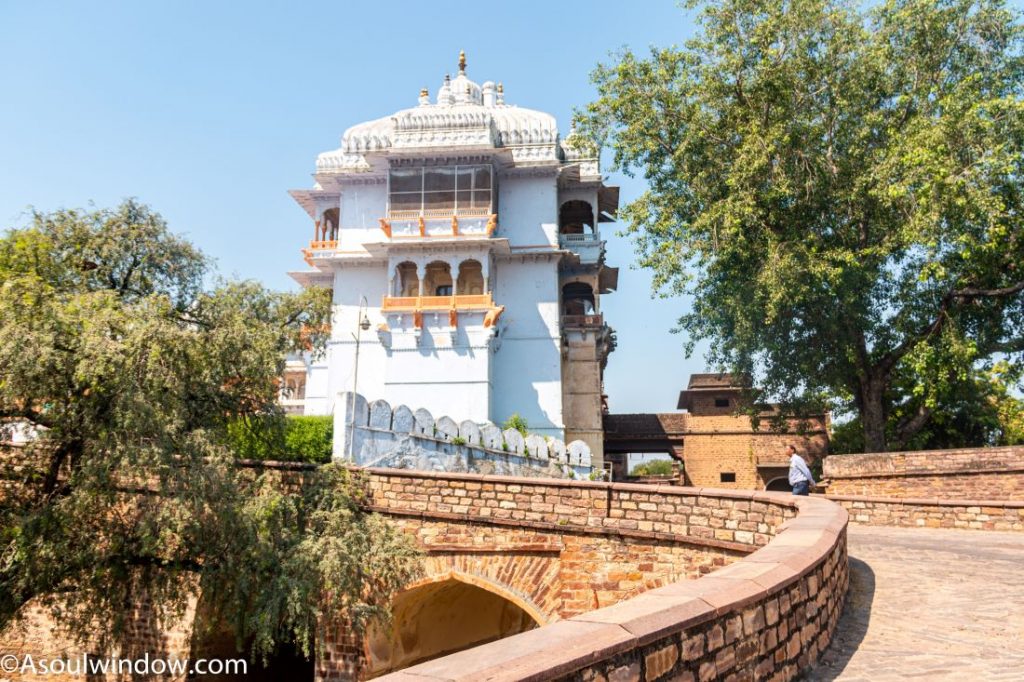
Garh Palace: Best place to visit in Kota
Also known as Kotah Garh or Kotah fort or the City Palace of Kota, it is the main attraction of Kota. City palace or the Garh has a brutal past which includes Nar Bali or human sacrifice.
It was Prince Jait Singh of Bundi who laid the foundation of Garh Palace in the year 1264 C.E.
It is that that the foundation was laid on the very spot where Jait Singh sacrificed and buried the severed head of Koteya, a Bhil chieftain. Jait Singh had just defeated Koteya, who used to reign over this area.
In fact, you can still see a temple devoted to Koteya Bhil within the premises of the City Palace. It sits as a Dvarpala (guardian) of Garh Palace. The royal family still worships at this shrine.
It is thus also concluded that Kotah may be named after Koteya. However, other historians differ and claim that Kota is named after Kot which means a strong fort.
I was impressed with the sheer size of the Fort premises as I entered its main gate. The massive gate itself speaks volumes of the past of Kota. It is one of the oldest surviving structures in Kotah.
You must climb on the top floor of Garh palace like I did. The sweeping views of City Fort and the Kota town and Chambal River is lovely from the top floor.
Garh Palace Baradari
You must also visit the beautiful Baradari. It was built by Rao Madho Singh (1625-1649 C.E.) It is a large room with several pillars. I could not help but admire the beautifully carved patterns and designs on the red pillars of baradari. The views of Kota city from Baradari are splendid.

Room of King
The room of the King within Garh palace precincts is also worth a dekko. It is located on the top floor. It was locked when I visited. I requested a local lady to open and she obliged. I was amazed at the exquisite mirror work and ancient paintings that adorned every inch of walls here. I observed many paintings of Shiv ji, Durga ji and Kings etc.
Balcony
There is also a balcony attached with this room. The King must have observed the city from here. The balcony is also embellished with beautiful artwork. It is open from 10 a.m. to 5 p.m. everyday.
Hawa Mahal of Kota
Much like the Hawa Mahal (Palace of winds) of Jaipur, Kota has a Hawa Mahal of its own as well, though it is not as ornate! It is located near the Naya Darwaza on the Tipta Chauraha which is the main square of the old Kota city.
The screened windows of Hawa Mahal of Kota allowed the Royal women to glance over the activities happening outside even as outsiders were not able to view them. It was constructed by the Maharao Umed Singh II. Plan your holiday in Kota using this comprehensive travel guide now.
Gates of Garh Palace
What else is there to do in Kota? Earlier the access to Garh Palace was through the Sailar Ghazi Darwaza. It is situated close to the Keshorpura Pol, south of the Naya Darwaza. This door is an attraction itself as it is the oldest surviving structure in Kota. It is said that the foundation of this gate was laid over the mortal remains of Koteya Bhil.
This is why you will also see a shrine dedicated to Koteya Bhil even now. This Kota tourist attraction is worth a visit. Your Kota city tour is incomplete without visiting these places of interest. You can take a free walking tour near the gates and markets of Kota.
Architecture of Garh Palace
The buildings of Garh palace are built in typical Rajputana style. Over the years, various rulers of the Rajput royal family of Kota have added new structure to the City Palace such as new apartments and suites. Once you will visit it you will know why Garh Palace is one of the places to visit in Kota.
The Maharao Rao Madho Singh Trust Museum
Located within the premises of the Kotah Garh or the city palace, the Maharao Madho Singh Museum offered me a glimpse in to the rich history of Kota through well displayed world-famous Rajput miniature paintings of the Kota school, arms, armours, royal belongings, old photographs, ritualistic objects, decorative items, yesteryear textiles and wall frescos.
Maharao Madho Singh Museum is a small museum which can be visited within few minutes. Open for public visit since the year 1970, this museum is one of the top places to see in Kota Rajasthan. I hope this Kota tourist places list is helping you!
Phone: 0744-2327695
Government Museum of Kota Rajasthan
Also known as Brij Vilas Palace Government Museum, it is a must-see tourist destination of Kota. It is one of the oldest museums of Rajasthan. What was earlier a palace was converted into a public museum in 1946, just a year before India achieved its independence from the evil British empire!
This museum is home to many ancient artifacts, old statues, miniature paintings, old coins, stone idols, armaments, costumes, arms and other displays. The display of ‘Yupa’ inscription dating back to 3rd century C.E. from Badwa is worth a mention.
The 9th century idol of Vishnu ji, or precisely Sheshshaayi Vishnu is also displayed here. It was found in Badauli. What’s more? You can also see stone objects from the stone eras here.
Government Museum of Kota is located in the Brij Vilas Palace near the Kishore Sagar Lake.It is one of the top places to visit in Kota.
Baoli
You can walk in the gardens of museum which are punctuated with decorative water fountains. You can also visit the historical Baori or the step well, located within the premises. I also visited a gorgeous step well at nearby Bundi, known as Raniji Ki Baoli. It was very ornate, unique and quite different from the Baoli I saw in Neemrana, Bara Imambada in Lucknow and Agrasen Ki Baoli in Delhi.
Jagmandir Palace & Kishore Sagar Lake
Rajasthan is known for building beautiful palaces in the middle of the lake. Some of such lake palaces I saw in Rajasthan are Padmini palace in nearby Chittorgarh, jüSTa Lake Nahargarh Palace (now a heritage hotel), Siliserh Lake Palace in Kishanpur, Jal Mahal in Jaipur, Taj Lake Palace and Jagmandir in Udaipur etc.
Located right in the middle of the Kishore Sagar Lake, the Jagmandir palace of Kota is one of the best places to visit in Kota Rajasthan.
Commissioned by one of the queens of Kota, the Jagmandir palace is constructed entirely in red sandstone. Jagmandir in Kota was built between the years 1743 and 1745 C.E.
You can admire its beauty from a distance or join the locals by hiring a boat ride which offers great panoramic views of the palace from all sides. You can also have a closer look of the palace from a boat ride in the Kishore Sagar Lake. It is one of the best picnic spots near Kota.
Keshar Bagh Cenotaphs
You can see Royal Cenotaphs of Kota in Keshar bagh, which is situated in the Keshar bagh near Jagmandir palace. Also known as Kshar Bagh, you can see a total of 17 Chattris or Cenotaphs here. In facts scenes from Bollywood film Badrinath Ki Dulhainya featuring Alia Bhatt and Varun Dhawan were shot here which helped in getting it more popularity.
History lovers can’t help but admire its Rajputana architecture. These cenotaphs are built in commemoration of the dead Royals. They are not buried here, the Chattris are built to celebrate their valour and legacy after they leave the world.
Cenotaph of Umed Singh is the most notable one. Umed Singh was just 10 years old when his father Rao Goman Singh breathed his last in the year 1770. Commander In Chief Zalim Singh was the virtual ruler and regent then. Umed Singh passed away in November 1819.
This heritage site is located near the Chatra Vilas Garden and Kishore Sagar Lake. It is one of the best places to visit in Kota.
Soul Window Tip
If you want breath-taking aerial view of the cenotaphs of Kota, the best vantage point is at Lucky Burj which is located near the Kishore Sagar Talav. The best views are seen from the top of the Lucky Burj.
I have also seen many royal cenotaphs in travel destinations such as the nearby Bundi, outskirts of Bikaner, Ahar Cenotaphs in Udaipur, Cenotaph of Maharaja Bakhtawar Singh in Alwar and even remote Ladnu while I was heading to Nagaur from Tal Chappar Blackbuck Sanctuary on a rickety bus.
Most of the Rajputana Cenotaphs I have seen in Rajasthan appear more Islamic than Hindu in its architecture. The domes are the most notable Islamic feature of all.
Jaswant Hada in Jodhpur is the grandest cenotaph I have ever seen in Rajasthan. The Chaurasi Khambon ki Chhatri in Bundi is also noteworthy as it stands on a whooping 84 pillars. The Royal Chhatardis of Bhuj near Rann of Kutch in Gujarat looked ethereal when I visited it during sunset.
Many of these Cenotaphs have beautiful Shivling on them which shows the devotion of Rajputana rulers towards Shiv Bhagwan, the most supreme of Hindu deity.
I am sure you will enjoy reading my exhaustive blogs on these places on A Soul Window, which is frequently mentioned as the Top Travel Blog from all of India. Some also address A Soul Window as No.1 Indian travel blog. Much of what is documented in A Soul Window is no-where to be found in old school travel guide books. Much research goes in writing such detailed travelogues.
Shivpuri Dham
Established by Naga Sadhu Shri Rampuri Ji, Shivpuri Dham is a well-known place near Kota city. He was inspired to build a temple here after he paid a visit to the world famous Pashupati Nath Mandir in Nepal.
What makes Shivpuri Dham in Kota famous is the fact that there is 15 feet tall Shivalinga located here. It is carved from a single stone. This unique Linga weighs as much as 14 tonnes. Personifying Bhagwan Pashupati, you can see 1008 smaller Shivlingas here.
Also, you can notice 525 smaller Shivling here which are shaped like a Yoni. Water from as far as Sindhu River in Leh Ladakh and other sacred rivers of India was brought here for Jalabhishek or offering while the temple was being established. Hindus believe that doing Jalabhishek here fulfils all their wishes!
It is a very peaceful and spiritual place. You can expect huge crowds here in the Hindu month of Saavan (monsoon) and during the festival of Raasleela and Mahashivratri! Other places to see here include Kaal Bhairav Mandir and Amrit Sarovar. Ample parking space is available here.
Abheda Mahal
This medieval palace was meant for the leisure of the rulers of Kota. Situated on the banks of a tank, this is where the royals used to unwind and relax, while soaking in the natural beauty of the area. You can also visit the Karni Mata Mandir, devoted to the presiding deity of Kota Rajasthan.
It is located near Abheda Mahal and is quite popular with Hindu devotees.Distance between the Kota tourist attraction Abheda Mahal and Kota is 8 kilometres. Do visit here during the Kota tour.
Seven Wonder Park
You can see the replicas of all the 7 wonders of the world in this unique amusement park in Kota. Located near the Kishore Sagar Lake at Vallabh Bari, it is fast gaining popularity with locals and tourists alike.
Think Taj Mahal of Agra, Pyramids of Egypt, Petra in Jordan, Eiffel Tower and Colosseum of Rome! Got the drift, eh? Families with kids love this Kota tourist attraction. It is a popular stop during the Kota city tour. It is an unusual thing to do in Kota.
Soul Window Thoughts
I feel that both the European buildings (Eiffel Tower and leaning what?) of the 7 wonders of the world are the damp squib and a misfit. Who made that list anyways? And why is Ajanta and Ellora Caves of Maharashtra not in that list? We have a leaning temple in Varanasi and never made hoo-haa about it anyways!
Kota Barrage
Where there is a river, there is a barrage. Whether it’s the Gomti barrage in Lucknow I grew up watching or the barrage of Kota which is built on the voluptuous Chambal Nadi. The Kota barrage is one of the most significant and important water reservoirs located in the state of Rajasthan.
It is a great picnic spot for the local people of Kota and Bundi who come here to enjoy the spectacular views of water gushing out through the gates with immense force. It reminds me of Bhushi dam in Lonavala near Khandala in Maharashtra which is a favourite destination of tourists during the monsoon. It is situated just 7.7 kms and 20 minutes away from Kota on the Ajmer Kota Road.
It is one of the best places to see around Kota Rajasthan.
Soul Window Travel Facts
Did you know that the Kota barrage sprawls over an area of a whooping 27,332 square kilometres? Hold your seats when I tell you that this area is equal to the size of Haiti, a tiny Caribbean nation near Cuba, Jamaica and Dominican Republic.
Kansua Shiv Mandir
This temple devoted To Shiv ji, is located very close to the Kota Barrage. What makes this Shiv Temple famous is that you can see a rare four faced Shivling. Did you know that there is a similar multifaced ancient Shivling in the Buddhist Vaishali in Bihar? From a stone inscription that was found here, we now know that Kansua Temple was commissioned by Raja Shivgana Maurya. The inscription was made in the year 738 C.E.
This ancient Shiv Temple is popular with both locals as well as tourists. Some people believe that the Pandavas from Mahabharat built a temple here. Also known as Kansua Shiv Mandir or simply Kanswa, it is one of the main places to visit near Kota. It is said that the mere darshan of the Shivling here fulfils all wishes!
Did you know about the mystery of Kansua Temple? There are many secrets associated with this temple. It is said that the first rays of Sun fall on the Shivling here. It is believed that Shakuntala, the wife of Dushyant gave birth to Bharat here on the shores of Malini River. The river still exists!
Kansua Temple, is thus of immense archaeological importance! Kansua Shiv Mandiris located just 10 kms away from Kota. It takes 25 minutes to arrive here via Kota Bapawar Road.
Chambal Udyan
The locals love to hang out at Chambal Udyan or Chambal gardens, especially on the weekends. Thanks to the abundant greenery and boat ride on Chambal River, it is a favourite picnic spot for the local people.

Apart from the scenic beauty of the place, it also attracts birdwatchers. During the winter months, birders can see many exotic foreign species of birds which migrate here. It is located just 8 kms away from Kota. It is one of the most popular places to visit in Kota.
And should I add that it is also a popular Lovers Point in Kota. It is not uncommon to see young couples holding hands and kissing in the corners of the Chambal Garden.
National Chambal Ghariyal (Gavial) Sanctuary
A part of the National Chambal Ghariyal (Gavial) Sanctuary, the world-famous Chambal River is picturesque.
Much like Kukrail in my home city Lucknow in Uttar Pradesh, the National Chambal Ghariyal aka Gavial Sanctuary conserves marsh crocodile and gharials who are depleting due to unethical human practises. This sanctuary was recognised in the year 1983.
Godavari Dham Temple
Located at walking distance from the above-mentioned Chambal gardens, the Godavari Dham Temple is popular with Hindu devotees. This temple devoted to Hanuman ji, is located right next to the Chambal River. The colossal swan made in marble sits atop the entrance gate, welcoming the faithful.
Also known as Shri Sankat Mochan Hanuman Mandir, this shrine is constructed in marble. The traditional architecture of Godavari Dham Templeis worth a dekko! Whether it’s the tall temple tower or the embellished walls of the temple, is demands to be seen! It is a must-see attraction near Kota! It is located 8 kms away from Kota.
Excursions from Kota Rajasthan
There are many quick excursions or short trips which you can easily club with your Kota and Bundi trip. From the much-revered Hindu temples to beautiful waterfalls (yes, in Rajasthan!) and natural Canyon like wonders, you will be amazed to visit the offbeat places to see near Kota. There are many unusual things to do in and around Kota.
Below are some of the best places near Kota which you must visit! This Kota tourist places list will help you plan your travel here.
Khade Ganesh Ji Temple
I cannot think of any other Hindu Temple where everyone’s beloved Ganesh ji is worshipped in his standing form. It is therefore the only temple of India where you can have a darshan of the standing idol of Ganesh Bhagwan. Located in the Southern part of Kota, it is a must visit place for both pilgrims and travellers.
And while you are visiting Khade Ganesh Ji Temple, do not forget to pay your respects at Rangbadi Balaji temple, which is located on the way. These are some lesser-known facts.
Khade Ganesh Ji Mandir is located 26 minutes and 13 kilometres away from Kota via NH52.
Karneshwar Temple
Where there are Hindus, there is a temple devoted to Shiv Bhagwan! Kota is no exception. Shiv Bhakts head to Karneshwar Temple to offer prayers to their beloved God. The temple is situated in a scenic place, the beauty of which is enhanced during the rains. This is why both picnic crowds and devotees can be seen here. Karneshwar Mahadev Temple is located at NH52 on the Jhalawar Road. It is 15.5 kms or 32 minutes away from Kota Rajasthan.
Charan Chauki
It is known as Charan Chauki because it is believed thatthefootprints of Bhagwan Shri Krishna can still be seen here. This is why Hindu Pilgrims find this place very sacred. Krishna Bhagwan is said to have stopped here and rested while he was on his way to Dwarka in what is now Gujarat from Mathura in what is now Uttar Pradesh.
This place falls on the way when you drive to Dad Devi Temple from Kota. Distance between Dad Devi Temple from Kota is just 15 kilometres. This is one of the unusual places to see near Kota.
Dad Devi Temple
Devoted to Shri Dad Devi Mata Ji, an incarnation of Durga Maa, the much-revered Hindu deity, it is a must visit place near Kota. This Hindu temple is the temple of the Royal Family of Kotah. As you will find yourself engulfed by thick jungles, the serenity of the place will start growing on you.
Local people throng this Hindu temple every day. Distance between Dad Devi Temple and Kota is just 18 kilometres. It can easily be clubbed with Kota tour.
Alnia Dam
I was amazed to see prehistoric paintings and art on the rocks in Bhimbhetka in Madhya Pradesh and Wadi Rum in Jordan. Did you know that you can see ancient rock paintings which can be traced back to the Upper Palaeolithic age? Located near a river bank, these prehistoric rock paintings are still in very good condition! It is an unheard-of place and a popular picnic spot for locals. It is also a free thing to do in Kota.
Mukundara Tiger Reserve
It is very often that Tigers from Ranthambore National Park are relocated here. An offbeat destination for wildlife lovers, the Mukundara Tiger Reserve is also home to black bears, various species of deer, wild boar and even panthers. Needless to say, the thick forests of this place also hide many birds under its canopy.
The core area of Mukundara Tiger Reserve is 417 square kilometres. The buffer area is 342.81 square kilometres. I did not see the core and buffer zone area concept while visiting wildlife destinations of Uganda in Africa.
Distance between Mukundara Tiger Reserve and Kota is 50 kilometres.
Darrah Wildlife Sanctuary
Do visit this offbeat wildlife destination near Kota. Wild animals such as leopard, elks, wild elephants, bear, sambar deer, wolves etc call Darrah Wildlife Sanctuary home! Formerly a hunting ground for Royals, it became a protected sanctuary in the year 1955.
You can do wildlife Safaris here. You can spot many endangered mammals and exotic species of birds here. It is also spelt as Durrah Wildlife Sanctuary.
Darrah Wildlife Sanctuary is located 56 kilometres away from Kota Rajasthan.
Garadia Mahadev Temple
If you are traveling to Kota in monsoon, you will love the views of lush green surroundings here. Hindu devotees visit here to offer prayers at the Temple. Garadia Mahadev Temple is devoted to Bhagwan Shiv!
Located on the Dabi road on NH 76, the Garadia Mahadev Temple offers breath-taking views of Chambal River. The view of Chambal River taking a U turn is visually stunning! It is a hidden gem and not many know about it. However, for locals, it is one of the popular picnic spots near Kota.
There are also good photography opportunities here as it is located in a picturesque place. Garadia Mahadev Temple is located some 15 kilometres away from Kota. It is one of the best places for sightseeing near Kota and Bundi.
Do visit for larger-than-life views. Thanks to its jaw dropping views, many tourists also call it the Grand Canyon of India, named after the one in Unites States of America! Even the more famous Gandikota in Southern Indian state of Andhra Pradesh is often referred to as Grand Canyon of India.
Mathuradheesh Temple
It is known as Mathuradheesh Mandir because the main idol of Krishna ji was brought here all the way from Karnaval Village near Mathura in my home state Uttar Pradesh. The idol was then placed in the haveli of Dewan Dwarka Das. Needless to say, this Hindu Shrine is devoted to Shri Krishna, the 8th avatar of Bhagwan Vishnu.
The Mathuradheesh Temple is affiliated to Pushti Marg, which is a Vaishnavite sect founded by Shri Vallabhacharya ji. It is but natural that the festival of Janamashtami, Holi, Annakoota and Nand Mahotsav is celebrated here with much fanfare.
You have to see how the devotees of Shri Krishna lose themselves as they drown in the festive fervour. No wonder it is the most famous nearby places to visit in Kota.
Gaiparnath waterfall Mandir
This Shiva Temple issituated in a picturesque place.Thanks to the voluptuous waterfall this temple is located near, it is a favourite picnic spot of the locals as well. Do visit the Gaiparnath waterfall Mandir to see spirituality and leisure blending seamlessly.
It is a popular place to visit near Kota. Visitors come here to enjoy the amazing views of cliffs of the Chambal valley and the gorge. The surrounding jungles add to the beauty of this place.
Gushing water from the waterfall and lush green surroundings and watchful eyes of benevolent Shiv ji make this Kota tourist attraction worth a visit. It is a popular picnic spot near Kota.
Kaithoon for Kota Doria sarees
Also spelt as Kaithun, it is known for its unique weave known as kota doria. You can see how Muslim women weave Kota Doria sarees in Kaithoon. The best part is that you can also shop for the same. Most of the women weavers here belong to the Muslim Ansari community.
The Kota Doria weave was awarded the Geographical Indication mark or GI mark in the year 1999, thanks to the real Gold zari work done on the cloths.
Kaithun is located approximately 15 kilometres away from Kota. You must shop for Kota Doria sarees and clothes when visiting Kota.
Souvenirs Shopping Guide to Kota
If you are looking for places to visit in Kota for shopping, then you must go to Kaithoon. Do let me know if you want to add to this comprehensive Kota tourist places list. Most tourists skip Kaithun during Kota city tour, but I recommend it if you are interested in handlooms. Kota trip is incomplete without some shopping.
ATM in Kota Rajasthan
It is my practical advice to not worry too much about cash in Kota. I noticed several ATMs in Kota ate every corner. Since it is a big modern city, expect facility of digital payment at many shops as well.
There is no dearth of ATMs in Kota Rajasthan because it is a big bustling city and is considered one of the most important places in Rajasthan.
Vegan and Vegetarian Food in Kota
There is no dearth of great vegan and vegetarian food in Kota. Vegans might want to watch out for desi ghee or clarified butter while binging on the Kota food. Just ask! Some of the most famous foods of Kota are pyaz kachori, lip smacking daal baati churma, Kadi and desserts such as the Rajasthan special Ghevar.
Some of the places you can eat famous food of Kota are Panna Laal Ke Pakode and Amar Dhaba etc.
Local Transport for sightseeing in Kota
Tuk tuks, local buses, battery rickshaws, auto rickshaws are easily available in Kota throughout the day.
Backpacking Budget Travel Tips for Kota
It is easy to visit Kota on a low backpacking budget. The city of Kota offers facilities like food, hotels and public transport for all economical sections of society. That is the beauty with most of the Indian destinations.
Solo Trip Tips for Kota
It is very easy and safe to visit Kota Rajasthan as both male and female solo travelers. It is easy to get around and manage on our own in Kota.
Luxury travel Tips for Kota
Luxury travelers will be spoiled for choice when visiting Kota Rajasthan. Since Rajasthan is a royal state of India, luxury is a way of life here. From premium stay to fine dining to modern frills, everything is available in Kota.
Photography Tips for Kota
You can get some brilliant shots at the nearby Garadia Mahadev Temple – the Grand Canyon. Visiting here is recommended during sun rise and sun set, when the glow of golden hour paints the canyon in surreal hues.
Places like Baoli as well as the Garh palace complex also lends a gorgeous background for a photo shoot.
Celebrities from Kota
Some famous celebrities such as singer Shreya Ghoshal and Parag Agarwal, CEO of Twitter were schoolmates of my friend Navneet, who is also from Kota. You should watch my interview with Shreya Ghoshal whom I met during Naropa Festival in Ladakh.
Hire local tourist guide in Kota
If you hire a local tourist guide in Kota, your trip can be made more meaningful. The guide can help you learn more about the top places to see in Kota along with some offbeat hidden gems.
There are several unexplored places in Kota which are located away from the crowds. A guide can help you go off the beaten track. Some of these lesser-known places are not to be missed!
Languages spoken in Kota
Harauti is the most popular dialect spoken in Kota. It is followed by Marwari, Hindi and English. These are easily spoken and understood by most people of Kota.
Toilet facility in Kota Rajasthan
Clean public toilets are available at most major tourist attractions, restaurants and picnic spots.
What to wear in Kota Rajasthan?
Light cotton in summer and monsoon and heavy woolen clothes in winter are a must when holidaying in Kota.
Duration of Visit in Kota Rajasthan
How many days to spend in Kota? It depends upon your time, budget and interest.
What can I do in 1 day in Kota?
Most of the major attractions of Kota are located next to each other. This makes it easy to see all the picnic spots and sightseeing attractions of Kota within a day. In fact, I had made a day trip to Kota with my parents and I was able to visit all the main points of attractions of Kota easily.
What can I do in 2 days in Kota Rajasthan?
If you want to visit Garadia Mahadev Temple – the Grand Canyon (which I highly recommend), remote temples in picturesque settings and other lesser-known sightseeing places, then you must visit Kota for 2 days or more. There are many must-see places near Kota which many tourists miss due to lack of awareness. This historic destination deserves more time!
Best time to visit Kota Rajasthan
It is a very commonly asked question on Kota. Here is all you wanted to know about the weather of Kota.
Winters are the best time to visit Kota Rajasthan.
Summer
Avoid Kota in the months of April, May, June as it is very hot in these months. Kota is a North Indian plain which gets very hot in these months. The temperatures of Kota are high in summer.
Monsoon
It rains a lot in the month of Mid-June and July. However, it may not rain daily and thus Kota can be visited in monsoon as well. The weather of Kota is pleasant in monsoon. Since most of the places of interest in Kota are located near to each other, it becomes convenient to explore Kota in rainy season.
Winter
I visited Kota during the cooler months which is also the best time to visit Kota. The cooler months in Kota are October, November, December, January, February and March. December and January are the coldest months but still enjoyable. It is also when you get best local food. Do carry woollen clothes when visiting Kota in winters.
Places to stay in Kota
This is another frequently asked question about Kota. Kota is quite a bustling town and has a plethora of interesting stay options.
We stayed in the jüSTa Lake Nahargarh Palace. It is a lovely property in the middle of the lake. They had arranged cars for us to visit nearby places such as Bundi and Chittorgarh. I stayed in their huge suites. The local food such as Ker Sangri is a must try here. It is a little away from Kota.
Umed Bhawan Palace is another luxury property located in Kota. Kota is quite a bustling town therefore you will find hotels in all budgets here.
Is Kota Safe to visit?
Kota is one of the safest places to visit in Rajasthan and India. The crime rate in Kota is low and tourists are never harmed whether you are travelling in public buses or cocooned in a private cab. All the places to visit in Kota are safe and peaceful.
Soul Window Travel Tips
You can easily see all the main attractions of Kota in a day! Most of the points of interest in Kota are located close to each other. However, you will have to hire a cab or hop on and off from autorickshaws in order to see all places.
How to reach Kota, Rajasthan
It is fairly easy to make it to Kota Rajasthan. Kota is connected with major big and small cities of India. If you want to see the destinations, I mentioned in the Kota tourist places list, then you can opt for below options:
Reach Kota by Bus
You can take public buses to Kota from nearby Bundi, Chittorgarh, Kumbhalgarh, Udaipur, Bikaner and Jaipur etc. Buses run by Rajasthan Road Transport Corporation are the best. They are cheap and punctual.
Reach Kota by Railways
Kota has its own railway junction which is connected with Indian cities such as Pune, Mumbai, New Delhi, Kolkata, Chennai etc. You can take express trains such as Rajdhanis and Superfast trains from New Delhi and Mumbai.
Reach Kota by air
Sanganer airport of Jaipur is closest airport from Kota. From Jaipur you can take a bus or train to Kota. We did a road trip from Jaipur.
Reach Kota by road trip
We visited Kota on an exciting road trip via Bundi. In fact, we saw the best of Bundi and Kota in a single day in a private taxi arranged by our hotel. The road conditions even in remote places of Rajasthan is excellent!
You can also club places such as Ajmer, Udaipur, Chittorgarh, Haldighati and Jaipur like we did on our epic road trip across Rajasthan. Many trains which ply on the Mumbai Delhi route stop here.
Distances from Kota Rajasthan
Here is a distance chart of best places to visit near Kota in ascending order. This will help you plan your trip in Rajasthan. I have made a list of all the best places to see near Kota and Bundi.
Distances from Kota to other places in Rajasthan are as below (In ascending order)
Distance between Bundi to Kota is 38 kilometres and it takes 50 minutes to 1 hour via NH52.
Distance between Chittorgarh to Kota is 172 kilometres and it takes 3 hours via NH27.
Distance between Ajmer to Kota is 202 kilometres and it takes 4 hours, 15 minutes via NH52 and Ajmer Kota Road.
Distance between Jaipur to Kota is 251 kilometres and it takes 4 hours, 30 minutes via NH52.
Distance between Nathdwara to Kota is 265 kilometres and it takes 4 hours, 50 minutes via NH758 and NH27.
Distance between Udaipur to Kota is 282 kilometres and it takes 4 hours, 50 minutes via NH27.
Distance between Kumbhalgarh to Kota is 300 kilometres and it takes 6 hours, 10 minutes via NH27 and NH758.
Distance between Bikaner to Kota is 600 kilometres and it takes 10 hours via NH52 and NH11.
Distance between Jaisalmer to Kota is 670 kilometres and it takes 12 hours via NH125.
Conclusion: Why visit Kota?
It is a pity that not many people go to Kota despite the facts that there is so much to see and do in and around Kota.
Kota is an offbeat place to visit in Rajasthan. Despite a smaller number of tourists travelling to Kota, there are so many interesting places to visit in Kota. Nearby destination such as Bundi, Chittorgarh etc also make it worth a visit!
To summarize, places to see in Kota deserves a visit. You must share this information packed Kota travelogue with your friends and family and plan a trip soon here. There are more points of attractions in Kota than you can imagine!
The view from my Soul Window is off the beaten track!
Pin this blog to save the blog and plan a trip later!
Related Blogs on Rajasthan
City Palace
Mehrangarh Qila
Alwar sightseeing
Bundi sightseeing
Chittorgarh sightseeing
Bikaner sightseeing
Karni Mata sightseeing
Khinchan Cranes
Tal Chappar sightseeing
Tal Chappar Avian species
Jorbeer Avian Species
Sightseeing in offbeat Rajasthan
Pushkar Blogs
Om Banna – The curious case of Bullet Baba temple!
About Om Banna
Om Banna Temple also known as the Bullet Baba, located on the Jodhpur Pali highway is the most offbeat Hindu Temple I have ever visited. Of my extensive travels in India since 2008, I have come across many bizarre places. Om Banna Temple is one of those mysterious places I visited on a cold winter afternoon. I went here while I was on a trip to see undiscovered Rajasthan.
I have lived as a Rajput Hindu in India all my life but this was still quirky for me. This exhaustive article is the most comprehensive travel guide on Om Banna Mandir ever. All the frequently asked question on Bullet Baba are answered here. Visiting Om Banna is an unusual thing to do near Jodhpur in Rajasthan.
Who is Om Banna?
The real name of Om Banna was Om Singh Rathore. He was the only son of a well to do Thakur and studied in Pali College. Name of the father of Om Banna is Shri Jog Singh. He lives in Chotila village, 3 kilometres away from the temple.
Om Banna was a regular young man from rural Rajasthan who ended up joining the 30-crore strong pantheon of Hindu Gods. The latest Hindu God that he has now become, the magical powers of his motorbike is still unknown.
He must have not even imagined in his lifetime that after his death, people will worship his statue and his bike, better known as the Bullet Baba.
Nomenclature of Om Banna Temple
Om Banna Temple is also known by below names
- Bullet Baba
- Baba Banna
- Shri Om Banna
- Shree Om Banna
- Om Banna Mandir
- Bullet Baba Mandir
Just to clarify, the above-mentioned names of Om Banna Temple are used interchangeably in this comprehensive travel guide on Om Banna Mandir. All the above alternative names mean the same thing.
Age of Om Banna
Om Banna was very young when he breathed his last. Age of Om Banna must have been only around 23 or 24 when he died. Some say he was 21. It is a pity that a young man left the world so early.
Family of Om Banna
Wife of Om Banna was Urmila Kanwar. He had a little family discord after he did love marriage with a girl of his choice. He then started staying with his wife, separately from his parents.
Name of the son of Om Banna is Maha Prakrami Singh. Om Banna’s son took birth 2 months after he died in the accident.
Why is Om Banna World-Famous?
Om Banna Mandir aka the Bullet Baba Temple is world-famous for its bike temple near Jodhpur in Rajasthan. It is one of the most unusual Hindu Temples that I have ever visited. What adds to the popularity of the Om Banna temple and Bullet Babaare the mysteries and miracles of the temple.
Both the idols ofOm Banna as well as the real motorcycle of Om Singh Rathore are being worshipped here daily by thousands of people who firmly believe in the magic of Om Banna.
The fame and popularity of Om Banna Mandir has risen so much in recent years that people from far away villages of Rajasthan visit it to not only pay their respects but also perform important life events such as Mundan ceremony and weddings etc.
Soul Window Thoughts
Hinduism sure has many forms, the most unusual of which I saw in rural Rajasthan. The one thing I love about Hinduism or Sanatan Dharm is that it is plural and allows one to be both a believer and a heretic or atheist.
Sanatan Dharm also allows one to modify their believes, questions the existing faith and even invent new Gods. The quirky Om Banna Temple in rural Rajasthan is a perfect example of this. It is the only place in the world where an ordinary motorcycle is worships by thousands on people, no questions asked.
For the people who believe in the magical powers of Om Banna do not need any explanation. For them Om Banna is beyond any doubt or research. It is the immense power of their faith which drives thousands of people every day to Om Banna.
Om Banna Story
There is a very interesting Om Banna Story behind this quirky Hindu Temple. It was a cold winter night of 1988 when the story of Om Banna unfolded in Rajasthan. On 2nd December, 1988, at 10 p.m., a young man known as Om Singh Rathore, was on his way to Chotila and Rohat from the small town of Bangdi near Sanderao in Pali. He was riding a motorcycle along with his friends when he got disbalanced and hit a Jaal tree.
He breathed his last after he met with the accident on the Pali Jodhpur highway. His beloved motorbike fell in a ditch. His friends survived though. What happened next is a tale of mystery and intrigue!

Mystery of Om Banna
There is an unsolved mystery which actually led people to worship Om Banna. On the next morning after Om Singh Rathore had an accident, the police had taken the custody of the bullet. They had emptied its fuel tank and locked it up with chains in a police station in Kerla, now called Rohta. The police had even deflated the tyres of the bike.
However, quite mysteriously, the next day the motorbike vanished from the local Police Station. It was later found at the place where Om Singh Rathore met his accident. No one knows the secret behind this incident.
This repeated for a few days. No matter how much the police tried to keep the bike under a lock it kept starting on its own and kept returning to the same ditch where it fell.
All the attempts to keep the motorcycle of Om Singh Rathore at the police station were in vain. Every time they tried to lock the bike at the police station, the bullet of Om Banna returned to the accident site before dawn.
The police then decided to send the mysterious bike to the home of a local potter of Chotila named as Hukma Ram. The same thing repeated as the bike started on its own in the home of the potter as well.
Secrets of Bullet Baba Mandir
Nobody was able to solve the mystery of Om Banna.
Soon the news spread. The local people saw it as nothing less than a miracle. Soon, other nearby villages also got a whiff of the news. The motorcycle was shifted back to the accident spot after which it never started on its own. And thus began the legend of Om Banna.
People started to worship the place, bike and Om Banna informally. The faith in the Bullet Baba Temple started to grow and it began attracting huge crowds from nearby places in Rajasthan. Within 6 months of death of Om Banna, the locals started to feel the magical and mysterious powers of Om Banna.
This is when, in order to formalise it a Bullet Baba’s Temple was built in the honour of Om Singh Rathore aka Om Banna. Banna is an honorary word used for addressing young Rajput males. I have yet to come across a story as unique as the Om Banna Story. The mystery and miracles of Om Banna Temple has remained unsolved and unexplained.
Another miracle story around Om Banna is that he appeared before her grandmother in night and claimed that he is not dead yet. He requested her to donate 2 Bigha land to Hemraj Purohit which his grandmother eventually did. Grandmother of Om Banna is not alive anymore.
Om Banna for Newly Weds
During my visit to the Om Banna Mandir, I observed many rituals taking place. I noticed many newly-weds couples, tied to each other via a knot. They were clad in red. The couples circumambulated around the sacred bike and the idol of Om Banna for blessing.
I asked some of them the reason behind it and they said that they were locals who find it auspicious to visit Baba Banna just after marriage.
Bullet Baba for safe journey
A local man told me during my visit to Om Banna temple that many people who ply on the Jodhpur Pali highway make sure that they stop and offer prayers to the Om Banna temple. They believe that it blesses them with a safe journey. I saw many truck drivers and local families clad in colorful dresses, making a quick stop to offer prayers at Om Banna Mandir or the Bullet Baba.
The locals of Rajasthan firmly believe that the spirit of Om Banna helps distressed travellers plying on the Pali Jodhpur highway. This is why people do not forget to bow their heads and leave behind offerings when they pass through the Pali Jodhpur Highway.
Not only the drivers from Rajasthan but others too such as Punjabi and Muslim drivers make a stop here before they move ahead. You may call it superstition because you do not understand it but locals believe that if someone refuses or forgets to stop at Om Banna Temple while riding on the NH65 then he is on a dangerous journey ahead. It is not considered a good omen to not stop here before proceeding ahead.
There are many mysteries and miracles associated with Om Banna. It is said that Om Banna was instrumental in saving a few accidents in the area near the Bullet Baba Mandir. Some truck drivers have also claimed that they have felt the presence of unknown as they drove on the National Highway 65 during the night hours.
Anecdote from Om Banna
There is a famous incident known to the locals. Few years ago, another man fell from his bike near the same ditch which killed Om Banna. He was profusely bleeding and injured when the soul of Om Banna rescued him. Such stories enhanced the reputation of the Bullet Baba Mandir, thereby strengthening the beliefs of the locals.
Worship of Baba Banna
The Worship of Om Banna, made me curious. I have grown up as a Rajput Hindu from Uttar Pradesh in North India and have never seen the rituals that I saw in Om BannaTemple. It was very similar to what you will see in a Hindu temple and yet different.
I saw Hindu devotees, mainly from the villages of Rajasthan, jostling to touch the idol of Om Bannafor blessing. They offered sweets, coconut, fresh flowers, liquor and big packets of incense sticks to the idol of Om Banna. Men and women also tied red threads as a mark of respect and to seek blessings.
Om Banna was an open-air temple when I first visited it. I noticed that the eternal flame was going strong even during the day. Nearby, big bunches of lit incense sticks made the air fragrant. A priest aka pujari named Shri Poonam Giri and his helpers sat next to the idol of Om Banna. People queue up to make offerings in honour of the helpful spirit.
Hindu devotees and travellers offered prayers to both the bike and its late owner Om Bannaaka Om Singh Rathore. I could see the devotion in their eyes and body language as they folded hands and closed their eyes in devotion.
While some people applied Tilak mark on the forehead of the idol of Om Banna, others tied sacred red thread on the motorcycle of Baba Banna. The locals sat on the ground with a harmonium and sung paeans in the glory of Om Banna. The Om Banna bhajan added to the atmosphere of the bizarre Hindu temple.
Whiskey Offering in Om Banna Temple
I noticed that almost all the Hindu devotees offered whiskey to the idol of Om Banna. There is a tradition here as per which devotees open a fresh whiskey bottle and offer it to Om Banna. I saw that after sprinkling the whiskey on the bust of the idol of Om Banna, hand over the bottle of whiskey to the presiding pujari.
The locals offer bottle of whiskey here when one of their wishes are fulfilled by Om Banna. Whiskey is the preferred choice of liquor offered here because that was what the favourite tipple of Om Banna was.
I noticed many young male devotees, extending the freshly opened whiskey bottle and pouring it near the lips of the idol of the bust of Om Banna, perched on an elevated concrete platform.
This reminded me of the Bhairavnath Temple of New Delhi, located near the Purana Qila or old fort. What makes it unusual is that Liquor is the main prasad served at this ancient Hindu temple.
After the Bhakt or devotees offer Liquor to Bhairo Baba, it is distributed to them as a prasad (holy food). The temple dates back to the ancient Mahabharat times.
Soul Window Travel Tip
Please note that since the Bullet Baba Mandir is located on a highway, drinking alcohol is strictly prohibited in and around the temple. You can get in serious trouble if the local police catches you drinking alcohol.
Location of Baba Banna
Unlike any other major Hindu temple that I had visited, the Om Banna Temple is located right on the highway. Situated near Chotila Village of Rajasthan in North India, Om Banna can be accessed via the wide Pali Jodhpur highway.
Om Banna Mandir is located just 20 kilometres or 12 miles from Pali and 53 kilometres or 33 miles away from Jodhpur. Om Banna temple location is easy to find as many local people and bus conductors know about this place.
If you enjoy going off the beaten track then this lesser-known place is not to be missed!
Om Banna Bike number plate
Here is an amazing fact on Bullet baba. Om Banna Bike number is RNJ 7773. Hindu devotees worship a 350cc Royal Enfield Bullet in Bullet baba temple. The Om Banna bullet number RNJ 7773 was easily visible when I traveled here. This is also the reason why it is known as the Bullet Baba Temple.
Bike of Bullet baba
The Om Banna bike is a sort of a new Hindu deity itself, what with many devotees garlanding it, worshipping it and doing a parikrama around it. In case you are wondering you are allowed to take pictures of the Om Banna bike no.
The Royal Enfield Bullet of Om Banna used to be kept near the Jaal Tree, which is located close to the highway. However, due to road widening work, the Bullet was moved under a shade in a field located at walking distance from the Jaal tree.

Om Banna Jaal Tree
There is a Jaal tree which is located closer to the Pali Jodhpur Highway where Hindu devotees throng for worship. This is the exact tree which collided with the motorbike of Om Singh Rathore aka Om Banna, leading to his unfortunate death.
The tree that caused death of Om Banna itself has become worthy of worship and is considered holy by the local people. I also saw many women in groups at Om Banna. Turns out, they are the wives of those who are frequently on the road. The women pray here for their protection when they are driving.
I saw many young and old women tying holy red threads on the sacred tree here. They tie the thread to seek blessings and prosperity.
The actual Om Banna Temple where rituals happen is located a bit inside to avoid the crowds spilling on to the highway.
I observed that the local women and girls also offered bangles and scarves at the sacred tree of Om Banna Mandir. Om Banna is a must-see place near Jodhpur.
Om Banna Bhajan
Also known as the Om Banna Aarti, I saw local people singing it even as devotees offered prayers to Om Banna God. These are some lesser-known facts about Bullet baba, the hidden gem of Rajasthan.
My Experience of Bullet Baba Temple
I visited Om Banna temple after seeing the imposing Mehrangarh Fort and the brilliant Jaswant Hada in Jodhpur on a crisp winter afternoon. I made a day trip to Om Banna from Jodhpur. The bus from Jodhpur dropped me on the other side of the Highway. I was curious to visit this unusual place to see in Rajasthan.
A huge shop next to a restaurant intrigued me with massive posters and other merchandise of Om Banna.
I walked my way to the other side of the Jodhpur Pali highway, watching carefully at the speeding trucks and cars. The first sight I saw was of women tying thread on the sacred tree of Om Banna Mandir. The energy of the place and the commotion made it stand apart from the other places in the vicinity.
The Om Banna temple had created a culture of its own, I noticed. The entire area around the temple cantered around the Om Banna Mandir. The sweet shops, Pooja Samagri shops, the souvenir shops, the works! Honestly, I had not expected such grand celebrations around Om Banna.
Before I had visited Bullet Baba Temple, I assumed it to be a gimmicky touristy attraction. I was proved wrong when I saw the devotion on the face of people. There were more locals than tourists present there. Om Banna is indeed a must-visit place in Rajasthan.
I saw many newlyweds and their relatives seeking blessing from the Om Banna. One of the bridegrooms I talked to even wore a western suit with a Rajasthani Pagdi and was well spoken, and urban. He was a Rajpoot and explained to me about Om Banna Temple in great details.
I stood there for a while and soaked in the ambiance. I took a step back when a profusion of the fragrant smoke from the incense sticks filled my nose. The locals were undeterred though. Nearby some rituals were taking place in a mandap. A couple actually got married in the premises of Om Banna Temple.
Bullet Baba: Motorcycle of Om Banna
I moved behind the main Om Banna main shrine to get a close ‘darshan’ of the famous motorcycle of Om Singh Rathore or Om Banna. It was kept in a huge glass box, protected from dust and the touch of unruly people. I saw many marigold garlands around the handle of the bike, much like how we offer garlands to Hindu deities by putting in on their necks.
I saw the newlyweds, their nuptial knots still tied, doing a parikrama or circumambulation of the motorcycle. It is considered auspicious to do that in Rajasthan. I saw many locals people dressed in the hues of primary colours such as bright red, pink, yellow, orange, blue and greens.
Also read: My Parikrama of Kailash Mansarovar Yatra
Om Banna for tourists
Off late, many Indian and foreign travellers also visit the Om Banna Temple to see what all the fuss around the Patron Saint of NH65 is about. I saw a big group of travellers from Europe, who looked visibly amused as their English-speaking Indian guide explained the story of Om Banna Temple to themin English.Visiting Om Banna Mandir is the most unusual thing to do in Rajasthan.
They had travelled all the way from Jodhpur in air-conditioned cars and a local guide. Many Indian and foreign tourists and travellers to Jodhpur make it a point to club the Om Banna Temple in their Rajasthan itinerary.Om Banna temple is an offbeat place to visit in Rajasthan. This unheard-of tourist place is still unexplored and located away from the crowds.
Souvenirs Shopping Guide to Om Banna Temple
What to buy at Om Banna Mandir?
I saw many shops selling Baba Banna merchandise across the highway. The shops sold paraphernalia associated with Om Banna such as:
- Om Banna Aarti
- Om Banna shirts
- Om Banna Bhajan
- Om Banna posters
- Om Banna Lockets
- Om Banna Keyrings
- Om Banna magnets
- Om Banna music CDs
- Stickers of Om Banna
- Om Banna showpieces
- Om Banna photo frames
- Om Banna Fridge Magnets
All of the above-mentioned Om Banna merchandise had the face of Om Banna embellished on the product. I did not pick any of these souvenirs but I saw the local people and Hindu devotees shopping for these. You can buy these quirky (to me) Om Banna Temple merchandise only on the location. It is located across the road from the temple.
I try to bring such unique and bizarre stories from across India on my award-winning travel blog A Soul Window, which has also been mentioned as the number one travel blog of India. My blog has also won many mentions as Top Travel Blog of India several times.
You will not find such detailed travel guide in the outdated old school travel guide books.
Entry Fee to Om Banna
Like with many major Hindu temples and tourist attractions of India, Om Banna temple is also a free thing to do in Rajasthan. There is no entry fee to visit Bullet Baba Temple.
ATM in Om Banna
There are not many ATMs around Om Banna, so it is good to withdraw some cash in Jodhpur which is a bustling city with many ATMs.
Solo budget trip tips to Om Banna
I was on a week-long solo budget trip to offbeat places in Rajasthan. Om Banna can easily be visited as a solo traveller on a shoestring budget. Easy availability of public transport and low costs make it an excellent place to see for solo travellers like me.
Backpacking Budget Travel Tips for Om Banna
It is possible to visit the Bullet Baba Temple on a very low budget. The only money I spent to visit Om Banna Temple was the money spent onthe bus.For lunch, I was carrying some packed food from Jodhpur.
It is not an exaggeration when I say that you can easily visit Om Banna Temple from Jodhpur under only Rs. 200 if you take public transport such as buses.
Luxury travel Tips for Om Banna
I saw many European tourists who visited Bullet Baba Mandir in luxury. The cost to visit Om Banna will increase if you travel by a private cab and dine at unnecessarily expensive restaurants. Jodhpur has some of the finest luxury amenities of the world.
Soul Window Reflections
A visit to the quirky Om Banna Mandir is not only worthwhile but also opened up my eyes to the unlimited possibilities that Hinduism offers. Unlike other religions, Hinduism is still the only religion which is evolving and adding new dimensions to it without much of a furore and opposition. Hinduism in not stuck in a universal book or a single male God. Hinduism is all about plurality.
The Om Banna Temple shows why Sanatan Dharm, the most ancient of all religions is tolerant of different viewpoints and accommodative of alternative thoughts and practises. You may dismiss it as mere blind faith or find it funny, amusing or even foolish to see thousands worshipping an ordinary man and his cool bike.
But for most Hindus of India, the unexplained mysteries and miracles have always been worthy of worshipping. Come to think of it! Hindus worship trees, snakes, monkeys, river Ganga which we find normal. However, I find these natural elements as mysterious as the self-driving bike of Om Banna.
And that is the beauty of Hinduism. To celebrate the unexplained!
Excursions: Places near Om Banna
There are many interesting sight-seeing places to visit near Om Banna. During my week-long trip across offbeat places in Rajasthan, I visited Bikaner, Jodhpur, Khichan, Pushkar, Karni Mata Mandir, Tal Chappar Blackbuck sanctuary, Nagaur and so on.
Here are some of the best places to see near Om Banna Temple
- Ladnu
- Bikaner
- Nagaur
- Jodhpur
- Khichan
- Pushkar
- Bishnoi Village
- Khejarli Village
- Guda Bishnoi Lake
- Karni Mata Mandir
- Tal Chappar Blackbuck sanctuary
How to reach Om Banna Temple in Rajasthan
This is one of the most commonly asked question on Bullet Baba Temple. Om Banna Temple is located on the NH65 or the National Highway 65. The Highway is informally known as the Jodhpur Pali Highway. It is fairly easy to arrive at Om Banna Temple from Jodhpur. I reached Om Banna Temple from Jodhpur via a straight bus.
You can catch any buses heading from Jodhpur Bus Depot to Pali, Abu Road or Sanderao in order to reach Om Banna. Just tell the conductor to alert you once Om Banna temple comes on the way. The bus drops at a walking distance from Om Banna temple, across the highway if coming from Jodhpur.
Om Banna is a nice unexplored place to see in Rajasthan with family and kids.
Distances from Om Banna
Distance between Jodhpur to Om Banna is 45 kilometres and it takes around 45 minutes via NH65
Distance between Pali to Om Banna is 22 kilometres and it takes around 30 minutes via NH65
Distance between Guda Bishnoi Lake to Om Banna is 29 kilometres and it takes around 30 minutes via NH65
Distance between Khichan to Om Banna is 187 kilometres and it takes around 3 hours and 30 minutes via NH65 and RJ SH61
Distance between Guda Bishnoi Lake to Om Banna is 29 kilometres and it takes around 30 minutes via NH65
Local Transport for sightseeing in Om Banna
You will not need any local transport in Om Banna as there is no other tourist attraction within 2-5 kilometres of Om Banna. Just hop on to a bus from Jodhpur to Om Banna and return from another bus. You will be dropped straight at the Bullet baba temple
Where to stay in Bullet Baba Mandir
Om Banna Temple is located on a highway. It is not a well-developed place. I saw just few buildings near the temple. Like me, most people prefer to stay in Jodhpur and make a day trip to Om Banna Temple.
There is actually no need to stay overnight around Om Banna as there is nothing else to do here. If you still want to stay, then you can consider a small Dharamshala nearby with basic facilities.
Best Time to Visit Om Banna
Winter: I visited Om Banna temple in the pleasant winter month of January.It was a sunny day and the weather in Om Banna was very pleasant when I visited here.Winter is the best time to visit Om Banna. Winter months in Rajasthan are September (very mild), October, November, December (extreme cold), January (very cold), February and March (windy)
Summer: Summer months are not the best time to be in Om Banna or anywhere else in Rajasthan. Temperatures may soar up to 50-degree Celsius in summers in Rajasthan. Hottest months in Rajasthan and North Indian plains are April, May and June.
Monsoon: The months of July and August are when it rains in Rajasthan. Some days can be dry while on other days it can rain heavily. That said, I have travelled in places in Rajasthan like Alwar and Bhangarh Fort near New Delhi in the monsoon months as well and it was a lovely experience.
Timings of Om Banna Temple
Om Banna temple is open from 9 a.m. to 10 p.m. every day.
What to wear in Om Banna
Wear respectfully since it is a Hindu shrine. Wear light cottons in summer and woolen clothes in winter.
How many days to spend in Om Banna?
What can I do in Om Banna in 1 day? I visited Om Banna mandir as a half day tour from Jodhpur. It was a quick getaway from Jodhpur.
I would suggest you leave Jodhpur early morning so that you can arrive at Om banna early and leave by afternoon. This will leave you with more time in Jodhpur which has more places to see and things to do.
You do not need to stay for 2 days or more in Om Banna. Half day free tour is enough for visiting Om Banna temple.
Vegan and Vegetarian Food around Om Banna
Where to eat at Om Banna Temple?
Nice vegetarian and vegan food are available right across the highway at walking distance from the Baba Banna Temple. You can sample some of authentic local food of Rajasthan here. You can also try the tea and Mogar Ki Kachori at the nearby Prajapat tea stall run by Prahladchand Mangilalji Prajapat.
Soul Window Travel Tip
In my experience, the best vegetarian and vegan food of Rajasthan I had were always in the small restaurants in the rural areas.
Om Banna Temple is located in a rural setting so keep your eyes peeled for delicious local food of Rajasthan such as Daal Baat Churma, Lahsun Ki Chutney, Gatte ki sabzi, Haldi ki sabzi etc.
The vegans need to watch out for Desi Ghee or clarified butter which Rajasthanis love!
Photography Tips for Om Banna
Om Banna temple is great for portraits of people of Rajasthan. Keep your eyes peeled for faces with character and people dressed in their traditional best.
You can also take pictures of various rituals as photography is allowed here.
Toilet facility in Om Banna
Clean toilets are available at the hotels and restaurants across the road from Om Banna Temple.
Languages spoken in Om Banna
Hindi, Marwari and Rajasthani are the most spoken and understood language in Om Banna Temple. Very few people here understand and speak English.
Is Om Banna Temple safe to visit?
Rajasthan is one of the safest places I have been to. Om Banna Temple is no exception. I found it 100% safe place to travel to. Do visit this unlikely shrine without fear. That said, visiting between morning and afternoon is advised. Due to lack of amenities here, you can get stuck in unfavourable situation.
Conclusion: Why visit Om Banna Temple
Is Om Banna Temple worth a visit? The Bullet Baba Temple, also known as the Om Banna Temple is one of the most unusual places of India I have ever been to yet. To summarise, the worship of a once ordinary man (Om Singh Rathore) and his motorcycle attracts Hindus devotees from the villages of Rajasthan for its miracles.
People from all corners of India and abroad come to visit Om Banna Temple, the main deity of which is a Royal Enfield 350 cc motorbike and its rider Late Om Singh Rathore.
It is not every day, after all, that we, as a traveller come across a quirky temple in what was once a nondescript place in the middle of nowhere. While traveling to the big city of Jodhpur therefore it is a good idea to make a day trip to the offbeat Bullet Baba Mandir.
Do share this well researched information packed travel guide on Om Banna Mandir with your friend and family. All you wanted to know about the famous Om Banna Mandir is explained here.
The view from my Soul Window is bizarre!
Pin this blog to save the blog and plan a trip later!


.jpg)
Informative post…. Also all fear abolished of so called Haunted place…. Thanks a lot dear !
Replyहा लेख वाचून भानगड किल्ल्याविषयीचे मनात असलेले गैरसमज दूर झाले . ओघवत्या लेखनशैली मुळे आंम्ही स्वतःच तिथे असल्याचा अनुभव आला. बऱ्याच न्यूज चॅनेल्स नि त्या परिसरात रात्री राहणे धोकादायक आहे आणि तिथे अदृश्य शक्तींचा वावर आहे वगैरे गोष्टी दाखवल्या होत्या पण आज तिथे असे काहीही नाही हा समज लेखकाच्या स्वानुभवामुळे पक्का झाला. अजून नवीन लेखांची प्रतीक्षा आणि खूप खूप शुभेच्छा
ReplyReally detail information shared with pics,haunted story was thrilling
ReplyVery Nice information sir .
ReplyVery detailed explaination giving minute details of everything. Helps clear lot of misunderstandings. Thank you
ReplyHorror movies cha feel aala
ReplyKhupch sunder mahiti...kharach jaun alyasarkh vatal...Rajasthan trip chya veli nkki bhet dein blog chi madam gheun..Mast lekh
Replyमला वाटले तुझा व भुताचा सामना वाचायला मिळेल पण जाउदे पुढ्व्हा वेळी आपण रात्री जाऊया म्हणजे भुतानाही कळेल की त्यांच्यापेक्षा बहाद्दर जमत या पृथ्वीतलावर अस्तित्वात आहे खुप छान लिहले आहेस प्रत्यक्ष जाऊन आल्यासारखे वाटले
Replyखूप छान व उपयुक्त अशी माहिती पुढील वाटचालीस हार्दिक शुभेच्छा
Replyखुप सुंदर माहिती
Replyमस्त लेख आहे. आवडला. माहितीपूर्ण आणि रोचक.
Replyखुप सुंदर लेखणी....
Replyमस्त,👍. राजस्थानात haunted tourism हा एक प्रस्थापित उद्योग आहे असेच वाटते. तेथील Jhalawar fort (झालावार) बद्दल सुध्दा अशाच अतिरंजित गोष्टी सांगितल्या जातात. At times, it is said that it's even more dangerous than Bhangarh.
Replyअमित नेहमी प्रमाणे सुंदर सुरेख आणि माहितीपूर्ण लेख.तुम्ही जयपूर ला पोहोचले तेव्हाच भानगढ च्या भुतांना खबर मिळाली मग त्यांची कुठे ऐवढी हिम्मत कि आमच्या डोंगरभाऊ समोर येणार
Replyखूप छान आणि सविस्तर माहिती सदर ब्लॉग मध्ये केले आहे. भुताचा किल्ला हे स्थानिक लोकांचे पारंपरिक दंतकथा सांगुन आजपर्यंत जतन केला व. हे सुध्दा काही कमी नाही.
Replyअसो एकंदरीत धान माहितीपूर्ण लेख आहे
Very informative post written in very simple yet interesting manner.
Replyदंतकथा, इतिहास आणि प्रत्यक्ष किल्ला वर्णन असा सहज बहाव लेखाला आला आहे. भयकथांमागिल तार्किक कारणमीमांसाही पटेल अशी! भानगढबद्दल वाचलेल्या अनेक वर्णनात सर्वात Authentic one असे ह्या लेखाबद्दल म्हणता येईल.
Replyखूपच छान आणि विस्तृत माहिती दिली सर. आजपर्यंत मी या किल्ल्याचे अनेक व्हिडिओ बघितले पण सगळे फक्त भुताटकी ने भरलेले होते. एवढी सविस्तर माहिती पहिल्यांदा भेटली.
Replyधन्यवाद
Khup Chan sir
Replyखूपच छान माहिती.
ReplyVery informative,Amit
Replyअमित लेख हा माहितीपूर्ण तर आहेच पण त्याचबरोबर जे फोटो आहेत ते सुद्धा खूप छान आणि बोलके आहेत. एक फोटो सुद्धा बरेच काही सांगून जातो आणि लेखाला पूर्णत्व येते. त्याच बरोबर तुझी मेहनत आणि सुक्ष्म निरीक्षण यामुळे लेखन खूप उत्तम झाले आहे.
Replyखूप धन्यवाद . यापुढे ही आम्हाला असंच वाचायला मिळेल अशी खात्री आहे.
नमस्कार
खूप छान माहिती व अंधश्रद्धा/गैरसमज दूर करणारा लेख!
Replyखूपच छान माहिती
Replyअमित खूप छान माहिती मिळाली त्याबद्दल धन्यवाद
Replyभानगडाची सुंदर ऐतिहासिक माहिती खूपच मस्त मनोरंजक लिहली आहे.स्थळाचे शेअर केलेले फोटो पण छान आहेत. बहुतेक अश्या ठिकाणी गावकरी भूत प्रेत या विषयी अधिक बोलताना आढळतात.तुम्हाला ते जाऊ नका असेच सांगतात.इथे ओसाड,जीर्ण अवशेष असलेल्या वस्तूंचे भग्न अवशेष यामुळेसुधा वातावरण भयावह वाटू शकते.
Replyआपले अतिशय सुंदर आणि सहज रित्या लिखाण करण्याची शैली आवडली.
पुन्हा एकदा आपणा दोहोंचे मनःपूर्वक अभिनंदन आणि पुढील वाटचालीसाठी अनेक सदिच्छा.
चांगली अभ्यासपूर्ण माहिती....
Replyऐतिहासिक वास्तूबद्दल असलेले गैरसमज दूर करून
Replyभानगढ किल्ल्याबद्दल वास्तव मांडण्याचा प्रयत्न अप्रतिम ! लेखनशैली मुळे प्रत्यक्षात भानगढ किल्ल्याला भेट दिल्याचा भास झाला. अभिनंदन व पुढील वाटचाली साठी शुभेच्छा.
छान लेख अमित
Replyलेख आवड़ला, आम्ही पन राजस्थान ट्रिप मधे कुलधारा गाव बघायला गेलो होतो. ते hounted विलेज आहे. गावात रात्री कोणच राहत नाही. गाइड बरयाच दंतकथा sangato
Replyछान माहिती
ReplyInteresting Information..
Replyखूपच सुंदर आणि माहितीपूर्ण लेख
Replyखूप चांगली माहिती, छान फोटो, भुताटकी च्या भानगडीवरच्या टिपणी तार्किक, नेहमीप्रमाणे उ त्त म
ReplySundar lekh
ReplyWowwwwww..... मज्जा आली वाचून..
Replyकिल्ल्याचा परिसर, त्याचा इतिहास याबद्दल अगदी सविस्तर लिहिलयस तू..मस्तच..
Replyसुंदर, अभ्यासपूर्ण माहिती.
Replyनेहेमीप्रमाणेच माहितीपूर्ण पोस्ट. 'भारतातला सगळ्यात पछाडलेला किल्ला' एवढंच भानगढविषयी ऐकलेलं होतं. तेवढ्यासाठी ही 'भानगड' बघायला जाण्याची काहीच शक्यता नव्हती. 😁 पण किल्ला म्हणूनही बघण्यासारखा आहे हे वाचून उत्सुकता जागी झाली.
Replyखूप छान माहिती
Replyखूप सुंदर 👌👌
Replyअतिशय अभ्यासपूर्ण लेख!
Replyगाईडच्या ट्रॅपमधे न सापडता अशी माहीती संकलन करण्यासाठी खूप अभ्यास, धाडस, इच्छाशक्ती आणि प्रामाणिकपणा लागतो. अमितकडे हे सर्व आहे, म्हणूनच असे प्रकल्प तो राबवू शकतो.
खरचं, मनःपूर्वक अभिनंदन.
असेच नाविन्यपूर्ण लेख वाचावयास मिळत.
धन्यवाद!
खूप छान दादा तुझ्या मुळे घर बसल्या काही किल्ल्यांची सफर होते आणि इतिहास माहिती पडतो 👌👍 खूप छान
Replyइतकं छान लिहिले आहेस की वाटते लिहिताना तू पण "पछाडलेला" असावास. गड किल्ले पहणाऱ्यांसाठी खूप छान माहिती.
ReplyInteresting
Replyसुंदर लेख आवडला आपल्याला
ReplySuper. Looking for next
ReplyNice fort.👌Nice description....Place initially did look a bit Haunted while seeing the photos of the fort...
ReplyMast lihilayas..mage mi jaipur la gelo hoto Teva ..hech sangnyat aale hote ki ..waha pe raat ko koi nahi rehta...
Replyछान वर्णन
Replyमस्त वर्णन
Replyमस्त लेख
Replyखूपच सुंदर आणि माहितीपूर्ण लेख,
ReplyKeep it up
💐💐💐 From Sachin Patil
श्री अमितभाऊ, जीवनात एका विशिष्ठ ध्येयाने पछाडलेला कर्मयोगीच सामान्यांना कठीणतम भासणारी अचाट कर्मे करत असतो. आपण त्या ध्येय वेडया व्यक्तीमत्वात निश्चितच फार मानाचे स्थान निर्माण केले आहे. त्या बद्दल आपले त्रिवार अभिनंदन!! सह्यखोऱ्यात रात्री -बेरात्री, ऊन-पावसाची तमा न बाळगता भटकंती करणाऱ्या आपल्या सारख्या निडर,जिद्दी भटकंत्याला भानगड सारख्या haunted किल्ल्याने न बोलाविले तरच नवल! या भुताटकीच्या प्रकाराचा आपण जो पर्दाफाश केला आहे त्याला तोड नाही.
Replyब्लॉग खूप छान लिहिला आहे अगदी बारीक सारीक तपशिलासह!!
फोटो सुद्धा मस्तच, खूपच बोलके,
आपली ध्येय मार्गावरील वाटचाल निरंतर चालत राहो,आपल्याला निरोगी आयुष्य लाभो ही ईश्वर चरणी प्रार्थना!
आपल्याबरोबर अभ्यासपूर्ण ट्रेक करायचा मानस आहे, ज्या योगे आमच्याही जीवनाला काही तरी
अर्थ लाभेल,
राजेंद्र सुधाकर वैशंपायन
कर्जत
पक्व लेखकाचे परिपूर्ण पर्यटन.
Replyतुमच्या लेखन शैलीचे वैशिष्ट म्हणजे वाचक स्वतः
Replyतेथे वावरत असल्यासारखी प्रचिती येते. बाकी गाईडही तुम्हाला "भानगडबाज" मिळाला. बऱ्याच
ठिकाणचे गाईड हे किल्ल्याच्या स्थापत्या बद्दल न
बोलता दंतकथाच सांगत असतात हा माझा अनुभव आहे. कदाचित त्याबद्दलचे योग्य शिक्षण
त्यांनी घेतलेच नसते, मग असे थातूर मातूर सांगून
वेळ मारून नेतात. बाकी तुमच्या कडून भानगडचे
नीट आकलन झाले. पुढील लेख वाचण्याची उत्सुकता!
रामनाथ रघुनाथ आंबेरकर
मस्त दादा..मज्जा आली वाचून .. बसल्याजागी अनुभवला..
Reply- Aarti Dugal
खूप छान.. मस्त.. अभ्यासपूर्ण लिखाण..किल्यावरील वास्तूंबाद्दल सविस्तर माहिती आणि इतिहास नव्याने समजला.. मी हा किल्ला पूर्वी पाहिला, त्याच्या आठवणी म्हणजे खूप जुनी मोठ्ठाल्ली वडाची झाडें, मोठ्ठा परिसर,गडावरील पडक्या इमारती, जीने, तटबंदी आणि भुताटकीच्या कथा.. आता सर्व वाचून असें वाटतेय हा किल्ला परत पाहायला हवा..
ReplyNice
Reply. सुंदर माहिती आहे...
Replyअप्रतिम वर्णन गडकिल्ले यांना भेट देणाऱ्यांसाठी अतिउत्तम आणि मार्गदर्शक लेख आहे
Replyसुंदर माहिती. हा रहस्यमय गड बघण्याची इच्छा आहे. दिलेली माहिती उपयुक्त ठरेल
ReplyVery nicely written.. Liked analysis of the situation and stories.
Replyखूप छान सर माहिती दिले ..धन्यवाद 👏
Replyनेहमीप्रमाणे उत्तम माहितीपूर्ण ब्लॉग आणि त्याला साजेसे फोटो 👌👍
Replyमाहितीपूर्ण लेख. भानगडच्या भानगडीची पोलखोल. त्यांना सह्याद्रीत आणून घाबरवण्याची कल्पना फारच आवडली. मला वाटते जयपूरला पर्यटनाला जाणारे इकडेच जास्त जाणार. लोकांना याचीच (घाबरण्याची) मजा वाटते. मजा आहे या डार्क टुरिझमवाल्यांची. डोंगरभाऊ स्वत: इंजिनिअर असल्यामुळे त्यांनी याची चिरफाड केली हे उत्तम. शेवटी प्रॅक्टिकली केलेली चाचणी (गावकरी आणि हरवलेली गुरे ) उत्तम. पुन्हा एकदा सायंटिफिक माहितीपूर्ण लेखाबद्द्ल धन्यवाद.
ReplyKhup chan mahiti ahe sir thank you