SwapnilJirageTravelPost

Monday, November 11, 2024

https://wanderingtamil.blogspot.com back up

 https://wanderingtamil.blogspot.com/2019/01/koothanur-mahasaraswathi-temple.html?view=flipcard

    Koothanur Mahasaraswathi Temple

Koothanur Maha Saraswathi temple: This is a well known temple for all the parents who are anxious about the studies of their children! This place is around 21 kms due north of Tiruvarur and there are plenty of buses to reach the temple. The temple is open from 6 am to noon and from 4 to 9 pm. The contact numbers are 04366 273050, 238445 and 99762 15220. Though it is a predominantly Muslim village, the worship in this temple is happening smoothly. Navarathri is celebrated in a grand manner with special poojas on both Navami and Dasami days ( Saraswathi Pooja and Vijayadasami when Akshabryas/starting of learning commences).

As per the sthala puranam, in the Sathya Lokam, there was an argument between Brahma and Saraswathi. While Brahma maintained that the fame of Sathya Lokam was due to His creative powers, Saraswathi was of the opinion that with Her power of Knowledge/wisdom/education, She was responsible. The argument finally resulted in each of them losing their cool and they mutually cursed each other. Due to this, they were born as siblings, Bahukanthan and Sraddha to the couple Punyakeerthi and Shobana.

When they had come of age, the parents wanted to perform their respective marriages. Then the siblings remembered their past as Brahma and Saraswathi. Since now they were born in the earth as brother and sister, they could not marry. There is a belief that this drama was enacted only to show that the marital discord between the couple could lead to disastrous consequences.

They informed the parents about their predicament. The parents prayed to Lord Shiva and requested Him to show a way. Shiva advised that as per the rules of human beings, they could not marry and hence They should remain separate. However He advised Saraswathi to remain here and bless the devotees without the company of Brahma. ( Hence Brahma’s idol is not installed in the sanctorum and it is only in the prakaram).

This is the biggest temple for Saraswathi in South India. Since it is a town of Ambal, it came to be called Ambalpuri. ( Incidentally, in this village Shiva is present with Durga in one temple and Vishnu with Mahalakshmi in another temple and Saraswathi is occupying Her temple. Thus it is an unique Kshetra with all the Three Devis present.) Brahma had to remain alone and due to Shiva’s curse ( the episode of Adimudikaana Nathar), Brahma is not having temples excepting in a few places like Pushkar.

Students of Tamil literature would be familiar with the name of Kavi Ottakoothar. He was a contemporary of another great Kavi Pugazhendhi. Ottakoothar was gifted this village by the Chozha King Kulothungan II and hence it came to be called Koothanoor. It is also believed that the present temple was constructed by this Kavi. There is another school of thought that he became a poet only after receiving the blessings of the Mother. She is also believed to have helped Kavi Kamban to escape from the wrath of the Chozha King.

Readers would be familiar with the river Saraswathi which is believed to have disappeared from the earth. When it came to know that Saraswathi Devi had settled here, it came rushing here along with Ganga and Yamuna. Ganga had to come as Shiva’s marriage with Parvathi was to take place in Himalayas. Yamuna was advised to join Ganga and Saraswathi in this place, to get rid of all the accumulated sins. Hence this place is called Dakshina Prayag. The new river was called Rudra Ganga or Harsole. ( The present name is Arisilaru ). This is considered so holy that performing rituals ( mainly Brahma Pooja in view of Brahma’s association with this place) for the ancestors is considered very auspicious. Unfortunately, this river is mostly dry thanks to the Kaveri issues.

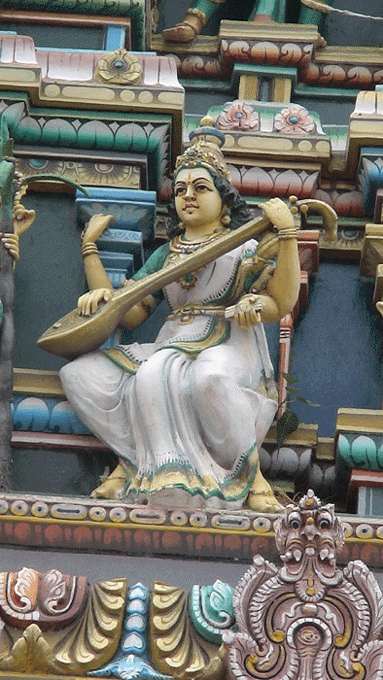
This is a relatively small temple with one prakaram. In the main shrine, the east facing Saraswathi gives darshan in Padmasanam, wearing an white dress, sitting on white lotus flower. She is having four hands holding a book, Aksharamala, Amrutakalasa and showing the Chin Mudra with the fourth hand. A veena is across Her lap. Since She is meditating, She is having Jatamudi ( long matted hair ). There is a belief that She is having a third eye called Gnanachas in this temple. Since Saraswathi is the embodiment of knowledge, the books, notebooks and other educational tools are kept at Her feet before given back to the student devotees. Those having speech impairments, offer prayers in this temple. ( One of the names of Ma Saraswathi is Vakdevi, Goddess of speech and learning). In front of the main shrine, Narthana Vinayakar is sitting on Hamsa vahanam. The other deities are housed in the prakaram. Note: Photos and some of the inputs were collected from various web sites.

Mahasarswathi

Mahasaraswathi in full decoration

Temple entrance

Kanisapakkam Kaneeswarar Temple

Kanisapakkam Kaniswarar Temple: Kanisapakkam is around 5 kms from Panruti and there are mini-buses to this village. We are visiting the temple of Shri Periyanayaki Ambal sametha Shri Kaneeswarar (Kanichapureeswarar/Kanichanathar). The temple is open from 7 to 10 am and from 4 to 7 pm. The contact telephone numbers are 094436 66413 and 099946 53232. The sthala vruksham is Vengai tree and the theertham is Sivaganga theertham.
Once here lived a famous astrologer called Kanikanar. He was a staunch Shiva devotee and he used to see the horoscopes only after completing his Shiva Pooja. Once five people claimed to be Siddhars from a nearby place called Siddharsavadi, came to his house. They brought a bundle of palm leaf scripts containing their horoscopes. Since the astrologer was doing his pooja, his assistant requested them to wait outside till the pooja was over.
They were not prepared to listen to him and they forced him aside and entered the pooja room. The leader of the group Veerasiddhan requested the astrologer to immediately see their horoscopes as they had to leave for another place immediately. He was prepared to offer additional money if the service is rendered without delay. The astrologer politely declined saying that he could take it up only after the pooja is over. The five Siddhars went out and waited.
After the pooja, Kanikanar came out and offered his pranams to the Siddhars. Veerasiddhan took out one of the palm leaves saying that it was his horoscope which was to be seen. Kanikanar doubted whether he would be capable of reading the horoscope for a spiritual person like a Siddhar. Veerasiddhan claimed that he had a doubt about his own horoscope and came to Kanikanar for clarification.
Kanikanar went through the palmleaf and could not find any defects. On the contrary he found the horoscope befitting a divinely person. Veerasiddhan wanted to know whether he would get married and be blessed with children. Kanikanar after checking up the horoscope said that Veerasiddhan was already married with two children. The other four Siddhars started laughing at this and started ridiculing Veerasiddhan for claiming to be a Brahmachari.
The latter took the astrologer aside and expressed his unhappiness about Kanikanar’s statement. He claimed that he was a Brahmachari and as he wanted to get married, he brought the horoscope to Kanikanar. He asked the astrologer to apologise and withdraw his statement claiming inaccurate reading of the horoscope, in front of the other four so that Veerasiddhan’s image would be restored. For this, Veerasiddhan was prepared to offer additional gold. Kanikanar refused and said that his reading was correct and he was prepared to face any consequences. The other four Siddhars intervened and advised the astrologer to keep the horoscopes in front of the Shivalingam which was being worshipped by Kanikanar and proclaim about the veracity of his statement (Sathya Pramanam). They threatened that if he made a false proclamation, he would be severely cursed.
The astrologer was not worried about this threat and kept the horoscopes in front of the Lingam and proclaimed that his statements were true. After doing this, when he opened the palm leaves again, he only found that there were no horoscopes recorded in them; instead all of them contained only the name of Thiruvadhigai Veerataneswara Mahadevar. The astrologer realised that the person who came as Veerasiddhan was none other than the Lord Himself.
When he came running out of his house in search of the Siddhars, they had already disappeared. Kanikanar was crying for not identifying the Lord. The Lord gave darshan to Kanikanar and consoled him. He confirmed that He came in the company of Parvathi, Vinayakar, Murugan and Chandikeswarar to test him and also to prove to everyone that he was true to his profession and no amount of money would make him utter false predictions. As astrologers do the job of Kanithal in Tamil ( calculating and predicting), the Lord came to be called Kanichapureeswarar or Kanichanathar. ( Later it became Kaneeswarar.) It may be of interest to know that the Tamil equivalent of a computer is a Kanini. Kanikanar requested the Lord to be present in this place and bless the devotees. This is the origin of this temple and later the local king constructed the temple as desired by the astrologer. Based on the above legend, people worship in this temple before taking out their horoscopes for seeking advice as the Lord would set right defects/problems if any in their horoscopes.
This temple is believed to be in existence for the past at least 1200 years. Recently a lot of renovations are done here. Though it is a small temple, there are a large number of shrines/idols both in koshtam and prakaram. There are three Vinayakars and three Nandis, in addition to Murugan with His consorts, Perumal, Bhairavar, Anjaneyar, Durga etc in the various shrines. One of the names of the Nandis is Rahasya Nandi, who is in front of the Ambal shrine. I am seeing this name for Nandi for the first time. Note: Some of the inputs were collected from various websites. ( Since I will not be accessing my resources for the next few weeks, there will be a break in my write ups. I will resume after some time with the blessings of the Lord. Om Namashivaya!)

Si Manampatti Vetrivel Murugan Temple

Si Manampatti Vettrivel Murugan Temple: This village is around 1 km from Killai. It is a very small village which became known after the Shri Vetrivel Murugan temple was established here. The exact date of construction is not known. According to the local people, this temple could be around 200 years old. In this Temple, Murugan appears without His consorts Valli and Devasena. It is close to the sea and the Lord is facing the sea. He sits on His peacock mount and with a raised hand, blesses the devotees. The temple is open from 6 to noon and from 4 pm to 9 pm. On Tuesdays and Fridays (as well as the other important days in Subramanya Kshetrams like Panguni Uthiram, Thai Poosam and Vaikasi Visakam), the temple is kept open even during the night time till the last devotee completes the darshan. In this respect, this is an unique temple. The contact number is 98428 13884.
As per local legends, there was one atheist living in this area nearly 200 years ago. He was suffering from serious health problems and everyone lost hope about his survival. One night, Murugan appeared in his dream with His peacock. The patient woke up and asked his relatives for food. The surprised relatives who thought that his days were numbered, realised that there was a miracle happening. Immediately he was fed and in the next few days, he became normal.
He decided to construct a temple for Murugan in his village and the idol was sculpted in the way he had seen the Lord in the dream. Since he saw only Murugan on peacock, the two Devis, were not included in the moolasthanam. He constructed a small thatched shed which later underwent a lot of changes and at present, we are seeing a normal temple with Vimanam with kalasams, a front mandapam etc.
There are certain unique things associated with this temple. In the nearby areas, there is a belief that those suffering from chronic, long standing illness as well as those with speech impairments, should visit this temple and pray. They are given Black Pepper which is first offered to the Lord. It is given as prasadam to the devotee and he is expected to powder it and mix it with water or milk and consume. The belief is that this would definitely give relief. I have seen devotees offering black pepper-e.g. Vaidheeswaran Koil-which is deposited in a box in the temple. This is the first temple where I am seeing black pepper given as prasadam. I may be corrected.
Another unique prayer is called Betel Leaf prayer. Betel leaf is first offered to the Lord. It is returned to the devotee after sprinkling a few drops of the Abhishekam water on it. The devotee has to wipe his face with this sanctified betel leaf and worship the Lord. The belief is that the bad things surrounding the person are wiped away and he could get a clear darshan of the Lord. This is especially suggested for those facing problems in getting married.
Another custom in this temple is to offer three tubers of turmeric (Manjal Kizhangu in Tamil) along with lemons to the Lord by those longing for child boon. After the prayers, they are returned to the devotees. While the juice from the lemon is to be consumed by both the husband and wife, the lady has to use the turmeric during her bath. This is believed to confer child boon.
Like other Murugan temples, Panguni Uthiram is celebrated in a grand manner in this temple. During one such occasion, when a coconut offered for pooja was broken, it had four divisions (clefts or pilavus in Tamil) inside. This is such a rare occurrence that this coconut is still preserved in the temple office. Note: Photos and some of the inputs were collected from various websites.
Kodimaram

Main shrine (see the huge gatekeepers)

Vetrivel Murugan

Navagraham

Outside view of the temple

Killai Sanjivarayar and other temples

Killai Sanjivirayar and other temples: Killai is a small village on the backwaters of the east coast. According to the geologists, once the sea was very close and it is now a few kilometres away and the connection is only through the backwaters. Its previous location near the sea is backed by the fact that deities from several nearby famous temples used to visit this village for Theerthavari on the waterfront. Several pavilions were constructed by the respective temples. Unfortunately, in the last few centuries, most of these temples had stopped the Theerthavari and only two prominent temples of Cuddalore district, visit this village for this purpose; the pavilions of other temples are either abandoned or taken over by local people for other purposes. One is the Shri Nataraja Temple of Chidambaram and another one is the Shri Bhu Varahaswamy temple of Srimushnam. Though Srimushnam is nearly 40 Kms away, they continue with this festival. Hence we find only two pavilions being used for the Theerthavari at Killai during the Magam star of Tamil month Masi ( Feb-Mar) and Thai Amavasai (Jan-Feb). It is around 13 Kms north east of Chidambaram. There are buses every 30 minutes.
We are going to visit Shri Sanjivirayar temple. The temple is open from 7 to 11 am and from 4 to 8 pm. The contact telephone numbers are 070103 26637, 090433 75562 and 098658 31800. This is a Hanuman temple. There are shrines for Nagar, Rahu and Ketu, apart from 8 Garudans on the outside of Moolasthanam. In the main shrine, Hanuman appears with Sanjeeva Parvatham on His hand. While He is standing with the left hand on top of the right hand, which is holding the mountain. While the idol faces South, Hanuman’s face is towards the west. He wears the Thulasi Mani Malai. In addition, there is another Hanuman idol installed on the north west corner of the temple. It is informed that one of the local persons, Mr Veerasundaram Padayachi collected funds and was instrumental in constructing the compound wall. He also found out the Hanuman idol in a nearby tank which is the one installed on the northwest corner.
It is a very small temple. The total constructed area is around 3000 sq ft for the entire temple complex, which also includes a small well and Thulasi garden, which is the sthala vruksham. There is a 10 feet high big bell (weighing around 75 Kgs) nearby. The pooja is done by one Shri Ganesh who is a differently abled person. I understand that he does free service in this temple.
The sthala puranam is interesting. Nearly 400 years back, there was a person of Madhava origin called Uppu Venkatarayar in this area. He was living with his parents in this place. Once his father was injured and had fever. Venkatarayar had a dream in which Sanjeevirayar (Hanuman) appeared. The Lord advised him to use a particular herb near his house and the problem would be solved. Venkatarayar was further advised to use the same treatment for anyone having similar problems. When Venkatarayar did as advised, his father got relief. They decided to construct a temple for Hanuman in that place.
The idol is around 2 feet in height and it was made at Kapisthalam near Kumbakonam and brought here. One of the Madathipathis of Udupi (the account varies whether it was Vadiraja or Vyasaraja Swamigal. Incidentally Vyasaraja Swamigal established 732 Hanuman temples all over South) did the consecration. The temple was only a small thatched shed. Later a pucca temple was constructed with Vimanam, flooring and concrete walls. At present, the temple is managed by the 9th generation of the Venkatarayar family. Chidambaram and Srimushnam Lords visit this temple when They come for Theerthavari.
There is a well known Amman temple in Killai. It is that of Shri Chintamani Amman. This is relatively a new temple. The geographical location of Killai is such that most parts of the village are having only salt water, thanks to the backwaters from Bay of Bengal. Still, some portions are available for cultivation where groundnut is mainly cultivated. In this cultivable land, two families of Manyam Purasami Pillai and his relative Narayanasami Pillai owned some lands.
One day, Ambal came in the dreams of Purasami Pillai and told him that as the area was surrounded by salt water, She was becoming very dark. Identical dream occurred to Narayanasami Pillai. They could not make out any meaning. However when they were ploughing their fields, they got a stone idol which was an exact replica of the lady who appeared in their dreams. After cleaning the idol, they installed it under a thatched shed. Later it was converted into a stone edifice and sudhai works were also done. It is still being managed by the two families as a village temple.
The main shrine houses the Amman. She is a five feet idol with a smiling countenance with four arms. The shrines of Pillayar, Murugan, Gajalakshmi and the village deities are in the prakaram. The construction is done in such a way that the rays of the Sun fall on the Amman during the first week of Chithirai month (Apl). The last Kumbabhishekam was done in 2013. All the Murthis who visit Killai for Theerthavari, cross this temple.
The next temple in this small village is that of Shri Putru Mariamman. This is also an Amman temple which was established after a dream seen by a devotee. Nearly 100 years back, there was a smallpox epidemic in the house of one Mr Munuswamy Pillai. Amman came in the dream of his wife, informing her that She was present in the form of a small ant hill and there would be neem and turmeric nearby. She was advised to apply the turmeric on the body and keep the neem nearby. When they went to the spot indicated, they found everything as seen in the dream. When they followed Her directions, smallpox disappeared. The family took the initiative and built a thatched shed over the ant hill. The ant hill started growing and it is now around 15 feet in height. This is the main shrine of a structure constructed around it with a stone idol of Amman also in the shrine. The shrines of other village deities like Raktha Kali, Peyachi and Periachi are in the prakaram. As happened in the family of Munuswamy Pillai, turmeric and neem are offered as prasadam in this temple, which gives relief to those suffering from smallpox. They are also used in Poojas at home.
The last temple to visit in this place is that of Shri Parvathambal sametha Shri Vidangeswarar. The utsavamurthy is Somaskandar. Once there was a Shiva devotee by name Appasamy Pillai. He had some differences with his relatives, the Zamindar of Pichavaram and was denied some temple honours. When he prayed to the Lord to restore his honour, the Lord appeared in his dream. He told him that Pillai should search in a forest area near Pichavaram where He would be present. When Pillai started searching in the area indicated, he unearthed this Lingam. He installed the Lingam along with that of the Mother and other deities and constructed a small temple. The name of this village was Thillai Vidangan as the Lord gave Moksha to Vidanga Rishi. Hence Pillai decided to name the Lord as Vidangeswarar. It is an east facing temple with Ambal facing South. The rays of the Sun fall in the mornings in the first week of Chithirai month (Apl). The uniqueness of this shrine is that the Lingam is installed below a screen of Rudrakshams. This is very rare. The shrines of Dakshinamurthy, Lingothbhavar and Durga are on the Koshtam. The shrines of other deities like Vinayakar, Murugan, Chandikeswarar, Sani, Surya, Chandra, Bhairavar etc are in the prakaram. Note: Some of the inputs were collected from various websites.

Iruppu Arasiamman Temple

Iruppu Arasiamman Temple: Iruppu is around 18 Kms from Vridhachalam on the Kattukudalur road. We are visiting the Shri Pidari Arasiamman temple. The temple is open from 6 am to 11 am and from 4 to 9 pm. The contact telephone number is 097510 93220. Sthala vrukshams are Neem and Peepal trees.
I have already mentioned about the episode of Parvathi playfully closing the eyes of Shiva. As per the sthala puranam of this temple, there is a small change in this legend. Parvathi asked Shiva the roles of Surya and Chandra. He replied that they were His two eyes. She playfully closed both the eyes. Immediately darkness descended everywhere. Devas requested Shiva to show the way. He then opened His third eye shining like millions of Sun and the darkness was removed. Parvathi realised Her folly and removed Her hands. However, as the eyes were closed, both the normal eyes were looking red hot like the third eye. Parvathi apologised for Her mistake. The Lord said that She should set an example for others and hence advised Her to be born in the earth and pray to get reunited with Him.
Accordingly, Parvathi came to earth and started searching for a suitable place for Her penance. After crossing Kanchipuram, She found a place where even the withered trees started blooming. She decided to do Her penance there. As it continued for hundreds of years, She was totally covered by ant hills. At that time, in a nearby hamlet, there were some shepherds who were bringing their cattle for grazing in this area. One of the shepherds, Arasan, found that one of his cows used to pour all its milk at an ant hill. When he reported it to the villagers, they carefully removed the ant hill and found the idol of the Ambal with a trident. Another name for Trident is Pidari. As Arasan found Her, She is called Pidari Arasiamman.
For all the surrounding villages, She became the guardian deity. The villagers raised a small temple and worshipped Her. One day, a bangle seller was passing through this area and he heard a divinely voice seeking bangles. He realised that it must be the Amman. He offered Her a set of bangles. He was advised to collect the payment for the bangles from one Ponnappa Padayachi in the village. The bangle seller collected the payment and came back to the temple to report. However, he did not get any response from inside the temple which was closed at that time.
The impatient merchant broke open the door and tried to enter the shrine. The Amman became so angry that he made him into a stone by touching him with Her trident. We can see this stone idol of this merchant in this temple. To atone for the sin committed by a person of their trade, bangle sellers from different parts of the state assemble here during Amman’s Thirukalyanam and present Her with a large number of bangles. Ambal used to be decorated with bangles.
The temple faces north. There is no Rajagopuram. Only an entrance arch welcomes us. After the Kodimaram (Dwajasthambam) and Bali Peetam, Amman’s shrine is present, facing north. The shrines of Vinayakar and Murugan are present in the prakaram behind the main shrine. The most important festival is the Thirukalyana function of the Amman in the Tamil month of Chithirai. Large number of devotees from different parts of the district assemble here for this festival. Note: Some of the inputs were collected from various websites.

Iraiyur Dhaagamtheerthapureeswarar Temple

Iraiyur Dagamtheerthapureeswarar Temple: Iraiyur (Erayur) is the current name of the old village, Thirumaranpadi. Iraiyur is the more appropriate name as it is considered God’s Village (irai=god, oor=village). It is around 20 kms southwest of Vridhachalam, 5 kms from Pennadam and 10 Kms from Thittakudi. Buses are there from all these places. We are visiting the temple of Shri Annapurni sametha Shri Dhagam Theerthapureeswarar. The temple is open from 6.30 to 11 am and from 4.30 to 8.30 pm. The contact telephone number is 094439 13912. The sthala vruksham is Jackfruit tree (Pala maram).
This is an ancient temple ( in existence even before 7th century) which was visited by Thirugnana Sambandar. Surprisingly it does not find any mention in Thevarams as a Paadal Petra Sthalam; however it is considered as the 263rd Vaipu Sthalam. In the Periapuranam of Sekkizhar, this sthalam finds a mention in four places. As per local legends, it was one of the temples covered by Sambandar when he was very young (5 years old). Until then, he was being carried on his shoulders by his father Shivapada Hrudayar. After visiting Vridhachalam, Pennadam and other temples, Sambandar wanted to have darshan at Thiruvattuthurai (Thittakudi temple).
As he decided not to burden his father with carrying him, Sambandar started walking. By the time, they reached this place, the child was very tired and others in the group also wanted to rest for the night there. So, they established camp in this temple and stayed. After settling down, all of them were very hungry and prayed to the Lord to satisfy their hunger.
As I mentioned in one of the earlier write ups, Sambandar is believed to be Murugan’s Amsam and hence the child of Mother Parvathi and Lord Shiva. ( Please recall the Sirkazhi legend of Ambal giving Gnanapal in a golden tumbler to Sambandar when he cried). As the mother could not see her child remaining hungry, Mother brought food in the form of village woman and fed the entire party. When they were eating, Sambandar had hiccups Immediately, the Lord created a pond using His trident and everyone’s thirst was quenched. As the Lord satisfied their thirst, He came to be called Dhaagam Theerthapureeswarar (Dhaagam=thirst, theertha= satisfied) and the Mother Annapurni, the Goddess of food.
I have purposely not mentioned anything about the sthala theertham. A small pond exists in front of the temple. Once there was a medium sized tank full of water in front of ASHS School This was the case even a few decades back. Unfortunately, encroachments ate away the space and now part of the pond is levelled and it is being used by the local CoOp Society for its building! Tamil readers may be remembering the well known Vadivel comedy ( well is missing- Kinatrai Kaanum). Such is our apathy to anything associated with temples. As readers may be aware, there are several temples with thousands of acres of lands in their names ( only in records) without getting one Rupee as income.
After dinner, when they were relaxing, Lord came in the dream of Sambandar. He had advised him not to go on pilgrimage by walk as he was too young. Hence He would arrange for a Muthu Chivigai (Palanquin decorated with pearls) and Sambandar should use it for future visits. The Lord simultaneously came in the dream of a rich man in Thiruvattuthurai to provide a Muthu Chivigai with all attendant honours like Chamaram (fan), Umbrella etc and send them to Thirumaranpadi (Iraiyur) to receive Sambandar. He also ordered the priests and other local Brahmins of Thiruvattuthurai to receive Sambandar with all honours.
Next morning, as usual, Sambandar started walking towards Thiruvattuthurai. When they walked a short distance, they met the party coming from the latter place with the palanquin. Sambandar accepted all the honours with humility and then onwards, used it for all his future travels. Both the parties met at a place which came to be called Koodalur (meeting point) and it is in between Iraiyur and Thittakudi.
It is a small east facing temple with a single prakaram. In the central shrine, Lord is present in the Linga Swaroopam. Ambal faces South in a separate shrine. The other deities like Nardhana Ganapathy, Dakshinamurthy, Arathurai Nathar, Lingothbhavar, Perumal, Vinayakar, Murugan with His consorts, Gajalakshmi, Durga, Saneeswaran, Navagrahams, Sambadar etc are in shrines, either on Koshtam or prakaram. Bhairava worship is very popular in this temple especially on the Ashtami of the waning fortnight (Theipirai). Special prayers on that day include sandal paste covering of the Murthy. Note: Photos and some of the inputs were collected from various websites.
Ambal Annapurna

Bhairavar with sandalpaste decoration

Combined photos of Swamy and Ambal in the brochure

Dakshinamurthy

Temple entrance

Main shrine

Swamy Dhaagamtheerthapureeswarar

Sudhai work depicting Sambandar receiving the palanquin

Shri Valli Devasena sametha Shri Subramanyan

Vimanam

Nallur Vilvavaneswarar Temple

Nallur Vilvavaneswarar Temple: ( The Nallur covered here is not the well known Sri Lankan temple) Nallur is around 20 Kms west of Vridhachalam. We have to travel on the Vridhachalam-Salem Road and take a right turn at Kandankurichi. Bus facility is also available from Veppur, an important centre in these areas. We are visiting the Shri Brahannayaki (Balambika) sametha Shri Vilvavaneswarar temple. The temple is open from 9 am to noon and from 5 to 7 pm. Those desirous of performing pooajs may contact the temple authorities in advance through 04143 230232 and 094436 16639. Sthala vruksham is Vilvam and the theertham is Manimuthar (Triveni Sangamam).
Three rivers originate from Kalvarayan Hills in Villupuram District. Two of them-Gomukhi and Mayura-merge together at Kaattu Mayilur. Another river-Manimuthar- also originates from Kalvarayan Hills. Both the systems of rivers flow past this temple on either side (south and north) and merge together in front of the temple on the eastern side. Hence this place is called Dakshina Triveni Sangamam. The temple is situated between the two rivers.
This sthalam is associated with Murugan. After destroying Soora Padman, Murugan was followed by Veera Hathi (killing a warrior). He was advised to pray in this temple. This is one of the rare Kshetrams where Murugan along with His consorts Valli and Devasena, worship His father, facing North. He appears with six faces and twelve arms, sitting on His peacock.
As per the sthala puranam, the king of Madurai, Veera Pandian, was on his way to Kashi to immerse the ashes of his father. He came to this place, had bath in the Prayag and sprinkled the river water on the bundle containing the ashes. They immediately became golden lotus flowers. The king then realised that this was the place to consign the entire ashes in the river and he cancelled his Kashi visit. Apart from presenting the golden flowers, he also made extensive grants to the temple.
I have already mentioned about the curse on Chandra for coveting Tara, the wife of his Guru, Brahaspathi. (Budhan was born to Chandran and Tara). For his immoral action, he was cursed with leprosy. Brahma advised him to take bath in this Prayag and worship the Vilvaranyeswarar. Chandra installed a lingam (Somalingam) and after worshipping the Lord, got relief.
In our puranams, we have read about the celestial ladies like Urvashi, Ramba, Thilothama etc. This kshetram is associated with Ramba. As per the legends, there was a king by name Emangathan in Naindhuva desam. He was issueless for long and after praying here, he was blessed with a son who was named Banu. The Kashmiri Princess Gunavathi was married to Banu. While they were going around the country, near Godavari river, Banu died due to snake bite. Sage Durvasar advised Gunavathi to pray here for relief. Gunavathi came here and installed a Lingam (Prana Thyageswarar) and worshipped Him. The Lord along with Mother Bruhannayaki gave darshan. He told her that her stay on earth was over and she would come to heaven and remain there as Ramba, one of the celestial ladies.
As advised by Sage Narada, Pancha Pandavas were believed to have worshipped here during their 12 years of exile. . Each one made a Lingam and worshipped. The one made by Bheeman in sand is famous and is still being worshipped. In addition to the Moolavar, there are several other Lingams in the prakaram- Visalakshi sametha Viswanathar, Madurai Sokkanathar, Ekambareswarar, Prana Thyageswarar and Somalingeswarar. Since the place was full of Vilvam trees, the Lord came to be known as Vilvaranyeswarar. As He is present in Nallur, He is also called Sri Nallur Nayakar. Note: Photos and some of the inputs were collected from various websites.
Sesha (Naga) Vahanam

Utsavamurthis

Sri Valli Devasena sametha Shri Subramanyar

Kattumannarkoil Kathayee Amman Temple

Kattumannarkoil Kathayee Amman Temple: This temple of Shri Kathayee Amman is around 2 Kms from Kattumannarkoil on the banks of river Vadavaru. Autos are available from Kattumannarkoil bus stand. It is around 30 Kms southeast of Chidambaram. The temple is open from 6 to 11.30 am and from 4.30 to 8 pm. The contact telephone number is 099424 44928.
Though it is called Kathayee Amman temple, there are three Ammans in the main shrine- Kurunkudil Kathayee Amman holding child Murugan (Kuzhandai Amman), Pachai Vazhi Amman on Her right with conch and disc in Her hands (Mahavishnu Amsam) and Poonkurathi Amman on Her left in the costume of a nomad (Kurathi in Tamil). Since Three Ammans are together in a single shrine, devotees worship Them to strengthen the bonds between siblings. As Kathayee is holding the Child Murugan, She is worshipped for safe delivery of children.
Shiva is having a separate shrine (Kailasa Sivan) facing South. This is an unusual direction for Shiva and is generally reserved for Shri Dakshinamurthy. Hence the Lord does not appear in the Lingam format; instead an idol is installed. As He occupies the place of Gurunathar, people worship Him for excelling in studies. Special poojas are offered on Thursdays.
The sthala puranam spreads over the regimes of two Chozha kings both of whom were named Vikrama Chozhan- First and Second. As per legend, Vikrama Chozhan I wanted to expand his kingdom and Kathayee Amman was his family deity. He went to war against the Pandya King. The latter was not interested in war as it brought untold miseries to the citizens of both the kingdoms. He prayed to Lord Sokkanathar of Madurai to show a way out.
The Lord took the form of a nomad (Kuravan) and fought against the Chozha king and defeated him. The king understood that his opponent was a Divine being and he surrendered. Lord gave him darshan and advised him to avoid war and rule his kingdom for the benefit of all his citizens. He also blessed him to be born again as a Chozha king and remember this episode.
He was born again as Vikrama Chozhan II. This time some of his relatives conspired against him. Since he remembered the advice of the Lord, the king prayed to Kathayee Amman to show a way and avoid conflicts and bloodshed. Ambal took the form of a Kurathi and counselled the relatives and advised them to stop their activities. The relatives realised that it was Ambal who came in the form of a Kurathi, agreed with Her command and peace prevailed. The grateful king installed another Amman by the side of Kathayee Amman and called Her Poonkurathi Amman. The third Amman was installed as a Vishnu Swaroopam with Shanku and Chakra. The shrines of the village guardian deities like Muthumuni, Jadamuni etc are having their shrines in the prakaram. Note: Photos and some of the inputs were collected from various websites.
Kathayee Amman

Outside view of the temple

Three Ammans in the central shrine

Vadalur Vallalar Temple

Vadalur Vallalar Temple: Vadalur is around 6 kms from Neyveli and 34 Kms from Cuddalore. There are a number of buses from both the towns. We are visiting the Shri Sathya Gnana Sabai which is popularly called Vallalar Temple. The Sabha is open throughout the day from 6 am to 6 pm. The contact numbers are 04142 259250 and 094865 47041. There is a tank called Theenchuvai Theertham (Sweet water pond) ( between Karunguzhi and Mettukuppam which was dug as per Vallalar’s instructions to overcome water scarcity in that area) which is attached to this Sabha.
While Tamil readers may be familiar with Vallalar Shri Ramalinga Adigalar, I am giving a brief sketch of this noble soul, mainly for my non-Tamil readers. He was born at Marudur, near Chidambaram in 1823. He was named Ramalingam. Though he was forced to marry, he did not lead a married life. He lived for fifty years and became one with the Lord in 1874 and in all, he lived only in five places-Marudur (1823-25), Chennai (1825-58), Karunguzhi (1858-67), Vadalur (1867-70) and Mettukuppam (1870-74).
As could be seen from the above, he lived the maximum time in Chennai as he was under the care of his elder brother Sri Sabapathi. This was due to the demise of his parents at an early age. His sister in law (Mrs Sabapathi) Smt Papammal considered him more like a son and took good care of him. In the opinion of his elder brother, he was good for nothing, wasting his time in useless pursuits. But Smt Papammal protected him from the ire of her husband and she used to feed the child even without the knowledge of her husband. Once when Ramalingam came late to the house, he was forced to sleep on the verandah outside. As he was hungry, Mother Vadivudai Ammai ( Ambal of Thiruvotriyur temple) came in the form of Papammal and fed him.
Sabapathi was a Tamil scholar and he was delivering a series of lectures on Periapuranam. One day, he could not go for the lecture due to health issues. Papammal convinced him to send Ramalingam. With great reluctance, Sabapathy sent his younger brother. The audience were spell bound by the precocious Ramalingam and slowly people started realising his greatness.
At the age of nine, at the request of Ramalingam, his brother allotted him a room in his house with a mirror and lamp. Ramalingam closed the door and started meditating. When he looked at the lamp in the mirror, he experienced the Lord and the light within the light, representative of the formless infinite spirit. His sincere wish was that people living in every nook and corner of the world should be able to get the experience of the grace of such divine light he got. He also started preaching that service to humanity is service to God.
He was an ardent devotee of Shiva and Murugan. Some of his followers believe that he was another incarnation of Murugan. During his younger days, he went around various temples and his favourites were the Kandakottam in Chennai George Town and Thiruvotriyur temple on the northern outskirts of Chennai. Despite his strong devotion, he never imposed his religious thoughts on his followers and he gave them full freedom to follow their religious practices. His thoughts were mostly in the form of verses and the most prominent one is the Thiruvarutpa, a collection of nearly 6000 verses. In addition, he also authored two books called Manumurai Kanda Vaasagam and Jeevakarunya Ozhukkam.
In order to continue his way of thinking and to help his followers, he established an universal temple called Sathya Gnana Sabhai at Vadalur in 1872. He later went to a nearby village called Mettukuppam and settled there. On 30th Januaray 1874, ( it was Thai Poosam day), he went inside a room ( Thiru Kaappitta Arai/locked room) and asked his followers to close it and not to open it under any circumstances, except when legally compelled. Subsequently, when it was opened in the presence of revenue authorities, they did not find anything inside and it is believed that he converted himself into minute atoms and became one with the Lord. This room is opened only once a year on the second day of Thai Poosam festival. At noon, Thiru Arutpa is brought in a palanquin and it is reverentially kept in this room and aarati shown. The room used to be kept open for six hours upto 6 pm the and then closed. Devotees used to have darshan of this room from the side windows. A small idol of Adigalar, a Gnana Simhasana (wisdom throne) and the jothi could be seen there.
Sathya Dharmasalai in Vadalur was started in 1867. This was a Dharmashala where free food was offered. The fires started in 1867, still burn and 5 times a day-6 am, 8 am, 12 noon, 5 pm and 8 pm-, food is offered to all the assembled persons. Even during the night, to ensure that the fire is not extinguished, a person remains by its side and puts firewood periodically into the pit. Hence no match box is needed in this kitchen! ( similar to the Dhuni in Dwarakamayi in Shirdi). This service continues even now in the midst of the Corona problem! The fire pit is 21 feet long with a depth of 2.5 feet.
His closest follower Shri Velayutha Mudaliar of Thozhudur, started calling him Arut Prakasa Vallalar, indicating his Noble qualities. From that time onwards, he was popularly called Vallalar or Ramalinga Adigal. He was popularly called Vallalar as he was not in the habit of keeping anything for himself and whatever was given by followers, used to be disbursed for community welfare and propagation of his philosophy. As mentioned earlier, he was deeply devoted to Murugan. Hence Thai Poosam (Jan-Feb) is an important occasion in his life as well as for his followers.
Several miracles were attributed to Vallalar. The waters of Theenchuvai Theertham are believed to have medicinal value. When Vallalar was writing the Thiruarutpa, he was being taken care of by one Mr Tiruvengadam. Since Vallalar used to write late into the nights, Mrs Tiruvengadam used to keep a jar of oil outside his room for the lamp. One day, by oversight, she kept water instead of oil. Vallalar used the water and the lamp still burned! ( similar to an episode in the life of Shirdi Sai Baba).
There are no idols in Sathya Gnana Sabha. Hence I do not know whether it could be called a temple. But everyone who visits there, accepts that there are very good vibrations present there. Importance is given only to Jyothi (Light). There are seven curtains present and there is a lamp present in front of these curtains. Poojas at 11.30 am and 7.30 pm are performed and aarati shown to this lamp and the curtains. On the Thai Poosam day, all these 7 curtains are removed one after another and devotees will have darshan of the mirror ( which was used by Vallalar to understand Godliness in light) and the jothi. On the other Poosam star days, only the first six curtains are removed.
The design of the Sabha is hexagonal and from the top it looks like a lotus. Since we breathe 21600 times a day, a chain having 21600 links/joints, is tied around the Sabha. There are two small rooms called Porchabai and Sirchabai ( I understand that some of the manuscripts in Adigalar’s handwriting are preserved there) and aarati is shown to the doors of these rooms also. Vallalar was a staunch votary for vegetarian food. Hence those who consume non-vegetarian food are requested to stay away from this place as there is a notice board to that effect in the Sabha. However, they can stand outside and witness the activities. Everyone, irrespective of caste or religion, is permitted entry. There are no archanas or special poojas and hence no prasadam is also offered here. Hence it is difficult to classify this Sabha as a temple, though it is done so as per practice. It is generally suggested for those who are interested in Meditation and doing public service. Note: Photos and some of the inputs were collected from various websites.
Combined photo of Porchabai and Sirchabai

Boxes containing Vallalar's manuscripts

Jothi darshan

Outside view of the Sabha

Theenchuvai theertham

The mirror in which Vallalar saw Murugan

Thirukaapitta arai episode- pictorial depiction

Vallalar- a painting

Welcome arch to Marudur

Thiruthalur (Thiruthrayur) Sishtagurunatheswarar Temple


Thiruthalur Sishtagurunatheswarar Temple: Thiruthalur is around 32 kms west of Cuddalore on the Shankarapuram Road and 9 Kms west of Panruti. Lot of buses are available from both Cuddalore and Panruti. ( Sundarar’s birthplace Thirunavalur is close by). We are visiting the temple of Shri Shivalokanayaki (Poongothai Nayaki) sametha Shri Sishtagurunatheswarar (Pasupatheeswarar/Thavaneri Aaludayar). Utsavar is Somaskandar. The temple is open from 6 am to noon and from 5 to 8 pm.. The contact telephone numbers are 04142 248498 and 094448 07393.
The sthala vruksham is Kondrai and the theerthams are Surya and Chandra Theerthams. This is another Paadal Petra Sthalam with Thevaram by Sundarar. There is Thirupugazh on the Murugan of this temple. The old name of this place is Thiruthalur. This is a small temple without a Rajagopuram. There is only one prakaram. The temple is on the banks of Malattar (Then Pennai Aaru). It is reported that the river was flowing south of the temple during Sundarar’s period; it is now flowing north. This is also the birthplace of Arul Nandhi Sivachariar, disciple of Meikandadevar (one of the Santhana Kuravarkal). He also attained Samadhi here and his Gurupooja is performed every year. His family members are the priests of this temple.
I have already mentioned about the stoppage of Sundarar’s marriage by Lord. He took him to Thiruvennainallur and Sundarar sang his first hymn “Pitha Pirai Soodi” there. Then he came to this place. While coming to this side, he had to cross the Then Pennai river which was in spate. Sundarar prayed to the Lord to offer a solution. At that time, an old couple came to that side with a boat and they took Sundarar to the other banks.
After reaching the destination, Sundarar was searching for Lord Shiva. When he asked the old man, he showed the sky and disappeared. When Sundarar looked up, he saw Shiva and Parvathi on the vimanam of the temple. Sundarar sang Thevaram after witnessing this scene. He asked the Lord to teach him the methods of worship and rules to be followed and the Lord took the role of Guru and taught him. Hence the Lord is called Sishta Gurunathar, as Sundarar was the disciple and the Lord, the teacher. The episode of Shiva giving darshan is beautifully done near the Dakshinamurthy shrine. There is a Ganesa (Sakshi Vinayakar) by the side of this sculpture witnessing this event. A stone panel also depicts Sundarar’s journey across the river. Since the Lord the other banks (Thurai in Tamil), this place is called Thiru Thurayur. Before this episode, this temple was known as Psupatheeswarar temple.
This is another temple with the Agasthayar legends- installing Lingams, seeing the wedding scene of Shiva and Parvathi etc. He had installed the Lingam facing the west ( not a common direction) and Ambal facing North (very rare) to create a mirror image of the scene in Kailash. I am coming across the Ambal facing North for the first time. Another unusual thing about this temple are the directions being faced by the Shiva Parivar-Lord facing west, Mother facing North, Ganesa facing east and Murugan facing South. Whether the temple builders intentionally did it or not, is not clear. However, for me, it is the first of its kind. Since the Lord faces west, Surya rays fall on Him during sun set in the first week of Chithirai month (Apl-May). The Swayambu Lingam is large in size. As it is a west facing shrine, the Avudai is on the right. Since the Lord faces west, the Murthis in the koshtam are also in the reverse order with Chandikeswarar and Durga coming first. Outside the main shrine, there is a diagram (Soma Suthra Pradakshinam) installed to show the correct way of covering the koshtam deities.
As mentioned earlier, Mother Shivalokanayaki is in a separate north facing shrine. Her shrine is located in the outer prakaram. People seeking child boon (Santhana Praapthi), perform special prayers and worship Her for nine consecutive Fridays to get their wish fulfilled.
The original Lingam installed by Agasthyar is below the sthala vruksham. There are several other Lingams in the prakaram-Rama Lingam, Bheema Lingam, Surya Lingam etc. In addition to these Lingams, there is a separate shrine outside the temple in a location called Kizhapakkam where there is a LInga shrine called Thaduthu Aatkondeeswarar ( one who stops and helps).. Kizhapakkam is an obvious reference to Shiva coming as an old man to help Sundarar. Ashta Bhuja Durga is in a shrine outside this temple. The samadhi of Arul Nandi Shivachariar is also adjoining these two shrines.
Inside the temple,Perumal appears as Adikesava Bhaktavatsala Perumal in a shrine adjoining the Murugan shrine. Arunagirinathar had sung Thirupugazh on this Murugan. As Shiva took the role of a teacher to instruct Sundarar on Saivism and the methods of worship, this place is considered an important centre for Guru. Hence special prayers are offered to the Moolavar as well as Dakshinamurthy on Thursdays and a large number of parents bring their children for getting the blessings of the Lord for getting good education.
Pradosha Pooja is unique in this temple. As readers may be aware, importance is given to Nandi on these days and first pooja is performed to Nandi. In the olden days, during the Pradosha Pooja, a Nandi flag used to be hoisted. This system is no longer in vogue in South India. However, in Sri Lankan Shiva Temples, it is being followed. This is one of the rare South Indian temples where the Nandi flag is hoisted on Pradosham days.
Sundarar is given the place of pride in this temple. As I mentioned in my previous write ups, he was considered not as a mere devotee, but a friend of the Lord (Thambiran Thozhar). To show his special place in the pantheon of Saivite Savants, in this temple, there is a stick (called Sengol in Tamil which is normally in the hands of the king) and a turban adorns his head. Note: Photos and some of the inputs were collected from various websites.

Ambal shrine
 
Ayyappan, Ramalingam and Somalingam

Lord Vishnu and His nephew Murugan's shrines

Sakshi Ganapathi, Sundarar and Somaskandar

Inside the temple

Kalabhairavar, Suryalingam and Surya shrines

Outside view

Soma Sutra Prakashinam

Orathur Margasahayeswarar Temple

Orathur Margasahayeswarar Temple: Orathur is around 7 Kms from Bhuvanagiri (the birthplace of Shri Raghavendra Swamigal) on the Sethiathoppu road and around 15 kms west of Chidambaram. Bus service is available to this village. We are visiting the temple of Shri Maragathavalli sametha Shri Margasahayeswarar (Vazhithunainathar). The temple is open from 6 to 11 am and from 5.30 to 8 pm. The contact telephone number is 096002 05958.
Though this is an old temple, it does not come in the list of Paadal petra or Vaippu Sthalams. It is actually connected with Sundaramurthy Nayanar. I have already mentioned in my write up of Thirukudalayatrur ( https://www.blogger.com/blogger.g?blogID=1746986792680675421#editor/target=post;postID=7794212811929910082;onPublishedMenu=allposts;onClosedMenu=allposts;postNum=0;src=postname) as to how the Lord showed Sundarar the way to that kshetram. The same story is repeated in this temple also with some small changes.
Sundarar was going towards Thirumudukundram. Enroute, he lost his way and he did not know the direction he had to take. He prayed to the Lord. At that time, an old man came to that side and enquired from Sundarar. Sundarar explained his predicament. The old man showed him the way to Thirukudalayatrur and gave him further directions and disappeared.
Sundarar realised that the old man was none other than the Lord Himself. He first worshipped the Lord in this temple and then proceeded to Thirukudalayatrur. Here He is called Maragasahayeswarar, as He helped (Sahayam) by showing the Margam (way ) (in Thirukudalayatrur, He is called Nerikattinathar.)
River Vellaru flows in the boundary of this village. The temple is on the banks of the river. Generally, the rivers flow in straight or slightly curved lines. Here it flows in a circle! Hence it is believed that those who face confusion in life or suffer from fear complex, pray in this temple. They light ghee lamp and offer Sakkarai Pongal as Neyvedhyam to the Lord on their star birthday or any Monday. Like the river moving ahead after making a circle, after the initial confusion, they will see a clear path ahead in their lives.
While the Lord is in the central shrine facing east, Mother Maragathavalli is in a separate south facing shrine. Navarathri is celebrated in a big way when the Mother’s procession deity is kept in a swing (oonjal utsavam) and prayers are offered. Special prayers are also offered on the Fridays of Tamil months Aadi and Thai.
Sani occupies an important position in this temple, as He does in Thirunallaru. He is in the front side of the main shrine facing east. Natarajar is in the front mandapam. The demon below this idol is slightly different from other temples. Here, he raises his head and looks at the sole of the Lord. Other deities like Siddhi Vinayakar, Subramanyar, Gajalakshmi, Bhairavar, Chandikeswarar and Navagrahams are in the prakaram. Note: Some of the inputs were collected from various websites.

Thirunarayur Soundaryeswarar Temple (Polla Pillayar Temple)

Thirunarayur Soundaryeswarar Temple: There are two Thirunarayurs having famous temples- one is already covered under Nachiarkoil (another name for Thirunarayur and it is close to Kumbakonam). It has two famous Vishnu and Shiva temples. We are now covering the second Thirunarayur in Cuddalore district. It is 18 kms from Chidambaram on the Kattumannarkoil road. We are visiting the Shri Tripurasundari sametha Shri Soundaryeswarar temple. The sthala vruksham is Punnai (Alexandrian Laurel) and the theertham is Senkazhuneer/Karunyatheertham. The temple is open from 6 am to noon and from 4 to 8 pm. The contact telephone numbers are 094425 71039 and 094439 06219. This temple must be more than 1500 years old. The last kumbabhishekam was performed in 2009.
The sthala puranam speaks about the penance done by a stork (Narai in Tamil). Once a Gandharva ate a fruit and spat the seed on Sage Durvasa. The sage got irritated and cursed him to be born as a stork as he had discarded the seed like a bird . The stork prayed to Lord Shiva. He advised the bird to worship Him in this place by performing abhishekam with Ganga water fetched from Kashi. The stork used to fly to Kashi, carry some Ganga water on its beak and pour it over the Shiva Lingam. One day when the stork was bringing the Ganga water, there was a severe rainstorm in which all the feathers of the stork had fallen down. The place where the feathers fell, is called Sirakizhanda Nallur which is around 3 kms from this place. After losing all its feathers, finally the bird came crawling to this place and performed the abhishekam. Seeing its painstaking efforts, the Lord gave relief and the Gandharva regained his original form. As the Narai worshipped the Lord here, the place came to be called Thirunarayur. When the stork brought the Ganga water, some of the drops spilled in front of the temple, forming the Karunya Theertham.
This is another Paadal Petra Sthalam with Thevarams by Sambandar and Appar. However the prominence here is for the Vinayakar. He is called Polla Pillayar. Polla could be pronounced in two ways in Tamil. If the L is pronounced like Laddu, it means mischievous; if it is called similar to Pallam (pit), then it means one who has not been carved by a chisel. As He is a Swayambumurthy, the second pronunciation is accepted. Like the Arupadai Veedus of Murugan, Vinayaka is also having six important temples and this is the first padai veedu ( the rest are the Padaiveedus are in Vrudhachalam, Tiruvannamalai, Madurai, Thirukadayur and Kashi).
The legend starts with a great Saivite Savant called Nambiandar Nambi(10th-11th Century). He was born in this place as the son of the temple priest Ananthesar. After performing pooja and distributing the prasadam to the devotees, Ananthesar used to return home empty handed. When Nambi asked his father whether the Lord had eaten the Neyvedhyam offered, the father replied in the affirmative. This continued for some time.
One day, the father could not go to the temple and deputed his young son with the Neyvedyam. The young lad performed pooja and requested the Lord to eat. The Lord did not respond. The child repeatedly pleaded, but in vain. The child then started banging his head against the Lord’s feet. Seeing this, the Lord started eating the Neyvedyam. When Nambi brought the empty vessel, the parents refused to believe that the Lord had eaten the Neyvedhyam. The next day, when the parents observed this without the knowledge of the child, they realized the value of true devotion. The locals did not accept the child’s story. When the matter reached the ears of the Chozha Emperor Rajarajan, he personally visited Narayur.
He had arranged for another neyvedyam and directed the child to offer it to the Lord. The Lord refused to yield. The child started singing a hymn called Irattai Mani Malai. Pleased with his prayers and the sweet singing, the Lord consumed the Neyvedyam in the presence of everyone. The king fell at the feet of Nambi. Though Rajarajan heard about the existence of Saivite hymns like Thevaram, he was not aware about their location. He took the help of Nambiandar Nambi. When both of them prayed to Polla Pillayar, they heard a heavenly voice that they were stored in the south west mandapam of Chidambaram Natarajar temple. ( There is a shrine of Thirumurai Kattiya Vinayakar on the western side of the inner prakaram of Chidambaram temple) in a room where there would be a symbol of Hand. The palm leaf manuscripts were found in that place.
The Deekshitars refused to part with the manuscripts as they were the property of Nayanmars. Nambi advised the king to make metal images of the Moovar and brought them before the Deekshitars. They could not give any further excuse. When the room was opened, they found out that the palmleaves were covered by an ant hill and a major portion was lost. ( Only around 10% was recovered). However, they heard a heavenly voice that the Lord had preserved only those which are required as per the then prevailing lifestyle. Nambi took a lot of effort and arranged the manuscripts in the proper order in 11 volumes (11 Thirumurais) and gave them to the king for propagation. Appar, Sundarar and Sambandar’s Thevarams are in the first 7 Thirumurais, Manikavasagar’s Thiruvasagam and Thirukovayar in the 8th, Thiruvisaipa and Thirupallandu in the 9th, Thirumoolar’s Thirumandiram in the 10th and other hymns including Nambi’s own in the 11th.
The next task was to set the hymns to tune. Once again they sought divine support and prayed at Thiru Erukathampuliyur Neelakantar temple. Lord ordered that they should entrust the responsibility to a girl born in the family of Thiruneelakanta Yazhpanar. Though this girl was deaf and dumb, with the Lord’s Grace, she got the voice and music skill. The king took her to Chidambaram where she set hymns to tune and sang them before the Lord. In the entire exercise, the roles of Nambiandar Nambi and Rajaraja Chozhan are to be greatly appreciated. But for them, we would not have heard about Thevarams and other Thirumurais. Both of them are honoured with their idols in this temple. There is also a separate small temple for Nambi in the house where he lived. The Gurupooja of Nambi is celebrated on the Punarpoosam star of Vaikasi month (May-June).
There is a three tier Rajagopuram facing east. The theertham is on the eastern side outside the temple complex. There is no dwajasthambam. It is a large temple occupying nearly 5.5 acres. On the walls of the temple, Nambi's story is beautifully painted. The main shrine is that of Lord Soundaryeswarar. He is also called Swayam Prakasa Eswarar as He is a Swayambumurthy. The vimanam above the Lord is in semi-circular shape with two kalasams. This is a rare type of vimanam with the second kalasam for Ambal. Ambal Tripurasundari is in a south facing shrine. The shrines of Thirumoolanathar, Vinayaka ( there are actually two and the one on the left is that of Polla Pillayar), Murugan, Surya, Chandra, Gajalakshmi and the Navagrahams are in the prakaram. One of the interesting shrines is that of Bhairavar. Instead of one, three Bhairavars are present in this shrine. There are two Chandikeswarars in a single shrine-one for Soundaryeswarar and another for Thirumoolanathar. Note: Photos and some of the inputs were collected from various websites.
Ambal Tripurasundari

Combined image of Swamy and Ambal

Painting at the entrance giving the essence of sthala puranam

Gopuram

Inside the temple

Main shrine

Swamy Soundaryeswarar

Painting on the wall with the sthala puranam

Nambinandar Nambi

Natarajar with Shivakami

Painting of Polla Pillayar

Polla Pillayar Shrine

Polla Pillayar

Painting of the stork worshipping the Lord

Sri Subramanyar

Three Bhairavars

Theerthanagiri Sivakozhundheeswarar Temple

Theerthanagiri Sivakozhuntheeswarar Temple: Theerthanagiri is around 28 kms southwest of Cuddalore or 26 kms northwest of Chidambaram. It is on the banks of Perumal lake. When one travels from Cuddalore to Bhuvanagiri, there is a bus stop called Mettupalayam. This temple is around 5 Kms from that bus stop. Since bus services are not adequate, devotees may engage a taxi or auto from either Chidambaram or Cuddalore. We are visiting the Shri Oppilatha Nayaki (Karunthadankanni/Neelayadakshi/Ilamkompannal/Neeladhambikai) sametha Shri Sivakozhundeeswarar (Thiruntheeswarar/Shivangareswarar) temple. The old name of this place is Thiruthinai Nagar. The temple is on the northern banks of Pennayar.
The sthala vruksham is Kondrai and the theertham is Jambava Thadagam (tank on the northern side of the temple). In addition Gowri Theertham (well in the prakaram), Perumal Lake or Garuda Lake (where there is a small temple of Garuda Lingam), Chakra Theertham and Deva Theertham (Bay of Bengal) are also considered as additional theerthams for this temple. The temple is open from 6 am to noon and from 5 to 8 pm. The contact telephone numbers are 094434 34024/4142 278324/97864 67593/ 90471 40464/91501 51195/88707 40464/99653 28278.. The last Kumbabhishekam was performed in 1998.
This is an ancient temple which is believed to have existed in all the four Yugas and it was known in different Yugas by various names like Omkarapuri, Thesa Piratham, Ghana Piratham and Thiruthinai Nagar. This temple is also connected to a Bengal king by name Vishva Nirupan. When his dog and horse got their skin ailments cured after having a dip in the theertham of this temple, he realised that his Leucoderma (white patches) could also be similarly cured. After getting relief, his son Veerasenan stayed here for 3 years and did extensive renovations and additions which included four towers and three corridors. Unfortunately, most of these constructions were damaged or totally destroyed during the Arcot Wars and some evidence is seen even today about the grandeur of this temple. Veerasena’s idol is kept along with the Nayanmars.
This is another Paadal Petra Sthalam with Sundarar Thevarams. The name of this place (Thiruthinai Nagar), was based on Foxtail Millet (Thinai in Tamil). Once here lived a devoted couple ( Periyan and his wife) who were staunch Shiva devotees. The Lord wanted to test their devotion. They always fed a Shiva devotee before taking food. One day, they could not find anyone to feed. They only had the seeds for next cultivation; they were prepared to use even this for feeding Shiva devotees. They went to their field so that they could feed the labourers. Lord ensured that all of them were sent out on some errands. The couple were tired but decided not to have their food, until they could feed someone. At that time, the Lord came in the form of an old man. The couple were very happy and requested him to accept their hospitality.
The old man said that he would not accept alms and would accept only wages. He asked the couple to give him some work and as wages, he would accept their food. The couple requested him to plough a part of the field where Thinai was being grown. They went to their house and used the remaining seeds, cooked and brought the food. They were amazed to find that the entire land was not only ploughed, but also cultivated and the crops were not only grown, but also ready for harvest, all within a few hours! The surprised couple served the old man his food under the Kondrai tree and asked him how he could do all these in such a short time. Suddenly the old man disappeared. The Lord appeared before the couple and blessed them. They requested Him to stay in that place and bless everyone. The Lord acceded to that request and stayed here as Swayambulingam.
In this temple, it was always Thinai which was used for preparing Neyvedhyam. Unfortunately, this has stopped for the past few decades as the crop is no longer grown here. Now other grains are used for Neyvedhyam. The main theertham owes its name to Jambavan, the bear leader who finds a prominent place in Ramayanam. He came here, dug the pond, took a dip and prayed to the Lord. Hence this theertham came to be called Jambava Thadagam.
At the entrance there is a three tiered Rajagopuram and the temple has only one prakaram. The base of the flagpole is fully covered in metal sheets with beautiful figures engraved. In the central shrine, the Swayambumurthy Shivakozhundu Eswarar is present. He is sitting on a square peetam. The Bhanam (stem) looks like a cone with a sharp edge. Avudayar is seen on both the sides. Since He was associated with the agricultural operations, the agricultural implements presumed to have been used by Him, are preserved in this temple. The rays of the Sun fall on the Lord betweenPanguni 26th and 28th- some say between 20th and 22nd- ( April second week). In addition, below the Kondrai tree (where the Lord took food from Periyan), there is a Lingam with Nandi. Ambal Oppilanayaki is in a south facing shrine and She stands majestically at 5 feet. Her shrine is in a separate small temple with a single prakaram outside the rajagopuram. This is one of the few kshetrams, where the Ambal is also having the Third eye like the Lord. This is one of the rare kshetrams where the Thevaram song specifically mentions the Ambal. The Lingam worshipped by Jambhavan is in Ambal’s shrine.
As per experts, all the Lingams right from Kashi to Kanyakumari were created on the basis of the Lingam here. This information is available in a work called Siva Rahasya. Lord Shiva explained about the various kshetrams to Parvathi. Subramanya who was present there, passed it on to His disciple, Sage Aasthya. The Tamil version of this book is now preserved in Connemara Library, Chennai. As per this, in order to kill a demon called Murasuran, Vishnu worshipped here and got the necessary powers. As He won against Murasuran, Lord Vishnu came to be called Murari.
Main Vinayakar in this temple is Valampuri Vinayakar. In addition there is another Vinayakar called Niruddha Vinayakar on a pillar who is being attended to by four Bhootha Ghanas. Natarajar is dancing to Vishnu blowing His conch and Brahma with Panchamukha Vadhyam (rhythm). This is perhaps one of the very few kshetrams where such a scene is enacted. It is rare to have the darshan of the Trimurthis in this manner. It is believed that Nataraja danced here before dancing in Chidambaram. This Nataraja is Ardhanari- Ganga on His head , anklet only in one leg and two different types of ear rings! He holds Agni in one hand and Damaru (small drum) in another hand. Students wishing to excel in music and dance, pray to this Lord.
Dakshinamurthy in this temple is also unique. Here, both His knees are bent which is not seen in other temples. The priest explains that this is to signify Shiva taking food in this posture under the Kondrai tree. Muyalagan is also not seen below Dakshinamurthy’s feet. Apart from Sanakathi Rishis, Siddhar Kakabhujandar also sits at the Feet of the Lord. It is believed that worshipping this Lord gives plenty of yield to the farmers. This is another kshetram with Ashtabhuja Durga in the Vishnu Durga format with conch and disc. Chandikeswarar in this temple is present with his wife. Note: Photos and some of the inputs were collected from various websites.
Vimanam

Ambal

Swamy, Ambal and Natrarajar-a combined photo

Dakshinamurthy

Inside the temple

Lingothbhavar with Vishnu and Brahma on either side

Stone panel depicting the sthala puranam

Temple entrance with gopuram

Swamy Sivakozhundheeswarar

Swamy and Ambal on Rishabam- a sculpture

Thirukazhipalai Palvannanathar Temple

Thirukazhipalai Palvannanathar Temple: This temple is adjoining the Sivapuri Uchinathar temple. Earlier this was in a place called Karaimedu (around 12 Kms from this place) on the banks of the Kollidam river. Owing to river erosion and floods, the temple was totally damaged. In the last century, one Shri Palaniappa Mudaliar took the initiative and shifted all the deities to a newly constructed temple on the southern side of the Sivapuri temple. Hence those who visit the Uchinathar temple, could easily cover the temple of Shri Vedanayaki ( Porpadhavedanayaki) sametha Shri Palvannanathar at Thirukazhipalai. At the entrance, there is a three tier gopuram and a single corridor. The last kumbabhishekam was performed in 2003. Once the temple was on the banks of backwaters (Uppankazhi in Tamil) and this could be the reason for the name Kazhipalai.
The temple is open from 7 to 10 am and from 4 to 7 pm. It is preferable to contact the priest in advance . The contact numbers for the temple and the priest are 04364-235462, 04144-237265 and 98426 24580. The theertham is the Kollidam river and the sthala vruksham is Vilvam. Sage Valmiki worshipped here. This is one of the Paadal Petra Sthalams with Thevarams by all the three leading Nayanmars-Appar, Sundarar and Sambandar- and hence it is in the group of 44 similar such temples.
As per the sthala puranam, this is another Lingam associated with Agasthyar. The Lord appeared as a Swayambu and the sage worshipped him. According to another account, it was sage Kapila who installed the lingam. As per that legend, Kapila came to this place which was full of vilva trees. He was desirous of making a Lingam to pray. He could find only white sand as cows used to pour their milk on this spot. He used that white sand to make a Lingam. At a later date, a local king was travelling in this area. The hoof of the horse touched the Lingam which got split. Hence the damaged Lingam is seen in the main shrine. There is a small dent (kuzhi in Tamil) on His head and as it is square, it looks like a Thulasi Madam. ( Some accounts claim that the damage was caused by Kamadhenu, the celestial cow).
Kapila was sad that the Lingam was damaged. He tried to make another Lingam for worship. The Lord appeared in his dreams and advised him to continue the pooja with the damaged Lingam. This Lingam is white in colour which has given rise to the name Palvanna Nathar ( Pal Vannam= colour of milk). Only milk abhishekam is done to the Lingam and the rest are performed only to the Avudai. It is believed that whatever milk was poured on the Lingam, it gets absorbed by the Lord. Small quantities of the milk after abhishekam is offered to the devotees as prasadam. This gives child boon as well as relief from heat (Ushnam in Tamil) related diseases as the milk has cooled the fiery Lord.
The Agasthyar legend is more prominent in this temple. As mentioned in other write ups, the Lord gave darshan to the sage in His wedding splendour. Hence we find the Lord and the Ambal behind the Lingam in the standing posture. The other deities are in the prakaram or koshtam. They include Vinayakar, Murugan with Valli and Devasena, Bhuvaneswari, Surya, Chandra, Brahma etc.
One of the important and interesting shrines is that of Bhairavar. He is in the southeast corner of the temple. He is so famous that this temple is popularly called Bhairavar temple. Unlike most of the temples, here Bhairavar is without His companion, dog. He stands with a garland of 27 skulls, with Yagnopaveetham (Poonal in Tamil), a serpent tied in the waist, having broad lion’s teeth and matted hair. He resembles the Kala Bhairavar in Kashi. There is a belief that the same sculptor created both the idols. Special prayers are offered to Him on Ashtamis in general and the one in Theipirai (waning fortnight) in particular.
Another interesting shrine is that of Shri Natarajar. The Lord is a Panchaloha murthy in His normal dancing posture. His hair is tied in a bun on top of His head. The height of Sivakami Amman, unlike the other temples, is almost the same as that of the Lord.(Normally She is represented as a small idol). This is one of the rare temples, where along with Sivakami, we find two of Her companions, Vijaya and Saraswathi and all the three are standing in the same Peetam.
Agoramurthy is one of the forms of Shiva. He is believed to be one of the fiercest forms of the Lord. The well known Thiruvenkadu temple houses this Lord. There are very few temples having an idol of this Murthy. This temple is one of them. Similarly, Kiradamurthy ( please read my write up on Thiruvetkalam temple: https://www.blogger.com/blogger.g?blogID=1746986792680675421#editor/target=post;postID=4947586139396762419;onPublishedMenu=allposts;onClosedMenu=allposts;postNum=0;src=postname) is a rare form of Shiva, seen as a hunter. In this kshetram, there is an idol of this Lord. The Durga in this temple is called Satura (or is it Chatura?) Durga. I am hearing this prefix for Durga for the first time. I could not get any additional information on this Durga. Is it because She is having four hands (not seen clearly )?
Another unique thing is the Dakshinamurthy idol. The demon Mulayakan under His feet, is having his head on the left side of the Lord. ( Normally seen on the right side). Adhikara Nandi in this temple appears with His two wives near the entrance of the inner prakaram. Note: Photos and some of the inputs were collected from various websites.
Ambal Vedanayaki

Bhairavar

Bhuvaneswari

Dakshinamurthy

Durga

Temple entrance

Dwarapalaka

Inside the temple

Lingothbhavar

Palvannanathar

Natarajar with Shivakami

Swamy and Ambal in weddiing pose with Lingam in the foreground

Swamy Palvannanathar close view

Rishbha Vahanam

Shanmukhar shrine

Swamy and Ambal wedding pose

Sivapuri Uchinathar Temple

Sivapuri Uchinathar Temple: Sivapuri is around 3 kms from Chidambaram on the Kavarapattu road. There are both buses and autos available from Chidambaram. It is close to Annamalai University. As this temple is surrounded by paddy fields, in the olden days, it was called Thirunelvayil (nel=paddy). We are visiting the temple of Shri Shri Kanakambika (Uchinayaki) sametha Shri Uchinathar (Madhyaneswarar). The sthala vruksham is gooseberry (Nellikai in Tamil) and the theertham is Krupa Samudram. The temple is open from 6 to 11 am and from 5 to 7.15 pm. Those who wish to have darshan in the afternoon, may kindly make arrangements with the priest well in advance. The contact number of the temple is 098426 24580. This temple must be at least 1400 years old. The last Kumbabhishekam was performed in 2008.
This is another Paadal Petra sthalam with Thevarams by Thirugnana Sambandar. Arunagirinathar had sung Thirupugazh on the Murugan of this temple. It is also closely associated with the Sambandar legend. During his stay in Chidambaram, Sambandar used to worship in this temple every day. Readers might have already read my write up on Sirkazhi Thoniappar temple where I had mentioned about how Mother Uma offered milk in a golden tumbler ( Shanku/kovarnam ) to the crying child Sambandar. In this temple, the Lord offered food to Sambandar and his accompanying people.
When Shivapada Hrudayaur, Sambandar’s father decided to perform his son’s marriage at Achalpuram, Sambandar was camping at Thiruvetkalam. Hence everyone first went to Thiruvetkalam and along with Sambandar, they left for Achalpuram. Enroute they crossed this place. At that time, it was noon and every one was tired and hungry. Knowing their hunger, the Lord came in the form of a temple staff with a large amount of food and fed everyone. As He had satisfied the devotees with food during noon, He is called Madhyaneswarar (Madhyanam= Midday/noon). In Tamil, He is called Uchi Nathar as Uchi refers to the noon or the highest point of the Sun. This is how Sambandar himself had addressed the Lord- Emadhu Uchiyare. Like Sambandar, every parent wishes to have his/her son to be free from the worry for food. Hence this is a preferred place for Anna Prasanam( first feeding of the child with solid food) in this area. ( My Palakkad friends may recall the Anna Prasanams done for their children at Guruvayur).
The Lingam in this temple is believed to have been installed by Sage Agasthyar. I have written in a number of previous episodes (including Thiruchopuram yesterday) about the Sage’s Southern sojourn. As he was asked by the Lord to balance the earth due to huge accumulation at Kailash, he came down south. Enroute, he either had darshan or created Lingams at various temples. This is one of them. As promised by the Lord, Agasthyar could enjoy the Kailash scenes, especially the wedding pose of the Lord and the Mother, at any place. This is one such temple. Hence behind the Lingam in the main shrine, we see a panel depicting the Divine Couple in their wedding fineries. Sage Kanvar also worshipped in this temple.
This is an east facing temple with a lean ( not very broad) five storied Rajagopuram. There is only one prakaram in this temple. The temple is modest in size occupying around one acre. The inner side of the temple is approached through a Mukha Mandapam and an Ardha Mandapam. The central shrine is that of Swamy Uchinathar. He is a swayambu murthy. The Lingam is small. Ambal is in a separate shrine in the Mukha Mandapam facing south. For many people, this temple is known only as Kanakamba temple as the Mother’s name is well known.
The shrines of other deities like Dakshinamurthy, Brahma, Durga, Lingothbhavar, Vinayakar, Nardhana Vinayakar, Murugan, Chandikeswarar, Kasi Viswanathar, Bhairavar etc are either housed in the koshtam or prakaram. Since the entire temple is in a single prakaram, by going around this corridor, one could cover all the deities. The construction of this temple is similar to Chidambaram Anantheeswarar temple. It might be due to the fact that both the temples had seen extensive Thirupani (renovation/addition) by the Nagarathar community. There is no separate shrine for Navagraham though Surya, Chandra and Sani are finding their places in the prakaram. The sculptures in this temple both in walls and pillars are beautifully executed. Note: Photos and some of the inputs were collected from various websites.
Kanakambika Ambal

Dakshinamurthy

Front Mandapam

Koshtam

Main shrine

Nardhana Vinayakar

Natarajar sculpture on a pillar

Temple outside view

Swamy Uchinathar

Thiruchopuram Mangalapureeswarar Temple

Thiruchopuram Mangalapureeswarar Temple: We are now visiting Thiruchopuram which is a sea side village on the Cuddalore-Chidambaram route. After 18 Kms, we come across Alapakkam. We have to get down at this place, cross the railway track and walk towards the sea for around 1.5 kms to reach the temple of Shri Thyagavalli ( Mangalambikai/Chopuranayaki/Satyakshi/Satyayaydakshi/Velnedunkanni) sametha Shri Mangalapureeswarar (Chopuranathar). The place is also known as Thyagavalli/Thambiran Kanda Kovil/Mangalapuri. The sthala vruksham is Kondrai and the theerthams are Bay of Bengal (Brahma Theertham) and Chopura Theertham. The temple is open from 8.30 to 11 am and from 5.30 to 8 pm. The contact telephone number is 094425 85845. Once this place was covered by sea water and a branch of Kedilam river. Now there are decent roads connecting it to the mainland.
This is a Paadal Petra Sthalam with Thevaram by Sambandar. The Lord in this temple is a Swayambumurthy and not chiselled by any sculptor. As per local legends, Sage Agasthyar during his Southern trips, visited this place. At that time, he developed a severe stomach ache. He prayed to the Lord and wanted to build a Lingam with sand. However his efforts failed and finally he mixed the sand with some herbs found nearby and could create a Lingam. Immediately, his stomach problem was solved.
The Lingam is installed in a square platform and He faces west. There is a small ball-like structure on top of the Lingam. According to the priest, it represents Ganga who was absorbed by the Lord on His matted hair. According to the temple priest, the handprints of the Sage could be seen on the Lingam. As per local legends, when Agasthyar created the Lingam, he invoked the Mother Shakthi also in that Lingam. The Lord and the Mother gave him darshan in their wedding dress. Hence when archana is performed, instead of Vibhuthi, here they use turmeric and Kumkumam as Ambal is present with the Swamy. This kind of worship is also beneficial for those praying for marriage and health issues. As turmeric is also used for archana, the Lord came to be called Mangalapureeswarar (turmeric is used in all the auspicious functions/poojas). The separate shrine for the Mother is believed to have been constructed subsequently.
Subsequently, during the 12th century, extensive work was done by the Chozha King, Tribhuvana Chakravarthy (Kulothungan II) and his wife Thyagavalli. The queen is named after the Ambal of this temple and that is also the given name for this village. Their idols are in the prakaram. Since the Chozha was involved in constructing the temple and development, it might have been called Chozhapuram which eventually became Chopuram.
One of the unique shrines is that of Isai Dakshinamurthy who is present in the southern koshtam. In many temples, we find this Lord with Veena in His hands and He is believed to dispense wisdom. The unique thing in this temple is that when the priest gently taps the idol, the seven musical notes emanate! ( I have seen musical pillars in several temples including Tirunelveli, but the Lord Himself giving out musical notes is not seen by me so far). Hence He is called Isai Dakshinamurthy (Isai= music). The Agni (fire) and the snake in His hands in this temple are the reverse of what we see in other temples- here it is fire on the right and snake on the left hands. Unlike other temples, where yellow cloth adorns Him, here they use only white cloth. The reason given is that as colour yellow is associated with the Moolavar Mangalapureeswarar (turmeric used in archana), white cloth is used for Dakshinamurthy. Students of music are advised to worship this Lord.
This is a west facing temple on the shores of the sea without a gopuram, with two prakarams. Since the sea is close, the outer prakaram has lot of sand. As I mentioned in the beginning, sea is considered one of the theerthams. Unfortunately, this closeness also caused the temple to be completely buried in the middle centuries and only a kalasam was visible. Though people were aware of Sambandar thevaram on this Lord, the location of the temple was not known. Two centuries back, one Shri Ramalinga Yogi (of Madurai Aadheenam) came to this side and when he saw the kalasam, he guessed that it must be the temple. With the help of the locals and other institutions, he got the sand completely removed and the temple was restored to a decent condition. It is reported that when the temple was reclaimed, they found a lamp burning in the main shrine! No scientific explanation was forthcoming and it is believed that the Devas were worshipping in the interim period. As Thambiran found the temple, it came to be called Thambiran Kanda Kovil.
The central shrine houses the Lord. On his left side, Mother is in a shrine, facing south. She is around 5 feet and is a majestic idol. The other deities are housed in the koshtam or prakaram. Since it is a west facing temple, the koshta murthis are in the reverse order. Hence Dakshinamurthy comes last whereas Vishnu Durga comes first! ( Yes Vishnu Durga, which is not seen in many Shiva temples). One of the shrines is that of Kannappa Nayanar who is rarely seen in most of the Shiva temples. Another interesting shrine is that of Lingothbavar where Vishnu and Brahma are also present. Hence the devotees could have darshan of the Trimurthi on this spot.
Special mention must be made about the Ther (car) festival in this place. Since it is a sea shore, the wheels of the car would sink into the wet sand. Still, with the grace of the Lord, the devotees could pull the car and complete the round without any difficulty. As the Lingam is believed to have been made using herbs, like Pazhani, here also the theertham after the abhishekam, is believed to carry medicinal properties. Devotees who visit this temple should also enjoy some time in the nearby Pettodai Beach. It is not only clean but also good for taking bath. Note: Photos and some of the inputs were collected from various websites.
Bhairavar

Dwajasthambam and entrance

Gajalakshmi

Inside the temple

Isai Dakshinamurthy

Swamy Mangalapureeswarar

Tribhuvana Chakravarthi with Queen Thyagavalli

Veerateswarar

Vimanam

Srimushnam Bhu Varaha Swamy Temple

Srimushnam Bhoovarahaswamy Temple: We are now entering Srimushnam, one of the important pilgrim centres for the Vaishnavites. This town is around 24 kms from Vrudhachalam or 35 Kms from Chidambaram. There are plenty of bus services from different parts of the district. We are visiting the temple of Shri Ambujavalli Thayar sametha Shri Bhu Varaha Swamy. Utsavar is Swamy Yagnavarahan. Sthala vruksham is Peepal (Arasa maram) and the Pushkarni is Nithyapushkarni. The temple is open from 6 am to noon and from 4 to 8.30 pm. The contact telephone numbers are 04144 245090, 099524 21072 and 087785 16498 ( the last two numbers belong to the Bhattar and could be contacted after 9 pm).
There are eight Vaishnava kshetrams where the Lord is believed to be Swayambu. Srimushnam is one among them. The others are Srirangam, Vanamamalai Thothatrinathar, Mukthinath, Tirupathi, Naimisaranyam, Pushkar and Badrinath. Hence all Vaishnavites desire to have the darshan of the Lord here at least once in their lifetime. The Lord is a small 2 feet idol made of Salagramam. While the Lord’s body faces west, His face is turned towards south.
In the Dasavatharam, the third avataram is Varaham. Hiranyakshan stole Bhudevi and took Her to the netherworld (Patalam). When the Devas and Bhudevi prayed to the Lord, He took the form of wild boar (Varaham), dug the earth and went to the Patalam and killed the Asura. While dying, the Asura ( who was formerly the Dwarapalaka in Vaikuntam and was born as an Asura due to a curse) requested the Lord to always look at him. Hence while the human part of the body is turned in the west, the Varaha face is turned towards the South, where the Asura had fallen. The Lord’s sweat created the Nithya Pushkarni. Taking bath in this Pushkarni on the noon of Chithra Pournami is immensely beneficial as the Lord is believed to have His bath at that time in this place. At the request of Bhudevi, the Lord married Her. Since the devotees may be frightened with His boar face, Thayar requested Him to display His normal face. As desired by Her, while the Moolavar retains the Varaha face, the Utsavar appears with the normal human face. Since the Lord married the Thayar here, unmarried people pray here for getting married.
This temple sees festivals almost every month. One of them (Masi Magam) is interesting. During this festival, the Lord goes to the sea for Theerthavari. He goes via a Muslim dominated village called Thaikal. There, He is received with all honours by the local Muslims and He goes upto the Palace of the Nawab (the erstwhile Muslim ruler), before resuming his journey. The priests take the Karpoora Aarathi inside the palace and go round and come back. There is a background to this process.
Once this area was under the control of the Thaikal Nawab. The Nawab was suffering from some serious disease. Despite the best efforts of all doctors including Unani, there was no relief. At that time, a Madhva devotee who was returning from Srimushnam, heard about the Nawab’s problem. He gave the thulasi and theertham he was carrying from Srimushnam to the Nawab. The latter was completely cured. In gratitude, the Nawab constructed a mandapam at a place called Killai on the way to the sea and he donated a big endowment. Due to his affinity to this place, he came to be called Burra Saheb ( derived from Bhu Varaha). From his endowments, every year, Swamy is received with honours at this place and He goes upto the Samadhi of the Nawab and returns. For the Car (Ther)festival in Srimushnam, the flag is presented by the local Muslims. During the car festival, Muslims offer Kanikkai ( offerings) to the Lord and He also sends gifts to the local mosque. This is perhaps the only temple where Muslims can visit upto the Ardha Mandapam.
Swamy Bhu Varahar is present in the central shrine. As mentioned earlier, He is a Swayambhu Murthy. He is in standing position, keeping His hands on His hips. Generally, in Vishnu temples, Thirumanjanam (abhishekam) is not done every day, barring a few. This is one of the exceptions. ( The Common Saying is Shiva abhisheka priya, Vishnu Alankara Priya). Thirumanjanam is performed here every day. Generally we find Dwarapalakas in granite. In this temple, they are made of Panchaloha. Utsavar is present with Thayars in a separate shrine in the Ardha Mandapam. Those having Rahu, Guru and Ketu doshams, offer special prayers here. This is the preferred temple for those who buy new vehicles. Even for those whose vehicles were involved in accidents, after repair, they first bring the vehicles to this temple and offer pooja. Mother Ambujavalli is in a separate shrine in the second prakaram. The shrines of Andal, Venugopala, Vishwaksenar, Ramanujar, Vedanta Desikar, Manavala Mamunigal, Kuzhanthai Amman and Thirukachi Nambi are present in the prakaram. The Hanuman in the prakaram is unique-He is carrying Sri Rama and Lakshmana on His shoulders!
The entire complex is covered with a tall granite wall (Madhil). Though there are two towers, the western one ( 7 tiered Rajagopuram) is used by the devotees. The eastern entrance is opened only during Vaikunta Ekadasi as Sorgavasal. There is a separate glass room (Kannadi Arai) which was a later addition. Though this temple was constructed by Medieval Chozhas (around the 11th century, post Azhwar period), considerable additions took place during the Tanjavur Nayak rule, especially in the 16th century by Achuthappa Nayak. Once he was suffering from severe stomach pain and after praying here, he got relief. He was instrumental in constructing the beautiful 16 pillared mandapam in this temple. In this hall, the pillars contain a lot of sculptures and the ceiling is full of sculptures and scrolls. Some of the artistic work done here, like the Kodungais, resemble the works in Avudayarkoil. This mandapam is called Purusha Sooktha Mandapam as it is recited here every day. Zamindars of Udayarpalayam also did some constructions including the Kannadi Arai and donated a number of gold ornaments to the Lord and Thayar.
Those who visit Srimushnam should not miss the special prasadam offered in this temple which is not available anywhere in the world. It is called Koraikizhangu (Purple Nut sludge/Nut grass) prasadam. Since the Lord had taken the form of Varaham, Koraikizhangu which is the favoured food for boars, is mixed with rice flour, powdered sugar, ghee and cardamom and a Laddu like prasadam is made. It is also called Mustha Choornam (Mustha in Sanskrit means Koraikizhangu) and it is given at 10 am after the Thirumanjanam is over. Perhaps the word Mustham might have been corrupted over a period of time to become Mushnam and then Srimushnam.
There is some connection between Tirupathi and this temple. When a devotee visits Tirupathi, he has to first worship the Bhu Varaha Swamy and then only have Lord Balaji’s darshan. Similarly, when a devotee visits Srimushnam, he has to first worship Lord Srinivasan near the western tower, before having darshan of the Varahamurthy. Similarly, there is a connection between this place and Kashi. In the latter, when someone dies, Shiva is believed to recite the Rama Mantra in the ears of the departed. Here Garuda does it so that the soul reaches Vaikunta. Though the poojas are performed as per Vaishnava Sampradayam, Madhvas are also given certain rights in this temple. Hence they recite Madhva Purana and Gajendra Moksha (as per their traditions) in this temple. Note: Photos and some of the inputs were collected from various web sites.
Swamy Bhu Varaha Murthy

Gopuram

Inside the temple

Nithyapushkarni

Purushasooktha Mandapam with carved pillars

Sapthamathas

Some of the sculptures on the walls

Utsavamurthis

Yagnavarahaswamy with Thayars

Singirikudi Lakshmi Narasimhar Temple

Singirikudi Lakshmi Narasimhar Temple: Singirikudi could be reached from both Cuddalore and Puducheri. The temple is around 3 Kms from Abhishekapuram junction on the Cuddalore-Puducheri road. It is around 17 kms from either place and there are a number of buses. We are visiting the Shri Kanakavalli Thayar sametha Shri Lakshmi Narasimhar temple. Utsavamurthy is Shri Prahaladavaradan. The temple is open from 7.30 am to noon and from 5.30 to 9 pm. The sthala vruksham is Vilvam and the theerthams are Jamadagni, Indra, Bruhu, Vamana and Garuada Theerthams. Poojas are conducted as per Vaikanasa tradition. The old name of this place was Singar Kovil, Singavezhkundram, Abhishekapuram or Krishnaranya Kshetram.
Though this is neither a Divya Desam nor an Abhimana or Purana Kshetram, it is one of the most popular Narasimha Kshetrams in Cuddalore-Pudhucheri belt. This is one of the eight Narasimha Kshetrams where the Lord had provided darshan soon after destroying Hiranyakashipu. The others are Anthili (near Thirukovilur), Parikkal (already covered by me a few years back. Those who wish to read, may use the following link: https://www.blogger.com/blogger.g?blogID=1746986792680675421#editor/target=post;postID=2811672823288002445;onPublishedMenu=posts;onClosedMenu=posts;postNum=0;src=postname), Sholingur, Namakkal, Singaperumal Kovil, Poovarasan Kuppam and Sinthalavadi. There are three Narasimha temples- Singirikudi, Poovarasankuppam and Parikkal- in a straight line from east to west. Those with some time, could include Anthili also. Singirikudi Narasimhar faces west, facing the other two kshetrams. It is customary to visit all the three temples in a single day.
There was a king by name Nimi who wanted to perform Indra Yagna. He approached sage Vashista with a request to conduct the havan. The sage expressed his inability and promised to return later. (Some say reluctance) Since the king was desirous of conducting the homam, he took the help of Sage Koushika and completed it. After finishing the homam, he wanted to take rest and instructed his guards, not to allow anyone inside. After some time, Vasishta came back and wanted to meet the king. As the guards stopped him, he cursed the king to float in the air without a body. When he came to know about this curse, the king cursed Vasishta with a similar curse. Hence both of them were floating aimlessly. When Vasishta consulted his father Lord Brahma, he was advised to worship here and get relief. He did accordingly and was restored to his normal form. King Nimi did not want to resume his normal body; instead he wanted to have darshan of the Lord through the eyes of all devotees. Really a very noble thought!
In some temples, Narasimha appears with Thayar on His lap as Lakshmi Narasimhar. In some temples, He appears as Yoga Narasimhar. Here in the Moolasthanam, the Lord appears in His furious majesty with 16 arms with the killed demon on His lap (Ugra Narasimhar). This is perhaps the only Narasimha Kshetram in TN where we can have darshan of 3 Narasimhas in the Moolasthanam. While the Moolavar is a gigantic vigraham, on the side, facing the north are the small idols of Yoga Narasimhar and Bala Narasimhar. I understand that there is a similar temple in Rajastan, where three Narasimhas are present.
As per Puranas, Narasimhar killed Hiranyakashipu, facing west. Hence here He faces west in the sitting posture. On the left side of the Lord, Neelavathi ( Prahladan’s mother) and on the right,, Prahladan, Sukra and Vasishtar are present. It is believed that Prahlada visited this place after worshipping in Thiruvaheendrapuram. When he visited, he invoked the blessings of Lord Ugra Narasimha here. On the left side are the two small idols of Yoga Narasimhar and Bala Narasimhar. Utsavar Prahlada Varadan is in standing pose with Sridevi and Bhoodevi Thayar under the Pavana Vimanam.
Swamy’s idol is beautifully carved. His 16 hands are either holding weapons or involved in some action or gesture as follows: the 8 hands on the right side hold banner, disc, hand dagger, arrow, demon’s head, knife, holding down the demon’s leg and tearing out his intestines; the 8 left hands hold the demon’s intestine as a garland, conch, shield, bow, mace, severed head, pressing down the demon’s head and tearing out the intestines. It is so realistic that we feel that we are actually witnessing the Hiranyakashipu Vadam! Masi Makam (Feb-Mar) is an important festival when the Utsava Murthy with Thayars, visits the sea shore for Theerthavari.
At the entrance there is a five tier Rajagopuram facing west. This old temple saw extensive renovations and additions during Rajaraja Chozhan and Vijayanagar periods. After crossing the gopuram, we come across a very tall Dwajasthambam. While the main shrine is after the Mahamandapam and Ardha Mandapam, Thayar Kanakavalli is in a separate East facing shrine. Sri Ramar, Garudan, Andal, Vishvaksenar, 12 Azhwars, Anjanjeyar, Thumbikai Azhwar, Vishnu Durga and Manavala Mamunigal are present in the prakaram. This temple is associated with the 4th Jeeyar Swamigal of Ahobila Mutt. His Brindhavanam is present here. Note: Photos and some of the inputs were collected from various websites.
The combined photo of the three Narasimha Kshetrams

Gopuram

Inside the temple

Swamy Ugra Narasimhar

Another view of the Swamy

Route map covering the three Narasimha kshetrams along with some more temples

Thiruvetkalam Pasupatheeswarar templeThiruvetkalam Pasupatheswarar Temple: (I should have covered this temple along with my write up on Chidambaram temples). This temple is situated in Annamalainagar within the University complex in Chidambaram. We are visiting the temple of Shri Satgunanayaki (Nalla Nayaki) sametha Shri Pasupatheswarar. This temple is open from 6.30 to 11.30 am and from 5.30 to 8.30 pm. The contact telephone numbers are 04144 238274, 098420 08291 and 098433 88552. The sthala vruksham is bamboo ( there is also a Nagalinga tree which is considered holy) and the theertham is Krupa Kadaksha Theertham. This is another Paadal petra sthalams with hymns by Thirunavukarasar and Sambandar. Sambandar stayed here on his way to Natarajar temple. He calls this place as Nannagar (Good City) and Ambal as Pennil Nallal (Good Lady). . Arunagirinathar had sung Thirupugazh on the Murugan of this temple. This temple is believed to have been constructed by Pallava Kings. Hence it should be prior to the 7th Century. In the Thevarams, the first temple to be mentioned is the Thillai Natarajar temple which is followed by this temple. According to the experts, this is one of the few temples which was constructed strictly in accordance with Temple architecture manuals. It remained a brick structure for long. Despite its antiquity, it fell on bad days during the middle centuries. In 1914, Shri Petha Perumal Chettiar of Kanadukathan (Raja Sir Annamalai Chettiar, Founder of Annamalai University was also born in this village) did extensive repairs and renovation, including the Kumbabishekam. The sthala puranam of this temple is related to Mahabharata. Before the Kurukshetra war, Arjuna got most of the divine arrows/mantras from his father, Indra. However, one of the most potent weapons, Pashupatastra, could be given only by Lord Shiva. Hence Lord Krishna advised Arjuna to do penance at this bamboo forest to Shiva, after getting permission from his father. Indra blessed his son and also visited this temple. ( A sculpture of Indra on Iravatham is seen on the walls of this temple). Arjuna did intense Tapas. Since the aim of Duryodhana was to stop all the efforts of Pandavas, he sent the demon Mookasuran to disturb Arjuna’s penance. Shiva decided to not only help Arjuna, but also to test his resolve. He took the form of a hunter, with Mother Parvathi accompanying Him as the hunter’s wife and the four Vedas following them as hounds. ( A beautiful sculpture depicts this on Ambal shrine). Mookasura took the form of pig and charged towards Arjuna. Hearing the grunts of the pig, Arjuna shot an arrow at it and simultaneously, another arrow from the hunter also hit the pig, which fell down. A dispute arose as to who killed the pig. The argument became a fight in which they shot arrows at each other. One of Shiva’s arrows broke Arjuna’s bow and in anger, Arjuna hit the Lord with his broken bow. This blow was felt by all beings on all the seven worlds (similar to the Pittukku Mann Sumandha episode in Madurai where the Pandya king hit Sundareswarar). Due to this, there is a scar on top of the Lingam in this temple. When Shiva was hit, Parvathi became agitated and She was about to curse Arjuna. Shiva pacified Her saying that a Mother cannot curse Her child and asked Her to remain calm with Her Satgunas (good qualities). This has given rise to the name of the Ambal in this temple. Shiva used His toes and tossed Arjuna into the Krupa Kataksha theertham. Arjuna then realised that the hunter was none other than the Lord. He prostrated before the Lord and apologised for his immature action. The Lord appeared along with the Mother in the real form, blessed him and gave him the Pashupatastra. The place where the fight took place is now called Eesan Porveli and the place where Arjuna’s bow was broken is called Villaruttan Kuttai (vil= bow, aruttal=cutting). On the Visakam star of Tamil month Vaikasi (May-June), this episode is enacted in this temple. Incidentally, this day is also auspicious for Murugan worship and it may be remembered that Arunagirinathr had sung two Thirupugazhs on the Murugan of this temple. It is an east facing temple with a 3 tier rajagopuram with 2 prakarams. The temple occupies nearly 2 acres. After the Mukhamandapam, we enter the Ardha Mandapam and the main shrine. Lord Pasupatheswarar , who is a Swayambhu Murti, faces east and He is in the central shrine. Ambal is in a south facing shrine in the mukha mandapam. She is holding Neelotpala flower and Lotus in two of Her hands, offering Varada and Abhaya Hasthams in the other two hands. This is a rare temple with a Nandi in front of the Ambal. On the pillars in Ambal shrine, the Shiva-Arjuna fight is nicely depicted in stone sculptures. Like Vaidheeswaran Koil, here also fine sand balls (Chandu Urundai in Tamil) are offered as prasadam. This is specially sought for by those facing speech impairments. (Those facing hurdles in getting married also worship here). Devotees then worship the Utsavamurthis- Shiva in the form of Kirathamurthy (hunter) with the Pashupatastra in His hand with Mother Parvathi and Arjuna by His side. In fact this is one of the few kshetrams where Shiva is worshipped as Kirathamurthy. The image of Parvathi with Her hair unlocked (spread) is beautiful. The shrines of Nardhana Vinayakar, Siddhi Vinayakar, Uchi Vinayakar, Natarajar ( with a crown on His head, which is rare), Durga, Valli Devasena sametha Subramanya with 12 arms,( sitting on the peacock and including the semi-circle Thiruvachi,is made in single stone) , Somaskanda, Adhi Pasupatheeswarar, Sokkanathar and Navagraham are in the prakaram. Anugraha Dakshinamurthy is in the Southern koshtam. The unique thing is the direction which the demon Muyalagan under this Lord’s Feet is facing. Generally we see his head on the right foot of the Lord; here it is on the left foot. Surya and Chandra shrines are adjacent to each other; in most of the temples, they would be facing the Lord on either side of the passageway. Hence worshipping them together during the eclipse periods, is considered auspicious. Note: Photos and some of the inputs were collected from various websites.

Thiruvetkalam Pasupatheswarar Temple: (I should have covered this temple along with my write up on Chidambaram temples). This temple is situated in Annamalainagar within the University complex in Chidambaram. We are visiting the temple of Shri Satgunanayaki (Nalla Nayaki) sametha Shri Pasupatheswarar. This temple is open from 6.30 to 11.30 am and from 5.30 to 8.30 pm. The contact telephone numbers are 04144 238274, 098420 08291 and 098433 88552. The sthala vruksham is bamboo ( there is also a Nagalinga tree which is considered holy) and the theertham is Krupa Kadaksha Theertham.
This is another Paadal petra sthalams with hymns by Thirunavukarasar and Sambandar. Sambandar stayed here on his way to Natarajar temple. He calls this place as Nannagar (Good City) and Ambal as Pennil Nallal (Good Lady). . Arunagirinathar had sung Thirupugazh on the Murugan of this temple. This temple is believed to have been constructed by Pallava Kings. Hence it should be prior to the 7th Century. In the Thevarams, the first temple to be mentioned is the Thillai Natarajar temple which is followed by this temple. According to the experts, this is one of the few temples which was constructed strictly in accordance with Temple architecture manuals. It remained a brick structure for long. Despite its antiquity, it fell on bad days during the middle centuries. In 1914, Shri Petha Perumal Chettiar of Kanadukathan (Raja Sir Annamalai Chettiar, Founder of Annamalai University was also born in this village) did extensive repairs and renovation, including the Kumbabishekam.
The sthala puranam of this temple is related to Mahabharata. Before the Kurukshetra war, Arjuna got most of the divine arrows/mantras from his father, Indra. However, one of the most potent weapons, Pashupatastra, could be given only by Lord Shiva. Hence Lord Krishna advised Arjuna to do penance at this bamboo forest to Shiva, after getting permission from his father. Indra blessed his son and also visited this temple. ( A sculpture of Indra on Iravatham is seen on the walls of this temple).
Arjuna did intense Tapas. Since the aim of Duryodhana was to stop all the efforts of Pandavas, he sent the demon Mookasuran to disturb Arjuna’s penance. Shiva decided to not only help Arjuna, but also to test his resolve. He took the form of a hunter, with Mother Parvathi accompanying Him as the hunter’s wife and the four Vedas following them as hounds. ( A beautiful sculpture depicts this on Ambal shrine). Mookasura took the form of pig and charged towards Arjuna.
Hearing the grunts of the pig, Arjuna shot an arrow at it and simultaneously, another arrow from the hunter also hit the pig, which fell down. A dispute arose as to who killed the pig. The argument became a fight in which they shot arrows at each other. One of Shiva’s arrows broke Arjuna’s bow and in anger, Arjuna hit the Lord with his broken bow. This blow was felt by all beings on all the seven worlds (similar to the Pittukku Mann Sumandha episode in Madurai where the Pandya king hit Sundareswarar). Due to this, there is a scar on top of the Lingam in this temple.
When Shiva was hit, Parvathi became agitated and She was about to curse Arjuna. Shiva pacified Her saying that a Mother cannot curse Her child and asked Her to remain calm with Her Satgunas (good qualities). This has given rise to the name of the Ambal in this temple. Shiva used His toes and tossed Arjuna into the Krupa Kataksha theertham. Arjuna then realised that the hunter was none other than the Lord. He prostrated before the Lord and apologised for his immature action. The Lord appeared along with the Mother in the real form, blessed him and gave him the Pashupatastra. The place where the fight took place is now called Eesan Porveli and the place where Arjuna’s bow was broken is called Villaruttan Kuttai (vil= bow, aruttal=cutting). On the Visakam star of Tamil month Vaikasi (May-June), this episode is enacted in this temple. Incidentally, this day is also auspicious for Murugan worship and it may be remembered that Arunagirinathr had sung two Thirupugazhs on the Murugan of this temple.
It is an east facing temple with a 3 tier rajagopuram with 2 prakarams. The temple occupies nearly 2 acres. After the Mukhamandapam, we enter the Ardha Mandapam and the main shrine. Lord Pasupatheswarar , who is a Swayambhu Murti, faces east and He is in the central shrine. Ambal is in a south facing shrine in the mukha mandapam. She is holding Neelotpala flower and Lotus in two of Her hands, offering Varada and Abhaya Hasthams in the other two hands. This is a rare temple with a Nandi in front of the Ambal. On the pillars in Ambal shrine, the Shiva-Arjuna fight is nicely depicted in stone sculptures. Like Vaidheeswaran Koil, here also fine sand balls (Chandu Urundai in Tamil) are offered as prasadam. This is specially sought for by those facing speech impairments. (Those facing hurdles in getting married also worship here). Devotees then worship the Utsavamurthis- Shiva in the form of Kirathamurthy (hunter) with the Pashupatastra in His hand with Mother Parvathi and Arjuna by His side. In fact this is one of the few kshetrams where Shiva is worshipped as Kirathamurthy. The image of Parvathi with Her hair unlocked (spread) is beautiful.
The shrines of Nardhana Vinayakar, Siddhi Vinayakar, Uchi Vinayakar, Natarajar ( with a crown on His head, which is rare), Durga, Valli Devasena sametha Subramanya with 12 arms,( sitting on the peacock and including the semi-circle Thiruvachi,is made in single stone) , Somaskanda, Adhi Pasupatheeswarar, Sokkanathar and Navagraham are in the prakaram. Anugraha Dakshinamurthy is in the Southern koshtam. The unique thing is the direction which the demon Muyalagan under this Lord’s Feet is facing. Generally we see his head on the right foot of the Lord; here it is on the left foot. Surya and Chandra shrines are adjacent to each other; in most of the temples, they would be facing the Lord on either side of the passageway. Hence worshipping them together during the eclipse periods, is considered auspicious. Note: Photos and some of the inputs were collected from various websites.
Ambal Sadgunanayaki

Arjuna tapas

Dakshinamurthy

Durga standing atop the Mahisha

Front mandapam

Indra on Airavatham

Inside view of the temple

Swamy Kiradamurthy with Pasupathastram in His hand with Parvathi and Arjunan

Swamy Pasupatheeswarar

Nardhana Vinayakar

One of the sculptures in front of the Ambal shrine

An old photo taken outside the temple in the 'fifties

Arjuna hitting Shiva with the broken bow

The hunter and his wife with the Vedas as hounds

Sokkanathar shrine

Bamboo, the sthala vruksham

Temple tank

Neyveli Township Natarajar Temple

Neyveli Township Natarajar Temple: Neyveli is a well known town in South India. It is around 40 Kms from Cuddalore and 32 Kms from Chidambaram. It is known mainly for the Lignite mines and industries associated with it like the thermal power station etc. The town is of recent origin after lignite was found here in 1935 and the mining started in 1962. Generally I write about our ancient temples which are forgotten and neglected. Occasionally, I make exceptions and this is one of them.
We are visiting the Shri Sivakami (Osai Kodutha Nayaki) sametha Shri Natarajar (Azhagiya Chitrambalam Udayar) Temple in Neyveli Township. After this temple was established, this area came to be called Shivapuram. It is located in Block 16 and is open from 6 am to noon and from 4 to 9 pm. The temple authorities can be contacted through 04144 223500, 094438 43912 and 094423 88832. The temple is very close to the Central Bus Stand.
This temple must be in existence only for the past 50 years. According to the locals, an ancient temple was present in this village and when the mine and township were developed, the present temple came up in the place of the old one. I have chosen to cover this as there are several interesting things connected with this temple. It is one of the best maintained temples in Tamilnadu. The temple is administered by Panniru Thirumurai Valarchi Kazhagam and the devotees served by Nalvar Narpani Mandram.
At the entrance we find the shrine of Trimurthy (Brahma, Vishnu and Shiva). When we enter, on the left side, we see the complex containing the shrine of Shivalingam, Sempon Jothinathar. On the forehead of the Lingam, three lines are carved horizontally to represent the three lines of Vibhuthi and this could be seen during Abhishekam. Generally we see Manickavasagar at the Feet of the Lord. Here Thirumoolar is present. Normally we find Surya and Chandra in front of the Shiva shrines. Here Chandran is replaced by Bhairavar. He is an unique Lord with 10 hands and is called Dasabhuja Bhairava. On the koshtam and prakaram are the shrines of Vinayakar, Aramvalartha Nayaki (Ambal), Dakshinamurthy (Thenmugakadavul), Annamalaiyar, Valli Devasena Sametha Subramanyar, Chandikeswarar, Ashtabhuja Durga, Surya and Saneeswarar.
The Navagraha mandapam in this temple is interesting. In a single stone, a chariot-like structure is carved with Surya in the centre and the other eight planets are in meditative posture (Thava Kolam ) facing the eight directions. Seven horses pull the chariot. There are Ashta Digbalakas (guardians of the eight directions) around the shrine. This shrine is very similar to the one we see in Gangaikonda Chozhapuram temple.
We normally see the 63 Nayanmars in a row, starting/ending with Vinayakar and they are housed in one of the prakarams. This is perhaps the only temple, where there is a mini-temple cum meditation hall, where the Nayanmars are separately installed. The central portion of this hall is occupied by the Natarajar.
I have mentioned in my write up on Konerirajapuram temple about the large Nataraja idol present there. I was under the impression that it is the largest panchaloha idol in the world ( 8.5. ‘ x 5.5 ft). However I understand that the idol in this temple at Neyveli is the biggest in the world with 10’1” height with a base of 8’4”, weighing 2420 Kgs. Even the idol of Mother Sivakami by the side of the Lord is massive at 7’ in height, weighing 750 Kgs. Vyakrapathar and Patanjali are sitting by the side of Natarajar. Those who participate in the Natyanjali festival in Chidambaram worship this Nataraja before giving their performance.
Readers may be familiar with the Pancha Sabhas (five stages) in which the Lord dances-Chidambaram (gold), Thiruvalangadu (gems/Rathinam), Madurai (silver), Tirunelveli (copper) and Kutralam (Chitra). Since this temple is recently established and is done in marble, they call this Nataraja temple as Marble (Palingu in Tamil) Sabha.
I have already mentioned in the Chidambaram Nataraja Temple write up about the role played by the Lord in writing down the Thiruvasagam dictated by Manickavasagar. After completing the writing, the Lord wrote “ dictated by Manickavasagar and written by Thiruchitrambalam Udayan '' and kept the manuscript in the Natarajar shrine. To commemorate that event, the Natarajar here is calle Azhgiya Chitrambalam Udayan. Since Mother Sivakami stands by His side with Mathalam (cymbals) lending the rhythm support, She is called Osai Kodutha Nayaki.
There is an unique custom in this temple. Readers may remember the Manu Needhi Chozhan story which I had narrated in my Tiruvarur writeups. This king sacrificed his son when a cow rang the complaint bell (Aaraichi Mani) after the demise of its calf. In this temple, there is a Manu Needhi Aaraichi Mani. Devotees write their problems in a piece of paper and put it in a box below this bell. All such papers are collected in the morning by the priest, read them to the Lord for redressal and destroy the sheets. Everything is done in strict confidence. After the issue is resolved, the devotee is expected to write a thanks letter and put it in the box. Once again, it is read to the Lord by the priest and destroyed. I have not seen a similar procedure in any other temple.
Another unique custom in this temple is the Kootu Prarthanai (Joint prayer) at 5.30 pm every Monday. This prayer is specifically arranged seeking the blessings of the Lord to give relief to those suffering from various diseases. At the present juncture when the world is suffering from Corona Virus, such efforts go a long way in mitigating the suffering.
On the walls of the temple, they have inscribed Pathigams (hymns by Nayanmars and other scholars) for all the 12 Rasis (zodiac sign). They are arranged in such a way that each person according to his Rasi, can recite the particular pathigam and get relief. Another useful activity performed here is the Thirumurai Hall. On the first Sunday of every month, Saiva Siddantha classes are conducted by Thiruvavaduthurai Aadheenam. Other regular classes on our religion and activities like Bhajan etc are being conducted regularly here. Note: Photos and some of the inputs were collected from various websites.
Ashtabhuja Durga

Dasabhuja Bhairavar

Details about the Aaraichi Mani

Inside the temple

Aaraichi Mani

Natarajar with Shivakami Amman

Single stone Navagraham

Thiruthondar Thirukoil (Nayanmar temple)

Virudhachalam Vedappar Temple

Virudhachalam Vedappar Temple: ( The write up on this temple may be taken as continuation of the previous one on Kolanjiappar temple. Readers will know the reason when they complete the reading of this write up.) This temple is in the outskirts of Virudhachalam town. It is around 2 Kms from the bus stand on the Pennadam road, near the bye-pass. We are visiting the Sri Valli Devasena sametha Shri Vedappar temple. The name Vedappar here refers to Murugan. The sthala vruksham is Uga tree ( I do not know the English or Hindi name for this tree. Readers may help me). The theertham is the Manimutharu river. The temple is open from 6 am to noon and from 3 to 6 pm. Readers are advised to have the darshan in the morning itself as there are only limited hours for poojas in the afternoon and the availability of the priest is also to be ascertained. The contact telephone number is 085080 17757.
As mentioned in the earlier write ups on Vrudhachalam temples, Sundarar was visiting the temples in this area. When he came to Vrudhachalam, he did not visit the Virudhagireeswarar (Pazhamalainathar) temple. He felt that as it was an old temple, he might not be properly rewarded. So he tried skipping the temple. The Lord wanted to show the proper way to His favourite devotee ( Sundarar was considered a friend of the Lord rather than a mere devotee as revealed by several episodes in his life).
The Lord advised Murugan to stop Sundarar from leaving the town without visiting His temple. Murugan blocked all the four directions of the town in the form of four temples-as Kolanjiappar in the west, as Vennumalaiappar at Kandiyankuppam in the north, as Karumpayiram Kondavar at Komavidanthal in the east and as Vedappar in the Pennadam road in the south. He also took the form of a brigand ( a robber posing as a hunter) and waylaid Sundarar and took away whatever wealth he was carrying and made him go to Pazhamalainathar temple to lodge a complaint! The name Vedappar was on account of this episode. ( The sthala puranam is identical to that of Kolanjiappar temple)
According to the local accounts, Sundarar lodged a complaint with not only Pazhamalainathar, but also in other temples like this one and Kolanjiappar. When the Lord gave him darshan and explained the reason for such a drama, Sundarar realised his error and sang on Pazhamalainathar before leaving Virudhachalam. From that time onwards, there is a system of devotees filing complaints/applications ( Pradhu koduthal in Tamil) in this temple along with a prescribed fee, (now it is Rs 125), narrating their problems and seeking Divine intervention. . This is to be repeated for two more weeks and the issue will be resolved within 3 months. Generally people submit applications/complaints about missing/stolen items and the locals affirm that the items would be restored within the prescribed period. ( Same system is followed in Kolanjiappar temple also).
From the sthala puranam, it is difficult to make out the period of construction. There are no inscriptions. Sundarar is given a lot of importance in this temple. First pooja is performed to him. The main shrine has Vedappar with Valli and Devasena. There is a separate shrine for Vinayakar. The village deities- Muneeswaran and Karuppaswamy- are installed in the prakaram. Like the other village temples, here also the sudhai made horse etc are present in the compound. Murugan’s vahanam, Peacock is also present in the compound. Note: Photos and some of the inputs were collected from various websites.
Temple entrance board

Gopuram

Vedappar Shrine

Muneeswaran and Karuppaswamy 

Vrudhachalam Kolanjiappar Temple

Vrudhachalam Kolanjiappar Temple: This is another well known temple in Vrudhachalam. It is around 2 Kms from Railway station. This place is called Manavalanallur. This is a Murugan temple. We are visiting the Shri Kolanjiappar temple here. Kolanji is the name of the sthala vruksham . The theertham is Manimuthar river. The temple is open throughout the day from 6 am to 8.30 pm without any closure in between. The contact telephone numbers are 04143 230232
I have already mentioned about Sundarar wanting to avoid Vrudhachalam Vrudhagireeswarar temple. Several reasons are given for this. One reason given was that it was an old temple with an old Lord and he might not get much from that temple for the Tiruvarur renovation work. Another reason given was that Sundarar was very young and he felt that the temple being very old and famous, he would not be fit to have darshan and sing hymns on the Lord. Pazhamalainathar had other ideas. He and Ambal were desirous of hearing Sundarar’s songs. Moreover, Sundarar had the distinction of being a Thozhar (friend) of the Lord. Hence the Lord complained to Murugan and sent Him to bring Sundarar to the temple. (There is another version which says that Sundarar first visited Vrudhagireeswarar temple, sang his hymn and then left. As the Lord wanted to hear some more hymns, He sent Murugan to fetch him back).
Murugan took the form of a hunter, waylaid Sundarar and took away all the gold and other valuables from him. When Sundarar pleaded that they were meant for the renovation of Tiruvarur temple, Murugan replied that if Sundarar wanted to get them back, he should visit Vrudhagireeswarar temple and claim. After giving this message, He disappeared. Sundarar understood that the hunter was not an ordinary human being. He realised his mistake, visited the Vrudhachalam temple and requested the Lord to forgive him. Pleased with his devotion, the Lord not only gave darshan but also presented an additional 12000 gold coins along with the wealth confiscated by Murugan. Along with this temple, three other temples in the other three directions are considered to be the Kaval Deivams ( guardian/security) for Pazhamalainathar. This is also the place where the Guru of Pampaati Siddhar (one of the 18 Siddhars,), Shri Agappai Siddhar attained Jeevasamadhi.
Murugan waylaid Sundarar in a place west of the Shiva temple. This place was full of Kulanji trees ( Reed Bamboo/Sage leave tree). Hence He was called Kulanjiappar which over a period of time, became Kolanjiappar. As indicated earlier, He appeared Swayambu ( not man made) and this is perhaps one of the very rare Kshetrams ( the other one that springs to my mind is Kathirkamam where the Lord is not seen in physical form and all the poojas and aarti are performed only to a curtain having Murugan’s image) where the Lord does not have a physical presence. At the same time, He is not totally formless. It is a mixture of both- He is present in the form of a 3 feet Bali Peetam. All the abhishekams, decorations including the crown and poojas are done only for this Peetam. Below this Peetam, a Chakra with Murugan’s Shadaksharam (six letter Moola Mantra-Sa Ra Va Na Ba Va) is installed.
As per another legend, Manavalanallur was full of Kolanji trees and the cows from the nearby villages were grazing in this area. One of the cows was in the habit of showering all its milk at a particular spot. The shepherd became curious and when he followed the cow one day, he located the place where the cow was pouring all its milk. When he carefully removed the bush, he found a rocky formation similar to that of a Bali Peetam. Since the cow was voluntarily pouring milk on this peetam, the villagers assumed that it was having divinity and cleared the place and worshipped this Bali Peetam like structure. However they did not know the name of the deity who was associated with this Peetam. Later, after extensive research, they came to know about the Sundarar episode and inferred that this was the western side guard of the Vrudhagireeswarar temple and the Peetam was then associated with Murugan.
I have already indicated in Thirukarugavur write up about the ghee and oil for pregnancy and safe delivery. In this temple, there is a similar custom. Those having external injuries/wounds/boils etc, hand over a bottle of Neem Oil (available in the store near the temple) and hand it over to the priest. He places it at the Feet of the Lord and after mixing a small portion of Vibhuthi, hands it over back to the devotees. They have to apply this oil on the affected portion and it gives definite relief. This treatment is done even for the cattle. This oil is so famous that it is being taken from here to all parts of the country as well as abroad. ( similar to the oil collected from Shri Thothatrinatha Swamy Temple, Nanguneri, where there is an oil well, formed by the Abhishekam done to the Lord, from which oil in small bottles are given as prasadam).
Those who have prayed for child boon, visit this temple after the child's birth. They bring the child 90 days after the birth. Till then, no shirt or any upper garment is put on the child. No jewel is put and even Vibhuthi or Kumkumam is not applied. Only after praying here, the child gets decorated with all the fineries.
There is another peculiar custom in this temple. Those who were cheated, lost valuables, suffering from chronic diseases, having family problems etc, adopt a process called Prathu Koduthal (submitting a complaint/application) to the Lord. ( This custom started with Lord Vrudhagireeswarar as He complained to Murugan about Sundarar!). These applications are to be written in white paper, duly addressed to the Lord ( To Shri Kolanjiappar of Manavalanallur Temple…..), narrating their issue, giving their address etc, as if they are writing to a Govt official for relief. The priest keeps them at the Feet of the Lord, puts some vibhuthi on these papers and folds them into small packets. The devotees tie these packets with a small thread in a spear near the Muniswarar shrine. It is believed that the issue would be resolved within 90 days. Once the issue is resolved, the applicant should re-visit the temple and give a fresh application withdrawing his original complaint. The applicant should pay a fee to the temple which is calculated at Rs 0.25 per Km for the distance from the applicant’s home to the temple and an announcement fee of Rs 20. When the complaints are withdrawn, an additional fee of Rs 50 must be paid. .
Earlier this temple was in a thatched shed. Only a few hundred years back, the pucca construction was done. It is an east facing temple. At the entrance, there is a five tier gopuram. After passing through a mandapam, we reach the Ardha Mandapam and sanctorum. Ten years back extensive renovation and additions were done to this temple-northern tower, Siddhar Mandapam, Mani Mandapam etc were added. The temple is under the control of the HR &CE dept of Govt of TN.
The main shrine is that of Shri Kolanjiappar in the form of a Bali Peetam. Apart from the entrance, there are windows on the other three sides so that devotees can view the Lord from any direction. This is the only Murugan temple where this arrangement is made. On His right, is the shrine of Siddhi Vinayakar. He is a large idol. For both the Lords, there are separate Vimanams. In front of their shrines, we find two sudhai horses, ready to go for hunting ( indicating the role of Murugan in the sthala puranam). On the left side of the Mahamandapam, is the shrine of Muneeswarar. Near His shrine, hundreds of spears made of stone and iron are installed. On the back side of the main shrines, the shrines of Idumban and Kadumban are present. Veeran is having a separate shrine in a corner. All the festivals which are observed in Murugan temples are celebrated here. Special prayers and processions are conducted on all the Karthikai star days. At that time, an image of Murugan made of sandal paste is used. Sandal decoration is also performed for Siddhi Vinayakar. Note: Photos and some of the inputs were collected from various websites.
Combined photo of Kolanjiappar and Vinayakar


Gopuram

Main shrine

The two horses ready to depart with Munesswarar

Spear with petitions

Sthala puranam in the form of Sudhai images

Moolasthanam-Bali Peetam


tamilnadu-favtourism.blogspot.com

Goddess Saraswathi Temple, Koothanur, Thiruvarur

6–8 minutes

Goddess Saraswathi Temple, Koothanur, Thiruvarur

The uniqueness of this temple lies in the fact that it is dedicated exclusively to the Goddess of learning Saraswati. Although there are shrines to Saraswati in most Shaivite temples as well as niche shrines to Brahma, temples dedicated exclusively to Brahma or Saraswati are very rare.

It is believed that the poet Ottakkoothar erected the shrine. He is also said to have celebrated Vijaya Dasami, the day following the 9-day Navarathri festival in the Tamil month of Purattasi. There are several stone inscriptions, validating the antiquity of the temple.

Koothanur is a small village located near Poonthottam in the heart of the Temple belt of Tamil Nadu. This village is especially famous for the Saraswati Temple and its association with Ottakkoothar, the Tamil poet.

On full moon nights, children are brought here in droves and the word “Om” is written on their tongues, with a stick dipped in honey. It is believed that such children blossom into fine orators, poets and musicians.

In Koothanur village which is very near to Nannilam, an extremely rare temple for Saraswati exists. During examination times, many students come to worship Goddess Saraswathi, the goddess of Wisdom. Reaching the temple is convenient because of ample transport facilities from Kumbakonam, about 30 km away.

Many sages and savants chose the banks of the river in Koothanur to perform their penance in absolute peace. Right near the river, Harinatheswarar temple confers an absolutely peaceful for doing penance. A few feet away, Goddess Durga is found as the village protective deity. which is a rarity A nearby place known as ”Poonthottam” must have been a beautiful park full of lovely flowers in ancient times. People of the past, would have had their bath in river Arasalaaru and taken flowers from Poonthottam for worshipping the Lord.

Legends

For brief details, please refer below link;

Etymology

According to the history, King Rajaraja Chola donated this temple to Ottakkoothar a renowned poet so that he could compose in peace. Hence this town came to be called as Koothanur = Koothan (the poet) + oor (village). 

Location

Temples dedicated to the Goddess Saraswati are seldom found in India.

There are very few temples in India dedicated to Saraswathi, the Goddess of learning. Though we see her in collaboration with other deities in most other temples, a shrine dedicated to the Goddess Herself is very rare. Located in the Mayiladuthurai-Tiruvarur rail route and one and a half kilometres away from the village Poonthottam is the temple dedicated to Saraswathi – Koothanur.

History

The origin of the word Koothanur was a village gifted by Raja Raja Chola II to the songster Ottakkoothar. The temple has attained popularity by gaining the status of the only temple dedicated to Saraswathi. Devotees throng the place praying for their children’s education, liberation from previous births by taking a bath in the Triveni Sangamam.

The Temple

For brief details, please refer below link;

Other Temples in Koothanur:

1.     Temple for the goddess of learning, Maha Saraswathi

2.    Temple for Rama, God Protecting Dharma.

3.    Temple for Harinatheswarar, to perform penance.

4.    Temple for Durga, the benevolent and town protecting goddess.

5.    Temple for Draupathi.

6.  Temple for Malaysia Sastha, Ayyanar, the family deity of people of this town.

7.   The temple of Maha Ganapathi, (known as ‘Moola Vinayaka’ or, colloquially ‘Moolai Vinayaga’) who is supposed to be the root of Koothanur. The deity here is the favourite of youth of this own, and they celebrate festivals for him regularly.

Worship & Festivals

For brief details, please refer below link;

Prayers

People aspiring for wisdom, knowledge and education come to this shrine to pray to Goddess Saraswathi. Children are admitted to schools after performing pujas in the Saraswathy Temple in Koothanur. Those aspiring for higher education, art and crafts and music visit the temple to get their desires fulfilled. Outside the temple you can see little shops selling pencils, pens, notebooks and other aids to studying. These objects are offered to the Goddess, sometimes in multiples of 100, and distributed to visitors and family by devotees.

Couples separated from each other or undergoing marriage problems come to Saraswathy Temple to pray and come together to start a new chapter in their married life. People also pray for gainful employment, profit from business development, promotion in jobs etc. According to the scriptures, those who perform rites of passage for their ancestors here on the banks of Harisol River in the month of Thai (January-February) gain great benefits from the blessing of their elders.

Rituals

The rituals performed by devotees to Goddess Saraswathi in this temple are believed to be highly rewarding. For having grace of the Goddess they can offer bathing of the idol in honey, milk, turmeric power, pure oil, curd, ghee, and fruit juices. Certain devotees offer white dresses for covering the idol of the Goddess.

Another popular belief is that childless couples who consume ghee offered at the feet of the goddess will be blessed with children very soon.

The ancient poets of Tamil Nadu with names Ottakkoothar, Ovathakoothar, and Purushothaman Bharathi were assumed to have gained wisdom and skills by worshipping Saraswathi of this temple.

Literary Mention

Bhaskarar, who wrote the Sri Lalitha Sahasranama Bhashyam, said that only if a person has done good deeds in previous births he would be able to admire the Goddess. The Devi Mahathmiyam praises her as follows: Clad in a white garment, seated in Padmasana in a white lotus, holding a book in the left hand, a veena in the right hand, with eyes expressing compassion and the third eye revealing knowledge, along with the lips rendering a warm smile.

Contact

Sree Maha Saraswathi Amman Temple,

Koothanur, Poonthottam Post,

Nannilam Taluk 

Tiruvarur District - 609503

Phone: 04366-239909 91

Connectivity

Koothanur, a town situated in the Thiruvarur district of Tamilnadu, is approximately 25kms from Mayiladuthurai and 19 kms from Thiruvarur.

By Train:

The Temple is located west at a distance of 2 Kms from Poonthottam Railway Station which is between Mayiladuthurai to Tiruvarur.

By Road:

The temple is located at Mayiladuthurai to Tiruvarur route. Get down at Poonthottam Stop; Temple is located at a distance of ½ Km from the Bus

By Air:

Nearest Airport is located at Trichy.


https://sandrp-in.translate.goog/2015/11/27/yamuna-river-story/?_x_tr_sl=en&_x_tr_tl=mr&_x_tr_hl=mr&_x_tr_pto=tc


at November 11, 2024
Email ThisBlogThis!Share to XShare to FacebookShare to Pinterest

No comments:

Post a Comment

Note: Only a member of this blog may post a comment.

Newer Post Older Post Home
Subscribe to: Post Comments (Atom)

http://itsmytravelogue.blogspot.com

   Cinematographic Wai - Menavali_November 6, 2013 We had a "real" long Diwali Holidays to our Company - 9 days - long enough to m...

  • http://bhargavasarma.blogspot.com back up
      http://bhargavasarma.blogspot.com/2010/01/basar-rare-temple-of-goddess-saraswathi.html Basar - A Rar...
  • https://matriwords.com part 2
     https://matriwords.com/2019/02/17/hampi-continues-to-live-part-1/ Hampi Continues to Live – Part 1   In this several-part series...
  • https://wanderingtamil.blogspot.com back up
     https://wanderingtamil.blogspot.com/2019/01/koothanur-mahasaraswathi-temple.html?view=flipcard     Koothanur Mahasaraswathi Tem...

About Me

SwapnilJirageTravelPost
View my complete profile

Labels

  • Beed district

Pages

  • Home

Search This Blog

All Posts

  • Home

Report Abuse

Labels

  • Beed district

Blog Archive

  • ►  2025 (102)
    • ►  December 2025 (2)
    • ►  November 2025 (14)
    • ►  October 2025 (10)
    • ►  September 2025 (2)
    • ►  August 2025 (6)
    • ►  July 2025 (12)
    • ►  June 2025 (4)
    • ►  May 2025 (5)
    • ►  April 2025 (10)
    • ►  March 2025 (17)
    • ►  February 2025 (8)
    • ►  January 2025 (12)
  • ▼  2024 (313)
    • ►  December 2024 (12)
    • ▼  November 2024 (13)
      • https://hindutemples-india.blogspot.com blog back ...
      • https://hindutemples-india.blogspot.com blog back ...
      • इट्स टाइम फॉर आफ्रिका
      • https://hindutemples-india.blogspot.com, https://...
      • भोरगिरी ते भीमाशंकर
      • https://wanderingtamil.blogspot.com back up
      • http://bhargavasarma.blogspot.com back up
      • अन्नपूर्णा सर्किट ट्रेक
      • गोव्यातील लेणी
      • आंध्र प्रदेश
      • https://myfayth.com back up
      • जिम कॉर्बेट - एक दर्शन
      • https://matriwords.com part 2
    • ►  October 2024 (20)
    • ►  September 2024 (12)
    • ►  August 2024 (22)
    • ►  July 2024 (44)
    • ►  June 2024 (13)
    • ►  May 2024 (20)
    • ►  April 2024 (4)
    • ►  March 2024 (12)
    • ►  February 2024 (98)
    • ►  January 2024 (43)
  • ►  2023 (501)
    • ►  December 2023 (67)
    • ►  November 2023 (23)
    • ►  October 2023 (8)
    • ►  September 2023 (11)
    • ►  August 2023 (43)
    • ►  July 2023 (138)
    • ►  June 2023 (64)
    • ►  May 2023 (88)
    • ►  April 2023 (8)
    • ►  March 2023 (17)
    • ►  February 2023 (12)
    • ►  January 2023 (22)
  • ►  2022 (189)
    • ►  December 2022 (8)
    • ►  November 2022 (11)
    • ►  October 2022 (4)
    • ►  September 2022 (7)
    • ►  August 2022 (27)
    • ►  July 2022 (37)
    • ►  June 2022 (2)
    • ►  April 2022 (40)
    • ►  March 2022 (1)
    • ►  February 2022 (51)
    • ►  January 2022 (1)
  • ►  2021 (139)
    • ►  December 2021 (44)
    • ►  November 2021 (4)
    • ►  October 2021 (11)
    • ►  September 2021 (8)
    • ►  August 2021 (11)
    • ►  July 2021 (6)
    • ►  June 2021 (19)
    • ►  May 2021 (2)
    • ►  April 2021 (12)
    • ►  March 2021 (1)
    • ►  February 2021 (12)
    • ►  January 2021 (9)
  • ►  2020 (369)
    • ►  December 2020 (23)
    • ►  November 2020 (47)
    • ►  October 2020 (107)
    • ►  September 2020 (58)
    • ►  August 2020 (23)
    • ►  July 2020 (33)
    • ►  June 2020 (22)
    • ►  May 2020 (31)
    • ►  April 2020 (25)
Picture Window theme. Powered by Blogger.