Jaisalmer Fort and Palace

Built on the summit of Trikuta Hill in the middle of the Thar desert by Rawal Jaisal in 1156, Jaisalmer Fort is one of the largest fully preserved fortified cities in the world.


The fort was strengthened just over a century later in 1276, when King Jetsi was facing the invading army of the Sultan of Delhi. The 56 bastions were manned by over 3,500 soldiers in a siege that lasted over eight years. Eventually the Sultan’s army breached and destroyed the castle, but it wasn’t for another 30 years before work was undertaken to repair and strengthen the fort.


The fort contains three layers of walls. The outer lower layer is made out of solid stone blocks and it reinforces the loose rubble of Trikuta Hill. The second middle wall snakes around the fort. From the innermost third wall, the Rajput warriors once hurled boiling oil and water as well as massive blocks of rock at their enemies, who would become entrapped between the second and third walls. The defences of the fort now has 99 bastions, of which 92 were built between the period of 1633-47.


Alauddin Khilji attacked and captured the fort in the 13th century and managed to hold it for 9 years. During the siege of the fort the Rajput women committed Jauhar, some say as many as 24,000 women took their own lives.


The second battle at the fort began in 1541, when Mughal emperor Humayun first attacked the fort city. The Rawal was eventually overwhelmed by the repeated assaults of the Mughal emperors and finally agreed to parly with Akbar, Humayan’s successor, in 1570, offering his daughter in marriage to the emperor in the process.


The fort remained under the control of Mughals until 1762 when Maharawal Mulraj took control of the fort. The fort escaped the ravages of the Marathas due to its isolated location. The treaty between the East India Company and Mulraj on 12th December 1818 allowed the Mulraj to retain control of the fort and provided for protection from invasion.
After the death of Mulraj in 1820, his grandson Gaj Singh assumed control of the fort.

The emergence of maritime trade and the growth of the port of Bombay led the ancient trade routes dissolving, which led to the gradual economic decline of Jaisalmer.
Although at one point the entire population of Jaisalmer lived within
the fort, it today has a resident population of about 4,000 people who
are largely from the Brahmin and Daroga communities.
The main structure types within the fort are
- Four Gateways
- Raj Mahal (Royal palace)
- Jain Temples
- Hindu Temples
- Merchant Havelis


Jaisalmer Palace is much smaller than its counterparts in Jodhpur and Udaipur, but it has been well conserved having suffered some serious damage in the 2001 earthquake.

There’s a very good audio guide to accompany your tour around the palace that should take no more than 90 minutes to complete.


For me the highlight of the palace was the exceptional views you can get from the balconies and rooftops of both the fort itself and the Thar desert beyond.


It’s also well worth revisiting the fort complex at night, which if you are staying here is pretty much unavoidable anyway ! As you would hope and expect, the fort is illuminated at night. Plus of course the countless rooftop restaurants from which to admire the view, which is impossible to grow tired of.


Please ‘Like’ or add a comment if you enjoyed this blog post. If you’d like to be notified of any new content, just sign up by clicking the ‘Follow’ button.
If you’re interested in using any of my photography or articles please get in touch. I’m also available for any freelance work worldwide, my duffel bag is always packed ready to go…
KevinStandage1@googlemail.com
Categories: India, Jaisalmer, Jaisalmer Fort and Palace, Rajasthan
5 replies »
Jaisalmer Jain Temples

This was without doubt the highlight of my short visit to Jaisalmer. Within the fort walls is an astonishing maze-like interconnecting treasure trove of seven beautiful yellow sandstone Jain temples, all dating from the 15th and 16th centuries.


The temple names are Chandraprabhu, Rikhabdev, Parasnath, Shitalnath, Sambhavanth, Gyan Bhandar, Shantinath and Kunthunath. Unfortunately I am not able to accurately attribute all my photos to any specific one of these temples.


My first visit was cut short as the temples were closing at 3pm, and my return visit the following day revisited some of the same temples, and also explored new ones in what can only be described as a completely random fashion !
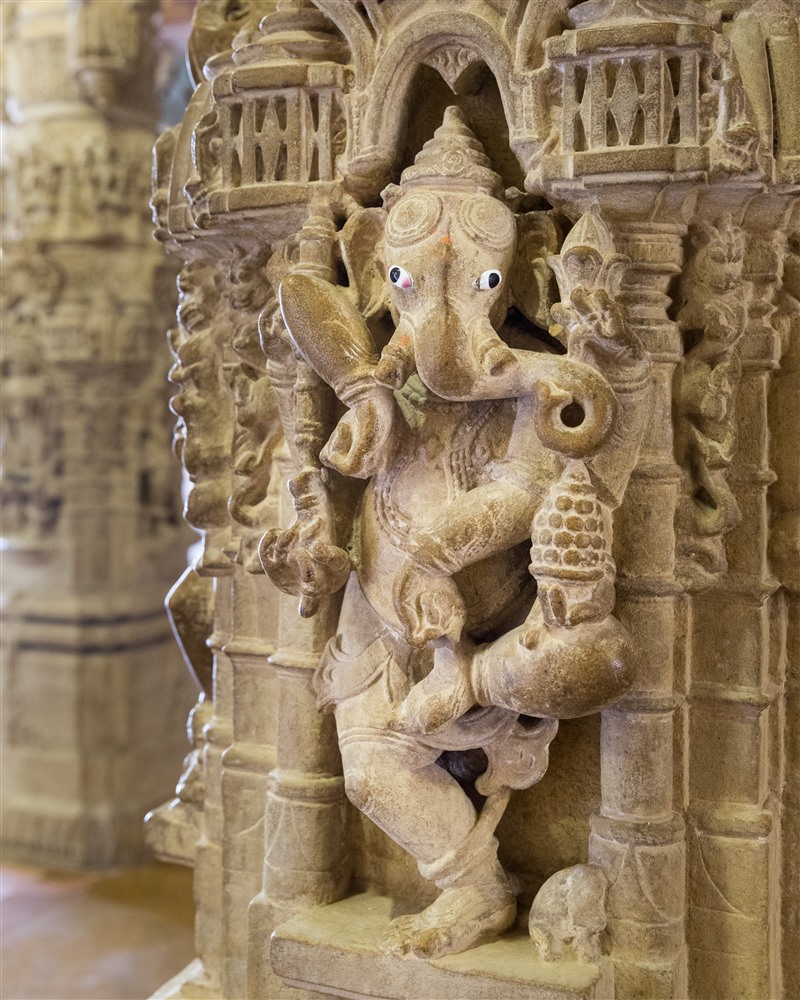


The highlight of both my visits was the carved decoration on a couple
of the ceilings, which was almost beyond description. I’m not even sure
I’ve managed to capture this successfully, but it’s not for want of
trying 


A visit here is actually quite a disorientating experience, with no signage and seemingly nondescript doorways leading to an unexpected new temples – I was constantly losing track of where I’d been and precisely where I was in relation to the other temples.


Subsequent research on the web hasn’t really helped me identify the exact temple names for many of these photos. I don’t think I’m the only one who has had a hard time achieving this !


This is one temple complex that was totally complex ! But in many respects that doesn’t really matter, it’s actually part of the joy of visiting this place. Whilst it does result in a bit of a dump of photos on the blog, it does accurately represent what you will see if you come here.


To see everything, you should plan for at least 90 minutes. And critical to that plan is to ensure you know the opening and closing times. There’s one ticket to see everything here, and the guards that hover around the three main entrances will know the opening times for any specific day.


Remember not to wear any leather items, although on the days I visited they didn’t seem to check for this.
Patwon Ki Haveli

Located just 400m to the north of Jaisalmer fort and palace, Patwon Ki Haveli is a complex of five separate havelis owned by five brothers, and was the first haveli to be constructed in Jaisalmer.

This remarkable piece of architecture was commissioned by Guman Chand Patwa in 1806, a very rich trader who wanted to build five havelis for his five sons. It look over 50 years to complete, and so Guman Chand Patwa’s wish was not actually realised within his lifetime.

The Haveli has 60 wonderful jharokhas (balconies) in a mix of Indian and Persian styles of architecture. Havelis like this are a good representation of the affluent living standards of the merchants of Jaisalmer.

As for going inside the Haveli, you actually have two choices out of the five – but confusingly they both seem to have the same name. If you look at TripAdvisor reviews for Patwon Ki Haveli you will get the distinct impression that people are talking about two different places, and that’s because they are !

Government Managed Patwon Ki Haveli
As you stand looking at the frontage of the five havelis, the government run one is on the far left. To enter this one you need to purchase an entry ticket.


A walk around this haveli takes you through a series of rooms that have been reconstructed to give a sense of how this place looked at around 1900 – 1930. This is not just in the decor of the rooms, period furniture and other items have been used to suitably “dress” the rooms.


It’s an interesting place to wander about, more of a museum than anything else, although I found the lack of signs a little frustrating (although guides are available).


Privately Owned Patwon Ki Haveli
As you stand looking at the frontage of the five havelis, this one is to the right. There’s no sign, no entrance fee, just an open door ! If I hadn’t overheard a guide mention it to his customers, I would be completely oblivious to the fact that it’s somewhere the public can go.


And what a treat it is ! A treat for me at least, who prefers to see authentic interiors well maintained and preserved, rather than being overly reconstructed.


You’re free to roam around this haveli undisturbed by anyone. Almost all the rooms are empty aside from a couple of shops, but what has been left in terms of the room decoration is fascinating.


Unlike the first haveli, in this one there’s even a small private temple for the household to use.


The rooms spill off from five floors, again, with nothing to tell you their function or purpose (aside from the temple) – but I’m ok with that here.

It’s quite an eerie experience, you get the feeling the last occupants left decades ago and the rooms have been completely left alone since then.


So quite a contrast in the two havelis and how they’re presented. Built by the same family over 100 years ago, but now offering two different insights into what it was like to live in one of them.
I’d thoroughly recommend seeing both when you visit Jaisalmer, and in many respects I enjoyed the free (privately owned) haveli more than the government run museum.
You’re welcome to ‘Like’ or add a comment if you enjoyed this blog post. If you’d like to be notified of any new content, why not sign up by clicking the ‘Follow’ button.
If you’re interested in using any of my photography or articles please get in touch. I’m also available for any freelance work worldwide, my duffel bag is always packed ready to go…
KevinStandage1@googlemail.com
Categories: India, Jaisalmer, Patwon Ki Haveli, Rajasthan
3 replies »
-
First reply after nearly four years for this post … Incredible. The pictures are amazing. Thank you for this post (and all your posts). I spent hours and hours in your blog since I discovered it, few weeks before ! )
I visited most of the cities and areas that you show us (except Goa, Ladakh, Kerala and Pune area but I miss some places in the these areas (a good reason to come again in Gwalior for the hidden Jain statues for exemple) and it is a pleasure to see your pictures, read your explanations and remenber these marvels in this time where travelling is not possible. For the first time since 13 years, I don’t have an india trip in project, so your blog help me to dream about this incredible country.
Thank you again (sorry for my bad english, I’m french…)Liked by 1 person
Bada Bagh

Bada Bagh (also known as Bara Bagh or Barabagh) is a garden complex 6km north of Jaisalmer. If you’ve already visited Jaisalmer Fort and Palace you may have spotted this place from one of the viewpoints overlooking the city and Thar desert beyond.


Here are the royal cenotaphs(or chhatris) of the Maharajas of Jaisalmer state, starting with Jai Singh II (d.1743) and the last intended for Jawahar Singh but remains unfinished after Indian independence. When Jawahar Singh’s son ascended the throne after his father, he died within a year. This was considered such bad luck that the tradition of building cenotaphs here was discontinued.


Jai Singh II was well known for his contribution to making the desert around Jaisalmer green. He constructed a dam near a lake here, and in his honor his son Lunkaran set up a memorial in the form of a cenotaph and a park next to the dam. The stretch of road immediately before the site and carpark is in fact built on top of the dam, although it’s hard to appreciate that when you’re there.


This tradition of building cenotaphs caught on, and every subsequent death of a royal member of the rulers of Jaisalmer was honoured with a chhatri at Bada Bagh.


Bada Bagh means “big garden”, although any evidence of this green oasis in the desert seems to have mostly disappeared, at least in March when I visited. However, it does claim other green credentials now, as enveloping the site today is an impressive mass of wind turbines. I did my very best not to include these in any of the photography, but if you visit Bada Bagh it will be one of your lasting memories of the site.

Most of the cenotaphs have a single stone slab set in the middle, usually with a carving depicting a man on horseback, representing the ruler for whom the cenotaph was built. Next to this is often further carvings of women, often quite a number of them. I initially thought this was to represent how many wives the ruler had, but sadly it’s not quite as simple as that.


These carvings of the women actually represented how many self-immolated by jumping into the burning pyre of the ruler, an act known as Satis. At the time of visiting Bada Bagh I had no idea this was what I was seeing being represented.


The cenotaphs are of various sizes, the more powerful and important you were, the bigger your cenotaph is. The smaller structures are probably for princes and other peripheral members of the royal family.


It’s an incredibly atmospheric place, despite the wind turbines looming a short distance away. The entire place has an abandoned feel to it, contributed in part by the fact that I had the entire place to myself. I get the impression this place is not that frequently visited.


If you’re intending to visit Bada Bagh the best time is early morning. This is not just because of the light, but because of the direction of the light. Early morning gives you the best opportunity to photograph the site avoiding the wind turbines just a short distance beyond to the south and east.
Gadisar Lake

Originally a conservation lake to collect rain water, Gadisar Lake (also called Gadsisar Lake) was built in 1367 by Maharawal Gadsi Singh to meet the water requirements of Jaisalmer.


The tank remained Jaisalmer’s vital water supply until 1965, and due to its importance to the city over the six centuries many small temples and shrines were constructed along its banks.


Now the lake is a popular destination for both tourists and locals, although close to monsoon time the lake is almost dry. The local people sell bread to feed the hungry catfish in the lake, and you can also hire boats or just come here and hang out for a while.


A local also told me that in winter the lake hosts many migratory birds that come from the nearby Bharatpur Bird Sanctuary.


I only stayed in Jaisalmer for one night, so got up early to catch sunrise at the lake. Conditions were not brilliant, but I’m glad I made the effort. The lake is less than 1km south east of Jaisalmer fort walls.


The 14th-century Tilok Ki Pol gateway that straddles the road down to Gadisar Lake is said to have been built by a prostitute. When she offered to pay to have it constructed, the maharawal refused permission on the grounds that he would have to pass under it to go down to the tank, which would be beneath his dignity. While he was away, she built the gate anyway, adding a Krishna temple on top so the king could not tear it down.


.jpg)

Great job in collecting and describing its history. Thank you
On Sat, Mar 25, 2017 at 12:10 PM, Kevin Standage wrote:
> kevinstandagehotography posted: ” Built on the summit of Trikuta Hill in > the middle of the Thar desert by Rawal Jaisal in 1156, Jaisalmer Fort is > one of the largest fully preserved fortified cities in the world. The fort > was strengthened just over a century later in 1276, when Ki” >
Liked by 1 person
Thank you for stopping by !
Like
Loved your photos and article, which brought back memories of when I solo back-packed there back in 1985! Bet it’s changed somewhat since then…
Using 35mm Fujichrome slide film, if you have time, check some images out: http://www.nillasphotography.com/galleries/india-1985
Many thanks for stopping by and liking my Travel and Photography site.
Liked by 2 people
Hey Kevin!
I don’t if it is your laziness to share it well or what, but this post is very underrated. There are so many garbage photography blogs out there getting tremendous exposure and gems like this are hidden. Excellent photography beautifully portrayed the heritage of Jaisalmer.
I am gonna share it right away.
Thank you so much for your effort and please keep visiting India.
Liked by 1 person
Thanks Kavri, that’s so kind of you. I don’t promote the blog that much, I’m really not one for massive self promotion. Thanks for sharing it !