Shiva Temple, Belpan, Takhatpur Tehsil, Bilaspur District, Chhattisgarh

The 16th century Shiva Temple also known as Narmadeshwar Mahadev Temple in Belpan is believed to be the origin of the sacrosanct Chhoti Narmada River. According to the locals, Chhoti Narmada emanates from the nearby Sita Kund and joins the Maniyari River.
This place has been mentioned in several important Hindu texts and commentaries and has been the tapo sthala of yogis, saints, tapasvis and literary giants. Devotees from far – flung places throng this sacred kshetra in the auspicious months of Sravan and Kartik and on Maha Shivaratri.
This east – facing temple is built on a high platform and is largely simple in terms of decoration. The entrance door is decorated with floral motifs. A majestic Shiva Linga has been consecrated in the garbha griha that is revered by all.
It is said that the ancient Sita Kund has been blessed by the entire gamut of creation and a dip in the Chhoti Narmada relieves you of sorrow and bad thoughts and habits.
There are smaller temples dedicated to various gods and goddesses around this temple. An annual fair is conducted here in the month of Sawan.
There are several broken sculptures and Shiva Lingas of great antiquity placed within the compound. Unfortunately, this divine temple is in shambles and in dire need of renovation.
Written by Lakshmi Subramanian
Siddheshwar Temple, Palari, Balodabazar District, Chhattisgarh

Siddeshwar Temple by the ancient Balsamund Talab in Palari is a lesser – known brick temple of the 7th – 8th century. This west – facing temple strictly adheres to the tenets of the Shilpa Shastra and has been widely appreciated by historians, architects and artisans for its extraordinary sculptures, carved panels and structural ingenuity.
The temple on plan has the typical oblique projections seen in the stellar layout. The external facades and shikhara are richly embellished with beautiful carvings of elephants, lions, medallions inset with gods and goddesses like Bhagawan Ganesha, Bhagawan Kartikeya and Gajalakshmi, miniature niches, repetitive floral and foliage motifs, geometric patterns in harmony and auspicious Hindu iconography that are incredibly difficult to carve on brick!
A considerable number of these sculptures have been severely damaged and are beyond repair. Locals say that the temple has been renovated in parts over the years.
The temple has been constructed using a unique technique known thousands of years ago wherein the garbha griha remains cool even in the hottest summers.
The entrance doorway exhibits unparalleled architectural and artistic mastery. Life – size figures of the river goddesses Ganga and Yamuna in dvibhaṅga on their respective vahanas along with their attendants that adorn the main entrance exude delicacy, elegance and charm. The sculptural lines, garments, ornaments, diadems, hair and facial expressions of Ganga and Yamuna are breathtaking to say the least!
The most elaborate panel depicting the divine marriage of Bhagawan Shiva with Parvati and the accompanying procession comprising of Bhagawan Vishnu, Bhagawan Brahma, musicians, dancers, sages and gods and goddesses above the lintel of the main door is truly captivating and one of a kind. Bhagawan Ganesha has been carved to the left of the door while Bhagawan Kartikeya sits on the right.
A Shiva Linga of great antiquity has been consecrated in the garbha griha. Thousands of people come to have darshan in the important months of Sravan and Kartik and on Maha Shivaratri.
There is an old Peepul tree within the premises where recently excavated idols have been placed.
Written by Lakshmi Subramanian
Vishnu Mandir, Janjgir, Janjgir – Champa District, Chhattisgarh

One of the most mysterious temples of the late 11th century – early 12th century in the former kingdom of Haihaiyavanshi commissioned by Raja Jajjalladeva I of the Kalachuris of Ratnapura is the incomplete Vishnu Mandir at Janjgir. Locals say that this temple was actually constructed in two parts but the temple remained unfinished as the assembly could not be done.
This temple located by Bhima Talab is known locally as Nakata Mandir or Nakta Mandir. This east – facing temple sits on a high platform whose sides are adorned with intricately carved panels depicting stories from the Ramayana.
The most noteworthy are the hunt for the golden deer by Prabhu Sri Rama along with Sita Mata and Lakshmana and the piercing of seven trees with a single arrow by Prabhu Sri Rama. Stories from Srimad Bhagavatha Mahapurana like Vasudeva carrying baby Krishna from prison and others have been carved to perfection.
The temple is built of locally sourced red sandstone. The temple on plan has a few steps leading to the antarala and the garbha griha that is designed as a pancharatha. The presence of short pillars at the antarala suggests that a mukha mandapa was also planned but not executed.
The entrance doorway is truly an artistic and architectural masterpiece exuding grandeur, charm and elegance. The door frame has three bands, three toranas and two tall and broad pillars on the sides. Each and every inch of this door jamb is a visual spectacle with embellishments, decorative motifs and patterns, carvings and sculptures.
The harmonious composition of life – size figures of Ganga and Yamuna and the dwarapalakas, bands of snakes, manibandha, patravali and miniature niches inset with gods and goddesses and forms of Bhagawan Vishnu is stunning to look at. Bhagawan Brahma and Bhagawan Shiva are seen on either side of Chaturbhuja Vishnu on the lintel along with the Navagrahas.
Elephants, swans and figures are seen in the bottom panel of the entrance doorway. The pilasters seen inside support a receding roof panel of an eight – petalled lotus.
The external facades and shikhara are profusely decorated with floral, foliage and geometrical patterns, repetitive elements, auspicious Hindu iconography, miniature niches inset with gods and goddesses like Bhagawan Surya, Bhagawan Brahma, dancing Ganesha and forms of Bhagawan Vishnu like Varaha, Vamana and Narasimha, musicians, apsaras, Ashtadikpalakas, mithunas, sages and others.
It is unclear why this temple has been abandoned for centuries and relegated to obscurity. Stories about a competition between Vishwakarma and Bhima and Bhagawan Vishnu choosing between this temple and the Sheorinarayana Temple will keep you enthralled.
Written by Lakshmi Subramanian
Ancient Site, Nagari Village, Chittorgarh Tehsil, Chittorgarh District, Rajasthan

Nagari or Nagri, once a splendid city during the Mauryan and Gupta Periods and an important seat of learning, philosophy, literature and economics is now nothing more than a forgotten chapter in the history of Akhanda Bharat. This city has been mentioned in the Mahabharat as one of the regions conquered by Nakula in the legendary Digvijaya Parva of the Sabha Parva wherein, Nakula was sent to the west to expand the Pandava Empire following which the Rajasuya Yagna was held in the presence of Bhagawan Krishna and others at Indraprastha.
In fact, this ancient site called locally as Madhyamika Nagari (which is its original name) is a repository of information about the religious and social practices, cultural traditions and customs and art and architecture of the people and land since the early Vedic Period.
Historical records claim that this prosperous city had an abundant supply of silver drawing the attention of the Greek invaders. People moved from the north west borders to this place which later became a part of the Shunga Empire under Maharaja Pushyamitra who succeeded in chasing away the Greeks.
Ancient inscriptions in Brahmi script and Sanskrit language found in Ghosundi dating back to 200 BCE – 150 BCE have revealed that a Ashwamedha Yagna was performed by a king named Sarvatat of Parasara Gotra who also commissioned the temple of Sankarshana and Vasudeva in Narayana Vatika. This inscription is said to be the oldest of its kind found in Rajasthan that makes a clear reference to the Vaishnava influence in this region at that period.
Fragments of broken pillars found on either side of the Berach River mention the Vajapeya Yagna and the erection of a Yupa and the construction of a Vishnu Temple in the 5th century.
The entire city called as Narayana Vatika became a fortress under Sarvatat Gajayana and remained impregnable when the Muslim barbarian Akbar attempted to attack it. His elephants were held captive in this place that came to be known as Hathi Bada.
The temple designed for the worship of Bhagawan Sankarshana and Bhagawan Vasudeva is enclosed by a stone wall and covers a large area. It is highly likely that the idols were consecrated on a high platform. The traditional pillar or Garuda Sthambha in front of the temple was later removed by Akbar who also used the massive stones from the outer walls of the city to build a lighthouse.
Archaeological excavations conducted over the years have uncovered copper coins, seals, fragments of pottery, stones, sculptures and figures of great antiquity, two carved pillars of the Gupta Period with the lion and bull capital respectively, stupas of moulded bricks and terracotta adorned with animal, human and floral motifs, fluted pillars, red and grey ware, fortifications of moulded bricks and clay plaques, limestone and stone, terracotta seals, human figurines and others and an ivory seal with swastika and taurine symbols and copper antimony rods and rings.
Written by Lakshmi Subramanian
Andal Deul or Indal Deul, Kharod, Janjgir – Champa District, Chhattisgarh
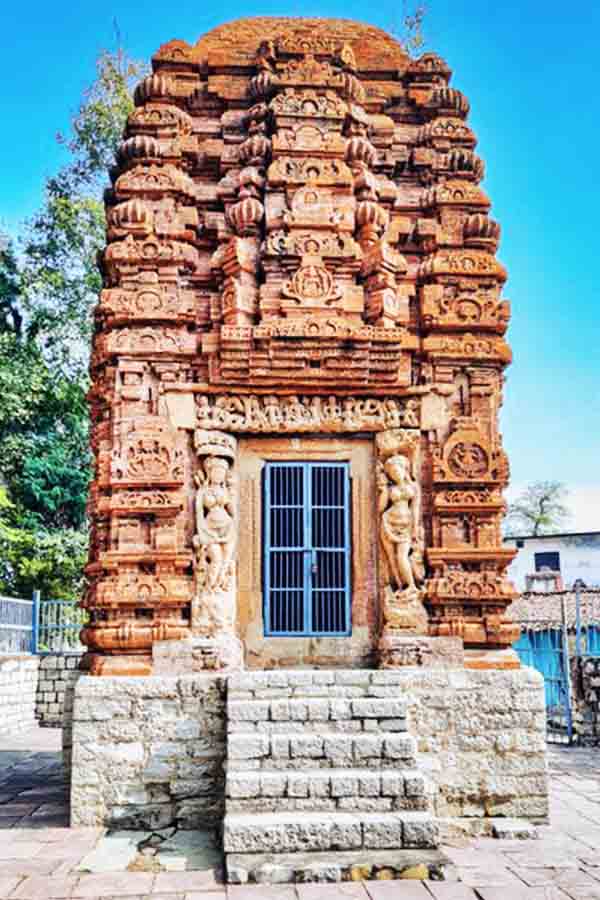
Kharod, known as the Kasi of Chhattisgarh is dotted with stunning brick temples dating back to the Vedic Period. Of these, only four remain today namely Shavari Devi Temple, Andal Deul, Lakshmaneshwar (also known as Lakhneshwar) Temple and Eeshaaneshwar Temple.
The most famous temple of Kharod is Indal Deul also known as Andal Deul, a 7th century brick and stucco temple built by perhaps Maharaja Indrabala of the Panduvamshis of Dakshina Kosala. This west – facing temple located to the north of the village has been widely appreciated by artists and architects for its richly embellished entrance doorway.
The temple sits on a 4 feet high platform and on plan originally had a pillared mandapa, a kapili and a garbha griha. However, only the garbha griha has managed to survive while the curvilinear shikhara of five tiers is in a state of disrepair.
The platform and entrance doorway are built in stone while the rest of the temple is of brick. The temple attempts to adhere to the stellar (star) form though the oblique projections do not render it into a complete stellar.
The temple appears to have been designed as a saptharatha with a square garbha griha. The external facades are adorned with sculptures and carvings in stuccowork that though have largely eroded, still manage to exude subtle elegance and grandeur.
The external facades are divided into five tiers and are decorated with mouldings, riders on lions, dancing Ganesha, Gajalakshmi Devi, Bhagawan Shiva, Bhagawan Narasimha, Bhagawan Indra seated on Airavata, ten – armed Durga Devi, Bhagawan Vishnu on Garuda, Bhagawan Kubera, Mahishasuramardini and others (many are too defaced to recognize), miniature niches inset with figures, musicians, dancers and apsaras, repetitive floral and geometrical patterns and auspicious Hindu iconography. A considerable number of these sculptures have been severely damaged and are beyond repair.
The entrance doorway has three prominent bands, the innermost of patravali, the middle of manibandha and the outermost of life – size figures of the river goddesses Ganga and Yamuna with pitchers in their hand in slight dvibhaṅga on their respective vahanas. It is believed that the Archaeological Survey of India (ASI) placed these sculptures in the present position during renovation.
Shiva – Parvati sit majestically on the Lalata Bimba along with Bhagawan Brahma and Bhagawan Vishnu, Garuda and a couple of Naga and Nagis. Remains of stuccowork is clearly visible here. The delicate lines of the sculptures of particularly Ganga and Yamuna and their garments and ornaments are very similar to the sculptural art of the Gupta Period.
Written by Lakshmi Subramanian
Vaishnava Temple, Konark Temple Complex, Konark, Puri District, Odisha
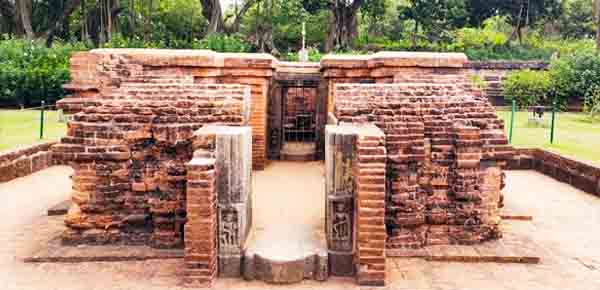
The spectacular Konark Temple complex is an excellent example to understand the science of Hindu philosophy and tenets of Shilpa Shastra. This complex is full of architectural and artistic gems that will leave you spellbound.
The magnificent Konark Sun Temple in particular is a wonderous architectural and structural feat, a true testimony to one’s faith in the Supreme Brahman. The main temple is surrounded by edifices built over different periods.
One such structure is the Vaishnava Temple, a small brick temple dating back to 10th – 11th century. This temple had remained forgotten for centuries under a sand pile and was actually discovered quite by accident in 1956.
This east – facing temple sits to the south – west of the main temple and is also referred to as Temple No. 3 by the Archaeological Survey of India (ASI). This temple on plan originally had a pancharatha garbha griha and a jagmohana that have long disappeared.
The temple is largely simple in decoration with only carvings of Balarama and the Parsvadevatas Varaha, Vamana and Trivikrama. The main deity is missing.
Written by Lakshmi Subramanian
Bhim ki Chauri, Dara, Mukundara Hills National Park, Kota District, Rajasthan
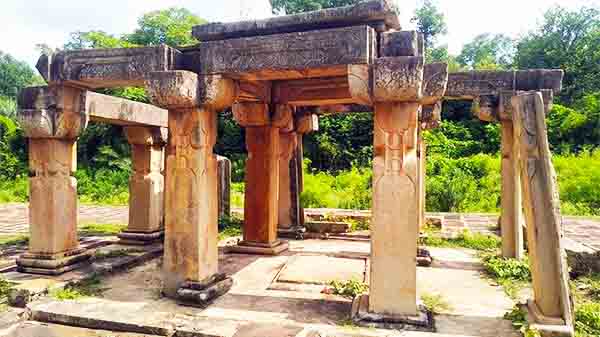
Bhim ki Chauri (marriage pavilion of Bhima), a mid – late 5th century edifice of possibly the Guptas or their feudatory, the Aulikaras presents a lonely picture in the midst of stunning natural beauty. This temple located in the lush green Mukundara Hills National Park is believed to be the only surviving structure of that period in this area that was once a part of the princely region of Hadoti.
The temple (or whatever is left of it) sits on a low platform accessed by two lateral flight of steps. This east – facing temple on plan originally had a pillared Nandi mandapa of which only fragments are seen today and a garbha griha.
The sanctum is clearly marked by four columns and was placed at the centre of a square bay. There were walls on the south, west and north of the shrine with decorated pilasters and columns. A narrow pradikshina path can be seen around the open pillared sanctum sanctorum.
The lintels are simplistically embellished with floral and foliage motifs, bead like work and concentric linear patterns while the capitals of the pillars are adorned with intricately carved floral and geometrical designs. The ceiling of the mandapa has a beautiful panel of a full – bloomed lotus in the centre with four smaller lotuses at the four sides.
The walls most likely made of brick have disappeared altogether. Parts of the pillars, lintels, ceiling panels and other architectural elements are seen and have also been preserved by the Archaeological Survey of India (ASI). A gana and a drummer (Jhallari Vadak) from this site are on display at the Government Museum at Kota.
This flat – roofed temple also has the traditional makara pranalas that are of great antiquity. It is most unfortunate that a considerable portion of this ancient temple was broken and used to build a mansion in the 17th century by the local ruler as well as a Shiva Temple behind the mansion and the deserted temple at Jhamra.
However, the search is still on for the missing walls, doorways, architectural details and ceiling panels of this old temple.
Written by Lakshmi Subramanian
Gandharadi Chari Sambhu Temple, Gandharadi, Boudh District, Odisha

The ancient city of Boudh, formerly a part of the Khinjali Mandala of the Bhanja dynasty is dotted with stunning temples of the late 8th – 9th century built by Maharaja Ranabhanja. The discovery of plates makes mention of grants made by the Bhanjas of Khinjali Mandala to a village of Gandatapati (known later as Gandharadi) close to the Mahanadi River.
The remains of an old fort, mounds and brick structures gives credence to the theory that this medieval town was once an important seat of learning, art, architecture and philosophy. The most famous temple complex of Gandharadi is the twin temples of Nilamadhava dedicated to Bhagawan Vishnu and Siddeshwara dedicated to Bhagawan Shiva that was originally located on the bank of the Mahanadi but now stands at a little distance away owing to the altered course of the river.
Though visually identical, the Nilamadhava Temple on the left has a chlorite Sudarshana Chakra as the crowning element while a chlorite akasa Shiva Linga sits atop the Siddeshwara Temple on the right! This unique architectural feature has never been found in any other temple built in the same period.
The east – facing temples sit next to each other on a high platform and are interestingly designed as a panchayatana with the twin temples marked as one and four smaller shrines on each corner of the platform. The four shrines however have collapsed over the years and only a few fragments are visible today.
The temples are designed in the typical rekha deul style of architecture with a flat – roofed jagmohana (assembly hall) and pancharatha garbha griha. The temple is built with locally sourced sandstone and chlorite.
The rectangular jagmohana has a two – tiered roof which was perhaps originally supported by twelve pillars with four pillars on all the four sides with a central opening. The lintels appear to have given way under the weight of the roof and the jagmohana was later redesigned to fill the gaps between the pillars and lintels thereby closing the sides and leaving only the central openings untouched.
The side openings now have jali work in blue chlorite at the bottom and miniature temple shikharas over it. There are carvings of Mahishasura Mardini, Durga Mata and Bhagawan Vishnu as Matsya, Kurma and Varaha among others.
The intricately carved Nagas on the doors and windows of the jagmohana are truly captivating. A Shiva Linga is consecrated on a square Shakti peetha in the sanctum sanctorum of Siddeshwara Temple while Bhagawan Vishnu is seen with four arms along with Sridevi and Bhudevi.
The temple is called Chari Sambhu as it houses four Shiva Lingas within the Siddeshwara Temple (Jogeshwara, Kapileshwara and Somnatha are the other three).
There are sculptures and carved panels within the premises that are of great antiquity. This little – known architectural gem has a fine blend of early Kalinga style of architecture and 9th – 10th century Bhanja dynasty imprint.
Written by Lakshmi Subramanian
Brick Temple of Shavari, Kharod, Janjgir – Champa District, Chhattisgarh
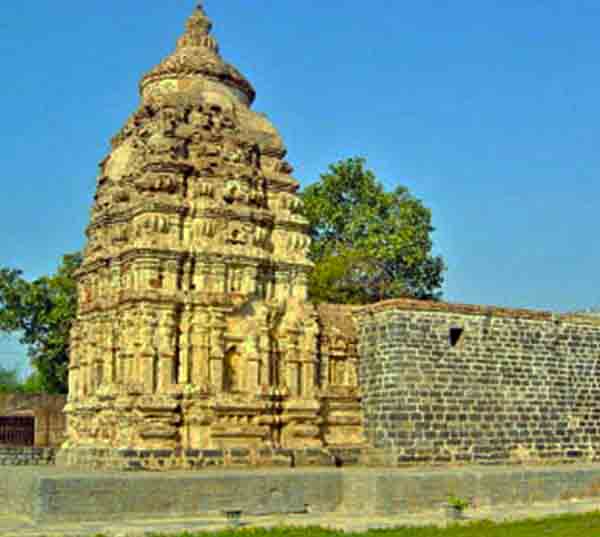
Kharod, a relatively sleepy town is a lesser – known treasure trove of ancient brick temples. This town of immense religious and spiritual potency is said to derive its name from Khara and Dushana, the younger brothers of Ravana. The great war between Khara and Dushana and Bhagawan Rama is said to have taken place here.
Historical records state that countless brick temples were built in this area of which only four remain today namely Shavari Devi Temple, Andal Deul, Lakshmaneshwar (also known as Lakhneshwar) Temple and Eeshaaneshwar Temple.
The Shavari Devi Temple (known locally as Shabari Devi or Shabarinarayana Temple) is located in the southern part of the village on the west bank of an old tank. This east – facing temple sits on a high stone platform and on plan has a pillared mandapa, an antarala and a square garbha griha.
The sanctum sanctorum interestingly has been designed as a saptaratha representing a stellar (star) though it hasn’t been completed in entirety and therefore, appears to be only a semi – stellar.
The external facades are relatively simple in terms of decoration with mouldings, niches that are empty, repetitive linear elements and auspicious Hindu iconography.
The entrance door to the shrine has the river goddesses Ganga and Yamuna of very small size, dwarapalakas and prominent carvings of the Nagas. Garuda sits on the lintel holding the tails of serpents.
The mandapa has two rows of six pillars each. The sculptures adorning the pillared mandapa though defaced are classical in their ornamentation, size and proportion. There are sculptures of other temples placed here as well.
The temple was dedicated to Bhagawan Vishnu originally but later seated the local goddess Savari Devi. This temple was built in the mid – 7th – early 8th century by the Panduvamshis of Dakshina Kosala and the mandapa was an addition by the rulers of this region in the late 12th century.
Written by Lakshmi Subramanian
Shiv Mandir, Pali Raiyatwari Village, Malthone Tehsil, Sagar District, Madhya Pradesh

The 10th – 11th century Shiv Mandir known locally as Hazariya Mahadev Mandir located on the outskirts of the lesser – known Pali vilage is one of the most amazing Shivalayas ever built. The temple is open to the public only on three days in a year namely Shravan Somavara, Kartika Purnima and Maha Shivaratri.
Locals say that this Shiva Linga is one of the rarest of its kind where offering prayers to IT is deemed equal to worshipping 1008 Shiva Lingas! In fact, Bhagawan Shiva is called Hazariya Mahadev here because of this remarkable aspect.
The temple built by the Chandelas of Jejakabhukti sits on a high platform with only the garbha griha intact. The sculptural art is very similar to that seen in the temples at Khajuraho.
The entrance doorway is absolutely spectacular and testimony to the artistic and architectural excellence of the Chandelas. The door jambs are richly embellished with Ganga and Yamuna and their attendants, dwarapalakas and series of intricately carved figures from the base to the lintel along with foliage, floral and geometric patterns and auspicious Hindu iconography in distinctive bands that are visually harmonious.
The lintel has a beautiful carving of Uma Maheshwara in the Lalata Bimba flanked by carvings of Sapta Matrikas, Navagrahas, Bhagawan Ganesha and Bhagawan Veerabhadra and dancers and figures in three tiers. The ceiling of the sanctum sanctorum has a detailed lotus panel in the centre.
The Chandelas’ structural ingenuity can be observed at the outlet behind the shrine. There are miniature niches, some inset with sculptures and some empty in the external facades.
Nandi Bhagawan has been seated in front of the sanctum sanctorum. There are broken sculptures of gods and goddesses, apsaras and panels depicting stories from the scriptures that have been preserved by the Archaeological Survey of India (ASI).
There are ruined temples of various periods around this ancient shrine.
Written by Lakshmi Subramanian
Chaurasi Khambha Temple, Kaman, Bharatpur District, Rajasthan
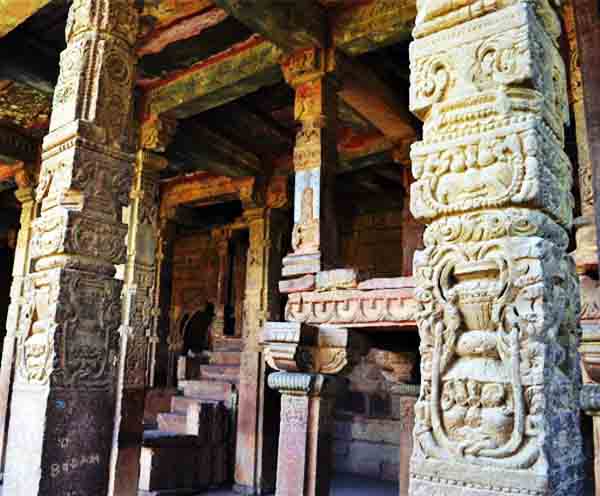
Kaman also known as Adi Vrindavan is a town of great antiquity that has been mentioned in the Srimad Bhagavatha Mahapurana as the holy land where Bhagawan Krishna spent his childhood days. This sacrosanct town is home to Kameshwar Mahadev Temple, one of the four important Shivalayas on the Braj Chaurasi Kos Yatra.
The most mysterious edifice in this town is the Chaurasi Khambha Temple whose pillars though literally translates to 84 in number (chaurasi means eighty – four) have never added up to 84! Several people have even numbered the pillars in white chalk only to find themselves at their wits’ end when the final number has either exceeded or is lesser than 84.
No one has been able to explain why it is so hard to count these pillars that locals believe have existed since the time of the Pancha Pandavas. In fact, Kaman is said to be the place where the Pancha Pandavas and Draupadi spent time in tapas (penance and austerities) during their exile.
The legendary Yaksha Prasna also happened in this village at a pond called Dharam Kund. The other fascinating feature of this temple is that though it is generally accepted to be a place of worship, there is no record of an idol of any kind!
The villagers also opine that Maharajadhiraja Vikramaditya, the epitome of dharma built this structure during his reign as there is a prominent elevated seating which is generally regarded as the seat of the king while holding court.
The pillars from the base to the capital are adorned with stunning carvings, motifs of flowers, pots, snakes, animals and birds, repetitive patterns and auspicious Hindu iconography. There are bas – reliefs of the Navagrahas, different forms of Bhagawan Vishnu, the union of Bhagawan Shiva and Parvati Devi, Nagas and others,
There are exquisite sculptures of Bhagawan Ganesha, Kali Mata, Bhagawan Vishnu and Bhagawan Narasimha. One pillar has the sacred mantra “ॐ नमः शिवाय” inscribed on it. Historians claim that the temple was built in the 8th century CE though parts of it appear to be much older.
This temple was desecrated by the Delhi Sultanate and partly converted into a mosque using the debris.
Written by Lakshmi Subramanian
Ancient Shiva Temple, Ganiyari Village, Kota Tehsil, Bilaspur District, Chhattisgarh
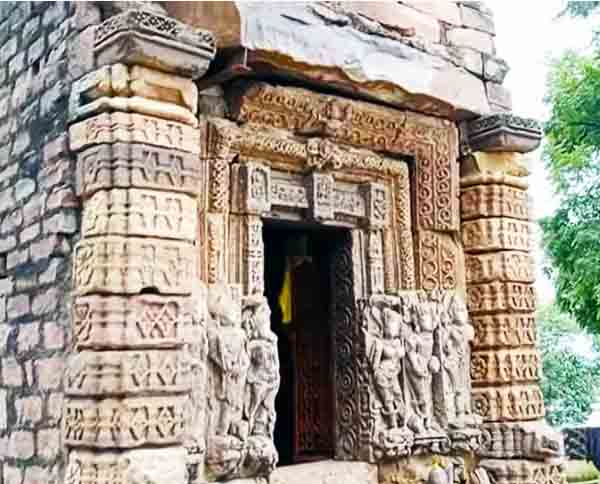
A stunning example of 10th – 11th century temple architecture of the Kalachuris of Tripuri also known as Kalachuris of Chedi is the Shiva Temple located in the remote Ganiyari village in Bilaspur district. This east – facing temple located in front of a lake has the most charming sculptures of its time adorning the main door.
This centuries – old temple built on a low platform is in a state of disrepair with only a part of the antarala and garbha griha in good condition. This temple might have had a pillared porch and even a mukha mandapa but unfortunately, time and weather have not been kind to this once – magnificent edifice.
The sanctum sanctorum is square in plan designed as a pancharatha. The shikhara has totally disappeared along with a greater part of the external facades. The shikhara most likely would have conformed with the Nagara style of architecture.
The entrance doorway is however an artistic and architectural masterpiece with elaborately designed panels, tiers, bands, figures and motifs. The door jambs have three distinct bands on either side of dvarapalakas, Ganga and Yamuna on their respective vahanas. There is a panel of elephants on the right and a Shiva Linga on the left in the bottom.
The lowest part of the main entrance has floral motifs in repetition along with some other figures that are unrecognizable. On either side of the main door are carvings inset in miniature niches in the innermost band, interlocked circular design in the middle and foliage pattern in the outermost.
Floral and geometric patterns and auspicious Hindu iconography are found on either side of the entrance doorway. The lintel has carvings of the Navagrahas, dancing Ganesha and Parvati Devi. Gajalakshmi is seated in the Lalata Bimba while Bhagawan Nataraja and Garuda are seen above the central figure.
A Shiva Linga has been consecrated in the sanctum sanctorum along with idols of Bhagawan Surya on his chariot with Usha and Pratyusha, Bhagawan Ganesha, Bhagawan Vishnu, Bhagawan Nataraja and others that are of great antiquity.
The northern façade has Bhagawan Ganesha, Bhagawan Surya and Bhagawan Parvati seated in the niches.
Written by Lakshmi Subramanian
Shiva Temple, Sakour Village, Hatta Tehsil, Damoh District, Madhya Pradesh
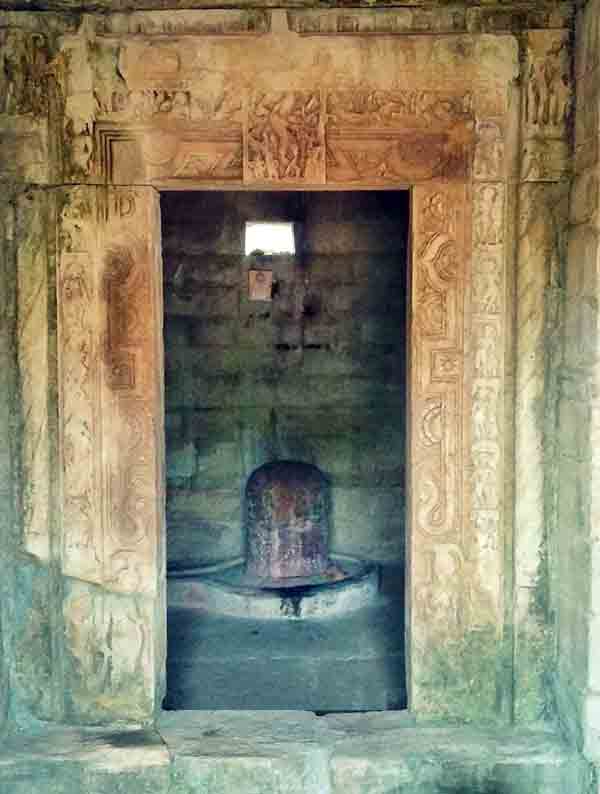
A lesser – known edifice of the late Gupta period is the 6th century Shiva Temple located in the obscure village of Sakour. Archaeological excavations conducted in this village have uncovered coins of Maharajadhiraja Shri Samudragupta, Maharajadhiraja Shri Chandragupta and Maharajadhiraja Shri Skandagupta indicating that this village must have been an important seat of learning, art, literature and architecture during the Gupta reign.
Historical records state that the Muslim barbarian Muhummad Ghori looted and razed several temples of the Guptas in this region to the ground in his unrelenting attack and invasion of Akhanda Bharat. This temple was totally in shambles with only the entrance doorway of the shrine in decent condition.
The temple has undergone renovations recently and now sits majestically on a rebuilt platform. This west – facing temple has only a mandapa and a garbha griha in which a Shiva Linga has been consecrated. The original temple layout is similar to the Gupta temples seen at Bhumara and Nachna and probably had a pradakshina path as well.
The temple was built with dressed stones without mortar and had an imposing shikhara over the sanctum sanctorum and a roof over the mandapa that have totally disappeared. A severely defaced inscription was found on a roof slab of the mandapa.
The entrance doorway of the garbha griha is noteworthy with three profusely decorated bands. The innermost has a random pattern that starts from above the heads of Ganga and Yamuna comprising of lotus enclosed in semi – circular frames.
The middle band has seven carvings on either side while the outermost band has a twisted garland like pattern emerging from a pot held above the head of a gana at the base of the band. The lintel has an unrecognisable panel on either side of the centrally seated Bhagawan Nataraja.
Written by Lakshmi Subramanian
Yupa Pillars, Bichpuri Village, Tonk Tehsil, Tonk District, Rajasthan
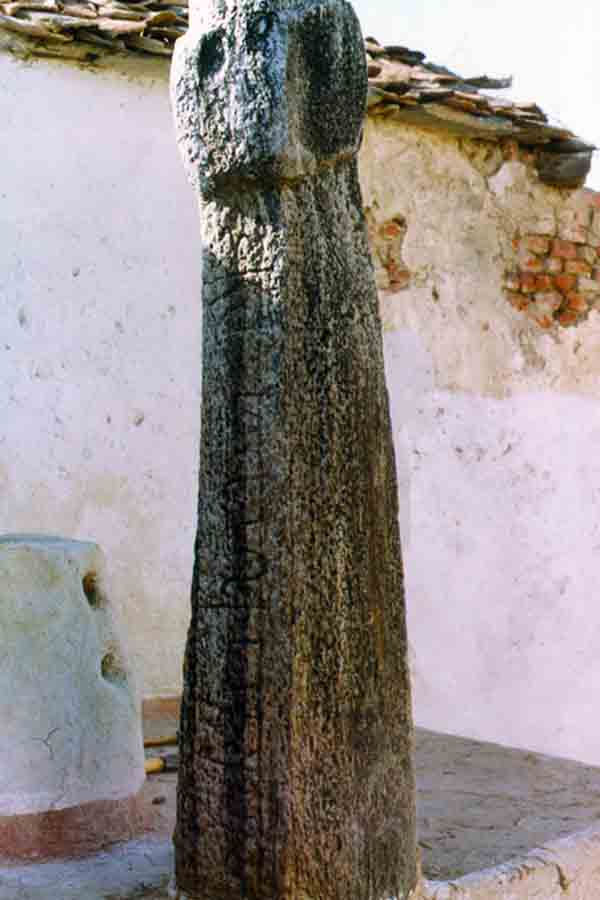
The princely state of Rajputana has since the ancient times been an important seat of Vedic philosophy, learning and spirituality. Archaeological excavations conducted across Rajasthan have revealed the existence of thriving Vedic practices, Vedis (sacrificial altars) and yūpas (sacrificial pillars).
It is evident that successive dynasties that ruled this rich province were totally dedicated to Advaitha and the quintessence of the Vedas. The discovery of yūpas in particular were an eye – opener as they are dated to the 2nd to 4th century CE when there was a significant inclination to Hinduism and Vedic sacrifices, rites and rituals.
These yūpas were raised specifically for the performance of yagnas and homas as per the tenets of the Vedas. One such yūpa belonging to the period of the Malavas of Rajathan was a chance discovery in the courtyard of an old temple at Bichipura at Nagar or Malavanagar, the former capital of the Malavas of Rajasthan.
This yūpa is 10 feet 6 inches in height with an inscription in Brahmi script and Sanskrit language, “सं ३२१ फगुन शुक्लपक्षस्य पञ्चदश अहिशर्म अ (ग्नि) होतुस्य धरकपुत्रस्य यूप (श्चपुण्य) मेधतु”. The inscription does not mention the sacrifice that was performed here by an agnihotri named Dharaka.
Written by Lakshmi Subramanian
Gadgach Temple, Kherliganj, Atru, Baran District, Rajasthan
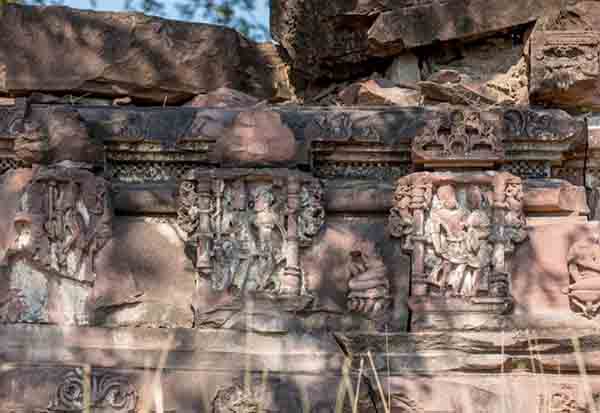
The lesser – known Atru, known as Atalpuri in the ancient times is a treasure trove of temples of unmatched beauty, structural ingenuity and artistic and architectural excellence. Though the temples were looted and razed to the ground by the Muslim barbarians, one has to only see the broken carved panels, sculptures, plinths and niches strewn about to appreciate the grandeur, charm and elegance of the temples that once stood here.
The mound on which the ruins is situated is actually the remains of an edifice built in two phases. The first temple dedicated to Bhagawan Vishnu lying on Adi Sesha was built in the early part of the 10th century of which only the plinth remains. The second temple also dedicated to Bhagawan Vishnu was built over this in the late 10th century.
Only parts of the entrance porch railing, three ornamental pillars of the mandapa and left side of the entrance doorway of the main shrine remain. The carved ceilings, miniature niches inset with sculptures and intricately carved architectural members are seen on the site.
Archaeological excavations uncovered the raised platform of dressed stones and mouldings on the north face of the plinth of the first structure. The south face for some reason has completely disappeared.
Sculptures on the exposed plinth of the first temple are of the Ashtadikpalakas and Mithunas. However, only four Mithunas remain in the north while those on the south and west face have either been stolen or destroyed.
It would appear that the arrangement of these figures was identical on all the faces based on the decorative tiers on the plinth. The richly embellished plinth has niches framed by columns inset with figures and a crowning medallion, birds, elephants, apsaras and gods and goddesses.
This east – facing temple had an entrance porch, a mandapa, an antarala and a garbha griha. An inscription found on the pillar states that this lofty temple built on a high platform had profusely decorated external facades.
Written by Lakshmi Subramanian
Charkhambha, Bilasgarh, Kishanganj Tehsil, Baran District, Rajasthan
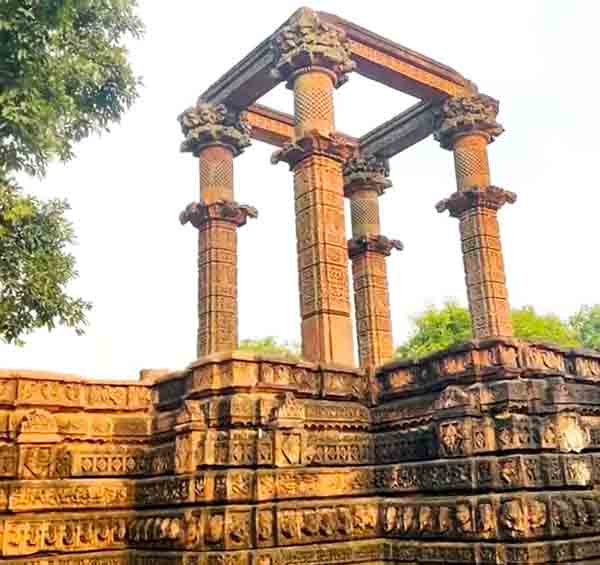
Bilasgarh, a treasure trove of ancient ruins and artefacts was once dotted with temples (dating back to the Vedic Period), forts, dharmashalas, Gurukulas and bhojanashalas. Archaeological excavations around this area uncovered caves with prehistoric drawings and petroglyphs.
According to historical documents, this city located on the banks of a tributary of the Parbati River was once a part of the princely region of Hadoti which was ruled by the Paramaras, the Gaud Brahmins and the Khichi Chauhan dynasty.
Bilasgarh was formerly known as Krishnavillas or Vilasnagara or Vilasa owing to the countless number of temples dedicated to Bhagawan Vishnu. One historical document refers to it as Karkotanagara or Nagara, the capital city of the Malavas of Rajasthan.
The discovery of punch – marked coins as well as Malava coins which bear the famous line ‘Malavanam jayah‘ and ‘Malava Ganasya jayah‘ dated to between 3rd century BCE (250 BCE) and 2nd century CE have supported this theory that this town of great antiquity was indeed a seat of learning, Vedic philosophy, art and architecture.
The prosperity of this town up till the 10th century has been well – documented in many literary works. Court records of the Muslim barbarians from the late 10th century onwards reveal repeated attacks on this flourishing town. Aurangzeb, on hearing about its opulence through his governor did not spare the grand temples and people of this city.
Broken carved panels and sculptures, ornamental plinths, damaged yonis that once seated Shiva Lingas and defaced and mutilated images of gods and goddesses and inscriptions stand as a testimony to his barbarism.
The now completely ruined Vishnu Temple is one such edifice belonging to the late 9th – early 12th century found in the midst of the ruins. The original temple built in red sandstone stood on a raised platform that has richly embellished tiers of elephants, nagas, figures, dancers, geometric and floral patterns, repetitive elements, miniature niches inset with gods and goddesses, auspicious Hindu iconography and intricately carved sculptures of the various forms of Bhagawan Vishnu.
It would appear on plan that the temple had an entrance porch, a pillared mandapa, an antarala and a rectangular garbha griha which most likely seated an idol of Bhagawan Vishnu on a pedestal. This pillared mandapa has a square space in the middle with four profusely decorated pillars known as the Charkhambha (four pillars). The roofless Chaukhamba has elaborately carved beams and pillars.
Some of the notable sculptures are of Yoga Narayana, Anantasayana, Bhagawan Krishna playing the flute, Dasha Avatar and Vishnu Varaha. About 15,000 broken sculptures were found in the debris.
Written by Lakshmi Subramanian
Neelkanth Temple, Dabkan, Sariska Tiger Reserve, Rajgarh Tehsil, Alwar District, Rajasthan
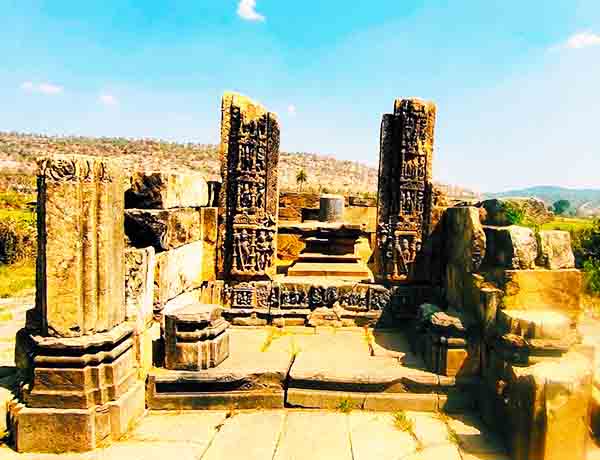
Coined the ‘Khajuraho of Sariska‘ and ‘Khajuraho of Aravalli’, the Neelkanth Mahadev Temple situated atop a hillock in the midst of stunning natural beauty is a prized architectural gem of the ancient times. This temple located deep inside the protected Sariska Tiger Reserve is believed to have been established by the Pancha Pandavas.
According to the Hindu scriptures, the Pandavas desired to consecrate a Shiva Linga on the banks of the Banganga River at Bairath (Viratnagar) and prayed to Bhagawan Shiva in Kashi to seek His help. Bhagawan Shiva agreed to accompany the Pancha Pandavas on the condition that they will have to consecrate the Shiva Linga when it became day break.
Though the Pancha Pandavas had intended to take Bhagawan Shiva to Bairath that is 30 kms away from Sariska, they abided by their promise and installed the Shiva Linga at this spot at sunrise. This place used to be called Para Nagar in the Mahabharat period
They lit the akhanda jyoti (eternal light) in the sanctum sanctorum to consecrate Bhagawan Shiva. It is interesting to note that the akhanda jyoti burns even today. They also built a stepwell overnight to perform the jala abhishek. The water has not dried up till date.
There are many references to this temple and the priceless Neelam stone (blue sapphire) Shiva Linga of this temple in the Mahabharat. The three shrines dedicated to Bhagawan Shiva, Bhagawan Brahma and Bhagawan Vishnu are deemed to be the oldest in the temple complex that took its present form between the mid – 7th century and 10th century.
Maharadhiraja Parmeshwara Matthandeva of the Gurjara – Pratiharas is credited with the construction of the temple complex as per an inscription dated 961 CE. Another inscription mentions Raja Ajayapal of Rajorgarh of having contributed carvings and sculptures to this Shiva Temple in 1010 CE.
Historical records state that this grand temple complex was desecrated and looted by the Muslim barbarian Aurangzeb who razed several temples (believed to be about 200 in number) to the ground. The main shrine of Bhagawan Neelkanth managed to survive his savagery because a bike of bees suddenly attacked Aurangzeb and his men.
This lone temple surrounded by ruins is a trikuta (triple – shrined) with an entrance porch, a common ranga mandapa supported by four pillars and pancharatha design garbha grihas. The west – facing shrine of Bhagawan Shiva has a magnificent shikhara while the shikharas of the other two shrines have since collapsed.
The entrance doorways (door jambs and lintel) of the shrines dedicated to Bhagawan Brahma and Bhagawan Vishnu are profusely decorated with sages and various forms of Bhagawan Vishnu respectively.
The rangamandapa has richly embellished ceiling panels of concentric coffered cusps, lotus, floral and geometric patterns. The pillars from the base to the capital are adorned with carvings of apsaras, gandharvas, Sapta Matrikas, musicians, dancers, gods and goddesses.
The entrance doorway of the main shrine is decorated with beautiful carvings and has Bhagawan Nataraja seated on the Lalata Bimba. The external facades have niches housing sculptures of Bhagawan Narasimha, Tripurantaka, Hariharaarka and Risabharuda along with figures of apsaras, gandharvas, sages, Ashtadikpalakas and others.
There are countless bases of temples, broken pillars, sculptures, carved panels, inscriptions and figures in erotic poses on stones strewn about. The captivating imagery of sex kriyas as they are known was a common feature in that era as temples were considered to be the appropriate medium to impart sexual knowledge. The exquisitely comprehensive Rati krida is an unparalleled wealth of wisdom.
Written by Lakshmi Subramanian
Gadarmal Devi Temple, Badoh Village, Kurwai Tehsil, Vidisha District, Madhya Pradesh

Badoh and the neighbouring village of Pathari formed a part of the ancient town of Badnagar (Vatanagara), a prosperous trading hub in the days of the Gurjara – Pratiharas. As per inscriptions found, this region was dotted with temples belonging to the olden days though countless of them have either disappeared entirely or are buried deep in the ground or are in a state beyond recognition owing to multiple attacks by Muslim barbarians starting from the late 10th century.
Gadarmal Devi Temple is one such edifice belonging to the ancient times that was repeatedly desecrated, renovated and finally, ended up as a combination of a Hindu and Jain Temple. This imposing structure stands tall in the midst of ruins and can be appreciated from a distance.
The original temple was built by the Gurjara – Pratiharas in the 9th century as seen in the mouldings and plinth while the shikhara is a replacement for the original that has since collapsed and is made up of stones, panels and carvings from the ruins of nearby Hindu and Jain temples. There is also architectural evidence of some part of the temple being built by the Paramaras.
The temple complex has been designed as an Ashtayatana (eight shrines) with seven smaller shrines placed around the main temple on a high platform. All these temples are now in ruins but the decorative mouldings and niches inset with sculptures of gods and goddesses on the platform are well – preserved.
An ornamental torana (gateway) in the north, once a symbol of power, grandeur and artistic excellence, now in a state of disrepair leads to a flight of steps that takes one to the raised platform that sits in the middle of a large space.
Interestingly, the main temple has a pillared entrance porch, an antarala, a mukha mandapa and an oblong – shaped garbha griha. There are two lions on either side of the main entrance. The mukha mandapa is supported by eight pillars that are profusely decorated from the base to the capital.
The entrance doorway (door jambs and lintel) is richly embellished with miniature niches inset with figures, carvings of gods and goddesses, floral and foliage patterns and repetitive motifs. An exquisite sculpture of Devi has been seated on the Lalata Bimba along with Her different forms.
The sanctum sanctorum has remnants of a series of pedestals running along its back and side walls that indicate that a row of idols were once placed here. Historians and archaeologists opine that this temple once housed 42 Yoginis (maybe even 64) whose sculptures were found in the debris.
A beautiful sculpture of Divine Mother with a baby was found lying in the rubble inside the shrine. The main idol of Devi has been lost.
The external facades are a visual treat of delicately carved panels, figures, niches inset with sculptures of gods and goddesses and the Ashtadikpalakas, auspicious Hindu iconography, elephants, horsemen, musicians, dancers, mother and child, sages and repetitive geometric patterns.
Locals believe that this temple was built by a shepherd (gadaria) and hence, came to be called Gadarmal Devi.
Written by Lakshmi Subramanian
Udayeshwara Mahadeva Temple (Nilkantheswara Mahadeva Temple), Udaipur, Vidisha District, Madhya Pradesh
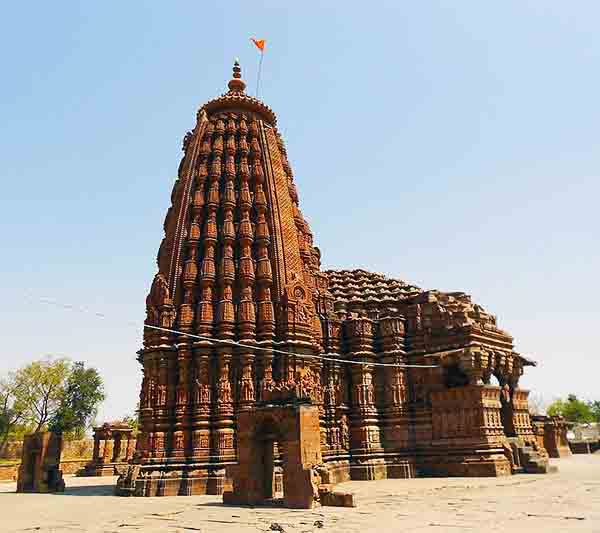
One of the finest examples of Bhumija style of architecture is the ancient Udayeshwara Mahadeva Temple in Udaipur. This city as per Sanskrit inscriptions was founded by the Paramara king Maharaja Udayaditya of Malwa, brother of Maharajadhiraja Bhoja who also designed a kund known as Udayasamudra.
According to the many Sanskrit inscriptions found in the Udayeshwara Temple, the construction of this grand edifice commenced in 1059 CE and was completed in 1080 CE.
The temple built in red sandstone (pink coloured sandstone) stands majestically in a square courtyard that has rectangular projections in the centre of each side. The low enclosure wall is adorned with carvings on the outer face while stone seats with balustrades run along the inner face.
Though the main entrance to the temple is on the east, there are entrances marked on each side with a flight of steps and dwarapalakas on either side that have now been closed. The temple originally had eight smaller shrines placed in accordance with the tenets of the Shilpa Shastra.
However, two shrines have completely disappeared while the other six are in a state of disrepair with their shikharas on the verge of collapse or severely damaged. The traditional Vedi, a square room meant for the performance of yagnas (sacrificial fire) is seen in front of the main temple. Its roof has since fallen off.
A similar square shrine is seen at the rear of the temple that was demolished by the Muslim barbarian Muhammad bin Tughluq. A mosque was built on its debris between 1336 to 1338 CE.
The main temple has three entrance porches (pravesa mandapa), a sabha mandapa and a garbha griha in which Bhagawan Shiva in the form of a Shiva Linga is consecrated on a high pedestal. The Shiva Linga has now been covered with a brass sheet that is removed on the auspicious occasion of Maha Shivaratri. According to the locals, the first rays of the sun fall on Bhagawan Shiva on the two equinoxes.
This brass covering with Bhagawan Shiva’s face in relief was offered by Khande Rao Appaji, a general of the Maratha war veteran Mahadji Scindia. The entrance doorway is richly embellished with artistic details often seen in temples of the olden times.
The original figure of Bhagawan Nandi was destroyed by Muhammad bin Tughluq and replaced sometime in the late 18th century. The pillars and seats in the entrance porches on the three sides of the sabha mandapa have Sanskrit inscriptions and historical records.
The exterior facades are a visual spectacle with exquisite sculptures of gods and goddesses, Bhagawan Brahma, Bhagawan Vishnu, Bhagawan Ganesha, Bhagawan Kartikeya, Ashtadikpalakas in their respective positions and various forms of Bhagawan Shiva and Durga Devi. The facial expression, body posture, garments and jewellery of the sculptures has been executed with great precision and delicacy.
There are pyramidal roofs over the entrance porches and the hall while there is a magnificent shikhara over the sanctum sanctorum. The shikhara is truly an artistic and architectural marvel with intricately carved miniature niches in repetition, medallions inset with gods and goddesses, geometric patterns in harmony and auspicious Hindu iconography.
There is a lone human figure sitting near the pinnacle of the shikhara that is widely interpreted to be the architect of the temple who turned to stone overnight.
Historians, architects and artists have often remarked that this temple is an architectural gem of unparalleled beauty, elegance and grandeur.
Written by Lakshmi Subramanian
Sringar Chauri, Baroli Group of Temples, Baroli Village, Rawatbhata, Chittorgarh District, Rajasthan
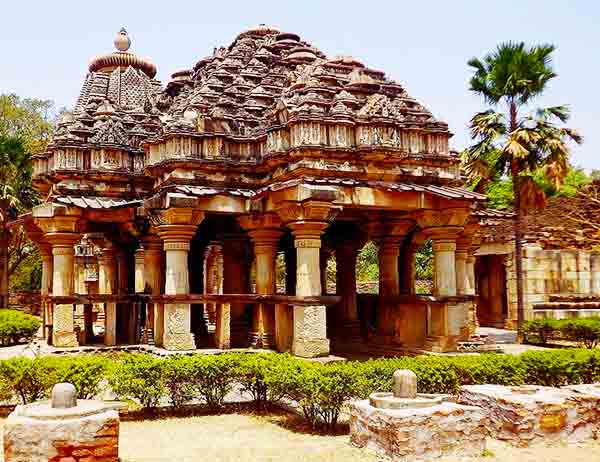
Sringar Chauri, an elegant ranga mandapa is the last structure built in the Badoli group of Temples. Deemed to be the finest of its time, this late 10th century edifice is largely accepted to be an extension to the famous Ghateshwara Temple.
This pillared hall on plan has a square space in the middle with four profusely decorated pillars (one on each corner). The pillars on the offsets are twenty in number and are comparatively simpler in design.
The hall has openings on the east and west with embellished kakshasana (seats) to view the performance. The pillars in the centre square are adorned with exquisite sculptures and carvings of Ganga, Yamuna, forms of Lord Shiva, Lord Brahma and Lord Vishnu and auspicious Hindu iconography.
Written by Lakshmi Subramanian
Ghateshwar Mahadev Temple, Baroli Group of Temples, Baroli Village, Rawatbhata, Chittorgarh District, Rajasthan
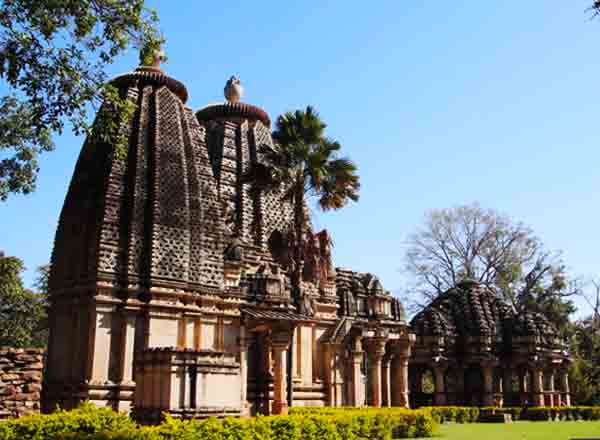
The Baroli group of Temples, one of the earliest temple complexes in Rajasthan has received much admiration from historians, artisans, architects and archaeologists for its sublime beauty and elegance. Since its discovery during the British Raj, this temple complex has been researched in detail, photographed and written about in many publications.
The oldest, largest and most magnificent temple in this complex is the Ghateshwar Mahadev Temple listed as Temple No. 7 by the Archaeological Survey of India (ASI). Built in the early part of the 10th century by the Gurjara – Pratiharas in the typical Nagara style of architecture, this temple has Bhagawan Shiva depicted in the form of five Shiva Lingas with one of the them in the shape of an inverted ghata (pot). It is this rare form of Bhagawan Shiva that draws countless devotees to this ancient temple.
This east – facing temple on plan has a mukha mandapa, an antarala and a garbha griha designed as a pancharatha. There is an ornamental makara torana at the entrance of the mukha mandapa that exudes charm and delicacy.
The mukha mandapa of six pillars and two pilasters is a visual spectacle with exquisitely carved pillars from the base to the capital and intersecting ceiling panels of lotus, coffered cusps, makara (crocodile), apsaras, gods and goddesses, sages, dancers and musicians. Bhagawan Nandi is seated in the middle of the mukha mandapa and the garbha griha.
The richly embellished lotus ceiling in the sanctum sanctorum is nothing short of exceptional and is truly an excellent example of the artistic and architectural mastery of the Gurjara – Pratiharas. Bhagawan Nataraja is seen on the Lalata Bimba flanked by Bhagawan Brahma and Bhagawan Vishnu. Ganga, Yamuna and other figures are seen on the entrance doorway.
The external facades and shikhara are profusely decorated with geometric patterns, auspicious Hindu iconography, floral and foliage motifs, extended brackets and niches of Bhagawan Shiva as Chamunda, Nataraja, Gajasamharamurthy and Andhakantaka.
The famous Sringar Chauri, a later addition stands in front of this temple. The temples dedicated to Bhagawan Ganesha and Ashtamata are close to this temple.
Written by Lakshmi Subramanian
Sheshashayan Temple, Baroli Group of Temples, Baroli Village, Rawatbhata, Chittorgarh District, Rajasthan
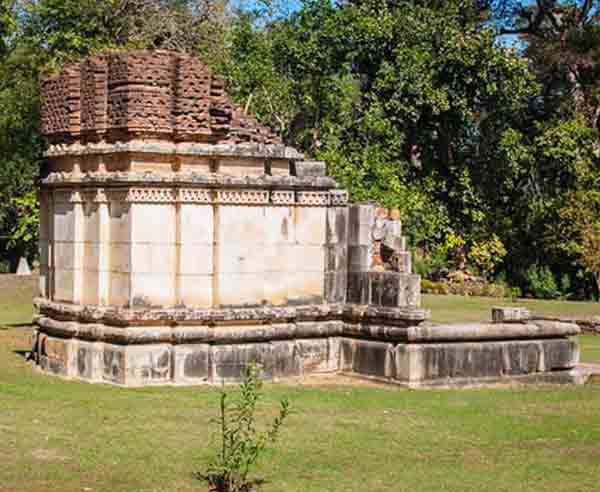
The Seshashayan Temple listed as Temple No. 2 in the Baroli group of Temples by the Archaeological Survey of India (ASI) is a 10th century edifice of the Gurjara – Pratiharas. This temple stands near the Shiv Temple built in the middle of the ancient kund.
The original temple in plan had an ardha mandapa, an antarala and a garbha griha. The sanctum sanctorum was designed as a triratha and had a heavy shikhara that archaeologists believe was in the form of a barrel vault or wagon vault. This type of roof design is very unusual for this period and raises questions on whether the shikhara was bejewelled as suggested by some historical references.
This would also support the evidence from court records and historical references that the Muslim invaders particularly Aurangzeb and the Christian invaders the British looted this temple and destroyed its roof and front entrance porch.
The entrance doorway is rather plain in decoration and was said to be made of conch shell. The external facades are bereft of embellishments.
The idol of Bhagawan Vishnu consecrated here has now been moved to a museum for safekeeping.
Written by Lakshmi Subramanian


.jpg)


No comments:
Post a Comment
Note: Only a member of this blog may post a comment.