Thursday, November 12, 2026

Team G Square Karnataka blog 12


 MP Diaries: Ashapuri, A ruined Capital City

Ashapuri is one of the best kept secrets of Madhya Pradesh. Being very close to the capital city of Bhopal and located between two of the most prominent tourist places of Bhimbetka and Bhojpur, this place is hardly visited by tourists. We too were unaware of this place until a board at Midway Retreat in Bhimbetka displayed it. A quick research about the same on google helped us gather more information. We were more than happy to visit this place as it was located on the way to our next destination of Bhojpur. The sign board put up by Madhya Pradesh Tourism made it easier for us to reach this place, which is located about 22 km from Bhimbetka towards Bhojpur.
Ruins of Ashapuri with lake in the background 
Pink Lotus 
Ashapuri was the temple laboratory of the Pratihara and Paramara clans during 9th century AD. The numerous temples that are now in ruins bear a testimony to this. As we entered the Bhootnath temple complex, the care taker walked down the steps towards us with the visitors book in hand. After gathering details from us, he doubled up as our guide. As we maneuvered through the ruins, we stumbled upon the main temple complex of Bhootnath, built on the banks of a lake. The complex houses 26 uniquely styled temples of varying proportions. The locals are bound to the belief that this place was razed to dust by Mughals and hence is in ruins. The site is well maintained by the ASI and temples are systematically numbered from 1 to 26. Temple number 5 is the main temple of this complex and is dedicated to Bhootnath (Lord Shiva). The remains of this temple speaks volumes about the art and architecture of Pratiharas, who contributed majorly towards the temple construction. A large number of idols and other segments of the temples, most of which are partially damaged are kept spread wide across the temple complex, while many others are displayed at the museum nearby.
Remains of  BhootnathTemple 
Andhakasura form of Shiva 
Sapthamatrikas 
Ruins all the Way
Our guide also mentioned about the presence of another temple dedicated to Goddess Durga at a fair distance (about 400 meters) from the Bhootnath complex. This temple too lies in a  ruined state with fragments of idols spread across the temple. Just outside the Bhootnath temple complex is a temple dedicated to Lord Hanuman. Hereon, we drove towards the museum during lunch time and realised it was closed. We inquired about directions to another temple dedicated to Lord Shiva, the Billota temple at the entrance of the village. Unfortunately, this temple too was closed. A big Shiva linga is seen outside the temple with many small lingas carved on it, called as the Sahasralinga. A beautifully carved but broken pillar base is also seen in this complex, with a carving that exhibits the various avatars of Lord Vishnu. Thus ended our exploration. It is good to know that a joint effort has been initiated by Madhya Pradesh Government in collaboration with the World Monuments Fund towards restoring Ashapuri back to its glory.
Goddess Durga Temple
Lord Brahma 
Shiva Temple, Billota 
Sahasralinga 
Parshuram (6th Avatar of  Lord Vishnu)
Vamana (5th Avatar of  Lord Vishnu)
Distance from the nearby town: 36 km from Bhopal. 
Accommodation: There are no accommodation options here. The best would be to plan for an overnight stay at Bhopal. 
Where to eat: The nearest eateries are about 6 km from here, at Bhojpur. 
References:

Related Posts:

15 comments:

  1. Thank you for sharing. This is a wonderful find.

    Reply
  2. interesting discovery!

    Reply
  3. Beautiful images of India, love this.

  • BuyMaps

    Reply
  • I already like the way MP promotes its tourism and the way they preserved these ruins is appreciable. Great coverage on the site and nice photos... I just wonder how they got mind to destroy these artistic marvels. Good leaning about this place from you

    Reply
  • Madhya Pradesh does seem to take a keen interest in their history.

    Lovely images and narration.

    Reply
  • Discover more
    Blog
    Start Blogging
    Plan Routes
    Book Local Tours
    Read Travel Guides
    Support Veterans
    Explore History
    Browse Art Prints
    Visit Dig Sites
    Rent Camp Gear
  • Wonderful discovery as it were we missed it totally in the darkness

    Reply
  • Thank you for sharing about Ashapuri, exploring such hidden gems and sharing about it inspires others to visit this place. Hope this place gets resorted back to its glory soon and we get a glimpse of its glory in the past..

    Reply
  • Very interesting place. I am glad you brought this to our notice.

    Reply
  • Hame esha lagta he ki ye jammu &kashmir ka pakistan or hindustan
    He jiski koi border nahi he inhe dekhne ke baad hume esha lagta he jese ki poora world ishme samahit he

    Reply
  • yha se hame dharti ka swarg he
    Jo koi nahi Jaan sakta he

    Reply
  • Bhakto me mata aashapori hu me chetavni deti hu ki Mere mandir ke paas koi nirmad ya mere mandir par koi dusra mandir nya mandir nahi banega jo 1000 saal pehlye the veshs hi rahega nahi to tumhara sab log ka bura hoga or tum sab log mere honye dushman rahoge

    Reply
  • Bhkto mata je khe rahi he ki koi bhi naya kaam nahi karega jish jagha par jeshi chiz rakhi he vo veshi hi rakhi rahegi koi kuch mandir nahi banega ya tum mujhe bhart or pakistan ki border samajh lo
    Jonye dushman

  •  MP Diaries: Bhimbetka, A gateway to Ancient Civilisation

    Long ago, during one of our visits to Hampi, we were fortunate to visit the pre-historic site of Anegundi (Koppal district), Karnataka. Ever since then, our interest with regards to pre-historic cave paintings only grew and any search relevant to pre-historic cave paintings in India would lead us first to the site of Bhimbetka in Madhya Pradesh. Though visiting Bhimbetka did not happen too soon, we have had a chance to visit many such interesting sites in Karnataka. Bhimbetka is India's most renowned pre-historic site  and unlike other sites across India, this place has been very well documented and studied even today. Bhimbetka is the largest pre-historic site in India and the only such to have been inscribed on the list of UNESCO world heritage sites. This place was under continuous human occupation from lower Paleolithic period till the early 19th century AD.
    Walk-way
    On the 29th of December 2016, we drove down from Mandu to Bhopal, via Indore and Dewas. A good six hour drive brought to us Bhopal. It was around 2 am and our hunt for accommodation at this hour brought us to Hotel Midland. After a hard bargain, we negotiated a good deal and settled down for the night. We woke up considerably late the next morning after getting the much needed rest. We were ready to hit the road again after a quick Poha and Sev for breakfast. In an hour we reached Midway Retreat, located 3 km away from Bhimbetka. A cup of hot tea was only thing in between us and the cave paintings. The book of Bhimbetka-World Heritage Series quotes, "Bhimbetka's uniqueness lies not only in the concentration of its antiquity and art, and the wealth that it conceals, but that it has not remained frozen in time and space. Elements of this continuity are manifest in the creative expressions that show affinity to great antiquity in the traditional lifestyles of the adivasis of the area integral to Bhimbetka and the surrounding region". There are over 1400 rock shelters here, of which about 700 carry cave paintings, while only 15 among them are open to the public. The rest are located inside the Ratapani Wildlife Sanctuary. The 15 rock shelters are prefect representatives of Bhimbetka.
    Welcome to Bhimbetka
    Rock Shelter No.1 - This shelter has a few paintings mostly of historic period. Here we can see the paintings of two elephants and a bull, wounded by the arrow of a hunter.
    Paintings in Rock Shelter No.1
    Rock Shelter No.3 - This cave is also called as the 'auditorium cave' due to this long shape. This shelter has paintings of bull, buffaloes, deer, peacock, left hand print of a child and many such. There are many cupules (depressions) on stone, probably associated with Paleolithic period.
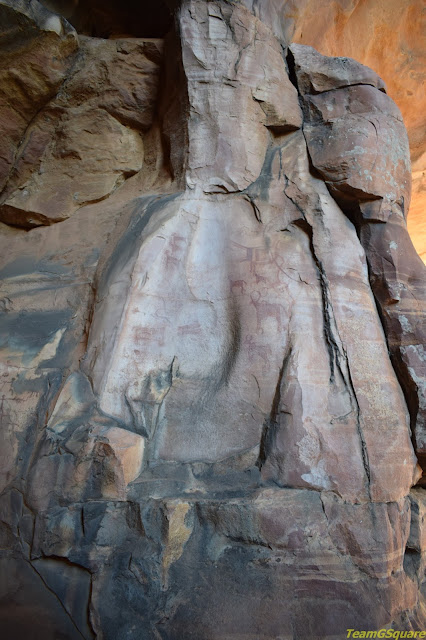
    Pre historic paintings Bhimbetka
    Paintings in Auditorium Cave
    Left Hand Print of a Child
    Cupules
    Rock Shelter No.4 - This shelter is known as the 'zoo rock' and is the most important rock shelter here. There are 453 figures here, comprising of 252 animals of 16 species. The paintings here belong to the Mesolithic, Chalcolithic and historic periods. There are as many as ten layers of super-imposed paintings which is a unique and the most important feature of this cave.
    Cave Paintings Bhimbetka
    Zoo Rock 
    Rock Shelter No.6 - This shelter contains beautifully depicted, natural looking animal drawings, group of dancers, drummers and horse riders in white color. An interesting drawing is that of a group of dancers in a line, shown with interlocking hands.
    Row of Dancers 
    Rock Shelter No.7 - This shelter contains paintings of horse riders and a row of deers in stylized form, belonging to historic period.
    Men Riding Horse and Carrying Weapons
    Rock Shelter No.8 - This is one of the important shelters here and the only one comprising  drawings of scorpions, fowls and other insects. This is a two storeyed cave with paintings all across its ceilings. There is a scene depicting seven cavaliers accompanied by three foot soldiers, a horse, an old woman, a panther, a jungle fowl, two chicks and insects. Other paintings here exhibit various scenes of hunting, dancing,  and other daily rituals.
    Cavaliers 
    Paintings of Rock Shelter No.8
    Rock Shelter No.9 - The only shelter here having paintings depicted in green and yellow colors. Most of the paintings here belong historic period. There are paintings of a horse, an elephant and a flower pot.
    Horse Painting
     Flower Pot Painted in Yellow
     Rock Shelter Nos.2,5,10 - These shelters carry only one painting each.
    Painting in Rock Shelter No.2
    Rock Shelter No.11 - The paintings of this shelter depict scenes from war, most of them showing men on horses carrying swords or spades.
    War Scenes
    Rock Shelter No.12 - This is another interesting shelter with an attractive composition of 38 animals drawn, along with various other paintings.
    Paintings of Rock Shelter no.12 
    Rock Shelter No.13 - There are a few paintings here depicting humans engrossed in there daily activities.
    Humans Engrossed in Their Daily Activities
    Rock Shelter No.14 - There are few paintings of animals, the most beautiful of them is that of a horse painted in white and decorated with a honeycombed pattern.
    Horse Decorated With Honeycombed Pattern
    Rock Shelter No.15 - This shelter is also called as the 'boar rock' due to the presence of a huge painting of a mythical boar like animal chasing a human. Apart from this, many other animals and humans are depicted in the shelter here.
    Mythical Boar Like Animal Chasing a Human
    Entrance Fee: Rs.50/- per head for Indian Citizens and Rs.200/- per head for others. Rs.250/- for car entry including parking.
    Distance from nearby major town: 45 km from Bhopal.

    Accommodation: The only option for accommodation at Bhimbetka is Midway Retreat maintained by MPSTDC. A better idea would be to plan for an overnight stay at Bhopal.
    Where to eat: Midway Retreat is the only closest option here for food and drinks. There are a few eateries after we reach the highway which is about 4 km from Bhimbetka rock shelter. Carry enough water as there are no facilities for the same once you enter the rock shelter.
    References:
    1. Bhimbetka - World Heritage Series by ASI.

    Related Posts:
    1. Usgalimal - Rock engraving in Goa

    10 comments:

    1. Amazing...A must go place for art lover like me. It is interesting just to observe how art has evolved.

  • BrowseArt Prints

    Reply
  • Very interesting post.. loved reading it

    Reply
  • There are so many paintings there. Seems like people who drew them just painted them as they saw things in real time!

    Reply
  • Their paintwork is excellent, I love that.

    Reply
  • The paintings here are delight to the eyes.

    Reply
  • Such a helpful post. Nicely covered.

    Reply
  • How many kilometers it is from Bhopal ? Very good place to visit

    Reply
    Replies
    1. Hello Yogi..Bhimbetka is 45 km from Bhopal.

  •  MP Diaries - The Baobab, Mandu Ki Imli

    Mandu, apart from being well known for its rich heritage is also significant for the presence of a good number of Baobab (Adansonia Digitata) trees. Unlike other locations in India where the trees are present either singly or up to a maximum of three in number, Baobab trees can be sighted across the length and breadth of Mandu. Being native to Africa, they are considered as one of the very ancient and longest living trees. These trees also find a mention in the Hindu epic of Mahabharata. An African folk-tale claims that their consorted shapes were caused by an angry deity plucking the tree from the ground and thrusting it back in again upside down. Hence, they are also called as upside-down trees with their branches resembling the roots after they shed their leaves. The Baobab trees have an incredible quality of storing water in their trunks in high capacities and hence are a lifeline to the locals of the tropical regions of Africa. The Africans consider the Baobab as sacred and refer to it as the ‘Tree of Life’. This tree possesses amazing medicinal properties and is of great nutritive value. Apart from providing shelter, water and food to many, every part of its tree proves useful in many ways. It is truly the tree of life. The Baobab is locally known as ‘Imli’ (tamarind), or ‘Bada Imli (Big tamarind) in Mandu and is popularly referred to as ‘Mandu ki Imli’. 
    Baobab Trees, Mandu
    Baobab Tree Welcoming us to Mandu
    Baobab Tree
    Bare Baobab Tree with only Fruits
    Baobab Tree Inside Baz-Bahadur's Palace Complex
    Mandu Ki Imli
    Upside-Down Tree
    Malik Mughith Mosque and the Baobab 
    Baobab Reflection in Somvati Kund
    Oldest Baobab Trees
    Probably the Largest and the Oldest Baobab Tree we saw 
    Mandu Ki Imli
    Baobab Fruit on Sale
    Value Added Products from Baobab Fruits

    References:
    1.AFRICA Natural Spirit of the African Continent- By Gill Davies

    Related Posts: 

    13 comments:

    1. So interesting. They have a fake tree inspired by this at Disneyworld Orlando if I remember correctly.

      Reply
      Replies
      1. Yes you are right Christine..they do.

    2. Interesting facts about Baobab! Its like kalpavriksh where every part of the tree is used..:)

      Reply
    3. This is interesting. Glad to know about the Imli.

      Reply
    4. Interesting information on Imli trees

      Reply
    5. Baobab trees are amazing. Specially the ones found in Madagascar. I found the ones in India, much different to those in Africa.

  • BuyMaps

    Reply
    Replies
    1. Yes ajeya..we think it depends on the climatic and environmental conditions..

  • These Baobabs are part of our heritage and need to be protected. We are fighting in saving an OLD Baobab in Hyderabad Nanakramguda....

    Reply
    Replies
    1. Good work...hoping your sincere efforts will really save that baobab tree. Sadly, every city today is facing the crisis of deforestation due to urbanization..

  •  MP Diaries - Mandu, Symbol of Immortal Love

    Mandu is the largest fortified area in India, second only to the great city of Hampi. This romantic city which is also well known for its history is situated about 37 km from Maheshwar. Mandu has also been known by various names previously such as Mandapa-Durga and Mandavagarh. The original fort was built by Paramara kings in 6th century AD. This region attained unparalleled glory, especially under Kings Munja and Raja Bhoj who ruled from both Ujjain and Dhar. Mandu was founded as a fortress and retreat  by Raja Bhoj and later King Jayavaram transferred the seat of the Paramara from Dhar to Mandu, finally falling into the hands of Khilji of Delhi Sultanate.  Mandu came on its own later under Hoshang Shah who shifted his capital from Dhar to Mandu and renamed Mandu as Shadiabad - City of Joy. Even amidst his arduous wars with the neighboring powers, Hoshang Shah raised the architectural splendor of the kingdom to its greatest heights. A period of expansion and prosperity was witnessed under the later rulers, Mahmud Shah and Ghiyasuddin, until the end of 14th century AD.  In the next century, Mandu collided with various kingdoms of Gujarat and Rajasthan. A series of deadly warfare followed there after and one such change led to Baz-Bahadur assuming power. Baz-Bahadur almost gave up fighting after being overpowered by Rani Durgavati during one of the wars. He devoted himself to music in which the famous and beautiful Rani Rupmati proved to be his most loving associate and consort. The selfless and devoted love between them even today is a favorite theme in the folk songs of Malwa. Rani Rupmati is said to have committed suicide rather than succumb to the powerful army of Akbar. In late 17th century this fort came under the control of Marathas under Malhar Rao Holkar and from then on remained under the Marathas.
    Mandu Ravines
    Rupmati’s Pavilion: Rupmati’s/Roopmati’s pavilion is situated atop the hill to the south of Baz-Bahadur’s palace overlooking the Nimar valley. It is believed that Rani Rupmati, Baz-Bahadur’s beloved enjoyed the view of the much revered river Narmada from this pavilion. The arched pavilion is a Baradari, a building with 12 doors with 3 doorways on every side and is crowned by a fluted dome.
    Rupmati's Pavilion, Mandu
    Rupmati's Pavilion 
    Baz-Bahadur’s Palace: To the east of Rewa Kund is the Baz-Bahadur’s Palace, built on the hill slope. A Persian inscription on its entrance arch states that the palace was built by Nasiruddin in 1508 AD. The palace has a spacious courtyard with a beautiful water tank at its center fed by Rewa Kund. It is quite interesting to know that Rewa Kund situated close by, was frequently visited by Rani Rupmati, which justifies the king’s choice of this place as his palace.
    Baz Bahadur Palace, Mandu
    Baz-Bahadur's Palace 
    Rewa-Kund: This is a reservoir built by Baz-Bahadur whose origin is associated with the love story of Baz-Bahadur and Rupmati.
    Rewa Kund, Mandu
    Rewa-Kund 
    Jali Mahal: Jali Mahal is a tomb built on a square plan with three arched openings on each side. Except for the entrance, the arches on the other three sides are filled with latticed screens carrying various geometric/ornamental patterns giving this tomb the name Jali Mahal.
    Jali Mahal, Mandu
    Jali Mahal
    Malik Mugith's/ Malik Mughith's Mosque: This mosque was built by Malik Mugith, father of Mahmud Khilji in 1432 AD. The projecting front porch of the mosque built on a high plinth is now mostly in ruins. The exterior walls are in the form of an arcade at the lower level while colonnades are seen in the corridors inside. It is clearly evident from the pillars of the corridor that the mosque was built by utilizing materials from destroyed Hindu temples/buildings, which is considered as the first phase of Muslim architecture in Malwa. The mosque houses three domes above its main portion with turrets at the corners. During our visit, restoration work was in progress to save the remnants of the structure.
    Mosque of Malik Mughith, Mandu
    Mosque of Malik Mughith
    Caravan Sarai: Built in 1437 AD, Caravan Sarai comprises of a huge court surrounded by rooms and halls that served as places of accommodation and storage. 
    Caravan Sarai, Mandu
    Caravan Sarai
    Dai-Ki-Chhoti-Behan-Ka-Mahal: This tomb associated with a lady is built on a highly raised double terraced platform in an octagonal plan with four entrance arches and is crowned by a dome. Remains of blue tiles with which the dome was originally decorated with, is clearly visible.
    Dai Ki chhoti behan ka mahal, Mandu
    Dai-Ki-Chhoti-Behan-Ka-Mahal
    Dai-Ka-Mahal: This is a tomb of a lady and stands on a high platform having rooms with arched openings. The tomb is square in plan. The lower portion of the dome is octagonal in shape and is decorated with miniature arches while small projecting structures are seen at the corners.
    Dai Ka Mahal, Mandu
    Dai-Ka-Mahal

    Lal-Bagh: A beautiful garden and pavilion, with traces of cisterns and cascades laid during the Mughal rule.

    Lal Bagh Mandu
    Lal-Bagh
    Hathi Mahal (Elephant Palace): The Hathi Mahal is a mausoleum with its name being attributed to the enormous pillars that resemble the legs of an elephant, supporting the dome above.
    Hathi Mahal, Mandu
    Hathi Mahal
    Darya Khan's Main Tomb: The most beautiful structure in Mandu is the tomb dedicated to Darya Khan. This tomb is built of red sand stone in a square plan. There is a Darya Khan Mosque, Sarai Kothari, Kharbush Tomb and Somvati Kund nearby the Main tomb.
    Darya Khan's Tomb, Mandu
    Darya Khan's Tomb
    Sarai Kothdi, Mandu
    Sarai Kothdi
    Jami Masjid (Friday Mosque): This is one of the largest structures in Mandu. The construction was started by Hoshang Shah and completed by Mahmud Khilji in 1454 AD. Simple in its style, this mosque has a huge prayer hall facing the courtyard. The Mihrab (a niche in the wall of a mosque towards which people face to pray) and Mimbar (a platform used by the preacher in a mosque) in the prayer hall are elaborately designed. A striking feature here is the chain of domes and arches in the enclosing walls of the courtyard.
    Jami Masjid, Mandu
    Jami Masjid 
    Hoshang Shah's Tomb: This mausoleum built with white marble is India's first marble edifice. The construction was started by Hoshang Shah and completed by Mahmud Khilji in 1440 AD. The tomb is a massive structure situated at the center of a large courtyard. The tomb is crowned by a huge dome with smaller sized domes at its corners. The noteworthy features in the interiors are the intricately designed lattice screen works and decorative moldings.
    Hoshang Shah Tomb, Mandu
    Tomb of Hoshang Shah
    Ashrafi Mahal (Madrassa) and Tower of Victory: Khilji built the Madrassa (school) facing the mosque (Jami Masjid), which is now deserted. It also has the Tower of Victory, originally a seven storeyed tower built in celebration of victory over an enemy which is now in ruins with only one storey having managed to survive.The tomb of Mahmud Khilji is also situated in this complex.
    Tower of Victory, Mandu
    Tower of Victory
    Khilji's Tomb, Mandu
    Khilji's Tomb
    Jahaz Mahal (Ship Palace): This magnificent palace standing between two man-made lakes of Munj and Kapur is beautifully designed. The palace resembles a ship floating on water and hence the name. The interconnected water-ways/channels from the lake to the water ponds of the Mahal and its garden is fascinating.
    Jahaz Mahal, Mandu
    Jahaz Mahal
    Kolhu (Crusher): Kolhu was a very popular traditional device used for crushing solid materials into smaller pieces, usually manually or animal driven. Different materials such as lime stone, jaggery, and other building materials were mixed together and crushed/ground to form a uniform powder which was then used for construction purpose.
    Kolhu
    Gadashah's Palace and Shop: These buildings probably were built for a person named Gadashah who played a significant role in the royal family. Both the buildings are sadly now in ruins.
    Gadashah's Shop
    Ancient Baoli: A beautiful well belonging to the Paramara period.
    Ancient Baoli
    Hindola Mahal (Swinging Palace): This mahal is 'T' shaped in plan and has sloping side walls by virtue of which it is also known as the Swinging Palace and served as an audience hall. The exteriors are mostly plain with two-storeyed arches placed between huge pillars that slope inward. The overhanging balconies are enclosed (jharokhas) and carry on them floral carvings and lattice designs.
    Hindola Mahal, Mandu
    Hindola Mahal
    Champa Baoli and Royal Palace: This is an underground well that served as a reservoir. Square in shape, it is surrounding by eight arches that giving it a circular appearance. This place was used by the royal ladies as a summer retreat. The Royal palace is very big building where the royal family resided.
    Champa Baodi, Mandu
    Champa Baoli
    Hammam (The Bath): The Hammam houses separate waterways for supply of hot and cold water. The queens enjoyed a luxurious bath here. The ceiling of the hammam is dome like, having circular and star shaped perforations for light to pass through and hot steam to pass out. The techniques used for water flow system into the Hammam are quite intriguing.
    Hammam, Mandu
    Domed Roof  Hammam
    Jal Mahal (Water Palace): This beautiful palace is built on the banks of lake Munj, on the opposite side of Jahaz Mahal. It is an interesting structure with water channels running across the mahal to feed the water ponds and gardens. The view of Jahaz Mahal from Jal Mahal is astonishing.
    Jal Mahal, Mandu
    Sunset Behind the Jal Mahal
    Darwazas (Gateways): The 40 km long fort wall that encircles the city of Mandu houses 12 Darwazas or Gateways, notable ones being the Tarapur Gate, Jahangirpur Gate, Rampol Darwaza, Delhi Darwaza, Alamgir Darwaza and Bhangi Darwaza.
    Tarapur Gateway, Mandu
    Tarapur Gate
    Other Places of Interest: Sapth Kothari, Lohani Caves and Gate, Taveli Mahal, Dilawar Khan's Tomb, Nilkanth Palace and Temple, Chhappan Mahal, Lal Mahal, Kakra Khoh, Ram Mandir, Jain Mandir and many more.
    Distance from the nearby Major Town: 90 km from Indore
    Entrance Fee: A fixed entrance fee is charged to visit the Royal Enclave, Jami Masjid and Rupmati's Mahal. Rs 15/- for Indian Tourists and Rs 200/- for Foreigners, an additional fee is charged for video shooting.
    Accommodation: We didn't stay here, but there are many options for accommodation here. The better ones are the Malwa Resort and Malwa Retreat, both maintained by MPSTDC.
    Where to eat: We had lunch in Malwa Retreat, a multi cuisine restaurant and our lunch bill was around Rs.700/-. Food was good and tasty. Card payments are accepted.
    References: 
    1. The Guide to the Architecture of the Indian Subcontinent - By Takeo Kamiya
    2. RBS Visitors Guide India-"Madhya Pradesh"
    3. Latest Tourist Guide Mandu - By J.P.Sharma

    Related Posts: 

    6 comments:

    1. You have taken them to the height of heaven, well photographed.

      Reply
    2. Beautiful shots of the fort. There is lot to see here.

  • SupportVeterans

    Reply
  • Beautiful landscapes and historical buildings.
    The ceiling of the bath looks very innovative. It must be lovely to see moonlight filter through those circles and stars.

    Reply
  • Discover more
    Start Blogging
    Blog
    Buy Maps
    Plan Routes
    Book Local Tours
    Read Travel Guides
    Explore History
    Visit Dig Sites
    Browse Art Prints
  • Nice coverage of Mandu and its monuments.

    Reply
  • Very detailed post. Enjoyed reading.
    Thanks for sharing, Mandu is high on my agenda

  •  MP Diaries - Maheshwar, Fashion Carved in Stone

    Maheshwar stands as a brilliant example of Maratha architecture portraying marvelous geometric symmetry, which is truly a feast for the eyes. The sculptures and carvings on stone simply exhibit the excellent craftsmanship the ancient men possessed. The decorative friezes at the base of the platform, sculptures of dwarapalakas (door-keepers) on either sides of the door, corbels carved in the form of statues depicting various men and women with a variety of attire and ornaments, musicians, dancers and the intricate carvings of lattice designs and floral patterns on the walls  are most impressive and carved to perfection. Below are some of the exceptional statuettes of men and women found in the courtyard of Vithoji's Chhatri/Cenotaph. The unique clothing styles, patterns and ornamentation epitomizes the fashion statement of their period.
    A Bearded Man with his Better-Half
    Door-Keeper
    A Musician Playing the Bugle
    A Stylish Couple
    Lord Krishna with his Lover Radha
    Lord Krishna with Radha and Rukmini 
    A Dancing Couple
    Couple with a Child - Team G Cube !!! 
    Musicians Playing the Shehnai and Dhol
    Peacock Admiring the Beauty of a Lady 
    An Englishman seen holding Parrots
    A Lady in Maheshwari Saree (Striped Saree)
    A Godly Woman
    Take a Closer Look
     Soldier with a Dagger
     Musicians Playing the Mridangam and Been
    A British Lady 

    Related Post: 

    7 comments:

    1. Beautiful details all in stone!

      Reply
    2. Beautiful stone carved of India.

  • BuyMaps

    Reply
  • Wonderful works. Awesome pics.

    Reply
  • Discover more
    Explore History
    Browse Art Prints
    Visit Dig Sites
    Rent Camp Gear
    Explore Churches
    Shop Puja Supplies
    Plan Trips
    Book Site Tours
    Study Geology
  • Thanks for sharing, nice post! Post really provice useful information!

    An Thái Sơn chia sẻ trẻ sơ sinh nằm nôi điện có tốt không hay võng điện có tốt không và giải đáp cục điện đưa võng giá bao nhiêu cũng như mua máy đưa võng ở tphcm địa chỉ ở đâu uy tín.

    Reply


  •  MP Diaries - Maheshwar, Sanctified by Faith

    Maheshwar, Madhya Pradesh
    Maheshwar, Sanctified by Faith
    Maheshwar, nestled on the banks of River Narmada was a glorious city of the Hindu civilisation in the past. This town finds its mention in the epics of  Ramayana and Mahabharata as Mahishmati, the ancient capital of King Kartavirya Arjuna (Shree Sahasrarjuna). There is an interesting legend associating this place with Ravana, the king of Lanka and Sahasrarjuna, the 1000 armed King. A small river nearby that joins the Narmada is still called by the name of Mahishmati. Later, the town rose to prominence with the rule of Rani Ahilya Bai of Holakar dynasty, whose voice of bravery still echoes in the walls of the fort. The town is also famous for Maheshwari sarees that are hand woven and elegant. We reached Maheshwar on the night of December 28th after a one and a half hour drive from Omkareshwar. The accommodation options were many and we chose one to crash out that night. We woke up early and got ready for a long day of exploration. We headed straight towards the Fort of Ahilya Bai after the entrance of which, a narrow road lead us to the Chaturbhuj temple.
    Maheshwar fort entrance
    Entering the Fort 
    Chaturbhuj Naryana Temple 
    A temple exhibiting typical North Indian style of architecture and stands in neglect, is dedicated to  the four armed Lord Naryana (Lord Vishnu). As this temple was closed during our visit,  we were unable to witness the temple interiors.
    Chaturbhuj Naryana Temple
    Raja Rajeshwar Temple 
    This temple complex is situated close to the Ahileshwar temple (main temple). There are many temples in this complex, most of which are dedicated to Lord Shiva. One such, seemed lively with a lot of action happening in terms of rituals and offering prayers. There is an idol of the king Sahasrarjuna in the temple.
    Raja Rajeshwar Temple
    King Sahasrarjuna 
     Ahileshwar temple 
    The Ahileshwar temple is a multi-tiered temple distinguished by its carved overhanging balconies and intricately carved doorways. This temple is dedicated to Lord Rama who is seen along with his consort Sita matha and brother Lakshmana. This temple stands as an the epitome of Holkar style of architecture and a symbol of pride of Queen Ahilya Bai.
    Ahileshwar Temple and River Narmada
     Chhatri of Vithoji 
    In front of the Ahileshwar temple is a Chhatri (Cenotaph) dedicated to Shrimant Sardar Vithoji Rao Holkar, who was sentenced to death by being trampled under elephant's feet by the Maratha King Peshwa Baji Rao II. The presence of enormous carvings of elephants may be attributed to this incident.
    Chhatri of Vithoji 
    Ahilya Ghat 
    Ahilya ghat, built on the banks of river Narmada during the reign of Rani Ahilya Bai is situated besides the temple of Ahileshwar, from where one can get an astounding  view  of the Ahilya Bai fort.
    Ahilya Bai Ghat and Fort
    Ahilya Bai Palace
    The royal Palace of Holkar dynasty where Queen Ahilya Bai spent most of her time during her rule   is now converted into a small museum with collections of  her memorabilia. There is a big statue of the Queen Ahilya Bai inside this palace installed in her memory. The rest part of the Palace is now converted in the Heritage hotel.
    Queen Ahilya Bai 
    Gobar Ganesha Temple 
    This 900 year old temple dedicated to Lord Ganesha  is one of the oldest living temples here. Due to its continuous renovations, the temple currently is seen as a modern structure housing the 900 year old Ganesha idol shaped out of Gobar (cow dung). It is indeed surprising. How this idol has survived for such a long period, being made of organically decomposeable material is a  mystery. We were fortunate enough for having a chance to visit this temple which was located in the interior streets of Maheshwar.
    Lord Gobar Ganesha 
    Other places to visit around: Kaleshwar Temple, Narmada Temple, Kashi Vishwanath Temple, Jawaleshwar Temple, Baneshwar Temple (on the island formed by River Narmada), many other temples and ghats. 
    Distance from nearby major town: 90 km from Indore. 
    Accommodation: We stayed at hotel Devarshi, a good budget hotel for over night stay located on the road to Damoh. The hotel attached to this place only serves vegetarian food. Only cash is accepted here. Another option for lodging is hotel Narmada Retreat maintained by  MPSTDC. Various options exist to suit one's budget. 
    Where to eat: Hotel Narmada Retreat is the best choice for food apart from the various cafes inside the fort area, although road side eateries were our favorite for the very famous Poha and Sev.

    References:
    2. RBS Visitors Guide India - ''Madhya Pradesh"

    Related Posts: 

    10 comments:

    1. Beautiful post. Great pics.

      Reply
    2. Looks like everybody is exploring Madhya Pradesh. :)
      No idea why but Cenotaphs always fascinate me. why were they made and what was the purpose... why they are common in some region, and not everywhere. What are their stories and so on. :)

      Keep exploring and showing us the world.

      Reply
    3. Such a great travel post!All the buildings are mysterious for me. Beautiful!

      Reply
    4. Amazing images. The place looks like photographer and history buffs delight.

      Reply
    5. Nice shots - Looking forward to spending a few days in India soon.

      Sorry about slow reply - I have been in New Zealand and blogging has taken a bit of a back seat.

      Cheers - Stewart M - Melbourne

  • BuyMaps

    Reply
  • So many temples to see. So happy to go through the post and list of temples.

    Reply
  • Wow, what an amazingly grand structures these are. Lovely pictures!

    Reply
  • Beautiful! Place and pics!

    Reply
  • Glad to know in detail about Maheshwar.

    Reply
  •  MP Diaries - Asirgarh, Gateway to Deccan

    Asirgarh, a hill fort in Burhanpur of East Nimar district, Madhya Pradesh is located in the Satpura range, 259 meters high from the base and 696 meters above sea level. Asirgarh was an invincible fort of the medieval times covering an area of 60 acres at the summit of the hill. The fort was regarded as the gateway to the Deccan and the emperor who had the authority over the region not only had access to the Deccan region but also had a control over land and water routes and could regulate the inland and foreign trade that resulted in a prosperous economy. The west side of the hill is well defended by three lines of defenses namely, the lower most Malaigarh, middle most Kamargarh and the top most Asirgarh. Over time, the fort was ruled by many dynasties and the fortification was strengthened. The fort comprising of strong walls and bastions had mainly seven gateways.
    Asirgarh Fort , Burhanpur
    Asirgarh Fort 
    Asirgarh fort finds a mention in the epic Mahabharata as Ashwatthamagiri. Firishta (Persian historian) derived the name of Asirgarh from Asa Ahir, to whom he attributes the foundation of the fort; but this is speculative as the name Asir is repeatedly mentioned by the Rajput poet Chand. It may have come from the Asi or Haihaya kings who ruled the Narmada valley from Maheshwar. The literary sources proclaim that from 9th to 12th century, the fort was under the dominion of Tak and Chauhan Rajputs. In 1295, the fort was a stronghold of the Chauhan Rajputs and was captured by the Sultan of Delhi, Alauddin Khilji after retreating back from his Deccan campaign. Later in 15th century, the fort was held by the Faruqi kings of Khandesh and taken by the Mughal emperor Akbar in 1600 who opened the gateway to the southern India. After the decline of the mughals, the fort was controlled by Nizam, Peshwa, Scindia and Holkar. In 1904, the fort was transformed into a British cantonment under the command of General Doveton. The legendary freedom fighter of Sambalpur (Odisha/Orissa), Veer Surendra Sai along with his family members and followers were brought here against the charges of revolutionary movement against British. They were kept here as state prisoners until the death of Veer Surendra, after which the rest were released. The Persian inscriptions of Akbar, Shah Jahan and Aurangzeb found here speak volumes about their association with this fort. 
    Persian Inscriptions
    Jama Masjid
    The Jama Masjid was constructed by the Faruqi ruler Adil Shah IV in the year 1590. The masjid is entered by three elevated arches that open into a quadrangular courtyard that is surrounded by elevated arcaded colonnades (a series of arches supported regularly spaced columns) on three sides with a prayer hall on the west. The arched cloister of the prayer hall has a qibla at its center. The two ends of the prayer hall are supported by two lofty minars.
    Jama Masjid Asirgarh
    Jama Masjid 
    British Cantonment
    On the southwest side of the fort, structures, cells and cemetery of the British period is present. These underground cells were for the prisoners made captive by the British. Topographically, the hill was a natural barrier for the intrusion and extrusion that resulted in a difficult prison break. Apart form many patriots, revolutionaries of kuka movement headed by Guru Ram Singh were also detained here in the year 1872. Of the kuka revolutionaries, Rur Singh and Pahar Singh died during their confinement whereas Muluk Singh, during his last days was sent back to Punjab in the year 1886.
    Queen's Lake (Rani Ka Talab)
    Portion of the British Cantonment
    Mahadev Temple
    The legend says that, the son of Guru Drona, Ashwatthama of Mahabharata worships this ancient Shiva temple every day. The temple was constructed in 18th century in the Maratha style of architecture. The temple comprises of a garbhagriha and a mandapa. Close to the temple are a baoli (well) and few rock-cut cells and passages.
    Lord Mahadev Temple
    Phansi Ghar (Place of execution of criminals)
    British Cemetery Inside the Fort 
    Moti Mahal
    The beautiful palace of Moti Mahal was built by Shah Jahan, which is now in ruins and neglected. This two storeyed palace was built for his beloved wife Moti Mahal, where he spent private time with his queen.
    Moti Mahal
    Moti Mahal 
    Inside Moti Mahal
    References:
    1. Krik Kitell
    2. Travel Magic 
    3. Saini Online 
    4. Imperial Gazetteer of India.

    Related Post 

    12 comments:

    1. Amazing place. Nice writeup.

      Reply
    2. Nice narration. Looks like a good place to visit.

      Reply
    3. Have been contemplating about Asrgarh for a while now...
      MP wishlist keeps getting longer

      Reply
    4. Superb...

      Reply
    5. Excellent coverage. The place looks majestic!

      Reply
    6. Great shots of the mountain fort. It is good to see at least some of the ruins.

  • SupportVeterans

    Reply
  • Very impressive work. But, such sights also make me sad for the amount of vandalism they have undergone by the ancient attackers and the modern day ignorance.

    Reply
  • Nice work.I must appreciate. But at the same time I want to add that the legendary freedom fighter of Sambalpur, Odisha Veer Surendra Sai and others 7 were kept in Asirgarh since 1864. One of his brother and only son were released after 12 years but Surendra himself,two of his brothers and other three means total 6 fighters were breathed their last at Asirgarh. Surendra died on 18th February 1884. In his life time Surendra remains in jail for total 37 years. He fought against the British for 20 years, capture by treachery.

    Reply
  • Sorry the date of death is wrongly typed it will be 28th February 1884

    Reply
  • Out of eight Sambalpur political prisoners only two by name Dhruv Sai, brother and Mitrabhanu Sai, only son of Veer Surendra Sai were released from Asirgarh on the occasion of Maharani of Britain announced as the Empress of India, but were barred from entering in to Sambalpur. Rest all of the six by name Veer Surendra Sai and his two brothers Udanta, Medini Sai and also Loknath Panda, Khageswar Singh Dau and Kamal Singh Dau were died in Asirgarh in captivity. (Source : Sambalpur Itihas)

  • BuyMaps

    Reply
  • taak chauahn rajput vansh hai jiski detail vansh bhaskar book m likha hai galat gyan mat do kisi ahir ne nhi taak chauhan vansh ka hai jo sambhar ke manikrav ke vanshaj hia book read krlo 

  •  


    Team G Square Karnataka blog 13

        MP Diaries - Maheshwar, Fashion Carved in Stone Maheshwar  stands as a brilliant example of Maratha architecture portraying marvelous ge...