Mallikarjuna Temple, Canacona, Goa
Mallikarjuna Temple is a Hindu Temple dedicated to Lord Shiva, located in the Sristhal Village in Canacona Taluk in the South Goa district of Goa, India. The shrine is known to be one of the oldest in Goa and is situated amidst beautiful natural surroundings in a valley completely surrounded by mountains. The temple is also known as Adavat Sinhasanadhishwar Mahapati Canacona among the locals.


Legends
Mallikarjun:
As per legend, a demon named Malla was fighting with one of the Pandava brothers, Arjuna. Lord Shiva assumed the form of a hunter and killed Malla to save Arjuna. Hence he came to be called as Mallikarjun.
Lord Shiva united with his consort Parvati here:
As per legend, the temple was the place where Lord Shiva united with his consort Parvati after a long period of separation.
The Linga is believed to be Swayambhu lingam, unearthed by a member of the Kunbi community while clearing the forest and it is a phallic shaped uncut stone covered with a metallic mask.
History
The temple is believed to be constructed during the middle of the 16th century, as per the writing on a plaque near the temple dome, by ancestors of the Kshatriya Samaj, descended from the royal Surve family from Prachitgad near Shringarpur of Ratnagiri district of Maharashtra. It was refurbished in the year 1778. There are about 14 Mallikarjuna shrines spread over Goa. Two ancient shrines of Mallikarjun existed in Bardez at Assgao and Pomburpa were demolished by the Portuguese as per available records.


The Temple
The Temple is considered as one of the oldest Temples in Goa. The six pillars in the mandapa (hall) have scenes from the Puranas and Mahabharat carved on them. One of the wooden pillars in the mandapa is used as the oracle pillar in the temple. There are beautifully carved profiles of Dvarapalas (doorkeeper) on either side of the door leading to the inner sanctum. Presiding Deity is called as Mallikarjuna / Adavat Sinhasa Nadhishwar Mahapati. He is housed in the sanctum in the form of Lingam. The Linga is believed to be Swayambhu lingam.


It is a phallic shaped uncut stone covered with a metallic mask. His consort is referred to as Devati. There are about 14 Mallikarjuna shrines spread over Goa. The striking similarity in these shrines is that all idols are in phallic shape and covered with metallic masks accompanied by Trishula. These phallic shaped wooden idols are known as Nirakar(formless) by the local population. These idols probably point to the era when Natha Sampradaya was prominent in the Western Deccan region. The lingas are believed to be Swaymbhu lingas.


Festivals
For brief details, please refer below link;
Priests
The daily worship is performed by Brahmin priest only for a certain designated period and during the rest of the period, the Kunbi priests namely Velip and Zalmi perform the daily worship. The ritual of hunting is associated with some of the Mallikarjuna shrines.
Connectivity
The Temple is located at about 2 Kms from Canacona IDC Bus Stop, 5 Kms from Canacona Bus Station, 5 Kms from Chaudi, 6 Kms from Canacona Railway Station, 67 Kms from Goa Airport and 74 Kms from Panjim. The Temple is situated close to NH 66 near Chaudi.
Mahamaya Kalika Temple, Kasarpal, Goa
Mahamaya Kalika Temple, Kasarpal, Goa
Mahamaya Kalika Temple is a Hindu Temple dedicated to Goddess Kali, located in Kasarpal Village in Bicholim Taluk in the North Goa district of Goa, India. The deity is believed to be patron deity of Gomantak Daivadnya Brahmin of Goa.

Legends
As per local folklore, after killing the demons Sumbha and Nisumbha, the Mahamaya anger was soothed and the deity manifested herself in a peaceful (Shanta), gentle (Soumya) form in this place.

History
The deity might have been worshiped by the copper-smiths of the village originally. The folk tradition believes that this temple might have been constructed during the Chandragupta Vikramaditya’s time. There is Copper-plate inscription dated to 1436 AD under the possession of the Archaeology department of Goa. It states that the Brahmin Devasharma of Kashyapa Gotra, hailing from the region bathed by river Jahnavi, fleeing from the invasion of the Turukshas (Muslims), came to Konkan.

His descendant Nagadeva, a worshiper of Shiva went to Pallika (Kasarpal) and in presence of Mahajanas, and the copper-smiths of the village, gave on the first day of the month Chaitra of Shri Nala of Salivahana era 1358, the village of Varandem (which includes Kasarpal) as gift to the son of Rupa Sheti, named Lakshman Sheti, who was born by the grace of Devi.

Kalamba seems to be another name of the deity though, the name Kalika appears in the copper-plate inscription mentioned above. During Goa Inquisition, when Goa was in turmoil, most of the people of Daivajna caste took refuge in the temple premises to elude conversion to Roman Catholicism and prosecution.

The Temple
The temple is a masterpiece of Goan temple architecture, with a huge hall for public gatherings during festivals and meetings (Sabha Mandapa a stage and a Nagarkhana which is above the stage is used to play drums and shehnai during specific times of the day and during specific rituals), the main hall inside the temple, path for circumambulation and sanctum, with a huge golden Kalasha. The Temple is surrounded by Agrashalas, two beautiful gates (Praveshdwaras) and a magnificent lamp tower (Deepa stambha).

The presiding deity of the temple is Kali worshipped in the form of Mahamaya. She is housed in the sanctum. The idol is about 800 years old and is a masterpiece of Kadamba sculptures. The deity is four armed, shows each hand carrying variously a sword (Khadga), a trident (Trishul), a Shield (Khetaka) and a skull bowl (Kapala), her mount lion, can be seen at her feet.

Devi Panchayatana (worshiped in the main sanctum sanctorum, includes Shivalinga, Saligrama etc.), Ravalnath, Hedgeshwar, Shetyeshwar and Palnath are the other deities worshipped in this Temple. A Buddhist idol of Shakyamuni is found in the temple, as a remnant of the Buddhist sect that prevailed in Goa till the early 12th century AD.

Museum:
It is the first temple in Goa to have a private museum on its own, titled as Kaalamba Sangrahaalaya. It has objects of ancient, medieval and the modern period. The museum has around 10 small galleries housing rare antiquities including stone sculptures, brass lamps, wooden and silver artifacts etc.
Festivals
The Shishirotsav of Kasarpal temple attracts pilgrims from Goa, Maharashtra and Karnataka. It is a 10-day-long celebration, includes procession of deities in different Vahanas, and various other rites like Ganga Pujan, Homa, Dhwaja Rohana, Gulalotsava, Rathotsava etc. An orchestra known as Suvari is played during the festival which includes musical instruments Ghumot, Kasale, cymbals and Shehnai. Other important festivals are Ratha Saptami, Navaratri, Vasant Puja, Akshaya Tritiya, Dasara, Avali Bhojan. Silver Palanquin procession of the deity on every Chaturdashi of the dark fortnight of Hindu lunar calendar is also a major attraction.
Connectivity
The Temple is located at about 1 Km from Kasarpal Bus Stop, 7 Kms from Dodamarg, 7 Kms from Assonora Bus Stand, 10 Kms from Thivim Railway Station, 13 Kms from Bicholim, 31 Kms from Panjim and 56 Kms from Goa Airport. The Temple is situated on Assonora to Dodamarg Route.
Mahalaxmi Temple, Bandora, Goa
Mahalaxmi Temple, Bandora, Goa
Mahalaxmi Temple is a Hindu Temple dedicated to Goddess Lakshmi, consort of Lord Vishnu, located in the Bandora Village near Ponda Town in Ponda Taluk in the North Goa district of Goa, India. It is one of the most visited places in Goa and an important pilgrimage site for Hindus.


History
The Goddess Mahalakshmi was worshipped by the Shilahara rulers (750-1030 A. D) and the early Kadamba Kings of Goa. The temple was originally in the village of Kolambe near present day Colva beach. When the Portuguese destroyed it, devotees smuggled the idol of Mahalakshmi first to the town of Talaulim where it resided in the home of a priest. It was then moved to its present location in Bandivade in Ponda where a small temple was established in 1866.


The Temple
The Temple is considered the abode of the original Goddess of the Shakti cult. It has a modern structure. The facade is a beautifully decorated arch and entrance with sculptures of two elephants around the outer spire. There is a black stone Deepa Sthamba next to another Deepa Sthamba bearing the temple colour facing the facade. There is a Tulsi Vrindavan in the outer corridor.


The Sabha Mandapa has beautiful antique chandeliers attached to the ceiling. Its walls are adorned with paintings engravings of Lord Hanuman, Lord Garuda and Lord Ganesha. The inner walls are covered with paintings, engravings depicting stories of the puranas. It has twenty-four panels painted with images from Bhagwat Geeta along with the incarnations of Lords Vishnu. It is considered one of the few galleries of wooden images of Vishnu in India.


The idol of Mahalaxmi with four arms holding a sickle, a club, a dagger and a vessel containing Prasad and flowers. The image of Mahalakshmi has a close resemblance to that of Mahalakshmi at Kolhapur, the main centre of worship. Her special feature is that she wears a Linga on her head and is considered a peaceful or Satvik form of the Devi. There was another idol of Devi made of Panchaloka besides the stone idol.


Festivals
Navaratri is celebrated grandly here. Other festivals celebrated are Shri Ram Navami, Shri Mahalakshmi Pratishthapana Day in Vaisakha and Maha Shivaratri Festival in the month of Magha. The main idol of the Goddess Mahalaxmi is also taken out during the festival of Mahashivaratri, on a chariot carried on the shoulders of devotees.
Contact
Mahalaxmi Temple,
Bandora, Ponda,
Goa – 403 401
Phone: +91 832 233 5355 / 233 5434
Connectivity
The Temple is located at about 1.5 Kms from Ramnathi Bus Stop, 4 Kms from Ponda, 4 Kms from Ponda Bus Stand, 20 Kms from Karmali Railway Station, 22 Kms from Madgaon Junction Railway Station, 24 Kms from Verna Railway Station, 24 Kms from Goa Airport and 30 Kms from Panjim. The temple is situated in the village of Bandora or Bandivade close to Ponda Town.
Mahalasa Narayani Temple, Mardol, Goa
Mahalasa Narayani Temple, Mardol, Goa
Mahalasa Narayani Temple is a Hindu Temple dedicated to Goddess Mahalasa, located in Mardol Town in Ponda Taluk in the North Goa district of Goa, India. The Temple is situated very close to the famous Mangueshi Temple.


Legends
During the Samudra manthan (churning of the ocean of milk) by the gods and demons, the demons steal the pot of Amruta (elixir of immortality). Lord Vishnu took the form of the enchantress, Mohini. Mohini seized the Amruta from the demons and served it to the gods. Mohini is worshipped as Mahalasa Narayani or Mahalasa. She is considered as a form of Mohini, the female avatar of the Lord Vishnu and is called Mahalasa Narayani.


Mahalsa is also worshipped as the consort of the folk god Khandoba, a form of the Lord Shiva. She is associated with Parvati, Shiva's wife as well as Mohini. It is also believed that she is incarnation of Parvati with the beauty of Mohini as per Lord Shiva's wish. Goud Saraswat Brahmins as well as Vaishnavas from Goa and South Canara identify her with Mohini and call her Narayani and Rahu Matthani, the slayer of Rahu, as told in the Bhavishya Purana.


History
It is believed the idol of Mahalasa was originally located in Nepal. She was moved to Aurangabad in Maharashtra. During Mughal rule, Aurangabad fell under the Muslim rule and the icon was moved to a secret location in Goa. Later, a small temple was built at Verna, Salcette. Verna is also called as Velham or Old Mardol. It was destroyed by the Portuguese in 1567, though the icon of the Mahalasa was rescued. It was shifted here from Velham to avoid destruction during the forcible Christianization of Salcette. The current temple was built in Mardol (which was outside Portuguese control) in the 17th century CE.


The temple is famous in Goa for its huge brass bell. The bell does not have a ringer. The ringer was attached only when somebody wanted to testify. It was believed that the goddess will punish the person by killing the person in three days who lied while ringing the bell. The belief was so strong that during the Portuguese rule the testimony in the temple was considered acceptable in the court of law. The Temple banned entry of foreigners into the temple citing objectionable dressing and conduct as the reason in 2011.


The Temple
For brief details, please refer below link;
Festivals
The Magha Jatra (festival) at the temple and Navaratri (festival dedicated to the Hindu goddess) are the main annual temple celebrations. Sunday and Panchami holds a special significance for the temple and the presiding goddess. Palakhi Seva is performed in addition to other rituals on this day. The goddess is taken out for a ride around the temple in a palanquin (Palakhi). The palanquin is decked up with flowers and traditional colourful decorations.
A large crowd gathers to participate in the event and the devotees sing her praises. If any Sunday or any Panchami falls on a day of any special Vahanotsava, the Palakhi Utsava is replaced by that Vahanotsava. If a Sunday and a Panchami falls on the same day, the Palakhi procession of Shri Santeri leaves out first. Shri Vithobalankar Pooja is offered to Shri Mahalasa on every Ekadashi day.
Priests
There are three families of Archakas in the Temple. The family of Bhatji performing Sevas on behalf of Gowda Saraswat Brahmin, the family of Khedekar performing Sevas on behalf of other Brahmins and the family of Acharya performing Sevas on behalf of people of other community.
Contact
Mahalasa Temple,
Mardol, Ponda,
Goa – 403 404
Phone: +91 832 234 3421 / 234 3883
Connectivity
The Temple is located at about 200 meters from Mardol Bus Stop, 8 Kms from Ponda, 14 Kms from Karmali Railway Station, 22 Kms from Goa Airport and 24 Kms from Panjim. It is on the National Highway No: 4A connects the cities of Panaji to Ponda and Margao. Many inter-state government-run and privately-operated buses travel through Mardol.
Mahalasa Narayani Temple, Mardol – The Temple
Mahalasa Narayani Temple, Mardol – The Temple
The Mardol Temple has the tallest Samai (lamp) or the Dnyandeepa, and the Deepastambam. It is famous all over the world as it is highlighted in posters of the Goa Tourism Development Corporation. The Temple has granite Sabha Mantapa. The roof of the sanctum is made of copper. Presiding Deity is called as Mahalasa / Narayani / Mohini. She is housed in the sanctum. Mahalasa is identified with Mohini, the female avatar of the god Vishnu.
Mahalasa has four hands, carrying a Trishula, a sword, a severed head, and a drinking bowl. She stands on a prostrate man or demon, as a tiger or lion licks blood dripping from the severed head. She also wears the yajno pavita (sacred thread), which is generally dedicated on male deities. She stands on a prostrate man or demon, as a tiger or lion licks blood dripping from the severed head. She is dressed in Alankar (ornaments, costume) as various Vishnu-related deities at various days in the year.
She is dressed as Vishnu's wife Lakshmi as well as Vishnu's male forms like Rama, Krishna (Bala Krishna - infant Krishna, Krishna killing Kaliya), Vithoba, Venkateswara etc. Generally, the male or main deity accompanies the right-hand position (considered superior to the left). However, in joint processions or functions, Shanta Durga is given the right-hand seat, while Mahalasa sits on her left, as per the lore that Mahalasa gave the former the honour.


The Mardol Temple complex also has smaller temples of the goddess Shanta Durga (Santeri) and Lakshmi Narayan (Vishnu with his consort Lakshmi). The shrines for five main ganas (attendants) of Mahalasa, namely Grampurush, Bhagwati, Dadh, Simha Purush and Mhal Purush, are also located within the temple premises. Daily worship of all these deities is carried out before worshipping the main goddess.


The office of the Sansthan is situated on the left-hand side of the main entrance. Devotees should go to the office for booking of rooms and other informations. The Shri Mahalasa Sansthan, Mardol, has 26 two-room blocks and four three-room blocks, all with an attached toilet and bathroom. Each room is provided with one cot, two mattresses with pillows. There is a counter inside the temple premises where Sevas can be booked, where one can also purchase yearly calendar, containing the details of all auspicious occasions and other details of temple programmes. Photos of deities and Stotra books are also available at the counter.
There is a full-fledged canteen where breakfast and meals are available, at subsidized rates. The Prasad is served here after the morning and evening aarti. The temple has a tank for bathing as well as to perform other rituals. There is a hall called Shri Mahalasa Hall with chairs to seat about 600 persons and for meals, squatting on the floor for 300 people. The hall is used for Samaradhana on all functions of the temple. The hall is attached with a cooking section with cooking vessels, chairs and other required items for the functions. The hall is rented out for marriages and thread ceremonies to the devotees.
Betal Temple, Amona, Goa
Betal Temple, Amona, Goa
Betal Temple, Amona, Goa
Betal Temple is a Hindu Temple dedicated to Lord Shiva, located in Amona Village in Bicholim Taluk in the North Goa district of Goa, India. Betal of this temple is considered as local village deity of Amona Village.


History
Betal is considered as the deity of indigenous people of India. The deity was worshipped by the Gauda tribe, Goa‘s earliest settlers, and later embraced by the Nath Panthis between the 10th & 13th Century CE.


The Temple
Presiding Deity is called as Betal, a form of Lord Shiva. The Idol is in standing posture. He is in the form of a warrior. He is considered as village deity of Amona.


Connectivity
The Temple is located at about 1.5 Kms from Amona Junction Bus Stop, 7 Kms from Sanquelim, 14 Kms from Karmali Railway Station, 25 Kms from Panjim and 36 Kms from Goa Airport. The Temple is situated on Carambolim to Sanquelim route via Marcel.
Stambheshwar Mahadev Temple, Kavi Kamboi, Gujarat
Stambheshwar Mahadev Temple, Kavi Kamboi, Gujarat
Stambheshwar Mahadev Temple is a Hindu Temple dedicated to Lord Shiva, located in Kavi Kamboi in Bharuch District District of Gujarat, India. The Temple is about 150 years old. The Temple is also known as the Submerging temple. It is one of the most unusual Shiva shrines in India. The Temple is flanked by the Arabian Sea on one side and the Bay of Cambay on the other side.


Legends
As per legend, Tarakasura troubled the common people, sages and devas a lot. Hence, Lord Kartikeya killed him, but later he felt guilty for killing a demon who was a great devotee of Lord Shiva. He went to Lord Vishnu and told about his guilty. Lord Vishnu advised him to install a Shiva Linga to get relief from the sin. As advised, he installed the Shiva Linga in this place and prayed to Lord Shiva to forgive his sin.


The Temple
The temple is located in Kavi Kamboi between the shores of Bay of Cambay and the Arabian Sea. This Temple is very simple temple in terms of architecture. Every day, during the high tide hours, the temple submerges, and when the tide level becomes normal, the temple reappears again. The Temple houses a 4 feet high Shiva lingam. The Lingam can be seen during low tide. The visit to the temple should be planned in such a way that, one get to see the whole disappearing and the reappearing of the temple.


It is ideal to plan a trip for at least whole day and night, so that you can see and enter the temple in the early morning low tide hours and can return to watch the spectacular moment of the temple getting submerged. People flock this temple in large numbers to witness the event of submerging or reemerging of the temple from the sea.


Contact
Sthambheshwar Mahadev Temple,
Kavi Kamboi, Jambusar Taluk,
Bharuch District,
Gujarat – 392 180
Mobile: +91 98250 97438 / 98250 62695
Connectivity
The Temple is located at about 31 Kms from Jambusar Bus Stand, 31 Kms from Jambusar, 33 Kms from Jambusar Junction Railway Station, 70 Kms from Vadodara and 81 Kms from Vadodara Airport. Jambusar is well connected to rest of Gujarat by all means of transport.
Navlakha Temple, Ghumli, Gujarat
Navlakha Temple, Ghumli, Gujarat
Navlakha Temple is a Hindu Temple dedicated to Sun, located in Ghumli Village in Devbhumi Dwarka district of Gujarat, India. The Temple is considered as the oldest sun temple of Gujarat. It rivals the Somnath Temple and Modhera Sun Temple in its architecture. The Temple was under the control of the Archaeological Survey of India.


Legends
Navlakha:
The Navlakha temple was built at a total cost of Rupees Nine Lacs hence the temple was named Navlakha.
Curse of a Sati named Son:
It is said that Ghumli was destroyed due to curse of a Sati named Son with whom Rana Bhanji Jethwa fell in love.
History
Ghumli was the capital of Saindhava dynasty which ruled western Saurashtra from middle of eighth century to middle of tenth century. The Saindhava Copper plates and several inscriptions mention Bhutambilika, Bhumilika, Bhutambilimandal, Bhutambilyan, Bhumbhall Bhubhrutpalli, Bhumbhiliya. It was later corrupted into Bhumli and then Ghumli. Ghumli was declared as second Capital by Jethwa dynasty, in 1220 by Rana Shiyaji, who took the title of Rana of Ghumli and shifted capital from Shrinagar.


Ghumli remained their Capital till 1313, when Rana Bhanji Jethwa, was defeated at a war, he fled Ghumli & shifted to Ranpur. Jadeja Jam Unaji came from Sindh and attacked Ghumli in 1309 but was defeated later in 1313 his son Barmaniyaji Jadeja attacked and defeated Rana Bhanji Jethwa. He completely destroyed Ghumli and turned it into ruins. Navlakha Temple at Ghumli was built by Jethwa rulers in 12th century CE. The temple was destroyed when Ghumli was sacked by Jadeja Jam Barmaniyaji attacked Ghumli in 1313.
The Temple
The Temple is considered as the oldest sun temple of Gujarat. The temple follows a combination of Solanki style architecture and Maru-Gurjara style of architecture. The temple is of Sandhara type. The Temple is facing towards east. It has the largest base (Jagati) of the temples in Gujarat, measuring 45.72 x 30.48 m. The Temple had a beautiful entrance arch or Kirti Toran, that is now lost. The sanctum sanctorum is surrounded by a covered pradakshina path with balconies. The Ranga Mandapa (large gathering hall) is two storeyed.


The mandapa has eight-sided pillars for support. There are images of Brahma & Savitri in the south, Shiva & Parvati in the west and Lakshmi & Narayan in the north in Bhadra Gavashaka. An entwining tusk of three elephants is considered to be a trade mark of this temple. An image of two elephants fighting with their trunks can be seen on the back wall of the temple. The carvings on the outer walls represent figures from the Shaiva mythology and friezes.


There are two step wells called as Vikai Vaav and Jetha Vaav near to the Navlakha temple. Vikai Vaav is the largest step well in entire Kathiawar region. Vikai or Vikia Vaav was constructed by Jethwa ruler Vikiaji. Hence, the Vaav was named after him. It is considered as one of the oldest and the biggest step wells. The well has many flights of steps leading up to it. The entrance pavilions can be seen standing intact at three places.


Ghumli Ganesh Temple:
There is a temple dedicated to Ganesha, popularly known as Ghumali Ganesha Temple outside the Navlakha Temple. This Temple was built in the 10th century AD. The temple has a tall shikhara and devoid of any notable carvings in the outer walls. It is now in a dilapidated condition.


Connectivity
The Temple is located at about 7 Kms from Bhanvad Bus Stand, 8 Kms from Bhanvad Railway Station, 42 Kms from Porbandar Airport, 42 Kms from Porbandar, 87 Kms from Jamnagar, 146 Kms from Rajkot Airport and 361 Kms from Ahmedabad. The temple is situated on Porbandar to Jamnagar Route via Bhanvad.
Sonkansari Temple, Ghumli, Gujarat
Sonkansari Temple, Ghumli, Gujarat
Sonkansari Temple is a Hindu Temple dedicated to Lord Shiva, located in Ghumli Village in Devbhumi Dwarka district of Gujarat, India. The Temple Complex is situated on a hill summit to the south western side of Navlakha Temple.


Legends
A daughter with only 2 teeth was born to Shankhodwar Bet ruler Dudanshi Vadhel at the end of 13th Century CE. An Astrologer predicted that she would bring ill fortune to the family. The family decided to put the infant girl in a wooden box and threw her in sea. The wooden box containing the child reached the coast of Miyani port where a Kansara (copper smith) found it. As the Kansara was childless, he brought up her as his own daughter. He named her as Son. When she reached puberty, she was very beautiful.

Miyani ruler Prabhat Chavda wished to marry her, but she refused. The Coppersmith and her daughter Son left Miyani in anticipating backlash from the ruler. Both of them migrated to Ghumali. Son decided to marry Rakhayat Babaria, Ghumli ruler Bhan Jethwa's brother-in-law son. When the marriage ceremony is over, the dacoits arrived and looted cows & cattle’s from the marriage place. Rakhayat went to fight with dacoits, but he was killed in action. Son Kansari decided to perform Sati.

Ghumli ruler Rana Bhan Jethwa sent message to Son Kansari not to be Sati and ordered her to marry him. She refused to marry Rana Bhan Jethwa. Son Kansari took refuge under Bardai Brahmins of Ghumli. Bhan Jethwa ordered Bardai Brahmins to surrender Son Kansari but Bardai Brahmins refused. Ghumli ruler Bhan Jethwa sent soldiers against Bardai Brahmins In 1315 AD. Thousands of Brahmin sacrificed their lives to protect Son. Son Kansari performed Sati and she cursed, Ghumali will be destroyed forever. Sindh prince Bamanioji invaded Ghumali & destroyed it forever in 1316 AD.

History
Ghumli was the capital of Saindhava dynasty which ruled western Saurashtra from middle of eighth century to middle of tenth century. The Saindhava Copper plates and several inscriptions mention Bhutambilika, Bhumilika, Bhutambilimandal, Bhutambilyan, Bhumbhall Bhubhrutpalli, Bhumbhiliya. It was later corrupted into Bhumli and then Ghumli. Bhutambilika / Ghumli was capital city of 12th century Rajput Jethwa dynasty of Gujarat. The dynasty extended from today’s Porbandar to Morbi.

According to book 'Makardhwajvanshi Mahimala' Morbi area of Saurashtra was under rule of 12th century Jethwa Kings of Ghumli. Ghumli was declared as second Capital by Jethwa dynasty, in 1220 by Rana Shiyaji, who took the title of Rana of Ghumli and shifted capital from Shrinagar. The 12th and 13th century Jethwa rulers of Ghumali were under rule of Gujarat's Solanki / Vaghela Kings at Patan.

Jadeja Jam Unaji came from Sindh and attacked Ghumli in 1309 but was defeated later in 1313 his son Barmaniyaji Jadeja attacked and defeated Rana Bhanji Jethwa. On the same night Goddess Ambaji came in his dream and told him that, as she has granted the wish of his father to conquer Ghumli, he should make a temple in her name. So Bamaniyaji built the Temple of Ambaji on the hill in the middle of Ghumli and named it as Ashapura Mata Temple. He completely destroyed Ghumli and turned it into ruins.

Rana Bhanji Jethwa fled Ghumli and shifted to Ranpur. It is said that Ghumli was destroyed due to curse of a Sati named Son with whom Rana Bhanji Jethwa fell in love. The Story of the bravery of Bardai Brahmins & their final stand for the protection of Son Kansari is narrated in a book of Zaverchand Meghani. A historical Gujarati novel 'Sati Sonal Ni Sakhate' was written by Devkumar Modha published at Porbandar in 1970 AD.

The Temple
The Temple Complex is situated to the south western side of Navlakha Temple. It is situated on a hill summit. The temples in these complex care situated around a pond called Sonkansari Pond. The larger ones consist of a square shrine with a long mandapa and the smaller ones of a cell and a porch. The mandapas have fallen. This is a Sindhava era temple, built in the middle of 9th Century A.D., of which only sanctum with shikara remains. The hill around the temple is known as Son hill.


Connectivity
The Temple is located at about 1 Km from Ghumli, 8 Kms from Bhanvad Bus Stand, 9 Kms from Bhanvad Railway Station, 42 Kms from Porbandar Airport, 42 Kms from Porbandar, 88 Kms from Jamnagar, 146 Kms from Rajkot Airport and 361 Kms from Ahmedabad. The temple is situated on Porbandar to Jamnagar Route via Bhanvad.
Chandrabhaga Temple, Veraval, Gujarat
Chandrabhaga Temple, Veraval, Gujarat
Chandrabhaga Temple is a Hindu Temple dedicated to Goddess Sakthi located in Prabhas Patan near Veraval in Gir Somnath District in Saurashtra region on the western coast of Gujarat, India. The Temple is also called as Chandrabhaga Shakthi Peeth and Prabhas Shakti Peeth. The Temple is considered as one of the 51 Sakthi Peethas. Being one of the 51 Shakti Peethas of Hindu Mythology, this temple is one of the holiest sites for devotees of the Shakti sect of Hinduism. Somnath Temple, one of the Jyothirlingas, is situated adjacent to this temple.


Legends
For brief details, please refer below link;
The Temple
There is no temple for Chandrabhaga Devi but there used to be a separate shrine for Devi in ancient times. The temple is identified with the holy confluence of three rivers, Hiran, Kapila and Saraswathi. Presiding Deity is called as Chandrabhaga and associated Bhairava is called as Vakratunda. The present structure looks like a stage.


Festivals
Navaratri during Ashwija masa( Sep- Oct) and Chaitra masa (March- April) is celebrated with great fervor for nine days. Special poojas are held during Shivaratri. Nagapanchi during Shravan masa is another festival celebrated at Prabhas Shakthi Peeth. Additionally, a fair is held at Somnath on Karthik Poornima during November every year.
Connectivity
The Temple is located at about 750 meters from Somnath Bus Stand, 3 Kms from Somnath Railway Station, 7 Kms from Veraval Railway Station, 9 Kms from Veraval, 57 kms from Keshod Airport, 80 Kms from Diu Airport, 83 Kms from Diu, 85 Kms from Junagadh, 175 Kms from Saurashtra, 198 Kms from Rajkot Airport and 411 Kms from Ahmedabad. Somnath is connected with Diu by road. Nearest Railway Stations are located at Veraval and Somnath. The Nearest Airport is at Keshod, which is connected with Mumbai. At present Jet Airways operates passenger flight from Bombay to Diu every day except Thursday.
Chandrabhaga Temple, Veraval – Legends
Chandrabhaga Temple, Veraval – Legends
Sakthi Peethas:
In Hindu mythology, Daksha Yajna or Daksha-Yaga is an important event, which is narrated in various Hindu scriptures. It refers to a yajna (sacrifice) organized by Daksha, where his daughter Sati immolated herself. The wrath of god Shiva, Sati's husband, thereafter destroyed the sacrifice. The tale is also called Daksha-Yajna-Nasha (destruction of Daksha's sacrifice). The story forms the basis of the establishment of the Shakti Peethas, temples of the Hindu Divine Mother. It is also becoming a prelude to the story of Parvati, Sati's reincarnation who later marries Shiva. The mythology is mainly told in the Vayu Purana. It is also mentioned in the Kasi Kanda of the Skanda Purana, the Kurma Purana, Harivamsa Purana and Padma Purana. Linga Purana, Shiva Purana, and Matsya Purana also detail the incident.
Sati-Shiva marriage:
Daksha was one of the Prajapati, son of Brahma, and among his foremost creations. The name Daksha means "skilled one". Daksha had two wives: Prasoothi and Panchajani (Virini). Sati (also known as ‘‘Uma’’) was his youngest daughter; born from Prasoothi (the daughter of the Prajapati Manu), she was the pet child of Daksha and he always carried her with him. Sati (meaning truth) is also called Dakshayani as she followed Daksha’s path; this is derived from the Sanskrit words Daksha and Ayana (walk or path).
Sati, the youngest daughter of Daksha, was deeply in love with the god Shiva and wished to become his wife. Her worship and devotion of Shiva strengthened her immense desire to become his wife. However, Daksha did not like his daughter’s yearning for Shiva, mainly because he was a Prajapati and the son of the god Brahma; his daughter Sati was a royal princess. They were wealthy nobility and their imperial royal lifestyle was entirely different from that of Shiva.
As an emperor, Daksha wanted to increase his influence and power by making marriage alliances with powerful empires and influential sages and gods. Shiva on the other hand led a very modest life. He lived among the downtrodden, wore a tiger skin, smeared ashes on his body, had thick locks of matted hair, and begged with a skull as bowl. His abode was Mount Kailash in the Himalayas. He embraced all kinds of living beings and did not make any distinction between good souls and bad souls.
The Bhutaganas, his followers, consisted of all kinds of ghosts, demons, ghouls and goblins. He wandered through garden and graveyard alike. As a consequence, Daksha had aversion towards Shiva being his daughter’s companion. However, unlike Daksha, Sati loved Shiva as she had the revelation that Shiva was the Supreme God. Sati won Shiva as her husband by undergoing severe austerities (tapas). Despite Daksha's disappointment, Sati married Shiva.
Brahma's Yajna:
Once Brahma conducted a huge yajna (sacrifice), where all the Prajapatis, gods and kings of the world were invited. Shiva and Sati were also called on to participate in the yajna. All of them came for the yajna and sat in the ceremonial place. Daksha came last. When he arrived, everyone in the yajna, with the exception of Brahma, Shiva and Sati, stood up showing reverence for him. Brahma being Daksha's father and Shiva being Daksha's son-in-law were considered superior in stature to Daksha. Daksha misunderstood Shiva’s gesture and considered Shiva's gesture as an insult. Daksha vowed to take revenge on the insult in the same manner.
Daksha Yaga:
Daksha’s grudge towards Shiva grew after Brahma's yajna. With the prime motive of insulting Shiva, Daksha initiated a great yajna, similar to that of Brahma. The yajna was to be presided over by the sage Bhrigu. He invited all the gods, Prajapatis and kings to attend the yajna and intentionally avoided inviting Shiva and Sati.
Dadhichi – Daksha argument:
The Kurma Purana discusses the dialogues between the sage Dadhichi and Daksha. After the sacrifice and hymns where offered to the twelve Aditya gods; Dadhichi noticed that there was no sacrificial portion (Havvis) allotted to Shiva and his wife, and no Vedic hymns were used in the yajna addressing Shiva which were part of Vedic hymns. He warned Daksha that he should not alter the Holy Vedas for personal reasons; the priests and sages supported this. Daksha replied to Dadhichi that he would not do so and insulted Shiva. Dadhichi left the yajna because of this argument.
Sati's Death:
Sati came to know about the grand yajna organized by her father and asked Shiva to attend the yajna. Shiva refused her request, saying that it was inappropriate to attend a function without being invited. He reminded her that she was now his wife more than Daksha’s daughter and, after marriage, is a member of Shiva’s family rather than Daksha’s. The feeling of her bond to her parents overpowered the social etiquette she had to follow. She even had a notion that there was no need to have received an invitation in order to attend as she was Daksha’s favourite daughter and no formality existed between them.
She constantly pleaded and urged Shiva to let her attend the ceremony and became adamant in her demands without listening to the reasons Shiva provided for not attending the function. He allowed Sati to go to her parents' home, along with his followers including Nandi, and attend the ceremony, but refused to accompany with her. Upon arriving, Sati tried to meet her parents and sisters; Daksha was arrogant and avoided interacting with Sati. He repeatedly snubbed her in front of all the dignitaries, but Sati maintained her composure.
Because of Sati’s persistence in trying to meet him, Daksha reacted vehemently, insulting her in front of all the other guests at the ceremony to which she had not been invited. He called Shiva an atheist and cremation ground dweller. As planned, he took advantage of the situation and continued shouting repugnant words against Shiva. Sati felt deep remorse for not listening to her beloved husband. Daksha’s disdain towards her, and especially her husband Shiva, in front of all the guests was growing each moment she stood there. The shameless insult and humiliation of her and her beloved, eventually became too much to bear.
She cursed Daksha for acting so atrociously toward her and Shiva and reminded him that his haughty behavior had blinded his intellect. She cursed him and warned that the wrath of Shiva would destroy him and his empire. Unable to bear further humiliation, Sati committed suicide by jumping into the sacrificial fire. The onlookers tried to save her, but it was too late. They were only able to retrieve the half-burnt body of Sati.
Daksha's pride in being a Prajapati and his prejudice against his son-in-law created a mass hatred within himself, which resulted in the death of his daughter. The Nandi and the accompanying Bhootaganas left the yajna place after the incident. Nandi cursed the participants and Bhrigu reacted by cursing the Bhootaganas back.
Destruction of the Yajna by Lord Shiva:
Lord Shiva was deeply pained upon hearing of his wife's death. His grief grew into a terrible anger when he realized how Daksha had viciously plotted a treachery against him; but it was his innocent wife who fell into the trap instead of him. Shiva learned of Daksha’s callous behaviour towards Sati. Shiva's rage became so intense that he plucked a lock of hair from his head and smashed it on the ground, breaking it into two with his leg. Armed and frightening, two fearsome beings Virabhadra and Bhadrakali (Rudrakali) emerged. Lord Shiva ordered them to kill Daksha and destroy the yajna.
The ferocious Virabhadra and Bhadrakali, along with the Bhutaganas, reached the yajna spot. The invitees renounced the yajna and started running away from the turmoil. Sage Bhrigu created an army with his divine penance powers to resist Shiva’s attack and protect the yajna. Bhrigu’s army was demolished and the entire premises were ravaged. All those who participated, even the other Prajapatis and the gods, were mercilessly beaten, wounded or even slaughtered.
The Vayu Purana mentions the attack of Bhutaganas: the nose of some goddesses were cut, Yama's staff bone was broken, Mitra's eyes were pulled out, Indra was trampled by Virabhadra and Bhutaganas, Pushan's teeth were knocked out, Chandra was beaten heavily, all of the Prajapatis' were beaten, the hands of Vahini were cut off, and Bhrigu's beard was cut off. Daksha was caught and decapitated, the attack culminated when the Bhutaganas started plucking out Bhrigu’s white beard as a victory souvenir.
The Vayu Purana do not mention the decapitation of Daksha, instead it says Yagna, the personification of yajna took the form of an antelope and jumped towards the sky. Virabhadra captured it and decapitated Yagna. Daksha begs mercy from the Parabrahmam (the Supreme Almighty who is formless), who rose from the yajna fire and forgives Daksha. The Parabrahmam informs Daksha that Shiva is in fact a manifestation of Parabrahmam. Daksha then becomes a great devotee of Shiva. The Linga Purana and Bhagavatha Purana mention the decapitation of Daksha.
Certain other puranas like Harivamsa, Kurma, and Skanda narrate the story from the perspective of the Vaishnava-Shaiva community feud prevalent in ancient times. In these puranas, there are fights between Vishnu and Shiva or Virabhadra, with various victors throughout. The story of Daksha Yaga in Vaishnava and Shaiva puranas end with the surrendering of Daksha to the Parabrahmam or with the destruction of yajna and decapitation of Daksha.
Aftermath:
As the obstruction of the yajna will create havoc and severe ill effects on the nature, Brahma and the god Vishnu went to the grief-stricken Lord Shiva. They comforted and showed their sympathy towards Shiva. They requested him to come to the yajna location and pacify the Bhutaganas and allow the Yaga to be completed; Shiva agreed. Shiva found the burnt body of Sati. Shiva gave permission to continue yajna. Daksha was absolved by Shiva and the head of a ram (Male goat) meant for yajna was fixed on the decapitated body of Daksha and gave his life back. The yajna was completed successfully.
The later story is an epilogue to the story of Daksha yajna mentioned in Shakta Puranas like Devi Bhagavata Purana, Kalika Purana and the folklores of various regions. Shiva was so distressed and could not part from his beloved wife. He took the corpse of Sati and wandered around the universe. To reduce Shiva's grief, Vishnu cuts Sati's corpse as per Vaishnava Puranas; whose parts fell on the places Shiva wandered. The Shaiva version says that her body disintegrated on its own and the parts fell while Shiva was carrying Sati's corpse in various places. The stomach of Goddess Sati fell here.
These places commemorating each body part came to be known as the Shakti Peethas. Shakti Peethas are holy abode of the Mother Goddess. Each temple have shrines for Shakti and Kalabhairava. There are 51 Shakti Peethas, representing the 51 letters of Sanskrit. Some of the puranas which came in later ages gave more importance to their supreme deity (depending on Vaishnava, Shaiva, and Shakta sects) in their literature. Shiva went to isolation and solitude for ages and wandered all around until Sati reincarnated as Parvati, the daughter of the King Himavan. Like Sati, Parvati took severe austerities and gave away all her royal privileges and went to forest. Shiva tested her affection and devotion in disguise. He eventually realized Parvati is Sati herself. Shiva later on married Parvati.
Chandra’s Curse:
Moon god Chandra married 27 daughters of King Daksha Prajapati. Out of 27 wives, the Chandra started loving only one wife Rohini and started neglecting remaining wives. Once 26 wives went to their father about Chandra partiality towards them, King Daksha tried to convince Moon god, but moon didn’t respect his uncle. Hence, Daksha got angry and cursed moon that he will lose his glow. In order to clear his curse, Moon prayed to Lord Shiva at Prabhas to regain his glow.
Bhalka Tirtha, Veraval, Gujarat
Bhalka Tirtha, Veraval, Gujarat
Bhalka Tirtha is located in the Veraval in Saurashtra on the western coast of Gujarat, India, It is the place where Krishna was hit by an arrow shot by a hunter named Jara, after which he is said to have left the earth for the heavenly abode, an act referred to in the Puranas as Shri Krishna Neejdham Prasthan Leela. Bhalka Tirtha, is sometimes referred to as the Bhalka pilgrimage.


Legends
For brief details, please refer below link;
History
This ancient temple was ransacked by Mahmud of Ghazni and looted precious jewels along with treasures back to his hometown. This ancient town was razed to the ground several times and it was later reconstructed by the Hindu community. Presently the government has planned to develop this temple also into a major tourist attraction.


The Temple
The Temple is known as Mahaprabhuji's Bethak. A Tulsi tree has been planted in Lord Krishna's memory. At the Dehotsarg Tirth, in the 9th century AD Shri Vallabhacharya gave discourses on Shrimad Bhagavat Gita for seven days, as well as the revered Gita Mandir, which has eighteen marble pillars with a chapter from the Bhagavat Gita inscribed on each one. The temple also contains a beautiful tribhangi idol of Lord Krishna playing his flute.


The inner sanctum of this temple houses a blue colored idol of Lord Krishna who is in a meditation posture. Nearby is a place known as Baldev Gufa (cave). According to legend, Lord Krishna's elder brother Baldev disappeared through this cave and went to the netherworld, as he was considered to be an incarnation of Sheshnag, the king of snakes.


Temple Opening Time
The temple remains open from 06:00 AM in the morning to 06: 00 PM in the evening.
Connectivity
Bhalka Teerth is located at about 3 Kms from Veraval Junction Railway Station, 3 Kms from Veraval Bus Stand, 4 Kms from Somnath Temple, 5 Kms from Somnath Bus Stand, 5 Kms from Somnath Railway Station, 83 Kms from Diu Airport, 88 Kms from Junagadh, 194 Kms from Rajkot Airport, 229 Kms from Dwarka and 400 Kms from Ahmedabad. Bhalka is very well connected via road and rail network. Bus services are available from Ahmedabad, Vadodara, Rajkot, Dwarka etc.
Ambaji Temple, Ambaji, Gujarat
Ambaji Temple, Ambaji, Gujarat
Ambaji Temple is a Hindu Temple dedicated to Goddess Sakthi, located in Ambaji Town in Banaskantha District in Indian State of Gujarat. The Temple Complex consists of a foot hill temple, original temple at hill top and Gabbar Parikrama Path. The Temple is considered as one of the 51 Sakthi Peethas. Being one of the 51 Shakti Peethas of Hindu Mythology, this temple is one of the holiest sites for devotees of the Shakti sect of Hinduism. Ambaji Town is situated in between the borders of North Gujarat and Abu Road of Rajasthan.


Legends
For brief details, please refer below link;
The Temple
For brief details, please refer below link;
Temple Opening Time
The temple is open from 6.00 am to 11.30 am, 12.30 pm to 4.30 pm and 6.30 pm to 9.00 pm.
Pooja Timings
· Morning Aarti: 6.00 a.m – 6:30 a.m.
· Darshan: 6:30 a.m – 10:45 a.m.
· Rajbhog: 12.00 Noon – 12:15 p.m.
· Atrakuth Aarti: 12:15 p.m – 12:30 p.m.
· Afternoon Darshan: 12:30 p.m – 4:15 p.m.
· Evening Aarti: 6:30 p.m – 7.00 p.m.
· Evening Darshan: 7.00 p.m – 9.00 p.m.
Festivals
Bhadarvi Poornima, Chaitri Navratri, Diwali, Navratri, Poshi Poornima, Kartik Sud, Posh Sud Poornima, Shravan Vad Amas, Bhadrapad Sud Poonam Mela, Aswin Sud Navratri, Janmashtami, Dusshera, Rath Yatra of Ashadha and Sud Bij are the festivals celebrated here. Bhadarvi Poonam is one of the most popular festivals for visitors to the temple. An estimated 18 — 20 lakh pilgrims visit during the festival.
Contact
Ambaji Temple,
Ambaji, Banaskantha,
Gujarat – 385 110
Phone: +91 2749 262 136 / 264 536 / 262 930 / 262 636
Connectivity
The Temple is located at about 750 meters from Ambaji Bus Station, 20 Kms from Danta, 22 Kms from Abu Road Railway Station, 50 Kms from Mount Abu, 59 Kms from Palanpur, 81 Kms from Deesa Airport, 103 Kms from Himatnagar, 180 Kms from Ahmedabad Airport and 189 Kms from Ahmedabad. The Temple is situated on Himatnagar to Mount Abu Route. The Hill Temple is located at about 4 Kms from the foot hill temple.
Ambaji Temple, Ambaji – Legends
Ambaji Temple, Ambaji – Legends
Sakthi Peethas:
In Hindu mythology, Daksha Yajna or Daksha-Yaga is an important event, which is narrated in various Hindu scriptures. It refers to a yajna (sacrifice) organized by Daksha, where his daughter Sati immolated herself. The wrath of god Shiva, Sati's husband, thereafter destroyed the sacrifice. The tale is also called Daksha-Yajna-Nasha (destruction of Daksha's sacrifice). The story forms the basis of the establishment of the Shakti Peethas, temples of the Hindu Divine Mother. It is also becoming a prelude to the story of Parvati, Sati's reincarnation who later marries Shiva. The mythology is mainly told in the Vayu Purana. It is also mentioned in the Kasi Kanda of the Skanda Purana, the Kurma Purana, Harivamsa Purana and Padma Purana. Linga Purana, Shiva Purana, and Matsya Purana also detail the incident.
Sati-Shiva marriage:
Daksha was one of the Prajapati, son of Brahma, and among his foremost creations. The name Daksha means "skilled one". Daksha had two wives: Prasoothi and Panchajani (Virini). Sati (also known as ‘‘Uma’’) was his youngest daughter; born from Prasoothi (the daughter of the Prajapati Manu), she was the pet child of Daksha and he always carried her with him. Sati (meaning truth) is also called Dakshayani as she followed Daksha’s path; this is derived from the Sanskrit words Daksha and Ayana (walk or path).
Sati, the youngest daughter of Daksha, was deeply in love with the god Shiva and wished to become his wife. Her worship and devotion of Shiva strengthened her immense desire to become his wife. However, Daksha did not like his daughter’s yearning for Shiva, mainly because he was a Prajapati and the son of the god Brahma; his daughter Sati was a royal princess. They were wealthy nobility and their imperial royal lifestyle was entirely different from that of Shiva.
As an emperor, Daksha wanted to increase his influence and power by making marriage alliances with powerful empires and influential sages and gods. Shiva on the other hand led a very modest life. He lived among the downtrodden, wore a tiger skin, smeared ashes on his body, had thick locks of matted hair, and begged with a skull as bowl. His abode was Mount Kailash in the Himalayas. He embraced all kinds of living beings and did not make any distinction between good souls and bad souls.
The Bhutaganas, his followers, consisted of all kinds of ghosts, demons, ghouls and goblins. He wandered through garden and graveyard alike. As a consequence, Daksha had aversion towards Shiva being his daughter’s companion. However, unlike Daksha, Sati loved Shiva as she had the revelation that Shiva was the Supreme God. Sati won Shiva as her husband by undergoing severe austerities (tapas). Despite Daksha's disappointment, Sati married Shiva.
Brahma's Yajna:
Once Brahma conducted a huge yajna (sacrifice), where all the Prajapatis, gods and kings of the world were invited. Shiva and Sati were also called on to participate in the yajna. All of them came for the yajna and sat in the ceremonial place. Daksha came last. When he arrived, everyone in the yajna, with the exception of Brahma, Shiva and Sati, stood up showing reverence for him. Brahma being Daksha's father and Shiva being Daksha's son-in-law were considered superior in stature to Daksha. Daksha misunderstood Shiva’s gesture and considered Shiva's gesture as an insult. Daksha vowed to take revenge on the insult in the same manner.
Daksha Yaga:
Daksha’s grudge towards Shiva grew after Brahma's yajna. With the prime motive of insulting Shiva, Daksha initiated a great yajna, similar to that of Brahma. The yajna was to be presided over by the sage Bhrigu. He invited all the gods, Prajapatis and kings to attend the yajna and intentionally avoided inviting Shiva and Sati.
Dadhichi – Daksha argument:
The Kurma Purana discusses the dialogues between the sage Dadhichi and Daksha. After the sacrifice and hymns where offered to the twelve Aditya gods; Dadhichi noticed that there was no sacrificial portion (Havvis) allotted to Shiva and his wife, and no Vedic hymns were used in the yajna addressing Shiva which were part of Vedic hymns. He warned Daksha that he should not alter the Holy Vedas for personal reasons; the priests and sages supported this. Daksha replied to Dadhichi that he would not do so and insulted Shiva. Dadhichi left the yajna because of this argument.
Sati's Death:
Sati came to know about the grand yajna organized by her father and asked Shiva to attend the yajna. Shiva refused her request, saying that it was inappropriate to attend a function without being invited. He reminded her that she was now his wife more than Daksha’s daughter and, after marriage, is a member of Shiva’s family rather than Daksha’s. The feeling of her bond to her parents overpowered the social etiquette she had to follow. She even had a notion that there was no need to have received an invitation in order to attend as she was Daksha’s favourite daughter and no formality existed between them.
She constantly pleaded and urged Shiva to let her attend the ceremony and became adamant in her demands without listening to the reasons Shiva provided for not attending the function. He allowed Sati to go to her parents' home, along with his followers including Nandi, and attend the ceremony, but refused to accompany with her. Upon arriving, Sati tried to meet her parents and sisters; Daksha was arrogant and avoided interacting with Sati. He repeatedly snubbed her in front of all the dignitaries, but Sati maintained her composure.
Because of Sati’s persistence in trying to meet him, Daksha reacted vehemently, insulting her in front of all the other guests at the ceremony to which she had not been invited. He called Shiva an atheist and cremation ground dweller. As planned, he took advantage of the situation and continued shouting repugnant words against Shiva. Sati felt deep remorse for not listening to her beloved husband. Daksha’s disdain towards her, and especially her husband Shiva, in front of all the guests was growing each moment she stood there. The shameless insult and humiliation of her and her beloved, eventually became too much to bear.
She cursed Daksha for acting so atrociously toward her and Shiva and reminded him that his haughty behavior had blinded his intellect. She cursed him and warned that the wrath of Shiva would destroy him and his empire. Unable to bear further humiliation, Sati committed suicide by jumping into the sacrificial fire. The onlookers tried to save her, but it was too late. They were only able to retrieve the half-burnt body of Sati.
Daksha's pride in being a Prajapati and his prejudice against his son-in-law created a mass hatred within himself, which resulted in the death of his daughter. The Nandi and the accompanying Bhootaganas left the yajna place after the incident. Nandi cursed the participants and Bhrigu reacted by cursing the Bhootaganas back.
Destruction of the Yajna by Lord Shiva:
Lord Shiva was deeply pained upon hearing of his wife's death. His grief grew into a terrible anger when he realized how Daksha had viciously plotted a treachery against him; but it was his innocent wife who fell into the trap instead of him. Shiva learned of Daksha’s callous behaviour towards Sati. Shiva's rage became so intense that he plucked a lock of hair from his head and smashed it on the ground, breaking it into two with his leg. Armed and frightening, two fearsome beings Virabhadra and Bhadrakali (Rudrakali) emerged. Lord Shiva ordered them to kill Daksha and destroy the yajna.
The ferocious Virabhadra and Bhadrakali, along with the Bhutaganas, reached the yajna spot. The invitees renounced the yajna and started running away from the turmoil. Sage Bhrigu created an army with his divine penance powers to resist Shiva’s attack and protect the yajna. Bhrigu’s army was demolished and the entire premises were ravaged. All those who participated, even the other Prajapatis and the gods, were mercilessly beaten, wounded or even slaughtered.
The Vayu Purana mentions the attack of Bhutaganas: the nose of some goddesses were cut, Yama's staff bone was broken, Mitra's eyes were pulled out, Indra was trampled by Virabhadra and Bhutaganas, Pushan's teeth were knocked out, Chandra was beaten heavily, all of the Prajapatis' were beaten, the hands of Vahini were cut off, and Bhrigu's beard was cut off. Daksha was caught and decapitated, the attack culminated when the Bhutaganas started plucking out Bhrigu’s white beard as a victory souvenir.
The Vayu Purana do not mention the decapitation of Daksha, instead it says Yagna, the personification of yajna took the form of an antelope and jumped towards the sky. Virabhadra captured it and decapitated Yagna. Daksha begs mercy from the Parabrahmam (the Supreme Almighty who is formless), who rose from the yajna fire and forgives Daksha. The Parabrahmam informs Daksha that Shiva is in fact a manifestation of Parabrahmam. Daksha then becomes a great devotee of Shiva. The Linga Purana and Bhagavatha Purana mention the decapitation of Daksha.
Certain other puranas like Harivamsa, Kurma, and Skanda narrate the story from the perspective of the Vaishnava-Shaiva community feud prevalent in ancient times. In these puranas, there are fights between Vishnu and Shiva or Virabhadra, with various victors throughout. The story of Daksha Yaga in Vaishnava and Shaiva puranas end with the surrendering of Daksha to the Parabrahmam or with the destruction of yajna and decapitation of Daksha.
Aftermath:
As the obstruction of the yajna will create havoc and severe ill effects on the nature, Brahma and the god Vishnu went to the grief-stricken Lord Shiva. They comforted and showed their sympathy towards Shiva. They requested him to come to the yajna location and pacify the Bhutaganas and allow the Yaga to be completed; Shiva agreed. Shiva found the burnt body of Sati. Shiva gave permission to continue yajna. Daksha was absolved by Shiva and the head of a ram (Male goat) meant for yajna was fixed on the decapitated body of Daksha and gave his life back. The yajna was completed successfully.
The later story is an epilogue to the story of Daksha yajna mentioned in Shakta Puranas like Devi Bhagavata Purana, Kalika Purana and the folklores of various regions. Shiva was so distressed and could not part from his beloved wife. He took the corpse of Sati and wandered around the universe. To reduce Shiva's grief, Vishnu cuts Sati's corpse as per Vaishnava Puranas; whose parts fell on the places Shiva wandered. The Shaiva version says that her body disintegrated on its own and the parts fell while Shiva was carrying Sati's corpse in various places. The heart of Goddess Sati fell here.
These places commemorating each body part came to be known as the Shakti Peethas. Shakti Peethas are holy abode of the Mother Goddess. Each temple have shrines for Shakti and Kalabhairava. There are 51 Shakti Peethas, representing the 51 letters of Sanskrit. Some of the puranas which came in later ages gave more importance to their supreme deity (depending on Vaishnava, Shaiva, and Shakta sects) in their literature. Shiva went to isolation and solitude for ages and wandered all around until Sati reincarnated as Parvati, the daughter of the King Himavan. Like Sati, Parvati took severe austerities and gave away all her royal privileges and went to forest. Shiva tested her affection and devotion in disguise. He eventually realized Parvati is Sati herself. Shiva later on married Parvati.
Down Hill Ambaji Temple:
Once, the King of Danta, who was probably tired of climbing up the hill to worship Ambaji, requested the Goddess to shift to Danta. The Goddess agreed to the request with one condition: the King should not stop on the way to Danta and he should not look back even once till he reached Danta. If he did, she would root herself to the spot where he stopped or turned to look back. She would stay in the place forever.
The king accepted the condition and he led the way down the hill towards Danta. He heard the Goddess anklets tinkling from time to time convincing him that she was following him. After a while, the King realised that he could not hear the anklets and doubts crept in. He decided to stop and take a quick look. Goddess did not come further and stopped at that place itself. The spot where the King stopped to turn and look back became the site for the Ambaji Temple at downhill.
Maha Maya:
As per legend, Mangal and his wife, a devotee couple of Mata Ambaji used to go near Gabbar hill for grazing their cows. Once, they saw an unknown white cow, usually grazing near their ones and then disappearing over Gabbar Hill. They decided to follow this cow and went on the hills of Gabbar. They reached the top at night and found a beautiful palace. The doors of the palace got opened by the voice of the cow. The couples found Adi Shakthi sitting in her palace. The couples requested remuneration from Amba Mata, for the service of grazing the white cow.
Mother gave them some grains of Barley, but they threw the invaluable grains on the hills of Gabbar. They found some of the grains are made of gold in the morning. They repented for their act and went back on the hills to see Ambaji and begged for mercy. Mother got pleased and graced them to reincarnate as their daughter in future. As per Mother boon, the couple born again as Nand & Yashoda, the foster parents of Lord Krishna. Mata Ambaji reincarnated as their daughter Maha Maya, who disappeared in jail, after warning Raja Kansa.
Origin of Navratri Festival:
As per legend, Princess Rukmani had worshiped her Kul Devi Mata Ambika on the mountain of Gabbar Hill on the Full Moon Day Purnima of the month of Bhadrapad, in order to invite her beloved Lord Krishna, to abduct her from her Swayamvara to marry. Mother blessed her. Rukmini married Lord Krishna and became regal queen of his Kingdom. Rukmini started the Navaratri festival for first time in gratitude to Mother Ambaji in Dwaraka.
Powerful Arrow Ajay:
As per a legend, Lord Rama and Laxman came to Ashram of Shrungi Rishi in search of Sita, where they were advised to worship Ambaji at Gabbar. Rama worshiped Ambaji as advised. Mother Ambaji blessed Lord Rama with a powerful arrow Ajay. He used this arrow in his war with Ravana and effectively killed him.
Pandavas worshipped goddess Ambaji during their exile:
The Pandavas worshipped goddess Ambaji during their exile. She gave Bhimsen a garland called Ajaymala which would ensure victory in battles. She also gave Arjun divine costumes for disguise as Brihannal in their last year of exile while hiding at the court of Virata.
Mundan Ceremony of Lord Krishna:
As per legend, the Mundan ceremony (head shaving ceremony) of Lord Krishna was conducted in Gabbar Hill. The ceremony was conducted in presence of his foster parents Nand and Yashoda, who had worshiped Ambaji and Lord Shiva.
Sword of Rana Pratap:
Maha Rana Pratap, famous Rajput King of Mewar, was an ardent devotee of Arasuri Amba Bhawani. It is believed that he was once saved by Ambaji, so he had gifted his famous sword to the holy feet of Ambaji.
References in Puranic Scriptures:
As per puranic scriptures, Gabbar Tirth is situated on the bank of the origin of the Vedic river Saraswathi, in the hills of Arasur in Ambika forest, towards south-west side to old hills of Aravalli.
Ambaji Temple, Ambaji – The Temple
Ambaji Temple, Ambaji – The Temple
The Temple Complex consists of a foot hill temple, original temple at hill top and Gabbar Parikrama Path.


Ambaji Temple at Foot Hill:
There is a main entrance in the front and only a small side-door, because it is believed that Mataji has forbidden the addition of any other door. The temple is surrounded by an open square called Chachar chowk where ceremonial sacrifices called havans are performed. The temple has a Havan Shala, with one main Havan Kund and 8 smaller Havan Kund. Presiding Deity is called as Arasuri Ambaji.


There is no image or idol of goddess in the sanctum. The sanctum has a cave like structure in the inner wall. It houses a gold plated convex shaped (Kurma) Shakthi Vishwa Yantra with 51 Bijapatra letters engraved. This Yantra is worshiped as the main deity. Devotees are not allowed to see the Yantra with naked eye. The worship of this Visa Shree Yantra is done only after tying a bandage on the eyes.


The photography of the Yantra is prohibited. The sanctum is crowned with a golden colored Shikara raising to 61 feet high. The top of the Shikara has a flag and Trishul. The Shikara is topped with Kalasha. There is a large rectangular Kund, with steps on all its four sides, called Mansarovar, situated very close to the Temple.
Ambaji Temple at Hill Top (Original Seat):
The actual Shakthi Peeth is situated on Gabbar Hill Top in the Town. There are about 999 steps to reach the temple at the top of Gabbar Hill. There is a Holy Lamp constantly burning in the sanctum facing the Yantra in the foot hill Temple. The footsteps of Goddess are imprinted on the Gabbar Hill. The imprints of her chariot are also found here. Cable car service is available for the devotees to reach this Temple easily. The visit to Ambaji Temple at foot hill is not completed without visiting this shrine.


Gabbar Parikrama Path:
The Temple Trust has developed a parikrama (pathway) for circulating the Gabbar hill. The 51 Shaktipeeth temples are constructed on this Parikrama Path. The temples are replicas of their original temples. The project took 6 years to finish and was opened for visit in 2014, allowing devotees to experience all 51 Shakti Peethas in one place.


Devikoop Bhadrakali Temple, Thanesar, Haryana
Devikoop Bhadrakali Temple, Thanesar, Haryana
Devikoop Bhadrakali Temple is a Hindu Temple dedicated to Goddess Sakthi located in Thanesar Town in Kurukshetra District in Haryana State, India. This Sakthi Peeth is situated on the banks of Saraswathi River. The Temple is also known as Savitri Peeth, Devi Peeth, Kalika Peeth or Aadi Peeth. The Temple is considered as one of the 51 Shakthi Peethas. Being one of Shakti Peethas of Hindu Mythology, this temple is one of the holiest sites for devotees of the Shakti sect of Hinduism.


Legends
For brief details, please refer below link;
The Temple
This is a newly built temple. There is a big lotus idol immediately after the entrance. It has the impression of left leg of Goddess Sati. This structure is built of white marble. There are horse idols facing the lotus idol. Presiding Deity is called as Bhadra Kaali. She is housed in the sanctum. Bhairava associated with this Shakthi Peeth is called as Sthanu. There is a right ankle made of metal has been placed in front of the main deity in the sanctum. The Shikara over the sanctum is about 80 feet high.


There is an open hall to the right side of sanctum for performing Satsang / kirtans in front of Shri Hari, Radha Krishna and Siya Ram. There is a stair on the left side of the sanctum which takes one to first floor. Idols of Lord Shiva carrying Sati, Shiva Lingam and Lord Vishnu riding his Garuda with his Sudarshan Chakra depicting the event of the legend associated to the Shaktipeethas can be found in this floor. There are shrines for Ganapathi, Saraswathi and Gayatri in the temple premises.


Festivals
Durga Puja and Navratri are the famous festivals celebrated here.
Connectivity
The Temple is located at about 1.5 Kms from Thanesar Old Bus Stand, 2 Kms from Thanesar City Railway Station, 3 Kms from Kurukshetra Junction Railway Station, 4 Kms from Thanesar New Bus Stand, 7 Kms from Kurukshetra, 75 Kms from Patiala Airport, 94 Kms from Chandigarh Airport, 96 Kms from Chandigarh and 176 Kms from New Delhi. The Temple is situated on Delhi to Jammu Route.
Devikoop Bhadrakali Temple, Thanesar – Legends
Devikoop Bhadrakali Temple, Thanesar – Legends
Sakthi Peethas:
In Hindu mythology, Daksha Yajna or Daksha-Yaga is an important event, which is narrated in various Hindu scriptures. It refers to a yajna (sacrifice) organized by Daksha, where his daughter Sati immolated herself. The wrath of god Shiva, Sati's husband, thereafter destroyed the sacrifice. The tale is also called Daksha-Yajna-Nasha (destruction of Daksha's sacrifice). The story forms the basis of the establishment of the Shakti Peethas, temples of the Hindu Divine Mother. It is also becoming a prelude to the story of Parvati, Sati's reincarnation who later marries Shiva. The mythology is mainly told in the Vayu Purana. It is also mentioned in the Kasi Kanda of the Skanda Purana, the Kurma Purana, Harivamsa Purana and Padma Purana. Linga Purana, Shiva Purana, and Matsya Purana also detail the incident.
Sati-Shiva marriage:
Daksha was one of the Prajapati, son of Brahma, and among his foremost creations. The name Daksha means "skilled one". Daksha had two wives: Prasoothi and Panchajani (Virini). Sati (also known as ‘‘Uma’’) was his youngest daughter; born from Prasoothi (the daughter of the Prajapati Manu), she was the pet child of Daksha and he always carried her with him. Sati (meaning truth) is also called Dakshayani as she followed Daksha’s path; this is derived from the Sanskrit words Daksha and Ayana (walk or path).
Sati, the youngest daughter of Daksha, was deeply in love with the god Shiva and wished to become his wife. Her worship and devotion of Shiva strengthened her immense desire to become his wife. However, Daksha did not like his daughter’s yearning for Shiva, mainly because he was a Prajapati and the son of the god Brahma; his daughter Sati was a royal princess. They were wealthy nobility and their imperial royal lifestyle was entirely different from that of Shiva.
As an emperor, Daksha wanted to increase his influence and power by making marriage alliances with powerful empires and influential sages and gods. Shiva on the other hand led a very modest life. He lived among the downtrodden, wore a tiger skin, smeared ashes on his body, had thick locks of matted hair, and begged with a skull as bowl. His abode was Mount Kailash in the Himalayas. He embraced all kinds of living beings and did not make any distinction between good souls and bad souls.
The Bhutaganas, his followers, consisted of all kinds of ghosts, demons, ghouls and goblins. He wandered through garden and graveyard alike. As a consequence, Daksha had aversion towards Shiva being his daughter’s companion. However, unlike Daksha, Sati loved Shiva as she had the revelation that Shiva was the Supreme God. Sati won Shiva as her husband by undergoing severe austerities (tapas). Despite Daksha's disappointment, Sati married Shiva.
Brahma's Yajna:
Once Brahma conducted a huge yajna (sacrifice), where all the Prajapatis, gods and kings of the world were invited. Shiva and Sati were also called on to participate in the yajna. All of them came for the yajna and sat in the ceremonial place. Daksha came last. When he arrived, everyone in the yajna, with the exception of Brahma, Shiva and Sati, stood up showing reverence for him. Brahma being Daksha's father and Shiva being Daksha's son-in-law were considered superior in stature to Daksha. Daksha misunderstood Shiva’s gesture and considered Shiva's gesture as an insult. Daksha vowed to take revenge on the insult in the same manner.
Daksha Yaga:
Daksha’s grudge towards Shiva grew after Brahma's yajna. With the prime motive of insulting Shiva, Daksha initiated a great yajna, similar to that of Brahma. The yajna was to be presided over by the sage Bhrigu. He invited all the gods, Prajapatis and kings to attend the yajna and intentionally avoided inviting Shiva and Sati.
Dadhichi – Daksha argument:
The Kurma Purana discusses the dialogues between the sage Dadhichi and Daksha. After the sacrifice and hymns where offered to the twelve Aditya gods; Dadhichi noticed that there was no sacrificial portion (Havvis) allotted to Shiva and his wife, and no Vedic hymns were used in the yajna addressing Shiva which were part of Vedic hymns. He warned Daksha that he should not alter the Holy Vedas for personal reasons; the priests and sages supported this. Daksha replied to Dadhichi that he would not do so and insulted Shiva. Dadhichi left the yajna because of this argument.
Sati's Death:
Sati came to know about the grand yajna organized by her father and asked Shiva to attend the yajna. Shiva refused her request, saying that it was inappropriate to attend a function without being invited. He reminded her that she was now his wife more than Daksha’s daughter and, after marriage, is a member of Shiva’s family rather than Daksha’s. The feeling of her bond to her parents overpowered the social etiquette she had to follow. She even had a notion that there was no need to have received an invitation in order to attend as she was Daksha’s favourite daughter and no formality existed between them.
She constantly pleaded and urged Shiva to let her attend the ceremony and became adamant in her demands without listening to the reasons Shiva provided for not attending the function. He allowed Sati to go to her parents' home, along with his followers including Nandi, and attend the ceremony, but refused to accompany with her. Upon arriving, Sati tried to meet her parents and sisters; Daksha was arrogant and avoided interacting with Sati. He repeatedly snubbed her in front of all the dignitaries, but Sati maintained her composure.
Because of Sati’s persistence in trying to meet him, Daksha reacted vehemently, insulting her in front of all the other guests at the ceremony to which she had not been invited. He called Shiva an atheist and cremation ground dweller. As planned, he took advantage of the situation and continued shouting repugnant words against Shiva. Sati felt deep remorse for not listening to her beloved husband. Daksha’s disdain towards her, and especially her husband Shiva, in front of all the guests was growing each moment she stood there. The shameless insult and humiliation of her and her beloved, eventually became too much to bear.
She cursed Daksha for acting so atrociously toward her and Shiva and reminded him that his haughty behavior had blinded his intellect. She cursed him and warned that the wrath of Shiva would destroy him and his empire. Unable to bear further humiliation, Sati committed suicide by jumping into the sacrificial fire. The onlookers tried to save her, but it was too late. They were only able to retrieve the half-burnt body of Sati.
Daksha's pride in being a Prajapati and his prejudice against his son-in-law created a mass hatred within himself, which resulted in the death of his daughter. The Nandi and the accompanying Bhootaganas left the yajna place after the incident. Nandi cursed the participants and Bhrigu reacted by cursing the Bhootaganas back.
Destruction of the Yajna by Lord Shiva:
Lord Shiva was deeply pained upon hearing of his wife's death. His grief grew into a terrible anger when he realized how Daksha had viciously plotted a treachery against him; but it was his innocent wife who fell into the trap instead of him. Shiva learned of Daksha’s callous behaviour towards Sati. Shiva's rage became so intense that he plucked a lock of hair from his head and smashed it on the ground, breaking it into two with his leg. Armed and frightening, two fearsome beings Virabhadra and Bhadrakali (Rudrakali) emerged. Lord Shiva ordered them to kill Daksha and destroy the yajna.
The ferocious Virabhadra and Bhadrakali, along with the Bhutaganas, reached the yajna spot. The invitees renounced the yajna and started running away from the turmoil. Sage Bhrigu created an army with his divine penance powers to resist Shiva’s attack and protect the yajna. Bhrigu’s army was demolished and the entire premises were ravaged. All those who participated, even the other Prajapatis and the gods, were mercilessly beaten, wounded or even slaughtered.
The Vayu Purana mentions the attack of Bhutaganas: the nose of some goddesses were cut, Yama's staff bone was broken, Mitra's eyes were pulled out, Indra was trampled by Virabhadra and Bhutaganas, Pushan's teeth were knocked out, Chandra was beaten heavily, all of the Prajapatis' were beaten, the hands of Vahini were cut off, and Bhrigu's beard was cut off. Daksha was caught and decapitated, the attack culminated when the Bhutaganas started plucking out Bhrigu’s white beard as a victory souvenir.
The Vayu Purana do not mention the decapitation of Daksha, instead it says Yagna, the personification of yajna took the form of an antelope and jumped towards the sky. Virabhadra captured it and decapitated Yagna. Daksha begs mercy from the Parabrahmam (the Supreme Almighty who is formless), who rose from the yajna fire and forgives Daksha. The Parabrahmam informs Daksha that Shiva is in fact a manifestation of Parabrahmam. Daksha then becomes a great devotee of Shiva. The Linga Purana and Bhagavatha Purana mention the decapitation of Daksha.
Certain other puranas like Harivamsa, Kurma, and Skanda narrate the story from the perspective of the Vaishnava-Shaiva community feud prevalent in ancient times. In these puranas, there are fights between Vishnu and Shiva or Virabhadra, with various victors throughout. The story of Daksha Yaga in Vaishnava and Shaiva puranas end with the surrendering of Daksha to the Parabrahmam or with the destruction of yajna and decapitation of Daksha.
Aftermath:
As the obstruction of the yajna will create havoc and severe ill effects on the nature, Brahma and the god Vishnu went to the grief-stricken Lord Shiva. They comforted and showed their sympathy towards Shiva. They requested him to come to the yajna location and pacify the Bhutaganas and allow the Yaga to be completed; Shiva agreed. Shiva found the burnt body of Sati. Shiva gave permission to continue yajna. Daksha was absolved by Shiva and the head of a ram (Male goat) meant for yajna was fixed on the decapitated body of Daksha and gave his life back. The yajna was completed successfully.
The later story is an epilogue to the story of Daksha yajna mentioned in Shakta Puranas like Devi Bhagavata Purana, Kalika Purana and the folklores of various regions. Shiva was so distressed and could not part from his beloved wife. He took the corpse of Sati and wandered around the universe. To reduce Shiva's grief, Vishnu cuts Sati's corpse as per Vaishnava Puranas; whose parts fell on the places Shiva wandered. The Shaiva version says that her body disintegrated on its own and the parts fell while Shiva was carrying Sati's corpse in various places. The right ankle of Goddess Sati fell here. It fell inside a well, so this temple came to be called as Devikoop.
These places commemorating each body part came to be known as the Shakti Peethas. Shakti Peethas are holy abode of the Mother Goddess. Each temple have shrines for Shakti and Kalabhairava. There are 51 Shakti Peethas, representing the 51 letters of Sanskrit. Some of the puranas which came in later ages gave more importance to their supreme deity (depending on Vaishnava, Shaiva, and Shakta sects) in their literature. Shiva went to isolation and solitude for ages and wandered all around until Sati reincarnated as Parvati, the daughter of the King Himavan. Like Sati, Parvati took severe austerities and gave away all her royal privileges and went to forest. Shiva tested her affection and devotion in disguise. He eventually realized Parvati is Sati herself. Shiva later on married Parvati.
Tradition of donating horses:
It is said that the Pandavas of Mahabharat worshipped Devi Durga here along with Lord Krishna and sought blessings for the victory in the war against Kauravas. After winning the war, they presented their horses in her respect. As a result of this gesture, devotees till date continue to present terracotta and metal horses in front of the deity and believe that it fulfils their wishes and desires.
Mundan Ceremony:
It is also said that Lord Krishna and Balarama had their Mundan (head shaving) ceremony. Devotees throng this temple for the same for their children.
Mahabharata:
It is the place where great battle Mahabharat took place and where Lord Krishna narrated Bhagavad-Gita.
Neelakantha Temple, Lakkundi, Karnataka
Neelakantha Temple, Lakkundi, Karnataka
Neelakantha Temple is a Hindu Temple dedicated to Lord Shiva, located in Lakkundi Village near Gadag Town in Gadag District of Karnataka. This is a small temple and in ruins. This temple is also dated to Chalukyan Era. This temple has lost its shikhara and mandapa walls. There are stones placed over the walls that gives the temple and interesting appearance. The Temple is located at about 1 Km from Lakkundi Bus Stop.

Connectivity
For brief details, please refer below link;
Nanesvara Temple, Lakkundi, Karnataka
Nanesvara Temple, Lakkundi, Karnataka
Nanesvara Temple is a Hindu Temple dedicated to Lord Shiva, located in Lakkundi Village near Gadag Town in Gadag District of Karnataka. The Temple is a mid-11th century Hindu temple in the Later Chalukya style (also called Western or Kalyani Chalukya). It stands across the street from the ornate Kasivisvesvara Temple. The temple is protected as a monument of national importance by the Archaeological Survey of India. The Temple is located at about 1 Km from Lakkundi Bus Stop.


The Temple
The Nanesvara Temple follows the same basic plan as the Kasivisvesvara Temple, minus the auxiliary shrine. The temple consists of a garbhagriha, antarala, navaranga and mukhamandapa in east-west axis. While the first three parts are covered the last one is open and gives the impression of later addition but the contrast it provides is highly pleasing and that is the uniqueness of this temple. The mukhamandapa has sixteen pillars, each with a square pedestal and circular mouldings above.


The temple has an open mandapa with beautifully decorated pilars leading to a small mandapa that leads to the Garbhagriha housing the Shiva Linga. The square Garbhagriha has a doorway which is full of decoration consisting of creeper and floral ornamentation. Gajalakshmi is found on the lintel. In the centre of the Garbhagriha is a pedestal on which is found a Shiva Linga called Naneshvara in the inscription. The sikhara over the garbhagriha has three tiers with a kalasa at the top and gives an elegant appearance. The temple is built on a raised platform (jagati) of about four feet height.


The platform relating to the hind parts have carved mouldings over which the wall of the temple rises. There are niches along with pilasters as decorative motifs and at the roof level is decorated eave. The material used, soapstone, is a Chalukyan architectural innovation that became popular in 12th and 13th century Chalukya and Hoysala constructions. There are two inscriptions here and one of them is dated 1180 AD. On this basis this temple can be dated to the middle of the 12th century AD.


Connectivity
For brief details, please refer below link;
Naganatha Temple, Lakkundi, Karnataka
Naganatha Temple, Lakkundi, Karnataka
Naganatha Temple is a Hindu Temple dedicated to Lord Shiva, located in Lakkundi Village near Gadag Town in Gadag District of Karnataka. This temple is located in the north-west of Lakkundi and was originally dedicated to Parshwanatha who is represented over the shrine doorway with a snake hood over him. It is known as the Naganatha temple as it has been used as a Naga temple because of the carving of the snake over the Jain figure.


This Temple is almost attached to the neighbourhood houses. It is sad almost this beautiful temple is hidden between just few feet from the houses. Intricate stone works can be seen inside the temple. It is currently protected monument in Archaeological Survey of India, under the jurisdiction of Dharwad Circle. The Temple is located at about 500 meters from Lakkundi Bus Stop.


The Temple
This temple is located in the north-west of Lakkundi and was originally dedicated to Parshwanatha who is represented over the shrine doorway with a snake hood over him. It consists of a front porch, a closed mandapa, antarala and garbhagriha. Porch is supported on two front pillars. Mandapa doorway lintel has Gaja-Lakshmi. Mandapa is supported on four central pillars. Garbhagriha has Parshwanatha on its Lalatabimba. Inside the garbhagriha, the snake canopy and pedestal of the original image is remained however a Shivalinga is placed over this pedestal.


Connectivity
For brief details, please refer below link;
Manikeswara Temple, Lakkundi, Karnataka
Manikeswara Temple, Lakkundi, Karnataka
Kasivisvesvara Temple is a Hindu Temple dedicated to Lord Shiva, located in Lakkundi Village near Gadag Town in Gadag District of Karnataka. This Temple along with its stepped Kalyani (Step Well) is one of the famous tourist attractions of Lakkundi. The temple is protected as a monument of national importance by the Archaeological Survey of India. The Temple is located at about 250 meters from Lakkundi Bus Stop.


The Temple
This is a Trikuta (triple-celled) temple. Shikhara of all the cells are lost. The main cell houses a Shiv Linga. The Shiva Linga is made from Saligrama Stone. The common mandapa is fronted with a porch supported on four front pillars. Perforated panels are present on either side of the antarala door-jambs of all the cells. External walls are devoid of any sculptures. Miniature shrines are present on the south and north vimanas.


There is a stepped well called Muskina Bavi (Veiled Well) dated to Chalukya period can be found next to the Manikeswara Temple. There are steps on three sides of Kalyani and the approach to the mandapa of the temples forms a bridge on the fourth side. The tank is artistically built with small canopied niches inside the walls of the well enshrining lingas. The well actually begins beneath the temple and extends outward. There is an entrance to the well just next to the temple.


Kumbareshwar Temple, Lakkundi, Karnataka
Kumbareshwar Temple, Lakkundi, Karnataka
Kumbareshwar Temple is a Hindu Temple dedicated to Lord Shiva, located in Lakkundi Village near Gadag Town in Gadag District of Karnataka. This is a small temple and in ruins. This temple is also dated to Chalukyan Era. This Temple was built in 11th century AD. It has a Chalukyan style gopura and architecture, temple has a hajara, hall and garbhagriha. The sanctum houses the presiding deity, Kumbareshwar in the form of Shiva Linga. The Temple is located at about 600 meters from Lakkundi Bus Stop.


Connectivity
For brief details, please refer below link;
Kote Veerabhadreshwara Temple, Lakkundi, Karnataka
Thursday, May 28, 2020
Kote Veerabhadreshwara Temple, Lakkundi, Karnataka
Kote Veerabhadreshwara Temple, Lakkundi, Karnataka
Kote Veerabhadreshwara Temple is a Hindu Temple dedicated to Lord Shiva, located in Lakkundi Village near Gadag Town in Gadag District of Karnataka. This is a small temple and in ruins. This temple is also dated to Chalukyan Era. The Temple is located at about 1 Km from Lakkundi Bus Stop.


Connectivity
For brief details, please refer below link;

Ilamurugan, Pondicherry Mail us: ila_murugan2003@yahoo.co.in
Kasivisvesvara Temple, Lakkundi, Karnataka
Kasivisvesvara Temple, Lakkundi, Karnataka
Kasivisvesvara Temple is a Hindu Temple dedicated to Lord Shiva, located in Lakkundi Village near Gadag Town in Gadag District of Karnataka. The Temple is also called as Kashi Vishwanatha Temple. The temple is a dual shrine or dvikuta, in which the one facing east is Lord Shiva in the universal form of Linga and the other facing west is the Sun god. The temple is protected as a monument of national importance by the Archaeological Survey of India.


The Temple is situated opposite to Nanneshwara Temple. Though on similar architectural style like Nanneshwara, Kashi Vishwanatha is much more elaborate, has more carvings and sculptures all across. The temple is known for its exquisite and intricate carvings on its exterior, pillars and on the door frames. The temple is on the banks of the River Tungabhadra. The Temple is located at about 1 Km from Lakkundi Bus Stop.


History
The centre of cultural and temple-building activity of the Western Chalukya Empire lay in the Tungabhadra river region, where large medieval workshops built numerous monuments. These monuments, regional variants of pre-existing dravida (South Indian) temples, defined the Karnata dravida tradition. Lakkundi in particular was the location of the mature phase of the Western Chalukya architecture, and the Kasivisvesvara temple marks a high point of these achievements. It is one of the most ornate temples in the Kannada spoken region of India.


The existence of a 1087 CE inscription on a beam in the temple mantapa (hall) and the plainness of that part of the temple suggests that the original construction may have been simpler and that the profusion of decoration may have been added to the other parts of the temple at a later period, with the end of Chola invasions of Chalukyan territory. Most of the inscriptions in Lakkundi date from 1170 CE onwards. It is known that Hoysala king Veera Ballala II annexed Lakkundi (also known as Lokkigundi) from the Seunas of Devagiri and made it his capital around 1193 CE. It is possible that the temple may have received embellishment during his rule.


The Temple
For brief details, please refer below link;
Temple Opening Time
The Temple remains open from 08.00 AM to 05.00 PM except on Fridays.
Festivals
Lakkundi festival which is an annual festival held in May every year with much fanfare.
Connectivity
For brief details, please refer below link;
Kasivisvesvara Temple, Lakkundi – The Temple
Kasivisvesvara Temple, Lakkundi – The Temple
This is a double shrined temple (dvikuta). This twin temple might be joined by a mandapa at some point of time and covered with a roof above it. The shrine facing east is dedicated to Kasivisvesvara (Hindu god Shiva) whose universal symbol, a Linga, stands three feet tall in the sanctum. It has a garbhagriha, antarala, mandapa and a porch. Entrance to the mandapa is provided on its east and south. Inside the mandapa are found Sapta Matrikas and Ganesha on either side of the antarala doorway.
The garbhagriha doorway lintel has Shiva in middle with Brahma and Vishnu on either side. Shiva is shown with Parvati. Below these figures are placed fighting scenes of horses and elephants having rider on few. Inside the garbhagriha is a Shivalinga. The god is referred as Kavatalesvara and Kavatala-chamundeshvara in inscriptions.

The external walls of the temple are decorated with various sculptures. Among these Ravana lifting mount Kailasa, Shiva slaying Gajasura, Bhima fighting with Bhagadatta, Ravana fighting with Indra etc. are notable. These sculptures are much mutilated and spoiled. Noteworthy are the majority of elephant fight themed sculptures on these external walls and presence of elephants on the lintel of the garbhagriha.

The Kasivisvesvara temple epitomizes the shift in Chalukyan artistic achievements, towards sharper and crisper stone work not seen in earlier constructions, taking full advantage of the effect of light and shade. Special attention was paid to mouldings, arches and other details on the tower, and decorations on doorjambs and lintels.

The other shrine, which faces the main shrine is dedicated to the sun god Surya and is called Suryanarayana. The Surya shrine faces west, an unusual occurrence among Surya temples, which normally face east. Mandapa doorway lintel depicts Surya with Usha and Pratyusha. Surya is shown in his high boots. Around the vimana, on central niches of all sides, horses of Surya are still intact though the niches are empty now. Inside the garbhagriha is a pedestal over which seven horses of Surya with charioteer Aruna are left but image of Surya is missing.
The architects in the Karnataka region seem to have been inspired by architectural developments in northern India. This is evidenced by the fact that they incorporated decorative miniature towers (multi-aedicular towers depicting superstructures) of the Sekhari and Bhumija types, supported on pilasters, almost simultaneously with these developments in the temples in northern India.

The miniature towers represented shrines, which in turn represented deities. Sculptural depictions of deities were generally discreet although not uncommon. Other northern ideas they incorporated were the pillar bodies that appeared as wall projections. Well-known constructions incorporating these features are found at the Kasivisvesvara Temple and the nearby Nannesvara Temple.

The doorpost mouldings on the southern and eastern doorway are worthy of mention. On both sides of the southern doorway are four inner bands of scrolls which run up the sides and around the lower part of the entablature above. Next to these bands, on either side, in the centre, are tall columns or pilasters supporting the lower cornice above. Beyond these columns, on either side, are four more bands of decorative mouldings.
On the lintel of the doorway is a dedicatory block containing an image of Gaja-Lakshmi with an elephant on either side. In fact, in the Kannada spoken regions, it is common to find the image of Lakshmi in the dedicatory block on the lintel irrespective of the temple's original dedication; whether the principal deity was Shiva, Vishnu or Jaina. Above the lower cornice, the entablature consists of small figures, now numbering only three (must have been eleven originally) standing under cusped arches.
Above these figures is a valance of beads hanging in festoons. The decoration on the eastern doorway, though not a fine as on the southern doorway, is worthy of praise for its filigree work. The doorway to the shrine (sanctum) rivals the exterior ones in finish. The dedicatory block on the lintel has an image of Gaja-Lakshmi and her elephants. Above the cornice is a procession of men and animals. These images, which are barely six inches tall, include horsemen and musicians.

Above these images are the trinity of Hindu gods: Brahma, Vishnu and Shiva. The ornamentation on the outer wall of the shrine consists of prominent central niches above which is a miniature tower (shikhara or aedicule) which is purely nagara (north Indian) in style and cuts through the principal cornice. The decorative arch above the miniature tower is a conspicuous ornamental feature of the superstructure. The miniature tower–arch combination is repeated up the superstructure of the shrine.
The finial (kalasha) and the capping structure of the tower is missing. In the temple hall, the pillars, their capital, and brackets figures above the capital (which include little lions, kirtimukhas and scrolls) are evidence of expert workmanship, the kind found on ivory or silver. The artisans fully availed the workable properties of finely grained stone (soapstone) to produce polished pillars whose shafts have a rounded appearance obtained by using a lathe.
Jain Temple, Lakkundi, Karnataka
Jain Temple, Lakkundi, Karnataka
Jain Temple is a historical temple located in Lakkundi Village near Gadag Town in Gadag District of Karnataka. The Temple is also called as Brahma Jinalaya. Lakkundi is also known as Lokkigundi in medieval times, the town was of considerable importance during the 11-12th century A.D. Western Chalukya rule. With the waning of their power, in 1191 A.D., the noted Hoysala Emperor Veera Ballala II made this town an important garrison. The temple is protected as a monument of national importance by the Archaeological Survey of India. The Temple is located at about 1 Km from Lakkundi Bus Stop.


The Temple
This east facing temple is the oldest Jain temple at Lakkundi. The temple consists of a garbhagriha, antarala, navaranga, an open mandapa and mukha-mandapa. The architectural style of the temple can be classified as Later Chalukya style. The temple has single shrine (ekakuta vimana) connected to a closed mantapa hall via a vestibule (sukanasi or ardhamantapa) that is connected to another, open mantapa. These features are found commonly in all Western Chalukya temples. The open mandapa is supported on twenty-eight pillars.


As observed in other Western Chalukya period temples, slanted-backrest seating like arrangement cannot be found in this open mandapa. Navaranga has four pillars in center to support the ceiling above the central stage. The building material is soapstone, typical in later Hoysala architecture. The most conspicuous feature of the Western Chalukya temples is the decrease in the size of masonry and the resulting decrease in the overall height of the temples compared to those built by the Badami Chalukyas at Pattadakal. This was a result of a shift in the basic building material, from sandstone to the more workable soapstone.


The garbhagriha doorway has an image of Mahavira on its Lalatabimba. The garbhagriha is a square sanctuary and it houses a Mahavira image standing above a Simha-pedestal. On his left is shown yakshi Padmavati and on his left is a Yaksha. Inside the navaranga, on either side of the antarala doorway, are placed two exquisite sculptures, one of Padmavati and one of Brahma. Brahma is shown standing in samabhanga posture. He is shown with his four heads and four hands. Because of this image, the temple is probably known as Brahma-Jinalaya.


The tower over the shrine as Dravidian (south Indian) but it is more Vesara because each tier are encrusted with motifs that make the tower more "curvilinear". The shikhara of this temple is very noteworthy. It is constructed in three stories topped with a crowning member. The first story is taller than the above two stories. It rises above the garbhagriha and provides a cavity for another smaller garbhagriha.


It is topped with two stories of same design. The crowning member is square in shape and has a pot-finial above it. The overall structure with its well-proportioned tiers and finial (amalaka, kalasha) give the superstructure a "majestic" look. Above the cornice are circular niches, each of which holds the image of a Jain saint (Jaina) in relief, with a kirtimukha decoration above. The walls of the shrine have pilasters, with the spaces between them containing, in relief, pavilions, and miniature decorative towers (aedicula) on slender half pilasters.


Some miniature towers have niches below them. Overall, the decorative ornamentation is taken to a new level compared to earlier temples. There is another small temple on the north of the main temple. The mandapa of the temple has not survived. An image of Mahavira, which head is broken, is placed over the platform of the mandapa. The shikhara of the temple is also lost.


Sculptures
There are three notable freestanding sculptures in the temple. An image of Mahavira that is a little over 4 feet tall, made of black polished stone and seated on a "lion throne" (simhaasana) is found outside the temple. This Idol might be the original idol housed in the sanctum. Mahavira has an attendant on either side, holding a chowri (a type of brush) in one hand a fruit in another.


An exceptionally well rendered image of the god Brahma stands in the inner hall, and that of the goddess Saraswathi stands at the entrance to the vestibule. In each of her four hands she holds an attribute; a ankusa (elephant goad), a petaled flower, a book and a citron. In addition to these sculptures, the relief of a Jaina is carved on to the door lintel of the sanctum and outer hall, and an image of Gajalakshmi (Lakshmi with elephants on either side) exists over entrance to the vestibule.


Inscriptions
As per an inscription, it was constructed by Attiyabbe, the wife of chief Nagadeva, in about 1007 CE. Her son is said to be governing the Masavadi country. The temple was under the priesthood of Archanandi-pandita who belonged to Surastha gana of Mula Sangh of Digambar order.

Connectivity
For brief details, please refer below link;
Chintpurni Temple, Una, Himachal Pradesh
Chintpurni Temple is a Hindu Temple dedicated to Goddess Shakthi, located in Chintpurni in Una District of Himachal Pradesh, India. The temple is situated on one of the highest peaks of the Sola Singhi range of hills. Chintpurni is situated at an elevation of 940 metres. Chintpurni is a major pilgrimage Centre and one of the Shakti Peethas in India subcontinent. Being one of the 51 Shakti Peethas of Hindu Mythology, this temple is one of the holiest sites for devotees of the Shakti sect of Hinduism.


Legends
For brief details, please refer below link;
History
Pandit Mai Das, a Saraswat Brahman, is generally believed to have established this shrine of Chintpurni Devi in Chhaproh Village in ancient times. This place came to be called as Chintpurni later named after the presiding deity. His descendants still live in Chintpurni and perform prayers and puja at the Chintpurni temple. These descendants are the official priests at the Temple.


The Temple
For brief details, please refer below link;
Pooja Timings
|
Poojas |
Summer: April to October |
Winter: November to March |
|
Snana |
04.00 am |
05.00 am |
|
Opens for devotees |
04.30 am |
05.30 am |
|
Closed for Bhog |
12.00 - 12.30 pm |
12.00 - 12.30 pm |
|
Evening Arati |
08.00 pm |
07.30 pm |
|
Temple closes |
10.00 pm |
09.30 pm |
|
Sankranti: Temple opens at 1.00 am; Sunday: Temple opens at 3.00 am |
||
|
Langar - breakfast |
06.00 - 07.00 am |
07.00 - 0800 am |
|
Langar - Noon |
12.00 - 2.00 pm |
12.00 - 2.00 pm |
|
Langar - Evening |
08.30 - 10.30 pm |
07.30 - 09.30 pm |
Festivals
The Navaratri fairs in Shrawan (July–August), Ashwin (September–October) and Chaitra (March–April) are popular with devotees. Monthly Sankranti, Sawan Ashtami and New Year are the other famous festivals celebrated here.
Prayers
It is believed that if one asks something from the Devi with an honest heart, the wish is granted. Devotees ties red crimson threads on making a wish and come back and untie when fulfilled.
Contact
Chintpurni Temple,
Chintpurni, Amb Tehsil,
Una District,
Himachal Pradesh – 177 110
Phone: +91 1976 255 818
Fax: +91 1976 255 318
Connectivity
For brief details, please refer below link;
Chintpurni Temple, Una – The Temple
Chintpurni Temple, Una – The Temple
The Temple is situated at an elevation of 940 metres on top of a Hill. The temple is situated on one of the highest peaks of the Sola Singhi range of hills. The temple is a single storeyed building made of stones. Its base is square, and a dome provides the center of its roof. The main entrance to the temple faces north. It is also customary to cover your head in the temple bhavan with a cap, shawl or handkerchief.
A stone can be seen on the right-hand side immediately after the entrance. This is the stone which Pandit Mai Das had dug out to reveal the water spring as commanded by the Devi. There is an old banyan tree, with a raised platform at its feet, can be found in front of the entrance. The idols of lord Ganesh and Hanuman are placed in the recesses of the façade on other side of the entrance gate.
Big brass bells hang high along the entrance inwards. Devotees who come to pay homage to the Goddess toll these bells both way while going to and coming back from the deity. Presiding Deity is called as Chintpurni Devi / Chinnamastika Devi / Chinnamasta. She is housed in the sanctum. The image of Chintpurni Devi is installed in the sanctum in the form of a Pindi (a round stone).
It stands placed in a palanquin of white marble in the room inside. The priests who are descendants of Mai Dass, sit beside the Pindi and do its puja. Sculptures of Bhairava and Hanuman can be found in the western part of roof of the temple. Verandahs and few additional rooms can be seen on the southern and western side of the temple. They are meant for the temple trust officials, priests and devotees during the celebrations.
There is another banyan tree in the campus of the temple where Mundan (first hair cutting) ceremony of children is performed. Idols of Bhairav and Ganesh can be found under the tree. Diwan Dina Nath, a noble man of Maharaja Ranjit Singh’s court, got constructed the steps and the path leading to the temple. There is a banyan tree adjoining the south wall of the temple. Pandit Mai Das had the divine darshan of the Devi under this tree.
Devotees often tie a mauli (kuccha red string) to the tree and make a wish. Devotees can get an excellent panoramic view of the Dhauladhar mountain ranges from the temple on clear sky. There is a deep but terraced water tank, found at about two furlongs downhill to the north of the Temple. Pandit Mai Das's samadhi is situated on the eastern side of the water tank.
Hindu genealogy Records:
Hindu genealogy registers at Chintpurni are the genealogy registers of pilgrims maintained here by pandas. Hindu pilgrimage and marriage records were also used to be kept at this holy place. The Genealogical Society (GSU) of Utah, USA has microfilmed Hindu pilgrimage records for Haridwar and several other Hindu pilgrimage centers. Priests (pandits) located at each site would record the name, date, home-town and purpose of visit for each pilgrim. These records were grouped according to family and ancestral home. The holdings by GSU include Haridwar, Kurukshetra, Pehowa, Chintpurni, Jawalapur and Jawalamukhi.
Chintpurni Temple, Una – Legends
Chintpurni Temple, Una – Legends
Sakthi Peethas:
In Hindu mythology, Daksha Yajna or Daksha-Yaga is an important event, which is narrated in various Hindu scriptures. It refers to a yajna (sacrifice) organized by Daksha, where his daughter Sati immolated herself. The wrath of god Shiva, Sati's husband, thereafter destroyed the sacrifice. The tale is also called Daksha-Yajna-Nasha (destruction of Daksha's sacrifice). The story forms the basis of the establishment of the Shakti Peethas, temples of the Hindu Divine Mother. It is also becoming a prelude to the story of Parvati, Sati's reincarnation who later marries Shiva. The mythology is mainly told in the Vayu Purana. It is also mentioned in the Kasi Kanda of the Skanda Purana, the Kurma Purana, Harivamsa Purana and Padma Purana. Linga Purana, Shiva Purana, and Matsya Purana also detail the incident.
Sati-Shiva marriage:
Daksha was one of the Prajapati, son of Brahma, and among his foremost creations. The name Daksha means "skilled one". Daksha had two wives: Prasoothi and Panchajani (Virini). Sati (also known as ‘‘Uma’’) was his youngest daughter; born from Prasoothi (the daughter of the Prajapati Manu), she was the pet child of Daksha and he always carried her with him. Sati (meaning truth) is also called Dakshayani as she followed Daksha’s path; this is derived from the Sanskrit words Daksha and Ayana (walk or path).
Sati, the youngest daughter of Daksha, was deeply in love with the god Shiva and wished to become his wife. Her worship and devotion of Shiva strengthened her immense desire to become his wife. However, Daksha did not like his daughter’s yearning for Shiva, mainly because he was a Prajapati and the son of the god Brahma; his daughter Sati was a royal princess. They were wealthy nobility and their imperial royal lifestyle was entirely different from that of Shiva.
As an emperor, Daksha wanted to increase his influence and power by making marriage alliances with powerful empires and influential sages and gods. Shiva on the other hand led a very modest life. He lived among the downtrodden, wore a tiger skin, smeared ashes on his body, had thick locks of matted hair, and begged with a skull as bowl. His abode was Mount Kailash in the Himalayas. He embraced all kinds of living beings and did not make any distinction between good souls and bad souls.
The Bhutaganas, his followers, consisted of all kinds of ghosts, demons, ghouls and goblins. He wandered through garden and graveyard alike. As a consequence, Daksha had aversion towards Shiva being his daughter’s companion. However, unlike Daksha, Sati loved Shiva as she had the revelation that Shiva was the Supreme God. Sati won Shiva as her husband by undergoing severe austerities (tapas). Despite Daksha's disappointment, Sati married Shiva.
Brahma's Yajna:
Once Brahma conducted a huge yajna (sacrifice), where all the Prajapatis, gods and kings of the world were invited. Shiva and Sati were also called on to participate in the yajna. All of them came for the yajna and sat in the ceremonial place. Daksha came last. When he arrived, everyone in the yajna, with the exception of Brahma, Shiva and Sati, stood up showing reverence for him. Brahma being Daksha's father and Shiva being Daksha's son-in-law were considered superior in stature to Daksha. Daksha misunderstood Shiva’s gesture and considered Shiva's gesture as an insult. Daksha vowed to take revenge on the insult in the same manner.
Daksha Yaga:
Daksha’s grudge towards Shiva grew after Brahma's yajna. With the prime motive of insulting Shiva, Daksha initiated a great yajna, similar to that of Brahma. The yajna was to be presided over by the sage Bhrigu. He invited all the gods, Prajapatis and kings to attend the yajna and intentionally avoided inviting Shiva and Sati.
Dadhichi – Daksha argument:
The Kurma Purana discusses the dialogues between the sage Dadhichi and Daksha. After the sacrifice and hymns where offered to the twelve Aditya gods; Dadhichi noticed that there was no sacrificial portion (Havvis) allotted to Shiva and his wife, and no Vedic hymns were used in the yajna addressing Shiva which were part of Vedic hymns. He warned Daksha that he should not alter the Holy Vedas for personal reasons; the priests and sages supported this. Daksha replied to Dadhichi that he would not do so and insulted Shiva. Dadhichi left the yajna because of this argument.
Sati's Death:
Sati came to know about the grand yajna organized by her father and asked Shiva to attend the yajna. Shiva refused her request, saying that it was inappropriate to attend a function without being invited. He reminded her that she was now his wife more than Daksha’s daughter and, after marriage, is a member of Shiva’s family rather than Daksha’s. The feeling of her bond to her parents overpowered the social etiquette she had to follow. She even had a notion that there was no need to have received an invitation in order to attend as she was Daksha’s favourite daughter and no formality existed between them.
She constantly pleaded and urged Shiva to let her attend the ceremony and became adamant in her demands without listening to the reasons Shiva provided for not attending the function. He allowed Sati to go to her parents' home, along with his followers including Nandi, and attend the ceremony, but refused to accompany with her. Upon arriving, Sati tried to meet her parents and sisters; Daksha was arrogant and avoided interacting with Sati. He repeatedly snubbed her in front of all the dignitaries, but Sati maintained her composure.
Because of Sati’s persistence in trying to meet him, Daksha reacted vehemently, insulting her in front of all the other guests at the ceremony to which she had not been invited. He called Shiva an atheist and cremation ground dweller. As planned, he took advantage of the situation and continued shouting repugnant words against Shiva. Sati felt deep remorse for not listening to her beloved husband. Daksha’s disdain towards her, and especially her husband Shiva, in front of all the guests was growing each moment she stood there. The shameless insult and humiliation of her and her beloved, eventually became too much to bear.
She cursed Daksha for acting so atrociously toward her and Shiva and reminded him that his haughty behaviour had blinded his intellect. She cursed him and warned that the wrath of Shiva would destroy him and his empire. Unable to bear further humiliation, Sati committed suicide by jumping into the sacrificial fire. The onlookers tried to save her, but it was too late. They were only able to retrieve the half-burnt body of Sati.
Daksha's pride in being a Prajapati and his prejudice against his son-in-law created a mass hatred within himself, which resulted in the death of his daughter. The Nandi and the accompanying Bhootaganas left the yajna place after the incident. Nandi cursed the participants and Bhrigu reacted by cursing the Bhootaganas back.
Destruction of the Yajna by Lord Shiva:
Lord Shiva was deeply pained upon hearing of his wife's death. His grief grew into a terrible anger when he realized how Daksha had viciously plotted a treachery against him; but it was his innocent wife who fell into the trap instead of him. Shiva learned of Daksha’s callous behaviour towards Sati. Shiva's rage became so intense that he plucked a lock of hair from his head and smashed it on the ground, breaking it into two with his leg. Armed and frightening, two fearsome beings Virabhadra and Bhadrakali (Rudrakali) emerged. Lord Shiva ordered them to kill Daksha and destroy the yajna.
The ferocious Virabhadra and Bhadrakali, along with the Bhutaganas, reached the yajna spot. The invitees renounced the yajna and started running away from the turmoil. Sage Bhrigu created an army with his divine penance powers to resist Shiva’s attack and protect the yajna. Bhrigu’s army was demolished and the entire premises were ravaged. All those who participated, even the other Prajapatis and the gods, were mercilessly beaten, wounded or even slaughtered.
The Vayu Purana mentions the attack of Bhutaganas: the nose of some goddesses were cut, Yama's staff bone was broken, Mitra's eyes were pulled out, Indra was trampled by Virabhadra and Bhutaganas, Pushan's teeth were knocked out, Chandra was beaten heavily, all of the Prajapatis' were beaten, the hands of Vahini were cut off, and Bhrigu's beard was cut off. Daksha was caught and decapitated, the attack culminated when the Bhutaganas started plucking out Bhrigu’s white beard as a victory souvenir.
The Vayu Purana do not mention the decapitation of Daksha, instead it says Yagna, the personification of yajna took the form of an antelope and jumped towards the sky. Virabhadra captured it and decapitated Yagna. Daksha begs mercy from the Parabrahmam (the Supreme Almighty who is formless), who rose from the yajna fire and forgives Daksha. The Parabrahmam informs Daksha that Shiva is in fact a manifestation of Parabrahmam. Daksha then becomes a great devotee of Shiva. The Linga Purana and Bhagavatha Purana mention the decapitation of Daksha.
Certain other puranas like Harivamsa, Kurma, and Skanda narrate the story from the perspective of the Vaishnava-Shaiva community feud prevalent in ancient times. In these puranas, there are fights between Vishnu and Shiva or Virabhadra, with various victors throughout. The story of Daksha Yaga in Vaishnava and Shaiva puranas end with the surrendering of Daksha to the Parabrahmam or with the destruction of yajna and decapitation of Daksha.
Aftermath:
As the obstruction of the yajna will create havoc and severe ill effects on the nature, Brahma and the god Vishnu went to the grief-stricken Lord Shiva. They comforted and showed their sympathy towards Shiva. They requested him to come to the yajna location and pacify the Bhutaganas and allow the Yaga to be completed; Shiva agreed. Shiva found the burnt body of Sati. Shiva gave permission to continue yajna. Daksha was absolved by Shiva and the head of a ram (Male goat) meant for yajna was fixed on the decapitated body of Daksha and gave his life back. The yajna was completed successfully.
The later story is an epilogue to the story of Daksha yajna mentioned in Shakta Puranas like Devi Bhagavata Purana, Kalika Purana and the folklores of various regions. Shiva was so distressed and could not part from his beloved wife. He took the corpse of Sati and wandered around the universe. To reduce Shiva's grief, Vishnu cuts Sati's corpse as per Vaishnava Puranas; whose parts fell on the places Shiva wandered. The Shaiva version says that her body disintegrated on its own and the parts fell while Shiva was carrying Sati's corpse in various places. The head of Goddess Sati fell here.
These places commemorating each body part came to be known as the Shakti Peethas. Shakti Peethas are holy abode of the Mother Goddess. Each temple have shrines for Shakti and Kalabhairava. There are 51 Shakti Peethas, representing the 51 letters of Sanskrit. Some of the puranas which came in later ages gave more importance to their supreme deity (depending on Vaishnava, Shaiva, and Shakta sects) in their literature. Shiva went to isolation and solitude for ages and wandered all around until Sati reincarnated as Parvati, the daughter of the King Himavan. Like Sati, Parvati took severe austerities and gave away all her royal privileges and went to forest. Shiva tested her affection and devotion in disguise. He eventually realized Parvati is Sati herself. Shiva later on married Parvati.
Chinnamastika:
The goddess residing in Chintpurni is also known by the name of Chinnamastika. According to Markandeya Purana, goddess Chandi defeated the demons after a fierce battle but two of her yogini emanations (Jaya and Vijaya) were still thirsty for more blood. Goddess Chandi cut off her own head to quench Jaya and Vijaya's thirst for more blood. She is usually shown holding her own severed head in her hand, drinking one stream of blood spurting from the arteries in her neck, while at her side are two naked yoginis, each of whom drinks another stream of blood.
According to Puranic traditions, Chhinnamastika Devi will be protected by Lord Shiva in the four directions. There are four Shiva temples namely Kaleshwar Mahadev in the east, Narayana Mahadev in the west, Muchukunda Mahadev in the north and Shiva Bari in the south. All the four temples are nearly equidistant from Chintpurni. This also confirms Chintpurni as the abode of Chhinnamastika Devi.
Mai Dass:
It is said that Mai Dass, a Brahmin priest of Ripoh village was on his way to Pirthipur village to see his parents-in-law. Chintapurni lies in the route. When he reached Chintpurni, he heard devotional songs from the peak of the hillock. He climbed up the hillock and saw a beautiful girl of about 12 years old sitting with a lion by her side and surrounded by a number of gods sang devotional songs in her praise. He could not face the celestial light radiating from the girl and was horrified. The girl, however, came to his rescue and disclosing that she was Goddess Durga and that she was pleased with him, she asked him to shed his fear.
Addressing him further she said that she would like to stay at the site of her appearance permanently in the form of a Pindi (stone) and asked Mai Dass that he and after his death, his progeny should do puja(worship) of the Pindi twice a day, regarding it as her own image. She further blessed that anyone who visited this place and worshipped the Pindi with sincere devotion would be emancipated from all worldly anxieties and worries and that hence she (the Goddess there) would be known as Chintan Purni Devi (Goddess relieving one of all worries).
Mai Dass, was aged 80, was childless and the area was dry. Mai Dass requested Goddess Durga to bless him with child and the area with water. Goddess blessed Mai Dass that he would have a son, and further directed him to a place about two furlongs away where underneath a slab of stone, he would find water. Mai Dass to his astonishment discovered water under the slab indicated by the Goddess. He brought that slab and kept it near the Pindi. He gave bath to the Pindi and did its puja as directed by the Goddess.
However, next day he left the place and set out for the house of his in-laws. In the way he became blind. He met a passer-by to whom he narrated the whole story repenting as to how he had become blind after leaving the place and thereby breaking his pledge of continuing puja of the Pindi. The passer-by brought back Mai Dass to the spot, who after apologising to the Goddess regained his eye-sight. He then constructed a small thatched straw-hut over the Pindi and became the first inhabitant of the place.
Dispute about the ownership of the place:
As per local folklore, there was an interesting dispute about the ownership of the place between the Rajas of Siba and Amb. As both the parties claimed the area, the dispute was settled in a unique way by the priests. Both the Rajas were asked by the priests to sprinkle the holy water, purified after chanting hymns / mantras from religious scriptures over the head of a ram turn by turn. They were further told that whosoever will make the ram shiver / tremble first, will have the decision of having the holy abode of mother Goddess in the jurisdiction of his principality’s area. It is stated that as the decision went into the favour of Raja of Amb, so the temple became a part of Amb state.
Bajreshwari Temple, Kangra, Himachal Pradesh
Bajreshwari Temple, Kangra, Himachal Pradesh
Bajreshwari Temple is a Hindu Temple dedicated to Goddess Shakthi, located in Kangra Town in Kangra District of Himachal Pradesh, India. The Temple is also called as Kangra Devi Temple / Nagarkot Devi Temple. The Temple is situated at an altitude of about 2400 feet high. The temple is considered as one of the 51 Shaktipeeths in India subcontinent. Being one of the 51 Shakti Peethas of Hindu Mythology, this temple is one of the holiest sites for devotees of the Shakti sect of Hinduism.


Legends
For brief details, please refer below link;
History
The temple was sacked by Mohammad Ghazni, the Islamic invader, in 1009 AD. He looted this temple at least 5 times in the past. A mosque was built on the ruins and a garrison was left behind. The local king regained its possession after 35 years and repaired the temple. A replica of the idol was enshrined in the temple. The temple was again ransacked in 1360 by Firoz Tughlaq.


Later Emperor Akbar visited the shrine with his Dewan, Todar Mal and restored it to its former grandeur. Maharaja Ranjit Singh visited and under his orders the domes of the temples here and at Jwalamukhi were gilded during the reign of Maharaja Ranjit Singh. The temple was destroyed by a powerful earthquake in1905 AD and was subsequently rebuilt by the government. The temple was reopened to the public in 1920.


The Temple
The main gate entrance has a Nagarkhana or drum house and is built similar to fort entrance. The temple is also surrounded by a stone wall like a fort. Presiding Deity is called as Bajreshwari / Vajreshvari. She is housed in the sanctum in the form of Pindi. There are four idols of the lions in the front of the sanctum. The Sanctum is crowned with a tall Shikara.


There is an idol of Dhayanu Bhagat in front of the sanctum. He had offered his head to the Goddess during the reign of Akbar. There is a small shrine for Bhairava in the temple complex. Sculptures of four-armed Durga, seated on a lion, and Lord Vishnu in his abode Vaikuntha can be found in the external walls. There is a huge tree of Bargad. Devotees tie a Chunni on it to fulfil their desires.


Temple Opening Time
The temple opened for visitors every morning at 5.00 a.m. and close 9.00 p.m. in summer. The winter timing is 6.30 a.m to 8.00 p.m.
Pooja Timings
· Morning Aarti (Summer) – 5.30 a.m.
· Evening Aarti (Summer) – 8.30 p.m.
· Morning Aarti (Winter) – 7.00 a.m.
· Evening Aarti (Winter) – 7.00 p.m
Festivals
Makar Sankranti, Deepawali, Navaratri, Holi, Kojagiri Poornima, Datta Jayanti and Hanuman Jayanti are celebrated in the temple. A huge fair is also organized as reverence to Goddess on Amavasya in the month of Chaitra. Next day, a ceremonial event with a procession carrying an idol of Goddess Durga in a Palki is observed.
Connectivity
The Temple is located at about 2 Kms from Kangra Bus Stand, 2.5 Kms from Kangra Railway Station, 10 Kms from Kangra Airport, 14 Kms from Nagarkot, 33 Kms from Palampur, 85 Kms from Pathankot and 217 Kms from Shimla. Kangra is well connected by road to the major cities of North India.
Bajreshwari Temple, Kangra – Legends
Bajreshwari Temple, Kangra – Legends
Sakthi Peethas:
In Hindu mythology, Daksha Yajna or Daksha-Yaga is an important event, which is narrated in various Hindu scriptures. It refers to a yajna (sacrifice) organized by Daksha, where his daughter Sati immolated herself. The wrath of god Shiva, Sati's husband, thereafter destroyed the sacrifice. The tale is also called Daksha-Yajna-Nasha (destruction of Daksha's sacrifice). The story forms the basis of the establishment of the Shakti Peethas, temples of the Hindu Divine Mother. It is also becoming a prelude to the story of Parvati, Sati's reincarnation who later marries Shiva. The mythology is mainly told in the Vayu Purana. It is also mentioned in the Kasi Kanda of the Skanda Purana, the Kurma Purana, Harivamsa Purana and Padma Purana. Linga Purana, Shiva Purana, and Matsya Purana also detail the incident.
Daksha was one of the Prajapati, son of Brahma, and among his foremost creations. The name Daksha means "skilled one". Daksha had two wives: Prasoothi and Panchajani (Virini). Sati (also known as ‘‘Uma’’) was his youngest daughter; born from Prasoothi (the daughter of the Prajapati Manu), she was the pet child of Daksha and he always carried her with him. Sati (meaning truth) is also called Dakshayani as she followed Daksha’s path; this is derived from the Sanskrit words Daksha and Ayana (walk or path).
Sati, the youngest daughter of Daksha, was deeply in love with the god Shiva and wished to become his wife. Her worship and devotion of Shiva strengthened her immense desire to become his wife. However, Daksha did not like his daughter’s yearning for Shiva, mainly because he was a Prajapati and the son of the god Brahma; his daughter Sati was a royal princess. They were wealthy nobility and their imperial royal lifestyle was entirely different from that of Shiva.
As an emperor, Daksha wanted to increase his influence and power by making marriage alliances with powerful empires and influential sages and gods. Shiva on the other hand led a very modest life. He lived among the downtrodden, wore a tiger skin, smeared ashes on his body, had thick locks of matted hair, and begged with a skull as bowl. His abode was Mount Kailash in the Himalayas. He embraced all kinds of living beings and did not make any distinction between good souls and bad souls.
The Bhutaganas, his followers, consisted of all kinds of ghosts, demons, ghouls and goblins. He wandered through garden and graveyard alike. As a consequence, Daksha had aversion towards Shiva being his daughter’s companion. However, unlike Daksha, Sati loved Shiva as she had the revelation that Shiva was the Supreme God. Sati won Shiva as her husband by undergoing severe austerities (tapas). Despite Daksha's disappointment, Sati married Shiva.
Once Brahma conducted a huge yajna (sacrifice), where all the Prajapatis, gods and kings of the world were invited. Shiva and Sati were also called on to participate in the yajna. All of them came for the yajna and sat in the ceremonial place. Daksha came last. When he arrived, everyone in the yajna, with the exception of Brahma, Shiva and Sati, stood up showing reverence for him. Brahma being Daksha's father and Shiva being Daksha's son-in-law were considered superior in stature to Daksha. Daksha misunderstood Shiva’s gesture and considered Shiva's gesture as an insult. Daksha vowed to take revenge on the insult in the same manner.
Daksha’s grudge towards Shiva grew after Brahma's yajna. With the prime motive of insulting Shiva, Daksha initiated a great yajna, similar to that of Brahma. The yajna was to be presided over by the sage Bhrigu. He invited all the gods, Prajapatis and kings to attend the yajna and intentionally avoided inviting Shiva and Sati.
The Kurma Purana discusses the dialogues between the sage Dadhichi and Daksha. After the sacrifice and hymns where offered to the twelve Aditya gods; Dadhichi noticed that there was no sacrificial portion (Havvis) allotted to Shiva and his wife, and no Vedic hymns were used in the yajna addressing Shiva which were part of Vedic hymns. He warned Daksha that he should not alter the Holy Vedas for personal reasons; the priests and sages supported this. Daksha replied to Dadhichi that he would not do so and insulted Shiva. Dadhichi left the yajna because of this argument.
Sati came to know about the grand yajna organized by her father and asked Shiva to attend the yajna. Shiva refused her request, saying that it was inappropriate to attend a function without being invited. He reminded her that she was now his wife more than Daksha’s daughter and, after marriage, is a member of Shiva’s family rather than Daksha’s. The feeling of her bond to her parents overpowered the social etiquette she had to follow. She even had a notion that there was no need to have received an invitation in order to attend as she was Daksha’s favourite daughter and no formality existed between them.
She constantly pleaded and urged Shiva to let her attend the ceremony and became adamant in her demands without listening to the reasons Shiva provided for not attending the function. He allowed Sati to go to her parents' home, along with his followers including Nandi, and attend the ceremony, but refused to accompany with her. Upon arriving, Sati tried to meet her parents and sisters; Daksha was arrogant and avoided interacting with Sati. He repeatedly snubbed her in front of all the dignitaries, but Sati maintained her composure.
Because of Sati’s persistence in trying to meet him, Daksha reacted vehemently, insulting her in front of all the other guests at the ceremony to which she had not been invited. He called Shiva an atheist and cremation ground dweller. As planned, he took advantage of the situation and continued shouting repugnant words against Shiva. Sati felt deep remorse for not listening to her beloved husband. Daksha’s disdain towards her, and especially her husband Shiva, in front of all the guests was growing each moment she stood there. The shameless insult and humiliation of her and her beloved, eventually became too much to bear.
She cursed Daksha for acting so atrociously toward her and Shiva and reminded him that his haughty behavior had blinded his intellect. She cursed him and warned that the wrath of Shiva would destroy him and his empire. Unable to bear further humiliation, Sati committed suicide by jumping into the sacrificial fire. The onlookers tried to save her, but it was too late. They were only able to retrieve the half-burnt body of Sati.
Daksha's pride in being a Prajapati and his prejudice against his son-in-law created a mass hatred within himself, which resulted in the death of his daughter. The Nandi and the accompanying Bhootaganas left the yajna place after the incident. Nandi cursed the participants and Bhrigu reacted by cursing the Bhootaganas back.
Lord Shiva was deeply pained upon hearing of his wife's death. His grief grew into a terrible anger when he realized how Daksha had viciously plotted a treachery against him; but it was his innocent wife who fell into the trap instead of him. Shiva learned of Daksha’s callous behaviour towards Sati. Shiva's rage became so intense that he plucked a lock of hair from his head and smashed it on the ground, breaking it into two with his leg. Armed and frightening, two fearsome beings Virabhadra and Bhadrakali (Rudrakali) emerged. Lord Shiva ordered them to kill Daksha and destroy the yajna.
The ferocious Virabhadra and Bhadrakali, along with the Bhutaganas, reached the yajna spot. The invitees renounced the yajna and started running away from the turmoil. Sage Bhrigu created an army with his divine penance powers to resist Shiva’s attack and protect the yajna. Bhrigu’s army was demolished and the entire premises were ravaged. All those who participated, even the other Prajapatis and the gods, were mercilessly beaten, wounded or even slaughtered.
The Vayu Purana mentions the attack of Bhutaganas: the nose of some goddesses were cut, Yama's staff bone was broken, Mitra's eyes were pulled out, Indra was trampled by Virabhadra and Bhutaganas, Pushan's teeth were knocked out, Chandra was beaten heavily, all of the Prajapatis' were beaten, the hands of Vahini were cut off, and Bhrigu's beard was cut off. Daksha was caught and decapitated, the attack culminated when the Bhutaganas started plucking out Bhrigu’s white beard as a victory souvenir.
The Vayu Purana do not mention the decapitation of Daksha, instead it says Yagna, the personification of yajna took the form of an antelope and jumped towards the sky. Virabhadra captured it and decapitated Yagna. Daksha begs mercy from the Parabrahmam (the Supreme Almighty who is formless), who rose from the yajna fire and forgives Daksha. The Parabrahmam informs Daksha that Shiva is in fact a manifestation of Parabrahmam. Daksha then becomes a great devotee of Shiva. The Linga Purana and Bhagavatha Purana mention the decapitation of Daksha.
Certain other puranas like Harivamsa, Kurma, and Skanda narrate the story from the perspective of the Vaishnava-Shaiva community feud prevalent in ancient times. In these puranas, there are fights between Vishnu and Shiva or Virabhadra, with various victors throughout. The story of Daksha Yaga in Vaishnava and Shaiva puranas end with the surrendering of Daksha to the Parabrahmam or with the destruction of yajna and decapitation of Daksha.
As the obstruction of the yajna will create havoc and severe ill effects on the nature, Brahma and the god Vishnu went to the grief-stricken Lord Shiva. They comforted and showed their sympathy towards Shiva. They requested him to come to the yajna location and pacify the Bhutaganas and allow the Yaga to be completed; Shiva agreed. Shiva found the burnt body of Sati. Shiva gave permission to continue yajna. Daksha was absolved by Shiva and the head of a ram (Male goat) meant for yajna was fixed on the decapitated body of Daksha and gave his life back. The yajna was completed successfully.
The later story is an epilogue to the story of Daksha yajna mentioned in Shakta Puranas like Devi Bhagavata Purana, Kalika Purana and the folklores of various regions. Shiva was so distressed and could not part from his beloved wife. He took the corpse of Sati and wandered around the universe. To reduce Shiva's grief, Vishnu cuts Sati's corpse as per Vaishnava Puranas; whose parts fell on the places Shiva wandered. The Shaiva version says that her body disintegrated on its own and the parts fell while Shiva was carrying Sati's corpse in various places. The left breast of Goddess Sati fell here.
These places commemorating each body part came to be known as the Shakti Peethas. Shakti Peethas are holy abode of the Mother Goddess. Each temple have shrines for Shakti and Kalabhairava. There are 51 Shakti Peethas, representing the 51 letters of Sanskrit. Some of the puranas which came in later ages gave more importance to their supreme deity (depending on Vaishnava, Shaiva, and Shakta sects) in their literature. Shiva went to isolation and solitude for ages and wandered all around until Sati reincarnated as Parvati, the daughter of the King Himavan. Like Sati, Parvati took severe austerities and gave away all her royal privileges and went to forest. Shiva tested her affection and devotion in disguise. He eventually realized Parvati is Sati herself. Shiva later on married Parvati.
Pandavas built this Temple in single night:
As per legend, Goddess Durga appeared in the dreams of Pandavas and informed that she was situated in Nagarkot Village. She further stated that if they wanted to be safe from hurdles, they should construct a temple for her. Failing to do so, they would be destroyed. Pandavas built this Temple at the same night itself.
Bajreshwari constructed this Temple:
It is said to be constructed by Goddess Bajreshwari itself at a place where once the famous Aswamedha or horse-sacrifice took place.
Treating the wounds with Butter:
When the goddess was injured during a fight with demons, her wounds were treated with butter on Makar Sankranti by Gods. Whenever the butter removed from the idol it is distributed among the devotees.
Chandramouleshwara Temple, Lakkundi, Karnataka
Chandramouleshwara Temple, Lakkundi, Karnataka
Chandramouleshwara Temple is a Hindu Temple dedicated to Lord Shiva, located in Lakkundi Village near Gadag Town in Gadag District of Karnataka. This is a small temple and in ruins. This temple is also dated to Chalukyan Era. The Temple is located at about 150 meters from Lakkundi Bus Stop.


Connectivity
For brief details, please refer below link;
Yamai Temple, Aundh, Maharashtra
Yamai Temple, Aundh, Maharashtra
Yamai Temple is a Hindu Temple dedicated to Goddess Durga, located in Aundh Town in Satara District of Maharashtra, India. The Temple is situated on top of the Aundh hill. This temple is considered as one of the most revered shrines in Maharashtra.


Legends
For brief details, please refer below link;
History
The town and the temple has been associated with the Pant family for many centuries. The present head of this former ruling family, Gayatri Devi Pantpratinidhi, has installed a 7 kilograms (15 lbs.) solid gold kalash or crown on the pinnacle of the Yamai temple on the hill. The temple is the family shrine (Kula Devata) for a large number of Marathi families.


The Temple
For brief details, please refer below link;
Festivals
The annual Yatra to the Yamai Devi Temple attracts thousands of devotees. Yamai Devi Yatra is annually observed on Paush Purnima or full moon day in Paush month as per traditional Hindu lunar calendar followed in Maharashtra. This festival attracts large numbers of devotees.
Connectivity
The Temple is located at about 1 Km from Aundh Bus Stand, 22 Kms from Rahimatpur Railway Station, 40 Kms from Satara, 42 Kms from Satara Railway Station, 43 Kms from Satara Bus Stand, 155 Kms from Pune Airport and 312 Kms from Mumbai. There are regular buses from Satara to Aundh.
Yamai Temple, Aundh – The Temple
Yamai Temple, Aundh – The Temple
The Temple is situated on top of the hill. The top of the hill can either be reached by climbing 432 steps, starts at the bottom of the hill or by car using a road. There is a parking available at the top. The sanctum houses an idol of Yamai (Mahishasura Mardini) in black stone. It is almost 2 meters high and is in a cross-legged sitting position.


The temple is the family shrine (Kula Devata) for a large number of Marathi families. The idol has four hands and is carrying gada, arrow, Trishul and Paan patra. The temple kalash is adorned with 7 kg solid gold. There is another temple for Yamai Devi located in the town apart from the one on the hill.


Shri Bhavani Museum:
For brief details, please refer below link;
Shri Bhavani Museum, Aundh, Maharashtra
Shri Bhavani Museum is located in Aundh Town in Satara District of Maharashtra, India. The museum is situated at the mid of the picturesque Aundh hill where Yamai Temple is located. The Museum was established from the private collection of the Maharajas of Aundh.


History
The Raja of Aundh, the late Bhawanrao Pantpratinidhi in 1938, built the Shri Bhavani Museum & Library. It is now being looked after by the State Government and is the only museum out of the 13 state museums in Maharashtra, housed in a building constructed for the purpose of displaying art, and not in a palace.


The Museum
For brief details, please refer below link;
Museum Timings
The museum remains open on every day between 10.00 a.m. to 1.00 p.m. and 2.00 p.m. to 5.00 p.m. except on Mondays.
Connectivity
The Museum is located at about 1 Km from Aundh Bus Stand, 22 Kms from Rahimatpur Railway Station, 40 Kms from Satara, 42 Kms from Satara Railway Station, 43 Kms from Satara Bus Stand, 155 Kms from Pune Airport and 312 Kms from Mumbai. There are regular buses from Satara to Aundh.
Shri Bhavani Museum, Aundh – The Museum
Shri Bhavani Museum, Aundh – The Museum
The museum is situated at the mid of the hill where Yamai Temple is located. The Museum houses rich collection contains objects of sandalwood and ivory, Indian miniature paintings, paintings of Bengali and Western themes, style and origin and contemporary paintings. The great collection that the museum exhibits is actually the lifetime collection of Bhawanrao, who during the first four decades of this century spent his time and fortune picking up these masterpieces. The 12 display rooms inside have glass panes on the ceilings for enough sunlight to flow in. The Museum has a self-portraiture statue of Shrimant Bhawanrao, as a tribute to founder of the museum.
Paintings Section:
The museum has 500 miniature paintings of all major schools – Jaipur, Kangra, Mughal, Punjab, Bijapur, Pahadi, Bengali, western and Maratha of the period between 15th and 19th century. It is probably the only museum in India, which has such a large collection. The museum has four sections entirely devoted to Western paintings, of which about 150 have been displayed- many of them originals. The works adorning the walls are that of the leading contemporary European masters of the early half of the 20th century, mostly between 1900 and 1938.
The museum holds paintings by noted artists such as M. V. Dhurandhar, Baburao Painter, Madhav Satwalekar, Oleti of Thakursing, Karnil, Andridil, Sortobardana, Francis Goya, Chairasee Frank, Estman, Mistueth, Jamini Roy, Nandalal Bose, Bhuvan Verma, Sadhana Ukil, Jones Bero and Raja Ravi Varma. Three paintings by Raja Ravi Varma is the pride of the Museum.
Noteworthy among them are Virgin Woman, Road to Paris, Views of Venus, Madonna of the Book, In the Prison of Aurangzeb, Beggar Boy, Game of Draughts, Boy Volunteer, Sunset, Sairandhree, Damayanti, Malayali Lady, Bathing Damsel, Final meal and models of Monalisa. The museum carries a special section devoted entirely to paintings by Bhawanrao himself.
Stone Sculptures Section:
The museum has a big department of stone created structures including the famous Mother and Child stone structure by the British artist Henry Moore. Moore's creation was last seen in Delhi nearly 10 years ago when the British Council organised an exhibition of Moore's sculptures. At the time, the Mother and Child sculpture, which was listed in Moore's list as having been sold to the Raja of Aundh, was transported to Delhi. The estimated value was then put at 1.25 lakh and the insurance charges for transportation from Aundh to Delhi and back was a whopping 85,000. The caretakers and the descendants of the princely family realized its importance and kept it in safety room.
Bronze & Marble Sculpture Section:
The bronze and marble sculpture section in the courtyard has several miniature marble statues of Greek mythological figures, where Apollo, David and Mercury jostle with Dyna and Venus for space. It also houses bronze sculptures of Running Mercury, Kamdev, Agni Dev.
Jewelry & Priceless Items:
The museum houses 4,000 articles of jewelry and other priceless items, including a rare walking stick supposed to have belonged to Emperor Jehangir, made of ivory and studded with 208 rubies, and a 50 paisa coin-sized emerald. The handle and the corner of the stick is of pure gold. The Tibetan wall hanging depicting Vishnu is studded with diamonds, sapphires, rubies, emeralds and crystal and decorated with gold threads. All these items are housed in the strong room for safe keeping.
Library:
It also contains above 8,000 articles and 16,000 texts. Of these numerous books, there are about 3500 handwritten holy books.
Garden:
The museum has a very small garden within its premises. There is a collection of the statues of 6 Indian seasons, installed in the garden of the Sri Bhavani Museum.
Saptashrungi Temple, Vani, Maharashtra
Saptashrungi Temple is a Hindu Temple dedicated to Goddess Saptashrungi, located in Vani in Nashik District in Maharashtra State, India. The temple lies atop the cliff with an altitude of 1,230 m. Presiding Deity is surrounded by seven (Sapta in Sanskrit) peaks (shrunga in Sanskrit), hence she came to be called as Sapta Shrungi Mata (mother of the seven peaks).


The Temple is considered as one of 51 Sakthi Peethas, highly revered temples throughout South Asia, that commemorate the location of fallen body parts of the Hindu deity Sati. The temple is also part of the famous three and half Shakti Peethas of Maharashtra. The Marathas and some Bhil tribes worship the goddess from a long time and some worship as their Kuladevatha.


Legends
For brief details, please refer below link;
The Temple
For brief details, please refer below link;
Festivals
For brief details, please refer below link;
Religious Significance
For brief details, please refer below link;
Facilities
For brief details, please refer below link;
Connectivity
The Temple is located at about 500 meters from Saptshrungi Bus Stop, 23 Kms from Vani, 24 Kms from Vani Bus Stand, 55 Kms from Nashik Airport, 66 Kms from Nashik, 73 Kms from Nashik Road Railway Station and 236 Kms from Mumbai. The State Highway 17 connects the temple with Nashik. Maharashtra Road Transportation buses are available from Nanduri. They take you to the top of the hill. There are also huge parking spaces available if you are driving your own vehicle. Since the temple is atop a hill, the climb up to the temple is about 450 steps. For senior citizen and disabled, a palanquin service is provided at a fee. These people do not have to wait in queue for Darshan.
Saptashrungi Temple, Vani – The Temple
Saptashrungi Temple, Vani – The Temple
The temple lies atop the cliff with an altitude of 1,230 m. A path has been cut out from the mountains to form steps that lead to the temple. Now, a motorable road has been built, which goes up to an altitude of 1150 m. From that place one has to climb only 470 steps to reach the shrine, which takes about 45 minutes. The steps were built by Umabai Dabhade in 1710 AD. The steps are also seen with figures of Rama, Hanuman, Radha and Krishna, Dattatreya, tortoise and several minor shrines dedicated to Durga. There is also a trolley system for those who are not able to climb the steps.
There is a community hall, a gallery for devotees to form queues and have orderly darshan of the goddess immediately after the entrance. The Temple is two storied shrine with the presiding deity enshrined in the top floor. Presiding Deity is called as Saptshringi. She is known as the Goddess of Khandesh. The Devi image is carved in a cave at the base of a sheer scarp rock face. The Devi is said to be Swayambhu (self-manifested) on a rock on the sheer face of a mountain. She is surrounded by seven (Sapta in Sanskrit) peaks (shrunga in Sanskrit), hence the name: Sapta Shrungi Mata (mother of the seven peaks).
The iconography of the Saptashrungi goddess is that of the Mahalakshmi of the Devi Mahatmya. The image is about 8 feet (2.4 m) tall and appears saffron in colour, as it is covered with sindoor. The goddess is eighteen-armed (Ashta Dasha Bhuja). She holds the trishula (trident) of Shiva, the Sudarsana chakra of Vishnu, the shankha (conch) of Varuna, the flames of the fire-god Agni, the bow and arrow of Vayu, the vajra (thunderbolt) and ghanta (bell) of Indra, Danda (cudgel) of Yama, akshamala (string of beads) of Daksha, kamandalu (water-pot) of Brahma, the rays of the sun-god Surya, the sword and shield of Kali, the parashu (axe) of Vishwakarma, the wine-cup of Kubera, gada (mace), lotus, lance and pasha (noose) in her arms.
The Devi is decorated with high crown (like a papal tiara), and a gold nose-ring and gold necklaces which are the ornaments used every day. Her attire is in the form of a robe with a blouse, which are changed with new dresses every day. Before she is dressed for worship she is religiously given a formal abhisheka or bath; warm water is reported to be used for two days in a week. The Devi is decorated with high crown (like a papal tiara), and a silver nose-ring and necklaces which are the ornaments used every day. Her attire is in the form of a robe with a blouse, which are changed with new dresses every day.
Before she is dressed for worship she is religiously given a formal abhisheka or bath; warm water is reported to be used for two days in a week. The courtyard in front of the temple has a trident or Trishula decorated with bells and lamps. There are other precious ornaments of the goddess which are normally kept at Vani in safe custody but are used to decorate the deity on special festival days. The Devi’s image is painted bright red with ochre called sindoor, which is considered auspicious in this region; however, the eyes are not touched by the colour but are made of white porcelain, which shine very brightly.
The courtyard in front of the temple has a trident or Trishula decorated with bells and lamps. There are other precious ornaments of the goddess which are normally kept at Vani in safe custody but are used to decorate the deity on special festival days. The Devi's image is painted bright red with ochre called sindoor, which is considered auspicious in this region; however, the eyes are not touched by the colour but are made of white porcelain, which shine very brightly. There is a circumlocutory path used by pilgrims to do parikrama around the temple. This path is in an elevation range between 1,230 metres (4,040 ft) and 1,350 metres (4,430 ft) and is stated to be in steep rock topography.
The Holy Flag of Goddess Durga flutters in the north of Saptshringi Garh. Hoisting of the Flag is a privilege of a particular family. There is a cave on the Mahonidri Mountain while descending from the temple complex. As per local folklore, it is the place from where the goddess Saptshringi, after defeating the demons, disappeared. At the foot of the hill, from where one starts climbing the steps, there is the head of a buffalo, made in stone, which is believed to be of demon Mahishasura.
Parashurama Temple, Mahur, Maharashtra
Parashurama Temple, Mahur, Maharashtra
Parashurama Temple is a Hindu Temple dedicated to Lord Vishnu, located in Mahur town in Nanded district of Maharashtra, India. The Temple is situated at the backside of Renuka Devi Temple. Devotees need to climb down around 200 steps at the back side of Renuka Devi Temple. There is a holy pond called Parasurama Kund can be found in the premises.


Legends
For brief details, please refer below link;
Connectivity
The Temple is located at about 4 Kms from Mahur Bus Stand, 50 Kms from Kinwat Railway Station, 108 Kms from Washim Railway Station, 118 Kms from Hingoli Railway Station, 132 Kms from Nanded, 158 Kms from Amravati, 183 Kms from Akola, 224 Kms from Nagpur Airport and 230 Kms from Nagpur. Maharashtra State transport buses connect Mahur with Nagpur, Amravati, Akola, Nanded, Kinwat, Yavatmal and Pusad.
Matru Tirtha, Mahur, Maharashtra
Matru Tirtha, Mahur, Maharashtra
Matru Tirtha is a holy pond located in Mahur town in Nanded district of Maharashtra, India. This pond is described in Guru Charitra. Lord Parasurama did ceremony of his father, Jamadagni, in this place. People will take a holy dip in this pond and get rid of their sins.


Legends
For brief details, please refer below link;
Connectivity
The Temple is located at about 3 Kms from Mahur Bus Stand, 51 Kms from Kinwat Railway Station, 107 Kms from Washim Railway Station, 121 Kms from Hingoli Railway Station, 131 Kms from Nanded, 157 Kms from Amravati, 181 Kms from Akola, 222 Kms from Nagpur Airport and 229 Kms from Nagpur. Maharashtra State transport buses connect Mahur with Nagpur, Amravati, Akola, Nanded, Kinwat, Yavatmal and Pusad.
Devdeveshwar Temple, Mahur, Maharashtra
Devdeveshwar Temple, Mahur, Maharashtra
Devdeveshwar Temple is a Hindu Temple dedicated to Lord Shiva, located in Mahur town in Nanded district of Maharashtra, India. This Temple is considered as the sleeping place of Dattatreya Swami.


Legends
For brief details, please refer below link;
Connectivity
The Temple is located at about 1 Km from Mahur Bus Stand, 49 Kms from Kinwat Railway Station, 107 Kms from Washim Railway Station, 117 Kms from Hingoli Railway Station, 129 Kms from Nanded, 157 Kms from Amravati, 182 Kms from Akola, 223 Kms from Nagpur Airport and 230 Kms from Nagpur. Maharashtra State transport buses connect Mahur with Nagpur, Amravati, Akola, Nanded, Kinwat, Yavatmal and Pusad.
Dattatreya Temple, Mahur, Maharashtra
Dattatreya Temple, Mahur, Maharashtra
Dattatreya Temple is a Hindu Temple dedicated to Lord Dattatreya, located in Mahur town in Nanded district of Maharashtra, India. Mahur is considered as the birth place of Lord Dattatreya.


Legends
For brief details, please refer below link;
Connectivity
The Temple is located at about 7 Kms from Mahur Bus Stand, 48 Kms from Kinwat Railway Station, 111 Kms from Washim Railway Station, 117 Kms from Hingoli Railway Station, 135 Kms from Nanded, 161 Kms from Amravati, 190 Kms from Akola, 226 Kms from Nagpur Airport and 233 Kms from Nagpur. Maharashtra State transport buses connect Mahur with Nagpur, Amravati, Akola, Nanded, Kinwat, Yavatmal and Pusad.
Anasuya Mata Temple, Mahur, Maharashtra
Anasuya Mata Temple, Mahur, Maharashtra
Anasuya Mata Temple is a Hindu Temple dedicated to Goddess Anusuya, located in Mahur town in Nanded district of Maharashtra, India. Anasuya Mata is the mother of Lord Dattatreya.


Legends
For brief details, please refer below link;
The Temple
The Anasuya Mata temple is located on a steep hill. There is a Temple for Atri Maharshi, father of Dattatreya beside Anasuya Mata Temple. There is a temple marking the birthplace of Lord Dattatreya is located on the way to Anasuya Mata Temple.


Connectivity
The Temple is located at about 8 Kms from Mahur Bus Stand, 49 Kms from Kinwat Railway Station, 112 Kms from Washim Railway Station, 118 Kms from Hingoli Railway Station, 136 Kms from Nanded, 162 Kms from Amravati, 191 Kms from Akola, 227 Kms from Nagpur Airport and 234 Kms from Nagpur. Maharashtra State transport buses connect Mahur with Nagpur, Amravati, Akola, Nanded, Kinwat, Yavatmal and Pusad.
Ekaveerika Temple, Mahur, Maharashtra
Ekaveerika Temple, Mahur, Maharashtra
Ekaveerika Temple is a Hindu Temple dedicated to Goddess Ekaveerika Mata, located in Hivara Village near Mahur town in Yavatmal of Maharashtra, India. The Temple is considered as one of 51 Shakti Peethas, highly revered temples throughout South Asia, that commemorate the location of fallen body parts of the Hindu deity Sati. Three and a half Shakti Peethas (prominent seats of the Hindu Goddess) are reported in Maharashtra. These four Goddess temples are Mahalakshmi Temple at Kolhapur, Tulja Bhavani Temple at Tuljapur, Renuka Temple at Mahur (Matripur) and the Sapatashrungi Temple of Vani.


Legends
For brief details, please refer below link;
The Temple
The Temple is situated on the banks of Pen Ganga river (Pancha Ganga river). This Temple consists of a hall and Sanctum. The Sanctum houses the head of Ekaveera Mata. The idol is very big in size.


Connectivity
The Temple is located at about 10 Kms from Mahur Bus Stand, 55 Kms from Kinwat Railway Station, 97 Kms from Washim Railway Station, 108 Kms from Hingoli Railway Station, 121 Kms from Nanded, 151 Kms from Amravati, 176 Kms from Akola, 217 Kms from Nagpur Airport and 224 Kms from Nagpur. Maharashtra State transport buses connect Mahur with Nagpur, Amravati, Akola, Nanded, Kinwat, Yavatmal and Pusad.
Renuka Temple, Mahur, Maharashtra
Renuka Temple, Mahur, Maharashtra
Renuka Temple is a Hindu Temple dedicated to Goddess Renuka, located in Mahur town in Nanded district of Maharashtra, India. The Temple is considered as one of 51 Shakti Peethas, highly revered temples throughout South Asia, that commemorate the location of fallen body parts of the Hindu deity Sati. Ekaveerika Temple in Mahur is considered as actual Shakthi Peetha. Three and a half Shakti Peethas (prominent seats of the Hindu Goddess) are reported in Maharashtra. These four Goddess temples are Mahalakshmi Temple at Kolhapur, Tulja Bhavani Temple at Tuljapur, Renuka Temple at Mahur (Matripur) and the Sapatashrungi Temple of Vani.


Legends
For brief details, please refer below link;
History
It is believed that the temple was constructed by a Yadava king of Devagiri in 12th Century CE.


The Temple
Renuka Devi Temple is situated on Hill top. The Temple follows Chalukyan and Rashtrakuta architectural styles. There are about 250 steps for the devotees to climb up in order to the reach the Temple. Doli facility is available for the convenience of the devotees who cannot reach the temple on the hill top. The Sanctum houses a head idol of Renuka Devi. The idol is Swayambhu.


She is adorned with various gold ornaments such as the golden flower earrings, gold garlands, nose-ring etc. There are shrines for Ganesha, Siddheshwara, Eknath, Mallikarjuna and Parashurama in the temple premises. There are many caves in the hills around Mahur. The breath-taking view of Mahur sprawling beneath and Sahyadri ranges can be viewed from the Temple.


Festivals
The nine-day Navaratri festival at the temple is famous for its unique rituals. Thousands of people arrive to celebrate Navratri at the abode of Renuka Devi. On auspicious occasions like Navaratris, Datta Poornima; Mahapuja is organised followed by Mahaprasad (Feast for the Pilgrims). A big fair is held here every year on the occasion of Vijayadashami.
Connectivity
The Temple is located at about 4 Kms from Mahur Bus Stand, 50 Kms from Kinwat Railway Station, 108 Kms from Washim Railway Station, 118 Kms from Hingoli Railway Station, 132 Kms from Nanded, 158 Kms from Amravati, 183 Kms from Akola, 224 Kms from Nagpur Airport and 230 Kms from Nagpur. Maharashtra State transport buses connect Mahur with Nagpur, Amravati, Akola, Nanded, Kinwat, Yavatmal and Pusad.
Mahalakshmi Temple, Kolhapur, Maharashtra
Mahalakshmi Temple, Kolhapur, Maharashtra
Mahalakshmi Temple is a Hindu Temple dedicated to Goddess Lakshmi, located in Kolhapur City in Kolhapur District in Maharashtra State, India. The Temple is located on the banks of the Pancha Ganga River. The temple is of special religious significance and is considered to be a place where Shakti (Energy of the Supreme Lord) manifests and as one of only six sacred houses of Shakti where worshipers can either be freed from or granted their longings. She is fondly called Ambabai which means Divine Mother.


The Temple is one of 18 Maha Shakti Peethas, highly revered temples throughout South Asia, that commemorate the location of fallen body parts of the Hindu deity Sati. Three and a half Shakti Peethas (prominent seats of the Hindu Goddess) are reported in Maharashtra. These four Goddess temples are Mahalakshmi Temple at Kolhapur, Tulja Bhavani Temple at Tuljapur, Renuka Temple at Mahur (Matripur) and the Sapatashrungi Temple of Vani.


Legends
For brief details, please refer below link;
History
For brief details, please refer below link;
The Temple
For brief details, please refer below link;
Temple Opening Time
The temple remains open from 04.30 a.m. to 12.00 noon and from 01.30 p.m. to 10.00 p.m.
Pooja Timings
For brief details, please refer below link;
Festivals
For brief details, please refer below link;
Religious Significance
Sakthi Peeth:
The mythology of Daksha Yaga and Sati's self-immolation is the main theme in the origin of Shakti Peethas. Shakti Peethas are divine temples of Adi Parashakti. The cause of the presence of Devi's presence is due to the falling of body parts of the corpse of Sati Devi. The seat (Peetha) part of Sati Devi's body is believed to have fallen here. There are 51 Shakti Peeth linking to the 51 alphabets in Sanskrit. This Temple is considered as one of the 18 Maha Shakthi Peethas praised in the Ashta Dasa Peetha Stotram by Adi Shankaracharya. This Temple is one of the four Shakti Peethas of Maharashtra, the other three being Tuljapur enshrining Bhavani, Mahur enshrining Mahamaya and Renuka and Saptshringi enshrining Jagadamba.
Union of all Sampradayas in Hinduism:
This temple gives equal importance to all sampradayas and not only Shaktism. To the Vaishnavas, who believe Narayana as Supreme she is undoubtedly Lakshmi the divine consort and shakti of Lord Vishnu.
Prayers
Devotees pray to Mother Mahalakshmi to get relief from evil effects. Devotees perform abishek to Mother and offer Vastras.
Contact
Mahalakshmi Temple,
Kolhapur – 416 012,
Maharashtra
Phone: +91 231 262 6147 / 254 779
Fax: +91 231 262 6750
Mobile: +91 94210 24366 / 97237 91011
Connectivity
The Temple is located at about 3 Kms from Kolhapur Bus Stand, 3 Kms from Kolhapur Railway Station, 11 Kms from Kolhapur Airport, 233 Kms from Pune, 243 Kms from Pune Airport and 375 Kms from Mumbai. Kolhapur is situated on the national highway between Bangalore and Pune. The Maharashtra State Transport Corporation (MSTC) operates regular buses from all major Maharashtrian cities like Mumbai, Pune, and Sholapur to Kolhapur. Buses are also available from Goa and Bengaluru. Several private bus operators also ply buses to Kolhapur from major cities like Bengaluru, Mumbai and Pune.
Mahalakshmi Temple, Kolhapur – Pooja Timings
Friday, May 22, 2020
Mahalakshmi Temple, Kolhapur – Pooja Timings
Mahalakshmi Temple, Kolhapur – Pooja Timings
Pooja Timings are as follows;
S. No |
Event |
Timings |
1 |
Opening of the Temple |
4:30 a.m |
2 |
Kakad Aarti (The Morning Aarti) |
4:30 to 6:00 a.m |
3 |
Morning Mahapuja |
8:00 a.m |
4 |
Nevaidya (Offering of Holy Food) |
9:30 a.m |
5 |
Madhyan Aarti (The Afternoon Aarti) |
11:30 a.m |
6 |
Alankar Pooja |
1:30 p.m |
7 |
Dhup Aarti (The Evening Aarti) |
8:00 p.m |
8 |
Shej Aarti (The Night Aarti) |
10:00 p.m |
Mahalakshmi Temple, Kolhapur – The Temple
Mahalakshmi Temple, Kolhapur – The Temple
This is west facing Temple follows Hemadpanthi style architecture. The main temple is surrounded by a pentagonal shaped stone wall. The open space between the wall and the main building is paved with stone slabs. The boundary wall has four entrances on four sides. The Mahadwar, the main entrance is on the west side of the complex.

It is believed that the Mahadwaar was built by Sri Adi Shankaracharya himself. Several Deepamalas can be found immediately after the Mahadwar. Nagarkhana is situated at an elevation adjoining the Mahadwar. It is a wooden structure having the musical instruments that are played during Aarti time and other major occasions. The ancient Kitchen is situated above the drum-chamber.


The current kitchen is at the ground level next to the Nagarkhana. The entrance on the eastern side called Purva Darwaja has an inscription dating back to the Maratha period of 18th century stating that it was renovated by Army chiefs, Trimbak Dabhade, Yashwantrao Dabhade, Bhairavjirao Gaikwad and Bhagwanrao Gaikwad.

Garuda Mandapa:
Garuda Mandapa is the outermost hall, constructed during the administration of Daji Pandit between 1838 and 1843. The Mandapa is embellished with square pillars and foliated arches of wood, characteristic of Maratha temples. An image of Garuda, the vahana of Vishnu faces the sanctum.
Ganpati Chowk:
Ganpati Chowk Hall can be found after Garuda Mandapa. It has a Ganapati Shrine in the centre. Idols of Sage Agasti and his wife Lopamudra can be found on the either side of the shrine. There is a beautiful sculpture of Uma Maheshwar (Lord Shiva with Parvati) on external wall of this hall on northern side. Idols of Lord Venkateshwara and Goddess Katyayini can be found in the eastern niche. Kurma Mandap and Ganpati Chowk were built by King Singhan of the Yadava Dynasty.
Ranga Mandapa:
Ranga Mandapa consists of two parts namely Darshan Mandapa and Kurma Mandapa. Dwarapalakas Jaya and Vijaya can be found at the entrance of Ranga Mandapa. Darshan Mandapa is the closest Mandapa from where the idol of the Goddess can be viewed at the closest. The ceiling of this hall is made up of octagonal layers.
Kurma Mandapa has a Kurma (tortoise) installed in the centre. Hence, the Mandapa came to be called as Kurma Mandapa. This Mandapa is now called as Shankha Tirtha Mandapa because the holy water called Tirtha is sprinkled on the devotees from the Shankha (conch) in this hall. The ceiling of this hall is intricately carved. Both the halls have several pillars with sculpted patterns.
Sanctum:
Maha Lakshmi is housed in the sanctum. She is facing west. The Idol is mounted on a stone platform. The Idol is made of gemstones and weighs about 40 kilograms. It weighs about 40 kilos. The precious stones that adorn the deity indicate the antiquity of the deity. The idol of Maha Lakshmi carved in black stone is 3 feet in height. She is in standing posture. She is having four hands.
The lower right hand holds a mhalunga (a citrus fruit), in the upper right, a large mace (Kaumodaki) with its head touching the ground, in the upper left a shield and in the lower left, a bowl (panpatra). The crown contains an image of the Sheshnag, the serpent of Vishnu and Shiva Linga. The Shri Yantra is carved on one of the walls in the temple. A stone lion (the vahana of the goddess), stands behind the statue.
There is a small open window on the western wall, through which the light of the setting sun falls on the face of the image for three days around the 21st of each March and September. There is an idol of Ganapati in in one niche in the wall. The outer walls of the sanctum is carved with geometrical and floral patterns, musician ladies and Chausath Yoginis.
Upper Shrine:
There is an upper shrine over the sanctum sanctorum. It houses a Ganapathi Idol. There is a rectangular Shivalinga known as Matulinga (Shivalinga atop the Goddess idol) in front of the Ganapathy Idol. It is said that the Matulinga was installed during the Yadava Period in 12th century as the devotees are not able to see the Shivalinga that is carved on the crown of Goddess Mahalakshmi since it remains covered. Nandi can be found facing the Shiva Linga. There is a staircase to the left of sanctum leads to this storey of the temple.
Maha Kali Shrine:
Maha Kali Shrine is situated to the right side of the main shrine in the circumambulatory path around the sanctum. This Shrine was constructed by King Gandaraditya of the Shilahara Dynasty.
Maha Saraswathi Shrine:
Maha Saraswathi Shrine is situated to the left side of the main shrine in the circumambulatory path around the sanctum. This Shrine was constructed by King Gandaraditya of the Shilahara Dynasty.
Navagraha Shrine:
This Shrine is situated on the left side of Ghati Darwaja. This Shrine was constructed in 1941 by Shirmant Jahagirdar Babasaheb Ghatge. Idols of nine planets including Sun, Shiva Lingas and Ashtabuja Mahisasuramardini were installed on a raised stone platform in this Shrine. There is a small hall like structure made of black stone in front of Navagraha Shrine. It has sculptures of nine planets, Lord Vishnu reclining on Adi Shesha and Ashta Dikpalas (guardians of eight directions).
Sheshashayi Shrine:
This Shrine is situated close to eastern entrance. The Shrine is octagonal in shape. The dome consists of two tiers. The topmost tier has 6 Petals of a flower and the lower tier has 16 petals of flowers sculpted on it. The shrine has figures of the 60 Jain Tirthankaras on the dome. The shrine is believed to be dedicated to the Jain Tirthankara Neminath. However currently, an idol of Lord Vishnu reclining on the Shesha Nag is worshiped here. It is believed that this Temple s also sacred to the followers of Jainism.
Other Shrines:
There are shrines for Radhakrishna, Kalabhairava, Siddhivinayak, Sinhavahini, Tuljabhavani, Lakshmi-Narayana, Annapurna, Indrasabha, Rameshwar and Narayanswami Maharaj along the southern gate (Vidyapeeth Darwaja). There is a Shrine for Vitthala and Rakumai along the northern gate.
Bell:
There is a huge bell installed by Rajarshi Shahu Maharaj (1874 to 1922) near Ghati Darwaja. It was made by J.W. Benson Lim Clock Makers, Ludgate Hill, London E.C in 1902 and the same was inscribed in the bell. There is a sentence in Portuguese “Ave Maria Gratia Dominus Tecumihs (Hail Mary full of grace! The Lord is with thee) inscribed on this bell. It is believed that this bell was brought to Kolhapur by Chhatrapati Sambhaji after the battle in Goa in 1683.
Canon:
A canon is located near the northern entrance which is fired on specific days. The litter of the Goddess receives one canon ball salute. This tradition was started by Queen Tarabai, daughter-in-law of the Maratha Regent Chhatrapati Shivaji.
Temple Ponds:
There are two ponds namely Kasi Kund and Manikarnika Kund. Vishweshwar Mahadev Shrine can be found on the banks of Manikarnika Kund. There were Sculptures and Veergal (the hero stones) around these ponds once. Most of them were removed and kept in the Town Hall Museum.
Pancha Ganga Temple, Mahabaleshwar, Maharashtra
Pancha Ganga Temple, Mahabaleshwar, Maharashtra
Pancha Ganga Temple is a Hindu Temple dedicated to Lord Vishnu, located at Mahabaleshwar Town, a famous Hill Station in Satara District in Maharashtra, India. The Pancha Ganga Temple is constructed at the confluence of five rivers Krishna, Venna, Savitri, Koyna and Gayatri. It is believed that five rivers originate from Gaumukhi (cow’s mouth) carved out of stone inside Pancha Ganga Temple. The Temple is situated in Old Mahabaleshwar. It is one of the popular Mahabaleshwar tourist places.


Legends
As per legend, Lord Brahma along with the Vishnu and Shiva decided to perform a Yagna (religious ritual) at this place. However, while performing the yajna, his wife Savitri (Saraswathi) could not be present at the designated time to perform the essential part of the yajna as she was waiting for her companion goddesses Lakshmi, Parvati and Indrani. Annoyed, Brahma requested god Indra (the king of heaven) to find a suitable girl for him to wed to complete the yajna.

Indra could find only local maiden Gayatri (a milkmaid) who was sanctified by passing her through the body of a cow. Lord Vishnu, Lord Shiva and the priests certified her purity as she had passed through a cow, it was her second birth and she was named Gayatri (goddess of milk). Lord Brahma then married Gayatri and completed the yajna with his new consort sitting beside him, holding the pot of amrita (elixir of life) on her head and giving ahuti (offering to the sacrificial fire).

But when Savitri finally arrived at the venue she found Gayatri sitting next to Brahma which was her rightful place. She got enraged and in her fury transformed Brahma, Vishnu, Shiva and Gayatri into rivers. They also retaliated, turning Savitri into a watercourse as well. Thus, Brahma became the Venna river, Gayatri and Savitri became the rivers of their own name, Lord Vishnu became the river Krishna and Lord Shiva got transformed into river Koyna.

History
The temple was constructed by Raja Singhandeo, the Yadava ruler of Devagiri in the 13th century CE. The Temple was renovated in 16th and 17th Century CE by Chanda Rao More of Jaoli and Maratha Emperor Chhatrapati Shivaji Maharaj.

The Temple
The Pancha Ganga Temple is constructed at the confluence of five rivers Krishna, Venna, Savitri, Koyna and Gayatri. It is believed that five rivers originate from Gaumukhi (cow’s mouth) carved out of stone inside Pancha Ganga Temple. The temple is constructed predominantly using black stone and the roof is supported using few stone pillars constructed around a pool. This pool of water is formed by the water from Gaumukhi. The temple is dedicated to Lord Krishna and has a beautiful idol of him.


Connectivity
The Temple is located at about 7 Kms from Mahabaleshwar Bus Stand. Mahabaleshwar is located at about 33 Kms from Wai, 66 Kms from Satara, 71 Kms from Satara Railway Station, 120 Kms from Pune, 130 Kms from Pune Airport and 231 Kms from Mumbai. Mahabaleshwar is connected by the National Highway 4. Bus services by state-run MSRTC and private organizations connect Pune, Miraj, Mumbai, Sangli and Satara to Mahabaleshwar.
Mahabaleshwar Temple, Mahabaleshwar, Maharashtra
Mahabaleshwar Temple, Mahabaleshwar, Maharashtra
Mahabaleshwar Temple is a Hindu Temple dedicated to Lord Shiva located at Mahabaleshwar Town, a famous Hill Station in Satara District in Maharashtra, India. The Temple is situated in Old Mahabaleshwar. It is one of the popular Mahabaleshwar tourist places.


Legends
As per legend, it is said that there were two demons brothers namely Mahabal and Atibal. Both of them were creating trouble for common people, devas and sages. All of them prayed to Lord Brahma, Lord Shiva and Lord Vishnu to get rid of these demons. Lord Vishnu killed Adibaleshwar and Lord Shiva was not able to kill Mahabal as he was having the boon of will death. Hence, Lord Shiva, Lord Vishnu and Lord Brahma prayed to Goddess Mahamaya for help.


The Goddess lured Mahabal and brought him to the Gods. She asked the gods to request for boon from Mahabal. The Gods asked Mahabal for his death. Mahabal granted the boon but requested Lord Vishnu to take the name of his brother as Adibaleshwar, Lord Brahma to take the name as Kotishwar and Lord Shiva to take the name as Mahabaleshwar and requested three of them to stay at Mahabaleshwar forever. The gods granted his wish. The Town Mahabaleshwar derived its name from Mahabaleshwar Temple.


History
The temple was built by Chanda Rao More in 16th century CE in Hemadpanti architectural style.


The Temple
This temple was built in Hemadpanti architectural style. The temple is secured by a 5 ft wall. The Temple is divided into two parts namely the sanctum sanctorum and the central hall. Presiding Deity is called as Mahabaleshwar. He is housed in the sanctum in the form of Lingam. Lord is Swayambhu Moorthy and is about 6 feet tall. Lingam is in the shape of Rudraksha, which is considered to be the tip of Shiva Linga, called as Mahalingam.


The central hall houses the 300 years old articles dedicated to Lord Shiva like the Trishul, Rudraksha, Damru and a bed, believing that he still pays visit to the temple and uses them. It is believed that every morning, the bedsheet is found crumpled indicating Shiva's presence at night within the temple. There is a square shaped raised platform made of gold, believed to be given as charity by the Maratha ruler, Shivaji. It is believed that the square is equal to the weight of his mother, Jijabai.


Connectivity
The Temple is located at about 7 Kms from Mahabaleshwar Bus Stand. Mahabaleshwar is located at about 33 Kms from Wai, 66 Kms from Satara, 71 Kms from Satara Railway Station, 120 Kms from Pune, 130 Kms from Pune Airport and 231 Kms from Mumbai. Mahabaleshwar is connected by the National Highway 4. Bus services by state-run MSRTC and private organizations connect Pune, Miraj, Mumbai, Sangli and Satara to Mahabaleshwar.
Krishnabai Temple, Mahabaleshwar, Maharashtra
Krishnabai Temple, Mahabaleshwar, Maharashtra
Krishnabai Temple is a Hindu Temple dedicated to Lord Shiva located at Mahabaleshwar Town, a famous Hill Station in Satara District in Maharashtra, India. The Temple is considered to be the origin of Krishna River. The Temple is situated in Old Mahabaleshwar. It is one of the popular Mahabaleshwar tourist places.


History
This temple was built in Hemadpanti architectural style in 1888 by a ruler of Ratnagiri on a hilltop overlooking the Krishna valley.


The Temple
The Temple is considered to be the origin of Krishna River. This temple was built in Hemadpanti architectural style. The Temple was built on a hilltop overlooking the Krishna valley. The temple has a Shiva lingam and a beautiful statue of Goddess Krishna. A small stream of the river flowing from a cow-face (Gomukh) falls in a Kund or water tank which is the source of mighty River Krishna. The Temple is famous for its stone carved columns and ceilings. The temple also offers enchanting views of the Krishna valley and surrounding countryside.


Connectivity
The Temple is located at about 7 Kms from Mahabaleshwar Bus Stand. The Temple is situated few meters away from Panch Ganga Temple in Old Mahabaleshwar. Behind Pancha Ganga temple, there is a small and well-marked trail leads to Krishnabai temple. Mahabaleshwar is located at about 33 Kms from Wai, 66 Kms from Satara, 71 Kms from Satara Railway Station, 120 Kms from Pune, 130 Kms from Pune Airport and 231 Kms from Mumbai. Mahabaleshwar is connected by the National Highway 4. Bus services by state-run MSRTC and private organizations connect Pune, Miraj, Mumbai, Sangli and Satara to Mahabaleshwar.
Koteshwar Temple, Mahabaleshwar, Maharashtra
Koteshwar Temple, Mahabaleshwar, Maharashtra
Koteshwar Temple is a Hindu Temple dedicated to Lord Shiva located at Mahabaleshwar Town, a famous Hill Station in Satara District in Maharashtra, India. The Temple is situated in Old Mahabaleshwar. It is one of the popular Mahabaleshwar tourist places. The Temple is situated close to Pancha Ganga Temple.

Legends
As per legend, it is said that there were two demons brothers namely Mahabal and Atibal. Both of them were creating trouble for common people, devas and sages. All of them prayed to Lord Brahma, Lord Shiva and Lord Vishnu to get rid of these demons. Lord Vishnu killed Adibaleshwar and Lord Shiva was not able to kill Mahabal as he was having the boon of will death. Hence, Lord Shiva, Lord Vishnu and Lord Brahma prayed to Goddess Mahamaya for help.

The Goddess lured Mahabal and brought him to the Gods. She asked the gods to request for boon from Mahabal. The Gods asked Mahabal for his death. Mahabal granted the boon but requested Lord Vishnu to take the name of his brother as Adibaleshwar, Lord Brahma to take the name as Kotishwar and Lord Shiva to take the name as Mahabaleshwar and requested three of them to stay at Mahabaleshwar forever. The gods granted his wish.

The Temple
It is a small Temple situated close to Pancha Ganga Temple. The Temple consists of frontal porch and sanctum. Presiding Deity is called as Koteshwar. He is housed in the sanctum in the form of Lingam. Nandi can be found in the porch facing the Sanctum.

Connectivity
The Temple is located at about 7 Kms from Mahabaleshwar Bus Stand. Mahabaleshwar is located at about 33 Kms from Wai, 66 Kms from Satara, 71 Kms from Satara Railway Station, 120 Kms from Pune, 130 Kms from Pune Airport and 231 Kms from Mumbai. Mahabaleshwar is connected by the National Highway 4. Bus services by state-run MSRTC and private organizations connect Pune, Miraj, Mumbai, Sangli and Satara to Mahabaleshwar.
Kadsiddhrameshwar Math, Mahabaleshwar, Maharashtra
Kadsiddhrameshwar Math, Mahabaleshwar, Maharashtra
Kadsiddhrameshwar Math is a Hindu religious Mutt located at Mahabaleshwar Town, a famous Hill Station in Satara District in Maharashtra, India. The Mutt houses Jeeva Samadhi of Shri Sadguru Siddharameshwar Maharaj. It was built by Shri Sadguru Kaddsiddheshwar Maharaj from Siddhagiri Math, Kholapur. The Mutt is situated in Old Mahabaleshwar. It is one of the popular Mahabaleshwar tourist places.


The Mutt is located at about 7 Kms from Mahabaleshwar Bus Stand. Mahabaleshwar is located at about 33 Kms from Wai, 66 Kms from Satara, 71 Kms from Satara Railway Station, 120 Kms from Pune, 130 Kms from Pune Airport and 231 Kms from Mumbai. Mahabaleshwar is connected by the National Highway 4. Bus services by state-run MSRTC and private organizations connect Pune, Miraj, Mumbai, Sangli and Satara to Mahabaleshwar.
Adibaleshwar Temple, Mahabaleshwar, Maharashtra
Adibaleshwar Temple, Mahabaleshwar, Maharashtra
Adibaleshwar Temple is a Hindu Temple dedicated to Lord Shiva located at Mahabaleshwar Town, a famous Hill Station in Satara District in Maharashtra, India. The Temple is situated in Old Mahabaleshwar. It is one of the popular Mahabaleshwar tourist places. This Temple might be older than Mahabaleshwar Temple.


As per legend, it is said that there were two demons brothers namely Mahabal and Atibal. Both of them were creating trouble for common people, devas and sages. All of them prayed to Lord Brahma, Lord Shiva and Lord Vishnu to get rid of these demons. Lord Vishnu killed Adibaleshwar and Lord Shiva was not able to kill Mahabal as he was having the boon of will death. Hence, Lord Shiva, Lord Vishnu and Lord Brahma prayed to Goddess Mahamaya for help.


The Goddess lured Mahabal and brought him to the Gods. She asked the gods to request for boon from Mahabal. The Gods asked Mahabal for his death. Mahabal granted the boon but requested Lord Vishnu to take the name of his brother as Adibaleshwar, Lord Brahma to take the name as Kotishwar and Lord Shiva to take the name as Mahabaleshwar and requested three of them to stay at Mahabaleshwar forever. The gods granted his wish.
The Temple
This is a small temple situated next to Mahabaleshwar Temple. The height of doors are so low that devotees need to bend down to enter the Temple. Presiding Deity is called as Adibaleshwar. He is housed in the sanctum in the form of Lingam. There are 3 Nandis facing the Sanctum.


Connectivity
The Temple is located at about 7 Kms from Mahabaleshwar Bus Stand. Mahabaleshwar is located at about 33 Kms from Wai, 66 Kms from Satara, 71 Kms from Satara Railway Station, 120 Kms from Pune, 130 Kms from Pune Airport and 231 Kms from Mumbai. Mahabaleshwar is connected by the National Highway 4. Bus services by state-run MSRTC and private organizations connect Pune, Miraj, Mumbai, Sangli and Satara to Mahabaleshwar.
Sacred Jackfruit Tree, Kaina, Manipur
Sacred Jackfruit Tree, Kaina, Manipur
Sacred Jackfruit Tree is a historical site located on the small hill of Kaina in Thoubal District in the Indian state of Manipur. It is a Vaishnavite religious site where a jackfruit tree (Artocarpus heterophyllus) growing on the small hill of Kaina was used to carve images of Hindu god Krishna. The location of the Theibong Jackfruit tree (Jackfruit in Meitei language means Theibong) is a religious and historical site for the Meitei Hindus who have named it as Bhashmukh Parbat. Kaina Hill was known as Lakhai Phandong Ching in ancient times. Kaina hill rises to a height of about 921 metres (3,022 ft).


Legends & History
For brief details, please refer below link;
Sacred Jackfruit Tree
The Sacred Jackfruit Tree is a historical place on the small hill of Kaina. It is said that the images of Lord Krishna were carved from the Jackfruit tree at this place. The site measures 22 by 18.40 square metres (236.8 sq. ft × 198.1 sq. ft) and is called Kaina temple complex, which is being developed as one of the three major tourist complexes in Manipur along with the Kheba hillock and Marjing temple complex on the Heingang hill in eastern Imphal. The original location of the jackfruit tree has been declared an historical archaeological site by the Archaeological Department of Manipur.


Festivals
The festivals of Raas Leela, Janmashtami, Holi, Dussehra, and Diwali are celebrated with great pomp and devotion.
Connectivity
The Sacred Jackfruit Tree site is located at about 5 Kms from Thoubal, 23 Kms from Imphal Bus Stand, 24 Kms from Imphal and 28 Kms from Imphal Airport. The site is situated on the Kaina Hill, a small hillock in the southern part of a mountain range called Langmaijing, in the Thoubal district to the east of the Manipur valley. The Site is situated on the Imphal-Yariripok road. Thoubal has a bus stand. There are direct buses from Imphal every 30 minutes.
Gopinath Temple, Ningthoukhong, Manipur
Gopinath Temple, Ningthoukhong, Manipur
Gopinath Temple is a Hindu Temple dedicated to Lord Vishnu, located in Ningthoukhong Town in Bishnupur District in the Indian state of Manipur. It is the second largest temple in Manipur State.


Legends & History
For brief details, please refer below link;
The Temple
It is the second largest temple in Manipur. It is a white colored temple dedicated to Govindaji, a form of Lord Vishnu. The temple adorns some beautiful paintings that depict amazing scenes from the Raas Lila of Lord Krishna with Radha and other Gopis.


Festivals
The festival of Janmashtami is celebrated with great pomp and devotion. Apart from this Holi, Diwali, and Durga Puja are also celebrated with great fervor.
Connectivity
The Temple is located at about 1 Km from Ningthoukhong Project Gate Bus Stand, 28 Kms from Imphal Airport, 36 Kms from Imphal, 36 Kms from Imphal Bus Stand and 185 Kms from Jiribam Railway Station. The temple is easily accessible from all the major cities of Manipur due to well-connected road network. Buses, taxis, and cabs are easily available to reach the temple.
Govindaji Temple, Imphal, Manipur
Govindaji Temple is a Hindu Temple dedicated to Lord Vishnu, located in Imphal, capital city of Manipur State, India. The temple is located next to the palace of the former rulers of the Manipur. The Meitheis, an ethnic group of Manipur, are the ardent devotees of the Lord of this temple.


Legends & History
For brief details, please refer below link;
The Temple
For brief details, please refer below link;
Festivals
Janmashtami, during the month of August, and Kang (Rathayatra), during June–July, which are attended by a very large number of devotees. Another important activity held in the precincts of the temple is the Ras Lila, a dance form of Manipur, held with great enthusiasm during Halangkar (Holi festival), Basant Purnima in February, and Kartik Purnima in October.
In this dance form the typical skirt that the dancers wear was revealed to Jai Singh in a dream, when the Lord appeared before him wearing a similar dress, directing him to build a temple for him. The Ras Lila is a grand visual treat when a large number of gopis in traditional attire dance around the temple's main deity, which is brought out for the occasion onto the grounds at the sacred Kaina.
Administration
The temple management was earlier with the former king as per Article II of the Manipur Merger Agreement of 1949 when Manipur became a part of India after independence. However, on popular demand by the public, it is now managed by a Board with members drawn from the priest community and important people of the city. The Chief Minister of the state is the Board's president.
Connectivity
The Temple is located at about 3 Kms from Imphal Bus Stand, 8 Kms from Imphal Airport and 206 Kms from Jiribam Railway Station. Imphal is connected by the National Highway to major cities like Guwahati, Kohima, Agartala, Shillong, Dimapur, Aizawl, and Silchar. The temple is located next to the palace of the former rulers of the Manipur.
Govindaji Temple, Imphal – The Temple
Govindaji Temple, Imphal – The Temple
The temple is built over a square plan on a high platform like a royal residence. The sanctum sanctorum is surrounded by a circumambulatory passage (Pradakshina path). The sanctum is compartmentalized with two short walls. The outer chamber and the porch are built with huge columns in an arcade system where the walls above the arches rise up to the cornice. The first row of railings is provided above the cornice, in front of the portico roof, over the Pradakshina path.

At the four corners of the railings small shrines called Salas are built. Above the sanctum, the walls rise to the terrace and are then formed into two arched domes. The arched formation of the dome terminates in to a crown where an Amalaka Sila (a circular stone disc with ridges on the rim) is topped by a Kalasa (finial) on each of the domes. A white flag is hoisted above the Kalasa. The external surface of the two domes is gilded with gold.

A second row of railing, at a higher level, is provided around the two domes. The temple entrance faces east. The temple is built with brick and mortar. In the sanctum sanctorum images of Govindaji with Radha are deified in the central chamber. A striking feature of this temple is that the idol of the presiding deity is etched on the bark of a Jackfruit tree. In its adjoining northern chamber images of Jagannath, Subhadra and Balabhadra are installed while on the southern chamber images of Balabhadra and Krishna are deified.


The arcade in front of the sanctum is covered with a curtain. The images of Govindaji and Radha are first carved out of special wood and with the remaining wood images of Jagannath, Subhadra and Balabhadra are made. Images of Krishna and Balarama are, however, made of Plaster of Paris in attractive colorful shades. On special festival days the images are adorned with Mukutas (Crowns).


There is an open colonnaded mandapa or pillared outdoor pavilion with arcades facing the facade of the temple to the east. It is an independent structure, but within the enclosed precincts of the temple. It is built with royal elegance and is built double storied. It is covered by a protective railing at the first-floor level. At the cornice level on the first floor a row of elephant heads are provided which support the inclined roof slabs. A mini temple tower is built as an extension of the mandapa.

Seating arrangements are built within the mandapa on its eastern and southern sides to accommodate to devotees who come to witness the cultural and religious programmes held in the mandapa. The roof covering is made of corrugated cement sheets. There is also another mandapa known as the Natyashala, which is also a colonnaded structure with arcades with idols fixed at the four corners of the roof. A pond is seen in the temple premises which is famous for an elevated spot. It has the cemented replica of the footprints of Lord Krishna.


Tripura Sundari Temple, Udaipur, Tripura
Tripura Sundari Temple, Udaipur, Tripura
Tripura Sundari Temple is a Hindu Temple dedicated to the Goddess Shakthi located in Udaipur City in Gomati District in the Indian state of Tripura. The Temple is locally known as Tripureshwari Temple / Matabari. The temple is built on a small hillock which is convex shaped, almost like a hump of tortoise (thus also referred as Kurmapitha). The temple was constructed on the top location of the tortoise shaped hillock. The temple is considered as one of the 51 Shakthi Peethas. Being one of the 51 Shakti Peethas of Hindu Mythology, this temple is one of the holiest sites for devotees of the Shakti sect of Hinduism.


Legends
For brief details, please refer below link;
History
King Dhanya Manikya, ruled over Tripura in the closing years of the 15th century, built this Temple in 1501 AD. It was renovated by King Rama Manikya in 1681 A D, when it was damaged by lightning and again by King Radha Kishore Manikya during the 19th Century. Udaipur was attacked and conquered by the Mughals in 1618 A.D. Udaipur was under their control for 3 years.


Arakan forces had once demolished the crown of the Tripura Sundari Temple which was again rebuilt by Kalyan Manikya. This invasion might have happened during the reign of Amar Manikya. It is based on the fact that Udaipur was once invaded and conquered by the Arakan with the help of the Portuguese in 1584 A.D.


The Tripura Sundari Temple is presently run by the State Govt. as per the condition of Tripura Merger Agreement. The District Magistrate & Collector of Gomati District is by virtue of Chair holds the post of ‘Sevait’ of the temple. The DM & Collector, Gomati District is Member-Secretary and look after the entire management of the temple.


The Temple
For brief details, please refer below link;
Poojas
The Temple is opened before 04.00 AM and Mangal Arati is performed to Goddess. Dry sweet (perah) is offered. The Goddess is decorated with new cloths and ornaments after her ritual bath at 08.00 AM. The daily pooja is offered from 10.30 AM to 12.00 Noon. Various sacrifices like goat, buffalo, pigeon, hen, etc. are made after 12.30 P.M. Sacrifice is also offered daily except Dashami Tithi as per custom. Anna Bhog is performed at 02.00 PM. Goddess retires for half an hour from 02.00 PM to 02.30 PM.
The lunch offered to deity during Bhog is distributed as prasad to pilgrims at 02.30 PM. The Temple doors will be opened at 03.30 PM for pilgrims. Sandhya Arati is performed at 07.00 PM. Baikalik (Supper) is offered to Goddess at 09.30 PM. Sayana Arati is performed at 10.00 PM. The Pilgrims can offer their puja any time between Mangal Arati and Sayana Arati except during 2.00 pm to 3.30 pm.
Festivals
Every year on Diwali, a famous Mela takes place near the Tripura Sundari Temple which is visited by more than two lakhs pilgrims. Durga Puja and Kali Puja are among the other most celebrated festivals here.
Religious Significance
For brief details, please refer below link;
Priests
King Dhanya Manikya had brought 2 priests namely, Sri Lakshminarayan Pandey and Sri Gadadhar Pandey from Kannauj for performing Poojas for Goddess Tripura Sundari. Sri Lakshminarayan Pandey belonged to Sandilya Gotra while Sri Gadadhar Pandey belonged to Batsaba Gotra. The two families brought in 1501 A.D have now grown to 18 families (15 in Sandilya Bansa and 3 in Batsaba Bansa). These 18 families share among themselves the priest hood of the temple.
The 3 families of Batsaba Gotra get 182 days puja (91 days shared between 2 families and 91 days taken by the remaining one family), while the remaining 183 days puja in a year is performed by the 15 families of Sandilya Gotra. Of them, only one family gets 45 days puja, 8 families perform 46 days puja, 3 families perform 45 days puja and the remaining 3 families perform puja for the remaining 47 days in a year. These priests are not paid by the Government. They survive by the Pooja offerings given by the pilgrims.
Contact
Tripura Sundari Temple,
Udaipur, Gomati District,
Tripura – 799 013
Mobile: +91 96128 64252
Connectivity
The Temple is located at about 2.5 Kms from Udaipur Railway Station, 4 Kms from Rajarbagh Bus Stand, 53 Kms from Nagerjala Bus stand, 55 Kms from Agartala and 64 Kms from Agartala Airport. The Temple is well linked to this place by road. NH 44 connects the state with many north eastern states by road. Buses from Nagerjala Bus stand, Agartala are found throughout the day to Tripura Sundari Temple, Train from Agartala runs twice to Udaipur a day except Sunday.
Tripura Sundari Temple, Udaipur – The Temple
Tripura Sundari Temple, Udaipur – The Temple
The temple is built on a small hillock which is convex shaped, almost like a hump of tortoise (thus also referred as Kurmapitha). The temple was constructed on the top location of the tortoise shaped hillock. The temple is facing towards west. Though the main entrance is in the west, there is a small entrance also in the north side. The Sanctum is a cubical edifice with a three-tier roof with a finial, is constructed in the Bengali Ek-Ratna style.

There are two similar, but different sized black stone idols of the Goddess can be found in the sanctum. The larger idol, about 5 feet height is of Goddess Tripura Sundari and the smaller one, called as Choto-Ma (literally, Little Mother), is 2 feet tall and is an idol of Goddess Chandi. Folklore says that the smaller idol was carried by the kings of Tripura to the battlefield. Goddess Tripura Sundari is also called as Tripureswari / Shodasi.
Devi Tripura Sundari has 4 hands, face is a bit longer, and eyes are comparatively small, standing on the chest of Lord Siva, crowned with golden crown and have a gridlock. The Mudra signs of the four hands of the goddess is beyond recognition as the upper layer of the stone has been worn out. The nose is pressed, and the lips are small and thick. The Goddess is served by traditional Brahmin priests.

Bhairava associated with this Shakthi Peeth is Tripuresh. The Natmandir was of recent construction. It follows Orissa-style of architecture. These are inscription slabs found on the walls of Tripura Sundari temple. One is in the north and two each in the east and South. There is a Shrine for Lord Vishnu in the Temple premises. The Idol is made of Saligrama Stone. Vishnu Shrine in Shakthi Peeth is very rare and unique feature.


Kalyan Sagar:
Kalyan Sagar lies on the eastern side of the temple. The pond spread over 6.4 acres, with a length of 224 yards and width of 160 yards. The pond date back to the period of Maharaja Kalyan Manikya (1625 - 1660 AD). This pond has varieties of aqua species. Kalyan Sagar is famous for very rare species of tortoise in large numbers. The lake is considered sacred and devotees worship the fishes and tortoises present here. Devotees feed them with Muri and biscuits. Fishing is not permitted in the Kalyan Sagar.


Lakshmi Narayan Temple, Agartala, Tripura
Lakshmi Narayan Temple, Agartala, Tripura
Lakshmi Narayan Temple is a Hindu Temple dedicated to the Lord Vishnu located in the Ujjayanta Palace ground in the city of Agartala in West Tripura District in the Indian state of Tripura.


History
Lakshmi Narayan Temple was established by the King of Tripura, Birendra Kishore Manikya from the 1909-1923 within the Ujjayanta Palace ground. But the idol of Lord Krishna had been consecrated inside the sanctum sanctorum some 45 years back by the Krishnananda Sevayet of the temple.

The Temple
This Temple is situated at the entrance of the Ujjayanta Palace. The Temple is of two storied. The Sanctum houses an idol of Lord Krishna. The Sevayet planted a Tamal Tree in front of the Laxmi Narayan temple around 35 years ago.


Festivals
Every year, Janmashtami- the birthday of Lord Krishna is celebrated grandly inside the temple campus and the palace grounds. During this time, the devotees come across from various parts of the state and from outside to offer prayers to Lord Krishna.
Connectivity
The Temple is located at about 2.5 Kms from Nagerjala Bus Station, 7 Kms from Agartala Railway Station and 11 Kms from Agartala Airport. National Highway 8 connects Agartala to Assam and the rest of India by road. The highways (NH44, NH 44A) connect Agartala with Silchar, Guwahati, Shillong, Dharmanagar and Aizawl. A bus service connects it to Dhaka.
Chaturdasha Temple, Agartala, Tripura
Chaturdasha Temple, Agartala, Tripura
Chaturdasha Temple is a Hindu Temple dedicated to fourteen tribal deities located in Old Agartala in West Tripura District in the Indian state of Tripura. This temple was built in honour of fourteen deities, together called the Chaturdasha Devata.


Legends
According to the legends, the tyrant King of Tripura was killed by Lord Shiva. Once his widow, Harabari came to the river to bath and found the fourteen Gods are chased by a maddened buffalo. She helped the Gods to fight and win against the buffalo. The Gods decided to visit the palace with Harabari as a token of gratitude and lived there. Thus, during the annual Kharchi Festival, buffaloes are sacrificed since then.


History
Udaipur fell to Samser Gaji, forcing King Krishna Manikya to shift his capital to Agartala. This temple was built in honour of fourteen deities, together called as Chaturdasha Devata, by King Krishna Manikya Debbarma of Tripura in Agartala in 1761 CE.


The Temple
For brief details, please refer below link;
Temple Opening Time
The temple will not be opened after noon and visitor can only get darshan of the Gods after 8.00 AM to 12 noon.
Festivals
For brief details, please refer below link;
Connectivity
The Temple is located at about 9 Kms from Nagerjala Bus Station, 12 Kms from Agartala Railway Station and 17 Kms from Agartala Airport. The Temple is situated on Old Agartala. National Highway 8 connects Agartala to Assam and the rest of India by road. The highways (NH44, NH 44A) connect Agartala with Silchar, Guwahati, Shillong, Dharmanagar and Aizawl. A bus service connects it to Dhaka.
Jagannath Temple, Agartala, Tripura
Jagannath Temple, Agartala, Tripura
Jagannath Temple is a Hindu Temple dedicated to the Lord Vishnu located in the Ujjayanta Palace ground in the city of Agartala in West Tripura District in the Indian state of Tripura. The Temple is dedicated to Hindu Gods Jagannath, Balabhadra and Subhadra.


History
The Temple was built by the Radha Kishore Manikya, Maharaja of Tripura of the Manikya Dynasty in the 19th century. It is widely believed that the Neel Madhav idol that is consecrated at Puri was donated from the Jagannath Bari Mandir of Tripura.


The Temple
This Temple is situated in the Ujjayanta Palace grounds. The base of the Jagannath temple is an octagon in shape with brightly coloured orange walls. This Temple has four stories and adorned with bright orange stepped up Shikharas. The Sanctum houses idols of Jagannath, Balabhadra and Subhadra.


Festivals
The Ratha Yatra, the annual festival of the temple, is an important festival that is celebrated with great zeal and fervour and is attended by hundreds of devotees each year.
Connectivity
The Temple is located at about 2.5 Kms from Nagerjala Bus Station, 7 Kms from Agartala Railway Station and 11 Kms from Agartala Airport. National Highway 8 connects Agartala to Assam and the rest of India by road. The highways (NH44, NH 44A) connect Agartala with Silchar, Guwahati, Shillong, Dharmanagar and Aizawl. A bus service connects it to Dhaka.
Bindhyabasini Temple, Pokhara, Nepal
Bindhyabasini Temple, Pokhara, Nepal
Bindhyabasini Temple is a Hindu Temple dedicated to Goddess Durga, located in Pokhara City in Nepal. The Temple is considered as one of the oldest temples in the Pokhara valley. The Temple is situated at a small hillock at a height of about 3000 feet above the mean sea level in between the main old market and Bagar. Legend relates this temple to the famous temple of Bindhyabasini in Vindyachal in Uttar Pradesh, India.

Legends
As per legend, King Khadag Bum Malla had a dream in which the Goddess Durga appeared and ordered him to build a Temple for her. As instructed, he built the temple for Goddess in Pokhara.

History
It is believed that King Siddhi Narayan Shah of Kaski brought the deity to Pokhara before Nepal’s unification and built the Temple in 17th Century CE.

The Temple
The Temple is situated at a small hillock at a height of about 3000 feet above the mean sea level. Devotees have a flight of stairs to climb from the road till the temple. The temple is built in pagoda style and is white colored. The gate of the temple is golden in color. The Sanctum houses Saligrama idol of Durga. The Goddess Durga is the guardian deity of Pokhara and protects the city from harm. There is a big tree in the temple premises. Devotees can have a breathtaking views of Annapurna range and Dhaulagiri Mountain from the temple.

Festivals
The Hindu festival of Dashain sees large numbers of devotees coming to offer sacrifices at Bindhyabasini Temple. Animal sacrifices are offered at the temple on Saturdays and Tuesdays. The temple is a popular hub for marriage ceremony and Bratabandha as well.
Connectivity
The Temple is located at about 750 meters from Pokhara Bus Stand, 6 Kms from Pokhara Airport and 205 Kms from Kathmandu. The Temple lies on the Pokhara Baglung highway. Pokhara is well connected to rest of the country through permanent road and air links. The main mode of transportation are public buses and the Pokhara Bus Stand is the main hub for buses plying country wide. The all-season Pokhara Airport with regular flights to Kathmandu, Mustang are operated by various domestic and a few international airlines. Flight duration from Kathmandu to Pokhara is approximately 30 minutes.
Hanuman Sculpture, Billawar, Jammu and Kashmir
Hanuman Sculpture, Billawar, Jammu and Kashmir
An ancient Hanuman Sculpture can be found carved on a rock boulder in the middle of the river Naz in Billawar Town in Kathua District in Union Territory of Jammu and Kashmir. It is located at about 200 meters from Billawar Bus Stand, 55 Kms from Basohli, 72 Kms from Pathankot, 73 Kms from Kathua, 79 Kms from Pathankot Airport, 88 Kms from Udhampur, 113 Kms from Katra, 114 Kms from Jammu Airport, 117 Kms from Jammu, 286 Kms from Srinagar and 289 Kms from Srinagar Airport. Billawar is situated on Delhi – Jammu Route on NH – 1A. Billawar is connected to Jammu, Udhampur, Kathua, Basoli, Delhi, Haridwar, Pathankot, Lakhanpur, Lornoo etc. by regular bus service.


Harihara Temple, Billawar, Jammu and Kashmir
Harihara Temple, Billawar, Jammu and Kashmir
Harihara Temple is a Hindu Temple dedicated to Lord Shiva located in Billawar Town in Kathua District in Union Territory of Jammu and Kashmir. The Temple is also famously called as Mahabilvakeshwar Temple. The Temple is situated on the banks of Bhinni River, the main tributary of River Ujh. Billawar is also known as Balaur, Villapur and Belapur. This Temple is one of the listed sites under Archeological survey of India.


Legends
For brief details, please refer below link;
History
Raja Bhog Pal, a son of the king of Kullu Valley, founded Basohli and established Billawar as the capital in 765 A.D. after subduing Rana Billo, a feudal chief who once ruled the area. The ruling house was subsequently known as Balouria, deriving name from Balor. Billawar was called as Villapur in ancient times. The town was mentioned in Kalhana's Rajatarangini, the chronology of kings. During the reign of Raja Anant of Kashmir, King Kalsha ruled Villapur. Sussala, the ruler of Kashmir was married to the daughter of Villlapur's ruler. It was evident that there was close political and cultural relations between Kashmir & Billawar in ancient times.


Billawar was situated on an important ancient trade route from Haridwar to Kashmir, which according to Alberuni passed through Pinjor (near Chandigarh) Dahmala (Nurpur), Billawar, Ladha and Rajapuri fort, before going to North through Pir Panjal pass. The temple is dated to 10th Century CE. It was destroyed by the troops of Babur. But according to others, it collapsed 150 years ago in the reign of Raja Bhupinder Pal.


The Temple
For brief details, please refer below link;
Connectivity
The Temple is located at about 400 meters from Billawar Bus Stand, 55 Kms from Basohli, 72 Kms from Pathankot, 73 Kms from Kathua, 79 Kms from Pathankot Airport, 88 Kms from Udhampur, 113 Kms from Katra, 114 Kms from Jammu Airport, 117 Kms from Jammu, 286 Kms from Srinagar and 289 Kms from Srinagar Airport. Billawar is situated on Delhi – Jammu Route on NH – 1A. Billawar is connected to Jammu, Udhampur, Kathua, Basoli, Delhi, Haridwar, Pathankot, Lakhanpur, Lornoo etc. by regular bus service.
Harihara Temple, Billawar – The Temple
Harihara Temple, Billawar – The Temple
This is a west facing temple. The temple is a local variant of the Indo-Aryan style or North Indian temple architecture with little influences of Kashmir temple architecture. The Temple is built on a three feet high platform. The Temple is Navratha on plan and consists of a square sanctum internally crowned by curvilinear sikhara, Antarala and a pillared mandapa.
The Mandapa is collapsed. Only north and west wall of the Mandapa remains. A low wall has been constructed on the east side utilizing old materials. A square slab with lotus rosettes can be seen in the newly constructed east wall. This slab once might have been part of the central ceiling of the Mandapam.
The roof of the Mandapa might have been supported by four pillars. Presiding Deity is called as Mahabilvakeshwar / Harihara. He is housed in the sanctum in the form of Lingam. The Vimana over the sanctum is about 60 feet high. The wall portion has plain mouldings at the base and top.
It has niched shrines for Parsvadevatas on its central rathas and is studded with Dikpalas figures and rosettes in pedimented niches at the corners and flanking rathas. The Vimana is decorated with lotus motifs. Lord Brahma, Lord Vishnu and five headed Lord Shiva (5-headed), Lord Ganesha and Lord Bhairava are the others idols worshipped in this Temple.
Parshuram Mahadev Temple, Rajsamand, Rajasthan
Parshuram Mahadev Temple, Rajsamand, Rajasthan
Parshuram Mahadev Temple is a Hindu Cave Temple dedicated to Lord Shiva located at border of Pali and Rajsamand district of Rajasthan state in India. This Temple is situated at 3,995 feet above sea-level in the foothills of the Aravalis mountain range. The Temple is also known as Amarnath temple of Rajasthan and second Amarnath temple of India.


Legends
It is said that Parshuram, the sixth avatar of Lord Vishnu, made the cave with his axe and used to worship the lord Shiva at this serene place in the foothills of the Aravalis mountain range.


The Temple
The cave is situated at 3,995 feet above sea-level. There are 500 steps to be climbed to reach this ancient cave. This natural cavern houses a natural self-formed Shiva Linga. The surprising thing is that the entire cave remains in the same rock. Inside this cave temple, there is a location where Parshuram, the sixth incarnation of Vishnu, had performed rigorous penance for many years of Lord Shiva. The Cave has naturally made figures of Lord Ganesha and Lord Shiva and also has nine Kunds which never go dry.


Festivals
Fairs are organised here twice a year. On the Shravan Shukla Sastami and Saptami (6th and 7th) usually falling in August/September a large fair held. Some social organisations, notably Amar Ganga Charitable Trust, have been arranging food and lodging facilities for the past many years. The trust also organises 'Sangeet Sandhya' (musical nights) during fairs where local artists sing devotional songs. According to an estimate, around 900,000 people visit the holy place every year.
Connectivity
The Temple is located at about 8 Kms from Kumbhalgarh, 8 Kms from Kumbhalgarh Fort, 37 Kms from Sadri, 53 Kms from Rajsamand, 65 Kms from Falna Railway Station, 67 Rani Railway Station, 113 Kms from Pali, 100 Kms from Udaipur and 103 Kms from Udaipur Airport. The Temple is situated on the border of Rajsamand and Pali district of Rajasthan. The main cave temple comes in Rajsamand district whereas Kund Dham comes in Pali district.
One can easily reach at Sadari by bus from all over Rajasthan. At Sadari, local taxi and jeeps are available to reach the Kund. From Kund, devotees has to walk 2 Kms through hilly narrow path to reach at top, and then from top there is around 400 narrow steps to reach at natural cavern.
The Temple is well connected through nearest Falna and Rani Railway station to major cities railway stations like Delhi, Agra, Mumbai, Chennai, Bikaner, Jodhpur, Jaipur, Ahmedabad. The Temple can be reached through nearest Udaipur Airport which is well connected with regular domestic flights to Delhi, Kolkata, Mumbai, Ahmedabad, Jodhpur and Jaipur.
Manibandh Shakti Peeth, Pushkar, Rajasthan
Manibandh Shakti Peeth, Pushkar, Rajasthan
Manibandh Shakti Peeth is a Hindu Temple dedicated to Goddess Sakthi located near Pushkar Town in Rajasthan State in India. This Temple is also called as Chamunda Devi Temple / Gayathri Temple. The Temple is situated on top of Gayathri Hills. This Sakthi Peeth is situated amidst a major pilgrimage center Pushkar yet remains relatively unknown. This temple is considered as the ideal place for Gayathri Mantra sadhana.


Legends
For brief details, please refer below link;
The Temple
The Temple is situated on top of Gayathri Hills. The main deity is Goddess Gayatri Devi / Aadi Shakti in Durga form. The Bhairava associated with this Temple is Sharvananda. There are idols of Ganesh and Kali towards extreme corners (left and right), in the temple premises.


Festivals
Pushkar Mela, Navratri and Shivaratri are the festivals celebrated here with much fanfare.
Connectivity
The Temple is located at about 2 Kms from Pushkar Brahma Temple, 3 Kms from Pushkar Bus Stand, 3 Kms from Pushkar Railway Station, 16 Kms from Ajmer Railway Station, 17 Kms from Ajmer, 152 Kms from Jaipur and 157 Kms from Jaipur Airport. Pushkar is situated on Jaipur to Jodhpur Road.
Karli Mahadeva Temple, Samlur, Chattisgarh
Karli Mahadeva Temple, Samlur, Chattisgarh
Karli Mahadeva Temple is a Hindu Temple dedicated to the Lord Shiva located in Samlur in Dantewada District in the Indian state of Chhattisgarh. The Temple is one of the protected monuments in Chattisgarh declared by Archaeological Survey of India.


History
The Temple was built in 10th – 11th Century AD by King Someshwar Dev’s wife, Somal Devi.

The Temple
The Temple follows Vesara style architecture. Presiding Deity is housed in the sanctum in the form of Shiva Lingam. Shiva Lingam is about 2 feet tall. Nandi can be found facing the sanctum. The carvings and sculptures of this temple are similar to Battisa temple in Barsur.

Connectivity
The Temple is located at about 5 Kms from Samlur, 13 Kms from Dantewada Railway Station, 14 Kms from Dantewada Bus Stand, 14 Kms from Geedam, 14 Kms from Geedam Bus Stand, 14 Kms from Dantewada, 20 Kms from Geedam Railway Station, 31 Kms from Barsur, 88 Kms from Jagdalpur Airport and 337 Kms from Raipur. The Temple is situated on Dantewada to Bijapur Route.
Mahadeva Temple, Pali, Chattisgarh
Mahadeva Temple, Pali, Chattisgarh
Mahadeva Temple is a Hindu Temple dedicated to the Lord Shiva located in Pali in Korba District in the Indian state of Chhattisgarh. This is an east facing temple, situated on the banks of a large pond. The Temple is one of the protected monuments in Chattisgarh declared by Archaeological Survey of India.


History
Banas were originally ruling over Karnataka and Tamilnadu area as a feudatory under the Pallavas. Vikramaditya I of the Bana dynasty was ruling in the last quarter of the 9th Century AD. Udayachandra, a Pallava general of Emperor Nandivarman Pallavamalla of Pallava Dynasty of Tamil Nadu invaded Central India and defeated Purushavyaghra, a King ruling over Bastar. The Bana chiefs accompanied Pallava general took control over the areas captured by Pallava General. Further, Banas pushed further north and conquered Pali also.


As per the inscription in the sanctum door of the temple, the temple was built by King Vikramaditya I, the son of Maha Mandalesvara Malladeva of Bana Dynasty. The same King was mentioned in Gudimallam grant of Andhra Pradesh. Pali came under the control of Haihayas or Kalachuris of Ratanpur after the Banas. Inscriptions of the Kalachuri King Jajalladeva I dated to 12th Century AD can be found in this Temple.


The Temple
This is an east facing temple, situated on the banks of a large pond. This Temple is built over raised platform. The Temple consists of sanctum and Mandapa. The Mandapam had undergone extensive renovations. Due to the renovations, it is currently octagonal in shape. The roof of the mandapa is in the rudimentary form of dome. Nandi can be found facing the sanctum. The sanctum door is built with three panels on each door jamb.


River Goddess Ganga and Yamuna can be found at the base of the door jamb. Dvarapalas can also be found at the door jamb. An image of Shiva can be found in the center of the lintel, while an image of Brahma and Vishnu are on the either side. Navagraha Panel can be found on the door lintel. The sanctum houses a Shiva Lingam of recent origin.


Tripurantaka and Kartikeya can be found on the niches in the southern wall of the vimana. Surya and Lord Shiva can be found on the niches in the western wall of the vimana. Chamunda and Lord Shiva can be found on the niches in the northern wall of the vimana. The exterior walls of Sanctum and Mandapam are carved with beautiful sculptures. Two Friezes run over the sanctum exterior.


These friezes contains apsaras, Gandharvas, dancers and amorous couples. These friezes are cut by niches at regular intervals. The pond near the entrance of this temple has nine corners. This pond has been found to be water filled throughout the year. Few Idols and ancient coins were found in this pond while the archeological department excavated this place for making boundary walls.


Inscriptions
There are few inscriptions found in the temple. As per the inscription in the sanctum door of the temple, the temple was built by King Vikramaditya I, the son of Maha Mandalesvara Malladeva of Bana Dynasty. Inscriptions of the Kalachuri King Jajalladeva I dated to 12th Century AD can be found in this Temple. An inscription of an ascetic is also found inside the temple.
Connectivity
The Temple is located at about 400 meters from Pali Bus Stop, 30 Kms from Katghora, 47 Kms from Bilaspur, 49 Kms from Bilaspur Junction Railway Station, 52 Kms from Korba, 59 Kms from Bilaspur Airport and 164 Kms from Raipur. The Temple is situated on Bilaspur to Katghora Route. Public buses ply from Bilaspur on regular intervals.
Siddheshwar Temple, Palari, Chattisgarh
Siddheshwar Temple, Palari, Chattisgarh
Siddheshwar Temple is a Hindu Temple dedicated to the Lord Shiva located in Palari in Baloda Bazar – Bhatapara District in the Indian state of Chhattisgarh. This Temple is a fine example of existing brick-built temples of Chhattisgarh. The temple is situated on the banks of Bala Samund Pond. The Temple is one of the protected monuments in Chattisgarh declared by Archaeological Survey of India.


Legends
As per legend, it is said that tribal chief along with his tribes settled in this place. The place was dense forest during his arrival. There was no pond to quench the thirst of the tribals. On seeing the condition of his people, the chief dug a huge pond extending over 120 acres. Even after digging the pond, the pond remains dry. Chief sought the advice of the elders, the elders advised him to leave his new born baby in the pond.


Next day, the pond was filled with water and even baby also reached the shores safely. Hence, the pond came to be called as Bala Samund. It is said that there is a perennial spring in this pond so that the pond never dry in any season. There is an island in the middle of the pond. It is said that while digging the pond, the sand were thrown at this spot and as a result the island was formed.


History
The temple was believed to be built in 7th – 8th Century AD and was lost completely. There was a dense forest around Palari Village till 1950s. Wild Animals used to roam around the place. Dau Kaliram Varma of the village went to a hunting expedition in the forest. Accidently, he found the temple in dilapidated condition, completely hidden with shrubs all over the temple.


He found the sanctum empty. The remains of the Ghat, Pond and temple structure, he understood that it was a Shiva Temple. He wished to renovate this Temple in memory of his father Mohan Lal. Brijlal Varma (former Union Minister), son of Dau Kaliram Varma renovated this temple in 1961 as per his father wish.


The Temple
This is a west facing Temple, situated on the banks of Bala Samund Pond. This Temple is a fine example of existing brick-built temples of Chhattisgarh. The Temple follows Nagara style architecture. The temple consists of an open Mandapa and sanctum. The Open Mandapa is of recent origin. The Sanctum houses a marble Shiva Lingam called Siddheshwar. The Vimana is of Pancharatha style. The Shikara had been rebuilt. River Goddesses, Ganga and Yamuna, standing in tribhanga mudra can be found on the doorjamb of the temple.


Depiction of Hindu Trinity and divine marriage of Lord Shiva can be found on the lintel of the door. Carvings of Ashtathik Palakas can be found in the door jamb. There is a unique depiction of Pushpaka Vimana of Ramayana fame can be found at the entrance of the temple. The Vimana is decorated with Kirtimukha motif and figures of elephants, Ganesha and lions are shown in chaitya window. There is a Pipal tree on the left side of courtyard of the temple. A recent found idol of Siddh Baba is placed under this tree.


Festivals
A grand fair is organized in this temple on the day of Magha Purnima every year. Thousands of devotees from nearby villages take a bath in the pond on this day.
Connectivity
The Temple is located at about 1.5 Kms from Palari Bus Stand, 17 Kms from Baloda Bazar, 32 Kms from Kharora, 43 Kms from Bhatapara, 43 Kms from Bhatapara Railway Station, 72 Kms from Raipur Junction Railway Station and 79 Kms from Raipur Airport. The Temple is situated on Raipur to Baloda Bazar Route.
Narayanpal Temple, Bastar, Chattisgarh
Narayanpal Temple, Bastar, Chattisgarh
Narayanpal Temple is a Hindu Temple dedicated to the Lord Vishnu located in Narayanpal Village in Bastar District in the Indian state of Chhattisgarh. This is the only ancient Vishnu temple in the whole Bastar district. The Temple is situated near the confluence of rivers Indravati and Narangi. The Temple is one of the protected monuments in Chattisgarh declared by Archaeological Survey of India.


History
The temple is contemporary to the Khajuraho Temple of India, located in the state of Madhya Pradesh. The Temple was built by Mumundadevi, the queen of Chindaka Nagavanshi dynasty in 11th Century CE. The temple has the influence of Chalukya style of architecture. As per the archaeologists, the temple was earlier a Shiva temple but later, the idols of Lord Vishnu were installed in the sanctum.


The Temple
This is an east facing temple. The Temple is Saptha Ratha on plan. The Temple stands on large platform. It has an imposing curvilinear sikhara. The sanctum houses the black stone image of four armed Vishnu. The image is canopied by a hooded snake showing its tribal affiliation. There is an inscription dated to 1110 CE by Gund Mahadevi, the mother of Nagwanshi King Someswar. The inscription talks about the grant of gifting land to Lokeswar by Gund Mahadevi.


Connectivity
The Temple is located at about 8 Kms from Chitrakote Waterfalls, 33 Kms from Bastar, 35 Kms from Jagdalpur, 38 Kms from Jagdalpur Railway Station, 38 Kms from Jagdalpur Airport, 52 Kms from Barsur and 269 Kms from Raipur. The Temple is situated on Jagdalpur to Chitrakote Waterfalls Route near the confluence of Indravati River and Narangi River.
Mawali Mata Temple, Tarponga, Chattisgarh
Mawali Mata Temple, Tarponga, Chattisgarh
Mawali Mata Temple is a Hindu Temple dedicated to the Goddess Shakthi located in Tarponga in Baloda Bazar – Bhatapara District in the Indian state of Chhattisgarh. The temple is situated on the southern banks of Shivnath River. The Temple is one of the protected monuments in Chattisgarh declared by Archaeological Survey of India.


The Temple
The ancient temple has been completely demolished and a new temple has been built with remains of an ancient temple. The door frames and few idols have been utilized. Though the temple is famously called as Mawali Mata Temple, the sanctum houses Mahishasuramardhini, a form of Durga. This Durga is considered as Mawali Mata by the locals. River Goddess Ganga and Yamuna can be found on the ancient door jambs.


Idols and sculptures of Chathurbuji Vishnu, Mahishasuramardhini, Uma Maheswara etc. can be found on the walls of the temple. Stucco images of Lord Shiva and Nandi can be found in the temple premises. Shiva Lingas, Nandi Idols, Sati pillars and Jodha Idols can be found in the temple premises. Temple remains and sculptures dating back to 11th – 12th Century AD and Hero stones dating back to 16th – 17th Century AD can be found in the outer courtyard.


Connectivity
The Temple is located at about 6 Kms from Bishrampur, 19 Kms from Simga, 22 Kms from Bhatapara, 22 Kms from Hathbandh Railway Station, 47 Kms from Baloda Bazar, 63 Kms from Raipur Junction Railway Station, 66 Kms from Raipur and 83 Kms from Raipur Airport. The Temple is situated on Raipur to Bilaspur Route.
Kaneshvar Mahadev Temple, Sihawa, Chattisgarh
Kaneshvar Mahadev Temple, Sihawa, Chattisgarh
Kaneshvar Mahadev Temple is a Hindu Temple dedicated to the Lord Shiva located in Sihawa in Dhamtari District in the Indian state of Chhattisgarh. The temple is situated on the northern banks of Mahanadhi River. The Temple is one of the protected monuments in Chattisgarh declared by Archaeological Survey of India.


History
Kanker was ruled by Somavanshi kings from 11th Century AD to the first half of 14th century AD. Somavanshi rulers made Sihawa region as their secondary capital besides Kanker. A Sanskrit inscription in Nagari script dated to 1192 AD by Somavanshi King Karna Dev states that the temple complex was built by him. Sihawa was an important pargana of the princely state of Bastar until 1830.


The Temple
The temple complex consists of five ancient temples, built by Somavanshi King Karna Dev of Kanker in Sihawa. These temple groups are known as Karneswar Mahadev Temple Group. Among them, the prominent temple is Karneswar Temple. The second temple is the Ram Janaki Temple. This Temple houses new marble idols of Lord Rama, Sita, Lakshman, two Vishnu idols and ancient idol of Sun.


The third and fourth temple houses idols of Ganesha and Durga. The fifth temple is a small temple housing an idol of Sun. A Temple Pond can be seen nearby. Remains of an ancient temple dedicated to Lord Vishnu can be seen on the banks of the River. It is believed that this temple was built by Queen Bhopal Devi of Karna Dev. All these temples are built in Kalingan style.


Connectivity
The Temple is located at about 2 Kms from Sihawa Bus Stop, 5 Kms from Nagari, 5 Kms from Nagari Bus Stand, 57 Kms from Kanker, 67 Kms from Dhamtari, 69 Kms from Dhamtari Railway Station and 117 Kms from Raipur Airport. The Temple is situated on Kanker to Nagari Route.
Dongeshwar Mahadev Temple, Jangalpur, Chattisgarh
Dongeshwar Mahadev Temple, Jangalpur, Chattisgarh
Dongeshwar Mahadev Temple is a Hindu Temple dedicated to the Lord Shiva located in Jangalpur in Rajnandgaon District in the Indian state of Chhattisgarh. This Temple is believed to be established by Gond king Gond Raje Dongeshwar Khushro. This temple is situated on a Hill. The place is abounded with natural beauty.


The Temple is located at about 15 Kms from Gandai, 36 Kms from Khairagarh, 58 Kms from Kawardha, 75 Kms from Rajnandgaon, 75 Kms from Rajnandgaon Railway Station, 101 Kms from Raipur and 118 Kms from Raipur Airport. The Temple is situated on Rajnandgaon to Kawardha Route.
Harratoli Shiva Temple, Shankargarh, Chattisgarh
Harratoli Shiva Temple, Shankargarh, Chattisgarh
Harratoli Shiva Temple is a Hindu Temple dedicated to the Lord Shiva located in Harratoli Village near Shankargarh in Balrampur District in the Indian state of Chhattisgarh. The Temple is one of the protected monuments in Chattisgarh declared by Archaeological Survey of India.


History
The Temple is believed to be built during 8th Century CE.


The Temple
This ancient Temple complex houses ruins of temples, sculptures and temple structural remains. Idols of Kartikeya, Gauri, Uma Maheshwar, Harihar and many Shiva Lingams along with Nandi can be found here. Main Shiva Temple has been restored by ASI.


Festivals
Mahashivaratri is the most famous festival celebrated here with much fanfare.
Connectivity
The Temple is located at about 3 Kms from Belsar, 7 Kms from Shankargarh Bus Stand, 15 Kms from Shankargarh, 66 Kms from Ambikapur, 71 Kms from Ambikapur Railway Station, 82 Kms from Ambikapur Airport and 401 Kms from Raipur. The Temple is situated on Ambikapur – Kusmi via Nawki.
Shiva Temple, Chandkhuri, Chattisgarh
Shiva Temple, Chandkhuri, Chattisgarh
Shiva Temple is a Hindu Temple dedicated to the Lord Shiva located in Chandkhuri in Raipur District in the Indian state of Chhattisgarh. The Temple is also called as Che Mashi Shiva Temple. The Temple is one of the protected monuments in Chattisgarh declared by Archaeological Survey of India.

History
The Temple was believed to be built in 10th – 11th Century AD. The ornate gateway of this temple is belonged to another destroyed Somavanshi Temple dated to 8th Century AD.

The Temple
The Temple is Pancha Ratha in plan and was built in Nagara Style. River Goddesses Ganga and Yamuna can be found at the door jamb. Gaja Lakshmi can be found at the lintel. There is no idol or Lingam in the sanctum. Few Idols and sculptures can be found in the Temple premises.

Connectivity
The Temple is located at about 1 Km from Chandkhuri Mata Kausalya Temple, 21 Kms from Raipur Bus Stand, 21 Kms from Raipur Airport, 23 Kms from Raipur and 25 Kms from Raipur Railway Station. The Temple is situated on Raipur to Baloda Bazar Route. This Temple is located in Patel Para by crossing a thin road on the left bank of the village of Chandkhuri.
Vishnu Temple, Barsur, Chattisgarh
Vishnu Temple, Barsur, Chattisgarh
Vishnu Temple is a Hindu Temple dedicated to the Lord Vishnu located in Barsur Town in Dantewada District in the Indian state of Chhattisgarh. Barsur is located on the banks of Indravati River. The Temple is situated behind the Mama Bhanja Temple.

History
For brief details, please refer below link;
The Temple
The Temple was in complete ruins. This Temple is situated in the north-western corner of Singraj Talab. Only a five feet tall idol of Lord Vishnu can be found. During rainy days, this idol will be submerged in water, while in summer it remains lying in the pond. The remains of ancient temple can be found scattered around this idol.
Connectivity
The Temple is located at about 1 Km from Battisa Temple, 21 Kms from Geedam Bus Station, 22 Kms from Geedam, 27 Kms from Geedam Railway Station, 41 Kms from Dantewada, 79 Kms from Bastar, 94 Kms from Jagdalpur, 96 Kms from Jagdalpur Railway Station, 97 Kms from Jagdalpur Airport, 143 Kms from Bhopalpatnam, 308 Kms from Raipur and 317 Kms from Raipur Airport. The temple is situated on Jagdalpur to Bhopalpatnam route.
Pedamma Gudi Temple, Barsur, Chattisgarh
Pedamma Gudi Temple, Barsur, Chattisgarh
Pedamma Gudi Temple is a Hindu Temple dedicated to the Goddess Durga located in Barsur Town in Dantewada District in the Indian state of Chhattisgarh. Barsur is located on the banks of Indravati River. The entry of women inside this temple is forbidden.


History
The ancient Danteshwari Gudi of Barsur was called Peddammagudi in the time of the Nagas. In Telugu, the elder mother is called as Pedamma. The Telugu language was the mother tongue of Nagavanshi Kings. The temple was partially constructed by Annamdev, the founder of the Chalukya dynasty in Bastar, where he first established his Kuladevi and later took them to Dantewada.
The origin of the word Barsur is believed to be from the word Balsuri, Balsuri became famous as Barsurgarh later. Inscriptions and coins circulated by Nala Dynasty Kings have been found in Chhattisgarh and Dandakaranya region. King Bhavdatt Varman of Nala Dynasty gained victory over many places of Southern Bastar. A Gangavanshi ruler of Odisha in 850 AD invaded Dandakaranya region and established his Kingdom. One of his son, started ruling over Bastar. He made village Barsur on the banks of river Indravati, as their capital.
Remnants of ancient capital can be seen to this day. Gangavanshi rulers constructed many temples in Barsur, among them Mama Banja temple is still in good condition. Nagavanshi rulers gained victory over Gangavanshi rulers in 11th century CE, and they also made Barsur as their capital. Later, Nagavanshi ruler Jagdeshbhusan Dharavarsha transferred his capital from Barsur to Taaralpal, present day Dantewada. Still Nagavanshi rulers built many temples and excavated lakes in Barsur.
The last Nagavanshi ruler Harishchandra was defeated by the ruler of Kakatiya dynasty, Raja Annamdev. After this incident, importance of Barsur and Bastar went to obscurity. It is believed that there were about 147 temples and an equal number of ponds here during its heyday. Mama Bhanja Temple, Chandraditya Temple, Battisa Temple, Twin Ganesha Temple, 16 Pillar Temple, Hiram Raj Temple, Bhairava Temple, few ruined temples and lakes dated to 11th Century AD can be found at present in Barsur.
The Temple
The Temple was in complete ruins. Only backside side of the sanctum remains intact. The Sanctum houses an idol of Hanuman now inside it, but the villagers call it as Pedamma as the sanctum houses Pedamma originally. The original idol of Pedamma, a form of Durga, has been shifted to Dantewada during Annamdev rule. The artistic eastern wall of its sanctum sanctorum has collapsed. The entry of women inside this temple is forbidden.
Connectivity
The Temple is located at about 1 Km from Battisa Temple, 21 Kms from Geedam Bus Station, 22 Kms from Geedam, 27 Kms from Geedam Railway Station, 41 Kms from Dantewada, 79 Kms from Bastar, 94 Kms from Jagdalpur, 96 Kms from Jagdalpur Railway Station, 97 Kms from Jagdalpur Airport, 143 Kms from Bhopalpatnam, 308 Kms from Raipur and 317 Kms from Raipur Airport. The temple is situated on Jagdalpur to Bhopalpatnam route.
Hiram Raj Temple, Barsur, Chattisgarh
Hiram Raj Temple, Barsur, Chattisgarh
Hiram Raj Temple is a Hindu Temple dedicated to the Hiram Baba, chief protector of Barsur, located in Barsur Town in Dantewada District in the Indian state of Chhattisgarh. Barsur is located on the banks of Indravati River.

History
Hiram Baba was considered as chief protector during the rule of the Naga rulers. It was believed that Hiram Baba used to protect the city from this hill of Barsur. The Naga rulers established Hiram Baba's temple on this hill of Barsur in reverence. This Temple was attacked by Mughal invaders. The Hiram Baba statue kept in the temple was thrown down from the hill, causing Hiram Baba's statue to be broken. Later, it was saved by a villager of Barsur. He kept Hiram Baba's statue under the rock in the foot hills. Even today the statue of Hiram Baba is kept under the hill.

The origin of the word Barsur is believed to be from the word Balsuri, Balsuri became famous as Barsurgarh later. Inscriptions and coins circulated by Nala Dynasty Kings have been found in Chhattisgarh and Dandakaranya region. King Bhavdatt Varman of Nala Dynasty gained victory over many places of Southern Bastar. A Gangavanshi ruler of Odisha in 850 AD invaded Dandakaranya region and established his Kingdom. One of his son, started ruling over Bastar. He made village Barsur on the banks of river Indravati, as their capital.
Remnants of ancient capital can be seen to this day. Gangavanshi rulers constructed many temples in Barsur, among them Mama Banja temple is still in good condition. Nagavanshi rulers gained victory over Gangavanshi rulers in 11th century CE, and they also made Barsur as their capital. Later, Nagavanshi ruler Jagdeshbhusan Dharavarsha transferred his capital from Barsur to Taaralpal, present day Dantewada. Still Nagavanshi rulers built many temples and excavated lakes in Barsur.

The last Nagavanshi ruler Harishchandra was defeated by the ruler of Kakatiya dynasty, Raja Annamdev. After this incident, importance of Barsur and Bastar went to obscurity. It is believed that there were about 147 temples and an equal number of ponds here during its heyday. Mama Bhanja Temple, Chandraditya Temple, Battisa Temple, Twin Ganesha Temple, 16 Pillar Temple, Hiram Raj Temple, Bhairava Temple, few ruined temples and lakes dated to 11th Century AD can be found at present in Barsur.
The Temple
This is a Hill temple. The Temple can be climbed accessing a paved stairway. The Temple architecture is quite different and unique as this temple has no foundation. This temple was built on a rock boulder without foundation. The Temple was in dilapidated condition.

Connectivity
The Temple is located at about 3 Kms from Battisa Temple, 19 Kms from Geedam Bus Station, 20 Kms from Geedam, 26 Kms from Geedam Railway Station, 40 Kms from Dantewada, 81 Kms from Bastar, 92 Kms from Jagdalpur, 94 Kms from Jagdalpur Railway Station, 95 Kms from Jagdalpur Airport, 156 Kms from Bhopalpatnam, 310 Kms from Raipur and 314 Kms from Raipur Airport. The temple is situated on Jagdalpur to Bhopalpatnam route.
Mahadeva Temple, Ghatiyari, Chattisgarh
Mahadeva Temple, Ghatiyari, Chattisgarh
Mahadeva Temple is a Hindu Temple dedicated to the Lord Shiva located in Ghatiyari Village in Rajnandgaon District in the Indian state of Chhattisgarh. The Temple is one of the protected monuments in Chattisgarh declared by Archaeological Survey of India.


History
The Temple was believed to be built around 11th – 12th Century AD.


The Temple
This is a newly excavated Shiva Temple. The Temple consists of a Mandapam, Antrala and Sanctum. None of the structure survived, only the foundation remains. The Temple would have followed Panchayatana layout i.e. the main shrine surrounded by four subsidiary shrines. The Sanctum houses the Shiva Lingam.


Nandi can be found facing the sanctum. Dilapidated walls of the sanctum cab be seen. Remains of ancient temple like sculptures, pillars and stones are found scattered around the temple premises. Idol of Ashta Bhuji Natraj, Andhakasur Vadh and Chathur Bhuja Shiva are found in the temple premises.


Connectivity
The Temple is located at about 4 Kms from Gandai, 5 Kms from Gandai Bus Stop, 51 Kms from Kawardha, 86 Kms from Rajnandgaon, 86 Kms from Rajnandgaon Railway Station, 101 Kms from Raipur and 118 Kms from Raipur Airport. The Temple is situated on Rajnandgaon to Kawardha Route.
Gandai Shiva Temple, Rajnandgaon, Chattisgarh
Gandai Shiva Temple, Rajnandgaon, Chattisgarh
Gandai Shiva Temple is a Hindu Temple dedicated to the Lord Shiva located in Gandai Town in Rajnandgaon District in the Indian state of Chhattisgarh. The Temple is also called as Deour Shiv Mandir. The Temple is one of the protected monuments in Chattisgarh declared by Archaeological Survey of India.

History
The Temple was built in 13th – 14th Century CE by Kalachuri Dynasty.

The Temple
This is an east facing temple. The Temple follows Nagara style architecture. The Temple is triratha in plan. Nandi can be found facing the sanctum.

Connectivity
The Temple is located at about 1 Km from Gandai Bus Stop, 45 Kms from Kawardha, 58 Kms from Bhilai Airport, 66 Kms from Durg Junction Railway Station, 69 Kms from Bhilai, 73 Kms from Rajnandgaon, 89 Kms from Raipur and 105 Kms from Raipur Airport. The Temple is situated on Rajnandgaon to Kawardha Route.
Phanikeshwar Nath Mahadev Temple, Fingeshwar, Chattisgarh
Phanikeshwar Nath Mahadev Temple, Fingeshwar, Chattisgarh
Phanikeshwar Nath Mahadev Temple is a Hindu Temple dedicated to the Lord Shiva located in Fingeshwar in Gariaband district in the Indian state of Chhattisgarh. This Temple is one among the five Shiva Temples of Rajim-Panchkoshiya Parikrama. Other Temples are Pateshwar Nath at Patwa, Champeshwar Nath at Champaran, Bamleshwar Nath at Bamhani in Mahasamund, and Kopeshwar Nath at Kopra. The Temple contains erotic sculptures around the sanctum walls. Hence, the temple is also called as Khajuraho Temple of Fingeshwar. The Temple is one of the protected monuments in Chattisgarh declared by Archaeological Survey of India.


Legends
Panchkoshiya Parikrama:
As per legend, Lord Rama passed through this place during his exile. During their passing, Mother Sita installed Shiva Lingam at five places and worshipped them. Therefore, these temples came to be called as Panchkosi Dham. This Temple is one among the five Shiva Temples of Rajim-Panchkoshiya Parikrama.
Built in Six Nights:
This Temple was believed to be built in six nights. The Kalash could not be established in the temple on the completion, due to which the Kalash of the temple has been installed in the north direction.
History
The Temple is believed to be built in 14th Century AD.


The Temple
This is an east facing temple. The Temple follows Nagara style architecture. The Temple consists of sanctum and a 16 pillared Mandapam. The mandapa is common for the sanctum and other shrine. It seems the Mandapam might be built in latter stage. Presiding Deity is called as Phanikeshwar Nath Mahadev. He is housed in the sanctum in the form of Shiva Lingam.


The Temple contains erotic sculptures around the sanctum walls. Hence, the temple is also called as Khajuraho Temple of Fingeshwar. Idols of Bhairava, Vaishnavi and Chaturbhuj Ganesh can be found in the temple premises. Apart from this temple, there are many other interesting temples and places in this village. Of these, Ram Temple (Pancha Mandir), Hanuman temple and a palace in dilapidated condition.


Festivals
Sawan Somvar and Maha Shivaratri are the festivals celebrated here with much fanfare.
Connectivity
The Temple is located at about 1 Km from Fingeshwar Bus Stand, 17 Kms from Rajim, 22 Kms from Mahasamund, 23 Kms from Mahasamund Railway Station, 53 Kms from Gariaband, 59 Kms from Raipur Airport and 67 Kms from Raipur. The temple is situated on Rajim to Mahasamund Route.
Dodrepal Temple, Bastar, Chattisgarh
Dodrepal Temple, Bastar, Chattisgarh
Dodrepal Temple is a Hindu Temple dedicated to the Lord Shiva located in Dodrepal in Bastar District in the Indian state of Chhattisgarh. The Temple complex is situated on the eastern side of Dodrepal Village. The Temple is one of the protected monuments in Chattisgarh declared by Archaeological Survey of India.


Legends
As per the legends, Lord Vishwakarma built three temples here for Lord Brahma, Lord Vishnu and Lord Shiva.

History
The temples of Dodrepal is believed to be built around 11th Century CE by Nagavanshi Kings. There is fragmentary Telugu inscription, found on a slab provides information about Nagavanshi Ruler.

The Temple
The Temple complex consisted of three temples with similar height. Two temples remained intact and the third one is completely lost. Remains of the third temple can be found in the premises. The Temple follows Nagara style. One Temple houses a Shiva Linga within a circular Yonipitha. Sculpture of Lord Shiva and Parvathi sitting on Nandi can be found in the back side of the Lingam in the sanctum wall. The Second Temple also houses a Shiva Lingam.


Among the remains of the third temple, three idols are significant. Two idols are completely defaced. The third one is the idol of Vishwakarma, God of art and sculpture (in Hindu Mythology). This idol is around 22 feet high and carved on a thick slab of rock. The presence of Vishwakarma Idols makes this temple as the only Vishwakarma temple in the Bastar region. There was an idol of Goddess Danteshwari of around 4.5 ft high, but this idol is lost.


Festivals
Maghi Purnima is the festival celebrated here with much fanfare.
Connectivity
The Temple is located at about 1 Km from Mavlibhata, 7 Kms from Bade Arapur Railway Station, 30 Kms from Jagdalpur, 32 Kms from Jagdalpur Railway Station, Jagdalpur Airport, 46 Kms from Geedam and 308 Kms from Raipur. The Temple is situated in Jagdalpur to Geedam Route. Take a left before Mavlibhata Village to reach this temple.
Dholkal Ganesh Temple, Dantewada, Chattisgarh
Dholkal Ganesh Temple, Dantewada, Chattisgarh
Dholkal Ganesh Temple is a Hindu Temple dedicated to the Lord Ganesha located near Dantewada Town in Dantewada District in the Indian state of Chhattisgarh. The Temple is situated at a height of 3000 feet from sea level on top of the hill amidst the lush green forests of Bailadila ranges.


Legends
For brief details, please refer below link;
History
For brief details, please refer below link;
The Temple
The Temple is situated at a height of 3000 feet from sea level on top of the hill amidst the lush green forests of Bailadila ranges. Ganesha Idol is about 3 feet and weighs around 100 Kg. It has been carved in the shape of Dholak, a musical instrument commonly used in classical music. Hence, the hill has been named as dholkal. The idol depicts Ganesha seated in his typical lalitasana or playful and easygoing posture. The idol is situated in a hill on top of a boulder, shape of which resembles a dholak (Indian drum), and hence, the idol became popularly known as Dholkal Ganesh.


Festivals
A special fair is held at this temple in the month of Magha, between January-February.
Connectivity
Faraspal is located at about 14 Kms from Dantewada Railway Station, 21 Kms from Dantewada, 94 Kms from Jagdalpur, 97 Kms from Jagdalpur Airport and 349 Kms from Raipur. Devotees should reach Farsapal village, base point for the Dholkal Ganesha trek. It takes 16 hours to finish the trek. It is advised to hire the service of a local guide for the entire trek to avoid losing your way in the dense forest. Water Bottles and Foods need to be taken along with you as you will not find any of these in your trek. This trek route is roughly around 5 Kms one way. The trek is little difficult but the last 200 meters is really difficult as it involves climbing steep rocks. Children and old people are not advised to trek.
Mahendragiri, Gajapathi, Odisha
Mahendragiri, Gajapathi, Odisha
Mahendragiri, is a mountain peak at in the Paralakhemundi (or Parlakimidi) subdivision of the district of Gajapati, Odisha, India. Mahendragiri Hills is situated amongst the Eastern Ghats at an elevation of 1,501 metres (4,925 ft). Though the major part of this hill range now comes under Andhra Pradesh, the 4,925 ft feet high peak Mahendragiri is actually located within the district of Gajapati, Odisha. This is the second highest mountain peak of Odisha after Deomali in Koraput district.


Legends
For brief details, please refer below link;
The Hills
For brief details, please refer below link;
Festivals
Shivaratri is the famous festival celebrated in Mahendragiri Hills. Around 50000 devotees will visit Bhima Temple, Kunti Temple and Yudhistra Temple in Mahendragiri Hills during Shivaratri.
Accommodation
For brief details, please refer below link;
Connectivity
For brief details, please refer below link;
Mahendragiri – The Hills
Mahendragiri – The Hills
Mahendragiri – The Hills
Mahendragiri Hills is situated amongst the Eastern Ghats at an elevation of 1,501 metres (4,925 ft). Though the major part of this hill range now comes under Andhra Pradesh, the 4,925 ft feet high peak Mahendragiri is actually located within the district of Gajapati, Odisha. The river Mahendratanaya flows down the mountain in the east through Mandasa and joins the Bay of Bengal at Barua, an important port of ancient Kalinga. Mahendragiri is foremost of the seven Kulagiris or principal mountains of India. The Mahendragiri is a place of great scenic beauty.


Mahendragiri is surrounded by hills on three sides and the hills are abounded with thick growth of wild trees. Mahendragiri is replete with biodiversity, species from the Himalayas, Western Ghats and the Nilgiris of south India being found here. The surrounding forests are home to peacocks, flying squirrels, giant squirrels, elephants, spotted deer, leopards, wild boar, mouse deer, golden geckos, pied horn bills, grey horn bills and talking mynahs. The hill has a very rich and varied biodiversity, including 642 species of flowering plants, of which 37 species are orchids, 58 species of flowerless plants and five species of lichens among various other species.


The kind of lichens found here are not found in the Eastern Ghats and are important from both ecological and medicinal points of view. The view of the surrounding area and bay of Bengal from the top of the hill is enchanting. There are three temples on the top of the mountain. These temples are named after the Pandava brothers and their mother Kunti.


Bhima Temple:
For brief details, please refer below link;
Kunti Temple:
For brief details, please refer below link;
Yudhistra Temple:
For brief details, please refer below link;
Daru Brahma:
Daru Brahma is the topmost point in Mahendragiri Hills. It is believed that the wood for making of Puri Jagannatha was from this place.

Arjuna Cave:
Arjuna Cave is the place where Arjuna, one of the Pandava brothers, is believed to have performed penance. There is a structure of Shiva Linga with a serpent hood above the Linga can be found near Arjuna Cave.
Kunti Temple, Mahendragiri, Odisha
Kunti Temple, Mahendragiri, Odisha
Kunti Temple is a Hindu Temple dedicated to Lord Shiva located in Mahendragiri Hills in the Paralakhemundi subdivision of the district of Gajapati, Odisha, India. The temple is situated on the second peak, next in height to Kubjagiri of Mahendragiri Hills. This Temple is also called as Gokarnesvara Temple.

Legends
For brief details, please refer below link;
History
The exact history of this Temple is not known. This temple is one of the earliest Shiva temples of Odisha. The temple might be dated to 7th Century A.D. It is believed that the first ruling prince of Kalinga was Maharajadhiraj Indravarma was staunch worshipper of Lord Gokarnesvara. This temple on the top of this mountain might be established by him which became the family god of all the branches of the Gangas of Kalinga. As Mahendragiri was the home land of the Shailodbhavas, this temple might be built by them. be the work of them. There are conflicting claims about the builder of this Temple among the Historians.

The Temple
This Temple follows Rekha Deula style, but it does not have Jagamohana. The Temple is about 30 feet high. Presiding Deity is called as Gokarnesvara. He is housed in the sanctum in the form of Lingam. It is also stated that original shape of Gokarnesvara was wooden pillar worshipped by Sauras on the Mahendragiri hills which later turned to the shape of Shiva Linga and was named as Gokarnesvara. There is a strange phenomenon here, if water is poured on Shiva Linga, it disappears.

There are three niches of the three sides of the temples. Ganesha is on the South, Kartik on the East and Lord Vishnu on the eastern side. The Navagrahas can be found in the lintel over the door jambs. There are two inscriptions paleographically dated to 12th century A.D can be found in this Temple. One inscription is found to the right of the entrance door and the other on the left side of the temple. Few sculptures and ancient temple slabs are lying scattered around the temple premises.

Festivals
Shivaratri is the famous festival celebrated in Mahendragiri Hills. Around 50000 devotees will visit Bhima Temple, Kunti Temple and Yudhistra Temple in Mahendragiri Hills during Shivaratri.
Accommodation
For brief details, please refer below link;
Connectivity
For brief details, please refer below link;
Yudhistra Temple, Mahendragiri, Odisha
Yudhistra Temple, Mahendragiri, Odisha
Yudhistra Temple is a Hindu Temple dedicated to Lord Shiva located in Mahendragiri Hills in the Paralakhemundi subdivision of the district of Gajapati, Odisha, India. This Temple is situated in the north east of Bhima Temple on the top of the Mahendragiri hills.


Legends
For brief details, please refer below link;
History
Yudhistra Temple can be assigned to the latter part of the 6th Century A.D.

The Temple
This is a west facing temple. The temple is in triratha style. The temple is constructed with hard granite blocks. The top of the temple is adorned with an amalaka and a weapon. There is no idol found in the sanctum similar to Bhima Temple. There are four Chaitya arches on four sides of the tower of the temple. The outer walls are devoid of any sculptural decoration. There are no niche idols around the shrine. Broken idols can be found scattered inside the courtyard of the temple.


The Lintel of the front door contains an inscription of the Chola Emperor Rajendra Chola. The Mahendragiri Tamil inscription, which bears the Chola insignia of the tiger and the two fish and records the defeat of the Kuluta chief Vimaladitya by a General of Emperor Rajendra Chola I, must be referred to this campaign of the king. Kuluta was mentioned as a country in the North-Eastern division of India according to the topographical list of the Brihatsamhita.


Festivals
Shivaratri is the famous festival celebrated in Mahendragiri Hills. Around 50000 devotees will visit Bhima Temple, Kunti Temple and Yudhistra Temple in Mahendragiri Hills during Shivaratri.
Accommodation
For brief details, please refer below link;
Connectivity
For brief details, please refer below link;
Bhima Temple, Mahendragiri, Odisha
Bhima Temple, Mahendragiri, Odisha
Bhima Temple is a Hindu Temple dedicated to Lord Shiva located in Mahendragiri Hills in the Paralakhemundi subdivision of the district of Gajapati, Odisha, India. This Temple is situated in the southwest of Yudhistra temple on Kubjagiri, the highest peak of Mahendragiri Hills.


Legends
For brief details, please refer below link;
History
The Bhima temple is assumed to have been built just after the Gupta period and appears to be the oldest of these temples. It is believed that this Temple was built by Mathra King Uma Varman, who ruled over this area in 360 – 395 AD. Bhima Temple is considered much older than Kunti Temple.

The Temple
The Temple is made out of huge sized stone blocks kept balanced one over another. The temple is smaller in height and was flat roofed structure. The temple has one small door opening at the front. There is one stone block kept inside the sanctum as object of worship. The walls do not have any niche idols. Amalakasila can be found at the top of the Vimana but the kalasa is absent. This Temple does not have any sculptures nor any decorations. There is no sculptural decoration worth mentioning. This temple is often regarded as the Gokarnesvara temple of the place. In addition to these temples, there are three other huts like uncut stone structures arranged in groups.

Festivals
Shivaratri is the famous festival celebrated in Mahendragiri Hills. Around 50000 devotees will visit Bhima Temple, Kunti Temple and Yudhistra Temple in Mahendragiri Hills during Shivaratri.
Accommodation
For brief details, please refer below link;
Connectivity
For brief details, please refer below link;
Paschimesvara Temple, Bhubaneswar, Odisha
Paschimesvara Temple, Bhubaneswar, Odisha
Paschimesvara Temple is a Hindu Temple dedicated to Lord Shiva located in Bhubaneswar, the state capital of Odisha, India. The Temple is situated on the south-western embankment of the Bindusagar lake. Hence, Lord Shiva came to be called as Paschimesvara (i.e. Lord of the west). This ruined temple is situated on the parikrama path of Bindu Sarovar, between Markandeswar and Mohini Temple. The temple is surrounded by the Markandesvara Temple in the west, Akhadachandi in the northwest corner, Bindusagar in the east and private residential buildings in the south.


History
The Temple was believed to be built in 8th Century CE during Bhaumakara Dynasty. The Temple was destroyed in 1940. Only plinth, few idols and Linga remains.

The Temple
This is a west facing temple. It is believed that temple was consisted of only sanctum without a jagamohana. The Temple was completely destroyed in 1940. Only plinth, few idols and Linga remains. It is presently a living temple. Niche idols of the destroyed temple have been kept near the plinth. Kartikeya is shown seated over a peacock holding his Shakti in one hand. Ganesha is shown with four hands, holding an axe and akshamala. He is seated on a throne, below which a vessel of laddus is placed on a tripod. Parvati is shown standing in sambhaga and with four arms. There is a Shivalinga inside the sanctum and is under worship. There is a sculpture of four-armed Narasimha in his Ugra form standing on a decorated pedestal.


Festivals
Shivarathri and Sankranti are the festivals celebrated here with much fanfare.
Connectivity
For brief details, please refer below link;
Papanasini Temple Complex, Bhubaneswar, Odisha
Papanasini Temple Complex, Bhubaneswar, Odisha
Papanasini Temple Complex is a group of Hindu Temples dedicated to Lord Shiva located in Bhubaneswar, the state capital of Odisha, India. The temple is situated on the banks of Papanasini Pond. The Papanasini Temple complex consists of Papanasini Temple, Papanasini Tank, Baneswar Temple, Maitreswara Temple and Varunesvara Temple. It is located at Badheibanka Chowk, Old Town, Bhubaneswar, nearby the famous Lingaraj Temple.


The Temple
For brief details, please refer below link;
Connectivity
For brief details, please refer below link;
Papanasini Temple Complex, Bhubaneswar – The Temple Complex
Papanasini Temple Complex, Bhubaneswar – The Temple Complex
The Papanasini Temple complex consists of Papanasini Temple, Papanasini Tank, Baneswar Temple, Maitreswara Temple and Varunesvara Temple.

Though the Temple complex is named after this Temple, it is not the main temple in the complex. In fact, it is the smallest Temple in the entire complex. It is a small south facing temple lying in an extreme corner in this complex. The temple just has sanctum sanctorum and it does not have Jagmohana. The vimana follows Pidha Deula Style. There is no deity found in the sanctum. Navagraha panel can be found at the entrance. The temple was believed to be built around 14th or 15th century CE.

Papanasini Tank:
Papanasini Tank is one the sacred Theerthams of Bhubaneswar City and is also associated with this Temple. It is locally called as Papanasini Kunda. It was built in the 11th century CE. There are many ancient temples situated on the banks of this Tank. The prominent among them was this Temple complex. It has step wells in all sides with greenish azure waters. It is believed a dip in this pond relieves one of his sins. The pond is much polluted, periodically it gets cleaned.


Baneswar Temple:
This is another small Temple dedicated to Lord Shiva in the Papanasini Temple Complex. The temple is facing towards east direction. It is situated to the east of Papanasini Temple. The temple just has sanctum sanctorum and it does not have Jagmohana. The vimana follows Rekha Deula Style. The temple has Triratha Vimana. The niches around the temple wall are empty without any idols. Presiding Deity, Baneswar is housed in the sanctum in the form of Shiva Lingam. Nandi can be found facing the sanctum. The temple can be dated back to Somavamshi period in the 9th century CE.

Varunesvara Temple:
This is an east facing temple situated in the temple complex. The temple consists of sanctum sanctorum and Jagmohana. The vimana follows Rekha Deula Style and Jagmohana follows Pidha Deula Style. Jagamohana follows the Pancharatha plan of its Deul. There is no deity inside the sanctorum. The niches around the temple wall are empty without any idols. Gaja Lakshmi Panel can be found in the lintel and Navagraha Panel can be found in the Uttara at the entrance of Jagmohana. This temple was built by Suryavamsi Gajapati ruler Kapilendradeva in 1449 CE.


Maitreswara Temple:
This is an east facing temple situated in the temple complex. It is the main temple in the complex. The temple consists of sanctum sanctorum and Jagmohana. The vimana follows Rekha Deula Style and Jagmohana follows Pidha Deula Style. The upper portion of vimana as well as Jagmohana are broken. Jagamohana follows the saptaratha plan of the Deul. There is no deity found in the sanctorum.


The niches around the temple wall are empty without any idols except a heavily damaged Parvati idol. Gaja Lakshmi Panel can be found in the lintel and Navagraha Panel can be found in the Uttara at the entrance of Jagmohana. There are a lot of beautiful sculptures around the walls of the temple such as Nagas, Mithuna figures, dancing girls, elephant procession, etc. The temple was built by the Gangas in the 13th century CE.


Parashurameshvara Temple, Bhubaneshwar, Odisha
Parashurameshvara Temple, Bhubaneshwar, Odisha
Parashurameshvara Temple is a Hindu Temple dedicated to Lord Shiva located in Bhubaneswar, the capital of Odisha, India. The Temple is considered as the best-preserved specimen of an early Orissan Hindu temple dated to the Shailodbhavas period between the 7th and 8th centuries CE. The temple is maintained and administered by the Archaeological Survey of India (ASI) as a ticketed monument. The temple is one of the most prominent tourist attractions in the state of Odisha.


Legends
It is believed Parasurama, one of the avatars of Vishnu performed penance on Lord Shiva here. Hence, the Lord came to be called as Parashurameshvara.


History
Parashurameshvara Temple was built by the Shailodbhavas in 6th Century CE. There are three inscriptions found in this temple which determine the age of the temple to the 7th century CE. The temple was repaired in 1903, with minor modifications in the roof of the inner sanctum, while retaining most of the original structure. In modern times, the temple is maintained and administered by the Archaeological Survey of India (ASI) as a ticketed monument.


The Temple
Festivals
Parashuramashtami is the major festival celebrated in the temple on the 8th day of Ashadha (June–July) when the festival image of Lingaraja is taken to Parashurameshvara Temple and feasted.
Religious Significance
Parashurameshvara Temple, along with Rajarani Temple and Vaitala Deula, substantiates the existence of the Devadasi tradition during the 7th and 8th centuries CE. Devadasis were girls dedicated to worship and service of a deity or a temple for the rest of their lives and usually enjoyed a high societal status. They were usually transferred to the king's palace and subsequently performed for the general masses.
Connectivity
For brief details, please refer below link;
Parashurameshvara Temple, Bhubaneshwar – The Temple
Parashurameshvara Temple, Bhubaneshwar – The Temple
This is a west facing Temple. The Temple consists of Sanctum and Jagamohana. It is a living temple and has two entrances. The main entrance has two dvarapalas at the base of doorjamb. There is a Gajalakshmi panel at the top of the entrance. The temple is triratha on plan and triangabada in elevation. Presiding Deity is called as Parasurameswara. He is housed in the sanctum in the form of Lingam.


The south facing entrance has more beautiful relief images. The doorjambs has dvarapalas sculptures, Nayikas, Mithuna images, lions and different decorations. The top portion has the image of Ganesha flanked by Ganas. The vimana is square in plan. The vimana is of rekha order.


The Jagamohana of the temple is unique in style. Instead of being a stepped pyramidal tower called as Pidha deula as found in most of the other temples in Bhubaneswar, it has a terraced roof in two stages. It is rectangular in shape with a clerestory. The style is unique as it belongs to early Kalingan architecture style.


The temple contains the earliest representation of a six-armed Mahisasuramardini (Durga) image. Though the temple is a Shaiva shrine, it contains the images of Shakta deities in the niches. The temple is the first among Bhubaneswar temples to contain Saptamatrika images, a group of seven goddesses. These images are flanked by Ganesha and Virabhadra.


Sculptures of an eight-armed dancing Ardhanarishvara, Vishnu, Indra, Surya, Yama, Kartikeya riding on his peacock vehicle, Shiva & Parvathi, Ravana Anugraha Moorthy, Nataraja, Ganga & Yamuna, floral designs, birds and animals can be found in the outer walls, niches and vimana. There is a Sahasra Linga, found in the prakara near the Sapta Matas sculpture.


Rameshwara Temple, Bhubaneswar, Odisha
Rameshwara Temple, Bhubaneswar, Odisha
Rameshwara Temple is a Hindu Temple dedicated to Lord Shiva located in Bhubaneswar, the state capital of Odisha, India. It is considered as one of the oldest temples in Bhubaneswar. The Temple is also known as Mausi Ma Temple of Lingaraja Temple. There are three Temples dedicated to the three brothers of Lord Rama, Lakshmana, Bharata and Shatrugna in front of this Temple, on the opposite side of the road.


Legends
It is said that Lord Rama along with his wife Sita, while he was returning to Ayodhya after his victory over Ravana, in Lanka, was passing over Ekamra Kshetra. Here Sita requested him to stop and expressed her desire to offer prayers to Lord Shiva. To fulfill the wishes of his wife, Lord Ram installed this lingam. Hence, the presiding deity came to be called as Rameswara.


History
The temple was believed to be built in initial phase of the Somavamsi dynasty reign i.e. early part of the 9th Century AD. The Jagamohana was a later addition. Ashokan Bell Capital was found in the tank, located inside the Rameswara Temple Complex. Currently, it is housed in Odisha State Museum. The Temple Tank is called as Ashokajhara, indicating its connection with Mauryan Dynasty. The Ganesha Idol housed in the Jagamohana can be traced back to 7th Century CE.


The Temple
For brief details, please refer below link;
Festivals
Rukuna Rath Jatra is the major festival observed in this temple. Every year during the month of March/April (8th day on the month of Chaitra) Lord Lingaraja (represented by the bronze statue of Chandrasekhara), along with Rukmini and Basudeva are taken to Rameshwar Temple in a colourful procession. The festival is also called Ashokastami and the deities stay in the temple for four days before returning to their abode, the Lingaraja temple, on the fifth day. The festival is called Analeuta Ratha Jatra (meaning the chariot doesn’t take a turn all along its journey).
For brief details, please refer below link;
Rameshwara Temple, Bhubaneswar – The Temple
Rameshwara Temple, Bhubaneswar – The Temple
The temple stands amidst a beautiful park and within its precincts, lies a lily pond. This is an east facing Temple. The pitha of the present temple rises to a height of about 7.5 feet. The Sanctum and the jagamohana rests on the Pitha. A unique aspect of this Temple is the Jagamohana is disengaged from the sanctum sanctorum. Presiding Deity is called as Ramesvara. He is housed in the sanctum in the form of Shiva Lingam on yonipitha. A relief image of Parvati can also be found inside the sanctum.


Navagraha panel can be found on the top of the entrance of the shrine. Dvarapalas along with the rivers Ganga and Yamuna can be found at the door jamb. The sanctum sanctorum is of Rekha type. The Vimana is Pancha ratha on style and Panchangabada by elevation. Ganesha, Kartikeya and Parvati are the niche idols found in the walls of the shrine.


The Jagamohana faces west direction and it is of Pidha type. Idols of Jagannath of recent origin, Hanuman and Ganesha can be found inside the Jagamohana. The outer wall of Jagamohana has many bas relief images of amorous couples, erotic sculptures, Trivikrama, Narasimha with two birds on either sides, etc. This is another unique feature found in this Temple.


Mohini Temple, Bhubaneswar, Odisha
Mohini Temple, Bhubaneswar, Odisha
Mohini Temple is a Hindu Temple dedicated to Goddess Chamunda located in Bhubaneswar, the state capital of Odisha, India. This temple is situated on the southern bank of Bindu Sagar Tank. It is one of the popular Shakti temples in Bhubaneswar. Presiding Deity of this temple is ten-armed Chamundi Devi. The Temple architecture bears a close resemblance to the Parasurameswar Temple.


History
Mohini Devi, the Queen of Bhauma King Sivakara Deva II constructed the temple named after her on the southern banks of Bindu Sarovar in 687 CE.
The Temple
Mohini Temple is a small temple, situated on the southern banks of Bindu Sagar. The Temple architecture bears a close resemblance to the Parasurameswar Temple. The temple consists of a Sanctum and Jagamohana. The Jagamohana was completely damaged and has been renovated badly with marbles in the interior. The temple is tri ratha on plan and tri anga bada in elevation.


There are hardly any designs or decorations found on the vimana or exterior walls. The sanctum sanctorum has rekha type vimana and Jagmohana is pidha type. The Tower over the sanctum rises to a height of about 9.45 m. The Sanctum houses ten armed Chamunda Devi. The image is terrific and is depicted in tantric form with sunken belly, wearing garlands of skulls and standing on a corpse.


There is an idol of a six-armed Mahishasuramardhini lying on the floor in the sanctum. There are some idols such as eight armed Durga and others are found in the Jagamohana. All these idols were found during the excavations in nearby places. There is a small sub-shrine without any deity located in the prakara. Here, the niche images are carved on the stones of the wall.


The exterior walls have five niche images (Parsvadevatas). They are Ganesha shown seated in ardhaparyanka mudra on a throne, Kartikeya along with his consort on a peacock, Goddess Parvati with two attendants and a lion, a damaged idol of Durga and a pair of damaged unidentified idols where one of them is holding trident and another is holding an axe. Two large vessels are put on either sides of them.


Temple Opening Time
The Temple remains open from 06.00 AM to 12.00 Noon and 03.00 PM to 08.00 PM.
Connectivity
For brief details, please refer below link;
Markandesvara Temple, Bhubaneswar, Odisha
Markandesvara Temple, Bhubaneswar, Odisha
Markandesvara Temple is a Hindu Temple dedicated to Lord Shiva located in Bhubaneswar, the state capital of Odisha, India. The temple is situated on the southwestern corner of Bindu Sagar tank. The Temple is a protected site under the Archaeological Survey of India (ASI).


History
This Temple is one of the earliest temples built by Bhauma Kara Dynasty during 8th Century CE.


The Temple
The temple faces east. The temple is made of sandstone while the boundary wall is made of laterite. The temple is positioned on a low level and can be approached by descending a fleet of steps at the end of the lane. It consists of a Deul and jagamohana. The Tower over the Vimana rises to a height of about 31 feet. The Base is made of four mouldings. The Bada remains tri ratha in design but it was precursor to Pancha Ratha Style.


The actual jagamohana was completely destroyed. Current jagamohana is a modern construction using plain blocks of stone. It is a rectangular hall with a sloping roof. The back wall of the jagamohana is joined with the front wall of the Deul through a connecting doorway. This joining allows the niches on either side of the front wall of the Deul remain visible for a visitor. The northern end niche houses a popular motif of alasya kanya, a female standing in a doorway.


Vajra mastaka on the front is made of two superimposed medallions, the lower one is empty and the upper one has twelve-armed Shiva Nataraja, dancing in chatura pose. Vajra-mastaka on north has Mahishasuramardhini and on south has Hari-Hara. Vajra-mastaka on the west is much damaged. Among the scenes depicted in the recess between gandi and bada, the one of interest is of Brahma and Vishnu paying homage to Shiva and a scene of Linga worship.


The Sanctum doorways is constructed with three bands. There are three niches on the inner band, on each side. On the left, Brahma, Agni and a Shaiva dvarapala can be found, while on the right Varuna, a damaged figure and a Shaiva dvarapala can be found. Three guardian figures are present at the base, on either side. Ashta graha (eight planets) panel can be found above the lintel.


Most of the niche images are damaged completely. Some of the niche images were standing Shiva, Ganesha, seated in ardhaparyanka mudra with a yoga patta made of serpent, Hari-Hara with a female on his left, Gangadhara, kneeling Bhagiratha, Kartikeya, standing his one hand placed over his hip and in another holding a vija puraka, Bhikashatanamurti, four-armed Ardhanareeswarar, has four-armed Parvati, standing with her attendants and Ekapada.
Connectivity
For brief details, please refer below link;
Makareswar Temple, Bhubaneswar, Odisha
Makareswar Temple, Bhubaneswar, Odisha
Makareswar Temple is a Hindu Temple dedicated to Lord Shiva located in Bhubaneswar, the state capital of Odisha, India. The temple is situated very close to Papanasini Pond. The Temple was built in 12th Century AD by the Gangas. The temple complex consists of two Temples.


The Temple
The temple complex consists of one main temple dedicated to Makareswar and another small temple.
Makareswar Temple:
This is the main temple in the temple complex. It is made up of Sandstone. It is facing east. Presiding Deity is called as Makareswar. He is housed in the sanctum in the form of Shiva Lingam. The vimana is of rekha deula type and the Jagmohana follows Pidha Deula style. Gaja Lakshmi can be found on the lintel and Navagraha panel can be found on the Uthara at entrance of Jagamohana. Ganesha, Kartikeya and Durga are the niche idols around the walls of the shrine. The Vimana is plain and is devoid of sculptures.


Smaller Temple:
This is the smaller temple in the complex. It has only sanctum with rekha type Vimana. The Entrance is little bit projected outside. It does not have Jagamohana. However, there are indications that it would have boasted a Jagamohana in ancient times. Presiding Deity Labanyeswara is housed in the sanctum in the form of Shiva Lingam. Ganesha, Kartikeya and Parvati are the niche idols around the walls of the shrine. Gaja Lakshmi panel can be seen in the lintel. Dvarapalas can be found at the door jambs.


Connectivity
For brief details, please refer below link;
Maitreswara Temple, Bhubaneswar, Odisha
Maitreswara Temple, Bhubaneswar, Odisha
Maitreswara Temple is a Hindu Temple dedicated to Lord Shiva located in Bhubaneswar, the state capital of Odisha, India. The temple is situated on the banks of Papanasini Pond. The Temple was built in 13th Century AD by the Gangas. The temple complex consists of two Temples.

The Temple
The temple complex consists of one main temple dedicated to Maitreswara and another small temple dedicated to Labanyeswara. Devotees do not confuse with Maitreswara Temple located in Papanasini Temple Complex. This Temple is totally different from that Temple.


Maitreswara Temple:
This is the main temple in the temple complex. It is made up of Sandstone. It is facing east. Presiding Deity is called as Maitreswara. He is housed in the sanctum in the form of Shiva Lingam. The vimana is of rekha deula type and the Jagmohana follows Pidha Deula style. Navagraha panel can be found at the entrance of the sanctum. Ganesha, Kartikeya and Durga are the niche idols around the walls of the shrine. All the idols are dilapidated. The Vimana is plain and is devoid of sculptures.
Labanyeswara Temple:
This is the smaller temple in the complex. It has only sanctum with rekha type Vimana. It does not have Jagamohana. Presiding Deity Labanyeswara is housed in the sanctum in the form of Shiva Lingam. Ganesha, Kartikeya and Parvati are the niche idols around the walls of the shrine. Two Shiva Lingas can be found besides this Shrine.

Connectivity
For brief details, please refer below link;
Sampoorna Jaleswara Temple, Bhubaneswar, Odisha
Sampoorna Jaleswara Temple, Bhubaneswar, Odisha
Sampoorna Jaleswara Temple is a Hindu Temple dedicated to Lord Shiva located in Bhubaneswar, the state capital of Odisha, India. Subarna Jaleswara and Sampoorna Jaleswara temples are located on the left side of Kotitirthesvara lane leading from Parasurameswara Temple to Bindu Sagar. Both the temples are situated adjacent to each other but separated by a drainage canal. Both the temples are connected by narrow bridge.


History
Sampoorna Jaleswara temple was built in the 10th century CE by the Somavamshi Kings.

The Temple
Subarna Jaleswara temple is the first temple to be accessed from the Road. Sampoorna Jaleswara temple is situated on the backside of the Subarna Jaleswara temple. Sampoorna Jaleswara Temple is more beautiful than Subarna Jaleswara Temple. This is a small east facing temple and it is not a living temple. There is no Shiva Linga in the sanctum.


It is not a living temple and has no Shiva Linga idol. The sanctum has rekha deula type vimana and has no Jagmohana. Gaja Lakshmi Panel can be found over lalatabimba. Navagraha Panel can be found at the lintel. The outer wall around the shrine is carved with scroll works, motifs, lions, Nagas, Naga stambhas, dancing girls, Ganas, etc. Carvings of Lord Shiva holding bow and arrow and Surya can be found above the entrance.


Connectivity
For brief details, please refer below link;
Subarna Jaleswara Temple, Bhubaneshwar, Odisha
Subarna Jaleswara Temple, Bhubaneshwar, Odisha
Subarna Jaleswara Temple is a Hindu Temple dedicated to Lord Shiva located in Bhubaneswar, the state capital of Odisha, India. Subarna Jaleswara and Sampoorna Jaleswara temples are located on the left side of Kotitirthesvara lane leading from Parasurameswara Temple to Bindu Sagar. Both the temples are situated adjacent to each other but separated by a drainage canal. Both the temples are connected by narrow bridge.

Legends
Once, the area was populated by gold smiths and they used to worship Lord Shiva of this Temple. Hence, the Lord came to be called as Subarna Jaleswara. Subarna means Gold in Oriya.

History
Subarna Jaleswara temple was built in the 10th century CE by the Somavamshi Kings.

The Temple
Subarna Jaleswara temple is the first temple to be accessed from the Road. Sampoorna Jaleswara temple is situated on the backside of the Subarna Jaleswara temple. This is a small east facing temple and it is a living temple. Presiding Deity is called as Subarna Jaleswara. He is housed in the sanctum in the form of Shiva Lingam. Nandi can be found facing the sanctum. The temple is pancha ratha on plan and pancha anga bada in elevation. The vimana is of rekha deula type. It has only the vimana with an attached porch. There is no Jagmohana.

The niches around the shrines are empty without any sculptures. The Navagraha Panel can be found above the entrance door. The unique feature here is Navagrahas are flanked by two Ganas. The Dwara Palas, at the base of the doorjamb are found with Ganga and Yamuna with their respective mounts. There is an idol of Goddess Dharini of recent origin can be found in the temple premises. A big Shiva Linga can be found near the idol of Goddess Dharini.

Connectivity
For brief details, please refer below link;
Sari Temple, Bhubaneswar, Odisha
Sari Temple, Bhubaneswar, Odisha
Sari Temple is a Hindu Temple dedicated to Lord Shiva located in Bhubaneswar, the state capital of Odisha, India. Sari temple shares the compound wall with the Suka Sari temple. This ASI maintained temple is not a living temple. Sari Temple is abandoned and not in use. The Temple has been renovated by Odisha State Archaeology Department.


History
Sari temple was built by the Gangas Kings in the 13th century CE.


The Temple
For brief details, please refer below link;
Connectivity
For brief details, please refer below link;
Sari Temple, Bhubaneswar – The Temple
Sari Temple, Bhubaneswar – The Temple
The Sari Temple is facing west, consists of only a vimana and a jagamohana. The temple has sanctum sanctorum with Rekha type vimana. It does not enshrine any deity although it used to be a temple of Lord Shiva. There is Jagmohana with Pidha. The vimana and jagamohana are Panchanga Bada in elevation. The vimana is Sapta Ratha and Jagmohana is Nava Ratha on plan. Its narrow courtyard is enclosed by a low compound-wall.
The temple reproduces the fundamental features of Kalingan temple architecture in its mature phase in having a panchanga bada and a saptaratha plan. The facets of the jangha are relieved with meandering creepers, flowers and scroll-work, often containing animal-figures, the central facets being further distinguished by khakhara-and pidha-mundis. The corner khakhara-mundis on the lower jangha-mundis having their female counterparts. Of the parsva-devatas only the chlorite image of Parvati is extant.

The Jagamohana closely follows the Deul in decorative details. The balustraded windows, without any opening, are only ornamental, and considerable skill is displayed in their embellishment. The balusters on the south side are relieved with dancers, while those on the north with musicians. The niche above the south window contains a royal procession with the king seated on an elephant and surrounded by infantry, cavalry and elephants.
The jagamohana is a pidha deula and has two balustraded windows. All available space of the temple bears minute decorations in the same style as at Konark. Some motifs, like a nude female figure standing over a stump like object, and a lady wringing her long hair after a bath while a swan looks on at her feet, which frequently occur at Konark, are also seen here. Such sculptural affinities suggest that it might be built during the Konark temple construction. There is even a possibility that these two temples, belonging to the same period, were built by the same king.


Among the sculptures of the Sari Temple, there is a depiction of royal personage as is evident from the attendants and the parasols held over his head, standing with his left leg raised and bent as though skipping with a rope. A similar figure, in a similar style, is found on the northern Parsvadevta shrine of the Konark temple and on the western bada of the main Simhachalam temple which was built on Narasimha-I’s orders. As the same royal figure appears in these three temples, it may be that he is Narasimha-I on whose order the Sari Temple was erected.

Like the Ananta-Vasudeva and Yamesvara temples, the Sari Temple is noted for its minute carvings. The entire exterior walls of temple are decorated with architectural motifs such as Pidha Mundi and Khakhara Mundi, Naga stambhas, and others. Also, they contain the sculptures/carvings of mythological animals like Virala and Gaja Kranta, flowers, creepers, scroll works, sages, royal figures, warriors, some deities such as Krishna and Parvati, Dikpalas and their consorts such as Indra, Indrani, etc., animals such as elephants, lions, etc. Even few amorous sculptures are also found.

The decorations on the exterior walls are very intricate and attractive. In fact, although hundreds of architecturally beautiful temples are found across Bhubaneswar, only very few temples have such intricate sculptures. Another important feature of the temple is that not only the sanctorum walls but even the walls of Jagmohana are found with intricate sculptures. Even the windows of this temple look artistic. They are not ordinary but balustrade windows with the sculptures of Nayikas (dancing girls) are found in the place of rods.


The sculptures of Nayikas in different postures that are found in large numbers are outstanding. The sculptures of Dikpalas and their consorts found in this temple are rare which cannot be easily found in the other temples of Bhubaneswar. Only Parvati is found as the Parsvadevta (niche) image. The vimana as well as the entrance the temple have Navagraha panels and Lakshmi relief images.

Shukuteswara Temple, Bhubaneswar, Odisha
Shukuteswara Temple, Bhubaneswar, Odisha
Shukuteswara Temple is a Hindu Temple dedicated to Lord Shiva located in Bhubaneswar, the state capital of Odisha, India. The Temple is believed to be built in 16th Century CE. The temple is situated behind the Lingaraja market complex, right side of the Ganga Yamuna road branching from Gouri Sankara Temple. It is south west of the Ganga Yamuna Temple and west of Lakshesvara Temple.


The Temple
This Temple is a living temple facing towards east. Presiding Deity is called as Shukuteswara. He is housed in the sanctum in the form of Lingam within a circular Yonipitha. The temple has a vimana and a frontal porch. There is a modern hall for congregation in front of the temple which served as the jagamohana.


It is Pancharatha as distinguished by a central raha and a pair of anuratha and kanika pagas on either side of the raha. The vimana is of pidha order. The images in the niches are of recent installation. There is a Gajalakshmi image seated on a double petalled lotus, flanked by two elephants at the lalatabimba. Navagrahas, all seated in padmasana can be found at the lintel.
Festivals
Mahashivaratri, Chandipatha and Rudrabhiseka are the festivals celebrated here.
Connectivity
For brief details, please refer below link;
Sisiresvara Temple, Bhubaneswar, Odisha
Sisiresvara Temple, Bhubaneswar, Odisha
Sisiresvara Temple is a Hindu Temple dedicated to Lord Shiva located in Bhubaneswar, the state capital of Odisha, India. It is considered as one of the oldest temples in Bhubaneswar. This temple is situated in the same compound of the Baitala Deula Temple. The temple is situated on the left side of the Rath road leading from Gosagaresvar chowk to Badehibanka chowk near Bindu Sagar Lake.


History
This temple is situated in the same compound of the Baitala Deula. Based on the architectural style, Sisireswara Temple might have been built earlier than the Baitala Deula. The temple might have been built in 8th Century CE by Bhaumakara rulers.


The Temple
The Temple is facing towards east. It has a rekha vimana and the jagamohana. Jagamohana has a flat terraced roofed structure with a clerestory in between two tire roof of early Kalingan order. The vimana is square on plan and the jagamohana is rectangular and both stand over a low platform. The temple is Pancharatha on plan and triangabada in elevation.


Presiding Deity is called as Sisiresvara. He is housed in the sanctum in the form of Shiva Linga within a circular yonipitha. The top portion of the Vimana was destroyed. The Temple can be accessed through Jagamohana, has two large pillars. The pillars have three bands, the inner two bands are decorated with dvarapalas. The lalatabimba has Gaja-Lakshmi motif.


The vimana and jagamohana are decorated with architectural designs such as floral motifs, scroll works, animal processions, amorous figures, erotic figures. Also, it includes sculptures of Nataraja, Ardhanariswara, Hari Hara, Gangadhara, Ekapada, Bhikashatanamurti and Bhairava. Lord Ganesha, Karthikeya and Mahishamardini are the niche idols located around the shrine.


Connectivity
For brief details, please refer below link;
Papanasini Temple Complex, Bhubaneswar, Odisha
Papanasini Temple Complex, Bhubaneswar, Odisha
Papanasini Temple Complex is a group of Hindu Temples dedicated to Lord Shiva located in Bhubaneswar, the state capital of Odisha, India. The temple is situated on the banks of Papanasini Pond. The Papanasini Temple complex consists of Papanasini Temple, Papanasini Tank, Baneswar Temple, Maitreswara Temple and Varunesvara Temple. It is located at Badheibanka Chowk, Old Town, Bhubaneswar, nearby the famous Lingaraj Temple.
The Temple
For brief details, please refer below link;
Connectivity
For brief details, please refer below link;
Talesvara Temple, Bhubaneswar, Odisha
Talesvara Temple, Bhubaneswar, Odisha
Talesvara Temple is a Hindu Temple dedicated to Lord Shiva located in Bhubaneswar, the state capital of Odisha, India. This Temple is situated on the left side of the Kedar Gouri road leading from the Parasurameswara temple to the Vaital Temple. The Temple is surrounded by Parasurameswara Temple in North east, Kedar Gouri Temple in east, Ananta Vasudeva Temple in south and Uttaresvara Temple in west.


History
The Temple is believed to be built by Bhauma Kara Dynasty in 9th Century CE. The temple is owned by a single private owner and it is presently looked after by Sudarsana Panda and his family members, he lives in Kedar Gouri Chowk, Old Town, Bhubaneswar.


The Temple
For brief details, please refer below link;
Festivals
Shivarathri, Kartika Purnima and Sankranti are celebrated in this temple with much fanfare.
Connectivity
For brief details, please refer below link;
Talesvara Temple, Bhubaneswar – The Temple
Talesvara Temple, Bhubaneswar – The Temple
This is a small east facing Temple. The temple is enclosed within a compound made of dressed laterite blocks. It is a living temple. Presiding Deity is called as Talesvara. He is housed in the sanctum in the form of Shiva Lingam within a circular yonipitha. The sanctum follows Rekha Deula style but the now the superstructure over the sanctum in completely lost. The vimana is triratha on plan. There is no Jagamohana.
The niche idols around the shrine are of recent origin. Dvarapalas along with Ganga and Yamuna can be found at the base of doorjamb. The dvarapala is flanked by two male figures. Gajalakshmi Panel can be found at lalatabimba. Ashta Grahas can be found in the lintel. Ketu is missing. There is an ancient well made of laterite block in the southeastern corner of the temple.
There is a unique idol in this Temple. The idol is a four-armed Aja Ekapada Bhairava in a subsidiary niche on the northern wall of the shrine. The deity is holding an arrow in lower left arm, a trident in upper left arm, his lower right arm is in varada mudra and the upper right arm holds a rosary. The deity is crowned by jatamukuta.

Tirthesvara Temple, Bhubaneswar, Odisha
Tirthesvara Temple, Bhubaneswar, Odisha
Tirthesvara Temple is a Hindu Temple dedicated to Lord Shiva located in Bhubaneswar, the state capital of Odisha, India. It is situated on the left side of road leading from Bindusagar to Lingaraja Temple. The temple is surrounded by private residential buildings on three sides of east, north and south and the Tala bazaar road in the west. The Temple is owned by multiple private parties.

History
The architectural features of the temple resemble with the Ganga period, so it is believed that it was constructed in the 14th century A.D.

The Temple
This is a small west facing living Temple. Presiding Deity is called as Tirthesvara. He is housed in the sanctum in the form of Shiva Lingam within a circular Yonipitha. The Temple consists of Sanctum and Jagamohana. Vimana is a rekha Deul while jagamohana is a pidha Deul. The pabhaga of the vimana have been buried from all the sides. The vimana has panchanga bada.

The jagamohana which is a later addition has a trianga bada. All the three niches are empty. Dvarapalas can be found at the base of the doorjambs. Gajalakshmi Panel can be found at the lintel of the entrance. Navagraha Panel can be found above the Gaja Lakshmi Panel. There is an image of a four armed Siddhi Vinayaka on the right side of the entrance to the vimana.
Festivals
Sankranti, Shiva Chaturdashi, Samabar Jalabhiseka and Dahana Chori are the festivals celebrated here with much fanfare.
Connectivity
For brief details, please refer below link;
Uttaresvara Temple, Bhubaneswar, Odisha
Uttaresvara Temple, Bhubaneswar, Odisha
Uttaresvara Temple is a Hindu Temple Complex dedicated to Lord Shiva located in Bhubaneswar, the state capital of Odisha, India. The temple complex has Uttaresvara Temple, Bhimesvara Temple, eight identical temples called Ashta Sambhu Temples, Godavari Tank and few dilapidated temples. Uttaresvara Temple is considered as an important temple in the temple complex.


The temple is considered as one of the four Pithas and it is known as Tantra Pitha. The other three Pithas are Yoga Pitha at Kharakhia Baidyanath, Bhoga Pitha at Lingaraj and Siddha Pitha at Kedara Gouri temple. The temple complex is located in the northern embankment of Bindusagar tank.


Legends
According to the local tradition, this temple is named as Uttaresvara since it is located on the northern embankment of Bindusagar tank and towards the north of Lingaraj temple. The term Uttara means North.


History
Uttaresvara Temple is considered as an important temple in the temple complex. It was built in the 7th century CE by the Bhaumakara Kings. It was renovated in the 19th century CE.


The Temple Complex
Festivals
Narasimha Jayanti, Durga Ashtami, Kartika Purnima, Makar Sankranti, Maha Shivaratri and Diwali are observed in this temple with much fanfare.
Connectivity
For brief details, please refer below link;
Uttaresvara Temple, Bhubaneswar – The Temple Complex
Uttaresvara Temple, Bhubaneswar – The Temple Complex
The temple complex has Uttaresvara Temple, Bhimesvara Temple, eight identical temples called Ashta Sambhu Temples, Godavari Tank and few dilapidated temples. Uttaresvara Temple is considered as an important temple in the temple complex. The temple is surrounded by the lesser shrines of Bhimesvara in north Sahadevesvara in south and the compound wall on the eastern and western sides. The Temple is facing east, and it is a living temple.

Presiding Deity is called as Uttaresvara. He is housed in the sanctum in the form of Shiva Lingam within circular yoni pitha. There is a mount pillar installed in front of the sanctum. A Nandi is placed on top of this mount pillar. There is a four armed Goddess Gajalakshmi seated in lalitasana over a lotus pedestal at the lalatabimba. The architrave above the doorjamb is carved with the traditional Navagrahas (nine planets).


Dvarapalas along with the attendants are found at the lower portion of door jambs. Idols of Bhairava and Bhairavi can be found at entrance of sanctum. There is an idol of Lord Narasimha at the right side of entrance to sanctum. He is facing Lord Uttaresvara. The Temple consists of Sanctum and Jagamohana. The sanctum has rekha type vimana.


The Jagmohana has rectangular flat roof. The vimana is tri ratha on plan trianga bada on elevation. The Jagamohana is plain with the three niches in the southern wall. The roof of the jagamohana is very similar to that of Parasurameswara temple, built in two tiers of sloping terrace, with a clerestory in between. The northern Raha niche has an idol of six armed Mahisasuramardini.


She holds a wheel in lower left, a bow in second lower left and the third left hand rests over the demon Mahishasura. The deity holds a sword in lower right, a spear in the middle and an arrow in the third right hand. Her left leg is resting over the hip of the demon. Goddess holds a spear, a sword and an arrow in her right hands. Her left leg is seen over the hip of the demon. The human faced demon has a torso of Buffalo.

She is considered as one of the Ashta Chandi of Lord Lingaraj. (Ashta Chandi of Lingaraj are Bindhya Bashini at Tala Bazar, Mohini at Southern embarkment of Bindusagar, Ramayani or Rabani at Pujapanda Sahi on Ratha Road, Kapali of Tinimundia / Vaital Temple, Uttarayani, Gouri of Kedar-Gouri Temple, Ambika near Kotitirtheswara Temple and Dwara Bashanti on Bindusagar Road). During the month of Chaitra offering of Pana to Uttarayani is famous at this place.
The southern Raha niche houses an image of a four armed Siddhi Vinayaka. He holds a Nagapasa, Parasu, Modaka-Patra and a staff in his hands. The western Raha niche houses an image of Kartikeya. Lord Karthikeya in a standing posture. In his left hand he holds Sula and his right hand rest over his thigh. He has jatamukuta and wears beaded necklace and a female attendant is standing in his lefts. This temple is heavily painted in yellow colour by the temple authorities without knowing its architectural importance.
Bhimesvara Temple:
Ashta Sambhu Shiva Temples:
For brief details, please refer below link;
Godavari Theertham:
For brief details, please refer below link;
Sahadevesvara Temple:
The Temple is situated inside Uttaresvara Temple Complex near to Bhimesvara Temple. It is believed that Pandavas visited this place. The temple is facing towards the north. Presiding Deity is called as Sahadevesvara. He is housed in the sanctum in the form of Shiva Lingam over a circular yonipitha. The Temple has a square vimana with a frontal porch. The vimana is in pidha order. The doorjambs and lintel are plain
Laterite Temple:
The temple is located inside Uttaresvara temple complex. It is a dilapidated temple in the complex. The temple is buried up to the bada portion. The temple as ascertained from the visible portion of the bada has a square Pancharatha vimana.
Godavari Theertham, Bhubaneswar, Odisha
Godavari Theertham, Bhubaneswar, Odisha
Godavari Theertham is a sacred tank, located inside the Uttaresvara Temple Complex in Bhubaneswar, the state capital of Odisha, India. It is located on the northern embankment of Bindusagar tank.


Legends
There is a legend associated with this holy tank. After killing the demons Kirti and Basa, the Goddess Parvati felt thirsty. To quench his wife's thirsty, Lord Shiva struck his trident on earth where a spring (this tank) came out. To make the water holy, he invited all the rivers to enter into the spring. All except Godavari river came. She could not come due to her menstrual cycle. Lord Shiva cursed her water to be impure throughout except on the occasion of Kumbhamela.


The Tank
Godavari Theertham is situated inside the Uttaresvara Temple Complex. It is a natural spring with an outlet channel leading into Bindu Sagar. The tank is enclosed by embankments made of dressed laterite blocks.


Connectivity
For brief details, please refer below link;
Bhimesvara Temple, Bhubaneswar, Odisha
Bhimesvara Temple, Bhubaneswar, Odisha
Bhimesvara Temple is a Hindu Temple dedicated to Lord Shiva located in Bhubaneswar, the state capital of Odisha, India. The Temple is situated inside the Uttaresvara Temple Complex next to Uttaresvara Temple in the northern embankment of Bindusagar Tank.

History
This temple was built by Bhaumakara Kings in the 8th century CE.
The Temple
This is an east facing Temple. The Temple is situated inside the Uttaresvara Temple Complex. It is a living Temple. Presiding Deity is called as Bhimesvara. He is housed in the sanctum in the form of Shiva Lingam within a circular yoni pitha. The temple has a square vimana with a modern concrete hall in front of the vimana serves as the jagamohana. The vimana is of rekha order having bada, gandi and mastaka. The vimana is tri ratha on plan and trianga bada on elevation.

The Parsvadevta niches are located in the jangha portion on three sides. The western raha niche houses a beautiful four armed Kartikeya standing over a lotus pedestal. His lower left hand rests over a cock and lower right hand holding the beak of his mount peacock. He is holding a damru in his upper left and a trident in upper right hand. The northern raha niche houses a four armed Parvati standing over a lotus petal. The deity holds lotus in her lower left, akshamala in lower right, a staff in upper left and a nagapasa in upper right arm.

The southern niche houses a four armed Ganesha standing over a lotus pedestal. He holds a rosary in lower right, Varadamudra in upper left, lower left hand rests over the Parasu whereas upper left hand holds a broken tooth. All the niche idols are of recent origin. The doorjamb is carved with three plain vertical bands. There is a Gajalaxmi seated on a lotus pedestal at the lalatabimba The deity holds a lotus in her left arm and right hand is in Varada mudra. This temple is heavily painted in yellow colour by the temple authorities without knowing its architectural importance.
Connectivity
For brief details, please refer below link;
Ashta Sambhu Shiva Temples, Bhubaneswar, Odisha
Ashta Sambhu Shiva Temples, Bhubaneswar, Odisha
Ashta Sambhu Siva Temples are collection of 8 Hindu Temples dedicated to Lord Shiva located in Bhubaneswar, the state capital of Odisha, India. The Temple is situated inside the Uttaresvara Temple Complex. Ashta means eight and Sambhu refers to another name of Lord Shiva. These eight temples are of identical size and dimension. Five of them are arranged in one alignment are also known as Pancha Pandava.


History
The Temple was believed to be built in 10th Century CE by Soma Vamshi Kings based on its architectural features. The temple is under the private ownership and is maintained by the Ratnakara Gargabatu and family.


The Temple
For brief details, please refer below link;
Festivals
Mahashiva Ratri is celebrated on a grand scale in this temple.
Connectivity
For brief details, please refer below link;
Ashta Sambhu Shiva Temples, Bhubaneswar – The Temple
Ashta Sambhu Shiva Temples, Bhubaneswar – The Temple
Ashta Sambhu Siva Temples are collection of 8 Hindu Temples situated inside the Uttaresvara Temple Complex. These eight temples are of identical size and dimension. Five of them are arranged in one alignment are also known as Pancha Pandava. The temple is surrounded by Godavari tank in the east, Uttaresvara Siva Temple compound wall in west, and Bindusagar tank in south beyond the compound wall.


Lingams in these eight temples are called as Kanakeswar, Swapneswar, Aisneswar, Kapileswar, Baidhyanatheswar, Baneswar and Lokanatheswar. Eight Shiva Lingas are made of precious stones. Each one of them is of a different colour. Some are white while some are red and black. The Shiva Lingas appear to be in different colors when looked at from different directions. Due to the reflection of the sun their color changes.

These temple contains a vimana and a porch facing the front side. The sanctum sanctorum of these temples follow rekha deula type vimana. Jagmohana is not present. All these temples are not in worship. All the temples are pancha ratha on plan and trianga bada in elevation. Dvarapalas can be found at the base of the doorjambs. Gajalakshmi Panel can be found at the lalatabimba of entrance.

Navagraha Panel can be found above the Gaja Lakshmi Panel on lintel. Niches around the sanctum are empty. There are Udyota Simhas on all four sides in the middle of the raha paga. There is a unique four armed Ganesha in one of the niches. He is holding a Parasu in his lower left, a rosary with varada mudra pose in lower right hand. His upper hands are broken. The deity is flanked on the top by two flying Vidyadharas holding garlands in their hands.

Lingaraja Temple, Bhubaneswar, Odisha
Lingaraja Temple, Bhubaneswar, Odisha
Lingaraja Temple is a Hindu Temple dedicated to Lord Shiva located in Bhubaneswar, the state capital of Odisha, India. It is considered as one of the oldest temples in Bhubaneswar. The temple is the most prominent landmark of Bhubaneswar city and one of the major tourist attractions of the state. Also, it is the largest temple in Bhubaneswar. Presiding Deity is called as Lingaraja / Kirtivasa / Bhubaneswar / Tribhuvaneshwara / Harihara and Mother is called as Bhuvaneswari / Parvathy.


The central tower of the temple is 45.11 m (148.0 ft) tall. The temple represents the quintessence of the Kalinga architecture and culminating the medieval stages of the architectural tradition at Bhubaneswar. The temple is believed to be built by the kings from the Somavamsi dynasty, with later additions from the Ganga rulers. The temple has an average of 6000 devotees visiting the auspicious shrine on a daily basis.


The temple is active in worship practises, unlike most other temples in Bhubaneswar and Shiva is worshipped as Harihara, a combined form of Vishnu and Shiva. The temple has images of Vishnu, possibly because of the rising prominence of Jagannath sect emanating from the Ganga rulers who built the Jagannath Temple in Puri in the 12th century. Lingaraja temple is maintained by the Temple Trust Board and the Archaeological Survey of India (ASI).


The temple is architectural marvel, historically significant and full of beautiful sculptures. The temple attracts all sorts of people such as history enthusiasts, architects, art lovers, devotees and travelers. The temple compound is not open to non-Hindus, but there is a viewing platform beside the wall offering a good view of the main exteriors. This was originally erected for a visit by Lord Curzon, then Viceroy of British India.


Legends
For brief details, please refer below link;
History
For brief details, please refer below link;
The Temple
For brief details, please refer below link;
Religious Practices
For brief details, please refer below link;
Festivals & Worship Practices
For brief details, please refer below link;
Religious Significance
For brief details, please refer below link;
Administration
For brief details, please refer below link;
Connectivity
For brief details, please refer below link;
Lingaraja Temple, Bhubaneswar – The Temple
Lingaraja Temple, Bhubaneswar – The Temple
The Lingaraja Temple is the largest temple in Bhubaneswar. The Temple covers an area of about 250,000 sq. feet. The entire temple complex is enclosed within a spacious compound wall of laterite measuring 520 ft (160 m) by 465 ft (142 m). The wall is 7.5 ft (2.3 m) thick and surmounted by a plain slant coping. Alongside the inner face of the boundary wall, there is a terrace to protect the compound wall against outside aggression. The tower over the sanctum is 45.11 m (148.0 ft) high and the complex has 150 smaller shrines in its spacious courtyard. The door in the gate of the entrance porch is made of sandalwood. A trident can be seen at the entrance of the temple, which consists of a statue of Lord Shiva and two statues of Lord Vishnu on both the sides of the entrance gate.


The Lingaraja temple faces east and is built of sandstone and laterite. The main entrance is located in the east, while there are small entrances in the north and south. The temple is built in the Deula style that has four components namely, vimana (structure containing the sanctum), jagamohana (assembly hall), Natamandira (festival hall) and bhoga-mandapa (hall of offerings), with all four in axial alignment with descending height. The dance hall was associated with the raising prominence of the devadasi system that existed during the time. The various units from the Hall of offering to the tower of the sanctum increase in height.


Bhoga Mandapa:
The bhogamandapa (Hall of offering) measures 42 ft (13 m) X 42 ft (13 m) from the inside, 56.25 ft (17.15 m) X 56.25 ft (17.15 m) from the outside and has four doors in each of the sides. The exterior walls of the hall has decorative sculptures of men and beast. The hall has a pyramidal roof made of up several horizontal layers arranged in sets of two with intervening platform. It bears an inverted bell and a kalasa in the top.
Natamandira:
The Natamandira (festival hall) measures 38 ft (12 m) X 38 ft (12 m) from the inside, 50 ft (15 m) X 50 ft (15 m) from the outside, has one main entrance and two side entrances. The side walls of the hall has decorative sculptures displaying women and couples. It has a flat roof sloping in stages. There are thick pylons inside the hall.
Jagamohana:
The jagamohana (assembly hall) measures 35 ft (11 m) X 30 ft (9.1 m) from the inside, 55 ft (17 m) X 50 ft (15 m) from the outside, entrances from south and north and has a 30 metres (98 ft) tall roof. The hall has a pyramidal roof made of up several horizontal layers arranged in sets of two with intervening platform as in the Hall of offering. The facade to the entrances are decorated with perforated windows with lion sitting on hind legs. The inverted bell above second unit is adorned by kalasa and lions.
Sanctum:
The Lingaraja temple is a rekha deula planned in the Pancharatha style without a Pistha (platform) having Panchangabada. The rekha deula has a 45.11 m (148.0 ft) tall pyramidal tower over the sanctum and measures 22 ft (6.7 m) X 22 ft (6.7 m) from the inside, 52 ft (16 m) X 52 ft (16 m) from the outside over the sanctum. It is covered with decorative design and seated lion projecting from the walls. The sanctum is square in shape from the inside. The tower walls are sculpted with female figures in different poses. Presiding Deity is called as Lingaraja / Kirtivasa / Bhubaneswar / Tribhuvaneshwara / Harihara. He is housed in the sanctum in the form of Lingam. Lord is a Swaymbhu Moorthy.
The Shiva Linga idol is big, and it is around 8 feet in diameter. This temple worships Lord Shiva as Harihara, which is a combined form of Vishnu and Shiva. The priests worship the deity daily with water, milk and bhang (marijuana). The Varandah of the temple contains 10 mouldings beautifully carved. The Janghas are richly decorated and the lower Jangha is ornamented with Khakaramundis. The Mastaka, Khapuri and Kalasha of the temple have been arranged very nicely and trisula is the finial in the temple. The beauty of the deula and Mukhasala is very much artistic in nature.
Mother Shrine:
Mother is called as Bhuvaneswari. She is housed in a separate shrine. Similar to sanctum, it is also built in Deula style and has four components namely Vimana, Jagamohana, Nata Mandir and Bhoga Mandapa. The Shrine was built by Gangas in 13th Century CE. The shrine enshrines the beautiful idol of Parvati in the standing posture. Although there are niches found in the exterior wall, only one Parsvadevta namely Parvati is present and the other niche idols are missing. The exterior wall of the shrine is full of designs and sculptures such as scroll works, Naga stambhas, Naga and Naginis, dancing girls, erotic figures, perforated windows, lions, miniature shrines, etc. The Vimana is of rekha type and the Jagamohana is of Pidha type.
Other Shrines:
For brief details, please refer below link;
Sculptures:
The Jagamohana of the Lingaraja temple is decorated with various sculptures. It had also balustrated windows in the north and south. The images of Parvati, Ganesa and Kartikeya appear in the northern, southern and western niches of the sanctum respectively. The life-size images of the Parsva-devatas are made of chlorite. The three distinct Puranic episodes are found on the walls of the sanctum and of the Jagamohana.
On the southern door of the Jagmohana, the marriage scene of Lord Siva has been depicted where Siva wears the crown of a bride groom but appears perfectly naked. The images of Bhrikuti, Brahma and Parvati are associated with the scene. On the southern facade of the sanctum, a scene is found where Yasoda churns curd and Srikrishna, as a child, disturbs her. The image of Nanda is also associated with it. The third episode on the western side of the Vimana is represented with a simple form of Lord Siva’s marriage.
Lingaraja Temple, Bhubaneswar – Other Shrines
Lingaraja Temple, Bhubaneswar – Other Shrines
The temple has a vast courtyard mired with hundreds of small shrines. Around 150 small and big shrines are located within the complex of Lingaraja temple.

Ganesha Shrine:
This Shrine houses Ganesha. He is gracing the devotees with two arms in sitting posture. This Shrine was built in 12th Century CE and some modifications in 13th Century CE by the Gangas. The Sanctum follows Rekha Deula style and Jagamohana follows Pidha Deula style architecture. Navagraha Panel can be found at the entrance. The interior and exterior parts of the shrine are bestowed with numerous beautiful sculptures. Some of the notable sculptures are Anantasayana Vishnu and Lord Shiva Parvati marriage scene. There are two Ganesha idols as niche deities around the shrine.
Anantesvara Shrine:
This Shrine houses Baladeva, Ekanamsa Devi (Subhadra) and Krishna. This Shrine was built in 13th Century CE by the Gangas. This Shrine follows Rekha Deula architecture.
Baidyanath Shrine:
This Shrine was built in 15th Century CE by the Gangas. It houses Baidyanath in the form of Shiva Lingam. This Shrine follows Pidha Deula architecture.
Bhairavesvara Shrine:
This shrine does not have any idol in the sanctum. This Shrine was built in 13th Century CE by the Gangas. The Vimana is dilapidated. The Jagamohana follows Pidha type architecture. Due to Ekapada Bhairava sculpture found in the Vimana, this shrine came to be called as Bhairavesvara Shrine.
Bhuvaneswari Shrine:
This Shrine houses the idol of Bhuvaneswari. She is also called as Gopalini. This Shrine was built in 12th Century CE by the Gangas. The sanctum is crowned with Khakhara Vimana and Jagamohana follows Pidha type architecture.
Chandesvara Shrine:
This Shrine houses Chandesvara in the form of Shiva Lingam. This Shrine was built in 12th Century CE by the Gangas. This Shrine follows Rekha Deula architecture. Dvarapalas can be found at the door jambs.
Ekadasi Mahadeva Shrine:
This Shrine houses Ekadasi Mahadeva in the form of Shiva Lingam. This Shrine was built in 15th Century CE by the Gangas. This Shrine follows Rekha Deula architecture.
Gauri Shankar Shrine:
This Shrine houses Gauri Shankar in the form of Shiva Lingam. This Shrine was built in 14th Century CE by the Gangas. This Shrine follows Rekha Deula architecture. The Upper portion is dilapidated. Navagraha panel and Gaja Lakshmi relief image can be found at the top of the entrance. There are two small Dwara palas relief images at the doorjambs.
Ladukesvara Shrine:
This Shrine houses Ladukesvara in the form of Shiva Lingam. This Shrine was built in 12th Century CE by the Gangas. The Shrine follows Rekha Deula type architecture. Images of Ganesha and Kartikeya can be found in niches.
Lavanesvara Shrine:
This Shrine houses Lavanesvara in the form of Shiva Lingam. This Shrine was built in 12th Century CE by the Gangas. The Shrine follows Rekha Deula type architecture. Images of Ganesha and Parvati can be found in niches.
Lakshmi Narasimha Shrine:
This Shrine houses Lakshmi Narasimha. He is with four arms in the sitting posture (Padmasana). His upper arms hold conch and discus. He is flanked by Sri Devi and Bhoo Devi. This Shrine was built in 14th Century CE by the Gangas. The Shrine follows Rekha Deula type architecture. Bhoovaraha can be found as a niche image in this shrine.
Pataleswara Shrine:
This Shrine houses Pataleswara in the form of Shiva Lingam. This Shrine was built in 14th Century CE by the Gangas. The Shrine follows Rekha Deula type architecture.
Ramalingeswara Shrine:
This Shrine houses Ramalingeswara in the form of Shiva Lingam. This Shrine was built in 13th Century CE by the Gangas. The Shrine follows Rekha Deula type architecture.
Rishaba Shrine:
This Shrine houses Nandi (Rishaba). This Shrine was built in 13th Century CE by the Gangas. The Shrine follows Rekha Deula type architecture. Surya on the chariot can be found in the balustrated window. Sculptures of Kartikeya and Mithuna can be found in the shrine. Ganga, Yamuna, Navagraha panel and dwara palas can be found at the doorjambs.
Satyanarayana Shrine:
This Shrine was built in 13th Century CE by the Gangas. The sanctum follows Rekha Deula Style and Jagamohana follows Pidha Deula style architecture. This Shrine houses Satya Narayana. He is flanked by Sri Devi and Bhoo Devi on his either sides. He is found with four arms and holds conch, discus and lotus. Garuda is found at his right foot.
Savitri Shrine:
This Shrine was built in 12th Century CE by the Gangas. The sanctum follows Khakhara Deula Architecture (Vimana with unique semi-cylindrical roof). It houses Savitri in seated posture. Yama Shrine can be found near to this Shrine without any idol inside it.
Siddhesvara Shrine:
This Shrine was built in 12th Century CE by the Gangas. It houses Siddhesvara in the form of Shiva Lingam. This Shrine follows Rekha Deula architecture. Gaja Lakshmi can be found at the lintel. Ganesha, Kartikeya and Parvathi are the niche idols around the shrine.
Tarakesvara Shrine:
This Shrine was built in 14th Century CE by the Gangas. It houses Tarakesvara in the form of Shiva Lingam. This Shrine follows Rekha Deula architecture. Gaja Lakshmi can be found at the lintel. Ganesha, Kartikeya and Parvathi are the niche idols around the shrine.
Ugresvara Shrine:
This Shrine was built in 15th Century AD by the Gangas. It houses Ugresvara in the form of Shiva Lingam. The sanctum is crowned with Rekha Vimana and Jagamohana follows Pidha type architecture.
Vishwakarma Shrine:
This Shrine was built in 12th Century AD by the Gangas. It houses Baidyanath in the form of Shiva Lingam. This Shrine follows Rekha Deula architecture. A Shiva Linga in the name of Vishwakarma is housed in the Shrine. Vishwakarma painting is also found in the shrine.
Chitresvara Shrine:
This Shrine houses Chitresvara in the form of Shiva Lingam. This Shrine was built in 16th Century CE by the Suryavamshi Gajapati. This Shrine follows Rekha Deula architecture.
Dakshina Kali Shrine:
This Shrine houses Dakshina Kali. She is gracing the devotees with four arms in standing posture. This Shrine was built in 16th Century CE by the Suryavamshi Gajapati. This Shrine follows Pidha Deula architecture.
Sakshi Shankar Shrine:
This Shrine was built in 16th Century CE by the Suryavamshi Gajapati. It houses Sakshi Shankar in the form of Shiva Lingam. The Shrine follows Pidha type architecture. Navagraha panel can be found at the top of the entrance and Gaja Lakshmi can be found at the lintel. Dvarapalas can be found along with Ganga and Yamuna at the doorjambs.
Sasthi Devi Shrine:
This Shrine was built in 16th Century CE by the Suryavamshi Gajapati. It houses Sasthi Devi with four arms in the standing posture. The Shrine follows Pidha type architecture.
Guptesvara Shrine:
This Shrine houses Guptesvara in the form of Shiva Lingam. This Shrine was built in 16th Century CE by the Somavamshi Gajapati. This Shrine follows Rekha Deula architecture. Navagraha panel can be found at the top of the entrance. There are two small Dwara palas relief images at the doorjambs.
Isanesvara Shrine:
This Shrine houses Isanesvara in the form of Shiva Lingam. This Shrine was built in 16th Century CE by the Somavamshi Gajapati. This Sanctum follows Rekha Deula architecture and Jagamohana follows Pidha Deula architecture. Ganesha, Kartikeya and Parvathi are the niche idols around the shrine.
Kapilesvara Shrine:
This Shrine houses Kapilesvara in the form of Shiva Lingam. This Shrine was built in 16th Century CE by the Somavamshi Gajapati. This shrine follows Pidha Deula architecture.
Mahavir Shrine:
This Shrine houses Mahavir / Hanuman. This Shrine was built in 16th Century CE by the Somavamshi Gajapati. The Shrine follows Rekha Deula type architecture.
Pasana Durga Shrine:
This Shrine houses Pasana Durga / Kanaka Durga. This Shrine was built in 16th Century CE by the Somavamshi Gajapati. The Shrine follows Pidha Deula type architecture.
Ekambaresvara Shrine:
This Shrine houses Ekambaresvara in the form of Shiva Lingam. This Shrine was built in 11th Century CE by Somavamshi. It is also believed that this shrine might be older than Lingaraja Shrine itself. This Shrine follows Rekha Deula architecture.
Kartikeya Shrine:
This Shrine houses Kartikeya in standing posture. The idol is damaged. This Shrine was built in 12th Century CE by the Somavamshi. This shrine follows Rekha Deula architecture.
Kasi Vishwanath Shrine:
This Shrine houses Kasi Vishwanath in the form of Shiva Lingam. This Shrine was built in 12th Century CE by the Somavamshi. The Shrine follows Rekha Deula type architecture. Ganesha, Kartikeya and Parvati are the niche idols found around the shrine. Dvarapalas along with Ganga and Yamuna can be found at the doorjamb. Navagraha panel and Gaja Lakshmi can be found at the entrance.
Pejakhia Shrine:
This Shrine houses Pejakhia in the form of Shiva Lingam. This Shrine was built in 11th Century CE by the Somavamshi. The Shrine follows Rekha Deula type architecture.
Ram Sita Shrine:
This Shrine houses a Shiva Linga along with the metal images of Ram and Sita. This Shrine was built in 12th Century CE by the Somavamshi. The Shrine follows Rekha Deula type architecture.
Shiva Kali Shrine:
This Shrine was built in 14th Century CE by the Somavamshi. It houses a Shiva Lingam. This Shrine follows Rekha Deula architecture. Ganesha, Kartikeya and Parvathi are the niche idols around the shrine.
Varahi Shrine:
This Shrine houses Varahi in the seated posture with four arms holding fish and a child and sitting on the mount buffalo. This Shrine was built in 11th Century AD by the Somavamshi. This Shrine follows Rekha Deula architecture.
Shiva Shrines:
Apart from the shrines mentioned above, there are many sub shrines dedicated to Lord Shiva in the form of Lingas. There is no specific name for some of these Lingams and all of them are merely called as Shiva. Few of them are named as Ramanath, Kedareshwar, Nageshwar, etc. Many of these shrines are dated to 16th century CE and were built by the Somavamshi Gajapati rulers. Some of them belong to 14th or 15th century CE and were built by the Gangas.
Vishnu Shrines:
There are few shrines without any deities but are believed to be Vishnu Shrines. These Shrines are dated to 13th to 15th century CE and were built by the Gangas.
Ruined Shiva Shrines:
There are also few ruined Shiva shrines with or without Shiva Linga idols. These shrines are dated to 13th or 14th century CE and were built by the Gangas.
Mangaleswara Temple, Bhubaneswar, Odisha
Mangaleswara Temple, Bhubaneswar, Odisha
Mangaleswara Temple is a Hindu Temple dedicated to Lord Shiva located in Bhubaneswar, the state capital of Odisha, India. The temple is situated on the banks of Papanasini Pond. The Temple was built in 14th Century AD.


The Temple
The temple is situated on the southern embankment of Papanasini Pond. The temple faces east. The temple is 1.60 metres below the present street level. Presiding Deity Mangaleswara is a circular yonipitha, housed in the sanctum. The Lingam is absent. The vimana is of rekha deula type and the Jagmohana follows Pidha Deula style. The temple has a square vimana measuring 3.30 square metres and a square jagamohana measuring 4.50 square metres.


The doorjamb of Jagamohana has three plain vertical bands in each side and at the base of the doorjamb there are Saivite dvarapalas. The dvarapalas hold trident in their left hand and their right hand is in varada mudra. At the lintel Lakshmi is seated in Padmasana and the deity holds lotus in her both hands. There is a carved Navagraha panel in Uttara in which Ravi holds a lotus in his hands. Rahu holds a bow or half-moon in his hands. Ketu is portrayed with a serpent tail.

Festivals
Sankranti, Shivarathri and Jalabhiseka are the festivals celebrated here with much fanfare.
Connectivity
For brief details, please refer below link;
Lakhesvara Temple, Bhubaneswar, Odisha
Lakhesvara Temple, Bhubaneswar, Odisha
Lakhesvara Temple is a Hindu Temple dedicated to Lord Shiva located in Bhubaneswar, the state capital of Odisha, India. This Temple is located in the right side of the Ganges – Yamuna road, behind the Lingaraja market complex and opposite to Ganga Yamuna Temple. The Temple is situated to the north east of Lingaraj Temple, south of Ganga Yamuna Temple across the road. The Temple is looked after by the members of the Ganga-Yamuna Sangathana.


Legends
It is believed that the Linga is rescued from Lanka when Lanka was burning in fire before the war.

History
The temple was built during the rule of Ganga dynasty in 13th Century AD.

The Temple
This is a small east facing Temple. Presiding Deity is called as Lakhesvara. He is housed in sanctum in the form of Lingam within a circular yonipitha. The temple is saptaratha with a square vimana and a renovated frontal porch. The Vimana follows Rekha Deula style. All the niches are empty. The doorjamb is a recent addition and devoid of any ornamentation.


Festivals
Shivarathri, Sankranti, Chandana utsav, Kartika Purnima and Jalabhiseka are celebrated here.
Connectivity
For brief details, please refer below link;
Kusakeswara Temple, Bhubaneswar, Odisha
Kusakeswara Temple, Bhubaneswar, Odisha
Kusakeswara Temple is a Hindu Temple dedicated to Lord Shiva located in Bhubaneswar, the state capital of Odisha, India. The twin temples of Kusakeswara and Labakeswara are situated on both the sides of the road, almost opposite to each other in close proximity to the Ramesvara temple on the right and Satrughnesvara group of temples on the left side of the road leading from Kalpana square to Bindhu Sagar.

History
The twin temples of Kusakeswara and Labakeswara were built by Suryavamsi Gajapati rulers in the 14th or 15th century CE.
The Temple
It is a living temple and facing towards west. Presiding Deity is called as Kusakeswara. He is housed in the sanctum in the form of Shiva Lingam within a circular yonipitha. The Temple follows Pidha Deula style. Ganesha, Kartikeya and Parvathi are the niche images found around the walls of the Temple.

Connectivity
For brief details, please refer below link;
Labakeswara Temple, Bhubaneswar, Odisha
Labakeswara Temple, Bhubaneswar, Odisha
Labakeswara Temple is a Hindu Temple dedicated to Lord Shiva located in Bhubaneswar, the state capital of Odisha, India. The Temple is also called as Hanumantesvara Temple. The twin temples of Kusakeswara and Labakeswara are situated on both the sides of the road, almost opposite to each other in close proximity to the Ramesvara temple on the right and Satrughnesvara group of temples on the left side of the road leading from Kalpana square to Bindhu Sagar.
History
The twin temples of Kusakeswara and Labakeswara were built by Suryavamsi Gajapati rulers in the 14th or 15th century CE.
The Temple
It is a living temple and facing towards west. Presiding Deity is called as Labakeswara / Hanumantesvara. He is housed in the sanctum in the form of Shiva Lingam within a circular yonipitha. The Temple follows Pidha Deula style. There are no niche images around the walls of the Temple.

Connectivity
For brief details, please refer below link;
Koti Tirthesvara Temple, Bhubaneswar, Odisha
Koti Tirthesvara Temple, Bhubaneswar, Odisha
Koti Tirthesvara Temple is a Hindu Temple dedicated to Lord Shiva located in Bhubaneswar, the state capital of Odisha, India. The temple is situated on the banks of the Kotitirtha Tank. Kotitirthesvara Temple is located on the left side of Kotitirthesvara lane leading from Parasurameswara temple to Bindu Sagar lake.


History
Koti Tirthesvara Temple was built by the Somavamshi Kings in the 11th century CE.


The Temple
This is a small west facing temple. It is a living Temple. The temple is located on the banks of the tank Kotitirtha Tank. Presiding Deity is called as Koti Tirthesvara. He is housed in the sanctum in the form of Shiva Lingam. Nandi can be found facing the sanctum. The temple is pancha ratha on plan. The sanctum sanctorum has rekha type vimana.


The Temple had Jagmohana in ancient times, but it is completely lost. Gaja Lakshmi can be found over lalatabimba. Navagrahas flanked by Ganas can be found at the lintel. Dvarapalas can found along with the river Goddesses Ganga and Yamuna along with their mounts in the lower side of door jambs. The temple exterior walls and vimana are plain except udyota Simha.


Connectivity
For brief details, please refer below link;
Kotitirtha Tank, Bhubaneswar, Odisha
Kotitirtha Tank, Bhubaneswar, Odisha
Kotitirtha Tank is a sacred tank located in Bhubaneswar, the state capital of Odisha, India. Kotitirtha Tank is located behind the Kotitirthesvara temple in the Kotitirthesvara Lane, Old Town, Bhubaneswar. It is considered as one of five sacred tanks of Bhubaneswar (Pancha tirtha). The other four sacred tanks are Bindu Sagar, Devi Padhara, Papanasini and Ganga Yamuna Kunda. Kotitirtha Tank is located on the left side of Kotitirthesvara lane leading from Parasurameswara temple to Bindu Sagar lake. It is now under the care and maintenance of Kotitirthesvara Thakura Development Committee.

History
The tank might be excavated earlier than the temple that is assigned to the 11th century AD.
The Tank
The tank is enclosed within a masonry embankment made of dressed laterite blocks. The tank is rectangular on plan. It is fed by a natural spring from the underground. The excess and wastewater are discharged to the Lingaraja West Canal through a channel in the southern wall. As a result, the water level of the tank remains constant throughout the year. The water is fresh and clean. The water is used for ritual bath as well as community bath by the locality.

Bathing Ghats are provided with steps in the western embankment. The temples of Kotitirthesvara and Visvanatha stand on the western embankment. Local people held the tank in high esteem as a sacred bathing place for cleansing the sins. The tank is used for various ritual practices like offering pinda and other ritual offerings.
Connectivity
For brief details, please refer below link;
Therkkil Parappurath Siva Temple, Thrissur, Kerala
Therkkil Parappurath Siva Temple, Thrissur, Kerala
Therkkil Parappurath Siva Temple is a Hindu Temple dedicated to Lord Shiva located in Thangaloor Village in Thrissur District of Kerala, India. The Temple is considered as Thevara Vaippu Sthalam as Devaram hymns had a mention about this Temple. The Temple is situated on the northern banks of the Puzhakkal River.


Literary Mention
The Temple is considered as Thevara Vaippu Sthalam as Devaram hymns sung by Sundarar had a mention about this Temple. The Temple is mentioned in 7th Thirumurai in 31st Patikam in 6th Song.
திங்களூர் திருவா
திரையான் பட்டினமூர்
நங்களூர் நறையூர்
நனிநா லிசைநாலூர்
தங்களூர் தமிழான்
என்றுபா விக்கவல்ல
எங்களூர் எய்தமான்
இடையா றிடைமருதே
Connectivity
The Temple is located at about 6 Kms from Mulankunnathukavu Railway Station, 14 Kms from Thrissur, 15 Kms from Thrissur Bus Stand, 16 Kms from Thrissur Railway Station, 22 Kms from Guruvayur and 66 Kms from Cochin Airport.
Shankaragaurishvara Temple, Patan, Jammu and Kashmir
Shankaragaurishvara Temple, Patan, Jammu and Kashmir
Shankaragaurishvara Temple is a Hindu Temple dedicated to Lord Shiva located in Pattan Town in Baramulla District in Union Territory of Jammu and Kashmir. The temple is in a dilapidated condition and worship is no longer conducted. It is built in a style similar to the Shankaracharya Temple. It is listed as one of the most important temples for promotion of tourism in the Union Territory of Jammu and Kashmir. This site is one of the listed sites under Archeological survey of India.


History
Kalhana, author of Rajatarangini (River of Kings), an account of the history of Kashmir. He wrote the work in Sanskrit between 1148 and 1149. In his work, Kalhana wrote about King Avanti Varman (855 – 883 AD), the first king of the Utpala dynasty and his son Shankara Varman (883-902 AD). Shankara Varman founded a new town called Shankarapattana and built two temples at Shankarapattana dedicated to Lord Shiva. King Shankara Varman named one of the temples after his wife Sugandha as Sugandhesha.

After the demise of his husband and early death of her two boy kings, Sugandha got the opportunity to rule Kashmir from 904 to 906 A.D. Kalhana mentions that just like a bad poet steals material from other poets, a bad King, plunders other cities. Shankara Varman plundered the nearby Buddhist site of Parihaspora to build his new town. The stones used in the construction of the temples in his capital came from the ruins of Parihaspora.

Studies have shown that the temple first underwent significant damage in 10th or 11th century. However, the major damage was done in 1885. In 1847, the two temples at Pattan were identified by Alexander Cunningham (1814-93) as the ones mentioned in Rajatarangini. Based on the fact that one of the temples was smaller and less decorate that the other, he marked it as Sugandhesha temple. It is similar to Shankaragaurishvara Temple in plan. But it is of a much smaller size. Both the temples are seen in a dilapidated condition.
The Temple
This is an east facing temple. It has a square a sanctum with a portico having a trefoiled niche and a number of carved figures. The exterior and interior surfaces exhibits intricately sculpted carvings. The pediments are stacked symmetrically one above the other. The columns at the entrance are heavily sculpted in a beautiful Kashmiri architectural style, especially in relation to the detailing.


The pedestal of the temple and of the shrine is built in a peristyle, an open colonnaded pattern, within a walled enclosure. The peristyle and plinth are buried underground. It is in the form of a cellular passage and remnants of which are still visible. The temple is now in ruins and hence no worship can be conducted. This site is one of the listed sites under Archeological survey of India. The complex has beautiful garden.


Connectivity
The Temple is located at about 2 Kms from Pattan Railway Station, 28 Kms from Baramulla, 27 Kms from Srinagar, 30 Kms from Srinagar Bus Stand, 36 Kms from Srinagar Railway Station, 35 Kms from Srinagar Airport and 290 Kms from Jammu. Pattan Town is situated on National Highway connecting Srinagar with Baramulla. It takes half an hour to reach Pattan from Srinagar. Buses and private taxis are available to access the temple.
Sugandesha Temple, Pattan, Jammu and Kashmir
Sugandesha Temple, Pattan, Jammu and Kashmir
Sugandesha Temple is a Hindu Temple dedicated to Lord Shiva located in Pattan Town in Baramulla District in Union Territory of Jammu and Kashmir. The temple is in a dilapidated condition and worship is no longer conducted. It is listed as one of the most important temples for promotion of tourism in the Union Territory of Jammu and Kashmir. This site is one of the listed sites under Archeological survey of India.


History
Kalhana, author of Rajatarangini (River of Kings), an account of the history of Kashmir. He wrote the work in Sanskrit between 1148 and 1149. In his work, Kalhana wrote about King Avanti Varman (855 – 883 AD), the first king of the Utpala dynasty and his son Shankara Varman (883-902 AD). Shankara Varman founded a new town called Shankarapattana and built two temples at Shankarapattana dedicated to Lord Shiva. King Shankara Varman named one of the temples after his wife Sugandha as Sugandhesha. After the demise of his husband and early death of her two boy kings, Sugandha got the opportunity to rule Kashmir from 904 to 906 A.D.

Kalhana mentions that just like a bad poet steals material from other poets, a bad King, plunders other cities. Shankara Varman plundered the nearby Buddhist site of Parihaspora to build his new town. The stones used in the construction of the temples in his capital came from the ruins of Parihaspora. Studies have shown that the temple first underwent significant damage in 10th or 11th century. However, the major damage was done in 1885. In 1847, the two temples at Pattan were identified by Alexander Cunningham (1814-93) as the ones mentioned in Rajatarangini. Based on the fact that one of the temples was smaller and less decorate that the other, he marked it as Sugandhesha temple.
The Temple
The shrine is 12' 7'' square and has, as usual, a portico in front. It is open on one side only and has trefoiled niches externally on the other sides. These niches contained images. The temple stands on a double base, but it seems probable from the flank walls of the lower stair and the frieze of the lower base, in which the panels intended for sculpture decoration have been merely blocked out, but not carved, that the temple was never completed. The entrance to the courtyard is in the middle of the eastern wall of the peristyle, and consists, as usual, of two chambers with a partition wall and a doorway in the middle.


Among the architectural fragments lying loose on the site, the most noteworthy are (a) two fragments of fluted columns with their capitals, (b) two bracket capitals with voluted ends and carved figures of atlantes supporting the frieze above, (c) a huge stone belonging to the cornice of the temple, bearing rows of kirtimukhas (grinning lions heads) and rosettes, and (d) a stone probably belonging to the partition wall of the entrance, having two small trefoiled niches in which stand female figures wearing long garlands and below them two rectangular niches, in one of which is an atlant seated between two lions facing the spectator, and in the other are two human-headed birds.


The cornice of the base of the peristyle is similar to that of the Avantisvami temple. The cells were preceded by a row of fluted columns, bases of some of which are in situ while those of others are scattered about in the courtyard. The slots in the lower stones of the jambs of the cells. These are mortices for iron clamps which held pairs of stones together. Pieces of much-corroded iron are still extant in some of the mortices. The temple complex is fenced to protect the stones scattered around the complex.
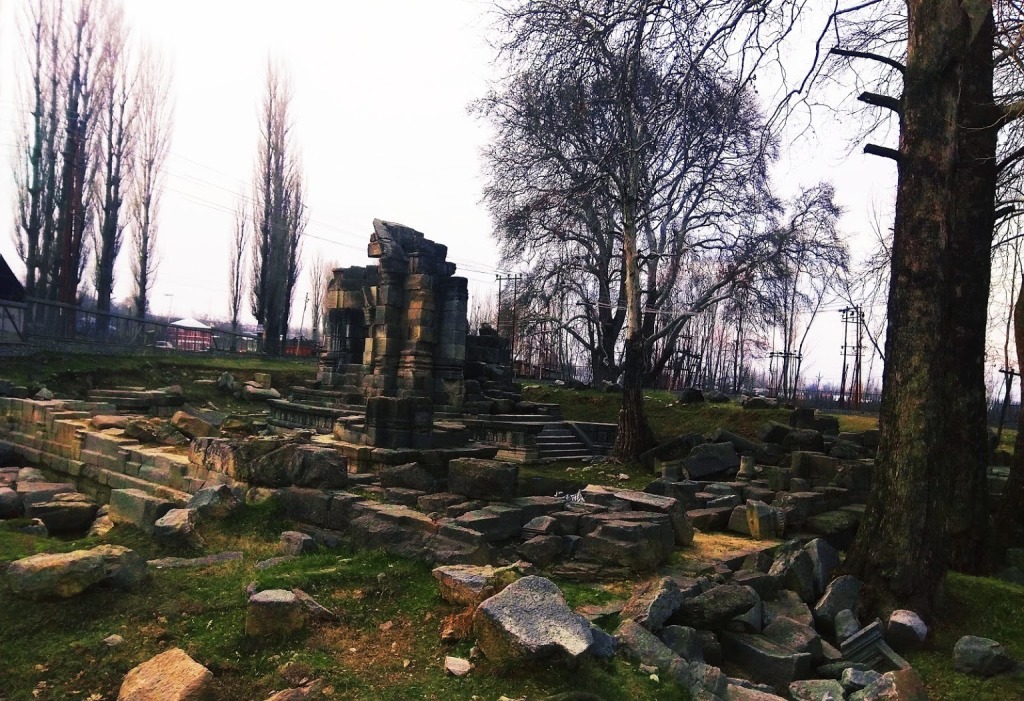

Connectivity
The Temple is located at about 2.5 Kms from Pattan Railway Station, 28 Kms from Baramulla, 27 Kms from Srinagar, 30 Kms from Srinagar Bus Stand, 36 Kms from Srinagar Railway Station, 35 Kms from Srinagar Airport and 290 Kms from Jammu. Pattan Town is situated on National Highway connecting Srinagar with Baramulla. It takes half an hour to reach Pattan from Srinagar. Buses and private taxis are available to access the temple.
Nandikeshwari Temple, Sainthia, West Bengal
Nandikeshwari Temple, Sainthia, West Bengal
Nandikeshwari Temple is a Hindu Temple dedicated to Goddess Sati, located in Sainthia City in Suri Sadar subdivision of Birbhum district in the Indian state of West Bengal. The Temple is also known as Nandikeshwari Tala. The Temple is situated on the banks of Mayurakshi River. The Temple is believed to be one of the Shakti Peethas. Being one of the Shakti Peethas of Hindu Mythology, this temple is one of the holiest sites for devotees of the Shakti sect of Hinduism.


Legends
For brief details, please refer below link;
History
The present temple was built in 1913, the Bengali year of 1320.


The Temple
The Temple is situated on an elevated platform and contains many additional smaller shrines to many gods and goddesses of the Hindu pantheon. Goddess Shakti is worshipped here as Nandini and Lord Bhairav as Nandikeshwar. The main idol in the temple is a black stone, which is now almost red, as devotees use sindoor to pray the holy stone as Nandikeshwari. The idol is adorned with a silver crown and three golden eyes.


Sculptures of Dasa Mahavidya are carved on the walls overlooking the sanctum. There are shrines for Lord Rama with his consort Sita, Shiva, Maha Saraswathi, Maha Lakshmi, Ganesha, Lakshmi Narayana, Radha Govinda, Bhairava and Hanuman in the Temple premises. There is a huge sacred banyan tree where the devotees bind red and yellow threads to fulfill their wishes.


Festivals
Festivals are held especially in the Baisakhi Purnima or the Buddha Purnima (full moon day), with yagna. Special rituals are also held on Kali Puja and on Amavasyas (new moon). And daily, Mother is offered with Anna Bhog (rice) on the noon.
Connectivity
The Temple is located at about 600 meters from Sainthia Bus Stand, 700 meters from Sainthia Junction Railway Station, 18 Kms from Suri, 52 Kms from Birbhum, 82 Kms from Durgapur Airport, 193 Kms from Kolkata and 194 Kms from Kolkata Airport. The National Highway 114 and State Highway 11 runs across the city. These highways links important cities and towns in West Bengal. The Sainthia railway station connects to both of Kolkata's two busy rail terminals, Howrah railway station and Sealdah railway station. The nearest domestic airport is Kazi Nazrul Islam International Airport.
Nalateswari Temple, Nalhati, West Bengal
Nalateswari Temple, Nalhati, West Bengal
Nalateswari Temple is a Hindu Temple dedicated to Goddess Sati, located in Nalhati Town in Rampurhat subdivision of Birbhum District in the Indian state of West Bengal near the West Bengal / Jharkhand border. Nalateswari temple is situated in the central (neck) portion of West Bengal. The Temple is believed to be one of the 51 Shakti Peethas. Being one of the Shakti Peethas of Hindu Mythology, this temple is one of the holiest sites for devotees of the Shakti sect of Hinduism. The town Nalhati is named after this Temple.


Legends
For brief details, please refer below link;
The Temple
This is a magnificent Temple situated on an elevated platform with a beautiful entrance arch way. There is an idol of Lord Ganesh at the entrance of sanctum. He is surrounded with eight snakes. Presiding Deity is called as Nalateswri / Bhagobidhata Nalateswri / Devi Parvati / Kalika. She is housed in the sanctum. The Sanctum is crowned with a raised pinnacle. The deity has huge eyes, also known as Trinayan (or three eyed deity), red colored tongue made of gold whereas the face is completely laden with sindoor or vermilion (the sign of marriage of Hindu women).


Below the golden tongue, there lies the Nala or throat of Devi Sati. It is believed that no matter how much water is poured down the throat of the goddess, it will never get overflowed or dried up. Even when the water moves down the throat there is a sound produced which can be recognized as a gulp echo. The Bhairava associated with this Sakthi Peetha is Jogesh Bhairab. His shrine can be found few kilometers away from Nalateswari Temple. A pair of footprints of Lord Vishnu can be found in this Temple.


Festivals
Dusshera and Navaratri are regarded as the most auspicious time to visit the temple. Pilgrims throng to this temple during the Mahanavami days during October.
Contact
Nalateswari Temple,
Nalhati, West Bengal – 731 243
Phone: +91 3465 255 333
Mobile: +91 94340 09435
Connectivity
The Temple is located at about 2 Kms from Nalhati Bus Stand, 2 Kms from Nalhati Junction Railway Station, 56 Kms from Berhampore, 217 Kms from Bangladesh Rajshahi Airport, 238 Kms from Kolkata and 238 Kms from Kolkata Airport. SH 7, running from Rajgram to Midnapore, and NH 14, running from Morgram to Kharagpur, pass through Nalhati. The section of the highway passing through the area was earlier part of Panagarh-Morgram Highway. Nalhati Junction Railway Station is situated on the Khana – Barharwa section of Sahibganj loop. Nalhati – Azimganj branch line originates from Nalhati.
Mangal Chandi Temple, Kogram, West Bengal
Mangal Chandi Temple, Kogram, West Bengal
Mangal Chandi Temple is a Hindu Temple dedicated to Goddess Sati located in Kogram Village in Bardhaman District of West Bengal, India. The Temple is called as Ujani Shakti Peetha. Kogram was called as Ujani in ancient times. The temple is situated in the banks of Ajay River. This temple is considered as one of Shakti Peethas in Indian Subcontinent. Being one of the 51 Shakti Peethas of Hindu Mythology, this temple is one of the holiest sites for devotees of the Shakti sect of Hinduism.


Legends
For brief details, please refer below link;
The Temple
This is a small and neatly maintained temple. The Temple structure is of recent origin without any special architectural ornamentation. The temple courtyard is abounded with trees. The Sanctum houses the idols of Goddess Mangal Chandi and Lord Shiva in the form of Bhairava called Kapileshwar.


Temple Opening Time
The temple remains open from 06:00 am to 12:00 noon and 04:00 pm to 08:00 pm.
Connectivity
The Temple is located at about 3 Kms from Natunhat Bus Stop, 20 Kms from Guskara Railway Station, 38 Kms from Bardhaman, 138 Kms from Kolkata Airport and 148 Kms from Kolkata. The road to the temple is on the sharp left after passing Natunhat Bus Stop. You have to take right from the main road on to a village road to reach this temple.
Melai Chandi Temple, Amta, West Bengal
Melai Chandi Temple, Amta, West Bengal
Melai Chandi Temple is a Hindu Temple dedicated to Goddess Sati, located in Amta in Uluberia subdivision of Howrah District in the Indian state of West Bengal. The Temple is situated on the eastern bank of the derelict channel of the river Damodar. The Temple is believed to be one of the 51 Shakti Peethas. Being one of the Shakti Peethas of Hindu Mythology, this temple is one of the holiest sites for devotees of the Shakti sect of Hinduism.


Legends
For brief details, please refer below link;
History
Amta has been mentioned in the several mediaeval Bengali verses including Chandi Mangal, a masterpiece of 16th century Bengali literature of Kavikankan Mukundaram Chakraborty. The present atchala temple was constructed by Krishna Chandra Dutta of Hatkhola, Calcutta, who had a salt-depot at Amta. The date-plaque of the temple above the entrance now became illegible but it is said to ascribe the erection of the edifice to a Karmakar in 1056 B.S, (i.e. Bengali calendar year) corresponding to 1949-50 A.D. It is also believed that the temple was not erected by Karmakar, he may be the temple architect, as it was a popular custom to inscribe the name of the temple-architect on the façade.


The Temple
The Temple is enclosed by compound walls on all four sides. Each side has its own doors. The Temple is about 25 m x 35 m (approx.). The temple complex consists of Sanctum, service area, office room, Nat mandir, an atchala Durgeswar Shiva shrine and a recently built Ramakrishna Shrine. The Temple is a simple atchala structure with a detached mandapa hall (assembly hall) in the fore court and a subsidiary shrine of Lord Shiva to the south-east, the whole complex being enclosed by a compound wall the entrance gateway being on South.


The icon of Melai (Malai) Chandi is made of black basalt stone, now heavily painted with vermillion yet this could be ascribed to Pala period (8th – 10th Century A.D.) from the padapith. Images of Basudeva and Karthick belonging to Pala period are being worshipped with the deity Melai Chandi. There is a huge tank with two Ghats and a dharmashala for devotees, situated adjacent to Temple complex.


Festivals
The annual festival is held on the auspicious day of Baisakhi Purnima during (April-May). Durga Puja, Maghi Purnima (January-February) and Saptami Dol are the other festivals celebrated here.
Connectivity
The Temple is located at about 500 meters from Amta Bus Stop, 1.5 Kms from Amta Railway Station, 12 Kms from Munshirhat, 17 Kms from Ranihati, 31 Kms from Howrah, 45 Kms from Kolkata and 54 Kms from Kolkata Airport. The Temple is situated on Howrah – Bargachia – Bagnan Route.
Kiriteswari Temple, Kiriteswar, West Bengal
Kiriteswari Temple, Kiriteswar, West Bengal
Kiriteswari Temple is a Hindu Temple dedicated to Goddess Sati located in Kiriteswar Village near Murshidabad Town in Murshidabad District of West Bengal. Earlier, Kiriteswar was called as Kiritkona. The Temple is situated on the banks of Bhagirathi River. This Shakti Peeta is considered as an Upa Peeta, as no limb or part of the body fell here, but only a portion of her ornament fell here. Being one of the Shakti Peethas of Hindu Mythology, this temple is one of the holiest sites for devotees of the Shakti sect of Hinduism.


Legends
For brief details, please refer below link;
History
For brief details, please refer below link;
The Temple
This Shakti Peeta is considered as an Upa Peeta, as no limb or part of the body fell here, but only a portion of her ornament fell here. This Temple consists of shrines of 16 different deities. Bhairava Shrine is situated adjacent to the Temple complex on the banks of the river Bhagirathi. Presiding Deity is called as Kiriteswari / Mahishamardini / Mukuteshwari / Vimala. Bhairava associated with this Temple is called as Samvartha. It is one among the handful of temples in Bengal where no deities, but an auspicious stone is worshipped.


Here Goddess is represented only by a Red coloured stone. The Red coloured stone is covered with a veil and is changed only on Ashtami of each Durga Puja and given a sacred bath. The Kirit or crown has been worshipped through ages. At present, the headdress is preserved at Rani Bhabani’s Guptamath opposite the temple. There is a high altar on which a small altar is seen. Here the face of Maa Kiriteswari is indexed.


Festivals
Festivals are held on the day of Durga Puja, Amavasya and Kali Puja. The special ritual is held on the Ratanti Amavasya (Magh - no moon night) with whole night yagna and other special rituals. And daily, Mother is offered with annabhog on the noon. Besides this, various types of seasonal fruit is offered to the goddess. Besides, the festivals, Kiriteswari Fair is held every Tuesday and Saturday in the month of Poush (December-January) on the banks of River Bhagirathi with other special customs since the time of Darpanarayan. This fair attracts many pilgrims who bathe and offer prayers, as well as picnickers.
Connectivity
The Temple is located at about 3 Kms from Dahapara Dham Railway Station, 5 Kms from Dahapara Bus Stand, 19 Kms from Murshidabad, 19 Kms from Murshidabad Railway Station, 199 Kms from Kolkata Airport and 211 Kms from Kolkata. The Temple situated on Dahapara to Panchgram Route.
Kiriteswari Temple, Kiriteswar – Legends
Kiriteswari Temple, Kiriteswar – Legends
Sakthi Peethas:
In Hindu mythology, Daksha Yajna or Daksha-Yaga is an important event, which is narrated in various Hindu scriptures. It refers to a yajna (sacrifice) organized by Daksha, where his daughter Sati immolated herself. The wrath of god Shiva, Sati's husband, thereafter destroyed the sacrifice. The tale is also called Daksha-Yajna-Nasha (destruction of Daksha's sacrifice). The story forms the basis of the establishment of the Shakti Peethas, temples of the Hindu Divine Mother. It is also becoming a prelude to the story of Parvati, Sati's reincarnation who later marries Shiva. The mythology is mainly told in the Vayu Purana. It is also mentioned in the Kasi Kanda of the Skanda Purana, the Kurma Purana, Harivamsa Purana and Padma Purana. Linga Purana, Shiva Purana, and Matsya Purana also detail the incident.
Sati-Shiva marriage:
Daksha was one of the Prajapati, son of Brahma, and among his foremost creations. The name Daksha means "skilled one". Daksha had two wives: Prasoothi and Panchajani (Virini). Sati (also known as ‘‘Uma’’) was his youngest daughter; born from Prasoothi (the daughter of the Prajapati Manu), she was the pet child of Daksha and he always carried her with him. Sati (meaning truth) is also called Dakshayani as she followed Daksha’s path; this is derived from the Sanskrit words Daksha and Ayana (walk or path).
Sati, the youngest daughter of Daksha, was deeply in love with the god Shiva and wished to become his wife. Her worship and devotion of Shiva strengthened her immense desire to become his wife. However, Daksha did not like his daughter’s yearning for Shiva, mainly because he was a Prajapati and the son of the god Brahma; his daughter Sati was a royal princess. They were wealthy nobility and their imperial royal lifestyle was entirely different from that of Shiva.
As an emperor, Daksha wanted to increase his influence and power by making marriage alliances with powerful empires and influential sages and gods. Shiva on the other hand led a very modest life. He lived among the downtrodden, wore a tiger skin, smeared ashes on his body, had thick locks of matted hair, and begged with a skull as bowl. His abode was Mount Kailash in the Himalayas. He embraced all kinds of living beings and did not make any distinction between good souls and bad souls.
The Bhutaganas, his followers, consisted of all kinds of ghosts, demons, ghouls and goblins. He wandered through garden and graveyard alike. As a consequence, Daksha had aversion towards Shiva being his daughter’s companion. However, unlike Daksha, Sati loved Shiva as she had the revelation that Shiva was the Supreme God. Sati won Shiva as her husband by undergoing severe austerities (tapas). Despite Daksha's disappointment, Sati married Shiva.
Brahma's Yajna:
Once Brahma conducted a huge yajna (sacrifice), where all the Prajapatis, gods and kings of the world were invited. Shiva and Sati were also called on to participate in the yajna. All of them came for the yajna and sat in the ceremonial place. Daksha came last. When he arrived, everyone in the yajna, with the exception of Brahma, Shiva and Sati, stood up showing reverence for him. Brahma being Daksha's father and Shiva being Daksha's son-in-law were considered superior in stature to Daksha. Daksha misunderstood Shiva’s gesture and considered Shiva's gesture as an insult. Daksha vowed to take revenge on the insult in the same manner.
Daksha Yaga:
Daksha’s grudge towards Shiva grew after Brahma's yajna. With the prime motive of insulting Shiva, Daksha initiated a great yajna, similar to that of Brahma. The yajna was to be presided over by the sage Bhrigu. He invited all the gods, Prajapatis and kings to attend the yajna and intentionally avoided inviting Shiva and Sati.
Dadhichi – Daksha argument:
The Kurma Purana discusses the dialogues between the sage Dadhichi and Daksha. After the sacrifice and hymns where offered to the twelve Aditya gods; Dadhichi noticed that there was no sacrificial portion (Havvis) allotted to Shiva and his wife, and no Vedic hymns were used in the yajna addressing Shiva which were part of Vedic hymns. He warned Daksha that he should not alter the Holy Vedas for personal reasons; the priests and sages supported this. Daksha replied to Dadhichi that he would not do so and insulted Shiva. Dadhichi left the yajna because of this argument.
Sati's Death:
Sati came to know about the grand yajna organized by her father and asked Shiva to attend the yajna. Shiva refused her request, saying that it was inappropriate to attend a function without being invited. He reminded her that she was now his wife more than Daksha’s daughter and, after marriage, is a member of Shiva’s family rather than Daksha’s. The feeling of her bond to her parents overpowered the social etiquette she had to follow. She even had a notion that there was no need to have received an invitation in order to attend as she was Daksha’s favourite daughter and no formality existed between them.
She constantly pleaded and urged Shiva to let her attend the ceremony and became adamant in her demands without listening to the reasons Shiva provided for not attending the function. He allowed Sati to go to her parents' home, along with his followers including Nandi, and attend the ceremony, but refused to accompany with her. Upon arriving, Sati tried to meet her parents and sisters; Daksha was arrogant and avoided interacting with Sati. He repeatedly snubbed her in front of all the dignitaries, but Sati maintained her composure.
Because of Sati’s persistence in trying to meet him, Daksha reacted vehemently, insulting her in front of all the other guests at the ceremony to which she had not been invited. He called Shiva an atheist and cremation ground dweller. As planned, he took advantage of the situation and continued shouting repugnant words against Shiva. Sati felt deep remorse for not listening to her beloved husband. Daksha’s disdain towards her, and especially her husband Shiva, in front of all the guests was growing each moment she stood there. The shameless insult and humiliation of her and her beloved, eventually became too much to bear.
She cursed Daksha for acting so atrociously toward her and Shiva and reminded him that his haughty behaviour had blinded his intellect. She cursed him and warned that the wrath of Shiva would destroy him and his empire. Unable to bear further humiliation, Sati committed suicide by jumping into the sacrificial fire. The onlookers tried to save her, but it was too late. They were only able to retrieve the half-burnt body of Sati.
Daksha's pride in being a Prajapati and his prejudice against his son-in-law created a mass hatred within himself, which resulted in the death of his daughter. The Nandi and the accompanying Bhootaganas left the yajna place after the incident. Nandi cursed the participants and Bhrigu reacted by cursing the Bhootaganas back.
Destruction of the Yajna by Lord Shiva:
Lord Shiva was deeply pained upon hearing of his wife's death. His grief grew into a terrible anger when he realized how Daksha had viciously plotted a treachery against him; but it was his innocent wife who fell into the trap instead of him. Shiva learned of Daksha’s callous behaviour towards Sati. Shiva's rage became so intense that he plucked a lock of hair from his head and smashed it on the ground, breaking it into two with his leg. Armed and frightening, two fearsome beings Virabhadra and Bhadrakali (Rudrakali) emerged. Lord Shiva ordered them to kill Daksha and destroy the yajna.
The ferocious Virabhadra and Bhadrakali, along with the Bhutaganas, reached the yajna spot. The invitees renounced the yajna and started running away from the turmoil. Sage Bhrigu created an army with his divine penance powers to resist Shiva’s attack and protect the yajna. Bhrigu’s army was demolished and the entire premises were ravaged. All those who participated, even the other Prajapatis and the gods, were mercilessly beaten, wounded or even slaughtered.
The Vayu Purana mentions the attack of Bhutaganas: the nose of some goddesses were cut, Yama's staff bone was broken, Mitra's eyes were pulled out, Indra was trampled by Virabhadra and Bhutaganas, Pushan's teeth were knocked out, Chandra was beaten heavily, all of the Prajapatis' were beaten, the hands of Vahini were cut off, and Bhrigu's beard was cut off. Daksha was caught and decapitated, the attack culminated when the Bhutaganas started plucking out Bhrigu’s white beard as a victory souvenir.
The Vayu Purana do not mention the decapitation of Daksha, instead it says Yagna, the personification of yajna took the form of an antelope and jumped towards the sky. Virabhadra captured it and decapitated Yagna. Daksha begs mercy from the Parabrahmam (the Supreme Almighty who is formless), who rose from the yajna fire and forgives Daksha. The Parabrahmam informs Daksha that Shiva is in fact a manifestation of Parabrahmam. Daksha then becomes a great devotee of Shiva. The Linga Purana and Bhagavatha Purana mention the decapitation of Daksha.
Certain other puranas like Harivamsa, Kurma, and Skanda narrate the story from the perspective of the Vaishnava-Shaiva community feud prevalent in ancient times. In these puranas, there are fights between Vishnu and Shiva or Virabhadra, with various victors throughout. The story of Daksha Yaga in Vaishnava and Shaiva puranas end with the surrendering of Daksha to the Parabrahmam or with the destruction of yajna and decapitation of Daksha.
Aftermath:
As the obstruction of the yajna will create havoc and severe ill effects on the nature, Brahma and the god Vishnu went to the grief-stricken Lord Shiva. They comforted and showed their sympathy towards Shiva. They requested him to come to the yajna location and pacify the Bhutaganas and allow the Yaga to be completed; Shiva agreed. Shiva found the burnt body of Sati. Shiva gave permission to continue yajna. Daksha was absolved by Shiva and the head of a ram (Male goat) meant for yajna was fixed on the decapitated body of Daksha and gave his life back. The yajna was completed successfully.
The later story is an epilogue to the story of Daksha yajna mentioned in Shakta Puranas like Devi Bhagavata Purana, Kalika Purana and the folklores of various regions. Shiva was so distressed and could not part from his beloved wife. He took the corpse of Sati and wandered around the universe. To reduce Shiva's grief, Vishnu cuts Sati's corpse as per Vaishnava Puranas; whose parts fell on the places Shiva wandered. The Shaiva version says that her body disintegrated on its own and the parts fell while Shiva was carrying Sati's corpse in various places. The crown of Sati fell here. The Shakti Peet at Maa Kiriteswari temple is considered as an Upa Peeta, as no limb or part of the body fell here, but only a portion of her ornament fell here.
These places commemorating each body part came to be known as the Shakti Peethas. Shakti Peethas are holy abode of the Mother Goddess. Each temple have shrines for Shakti and Kalabhairava. Here Devi is worshipped as Vimala or pure and Shiva as Sangbart or Sambarta. There are 51 Shakti Peethas, representing the 51 letters of Sanskrit. Some of the puranas which came in later ages gave more importance to their supreme deity (depending on Vaishnava, Shaiva, and Shakta sects) in their literature. Shiva went to isolation and solitude for ages and wandered all around until Sati reincarnated as Parvati, the daughter of the King Himavan. Like Sati, Parvati took severe austerities and gave away all her royal privileges and went to forest. Shiva tested her affection and devotion in disguise. He eventually realized Parvati is Sati herself. Shiva later on married Parvati.
Sleeping place of Mahamaya:
This place was considered to be the sleeping place of Mahamaya.
Mir Jafar requested Charanamrito:
There is a myth that Nawab Mir Jafar in his death bed had requested for the holy Charanamrito (the holy water) of Maa Kiriteswari while suffering from leprosy.
Kiriteswari / Kireetkana:
The previous name of Kiriteswari was Kireetkana. Kirit means the crown. Kireetkana or Kiriteswari is mentioned in the Vabisyapuran, a literature written in the medieval period. Kiriteswari had existed from the days of Shankaracharya and the Guptas.
Kiriteswari saved Tara from Siraj-ud-Daulla:
Another story says about the legend of Tara, the daughter of Rani Bhawani. Local people believe that she was rescued by Mata Vimala from the evil wishes of Siraj-ud-Daulla, the Nawab of Bengal. Temporality she was gifted with the disease of small pox. When Siraj reached her, he left immediately after seeing her suffering from small pox. Later, Tara was cured in some time by the blessings of Maa Vimala or Kiriteswari.
Damru Shiva Temple, Baloda Baza, Chattisgarh
Damru Shiva Temple, Baloda Baza, Chattisgarh
Damru Shiva Temple is a Hindu Temple dedicated to the Lord Shiva located in Damru Village near Baloda Bazar Town in Baloda Bazar – Bhatapara District in the Indian state of Chhattisgarh. Shivnath river flows near Damru. The Temple is one of the protected monuments in Chattisgarh declared by Archaeological Survey of India.


History
It is believed that this temple was built in 12th Century CE by Kalachuri Kings.

The Temple
This is an ancient ruined Shiva Temple, situated on the stone-built platform. The Temple is facing east. This temple is about 15 feet high. The Sanctum is empty. A headless Nandi can be found facing the sanctum. Desecrated Yonipitha is lying in front of the temple. The walls of the temple are also very simple. Remains of ruined temples in the form of two mounds are found nearby.

Excavated Sculptures of Trivikram, Vishnu, Surya, Shiva, Brahma, Yama, Chamunda, Parvati, Ambika, Chawardharini and few erotic sculptures from the temple premises and nearby area have been fixed in newly built Maha Maya Temple next to this Shiva Temple. Mahamaya Temple houses ancient idols of Mahamaya, Mahakal and Vinayaga. The remains of the old settlements have been found as a result of archaeological excavations at Damru.

Connectivity
The Temple is located at about 15 Kms from Baloda Bazar, 41 Kms from Bhatapara, 41 Kms from Bhatapara Railway Station, 50 Kms from Bilaspur Airport, 58 Kms from Bilaspur Junction Railway Station, 61 Kms from Bilaspur and 100 Kms from Raipur. The Temple is situated on Bhatapara to Pauni Route.
Chitavari Devi Temple, Dhobani, Chattisgarh
Chitavari Devi Temple, Dhobani, Chattisgarh
Chitavari Devi Temple is a Hindu Temple dedicated to the Goddess Shakthi located in Dhobani Village in Baloda Bazar – Bhatapara District in the Indian state of Chhattisgarh. The temple is situated on the eastern banks of Shivnath River. This Temple is situated very close Damakheda, where the seat of Kabir Panthi Gurus is installed. The Temple is one of the protected monuments in Chattisgarh declared by Archaeological Survey of India.


History
The Temple was believed to be built in 8th – 9th Century AD.


The Temple
The Temple is placed on a raised platform. It was originally a Shiva Temple but later replaced with Chitavari Devi at its sanctum. The Temple is built with stones and bricks. It is also one of the few surviving brick structures of Chattisgarh.


Connectivity
The Temple is located at about 10 Kms from Nandghat, 25 Kms from Hathbandh Railway Station, 27 Kms from Bhatapara, 52 Kms from Baloda Bazar, 55 Kms from Raipur Junction Railway Station, 57 Kms from Raipur and 69 Kms from Raipur Airport. The Temple is situated on Bilaspur to Raipur Route.
Chandraditya Temple, Barsur, Chattisgarh
Chandraditya Temple, Barsur, Chattisgarh
Chandraditya Temple is a Hindu Temple dedicated to the Lord Shiva located in Barsur Town in Dantewada District in the Indian state of Chhattisgarh. Barsur is located on the banks of Indravati River. The temple is situated on the banks of Budha Talab.


History
An inscription of Barsur dated to Shaka Samvat 983 (1061 AD) in Telugu script, states that Mahamandaleshwar Chandraditya Maharaj, a feudatory chief of Nagavanshi ruler Dharavarsha excavated a tank and built this Shiva temple at its centre. He bought a village from Rajadhiraja and donated it to carry out the expenses of temple construction. The Temple was named after him.


The origin of the word Barsur is believed to be from the word Balsuri, Balsuri became famous as Barsurgarh later. Inscriptions and coins circulated by Nala Dynasty Kings have been found in Chhattisgarh and Dandakaranya region. King Bhavdatt Varman of Nala Dynasty gained victory over many places of Southern Bastar. A Gangavanshi ruler of Odisha in 850 AD invaded Dandakaranya region and established his Kingdom. One of his son, started ruling over Bastar. He made village Barsur on the banks of river Indravati, as their capital.


Remnants of ancient capital can be seen to this day. Gangavanshi rulers constructed many temples in Barsur, among them Mama Banja temple is still in good condition. Nagavanshi rulers gained victory over Gangavanshi rulers in 11th century CE, and they also made Barsur as their capital. Later, Nagavanshi ruler Jagdeshbhusan Dharavarsha transferred his capital from Barsur to Taaralpal, present day Dantewada. Still Nagavanshi rulers built many temples and excavated lakes in Barsur.


The last Nagavanshi ruler Harishchandra was defeated by the ruler of Kakatiya dynasty, Raja Annamdev. After this incident, importance of Barsur and Bastar went to obscurity. It is believed that there were about 147 temples and an equal number of ponds here during its heyday. Mama Bhanja Temple, Chandraditya Temple, Battisa Temple, Twin Ganesha Temple, 16 Pillar Temple, Hiram Raj Temple, Bhairava Temple, few ruined temples and lakes dated to 11th Century AD can be found at present in Barsur.


The Temple
The temple is situated on the banks of Budha Talab. The Temple is built on a high platform. The Sanctum is Pancharatha on plan. The Sanctum is attached with a square pillared mandapa in front. Nandi can be found facing the sanctum. The exterior walls of jangha portion contain image of Brahma, incarnations of Lord Vishnu, Prajapati Daksha, Uma-Maheshvara, erotic sculptures and also few other images from Hindu pantheon.


Connectivity
The Temple is located at about 1 Km from Battisa Temple, 21 Kms from Geedam Bus Station, 22 Kms from Geedam, 27 Kms from Geedam Railway Station, 41 Kms from Dantewada, 79 Kms from Bastar, 94 Kms from Jagdalpur, 96 Kms from Jagdalpur Railway Station, 97 Kms from Jagdalpur Airport, 143 Kms from Bhopalpatnam, 308 Kms from Raipur and 317 Kms from Raipur Airport. The temple is situated on Jagdalpur to Bhopalpatnam route.
Bhairam Dev Temple, Bhairamgarh, Chattisgarh
Bhairam Dev Temple, Bhairamgarh, Chattisgarh
Bhairam Dev Temple is a Hindu Temple dedicated to the Lord Shiva located in Bhairamgarh in Bijapur District in the Indian state of Chhattisgarh. The Temple and the ancient ruins can be dated to 13th – 14th Century AD.


The Temple & Ruins
This Temple contains a thatched hut, housing a Shiva Lingam namely Bhairam Dev and Nandi inside it. Bhairam Dev is considered as consort of Danteshwari. Ancient Temple ruins can be found scattered all around this Village. A rock cut sculpture of Ardhanariswara found among the ruins needs a special mention. It belonged to 13th – 14th Century AD.


Several sculptures of Nagavanshi Kings, Brahma, Ganesha etc. can be found within 500 meters radius of the temple. Amidst the ruins of a temple on the banks of the Lakhauri lake, moonstones, broken pillars and statues of Vishnu, Ganesh, Shiva, Parvati, etc., made of black stone have been found. Remains of an ancient fortress and numerous temples have been discovered here.


Connectivity
The Temple is located at about 9 Kms from Belnar, 43 Kms from Geedam, 49 Kms from Bijapur, 50 Kms from Geedam Railway Station, 57 Kms from Dantewada, 117 Kms from Jagdalpur Airport and 367 Kms from Raipur. The Temple is situated on Jagdalpur to Bhopalpatnam Route.
Bhairava Temple, Barsur, Chattisgarh
Bhairava Temple, Barsur, Chattisgarh
Bhairava Temple is a Hindu Temple dedicated to the Lord Bhairava, a fierce form of Lord Shiva, located in Barsur Town in Dantewada District in the Indian state of Chhattisgarh. Barsur is located on the banks of Indravati River. The Temple is situated very close to Battisa Temple near to main road. This temple might have been built in 10th – 11th century AD by Nagavanshi Kings.

For brief details, please refer below link;
The Temple
The Temple is in complete ruins and is hidden in the bushes. It is a simple temple with only sanctum. It is about 5 feet high. It can be entered only by leaning. The sanctum houses a nude image of Bhairava.
Connectivity
The Temple is located at about 50 meters Battisa Temple, 21 Kms from Geedam Bus Station, 22 Kms from Geedam, 27 Kms from Geedam Railway Station, 41 Kms from Dantewada, 79 Kms from Bastar, 94 Kms from Jagdalpur, 96 Kms from Jagdalpur Railway Station, 97 Kms from Jagdalpur Airport, 143 Kms from Bhopalpatnam, 308 Kms from Raipur and 317 Kms from Raipur Airport. The temple is situated on Jagdalpur to Bhopalpatnam route.
Mahadeva Temple, Bastar, Chattisgarh
Mahadeva Temple, Bastar, Chattisgarh
Mahadeva Temple is a Hindu Temple dedicated to the Lord Shiva located in Bastar in Bastar District in the Indian state of Chhattisgarh. The Temple is also called as Cherkin Temple. The temple is situated on the eastern banks of Indravati River. The Temple is one of the protected monuments in Chattisgarh declared by Archaeological Survey of India.


History
When Kakatiya rulers migrated from Dantewada to Jagdalpur. But before coming to Jagdalpur, they stayed in Bastar, and then finally settled in Jagdalpur and made Jagdalpur, as their capital and renamed their Kingdom as Bastar State. It is believed that this temple was built during their stay in Bastar.


The Temple
The Temple was built over a two feet high platform. The Temple is situated on the banks of Kaimarai Pond. The Temple consists of Deula (Sanctum) and Mukha Mandapa. Gajalakshmi Panel can be found at the lintel of Mukha Mandapam. Dvarapalas can be found on each side of the doorjamb of Mukha Mandapam. The left jamb and lintel of the sanctum are original. The Lintel of the sanctum has a relief of Ganesha.


Besides, kiritamukuta, chaitya gavaksha dormer and Mithuna figures, there is a unique Chamunda image on the left side of the sanctum doorway. She has emaciated body (literally skeleton) with sunken belly, sunken eyes and open mouth. She sits on a corpse flanked by a jackal and an owl and decorated with a garland of skulls.


She wears garland of skull and has serpent on her head. She has eight arms and holds snake, bow, shield, sword, trident, thunderbolt and arrows. The neck of a Rakshasa is pierced in the arrow. She is in a terrifying form. The Sanctum houses Lord Shiva in the form of Lingam. Lingam is about 1.5 feet high. Lord is a Swayambhu Moorthy.


Festivals
Maha Shivaratri is celebrated in this temple with much fanfare.
Connectivity
The Temple is located at about 21 Kms from Jagdalpur Old Bus Stand,21 Kms from Jagdalpur Airport, 23 Kms from Jagdalpur New Bus Stand, 24 Kms from Jagdalpur Railway Station, 55 Kms from Kondagaon and 268 Kms from Raipur. The Temple is situated on Raipur to Jagdalpur Route (NH 30).
Battisa Temple, Barsur, Chattisgarh
Battisa Temple, Barsur, Chattisgarh
Battisa Temple is a Hindu Temple dedicated to the Lord Shiva located in Barsur Town in Dantewada District in the Indian state of Chhattisgarh. Barsur is located on the banks of Indravati River. It is a unique Hindu Temple having two sanctum sanctorums. The Temple is one of the protected monuments in Chattisgarh declared by Archaeological Survey of India.


History
As per the inscriptions available in the temple, these two temples were constructed in 1209 AD (Shaka Samvat 1130) by the Ganga Mahadevi, Queen of Nagavanshi ruler Someshwara Deva. One temple was named as Someshwara after his husband and other was named as Gangadeshwara. The inscription also states that Keramruka village was donated for the expenses and maintenance of the temple. This inscription is currently preserved in the museum of Nagpur.

The origin of the word Barsur is believed to be from the word Balsuri, Balsuri became famous as Barsurgarh later. Inscriptions and coins circulated by Nala Dynasty Kings have been found in Chhattisgarh and Dandakaranya region. King Bhavdatt Varman of Nala Dynasty gained victory over many places of Southern Bastar. A Gangavanshi ruler of Odisha in 850 AD invaded Dandakaranya region and established his Kingdom. One of his son, started ruling over Bastar. He made village Barsur on the banks of river Indravati, as their capital.

Remnants of ancient capital can be seen to this day. Gangavanshi rulers constructed many temples in Barsur, among them Mama Banja temple is still in good condition. Nagavanshi rulers gained victory over Gangavanshi rulers in 11th century CE, and they also made Barsur as their capital. Later, Nagavanshi ruler Jagdeshbhusan Dharavarsha transferred his capital from Barsur to Taaralpal, present day Dantewada. Still Nagavanshi rulers built many temples and excavated lakes in Barsur.

The last Nagavanshi ruler Harishchandra was defeated by the ruler of Kakatiya dynasty, Raja Annamdev. After this incident, importance of Barsur and Bastar went to obscurity. It is believed that there were about 147 temples and an equal number of ponds here during its heyday. Mama Bhanja Temple, Chandraditya Temple, Battisa Temple, Twin Ganesha Temple, 16 Pillar Temple, Hiram Raj Temple, Bhairava Temple, few ruined temples and lakes dated to 11th Century AD can be found at present in Barsur.
The Temple
This temple is facing east. It is built on three feet high platform. This temple has two rectangular sanctum sanctorums with a joint Mandapam. Both the sanctum sanctorum houses Shivalingas namely Someshwara and Gangadeshwara. The Shivalinga is in the Triratha style and can be rotated. A relief image of Ganesha can be found on the lintel at the entrance of the sanctum.


Nandi can be found facing each sanctum. There is a circumbulatory path around each sanctum. The Shikara over the sanctum is completely destroyed. The Sanctum walls are devoid of sculptures, reliefs and ornamentation. The Mandapam consists of 32 stone pillars having 4 rows and eight columns, due to which the temple came to be called as Battisa Temple. There are gates in all three directions to enter the pavilion.


Connectivity
The Temple is located at about 21 Kms from Geedam Bus Station, 22 Kms from Geedam, 27 Kms from Geedam Railway Station, 41 Kms from Dantewada, 79 Kms from Bastar, 94 Kms from Jagdalpur, 96 Kms from Jagdalpur Railway Station, 97 Kms from Jagdalpur Airport, 143 Kms from Bhopalpatnam, 308 Kms from Raipur and 317 Kms from Raipur Airport. The temple is situated on Jagdalpur to Bhopalpatnam route.
Twin Ganesha Temple, Barsur, Chattisgarh
Twin Ganesha Temple, Barsur, Chattisgarh
Twin Ganesha Temple is a Hindu Temple dedicated to the Lord Ganesha located in Barsur Town in Dantewada District in the Indian state of Chhattisgarh. Barsur is located on the banks of Indravati River. The bigger Ganesh idol of Barsur is today recognized as the third largest Ganesh idol in the world. The Temple is located very near to Mama Bhanja Temple.


Legends
For brief details, please refer below link;
History
For brief details, please refer below link;
The Temple
Ganesh Temple has two idols of Lord Ganesha and one Lingam. It is unique to have two idols of Vinayaga side by side in the temple. These idols, made of sand stones, are monolithic. One idol is big and is about 7½ feet high. This idol is considered to be the third largest statue in the world. The other idol is small and is about 5½ feet high. These idols of Ganesha dates back to 11th – 12th century.


Both the idols are housed in newly constructed Mandapam. The mandapam is fenced on all sides by grills for safety. A stone Kalasha, called Amrita Kalasha, is kept on top of a ruined structure. The Temple structure is completely lost only the idols survived. Remains of pillars, stones and damaged sculptures were found scattered around the temple complex.


Festivals
Month of Savan is auspicious here. Devotees perform Jala Abhishek to Lord Ganesha here.
Connectivity
The Temple is located at about 1 Km from Battisa Temple, 21 Kms from Geedam Bus Station, 22 Kms from Geedam, 27 Kms from Geedam Railway Station, 41 Kms from Dantewada, 79 Kms from Bastar, 94 Kms from Jagdalpur, 96 Kms from Jagdalpur Railway Station, 97 Kms from Jagdalpur Airport, 143 Kms from Bhopalpatnam, 308 Kms from Raipur and 317 Kms from Raipur Airport. The temple is situated on Jagdalpur to Bhopalpatnam route.
16 Pillar Temple, Barsur, Chattisgarh
16 Pillar Temple, Barsur, Chattisgarh
16 Pillar Temple is a ruined Hindu Temple located in Barsur Town in Dantewada District in the Indian state of Chhattisgarh. Barsur is located on the banks of Indravati River. The Temple was believed to be built in 9th Century AD by Nagavanshi Rulers. The design of the pillars and sculptures in the pillars are similar to Danteshwari Temple.


History
For brief details, please refer below link;
Connectivity
The Temple is located at about 1 Km from Battisa Temple, 21 Kms from Geedam Bus Station, 22 Kms from Geedam, 27 Kms from Geedam Railway Station, 41 Kms from Dantewada, 79 Kms from Bastar, 94 Kms from Jagdalpur, 96 Kms from Jagdalpur Railway Station, 97 Kms from Jagdalpur Airport, 143 Kms from Bhopalpatnam, 308 Kms from Raipur and 317 Kms from Raipur Airport. The temple is situated on Jagdalpur to Bhopalpatnam route.
Kankalitala Shakthi Peeth, Bolpur, West Bengal
Kankalitala Shakthi Peeth, Bolpur, West Bengal
Kankalitala Shakthi Peeth is a Hindu Temple dedicated to Goddess Sati, located in Kankalitala in Bolpur subdivision of Birbhum district in the Indian state of West Bengal. The Temple is situated on the banks of Kopai river. The Temple is believed to be one of the 51 Shakti Peethas. Being one of the Shakti Peethas of Hindu Mythology, this temple is one of the holiest sites for devotees of the Shakti sect of Hinduism.


Legends
For brief details, please refer below link;
The Temple
There is no deity statue made of stone, clay, or metal in the sanctum. Only, a framed painting depicting the goddess Kali standing on top of her husband Lord Shiva can be seen. The Sanctum is a small room crowned by a curved pyramidal roof, ornamented with a metal spire. Nat Mandir is a rectangular raised platform can be found in front of the sanctum. Though, painting of Kali is considered sacred, but the most sacred in this Temple is the Kund (temple tank) located next to the Temple.


This Kund is a small shallow pond that is surrounded by a protective concrete wall topped with red fencing. It is believed that fall of Sati’s waist created a depression in the earth which later filled up with water and formed the sacred Kund. It is repeatedly told that the actual body part now lies underneath this water. Harikath, a device used for the ritual sacrifice of goats can be found next to the sacred Tree. The temple complex also boasts a large cremation ground.


The deity is accompanied by her divine consort, Ruru Bhairav, consecrated as a Shiva Lingam inside the Shiva Temple close to the entrance of the temple complex. But the Shiva lingam is placed under the ground and devotees have to pour water and offerings on the pit of the broken Lingam. Once the lingam used to be huge but during the Muslim invasion during the 16th century by the notorious Kala Pahar, the lingam was broken.


There is a sacred tree on the opposite side of the Sanctum. It can be noticed that numerous stones had been tied up in the tree by the devotees. This is a Bengali folk tradition associated with fertility. These rocks are tied to trees as offerings to be blessed with pregnancy and a safe childbirth. There is a unique formation of Shiva Lingam on this Tree.


Festivals
Holi, Navaratri, Vijaya Dashami, Sharad Poornima, Deepawali, Annakuta, Makar Sankranti and Shiva Ratri are the festivals celebrated here.
Connectivity
The Temple is located at about 5 Kms from Prantik Railway Station, 9 Kms from Santiniketan, 9 Kms from Bolpur Railway Station, 9 Kms from Bolpur Bus Stand, 67 Kms from Bardhaman, 168 Kms from Kolkata Airport and 176 Kms from Kolkata. The Temple is situated on Bolpur to Labhpur Road. One can hire a taxi or take a rickshaw from Bolpur to reach this Temple.
Juranpur Sakthi Peeth, Nadia, West Bengal
Juranpur Sakthi Peeth, Nadia, West Bengal
Juranpur Sakthi Peeth is a Hindu Temple dedicated to Goddess Sati, located in Juranpur in Nadia District of West Bengal, India. The Temple was situated on the banks of the Bhagirathi River, but today the river flows about one kilometer west of the Temple. The Temple is believed to be one of the 51 Shakti Peethas. Being one of the Shakti Peethas of Hindu Mythology, this temple is one of the holiest sites for devotees of the Shakti sect of Hinduism.


Legends
For brief details, please refer below link;
History
There is an underground room (now abandoned) previously connected to the river Bhagirathi where many saints and revolutionaries took shelter before independence. Famous personalities who took shelter in this Temple include Mohan Lal (general of nawab Sirajuddulla), Hukka Lal (younger son of Maharaja Mohan Lal), Sadhak Ramakrishna (Raja Ramakrishna Ray son of Rani Bhabani), Sri Sitaram Onkarnath, Kulanand Brahmachari, Taranath Tarakhapa, Ganga Bai (Mataji) Balbant Singh, Purnanda Brahmachari, Shibnath Sastry, Swami Bisuddhananda Saraswathi, Tantric Triguna Nath Brahmachari and Birendra Giri Brahmachari Maharaj, archaeologist Rakhaldas Bandyopadhyay, Raja Prithvi Chand Lal of Purnea, Editor Gope Mitra Zamindar, Advocate Bankubehari Ghosh, Editor Yadav Rajit Singh Baranashi. All India Yadav Mahasabha President Advocate Nabadwip Ghosh of Patna visited this Temple in December 1924 under the guidance of Balak Ram Ghosh of Juranpur. This Pith is now managed by a trust after a Calcutta High Court order on 16.01.1963.


The Temple
The Goddess is called as Jaya Durga and the Bhairava associated with this Temple is known as Krodhisha. The main idol is situated under an ancient banyan tree that evokes a sense of reverence. Bhairava in the form of Linga can be found in the sanctum of the Temple.


Festivals
Every year during Magh Purnima a fair takes place here that attracts a huge congregation of pilgrims.
Connectivity
The Temple is located at about 17 Kms from Debagram Railway Station, 19 Kms from Dainhat Railway Station, 24 Kms from Katwa, 25 Kms from Katwa Junction Railway Station, 52 Kms from Berhampore, 157 Kms from Kolkata and 157 Kms from Kolkata Airport. The Temple is situated on Katwa to Debagram Route.
Jogadya Temple, Kshirgram, West Bengal
Jogadya Temple, Kshirgram, West Bengal
Jogadya Temple is a Hindu temple dedicated to Goddess Sakthi located in Kshirgram (Khirogram) Village in Mongalkote CD block in Katwa sub division of Purba Bardhaman district in the Indian state of West Bengal. The Temple is believed to be one of the 51 Shakti Peethas. Being one of the Shakti Peethas of Hindu Mythology, this temple is one of the holiest sites for devotees of the Shakti sect of Hinduism.


Legends
For brief details, please refer below link;
The Temple
This Sakthi Peetha consists of an old temple, new temple and Shiva (Bhairava) Temple.
Old Temple:
This Brick Temple is situated in the middle of the village. It is believed to be built in the 11th Century A.D. The Temple is enclosed within a compound wall. Locals calls this Temple as Maa-er Baari. The Temple consists Nat Mandir, Bhog Ghar, Bhander Ghar and Sanctum. There was no idol of Jogadya, not even picture of Goddess in the sanctum. It is said that, infamous Muslim General Kalapahar destroyed this Temple. The Temple was restored by Kritichand in 1760 A.D.

It is believed that the deity remains submerged under the Kshirdighi, a nearby pond by the shrine. On every Baisakhi Sankranti she comes out of the water and stay overnight inside the temple Garbha Griha. After accepting the yajnas and the special puja, She again gets back to the water of the Kshirdighi.

New Temple:
This Temple was constructed in 2005 in the middle of a Pond called Kshirdighi. The Temple was constructed with white marbles. The idol of Jogadya is kept underwater in this temple. An ancient idol of Jogadya was found during an excavation in Kshirdighi Pond. Another small temple had been built in 31st December 2011 to house this newly found ancient idol.

The Temple was made of red stones. The Temple consists of Nat Mandir, Bhog Ghar, Bhandar Ghar and guest house for the devotees. Both the idols are made of Kashti Stones and looks like the idol of Goddess Durga. The newer idol was made by Nabin Bhaskar around 180 years ago. The older idol is found to be around 600 yrs old.

It is said that earlier there was no idol of the goddess at Kshirgram but both the puja and the fair were there. The goddess in an Ugra Chandi form appeared in a dream to Hari Dutta, the king of Kshirgram and he got a stone image of the ten-armed Singhabahini goddess made and established it. The goddess is worshipped by the Ugra Kshatriyas in places other than Kshirgram, a day earlier.

Kshirdighi:
Kshirdighi covers an area of about 13 acres. There are lot of large fishes in the pond. The Dighi is surrounded with a beautiful garden.

Kshireswar Temple:
Kshireswar is the Bhairava associated with this Sakthi Peetha. This ancient Temple is situated at about 30 feet high. It is believed that infamous Muslim General Kalapahar destroyed this Temple also. The temple of Kshireswar is a little away from Kshirdighi.

Festivals
Goddess Jogadya is worshipped at Kshirgram on Vaisakha Sankranti and a big fair is organised.
Connectivity
The Temple is located at about 4 Kms from Kaichar Railway Station, 23 Kms from Katwa, 45 Kms from Bardhaman, 133 Kms from Kolkata and 133 Kms from Kolkata Airport. Kshirgram can be reached by bus from Katwa & Burdwan.
Bargabhima Temple, Tamluk, West Bengal
Bargabhima Temple, Tamluk, West Bengal
Bargabhima Temple is a Hindu Temple dedicated to Goddess Sati, located in Tamluk Town, headquarters of Purba Medinipur District of West Bengal, India. The Temple is situated on the banks of Rupnarayan River close to the Bay of Bengal. The Temple is believed to be one of the 51 Shakti Peethas. Being one of the 51 Shakti Peethas of Hindu Mythology, this temple is one of the holiest sites for devotees of the Shakti sect of Hinduism.


Legends
For brief details, please refer below link;
History
It is believed that present-day Tamluk is the site of the ancient city variously known as Tamralipta or Tamralipti. This ancient kingdom and port city was bounded by the Bay of Bengal in the south, Rupnarayan River in the east and Subarnarekha River in the west. Archaeological remains show continuous settlement from about the 3rd century BC.


The place was known as Tamralipta (in the Puranas and the Mahabharata), Tamalika (in historical documents), Tamalitti (in foreigners' descriptions), or Tamoluk (in the British Raj). It was a seaport, now buried under river silt. Tamluk was also known as Bhivas, in religious texts, and Madhya Desh, as the Middle State of Utkal / Kalinga and Banga. According to Jain sources, Tamralipti was the capital of the kingdom of Vanga and was long known as a port.


The Temple is believed to be built by a King from Mayur Dynasty in 9th Century AD. The temple had been mentioned in various ancient Bengali Literature. The temple is the mixture of three cultures, Hindu, Buddhist and Bengali. The current temple is not very old as it was rebuilt after the Islamic occupation of Bengal in the Middle Ages. The temple has been declared by Heritage Site by West Bengal Government.
The Temple
The Temple is situated on the banks of Rupnarayan River close to the Bay of Bengal. The temple architecture follows Odishan style. The Temple is situated on an elevated area. The temple is spread over the huge area with a courtyard. Presiding Deity is called as Kapalini / Bhimarupa / Bargabheema and the Bhairava associated is called as Sarvanand. The sanctum houses the black stone idol of Goddess Kali. A Shiva Linga can be seen beside the idol of Mother. The deity has four arms. Upper arms are holding a Trident and a human skull. In her lower hands, she carries the heads of the demons after slaying them.


Festivals
The local people celebrate a large festival on Durga Puja and Bengali new year in this temple.
Connectivity
The Temple is located at about 1 Km from Tamluk Central Bus Stand, 2 Kms from Tamluk Railway Station, 5 Kms from Nimtouri, 16 Kms from Mecheda, 33 Kms from Panskura, 86 Kms from Kolkata, 90 Kms from Kharagpur and 95 Kms from Kolkata Airport. Take Digha bound Buses at Esplanade or at Howrah, the bus travel in Kolkata – Kolaghat – Nimtouri route to reach Digha. Get down at Mecheda and then take local bus routes (Mecheda to Haldia / Mecheda to Srirampur / Mecheda to Nandigram) to reach at Tamluk. Devotees can also avail Haldia Local Trains from Howrah Railway Station to reach Tamluk.
Bhramari Devi Temple, Bodaganj, Jalpaiguri, West Bengal
Bhramari Devi Temple, Bodaganj, Jalpaiguri, West Bengal
Bhramari Devi Temple is a Hindu Temple dedicated to Goddess Sati located in Bodaganj Village in Jalpaiguri District in West Bengal, India. Mother is called as Bhramari and accompanied by Bhairava, Ambar in the form of Lingam. The Temple is situated on the banks of Teesta River. This Temple is also called as Tristrota Shakti Peeth as it is located on the banks of Teesta River. This temple is considered as one of Shakti Peethas in Indian Subcontinent. Being one of the 51 Shakti Peethas of Hindu Mythology, this temple is one of the holiest sites for devotees of the Shakti sect of Hinduism.


Legends
For brief details, please refer below link;
The Temple
The temple is a one storied, red colored structure enshrining the idol of Devi Bhramari and accompanied by Bhairava, Ambar in the form of Lingam. Her chakra (shaped in the form of lotus) is believed to have healing powers.


Connectivity
The Temple is located at about 20 Kms from Jalpaiguri, 20 Kms from Jalpaiguri Bus Stand, 20 Kms from Jalpaiguri Railway Station, 31 Kms from New Jalpaiguri Junction Railway Station, 45 Kms from Siliguri, 49 Kms from Bagdogra Airport and 590 Kms from Kolkata. The Temple is situated near to Jalpaiguri Town. From Jalpaiguri, private taxis and autos are available to reach this Temple.
Bhramari Devi Temple, Bodaganj, Jalpaiguri – Legends
Bhramari Devi Temple, Bodaganj, Jalpaiguri – Legends
Sakthi Peethas:
In Hindu mythology, Daksha Yajna or Daksha-Yaga is an important event, which is narrated in various Hindu scriptures. It refers to a yajna (sacrifice) organized by Daksha, where his daughter Sati immolated herself. The wrath of god Shiva, Sati's husband, thereafter destroyed the sacrifice. The tale is also called Daksha-Yajna-Nasha (destruction of Daksha's sacrifice). The story forms the basis of the establishment of the Shakti Peethas, temples of the Hindu Divine Mother. It is also becoming a prelude to the story of Parvati, Sati's reincarnation who later marries Shiva. The mythology is mainly told in the Vayu Purana. It is also mentioned in the Kasi Kanda of the Skanda Purana, the Kurma Purana, Harivamsa Purana and Padma Purana. Linga Purana, Shiva Purana, and Matsya Purana also detail the incident.
Sati-Shiva marriage:
Daksha was one of the Prajapati, son of Brahma, and among his foremost creations. The name Daksha means "skilled one". Daksha had two wives: Prasoothi and Panchajani (Virini). Sati (also known as ‘‘Uma’’) was his youngest daughter; born from Prasoothi (the daughter of the Prajapati Manu), she was the pet child of Daksha and he always carried her with him. Sati (meaning truth) is also called Dakshayani as she followed Daksha’s path; this is derived from the Sanskrit words Daksha and Ayana (walk or path).
Sati, the youngest daughter of Daksha, was deeply in love with the god Shiva and wished to become his wife. Her worship and devotion of Shiva strengthened her immense desire to become his wife. However, Daksha did not like his daughter’s yearning for Shiva, mainly because he was a Prajapati and the son of the god Brahma; his daughter Sati was a royal princess. They were wealthy nobility and their imperial royal lifestyle was entirely different from that of Shiva.
As an emperor, Daksha wanted to increase his influence and power by making marriage alliances with powerful empires and influential sages and gods. Shiva on the other hand led a very modest life. He lived among the downtrodden, wore a tiger skin, smeared ashes on his body, had thick locks of matted hair, and begged with a skull as bowl. His abode was Mount Kailash in the Himalayas. He embraced all kinds of living beings and did not make any distinction between good souls and bad souls.
The Bhutaganas, his followers, consisted of all kinds of ghosts, demons, ghouls and goblins. He wandered through garden and graveyard alike. As a consequence, Daksha had aversion towards Shiva being his daughter’s companion. However, unlike Daksha, Sati loved Shiva as she had the revelation that Shiva was the Supreme God. Sati won Shiva as her husband by undergoing severe austerities (tapas). Despite Daksha's disappointment, Sati married Shiva.
Brahma's Yajna:
Once Brahma conducted a huge yajna (sacrifice), where all the Prajapatis, gods and kings of the world were invited. Shiva and Sati were also called on to participate in the yajna. All of them came for the yajna and sat in the ceremonial place. Daksha came last. When he arrived, everyone in the yajna, with the exception of Brahma, Shiva and Sati, stood up showing reverence for him. Brahma being Daksha's father and Shiva being Daksha's son-in-law were considered superior in stature to Daksha. Daksha misunderstood Shiva’s gesture and considered Shiva's gesture as an insult. Daksha vowed to take revenge on the insult in the same manner.
Daksha Yaga:
Daksha’s grudge towards Shiva grew after Brahma's yajna. With the prime motive of insulting Shiva, Daksha initiated a great yajna, similar to that of Brahma. The yajna was to be presided over by the sage Bhrigu. He invited all the gods, Prajapatis and kings to attend the yajna and intentionally avoided inviting Shiva and Sati.
Dadhichi – Daksha argument:
The Kurma Purana discusses the dialogues between the sage Dadhichi and Daksha. After the sacrifice and hymns where offered to the twelve Aditya gods; Dadhichi noticed that there was no sacrificial portion (Havvis) allotted to Shiva and his wife, and no Vedic hymns were used in the yajna addressing Shiva which were part of Vedic hymns. He warned Daksha that he should not alter the Holy Vedas for personal reasons; the priests and sages supported this. Daksha replied to Dadhichi that he would not do so and insulted Shiva. Dadhichi left the yajna because of this argument.
Sati's Death:
Sati came to know about the grand yajna organized by her father and asked Shiva to attend the yajna. Shiva refused her request, saying that it was inappropriate to attend a function without being invited. He reminded her that she was now his wife more than Daksha’s daughter and, after marriage, is a member of Shiva’s family rather than Daksha’s. The feeling of her bond to her parents overpowered the social etiquette she had to follow. She even had a notion that there was no need to have received an invitation in order to attend as she was Daksha’s favourite daughter and no formality existed between them.
She constantly pleaded and urged Shiva to let her attend the ceremony and became adamant in her demands without listening to the reasons Shiva provided for not attending the function. He allowed Sati to go to her parents' home, along with his followers including Nandi, and attend the ceremony, but refused to accompany with her. Upon arriving, Sati tried to meet her parents and sisters; Daksha was arrogant and avoided interacting with Sati. He repeatedly snubbed her in front of all the dignitaries, but Sati maintained her composure.
Because of Sati’s persistence in trying to meet him, Daksha reacted vehemently, insulting her in front of all the other guests at the ceremony to which she had not been invited. He called Shiva an atheist and cremation ground dweller. As planned, he took advantage of the situation and continued shouting repugnant words against Shiva. Sati felt deep remorse for not listening to her beloved husband. Daksha’s disdain towards her, and especially her husband Shiva, in front of all the guests was growing each moment she stood there. The shameless insult and humiliation of her and her beloved, eventually became too much to bear.
She cursed Daksha for acting so atrociously toward her and Shiva and reminded him that his haughty behavior had blinded his intellect. She cursed him and warned that the wrath of Shiva would destroy him and his empire. Unable to bear further humiliation, Sati committed suicide by jumping into the sacrificial fire. The onlookers tried to save her, but it was too late. They were only able to retrieve the half-burnt body of Sati.
Daksha's pride in being a Prajapati and his prejudice against his son-in-law created a mass hatred within himself, which resulted in the death of his daughter. The Nandi and the accompanying Bhootaganas left the yajna place after the incident. Nandi cursed the participants and Bhrigu reacted by cursing the Bhootaganas back.
Destruction of the Yajna by Lord Shiva:
Lord Shiva was deeply pained upon hearing of his wife's death. His grief grew into a terrible anger when he realized how Daksha had viciously plotted a treachery against him; but it was his innocent wife who fell into the trap instead of him. Shiva learned of Daksha’s callous behaviour towards Sati. Shiva's rage became so intense that he plucked a lock of hair from his head and smashed it on the ground, breaking it into two with his leg. Armed and frightening, two fearsome beings Virabhadra and Bhadrakali (Rudrakali) emerged. Lord Shiva ordered them to kill Daksha and destroy the yajna.
The ferocious Virabhadra and Bhadrakali, along with the Bhutaganas, reached the yajna spot. The invitees renounced the yajna and started running away from the turmoil. Sage Bhrigu created an army with his divine penance powers to resist Shiva’s attack and protect the yajna. Bhrigu’s army was demolished and the entire premises were ravaged. All those who participated, even the other Prajapatis and the gods, were mercilessly beaten, wounded or even slaughtered.
The Vayu Purana mentions the attack of Bhutaganas: the nose of some goddesses were cut, Yama's staff bone was broken, Mitra's eyes were pulled out, Indra was trampled by Virabhadra and Bhutaganas, Pushan's teeth were knocked out, Chandra was beaten heavily, all of the Prajapatis' were beaten, the hands of Vahini were cut off, and Bhrigu's beard was cut off. Daksha was caught and decapitated, the attack culminated when the Bhutaganas started plucking out Bhrigu’s white beard as a victory souvenir.
The Vayu Purana do not mention the decapitation of Daksha, instead it says Yagna, the personification of yajna took the form of an antelope and jumped towards the sky. Virabhadra captured it and decapitated Yagna. Daksha begs mercy from the Parabrahmam (the Supreme Almighty who is formless), who rose from the yajna fire and forgives Daksha. The Parabrahmam informs Daksha that Shiva is in fact a manifestation of Parabrahmam. Daksha then becomes a great devotee of Shiva. The Linga Purana and Bhagavatha Purana mention the decapitation of Daksha.
Certain other puranas like Harivamsa, Kurma, and Skanda narrate the story from the perspective of the Vaishnava-Shaiva community feud prevalent in ancient times. In these puranas, there are fights between Vishnu and Shiva or Virabhadra, with various victors throughout. The story of Daksha Yaga in Vaishnava and Shaiva puranas end with the surrendering of Daksha to the Parabrahmam or with the destruction of yajna and decapitation of Daksha.
Aftermath:
As the obstruction of the yajna will create havoc and severe ill effects on the nature, Brahma and the god Vishnu went to the grief-stricken Lord Shiva. They comforted and showed their sympathy towards Shiva. They requested him to come to the yajna location and pacify the Bhutaganas and allow the Yaga to be completed; Shiva agreed. Shiva found the burnt body of Sati. Shiva gave permission to continue yajna. Daksha was absolved by Shiva and the head of a ram (Male goat) meant for yajna was fixed on the decapitated body of Daksha and gave his life back. The yajna was completed successfully.
The later story is an epilogue to the story of Daksha yajna mentioned in Shakta Puranas like Devi Bhagavata Purana, Kalika Purana and the folklores of various regions. Shiva was so distressed and could not part from his beloved wife. He took the corpse of Sati and wandered around the universe. To reduce Shiva's grief, Vishnu cuts Sati's corpse as per Vaishnava Puranas; whose parts fell on the places Shiva wandered. The Shaiva version says that her body disintegrated on its own and the parts fell while Shiva was carrying Sati's corpse in various places. The left leg of Sati fell here.
These places commemorating each body part came to be known as the Shakti Peethas. Shakti Peethas are holy abode of the Mother Goddess. Each temple have shrines for Shakti and Kalabhairava. There are 51 Shakti Peethas, representing the 51 letters of Sanskrit. Some of the puranas which came in later ages gave more importance to their supreme deity (depending on Vaishnava, Shaiva, and Shakta sects) in their literature. Shiva went to isolation and solitude for ages and wandered all around until Sati reincarnated as Parvati, the daughter of the King Himavan. Like Sati, Parvati took severe austerities and gave away all her royal privileges and went to forest. Shiva tested her affection and devotion in disguise. He eventually realized Parvati is Sati herself. Shiva later on married Parvati.
Annihilation of Arunasura:
It is said that once a demon called as Arunasura used to live in the world. His power grew so much that he started fighting devas in heaven and forced them to leave the heaven. He did not even spare the families of the devas. The wives of Devas suffered in the hands of the demon and came to Mother Bhramari. It is said that Mother Sati turned herself into numerous bees and protected the wives of devas. Further, the bees attacked the Demon and killed him.
Bakreshwar Temple, Bakreshwar, West Bengal
Bakreshwar Temple, Bakreshwar, West Bengal
Bakreshwar Temple is a Hindu Temple dedicated to Lord Shiva located in Bakreshwar in Birbhum District of West Bengal, India. This Temple is situated on the banks of the Paaphra River. Here, Goddess Sati is worshipped as Mahishasuramardhini and the Bhairava associated with this Temple is called as Vakranath. This temple is considered as one of the 51 Shakti Peethas in Indian Subcontinent. Being one of the Shakti Peethas of Hindu Mythology, this temple is one of the holiest sites for devotees of the Shakti sect of Hinduism.


Legends
For brief details, please refer below link;
The Temple
For brief details, please refer below link;
Festivals
A big mela is held every year on the day of Shivarathri.
Connectivity
The Temple is located at about 750 meters from Bakreshwar Bus Stand, 12 Kms from Dubrajpur Railway Station, 20 Kms from Suri, 217 Kms from Kolkata and 217 Kms from Kolkata Airport. Frequent Bus Services are available from Suri and Dubrajpur.
Bakreshwar Temple, Bakreshwar – Legends
Bakreshwar Temple, Bakreshwar – Legends
Sakthi Peethas:
In Hindu mythology, Daksha Yajna or Daksha-Yaga is an important event, which is narrated in various Hindu scriptures. It refers to a yajna (sacrifice) organized by Daksha, where his daughter Sati immolated herself. The wrath of god Shiva, Sati's husband, thereafter destroyed the sacrifice. The tale is also called Daksha-Yajna-Nasha (destruction of Daksha's sacrifice). The story forms the basis of the establishment of the Shakti Peethas, temples of the Hindu Divine Mother. It is also becoming a prelude to the story of Parvati, Sati's reincarnation who later marries Shiva. The mythology is mainly told in the Vayu Purana. It is also mentioned in the Kasi Kanda of the Skanda Purana, the Kurma Purana, Harivamsa Purana and Padma Purana. Linga Purana, Shiva Purana, and Matsya Purana also detail the incident.
Sati-Shiva marriage:
Daksha was one of the Prajapati, son of Brahma, and among his foremost creations. The name Daksha means "skilled one". Daksha had two wives: Prasoothi and Panchajani (Virini). Sati (also known as ‘‘Uma’’) was his youngest daughter; born from Prasoothi (the daughter of the Prajapati Manu), she was the pet child of Daksha and he always carried her with him. Sati (meaning truth) is also called Dakshayani as she followed Daksha’s path; this is derived from the Sanskrit words Daksha and Ayana (walk or path).
Sati, the youngest daughter of Daksha, was deeply in love with the god Shiva and wished to become his wife. Her worship and devotion of Shiva strengthened her immense desire to become his wife. However, Daksha did not like his daughter’s yearning for Shiva, mainly because he was a Prajapati and the son of the god Brahma; his daughter Sati was a royal princess. They were wealthy nobility and their imperial royal lifestyle was entirely different from that of Shiva.
As an emperor, Daksha wanted to increase his influence and power by making marriage alliances with powerful empires and influential sages and gods. Shiva on the other hand led a very modest life. He lived among the downtrodden, wore a tiger skin, smeared ashes on his body, had thick locks of matted hair, and begged with a skull as bowl. His abode was Mount Kailash in the Himalayas. He embraced all kinds of living beings and did not make any distinction between good souls and bad souls.
The Bhutaganas, his followers, consisted of all kinds of ghosts, demons, ghouls and goblins. He wandered through garden and graveyard alike. As a consequence, Daksha had aversion towards Shiva being his daughter’s companion. However, unlike Daksha, Sati loved Shiva as she had the revelation that Shiva was the Supreme God. Sati won Shiva as her husband by undergoing severe austerities (tapas). Despite Daksha's disappointment, Sati married Shiva.
Brahma's Yajna:
Once Brahma conducted a huge yajna (sacrifice), where all the Prajapatis, gods and kings of the world were invited. Shiva and Sati were also called on to participate in the yajna. All of them came for the yajna and sat in the ceremonial place. Daksha came last. When he arrived, everyone in the yajna, with the exception of Brahma, Shiva and Sati, stood up showing reverence for him. Brahma being Daksha's father and Shiva being Daksha's son-in-law were considered superior in stature to Daksha. Daksha misunderstood Shiva’s gesture and considered Shiva's gesture as an insult. Daksha vowed to take revenge on the insult in the same manner.
Daksha Yaga:
Daksha’s grudge towards Shiva grew after Brahma's yajna. With the prime motive of insulting Shiva, Daksha initiated a great yajna, similar to that of Brahma. The yajna was to be presided over by the sage Bhrigu. He invited all the gods, Prajapatis and kings to attend the yajna and intentionally avoided inviting Shiva and Sati.
Dadhichi – Daksha argument:
The Kurma Purana discusses the dialogues between the sage Dadhichi and Daksha. After the sacrifice and hymns where offered to the twelve Aditya gods; Dadhichi noticed that there was no sacrificial portion (Havvis) allotted to Shiva and his wife, and no Vedic hymns were used in the yajna addressing Shiva which were part of Vedic hymns. He warned Daksha that he should not alter the Holy Vedas for personal reasons; the priests and sages supported this. Daksha replied to Dadhichi that he would not do so and insulted Shiva. Dadhichi left the yajna because of this argument.
Sati's Death:
Sati came to know about the grand yajna organized by her father and asked Shiva to attend the yajna. Shiva refused her request, saying that it was inappropriate to attend a function without being invited. He reminded her that she was now his wife more than Daksha’s daughter and, after marriage, is a member of Shiva’s family rather than Daksha’s. The feeling of her bond to her parents overpowered the social etiquette she had to follow. She even had a notion that there was no need to have received an invitation in order to attend as she was Daksha’s favourite daughter and no formality existed between them.
She constantly pleaded and urged Shiva to let her attend the ceremony and became adamant in her demands without listening to the reasons Shiva provided for not attending the function. He allowed Sati to go to her parents' home, along with his followers including Nandi, and attend the ceremony, but refused to accompany with her. Upon arriving, Sati tried to meet her parents and sisters; Daksha was arrogant and avoided interacting with Sati. He repeatedly snubbed her in front of all the dignitaries, but Sati maintained her composure.
Because of Sati’s persistence in trying to meet him, Daksha reacted vehemently, insulting her in front of all the other guests at the ceremony to which she had not been invited. He called Shiva an atheist and cremation ground dweller. As planned, he took advantage of the situation and continued shouting repugnant words against Shiva. Sati felt deep remorse for not listening to her beloved husband. Daksha’s disdain towards her, and especially her husband Shiva, in front of all the guests was growing each moment she stood there. The shameless insult and humiliation of her and her beloved, eventually became too much to bear.
She cursed Daksha for acting so atrociously toward her and Shiva and reminded him that his haughty behaviour had blinded his intellect. She cursed him and warned that the wrath of Shiva would destroy him and his empire. Unable to bear further humiliation, Sati committed suicide by jumping into the sacrificial fire. The onlookers tried to save her, but it was too late. They were only able to retrieve the half-burnt body of Sati.
Daksha's pride in being a Prajapati and his prejudice against his son-in-law created a mass hatred within himself, which resulted in the death of his daughter. The Nandi and the accompanying Bhootaganas left the yajna place after the incident. Nandi cursed the participants and Bhrigu reacted by cursing the Bhootaganas back.
Destruction of the Yajna by Lord Shiva:
Lord Shiva was deeply pained upon hearing of his wife's death. His grief grew into a terrible anger when he realized how Daksha had viciously plotted a treachery against him; but it was his innocent wife who fell into the trap instead of him. Shiva learned of Daksha’s callous behaviour towards Sati. Shiva's rage became so intense that he plucked a lock of hair from his head and smashed it on the ground, breaking it into two with his leg. Armed and frightening, two fearsome beings Virabhadra and Bhadrakali (Rudrakali) emerged. Lord Shiva ordered them to kill Daksha and destroy the yajna.
The ferocious Virabhadra and Bhadrakali, along with the Bhutaganas, reached the yajna spot. The invitees renounced the yajna and started running away from the turmoil. Sage Bhrigu created an army with his divine penance powers to resist Shiva’s attack and protect the yajna. Bhrigu’s army was demolished and the entire premises were ravaged. All those who participated, even the other Prajapatis and the gods, were mercilessly beaten, wounded or even slaughtered.
The Vayu Purana mentions the attack of Bhutaganas: the nose of some goddesses were cut, Yama's staff bone was broken, Mitra's eyes were pulled out, Indra was trampled by Virabhadra and Bhutaganas, Pushan's teeth were knocked out, Chandra was beaten heavily, all of the Prajapatis' were beaten, the hands of Vahini were cut off, and Bhrigu's beard was cut off. Daksha was caught and decapitated, the attack culminated when the Bhutaganas started plucking out Bhrigu’s white beard as a victory souvenir.
The Vayu Purana do not mention the decapitation of Daksha, instead it says Yagna, the personification of yajna took the form of an antelope and jumped towards the sky. Virabhadra captured it and decapitated Yagna. Daksha begs mercy from the Parabrahmam (the Supreme Almighty who is formless), who rose from the yajna fire and forgives Daksha. The Parabrahmam informs Daksha that Shiva is in fact a manifestation of Parabrahmam. Daksha then becomes a great devotee of Shiva. The Linga Purana and Bhagavatha Purana mention the decapitation of Daksha.
Certain other puranas like Harivamsa, Kurma, and Skanda narrate the story from the perspective of the Vaishnava-Shaiva community feud prevalent in ancient times. In these puranas, there are fights between Vishnu and Shiva or Virabhadra, with various victors throughout. The story of Daksha Yaga in Vaishnava and Shaiva puranas end with the surrendering of Daksha to the Parabrahmam or with the destruction of yajna and decapitation of Daksha.
Aftermath:
As the obstruction of the yajna will create havoc and severe ill effects on the nature, Brahma and the god Vishnu went to the grief-stricken Lord Shiva. They comforted and showed their sympathy towards Shiva. They requested him to come to the yajna location and pacify the Bhutaganas and allow the Yaga to be completed; Shiva agreed. Shiva found the burnt body of Sati. Shiva gave permission to continue yajna. Daksha was absolved by Shiva and the head of a ram (Male goat) meant for yajna was fixed on the decapitated body of Daksha and gave his life back. The yajna was completed successfully.
The later story is an epilogue to the story of Daksha yajna mentioned in Shakta Puranas like Devi Bhagavata Purana, Kalika Purana and the folklores of various regions. Shiva was so distressed and could not part from his beloved wife. He took the corpse of Sati and wandered around the universe. To reduce Shiva's grief, Vishnu cuts Sati's corpse as per Vaishnava Puranas; whose parts fell on the places Shiva wandered. The Shaiva version says that her body disintegrated on its own and the parts fell while Shiva was carrying Sati's corpse in various places. The forehead and brows of Sati fell here.
These places commemorating each body part came to be known as the Shakti Peethas. Shakti Peethas are holy abode of the Mother Goddess. Each temple have shrines for Shakti and Kalabhairava. There are 51 Shakti Peethas, representing the 51 letters of Sanskrit. Some of the puranas which came in later ages gave more importance to their supreme deity (depending on Vaishnava, Shaiva, and Shakta sects) in their literature. Shiva went to isolation and solitude for ages and wandered all around until Sati reincarnated as Parvati, the daughter of the King Himavan. Like Sati, Parvati took severe austerities and gave away all her royal privileges and went to forest. Shiva tested her affection and devotion in disguise. He eventually realized Parvati is Sati herself. Shiva later on married Parvati.
Bakreshwar:
The word Bakreshwar comes from the name of Lord Shiva worshipped in the locality. Bakra (Vakra) means bent or curved and Ishwar means God. As per legend, two renowned sages called Subrata and Lomas received an invitation to participate in the marriage ceremony of Lakshmi and Lord Vishnu during Satya Yuga. Indra received Sage Lomas first and insulted Sage Subrata. The Sage was so enraged that ended up twisting his nerves into eight folds, which eventually earned him the name of Ashtabakra.
Disfigured and disillusioned, Sage Ashtabakra decided to perform penance for his sin (sages were supposed to overcome weakening emotions like anger) and proceeded to Kashi to pray to Lord Shiva. On reaching Kashi, he was informed that he would have to travel eastwards to a place called Gupta Kashi and then begin meditating. Rishi Ashtabakra did so, and eventually landed in Bakreshwar where he meditated and chanted prayers in praise of Shiva for ten thousand years.
Pleased by his dedication and repentance, Lord Shiva granted him the boon that Rishi Ashtabakra would be worshipped before Lord Shiva to gain Shiva’s grace. On the instructions of the Supreme Lord, Vishwakarma (the architect of the gods) constructed a beautiful temple in honour of the sage. Hence, the Lord came to be called as Bakreshwar.
Bakreshwar Temple, Bakreshwar – The Temple
Bakreshwar Temple, Bakreshwar – The Temple
The temple is renowned for its Odisha style of architecture. Goddess Sati is worshipped as Mahishasuramardhini and the Bhairava associated with this Temple is called as Vakranath. The Temple complex consists of two major shrines; one dedicated to Mahishasuramardhini and the other dedicated to Vakranath.


The former has ancient paintings of the goddess, preserved well by the Archaeological Survey of India. Mahishasuramardhini is depicted with ten hands, seated on a ferocious lion, slaying Mahishasura – the buffalo demon. The main temple of Bakreshwar is surrounded by many small shrines which are dedicated to lord Shiva.


Hot Springs:
Bakreshwar is also a place of geological interest with many hot springs. It is believed that the water from these springs have healing properties. It is believed that the water from these springs will discharge in to a rivulet which run past and join a small stream about 200 yards from the temple.


There are ten hot springs here. They are:
1. Paphara Ganga.
2. Baitarini Ganga.
3. Khar Kunda (the water in this spring is of 66 degrees Celsius)
4. Bhairav Kunda (the water in this spring is of 65 degrees Celsius)
5. Agni Kunda - The water in this spring is at 93.33 degrees Celsius. It is also rich in many minerals of sodium, potassium, calcium, silicates, chlorides, bicarbonates and sulphates which are said to have medicinal properties.
6. Dudh Kunda - Dudh means milk. The water of this spring attains a dull white hue during early morning probably due to ozone concentration. The water in this spring is at 66 degrees Celsius.
7. Surya Kunda - Surya means sun. The water in this spring is of 61 degrees Celsius.
8. Shweta Ganga
9. Brahma Kunda
10. Amrita Kunda
Chitrakarini Temple, Bhubaneswar, Odisha
Chitrakarini Temple, Bhubaneswar, Odisha
Chitrakarini Temple is a Hindu Temple dedicated to Goddess Sakthi located in Bhubaneswar, the state capital of Odisha, India. It is one of the important Sakthi temples in Bhubaneswar. The Chitrakarini temple is situated on the west of the Lingaraj Temple. The Temple is under the control of Archeological Survey of India (ASI).


History
The Temple is believed to be built in the mid of 13th Century CE by Ganga Kings. It was built by the Ganga King Narasimha Deva I (also called as Parama Mahesvara).


The Temple
Chitrakarini temple is a Panchayatana temple where the main temple stands in the center facing east and a subsidiary shrine is placed at each corner. The overall complex is enclosed within a laterite wall. The main shrine in the middle has two parts namely sanctum sanctorum and Jagamohana. The other four shrines have only sanctum.


All the sanctum sanctorums follow rekha deula style. The Jagamohana of the main shrine follows Pidha Deula style. It is believed that the temple was dedicated to Chitrakarini, the goddess of painting, a form of Saraswathi. However, the current deity enshrined in the sanctum is a form of Chamunda. Chamunda idol is red colored stone idol.


The idols of Hanuman and bas relief idols of Navagraha in a single row can be found in the Jagamohana. All these idols are not old as the temple. It is said that once, there were five idols in the main shrine and one idol in each sub shrine, making totally nine idols of Shakti in this temple. However, no idols are found in these four shrines.


The vimana, pidha and the walls of the shrines are intricately decorated and have lot of sculptures and friezes such as elephants, lions, lions controlling elephants, dancing girls, Dikpalas and their corresponding Shaktis, amorous couple, Shiva marriage scene, Krishna with Gopis, erotic figures, Nagas and deities from Hindu pantheon can be found on them.


Connectivity
For brief details, please refer below link;
Njazharkovil Mahadeva Temple, Muthalakodam, Kerala
Njazharkovil Mahadeva Temple, Muthalakodam, Kerala
Njazharkovil Mahadeva Temple is a Hindu Temple dedicated to Lord Shiva located in Muthalakodam in Thodupuzha Taluk in Idukki District of Kerala, India. The Temple is considered as Thevara Vaippu Sthalam as Devaram hymns had a mention about this Temple. Njazharkovil means Temple situated amidst forest.


Literary Mention
The Temple is considered as Thevara Vaippu Sthalam as Devaram hymns sung by Appar had a mention about this Temple. The Temple is mentioned in 6th Thirumurai in 71st Patikam in 5th Song.
பெருக்காறு சடைக்கணிந்த பெருமான் சேரும்
பெருங்கோயில் எழுபதினோ டெட்டும் மற்றுங்
கரக்கோயில் கடிபொழில்சூழ் ஞாழற் கோயில்
கருப்பறியல் பொருப்பனைய கொகுடிக் கோயில்
இருக்கோதி மறையவர்கள் வழிபட் டேத்தும்
இளங்கோயில் மணிக்கோயில் ஆலக் கோயில்
திருக்கோயில் சிவனுறையுங் கோயில் சூழ்ந்து
தாழ்ந்திறைஞ்சத் தீவினைகள் தீரு மன்றே
Connectivity
The Temple is located at about 500 meters from Muthalakodam Bus Stop, 3 Kms from Thodupuzha, 3.5 Kms from Thodupuzha KSRTC Bus Stand, 37 Kms from Idukki, 50 Kms from Ettumanoor, 51 Kms from Ettumanoor Railway Station, 55 Kms from Cochin Airport, 60 Kms from Kottayam and 199 Kms from Thiruvananthapuram.
Agastheeswarar Temple, Talakaveri, Karnataka
Agastheeswarar Temple, Talakaveri, Karnataka
Agastheeswarar Temple is a Hindu Temple dedicated to Lord Shiva located in Talakaveri in Brahmagiri hills in Kodagu District of Karnataka. The Temple is considered as Thevara Vaippu Sthalam as Devaram hymns had a mention about this Temple. Talakaveri was also called as Saiyamalai during ancient times. Talakaveri is the place that is generally considered to be the source of the river Kaveri.


As per Hindu mythology, the river Cauvery is one of the most sacred rivers in India. It is located on Brahmagiri hills near Bhagamandala in Coorg district, Karnataka. It is located close to the border with Kasaragod district of Kerala State. Talakaveri stands at a height of 1,276 m. above sea level. However, there is not a permanent visible flow from this place to the main river course except during the Monsoon.


Legends & History
For brief details, please refer below link;
The Temple
For brief details, please refer below link;
Literary Mention
The Temple is considered as Thevara Vaippu Sthalam as Devaram hymns sung by Appar had a mention about this Temple. The Temple is mentioned in 6th Thirumurai in 71th Patikam in 9th Song.
கந்தமா தனங்கயிலை மலை கேதாரங்
காளத்தி கழுக்குன்றங் கண்ணார் அண்ணா
மந்தமாம் பொழிற்சாரல் வடபர்ப் பதம்
மகேந்திரமா மலைநீலம் ஏம கூடம்
விந்தமா மலைவேதஞ் சைய மிக்க
வியன் பொதியின் மலைமேரு வுதய மத்தம்
இந்துசே கரனுறையும் மலைகள் மற்றும்
ஏத்துவோம் இடர்கெடநின் றேத்து வோமே
Prayers
There is a religious significance attached to the temple. It is said that if you take a dip in the holy river you will be healed of various physical and psychological miseries. The water here is supposed to have healing and miraculous powers.
Connectivity
The Temple is located at about 8 Kms from Bhagamandala, 44 Kms from Madikeri, 81 Kms from Kanhangad Railway Station, 90 Kms from Kasaragod,144 Kms from Mangalore, 149 Kms from Mangalore Airport, 161 Kms from Mysore and 291 Kms from Bengaluru. Coorg (Kodagu) can be reached only by road, since there is no railway or commercial air service that serves the area. The Mysore - Mangalore high way passes through Coorg. There are regular buses plying from Bangalore, Mangalore, Cannanore and Tellicherry to Madikeri, the district headquarters.
Agastheeswarar Temple, Talakaveri – The Temple
Agastheeswarar Temple, Talakaveri – The Temple
The temple complex houses shrines dedicated to Shiva and Ganesha, a large pond and steps leads to the top of the hill. This temple has been renovated by the state government recently. Lord Shiva shrine houses an ancient Linga. The Linga is supposed to have been installed by Sage Agastya. The Temple Tank, called as Brahma Kundike or Tirth Kundike, of about 2 sq. ft. is considered as origin of River Cauvery. Pilgrims throw coins into this tank and make a wish.

It is believed that Goddess Cauvery appears in the form of a sudden upsurge of water from this tank to give darshan to the large devotees gathered here. This event known as Theerthodbhava which falls on October 17th every year and is celebrated with much festivity in Kodagu. During this festival, the area becomes very attractive with thousands of lights lit in the temples.

Though one cannot see any stream flowing out though it is believed the water from the pond goes underground and emerge above the ground after about one kilometer down the hill. This temple has a holy Ashwantha tree where, according to legend, the Trimurtis - Brahma, Vishnu and Shiva gave darshan to sage Agastya.


A flight of steps takes one up to the nearby Brahmagiri peak, where the 7 great sages called the Sapta Maharishis were believed to have performed a special yagna. A picturesque stretch of blue Brahmagiri hills feasts the eyes of the tourists from the peak as well as on the drive to Talakaveri. A temple guest house and the nearby Ashram provide accommodation to the pilgrims.


Budha Deula Temple, Bhubaneswar, Odisha
Budha Deula Temple, Bhubaneswar, Odisha
Budha Deula Temple is a Hindu Temple dedicated to Lord Shiva located in Bhubaneswar, the state capital of Odisha, India. This temple is situated on the southern bank of Bindu Sagar Tank. The Temple was believed to be built during 10th to 11th Century CE. It is located in Badu Sahi, Old Town of Bhubaneswar in Orissa. The temple is surrounded by Bindusagar Tank in north, Mohini Temple in south and Akhada Chandi Temple in west. This Temple attains its huge importance during sradha, pinda and mundanakriya.

The Temple
The main door of the temple faces towards east. This shrine is an RCC roofed hall of modern construction, the doorjambs are plain. The Sanctum houses two Shivalingams with circular yonipitha. Another four Shivalingams with yonipitha are also found in between the larger two. These Shiva Lingams are discovered from Bindusagar and are placed here.

Connectivity
For brief details, please refer below link;
Brahma Temple, Bindusagar, Bhubaneswar, Odisha
Brahma Temple, Bindusagar, Bhubaneswar, Odisha
Brahma Temple is a Hindu Temple dedicated to Lord Brahma located in Bhubaneswar, the state capital of Odisha, India. The temple is located in the eastern embankment of Bindusagar, on the left side of Talabazar road leading from Lingaraja Temple. The Temple is surrounded by Talabazar road in the east and Bindu Sagar tank on the west. The temple is looked after by Lingaraja Trust Board.


Legends
Lord Brahma came to Bhubaneswar to attend the coronation of Lord Lingaraj. Here he was requested to stay forever, but he assured that he will come every year on the month of Chaitra for the Ashokashtami festival. Again, he assured that he will be the charioteer (Sarathy) of the Rukuna Rath of Shri Lingaraja. So, a temple was erected in honour of him near Bindusagar.
History
This temple was constructed in 15th Century CE by Gajapathi Rulers.

The Temple
This Temple is a living temple. The vimana is facing towards south and the jagamohana towards east. The vimana is square on plan while the Jagamohana is rectangular. The temple is Panchangabada in elevation. The temple features a four-handed black chlorite image of Brahma, standing on a lotus pedestal. He is holding Veda and water vessel in upper two hands and rosary, abhaya mudra in lower two hands. The lower left and right hand are resting over two female figures. At the base of lotus pedestal there is a swan flanked by two female worshippers. The image is crowned with kiritamukuta.


Festivals
This shrine is only used during Chandana Jatra of Lord Lingaraj. Associated with Lord Lingaraja as his charioteer during the Ratha Yatra (car festival) that is held on the day of Ashokastami every year.
Connectivity
For brief details, please refer below link;
Narayani Temple, Bhubaneswar, Odisha
Narayani Temple, Bhubaneswar, Odisha
Narayani Temple is a Hindu Temple dedicated to Goddess Parvathi located in Bhubaneswar, the state capital of Odisha, India. Though it is a Skathi Temple, the sanctum houses Lord Vishnu along with his consorts. The Temple is located in the complex of Bhabani Shankar Temple near Mohini Temple and Bindu Sagar. The Temple is also called as New Bhabani Shankar Temple.

History
The temple must have been built in the 7th or 8th century CE and it was built by Bhaumakara Kings.
The Temple
This is a north facing temple. The Temple consists of sanctum sanctorum and jagamohana. Vimana is of rekha deula type and Jagmohana is of pidha type. The temple is square on plan. It is partially submerged and only bada portion is visible nowadays. The vimana has floral and scroll decorations. As it was built by Bhaumakara Kings who were mainly practicing Shakta religion and as it is called as Narayani temple, it must have been a temple of Goddess originally. However, the main deity is not found now. Now, the deities of Ananta Narayana long with his consorts Sri Devi and Bhoo Devi are placed in the sanctorum. Pancha Mukha Anjaneya is also found along with the main deity in this temple.

The temple got exposed while digging for a drain. The part exposed is of the eastern face of the Deul (vimana) which has been attached to a Jagamohana (mandapa). However, as basement mouldings of the bada and Jagamohana are different, this suggests that the jagamohana was a later addition. An unusual feature of the temple where raha-niche (bhadra or central niche) is recessed while kanika-niche (karna or corner niches) are projected. The raha-niche of the exposed wall has an image of Uma-Mahesvara.

Uma-Mahesvara image in the raha-niche is unique as this icon in raha-niches of any other temple of Odisha. This particular image is built of a separate stone block and most probably was not part of original design to be fitted into this niche. It might be later period addition. An inscription has been found on the wall of this temple. The inscription is inscribed in two rows and has about twenty-seven characters. The script of the letters helps in dating the inscription to seventh-eighth century CE. This is also supported by the architectural style and iconography.
Connectivity
For brief details, please refer below link;
Bhabani Shankar Temple, Bhubaneswar, Odisha
Bhabani Shankar Temple, Bhubaneswar, Odisha
Bhabani Shankar Temple is a Hindu Temple dedicated to Lord Shiva located in Bhubaneswar, the state capital of Odisha, India. The Temple is located near Mohini Temple and Bindu Sagar. This temple complex houses two temples, one popularly known as Bhavani Shankar and the other, which is partially excavated, referred as New Bhavani Shankar temple (Narayani Temple). This is a living temple.

History
The temple belongs to the 14th century CE and was built by the Gangas.
The Temple
The temple is very small. It has sanctum sanctorum with rekha type vimana and Jagmohana with Pidha. The temple is Pancha ratha on plan and Panchangabada in elevation. This is a living temple and has Shiva Linga and Bhabani as the main deities. Bhabani is pronounced as Bhavani in other parts of India. This temple is unique because Shiva Linga is found along with his consort in the sanctum. There is another ancient temple called Narayani temple (New Bhavani Shankar Temple) can be found in In the temple complex.
Connectivity
For brief details, please refer below link;
Kaleshwara Mukteswara Swamy Temple, Kaleshwaram, Telangana
Kaleshwara Mukteswara Swamy Temple, Kaleshwaram, Telangana
Kaleshwara Mukteswara Swamy Temple is a Hindu Temple dedicated to Lord Shiva located in Kaleshwaram Village in Bhoopalpally District of Telangana. Kaleshwaram Temple is also called as Dakshina Gangotri. The uniqueness of Kaleshwara Kshetram is that there are two Shiva Lingas named Lord Shiva and Lord Yama found on a single pedestal and hence got the name Kaleshwara Mukteswara temple.


The Temple is considered as Thevara Vaippu Sthalam as Devaram hymns had a mention about this Temple. The Temple is located on the border of Telangana and Maharashtra States separated by the sacred Godavari River and its Pranahita tributary. Kaleshwaram Temple is considered as one of the Trilinga Kshetrams, the land of Three Shivalingams. The Trilinga Temples are:
· Kaleshwaram
· Bhimeswaram or Draksharamam
· Srisailam
Legends
For brief details, please refer below link;
The Temple
For brief details, please refer below link;
Temple Opening Time
The Temple remains open from 04:00 a.m. to 01:00 p.m. and 03:30 p.m. to 09:00 p.m.
Poojas & Festivals
For brief details, please refer below link;
Religious Significance
For brief details, please refer below link;
Literary Mention
The Temple is considered as Thevara Vaippu Sthalam as Devaram hymns sung by Appar had a mention about this Temple. The Temple is mentioned in 7th Thirumurai in 78th Patikam in 6th Song.
தளிசாலைகள் தவமாவது
தம்மைப்பெறி லன்றே
குளியீருளங் குருக்கேத்திரங்
கோதாவிரி குமரி
தெளியீருளஞ் சீபர்ப்பதந்
தெற்குவடக் காகக்
கிளிவாழையொண் கனிகீறியுண்
கேதாரமெ னீரே
Contact
Kaleshwara Mukteswara Swamy Temple,
Telangana – 505 504
Phone: +91 8720 201 055
Mobile: +91 81878 54733
Connectivity
The Temple is located at about 500 meters from Kaleshwaram Bus Stand, 55 Kms from Bhoopalpally, 66 Kms from Manthani, 71 Kms from Ramagundam, 120 Kms from Hanamkonda, 122 Kms from Warangal, 134 Kms from Karimnagar and 291 Kms from Hyderabad Airport. Regular TSRTC bus services are available from Warangal, Karimnagar and Manthani. Buses leave from Hanamkonda every 30 minutes from 4:30 AM to 8:00 PM. The bus from Kaleshwaram to Hanamkonda runs on a similar schedule. Nearest Railway station to Kaleshwaram is Ramagundam. Take train to Ramagundam from Hyderabad and then travel by bus to Kaleshwaram. There are number of buses available from Ramagundam to Kaleshwaram.
Kaleshwara Mukteswara Swamy Temple, Kaleshwaram – Poojas & Festivals
Kaleshwara Mukteswara Swamy Temple, Kaleshwaram – Poojas & Festivals
Pooja Timings:
· Suprabhatha Seva – 4.30 AM to 5.30 AM
· Abhishekam – 5.30 AM to 6.30 AM
· Darshanam – 7 AM to 12.30 AM
· Ashwatha Shiva Kalyanam – 9.30 AM to 10.30 AM
· Anna Puja and Maha Nivedhana – 12.30 PM to 1.00 PM
· Dwara Bhandanam (Temple will be closed) – 1.00 pm to 3.30 PM
· Darshanam – 3.30 PM to 6.00 PM
· Pradoshakala Puja – 6.00 PM to 7.30 PM
· Bhajanas & Prasada Distribution - 7.30 PM - 8.00 PM
· Dwara Bhandanam (Temple will be closed) – 8.00 PM
Festivals:
3 Days Maha Shivarathri, Navagraha Rudra Chandi Havanam on monthly Shivarathri, Navaratri, Dhanur Masa special Pooja, Rama Navami, Panchanga Shravanam, Ugadi, Vinayaga Chathurthi and Karthikai are the festivals celebrated here. Every 12 years Pushkarams are organized at Kaleshwaram. The holy place draws tourists during the Karthika Month of the Indian Calendar, 16 November – 15 December. Holy baths are held during 6–17 of December. People who bathe here first visit Lord Ganesha, then pray to Lord Yama and then to Lord Shiva.
Prasadams:
Two types of prasadam are inside the temple: Puliathora (Tamarind rice) and Laddu (sweet).
Kaleshwara Mukteswara Swamy Temple, Kaleshwaram – Poojas & Festivals
Kaleshwara Mukteswara Swamy Temple, Kaleshwaram – Poojas & Festivals
Pooja Timings:
· Suprabhatha Seva – 4.30 AM to 5.30 AM
· Abhishekam – 5.30 AM to 6.30 AM
· Darshanam – 7 AM to 12.30 AM
· Ashwatha Shiva Kalyanam – 9.30 AM to 10.30 AM
· Anna Puja and Maha Nivedhana – 12.30 PM to 1.00 PM
· Dwara Bhandanam (Temple will be closed) – 1.00 pm to 3.30 PM
· Darshanam – 3.30 PM to 6.00 PM
· Pradoshakala Puja – 6.00 PM to 7.30 PM
· Bhajanas & Prasada Distribution - 7.30 PM - 8.00 PM
· Dwara Bhandanam (Temple will be closed) – 8.00 PM
Festivals:
3 Days Maha Shivarathri, Navagraha Rudra Chandi Havanam on monthly Shivarathri, Navaratri, Dhanur Masa special Pooja, Rama Navami, Panchanga Shravanam, Ugadi, Vinayaga Chathurthi and Karthikai are the festivals celebrated here. Every 12 years Pushkarams are organized at Kaleshwaram. The holy place draws tourists during the Karthika Month of the Indian Calendar, 16 November – 15 December. Holy baths are held during 6–17 of December. People who bathe here first visit Lord Ganesha, then pray to Lord Yama and then to Lord Shiva.
Prasadams:
Two types of prasadam are inside the temple: Puliathora (Tamarind rice) and Laddu (sweet).
Kaleshwara Mukteswara Swamy Temple, Kaleshwaram – The Temple
Kaleshwara Mukteswara Swamy Temple, Kaleshwaram – The Temple
The Kaleshwara – Mukteswara Temple is a unique temple because the temple houses two Shiva Lingas on the same platform. These Lingams are named after Lord Shiva and Lord Yama. One is believed to be a manifestation of Kaleshwara or Lord Yama, the God of death. The other Linga is Mukteswara or Lord Shiva, the Liberator, freeing you from the cycle of life, together Kaleshwara and Mukteswara are the givers of Moksha, salvation. Devotees can go right inside the sanctum and offer prayers.


The amazing fact is that this Shivalinga has two nostrils. The water poured into these nostrils just disappears and merges into Godavari and Pranahita rivers while travelling along with River Saraswathi. The sanctum sanctorum has four Maha Dwaras like in Kasi Viswanathar Temple in Varanasi and Pashupathinath Temple in Nepal. Nandi is installed before the four doors leading to the sanctum sanctorum.


Jaya and Vijaya who stand as door-keepers at the entrance of Lord Sri Maha Vishnu in Vaikunda is seen here as door-keepers (Dwarapalakas) guarding the sanctum. There is a four-sided arch called Yama Konam, can be found near the sanctum. Devotees had to pay to pass through the arch. It is believed that if you manage to pass through the arch without your head / body touching the roof, Lord Yama would treat you in good way in Yama Loga.


The temple has a separate shrine for Lord Ganesha. The devotees are said to worship Lord Ganesha first and then Lord Yama and finally Lord Shiva. There are shrines of Shubhananda Devi, Saraswathi, Rama, Dattatreya, Sangameswarar, Durga, Maha Ganapathi, Veerabhadra, Vijaya Ganapathi, Annapoorani, Chinthamani Ganapathi, Surya, Swarna Akarshana Kala Bhairava, Anjaneya, Mathsya Avathara and Navagrahas in the Temple premises.


There is an interesting sculpture of a fish in the Temple premises. Though the origin of this sculpture is unknown it is remarkable for its structure and style. Theerthams associated with this Temple are Brahma Theertham, Chithsukha Theertham, Gnana Theertham, Pakshi Theertham, Sangama Theertham, Narasimha Theertha, Hanuman Theertham and Vyasa Theertham. The Adi Mukteswara Temple is a small shrine located in the middle of fields, about 1.5 Kms from the main temple. It is customary to visit Adi Mukteswara Temple at first and then visit the main Temple to reap the spiritual benefits.


Kottukal Cave Temple, Chadayamangalam, Kollam, Kerala
Kottukal Cave Temple, Chadayamangalam, Kollam, Kerala
Kottukal Cave Temple, also known as Kaltrikkovil in Malayalam, is an existing example of rock cut architecture, built between 6th and 8th centuries CE. It is situated in the village of Ittiva in Chadayamangalam Taluk in Kollam District of Kerala. The temple is also known as Kottukal Kal Thrikovil Cave Temple. The name Kottukal means carved rock in English (Kottiya Kallu in Malayalam). Kottukal rock cut cave architecture typifies rock cut cave style of Kerala.


The Temple is considered as Thevara Vaippu Sthalam as Devaram hymns had a mention about this Temple. The rock cut cave temple is administered by Travancore Devaswom Board and this body conducts daily pooja services. The state government of Kerala pronounced the Kottukal cave owned by Travancore Devaswom Board as the protected monument in 1966.
Legends
According to local traditions, the big rock was brought to the area by the incarnations of Shiva including Nandi to the area, and another small rock near to it called Chummaadu Para is believed to be the support to relieve the pain when the bigger hard rock kept in head.

History
The Temple traces its origin back to the 7th century AD when Nedila Paranthaka Nedumchadayan who ruled Chadayamangalam the nearby place, constructed this rock cut temple.

The Cave Temple
The rock cut cave complex has two caves of uneven size. Both the caves are facing east. The larger cave has an almost square sanctum and pillared mukha-mandapam (rectangular hall). The rock cut façade has two massive supporting pillars. The smaller cave opens an oblong sanctum and there is no pillared mandapam. The cave-temple dedicated to Shiva. The sanctums have the monolithic Shiva lingams and the celestial bull (Nandi) idol.


Another sanctum (niche) houses the image of sthanaka Hanuman (Anjaneya), the monkey god. In between the two caves there is a rectangular alcove like shrine housing the bas relief image of Lord Ganapathy (Lord Pillaiyar). The cave temple complex also known for its well that never dries up.


The cave hewn out from a natural living hammock situated amidst paddy field. The hillock looks like an elephant in a sitting position. Since the rock cut cave houses three deities Lord Shiva, Lord Ganapathy and Lord Hanuman, the name "Thrikovil" emerges. The rare association of Shiva Lingam, Nandhi and Anjaneya is seen only Kottukal and nowhere else in India such combination exists.


Literary Mention
The Temple is considered as Thevara Vaippu Sthalam as Devaram hymns sung by Appar had a mention about this Temple. The Temple is mentioned in 6th Thirumurai in 7th Patikam in 5th Song.
செழுநீர்ப் புனற்கெடில வீரட்டமுந்
திரிபுராந் தகந்தென்னார் தேவீச்சரங்
கொழுநீர் புடைசுழிக்குங் கோட்டுக்காவுங்
குடமூக்குங் கோகரணங் கோலக்காவும்
பழிநீர்மை யில்லாப் பனங்காட்டூரும்
பனையூர் பயற்றூர் பராய்த்துறையுங்
கழுநீர் மதுவிரியுங் காளிங்கமுங்
கணபதீச் சரத்தார்தங் காப்புக்களே
Connectivity
The Temple is located at about 8 Kms from Chadayamangalam, 13 Kms from Anchal, 32 Kms from Varkala Sivagiri Railway Station, 33 Kms from Varkala, 34 Kms from Nedumangad, 44 Kms from Kollam, 44 Kms from Kollam Junction Railway Station, 46 Kms from Thiruvananthapuram and 52 Kms from Thiruvananthapuram Airport. This Cave Temple is located on the Thiruvananthapuram – Kottayam MC Road. Kottukal is connected through local bus service from Chadayamangalam and Anchal.

.JPG)

.jpg)

No comments:
Post a Comment
Note: Only a member of this blog may post a comment.