Druk Wangyal Khang Zhang Chortens
Chortens are minute in size as compared to dzongs, but they are far more potent in terms of their religious symbolism. Their simple exterior is in sharp contrast to the riches that are concealed within. A chorten is a manifestation of deep faith, and a humble act of devotion on the part of the person who has built it.
Basically, chortens are built to ward off adversities and eliminate evil forces and also to allow people to gain merit by circumambulation of chortens. Chortens, as an expression of religious significance, represent the enlightened mind. Buddhist pilgrims and travellers circumambulate chortens as meritorious action of reverence. Movement around the chorten is clockwise, so that the right shoulder is always towards the chorten. By circumambulating the chorten, it is believed that one's demerit or delusions will all be washed away. In Bhutan, one will often come across people, irrespective of age, circumambulating the chorten. On certain auspicious days, one will see a lot of people going to the monasteries and chortens to light butter lamps.

For nearly a centry and half Bhutan had not faced any external enemy - the last time the country had gone to war was in 1864-65, when the father of the first king, Tongsa Penlop Jigme Namgyel, had routed the British in the Duar War. Since then, the country had perhaps become complacent, and taken for granted the peaceful stable lives.
But in 2003, war clouds were gathering. Militant groups from India's north-eastern region had established their guerilla camps in the dense jungles of Southern Bhutan, from where they would launch terrorist attacks across the border. For many years Bhutan Government and the King had held talks with these militant groups, trying to persuade them to leave Bhutan, and to stop using Bhutan's territory to attack a country that was Bhutan's staunch friend. After 6 years of these futile negotiations, it became clear that the militants were not going to leave, that they posed a real threat to Bhutan's own security, and that armed action was unavoidable to expel them from Bhutan. Public opinion in support of this action had gradually been building up through discussion in the National Assembly and public meetings in all part of the country.
Sharing the anxiety of every Bhutanese at this time, the Queen mother Ashi Dorji Wangmo Wangchuck started building a chorten at the Dochula Pass, as a visible symbol of fervent prayers to the deities to protect the country at difficult time. On 4th December 2003, the King and his son Jigyel left Punakha for the battlefront. As Jigyel got into the car with his father, he said to his mother Ashi Dorji Wangmo Wangchuck "the war must not be lost by those who are left behind". His parting words to his mother were that she should be prepared not to see him again, for if the worst were to happen to his father, he too would not come back alive from the battlefield.
The king travelled towards the South, addressing public gatherings on the way, ensuring that the armed forces were adequately equipped and trained, meticulously planning every detail of the logistics and strategy for the battle to come. He had no intention of issuing orders from Thimphu - his place was on the battlefield, beside his soldiers, he told them, for he regarded them and every Bhutanese citizen as his own children. They knew that these words came from his heart.
The day the King and Jigyel left Punakha, Queen mother returned to Thimphu and went straight to Cheri Monastery, high on a mountain at the northern end of the Thimphu valley. She climbed as fast as she could, to reach the cave above the monastery where the Zhabdrung, the founder of Bhutan, had meditated for 3 years. In the silence of the cave, she felt the Zhabdrung's blessings and reassurance that all would be well, and left Cheri with a lighter heart, and a clearer idea of what contribution she could make, at a time when the future seemed so uncertain.
She lost no time in galvanizing the Tarayana Foundation, which she had set up in May 2003, to take the lead in coordinating civilian efforts. Within hours, thousands of volunteers had joined in the efforts to help organize blood donations, set up a blood bank database and make plans for the rehabilitation of villagers who might be displaced from their homes near the battlefield. Cash donations came pouring in.
With the relief under way, she set off to the Dochula Pass on 6th December to fulfil another vow she had taken at Cheri Monastery. She climbed the snow-covered hillock to the chorten she had built and there she pledged to build 108 chortens around it, as symbols of her prayers for the safe return of the King and soldiers. 108 is an auspicious number for Buddhists, representing the number of prayers that make up a complete cycle.

The 108 chortens at Dochula called gYul Las rNampar Gyal wai ' Chorten or the chorten of victory, at an elevation of 3,100m about 16Kms away from the capital city Thimphu in the lap of nature with snowy Himalayan ranges looming in the backgroundjust is an example of red-band or Khangzang chorten. Queen Mother, Ashi Dorji Wangmo Wangchuck, commissioned the monument after King Jigme Singye Wangchuck was victorious in the struggle to dislodge the rebels who were using Bhutan as a base to raid India.

Chortens can broadly be categorized into 3 types: the Bhutanese style chorten or Khangzang chorten, the Nepali style and the Tibetan style or the Jangchub chorten. All 3 types of chorten can be found in Bhutan. The common one is the Khangzang chorten, which has a red band just below the eaves. The red band is a distinctive architectural feature of a Bhutanese chorten. This type of chorten has a broad square base, elongated middle structure, crowned with a crescent moon and a sun on the top or sometimes with only a pinnacle.

The 108 chortens at Dochula are built in three layers, the first lowest level layer has forty five chortens, the second has thirty six and the top layer has twenty seven built around the main chorten. Before any chorten is built the ground has to be purified, and so on 8th Dec, the Je Khenpo came to perform this ritual, called the Senem Kurim. At various stages in the construction of chorten, certain prescribed rituals and prayers must be held for it to serve its purpose effectively, and so it was with each of the 108 chortens that simultaneously began to take shape. Once a chorten reaches the height of 1m, an opening is made in the ground and symbolic offerings, such as grains and a bronze vessel filled with butter, are put in. The construction then proceeds until the next stage, when clay images of deities, their hollow insides filled with handwritten prayers, are interred.
In the next stage, which is considered the "vital stage", in erecting a chorten was the fixing of the sokshing meaning "the life tree of the chorten". The sokshing, which is believed to provide a link between heaven and earth within a chorten, is in the form of a long square wooden pole made from a juniper tree made by an individual who has appropriate qualities from an astrological point of view. The pole was painted in red colour and inscribed with sacred hymns and banded with religious paraphernalia such as gilded images of gods, prayer bells, small clay stupas, and also precious stones and jewellery. The sokshing was then wrapped around by silk cloth and then fixed in the partly built chorten on an auspicious day
Pungthang Dechen Phodrang - The Palace of Bliss

They were later altered and extended in order to accommodate the functions under the dual government system. This has presumably led to development of two very distinct façades of the Dzongs; the outer façades formed by high and massive battered stone masonry fortification walls of Shabkhor and the inner façades consisting of sophisticated wooden structure often finished with elaborate carvings and paintings, creating ambience suitable for space for civil and state affairs. Dzongs illustrate the peak of collective architectural achievements of the people of Bhutan.

Dzongs serve as principal seat of Buddhist school. Most of the Dzongs were built for gaining influence of particular Buddhist schools and controlling over the region under the power of the schools. It is said to be the medieval period in the 12th century when Dzongs were started to be built in "the southern land (Bhutan)" by clergies of different Buddhist schools established in Tibet.

It was in 1616 when Zhabdrung Ngawang Namgyel, the linage holder of Drukpa-Kagyud Buddhist School arrived at the southern land escaping the conflict over recognition of the principal abbot of the School in Ralung, Tibet.
He, later becoming the unifier of Bhutan, started constructing several Dzongs in the process of gaining control over the country, which was at that time dominated by clergies and leaders of different Buddhist schools. Strategic location of the Dzongs is one of the main factors that have led the successful unification of the country. It is much elaborated in old literatures describing the prophecies of ancient saints and auspicious events how the location of the Dzongs was determined.

The nation’s most revered and important temple was built in 1637 at the confluence of two mighty rivers, named the Mo Chhu (mother river) and Pho Chhu (father river) by the charismatic leader Zhabdrung Ngawang Namgyel who is believed as the re-birth of Tsangpa Gyaray, the founder of Drukpa-Kagyud School and also an emanation of Avalokitesvara has great spiritual significance to the people of Bhutan.
In the 8th century, Guru Rinpoche had prophesied that a young man named Namgyel would come to a mountain that appeared like a sleeping elephant and build a dzong upon the elephant’s trunk. The Zhabdrung visited Punakha and chose the tip of the trunk of the sleeping elephant a the confluence of the Mo Chhu and Pho Chhu as the place to build a DzOng. It's not obvious, but with a bit of imagination you may be able to visualise the hill as a elephant.

As early as 1326 a smaller building called Dzong Chug (small Dzong) housed a statue of Buddha here. Zhabdrung ordered Palep to sleep in front of the statue. While Palep was sleepoing, the Zhabdrung took him in his dreams to Zangto Pelri and showed him the palace of Guru Rinpoche. From his vision, the architect conceived the design for the new Dzong, which, in keeping with tradition was never committed to paper.

Construction began in 1637 and was completed the following year, when the building was christened Pungthang Dechen Phodrang (Palace of great happiness). Later embellishments included the construction of a chapel to commemorate the victory over the Tibetans in 1639. The arms captured during the battle are preserved in the Dzong.
Inside the mammoth complex are three courtyards separating the major structures. The first features a white-washed stupa and a spectacular Bodhi tree that gives shade and represents a strength of nature within the confines of the mighty man-made walls.

Monks live in residence in the second courtyard and give the space a distinct reverence, but it's the third where the beauty of the dzong is at its most lavish. Murals depict the life of Buddha, and gilded statues and treasures from Bhutan are all kept here. It’s also said that with years of looting and pillaging, there may be more treasures from Tibet safely preserved here than in Tibet itself

The utse is 6 storeys high. The gold dome on the utse was built in 1676 by the dzongpen (lord of the dzong), Gyaltsen Tenzin Rabgye. Many of the dzong's features were added between 1744 and 1763 during the reign of the 13th desi, Sherab Wangchuk. One item he donated was the chenmo (great) thondrol, a large thangka depicting the Zhabdrung that is exhibited to the public once a year during the tsechu festival. A brass roof for the dzong was a gift of the 7th dalai Lama, Kelzang Gyatso.

The Machen Lhakhang, a temple inside the Dzong enshrines the mummified body of the Zhabdrung who passed away in retreat here in 1651. Dzongchung (or the little Dzong), built in 1328 by saint Ngagi Rinchen can still be seen opposite the main Dzong. The spectacular Kuenrey (assembly hall) in Punakha Dzong is open to the tourists.

Beautiful Punakha has been inextricably linked with momentous occasions in Bhutanese history. On 17 December, 1907, the first king of Bhutan, Ugyen Wangchuck, was crowned here. Most recently, Punakha Dzong held the royal wedding of the wildly popular Druk Gyalpo (Dragon King) Jigme Khesar Namgyel Wangchuck and Druk Gyaltsuen (Queen Consort) Jetsun Pema in 2011. It served as the capital of the country from 1637 to 1907 and the first national assembly was hosted here in 1953.

Shifting the government to Thimphu has enabled the Punakha region to retain the most authentic charm in the country, where terraced rice fields surround the riverbanks, farmers and their herds live in the hills, and monks practice archery in the forest.

Frequent fires (five between 1750 and 1849) damaged the dzong, as did the severe 1897 earthquake. A glacial lake burst on the Pho Chhu in 1960 and again in 1994, causing damage to the dzong that has since been repaired. Outside the dzong is a memorial to the 23 people killed in that flood.

Trimbakeshwar Shiva Temple
Trimbakeshwar is considered as one of the most sacred towns in India. There are many reasons for this belief. Trimbakeshwar is believed to be the birth place of Lord Ganesha. It is also believed that Trimbakeshwar was the abode of revered sage Gautama. The sage in order to be relieved of the sin of ‘gohatya’ worshipped Lord Shiva at Brahmagiri Mountain for River Ganges to flow down to earth. The wish was granted and Goddess Ganges took the form of River Godavari and originated from Kushavarta (Teertharaj) of Brahmagiri mountain at Trimbakeshwar. Hindus believe that those who visit Trimbakeshwar attain salvation or Moksha and it is the most ideal place for Shraaddha ceremony (a Hindu ritual for the salvation of the soul). As per the legends, Lord Rama made his yatra to Trimbakeshwar to perform shraaddha. Also, as per the legend, a drop of amrita (immortal nectar) from Amritakumbha spilt at Trimbak.

Trimbakeshwar temple built in Nagara style enshrines one of the 12 Jyotirlingas dedicated to Shiva. The extraordinary feature of the Jyotirlinga located here is the Linga is three faced embodying Tridev - Lord Brahma, Lord Vishnu and Lord Shiva. All other Jyotirlingas have Shiva as the main deity. The Linga is crowned with a jewel studded crown believed to be from Pandavas. The crown is adorned with diamonds, emeralds, and many other types of precious stones.

Legend has it that Guatam Rishi performed a rigorous ritual of prayer and penance or tapasya to Shiva on Brahmagiri Hill which rises above the present-day temple. Pleased with this devotion, Shiva is said to have blessed him and brought down to earth from heaven the sacred rivers of Ganga, Gautami and Godavari.

The work of constructing the present temple of Trimbakeshwar was begun by Shrimant Balaji Bajirao alias Nanasahib Peshawe in 1755 in the first half of the Margashirsha month (around December) and was completed in 1786. It took 31 years to construct the temple and the cost of 16 lakhs then.
It has been built as per the Nagara style and has been beautifully adorned with idols and sculptures, comprising the figures of humans, animals as well as yakshas. Encircling the Trimbakeshwar Temple is a colossal wall, made out of stone. In the path that leads to the temple is a large statue of a bull and one enters the sanctum sanctorum, the marble idol of Nandi Bull, the vehicle of Lord Shiva, comes into view.

Kumbha Mela
According to Shiv Maha Purana, it is because of the earnest request of Godavari River, Gautam Rishi and other gods that Lord Shiva agreed to reside here and assumed the famous name Trimbakeshwar.
All the heavenly Gods promised to come down to Nasik, once in twelve years, when Jupiter resides in the zodiac sign of Leo. On this day a grand fair is organized at this place. Devotees take holy bath in Gautami Ganga and then seek the blessings of Trimbakeshwar.

6 comments:
-
Unknown said...

-
Very nice post. Every year thousands of devotees come to Trimbak town to pay their respect to Trimbakeshwar temple and to accommodate them, there are decent number of hotels in Trimbakeshwar. Keep sharing such useful posts.
-
Unknown said...
-
Hi,
Nice to read this article.... Thanks for sharing this article...,..
Tirupathi tour package from Chennai -
Ashwin said...
-
Very nice post about Trimbakeshwar in Nashik. Thanks for sharing this lovely post in your blog. Love to read this blog and plan to visit this place with my family. Travel to this place in Konduskar Travels for best services.
-
Anonymous said...

-
Excellent travel blog information and if you want to enjoy the most famous tourist places in India. Book the perfect journey in India which completes your travel needs to do
Agra Tour Packages
Delhi Tour Packages
Golden Triangle Tour Package
North India Tour
-
aspdigitals said...
-
"Nice to Post read such a great informantio. Pandit Deepak Shastri Ji also provide the Puja Service of Kaalsarp Puja in Trimbakeshwar. Contact for Separate Kaal Sarp Dosh Nivaran Puja.
Get Result From All Problems Solve as Love Marriage Financial Job Family and Divorce. Book Best Pandit in Nashik Now
Consult Now Kaal Sarp Pooja Trimbakeshwar Nashik
We offer pujas like mahamrutyunjay jap navgraha dosh puja mangal dosh vastushanti vastu puja navchandi narayannagbali (Pitrudosha) Kalsarp (Kala sarp) yoga and all types of puja. We perform Online Kal sarp Pooja!
Separate Kaal Sarp Yog Puja with all Samgari, Puja near Trimbakeshwar temple nashik. Contact at Visit kaalsarppujanasik.com" -
urvashi rautela said...
-
Really nice article and helpful.
shivling for home puja
Bhoganandishwara and Arunachaleshwara temples - nandigrama


Nestled at the base of the more frequently visited Nandi hills are the twin temples dedicated to Bhoganandishwara and Arunachleshwara.

1000 years old Bhoganandeeshwara temple dedicated to Shiva and Parvati is a marvel of sorts, a testament to the intricate Dravidian architecture. The temple contains essential elements of a typical Dravidian temple which include the sanctum or ‘vimana’,the ‘mantapa’ or hall, the towers or ‘gopuras’ and a 'kalyani' or temple tank. Intricate sculptures and beautiful carvings cover most parts of the temple.

Copper plates found at Chikkaballapur state that the temple was built by Ratnavali consort of Bana King Vidhyadhara and records a grant to it in 810 AD. The temple then underwent many additions and modifications, spread over the rule of around five dynasties. The Chola kings in the 11th century added the roof; the Hoysalas added the marriage hall to the temple structure and the outer wall and buildings were added by the Vijayanagar kings in the 13th century.
For centuries it was impregnable until the British stormed it in October 1791 and defeated Tipu Sultan.


Bhoganandeeshwara temple complex houses three temples, Arunachaleshwara, Uma Maheshwara and Bhoganandeeshwara.
Traditionally Arunachaleshwara is said to represent the childhood of Shiva, Bhoganandeeshwara the Youth, and Yoga Nandeeshwara on the Hill top, the final renunciation stage.
The Bhoganandeeshwara temple depicts the youthful phase of Lord Shiva. As youth is the time to rejoice and enjoy life, many festivals are celebrated in this temple throughout the year. Uma Maheswara temple depicts the wedding scenes of Shiva and Parvathi. The Yoganandeeshwara temple located atop Nandi hills, by contrast has no festivals at all as it signifies Shiva in his renunciation stage. There are significant carvings in and around these temples.


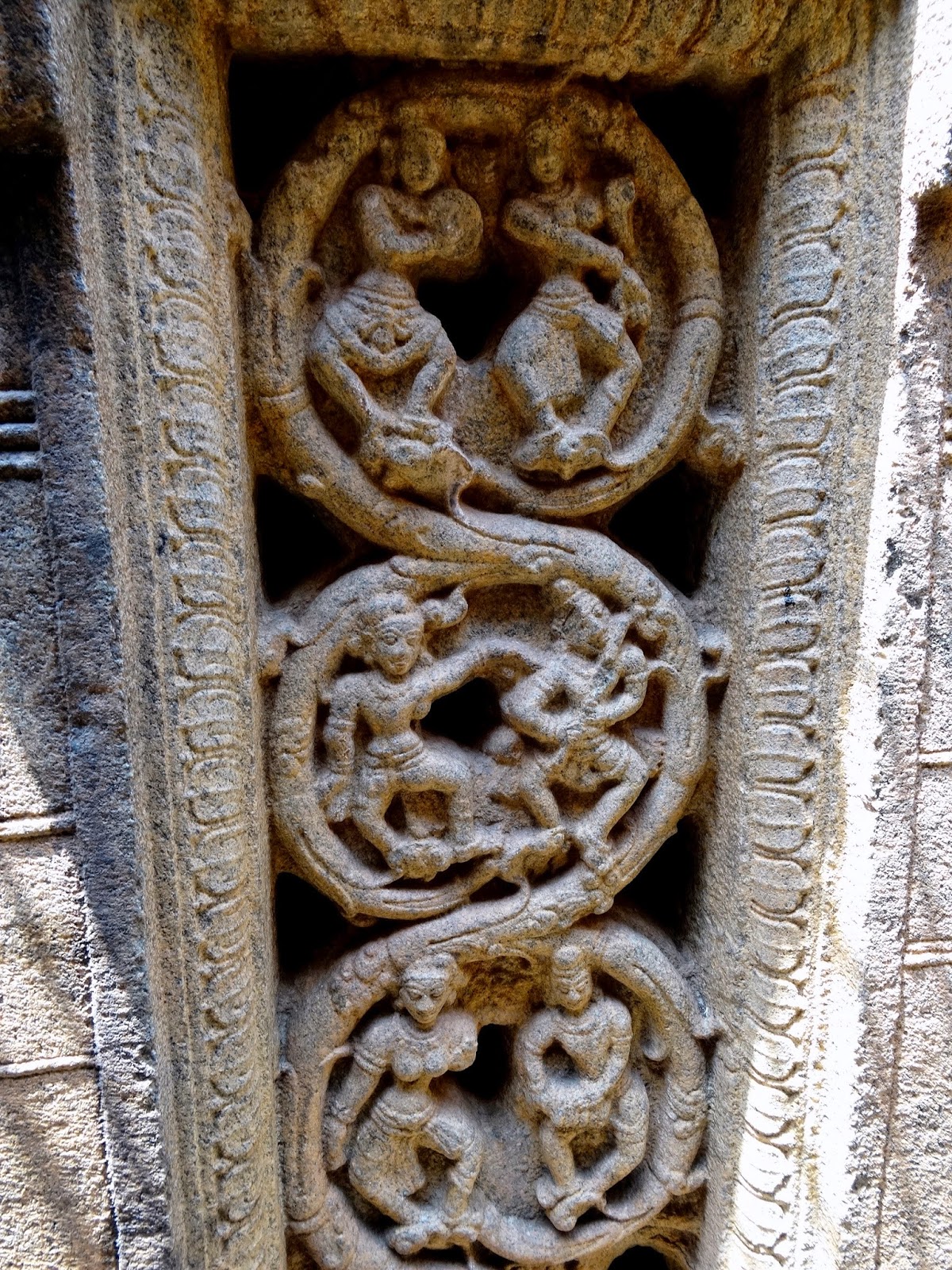
Each consists of a garbhagriha, a sukanasi and a navaranga. They have two pierced windows opposite to each other in both the sukanasi and the navaranga. The four pillars of navaranga in Bhoganandishwara shrine has intricately carved figures on all sides. The ceiling has ashtadikpalakas with Shiva and Parvati on the central panel. The base has a frieze of elephants, yaalis and lions intercepting with each other. Both the shrines have fine stone shikharas that are almost similar in design.


Between the two shrines is a small intervening shrine dedicated to Umamaheshwara. In front of this is a Kalyanamantapa built of black stone very interestingly carved with creepers and birds. The prakara has two Devi shrines, Kalyana mantapa, Tulabharamantapa and a square stepped shringi thirtha pond.

The Arunachaleshwara temple, built by the Gangas, has a unique form of Lord Ganesha called Simha Ganapathi or Ugra Ganapathi or Herambha Ganapati. There is a granite idol of Nandi idol in front of the temple.


Built by the Hoysalas, this temple has the presiding deities Uma and Maheshwara in the Sanctum. The Kalyana Mantapa is surrounded by four pillars each of which have a divine couple depicted on them – Shiva and Parvati, Brahma and Saraswathi, Vishnu and Lakshmi and Agni Deva and Swaha Devi.
The pillars and walls are covered with intricate carvings typical of the Hoysalas. The structures are covered in figures of parrots, animals, creepers and divine figures.


The main Bhoganandeeshwara temple has a majestic Shiva Linga in the sanctum sanctorum. There is a sculpture in the temple that the locals believe is that of Raja Raja Chola. But it could be an idol of a devotee.
“The historical records state that during tenth century, Raja Raja Chola invaded this temple and helped himself to the sculptures in the temple. However, he felt guilty and took the sculptures back, after which he built a statue of himself in the temple complex,” said a historian.
The pillars are covered in beautiful carvings. The Nandi idol in front of the Sanctum of this temple is even more attractive than the one in front of Arunachaleshwara temple.

Vijayanagara rulers added the Kalyana Mantapa and Tulabhara Mantapa.


2 comments:
-
Anoop Negi said...
-
Lovely work on the place. I came in here while checking up the history of the temple complex.
I post my photos on Flickr etc and my blog remains kind of not so active.
-
Anonymous said...
-
Excellent travel blog information and if you want to enjoy the most famous tourist places in India. Book the perfect journey in India which completes your travel needs to do
Agra Tour Packages
Delhi Tour Packages
Golden Triangle Tour Package
North India Tour
Kalaram Mandir - Nashik
The temple was built in 1788 by late Sardar Rangarao Odhekar. According to a local legend, it is said that Sardar Rangarao Odhekar dreamt that a black statue of Lord Rama was lying in river Godavari. Odhekar found the idol in the river and the place where statue the was found was named ‘Ramkund’. The temple derives its name from the statue of Lord Rama that is black in colour. The literal translation of Kalaram means black Rama. The sanctum sanctorum also houses the statues of goddess Sita and Lakshman.

Sardar Rangrao Odhekar, under the consultation with Late Sawaee Madhavrao Peshwa Started the construction of present temple in the year 1780. The main temple was completed by the year 1792 and thereafter the sabhamandapa, the stilt round the temple and the fencing by the year 1799. The temple built of beautiful black stone has about 96 pillars. It is said that the expert masons brought best quality stones from Ramshej Hills near Nashik, tested each block in boiling milk before using it in construction work.The ‘Kalash’ inside the temple is made of pure gold. It took 12 years, 20000 workers and 23 lakhs INR to build this incredibly artistic temple.

Dr. Ambedkar said:
"I didn’t launch the temple entry movement because I wanted the Depressed Classes to become worshipers of idols which they were prevented from worshiping or because I believed temple entry would make them equal members in and an integral part of the Society."
Organized by Ambedkar and the local Mahar leaders, the Kalaram Satyagraha involved thousands of untouchables in intermittent efforts to enter the temple and to participate in the annual temple procession. The agitation for entry into the Kalaram temple went on for four years, from 1930 to 1934. Opposition came not only from the orthodox Hindus but also from some local congressmen. The outcome of the Kalaram Satyagraha, however, was not only further disillusionment with the Satyagraha, with the satyagraha method and the attitude of the congress, but also a rejection of Hinduism and a strengthening of the separatist political stance then developing among Untouchables.
Ambedkar discontinued the agitation in 1934 following opposition by priests, notwithstanding the support extended by Gandhiji. But he fought a legal battle, along with a peaceful agitation, for the next four years, and in 1939 ultimately secured entry to the temple for “untouchables.”
Wandering in the temple courtyard and on the narrow streets around its precincts, with their small houses, latticed wooden balconies, gnarled pipal trees, and clay-tiled sloping roofs, it is hard to imagine a time when access to this temple was so fraught an issue as to become the watershed after which Ambedkar could never allow himself or his community to be reconciled with the Hindu mainstream.
Umaid Bhawan - Jodhpur

The last of India's great palaces, Umaid Bhawan, perched high above the desert capital of Jodhpur is a stunning example of a bygone royal era. It is one of the largest palaces in the world set in 26 acres, of which 15 are garden. It took half a million donkey loads of earth for the garden beds, a 100 wagon loads of Makrana marble, 2.5 million quintals of ice, a million meters of steel conduits, 15,000 running feet of copper and lead were weighing 200 tons, an electric network of 2500 KW for the main palace alone and a 300 ton compressor for the air-conditioning plant. It took more than 5,000 workers 15 years to build the palace, and is unusual in that it does not use mortar or cement to bind the stones together. When finished, it was the largest private residence in the world, with almost 350 rooms. The Maharaja's family still live in one wing of the palace, and another part of the palace is open to the public as a museum. Umaid Bhawan Palace sits on Chittar Hill overlooking Jodhpur and faces the city's other great palace, the Meherangarh Fort.

The furniture and fittings were originally designed by Maples of London, (who had decorated the viceroy Lodge in Simla, as early as 1892) in the Art Deco style that was the pinnacle of fashion in Europe and America in the thirties. They were dispatched to Bombay in 1942 but, tragically, the ship carrying them was sunk enroute by the Germans. Frantic efforts were then made in Jodhpur to manufacture the interiors in the style required. Fortunately, the Maharaja had in Stephan Norblin, a Polish artist who had fled war-torn Europe, an amateur interior designer well acquainted with the work of Art Deco masters like - Emile Ruhlmann. The Maharaja asked Norblin to paint too, and his spectacular and imaginative murals in the Maharaja and Maharani suites superbly complement his decoration, while in the Oriental Throne room, his scenes from the Hindu epic, Ramayana could not have been better chosen for, as we know, the Rathores claim descent from Lord Rama, the ideal Hindu king.
Though the Art Deco vogue has lapsed elsewhere, in Umaid Bhawan Palace, it is perfectly preserved. Occidental in it symmetrical planning and integration not flawless maintain many Indian architectural styles. Like medieval Rajput palaces, it is divided into 2 sections, the "Zenana" or ladies' wing and the "Mardana" or male wing, both with separate entrances, the former with and enclosed private garden and hidden passages to the swimming pool and public rooms. Like their predecessors, the ladies could watch ceremonies, durbars and parties unobserved. The durbar and banquet halls, the auditorium and the ballroom have galleries on the first floor where screens were draped for the zenana.

Its central cupola is 105 feet high. With 347 rooms, a throne room for private auditorium, a ballroom, a library, an indoor swimming pool, a billiards room, 4 tennis courts, 2 (unique) marble squash courts, croquet lawns, a marble pavilion, a nursery and garages for 20 motor cars, the palace is unabashedly magnificent.
The many stylized sculpture and carvings on its caves, parapets and towers have been thoughtfully chosen. Those of horses speak of the Rathores' centuries old equestrian tradition, armorial helmets, of their martial skills, the eagle, their spiritual power and the peacock their majesty. Sculpture of boar, heads capture the excitement of the sport of the day pig-stacking and carved airplanes on parapets and railings celebrate Maharaja Umaid Singh's passion for flying "the latest" as he used to say "of our recreations".
Above all, it is the presence of the "Monarch's imperial medals carved on 4'X6' slabs on each side of the cupola, facing Meherangarh in the west, that makes this palace so uniquely his.


There is about Maharaja Umaid Singh something uniquely exciting, an extravagance of vision, power not only to dream but even to realize; in many ways, albeit on a smaller scale, not unlike that of the Mughals. He enjoyed polo, so he took his own team to England with an army of ponies and syces and Jodhpur emerged a world polo power. He loved flying so the Jodhpur aerodrome became an international airport before Delhi, with 3 trans-continental airlines stopping here.
His famine relief policy, which shames many a modern day development project, gave rise to one of the largest and most magnificent royal residences in the world and a dam that remained, half a century later, Jodhpur's main source of water.
Yet there was in him an astonishing simplicity, a grace he was born with and carried always, whether playing polo at Hurlingham or big-game hunting in Africa, Salmon-fishing in Scotland or fox hunting at his sumptuous estate "Arranmore" in Ootacamund (South India). Feted in the most fashionable of salons the world over he was, as Chief Scout of the Marwar State Scouts Association, equally at home at a boy scout's camp on the dusty grounds of his palace! It was this simplicity and humility, together with his stature and style that earned for the 36th Rathore rule of Marwar the nickname "The Monarch" and it was always used with affection and respect.

The Jodhpur Royal Family first played polo with the Mughals but it did not become a passion with them till much later, in the 19th C. It was in 1889 that Sir Pratap Sing Regent of Jodhpur invited Col. Stuart Beatson to help raise the Jodhpur Lancers and with him came the modern version of the sport. The Rathores took to it as fish to water: here was a splendid substitute for war. The changes, the riding-off, the frantic change of horses, it was all there and only 4 years later the Jodhpur team brought home its first trophy, the Rajputana Challenge Cup of 1893. In 1897, Sir Pratap traveled to London for the Diamond Jubilee: he took his team along, amongst the earliest of foreign teams to invade England. They won many matches there, at Hurlingham and Ranelagh, and returned with their reputation enhanced, the finest Indian team during those years.
By the turn of the centry Jodhpur had become an important polo center, and it would remain so till 1949 (when the city boasted no less than 6 polo fields) rivaling Calcutta, the oldest polo club in the world, by the sheer number of players.
In 1921 Jodhopur beat Patiala to become champions of all India. That victory was only the beginning.

In early 1925 Maharaja Umaid Singh visited England with his polo team mounted by an extremely talented team, which included Rao Raja Hanut Singh, Thhakur Prithi Singh, Ram Singh, Thakur Dalpat Singh and an Englishman, Capt. Bill Williams. The Jodhpur team had a wonderful season, beating every team there was to beat, including the US Army, and winning hte Hurlingham Champion Polo Cup and the Rochampton Open Polo Cup. At the end of the season Umaid Singh was pleased to donate a new pavilion to the West Somerset Polo Club, which boasted one of the prettiest polo fields in England.
Kalgudi (stone temple) at Degulahalli

"Every subatomic particle not only performs an energy dance, but also is an energy dance; a pulsating process of creation and destruction…without end…For the modern physicists, then Shiva's dance is the dance of subatomic matter. As in Hindu mythology, it is a continual dance of creation and destruction involving the whole cosmos; the basis of all existence and of all natural phenomena."
- Fritzof Capra (The Dance of Shiva: The Hindu View of Matter in the Light of Modern Physics )
The cosmic dance of Shiva is called 'Anandatandava,' meaning the Dance of Bliss, and symbolizes the cosmic cycles of creation and destruction, as well as the daily rhythm of birth and death. The dance is a pictorial allegory of the five principle manifestations of eternal energy — creation, destruction, preservation, salvation, and illusion.
According to Kumara Swamy, the dance of Shiva represents:
'Shrishti' (creation, evolution) - symbolized by the drum
'Sthiti' (preservation, support) - symbolized by abhaya-hastha
'Samhara' (destruction, evolution) - symbolized by fire
'Tirobhava' (illusion) and
'Anugraha' (release, emancipation, grace) - symbolized by foot held aloft
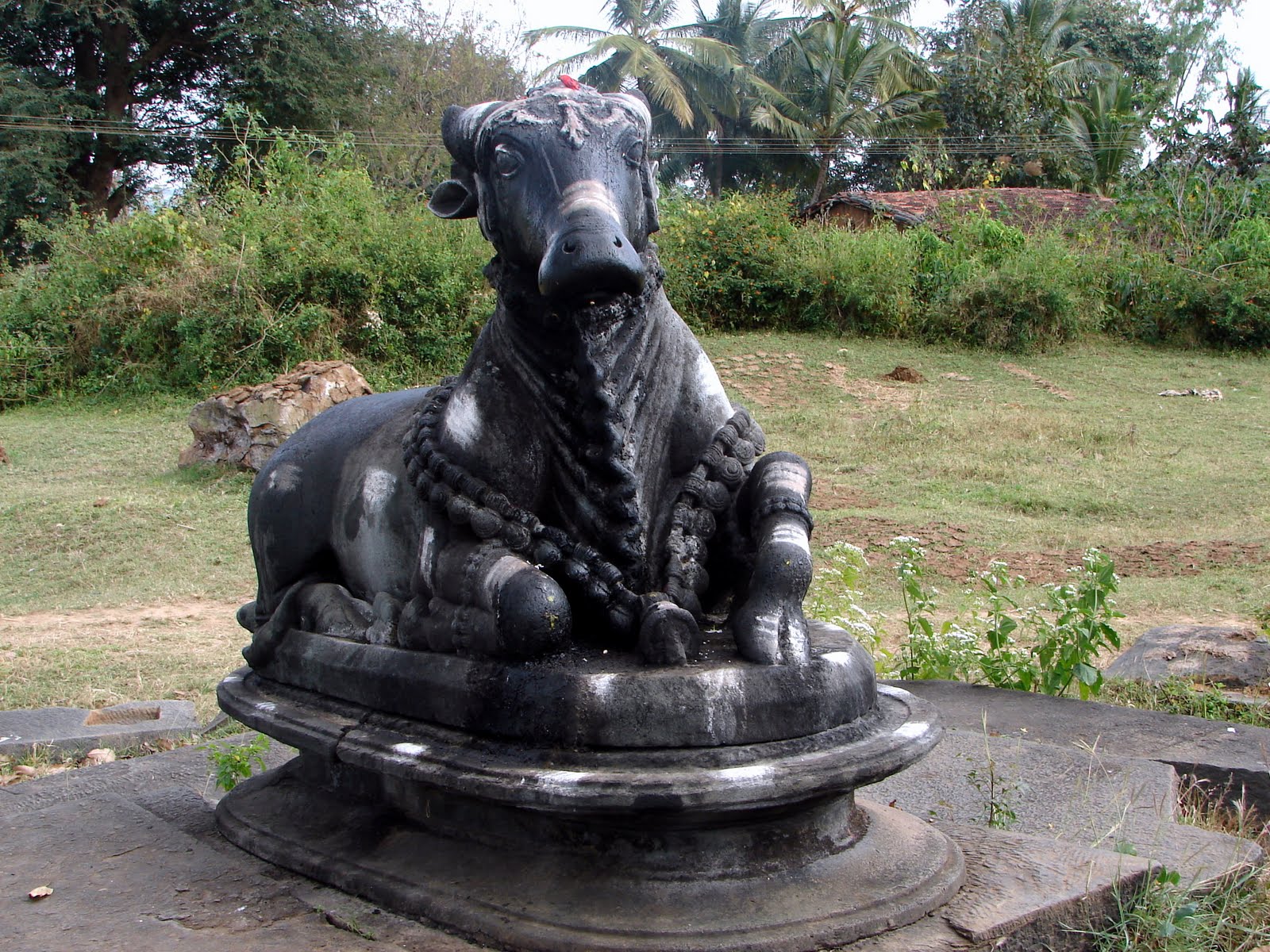
Following paragraphs borrowed from "Sacred Animals of India By Nanditha Krishna"
Nandikeshwara, lord of happiness, was one of Shiva's ganas. He was also fond of music and dance. He was born to the divine progenitor Kashyapa and divine cow Surabhi. He married Suyasha, the daughter of the Maruts. As his life was coming to an end, he prayed to Shiva to lengthen his life. Shiva granted him both immortality and the chief position over his ganas. He was given the title "Adhikara Nandi" (or 'authoritarive Nandi'), for it is only with Nandi's grace and permission that one can enter the temple of Shiva. Adhikara Nandi took on a human form as a bull-headed human standing on two legs, or even a bull standing erect on his rear legs.
Nandi's attributes were taken over by Shiva as Nataraja, the lord of dance. Nandi ceased, thereafter, to be a deity and became the companion and, later, the vehicle of Shiva. When Shiva dance the tandava, Nandi accompanied him on the mridangam (a percussion instrument).
There are several other stories about Nandi's origin. According to one, Nandi was a rishi (sage) who performed such severe austerities that Shiva granted him the wish of becoming the head of his Ganas.
According to another legend, Nandi was born from Vishnu's right side as a gift to the Brahmin Salankayana. This was Nandi's forty-ninth rebirth.
Nandi is more than Shiva's vahana or vehicle. As the chief of Shiva's attendants, he is also the guardian of all four-legged animals. Nandi is essential to every Shiva temple - the sanctum sanctorum of each temple, where the deity may be in human or linga form, has an image of Nandi facing the shrine. The devotee will first touch the Nandi image and ask for his blessings before entering. Sometimes, Nandi may be as big as or even bigger than the image within.

Following paragraphs have been borrowed from http://www.newworldencyclopedia.org/entry/Ganesha
Historically, Ganesha appeared as a distinct deity in recognizable form beginning in the fourth to fifth centuries C.E., during the Gupta Period (c. 320-600 C.E.) of Indian history. His popularity rose quickly, and he was formally included among the five primary deities of Smartism, an influential stream of Hinduism that began in the ninth century C.E. Ganesha appears as a distinct deity in clearly-recognizable form beginning in the fourth to fifth centuries C.E., suggesting the emergence of the Ganapatya (Ganesh-worshipping) sect (probably an offshoot of mainstream Shaivism). The earliest cult image of Ganesha so far known is found in the niche of the Shiva temple at Bhumra, which has been dated to the Gupta period. By about the tenth century C.E., Ganesha's independent cult had come into existence.
Despite these fragments of information, questions as to Ganesha's historical origin are still largely unanswered, and many theories persist as to how he came into being. One theory of Ganesha's origin states that he gradually came to prominence in connection with the four Vināyakas, from whom he gains one of his epithets. In Hindu mythology, the Vināyakas were a group of four troublesome demons who created obstacles and difficulties, but who were easily propitiated. Krishan is among the academics who accept this view, and states flatly that Ganesha "is a non-vedic god. His origin is to be traced to the four Vināyakas, evil spirits, of the Mānavagŗhyasūtra (seventh–fourth century B.C.E.) who cause various types of evil and suffering." While none of these gods are conceived to be elephant-headed, they are held to be responsible for the creation of obstacles.


Brahmani, Vaishnavi, Maheshvari, Indrani, Kaumari, Varahi and Chamunda or Narasimhi - Saptamtrikas
Following information has been referred from wikipedia -
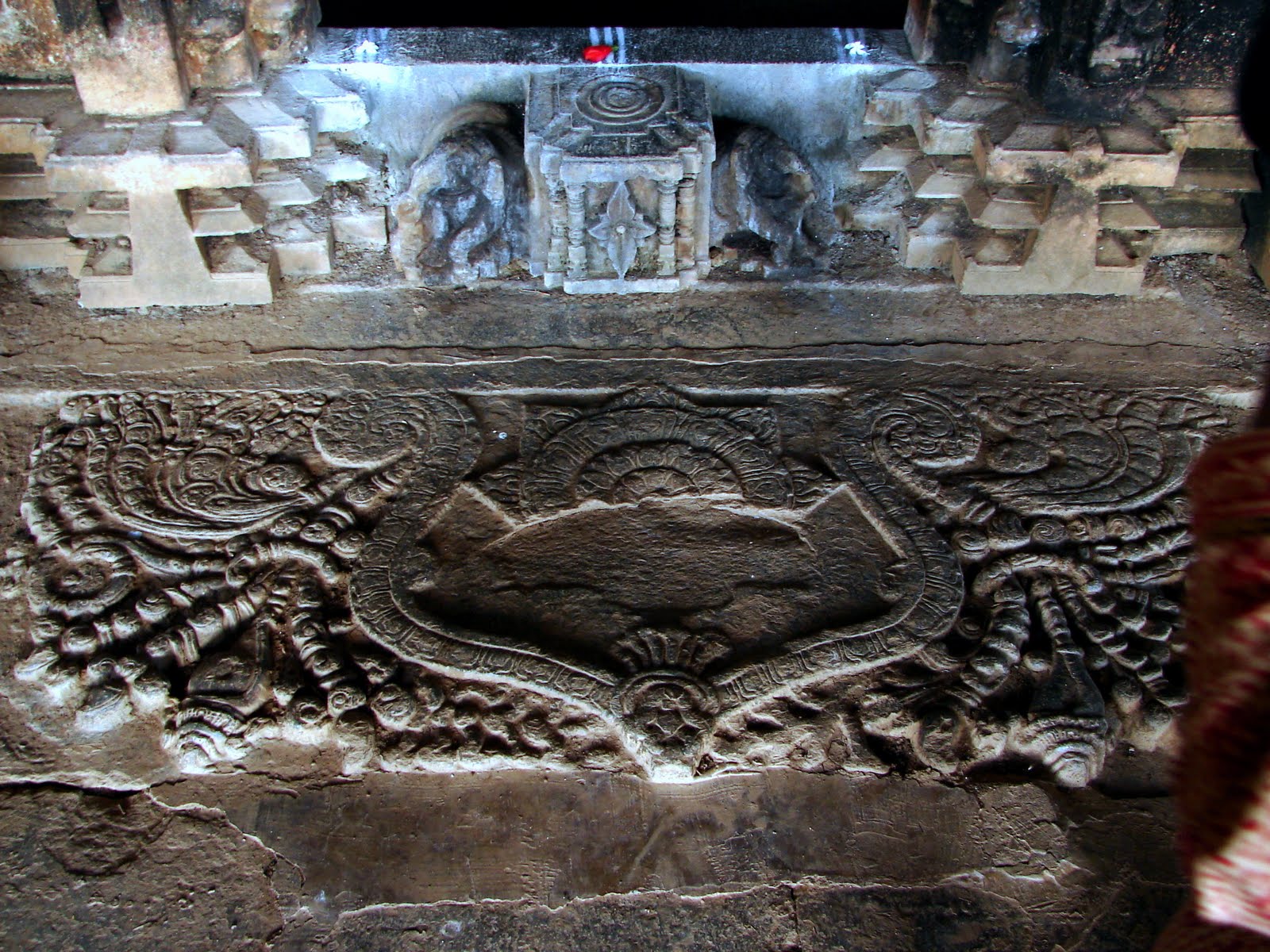
Matrikas were existent as early as the Vedic period and the Indus Valley civilization. Matrikas may be non-Aryan or at least non-Brahmanical (orthodox Hinduism), local village goddesses, who were being assimilated in the mainstream. Matrikas maybe inspired by the concept of Yakshas, who are associated with Skanda and Kubera – both are often portrayed with the Matrikas. The Sapta-Matrikas were earlier connected with Skanda (Kumara) and in later times, associated with the sect of Shiva himself. During the Kushana period (1st to 3rd century), the sculptural images of the matrikas first appear in stone. In the Gupta period (3rd to 6th century A.D.), folk images of Matrikas became important in villages. The Western Ganga Dynasty (350–1000 CE) kings of Karnataka built many Hindu temples along with saptamatrika carvings and memorials, containing sculptural details of saptamatrikas.
The inconsistency in the number of Matrikas found in the valley [Indus] today (seven, eight, or nine) possibly reflects the localization of goddesses. Although the Matrikas are mostly grouped as seven goddesses over the rest of the Indian Subcontinent, an eighth Matrikas has sometimes been added in Nepal to represent the eight cardinal directions. In Bhaktapur, a city in the Kathmandu Valley, a ninth Matrika is added to the set to represent the centre.
Hazrat Nizamuddin Aulia (R.A.) Dargah
Turn round the king of the prophets (and) with the utmost humility recite the Salaam.
Sometimes pass the gate of mercy (and) with the gate of Gabriel rule the forehead.
Salaam to the prophet of God (and) sometimes recite Salaam at the gate of peace.
Put with all respect the head of faith on the dust there.
Be one with the sweet melody of David and be acquainted with the cry of anguish.
In the assembly of the prophets recite verses from the humble being 'Nizam'.
- Hazrat Nizamuddin Aulia (R.A)

Hazrat Nizamuddin Aulia's ancestors were from Bukhara (now in Uzbekistan). After leaving their homeland, the paternal grandfather of Hazrat Nizamuddin Aulia -- Khwaja Ali -- and the maternal grandfather of Hazrat Nizamuddin Aulia -- Khwaja Arab -- along with their family, came to India. At first they lived in Lahore, but later they took up their residence in Badayun (East of Delhi). Khwaja Arab married his daughter Bibi Zulaitaikha to Khwaja Ali's son Khwaja Ahmad.
Shaikh Nizamu'd-Din was born at Budaun in 1236. He lost his father at the age of five and came to Ghiyaspur near Delhi, with his mother. Young Nizamu'd-Din mastered the seven ways of reciting the holy Qur'an. Then he studied Arabic grammar, commentary of the Qur'an and logic. At the age of twelve, he received the "turban of excellency." He was so sharp-witted, wise and understanding that he was given the title "Debater, capable of defeating the congregation." He became distinguished in mathematics and astronomy. Later he became the disciple of the famous saint Shaikh Farid Shakarganj, who introduced him into the world of Sufism. Later, Sheikh Farid Shakarganj appointed Nizamuddin as his successor and he was conferred as Hazrat Nizamuddin Aulia.
In his lifetime, Nizamu'd-Din was frequently at loggerheads with the Delhi rulers but was also sought after for advice and blessing. He had many followers which include the ferocious ruler named Sultan Ala-ud-din Khilji and Muhammad Bin Tughlaq as well as Hazrat Amir Khusrau, who is known as one of the most renowned poets of all times.

"He was not a miracle-monger of the ordinary sort. He never flew in the air or walked on water with dry and motionless feet. His greatness was the greatness of a loving heart; his miracles were the miracles of a deeply sympathetic soul. He could read a man's inner heart by a glance at his face and spoke the words that brought consolation to a tortured heart."
In the early period of his Hazrat Nizamuddin Aulia experienced great poverty. Although in Sultan Ghyasuddin Balban's time one could buy melons for very little money, the greater part of the season would pass without Hazrat Nizamuddin Aulia eating a single slice. One day a pious woman brought some barley flour and presented it to him. He asked Sheikh Kamaluddin Yaqub to boil it in a cauldron. At that moment a faqir with a patched frock arrived and with a loud voice said: "O, Nizamuddin! bring whatever is present." Then Hazrat Nizamuddin Aulia gave all the food to him. The faqir ate it all and then broke the cauldron. Hereafter he said: "O, Nizamuddin! You have received the bounties of the invisible world from Baba Farid and the bowl of visible poverty I have broken. Now you have become the sultan of both the visible and invisible world." From that day on, countless gifts started coming and free food was distributed to hundreds of visitors every day.
Hazrat Nizamuddin Aulia was very generous as can be seen in the following narration, which can be found in Jami's "Nafhatul Uns". A merchant of Multan lost all his possessions to a band of thieves. He told Sheikh Sadruddin, the son of the famous Suhrawardy saint (Shaikh Bahauddin Zakaria of Multan), that he intended to go to Delhi and asked for a letter of recommendation to Hazrat Nizamuddin Aulia. Then he was told by the great saint that he would receive all the gifts that would be given from the morning to the chasht (forenoon) prayers. About 12,000 golden and silver coins were received. All these were given to the merchant. Every day large numbers of gifts used to be received, but they were distributed before the evening. More than three thousand needy people used to live on the langar (free feeding).

Being drunk with divine mysteries:
Hazrat Mehboob-e-Elahi -- the beloved of Allah,
O, how I long for the attar of your company
Hazrat Nizamuddin Aulia represents in many ways the pinnacle of the Chishti Order of the Sufis. Hazrat Baba Farid, his spiritual guide, said to him on appointing him as his successor: "Be like a big tree, so that Allah's creation, the human beings in their vast multitudes, may find rest and solace under your shadow." This partly explains why he admitted so many (according to some, including Barani, too many) men into the Chishti order as his disciples. Another reason has been clearly formulated in this way: "History, nonetheless, bears out the wisdom of his open-ended policy . . . To far-flung areas of Uttar Pradesh, Rajastan, Gujarat, Bihar, Bengal and the Deccan, Hazrat Nizamuddin Aulia sent able disciples well versed in the Chishti practices, yet sensitive to the needs of the local populace."

Hazrat Nizamuddin Aulia lived in a small village called Ghiyaspur on the outskirts of Delhi. He lived there for 60 years. He is also referred to as Mehboob-e-Elahi, the beloved of Allah. He died in 1325 and is buried here. Today, Ghiyaspur is better known as Nizamuddin. Muhammad Tughluq built the tomb and to this day, the place is one of the sacred places of pilgrimage. Though the original Tomb of Hazrat Nizamuddin does not exist, a nobleman and follower of the Saint named Faridun Khan constructed this present Tomb structure sometime during the mid 15th Century AD. This was later renovated and re-decorated by Feroz Shah Tughlaq and his following successors as well as the following rulers. The present structure was built between 1562-63 by Faridu'n Khan, a nobleman with a high rank, and has been added to or repaired later by several persons.
Hazrat Nizamuddin was so popular that while travelling through this place, Mughal Emperors like Babar, Humayun, Akbar, Jahangir and Shah Jahan would ensure to halt at the Shrine of this Mystic Saint and duly pay their respect at the Dargah. He was mainly known for his Doctrine of Sacrifice and Surrendering to the Almighty as well as tolerance towards other religious sects which greatly influenced people from all cultural backgrounds and hence had a huge number of devotees following. He also prophesized that Sultan Ghiyas-ud-din Tughlaq (name also spelled as Ghiyath Al-Din Tughluq and real name was Ghazi Malik) would never return to Delhi from his campaign and that is what exactly happened. Ghiyasuddin Tughlaq died on his way to Delhi in February 1325 AD. He ruled for a short span of 5 years only between 1320 AD and 1325 AD and was succeeded by his son, Muhammad Bin Tughluq.

The Courtyard is paved with marble where the sacred Shrine, Dargah or Tomb of Hazrat Nizamuddin sits and the grandiose pavilion that you see today decked with lattice screens or 'Jalis' and arches made of marble was later added to the shrine by Emperor Shah Jahan. Most of the devotees and worshippers tie a red thread around these lattice screens in hope of getting their wishes fulfilled. The imposing dome, ornate with vertical stripes of black marble with lotus ornamentation was later added by Mughal Emperor Akbar II.
The Tomb of Hazrat Nizamuddin is surrounded by a Mosque and several Tombs of famous people as it was their dying wish to be buried next to the Sufi Saint. Other tombs situated inside the complex of Hazrat Nizamuddin Auliyaa Dargah belong to Begum Jahan Ara, Shah Jahan's favorite daughter, and Mirza Ghalib.
Seven hundred odd years later, the dargah still retains the essence of what it must have been like all those years ago.
Reference Sites:
http://www.nizamuddinaulia.com/
http://www.nizamuddinrenewal.org/
http://khawajagharibnawaz.com/KhwajaNizamuddin.html
Turtuk - Delightful Baltistan Indian frontier village

The barren landscape slowly transformed to green pastures. The chortens and prayer flags, those ubiquitous landmarks of Ladakh, had disappeared. The village transformed from Buddhist-Ladhaki to Muslim-Balti both culturally and linguistically as we drove from Hunder via Panamik to Turtuk, a delightful hamlet tucked into a narrow Shyok river valley in the farthest corner of India. It is literally the last village on Indian Line of border control.

The scenically magnificent main village is up a steep stairway leading to stone terracing. High on a crag are the crumbling ruins of an old fort. Turtuk like any other typical Baltistan village perches on laboriously terraced and fertilised alluvial fans that extend from side streams onto the banks of the main rivers. It is a tight cluster of interconnected houses and narrow passageways. Houses of stone and dried mud-brick with flat roofs of interlaced willow fronds overlain with mud stand in the shade of giant apricot, walnut and mulberry trees. As with other Ladakhi/Balti villages, water channels gurgle through the winding village lanes.
River Shyok (literally "the river of death" in Yarkandi or Central Asian - probably given by the Central Asian traders who ventured on this treacherous route for centuries and perished) a roaring, turquoise torrent rushing to converge with the mighty Indus in Pakistan is the only thing noisy and brash in an otherwise tranquil and peaceful podunk. Its water is augmented perennially by the countless little streams originating from the Himalayan glaciers. One such gushing glacier-stream cuts across Turtuk, dividing the village into two sides known as the Youl and Farol. Youl, the original Turtuk village, is clustered below the old fort and palace on the west bank of the stream. Pharol is the newer village area among terraced fields on the east bank of the stream. About 300+ Balti families belonging to Tibetan origin stay happily together on either sides.

In the Balti language, balti refers to a basement chamber where animals are housed below the ground-level human dwelling space. Such protective housing for a necessarily limited number of animals marks the early Balti people as settled agriculturists. These Tibetan-speaking farmers might have been known to their Tibetan pastoral neighbors as Balti-pa, "those who keep their animals in an underground chamber"
In winter the families occupy an 8X10 feet ground floor room with their animals quartered below in the balti. In summer much of the life and work of the household takes place on the roof. The village occupies as little space as possible in order to allow maximum amount of cultivation in this inhospitable soil. The village is surrounded by small plots of privately owned land. Although new lands are developed through communally pooled labour, as the land comes into production it is divided into individually owned parcels, and villages must travel farther and farther away from the village to work their fields. The people continue to reside in the main village, preserving its compact character.


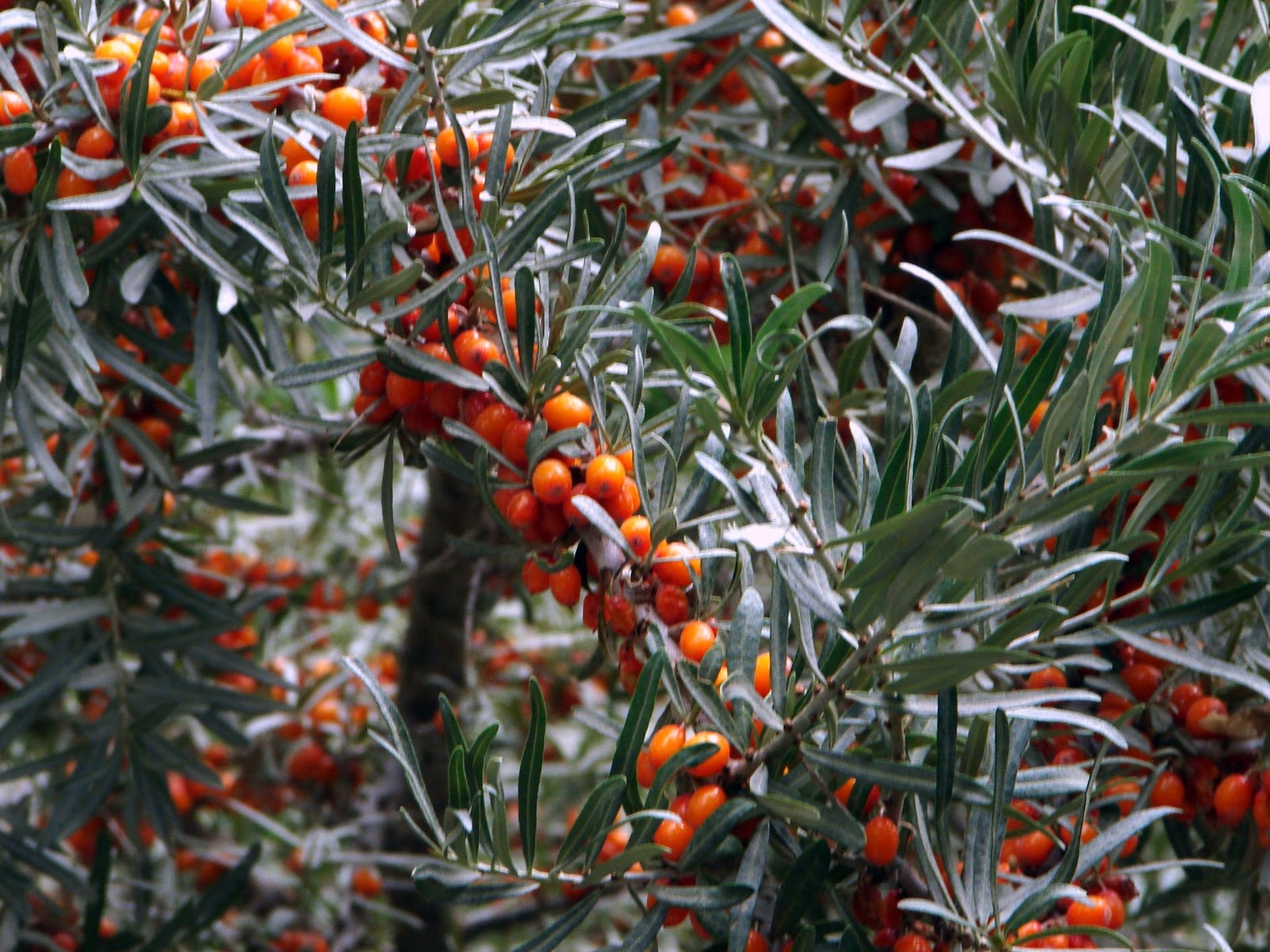
Being lower in altitude than most towns in Nubra Valley (somewhere around 3000m), the village is fertile and lush with vegetation. Agriculture is in its full splendour during the summer months. Vegetables including cauliflower, tomato, cabbage, spinach, carrots and greens are cultivated and stored for the long and hard winter. Apricot trees border every house's fencing. Walnut trees sport green, unripe fruits. The locals dry up the mature fruits to extract the crispy walnuts. Ancient Chinese documents refer to Baltistan as 'Apricot Tibet' and Balti dried apricots were prized as far east as Lhasa.


The Balti, presumably descendants of the Scythians (Saka), form a majority group among the Muslims of Ladakh in Jammu and Kashmir. They derive their name from their homeland Baltistan, and they also perceive their distribution in Kargil, Leh and in parts of Baltistan. They speak Balti and use the Perso-Arabic script.

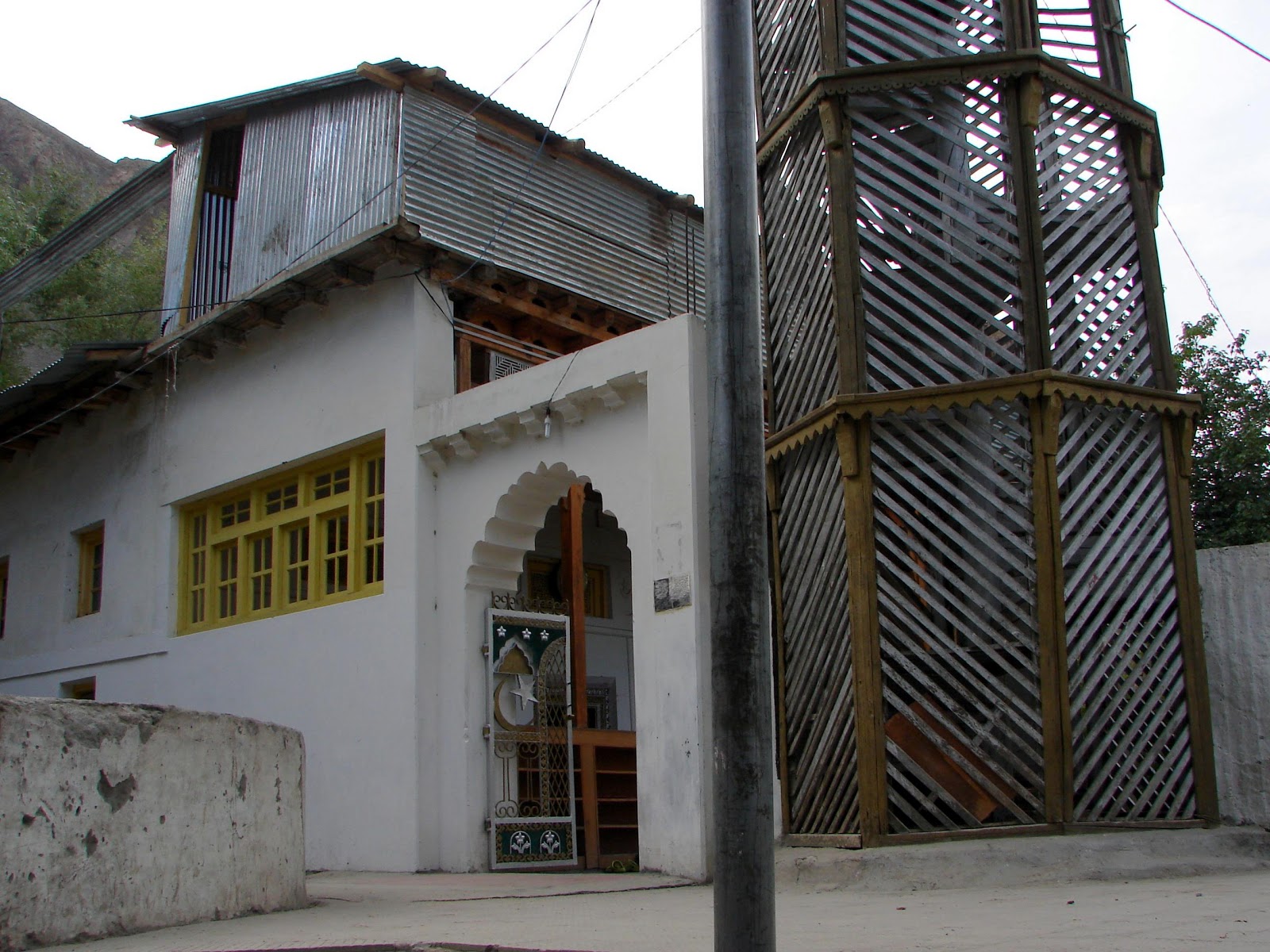
The Baltis were Buddhist prior to 1400. At approximately that time, Sufi teachers converted the Baltis to Islam. Local tradition attributes the origin of Islam in Baltistan to one or more visits from Kashmir by Sayyid 'Ali al' Hamadani. There is no historical record of his personal visit, but his influence, whether directly or through his disciples, is well established. Some of the oldest mosques in Baltistan are wooden Khanaqahs, constructed on the unique design of the famous Shah Hamadan mosque in Srinagar.
But most interesting, the Nurbakshiya Sufi order, derived from Ali al Hamadani through Isaq al Khuttalani to Muhammad ibn Abdullah (known as Nurbaksh) was brought from Kashmir to Baltistan. Nurbakshiya Sufis still prevail in the eastern sections of Baltistan and are numerous in the Shigar region. The rest of the Balti population, notably in the Skardu area is predominantly Shia.
Following information has been borrowed from Encyclopaedia of the World Muslims: Tribes, Castes and Communities, Volume 1
A more important social-organisational correlate of Balti hydraulic ecology is seen in the history of state formation and alien rule in Baltistan. What are now the three most intensively irrigated regional centres in Baltistan - Skardu, Shigar and Khapalu - were, from as early as 740 A.D., the foci of major political development in the upper Indus Basin. Most likely under the sponsorship of Chinese imperial power in Turkestani dynasties established rulership in all three regions of Baltistan. The Amacha family ruled over the sovereign state of Shigar from some unknown date of origin until 1840.
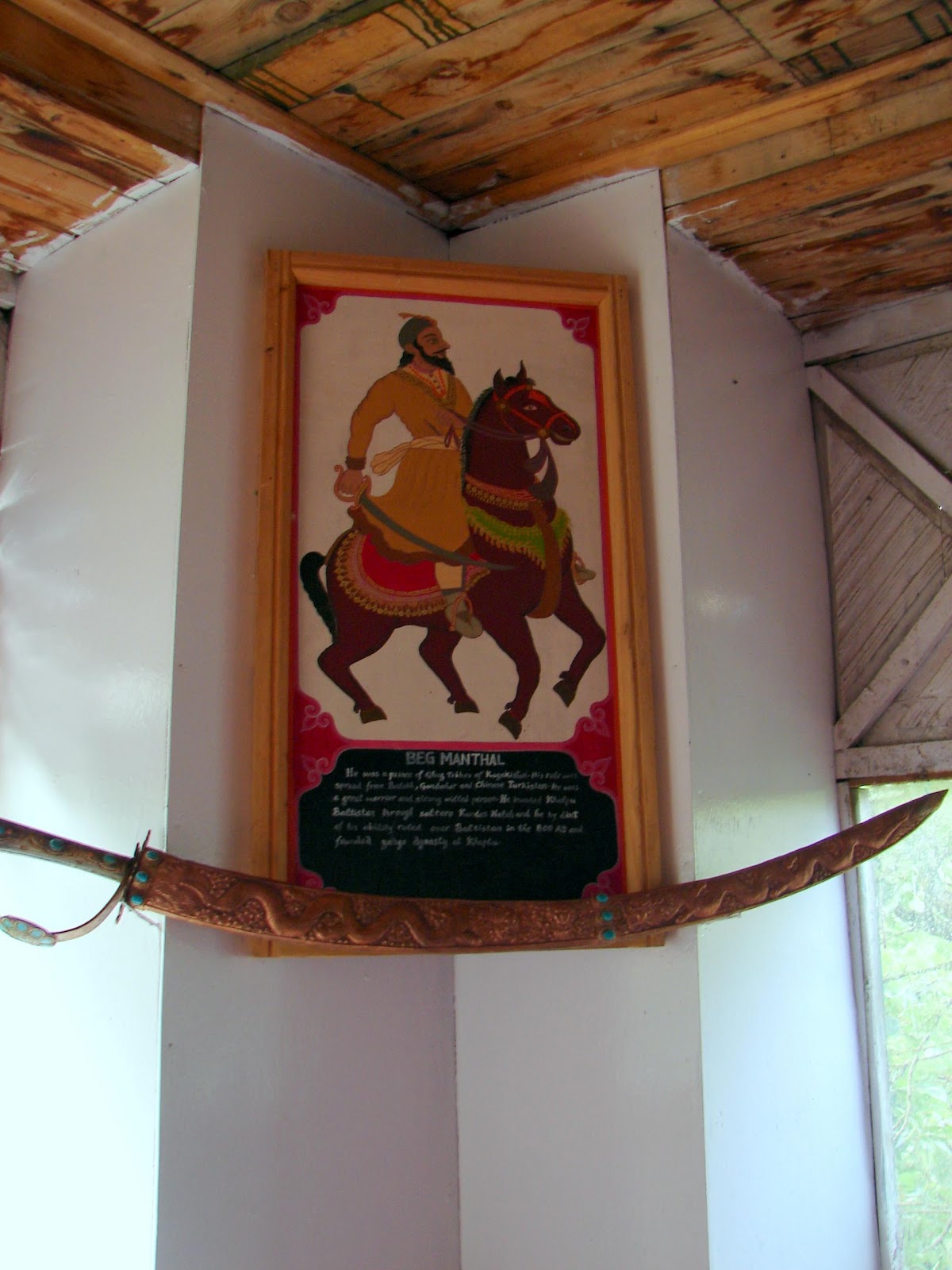
The Yabgo dynasty was ruling in Khapalu for some time well before 1500 until 1972, when Khapalu was fully annexed into Pakistan. There is a reason to believe that 'Amacha' derives from Amacas, a title granted by the Chinese crown to the kings of Khota; and the 'Yabgo' derives from yabghu, the title of the 8th C Turkic Buddhist rulers of Kundus in the Tokharistan region of Turkestan.
In Baltistan, these dynasties came to rule under the title cho ('chief' in Balti/Tibetan). Thus a ruling class of ancient Turkestan origin (called Kha-Cho, brothers of the Cho) ruled over indigenous Tibetan-speaking cultivators. The Balti states lost sovereigenity and were gradually absorbed into the British-Indian empire beginning in 1840, when Zorawar Singh conquered all of Baltistan and Ladakh.

We were honored to meet the Khan of Turtuk, Mohammad Khan Kacho of the Yabgo Dynasty of Chorbat Khaplu. He is the direct descendant of King of Western Turkistan that ruled over this area (called Baltistan Chorbat) for over 1000 years (800AD – 1800BC). His ancestors derived their power and wealth from Turtuk’s strategic location on a feeder road of the Silk Route going on to Central Asia via Skardu and Yarkand. The old Khan now lives a poor life with a young wife and daughter aged 8-10 years who could be easily mistaken for his grand daughter.
Khan has his own private museum of family artefacts that have been passed on for generations. A proud historian himself he has written up the history of his village and compiled the family tree from a cloth version that was passed from generation to generation. A very humble and hospitable man, he warmly welcomes one and all to his humble abode and talks about his royal history with pride in fluent Hindi.
People of Turtuk primarily speak Urdu. Many can converse in Hindi and some Ladakhi. Most also have only a smattering of English.


Myriads of cobbled paths led us to a polo ground in Farol. Horse polo is the famous game of Baltis and is being played for centuries with gaiety and fervour. A game of Central Asian origin, it was first played in Persia (Iran) at dates given from the 6th century BC to the 1st century AD. Polo was at first a training game for cavalry units, usually the king’s guard or other elite troops. To the warlike tribesmen, who played it with as many as 100 to a side, it was a miniature battle.
In time polo became a Persian national sport played extensively by the nobility. Women as well as men played the game.From Persia the game spread to Arabia, then to Tibet (the English word polo is the Balti word meaning “ball”), to China, and to Japan.

The aim is to enhance the mental, emotional and psychological development of children within and beyond the education they receive at school, giving them the best possible foundation for the rest of their lives.


A land that is not frequented by the tourists manages to cling on to its slowly dying Balti culture. A visit to this little village sure makes you feel like you are on top of the world!
Jama Masjid - Champaner

Champaner, a sleepy town, with its crumbling fortifications, is a tribute to Begada's architectural imagination. The focal point of Champaner's World Heritage status, is the imposing Jama Masjid. Dating to 1513, this is one of the finest mosques of Gujarat. The fine architecture is an unique amalgam of Hindu and Muslim styles of decoration. This gigantic structure with two imposing minars on either side of the central entrance to the prayer hall was constructed over 125 years. The minars are a fine blend of Hindu and Islamic architecture.


The mosque is a place of pilgrimage for those who seek blessings from the pir who is buried in one corner of the mosque gardens.

The roof just behind the central dome is filled by a carved slab of great beauty and ingenuity of workmanship. There are seven mehrabs (prayer niches) in the back wall of the main prayer hall, the central being more elaborated. The northern section of prayer hall was separated by a perforated screen, reserved for ladies from where an extra entrance was provided. The prayer hall has eleven domes with the central dome, a double-storied structure, built on pillars in an arcade form. A pillared corridor goes round the vast court yard.


The mosque stands on a raised platform and comprises a walled structure with entrances on its north, south and east sides. The eastern entrance is the main gateway into the building and projects outward in the form of a wonderful doorway embellished with skillful decoration in stone.


The mosque has a courtyard surrounded by pillared corridors, with the main shrine at the far end within which are seven mihrabs or prayer niches. Like the Shahar-ki-Masjid , this mosque also has five arched entrances, with the central one —higher and more prominent flanked by 30 metre high minarets. This mosque had three oblong mural plaques, one at the top of the pulpit and the other two on the sides, with engravings of hymns from the Koran. Of the two minarets, one was damaged by an intentional gun firing in 1812 by Patankar, a Scindia Governor considered a “tyrant.”


It was during the reign of Mahmud Begahra a passionate builder, the famous Gujarat Muslim style reached its apogee. The Hauz-i-Vazu, a large open-air tank for rainwater harvesting, adjoins the main mosque. Nearby is a stepped tank that must have been used for pre-prayer ablutions.Water-wise, Begada created narrow ledges at the base of slopes to contain downhill streams, leading to interconnected lakes, and finally to the largest Vada Talav in the plains.


Artisan communities responsible for building Champaner's mosques practised the regional style of architecture, offering their skills to the reigning patron, regardless of his faith. Even though figural representation - a mainstay of temple embellishment was prohibited in Islamic religious buildings, the artisans had many opportunities to practice their trade in the profuse aniconic ornamentation. The stone mihrabs in the Jami Masjid and other mosques had recessed frames with lintels topped by aedicular niches within which were carved symbols of plenitude: the sun, pot and foliage. Besides the pot motif (purnaghata), the mosque and tomb surfaces were ornamented with the vine (kalpavalli), the bands of diamond motif (ratnapatta), and lotus medallions (padmasila), which had adorned the surfaces of earlier temples.
Although the stone carvers and masons worked within a regional design tradition, learned by imitative practice and passed down from one generation to the next, their knowledge and skills were employed with a degree of flexibility and inventiveness. The building patrons and users were identifiably Hindu, Muslim, or Jain, but while the workers themselves also had specific religious identities, their art was not limited by sectarianism but could be adapted as needed. Their building knowledge and skills were a living tradition imbibed from their forefathers, not a codified and static text that would prove irrelevant with changing times and patrons of different faiths.


Among all the UNESCO world heritage sites of India, Champaner is the least celebrated.This is truly one of India's finest archaeological sites and yet limelight still eludes it...Which muezzin called the faithful to prayer at this masjid? I wonder!
7 comments:
-
R Niranjan Das said...

-
Looks wonderful. Great architecture. As you entioned, definitely the least celebrated of the UNESCO sites in India. Thanks for sharing this nice article.
-
Casey said...

-
Thanks Niranjan for visiting my blog.
-
sunand sampath said...
-
very informative , good capture of details , Thanks for the efforts in creating information for public domain ,
-
Casey said...
-
Thanks Sunand
-
lotusleaf said...

-
Just by chance, I stumbled upon your blog. It is full of information and good photos. I read through many of your posts and liked them very much.
-
Casey said...
-
Thank you Lotusleaf for visiting my blog and linking the posts.
-
SAM India Tour said...
-
Thank you for publishing this awesome article
Golden Triangle Tour Packages
Patwa Haveli - Tajmahal of Jaisalmer

The Patwas were invited by the rules of Jaisalmer to finance the state deficit. This brought the clan back to the city that they had decided never to return to. Ghumanmal Bafna , the head of the family decided to gift each of his five sons a separate and elaborate haveli against the advise of the priest. Haveli is the term used for a private mansion in India and Pakistan, usually one with historical and architectural significance. The word haveli is derived from the Persian word hawli, meaning "an enclosed place". They share similar features with other mansions derived from Islamic Architecture such as the traditional mansions in Morocco called Riads.

An intriguing asset to architectural history, the special quality of the haveli stems from the fact that it is not a single haveli, but a cluster of five havelis. The first of the five Havelis known as the Kothar's Patwa Haveli, named after the present owner, is most opulent and extrordinarily preserved. It gives a glimpse of the rich lifestyle of the erstwhile Patwas.

The haveli has rich artistic work in each corner like the gracefully carved pillars, façade or the balconies (jharokhas), expensive decorated items imported from various coutnries, murals and interiors that have derived inspiration from the Rajputi, Mughal as well as the Victorian architecture. Jaisalmer had different forms of architecture in different eras. The ancient times saw Rajputana architecture dominating the area while the medieval period saw a fusion of Rajputana and Islamic architecture. Most havelis were constructed during this era.

Patwa haveli exhibits an elaborate filigree work on stone. The dexterous fingers of the stone carvers have created masterpieces of art, better and minute than those found on the Taj Mahal. It also houses a museum, where various rooms used by the Patwas, along with their household items, have been kept intact to provide a glimpse of their lifestyle. Besides exhibiting the lifestyle of the Patwas, they also hint at their aesthetic taste.

Mohini Vilas (Mirror Work)
Widely considered as the ‘Taj Mahal of Jailsalmer’, the haveli was mentioned in Lonely Planet (2009 edition) as the most magnificient of all the havelis.
"Most magnificent of all the havelis, its stone work like honey-coloured lace, Patwa-ki-Haveli towers over a narrow lane. It was build between 1800 and 1860 by five Jain brothers who were brocade and jewellery merchants. It's most impressive from the outside. The first of the five sections is opened as the privately owned Kothari's Patwa Haveli Museum, which richly evokes 19th-century life. Next door is the forlorn and empty (apart from pigeons and bats) government-owned haveli. "


The Patwonji ki Haveli is an interesting piece of architecture and is the most important among the havelis in Jaisalmer. It was the first haveli erected in Jaisalmer. The first among the cluster was constructed in 1805 by Guman Chand Patwa and is the biggest and the most ostentatious. He ordered the construction of separate stories for each of his five sons. These were completed in 50 years, indicating the sophistication and vastness of each structure. All five houses were constructed in the first 60 years of the 19th century.
The havelis are also known as the "mansion of brocade merchants". This name has been given probably because the family dealt in threads of gold and silver used in embroidering dresses. However, there are theories, which claim these traders made considerable amount of money in opium smuggling and money-lending. Keeping in mind the climate of Jaisalmer, the floors are made of mud and wood has been used for the roofs so that the havelis remain cool in summers and warm in winters. Each haveli has a diwankhana, guest room, kitchen, basement, staircase, safes etc.

Munim's chamber
The haveli has a Munim's chamber within it. Munims worked as accountants and secretaries to big businessmen. The Munim was the real interlocutor for the official business. He was not only the mediator and spokesman, but also a key personage who could both read and draft materials and who had a grasp over the realities of the trade. Besides, a Munim was also required to be discreet and virtuous.
The furnishing of the room was simple, the Munim would sit at one end of the room with his paraphernalia of typewriter, ink pen and ink stand, bahi khata (official business accounts), scrolls and scroll keepers to seal in confidential papers and record the proceedings of business meetings, make and receive payments and oversee the balance sheet of the business. At the other end would be a small seating area where the Patwa seated at the center entertained clients with hookah, food and drinks and engaged in business dealings. In one corner would be a safe to store cash and valuables and in the other a picture painting of Goddess Lakshmi worshipped by all who seek material wealth and fortune.

Visitors would be entertained in the drawing room, situated on the second floor. At present the drawing room attracts the viewers' attention with the huge elegant 'surahi' (wine/water container). The furniture - the superbly carved sofas, chairs, centre table and the side tables - are characteristic of 19th C rich houses and is marked by heavy forms and intricacy of design. The office table could be used to read, write or sign documents while engaged in socializing and entertainment.

Gold Ceiling in chamber
A chess board is nearby if the party wanted to play a friendly game. Collectors' items of decorative and functional value play a great role in the image of the drawing room. Of particular note are the antique clock, old fashioned cameras and the real master piece is a large music box. Pictures on the wall enliven the mood of the room, and the mirrors enchance the light from candles during the evening. A bottle of scented water was kept handy to be sprinked in the room to refresh the air and create an ambience.

Chess table in Jivan Vilas

Silver Crafted bed


Dressing Room

The courtyard had a kitchen in one corner with a large trough of water constructed in the adjoining room. This was filled through an opening in the outer wall of the room by a camel driver carrying casks filled with water. In the evening, family members would sit there on cots and gossip.

The dining room was usually used for private meals in a narrow circle; not infrequently friends and people of importance were invited. Traditionally men and women in Rajashtan ate separately, with women usually eating after men finished. Sitting area is sparsely furnished with gaddis (cushions) laid out for everyone to sit on the floor (and an occasional chair) with their thali (plate) in front of them. Food was then served from the large pots and bowls brought from teh kitchen by the women of the house, and when finished they would leave their thali in place to be collected later by the women or the servants and proceed to wash their hands. Also displayed in the room are large tiffin boxes perhaps carried by the men to their workplace, which are unusually interesting.
In terms of food choice, as in all other spects of living the geography and the availability of food ingredients has major influence on the Rajasthani cuisine. Lack of agricultural area means lack of green leafy vegetables, therefore lentils, pulses and legumes are the major food of choice. Scarcity of water means use of milk, curd and buttermilk in place of water in the gravy. Add to this a liberal dose of spices to add colour and taste and what you get is the essentials of any Rajasthani food preparation.


Ornamental ceiling of Jivan Vilas


The havelis give us a peep into the rigid lifestyle of that society. Social norms and cooling dictated the architectural style of these mansions. Usually there were two courtyards — an outer one for the men and inner for women and children. The first floor balconies, overhanging the streets, had latticed windows enabling the women to view the outside world without being looked at. The front of the haveli has 60 latticed balconies so finely carved as if they have been created from wood than from stone. It has exquisitely carved pillars and extensive corridors and chambers.


Fans, Locks and betel nut cutters on display
The fortunes of the Patwas started dwindling and consequently they had to abandon the city again to seek new fortunes in distant lands. They left the havelis at the mercy of the care takers. Eventually the care takers became the owners and sold the havelis. The first of the havelies was purchased by Jeevanlal Ji Kothari, a native of Jaisalmer who like the Patwas had left the city to explore better opportunities.
Havelis are mysterious - there is much more to what is revealed to the naked eye! But if one really researches their history, relevance to the world of culture and the message that these empty mansions shout out, it is no wonder that many have trekked to India to see for themselves what they have to offer. It is a mesmerising experience one shall never forget!
8 comments:
-
Dimpy Roy said...
-
Lovely pictures. The merchants of Jaisalmer built some of the most ornate residences ever. Made of Jaisalmer sandstone, these are adorned with jaalis and elaborate façades. The most skilful stonework is done on the outside, since they were a show of wealth more than anything else. The biggest and the most ornate of the havelis is the Patwon-ki-Haveli, a set of five houses adjacent to each other, built by five Jain brothers in the first half of the 19th century. Check out best places to visit in Jaisalmer also.
-
Arabinda Singha Roy said...

-
It is really good as well as informative.
-
Arabinda Singha Roy said...
-
I don't know till you are being an archaeologist or not. I am a archaeologist. I am eagerly like to say u that u have done a good job and in this present article u give such a good information that, i think, even a tough work for any archaeologist or museologist.I would like to quote u in my one article which will published very soon regarding Patwa Haveli. If You need any information related Archaeology plz knock me at arabindasingharoy@gmail.com
-
Casey said...
-
Thank you Dimpy Roy and Arabinda Singha Roy for visiting my blog and liking the post.
Arabinda Singha Roy, Thank you, you could quote if you think that apt :). I shall definitely get in touch with you at the email id if I need any information related to Archaeology :). -
S.A.M Tours and Travels said...
-
Experience the most popular trip with an amazing tourist attractions in India. Get the best travel places with enjoy the magnificent travel attractions for the tourists. Find the top travel packages in India book now: Golden Triangle Tour in India packages which includes top destinations in India. Enjoy the famous travel cities - Delhi, Jaipur, Agra, Bharatpur, Fatehpur Sikri etc. If you want to make a travel plan for Delhi Agra Jaipur Tour.
-
SAM India Tour said...
-
Thank you for publishing this awesome article
Golden Triangle Tour Packages
-
Royal Adventure Tour Packages said...

-
Such a amazing and informative post. You can visit jaisalmer with us by getting best Jaisalmer tour packages
-
Travel Corp India said...

-
With our alluring Jaisalmer Tour Package, enter the golden sands of history. The "Golden City" of Jaisalmer, tucked away in the centre of the Thar Desert, provides a captivating fusion of desert adventure, royal legacy, and classic charm. The magnificent Jaisalmer Fort, the peaceful Gadisar Lake, the beautifully carved havelis like Patwon Ki Haveli, and the ethereal Sam Sand Dunes—where cultural evenings and desert safaris await—are all included in our travel package.
Joger Gerusoppa - Jog Falls - Shivamogga

"Who can stand over this mighty spectacle, says one, and disbelieve in a Creator? No, says another, the most cogent position-topographically as well as theologically speaking-is below, in the pool. One man has been tapping the dark-gray rocks with a little hammer and hints at geological possibilities. Another laments the huge waste of "uncaptured" power. A third promises excellent fishing a certain number of feet above, or is it below? The Falls. One brave Englishman has, somewhere in the nineteenth century, made a perilous crossing on foot, through a merciful barrage of rocks, and . . . "how he perspired"!
- Essay on Gersoppa Falls by Late Armando Menezes

Considered on a global basis, waterfalls tend to occur in 3 principal kinds of areas -
(i) along the margins of high plateaus or the great fracrures that dissect them
(ii) along fall lines, which mark a zone between resistant crystalline rocks of continental interiors and weaker sedimentary formations of coastal regions
(iii) in high mountain areas, particularly those that were subjected to glaciation in the recent past.
The most spectacular fall-line waterfalls, include Churchill (formerly Grand) falls, Labrador - Canada, Jog Falls (Gerusoppa Falls) and Paulo Afonso Falls - Brazil.

Jog Falls created by the Sharavathi River falling from a height of 253 m (830 ft) is the second-highest (after the Nohkalikai Falls with a height of 1100 feet (335 metres) in Meghalaya) plunge waterfall in India. Located in Sagara, Karnataka Shivamogga District of Karnataka state, these segmented falls are a major tourist attraction. It is also called by alternative names of Gerusoppe falls, Gersoppa Falls and Jogada Gundi.
There are many waterfalls in India that drop from a higher altitude than Gerusoppa. But, unlike most of such falls, Jog Falls is untiered, i.e., it drops directly and does not stream on to rocks. Thus, it can be described as the First-highest untiered waterfall in India. The waterfall database gives it 83 scenic points while Angel Falls is at 97.

Jog Falls consists of four distinct falls named Raja, Rani, Roarer and Rocket. The Raja Falls peacefully streams down; the Rani Falls follows a winding path, the Roarer Falls bursts out of a rocky stretch, while the Rocket Falls gushes out in high speed remaining true to its name.

Sharavathi river originates at Ambuthirtha in Thirthahalli taluk, flows north-west through the Western Ghats forming the Jog Falls before joining the Arabian Sea at Honavar. Discovered by British explorers 150 years ago, Jog Falls, which is three times higher than the Niagara Falls in the US, has always been an enigma.


Jog falls was officially discovered by the British travellers in the 1860s. The water inflow into the falls from river Sharavathi has decreased considerably after Linganamakki dam - one of the biggest dams in the country was built across the river in 1965. The splendid beauty of Jog falls reappears only during the Monsoon every year.


The falls surrounded by mist, deep valleys, hundreds of miles of virgin forest and rolling hills is declared as one of the top ten UNESCO ecological hot spots in the world. During the colonial days, Sharavati river separated the British province of Bombay presidency from the Mysore Kingdom of Wodeyars. The Mysore bungalow was illuminated with bright lights, thanks to the efforts of the great engineer Vishveshwariah while the British area was drenched in darkness.

The visitors book at the elegant colonial buildings British Bungalow (built in 1862, very close to the falls) and Mysore guest house (built in 1892 facing the falls) have the comments and signatures of British Viceroys like Lod Curzon, Lord Hardinge, Mount Batten, leaders like Mahatma Gandhi, Nehru, Tagore, Sardar Patel, Sir M Vishweshwaraiah, kings of Mysore, Indira Gandhi, Churchil, Khrushchev, Thatcher.

KSTDC has recently started a laser show at Gerusoppa which is a spectacular tribute to the glory of Karnataka and the rich culture of Gerusoppa. On the event of Independence day a special tribute was also paid to the nation that was received with a thunderous applause by the audience.


1 comment:
-
Ashwin said...
-
Wonderful place to visit during vacation. Well written blog with nice information. Thanks for sharing this beautiful place. Love to visit this place atleat once with my friends. Book bus tickets in Bus Ticket Booking portal to make the trip most memorable.
Bandhavapura (Bandalike)


The ruins of the old city that covers an extensive area contains several dilapidated temples of large dimensions. The many ruins and temples narrate interesting stories. The inscription found here informs that it was ruled by the wise Chandragupta Maurya. It was a prosperous agrahara and a popular pilgrim centre for the Jains even from the beginning of the 10th century. There is big Jaina basadi on the right side of the tank named Nagara-kere or Nagaratirtha called Shantinatha basadi.


The Shantinatha Basadi in plan has a garbhagriha, an antarala; a four pillared mahamandapa and a thirty two-pillared mukhamandapa all in north-south orientation. The mahamandapa in its southern wall has the devakoshthas on either side of the sukanasi doorway which is also provided with perforated jalis, datable to the times of Rashtrakuta Krishna (Kannaradeva) the temple received endowments by one Jakkiyabbe who was ruling Bandalike in A.D. 912. This is for the first time we find women being appointed to such responsible positions. She was a pious Jain devotee and built a number of temples and basadis in Bandalike.
The epigraphs dated to 1200 and 1203A.D. record that the basadi was rebuilt by a merchant named Boppa Setti. The sanctum is bereft of Jaina images. However, a few mutilated Jaina sculptures are found inside.


To the north-east of the basadi stands the temple of Veerabhadra which appears to have been built in the 14th century. The image of the deity is well executed. It is in the pose of marching to the left, holding in his four hands a sword, arrow, bow and shield. To the west of the temple is a mound on which there is an image of Mahishasuramardini in a standing pose, with eight hands. there is a mutilated image of a four handed god, perhaps, Vishnu.

In the north-east corner of the old Chalukyan town-site is situated the Someshwara temple, also known as Anekalsomayya and Boppaswara temple. This was constructed by Boppa Setti in 1274 A.D. This is an austere temple with a Garbhagriha, Antarala, and a pillared Mandapa with a proch in east-west orientation. The entrance doorway is ornate with as many as four door jambs which at the base has well sculptured Dwarapalas and apsara figures. The jambs are of ornate variety with creeper decorations. The lintle at the centre has Gajalakshmi. On either side of the door are artisticaly sculptured, peforated screens which are divided by circular small panels bearing relief figures of deities, yakshas, swans, lions, etc. Between the rows of perforations are the narrative freizes depicting episodes from the epics of Ramayana and Mahabharatha. The sanctum is bereft of any images. Inside the Mahamandapa are six niches, tow flanking the antarala and three each in the northern and south walls of the mandapa, the central one being larger.

The following paragraphs in italics have been borrowed from "The Foreign Quarterly Review, Volume 19"
On the mountain of Kailasa, when Shiva was sitting in his court, Chandeshwara stood up in his presence, and saluted him with a single hand. Parvati Devi, observing it, said to Shiva "Oh, parameshwara, every one salutes us with both hands. What is the reason that this person salutes with but one?"
Parameshwara then became ardhanarishwara. Chandeshwara beholding it remarked "Although foul or fragrant odours may be wafted by the wind, or the shadow of the sun reflected from a jar of water, yet are they not one exitence?" So saying, he turned to the right half and saluted it alone.
Parvati, then being highly enraged, spoke thus "Chandeshwara, I am the material mask of the spirit; how can you refuse to acknowledge me? You are under my command as long as you are enveloped with a body." Chandeswara then became Bhringishwara with 3 legs, at which the Ganas were surprised, and called him Ganeshwar (the exempted from matter), Parvati, beholding Shiva said that she had conferred half of her body to him, and Brahma and Vishnu and the rest were concentered in her; which then was greater, Bhringishwara or Shiva himself?"

Shiva replied to her that she might send a part of her essence to the mortal world and he would send Bhringi there, and she might then examine its spiritual truth. Parvati accordingly sent a spark of her essence to be borne as Maya or Mohinidevi to the King of Banavasi named Mamakara Raya. This Maya became a harlot and associated with the musician of the temple of Madhukeshwara at Banavasi. The spirit of Bhringishwara or Nermaya Ganeshwar was born to Niranhankara and Sujnanadevi at Karure and his parents gave him the name of Allama Prabhu and nourished him.
When he grew up, he said to his parents that he was born to them for their faith to Shiva; and wished to teach the prayers of Shiva to the disciples in the different regions and he showed them the mode of attaining liberation. He went to Banavasi and subdued the musicians and Maya there and obtained the title of Niranjani.


Mayadevi seeks his hand in marriage, but Prabhudeva chooses instead to lose himself in dhyana or penance. Mayadevi looks for him everywhere, but eventually, a disappointed princess arrives at Bandalike. Allama Prabhu, the celebrated saint changes Mayadevi into a divine form. A temple at Bandalike is dedicated to Mayadevi or Banashankari. Local devotees worship the goddess as Maha Durgi. It is believed that in the olden days, this temple was the centre of tantrik rituals by a group of kalamukhas.
As a number of shrubs and small forest trees have grown around this shrine due to negligence over a long period, this goddess has gained the names of Banashankari, Bana Devi and Bandamma. Most probably, the village also came to be called after this deity as Bandalike.

9 comments:
-
Technophilo said...
-
how to reach this place from shimoga? please do provide travel information also.
regards,
technophilo -
Casey said...
-
Thanks for visiting my blog Technophilo. Bandalike is 35 Kms from ShiraLkoppa. You can visit Balligavi, Talagunda and then Bandalike and proceed to Sagara (optional) or you could reach ShiraLkoppa.
-
Tangella Madhavi said...

-
Hi,
Thanks for the fascinating post. I am a researcher and I wanted to some more information about this place. How can I reach you. Thanks, Madhavi
manzilechar@yahoo.com -
Casey said...
-
Thanks Tangella Madhavi for visiting my post. I visited this place out of my passion for visiting the archaeological / heritage centres in the country. The best place to get more information on this place is to contact the Karnataka Archaeological department. The nearest office to this place is at Sirsi.
-
VK said...
-
well written. Than x. Plz update this information on wiki.
-
Minakshi Jian said...
-
Dear Casy, Very good findings.
Have you visited South rajasthan? Dalhan pur and Mauborda?
They are like lost cities.
mina.jain@gmail.com -
Casey said...
-
Thank you VK and Minakshi Jian for visiting my blog.
Thanks for the suggestion VK, But am not sure if this post is worth an entry in wiki. I am sure the website has good enough information about most of the places already :).
No Minakshi Jian, I have not visited Dlhan pur and Muborda. Thanks for letting me know. I will probably visit Rajasthan sometime and will definitely include these places in my itinerary. -
Vaishakh Pai said...
-
going to Bandalike, balligavi, talagunda, bandalike, hangal and banavasi.. I like visiting archeological places.. anything you did like to suggest apart from these ?
-
SAM India Tour said...
-
Thank you for publishing this awesome article
Golden Triangle Tour Packages

Madhukeshwara Temple Vanavasaka (Banavasi)
Chaagadha bhogadhakkaradha geyadha nottiyalampinimpugalgaagaramaadha maanasare maanisar! amthavaraagi puttalenaagiyumeno theerdhapudhe? theeradhodam maridhumbiyaagi menkogileyaagi puttuvudhu namdhanadhoL banavaasidheshadhol”
It is a virtue to be born in Banavasi as a human being. If not as a human being, then one should be born at least as a bee or a cuckoo in the garden of Banavasi
- Pampa, Kannada poet (born 902 CE)

Banavasi features in Hindu mythology across many eras. It is referred to as ‘Vanavasaka’ in the epic Mahabharata, suggesting that the town existed since 4000 B C considering period of Mahabharata. According to Mahavamsa, a Buddhist text, Samrat Ashoka had sent missionaries to Banavasi. Legends also say that Kalidasa too visited Banavasi as an ambassador of Gupta kings. His famous work Meghaduta has references to Banavasi.

Recognised as the first capital of 'Kunthala’ state (Kunthala refers to present days Shimoga, Uttara Kannada and Dharwad disricts) when the Kadamba dynasty ruled over the region from the 4th to the 6th C it was know by the name ‘Jayanthipura’or ‘Vaijayanthipura’. Huen Tsang the Chinese traveler-monk who was in India between 630-644 C.E, visited Konkanapura called Konkanapulo(referred in Chinese scripts)or Banavasi.
Today, river Varada surrounds the town on three sides. Perhaps in ancient times it was mighty and surrounded the fort on the fourth side as well. Hence, the Aihole inscription of Pulakeshi II refers to Banavasi as “Jaladurga” or water fort. The famous European historian Kittel says that the name ‘Banavasi’ has come from two words ‘Bana’ and ‘Vasi’. ‘Bana’ means forest and ‘Vasi’ means spring.

Madhukeshwara temple, the nucleus of Banavasi, was built by the Kadamba dynasty. It is believed that Mayura Sharma, the first King of the Kadamba dynasty built this temple. Madhukeshwara temple is named after the honey (madhu) coloured Shiva Linga. Though the shivalinga belongs to the ancient times, it is believed that original shrine was that of Vishnu.
The main shrine in the Madhukeshwara Temple was built during the nascent stages of temple architecture. So, it is a very simple structure with minimal decorative sculptures on the walls and pillars. This architectural marvel has seen many modifications in later years as every dynasty which ruled Banavasi like the Chalukyas, Hoysalas and rulers of Sonda contributed its share over thousand years to its present shape. This is evident visually as we move from the ornate sculptures into the sombre simplicity of the innermost sanctum sanctorum. Some splendid monolithic stone contributions of Sonda rulers like the stone couch and the porch dedicated to the depiction of the three worlds of existence – heaven, earth and the nether world. There is a belief that visiting this temple is equivalent to visiting all of Hinduism’s main temples.


The Sankalpa Mantapa, in front, reveals the influence of the Chalukya style. There is a seven-foot huge Nandi idol made of a single stone.


The dancing hall was added during the Hoysala period and has exquisite carving on the pillars and the ceiling. It is here that the legendary Natyarani Shantala is said to have challenged the famed musician Allama Prabhu.
There are many smaller idols of different deities around the main temple, added from time to time in the renovated temple. There are idols depicting Lord Shiva and Lord Vishnu from all their main abodes including Varanasi, Tirupati and Rameshwaram. There is a striking 'Ardha Ganapathi' - half idol of Ganesha which literally symbolises the bachelorhood of Ekadanta standing without the Ardhangi. It is said that the other half is in Varanasi.


There is also an unusual idol of Lord Narasimha portrayed with two hands and a peaceful face. The unique feature of this idol is that the eyes appear to be wide open in dim light and appear to be closed in the bright light. A five-hooded Naga sculpture dating back to the second century has an inscription in Prakrit saying that princess Sivaskanda Nagashri had this installed when she had a rest house for travellers and a tank constructed at the site.

There are Jaina and Buddhist relics, attesting that Banavasi was homeland of all sects and creeds. Huen Tsang has recorded that there were a hundred monasteries of both Hinayana and Mahayana sects with 10,000 Buddhist monks and priests. He further records that a monastery was dedicated to Sarvana Siddha (Buddha) and a huge sandalwood image of Buddha- Mitreya at Banavasi had miraculous powers.
As the most ancient city of India, perhaps next only to Varanasi, Banavasi has been a cultural and religious center for ages. It has a rich past being the grand capital of the first and one of the mighty royal dynasties of Karnataka. Buddhist, Hindu and Jaina scholars lived and worked here. It was perhaps an ideal Indian ancient metropolis representing endless tolerance and embodiment of unity in diversity to inspire Pampa to write -
It is a virtue to be born in Banavasi as a human being. If not as a human being, then one should be born at least as a bee or a cuckoo in the garden of Banavasi
Tarakeshwara Temple - Viratanagara (Hangal)

Kadambas were the earliest patronizers of Hangal. This small town was ruled by Kadambas of Banavasi, Gangas, Kalyani Chalukyas, Hoysalas, Vijayanagara, Adil Shahis and finally Tipu Sultan. Tarakeshwara temple is a marvel of architectural splendor. It was constructed by Kadambas and later Kalyani Chalukyas made changes to it.

Assignable to 12th century A.D., the temple faces east & has a garbhagriha(sanctum sanctorum), an antarala (antichamber between garbhagriha and the mantapa) a navaranga and a mukhamantapa (main hall) in the typical Kalyani Chalukya style. The navaranga has entrance on the East, South and North. The garbhagriha is raised over a multi angled plinth and houses a linga on a high pedestal. The doorway of the antarala (vestibule in the form of an intermediate chamber which usually connects the two isolated parts of the Temple i.e. garbhagriha and mantapa.) is richly decorated. The two side walls of the antarala are decorated with Jalandhara (lattice windows work) for ventilation. The pillars and columns of this temple are lathe-turned which was very advanced technology for the 12th century.


The ceiling of the eight-pillared hall (mantapa) is carved like a full bloomed lotus medallion. The four corners of the mantapa are adorned by miniature sculptures.

The decorated pillars & the carved ceilings of the elaborate Chalukyan style are a celebration of stone workmanship and architecture. The kaksashana (balcony seatings) is decorated with scenes from the Ramayana and Mahabharatha. The sikhara raised over the garbhagriha (sanctum sanctorum) depicts scenes from the Sivapurana.
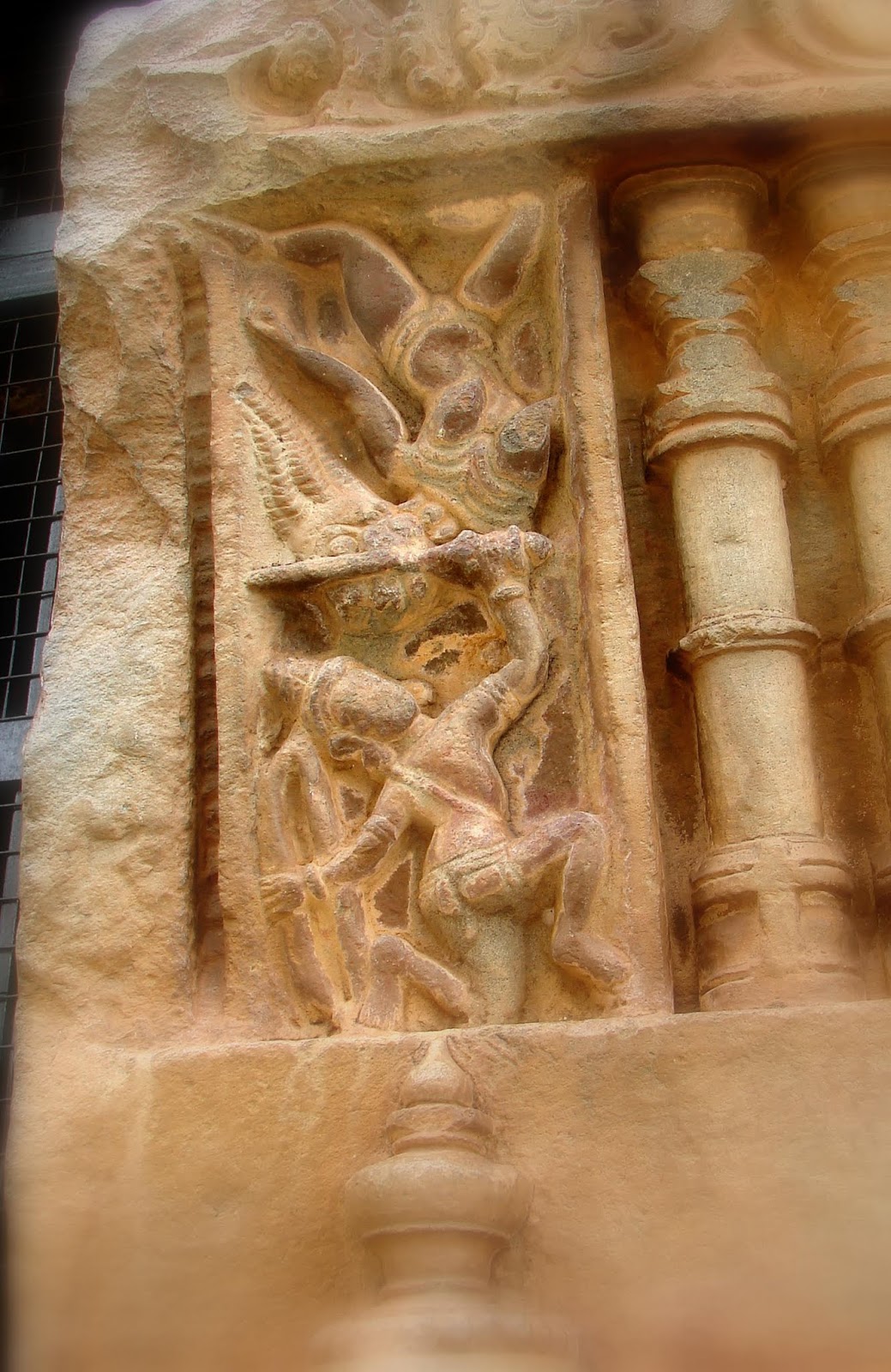


The following paragraphs have been borrowed from The Kadamba Kula - a history of ancient and mediaeval Karnataka by George M. Moraes
There was a Brahman family devoted to the study of Vedas and to the performance of sacrificial rites. They belonged to the Manavya gotra and their name of Kadambas was derived from the fact that they carefully tended a Kadamba tree which grew near their house. In this Kadamba family was now born an illustrous and learned Brahman named Mayurasarma, who together with his guru Virasarma went to Kanchipuram, the capital of the Pallava kings, to prosecute the study of the Vedas. There he took part in a sharp quarrel with some Pallava horsemen, and being enraged at the treatment meted out on this occasion, and considering it a dishonour to the Brahmanas, he, in the picturesque words of the Talagunda inscription, "with the ands dexterous in grasping the Kusa grass, the fuel, the stones, the ladle, the melted butter, and the oblation vessel, unsheathed a flaming sword eager to conquer the world". Accordingly, having trained himself in war-like exercises, he easily overpowered the frontier guards and established himself in the almost inaccessible forests of Sriparvata (Srisailam, Karnool District). There he grew so powerful that he was able to levy tribute from the great Bana and other Kings and caused much havoc by his predatory excursions. The Pallava kings of kanchi took the field against him; but he could not be subdued. At last they made a compact with him by which he undertook to enter their service. Distinguishing himself by his deeds of valour, he pleased the Pallavas, his master, who finally installed him as King over a territory extending from the Amara ocean (western ocean) to the Premara country (Malva), specifying that other chiefs "should not enter it".


Prof. Kielhorn observes that Kubja the composer of Talagunda inscription states that Mayurasarma entered the service of the Pallavas by becoming a dandanayaka or general. This view is supported by the description in the inscription which states Kadamba family as the great lineage of leaders of armies (senani) and also that Mayurasarma was anointed by Shadanana (the six faced god of war) after meditating on Senapati ie. the general of Gods (Kartikeya).


It is possible that Mayurasharma, also styled Mayuravarma, availed himself of the confusion prevailing in the country after the southern expedition of Samudragupta and established himself as an independent ruler. It is evident from the inscription that Mayuravarma soon grew sufficiently powerful to impose his suzerainty on the neighbouring kings. An epigraphical record found at the same village says that he performed 18 horse sacrifices.


This number seems to be a little exaggerated, after a lapse of 7-8 centuries. Nevertheless, it may safely be maintained that he really performed one or perhaps a few more, which thus formed the historical foundation for the exaggerated version of the later records. This was indeed a great achievement, for it is well known that the great Gupta King, Samudra Gupta, for instance performed only one.


The outer walls of the temple are articulated with both Dravidian and nagara style of miniature shikaras.



The dynastic symbol of theKadambas was the lion. It is possible that they borrowed this from the Pallavas, who also had this sign for their national emblem. The reason for this assumption is that the Pallavas, as has already been noted were at least for some time the overlords of the Kadambas. It may incidentally be observed that the dynasty of the Vishnukundins also had the lion for their symbol, and it is not improbable that the Pallavas borrowed it from them. The image of an advancing lion with its right fore-paw raised, its neck erect, mouth wide open and the tail twirled round is employed as a decorative motif in several Kadamba temples.
Pangong Tso - Lukung Lake

Rupshu abounds in myth and legend. Some say that Jesus passed the lost years of his life in Hemis monastery. Lama Govinda received his second spiritual, mystical initiation while resting at Thak Thok monastery on the approach to the Chang La and gypsy Davy and Lady Ba camped for three weeks at various places along Pangong Lake in the early 1920s. Once, Lady Ba's horse, Tomar, disappeared with a herd of Kiang(Tibetian Wild Ass). The best Shikaris were sent to track him, and they did, across two ranges and a valley. On the third day, Tomar returned seven years younger.

Kashmir Himalayas are characterised by high snow covered peaks, deep valleys, interlocked spurs and high mountain passes. A bone rattling drive of 5 hours from Leh through dramatic mountain roads and mountain pass Chang-la leads to Pangong lake. Situated at an elevation of over 5270m, Chang-la is a high mountain pass in the Greater Himalayas. Being snow-covered, it remains closed during the winter season. The pass has a temple dedicated to Chang-la Baba after whom the pass has been named. Hundreds of bright Green, Red, Orange and Yellow prayer flags at the temple flutter in the wind showering the blessings of Chang-la baba on the tourists.

The icy wind, the lack of oxygen and heavy snowfall makes it difficult to be at chang-la for long. The road after Chang-la is extremely steep, leading to the small town of Tangtse. Breathtaking views of the uniquely textured mountains in this region and the plains stretched before them, the Intriguing views of barren mountains, fabulous marshlands and a rare village make the journey picturesque and offer a special treat for senses.

Passing through the quaint village you might chance upon a herd of dzomos. Tibetans, Mongolians, and other cultures use dzo and dzomos as pack animals in high mountain regions, much the same as pure bred yaks. A rarely used English term of yakow refers to a female hybrid of yak and domestic cattle, popularly known as dzomor or Zhom. Cultures living in high elevations, such as the Himalayas, rely on animals with the strength and physiological characteristics required to carry heavy loads for long, arduous journeys through rugged mountain conditions. Animals, therefore, must have the ability to breath the rarified air of high elevations, as well as the dexterity to navigate difficult mountain terrain. Compared to purebred yak, dzo are more agile, owing to their cow ancestry, but without the pulmonary challenges cattle suffer at high elevations.

In addition to being pack animals, herders also use dzo and dzomos for more traditional livestock purposes. Since dietary requirements of yaks, cattle, and hybrids are the same, upkeep for large herds is relatively simple and allows herders to maximize the usefulness of each animal. Milk and meat production from bovid hybrids is reportedly higher than purebred yaks. Meat, milk, and hides not only provide sustenance for herders and their families, but commodities for resale to others.

Popularly known as Moon land for its outlandish landscape of vast barren mountains, Ladakh has scant vegetation, and virtually no rainfall. Animals have to survive in freezing conditions. Despite the hostile conditions, some wildlife manages to survive. The plains are home to the Tibetan wild ass or kiang, wild horses (the ones from Zanskar are even better known), and marmots whose population outnumbers that of humans by a ratio of 1000:1! Wild horses grazing here ar the backdrop of picturesque hills make wonderful frames.


Although the once massive herds of speedy Kyang, the Tibetan wild Ass, are greatly depleted in Rupshu, the Marmot colonies have not visibly suffered from poaching. In Rupshu, as in the sweeping Deosai plains of Baltistan and parts of rugged Zanskar, the sizable, sleek Marmots, larger than the groundhogs they resemble, are the real denizens of this high mountain desert.

Marmots are generally large ground squirrels and tend to live in mountainous areas. They typically live in burrows (often within rockpiles, particularly in the case of the yellow-bellied marmot), and hibernate there through the winter. Most marmots are highly social and use loud whistles to communicate with one another, especially when alarmed. They mainly eat greens and many types of grasses, berries, lichens, mosses, roots and flowers.
Indeed, as Richelle Mead quotest in "The Indigo Spell" “Sometimes it's worth lingering on the journey for a while before getting to the destination.”

Pangong Tso lake is known for its calm, clear and unending expanse. The size of the lake is best inferred from the probable etymology of its name, Pangong, which means extensive concavity. It is 130 km long and 7 km wide.
It is the biggest lake in Asia with its area falling under both India and China. One third of it is in India and remaining in China. The lake was once divided between Ladakh and Tibet as early as 1684 under the Treaty of Tingmosgang signed between the king of Ladakh, Deldan Namgyal, and the Regent of Tibet. As of today it is shared by India and China.

The Line of Actual Control between Indian and China passes through this lake. The eastern end of the lake is in Tibet and the dispute-free area of the lake is the western end. At present, the lake is the point in India from where intrusions of China can be easily observed.

The mirror-calm water is cold, clear, and extremely salty, holding sufficient quantity of lime to form a calcareous deposit, which cements the pebbles together in patches of concrete on its bank. It is believed that there is a large amount of minerals in the basin of the lake, which result from the melting of the snow.

Pangong Tso is a clear symbol of nature’s craftsmanship. Its brackish water plays with sun light to produce different colour effects. The water sparkles in distinct shades of blue, green, purple, and violet, being transparent to a good depth.


The lake remains cut off from the rest of the Ladakh for about six months (winter months) as the road leading to lake across the Changla pass remains closed for more than six months. The lake remains frozen for more than three months from the last week of December to first week of April.


The stark beauty and serenity of the lake has been known to touch a tender chord in even the most hardened traveler. Pangong comes as a breathtaking relief in the parched landscape of Ladakh. The haunting play of light and shadow on the hills around the lake and the sun rays playing magic with the crystal clear water imparting colours from turquoise to azure to an amazing irridescent green creates a surreal effect.
Sitting on its sandy beach and listening to the accentuated cackling of the birds,
feeling the gentle waves caressing your feet, you can't help but hum..
Put on your slippers and sit by the fire
Youve reached your top and you just can't get any higher
Youre in your place and you know where you are
In your shangri-la
Sit back in your old rocking chair
You need not worry, you need not care
You can't go anywhere
Shangri-la, shangri-la, shangri-la, shangri-la, shangri-la, shangri-la
You will want to return to this slice of heaven in the mountains!
1 comment:
-
SAM India Tour said...
-
Thank you for publishing this awesome article
Golden Triangle Tour Packages
Lamayuru Monastery (bla ma gyung drung dgon pa)
Mahasiddha Naropa,a 11th century Indian Buddhist scholar sat in meditation for many years in one of the caves in Lamayuru, which can still be seen in the Dukhang. A crack was formed in the hillside surrounding the lake through which the lake started draining. When the lake dried out, Naropa found a dead lion lying inside it. On the same spot, he constructed the first temple of the area, known as the Sengye Gang (Lion Mound).
Lamayuru gompa, with its medieval village seemingly growing out of the rocky hillside belongs to the red-hat sect of Buddhism.

Lamayuru is perhaps the oldest monastery in Ladakh, thought to be a site of pre Buddhism Shrine of the ancient Bön religion of Tibet. Historical accounts relate that in the 10th century the King of Ladakh ordered the building of Lamayuru and placed it under the supervision of Rinchen Zangbo. The original gompa was composed of five buildings although only the central one still stands. The 16th century, Ladakh's King Jamyang Namgyal was cured of leprosy by a lama from Tibet. In gratitude, the King gave the gompa to this lama and also bestowed other privileges - no taxes were collected and the area surrounding the gompa was declared a sanctuary where none could be arrested. For this reason, Ladakh's still refer to Lamayuru as Tharpa Ling, the "Place of Freedom".

In the past, the gompa housed up to 400 lamas, but presently lesser than 50 lamas live here, although about 150 lamas belong to the gompa. The other lamas stay and teach at Lamayuru's daughter gompas located in outlying villages. Twice a year, all the lamas gather for prayers, accompanied by three days of masked dancing.
Galdan Tashi Chhuling Gompa [Diskit Monastery]
Diskit Gompa has quite an interesting legend attached to it. It is believed that a Mongol demon once lived here and was considered to be a sworn enemy of Buddhism. He was annihilated near the monastery. However, even after his death, his body kept coming back to the monastery. It is said that even today the wrinkled head and hand of the demon lie inside a temple of the monastery, which is filled with fierce Gods and Goddesses.


The following paragraph is borrowed from 'Research on Ladakh Proceedings of the sixth International Colloquium on Ladakh Leh 1993'
There is very little information on the valley before the 14th C; but from the time of King Grags-pa-'bum-Ide (2440 - 1440 AD) there are various historical references. The King's ambitious brother Grags-pa-'bum is said to have paid a visit to Nubra in the hope of seizing power. A local ruler, Nyi-ma-grags-pa, reigned there at that time and it is said that he assisted a Gelugpa exponent, Shes-rab-bzang-po, who came from the Leh valley to Nubra, where he built the monastery of Diskit, and installed a statue of Tsong-kha-pa, the founder of Gelugpa sect. He also visited Charasa village near Tegar and installed another statue at the Dwensa temple.
The king Tshe-dbang-rnam-rgyal, who came to the throne in the middle of the 18th C, offered Diskit gompa to the Rinpoche of Thikse and this arrangement has persisted to this day.

106 feet statue of Jampa (Maitreya) Buddha is located on top of a hill below the monastery and faces the Shyok river towards Pakistan. It was built with three main intentions - protection of Diskit village, prevention of further war with Pakistan and to promote world peace.
According to the chairman of the committee, most of the money for the statue was collected by local donations. The head of Gelugpa, Ganden Thipa and Abbott of Rizu monastery, gave 8Kgs of Gold for its decoration.

Diskit Monastery also known as Deskit Gompa or Diskit Gompa belonging to the Gelugpa (Yellow Hat) sect of Tibetan Buddhism is the oldest and largest Buddhist monastery (gompa) in the Nubra Valley of Ladakh, northern India.


The Gompa is not in a satisfactory condition. In several portions inside the Dukhang, there are large cracks in the plaster due to water penetration. This has lead to the flaking off of beautiful wall painings. The wall paintings also appear faded because of soot deposits over them. The Gompa has not been maintained properly for a long time causing its gradual deterioration. The Gompa has been repaired recently, and as a result of which, some precious inscriptions have been lost.

Diskit monastery houses about 100 monks and runs a school for the Tibetan children in its precincts. The school has been upgraded recently to enable teaching of scientific subjects with support from the Lungta, a 'Tibet Support Group' (a Non Governmental Organization -NGO) who have created computer facilities in the school. Lungta has trained the monks of the monastery in computer skills and in the English language so that they could in turn teach the children of the school. Further additions to the school library in the form of dictionaries, encyclopaedias and English teaching materials are being provided.

Alchi monastery

The text in the following paragraphs have been borrowed from "Buddhist Architecture" - Le Huu Phuoc
Alchi is a famed and historic monastery in Ladakh constructed during the mature Phase II of the second Buddhist renaissance in the Western Himalaya; due to its miraculously preserved conditions dating back to its founding, it is extremely valuable to the study of the evolution of regional Tibetan architecture. Vajrayana iconography, and the extinct Kashmiri or Indo-Kashmiri style of Buddhist Paintings. The founder of this monastery was a Buddhist monk named sKal-Idan-shes-rab from his inscription discovered inside the Dukhang or Assembly Hall, which is undoubtedly the oldest building at the site; the discovered fourteen inscriptions in Alchi have also shed much light into the history and founders:
In the best of continents, souther Jambudvipa [India], at this spot, the hermitage of Alchi in sPu-rg-yal's Tibet, land of pure ground and high mountains, I have built a precious temple with devoted veneration! To look on the wood carvings and paintings...
composed by the Buddhist monk sKal-Idan-shes-rab[inscription 1]
His [sKal-Idam-shes-rab] birthplace is Sumda... His residence is Alchi...His lineage [clan] is 'Bro.. He built a temple as a place of meditation and study [Inscription 2]
He [skal-Idam-shes-rab] studied at Nyar-ma in Maryul [Ladakh]... he is wealthy... he built a fort and bridge [at Alchi]... in pursuance of the request to his father, he built this great vihara here at Alchi [Inscription 3]
The construction of the Sumtsek temple has been ascribed to another Buddhist monk Tshul-khrims'od, possibly the brother of sKal-Idan-shes-rab as mentioned among the inscriptions inside this temple.
That patron and monk, Tshul-khrims'od... [Inscription 6]
In the north part of Jambudvipa [India] is the Land of Snows, the country of sPu-rgyal's Tibet with its high mountains and pure ground, filled with religious practioners who possesses the Thought of Enlightenment. The patron who founded this precious tired vihara [Sumtsek] here at Alchi of Ladakh, in Lower Mar-yul of Upper Nga-ri [Western Tibet] was the teacher Tshul-khrims'od. He was of the great and aristocratic 'Bro lineage'... As the sun and the moon together ornament the sky, so did the two great 'Bro brothers' [sKal-Idan-shes-rab and Tshul-khrims'od could be brothers] [Inscription 7]
The date between 1175-1200 CE for the construction of the Dukhang and Sumstsek seems credible which is also corroborated by the styles of the murals. The Sumstek was probably erected around Jigten Gonpo's time whereas the Dukhang was a little earlier based on the style of its murals and inscriptions.
Anyhow, Drigungpa was presumbably the sect with which Alchi was associated when it was first founded; nowadays the monastery is in the custodian of the Gelugpa monks residing in the nearby Likir monastery.

The rectangular site of Alchi is bounded by a mud wall enclosing encloses the original buildings inside alongwith their sculptures and murals. The original buildings include the Dukhang and Sumstsek, the attached twin temples of Lotsawa Lhakhang and Munjusri Lhakhang, Soma Lhakhang and Chortens. The other buildings were of later additions including houses, chortens, shrines, sutra halls etc. From the inscriptions and styles of the murals, the various dates for the most important buildings at the site can be established.
Dukhang is certainly the oldest building at the site and like the other buildings, with the exception of the 3 floored Sumtsek, it has a single story with a flat roof and a parapet painted in continuous red band as in all other buildings; its wooden entry portal is elaborately carved liek the Sumtek. The interior contains a single Vairacona image inside the niche at the back while the surrounding walls and those in the courtyard are completely covered with murals of mostly Buddhist themes and a few secular ones depicting royal banquets. The most important murals are the 7 mandalas of Vairacona, Manjushri and Prajnaparamita; these are some of teh earliest painted mandalas in the western Himalaya and Tibet. The oldest extant mandala paintins in the world, which are in the scroll format, came from Chinese Mogao caves in Dunhuang and Japan dated in the 9th C. Above the door of the Dukhang is a mural of the protecting deity Mahakala as in the other buildings, all deities depicted in the Dukhang murals belong to the yoga-tantra class with Vairacona as the principal deity in the centre of the mandala.

Sumtsek is probably the most important in terms of tantric iconographies and symbolisms; it is a 3-storied temple. Its highly ornate portico, which also contains murals but much faded due to exposure, is supported by fluted timber columns and half columns or pilasters in the Indo-Kashmiri Style that faintly resemble the Greek Ionic order and also the Ajanta Columns, the triangular trussed-like pediments on the entablature; besides serving as decorative elements, also function as braces to strengthen the structure against earthquakes. The interior, which contains a large chorten of a later date in the centre, also employs the same fluted timber columns as the exterior to support the mud floors. The 3 miches on the first floor house 3 huge standing polychrome clay and 4-armed bodhisatvas wearing 5-pointed tiaras with the tallest image of Maitreya in the back, Avalokitesvara on the left, and Manjushri on the right; their heads reach all the way to the second story where openings are cut through the walls in front of their faces so they can look out to the second floor. On the first floor there are murals on Maitreya's dhoti depicting Sakyamuni's Life scenes while those on Avalokitesvara's dhoti are quasi-religious and secular scenes probably of Buddhist pilgrimage centres in Kashmir and Manjushri's dhoti contains scenes of the 84- Siddhas. The surrounding walls are murals of Akshobya, Amitabha and Manjushri as well as secular and religious personages including the royalty, celestial beings, musicians, et. The second floor is also completely filled with murals including ten mandalas of Vairacona, Aksobhya, Amitabha, Amoghasiddhi, Ratnasambhava, Vajrasattva and their various manifestations including female ones; the others depict paradises of Aksobhya, Amitabha, Amoghasiddhi and Ratnasambhava. Above Maitreya's head are murals of Sakyamuni, above Avalokiteshwara's is his multi-limbed manifestation adn above Manjushri's is the multi-limbed Prajnaparamita. The third floor has 3 mandalas of Manjushri, Sakyamuni and Prajnaparamita; the remaining murals are pictorial eulogies to the lineage of Buddhist monks, both Indian and Tibetan, who were responsible for the introduction and founding of the various Vajrayana sects in Tibet. Above the doors of each floor are murals of ferocious guardian deities with the one on the first floor depicting Mahakala, the second Yamantaka, and the third Acala; these are the dharmapala deities like the one above the entry doorway of the Dukahng. The ceiling of the top floor is constructed in teh lantern roof common in Central Asia whereas the ceilings of the lower floors are completely covered in murals of decorative patterns and non-religious themes. Thus the architectural and inconographical program at Sumtsek appear to represent a symbolic spiritual progression from the lower to the higher levels of enlightenment and the Mahayana to the Vajrayana from the lowest floor to the upper floors. The highest third floor symbolically consecrates pilgrims and Tantric initiates who have completed their spiritual journeys by ascending up the floors or literally entering different mandalas. These symbolic levels of spiritual enlightenment, as embodied in the arts and architecture and the ritualized consecration of the initiates have also been suggested for Borobodur and Kumbum; these are common vajrayana themes throughout the Buddhist world dated as early as the 8th C and certainly not unique in Alchi. Among the earliest cases of the implementation of a combined sculptural and architectural proram to portray the concept of an architectural mandala occurred in the Ellora caves in India wherein each of the 3 floors of the Ellora cave 12 had been conceived as a mandala with Bodhisattva sculptures flanking both sides of a central Buddha. This mandala arrangement would later be repeated in many western Himalaya monasteries like the Tabo Dukhang and heare in the Sumtsek of Alchi; this concept was subsequently transmitted to central Tibet where it became the imprint of Vajrayana rituals in the multi-tiered architectural mandala of Kumbum. The inscriptions at Alchi also suggest such esoteric or Tantric schemes for its buildings.

The patron and onk, Tsul-khrims'od set up these reliquaries of Body, Speech and Mind. In order to remove bodily impurities and obtain a 'human Buddha-Body', he set up Manjushri as a body-image. In order to remove vocal impurites and obtain a 'glorius' Buddha-Body, he set up Avalokitesvara as a speech-image. In order to remove mental impurities and obtain an 'absolute' Buddha-Body, he set up Maitreya as a mind image.
From the sky of the non-originated Dharmakaya [Absolute Body] the unobstructed Sambhogakaya [Celestial Body] appears like a cloud and the active Nirmanakaya [Physical Body] like incessant rain.
Manjusri was associated with Body and 'human' Buddha-Body, Avalokitesvar with Speech and 'glorious' Buddha-Body, and Maitreya with Mind and 'absolute' Buddha-Body; thus the 'hunam', 'glorious', and 'absolute' Buddha-Body can be equated respectively with Nirmanakaya (Physical Body), Sambhogakaya (Celestial Body), and Dharmakaya (Absolute Body).

Lotsawa Lhakang
This building shares a common wall with Manjushri Lhakhang as both ahve obviously been constructed about the same time and have simple porticoes. The mural-filled interior is also supported by fluted timber columns like in the Sumtsek with its central bay opens to a loft story above; in the back end is the main polychrome Sakyamuni statue. The walls contain murals of Avalokitesvara and Amitabha mandalas, Ringchen-sangpo, Lokesvara, Amitabha and Mahakala above the door while the remaining spaces are painted with repeated rows of the Thousand Buddhas theme; the iconography of the deities in these murals belong the yoga-tantra class as in the Dukhang and Sumstsek.
Manjusri Lhakhang
This chapel also has a simple entry portico like its immediate neighbor Lotsawa Lhakang; it also has a loft story projecting beyond the roof above the central bay. This bay is elevated on a high plinth and has four polychrome clay images of Manjusri on the four sides, each of which is painted in gold, white, blue and red according to their proper directions. Unfortuantely the murals have been completely ruined from rain seepage and they most likely, as one might guess have similar stylistic and iconographic contents as those in Lotsawa Lhakhang.
Soma Lhakhang
This so-called 'new' temple of a single-storied flat roof has a chorten in the centre probably added at a later time. The murals on the interior walls are filled with deities of the yoga-tantra and anutataryoga-tantra class arranged in rows, a scheme which appears more formal and rigid than the murals in other buildings; the 3 mandalas of Amitayus, Sakyamuni, and Vairacona are painted on the left wall along with Sakyamuni's life scenes, which have clearly diminished in popularity. Historic personalities liek Santaraksita and Padmasambhava are also among the figures in the murals; Mahakala is once again found above the door as a protecting deity.
The murals of the Dukhang and Sumtsek aer the acme of the Buddhist Kashmiri or Indo-Kashmiri style while the style of their sculptures has also been derived from Kashmiri bronzes; the Soma Lhakhang murals have been painted in teh international Indian Pala Style. The Lotsawa Lhakhang murals, which fuse the Kashmiri and Pala style, are believed to have been painted later than those in Soma Lhakahang. The Alchi murals are painted in several modes with slight shading and high lighting to render volumen, whithout shading using lines to define forms, or the combination of both. The first mode was characteristic of the Indian artists at Ajanta whereas the second mode was favoured by the Chinese at Mogao, above all the Alchi murals show an eclectic mixture of differnt styles rather than the predomiance or preference over any particular style. Some of the most conspicuous elements in teh Alchi murals, such as the lantern roof, mandalas, painted chortens, pearl medallions, along with the postures and dresses of many figues, are of Central Asian origins, the exaggeratedly pinched waists and mannerisms of the paired female dancers also recall the females of the Begram ivories from Afghanistan and Andhra sculptures of Amaravati and Nagarjuankonda. Possible Chinese infiltration from Mogao may also be surmised sucha s the murals of the pairs of female dancers, the acrobatic divers of the apsaras with feet swinging awkwardly backward and the thousand Buddhas theme. The use of pastiglia in the Alchi murals would subsequently be employed in the Kumbum murals in Tibet; the Alchi style might have also influenced later Indian paintinsgs after the disappearance of Buddhism in India. The plans of the Dukhang and Sumtsek with their principal image niches in the back can be traced back to the classic plan of the Indian Mahayana caves like Ajanta. A few architectural elements such as the trefoil triangular pedimetns, the Indo-Kashmiri pseudo-ionic columns, etc. also had earlier Kashmiri precursor. However, the overall forms of all Alchi buildings conform to the traditional Tibetan architecture and one must also be careful not to attribute all the woodworks to Kashmir since wood carcing is also the traditional craft of the people in the Himalayas and Tibet. Above all, the concepts of utilizing architecture as a religious instrument and medium in the process of Tantric initiation and consecration and an aid to spiritual enlightenment are the cornerstone of the Vajrayana as exemplified in the Indian Ellora caves, the Dukhang of Tabo in Spiti, the Sumtsek at Alchi and later Kumbum in Tibet.
Lhachen Palkhar [Leh Palace]
It was at this time that King Senge Namgyal built Leh Palace, also known as Lachen Palkar Palace. According to a local belief, this palace was originally to be built by his father, but it was king Singge who chose the site on a ridge (shaped like an elephant's head). The king ordered an 'important building' to be constructed at this site which could house his family, his four ministers (kalon) and sixty elders (rGanmi). The building took 3 years to complete. The king is said to have invited leading Ladakhi families to settle within the fortified town below the palace. Remnats of the city walls from that time still exist. This fortified town was built on the slope of ahill, reflecting the need at the time to preserve arable land. All over Ladakh and many parts of Tibet the earliest human settlements were built on the edge of mountains and hills, as arable land was always scarce.
The massive nine-story stone structure lies at the base of the Tsemo ridge and towers over the old town. It was designed in the Tibetan style that was later made famous by Potala Palace in Lhasa. King Senge Namgyal also constructed massive rammed earth walls around the original residential area of the old town.

A cruel tale is attached with its completion. The king in order to have his building unrivalled in the region, got the right hand of the master mason chopped off.
The palace came under a siege by the Dogras (1836 AD) and during this seige it was partially destroyed. As a result, the family moved to Stok and never shifted back, thus making the palace building redundant thereafter.
The palace is associated with Dosmoche festival. During the festival, monks from different monasteries from surrounding areas aer invited to perform rituals to promote peace and prosperity in the region. Sacred dances are also performed by the lamas of Tagthog monastery on this occassion.

Physical / Architectural Description:
The palace of Leh is an ensemble of several structures that crown the ridge of Namgyal Tsemo. Beside the main palace, the ridge comprises several structures of importance which include the palace fort of Tashi Namgyal, several religious structures, chortens and royal stables.
The main palace building is undoubtedly the finest example of palace architecture in the entire Ladakh region. It is one of the most imposing structures ever built on Ladakhi soil. The palace has 9 levels.
The lower levels have rooms for staff and servants, storage spaces for animals fodder, wood; dried meat and vegetables. The upper levels had apartments for the royal family, two small temples, a throne room, reception halls and rooms for religious purposes. In the middle of the building, at the fourth level, is a small courtyard (Katog chenmo) which was the main congregation place for any social or cultural activity.

The main entrance (also the ceremonial entrance to the palace) is at the third level and located in the north. The entrance is through a large elaborately carved wooden porch supported by 2 circular wooden columns. The characteristic of this porch is a carved wooden snow lion. The first, second and the third levels have small rooms which are mainly for housing the staff and servants. Besides there are several small stores.
The main corridor at the third level leads to a smaller courtyard on the fourth level from where one can access a small private temple for the royal family, the Duk-kar Lhakhang. This small temple is situated in the north-west corner of the palace. One enters the temple through a small porch, to go into the Lhakhang. This chamber is square in plan and has its roof supported over four rows of wooden columns (four columns in each row). There is a small clere-storey window in the middle of the roof which ventilates the interior.

From this courtyard a small staircase provides and access to the main courtyard, the Katog Chenmo, built on the fourth level. This courtyard faces east thus commanding a majestic panoramic view of the entire Leh valley. The levels above (fifth and sixth) comprise the main audience cum assembly hall (Tak Chen) and the main living quarters of the royal family. This area now is not accessible. This level is characterised by wooden balconies that jetty out of walls.

The seventh level has rooms where official ceremonies were performed. This level includes a throne room (Junga Simjung), a temple (Sangyeling Lhakhang) and the royal chamber facing east (Shar-gi simjung). The eighth level has a few rooms only whose function could not be ascertained. The ninth level again has a small temple that comprised a small room (Tse-simjung). Here worship to Gurlha divinity was performed.
The dominance of the palace structure, however, is due to its sheer stark facade that dominates the entire Leh townscape as the most prominent landmark. Its east facade is the most dramatic one whose battered wall inclines to provide adequate structural strength and has a series of balconies and windows (small rectangular slits) to break the sheer monotony of the vast surface. The side and the rear elevations are in comparison less dramatic. Still these are punctuated with balconies and windows at upper levels.

The structural system of the building is simple and typical, heavier base and a lighter top. There have been no foundation system; the building is directly resting on the granite rock beneath. The material used is neatly dressed stone having a layer of timber beam alternating every three metres or so. This creates an efficient framework of timber beams which counters any lateral movements due to an earthquake. The upper portion has neat sun baked bricks used as the wall material to provide adequate lightness and the much needed thermal insulation inside.
Decorative features:
Not much survives in the palace. perhaps the most exquisite works of art have been preserved in the fourth level Duk-kar Lhakhang, which houses a large image of Duk-kar (a thousand armed form of Tara). Sakyamuni and Padmasambhava. Besides, there are ornamental carvings done on beams and columns in the hall of audience (Tak-chen) at the fifth level, and throne room at the seventh level.
Yuma Changchubling [Rizong] Monastery

His Holiness Rizong Rinpoche III, one of the most highly respected lamas alive today, was born in Matho in 1928 and recognised as the reincarnation of Shas Rinpoche II at 2 years old by His Holiness the 13th Dalai Lama who had predicted the circumstances of the rebirth. The Rinpoche went to Rizong Monastery at 4 years of age to study and at 17 went to Tibet to continue his studies, joining Drepung Loseling Monastery, Lhasa, in the mid-1940s. He returned to Rizong in 1959 after the Chinese occupation of Tibet then went to Dalhousie to study for his Geshes degree. He graduated, attaining the highest possible degree in 1972.
In Tibetan spiritual circles, he is regarded as a modern-day Milarepa, having lived a life of simplicity and meditation since his youth.

Two out of the three rooms in the monastery house statues of Buddha while the third one has a stupa. The painting blocks of the biography of Lama Tsultim Nima, is yet another highlight of the monastery.

The monastery is unique because it is the only one with no annual mak dance festival. The monastery believes in laying more emphasis on individual practices.
The Rizong Monastery is the only one in Ladakh which has a nunnery. The nunnery, Jelichung, is located little down the monastery.

Following sections are borrowed from "Being a Buddhist Nun: The struggle for enlightenment in the Himalayas" by Kim Gutschow
Although male monastic community at Rizong was renowned for its strict adherence to manastic discipline, it could only sustain this religious ascendancy by requiring indentured services of nuns and laypeople. Rizong monks might not eat after noon and followed strict rules of poverty, but they required nuns to labour all day on behalf of the monastery's economic enterprises.
While most Ladakhi nunneries are independent institutions not directly attached to a monastery, Julichen is subordinated to Rizong monastery. Lying in lower Ladakh, Julichen nunnery takes its name, "Great Apricots", from the rich crop of apricots that nuns process and sell on behalf of the monastery. Julichen effectively seves as the factory floor of the monastic corporation. While the nunnery sustains profane needs of subsistence, the monastery engages in sacred ritual. The nuns serve as the worker bees in the monastic hive, which is overseen by monks engaged in their ritual ministrations. Nuns work from dawn to dusk processing the monastery's vast wealth of grain, apples, apricots and wool. While the monastery soars skyward at the end of a secluded valley, far above the distractions of human livelihood, the squat and ramshackle nunnery sits amid the monastic fields and orchards.

The nuns' quarters are bursting with odd heaps of barley sacks, drying apricots, woolen homespon waiting to be dyed, abandoned looms and plowshares in various states of disrepair. Nuns spend mos of their waking hours working or cooking for the monastic estate, while living in rooms bereft of religous images.
The most common problems that nuns complained of were a lack of residential or assembly space, lack of teachers and too little ritual training. Finally, there was the problem of no permanent endowments, which forced most nuns to work as domestic or wage labourers rather than devoting themselves to spiritual study. The nuns gradually began to express a desire for more study and less domestic drudgery.

Dr Tsering Palmo was the first Ladakhi nun to be trained as a Tibetan medical doctor. Born at Matho Village, 15kms from Leh (the capital city of Ladakh) she graduated from the Tibetan Medical and Astro Institute, Dharamsala, in 1993. Upon returning to Ladakh ,in 1994, as a medical practitioner, Dr. Palmo learned of the miserable conditions of the nuns and felt emphathetic towards them.

Intially Palmo encountered considerable resistance from laypeople and local monks. Some laypeople complained that nuns were no longer available for domestic chores. There was also the pragmatists who said that withdrawing nuns for rural areas already short of labour would be disastrous. Some monks thought that she was crazy to educate "illiterate" nuns who would just be corrupted by coming to Leh or over-educated for life in the rural nunneries. Lastly, the nuns themselves thought that she was mocking them when she described the advanced philosophical training they should receive. Palmo's biggest complaint was that people refused to take her seriously. She suspected that they saw her as a newly ordained imposter with little concept of monastic life in Ladakh after her extensive sojourn among the Tibetans. Many who were sympathetic to Palmo's message were fearful of openly subverting the privileges of monks. Palmo listened to their complaints and refuted them as best as she could. She carried on day after day, even when people were laughing at her. Recalling the vow of the Matho princess she had once played so many years ago, she decided she would dedicate whatever merit she had earned towards the nuns and happily die for her cause.

Overcoming the subtle opposition of Rizong monks, Palmo expanded the nunnery and quintupled its membership by 1999. With the permission of the abbot of Rizong and the assistance of local nuns, foreigners and wage laborers, she began to construct a new nunnery complex. When Palmo and her companions first arrived in Rizong, the local monks and villagers made fun fo them, joking "they have come as tourists and they will leave after a few months". After a few years, they had built 11 residential cells, 4 teaching rooms, a meditaion hall, a toilet and a conference hall. The construction was interrupted for fund-raising and the ordination of several new nuns, all of whom were secondary-school graduates.
These highly eduacated and outspoken new young recruits had little desire to perform menial tasks like the ones their elders continued to do faithfully. As a result, the community of nuns is split. The younger recruits have adopted a religious curriculum of meditation, Tibetan and Philosoply while the elders continue to slave on the monastic estates.

The Rizong monks initially blocked Palmo's plan to turn Rizong into a training institute for Ladakhi nuns, so Palmo found a building in Leh to house her new Foundation, the LNA. Palmo's Ladakh Nuns Association, established in 1996, spearheaded a number of projects that increased eduction, visibility and material status of nuns in Ladakh.

When the highest-living Tibetan Buddhist authority spoke out on behalf of women, Ladakhi people finally took note. Although the Dalai Lama's office had ignored Palmo's numerous requests for a public meeting, he accepted her invitation to give a public talk on women during his 1998 visit. His Holiness spoke to a thronged audience about how men and women have an equal capacity for enlightment. Local attitudes toward nuns shifted noticeably after the local media picked up the Dalai Lama's speech.

Palmo has begun to build her institue with foreign funding. She envisions a place where nuns can attend teachings or workshops and train to work in a number of fields - as maternal health workers, traditional doctors, painters, tailors or handicrafts experts. She wants the nunneries to become self-sufficient enterprises as well as educational institutes.

A pilot school begun at Timosgam has begun to offer the standard Buddhist curriculum to young nuns and vilalge girls. Those who graduate from CIBS can become teachers throughout Ladakh, Zangskar and Nubra. The best and brightest students from Ladakhi nunneries have been sent to Tibetan institues in India in Dharamsala, Mungood, Darjeeling and Varanasi where they are studying philosophy, Buddhist studies and Tibetan medicine.

1 comment:
-
SAM India Tour said...
-
Thank you for publishing this awesome article
Golden Triangle Tour Packages
Likir Monastery

The geo-political landscape during 15th C was generally marked by bitter struggle for control of land. Monasteries in Tibet and Ladakh region controlled and owned large tracts of land and thereby the agricultural produce. Conflicts with rival sects of monasteries for political and material control were pretty common. They had to protect the inhabitants and the wealth from rival attacks.
Monasteries that flourished during this period evolved as small fortresses perched strategically on hills, utilising the terrain and reinforcing it with thick peripheral walls to form a protected inner core.

Monasteries like Likir played a very important socio-cultural and political decision making process during the 14th C. The monstery is located on top of a hill beside the valley of River Indus and has agricultural fields at the lower level while the monastery complex occupies the high grounds.
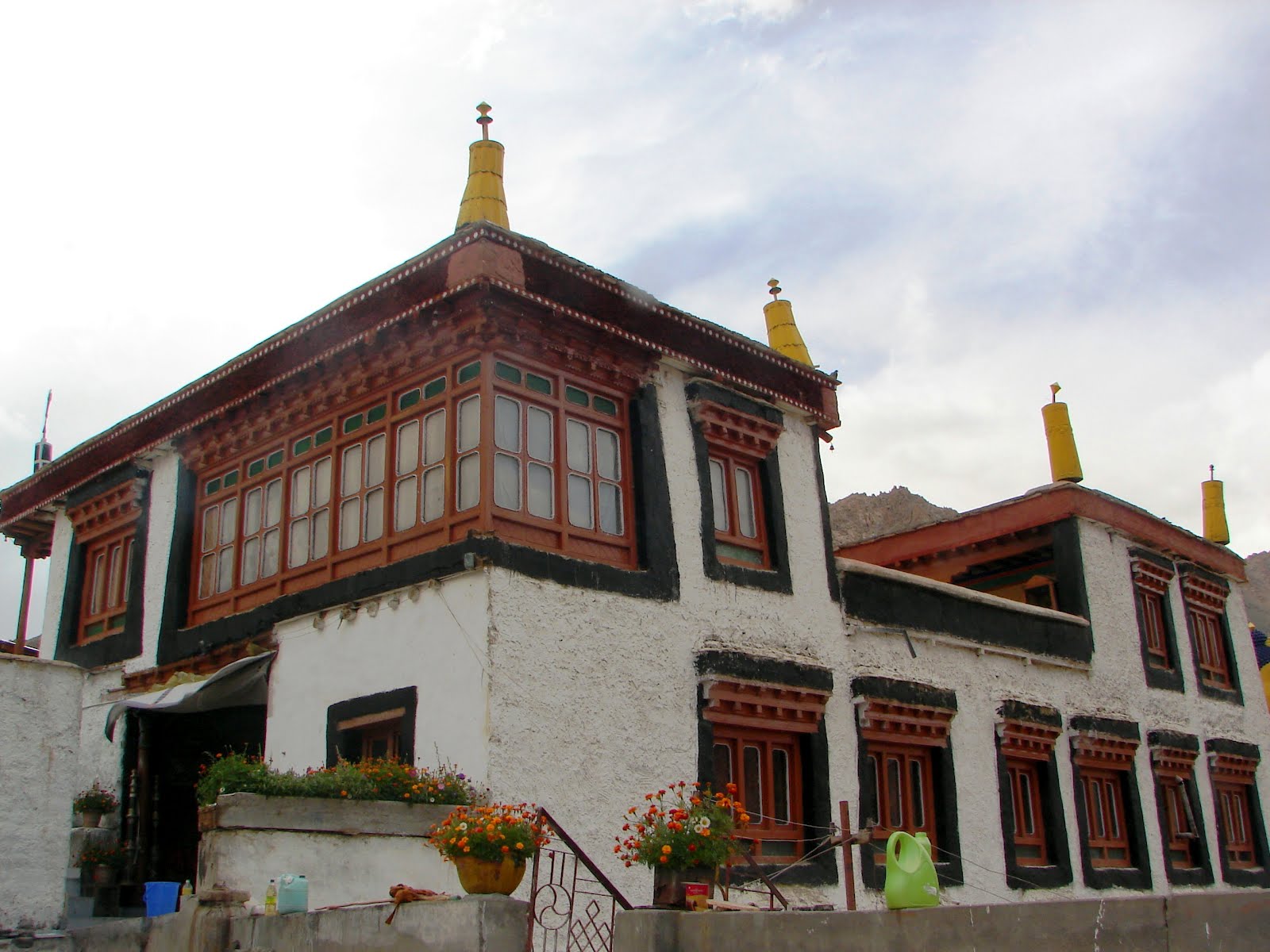
Buddhism revolves around the teachings of Lord Buddha and the Lamas of the past also hold very important position in the mythology and general beliefs system. The centrality in source of religious beliefs is reflected in the overall arrangement of the monastery complex.
The monastery complex contains the main temple and the assembly hall at the highest plateau of the hill, followed by the monks' quarters, kitchen and dining space. The village houses are at the lower slope. The main complex has narrow entry and exit points and has shear wall surrounding its periphery results in creation of a protected fort like complex

Likir means “The Naga – Encircled”. The Gompa represents the bodies of two great serpent spirits [Naga-rajas] Nanda and Taksako. It is believed to be associated with the Ka-dam-pa order. The gompa was refounded in the 15th C as a Ge-lugs-pa institution. Lama Duwang Chosje established the monastery belonging to the Gelugpa [Yellow Hat] sect of Tibetan Buddhism in 1605 under the command of 5th king of Ladakh Lhachen Gylapo. The present buildings of the gompa had to be reconstructed during the 18th C in the wake of a fire which destroyed the earlier structure.

Likir enjoys a special status as a brother of His Highness Dalai Lama happens to be its head Lama who visits the gompa on important pujas.

The monastery also houses a protective deity, located in the interior, with a golden armor. There are two Dukhangs (Assembly halls) inside the monastery, one of them relatively new.

The main Du-kahng contains two chortens, Clay Images of three Buddhas - "Marme Zat" (past), "Sakyamuni" (present) and "Maitreya" (Future), Tsong-kha-pa with his two disciples. It is also equipped with wooden racks of volumes of scriptures.

Another newly built Du-khang contains an image of 1000 arms and 11 headed Avalokiteshwara and some new paintains on the side walls representing benevolent Bodhisattvas and 26 Arhats.

The Gon-khang houses a statue of "Tse-Ta-Pa", the wrathful protector. Additionally, the impressive murals of "Yamantaka" and "Mahakala" too adorn the Gon-khang.

Within the old Dukhang are the statues of Bodhisattva (Lord of everything you see), Amitabha (Buddha of the West), Sakyamuni (the historical Buddha), Maitreya (the Future Buddha or Buddha of Compassion) and Tsong-kha-pa (founder of the Yellow Sect-hat).

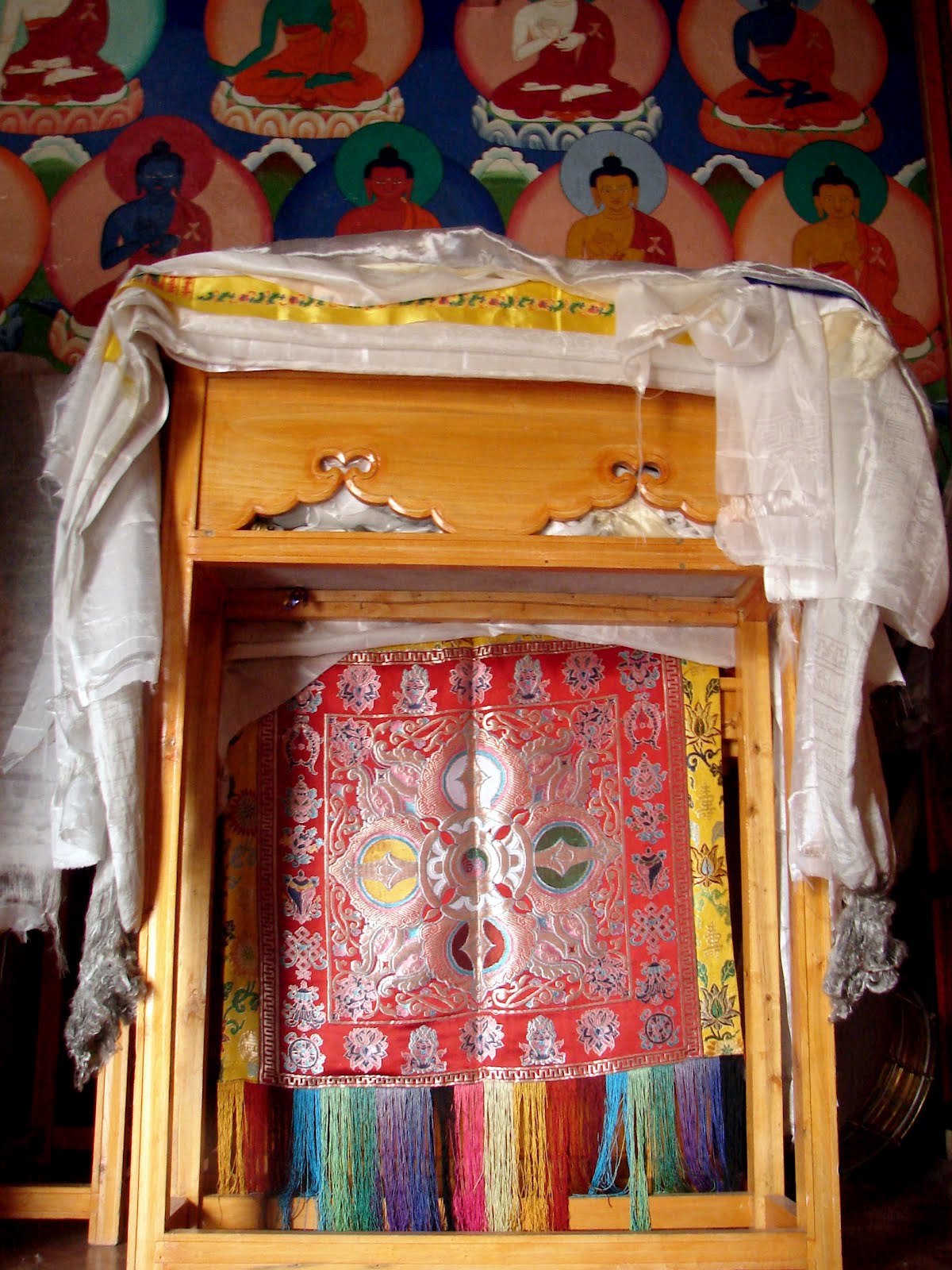


Hemis Gompa

Cradled in a beautiful valley and surrounded by streams is the 17C Hemis monastery below the famous cave of Gotsangpa and the Gotsang retreat center.
The monastery holds the distinction of being the biggest as well as the wealthiest monastery of Ladakh. Since the monastery was built hidden in a valley, it was never found by invaders. Also, the farmers of Hemis give a part of their harvest to the monastery.

The monastery is divided into two parts - assembly hall and the main temple (Tshogkhang). The historic temple Du-Khang houses the throne of the Rinpoche and the other historic temple Tshogs-Khang has a huge guilded statue of the Sakyamuni Buddha decorated with semi precious stones. The balcony is well garnished with fresco pictures.

The monastery belongs to Drukpa Lineage or the Dragon Order of Mahayana Buddhism. His Holiness the Gyalwang Drukpa [conferred with Bharat Jyoti Award] is the supreme spiritual head. Gyalwa Gotsangpa Gonpo Dorje, one of the most celebrated yogis in the Himalayas, came to Ladakh in the 13th C and established the Drukpa lineage.

The monastery is an architectural delight, constructed during the period of Sengge Namgyal. It treasures a beautiful copper gilt idol of Lord Buddha, sacred thankas, gold and silver stupas and several other religious objects.


Hemis has more than 200 branches (monasteries) in the Himalayas and more than 1,000 monks under its care. It is an important living monument and heritage of Himalayas and its people. The monastery contains the richest collection of ancient relics.

The huge courtyard is the venue for annual Hemis Festival dedicated to Guru Padmasambhava, the founder of Tantric Buddhism in Tibet, and marks his birth anniversary. The ‘Thangka’ or sacred tapestry depecting Guru Padmasambhava is decorated with pearls and is displayed in Hemis festival once in every 12 years. It is said to bestow good health and spiritual strength. The sacred mask dance performed at the monastery is the main highlight of the Hemis Festival.

Padmasanbhava [the lotus-born] better known as Guru Rinpoche(precious guru) or Lopon Rinpoche or simply, Padum in Tibet was born into a Brahmin family of N-W India in the kingdom of Oddiyaana [modern day swat valley in Pakistan].
Considered as an emanation of Amitava Buddha and venerated as 'Second Buddha, he is said to have practiced tantric rituals. He hid a number of religious treasures including the Bardo Thodol [Tibetan Book of the Dead] in lakes, caves, fields and forests of the Himalayan region.
"His two eyes are wide open in a piercing gaze. On his body he wears a white vajra undergarment and, on top of this, in layers, a red robe, a dark blue mantrayana tunic, a red monastic shawl decorated with a golden flower pattern, and a maroon cloak of silk brocade. He has one face and two hands. In his right hand, he holds a five-pronged vajra at his heart; and in his left, which rests in the gesture of equanimity, he holds a skull-cup in the centre of which is a vase of longevity filled with the nectar of deathless wisdom. Cradled in his left arm is a three-pointed khatvanga representing the consort Mandarava. On his head, he wears a five-petalled lotus hat. Wrathful and smiling, he blazes magnificently with the splendour of the major and minor marks. He is seated with his two feet in the royal posture."
-- Jamyang Khyentse Wangpo
The three points of the trident represent the essence, nature and compassionate energy (ngowo, rangshyin and tukjé). Below these three prongs are three severed heads, dry, fresh and rotten, symbolizing the three kayas.

Thiksey Monastery [Mini Potala]

As per a popular legend, Jangsem Sherab Zangpo and his disciple Palden Sherab were performing prayer services to the local deities at Arzoo valley [3Kms from the present Tiksey monastery]. Suddenly a crow appeared from nowhere and took away the ceremonial plate with Tormas[ritual cakes made from chickpea flour] in it. On searching, they were amazed to find the plate on top of a hillock. The Tormas were undisturbed or "in perfect order". The duo took it for an auspicious omen and built the monastery right there and named it Thiksey – meaning “In perfect order”. The monastery is situated in Thiksey village and the alternate name of the incumbent of the monastery is also addressed as Thiksey Rinpoche.

Since the monastery is similar to Potala Palace [former official seat of the Dalai Lamas] in Lhasa, it is often known as 'Mini Potala'. One of the biggest monasteries in Ladakh with over 120 resident monks, it has a world-renowned 40ft tall statue of Maitreya Buddha[Future Buddha].

The statue was built at the behest of His Highness, the Holy Dalai Lama, when he visited the monastery in 1980. The statue was made under the guidance, supervision and direction of Kushok Nawang Chamba Stanzin, the present head Lama of Thiksey monastery. The staue, 15 m tall, clay statue covered in gold paint, is the largest figure of Buddha in Ladakh and took the local craftsmen about four years to complete it.

The Gompa contains 10 temples. Below the monastery are chapels and houses of monks stretching down the hillside. About 100 monks belonging to the yellow - hat sect of Buddhism.
A temple is also dedicated to goddess Tara with her 21 images placed in glass-covered wooden shelves.


The nunnery or the school for the community of nuns is located within the precincts of the monastery and is managed by the Monastery Administration. Nunneries were held in a grossly inferior status and Buddhist nuns in particular lived in appalling conditions. Awareness was raised on the status of the nuns in Ladakh in 1990s and Thiksey received a degree of international attention and support. Ladakh Nuns Association was established in 1996. This was important in raising the status of the nuns in Ladakh, to ensure a shift in their functional role of “servitude and to one of true spiritual practice”. The Chief Lama, Thiksey Rinpoche of Thiksey Monastery was also important in these positive developments in the betterment of nuns. The monastery donated the land for a new nunnery at Nyerma, near Thiksey, at the same place where the very first monastic seat was established by Rinchen Zangpo, the Tibetan translator, in the tenth century. The nunnery is now under the patronage of Thiksey Monastery.

Shanti Stupa - Leh

The Stupa represents Buddha's holy mind, Dharmakaya, and each part of the Stupa shows the path to Enlightenment. Building a Stupa is a very powerful way to purify negative karma and obscurations, and to accumulate extensive merit. In this way you can have realizations of the path to Enlightenment and be able to do perfect work to liberate suffering beings, who equal the sky, leading them to the peerless happiness of Enlightenment, which is the ultimate goal of our life."
-- Lama Thubten Zopa Rinpoche in Chenrezig Institute, Australia, in September 1994.
Reference: http://www.stupa.org/stupas.htm
A site is selected to build the Stupa and the earth deities are addressed to seek the blessings for the site to remove any obstacles. All people involved in the work should have the right motivation to ensure that every aspect of the stupa emanates pure mind of Buddha.
Each Stupa rests upon a square base (Lion's seat). The four sides represents the four qualities of mind namely Love, Compassin, Joy and Equanimity, that are essential to attain enlightenement. The base is then filled with jewels, precious texts and relics pertaining to Stupa building. 5 steps are built on the Lion's seat that represent the progress of mind towards enlightnment. Each step can be divided into 2 parts that alludes to the 10 levels of Bodisatva realisation.
Bumpa, a round form, that represents the 17 levels of the realm of form, is built on top of the steps. Depending on the size of the stupa, it can contain a room for meditation and Puja. If it is small, it will simply be filled with precious and pure representations of Buddha's mind.

A spire forms out of the Bumpa and on top of that sit the ornaments that together represent the four stages of the formless realm. The inner contents of the Stupa and the outer manisfestation mirror the pure mind.
A central axis called the Sog Shing, meaning “Life Stick” is made, and is traditionally carved from Sandalwood or Juniper. However, if it is not possible to obtain these woods, the wood of any tree which does not bear poisonous fruit can be used. At the tip of the Life Stick a picture of the Victory Stupa is made and at its base that of a half Dorje. Holes are made at the top and base and blessed relics, medicines and texts are placed inside. The Life Stick is then wrapped in precious materials and is fixed in place on the Lion’s Seat. It is long enough to protrude to the Stupa's highest point.
The Stupa is then filled with relics which symbolically pertain to the utmost purity of mind. It is said that if the Stupa itself is the representation of Buddhas' body then the Relics are the life force which flows through it and, as such, are even more vital than its outer form.

The Benefit of the Stupa emanates far and wide and is said to go on for Aeons. The positivity generated by such activity is impossible to measure. Liberation is said to be given by merely hearing about a Stupa, by touching it, by seeing it, by praying to it, by walking around it and by eating the offerings that are made to it.

Sitting majestically on a hilltop in Chanspa, Leh district, Ladakh, in the north Indian state of Jammu and Kashmir, Shanti Stupa is a white domed Buddhist stupa. It is an elegant stupa built by Japanese monks to promote world peace and prosperity and to commomerate 2500 years of Buddhism. It has brightly coloured reliefs on its mid-levels and is topped by a spired white hemisphere. It is considered a symbol of the ties between the people of Japan and Ladakh. The Stupa holds the relics of the Buddha at its base.

The beautiful positioning of this stupa provides a breathtaking panoramic view of the surrounding landscape. This has become a primary reason for Shanti Stupa to become a tourist attraction, apart from its religious significance
1 comment:
-
Tom said...
-
Thanks for the informative post about Leh Ladakh! Do check out our post on the Leh Ladakh Attractions during our 13 days of travels in India as well!
Happy Travels Everyone!
Tom & Kate,
2bearbear.com
Namgyal Tsemo Gompa - Leh

Located in the vicinity of villages, aesthetically pleasing and architecturally interesting gompas provide the focus for the faith of the highly religious Buddhist people in Ladakh. Gompas are places of worship, isolated meditation and religious instruction for the young.
Namgyal Tsemo Gompa was founded by King Tashi Namgyal, one of the Namgyal rulers. Tashi Namgyal is known to have ruled during 15th century AD. The Namgyal (also called "Tsemo Gompa" = 'Red Gompa', or dGon-pa-so-ma = 'New Monastery'),a temple, is the main Buddhist centre in Leh. No longer inhabited, it stands atop the crag behind Leh palace. The Gompa boasts of a rich collection of some ancient manuscripts and wall paintings.

Bhandasar temple - Bikaner

Situated at the south-west end of the walled city, Bhanda Shaha Jain temple is the oldest Jain temple in Bikaner. It was built by a rich Jain merchant Bhandasa Oswal in 1468 AD before Bikaner was founded and was completed by his daughter in 1514 AD after his death. It is believed that 40,000 kg of ghee was used as substitute to water while the foundation of this temple was being laid and the stones for construction had to be transported all the way from Jaisalmer. It celebrates the grandeur of Rajputana architecture. The spire of this temple with its 'Sringas' and 'Upasringas' of decorative shikharas and its guilded flagstaff, towers high above the rest of the city and can be seen from far.

The temple is dedicated to Sumatinath Ji, the fifth Tirthankara of the Jains. The paintings from Jain scriptures on the interior walls and ceiling of this temple are of much later times. The temple is mainly famous for wall paintings and usta art. One can see the skyline of Bikaner by climbing to the topmost floor of this temple.

This three-storeyed structure built of red sandstone is a classic example of Jain architecture. The pillars of the temple bear floral designs and stories that depict the lives of the 24 Jain tirthankars. The temple has beautiful inlay work in gold. The walls and ceiling are adorned with paintings.

The ground floor has white marble pillars covered with colorful floral patterns. The sandstone pillars are embellished with beautiful sculptures. Beautiful miniatures of the sentries of the gods are present on the first floor. One can also find artistically carved balconies on the first and second floors. The intricate designs, beautiful frescoes and sculpted pillars largely attract the tourists to Bikaner.

Usta Art
Usta is a professional caste of artists, and the word Usta derives from the Persian word Ustad, meaning master or skilled person. Usta art is a generic term used for the media of Naqqashi and Manoti art practiced by Usta artisans from the erstwhile Bikaner State in present-day Rajasthan, India. Naqqashi and Manowati (emboss) is characterised by painting miniature translucent and opaque watercolour and oil based floral patterns on objects, camel leather, and architectural elements with gold. Naqqashi are items that are unembossed gold layers and Manoti are items that are embossed gold layers. The art of Naqqashi and Manoti flourished between the late-16th to mid-19th century in the Bikaner State.

1 comment:
-
Padma said...
-
Amazing art!!!! The paintings and artwork on the walls are top class! Would love to visit it someday! Thank you so much for posting this!
Mallikarjuna temple - BasaraaLu

Following text in italics has been borrowed from Indian temple architecture: form and transformation: the karnaata Draavida tradition 7th to 13th centuries
Adam Hardy
At the end of the first decade of the 12th C the Hoysalas began more than a century and a half of prolific temple-building in Southern Karnataka. At that time the Hoysala rulers were feudatories of the Later Chalukyas, and they remained so, nominally at least, until 1192 when BallaaLa II proclaimed himself emperor. Before Hoysala patronage the stone temples of the region, those of the Gangaas and Nolambas, had been closely related to the Draavida traditions of Tamil Nadu. But to establish their own school the Hoysalas looked North to the Chalukya tradition.
Inscriptions record that at first many artists migrated from both mainstream and non-mainstream centres in northern Karnataka. Alongside the migrants, large numbers of local craftsmen would also have been needed.Presumably they must initially have worked under sthapatis trained further north, and have transferred to soapstone, the material almost universally employed for Hoysala temples, the skills which they were used to exercising in other materials.
The Hoysala style changes relatively little over the whole period of its existence, from overall composition down to the shapes of mouldings. Naasi details and subtle differences in the character of carving point to different sub-schools.
Foundational inscriptions give much information about patronage. On the whole, patronage by the kings is rare, more usual patrons being generals, ministers and merchants, or their wives. It is known that artists would sometimes contribute towards the cost of a temple.
Shiva temples predominate. Vaishnava shrines are also numerous and Jain temples are not uncommon.

A record of Hoysala Narasimha II, dated 1234 AD refers to the grant given to the service of the god Mallikarjuna by a certain Harihara Dandanayaka, after causing the construction of the temple for the deity in the name of his father Mallikarjuna and a tank in the name of his mother Gujjavve at his birth place BasaraLu (referred as "Basauruvalu" in inscriptions and 4 records of different periods)
There are two general characteristics, commonly recognised as distinguishing Hoysala from later Chalukya temples. The first, in many but not all the Hoysala works, is an abundance of figure sculptures.


The second often cited characteristic of Hoysala temples is their ornateness. It is true that some Hoysala temples are much more ornate than others, in the sense that their surfaces have been overwhelmingly richly elaborated, in a way which fully exploits the possibilities of soapstone. But this is not to say that plainer examples are of a different style, as if style were determined only by surface ornament. As ever, there are temples in which every moulding and detail hs been taken to the final degree of elaboration that the style allows (now a higher degree than before), while others are partly or entirely in the smooth, blocked-out state. The style, in the sense of the imprint of a particular group of artists, may be identical in both cases: only the degree of elaboration is different.
Temple has polyangled basement and is on a three feet high platform. It has a main garbhagriha, antarala and two separate garbhagriha on either sides of the navaranga facing each other. The mukhamantapa has perforated windows on its wall. Temple has a beautiful Dravidian Shikhara on its garbhagriha, which houses a Balahari Shivalinga.
The garbhagriha in the navaranga houses a four and half feet tall, naga-nagini sculpture and a beautiful Sun God sculpture. There apparantely was a Vishnu sculpture on the pedestal of the present Serpent sculpture. Shaiva doorkeepers guard the door.
A record dated 1234 A.D. describes this temple as one with varieties of sculptures starting from bottom up to the Kalasa (Pinnacle) in the superstructure dispensing happiness through its panels of the episodes from Bharatha, creating such illusions that it stands like the offshoot of Merugiri.


Sculptures of couples and other several social scenes depict the contemporary society. Among them the fight between vali-sugreeva in ramayana, ravana lifting the kailasa mountain, the destruction of fish machine matsya yantra in mahabharata, kiratarjuna fight, the chakravyuha,Draupadi rushing forth with garland, krishnaleela scenes from the bhagavatha, govardhanadhari krishna are beautifully rendered.
The temple also has an idol of Lord Shiva with sixteen arms dancing on the head of demon Andhakasura. There is an idol of Goddess Durga with 22 arms and Goddess Saraswati both in the dancing posture.
The first layer between the two layers in the walls on the basement is decoraetd with sculptures of Gods and Goddesses. The layer above this has small superstructures and decorated pillars. On the walls one can see sculptures of samudra mantahana, shanmukha, kalinga mardana,hayagreeva (God with a horse head), dancing lakshinarasimha, yoganarasimha, abhayanarasimha, lakshminarayana, sun god, harihara, vishnu, vamana, bali chakravarthi, tripurantaka shiva, brahma-saraswathi, uma maheshwara, ganapa, nataraja, bhairava, vishnu riding on Garuda, rati manmata, devi and so on. In addition, parrot belle, maid servants holding fans are also seen.

Each of the friezes carries an array of decoration. Going from the bottom where the temple wall meets the platform, the lowest frieze depicts charging elephants which symbolise strength and stability, above which, in order, are horses for speed,friezes with lions which symbolise courage, depiction of Hindu epics, makara (beasts) and finally a frieze with hansas (swans).
The two main deities found in Hoysala temple sculpture are Lord Shiva and Lord Vishnu in their various forms and avatars (incarnations). Shiva is usually shown with four arms holding a trident and a small drum among other emblems that symbolise objects worshiped independently of the divine image with which they are associated. Any male icon portrayed in this way is Shiva although a female icon may sometimes be portrayed with these attributes as Shiva's consort, Parvati. Various depictions of Lord Shiva show him in action, such as slaying a demon or dancing on the head of an elephant. He is often accompanied by his consort Parvati or shown with Nandi the bull. He may be represented as Bhairava, another of Shiva's many manifestations.

A male figure depicted holding certain objects such as a conch (symbol of eternal, heavenly space) and a wheel (eternal time and destructive power) is Vishnu. If a female figure is depicted holding these objects, she is seen as his consort, Lakshmi. In all the depictions Vishnu is holding four objects: a conch, a wheel, a lotus and a mace. These can be held in any of the icon's hands, making possible twenty-four different forms of Vishnu, each with a unique name. Apart from these, Vishnu is depicted in any of his ten avataras, which include Vishnu sitting on Anantha (the celestial snake and keeper of life energy), Vishnu with Lakshmi seated on his lap (Lakshminarayana), with the head of a lion disemboweling a demon on his lap (Lakshminarasimha), with head of a boar walking over a demon (Varaha), in the Krishna avatar (as Venugopala or the cow herder playing the Venu (flute), dancing on the head of the snake Kaliya, lifting a hill such as Govardhana), with his feet over head of a small figure (Vamana), with Lakshmi seated on Garuda, and the eagle (stealing the parijata tree).

There is a 20 feet tall Garuda pillar to the east of the temple. The identity of the Garuda Lenka of this memorial is not known.
An elite and well trained force of bodyguards known as lenkas (heroes) or jolavalis (indebted to the king for food) or velavalis (those who stood by the king at all times)protected the members of the royal family at all times. They served the king the way the mythical eagle Garuda served Lord Vishnu and hence were also known as Garudas. Those servants moved closely yet inconspicuously by the side of their master, their loyalty being so complete that they committed suicide after his death. The government erected Garuda pillars, or Hero stones (virgal) in memory of those bodyguards.

3 comments:
-
Arti said...

-
Such intricacy in detailing of the sculptures! Wonderful pictures and your vivid commentary only elevated the level of beauty of this post. Many thanks for sharing. :)
-
Casey said...
-
Thanks for visiting my blog Arti. Thanks for your generous comments too.
-
SAM India Tour said...
-
Thank you for publishing this awesome article
Shingba Rhododendron Sanctuary Sikkim
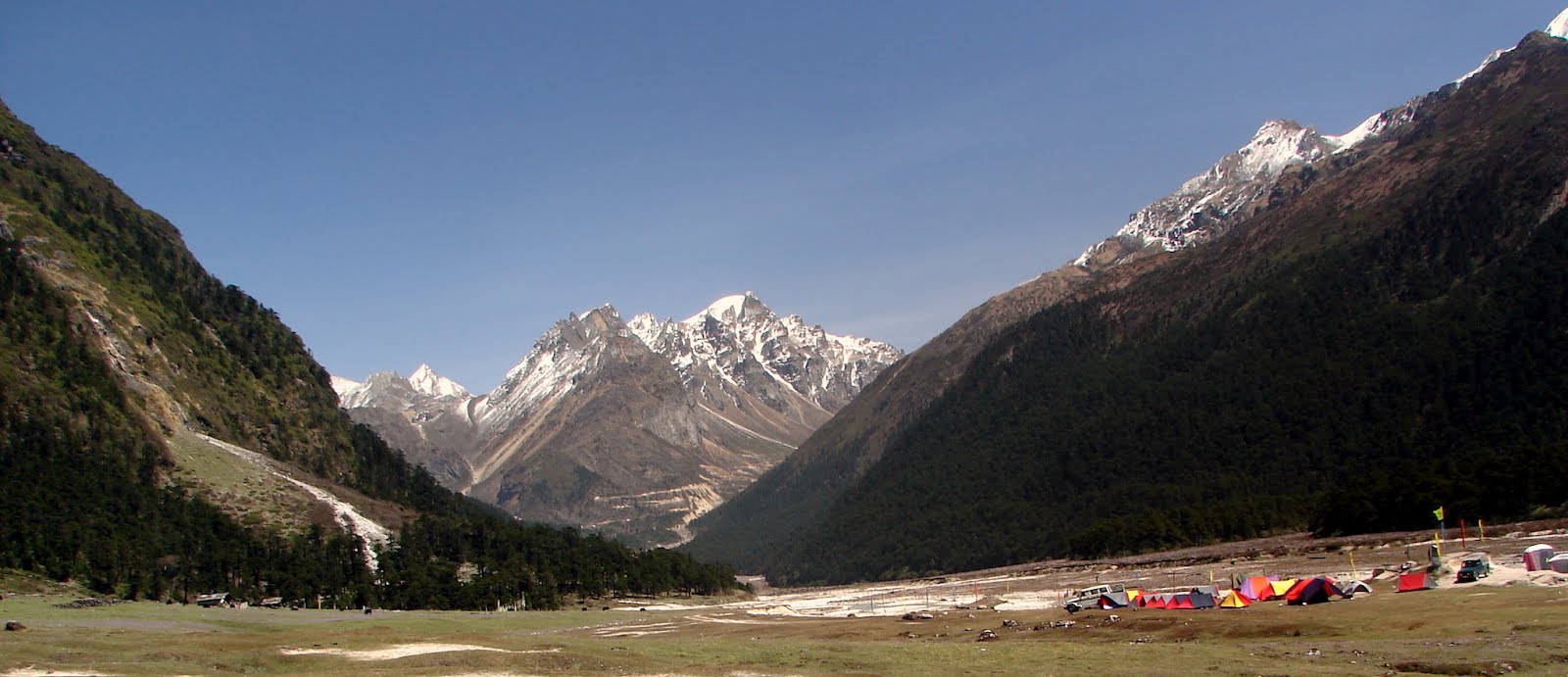
Sikkim's original inhabitants are the Lepchas also called Rongtub (“the dearest people of Mother Earth”). They named their motherland "Ney Mayal Lyang" which means heaven . A visit to the tiny little thumb shaped pretty Himalayan state sandwiched between the kingdoms of Nepal in the west and Bhutan in the east, proves that the Lepchas did not exaggerate. On its northern border towers the plateau of Tibet and it shares its southern border with West Bengal.

Being close to the Tibetan Plateau, the entire valley witnesses long winter seasons. During this entire period the valley receives heavy snowfall which further enhances its beauty. The snow capped mountains are like a fest to the eyes. The far-off mountains stand shrouded in mist.


Singba Rhodendron Sanctuary is located towards the North of Sikkim, in the famous Lachung Valley. The sanctuary is bounded on its southern pheriphery by the Yumthang Valley (dubbed as “Valley of Flowers”) known for its alpine meadow and hot springs. It is hemmed in on the east by high rugged Chuba - Sagochen mountain ranges and on the west by part of Chomzomei Tso extending upto Lava pass. The sanctuary is known for its unique abundance of Rhododendron trees and shrubs. In the months of April & May the entire valley is covered with bright colors of blossomed Rhododendron flowers. The picturesque Yumthang river silently flows towards its destination through the sanctuary.

This beautiful and diverse landscape makes it a trekker's paradise. It seems as if God himself spends his leisure hours in this less explored and un-spoilt serene land. Some of the most wild flowers fill up your senses and enamour you.


3 comments:
-
SRIDHAR R ( Srirangam ) said...
-
great article and great photos...when did you visit this place .....cheers
-
Padma said...
-
Wow so good! I loved the photos too.. Nice to meet a fellow travel freak :D
-
Casey said...
-
Thank you Sridhar and Padma for visiting my blog and liking my posts. Appreciations like these encourage bloggers to write better articles. Thanks.
Tsomgo [Changu] Lake - Sikkim

The ethereally beautiful kilometer long 15 m deep Tsomgo (pronounced Changu) lake is nestled at an incredible altitude of 12,400 ft. TSO means lake and MGO means head in Bhutia language. The vast expanse of crystal clear water is situated on the Gangtok-Nathula highway and is revered by the Sikkimese as sacred. The Nathula pass was part of the famous Silk route connecting the plains of Bengal with Tibet and from thereon China.
The lake is also of special significance for the Jhakris [faith healers] of Sikkim who congregate here annually on Guru Purnima from all over the state to offer prayers.
Around the picturesque Tsomgo Lake is woven a rich legend. Sikkimese folk-lore narrates that Tsomgo was initially at Laten, several km away from the present Tsomgo (lake). One night an old woman of Tsomgo dreamt that the lake at Laten would shift to Tsomgo. She was warned to leave the place as soon as possible. The old lady hastened to inform her other yak herder friends but they paid no heed.

She hurriedly milked her dri (female yak) and poured the milk on the ground for good luck and left the place with her yaks for Lhachungkar near Thegu. Just before leaving, she saw an inordinately fair lady with gleaming grey hairs, entering Tsomgo. Immediately the earth turned into water and formed Tsomgo lake. The two obstinate yak herders are believed to have been submerged in the lake along with their yaks.
In the times gone by, lamas (Buddhist monks) are said to have foretold the future by observing the color of the lake’s water. If the water had a dark tinge, it foreshadowed a year of trouble and unrest in the state.

Nathula area has three lakes - Memonchu, Kupup and Tsomgo - and out of three, reports have shown that the Tsomgo lake is heavily polluted. Tsomgo wetland is amongst the most productive & biologically rich ecosystems and also amongst the most endangered. This wetland is a lake complex joined by some other water bodies Manju I and Manju II.
There are several shops selling snacks, souvenirs, warm clothes and snow boots along the periphery of the lake. Basic sanitation and sewerage facilities are almost negligible, leading in all the human and yak wastes ultimately percolating down the lake. The experts have observed that due to low temperature, bacterial decomposition of the wastes is at a very slow process. Exhaust fumes from the tourist vehicles greatly damage the rarified air and water resources.

Tsomgo Lake Conservation Society president Chewang Norbu Bhutia has reported that when tourism in the state was not so popular, the lake water was pure and drinkable, but it had become polluted subsequently. The efforts of the society include sensitising the locals and tourists alike about maintaining the cleaniness of the lake and its premises, besides maintaining the tourist amenities and eco-tourism code.
3 comments:
-
SRIDHAR R ( Srirangam ) said...
-
you have got clear photos...unfortunately when we went to this place during February 2012 (last month) , it was full of fog...we returned disappointed
-
Casey said...
-
Thanks Sridhar for visiting my blog. Yes, it is difficult to get clear pictures as it is covered by fog on most of the days. We were indeed fortunate that we had clear weather for a few minutes when we visited the lake.
-
Unknown said...
-
Hi..I really enjoyed reading your blog post .:) This pristine and scenic lake is one of the most popular places for tourists in Gangtok. It has an average depth of 50 ft and remains frozen during the winter months. For travelers, there are plenty of hotels in Gangtok.
Opéra National de Paris - Palais Garnier - Paris
Sees operas daily, learns the tunes so long,
Till foot, hand, head, keep time with every song:
Each sings his part echoing from pit and box,
With his hoarse voice, half harmony, half pox.
- prologue of John Dryden's 1685 Albion and Albanius
The rich history of French music began in 10th century with court songs and chivalrous music. From this point forward, France has an illustrious musical history, ranging from Opéra to classical, to pop and rock. While the first operas that appeared in France during the mid-17th century were experimental, they was soon met with considerable enthusiasm in Paris, especially those based on Italian opera of the time. During the reign of Louis XIV, Italian-style Opéra began to flourish in France. The Opéra represented French grand Opéra and attracted the upper class.

Entertainment for the upper class
There would frequently be huge pageants to celebrate occasions such as the birth of an heir or an empire-building marriage in Italy during the Renaissance. Members of the aristocracy and hired performers to impress the nobility of neighbouring states performed at these events.
When one of King Charles VI's knights married one of the queen's gentlewomen, he performed in a masque or morisco (masked performance) called Bal des Ardents or Burner's Ball where he played a Wild Man of the Forest in a big hairy costume made of flax and pitch. At one moment when he separated himself from the other five "wild men" to talk to a duchess, a torch held by an onlooker set the other five dancers on fire. When the fire spread to the king's costume, the duchess smothered it with her train. All but one of the other five dancers died from their burns.
Christina of Sweden, the kings of Denmark and Poland, the princes of Germany and Italy, the Holy Roman Emperor, all had their Ballets. Even the taciturn William of Orange, later William III of England, danced in a Ballet de la Paix at the Hague in 1668. France was no different. Where the French king led, the courts of Europe followed.
Evolution of Ballet
Men wearing wigs and bloomers with hard shoes and women wearing heavy long-skirted gowns took part in the dance that also had equestrian demonstrations and mock combats!
As ballet advanced and became more dance and less speaking over the next fifty years it stopped being something that was only offered in court and was offered to paying audiences. Also during this time, the nobility, including King Louis XIII, performed in roles ranging from the hero to the lowest scum in the ballet, lending prestige to the portrayal of evil parts. A number of stage works informed the creation of Opéra. It did not remain tied to a single geographic area, and fast became one of Italy's chief exports.

Ballet receives royal patronage in Paris
Cardinal Mazarin
Louis XIV's interest in dancing was strongly supported and encouraged by Italian-born Cardinal Mazarin. Louis XIV made his ballet debut as a boy. Louis accomplished his most memorable feat as a dancer in 1653 when he was just a teenager. He performed a series of dances in Le Ballet de la Nuit . He appeared as Apollo the Sun God for his final piece and he came to be known as the Sun King.
Lully
Cardinal Mazarin promoted Italian influences in the French spectacle. Jean-Baptiste Lully, a Florentine, arrived in Paris at age 14 to serve as an Italian tutor to Louis XIV's cousin, Grande Mademoiselle Anne-Marie-Louise d'Orleans. Having distinguished himself as a violinist and dancer, he left to take a position in Louis XIV's court in 1652.
Lully composed court ballets with Isaac de Benserade - including the one performed at Louis' wedding. He became one of the king's favorite dancers and rivaled the king as the best dancer in France. He continued to gain importance in the court and in 1661 he was appointed surintendant and compositeur de la musique de la chambre du roi.
Académie Royale de Danse
In 1661 Louis established the Académie Royale de Danse in a room of the Louvre, the world's first ballet school. The king attended a party put on by the finance minister to show off his new home in the country. The king was greatly by the entertainment put up. He thought that the finance minister was a treasonous servant and arrested him. He then hired the ballet master Molière, the home's architect, and the gardener.
In 1662 Lully was granted the title maître de la musique de la chambre which placed him in regular contact with the king. With his directorial duties dispersed to others, Lully began working with the playwright Molière on a series of comédies-ballets -- a new genre combining spoken comedy with singing and dancing.

Molière
At court, Molière and Lully collaborated, with Molière choreographing and Lully composing the music for ballets. By the end of the decade, Lully witnessed the first attempt to perform opera in Paris.
Académie d'Opéra et Académie Royale de Musique
In 1669 Louis, (still Louis XIV), established the Académie d'Opéra which was renamed as Académie Royale de Musique a year later. Pierre Perrin and Robert Cambert were given royal permission (a "monopoly") to stage operas. Then, in 1670 the king, past his physical prime, retired from dancing, allowing other, better dancers to take lead roles. Though Perrin and Cambert were bankrupt three years later, Lully was keenly aware of the possibilities and persuaded the king to transfer the monopoly to himself.
In 1672 Lully established a dance academy within the Académie Royale de Musique. This dance company survives today as the ballet of the Paris Opera - the world's oldest continuously running ballet company.
Lully accidentally stabbed his foot in 1687 with his time marking stick and subsequently succumbed to the injuries. At this time, ballet was normally performed in a theatrical form known as opéra-ballet by the same productions as opera. The music academy that Lully had run set the standard in the opéra-ballet, which people attended for the dancing as for the music. L'Europe Galante(1697), the composer of one opéra-ballet suggested making the opéra-ballet more popular by lengthening the dances and shortening the skirts of the now common female dancers.
Through the seventeenth, eighteenth, and nineteenth centuries, the Paris Opéra occupied a succession of buildings:
Première Salle du Palais Royale, from 1673
Salle des Machines du Palais des Tuileries, from 1764
Deuxième Salle du Palais Royale, inaugurated in 1770
Salle de la Porte Saint-Martin, from 1781;
Théâtre des Arts, from 1791 and
the Salle Le Peletier, constructed from 1820-21 on rue Le Peletier. The Salle Le Peletier was destroyed by fire in 1873.

Palais Garnier
All the previous halls, since the foundation of the Académie Royale de Music, had been either of temporary construction or had been destroyed by fires. Hence Napoleon III decided to build the Grand Opera in 1858.
An architectural competition was organized for the new opera house in 1860. Charles Garnier's design was selected out of the 171 entries. He created an Opera House and stage in the traditional Italian style inspired both by the Grand Theatre in Bordeaux built by Victor Louis in 1870 and by the Italian and French villas of the 17th and 18th centuries. The passages, halls, foyers, staircases, and rotundas occupy a far larger area than the theatre itself. This was to facilitate hosting the festivities of the Emperor's entourage and of elegant audiences from the moneyed and social élite, for whom a night at the Opera was a pleasant excuse for meeting people and renewing acquaintances.
A water table was discovered at the site when the construction started in 1861 and it had to be drained before the construction could begin. This slowed down the work drastically. An enourmous concrete well was designed and filled with water to carry the stage and fly tower. The well was filled with water in order to counter the water pressure (hence the legend of the underground lake popularized by Gaston Leroux's Phantom of the Opera).
Franco-Prussian war and the Commune interrupted the construction works in 1870. But the fire at the old opera in Rue Le Peletier in 1873 hastened the completion of the monument. Begun under the Second Empire in 1862, construction of the opera house took about 14 years to complete. It was officially inaugurated during the Third Republic by Field Marshall de Mac-Mahon on 5 January 1875.
The building, which is a perfect example of 19th century stage architecture, hides its iron frame under flamboyant decoration. The overall impression is harmonious in spite of the diversity of its inspiration and the temes taken up by Charles Garnier. He personally supervised the integration in the architecture of decorative works entrusted to sculptors, painters and mosaic artists representative, as himself was, of state-sponsored artists.

TRIUMPH OF ECLECTICISM
Garnier's architectural principles are imbued with Renaissance ideals. Garnier also had "general interest in all kinds of technological progress", such as "balancing the ancient craft of stonecutting against iron's modern industrialization of architecture. This diversity of the materials used in the building and the range of colours used right from the façade, takes you into the fairy-tale world of the Opera House.
The two side pavillions formerly provided access for the regular subscribers on one side and for the Emperor on the other. They are today occupied by the Library and the Opera Museum. At the right of the entrance halls, there is the famous group of dancers by Jean-Baptiste Carpeaux - the original is in the Musée d'Orsay. The great staircase continues down towards Pythia's water basin and the former subscribers' rotunda. The stairs are decorated in marble and onyx, a true theatre of worldly events, while the lobby is decorated with Venetian mosaics.
Two small rooms, one dedicated to the Moon, the other to the Sun, lead to the main foyer, a princely gallery of gilded luxury in which the mythological characters and the allegories of Paul Baudry stand out. The rotunda is adorned by eight tapestries made by the Gobelins, under a ceiling by Georges Clairin. In the auditorium itself, the great chandelier illuminates the ceiling by Marc Chagall, which has, since 1964, covered the original work of Jules-Eugène Lenepveu. Echoing the colorful style dear to Charles Garnier's, Chagall has designed his painting as a living image of the festive spririt surrounding each performance: luminous, fluid figures surge forth, contrasting with the gold and red tones of the theatre.

Among round arches and soaring Corinthian columns, busts and medallions of celebrated composers adorn the stately façade of dressed stone. The four thematic façade groups at the entrance to the opera house include Harmony by Jouffroy; Instrumental Music by Guillaume; Lyric Drama by Perraud; and The Dance, the celebrated sculpture by Carpeaux.
The façade attic groups with winged goddesses by Guméry are entitled Harmony and Poetry. Each flytower corner group by Lequesne features Pegasus rearing above the great, copper-plated dome. At the stage flytower apex stands Aimé Millet's monumental group Apollo Crowning Dance and Poetry. The youthful god holds aloft a golden lyre - a decorative leitmotif throughout the splendid Palais Garnier.
The French Revolution of 1789 prompted the Paris Opéra to produce a series of operas on revolutionary subjects. In the middle and late 19th century, grand opera, exemplified in the works of Giacomo Meyerbeer, flourished in the company’s repertory. The Opéra underwent a decline in the 20th century, and attempts to rejuvenate it began at mid-century. Its administration was joined with that of the Opéra-Comique, which traditionally stages works with spoken dialogue. From 1875 to 1990 the Paris Opéra was housed in the Théâtre Nationale de l’Opéra, an architectural landmark that is better known simply as the Opéra. In the latter year the company occupied its new home in the Opéra de la Bastille building.
Star Turtles

Turtles have been inhabiting our planet for more than 150 million years. Star Turtle is a species of Turtle found in dry areas and scrub forest. This species is quite popular in the exotic pet trade. Star Turtles have a yellow or tan head. Females are much larger than males and have a shell which is much broader.Life span is up to 80 years.
ScienceDaily (Feb. 22, 2011) — A report issued Feb. 22, 2011, co-authored by the Wildlife Conservation Society (WCS) working in conjunction with the Turtle Conservation Coalition, lists the 25 most endangered turtle species from around the world -- some of which currently number less than five individuals.
Decimated by illegal hunting for both food and the pet trade along with habitat loss, many turtle species will go extinct in the next decade unless drastic conservation measures are taken, according to the report, which was released at a regional workshop hosted by Wildlife Reserves Singapore and WCS.
Illegal hunting for turtles in Asia for food, pets, and traditional medicines is a particular problem, the report says.
"Turtles are being unsustainably hunted throughout Asia," said co-author Brian D. Horne of the Wildlife Conservation Society. "Every tortoise and turtle species in Asia is being impacted in some manner by the international trade in turtles and turtle products.
Liz Bennett, Vice President of WCS Species Program, said: "Turtles are wonderfully adapted to defend themselves against predators by hiding in their shells, but this defense mechanism doesn't work against organized, large-scale human hunting efforts. The fact is that turtles are being vacuumed up from every nook and cranny in Asia and beyond."
3 comments:
-
Ramya said...
-
i got to your blog while looking for information on barkul.
you've got some interesting travelogues up here :)
looking forward to reading more! -
Casey said...
-
Thank you Ramya Sriram for visiting my blog.
-
SAM India Tour said...
-
Thank you for publishing this awesome article
Hawa Mahal - Jaipur
 The
succession of Madho Singh's five year old son Prithvi Singh on his
death in 1768 was in accordance with protocol.What was unusual was that
the person appointed as his regent was not his own mother, but an older
and more senior queen of Madho Singh's, a woman descended from the
Chandawat line (a branch of the house of Mewar); and she had a son of
her own, Pritvi Singh's younger half-brother Pratap.
The
succession of Madho Singh's five year old son Prithvi Singh on his
death in 1768 was in accordance with protocol.What was unusual was that
the person appointed as his regent was not his own mother, but an older
and more senior queen of Madho Singh's, a woman descended from the
Chandawat line (a branch of the house of Mewar); and she had a son of
her own, Pritvi Singh's younger half-brother Pratap. The thakurs strongly disliked female rule of any sort but they were divided about how to take control of their infant king themselves, were further appalled by the open secret of the close personal relationship between her and one of her ministers, a man named Firoz who had previously been an elephant driver. Impotent to change the situation, the thakurs returned to their own estates and sulked, waiting for the boy to come of age when he could appoint his own advisers and ministers. But Prithvi Singh never reached his majority. At the age of fifteen, just at the point when he seemed ready to shake off his unwholesome guardians and assert himself, he died suddenly as a result of a fall from his horse. Though not yet old enough to rule, he had already married twice. That he was succeeded not by his own infant son Man Singh, the legitimate heir, but by the son of the queen regent, his half brother Pratap - thus perpetuating the power of the regent and of her elephant driver - must excite the suspicion that Prithvi Singh was pushed. Poor Prithvi Singh had been riding for this fall all his life. As James Tod mildly put it, given that the Chundawat rani had a direct interest in the death of Prithvi Singh, the laws of common sense were violated in appointing her his guardian.
- "JaipurNama" Giles Tillotson
Thus Pratap Singh succeeded Prithvi Singh in April 1778 at the age of thirteen. Early in 1779 he visited the emperor at Delhi and was recognised as the rightful ruler. Pratap was a man rather more in the image of the founder, his grandfather Sawai Jai Singh. Though not on the same scale, he was an enthusiastic patron of literature, painting and architecture. His major addition to the palace is the building for which Jaipur is best known today, the Hawa Mahal.

He commissioned Lal Chand Usta in 1799 to design Hawa Mahal which literally translates to "Palace of Winds". It is an icon of Jaipur and is an extension of the Royal City Palace Zenana (women’s chambers) standing away from the main complex. The monument with a spectacular view of Jaipur city with road avenues, intersections and colourful crowds in the market, was originally conceived with the aim of enabling ladies of the royal household to watch the everyday life and royal processions in the city without being seen. This is the element on which the builders lavished most attention.
Admired by many for its breathtaking eccentricity, the Hawa Mahal has been derided by others as a gratuitous flourish, disconnected from any serious purpose. Leaving aside arguments as to its quality, the seeming confusion and jumble of forms is in fact regulated by a strict and carefully calculated order. Though superficially it appears arbitrary, a careful scrutiny will reveal how the architect has devised a composition out of a handful of well-establised and elementary principles of vastu vidya.

The building, standing on a high podium, is a fifty-foot high thin shield, less than a foot in thickness, with small intimate chambers , which give this palace its unique facade. There are no regular stairs to reach the upper floors, but only ramps.
Though often described as merely a screen, the Hawa Mahal is in fact a structure built around two courtyards, but with a vast screen-like facade on the east, overlooking the street. The five storied pyramidal shaped monument built in red and pink sand stone to keep with the décor of the other monuments in the city is in the form of a Mukuta or crown, adorning Lord Krishna. Its façade depicts 953 niches with intricately carved Jharokhas (some are made of wood) is a stark contrast to the plain looking rear side of the structure.

Its cultural and architectural heritage is a true reflection of a fusion of Hindu Rajput architecture and the Islamic Mughal architecture; the Rajput style is seen in the form of domed canopies, fluted pillars, lotus and floral patterns, and the Islamic style is evident in its stone inlay filigree work and arches (as distinguished from its similarity with the Panch Mahal – the palace of winds – at Fatehpur Sikri).

One very interesting feature of Hawa Mahal is the fact that the elaborate and decorative element exists only on one side. There is a total lack of ornamentation on the inner face of the building. The chambers are plain and more a mass of pillars and passages leading to the top storey.
 Entrance to Hawa Mahal is from the City Palace side, through a stately
door. Façades of Jaipur and surroundings typically have gokhdas (sitting
spaces) on either side of the entrance. Stylistically, the bangaldar
(curvilinear) roof became prevalent in stone chhatris and chhajjas
(sunshades) and was later used in other areas of Rajasthan too. Ganesha
(opens gate to material success and is the spiritual guide), Shiva,
Laxmi on moon (symbol of beauty), Vishnu and Kalki are etched on the
chhatri.
Entrance to Hawa Mahal is from the City Palace side, through a stately
door. Façades of Jaipur and surroundings typically have gokhdas (sitting
spaces) on either side of the entrance. Stylistically, the bangaldar
(curvilinear) roof became prevalent in stone chhatris and chhajjas
(sunshades) and was later used in other areas of Rajasthan too. Ganesha
(opens gate to material success and is the spiritual guide), Shiva,
Laxmi on moon (symbol of beauty), Vishnu and Kalki are etched on the
chhatri.The stately entrance door opens into a spacious courtyard. The courtyard has a double storeyed building on three sides. The royal family celebrated the colorful festival of Holi on Phalgun Purnima which comes in February end or early March in the courtyard.
There is a small archeological museum here. Only the eastern wing has three more storeys above, which are just a single room thick.

Pratap Mandir
Sawai Pratap Singh was barely 13 years when he ascended the throne.He had no knowledge of administration. He lived through troubled times. The kindom had spent 25 years placating the Maratha. The royal treasury had run dry. Jaipur was poor. He would retire to Pratap Mandir (situated at one end of the open courtyard) where he spent time composing poems in praise of his beloved Lord Govindaji. He would sing and dance praising his lord.

N.G. Rathod in his book "The Great Maratha Mahadaji Sindhia" describes Pratap as a fickle-minded transvestite who tied "jingling bells" [anklets]to his feet and danced in the dancing halls.
Bhojan Bhavan - Rare public Dining Hall
On the other side of the courtyard is the Royal Dining Hall. Among the many things popular about the Maharajas of Rajasthan are the dishes they savoured. The food was prepared to nourish people fighting wars and were away from their homes for long periods. It was required for the food to have long shelf lives. Also the desert climate has seen the evolution of recipes that call for minimum water and did not use great quantities of vegetables. The foods were cooked in accordance to what was available and that scarcity never changed the grandiose lifestyle of its people. Greater use of milk, butter milk and other milk products can be seen in Rajasthani cuisine.

Some of the widely renowned Rajasthani Cuisine are dal-bati, besan-chakki, churma, jhajariya, gevar, balusahi, tarfini, raabdi, bail-gatte, panchkoota, chaavadi, laapasi, nukhti, googri and dhungari hui chaach. In Rajasthan, dry fruits, yogurt and spices are used while cooking many dishes. Dal-Bati-Choorma, made of butter, cereals and sweetened bread pudding of Jaipur is considered a specialty. The royals often treated their guests to these Rajasthani delicacies in the Royal Dining Hall on the ground floor.
The second storey is known as Ratan Mandir because of the dazzling glasswork on its walls.

The third storey is called Vichitra Mandir, as no one knew what lay behind the closed doors. Some believe that the maharaja worshipped his deity Lord Krishna here.
The Jaipur royals were a formidable polo playing family. They kept special stables for polo ponies and their teams included among the very best in the world. Very often, the players were the rulers and members of their families, though their armies also encouraged the sport. In the zenanas, even the women of the royal family were encouraged to play polo and proved themselves adept at it. The royal family also played polo on elephant-backs. The queen and her maids watched the polo matches and archery matches from the fourth story known as Prakash Mandir. It has an open terrace on both sides.

The fifth storey is known as Hawa Mandir after which the whole structure came to be known as Hawa Mahal.
Beautiful Light patterns caused by colour glasses in the windows
 Hawa
Mahal's unique five-storey exterior is also akin to the honeycomb of
the beehive with its 953 small windows called jharokhas that are
decorated with intricate lattice work. The small windows circulated
cooler air during the months of summer season. The original intention of
the lattice was to allow royal ladies to observe everyday life in the
street below without being seen, since they had to observe strict
"purdah" (the practice of preventing women from being seen by men).
Though no historical record is available to its exact history, it is
conjectured that Royal family ladies, who were under strict observance
of purdah , had to be given opportunity to witness proceedings in the
market centre and watch the royal processions and festivities sitting
behind the stone carved screens.
Hawa
Mahal's unique five-storey exterior is also akin to the honeycomb of
the beehive with its 953 small windows called jharokhas that are
decorated with intricate lattice work. The small windows circulated
cooler air during the months of summer season. The original intention of
the lattice was to allow royal ladies to observe everyday life in the
street below without being seen, since they had to observe strict
"purdah" (the practice of preventing women from being seen by men).
Though no historical record is available to its exact history, it is
conjectured that Royal family ladies, who were under strict observance
of purdah , had to be given opportunity to witness proceedings in the
market centre and watch the royal processions and festivities sitting
behind the stone carved screens.
6 comments:
-
Neha said...
-
Why don't they just paint it again? Is it so difficult? Why do we prefer to let our old monuments rot than maintain them like new?
-
Casey said...
-
Thanks for visiting my blog Neha.
It is not just the Government that neglects our heritage monuments, but the citizens too don't respect them. It was very disheartening to see a group of college girls etching their names on the walls of this national Heritage. When I told them not to spoil the structure, they told me that they were only adding their names to the list of other names already etched there. -
Unknown said...
-
A five-storey high red sandstone structure complete with over 950 windows, Hawa Mahal was made in such a way that the breeze circulates through these windows, giving the palace its name. For travellers who are planning to visit Jaipur, check out these hotels in Jaipur.
-
Anonymous said...
-
Such an iconic masterpiece! Hawa Mahal is truly a testament to Jaipur's rich heritage and architectural brilliance. Can't wait to visit and experience its grandeur in person!
-
Anonymous said...
-
Such an iconic masterpiece! Hawa Mahal is truly a testament to Jaipur's rich heritage and architectural brilliance. Can't wait to visit and experience its grandeur in person
-
Hawa Mahal said...
-
hawa hehal
St. Mary's church - Cantonment Belgaum

Of the several historical monuments in Cantonment, St. Mary's Church deserves a special mention. This Gothic church was designed by Reverend Francis Gell and built under the supervision of the then army garrison engineer. It is built of Gokak pink stones, Alnavar and Dandelt teak and mortar. It took five years to complete. It was consecrated on April 15, 1869 by the then Governor of the Bombay Precedence.

Features of Gothic architecture
The pointed arches allows a greater weight to be carried when compared to a Norman rounded arch. It is important to note that in addition to providing a greater flexibility to architectural form, the pointed arch also directed one's gaze to heaven.Due to the versatility of the pointed arch the structure of Gothic windows evolved from simple openings to immensely rich and decorative sculptural designs and the windows were later filled with stained glass which added a dimension of color to the available light in the building.
The buttresses allow the extra weight to be transferred to additional parts of the church. 'Flying buttresses' allow the outward pressure of the massive roofs to be resisted. The ability to cope with greater weights also allowed Gothic architects to use larger windows.
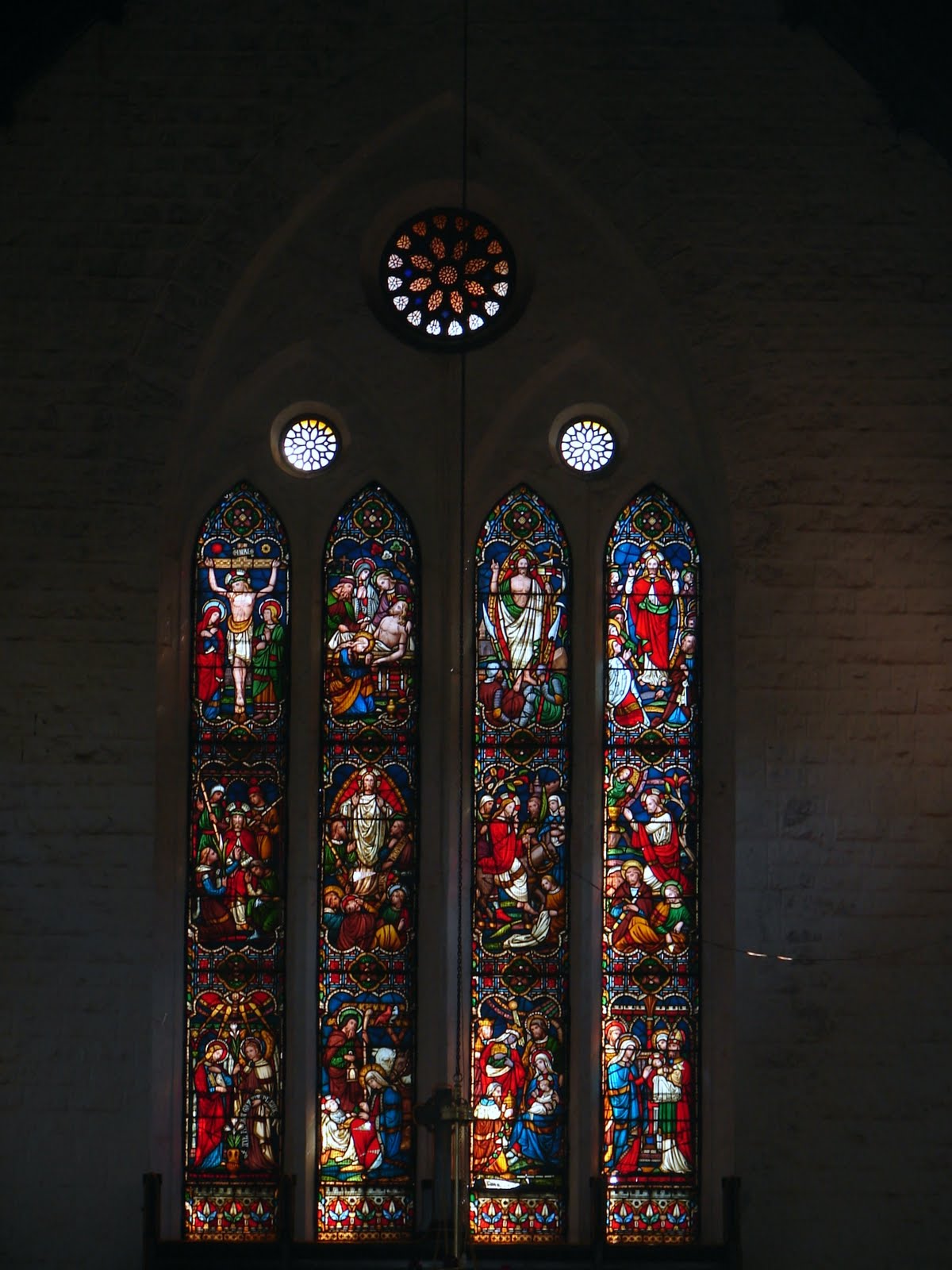 The teak and marble altar is towered by an exceptionally beautiful
stained glass collage. The collage is 20 feet tall and 8 feet wide. The
collage depicting the life of Lord Jesus from birth to resurrection in
12 frames was made in Italy. The sun filters through the stained
glasses in the church during the morning service creating a breathtaking
view. The main thrust of Gothic style is to make light all important.
The pipe organ is as old as the church itself.
The teak and marble altar is towered by an exceptionally beautiful
stained glass collage. The collage is 20 feet tall and 8 feet wide. The
collage depicting the life of Lord Jesus from birth to resurrection in
12 frames was made in Italy. The sun filters through the stained
glasses in the church during the morning service creating a breathtaking
view. The main thrust of Gothic style is to make light all important.
The pipe organ is as old as the church itself. 
St Mary’s Church follows the Anglican form of worship. Prior to Independence, it was the Army Garrison Church of Belgaum, under the Army Station Commander, the Bishop of Bombay and the Archbishop of Canterbury, England. The head priest of the church was the Chaplain of Belgaum. Even today the locals refer to this church as the Church of England or High Church.
3 comments:
-
SRIDHAR R ( Srirangam ) said...
-
Hi, nice writing....good photos...i too love traveling like you...
-
Casey said...
-
Thank you Sridhar for visiting my blog. Thanks for liking the posts and photos
-
Joseph Britto said...

-
Truly one of the Best Churches in India .
The surrounding landscape itself seems to Blend with the pink color
of the Church.
The Stained glasses are surely amongst the Best and the Magnificent
Altar indeed is the Unique Feature of this amazing Church.
Chennamma's Kittur

The fort at Kittur spread over an area of about 23 acres was built by Allppa Gowda SarDesai the fifth ruler of Kittur dynasty during 1660-1691 A.D. The fort built with small stone available in plenty in the surrounding region was extensively damaged by Chaplin, the British Comissioner of Deccan region.

The palace in the Kittur fort popularly known as "Rani Chennamma's palace" was also constructed by Allappa Gowda SarDesai. The palace was constructed in the Peshwa-Islamic style. The palace was a three storied building consisting of several rooms. The various rooms in the palace can be classified as: Rest Rooms, Discussion Rooms, Pole Star Viewing Room, several kitchens, bath rooms etc. Copper pipes supplied water to the palace. The palace also had a secret well that reflects the social structure of the period.

The guest rooms, the Durbar hall, the Dining hall, the store rooms, the kitchen etc. provide a glimpse of the architectural marvel of the palace. Every room had two entrances. A well was constructed inside the palace and brass pipes were used for water supply. Stone containers and tanks were built to store water. The dining hall was designed to feed at least thousand persons at a time. The palace had an in-built swimming pool. Inside the palace, there are remnants of ornamental arches and decorated shelves.

There was a beautiful dwara mantapa in front of the palace. This measured 100ft broad and 300 ft long. This was decorated by tall and attractive pillars. In one of the rooms of the palace, in the midst of a wall, an iron pipe measuring 1.5 ft was in-built to enable one to view Pole-star from inside the room.

Kittur known as Geejaganahalli in the 12th C became the seat of power of Kittur kings between 1585 and 1824 A.D. The principality of Kittur was founded by the Shetty brothers - Hiremalla and Chikkamalla who hailed from Sagar area of Shimoga district. Adil Shahi, the king of Bijapur, in admiration of teh services and the heroic deeds of these brothers gifted Kittur in 1585 A.D. The Shetty brothers ruled this area with Sampagaon as their capital. Kittur was ruled by 12 kings in all.

King Mallasarja, the most famous of all the Kittur kings ruled this land between 1782 - 1816 A.D. Kittur attained great fame during his rule. Baji Rao Peshwa of Pune who was jealous of his achievements invited him to Pune on the pretext of extending his hand in friendship and kept him in prison for 3 years. Mallasarja's health deteriorated and he died in 1816. His first wife Rudramma turned towards spiritualism and his second wife Chennamma, an able administrator ruled the land after Mallasarja's death.

Though Chennamma's son Shivabasavaraja was older than Rudrasarja Chennamma coronated Rudrasarja as she had promised Rudramma that she would always treat her as her elder sister and her son would inherit the kingdom. She tied "Bhairavi kankaNa" to her son which meant that he had to pledge his life to save the king's life with his own if required. Rudramma's son Shivalinga Rudrasarja proved to be a very weak ruler. So Chennamma assumed to herself the reigns of Kittur. Shivalinga Rudrasarja died issuless on 12-10-1824. The British then started interfering in the administration of Kittur. Thackery, the Collector of Dharward, seized the treasury of Kittur. Chennamma provocated by this incident prepared to confront the collector. The brave soldiers of Kittur defeated Thackery and his men. Thackery was killed by Amatur Sadhunavar Balappa's bullet, a loyal bodyguard of Chennamma who was leading the battle. Since the battle preceeded the revolt of Jhansi Rani, Chennamma is popularly known as "the pole star of Indian Independence".

Chennamma realised that she could not fight the British army and on the advise of her guru initiated the peace treaty with the British. She also took good care of British officers Illiot and Stevens who were prisoners of war. She was also simultaneously preparing for the inevitable war with the British. British galvanised a huge army and attacked Kittur on 3rd December 1824. The battle that lasted for 3 days resulted in the defeat of the queen who was exiled at Bailhongal.

Kittur fort fell to the British on December 5, 1824. Rani Chennamma was captured and sent away to the jail in Bailhongal. Chaplin confiscated 16 lakh Rupees, ornaments worth 4 Lakhs and other valuables from the Kittur fort. He destroyed the palace and the fort to avenge the death of comissioner Munroe and other British officers. He sold the wooden doors and windows in the palace. He permitted the British soldiers to loot the palace and ransack it completely. He wanted to instill fear in the minds of other Indian rulers who dared to retaliate against the British rule.

The patriotic queen who dreamed of a free country breathed her last in 1829 while still in the British custody.

11 comments:
-
Unknown said...
-
Hello,
I like to know the source of your writings -
Casey said...
-
Thanks for visiting my blog Anoop. Sources for my posts on historical topics - books and internet. A little bit of imagination for the non-history blogs :).
-
Basavaraj Chikkamath said...
-
thanks for giving such nice historic information and photos..
-
Anonymous said...
-
Hello Casy,
you mind if i shoot some questions at you?....don't worry it would based on ur really good blogs.
I don't know how to get in touch with you....but i would be looking at the same page for the nxt few days...to see if i get a reply from ur side.
Thank you.
Norman
-
Casey said...
-
Hello Norman,
Thanks for visiting my blog. Sorry, I do not check my messages very often. You could post your question on the blog post if it is related to the posts, I will reply at leisure.
Regards,
KC -
Desai said...
-
Thanks for the very good photographs of Kittur Fort. I appreciate and proud of you.
Thanks
MALLASARJ DESAI -
Casey said...
-
Thanks for visiting my blog Mallasarj Desai.
-
The Shimoga Post said...

-
Please intimate me the names of Kittur Kings from the beginning to the last.
Prakash Rao -
Unknown said...
-
Good
-
Unknown said...
-
What is secret well here please say
-
Anonymous said...
-
ಶಿವಲಿಂಗ ರುದ್ರಸರ್ಜ ಅಮರ ವಾದ ದಿನಾಂಕ ತಿಳಿಸಿ ದಯವಿಟ್ಟು
Bhuvaraha Narasimha temple at Halasi

"Works of art indeed are not made entirely at random from inspiration; there are almost always discoverable some methods, principles and irrevocable canonical rules. Whatever may be the originality of a work, it is connected with contemporary works; it is explained by anterior works. The author belongs to a school, the work belongs to a style"
- Dr. Jaouveau-Dubreuil in Dravidian Architecture
Temple architecture in South India
The temple architecture that started in South India was generally classified into groups according to the names of the dynasties of kings. It is usually said that the Pallava period (AD 600-AD 850) is that of sculptured rock, the early Chola period (AD 850-AD 1100) that of grand Vimanas, the later Chola and Imperial Pandya period (AD 1100-AD 1350) that of the most beautiful gopuras and of the Vijaynagar period (AD 1350-AD 1600) that of mantapas and pillared halls and the Nayak period as also the modern period after 1600 as that of corridors.
Temple architecture in Karnataka
The Architecture of Karnataka can be traced to 345 AD with that of the Kadamba Dynasty. The Kadambas were the originators of the Karnataka architecture. Kadamba's architecture and sculpture contributed to the foundation of Chalukya-Hoysala style. Vijayanagara architecture is a vibrant combination of the Chalukya, Hoysala, Pandya and Chola styles, idioms that prospered in previous centuries
Salient features of Kadamba architecture
The most prominent feature of Kadamba architecture is the Shikara(tower), also called Kadamba Shikara. The pyramid shaped shikara rises in steps without any decoration and is crowned with a Kalasha on the top. Occasionally the pyramids had perforated screen windows.
Kadamba temples were an improvement on the Andhrabhritya structures. The latter we may presume, were like all ancient monuments, mere halls, as yet not separated into partitions. With the rise of the Kadambas, however, the temples came to consist of two distinct parts, namely the garbhariha and the sukanasi.

BhooVaraha Narasimha temple
A popular legend narrates that the Pandavas, while in exile, built Narasimha temple overnight at Halasi to worship Lord Vishnu.
Historically, the temple has been dated to 5th century AD when the Kadamba ruler Shivachitta were ruling over this region. Inscriptions inside the temple also support this.
The Varaha-Narasimha temple at Halasi shows further evolution in Kadamba architecture. The parallelopipeds in the stages of the tower are here more numerous than in several other temples. But as these stages are not so minutely divided or marked with profusion of ornamentation as in the later temples, the vigorous and purposeful lines of the tower are still maintained. The tower is arranged in eleven tiers. On the 10th tier there are four panels each crowned by a kirtimukha, or the grotesque face of a monster, apparently a lion.

The sukanasi which is surrounded by walls is lighted by pierced stone windows inserted above the overhanging eaves. Unlike the earlier Kadamba temples that have one window, Bhoovaraha Narasimha temple has three windows.


Originally, the temple had only one Garbhagriha where a crude idol of Narasimha having two hands was installed. It was later replaced with a seated Narayana. This shrine has a shikara built in the Kadamba-Nagara style which was renovated later.
A second garbhagriha facing the first, was added to the temple several centuries later. Vijayaditya III installed a 5 feet standing idol of Varaha carrying Mother Earth (or Bhoodevi) in his mouth in 1186-87 AD.
3 comments:
-
SAM India Tour said...
-
Thank you for publishing this awesome article
Golden Triangle Tour Packages
-
haeib jimed said...
-
A rare spiritual artifact like this Keertimukha deserves a sacred spot at home.
keertimukha -
arti3743rawat said...
-
I bought the kritimukha face for my workspace, and it’s brought a noticeable shift in energy. Highly recommended for spiritual balance.
Yellamma Gudda
A temple dedicated to Goddess Yellamma also known as Goddess Renuka, the consort of the mythical sage Sri Jamadagni and mother of Lord Parasurama, an incarnation of Lord Vishnu, forms the sacred crown of the beautiful hill. It is learnt from the legends that a part of the corpse of Sati fell here when it was severed by the Chakra or the 'Holy Wheel' of Lord Vishnu.

Although not usually a village guardian deity, Yellamma is represented somewhere in the pantheon of most villages in this region. She is also the "house deity" in a number of households from all castes in the social heirarchy. Equated loosely with Parvathi, all the prominent female deities of the region are considered her younger sisters; and the prominent male deities of the region (except Basavanna and Shiva) are her elder brothers.
According to one legend, Yellamma was born in Yellappagoudar's house in Haralakatti village. She married an ascetic Jamadagni who lived in an ashram on the hill outside Saundatti against her parents' wishes.
According to another legend, Renuka Devi also known as Yellamma, daughter of Renuka Raja married Sage Jamadagni on the advise of sage Agasthya

She would fetch fresh water for her husband from Malaprabha river every morning for his daily rituals by making a water pot with riverbed sand. She used a live cobra to cushion the pot on her head. One morning she saw gandharvas bathing in the river and she was momentarily lost in thoughts about her husband. She could neither make the pot nor catch the cobra as she could not concentrate. She returned home empty handed to face the wrath of her husband whose curse turned her to a leper.
Yellamma left the ashram and wandered far and wide. She came across two yogis, Ekayya and Jogayya who guided and helped her with the sacred waters of Jogalabhavi and cured her of leprosy. When she returned to the ashram, Jamadagni ordered his sons to chop off their mother's head. Three of their sons refused and finally Parasurama cut off his mother's head. The pleased Jamadagni granted Parasuram a wish and he chose to bring back his mother to life.
According to another legend,Jamadagni told Parasurama to bring his mother's head, but he couldn't find it. A woman Yellamma belonging to untouchable caste was passing by. Parasurama cut off her head instead and Jamadagni placed Yellamma's head on Renuka's body and she came back to life.
According to a third legend, Renuka fled to a low-caste community when her son parasurama was coming to kill her. He found an beheaded her along with another woman belonging to the low-caste who tried to protect her. When he later brought them back to life, he attached the woman's head to Renuka's body and vice-versa by mistake.
There are as many interpretations of the Renuka-Yellamma legend as there are varieties of the story. Since devadasis are invariably drawn from Dalit castes, the most obvious seems that it takes away the stain of sex with an untouchable: their heads (symbolised by Yellamma's) may be low caste, but their bodies (symbolized by Renuka's) might be used by upper caste men without defilement.
2 comments:
-
Anonymous said...
-
Hi Casy,
Its a nice write up. Like you even i am interested in travelling. May I know you contact num or id so that i can get in touch with you.
regds -
Casey said...
-
Thanks Anonymous for visiting my blog and liking the post. You could post your questions on the blog and I will respond to them at leisure.
Sugandavarthi (Saundatti) - Capital city of the Rattas

Saundatti was popularly known as Sugandhavarthi, Saugandhipura in the krutayuga. Jayappa Desai II of Navalgund - Sirasangi built the fort at Saundatti. He ruled Sirasangi- a prominent dynasty from 1734 A.D - 1758 A.D which was recognised as the "Golden Era". He was a clever administrator. He was humble, Religious, generous and sympathetic to his subjects. He was a great scholar and a poet. He composed poems in several languages and was also a patron of art . He translated the Sanskrit work "Deekshitara kuvalayaananda" composed by Appayya and "Rasamanjari" composed by Bhaanudatta to Kannada.

He paid prominence to the safety of his dynasty and constructed forts on elevated lands. He constructed forts at Kusugal (Hubli taluq), Sirasangi and Saundatti at a total cost of 8.5 lakh Rupees. He started the construction of Saundatti fort in 1743 and completed it in 1751 at a total cost of 2 lakh Rupees. The fort is spread over an area of 10 acres and is built of red sand stone. The bastions, stone walls, stone arches, moat and watch towers enhance the beauty of this fort.
Hyder Ali attacked the fort during 1777 - 1782. There are records stating that Hyder Ali and Tipu Sultan not only received large amounts of wealth from the Desais and but also looted the kingdom.

The rulers of Navalgund - Sirasangi were Veerashaivas. KaaduSiddeshwara of Siddhagiri was the Rajguru. Kaadusiddeshwara was the family deity of the Sirasangi rulers. The ancient temple of KaadaSiddeshwara was constructed (1635 A.D. - 1638 A.D.) prior to the construction of the fort by a farmer Kallappa who belonged to Saundatti village.
Jayappa Desai II remodelled the temple while constructing the fort. The temple is constructed with white stones and is 430ft in diameter. 59 steps lead to the temple. There is a vast navaranga and the beautiful idol of KaaduSiddeshwara sculpted in black stone is magnificient.

Jayappa Desai constructed a beautiful palace within the fort walls. 40 feet Darbar hall, teak wood door, windows and pillars were very artistic. The palace was burnt down in 1942 during "Quit India movement".

The historical palace and the KaaduSiddeshwara temple within the Saundatti fort also have Educational importance. An Anglo vernacular school popularly known as the "Palace School" was being operated in the palace between 1918-1920 A.D. K.L.E. Society started the Shri KaaduSiddeshwara Middle school in 1935. The school was shifted to KaaduSiddeshwara temple when the palace was destroyed during the Quit India Movement. The school was relocated to an independent structure attached to the fort in 1951. Few classes were still conducted in the Kaadusiddeshwara temple until 1965.
Godachinmalki Falls, Ghodageri and Gokak Falls
Rivers, elevations and rains create spectacular waterfalls in North Karnataka. Belgaum district has more than six big waterfalls, of which the Gokak and Godachinmalki falls are the most magnificent and most popular with tourists.
Godachinmalki Falls


The Godachinmalki Falls also known as the Markandeya Falls located in a rugged valley enjoys a beautiful and exotic setting. Located within a green valley, it is approachable from Godachinmalki village by a short trek through an irregular forest route. Another route is from Pachhapur via Mawanur, which is about 6 kilometers.

Instead of one dramatic steep drop the river takes two gentle descents. Markandeya river takes a first fall from a height of about 25 metres and flows into a rocky valley. After a short distance from the rocky valley, it takes the second fall from a height of about 18 metres. After this double fall, Markandeya river joins Ghataprabha river near Ghodgeri.

Ghodageri Hanging Bridge

Inspired by former president A P J Abdul Kalam’s belief that “physical communication between two places paves way for development.”,Girish, the 60-year-old mechanical engineer has constructed as many as 84 hanging bridges across the rural landscapes of Karnataka, Andhra Pradesh and Kerala to keep the villages connected during heavy rain.
The idea of building a hanging bridge came to Girish when residents of his village prompted him to build a hanging bridge across the Payaswini river at Arambur village in Dakshina Kannada district in 1989. He is confident that with proper maintenance, the bridges he built can survive for more than 100 years. The bridges are built according to the conditions of the place. Girish’s repertoire includes bridges with supporting cement pillars and huge tree trunks used as anchors.

The engineer along with his colleagues from Ayyashilpa Company Sullia, visit the spot where a bridge is needed, and go about their jobs.
The biggest bridge that Girish has built is a hanging bridge of 280 metres connecting Avaragola and Ghodageri villages across the Ghataprabha in Belgaum district. He says that he is ready to teach the art of constructing hanging bridges free of cost to youngsters who are willing to devote time and energy for the same. (Girish Bharadwaj-9448123475)
Gokak Falls


Gokak falls also known as the Northern Mysore Falls and compared to Niagara Falls (because of their distinctive horseshoe shape)is close to Gokak town. Ghataprabha river leaps over sandstone cliff into a rocky gorge 170 ft down which is a beautiful sight to behold. In flood, the falls extend across 177 metres. A 201-metre long hanging bridge is suspended 14 metres above the river. Several temples and monuments, dating back to the days of the Later Chalukyas of Kalyana, are found on the banks of the river.

8 comments:
-
Prakash said...
-
Good Photography on very good places, these places need much recognize from Tourist dept.
-
Dr Arjun Y Pangannavar said...
-
The department of tourism Karnataka Govt should take-over Gokak-falls and temples around it for the protection and development of this place as tourist spot in the interest of the public.
-
Anonymous said...
-
Check my blog too of this beautiful place
https://distancetravelling.wordpress.com/2014/09/11/gokak-godachinmalki-waterfalls/ -
Casey said...
-
Thank you Prakash, Dr Arjun and distance travelling for visiting my blog.
-
Unknown said...
-
Hi..It was nice reading your blog spot. Located in Belgaum, Gokak is a pristine and majestic waterfall and a great place for a full day fun and frolic. While exploring the city, you can book your stay at these hotels in Belgaum which will further take away your worries associated with accommodation.
-
Ashwin said...
-
Nice post! thanks for sharing this wonderful post, its really awesome to read this blog. book your tickets in SRS Travels and enjoy your travel.
-
Swathi said...
-
Hi
The Godachinmalki Falls is a waterfall located on Markandeya river in Belgaum district, Gokak Taluk, Karnataka, India. It is 15 kilometers away from Gokak and 40 kilometers from Belgaum. It is located in a deep green valley.
Very interesting post, we enjoyed each and everything as per written in your post. Thank you for sharing this article because it’s really informative. If you are planning for your holiday and searching for the beautiful place to spend your time then you can wander around this vibrant city. It really helps people to plan for future trips. If anyone want go to visit these places and your online bus ticket booking advance in SRS Travels and get more Bus Ticket Offers. -
Ashwin said...
-
Hi,
Godachinmalki falls, also known as Markandeya falls, is located in a rugged valley, which is approachable from Godachinamalaki village by walking as well as by vehicle through an irregular forest route for about 2 kilometers and there are two routes to reach the falls from Godachinamalki, one is vai Malebail road by crossing bridge at godachinamalki and another one is vai Gurusiddeshwar Temple(Hatti Siddeshwar). It can also be reached from Nirvaneshwara Matha near Yogikolla, only by foot.
Very interesting post, we enjoyed each and everything as per written in your post. Thank you for this article because it’s really informative. If you are planning for your holiday and searching for the beautiful place to spend your time then you can wander around this vibrant city. It really helps people to plan for future trips. If anyone want go to visit these places book your online bus tickets advance in SRS Travels and get more offers.
Shivalingeshwara Math at Savalgi

Savalagi (sAvaLagi) a small town in Gokak taluk of Belgaum district contains Islamic style religious institution known as ‘sAvaLagi maTha’. The shrine of Sri Jagadguru Shivalingeshvara is six centuries old. People from both religions congregate here during the annual fair. There is regular interaction between the Swamiji of sAvaLagi and the seer of Bende Nawaj darga in Gulbarga.

The shrine is a symbol of Hindu-Muslim unity and communal harmony.Sri Shivalingeshwar Swamiji, its founder, and one of his disciples - Sharane Marulamma -- became Jeevantha Samadhis (a concept wherein individuals voluntarily embrace death).
The basement houses the nirvikalpa (live) samadhi of Shivalingeshwara. There is a tomb in the first floor with four minarets. There is a stone bed and a cotton bed. Khwaja Bandenawaz was a contemporary of Sri Shivalingeshwar Swamiji was a great admirer of the swamiji and had visited Savalgi. In turn, the swamiji had attended a Muslim festival in Gulbarga on the invitation of the saint. It is said that Shivalingeshwara and the famous Sufi saint Hazrath Khwaja Bandenawaz Gesudaraz of Gulbarga sat in this room and discussed socio-cultural issues.

Certain incidents during the late 14th Century led to communal tension among castes and religions. The Shaiva saint is said to have resolved these conflicts by performing miracles.
The Sufi saint Hazrath Khwaja Bandenawaz Gesudaraz visited Savalgi and is believed to have held discussions with Shivalingeshwara. Subsequently, he ordered Muslims to make common cause with all religious communities and serve the math as servants of the Shaiva saint. Since then, Muslims became an inseparable part of the math. The devotees chant the slogan “Hara Hara Deen, Hara Hara Mahadev” during religious procession.
The head of the math participates in all the important rituals observed by Muslims and other religious communities in the village. If there is a death, he cannot perform regular puja until the last rites are performed and the community informs him about it.
Philanthropic activities of the maTha
Without seeking any financial assistance from the government, the Math is running a hostel for girls studying in schools and colleges in Dharwad. It has also set up an institution in Dharwad for imparting training in yoga for girls.
As per the reports in 'Deccan Herald' dated September 26, 2003 some of the future philanthropic plans of the Math included construction of a marriage hall, starting of a milk dairy, an old-age home, a health-care centre, a botanical garden for growing Ayurvedic medicinal plants and a yoga centre at Savalgi.The Math is planning to open an institution for the rehabilitation of beggars and a centre for the deaf and blind children belonging to economically weaker sections of the society, both at Savalgi.
We did not have sufficient time to discuss about the maTha's philanthropic activities with the swamiji.
9 comments:
-
William said...
-
Hi,
Thank for the information on Savalgi MAth. -
kumar said...
-
How much distance Belgaum and route
-
Unknown said...
-
Hi I am Ganesan from Ambur,Vellore District, Tamilnadu from where Jagathguru Shivalingheshwar had Nirvikalpa at the same time when he had at Gokak Savaligi,Yesterday 13.2.19 I blessed to visit Gokak and had Pieceful Dyan. Om Savaligi Sivalingeshwaraya Nemaha. 🙏🙏🙏
-
Unknown said...
-
Best route to reach this place is from Belgaum 65 Kms, it takes 75 minutes by car.
-
jsnikhil said...

-
Any contact number please give
-
Unknown said...
-
Thanks for the information on shivalingeshwar Math at savalgi
-
Amman Travels said...

-
Excellent Information Thanks For Sharing Keep It Up Same Day Agra Tour By Car From Delhi
Same Day Agra Tour By Gatimaan Express Train -
haeib jimed said...
-
Thanks for shedding light on this topic
Yoganarasimha Swamy temple - Kaivara - Vaikuntha Hill

In Hindu temples throughout India, and most Hindu households, rituals, or pujas, are performed to the deities during which it is customary to offer a series of specific leaves and petals. Some will be carried out daily and other only on special festivals. Whilst people still perform the pujas today, it is less likely that the correct flower or leaf will be presented to the deities and they are often substituted with grains of rice: people have lost touch with this traditional knowledge about the ritual use of plants and can find it difficult to locate the correct species for each ritual.In response to this situation there is an initiative in the state of Karnataka, South India, to encourage temple authorities to create gardens in which these plants could be grown. In addition, the Karnataka forest department had also established a number of 'religious forests'. In 1984 the first 'religious forest' was opened in Sirsi, Uttara Kannada district. A second second had been established by 1989 in Ramanagaram, Bangalore district and a third in 1991, the Kaivara reserve forest, in Chintamani, Kolar district.

The Kaivara reserve forest was established in 1991 at the location where a popular 19th C philosopher sage Narayanappa or Yogi Nareyana Yathindra, born in the 1830s, attained jiva samadhi. The area is also famous in having been identified as the site of battles recounted in the Hindu epic the Mahabharata.
Nestled in this 'religious forest' is a piece of heaven on earth known as Vaikuntha- a tiny hill near Kaivara. Vaikuntha is the mytical celestial abode of Lord Vishnu in Vishnuloka according to Hindu mythology. The Lord's abode in Vaikuntha is surrounded by vast gardens where he plays with his consorts. The gardens consist of trees like parijatha, Harichandana, kalpaka and is filled with fragrant multicoloured flowers.

When the king of bees sings the glories of the Lord in the gardens, there is a temporary lull in the noise of pigeon, cuckoo, cakravaka, parrot, partridge and the peacock. The birds stop singing to hear the glories of the Lord.
A cave temple dedicated to Yoganarasimha swamy is located on Vaikuntha at Kaivara. Kaivara Narayanappa is said to have meditated here for more than three years and his statue is installed here.


 The wide eyes of the Lord look like freshly blossomed lotus flowers
(ambuja charulochanm). His beautiful lips sport a bewitching smile
(suchi smitham). He has a long and sharp nose. He holds the
panchaayudhas viz. the conch, the discus, the mace, the sword and the
bow in his hands. His fingers are adorned with valuable rings (divya
anguliyaka virajitham).
The wide eyes of the Lord look like freshly blossomed lotus flowers
(ambuja charulochanm). His beautiful lips sport a bewitching smile
(suchi smitham). He has a long and sharp nose. He holds the
panchaayudhas viz. the conch, the discus, the mace, the sword and the
bow in his hands. His fingers are adorned with valuable rings (divya
anguliyaka virajitham). The Lord wears a beautiful crown (athi manohara kirita makuta), a pendent on his forehead (chuda), ear drops (makara kundala) studded with precious stones, a neck band (graiveyaka), rows of chains hanging on the chest (hara), armbands (keyura), a circular band adorning the wrist (kataka), the mole like mark on the chest (Srivatsa).
He wears Kousthubha gem on his chest, rows of stringed pearls (mukthadhama) and many other jewels. Each of these jewels is said to exude sweet fragrance (divya gandhiah). Besides vyjayanthi vanamala (a garland of unfading flowers) adorns him.
Adjacent to the temple is a magnificent structure with a spacious prayer hall. One can get beautiful views of the surronding hills from here.

Amaranarayana Temple - Kaivara

This Dravidian style temple at Kaivara is dedicated to lord Vishnu. The temple has four sculpted stone pillars carved with finely sculpted motifs. This constitutes the Navranga Mantapa. The outer mantapa serves the purpose of an outer hall and leads to an inner small closed mantapa and the shrine. The outer mantapa is the largest part of the temple and is the place supporting larger congregations of people. The vimana contains the most sacred shrine wherein resides the image of the presiding deity Amaranarayana.
Bittiga, popularly known as Vishnuvardhana, the emperor of Hoysala Empire in present day Indian state of Karnataka is believed to have installed the idol of Lord Amaranarayana in Kaivara sometime during the period 1115–1141 CE. Vishnuvardhana was the name given to Bittideva after he relinquished Jainism and embraced Sri Vaishnava religion under the influence of Ramanujacharya, the founder of that sect. He got a number of temples built both during the Jaina phase and the Sri Vaishnava phase. He has been described as the Constantine of Srivaishnavism.
The priest told us that Indra, the King of Gods and a demon named Vruthasura fought a fierce battle in the Krutayuga. After a few days of constant battle, Indra emerged victorious by killing the demon. To wash off his sins he installed the idol of AmarNarayana at Kaivara. Since the idol was installed in KrutaYuga by Indra, there are no customary bodyguards of Vishnu at the temple entrance. Inside the temple complex there are also idols of Kalyana Rama along with Sita and Lakshmana, Anjaneya and the statue of saint Narayanaappa.
Jal Mahal - Water Palace - Jaipur

Mansagar Lake is a 300 acre lake surrounded by the Nahargarh hills. In the past, at the location of the lake, there was a natural depression where water used to accumulate. During 1596 AD, when there was a severe famine in this region there was consequent acute shortage of water. The then ruler of Ajmer was, therefore, motivated to build a dam to store water to overcome the severe hardships caused by the famine to the people inhabiting the region. A dam was constructed, initially using earth and quartzite, across the eastern valley between Amer hills and Amagarh hills. The dam was later converted into a stone masonry structure in the 17th century.

Jal Mahal or water palace, is built in the centre of the artificial lake Mansagar, outside the city to the north-east, by the road to Amber. Though sometimes dated as late as 1775, it is likely that this was constructed by Sawai Jai Singh, at the time of foundation, around 1735. Certainly, one surviving drawing in the palace collection that shows it is a type and style consistent with other drawings from Sawai Jai Singh's time.

The Jal Mahal palace, a pleasure resort, is considered an architectural beauty built in the Rajput and Mughal styles of architecture. Its position in a lake extends and established Rajput tradition, of which earlier examples include the very early palace of Padmini at Chittor (originally built c. 1300 but reconstructed c. 1880) and the Jag Mandir at Udaipur (1620s). Roughly contemporary is the Jag Nivas, also at Udaipur, which was built by Maharana Jagat Singh II. The palace has airy domes, pavilions and terraces around an old fruit orchard. A lot of people presume the Jal Mahal was a duck hunting retreat used by the maharaja and his guests for shooting migrating geese, grouse and duck but it was actually a pleasure pavilion for the royal family.

The palace, built in red sandstone casts an enchanting reflection in the calm waters of the Mansagar Lake. It is a five storied building out of which four floors remain under water when the lake is full and the top floor is exposed. The rectangular Chhatri on the roof is of the Bengal type. The Chhatris on the four corners are octagonal.
The garden on the roof – Chameli Bagh – is a Rajput garden, very different from a Mughal garden. It has plants bearing scented white flowers – juhi, champa, chameli, mogra.
The paintings on the tibaris celebrate the art forms of Jaipur, each with a different theme like sunehri, hari, neeli. All the doors are of rose wood, specially carved by traditional carpenters from Sikar. This is as authentically Rajput as it can get.
5 comments:
-
Sam Parsons said...
- This comment has been removed by a blog administrator.
-
Casey said...
-
Hi Sam Parsons,
If the downloaded quality of this picture is good, you can use the photo. Let me know if you want any other details. I will mail you from my personal ID.
KC -
Sam Parsons said...
-
Thanks, Casey. The quality is adequate for my purpose. I would prefer to do this correspondence via email rather than as posted comments in this blog space. I've already given you my address. Perhaps you could write me there?
I am about to publish the video on Vimeo. In the written description that accompanies the video on its page, I will credit you for the photo and also add the url for this blog.
Do you think you could erase our comment conversation? No big deal. I'd just rather not publish my personal email address.
Thanks so much for the use of the photo!
Sam -
Casey said...
-
Sorry for the delay in deleting the comment with your contact details Sam Parsons. I haven't been actively blogging in the past few months and hence hadn't deleted the comment. I have done it now! :)
-
Unknown said...
-
Thanks for writing such an informational post and the pictures are beautiful. Jal palace is one of the prime tourist attraction in the city. Check out these Jaipur Tour Packages and plan a vacation with your family or friends.
Dargah Shariff of Hazrat Khwaja Muinuddin Chishti

Love all and hate none.
Mere talk of peace will avail you naught.
Mere talk of God and religion will not take you far.
Bring out all the latent powers of your being
and reveal the full magnificence of your immortal self.
Be overflowing with peace and joy,
and scatter them wherever you are
and wherever you go.
Be a blazing fire of truth,
be a beauteous blossom of love
and be a soothing balm of peace.
With your spiritual light,
dispel the darkness of ignorance;
dissolve the clouds of discord and war
and spread goodwill, peace, and harmony among the people.
Never seek any help, charity, or favors
from anybody except God.
Never go the court of kings,
but never refuse to bless and help the needy and the poor,
the widow, and the orphan, if they come to your door.
This is your mission, to serve the people.....
Carry it out dutifully and courageously, so that I, as your Pir-o-Murshid,
may not be ashamed of any shortcomings on your part
before the Almighty God and our holy predecessors
in the Silsila on the Day of Judgment.
- The final discourse of Khawaja Moinuddin Chishti to his disciples, one month before his death
Khwaja Mu'inuddin Hasan Chishti was born in Asfahan, Persia, around 1138 AD, and brought up in Sanjar. He completed his religious education in Samarqand and Bukhara . He was initiated into the Chishti Order by Khwaja Usman Haruni around 1156 AD. Mu'inuddin met the great Abdu-l-Qadir Jilani, the founder of the Qadiri Order and also Abu-n-Najib Suhrawardi, the renowned Saint of the Suhrawardi Order at Baghdad. During his visit to Medina, around 1187 AD, he received a mandate from the Holy Prophet to proceed to Ajmer where he established the first presence of the Chishti Order in India. His high morals, great wisdom and frugal lifestyle deeply influenced thousands of people as he carried on his work in Ajmer for more than 45 years and became known as also known as Gharib Nawaz, the Patron of the Poor. He passed away in 1236 AD. His tomb in Ajmer is a well-known place of pilgrimage for people from many countries, regardless of their religion.

Text in the following sections has been borrowed from http://dargahsharif.com/KGN_DARGAH%20SHARIF.htm
Dargah Shariff of Hazrat Khwaja Muinuddin Chishti lies at the foot of Taragarh hill. The first recorded visit to to the Dargah Sharif (SHRINE) of Hazrat Khwaja Moinuddin Chishty Ajmeri was Muhammad Bin Tughluq in 1332. Between the death of Firuz Shah Tughluq (1388) and the invasion of Timur (1398), Zafar Khan, progenitor of the Sultans of Gujarat, made the pilgrimage to Ajmer from Nandalgarh.
The Khiljis of Malwa and Mandu had close connections with the shrine in the last half of the fifteenth century.Sultan Mahmud Khilji visited Ajmer in 1455. At that time there was still no proper mausoleum to house the tomb of Hazrat Khwaja Moinuddin. Two mighty Buland Darwaza, were built with the donations of Sultan Ghyasuddin Khilji of Mandoo who ruled Malwa from 1469 to 1500 A.D.
Mughal Patrons
Ajmer emerged as one of the most important centers of pilgrimage in India during the reign of Emperor Akbar. He was the first Moghul Emperor to visit the Dargah on foot when Ajmer came under his possession. Emperor Akbar used to come here by foot on pilgrimage from Agra every year with his queen in observance of a vow he had made when praying for a son. Akbar visited the grave of Hazrat Khwaja Moinuddin Chishty fourteen times.
One night His Majesty went off to Fatehpur Sikri (U.P.) to hunt and passed near by Mandhakar which is a village on the way from Agra to Fatehpur. A number of Indian minstrels were singing enchanting ditties about the glories and virtues of the great Khwaja, Khwaja Moinuddin--- May his grave be hallowed---who sleeps in Ajmer.
Often had his perfections and miracles been the theme of discourse in the holy assemblies. His Majesty, who was a seeker after Truth, and who, in his zealous quest sought for union with travelers on the road of holiness, and showed a desire for enlightenment, conceived a strong inclination to visit the Khwaja's shrine. The attraction of a pilgrimage higher seized his collar.
The Emperors subsequent devotion to the shrine was remarkable. He made it a rule for himself that he should go every year in the beginning of Rajab (the time of the 'urs) to the holy shrine'. But his visits were not confined to attending this annual festival. As the expeditions of just rulers are a source of soothment to mortals, and are market-days of justice, His Majesty was disposed to traveling and hunting especially when in this way he could make a pilgrimage to the shrine of some great ascetic. Akbar also visited the shrine regularly to give thanks after important military victories. Thus, he went there after the conquest of Chittor in 1568 and of Bihar and Bengal in 1574.
Akbar believed the birth of his son, Prince Salim, in 1570 to have been the result of the successful intercession with God by Salim Chishty, a darvish whose marble mausoleum may still be seen at Fatehpur Sikri. This reinforced the Emperor's faith in the Chishty order and was the occasion of his most striking display of devotion to Hazrat Khwaja Moinuddin Chishty. He, at the time when he was seeking for a son, had made a vow to his God that if this blessing should be attained, he would perform an act of thanksgiving which would be personal to himself, viz., that he would walk from Agra to the shrine of Hazrat Khwaja Moinuddin Chishty and there pay his devotions to God. He repeated the visit on the birth of his second son later in the same year, through this time he only walked the last stage of the journey.
Each of Akbar's visits to Ajmer was celebrated by his making substantial offerings at the shrine, conferring endowments on it and beautifying it. His Majesty also arranged for the management of the shrine, and for the treatment of pilgrims, and for the extension of mosques and khanqas in the territory.
- From Akbarnama
He built the Akbari Masjid, a spacious mosque in the Dargah in 1571 A.D. It was repaired by Nawab Ghafoor Ali of Danapur in 1901 A.D. One of its wings now accommodates the Moiniua Usmania Darul-Uloom, an Arabic and Persain School, for religious education which is run under the management of the Dargah.

The buland Darwaza in the north, which is now the main entrance of the Dargah, was built by H.E.H. Nisam Usman Ali Khan of Hyderabad Deccan in 1915 A.D.
On the top of this gateway, there is the main Naqqar Khana (drum house) containing two pairs of huge naqqars (beating drums) which were presented by Emperor Akbar after his successful victory in a campaign of Bengal. They are sounded to the accompaniment of music played on Nafeeries and Shahnias at certain fixed hours of every day and night of the year by musicians permanently employed on the staff of the Dargah.

In the three years he was at Ajmer, Jahangir visited the shrine nine times. He gave the dargah one of its cauldrons (degs) and on the inaugural occasion he lit the fire beneath it himself and the contents of the pot fed five thousand poor, as well as himself and his wife, Nur Mahal. In 616, Jahangir had made a vow that they should place a gold railing with lattice-work at the enlightened tomb of the revered Khawaja. On the 27th of this month (Rabi II) it was completed and I ordered them to take and affix it. It had been made at a cost of 110,000 rupees.

Shah Jahan is also belived to have constructed a ghat to give access to the Jhalra tank which is adjacent to the south side of the dargah. A second monumental gateway was built outside the Buland Darwaza during Shah Jahan's reign. The inscription on the gateway indicates that it was built to commemorate a victory of Shah Jahan.
Shah Jahan's daughter, Jahan Ara Begum,was a loyal follower of Hazrat Khwaja Moinuddin Chishty & as an expression of her devotion, she had a porch of white marble built over the main entrance to the saint's mausoleum known as the Begumi Dalan the has been recently decorated.
The Emperor Aurangzeb was not wholly in favour of pilgrimages to the shrines of saints: 'He forbade the roofing over of buildings containing tombs, the lime-washing of sepulchres, and the pilgrimage of women to the grave-yards of saints, as opposed to Quranic law.' Even so Aurangzeb himself did not fail to visit the shrine of Hazrat Khwaja Moinuddin Chishty when he was at Ajmer in 1659 after his victory over Dara Shikoh, he presented Rs. 5,000 to the attendants as a thanks-offering for the victory. However, there are no lasting monuments in the shrine of Aurangzeb's reverence of Hazrat Khwaja Moinuddin Chishty. But in spite of the lack of any obvious imperial patronage at this time, there seems to have been no drastic decline in the popularity of the shrine.
The Dargah includes many other attractive buildings, tombs, courtyards and Daalaans, some of which are exquisite specimens of the Moghul architecture and were erected during the Moghul period.

Tombs in Dargah Shariff
Finch mentions that there were many men of distinction to be buried in the saint's vicinity. Most remarkable of them, at the time Finch was writing, was the grave of Nizam, the water carrier who saved the Emperor Humayun's life. In his gratitude, the emperor promised that he would seat the water carrier on his throne. Humayun did not fail to keep his word and the humble bhishti was able to dispense imperial authority for a period which varies in the sources from two hours to two days. By the time Aurangzeb visited Ajmer (1659) the water carrier's grave was so elaborately decorated that the Emperor mistook it for the of the saint. He ordered that it should be stripped of its embellishments.
Another of the graves belongs to Shahbaz Khan one of Akbar's leading generals. There is a curious story behind his burial at the shrine: Shahbaz had expressed a dying wish to be buried in Ajmer within the hallowed enclosure of Khwaja Moinuddin Chishty. But the custodians of the sacred shrine refused to comply and Shahbaz was buried outside.
Ghiyas al-din entitled Naqib Khan, who was made a commander of 1500 at the beginning of Jahangir's regin, and died in 1614, is also buried in the Ajmer dargah with his wife beside him.
In 1616 Hur-al-Nisa', daughter of Shah Jahan, is believed to have died of smallpox and to have been buried just to the west of Gharib Nawaz 's tomb.
Outside the Begumi Dalan are several tombs, one of which houses the remains of Shaykh Mir, commander of Dara Shikoh's forces and Auragnzeb's father-in-law. Another contains the body of Shah Nawaz Khan, Aurangzeb's gneral. They were both killed in the battle of Ajmer fought between Dara Shikoh and Aurangzeb in 1658-9. In the same courtyard is the tomb of Mirza Adil, governor of Ajmer under the Scindias. The chronogram on the tomb gives the date 1768-9. Close to the grave of Mirza 'Adil is that of his son, Nawab Mirza Chaman Beg, who was Subadar of Malwa under the Scindias.'
The enclosure behind the Shah Jahani mosque is called the Charyar after the forty companions of Khwaja Moinuddin Chishty who are supposed to have arrived in Ajmer with him, and whose remains are believe to be buried there.
Hindu Patrons
Khwaja Moinuddin Chishty's grave was replaced by Maharaja Jai Singh of Jaipur in 1730. This contains approximately 42,961 tolas of silver.
The advent of Scindia rule in Ajmer in 1791 was marked by the Nawab of Arcot wishing to repair the dargah buildings which had become dilapidated. Rao Scindia co-operated in this and was presented with a telescope in return. The Scindia family was devoted to the shrine. Bishop Heber, who visited Ajmer shortly after the beginning of British rule noted that 'the Scindia family, while masters of ajmer, were magnificent benefactors of its shrine.' They spent Rs 2,000 annually on the distribution of food to the poor at the two Id festivals.
In 1793 the Nawab of Karnatak, Muhammad 'Ali Khan Wala Jah, built the Karnataki Dalan as a shelter for pilgrims to the shrine.
In 1800 the Maharaja of Baroda presented a chatgiri with which to cover the ceiling of the mausoleum of Khwaja Moinuddin Chishty.This was replaced in 1959 by Ghulam Dastgir of Hyderabad.
Distinguished visitors to the shrine
On 23 December 1911, Queen Mary of Britain visited Ajmer and its shrine. She gave Rs. 1,500 to pay for the repair & roofing of the tank in front of the Mahifil Khana.
Distinguished individuals continue to visit the shrine. Thus, in 1951 Dr. Rajendra Prasad, then President of India, Paid a visit to the dargah, as did the wife of President Fakhr al-din 'Ali Ahmad in 1975, and Indira Gandhi in 1977
Edakkal caves - A window to Pre Historic age

Fred Fawcett was a Superintendent of Police who served British government in Kozhikode. He had gone to Wayanad on an invitation from Colin MacKinzie, a planter who wanted him to join him on a hunting expedition. The planter showed him rock engraving in a cave and some very old implements which were found in his estate in 1890. They were situated on the western side of Ambukuthimala hill twelve kilometres south-west of the town of Sultan’s Battery in the Wayanad District of Kerala on an ancient route connecting the high ranges of Mysore to the ports of Malabar.

The name Ambukuthimala is ascribed to the local legend which has it that the caves were formed by arrows fired by Lava and Kusha, the sons of Sri Rama, legendary hero of the Ramayana.Even today there are many who believe that Lord Rama killed Surpanakha, the sister of Ravana, in the narrow fissure at the southern end of the cave.
Fawcett first discovered its anthropological and historical importance. Like many other officers of the British government posted in India, he had a keen interest in places and structures that had strong links with the culture and history of indigenous people and took time off his official duties to write about them. Fawcett was quick to understand these were "pre-historic". On his next visit to the cave in 1894 and in 1895 he was able to throw more light on the importance of the cave and the drawings found there. These were the Eakkal caves containing the Neolithic petroglyphs (rock engravings) on the walls.
The ground elevation is about 1200 metres above the mean sea level. The peak at over 500 metres above the surrounding area is easily identifiable from a considerable distance. The cave is formed by a heavy boulder straddling a fissure in the rock and hence has been appropriately named as “Edakkal” - which literally means “a stone in between”.

Edakkal cave is not a cave in the real sense. It is a fissure made by a corner of rock splitting off from the main body due to some natural causes. The depth of both the cleft and the fissure is 30 ft. What makes it a cave to the ordinary observer is the fact that in the other portion of the large cleft, an enormous rock, weighing several tonns, has fallen forming a roof over a large part of it. The rock wall contains some interesting carvings, which represent human and animal figures and objects of human use and symbols. These carvings speak of a highly civilized people of pre-historic era and inspires the archaeologists and historians to rewrite the history of Wayanad and Kerala as a whole.

Inside, the cave is on two levels. The lower chamber measures about 18 feet long by 12 feet wide and 10 feet high and can be entered through an opening of 5 x 4 feet. A passage opposite the entrance leads upward to a small aperture in the roof through which one climbs up to the next storey whose interior is about 96 feet long, 22 feet wide,and 18 feet high. Light enters the cave through a big gap at the right-hand corner of the roof where the boulder does not touch the facing wall.

The rock engraving indicate clear remnants of Harappan culture links the Indus Valley civilisation with South India. “There had been indications of remnants akin to the Indus Valley civilisation in Karnataka and Tamil Nadu, but these new findings give credence to the fact that the Harappan civilisation had its presence in the region too and could trace the history of Kerala even beyond the Iron Age” - historian M R Raghava Varier. Later, Mr. Varier, along with noted history scholar Rajan Gurukkal carried out further studies, which testified that the caves had remnants upto the Iron Age.

Of the identified 429 signs, "a man with jar cup", a symbol unique to the Indus civilisation and other compound letters testified to remnants of the Harappan culture, spanning from 2300 BC to 1700 BC have been found in this cave. The ‘jar’ is more or less same as those in Indus ligature. But the human figure is a little different. Mr. Varier opines that the Edakkal engraving has retained its unique style as the engraver tried to attain a two-dimensional human figure.
Human figures are depicted on the Indus Valley seals as holding various objects such as bow, jar,stick etc. Scholars have identified in the corpus of Indus script nearly 430 ‘letters’ including basic and compound signs. While some signs are shared by other contemporary civilizations of the Old World, some combinations like the ‘man-with-the-jar’ are peculiar to Indus Valley objects

“These symbols form part of compound letters similar to scripts and no concerted efforts appear to have been made in the past to decipher them, with a lone exception by Iravatham Mahadevan (a scholar on the Indus valley civilisation), who could gather valuable ideas from such letters. The discovery of the symbols are akin to that of the Harappan civilisation having predominantly Dravidian culture and testimony to the fact that cultural diffusion could take place. It is wrong to presume that the Indus culture disappeared into thin air,” Mr. Varier said.
The carvings in Edakkal have as much importance as the cave paintings unearthed as the prototypes of ancient world art in Africa and Australia. Edakkal has the prodigious history of more than 5000 - 7000 years. The figures of the warriors wielding bows and arrows bear a remarkable resemblance to the picture found on an earthen vessel discovered from Susa in Persia.
4 comments:
-
Akash said...
-
We are supposed to cycle down to this place during last TFN, but that didn't happen.
Did you get enuf time to look/study the engravings....was it too much crowd ?? -
Casey said...
-
It was crowded as we went there during the weekend. Majority of the Junta there wasn't interested in studying the carving :) so we got ample time to check the carved rock. It is wonderful to study it.
-
Anonymous said...
-
Caves are closed on all Mondays, Republic Day, Independance Day, Gandhi Jayanthi, Onam
-
SAM India Tour said...
-
Thank you for publishing this awesome article
Lakkidi - gateway of Wayanad and around

The hill station of Lakkidi is the gateway to the Wayanad district of Kerala. Located at an altitude of 700 meters or 2297 feet above the sea level, Lakkidi is the highest location in the Wayanad district and lies above the Thamarassery Ghat pass.

The lush greenery of the hills, gorges and streams seen on both sides of the passage up the hill are sure to linger on our mind for a long time. On a clear day Lakkidi View Point offers spectacular views of the surrounding cliffs and valleys.
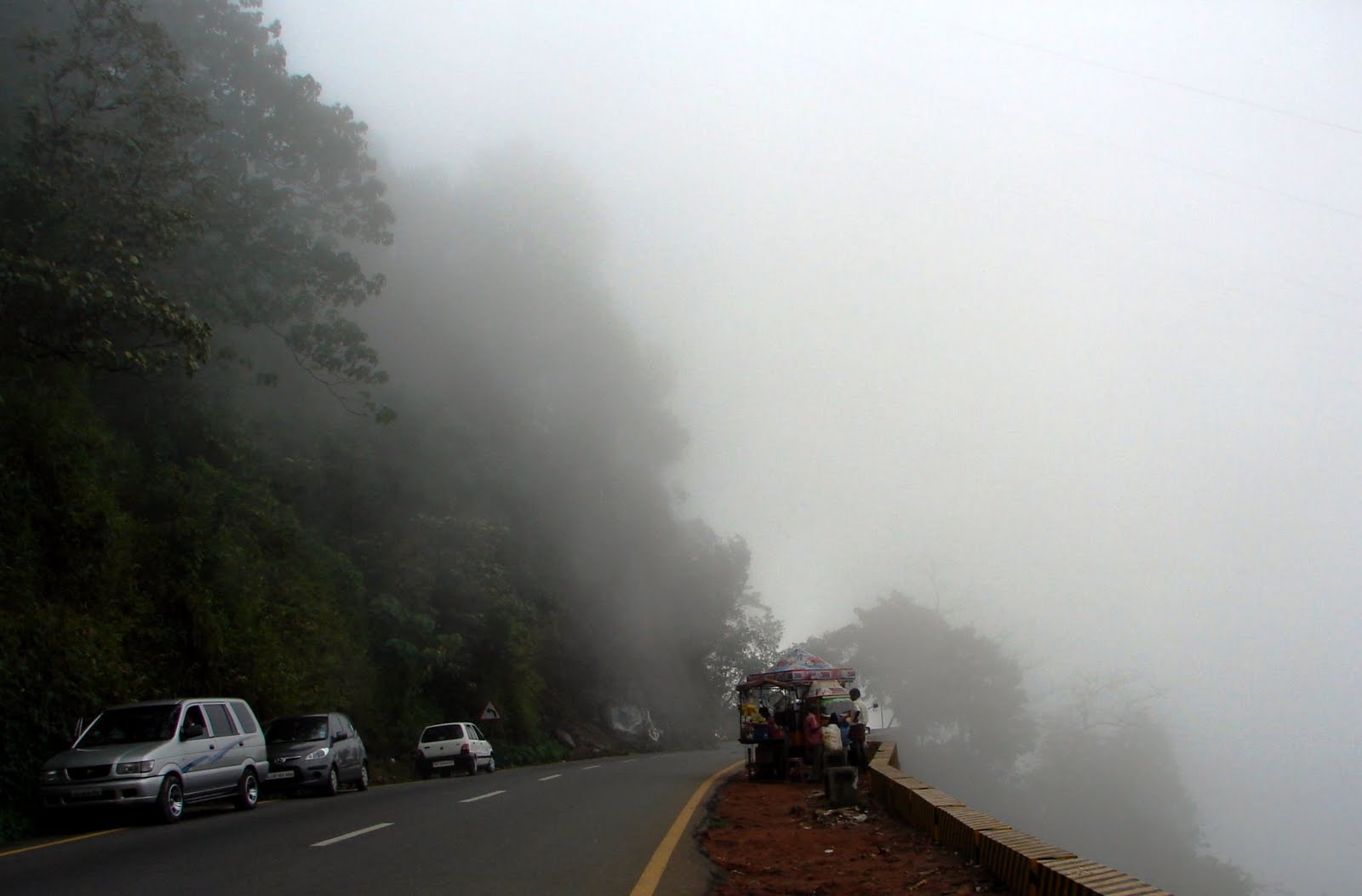
One of the highest locations in Wayanad, Lakkidi gets the highest average rainfall in Kerala. So streams, brooks, and waterfalls are a common sight around here. The rainfall at Lakkidi has also created a fresh water lake called Pokkot Lake in this area.

Pookot, a natural fresh water lake is located at 2,100 meters above sea level. The breathtakingly beautiful lake is surrounded by lush greenery all around. The pathway around the lake is lined by thick bushes and tall trees. One of the main tributaries of the Kabani River – the Panamaram rivulet originates from Pookot Lake and then tumbles down into Panamaram valley.The fresh-water aquarium at the lake is filled with an excellent array of fish.
Mountains, streams, thick forest and the panoramic view of the valley are exciting images. It is one of the vantage locations to experience the magic and mood of the monsoon in the woods.

Kanthapara and Meenmutty go through an exciting journey before tumbling down from rocky massifs. The streams meander through dense greenery, emerging for a brief, glittering plunge through the air before disappearing once again under thick foliage cover.Though relatively smaller, Kanthanpara - a two tiered falls is easily reachable, and makes an ideal picnic spot.

Meenmutty is the biggest of the waterfalls in Wayanad district both in terms of volume and height. The water cascades down in three stages from a height of about 300meters. Located in lush moist deciduous forests, the waterfall is a trekker's paradise. The best time to visit the falls is between November and May because the water is too torrential during the post-monsoon months. Meenmutty in Malayalam means "where fish are blocked". Since there is upward falls where fish can’t swim further this name is given to the falls.
The Meenmutty, Soochipara, and Kanthanpara waterfalls combined, feed the Chaliyar river.
 Apart from the stunning views of the surrounding plains, Lakkidi's
other claim to fame is the large Ficus tree bound by a prominent chain.
It is the source of a dramatic local legend. Tribal legend has it that
Karinthandan was murdered by some British engineers after he showed them
the tribal people's traditional pathway for the construction of a ghat
road that links Wayanad and Kozhikode. But Karinthandan's ghost made
life miserable for British people who travelled on the route. Finally, a
Christian clergyman chained the ghost to a tree near Lakkidi to
facilitate a trouble-free journey for the British. A heavy chain
anchored to the ground and placed around the stout branches seems to
lend credence to the story.
Apart from the stunning views of the surrounding plains, Lakkidi's
other claim to fame is the large Ficus tree bound by a prominent chain.
It is the source of a dramatic local legend. Tribal legend has it that
Karinthandan was murdered by some British engineers after he showed them
the tribal people's traditional pathway for the construction of a ghat
road that links Wayanad and Kozhikode. But Karinthandan's ghost made
life miserable for British people who travelled on the route. Finally, a
Christian clergyman chained the ghost to a tree near Lakkidi to
facilitate a trouble-free journey for the British. A heavy chain
anchored to the ground and placed around the stout branches seems to
lend credence to the story.
4 comments:
-
Anonymous said...
-
recently we been to nandi hills in bangalore.. the third snap recollected me the shots we took on our visit. we hardly get to see such beautiful ambiance.
we have an equally nice photo, the one shot near waterfalls. a lovely place and can think of a perfect destination for those looking for noiseless and pollution free getaway.
accommodation facilities are available in plenty. we stayed @ tropicalforrest; food and accommodation was good enough. -
Anonymous said...
-
I read your intersting and helpful blog, Thanks for sharing this
Visit : Tourist Attractions in Kerala -
Amman Travels said...
-
Excellent post on gateway of Wayanad keep sharing Same Day Agra Tour By Car From Delhi
-
haeib jimed said...
-
This Keertimukha artwork is not just decor—it’s a divine energy source.
Sultan Batheri (Battery) Wayanad
Sultan Battery was part of Kidanganadu Village, which got its name because of the presence of Kidangans (tribes). It is also believed that this town was earlier known as "Ganapathivattom" - 'the fields of Ganapathi', owing to the Ganapati Temple situated in the heart of the town. Sultan Bathery derives its present name from Tipu Sultan of Mysore who used the abandoned Jain temple here and used it as his battery - hence the name Sultan's Battery.

The Jain Temple at Sulthan Bathery is believed to have been built during the 13th century. Its design is strongly influenced by the architectural style of the then reigning Vijayanagar Dynasty. At one point in history, this temple also served as the ammunition store or battery of Tipu Sulthan’s army.
Following text has been borrowed from the board displayed by ASI in the temple premises:
Kerala has a few jain monuments of historical and archaeological importance belonging from the 9th - 15th C of the Christian era. Jainism received the patronage of the Chera kings of Mahodayapuram and Ay kings of South India. However, these Jain centres declined after teh 11th - 12th C.
Local tradition states that there were 12 Jain streets in and around Sultan Battery. The Hanneradu bidi (Kannada words for 12 streets) is one among the traditional Jain settlements in Sultan Battery.
Sultan Battery was known as Ganpathi Vatam in inscriptions. The Jain temple is datable to the 14th C A.D. on stylistic grounds. Thsi is an example of the cloistered temple and is wholly built out of granite. Axially teh temple consits of a garbhariha, antarala , closed mahamandapa of Kerala tradition.
The sanctum is square shaped, devoid of any image, but the lalata bimba of garbhariha and clsoed Mahamandapa has sacred Jain images. These are shown in a square outline as in padmasana with dhyana mudra. The pedestal of the image has a lotus depiction. The door jambs are decorated with different motifs or sakhas. The base portion of door is having intricate floral motifs. The sanctum is having a pillared circumambulatory pathway.

 The Mahamandapa followed by a Mukhamandapa is accessed through a flight
of steps. Its balustrade is decorated with yali motifs. The
Mukhamandapa stands on moulded adhisthana consisting of upana, jagathi,
padma, tripatta kumuda, gala and patti. The pillars are of higly evolved
type and deocrated with various designs such as floral motifs,
sarpabanda (entwined serpents), garland decorations, stylised vajra,
thirthankara, goose etc.
The Mahamandapa followed by a Mukhamandapa is accessed through a flight
of steps. Its balustrade is decorated with yali motifs. The
Mukhamandapa stands on moulded adhisthana consisting of upana, jagathi,
padma, tripatta kumuda, gala and patti. The pillars are of higly evolved
type and deocrated with various designs such as floral motifs,
sarpabanda (entwined serpents), garland decorations, stylised vajra,
thirthankara, goose etc. 
The detached Namaskara mandapa is supported on four pillars. Its roof is now missing. The temple originally had a cloistered wall which is now in ruins.
In ancient times the land was ruled by the’ Vedas’ Rajas. Later this land came under the rule of Pazhassi Rajah of Kottayam Royal Dynasty. Though Mysore ruler Hider Ali invaded Wayanad he brought it under his sway. In the days of Tippu Sultan it was restored to the Kottayam Royal Dynasty.
In the 18th Century, Tipu Sultan built a fort here in the heart of wayanad coffee and cardamom growing region, but not much of it remains. Though the fort does not remain any more, the place is worth the visit for the famous Jain Temple.
As per the Sreerangapatanam truce Tippu handed over the entire Malabar region to the British. This was followed by fierce encounter between the British and Kerala Varma Pazhassi Raja. With the help of ‘Kurichya’ tribal, Pazhassi organized guerilla type encounters with the British. In the end Pazhassi Raja killed himself and Wayanad fell into the hand of British.
The British rule made a new turn in the history of Wayanad. The British authorities opened up this land for cultivation of tea and other cash crops. They laid roads across the dangerous slopes of Wayanad from Calicut and Thallessery. These roads are extended to Mysore and Ootty through Gudallur.
Wayanad is backward in the case of Industries. There are no such major industrial units except tea processing factories, timber mills, and rice mills. In Sultan bathery, a mini industrial estate having 14 sheds is functioning under the control of SIDCO. A raw material unit is also operating there.
4 comments:
-
sunand sampath said...
-
good details , been there twice and missed this one ......
-
Casey said...
-
Thanks. Don't miss it the next time you go there. This little place has a lot of historic importance.
-
Anish Bhandarkar said...

-
Heey Casy !
I'm commenting on ur blog after a good 2 yrs !
This sulthan batheri is a namesake.. the real Tipu structure is in Boloor near mangalore..
You should definitely go visit it.. -
Casey said...
-
Hey Anish,
Hadn't checked my blog comments in almost 2 years now. Hadn't found time :(. Checked the blog today. Yes, I have heard about the other Sultan battery as well. I do intend to visit it someday.
Thanks.
Lal Mandir or Sone ki Nasiyan or Siddhkut Chaityalaya - Ajmer

Lal mandir or siddhakut Chaityalaya more popularly known as Sone ki Nasiyan was constructed by seth shri Mulchand Soni. The construction began in 1864 AD and was completed in 1895 AD.

The Digambar Jain temple is dedicated to the first jain thirthankara Rishabhadeva and is one of the 22 Jain temples in Ajmer. It is regarded as one of the best Jain temples in Rajasthan after the temples of Ranakpur and Mount Abu.
The temple has a two-storied structure divided into two parts, where one is the worship area comprising the idol of Lord Adinath and the second is the museum including a hall. The double – storey hall adjacent to the main temple has many idols covered with gold that has earned the name Golden Temple (Swarna mandir) for it. The hall displays a series of large gold plated wooden figures depicting legends from Jain mythology. The entire hall is richly adorned by glass mosaic, precious stones, gold and silver work. The temple also has splendid paintings.


The 40 X 60 feet hall is adorned with Belgium stain glass, mineral colour paintings and stain glasswork. This exquisite museum depicts the five stages (Panch Kalyanak) in the life of Lord Adinath, in the stature of statues.
This Digambar Jain Temple displays marvelous wooden gild representations, glass engravings and paintings, recounting the conviction of Jainism with reference to the making of the world.

The first floor of the temple is known as Swarna Nagari (city of gold) hall. It houses gold plate replicas of Jain temples of the country. An estimated 1000 kilograms of gold has been used in the construction of the marvel depicting panorama from Jain mythology, and of the ancient towns of Ayodhya and Prayag.
The inner chamber has silver balls suspended from its ceiling and is surmounted by a vimana (spire). The interiors are also embellished with the silver linings and precious other stones. The posh interiors of the temple boast of the aesthetic and rich taste of the Digambar Jains.

This scene depicts Lord Indira going in procession in the Golden city of Ayodhya, the birthplace of Lord Rishabhadeva.

As soon as the lord is born, Indira with his innumerable heavenly devas comes in procession with all splendour of celestial elephants, horses, chariots etc. Indira plays the heavenly music and goes round the sacred city thrice, to show his reverence to the great lord. After this, Indrani goes into the palace where the lord was born and brings the baby out. She hands him over to Indira. Indira rode on the celestial white elephant having several trunks and took the divine baby to Mount Sumer for the holy bath.
The following scene depicts the Heavenly Gods and worldly kings taking the lord in a celestial palinquin to Prayag where he renounced the world and became an ascetic.

Once when Nilanjana an apsara was dancing, she died suddenly. This event reminded the lord of the ways of life's misery.Heavenly Gods and worldly kings took the lord in a celestial palinquin to Prayag. The lord renounced the world, threw all his clothes and became skyclad ascetic under the sacred banyan tree in Prayag.He plucked his hair with his own hands, went into deep meditation (to purify his sould of all karmas - this is diksha kalyanak). He remained in this condition for a 1000 years and attained supreme enlightnment ie. kewala gnana (fourth kalyanak) which reflects past, present and future states of all the things of the whole universe.He preached ahimsa, satya, acharya and aparigraha. After that he attained salvation (nirwana) from mount kailash. This is moksha kalyanak the fifth.
3 comments:
-
Kalyanaraman said...
-
We visited the Some kind Nasiyan museum in Ajmer and were wonder struck by the remarkable display of the theme. The creation appeared more like the God coming down and creating the masterpiece.
-
Kalyanaraman said...
-
My comment should read as Sone ki Nasiyan
-
SAM India Tour said...
-
Thank you for publishing this awesome article
Jama Al-Tamish Or Adhai Din-Ka-Jhompra

Jama Al-tamish popularly known as Adhai-din-ka-Jhompra is situated in Ankerkot at the foot of the Taragarh hill.
As the legend goes, its construction took two and a half days (Adhai din)to complete. According to Ajmer Historical and Descriptive (by Dewan Bahadur Harbilas Sarda) it is claimed to be a Saraswati Mandir (within a temple) built in 1153 A. D. by Raja Visaldeva who was the first Chauhan Emperor of India. In 1193 AD, Mohammad Ghauri comquered Ajmer and converted the building into a mosque by adding a seven-arched wall in front of the pillared hall. The distinct pillars and arched 'screen' with its ruined minarets make it a splendid architectural masterpiece.
Colonel James Tod, describes Adhai-Din-ka-Jhompra as a temple in his book "Annals and Antiquities of Rajasthan".
He wrote, "The entire facade of this noble entrance is covered with Arabic inscriptions, but a small frieze over the apex of the arch is contained an inscription in Sanskrit. The reason why the mosque could be completed in two and a half days is existence of the original structures. One can enter the mosque through a simple gateway in the north. On its right stands a ruined minaret. The gate leads to a stairway leading up to a small tower from where the muezzin called the faithful to prayer."
The Archaeological Survey of India (ASI) says that the name of the monument possibly derives from the fact that a fair used to be held there for two and a half days.
General Cunningham., Director of Archaeology Government of India, who inspected this mosque in 1864 A. D., accepted that it was built in Dhai-din i.e. two and a half days, as its name implies out of the material released from some demolished temples. It was a judgment difficult to believe in view of its extensive and massive stone structure replete with extremlely fine and most intricate workmanship on stone.
Probably only the smaller marble arch in the centre of the mosque may have been finished in 2-1/2 days to meet an emergency. The whole massive structure, with its elaborate Arabic tracings and delicate engraving details, is definitely a work of many years sustained labour.


The mosque is supported by 124 pillars and has 10 magnificent domes. It is an architectural marvel in every sense with a seven-arched wall inscribed with verses from the Koran in front of the pillared hall. However most of them are in ruins today. A majestic tower inside the mosque is used by the Muezzin to chant prayers. The stone walls of the main prayer hall are fashioned with carved rectangular panels. An intricate jali (screen) under a raised arch was added by Sultan Altamush in 1230AD.
Designed by Abu Bakr of Herat, the mosque is an example of early Indo-Islamic architecture and is built from masonry taken from broken-down Hindu and Jain temples or a Sanskrit college that existed there.
But according to the Arabic inscription appearing on the marble arch in the centre of the mosque and the arguments by the author of Main-ul-Arifin (P. 150-154) it is recognised to be a mosque ever since its origin which was built by Sultan Shahabuddin Ghori in 12th century A.D. wherein Hazrat Khwaja Muinuddin Chishti himself is said to have offered his prayers for a considerable time. Later on, Sultan Shamsuddin Altamish of Delhi is reported to have built its present massive structure of red stone which was completed by Ali Ahmed mason under the supervision of one Mohammed Ariz - a claim which is also substantiated by another Arabic inscrition on its central arch. (Ahsan-us-Siar, P. 87-92). In any case, this magnificent mosque is one of the rare historic monuments of India.
Writing of the beautiful details of this marvellous edifice, Mr. Furgusson, author of the Eastern and Indian Architecture (P. 513 ) says - "As example of surface decoration, the Jhonpra and the mosque of Al-tamish at Delhi are probably unrivalled. Nothing in Cairo or in Persia and nothing in Spain or Syria is so exquisite in detail and can approach them for beauty or surface decoration. The gorgeous prodigality of ornamental work , the fascinating richness of tracery, the delicate sharpness of finish, the fascinating richness of tracery, the delicate sharpness of finish, the endless variety of detail and the accurate and laborious workmanship, are eternal credit to its past Indian engineers and masons". There is a rich variety of Quranic verse inscribed all over the building to tax the brains of both inquisitive historians and the antiquarians alike . In short, it is a model of excellence in the art Indian architecture.
Check-post and Sri Rama Seetha Temple, Ponkuzhy, Wayanad

Ponkuzhi is fast developing into a pilgrim centre and halt for travellers as the inter-State highway NH 212 cuts through the muthanga forest. The perennial Noolpuzha running through this corridor is the only source of water for a large population of elephants moving through this area for three to four months a year.
Hundreds of vehicles speed through the highway linking Bangalore with Kozhikode. Vehicles, especially goods-laden lorries, have to halt at four check-posts located close to Muthanga and similar check posts on the Karnataka side also.

The following text has been borrowed from http://www.thepetitionsite.com/1/save-the-kerala-rainforest-elephants/
2.5 kilometer wide corridor that connects the two Indian states of Kerala and Karnataka (located in the Western Ghats mountain range) is also the last unbroken forest leading the largest population of Asian elephants from wet season to dry season feeding grounds. This incredibly environmentally-sensitive corridor has become the scene of development which threatens an entire herd. The corridor is so sensitive it has become part of an international campaign to change the location of the development so it will not have such a harsh impact on the elephants.
The area is also one of the world's ten "Hottest biodiversity hotspots" and has over 5000 species of flowering plants, 139 mammal species, 508 bird species and 179 amphibian species. At least 325 globally threatened species occur in the Western Ghats.
Presently, a busy interstate highway passes through the forest with checkpoints leading from one state to another in three places. This leaves the forest corridor free for the elephants. Unfortunately, and shortsightedly, the Indian government has decided to combine the checkpoints in the centre of the elephants corridor.
This development would include all manner of infrastructure - building complexes, housing, offices, toilets and dormitories for drivers, a fuel filling station and so on, writes the nonprofit conservation group, Rainforest Information Centre. The checkpoint clearance takes hours, so there would be hundreds of lorries (trucks) parked along the road throughout the night on either side of the checkpoints within the forests preventing elephants from using the corridor.
The Rainforest Information Center tells us that work is already in progress and a trench has been dug which prevents elephants from crossing the road, cutting [the elephants] off from the river and whatever little fodder available on the river margin.
The best solution would be the relocation of the checking stations to outside the forest on the Kerala side of the corridor where suitable land for this is available, suggests Rainforest Information Centre. It is also necessary to prohibit vehicle movement during certain night-time hours for example, between 11 p.m. and 4 a.m.
John Seed of Rainforest Information Centre told Monagabay.com: "we feel confident that international attention can persuade the Kerala government to move the site of its planned development out of the corridor and out of the jungle."
The Rainforest Information Centre is working with the Indian environmental organization, Wayanard Nature Protection Group, and an online activist center. They encourage concerned persons to write to the governments of the states involved hoping that international attention and pressure will cause a change in the development plans
Very close to the checkpost is the Sri Rama Seetha Temple at Ponkuzhy

Rama or Ramachandra is the seventh avatar of Vishnu in Hinduism,and a legendary king of Ayodhya in ancient Indian Puranas. Based on Puranic genealogy, Rama is believed to have lived during 1450 BC, during the Rig Vedic period.

The srirama temple at Ponkuzhi on the Sulthan Battery Mysore road bears testimony about the story of Ramayana. There is a natural pond near the temple, surrounded by bamboo forest. It is believed that the water in the pond is the result of the falling tears from the eyes of Rama's wife seetha.

Asian Elephants in Bandipur National Forest

Halfway down Mysore-Ooty highway, Deccan Plateau rises to meet the Western Ghat mountains and the nilgiris mountains. In the Nilgiri Biosphere (India's first and foremost biosphere reserves with a heritage, rich in flora and fauna), nestled between the two mountains, is the Bandipur National Park. Endowed with a moderate climate and diverse geographical features, the park supports a remarkable variety of flora and fauna, making it a veritable paradise for wildlife. It is an abode to tigers, elephants, sloth bear, four horned antelope, Sambar Chithal and Gaur.
History of Bandipur National Forest
Bandipur was a game park of the royal family of Mysore for generations. It was in 1931 that the Bandipur Forest Reserve was formed with an area of 90 sq. km. Jayachamaraja Wodeyar an active wildlife enthusiast gave up hunting in 1955 and later became the chairman of the Indian Board of Wildlife.
In 1973, Bandipur with its 800 sq. km. area including the Venugopala Wildlife Park, was reserved under Project Tiger. In 1974 it was declared as a national park under the Indian Wildlife Act.
Bandipur's quiet, serene surroundings offer a peaceful escape from the noise and monotony of urban life.

During summer, when dryness prevails over most parts of Bandipur, the backwaters of the Kabini Reservoir in the northwestern portion of the park host huge congregations of large mammals, especially the elephant and the gaur.

The jungles towards the eastern limits of the park consist of stunted trees, interspersed with bushes and open grassy patches. Towards its northwestern fringes, there is a gradual shift in the vegetation from open dry deciduous forests to tropical mixed deciduous forests. These diverse habitats support an enormous diversity of animal life. With the onset of pre-monsoon showers in April, Bandipur begins to unfold in all its glory. Sprouting grass in the meadows attract elephants and the majestic gaur in large numbers.

Elephants have fascinated us for decades, both because they are imposing as the largest land mammal on earth but also, they are very attractive when at play, or observed during their daily routines.
The modern-day African and Asian elephants belong to the order Proboscidea. In the past there were some 350 members in this order, but over time majority of the members have gone extinct. Today, there are only two survivors to this order, Asian elephant and African elephant. Asian elephant is more closely related to the extinct mammoth than to the African elephant. But these two species are also facing a grim future that is heading very near to another man-propelled extinction.

The roots of the word "elephant" in latin is divided into two words; ele means arch and phant means huge. Hence, Elephant in latin (as ele and phant) means "the Huge Arch!"
Interesting facts about Elephants
Elephant trunks can get very heavy. It is not uncommon to see elephants resting them over a tusk!
Elephants cry, play, have incredible memories, and laugh!
Elephants are sensitive fellow animals where if a baby complains, the entire family will rumble and go over to touch and caress it.
Elephants have greeting ceremonies when a friend that has been away for some time returns to the group.
Elephants grieve at a loss of a stillborn baby, a family member, and in many cases other elephants.
Elephants don't drink with their trunks, but use them as "tools" to drink with. This is accomplished by filling the trunk with water and then using it as a hose to pour it into the elephant's mouth.

Bathing with Grass
One very important part of their routine is bathing.Elephants have three distinctly different forms of bathing; in water, mud and dust. In addition to soil, elephants will also throw hay, grass, branches and other materials onto their backs, and it is not unusual to see animals walking around covered with a fine layer of green grass cutting on their backs.
All forms are also a way for them to socialize, whether at a mud wallow or a watering hole, where they interact with each other and even spray each other. The elephant with its unique size has some unique difficulties which it has solved by using the three layer protective coating, put on by bathing in various mediums. Not only does it protect his skin and help regulate his temperature it is also very much a social time for the elephants - time to relax and have some fun!
A study on captive herd of Asian Elephants showed:
(1) Dusting frequency increased directly with the environmental temperature.
(2) Individual animals showed variation in dusting frequency but this was not related to body mass, suggesting that the function of dusting is not primarily thermoregulatory.
(3) Synchronisation in the timing of dusting behaviour within the herd suggests that it may have a function in the maintenance of social cohesion.
(4) The function of dusting behaviour could not be determined from the data presented, but it may be involved in skin care, protection from insects or other parasites, temperature control, protection from radiation or some combination of these.
Karapuzha Earth Dam at Vazhavatta in Vythiri

Kabini river is formed by the confluence of Mananthavady and Panamaram rivers. Other tributaries namely: Bhavanipuzha, Karapuzha and Narasipuzha originate in the western ghats and flow through Kerala State.
NEED TO USE CAUVERY WATER
Agriculture is the basic occupation of the people in the Kabini, the Bhavani and the Pambar Basins. The main crop in the low elevation is paddy where as in the middle and higher elevations it is the plantation crops. In the absence of assured water supply from irrigation projects, excepting a few minor irrigation works here and there serving limited ayacut, the agricultural crops in Cauvery basin in Kerala are dependent on the seasonal rainfall. Prior to the integration of States in 1956, Madras State to which Malabar belonged neglected the development of Malabar area and took no interest in the exploitation of Cauvery water for the development of irrigation or power in the Malabar region. After Malabar came over to Kerala, 9schemes were submitted by the State to Government of India for approval, for the development of irrigation in the two Cauvery Basins in Malabar. Excepting one project viz.Karapuzha in Kabini basin, no other scheme was approved by Government of India, obviously because the dispute on sharing of water was pending.
Karapuzha Irrigation project was the first scheme of Kerala approved by the Govt. of India in April, 1978 which they have since completed. The scheme was to construct an Earthen Dam across Karapuzha at Vazhavatta with a stroage reservoir and canal systems to irrigate 5,221 hectares of land in nine panchayat areas of three taluks in Wayanad district. The financial benefits from the cultivation of land in many parts of the world are rarely large enough to allow for expensive, technologically advanced concrete structures to be built for impounding water, whether on- or off-stream, and the alternative is normally an earth dam or simple weir.
Embankment dams have many advantages over equivalent concrete structures and are most appropriate for farm or other rural situations. Dams up to 15 m high, when built on suitable sites and correctly designed and constructed using good earthworks materials, can be built using relatively unsophisticated design procedures and equipment. Farm tractors (equipped with dam scoops, scrapers and rollers) are usually adequate for the construction of such an earth dam which, once completed, should generally have cost less than a concrete wall, with its attendant complex design and construction procedures.
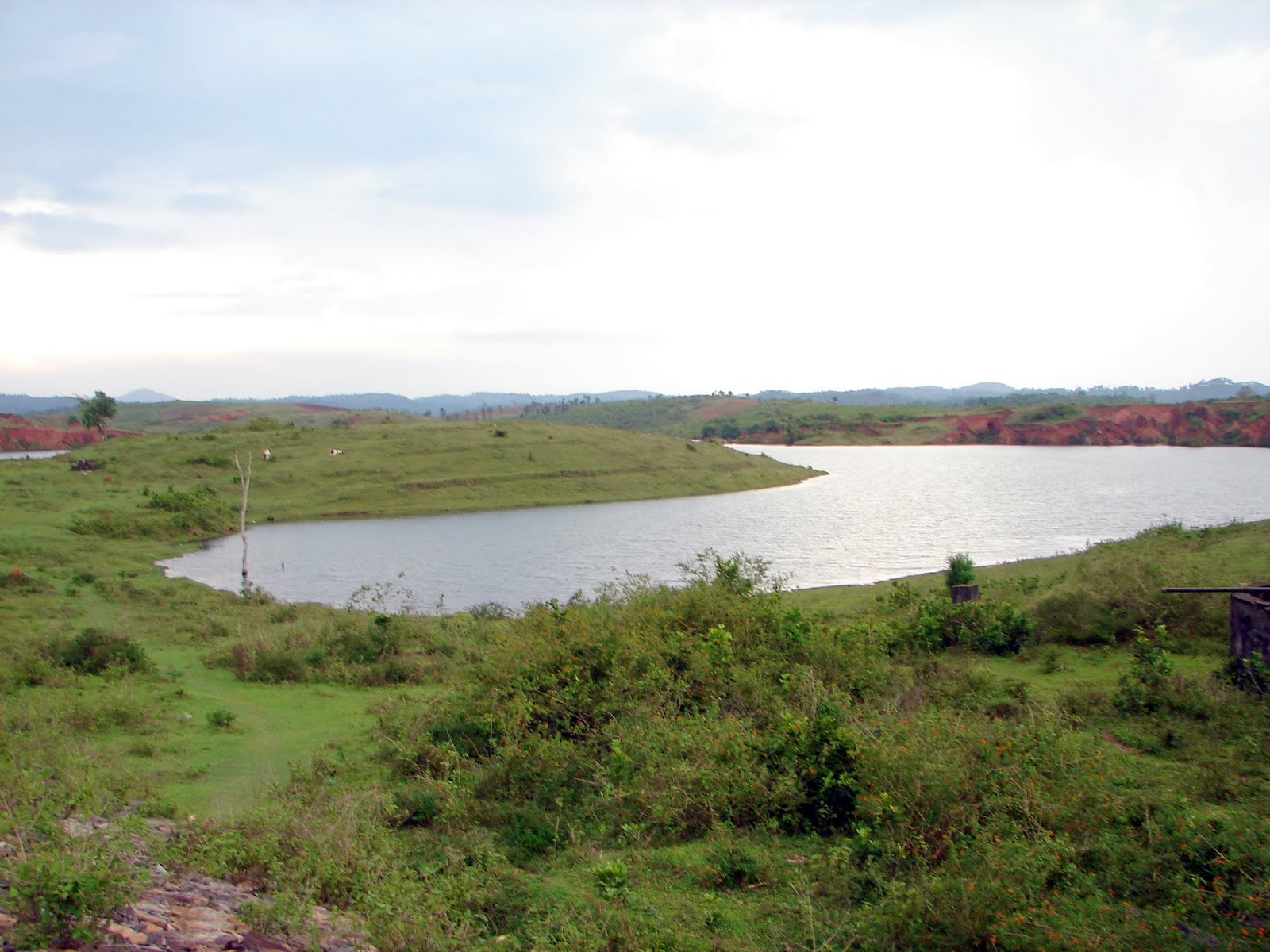
Smaller earth dams require minimal maintenance (unless in difficult locations or in extraordinary climatic situations), and are better able to withstand foundation and abutment movements than the more rigid concrete and masonry structures.
Further advantage can be gained by constructing the embankment from material excavated from the reservoir area. This provides a small increase in storage capacity and reduces costs.
The original estimate of the project was Rs.7.60 crores for the completion of the project. Revised estimate for the completion of the dam was Rs. 429 crore.The project was assisted under the RID Fund of NABARD for speedy completion during the Ninth plan period.
But the project could not be completed as scheduled. Construction of the dam and 80% of works in the main canal were completed. The distributories are only in the investigation stage. During Tenth Plan it was proposed to complete the project by completing the essential items of works which would optimise the benefit of the infrastructure already created within a period of two years in a phased manner. It was proposed to complete the remaining works in the dam and main canal during the first year and the remaining works in the branches and finishing works for commissioning during the second year.
Though the construction work of the right and left bank channels had been completed in 2009, five breaches occurred during the monsoon season. Thus, the full potential of the dam cannot be used for irrigation purposes. However, 12 km of these channels will have the potential to irrigate as much as 300 hectares of land at the time of partial commissioning.

Though the total water storage capacity of the dam is 76.5 million cubic metres, the water would be stored only at half the capacity as many parts of the water belt areas of the reservoir would be submerged in water where the land acquisition procedures are yet to be completed.
1,238 hectares of 1,250 hectares of land have been acquired for the reservoir and 126hectares of land for the construction of channels. A drinking water project under the Kerala Water Authority is nearing completion to supply 15 million litres of water from the reservoir in the Kalpetta municipality and the Meenangadi and Ambalavayal panchayats.

It is worthwhile to mention the reasons given regarding necessity of the scheme as follows:-
Agriculture has to be developed as the only source of existence of the local people. At present, generally, only one crop of paddy is cultivated. This is mainly because, rainfall is available only for one crop and the duration of the crop is very long. Hence the agricultural labourers get employment for a short period in one year and they get no employment during other periods. By adopting new high yielding varieties of paddy, it is possible to raise two crops of paddy easily. But this new pattern requires irrigation during the early parts of the first crop i.e. during May-June and also during the second crop period. The aim of the project is to provide this irrigation facility. This will increase the employment potential considerably.
The land owners are also benefited as the production of rice increased considerably.
The development of infrastructure such as construction of new roads, bridges, buildings etc. will open out new fields of activities which will help developing the area considerably.
This project was technically examined in Central Water Commission before it was given investment clearance by the Planning Commission, Govt. of India.
The extract from Govt. of India’s letter of 19th April, 1978 approving Karapuzha project is reproduced below:-
1) The acceptance of this project in the Cauvery basin is further subject to the Inter-State understanding of August 1976 regarding utilization of Cauvery waters and the utilisation from the above project shall not exceed 2.80 TMC.” (Ref:KL Vol. 3, Exh. 29)
2) Although in the Statement of Case and the affidavits of the witnesses, the State has been emphasizing on spice and plantation crops but while placing the demand for water, they have only submitted their requirement for mainly paddy and vegetable crop
besides indicating demand for domestic and industrial uses. Also, there are some hydro-power projects which involve inter-basin transfer of water. It would be interesting to refer to Kerala’s Statement of Case reproduced below:-
“Development of agriculture, particularly plantation crops which give large scale employment, is a worthwhile economic activity that can be taken up in the Cauvery basin region, and adjoining areas, in order to improve the economic conditions of the
people there. Plantation crops like coffee, cardamom, arecanut, coco and pepper require water throughout the year, particularly during the summer months, and are very sensitive to drought. Unlike seasonal crops, once the plantation crops are affected by drought it require about five years or more to raise new crops and bring them to yielding stage. Water resources can be exploited for maximum production when applied to plantation crops since the economic benefit per unit of water from plantation crops is much more.”
It appears that though plantation crops require water throughout the year, requirement is critical particularly during the summer months, as the plantation crops are said to be very sensitive to drought. It appears that for the spice and garden crops normally their water requirement is met with from the rain water except in some cases of short fall during summer months and once the projects are in position, the small requirement of plantation crops could be met with from the reservoir storages for which provision of 5% of the irrigation requirement in reservoir projects has been made as a safeguard to meet emergency requirements of plantation crops as and when necessary.
3) As regards culturable command area (CCA) and ayacut under individual projects, it is noticed that invariably the extent of proposed ayacut is much less than the CCA. This appears to be so, because of the physical nature of the area which is undulating in character.
The State has reported that the main crop in the low elevation areas is paddy, whereas in the middle and higher elevations, it is the plantation crops. Taking this situation in consideration, attempt has been made to assess reasonable needs of the State so that irrigated area equal to the culturable commanded area could be allowed.
4) The State has proposed two paddy crops and one vegetable crop for the Kabini sub-basin. However, it is seen that in case of first crop “Virippu” which is raised during May to September, bulk of its water requirement is met with from south-west monsoon precipitation. This is mostly a rainfed crop.
The second crop “Mundakan” is raised from end of September to end of January i.e. the winter season when some rainfall from northeast monsoon provides support. This is their principal irrigated paddy crop.
The third crop “Puncha” is grown from January end to early May mainly as a summer crop. Although, the State Govt. has proposed raising first crop i.e. Virippu and summer paddy crop i.e. Puncha, but summer paddy cannot be allowed because of non-availability of rainfall support. The first crop needs little support of artificial irrigation. The second crop namely: Mundakan which succeeds Virippu as a
transplanted crop, this needs artificial irrigation although it receives some support from northeast monsoon.
The Govt. of India while sanctioning Karapuzha project has also allowed these two paddy crops with a water delta of 1.38 ft. and 4.38 ft. As regards the summer season, it is suggested that vegetable crop which the State proposes to raise during the winter season could be shifted to the summer season and grown in patches where residual moisture from the previous paddy crop is available and if needs further support that could be taken from ground water.
This approved project covers a CCA of 13,800 acres with an ayacut of 11,500 acres. The proposed net irrigation covers the entire ayacut of 11,500 acres. The approved project allows two paddy crops namely; khariff paddy (Virippu-period May to September) in 11,500 acres and second crop of rabi paddy (Mundakan-period October to February) in the same area i.e. 11,500 acres (total 23,000 acres – gross irrigation). This gives an intensity of irrigation as 166% when compared to CCA. The water requirement under this project including lake losses has been limited to 2.8 TMC as provided in the clearance letter. (Ref. KL Vol. 3, Exh. No.29 front page – letter of acceptance dated 19.4.78)

The examination of the remaining nine projects shows that the season of first paddy crop (i.e. Virippu) as mentioned in the project reports (submitted before the Tribunal) has been delayed by two months i.e. instead of crop period being from May to September, it has been shown as July to November. Similarly, the second crop of paddy (i.e. Mundakan) is proposed to be taken in the summer season from February to May and during the intervening period between November and February which is
normally Mundakan season, they are proposing to raise vegetable crops.
As is well known, raising of paddy crop during summer season consumes lot of water and is also without any support from rainfall, as such, there have been recommendations of the National Commission of Agriculture, 1976 as well as the Irrigation Commission, 1972 that paddy crop should not be raised during summer season, when there is no support from rainfall. Also by projecting three crops as mentioned above in their projects in the Kabini sub-basin, the State of Kerala has indicated a very ambitious plan.
Keeping in view the fact, that the hilly region of Kabini sub-basin is inhabited by substantial tribal population and has so far been underdeveloped, being without any reasonable irrigation facilities, it seems worthwhile to allow two paddy crops namely: Virippu and Mundakan as already approved by the Govt. of India in the case of Karapuzha project.
This also appears to be justified because during the south-west monsoon season from May to September when Virippu crop is raised, there is very good support from the rainfall and only minimum support from artificial irrigation is needed, which is limited to 1.38 feet of delta (water depth). But in the Mundakan season i.e. from October to February, when second paddy crop is raised, as already permitted by the Government of India in the Karapuzha project, support from irrigation is required which would be of the order of 4.38 feet delta.
As regards the vegetable crop which the State has proposed as a third crop, the same could be taken in those valley areas where there is residual soil moisture supported by ground water exploitation.
3 comments:
-
Vin said...

-
immense research and excellent documentation :-)
-
Casey said...
-
Thanks Vin
-
Sanchari.org said...

-
I read your intersting and helpful blog, Thanks for sharing this
Visit : Tourist Attractions in Kerala
Jag Mandir Palace and Lake Pichola - Udaipur

View of Jag mandir palace from boat

View of Jag mandir palace from boat

Gol mahal and chattris.
In an era of peace reigned Maharana Karan Singh (1620-1628). He completed the construction of circular chambers we know as 'Gol Mahal' in 'Jagmandir'. Maharana Pratap Singh once refused lunch with Raja Man Singh because he had given away his sister in marriage to Prince Salim, later Mughal Emperor Jahangir. Man Singh avenged this insult by defeating Pratap at the battle of Haldighati. Pratap’s son Amar Singh made peace with the Mughals but unable to accept his humiliation, he gave up his title in favour of his son Maharana Karan Singh.
Prince Khuram (later emperor Shah Jahan) resided for some time in this palace, while in revolt against his father Jahangir, in 1623 AD. The young Mughal prince Khurram forged a strong friendship with Karan Singh, who provided a safe haven at 'Jagmandir' for the prince in exile. The Suryavanshi ideal of doing the right action at the right time and helping in distress without taking into acount any other implications was upheld by the Maharana. In 1627 when Mughal emperor Jehangir died, Prince Khurram succeeded him as emperor Shah Jehan. On his departure, the mughal emperor and the Maharana exchanged turbans as a token of bonding and friendship.


Reflection of the ceiling on table
Maharana Jagat Singh I (1628-1652) was undboubtedly the greatest patrons of art and architecture in Udaipur. In his reign,the picturesque Garden courtyard with its central pool was completed at 'Jagmandir'. Zenana chambers were built along with the west-end of the 'Gol Mahal'. 'Jagmandir' and 'Jag Niwas' the incomparable island palace on Lake Pichola are named after him. The 'quest for excellence' in architecture, painting and the arts reached its pinnacle in this era.
 Jagmandir was gloriously embellished during the reign of Maharana
Sangram Singh (1710-1734). The 'Darikhana' or the open pavilion with its
intricately carved marble columns, was built to complement the beauty
of the Garden courtyard. The 'Barah Patharon ka Mahal' or the palace of
12 stones, a unique structure with 12 solid marble-slabs was created
along the east end of the 'Gol Mahal'. The 'Kuwarpada Ka Mahal' or the
palace of the crown prince, was built at the western-end of the Garden
courtyard, complete with its pavilions and central pool.
Jagmandir was gloriously embellished during the reign of Maharana
Sangram Singh (1710-1734). The 'Darikhana' or the open pavilion with its
intricately carved marble columns, was built to complement the beauty
of the Garden courtyard. The 'Barah Patharon ka Mahal' or the palace of
12 stones, a unique structure with 12 solid marble-slabs was created
along the east end of the 'Gol Mahal'. The 'Kuwarpada Ka Mahal' or the
palace of the crown prince, was built at the western-end of the Garden
courtyard, complete with its pavilions and central pool.By the 1750s, 'Jagmandir' had come to resemble 'Swarg ki vatika' or the proverbial gardens of heaven.

During the sepoy mutiny of 1857 several European families from Neemuch were lodged and entertained by Maharana Sarup Sinha in this palace.
In 1942, during the reign of Maharana Bhupal Singh (1931-1955), three 'chattris' or kiosks came to adorn the Garden courtyard in front of the 'Gol Mahal'. The chattris mark the central directions of the garden courtyard. Each one is unique for its intricate carving and craftsmanship; the central deep green-marble 'chattri' being the most characteristic of them all. The 'chattris' are instrumental in integrating the entire space of the garden courtyard and its pavilions.


Lake Palace or Jag Niwas was built in 1754 by Maharana Jagat Singh II,62nd successor to the royal dynasty of Mewar – believed to be descendants of the Sun God, who gave his name to this elegant white building. The Lake Palace Udaipur a palace on an island in the middle of Lake Pichola girdled by hills, was the summer residence of the rulers of Mewar. Today this pleasure palace is a luxury hotel.
Udaipur is called "Venice of the East" due to the Lake Palace built on the island in the middle of Lake Pichola. It is an inspiration for the imagination of the poets, painters and writers.


5 comments:
-
Unknown said...
-
I’m Glad to read your full article on your blogs post about the beautifully destination like king of Rajasthan, green valley covered to mountain Kashmir and Kerala covered to snow falling shimla, which are attractive place for tourist parts of incredible India? India famous for traditional custom and simplicity a large number of tourists come to India for watching natural beauty of India
Rajasthan tour packages
India tour packages
-
Vishakha Maheshwari said...
-
Really a nice work on beauty, palaces and Udaipur Hotels. I loved your article.
-
Unknown said...
-
Udaipur, the recent capital of Mewar, is as rich in history as some other city with the great City Palace other than Lake Pichola, the luxurious Jalmandir Palace standing wonderfully amidst the lake.
Andaman
Best travel services
-
Royal Adventure tours said...
-
Excellent post. I want to thank you for this informative read; I really appreciate sharing this great post. Keep up your work. This blog have more info about jagmandir. it located in udaipur. for more info visit : Rajasthan holiday packages
-
Unknown said...
-
The wellbeing of our guests and associates is important to us.
We are constantly updating COVID – 19 guidelines from World Health Organization and the Local Health Departments.
Kindly contact us for any query, details given below:-
https://www.bryscaves.com/contact-us/
Haldighati
This place witnessed the famous Battle of Haldighati on June 18, 1576 between Maharana Pratap Sing of Mewar and the moghul army of Emperor Akbar of Delhi.
By the mid 1500s Akbar had forced all Rajput kingdoms, except Mewar, to become part of his empire. Akbar tried to force the Mewar king into submission, but failed. He sent a series of envoys to Mewar with peace treaty.
Akbar sent his first proposal with a team under the leadership of Jalal Khan Korchi. Two months of discussions did not yield the desired result.
The second proposal was led by Raja Mansingh - a high caste able Rajput who before serving the Moghuls, had extremely close ties with Mewar. Pratap refused to sign the treaty.
As per a popular folklore in Rajasthan, and as quoted briefly in epics like "Rajaprashasti" and "Vanshbhaskar", Pratap arranged for a "daawat" in Udaipur and excused himself from attending on the pretext of a stomach ache and sent his son prince Amarsingh instead. When ManSingh insisted on meeting the Maharana, Pratap refused to meet an outcaste. The enraged Mansingh challenges him to war. One Rajput commented "if you come with your army, then we will welcome you in Malpura. If you come on the basis of your paternal aunt's husband's (Akbar's) strength, then we will welcome you whenever we get the opportunity."
Insulted, Mansingh wentback. The food prepared in his honour was thrown into the lake and the ground where the party was held was dug up and Gangajal was sprinkled.
Rana saun bhojan samay, gahi maan yeh baan.
Hum kyon jeyvain aaphu, jeyvant ho kin aan.
Kunwar aap aaro giye, Rano bhakyo heri.
Mohi garani kachu, abbey jeyihun pheri.
Kahi garani ki Kunwar, bhai garani johi.
Atak nahin kar deyungo, taran churan tohi.
Diyo theli konso kanwar, uthe sahit nij saath.
Chulu aan bhari haan kahyo, ponch rumalan haath.
- By Ramkavi
Conversation between Mansingh and Maharana during dinner,
Mansingh: "Why should I eat the dinner when you are not eating?"
Maharana: "Kuwar, you eat the food, I have stomach ache and I will eat later"
Mansingh: "I will give you 'chooran' for your stomach ache".
Mansingh then puts aside his plate of food and stands up with his companions. Wiping his hand with his handkerchief, he says "I shall wash my mouth when I come the next time"
Akbar sent Mansingh's father Bhagwandas with a proposal for treaty. To give Maharana a proof of his strength, he conquered Badnagar, Rawail etc. Maharana respected Bhagwandas as a Rajput and not as a Moghul messenger. The third attempt too proved futile.
Akbar then sent his fourth proposal with Todarmal - an able commander and a clever politician. He too was not successful. Now a war seemed inevitable.
Akbar marched to Ajmer in March 1576. After 15 days of discussion, he made Mansingh the commander of his army. Abul Fazal has written about Mansingh -
"Raja Mansingh who was foremost in Akbar's court in intelligence, loyalty, and bravery and who was given the high title of 'farzand' (son) was chosen to fight Maharana Pratap".
Mansingh camped for two months at Mandalgarh to increase his military strength and finally marched towards Khamror - 10 miles away from Pratap's military camp and set up his base. Rana Pratap reached Gogunda destrying all the areas of Mewar plains so that the enemy would not be able to get food, grass or shelter.
Finally the two mighty armies faced each other for a battle that would go down in the annals of Indian history as one which showcased the great valour of the Rajput troops led by their scion Rana Pratap.The result was indecisive, but the battle was truly symbolic of the raw courage, spirit of sacrifice, and loyalty of the Rajputs in their heroic defence of their motherland.

The infantry of the Bhils with their traditional bow and arrows was under the leadership of Punja. The main commander of Mughals - Mansingh, was on an elephant in the centre.Pratap spurred his steed to a determined gallop towards Man Singh. He cut his way through to the Mughal general. Chetak collided with the elephant's plate armour. He reared up against the huge beast, his forelegs glancing off its tusks. Man Singh was partly obscured by his mahout, but Pratap heaved his lance at the howdah. The weapon passed through the driver's body, killing him instantly, and smashed against the howdah's metal plates.
Man Singh had disappeared. Thinking he had killed Man Singh, Pratap let out a triumphal cry of revenge. The uncontrolled elephant swung around in panic. The broadsword attached to its trunk slashed through the tendons of one of Chetak's hind legs. Unaware of this, Pratap wheeled Chetak to rejoin his men.
The horse now had the use of only three of his legs but, enveloped by the furore, he persisted valiantly. Imperial cavalry,who had rushed to guard their commander Mansingh, now surrounded Pratap. Chetak was limping and stumbling. Suddenly, a great commotion of kettledrums came from the rear of the Imperial ranks.The Rajputs saw the Mughal reserves making their entry and Man Singh followed closely at the head of battle-weary soldiers and horsemen.


Pratap's first impulse was to destroy the Rajput traitor, possibly meeting death in a blaze of glory. One of his officers, Jhala Man of Sadri, snatched the royal standard of Mewar from Pratap's hand, determined to fight a rear guard action until Pratap's army had reached the protection of the defile. "Ride swiftly to safety!" he yelled. Reluctantly but wisely, Pratap shouted an order to his remaining chiefs to take their men to the village of Koliyari, where arrangements had been made for treating the wounded.

Waving the Sun-God banner, Jhala rallied his men to meet the enemy's counter-attack, as the remainder of the Mewar army disappeared into the cover of the hills. Bringing up the rear, Pratap stopped upon an outcrop of rock. He turned to look back at the swirling dust haze that all but hid the horrendous spectacle of the battleground. Through it came the tumult of shots, the clashing swords, the cries of victory and death. For a few moments, he was able to follow the progress of his crimson banner. Then it, too, fell. They continued on. Chetak was now limping badly. Pratap, too, was now faint from loss of blood; he had sustained seven severe wounds from musket, sword and lance. Having carried his master to safety, Chetak died. Pratap joined the remainder of his men, recovered from his wounds, then continued his guerilla resistance.

3 comments:
-
sunand sampath said...
-
Thanks for this very informative ,
-
Casey said...
-
You are welcome Sunand!
-
juhi khatri said...
-
एक बार इस मूवी को देख लीजिये हल्दीघाटी अच्छे से समझ आजायेगा, वो भी UPSCके सभी examsके लेवल से और यकीन मानिये अकबर और महाराणा के पारस्परिक संबंधों पर आधारित इस घटना को जान कर आप कभी भी हल्दीघाटी के सम्बन्ध में आये हुए प्रश्नो को लिखित परीक्षा में भी गलत नही करेंगे :- Full Movie "Battle Of Haldighati"
Hatheesing temple - Ahmedabad

Hathee Singh temple is a very famous Shwetambar Jain temple constructed in 1848-1850AD by a rich Jain merchant Kesarisingh Hatheesing (Some sources mention the name as Maganbhai Hutheesing) at a whopping cost of Rs 10 lakh. It was designed by Premchand Salat and is dedicated to Dharmanath, the fifteenth Jina or Jain apostle.
The temple is an architectural marvel built in beautiful white marble. The temple is a double storied construction that has a dome on the front side. The other two sides of the temple consist of lavishly carved out galleries. The temple has a cemented courtyard enclosed by a row of cloisters and has 52 shrines in its spacious courtyard. Each of the shrines consists of an image of a Tirthankara.


2 comments:
-
Unknown said...
-
Hi.. this is an informative post...................Vedic Architects & Sculptors is the leading the Hindu temple builder specializing in Vastu science for contemporary buildings, Temple Vigraham in Stone and Stone carving architecture in Chennai.
Temple Vigraham In Stone -
SAM India Tour said...
-
Thank you for publishing this awesome article
Golden Triangle Tour Packages
Dada Hari ni Vav - Ahmedabad
The construction of stepwells can be dated as follows:
(i) Pre-Solanki period (8th to 11th century CE)
(ii) Solanki period (11th to 12th century CE)
(iii) Vaghela period (mid-13th to end-14th century CE)
(iv) and the Sultanate period (mid-13th to end-15th century CE)
Water-rich stepwells, were usually three to nine stories deep in the ground and served to conserve precious rain water for over 1,000 years until the late 19th century when they were replaced with borewells by the British Raj.
Stepwells shaded from wind and sun, are a niche out of the merciless desert heat. Water in the stepwells was used to quech the thirst of men, animals and crops. The underground facilities were used to celebrate colorful festivals and sacred rituals besides serving the everyday requirements for drinking, washing and bathing. The wells have drinking troughs for grazing animals and camels and people fill their basins as act of merit, lifting up more water than their own beasts need.
Purpose
Stepwell locations often suggested the purpose they served. When a stepwell was located within or at the edge of a village, it was mainly used for domestic purposes and as a place for social gatherings. When they were located outside the village, on trade routes, they were often frequented as resting places. When they were used exclusively for irrigation, a sluice was constructed at the rim to channelise the lifted water to a trough or pond, and finally to the fields.
Preventing water pollution
When stepwells and ponds were in daily use, they were ringed with the unwritten rules prohibiting adjacent activities that could pollute them. Their architecture was designed to keep the water clean; the wells sloped from the parapet to drain surface water away from its cavity, and the first stair was raised above the ground to prevent ground contamination.
Hindu ritual brought many substances to the water of the stepwell. Puja combines ancient custom of offering fire and throwing flowers with scattering or pouring rice, water, oil or cow / coconut milk over a scattered object. In temples with many worshippers, drains are cut in the wall to carry the liquids poured during rituals to the outside. But, in stepwells, pieces of broken terra-cotta, vegetable offerings, garlands and coconut husks collect. The water mass quickly decomposes into humus and was regularly spread as mulch on the neighbouring fields. Todays efforts to keep wells open and fresh conflict with the tradition of puja. Even a dry well like Dada Harir receives offerings of coconuts full of sprouting grain every year.
Ecosystem of the stepwells
Hindus love animals, especially if they figure in their myths and there are numerous creatures to be nourished by a well. Some water animals make their way to stepwells when the monsoon fuses the dusty line between land and water, but most are put in the the water by Hindus who think wells should have living beings. They bring a fine tortoise or a fish to a well to gain merit. Further blessings come from scattering grain on the roof, the parapet and in the water, thus beginning a cycle of life. Turtles eat the flower garlands thrown in the water, frogs eat the insects and there is some creature to eat every organic thing that drops or is blown into the well. The ecosystem thus cleaned the polluted water.
Vav / Bavdi
Traditional stepwells are called vav or vavadi in Gujarat, or baolis or bavadis in Rajasthan and northern India. They were built by the nobility usually for strategic and/or philanthropical reasons. They were secular structures from which everyone could draw water. These sources of life, were architecturally celebrated by both Hindus and Muslims.
The vavs or baolis (stepwells) or baavdis consisted of two parts:
(1) a vertical shaft from which water was drawn and
(2) surrounding it were the subterranean passageways, chambers and steps, which provided access to the well.

Walls of stepwells were lined with blocks of stone without mortar and steps were created leading up to the water.Sculptures and inscriptions on the walls of stepwells demonstrate their importance to the traditional social and cultural lives of people.
Dada Hari ni Vav,is an octagonal shaped well located below the ground level which dates back to 1501.It was built by Bai Harir Sultani a woman of Sultan Begara's harem, during the reign of Mahmud Shah.The basic purpose of setting up the well was to provide the travelers with cool water and a place for relaxation.

This underground well has intricately carved designs.


Dada Harir's dedication reads:
As long as the sun and moon endure, may this well remain for the nourishment of insects, birds, plants and animals.
 Dada Harir tomb and mosque
3 comments:
-
Maunish said...
-
i like your article very much, presentation of subject is nice.a blind mind which doesn't know about particular subject can know very much after read the article.its useful for me as after photography i m now collecting information about it.
-
Casey said...
-
Thank you Maunish. I am glad if it helps the interested!
-
Ashwin said...
-
Fabulous post about your trip!! thanks for sharing this wonderful post in this blog. Pictures were awesome with well written. Enjoyed reading this blog, heard a lot about these places. It really helps people to plan for trips. Make your trip to those places in Patel Travels and enjoy your trip.
Jama Masjid - Ahmedabad

Sultan Ahmed Shah, the founder of Ahmedabad city constructed the mosque in 1423 A.D. in the heart of the old city. Jama masjid of Ahmadabad is classed as the best building of its kind in western Hindustan.
 Made by using yellow sandstones, the architecture of this mosque is a
blend of Hindu and Muslim styling. This edifice was built using items
from the demolished Hindu and Jain temples. The mosque is supported by
260 pillars and consists of 15 domes.
Made by using yellow sandstones, the architecture of this mosque is a
blend of Hindu and Muslim styling. This edifice was built using items
from the demolished Hindu and Jain temples. The mosque is supported by
260 pillars and consists of 15 domes. The length of the veranda of the mosque is 103 yards by 89 yards. On either side of the veranda there are hallways which are 5 and a quarter yards in width, the flooring of the veranda is made of cut stones and the pillars of the hallway is of red brick. The hall consists of 354 pillars. Above these pillars the dome is situated. The size of this hall is 75 feet by 37. The floor, Mehrab and Minbar of this hall are made of marble. At the front on either side there are two round minarets from cut stone, which are spread on 3 sitting areas. This cut stone has beautiful ornamentation done.

On the right side, in front of the minbar, in the corner of the hall is the Royal seating area. Stone slabs have been erected between the pillars. Stone curtains are present around the Royal seating area until the ceiling. The purpose of this construction was that when the King came to offer Jumma or Eid prayer at the mosque, he, his advisors and entourage would make their prayers on the highest seating (also known as the Kings hall). It is also possible that this was done from a security point of view so that the King would be protected.

The method used to light this mosque is unique. The rays of light are made to change direction before being made to reflect into the whole mosque.
It took 13 years to complete this fine example of Indo-Saracen architecture of the Ahmed Shahi style. A white marble paved courtyard, with a pool in the middle provides a perfect pause between the raucous streets outside, and the dignity of the main sanctuary within.

Nearby the Masjid are Pols and the Teen Darwaza (The Three Gates). Sultan Ahmed Shah built these arched gateways, which were meant as the royal entrance to the Maidan Shah or Royal Square. From here the Sultans used to watch the processions from the palace to the Jama Masjid.

There are different entrances to the mosque. Near the eastern entrance are the tombs of Sultan Ahmed Shah, his son Mohammed Shah and his grandson Qutub-Ud-Din Ahmed Shah II.
4 comments:
-
Anonymous said...
-
Loved your post & pics, i have been to this mosque few months back. Have never seen a mosque so big & grand with such intricate art all over its walls & pillars.
-
Anonymous said...
-
Loved your post & pics, i have been to this mosque few months back. Have never seen a mosque so big & grand with such intricate art all over its walls & pillars.
-
Casey said...
-
Thank you deejthtraveller for visiting my blog and liking the post.
-
Pool Installation Fishers said...
-
This was great to read thanks
Swamy Narayan Temple - Ahmedabad

This temple in Ahmedabad is situated in Kalupur - an area dominated by the Muslims. Relations between the temple and its neighbours have always been harmonious. In 2001, when an earthquake shook Gujarat, the Muslim neighbours cooked food and gave it to the temple authorities to distribute to earthquake victims.

It was the first of the several swamy narayan temples built across the globe. A British officer, Sir Dunlop was so impressed with activities of Swaminarayan and his followers, that on behalf of the government he gifted 5,000 acres of land in Kalupur area of Ahmedabad to build this temple. The temple construction was completed on February 24, 1822. When the temple was completed, the officer was so impressed by the temple that he commanded a 101 gun salute to the temple.50,000 devotees from all over India attended the installation ceremony of the idols.

The central gateway of the temple blends local, regional and British styles of architecture and sculpture. Marathi and Rajasthani folk cultures and costumes are evident on the gateway sculptors. At the top of the projected pavilions are ruminants of Mughal architecture. Statues of women wearing frilled blouses and petticoats carrying their kids on their waist depict the Gujarati women.


It is designed to resemble a mansion. Intricate carvings in Burma teak and exotic sculptures of mythological characters add a pleasant charm to the temple.

Women spiritual leaders of the Swami Narayan sect arrange for religious gatherings in the interiors of the temple. Young girls, teenage students and home makers throng to this temple in the afternoon. The Guru for women is the wife of the Dharmavanshi Acharya and is addressed by the title Akhand Sobhagyavati Gadiwalashri. She is affectionately referred to as Baa, (mother) by her disciples as she is the mother of the sampraday.
Swaminarayan offered parents help with dowry expenses to discourage female infanticide, calling infanticide a sin. At that time, influential and wealthy individuals educated their girls through private and personal tuition. Male followers of Swaminarayan made arrangements to educate their female family members. The literacy rate among females began to increase, and they were able to give discourses on spiritual subjects. Within the faith, Swaminarayan is considered a pioneer of education of females in India.Swaminarayan also encouraged the British Governor James Walker to implement strong measures to stop the practice of sati.
2 comments:
-
Padma (Padmashree) said...
-
Such a good article and photos! I have always been wanting to visit the vibrant state of Gujarat. I will use your blog to plan my trip! Great work!
-
Casey said...
-
Thank you Sunand and Padma for visiting my blog and liking the post.
I am happy if my posts help you in planning your trip. Do let me know if you need any further information. I will be glad to assist if I can.
Goa - Viceroy's arch (Tiswadi)
Goa once known as the "Pearl of the Orient", was a muslim city to the north of Malabar. Duarte Barbosa wrote about Goa as: "The city was inhabited by Moors, respectable men and foreigners and rich merchants; there were also many great gentile merchants and other gentlemen, cultivators and men at arms. It was a place of great trade. It has a very good port to which flock many ships from Mecca, Aden, Homruz, Cambay and Malabar country... The town was very large with good edifices and handsome streets surrounded by walls and towers." At that time, it was being ruled by Adil shah of Bijapur.
 In 1510 under the command of Alfonso de Albuquerque the Portuguese laid
siege upon Goa. On February 17th he entered the city of Goa for the
first time and met little resistance as the Sultan was engaged with his
forces elsewhere. Sultan Adil Shah soon came after him with a vengeance
and and on May 23rd 1510 Alfonso de Albuquerque had to flee the city of
Goa. Determined to win it for good, Alfonso de Albuquerque made
another attempt a few months later with the help of a Hindu Chieftain
called Timoja (also referred to as Thimaya). Under Adil Shah, Hindus
were heavily taxed. The Goan Hindu (this includes the Christians who
later converted or were forced to convert) was very dissatisfied with
Muslim rule. Thimaya invited Portuguese to relieve Goa from Bijapur.
Albuquerque's timing could not have been more than perfect. Sultan Adil
Shah had just died and the heir to the throne was the infant Ismail Adil
Shah. Ela or the city of Goa was under Rasul Khan, one of his generals.
After an initial attack on the Arsenal and a quick and bloody battle,
Alfonso de Albuquerque victoriously entered the city of Ela, Goa on St.
Catherine's Day, November 25th 1510.
In 1510 under the command of Alfonso de Albuquerque the Portuguese laid
siege upon Goa. On February 17th he entered the city of Goa for the
first time and met little resistance as the Sultan was engaged with his
forces elsewhere. Sultan Adil Shah soon came after him with a vengeance
and and on May 23rd 1510 Alfonso de Albuquerque had to flee the city of
Goa. Determined to win it for good, Alfonso de Albuquerque made
another attempt a few months later with the help of a Hindu Chieftain
called Timoja (also referred to as Thimaya). Under Adil Shah, Hindus
were heavily taxed. The Goan Hindu (this includes the Christians who
later converted or were forced to convert) was very dissatisfied with
Muslim rule. Thimaya invited Portuguese to relieve Goa from Bijapur.
Albuquerque's timing could not have been more than perfect. Sultan Adil
Shah had just died and the heir to the throne was the infant Ismail Adil
Shah. Ela or the city of Goa was under Rasul Khan, one of his generals.
After an initial attack on the Arsenal and a quick and bloody battle,
Alfonso de Albuquerque victoriously entered the city of Ela, Goa on St.
Catherine's Day, November 25th 1510.  Almost
nine decades later(in 1597), viceroy D. Francisco da Gama,the
great-grandson of Vasco da Gama erected the Arch of the Viceroys, to
honor the achievements of his great grandfather, Vasco da Gama. On
taking office, every viceroy of Portugal posted to Goa, using the old
ceremonial route made the procession under the arch,along the river
Mandovi, where they would be given the ceremonial key to Goa. The road
under the arch known as the Rua Direita leads to the main square where
most of the monuments exist today.
Almost
nine decades later(in 1597), viceroy D. Francisco da Gama,the
great-grandson of Vasco da Gama erected the Arch of the Viceroys, to
honor the achievements of his great grandfather, Vasco da Gama. On
taking office, every viceroy of Portugal posted to Goa, using the old
ceremonial route made the procession under the arch,along the river
Mandovi, where they would be given the ceremonial key to Goa. The road
under the arch known as the Rua Direita leads to the main square where
most of the monuments exist today. The tradition of erecting triumphal arches goes back to Roman times, when such structures were used to celebrate great military victories, the foundation of new colonies, or the accession or death of an emperor. Revived during the Renaissance, the triumphal arch was also employed by later colonial powers in the distant lands under their rule.
The arch carries the deer crest of da Gama's family. On top of the arch on the side facing the Mandovi river is a small statue of Vasco da Gama, fully attired in his royal uniform. The arch is built of laterite stone with the side facing the river constructed of green granite.
 Correspondingly,
in the rear, is a statue of St Catherine of Alexandria stamping under
her feet, the back up, Adil Shah, the Sultan defeat by the Portuguese.
Correspondingly,
in the rear, is a statue of St Catherine of Alexandria stamping under
her feet, the back up, Adil Shah, the Sultan defeat by the Portuguese. 

There are two inscribed slabs alongside the walls in the arch.Inside the archway is an inscription recording that the arch was built by the Governor, Francisco da Gama (1597-1600), in the memory of his great-grandfather, Vasco da Gama. Another inscription on it is dedicated to the Immaculate Conception of Virgin Mary, commemorating the emancipation of Portugal from Spain in 1656.
Though the original structure was built in 1597, over eight decades after the conquest of the city by the Portuguese, the arch underwent considerable changes. The original arch collapsed in 1948 and it was restored in 1954, retaining the statues, excepting the bronze statue of St. Catherine which was at the top of the structure in a separate niche.It is now in the courtyard of the museum.
4 comments:
-
sunand sampath said...
-
lot of important and unknown info , keep posting , and all we know is that Vasco da gama came to goa ,
-
Anonymous said...
-
Do you know that names of all the viceroys of Goa in its 400 years under Portuguese rule? Does the word 'Farangi' refer to the Portuguese?
-
Padma said...
-
Hey,
What a great post! Enjoyed reading through every bit of it!
Thank you for all your information on the history of this beautiful place! -
Casey said...
-
Thank you Sunand and Padma for visiting my blog and liking my posts. I am glad that you found the articles interesting.
Goa - Aguada Fort (Bardez)
 Pre-15th century Arab and Chinese geographical texts describe various
natural hazards involved in long-distance shipping. However, they did
not cite any significant political or military impediments to
undertaking long-distance voyages to India other than the risk from
pirates.Peaceful trade had remained the norm in the Indian Ocean.
Evidence left behind by chroniclers like Marco Polo, Ibn Batuta, Persian
ambassador Abdur Razzaq, the Venetian Nicolo Conti and Genoan Santo
Stefano indicate that the Indian Ocean was the scene of thriving trade
in the 14th and 15th centuries.
Pre-15th century Arab and Chinese geographical texts describe various
natural hazards involved in long-distance shipping. However, they did
not cite any significant political or military impediments to
undertaking long-distance voyages to India other than the risk from
pirates.Peaceful trade had remained the norm in the Indian Ocean.
Evidence left behind by chroniclers like Marco Polo, Ibn Batuta, Persian
ambassador Abdur Razzaq, the Venetian Nicolo Conti and Genoan Santo
Stefano indicate that the Indian Ocean was the scene of thriving trade
in the 14th and 15th centuries. In 1497, 5 years after Christopher Columbus landed in America, Vasco da Gama, a Portuguese sailor, navigated around the Cape of Good Hope and sailed all along the eastern coast of Africa, stopping at the numerous Muslim trading cities that extended from Sofala to Ethiopia. In 1498, he reached the western coast of India: he was the first person to sail a ship directly from Europe to India. In India, da Gama loaded his ships with spices and returned to Europe. His voyage had been sponsored by merchants hoping to break the Muslim stranglehold on the spice trade; da Gama had shown that European merchants could sail to India directly and not deal with middlemen.
Prior to the arrival of the Portuguese in the Indian Ocean in 1498 no single power had attempted to monopolize the sea lanes that connected the ports of the Indian sub-continent with the Middle East and East Africa on the West, and the ports of South East Asia and China to the East. But once the Portuguese had discovered their new route to India, they displayed considerable zeal in seizing the most profitable ports of East Africa, the Persian Gulf, and the Saurashtran, Konkan and Malabar regions in India. In 1510, Bijapur's Adil Shahi ruler ceded the control of Goa to the Portuguese. The Portuguese built forts at strategic locations in Goa and strongly garrisoned to protect the entrance to the port or to the provinces around.
A chain of fortified coastal settlements backed by regular naval patrols allowed the Portuguese to gradually eliminate many rivals, and enforce a semi-monopoly in the spice trade by the middle of the 16th C. Portuguese shipped highly-prized Indian textiles to Indonesia - picking up valuable spices in return for shipment to Europe. But the very profitability of this trade brought competitors. First the Dutch, and soon after the English and the French.
 Fort
Aguada stands on the Sinquerim plateau of Bardez Taluk in Goa. Built of
laterite stone it was once the most important line of defence of the
Portuguese colonisers 500 years ago. The construction started in 1604
and was completed in 1612. From the foot of the hill, between the two
wings of walls, a stair of 100 steps come down to the level of the sea
where there was a fortification with a platform. It consists of two
levels - On the northern side on the lower half borders is where the
Portuguese ships used to dock as it provided a harbour for local
shipping. The upper level located about 200 feet above sea level
comprises of a moat, underground water storage chamber,
lighthouse,gunpowder room and bastions. This is where soldiers could
look out toward the waters and warn of incoming Dutch enemies or
attacking Hindu warriors, the Marathas. It also has a secret escape
passage to use during the time of emergency.
Fort
Aguada stands on the Sinquerim plateau of Bardez Taluk in Goa. Built of
laterite stone it was once the most important line of defence of the
Portuguese colonisers 500 years ago. The construction started in 1604
and was completed in 1612. From the foot of the hill, between the two
wings of walls, a stair of 100 steps come down to the level of the sea
where there was a fortification with a platform. It consists of two
levels - On the northern side on the lower half borders is where the
Portuguese ships used to dock as it provided a harbour for local
shipping. The upper level located about 200 feet above sea level
comprises of a moat, underground water storage chamber,
lighthouse,gunpowder room and bastions. This is where soldiers could
look out toward the waters and warn of incoming Dutch enemies or
attacking Hindu warriors, the Marathas. It also has a secret escape
passage to use during the time of emergency.A gunpowder room was once used to store the artillery for the 79 cannons that dominated over the grandstand. The fort was built to hold a series batteries, which allowed 200 guns to work at a time for the defence of the coast. In the year 1864, Portuguese constructed a four storey lighthouse measuring 42 feet, which in the present times is the oldest one in Asia. It was lit in the night and was last used in 1976. In recent times, it was used by the Portuguese to house political prisoners who fought for liberation.

“Aguada” is the Portuguese term for “water”. The fortress had a spring of sweet water within and underground water storage facility (the storage capacity of the tank is 23,76,000 gallons), from where sailors drew drinking water for their voyages. It was the first source of drinking water available to ships arriving in Goa after the long sea voyage. The prison, the biggest in Goa, is another relic from colonial days. Fort Aguada was never successfully invaded by outsiders during the 450-year Portuguese rule. The fort stands today intact reminding us the last portuguese glory.
7 comments:
-
sunand sampath said...
-
thats a good one , I missed on this and i am sure many more things like this during my past visits.
-
Anonymous said...
-
HI,
Nice to see your blog,very informative.
Pls do visit mine ebharatdarshan.blogspot.com/
Thanks -
inertia said...
-
Wonderfully written History. Fort Auguda is a beautiful fort, but much of the hidden secrets are hidden from public behind locked doors.
Last year, no I guess in 2008 on my Trip to Goa on my Bike ride we all missed visting the fort. Jst if you might be interested you can chk my trip log @ Goa Dream Destination or you can check my blog
TourerByTheLake.WordPress.com. -
Anonymous said...
-
There is no doubt that Purnaiah was also a traitor and with Mir Sadiq as we can see the British made him Dewan and also the incident where the soldiers leaving their positions for salary and the British then Capturing the Fort all suspicions fall on Purnaiah and Mir Sadiq
-
Johor 7 Feb 2012 said...
-
Excellent account. When visiting Goa in 1982 an article in the Indian Express said that Aguada Fort and the Fort Reis further back along that plateau were both prisons. If these photos are very recent this is probably no longer so and now open to tourists.
I am enjoying exploring your blog immensely. It is great. Thank you. -
Casey said...
-
Thanks Sunand, Inertia, Johor for visiting my blog and liking my post. Yes, Johor, it is now open to tourists. If you visit Goa again you can visit this fort.
Thank you for your generous comments Johor. It motivates bloggers to write better articles. -
Ashwin said...
-
Aguada Fort is a beautiful place in Goa. Lovely post with beautiful images. Thanks for sharing about this wonderful post in this blog. Goa is the best vacation place. Make your trip to Goa by booking your bus tickets in Konduskar Travels, a leading bus travel operator.
Amaravathi Stupa
"The convents are numerous, but mostly deserted and ruined. Of those preserved there are about 20, with 1,000 or so priests. They all study the law of the Great vehicle. There are a 100 Deva (Hindu) temples, and the people who frequent them are numerous and of different beliefs."
Though what he says about Amaravathi itself is disappointingly meagre it establishes the fact that Buddhism was an important state religion in the Andhra kingdom.
Growth of Buddhism in Andhra
Buddhism came to Assaka country (today's Nizamabad in Andhra Pradesh) during the Buddha's lifetime. Bavari, an ascetic who set up his ashram on the banks of the Godavari river, came to know that a Buddha had arisen in the north and sent his disciples to meet him and engage him in a spiritual dialogue.
The dialogue of the Buddha with the disciples of Bavari at Vaishali is recorded in Suttanipata, which says that Bavari's disciples were converted to Buddhism and later brought dhamma to the Telugu country, Andhradesa. Literary, epigraphical and archaeological accounts confirm that almost all schools of Buddhism flourished in Andhra Pradesh for over 2,000 years. According to Suttanipata, identified as one of the older parts of Tripitaka (the complete scripture collection of the Theravada school).Even though the traditional accounts of the Buddha's visit to Andhra Pradesh are discounted, the literary evidence, as recorded by the Chinese traveller Hiuen-Tsang, shows that Buddhism entered Andhradesa by circa 400 B.C.
It was only during the reign of Asoka that the Buddhist establishment at Dhanyakataka (today's Dharanikota) attained great recognition. Asoka raised the dhamma thambani and enlarged the stupa, enshrining in it the relics of the Buddha and providing the granite railing. The historian B.S.L. Hanumantha Rao said: "Asoka bestowed special attention on Andhradesa as he found out the preference of Andhras for Buddhism."
Being an urban centre with access to the Bay of Bengal coast, Dhanyakataka grew as the focal point of Buddhism in Andhradesa. Its importance grew further when it became the capital of the Satavahanas. The Satavahana expansion over coastal Andhra and the shift of the capital to Dhanyakataka was a notable change in the first century A.D. As a result, the Andhra coastline became the hub of trade with the Romans. These changes fostered prosperity, and Buddhist establishments came up with the support of local chieftains along the trade routes in the hinterland.
The monuments built by the Satavahanas were primarily Buddhist. They were stupas (tombs erected by Buddhists over the remains of the Buddha), viharas (places where Buddhist monks lived) and chaityas (combination of a stupa and a vihara and also a place of worship).
Vajrayana, the third major school of Indian Buddhism, with its manifestations born out of Mahayana, was practised at Dharanikota. According to L.M. Joshi, Andhradesa was an ancient and popular home of Vajrayana. Dhanyakataka was the centre of Vajrayana where the Kalachakra system was expounded by the Buddha.

The foundations of the stupas in the State looked like radiating and concentric brick walls, which are absent in stupas of northern India.

The stupa was a symbol of the Buddha's death. Umbrellas were sometimes mounted at the top of stupas as a sign of honour and respect. There were four gateways in the railing around the Stupa. Each one of the gateways marked one of the four directions, north, south, east and west. The Ayaka pillars found at the four cardinal points and close to the stupas are a peculiar feature of the stupas of Amaravati, which is not seen in the stupas of Sanchi.
The Great stupa or mahachaitya at Amaravathi was one of the biggest in Andhra Pradesh with a probable diameter of 50 meters and a height of 27 meters. It has a brick circular vedika or drum with projecting rectangular ayaka platforms in the four cordinal directions measuring 7.20 X 2.10 meters. Each ayaka pillar must have stood on each platform symbolically representing the five main events in Buddha's life:
The birth
The great renunciation
The enlightnment
The first sermon
Final extinction
The drum and ayaka platforms were covered with sculptured slabs. Five crystal relic caskets containing bone pieces, pearls and gold flowers were discovered from the southern ayaka platform. This is a sariraka type of stupa.
Some of the text in the following paragraph has been borrowed from "The Development of Buddhist Art in South India" By Devaprasad Ghosh -- The Indian Historical Quarterly Vol 4:4, December, 1928, p 724-740
The circular base of the stupa was 162 ft. in diameter, perhaps only 6 ft. high, supporting a frieze and cornice, and was faced with marble slabs possessing the richest carvings and characterised by the most delicate treatments, depicting miniature representations of the stupa itself and interposed by panels elaborately carved with scenes from the life of Buddha and the Jatakas. It is very difficult to ascertain whether the dome rose directly from the drum or rested upon several receding terraces like the Gandhara, Further Indian or Indonesian specimens. The great marble dome of Amaravati, unlike the short and stunted dome of Sanchi, rose to a considerable height of 90ft. (twice that of Sanchi ) and was more or less bulging in form.

Around the outer limits of the Stupa was a tall railing made of limestone. The railing marked the boundaries of the Stupa.
The Tibetan historian Taranatha records that the great Buddhist Acarya Nagarjuna, the founder of the Madhyamika School 'surrounded the great shrine of Dhanyakataka with a railing. Along the top of the railing were limestone blocks carved with reliefs. Blocks placed like this are known as coping. Pillars were carved from large single slabs of stone. Each pillar was about 2.6 metres high and 0.85 metres wide.
Colonel Mackenzie in 1797 was responsible for starting the theory that the stupa was surrounded by two rails--one inner and another outer. It was acknowledged and the mistake was rectified. 'From some misunderstanding of the first accounts' he added, 'it was supposed that the Amaravati Stupa had an inner rail; this was a mistake; the inner circle of sculptures was the facing of the base of the stupa'. The rail at Amaravati resembled its predecessors in the principal features; but the plinth was richly carved with a frieze of running boys and animals, grotesquely treated. The rectangular pillars were as usual edged off into shallow flutes. They were decorated with half lotus discs at the top and the bottom, and circular discs in the middle inserted with a full-grown lotus or a scene, in the usual manner. But the most typical characteristic about these pillars, is the complete absence of the large standing human representations, occupying the entire surface of the uprights, such as the graceful statues of Yaksas and Yaksinis of Bharhut, Bodh Gaya and the dancing girls of Mathura. They have entirely disappeared and their place is occupied by greatly magnified and richly carved lotus discs, curling leaves carefully corrugated, comical Ganas and an enormous variety of scenic sculptures. The preference for group composition, as opposed to single figures, is very obvious in the swarming of the space between the discs--which was generally left bare and unadorned in the earlier days by vivid and animated delineation of the Jatakas and other incidents. The three cross-bars were each embellished with a beautiful lotus disc with concentric bands of petals, the most elaborate of its kind ever made, and all different. On the massive coping, the meandering creeper of Bharhut was replaced by a long wavy roll, carried by moving human figures and dwarfs and interspersed with symbols in the loops. On the whole the inner side of the rail, covered with scenes full of life and movement, was decorated with greater beauty and elaboration than the exterior.

Between the railing pillars were carved stone bars known as 'cross bars'. Each cross bar had a round sculpted face. The round face is all that survives of many of the cross bars.
This cross bar shows a lotus. The lotus is a very important symbol representing purity and goodness in a polluted environment.
The lotus plant usually grows in the murky water of swamps and pools. Its sturdy stem grows up out of the water to support a pure, often white flower which blooms above the water.
 The
pillar of fire is thought to be the centre of the universe which
stretches between Earth and Heaven. This scene on the crossbar shows
worshippers around a pillar of fire which represents the Buddha.
The
pillar of fire is thought to be the centre of the universe which
stretches between Earth and Heaven. This scene on the crossbar shows
worshippers around a pillar of fire which represents the Buddha. 
The casing slabs of stupas are decorated with sculptures. The female figures shown are slim and curvy. There is movement, dynamism and pulsating life in both the female and male figures.


Lions represented power and strength and were meant to ward off evil spirits and protect the Stupa. Sculptures of lions were found at the Amaravati site and are thought to have graced the four gateways.
Some slabs invariably present us with another peculiar feature, viz., a dwarf figure standing on each side of the gate, holding a tray on his head. Their constant occurrences lead us to believe that in the original structure they represented statues in the round, bearing trays to receive the offerings of the visitors. Dr. Burgess opines, 'No example of them has been found and the only analogue I know of, is a similar small figure bearing a basin by the doorjamb of the cave at Lonad of the Thana district near Kalyan." But we think a closer examination of the extant monuments may yet reveal such figures and in fact there are such at Karli and in Orissa. A pair of vases with flowers (mangalakalasa?) prominently placed at the entrance is another regular feature of the sculptured slabs.
This relief (the picture on the right) shows a stupa with an empty throne and a dharmachakra in the doorway surrounded by worshippers. This is a symbol of the Buddha's First Sermon. Scenes like this help us to imagine what the Amaravati Stupa may have once looked like.

Decline of Buddhism in Andhra post Ikshvaku period
Royal support, especially by Ikshvaku princesses contributed to the vibrant Buddhist activity at Vijayapuri. During the post-Ikshvaku period, from the fourth century A.D., factors such as the rise of Vishnukundi power to the north of Krishna river and the Pallavas in the southern region and in the north coastal tracts, the resurgence of the Brahmanical religion, lack of royal support and the decline of Indo-Roman trade contributed to the stagnation of the Buddhist centres.
There is evidence that the Amaravati Stupa was still used by worshippers up until certainly A.D. 1344. Hinduism was the main religion in the country at this time, but there were still practising Buddhists in India. Soon after this period, the Amaravati Stupa fell into disrepair.
By the end of the 1700s all that could be seen of the structure was a mound of rubble and some pieces of sculpture on the ground. In 1797, a British colonel named Colin Mackenzie heard of Amaravati and visited the site.
Some of the text in the following paragraph has been borrowed from "The Development of Buddhist Art in South India" By Devaprasad Ghosh -- The Indian Historical Quarterly Vol 4:4, December, 1928, p 724-740
Mackenzie found to his great chagrin that just a year before, the local Raja Venkatadri Naidu had discovered and disemboweled the mound in a fruitless search after hidden treasures; he afterwards caused a reservoir to be dug in the centre and used the priceless marble slabs in building the new temple of Amaresvara and the flight of steps to the adjacent tank of Sivaganga. Some of the slabs were utilised by the Mussalmans in their mosques, after 'carefully divesting of every carving by rubbing them on harder stones, to prevent, as it is said, any pollution arising to Muhammadan faith from idolatrous substances'.
Mackenzie returned to Amaravati in 1816 to find that many pieces of the sculpture had been carted away and reused in local building projects. Mackenzie began to draw and record the sculptures remaining at the site. He recovered some 130 slabs, made drawings of them and prepared a ground-plan of the stupa. To learn more about the sculptures he excavated, visit website: http://www.bl.uk/onlinegallery/features/amaravati/homepage.html. He sent some of the sculptures to the museum at Calcutta.
In 1845, Sir Walter Elliot began excavating at the site. but in the meantime 70pieces of sculptures left behind in the open had been carried away by the enterprising villagers and burnt into lime! It is deplorable that even the Government Public Works Engineers were equally guilty of such acts of vandalism. The slabs excavated by Sir Walter were transhipped to England and now adorn the grand stair-case of the British Museum.
The sculptures which are now in India after surviving the ruthless vandalism through the ages are shared by the Museums of Madras and Calcutta.
1 comment:
-
Unknown said...
-
Thank you for providing detailed information about Amaravathi, the new capital of Andhra Pradesh. The pictures are beautiful. Amaravathi is named after its historic site. As mentioned there are many places to visit in Amaravathi. The town is a center of pilgrimage to both Hindus and Buddhists and has historical, spiritual and mythological significance.
Traveling to Badami
Though I am not an ardent believer in religion, I enjoy visiting places of worship.
Not for the fear of the almighty, but for the simple reason that these places reflect the architectural abilities of a culture. The richness of a dynasty is also measured by their contribution to art and architecture besides the wealth in the royal treasury. The wealthier the dynasty; the larger was their contribution to art and architecture. Aihole, Pattadakal and Badami are the architectural contributions of the Chalukyan rulers. The Mughal era saw the birth of Indo Saracenic form of art and the Chalukyan era resulted in Chalukyan style of architecture.
The expedition group consisted of not –so-like-minded people. We began our journey from Bangalore on the 29th of December in the fairly comfortable KSTDC coach to Badami at 20:30Hrs. I was the only other person belonging to the fairer sex besides Revathy. The “gang” as some team members would like to be called; assembled by about 20:00 Hrs at the Majestic Bus station. No sooner was the bus parked; people began crowding into it to occupy any available seat. We had our tickets confirmed and so boarded the bus leisurely. The conductor advised us to settle in our seats. He spoke the native dialect of the northern region of Karnataka. After a last minute cancellation of two tickets the “gang” settled comfortably in their respective seats; or so I thought. A few or probably most of us called our family and friends on our mobiles before the bus could leave the limits of the Bangalore city for fear of not being able to access the network later. I had “Wuthering Heights” to keep me company and Pavan had “Sherlock Holmes”. Once settled, we began enjoying our books only to be distracted by the talks of the other people in the group indulged in pulling Niranjan’s (fondly known as “Hunter”) legs. I tried to ignore them but the discussion seemed to be getting interesting. So I decided to put my book down, close my eyes and listen to their conversation. The loud talks were definitely irritating our co-passengers and a couple of them even expressed their frustration by complaining to the persons sitting besides them. But it failed to dampen our enthusiasm and ignoring their complaints we continued talking and joking. When the bus was nearing the outskirts of the city, we all posed for a picture for our “memory album”.

Our first halt was at … oops! I have forgotten the name of this village where we had tea / coffee. The hotel at this bus station isn’t very big but it does sell good coffee and tea. Few of us ordered coffee but were served tea instead. As long as I could wet my palate with something hot, I was content. I was too happy to even complain. The cramped muscles in my legs relaxed as we walked around and I also took this opportunity to get acquainted with Revathy. We had a pleasant introduction and I took an instant liking towards this girl. I was now sure that we would make good roommates for the next couple of days.
We boarded the bus again and proceeded towards Badami. Ideally the journey takes about 12 hours. But on that particular night, there was a heavy inflow of traffic on the highway towards Bangalore and added to this, the roads were being dug to broaden them. Our bus inched forward for almost an hour and then the flow of traffic was smooth again. O Well… that means… we shall reach our destination late by an hour! Looking at the brighter side… we would get another hour of extra sleep on the bus. I turned towards Shrikanth who had occupied the seat besides mine and noticed that he was comfortably dozing off… so I thought I would look out of the window until I could sleep. The vehicles passing by were the only source of light and I could see pieces of uncultivated land or dusty roads when other passing vehicles lit the way. Nothing seemed to interest me. So I hugged my pillow and dozed off … only to be woken up when the early morning sunlight kissed my forehead. Hmmm… after a good night’s sleep I was all set to enjoy the new day! Shrikanth was still sleeping and so I turned around to check if the others had woken up. Not a single soul on the bus stirred. I could hear someone snoring and the two men seated in front of us breathing heavily. The heavy breathing and the snoring was almost rhythmic … It was now time to enjoy my book… I continued to read for a while and then decided to watch outside the window instead.
North Karnataka besides “Jolad Rotti” and “badnikai palya” is also famous for pigs. Some of the small villages might have more pigs than people living in them . I saw a large number of pigs roaming aimlessly on the streets; some of them even ignoring the honking vehicles. The plain lands gave way to cultivated patches of land and I noticed that Sunflowers are one of the major cash crops that are cultivated here. By now some of the guys were hungry and the hunger woke them . Someone noticed that I had bought plum cakes with me and asked Shrikanth if they could eat it. He very generously handed it to the others… without even bothering to offer me a piece. When everybody had almost finished eating he asked me if I wanted to eat the few crumbs there were left over. I said I couldn’t eat without brushing my teeth and he was glad that I refused and ate the few remaining crumbs. We finally reached Badami at 9:30 Hrs the next day.
Manunath, my friend’s brother, had managed to get us the accommodation in a cheap hotel besides the main bus station in Badami. The hotel didn’t look good from the outside and I was now praying that at least the rooms should be clean. There are very few good hotels in Badami and it is always advisable to book a room well in advance. I walked over to the reception counter introduced myself and asked the man behind the counter if Mr. Krishnamurthy had booked rooms for fifteen people in their hotel. I was glad when he confirmed that he had the rooms reserved in my name. My joy knew no bounds when he said that hot water would be available for us to take bath. He asked if we two girls would want a separate room rather than share it with the other guys. So we girls shared one room and the guys had three rooms between them. The receptionist who I later learned was also the manager of the hotel personally walked us to our rooms on the first floor. The room was definitely dirty and there were cigarette stubs lying on the floor. The beds weren’t made and the bedspreads certainly needed a wash. The porter who had accompanied us to the rooms warned us in broken English “keep door close… big monkeys coming”. when I replied to him in Kannada he was very happy and repeated the same in Kannada. Revathy by then had walked into the bathroom to check if it was clean and by the looks on her face I could guess it wasn’t. Then I had to tell her my experience in Italy where the bathroom was stinking and they did not even provide hot water to take bath. Finally after much apprehension she agreed to take bath in the bathroom.
No sooner had the boys checked in, they rested comfortably on the beds, whilst we girls were getting ready to take bath. The porter then got some not-so-warm water to take bath and I was glad that I could take bath with atleast the tepid water.

We were quiet hungry by then. I was impatient waiting for the boyz to get ready. I reminded Shrikanth to let us girls know when they would have their breakfast so that we could join them. I started reading “Wuthering Heights” again and after a while I heard a knock on our door and saw Shrikanth waiting outside to let us know they were ready to have their breakfast. When we were just about to lock our door Mukunda asked us for the key so that the guys could have their bath in our bathroom. We handed the key to him and walked across to the hotel on the other side of the road.
It looked quite good from the outside. The building was not older than one year. There were posters stuck on the walls advertising about the “New Year’s party” in the hotel. We sat waiting for a while inside the hotel and realized the service was bad. There were just two men taking the orders and they seemed confused about the orders we placed. With most of us hailing from the southern part of the state, idly and vada seemed to be the favorite dish and we all placed the order for Idly and vada. The man returned after checking with the cook to inform us that we would have to wait for a while before we could be served vada, as the cook was yet to prepare them! Having planned to visit Aihole, Pattadakal and Banashankari on that same day, we realized we couldn’t wait around for the breakfast and so ordered for what ever was available. We were served dosa, set dosa, Masala dosa, Uppittu, Khara bhath and God knows how many more dishes! I stopped counting after a while. We had our stomach’s fill and ordered for coffee.

Coffee is a favorite beverage in the southern part of the state and not realizing that people in North Karnataka prepared BAD coffee most of us ordered for coffee. I had lived for six and a half years of my life in the Northern part of the state and I forgot about it?! Chandan sipped coffee from his cup and remarked that he had been served tea instead. He then sipped again and exclaimed “It tastes like coffee now. I am sure they have mixed coffee and tea and served it to us!” I sipped a little coffee from my cup and my face looked like I had sipped castor oil! Shrikanth then shared his cup of tea and reminded me to order tea the next time I wanted to drink some hot beverage while we were in North Karnataka. While we sipped our tea / coffee Shrikanth had arranged for the cruiser to take us to the places we intended to visit.
Amararama or Amareshwara temple at Amaravathi
 Long
ago there was a sage by name Kashyapa who was married to Diti. Their
son Vajranga married Varaangi who gave birth to rakshasa Taraka. Taraka
performed severe penance to please Brahma, the Creator, and obtained two
boons from Him. The first boon was that there should be no one more
powerful than himself. The second boon was that his death could come
only from a son born to Shiva.
Long
ago there was a sage by name Kashyapa who was married to Diti. Their
son Vajranga married Varaangi who gave birth to rakshasa Taraka. Taraka
performed severe penance to please Brahma, the Creator, and obtained two
boons from Him. The first boon was that there should be no one more
powerful than himself. The second boon was that his death could come
only from a son born to Shiva. Taraka was very bold and confident because Shiva was already deeply lost in penance and had no wife. So no son could be born. Taraka was ruthless and wicked and hated sacrifices and charity. He killed all kings who ruled over their subjects righteously.He destroyed the hermitages of the sages and set fire to the homes of good men. He put to death all pious people.
 The following text has been partially borrowed from http://www.templenet.com/
Legend has it that Amaravati was once the abode of the Gods - the Devas, the yakshas and the kinnaras. They sent Brihaspati to Kusumapura to fetch Manmatha. Manmatha along with his consort Ratidevi arrived where Shiva was doing the penance. They cast their spell on Shiva and he married Parvati.Shiva's son Subramanya vanquished the demon.
The Shivalingam in his throat broke and fell in five different spots, which became the Pancharama kshetras. The foremost of these is Amareswara at Amaravati where Indra and the Devas are believed to have worshipped Shiva.
 It
is believed that the Shivalingam that shattered into five pieces was a
huge one, and the biggest of the five pieces is a fifteen foot long
column of white marble which is worshipped as Amareswara at the
Amaravati temple. Legend has it that it was installed by Indra the king
of the Devas, Brihaspati the guru of the Devas and Sukra the preceptor
of the Asuras.
It
is believed that the Shivalingam that shattered into five pieces was a
huge one, and the biggest of the five pieces is a fifteen foot long
column of white marble which is worshipped as Amareswara at the
Amaravati temple. Legend has it that it was installed by Indra the king
of the Devas, Brihaspati the guru of the Devas and Sukra the preceptor
of the Asuras.Amaravati temple is located on a small hillock referred to as Krouncha Shaila, alongside the river Krishna which flows for a short distance in a North-Southerly direction, although for the most part, the river heads eastwards towards the ocean. The river Krishna is held in reverence at this pilgrimage site, and a ritual dip in this river here is considered to be meritorious.
 The
structural foundations as seen today, seem to date back to the 11th
century CE. The Vijayanagar kings provided grants to maintain the
temple. However it was the local kings of the 18th century CE that
provided vast endowments to this temple. The temple is decorated with
four lofty gopurams in its outer circumambulatory path. Shiva here is
referred to as Amareswara, Agasteswara, Kosaleswara, Pranaveswara,
Someswara and Parthiveswara and Parvati - Bala Chamundi.
The
structural foundations as seen today, seem to date back to the 11th
century CE. The Vijayanagar kings provided grants to maintain the
temple. However it was the local kings of the 18th century CE that
provided vast endowments to this temple. The temple is decorated with
four lofty gopurams in its outer circumambulatory path. Shiva here is
referred to as Amareswara, Agasteswara, Kosaleswara, Pranaveswara,
Someswara and Parthiveswara and Parvati - Bala Chamundi.Yet another legend has it that when Shiva destroyed the three Tripuras (Tripura Samharam), all that was left was a Shivalingam, and that he divided it into five pieces and placed them for worship at the Pancharama shrines.
Yet another legend links the pancharama kshetras. The five Shivalingams worshipped at these shrines are said to be a part of a single Shivalingam said to have been created by Surya or the Sun God.
Earlier known as Dhanyakataka, Amaravathi got its present name after Amareswara Swamy
2 comments:
-
Vin said...
-
The legent is very intresting. I had never heard of Mamtha.
"The Leaning" Tower of Pisa -- Torre pendente di Pisa

Pisa was one of the greatest marine republics of Italy in the middle ages.It extended its dominion and influence from Corsica to Sardinia and to Sicily. It was master of all the Tuscan shore. The people of Pisa were very good sailors and they conquered many lands, including Jerusalem, Carthago, Ibiza, Mallorca, Africa, Belgium, Britania, Norway, Spain, Morocco, and other places. They had only one real enemy, the people from Florence. The "Tower of Pisa" was built to show the rest of the world the wealth of the city of Pisa. It was nothing more than a "bell tower".
The absence of precise written references places doubt on whoever had initially planned the Tower. Tradition attributes the construction of The bell tower, famous for the yielding of the ground that has provoked its inclination,to Bonanno Pisano, in conjunction with William of Innsbruck. Recent hypothesis credits it to Diotisalvi instead. The construction was continued, after one long interruption, by Nicola Pisano and his son Giovanni Pisano and concluded in the XIV century by Tommaso di Andrea Pisano.
The people of Pisa started to build the tower in 1173A.D. but stopped after a while. The war with Florence started again and they stopped the construction work. In 1180 they restarted and in 1185 they had finished the 1st, 2nd and the 3rd. floor. They started another war with Florence, and the construction work stopped. In the same year the tower started to lean to one side. So the tower was already "the leaning" tower even during construction. They put bells on the top of the 3rd. floor in 1198.
 The rivalries with Lucca and Genoa undermined Pisa's power and it was
finally defeated by Genoa in 1284 by the betrayal of their own count -
Count Ugolino della Gherardesca. The enraged people of Pisa locked the
count and his family in the tower of Gualandi and threw the keys in
river Arno. The prisoners died of starvation. Now the people of Pisa did
not have any reason to show off their power. However, they resumed the
construction and completed all the floors in 1319. The bell tower was
finally put on top of it in 1350. In 1392, Pisa was sold to Florence.
The rivalries with Lucca and Genoa undermined Pisa's power and it was
finally defeated by Genoa in 1284 by the betrayal of their own count -
Count Ugolino della Gherardesca. The enraged people of Pisa locked the
count and his family in the tower of Gualandi and threw the keys in
river Arno. The prisoners died of starvation. Now the people of Pisa did
not have any reason to show off their power. However, they resumed the
construction and completed all the floors in 1319. The bell tower was
finally put on top of it in 1350. In 1392, Pisa was sold to Florence.The people of Pisa started a rebellion. But in 1406 they had to surrender because they were under siege and everybody was dying of starvation. In 1499 they started another war against Florence who were using the people of Pisa as slaves. Again the brave but unfortuned army of Pisa lost and that is the end of the history of Pisa. They never managed to gain the wealth as in the early years. Now it is just a small city somewhere in Italy where the people are still showing off this leaning tower that was listed as one of the Seven Wonders of the Middle Ages with "The Colosseum of Rome", "The Catacombs of Alexandria", "The Great Wall of China", "Hagia Sophia" of Constantinople, "Stonehenge" and "The Porcelain Pagoda of Nanjing".
Wars with Florence, Lucca and Genoa -- blessing in disguise!
The foundations of the tower had been situated at a mere depth of three meters, on a bedding of dry stones. The actual work was halted after the completion of 3rd story due to the ongoing wars with Florence. About ten years after the beginning of the construction, the ground yielded and that caused the first leaning of the constructed tower. There was an appraisable sinking between 30 and 40 cm and an initial lean of about 5 cm. A repair plan was needed to rectify the lean caused by inadequate foundation.
 Professor
Piero Pierotti, an architectural historian opines that the construction
materials of significant weight and the functional characteristics
created by the staircase, prevented the reduction of masonry toward the
top. This left very few options to resolve the lean.
Professor
Piero Pierotti, an architectural historian opines that the construction
materials of significant weight and the functional characteristics
created by the staircase, prevented the reduction of masonry toward the
top. This left very few options to resolve the lean. In 1275, over a century after laying of the first stone, Giovanni of Simone undertook the construction of three more floors. In 1284, the six gallery floors were completed and the tower stood at 56.70 meters (on the highest side). The accomplished technician mitigated the effect of the inclination by raising up one side of the galleries on the upper floors, partially correcting the lean of the bell tower.
At that time the lean of the Tower was more than 90 cm. Long phases of delay during the construction due to wars or political disruption, gave the bell tower the much needed "rest" and enabled the tower to settle into the ground and stabilize its most famous lean. It now stands inclined behind the cathedral with the neighbouring baptistery and cemetery.
The apocryphal Tale of Galileo and the Tower of Pisa
Galileo Galilei was born near Pisa on 15 February 1564 -- the same year in which Shakespeare was born and the year in which Michelangelo and Calvin died.He began to study medicine at the University of Pisa but changed to philosophy and mathematics. In 1589, he became professor of mathematics at Pisa. In 1592, he moved to become mathematics professor at the University of Padua, a position he held until 1610. During this time he worked on a variety of experiments, including the speed at which different objects fall, mechanics and pendulums.
The story goes that in order to demonstrate to Aristotlean scholars that two balls of different weights fall at the same rate, Galileo dropped a cannon ball and wooden ball from the top of the Tower of Pisa. While some of his earlier predecessors actually performed this experiment, Galileo did not.
Robe of "Tiger of Mysore"

Less than 2 months after it was declared that Tipu Sultan's throne would go under hammer in London, the quilted kurta-like silk garment, with warrior-king Tipu's bloodstains, that he wore the day he died fighting the British was found lying in a room full of old papers and discarded furniture at the palace in Srirangapatna. The researchers also found his pajamas and string in a glass case. Alongside, they found a note by the British describing the significance of the costume. "It confirms he was wearing it when he took his last breath," said Talkad Chikkarange Gowda, a scholar researching Tipu's life and was instrumental in spotting the treasure.
Tipu was either pierced with a bayonet, or fell to artillery fire from British soldiers. Will this robe now prove how he was actually killed?
Quoting from http://www.zeenews.com/news534221.htm
Minister of Haj, Wakf and Minority Welfare Mumtaz Ali Khan told PTI that the robe was preserved by the family of Tipu's most trusted Diwan Purnaiah for 190 years. They later handed over the robe to the then Wakf Minister, late Aziz Sait 30 years ago, who kept it in a room in Srirangapatna palace.
Officials have also found the rosary beads Tipu used for his last prayer, gold coins, and a Quran bearing his handwriting.


Rangin Mahal -- Bidar

Ali Barid was the first of the Baridshahi dynasty to adopt the title of Shah. Of the many regal titles of 'Ali Barid, as given in the Rangin Mahal inscription, the last is interesting as meaning 'a messenger to empires'. The historians have described Qasim Barid, the first of the line, as a Turk of Georgia, but thrown no light on the significance of the family title 'Barid', which was retained by all members of the family. Did they hold the position of 'royal courtier' before their migration to India?
Ali Barid was a cultured prince, specially fond of poetry, calligraphy, and architecture. A delightful building erected by this king is the Rangin Mahal ('painted palace'), which has lovely tile and mother-of-pearl decoration. This was apparently built by a Persian architect, for some of the verses inscribed on this palace have a striking resemblance to those painted on contemporary buildings in Persia.

Near the Gumbad Darwaza a royal tower has existed perhaps since the time when Ahmad Shah Wali built the fort (A.D. 1429-32). From this tower, which is mentioned as the Shah Burj in contemporary history, the Bahamani kings often reviewed their troops, which assembled outside the gate of the fort. In 892 H. (A.D. 1487) when a party of Abyssinians and Deccanis revolted against Mahmud Shah Bahamani and tried to murder him, he took refuge in the Shah Burj. The rebels were subsequently punished, but as the king was spared of his life he considered the shelter afforded by the Shah Burj as auspicious, and he had a lofty palace -- 'Rangin Mahal' built in its close vicinity. Rangin Mahal literally means the 'Coloured Palace", and this name was apparently given to it on account of its walls being originally decorated with tiles of different hues, traces of which still exist on the façade of the eastern halls. The southern apartments of this palace were rebuilt by 'Ali Barid (A.D. 1642-80), who adorned them with wood-carving and mother-of-pearl work.


Takht Mahal or the Throne Palace -- Bidar

The Takht Mahal or the Throne Palace was used as a durbar hall, where the installation ceremonies of the Bahmani and Barid Sultans were celebrated. This Throne Palace at the west end of the Fort is where the Bidar rulers held private audience. It has a columned hall facing north onto a rectangular court. Steps to the west of the courtyard lead to various rooms with complicated plans. Some have remains of granite columns.

Only the arches remain at present, which indicate the height and width of the dome that once adorned the monument. The Cheeni Mahal was sculptured with coloured tiles.

The chamber (in front of which the photo has been clicked) is identified as the throne room.
Apart from a hot water swimming pool that once existed here, it is the carvings on granite that are significant. While the geometrical figures signify the Muslim influence, the floral engravings speak of Hindu culture. Discussing the Takht Mahal Prof. H.K. Sherwani writes: "The arches are all very stilted and this would be sufficient to prove Iranian influence". The same is also evident from the two bold outlines of the Persian emblem on each of the Eastern and Northern façades, the lion with the rising sun in the background, flanking the arch on both sides, all worked in mosaic of beautiful coloured tiles.
Madrasa of Mahmud Gawan -- Bidar
 Humayun is described as the "Nero of Deccan" because of his cruelities.
In his reign of 4 years, he earned a terrible notoriousness for
cruelty. Men and women suspected of rebillion were shredded down to
pieces or scaled to death by boiling water or hot oil etc. He earned the
title of "Zalim", the oppressor. His good and noble queen had no
influence on him. He had an able minister named Mahmud Gawan who could
not restrain the Sultan. He was killed in 1461 AD by his own servants in
a drunken fit. His death was hailed as "delight of the world".
Humayun is described as the "Nero of Deccan" because of his cruelities.
In his reign of 4 years, he earned a terrible notoriousness for
cruelty. Men and women suspected of rebillion were shredded down to
pieces or scaled to death by boiling water or hot oil etc. He earned the
title of "Zalim", the oppressor. His good and noble queen had no
influence on him. He had an able minister named Mahmud Gawan who could
not restrain the Sultan. He was killed in 1461 AD by his own servants in
a drunken fit. His death was hailed as "delight of the world".Mahmud Gawan belonged to the village of Gawan in Persia. He was very capable and efficient. Greatly impressed with his military genius, Humayun had taken him in his service. After Humayun's death, he became the guardian of his minor prince Nizam Shah. He had the reigns of Government in his hands. When the young Sultan died in 1463 and his brother Muhammad III aged 9 succeeded him, Mahmud Gawan served as the prime minister. He effectively put an end to the havoc wrought on the pilgrims of Mecca and on merchants by the fleets of Rajas of Khelna (Vilasgarh) and Sangameshwar. He captured Goa, the best part of Vijayanagar empire. In 1474, a terrible famine known as "famine of Bijapur" devastated the Deccan. Large number of people fled to Gujrat and Malwa. For 2 years the rains failed and when they came in the third year, scarcely any farmers remained in the country to cultivate the lands.
Mahmud Gawan served the state most faithfully and enlarged the kingdom to an extent never achieved before. He plundered Kanchi or Kanjeevaram during the course of campaign against Vijayanagar. He fought successful wars against ruler so Konkan, Sangameshwara, Orissa and Vijayanagar.

Mahmud Gawan established the madrasa with a reputation that attracted the most eminent theologians, philosphers and scientists. He maintained close contact through correspondence with eminent personages in Persia and other Middle Eastern countries, as is evident from the collection of his letters entitled 'Riyad al-Insha'. Therefore it is not unlikely that he must have invited engineers and craftsmen from his own country (Gilan on the Caspian Sea) to build this Persian architectural style building. The grand entrance and the stately round minarets are features which came into the Deccan from persia. Prof. Yazdani states, "A striking resemblance may be noticed between the plan, the architectural style and the decorative details of this building and those of the Madrasah of Khargird near Meshhed."
The tower of Gawan's Madrasah has 3 storeys, the first and second having balconies which project from the main structure in a curvilinear form without any bracket support as seen in the Indian minarets. This indicates that the architect was a Persian, as the balconies of towers in Persia have a curvilinear form without struts. Describing the tile work the learned author further states "Details of the facade incude a band of tile-work containing a parapet design showing kanguras of a cusped pattern." The calligraphic designs in this building exhibit art of the highest order and in tile decoration the painter and calligrapher seem to have worked out jointly the design for the craftsmen. The servics of 'Ali As-Sufi' seems to have been specially requisitioned to prepare the decorative scheme of the madrasah in collaboration with other artists and artisans.

The madrasa occupies a rectangular structure covering 68 X 60 mts and encloses a central quadrangle. It is elevated on a high base with 2 stepped terraces. The front or east façade was framed by 2 lofty minarates about 100ft high that were dressed in green-azure majolica decorating the shaft in zigzag motifs. The madrasa was used by Aurangzeb as a military barrack in 1656. Rooms near the southeast minaret were used for gun-powder storage. An explosion resulted in damage to one-fourth of the edifice fo the tower and the entrance.The southeast corner tower, along with half of the east and south wing attached to it collapsed after being struck once by lighting and in the gun powder explosion.
The college's original splendor is unmistakable even in its present state, its arches and colorful glazed tiles recallign Timurid Central Asia, and its minaret and domes reminiscent of Mamluk Egypt. Moreover, the structure's sheer monumentality and its placement in the heart of the unwalled city - not in the heavily fortified citadel or near any royal palaces - confirms what we know from Gawan's prodigious correspondence with overseas scholars, namely, that he was determined to put Bidar on the map of the Persian-speaking world as a major center of learning.

After examination of the content of the Chronogram in the Abjat style, the founding date of this madrasa was found to be 1472-73. Large reading halls with semi-octagonal chambers attached to the exterior side, rise up at the center of the north, west and south wing to reach the full height of three storeys and have open arched façades facing the courtyard, forming a typical iwan structure. These iwans are further marked by domes. The rooms of the teachers and students are found on the three storeys flanking these grand reading halls.
Click on the photograph to notice the remnants of floral design on the dome
The madrasa's library had over 3000 manuscripts. 36 suites of rooms on 3 storeys accommodated more than a 100 students, and in 6 suites of rooms resided some 12 professors, who lectured in 4 vaulted halls measuring 40 feet by 27 feet. This extraordinary place, where the chief minister himself passed many hours in study and discussion, remains the most visible legacy of Gawan's cosmopolitanism and his devotion to scholarship.
 Mahmud Gawan was a man of lofty character. He was a great scholar and
patron of learning. His private life was pure and simple. The one defect
of his character was his incorrigible bigotry. His orthodoxy prevented
him from perceiving other points of view in religion. He also persecuted
the Hindus vigorously.
Mahmud Gawan was a man of lofty character. He was a great scholar and
patron of learning. His private life was pure and simple. The one defect
of his character was his incorrigible bigotry. His orthodoxy prevented
him from perceiving other points of view in religion. He also persecuted
the Hindus vigorously.Mahmud Gawan divided the big provinces into two and thus deprived the governors of the control of the fortresses by entrusting them to officers directly appointed and paid by the Sultan. These salutary reforms reduced the power of many of the nobles of the Deccan party and so provided their bitter hostility.
Several dissatisfied officers, one a Deccani and the other an Ethiopian, plied Gawan's seal-bearer with gifts and then presented him with a blank sheet of paper that required the chief minister's seal. Told that it was but a routine documnt, the seal-bearer willingly obliged to stamping it. The conspirators now wrote on the document a letter purporting to be Gawan's, in which the addressee, the raja of Orissa, was invited to invade Bahamani territory and share the spoils with the chief minister. This done, the conspirators presented the letter to Sultan Muhammad III, claiming that the document had been intercepted and that it confirmed Gawan's treasonous behaviour. The leader of this hostile party Malik Hasan poisoned the Sultan's ears against the faithful minister. Enraged, and his senses addled by wine, the sultan immediately summoned his chief minister, who went straight to court, despite the warnings voiced by suspicious friends.When shown the document with his own seal affixed, a shocked Gawan pleaded innocence, which the sultan merely ignored. Standing up and turning to leave, he ordered his executioner to do his work.
At the last moment of his life, he said his prayers and remarked, "I am old and do not mind my death but my death is bound to become your dynasty's end. I thank God that he gave me an opportunity to lay my life in the cause of the dynasty."
These words too, were ignored by the king, who proceeded to his chambers. Gawan, kneeling down and facing Mecca, was reciting the Islamic credo when the broad sword struck his neck.
Colonel Baillie's Dungeon -- Srirangapattana
July 1780: The Battle of Pollilur took place in 1780 at Pollilur near the city of Kanchipuram. It was a part of the second Anglo-Mysore war. Tippu Sultan was dispatched by Haidar Ali with 10,000 men and 18 guns to intercept Colonel Baillie who was on his way to join Sir Hector Munro.
The first battalion joined the army under Maj. Gen. Sir Hector Munro assembled at St. Thomas' mount, near Madras. This force amounted to 5209 men and with the exception of one battalion of the company's European troops, and the grenadiers of another, and 800 highlanders, consisted of native troops.
Gen Munro, with the view of joining Col. Baillie, who had a force of nearly 3000 men under him, marched to Kanjeevaram, where he arrived on 29th Aug. Col Baillie reached Perambaucum, 15 miles from Gen Munro's position on 6th Sept, where he was attacked by Tipu, whom, after a contest of several hours, he repulsed. Strange to say, the armies of Munro and Billie, though within a few hours march of each other, made no effort to unite, and 2 days after the battle Col. Billie sent notice to Gen. Munro to push forward with the main body, as from the loss he had lately sustained, he was unable to advance in the face of an enemy who was so superior in numbers. After an unaccountable delay of 3 days the general sent forward the flank companies of the 73rd Highlanders under Captains David Baird and the Honourable John Lindsay, 2 companies of European grenadiers, and 11 companies of sepoys, all under the command of Col Fletcher, and by taking a circuitous route, they were enabled to form a junction with the corps of Col. Baillie without opposition.
Reinforced by this detachment Col Baillie set out to join Munro on the evening of sept. 9th, but he had not proceeded above a mile when he fell in with the picquets of Hyder Ali's army. An irregular fire commenced, which was kept up by both parties for several miles. About midnight Col. Billie halted and lay on his arms all night without being disturbed by the enemy. He continued his march next morning without opposition, and, after proceeding 2 miles, entered a jungle. The Sultan had concentrated his army about this spot, and on the preceding day had raised 3 batteries, one in the centre of the grove, and one on each flank. No sooner had Col. Baillie advanced into the jungle than a heavy and destructive fire was opened upon him from 57 pieces of cannon from the batteries and field-artillery. The march was in the form of a square, with the sick, and the baggage, and ammunition in the centre, and though the detachment was assailed on all sides by an immense force, the enemy, after a desperate conflict of 3 hours' duration, were drive back at every point. Thus repulsed, "Hyder determined to retreat; and a rapid movement which Baillie made from the centre appeared to have decided the day. Orders were given to Col. Lally, a French officer in the service of the sultan, to draw off his men, and to the cavalry to cover the retreat, when in that instant two explosions were perceived in the English line, which laid open one entire face of their column, destroyed their artillery, and threw the whole into irreparable confustion!" This occurance revived the hopes of Hyder, whose cavalry charged in separate squadrons, whilst bodies of infantry poured in volleys of musketry; but they were gallantly repelled in every attack. Reduced at last to little more than 400 men, Col Baillie formed these remains of his army into a square on a small eminence. In this situation, after 2/3 rds of the number had been killed or disabled, the officers with their swords, and the soldiers with their bayonets, repulsed 13 charges; but being borne down by fresh bodies of horse, Col. Baillie to save the lives of the few brave men who survived, displayed a flag of truce.

In 1780, during the Second Mysore War, the British were defeated at the Battle of Pollilur. Tipu had the battle painted on the walls of his Summer Palace to celebrate his triumph.
Quarter was promised, but no sooner had the troops laid down their arms than they were attacked with a savage fury by the enemy; but, by the humane interference of the French officers, many lives were saved. One of these officers in a description of the battle says " too great encomiums cannot be bestowed on the English commander and his troops, for in the whole of this trying conflict they preserved a coolness of manoeuvre which would have done honour to any troops in the world. Raked by the fire of an immense artillery, the greatest part of the action within grape-shot distance, attacked on all sides by not less than 25,000 horse and 30 battalions of sepoys, besides Hyder's European troops, the English column stood firm, and repulsed every charge with great slaughter; the horse driven back on the infantry, the right of our line began to give way, though composed of the best troops in the Mysore army.
Sir Hector Munro, the victor of the Battle of Buxar, who had earlier defeated three Indian rulers (the Mughal emperor Shah Alam, the Nawab of Oudh Shuja-ud-daula, and the Nawab of Bengal Mir Qasim) in a single battle, was forced to retreat to Madras, abandoning his artillery in the tank of Kanchipuram.
In this destructive action the flank companies of the Highlanders had Lt. Geddes Mackenzie, William Gun, Volunteer Forbes, 3 sargents and 82 rank and file killed; and Cap. David Baird, Lts Hon. John Lindsay, Philip Melville, Hugh Cuthbert, 4 drummers, 92 rank and file wounded. All these with 23 who escaped without wounds were thrown into a dungeon by Hyder Ali, and were treated with such barbarity that only 30 of the soldiers survived, and of these few were afterwards fit for service.

The underground dungeons are situated towards the north of Ranganatha Swamy temple, close to Lal Mahal Palace about 15 kms from Srirangapattana. The dungeon measures 30.5 mts length and 12.2 mts breadth and has been built of brick and lime mortar. Apparently it was used during the time of Tipu Sultan to imprison the war prisoners. They were chained to the stone slabs fixed on the east, west, and north sides of the wall and it was then filled half-way with water.
There was no escape for these prisoners as the dungeons were surrounded by a deep moat as well. The prison was named after Colonel Bailey Dungeon who died here on May 13th 1782. This was particularly used to imprison British officers like Captain Baird, Rulay, Colonel Brith White, Sampson, Frozen and Lindsay.

During the siege of Srirangapatna one of the cannons rolled back, broke into the ceiling and fell into the vault and lies there still.
The grim dungeons where Tipu held British soldiers have been restored. It is alleged that the chained prisoners were forced to stand neck-deep in water. Some even had nails hammered into their heads. These could probably be the bomb-proof shelter. It is far more likely to have been used as a powder magazine and armoury.
The gallant Fletcher was killed at Pollilur. Among the survivors of that battered band, Col Baillie and Capt. Baird were wounded, and Captain John Lindsay was among the 200 men taken prisoner. His Journal, 'an account of myself, and of the various circumstances that befel me, from the time that I was taken prisoner by Haidar Ali on the 10th of September, 1780, until my release from prison, and my arrival at Madras on the 17th April, 1784,' describes Haidar's review of the prisoners on 11th September, and the moving encounter which followed: 'When I came out, a figure, covered all over with blood, came limping up to me and called me by my name, which from the voice I soon discovered was my old friend David Baird; this was a most welcome meeting to both of us.'

Mrs. Grant, in her 'superstitions of the Highlanders', alluding to the inflexible integrity of the Highlanders under the most trying privations, observes:- 'A Highland regiment, commanded by Lord Macleod was during the war with Hyder ALi, engaged in an unfortunate rencounter, when more than 100 men fell into the hands of the remorseless tyrant. They were treated with the most cruel indignity, and fed upon very sparing proportions of unwholesome rice, which operated as slow poison, assisted by the burning heat of the sun by day, and the unwholesome dews of night, to which they were purposely exposed to shake their constancy. Daily some of their companions dropped before their eyes and daily they were offered liberty and riches in exchange for this lingering torture, on condition of relinquishing their religion and taking the turbans.
5 comments:
-
Amin said...
-
You might find of interest the great grand daughter of Tipu Sultan: Noor-un-nisa Inayat Khan who during WWII earned both the George Cross and the French Croix d'guerre.
Spy Princess, or Radio Madelaine should bring it up
Blessings
Ganesh
salik3@gmail.com -
DeNHar ;) said...
-
Pretty impressive blog! Keep up the good work (and more importantly, keep traveling:))
-
Will O'Shea said...

-
Col. Baillie was my Great, great, great, great, great, great grandfather...
thanks for the information, it is helping with my family research. -
Anish Bhandarkar said...
-
Good to know that, Will !
DO you have in your possession any family heirlooms related to that period? -
Casey said...
-
Thanks David, DeNHar, Will O'Shea and Anish Bhandarkar for visiting my blog.
I am glad my post helped you Will O'Shea.
No Anish, I do not have any family heirlooms related to that period. I think we conversed over email after you commented on this post :).
Gumbaz -- Srirangapattana Mausoleum

I have lighted a different fire in the heart.
I have brought a tale from the Deccan.
I have a shining sword on my side;
I am drawing it out gradually from the scabbard.
I speak a subtle point about the Martyr Tipu Sultan,
I fear the festival day may turn bitter,
I proceed to kiss his dust,
There I heard from his holy grave;
If one cannot live a manly life in this world
Then to sacrifice life, like a man, is life!
Excerpt from:
Javid-Namah (The Book of Eternity).
[In Persian].
[First publ. 1932, in Lahore].
Tippu built the "Gumbaz" at Srinagapattana in 1784 which is a square shaped mausoleum with ivory-inlaid doors and black marble pillars. Tippu is buried here by the side of his father Hyder Ali and mother Fatima Begum. Outside the tomb are the graves of his relatives and commanders. Nearby the "Mashit-e-Aqsa" mosque, with a pair of small minarets is located. A solar clock could be found outside this building.


Tipu Sultan built the Gumbaz mausoleum (1784) for himself and his father. It is laid out in the style of a formal cypress garden. The entrance is from the east.
The mausoleum is constructed in Bijapur style, basically a dome on a cube, whose ornate railings and turrets are decorated with ball-shaped finials.


The following text has been borrowed from the book "Indian Renaissance: British Romantic Art and the prospect of India" -- Hermione de Almeida and George H. Gilpin
Robert Home, Cornwallis's official military artist and surveyor did his sketches and descriptions of Srirangapattana as he and the British troops saw it in 1793. At one end of the city was the fort, palace and Daulata Bagh (royal garden) of Tipu Sultan. At the other end, and covering almost one third of the city's five and half square miles, was the largest garden of Mysore, the Lal Bagh or Garden of Rubies, a huge and intricately landscaped formal garden which combined designs from several Asian landscape traditions, and which housed the royal mosque and the ornate marble tomb of Tipu Sultan's father. The manicured intensity of such a large garden, and the extravagant intricacies of the decorations of the high-domed marble mausoleum with its gold crescent, overwhelm and astonish Home even as he describes them, and he focuses finally on the usefulness and productive variety of the lal bagh 'This garden was laid out in regular paths of shady cypress; and abounded with fruit trees, flowers and vegetables of every kind. But the axe of the enemy [the British] soon despoiled it of its beauties; and those trees, which once administered to the pleasures of their master, were compelled to furnish materials for the reduction of his capital'.

Home's ominous and righteous last sentence refers to a highly symbolic event that occured at the end of the III Anglo-Mysore war, just before Tipu capitulated and gave up half his treasury and land and two of his children to Cornwallis. British soldiers occupied the Lal Bagh and camped on its grounds; they cut down the 100 year old cypress trees surrounding Hyder Ali's tomb and used them for target practice; they turned the fakir choultries or chambered alcoves reserved for holy men into a 'hospital' for wounded foot soldiers; they used the elegant summer house as a troop mess-hall; they used the subsidiary meditation bowers as latrines for the troops occupying Srirangapattana; and even worse, they buried their dead common soldiers in the consecrated ground of the flower beds surrounding Hyder Ali's vault and the royal mausoleum. All this was done in sight of the palace and royal quarters. Tipu Sultan saw this desecration of his father's tomb and garden as a symbolic and soon-to-be staged descration and destruction of the garden that was the city of Mysore he and his father had built. He was correct in reading the signs. In 1806, when the military artist Charles Gold, a veteran of the Fourth Anglo-Mysore war, published his triumphant and always perjorative Oriental Drawings of sketches taken in the 1790s, he specifically showed lal bagh and Hyder's tomb rising in all their magnificence but as a backdrop to British military encampment scenes of British redcoats brandishing axes and in the act of curting down the cypress tress, supervising Indian coolies as they carry off the tree trunks, disturbing the flower beds with their exercises and, in general, dismantling the landscaped order. To his depiction of dismantled Indian order and British military necessity, Gold attached a statement describing the 'extensive and beautiful groves' of the mausoleumm and, quoting Alexander Dirom, what happened to this 'luxuriant and cultivated spot':
The Sultan's garden... became a melancholy spectacle, devoted to the necessities of military service and appeared for the first time as if it had suffered the ravages of the severest winter. The fruit trees were clipped of their branches; while the lofty cypress tress, broken to the ground by troops, to be formed into fascines, werer rooted up by the followers to be consumed as firewood.
5 May
4 pm. Burial of Tipu at the Gumbaz mausoleum - at the eastern extremity of the island of Seringapatam - with full military honours. His body was carried on a bier, accompanied by four (4) companies of European grenadiers, Tipu's son, Abdul Khaliq, (as chief mourner) leading Mysorean officials, as well as a large number of the remaining populace of Seringapatam. Severe thunderstorm at the time of Tipu's burial - two officers of the Bombay army reported as killed by lightning: Lieuts. Barclay and Grant.
Lieutenant Richard Bayly
(12th Regiment):
Description of the Burial of Tipu during a Severe Thunderstorm
[May 5 1799]"...
I must relate the effects and appearance of a tremendous storm of wind, rain, thunder, and lightning that ensued on the afternoon of the burial of Tippoo Saib. I had returned to camp excessively indisposed. About five o'clock a darkness of unusual obscurity came on, and volumes of huge clouds were hanging within a few yards of the earth, in a motionless state. Suddenly, a rushing wind, with irresistible force, raised pyramids of sand to an amazing height, and swept most of the tents and marquees in frightful eddies far from their site. Ten Lascars, with my own exertions, clinging to the bamboos of the marquee scarcely preserved its fall. The thunder cracked in appalling peals close to our ears, and the vivid lightning tore up the ground in long ridges all around. Such a scene of desolation can hardly be imagined; Lascars struck dead, as also an officer and his wife in a marquee a few yards from mine. Bullocks, elephants, and camels broke loose, and scampering in every direction over the plain; every hospital tent blown away, leaving the wounded exposed, unsheltered to the elemental strife. In one of these alone eighteen men who had suffered amputation had all the bandages saturated, and were found dead on the spot the ensuing morning. The funeral party escorting Tippoo's body to the mausoleum of his ancestors situated in the Lal Bagh Garden, where the remains of his warlike father, Hyder Ali, had been deposited, were overtaken at the commencement of this furious whirlwind, and the soldiers ever after were impressed with a firm persuasion that his Satanic majesty attended in person at the funeral procession. The flashes of lightning were not as usual from far distant clouds, but proceeded from heavy vapours within a very few yards of the earth. No park of artillery could have vomited forth such incessant peals as the loud thunder that exploded close to our ears. Astonishment, dismay, and prayers for its cessation was our solitary alternative. A fearful description of the Day of Judgement might have been depicted from the appalling storm of this awful night. I have experienced hurricanes, typhoons, and gales of wind at sea, but never in the whole course of my existence had I seen anything comparable to this desolating visitation. Heaven and earth appeared absolutely to have come in collision, and no bounds set to the destruction. The roaring of the winds strove in competition with the stunning explosions of the thunder, as if the universe was once more returning to chaos. In one of these wild sweeps of the hurricane, the poles of my tent were riven to atoms, and the canvas wafted forever from my sight. I escaped without injury, as also my exhausted Lascars, and casting myself in an agony of despair on the sands, I fully expected instant annihilation. My hour was not, however, come. Towards morning the storm subsided; the clouds became more elevated, the thunder and lightning ceased, and nature once more resumed a serene aspect. But never shall I forget that dreadful night to the latest day of my existence. All language is inadequate to describe its horrors. Rather than be exposed to such another scene, I would prefer the front of a hundred battles

3 comments:
-
Nidhin Olikara said...

-
Very well written account of the burial and storm that followed. Great work.
-
Anish Bhandarkar said...
-
http://www.trinitysaintdavid.ac.uk/en/rbla/onlineexhibitions/charlesgoldsorientaldrawings/lalbagh/#d.en.5941
this link has Charles Gold's sketches ! you will enjoy the visual of the write up you have written :D -
Casey said...
-
Thank you Olikara and Anish for visiting my blog. Thank you Olikara for liking the post.
Thanks for the link Anish.
Dariya Daulat Bagh -- Srirangapattana

Photograph, taken in the 1870s by Nicholas and Company, part of the Ramsden Collection of photographs, showing the Darya Daulat Bagh of Tipu Sultan at Srirangapattana (Seringapatam) in Karnataka state.
Of the Darya Daulat Bagh (The Garden of Wealth of the Sea), also known as the summer palace of Tipu, Rev Thompson writes, "After the fall of Seringapatam, the Duke of Wellington, then Colonel Wellesley, occupied the building for a considerable time when he held charge of the Mysore territories. There are some interesting paintings on the walls of the verandah which were executed at the order of Tipu and represent, among other things the defeat of the British Force under Colonel Baillie at Perambakam... ."
Rev Thompson goes on to say "half a century afterwards, Lord Dalhousie as Governor General, visited Seringapatam, he found the building unoccupied and dilapidated, and he spoke with an aged man who described Colonel Wellesley's stay there. The wall paintings are still traceable, though faded. Lord Dalhousie gave orders for the repairs and maintenance of the building and the restoration of the paintings with the help of those who remembered them in their completeness".
Dariya Daulat also known as the "Summer Palace" of Tipu Sultan is on the southern bank of Cauvery. Hyder Ali laid the foundation in 1778 AD and Tipu completed it in 1784 AD. Despite the fact that most of his time was spent in war, Tipu patronised art. This was 'Tiger' Tipu's favourite retreat. The graceful proportions and the arabesque work in rich colours covering the walls, render the palace very attractive. It is a fine specimen of Indo-Saracenic architecture, which was named Dariya Daulat, meaning "wealth of the sea".
 The entrance is flanked by two domed pigeon houses which kept the valuable ‘letter carriers’.
As one walks forward on the pedestrian pathway, passing by royal palms, banyan and cypress trees standing tall against the azure sky, one comes across cannons alongside the fountain—a reminder of the turbulent times in which the garden was built.

The rectangular shaped Tippu palace stands on a raised (1.5 m high) platform. There are open corridors on all four sides of the elevated platform. With canopied balconies, audience halls, arches and concealed staircases, the Tippu summer palace is said to have been built in the structural style credited to the Moghal Governor, Dilvar Khan of Sira.
The salient feature of this place is that every pillar, wall and alcove is painted in rich hues of red, blue and gold on the white background. The designs are derived from nature and are mainly floral, with leaves and tendrils moulding the doorways. A low, wooden trellis-work runs around the room. The balconies have a cupola top that is a dominant feature of Islamic architecture.Around the main building runs a wide verandah standing tall on tapering, lotus-like teak pillars.

The palace is famous for the art work done extensively on its walls and ceilings. The outer and inner walls have scrolls, floral patterns, and the portraits of kings and courtiers. Wall decorations include impressive 18th century frescoes of battles the father and son fought against the British fields, armies in action and victory processions. These murals are considered to be rare visual documentaries of pre-independence war history.


The famous oil painting "Storming of Srirangapattanam" by Sir Robert Porter, depicting the defeat of Tippu and the fall of Srirangapattana on May 4, 1799 is said to be a painting of great artistic value and historic importance.
Apart from the murals depicting the great victory of the armies of Hyder Ali and Tippu Sultan in the battle against Col. Bailee in 1780, on the eastern side of the palace walls are historic murals of the darbars attended by powerful rulers Kittur Rani Chennamma, Krishnaraja Wodeyar II, and Palegars Madakarinayaka of Chitradurga, Magadi Kempegowda and many other kings and chieftains.
A lot of things which Tipu used for his daily chores are kept in the museum. It has artefacts, silver articles, furniture, coins, shields, swords and attires of a bygone era including Tipu’s blue-and-gold coat. It also has many ink drawings of Tipu and his family done by employees of the East India Company. Several sketches by Thomas Hickey and a 3D painting of prince Tipu are commendable!
4 comments:
-
Wendy North said...

-
We visited Dariya Daulat Baug, Srirangapatna in February of 2009 and I'm just uploading some of my photos to Flickr (my photos of this site are not great - they just help prompt my memory). It's been really helpful to read your blog post about Tipu Sultan's Palace. Thank you for sharing.
-
Padma said...
-
Hey,
I loved reading through your blog and particularly your post on Dariya Daulat Bagh.. I just visited it a couple of weeks back and was truly spellbound. I even have a blog post mentioning about it in my blog. Its indeed the garden of the wealth of the sea and a precious jewel of India. Keep up the very good work! Would love to hear from you. -
Casey said...
-
Thanks for visiting my blog Padma. Thanks for your generous comments too.
-
Padma said...
-
Hey,
You are welcome!
Watergate -- srirangapattana


May 5, 1799: He was still trapped in the courtyard with a handful of faithful followers and surrounded by the British soldiers. They fought for a long time.Three horses were shot from under Tipu. He, along with four other bodyguards, killed a record 4,500 British soldiers-about fifteen British were left alive and Wellesley was thinking about surrendering when a British bullet hit Tipu on his arm. Another hit his temple and the Tiger of Mysore, the hope of Indian freedom, the great nationalist who sacrificed every thing for his dream of British-free India, fell. And along with him, shattered the dream of Indian independence-one that will not be able to be achieved till 150 years later by the endless efforts of Ghandi and Nehru and Jinnah-just because some greedy men sold their soul for a few gold. Tipu's body was given a military burial and he was buried by his father's side in Lal Bagh.

The following text is borrowed from:
http://www.angelfire.com/co/begumnoor/tipu2.html
On the evening of May 3rd, British guns breached the ramparts, and at half past one on the following afternoon, General Baird led the forward storming party.
The fighting was fierce. The Sultan himself stood with those who were attempting to hold the breach, firing with his own hand. When it became evident they could not stem the invasion, he turned abruptly, and attempted to force his way through the press on horseback, toward the Zenana. According to Rajah Khan, the only person to have been at his side the whole afternoon, the thought of the ladies of the household had been in his mind since the moment when he realised the fort was going to fall, and he had considered it his duty to put them to the sword with his own hand, lest they be exposed to outrage in the tumult.
The great gateway, when the Sultan and Rajah Khan reached it, presented already a scene of carnage. Trying to push his way through a melee, in which British soldiers and his own were closely mingled, the Sultan was wounded, first in his breast, then in his right side. Rajah Khan, seeing how heavily he was afflicted, cried out to him that he should make his identity known to the British soldiers, who would surely treat his person with respect.
"Are you mad?" shouted Tippu. "Be silent!" Rajah Khan attempted to disengage him from the saddle and they both fell to the earth together. Rajah Khan, wounded in the leg himself, was yet able to drag the Sultan a little to one side, and so prop him up under the relative shelter of a the arch of the great gate. An English soldier, catching sight of the rich gold buckle with which the Sultan's belt was fastened, stooped and tried to take it off him. Tippu, however, was not dead yet. So many bodies had fallen across his own that he could not get to his feet, being pinned amongst the dead and dying; but he reached out with his hand, laterally, plucked a sword from one of those who had fallen, and struck upwards, slashing the grenadier across the knee. The grenadier, incensed, raised his musket, put it straight to the Sultan's temple, not knowing who he was, and shot him.


Even in death, wrote one present, he carried such a vivacity of hatred that Arthur Wellesley, standing over him in the flickering torchlight, could not believe him dead till he had felt the heart and pulse.
He was dressed in a white linen jacket, and loose drawers of flowered chintz, with a crimson cloth of silk and cotton round the waist. He was of small stature, a trifle corpulent, very dark of complexion, with aqualine nose, bold eyes and prominent chin. His brows were finely arched, and his hands and feet remarkably small and delicately shaped.


The following day, four companies of Europeans marched with his bier. It was borne by his personal attendants, and accompanied by the Kazi, chanting verses from the Koran. Thousands of the faithful prostrated themselves as the Sultan passed on his last journey through the streets toward Lal Bang, where they laid him with his father; the occasion of the last obsequies being rendered more awful by the bursting of an almighty thunderstorm.
The foregoing was quoted from the book:
"Noor-un-nisa Inayat Khan, GC, MBE, CdG, by British Author,
Jean Overton Fuller.
There are several stories as to how Tipu was defeated. One version of the story portrays Mir Sadiq as the traitor who sold his mother land while another version portrays Purnayya as the traitor who negotiated the life of his Muslim ruler with the British.
The British promised Mir Sadiq that in return for helping them, they would make him the ruler of Mysore. Also involved in this plot was Pandit Purnia, Tipu's Secretary of Treasury. He was promised the post of prime-minister. They tried various things on Tipu. During a highly important conflict, Purnia told the soldiers to come collect their wages. The soldiers left the cannons and went for their pay and the British were able to destroy parts of the fort wall. Also, empty cannonballs were provided to the soldiers. In the fort, Mir Sadiq declared that Tipu had abducted. However, one of Tipu's loyal followers attacked and killed Mir Sadiq.


In actual fact, Tipu's minister of finance, Mir Sadiq, who was a muslim, informed on Tipu to the British. Tipu did have a confidant, a Brahmin minister named Purnaiah, who remained loyal to him until the very end and who was appointed by the British to rule Mysore after Tipu's death until the legitimate Hindu King of Mysore came of age.
According to historical facts, Tipu did inded suspect Mir Sadiq of treason and intended to hang him before the fortress fell, but did not succeed. Forrest confirms that it was Mir Sadiq who betrayed Tipu to the British. He also believes that Mir Sadiq was killed by his own troops as a traitor and his corpse savagely mangeled.
The following text is borrowed from:
http://www.ourkarnataka.com/Articles/starofmysore/sadiq07.htm
Ordinary soldier:
When we speak of traitors or betrayers, the name of Mir Sadik comes to our mind instantaneously. He was an ordinary soldier in the army of Hyder Ali. By hard work and courage he attained superior position in the administration. Mir Sadik showed the same courage during Tipu's regime. Unsuspecting Tipu promoted him and made him the chief of revenue and finance. He remained faithful to Tipu till 1792. When British gained an upper hand, Mir Sadik understood that Tipu was not a winning horse and that there is no use in supporting him any longer. Overnight he changed his loyalty to the British but kept it as a secret and pretended loyalty to Tipu. He selected his own men and sent secret information to British Governor Cornwallis. He used code words and if by chance the messenger was caught, he would be killed immediately.
Evil designs:
Tipu was a sharp and shrewd Sultan and he came to know of the evil designs of Mir Sadik. He was arrested and kept in prison. But Mir Sadik explained that this was the work of some other soldiers and he was following them to find out the truth. Thus he pleaded his innocence and took an oath to be faithful and obedient to Tipu. Unfortunately Tipu believed him and released him from prison.
Breach of trust:
As soon as he came out of the prison, he continued his breach of trust against the Sultan with greater caution. He told the Sultan that he would be freely moving with the British officers and soldiers only to find out their secrets. Actually he was acting on the contrary. The British promised him wealth and the headship of the Mysore kingdom if Tipu was defeated. Again Tipu came to know of this treachery and prepared a list of persons to be hanged. The first name in this list was that of Mir Sadik. One of his friends informed this to Mir Sadik. He immediately became alert and before Tipu could act, the British were made to attack and Tipu could never come out of the fort of Srirangapattana.
On 22, May 1799 when the battle was going on, Mir Sadik invited all the soldiers of Tipu Sultan who were guarding the fort of Srirangapattana, to come out for a negotiation regarding the increase in their salary as per the order of Tipu. The soldiers believed it and left the fort and went out for negotiations. Now the British had no opposition except for Tipu and some commanders. Tipu was taken aback by this development. Immediately Mir Sadik as planned earlier gave the signal through a white handkerchief to the British soldiers to enter the fort. Immediately the British entered the fort.
Tipu look – alike:
As a strategy many soldiers were dressed like Tipu to confuse the British. It was difficult for them to identity the real Tipu and were struggling to find out the truth. At this juncture Mir Sadik told the British officers that he would go near the real Tipu in the battlefield and bend before him as if showing respect to the Sultan and the British should take the clue from this. He did like this and the British had no difficulty in recognising Tipu Sultan on the battlefield and killing him. Thus Mir Sadik fulfilled his desire of helping the British to eliminate Tipu, his own master who trusted him and promoted him, and even released him from prison, and saved his life. But Mir Sadik showed his gratitude in this way!
But the soldiers of Tipu and people came to know of the treachery of Mir Sadik, attacked him and killed him when he was on his way to join the British. British intervened and buried his body in Srirangapattana itself. But the people were so furious against Mir Sadik and decided that this treacherous person should not be allowed to rest in peace even after death. They exhumed his body from the grave and showed their indignation by throwing human excreta on the body. At this juncture the British intervened and reburied the body at the same place. This is how contemporary people showed their anger and contempt against Mir Sadik who symbolized treachery and betrayal against his own kingdom, master and mentor.
Mir Sadikism:
Even today when tourists go to Srirangapattana to see the Palace of Tipu and his tomb, the guide who explains the history of Tipu Sultan shows the tomb of Mir Sadik and vividly describes the betrayal of Mir Sadik in a highly emotional way. Some tourists even throw stones on his grave and feel justified in doing so. Thus Mir Sadik has become a symbol of treachery or betrayal in our history.
Mir Sadik is dead but his character “Mir Sadikism” still continues in various forms. If a friend or a relative behaves in a treacherous way and betrays the trust deposed in him or her, such a person is referred to as Mir Sadik. Thus Mir Sadik has unfortunately become immortal in history for his notorious character. That is the defect of history. The betrayer is dead but betrayal continues just like the demon Raktabijasura of our puranas!
Prof. A.V. Narasimha Murthy,
Former Head,
Department of Ancient History & Archaeology,
University of Mysore.
10 comments:
-
Unknown said...
-
Dear Mr. Narasimha Murthy,
Your description of the 1799 battle leading to the martydom of Tipu is an eye opener. I had viewed the painting of Henry Singleton of the stroming of seringapatma of 1799 and had observed the ferocious soldiers of Tipu in that painting. The point that Tipu and his 4 bodyguards killed 4500 british soldiers on 5th may 1799 in the courtyard at the breach is worth recognition even by the Govt. of India. I feel you should use your good offices to suggest such a recognition to Tipu for that valiant show of bravery. - Kriteen -
Anonymous said...
-
There is no doubt that Purnaiah was also a traitor and with Mir Sadiq as we can see the British made him Dewan and also the incident where the soldiers leaving their positions for salary and the British then Capturing the Fort.All suspicions fall on Purnaiah and Mir Sadiq
-
Anish Bhandarkar said...
-
A descendent of Purnaiah told me that indeed it was purnaiah who helped the brits..
Revenge is a dish best served cold, its said. Tipu is said to have molested two of Purnayya's young daughters, who commited suicide. When Purnayya came to know of this on his return, he was enraged and asked tipu for justice..
but tipu feigned ignorance. and hanged a random criminal to death after making him confess falsely.
In the final battle, Purnayya helped the brits identify the tipu among the fake ones, and led to his death..
for his service and statesmanship, he was made a diwan by the Brits, eventhough he was the PM of the enemy kingdom !
The psyche of tipu is unclear to the present day reader. maybe, purnayya wanted to punish an unjust ruler..
:) -
Anonymous said...
-
I can guess mr bhandarkar's favourite cold dish is ice cream.he need to eat more of it.so that he go back to his senses at least to make his story look like a story.tippu was the king it is as simple if he wanted to have a beautiful girl he can get it easily any girl from any part of the world,even as far from france.why only purnaiyas daughter.tippu was not that kind of personality to molest women,this are the stories made by the betrayers against him.it is as clear you can see how come purnaiya became a dewan even after his king and kingdom was defeated by british,still purniya got rewarded.
-
Ahmar Siddiqui said...
-
Hail the tiger of mysore....
-
Anonymous said...
-
Examining the premise that Purnaiah betrayed Tipu Sultan objectively, without bringing personal prejudices or emotions into play, we have three options.
1. Purnaiah did not betray Tipu and was loyal to the end. If this was the case, the British as atrocious and shrewd as they were would simply not install someone like Purnaiah to quash any hint of a rebellion, regardless of his wisdom and accomplishments. In fact his personal traits would be a good reason not to instill him as Dewan.
2. Purnaiah betrayed Tipu to avenge his daughters. If this was the case, the British would no doubt use this incident to malign Tipu's image, yet we hardly find any documented source, apart from accusations. Lowering him in the eyes of the people of the kingdom would undoubtedly affect morale and quell resistance.
3. Purnaiah was neutral. Again the British in this case would likely be suspicious of someone trusted by the sultan. They might choose him for a dewan due to this abilities, but the Brits were not known for working in favour of the locals. They prioritized one who would work for the British interests over others.
4. Purnaiah betrayed Tipu in promise for a reward by the British. As history turns out, he was indeed instilled as the dewan following Tipu's demise. In this case, betrayal is ultimate proof of loyalty towards the British. Of course, one who betrays Tipu can also betray the British later, but a dewan is no military figure and less likely to rebel. This holds the most weight among the options and likely the case.
Given these options, the -
Satish Kumar said...
-
Its only your guess.. please visit Tipu ka maqbara in Vellore ( graves of tipu family members).. you will find Purnaiah's daughter grave built in hoyasla/ hindu architecture. Circumtancial evidence proves mr. Bhandarkar's version
-
Satish Kumar said...
-
Please visit Tipu ka maqbara in Vellore.. the evidence is clearly visible.
-
Anonymous said...
-
My family lived in historical srirangapatna and i remember being informed that one of the daughters of puranayya was wronged by Tipu.
-
Anonymous said...
-
The cemetery in vellore which you mention stating Purnaiyya's daughters grave also indicates she converted to Islam...Also, why would they bury a hindu amongst Muslim dead if indeed Tippu molested her...Rubbish being propagated by BJP and Sanghi groups....
Lal Mahal -- Tipu's palace -- Srirangapattana

A short distance from Water Gate was the Lal Mahal, one of Tipu’s palaces. The British desccribed this palace as "very handsome". It had a regal audience hall or the durbar hall with three rows of magnificient pillars supporting a roof two stories above, a library and zenana. The palace also had sophisticated underground piping. It is said that Tipu had chained four tigers near its entrance. Col Wellesley destroyed lal mahal after the seige of Srirangapattana.


Could these flight of steps have led to the zenana?
It is said that in Tipu’s large zenana were, in addition to purchased slaves from such places as Istambul and Georgia, two sisters of the Raja of Coorg and a niece of none other than Purnaiya, who was Tipu’s Diwan http://www.organiser.org/dynamic/modules.php?name=Content&pa=showpage&pid=152&page=13
The zenana could have also been where Tipu's body was set after the British killed him in the last battle of Srirangapattana. Henry Singleton has painted this imaginary portrait. Moorish columns and archways form the dark scene and sleeping veils hang down from the ceiling. Tipu Sultan's body lies on a diwan, limp and robed. His arm hanging down lifeless, his head lolled back and only recognisable by its distinctive curled moustache. Women in diaphanous French empire style gowns surround the body in various poses of distress: one kneels and kisses his feet, with her back to the viewer; another stands with arms outstretched and open-mouthed head thrown back, in a pose that suggests the image of a maiden wailing for her demon lover. Two distraught young children in white gowns, clearly the hostage princes stand at Tipu's head; other Mysore attendants, in poses of distress or indifference, stand in the shadows.
Tipu's wives and children, and over 800 women from the royal zenana, were transported from Srirangapattana to Madras (present day Chennai) shortly after the capital fell to Baird's troops. They were all then imprisoned at Vellore Fort that was surrounded by moat filled with alligators of a very large size.

Ghulam Mohammed, Tipu Sultan's oldest and only surviving son, wrote a passage to his keepers in 1854 that revealed how very far both the Sultan's family and the British empire had traveled since the Romantic and revolutionary days of the 1780s, before Cornwallis, before Wellesley, and before the storming of Srirangapattana:
In the year 1799 AD, my father, the once powerful sovereign of the South of India (may his tomb be sanctified), fell subdued by the force of the invincible arms of Great Britain. With his downfall fled the greatness of his family, and the glory of his house was extinguished; but if in his wisdom, an Almighty Providence thought proper to crush him, I, his now only surviving son, can praise that One and only Being, who, in his bounty, has also thought fit to vouchsafe to us such merciful conquerors. I can now, with a sincere and true heart, offer up prayers for the safety and good health of her Majesty, our most Gracious Queen Victoria, and I can bless the Prophet, on whom be peace, that successive Sovereigns of her mighty Empire have entrusted the Government of this country, and the care of Britain's fallen foes and their descendants, to that just and even upright body, the Honourable the Court of Directors."
8 comments:
-
Anish Bhandarkar said...
-
casy !
I am Anish Bhandarkar... u have echoed my thoughts so much.. i too am interested in history and all its mysteries !
Tipu interests me the most among indian rulers... i have explored most of his monuments,, every piece of rock in srirangapatna, and even the inaccessible hidden armouries in bangalore !
Do visit my orkut profile and take a look at those :) -
Anish Bhandarkar said...
-
by the way,, the ASI has prohibited the entry of public inside Lal mahal compound..
how did u manage to get in ! -
Casey said...
-
Hi Anish,
Lets just say that the guard on that particular day was very generous and allowed us to go after learning about my passion for History :). I have managed to get into closed building / museums by talking to the guards there and letting them know why I want to get in :). I have managed to even click photographs in places where photography is prohibited. -
Anish Bhandarkar said...
-
Hi Casy !
did u speak in kannada to the guards? r u a localite? sigh.. i should have argued a bit, wit the lone guard guarding Lal Mahal :-)
did u read abt the auction of one of the 8 golden tiger heads of tipu's throne? happened in april 09.. -
Anish Bhandarkar said...
-
guess wat. i emailed the London auction agency person, and requested some exclusive snaps of the auction items.. they werent put up on websites.. Julian obliged !
i had told him abt my idea to build a Tipu website to spread awareness..
give me your emailid.. i'l mail u those. -
Dare Nabi Par... said...

-
This is SK Mohammed Mansoor akmal....
I like tipusultan because he was Great patriot he kept mortgage his kids... and he is The first freedom fighter of our india.....
He fought alone with british.. Nobody help him if someone help him on that time no one have guts to rule our india... he eat 62 bullets on his neck from britishers.... he alone fight with 2000 soldiers of british army in his fort .britishers lock from outside to kill him. he fight up to death wish....
for whom he fought... for indian know one know that...
TODAY EVERYONE IGNORE HIM. NO ONE RECOGNIZE HIS EFFORT AND COURAGE
I love you tippusultan... i like you very much. In my routine life reading are watching about tippu i cant control my tears
Thanks and regards
Sk Mohammed mansoor akmal
sallunaveed@gmail.com
sallunaveed@yahoo.com
9945427687 -
Anonymous said...
-
Its sad and unfortunate that this great freedom fighter Tipu Sultan is not given his due in Indian history. The cursed British will never ever recover from all the destruction they caused all over the world. The story of the destruction of Tipu and his palaces and his army brings tears to my eyes.
A true Indian, he loved his country and was able to see through the nasty, exploitative and oppressive nature of the colonialists. He is one of my greatest heroes.
Reddy -
Unknown said...
-
Yes your words are more than true we realize more when we we visit his house where he lived with his family
Sriranganatha Temple -- Srirangapattana


Legends linked to Sriranganatha Temple
It is said that Cauvery is in fact Ganges flowing at the bid of Kashi Vishwanatha. There was severe draught in Dravida desha that lasted for 12 years. Parched lands, dried up water sources, people and animals perishing in large numbers moved sage Sayana who did penance on Brahmagiri mountain to please Lord Maheshwara. Lord Maheshwara was pleased by the sage's penance and bade Ganga to flow in this land.
Though Ganga acquired new name and flowed in new land, she could not snap her connections from Vaikunta or Lord Vishnu. She wanted to wash the feet of her Lord eternally. So she created three islands and Srirangapattana is one of them. Theists erected temples dedicated to Sriranga on these islands. Great rulers donated liberally for conducting prayers regularly on a grand scale in Sriranganatha temple at Srirangapattana.


According to another legend, river Cauvery is the daughter of Kaveru who married sage Agasthya and took the form of River Cauvery to cleanse the people of their sins. Image of Cauvery in "garbha griha" is a testimony of gratitude of the people whose lives were enriched by her nectarine water.
 Ranganatha in sanskrit meaning "Protector of the place of assembly" is a
resting form of Lord Vishnu. This form of the Lord is of importance to
the Vaishnavites. Sri Devi and Bhu Devi the consorts of Lord Vishnu are
not present in the "garbha griha". Instead, River Cauvery is installed
in sitting posture at the feet of Lord Ranganatha holding a lotus in her
hand.
Ranganatha in sanskrit meaning "Protector of the place of assembly" is a
resting form of Lord Vishnu. This form of the Lord is of importance to
the Vaishnavites. Sri Devi and Bhu Devi the consorts of Lord Vishnu are
not present in the "garbha griha". Instead, River Cauvery is installed
in sitting posture at the feet of Lord Ranganatha holding a lotus in her
hand. History of the temple
Tirumalaraya a Ganga chieftain built the temple in 894 AD with imposing tower and enshrined Sriranganatha. He named the flourishing town around the temple as "rangapattana" or "rangapura". Later Udayadithya, brother of King Vishnuvardhana renovated and expanded it in all directions. Three centuries later, Vijayanagar rulers renovated the temple. Wodeyars took the possession of this temple from the Vijayanagar viceroy and passed it to Hyder Ali and Tipu Sultan. Hence it is a remarkable medley of different styles (Vijayanagar and Hoysala style) of architecture. The temple remained a place of worship receiving adoration from all the rulers.


Legend of Talakadu
The religious belief is that Srirangaraya was a Vijayanagar representative from Srirangapatna. Srirangaraya's wife Alamelamma was a devotee of Ranganatha. She used to send her jewels every Friday to decorate Goddess Ranganayaki in the Srirangapattana temple.
Raja Wodeyar was established as the ruler when Srirangarayan died. Raja wodeyar asked Alamelamma to hand over the jewellery, but she was adamant and refused. She committed suicide by jumping into River Cauvery. Locals believe that before dying she cursed the town -
"Talakadu MaraLagali,
malangi maduvagali,
wodeyar doreyarige makkaLagadirali"
--May Talakad be filled with sand,
may Malangi become a whirlpool,
May the Wodeyars never have children.
Strangely, it's all come true.
3 comments:
Lepakshi Nandi
 The
monolithic "Nandi" sculpture which is said to be the biggest monolithic
Nandi in India, is synonymous with Lepakshi. It is 4.5 m high and 8.23m
long.
The
monolithic "Nandi" sculpture which is said to be the biggest monolithic
Nandi in India, is synonymous with Lepakshi. It is 4.5 m high and 8.23m
long.The big granite bull is on the main road, about 200 metres from the temple. It has been positioned such that it faces the shivalinga shielded by a huge serpent inside the temple. Said to be the second largest monolith in India, after Gomateswara, the Nandi sports a huge kaasu malai, a bell chain, earrings and other jewellery.
Vijayanagara architecture is a vibrant combination of the Chalukya, Hoysala, Pandya and Chola styles. Its stylistic hallmark is the ornate pillared Kalyanamantapa (marriage hall), Vasanthamantapa (open pillared halls) and the Rayagopura (tower). Artisans used the locally available hard granite because of its durability since the kingdom was under constant threat of invasion.

Another element of the Vijayanagara style is the carving of large monoliths such as the Sasivekalu (mustard) Ganesha and Kadalekalu (Ground nut) Ganesha at Hampi, the Gomateshwara statues in Karkala and Venur, and the Nandi bull in Lepakshi.
Vijayanagara art includes wall-paintings such as Dasavathara (ten avatars of Vishnu) and Girijakalyana (marriage of Goddess Parvati) in the Virupaksha temple at Hampi, the Shivapurana paintings (tales of Shiva) at the Virabhadra temple at Lepakshi
4 comments:
-
sunand sampath said...
-
hey this is the largest in the world, not India alone
there is a place called chunchi ( or something In Tamilnadu which is also related to the same Period, and that was used mainly as a storage location by traders and arms storage. , this temple Hampi and that place have connections . -
Romy said...
-
Hey,
Your blog is really appealing.
Your write up on yourself is really interesting.
I am also from Bangalore although far away now.
Good and keep it up. -
Vin said...
-
Nandi looks awesome.... i missed it :-(
-
Casey said...
-
Thanks Sunand for providing the information. Lets plan to go to Chunchi sometime.
Thanks Romy for visiting my blog and liking my post.
Vin, yes, you missed this and many more as well :D
Bike Trip to Lepakshi -- The travelogue
Our group comprised of four people on two bikes (an Apache and a Victor). I was to ride pilion with Vinay on Apache and Sunand was to ride with Bhushan. We agreed to meet on NH7 near the Hebbal lake where the fly-over descends to meet Bellary main road. We were to leave Bengalooru at 6:30 AM. I reached there with Vinay at 6:35 AM to find Bhushan already waiting for us. As usual Sunand hadn't arrived. While we were waiting for Sunand to join us, two guys on a bike approached us and enquired if we were with Suhas's (I don't seem to recall the name now and it isn't important either ;) ) group. We assured them :) we weren't from his group and they continued to wait there on the bike. After about ten minutes I called up Sunand to learn that he was still waiting near R.T.Nagar for an auto. Meanwhile few more bikers joined the two guys (probably from Suhas's group) and they rode away while we continued to wait for Sunand. Our man finally arrived at 7 AM in an auto, holding a water bottle in one hand and a raincoat in the other. He had worn a cap to shield his head from the rain and sun (sun??? Wish there was sunshine for atleast a few hours on that day). There was nothing unusual about Sunand arriving late or forgetting his helmet. I would probably be shocked if he had either arrived on time or he hadn't forgotten his helmet ;) or if he had brought his backpack along to hold his raincoat and waterbottle.
The previous day was pleasantly warm and also we had generous sunshine until 4 in the evening. But today the sky was rather too overcast and it started drizzling. But our determination was not to be dettered :). Hoping that it wouldn't start pouring, we sped towards Yelahanka. I had surfed on the net the previous evening for the route to Lepakshi. One article about Lepakshi suggested that the best way to reach Lepakshi was to take NH7 and drive past Yelahanka, Devanahalli, Chikkaballapura, Bagepalli, AP border and then take the deviation towards Lepakshi.
The road was unusually empty. We sped past Devanahalli and reached the outskirts of Chikkaballapur stopping briefly to don our raincoats. We had our breakfast in a roadside vegetarian restaurant and gulped down warm tea and coffee. The food wasn't very palatable but we had no other option.
Bhushan and Sunand rode off on their bike when I noticed this beautiful hillock that was engulfed in a sea of clouds. It reminded me of Glencoe mountains and Vinay of "Kalvaralli betta". We decided to return to that hillock someday, though we were tempted to ride there right away.

Chikkaballapur marked the midway between Bengalooru and Lepakshi. We were quite keen on reaching the village quickly as there was no telling when it would start pouring. We passed few trucks and buses, occasionally giving way to impatient cars. We had traveled a few kilometers when it stopped drizzling and we experienced the warm sun for a few minutes.

We sped past Bagepally and reached the Andhra border. There was no checkpost to collect the toll. We parked our bike by the road side waiting for Bhushan and Sunand to catch up with us. We rested for a few minutes after they joined us and then proceeded towards Lepakshi.
We reached a tiny village where I enquired for the route to Lepakshi and a villager directed us to take the left turn at the junction. Though this road was narrow, it was in good condition with no sign of pot-holes. There aren't too many vehicles in this sleepy little village that could wear the tar away.

There were fields and little hamlets besides the road accompanying us all the way to Lepakshi. The journey so far had been quite pleasant and refreshing.
Airavatesvara Temple -- Darasuram

The name Darasuram is said to be a corruption of the original name Rajarajapuram, and this temple smaller than the Priya Koil and Gangaikonda Cholaeeswaram dates back to Raja Raja II's period (12th C AD). The Periya Nayaki Amman temple stands out as a separate temple because the outer walls of the temple have disappeared with the passage of time, unlike the original periya koil in Thanjavur. Darasuram is described as a sculptor's dream re-lived in stone. The front mantapa is in the form of a huge chariot drawn by horses. In front of the temple are stone panels that produce tones of varying pitches when struck.


The United Nations Educational, Scientific and Cultural Organisation (UNESCO) declared the Brihadeshwara temple of Gangaikondacholapuram in Perambalur district and the Airavatesvara temple of Darasuram in Thanjavur district "World heritage monuments", two examples of grandeur and excellence of Chola architecture and sculpture in Suzhou, China, according to the UN body's web site.
Belonging to the 11th and 12th Centuries, the two temples represent "an outstanding creative achievement in the architectural conception of the pure form of the Dravida temple" says the citation, adding that they are an "exceptional and the most outstanding testimony to the development of the architecture of the Chola empire and Tamil Civilisation in southern India."
The two temples have been put under the heading "Great Living Chola Temples" under which the big temple of Tanjavur also features. The big temple made it to the world heritage list in 1987. While Rajendra I (1012 - 44) constructed the Gangaikondacholapuram temple after scoring victories in the north, Rajaraja II (1146 - 73) built the Darasuram temple.
The two temples of Tamil Nadu are in the UNESCO parlance, considered extensions of the previously inscribed site of the Big temple. The UNESCO world heritage committee meets in June-July every year to include certain areas to the world heritage list on the basis of cultural or natural heritage of such sites. Sometimes, a combination of the two aspects is also taken into account.
So far, 788 places in the world have been declared heritage of which 611 are of cultural importance, 154 natural and 23 a mixture of both.
Altogether 26 sites in India have now (as on July 6th, 2004) made it to the world heritage list.
"Although the announcement may not mean anything in terms of monetary value or financial assistance, it will provide international exposure to the two temples" says K. T. Narasimhan, Superintending archeologist in charge of the temple survey project at the ASI. He points out that the UN organisation gave funds to Cambodia and SriLanka for preservation and conservation projects on World heritage sites in these two countries.
2 comments:
Shore Temple -- Mamallapura

The Shore Temple on the Bay of Bengal was constructed in the 7th century during the rule of King Narsimha-Varman II Rajasimha (c. 690-728). It consists of two sanctuaries dedicated to Shiva. There exists a popular belief in south India that the Shore Temple of Mahabalipuram is the last of a series of seven temples, six of which have been submerged.

Mahabalipuram, the famous centre of Pallava art andarchitecture, is situated on the coast of Tamil Nadu.The local traditions and the foreign accounts vividly refer to the submergence of six temples out of seven that existed here. Recent underwater archaeological explorations in the area have revealed many structural remains including fallen walls, scattered dressed stone blocks, a few steps leading to a platform and many other structural remains. The structures were badly damaged and scattered owing to strong underwater currents and swells. Due to thick biological growth,engravings on the stone blocks, if any, could not be noticed. Based on its alignment and form, they are considered to be man-made. Based on the archaeological evidences on land, the earliest possible date of these structures is estimated to be around 1500 years. The major cause of the submergence of these structures is severe coastal erosion prevailing in the region.


Mamallapuram was developed as flourishing seaport by the great Pallava monarch, Narasimhavaraman I, and has ever since remained important in the history of south India. A naval fleet was despatched from here, by the same king, to Sri Lanka which was conquered and his vassal, Manavarman, installed on the throne.
The Shore Temple was built on bed rock. So it survived all these years. This temple is the most complex group of all the temples of south India, having two shrines placed one behind the other, one facing east and the other west. These two shrines are separated by a rectangular shrine sandwiched in between and having its entrance from the side. This shrine is dedicated to Vishnu, who is represented as lying on his serpent couch and known as Talasayana Perumal. The other two shrines are dedicated to Siva. There is a large open court at the western end.


 A
little to the south of the sancta and within the compound is a majestic
lion which carries a miniature Mahishasuramardini carved inside a
square cavity cut in the neck of the animal. Two attendant deities of
the Goddess are shown as mounted on either side of the animal. A little
to north of this, in the platform, is an exquisitely carved deer with
its head mutilated.
A
little to the south of the sancta and within the compound is a majestic
lion which carries a miniature Mahishasuramardini carved inside a
square cavity cut in the neck of the animal. Two attendant deities of
the Goddess are shown as mounted on either side of the animal. A little
to north of this, in the platform, is an exquisitely carved deer with
its head mutilated. 


The ASI, which took over the preservation of the monument in 1900, had built a small wall between the sea and the temple to prevent sea waves, especially during high tides, from lashing the structure. It was further strengthened by piling up boulders in 1940. It was in the 1970s that a "groyne wall" was built further away into the sea with boulders piled and packed closely together.
Casuarina trees were planted around to lessen the salt content in sea breezes.
These measures were immensely effective during the December 2004 tsunami. The giant waves could not enter into the temple as they were blocked by the groyne wall. The water encircled the wall and could only sweep in through the southern side, leaving large quantities of slush inside without being able to erase the great artistical excellence.

The ASI, for the past few years, has been trying paper pulp treatment to remove the salt content in the rock structure. Paper is made into pulp using distilled water and is applied to the surface, which has been cleaned using de- mineralised water. The ASI has a plant here producing 500 litres of de-mineralised water daily for this. The pulp peels off in a few days after absorbing the salt content from rocks. This is the most widely used method for such a purpose and has 80 per cent effectiveness.

Moreover, the structure is made of low-grade granite, which contributes to the withering away of particles. ASI are using stone strengthener containing silica to help in the binding of rock particles. Silicone water repellent is also used in the process.
4 comments:
-
L N Srinivasakrishnan said...
-
Photographs are awesome. You obviously have a knack for getting the right elevation.
One trivial point however - I believe the name of the place is Mamallapuram which is how you call it in the article. But the title says 'Mamallapura' which is striking. -
L N Srinivasakrishnan said...
-
I was also disappointed not to see a pic of Arjuna's Penance. Was that perhaps a camera problem - I guess you might have needed a tripod(?)
-
Casey said...
-
Thanks for the compliments.
I referred to the place as 'Mamallapura' as that is how we refer to it in Kannada :).
There is a separate post on Arjuna's penance by the same name. You can find the photographs there. -
Unknown said...
-
Nice post. :) The crowning glory of Mahabalipuram, Shore Temple is one of India’s oldest structural stone temples and, a World Heritage site. Also, get to know about famous hotels in Mahabalipuram.
Five Rathas -- Mahabalipuram

The monolithic temples built during the reign of King Mamalla (Narasimhavarman I) are regarded as the transition point between the rock-cut cave temples and freestanding stone temples. They were carved out from a single rock almost 1,300 years ago and have been preserved very well.

The Rathas at Mahabalipuram are constructed in the style of the Buddhist viharas and chaityas. The architectural elements seen here appeared repeatedly, and with remarkably little variation, over the next 1,000 years of temple building in South India. The temples are unfinished and hence were never used for worship.
Five of the eight monolithic temples in Mahabalipuram have been named after the five Pandava brothers and are known as "Panch Pandava Ratha" (the five chariots of the Pandavas). The five Pandava rathas are -- Dharma raja Ratha, Bhima Ratha, Arjuna Ratha, Draupadi Ratha and Nakul Sahadev Ratha.
The first Ratha is named after Draupadi. It is the smallest and the simplest of all the rathas. The square shrine has a simple roof, similar to a thatched hut, with decorated corners. Makara arch is carved above the doorway. This roof design was never used again in southern Indian architecture. Shalabhanjikas guard the doorway.


Goddess Durga is the occupant of this ratha who stands surrounded by attendants. Below her, a devotee prepares to cut off his own head as a sacrifice to the goddess. It is thought that this horrible rite actually took place (not too often, one hopes) in Durga temples. Durga's association with decapitation is attested by scenes like this, and also by ritual texts and myth (Mahishasuramardini).

| Arjuna Ratha | Nakula Sahadeva Ratha |


Arjuna Ratha dedicated to Shiva, seems to resemble a small palace or pavillion, with sculpted pilasters, miniature roof shrines, and an octagonal dome, all characteristic features of later South Indian temples.A life-size sculpture of Shiva's mount Nandi kneels behind Arjuna Ratha, on the shrine's east side.
Nakula Sahadeva ratha has a barrel roof and is apsidal in shape.


Bhima Ratha is a large shrine that echoes palace architecture with its barrel vaulting and long columned porch. Seated lions are carved in front of the columns. The lower part of the shrine is unfinished.


The unfinished Dharmaraja Ratha a larger version of the Arjuna ratha, is three storied and is the largest. The temple roof, like most in India, is covered with repeating elements. Like any other typical south Indian temple, Dharmaraja Ratha has false windows, horseshoe-shaped arches, and little "rooflets" that are barrel-shaped when placed on the side of the roof and squared-off when placed on the corner of the roof. The building is topped by an octagonal-shaped dome, the shikhara.
Base of the three-storey Dharmaraja Ratha is supported by figures of lions. The base of the Dharmaraja Ratha is square and it rises to 13 meters as a pyramid.

Walking along Marina Beach the previous evening in my sandles that were not suited for the long walk caused my feet to swell. But with M's real good massage :) I was all set to walk to the shore temple to continue our sightseeing.
Mahishasuramardini Mantapa -- Mahabalipuram


Mahishasuramardini cave was built in mid-seventh century. The cave has two impressive friezes at each end of its long hallway.
The mythological story of Goddess Durga's fight with the demon, form the basis of this beautiful panel. Durga, the mother of the universe, is shown seated on her lion fighting the buffalo-headed demon, Mahisha.

At the opposite end of the veranda, is depicted Lord Vishnu lying under the protective hood of the seven-headed serpent Adishesha.

Varaha mantapa -- Mahabalipuram

A little beyond Krishna's Butterball is the Varaha mandapa. Heraldic lions support the ornamental pillars. These are perhaps the earliest to display a motif that became the signature of southern architecture-the lion pilaster.

Varaha mantapa is a small rock-cut hall. It has two incarnations of Vishnu-Varaha (boar) and Vamana (dwarf). Particularly noteworthy here are four panels of the famous Pallava doorkeepers. The hall was built during the time of Narasimhavarman I. Varaha Cave has four impressive carvings of Vishnu, Gajalakshmi, Trivikrama and Durga.


2 comments:
-
Venkat said...
-
nest destination?
Trimurthi Cave -- Mamallapuram

The name "Mamallapuram" was used as Mamalla is an honorific for the Pallava king, Narasimha Varman I in 630-668 A.D, who created the earliest of its monuments. But it is popularly known as "Mahabalipuram", or "The city of Bali", whom Lord Vishnu chastised for his pride.
The history of Mahabalipuram dates back to 2000 years, and there are nearly 40 monuments of different types including an "open air bas relief" which is the largest in the world. The ancient town of Mahabalipuram was a flourishing seaport during the days of Periplus (1st century A.D.) and Ptolemy (140 A.D.). Many Indian colonists travelled to South-East Asia from this port town.


According to historical facts, initially though the Pallava kings followed Jainism, after the conversion of King Mahendra Varman (600-630 AD) to Shaivism, the monuments related themselves mostly with Shiva and Vishnu. Most of the rock carvings and temples of Mahabalipuram are believed to have been built during the periods of Narasimha Varman I (630-668 AD) and Narasimha Varman II (700-728 AD).
2 comments:
-
Venkat said...
-
nice to meet a fellow traveller... :)
Butter ball rock -- Mahabalipuram


Krishna's Butter Ball is a huge, spherical monolith near the Ganesha Ratha. It rests precariously on a narrow rock base and seems to defy the rules of gravity. It is fifteen feet in diameter and could have probably been the raw material for the temples around.
I read somewhere that it was probably one of Krishna's pranks to leave the rock there. Wonder what Krishna could have been doing there playing with this huge rock?
It is believed that several Pallava kings have attempted to move the stone, but legend is that neither the kings nor their elephants could shift the boulder even by an inch.
Arjuna's Penance -- Mamallapura


Mamallapura is credited with featuring some of the earliest Indian attempts at monolithic stone carving. Arjuna's penance is the world's largest "open air bas relief". This huge whale back shaped rock contains figures of Gods, demi Gods, men, beasts, birds and represents the entire creation. It narrates the tale of Arjuna's penance. Here Arjuna is shown standing on one leg to please Lord Shiva and get his help to win back the Pandava empire. The second picture on the right shows a cat doing rigorous penance, eyes firmly shut even to the delectuble mice scampering around within easy reach.
Some believe that he is not Arjuna but Bhagiratha who entreated Shiva to let river Ganga flow over the earth to redeem the cursed soul of his ancestors.

There is a forest with tribal people and all forms of animal life, just as they would appear in their habitat. Among the carvings are animals and heavenly beings witnessing the descent of Ganges from the Himalayas. The cleft between the boulders is where Ganges descended. In the cleavage are carvings of a serpent god and a serpent goddess. The fissure indicates a river. It is believed that during the Pallava days, water actually flowed down the cleavage from the hill behind because there are remains of what could be a water tank.

Folklore and myths pepper the place in as much abundance as the stones and sculptures. Animals, deities, stories from panchatantra on the rocks seem to speak volumes.Arjuna's penance is one of the most realistic and unpretentious rock carving.


On the northern face are carvings of huge elephants. There are also a lion, a tiger and a boar. In the upper part of the surface are rows of semi-divine beings flying towards the fissure. Close by, is a beautifully carved monkey picking lice from the head of another. This was not sculptured here but brought from the nearby Mukunda Nayanar temple.
 Nothing is really known about why the Pallava rulers created this
sculptural extravaganza in Mahabalipuram. Was it a king's fancy or a
queen's fantasy? Was it to celebrate war victories?There are a lot of
missing links in the history of Mahabalipuram.
Nothing is really known about why the Pallava rulers created this
sculptural extravaganza in Mahabalipuram. Was it a king's fancy or a
queen's fantasy? Was it to celebrate war victories?There are a lot of
missing links in the history of Mahabalipuram.But what is known for sure, is that King Mahendravarman’s son, Narasimhavarman I (630 to 688 A.D.), who was called Mahamalla, started the Mahamalla style of temple architecture which consists of free standing monolithic structures. Most of the monuments at Mahabalipuram - the monolithic rathas, sculptured scenes on open rock faces like Arjuna's Penance, the rock cut cave-temples of Govardhanadhari and Mahishasuramardini, the Jala-Sayana Perumal temple (the sleeping Mahavishnu at the rear part of the Shore temple complex) were built by him.
4 comments:
-
Unknown said...
-
i have a very basic doubt
would you like to be called as Kavitha or kavita or kavi
this is because , i have a doubt if it is Arjun or ArjunA....
any clarifications on this -
Casey said...
-
Call a rose by any name it still is a rose ;).
Arjuna means "white" (I guess). So he was probably named as ArjunA. -
Vinutha and Lingaraj said...

-
wow... the carvigns r toooo gud... i really want to visit this place
-
Casey said...
-
I shall tell you the next time I go to Chennai. You can join me. I will be more than happy to take you to Mahabalipuram.
Eiffel Tower -- Paris


Eiffel's tower was greeted with skepticism from critics who argued that it would be structurally unsound, and indignation from others who thought it would be an eyesore in the heart of Paris. Unperturbed, Eiffel completed his great tower under budget in just two years. Only one worker lost his life during construction, which at the time was a remarkably low casualty number for a project of that magnitude. The light, airy structure was by all accounts a technological wonder and within a few decades came to be regarded as an architectural masterpiece.
The Eiffel Tower is 984 feet tall and consists of an iron framework supported on four masonry piers, from which rise four columns that unite to form a single vertical tower. Platforms, each with an observation deck, are at three levels. Elevators ascend the piers on a curve, and Eiffel contracted the Otis Elevator Company of the United States to design the tower's famous glass-cage elevators.


Engineer Gustave Eiffel, had himself indicated the need for painting the structure in a text, "The 300 metre Tower", in 1900. He wrote, "One will never sufficiently assimilate the principle that painting is the essential element for preserving metalwork and that the care taken therein is the only guarantee that it will last."
Rust, urban pollution and bird droppings all contribute to daily damage making cleaning and special care necessary. From the moment it was built, each part of the Eiffel Tower was made "perfectly accessible so that visits could be carried out in all weather to spot the beginning of any rust and to remedy it". Eiffel Tower is repainted every seven years. The colour is usually the same. The three different shades of "Eiffel Tower brown" (from the darkest at the bottom to the lightest at the top) which has been used since 1968, will continue to enhance the slim outline of the elegant construction which, in the past, had been painted Venetian red, then reddish-brown, ochre brown and even in shades of yellow. Its slender figure will continue to enthral the six million visitors or so, who, every year, pay homage to the Beauty and to inspire all kinds of poets as it did in the past with Cocteau, "Belle girafe en dentelle, Rendez-vous de pigeons voyageurs inconnus…" (Beautiful lace giraffe and meeting place for unknown homing pigeons) and Charles Trenet who sang "Y'a d'la joie, la Tour Eiffel part en balade…". (There is joy. The Eiffel Tower is going off for a walk).
 View to the northwest from the tower, across the River Seine, showing the Trocadéro gardens


Gustave Eiffel was never fond of school and he spent all his free time swimming in river Siene, attending plays and visiting Louvre. Cruise and dinner on the river is quite refreshing.


Eiffel's reputation continued to grow with his portfolio of projects, which included prefabricated campaign bridges for the military, the famous Bon Marché department store in Paris, iron framing for the cathedral of Notre-Dame, and his most prominent work before his famed tower - the Statue of Liberty.
Created by noted sculptor Frédéric-Auguste Bartholdi, the Statue of Liberty was to be presented by the French as a token of goodwill and friendship to the United States in honor of its Centennial Exposition of 1876. Bartholdi had designed the 151-foot woman, but did not know how to best construct the statue so it could be disassembled for shipping to New York . Also, how could the massive statue be stabilized to withstand the Atlantic winds that were known to gust through Lady Liberty's intended home in New York Harbor?
Enter Gustave Eiffel. Having established a solid reputation as a man in the business of making things that did not fall down, Eiffel was called upon to assist in the construction of the statue. Eiffel built an iron skeleton frame to which sheets of metal could then be attached, and embedded vertical steel beams in the granite base of the statue to which thin copper sheets were attached. The result was a lighter but stronger statue that was able to bear immense weight and withstand the harsh elements. Once again, Eiffel had demonstrated his ability to solve the most complex and stubborn technical problems using innovative techniques that nobody had previously dared to try.


Hazrat Khwaja Bande Nawaz Gesu Daraz - Gulbarga

Neither Hindu nor Muslim
I sit with all on a whim
Having no caste, sect or creed,
I am different indeed.
I am not a sinner or saint,
Knowing no sin nor restraint.
Bulleh tries hard to shirk
The exclusive embrace
of either Hindu or Turk.
--Bulleh Shah
It is widely known, that Islam in India was spread much less by the sword than by the Sufis. After all, Sufism, with its holy men, visions and miracles, and its emphasis on the individual's search for union with God, has always borne remarkable similarities to the mystical side of Hinduism. Under Sufi influence it was particularly at the level of village folk worship that the two religions fused into one, with many ordinary Hindus visiting the graves of Sufi pirs - some of whom are still considered to be incarnations of Hindu deities - while Muslim villagers would leave offerings at temples to ensure the birth of children and good harvests. To this day, Sufi dargahs still attract as many Hindu, Sikh and Christian pilgrims as they do Muslims


The 14th Century Sufi saint was a disciple of Hazarath Khwaja Pir Naseeruddin Mahmood also popularly known as Chirag of Delhi. Khwaja Bande Nawaz played an important role in preaching Islam in India during the 14th Century. Khwaja, who had his formal education in Islamic and Koranic studies, Arabic grammar, prophetic traditions, theology, law and jurisprudence, philosophy, and Sufism under the watchful eye of Chirag of Delhi, also underwent training in the mystic path and mastered it at a young age. The Sufi saint settled down in Gulbarga on the invitation of Bahamani King Firuz Shaha Bahamani. For the next 22 years, till his death at the age of 105 years, Khwaja made Gulbarga his home and spread the message of universal brotherhood from here.

8 comments:
-
Venki said...

-
Your blogs r factually superb, seems u spend lots a time collectin it n riting this.. good one..
-
Venki said...
-
Thanx for d comment.. do visit my page now n then..
-
Venki said...
-
@ iraq post...
thanx for d comment, comments lyk dis inspires me to write more..as for kabul express i will try to watch it soon but the problem is i dunno hindi tat much...Ur point on UN was absolutely right they hav step mother attitude towards so many countries but their fav child happens to be US..evry country which can protest against US are tied up so they r thinking they are the uncrowned king of the world.. happy to see comments like this.. -
Unknown said...
-
Hi
These Sufi saints in the South were responsible for giving legitimacy to many new Kings and their rule. Many were persecuted by the powers that be while others were part of the establishment.
I was in Bidar recently and came across the Dargah of Baba Rahmatullah Kirmani who must have given the Barid Shahis the legitimacy they needed when they broke free from the Bahmani empire. He is supposed to have come from Kirman in Persia in a hour and a half riding on a magic carpet!!!!!
manjaontherocks.blogspot.com -
Anonymous said...
-
thats my greatgreatgreatgreat grandfathers place
-
Casey said...
-
Thanks christina for visiting my blog and liking the post.
-
Anonymous said...
-
All of these Sufis are closet jihadis and did conversion of many innocent uneducated rural people. Swords met with swords. Hence Sufism then was plan B with shit-load of miracles and mysticism. Time has come to reveal these Dargahs inside-out, all of these were existing monuments converted.
-
Anonymous said...
-
You people worship stones and cartoons that's why to make you human and make you aware of real Almighty God these Sufis came and blessed you but some of you Pigs remained
Jumma Masjid - Gulbarga

The Jami or Jumma Masjid located inside the old fort was built by a Moorish architect in 1367, in imitation of the great mosque in Cordova, Spain. It is an important building of the early Baihmani period built by Muhammad Shah. It has a large dome on the west side and middle-sized domes at the four corners of the mosque. Instead of having a courtyard, it has many small domes in lines in the central area. Having these features, it can be regarded as one of the most interesting mosques in its form and structure in South Asia. The main entrance is provided at the north side and has a higher arch-shaped gate than the other sides.

In the west prayer room, pillars are painted in white with no decoration. In addition, wide spans of these pillars supporting large arches create a majestic atmosphere. (Matsuo Ara)

V opted to wait outside while I went in with U and J. They didn't seem to be interested in seeing the mosque and they walked out quite quickly. I went out, took the camera from V and went in again and took few pictures. There were very few people in the mosque.
I probably could have gone further into the mosque. But I didn't dare to, as I didn't see anybody going further beyond the prayer hall. I didn't want to listen to somebody say "Women shouldn't be going in".
I sat in the prayer hall for a little while and later joined the others who were waiting outside the mosque for me. There was nothing much to see in the fort. It was barely quarter to 10 when we walked out of the fort to shop for Ilkal saris in 'super market'.
1 comment:
-
AHMED said...
-
thanks a lot for posting this.i really thank u 4m the bottom of my heart.it was on 10 aug,2010 i visited the famous shrine of ghouse ul dakhan sarkar and then i happend to see the mosque.may god bless u.
Gulbarga Fort

An old provincial town, Gulbarga rose to prominence under the illustrious Bahmani dynasty founded by Hasan Ganga, a rebel Amir of Daulatabad who later assumed the title of Ala-ud-din Bahman Shah. The Bahmani dynasty ruled over the Deccan for nearly 200 years with Gulbarga as the Capital until 1424 and, later, Bidar. The title, Bahman Shah, is mentioned in an inscription on a local mosque and also on the coins of the dynasty.
Another legend traces the title to a half-mythical figure from Persia called Bahman. But, according to Ferishta, the great scholar and poet, Ala-ud-din called himself Gangu Bahmani in memory of a Brahmin who had employed him as a servant. Bahman Shah filled Gulbarga with beautiful palaces, mosques, stately buildings and bazaars. His successors continued the good work and the town blossomed completely.

The Gulbarga fort, occupied by the mighty Bahamani Sultanate, had withstood the advances of the mighty Vijayanagara empire. It was originally built by Raja Gulchand, and later strengthened by the first Sultan Sikandar-i-Sani Ala-ud-din Hasan Bahaman Shah-al-Wali, popularly called as Bahaman Shah. The smoky-looking structure has been a silent witness to generations of invading armies, raiding marauders and victorious rulers. Razed to the ground by Krishnadevaraya of Vijayanagar it rose like a Phoenix when Adil Shah undertook its repair with the booty captured from Vijayanagar. Standing tall, the Gulbarga fort contains large buildings, temples, stables, ammunition godowns, carriages, 15 towers, 26 guns and several beautiful courtyards. But, owing to neglect, the buildings have turned into crumbling ruins. Several illegal constructions mar the beauty of the fort and the encircling moat is filled with garbage.

The genesis of the Bahamani Sultanate may be traced to the several insurrections that broke up the Delhi empire in the 13th century which was then ruled by Mohammed-bin-Tughlaq.
The officers in the province of Daulatabad (now in Maharashtra) had failed to collect the revenue. When the emperor's punishment seemed imminent, some of the rebels planned to escape to Gulbarga under the leadership of Hasan Gangu.
Gathering an army at Gulbarga, Hasan Gangu went to Daulatabad and defeating Nasir-ud-din, who had been earlier proclaimed king of the Deccan by the rebels, proclaimed himself the king and assumed the title of ‘Sikandar-i-Sani Ala-ud-din Hasan Bahman Shah-al-Wali’.
He was the first sultan of the mighty Bahamani dynasty, and acceded the throne in 1347. He moved to Gulbarga the same year and the rest, as they say, is history.


The fort and the buildings in the fort, have been recognised as national monuments by the ASI, and are guided by The Ancient Monuments & Archaeological Remains Act of 1958 (24 of 1958). The Jama Masjid built by the second Sultan of the Bahamani, Mohammed I, in 1363 A D, an abandoned Vishnu temple with the Vishnu missing, the 'Rana Mandala', a huge structure situated in the centre of the fort used as a canon firing position, horse and elephant stables, and other small structures dot the fort.


The fort is currently being repaired by the ASI. Gulbarga Urban Development Authority has stated that land will be identified where the families of the encroachers will be shifted. Over 150 families are currently enchroaching the fort and they have been quite successful in destroying the historical monument. Whatever little is left of the fort, will also be totally destroyed if some measure is not taken immediately.
We walked besides the crumbled fort wall for a little distance. We saw a few playing cards lying strewn around. They might have probably been used by the encroachers. U had been mentioning that we should have brought a deck of cards with us to play on the train and V didn't let go of this opportunity to mention that we could pick up the cards and play later on the train :).
When it seemed totally impossible to step through the piled up garbage, we returned to the main fort tower (probably the only one). We saw a little boy riding his bike and V greeted him in Kannada in the North Karnataka dialect (or so he thinks :)...). Since there was nothing much to see in the fort premises, we walked over to the little building that we had seen from atop the fort.
2 comments:
-
Unknown said...
-
HI BUDDY
Make more of these kind of Pictures.
That's how you can popularise Gulbarga
Look at my videos in You tbe 'sunny4020' -
Unknown said...
-
Hi Casy,
Apart from the fort, there are many other uncared for monuments in Gulbarga. Hope you visit the city another time and whet your curiosity. Hope you realise your dream of visiting Machu Pichu.
Kaviraj
Sharana Basaweshvara Temple - Gulbarga


Gulbarga, a historical city in Karnataka is known for its rich cultural heritage. For nearly 1500 years, Gulbarga has been prominent in the history and culture of the Deccan. Many great dynasties rose to power in the region in rapid succession leaving indelible marks of their glory in the history. The very first known work in Kannada literature, "Kaviraj Marga" was produced during 850 AD by Srivijay during the reign of the famous emperor Nrupatunga. Around the same time Mahaveeracharya wrote his mathematical works and Vijnaneshwara gave his Mitakshara Law - an epigraph preserved in Martur village 22 km from Gulbarga. The region has witnessed a profound revolutionary movement during 12th century led by Basaveshwara. Later Gulbarga became a bastion of the philosophical school of Sufism and produced a very eminent saint and scholar, Hazrat Khajaa Banda Nawaz in 15th century and another famous saint Sri Sharana Basaveshwara in 19th century.

vachanadalli nAmAmR^ita tumbi
nayanadalli nimma mUruti tumbi
manadalli nimma nenahu tumbi
kiviyalli nimma kIruti tumbi
kUDala saMgama devA
nimma charaNakamaladoLagAnu tumbi
Meaning:
The words spoken (by me) are full of ambrosia of (Your Holy) Name !
The eyes are enriched with the vision of Your Form !
The mind is full of Your thoughts !
The ears are filled with Your Glory !
Oh Lord of kUDala saMgama,
in Your Feet lotus, I am there as a bee !

attalitta hOgada.nte heLavana mADayyA ta.nde,
sutti suLidu nODada.nte andhakana mADayyA ta.nde,
matto.nda kELada.nte kivuDana mADayyA ta.nde,
nimma sharaNara pAdavallade
anya viShayakkeLasada.nte irisu,
kUDalasa.ngamadEvA.
Meaning:
Not digressing here and there, make me a lame person, my Father !
Not letting sight around and away, make me blind, my Father !
Not letting hear something else, make me deaf, my Father !
Other than Your refugee's feet, keep not getting dragged
into anything else, Oh the Divine of kUDalasangama !!

nIrige naiDile sR^i~NgAra
samuDrake tereye sR^i~NgAra
naarige guNave sR^i~NgAra
gaganake chandrama sR^i~NgAra
namma kUDala sa.ngana sharaNara
nosalige vibhUtiye sR^i~NgAra
Meaning:
For the water (pond) water-lily is the charm;
For the ocean tides are the charm;
For the woman character is the charm;
For the sky moon is the charm;
For foreheads of the refugees (devotees) of the
Lord of kUDala sangama, the holy ash is the charm.

GYAnada baladinda aGYAnada kEDu, nODayya
jyOtiya baladinda tamantada kEDu, nODayya
satyada baladinda asatyada kEDu, nODayya
paruShada baladinda avalohada kEDu, nODayya
kUDala sangana sharaNara anubhAvadinda
enna bhavada kEDu, nODayya.
Meaning:
By the power of knowledge, is the destruction of ignorance, You see.
By the power of light, is the destruction of darkness, You see.
By the power of truth, is the destruction of falsehood, You see.
By the power of paruSha stone, is the destruction of iron, You see.
By the experience of the refugees of Lord of kUDala sangama,
is the destruction of my birth cycle, You see.

umba baTTalu bEre kanchalla
nODuva darpaNa bEre kanchalla
bA.nda o.nde bhAjana o.nde
beLage kannaDiyenisinittayyA.
aridaDe sharaNa maredaDe mAnava
mareyade pUjisu kUDalasa.ngana.
Meaning:
The vessel used for eating is not a different bronze and
the mirror is not made of different bronze.
Material is the same; Nature is the same;
When polished it shines as the mirror.
If realizes (s/he) is a sharaNa;
If forgotten then (ordinary) human being.
(So) worship without forgetting the One in kUDalasangama
11 comments:
-
L N Srinivasakrishnan said...
-
Excellent blog ... wonderful verses of Basavanna with lovely photos .. you do obviously have a sense of the beautiful. Best wishes
-
L N Srinivasakrishnan said...
-
Revisited yr Gulbarga posts. Wonderful photographs. Your verse of Bulleh Shah may be misleading - he lived in the Punjab.
Anyway, a comment on the Mehtar Mahal prompts me to write this. Have you not visited Belur, Halebid or Somnathapura?
Please visit http://srinilakshmi.wordpress.com
Kind Regards -
sharan said...
-
Hi this is very excellent collection, that i have never seen before.Though i have born and bought up in kalburgi(gulbargra), i could not do that.Hats of to you.
These days i was searching for the photo of the divine lord.At last i got it thanks a lot -
Gurangouda Patil said...
-
Being born in Kalburgi now called Gulbarga, iam very proud of it,and being to be shivasharana
-
sandhya said...

-
nice write up, I have just been to the S.B. temple. Beautiful place! Do u happen to know by any chance why the saint has 2 heads? as in did he reall have 2 heads?
-
sharan said...
-
hi sandhya they are two persons one is sharanabasaveshwara and the other one is marulasiddaiyya ,marulasiddaiyya is a guru of lord sharanabasaveshwara. Though they are two different bodies with single soul.
-
Radhakrishna Kulkarni said...
-
Being born somewhere and destined to grow from childhood to graduation in Gulbarga is my fortune. People say it as backward area but you will find the true Karnataka here. The simplicity and basic Kannada language where sweetness and fragrance of goodness flow from the heart and just the cheating googlies from the mind.The place which has sttod with the times of history the mixture of strong Hindu and Islamic culture.
-
sandhya said...
-
thank you sharan
-
Moda Sattva said...

-
I need photos of Kalingeshwara temple inscriptions in Martur. For my blog , can you help.
The inscriptions on a stone plaque, dated 1124 AD, found at the Kalingeshwara Temple in Martur village, 18 kilometres from Gulbarga, reveal: “Ariraya Mukuta Tadhita Charanan-enalu Negabdi Vikramankana Ratnokara Nichita Mukuta Tadhita,” meaning “When Emperor Vikramaditya bent down to salute Vijnaneshwara, the Emperor's jewelled crown touched the feet of Vijnaneshwara”. -
BASAV said...
-
YOU CAN SEE A GOD ON EARTH THAT IS LORD SHARANABASAV,,
-
Unknown said...
-
Super Ananya
Gol Gumbaz Museum - Bijapur

It was 8:30AM and we had spent sufficient time at the Gumbaz. We had to only visit the museum and that was to open at 10:00AM. We had sufficient time to eat our breakfast. After eating the dinner at our hotel restaurant the previous evening we were sure we didn't want to eat there again. I remembered from my previous visit to the Gumbaz that there was a small canteen in the premises. We strolled in the garden for a while and then went to the canteen.


It is a small place with a seating capacity of at most 6 people. Small wooden benches and a few rusty chairs form the complete set of furniture in the canteen. I opted to have "avalakki" (beaten rice) and the others opted to have upma. After the miserable dinner the previous night, the breakfast tasted really delicious. I ordered for KT -- this tea is prepared with a generous amount of milk and is also flavoured with elaichi. The previous evening we had tea in the hotel restaurant that tasted not just yuck , but also smelled bad. I am almost certain that it was prepared with Goat's milk. V felt repulsive after I revealed the secret of the bad tasting tea :). U reminded him that Goat's milk was good for health and Bapuji had Goat's milk everyday :). I guess only Gandhiji can drink this milk :) and I didn't finish my tea. I'm not sure if V drank it either :).
While we were relishing the tea, we saw another family (a man, two women and a little girl, perhaps there were more people and I didn't notice them) who came to the canteen. They wanted to eat idlis :) but the canteen didn't serve any. I am not sure what they had for breakfast, but what I am certain about is the fact that they didn't know anything about cleanliness . They sat on the grass in the garden and had their breakfast. When they left the canteen, we noticed that they had strewn food on the grass :(. The little buss boy didn't clean the garden after them either.

We had to return to the hotel, freshen up and then return to the museum. The hotel supplied hot water in the rooms only between 6 and 9 in the morning. Though it was well past 6:30 AM when we left the hotel room in the morning, the water in the shower wasn't hot. We felt it would be a good idea to visit the Gumbaz and then return to the hotel, shower and then visit the museum. We had to check out of the hotel at 10:00AM and so we vacated the rooms after we had showered. We stored our bags in the hotel reception area and went to the museum.


The museum located in the Naqquar Khana (Trumpet House) of the Gol Gumbaz Complex, was originally established as a district museum in 1892. Later on it was taken over to develop it as a site museum in 1982. Naqquar Khana is in typical Adilshahi architectural style and has elevated platforms and tall and loft arches raised over massive piers. The large and good massive showcases introduced by the British officers, themselves have become good examples of antique furniture.
The collection comprises of stone inscriptions of Arabic, Persian, Kannada and Sanskrit languages in different scripts and written in varied calligraphy, Brahmanical and Jaina sculptures, hero stones, illustrated and plain manuscripts, coins, China wares, wooden carving, carpets, maps, sanads and firmans, miniature pantings, Bidiri ware and other house hold articles, datable from 6th to 18th century AD.
The museum has six galleries, three in the ground floor and the rest in upper story. It houses a majority of movable cultural property of the region with a special collection of Adilshahi art objects.
The first gallery displays Brahmanical sculptures and second gallery has Jain sculptures. Third gallery displays inscriptions of Arabic, Persian, Sanskrit and Kannada languages with a variety of calligraphy. Fourth gallery exhibits arms, weapons and other metal wares. Fifth gallery has miniature painting, carpets, smaller metal objects. Sixth gallery exhibits Arabic and Persian manuscript, China porcelain wares etc. Inscribed slabs depicting excellent calligraphy, illustrated manuscripts of the Holy Quran, arms and weapons, well attired torso of a royal person, photo enlargements of excellent specimens of Adilshahi miniatures, translides of kings and queens and world’s famous monuments comparable with Gol Gumbaz are the main attractions in the museum.

After visiting the museum we went back to the garden and sat under the shade of a huge tree. A lot of school children were visiting the monument that Sunday morning. A group of little children were playing underneath the tree where we were seated. It reminded us of our school days when we used to play the very game but probaby sing a different song while playing. The kids were singing something that goes like... "something something, en bek mallayya..."
V, post your comment with the song that you sang while playing this game...
4 comments:
-
Ram Sharaph said...
-
Good post! Am planning a trip and the timings mentioned in your post are especially useful.
R -
sufin said...
-
Hi Casy,
Very very nice to see your blog,
belive me I have the same passion as you have , but only difference is could not explore things much.
I really appreciate ur effort and intrest , wish I could meet u and people like you of same intrest.
sufinj@gmail.com
Bangalore. -
Casey said...
-
Thanks Raman and sufin for visiting my blog and liking the post.
-
Dimpy Roy said...
-
Good one. The Gol Gumbaz or the Gol Gumbadh means "rose dome" in reference to its shape, which is akin to a budding rose. It is a mausoleum of Mohammad Adil Shah, the sultan of Bijapur. It also contains the tombs of his wives and children. Check out best hotels in Bijapur also.
Gol Gumbaz - Bijapur


Gol Gumbaz is the tomb of Mohammad Adil Shah. Besides the tomb of Mohammad Adil Shah, it also has the tombs of his younger wife Arus Bibi, grandson, his mistress Rambha, his daughter and his senior wife. The mausoleum was constructed during Mohammad Adil Shah's rule (1626-56). The dome second only to Pantheon in Rome has a diameter of 124.5 ft.


Tombs of grandson of Mohammad Adil Shah, Mohammad's younger wife Arus-Bibi, the sultan himself, his mistress Rambha, his daugher and his senior wife


The 'whispering gallery' runs round the interior of the dome. A single clap is echoed 7 times. But the gallery is always filled with tourists who don't seem to understand the meaning of 'whisper'. They shout and hoot the whole day. If you have to really enjoy the whispering gallery and listen to the whispers you need to reach the dome quite early in the day. Fortunately our hotel was opposite to the Gumbaz and we reached the dome by about 6:30AM. But a few noisy tourists had beaten us to the top :(. They were already shouting when we went in. A man probably a guard, was playing a 'harmonium' in one corner of the gallery. Another guard lit a match stick in one corner of the dome and we heard its sound being echoed 7 times standing on the opposite end of the dome. He clapped his hands once and we heard its echo too.
We sat on the opposite sides of the dome on the stone benches and whispered to each other. But the noise of the crowd was quite deafening. We could barely hear the person sitting next to us. I walked up to one of the guards and requested him to quiten the group. He said he had already tried it and the noisy group had told him to mind his own business as they had paid the entry fee to shout and not whisper. The noisy crowd seemed to be from the state of Maharashtra as they were shouting in Marathi. It was high time someone told them to maintain silence.

I walked up to one man in the group and told him to keep quite. He probably was the sole person in the entire group who understood Kannada. He translated what I said to the others. It was quite evident that their ego was hurt (how could they listen to a woman reprimand?!) as they walked out of the dome. The man then spoke to me in Kannada and told me that they would wait outside for a few minutes and then return to the dome. We had to be satisified with the little time that we got to enjoy the whispering gallery.
We (J and myself) whispered to V and U who were seated on the stone bench on the opposite end of the dome. We heard them whisper the replies to our questions! WOW! It was definitely an architectural marvel!
The noisy crowd was back again in five minutes time :(. They continued doing the only thing that they probably were good at... shouting. That ended the few moments of peace and quite that we were enjoying. We climbed down the stairs and went to the chamber containing the tombs of the Royal family.
We read the description board of the gumbaz and as we were walking out, U sighted a flight of steps leading to the floor above. I remembered from my earlier visit to Gol Gumbaz that visitors were not allowed to climb these stairs. But now we didn't sight any board restricting us from doing so. Just as we climbed the stairs, we saw one of the guards signalling us to come down :(.


2 comments:
-
Unknown said...
-
Very nice blog, you have been running it for a decade now. Kudos.
Have you been to all these places?
-
Ashwin said...
-
Lovely place, thanks for sharing about this beautiful place. Love to read this post. Well written with nice images. If anyone wants to travel this place by bus, book bus tickets in VRL Travels for best bus booking services.
Basanta Vana - Bijapur
This 85 feet cement and steel idol at Rambapur village 3Kms from City of Bijapur on the Ukkali road was unveiled on Feb 26th 2006 -- the auspicious day of Shivarathri. Sculptors from Shimoga toiled for 13 months to create the idol based on the design provided by the civil engineers from Bangalore.


A small idol of Shivalinga is installed beneath the big statue. "Shiva Charite" will also be inscribed in Kannada on the inner walls of the temple to help the devotees learn the mythological stories related to Lord Shiva.
Film producer Basantkumar Patil, the chairman of the T.K.Patil Banakatti Charitable trust has started a series of charitable work. An old age home "Basant Van" will accomodate 52 members initially and gradually enhance the capacity. Preference will be given to women. The trust will also sponsor education to meritorious students belonging the socially and economically backward classes and start free boarding for them. The trust has also decided to deposit 4.5 Crores of rupess in a bank and the interest earned on this money will be used for charity work.


There were a couple of camels in the garden around the temple and little kids were enjoying riding them. V wanted to sit on the grass in the garden and as usual :)... I didn't let him. I wanted us to return to the hotel as early as possible, have dinner and sleep well, so that we would not feel tired the next morning. We had to visit Gol Gumbaz the next morning and then continue to Gulbarga.
3 comments:
-
dvk said...

-
good one.
small idol of Shivalinga is installed beneath the big statue. "Shiva Charite" will also be inscribed in Kannada on the inner walls of the temple to help the devotees learn the mythological stories related to Lord Shiva.
http://sainikschoolbijapura.blogspot.com/ -
Casey said...
-
Thanks dvk for visiting my blog and liking the post.
-
Ashwin said...
-
Nice post about Bijapur, Thanks for sharing your travel experience. I really loved reading this blog, book your bus tickets in SRSTravels and enjoy your trip.
Jamma Masjid - Bijapur

The mosque is known as "Jumma Masjid" because the Khutba is recited here on Jumma ie. Friday.

 This
was the first mosque to be constructed in the Adil Shahi kingdom. Ali
Adil Shah I began the construction in 1576 using the booty gained by
defeating the Vijayanagar kingdom in the battle of Talikota fought at Rakkasatangadi.
Ali Adil Shah was a Shiaite and the sect prefers not to decorate the
place of worship. Hence the mosque wasn't decorated during his reign.
Mohammad Adil Shah was a Sunni and probably the elaborate mural
decorations near the mihrab were added during his reign. This is
recorded in an inscription to the right of the Mihrab. Teakwood
additions to the ceiling were also made during his reign. The mihrab was
gilded and decorated in black and gold. It was then inscribed with
Persian verses.
This
was the first mosque to be constructed in the Adil Shahi kingdom. Ali
Adil Shah I began the construction in 1576 using the booty gained by
defeating the Vijayanagar kingdom in the battle of Talikota fought at Rakkasatangadi.
Ali Adil Shah was a Shiaite and the sect prefers not to decorate the
place of worship. Hence the mosque wasn't decorated during his reign.
Mohammad Adil Shah was a Sunni and probably the elaborate mural
decorations near the mihrab were added during his reign. This is
recorded in an inscription to the right of the Mihrab. Teakwood
additions to the ceiling were also made during his reign. The mihrab was
gilded and decorated in black and gold. It was then inscribed with
Persian verses.Six Persian inscriptions found in mihrab are translated as:
1. Put no trust in life; it is short
2. The passing world has no rest
3. The world pleases the senses
4. Life is the best of gifts, but it lasts not.
5. Malik Yaqub, a servant of the mosque and the slave of Sultan Muhammad finished the mosque
6. This gilding and ornament were done by order of Sultan Muhammad Adil Shah, A.H. 1045.
It is said that the Raja of Satara built the side walls connecting the original mosque or main prayer hall to the eastern wall. By 1686AD the mosque was mostly completed.
The mosque can accommodate 4000 worshippers at a time. The floor was divided on the orders of Emperor Aurangzeb into 2250 rectangular inlays that mimic prayer rugs.


I was expecting one of the men in the mosque to walk up to us and inform us that "WOMEN" were not permitted in the prayer hall. But I was surprised that we women were allowed to walk upto the mihrab and offer our prayers. The priest pointed to two women and asked us if we were with them. We informed him we weren't. Then he pointed to the "hundi" (donation box) and told us to drop our offerings in it. He probably realised we weren't followers of Islam and so he ensured that we were informed about the donation box :). We dropped a few rupees in the box and sat in the courtyard for a while.


The prayer hall on the west side has a façade of seven bays, each bay having an arched opening. The arches are equal in size, while the central arch is delineated through delicate arabesque patterns in stucco. The prayer hall is crowned by an elegant, well-proportioned dome. The large inner courtyard contains fountain and a reservoir. We sat here for a while chatting and also had a pretend :) fight with V :).
Mehtar Mahal - Bijapur


| Mehtar Mahal | Beautifully decorated balcony |
Munir Khan (I can't seem to recall the name of our Tongawallah. I guess that is what I overheard when V asked the name of the Tongawallah. But then I could be wrong.) took us to Mehtar Mahal and told us to see the monument from outside as this structure is a gateway to the mosque. As usual women might not be allowed to enter this place of worship.
 The architectural design of the mahal indicate that it might have been
built about 1620AD. But there is no documentation of the architect or
the person who got this structure erected. There are a lot of
interesting stories related to this monument.
The architectural design of the mahal indicate that it might have been
built about 1620AD. But there is no documentation of the architect or
the person who got this structure erected. There are a lot of
interesting stories related to this monument. Some say that a sweeper built this gateway with the handsome gift he received from the king Ibrahim Adil Shah-I.
According to another story, a fakir erected this monument with the charity money that he received from King Ibrahim Adil Shah II.
Yet another story credits Mehtra Gada for the construction.
The most interesting story and my personal favourite of them all is the one that seems to be linked to the first story I mentioned earler. It credits the palace sweeper for the construction of the mahal. Legend has it that muslim divines would wave a plate containing gold coins and an auspicious lamp, before the king's face every night and offer prayers for his safety and well-being. The divine men would then spread the gold coins around the king's cot. The palace sweeper collected these coins and used it to build the mosque and the Mehtra mahal leading to the mosque.
 The ground floor entrance hall has a staicase that leads to a room
above. The stone elephant and lion motif is breath-taking. Munir Khan
told us to notice this bracket and probably I was the first one to
notice it. I showed this to U and J while V walked over to the other
side of the road to take a picture of the monument. Though he took this
picture :) he said he couldn't see it clearly until he saw it in the
photo :).
The ground floor entrance hall has a staicase that leads to a room
above. The stone elephant and lion motif is breath-taking. Munir Khan
told us to notice this bracket and probably I was the first one to
notice it. I showed this to U and J while V walked over to the other
side of the road to take a picture of the monument. Though he took this
picture :) he said he couldn't see it clearly until he saw it in the
photo :).Percy Brown Observes :
The fineness of the workmanship is astonising, the stone being manipulated as it it were plastic clay. Either in the chiselling of the low relief pattern around the doorway or in the deep moulding of the coffered ceiling of the ground storey, all is executed with a loving are recalling that of the artists of the Italian Quottro-Cento. The entire structure seems to imply that not only the artisans themselves took a pride in the perfection of the handiwork, but they were encouraged to do so by their patrons who experienced an equal pleasure in seeing such exquisite forms grow under their hands.
4 comments:
-
ABRAR MEHTER said...
-
THIS INFO. IS ACTUALLY WRONG, MY NAME IS ABRAR MEHETR. THIS PROPERTY BELONGED TO MY FOUR-FATHERS AND I CAN GIVE YOU THE EXACT STORY ABOUT IT.
-
devsear said...
-
pls tell me the story abt the mehtr mahal which belonged to your forefathers
-
Casey said...
-
Thanks ABRAR MEHTER and devsear for visiting my blog.
ABRAR MEHTER, I am definitely interested in knowing the exact story about the monument that belonged to your fore fathers. Please do post a comment with the story. -
Abdullah said...
-
Hi my name is Mehter Mohammed Abdullah.
I am from Bangalore. I would like to visit Mehtar mahal but I'm not able to locate it on maps..pl please help me my number is 8892126075 .I would like to know the history of my fore fathers. Thank you
Jod Gumbad - Bijapur

Built in the year 1687 Jod Gumbad is also known as "Abdul Razak Darga".
There are twin-domed memorial structures to two traitors, the father and son who helped the Moghul Aurangzeb defeat Sikandar, the young Adil Shahi ruler on the throne.
Text borrowed from http://www.bijapur.nic.in/tour.html I am not really sure why the people built a memorial to traitors. I haven't found further information on the internet as to how Aurangzeb succeeded in conquering the Adil Shahi capital either.
Now these structures have dargahs. They offered us a spoon full of holy water to drink in one of the dargahs. This ritual is very similar to the Hindu ritual that is observed in temples. We then went to the other dargah in the next gumbad and there were no priests or maulvis offering prayers but there were a few women seated outside the dargah. We enquired if we could go in and one of them told us that women aren't allowed to enter the dargah. So we waited outside for V, who had gone into the dargah.


This was probably the last of the monuments where we could take a picture in the tonga. We requested the tongawallah to position the tonga so that we could get the gumbad as the backdrop. With the tonga so positioned, we finally managed to take this picture seated in the tonga. How could we not remember the ever so famous Dhanno and Bansanti from Sholay while we were riding a tonga? U mentioned Dhanno and Basanti and we couldn't help but smile :).
Taj Bawdi - Bijapur

The well is 223 sq feet and 52 feet deep. The well has a 35 feet span majestic arch and is flanked by two octagonal towers. The eastern and western wings of the tower formed rest houses for the tired travellers. A small platform from the archway leads you to the well. Fligts of stairs on either sides of the platform lead you to the water. There is a narraw gallery on the inner side of the four walls covered by arch surfaces. The gallery passes through large rooms with lancet-shaped windows on all the three sides except the front. The rooms were meant for the use of travellers.

This well might have supplied water to the entire kingdom of Bijapur at one time. Little girls clinging to their mother while they filled water in their pots, little boys diving into the well from atop the platform, dames giggling while gossipping, young lads hanging around the well to catch a glimpse of the dames, tired travellers resting in the rooms beside the well... this probably was an everyday scene near the bawdi.
This tank was used until the Bhutnal tank was constructed in the 20th C after which it was used as a garbage dumping pit for decades. Recognising the historical importance of this tank, NSI declared it as a protected monument and spent about 8 lakh rupees in the latter part of 2005 to remove 10,000 tonnes of waste that was dumped in the well and filled it with water.
But exactly after a year, the tank seems to be slowly turning into a dumping pit. The stagnant water has turned green and it shall soon stink. The ignorant citizens of the city who do not realise the national importance of this monument are using the well to wash the clothes and dump garbage. There were a few women washing clothes when we visited this monument.
Time to Act
The Muslima Muttahida Council (MMC) "called to rebuild babri Masjid" on Dec 07 2006, 14 years after the incident. They hoisted black flags and observed "black day". They submitted a memorandum to the president and pressed the UP and the Union Govt. to rebuild the Babri Masjid. They can instead use the youth potential to maintain this historic monument in their own city.
Or will they wait until the bawdi is destroyed completely and then "call to rebuild the bawdi"?http://www.hindu.com/2006/12/07/stories/2006120707700300.htm


If you have been to Taj Bawdi in the recent past; have noticed the garbage and would like to complain then click here
http://www.bijapurcity.gov.in/pgr/BeforeReg.do
and hope the garbage is cleared.
4 comments:
-
Innoovatum said...
-
Dear casey, Good writings but shame on your part for last paragraph.. Its applies to you also and everyone in our country to keep it clean,, once again shame on you for mixing your evil intentions in precious writing ..
-
Innoovatum said...
-
Dear casey, Good writings but shame on your part for last paragraph.. Its applies to you also and everyone in our country to keep it clean,, once again shame on you for mixing your evil intentions in precious writing ..
-
Aiza tours said...
-
Thanks for sharing your experience and photos with us . Keep posting like this. https://www.tajtourpackages.com
-
Ashwin said...
-
Bijapur is a nice place to visit in Karnataka. Thanks for this wonderful post in this blog. Loved to read this beautiful place. Pictures were awesome with well written. If you are planning for your trip to this place, then book your bus tickets in VRL Travels .
Ibrahim Rauza - Bijapur

Ibrahim Rauza entombs the mortal remains of Ibrahim Adil Shah II -- the greatest of the Adil Shahi rulers. After several years of deligent work, the mausoleum was completed in 1626 just in time for the departed soul to rest here till eternity. Eight years later the remains of his wife Taj Sultana were also burried here. An inscription on the north door reads
"Heaven stood astonished at this building when it's head rose as it were from the earth to another heaven. The garden of paradise has borrowed its beauty from this garden and every column in this building is graceful as a cyprus tree in the garden of purity. An angel from heaven told the date of building in words `This heart-gladdening building is the memorial of Taj Sultana."
The mausoleum has a mosque and four graceful minarates within a rectangular enclosure and can be accessed by a lofty entrance tower. The mausoleum designed by Malik Sandal was surrounded by a royal garden during the Shahi rule.


The mausoleum entombs the remains of Ibrahim Adil Shah II, his wife Taj Sultana, his mother Haji Badi Sahiba, his daughter and two sons. The tombs are placed at the centre of the inner chamber.


Fergusson, the author of "Indian and Eastern Architecture" says:
"There is nothing in Hindustan which can be compared for grandeur of conception with the tomb of Muhammed nor any so elaborately rich in ornamental detail as the group of buildings comprised in the Ibrahim Rouza. The tombs of Humayun and Akbar will not bear comparision with them. Some will no doubt be inclined to think that the Taj Mahal at Agra is superior to anything in the south; but it is difficult to institute any very satisfactory comparison between it and them. The white marble of Taj, and its in-laying of precious stones, are most important adjuncts, but hardly legitimate circumstances to take into consideration in criticizing an architectural design. The situation too of the Taj on the banks of the Jumna river far surpasses that of any building at Bijapur, and it retains its gardens and its range of marble fountains, which every Rouza had, but only very few indeed now possess; all these add immensely to the charming effect of the Taj Mahal as it now stands, but must not be allowed to mislead us in judging of the advantages, the architect of the Gol Gumbaz would certainly have produced a far grander building, and the architect of Ibrahim Rouza one more picturesquely magnificent, either, in all probability, much more impressive than the pride of the northern capital."

V wanted to sit in the Mausoleum garden for a while before we continued to Taj Bawdi. But I had to remind everyone constantly that all the historic monuments in Bijapur closed at 6:00 PM and we had to visit a few more places. We rested on the cool stone in front of the mausoleum on which ASI had placed the description board of the monument. I fumbled in my backpack for a pencil to update the daily expenditure report and I felt the wrapper of a chocolate. It was the chocolate bar that Varsha had given me on her birthday a month ago. We savoured the "melted" chocolate and walked out of the mausoleum garden gate searching for our tonga. The tongawallah had suggested us to take a picture sitting in the tonga with the mausoleum as the backdrop. But he seemed to have forgotten; as he had already taken the tonga out of the mausoleum gate. We were disappointed that we couldn't take a picture :(.
3 comments:
-
Unknown said...
-
Is one day fine enough for complete sightseeing of Bijapur Monuments???
-
Casey said...
-
Thanks Lokesh for visiting my blog. I would recommend 2 days if you want to explore the monuments at leisure. But it depends on one's personal interest
-
Supriya said...
-
Hello, we would like to use your photographs for publication in a magazine. Please get in touch urgently at supriya@maxposure.in. Thanks so much. Looking forward to hearing from you!
Hazrat Khaja Ameenoddeen Ali Ala Shere Khuda Chishti - Bijapur

The kingdoms of the Bahamanis (1348-1527 C.E.) and the Adilshahis (1489-1686 C.E.) in the north of Karnataka and the interregnum of Hyder Ali and Tippu Sultan(1761-1799 C.E.) in Mysore were the main Islamic kingdoms in Karnataka.Bijapur thrived alongside the Mughal glory in the north. Masjids (mosques) big and small appeared in the newly conquered territories as if to match those built by the aesthete Mughals.


 Bijapur
is a historically Muslim region. There are a large number of dargas in
this little town. We first visited Hazrat Khaja Ammenoddeen Ali Ala
Shere Khuda Chishti darga. Though women are allowed to go up to the
darga doorstep, their entry into the room containing the tomb is barred.
Bijapur
is a historically Muslim region. There are a large number of dargas in
this little town. We first visited Hazrat Khaja Ammenoddeen Ali Ala
Shere Khuda Chishti darga. Though women are allowed to go up to the
darga doorstep, their entry into the room containing the tomb is barred.
There were a few women sitting outside the door with little children running around. We enquired if we could enter the darga and they said that women couldn't. So we sent V into the darga and waited outside for him to return.

When he came out of the room one of the women handed him her child and requested him to take the child in and seek the blessings of the saint. He took the baby in and held it on the tomb as per the woman's request and brought the baby out. The women were probably waiting for a man to come that way so that they could request him to take the baby in coz they left the dargah as soon as V handed the mother her child.
Strange are the religions' restrictions that doesn't allow women to go up to the tomb to seek the blessings of a saint! I fail to understand this discrimination between men and women. I am sure God created all creatures to be treated equally. Then why do men differentiate? This question will probably not be received well by most of the men but will they be able to provide a logical reasoning to this question?
3 comments:
-
goodpeapul said...
- This comment has been removed by a blog administrator.
-
Casey said...
- This comment has been removed by the author.
-
goodpeapul said...
- This comment has been removed by a blog administrator.
Malik-E-Maidan - Bijapur

Muhammad-bin-Hasan Rumi, a Turkish officer in the service of the king of Ahmednagar, cast his gun in 1549, as can be seen from an inscription on the gun. In 1686 Aurangzeb has also recorded an inscription on the gun saying that he subdued the Malik-e-Maidan. When the fort of Parnadah where this gun was installed, fell in to hands of Bijapur, General Murari Pandit brought the gun to Bijapur as a trophy of war and set it up on the present bastion. It was set up here with the help of 10 elephants, 400 oxen and hundreds of soldiers. It weighs 55 tons, is 8.5 metres long and 1.5 metres in diameter. To avoid going deaf, the gunner had to submerge his head in water before firing. Legend has it that if you touch the gun and make a wish, it will come true!


Lions on the entrance wall
This gigantic piece of curiosity was proposed to be taken to England by the Britishers but the idea was given up as impractical. (Thank heavens! Else this would have been on display with all the other "looted" Indian goodies in the Windsor Castle with the display board "Gifted by the Adil Shahi kings")The grand old gun was auctioned off for Rs. 150/- by a Magistrate of Bijapur, but the sale however was fortunately cancelled by the Satara commissioner and the Malik-e-Maidan is still there as a valuable relic on the Sherzi-Buruz, the Lion Tower, so named on account of the two heraldic lions carved in stone to the right of the entrance that leads to the tower platform on which the gun is resting.

2 comments:
Upli Burj - Bijapur
 We
had visited the Asar Mahal and Bara Kaman earlier in the day and were
now visiting the Burj. The tongawallah stood waiting for us with his
horse at the entrance of the Burj while we climbed the stairs to the top
of the watch tower.
We
had visited the Asar Mahal and Bara Kaman earlier in the day and were
now visiting the Burj. The tongawallah stood waiting for us with his
horse at the entrance of the Burj while we climbed the stairs to the top
of the watch tower.Also known as Hyder Burj, this 80ft tower was built by Hyder Khan, general in the service of Ali Adil Shah I and Ibrahim II in 1584. There are 70 steps (V argues that the steps were 69.. and the argument continues ;)....) leading to the top of this circular tower.
There were two men at the top who offered to tell us the history of the Burj for money. But having already acquainted ourselves of well informed the "guides" in the city were, we decided to keep away from them. I had printed the information about the monument that was available on the net. I read the content aloud for the benefit of the group. I read the description of "Malik-e-Maidan" from the notes I had compiled and somehow the description did not seem to tally with what we say (Obviously!).
The description in the paper read "Perched on a platform especially built for it, the cannon's nozzle is fashioned into the shape of a lion's head. & between the carved fangs is depicted an elephant being crushed to death."

So where the hell was the lion's head? There seemed to be no elephant either? We inspected the canons throughly (V even tried peering into the sand filled canons to search for the lion) and were trying to imagine a lion and an elephant when two women in early twenties seemed to be laughing at our confusion. I complained loudly "I neither see a lion nor an elephant." V said "Don't you see it? I just saw it in that canon." I walked over to the canon that was further away from me and peered in. I still couldn't see the lion. All I saw was a dirt filled Canon. I turned around to ask V to point the lion when I noticed him giggling. Aaargh! He was just fooling.
One of the girls walked up to us and said "Oh! but this is Upli Burj. The other canon is in MulkMaidan. It is beautiful. You should go there.". I thanked her for the information and then read the description of the Upli Burj.
Upli Burj means "watch tower". There are 2 canons atop the tower that measure 9m and 8.5m respectively. The view from the top of the Burj is breath-taking. Some of the most important monuments of Bijapur are visible from here.


Bara Kaman - Bijapur

Bara Kaman is the unfinished mausoleum of Ali Adil Shah. He lost his life in a conspiracy and the monument remained unfinished. "Bara Kaman" translates to "12 arches".
We hired a "guide"... (he wasn't really a guide... we just paid 20Rs to the security guard who agreed to tell us the history of the monument) and he told us a fascinating fable :). There is no evidence on the internet and if it really is "history" and not a fable :) then I guess the entire credit should go to the security guard.

According to the guard, "Ali Adil Shah was murdered by his father Ibrahim Adil Shah to prevent him from constructing Bara kaman. Ibrahim Adil Shah feared that Bara kaman would lessen the popularity of "Gol Gumbaz" that he had constructed and so had his son murdered. Bara Kaman has the tombs of Ali Adil Shah, his wife Chand Bibi, mistress and his daughters."
History records, Ali Adil Shah had only one son and a daughter. Though there is record of other Adil Shahi sultans having a mistress, there is no known record of Ali Adil Shah having one.

The guard then unravelled the mystery of the construction of "Bara Kaman". He explained to us that, "The architect Malik Sandal, initally raised solid walls in the form of concentric arches and once the entire wall was erected, the inner arches were topelled off and only the outermost arch was left intact. Also iron rings were used to hold the stones in place. They weren't cemented together. He pointed to one of the walls (visible to the right in the photo above) and told us that all the walls probably looked like that particular one before the stones were knocked off."
Malik Sandal was the architect of Gol Gumbaz but there is no historic record of him designing the Bara Kaman.

Probably none of what he said was true. But we heard one good fable for 20Rs that we will all probably remember for the rest of our lives.
6 comments:
-
Santosh Kumar said...
-
Hi recentely i visited this place...i also heard the same thing abt this place..like it should not beat the GolGumbaz...
really nice story..may be true...!! -
Anonymous said...
-
hi it's very nice place son of adil sahi build this bara kaman but his father having ego tats why his father killing him own son, ali adil sahi planning is after build this monument when sun rising it's shadow fall in gol gumbaz monument. if it's complete bye him it's become no 1 place in bijapur n maybe become world beautiful monument and it's histor also become famous really i love this place
Ajay Gowda(JEEVAN-ROSE) -
Ashwini gowda said...
-
hi...
it's very nice place son of adil sahi build this bara kaman but his father having ego tats why his father killing him own son, ali adil sahi planning is after build this monument when sun rising it's shadow fall in gol gumbaz monument. if it's complete bye him it's become no 1 place in bijapur n maybe become world beautiful monument and it's histor also become famous really i love this place -
Anonymous said...
-
Hi, i visited gol gumbaj, barakaman nd rest all historical places in bijapur.. Bt ggb is really nice nd thr is a miracle abt dt inner voice ya its fantastic...
-
Unknown said...
-
pyar ge agbitaythe song shooting has been held here.
-
Ashwin said...
-
Fabulous post!! its really an wonderful place to visit. Enjoyed reading this blog. Thanks for sharing this lovely post with beautiful information in this blog. Planning for your trip? then book your bus tickets in advance and enjoy your trip in Bijapur .
Asar Mahal (Asar-E-Sharif) - Bijapur

Three tanks grace the Mahal. The central square tank, 15 feet in depth is fed by conduits from Begum tank. Two smaller and less deeper tanks are on either sides of the central large one.


| Asar Mahal courtyard | V in Asar Mahal courtyard |
It is believed to contain relics of Prophet Muhammad. Two strands of Prophet Muhammad's hair is also housed here. Women are not allowed inside. The rooms on the upper storey are apparently profusely decorated with fresco paintings, many of them using foliage and flower motifs but some portraying male and female figures in various poses. These latter are all said to have been defaced.
We (Me,U and J) weren't allowed to go inside :(. Though V didn't appreciate going inside a building that did not allow women to go in, we (or should I say I :)...???) compelled him to. He reluctantly went in. He walked out in a few seconds with a smile on his face and said that the rooms were all locked. So we really didn't get to know if the walls on the first storey are indeed decorated with the fesco paintings or not.

The historical monument, said to be maintained by the Archaeological Survey of India (ASI) is used by the locals as a playground. A few children were playing cricket in one of the dried up smaller tanks in Asar Mahal.
http://www.deccanherald.com/deccanherald/jun82005/state183519200567.asp

The crumbling walls surrounding the Asar Mahal seem to be offering little protection to this historical building. It will not be too long before the structure disappears into oblivion if nothing significant is done by the ASI to protect this Adil Shahi monument.

Top of Europe - Switzerland
 The
Jungfraujoch is one of Switzerland's most attractive excursion
destinations and vantage points. It has also proved to be an excellent
location for a wide variety of research projects. The high altitude,
clear air and easy access by mountain railway are ideal conditions for a
wide range of scientific work. Astronomers, geologists, physicists,
meteorologists and hydrologists - they all make an essential
contribution towards our understanding of the environment.
The
Jungfraujoch is one of Switzerland's most attractive excursion
destinations and vantage points. It has also proved to be an excellent
location for a wide variety of research projects. The high altitude,
clear air and easy access by mountain railway are ideal conditions for a
wide range of scientific work. Astronomers, geologists, physicists,
meteorologists and hydrologists - they all make an essential
contribution towards our understanding of the environment.A recommended route to follow to Jungfrau is
Interlaken Ost - Lauterbrunnen - Kleine Scheidegg - Jungfraujoch - Grindelwald - Interlaken Ost.
This unique round-trip by modern cogwheel railway takes you first to Kleine Scheidegg, altitude 2061 metres, at the foot of the notorious Eiger North Wall. We changed trains at Kleine Scheidegg and proceeded to Jungfraujoch as we were running late. We decided we would stop at Kleine Scheidegg on our way back to Interlaken. The train slowly chugged up the mountain. From here the Jungfrau Railway climbs to the station at Eigergletscher , well known for its mountain restaurant and polar dog kennels.
The trip continues through the Eiger tunnel to the stations at Eigerwand and Eismeer, with a five minute halt at each. Enjoy spectacular sightseeing through large observation windows hewn from solid Alpine rock.


Superb views extend as far as the summits of the Vosges Mountains in France and the Black Forest in Germany. The Great Aletsch Glacier, at 22 km the longest ice-stream in the Alps, begins on the Jungfraujoch-Top of Europe.


We were surprised to see snow on the mountain during summer! In fact the mountain peak is covered with snow all the year round. Before the summer heat can melt the snow away, the winter begins and the snow covers the mountains again.


I felt a little out of breath at that altitude. There were a few tables and chairs nearby. M suggested that I sit for a while on the chair and catch my breath. Only when I sat there did I realise that the tables belonged to the little restaurant nearby. A board that read something like "it is courtesy to buy a glass of drinks if you sit on these chairs" made me uncomfortable. I joined M who was by then playing in snow.

The main attractions on the Jungfraujoch are:
Ice Palace
Ice Gateway
Sphinx observation terrace
Plateau with hikes in the eternal snow
"Top of Europe" Glacier Restaurant
High Alpine Research Exhibition
ski & snowboard park, husky-drawn sledge rides,
adventure attractions: e.g. Tyrolienne, snow disk etc.


We met a couple from Mysore on our way to the Ice-Palace (more about the Ice-Palace in my next post). "Aunty" :) gave us "bombay mixture" to munch on:). They were excited to hear us speak Kannada and they walked up to us and introduced themselves. They said they were on their first trip to Europe and were excited. But we couldn't talk for long as they had to hurry and join their group who were ready to move on to their next destination. We proceeded to the ice-palace ...

The Sphinx observation hall and terrace, the glistening Ice Palace, a walk on the eternal snows of the Jungfrau plateau are the amazing all- year-round attractions on the Jungfraujoch-Top of Europe! The Ice Gateway links the Ice Palace with the glacier plateau.
The unforgettable trip to the high-Alpine wonderland of eternal ice and snow is the true "highlight" of a visit to Switzerland.
5 comments:
-
Ashish Agarwal said...
-
Great photos. Make me want to go there soon.
-
Casey said...
-
Thanks for checking my blog Ashish. Do share your experiences if you visit Switzerland.
-
Unknown said...
-
Hey Kavita, cant believe you have really been to all these places, , actually feels like some dream land, did you really go there or did you sit for a couple of hours on dreamweaver and flash,;-))
Your Blogs are turning to be more surprising by the day,
the mountains just mesmerise the whole mood , must shake hand with you real soon, for revealing this out. -
Casey said...
-
Thanks Sunand :). That was a great compliment :)...
I was watching Gulmarg on news in the morning and it reiterated that our very own states of JNK and HP are no less beautiful than Switzerland. Let me know if KMA is organising a trek there and I shall try to join you guys. -
Justin L. Brown said...
-
Getting the most out of your time on school ski trips in Jungfrau, both on and off the slants takes arranging. Why not let the specialists demonstrat to you how? Jungfrau, for one
Kleine Scheidegg - Switzerland


Kleine Scheidegg means "minor watershed". This pass lies between the mountains Eiger and Lauberhorn and connects Grindelwald with Lauterbrunnen. The watershed lies between the catchment areas of the Weiss (white) Lütschine river in the Lauterbrunnen valley and the Schwarze (Black) Lütschine flowing through the Grindelwald valley. The different sediments from each valley gives the waters their different colours. Tourists board the Jungfrau Railway at Kleine Scheidegg to travel to Jungfraujoch.

Impressions of Kleine Scheidegg are dominated by the spectacular views of the 4000m high peaks of the Jungfrau and Mönch and the proximity of the awe-inspiring Eiger North wall.


The two old-world Scheidegg hotels Bellevue (1842) and Des Alpes (1896)


Zara sa jhoom loon mein
arre naa re na re naa...
Zara sa ghoom loon mein
arre naa re na re naa..
One of the many such memorable songs shot in Swiss Alps...
I am not sure if the song was picturised some place near Kleine Scheidegg, but the picturesque town(the small settlement here doesn't qualify for even a hamlet)reminded us of the movie "Dilwale dulhaninya le jaayenge".

We had taken a direct train from Grindelwald to Jungfraujoch but were fortunate enough to miss the direct train back to Grindelwald. We had boarded the train to Kleine Scheidegg while returning to Interlaken and this had provided the opportunity to spend a few mintues in this romantic little place.
4 comments:
-
Vinutha and Lingaraj said...
-
photos r gud and u look chooo cute
-
Vinutha and Lingaraj said...
-
i liekd the first photu the best.. but there is a pole in the left hand side.. i wish it weren't there
-
Casey said...
-
Vin[Comment 1] Thank you vin :).
Vin[Comment 2] I wish that too :(. I wanted to edit the photograph and crop it off but then realised it meant cropping off a bit of the beautiful cloud too :)... so I didn't crop it... -
Shiva GK said...
-
Hi,
Nice snaps and places are marvelleous.
Yeah, I'm sunand friend who is staying in Bangalore. who is part of KMA, social activites,etc,etc... even i was part of these events untill before i landed in UK!
Heard that you have been a good traveller around places here..Can you pls tell me some interesting trekking spots in this area?
Thanks & Regards,
Shiva
Shiva_gk@yahoo.com
Train to Jungfraujoch - Switzerland
M was a little unhappy with the high ticket price to the top of Europe. But as the train started the ascent, he thanked me a few times :) for convincing him to ride the train. The view was breath-taking. Wish my parents, sis and grandmom were with me :(. Climbing the highest mountain in Europe seated in a comfortable train was something that I had never imagined. Wish Indian Government too makes similar arrangements that would enable us to attract more tourists to our beautiful country. This is a dream, which I am sure will never be fulfilled :(.

The author of Muirhead's Switzerland published this description in 1923:
The Jungfrau Railway, the highest railway in Europe and one of the most interesting of all mountain lines, was constructed in 1896-1912 from the designs of Adolph Guyer-Zeller of Zürich. It attains a height of over 11,000 ft., thus bringing the most unathletic into the upper regions of the expert climber. Most of the line is on the rack system (Strub's patent), with overhead trolleys (steepest gradient 1:4), but there is also a short section beyond Eismeer on the ordinary or 'adhesive' system (gradient 1:14). The power is generated in works near Lauterbrunnen and Burglauenen, whence it is transmitted by high-tension lines. The gauge is 3 ft. 4 in. The first section of the line is in the open air, but beyond Eigergletscher it runs through a great tunnel (4-3/4 m. long, 10 ft. high, and 10 ft. wide), piercing the limestone and gneiss rock of the Eiger, Mönch, and Jungfrau. From the Jungfraujoch the intention was to carry up the line for 2000 ft. more, leaving the summit to be attained by an elevator 242 ft. high, but there does not seem any immediate prospect of completion of this scheme. Telescopes are provided at the stations for the use of visitors.
The trip can hardly be recommended except when the weather is such as to make a clear view from the top practically certain. The transit of the long tunnel (fully 1/2 hr.) is rather wearisome.
Like a friend once rightly said "a picture speaks volumes. A single picture can express more than 1000 words do". So I shall let the pictures speak for themselves of the most beautiful mountains I've ever been to...


2 comments:
-
Vinutha and Lingaraj said...
-
Lovelyyyy!! but the mountian doesn't look completly snow clad... does it get anytime?
-
Casey said...
-
You've to wait for my next post with pictures that were actually taken on top of the mountain jungfraujoch... it was completely covered in snow... :)
these were the pictures taken enroute to Jungfraujoch in the peak of summer.... in fact ice never melts completely here...
Grindelwald - Switzerland

The mountains surrounding Grindelwald had been considered threatening and inhospitable forces of nature (teeming with dragons, gnomes and spectres) for centuries. It experienced an unexpected surge of popularity in the 1800s. This was brought about by the writers and artists of the time, who, with little actual alteration of that age-old image, suddenly made the Alps seem wildly romantic. When these romantics finally arrived in Grindelwald, it wasn't solely to admire those massive chunks of rock that form its southern ridge. Nor was it primarily to study the flora and fauna of an area that was for so long shrouded in mystery. Instead, the main focus of attention was those glistening rivers of ice, the glaciers. Grindelwald has two glaciers, simply called the "Upper" and the "Lower," practically right in its back yard.
The overall growing interest and awareness of nature drew greater interest for Grindelwald and its mountains. Grindelwald's natural beauty, dramatic mountain scenery, cultivated landscape and good accessibility all contributed to its popularity. One of the olderst depictions of the lower Grindelwald glacier originated from the year 1642. In 1751, Joh. Georg Altmann used the Grindelwald valley as the basis for his research work into the historical and physical evolution and features of the glaciers in the Swiss mountains.

The earliest known document featuring the village name of Grindlewald was in 1149. In 1252, Ita from Wädiswil, baroness of Unspunnen, sold her estate in Grindelwald for 500 pounds to the Interlaken monastery. In 1349, the valley's inhabitants challenged the monastic rule. In a petition dated 3rd January, 1349, the community of Grindelwald encompassing all of the Lütschinen valley, had formed an alliance with the inhabitants of Unterwalden to gain mutual support against the Interlaken monastery. The monastery, however, summoned help from the ruling body in Berne and the uprising was "nipped in the bud".On the 28th February, 1349 a letter ensued demanding that the inhabitants of Grindelwald renounce their alliance with Unterwalden and must once again submit to the rule of the monastery and its protecting power in the city of Berne.
Walt means "Woods", Grindel means either "fence" or "shelf". Could the name thus mean "wooded shelf" or "Barricade forest"???

It wasn’t until the early 1800’s that the farming village turned its eye toward tourism. The first hotel was built in 1818, and the tourists have been coming ever since. The town’s Swiss chalet-style buildings add a traditional ambience to this Alpine town. Grindelwald is one of the few large resorts in the Alps where farming has been able to survive and co-exist alongside a dominant tourist industry.

The Bernese Oberland village has for decades benefited from a fragile symbiosis between agriculture and tourism.
“Tourism needs agriculture and agriculture needs tourism,” says Grindelwald farmer Sämi Brawand.

The tourist industry benefits because farmers preserve the picturesque pastoral landscape.
“If farming were to disappear, the landscape would be completely altered,” says Brawand. “Everything would be overgrown and forests would slowly encroach on the pastureland.”


2 comments:
-
Vinutha and Lingaraj said...
-
firt photo is choo nice.. cloud sitting on the top of the mountian.. well caught!!
-
Casey said...
-
Thank you :). Such sights are very common in that region of the country. I just wish traveling to Kashmir wasn't so risky, else you would be seeing such beautiful pictures in my posts that would be taken in our very own country
Morning Walk in Interlaken - Switzerland
 790Kms
away from office and not having to wake up early to cook and pack
lunch to office? That sounds like heaven :). Sure! I did wake up early,
but only to enjoy my morning walk in the pristine town. We (me and M)
met in the hostel lobby to go on our morning walk. The hostel was
serving free breakfast and since it was quite early in the day, there
weren't many people in the dining hall. It seemed to be a good idea to
eat our breakfast and then go on our walk. Mr and Mrs MK joined us at
the breakfast table a little later.
790Kms
away from office and not having to wake up early to cook and pack
lunch to office? That sounds like heaven :). Sure! I did wake up early,
but only to enjoy my morning walk in the pristine town. We (me and M)
met in the hostel lobby to go on our morning walk. The hostel was
serving free breakfast and since it was quite early in the day, there
weren't many people in the dining hall. It seemed to be a good idea to
eat our breakfast and then go on our walk. Mr and Mrs MK joined us at
the breakfast table a little later.We had cereal with strawberries (the cereal tasted delicious with strawberries and now, I always add strawberries to my breakfast cereal), 2 slices of bread with butter and jam, a cup of yoghurt and also coffee. We couldn't believe that we had eaten all that.
 We
waited for the couple (MK and his wife) in the reception who seemed to
be taking unusually long time to finish their breakfast. I was impatient
and told M I would go over to the guest room to pick up the tourist
brochures. M informed the couple that he would be in the guest room too
and joined me there. The telephone in the hostel guest room looked like
an instrument from Einstein's era.
We
waited for the couple (MK and his wife) in the reception who seemed to
be taking unusually long time to finish their breakfast. I was impatient
and told M I would go over to the guest room to pick up the tourist
brochures. M informed the couple that he would be in the guest room too
and joined me there. The telephone in the hostel guest room looked like
an instrument from Einstein's era.We picked up the brochures and took a tour of the hostel.The wooden chalet (hostel) is over 150 years old and was first a hotel called Meadow Lodge and later Hotel Quisisana. From 1932 - 1997 it was used as a old peole's home and was called "Alters- und Erholungsheim Sonnenhof". In the beginnig of the year 1998 it was renovated and opened up as Backpackers Villa Sonnenhof. It is a nice little warm hostel and the people at the reception were really very kind and friendly.
Finally the couple finished their breakfast and joined us in the guest room. They wanted to go back to their room and change into warm clothes before we left to Grindelwald. We (me and M) set out on our morning walk. The roads were deserted at 7:30 AM and made me wonder if the sand in the hourglass has stopped flowing.

"Landing place -- 0.2 Km" -- a sign outside the hostel!
Paragliding is a favourite "adventure sports" in Interlaken. This activity goes all year round depending on the weather conditions. The outdoor sports organisations offer different location choices from altitudes of 500 - 1400 mts. If you find the activity expensive, you could try trekking or mountain biking. We stuck to the most economic way of exploring the town -- walking ;)
 The little town is at the foot of the imposing mountains Eiger, Mönch
and Jungfrau. In a few hours, we would be atop Jungfrau. That was an
exciting thought! If that didn't pump up the adrenaline in my blood, I
don't know what else would ;)! We returned to the hostel to check on the
couple and see if they were all "dressed up" to go to Jungfrau. Luckily, they "announced"
they were and I was sure glad they were. Every minute that I spent in
this town was a minute away from the snow that I had been waiting to
play with. The very thought was frustrating.
The little town is at the foot of the imposing mountains Eiger, Mönch
and Jungfrau. In a few hours, we would be atop Jungfrau. That was an
exciting thought! If that didn't pump up the adrenaline in my blood, I
don't know what else would ;)! We returned to the hostel to check on the
couple and see if they were all "dressed up" to go to Jungfrau. Luckily, they "announced"
they were and I was sure glad they were. Every minute that I spent in
this town was a minute away from the snow that I had been waiting to
play with. The very thought was frustrating. "As in a dream!" Lord Byron apparently exclaimed on seeing the views of Interlaken and area. Felix Mendelssohn wrote to his mother:"Anyone who has not seen Interlaken's vistas does not know Switzerland.".
This beautiful little town is nestled between the lakes of Thun ("toon"
as in "cartoon") and Brienz and has managed to maintain the traditional
charm of a Swiss village.
"As in a dream!" Lord Byron apparently exclaimed on seeing the views of Interlaken and area. Felix Mendelssohn wrote to his mother:"Anyone who has not seen Interlaken's vistas does not know Switzerland.".
This beautiful little town is nestled between the lakes of Thun ("toon"
as in "cartoon") and Brienz and has managed to maintain the traditional
charm of a Swiss village.  We walked to the Interlaken OST station that is just about 0.7 Km from the hostel, to take the train to
 Traveling to Interlaken - Switzerland
The train made its way through the beautiful little towns Brienz, Thun, Spiez, Lauterbrunnen to reach Interlaken OST. We rode in the standard car as the panoramic cars are quite expensive. The standard cars have regular windows with smaller field of vision, in comparison to the panoramic cars. They have windows that genearally can be opened for unobstructed view. Unfortunately we weren't aware of this and so most of the pictures that we took have come with a glare :(.


With the total population of the country being only about 75,23,934 (July 2006) it is not too surprising to see very small villages. In some places the village had only about 10 houses. We couldn't see human habitation for miles at times. We would point out to each other when we saw anybody in a village :).


The tourists can hop off at any station, explore the village and then take the next train to their destination. No booking in advance is required and so you can explore the village at your own pace. M and me wanted to stop over at Spiez and try wind surfing. But we decided against it as we wouldn't have sufficient time in Interlaken. Also MK and his wife would probably not be able to go surfing with us :(. It was getting dark and we had to reach Interlaken before it became totally dark. So we decided to hire a bicycle and ride back to Spiez the next day if we had sufficient time.
We reached Interlaken OST station by 6 in the evening....

View from Interlaken hostel
More to follow...
3 comments:
-
pavan kumar said...

-
awesome locales+pics, but the window reflection could be seen..
-
Vinutha and Lingaraj said...
-
the pics r wow... reminds of my favourite movie DDLJ.... ahhhh!!! i wanna go to europe.
-
Casey said...
-
Thanks for visiting my blog Pavan.
Vin, you can come visit me in London and I shall take you to Europe :)... what say?
Bern - A day in the Swiss capital
I was excited! I was finally in the country that I always aspired to visit. Switzerland to me was always synonymous with snow capped mountains and chill wind. But there was neither snow in the city nor was it cold. We were in the country during summer and it was quite hot.
Just when we were about to turn round the corner near the railway station, M returned to the locker room to get his cigarette lighter. After he collected the lighter he realised that he had to insert 8CHF to shut the locker :) again. I smirked at him :) and said
"Serves you right. You don't listen to me when I try to stop you from smoking and now you have to pay 8CHF to smoke one cigarette. Don't you think that is one overpriced cigarette?"
ah-ha! Finally the scores were even! He had called me a bad cook and now I had the opportunity to taunt him and how could I let it go :)?! Needless to say, M was offended and he probably might have even sworn at me silently :).
The help desk assistant at the tourist information center had marked a few monuments and other places popular with the tourists, on the city map. We followed the road that led to the Swiss Parliament house pausing briefly to verify the map and ensure that were on the right road. We had already ridden on the excellent inter city train. The local trams also looked quite good. I'm sure it would be great to ride on one of those trams.


We visited the Swiss parliament. There are guided tours at particular hours of the day,but we didn't go inside. It didn't look as beautiful as I had imagined it to be. Maybe the interior is more elegant than it looks from the outside?
We ticked off one monument the travel assistant had marked on the map. Quite close to the Swiss Parliament is the Swiss National bank. I must confess that the building didn't match up to my expectations :). I had imagined a more grandiose building.
We went around the Swiss Parliament that is situated beside the river Aar. This old part of the town has tile houses that are built alike; they are simple, but solid structures of sandstone blocks, mostly three stories high and sheltered by projecting high-gabled roofs.


Next on the list were the clock tower and the münster. M didn't like the clock tower but I was mesmerized. Wish I had binoculars with me to see the clock. The clock reminded us it was almost time for lunch. There was a McDonald outlet situated very close to the clock tower. We were slightly more than surprised to see the price list. Surprised wasn't probably the word... we were probably SHOCKED. Food is very expensive in Switzerland. I had read that information on the net, but hadn't expected that a vegetable burger and a soft drink would cost me 10.55 CHF. M ordered a chicken burger and a coke. We were also served French fries with the food we ordered. We went upstairs and occupied the few empty chairs in the room.
Until then I hadn't realised how hungry I was. But once the food was served on the table, I started feeling hungry. We were all so famished that we started gobbling the food as soon as it was served. M toppled his glass containing the coke. I offered him Mirinda but he didn't drink it. Well... if that is what he wanted... I wouldn't compel him to drink Mirinda!
Next we went to the münster. We sat outside the church for a while and listened to the local band.

Bern Münster
We checked the map and decided to walk beside the river to the bear pit and then to the rose garden. We sat in the little garden beside the river for a while looking at the serene water. The landscape around Berne was formed by glaciers in the last ice age. The city was originally built on a peninsula engulfed by the river Aar but outgrew the natural boundaries of the river in the 19th century.
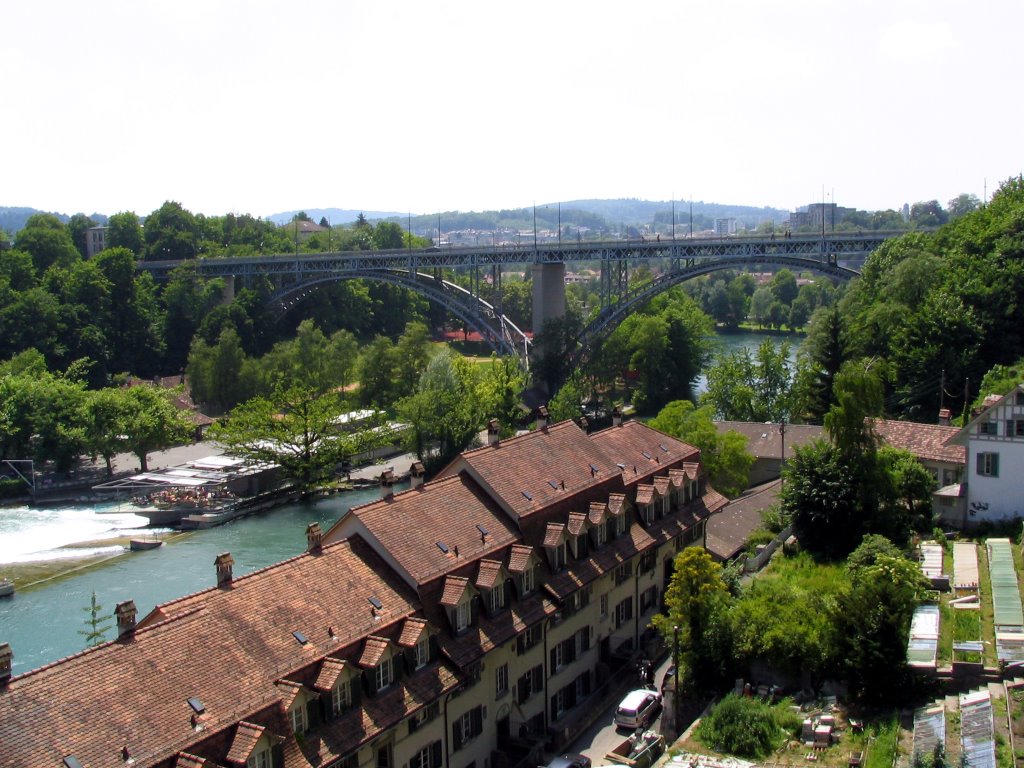
We stopped at the bear pit and watched the two bears. Bears have been maintained in the pit for over 400 years. The animals didn't look happy (obviously!) and they were resting in the little shadow that was cast by the wall of the pit. We couldn't watch the sad animals and M didn't want to even take their picture. We started our ascent to the rose garden.
MK decided to rest in the cool shade of the trees with his son and the three of us (me, M and MK's wife) started walking up the little hill. I was tired after climbing half way up the hill and MK's wife was literally gasping for breath. A couple of elderly women passed by and one of them smiled at us and said "you are young girls. You should be running up the hill and not stopping to rest". Having said this, they continued climbing the hill.
I must confess I was slightly embarassed at what the women said and so got on to my feet immediately and started climbing the hill again. MK's wife was making a Herculean effort to climb :). We finally succeeded in climbing the hill but were disappointed by what we saw. There were a few rose plants that had almost wilted away because of the summer heat and the roses weren't worth mentioning either. My mom grows better roses in our garden at home :(.
We knew that the garden up the hill was disappointing, but MK didn't. When we returned, we decided to make him jealous :) by saying that he had really missed something. He looked terribly disappointed. He was still repenting for having opted to stay back, when M spoiled the fun by blurting out that the rose garden wasn't really worth the climb up the hill. Aargh! What a spoil sport!
On the way back we stopped at a flea market. The vendors advertised that the few unusual assortment of things that they were selling in their shops were from the world wars' era. I was tempted to buy a few porcelain dolls. But the price was ridiculously high! How disappointing! One shop had a few torches and kerosene lamps that wouldn't light now :)...
We returned to the train station and collected our baggage from the storage room. We walked towards the platform to take the next train to Interlaken...
2 comments:
-
Vinutha and Lingaraj said...
-
switerland was hot ??? i always imagined it to be cold , greeeeen and snow... he he he....
and looks like they fleece lot of money.... 8C just to shut the locker again.. he he he -
Casey said...
-
Believe me, that is what my colleagues in England tell me about the entry price to monuments in India. We charge as little as 10Rs for an Indian and about 5USD for any other foreign national.
Flight to Geneva - Switzerland
"Destination Geneva -- 18th June 2005, Heathrow Terminal 4 -- Departure time 6:50 AM"
I took the bus 140 at 5:10AM, from Harrow bus station stop, to Heathrow airport central. I reached the airport at 5:55AM. I walked to terminal 3 to take the Heathrow express to terminal 4. On reaching Terminal 3, I realised that the Heathrow express would only run from 6:15 AM. OOPS! That wasn't good news. But I had no option. It was drizzling outside and I didn't want to lug my baggage to terminal 4. The entrance to the platform was locked :(. So I sat outside, waiting for the terminal service train.
The gates opened at 6:15AM. The first train arrived. I got on to the train and held the flight ticket in my hand, but there was no sign of the inspector. I put my ticket back in my backpack and stood near the door so that I could get off as soon as they opened and rush to the checkin counter. It took just a few seconds over a minute for the train to reach terminal 4. I pulled my cabin baggage and ran towards the check-in counter. M was already waiting impatiently. I rushed to the checkin counter and got my boarding card. Though he didn't complain loudly it was quite clearly written on his face that he was mad at me for arriving late :). I had to explain to him that the inter-terminal service started only at 6:15 and so I had to wait for it to begin. It didn't take much time to checkin as we were the last couple of people to check in.
Though I didn't request for a window seat, the officer at the desk handed me my boarding card with a window seat number on it :). M got the one besides mine.MK, his wife and kid had already settled in their seats when we got on to the flight. MK wanted to exchange tickets with me. But I wanted M to take pictures as we took off the ground and so we had already decided to exchange our seats and I am glad we did. If you notice the pictures carefully, you will see some interesting patterns in the picture.


We were served vegetarian sandwiches for breakfast. They didn't taste very good :(. But we had no choice. I had read on the internet that it wasn't very easy to find good vegetarian food in Switzerland. So I ate all the food that was served though I didn't quite enjoy it. I complained a couple of times to M who only managed to smile and say
"it is better than the food you cook."
How rude!
The airport authority immigration check at Geneva took a couple of minutes. The immigation officer was a handsome guy. I must confess M caught me a couple of times ogling :) at the officer and said
"there will be more handsome men in the country. You can ogle at them later. Now we should probably make our way to the baggage reclaim".
The officer asked me a question in what sounded like French and I only managed to smile and shrug my shoulder and say
"Sorry. I didn't follow what you said. Could you repeat your question please?"
The man probably didn't know English coz he muttered something and added "OK. OK", scanned my passport and handed it back to me. I was expecting him to stamp "immigration cleared" or something like it on my passport, but he didn't. I mentioned it to M and he said
"they probably scan your passport in the machine and so they don't have to stamp on it."
Mmmm... that was something new!
The entire process of the immigration took us just a couple of minutes and we were off to the cabin reclaim section. We collected our baggage and walked over to the train ticket section. There’s only one terminal, replete with English-language signing. The tourist information and airport information desks (both daily 6am–midnight) are in plain view, offering free maps and advice and hotel reservations boards (with complimentary phone). To the left of tourist information is a revolving door giving access into the adjacent CFF train station.
You can buy a Swiss pass and travel anywhere in Switzerland. The Swiss Pass offers 4, 8, 15, 22 days or one month unlimited access to Swiss Travel System’s rail, bus and boat network at very attractive rates. Refer http://www.swisstravelsystem.ch/?L=2 or http://www.raileurope.com/us/rail/passes/switzerland_index.htm for details.
I was keen on going to Bern while M wasn't :(. He felt he could go trekking in the mountain passes rather than spend another day in the city. After much discussion (or should I say argument? :)....), he reluctantly agreed to go with me. So we bought the combined rail pass for two as we could save a couple of CHF. Since MK and his wife didn't have any particular choice of their own, they agreed to go with us.
We walked to the adjoining railway station that is just about 200m from the flight. The airport waiting lounge was flanked with the models of these beautiful cows...


We boarded the train to Bern and were on our way to the capital city within few minutes of arriving at the airport. Our country would benefit much if the transport system is modelled on the lines of the the Swiss nation.

2 comments:
-
Vinutha and Lingaraj said...
-
intresting.... quite a bit of useful info for people who want to go there....
and nice pictures too..
put up more pictures... -
Casey said...
-
Thanks Vin. Sure. I shall be adding more pictures in the other posts :) that are to follow soon.
Planning for the trip - Switzerland
Indians holding work permit for United Kingdom that is valid for more than six months could visit Switzerland (2005) without any special permit. Switzerland wasn't a Schengen nation then(don't know if it is now...!!!), and so didn't demand the special visa (Schengen) that Indians require to enter Europe. But M wasn't convinced. I wrote to the Switzerland tourism department (webmaster@swisshelpdesk.org) and they confirmed that we didn't require any additional visa. (You can look up at http://www.swissinfo.org/eng/index.html for further information.)
He entrusted me wih the job of charting our journey in the country. He confessed that his knowledge about the country was limited and he would be glad to visit any place that I would consider worth visiting. Then began the meticulous job of finding the interesting places to visit in three days. The country looked really beautiful in the movies and I wasn't sure how many places we could visit in three days. I wanted to make most of our visit to the country.
I consulted Mark, our colleague who frequently visits Switzerland. He wrote to his friend in Geneva and suggested that I shouldn't miss the beautiful little town -- Interlaken, if I visit Switzerland. He also sent me a list of things that I could do while I was in the small town. I checked out a few sites on the internet and decided on visiting Bern, Geneva and Interlaken. I called up a fellow volunteer (back then, I used to volunteer for Friends Of Children) in India who had visited Switzerland, to find out what other places I could add to my itinerary. He suggested that I visit Jungfraujuch.
Another colleague, MK expressed his desire to join us (me and M). Now our group consisted of 4 adults (me, M, MK and his wife) and MK's two year old kid. So, I had to find a budget hostel that was also children friendly. After much searching on the net, I found a backpackers villa at Interlaken ( href="http://www.villa.ch/")that also accommodated families. The next job was to find the cheap flight to Geneva.
British Airways offered return tickets to Geneva for 87 Pounds. This wasn't a bad bargain. I went to BA office with M to book our flight tickets to Geneva. Unfortunatey neither of us had a credit card and the kind lady at the booking office suggested that we book our tickets on the internet as it would cost us less. We returned to our office in London and called MK at Leatherhead office. We requested him to use his credit card to book our flight tickets on the internet. We managed to get the return tickets for 78 Pounds each.
MK booked a dorm bed for me in the ladies' dorm and another room for M in the men's dorm at Backpackers Villa Sonnenhof. He booked a family room for himself.
We were to take the 7:30 AM BA flight from London -- Heathrow, to Geneva; take the train to Bern and visit the city the whole day. We would then take the train to Interlaken and checkin for the night. We would also go sightseeing in the night. The next day we would change trains at Grindelwald to Jungfraujuch and return to the hostel for the night and leave by train to Geneva the next morning. We would take the flight back to London the same evening.
"Perfect! I couldn't have planned any better if I were going to Switzerland for three days. You seem to have added all the nice places to your list." was what Mark said when I briefed him with my plan.
More to follow...
Bern - Bern's Münster - Switzerland


The first chapel on the site was recorded in 1224. On March 11th, 1421, Matthäus Ensinger a master builder from Strasbourg started the construction of St. Vincent cathedral, using the greenish local sandstone. Work continued until the mid 16th C according to his original plans. Most of the church's treasures were destroyed in 1528. But some notable pieces such as the portal sculpture, choir stalls and stained-galss windows survived. The münster was finlly completed in 1893 after a gap of 3 centuries with the addition of spire.


The central portal of the cathedral has spectacular depiction of the "Last Judgement" in the Gothic style. 170 small figures are the 15th C originals. 47 larger free standing pieces were replaced by copies in 1964 and the originals are now in the Bernisches Historisches museum. The left half of the portal depicts the "saved" and the right half the "damned". The left portal has beautiful smiling figures and the right portal has naked, screaming torment figures. This portal must have appealed to the iconoclastic reformers too as they spared it from destruction.


In the very centre is Justice flanked by angels Wise and foolish virgins and above the Archangel Michael wielding a sword and scales.
This medieval building was never a Catholic church as is often stated, for there has never yet been a bishop of Bern. This now serves as a Protestant church.
3 comments:
-
Vinutha and Lingaraj said...
-
ahhh !! they r really gud!!
-
Ashish Agarwal said...
-
Beautiful photos. The architecture seems spendid, and the 3rd and 4th photos were specially good.
-
Erin Kiskis said...
-
Hi! I’m the Community Manager of Ruba.com. We’re building a website to highlight some of the most interesting places travelers around the world have discovered. We’ve read hundreds of blogs about Switzerland, and we think that yours is awesome! We’d love to highlight excerpts from blogs like yours (assuming it’s OK with you of course) and to discuss other ways of tapping into your expertise if you are interested. I’m at erin@ruba.com.
Thanks! :)
Bern - Zytglogge - Switzerland


This 600 year old astronomical clock has a big dial on the outside that measures the 24 hours of the day. The star pointer gives the month and date. The darkest panels at the back indicate the time of sunrise and sunset while another point shows the sign of the zodiac. The moon pointer shows what stage the moon is at (full moon, new moon, crescent etc). The simpler mechanism of the clock was replaced by the current clock mechanism in 1530. The mechanism is composed of interlocking iron wheels, ropes, levers and knobs. The momentum of the clock is generated by the gradually descending stone weights that hang from long ropes through three floors of the tower. Highly paid, specially comissioned experts tried to add a pendulum to the mechanism but failed. A local farmer at the beginning of 18th C solved the problem.

The tower has a 1.4 ton bell that gives the tower its name. The month and the year it was cast (October 1405) is engraved on the bell. This year was the turning point for Bern. The wooden city had burnt down to ground and thus brought about a massive reconstruction project. The new project was to construct the town in sandstone.
 To
the right of the clock is a carillon that moves every hour (start 4
minutes before the full hour). It sounds small bells by means of a
'jester' indicating the number of the next hour. The jester rings the
two bells alternatively while a round-about of 7 bears rotate
representing the days of the week.
To
the right of the clock is a carillon that moves every hour (start 4
minutes before the full hour). It sounds small bells by means of a
'jester' indicating the number of the next hour. The jester rings the
two bells alternatively while a round-about of 7 bears rotate
representing the days of the week.The first bear mounted on a horse symbolises Sunday, the beginning of the week, followed by 6 other bears (monday - saturday) representing the different professions. The 4th bear turns his head when he comes out. The bear represents the 4th day of the week -- wednesday -- 'the turn of the week'. When the full hour arrives, the little man in rubber boots sitting on a golden chair starts counting the hour by moving his bearded chin while moving a golden rod - left-right-left. He is morally supported by a little golden lion that sits to his left and vigorously shakes his head for each count. At the same time, a huge golden male figure at the very top of the tower rings the big bell, one stroke for each full hour. All this is initiated by a golden rooster (flapping his wings) by crowing. He also crows in the middle of the show and finishes it off with his crowing.
The grim histroy of the tower
The tower was erected to serve the purpose of defence, but was later used as a women's prison. The so-called pfaffendirnens (prostitutes of the priests) who were condemned for having sexual relations with priests or monks were locked up here and severly punished. Many of them died in the tower.
2 comments:
-
Vinutha and Lingaraj said...
-
the clocks r impressive...
what did the farmer in 18th C solve? -
Casey said...
-
Highly paid, specially comissioned experts tried to add a pendulum to the mechanism but failed. The farmer added the pendulum.
Bern - Schweizerische - NationalBank -Switzerland

Today, Switzerland is considered a safe money haven as the Swiss financial sector is now home to 35% of the world's private and institutional funds at an estimated value of 3 trillion Swiss francs (CHF). This country is a magnet for international money as it beholds a long tradition of stability that is reflected in a sound banking system and currency. The Swiss franc is considered one of the world’s premiere currencies as it is backed by a large percentage of gold reserves relative to other advanced rich nations. With a population of approximately 7 million of which 1.1 million are foreigners, this very mountainous and scenic nation is home to many of the world’s wealthiest citizens and their bank accounts.
You are just another number...
The act of bank accounts designated with numbers only came about from time in history of Nazi Germany. Several German citizens in the 1930’s were executed for having Swiss bank accounts. Since then, no longer could just anyone walk into a bank and ask for an account holder’s name. If you wish, you can open a numbered bank account, available for individuals and corporations. Numbered accounts help to better maintain and protect the financial privacy of the client. Names are not shown anywhere on bank statements. A copy of valid identification is also required for each signer of the account. Numbered accounts are treated just like name accounts under Swiss banking rules.
Banking Laws in Switzerland
Banking law (Swiss Banking Law -- 1934)makes it a criminal offense in Switzerland for a banker to divulge information about a customer in violation of the law. The right of secrecy is a right belonging to the customer, not the bank. It is the customer’s privacy that is protected by law.
Swiss bank secrecy will cover most normal uses for a foreign bank account. Swiss law does not consider administrative offences such as tax evasion outside of Switzerland as a criminal offence, and bank secrecy will remain. However, the laws allow the banking secret to be broken if it is proven that a given bank account or person is connected to a criminal offence such as money laundering. The Swiss have some of the toughest money laundering laws within Europe and the world. Swiss law punishes with prison bankers who reveal details about their customers. Bank employees have to sign the secrecy portion of the banking act as a condition of employment.
Swiss National Bank (SNB)
The Swiss National Bank, incorporated in 1905, has executive offices in Bern and Zurich and branches in 8 other cities. It was established in 1907 as Switzerland’s independent central bank. The bank strives to maintain price stability, while taking economic development into account.
Gold forms 25% (reduced from 40% in 1996) of Switzerland’s central bank (SNB, or Swiss National Bank) reserves. This is a long-standing arrangement; Switzerland’s federal constitution requires a partial goldbacking for the Swiss franc, one of the world’s strongest and moststable currencies
Role of SNB during World War-- II
Switzerland did not have up-to-date equipment. If the country was attacked by the surrounding Fascist Nations, the army would have retreated into the Alps relatively soon, but would have kept up resistance based on some sort of Guerilla tactics.
The Swiss army would have destroyed the important bridges and tunnels and paralyzed the connection for years. The alpine railways were of central importance for transports between Germany and Italy.
Some historians say, that financial services, especially buying gold from Germany in exchange for convertible currency (Germany's national currency was no longer accepted as a means of payment in the international markets) was also an important factor. The Independent Commission of Experts showed that the Chairman of the Swiss National Bank (SNB) did not use this argument during the Second World War. "It was only after the war ... that the SNB directors claimed that their gold transactions and positive relations with Germany had prevented Germany from seriously considering the option of military operations against Switzerland. ... One might just as well claim that with its «business as usual» approach, the SNB had effectively prevented Switzerland from using the convertibility of its currency as a trump card in the economic negotiations with Germany, thus neutralising the dissuasive potential."
Dormant Accounts
Some of the victims of holocaust had accounts in Switzerland, but under these tragic circumstances surviving heirs were not easily able to know whether there was any account at all and exactly with which bank institute in Switzerland. After the war, Swiss bankers generally declared account of people that did not reply to letters or send letters to the bank with exact reference to the account number as "dormant accounts". This fact alone is a standard procedure not worth commenting. The problem is, that bankers were not very cooperative with surviving heirs that tried to find the accounts of their relatives. Only in the debate about Switzerland and World War II after 1995, they were willing to publish a list of dormant accounts and to cooperate.
2 comments:
-
Vinutha and Lingaraj said...
-
so what happens to the moeny in the dormant accounts?
-
Casey said...
-
In 1996-97 it became clear that some of these institutions had failed to return these assets to the survivors or their descendants.In early 1997 Swiss financial institutions and industry, together with the government, agreed to establish a private fund (comprising several hundred million Swiss francs) solely to compensate victims of the Holocaust.
In a separate initiative Arnold Koller, then Federal President, promised the government would establish its own publicly-funded Swiss Foundation for Solidarity with victims of humanitarian disasters, including survivors of the Holocaust, entirely separate from the Holocaust fund
curia confoederationis helveticae - Bern - Switzerland
 According
to legend, late in the 12th century, the Duke of Zahringen sent his
hunters into the woods and promised to name the city after the first
animal that was brought to him. The bear was the first to be slain and
since the 15th century the bear has served as the city's mascot.
According
to legend, late in the 12th century, the Duke of Zahringen sent his
hunters into the woods and promised to name the city after the first
animal that was brought to him. The bear was the first to be slain and
since the 15th century the bear has served as the city's mascot. Duke Berthold V of Zähringen founded the city on the River Aare in 1191 and allegedly named it after a bear (Bär in German) he had killed. It was made an Imperial Free City by the Holy Roman Emperor Frederick II in 1218 after Berthold died without an heir. In 1353 Berne joined the young Swiss Confederation, becoming a leading member of the new state. It invaded and conquered Aargau in 1415 and Vaud in 1536, as well as other smaller territories, thereby becoming the largest city-state north of the Alps. It was occupied by French troops in 1798 during the French Revolutionary Wars, when it was stripped of most of its territories. In 1831 the city became the capital of the Canton of Bern and in 1848 it additionally became the Swiss (administrative) capital.

The Federal Assembly building was built in Renaissance style in 1902. It has "Curia Confoederationis Helveticae" inscribed on it. The building sits on a cliff edge above the river Aare. The Bundeshaus or House of Parliament, is the seat of Swiss Government. The oldest part of the building, the west wing, dates back to 1856. The central connecting portion of the structure that connects the East and the West wing was completed in 1902.
Switzerland is a federal republic and perhaps the closest state in the world to a direct democracy. For any change in the constitution, a referendum is mandatory; for any change in a law, a referendem can be requested. In practice, the people have the last word in every change of law some interest group disagrees with.
History
 In
the mid-1850s, plans were drawn up for a neo-Gothic structure which
envisaged a building similar to the palace of Westminster in London. But
eventually the design of Wilhelm Auer was approved.
In
the mid-1850s, plans were drawn up for a neo-Gothic structure which
envisaged a building similar to the palace of Westminster in London. But
eventually the design of Wilhelm Auer was approved.Construction was carried out in accordance with the ideals of the Swiss federalism. The exterior is mostly sandstone from the quarries just outside Bern. Stone and other building materials from every region of the country have also been used. 30 artists from different parts of the country were commissioned to do the artwork.
Hidden secrets
When a large chandelier from one of the parliamentary chambers was taken down recently for restoration, it was found to contain documents written by restorers in the 1930s with their views about the approaching world war.
Like the building material used for construction, the restorers and the original construction workers represented most regions of Switzerland. Monica Bilfinger, an art historian at the federal building department rightly comments: "it is not just a house for the Swiss people, it's made by the Swiss people".
1 comment:
-
cialis said...
-
Hi, well be sensible, well-all described
A day in the Land of Mozart - Austria
Salzburg, is home to one of Europe's most famous beer destinations: Augustiner Bräu. For centuries, monastic orders like the Augustinians preserved the ancient art of beer making. The monks were craft brewers in the literal sense: they relied on scientific principles, and paid strict attention to quality. Some of Europe's finest beers have their origins in monasteries.
The Augustiner monastery was founded in 1605 by Wolf Dietrich, Salzburg's prince and archbishop. Dietrich was, to say the least, a larger-than-life character. Like a true prince of the Holy Roman Empire, he ruled the city with an iron hand, and spent lavishly on the arts. And he didn't let his religious vows get in the way of earthly pleasure. He had 15 children by his longtime mistress, Salome Alt, and built the lavish Mirabell Palace and Gardens in her honor.
In 1835, the emperor handed the monastery over to the Benedictine order, who decided to cash in by inviting the public to drink their beer. The residents of Salzburg have flocked there ever since.
A visit to Augustiner monastery didn't interest me as I don't drink. A climb to the monastery would only be a waste of time. So I just walked almost up to the monastery on the eastern bank of Salzach river and turned back. I took this picture as a memorabilia of my walk.
Getreidegasse --Salzburg's most famous shopping street
Salzburg´s Getreidegasse is the most famous street of the city, and therefore is the most crowded. The charming old houses have pretty portals and wonderful courtyards. The Getreidegasse is famous for the whrought signs from the 16th to the 19th Centuries. The design of the signs dates back to the Middle Ages. It is worth taking a second look at the houses because they are adorned with dates, symbols or the names of their owners, so they often tell their own history.


Salzburg is Austria’s fourth largest city and lies 436 m above sea level. Salzburg is divided by the river Salzach. Its two sides are very distinctive from one another: On the south side of Salzach you will find the "Oldtown" of Salzburg underneath the Mönchsberg and the Hohensalzburg Fortress. North of the river you will find the Kapuzinerberg and the baroque Castle Mirabell with its beautiful garden. I had a lovely walk through the old town of Salzburg and crossed over the bridge on to the new town side.

Though I am not a fan of Mozart I couldn't resist visiting Tanzmeisterhaus -- the house where Mozart spent a few years of his life. I walked around the place for a while and also visited the garden in front of the house. I saw this beautiful building in Marktplatz a little further from Mozart's house. It appeared to be a concert hall but I am not certain about it.

Marktplatz is just a stone's throw away from Mirabell garden where I had begun my journey earlier in the day. I went back to the garden and sat on a bench for a while before leaving to the station to take the train back to Vienna. While in the garden I heard a family speaking "Kannada" and I was excited. I heard them referring to "Jayanagar" and "Malleswaram" in their conversation and my joy knew no bounds. The family was from Bangalore, my hometown :). They were six people: two elderly men, an elderly woman, a young couple and a little boy aged about two years. I walked up to them and tried to speak to the young man. He gave me a weird look and walked away. I smiled at the young woman who seemed to be his wife and asked for the directions to the railway station in Kannada. She literally jumped with joy when she heard me speak in Kannada and asked me if I was from Bangalore. I said I was and she told me that her husband, a software engineer worked for a company in a nearby town and they had come to Salzburg with her parents to spend the weekend. She gave me the directions to the railway station and I thanked her.

I bought an icecream cone in a shop beside the main road and walked towards "Bahnhonf" -- the railway station, relishing it. I noticed this interesting signboard and an equally intersting traffic signal. I wonder what "KISS&RIDE" :) means.


The journey back to Vienna was for 3Hrs and 45 Min. I reached Wien Westbahnhof station at 8:30 PM, had a croissant and a cup of cappuccino in Caffé India. My first visit to Europe was indeed memorable. I returned to the hostel, packed my bags and slept. I had to take the airport service bus at 5 O' Clock early next morning.

1 comment:
-
Anonymous said...
-
A very nice content along with very good information and it is very useful and helpful.Thanks for sharing
Golden Triangle Tour Packages
Pferdeschwemme - Salzburg - Austria

The Pferdeschwemmen -- Horse well, was built by Fischer Van Erlach (who is aso responsible for the Trinity Church) along with the front façade of the royal stables in 1693. The centre of the well is decorated by a statue named "Der Rossebändiger" -- "horse tamers", the work of Michael Bernhard Mandl. It was formerly located in an oval basin axial to the portal of the royal stables. A palace façade with depictions of horses was located behind it.
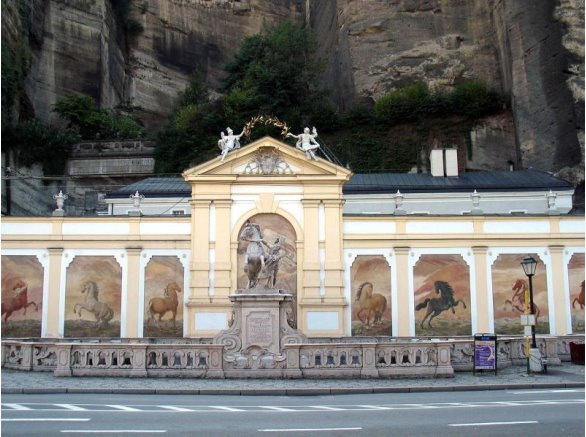
In 1732, the horse pond was restored under Archbishop Firmian. The group of horse tamers was turned by 90 degrees and given a new pedestal. The basin was enclosed by a balustrade. Joseph Ebner painted horse fescoes on the rear wall in the style of Stradnus' engraving "Equite seu speculum equorum"
The well was initially built to give water to the patrician's and Prince Archbishop's horses. Around 1700 horses in the archbishop's riding school bathed here before going to the stable across the street.

For 2000 years, the Norik Horse ( Noriker, Norisches Kaltbult, or Pinzgauer) has lived in Austria. Named after the Roman province of Noricum, they descend from an ancient Celtic horse that bred with heavy Roman draught horses. The breeding of Norik horses flourished under Charlemagne in the 8th century. The first stud farm that bred Norik horses was not until 1576 near Hallein and was under the control of the Archbishops of Salzburg who used the Noriks primarily as ceremonial or parade horses, with the colorful specimens especially popular. The frescos in Salzburg of the "Pferdeschwamme" portray similar horses.
For the construction of the Salzburg cathedral, rocks had been cut out from the mountain Moenchsberg. In 1693, Archbishop Johann Ernst von Thun decided to use this cavity in the mountain and he had a riding school built according to plans by Fischer von Erlach in which tournaments were held. It included 36 boxes chiseled from the rocks for the Archbishops and guests, and it was used as an open-air theatre for sport, dance and theater performances since the 18th century. The Horse Pond next to it was built in 1695 by von Erlach as a watering place for the Archbishop's riding stables.
Since 1926, the rock riding school has been used by the "Salzburger Festspiele". By the 18th century, Norik horses became important as work animals for farmers, but those horses which had been interbred with riding horses by the Archbishops were not as well suited for mountainous work and the more common type of less temperamental, heavy work horses were preferred in difficult terrain.
In time, these useful animals which had served as a riding, carriage, and work horse for knights, farmers and merchants in the Middle Ages evolved into the heavy alpine Norik horse, some of which would one day depart with their banished Protestant owners, bound for a long trek into unfamiliar lands.
1 comment:
-
Anonymous said...
-
A very nice content along with very good information and it is very useful and helpful.Thanks for sharing
Golden Triangle Tour Packages
Pferdeschwemme - Salzburg - Austria
The Pferdeschwemmen -- Horse well, was built by Fischer Van Erlach (who is aso responsible for the Trinity Church) along with the front façade of the royal stables in 1693. The centre of the well is decorated by a statue named "Der Rossebändiger" -- "horse tamers", the work of Michael Bernhard Mandl. It was formerly located in an oval basin axial to the portal of the royal stables. A palace façade with depictions of horses was located behind it.
In 1732, the horse pond was restored under Archbishop Firmian. The group of horse tamers was turned by 90 degrees and given a new pedestal. The basin was enclosed by a balustrade. Joseph Ebner painted horse fescoes on the rear wall in the style of Stradnus' engraving "Equite seu speculum equorum"
The well was initially built to give water to the patrician's and Prince Archbishop's horses. Around 1700 horses in the archbishop's riding school bathed here before going to the stable across the street.
For 2000 years, the Norik Horse ( Noriker, Norisches Kaltbult, or Pinzgauer) has lived in Austria. Named after the Roman province of Noricum, they descend from an ancient Celtic horse that bred with heavy Roman draught horses. The breeding of Norik horses flourished under Charlemagne in the 8th century. The first stud farm that bred Norik horses was not until 1576 near Hallein and was under the control of the Archbishops of Salzburg who used the Noriks primarily as ceremonial or parade horses, with the colorful specimens especially popular. The frescos in Salzburg of the "Pferdeschwamme" portray similar horses.
For the construction of the Salzburg cathedral, rocks had been cut out from the mountain Moenchsberg. In 1693, Archbishop Johann Ernst von Thun decided to use this cavity in the mountain and he had a riding school built according to plans by Fischer von Erlach in which tournaments were held. It included 36 boxes chiseled from the rocks for the Archbishops and guests, and it was used as an open-air theatre for sport, dance and theater performances since the 18th century. The Horse Pond next to it was built in 1695 by von Erlach as a watering place for the Archbishop's riding stables.
Since 1926, the rock riding school has been used by the "Salzburger Festspiele". By the 18th century, Norik horses became important as work animals for farmers, but those horses which had been interbred with riding horses by the Archbishops were not as well suited for mountainous work and the more common type of less temperamental, heavy work horses were preferred in difficult terrain.
In time, these useful animals which had served as a riding, carriage, and work horse for knights, farmers and merchants in the Middle Ages evolved into the heavy alpine Norik horse, some of which would one day depart with their banished Protestant owners, bound for a long trek into unfamiliar lands.
Mozartplatz and Tanzmeisterhaus - Salzburg - Austria

[The narration of Mozart's death has been borrowed from http://www.music-with-ease.com/mozart.html]
Mozart expired penniless, and almost neglected, and was laid to rest in a nameless grave, not one soul whom he had known in life standing by to see the coffin lowered. The records of musical history tell of no deathbed scene which leaves so deep an impression as that of Mozart. He had been commissioned to compose a Requiem and it was still uncompleted. His last afternoon on earth had come. Supported by pillows, though already exhausted by fits of coughing, he made painful efforts to join his pupil Sussmayer and one or two other acquaintances in singing the chorus parts of the unfinished work. The most vivid imagination cannot picture a more distressing scene than the dying man, unable to speak, extending his cheeks to indicate to Sussmayer the places at which the wind instruments should be employed. The evening wore on slowly enough for the sad, wearied watchers, and as midnight drew near the dying composer with difficulty raised himself from his bed, opened his eyes wide, and then, turning his face to the wall, seemed to fall asleep. It was the last sleep: an hour later and the perturbed spirit was at rest for ever.
The body lay for the usual time, and as the days of the old year were slowly dying, Mozart took his last long journey. A poor, scanty, straggling procession is observed wending its way from the house to the Cathedral, where a short service is to be held prior to the interment in the burial-ground of St. Mark, then lying in the suburbs of Vienna, but now a veritable oasis in the desert of the enlarged city. As the coffin emerges from the Cathedral in the pouring rain, some who have been at the service disappear round the angles of the building, and are seen no more. Others shelter themselves as best they can, and trudge with the remains along the muddy streets. But even these cannot hold out to the end. "They all forsook him and fled." And so, unattended except by hirelings, the body was borne away into the dismal country, there to be laid with paupers in a common grave, the exact site of which no one was to know in the course of a few years.
In 1809 some admirers wished to visit the grave, but they were told that the ashes of the poor were often exhumed to make room for others, and Mozart was as unknown at the cemetery as the other fifteen friendless unfortunates who had been buried the same week. To-day, in that great necropolis, the monument to Mozart stands over an empty grave.
 The
town paid its respects to the great son; after his death, by erecting
the Mozart memorial that was designed by Ludwig Schwanthaler. It was
opened in 1842 in the presence of Mozart's two sons. Mozart's widow
Constanze Von Nissen had died half a year earlier in May.
The
town paid its respects to the great son; after his death, by erecting
the Mozart memorial that was designed by Ludwig Schwanthaler. It was
opened in 1842 in the presence of Mozart's two sons. Mozart's widow
Constanze Von Nissen had died half a year earlier in May.1842 was a difficult time for the town of Salzburg. Secularised only two decades earlier, it was still suffering from the devastations of the Napoleonic wars. There was a Baroque fountain with a statue of St. Michael in the centre of the square that faced a church. It had to be removed for the Mozart memorial. It was an expensive enterprise for the economically distressed city.
The mentally disturbed King of Bavaria, Ludwig I was passionately in love with Salzburg and adored Mozart. He donated a significant amout of money to start the erection of the memorial. The opening of the memorial had been planned for 1841, but the construction workers discovered a Roman mosaic under the Baroque fountain and the work was delayed.
Tanzmeisterhaus (Mozart's Residence)

Mozart's residence was also known as Tanzmeisterhaus (dancing master's hgouse). It consisted of two buildings until 1685. On Aug 3rd, 1711 the decree granted permission to Lorenz Speckner to hold dancing for the aristocracy in the building. In 1739, the house was turned over to Lorenz's son Franz Karl Gottlieb Speckner. He was a higly arisocratic dancing master. In those days a dancing master played an important role by giving the young aristocrats dancing lessons and also prepared them for life at court and was perfectly conversant with the complicated court ceremonials.
Gottlieb Speckner witnessed Mozart's parents' wedding on Nov 15th, 1747. The Mozart family was considering moving to a bigger residence as early as in Dec. 1765. but the plans were always pushed aside during the family's extensive journey throughout western Europe. The family finally moved into their new domicile after their third journey to Vienna (mid July-Sept 25th 1773).
Gottlieb Specner had died on May 15th, 1767 and Tanzmeisterhaus was inherited by his cousin, Maria Anna Raab. She resorted to renting the space to wedding parties. The spacious residence was large enough to receive friends and musicians. In this house John Chrysostom Wolfgang Theophilus Mozart wrote symphonies, divertimenti, serenades, piano and violin concerti and a bassoon concerto, arias, masses and other sacred music from 1773 - 1780.
Mozart's mother died in Paris in 1778. His sister married and moved to St. Gilgen in 1784. Leopold lived alone in the house till in death on May 28th, 1787. The house had various owners after Leopold Mozart's death. A bomb struck the house on October 16th, 1944 and destroyed two-thirds of the building. The owner at that time sold the destroyed section to the Assicurazioni generali, who erected an office building on the site. International Mozarteum Foundation purchased the building in 1989. The international Mozarteum Foundation had already purchased the preserved secion of the Tanzmeistersaal in 1955 and turned it into a museum. The office building was torn down on May 2nd, 1944 and reconstructed it according to the old plans.
Mozart Memorablia
The city that never recognised his talents or paid the due respect that he deserved today sells Mozart memorablia in the form of chocolates, Mozart Yogurt, sausage, baby bottles and perfumes.

Kurt Palm, author of a new book about Mozart says "The new slogan for 2006 is not sex sells, but Mozart sells. If Mozart could see what happens now only in Austria, in Vienna or Salzburg this year, he would either only laugh about it or he would be disgusted".
4 comments:
-
Vinutha and Lingaraj said...
-
he wud be disgusted !!
-
Casey said...
- This comment has been removed by the author.
-
Casey said...
-
I agree...he would be so disgusted that he would have preferred to be dead :))
-
Anonymous said...
-
A very nice content along with very good information and it is very useful and helpful.Thanks for sharing
Dreifaltigkeitskirche - Salzburg - Austria


The Dreifaltigkeitskirche or "Trinity Church" is located on the right side of the river Salzach. It was built between 1694 and 1702 by Fischer Von Erlach by the order of Prince Archibishop Johan Ernst Von Thun to house a seminar for young men in training to become priests.
Like the other churches built by Von Erlach, this church also has a central dome, a plaful façade and two towers that make it appear like a palace. The architecture was inspired by Roman designs.

After visiting the Holy Trinity Church, I walked over to the other side of the building and entered the Residence square. It is the heart of the old city. Archibishops used the Residence buildings from 17th C onwards. The residence fountain is 15Mts high and is the Largest Baroque fountain outside Italy. The fountain was built between 1658 and 1661 with marble from Untersberg -- a mountain near Salzburg. It was possibly built by Italian artist Tommaso di Garona.
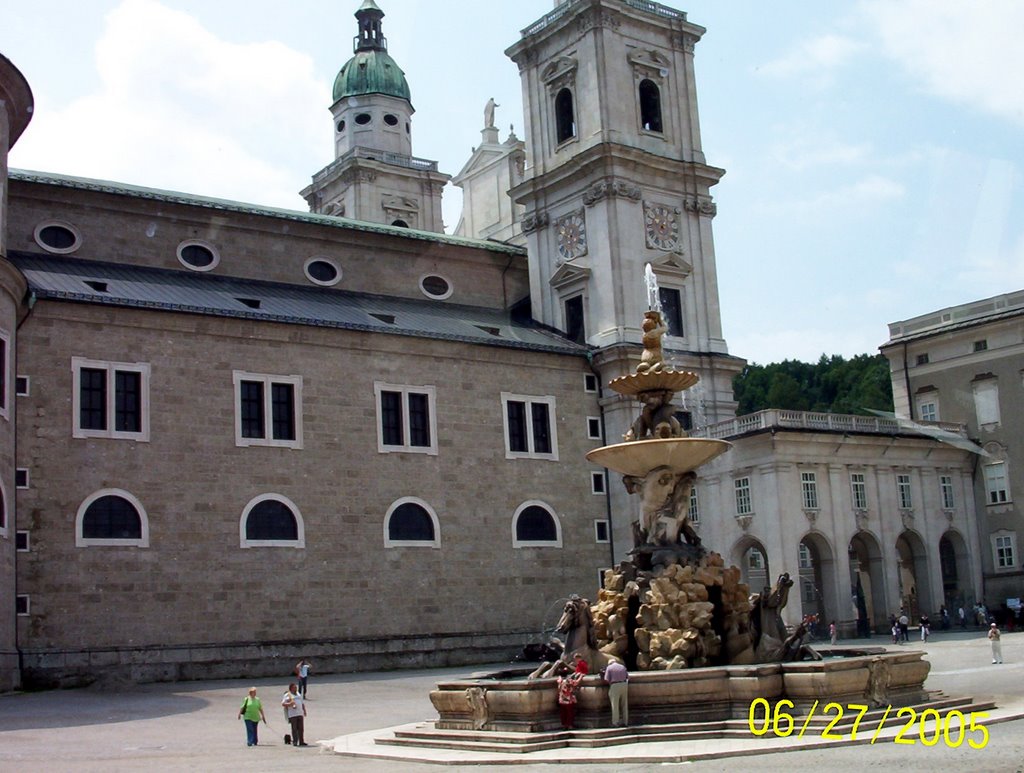

The waterspouting horses shot to world fame as they were featured in the movie "Sound Of Music". Maria boards the bus to the Trapp family house in the Residence square. As she crosses the square, she splashes her hand through the water of the Residence fountain and sings "I have confidence in me"
What will this day be like? I wonder.
What will my future be? I wonder.
It could be so exciting to be out in the world, to be free
My heart should be wildly rejoicing
Oh, what's the matter with me?
I've always longed for adventure
To do the things I've never dared
And here I'm facing adventure
Then why am I so scared
Oh, I must stop these doubts, all these worries
If I don't I just know I'll turn back
I must dream of the things I am seeking
I am seeking the courage I lack
And mind me with each step I am more certain
Everything will turn out fine
I have confidence the world can all be mine
They'll have to agree I have confidence in me
I have confidence in sunshine
I have confidence in rain
I have confidence that spring will come again
Besides which you see I have confidence in me
Strength doesn't lie in numbers
Strength doesn't lie in wealth
Strength lies in nights of peaceful slumbers
When you wake up -- Wake Up!
It tells me all I trust I lead my heart to
All I trust becomes my own
I have confidence in confidence alone
(Oh help!)
I have confidence in confidence alone
Besides which you see I have confidence in me!
(I have deleted a couple of paragraphs from the original lyrics :)... that I don't really enjoy much :)....)

A few local musicians were playing their music instruments and selling the CDs of the songs they had recorded. I sat in the cool shade and enjoyed their music for a while.

3 comments:
-
Vinutha and Lingaraj said...
-
the poem is too gud!! did u have similar thots as that r in the first 2 paragraphs, when u ventured out all alone ?
-
Casey said...
-
Yup :) you are right.... one of the reasons that I love this song is because I can relate to it :)...
-
Anonymous said...
-
A very nice content along with very good information and it is very useful and helpful.Thanks for sharing
Golden Triangle Tour Packages
Leopoldskron Palace - Salzburg - Austria

Archbishop Leopold Count Firmian built Leopoldskron palace in Rococo style, as a residence for his family in 1731. The Baroque palace is located on the banks of a lake on the outskirts of the city. Firmiani family sold the estate in 1837 and since then it has changed owners many times. King of Bavaria too owned it at one time.
Max Reinhardt, founder of the Salzburg festival, bought it in 1918. It was in a sad condition, but he renovated it to its original beauty and used its garden for theatre performances.
"Salzburg Seminar in American Studies"-- an institution that focuses on economy problems bought the castle in 1958.


The palace is one of the most important buildings in the movie "Sound of Music". It is used as a back façade of the Trapp family home. The baroness and the captain break up on the balcony and down on the terrace. The interior scenes were based on the inside façades of this palace but were rebuilt and filmed in the studios.

4 comments:
-
Vinutha and Lingaraj said...
-
weren't get any closer to the palace??
-
Casey said...
-
Nope... :( we weren't allowed inside the palace...
-
Erin Kiskis said...
-
Hi! I’m the Community Manager of Ruba.com. We’re building a website to highlight some of the most interesting places travelers around the world have discovered. We’ve read hundreds of blogs about Austria, and we think that yours is awesome! We’d love to highlight excerpts from blogs like yours (assuming it’s OK with you of course) and to discuss other ways of tapping into your expertise if you are interested. I’m at erin@ruba.com.
Thanks! :)
Mirabell Garden - Salzburg -Austria
 Let's start at the very beginning
A very good place to start
When you read you begin with A-B-C
When you sing you begin with do-re-mi
Do-re-mi, do-re-mi
The first three notes just happen to be
Do-re-mi, do-re-mi
Maria:
Do-re-mi-fa-so-la-ti
spoken Let's see if I can make it easy

Doe, a deer, a female deer
Ray, a drop of golden sun
Me, a name I call myself
Far, a long, long way to run
Sew, a needle pulling thread
La, a note to follow Sew
Tea, a drink with jam and bread
That will bring us back to Do (oh-oh-oh)
Do-re-mi-fa-so-la-ti-do
So-do!
Maria and the children sing this song in "Sound of Music" and towards the end of the song, they are shown dancing in the Mirabell Garden.
(If you click on the photo below and open it in a new page, you will see the two statues that are shown in the movie)

The garden is oriented towards the Hohensalzburg fortress and the Salzburg Dom Cathedral. Johan Bernhard Fischer Von Erlach re-modelled the original gardens under the reign of Prince Archbishop Johann Ernst Thun in 1689. Franz Anton Danreiter altered them in 1730 and shaped it to what is now considered as the most beautiful Baroque gardens in Europe.

There is a large fountain in the heart of the garden with four statue groups around it: the rape of Prosperina, rape of Helena, Aeneas and Anchises and finally Hercules and Antaeus. These statues were made by Ottavio Mosto in 1690.


Walking your way up the North brings you to the "Salzburg Dwarf Garden". It has a display of grotesque dwarfs. These dwarfs actually lived in the court of Prince Archibishops of Salzburg. These sculptures are so grotesque that you wouldn't want to take a picture of them.
I spent about an hour in the garden enjoying the wonderful Salzburg music. A local music group was practicing in Mirabell garden on the Sunday afternoon.

3 comments:
-
Vinutha and Lingaraj said...
-
do re mei.. tooo cul.. now i know
-
Casey said...
-
We had sung this song probably in 1987 at the Ganesha festival celebrations in Seshadripuram :)...
Festung Hohensalzburg - Salzburg - Austria
 Built 900 years ago, this fortress once served as a prison and also as a
miliary post. It was built by Price Archbishop Eberhard in 1077.
Initially it was built of wood and served for the protection of Imperial
troops of the Holy Roman Empire. During the struggle for power between
Pope Gregor VII and Emperor Henry IV, Prince Archbishop Eberhard decided
to stand by the Pope.
Built 900 years ago, this fortress once served as a prison and also as a
miliary post. It was built by Price Archbishop Eberhard in 1077.
Initially it was built of wood and served for the protection of Imperial
troops of the Holy Roman Empire. During the struggle for power between
Pope Gregor VII and Emperor Henry IV, Prince Archbishop Eberhard decided
to stand by the Pope.Prince Archbishop Konrad I built a stone tower during his reign. Conflicts between Bavaria and Austria posed continued threats for Slazburg and Hohensalburg Fortress and so was improved further.
Prince Archbishop Burkhard III. von Weißpriach built the four main towers along the outer wall. Burkhard's successor Prince Archbishop Bernhard Von Rohr built the bastion to protect from the rebel of the miners and the also to suppress rich patricians'struggle for more power. Salzburg also feared an invasion of Turkish troops.
Prince Archbishop Leonhard von Keutschach changed the purpose of the fortress from a militaristic and strategistic one to a representative one. He invested large amounts of money into decorations, modernisation and extensions to make the fortress a pleasant castle. Keutschach shaped the fortress and until today it has not changed in any fundamental way.

During the 30 years war, Prince Archbishop Paris Lodron modernised the Festung (fortress) by altering the roofs and outer walls. City walls were also built.
After the Napoleonic wars, when Salzburg became part of Austria, the fortress served as a prison and an army camp. During world War I, it was used to imprison Italian officers as prisoners of war.
Nazi underground terrorists were exiled in the fortress in 1934. This was the last time that the festung held prisoners.
 In 1965 a successful musical "Sound of Music"
was made a movie in the original locations of Salzburg and surrounding.
Here in this picture you see Julie Andrews (Maria in the movie) with
the Hohensalzburg as the backdrop.
In 1965 a successful musical "Sound of Music"
was made a movie in the original locations of Salzburg and surrounding.
Here in this picture you see Julie Andrews (Maria in the movie) with
the Hohensalzburg as the backdrop.
4 comments:
-
Vinutha and Lingaraj said...
-
Intresting !! can u put up more photos of the fort ?
-
Casey said...
-
Sorry Vin :( I don't have any more pictures of the beautiful fort coz I didn't climb up the mountain :(. I took the guided tour of the town and we didn't have sufficient time to visit the fort.
-
Casey said...
-
Hi Vibhor,
Thanks for stopping by. Yes, the fort looked really great from the outside. -
Anonymous said...
-
A very nice content along with very good information and it is very useful and helpful.Thanks for sharing
Golden Triangle Tour Packages
Schönbrunn - Vienna - Austria
 It
has been more than a year since I traveled to Austria and my grey cells
don't seem to be good at retaining a large amount of information :)... I
have forgotten how exactly I traveled to Schönbrunn or what tram I
took... I am sure a lot of you would now be saying "YAHOO!!! Thank God .
She doesn't remember too much. So that should spare us from reading all
the details of the travel :)"... but... I still have a great deal of
information about the places that I visited in Vienna. This was the
apothekery that I saw while on tram to Schönbrunn.
It
has been more than a year since I traveled to Austria and my grey cells
don't seem to be good at retaining a large amount of information :)... I
have forgotten how exactly I traveled to Schönbrunn or what tram I
took... I am sure a lot of you would now be saying "YAHOO!!! Thank God .
She doesn't remember too much. So that should spare us from reading all
the details of the travel :)"... but... I still have a great deal of
information about the places that I visited in Vienna. This was the
apothekery that I saw while on tram to Schönbrunn.I got off at the Schönbrunn stop and turned to my left at the exit. I saw a sign board Schönbrunn and followed it. The road led me to the parking lot for the vehicles to the palace :). I then walked out of the parking lot and stood looking around. I stood at the corner of the street trying to figure out the right road when a group of young men walked up to me and asked "may we help you?" I was happy to hear them speak English and said "Yes Please. I want to go to Schönbrunn palace. Could you direct me please?". The young man who approached seemed to be a Chinese student. He pointed in the opposite direction and said "you walk straight down this road you will reach the palace". I thanked them and walked on. The sight ahead was breath taking!

Schönbrunn Palace with its surrounding buildings and the huge park is one of the most significant cultural monuments in Austria. The castle was built to rival French Versailles in Baroque beauty and importance but House Habsburg lacked funds to outdo its rivalling nation France. In earlier times it served as summer residence to various Habsburg rulers.
History
Note: The following information about the history of the place has been borrowed from the UNESCO report.
The Katterburg estate, the site of the present Schönbrunn Palace, was sold in the mid 16th century by the Kiosterneuburg monastery to Emperor Maximilian II, who developed it as a hunting lodge and installed a menagerie. The buildings were badly damaged when Vienna was sacked by the Hungarians in 1605; it was not until 1622 that they were restored by Emperor Ferdinand II. After his death in 1637 the Katterburg became the dowager estate of his Widow, Eleanora of GOnzaga. The name was changed to Schonbrunn (Beautiful Spring) in 1642 when a new three storey chateau de plaisance was erected alongside the older building.
In 1683 Vienna was besieged by the Turks, Who were finally crushed, but not before they had Wrought great destruction in the surroundings of the city, including Schönbrunn. During the great rebuilding that followed the siege, Emperor Leopold I commissioned the Italian-trained architect Johann Bernard Fischer von Erlach to
design a new building there as a residence for his heir, Grand-Duke Joseph. His first design is now thought to have been prepared simply to demonstrate his capabilities. In this he was highly successful: his design was greatly admired and was to secure him many other commissions.
Emperor Franz Joseph (ruled 1848-1916), who was born here in 1830, spent the last years of his life entirely in Schönbrunn. In 1918, the palace became the property of the new republic. Due to this historical importance, its beautiful location and its gardens this palace is one of the very top sights in Vienna. Furthermore the entire complex was added to the UNESCO's world cultural heritage list.
Schönbrunner Schloßpark
Schönbrunn Palace is the former Habsburg summer residence. In 1695 Fischer von Erlach sr. was asked to design a palace that could match Versailles. His plan turned out to be too costly, so Schönbrunn was constructed a bit more sober initially.
Empress Maria Theresia choose Schönbrunn as her main residence. She added the theatre and the garden to make her stay more enjoyable. And inside, she refurbished the rooms in baroque and rococo style.


The Gloriette was built in 1775. Today, the inscription of the middle part of the building still bears witness: "JOSEPHO II. AUGUSTO ET MARIA THERESIA IMPERANTIB. MDCCLXXV" (Erected 1775 under the reign of Emperor Joseph and Empress Maria Theresia). Even then, one appreciated beautiful views - and for that reason a 20-meter-high observation terrace was created (accessible only via a spiral staircase).
Today, Café Gloriette is housed in this splendid building. Every Sunday morning, there is a brunch with live music ranging from the classics to jazz.
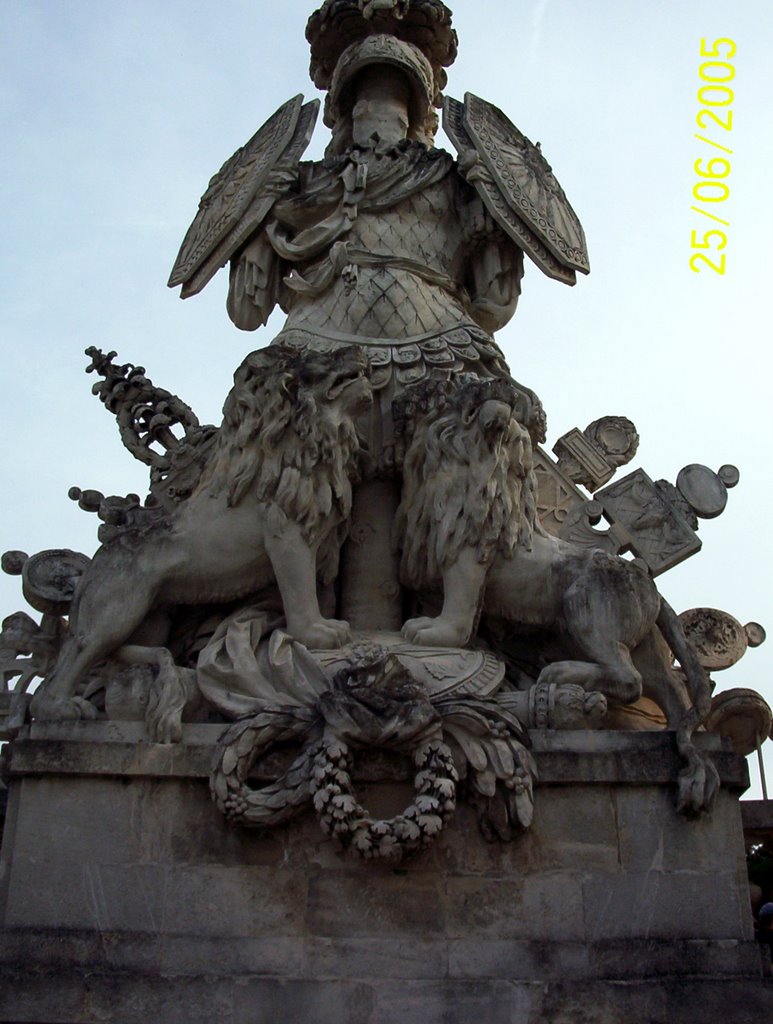


Neptune Fountain
Sited at the foot of the hill behind the palace and designed as the crowning element of the Great Parterre is the Neptune Fountain. It was conceived as part of the overall design of the gardens and park commissioned by Maria Theresa in the 1770s. Excavations for the pool began in 1776 and the fountain was completed four years later, just before the death of the empress. It was very probably designed by Johann Ferdinand Hetzendorf von Hohenberg, while the sculptural group of Sterzing marble was executed by Wilhelm Beyer.

A rocky landscape is peopled with the sea-god Neptune and his entourage. At the centre of the figural group above a rocky grotto stands Neptune in a shell-shaped chariot, his trident in his hand. To his left is a nymph, while on his right kneels the sea-goddess Thetis, entreating Neptune to favour the voyage of her son, Achilles, who has set off to conquer Troy. Frolicking at the foot of the grotto are the Tritons, creatures who are half-man and half-fish, and belong to Neptune's entourage. They hold conch shell trumpets with which they can inspire fear in both man and beast, and are restraining the hippocampi or sea-horses who draw Neptune's chariot across the seas.
Neptune driving across the seas in dominion over the watery element is a common motif in 16th to 18th-century art, being used as a symbol for monarchs controlling the destiny of their nations. The figural group was originally free-standing, but a screen of trees was planted behind it during the 19th century to provide a foil.




I sat in the garden for a long time. My first day in Europe was truly memorable. The next day I had to go to Salzburg. So though I didn't really want to return to the hostel, I had to :(. I returned to the hostel and had my dinner which consisted of chapatis and chutney that I had taken with me from London :). While having my dinner in the hostel garden, I met an interesting group of travelers. A girl from Hawaii whose name was rather too difficult for us to pronounce :) and so just called her Miss Hawaii, a student from USA and another student from London. He was an Indian by ethnic origin but was born in London. He called himself "D-raaaj" (it was quite obvious that his parents had named him Dhiraj :).....and after living in London for almost 20 years he couldn't say his own name in the right way). We spoke for a while and they exchanged email ids. I wasn't keen on meeting any of them again :) or keeping in touch with them either. So I excused myself saying that I had to take an early morning train to Salzburg and retired for the night.
3 comments:
-
Vinutha and Lingaraj said...
-
I guess they don't let you photograph inside the palace... i wish they wud let it ....
and u look cool in closeup photu... -
Casey said...
-
It's a pity that they don't let you take pictures inside the palace :(. Thanks for the compliment :)
-
Anonymous said...
-
A very nice content along with very good information and it is very useful and helpful.Thanks for sharing
Golden Triangle Tour Packages
Belvedere - Vienna -Austria
 I
took the tram to Strassenbahn like the kind man at the Weshbahnof
tourist information desk had suggested. I requested the driver to inform
me when we arrive at Belvedere. After riding on the tram for a while he
announced that we had arrived at Belvedere. I thanked the driver and
got off the tram.
I
took the tram to Strassenbahn like the kind man at the Weshbahnof
tourist information desk had suggested. I requested the driver to inform
me when we arrive at Belvedere. After riding on the tram for a while he
announced that we had arrived at Belvedere. I thanked the driver and
got off the tram.The palace looked beautiful from far. But I couldn't enter the palace as it was closed to visitors. I had reached there much after the palace was closed. I was a little disappointed.
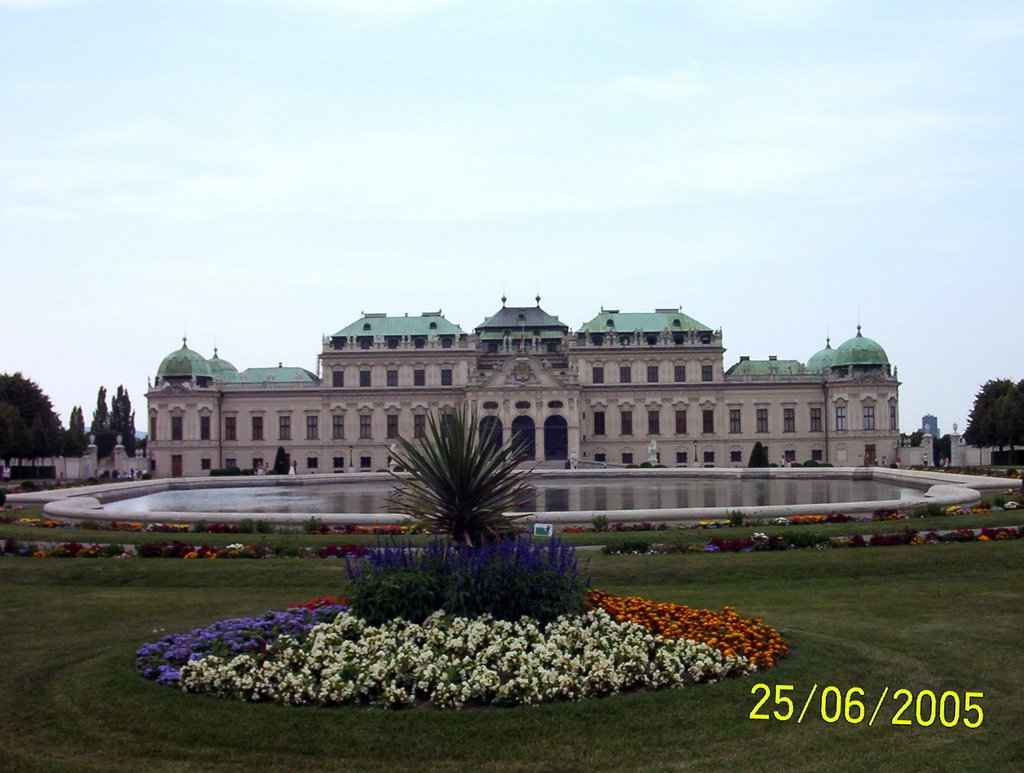
Then I thouhgt to myself... "Most of the palaces/castles in Europe look alike. I have been to quite a few of them in Scotland and England. I'm sure this palace too would be no different. The furniture might be different ... and the walls might have a different colored paint but that wouldn't make it any better than the palace at Mysore. Before I went to Windsor Castle I had heard that it was beautiful and one had to visit it while in England. But I was disappointed when I went there. It wasn't half as interesting as the palace in Mysore. It didn't have the grandiose that Indian palaces are famous for. So I believe I was better off seeing the palace from the outside."
History of Belvedere
Prince Eugene was a Frenchman and well-acquainted with Versailles though his parents were born in Italy. Spurned by Louis XIV, he became military commander of the Holy Roman Empire, and then 'the most grandiose and influential private patron in Europe'. Eugene was austere and taciturn, but a close friend and comrade of the Duke of Marlborough. They defeated Louis XIV's armies and were rewarded with palaces - one can compare the Belvedere with the original layout of Blenheim. The two generals were known as 'one soul with two bodies'. Eugene had bought land outside the medieval town after driving back the Turks' last assault on Vienna. All Europe rejoiced in its safety from 'the infidels'. Vienna developed a gay cosmopolitan society.
The Belvedere (means 'a place from which to see beauty') has a grand Upper Palace (built 1720-22) and a more comfortable Lower Palace (built 1714-16), where Prince Eugene lived. Gardens link the palaces, with elegant pools, fountains, sculpture, steps and cascades. Immaculate clipped maple hedges bring the sky itself into the design. The theme is man's journey from darkness to the divine light.
After Prince Eugene's death, in 1736, his estate passed to the Hapsburgs and continued to be used for social gatherings of pomp and circumstance. A 1731 set of engravings illustrated 'The Wonderful Home of the Incomparable Hero of our Time in Wars and Victories' much as they are today. Gothein II 164.
I took few pictures of the Upper palace. I wasn't even aware that the complex also had a lower palace when I was visiting. After returning to London I checked on the internet and learnt that there were two palaces - the upper and the lower. I visited only the upper palace. I checked the photos of the lower palace on the internet and I am glad that I did not visit :). It isn't half as beautiful as the upper palace and it also meant that I had to walk from the upper to the lower palace. I would have to spend another couple of hours to just see the not so attractive lower palace. Now that I think of it, I certainly feel that it was a wise decision to return. I spent more time at the Schönbrunn palace. Watching the setting sun from the palace was something to be remembered. I am sure I shall remember that for a long time.
As I was strolling in the palace garden, I saw two young couples (feels strange to read Two and couple together...??? I saw a black couple and white couple.... :).........and hence the words "two" and "couple".... together) having their wedding pictures taken. I'm not sure if they were married at Belvedere. But the photos would definitely make it look like they were married here :). Who wouldn't want to marry in this beautiful palace!!!

As I walked towards the exit I noticed a few birds that looked like crow. Having seen crows that are completely black (I haven't seen an albino crow yet ;)), this was bit of a surprise to me. While I stood there in doubt as to what this bird was, it started crowing :)) and that confirmed it definitely was a crow.
 I sat in the garden for a while and took a tram to Schönbrunn
More to follow...
2 comments:
-
Vinutha and Lingaraj said...
-
oh!! u cudn't go into the palace... :-((... it looks lovely and intriguing from outside.. wish u cud go in
-
Casey said...
-
Oh Yes! It does look intriguing. I'm sure it would be from the inside too. It probably would require more than half a day for me to see the palace and I didn't have the luxury of spending that much of time in one city :(. If ever I do find time to visit Vienna I shall definitely see the palace apartments.
Staatsoper - Vienna -Austria
Rathaus Plast was an amazing building and I could spend a couple of hours marvelling at the building. But I had to see lot more places yet. So I walked up the road for a little distance to see if there were any more architectural wonders. I saw this beautiful statue at the square. I neither remeber the name of the sqare, nor do I know the name of this pillar. It looked simply too beautiful to not capture it in the camera.
I had read on the internet that the gardens near Rathaus Plast also attracted a lot of tourists. They probably look beautiful during spring and it definitely wasn't spring yet. I didn't find them interesting. I took the tram to Belvedere. The tram passed by another interesting building. I pulled out my camera... oops... sorry... pulled out Robin's camera and took a picture of it. It was the Vienna State Opera house -- Staatsoper.
Vienna State Opera House is one of the world's largest and most splendid theaters. Under the law, the Austrian Republic is required to ensure that full use is made of its famous opera house, and so there is a different opera or ballet on the program on 300 evenings in the year.
The Viennese obsession with music goes far back into Habsburg history. The first recorded Viennese Court opera was performed in 1625, on the occasion of the birthday of Ferdinand II, on the Hradschin or Prager Burg, where the Emperor resided for six months. In 1660 Leopold II, probably the greatest music-lover and theatrical devotee of the Baroque period, had a smart theater built on the square in front of the Court Riding School in 1660-62. After 1668 numerous operas were performed, first on the site of the present Österreichische Nationalbibliothek, then in the Redoutensälen and in the old Burgtheater on Michaelerplatz, where Mozart's "Il Seraglio", "Marriage of Figaro" and "Cosi fan tutte" were first performed, and subsequently in the Kärntnertor Theater, where Weber's "Euryanthe" had its unhappy première and Beethoven's "Fidelio" began its series of triumphs in 1814. A few years later the first performances in Vienna of works by Rossini and Verdi ushered in a period of euphoria for Italian opera. After the destruction by fire of the Ringtheater the opera moved to its new home on the Ringstrasse in 1869.
The vast Opera House with its clearly defined structure is in the French Early Renaissance style. A contest was held in 1860 to come up with a design for the building. It was won by two professors from the Imperial Academy of Fine Arts. They divided up the work so that August Siccard von Siccardsburg handled the engineering, and Eduard van der Nüll was in charge of the decorative elements. Construction of the building took its emotional toll. An urban legend states that the opera was supposed to be much higher than it currently is, but rushed planning of the Ringstraße left it at the same height as its neighboring buildings. van der Nüll is said to have killed himself because he let the Emperor down. Siccardsburg died just two months later, in 1868, of grief. Neither architect lived to see the day.
It was built between 1861 and 1869 to plans by August von Siccardsburg and Eduard van der Nüll. It opened on May 25 1869 with Mozart's "Don Giovanni" and a prologue spoken by the popular actress Charlotte Wolter. The Opera House was hit by bombs on March 12 1945 and gutted by fire. Reconstruction was not completed until 1955. The second inauguration of the "Opera House on the Ringstrasse" took place on November 5 1955, when Beethoven's "Fidelio" was performed.
Today most of the Neo-Renaissance building is only decades old. The outside walls, the façade, and the grand staircase were the only portions to survive a direct hit by an Allied bomb during the Second World War. The interior is a reconstruction. Though it attempts to capture the grandeur of the original building, an exact reconstruction would have cost too much. Still, the Staatsoper is symbolic of Vienna's emergence as one of the world's cultural capitals.
Inside, the Grand Staircase is a sweeping expanse of chandelier-lit marble decorated by statues representing the seven liberal arts. Outside, there are five alcoves built into the façade. Each houses a bronze statue by Ernst Julius Hähnel representing Drama, Fantasy, Heroism, Humor, and Love. The building is flanked by fountains by Hans Glasser. Even today, the opera house is the center of social activity in Vienna. The directorship of the opera is considered one of the most important positions in Austria. Even more so than the president of the nation. It is for that reason that there is always lots of controversy and intrigue surrounding the post.
The Opera House was the first building erected on the Ringstraße when the old city's fortifications were torn down and replaced by massive public works projects.
More to follow...
2 comments:
-
Vinutha and Lingaraj said...
-
do u have the close up of hte first photo ?
-
Casey said...
-
Vin, Sorry I don't have :(. The camera I used was a low end one and I couldn't zoom either.
Museums,Parlament,Rathaus Platz - Vienna - Austria
I walked further up the road and saw a building towards my left that was being renovated. It looked really nice. I walked up to the building to take a closer look. I was disappointed that it was almost covered to the top to prevent the dust and any other building material from being strewn on the streets. I looked at the map and realised it was

I know you have guessed it ... :) ... Yes!!! It was the Austrian Parlament [parliament house]. It wasn't half as nice as our Vidhan Soudha :) but wasn't too bad either.
Built: 1874-1884
Also known as: Austrian Parliament
Designed by: Theophil Hansen
Post-war reconstruction: 1945-1956
Post-war reconstruction headed by: Professors Max Fellerer and Eugen Wörle
Type: Government Building
Location: The Ringstraße - central Vienna
This building was originally designed as the parliament building for the Habsburg Empire. It now serves as the Austrian Parliament building. The architecture is Greek, decorated with statues of Greek and Roman historians, statesmen, and scholars. The most prominent statue is of the Pallas Athene, the goddess of wisdom (Athenebrunnen). Hansen came under fire for his design, and defended it by saying, "The ancient Greeks were the first people to love the freedom and regularity above all, and it was their style which besides its pronounced severity and regularity permitted a great liberty of development." He was later given an architecture studio within the building to continue his work after retirement. This is the site where, after the collapse of the Hapsburg Empire, the republic of Deutsch-Österreich was formed. Half of the building was destroyed by World War II. Some of the artwork damaged during the war is only now starting to be restored.
Wish I could take a picture or two. But I couldn't :( as the dust protection covers blocked the view.But my determination was not to be deterred so easily...:) ... I walked around the building and entered the small street besides the parliament house and I finally took one picture that I could treasure :).
I walked further up the road and noticed a beautiful building to my left. I looked it up in the map and it was indicated that the building was Rathaus Platz or vienna city hall.
I didn't have sufficient time to actually see the interiors of the building. Was satisfied looking at it from the outside :). I had just for a day in Vienna and if I had to see all the major sights of interest then I couldn't afford to spend time actually going in and marvelling at the architectural splendour. O well... that is how I try to console myself :).
I better not hear "O... didn't you see the building from the inside? It is wonderful... yada yada yada" from any of you guys who have visited this place.
This is the information I got on the net about this marvellous building...
Friedrich von Schmidt, who had been the architect of the Cathedral of Cologne, designed and built Vienna's City Hall, the most important secular building in the neo-Gothic style in the city, between 1872 and 1883.
The tower measures 321 feet, not including the "Iron Knight of City Hall" (Eiserner Rathausmann) who measures almost 20 feet to the top of his pennant. This knight on top of the tower has become one of the symbols of Vienna.
The Vienna City Hall is the seat of the mayor and governor of Vienna ( with Vienna being both a city and a state since 1922, these functions are combined in one person ), of the City Council and of the Assembly.
It also houses the Municipal and State Libraries and Archives which hold many key documents of Vienna's history and a large collection of local memorabilia.
On both sides of the approach from the Ring ( closed to motor vehicles ), statues honour personalities who left their mark on the history of the city.
The Park of City Hall (Rathauspark) is a very attractively laid-out garden with two fountains and several interesting monuments, among them the memorial to the painter F. G. Waldmüller and the statues of two great composers of waltzes, Johann Strauss Father and Joseph Lanner. Facing the Burgtheater across the Ring are monuments to President Theodor Körner (1873-1957) and Mayor Karl Seitz (1869-1950).
More to follow...
1 comment:
-
Vinutha and Lingaraj said...
-
what is dust protection covers ?
Hofburg and Volksgarten - Vienna - Austria
"Hello there. It’s me again. I need your help again."
I spread the map on his table and pointed to the three circles and told him
"I would like to go to all these places. Could you please help me with the train numbers that I have to take?"
He smiled and said
"OK mam. Where would you like to go first?"
I pointed one circle to him and then he marked 1 on the circle and then pointed to another circle and asked "will you go there next?" I said "no I would like to go here please" and pointed to the third circle. He marked 2 on the circle that I had pointed to and then 3 on the remaining circle.
He tore off a sheet from one of the books and started writing the train numbers and the names of the stops where I had to get off. He turned the paper towards me and said "Ok. This is the first train. You take 'U3' the one that goes towards Simmering and get off at Burggasse.
You walk around the place and then you can take tram (don't remember the tram number now... but then I held on dearly :) to the sheet of paper the kind man at the station had given me and so knew which one to take) and reach the station ...(My grey cells have lost track of this as well :)....)
Then take tram D headed towards (sorry folks :)... if someone needs to go to Vienna I guess this will not be the right guide map for you :)... the people at the information centre are very friendly and you can just walk in and they will help you....) and get off at Belvedere.
Then you take the same tram headed in the opposite direction and reach Schonbrunn station.
After that you can walk back to your hostel from Schonbrunn.
I thanked him for all his help and walked towards the underground platform 2 to take the train to my first destination. I waited for 2 minutes and then the train arrived. I got on to the train and verified the city map that was displayed in the carriage and counted the number of stops before I reached Burggasse.
Television in one of the underground stations...
I walked out of the station and I didn't know which way to head. None of the direction boards were in English. I saw two women and walked up to them. Pointing at the circle marked as 1 I asked the women how I could reach that place. Neither of them spoke English. One lady looked at the map and then turned around pointed towards the road and said something in German. I understood that she meant "Go straight" then she pointed right and again said something in German. I knew she meant "go straight and turn right" then she made an action like drawing a straight line... I understood she meant... "the entire stretch of road". I thanked her and went off in the direction she had pointed.
I walked for 2 minutes and still nothing... nothing seemed interesting ... then I turned right and LO!!! There was a magnificent building there and all I could do was GASP! It was an amaaaaaaaaaazing building. I didn't know what the building was called. But it was amazing... I looked at the map and I knew I was on the Burg ring Opern Ring Kärntnerring road. So it had to be HOFBURG....wow!!! It was perhaps one of the most beautiful buildings I had seen...
The information I got on the internet about this place:
This is another one of Vienna's big attractions. And by big, we're talking scale. It encompasses six museums, a chapel, the president of Austria's offices, the national library, the famed Winter Riding School, a greenhouse, and a park. It will take two days to thoroughly see the place.
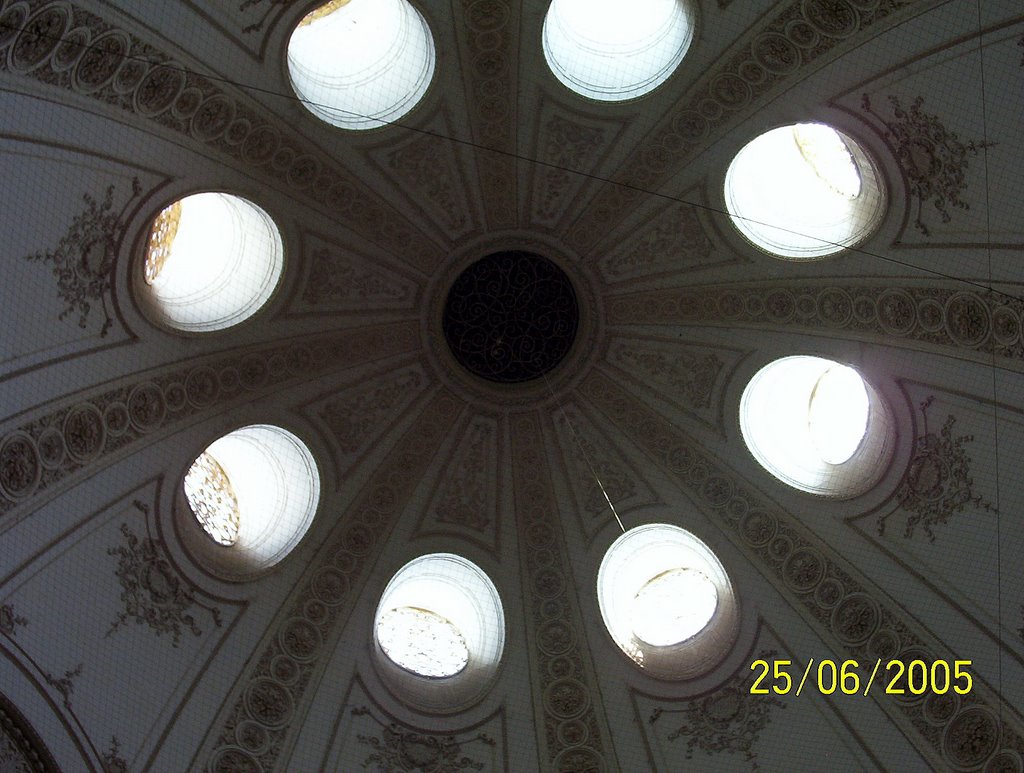
I don't know how many of you have seen the movie "Hum Dil De Chuke sanam". But the ceiling certainly reminded me of the song "Tadap tadap ke is dil se"... Not that the music hall in the Hofburg complex was on comparable scales to the one shown in the movie. But I just happened to remember the song. There were a couple of musicians playing some local music. I have probably recorded it on my camcorder.
The Hofburg Complex was built as the imperial home of the Habsburgs, and they lived there until 1918. The Kunsthistorisches Museum (Museum of Fine Art) has exhibits of ancient art, a collection of armor, even a collection of antique musical instruments. The Winter Riding School is where the Lipizzaner stallions are trained in the Spanish Riding School. It was designed by Josef Emanuel Fischer von Erlach, and built from 1729 to 1735. Inside two galleries surround the training ground, which is illuminated by two enormous chandeliers. But photography inside is not permitted. Most other buildings allow photography as long as the flash is turned off. There is also a butterfly aviary created out of greenhouses built from 1901-1907.
The Hofburg was originally a medieval castle, but today only the castle chapel remembers of its medieval past. The Hofburg was extended to a magnificent residence when the Habsburg's power increased.
That is the reason why one can find almost any architectural styles, from gothic style to art nouveau. Nowadays this enormous complex is the home of the "Österreichische Nationalbibliothek" (National Library), the "Schatzkammer" (Imperial Treasury), the Collection of Musical Instruments, the Collection of Weapons, the "Museum für Völkerkunde" (Museum of Ethnography) and the famous "Spanische Hofreitschule" (Spanish Riding School). Partly enclosed to the Hofburg one can find the vast "Heldenplatz" that is very impressive too. Equestrian statues of Archduke Karl, who won the battle of Aspern against Napoleon's troops (1809), and Prince Eugene of Savoy, who defeated the Turks, attest to Austria's glorious past.
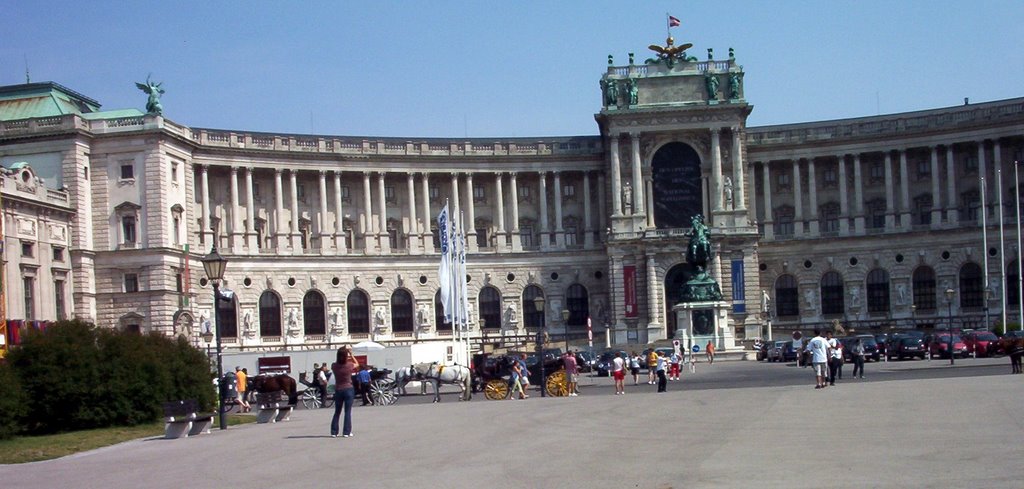
As per the description one needs at least two days :) to see the entire place... and I hardly had 2 hours to spare. I know I didn't do any justice to this beautiful place by spending only about 2 hours there... but I had to go to other places as well.
I walked out of the hofburg building towards Österreichische Nationalbibliothek. I wasn't too keen on going into the buildings as I had very little time to spend at vienna. I walked further on and saw a couple of horse driven carriages. I was particularly fascinated by the horse driven carriages and if not for the hot day, I would have definitely ridden in one of them.
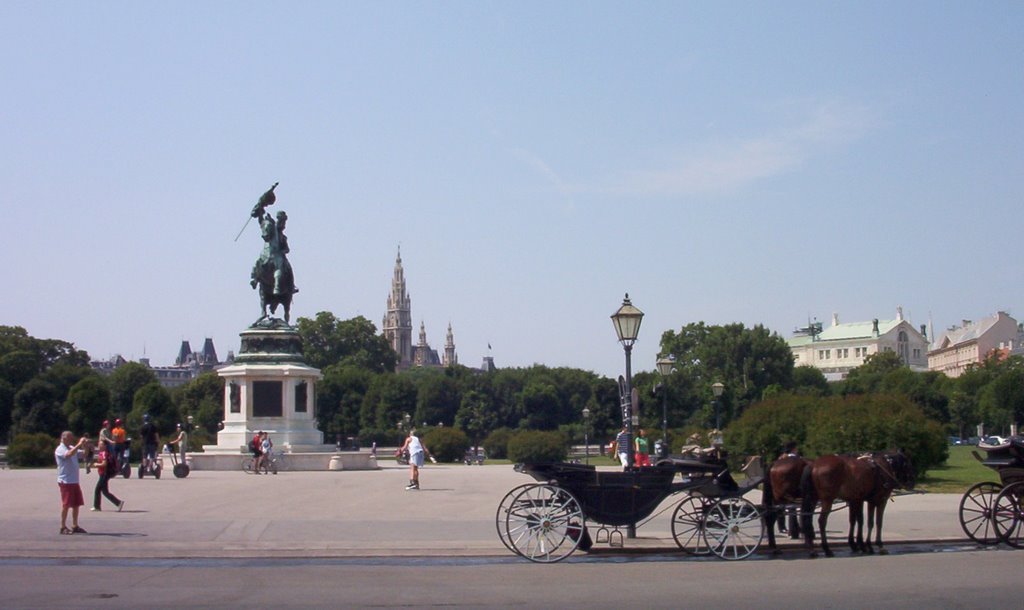
So I decided that it would be better to walk than to ride in the carriage and so unfolded my umbrella to shield myself from the fierce heat of the sun, took a couple of pictures in Robin's camera and went to garTen (Garden) to rest for a while in the cool shade.
Volksgarten is a public garden in the first district of Vienna next to the "Burgtheater". The garden has beautiful flowers and the interesting story about it is that there used to be a palace on the area, but had been destroyed with Napoleon's arrival. The Theseus Temple is located in the "Volksgarten". It was built in the 1930s.
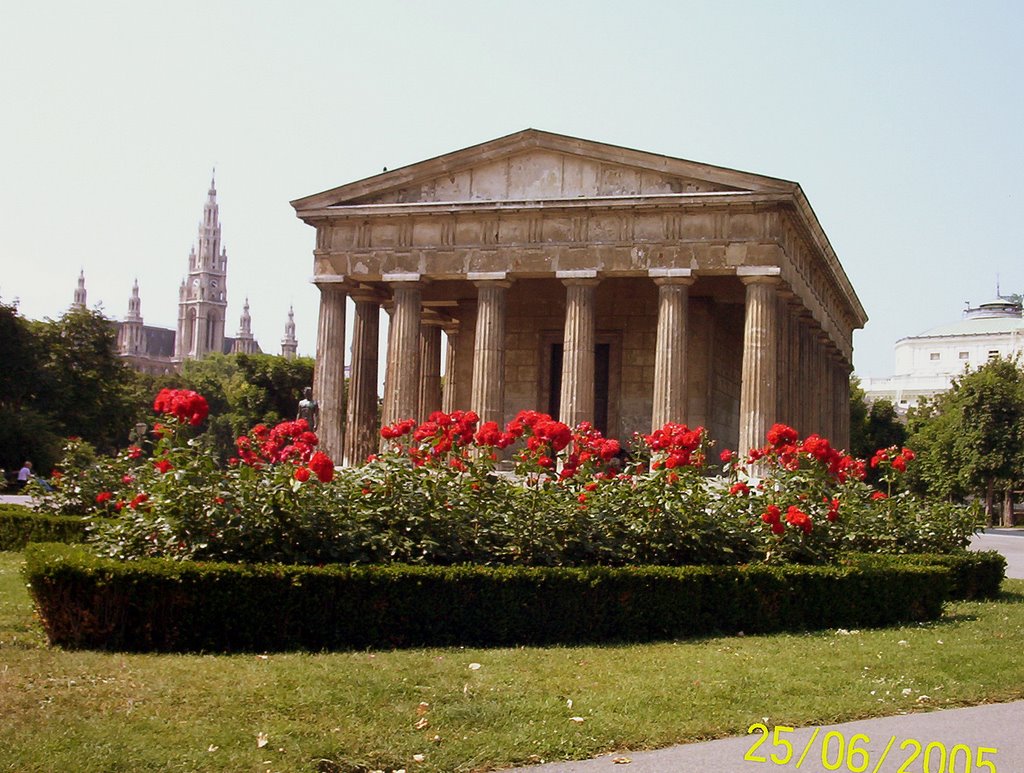
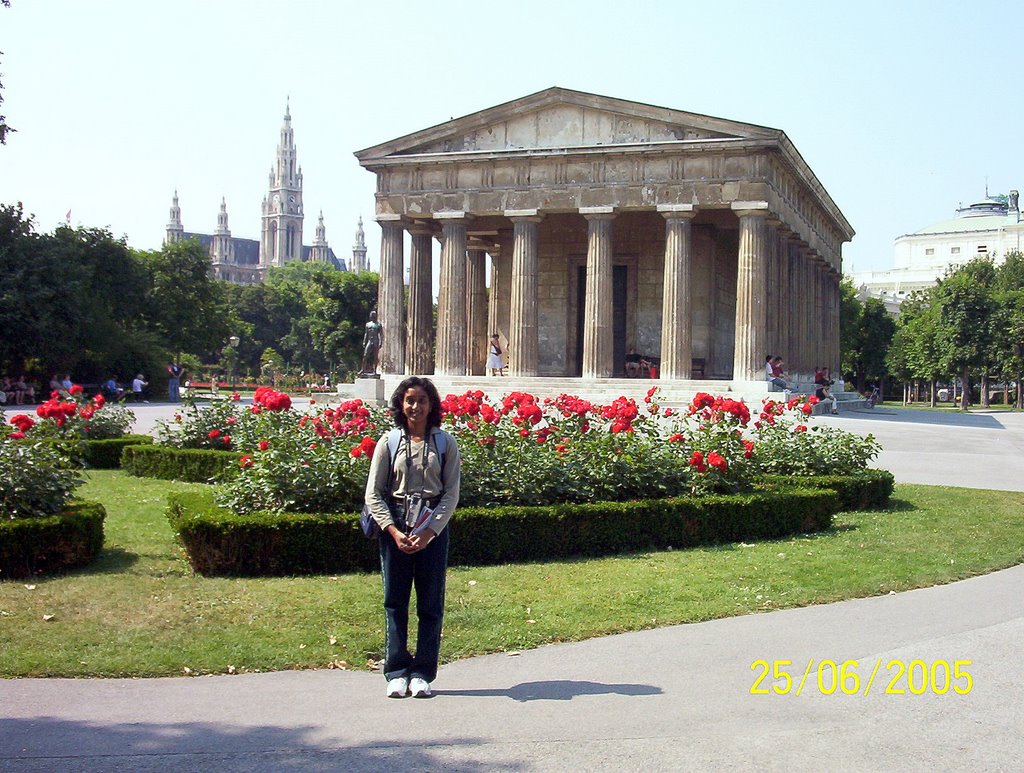
This isn't a very big garden. We have gardens that are definitely better than Volksgarten in Bangalore. But on that day I most certainly enjoyed sitting in the cool shade of the trees. There weren't too many different varieties of trees. I am not an expert on identifying the trees or the flowers. May be I could have taken a picture of one or two of them and asked Akash to translate the names for us in english :)... like he has translated "Basavana Paada" as "Cow's feet" :)...
It is a wonderful place to rest here on hot summer days. But beware!!! People spit bubble gums and chewing gums on the stairs and if you aren't too careful you might just sit on one of them like I did :) and then find it difficult to get rid of the gum.
I sat for a few minutes, pulled out the street map and then checked where I should be going next. Museum platz seemed interesting.
More to follow....
2 comments:
-
Vinutha and Lingaraj said...
-
u r mamazing.. went to the city n then searched for the places to cisit n bus routes... applause!!
u sat on a bubble gum.. he he he... then what did u do ? -
Casey said...
-
Vin, that was my first trip to Europe . So it wasn't very organised :) and sometimes, you get to see interesting places that are not even listed in the tourist information handbook :). So talking to the locals and finding out from them helps :)
Hostel Ruthensteiner - Vienna - Austria
I reached the hostel at 12:30PM. The receptionist told me that my room would be ready only by 2:00 PM. So I asked her if I could store my luggage in the locker room and then come back later in the evening and check in. She was more than happy to get rid of me :) and so she agreed to give me the locker key for a deposit of 10 Euros. I stored my luggage, freshened up, had my lunch (I had taken chapattis with me from London as I had read that it is difficult to find vegetarian restaurants in Austria) and then came to the reception desk to find out about the various sightseeing tour options.
The hostel offered "crawl Vienna" a bicycle trip for 4 hours that was scheduled at 2:30 PM. I was not very keen to ride a bicycle when the temperature was 31 deg C and was sweltering hot. I checked the other options:
1. Grape garden tour -- didn't seem very exciting.
2. Walking tour for 1 1/2 hour to begin at 4:00 PM. I didn't want to wait till then and so I decided to go on my own.
I asked the receptionist to suggest me a few places that I could visit in a day and she replied
"I don't know. Vienna has so much to offer. You can't see anything in one day. I will just mark a couple of places for you on the map and may be you can visit at least a few of them."
Having said that, she took a pen and circled three areas and returned the map to me. The people at Interlaken hostel were friendlier and they went out of their way to help the travelers. This lady seemed to be very rude to the people. I saw her replying curtly to a couple of more people too. It really didn't matter as I was in Vienna for just a day.
More about Vienna Trip to follow ...
2 comments:
-
Vinutha and Lingaraj said...
-
hmmm.. hadn't u planned for this trip b4 hand.... i mean hadn't u decided which places to go
-
Casey said...
-
nope :)... I hadn't decided what I would see in the city... I had selected Austria as the point of entry to Europe as I knew getting a Schengen Visa through the Austrian embassy was quite easy :). My intention of getting the Schengen Visa was to visit Paris and Italy :)... but unfortunately the embassy granted me visa for just 5 days :( while I was hoping for a 90 days visa...
@ Wien - Austria
Just letting you people know that I know a couple of more words in German :)....
Martin taught me that Flugafen means Airport
Mark taught me:
Bahnhof means Railway station
OST means East
West means West ... not WOST :)...I didn't even know that Wost is a valid word in English till I looked it up in the dictionary :)...
Wien means Vienna
Danke means Thanks
Dank vielen means Thank you very much
Ich spreche nicht deutsch --> I don't know German :)... That is quite handy when you are there... :)...
I had learnt quite a few phrases and Sentences in French oops sorry français :)but All i managed to say while i was in switzerland was:
NO FRENCH... :)...
that was quite embarassing :)... so I didn't want to go through that humiliation again and I learnt "I don't know German" :)... but unfortunately :( I couldn't use it while I was there... :(
While I was walking towards the passport verification section, I saw a lot of magazines that read "Welcome to Vienna. A complete guide to Vienna City with street maps inside".
good! I can use it to get around the city...
so i pick up one and I flick through the pages to see where I can go first...
aiye!! What is this??
dtypew'as je0wi ayteaytewrmqt???
[You ****** ******** !!! can't you have this printed in English? Do you expect every single tourist visiting this country to read and understand German?
Why does this remind me of Chennai or some other place in Tamil Nadu where you would be expected to know Tamil and then step into the state? Any Tamilian reading this...no offence meant. But I know a few people who have quit their jobs only because of the language barrier. One person even told me that she had to sit through the technical meetings that would be held in Tamil. There was this funny incident that happened to my friend Srivatsa. He finished his cricket match (o BTW, he is on the Vijaya bank cricket team) in Chennai by 15:00Hrs and he had the return bus to Bangalore at 22:00 Hrs. So he decided to walk around the city. He saw the poster "Dilwale Dulhaniya Le Jaayenge" in one of the cinema halls and being a fan of Kajol he happily bought the ticket and walked into the hall. The movie starts.... and what does he hear??? Kajol and Shah Rukh speaking in Tamil :). Ridiculous isn't it?]
I had picked up the magazine so I thought I might as well take it along with me.
Vienna airport or VIE - VIENNA AIRPORT is also known as Vienna International Airport. I read on the net that the airport has been rated as one of the most pathetic airports (may be in Europe????) People who have said such nasty things should fly to Bangalore International airport once in their life time. Only consolation was that the airport had very few seats in lounges compared to Bangalore airport. Considering the number of passengers changing their flights at this airport I guess we need to be sympathetic towards the airport personnel at least. Not many of them speak English. I was very unfortunate as my passport was verified by one such person who probably didn't even understand that I was speaking in English :). He looked at my passport looked at my face... and then verified my passport and said something... I said "pardon"... "sorry"... and craned my neck to look at what he was trying to do to my passport :).... and he finally said something in German and stamped CLEARANCE for entry :)... Yahoo...!!! another hurdle cleared.
Then I went off to reclaim my baggage. The baggage reclaim area is totally unorganized. There is no particular order like in Heathrow or at Stansted where you can reclaim. I checked for the conveyor number that would have my baggage and walked towards it... I waited ... and waited... and waited.... Zzzzz.... oo where am I...??? O yes @ Vienna Airport... is my baggage here yet? no?? not yet??? Ok...Zzzz.... is it here yet???? Looks like my baggage... the blue one... yes... definitely looks like mine... :)... is it? Nope... Not mine :(.... o well... it has just been 20 minutes since I have been waiting for it... so I guess I can take a short nap for another 10 minutes and then check... Zzzzzzzzz.... FINALLY... here it is... this is my baggage... is the baggage in one piece? Yes it is? Has the lock been tampered with? nope! then it should be fine...
Vienna... Here I come!!!!!
I looked for an information counter and I saw one. There was a lady at the counter. I greeted her and asked her for the directions to the hostel.
"Hiya. This is the address of my hostel. [I hand her my hostel map]
I am here in Vienna for only one day. Tomorrow I am off to Salzburg.
Can you please suggest me how to get round the city?
I also have a student card. Do you have any discounts for students?" [I show her my Symbiosis student card]
The girl smiled and said "Here is your one way ticket to Westbahnhof. You have to take the airport bus service that starts right in front of the airport. The ticket costs 6Euros. We do not have discount for students for hte airport service bus. But you will get a discount on the travel card that you can use on all the underground trains, buses, ferries and trams. It will cost you 5 Euros and the card is valid for 24 Hrs. This is the map of the the city and the visitor attraction sights."
I paid her the money thanked her for the tickets and asked her
"What do you suggest I should be doing? Should I go to the hostel drop off my luggage and then go round the city or should I first go round the city?"
She smiled and said "your hostel is just 3 minutes from the Westbahnhof station. So I suggest that you first go to the hostel and then go sightseeing"
I said "thanks a lot"
she smiled again and said "have a pleasant stay in Vienna and if you need any other help I will be glad to assist you"
I said "thanks. I have all the required information now. Thank you very much. I appreciate your help"
and walked towards the Currency exchange bureau.
I got my traveller's cheque encashed... PAID 3Euros as commission :( and walked towards the airport transfer bus. The airport is 25Kms from the city and it takes approximately 35 minutes to reach the westbahnhof station. He he he... I had read all the information on the internet.
I got on to the bus and exchanged my ticket voucher for the ticket and comfortably settled in the last seat with my camcorder round my neck and my book and pen to note down the details of all the interesting things that I saw on the way to the hostel.
Ok... what do I see... mmm a tree... another one... and some more of them... and Looooooooooooooooooooots of 'em... ok... I'm no botanist... else I could have written their botanical names... they look just like trees :)... nothing intresting or amusing to note down... ok... next we turn round the corner and we enter the city... and now what do I see??? Buildings and more building... naaa...not interesting... o well.... forget it. I put my book and my pen away and sat back doing nothing till I reached the Westbahnhof station.
@ Westbahnhof station
The airport service bus dropped us off in front of the westbahnhof station. I should have gone round the station and taken the road perpendicular to the main station. Instead, I entered the station as I thought I could look up the exit to in the station. London underground stations display the street names that you enter taking a particular exit. So off I went and was utterly confused. The railway station has not been planned very well. The international trains arrive on the same platforms as the national trains. The display boards are in German. Well.. the alphabets are almost roman :) except for a few like ß which is a double 'S' or ö which though is 'O' is pronounced with a nasal stress. Martin taught me how to pronounce this :).
Then I lost my way inside the station and took the stairs downwards, hoping to see an information centre around. Finally after descending about 60 - 70 steps I saw that I was entering the underground station. That was good news. Now all I had to do was find the exit to Robert Hamerlinggasse street. I proceeded with confidence to find the exit. Aiye!!! I saw an exit sign to 'Inner Hamerlinggasse'. Where the hell was Robert Hamerlinggasse street??? I slowly walked around trying to locate an information counter and could have almost shouted with joy when I saw one hidden behind a flight of stairs. I entered the information room and there were two men sitting at the desk.
[Should I talk to the one on the right or the one on the left. The one on the right doesn't look like he can speak English, let me talk to the one on the left.]
I walked up to the man and said
"Hello. I am looking for "Hostel Ruthensteiner". This is the address. Could you please help me find it?"
The man didn't even bother to look at the address he just said
"o Hostel Ruthensteiner. It is on Hamerlinggasse. You go straight down there and take the first exit to the left"
I said "Thank you very much. Did you say it was the first exit to the left?" He said "Yes"
I continued "Is it very far from here?" the man said "Just 2 -3 min walk from the station madam"
I was off again smiling. I finally took the right exit.
I noticed all the streets had their names ending with 'Straße' and I guessed that Straße meant Street.
Stansted airport & flight to Austria
I went to the waiting lounge to wait for the electronic display to announced the boarding. It was pathetic. There were only few chairs in the lounge and they were already occupied by the passengers who had arrived there the previous night to catch the EARLY morning flight. So I decided to walk around the airport and picked up the Stansted airport guide to make myself familiar with the airport plan. What if I had to plan another 9/11 attack here :)???? I know how to use the AK 47 and trying it here wouldn't be a bad idea :) isn't it?!
Aa well... it took me just about a couple of minutes to read the entire booklet and then I was restless again. What do I do to kill the time? I walked into "Boots" to compare the prices of the articles they sell in the airport shop and elsewhere in London.
I found the prices were pretty much the same. Not much of a difference? How uninteresting! Wish they had sold it at different prices and I would have found something to kill the time. I was soon tired of checking the prices and just when I decided to walk out ... I noticed that they sold sports socks at 3£ for a pair and TESCO sells it at 3£ for 3 pairs!!! Yippee!!! Something was expensive after all at the airport.
I then walked back to the waiting lounge and found a seat unoccupied. I walked fast, lest someone else occupied it. Where were all those people who seemed to be here just a few minutes ago? What had happened to everyone? Where had they all gone? I sat on the chair for a few minutes and was restless again.... I decided to check the boarding announcement again... and to my horror it read
Flight no: HG8553 Destination: VIENNA boarding now open!!!
No wonder I didn't see many people around. I ran towards the A49 gate to take the airport transit train service. There were just about 1000 people queued up ahead of me waiting to board their flights.... Oh Flippin heck!!! [Mark's favourite phrase :)....] How do I get past all these people?
To my good fortune, they opened another door and instructed us to proceed through that door.... he he he... this was good... I could sense few people gritting their teeth who had been waiting in the other queue for a long time :)... and just a couple of people like me who had arrived late were permitted to walk right through! This was unfair. Wasn't it?! :) Who cares? I got into the next lounge and I was happy.
The security cleared me and asked to proceed to the train. I stepped on the escalator and I heard the ever so famous line in London "Please mind the closing door". I thought to myself "oh! There goes my train. When will the next one be?" I reached the bottom of the escalator and was glad to find that I was the only person waiting at the door for the next train to arrive :). The display read
"The next train is within 2 minutes"
I waited for another minute and then I heard the train slowing chugging in. I was now smiling and telling myself "hey look at all those people rushing towards the door for the first carriage, while there are just a handfull of people waiting at the entrance for the second and the third car :). ahoy! Look... it is just me here ... and just another few people waiting at the entrance for the third car...
then I just looked up at the display right above the door and it read :(
Attention please. The next train has only one carriage and all passengers are requested to proceed to gate one to board it.
No wonder everyone was flocking towards the single gate. I too proceeded to gate one. I was probably the last person to board :(. But I go on alright and that is what mattered at the moment. The train chugged towards the boarding gates. I could hear the announcement
"Please hold tight. This train is now approaching the terminal."
When I heard it for the first time I was expecting the train to go through a dangerously curved track or something... :) but it was almost travelling in a straight path and sometimes Dooooooooooooooooooooooooown and then sometimes up...
I got off at the boarding gate and proceeded to the next waiting lounge. I saw a young couple with two kids - a boy and a girl. The husband was particularly very handsome :) and he was feeding his daughter. I find it so amusing that Dads in Britain take care of their children more than the moms. You see the dads holding their child or pushing the baby cart while shopping or walking with them in a park. You see them feeding the child in a restaurant. You seem them explaining a science concept in a museum. You seem them dropping off their child at school. I recommend that every Indian Dad be sent to UK for a few days to learn and take up more responsibilities. Not that all Indian Dads shun away from their responsibilities, just that a few do and also most of them just hand the baby to the mother if it starts crying or when it is time to feed or change.
There was a commotion at the checkin counter and I saw an "easyjet" attendant running towards the huge window signalling frantically with her hands what appeared to me like... "NO... DON'T"... as she was waving her arm wildly and at the same time blabbering something on the walkie talkie....
I saw another young man running behind her and shouting "that is not her fault. You can't do this to her". I looked out of the window and saw that two people - a man and a woman were disembarking from the plane and walking back towards the waiting lounge. I also saw the luggage trolley being manoeuvred towards the flight probably for getting the luggage off the flight. I'm sure in India this would have drawn a lot of attention. But none of the passengers there seemed to be bothered or they were too good at suppressing their curiosity. I saw a few more people getting off the flight and walking back. May be they didn't have the right papers. Someone too curious asked the girl as to why she had to get off the flight and she replied "you wouldn't want to know it" and walked off.
Then I saw the screen above me displaying "HG8553 passengers please proceed towards boarding" So I walked up to the counter and then began the series of questions again.
The person at the counter asked me
"So... are you an Indian citizen?"
[You moron. If you have my passport in your hand and it says "Republic of India" do you expect me to be a citizen of Guatemala?]
I replied "yes I am"
"Do you have a valid visa to enter Austria"
[Nope.I'm on a secret mission and I don't want the intelligence agency to know where I am. So I intend to fly without a valid visa and just hope that the immigration people don't notice me.
Can't you see there is a VISA in my passport that reads "Schengen VISA"?]
I opened the page that had the visa stuck on it.
He called another person and said
"She has this visa. Is it valid in Austria?"
[Unbelievable! It was issued by by the Austrian embassy. What do you expect? That it is not valid to enter Austria with? You got to be kiddin me!]
The other man read aloud "Schengen Visa?" and added "O yes. This is valid. Sorry mam it is our duty to cross verify. Sorry for the inconvenience caused. You may now proceed for the boarding"
I smiled and replied..."thats ok. You were just doing your job." and then boarded the flight.
The cabin crew greeted me with "Hallo. guten Morgen. wie Sie heute sind?"
It translates to "Hello. Good morning. How are you today?"
[YEAH!!! Like you care]
I replied "good morning. Fine thank you!"
Finally I was on my way to Vienna.
The flight
British Airways would have charged me 187£ to fly to Vienna whereas Airberlin -- NIKI charged me only 98£. Robin had told me that no food would be served on board a cheap flight. I would probably have to buy some. But the journey was only 2 hrs. So I didn't really mind. I could always eat something on landing at Vienna.
I had requested for a window seat and was hoping to take a few pictures. I was all set to take some pictures and then I noticed that it wasn't really worth taking any pictures. The landscape is not very beautiful around Stansted.
There were no individual television monitors either:(. There were a few hanging:) around and we had to just watch them. Headphone cost 1.5 Euros. So no music either :(. Not that 1.5 Euros was very expensive to buy head phones on flight but they only had a few English and German stations playing.
Next was the safety announcement. Can you believe that the safety announcements were made in German? So people who don't understand German will not be briefed with the safety procedures on flight? Yeah you could make out what they were saying as you could actually see them showing where to find your shwimmer suite(he he he another word that I learnt while I was there) another phrase I learnt was "unter Ihrem Sitz" which means "under your seat"... doesn't take a genius to deduce that isn't it :)?
I was settled comfortably in my seat looking out of the window. I turned my head and saw a German woman (with prominent masculine facial features) scowling at me.... probably wondering "where is she from? Why is she going to MY country?" or something on similar lines :). The young couple I had seen at the airport was seated in front of me with their kids.
I watched Mr Bean. O BTW, did you guys know that Rowan Atkinson is a graduate from Oxford University? I couldn't believe it either when I heard that at Oxford. He looks too dumb to be a graduate from that prestigious institute :). I watched Donald Duck as well... and a little bit of some serial whose concept was on the similar lines of "Candid camera".
Then they served us breakfast."ooo wow!! So I don't have to bother about finding food on landing at Vienna." I was served a sandwich that contained carrot pieces and something that tasted awful like grass. yuck! not that I have tasted grass :) but I'm sure that is how bad it would taste. That was the best food I could get as that was the only vegetarian food they served on flight :(.
Traveling to Stansted
I had just returned from Switzerland 4 days ago and I wasn't too keen on hopping on to a plane again :(. I guess I was only feeling lethargic as I had to board the flight from Stansted and not Heathrow. Heathrow airport is just 40 minutes from our house and there are frequent direct buses connecting this airport. Going to Stanstead, Gatwick or Luton airport takes more time than you would actually be sitting in the aircraft :).
I had to take the 03:23 night bus from the Northwick park hospital stop and then arrive at Wembley central to take the connecting bus to Golders Green. The display board at the Northwick park hospital indicated that it would take 9 minutes during the off peak hours to reach Wembley central. I have ridden on this particular route a number of different occasions and it takes ages to just travel 4miles. I was also not very sure how reliable the night service buses in London would be. I had two options, either I take this bus or I take the 4:25 Silver link train from the Harrow Weald Stone station. Harrow Weald stone station is about 25 min walk from home and Northwick park hospital stop is just 12 min.... so I decided to take the bus and if the bus didn't reach the stop on time, then I could always go back to the Harrow & wealdstone station and take the train. I was really amazed when the 03:23 bus arrived at the stop by 3:24. I hopped on to this bus and reached Wembly central station @ 03:34. The connecting bus to Golders green coach station was at 03:54. I could wait at the bus stop and if couldn't get the bus I could always go to the Wembly Central train station and take the Silver link metro train that would be leaving from Harrow & Wealdstone @ 4:25 and arriving at the Wembly central station by 4:30.
I didn't have to wait for long; the Golders green bus reached the stop at 3:52 as indicated on the scheduled departure times at the bus stop. I hopped on to the bus and surprisingly found about 15 - 20 people travelling to Golders green at that wee hour. Like Robin says "This city never sleeps" :). I reached the Coach station at 4:40. There are 3 buses leaving every 20 mins from this station towards Stansted. I had checked on the internet and there was one leaving at 4:42. Two people on the same bus that I had taken to Golders green were also travelling to Stansted. So I found company again while waiting for the bus :). The ticket counter at the station was closed :(.
uh oh! What do I do now? Aaa yes! I see a self ticket service counter. But wait, do I have the exact change to buy the ticket? This dumb machine does not spit out the excess money that I might pay and I have to feed it only coins?! aiye!!!!!!!! I don't have 8£ in coins. What do I do now?
O well! Here comes the bus. Why do these buses have to be on time ALWAYS! The schedule says 4:42 as the departure time, but... why the heck does it have to be here @ 4:42? Couldn't it arrive a minute or two late? I don't have the time to even fumble in my purse for the change. Never mind!
I walked up to the driver who had hopped off the bus to open the luggage storage cabin for us to shove our luggage in and was greeting all the new customers with "good morning"
I said "good Morning!!! can I buy the ticket on board?"
he smiled and said "yes. Provided you have 8£ change. I don't have change to refund if you pay in excess".
O heck! I do remember I have a 10£ note in my purse.... I can't do anything now but to pay him 10£ and hope that he can get me the change at the Stansted airport. So I reached to get the 10£ note and aiye...!!!! There was a 5£ note snoozing in a corner :)... and also I could feel some change in the other compartment :)... ooo boy! Do I feel lucky?! I counted 8£ and with a smile placed it on the driver's outstretched palm.
He said "Thank you very much madam. I needed the change to refund the other customers who have paid me in excess".... :):):) .
Hurrah!!! I was on my way to Stansted without any hitches so far.
I arrived at the station @ 5:30. The bus dropped us off right in front of the airport departure entrance. I walked in and saw the electronic display board to check for the AirBerlin NIKI flight "HG8553" that I had to take to Vienna. aaah... there it was .... what counter does it say? mmm 15... where the hell is 15? To my right or to my left. I can see all the other counters except for 15... o yeah... I see it.... it is to my right... ok.... off I go then.... lugging my cabin baggage and my backpack.... aiye! 20 -30 people already waiting @ 5:30 for their boarding cards for a flight that is scheduled to take off at 6:40? No problem... I have my ticket confirmed so I don't have to worry. I then joined the queue and to my HORROR realised that there was just one person waiting in line to get 15 boarding cards..... booooooooo hooooooooooo.... that takes the count to 45.... guess... it isn't my lucky day after all...
then I see this lady walking towards me and she asked... "are you on the flight to Vienna.... ?"
I said "Yes"...
so she said... "Ok... you can join the other queue over there this is group check in..."
he he he.... the other queue? with just 2 people? Then it IS my lucky day after all :):):):).... so I join the other queue and the lady at the counter says
"next please"
and it was ME :).... I walk up to her and she gives me this weird look and calls up someone on phone and says "I've got a passenger travelling to Vienna with an Indian Passport. What am I supposed to do now?" I don't know what the person at the other end told her but she hung up the phone and asked me "are you travelling to Austria?"
[I thought..."Yeah lady. If you know your geography well... then you should be knowing that Vienna is the capital of Austria. If my e-ticket says that I'm travelling to Vienna then that means I'm travelling to Austria". I guess Sherlock Holmes would have said "Elementary my dear [whatever her name was. I don't remember it] Elementary"]
How could I forget my etiquettes... ??? So I smiled and replied "yes. I am travelling to Vienna".
She then beckoned the other woman and said "I have this lady with an Indian passport and she has her ticket to Vienna confirmed. What should I do? Should I hand over the ticket?"
[Ladies.... I'm just a HARMLESS person travelling to Vienna for a weekend. I'm no terrorist. ]
Then the other lady looks at me and says "Do you have the VISA to travel?"
[Aaaaaa now I get it... you dumb people don't even know where to look for the visa.... ]
I said... "yeah sure. It is right here" and I flick the page open for her...
she looks bewildered and says "when are you returning to London?"...
[here we go again.... will these series of questions ever end?!]
I said ... "On Monday morning. Two days from now"
She said "Do you know your VISA expires on the 30th?"
[Yeah. I know. It is only 25th today and if I'm returning the day after and day after is 27th. So how should it matter if my VISA expires on 30th? Woman.... you need to learn the fundamentals ....]
I smile again and say "yes. I know my VISA expires on 30th."
She then tells the other woman "Issue her the ticket and the boarding card."
Phew! Finally. I see my ticket and boarding card, checked in my cabin baggage.... as it weighed 2 Kilos in excess of what is allowed on the flight... and just before the lady handed my boarding card... she started here routine questions again...
Yes.
[Mom is in India. She can't pack. Sis is probably in Office or in IIMB or someplace doing everything other than sleeping... so she can't pack either. Dad? He never packs his own suitcase. How will he pack mine? Grandma? Na.... She only packs my lunch box not my suitcase.]
[Wait... lemme see... The queen offered me her crown. I didn't take it coz it was very heavy. Prince Charles said I could take some petty cash of few thousands of pounds. But for once I wanted to live a simple life for a weekend and so I didn't take that either. Camilla offered me her royal jewels... but none of them were to my liking... so I didn't take them either.... Harry is busy training to be a soldier... so he couldn't meet me before I left.... William is not very friendly so I didn't meet him....so that means... I don't have anything with me that doesn't belong to me]
I replied... "No. Nobody gave me anything to take with me"
[mmmmm I don't use knife anymore... I use AK 47 instead. It is much more efficient and easy to use. I also have learnt to use a couple of more weapons but I don't want to count right now... :) as that would discourage me from learning to use more harmful weapons.... ]
I replied "No. I am not carrying any sharp instruments with me"
She then stood up
[lady ... you don't have to show your respect for me by getting up from your seat! I know you want to bow to me... :)... but that is alright... Please take your seat]
and pointed at the gate number,seat number and the boarding time and said "this is the boarding gate, this is your seat number and this is the boarding time."
[Oh really? What would I have done if you hadn't pointed it to me? Dear me! I would be lost in this airport and may be going round or square or rectangle if you hadn't ENLIGHTENED me. Thank you so much. I can never thank you enough for this.....
aaaaaaaaaaaaaaaaaah.... Lady for heaven's sake... I am neither illiterate nor blind....I know to read my boarding card. I don't need you to explain to me.... this is not the first time I'm taking a flight. Relax!!!]
I smiled and said "thank you very much." collected my boarding card and passport and walked towards the display board again to check for the other flights that might be taking off at the same time....
More to follow....
1 comment:
-
Vinutha and Lingaraj said...
-
ha ha ha !!! ur wit is amazing!!!
but i admire that u got up early in the morning and boarded a flight!! i dunno if i wud have done that all alone
Rhinoceros Unicornis
 Name: Rhinoceros Unicornis
Derived from Rhis (Greek) Genitive Rhinos , the nose
Keras (Greek) horn of an animal
Unus (Latin) One
Cornus (Latin) genitive Cornus, the horn of an animal
Body Length: 11.7 ft
Shoulder Height: 6 ft
Tail Length: 70cm
Weight: 1.7 - 2.2 tons
Diet: Herbivorous
Social Structure: Solitary. A mother will be accompanied by her calf for several years.
Distribution Range: Grasslands and forests in the foothills of the Himalayas.
Conservation status: Endangered
The Great Indian Rhinoceros is one of the largest rhinoceroses. Unlike other Rhinoceroses it has only one horn made of keratin, the same substance our fingernails are made of. They have excellent hearing and smell but poor eyesight. They can run at 35 miles per hour for a short time. They are excellent swimmers and they spend most of the time wallowing in water and mud to protect their skin.
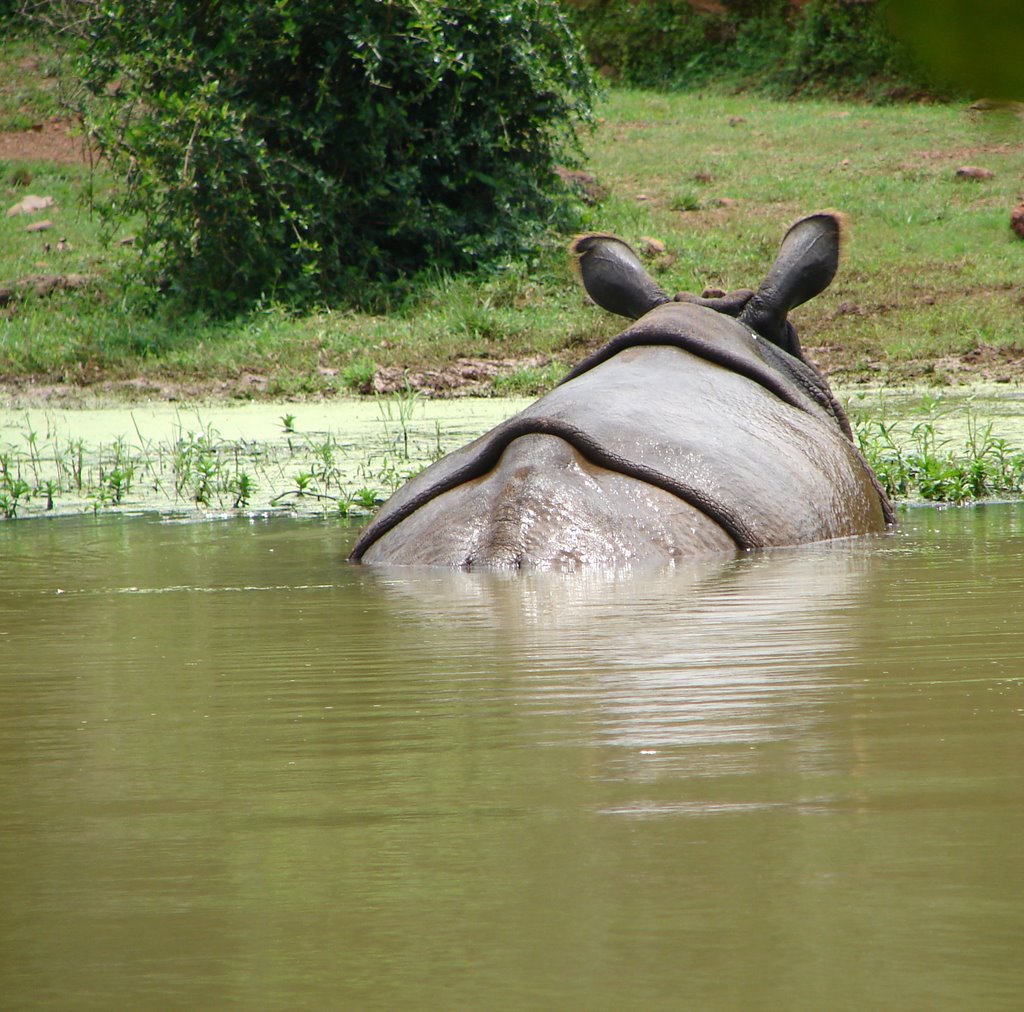
The skin is slight gray in color and has many folds and bumps giving it a heavily armored appearance. The interior of the folds is slightly pink, but, due to the mud wallowing, the coloration varies with the region's soil color. During fights, their folds of skin help protect sensitive areas. There is little hair on the hide except on the edges of the ears, eyelashes and the tuft of the tail. The lone horn on the nose is usually short and dull worn down by the use.
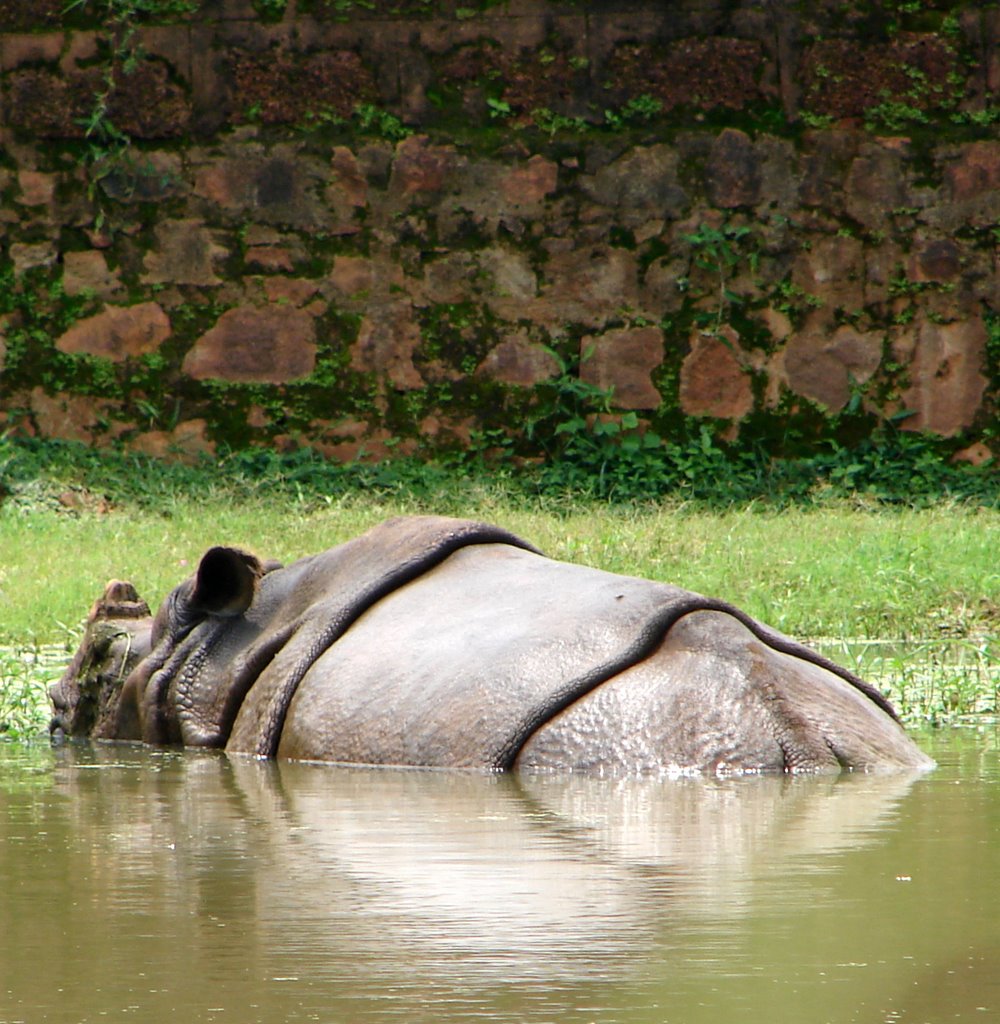
The Great Indian Rhinoceros is active throughout the day, although the middle of the day is spent wallowing in lakes, pools, puddles, ponds, rivers and resting in the shade. This activity is important for thermoregulation and the control of flies.
Badak Api
There are quite a few legends about Rhinoceros stamping out fire. They seem to have been common in Malaysia and Burma. Such Rhinoceros had special name "Badak Api" meaning "Rahinoceros fire". The animal would come out whenever there was a fire in the forest and stamp it out. No sightings have been reported in the recent history.
1 comment:
-
Vinutha and Lingaraj said...
-
Rhino stamping fire.. i remember having seen this in "Gods must be crazy"
Mithun/ gayals/ Sia
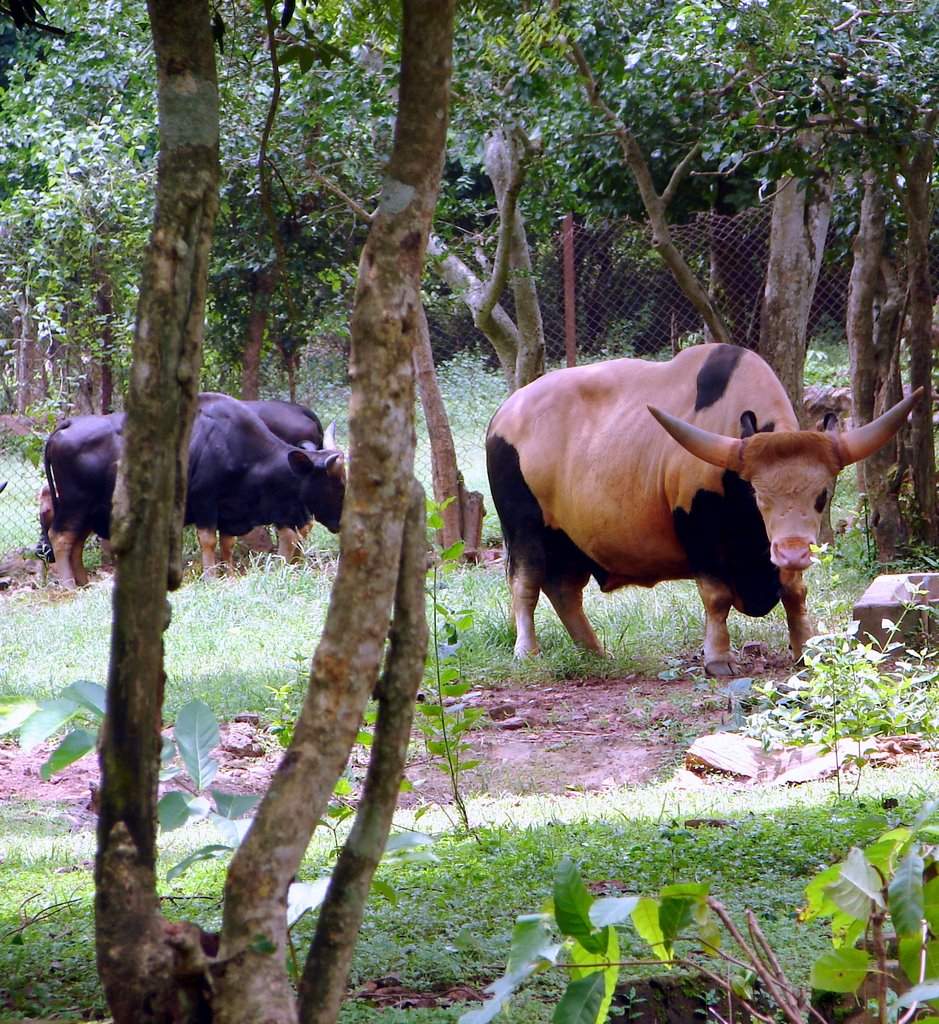 Name: Mithun
Height: 5 feet at shoulder
Diet: Browse forest leaves, young plants
Distribution Range: Himalayan foothills of south / southeast Asia.
Characteristics: Prominent dorsal ridge on the crest of the shoulder, flat forehead, big hors with large base. Mostly brownish black and piebald. Most animals have white stockings :)
The name "Mithun" probably came from Assamese dialect. They are known as "Gayals" in India. Chin people (one of the Zo ethnic groups living inn Western Burma) call these animals "Sia".
Mithuns are smaller versions of domesticated Gaurs. Mithuns and Gaurs are related to other great Asian Bovines: banteng of Indonesia and kouprey of Cambodia. They are extremely docile. The Chins use the expression "as gentle as a mithun". The milk of Mithuns is rich in butterfat content. They were traditionally the ultimate sacrificial animal. They have been used by the Chins for barter.
Indian Wild Boars
 Name: Indian Wild Boar
Height: 90Cms
Weight: 100 - 225Kgs
Diet: almost anything: nuts, berries, carrion, roots, tubers, refuse, insects, small reptiles, young deer and lambs.
Distribution Range:Asia Minor peninsula, India and Far-East
Wild boars are the wild ancestors of the domestic pig. They live in groups called sounders consisting of 20 - 50 animals. Adults are part of the sounders only during autumn breeding season. The boars are nocturnal. They have thick, short bristly coats ranging from grey to black.
Wild Boar in Hindu Mythology
Wind or storm God Rudra rides a wild boar.
In the Vedic literature Varaha was related to two different myths: the boar myth, in which the boar served as the sacrificial animal (yagna) and the cosmogonic myth. In this myth Varaha is not yet associated with Vishnu but with the Vedic god of creation: Prajapathi. It was Prajapathi who 'saw' the earth in the primordial waters while he moved in them as the wind. With his tusks, he took the form of Varaha in order to lift the earth from the waters, establishing a primary creation.
Later, in epic-puranic literature, Brahma takes over the creator function from Prajapati; so it is Brahma who takes the form of Varaha in order to lift the earth again from the waters, or as it is sometimes expressed: from the nether world (patala), where it had sunk after the earth's destruction by fire and deluge at the end of that certain world period (kalpa). Hence, Varaha's act of lifting the earth is no longer a primary creation, but has become a 'secondary' creation, a periodical act of renewal serving to establish the world anew, again and again.
The Brahma character of the myth, however, will change under the influence of expanding visnuism: Varaha is seen as a creator form of Visnu. Besides, some late-epic and puranic texts show an innovation in the cosmogonic myth: now Varaha has not only re-established the earth but also killed the demon king Hiranyaksa who lived in the nether world and had conquered the gods.
2 comments:
-
Anonymous said...
-
oh my God!! look at the speed at which u r blogging.. i will catch up okie !!
-
Vinutha and Lingaraj said...
-
aayee!! y is my comment under anonymous ??? i was loggedi n when i commented.
Meerschweinchen -- "Little Sea Pigs"
Misnomer: Guinea pigs
Length: 25 - 40 cm
Weight: 0.5 - 1.5 Kg
Life span: 4 - 8 years
Diet: grass, fresh raw fruits and vegetables
Breeding: Gestation lasts from 63 - 72 days.
Pups are well developed, including fur, teeth, claws and full eyesight when they are born. Males may demonstrate courtship behavior in the second or third week after birth. Unlike other rodents of the similar kind, they mate for life in the same pair bond.
Origin of term "Guinea Pig"
Guinea pigs are neither pigs nor do they come from Guinea. Some think that some of the sounds these vocal animals make remind them of pigs. They are also built like a pig with a large head relative to the body, a stout neck, and round rump with no tail and they spend large amount of time eating.
They were first domesticated in 2000BC for food by the mountain tribes in the Andean region of S.America. Dutch and English traders brought the Guinea pigs to Europe where they became popular as exotic pets.
The term "guinea" in guinea pig is even more difficult to explain. One theory suggests that the animals were brought to Europe via Guinea and hence the term Guinea. Another theory suggests that the term is a corruption of "Guiana", an area in S.America. Common misconception is that they were sold as a closest thing to pig one could get for a guinea (Old British coin whose value was 21 shillings)
1 comment:
Indian Porcupines
Name: Indian Porcupine
Weight: 11 - 18Kg
Length: Head and body measure 70 -90 cms in length. Tail is additional 8 -10 cm. The hair is modified to form multiple layers of spines. Each quill is brown or black in colour with alternating bands of white. Quills near the neck and shoulder are the longest measuring 15 - 30 cm.
When irritated or alarmed, the Indian porcupine raises its quills and rattles the hollow spines on its tails. If the disturbance continues, it launches a backward attack and clashes its rear against the offending animal. This drives the spines deep into the enemy and often leads to sever injury or death. Quite often the quills are dislodged and remain in the victim.
Diet: Vegetables, fruits, grains and roots. They also chew on bones for minerals (calcium) that help their spines grow.
Reproduction: Gestation lasts for 240 days. The young are born with their eyes open and they have short soft quills. Brood size is 2-4. Indian Porcupines are monogamous with both parents being found in the burrow with their offsprings throughout the year.
2 comments:
-
Anonymous said...
-
loving creatuers!!
it reminds me of someone :-p -
Unknown said...
-
A very nice content along with very good information and it is very useful and helpful.Thanks for sharing
Golden Triangle Tour Packages
Civet Cat
Name: Civet cat
Length: 76 Cms (excluding the 42Cm tail)
Weight: 11Kgs
Distribution Range: S-E Asia, Southern Europe and Africa
Diet:Carnivorous
Civets are not true cats. They have a weasel-like face, cat-like body and long tails. Their fur may be grey or brown and they are marked in various patterns. They have scent producing lands that produce yellow secretion having a distinctive musky odour. Commercially they are used as a perfume fixative.
The civet in the picture is a common palm civet. This is also known as Toddy cat because of its habit of climbing the palm trees to drink the toddy that flows into jars hung by toddy collectors. It is generally balck, blackish or brownish grey. The long hairs of the coat is dark throughout. These dark areas with a contrast of paler surrounding hairs suggest a pattern of black stripes on the head. These animals are arboreal and they rest in the day on the branches of trees or curled up in hole in the trunks. They feed on small animals, birds and insects.
Legends from Andaman
The Aka-Kol and the A-Pucikwar tribes had legends that made the monitor lizard into the creator of mankind. The lizard was said to have climbed up a tree one day and found the civet cat stuck up there. After helping her down, the two got married and their off-spring were the human ancestors.
In a legend from Akar-Bale tribe, the fire was saved from the flood by a monitor lizard and the civet cat. When the monitor lizard found that he could not carry the fire up the tree, his wife civet cat took it from him and carried it to the top of the hill where she kept it safe until the rain and flood stopped.
Pangolin
Pangolin derived from the Malayan meaning "rolling over", refers to the animal's habit of curling into a ball when threatened.
A Chinese legend
According to a Chinese legend, two ogres were jailed in the Calabash mountains. One of the ogres had a scorpion spirit and the other a snake spirit. One day a pangolin drills a hole on the slope and and the two spirits escape from the cave and cause havoc. The pangolin hurries to an old man and says that by growing calabashes in 7 colours they can annihilate the devil spirits. The old man grows red, orange, yellow, green, cyan, blue and purple calabashes. The spirits find out about this with the help of a fortune teller mirror. They try to destroy the calabashes but fail. They seize the old man and the pangolin and take them away.
The calabashes ripen and fall to the ground. They turn in to boys with different coloured suits. The boys fight the evil spirits, defeat them and save the old man and the pangolin.
Description
Pangolin has a long tail, sticky tongue, conical head and short powerful limbs. The body is covered with large, flat, imbricated horny scales. The leaf shaped plates re made of keratin, the same material that makes up our hair and fingernails. This mammal is found in the the tropical forests of Asia and Africa. Some pangolins live in trees but most of them are ground dwellers. Most species sleep during the day and feed at night. They dig the termite mounds with their strong legs.
Self defence: They roll into and impenetrable ball when threatened. They have razor sharp scales that they lash out. They have scent glands similar to skunk which they can use to spray enemies. They can run at a speed of KMPH.
Hanuman Langurs
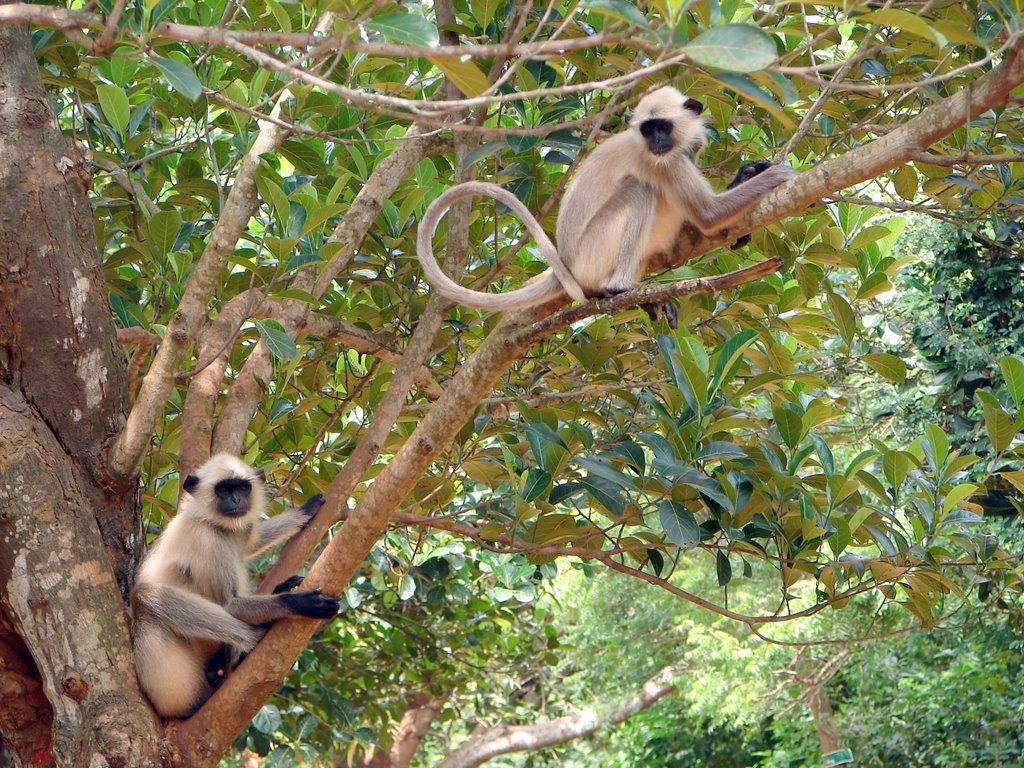
The legend of the sacred monkey traces back to more than 20 centuries. Hanuman leaped to Srilanka to rescue his master's abducted queen and set the palace on fire with his tail. This fabled deity is still worshipped by the Hindus for his heroic deeds.
Scientically these monkeys are known as Semnopithecus entellus and they are commonly known as Hanuman Langurs. The name 'langur' is derived from the Sanskrit term 'Langulin' which means 'having a long tail'. These long tails (upto 3 feet or more) help them balance on high branches.
These langurs are able to survive in a diverse range of environments, from the brutal hot sands of the Thar desert to the snow capped Himalayas. Sara Hrdy, an anthropologist at the University of California - Davis explains that "they can live on anything, even strychnine". Like all leaf-eating (colobines) monkeys, Hanuman monkeys have "sacculated" stomachs that can break down plant materials like mature leaves, unripe fruit, seeds and bark. Their stomach has anaerobic bacteria colonies that digest cellulose. They can even survive on poisonous "Lantana camara" that are even kill a horse. In the evergreen forest of Ramnagar, they survive on fruits and young leaves during monsoon. They also feed on protein rich caterpillars. During winter, they survive on flowers and dry fruits of a large climbing liana. During spring they eat any plant that they can find.
Social Pecking Order
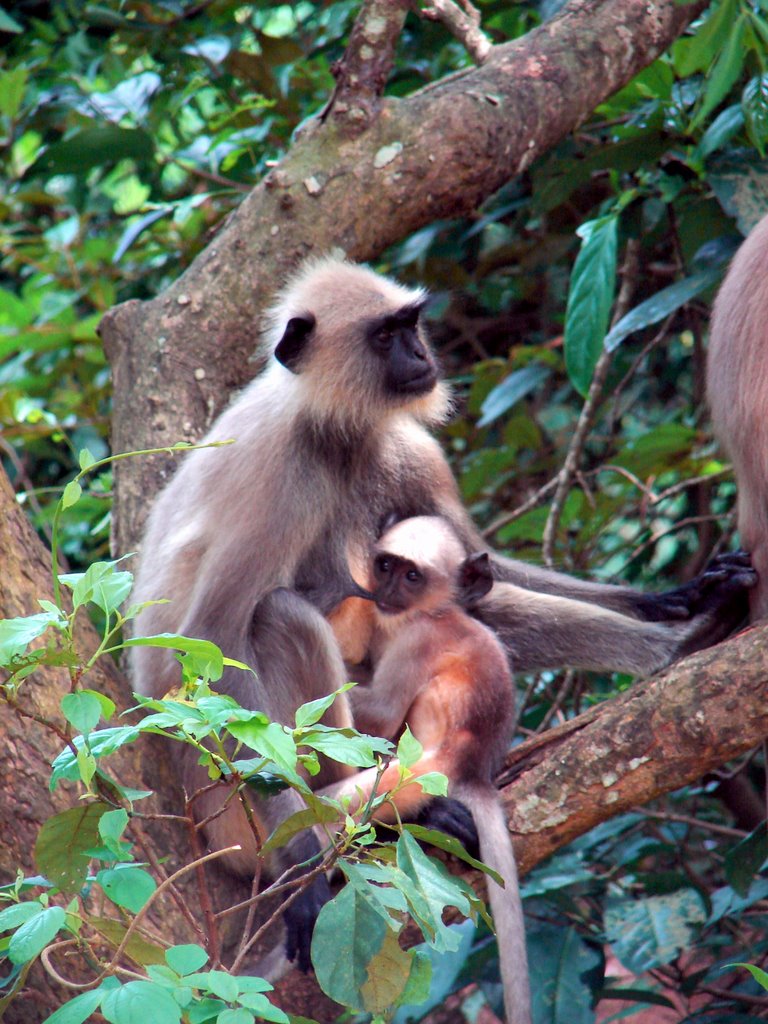
The langurs spend most of their time on the trees to escape from predators like tigers, wolves, wild dogs, hyenas, leopards and pythons. The highest ranking male sits at the top of the tree. The females with babies sit below the male followed by the younger females. The riskiest posts at the base of the tree are usually occupied by the adoloscent males. Sub-adult males are eventually kicked out of a troop to avoid inbreeding. They then join other troops to form a group of bachelor males. The females stick together in a single territory for their entire lives, while the males time in the troop is short-lived.
The bachelors roam around testing the males with harems. When they see a weakness they attempt to takeover. The bachelors rush into the troop whopping and the alpha male responds to the call and combats. The war ends when the bachelors retreat or drive off the alpha male and seize the command of the troop. The strongest member of the bachelor group evicts his fellow comrades and gains full control of the troop. Sometimes the succeeding male snatches the unweaned infants from their mothers and sinks his canines into their skulls. Such infanticide was first documented in 1960s by the Japanese scientists doing their research in India.
Sara Hrdy explains that the infanticidal males cancel the female's last 'choice' and forces her to choose him instead. The mother becomes fertile sooner if she stops nursing and increases the new male's chances of breeding with her. This is linked to Darwin's theory of sexual selection which states that males will compete for the fertile females with the females choosing the best male.
The females will stick together and fight the males trying to snatch the infants. A female will support her sister, cousin, aunt expecting that they will support her in times of need. The females seem to be evolving new strategies. They have noticed that a male is hesitant to kill his own offspring. The females take advantage of this behaviour and so mate with a variety of males outside the troop besides the alpha male.
Royal Bengal Tigers
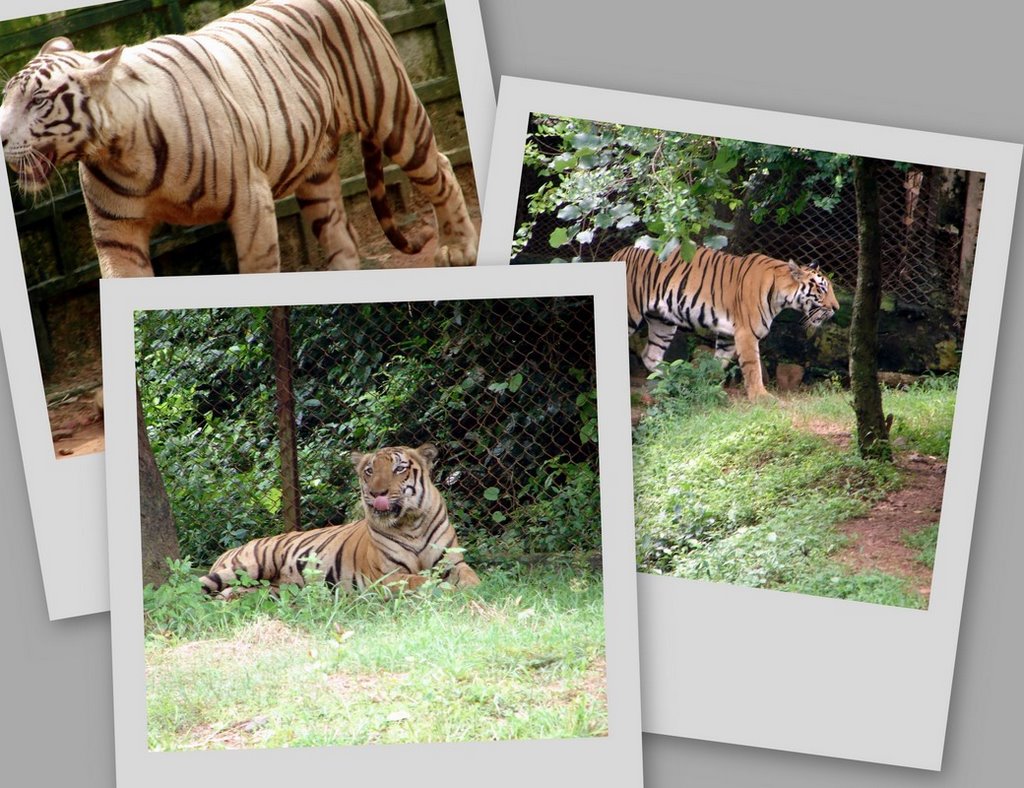
Name: Royal Bengal Tiger
Body Length: 140 - 280 Cm.
Weight: 200 - 300 Kg (males)
130 - 170 Kg (females)
Diet: Pure Carnivores
Distribution Range: India, Bangladesh, Nepal, Bhutan, Burma
Conservation status: Endangered
Tigers in Indian Mythology
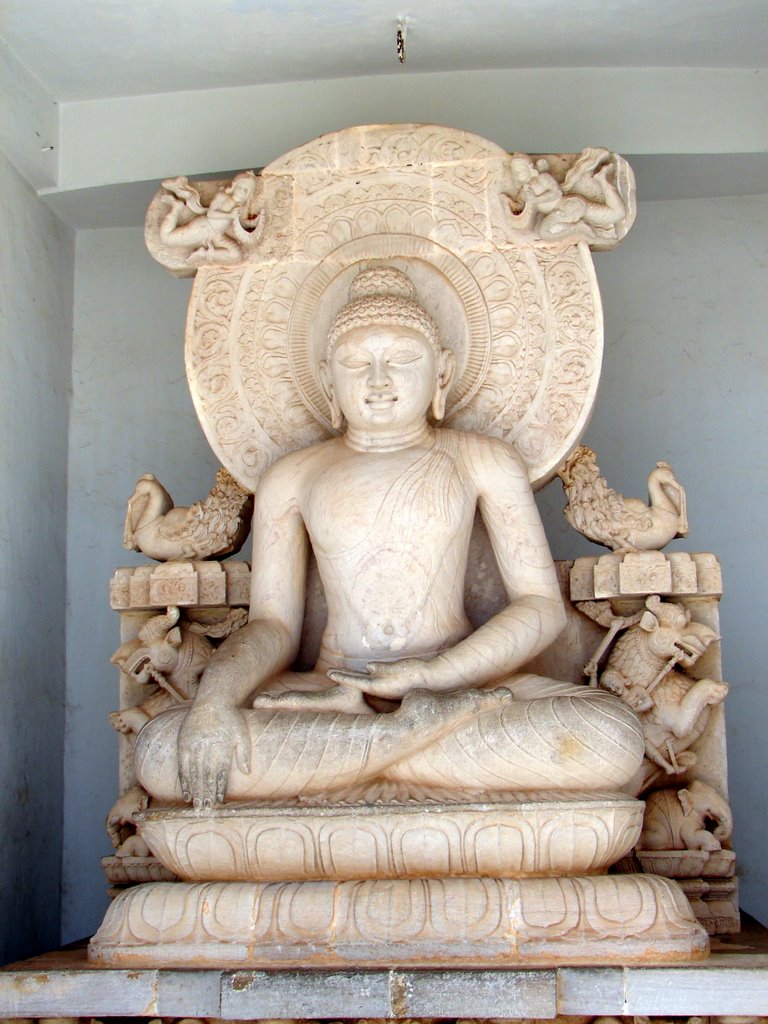
Young prince Mahasattva was walking over the hills with his brothers when he saw a tigress with her two cubs. The tiger was a little more than a skeleton and she was about to eat the young cub to satisfy her hunger. Wanting to save the cubs, Mahasattva threw himself in front of the tigress and waited for her to eat him. The tigress was so weak that she couldn't even bite. Mahasattva pricked himself with a sharp thorn and drew some blood. The tigress licked the blood and gained enough strength to devour the prince. The young prince was none other than Buddha.
It is believed that in many parts of North India the Tiger God was worshipped by both Hindus and Muslims.
Tigers in NandanKanan
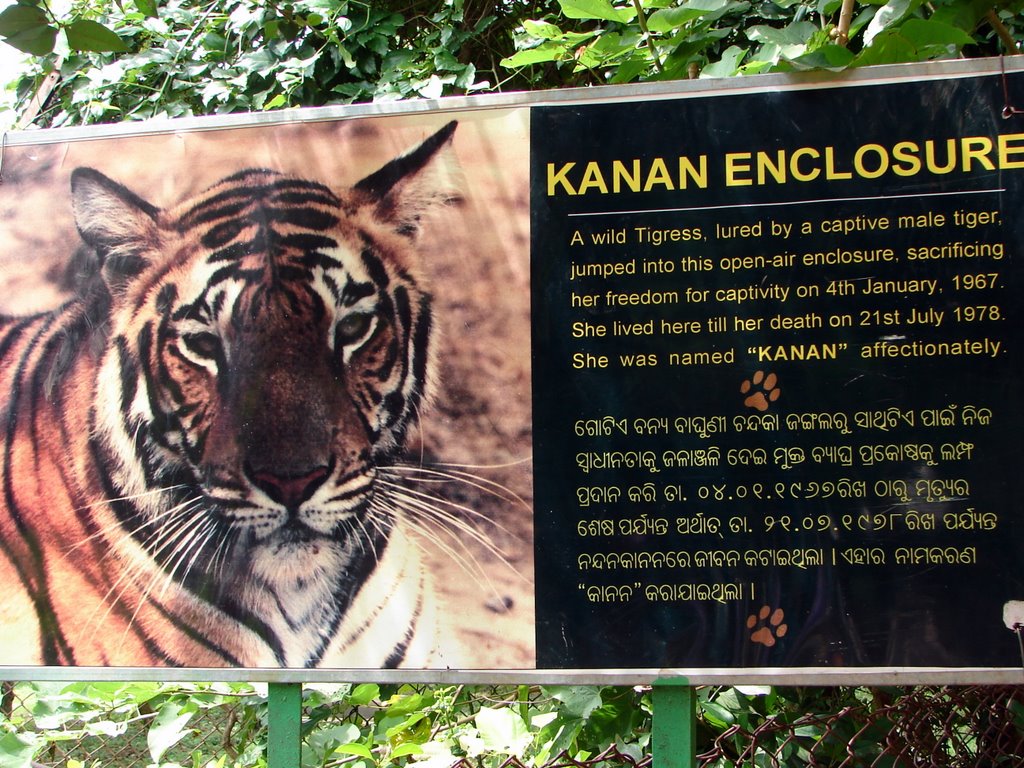
A wild tigress (probably the last in the forest surrounding the park) jumped a moat into a newly constructed tiger enclosure to mate with its sole occupant. She was fondly known as 'Kanan' and she lived here for 11 years and died in 1978 due to natural causes.
Causes for White Tigers
A white tiger can only be born to parents when both of them carry the unusual gene for white colouring. The double recessive allele in the genetic code turns up naturally once in every 10,000 births. For unexplained reasons, the white colour occurs in Bengal subspecies.
Reports of White Amur tigers are incorrect. These are Bengals that have been hybridised with the Amur subspecies at some point in time.
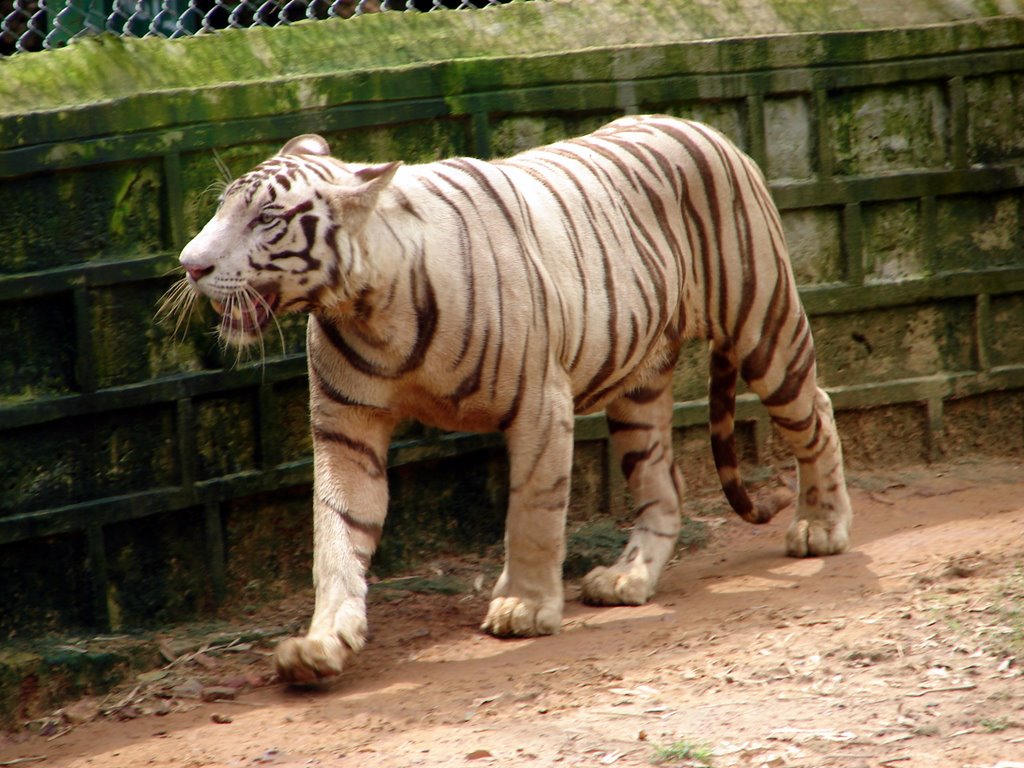 The State Forestry Department brought Shubra from Delhi in 1979. She
was a white tigress and had a serene temperment. She produced six
litters. Nandankanan has bred and produced more than 400 tigers in the
last 20 years, half of which were pure white.
The State Forestry Department brought Shubra from Delhi in 1979. She
was a white tigress and had a serene temperment. She produced six
litters. Nandankanan has bred and produced more than 400 tigers in the
last 20 years, half of which were pure white.On 8th Jan 1980, India first recorded white tiger cubs born to regular tawny parents at Nandankanan Zoological Park.
Old age home for the Royal cats
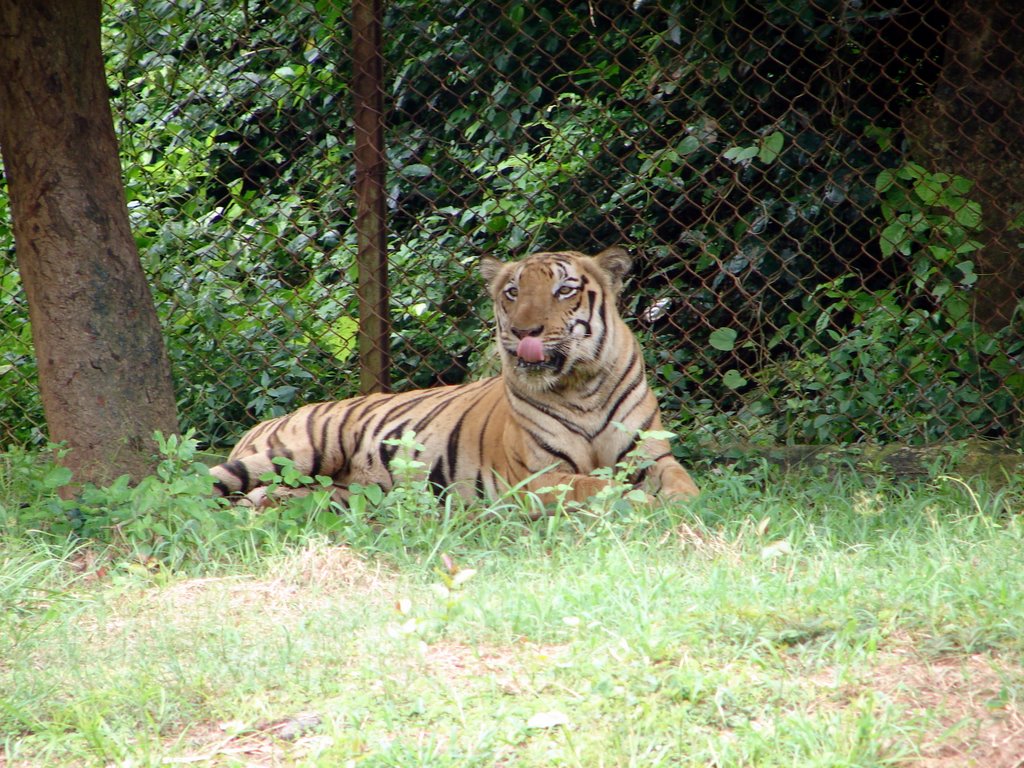
West Bengal's first tiger rescue center is all set to come up at Jharkhali and the royal cats of Sundarban that are unable to catch their prey in old age can now
Pages from the History of Royal families
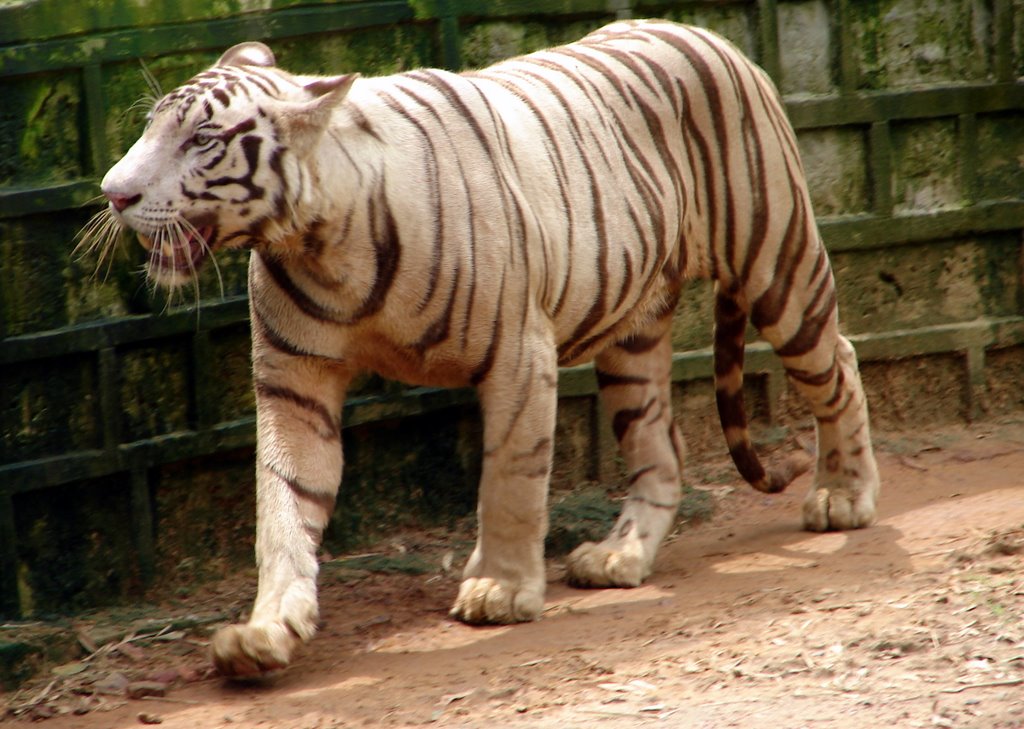
Royal Bengal White tigers in captivity
The earliest record of a white tiger captured was in 1820 at Exeter Change.
In December 1915, Maharaja Gulab Singh of Rewa caught a 2 1/2 year old white cub. He kept the tiger in captivity for five years and then gifted it to King George V as a sign of loyalty to the crown. Till date, white tigers are kept at the Maharaja's summer palace at Govindgarh.
Freedom Eluded
Maharaja Shri Marthanda Singh was hunting in the jungles of Bandhavagarh (Central India) in May 1951. He received a report that a tigress had been spotted with her 4 cubs and one of them was white.
The next day a search party with beating drums, cans, firing shots, trumpets and blasts was organised to find the tigress. Unaware of the threat the tigress approached them when the maharaja was seated with his guests. She and her two cubs were shot. Luckily the white cub escaped.
There was no sight of the white cub the next morning, but pug marks were sighted near the kill made by the mother. The cub after feeding had hidden in the rock crevice. A local carpenter made a drop-cage and placed it near the exit of the crevice. They used water to lure the helpless cub out of the crevice. Several hours later the cub came out to drink water and was captured. He was returned to the Maharaja's 150 roomed palace. He was kept in a large open courtyard.
Only 3 days after the capture the cub managed to escape again. A long hunt was organised. The search party used a net to capture the cub that only resulted in mauling. When the cub again attempted to attack, he was clubbed hard on his head and he lay unconscious. The search party men tied his legs, caged him and carried him back to the palace. The cub was reintroduced to a repaired courtyard where he lived for the next 19 years and 7 months. He grew up to be the famed Mohan.
Mohan was bred to a wild-caught orange tigress Begum. Her three litters contained only the normal coloured cubs. She was sold to the Ahmedabad zoo. Mohan was then bred to Radha his daughter (Thats right. Bred with his daughter!!! shocked? Wait till you read the next section on "Ancient Egyptian History") from the second litter. This resulted in four white cubs Raja, Rani, Sukeshi and Mohini. Radha then went on to give birth to 13 white and 9 orange tigers.
Mohan's children Raja and Rani were gifted to National Zoological Garden in Delhi. They were bred to produce 20 cubs all of which were white.
Mohan and Begum's fourth generation offspring Badal was bred with Seema at Kanpur Zoo on 29th August 1979. But this was not successful. She was then bred with Sheru a notorious man-eater from Corbet National Park. She delivered Sanjeev, Uttam and Johar of which Johar was white. Contrary to the accepted Mendelian's hereditary principles of Genetics, white offspring had been produced though the father (Sheru) and mother Seema were normal coloured homozygous.
Ancient Egyptian History
It was a common practice in ancient Egypt for the queens to marry their brothers. There was a complex interrelationship between husband-wife, brother-sister etc. As a result, rulers in Egypt were generally succedeed by the individuals that they designated as heirs.
Heirs were almost always sons of Pharoh and his "Great wife", his most favoured wife and usually the first he married. This selected son of the Pharoh and his Great wife was typically designated as the heir via marriage to the "First Daughter", Pharoh's most royal female child, the eldest eligible daughter of his most favourite "Minor Wife". Thus many queens married their half-brothers. Cleopatra and Hatshepsut married their half brothers.
Cleopatra VII's (popularly known as Cleopatra) father was exiled following a rebellion and her older sister took the throne. Her father reclaimed the throne on his return and Cleopatra's sister was put to death. Her sister Cleopatra VI mysteriously died around the same time. About 4 years later her father died and as the oldest child in her family Cleopatra took control of the throne at the young age of 17. In keeping with the ancient Egyptian tradition Cleopatra married her brother Ptolemy III who was 12 years old.
Thotmose Royal Family
Amen Hotep-I's daughter Ahmose married her half brother Thotmose-I. He was the son of Seseneb. Some historians argue that he was not Amen Hotep's son but a general in the army. All sons of Thotmose-I and Ahmose died young. At his death only his daughter Hatshpsut was alive. Thotmose-I had a son from his own daughter "Mut Nefert". Hatshepsut married this illegitimate prince who later came to be known as Thotmose-II and ascended the throne.
Thotmose-II had a secondary wife Isis. Hatshepsut bore Thotmose-II only two daughters Nefru-Ra and Merit-Ra-Hatshepsut. Nefru-Ra married her half brother (son of Isis and Thotmose-II) and the prince ascended the throne with the title Thotmose-III.
The Bare (Bear) Necessities
The simple bare necessities
Forget about your worries and your strife
I mean the bare necessities
Old Mother Nature's recipes
That brings the bare necessities of life
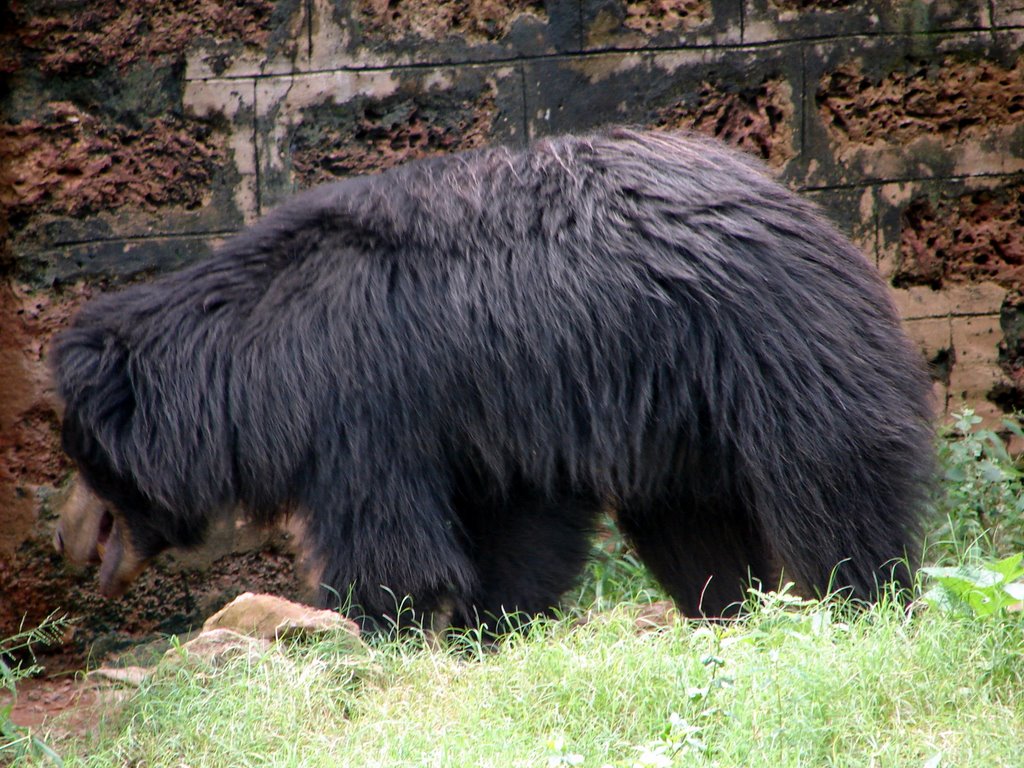
Wherever I wander, wherever I roam
I couldn't be fonder of my big home
The bees are buzzin' in the tree
To make some honey just for me
When you look under the rocks and plants
And take a glance at the fancy ants
Then maybe try a few
The bare necessities of life will come to you
They'll come to you!
Look for the bare necessities
The simple bare necessities
Forget about your worries and your strife
I mean the bare necessities
That's why a bear can rest at ease
With just the bare necessities of life
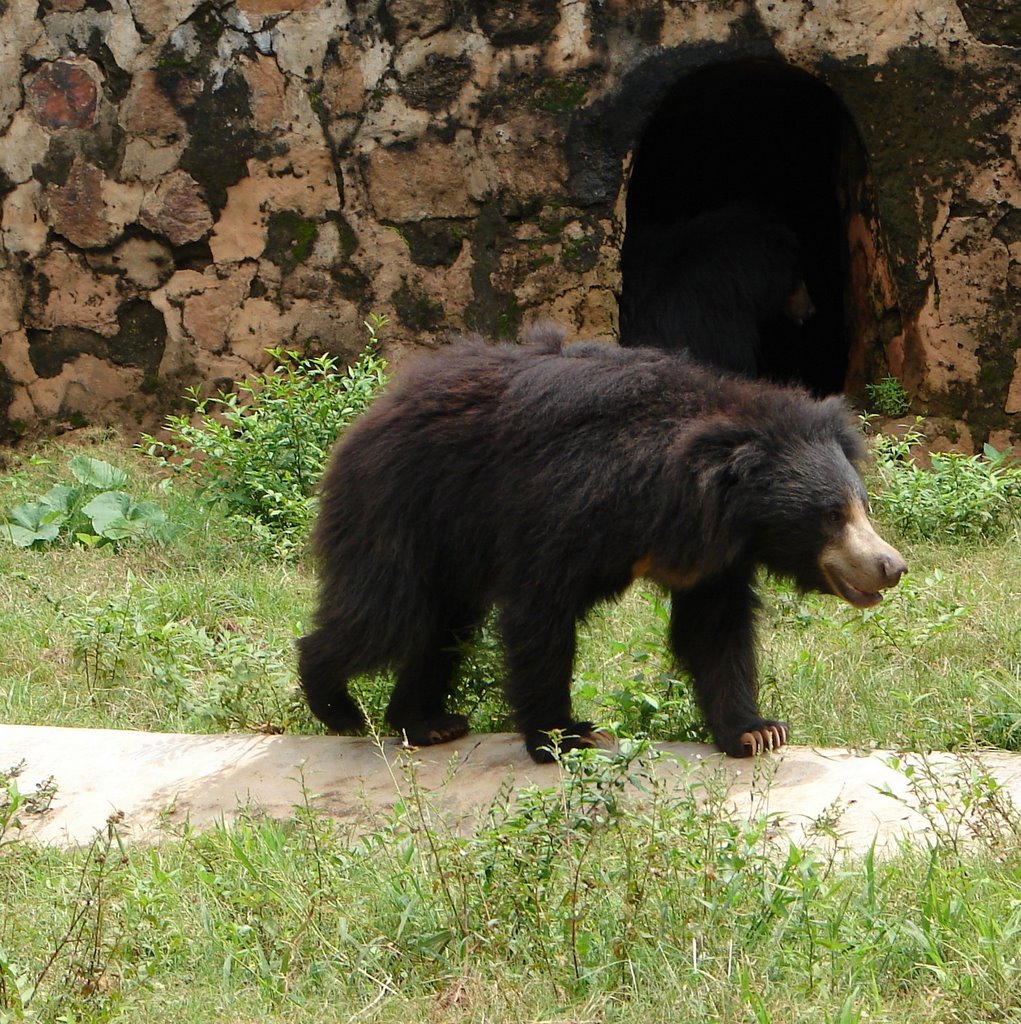 Now when you pick a pawpaw
Or a prickly pear
And you prick a raw paw
Next time beware
Don't pick the prickly pear by the paw
When you pick a pear
Try to use the claw
But you don't need to use the claw
When you pick a pear of the big pawpaw
Have I given you a clue ?
The bare necessities of life will come to you
They'll come to you!
So just try and relax, yeah cool it
Fall apart in my backyard
'Cause let me tell you something little britches
If you act like that bee acts, uh uh
You're working too hard
And don't spend your time lookin' around
For something you want that can't be found
When you find out you can live without it
And go along not thinkin' about it
I'll tell you something true
The bare necessities of life will come to you
 Name: Sloth Bear
Height: 140 - 190 cm
Weight: 80-140Kg(males)
55-95Kg(Females)
Life Span: 20 - 25 Years
Diet: Omnivorous
Distribution Range: Sri Lanka, Inda, Bhutan, Nepal and Bangladesh
Conservation Status: Vulnerable
Sloth bears are stocky with long, shaggy, black hair and a while U or Y shaped marking on their chest. They have large lips, long tongue, pale muzzle and a well developed hook-like claws that enable them to climb trees and dig for termites.
Habitat
Thorn forests, wet forests and grasslands
Diet
They are omnivoros and they feed on ants, termites fruits, berries, bees, honey, carcasses and sometimes small vertebrates. Thy use their long claws to expose the insect's nests. Then they blw out the dirt and suck out the termites. They can close their nostrils to create vacuum and their mobile lips enable to scoop up the prey. Their hairless muzzles are thought to be adapted to the stings of the insects.
Behavior
They are nocturnal and happily share their home ranges (13Sq Km) with other sloth bears. The constant availability of food (insects, termites etc) mean that they do not undergo hibernation.
Reproduction
They mate and give birth at any time of the year. Females give birth to 1-2 cubs.
Conservation status
They are classified as vulnerable. They are hunted by farmers when they cause damage to the crops and also by hunters who seek gall bladders to use in medicines.
Sloth bear cubs in India are poached and tortured through brutal training methods to become "dancing bears". At less than 4 weeks of age, the cub is stolen from its mother who is often killed while trying to protect her cubs, sold to traders and middlemen who in turn sell them to Kalanders.
The cub's canine teeth are knocked out, a red hot iron needle pierces its muzzle and a coarse rope is pulled through. The wound is never allowed to heal and the cub will live in fear, hunger and pain, tied to a stake for the rest of its life.
Himalayan Black Bear
"A pine needle fell. The Eagle saw it. The Deer heard it. The Bear smelled it"
 Name: Himalayan Black Bear
Height: 4 1/4 to 6 1/4ft
Weight: 110Kg to 150Kg (Males)
65Kg to 90Kg(Females)
Life Span: 25 years
Diet: Omnivore
Distribution range: East to west of Asian Continent
Conservation Status: Critically endangered
Asiatic Black Bear (Ursus Thibetanus) is also known as Tibetan Black Bear, The Himalayan Black Bear, The Moon Bear(because of the crescent moon shape on their chest). The characteristics of the bear are its black shiny fur with a distinctive white or cream 'V' marking on its chest. The fur around the shoulders and throat is particularly long and its ears are relatively large and set rather far apart. They have short claws measuring only 4-5 cm but are nevertheless good tree climbers.
(If you click the picture on the right and enlarge it, you can see a tiny patch of cream on its chest)
Distribution
These bears are found in Afghanistan, Bangladesh, Bhutan, Cambodia, China, India, Islamic Republic of Iran, Japan, Democratic People's Republic of Korea, Lao People's Democratic Republic, Malaysia, Mongolia, Myanmar, Nepal, Pakistan, Russian Federation, Taiwan and Vietnam.
Habitat
Forested areas, hills and mountainous regions.
Diet
They are carnivorous mammals. Their diet consists of small mammals, birds, fish, molluscs and carcasses. They also feed on grasses, berries, fruits, seeds, insects and honey. In autumn they fatten up for the winter by feeding on nuts.
Behaviour
They are solitary except for maternal family groups. They occupy a home range of 10- 20 Sq. Kms. They are mainly nocturnal (most active at night). In some areas they may be active even during the day. But this particular bear at "Nandan Kanan" park wasn't :(.
Hibernation
After building up a large fat store, the bears head into dens in late November and do not leave them until late March or early April. During hibernation, their heart beat drops to 8-12 beats per min compared to 40-70 in other bears. The metabolism also drops by half and its body temperature drops to only 3-7 deg. C. It also does not excrete urea or solid fecal matter while hibernating. While in other animals, this would cause poisoning, these bears transform the toxic substance into useable proteins. By the end of hibernation period, males lose 15-30% of their total weight while females lose upto 40%.
Reproduction
They mate from June - July and give birth during January and February. The female gives birth to 1-4 cubs that are born blind and helpless. They young, remain with the mother for a year or more.
Conservation Status
CRITICALLY ENDANGERED
Problems for survival:
Bile Bear
Bile Bear or Battery Bear is the term used for the Himalayan black bears that are kept in captivity in China and Vietnam to extract bile for use in Traditional Chinese medicines.
The Bile Bears live in cages that are slightly bigger than themselves. Bile is extracted through a cut made in the bear's abdomen and into the gall bladder. A tube is inserted into the opening to tap the bile or a steel stick is forced into the gall bladder with the bile running down into the basin. About 10 -20 ml of bile is tapped (milked) from the bear twice daily. The WSPA reports: "The investigators saw bears moaning, banging their heads against their cages and chewing their own paws while milking". Mortality rate is between 50% - 60%.
When the bears stop producing the bile after a few years, they are either moved to another cage where they are left to starve and die or killed for their paws and gall bladders. Bear paws are considered a delicacy.
Bear bile contains ursodeoxycholic acid (UDCA) that is used to treat fever, protect the liver, improve the eye sight, break down gallstones and act as anti inflammatory. Montreal based Axcan Pharma brought Ursodiol a commercial drug that is synthesized and not derived from animals to the market in 1998. They are as effective as the bear bile and Chinese traditional medicine practitioners should be encouraged to replace the bear bile with this medicine.
Raja-Rani Mandir -- Bhubaneswar
We walked further down the road and asked a few locals for the directions to the temple. We were misguided once by a vendor of tender coconuts. A teenager who probably was a college student was walking in the same direction and she offered to walk with us to the temple. We thanked her and walked into the temple garden. We had to buy an entry ticket to see the mandir. Though there was a ticket counter, there wasn't anybody to issue us the entry tickets.
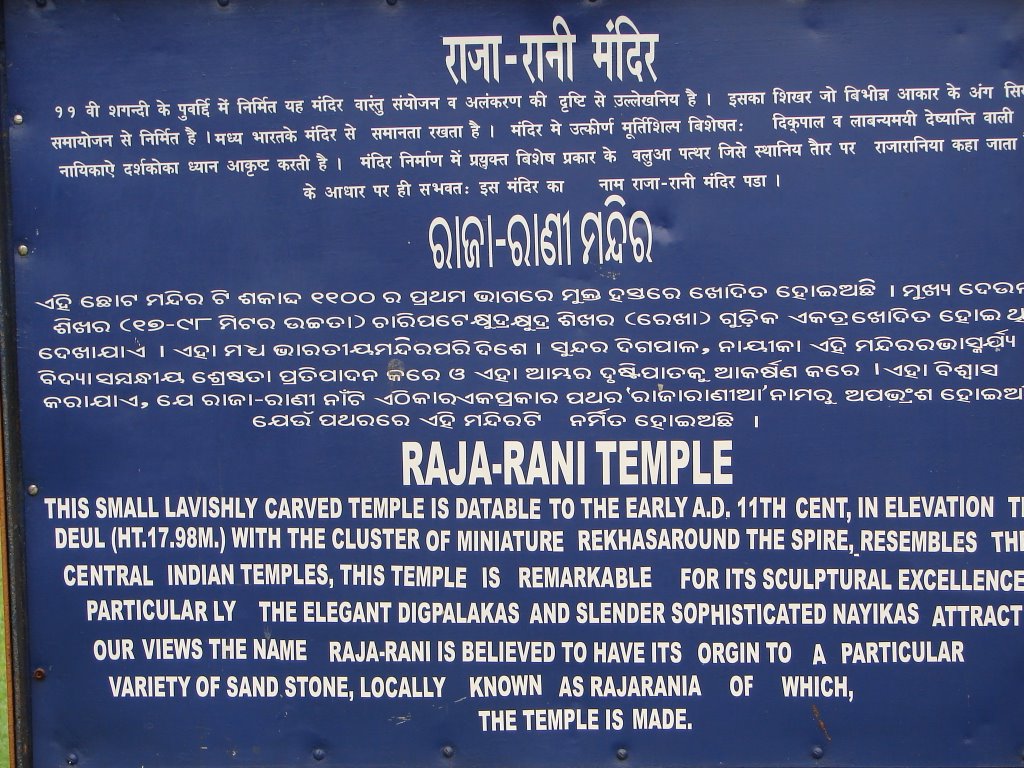
The
temple looked stunningly beautiful from far. The Kesari rulers are to
be credited for creating this architectural wonder. The Kesaris ruled
Kalinga for about 200 years from 9 AD till the advent of the Gangas in
1112AD. The Kesaris were massive builders. Some of the brilliant
specimens of Orissan Temples like Lingaraj, Mukteshwar, Rajarani and
Brahmeswar were credited to them.
The
speciality of this temple is that it has no presiding deity. This
temple has been mentioned in few ancient Sanskrit texts. Some scholars
believe that the temple was dedicated to worship of Lord Shiva and was
known as Indreswara temple. There is also a popular belief that it was
the Siddheshwara temple in bygone days. Though I have never been to
Khajuraho, I have heard that the temple has family resemblance with
Kandariya Mahadeva temple of Khajuraho. The name 'RajaRani' sounds
rather too uncommon considering the fact that all the major temples in
and around Bhubaneswar have suffixes that link them directly with Lord
Shiva.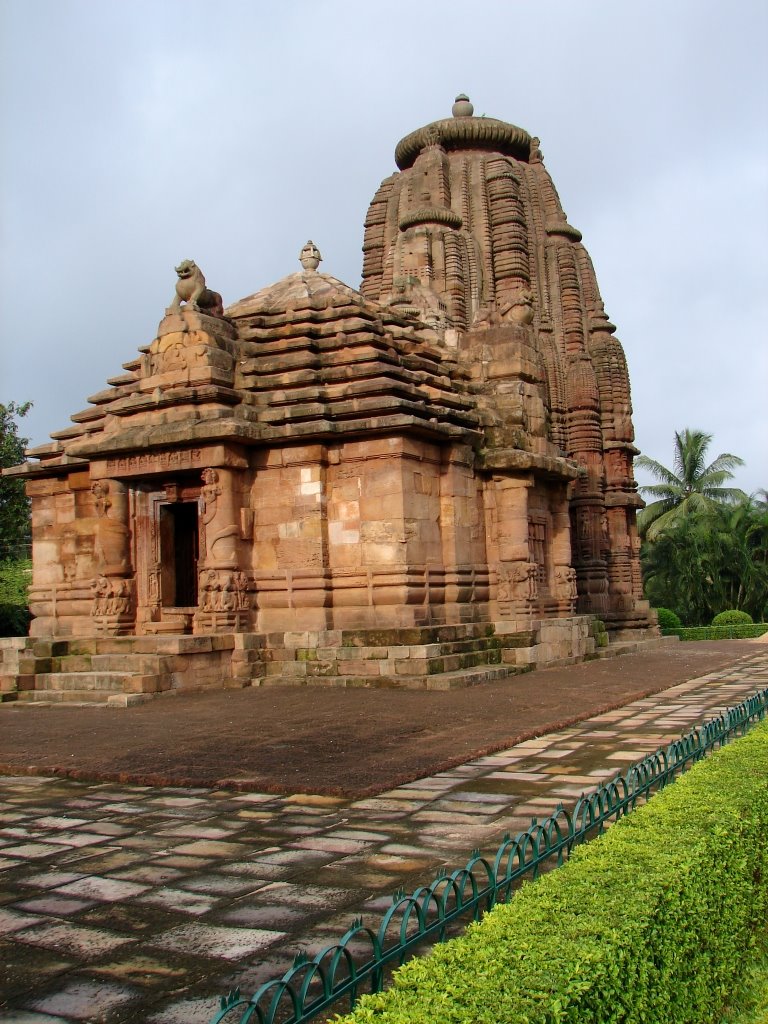
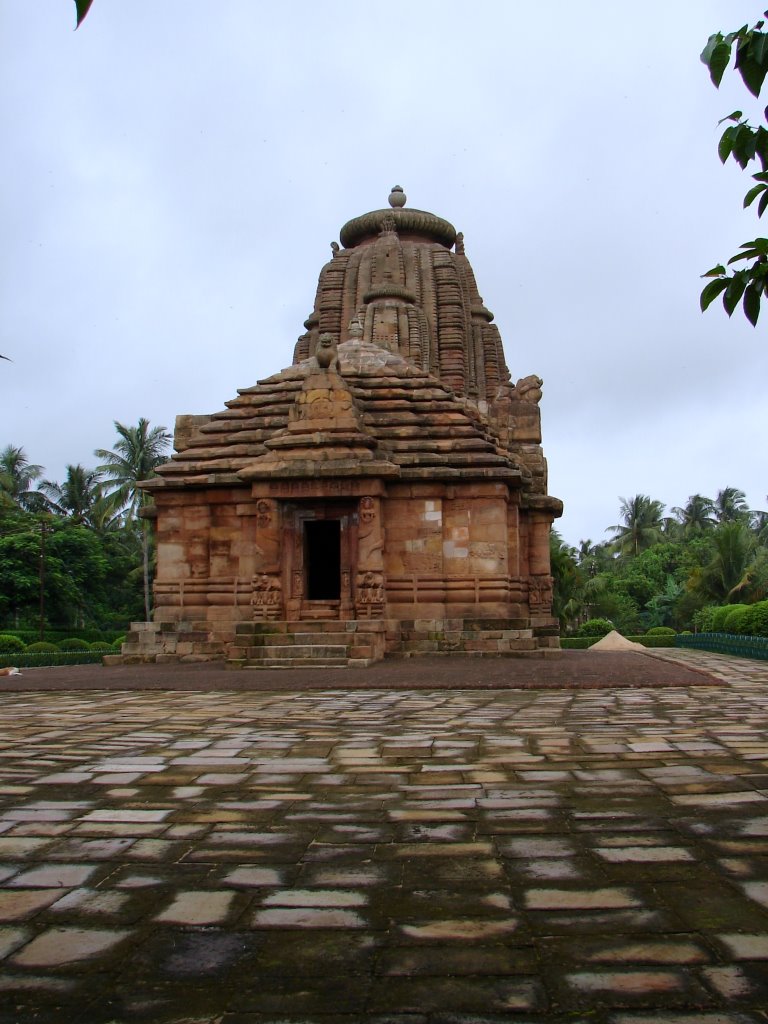
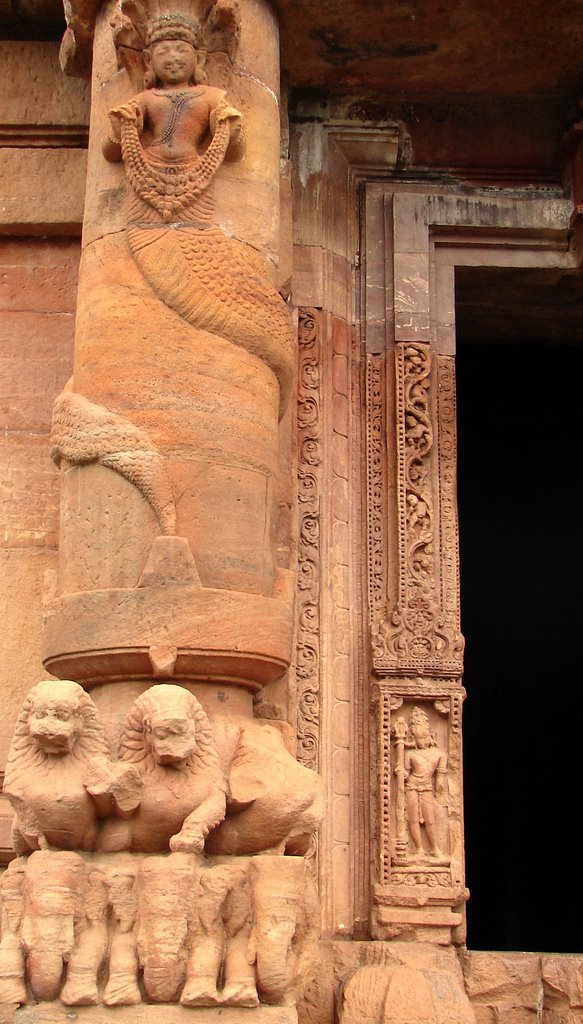
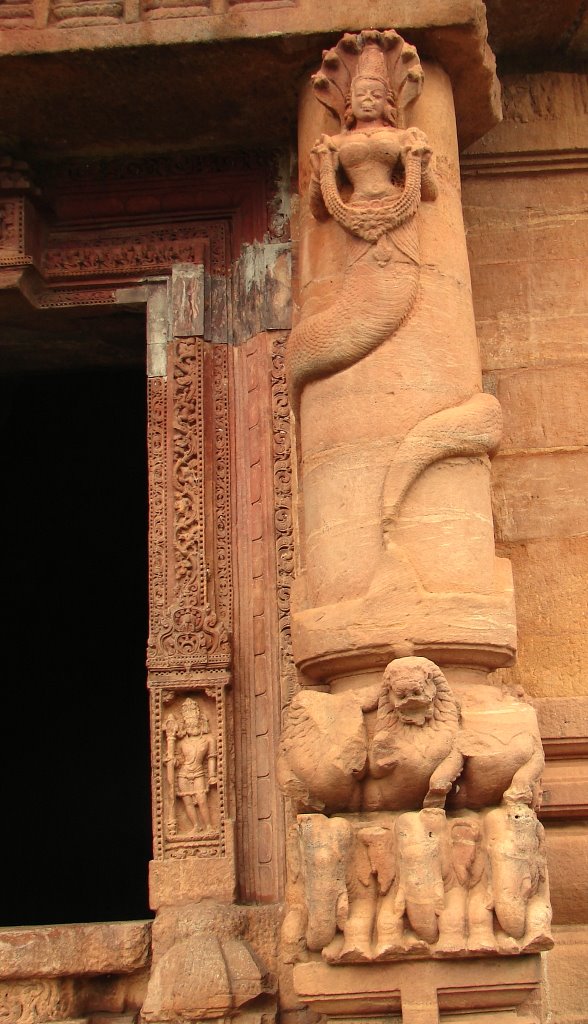
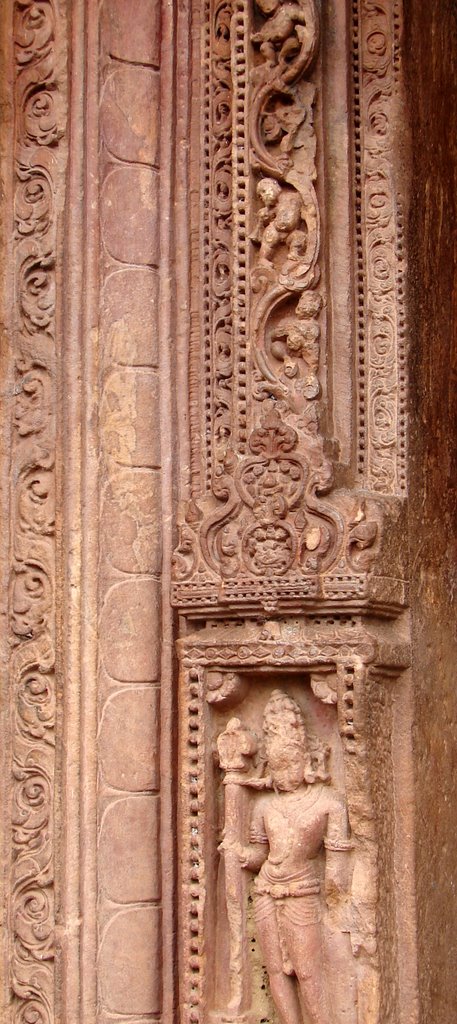
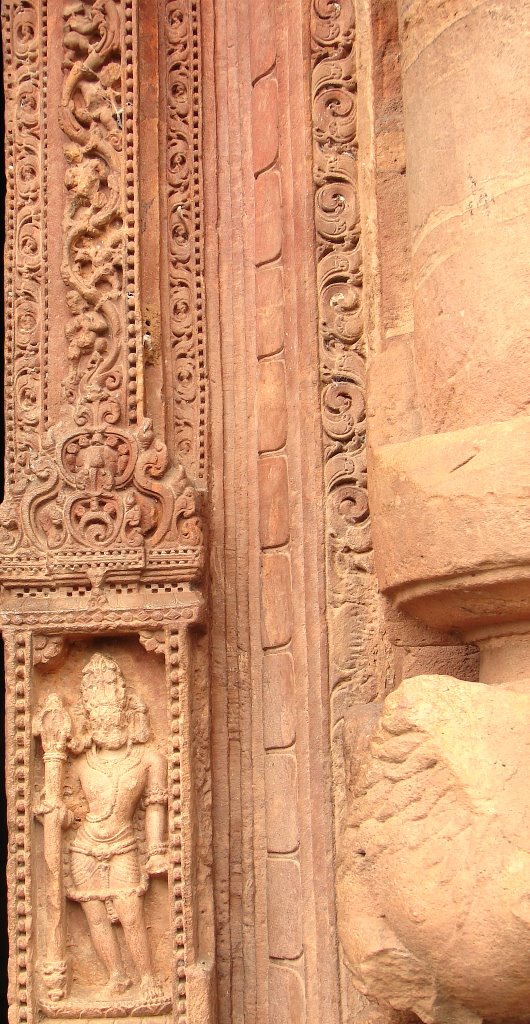
The
entrance is guarded by a pair of identical door keepers. They have
matted locks on head and carry tridents in hand which make it easy to
identifyf them as Shaivite dwarapalakas -- Chanda and Prachanda.
There are ashta dikpalakas(guardians of the eight directions). Indra holds his thunderbolt and guards the east.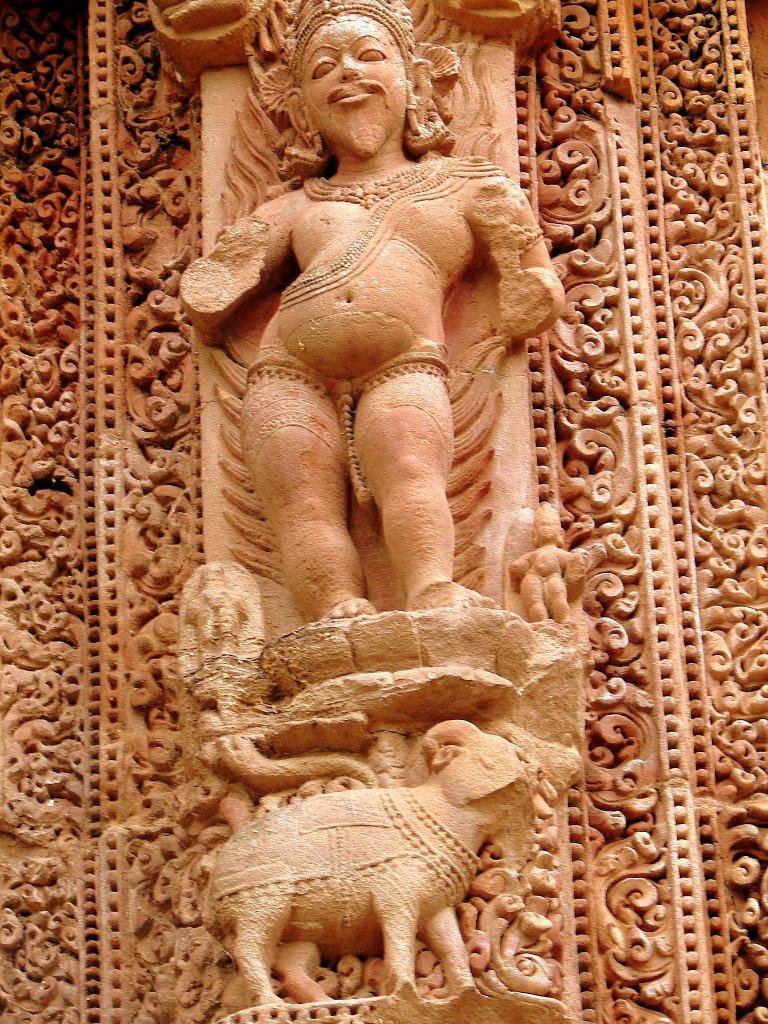
The pot bellied and bearded Agni controls the south-east.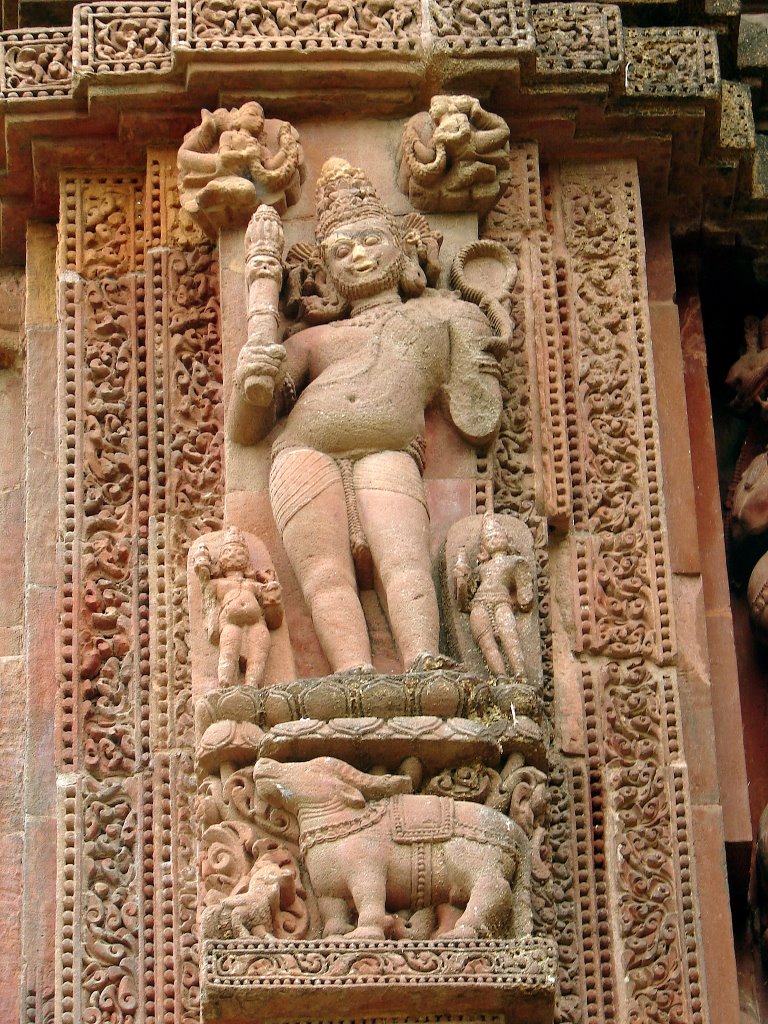
Yama with his staff and noose in hand and his carrier bufallo protects the south.
Nritti
is poised over a prostrate body and holding a sword and a severed head
guards the south-west. I do not have the picture :( as I wasn't able to
locate it :(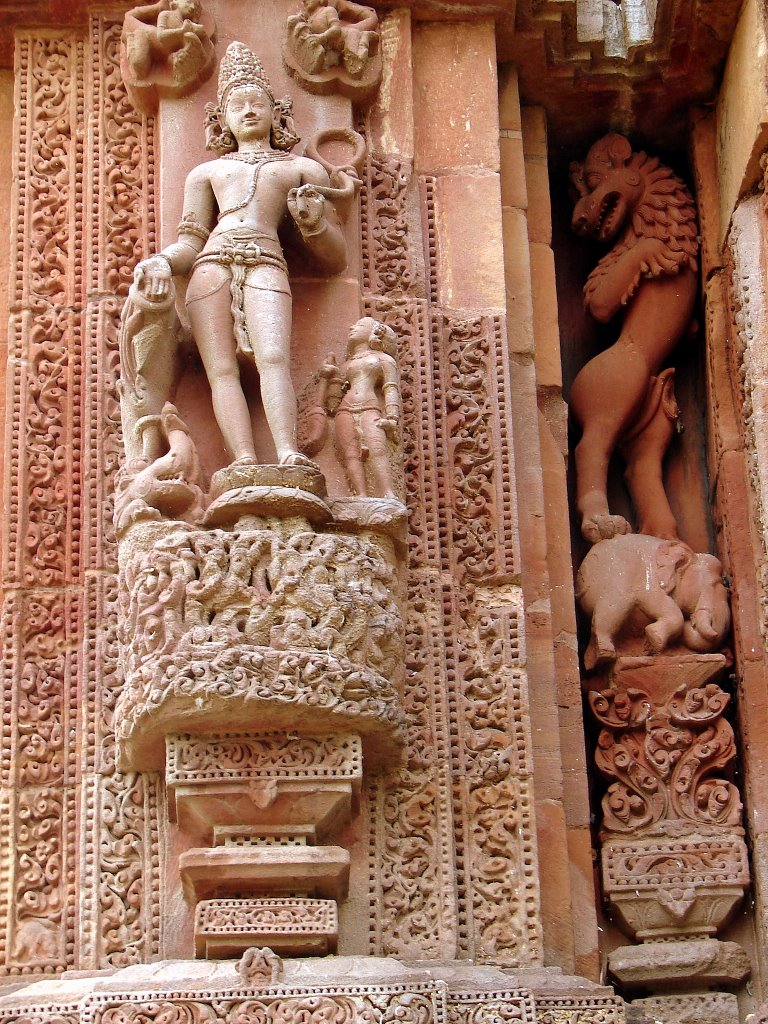
Varuna
with a noose in his left hand and his right hand in Vara mudra and his
mount makara (crocodile) besides him, preserves the west.
Vayu
holds a banner and is placed in the north-west. Kubera with seven jars
of nidhi keeps vigil in the north and Ishana with an emaciated figure by
his side protects the north-east. Unfortunately, I don't have the
pictures :(.
The temple has exquisite carvings of delicately
poised nayikas. The slender waisted figures, languorosly poised, reflect
the wealth of feminine charm. There are also nymphs or the embracing
couples. There are the carvings of women playing with children or
playing with pets or attending to their daily chores.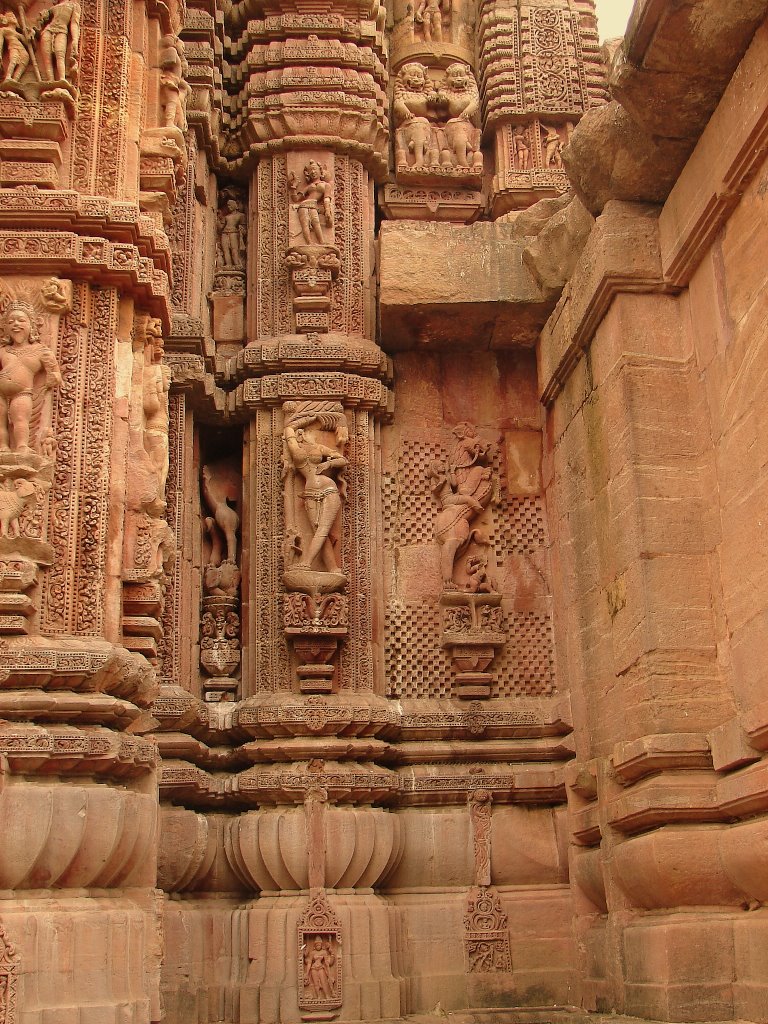
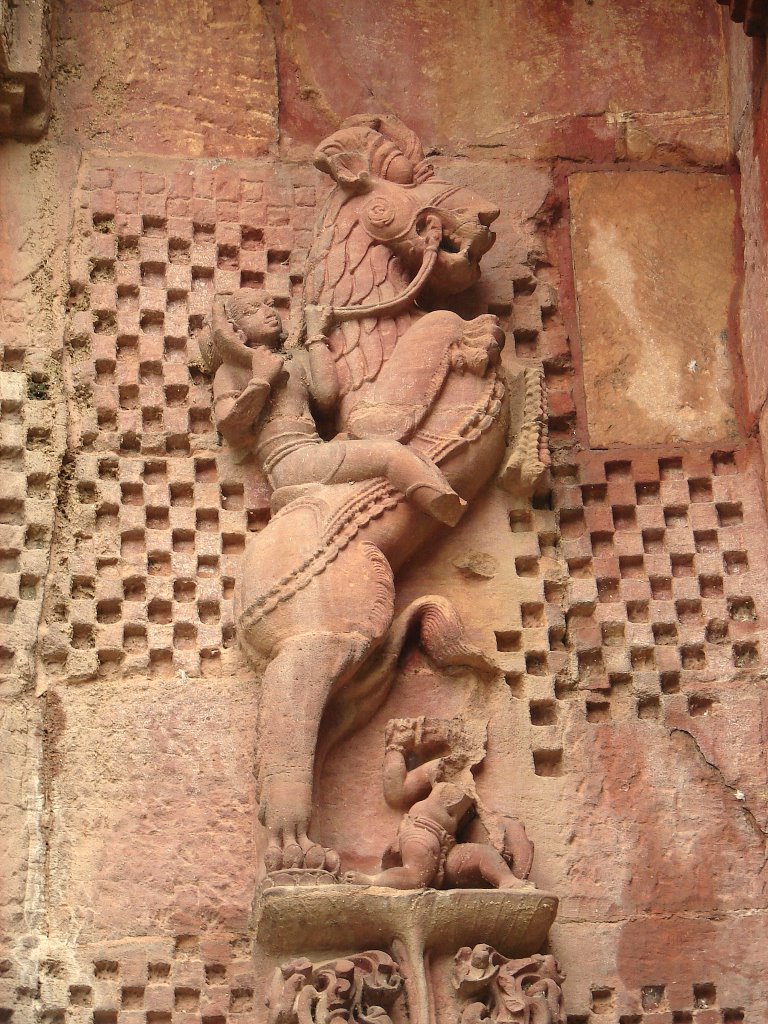
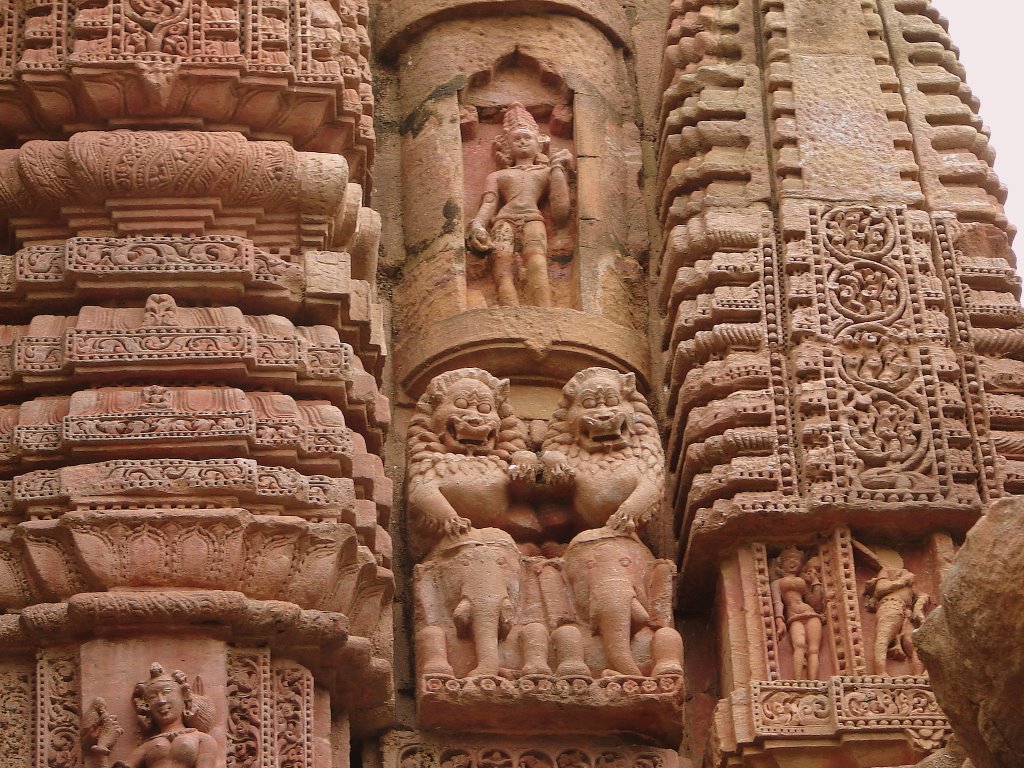
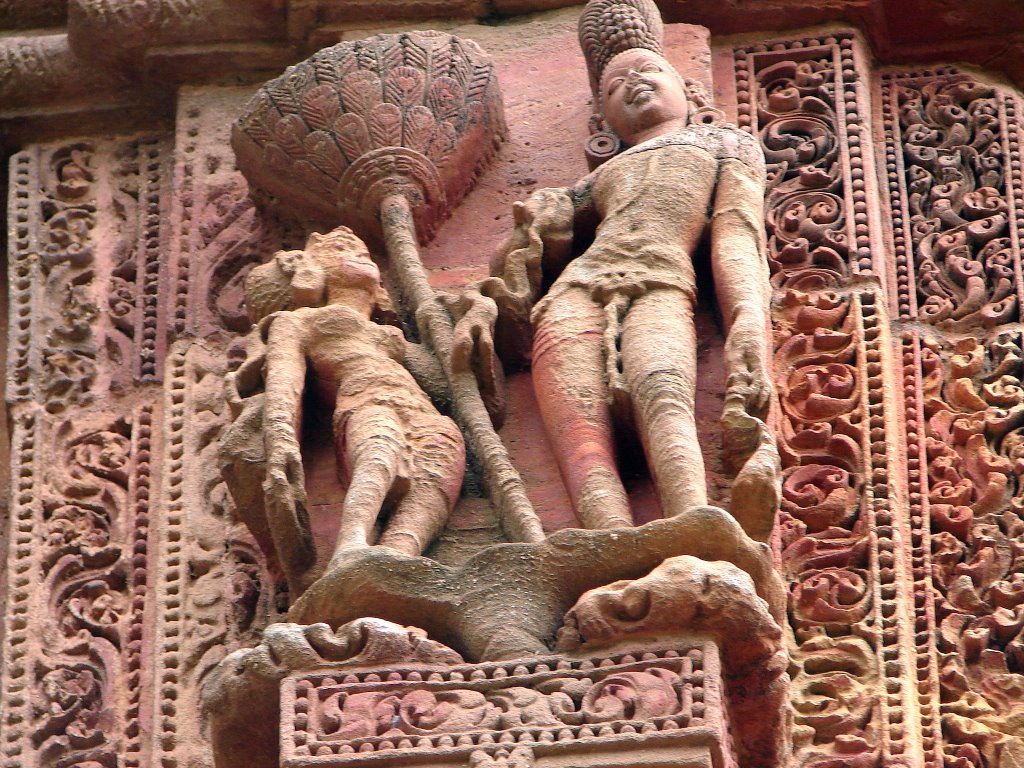
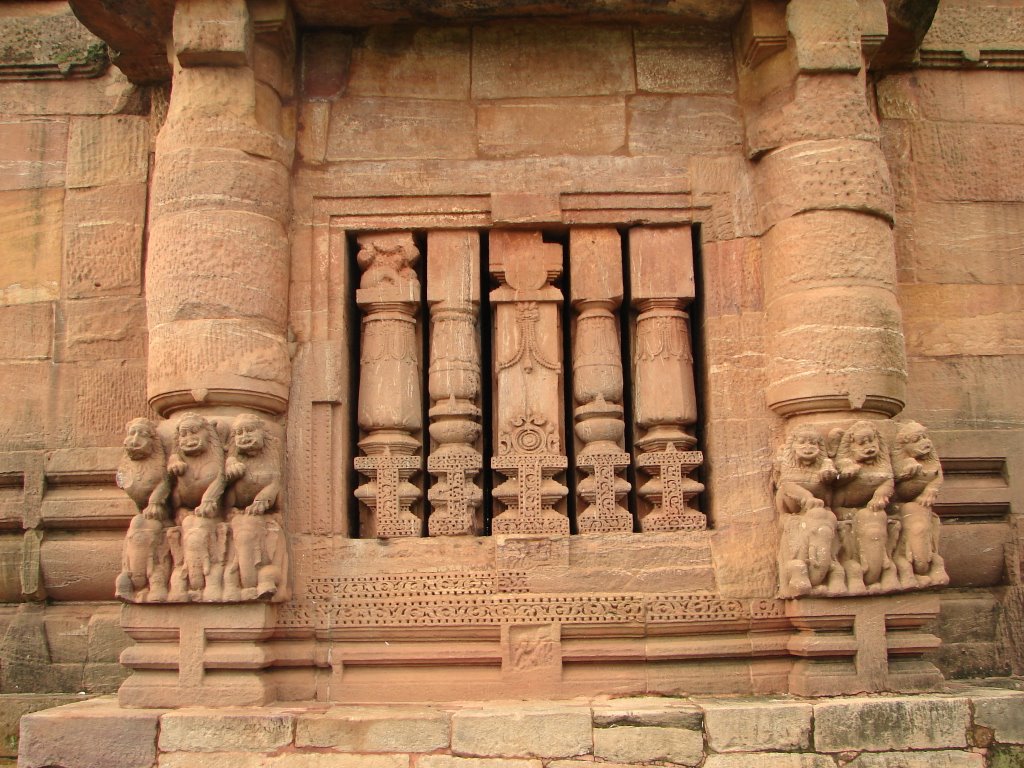
A
few men were exercising in the park. A few women who had finished their
early morning exercises sat besides the temple and began talking.
Though the women were conversing in Oriya and I couldn't understand the
exact details, I think what they were trying to decide was to which part
of the country we belonged. 'U' told me that they thought 'U' was from
Bengal. But I'm sure I heard the word 'Madras' in their conversation.
Well, to most of the people in our country who live in the North, South
India is just Madras and all the South Indians eat only Idli and Dosa!
The knowledge of the North Indians is so limited that they cannot
differentiate between the states in the South. It is sad but true. We
both have all the defining features of the Dravidians and I am sure the
women would have noticed that!
By then I saw an officer at the ticket counter and we went back to buy our entry tickets. We returned to the temple and took some more pictures.
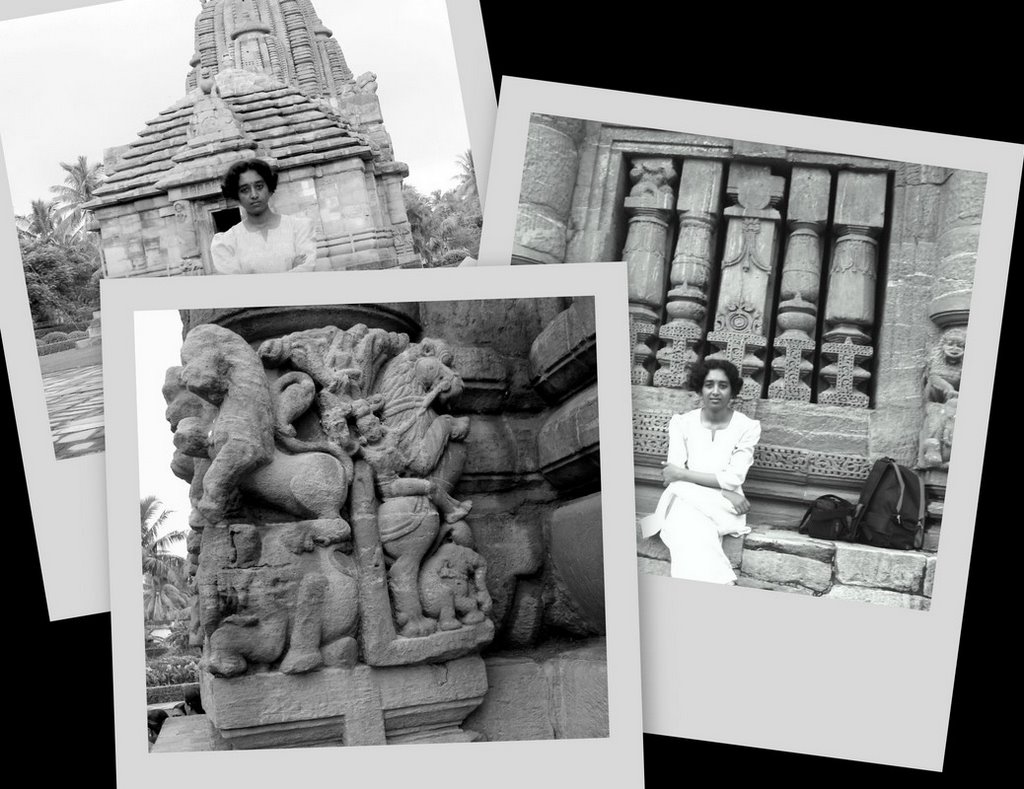
It was 7:30AM and we had to take the guided tour of Bhubaneswar city at 9:00AM. We had just enough time to return to the hotel, have our breakfast and check out of the hotel. We finished our breakfast at the Panth Nivas restaurant and checked out. We kept our baggage at the reception and boarded the bus. We were on our way to "Nandan Kanan"...
Atri
It was cloudy though it had stopped raining. We were disappointed as we couldn't go to the temple complex to watch the sun rise. Since we didn't have anything much to look forward to, we decided to leave immediately rather than wait till 6:30A.M. But we couldn't find the driver. The panth nivas (Govt. guest house) where we had stayed the previous night, was opposite the temple complex. We strolled into the complex hoping to take a few pictures of the temple in the morning. We hadn't been able to get any good pictures the previous evening owing to the heavy rainfall. We weren't very fortunate this morning either.
It was too gloomy and it meant we couldn't get any good pictures. So we didn't buy a ticket to enter the temple complex, instead saw the temple from outside and retuned to Panthnivas. The driver was waiting for us at the reception.
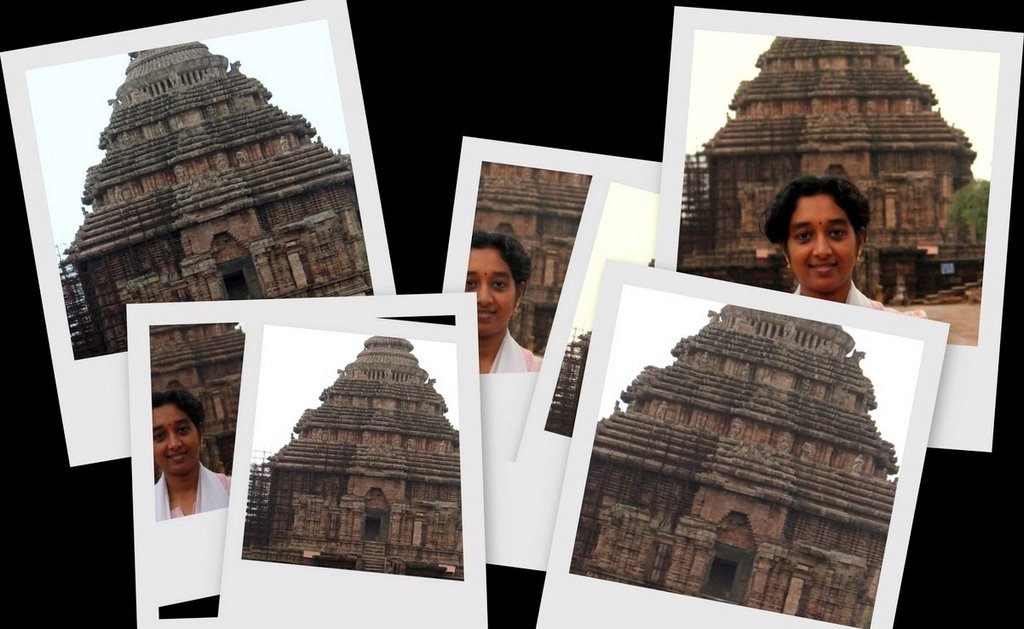
We reached Puri railway station at 8:15A.M. The driver took to us to the ticket counter where at least thirty people had lined up to buy tickets. We would definitely miss the train :(. But the driver walked right up to the ticket counter and asked the man at the counter to give us two tickets to Bhubaneswar. I don't appreciate breaking the discipline and so told the driver that we should probably stand in the queue and wait for our turn. But he insisted that we would miss our train and the man at the counter didn't seem to mind either. He issued two tickets to Bhubaneswar and asked me to pay him exact fare. I handed him a fifty rupees note that he angrily returned and rudly told me to pay the exact change. I don't seem to recall what the fare was but I do remember digging into my purse and pooling all the change I had and paying for the tickets. A few people in the queue expressed their anger by swearing at us in Oriya that I didn't understand.
We ran towards the platform to board the train to Bhubaneswar. We got into a car besides the "vendors car". I had never seen a "vendors car" before. Now I wish I had taken a picture for my memoir.
The train wasn't crowded and we found a seat as well. We reached Bhubaneswar comfortably and walked to the OTDC information centre at the railway station. We booked a tour for the 18th of Aug that included sightseeing of Bhubaneswar city, Dhauli, Khandagiri, Udayagiri and Nandankanan. The tour bus would pick us up from Pantha Nivas the next morning at 9:00A.M. Since the autos in Orissa do not have meters we had to bargain the fare everytime we went someplace. We enquired about the fare that we had to pay the auto driver. The man at the information centre suggested we walk over to the auto stand that was on other side of the station. He advised us to pay 20Rs. We walked over the foot bridge again and took an auto to Pantha nivas.
We checked in at the Panth Nivas. The room wasn't very clean. The beds though were made, didn't look clean enough. It didn't look worth the 400Rs that we had paid for a day. We freshened up and had brunch at the Panth Nivas restaurant. The restaurant walls were decorated beautifully with tribal paintings.
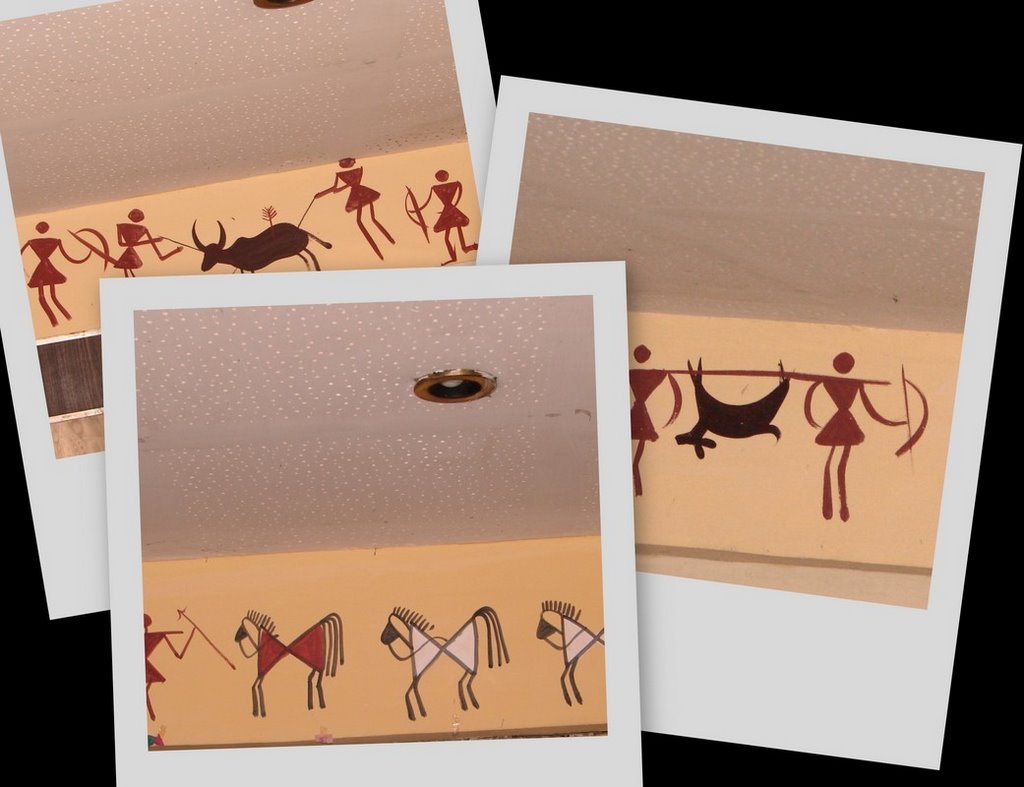
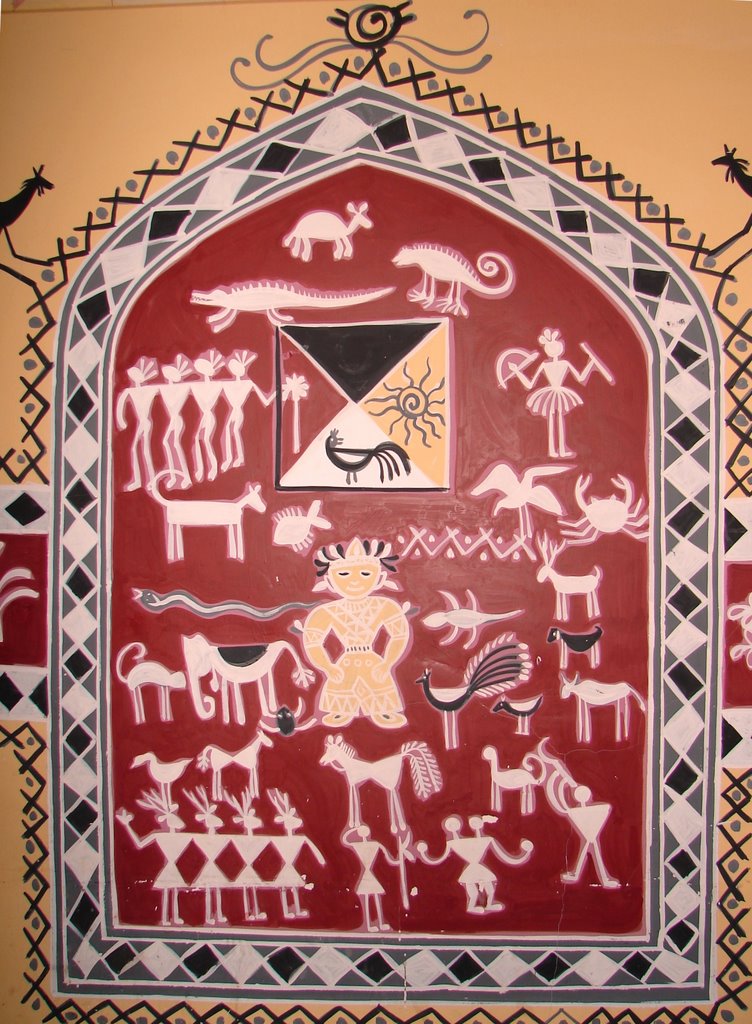
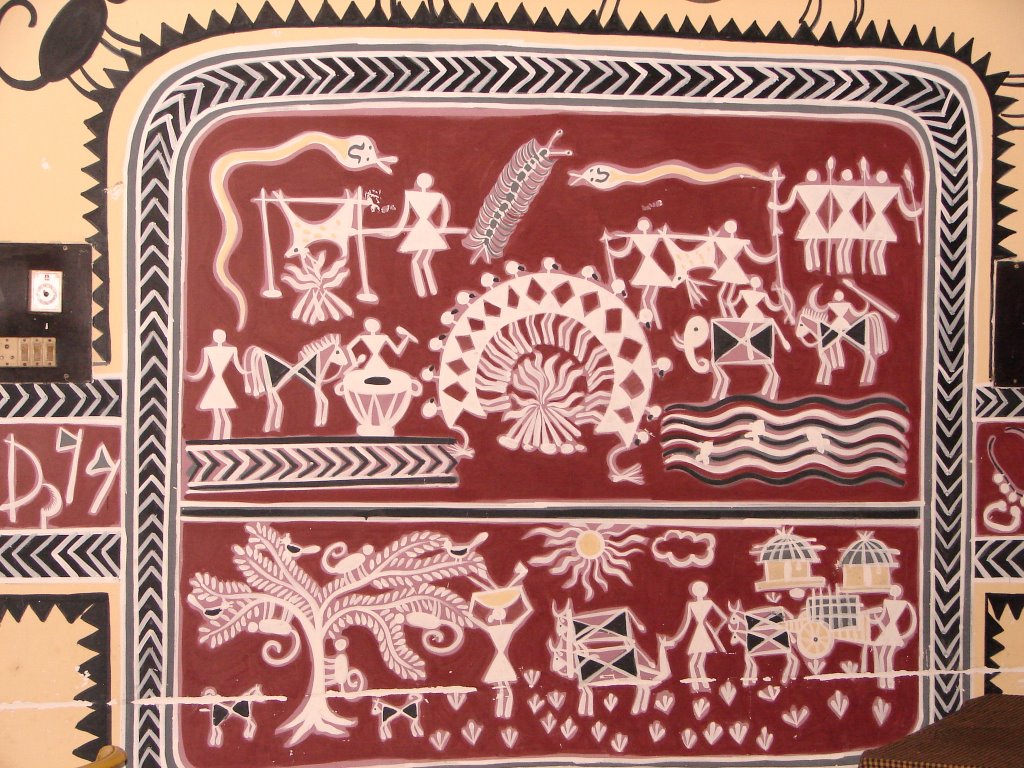
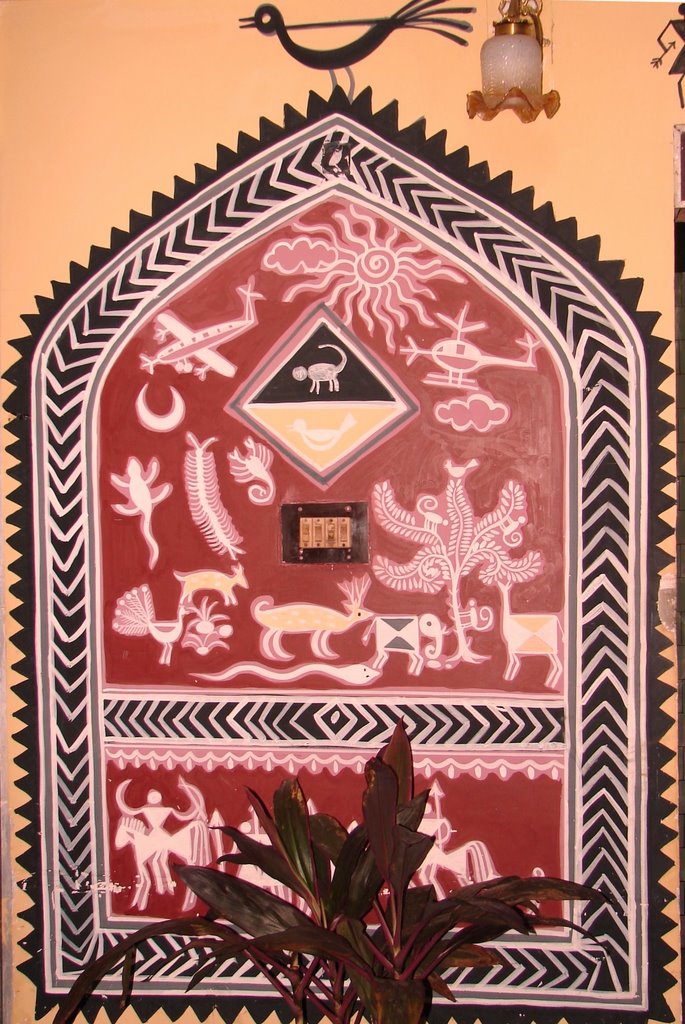
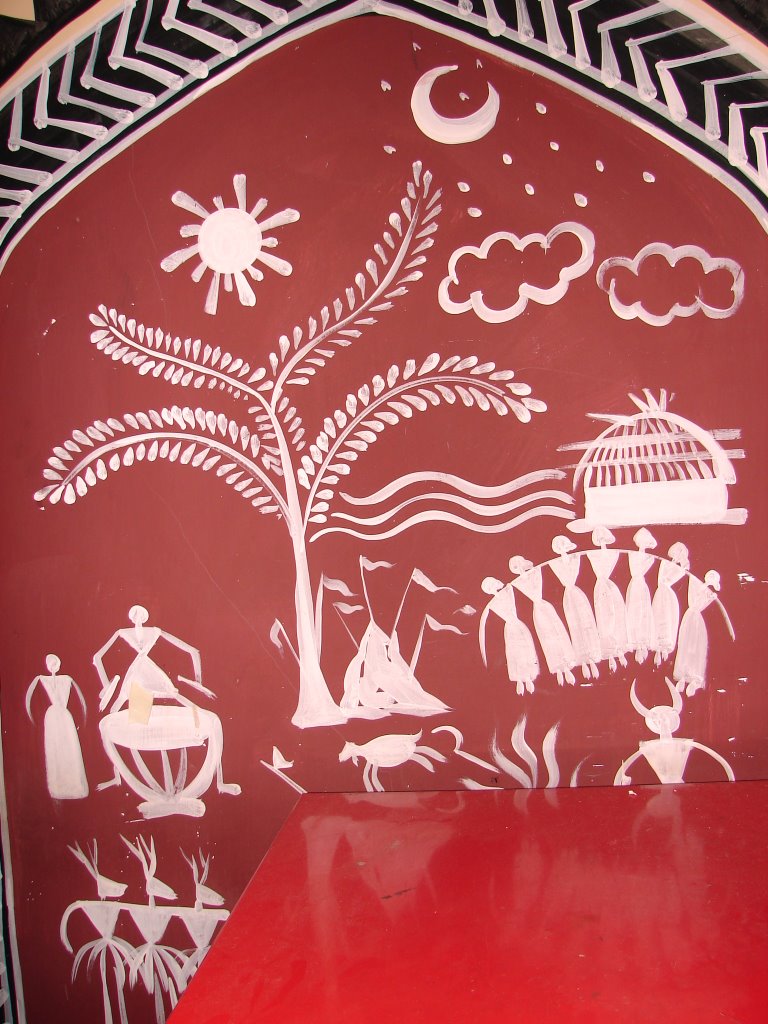
Fortunately the week long strike of the private bus owners had ended and the buses were plying regularly now. As per the Panth Nivas manager's suggestion we took a shared auto to the new bus stand. We shared the auto with a newly married couple who were returning to their village after visiting the lady's uncle in Bhubaneswar. The man was well travelled and he could speak Hindi. The woman was keen to strike a conversation with us but we can't speak Oriya.
There were a large number of buses at the bus station. But none were going towards Atri. The one bus that would go anyplace near Atri was already filled up. The conductor told us to go to the main road and wait for buses from other cities.We waited for a while but all the buses that came there were filled up. A few auto drivers approached us and tried to bargain with us to take us to Atri. We didn't show any interest in their offer. After waiting for a while we were contemplating about taking an auto to Atri when private bus stopped right besides us. The conductor told us that the bus would go to Atri. We told him that we wouldn't be interested in taking the bus unless we could sit comfortably. He asked a few passengers to move and gave us two seats. We were finally on the way to Atri.
After riding on the bus for almost an hour we reached Khorda town. The driver told us that we had to get off as he wouldn't be going any further. I was angry that the conductor had lied to us. We got off at the bus station to wait for the next bus to Atri. All the buses that came to the town bus station were overcrowded. By now it was almost 1:30P.M. and we had to also ensure that we left Atri by 4:00P.M. as there were no buses after that. Left with no choice we boarded the next bus to Atri. I stood on the footboard. Once the bus was out of the station I managed to move further in. I travelled the next 10 Kms standing on one foot. The man standing besides me would literally fall on me everytime the driver braked. I pushed him with my bag a couple of times but he didn't budge. I also warned him few times to stand straight. Seeing me uncomfortable another man who was sitting offered me his seat. By then we had reached Atri and I thanked the man for offering his seat and got off the bus.
Situated amidst greenery and famous for the hot sulphur water spring, Atri, 42 km. from Bhubaneswar and 14 km. from Khurda, is also a holy place with the shrine of Hatakeswar. A bath in the spring water is reputed to cure skin diseases apart from being a pleasant experience.
OTDC also has a pantha nivas in Atri. We didn't see anybody near the guest house though. We weren't surprised!The hot water spring in Atri (or "Otri" as the natives pronounce it) is nothing more than a small well that is a few feet deep. As soon as we got off the auto, a couple of Brahmin priests ran towards us with small brass pictures in their hands. One of them started talking to my friend U. I didn't show any interest in what he had to say as I knew his only intention was to make some money. He drew some water from the well and poured it on U's outstreached palm. Now that 'U' had already taken some water from his picture we had to pay him some money. I didn't resist when he offered me some water next as we had to pay him anywayz...

In all we spent about 15 minutes in Atri. We returned to the main road to wait for the next bus to either Khorda or Bhubaneswar. Fortunately we got a direct bus to Bhubaneswar.
Sun Temple -- Konark
The worship of Sun in India is several centuries old.The Sun God is referred to as Surya or Aditya. The Vedas are full of hymns describing the Sun as the source and sustainer of all life on earth. Several temples in India enshrine Sun as the principal deity.The grandest temple dedicated to Sun God is at Konark.
The Sun temple at Konark was built by Ganga ruler Narasingha Deva to commomorate his victory over the muslim rulers. During his reign he recorded at least three victories over the muslim invaders. The black granite of this structure earned the name 'Black Pagoda' from the 17th C European sailors who must have seen it from the sea.
The fame for this temple had spread far beyod the limits of Orissa in the 16th C. Abul Fazal, the famous chronicler of the court of Akbar wrote "Even those whose judgement is critical and who are difficult to please stand astonished at its sight".

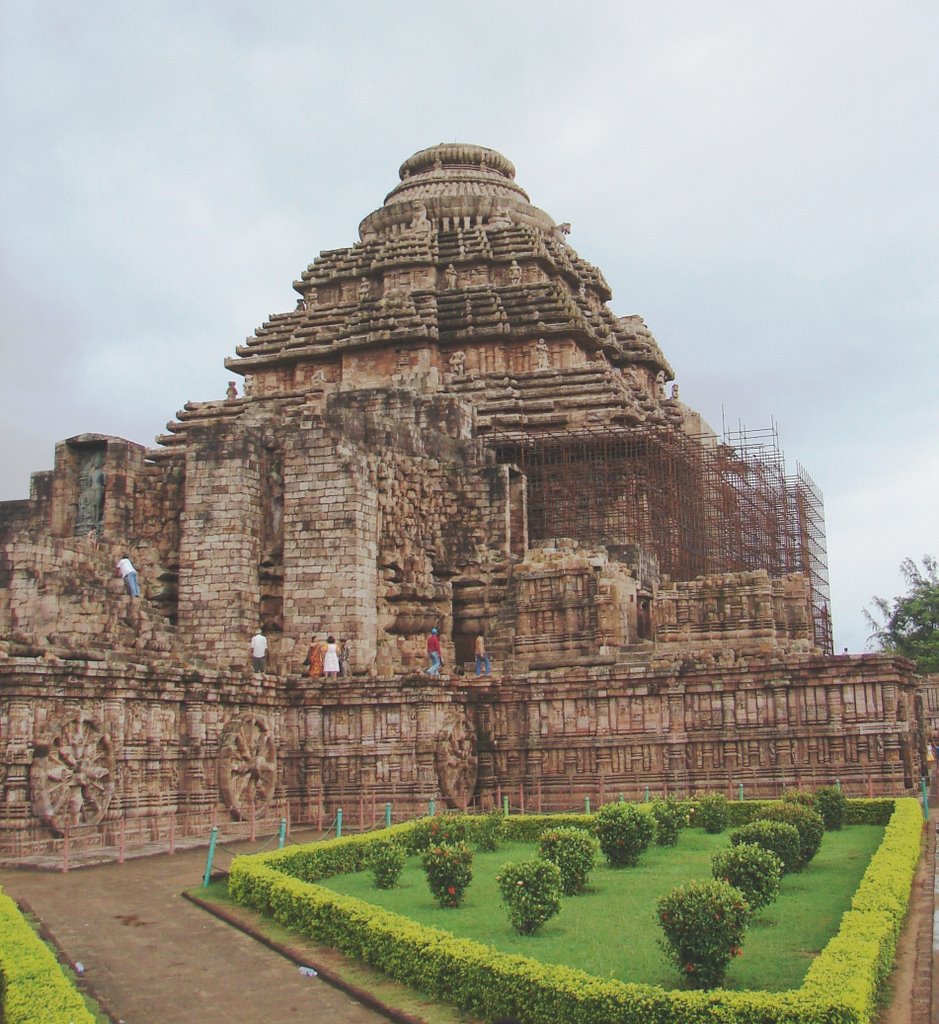
The Ganga dynasty had a militia of 300,000 men with 50,000 foot and 10,000 horses and an elephant regiment of 25,000 strong. The priest at the Jagannatha temple were renouned for their physical prowess and excercised in the religious gymnasia. The higher posts in the army were held by the priestly Brahmin caste. Narasingha himself was renouned for his valour. This combined with the impressive military history, supports the theory that the temple was a colossal tower of victory, erected to the Sun God thanking him for his earthly representative's (King Narasingha Deva) victory over the dreaded Muslim. The profusion of carvings on and around the temple depicting military subjects, seems to confirm it.
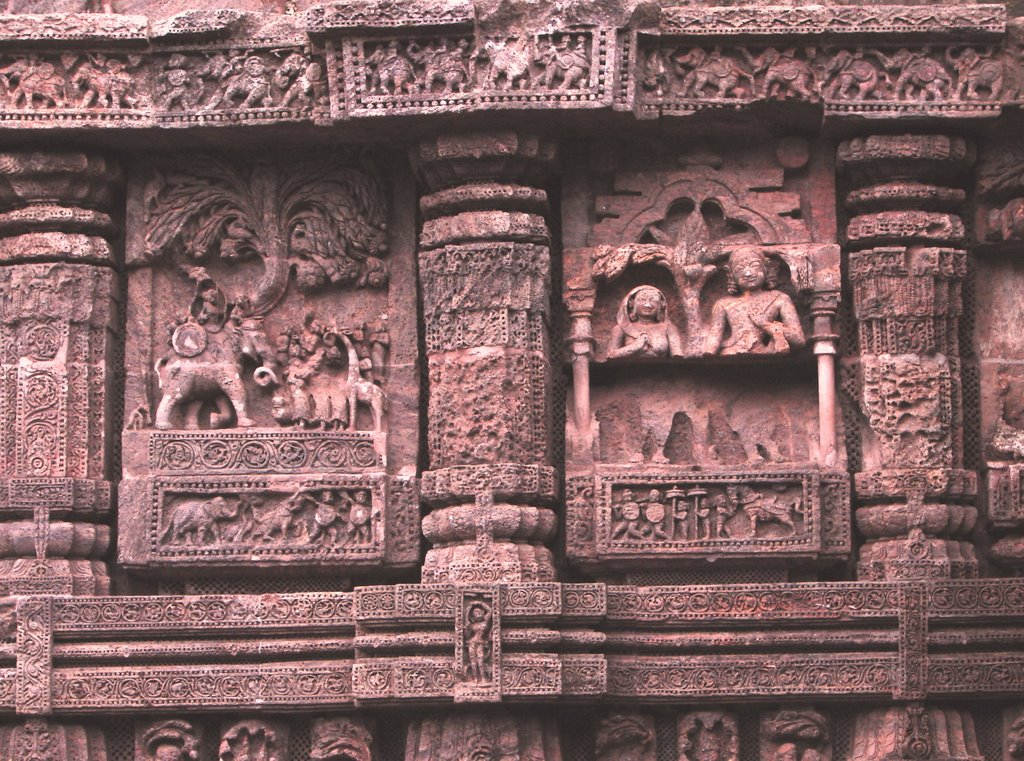
King Narasingha was also known as "Langulia" -- "one with a tail". It is also possible that he built the temple as a supplication to Surya to remove a spinal swelling of some sort.
No one really knows why a temple was built here, but there are many legends that account for its appearance. The most popular legend is that 'Sambha' the son of Krishna built the temple here. Sambha was very handsome and he was proud of it. One day he made the mistake of ridiculing Narada, a celebrated sage who was not renowned for his looks. He decided to take revenge on Sambha.
He lured Sambha into a pool where his step mothers were bathing. Krishna was furious and cursed him with leprosy. When he realised it was Narada who had lured him there, Krishna advised his son to worship the Sun God and hope for a cure. After a penance for twelve years, he was finally cured. Sambha built a Sun temple at that spot. It was called "Konark" --"Kona" meaning "corner" and "Arka" meaning "Sun"; hence "corner of the sun".
The entire temple has been designed in the form of gigantic chariot of the Sun God, taking him across the heaven. On days close to the equinox the Sun would shine at dawn or sunset on the Sun God in the temple, before the idol was removed. The temple has 24 wheels; each with 8 spokes and exquisite carvings. 7 horses drag the chariot. The 7 horses represent the 7 days of the week and the 24 huge wheels represent the hours of the day.Some believe that the wheels represent each month in the Hindu Calendar with the spokes being one of the part of the Hindu day (the wheels represent the 24 fortnights of the Indian year)
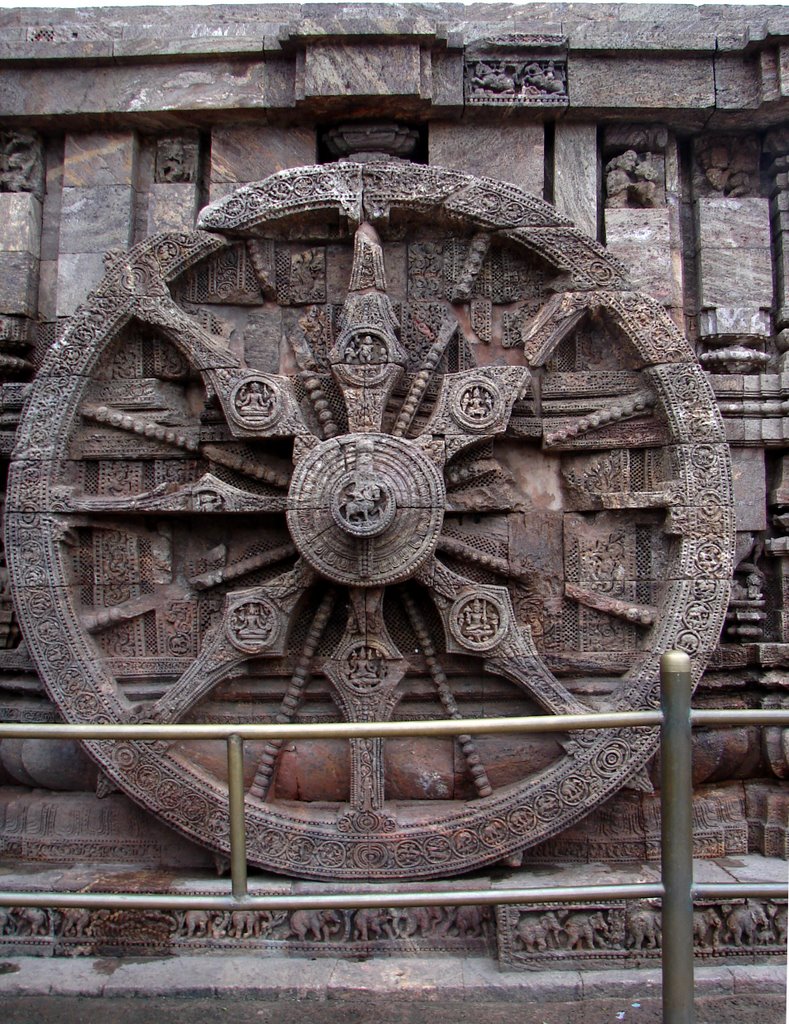
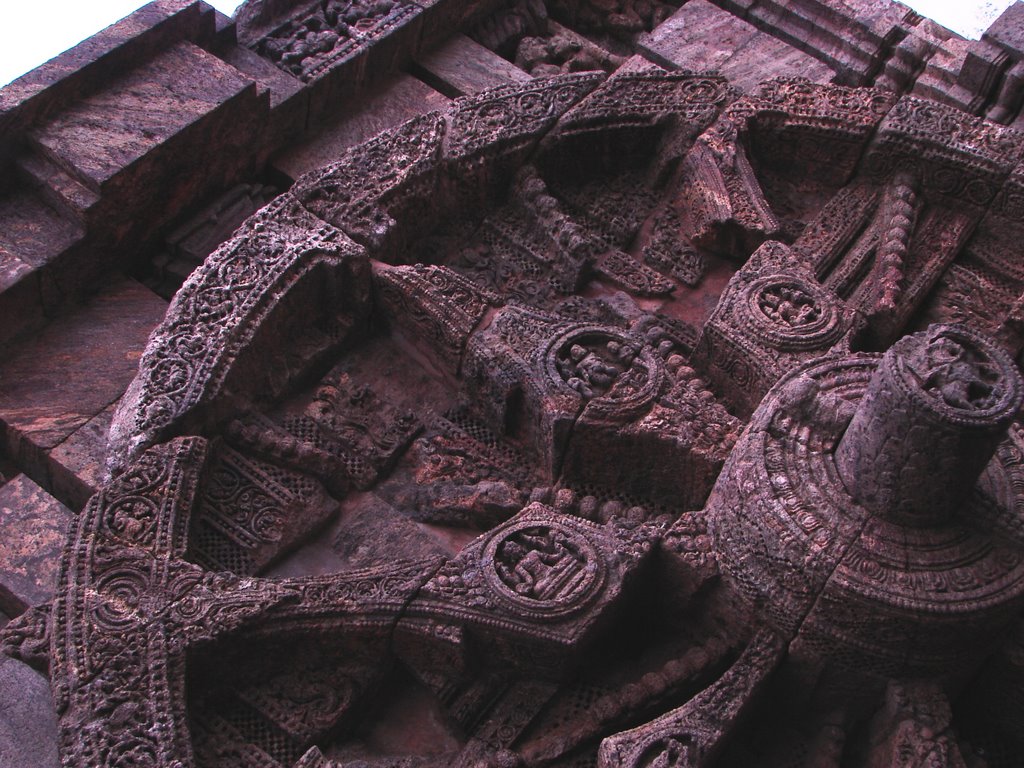
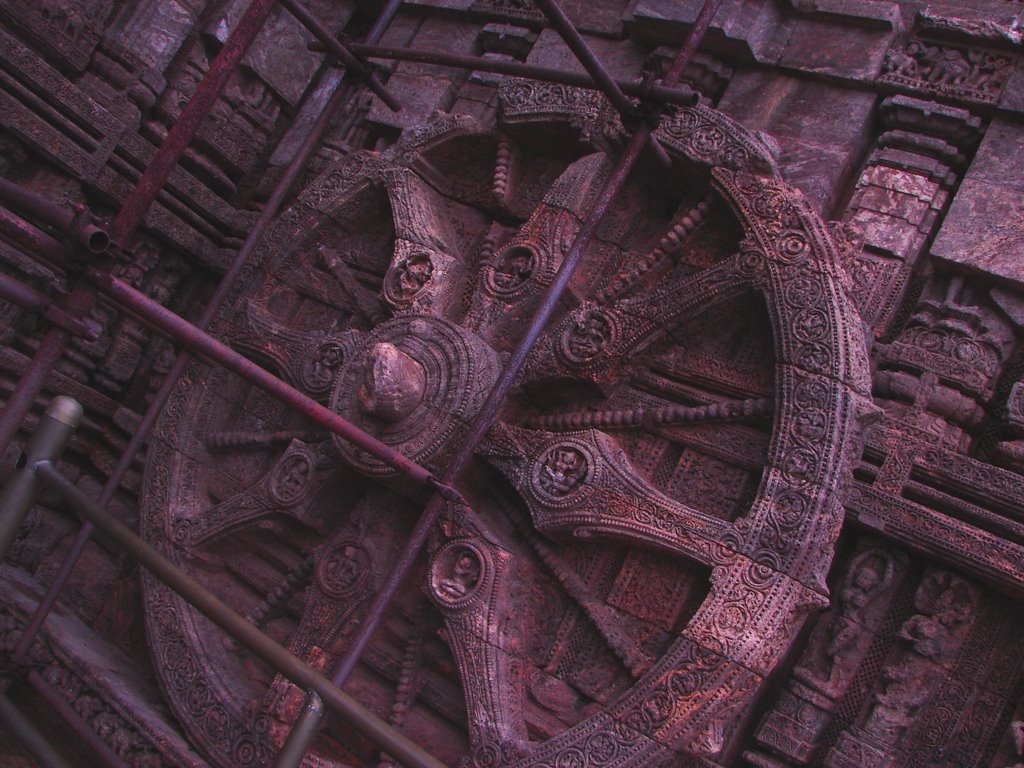
The decorated wheels act as the sun dials. Each wheel consists of 8 spokes that indicate 8 'praharas' of the day, one prahara being equal to 3 hours of time. The hub of the wheel casts shadow on the spokes indicating time.
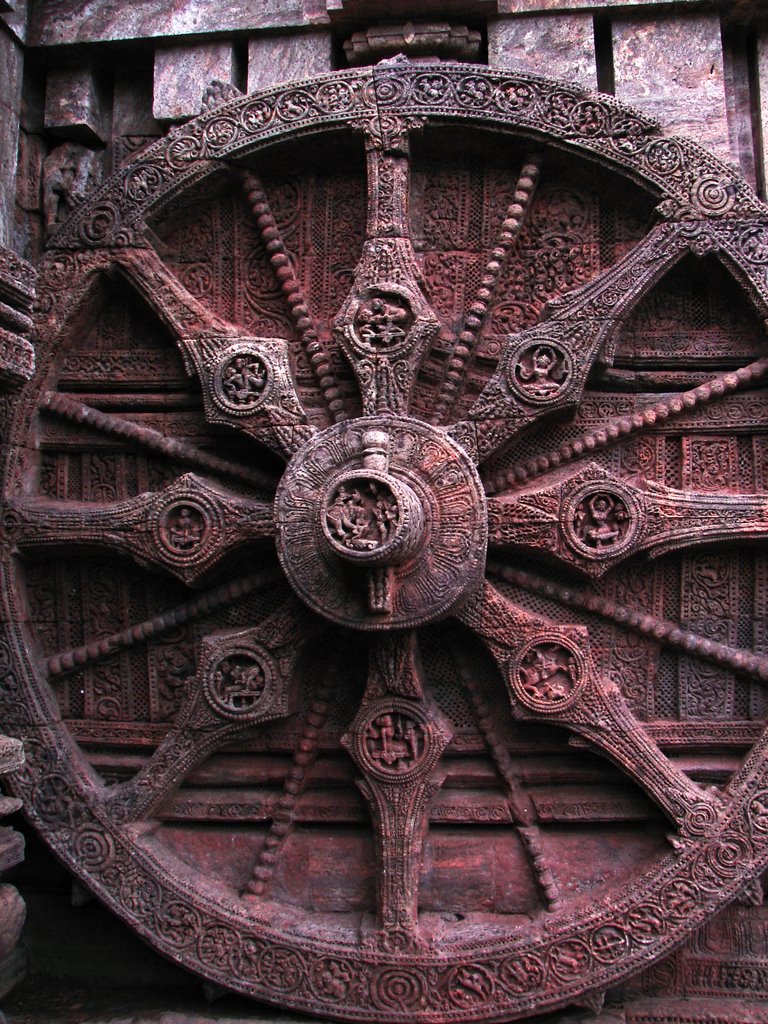
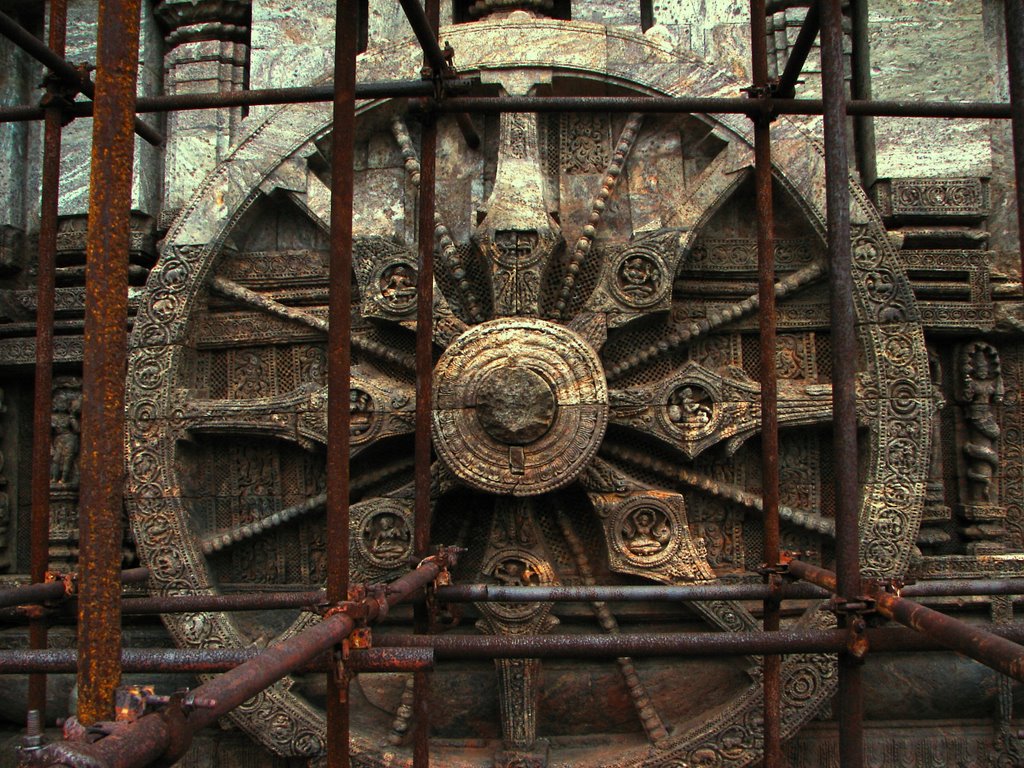
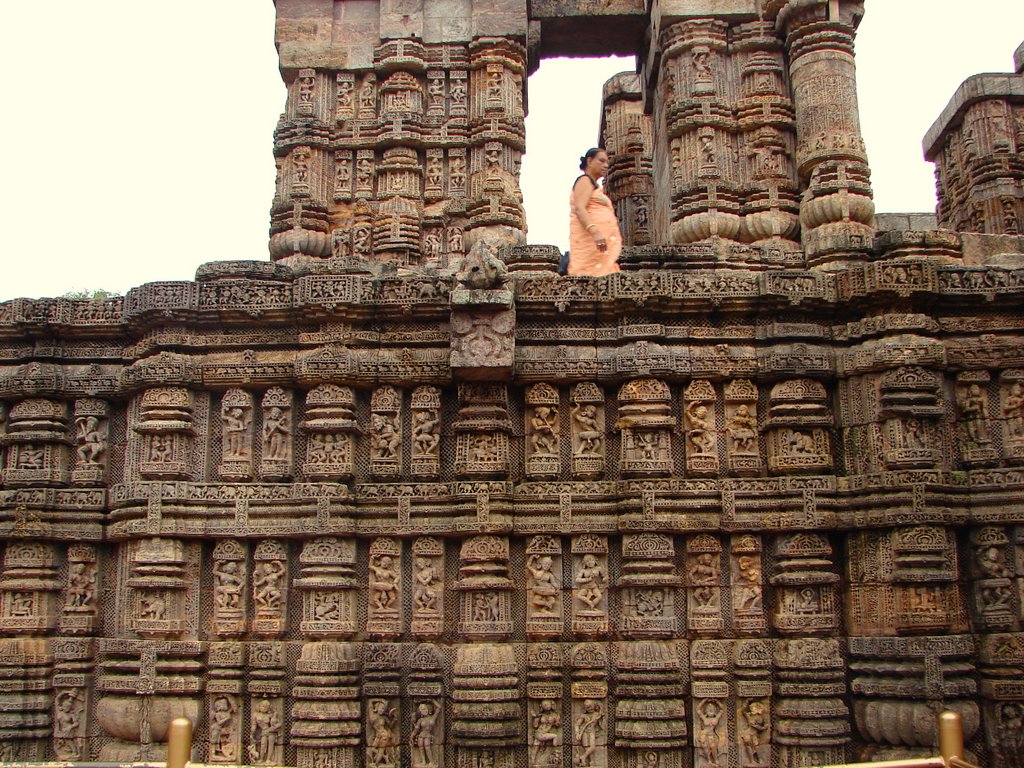 Konark
is not an isolated monument but a whole complex of temples. There is
the main temple which is a combination of several structural elements
like the chariot with the 24 wheels, a platform with a porch, the 'bhoga
mantapa', 'nata mantapa' and the Mayadevi temple. Though the main
sanctum is in ruins, the 'nata madapa' is in tact.
Konark
is not an isolated monument but a whole complex of temples. There is
the main temple which is a combination of several structural elements
like the chariot with the 24 wheels, a platform with a porch, the 'bhoga
mantapa', 'nata mantapa' and the Mayadevi temple. Though the main
sanctum is in ruins, the 'nata madapa' is in tact.

Sensuous Odissi dance poses are found in the sculptures. Traditionally the classical dance form of Odissi was performed as Mahari or Devadasi dance in temples dedicated to lord Jagannatha and also at the Konark sun temple.
With social and political changes in the country and also the supression of the dance form by the British authority the classical dance form moved out of the temples. Young dancers called 'Gotipuas' performed dances outside the temple premises.
This beautiful sculpture at the entrance to the temple is known as "nara gaja simha" (man elephant lion). The sculpture comprises of a man being crushed by an elephant that in turn is being crushed by the lion.
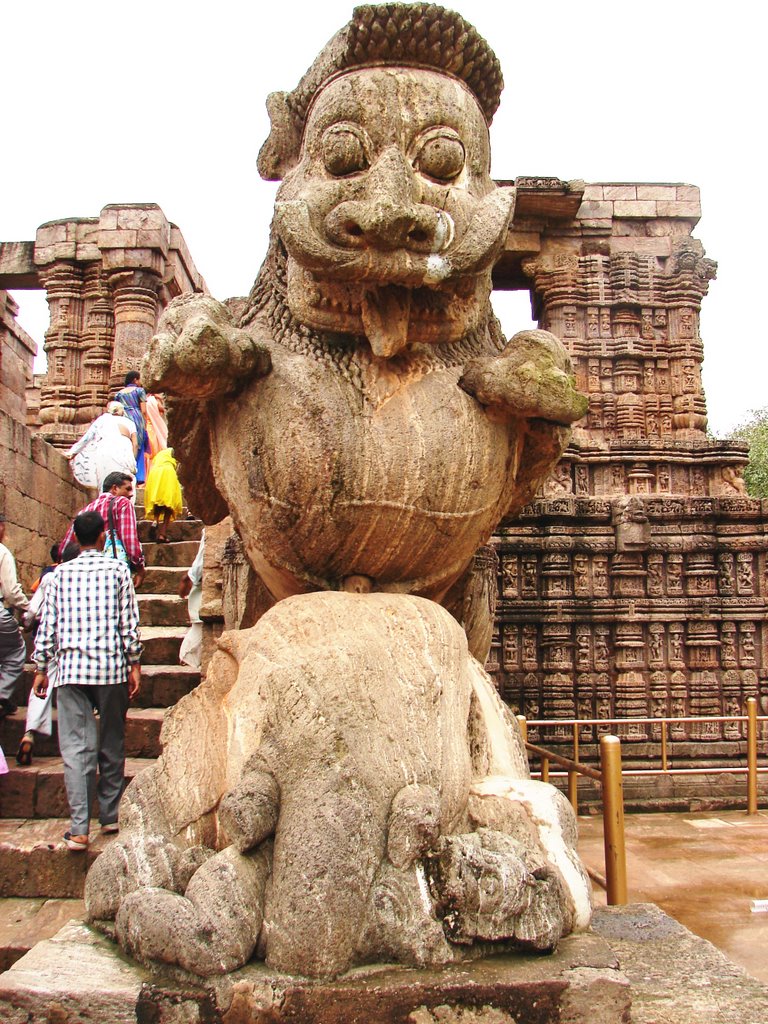

The guide explained to us that
"The man in the sculpture represents us. Born as free men we roam the world and acquire all the wealth. The elephant symbolises the wealth. Obsessed with wealth we commit sins. This wealth (elephant) crushes us. With wealth man acquires power. The lion symbolises the power. This greed for power will consume our wealth and finally crush and destroy us."
Lions gates are an important feature of Orissan architecture. Lions are installed at the entrance of temples. The lions have big sharp noses and thick moustaches.

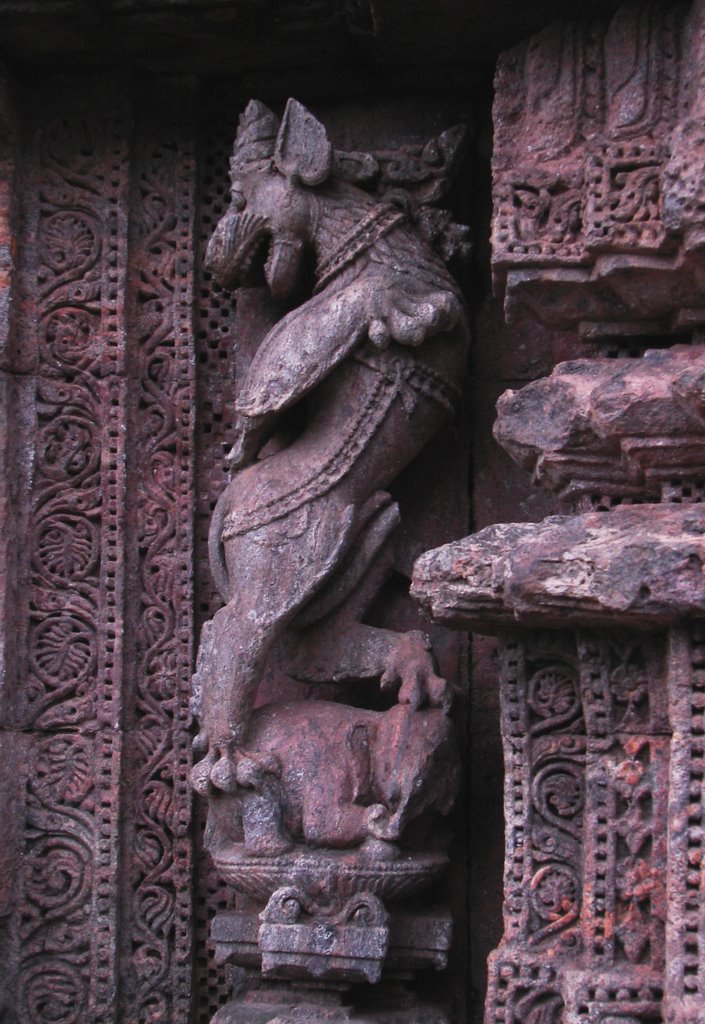
Besides the sculptures of the 'Devadasis' there are also sculptures depicting scenes from every day life. The picture on the left (above) depicts a lady waiting for her husband to return home from work.
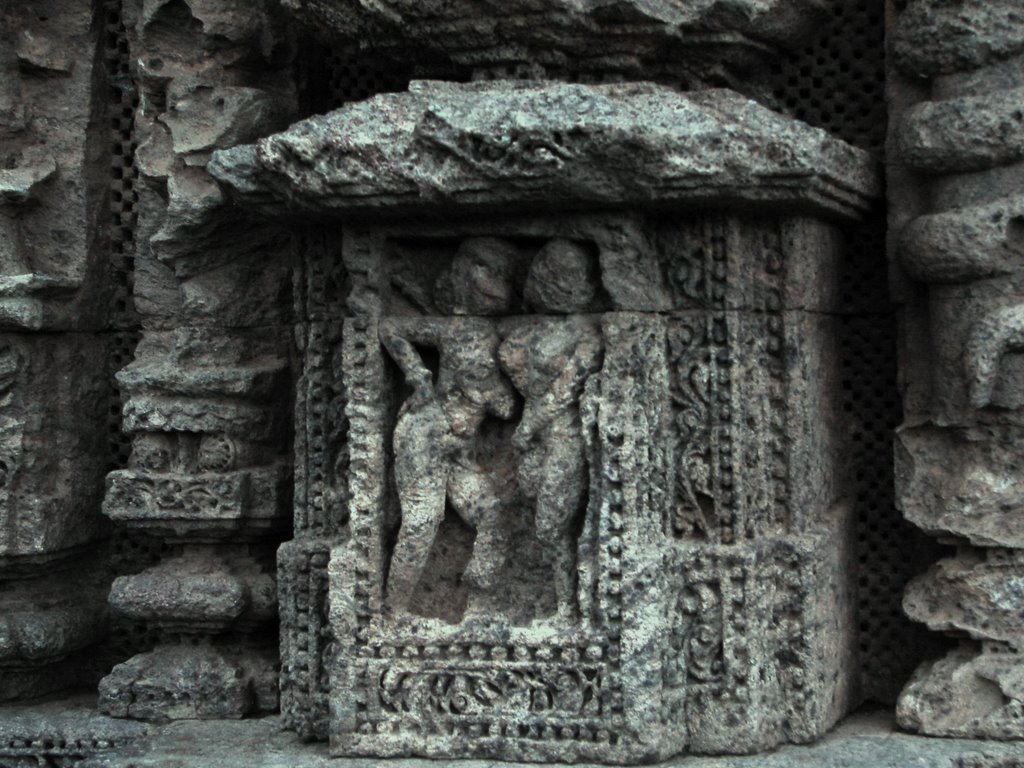
The picture on the left depicts a quarrel between a mother-in-law (the woman on the left with her hand on the hip) and her daughter-in-law.
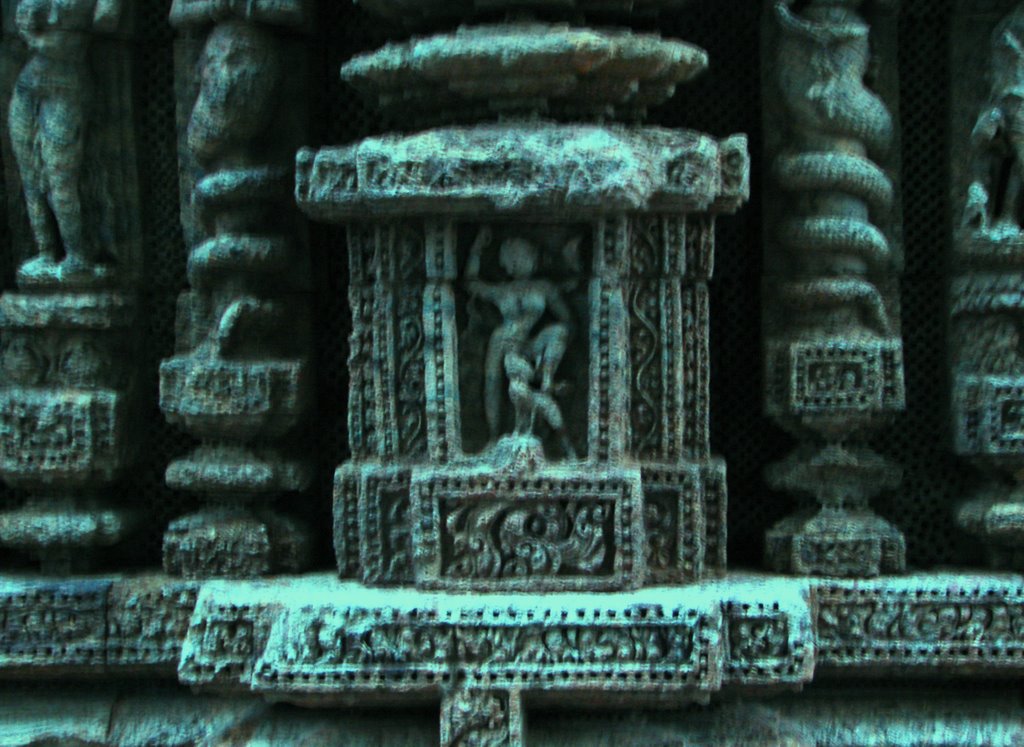
The guide interpreted the picture on the left as a woman seeking the help of a dog to clean up after birthing a child. I am not sure if that is what the sculptor intended it to be.
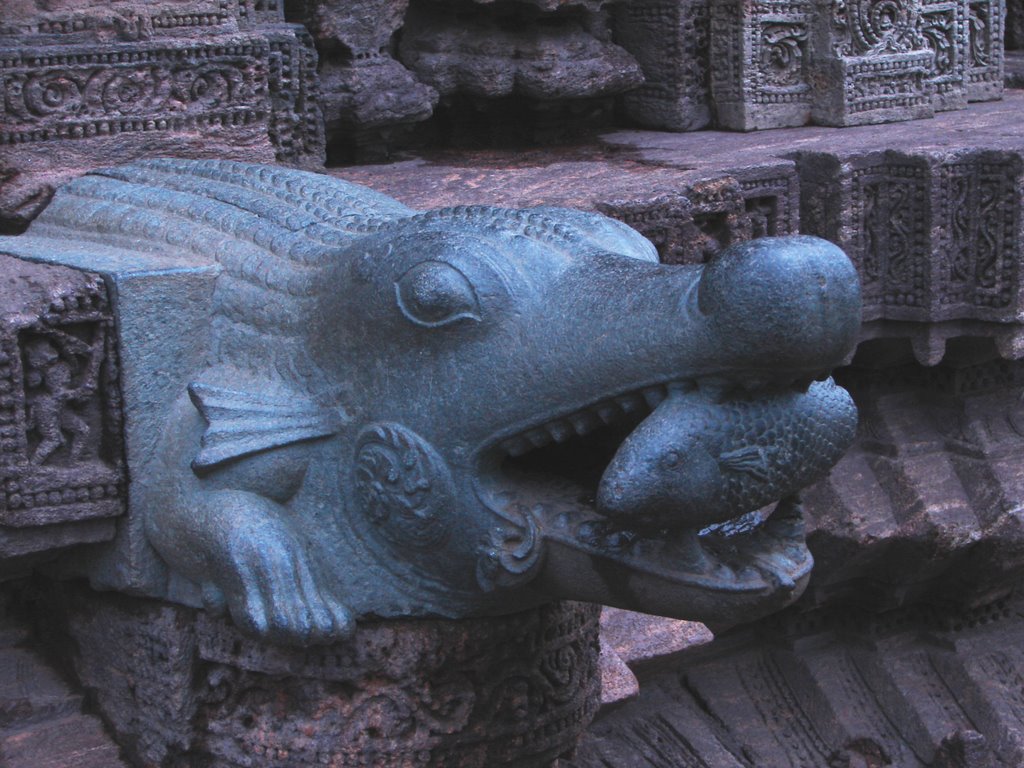 Three different kinds of stones were used in the construction of the
temple. Chlorite was used in the door-frame;laterite in the foundation,
staircase and the centre of the platform. Khondalite was used elsewhere.
It is of poor quality. None of these are available locally. The stones
were smoothly finished and then fitted together. Designs were cared on
them only after that.
Three different kinds of stones were used in the construction of the
temple. Chlorite was used in the door-frame;laterite in the foundation,
staircase and the centre of the platform. Khondalite was used elsewhere.
It is of poor quality. None of these are available locally. The stones
were smoothly finished and then fitted together. Designs were cared on
them only after that.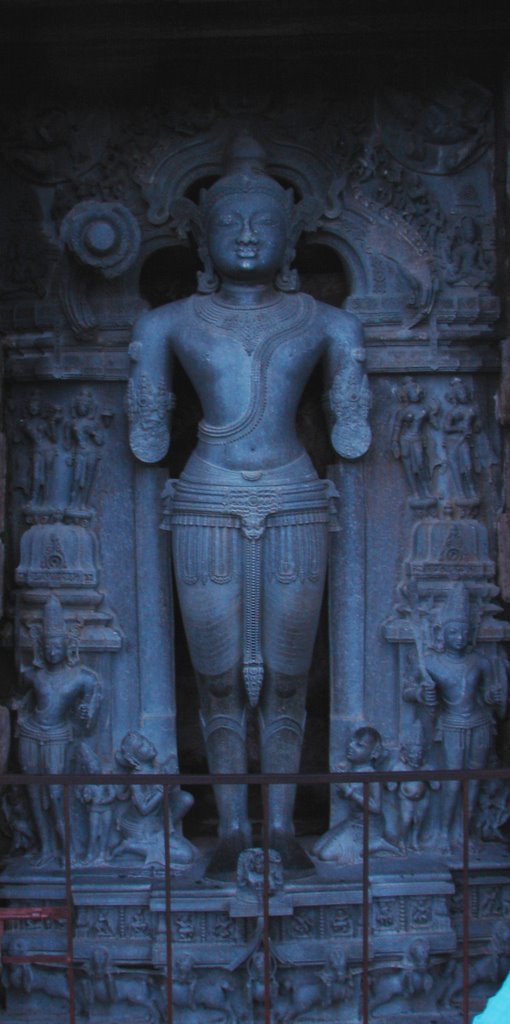
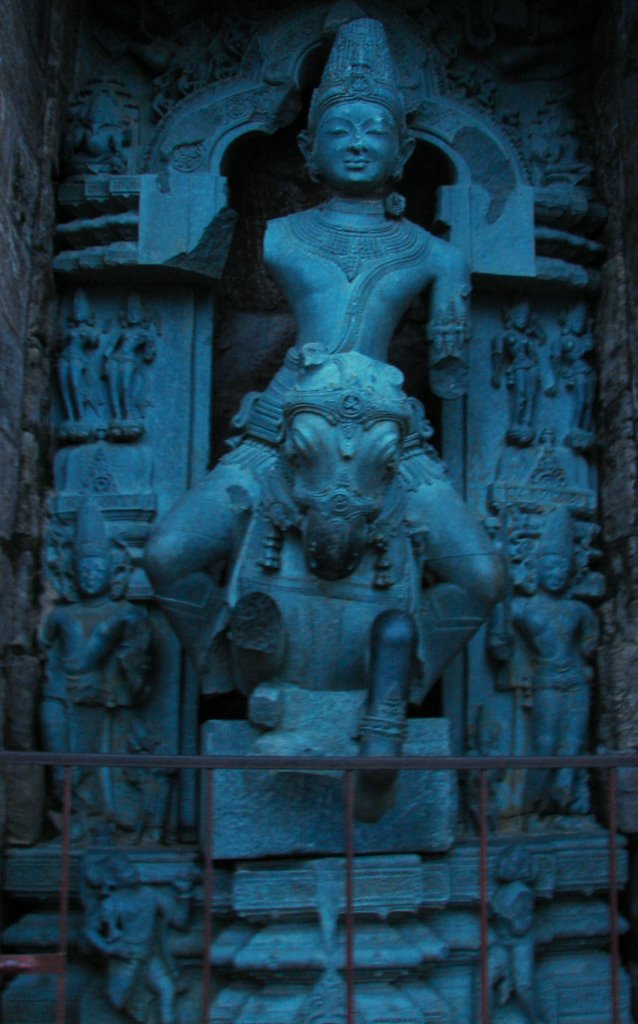

The main idol of the Sun God on which the sunrays used to fall in the morning was removed by some Portuguese navigators. There are three images of the Sun God positioned to catch the rays of the sun at dawn, noon and Sunset.
The sun rays at dawn fall on the first image (top left), on the image at the centre at noon and the rays fall on the image at dusk on the image on the right.
The guide told us that we had to sit for a while in front of the image that catches the sun rays at dawn. This is to please the Sun God that represents the infant Sun. Children often demand attention from everyone; and this image is no different. If you do not pay him all the attention that he seeks, he will be angry! The image that catches the sun rays at noon represents the "youth". The God sits on his horse in the evening as he will be tired after a whole day's job. The sculptors had some imagination!

Of the 22 subsidiary temples that stood in the temple complex, only two remain to the west of the tower: The Vaishnava temple and the Mayadevi temple. The temple of Chhaya devi and her idol are in a desecrated state. The picture above shows one wall of the Chhaya devi temple.
The Hindu mythology syas that for several yugas Aditya was without a wife or a sister and he revolved around the earth once everyday. This made him hot and wild tempered. Brahma realised the reason for the agitation and created Gayathri as his sister. This pacified Aditya. He married Samgnya and their combined influence calmed Aditya.
Samgnya's marriage to Aditya was a love marriage but his heat terrified her. Then Gayatri suggested to leave behind her shadow (Chhaya) to function as Aditya's wife and go back to her parents' house.
When the Sun God discovers the deception, he goes to his father-in-law's house to find out what happened to his wife Samjna. His father-in-law Tvastr explains that his daughter found the Sun too bright to bear. Then the Sun God allows Tvastr to put him on his cutting lathe and shear away the excess brilliance until the Sun becomes beautiful again. Surya then reunites with his wife Samjna.
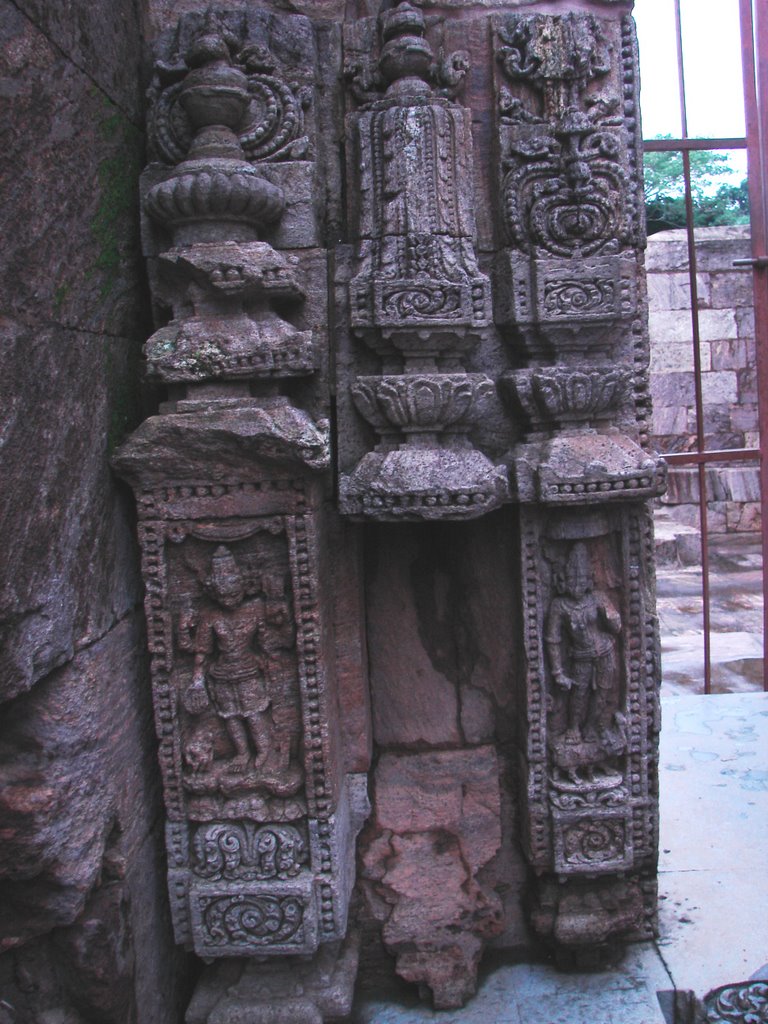

The picture on the left (above) is from the temple of Chhaya devi. The image on the right is Chhaya devi.
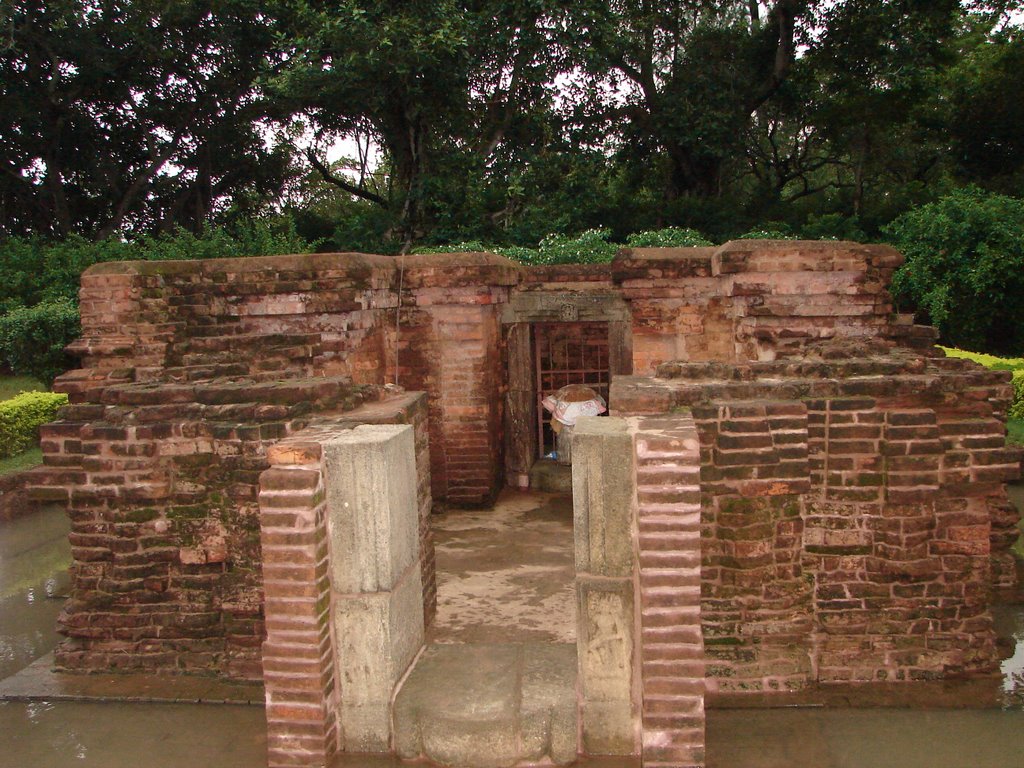
The guide then showed us another structure that he said was the shrine of Goddess Maya devi. He also told us that she was the second wife of Sun God. I haven't really found any evidence on the internet that supports his theory of the Sun God having two wives:). But the guide told us some wonderful stories and he also showed us the entire temple complex.
The temple of Konark is also known for figures of amorous couple. Liberal representation of such erotic figures was a fashion of not just the Hindu temples, but also Jain and Buddhist monuments.

It is believed that erotic sculptures are helpful in warding off the anger of natural calamities. It is described that the obscene sculptures were meant to rouse in the minds of the visitors a sense of what is sensual, therefore avoidable and a sense of what is spiritual, therefore desirable.
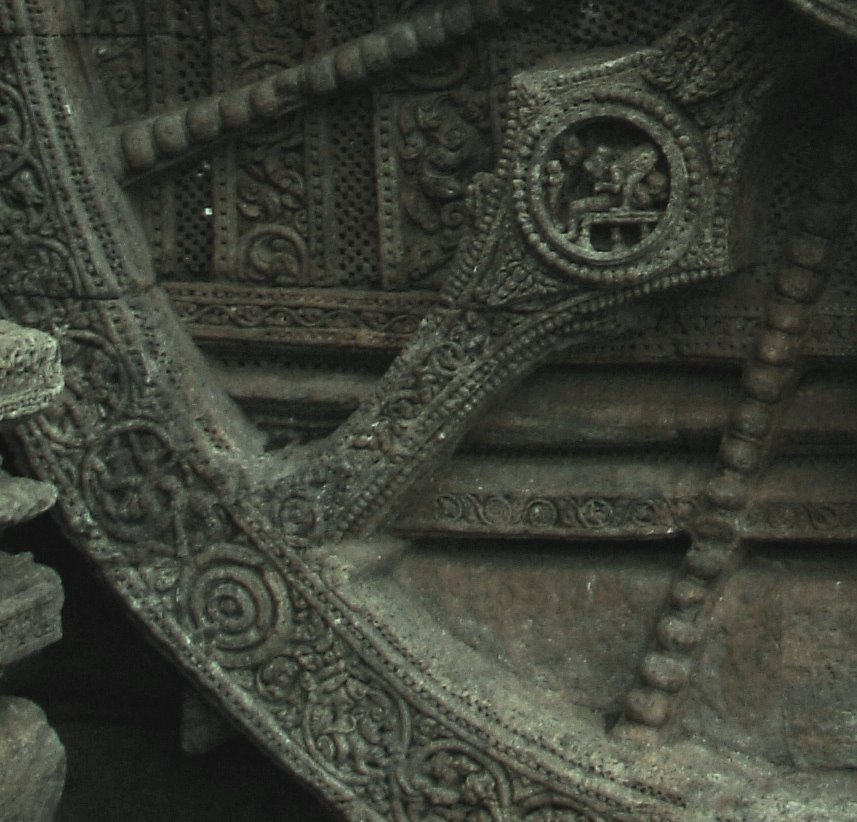

Eroticism occupies almost all segments of Konark temple. The amorous couple, the perfect female figures in seductive poses and their bewitching smiles have made Konark a feast for the eyes of all visitors. Konark stands unrivalled in the domain of romantic art. In the words of Rabindranath Tagore -- " The language of man is here defeated by the language of stone"...
3 comments:
-
Anonymous said...
-
oh my god.. u have put in so much and so many articles.....
-
Swati said...
- This comment has been removed by the author.
-
Swati said...
-
As u said " On days close to the equinox the Sun would shine at dawn or sunset on the Sun God in the temple, before the idol was removed. "
So wanna know that
Now when does Sun rays shine in the center of entry gate ,I mean in which month it gives best view.
Craftmen's village, Ramachandi, Chandrabhaga -- Fishing Village
We visited both the temples, had our breakfast, shopped for souvenirs and still managed to retun to the hostel by 12:00 PM. It was raining and we couldn't go to the beach either. We sat in the hostel waiting for the auto driver. Thankfully, the driver came to the hostel by 2:00 PM.
We left for Konark at 2:10 PM. We stopped at a nearby petrol station to fill the fuel. When we reached the outskirts of Puri town we saw a large plot of land filled with knee deep water. The driver explained to us that the ground serves as a bus station. Government buses from states other than Orissa park their buses here overnight and also the private tourist buses are allowed to park at a nominal fee. The ground is also used by the campers during Puri Rath Yatra.
Since the private buses weren't plying, a lot of villagers were waiting besides the road for some means of transport. To make the matter worse, it was raining. Our driver stopped the auto and offered to drop a woman and her son off at the next village. The woman and the kid sat with the driver in the front.
We then entered the reserve forest area. Driving through the forest was a nice experience. We didn't see any animals, but spotted a few colourful birds. Unfortunately, my camera was packed in the backpack and I couldn't photograph them. We stopped at a craftsmen's village. There were beautiful stone sculptures. The driver explained to us that there was demand for the sculptures even in the state of Andhra Pradesh.


We
spent about 20 minutes admiring the beautiful sculptures.The driver
informed us that he would drive us to Ramachandi next. The woman and her
son were still with us and it didn't seem to me that they stayed
someplace nearby. I invited the little boy to sit with us at the back.
The woman still sat with the driver in the front. We drove for another
10 Kms and reached a village. The woman and her son got off. She
reluctantly handed some money to the driver but he refused. We drove to
Chandrabhaga next.
Chandrabhaga is a beautiful little beach
situated on the confluence of the river Khushabhadra and Bay of Bengal.
Ramachandi the presiding deity of the Konark region is worshipped here.
Ramachandi According
to a legend, the temple of Goddess Ramachandi was to the south east of
the Konark Temple. Suleman Kalapahad a muslim ruler attacked Konark and
destroyed the sun temple. He then came to the Ramachandi temple to
destroy it. Goddess Ramachandi dressed as a maid servant (maluni) and
told Suleman to wait at the door till she returned with water for the
Goddess. Kalapahad waited for a long time and when the Maluni did not
return, he entered the temple. The throne of the goddess was empty. He
suspected that the Maluni had carried away the idol of the Goddess with
her. He went in search of the maluni and reached the banks of the river
Khushabhadra. He saw the goddess floating in the river. He was unable to
cross the river as it was flowing in full spate.
According
to a legend, the temple of Goddess Ramachandi was to the south east of
the Konark Temple. Suleman Kalapahad a muslim ruler attacked Konark and
destroyed the sun temple. He then came to the Ramachandi temple to
destroy it. Goddess Ramachandi dressed as a maid servant (maluni) and
told Suleman to wait at the door till she returned with water for the
Goddess. Kalapahad waited for a long time and when the Maluni did not
return, he entered the temple. The throne of the goddess was empty. He
suspected that the Maluni had carried away the idol of the Goddess with
her. He went in search of the maluni and reached the banks of the river
Khushabhadra. He saw the goddess floating in the river. He was unable to
cross the river as it was flowing in full spate.
Another legend
says that Goddess Ramachandi appeared as a old woman and served
Kalapahad with cold water to quench his thirst. When the King drank
water he looked up and didn't find the old woman. The idol in the temple
had disappeared too.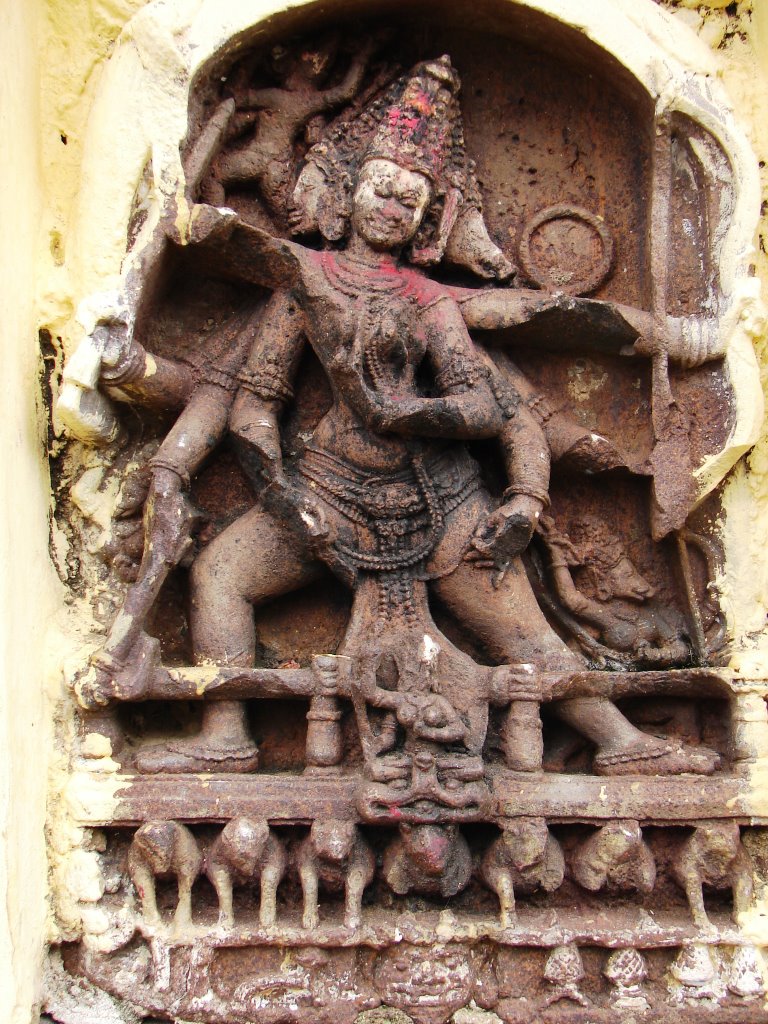
The
goddess appeared in the dream of a Panda (priest) and advised him to
build a temple for her on the banks of river Khushabhadra. Accordingly,
the priest built a temple for the goddess near the sea shore.
Chandrabhaga -- Fishing Village
According
to a myth, the Sun God is believed to have sought a beautiful maiden
named Chandrabhaga. Sadly though, the affection was not returned. This
drove the Sun god crazy. He suffered humiliation and in utter despair he
chased her right up to the shore. Chandrabhaga drowned herself in the
sea. In rage and remorse Chandrabhaga's father sage Sumanyu cursed the
Sun god that the temple would fall into ruins.
Another version of
the legend narrates that Sun god soght the beauty of a Sea-maiden and
chased her. After chasing her up to this place, she is said to have
disappeared into the sea.
A river by the same name is supposed to
have existed 3Kms from the Konark temple, where, as another legend
goes, Shamba, the son of Lord Krishna prayed to Sun God for 12 years to
be cured of leprosy. Though only a small lake now exists here, religious
festival (Chandrabhaga mela) is held here in memory of Shamba's
successful penance.It is believed that whoever takes bath in
Chandrabhaga will be cured of leprosy and bareness.
Bishnu
Maharana's artistic vision conceived the 13th C stone marvel at Konark.
Bishnu's 12 year old son, Dharmapada (Dharma) a prodigy, meets his
father for the first time after years of absence from home. He
accomplished the task of crowning the monument with the cupola after
numerous unsuccessful attempts by Bishnu and his 1200 masons. King
Langula Narasimhadeva had set the dead line of Magha Saptami for the
masons. Dharma's joy of having saved the crew from certain death for not
completing the task before the dead line was short lived. The King
learns the truth and commands Bishnu to single out the achiever. Dharma
throws himself from the pinnacle into the swirling waters of the
Chandrabhaga river below.
According to another legend, Sibei
Santara was the chief architect of Konark temple. Chandrabhaga was
chosen as an ideal site for the construction. The spot was so deep that
the king had to stockpile hundreds of cart loads of boulders into it.
The sea waves would wash them away within no time. Radhaba, a legendary
sea fish is said to have devoured all the stones. The operation was
suspended for a while until a suitable alternative could be found.
Once
Sibei was passing through a village at night. An old woman invited
Sibei and offered a plate of hot porridge. Sebei dipped his fingers in
the middle of the plate and burned them. The old lady told him not be
like Sibei. Sibei had not revealed his identity until then. The old lady
narrated the obvious shortcomings of the plan to build up a foundation
at the centre of the sea instead of starting it from a corner. Sibei
learnt from his mistakes and tried afresh and succeeded in his
endeavour.
The Hathigumpha (at Dhauli) inscriptions of
Kharavela(1st C BC)infers to the existence of a navy. It also indicates
that Ashoka (Maghadhan emperor) invaded Kalinga to acquire the sea ports
as Maghadha did not have a port of its own. The Tugu rock inscription
of western Java says that a river by name Chandrabhaga was regulated by a
canal. Though there is no river now, a small lake by the same name
exists.
The fishing community in Chandrabhaga consists of almost entirely the migrants from Andhra Pradesh. They have lived here for a very long time but they do not have any land rights. The local government intends to make Chandrabhaga a tourist spot and repeatedly evicted the community from their homes and destroyed their dwellings. The villagers were given some land elsewhere and permitted to construct their homes on the new land. The cyclones came just as things were settling into a routine and destroyed everything...


A small bridge leads you to the village or rather it used to lead you to the village. It was broken when we went to Orissa in the month of August 2006. It still probably is!
We had to reach Konark before the temple complex closed at 6:00 PM and it looked like it would start pouring any minute.So we dropped the visit to Chandrabhaga light house from our itinerary and drove to Konark.
1 comment:
-
Vinutha and Lingaraj said...
-
the sculptors r amazing.. what did they cost ???
if the legend of Dharmapada is true.. it is sad!!
Walking the streets of Puri
 We were up and ready, early the next morning. My friend wanted to play
in the sea for a while before we went to the temple. Though I am not
fond of playing in water, I didn't mind strolling on the beach. The
beach was just about 100 Mts from our hostel. But it was raining cats
and dogs. I wasn't too disappointed, but my friend was. We waited in the
hostel for the rain to stop. After a while, it stopped raining and we
grabbed our raincoats and cameras and went to the beach.
We were up and ready, early the next morning. My friend wanted to play
in the sea for a while before we went to the temple. Though I am not
fond of playing in water, I didn't mind strolling on the beach. The
beach was just about 100 Mts from our hostel. But it was raining cats
and dogs. I wasn't too disappointed, but my friend was. We waited in the
hostel for the rain to stop. After a while, it stopped raining and we
grabbed our raincoats and cameras and went to the beach.There weren't many people on the beach as the sky was filled with dark clouds and it looked like it would rain the whole day.
 We strolled on the beach for a while. We had heard that Puri beach was
better than the Gopalpur beach. But all we saw on the beach that day was
rotten leaves that had floated with the rain water, plastic bags,
stinking food dumped by the tourists and garbage that had flowed into
the sea. The warden later informed us that the main beach was at least
about half a kilometer from the hostel.
We strolled on the beach for a while. We had heard that Puri beach was
better than the Gopalpur beach. But all we saw on the beach that day was
rotten leaves that had floated with the rain water, plastic bags,
stinking food dumped by the tourists and garbage that had flowed into
the sea. The warden later informed us that the main beach was at least
about half a kilometer from the hostel.There were a few "pearl" vendors trying to sell off some cheap imitation of the pearls as real ones. Some older men were actually buying them! Just when we thought it had stopped raining... it started pouring again :(. That ended our early morning walk on the beach :(.
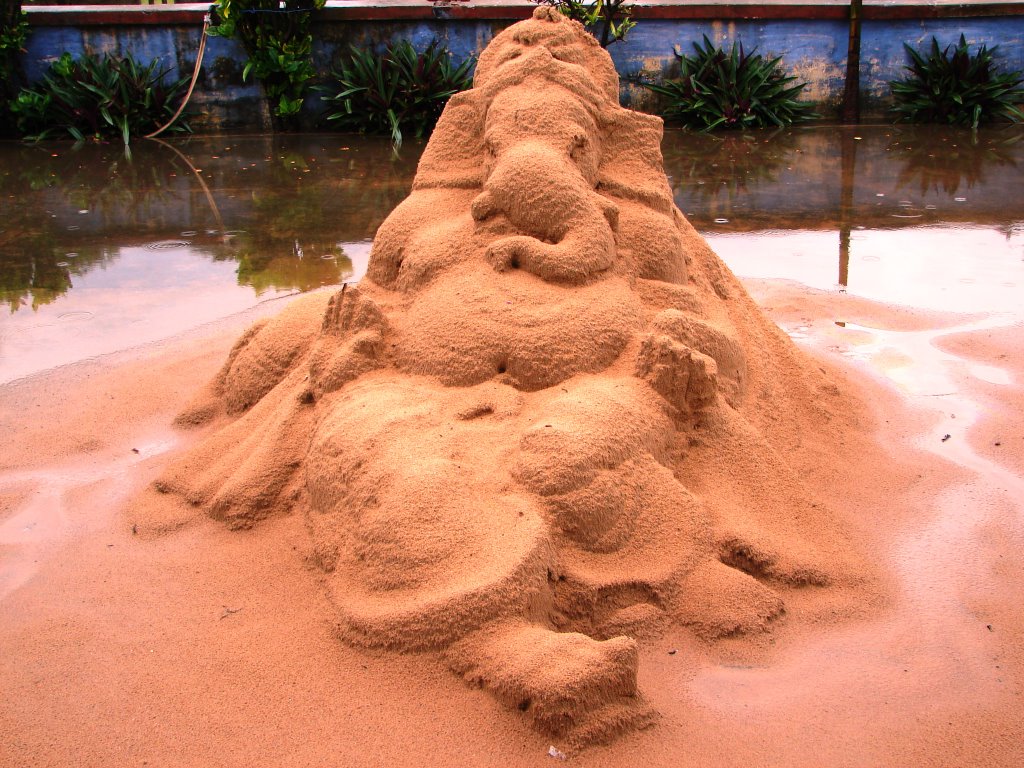
We went back to the hostel to wait for the rain to stop so that we could go to the temple again and take some pictures. We hadn't noticed the Sand sculpture of Lord Ganesha in front of the hostel when we left for the beach in the morning. But now that we had to wait until the rain stopped, we had sufficient time to notice things and that was when we spotted this sculpture. Probably one of the members attending the 'art of living' course organised at the hostel had sculpted this.

The downpour gradually turned into a drizzle and we took a cycle rickshaw to Gundicha mandir. We took few pictures of the temple and also bought some books at the temple book store. I purchased 'Purushottama Kshetra' by Ramachandra Mishra. We had asked the cycle rickshaw to wait for us for a while and then take us to Jagannatha mandir. It was still drizzling and the cyclewallah had covered his head with a cloth. I was feeling bad for making him wait in the rain. I purchased the book quickly and waited for my friend to join me.
Since we hadn't eaten our breakfast we asked the cyclewallah to take us to 'Nandan' restaurant. The restaurant was situated on the same street as Gundicha and Jagannatha mandir.


The rickshaw stopped at an unusual signal. The signal had boards that read 'STOP'. The traffic policeman would then place a card that read 'MOVE' covering the 'STOP' signal to allow the traffic in one direction. The number of vehicles on that road were so few that there was no need for a signal to control the traffic.
There was just another person besides us in the hotel. His mobile was ringing incessantly; but he seemed to be least bothered. Either he didn't realise that the mobile was ringing or he wasn't deliberately receiving the call. It seemed highly unlikely that he didn't realise the phone was ringing. Finally the man picked up the phone after it rang for almost ten minutes.

There is a temple right beside the hotel. We guessed that it was a Jain mandir and were expecting to see the images of Mahavira or the thirthankaras.

But when we peeped in, we realised that the temple wass dedicated to Radha and Krishna. There was also a cradle in the corner, in which was placed an image of 'Bala Mukunda'.
We then went shopping for few souvenirs to gift our family and friends. I spotted a house that had some unusual design patterns on the way to the temple of Jagannatha.


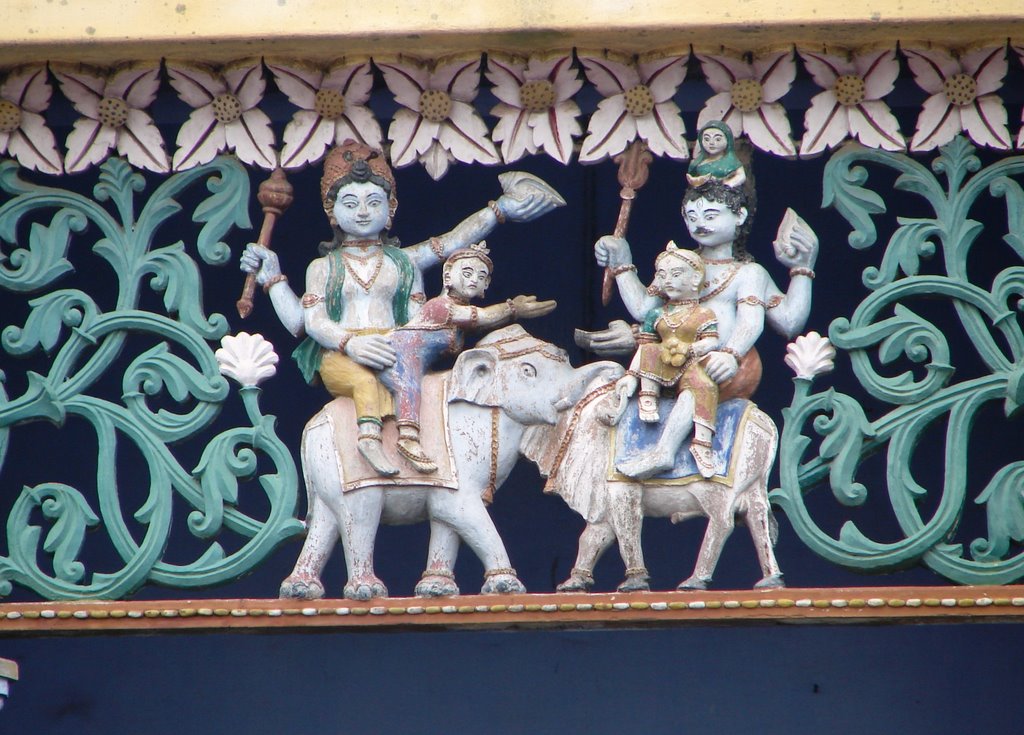
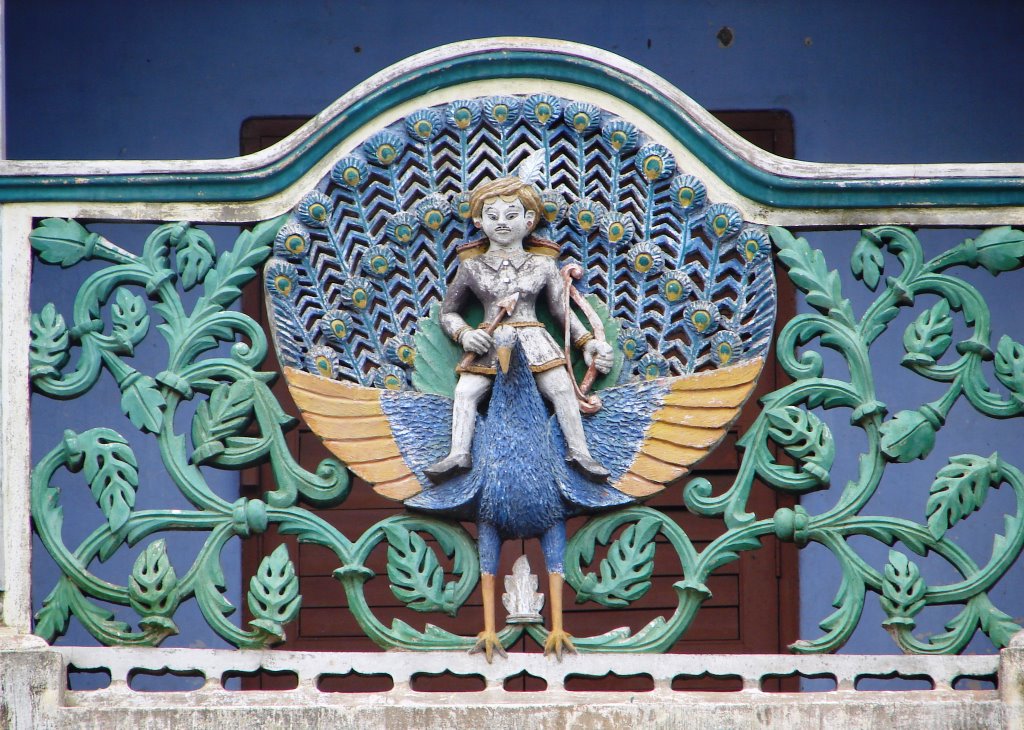

Our next stop was at the temple of Lord Jagannatha.
 We
photographed the temple from outside. A helpuful local walked up to us
and said we should see the temple from the top of the library as we
would get a better view from there. Probably he imagined we were
non-Hindus (Non-Hindus are not allowed in the temple) and so couldn't go
into the temple. We thanked him for the information and said we had
already been to the temple the previous day and we had returned to take
some pictures.
We
photographed the temple from outside. A helpuful local walked up to us
and said we should see the temple from the top of the library as we
would get a better view from there. Probably he imagined we were
non-Hindus (Non-Hindus are not allowed in the temple) and so couldn't go
into the temple. We thanked him for the information and said we had
already been to the temple the previous day and we had returned to take
some pictures.While I was photographing the temple, a concerned temple guard walked up to us and asked if we were people from the press. He probably got this idea seeing a huge handycam in my friend's hand and a noticeably large camera in my hand. We said we weren't from press and also assured him that we only wanted to take some pictures for our personal collection. He was satisfied and walked away.
We returned to the hostel to wait for the auto driver to take us to Konark. The private bus operators were still on strike and so there were no buses. There weren't any government buses either :(. The taxi drivers too didn't seem to be taking advantage of the strike. With no buses or train, and the taxis quoting a high fare we didn't have much of a choice :(. The hostel warden had helped us find a reliable auto driver who would take us to Konark, and also show us some interesting picnic spots enroute to Konark. We bargained for 650/-Rs which we felt was too much to pay for 35Kms one way. But with no other means of transportation, we had no option :(.


3 comments:
-
Vinutha and Lingaraj said...
-
intresting police signal...:-)...ganesha in sad looks gud even after rain.. before rain maybe it looked awesome!
-
Bikram Mishra said...
-
Nice-vivid description of the external Puri.People mostly depend on tourists and are simple and helpful.The Pandas(Sevaks of Lord Jagannath}have got the capability of feeding and accomodating hundreds of pilgrims,who arrive here unannounced,at any hour of the day-at this small town.Not in hotels.
-
Tabitha said...
-
I really enjoyed your blog post
Gundicha Mandir -- Puri
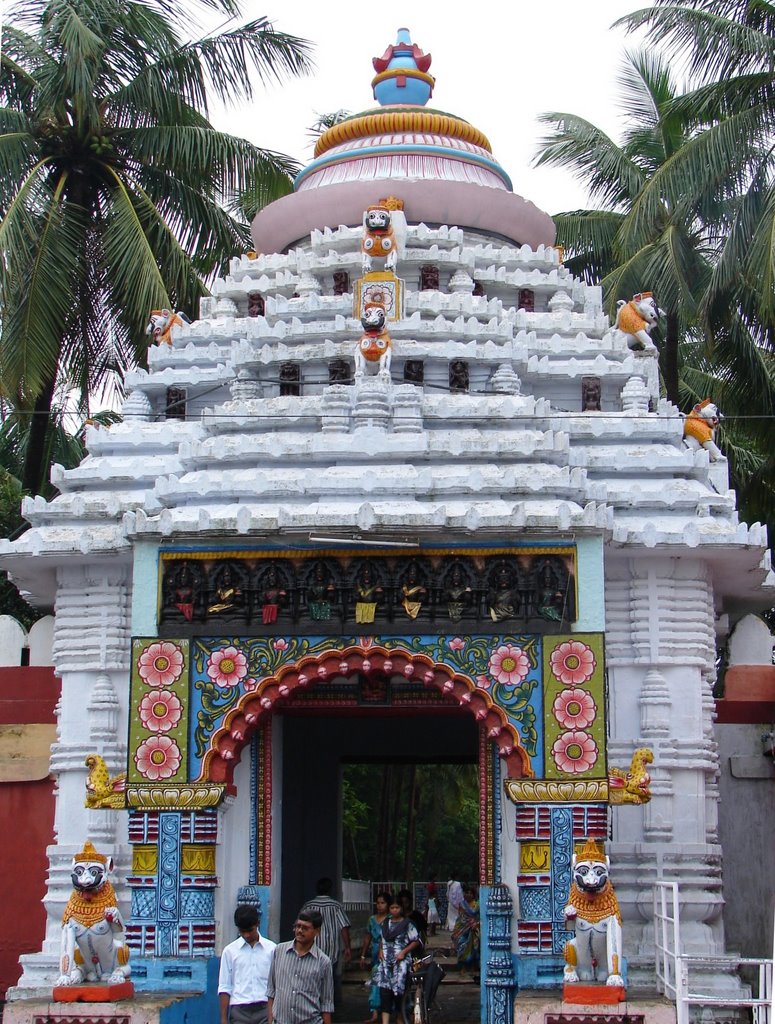
Gundicha is the aunt of Lord Jagannatha. According to a legend, lord Jagannatha is said to have expressed his desire to visit his birthplace Gundicha ghar once every year for a week. Accordingly, the deities Jagannatha, Subhadra and Balabhadra are taken to Gundicha mandir for a week during rath yatra. After a week, the lord returns to his temple. It is said that the wife of King Indradyumna was also named Gundicha.
In between Gundicha mandir and the 'Simhadwaar' from where the rath yatra begins, is the mausima mandir. The lord takes 'podapita' a special rice cake and then continues his journey to Gundicha mandir. It is stated in Skanda Purana that Mausima drank half the water during floods and saved the town of Puri and hence her name 'Ardhasini'.
Chaitanya Mahaprabhu was a great devotee of Lord Jagannatha. It is described in "Shri Chaitanya Charitamrita" that Shri Chaitanya once expressed his desire to wash the Gundicha temple.
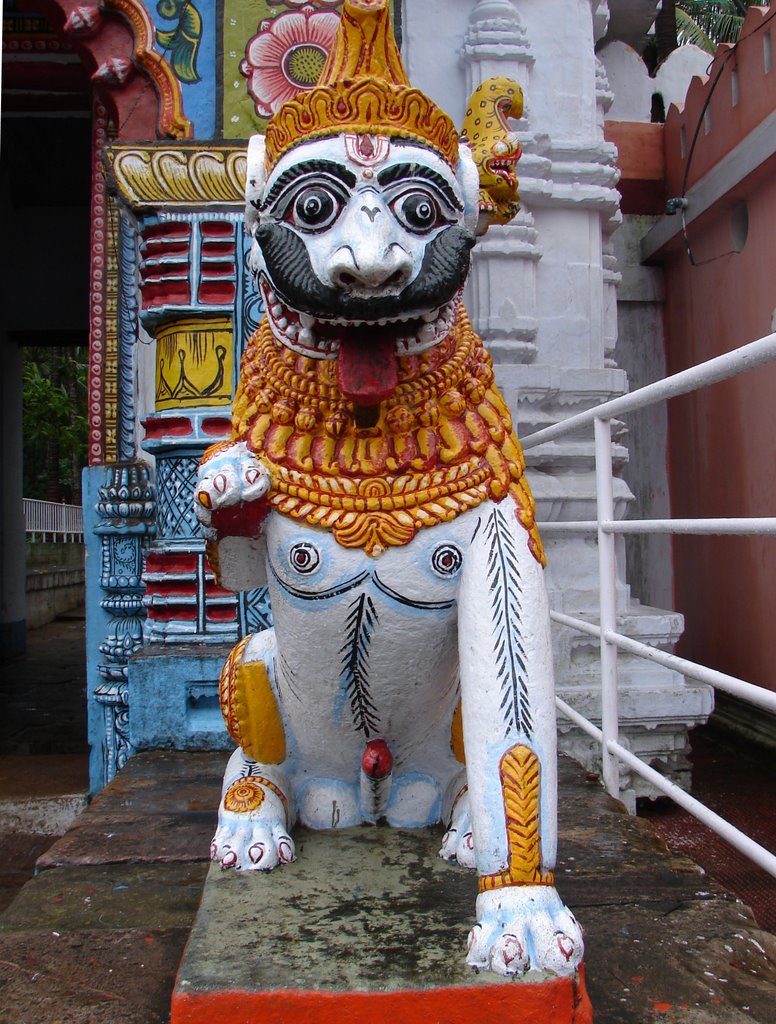
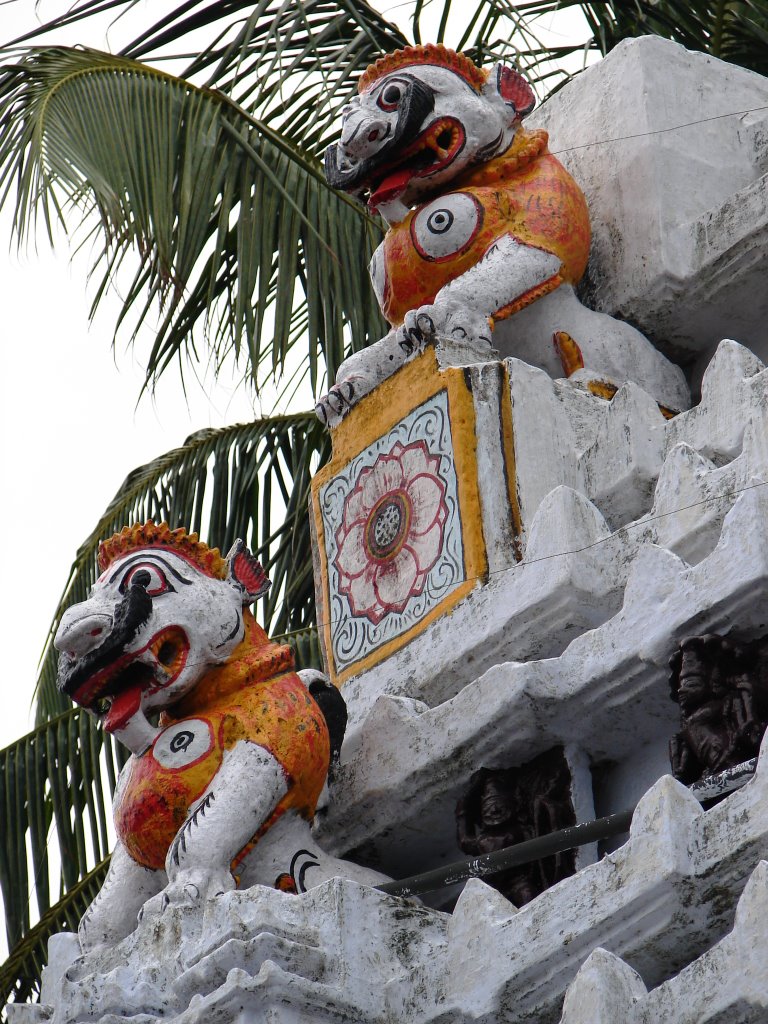
Upon hearing the Lord's request Padicha (superintendent of the temple) said
Padicha kahe -- ami saba sevaka tomara
ye tomara ichcha sei kartavya amara
My dear sir, we are all your servants
Whatever you desire is our duty to perform
They delivered hundreds of brooms and water pots to the Lord to clean the temple. The next day, Shri Chaitanya mahaprabhu was personally carrying out the operation of cleaning the temple. The devotees cleaned the bhoga mandira (place where the deitiy's food is kept) , yard, residential quarters one after the other. Shri Chaitanya mahaprabhu then gathered all the dust, straw and grains in his clothes and threw it outside. Hundreds of devotees brought water in pots and cleaned the temple.
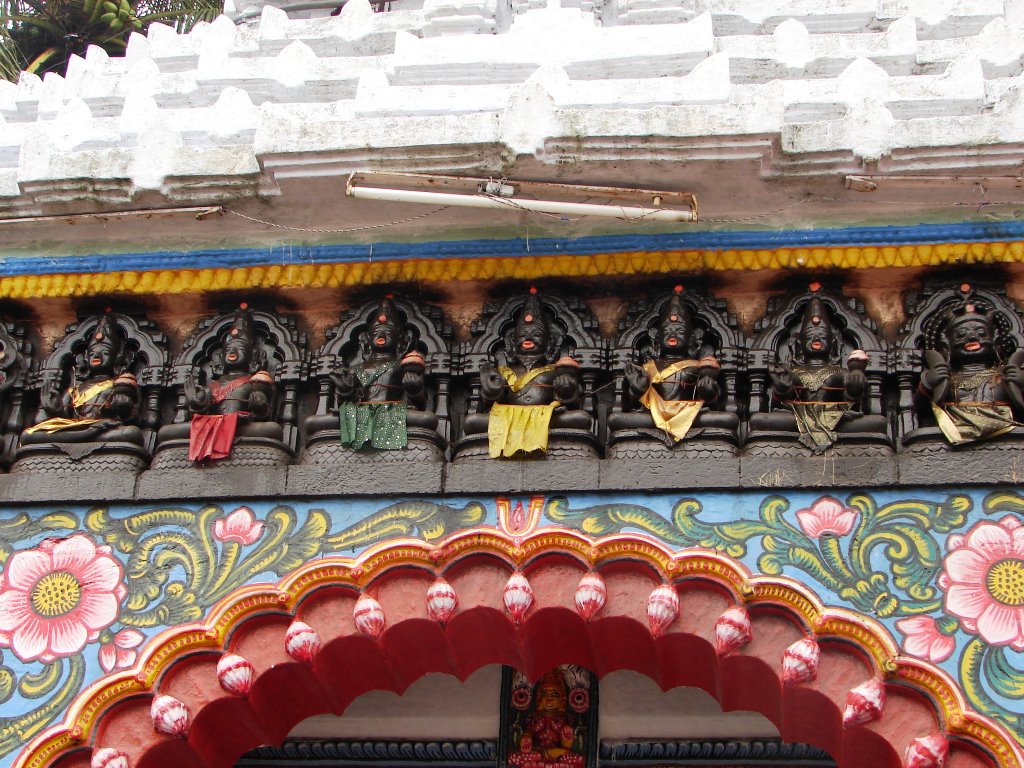
Shri Gundicha Mandiram Atma vrindaih
sammarjayan kshalanatah sa gaurah
sva chitta vac chitalam ujjvalam cha
krishnopavesaupayikam cakara
Shri Chaitanya mahaprabhu washed and cleansed the Gundicha temple with his devotees and associates. In this way he made it as cool and bright as his own heart and thus he made the temple a befitting place for Lord Krishna to sit.
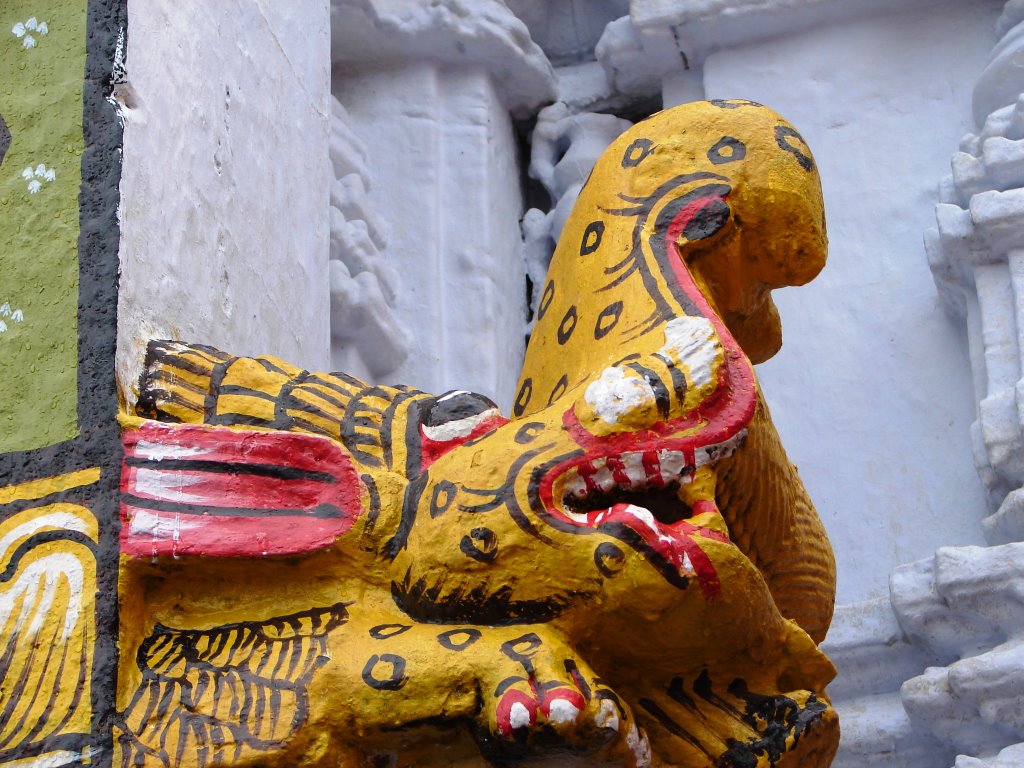
Lord Jagannatha left his wife Lakshmi, and went to Vrindavan (which is Gundicha mandir). When the Lord started on his rath yatra, he had promised to return the next day. When he does not return the next day, she was so upset that she ate only simple food and moved to the store room of the temple. After five days, the goddess decided to go to Gundicha Mandir on a paliquin and meet the lord. She arrived at the main gate of the temple in an angry mood. When the goddess arrived, her servitors - the devidasis confront the head dayita and sing the Hera Panchami song (Hera means to 'see' and Panchami means 'the fifth day') pulling at the dayita's dhoti. The Hera Panchami song expresses Lakshmi's anger. One of the devidasis then broke a piece of the Lord's chariot.
6 comments:
-
Vinutha and Lingaraj said...
- This comment has been removed by a blog administrator.
-
Vinutha and Lingaraj said...
-
i hadn't heard of gundicha... very intresting.... is the broken chariot still there ?
-
Casey said...
-
Vin, another interesting thing about the temple is the idol of Goddess Gundicha...(initially I thought it was the idol of Goddess Sita as I saw another idol of Hanuman kneeling besides the idol. But my friend from Puri clarified that it was the idol of Goddess Gundicha).
She blesses with her left hand! Can you believe that? When I was in the temple I thought for a second, that I was looking at the Idol in a mirror :))... but later realised that the goddess has raised her left hand to bless the devotees... :) -
Unknown said...
-
Located in Puri, the Gundicha Temple is considered to be the birthplace of Sita, consort of Rama and has two gateways: one for Jagannath’s entry and the other for his exit. Check out all best hotels in Puri for tourist accommodation.
-
Dilip Kumar said...
-
Very nice information about Gundicha Temple in Puri. Gundicha Temple is very famous and rath yatra Start from Jagannath Temple to Gundicha Temple. The journey of Rath Ytra is 3 km.
Thanks to share with us! -
Unknown said...
-
Good informations. Thanks.
Jai Jagannath
Deities in Jagannatha temple
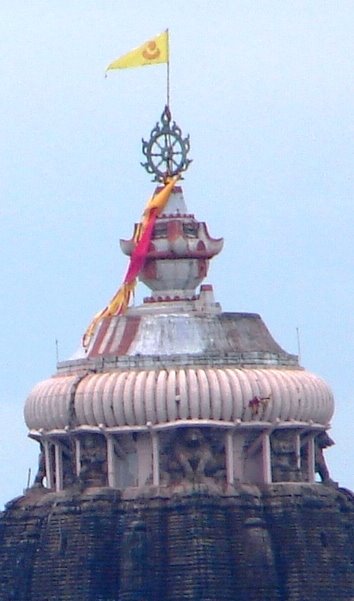
Sri Mandira Parikrama
There is a prescribed order that a piligrim should follow while at Lord Jagannatha temple. There are a little over 40 deities at the Sri mandir. The "Parikrama" or the circumambulation should be in the following order:
- Standing behind the "Aruna Sthamba" look at the temple sphere (Nila Chakra) and the flag and pay respect to them.
- Enter through the Lion's gate and pay respect to Patitapvan-- a replica of Lord Jagannath on the right and Fate-Hanuman on the left.
- Visit Kasi Visvanatha, Ramachandra and Narasimha on the left
- Climb 22 steps and enter the inner enclosure. Keep to the left and visit Agniswar Mahadeva temple (the protector of Agni of the Lord's Kitchen)
- Satyanarayana
- Bata (my friend from Orissa says you should pronounce it as "Batta") Gopal, Bata Krishna, Bala Mukunda (tiny image of Krishna sleeping on a banyan leaf sipping his toe to check whether it is Nectrine)
- Hari Sahadeva (supervisor of Lord's cattle stock)
- Bata Vihari Jagannath (Bata Abakash)
- Siddha Ganesha, Siddha Vinayak, Swetha Ganesha
- Bata Mangala on the right
- Pancha Pandav Shiva: Markandeya, Lokanatha, Kapala Mochana, Nilakantha, Yameshwara
- Bata Mangala
- Ananta Vasudeva
- Kuttam Chandi
- Aadi Narasimha and Mukteshwara temple
- Rohini Kunda
- Ganesha with eight hands in dancing form in front of Vimala Temple
- Goddess Vimala
- Venu Madhava
- Shri Nanda Maharaj
- Shri Rama Padapadma
- Shri SakhiGopal (also known as Sakshi Gopal)
- Bhadra Ganesha and Kanchi Ganesha (brought by Purushottama Deva from Kanchi)
- Ekadashi Devi
- Khirachora Gopinatha
- Pancha Shakti temple -- Bhuvaneshwari, Saraswathi, Sashthi, Savithri, Gayathri
- Nilaa Madhava
- Bedha Kali
- Lakshmi
- Navagraha
- Suryanarayana
- Shri Rama
- Paataaleshwar
- Then approach the temple through the northern gate, climb seven stairs, stand behind the Garuda pillar and have a quick glimpse of the Lord. Enter the Garbhagruha and see the lord from near
- Come back to the same same gate, and see Satyanarayana and Mahalakshmi
- Enter Ananda Bazaar, take prasada and leave the temple through Simhadvaara
Note: There are many more deities that I haven't mentioned in the list above.
A man who probably was a Brahman priest standing near the Aruna Sthamba approached us as we were entering the temple and offered to take us around the temple and also describe the greatness of each deity in the temple premises of the Lord for eleven rupees. He took us around the temple and also narrated a few legends. Since I have returned from Puri, I have been trying to verify the legends that he narrated. But I haven't found any similar legend on the net. So I presume none of what he said was true. But he did tell us some really interesting legends :).
You will need the help of one such person if you have to get into the sanctum sanctorum of the lord. With large number of devotees visiting the temple every day and with absolutely no discipline maintained by these devotees in entering the temple, it becomes very difficult to enter without the help of these people. They not only take you around the temple in the prescribed order, but also surprisingly push all the other devotees and make way for you to enter the temple. But we weren't very fortunate on that day as the man who took us around the temple showed us the counter where we could buy the ticket and left. Since people in Puri were celebrating "Janmashtami" on that particular day, there were more devotees than there are on other days. The ticket counter was also closed and we decided to eat the "prasadam" and then buy the ticket later.
Though there are a lot of deities and other interesting things in the temple premises, I will only update this post with what I find interesting.
Nila Chakra
The Nila chakra is made of an alloy of eight different metals known as "Ashta Dhatu". A flag is tied every day on a mast attached to the Nila Chakra. The wheel is comprised of two circles. Eight bars connect the inner and the outer circles. According to shwetaswatar Upanishad, the whole universe is a wheel and the bars of the wheel are mind, wisdom, selfness, sky, earth, sun, wind and water. These eight factors compose the human body. 'Pashupata Darshan' describes that the universe is a wheel and lord Shankara is moving around sitting on this wheel.
- When
the sense of a yogi culminates upto Sahasrara Chakra, it is Sudarshana
Chakra on the temple where the Yogi attains Brahma, losing his personal
identity. In Shri Mandir when a devotee's soul reaches 'Nilachakra' he
elevates to infinity and attains salvation. So a 'darshan' of the Chakra
on the top of the temple is equal to reaching the 'Sahasra Chakra' in
the body through meditation and enjoying the ecstasy of achieving
eternity.
- A yogi visualises the supreme effulgence when his
soul is united with Param Brahma. The yogi views the blaze is his
sahasra Chakra atop the body. But to a common devotee in Shri Mandir, on
every "Ekadashi" day a lamp lit at the NilaChakra is the symbol of
viewing the balze of Param Brahama (Deepam Jyothih Param Brahma) .
There are lots of legends associated with this temple There is a legend associated with the chakra too. Hazuri Balabhadra, the grand son of Chakhi Kuntia-- who was a great hero and worshipper of Lord Jagannatha, was standing on the roof of his house at 5A.M. in the month of July, in the year 1940. He saw strange light coming from the Chakra like a clear line of brilliant light leaving the temple at high speed. This lasted for more than 10 minutes. Out of curiosity, he asked father, who replied that Hazuri Balabhadra had seen the vehicle of devas coming to Lord Jagannath's temple.
Patitapavan (Redeemer of the fallen)
This deity holds both historical and religious importance. It is a small replica of Lord Jagannath. Historians believe that the deity was installed by Raja Ramachandra Deva-II to enable the non-hindus to have a darshan of the Lord.
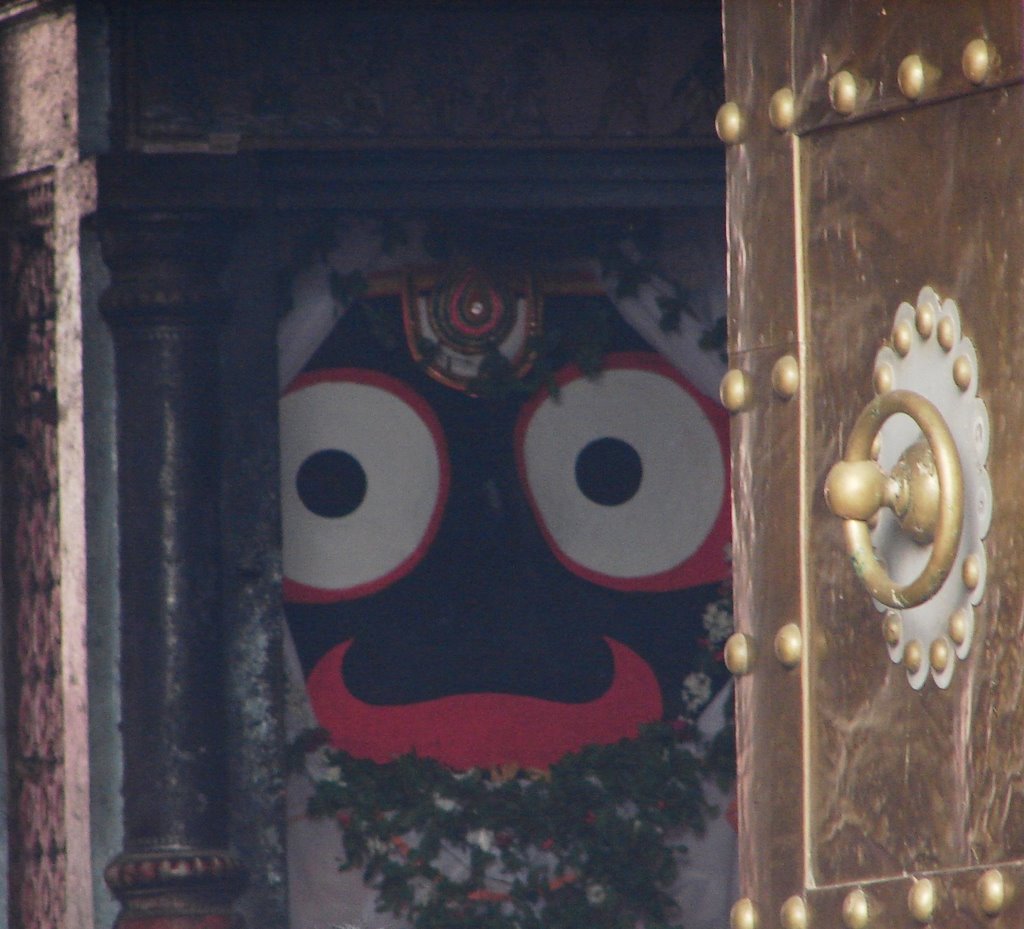
RamaChandra Deva, succeeded Gopinatha Deva in 1732. By this time, Muhammad Taqui Khan, the illegitimate son of Sujauddin, the Nazim of Bengal, was made the Naib Nazim in Orissa and he invaded the temple of Jagannatha being attracted by its wealth. The worshippers of Jagannatha apprehending his motives had taken away the idols of the lord and concealed on an island in Chilka lake. Taqui Khan defeated and imprisoned Raja RamaChandra Deva II in Cuttack. He forcibly converted Ramachandras Deva to Islam and named him Hafiz Qadar Muhammad. After Taqui Khan's death in 1734, Murshid Quli Khan II became the Naib Nazim of Orissa. He was a good administrator and helped reinstall the idol of Jagannatha and restored the worship in the temple. He also gave his daughter in marriage to Hafiz Qadar (Ramachandra Deva). Ramachandra Deva was ousted from the hindu society and was also deserted by his own family because of his change of religion.
Rama Chandra Mishra in his book "Purushottama Kshetra" writes that Raja Ramachandra Dev married Taki Khan's sister to protect the temple from muslim invasion. Whether this is true or not, the fact remains that he married a muslim woman and he was outcast from the religion.
Hanuman
It is believed that Hanuman was placed here by Ramananda acharya in the 14th C. Lord Hanuman here is depicted as having 12 hands. Hanuman is an eternal devotee of the lord who guards the temple at all the four entrances.
According to a legend, Kamadev entered the temple without Hanuman's permission. When Hanuman stopped him, Kamdev engaged him in a battel and he had to flee the place when he was defeated. Hanuman is considered as a caretaker of the garden in Puri temple. It is believed that Jagannatha visits the garden on "Akshaya thritiya" day with the permission of Shri Hanuman.
Kasi Vishwanath
As per the tradition, devotee has to pay his respects to lord Vishwanatha before praying to Lord Jagannatha. Legend says that, Lord Vishwanatha appeared at this place by virtue of devotion named Chakrapani Kuntia. It is believed that devotees get the benefit of worshipping Vishwanatha of Kashi (Varanasi) by worshipping him at this place. This temple brings harmony between Vaishnavas and Shaivas.
Ramachandra
Ramachandra temple is situated very near to Kasi Vishwanath temple. Ramacharita manasa says that Lord Shiva is fond of hearing Ramayana and hence Ramayana is recited before Shiva in this temple. I haven't read Ramacharita manasa and I am not sure if this is true. I shall probably read the book sometime and verify this.
Kalpabata tree
It has been mentioned in the puranas, that the huge banyan tree -- Kalpabata, was there when the entire world sunk under water. It is belived that the tree fulfills wishes of the devotees if expressed under it.
The king of Nepal, the only Hindu king in the world, enjoys special previliges in the Lord's temple. The Puri shrine has special Sevayat designated to attend the royal family during their visit to the shrine. The king of Nepal is the only person who has the right to enter the temple on a paliquin through the Southern gate upto Kalpabata. From there on, he goes to the sanctum sanctorum on foot.
There is a legend associated with this tree. King Indradyumna built a temple and went to heaven to invite Brahma to perform purification ceremony. Lord Brahma was praying and asked his royal guest to wait. Hundreds of earthly years passed. The temple was concealed under hills of sea sands. Galamadhava became the ruler of Orissa. One day while riding his horse, the hoof of his horse struck against the flag post of the temple. The king noticed a magnificient temple on clearing the sand, and claimed it as his own. Meanwhile, Brahma descended to the earth with Indradyumna. There ensued a dispute between Indradyumna and Galamadhava.
The four headed immortal crow god Bhushandi was meditating on the banyan tree known as Kalpabata. He acted as Indradyumna's first witness. Galamadhava did not bow to this decision. They then approached a tortoise of the tank. The tortoise said that he was once a labourer employed by King Indradyumna but had turned into a tortoise due too much of work. He was afraid that the king might employ him to finish up the remaining work of the temple. It was thus proved that Indradyumna was the real the builder. Galamadhava was proved to be a liar and his statue was installed outside the temple premise. The statue was not paid any respect.
Brahma was asked to perform the purification ceremony but he replied he was incapable of doing it. He tied a flag at the top of the temple, the sight of which could free men in bondage.
Kuttam Chandi
It is said that, originally the image of dog that is found here was found in the sanctum sanctorum of the main temple. According to the tantric worship, when Goddess Bhairavi is invocated, the food is offered to her and a part of it to a dog. Sometime later history, when Vaishnavas dominated, the image of the dog was removed from the sanctum sanctorum and brought here. The tantrics say that Jagannath in Puri is not Vishnu, Narayana or Shri Krishna. He is believed to be Bhairava (Shiva), and goddess Vimala is Bhairavi. The body of Kuttam Chandi resembles a dog, but her head is human.
Significance of the 22 steps in the temple
One has to cross 22 steps to realise Lord Vishnu. As per Yogashastra a man possesses 5 kinds of mana and 25 types of prakriti. Out of the 25 prakritis 3 are apara and 22 are para prakriti. A yogi has to cross 22 para prakritis like kama, ahankar, mada etc. to see the lord.
Another iterpretation is that Vaikuntha is situated above 7 lokas, 7 patalas and 8 vaikuntha. One has to cross all these to reach Vishnu.
It symbolises pancha matra, pancha bhuta, pancha vija, pancha deva and both jiva and parama.
It symbolises 22 tirthas of shrimad bhagavatha with 10 Gods (Vasudeva, Narayana, Madan Mohan, Rama Krishna, Sridevi, Bhudevi, Vimala, Bhubaneshwari) and Pancharasa Ashta Sattika Bhaba, Tribhija, Trisakti, Triguna.
Four Dham Lord
There is a small temple situated near the western gate of the temple that has the deities of the four dhamas Bhadrinath, Dvarakanath, Jagannath and Rameshwara. It is believed that if you visit this temple, it is equivalent to visiting all the four dhamas. On the way to this temple is the temple of Mahavir Hanuman, who is the protector of the four dhamas.
Sitala Temple
It is believed that all the deities who come to see Lord Jagannatha meet here. Water is drawn from the holy sona-kua (Golden well) in front of this temple for the bathing ceremony of Lord Jagannatha, Balabhadra and Subhadra.
Koili Vaikuntha
This is the burial ground of the lord. During Nava Kalebara the old image of the lords are burried here and new images are carverd at this place. The burial ground is covered by malati tree (creeper). It is belived that the Pandavas set fire to Lord Krishna's body here.
Satyanarayana
Devotees worship Satyanarayana on the occasion of the birthday of their children. It is believed that the Lord here is a synthesis of Hindu and Muslim religion. This was perhaps installed during the frequent Muslim invasion. Hindus worship Satyanarayana as Lord Vishnu and Muslims worship him as Satyapira (Alla the truth). The prayers are in Urdu and Bengali.
Bata Ganesha
The face of the lord is white and his body is red. A small stone mouse is installed in front of him. You can feel thorny projections on the body of the mouse when you run your hand on its body.
Pancha Pandava temple
A reference from Mahabharatha says that the pancha pandavas stayed here for a night during their year of disguise. They prayed to Lord Vishnu here for a favourable journery. As a symbol of this yatra, Pancha Mahadeva (Lokanatha, Yameshwar, Nilakantha, Markandeya and Kapalamochana) have been installed here.
Markandeya Temple
Skanda purana describes that Rishi Markandeya was advised by the Lord to stay here during the pralaya (destruction)
Indra temple
Perhaps the temple has been built here to prove that Indra performs the function of a gate keeper in the temple of the Lord.
Dikpalaka temple (Digpala temple)
According to Hindu mythology, there are 10 directions and they are guarded by 10 Gods. These guardian Gods are worshipped in this temple.
Mukti Mandapa (Brahmasana)
It was the seat of Lord Brahma. It is belived that Lord Brahma sat here and instructed the demi gods to perform the incarnation ceremony. This is where the Brahmini pundits of Puri now settle the disputes that arise in the temple or give dirctions to the common man to relieve them from the sins they have committed.
Goddess Vimala (Pada Pitheshwari)
As per the description of Devi Bhagavatha, Sati the daughter of Daksha prajapathi married Shiva. Once during a yajna arranged by her father, she could not tolerate the disrespect that was shown to her husband. She jumped into the yajna fire and died. Lord Shiva was so disturbed by this incidence that he carried the dead body of his wife and roamed all over the world (some authors mention that he roamed over India). Lord Vishnu then released his Sudarshana Chakra to cut the body of Sati into pieces to relieve Lord Shiva from his attachment to Sati. The chakra cut her body into pieces and fell at places that now form the Shakti pitas. It is believed that her feet (pada) fell here and hence Puri is known as Pada pita.
Pancha Shakti
Goddess Bhuvaneshwari is placed in the main temple. Besides her we find
Saraswathi -- Goddess of learning
Sasti -- Goddess of children
Savithri -- legend says that Savitri took back the life of her husband Satyavaana from the clutches of Yama.
Gayatri -- Goddess of Veda.
Mahalakshmi Temple
Mahalakshmi is the Shakti of the lord. She is associated with the lord at all times; during creation, destruction and perseverance. She is also associated with the lord during all the festivals. As per Lakshmi purana, Lakshmi had been to the house of Sriya Kandaluni, a low caste lady to accept her offerings. Jagannatha banished her from the shri mandira as per the advice of Balabhadra. But they later realised their mistake and pacified Lakshmi to return to the temple. The lord visits her temple on every thursday except on Ekadashi.
On the third day of the car festival (HeraPanchami) Lakshmi goes to Gundicha temple and breaks a part of the car as the lord had not taken her with him while he was on the car. When he returns to the temple, she shuts the door on him to show her supremacy and anger. Jagannatha then consoles her with sweet words and she finally concedes and allows him to enter the temple.
Lakshmi is also the cook of Jagannatha's temple. She prepares food for the lord everyday. During her absence from Dhanu sankranthi to Makara Sankranthi, Jagannatha's mother prepares the food for him.
Pataleshwara temple
Half of this temple is submerged in the soil. Legend says that when Lord Vamana placed his foot on Bali Chakravarth's head, he stayed here by becoming Pataleshwara Shiva.
4 comments:
-
Vinutha and Lingaraj said...
-
hmmm.. intresting legends... too well writeen...
-
Unknown said...
-
Dear,Friend
Puri, on the east coast of India, in the state of Orissa is a hoary pilgrimage center,
enshrining Jagannath, in a colossal temple. Puri is well connected by rail and road with
Calcutta and with Bhubaneshwar. Puri is an ancient shrine, enshrining Krishna -
Jagannath in the form of a wooden image. Also enshrined are wooden images of
Balabhadra (Balarama) and Subhadra brother and sister of Krishna respectively.
Please Visit For More Detail
http://desidirectory.com/india-travel-guide/ -
raje said...
- This comment has been removed by the author.
-
raje said...
-
Very Good Article, Thanks for Shairing
http://puriwaves.nirmalya.in/
Jagannatha Triad
Vidyapathi had wandered to a distant town inhabited by Shabaras, a non-ayan tribe. He stayed in the house of VishvaVasu (also referred to as "Vishvasu" by some authors; 'Vishvasu' and 'VishvaVasu', here in this post, refer to the same person) and married his daughter Lalitha. Everyday VishvaVasu would leave the house in the night and return the next noon. Though Vishvasu had instructed his daughter not to reveal where he went everyday, Lalitha told Vidyapathi that her father would go to worship Nila Madhava. Vidyapathi requested VishvaVasu to take him along to worship the lord. Finally Vishvasu conceded to take Vidyapathi with him blindfolded. Lalitha tied some mustard seed in a cloth so that a trail could be left to follow later. When they reached the shrine Vishvasu took off the blindfold and Vidyapathi saw the lord. He felt great esctasy.
One day while Vishvasu was out collecting the items for worshipping the lord, he saw a bird fall into a lake nearby and drown. The soul of the bird took the shape of a spiritual form and ascended to the spirit world. VishvaVasu wanted to do the same and climbed a tree to jump into the lake. A heavenly voice informed him to tell Indradyumna that he had found Nila Madhava. When Vishvasu went to worship Nila Madhava, the Lord spoke to him and told him to inform the King that he had found the lord.
Vidyapathi went to Indradyumna's court to inform the king. The king could not find Nila Madhava and so he arrested Vishvasu. The Lord appeared in the King's dream and instructed him to release Vishvasu. He also told the king that he would appear as a Daru-Brahmana, a wooden manifestation of the supreme almighty.
King Indradyumna built the temple for Nila Madhava in Puri and went to heaven to invite Brahma to consecrate the temple. Brahma was praying at that time and he asked Indradyumna to wait. Hundreds of earth years passed and when they finally returned to earth, Galamadhava was claiming that he had built the temple. Bhushandi Kaka (king of crows) and a tortoise who were the witness to Indradyumna's temple construction testified in favour of Indradyumna. Lord Brahma however said he could not consecrate the temple as the Shri Kshetra was manifested by the Lord himself. He put a flag on top of the temple and blessed it. He said that anyone who saw the flag from a distance and offered respect to it would be liberated from the material world.
The king waited for a long time for Nila Madhav to manifest himself in the temple. When the lord did not manifest the temple, he decided to fast unto death. The Lord then appeared in his dream and said he would appear in the sea as a floating Daru-Brahman. The King went to the sea and found a huge log of wood that was marked with a conch, club, lotus and disc. This was the Daru-Brahman! However hard the king and his men tried, they could not budge the Daru. The Lord then appeared in his dream and instructed him to bring Vishvasu. VishvaVasu then moved the Daru-Brahman easily onto a golden chariot. Lord Brahma then installed a deity of Lord Narasimha.
The king requested many expert carvers to carve the form of the Deity. But as soon as their chistel touched the wood, it would break. Then Vishvakarma (the architect of the demigods) arrived there in the guise of an old carpenter Ananta Maharana. He promised the king he would carve the deity in three weeks time if he was allowed to work behind closed doors. The king could hear the sound of the carving till 14 days. But on the 15th day there was no sound. On the advise of his queen, Indradyumna opened the doors to see what was happening. (It has been mentioned by a few authors that the King opened the door as he was concerned when he did not hear the sound. There is no mention of his queen suggesting him to open the door.) There he saw the deities Jagannatha, BalaBhadra (Balarama) and Subhadra in their incomplete forms. The hands and legs of the deities had not yet been carved. But since the king had broken his promise and opened the door sooner than he was supposed to open Vishvakarma did not complete the carving.
The king felt he had committed a sin and so he decided to end his life. Then Lord Jagannatha appeared in his dreams and told him that the Lord himself wanted to manifest in this form though it appeared to be incomplete. The lord said it was the form in which was meant to be worshipped in the Kali yuga. The king would occasionally decorate the Daru with golden hands and feet.
All the pictures used in this post have been borrowed from "hare krishna inspiration". Thanks to Radha-Raman Das and Aisvarya Kumar for sharing the wonderful pictures. Thanks to Bhaktin Veronica for optimising the images.
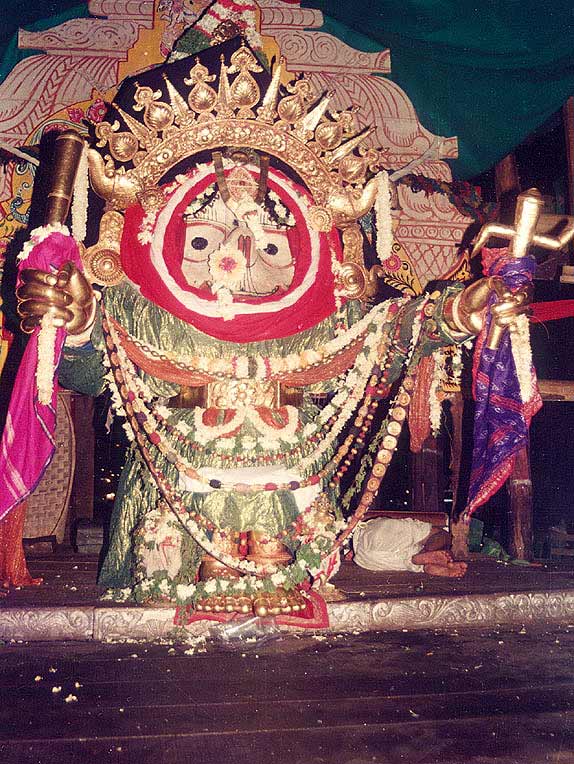
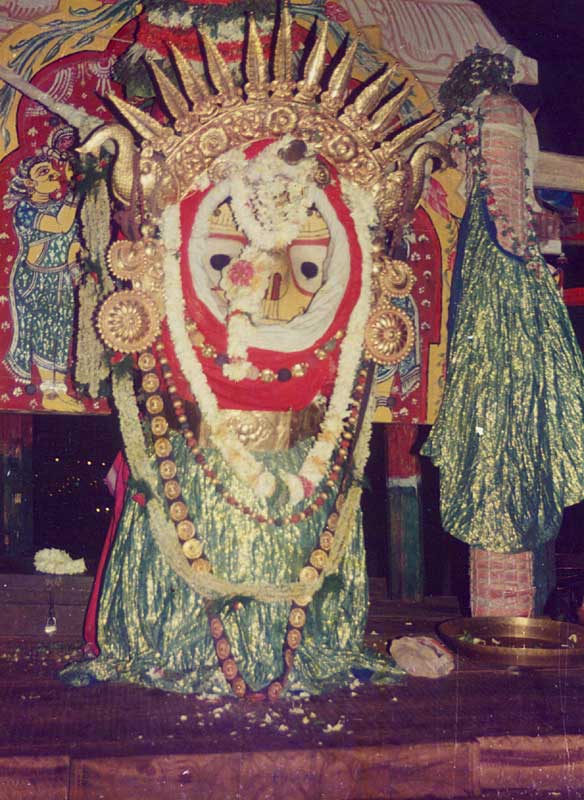

There is another legend that explains the incomplete form of the Lord. Once Narada went to Dwaraka and he saw a big festival taking place in Queen Rukmani's palace. All the 16,108 gopis present there were headed by Rukmani, Sathyabhama, Jambavathi, Bhadra, Mitravrinda and Nagnajiti -- the eight prominent queens of Krishna. Narada approached the queens and mentioned how fortunate they were to be serving the lord everyday.
Rukmini then mentioned that Krishna always yearned for Radha and the other Gopis. He would cry for his mother Yashodha. He called for his friends Sridama, Subala, Madhumangala, Kokila, Bhringa. He longed to take his cows Shyamali, Dhavali, Kalindi, Ganga and Pisanga to graze.
Krishna was sitting in his assembly hall Sudharma. While the queens were talking, his associates were sitting in the chamber discussing the various problems. Ugrasena maharaja was sitting on the throne in the middle surrounded by Akrura, Krishna, Baladeva, Uddhava and others.
Mother Rohini entered the room. She was Baladeva Prabhu's mother. She had lived in Brindavan with Yashoda for 11 years while Krishna and Baladeva were growing up. The queens turned to Rohini to find the reason for Krishna's discomfort. They wanted to learn from her what was it about the Gopis and Brindavan that Krishna could never forget them and always long for them.
Rohini replied
The vrajvasis have known Krishna as their son, their beloved or a friend. They see him as an innocent boy who is always dancing and playing his flute. He is Gopi-Jana-Vallabha, the beloved of all the Gopis. The gopis do not require a formal relationship with Krishna. They have given their heart to him since childhood and served him selflessly. They give him their undivided attention. They always remember him. Krishna has promised "ye yatha mam prapadyante" - I will remember those who remember me. He keeps his promise by remembering them.
Then Rohini began glorifying Radha's love for the lord:
Once Radha was sitting on Krishna's lap. A bee started hovering around her feet. She tried to chase it away, but it kept returning. Meanwhile, Madhumangala came and drove it away with his stick. He boasted "Madhusudana (the bee) is gone. I drove him away with my stick and he will never come back." Hearing this Radha thought that her Krishna (Madhusudana) had gone away. She forgot she was sitting on his lap and began crying thinking that the lord had gone away never to return. Such was the love of Radha for her beloved Krishna.
Krishna realised Rohini was talking about his beloved Brindavan and Brijvasis. He walked to queens' chamber with Balarama. Subhadra was standing guard at the door to prevent Krishna from entering. Although Subhadra stopped Krishna and Balarama from entering the room, they could hear through the door. Krishna was standing to the left of Subhadra and Balarama to her right. When they heard Rohini speak, their hearts and fingers began to melt. When they wept with joy, their hands, feet and mouth melted. Only the shape of the Jagannatha deities remained. When Rohini stopped speaking, he slowly regained his original form. Krishna then walked into the chamber and realised Narada had spoken about Brindavan and so Rohini had described to the queens the glory of Brindavan and the Gopis. He was so happy that Narada had helped him remember of Brij, he granted him a boon. Krishna said "ask what you want and your wish will be granted". So Narada requested the lord, subhadra and Balarama to remain in the melted form for the world to pray. They agreed to remain in this form at Puri.
Nava Kalebara Yaatra (ritual of transformation)
The deities are made of wood. New ones need to replace the old ones every 12 years. This is known as the Nava Kalebara yaatra (ritual of trnasformation). Right trees are found, deities are carved, transformation is made and the old ones are buried in the ground. The last rites of the lord are performed in absolute secrecy. Only a few appointed priests and servants can be present while the procedures are conducted.
Searching for the right tree
The search party consists of exact number of men belonging to specific casts and families. They reach Kakatpur village after many stops. The oldest member of the Dayitapati family will have to sleep in the temple of Goddess Vimala (The Auspicious one). The special tree selected to carve the deities should have a symbolic mark of chakra, conchshell mace and lotus.
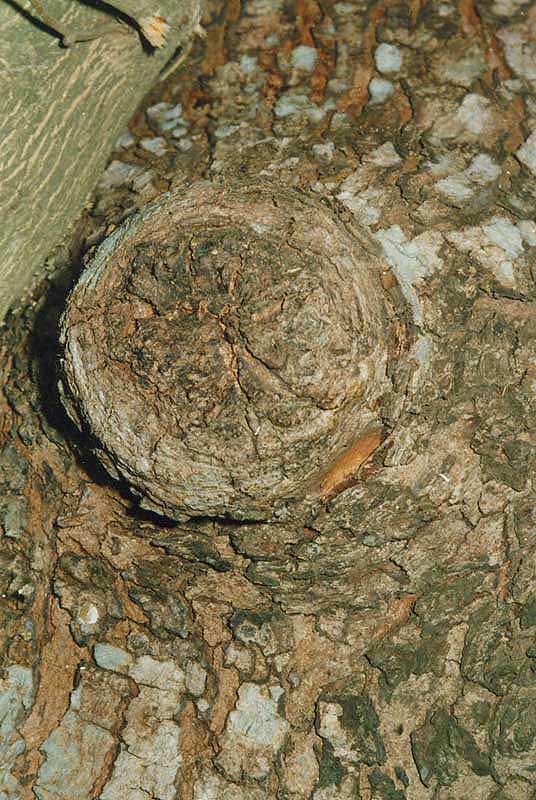
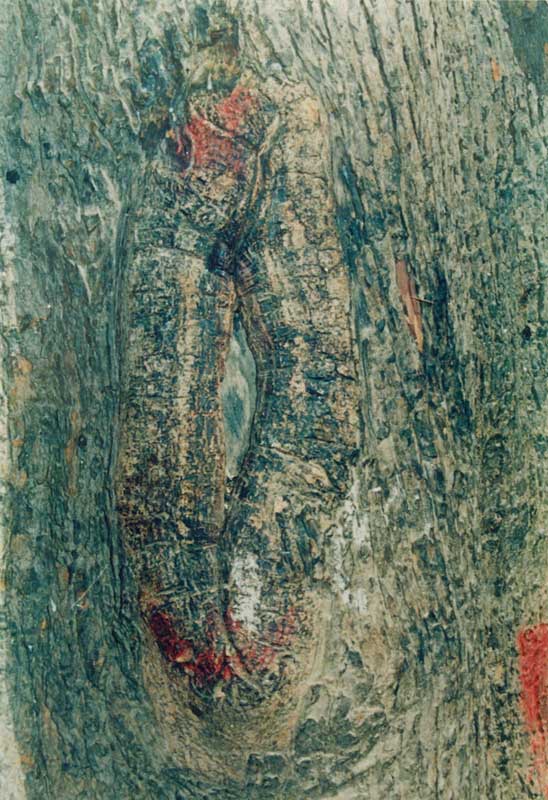
Each deity is made from different tree. They have to find four trees in all to make the four deities , the fourth one being Sudarshana. The trees for each of the deities will be in different places. When the search party locates the places, they have to find the right tree as only one of them will be fit to serve the wood for the Lord's idol.
The right place
There should be a Shiva's temple and a pond nearby. Rare types of trees like
- Varuna tree -- protects you from snakes and also has the power to destroy anger and pride. It is a local practice to carry the bark of a Varuna tree when they meet a bothersome person.
- Sahad tree -- Gives the power to forget onself
- Vilua tree -- has the power to cure diseases like heart disease, cancer and leprosy.
- Neem tree
When the search party finds the right place, they construct a small hut nearby and reside in it. They set up a great fire sacrifice to invite all the demigods to bless them so that the trees can be cut.
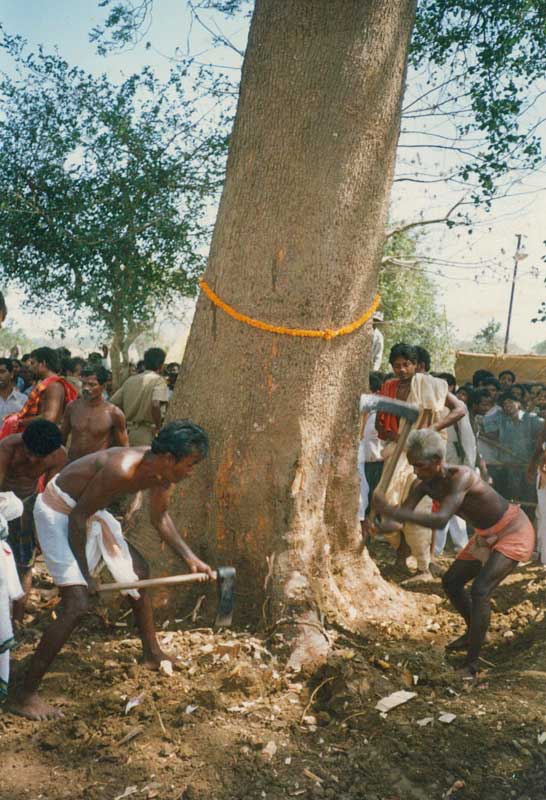

First the wood cutters touch the tree with golden axe, then silver and finally the iron axe is used to finish off the work. They chant the 108 names of Lord continuously. Since Neem is called "Daru", Jagannatha is also known as "Daru-Brahman". Only members of the Dayitapati family are allowed to carry the log back to Puri and the descendants of the original carver can carve the deity. Only few precisely designated servants can participate in the rites of transformation. Old deities are placed in front of the new ones and three oldest members of the Dayitapati family tranfer "Daru Brahman" to the new deities. Not even the head priest can be there during the actual transformation. Nava Kalebara yatra is actually the transformation ceremony. Old deities are buried in a place known as "Koili Vaikuntha". Koili means "burial ground" and vaikuntha means "Heaven".
1 comment:
-
Vinutha and Lingaraj said...
-
oh wow.. they serach for trees every year ???
Amazing details ....
who is sudarshana ?
but reason for the dieties being in tht form.. there cud be more reasons...
Lord Jagannatha Temple at Puri
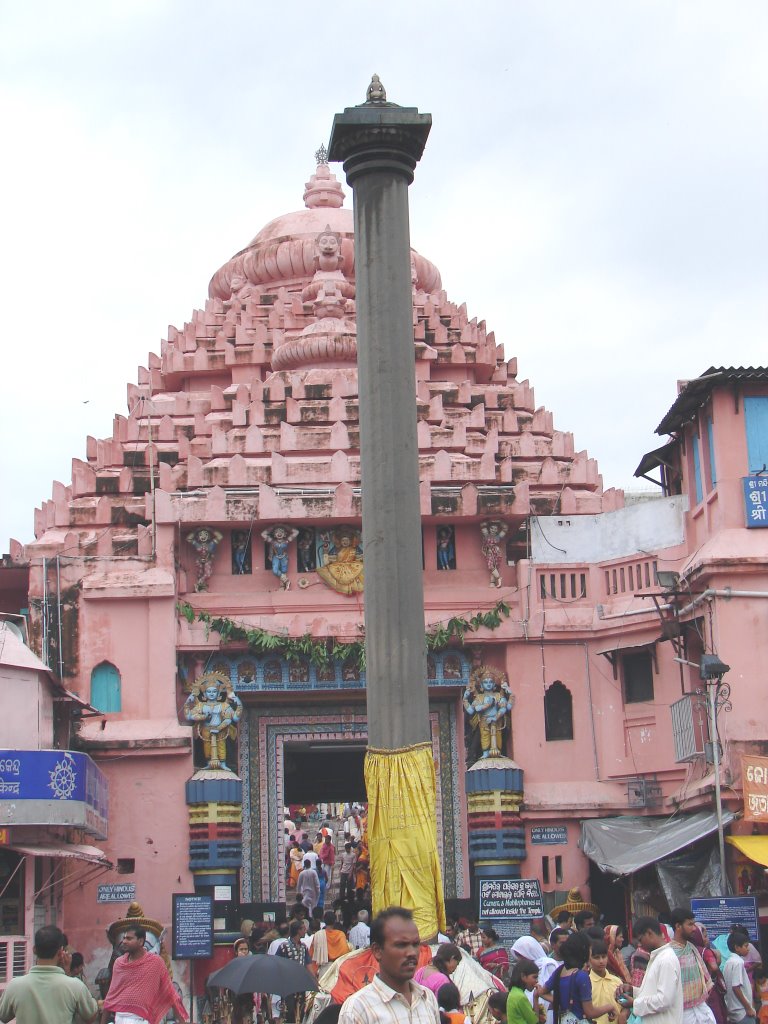 The "dhwaja sthamba" or the flagmast is customarily erected in front of
Hindu temples and is in perfect alignment with the sanctum sanctorum,
where the idol of the main deity is installed. “Aruna Sthamba” or “Sun
pillar” is erected in front of Jagannatha mandir. The pillar originally
stood before the sun temple at Konark. King Gajapati Divasingh Dev
brought this pillar to Puri during the Maratha rule in 18th C. Aruna,
son of kasyapa muni and vinata and the elder brother of Garuda squats on
top of the pillar praying. He is also the charioteer of sun god. In
Gayatri Mantra, Narayana is seated in the orbit of the sun. Since there
is no fundamental difference between the sun god and Lord Jagannatha,
Aruna is seated in front of the temple. The sthamba is a 16 sided
monolithic pillar measuring 11 meters in height. Some sevayuts say that
the golden rays of first rising sun washed the holy feet of Lord
Jagannatha through passing the Aruna Sthamba.
The "dhwaja sthamba" or the flagmast is customarily erected in front of
Hindu temples and is in perfect alignment with the sanctum sanctorum,
where the idol of the main deity is installed. “Aruna Sthamba” or “Sun
pillar” is erected in front of Jagannatha mandir. The pillar originally
stood before the sun temple at Konark. King Gajapati Divasingh Dev
brought this pillar to Puri during the Maratha rule in 18th C. Aruna,
son of kasyapa muni and vinata and the elder brother of Garuda squats on
top of the pillar praying. He is also the charioteer of sun god. In
Gayatri Mantra, Narayana is seated in the orbit of the sun. Since there
is no fundamental difference between the sun god and Lord Jagannatha,
Aruna is seated in front of the temple. The sthamba is a 16 sided
monolithic pillar measuring 11 meters in height. Some sevayuts say that
the golden rays of first rising sun washed the holy feet of Lord
Jagannatha through passing the Aruna Sthamba.Some devotees say that there were no mountains that that could supply sufficient stone to build the temple except the Nilgiri Parbat (Blue Mountain). This pillar is the symbol of the height of Blue Mountain.
Aruna means “reddish brown” in Sanskrit. In the Ramayana, Aruna is the father of the fabulous bird Jatayu, king of the vultures, slain by Ravana. In the Vishnu-Purana, Aruna is one of the two sons of Kasyapa by Vinata; called Suparna, he is "king of the feathered tribes, and the remorseless enemy of the serpent race" (1:21).
The temple has two big concentric walls. The outer wall (meghananda Paceri) has four gates. The loftiness of the wall places the temple like a fort. The civilians and the solders took shelter inside the temple compound during the Muslim invasion.
The four gates opening to the four directions are:
Simhadwar (Lion door): Two lions stand on either side of the east gate. They represent the Dharma pillar of Hindu Worship.Devotees generally enter the temple by this gate.
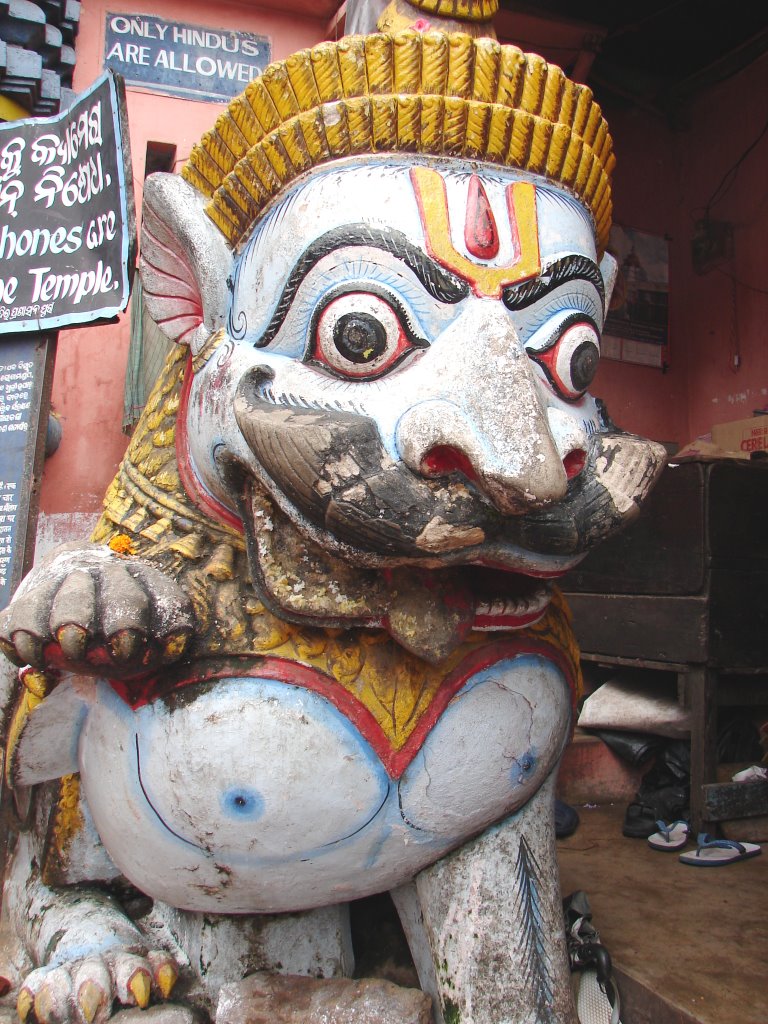
Dasia Bauri from Dandamukundapur, in the district of Puri, Orissa took a coconut to be offered to Lord Jagannath through the priests of the temple. But they out of mockery did not accept the fruit. Dasia was extremely sad, cursing the heritage of the worshippers. Out of pure devotion he stretched his hands and prayed,"Oh Lord, kindly accept this coconut". He was standing outside at the Lion's Gate of the temple. People saw two hands emerge from within the temple to take the coconut from Dasia. It was He who blessed Dasia in the presence of many.
Ashwadwar (Horse door): Two galloping horses with Jagannatha and Balabhadra on their back in the martial glory stand guard on either side of the south gate. The horses represent the Artha (money) pillar of Hindu worship. Horse is the symbol of Kshetriya king who traditionally enter the temple through this gate.
Vibhisana was one of the brothers of the demon king Ravana in Lanka during Tretaya Yuga. Yet he took shelter at the feet of Lord Rama. After the death of Ravana, he was made king of Lanka. He always felt that Rama was the Supreme Lord, and it is believed by the people of Puri that he comes every day to Lord Jagannath, feeling that He is Sri Rama Himself.
Like all the devas, Vibhisana comes to see and enjoy the last ritual at midnight, known as Pahuda Arati. It was in the year 1810, when there was no electricity and the town was dark at night. When returning home through the horse gate of the temple, head priest Pattajoshi Mahapatra felt somebody walking beside him. The person was not visible owing to the darkness, but he was so huge, it seemed his head was touching the sky. Pattajoshi Mahapatra was totally overwhelmed.
Out of fear, he questioned, "Who are you, Sir?"
The answer was, "I am Vibhisana from outer space. I come here daily to see the last ritual of Lord Jagannath."
Still the head priest doubted him.
He asked again, "Please give me some proof that you are from the outer space !"
So Vibhisana gave him the huge golden armlet he was wearing and vanished. Even now, almost 200 years later, this ornament given by Vibhisana of Devaloka is worshipped in the residence of Pattajoshi Mahapatra's family. It may be seen and verified. The ornament is the size of a wheel of a bullock cart. It could never have been used by a human being.
I haven't seen this armlet and I don't know if it is true. But most of the legends mentioned in this blog are borrowed from books and articles.
Vyaghradwar (Tiger door):
A pair of tigers guards the west gate. Tigers represent the Kamana (Desire) pillar of Hindu worship.
 Harihar Guru was one of the greatest worshippers of Jagannath Temple.
He was called Prakruta Panda, a real worshipper; for the help he
rendered to all. This event occured in 1969. Harihar Guru lived in
recent times but he was one of the most honest, simple and sincere
worshipper ever to serve Lord Jagannath. In spite of his limited income,
it was his habit to help poor people. In fact, he became poor himself,
helping others. He used to come daily to the temple at 4 A.M. by the
west gate, known as Vyaghradwar or "Tiger's Gate".
Harihar Guru was one of the greatest worshippers of Jagannath Temple.
He was called Prakruta Panda, a real worshipper; for the help he
rendered to all. This event occured in 1969. Harihar Guru lived in
recent times but he was one of the most honest, simple and sincere
worshipper ever to serve Lord Jagannath. In spite of his limited income,
it was his habit to help poor people. In fact, he became poor himself,
helping others. He used to come daily to the temple at 4 A.M. by the
west gate, known as Vyaghradwar or "Tiger's Gate".One morning he saw three beautiful ladies also going through the same gate. They had a divine fragrance around them and were nicely dressed, decorated with flowers but no ornaments. Their faces were veiled. It was raining heavily at that moment, but Guru could not see them wet, even though he was completely drenched and shivering from the cold. The three ladies seemed to be going inside as if there were no downpour. Their saris were dry and there was no sign of their foot prints on the earth. Seeing all of this, Guru approached them to ask who they were. They simply vanished! Only the sound of soft laughter was heard. When he narrated this episode to his friends, he was told that the ladies were divine beings from Kinnara Loka.
Hatidwar (Elephant door):
This is the gate towards the north. On each side is an elephant that is said to have been disfigured during the Muslim inroad. Elephants represent the Moksha pillar of Hindu worship.
Strangely no legend is associated with this door.

Jaya and Vijaya the dwarapalakas
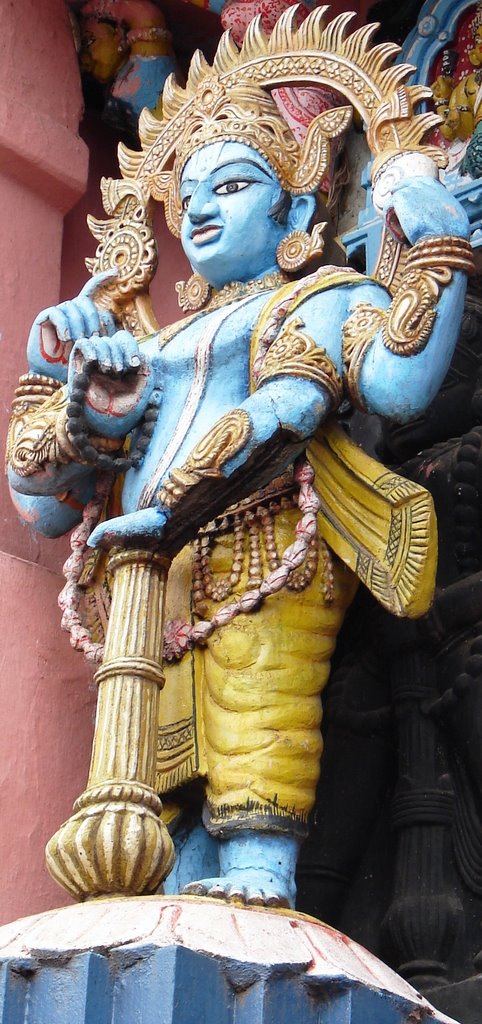
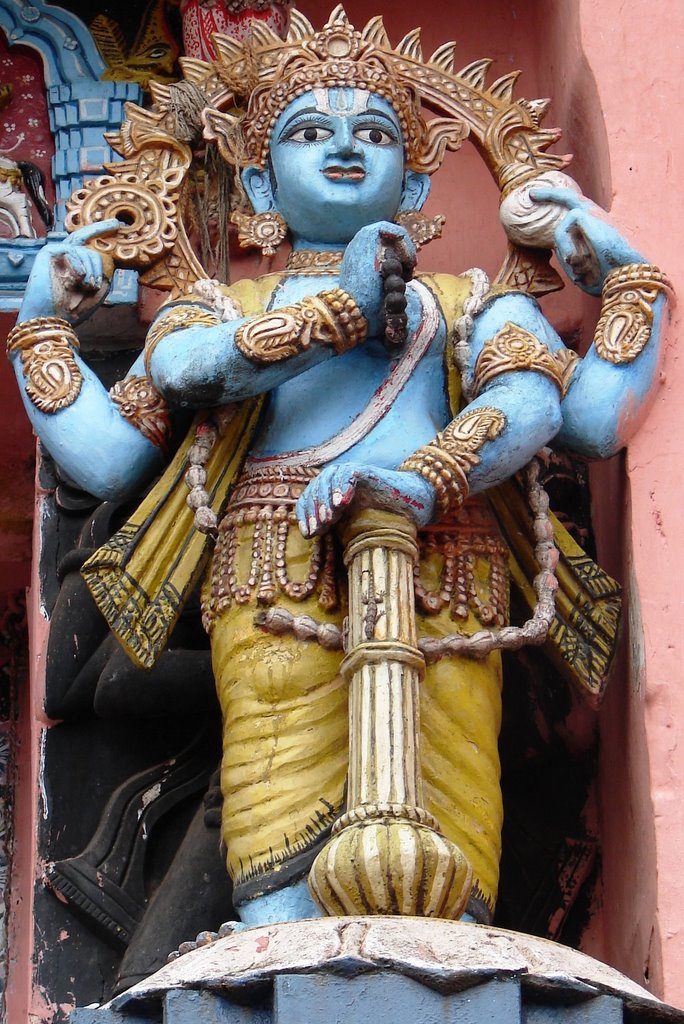
The eastern gate is guarded by the dwarapalakas Jaya and Vijaya. The mythological story goes that the two demigod gate-keepers/dwarapalakas (Jaya and Vijaya) of the abode of Vishnu, known as Vaikunta, barred revered sages from entering Vishnu's abode. The sages having taken great measures to travel to Vishnu's abode were furious at the insolence shown by the gatekeepers and cursed the Jaya and Vijaya to be born as mortals and roam the earth (Bhuloka).
The generous sages said that the dwarapalakas could return to Vaikuntha after being born a few times as enemies of Lord Vishnu and killed by him. Accordingly Jaya and Vijaya took the form of the demons Hiranyaksha and Hiranyakashipu, Ravana and Kumbakarna, and Kamsa and Shishupala.
In this era, known in Sanskrit as the Kali Yuga, Jaya and Vijaya are free from their curse, and they can be seen as gatekeepers in Vishnu temples (and temples affiliated with Vaishnavism). Famous temples where statues of Jaya-Vijaya stand are the temple of Venkateswara in Tirumala, the temple of Jagannath in Puri, and the temple of Ranganathar in Srirangam.
The 10 incarnations of Lord Vishnu are beautifully depicted on the eastern gate. Read the post http://diksoochi.blogspot.com/2006/09/dashaavataara-10-incarnations-of-lord.htmlto know more about the incarnations.
 The picture on the left depicts the Matsya Avataara of the Lord. The
picture below depicts the following avataaras (from Left to Right):
The picture on the left depicts the Matsya Avataara of the Lord. The
picture below depicts the following avataaras (from Left to Right):Kurma Avataara
Varaaha Avataara and the
Narasimha Avataara.
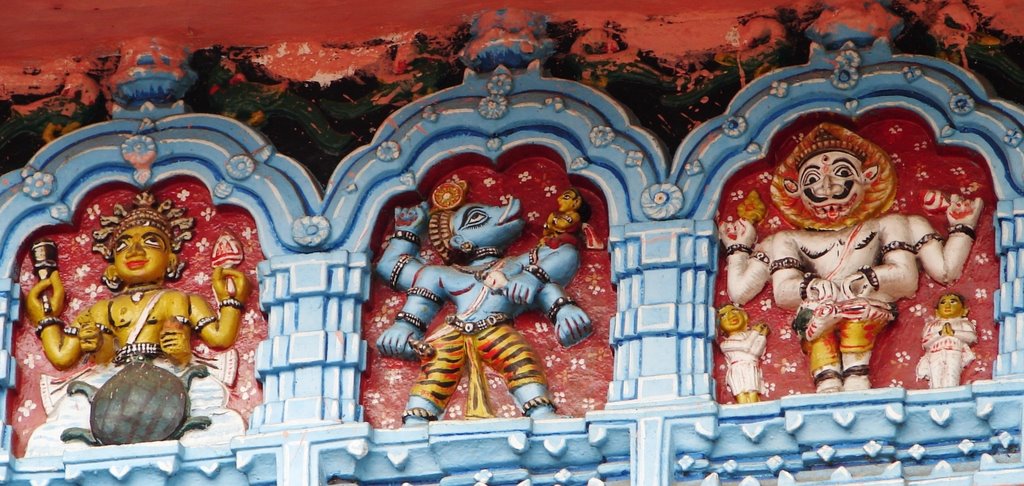
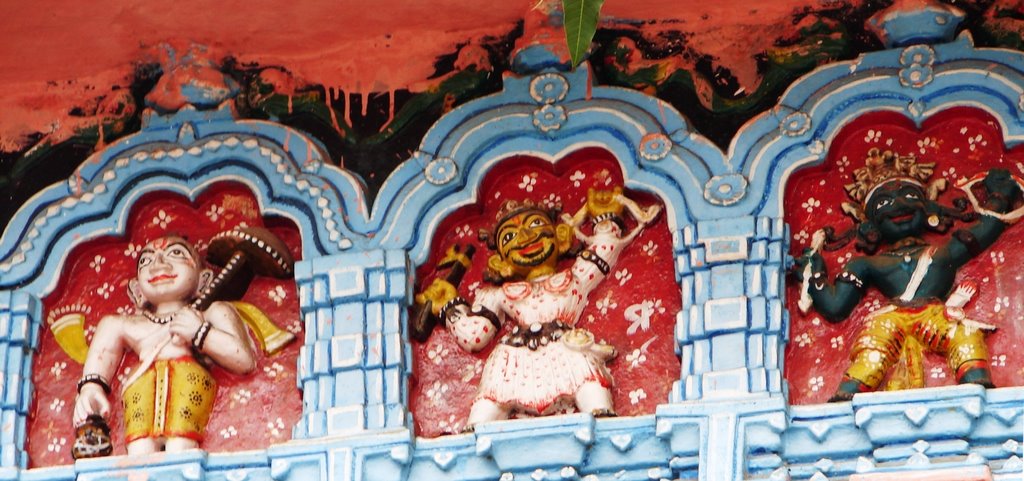 The picture to the right depicts the
Vaamana Avataara
Parashurama
and Shri Rama
of the lord
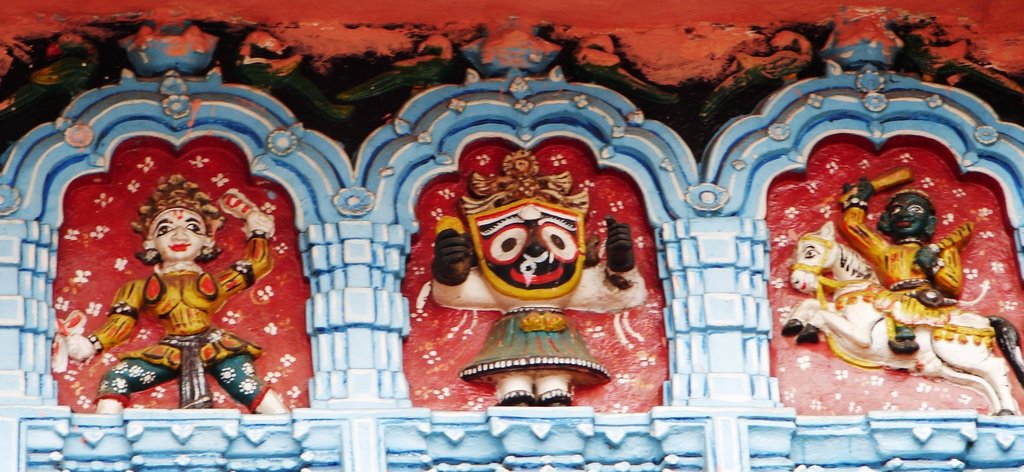
The Krishna avataara of the lord is to the left in this picture. Lord Jagannatha is in the centre and the last one is probably Kalki.
The temple also has other deities besides Jagannatha, Balabhadra and Subhadra -- the three main deities. I shall update the details of the other deites in another post.
1 comment:
-
Vinutha and Lingaraj said...
-
wow!! ... vibhisina appeared ??? u shud have tried to see that armlet and taken a photo!!
so it means our scriptures are true.. ramayana is not a fiction....
but the story of 3 women.. can't really tell....
Dashaavataara -- The 10 incarnations of Lord Vishnu
yada yada hi dharmasya
glanir bhavati bharatha
abhyutthanam adharmasya
tadatmanam srijaamya aham
Whenever there is a decline in religious practice
O descendent of Bharata
and a predominant rise of irreligion
at that time I descend
This
was the verse I sang every Sunday morning with Sonu Nigam while
watching "Mahabharatha" -- one of the most popular serials on Indian
Television. I didn't know what it meant, but something about it was so
enchanting that I would very religiously sing it every weekend.
Eversince I had aspired to read the Bhaagavata, but had never really
made an attempt to read it. I had also borrowed the book from a library a
couple of times but had returned it without reading a single page. I,
conveniently blamimg it on the busy schedule had been delaying reading
the book. While at Puri, I saw the dashaavataara
or the 10 incarnations of Lord Vishnu on the eastern gate of the
Jagannatha Temple and decided I would read the book as soon as I
returned to Bangalore. I finally managed to read a few chapters from the
sacred book and here I have made an attempt to update this post with a
little bit of information about few of the incarnations. Describing the
"Rama" and "Krishna" avataaras of the Lord would require more than just a
single post. So I have not made an attempt to write about these two
incarnations. I shall probably post another article about Budhdha later.
According
to Hindu mythology, Vishnu has incarnated 9 times to save the world
from destruction. He is yet to reincarnate as Kalki, the 10th avatara.
The 10 avaataras are:
1. Matsya (Fish)
2. Kurma (Tortoise)
3. Varaha (Boar)
4. Narasimha (man-lion)
5. Vamana (dwarf)
6. Parashurama
7. Rama
8. Krishna
9. Budhdha
10. Kalki
Matsya Avataara
Sri suta uvacha
itya ukto vishnu ratena
bhagavan baadarayanih
uvacha charitam Vishnur
matsya roopena yatkritam
Shri Suta (Goswami) said:
when questioned by maharaja Parikshita (vishnurata)
the most powerful son of Vyasadeva -- Sukadeva Goswami (baadarayanih)
described the pastimes of Lord Vishnu
in the form of a fish (matsya roopa)
Asid atita kalpante
brahmo naimittiko layah
samudropaplutas tatra
loka bhur adayo nripa
At the end of kalpa (past millenium),
At the end of Brahma's day,
annihilation took place and thus were inundated (as Brahma fell asleep)
the three worlds O King. kalenagata nidrasya
dhatuh shishayishor bali
mukhato nihsritan vedan
hayagrivo antike aharat
At the end of Brahma's day, when he fell asleep
and desired to lie down,
the vedas were emanating from his mouth
Hayagriva who was nearby stole the vedic knowledge
Jnatva tad daanavendrasya
hayagrivasya chestitaam
dadhara saphari rupam
Bhagavaan harir ishvarah
Understanding the great demon
hayagriva's acts,
the fish form
was accepted by Hari -- the supreme controller
The
lord assumed one fish incarnation to save the vedas at the beginning of
the swayambhuva manvantara and at the end of Chakshusha manvantara the
lord again assumed the form of the fish to favor the great king
Satyavrata.
One day while Satyavrata, the king of Dravidadesha
and the son of Vivasvan was performing austerities by offering water on
the bank of river Kritamala, a small fish appeared in the water of his
palms. When he was about to throw the fish into the water, the fish
requested him to take it with him and protect it from the other
acquatics. The king took the fish in a jug and brought it to his
residence. But the fish grew overnight and he had to find a well. The
fish grew three cubits within a moment. The king then took it to a lake.
The fish assumed a gigantic form exceeding the extent of water. He took
the fish to the ocean. The fish requested him not to throw it in the
ocean as there were dangerous sharks that could eat it. The king was now
sure that the fish was Lord Vishnu. He expressed his wish to know the
purpose for which the lord had assumed the form of a fish.
Shri Bhagavan uvacha
saptame hi adyatanad oordhvam
ahani etad arindama
nimankshyati apyaya ambhodhau
trailokyam bhur bhuvadikam
Lord replied:
On the seventh day from today,
this creation, O King who can subdue your enemies(arindama)
will be inundated in the ocean of destruction.
the three lokas that will be inundated are bhu, bhuvah and svaaha.
Tri lokyam liyamanayam
samvarta-ambhasi vai tada
upasthasyati nauh kachid
visaala tvam mayerita
When the three lokas merge
in the water of destruction
a large boat will appear
that will be sent by me.
tvam tavad aushadhih sarvah
bijanya uchchavachaani cha
saptarshibhih parivritah
sarva sattvopabrimhitah
aruhya brihatim navam
vicharishyasya aviklavah
ekarnave niraloke
rishinam eva varcasa
Until that time you shall collect all types of herbs
and seeds of the lower and higher order.
Along with the seven rishis
surrounded by all living entities
you shall get on the large boat
and travel without moroseness
in the ocean of inundation of darkness.
The only illumination will be the efflugece of the great rishis
Dodhuyamanam tam navam
samirena baliyasa
upasthitasya me sringe
nibadhnihi maha-ahina
The boat will be tossed about
by powerful winds.
I shall be present by your side so that you can tie the boat to my horn
by means of great serpent (Vasuki)
aham tvam rishibhih sardham
saha-navam udanvati
vikarshan vicharishyami
yavad brahmi nisha prabho
With you and all the rishish together,
I shall pull the boat in the water of devastation
and travel
till the night of Lord Brahma's slumber is over O King!
Kurma Avataara
The
demigods and demons summoned the king of serpants -- Vasuki, and
porimised to give him a share of the nectar. They coiled Vasuki around
Mount Mandara as a churning rope and endeavored to produce nectar by
churning the ocean of milk.
When the sons of Kashyapa (both
demigods and demons)began churning the ocean of milk, Mandara sank into
water as it had no support.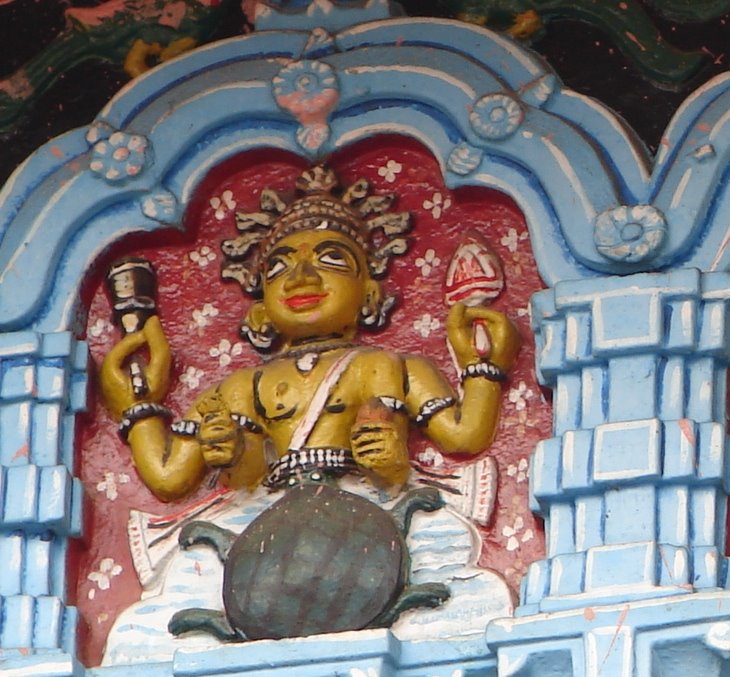
Vilokya vighnesha vidhim tadeshvaro
duranta viryo avitatha abhisandhih
kritva vapuh kachchapam adbhutam mahat
pravishya toyam girim ujjahara
Observing the obstruction created by the will of the supreme
the inconceivably powerful Lord, whose determination is infallible
took the wonderful shape of tortoise
entered the water and lifted the mountain
tam utthitam veekshya kulachalam punah
samudyata nirmathitum suraasurah
dadhara prishthena sa laksha yojana
prastarina dvipa ivaparo mahan
Seeing the mountain thus being lifted,
the demigods and demons were enlivened.
The mountain was carried by Sah (Supreme lord) on his back and he extended 1,00,000 yojanas (800000 miles)
like a big island
Surasurendrair bhuja virya vepitam
paribhramantam girim anga prishthatah
bibhrat tad avartanam adi kachchapo
mene anga kanduyanam aprameyah
When the demigods and demons, by the strength of their arms
rotated the mountain (while churning), O anga (Parikshitha maharaj),
the rotation of the mountain was considered by the kachchapa (tortoise)
as pleasing scratching of the body
Narasimha Avataara and Varaaha Avataara
Shri Narada Uvacha
Ekada Brahmanah putra
Vishnu lokam yadracchaya
Sanandanadayo jagmus
Karanto bhuvana trayam
Narada said :
Once upon a time the four sons of Brahma
Sanaka, sanandana, sanatana and sant kumara
Were wandering through the three worlds
And came to Vishnu loka.
Pancha shaddhayanarbhabhah
Purvesham api purvajah
Dig vasasah shisun matva
Dvah stahau tan pratyashedhatam
Although these four great sages
were older than Brahma’s other sons like marichi
they appeared like small naked children only five or six years old.
When Jaya and vijaya saw them trying to enter Vaikuntha loka forbade them to enter thinking they were only ordinary children.
Asapan kupita evan
Yuvam vasam na karhathah
Rajas tamobhyam rahite
Pada mule madhudvishah
Papishtaham asurim yonim
Balisau yatam asv atah
Being filled with anger they cursed thus
You two do not deserve to reside here
In a place that is free of passion and ignorance
At the feet of the one who has slain the demon Madhu
Be born in the womb of the most sinful asuras
Oh you two fools go quickly from here
Evam saptau sva bhavanat
Patantau tau kripalubhih
Proktau punar janmabhir vam
Tribhir lokaya kalpatam
Thus being cursed from their abode – Vaikuntha
While jaya and Vijaya were falling down, the merciful sages
Addressed again, “after three births
You will get back your position in vaikuntha.”
Jajante tau diteh putrau
Ditya danava vanditau
Hiranyakashipur jyeshto
Hiranyaksho anujas tatah
Thus were born the two sons of Diti
Worshiped by all the daityas and danavas (demons)
Hiranyakashipu was the elder son
Hiranyaksha was his younger brother
Hato hiranyakashipu
Harina simha rupina
Hiranyaksho dharodhare
Bibhrata sukarm vapuh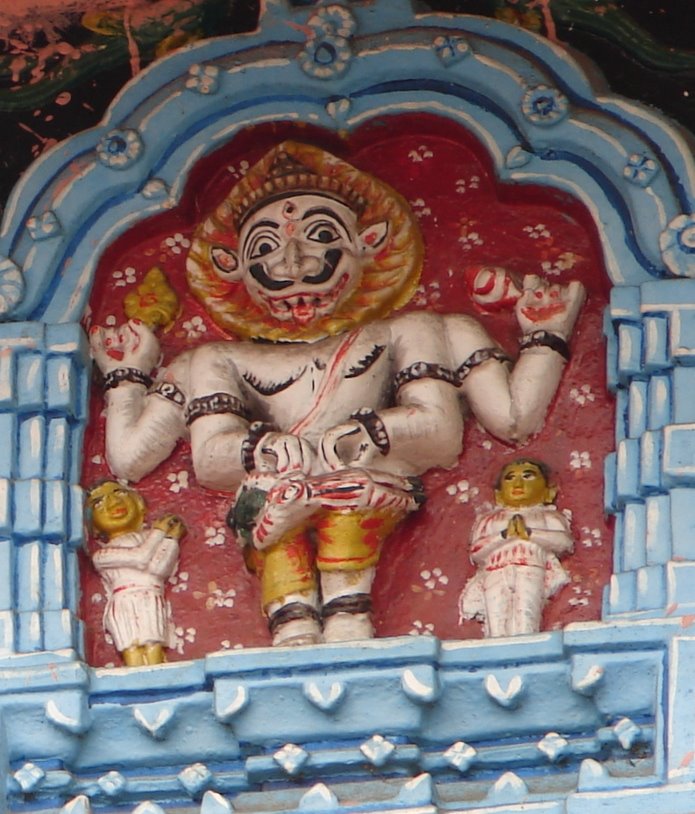
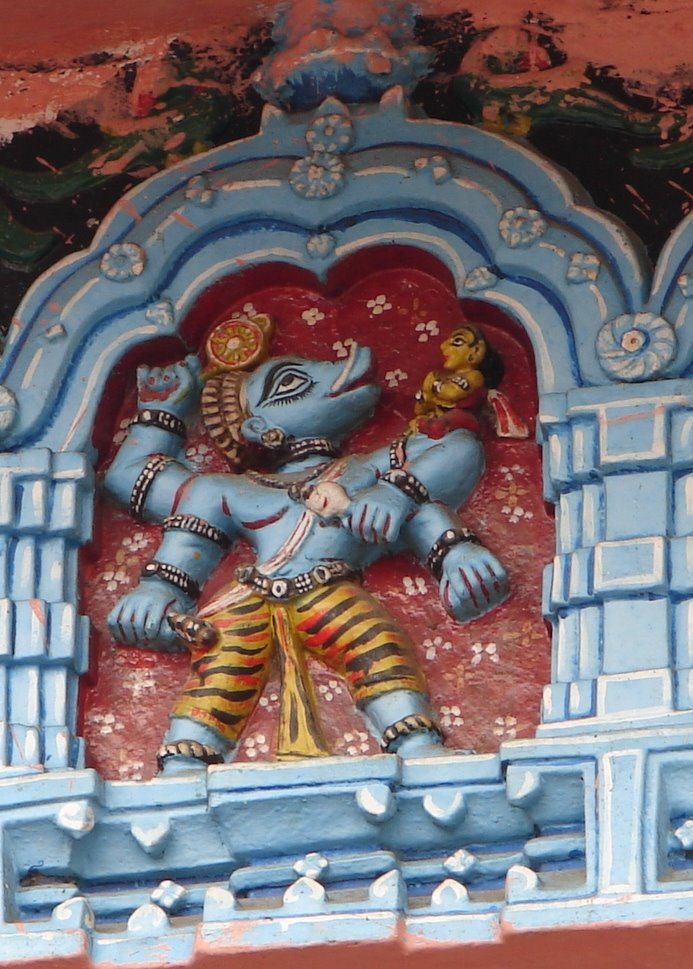
Hiranyakashipu was killed
By Hari (Vishnu) who appeared in the form of Lion (Narasimha)
When Hiranyaksa tried to hinder Hari who was delivering the planet earth that had fallen in Garbhodaka ocean
Vishnu killed him assuming the form of a boar
Vamana Avataara
Bali
maharaja, the demon, lost all his opulance and died in the fight.
Shukraacharya a descendant of Bhrugu muni, brought him back to life.
Bali maharaja became his disciple and served him with great faith.
The
brahmana descendants of Bhrugu muni were pleased with Bali maharaja.
They desired to conquer the kingdom of Indra. They engaged Bali in
Vishvajit yajna. Bali maharaja gathered demonic soldiers and departed
for the opulent capital of Indra.
tam deva dhaanim sa varuthini patir
bahih samantaad rurudhe prtanyayaa
aachaarya dattam jalajam mahaa svanam
dadhmau prayunjan bhayam indra yositam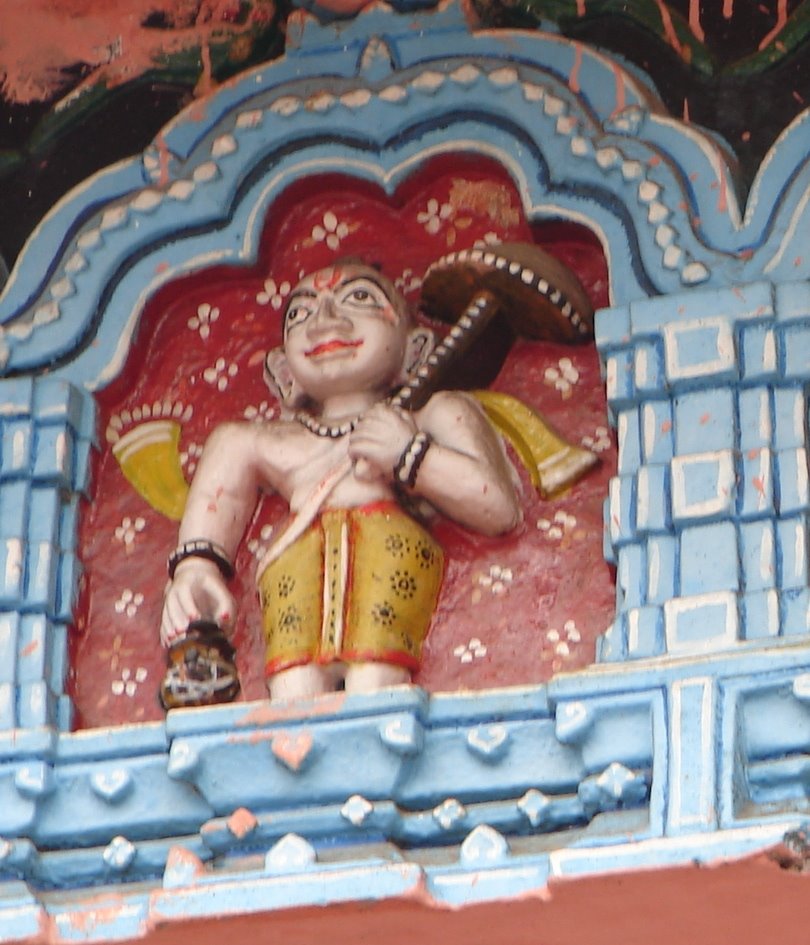
The palce where Indra lived
was surrounded in all directions by the commander of numberless soldiers
He sounded the conch shell given by Acharya
that created fear in all the ladies protected by Indra.
Indra approached Brihaspati to learn the secret of Bali's strength.
Shri guru uvaacha
jaanami maghavan chatror
unnater asya kaaranam
shisyayopabhrtam tejo
bhrgubhir brahma vadibhih
Shri guru (Brihaspati) said
"I know maghavan (Indra)
the reason for the elevated power of your enemy
the brahmana disciples of Bhrigu muni
have endowed him with all the power."
He
then informed Indra that neither he nor his men could conquer Bali.
Only the supreme lord could conquer him as he was equipped with the
spiritual power.
tasmaan nilayam utsrjya
yunam sarve tri vistapam
yaata kaalam pratikshanto
yatah satror viparyayah
Therefore give up the heavenly kingdom
and go elsewhere
until that time you need to wait
when the condition is reversed.
The
demigods assumed various forms and escaped unnoticed. Aditi, the mother
of the demigods was aggrieved. She was instructed by her husband
Kashyapa muni to observe payo-vrata and satisfy Vasudeva. Janardhana was
pleased with Aditi and agreed to be born as her son and protect her
other sons -- the demigods. Thus was born Vamanadeva.
One day
while Bali Maharaja was performing ashwamedha sacrifice at the field
known as Bhrugukachcha, Vamanadeva proceeded to show his mercy to Bali
Maharaja. Bali Maharaja jubilant on seeing Lord Vaamanadeva offered him a
seat with great satisfaction.
yad yad vato vaanchasi tat pratichchaa me
tvam arthinaam vipra sutaanutarkaye
gaam kaanchanam gunavad dhaama mrishtam
tathaanna peyam uta vaa vipra kanyaam
graamaan samriddhaams turagan gajaan va
rathaams tahtarhattama sampratichcha
Whatever you desire O brahmachaari (vato) that you may take from me
You can take from me whatever you desire Vipra Suta (son of a brahmana)
You may take cow, gold, furnished home, palatable
food grains and drinks, daughter of a brahmana for your wife,
villages that are prosperous, horses, elephants or
chariots or what ever you desire.
tasmaat tvatto mahim isad
vrne aham varadarshabhaat
paadaani trini daityendra
sammitaani paada mama
From your Majesty I seek very little land
From the personality who can give charity munificienty I ask
three paces of land O daityendra (Kind of the daityas)
to the measurement of my steps.
shri suka uvaacha
ity uktah sa hasann aha
vaanchtah pratigrhyataam
vaamanaaya mahim daatum
jagraaha jala bhaajanam
Sukhadeva Goswami said
thus being addressed he (Bali Maharaj) smilingly said
"as you have desired, now take from me
Lord Vaamana, the land"
To confirm his promise Bali Maharaja took the waterpot.
Shukrachaarya
realised Lord Vishnu's purpose and forbade him to fulfill his promise
that might harm the interest of the demons. He told Bali Maharaja to
take the evidence of Bahvarcha sruti, which says that a promise is
truthful only if preceeded by the word "OM" and untruthful if not. Bali
Maharaja after contemplating he relised that there was nothing more
sinful than untruthfulness. He decided that fame should be the aim of
life and even if one becomes poverty stricken for the sake of good
reputation, it is not a loss. Bali Maharaja gave Vishnu everything he
possesed.
tad vaamanam roopam avardhataadbhutaam
harer anantasya guna trayaatmakam
bhooh khaam disho dyaur vivaraah payodhayas
tiryan-nr-devaa rsaayo yad aasata
The incarnation of Lord Vaamana then began to increase in size
until everythin in the universe was within his body,
the land, the sky, all directions, the planetary system, different holes of the universe, great seas and oceans
lower animals birds and beasts, human beings, demigods great saintly persons
paadam dviteeyam kramatas trivistapam
na vai tritiyaaya tadiyam anv api
rukramasyaanghrir upary upary atho
mahar janaabhyaam tapasah param gatah
As the lord took his second step, he covered all of the heavenly planets
not even a spot remained for his step.
for the lord's foot extended higher and higher
beyond maharloka, janaloka, tapoloka and even satyaloka.
paadaani trini dattaani
bhoomer mahyam tvayaasura
dvaabhyaam kraantaa mahi sarvaa
tritiyam upakalpaaya.
You had promised to give me three footsteps
of land. O king of the demons
But my two steps have occupied all the land completely
Now find the means for the third step.
shri balir uvaacha
yady uttamasloka bhavaan maeritam
vacho vyalikam sura varya maanyate
karomi anritam tan na bahvet pralambhanam
padam triteeyam kuru shirshine me nijam
Shri Bali said:
if, O supreme lord, your goodself thinks
my promise was false, O greatest of all suras (demigods)
I shall make it true. I cannot allow allow my promise to be false.
Place your lotus feet on my head.
indrasena mahaaraja
yahi bho bhadram astu te
sutalaam svargibhih praarthyam
jnaatihih parivaaritah
Lord Vishnu said:
O Bali Maharaj (Indrasena)
All good fortune unto you! You may go to
Planet sutalam that is desired even by demigods
surrounded by your family members
Parashurama
A
brahmana sage named Ricika married Satyavati, the daughter of King
Gadhi. Satyavati and her mother, each desiring a son requested Ricika to
prepare an oblation. Ricika prepared one for his wife and an other for
his mother in law and went to bathe. Satyavati's mother thought that the
oblation prepared for her daughter must be better and so asked her
daughter for the oblation. Satyavati and her mother exchanged the
oblation.
tad viditva munih praha
patnim kashtam akarashih
ghoro danda dharaah putro
bhraata te brahma vittamaah
Having learned this fact, the great sage said:
"Wife you have done a wrong thing.
Your son will be a fiercce kshatriya who will punish others.
Your brother will be a learned scholar in spiritual science."
Satyavati
pacified Ricika with peaceful words and requested her son not be like a
fierce kshatriya. Ricika replied, "then your grandson will be of a
kshatriya spirit." Thus was born Jamadagni as the son of Satyavati. He
married Renuka, the daughter of Renu and many sons were born to them.
The youngest of them was Parasurama. When the royal dynasty, being
excessively proud of the material modes of passion and ignorance, became
irreligious and ceased to care for the laws enacted by the brahmanas,
Parashurama killed them.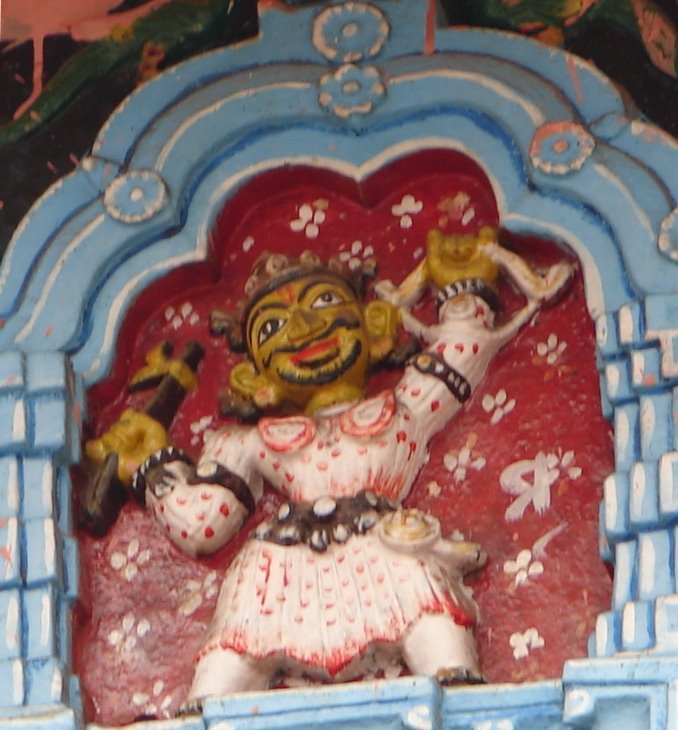
Kartaviryarjuna,
the Best of Kshatriyas, the king of Haihayas was blessed with 1000 arms
by Dattatreya. He became undefeatable and roamed all over the universe
without opposition like the wind.Once Kartaviryarjuna turned the course
of river Narmada and it inundated the camp of Ravana that was set up on
the banks of the river near the city of Mahishmati. Ravana attempted to
insult Kartaviryarjuna in the presence of the women who were surrounding
him at the moment. Kartaviryarjuna arrested Ravana just as one captures
a monkey and released him neglectfully in the city of Mahishmati.
Once
while Kartaviryarjuna was wandering in a forest hunting, he came to the
residence of Jamadagni. Sage Jamadagni received the king, his soldiers,
ministers and carriers very well. He supplied them with all the
necessities as he possessed Kamadhenu, the cow, that could give
everything. Kartaviryarjuna thought that Jamadagni was more powerful
than he was, as he possessed the cow.
havirdhanim risher darpan
naran hartum achodayat
te cha mahishmatim ninyuh
sa vatsam krandatim balat
Kamadhenu belonging to Sage Jamadagni
was forcibly taken away by Kartaviryarjuna's men after being encouraged by him
The men also forcibly brought the calf along with crying Kamadhenu to Mahishmatim.
Soon
after, Parashurama returned to the ashram and upon learning the act of
Karthaviryarjuan, he became as angry as a trampled snake. Taking his
chopper, shield, bow and quiver of arrows, Lord Parashurama chased
Kartaviryarjuna like a lion chasing an elephant.
achodayaat dhasti rathasva pattibhir
gadasi banarshti sataghni saktibhih
akshauhinih sapta dasatibhishanas
ta rama eko bhagavan asudayaat
Kartiviryarjuna sent elephants, chariots, horses and infantry soldiers,
clubs, swords, weapons called rishtis, weapons called sataghnis, weapons called saktis,
seventeen groups of akshauhinis,
Lord Parashurama killed them all single handedly.
He
worked with the speed of mind and wind, slicing his enemies with
Parashu (chopper. The enemies fell, their arms and shoulders being
severed, their chariot drivers killed, their carriers, the elephants and
horses all annihilated.
atharjunah pancha sateshu bahubhir
dhanuhshu baanaan yugapat sa sandadhe
ramaaya ramo astra bhritam samagranis
tany eka dhanveshubhir acchinat samam.
Thereafter Kartaviryarjuna, fixed arrows on five hundred
bows simultaneously,
to kill Lord Parashurama.
But Lord Parashurama released enough arrows with just one bow
to cut all the arrows and the bows in the hands of Kartaviryarjuna.
Punah sva hastair achalan mridhe anghripan
utkshipya vegad abhidhavato yudhi
bhujan kutharena kathora nemina
chichheda ramah prasabham tv aher iva
Kartaviryarjuna uprooted hills with his own hands
and uprooted the trees. With great force
Parashurama chopped off Kartaviryarjuna's arms like one lops off the hoods of a serpant.
kritta baahoh shiras tasya
gireh sringam ivaharat
hate pitare tat putra
ayutam dudruvur bhayat
agnihotrim upavartya
savatsam para vira ha
samupetya 'sramam pitre
pariklishtaam samarpayaat
Thereafter Parashurama cut off the head of Kartaviryarjuna
like a mountain peak.
When their father was killed, the sons,
(ten thousand in number) fled in fear.
Parashurama released Kaamadhenu
and with her calf, brought her back to the ashram.
Parashurama
then travelled to holy places to rid himself of the sin he had
committed by killing kartaviryarjuna. Once when Renuka, Jamadagni's wife
had gone to river Ganga to get water she saw king of Gandharvas
decorated with garland and sporting in the river with apsaras. She was
inclined towards Chitraratha -- the king of Gandharvas. When she
returned to the ashram, Jamadagni realised what had happened and ordered
his sons to kill their mother as she had committed adultry in her mind.
But the sons did not carry out their father's command. He then ordered
Parashurama who had just returned to the ashram. He carried out his
father's order.
Jamadagni was pleased with Parashurama and he
told his son to take any benediction he liked. Parashurama requested
that his mother and his brothers be brought back to life and that they
do not remember the incident when they became alive again. Jamadagni
granted Parashurama the benediction. Thus Renuka and her sons were
brought back to life again.
2 comments:
-
Vinutha and Lingaraj said...
-
Loved it !!
-
Vinutha and Lingaraj said...
-
hmmm.. intresting .. i didn't know that Parashurama's story started with his grandparents
Land of Lord Jagannatha -- Puri
“Art of Living” foundation had arranged for an advanced course in the hostel and there were several people attending it. That was proably the reason for the hostel being crowded. We were given a double room whose balcony opened to the sea. We had just enough time to check in and change into appropriate dress to go to the temple. We asked the hostel in-charge for the appropriate fare to reach the temple and hired a cycle rickshaw. We were off to see the temple that I had long yearned to see. Though I am not a very religious person, I enjoy visiting temples.

Puri is also known as Sri Kshetra, Sankha Kshetra, Nilachala, Nilagiri, and Dashavatara Kshetra. Jagannatha has been described as the famous deity of Odra or Utkal. Sri Kshetra is famous throughout the world. It is said that, if one visits Jagannatha Puri dhama he will get the result of visiting all the tirthas. One who sees Jagannatha at Puri need not go to any other place for piligrimage.
The glory of Puri is described thus in Tantra Yamala:
Bharate cotkale dese bhusvarge purushottame
Darurupi Jagannatha Bhaktanamamya pradah
 It
is mentioned in Mahabharatha that Visvakarma performed a sacrifice. He
gave the earth goddess as a present to rishi Ksyapa. The earth was so
angry after being treated thus that she disappeared into the nether
world. Kasyapa went through a period of penance after which the earth
goddess appeared in the form of a “vedi” – platform, near the sea. It is
said that the mortal who climbs on the platform becomes strong and
powerful. This vedi (platform) of mahabharatha has been identified with
the raised platform of the temple where Lord Jagannatha is enshrined.
It
is mentioned in Mahabharatha that Visvakarma performed a sacrifice. He
gave the earth goddess as a present to rishi Ksyapa. The earth was so
angry after being treated thus that she disappeared into the nether
world. Kasyapa went through a period of penance after which the earth
goddess appeared in the form of a “vedi” – platform, near the sea. It is
said that the mortal who climbs on the platform becomes strong and
powerful. This vedi (platform) of mahabharatha has been identified with
the raised platform of the temple where Lord Jagannatha is enshrined.Sankha Kshetra: This place is named after demon Sankhasura who was killed by Lord Vishnu. Sankhasura was formed from the sweat of demon Madhu. Vishnu killed Madhu when he was on the verge of killing Brahma. Sankhasura wanted to take revenge on Vishnu. He pleased Shiva by his penance and learned Tantra from him. While he was learning Tantra he could hear the recitation of veda. Rishi Yagnavalkya was learning Yajur veda from Brahma at the moment. Sankhasura wanted to learn the recitation and he asked Shiva for the source. Shiva instructed him to go to Brahma to learn the Vedamantra. But Brahma had already distributed the four Vedas among his disciples
Rig Veda – Madhu Chandra
Yajur Veda – Yagnyavalkya
Sama Veda – Goutama
Atharva Veda – Prahalada
So Brahma refused to teach him Vedamantra. Sankhasura was enraged and he took away the four Vedas from the disciples forcibly and hid them in the sea. Lord Vishnu took the incarnation of “Meenavatara” to search the demon in the sea. The demon hid in the Kalpa Vriksha inside the present temple. Lord Vishnu tried to kill the demon. The demon hid in a conch. Vishnu threw his disc to kill the demon. But the conch was so hard that the disc was thrown away to a place called “Chakra tirtha” due to the impact. Finally Vishnu killed the demon with his Brahmastra.
Shiva was furious to learn about the death of his disciple. The demi gods who had assembled to rejoice the death of Sankhasura pleased Shiva by singing “Vedasara Staba” (glories of Shiva). He requested Vishnu to name the place as Sankha kshetra after the name of Sankhasura. The proposal was accepted and the place was named as “sankha kshetra”.
 From Purushottama to Jagannatha
Reference to Sri kshetra (abbreviation for Sri Purushottama Kshetra) is found in the accounts of a Chinese traveler t-tsing. It is believed that a region in Burma was named after the famous sacred city. The popularity of the deity increased when Chodagangadeva constructed a grand temple.
Padau Yasya dharantariksham – akhilam nabhistu sarvva disha
Srotre netrayugam ravinduyugalam murddhapi va(cha) dyaur-asau
Prasadam purusottamasya nrupateh ko nama karttum kshamas
Tasyety-adyanrupair-upekshitamayam chakre tha gangeshvarah !!
Who can build a temple for purushottama whose feet are the earth and the entire space his naval.
Whose two ears are all directions,
Whose pair of eyes are the sun and the moon
And whose skull is the sky
So thinking this temple had been neglected by the previous kings,
But Gangeshvarah built it!!
Till the end of 12th C AD, the presiding deity of the sri kshetra was Sri Purushottama. During the period of Anangabhima III the muslims were already powerful on the frontier of Ganga kingdom and posed a danger. The regional hindu powers were also not united. Anangabhima attempted to safeguard the Ganga kingdom by the support of local religious force. For that purpose Purushottama was declared as Lord of the Ganga kingdom and the king himself became the deputy (rout) and ruled the kingdom on behalf of Lord Purushottama. The name was changed to Jagannatha to suit to different sections of religious belief as Buddhists, Jains, Shaivas, Vaishnavas and Saktas.
Memorable ride to Puri
We reached Balugaon station at 8:30 AM. It is a very small station with just a couple of platforms. We were made to run between the ticket counters to buy our tickets. We met a young lad in his early twenties who was well informed about the train timings. He assured us that the 8:30 AM train would never be on time and we could still get it. It generally arrives half an hour late. He told us to buy our tickets to Puri, board the train headed towards Khorda road and take another train to Puri. Accordingly, we purchased our tickets and sat on a cement bench waiting for our train. Slowly the time ticked by.
There was no sign of the train at 9:00 AM. The young lad walked up to us and reminded us that we had to change our train at Khorda road. We thanked him for his help and continued waiting for the train. We asked the station master when the train headed towards Khorda road would arrive on the platform. He told us that we could take the fast express instead of the passenger train that we were hoping to take. We crossed the foot bridge and went to the platform where the express train was expected. Just when the train arrival announcement was being made, I sighted a Blue Jay on the lamp post. I pulled out my camera and quickly photographed it.

Finally at 9:30 AM the train chugged into the station. We boarded one of the sleeper bogies. Since we had our tickets for the passenger express, we had to get it upgraded to a sleeper class ticket. I went across the length of the train a couple of times looking for the ticket inspector. A cool drinks vendor informed me that the inspector was in the pantry car having his breakfast and it would be a while before I could talk to him. I decided to go back to the compartment where Uma was comfortably seated and wait for the inspector.
The train reached Khorda road station at 10:55 AM. As soon as we got off the train we saw the Puri passenger train on the next platform. We got on the train only to find that it was overly crowded and there was hardly any place for us to stand comfortably. I stood in the aisle. Vendors walked up and down the aisle. Every time some one had to walk in the aisle, I had to move and give way. After a while I was annoyed as people would walk up and down the aisle for no particular reason.
After what seemed like eternity, the train slowly pulled out of the station. There was an elderly woman seated in the compartment who was curious to know our itinerary. She realized we were strangers and asked us if we were pilgrims headed to Jagannath mandir. She told us that leather belts, purse and watches wouldn’t be allowed in the temple premises. She warned us against taking cameras and mobile phones with cameras to the temple. Though she couldn’t speak Hindi very well, we managed to converse for a while. She then asked us if we were students or we worked. My friend replied that we were students studying in Bangalore University. Sometimes it is a good idea to conceal your true identity from strangers if you are traveling alone. She then asked us where we would be staying in Puri. We told her that we would be staying with friends and she assumed that we would be staying in the hostel with friends. Since she presumed we would be visiting Puri with friends she didn’t advise us further. She also told us that the fast express to Puri had been cancelled following the floods in Ahmedabad. The only express train that probably passes through this station is the train from Ahmedabad. But surely there should be express trains from other parts of the country?!
After shuffling on my feet for about an hour I sat on the overhead luggage shelf:). A man seated there until then got off the train. I grabbed the opportunity and occupied the seat that he had vacated.


I invited my friend to join me as there was sufficient place for both of us. She passed my offer. She stood for a little while after that. Few people got off at one of the major stations and she found a place to sit. I got down as well and occupied the vacant seat beside the window.
The train was expected to reach Puri by 12:30 PM. It was one of those journeys that never seemed to end. There were lot of people on train and at times the stench of sweat was unbearable. Since it had rained, the floor of the train was wet too. The train was now inching forward. Few people got off the train and preferred to walk on the tracks. We reached “sakhi Gopal” station (also referred to as "Sakshi Gopal") and one of the passengers asked us if we were planning to visit the “Sakhi Gopal” temple. I told him that we intended to visit only the temples in Bhubaneswar.
He exclaimed “Aren’t you going to Sakhi Gopal? Then your visit to Bhubaneswar isn’t worth it!”
I replied “well... we are here to visit the Jagannath Mandir and all other temples are only of secondary importance to us.”
We didn’t hear any other smart advices from him again. We reached Puri station at about 12:50 PM. We bid good bye to the lady who had given us all the advices that she thought would help us while we were at Puri and walked towards the exit gate looking out for the tourist information counter.
2 comments:
-
Vinutha and Lingaraj said...
-
first time nin hosa hairstyle noodidhu.. itz so different kanno...
-
Vinutha and Lingaraj said...
-
hmm intresting that the leather stuff r not allowed.. but how do they check ?
Chilka Lake -- Barkul
On reaching, we were disappointed to learn that all the private tour operators had joined in the strike (“indefinite”) and we were once again standing there with no means to reach Barkul. Just then a young man in track pants asked us where we were headed. He was probably returning after his morning exercise. We told him we had to go to Barkul and he suggested we take a private bus. We then asked a few locals how we could reach Barkul. Almost instantaneously people would ask us “Chilika Barkul?” as though there were two places in the state by the same name. A few of them suggested that we take the bus headed towards Rambha get off at “Kalighat” and then take another bus to Barkul. By then a bus going toward Rambha stopped there and the conductor assured that Barkul was just about 10 Kms from “Kalighat”. We should have known better than to believe the conductor. We got on the bus and stuffed our heavy bags in the overhead baggage shelf, and sat on the not-so comfortable seats. I asked a couple of men on bus how far Barkul really was from “Kalighat”. Two men on the bus who seemed to be well informed told us that Barkul was about 20 – 30 Kms from Kalighat. By then the bus had crossed the old bus stand.
The young man in tracks (I prefer to call him the “jogger”) came on his bike looking for us. He was indeed a good man who had returned to inform us that the bus that we were taking wouldn’t go anywhere near Barkul. He told us to take the government bus instead. So we got off the bus again and with the heavy bags on our back began the trek back to the old bus stand.
The “jogger” came looking for us again and told us that there was an OSRTC bus that would leave Berhampur at 11:30 AM. He had also talked to the conductor and requested him to drop us off near Barkul gate (whatever that meant!). He introduced us to the conductor and also the OSRTC officer who told us that we could come back at 11:30 AM and board a bus that would leave from the old bus stand. He also gave us the registration number of the bus that I now have forgotten. It was just about 9:00 AM and we had lot of time on hand to kill.
We went to Nandan hotel and had our breakfast. While paying our bill at the reception, I asked the cashier if we could hire a taxi to Barkul. The cashier (could have even been the manager of the hotel) called up a taxi driver and after talking to him, informed us that we would have to cough up 800/- Rs. This did not appeal to us and we thanked him and left the hotel. It was just about 9:40AM and we had to spend time till 11:30. We strolled past the old bus stand and enquired at a nearby travel agency if we could get a taxi to Barkul. Since the taxi operators too had joined in the strike, the watchman told us that the office was closed. With nowhere to go and nothing else to do, we stood in front of the travel agency waiting for the bus. By then the watchman walked over to the taxi stand and returned with another man who seemed to be a driver. The man walked up to us and asked if we were looking for a taxi. When we said, we were; he said it would cost us 700/- Rs. We refused to pay him the hefty amount and he walked away. By now, my legs were aching and we walked in to sit on the steps. It started drizzling and the watchman invited us into the office. We went in and sat in the office, but something didn’t feel right. So we walked out of the office again and sat on the stairs. Another man (taxi driver) walked up to us and asked us how much we were willing to pay. He was willing to take us to Barkul for 500/- Rs. He asked us if he could take another two people with us in the taxi. We were not comfortable with the idea and so we refused to take the taxi.
It didn’t seem like a good idea to sit in front of the office anymore. So we walked into an STD booth opposite the bus stand. I first called the manager of Barkul Panthnivas and asked him if it would be a good idea to take a train to Balugaon. He informed that Barkul was just about 8Kms from Balugaon station and we could get an auto from the station. I then called the railway enquiry and found out that the next train to Balugaon was at 12:00 PM and it would take about an hour to reach the station. I preferred to travel by train where as uma was against the idea. She wanted to take the bus. I was not very sure if we would reach Barkul in less than 2 hours. Reluctantly I waited with Uma at the bus stand for the bus. The bus came to the stand at about 11:00 but we weren’t allowed to board it. The conductor asked us to return by 11:30.
Where were we to sit and wait for the bus? We returned to the STD booth and asked the lady at the counter if we could sit there. She didn’t seem to mind. A young mother walked in with her daughter. We learnt that the little girl was Suhani and her elder sister was Simran. I exclaimed aloud that “Suhani” reminded me of Rani Mukherjee in “Saathiya” and the young girl’s mother smiled and confirmed that they had indeed named their daughters after watching two of the most popular bollywood movies. They had named their daughters after the lead women characters in movies “Saathiya” and “Dilwale Dulhaniya Le Jaayenge”.
We saw a few people boarding the bus and decided it was time for us to get on the bus too! We walked up to the bus and asked the conductor if we could board the bus. The conductor told us we could, but we had to occupy seats 31 and 32. These seats were towards the rear end of the bus and I wasn’t sure how rugged the roads would be :(. But did we have a choice? The seat on which I was sitting had some foam missing in the centre and it was not going to be a comfortable ride. The bus finally left Berhampur at about 11:50AM.
The route the bus took was beautiful and I didn’t mind the uncomfortable seat anymore. The conductor finally announced that we were to get off. The bus stopped in front of a dhaba. We got off and walked straight. A signboard directed us to the right. We reached the crossroad where we had to turn right when a car (it probably was an Indica) stopped right beside us and the driver offered us to drop us at Panth nivas. That saved us a walk of about half a kilometer. The driver dropped us at the reception hall and we were finally at Barkul. We thanked the driver and proceed to check in.
We enquired about the package tours that OTDC offered to “Chilika Lake”. The manager informed us that the package tours were all cancelled as it was not the right time to visit Chilika and there weren’t many tourists at the time. He then told us we could hire a boat at 450/-Rs per hour and visit Kalijai Island, Nalbana Island, Rajhans island and sea mouth. We realized it would take us at least 8hrs to cover all the islands. We checked into our room and decided to visit only Kalijai, Nalbana and Rajhans. This would take us about 3Hrs and we would be satisfied watching the palace from the lake as we wouldn’t be allowed to step on the island. We set off in our boat at 3:30PM towards Kalijai Island.
We watched panth nivas from the water. It is in a picturesque location. With Chilika lake on one side and the hills surrounding it on the other side, it is an ideal location for a romantic getaway.

Chilka served as a flourishing port even during the days of the emperor Ashoka. It was the link to other South-East Asian nations such as Java, Sumatra, Indonesia, Borneo, Burma, Ceylon (Sri Lanka) and also China. Manikpatna still has traces of that ancient port. The lagoon was probably created when the sea inundated the region, due to a depression on the earth’s crust. Vast areas were submerged and the water could not recede because of a barrier formed by the deposition of sand and other alluvial silts surrounding the water body. Myths and folklore, however, are woven into the fabric of Chilka. The lake lies to the north of Puri, the abode of Lord Jagannath. Legend has it that around fourth century AD, invaders came by sea to raid the temples and seize their phenomenal wealth. The priests, being forewarned, cleverly hid the deity as well as the jewellery, thereby foiling the invaders’ plan. The enraged attackers turned to the sea. The sea initially receded, and then it suddenly surged forward and swallowed the army. When the sea receded once more, Chilka was born.
We sped in our motor boat for about half an hour and had our first glimpse of the Kalijai island. The Island of Kalijai is famous as a center of religious worship due to the temple of Goddess Kalijai where a big fair is held on the occasion of Makara Sankranti that falls in January every year


A legend talks about Goddess Kalijai, immortalized in poetry by one of the leading poets of Orissa, Godavari Mahapatra. The village maiden Kalijai was married off to an inhabitant of the distant island of Parikud against her wishes. While going to her new home, a storm whipped up the placid waters, capsizing the boat and Kalijai was swept away. The cyclone is said to have started at the mammu-Bhanaja mountain (or the uncle-nephew mountain calles so for the striking resemblance that the two mountains have with each other.) Her spirit is said to have hovered around the island. The heart-broken villagers renamed the island where she had lived as Kalijai, installed her idol in a temple and began worshipping her, praying for the safety of those who ventured out to the sea.


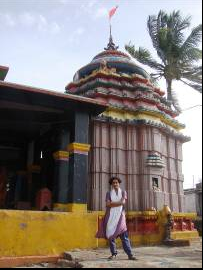
After offering our prayers at the temple, we told the boatman to take us to the island with the Raja’s palace on it. He said that the manager had only instructed him to take us to Kalijai island and then take us boating on the lake for about three hours and return to Barkul. We told him that we had hired the boat to visit Kalijai island, Rajhans and Nalbana island. After arguing for a while he turned the boat towards Rajhans. On reaching Rajhans, he told us that the islanders had spread their nets around the lake and so we couldn’t venture anywhere near the island. The manager at Panth Nivas had told us that the boat would take us round the island and we would be able to take pictures of the palace. But now, we were disappointed to learn that we would have to go by auto for about four and a half Kms to reach the palace. The manager at Panth Nivas had only informed us that we would be able to get off the boat and visit the palace. We were given an impression that we could view the palace from the boat. We were quite angry now for we felt cheated and so we instructed the boatman to talk to his manager on the walkie-talkie. He passed on the instrument to us and we expressed our anger. Since we were already almost an hour and a half away from panth nivas we were unsure as to what we had to do next. We instructed the boatman to take us to Nalbana island. He was visibly irritated. He probably wanted to return home soon. He told us that we wouldn’t be able to see even a single bird on the island. We asked him if we returned to Barkul immediately would we be refunded the last one hour’s amount. He said we had to pay for the full three hours as the receipt had already been issued. Since we were to pay for the last one hour, we decided we might as well go to Nalabana.
After traveling for about half an hour we asked the boatman how far the island was. He pointed to a watch tower and said that was Nalabana. We were expecting to see a little more than just a watch tower.


We couldn’t sight even a single bird :(. The island was submerged in water following the heavy rainfall the state had received. We only managed to sight a single nest on a lone tree. There was also a ticket booth that looked like a telephone booth :) from a distance.


By then it started drizzling and we had to return to Barkul. The boat rocked precariously in the strong winds. Uma had to shift to the other side of the boat to balance it. We had to hold on real tight. I was sitting at the center and the boat had spewed water on me generously all along. My dress was already wet and now the rain god was showering his blessings too! I didn’t have my raincoat on. I was literally shivering in the cold. Uma wasn’t very comfortable riding without a life jacket. I had to assure her that I had been on water in much worse weather conditions and we would safely reach the shore. Finally we reached the shore at 6:30 PM. The manager of Panth Nivas was standing there waiting for us, to probably find out why we sounded angry on the walkie-talkie. I was feeling cold and had to change into something warm as quickly as possible; else there was the risk of catching cold. Leaving the manager to talk to the boatman, we walked into our room.
We had our bath and changed into warm clothes. We then went to the reception desk to talk to the manager. The manager was probably expecting us. We then told him that we felt cheated as we could neither see the raja’s palace nor go round Rajhans island. He tried to tell us that the package tour was generally only to Kalijai island and Nalabana island, and that he had done us a favor by adding on Rajhans island. I tried explaining the situation to another panth nivas officer who happened to be there at that time. He agreed with us that the manager had not given us complete details. After arguing with the manager for an hour, he finally cancelled the receipt that he had issued and charged us for two hours instead. With the money refunded, we went over to the dining hall and had our dinner.
The next morning we woke up early to watch the life on Chilka. Our room was beside the lake and it was a pretty sight from the balcony. I enjoyed the view for a while. Once there was sufficient day light we took our camera and Handy cam and walked towards the lake. It was August 15th; the day India got her independence. We sang a few patriotic songs and hummed a couple more.


The fishermen were already at work. They were setting their nets to catch the fish. It was a delight watching the serene lake. We sat by the lake for an hour watching the fishermen. One of them even offered to take us on his boat to see a nearby island. I sat looking at the rising sun in the horizon wishing that the clock stopped ticking. Life here seemed to be nothing more than fishing. The cool breeze against the face, the sound of water and the melodious calls of the birds made me wonder why life couldn’t be this beautiful every day. Some birds were hovering around the nets hoping to get their free share of food.


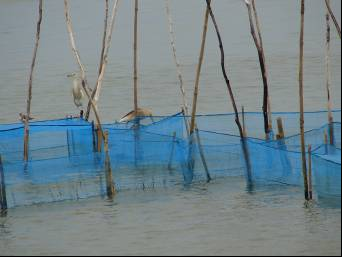
 I couldn’t have enough of Chilka lake in one day. I was disappointed
that we couldn’t visit Satpada to see the Irrawady dolphins. My next
trip to Orissa will be to Phulbani and Khoraput which will include
Chilka lake even if it is just for a day during the winter season to see
the birds and the dolphins.
I couldn’t have enough of Chilka lake in one day. I was disappointed
that we couldn’t visit Satpada to see the Irrawady dolphins. My next
trip to Orissa will be to Phulbani and Khoraput which will include
Chilka lake even if it is just for a day during the winter season to see
the birds and the dolphins.
10 comments:
-
Akash said...
-
Hey Kavi....
Dhod pic's haaku...ee small pics nindha 'effects' yennu illa.
Modhle blogspot ashtondh dhod chitra suport maadolla....mathe neenu kanjoos thanna thorisbeda!!!
Please................. -
Vinutha and Lingaraj said...
-
avid narration !! loved it... just if u had transport on time u cud have seen a bit more...
-
Anonymous said...
-
Dear,Friend
Chilka Lake (also Chilika Lake) is a brackish water coastal lake in India's Orissa
state, south of the mouth of the Mahanadi River. It is the largest coastal lake in
India. The lake was formed due to the silting action of the Mahanadi River, The
area of the lake varies from 1165 km² in the monsoon season to 906 km² in the
dry season, and is studded with numerous small islands. This wildlife sanctuary
is ideal for wildlife tours and bird watching tours during the winter months.
Please Visit For More Detail
http://www.desidirectory.com/india-travel-guide/
-
Anonymous said...
-
Thanks for the detailed narration. This will help me in my December trip.
-
SOUMAVA said...
-
Thanks 4 d narration & the pics..We frm Berger Paints r going on a wknd trip to Chlka...ur post ws rly handy...n the way of narration ws lucid as well...Keep Posting.
Thanks.
Soumava -
Unknown said...
-
Chilka lake is known as the largest brackish water lake in Asia, it is the largest wintering ground for migratory birds on the Indian sub-continent, housing various rare species of birds. Located in south west Puri, the lake is a popular attraction. Also, check out hotels in Puri offering all the basic facilities.
-
Anonymous said...
- This comment has been removed by the author.
-
Anonymous said...
-
Welcome into your official site Escort Service in Bhimtal.If you're searching for incredibly lovely enthusiastic acutely amazing versions, airhostesses, faculty ladies, unmarried girls for inner desires to be more fulfilled
Read more:- Bhimtal Escort -
Priya said...
-
Call Girls in Jaipur only trust quack-quack for uploading their complimentary personals whatsapp phone contacts and numbers for matchmaking, friendship and adore at jaipur. You're able to start a chat dialog using jaipur one girls online to share pictures, girls whatsapp amounts , interestsand hobbies etc..
-
Lip2Lip said...
-
Book High Profile Girls to all People who want to enjoy in your life at an affordable rate, just visit my website and get entertaining service by Akshita Sen. She is the top Escorts in Mumbai offering luxury and finest service.
Independent Escorts in Chembur
Sexy Colaba Escorts Girl Services
Beautiful Andheri Escorts Services
Escorts Services In Bandra at Low rate
Fantasy Borivali Escorts Service
Independent Hot escorts services in Dadar
Independent Goregaon Escorts Services in 5* Hotels
Gopalpur-On-Sea
There were a few chairs placed against the wall and we stretched ourselves on them. Though it wasn’t very comfortable, we were too tired to complain. Uma fell asleep within a few minutes while I was finding it very difficult to sleep. There were three women in the room who were very loud. I requested them twice to lower their voice but it didn’t have any effect on them. To add to this, two men who seemed to be related to one of the women would walk in every few minutes and I was noticeably irritated. But this didn’t affect the men in the least. They walked in whenever they felt like. Finally at about 5:30AM we woke up, had our bath and got dressed. The water in the bathroom was cold but I had no choice. We left the station at 6:30 AM. The ticket collector at the gate was surprised to see that we had arrived at 12:30 AM and were leaving the station at 6:30AM. He probably was wondering what we were doing for about six hours in the station.
We had to take a private bus to Gopalpur from the old bus stand. After walking for about five minutes we asked a passerby how far we had to walk to reach the bus stand. He informed us that it would take us just about another five minutes. We walked for about half a km and then asked another passerby how long it would be before we could reach the bus stand. He informed us it would take us another five minutes! People in Orissa seem to be fond of the number five! We hired a cycle rickshaw which later seemed to be a good idea as the old bus stand was far away from the railway station. We took a bus to Gopalpur and it took about an hour to cover just 16Kms!!!
Gopalpur is a sleepy little village. Gopalpur got its name from an 18th century temple dedicated to Krishna (Gopala). Once a prominent trading sea-port, during the British Raj, Gopalpur has transformed into a quiet and relaxed place. The crumbling walls and pillars of the harbor, are a witness to its past glory of commercial activity. It has been growing into one of India’s prettiest beach resorts.
Fortunately it wasn’t raining here though it was raining heavily in the other parts of Orissa at the time. It was a bright and sunny day though at times the sky looked a bit clouded. We asked the conductor on the bus to direct us to the youth hostel and were informed to walk straight and we would sight the youth hostel.

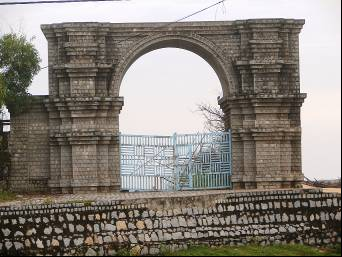 There is a pretty little mosque (or was it a madrasa?!) on the way to
the hostel. There was also a twin storied building that was in ruins. It
could have been a British office as Gopalpur was an important port
during the British rule. It reminded me of the old building in the movie
“Nagina”…
There is a pretty little mosque (or was it a madrasa?!) on the way to
the hostel. There was also a twin storied building that was in ruins. It
could have been a British office as Gopalpur was an important port
during the British rule. It reminded me of the old building in the movie
“Nagina”… 

We passed the old youth hostel on the way to the new youth hostel. It looked like it would crumble any time. We had seen the photo of the new youth hostel on the internet but were still unsure how good the building would be. On arriving at the new youth hostel, we were glad that it was a nice little place situated right beside the sea. We were allotted a double room that looked very comfortable. We checked into the youth hostel and returned to Berhampur to take the bus to our next destination Tara-Tarini and Jaugadh.
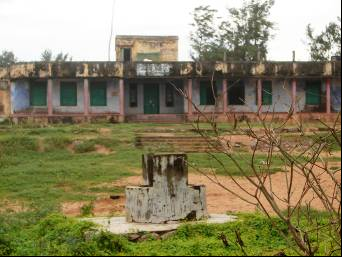

On reaching Berhampur we found out that the private buses weren’t plying as the union was on strike. A tourist operator informed us that it was an attempt to depose the travel minister. Surprisingly, the only means of communication in Orissa is private buses. The government buses do not ply to even the places that are popular with the tourists. One of the tourist operators informed us that there was a bus to Bhairavi and we could go there instead as there were more temples in Bhairavi as compared to Tara-Tarini. We decided to take the bus to Bhairavi but then within few minutes all the bus operators joined the strike and so we had no option but to return to Gopalpur . We returned to the hostel and since we were tired, we slept until 5:00 PM. I had read that there was a good light house where we could spend about two hours enjoying the picturesque island. The warden at the hostel informed us that the light house would close to the visitors at 5:30PM. We were a little disappointed as we realized we would probably not be able to reach the light house before it closed. We walked briskly and reached the light house at 5:35PM. We were now only hoping that we wouldn’t be sent away without being allowed to climb the light house. We reluctantly went in and enquired if we could go up and watch. The three men at the ticket counter said we could. This was the first good thing that happened to us since we had arrived at Gopalpur. We paid the nominal entry fee of five rupees and climbed the stairs. It is a pity that we are not allowed to carry our camera with us to photograph the beautiful island. We watched the island from the top of the light house for about 20 minutes and then decided to play in the sea.


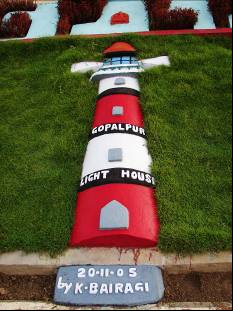


It was a wonderful evening and there were a lot of people at the beach. We walked on the shore for sometime and ate ‘chana masala’. It was turning dark and we felt it would be a good idea to return to the hostel before it turned completely dark. We had vegetarian chowmeen in a restaurant and returned to the hostel. I watched the light house from our hostel room for sometime and then fell asleep.



After a good night’s sleep we were all set to go to Barkul. The tour operator had informed us the day before that a private bus would leave to Barkul at 8:30AM. We checked out of the hostel at 7:00AM and took the bus to Berhampur.
2 comments:
-
Vinutha and Lingaraj said...
-
Very good narration.. liked it.
-
goodpeapul said...
-
Good. Keep going. Fill your blog with more fun-and-frolic for all of us..e e e e e e
I guess you would have won many prizes in story-telling competitions!!!
Any guesses who am I???
Bike trip to Manchanbele, Hutridurga and Big Banyan tree
I was to ride pillion on Vinay’s bike from CBI Main road R.T.Nagar. We decided to meet at 5:55 AM at the pre-decided meeting point. The others would meet at a convenient place in Sanjaynagar and then would meet us at R.T.Nagar. Vinay called me at about 5:55 AM to inform that his mobike had a puncture. I called up the others and informed them that we would be late. However they decided to reach R.T.Nagar and wait for us. The hours slowly ticked by and Uma called me at about half past seven to inform that the tyre was finally fixed. I reached New Shanti Sagar R.T.Nagar at about 7:50 AM and Vinay had not yet returned from the repair shop with his bike. Meanwhile I met Darshan’s friends Bhanu and Vijay who would also be joining us.
Finally Vinay met us at about 7:55 AM and after a hurried breakfast we were all set to go!
 After Vinay’s bike developed a puncture the others didn’t want to take a
chance and so the boyz decided to get their vehicles checked! We
stopped over at the Shell petrol bunk. Darshan got the tyres checked.
After Vinay’s bike developed a puncture the others didn’t want to take a
chance and so the boyz decided to get their vehicles checked! We
stopped over at the Shell petrol bunk. Darshan got the tyres checked.
Here we decided on the route that we would take to reach our final destination. Darshan gave the directions to Bhanu and Vijay and they went their own way while we patiently waited outside.
We then whizzed past Sri Gandhada kaavalu, bidarahalli and reached the outskirts of Bangalore. Here we decided to wait for Bhanu and Vijay who had gone their separate way after the brief stop at Shell petrol bunk.
After riding on the good tar roads for a few kilometers, we began to ride on tar roads that were filled with pot holes. Vinay’s dexterity at maneuvering the vehicle around these pot holes is commendable. Varsha and Arul were closely following us. We had lost contact with the others as the mobile network wasn’t strong to transmit the signals. Fearing that we might be separated from the group, we took breaks at regular intervals and waited for the others. I would occasionally turn around and look out for the others. When I couldn’t sight them, I would signal Vinay to ride slowly and let the others catch up with us. Darshan and Uma were listening to music on Darshan’s mobile and singing along. I however strongly condemn this act, as listening to music could be quite distracting at times. Not many people would agree with me, I’m sure! But it is always better to be safe than sorry!
With no direction boards to guide us, we had to depend on the passersby to help us. The villagers were more than glad to direct us. This is such a contrast to the experience I had in London. It had rained heavily on a particular day in 2004 and the tube stations were closed as they were filled with water. I was forced to ride a bus to Wembley park and the driver stopped the bus in an unfamiliar neighborhood and asked to get off the bus as he wouldn’t go any further. I requested a few people to give me directions to the nearest bus stop. Some just shrugged their shoulders and walked away while a few didn’t even bother to do that!
We were by now riding on mud roads and the ride was bumpy. But it didn’t bother us much as we were excited to reach Manchanbele dam at the earliest. After riding for a few minutes we noticed that Darshan and Uma weren’t following us. We waited for them to join us and were surprised to see Uma riding with Bhanu. They inform us that Darshan’s bike was low on air and it might have developed a puncture and Vijay had offered to stay back with Darshan to fix it! NO! NOT AGAIN!!!! We didn’t need another trouble with the bike to delay us now... Since they had assured that they would join us at the Manchanbele dam, and also because there wasn’t anything much that we could do, we proceeded towards the dam without the two of them.

 Darshan and Vijay meanwhile pushed the bike to a nearby repair shop in a
village and got it fixed. It was then that they realised that the man
who checked the air in Darshan's mobike tyres at the petrol bunk had
released some from them :)
Darshan and Vijay meanwhile pushed the bike to a nearby repair shop in a
village and got it fixed. It was then that they realised that the man
who checked the air in Darshan's mobike tyres at the petrol bunk had
released some from them :)
We enquired for the directions to Manchanbele at a few villages and then took one of the most rugged mud roads we had been on until that time. However, it didn’t seem like we were headed in the right direction as we couldn’t see water anywhere. Just when I was beginning to look around for some of the locals to enquire the direction, we saw a couple of bikers headed in the same direction.
 This
was an assurance that we were indeed on the right path as Manchanbele
is quite popular with the bikers. A few hundred meters on the same road …
and we had the first glimpse of the beautiful lake ahead.
This
was an assurance that we were indeed on the right path as Manchanbele
is quite popular with the bikers. A few hundred meters on the same road …
and we had the first glimpse of the beautiful lake ahead.It was 9:55 AM and there was no sign of Darshan and Vijay yet. We intended to go to the dam but found ourselves heading towards the lake instead. We decided to go near the water and see if we could cool off our heels for a while. We could wait for Darshan and Vijay there. We could only hope that they would take the same route that we had taken and not go towards the dam.
We continued along the same road and came to a place where we could park our bikes and play for a while. Just then one of the bikers came cycling from the opposite direction shouting to his fellow bikers that there was a better view point up ahead. Vinay dropped me off there and went ahead to check if he could find a better place. Uma, Arul and Varsha also waited there for Vinay to return while Bhanu parked his bike. After a few minutes Vinay returned and informed that he couldn’t find a better place ahead. So we parked our bikes and went closer to the water.

We had plum cakes and biscuits.By then Vijay and Darshan joined us. The boys played cricket for a while we girls enjoyed the beautiful view.

The serene water in front of us, the greenery around us and the cool breeze was worth the bumpy ride. Savandurga hill at the back drop made it more scenic.


Though we would all have gladly stayed there the whole day and enjoyed every minute of the stay, we decided it was time to move on. We still had to visit Hutridurga, T.G.Halli and Big banyan tree. Since it was already 11 O Clock we realized we had to drop one place from the itinerary. Some suggested that we drop big banyan tree, but Uma and myself were keen to go there. As we had heard that there was only restricted entry at T.G.Halli, we were not sure if it would be worth the visit. So we decided to visit T.G.Halli only if time permitted.
We then started towards Hutridurga. We had to again rely on the locals to give us the directions. We were advised to reach Tavarekere and enquire for further directions. The road was uneven and filled with pot holes. At few places there were just pot holes and no road. We had to move in single file.

But the thick trees on both the sides and a few rocky hillocks were quite refreshing and we didn’t mind the bad condition of the road.


We then took the road towards Savandurga. I had climbed Savandurga a few years ago with my colleagues. It was a tiring but an amazing experience. After a strenuous climb of four hours, we had reached the peak. I would love to climb it again.


Since we had to cover quite a few places on a single day, we decided to climb Hutridurga which was a smaller hill as compared to Savandurga. I had heard it was also an easy climb to the top.
Probably for the second time during the entire journey, we were following third. Bhanu and Vijay were leading on the first bike; Arul and Varsha were closely following them. I and Vinay followed them at a safe distance and Darshan and Uma were following us. While we were marveling at the gigantic rock to our right, we saw Arul and Varsha falling off their bike.


A snake had appeared out of nowhere and crossed the road. Bhanu in an attempt to protect it had braked suddenly. Since Arul was closely following him, he too braked to prevent a collision with Bhanu’s bike. But they lost control and fell off the bike. Varsha escaped with a slight bruise on her palm but Arul had a sprain in his right arm.
Fortunately we were wearing our helmets and Arul was riding quite slowly. After resting for a while we were on our bikes again riding towards Hutridurga. Arul decided to ride pillion with Bhanu till the pain subsided and Varsha rode with Bhanu.
3 comments:
-
goodpeapul said...
-
Hi I am Vinay.
A good one. I hadn't thought that you would be putting so much of detail. A very good attempt even though in-complete!
Where are the photos that were taken in "Dodda Aalada mara" Do put them and a little about the ride back home. -
talegari (ತಾಳೆಗರಿ) said...
-
Hi,
Would you let me know how to reach hutridurga from manchanbele ? -
Manoj said...

-
bangalore-tavarekere-tippagondanahalli-magadi-santepete circle-hutridurga hill. total 75 kms..
Talakadu-Jaladhama
6:15 AM: Dad dropped me at the pickup point. I waited patiently for the cab.
6:30 AM: No sign of the cab. I tried calling the driver but the mobile was switched off. I then called Sriram and he asked me to wait for another few minutes as the driver could have been delayed.
6:45 AM: I began to worry that the driver might have forgotten. A few joggers gave me a quizzical look. Some of them were probably surprised to see me standing in a bus stop but not boarding any bus that stopped there. I began feeling uneasy when a couple of guys slowed down and one of them even whistled. I gave them a real bad stare and they jogged off. I then began walking up and down the foot path.
6:50AM: I got tired of waiting and called up Ajoy and Sriram trying to find out if they knew the whereabouts of the cab. They seemed to be unaware of it too.
7:16 AM: Rajesh called me to inform that he would go to Technopolis and find out if the cab had reached the office.
7:21AM: I called Rajesh to find out if he had reached the office and if the Cab had too. But he probably was driving and he didn’t receive the call.
7:30AM: Sriram called me to find out if the cab had picked me up. When I informed him, the cab wasn’t there yet, he said he would call up Ajoy and find out what could be done. I then called Ajoy and informed him that I would return home as it wasn’t feasible to board the cab from any of the other two locations. One was about 21Kms from my house and the other was about 16 Kms. Getting an auto at that wee hours in the morning was difficult. But Ajoy insisted that I should try and make it to one of the pickup points.
7:33AM: Rajesh called me and informed that the cab had reached Technopolis and the driver had forgotten to pick me. I was now really furious and I asked the driver if it was possible to pick me from any other point. He informed me that he couldn’t.
7:38 AM: Sriram called me and asked if it was possible to reach some place that would be convenient for the maxi cab driver to pick me up from. The only place I could get an auto to was Shivajinagar. Sriram suggested that I take one auto to Shivajinagar and then another one to M.G.Road and try and meet them there. I finally took an auto to M.G.Road and since the streets were literally empty, it being a Saturday, I reached M.G.Road in just a few minutes.
7:51AM: I boarded the cab I was finally on the way to Talakadu!
The only familiar people were Ajoy, Sriram, Noreen and her son Jaden. I hadn’t seen the other people in the office. Since Sriram and Ajoy had updated everybody how the driver had forgotten to pick me, most of them empathized with me. There was a pretty girl sitting beside a window and she seemed to be genuinely concerned. She told me to give the driver a piece of my mind when I met him at the resort. Then another man sitting beside her introduced himself as Srinath and the pretty girl as his wife Sneha. There were three other guys I still didn’t know. We took the fly-over near Town hall and reached BEML. Here Sundaresan and his son Aravindakshan boarded our cab. Then we waited for the other cab. When the other cab finally arrived, we realized that there were two other people who hadn’t been picked up yet. Few guys in our cab took this opportunity to get the crate with beer cans that was in the other cab. We continued our journey towards Thalakadu and the other cab took a U-turn and went back towards Vijayanagar to pick up the two guys.
We began talking and I slowly got to know the other guys in the cab. One was Karthik and the other was Suraj. I still didn’t know the name of the third guy. Sneha seemed to know them all and it didn’t take me long to understand that they were all staying together in Finland for a few months.
We crossed BEML factory, Raja Rajeshwari nagar, Bidadi and Wonderla. A reckless station-wagon driver tried to overtake our vehicle from the wrong side. The driver of our cab got irritated and he tried to block the road and prevent the driver of the station-wagon from over taking us. I am almost certain that the driver of the station wagon was a North Indian. His features were Aryan. He managed to overtake few other vehicles and sped past us.
A few meters beyond Rajarajeshwari hospital, we were held up in a traffic jam. One side of the road was blocked probably for repair work and the vehicles had to ply on just one lane. Some thoughtless drivers had blocked the path of the oncoming vehicles and there was absolutely no way that vehicles on either side could move. Ajoy by then spotted the station wagon that had over taken us a few minutes ago. The driver had not only blocked the road by his senseless driving but was also beckoning to his friends to move further up the road. Sneha put her had out of the window and started waving to the other vehicles that had piled up behind our cab and informing the drivers not to overtake us. Fortunately the drivers listened to Sneha and they didn’t try to drive past us.
We passed Tavarekere [pond of lotus] on the way. Like the name suggests, it is a pond covered with lotus. I could only spot the white lotus. I am not sure if there were any, of other color. We wanted to stop by at Maddur to eat the maddur vadas. But we decided to stop on the way back as we were getting late . The good tar roads gave way to the mud roads and towards the last bit of the journey; there were only pot holes and no roads. The driver did a commendable job at driving us into and out of the pot holes. The speed at which he drove the vehicle made me wonder why he wasn’t a professional Formula 1 racer?!
European Holiday
A lot of Indian women
dread to travel alone to distant countries. But traveling alone in most
of the European countries is not only easy but also quite safe. It
requires a lot of careful planning though. Planning for the trip
sometimes requires more time than you actually spend at the place you
visit. I lived in London for a while and I traveled to a few countries
in Europe. The following tips to travel to European countries are only
for Indian Nationals with a work permit to United Kingdom that is valid
for a period of more than six months . This list is not complete. You
should refer to the website of the embassy through which you will be
applying for your visa.
Applying for the visa:
Indian nationals require a Schengen visa (http://www.eurovisa.info/)to
visit most of the countries in Europe. The visas are expensive and cost
you between 20 and 30 Pounds. However the only consolation is that the
visa is valid in all the countries that are a member of the Schengen
union. Before you apply for the visa, ensure your have
1. A
valid visa to visit the country. However if your work permit is valid
for a year or more than a year, you do not require a separate visa to
visit Switzerland.
2.
Purchase a multi trip medical insurance. The embassies do not issue a
Schengen visa if you do not have a medical insurance covering the entire
duration of your trip.
3.
Salary slips for three months. If you cannot produce salary slips
request your employer to issue a letter to the concerned person in the
embassy stating your employment details. The companies will generally
have the template of the letter to be issued.
4.
A recent bank statement. Do not print the balance details from the
internet. Request your bank to issue the statement. You can also
purchase travelers cheques and provide the details.
5.Have
a detailed itinerary and confirmed tickets. You should also have a
confirmed hotel reservation. Hostels are also a good option if you have a
limited budget. You can become a member at the Youth Hostels
Association of India (http://www.yhaindia.org/) and stay in the youth hostels world wide.
Since
a single visa is required to visit any Schengen country, you can apply
for the same through any embassy. But it is simple and convenient to
apply through French embassy (http://www.diplomatie.gouv.fr/venir/visas/index.html).
But then your port of entry should be France. Therefore you need to
include one place in France in your itinerary, travel to that place and
then visit any other Schengen country. You might get a visa valid for 90
days if all your documents are in order. However the embassy's decision
is final and you might not get the visa for 90 days if you are unlucky.
People living in London can also book online with the French Embassy for an appointment to get the Visa(https://www.consulfrance-londres.org/consulat/texte/visa/rdvvisaautres.htm).
Book a slot and be present at the embassy at the allotted time. Spend
about half a day at the embassy and you will walk out with your visa!
You might have to wait for about 2 months before you get an appointment
with the visa as Paris is a favourite tourist destination.
Some
embassies require you to call on the premium numbers to get an
appointment. The calls on the premium lines are expensive. You can also
get a Schengen visa from the Austrian embassy by sending them an email
to obtain the appointment. However I am not sure if the embassy issues a
90 days visa.
Travel check-list
Before you set out on the journey, ensure you have the copies of the  following documents on your personal mail id that can be retrieved quickly if needed
1. Scanned copy of passport
2. Scanned copy of work permit
3. Itinerary
4. Emails / scanned copies of the hotel / hostel reservations
5. Scanned copy of your medical insurance
6. Scanned copy of your employment letter
7.
Scanned copy of the letter issued by your employer to the embassy. This
is not really required. But you can have it, just in case.
8. Important phone numbers and address of relatives, friends, employer, doctor
9. Scanned copies of flight / train / coach tickets
10. Scanned copy of Youth hostel card and a student identity card if you are a student
Booking flights
1. If you are a budget traveler book your tickets on the cheap flights.
2. Try and book your flights months in advance.
3. Flights scheduled at odd times (early in the day or late in the evening) usually cost less.
4.
Most flights that fly to major international airports cost more. Try
and locate a smaller airport that is close to your travel destination
and fly there instead. For instance, flying to Venice is more expensive
than flying to Treviso that is just about an hour away from Venice.
Your travel kit
1. Travel light.
2. Find out the weather details of the place you are traveling to before you travel and be properly equipped.
3. Place photo copies of all important documents in all the travel bags that you take along with you.
4. If you carry any medicines with you, ensure that you also take the doctor’s prescription to avoid any unforeseen problems.
5. Take backpacks instead of heavy suitcases.
6.
If you are a strict vegetarian ensure that you learn “no egg”, “no
fish” and “no meat” in the languages that are spoken in the place you
are traveling to. You can also take a print out of the following
translated words / phrases if you don’t want to buy a translation book
1. WC [toilet]
2. police station
3. hospital
4. directions: right, left, straight etc
5. restaurant / hotel
6. thank you very much
7. do you speak English
8. metro / train station / coach station / bus / airport
9. tickets
10. please
11. I only speak English
12. sorry
7.
Try and find out if you get MTR or any other branded “ready to eat”
food and take some along with you. You might not find the food to your
liking in most of the European countries.

.JPG)

.jpg)


No comments:
Post a Comment
Note: Only a member of this blog may post a comment.