Buddhist sculptures at Kanaganahalli-Sannati site
November 28, 2014
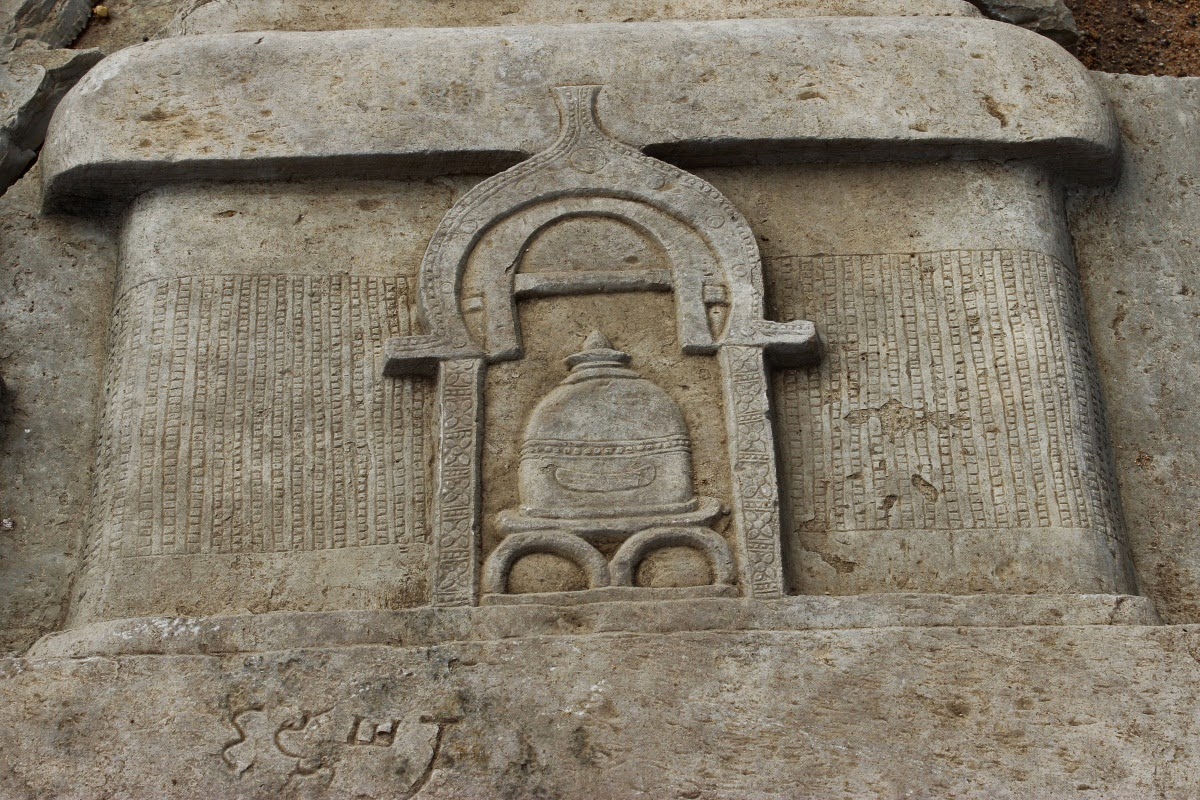
This is a stupa with a egg shaped object in it. The two women on the outside seem to be fanning the egg shaped object. Flanking the stupa are richly decorated pillars. The tree here might be the Bodhi tree under which Buddha attained enlightenment.




..........
Directions names in Kannada

the steel block of Golconda
This forged alloy steel block is one of the curious artifacts at Golconda fort. This block was used to test army candidates strength while during recruitment. As per guides at the fort, this block weighs 250kg. Anyone lifting it was selected. There are no details of the block as such. Assuming this block came into existence during the Qutb Shahi times, possibly even earlier. This block's workmanship is close to forged steel canons of those times i.e. XV or XVI century. Coming back to its weight, based on its dimensions, my estimate is 130 to 160 kg. The weight could vary depending on the composition of the alloy.

Weight lifting test was very essential in those times because soldiers were expected to handle a lot of dead weight like guns, canon balls, spears, swords, grain laden bags, etc. A soldier's basic qualities were both strength and stamina. Of course ancient people definitely were much fitter compared to the present. Their life expectancy might've been shorter but they were fitter.
Of the four visits to Golconda fort, I've made it a point to see the block every time. During the second visit, my maternal uncle Praveen was in company. We tried lifting it.. Praveen couldn't budge it while I could move it a inch but couldn't lift it off the ground. While we were there three local kids came by. They, 13 or 14 year-olds, said they could lift it together. They lopped in a piece of cloth gripped their little hands together and lifted it an inch off the ground. Basically the knack of gripping is important. Bad that I didn't take a shot of the kids in action.

Here's a video of the block being lifted by a body builder. He too employs a fabric to enhance grip.
While on the subject of ancient metallic artifacts, do check out the following posts:
3 comments:
- Anonymous said...

The ring given on it is to use your fingers and grip not any other means of support..like cloth or rope... soldiers were selected on basis of their strength and stamina..so stop posting useless things
- siddeshwar said...

First, quit hiding behind anonymity, post with your id.
Second, have i said soldiers were expected to lift the block with a cloth or rope. No.
Third, read the second para again. I've mentioned "strength and stamina."
Lastly, if you want to be critical, fine. But, is there a need to be rude?- Anonymous said...
I think 250 kg is more of a lore to intrigue the visitors....it must be weighing around 100-120 kgs...
Thenginkal Betta
Sometime Dec 2002. Amma gave me a Prajavani newspaper cutting about Thenginakallu Betta. The article inspired me to plan a trip to this remote hill. I asked two of my office colleagues Girish and Rajesh to join me, they happily tagged along. We left Bangalore early, stopped at Sri Revana Siddeshwara Kshetra for a quick breakfast at a local eatery serving steaming hot tatte idli & sambar. Sri Revana Siddeshwara Kshetra is also known as SRS Betta because of the monolithic hill here. SRS Betta to Thenginkalbetta distance is about 2 km, a narrow rural road flanked by fields and plantations.
Before we explore the hill, let's take a look at it's name. Thenginakallu can be split into Thenginkayi & Kallu which means coconut & stone. There must be some historical connection to this name which I'm unaware of. Betta means a hill or a mountain.
One long look at the hill we couldn't figure out where to start the climb. So we decided to seek help. At the entrance of the village, on the right hand side was a house, we stopped to inquire. The house owner's name was Chandrashekhar, he seemed to be the village headman. He was kind enough to talk to a villager and appoint him as our guide. We were very happy that a local person would be leading / guiding us here.

Thenginkalbetta is a merger of two hills into one. Meaning on a long base are two granite mounds. That's our guide leading us, Girish behind him and Rajesh was behind me.
Thenginkalbetta is peaceful and hardly touched by mankind, something rare in these times. Bottom half of the hill is green with lot of plant life. We had walk over rocks, through creepers and thorny bushes. It was one hell of an adventure. Without our guide, we would not have found the way to the top. By the time we reached the half way up, my exposed skin was covered with cuts. Our guide told us that there are leopards, bears, wolves and a host of wildlife in & around this hill. He told us that any wild animal coming from the side or diagonal generally do not attack, if we remain calm they might just go away. however, if you see it head on, it could spell trouble. Apparently when you face any wild animal head on they feel challenged or threatened and they tend to attack. As a precaution our guide had a well sharpened sickle in his hand. A sickle is a handy thing in a jungle trek, helps clear thorny limbs in the way.
Our guide, I think his name was Manjunath, showed us a dolmen concealed under a shrub. He told that Palegar soldiers hid weapons under the slabs for emergency use. That's Rajesh inspecting the secret spot. He's holding a small machete in his hand, so amongst the four of us there were two weapons.

A few minutes away from the dolmen were these memorial stones. As you see the bottom panels show battle scenes in which warriors were martyred and the upper panels show them merging with Paramaatma. Those days I used a Yashica film roll camera, so shooting pictures was always constrained hence no close ups.

This is the larger rock-hill to our right.

..and the the smaller hill to our left. We were heading into the valley between the hills.

Thenginkalbetta has played a role in history. It's natural caves were used as hideouts by Palaegars (local chieftains) during wars. Manjunath showed us one of the caves high up in the rocks. Bamboo ladders were used to climb and pulled up into the cave. It seems the cave can accommodate up to 60 people and has a source of fresh water as well.

Apart from the large cave, there are a few more smaller caves here. Clambering over the unstable stack of stones was a risky adventure but our Manjunath was very encouraging. This cave was large enough to accommodate a dozen adults.

Due to frequent thunderstorms, the cave's floor was water logged. That's Girish standing in cold water. Climbing down the stacked stone was even more scary but all of us descended safely.

This is another cave which doesn't have waterlogging issues. Here we had to negotiate the slope without steps.

Our guide mentioned that fugitives use these caves to avoid police. Even hunters use these shelters while waiting for a prey to get ensnared.
Now we are atop the smaller peak. The rock surface is not very smooth... it gave us good grip and we felt confident even on steep faces.

May be not long back the place would've been covered by thick forest.

Every step we could see something unique; here we have a T-shaped gap. A large boulder has split into three, a natural phenomena of disintegration.

A pool of rain water, still fresh & clear. A face-wash of this cool water refreshed us. Manjuntah on my right, and Girish on the left. From this spot, we caught a glimpse of three bears trying to get under cover... they are way down the hill.

We are standing in the valley of the two peaks.

This creeper born in the tiny gap! Look how it's clinging close to the rock.

More water... we reach a fresh water pond. This looked like a man made one, meaning a small has been built to harvest rain water. If you look carefully, you can see a stone pitching over the surface of the water.

A trisected rock still standing as one. I wonder how it was formed.

As we climbed further upto towards the bigger peak, entered a small wood of Neralaemara. A carpet of green grass and fruit bearing trees. I felt I was looking a paradise. My pictures hardly say anything. One should be in the place and feel it.

The shape of the rock is the effect of soldiers sharpening their swords. They would lie below the rock and rub their sword-edge against the rock's surface. I remember seeing similar stones at Chikkasiddarabetta fort.


Another grinding spot.

We had a wonderful time on the top. We climbed down the other face of the larger peak. It was quite steep but the surface gave us great grip.

Even nature draws and paints... see this painting created by flow of water. Such contrasting colors!

Once back down, Manjunath took us home, introduced his mother and wife. This simple mud & wood house has sheltered four generations. While we chatted away the ladies prepared coffee for us. It was the first time I had Bella-Coffee ~ jaggery sweetened coffee and loved it. We Thanked our host for their warm hospitality and said bye.

On the way back, we stopped at Sri Chandrashekhar's house, thanked him too and left.
Thenginkalbetta has been one of the most serene places I had ever been to.
16 comments:
- Joanna Serowa Marzycielka said...

Hello,
a great story! Especially with the pictures illustrating your trip!
Take care,
Joan- siddeshwar said...
Thanks Joan. I'm looking at your blog. great pictures! I loved the hay stacks and the purple flowers. I'll take some time off this weekend and to spend time on your blog.
- siddeshwar said...
I think the stone structure in photo number 8 (from the top) could be a megalithic tomb.
- subbunayana said...

Siddu,
Enjoyed reading this blog- siddeshwar said...
thank you Subbu
- Anonymous said...
Super ur jurny sir
- Sumana said...
That's a really good spot u have gone to Siddeshwar, write about the paleygars, the wild animals, the veergals are all so exciting, thank u for bringing this to us
- Anonymous said...
Going through your blogs Siddu.. you sync your write ups alongwith the photos so well that we feel like we ourselves have visited the place.
Excellent debut @ the journey across Karnataka.. keep the ink flowing buddy!
- Ceeni ❤️- siddeshwar said...
thank you dear friend
- siddeshwar said...
indeed an amazing place. thanks to Amma for keeping that newspaper cutting and giving it to me. and deep regards to our hosts Chandrashekhar & Manjunath. and of course, regards to you for reading and appreciating 🙏🏽
- siddeshwar said...
thank you Seeni buddy. While I sync up with photos, your poems sync up with the unseen.. magical compositions by you.
- Anonymous said...
Nice to know about Palegars , very informative Siddeshwar Prasad (Sidds)
- siddeshwar said...
thank you Anant
- Anonymous said...
Awesome, trip loved the experience
- siddeshwar said...
Thank you, dear friend.
- Anonymous said...
Superb, Hope it has not become picnic crowds den littered with bottles and plastic.
Bicycle Ride - Bangalore to Mysore to Kallur to Bangalore
Soon after our PUC-I exams, during the summer of 1986, Babu Prasad and I, did some basic planning for the trip. A little village called Kallur near Mysore was our destination. Mom was against our idea while Dad was cool about it... We made sure our Hero cycles were in good condition, especially the brakes. We carried one back-pack each. Both of us had a Walkman each and a few cassettes.
We started our journey early morning since we had no idea how much time was required to cover 165 km. The first 20-30 km was mostly uphill, with the sun going up, the day was getting warm. Sweating and panting, I started wondering if I could ride all the way to Mysore. This is where our Walkman came handy, thoughts of giving up were blown away by the numbers blasting into our ears... we passed by Ramanagara and its hill ranges. Ramanagara is where the most of Sholay the blockbuster movie was shot.

We were yet to cover the last leg of our journey. The road to Babu's village Kallur. The road wasn't a flat one, we had to negotiate lot of uphill stretches. At one point, we both got cramps in our legs... what a coincidence! We almost fell off our bicycles by the sudden seizure and pain. We sat on the road until the muscles relaxed. It was dusk, it would be dark soon, so we had to resume riding. As we reached Kallur, the sky it was dark, we could see a few stars twinkling... we felt as though they were smiling at us. Babu and I were ecstatic!
Babu's relatives gave us a warm welcome. We freshened up, had coffee and went around the village... looking at the houses, light spilling out of them, people relaxing on the door steps, cattle tied to their posts, carts parked by... I was seeing rural life so closely after a long time. I enjoyed the dinner, which was ragi mudde and hurlikalu saaru, offered with so much of affection and care. After dinner we went out for a short walk in the village streets.
Next morning, we freshened up, had breakfast and we said bye to my hosts. Babu was familiar with the area. Our destination was KRS. We rode through a narrow dusty paths winding through the farm lands. At one point we were less than 50 meters from the backwaters of Krishna Rajendra Sagar reservoir. The reservoir is created by Kannambadi Katte (KRS Dam) across river Cauvery. The dam is almost 2 km long. Those days public were allowed on the dam without much restrictions. In fact for local village people the road on the dam was a shortcut. We rode our bikes end to end, back... it was a once in a lifetime opportunity. We went down to Brindavan gardens, found a cool spot under a rose apple tree. I think we managed to get a few rose apples. Around 3 pm or so we left KRS and rode towards Mysore. We went to Babu's friend's place where we had dinner and spent the night.
The following morning, our return journey started. Somewhere after Mandya, we passed by a cyclist on a regular cruiser, the rider was a 20+ year old. In a couple of minutes the cyclist was next to us, trying to overtake us... he was racing us! The race was fun for us though it was not fair, since our bikes were much lighter than our competitor's bike. Our friend was increasing the pace of the race... we picked up speed and left him behind. Then, slowed down to let him catch us... ride faster to stretch the gap... slow down again...let him close the gap... (guess it was mean of us to do this) I don't remember how long our race went on...the guy gave up...probably he had reached his destination. We missed his company. As we rode on and on... kilometer after kilometer... we were eager to end the countdown 80s, 70s, 60s... we counted down as long as we saw milestones.

Images added on 27-12-2022
A day at Sathodi Falls
A trip planned by colleagues- Ajay, Archana, Haseena, Mahesh, Preeti, Roopa, Shilpa, Shweta, Ushalata, Vani, Vidya, Vijayalaxmi, Yasmeen and I.


Weather was humid and getting warmer. We reached a point beyond which no vehicle could pass... Cruiser waiting for us. The falls was just another kilometer from here. We could hear the gushing water. We took our bags now and headed to the waters and falls. Vidya, Shilpa and I were the last ones to reach the falls.


looking around Sathodi Falls
 |
| a skeletal hand |
 |
| Nature creates the best spirals |
 |
| a type of moss |

 |
| like a Trishula stuck in Earth |


Chikkasiddarabetta


2 comments:
- Guru said...

Hi, where exactly is this place?
i've never heard of this place. can you give me some info.. will b very helpful.
--Guru- siddeshwar said...
Hello Guru,
It's easy to locate. Going towards Tumkur, just after Dobbasept, right opposite Kamat ___. You cannot really miss the hill.
Kurnool and Alampur
During one of the visits, we went for a walk in the river bed. Rivers in Rayalseema belt are mostly shallow and wide. The bridges across the rivers are long. I’ve hardly seen rivers flow in this region, except for this one- Tungabadhra and Krishna.
It was a summer evening; the breeze was refreshing after a day of traveling from Bangalore and then work at one of TGV factories. As we entered the river bed, we noticed musk melon creepers… it was towards the end of the season, most of them were dry. The Kurnool variety musk melon is very popular.
Walking on dry sand was fun and needed lot of effort. As we approached the waters, I noticed this lovely little anchor. It was a beautifully crafted piece.


The is Sangameshwara Gudi situated in the outskirts of the village. It was originally built at another place close by. The temple was moved to the present location since its former location is submerged in Tungabhadra backwaters. ASI had put in lots of efforts into this project; mark every stone and dismantle the temple, shift the stones and assemble it back at Alampur.


Edit:
I happened to visit Alampur two more times once in 2014 and again in 2015. Here are the links to the newer articles.
Sculptures at Archaeological museum, Alampur
Sangameshwara temple, Alampur
Papanashi group of temples near Alampur
3 comments:
- Siva durga prasad Nayak said...

Nice article about Alampur.Alampur is called as city of temples.Jogulmba maata is main diety in Alampur.She is one of the 18 Shaktipeeth.
Lord Bala Brahmeshwara swamy is the form of Lord Shiva- Unknown said...
alampur is called as city of temples,in alampur we have navabhrama temples to visit,a lot of peoples come from karanataka to see lord shiva at the time shivaratri,jogulamba mata is fifth shakti peteam in world we have totally 18 shakti petams
Kotilingakshetra and Bethamangala


 It was educative tour, the 30 minutes we spent there was worth it. We thanked the technician and headed back towards KGF town.
.........
Kumbhakarna theme park

This is an attempt to create the scene from the mythological story Ramayana; the awakening of Kumbhakarna, the brother of the powerful demon king Ravana. According to the story, he was huge and was cursed to fall asleep immediately after a meal. Demon soldiers are trying to from his deep slumber using all possible ways… drumming into his ears, elephant prodding his head, pulling hair, poking with spears, tickling his sole, pulling hair, trying to get the aroma of food into his nose… The imagination is just too good.


2 comments:
- gayathri said...
i expected it as jst a sculpture not a restaurant might b it is reallyyy amazing !!!!!!!!
- siddeshwar said...
Pardon me for not responding earlier. Truly this theme is a nice way of educating people, especially the youngsters.
Sunsets at Bokyapur Kere


 .........
2 comments:
- gayathri said...
really awsomeeeeeeee pics !!!!
- siddeshwar said...
Thank you.
Hero-stone at Veerabhadra Gudi, Tadakod

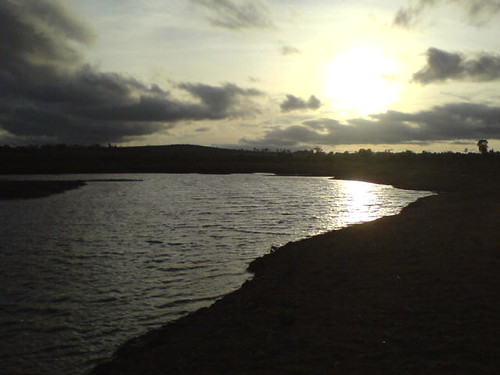
Another sunset at Bokyapur Kere
flora at Ramakrishna Ashram, Bangalore
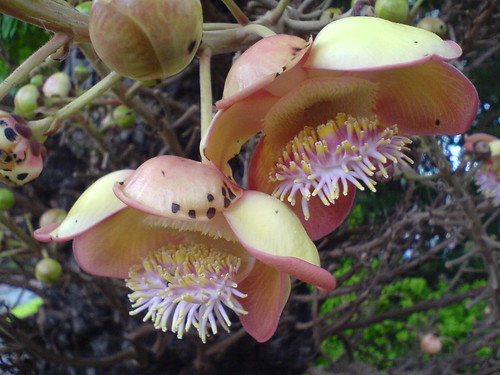

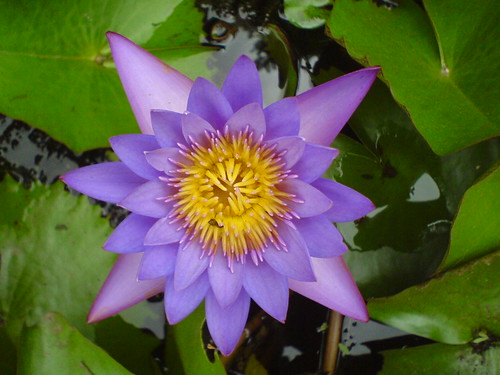
Pink trumpet bloom at Bangalore University

Shishunala Sharif's tomb, Shishuvinahala
 Shishunala Sharif, the was a XVIII Century philosopher and poet. His compositions conveyed profound messages, they were easily accepted by common people. Sharif was a disciple of Guru Govinda Bhat, Sharif's dedication towards his Guru was an example to look upto.
I visited Shishunala again years later, see how Shishunala Sharif's tomb had changed.
.........
4 comments:
- time-travels said...
The village name is Shishuvinahalla ? is it so ?
- siddeshwar said...
Yes, the full form is Shishuvinahala (single l) but people generally use its shortened version Shishunala.
- Unknown said...
Sir I am visiting shishunala sharifajja tomb,since 1992.Its my favourite place. My native village lies near to shishunala village.In fact i visited most of the places which Sharifajja used to visit.I have uploaded those photos and videos in my YouTube channel Umesha Nomad Videos. PL see.Thank u
- siddeshwar said...
Namaste Umesha. Could you please share the names of the places Sharifajja visited.
Tungabhadra at Hampi
A lonely Basava watching Tungabadhra. The hill on the horizon is Anjanari Betta the birth place of Hanuman.
 This is the still waters at Chakra-Theerta.
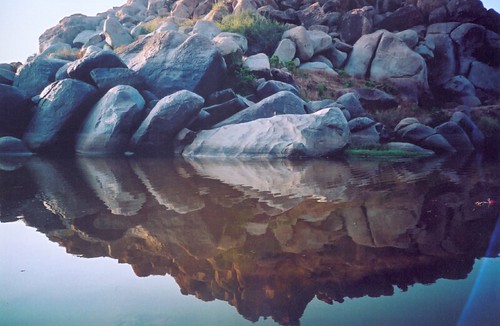 .........
Horsley Hills
This was one of the wildest trips I'd ever been. I picked the place out of Andhra map and planned the trip... route, schedule, logistics & all. The planned route was Bangalore - Kolar - Madanapalle - Horsley Hills, approximately 160 km, estimated travel time was 3.5 hours. Plan was to reach our destination by 9-30 and have dinner there. The group: Satish, Prithvi, Ganesh, Mama (my maternal uncle Praveen).
We took off at 6PM on three two-wheelers- my Kinetic Honda scooter and two Yamaha RX 100 bikes. We were carrying one 3-person tent, booze, soft drinks, and a 12" Rambo style knife. We had hardly travelled 60km, these guys stopped (against my wishes) at a road-side bar & restaurant on the outskirts of Kolar. The booze session started, followed by dinner. When we settled the bill it was 10PM. Great!
Our journey resumed, we continued towards our destination... Madanapalli & Horsley Hills. We crossed Karnataka-Andhra border and after few kilometers, we had to stop at a fork, unsure of which road to take. And the map was confusing me even more. So we waited for some vehicle to come by... a KSRTC bus came, Satish waved his arms at the driver but the bus didn't even slow down. We were puzzled at the driver's behavior. After a few minutes, an Ambassador car came by, this guy stopped but a good 30 meters away from us. Satish ran towards the car and yelled which way to Madanapalle. The driver quickly told us to take the same road he was on and sped away. We were wondering at the drivers' impatience... it was Mama's doing- he waved the knife at the car driver and done the same at the bus too. Also, who would risk stopping for a gang on a desolate road? Trusting the Amby driver's response, we took the right side of the fork.At 2-30 AM all of Madanapalli was sleeping except for two guys loading some stuff from a shed into a car on the main street. We asked them directions for Horsley Hills which was easy to remember. The road to Horsley Hills was superb, we rode like maniacs, my Kinetic Honda maxed out in 90s, the bikes cruised at 100. Road on the hill was narrow, full of turns and hairpin curves, we rode carefully. We reached the hill-station around 3 AM, the place was sleepier than Madanapalli, not a soul to be seen anywhere. Not a single sign board saying "lodge." The hill was dark, cold & misty. We were exhausted, gave up looking for a lodge. We found a level grassy patch next to the road, pitched the tent.
 |
| Prithvi, Ganesh, Praveen, Satish |
The tent was too small for five grown-ups and especially with four drunks. I did not sleep at all... foul air, snores, stones poking from beneath and cold air. I was just waiting for dawn and the moment I saw light, I asked these guys to wake up. No response. I just crawled on them out of the tent! Freshened my mouth with 'Sprite' and started looking for a tea-joint. Nothing in sight. We rented a guest house for few hours, had tea and freshened up. By the time I finished my bath, Mama, Prithvi and Ganesh had started a booze session! At 9 30 AM!
 |
| Drunk at 10-30 AM |
We rode around the place... not a very big hill-station but a beautiful one. It's named after a British collector W. D. Horsley. Andhra's highest point is situated at Horsley Hills. We climbed up and finally reached a point where we had to climb through a tree's branches to cross-over to another rock. Only Prithvi and I went right to the top. Mama and Ganesh were too drunk for the adventure and Satish isn't a sport for such adventures.
We did some more sight-seeing before we decided to head back. The down-hill ride was fun, we free-wheeled most of the way, leaning heavily through the curves.
 |
| Dog eying Prithvi |
This time, we took Madanapalle-Chitamani road instead of Kolar. At Chintamani we stopped lunch, we tasted one of the best Andhra meal at a mess. Our return journey had plenty of stops, there was no dearth for reasons to stop.

An unforgettable trip!!
Byadgi Chilly Market


2 comments:
Kittur Rani Chennamma memorial
 180 years after her death, it is still not clear if she died as a prisoner in 1829, or if she was let off and died at an old age.
Bhagawathi Tea Estate
I got permission from my Dad to go on a business (actually a service trip) with two uncles and a service engineer to rectify a nagging problem in a weighbridge supplied by our company, EFGE Load Cells to Bhagawathi Tea Estates, Wynad, Kerala. EFGE is pronounced FG, which means ‘foil gauge’, a delicate little strain sensor.
We left Bangalore in our HM Ambassador Mark III by 6 30 pm heading towards Mysore. On the outskirts my uncles picked up few beer bottles. After a while, one of my uncles, handed me an open bottle and asked me to have. What?? I was like… Anyway, I tasted the cold beer and liked it. I went real slow. I enjoyed my first bottle of beer. We broke our journey at Mysore and decided to continue the next morning.
The next morning, we had dosa for breakfast at a real tiny place in the narrow streets of old Mysore city. The dosa just melted the moment it landed on my tongue. This is the most memorable dosa I ever tasted. We got with our journey… Gundlupet, Sultan Battery… and we reached Wynad some time afternoon. The weather there was hot and humid… typical for a tea estate. I guess we did not work much, may be just a cursory check of the weighbridge. That night we had wine, and I had some and liked the taste. The color was wonderful and taste was excellent. As it is, grape juice was one of my favorite. We had a good dinner and peaceful sleep in the silent hills.
We started the new day with typical Kerala style tea served in glasses and after a while was Kerala breakfast. I think it was ‘Pattu’ with Bengal gram and 'Appam'. Every morning our guest house cooks served us different dishes of Kerala. Real expert cooks they were. For me it was more of a holiday… while my uncles were trying to sort out the weigh bridge problem. I walked around the estate through the tea shrubs, up and down the slopes. From one point I looked down towards our guest house and then to its left further down the hill, a little stream flowed in the valley with little houses next to it, children played around while the women washed clothes in the stream. Typical story book scene it was.
This is where I first saw tea leaf picking. It was a women’s job, they carried huge woven cane baskets on their backs and dropped leaves into them as they chose and picked the leaves from the shrubs. Once the baskets were filled, they carried them down to the factory area where the leaves and weighed and wages paid accordingly. One of the days, the factory manager showed us around the plant. It was interesting to see how raw leaves were washed, dried, dehumidified and turned into dust and then graded and packed. The place was full of managers… AM, DM, EM, FM, GM, etc. I can recall few; Accounts, Deputy, Estate, Factory and General.
Not sure if it was the second or third evening at the estate; we were invited to the GM’s bungalow for drinks. Whisky was offered and I declined it, I was not sure if I could handle it. The GM was an ex-army person and cordial to us. I think, the same evening, my uncles decided to go to a nearby town to fetch drinks and on the way back a big stone hit the underside of our Ambassador damaging the oil sump. Back at the guest house, the booze session was little wild with one of the uncles in real high spirits.
Work on the weigh bridge was going nowhere and the managers were getting impatient with us. After several rounds of discussions over phone with my Dad, it was decided that we head back home, leaving the job incomplete. Somehow nothing was going well… no progress on work, bad remarks from the customer and a damaged car. Our journey back home was a real drag; because of low oil pressure the engine was damaged and we drove real slow... literally limped back.
If not for anything else, this trip introduced me to the world of booze. I had the confidence to handle it while most of friends had not even touched it. Years later I gave up drinks, have remained a teetotaler.
………
NCC Camp at Annie Besant Park
Tents big enough to accommodate 15 grown-ups were pitched in a huge square with an open ground in the center. Every tent had a snake pit around them. The first day, we were read out the camp rules and allowed to settle in our respective tents. We explored the park out of curiosity. Found a couple of bore wells and water taps, our source for water to drink and wash. We discovered there were no bathrooms or toilets, Indian Army wanted us to be real close to nature.
 This was the first time I slept in a tent, with just a mat on the earth. Wind was blowing like crazy through the night and our tent had a nice tear in a corner, right next to me. I hardly slept through the night. The next morning, we were woken up early. It was cold and we had to wash with cold water… ooohaaahah! What an experience!
We all assembled in the quadrangle, dressed in our uniforms. We went for a cross country jog and then exercised, after which we had a short break during which we had breakfast and relaxed. Then came the drill session… Attention! Baye mood! Dhaine mood! Piche mood! By the left quick march!! left-left-left-right-left... look straight, swing your arms high, left-left-left-right-left... keep your knees straight, dig your heels into the ground… Oh man! The Gurkha officers made us spend double the energy of what their food gave us. The sessions never seemed to end. Most of us were just waiting to hear 'squad-halt!', 'stand-at-ease' and 'disperse'. We were served three meals a day and we could choose between veg and non-veg. Food was no way near to home food but not bad too.
Most of the officers were friendly but strict. I remember there were three ‘Chatri’s. And in our college group, there were three Prasads. Babu Prasad, Skanda Prasad and me. The Gurkhas asked us if we were cousins and we asked them if they were brothers. My other tent mates were Gurudutt M P, Ramesh P, Bharath, Sridhar...
One morning, our officer made us jog down to the Doddaballapura Railway Station, it was a deserted little place with hardly any activity. We exercised on the tarmac road with a few local people watching us with amused expressions. On the way back to the camp, again jogging, we stopped every half kilomater and made to push ups or sit-ups or any activity to sap our energies out. Most of us were hungry and just waiting to reach the camp food area. What a morning that was! The camp was not just drills or exercising, we were given tasks to make us get used to hard work like watering plants, levelling the dirt path within the camp area for which we had to dig with spades and move dirt from a near by spot. We fetched water from a bore well and sprayed the dirt path we had repaired. The officers never ran out of ways to kep us busy... One of the nights, four of us were asked to watch the food material store room. I remember how we struggled to stay wake in the cold weather till morning.
After a week or so, one after-noon, I got a surprise. Dad, Mom and Dipi had come to see me. They stayed for few minutes, 15-20 minutes and left. Dad gave me a bundle of snacks which got over in no time.
One of the days, a day trip to the near-by Nandi Hills was organized. We were dropped off on the main road at the base of the hill, given breakfast and asked us to take the road up. A 8km trek. It was fun! We made it to the summit in about 2 hours. We explored the hill and it’s fort and ruins and assembled back at a pre-designated time and spot expecting the trucks to be there to take us down. No! We were asked to climb down the steps!! Most boys started complaining pain and few experienced cramps by the time we reached the base. That was not the end, we had to trek 4kms of rough terrain to reach the trucks. With the sun blazing down, mouths dry and stomachs growling… You are in the army now!
Our camp had a small open air theater in natural settings with granite slab benches for seating an audience of about 300. The stage area was sheltered with Bougainvilla creeper and other small trees. On the tenth evening, couple of senior army officers were present for the closing… not a ceremony, whatever you call it …who gave away prizes and gave short speeches. I revisited the place sometime 1996 with Gulli.
 No beds. No electricity. No hot water. No bath for eleven days!! When I got back home, my hot water bath lasted one hour.
………
9 comments:
- gayathri said...
no tv no bath no beds how's it goin 2 b there ???? gonna miss home !!!!
- siddeshwar said...
try being in Nature, you'll love the experience
- Bharath Kumar B.N said...
It was truly amazing Sid. I still remember that experience. When we came back home most of em didn't even recognize me as if I was in POW camp !!! It really toughened us a lot.
- Unknown said...
Hi there,
Nice to read your experience.
I was also there in 1993 as a part of NCC contingent from A.P.S arts and science college. (7th karnataka battalion).
1st day it was tent errecting and snake pit forming day. Food was good (chappathi and dal subzi -i loved it and milkless tea -got used to it even though it was initially allergic.) Night times it was fun with different college guys hearing their experiences and some ghost stories. Some got home sick.- siddeshwar said...
@Bharath - thrown into laps Nature, we had to tend ourselves. The NCC staff were not caring which was a good thing.. let these bots become men. Early morning physical training on the roads a kilometer away from the camp.. no water until we got back. Seriously, every single school / college student must experience this.
@Venkatesh - Thank you. Yeah, few guys returned, they missed some fun. Yeah, nights were beautiful, could actually see stars those days. We never heard of any ghost stories but we had plenty of encounters with scorpions!- Anil.v.s said...
For me, The time line mentioned by the author , during the camp took me down the memory lane 41 long years!!! The Vayu sainik camp
I was the contingent commander of 1(K)Air Sqn NCC, Kerala , Still remember those 12 days!! the PT, parades, drill competitions, Kit lay out comp, firing, Skeet shooting comp, trekking, para Gliding, the mess, complete trekking to Nandi hills from the camp, the swimming pool on the rear side of the camps, the village behind the camp , where they grow vegetables, the monkeys and the small river across the vegetable farms etc...the cultural programs ohh..gosh its still flashing thru my mind.....it will never fade away !! so much vivid memories' to cherish!! oh i missed the big tower in the quadrangle!!- siddeshwar said...
Anil, wonderful time indeed. Really nice of you sharing your memories here. Thank you.
- Anonymous said...
No bed, No hot water , No electricity for 11days very difficult to imagine now a days
- siddeshwar said...
11 days no bath as well, not all but many of us.
Bathi Hill
 This is Sri Revana Siddeshwara Devastana, also called Bathi Siddappa Gudi since it's situated on Bathi Gudda. This picture was shot in 1995, before the temple's renovation.
 The temple is located half-way up Bathi hill. At the hill's base is the village of the same name. This place is about 6km from Davangere on the way to Harihar. Davangere & Harihar can be called as twin cities with just 12km separating them. The hill offers a nice view of the surrounding mostly flat terrain. Green fields, few ponds and lakes and more hills in the distance. Evenings are good time to spend there; enjoy cool breeze and sunsets.
 During one of the earlier visits when I was about 6 or 7 years old, Appaji, Dipi and I had walked half way around the hill to a cave. It's a small cave, seemed like naturally formed, at the same elevation as the Siddappa Gudi. On the way, I remember Appaji telling us that a lion lived in the cave when asked if any animal lived there. That was the first time I ever saw a cave. During another visit with a group of relatives, we went up the hill beyond the temple. The upper part of the hill is ragged with a lot of outcrops, making the climb unsafe. We weren't dressed for that kind of an adventure. We gave up after a 15 minute climb and returned to the temple.
Here's a short video of the temple shot in March 2013 and the link to the blog post published in 2019 - Doddabathi Revana Siddeshwara Gudi.
Gokak Falls
 This is the hanging bridge; it was a different experience to walk across it, swinging lightly as we walked along with local people. I feel it's a great combination of nature's wonder and man's creation; a lovely water fall and a beautiful bridge.
 People say that Gokak Falls is Niagara Falls of India. While Niagara Falls is U-shaped, Gokak Falls is almost straight. Sizes are incomparable. The only common feature is both waterfalls are sheer drops.
Nandi at Chamundi Betta
 My wish to see Nandi closely was fulfilled. It's truly a magnificent creation. Seated on a pedestal, the giant Nandi is a sweet looking calf with a chubby face and big eyes. Unlike other the other big Nandi idols such as Lepakshi Nandi or Basavangudi Nandi, this Nandi seems to be soaked in oil. I think Nandi is bathed in oil during some festival, probably a Enne Snana.
 To my knowledge, Lepakshi Nandi is the largest monolithic Nandi in southern India (if not the whole of India). The next largest seems to be Chamundi Betta Nandi followed by Basavangudi Nandi and Nandihalli Nandi.
 From Chamundi Betta we returned to Mysore and took a bus back to Bangalore.
.........
Faces in rocks
This rock is like a dead man's face, as though its sticking out of its grave. This rock is at Koongal Betta, near Ramanagara on Bangalore-Mysore road.
 The second one looks like a British cop wearing a custodian hat. This sandstone rock is at Badami, the Chalukyan capital from VI to VIII Century CE.
 .........
Four shots from Jamkhandi
 |
| spiral staircase at Jamkhandi Palace |
 This ancient sculpted idol is at Rameshwara Gudi which is a part of the palace complex. Of course the temple is older than the palace. It is said that any person who can pass through that narrow gap with a wish, will have that wish come true. It seems the original gap was larger, the paving slabs have reduced a few inches. I don't think even a 6 year old could pass through it.
 |
| A rock face on the hills seen early morning |
 |
| a Peepul or a Ficus on the eastern edge of the hill |
.........
Jesus Christ, Altinho, Panaji
 .........
1993 Mahamasthakabhisheka at Shravanabelagola
I: let me check at with parents
Amma said “no” as usual. I persisted. Appaji said “Let them go or they’ll have to wait another 12 years.” I was all smiles.
December 19, 1993. Anish and I left home at 2am on my Kinetic Honda. The night chill was bearable within city limits but once on the highway it was freezing, especially while riding in the front. Fingers became numb, nose would freeze… The ride was somewhat lonely, hardly any traffic on the highway, which in a way was good. Somewhere near Kunigal, we saw a car with a smashed front with a sole occupant seemingly waiting for help to arrive.
The chill factor got worse as we rode on, at times we shivered. After Channarayapatna, we left the highway at Hirisave and took the road to Shravanabelagola. Last 18km to our destination. A few kilometers before Shravanabelgola we saw a huge camp. rows after rows of tents, hundreds of them. That was the camp setup for devotees from other places, mostly out of Karnataka. People were up and getting ready for the grand Abhisheka which was due to start in a few hors. Small groups were huddled around fire trying to keep the warm in the freezing cold. We rode slow, looking at the sights… then we saw a row of shops set up for the camp. We stopped as soon as we saw a tea-shop. As I remember it took us a minute to get off the scooter… our joints were frozen stiff. We stood close to the coal stove trying to soak up the warmth. The first few minutes we had difficulty holding the glasses because the finger tips had lost sensation. After three glasses of tea we felt a little better but it was still cold.
At Shravanabelagola we parked my Kinetic Honda in the town bus-stand which is close to Chandragiri. Gomateshwara statue stands on Vindhyagiri and we wouldn't be allowed up there since we did not have the required passes for the event. However public was allowed on Chandragiri, we positioned ourselves on some rocks which had a clear view of Vindhyagiri. Gomateshwara's head and shoulders were visible. A huge scaffolding had been erected around the statue.
We watched just the first one hour of the event and decided to leave… we did not have plans of getting stuck in the ever increasing crowd. We said bye to Bahubali, Shravanabelagola and the people and moved towards Channarayapatna where we had lunch and started off towards Bangalore.
Four years later, Gulveer and I visited Shravanabelagola during a weekend. We reached late afternoon, checked into a hostel, a simple little place, went for a walk, saw Bastis… it was relaxing, silent, peaceful and serene. Morning, we woke up early, bathed and went up Vidhyagiri and stood before Bahubali’s feet. Wow! What a statue it is! I was wondering how it was created, how much it weighed, there was no chance for any mistakes while the artists sculpted... We spent about an hour looking around the cells where the monks used to live. As I type out the words, I feel I should revisit the place.
India is full of such wonders, be it natural or man-made. There’s so much to see; our temples, forts, towers, wells and what not. What kind of talent and skill gave such wonderful forms to stones! Truly amazing!! Surely people of those times had put in lot of effort and time to create these wonders. They also lived in synch with nature. Modern man somehow ends up messing up with Mother Nature… sad but true.
PS: 3 days after publishing this post i.e. on Dec 31st, I visited Shravanabelagola. This time with Durga, Deepak and Gulveer.
Three body, one head fish

Ghati Subramanya
As we crawled up the hilly section of the road in first and second gears, Appaji went back to his engineering days at UVCE … told us how he and his classmates spent 5 days surveying the hills. Those days, 1960s, survey was a part of the 5 year course. He’s had one hell of a time! We dropped off the boys at the outskirts of the town close to a dormitory where they were put up and we went straight to the temple. I think we had to wait to for 30 minutes for the temple doors to open.
Inside the temple, close the sanctum sanatorium, we stood with other visitors. Appaji and Praveen were in the front. Anish and I stood at the back behind a couple, the wife holding her 2-3 month baby looking at Anish with it’s cute little eyes. I was trying to be serious while Anish found the baby amusing. He started making faces at the baby and asking me look at it making faces in return. Serious! The baby would stick its pink little tongue out when Anish stuck his tongue out. I was little worried, what if the husband saw and mistook that we were trying something… The sound of bells during the Mangalarathi distracted Anish and he left the baby alone.
The temple is not a very big structure but the mythological story behind it was quite interesting. The story revolved around the Garuda and Nagadeva; the reason for their enmity and all. Any time in the future, if I ever recall the story, I’ll post it. People would visit this temple to offer a silver snake idol to the temple, perform pooja and seek blessings to wash away the sin acquired by harming or killing snakes. Once out of the temple, we headed straight to a mobile cart shop, had bajji & tea and then started towards Bangalore.
During this trip, we had one helluva time. Our journey; Bangalore-Chilamkur-Kurnool-Ghatisubramanya-Bangalore. This was my first venture into the interiors of Andhra Pradesh and I was amazed at the state government’s effort into rain water harvesting… lakes after lakes. While travelling between Chilamkur and Kurnool, we took a small detour to visit a small dam and reservoir; sorry again, I cannot recall the river’s name. We saw hundreds of dead fish floating…
Andhra is beautiful, similar to Karnataka in more than one way.
………
1 comment:
- Anonymous said...
Very nice information post by this blog owenr I want to say thanks for it. I would be like to come again and again on this blog. Good job dear ! Total Station Survey Equipment
Appaji's photography at Mekedatu


 The rock formations are intricate. Someone in the group was familiar with the place who led us down close the waters. There are painted signs not to enter water. However careless or overconfident people have been washed in the waters only to end up floating dead a few kilometers away. Thankfully, everyone in our group was responsible enough, Appaji didn't have to worry about our safety.
 After this trip, I revisited this place three times with college friends. A decade later Appaji, Deepak & I, along with a few close relatives and colleagues visited another spectacular place- Savandurga the second largest monolithic hill of Asia. We had a great evening on the hill, slept inside a historical structure and woke up to wonderful morning sights.
Madiwaleshwara Matha, Garag
 Madivaleshwara, the spiritual leader of XIX Century, contemporary of Shishunala Sharif Saheb and Siddarooda Swami, came here from Kittur and established the Matha. Pilgrims come to this temple to offer prayers and perform 'pooja' to his 'Samadhi'. Here are few pictures from Garagad Madiwaleshwara Jatre the annual fair usually held in the months of February or March.
 |
| chariot being pulled by devotees |
 |
| crowds watching the chariot |
 |
| people having fun at the fair |
 |
| huge pans holding sweet dish, either Shira or Sajjaka |
 |
| a heap of cooked rice ready to be served |
 |
| Saru being prepared in large vessels |
.........
Biking trip to Kemmangundi
1991 July
Through with final year engineering exams, it was a relief and I was looking forward to a break. Anish, Deepak and I planned a trip to Kemmangundi… we decided to take Anish’s KB100, Deepak’s Hero Puch and my Kinetic Honda DX100. My scooter’s mileage was the worst… maximum I could expect was 35km per liter of petrol.
We started early morning. Took NH4 and turned off at Nelamangala towards Mangalore. Our first stop was next to a small pond. Deepak casually lit a cigarette and Anish shot him smoking. Deepak was just not bothered about it. We carried on with our journey stopping on and off… to see a lake, a flock of ducks walking on the highway, forest nursery, Yediyuru Siddalingeshwara… we reached Hassan late afternoon and checked into Hotel Apoorva. Evening we had a mini booze session. The following morning we headed towards the Halebidu and Belur. We saw Hoysaleshwara Devastana at Halebidu and Chennakesaava Devastana at Belur. By noon we started off towards our destination - Kemmaninagundi.
As we neared Chikkamagaluru, the roads were wet. Tt was raining lightly when we entered Chikkamaglur. We weren't prepared for rains. We bought a few bottles of rum and whisky.
Chikkamagalur-Kemmangundi road was narrow & twisty and it was almost dark, windy & drizzling as we started climbing the Baba Budan Giri Range. We could make out coffee estates in the dim light. Clouds had blocked out every bit of light from the sky, it was pitch dark if not for our bikes' lights. We soon realized that middle of the road was slippery because of a thick layer of wet leaves. We had to keep our wheels in the tire-track made by four-wheelers. Also we had to concentrate not to go veer off tarred surface because the sides were muddy and slippery. As we climbed higher, the wind was strong, blowing rain drops into our eyes. Anish had trouble because of his spectacles. My Kinetic Honda had a powerful halogen headlamp which could blind oncoming drivers. It lit up the road pretty well even in rainy conditions. We were soaked, cold and hungry. To make things worse for us, mist joined the party with darkness, rain and wind. At times the visibility would be just few meters and my halogen lamp was not just useless but dangerous. The white screen of mist reflected the light back to us. I used to switch over my normal lights, which was like a parking lamp. Deepak was much better in misty conditions and we followed him closely. It was getting colder, I wished for some warm drink. Luckily we found a tea shop in a mountain hamlet. The shop keeper was asking us if we were crazy to do this journey on two-wheeler, in a rainy night like this one.
The hot tea helped immensely. We resumed our journey with Deepak leading. After a blind turn, he stopped suddenly, I braked hard stopping inches from his rear tire and it was the same for Anish. The reason for stopping was a stream across the road!! The stream was about 12 feet wide. There was a waterfall on our left which fell into the roadside trench, then flowed across the road and down the hill to our left. What a sight it was! Had we done this journey during day we could've got great pictures. We rode on; the effect of tea had worn off, we were cold again. When the going gets tough, the tough get going… we rode on and finally made it to Kemmangundi. We a got a place to stay, one of the ancient cottages. Since this wasn't tourist season we didn't get food but we let the booze flow.
Kemmangundi is a shortened version of the phrase "kempu mannina gundi" which means a red soil pit. Kemmangundi is an inactive iron ore mine. A few decades back it supplied iron ore to VISL via the ropeway system. In the 1970s when we used to live in Bhadravathi, we often saw ropeway trolleys laden with iron ore sail towards the steel mill. I would ask father how it worked, he would explain but I wouldn't get it. I loved Kemmangundi; it was green, cool & peaceful. I remember climbing up and down the steps connecting the cottages. Memories of the only eatery was fresh too. It was as though my childhood was just few days ago.


The following morning we had a good breakfast. Then we went sight-seeing. Deepak’s Hero Puch’s rear tire was flat. The nearest garage was 13km away, Lingadahalli. On the way down, we stopped at one the streams and spent some time in the cool mountain water… it was truly refreshing.

We located the garage, got the puncture fixed and returned to Kemmangundi. After lunch, we went towards Z-Point, the most popular spot for trekking freaks. We rode through the mountain foot path till a stream across the path. We parked our two-wheelers there and started walking. The path got narrower and wilder. It was drizzling continuously. We enjoyed the fresh cool air… What a feeling it was. One of us pointed out the tiny black earthworms on the pebbles and some on plants too.

We saw more and more and more… We came to a beautiful little water-fall, we spent some time there and took few pictures and moved towards Z-Point.

The ‘earthworms’ were thousands now. Well, those little black creatures weren't what we thought. They are leeches! Oh man!! We forgot about Z-Point and ran till we crossed the stream to the spot where we had left our bikes. We literally tore off our clothes and searched ourselves for leeches. We had been attacked badly. The little creatures were really slippery, they held on stubbornly, just couldn't pull them off our skins. So tried prying them off with sharp edged stones which worked to an extent. We made sure we were free from our enemies but the creepy feeling would not go away. Back at our lodge, if I felt ticklish I would check myself. Probably imagination was causing the ticklish feeling and not leeches. Our booze session started early with a pause for dinner and continued late into night. Anish was sloshed. We had to lift him up and put him put him to bed. Good night.
The next afternoon we decided to leave back to Bangalore. This time we took the less adventurous route down; Lingadahalli, Arasikere and then to Hassan. The ride between Arasikere and Hassan gave a creepy feeling, the terrain was ideal for robbery, felt as though bandits lurked around. We reached Hassan dead tired, checked back into Hotel Apoorva again, then a booze session followed by food. We slept better then the previous night. Morning, we woke up a bit late and then rode back to Bangalore.
This picture below was shot in 1997. This is one of the most popular photo spots around Kemmangundi. You can see this a number of Kannada movies.
 ………
………a few pictures at Kelageri Kere
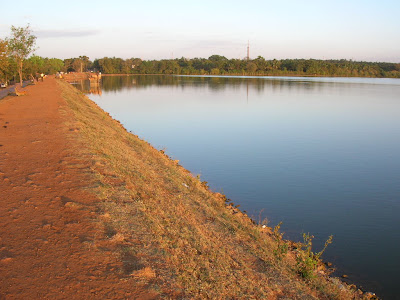 This waterbody is a lifeline for people & cattle of Kelgeri village. Buffaloes come here for a mandatory dip during midday i.e. in between their grazing sessions.


 One can see spectacular sunsets here during the drier months.
 Do check out the stone inscription about this manmade waterbody at this blog post- Kelageri Lake.
Ramagundam to Byadgi
We had to attend a service call at APMC Byadgi so we would be going there instead of Bangalore. Our route would be Bellary, Sandur, Harihar and Byadgi. We planned to go upto Bellary and break our journey. It was dusk when we started our second part of the journey. As we reached Bellary, I said we'll go upto Hospet, just 40kms more. It was 9-30 or 10pm when we touched Sandur.
 At Sandur we stopped for food. While waiting for our food, I asked Praveen "How about going till Ranebennur?" No objections. He's always been a great company while driving, he always stayed alert and helped me stay alert as well.
We resumed out journey, deserted roads through one of the major mining belts of Karnataka. The roads were not so good, may be that helped me keep awake. Praveen and I had good understanding when it came to driving. He's was a good navigator and I could trust his judgement, he rarely made mistakes. We stopped for tea at a small town, I think Harpanahalli. We reached Harihar by 2-30am. Now, we had to cover a short stretch on NH4, just 22km. We reached Ranebennur at 3AM. There was no point in going to Byadgi at that hour because we wouldn't get a lodge.
We had traveled 850km in 21 hours in three legs and two different modes of transportation.
Even though I was exhausted I had a bath and then went to bed. We woke up at 10 next morning and went on to APMC Byadgi.
.........
Narasimhaghad near Dharmastala

These pictures were taken sometime December 2002, during a visit to Dharmasthala with Amma, Deepak and Praveen. Deepak and I had climbed the hill while Amma and Praveen waited at the base. The top was full of tall grass, we could hardly make out what lay ahead of us.

The first time I saw this place was sometime 1992 with Anish. Jamalabad (that's the other name) is about 22km from Dharmastala. We climbed one third way and gave up. Somehow the same had happened with Anish at Shivagange and Savandurga.


Narasimhagad is almost as tall as Shivagange with ruins on the top. The summit is small in area bit offers a fantastic view of the surrounding forest covered hills. Deepak had shot better pictures, may be sometime I'll get them from him and post them in this blog.
 .........
Kudle beach and Om beach
We were a group of 19 colleagues; Ajay, Archana, Arshiya, Chetana, Farzana, Haseena, Kavita, Manjula, Marina, Preeti, Priya, Raj, Rayeesa, Siddesh, Shilpa, Usha, Vidya, Vilma, Yasmeen.
We grouped at my Uncle's place near Hubli Toll Naka since it was the most convenient spot. About a year ago, Uncle's home was our rendezvous for Sathodi waterfall trip. A bus had been hires for the trip. Our journey started at 6 30 am. The journey was slow... the orange colored bus driven by Kallayya barely touched 60kmph. Just after Yellapur, we stopped at a restaurant; our driver and cleaner wanted to have tea! After a while, we stopped in a wooded spot for breakfast.

 The sandwiches made by Vidya, and the idlis cooked in jackfruit leaves by Shilpa were excellent. After a 45 minute break we continued towards our destination- Kudle beach.
We passed by Ankola, took left towards Mangalore and after some distance took the right turn towards Gokarna. The road was flanked by backwaters and there were several salt pans. After crossing the backwaters, the road entered hilly terrain. It was noon when we set our feet on the sand! Kudle Beach here we come!

 We found a shaded rocky spot and some got into the water while some preferred to watch the water. I went exploring and almost got stuck on a steep rock face. I could climb easily but descending was tricky. I took a while to brace up and took downward steps very carefully. One slip I would've crash landed on rocks below. Rock surfaces offer better grip when cool, and slippery when they are hot. And the other thing is its better to be bare feet but I kept my shoes on since I already had camera in one hand. I managed to shoot a few pictures in that risky situation.


 I managed to take a different route and rejoined the group. By then most of them wanted a break from sunlight. We settled down on a flat shady patch in a coconut groove inside one of the beach resorts. Time for lunch, the ladies spread the items on a mat; salad, chapathi, brinjal palya, peas palya, dry chatinis, sweets, two types of rice, one by Haseena & another by Arshiya. I enjoyed the rice dishes more than anything. After the lunch break we headed back back to the sands.

 While most of the ladies played in the sea, a few of us tried to keep a irksome bull away from grabbing the remaining food. Shilpa was very annoyed at the bull, the creature followed us everywhere, even on to the wet slippery rocks. I'm not sure how the little episode ended but it did end.
Around 4-00 PM we decided to do a short trek to Om Beach, the beach looks like digit 3 when seen from a height. Most of us were panting at the end the uphill trek from Kundle beach to Om beach vehicle parking area. While we climbed down the steps to Om beach, someone spotted an empty bird nest in one of the trees next to the steps.
 Om beach as seen from the steps descending into the beach area.
 The beach was crowded, it looked like a market area. The ladies had had enough of playing in water. Now they wanted to go into the sea by boat. There were five or six boats, their operators were trying to hook customers. The group was split into two and climbed into our boats. The outboard powered boats were quite fast, the boatmen entertained us with a mock race.
 Everybody just enjoyed it... dipping hands in the water. We passed by several other less crowded beaches... two names I can recall- Paradise Beach and Half Moon Beach. The ride was over sooner than we had expected. As the day came towards the end, we all settled down on rocks to watch the sunset.


 We watched the sun until it was just above the horizon. The last few minutes of sea sunsets are usually hazy. Day was over, time to head home. We did see sun dip into the sea as we climbed up the steps. Bye bye Suryadeva.
 Our journey back started off... Vilma surprised us with cakes & potato chips. Then there more snacks and finally soda water. The return journey was a drag. The bus driver & cleaner stopped near Yellapur for food, almost an hour gone. Then we were relieved as we approached Khalghatgi where the driver sprang a surprise. Apparently the bus was low on fuel, we stopped at a bunk. Another 15 minutes of waiting! We dropped off Marina at her home in Hubli and then went to Dharwad. Ajay and I dropped off Shilpa & Farzana, and then Chetana at Amminabavi. Back at Dharwad, Ajay went home on his bike. I reached my place by 1-30 AM. Happy Republic Day!
.........
4 comments:
- Arshiya Naaz said...

Thank you for posting...!
The time I was reading, I got lost in sweet memories and time spent with all during our wonderfull journey...!- Archana said...
Very nice photography that took me to the flash back for a moment. Recollected the cool memories. Also, write something about crazy things of the cow and small kids. It would give more effect to the blog. :)
- siddeshwar said...
:) Archana seems to be confused!
As usual.- Archana said...
it happens due to working continuously day-night without break. :(
Bidar Fort
Pictures in this post were shot during two visits 1996 and 2003.
The top most city on the Karnataka map, Bidar is just kilometers from Andhra and Maharashtra borders. Bidar is known for its hot climate and the fort. I saw the fort, for the very first time, in the Kannada movie ‘Bara’ meaning drought. Anant Nag played the lead role. The movie is centered on communal riots and a good part of the movie is shot within the fort. This was some time during my school days.
October 1995. Gulli and planned to tour Karnataka on my Splendor and Bidar was one of the important destinations.
February 1996. We rode from Bangalore through Hospet, Bijapur, Solapur and reached Bidar. Back then the city was just growing out of its original boundaries. We could see new layouts with new constructions. Somehow I have an attachment for that city.

The fort is located on the edge of a plateau and nearly half its perimeter is flanked by a moat, of course it’s dry now.

The moat is literally carved out of a bed of rock. The fort entrance is unique with a very complex security system. There are two gateways in series. The second gateway is designed to confuse anyone new to it and it’s very easy to get lost in the maze of doorways and corridors.


Past the gateways, we the inside opens up. Kings quarters on the left, a mosque straight ahead and prisoner gallows on the right. Also there’s a government office housed in one of the buildings. As we parked our bike and looking around where to start from, a senior government official arrived and the doors to Rangeen Mahal were opened for him. We asked if we could take a look and to our luck we got permission. The decorations in the walls were colorful and intricate set with shiny pearl like shells.

Next, we went into the mosque complex. We met the watchman who was washing clothes in one of the ancient floral design fountains. The watchman pointed out the important things to look for.


We looked around and tried to imagine how it was back then during it’s time... Gulli was trying to act like a king. There was also a small museum within the mosque complex with just few stone carvings and canons.
Just outside the mosque complex gate, there’s an ancient well and just next to it a big bowl carved out of stone.

We moved towards the gallows and dungeons. These thick walled structures have a serious look. These are designed to hold prisoners; tight entrances and small ventilation holes on the roofs. We peeped down into one of the gallows; the floor was at least ten feet down. Now these gallows are in ruins and the floor was strewn with cannons of various sizes.
The fort is not maintained, lots of thorny bushes. We noticed steps leading down… underground. We went exploring little bit but we lost courage as it got a bit too wild for comfort. Probably we were very close to a tunnel entrance. The construction definitely indicates that this fort was highly sophisticated for its time with innumerable places for soldiers to hide.
We came back to our bike, took it and rode deeper exploring… We saw ruins of a half constructed palace. We could see marking lines on column which indicated the place was still under construction.

From here we could see a hamlet. It’s within the fort. The people here are into farming, growing mainly vegetables. We went down there and met few kids who let Gulli draw water from a well which we used to wash our faces.

Cool and refreshed we sat in the shade of a temple chatting away with the kids. Nice peaceful little place it was.
Most parts of the fort is deserted and it’s safe to venture out alone but local people loiter in the gateway complex, mostly students, of course only men, bunking school or who cannot find enough privacy and sleep at home. Also, there are some serious students who come here to study. The place I littered with plastic and all kinds of waste… it’s very sad to this monument in this condition.
As we explored more, Gulli and I discovered something amazing; a massive cannon! We were awe-struck by the size.

It’s difficult to imagine how it would be to fire a shot… the sound and vibrations and the lightning! I estimated the dimensions and the weights:
Length: 13 feetOuter diameter: 4 feetBore diameter: 1.5 feetWeight of the cannon: 33,000kgWeight of cannon ball: 350kg

It seems there are five such cannons and these cannons are capable of firing the ball 4km from here. Just try to imagine the speed of a 350kg ball flying in the air and land 4 kilometers away! Just imagine the havoc it could wreck if it landed closer!
Overall, the fort and whatever you see within it are all created by masters of those times. Everything’s engineered to perfection. After this visit I had the opportunity to visit Bidar district a few more times and compiled a list: What to see in Bidar District.
.........3 comments:
- Vidya said...

I liked the first picture. That's a nice angle from where you shot. Bidar fort is indeed a must to visit place.
- AS said...
ALL THE PERSON SHOULD DEFANETLY SEE THE BIDAR FORT MISSING A SINGLE POINT OF THE FORT I LOVED IT A LOOOOOOOOOOT BUT SOW ONLY FROM OUT POTION OF THE FORT BUT STILL I AM WAITING TO SEEN THE INTERIOR OF THE FORT TILL THE DAY I VISITED THE FORT SOO MANY TIMES BUT I AM ALWAYS MISSING SOME THING I DONT KNOW WHAT IS THAT I REQUEST ALL THE KARNATAKA PEOPLE PLEASE DONT MISS TO SEE THE BIDAR FORT.
- siddeshwar said...
@ AS I agree with you. If historical monuments interests you, this is one fort to be seen. It's one of the best preserved forts of Karnataka. I only pray tourists and archaeology department take good care of it.
Chitradurga Fort
Terrain around Chitradurga is typically hilly... boulder strewn hills. The Palegars made good use of the terrain to hide from their enemies. This snake sculpture is on the left side of the gateway to the fort. From here, the path leading to the inside zigzags and climbs up gradually.

Once past the gateway, we come to a open place. This (see below) is supposed to be grinding stones. Probably to grind flour or to extract oil or grind gun powder for canons. As you see, the entire system is in pretty good condition. Very close to this is a pit carved out of stone which it seems was used to be filled with oil.

The fort had every facility it required for its time; water bodies, soldier quarters, stables, palace, temples, graineries... everything.


Plenty of monkeys too.

In the picture below, you can see a track the right hand top side. This path to the top of the hill is very tricky. People start climb it, go up some way and them get stuck. It's pretty steep and dangerous.


One has to spend two or three full days to see every part of the fort and every single moment would be worth. The beauty is that the fort blends into the nature.


That's Nagesh on the top and in the below picture, Praveen and I are one small speck... tiny blue dot.


This is the famous 'Obavvana Kindi', one of the many the secret passages through which one could go out of the fort. We went exploring into the passage; we climbed down rocks into a stream bed which leads the way out into the open field, out of the fort.

Manjarabad Fort
A bit about this fort from Wikipedia- Manjarabad fort is located just outside of Sakleshpur on National Highway 48. The fort is reputed to have been constructed by Tipu Sultan, the ruler of Mysore as a strategic defensive location as it commands the approach to the plateau beyond Sakleshpur from the coast. It is also believed that he had constructed a tunnel from this fort to another fort in Srirangapattana near Mysore.

The fort is on one level unlike other forts which are multi-level. This seems cross-shaped pit with steps leading into it seems to be an ancient well, probably the only source of water in the fort.

These are all my cousins. Coming from the top- Vinay, Vineet, Rohin, me, Siddesh, Vivek, Pavitra, Manasi and Sushant.

We spent about an hour exploring the fort and then as the sun came beating down on us, we decided to head back to Dhamangundi Estate, Ballupet.
Narasimhaswamibetta


If you feel like going there, just follow the directions. The entire area is full of hills. The other hills I visited in the surrounding area are Ramdevara betta, Kungal Betta and Thenginkal Betta.
SriKalaHasti
'Kala' for snake and
'Hasti' for elephant.

This stone sculpture is at Lepakshi Temple. Srikalahasti one of the important holy places in South India.
Praveen, Gulli and I took a night bus... I remember a suitcase falling on my head from the overhead luggage rack in the bus. Not once, two times, same suitcase. The owner finally kept it on the floor board. We reached quite early, it was still dark.

We found a low priced lodging, slept for some time and got ready early. We visited the main temple first, it's quite big and was a busy place for a temple. The guide tried to explain us the invisible force which keeps... (not getting the word, ok let me call it shaking) shaking the flame in the Deepa but could never catch his explanation. The temple is a very interesting place, we spent some time looking around. Then we had tasty idli, vada and dosas from one of the many carts.

Just behind the temple is a rocky hillock. From the top we could see part of the town. That's Gulli and me and behind us is a scene from the story of Bedara Kannappa in which Kannappa gouges out his eye for Lord Shiva.

Done with the main temple, we explore the town streets. We climbed another hill in the middle of the town, much taller than the one we had climbed earlier. From here we could see the entire town and beyond it also.

That's river Swarnamuhki. The uniqueness of this part of the river is that it flows South-North direction. This is a rare occurrence. All rivers flow in the general direction of North South... at least in India. It's a Hindu belief that this spot frees one from some kind of sin... cannot recall what was told by our guide.

The town is crowded, streets are narrow and hums with activity.
Done with seeing the place, we had lunch, slept for a while and Praveen suggested we head back home. We boarded a Bangalore bound KSRTC bus. The driver drove like a maniac, mostly one handed. He would either be smoking beedis or chewing tobacco and spitting. He honked whenever he saw something moving and would go past pedestrians real close. It was a real tense journey... sitting in the very first row with a full view of the road. We reached Bangalore by 9 30 or so, without any incident.
It was a memorable little trip for the three of us.
Basava Kalayana Kote
We decided to go sight-seeing. First Basavaeswara temple and then to the fort, it's a very interesting place. We met a bunch of school kids playing in the fort's ruins... actually it was in pretty decent shape then. This is one fort where you can see varieties of canons, some artistic and intricately designed. See the one below- a short stubby one but look at the size of the bore. I wish I could see it in action. Pardon me for the bad pictures. If you look close the handles are fish shaped. Some more canons had fish handles.


This is the mosque courtyard, during our visit it housed a Urdu school. In spite of people living close by the buildings are pretty good condition. In the middle is a water fountain, of course no water.


This is the on top of the gateway tower. The mosque complex acted like a massive gateway for the fort entrance. It was a Friday and the fort gates are kept locked! We were in no mood to give up... we got the watchman to open the gate for us. He let us in with the kids and locked the gate!!

That's the fort complex. It's surrounded by a moat pit.

This looks like a royal courtyard where the king would be relaxing in the evenings... features some what similar to Bidar Fort's but much more emphasis on artistic decoration.


This is the the biggest canon... it has similarities to the a canon in Bijapur, the one that's supposed to be an alloy of five metals. The alloy has certain qualities- does not heat in the hottest of weathers, does not corrode, can withstand the worst of natures forces.

I was awe-struck by this particular canon. Just look at the mouth of the canon; such a beautiful creation to destroy something else! This canon was almost in the original condition, the swivel action still worked. Later I learned this cannon is called Kadak Bijli Tope ~ Strong Lightning Gun.

We sent copies of the pictures to these boys but I cannot recall their names. They were perfect guides.
Bellary Fort
Prasanna of Epoch Instruments, Praveen and I were on a business trip to Bellary. We were here to gather technical information for a ladle weighing system at Bellary Steels and Alloys Limited. We reached the plant by 8 30 am, checked the ladle (which contains molten steel), had a round of discussion with General Manager, Purchase Officer and the production department head. We got the required information and our work was done by noon. We headed to the city, to the Railway Station, booked our tickets to Bangalore. From the station we saw the hill and the fort and decided to explore it.
We walked from the station towards the hill, at the base, we could see ruins of the base fort occupied by people. The entire path to the fort is paved with stone steps and the climb was easy. Now we entered the main fort... in through the main gateway. Most of the ruins are vandalized by treasure hunters, we could see stones displaced and pits dug all over the place. Otherwise the fort is mostly deserted.
The constructions- royal quarters, soldiers quarters, the fort wall, turrets -give an indication of the intelligence of the engineers of those times. We noticed a unique construction... discussed it for quite some time trying to figure out the purpose of it. Our guess was that it's a kind of system to train soldiers. That's the moment I regretted for not carrying the camera. Anyway... we went exploring. Ponds, small to large ones, have been created abundantly to harvest rain water. The fort was designed to be self sufficient for months during a war. As we counted the ponds, Praveen observed a water snake in one of the smaller ponds. Then we saw snakes in almost every pond, in fact one of the larger ones had five of them. Prasanna and Praveen chucked stones in the water to scare them and they enjoyed it!
It was lunch time... our stomachs growling... we decided o head back. Still inside the main fort, we were climbing down the steps... I noticed something interesting and decided to check it out while Praveen and Prasanna continued. Few minutes later I joined them back way down the steps... both had scared looks on their faces... they had seen a huge Cobra just feet away in their path with it's hood open. It was Naga_Panchami that day! Both regretted throwing stones into the pond. We were kind of jumpy for the rest of the way till we got out of the fort.
I was glad to have visited another fort but sad for not bringing the camera. One day, I want to visit the fort again and take lots of pictures and add them to my collection.
Gooty Fort
The fort is located on rocky hill, it was one of Tipu Sultan's stronghold. There are no guides here and we just went exploring. The fort seems to be simple but it's quite complex.


That's Dipi and behind him must be dungeons for prisoners.


The hill offers a very good view of the surrounding area, soldiers could get early warning of any attacks by armies. I think for Tipu this was on of the strategic forts. The other important strongholds in this stretch are Kurnool up North and Penukonda, Nandidurga and Devanhalli down South.


That's the highway to Bangalore.

That's Shaji, Nagesh and Praveen.

In the picture below you can see a cemetery, it's a Christian one. Probably Britishers who ruled us are buried here.

.........
2 comments:
-
chandra said...
-
fort was built by bukka raya, later took over by marathas, tippu no way connected with this fort, haidar ali once attacked it with little success, lastly it was with gorpade kings sandur princely state
-
siddeshwar said...
-
Thanks for your comment, Chandu Sekhar. I believe Hyder/Tipu might have controlled Gooty fort at some point of time - this is based on the architecture of one of the gateways - please see second picture - this is typical Islamic design.
Mekedatu
 My
college time friend Satish and his family Shefali & Shobha. The 4km
bus ride from Sangama to Mekedatu was a bumpy one. During my previous
visits, I had walked both ways which makes it a 8 km trek on a rough
path.
My
college time friend Satish and his family Shefali & Shobha. The 4km
bus ride from Sangama to Mekedatu was a bumpy one. During my previous
visits, I had walked both ways which makes it a 8 km trek on a rough
path. The
mighty Cauvery flowing through a narrow gorge. The water level is
slightly less than its level in my first visit which was in 1985 0r
1986. That trip was with my parents, brother and classmates from PES
College. My father had taken some awesome pictures of Mekedatu with a
Canon SLR. You could see them at Appaji's photography at Mekedatu.
The
mighty Cauvery flowing through a narrow gorge. The water level is
slightly less than its level in my first visit which was in 1985 0r
1986. That trip was with my parents, brother and classmates from PES
College. My father had taken some awesome pictures of Mekedatu with a
Canon SLR. You could see them at Appaji's photography at Mekedatu. This
is the narrowest part of the river, the speed of water is supposed to
be around 70kms per hour. This is where a goat jumped across the gorge
while being pursued by some jungle cat and that tale behind the name of
this spot Mekedatu - the goat's crossing.
This
is the narrowest part of the river, the speed of water is supposed to
be around 70kms per hour. This is where a goat jumped across the gorge
while being pursued by some jungle cat and that tale behind the name of
this spot Mekedatu - the goat's crossing. This was a dry part of the year and hence less water. It would be great to see when there's more water.
 This
stretch is past the 'goat's crossing'. The surface appears calm again. I
realized that the water surface was calm before & after the
narrowest part the gorge. This is akin to the calm before the storm and
calm after the storm.
This
stretch is past the 'goat's crossing'. The surface appears calm again. I
realized that the water surface was calm before & after the
narrowest part the gorge. This is akin to the calm before the storm and
calm after the storm. On the way back, I had walked almost half the distance when the bus caught up with me.
Koyagudem - Kothagudem

These guys had run out of petrol. Vijay gave them some petrol from his bike, the nearest bunk was 10km.

I'd never seen a temple 'gopura' like this ever before... horse, eagle, monkey, boar and lion. And look at the colors!


That's a dam which supplies water to Kothagudem Thermal Power Station near by. Vijay told me that the reservoir when full has enough water for two years supply to the power station.

The dam's guest house is situated in a woody and hilly part right next to the reservoir. The place is no longer used, ever since the place was bombed by Naxalites. You can catch a glimpse of KTPS in the top left corner of the picture below.


That was my last visit to Kothagudem. I'm not sure if Vijay is still operating the weigh bridge... it was a 120T 12m by 3m concrete deck supported on six double ended shear beam load cells supplied some time 2002.
Near fatal accident
It's a high traffic jetty with each weigh bridge weighing close to 1000 trucks per day during peak season. The salt in the moisture laden air corrodes steel real fast. The manganese dust accelerates the corrosion process. Steel structures need lot of maintenance work. Shabir and I with Shashi's gang of welders and fabricators were working on weigh bridge maintenance. The gang - Shashi the leader, Gopala the next-in-line, Bhaktha the expert welder, Nataraja the all-rounder and... I cannot recall few names.
 For
the day, we had work on two weigh bridges, about 40 meters away. Done
with one, we wanted to move the portable generator to the other weigh
bridge. The dirt path slopes down and then slopes up. The generator is
heavy duty type weighing close to 1500kg, mounted on four heavy duty
tires, like the grooved tires tractors have on the front wheels. Bhakta
took the steering-end and the rest of us were at the other end. We
thought we should pick up speed going down slope to build up momentum so
that we need not struggle going up the slope. As we picked speed,
Bhakta was in high spirits and running backwards with the steering cum
tow lever in his hands. None of noticed the tarpaulin sheet until Bhakta
tripped, falling backwards. The genset mowed him down. The immediate
thought that came to my mind was that we are going to be in deep
trouble.
For
the day, we had work on two weigh bridges, about 40 meters away. Done
with one, we wanted to move the portable generator to the other weigh
bridge. The dirt path slopes down and then slopes up. The generator is
heavy duty type weighing close to 1500kg, mounted on four heavy duty
tires, like the grooved tires tractors have on the front wheels. Bhakta
took the steering-end and the rest of us were at the other end. We
thought we should pick up speed going down slope to build up momentum so
that we need not struggle going up the slope. As we picked speed,
Bhakta was in high spirits and running backwards with the steering cum
tow lever in his hands. None of noticed the tarpaulin sheet until Bhakta
tripped, falling backwards. The genset mowed him down. The immediate
thought that came to my mind was that we are going to be in deep
trouble.But what happened was... as the genset mowed him down sending him between the front wheels, under the front axle. I heard his scream.... aaayyyooo ayyayyo ayyyyayyo!!! Within no time the rear axle passed over him and he was stuck with. The remaining of us pulled it back to slow it down and it stopped. Bhakta was still screaming. I could see the mixed feeling of surprise, fear and happiness in his eyes... to see himself alive. He was still under the genset and all of us looking at him in shock. He crawled out pretty fast... as though the genset might start moving again. He was injured on the forehead, one of the shoulders, arms, knees and back but he was moving by himself and talking... that was a big relief.
Few other workers had gathered around us. Before anybody could kick up trouble, I asked Bhakta to get into the Bolero with two more guys and took him out of the factory premises. I picked up few bottles of mineral water, Dettol, cotton rolls and plaster. We drove away towards the hills and stopped at a lonely spot. Asked him to take off his t-shirt and checked him for injuries. The forehead and knee were the bad ones. We cleaned him with water. Then cleaned his wounds with mineral water and Dettol and covered them with cotton and plaster. First Aid done. We took him to a doctor who checked the wounds, gave a anti-tetanus shot and prescribed some pain-killers. He appreciated my first aid skill.
Bhakta was on rest for a week. I banned him from coming to work place too. Next day we took him to a mines specialist doctor who certified he was out of any danger and prescribed some antibiotics to prevent infection to the wounds.
The moment Bhakta tripped, I thought one of the wheels would run him over. It's just plain luck he went exactly in the middle. Later I was studying the tires and trying to imagine what they could do to a 40kg man. If it ran over the stomach, the man could be cut into two. Let me not imagine anything more.
The mistake we did was taking the genset in forward. We should have taken in the reverse direction. That way nobody would be in the way of the genset. I believed and practiced safe work methods but that day I was not alert. I understood the importance of being alert at all times. Every second counts.
Golconda Fort
The pictures were shot with my Yashica film roll camera on two different occasions, first with my father and next with a maternal uncle.
This is the entrance to the garrison which is more or less the ground level. From here the path to the hill summit starts.

According to our guide this forged steel block weighs 250 kg, it was used to test army candidates during Qutb Shahi times. Candidates had to lift this block off the ground to qualify. Praveen gave it a try, he could not budge it. It managed to shift it little bit. But three local boys all aged around 12 years, jointly lifted it one inch off the ground. Based on approximate dimensions of this forged iron block, my estimated weight is 125 kg to 150 kg.

These are the step leading the way to the prison / dungeon.

These images depicting scenes from Ramayana are on one of the walls of the prison. This prison's only source of ventilation is a hole in its roof. It is said that these images were sculpted by a prisoner named Bhakta Ramadas. Apparently Ramadasa was imprisoned here for 12 years for embezzling treasury funds. During his imprisonment he prayed to Rama for his release and created these images. It is said that two unknown young boys paid up the owed money and Ramadasa was released. That's the story passed down generations, there's no written record as such.

Now we are at the summit of the rocky hillock and below that rock are two small temples.

That's the summer palace and the highest point in Golconda Fort.

Below picture, to the right, are the palace ruins. The walls and floors still have water pipelines. It seems water was pumped to the palace from another hillock about 2km from here. Of course, those days there were no motors... gravitational force was used to it's best.

Looking back at the summer palace on the way down. We took the other stairs which is much steeper than the one we climbed up.


The climb looks daunting, to most people. Our guide told us that some unscrupulous guides would bring tourists to this stairs, and those tourists would refuse to climb us thereby ending the tour prematurely. Time saved for more tourists.

That's a fountain head in the palace courtyard.

Subsequently I visited Golconda 2 more times in 2014. During those visits I happened to discover the less known living heritage of Golconda- the multi centuries old Baobab tree at Nayaa Qila.
Ramdevarabetta


 Those
are the steps leading up the rock, it's pretty steep. We were tempted
to climb up but then climbing down could be dicey. We decided not to
risk safety.
Those
are the steps leading up the rock, it's pretty steep. We were tempted
to climb up but then climbing down could be dicey. We decided not to
risk safety. That's Suresh S Patil, my mom's elder brother.
This stone looked like a peeled out onion to me.

That's Mama in the cave entrance. We sat for a while in teh shade. I found few tiny bones, could be of some birds. There are plenty of preying birds around these rocky hills; kites, hawks, vultures.


That's a layer of rock which might have loosened off the surface and slid down.
Astur
Not many people would have heard this name. It's a... I would call a collection of royal tombs. Astur (Ashtoor) is about 4km from Bidar Fort, away from the town and the hustle-bustle. There must be a dozen massive buildings similar to Gol Gumbaz but smaller. Except for one, all tombs are closed and locked to public. One tomb which is open to public seems to be the biggest one... people visit to pay their respects to this Durgah.
When I stepped inside, the inside is almost dark. In the dim light I could see the intricate art work covering the walls and the dome too. Gold was one of the dominating colors. The bottom parts of the walls were vandalized. The care-taker told us about the Durgah most of which I've forgotten but one thing I remember is about the 3 diamonds embedded in the art. All high up in the ceiling and the inside of the dome. Sitting on the doorway, using a piece of broken mirror, the care-taker shone sunlight to the ceiling and a spot shone in the small patch of light...must be one of the diamonds.
What I liked most about the place is the serenity. It was cool in the Neem trees shade... a contrast to the surrounding sunbaked barren landscape. During the first visit, with Gulli, we met two men who said they were regular visitors. They come here to discuss their problems in peace. The place truly has a calming effect.
Banashankari Temple
That's one of the many Deepastambas around the temple.

The tower sits on the edge of the temple pond - Pushkarni. Unfortunately during my visit, the pond was completely dry. The tower is multi-storeyed, it's hollow with places to light Deepas inside. One can go till the terrace where you can see it's mast. This tower can host thousands of oil lamps. Wish to see it lit up during a night.

 That's a view of the pond bed through one of the windows.
I'm not sure if this too is a lamp tower but it's a part of the main temple.

I've seen this type of Deepastamba in lot of temples in North Karnataka and parts of Maharastra.

Travelers shelter all around the Pushkarni.

My last visit here was sometime 2003. One of the days in the near future I'll visit Banashankari temple again.
Kittur Rani Chennamma

 |
| Kittur Vaadae main entrance, facing east |
 |
| Chennamma as an infant. Born on October 23, 1778 at Kakati. |
 |
| As an young girl at school |
 |
| Chennamma in as an youth |
 |
| A scene from an hunting expedition. |
 |
| During the hunting expedition; Chenamma claims her arrow killed the tiger while Mallasarja Desai asserts his arrow killed it. Admiring Chenamma's courage he offers to marry her. |
 |
| Chennamma mourning a relative's death. |
 |
| Chennamma with her bodyguards, preparing for a battle. |
 |
| Chennamma engaged in a fight against British forces. |
 |
| Chennamma leading her army into the battle-field. |
 |
Chennamma charges on as Amatur Balappa slays John Thackeray, the British Collector.
|
 |
| Sangolli Rayanna disguised as an ascetic meets Chenamma at Bailhongal jail. Rayanna assures Chennamma that he is continuing the struggle against the British. |
 |
| Chenamma a prisoner lodged at Bailhongal jail; speaking to her trusted allies. |
 |
Sangolli Rayanna being captured by deception at Dori Halla.
|
Read more about Sangolli Rayanna.
.........
23 comments:
-
anupavanje said...
-
interesting paintings.....
-
Anonymous said...
-
tumba chennagide sir....
-
mgkammar said...
-
paintings are teling real stories
thank you Sir
Yours VTU Kammar -
Anonymous said...
-
I heard about Chennamma. I liked these paintings very much.
-
Atul said...
-
Its our Pleasure that we are born in india wheres the history is golden
-
shabs said...
-
it tells what kind of people lost india
-
messenger said...
-
Inspiring visuals with million messages .. proud moments to Kannidigas.. Great wiki
-
Dr K Prabhakar Rao said...
-
Kittur Rani Chennamma is a great inspiration to whole India.
Dr K Prabhakar Rao -
JAI HIND said...

-
itihasavannu marukalisuva prayatna madutiddiri.... nimage koti punya barali
-
Vaibhav Bhalki said...

-
Very nice pictures,
I am a hubli citizen and kittur fort is just 60 km for me.
I have visited the current fort and the ruins and trust me once you go there, you will still feel the wind gusting and each stone telling you the story about rani chenamma.
Its a unique experience, i recommend every one to visit current ruins of kittur. -
lover said...
-
Revolutionary woman Before India Uprising....
True Woman Warrior -
Anonymous said...
-
Whoever drew this paintings, hats off to him. Though I'm not her biological son but I'm proud to say that she is mother. In today's world people don't help each other, my mother rani Chennamma fought for the Freedom of Indians. Mom, please don't take birth again, this world is not worth for your love
-
Unknown said...
-
Photos of fort and ruins should have also been added to high light the issue and Fort of Channamma.
-
siddeshwar said...
-
@ Satyanarayana - Here's the link to the article about fort & palace.
http://karnatakatravel.blogspot.in/2011/03/kittur-fort-and-palace.html -
Avinash said...
-
SANGOLLI RAYANNA IS A FATHER OF REVOLUTION IN INDIA. I SALUTE HIM PROUDLY.
-
hitharth said...
-
Any way i can contact you i am making paintings on Mother Chennamma and needed a few inputs
-
siddeshwar said...
-
Hitharth - I'm not the artist who created these paintings. however, if you still need to contact me, you can find my email id in my profile.
-
Anonymous said...
-
Beautiful paintings. Paintings are only telling history.
-
Anonymous said...
-
ನನಗೆ ಈ ತಾಯಿನ ನೆನೆಸಿಕೊಂಡರೆ ತುಂಬ ಬೇಸರವಾಗುತ್ತೆ, ಇಂಥಹ ಹಲವಾರು ವ್ಯಕ್ತಿಗಳು ನಮ್ಮ ಸ್ವಾತಂತ್ರ್ಯಕ್ಕೆ ಪ್ರಾಣ ಕೊಟ್ಟಿದ್ದಾರೆ ಆದರೆ ನಾವು ಒಂದು ದಿನವೂ ಇವರಿಗೆ ನೆನೆದು ಮರ್ಯಾದೆ ಕೊಡೊದಿಲ್ಲ
-
siddeshwar said...
-
You are right. We people are ignorant of many past warriors, or we have neglected & forgotten martyrs of our land. However, in the past few years, government has put in immense efforts to rekindle the past, the real history which was subdued earlier. People are slowly realizing the sacrifices of freedom fighters of our land.
-
Anonymous said...
-
It's more help me about mharani
-
siddeshwar said...
-
absolutely. as the saying goes- a picture is worth a thousand words. thanks to the artists who painted these pictures.
-
siddeshwar said...
-
you must visit the historical museum inside Kittur fort to learn more abour Rani Chennamma Desai.
Pandava Caves & Harvalem Falls
 These are the Harvalem caves also known as Pandava caves.
 In these rock-cut shrines are five Shivalingas, I had photographed three of them during my visit.

 About half a kilometer from Harvelem caves is Harvalem Falls situated
in a valley. This photo was shot during the onset of summer. During
rainy season the waterfall is a terrifying sight, its roar could be
heard at a distance and force of the water kicks up a continuous spray.
About half a kilometer from Harvelem caves is Harvalem Falls situated
in a valley. This photo was shot during the onset of summer. During
rainy season the waterfall is a terrifying sight, its roar could be
heard at a distance and force of the water kicks up a continuous spray. .........
2 comments:
-
Unknown said...
-
You deserve appreciations. It is not a joke to tour all over Karnataka and visit all monuments places, capture them in a camera and then prepare a blog! My congratulations to you.
-
siddeshwar said...
-
Thank you Satyanarayana.
Madhumalai Hills
Later, I think just before dinner, we went out for a drive with a hope of seeing some wildlife. We saw some buffaloes and cows. Obviously we were near a village. As we entered the village, we could see two dogs barking at something... it was a wild boar! The dogs tried attacking the boar but the boar attached one the dogs with it's snout and the dog took off yelping it's guts out.
Next morning, I joined a group who were going out for a safari ride in two open top Gypsys. We went through the country side with big trees. An elderly British couple were looking out for birds. We entered a real wild looking coffee estate... basically it was badly maintained. The first thing we saw a group of monkeys perched up high on trees. They were kind of restless... screeching all the while. At first we thought it was because of our presence but out guides cum drivers sensed it was something else. The monkeys screeching became louder and louder... one of the guides told us that a big cat must be prowling close by. The drivers switched off the engines. The monkeys seemed to have calmed down and everything was silent and suddenly they took off full blast this time. We heard a roar.... GRRRRROOOOOOOOOOAAARRRR!!! The monkeys went crazy. Of course, we were scared too... sitting like ducks in open top jeeps. What a roar it was... the very first time I ever heard a roar in wild. The guides said it was one of the tigers which visited the water holes in the estate. We waited some more and then went exploring deeper into the woods. We could see a few interesting birds, some deer and a flying fox. The sun was up and getting warm and we headed back to the resort.
Later we went to check out two newly built tree-houses. The houses, including the steps were made of bamboo and coir ropes were high up on massive jamoon trees. They had a bedroom, a place for lunch with tables and benches, balconies and bathrooms too. As a kid I used to dream of tree-houses after learning about them from Phantom comics. One day I wish to build one on my own. That evening, I engaged a guide to take me up the hills and back.
We started when it was still dark. It was cold. We walked up the gentle slope through the bamboo forest. As we sent deeper, it got steeper. It was colder in here... we were blowing out mist as we breathed. Then after while we hit a trial created long back. In fact parts of the path was covered by stones... to make climbing easy during rainy season. We reached the top after an hour or so. The rocky spot where we sat gave s good view of the surroundings. Plains to our back and more hills ahead of us. Seriously speaking, the forest cover is being actively destroyed. I could see barren patches. The guide spotted a herd of elephants on the neighboring hills but I could not spot them. Then he spotted a bison, again I did not get it. He asked me if I could see a black rock. I said yes. He asked me to watch it. I was watching the rock when it appeared to move slowly. That was the bison! The guy was huge!! Them after a couple of minutes he disappeared into the forest. Rested, we decided to go on...
We were moving from smaller hill to the bigger hill and the ahead of us was a spot which was kind of scary. It was a blind spot in our path... cannot guess what was waiting for us after the bend. We heard leaves rustle from our left. The guide was alert and we saw a bear... some 200 feet away. The guide in a flash dug out a beedi and matches,lit the beedi and started smoking I furiously. I asked him why. I got the answer. The bear smelt the smoke and took off... away from us. Smart guy, knows how to survive in the jungle. The guide went in the direction of the bear and made sure it was gone. Back on our path, we went higher and deeper into the jungle...
The path was wilder and narrower. The grass was wet with dew and it was slippery at places. On and off we could see patches of paved surface. Suddenly it was misty again and we moved carefully. When the mist cleared, I saw a different variety of eucalyptus trees. The leaves had a very thick coat of silvery layer. I crushed a few leaves and applied it to my forehead. The smell was refreshing. I think it was 10 now and I was hungry but we still had to climb.
Tea plantations came into our view which indicated that now we were close to a to village or a town. My guide (now I recall his name – it was Chinappa) took me to one of the estates where one of his friends – Muthu- lived. Muthu took us to a spot from where we could see the resort. I called Satish from my Motorola but the reception was poor and I could not manage to tell Satish the spot we were standing. Anyway, I was starving and asked my guide that we get going. We said bye to Muthu and walked towards the town... I got cramps when I started walking on a tar road. Finally we reached the village and found a small eating place. It seems Ooty is abut 12km from this village. We had idlis and vade and everything else the place offered. I was full, we filled up the water bottles, and decided to head back. I told my guide to take a different route. I did not want to go the same way we came. He thought for a while and told me that he'll have to take Muthu's help to find the route. I told to do anything.
We went back, found Muthu and from here, he was my guide's guide. The path we took was crazy. It was on a steep slope, just enough for one person to walk. One wrong step, that's it, one could go down rolling the grassy slope end up in the valley down below. The damn terrain never seemed to end and did put a wrong step and plain lucky to be sitting and typing this post. Finally, th path ended as we moved to another hill.
The path on this hill was more comfortable but the forest was thick. About 30 minutes trek, we came to a opening in the forest. It was flat patch high up on the slope of the hill. The guide told me this is where we saw the bison earlier that morning. I saw a water hole with bison hoof-prints close by. The spot had a kind of feel. It felt great to be standing high up in the jungle. I spotted a mountain-berry tree with lots of berries weighing down branches. The guides broke of ends of a couple of branches.. that's for me. We continued with our trek, we walked to the edge of the plain open patch, we got a narrow path going down into the forest. As we went down, on to our left we saw a small natural cave. According to a local story, it's said that Saint Agatsya has meditated here ages ago. We sat here for a while. The guides picked out the berries from the branches. From here Muthu would go back and my guide would have to find the way back. It seems that this is the first time he's come in this route... a route usually the forest guards take. We said bye to Muthu.
The path was unfriendly, thorny bushes, over-grown grass, rocks in the path and in places we could even see th ground. We ran out of water. The going got tough. I must've stepped over a stone, tripped and fell. If not for my high-ankled Reebok I would've twisted my ankle badly. From then I had a slight limp. The forest got thicker and wilder... it was scary. No telling from where a bear can come or a snake could slither out. Finally, by 3 PM, we got a glimpse of the resort through a gap in the trees and soon we could see the fencing. Made it back!
I was tired and hungry but a bath was my immediate need. I was the last of lats to have lunch that day. That evening, I hit the sack early real.
The next morning, I went for a walk to a nearby hill with a little temple on the top. I spent some time on the top looking down at the village below. On the way back, I was at the base of the hill, I realized that my cottage key was on the hill. I trekked up again.
Mekedatu
My
college time friend Satish and his family Shefali & Shobha. The 4km
bus ride from Sangama to Mekedatu was a bumpy one. During my previous
visits, I had walked both ways which makes it a 8 km trek on a rough
path.The
mighty Cauvery flowing through a narrow gorge. The water level is
slightly less than its level in my first visit which was in 1985 0r
1986. That trip was with my parents, brother and classmates from PES
College. My father had taken some awesome pictures of Mekedatu with a
Canon SLR. You could see them at Appaji's photography at Mekedatu.This
is the narrowest part of the river, the speed of water is supposed to
be around 70kms per hour. This is where a goat jumped across the gorge
while being pursued by some jungle cat and that tale behind the name of
this spot Mekedatu - the goat's crossing.This was a dry part of the year and hence less water. It would be great to see when there's more water.This
stretch is past the 'goat's crossing'. The surface appears calm again. I
realized that the water surface was calm before & after the
narrowest part the gorge. This is akin to the calm before the storm and
calm after the storm.On the way back, I had walked almost half the distance when the bus caught up with me.Ganesh's Coffee Estate at Shuntikoppa

That's my cousin Ganesh, my dad's cousin Mahendra's son. He's standing below a mango tree, the tallest one I've seen in my life.

During my visit, it was rainy season and they were spraying the plantation. A tough, labor intensive job. Unlike other plants, the the underside of the coffee leaves are sprayed.
There were hundreds of jack-fruit trees loaded with hundreds of jack-fruits. Some rotting away in the tree itself. Ganesh told us that workers here just slash through ripe ones and pick few pieces and eat them when hungry. Nobody ever bothers taking them home.
Just behind the house, next to a fresh water stream, was a large cluster of banana plants, the jungle variety a source of continuous supply of banana through out the year. Apart from this the estate provides them with almost everything they need... firewood, water, fruits, spices. It would be fun to spend few weeks down there.
Koyagudem - Kothagudem
These guys had run out of petrol. Vijay gave them some petrol from his bike, the nearest bunk was 10km.
I'd never seen a temple 'gopura' like this ever before... horse, eagle, monkey, boar and lion. And look at the colors!
That's a dam which supplies water to Kothagudem Thermal Power Station near by. Vijay told me that the reservoir when full has enough water for two years supply to the power station.
The dam's guest house is situated in a woody and hilly part right next to the reservoir. The place is no longer used, ever since the place was bombed by Naxalites. You can catch a glimpse of KTPS in the top left corner of the picture below.
That was my last visit to Kothagudem. I'm not sure if Vijay is still operating the weigh bridge... it was a 120T 12m by 3m concrete deck supported on six double ended shear beam load cells supplied some time 2002.
Trip to Kerala during Dasara vacations
One evening October 1994, our journey from Bangalore. I think the private travels took us till Kannur from where we caught a bus to Thekkadi. The journey dragged on and on... after passing Munnar, we sang noisily for sometime and we could see that some of the local passengers were annoyed at our singing. As we neared Thekkadi, it was raining. Another 2 kilometers to go our driver trying to overtake another bus in those narrow jungle roads, runs off road and our bus is stuck. It was stuck fast, our efforts to push it out went waste. We walked up to the lodge in the rain. Exhausted, I just had dinner and hit the sack.

Next morning, we went for a boat ride in the Thekkadi Lake. The place was swarming with holiday makers like us. Most people come with hopes of seeing tigers, elephants and other wild life. We were not so lucky... a herd of elephants on the lake bank, a wild boar and I think few deers, that's it. Of course we saw ducks and some lonely water birds.
Our next destination was Kanyakumari. Thekkady to Chenganacherri by bus. Chenganacherri to KanyaKumari by train. I think we reached KK late, checked into a cheap lodge and crashed into the bed. Early morning we went to Vivekananda Rock. The place is magical. We spent about an hour on the rock, seeing the meditation hall.
Our next destination was Kovalam Beach. I think we traveled by bus to Trivandrum. Checked into a hotel close to the railway station. Srinivasamurty, the co-planner had booked train tickets and the status: Waiting List some three digit number. We spent time looking around the city and then spent an evening at Kovalam Beach. I was not impressed... black and grey fine sand. We had a good lunch... I enjoyed fish and rice.


_____, Ayesh, Jayanth, Aravind, _____, Venkatesh, Srinivasamurty and that's Rajesh sitting.
Now comes the most memorable part... I'll call it unforgettable part, of our trip. Our tickets were still in waiting list which meant we had to travel in the unreserved bogie which meant no chance of sleeping. We went to the railway station, it was crowded. Our train was no less... looked as thought everybody in the station were traveling to Bangalore. We got into the second class bogies and managed to get seats. At Cochin, the ticket collector chased us out... to the unreserved bogie. Oh man, it was jam packed! We hardly had place to put both feet on the floor. At times I stood on one foot and my arms up. I had never experienced anything like this before. We traveled standing, the entire night. Somewhere near Bangalore, I got a chance to sit the doorway for an hour or so. The nine of us took turns.
13 Day trip - Day One and Day Two
Gulli and I left Bangalore early morning, on my Hero Honda Splendor, stopped just before Tumkur at Kyatsandra for breakfast at Ravi Idli Hotel. We rode pretty slow, wanted to have a safe journey. NH4 traffic is known for notoriety. At Chitradurga we left NH4 and took NH13, heading towards Hospet. This road was even worse, both edges were eaten away, foot deep ditches. We cannot expect truckers to go off the road for a bike. At times we used to get stuck behind loaded trucks moving at ox-carts pace. At times the terrain was desert like... barren and parched stretches of open land. We stopped for lunch at a road side dhaba. We were about 10km from Hospet, to our left we saw a temple tower. We decided to explore the place, took the narrow dirt track leading to the temple ruins. The architecture was Vijayanagara style. There was a village close by we met few locals; some sleeping, some studying, some chatting and some gambling too... multipurpose utility. We spent about an hour and then moved on...


We checked into KSTDC Lodge close to TB Dam, the bathroom did not have light! We dumped our bags, freshened up and went to TB dam. We saw the sun go down into the reservoir and then we came down to the dam gardens. The music fountain was playing, just like the one I'd seen in Bangalore.
The next morning, we left to Hampi. We went to Virupaksa temple first, bought coconuts from this little shop and paid our respect to the Gods inside.

We went exploring more ruins next to river Tungabhadra, it was warm now and in this rocky terrain it gets hot pretty fast. We met this little fellow playing on the rocks and ran to his mom as soon as he saw us...

We had breakfast in one of the small eateries on the temple street. I think we had churmari, bajji and tea. We went sightseeing... we saw many art students paint the ruins, they seemed to do a pretty good job.

That's Ugra Narasimha, look how his eye-balls are popping out

We kept moving fast from one spot to another trying to find shaded places. We aere amazed at this well but did not have the sense to click few more snaps.

The last stop for the day was the music hall and the stone chariot. We got a chance to touch the chariot. That's our guide showing us how we could hear music in these stones. We did hear different tunes. I remember the guide telling us that back then when kings ruled the land, music and dance concerts used to b held here and the music played here could be heard a kilometer away. Our guide explained us in detail with great patience.


We had seen just a fraction of Hampi. I cam back here in 2003 and then again some time 2005 and I'm yet to see the place fully.
If you ever plan to visit Hampi, see to that you go in a small group and start early in the day. That way may be you can see the place in 3 days.
Dharwad Qila


One door's still fixed in the wall

...while the other one lies rotting away close by.

Rock climbing at Mekedatu
We spent some time at Mekedatu admiring the beauty of the rocks and the power of the river Cauvery. It was time for us to head back. As we walked towards the steps that leads up to the dirt path to Sangama, I saw a vertical climb with rocks and dirt and quickly did few calculations and decided that we could climb the face. Gulli, agreed for the adventure. We climbed confidently, moving up from one rock to another till we got stuck at a point 30 feet above where we started. And just enough place for two us to stand. The next hold was evading us by few inches. We thought of climbing back down but one look down it was impossible to go down safely. We thought of jumping down into the sand below but to our luck there was a rock sticking out at the point of landing. All thoughts of going down were banished. Gulli strengthened his resolve to find a way up. He gave a hard try and I think I gave a small push up and he managed to get hold of a root which was sticking out of the dirt. That’s it Gulli managed to pull himself up and then lent me a hand. We had crossed the hurdle. Then on the climb was pretty much easy and we made it to the top. Relieved!
No matter how confident we feel while climbing, it’s a good idea to have a rope as a back-up.
Srisailam
We hired a cottage for our stay and evening we went out to see the dam close by. On the way...

...an abandoned earth-moving equipment which was probably used at the time of constructing the dam across river Krishna, which flows in the valley below.


That's Kusuma aunty (dad's cousin) mom, dad, Praveen and my granny.

Overhead is the rope-way system used for conveying material.

Praveen and I went down close to the reservoir. We stood on a structure which housed a massive pipe which drained out water. It was scary to see water getting sucked into the pipe.

While security at dams in Karnataka is tight dams in Andhra Pradesh hardly have security, even a major dam like this!
I did not take pictures of the temple at all, even during the second time. It's a peaceful place. I wish to visit it again sometime.
Few pictures of Manmad Hills

This hill, to my eyes, looked like a camel's back. Below picture is the other side of the hill.


This one looks as though the rock has risen out of the ground. I like such hills. One of the hills in Devarayanadurga is some what similar.

That's the facmous "Thumsup Rock" of Manmad.
And one valley; looks as thought a river flowed here thousands or years ago.

Devarayanadurga

It was a cloudy day, morning air was laden with mist.

Snaky road climbing the slopes towards Yoga Narasimha temple.

Ruins of Devarayanadurga fort and stairway to Yoga Narasimha temple. It was too early for temple doors to be open. I looked for a way to the hill top.. reaching the fort ruins was the purpose of this visit but I did not wait until the doors opened.

View point near Bhoga Narasimha temple.


Plains between the hills of Devarayanadurga hill range as seen from the view point. I did not spend much time here. Soon I was riding down the till..

..towards Tumkur, I stopped by a forest department station where few deer are reared. Within the forest department campus is a fresh water spring known as Namada Chilume.

On the way back to Bangalore, rain poured down between Nelemangala and Peenya, it was so heavy that visibility was barely 200 meters.
Navalur Gudda
I drove through the narrow streets of Navalur, a dusty village. On the other side of the village, I had to drive my Omni on the dirt track, a SUV would've been better for such a road.

That's Basavanna temple. I saw a dozen Muslim women and kids in the temple. The poojari was a Hindu. By the looks of the temple, it's half way through it's so called 'renovation'. I wish people could leave the temple structure as it is and pray sincerely.
 The stretching plains of Bayaluseeme. From here its mostly black soil fields as far as the eye can see.

The white patches are called 'kana', here farmers process their produce, the grains are separated from the husk.


That's a small cave behind the temple.

This pond, for the cattle grazing on these hills (I wonder what they get to eat) is like an oasis in the middle of a desert. Not just for the animals but also the cattle herd boys too.

Tirumala
Lord Venkateswara’s temple is atop seven hills ...Saptagiri. There are two ways to reach it. By road, go in a vehicle, what most people prefer. The other one is by foot …the path starts at Tirupati and goes up all the way to Tirumala. I guess the more pious take this route. The tradition is that one has to climb bare foot, carry their belongings which includes offerings to the Lord above on their head and chant his name till the darshan. It’s a belief that one needs to go through hardships to see God.
1992
It was dad’s suggestion to go by foot …Roopa and I agreed to join. My interest was in climbing the hill, it was a new found passion then which I still cherish. We started early and weather was on our side …cloudy or raining and cool. The climb got interesting, the breeze stronger as we went higher and higher. From few points we could see the first gateway up above. The climb looked daunting but we were determined. The steps were wet with rain water and this helped our feet stay cool. We reached the first gateway …it was a wonderful feeling to be high above in the clouds. I think we had some snacks. From here the path was almost in one level for some time and then started climbing up again slowly …very slowly. At one point the foot path and road intersected and ran parallel for a short distance. This is the only part of the path without overhead shelter. The last bit was one real steep climb, the steepest in the entire stretch …my lungs ached and I got cramps in my leg. The trouble was worth every bit, we made it to the top. Dad's words still echo in my ears; Roopa, you proved your mettle.
We bought special Darshan tickets, joined the line of pilgrims and waited nearly 18 hours to see get our chance to get a glimpse of the Lord adorned with gold jewelry studded with diamonds. A sight every one has to see once.
Nandi and Shiva Linga at Lepakshi


That's my dad, S Rajendra Prasad, his last picture shot by me sometime July 2002.

He passed away on November 2, 2002.
Allwyn Nissan Cabstar
The first visit to Mekedatu was with my parents, brother and PES College PUC-I classmates. Dad took us all in our truck- Allwyn Nissan Cabstar, the most advanced truck on the road for the times. On the day I was not keeping too well so I got to ride with my parents in the cab while Deepi and my friends rode in the cargo space. The diesel engine was smooth & powerful and inside the cab, with the windows rolled up, it was really silent. Much better than Ambassador cars.
The second visit to Mekedatu was with my SSMRV College PUC-II classmates. This time I drove. We were around 15 of us (Deepi, Praveen, Vijay, Jayant, Venkatesh, Jayanna, Srinivasmurthy… cannot recall few names) plus one BMX bike. Though I was an expert with this vehicle, I drove relatively slow… 70 to 80 kmph since it was the first time I was driving this vehicle on a highway. Yeah, I did not have a license to drive a LCV. We parked the truck at Sangama, I took the BMX while rest of the gang walked the 4km pebble-strewn dirt track to Mekedatu. Some smart ones came bare foot! We spend about an hour at the goat’s crossing.
On the way back the ground was really hot, some could barely walk towards the end. Anyway, we had plenty of time to cool off at the Sangama. I found a spot to dive into the water riding the BMX. It was fun!
On the way back to Bangalore, we raced with a FIAT car. FIAT was no match for Nissan. Further we raced with a Swaraj Mazda bus. The driver would not let us pass easily but I was determined. The gang was cheering me from the back. Nissan – Mazda abreast on the highway for nearly a kilometer. I pushed hard… touching 130 kmph and finally did it. The Mazda was behind the Nissan. There was a mini celebration at the back.
That was one of the craziest piece of driving I ever did but I was good at it. No questions about my control over the vehicle.
Ruins of Kittur Desai Vaadae ~ Kittur fort & palace
I always thought Kittur Vaadae to be a Qila (fort) but got to know the fact few years ago. I’ve visited the place few times and found some features very interesting – the kitchen, the bathroom sink and water tanks, the drain grill carved of stone, water pipes in the walls, the swimming pool, the dairy… There’s not much to see but still if you have the interest you can find lot of things you can appreciate. Kittur Vade was built early 19th century ...1820s.
And if you happen to be driving between Dharwad and Belgaum and you want to stop over for a break, Kittur vade is a nice place to relax.

 |
| Palace ruins |
 |
| Swimming pool |
 |
| Wash basin |
 |
| Lamp wall |
 |
| Pole Star viewing room |
 |
| Water tank |
 |
| Kitchen |
 |
| Wash basin |
 |
| Underground drain cover-grill |
 |
| Pooja room |
 |
| Plumbing - pipes built into walls |
 |
| Palace rear |
 |
| Palace garden |
 |
| Fort walls |
 |
| Bastion |
Drepung Loseling Monastery, Mundgod
I made up my mind to visit the Tibetan Buddhist temple at Mundgod on June 21. I left Dharwad around 1 45 pm. From Kalghatgi road, I took the Dharwad hubli by-pass and joined NH4 and turned off the highway to the right at Tadas cross. From here, the path is flanked by trees and it gives a feeling of forest …in fact further ahead the path goes through forest area. Soon I passed Tadas, few more kilometers to Mundgod. I stopped to take a picture of tender teak leaves and found this cricket …it waited patiently while I took several pictures.


At Tadas, near the government bus stand I took the road going towards Kalghatgi and a kilometer further, I turned left at a fork and another kilometer I turned right …into the Tibetan refugee camp. This was camp One. I could see massive temples, clean and tidy and no people around except for few care-takers. Inside the temple, I saw a big golden idol of a sitting Buddha. I could see just one monk sweeping the clean floor. I spent a few minutes and then went further along the street and turned right …I could see more monks, little ones too.


I parked my car and walked through a maze of buildings; a school where little monks were noisily chanting lessons, I could hear drums beating booom booom booom…. As I walked I saw more monks some resting, some sitting in a circle chatting, some sitting around a table discussing seriously. I got a glimpse of the monastery kitchen; huge steam boilers to cook rice and noodles.

I was looking up at a bigger temple but the doors were closed and two groups of middle-aged monks were discussing with scripts and books spread in front. I saw few tourists who were just packing up their lunch things. I just looked around for few more minutes and decided to head to the main temple which is in Camp2 which is about 4 km from here.

The drive through the country side I could see green fields all around with cattle grazing here and there. Looks like paddy and corn were the main crops cultivated here. It started raining and by the time I was parking the car near the temple it was pouring …it felt great to see rain like this. I climbed up the steps and could see one monk who gave a welcome smile. Apart from the monk there were 3 other people who were visiting tourists like me. It was a great feeling to be standing in the temple corridor, walls covered in colorful pictures and the breeze blowing in sprays of rain water.


When the rain let up, I went down the steps exploring …the Ashoka Stamba caught my attention.

Few minutes it was pouring again and I ran back to the temple. The inside of the temple was silent and there were rows of cushions laid on the floor …I guess for the monks to sit and pray. I was expecting to see a sleeping Budhha but again I saw a sitting Buddha. I brought my palms together and did namaskara to all the idols and a picture of Dalai Lama. Check out this bad video by me...
Back outside, I spent lot of time seeing and shooting the paintings. Each one of them told a story but I did not bother to ask the monk. It was still raining and I decided to leave early since I would be taking different route back to Dharwad. About a kilometer away I saw a windmill which powered a pump to draw water from a bore-well, made a short video of the tower. Soon I was out of the camp area.
Driving through wet country roads – local farm workers were rushing back home trying to escape the rain. I stopped to shoot a water bird and noticed lot of activity going on in a water-logged paddy field; a farmer cultivating in the traditional method with a pair of bullocks and women planting young paddy saplings supervised by the landlord. I had only seen paddy fields being cultivated by tractors and this was very interesting.I drove on …through a stretch of dirt road and then back on tarred roads. I reached Kalghatgi; no rains. Dharwad was about 45 minutes from here.
Paintings at Drepung Loseling Monastery
The door jamb.


One needs lot of time to really see and understand these wonderful paintings ...each one of them have their own story to tell.


I'm not sure if these are Tibetan alphabets.


That's on the floor in the front yard.

SRS Betta


Shravanabelagola on New Years Eve 2008
Just before Shravanabelagola, we stopped at aalada mane. We tried explaining how jaggery was made from sugarcane.
We parked the car close to Vindhtagiri and started our climb...

...Durga and I were the first to reach the top. We explored the ruins and the temple.


We spent lot of time sitting in front of Lord Bahubali ...admiring the beauty of the statue and families performing pooja.


A group of school children were being told the story behind the statue ...it seems it was made at Karkala and brought here. I remember the teacher explaining pretty well but it did not register in my memory. Some of the kids at the back were distracted... when I was shooting the little pits on the floor. My guess is that this was used for playing some kind of game.

One cannot help admiring the skill which created this wonderful art work. The curly hair is so evenly spaced.


I wonder what skill the artist possessed to create this extremely complex floral design in stone.

We decided to head down, all of us were hungry. We found a place which served home made Jain food. Lucky we found this place or we would have ended up eating at some restaurant who would have served God knows what.
Next we went straight to Chandragiri and went up the hill ...

Deepi found a cool spot in one of the temples for his siesta. I left these guys here exploring the 16 odd Bastis.


It was pretty warm ...Deepak and Gulli found another spot to rest their tired legs.

Most people like to slide down the rock here. It took us 10 minutes to get Durga join Deepi and Gulli slide down the rock. Gulli and Deepi went up for another ride!

On our way back home, we stopped at a dhaba for dinner ...food was not so good but we did not have much choice there. We reached home just before mid-night.
Lepaksi revisited
This was my third visit to Lepaksi. The last one was in 2002 with Dad and Praveen. This time I was with Durga, Mom and Deepi. We left early but the journey was slow because of ongoing road work. Breakfast was on the go and Durga kept us busy with her games and riddles. One of her questions ask "what is green outside and yellow inside and has thorns" and I replied back jack-fruit. One of my question was "what is yellow outside and white inside" and she was struggling ...I gave her a hint as we passed by a shop with bunch banana hanging but that did not help her. Instead Deepi told her the answer.
The 22km drive from the NH7 to Lepaksi brought back lot of memories about Dad. During our visit -his last visit- he had given some money to a small Shiva temple. He was a staunch Shiva-bhakta.
We stopped to see the Nandi first...


At the temple, we paid respect to the Gods inside and then our guide showed us around starting with how the name 'Lepaksi' came into existence as a result of an incident from Ramayana. Then he told us many stories about around the temple ...I can't recall all the things he told.

This is the corridor from the temple entrance to the front-left corner

and this is the left side corridor. The temple is situated on rock and hence elevated from the ground level.

This is one of the five Shivalingas within this temple.

That's Deepi next to the natural spring shaped like a human foot. It's supposed to be a foot print from one of the mythological stories ...I think it's Hanuman's foot-print.

According to our guides, these circular shallow pits are supposed to be lunch plates used by the artists but the 've also heard that these were the palettes used to mix vegetable colors for paintings made on the ceiling.

Its evident that the temple construction was abandoned before the completion. In the background is the Kalyan Mantap which has 60+ pillars with unique designs which are used for Sari borders.

This is another view of the Kalyan Mantap.

Art-lovers could spend hours studying these lovely creations ...every pillar is unique with all types of creatures.

We spent lot of time taking pictures and studying the temple construction. By 1pm it was very warm and Durga was hungry and we decided to head back ...stopped at a dhaba for lunch near Devanahalli and stopped by to take a picture of Devanahalli Fort.

We were back home before sunset.
Davangere, Shamnur and Kunduwada Kere


We headed back to uncle's house, stopped for a benne dose on the way. At the house, we bid bye to Dr.Nagappa and then left to an aunt's place where we had lunch and slept off. Evening over tea uncle and my 3 aunts told me about the good old days when they were kids. It was time for me to go to Shamnur, my grandfather's place. Outside, it was time for these kids to play after a nice after-lunch sleep. The little fellow in blue tee is my nephew and the rest are his friends.

I went to Shamnur village, now it's a part of Davangere city. I had to wait for few minutes for my cousin to come ...meanwhile I met Siddesh who showed me the 'Buddha' temple. I told him it was Mahaveera. The statue is definitely ancient and people have maintained it well ...except for the glazed tiles :( This little temple is right next to my uncle Basavaraj's house.


Shivu, my cousin, and I went to Hanuman temple. On the way I found this stone inscription. I've seen such stones in many other places too ...like the ones at Thenginkalbetta and near Savandurga.


My next point on my agenda was to see Neelamma Bindapla alias Neelajji. She's my grandfather Dr. B Siddappa's eldest brother's wife. She's the only surviving member of that generation and she's supposed to be 105 years old. There are no records to prove her age but she definitely looks 100+. She can see, hear and speak well but her memory is not so good. It seems she was very strong woman in her younger days.

That evening I had dinner at one more aunt's place and retired pretty early since we had planned to go for a morning walk at Kunduwada lake. As a kid I never liked Davangere because of it's dry weather and lack of greenery. However the place has changed and it's much more greener. Uncle and I walked around the lake ...the place is pretty interesting we could spot few water birds which migrate to this place during this season.


This stone caught my attention. Uncle explained that it's called 'tugu'. The stone supports the ball-valve mechanism to control the out-flow of water. Water from this lake is used for irrigating agricultural lands and also drinking water for a part of Davangere. Uncle said that some of the dried up wells have revived because of this lake.


That's Kere Choudeswari temple and the young man in the picture is the archaka. It seems his grandfather installed the image and worshiped it many years ago and local people helped build the temple we see now.


 The hill seen in the picture below is Bathi hill. Half-way up the hill is Bathi Revana Siddeshwara Devastana, a very popular temple in this region.
 The
walk built up a good appetite and we headed to another aunt's place
where we had churmari ...a satisfying breakfast. And it was time for me
to pack up and catch my train back to Dharwad. On the way to the station
uncle told me the story of why donkeys make sound the way they do. It
was a very funny one. I'll share that story some other time.
The
walk built up a good appetite and we headed to another aunt's place
where we had churmari ...a satisfying breakfast. And it was time for me
to pack up and catch my train back to Dharwad. On the way to the station
uncle told me the story of why donkeys make sound the way they do. It
was a very funny one. I'll share that story some other time.Ulavi
I was supposed to turn right at the forest check-post but instead went straight. After a while, two guys riding bicycles made me realize the mistake. I reversed the car and traced back the 6 kilometers back to the check-post and turned left. From here the forest got denser and about 2km down the road I could smell elephant dung and saw broken bamboo shoots and fresh elephant dung on the road. Another half kilometer down I saw a similar spot, broken bamboo scattered across the road and elephant dung. I had missed them in matter of minutes. Bad luck because I missed seeing the elephants and good luck for having missed possible trouble.


As I moved towards Ulavi, rain got heavier and heavier. By the time I reached Ulavi it was pouring cats and dogs. I parked the car close to the temple gate, got my bag and got out. By the time I locked the car and ran 20 meters to the temple gate my hair was dripping wet. From the gate to the temple my tee-shirt and trousers were wet too. The pujari greeted me and invited me to step into the Sanctum Sanatorium. I applied vibhuti to my forehead and waved the arti around while the pujari chanted a song. I got few flowers and a coconut for prasada. We spoke about rains and mentioned that the day rain was heavier then any other day.


On the pujari's insistence I had food at the temple dining hall ...a thin watery sweet and rice and thili-saru. The meal was satisfying. It was almost 3 and I decided to leave so that I can get out of the jungle before it gets dark. Rain was still pouring.
One last stop, As I climbed up the steps leading to the Hanuman temple, I was surprised to see a herd of donkeys grazing on the slope. From here I could see most of Ulavi- government guest houses on the left, temple and paddy fields straight ahead, the main street and stalls to the right and the temple guest house to my back and of course water every where.


A bunch of farm workers returning home.
Few kilometers away from Ulavi there's a short tower to the right which offered a good view of the hills across the valley. If it was a clear day, probably I would not have liked it so much. The mist added beauty to the whole place. It cleared for few seconds giving a glimpse of the hills beyond and closed the curtain.


I stopped at a forest guard house, the two guards told me about the elephant crossing in the morning. To me it was confirmed that I missed them narrowly. I drove on stopping on and off to shoot pictures.


On the outskirts of Dandeli, I saw people coming out of the cemetery after a funeral. Earlier in the morning I had seen two men with spades walking in.
Water level had increased in river Kali, morning I had seen rocks on the water surface. The river has a deadly reputation- rapids, whirlpools, currents, crocodiles,
etc.


After Haliyal, at many spots, rain water flowed across the road. I twas dusk by the time I reached Dharwad and on the outskirts, near Tapovan I could see few houses inundated.
Later I heard that the day had received the heaviest rains for the season.
Syntheri Rocks

I stopped few kilometers from Haliyal, and ventured into the woods (not deep inside). The soil was wet and trees were dripping with rain drops.

Road was good most of the way except for few kilometers before Dandeli. I stopped on the bridge across Kali river and surprised to see rocks scattered over the water surface. During my last visit December 2006 the river was full and water was deep green.

Having come so far I thought let me go to Ulavi and on the way I could I also stop over at Syntheri Rocks ...I drove on. I passed by a graveyard and saw two men walking into it with a pick-axe and a spade. I guessed they were heading to dig a grave. The jungle got thicker as I drove on and I could see streams more often. The sky was filled with dark clouds and the air was humid and warm ...sign of rain.


Finally I was at the turn off to Syntheri Rocks. I bought tickets one for me and one for the car and took the dirt road. On the way I stopped by to take a picture of a tree and a spider caught my attention. It was a delicate looking one but hyper-active ...it seems it was weaving a web.
I parked the car in the vehicle parking space and walked down the slippery steps into the valley ...I could hear the water gushing through rocks. This board greeted me to the spot ...it should have been in red. One needs to be really careful on these slippery rocks, especially when they are wet.


The stream flows from the right to left passing through a narrow gap between rock formations...

...and cascades down into a pool and then flows away.


It looks as though tar has flowed down these rocks.

I sat here watching the water flow by raising a light mist. The caves and few pigeons sitting on the narrow ledge jut above one of the caves. I collected a few pebbles ...white colored and light weight.

Rain drops made me get up but I stopped to shoot these interesting life form out of dead leaves.


May be these two videos gives a good feel of the place.
By the time I climbed up the steps and reached th car it was pouring and I was sweating too. And by the time I reached the main road it was raining cats and dogs. I turned left towards Ulavi.
1300km in 5 days on Kinetic Honda
March 1992
Anish and I decided to celebrate my birthday at Mangalore and also decided take my Kinetic Honda for the trip.
We left early, took NH4 and then NH48 towards Mangalore, riding between 50 to 70 kmph. Soon it was warm and some place just before Hassan we had tender coconut water, it was cooling and refreshing. I had four of them and Anish had two, the vendor was shocked.
Our first stop was at Dharmastala. Anish got his head shaved. He looks scary! Mid March Dakshina Kannada climate is warm & humid, sweating was nonstop. We rented a room in one of the many lodges and had a good Darshan of Manjunatheshwara. While in Dharmastala, eat at the temple dining hall. I'd eaten here when I was a kid. I remember that family trip well. We enjoyed the food served at the temple dining hall, simple n tasty, served on leaves and we had to squat on the floor. Anish was amazed at the speed local kids emptied their leaves, his point was that they had more than us in much lesser time. It was true. I guess they were accustomed to having this food squatting on the floor.
We went exploring the nearby Narasimhagada, also known as Jamalgudda, which is about 22km from Dharmastala. We climbed about quarter way up and gave up. Somehow Anish & I have never climbed a hill fully, we'd aborted climbs at Narasimhagada, Shivagange and Savandurga.

Next morning we headed towards Manipal, Udupi Sri Krishna temple was our destination. This was our very first visit, apart from that I cannot remember anything more. From here we went to Kollur Mookambika temple. Few kilometers before Kollur we stopped for a drink (coconut water) at a small shop by the road side. We were relaxing on a light wooden bench in the cool shade of big trees. Anish got up and the same moment I went down! The bench's legs were way too inside and my weight on the extreme end disturbed the equilibrium. No injuries. We had a good laugh and carried on with the journey. I remember seeing an elephant inside the temple premises, pilgrims feeding it bananas & coconut and getting blessings in return. Our final destination was for the day was Hattiangadi, a small village popular for it's Ganapati Temple. We reached the village after sunset and managed to get one of the rooms the temple lets out to pilgrims.
Hattiangadi is situated next to back waters and surrounded by coconut trees and paddy fields. One can see fishermen in boats going about their business peacefully. It's a nice place to be in if you wish to get away from maddening crowds. So far, we had been goody goody types, visiting temples, praying and all that. Now our trip takes a turn.
We traced back the journey on NH17, which runs along the coast, till Udupi and soon we were at Mangalore. We checked into Hotel Roopa on Balamatta Road, a decent place which fit our budget. One thing unique about this hotel was that all its 3rd and 4th floor rooms were rented out to college students. That evening we went in search of a doctor friend of Anish. It was the doctor's suggestion we eat at an open-air joint popular for seafood in the city outskirts towards Ullal. I relished every dish on the menu, in fact I was busy with my beer and plates of squid, prawns, bangda, crabs, etc. while Anish and the doc went on with their conversation. We met Lavin and his lovely friend, Lavin another friend of Anish. I think we went to Panambur beach where we got a glimpse of dismantling scrapped sea vessels. Rusted ships were being broken down and the metal would be recycled.
Our next destination was Kannur. At the Karnataka-Kerala border a policeman waved us down and questioned us; where did we come from, where we were going, what did we carry in our bags, etc. He was convinced we were not the underworld type and let us pass. it seems gold smuggling is rampant in these parts. He was doing his duty.
Kannur is Anish's home town but his parents lived in Middle East those days. We did visit a friend, another doctor who was down with relapsed jaundice. The whites of his eyes were yellow and of course even the skin had a hue of yellow. What an irony; a doctor with a relapse. Anyway, he was a jovial person, I'd met him once earlier at Bangalore. Anish showed me around Kannur, we saw the St. Angelo Fort. Evening we had been to the sea coast, no beach here but rough and rocky coast line. Most of Kerala's coast line is rocky and very few beaches. We found plenty of crabs crawling up and down these rocks ...I learnt that certain types of crabs turn poisonous during full-moon/no-moon and fishermen do not catch them on such days. Talking about crabs and sea food reminds me of a small joint popular for sea food. I can tell this is the best sea food I ever had in my life. The place is small packed with simple wooden tables and benches. The basic meal on the menu is rice and fish curry and varieties of fishes are carried around by waiters ...all you need to do was call the right waiter and get what you want instantly. I wished I could stay in Kannur forever and visit the place everyday. I cam to know that Kerala restaurants follow the JIT system, Just In Time, food prepared for the day is sold by the end of the day, that's why food is always fresh in most places in Kerala.
Well, our holiday was coming to an end, time we head back to Bangalore. We rode towards Mahe, a less known Union Territory. Anish did not let me fill petrol in Kannur because it would be cheaper here, we filled the tank, we did not save a great deal but still saved a few rupees. On with our journey, we touched Calicut, Sultan Battery, Gundlupet, Mysore... The road between Sultan Battery and Mysore passes thorough forests and it's quite common to see elephants and other wild creatures. We did see a herd of wild elephants to our right. The group leader a big tusker was slightly away from rest of the herd (closer us) kicking dust and warning us to keep moving. If by chance he charged at us we had a bleak chance of escaping safely. We took off before our friend decided to charge at us and reached Mysore by evening. We checked into KSTDC Lodge, the place has an antique feel about it. Later we found a mess which offered sea food, no way comparable to the place at Kannur. We retired early that night, the ride through the jungle had left us tired.
Following morning I think we went to KRS before heading back towards Bangalore. The ride back home was little slow since we had to stop more often. My bottom was sore because of the continuous riding. Our entire journey spanned close to 1300 kilometers in 5 days.

I still have my Kinetic Honda (I call it 'wife') it's traveled 1,20,000 kilometers and resting in Bangalore at the moment. It's one of the safest two wheelers on road, it had real good braking power.
Haunted Poultry Farm
It all started off with Satish. He wanted Anil, Anish and me to visit Tiptur to attend a wedding. We agreed if Satish would provide us with sufficient booze...
We took a passenger train (from Bangalore) which would stop at every little station. The 180km journey took some 4+ hours. Anyway we were in no hurry. There were plenty of hawkers selling every kind of food- banana, gauvas, jackfruit, churmari, idli-vade, dosa, tea & coffee, etc. etc. We had a wonderful time trying out literally everything available. We landed at Tiptur ...first visit for all of us except our host. We found a lodge and rented two rooms.
Indian wedding ceremonies start the day before evening ...engagement function and the wedding ceremony is the following day. Evening we headed to the wedding hall to find it empty. We were one day early! Wow! This is going to be a nice little vacation for us. Our next destination would be anybody's guess...

Satish took us to a place on the outskirts, an open air restaurant in a farm. Booze flowed freely and our conversation included Saddam Hussein, Middle East War, LTTE and at some point ghosts came into the picture. Satish told us a story about a ghost which has created havoc at a poultry farm. It seems the ghost would throw chicken at the farm house walls, left many dead birds and the farm was deserted now. People are scared to go near it. Anil and I wanted to check out the place and Satish agreed to it reluctantly while Anish opted out ...he said he doesn't wish to mess around with ghosts. We took a bike, Satish driving, Anil in the middle and I was at the back. The country dirt road took us away from human lives ...no houses, nobody to be seen, not even a stray dog.It was pitch dark. Finally we reached the damned place ...Satish pointed the bike's headlight towards the farm house, it was kind of spooky out there.. Then Satish pointed the light to a wall painted white with patches of brown scattered all over it ...that was supposed to be chicken blood. We never got off the bike as though the bike would protect us from any ghosts lurking around. We had hung around enough and decided to scoot before any of the ghosts woke up. Satish turned the bike around and paused for one last look. An idea flashed! I lifted the bikes rear part clear off the ground and these guys did not realize it. Satish engaged first gear, de-clutched and opened the throttle ...rear wheel is spinning but we are stationary. Believe me Satish and Anil panicked while I was smiling away. I managed to hold the bike up till my arms ached. I told them why the bike did not move. Satish and Anil were relieved. We had a good laugh and rode back to the farm restaurant...
We woke up late the following day. Satish took us to his village- Belagrahalli which he called Belgrade. Evening we had another wild session but this time it was in the lodge. Following day we attended the wedding ceremony and caught a passenger train heading to Bangalore. The train was pretty crowded, we could not find seats and we took two upper berths. Like our journey two days back, we kept calling every hawker who passed by and kept stuffing ourselves. However we found a very interesting topic for our conversation; what type of girl we wished for a wife and how we wished our married lives would be...
The fantasies remained fantasies. Same for all of us.
Looking back, we did have a wonderful time together.
.........6 comments:
-
wary_88 said...

-
Hi! Read your blog about the haunted poultry farm. I am Aishwary Narolia, Lead Investigator for spirit seekers army, india's first paranormal group. you can google us to get more info about us. i wanted some details about this farm as in the exact location and stuff..please drop me a mail with your contact details so that i can contact you.
mail me at : spiritseekersarmy@gmail.com
Cheers and keep blogging! -
Unknown said...
-
hi siddesh. i want know exact place of that farm.i know tiptur.so can you give the information how to reach that farn from tiptur...
-
siddeshwar said...
-
Hello Sachin, I cannot remember the exact location, we were there 20 years back, at night, drunk. But I do remember taking a left off Tiptur-Gubbi road. Not too far, about 7km from Tiptur.
-
Unknown said...
-
thanks siddesh....
-
Anonymous said...
-
u don't remember the place name but u remember the cross name and kilometers sounds crazy!
-
siddeshwar said...
-
yeah, cannot remember the place name. BTW, the farm was in agricultural fields, out of sight/ear-shot from villages or any kind of human settlement.
Itagi and Kuknur
After lunch, Advesh and I continued our journey... he spoke about various other historical monuments in Gadag district as I drove on NH63. At Bannikoppa we turned off the highway and took the narrow country road. A short drive and we were at Itgi, I parked the car under a tree opposite Itgi Panchyat Office and walked to the temple which is about 50m away. The temple complex was strewn with stone slabs of various sizes in various stages of work. A full scale restoration activity was in progress.
Carvings at this temple are intricate and detailed.


Having covered most of the temple complex, we decided to head towards Kukunur, which is about 8km from Itgi.
This is inside Kukunur temple. Since this is an important pilgrim center of Koppal district, the main temple is renovated with oil paint, distemper, ceramic tiles and steel rails.


We spent about 15 minutes looking around, actually there's not much to see. We headed back towards Lakkundi. I dropped off Advesh there and then drove back towards Dharwad.
Temples of Lakkundi
Lakkundi is known for it's 101 temples and 101 tanks. Every temple has it's own well or tank known as Kalyani. We might find 101 temples if we could go back in time but at present, only about 14 temples are identifiable of which only 6 (see below) are under the care of Archeological Department.
1. Bramha Jinalaya,
2. Naganatha Temple,
3. Naneswara Temple,
4. Kashi Vishwanatha Temple,
5. Manikeshwara Temple and
6. Kumbareswara Temple
My first stop was at Jain Basti, there's a museum also but nothing great, it looks more like a godown,
 A beheaded statue...


One of the columns which probably acted as a mirror. I wonder how the column would have looked back those days.


We climbed up the stair-case and got a bird's eye-view of Lakkundi.


8 comments:
-
LET US STAY CONNECTED said...

-
My wife have returned from a trip to Hampi,Badami tec.On our way from Hospet to Badami, we stopped at Lakundi.We enjoyed our visit very much. I intend to write blogs on Lakundi - reached yours during a search in the internet.
Appreciate the photographs and interesting notes describing the events depicted in the wall panels. I was wondering whether the Mahabharata scene is slaying of elephant Kubalayapeer by Krsna ? -
siddeshwar said...
-
Hello Sir, Thank you for your time and comments. Looks like you are right about Mahabharata scene. The figure on the left should be Arjuna.
-
LET US STAY CONNECTED said...
-
When Balaram and Krsna were entering Mathura to challenge king Kansa,their uncle, Kansa let the elephant Kubalayappeerha against them. So, if this scene depicts this scene, then the other person here is Balaram.
Your blogs on Karnataka are excellent.You seem to enjoy traveling very much ! I have just published a blog on Iconography of wall reliefs @ Lakundi ( planning to release some more photographs in a 2nd part) where I have suggested readers may refer to your blog too !
When you find time, pl visit - http://przmm.blogspot.com/2011/03/in-pursuit-of-siva-iconography-iii.html -
siddeshwar said...
-
Pardon me for the ignorance. I've read stories from the Mahabharata during school days, later I lost touch and most of them are forgotten...
Basically I like to spend my free time outside city limits and been a traveling type since my childhood. Thanks to my parents for the freedom granted.
Thank you, for referring your friends to JaK :) -
LET US STAY CONNECTED said...
-
Hello friend,
How are you - busy exploring different places !
I do not know whether you stay in touch with my blogs - I wd.invite you to view my 2nd blog on Lakundi : http://przmm.blogspot.in/2012/05/mythical-real-life-animals-at-lakundi.html
Best wishes.
Shyamal Chatterji -
siddeshwar said...
-
Hello Sir,
Your blog post "MYTHICAL & REAL-LIFE ANIMALS at LAKUNDI" is interesting. The pictures are well shot and the description crisp and clear as always.
...yes Sir, I travel often. Thank God for this opportunity.
We'll be in touch. -
Unknown said...
-
Hi Siddeshwar
Just came across your blog by chance . Thanks to google !
Thank you very much for such an amazing blog. Makes for a very interesting read . My ancestors are from Lakkundi ( hence the surname ) . I have never visited the place though !
After reading your blog , makes me want to visit the place .
Thank you once again
Anil Lakkundi
-
siddeshwar said...
-
Hi Anil,
Thank you. Do spend a day at Lakkundi, those temple are beautiful! I think October to December is a good time, weather would be friendly.
Kudala Sangama
 |
| Basava's Aikya Mantapa in 1959 |

Actually I was not at all happy to see all this so called developments ...all I could see was cement every where ...disappointing. During my maiden visit in 1983 the temple was almost in it's original condition and the protective wall around Aikya Mantapa was under construction however, on that day there were no workers. I had climbed up the scaffolding and I got a glimpse of the Mantapa down below but I was not brave enough to descend the unfinished cement steps leading down.
During this visit Krishna was right upto the brim, there was water as far as I could see ...it seemed like one lake.

The long pending wish to see the Mantapa came true. The 'well' smelt damp. Recorded Om Namah Shivaya reverberated ...actually it helped people reign in concentration towards the Aikya Linga under the Mantapa. Again I was disappointed to see marble tiles and cement ...I wonder why man is so obsessed with cement. Anyway, I wanted to make the best of the visit, I touched the Mantapa ...I do not know if I'll ever visit again.

This is where Basavanna attained Aikya.. hence the name Aikya Mantapa.

Sparrows fly in and out chirping noisily. I was happy to see them, they are fast vanishing in cities ...I've heard many say that cell phone signals affect them and many die because of the exposure.

During my first visit I vaguely remember having lunch under the tree which is still standing there. Water level was way down and I had walked right down and washed my hands and feet. I had found a small stone Shiva Linga and shown it mom and grannies as if it was a great discovery. My granny's eldest sister whom we used to call Nallur Ajji told us to put it back where ever I found it. We were not supposed to take them.

Girls from local villages sell curds set in little black mad pots. I had three of them ...that was my breakfast.

I decided to move on, my next destination was Bijapur ...but I stopped on of the many tourists attractions ...a historical scene was recreated ...horses, king, courtiers, maids, etc. As I got out of the car and walked towards the place I felt I just did something stupid. I felt my pockets- no car key. I was locked out! Even the spare key was in the wallet which was safely tucked in one of the two bags. Great!! I walked to one of the shops, told about my problem and asked them to lend me all vehicle keys they had ...nothing worked and a small group had gathered . Somebody suggested that one of the drivers here had more keys and lo he appears as his name is taken. Our man seemed magical, he unlocked the front right door. I thanked the whole group and made sure I always locked using the key.
Soon I was at Kudala Sangama cross on NH13. Memories of Gulli and I having local food in a small hut came back. I was retracing the same stretch of the Highway we had ridden my Splendor back in Feb 1996 but the road was much better back then.

.JPG)

.jpg)


13 comments:
Absolutely stunning! I've never seen anything like it. It must be incredibly powerful to see in person. Thanks for sharing, Siddie!
Wonderful post..
"One seems to be holding a mirror while the other one is carrying a box like object."
That box may be a makeup kit.. :)
& as mustangally commented it will be an amazing experience to see the place in real.
Thank you, Alexis and Manjula. You are right, nothing like seeing them in person, you can spend an entire day gazing at them.
omg!! what a pics and descriptions ....really felt amazing like in heaven!! no words to say bout all these especially ASHOKA THE GREAT
Thank you, Prasenjit.
Congratulations Siddeshwar, your photos are amazing. This Buddhist site must be made known to India and the world, it is full of wonders. My interpretation of different images:
Number 6 may be a scene of the Mahākapi jātaka
Numbre 13 seems to be the Birth of the Buddha. The female on the right is his mother holding one branch of a tree, and the four figures on the left are the devas receiving the new born on a cloth. It would be amazing if you have a picture of the whole image.
@upayin - Thank you, Sir.
On the whole the style is similar to Bharhut stupain Central India now in Kolkata Indian Museum. But the commanding yakshi in no.123 is the only example I have seen in sculpture that reproduces the important features of the yakshi depicted in the votive terracotta plaques that were deposited in the cult centers in Tamluk and Chandreketughar in Bengal. It is amazing how the world was connected even before the web world!
Arputha, thanks for your valuable input.
Fascinating blog Siddeshwar! I have used a few of your pics on twitter, hope to spread more awareness about historical treasures of Karnataka. @slashpj
Thanks for the comment but your idea of using pictures without permission and not giving credit to owner is not appreciated. Please refrain from using any more pictures from "Journeys across Karnataka"
Where are all these sculptures are kept nowdays?... I would like to see them with my own eyes.... Especially the Ashoka one. Great blog... Absolutely stunning
Thank you, Mandar. Its four years since I visited. You'll have to go to the site and see if the sculptures are still available there.