Parathas, Lassi & more
When we planned our trip to Amritsar and booked tickets to New Delhi on the Amritsar-New Delhi Shatabdi at 5 AM, we were a little concerned if we would find transport to take us to Railway Station so early in the morning. Our homestay owner assured us that there would be an auto rickshaw ready for us by 4.30 AM and when we woke up at 3.30 AM and were getting ready, we got a call by 4.15 AM itself that our auto was ready ! One more reason to be impressed by Amritsar !
We boarded the Shatabdi Express and dozed off until sunrise, when we looked out of the window, all we could see was white ! The famed dense fog of the North Indian plains !

We had fun looking out at the sights, read a book, slept for some more time and woke up when Delhi was arriving. The train was about 45 minutes late. We boarded the Delhi Metro and directly went to Jai Shree Balaji Guest House, where we had booked rooms. Since we were attending a wedding for the 3 days, we booked this place, as we got a good deal. The hotel is decent and very close to the Metro Station at Dwarka but the approach road to the hotel is in a sad state and if you are travelling with family, you may not find it very convenient.
A few hours of freshening up and lunch later, we stepped out for a quick tour of the Red Fort and Chandni Chowk.
Delhi’s capital !
It took us a little over an hour riding on Delhi Metro from Dwarka to Chandni Chowk. It was already 4 PM and Red Fort would close by 5 PM, so we decided to do a quick tour. During our last visit in January 2017, Red Fort was closed for Bharat Diwas celebrations around Republic Day time. This time, we approached Red Fort with lot of excitement, after all, it was “the” Red Fort ! If Delhi was India’s capital, then Red Fort was Delhi’s capital, the seat of power at the peak of Mughal reign.

At the entrance, there is a corridor with shops selling touristy stuff like handicrafts, souvenirs, trinkets and the like.

Around this time, our camera started giving us some trouble, every time, we clicked an image, it would shut off. That made this photographer a little panicky but more than the mood getting disturbed, somehow, Red Fort didn’t seem to hold our interest. Somehow, we could not find the architectural grandeur we had read about. Of course, there were elegant structures like this arched assembly hall, the Diwan-i-Aam.

This hall houses the throne where Shah Jahan used to be seated while addressing the assembly.

Then, there is the Diwan-i-khaas.

The engravings, carvings on this marble structure are so delicate and perfect, you wonder if someone actually pasted a printed wall paper !

We walked around wondering if that was what Red Fort was all about, we then, spotted a few buildings belonging to the British era, these buildings and lawns in front, gave it a very British feel, it almost felt like a piece of Europe had been brought inside the Red Fort !
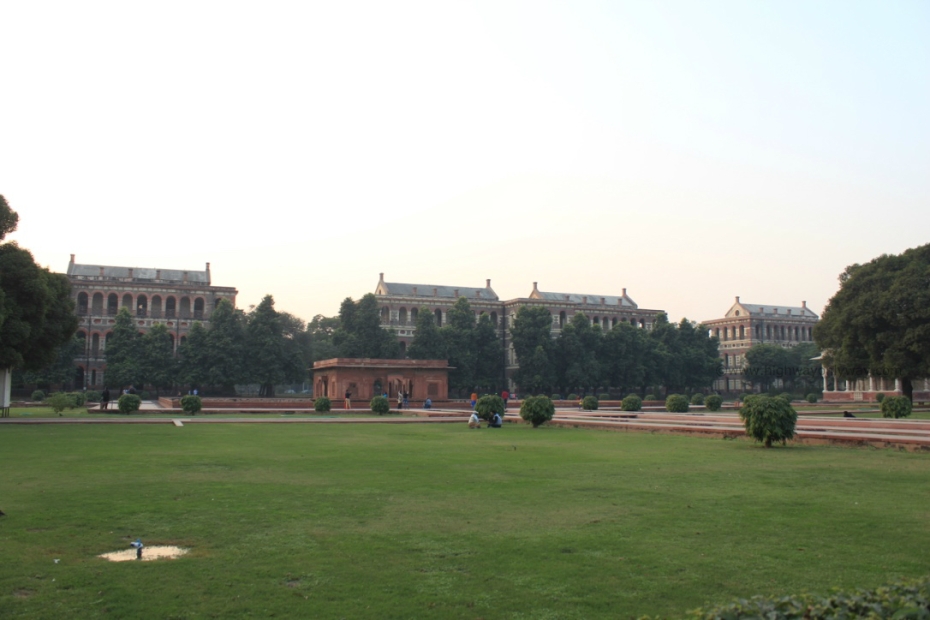
By this time, evening was setting in and we simply hurried around, we honestly, did not stop by to read or explore the structures in detail. We stopped to click pictures only if we found something interesting like this one:

A security officer’s royal swag !
Since, we did not find anything else that interested us, we decided to leave. We found a board with the map of the Red Fort and realised that a marble domed structure that we just passed was the famous Moti Masjid or the Pearl Mosque. We went back to check the monument but it was closed and we could only get this shot of it.
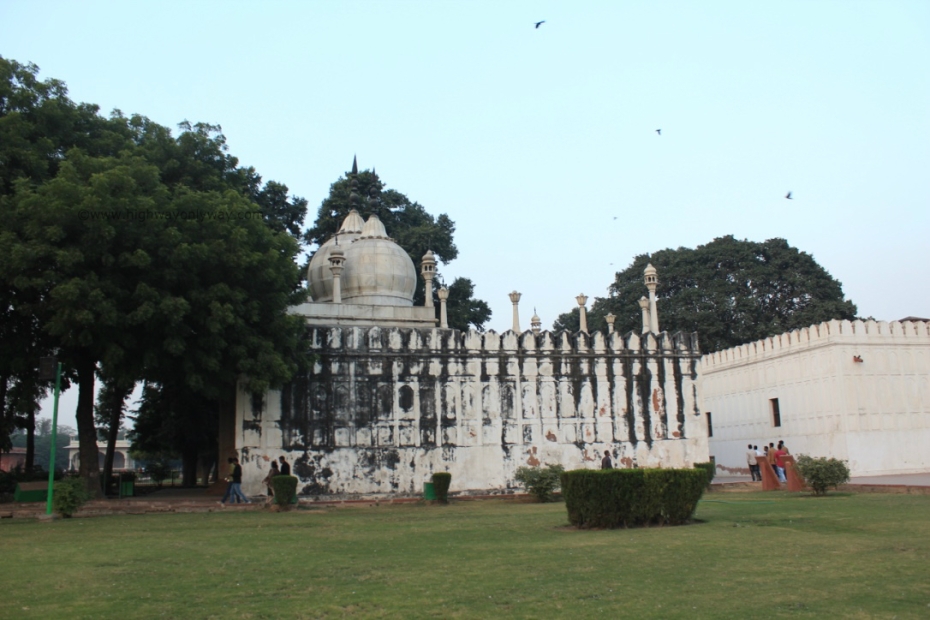
We were then done with our Red Fort visit, while leaving, we saw the place from where the Prime Minister addresses the nation on Independence Day, next time we see it on TV, we know exactly how the place looks !
Before leaving, we took one more shot of the ramparts of the Red Fort !

This reminded us of the Standard company’s “Lal Kila” Diwali crackers with a similar picture of the Red Fort on the cover !
Our next stop was the Jama Masjid, this time to show it to our friend, the rest of us had been there during our January 2017 visit. It had fallen dark by then and there was a crescent moon above the Jama Masjid, it was a beautiful sight, we sat down watching it in the cool breeze and evening chill. Since our camera gave up and mobile phones could not capture that scene, we have it recorded in our mind camera !
The king of roadside food
After a visit to the Red Fort, the next logical thing would be to take a walk through Chandni Chowk and binge at Paranthewali Gali ! Walking in the bye-lanes of Chandni Chowk is insane, you will learn to master the art of navigating your way through narrowest of spaces ! Despite the chaos and mess, Chandni Chowk is vibrant with bright colours – textiles, jewellery, bangles, handicrafts and of course food, our point of interest.
Paranthewali Gali or the Lane of Paranthas has rows of eateries selling Parathas deep fried in oil, we have never seen Parathas deep fried ! We went to this eatery that seems to have been in business for more than 120 years !

You won’t believe the variety of Parathas they have here, some sound funny ! We tried a Tomato, Mirchi, Badam, Nimbu and Rabri Paratha. The Parathas come dripping with oil but that’s the fun part of it, as for the taste, these Parathas are delicious but more than the taste, again it is the experience. Try Rabri Paratha if you want to try something crazy !
After the Parathas, we tried khullar Lassi – thick, creamy, Lassi, as good as the one we had in Amritsar.

We were not done yet, walking further, we spotted someone selling the famous Daulat-ki-Chaat, we had a taste of it during our January trip and there was no way we were missing it, even if we were already full to the brim !
By now, our tummies were bursting but that it did not stop us from having Rabri-Jalebi at one of the stalls that claimed to be have been awarded by Times of India for their special Rabri-Jalebi. One plate of it has a giant Jalebi with a ladle full of Rabri to go with it and costs Rs.100 ! It is a sugary heaven. The rest of the gang had only a bite and it was left to this writer to do justice to it.
Barely able to walk after our food marathon, we dragged ourselves to Chandni Chowk Metro station and took the train back to our hotel.
Simply, CP !
After 2 days of wedding festivities, the whole purpose of this week long trip, we had reached the last day of our vacation. Not wanting to waste the remaining time, we took the Metro and went to Connaught Place or CP, Delhi’s most important commercial centre.
The first thing that caught our attention was the huge Indian Flag fluttering high in the Central Park, what a wonderful sight, that is !

When you are in CP, one must take a look at the underground Palika Bazaar. There are 100s of shops selling electronics, clothes and what not, you name it, you will find it ! We found it highly amusing that some shops had names that had nothing to do with what was being sold there, like this one:

Aao Ji Foods selling clothes, we did not understand how that worked !
The roads and buildings of CP are classy, you feel like you are in some European city, just stand in a corner and get a feel of the place.

It was lunch time and we decided to check out the famous Kake-Da-Hotel, which has been in business at CP since 1932. The small place was bustling with people but service happened at super speed. We had the usual Paneer and Parathas and we understood why the place is so famous, everything was perfect !
We spotted numerous Paan shops and decided to try Fire Paan. Paan served with fire before it is dumped into your mouth, the guys who tried it said it was awesome ! If the guys tried fire, this writer decided to go with Ice Paan. How does it feel? No idea, because your mouth goes numb with all the ice dunked into your mouth but once you manage to chew it, it is fun. It is like having an ice gola all at once !
Toilet Museum
We still had about 5 hours for our flight back to Hyderabad, there was one more place that we missed visiting during our last trip, so we headed to Sulabh International Toilet Museum !
Sulabh International, most of us know, is an NGO promoting sanitation. There are several toilet complexes across the major cities providing public convenience. That our people do not use them or do not know how sanitation culture even if they use a toilet, is a different issue altogether !
A visit to the Toilet Museum is amusing. When you enter the museum, there are models of toilets that have human waste recycling systems and can be built at homes. This writer remembered a time at our village, many years ago, where the cattle dung was used to generate Gobar Gas !
The museum is as big as a living room of a house but has several photos, articles, history and models of different toilets/commodes.

It is interesting to read the history of toilets, toilet culture in various countries and some funny anecdotes. We wonder how the guide managed to tell us about each toilet model or “potty” story with a straight face, we of course, were giggling and laughing throughout ! It is the most amusing museum ever !
There is a model of a throne with a commode attached for King Louis XIV of France, the king had a bowel movement problem and the throne was designed to make it convenient for him ! There are several such hilarious models, some like the ones soldiers use in remote places will make your heart go out for their hardship. We were also quite surprised to spot this “potty” invented and donated to the museum by someone all the way from Machilipatnam !

When you are in a far away place, anything that is connected to your home state makes you feel good and is click worthy, even if it is a potty !
We didn’t realise that we had spent more than a hour at the toilet museum. Funny, though the museum is, in India, sanitation needs to be considered a very serious business and Sulabh International deserves a salute for their efforts in spreading awareness about proper sanitation.
That was the last place we visited before going back to collect our luggage and take our flight back Hyderabad. We ended the trip on a very happy note.
The sight of the crescent moon from the plane window as we flew back home was the perfect ending to what they call “a trip of a lifetime” ! We of course say that about every trip because travel is all about such moments of high !
Info tidbits
- Red Fort is open from sunrise to sunset and closed on Mondays. You will need an hour to visit Red Fort.
- If you are the slightly sensitive kind when it comes to outside food, you may want to be cautious about eating in Paranthewali Gali or anywhere in Chandni Chowk. Hygiene standards are not too great.
- CP is a good place if you want to go shopping or for better quality street food.
- Information on Sulabh Toilet Museum can be found here http://www.sulabhtoiletmuseum.org
Wagah Border – Jai Jawan !
When you are visiting a place, you could either fill up your schedule and visit all the places of interest or simply limit your visits so that you get all the leisure to soak in the feel of the place, at Amritsar, we chose to do the latter.
Golden Temple on a serene morning
When we stepped out that early morning, there were tour operators everywhere offering to take us on a city tour, the list of places sounded interesting including the must visit Wagah Border but we were so much in love with the Golden Temple area that we didn’t want to go anywhere else. We decided we would first chill on the roads of Chowk Fawwara and then decide if we wanted to go to Wagah Border or not.
Before going to bed the previous night, we knew the first thing we would do in the morning was visit the Golden Temple. It was numbing cold and just as the sun was rising, we caught the dazzling beauty of the Harmandir Sahib !

A cold, misty morning and the warmth of first rays of the sun – despite all the strife of the outside and the violence that this very place once witnessed, at the Harmandir Sahib, you will feel all is right with the world !

We joined the queue for the Darshan once again. This time, we spent more time inside the Gurudwara, climbed up the stairs to the first level and saw the 109 years old hand written copy of the Guru Granth Sahib being opened for the day. One can see the massive pages of the Holy Book being opened amidst hymns and prayers, we were lucky to have been at the place at the right time. We are not sure if there are specific timings, we suppose it is opened early in the morning at sunrise time. Similarly, the original Guru Granth Sahib in the Sanctum Sanctorum is also opened every morning at dawn, we did not witness that.
Some more moments of pure zen followed as we walked around the precincts, sat down and closed our eyes. Capturing the moments on our camera, we finally took leave of the Golden Temple.

Waheguru !
After our visit to the Golden Temple, it was time for breakfast !

Hot Kachori and Chole followed by steaming Chole Bhature !

The team refused to let this writer indulge in Lassi early in the morning !
Partition Museum
We walked around the bye-lanes near our hotel, behind the beautified road lies the old Amritsar, age old buildings, old shops, merchants. We stopped by to have a syrupy Jalebi that tasted like heaven.
With no specific plan in place, we took a stroll and found a place to sit on a raised platform opposite the Maharaja Ranjit Singh statue, who was looking even more regal under the daylight.

We sat there and watched the colour and gaiety of Amritsar, people dressed in bright hues, all happy and walking towards the Gurudwara, traders, hawkers, shops, the cold weather yet the warm sunshine. It felt like we were sitting in a vast theatre and watching a slice of life. Our deep breaths told us how relaxed this “doing-nothing-just-chilling” was making us feel !
After about an hour, we decided to visit the Partition Museum. During the British rule, the building, which now houses the museum, was the Town Hall.

The Museum has pictures, videos, interviews, newspaper clippings and articles about the horrors of the Partition in 1947.
If you want to realise how lucky, privileged a life you are leading, one has to visit the Partition Museum, you will end up feeling grateful for whatever little you have. We are only used to reading about the violence that followed India’s independence, we never really take time to imagine what it must have been like, walking through the Partition Museum and seeing the photos almost had us choked to tears, it made us angry ! Why aren’t we taught all these ugly truths in our history books? We felt guilty about the happy lives we are all living in the present, our freedom was achieved over the dead bodies of millions of innocent people. We have been painted a rosy picture of our non-violent means of achieving independence, we thought that would be an insult to the memory of all those millions of people who died gory deaths. The visit left us extremely disturbed.
We left the Partition Museum with a heavy heart and walked around wondering what to do next. We were approached by some tour operators who offered to show us around Amritsar including Wagah Border. That’s when we decided, we had a lot of time and we could make a trip to Wagah after all. We did not want a city tour, which would include the Gobindgarh Fort, we fixed a trip to Wagah Border with one of the tour operators and headed for a quick lunch.
Overwhelmed by patriotism
We started to Wagah Border around 1.30 PM. Our trip to Wagah took us through the ancient route that was once part of the Uttarapath or the trade route from ancient port of Tamralipti to all the way to Central Asia. Later, it became the Grand Trunk Road built by Sher Shah Suri and further expanded by the British (obviously, the name Grand Trunk Road was given by the British). Today, the route is part of National Highway 1.

This is the last (or the first, depending on which end you look at it from !) toll booth on National Highway 1 ! Poor quality picture because it was clicked through the windshield from the back seat of a speeding car.

There was some kind of an adrenaline rush as we neared the border, after all, Wagah Border is the most famous border point between India and Pakistan ! That is why when we saw this sign board, it was quite surreal.

The sign board only has Pakistan cities in the list, it was amusing for us. We had never imagined that one day, we would be standing at a place so close to Pakistan !
Vehicles are allowed only upto a certain point about 1 km away from the border, one has to either walk or take a rickshaw to the border point. The place has stalls selling Indian flags, caps and other souvenirs, eateries and hawkers. Equipped with some Guava fruits and miniature Indian flags, we decided to walk to get a feeling of countdown to India’s frontier.

Wherever you turn, you can see BSF – offices, buildings, hoardings, officers, check points – awe inspiring and though an ordinary citizen, it fills you with pride.
We arrived at the Wagah Border after a 10 minute walk and joined the queue waiting to witness the Beating Retreat Ceremony. It was around 2.45 PM and the Beating Retreat was supposed to begin at 4.30 PM. Wagah Border attracts huge crowds and it is a good idea to reach atleast 2 hours in advance, so that you can find some place to sit.
At 3 PM, they allowed us near the Border Crossing Point, one has to walk half a kilometre. Men and women are asked to stand in separate lines and women are allowed to go first, this got a little chaotic because it is hard to spot your family in the crowd and phone signals do not work here. It is quite confusing and you do feel lost not being able to contact your people, despite that, when you see the arch with “INDIA” written in bold, you seem to forget the inconvenience for the moment.

Once at the gallery from where one can view the ceremony, people were rejoined with their families and all was well. Seating in the front few rows will give you the best view but anywhere will be just as fine.

We found a place to sit on one of the upper rows and waited for ceremony to start. The biggest point of interest was Pakistan on other side of the gate ! It was almost a “oh my God” kind of moment, India ends at that gate and Pakistan, the name that evokes so many emotions in an Indian, on the other side !
While on our side, the crowds were milling in, there were only a handful of people on the Pakistan side. Wonder what they must have been thinking looking at India !
Patriotic songs were played, cheerleaders from the BSF built up the patriotic fervour by asking the crowd to join in shouting slogans “Bharat Mata ki Jai”, everybody cheered from their heart ! The idea was to be louder than the Pakistani crowd, which was not even 10% of the Indian crowd !
A group of women from the crowd were asked to run a relay with the National Flag amidst loud cheering from the crowd, then, girls from the crowd danced to patriotic songs, it was fun, festive and above all, a great feeling of love for the country !

There wasn’t much fun and frolic on the Pakistan side and our cheering grew louder to drown any slogan shouting from that side. It was like the cultural events way back in school and college.
Promptly at 4.30 PM, the Beating Retreat Ceremony began. India’s ceremony was lead by two women officers of BSF, it was inspiring !

We cheered our heart out, feeling immensely indebted and grateful to our soldiers who defend us, who undergo unthinkable hardships, leave their families behind and even lay down their lives so that we can live in peace. Our cheers were our way of thanking the soldiers but even bigger way of thanking them would be being responsible citizens and making this country worthy of their sacrifices.
The border gates were opened, there was show of might and valour on both sides and lowering of the flags just before sunset.

The ceremony took about half an hour and left us ecstatic, we were so glad we decided to visit Wagah Border and cheer the Army men. Patriotism is a great thing, though one has to be wary of mindless nationalism !
May be it was to do with being in Army area, people were surprisingly disciplined while coming and leaving the galleries. We are capable of discipline, it’s just that we are too lazy to be disciplined unless we really have to be, is that it?
After the ceremony, we were allowed to take pictures of the border gates. Earlier, people were allowed till the gates, now there are barricades a few metres before the gates.

With our hearts filled with love for the country and in awe of BSF, we left ceremony arena to head back. While leaving, we spotted this board.

“Welcome to Republic of India” ! A goosebump moment !
We also caught a glimpse of the border fencing running till as far as your sight permits. Back on the road, the whole place looked like a mela, a long line of food carts, stalls and people having a good time.

Wagah Border is a must visit, though on holidays and tourist season, our driver told us, it could get very crowded and if you do not plan well, it could be a hassle as well. Nevertheless, all of us need this shot of patriotism. After all, Walter Scott had written “Breathes there the man with soul so dead, who never to himself hath said, “this is my own, my native land” !
The flag we bought at Wagah Border is now safely kept in our cupboard, we look at it almost everyday and remember the BSF and say “we love India” !
We were back at Amritsar in time for dinner. We went for dinner to the legendary Bharwan Dhaba at Amritsar. The ghee flowing from the Dal Makhni and Panneer was indicative of why the restaurant is legendary ! Our Amritsar trip was drawing to a close and the lip smacking food at Bharwan Dhaba was the “Makhan on the Paratha” !
We had to catch the early morning train to New Delhi, we did one more round of the market place, another glimpse of the Golden Temple from outside and retired. Amritsar is magical !
We leave you with our favourite view of Amritsar.

Info tidbits
- Partition Museum is open from 10 AM to 6 PM.
- Wagah Border is 35 kms from Amritsar. There are tour operators who will take you on a city tour including Wagah Border and charge you around Rs.1200/- for a cab. There is not much difference between a city tour package and Wagah Border alone. You could negotiate if you are good at it.
- Entry to view the Beating Retreat Ceremony is free. It is a good idea to plan a visit Wagah Border on a weekday and off peak season for tourists. Weekends and holidays are usually supposed to be very crowded and unless you reach the place atleast 3 hours in advance, you wouldn’t be able to find a place to sit. Even during off season, we suggest, you go there 2 hours before the Ceremony time.
- Since men and women are made to stand in separate queues before entering the gallery, it could be a tad difficult to locate your family in the crowd once inside, especially without mobile signals. Don’t panic, you can spot them once everyone settles down or ask them to wait at the entry point. If you have kids with you, be extra careful and keep them close.
- Keep half a day aside for Wagah Border.
- It is alright if you cannot get a great view of the Ceremony, it is all about being at the place and being a part of the experience and cheering the soldiers.
The Golden Temple
Amazing food, colourful culture, warm and happy people – our first evening in Amritsar in short. We ambled along the roads around the Golden Temple and were quite taken aback by the beautification. The entire stretch has been neatly paved, well organised rows of shops, off limit for vehicles, benches where people can sit and relax and above all, very well maintained and sparkling clean roads !
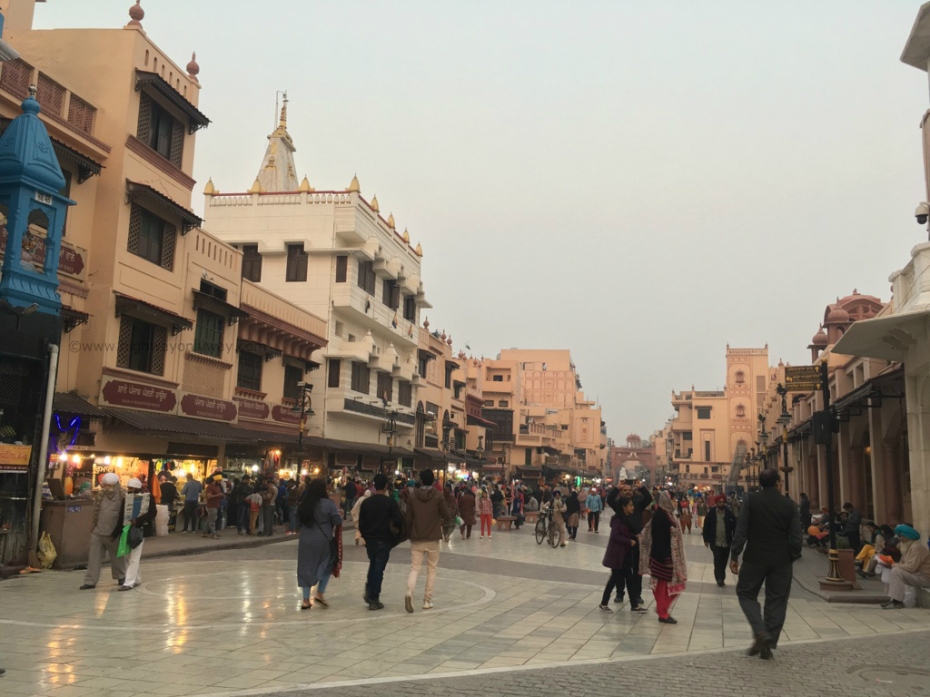
They blended the heritage buildings beautifully with the modern constructions, we were told the roads were beautified a year ago and the Municipal authorities take great care in cleaning and maintaining the area. It is refreshing to see civic authorities and citizens being responsible, a rarity in our country !
The shops are shopaholic’s paradise, the famous Punjabi Juttis to Phulkari textiles, toys, handicrafts, kulfi !

At the end of the road are the white marble buildings leading to the Golden Temple.

Every bit of the area, spick and span and people quietly going about their business. When the sun set, the lights came on, adding to the beauty of the setting.

It was time for our visit to the Golden Temple.
Life’s golden moments
Under the lights, the entrance to the Golden Temple looked “wow” !

Through the archway, we caught our first glimpse of the Golden Temple and were left speechless !

Who hasn’t seen pictures of the Golden Temple? But, seeing it in person, dazzling in the night, in the middle of a water pool, with strains of soulful music in the background – one has to experience it to believe it !
Just looking at the stunning Golden Temple and the aura of the place feels like you are being drawn into a trance.

Surreal, we could call it. We went quiet, each of us drawn into ourselves, feeling several things – happiness, tranquility, fulfilment, alive !
We joined the queue waiting for darshan. The queue was teeming with people but we watched in absolute surprise how everybody was quiet, disciplined, no pushing, no trying to break the queue or going ahead out of turn, no shouting or loud talk. How wonderful it is when our people can be at their best behaviour at public places – a rarity !
The pathway to the Golden Temple is built over the Amrit Sarovar, the tank around the temple from which the city of Amritsar gets its name.
A quick darshan and we were out of the Golden Temple. The gleaming gold interiors inside the temple will leave you mesmerised. We sat on the platform outside in silence and watching people lost in spirituality. We were impressed by the way people conducted themselves with discipline, devotion, the sense of service. One can see people voluntarily taking up some work or the other, cleaning the floor, helping another, this, we think is the essence of any religion – service to mankind as a means to serving God.
Then, we strolled around the temple. The marble floor almost made our toes freeze and the cold air gave us the shivers but we were so taken by the sublimity of the Golden Temple that even the extreme cold was a source of joy !
One can spend hours watching the sparkling reflections in the pool.

We sat on the marble floor bordering the tank, there was no thinking, no rush, no plan – just empty minds soaking in the golden moments of life. We wanted to forget everything and just spend our lives there !
There are hundreds of multi coloured fish in the Amrit Sarovar, it was very calming to watch them quietly swim in the cold water, there is something to watching nature do its work without uttering a word.
After a long time of silence and complete bliss, we headed out. Here is one more picture of the Swarna Mandir in all its glory.

Next, we went to the Guru-ka-Langar, the Gurudwara’s kitchen as it is called in Punjabi. Probably the largest kitchen in the world, the Langar serves free meals to anybody at any time of the day. The tradition of serving meals was started by Guru Nanak himself and it is amazing that this service to mankind is followed in almost every Gurudwara. The people who work at the Langar are usually devotees volunteering to do service, it is the greatest example of community service.
A meal at the Langar is divine, simple rotis, curries and kheer that you can have as much as you wish for. The volunteers serve you with such kindness that you are almost choked with gratitude.
When clean India is not just a dream !
With a feeling that could only be described as overwhelmed, we stepped out of the Golden Temple and took a walk, already in a happy state of mind, everything around looked enchanting ! Kulfi followed by Coffee, we wandered around the glittering streets of Amritsar’s Chowk Fuwwara.
Look at this majestic statue of Maharaja Ranjit Singh !

Check out the super clean, neatly paved, illuminated roads.
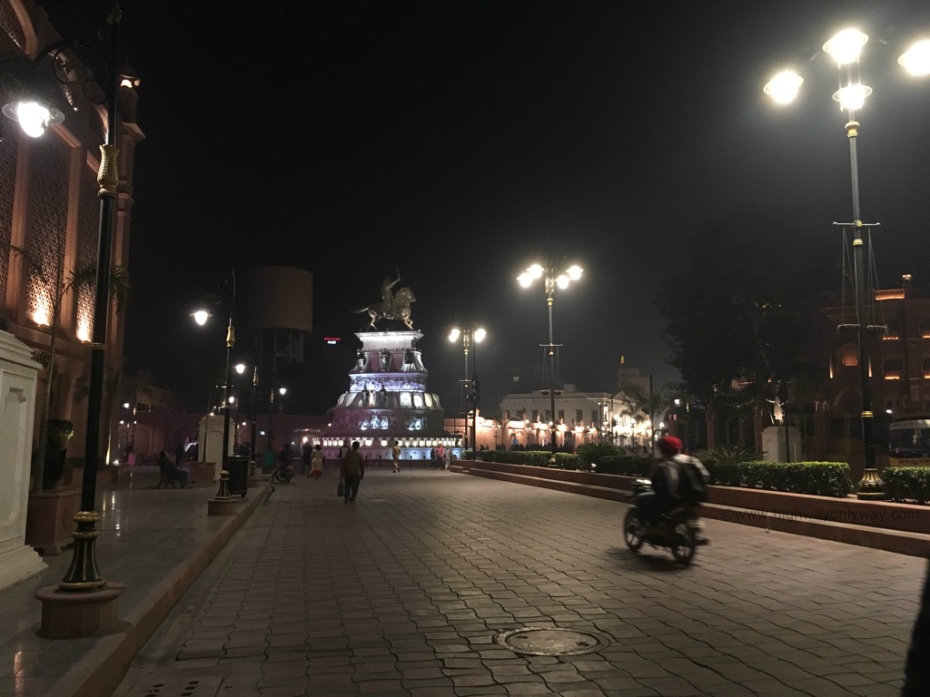
Walking here feels like you are in one of those foreign countries, whose pictures you see and wonder when India would become like this !

There is also a large LED screen on one of the buildings showing footage and images of the Golden Temple.

The entire stretch of over 1 km of what they call the Fawwara Chowk to Town Hall to the Golden Temple is proof that if citizens and authorities make up their mind, Swachch Bharat is not a distant dream !
It was almost 10 PM when we wound up for the day and headed back to our hotel, raving about Amritsar till we fell asleep.
Info tidbits
- The Golden Temple is open from 2.30 AM to 10.15 PM. There are no tickets, special entries or VIP darshans, everybody has to follow the same queue.
- The Guru Ka Langar is open at all times, anybody can simply walk in and have a meal.
- We did not find any information on how one could also be a volunteer and do some seva like our experience in Nanded Gurudwara.
- Do not just make a quick visit and exit from the Gurudwara, make sure you spend a lot of time just sitting in the premises and absorbing the peace.
- Photography is not allowed inside the Sanctum, one can click pictures anywhere outside the main shrine.
- Vehicles are not allowed to ply on the roads leading to Golden Temple and the lanes around are too narrow, if you are driving your own vehicle, parking could be an issue.
- Indulge in shopping as much as you want, we did not shop at all and we are not sure if bargaining works.
Jallianwala Bagh
With only 3 hours of sleep, we woke up at 5 AM (try making us do that on a normal weekday !) to catch our 7.20 AM train to Amritsar. One of the best experiences of early morning travel is having Chai, especially if it is as cold as a Delhi winter morning. We walked the few metres to New Delhi Station, whose swanky look, by the way, had us gaping at it like some village bumpkins !
We boarded New Delhi-Amritsar Swarna Shatabdi Express, after the Rajdhani Express trains, the Shatabdi trains are the next high priority, prestigious trains. On dot, the train chugged out of New Delhi and promptly, breakfast was served. When you love food, you tend to relish even a repeated menu – cutlet, bread, boiled vegetables and tea ! Indian Railways is very consistent that way – Hyderabad to Amritsar, one Railways, one menu ! But, Indian Railways is also the reason why some of us become kids again, looking out of the window and the joy of viewing new landscapes !
The train was running behind schedule but we had no complaints, sitting in comfort with a book or just dozing off.
The land of five rivers
Punjab – Bhangra, Lassi, Parantha, “Bhalle, Bhalle”, these are probably the first words that come to one’s mind. Especially for those from the South of India, Punjab is a fascinating place. Images of the mustard fields, the sturdy Punjabis and the colourful culture – one grows up in awe of Punjab ! It was terribly exciting the first time we read a station name written in Punjabi. We spotted mustard fields and broke into “Tujhe dekha tho ye jaana sanam” ! Breathes there an ’80s kid who doesn’t get high on this song?
It was mid-morning but the fog had not lifted.

At some places, crops were being burnt, 100 kms away, Delhi gets choked by pollution !
We passed Ludhiana, one of the most important industrial cities of India, we couldn’t believe we were actually seeing these places that we had only studied about as part of GK.
Name the five rivers of Punjab. A mandatory Geography question ! Punjab, we all know, is called the Land of five rivers, thanks to these 5 rivers – Ravi, Sutlej, Beas, Chenab and Jhelum. Here is Sutlej of the Famous Five !

A short while after crossing Sutlej, we passed Jalandhar city. About 40 minutes later, we crossed the Beas too.

It is one thing to study about the rivers in school and another to actually see and even cross the rivers, almost gave this writer goosebumps. We couldn’t click better pictures from the train window, especially when the train wasn’t slowing down.
The train was an hour late and it was past lunch time when we arrived at Amritsar. Swarna Shatabdi only serves you breakfast, if the train is late, lunch is left to you ! Thankfully, we had our snack pouch that we carried all the way from Hyderabad, which kept us happy till we alighted in Amritsar.
Amritsar looked like any other chaotic city with until we reached the road leading to our homestay, a stone’s throw away from the Golden Temple. The entire stretch of what must have been the market has been beautified and open only for pedestrians. It looked like we had suddenly walked into a different world. We decided to check out the road later and first checked into our homestay, Osahan Paradise, located right behind the historical Jallianwala Bagh. We had to navigate narrow bye-lanes to reach the homestay but once inside, we loved the comfort of the place. If you plan to visit Amritsar, Osahan Paradise could be a wonderful stay option.
It was 3.30 PM and the only thing on our minds was food, having missed lunch thanks to the late train. We walked into the first eatery we found and ordered the obvious, when in Punjab you order Chole Bhature !

How do we put in words to tell you how much we relished the Chole Bhature? This one was different from the usual, the Bhature were made out of rice flour, instead of the usual maida. This was followed by Lassi !

Though one can find Lassi almost everywhere, one has to taste the Lassi in Amritsar to know why that is the golden standard for Lassi. Amritsar already had us floored.
Value your freedom, dear Countrymen !
All our life, we have studied about India’s struggle for freedom, being born in an era where freedom is considered a given, many of us wouldn’t really understand what it must have been to live in the times of colonialism and to fight for being free, to have your country for yourself. We might have written essays on Indian independence movement, watched movies, flag hoisting, sang patriotic songs but nothing hits you really hard until you actually experience being at the very place where the struggle for freedom turned the ugliest – Jallianwala Bagh.

The moment you enter the place, you automatically feel a sense of gloom, atleast a 1000 innocent, unarmed people were killed within the precincts of this place.
The buildings around Jallianwala Bagh have been left intact and one of them has been converted into a museum, exhibiting photos and write ups from 1919 when the massacre happened.

No matter how much history you studied or watched videos, when you visit the museum, you really understand what a horrible act of genocide had been committed. It will make your blood boil and that’s when you realise how lucky you are to have been born in a free, democratic country.
Today, Jallianwala Bagh is a pleasant garden, where people go for walks and picnics.

But this, sign board makes you stop and think.

This one almost choked this writer with emotion.

Then there is the Martyrs’ Well, where hundreds of people jumped to save themselves from bullets only to die a more gory death.
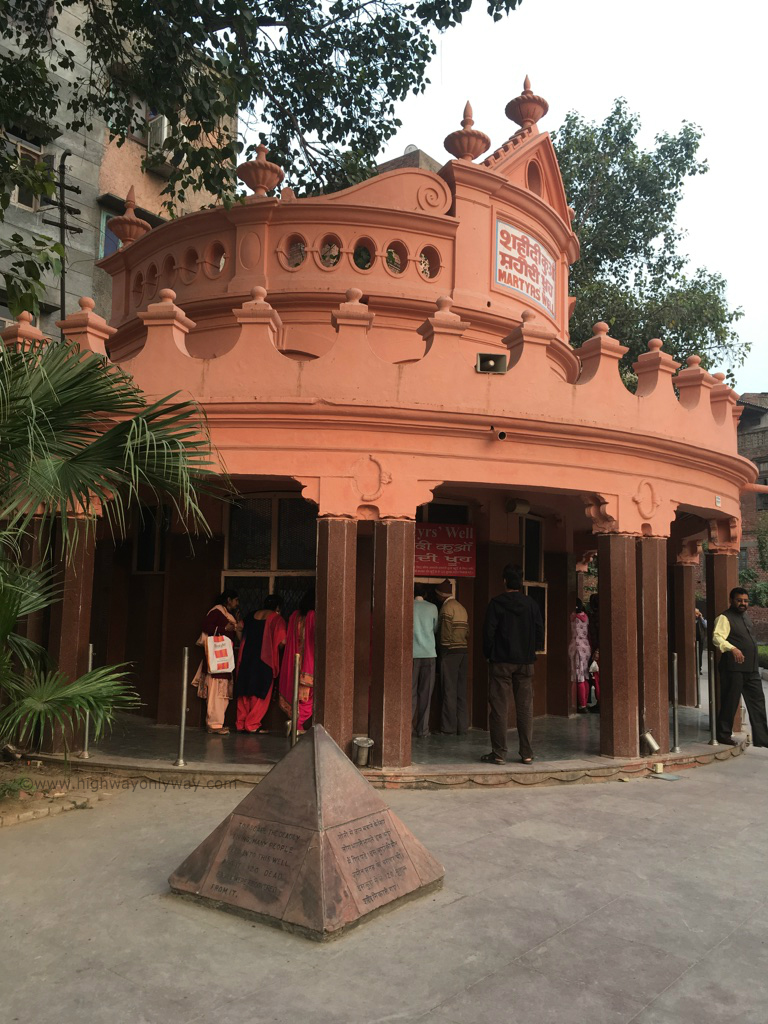
One cannot even begin to imagine the fear and panic that those people must have felt. Walk around the garden and you can find walls with bullet marks, as many 1600 rounds of bullets were shot.

The soldiers must have chased the people and shot them with bullets flying everywhere, you can find them on almost all walls.

In the middle of Jallianwala Bagh, is the monument built in memory of all those people who were killed.

People were walking around, pointing to the bullet marks, talking, some clicking pictures beside the bushes shaped like firing soldiers, having a good time. How many of us actually think that the good life that we enjoy today came at a very high price? Do we value our freedom and realise that the freedom that was won after such pain also means we have certain responsibilities towards our country?
We sat down discussing if India’s independence was really achieved in a peaceful manner? Indians may have been non-violent towards the British but ask all those lakhs of people who lost their lives under the British rule, was it really a non-violent struggle? After a few moments of quiet contemplation, we left Jallianwala Bagh feeling very sombre.
You walk out through the narrow, only entrance and exit to Jallianwala Bagh from where General Dyer organised his troops and blocked it so that nobody could escape.
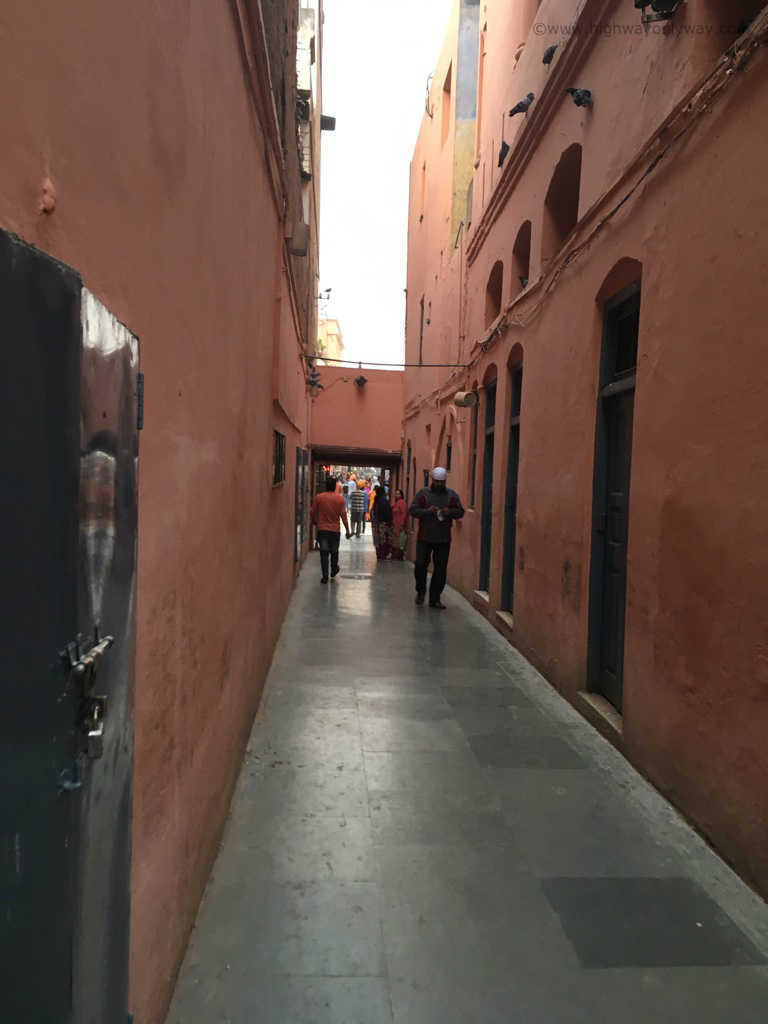
It will make you angry but that is history and one cannot undo it, the least we can do is learn from it and not let these sacrifices go waste, have some regard and love for the country, not the kind of love that says “my country right or wrong” but that makes you want to be a responsible citizen.
All these heavy thoughts made us crave for a refreshing cup of chai and we found one in one the narrow lanes. A cup of chai sitting on the roadside benches in the cold weather – always a winning combination !
Info tidbits
- If you are not on a road trip, the best way to travel to Amritsar from Delhi is to take the Shatabdi trains. The journey is 6 hours by these trains, every other train takes around 12 hours and most of it is a night journey.
- Jallianwala Bagh is adjacent to the Golden Temple, there is no entry fee. We did not check the timings but we suppose it closes by 5 or 6 PM.
- Do take time to visit the museum.
Fatehpur Sikri – Akbar’s City of Utopia
From Agra, our trip proceeded towards Fatehpur Sikri, 35 kms from Agra, which is often described as Akbar’s dream in red sandstone. Lunch time was closing in, we stopped for lunch at one of the restaurants on the highway and after a hearty meal, we reached Fatehpur Sikri, around 2.30 PM.
Some lessons in history and some for life
Akbar, the greatest of the Mughal kings, as we all know, founded the city of Fatehpur Sikri and made it his capital at the peak of his reign in 1571 A.D. One of the reasons for choosing Fatehpur Sikri was in honour of the great Sufi saint, Salim Chisti, who lived there and whom Akbar revered. Today, Fatehpur Sikri is listed in the UNESCO World Heritage Site and the celebrated example of Mughal architecture under Akbar.
As we approached the gateway to Fatehpur Sikri, our cab driver informed us that private vehicles were not allowed near the actual location of Fatehpur Sikri’s monuments, we had to take shuttle buses. He also told us that Fatehpur Sikri was too big a place to explore on our own and that we wouldn’t know what to see if we did not hire a guide. Even as we were contemplating, he parked the car at the parking lot and immediately, the car was surrounded by burly looking men. One look at them and we knew we had no choice but to hire the guide they would refer us to, such was their looming presence. In fact, starting from that moment, we knew we would have no say in our sight seeing trip !
We boarded the bus and followed the guide into Fatehpur. We were greeted by this royal mahal.

The guide rambled on about the history but we were too lost in the bright hues of the red sand stone all around.

Akbar moved his capital from Agra and had Fatehpur built as his dream project, probably why even the buildings turned out as dreamy as these !
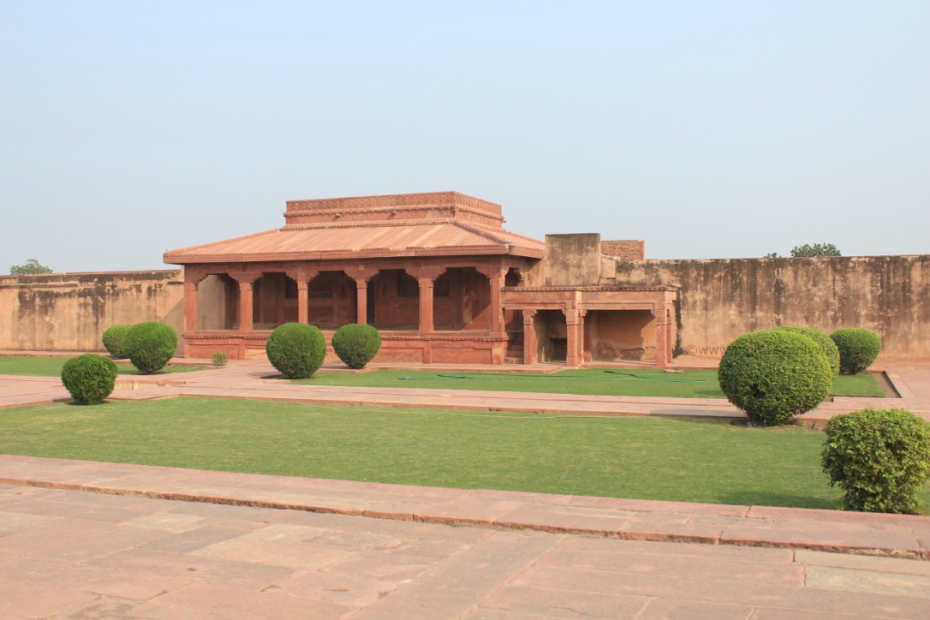
We hardly got some time to admire the architecture because the guide was in a rush to finish up the tour, it felt like somebody had tied us down because we usually spend a lot of time exploring a place, looking at the architecture and clicking pictures.
Running to keep pace with the guide, we were shown the Din-e-Ilahi Pillar. Din-e-Ilahi was Akbar’s idea of religious harmony and it was a new religious movement propagated by him which took the best from all the religions in India. This pillar in Fatehpur is a combination of sculpture forms of all the religions and represents his principles of Din-e-Ilahi.

One can see the Hindu, Islam, Jain/Buddhism, Christian, Sikhism styles of sculpture and architecture all blended into one pillar. This we found very fascinating. But, Akbar’s Utopian idea of religious harmony did not take off and even after 400 odd years, this harmony has eluded the world !
Next, we were rushed past the private areas meant for the royals, the Panch Mahal being the most important one. It is designed to look like a temple and has been built in such a way that one could enjoy the cool breeze from each floor.

We don’t have a better picture because the guide seemed to get annoyed if we stopped for more than a few seconds to click pictures. We now understand why History is not a favourite subject with students. Teachers simply rattle off events and dates, nobody bothers to stop and make them appreciate the lives of those who lived before us.
Next to the Panch Mahal is one of the private chambers of the Chief Queen.

You could imagine the queen relaxing on a pleasant evening watching dancing girls and listening to the music.
Music was an important part of the Mughal culture with the mystic Sufis and Hindustani musicians, the legendary among them being Tansen. Perhaps, the most charming structure of Fatehpur is the Anoop Talab.

The open air stage in the middle of a pool where musicians entertained the king on evenings, chief among them being Tansen. There are stories about how Tansen would sing the Malhar Raag and could move even clouds and bring in rains or how he could light lamps with his Deepak Raag.
Take a moment and imagine an evening where Akbar sits in one of the rooms on the top floor and Tansen rendering his raagas under the cool breeze and as night falls, his music reaches a crescendo and the lamps light up ! Or imagine Tansen’s voice making clouds gather, melt and send down showers in appreciation of his music ! Of course, it was all poetic liberty and stuff that legends are made of but the setting is so perfect for your imagination to travel back in time.
Up next were the living quarters of the Queens, more specifically, the Rajput princesses.

An interesting feature of this part of the fort is that, the architecture is heavily dominated by Hindu features which, the guide will tell you, was because these were built in the Rajasthan style because the Hindu princesses lived there. Check out this mandir, a prayer room built for Queen Jodha.

It seems, Akbar even had a separate kitchen built for Jodha because she was a vegetarian ! While there are different opinions on whether Jodha was real Queen or a fictional character but at Fatehpur Sikri, her name reverberates in every where.
Here is one more of the several chambers of the noble women, this one shaped like a hut.

Akbar’s dream capital and royal palace was abandoned after about 15 years because the dry area of Fatehpur Sikri ran out of water and it was not possible to sustain a capital with such severe water shortage.
We had hardly registered the whole tour in our minds when our guide announced that his duty ended there and he was going to introduce us to another guide who would show us Sikri ! Our expression is left to your imagination !
Not in the name of God !
It wasn’t until we visited Fatehpur Sikri did we know that Fatehpur and Sikri were technically two different places, though both are located beside each other. Sikri was the name of a small village with a large water body near by, it was the home of Salim Chisti. Inspired by the Sufi Saint, Akbar, decided to make the area his capital and built Fatehpur beside Sikri. It was the water body near Sikri that served as a water source to the entire capital and when it dried up, Fatehpur Sikri had to be abandoned and the capital was shifted back to Agra.
Sikri looks regal, the architecture also reminded us of the British era buildings especially the National Art Gallery at Madras.

Indo-Saracenic architecture, as the British architecture in India is usually called, must have been inspired by these Mughal buildings.

The guide continued showing us around, honestly, we did not pay much attention, especially when we were being told stories like how Anarkali was not actually entombed alive but Akbar had an escape passage built so she did not have die, he only wanted to separate Salim and Anarkali. Now, we know that Anarkali was a fictitious character but we have government authorised guides narrating these stories and expecting us to amazed by them !
But, what really ruined the entire Fatehpur Sikri experience for us was the tour of Salim Chisti Tomb. Located amidst the red sandstone structures of Sikri, the tomb is the only white marble monument and like all other Mughal structures, looks elegant and pristine. To the left of the Tomb is the Jama Masjid, the Jama Masjid at Delhi almost looks like a replica.

Before visiting the Tomb, we were given instructions and lecture on the traditions of the Chadar and Mannat, how the proceeds of whatever we buy go to help the poor and so on. We had mentally decided we weren’t going to do any of those but obliged to follow the guide to one of the guys selling the decorated Chadar and the sacred threads to be tied to the grills of the Tomb after making a wish.
We were shown the Chadars and listened patiently to every thing that was told to us, then we said we weren’t keen on buying anything. And then, all hell broke loose, the person who was selling the Chadar suddenly became rude, almost to the point of abusing and creating a scene. We suppose, they rely on the fact that if they raise their voice, ordinary tourists like us would want to avoid any ugly scenes and succumb to their pressure. Like every tourist taken for a ride, the Chadars and Mannats were forced upon us, we had to spend Rs.1000/- unwillingly. We were disgusted and shaken by the whole experience and fraud in the name of God, fleecing of tourists in the name of the holy saint ! Respect people’s beliefs but making a business out of it is unfair. We do hope the concerned authorities do something about it.
After that point, we lost it. It dawned upon us that right from our hotel who booked the cab to the cab driver to the hotel where we had lunch to the ones who insisted that we hired a guide to the first guide who showed us Fatehpur to the second one at Sikri to the shopkeeper selling Chadar, they were all part of the network out to cheat tourists ! If Indians can be taken for a ride, imagine the plight of foreigners ! So much for Athiti Devo Bhava.
After this point, we didn’t care what the guide was telling us, we vaguely remember him telling us about the marble and carvings on the Salim Chisti tomb. We were not in the mood to click any pictures, just about managed to click this one for the record.

Instead, we turned our attention to a group of singing Sufi songs outside the dargah, atleast the music was soothing.

We would have wounded up the visit, if not for Buland Darwaza, supposed to be the highest gateway in the world. Even from inside Sikri, one can see how massive the gateway is.

To see the front face of Buland Darwaza, one has to go outside the Sikri complex through the same gateway. May be it was our disinterested mood, we simply scanned the Buland Darwaza, our reaction was something on the lines of “nice” ! This photographer did not even think of taking a proper picture of it.
It is hard to fit the colossal gateway into a single frame unless you walk down the steps before it and take a long shot.
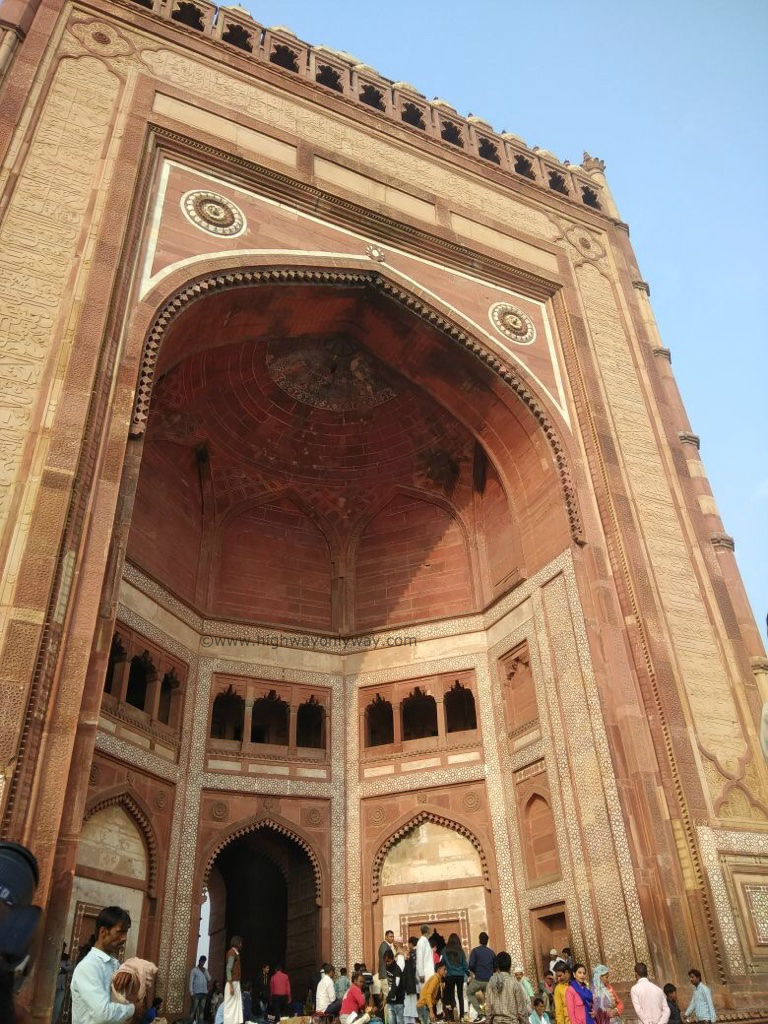
We do not remember what the guide told us about its architecture and other features, one could always look up for more reliable information on the internet.
Back inside Sikri, we were shown the corridors where the famous song of the 1990s from the film Pardes “Do dil mil rahe hain”, was shot. There is some kind of a grace in these long, arched, red sand stone corridors, a signature mark of Mughal architecture.

We spent a few minutes more looking around and then decided it was time to leave. As we were leaving, a few kids surrounded us telling us that they would recite some shayari, in return, we would pay them. We refused, yet the kids wouldn’t stop and as we wore our footwear, they recited things that were inappropriate for kids that young, imagine a 10 year old describing the beauty of “madam” and how “sir” is lucky ! It was sickening that someone taught these verses to the kids and they mouth them without knowing the meaning. We told the kids to use their intelligence for their studies and left the place.
We hastily paid the guide and took the shuttle bus back to the parking lot. We complained to the cab driver about how we were fleeced and told him there were unfair practices going on, he simply reacted with a “acha” ! With nothing much to do, we travelled back to Agra, had one more round of our now favourite vegetable juice, spent some time buying the famous Agra Petha, followed by dinner at a random restaurant and reached the Agra railway station to catch the Shatabdi Express to New Delhi. In less than 24 hours time, we had seen the “who’s who” of India’s tourism !
The train scheduled to arrive at 9 PM was late by more than an hour. Tired, we decided to catch some sleep in the train but dinner was served when we least expected it. It was exactly the same menu that was served to us on the Rajdhani ! Second round of dinner done, we couldn’t stop ourselves from dozing off and woke up a few minutes before New Delhi arrived.
New Delhi was only a transit, we were to catch an early morning train to Amritsar. We had booked our rooms at Smyle Inn, a short walk from the New Delhi station through the narrowest, strange looking bye-lanes of Paharganj ! Walking through those lanes in the middle of the night, we never thought we would be doing it in our lives. Travel is fun, bitter experiences and all !
Info tidbits
- Fatehpur Sikri is 35 kms from Agra and a cab could cost around Rs.1800/-. This includes Agra sightseeing and round trip to Fatehpur Sikri.
- Authorised guides charge Rs.250/-. There are separate guides at Fatehpur and Sikri.
- We suggest you read up all the information on the internet or buy and audio book. Stay away from guides if you can.
- Even if you hire a guide and you are not keen on paying for the Chadar and Mannat, be firm and tell the guide that you are not interested.
- Though we were given a quick tour, one can spend about 2 hours at Fatehpur Sikri, the place is really beautiful.
Agra Fort – The original Mughal
While we usually associate Delhi with the Mughals, the original capital of the empire was Agra. The Mughals reached their zenith under Akbar, who had the Agra Fort built over the ruins of an existing fort of the Lodi dynasty and from then on, it came to be the stronghold of the Mughal empire.
The Mughal seat of power
Agra Fort is a 5 minute drive from Taj Mahal. Our driver dropped us at the entrance but we stopped by the road to buy some delicious guavas. Lost in picking the fruits, we were astonished when we glanced to the side and spotted the massive Fort wall !

That’s when we understood how mighty the Mughals must have been. It is one thing to read history and another to actually see the places where it played out.
At the Agra Fort too, we did not have to buy tickets thanks to the World Heritage Week celebrations. While the Red Fort and Taj Mahal usually steal the limelight, we felt, the Agra Fort should actually be on top of the list. Look at the formidable entrance.

Walking inside the fort, you get a hang of the famed Mughal architecture.

In the above picture, the building on the right is the Diwan-e-aam or the Assembly Hall of the Commons. This writer could almost recall images of the history textbook pages on the Diwan-e-aam and the Diwan-e-khaas ! Here is a look inside the Diwan-e-aam. The enclosed place is where the Emperor would sit and address the audience.

There are steps from the Diwan-e-aam leading up to the top level of the fort. When you reach the top, you are floored by the beauty of the buildings and the landscape.

Delicate arches of marble and red sandstone all around you, the beauty lay in the simplicity and elegance. Walking through the corridors, we found ourselves humming “Jashn-e-bahara”, A.R.Rahman’s classic tune catching the subtle love of Jodha and Akbar, whose story is supposed to be set in the Akbar Fort. This is a perfect setting for love to blossom !

This arch also frames the Diwan-e-khaas or the Private Assembly Hall of the Emperor. One is not allowed inside the Diwan-e-khaas but we managed to click a picture through the grill enclosing the hall.

When you see the intricate artwork and carvings on the marble walls and you will know why the hall features as the best example of Mughal art.
Perhaps, the most interesting thing about the Agra Fort is that whichever part of the fort you visit, you get to view the Taj Mahal. Of course, the fort wasn’t designed that way because it was built before the Taj Mahal. You get the view because just behind the fort the Yamuna flows and you can see the Taj Mahal all the way across the river bed.

It was a foggy day, so our view of the Taj wasn’t very clear but this is a nice spot to stand and gaze at the world famous monument and the Yamuna river, though there is hardly anything left of the river except the slushy bed.
The Agra Fort was the centre of Mughal power starting from reign of Babur to Jahangir, Shah Jahan had shifted the capital to Delhi but he was brought back to Agra under house arrest by his son Aurangzeb. This is where he must have spent his final days looking at the Taj Mahal from his confinement.

We walked further down to another section of the Fort, private quarters of the princes, charming marble buildings, landscaped gardens, evidence of the Mughal luxury.

The lawns are of recent origins but the once upon a time, these very places must have housed the famous Mughal gardens.
On the first floor of one of the buildings, one can see “whispering walls”, where you can speak into one of the corners of the walls and the person on the opposite wall can place their ear near a corner and hear the whispers. We were told there is some kind of a hollow space behind the walls and the sound waves travel across to the opposite wall. Here is one of those walls.

It is easy to spot these walls because you will find people huddled near a wall trying to hear the whispers. These ancient monuments have such fascinating features, wonder why modern architecture doesn’t try such creative ideas.
After spending about an hour walking around the fort, we thought we were done with the fort but spotted the Jahangir Mahal. Though named after Jahangir, this part of the fort was built by Akbar and housed the Queens’ chambers, especially, the Rajput princess’ that Akbar married.

Like the rest of the fort, you can see the Taj Mahal from the corridors here. Wonder how they chose the location for the Taj so as to be visible from any part of the Fort, considering that the Fort was in existence much before Shah Jahan had the Taj Mahal built.
Made of Red sandstone, these quarters are simple but the buildings look like they would have competed with the grace of the women who once lived in them.

This is probably Mughal architecture at its best.
As we were preparing to leave, we made a quick visit to the ruined part of the fort called the Bengali Mahal, which was built by Akbar and was part of the harem.

The information board says the harem had some 5000 women ! What were their lives like? History never ceases to fascinate.
We wound up our visit to Agra Fort after this. If you ever wondered why some seemingly undeserving people get all the good things in life, one should consider the example of the Agra Fort and the Taj Mahal, is what we concluded.
Back to our cab, we were ready to head to Fatehpur Sikri. Enroute, we spotted a famous eatery, Deviram Sweets. We had read about it online and their special Bedhai or the local variety of Puri, served with a potato curry and a topping of curd.

The place was doing insane business with people relishing the hot Bedhai and curry in the cold weather. If it is good food, we cannot be far behind, we joined the crowd. Bedhai with Jalebi is how you do it at Devirams. We had asked for a plate of Jalebi but in this part of the world, a plate means 200 to 300 grams of Jalebi ! Simply indulge in the crunchiest, juicy Jalebis !
Once you are done with the Bedhai and Jalebis, look for a juice cart adjacent to Devirams, we had the most refreshing, healthy vegetable juice. It had beetroot, carrots, greens, amla, name a healthy vegetable, you would find it in that juice ! Here is a quick click of the magic drink before we emptied it.

We had 2 glasses of it each. If only healthy eating was as delicious as that, a “not to miss” in Agra !
Info tidbits
- Agra Fort is open from sunrise to sunset. The entry fee is Rs.40/- for Indian citizens. Tickets can also be booked online here http://asimustsee.nic.in/index.php
- You may hire a guide if you want to know more, the official fee is Rs.250/-. However, we suggest reading the history and information from ASI and other sites or take an audio tour.
- One can spend 1-2 hours going around the Agra Fort.
- You are not allowed to carry eatable inside the Agra Fort. Also, there will be a security check on handbags and backpacks, spare some time for security checks, if you are carrying bags.
It was 3.30 AM when we alighted in Agra, a cold morning welcomed us as we dragged our luggage to Hotel Sarwan, a 700 metres walk from the railway station which took us through some dingy, dark lanes, thanks to Google Maps. We actually had to wake up the hotel management at that ungodly hour !
A few quick winks and we were ready to begin our Agra tour, we had asked our hotel to arrange for a cab, which promptly arrived at 6.30 AM, later on, we would have a lot of learning from this arrangement. Our driver wanted us to start the tour with Fatehpur Sikri but we insisted on going to the one place everybody around the world wants to visit – Taj Mahal ! We had read online that visiting the Taj early in the morning before it got too crowded was a good idea, especially if it was a Sunday.
Finally, the Taj !
If you grew up in Madras in the late 1980s, “arey huzoor, wah Taj boliye”, would have been the longest sentence in Hindi the average person knew, the famous ad tagline was about the Taj Mahal tea but somehow, we came to associate it with the world famous monument itself. Every year our history books would remind us what a great architectural feat it was, until it was fixed in our minds that our lives were incomplete if we did not visit the Taj Mahal !
As you grow older and look at more pictures, hear opinions, you become curious about how you would react when you actually saw the monument. With all that buzz in our mind, we started our tour of Agra with a hot cup of tea from a road side stall. The cold weather and hot tea were just perfect company. Despite the chillness, this writer found wearing a sweater annoying, well, no Madrasi worth their salt would wear a sweater for such a long time !
Our driver dropped us at the Eastern Gate, the Taj has 3 entry gates, the Eastern and Western ones open at sunrise. It was around 7.30 AM but people had already queued up. When you spot so many foreigners, it sinks in that you are actually at the Taj.
The day we visited was the first day of the World Heritage Week 2017 and we had free entry though it took us about 20 minutes to pass the security check. We also had to get shoe covers to be worn when you climb the monument. Then, we proceeded towards the red sandstone archway and caught our first glimpse of the marble delight.

The first reaction? “Ok, so this is the Taj?” Then, we stood at the archway and through the arch, caught the full view of the Taj Mahal, this time it was “Holy, wow !”

It is a struggle to click this picture because there are too many people, all trying to frame this view and frame it you must, this is probably the best view of the Taj.
We crossed the archway and as we looked up, we could hear an imaginary drum roll in our ears, before us stood one of the 7 wonders of the world, the most photographed monument, India’s tourist icon, the most famous symbol of love, Shah Jahan’s dream !

The rising sun was lighting up the dome, the air was fresh, it was beautiful. And then came the buts, “This is great, yes, but…”. May be we should have visited the Taj Mahal when we were younger, we could have been in awe of it or we should not have spent so many reams of exam paper describing a monument we had not even seen, so when we actually saw it live, it turned out to be an anti-climax !
Beside us, there were hundreds of people getting themselves clicked in the standard pose of touching the top of the Taj Mahal or sitting on the famous bench, men going down on their knees before their lady love, foreigners dressed up in Indian wear, somebody was dressed up as a groom, people shouting, guides reciting all the mugged up history – it was, for lack of a better word, as “touristy” as it could get.

We did not click too many pictures, it was hard to get any proper angle with so many people blocking your views, the internet has some really good pictures, here is our humble addition to the stock:

The slight tilt is because that is the best the photographer could do to stop from dashing onto some one or someone getting miffed at you for delaying their photo session of professing love. If only love was as romantic as a photo session before the Taj !
Walking along the paved path, we climbed upto the monument, wore our shoe covers and queued inside to see the graves of Mumtaz Mahal and Shah Jahan. Photography is not allowed inside and with the number of people, you hardly get a chance to view it in detail but one thing that holds your attention is the precision with which the floral designs have been carved on the marble. The design is the same across the Taj Mahal but it is no joke to get it right in every corner. Shah Jahan had these designs studded with gems, of course, all that is now history !
Behind the Taj Mahal, the Yamuna flows quietly. We forgot the crowd and gazed at the serene river, the cool winter breeze simply added to the effect.

A boat ride on the Yamuna would be lovely but there are no official boat trips and one has to look for boatmen who are willing to give you a ride.
We finally sat down to take in the entire setting, the river, the marble marvel, happy people and the fresh morning, this is what visiting a place means, not just seeing it, you need to get a feel of the place, an experience.

This is also when you get to indulge in some photography.

To click this picture, you might have to actually lie down on your back, much to the amusement of fellow tourists.
A little away from the Taj Mahal is the Mosque. On Fridays, the Taj Mahal is closed but the Mosque is open for those offering Namaz.

With a quick glance of the mosque from the outside, we thought it was time to leave. We walked by the gardens for some more pretty views of the Taj Mahal.

Here is a click of the Taj without the entourage.

It is hard to keep the minars out of the frame, we caught them peeking in from the corners !
We wound up our Taj visit with a short walk around the corridor near the entrance and one more round of some cliched photography.

Finally, the deed was done, we had seen the Taj Mahal ! Now we could call ourselves “tourists” !
But it was not over yet, walking back to the gate where we were to meet our cab, we spotted a young lady selling kachoris and aloo subzi. First, we were impressed by her confidence and then the warmth with which she called us “Bhaiyya”, “Didi”. As for the kachori and aloo she served us, it was out of this world !

Having those crunchy kachoris dipped in piping hot, spicy aloo subzi in the chill weather will make you forget even the Taj Mahal ! This was the real beauty. We can still recall the taste. We could have easily had atleast half a dozen of those but we did not want to over do it. We thanked the girl and when one of us asked her if she made it herself, we got to hear the lyrical, sing-song, Hindi dialect distinct to these parts, “woh dukaan se leke aate hai na, didi”. While travelling, you sometimes come across people who, for some reason, become unforgettable, this girl, was one such person.
The kachori was our total paisa vasool moment of the Taj Mahal visit, buoyant with the feeling that only good food can give you, we got into the cab to the next place on our list.
Info tidbits
- One can find all the information about the Taj Mahal including the night viewing in every travel website and also at their official site http://www.tajmahal.gov.in
- If you wish to book entry tickets online, you could do so here: http://asimustsee.nic.in If you are visiting the Taj Mahal during the peak holiday season or weekends, booking tickets online could save you some time.
- If you are carrying bags/covers, be prepared to spend atleast 15 minutes to get your bags scanned. This is in the early mornings, in peak hours, it may longer. Also, eatables are not allowed inside the Taj.
- It is always a good idea to visit the Taj Mahal early in the morning. You could avoid the crowds and waiting time at the queue and being an important monument, it is a good idea to visit it first and spend some time if you like. Despite, not being entirely awed by the Taj Mahal, we spent close to 2 hours here.
- Each entry gate opens to a different area and could get a little confusing, remember the gate from which you entered and leave through the same, if you have parked your vehicle somewhere.
- Do not end up in Agra on a Friday, the Taj Mahal is closed on Fridays.
- You could tie up with the local day tours but we suggest, you hire a cab and go around at your own pace.
- We did not hire a guide, so we do not know how useful it would be. The official charges for guides is around Rs.250/-. Whether you hire a guide or not, it is always helpful to read up on the place you are visiting.
- The walk from the entry gates to the actual monument area takes about 5 minutes, there are battery operated vehicles also. If you are scared of monkeys like this writer, take the battery vehicles. There are too many wild monkeys, though they do not disturb you unless you go in their way.
- If you want a boat ride, one has to find a way to the river and see if you can spot some boat men willing to give you a ride. It is not official, so one takes the risk on their own.

.JPG)

.jpg)

No comments:
Post a Comment
Note: Only a member of this blog may post a comment.