https://sujathastravelblog.blogspot.com/2022/07/assam-diaries-part-2.html
I have thought of Assam many times in the past. Assam tea hoardings and ads are thrown at our faces. Assamese people thrive in Bangalore. But the thought of ever actually visiting Assam was always deferred as the distance and cost are huge.
I had been to Assam, once, in 2015. It was a work trip and hence I didn't pay anything from my pocket. I had been to NIT in Silchar for campus recruitment.
Finally, we planned a family trip to Assam. Our trip was from 14 May 2022 and we booked the flight tickets a month in advance on the 4th of April itself. Just the flight tickets (Vistara onward flight and Indigo return) cost us Rs 50,000/- for four of us including my 4-year-old daughter. That amounts to Rs 6000/- per person one ticket.
This is the problem with going to certain places in India. Going to Guwahati will cost you the same as going to Nepal or Maldives as far as flight cost is concerned. Nepal/Maldives ticket charges are the same! Might as well do an international trip at the price of a domestic one. But I am so obsessed with traveling to all states of India, at least once before I die, that we took it with a pinch of salt.
Of the 8 nights, and 9 days of the trip, we had planned 50% of the duration for Meghalaya.
Our Vistara flight was at 9:30 a.m. It is a three-hour journey to Guwahati from Bangalore. The first impression of any state always comes from its capital city. As we landed in Guwahati and took the cab to the hotel just 8 km away, on Mirza Road, it felt like a village. Dirty, not developed enough. Rundown houses line the roads, some unfinished, some unpainted, old worn shops, and bad roads. The initial imprint on our minds was one of squalor. Knew right away we would not be able to spend too long here. We would want to get away as fast as we could.
If Guwahati was not the Gateway to the North East, as it is famously called, we would not even land here. In the future, if we ever have the fortune to visit Arunachal Pradesh. which I truly want to see, Guwahati is only going to be a "cannot avoid" stopover to catch the next flight to Tawang, the capital of AP.
Here are some of the things I found to be interesting or unique or just different from my city:
Tea made in a large bowl Sugarcane cart


Chicken sold in cane cage on a cycle Fooding Only!!


The worst aloo paratha of my life eaten in Paltan Bazaar. There are different versions of it - from thick maida to ones deep fried in oil like you fry a puri. Aloo paratha fried like a puri.
 |
| That BIG piece of Aloo |
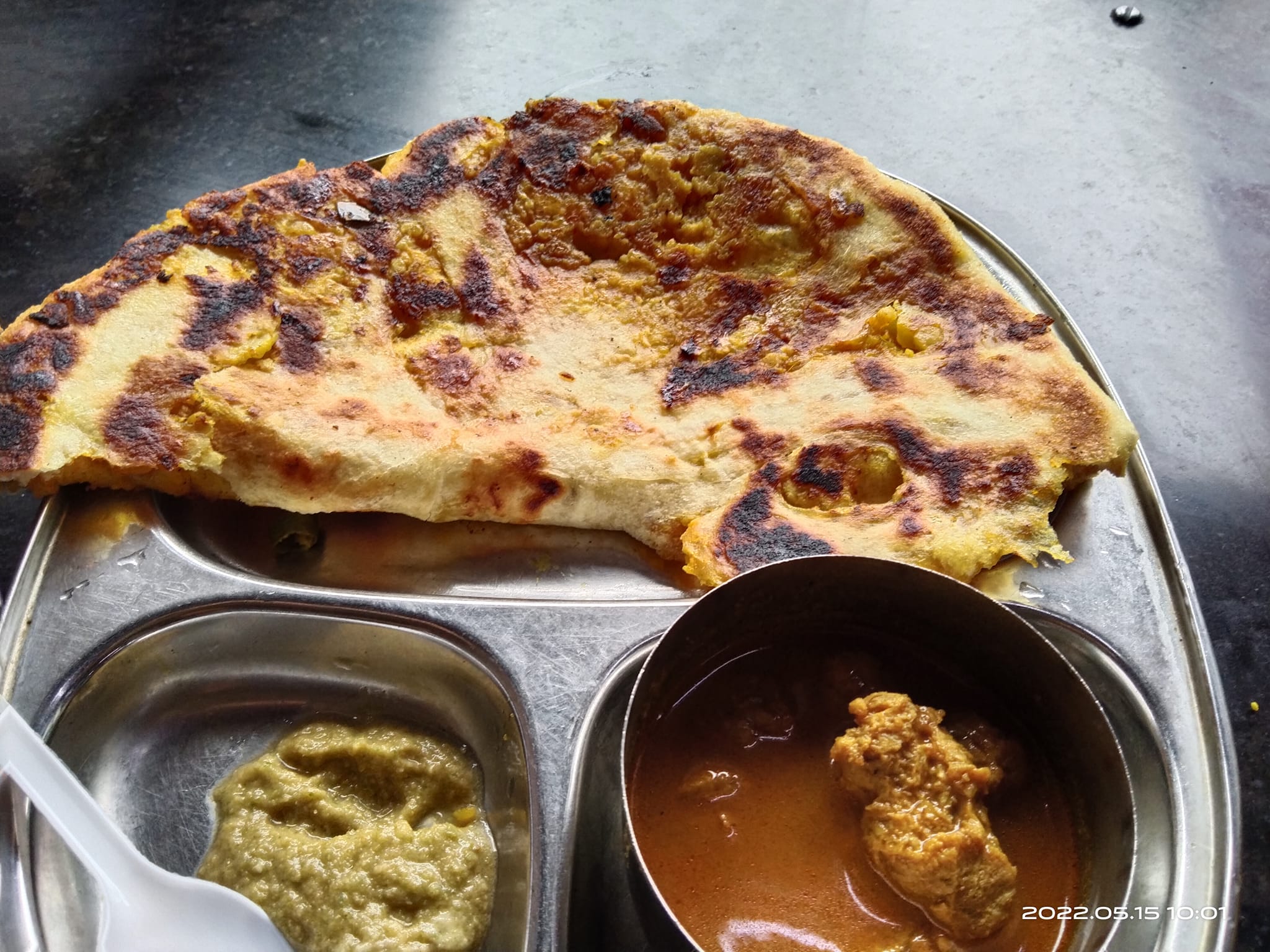 |
| Aloo Paratha - Assamese version |
 |

At the Planetarium, here is what we saw. This, I thought, was completely unfair. No show in Hindi! Not a single one!
Huge bags! Big enough to carry a child in it! Rs 200/-


 |
| common variety |
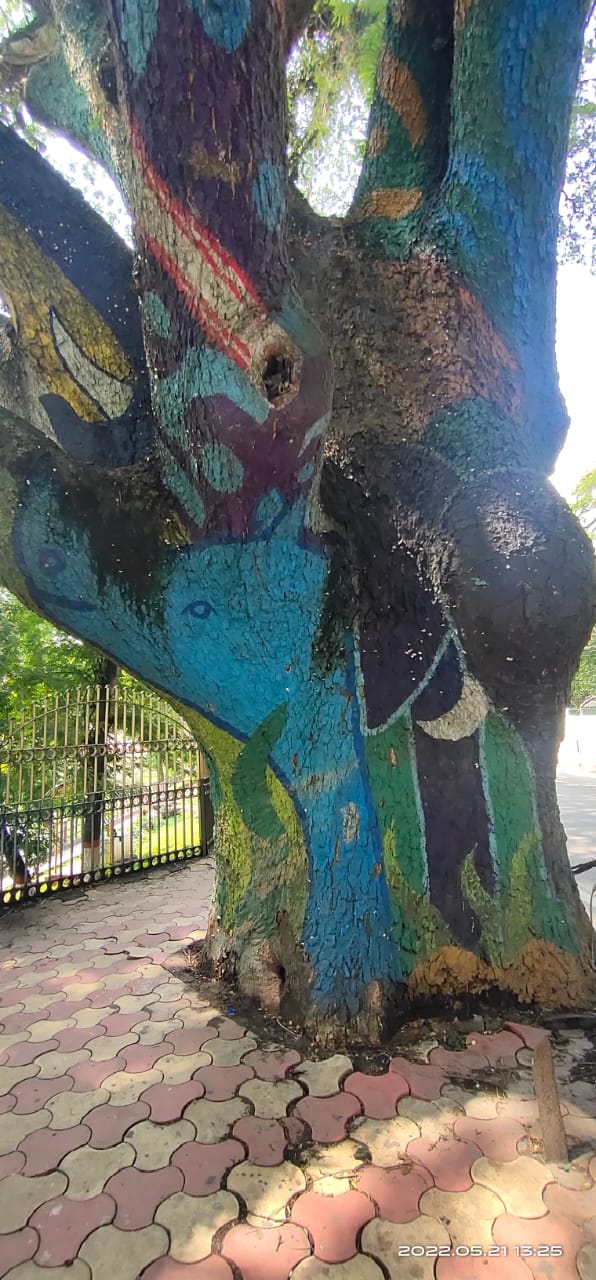

The last I heard of this was in the story of Shravan Kumar who carried his parents like this to fulfill their last wish. I can't believe it is still widely used in Northeast. Saw this on a busy street in Guwahati, the capital city.

Sualkuchi was not on my tour itinerary. It was a backup. It was not on my list of places that I MUST see. It was more of an "if we had time to spare, we could go there" option.
Haflong, 350 km from Guwahati, was on the list, it was where I wanted to go. Assam, a plainland, has only one hill station and that is Haflong. Unfortunately, we couldn't go to Haflong. That entire week, Assam was ravaged by rain and floods in many districts. The railway station in Haflong was damaged and all the trains were canceled.
Majuli Islands was on my list, it was another place I really wanted to see. It is supposedly the largest river island. However, there is a warning that the island will disappear in 20 years! As it is, large parts of the island is submerged in water for months. Assam is the state that has the rare distinction of having both the largest and smallest (Umananda Island) river islands. For Majuli Islands, we had to go to Jorhat and from there, drive for 10-15 kms to a jetty and take the boat to Majuli. The boat leaves at 1:00 p.m every day. But due to the rise in the water of the river and the rains, the jetty was not an option. Also, there were no hotel facilities in Majuli and homestay was the only stay option available. Those too were limited and the ones we checked online, didn't look feasible or there was no contact number of the owner for us to call and enquire/book. We had to drop the plans of both Haflong and Majuli.
So we decided to see Sualkuchi, Hajo and Dipor Beel instead. Sualkuchi and Hajo both are in Kamrup district. Since we had the hired car, it was easy to cover all three in one day.
Sual Kuchi is called the Manchester of Assam because it has a large number of handloom units. Some say around 2000 units! It is 35 km from Guwahati. It is a weaving village specializing in silk - Eri, Muga and Paat.
Weaving is done here on the backstrap loom at home. 
We visited one of those looms. It was so dingy, barely lit, and no fan. The constant sound of the loom was overpowering. It seemed like a LOT of hard work. It is a pity the demand for handwoven silk textiles is dying in India, and mostly in demand outside the country. The handloom owner showed us the different materials packed neatly, with a proper seal that it is genuine silk, and placed in cupboards - all for export. At the time we went, there was an exporter lady who had come to place an order and check the quality. The skill of weaving is handed down generations. In his case, his father taught him but his only daughter may or may not take this up as her profession.
The
new approach to the village - beautified and welcoming. Apparently, a
lot of foreigners visit the village, looking for genuine muga and eri
silk textiles. 

.jpeg)
.jpeg)
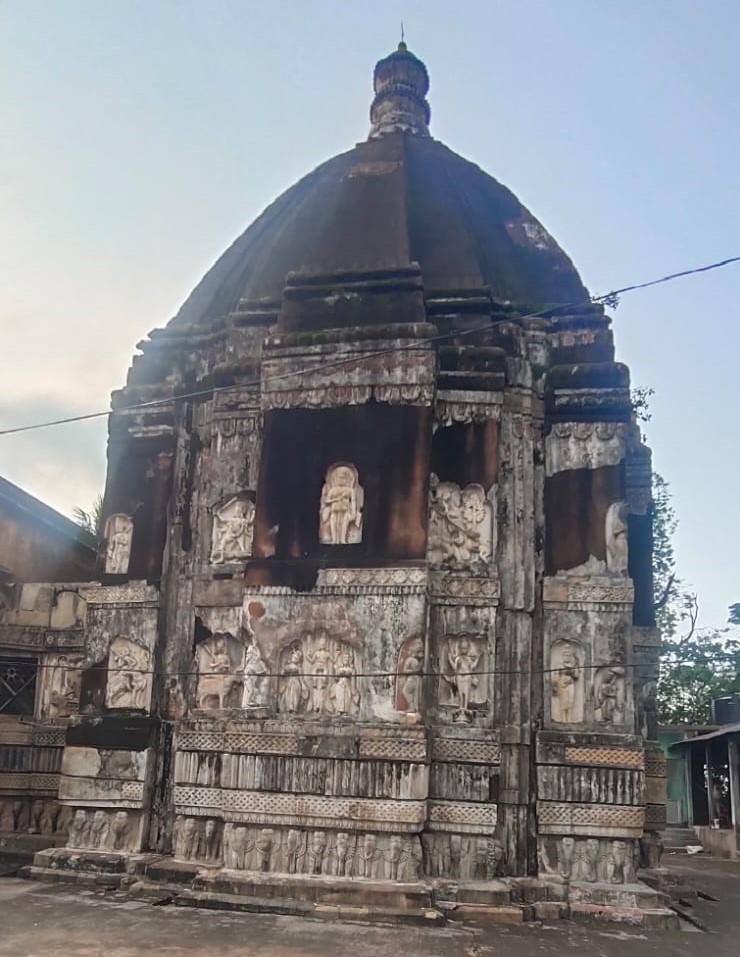
Hajo Hayagriva Temple
Hajo means hill. It is said to be the meeting point of Buddhists, Hindus, and Muslims. The temple was constructed in 1583 by King Raghu Narayan. It has an image of hayagriva madhav. Budhists believe that Gautam Budha attained nirvana in the Hayagriva Madhava temple and it was here that he died.




Maa Kamakhya Temple


It didn't happen. Our first night in the city was in a hotel on Mirza Road, in Kamrup, 8 km from the airport but 25 km from the main city of Guwahati.
Finally, on a Wednesday, four days after we landed in Guwahati, we left our hotel early in the morning at 7:00 a.m. Almost everyone we spoke to, had warned us about the humongous crowd at the temple, and had asked us to leave early.
The temple was just 2 km from our hotel, 10 mins drive. We booked an Ola taxi. Fare shown was Rs 170. But the driver demanded Rs 250! Nowhere does an Ola driver demand more than the fare shown on the app. That fare by itself is high as it includes Ola's commission. In other cities, they ask to be paid in cash but they don't ask for extra. Here, they openly demand more.
The distance and fare ratio is unimaginably exorbitant in Assam (AS). For a distance of less than 2 km, autos routinely ask for Rs 100 and Ola drivers Rs 250! In Bangalore, for Rs 200, I can travel 15 km in Ola auto or mini.
We canceled the Ola and boarded a local bus. One good thing in AS is that the buses have destinations written in English. It is very easy for outsiders to use the local transport. In Chennai, it was a nightmare. Everything was in Tamil. Oh! What a pain it was.
The bus ride cost us just Rs 10 each. And we reached in 15 mins. From Rs 250 of Ola to Rs 10 of the bus for about the same time for travel, not bad we thought. Maa Kamakhya was making it easy for us to come to her.
The bus conductor gave us Rs 10 and asked us to offer it at the temple. We were touched by his gesture. He helped us by pointing to a lady passenger and told us to follow her as she was also going to the temple.
We got down at the main gate. The lady passenger smiled at us and very sweetly, pointed to the line of Maruti Vans. Having experienced the brusqueness of the Khasi women of Meghalaya, she seemed like she was dipped in honey!
The taxi, with 8 other passengers, took us to the top of the hill, to the temple, for Rs 30 each.
The drive up to the hill is similar to the drive to Sri Chamundeshwari Temple in Mysore, only less scenic, and less enjoyable. The way everything is organized and maintained in Chamundi Hills is awesome. You will absolutely cherish the drive for a long time and want to keep going back.
At 8:45 a.m, we reached the temple. And believe it or not, at 9:30 a.m, we were out of the temple and sitting in a bus to take us back to the main gate. Yes, in flat 45 mins we had finished the "darshan" despite the rumored "swelling crowd".
How is that possible? We were surprised and felt something was wrong somewhere. Everyone had told us we had to keep an entire day aside for darshan at the sacred Maa Kamakhya Devalaya. It would take us a minimum of 5-6 hours in the queue. Yet, here we were, done and dusted in 45 mins.
This is what transpired at the temple.
When we entered the temple, there were some people waiting in the queue and some around the temple. We did not find any 'crowd.' A South Indian knows what an actual temple crowd looks like. Across temples in Karnataka, Andhra, Kerala, and Tamil Nadu, we are accustomed to it. Lakhs of people visit Sri Venkateshwara Temple - Tirupati, in Chittor, Andhra, thousands visit Sri Meenakshi Amman Temple in Madurai, Tamil Nadu and hundreds visit Sri Manjunatha & Kukke Subramanya Temple in Dharmasthala, Karnataka and Sri Guruvayoor in Kerala.
Compared to that, here, it looked like the kind of crowd we see every day in our neighborhood temple. In spite of that, we were ready to pay for special darshan because we wanted to save whatever time we could and get back to the hotel as soon as possible. Our kids were still sleeping. Since we had left so early, we didn't wake them up.
The special darshan counter was closed. We enquired at the information center. The lady said regular darshan will take more than 4 hours. We couldn’t afford that time.
By the way, the special darshan tickets are priced at Rs 500 per person. Yes, Rs 500! The highest I have ever come across in any temple in any part of India that I have visited so far. Even in Tirupati, which is literally the Father of Temple Crowds, it is Rs 300. There, people are locked up in huge rooms that easily accommodate 100+ people. Water and food are provided to the devotees as they wait, sometimes the whole day, for the rooms to open and be allowed to go for the darshan.
Anyways, here, since the special darshan counter was closed, we were clueless. We couldn't spend 4-5 hours in the queue. We were looking around wondering what to do.
One person, a priest, or Panda as they call them here in AS, approached us. Clearly, our faces showed we were looking for a special darshan and we were not locals. He said, "Special darshan Rs 500 closed. I will take you for darshan, give the same Rs 500 to me. Plus what you are planning to give for hundi, you give it to me. How much are you planning to give for hundi? You will get the darshan but you cannot 'touch'. If you want to touch, pay the money I said and wait minimum 2-3 hours in the queue."
We agreed. We were okay with just the darshan and did not want to touch or wait in the queue for 2 hours.
The darshan was over in less than 10 mins. He left. We walked around.
And that is when we got the shock of our lives.
We realized he had taken all that money to take us to a place that was already open to all! It was an open place, from all sides, anyone could enter from any side and leave from any side! We did it and no one stopped us. We went back to the same place he had taken us. Many were doing the same. For free!!!!
My heart sank! I saw that the panda was already 'trapping' another family. I wanted to scream and shout at him. But my mouth was dry. I could barely hear my own voice. My eyes had started welling up. I could not believe we were duped in such a sacred place. This temple had such a history and lineage and significance and power! And the temple staff was looting devotees like this! Cheating - Openly and nonchalantly!
I thought of how much I had longed for the darshan of Maa Kamakhya and, how much I revered the temple. The trip was planned in April and I had been longing to see the temple since then. The devotion was replaced by despair, a sinking feeling. It felt like a stone was placed on my chest, the weight of which I was not able to bear.
Even in Dwarkadeesh in Gujarat, the situation is somewhat similar. Priests wait for gullible devotees at the footwear stand. They scan you, approach you, and smooth talk you into making donations at the thulabhara complex. But there, at least, he did not demand any particular amount. He said give whatever you feel like. And he showed the complete temple and explained the importance and history of each part of the temple. And he really helped us beat the crowd.
Later, I read the Google reviews of the Maa Kamakhya temple. Many people had written of similar experiences. The temple management creates a fake atmosphere of panic forcing devotees to be alarmed at the manipulated crowd length and charging them Rs 500 and again making them wait in the queue for an hour or more. The line is kept waiting to make the oncoming devotees feel there is a big crowd.
And then some priests walk around trapping poor devotees promising them a darshan where they actually just take them to the open room.
Sigh!
Shillong
In Shillong, Ward's Lake, Lady Hydari Park, Don Bosco Museum, Golf Course, Umiam Lake, and Elephant Falls are some of the must-visit places. And except Don Bosco and the Golf course, all these places are covered in the tour package.
Ward's Lake
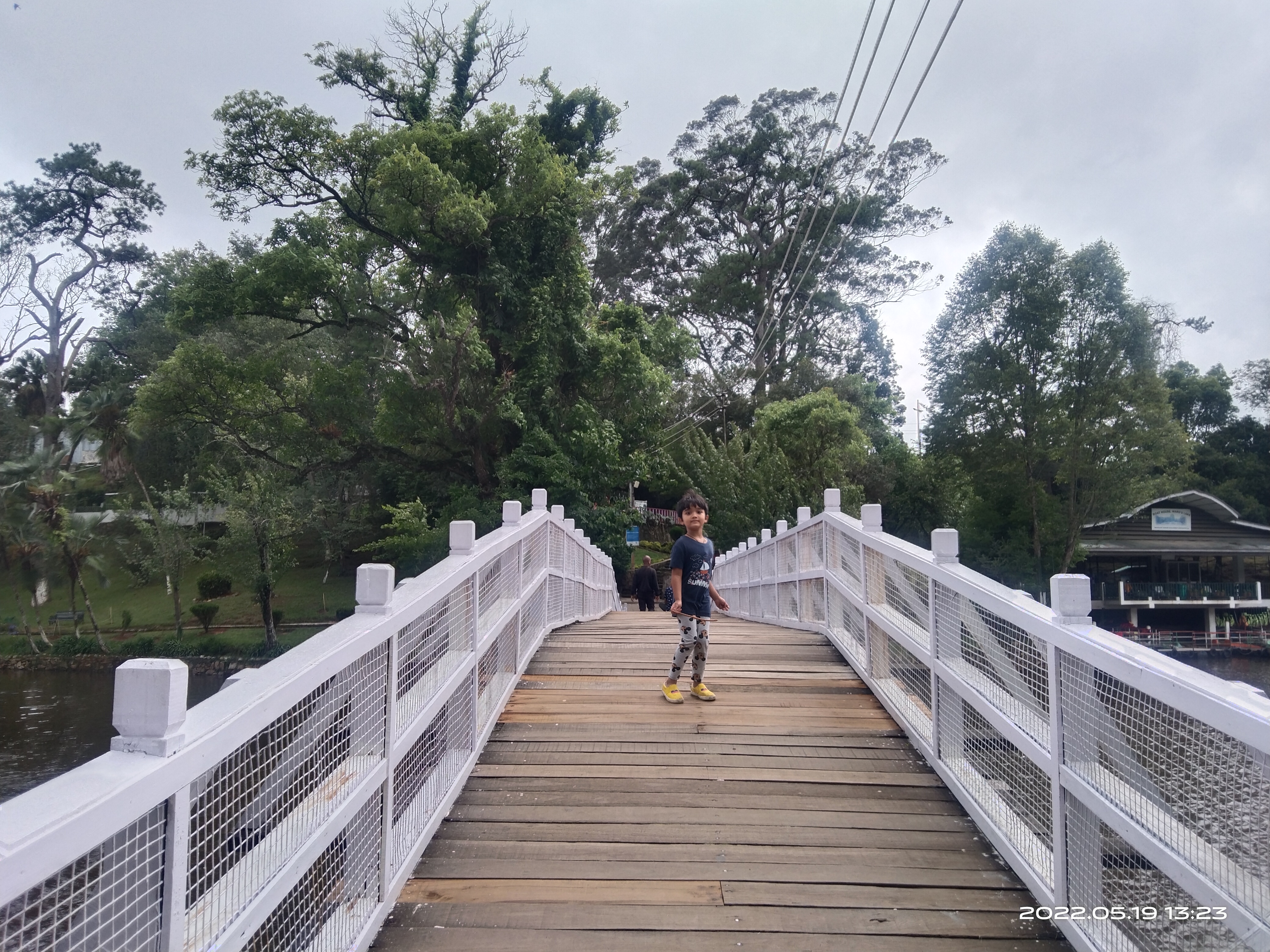


There is a boating facility too.
Now, with these boats, which I have stopped hopping onto, the problem is that out of 3-4 people who sit in the boat, only 1 or 2 peddle and it is usually a man. This means the women spend all their time on the boat clicking, pictures, posing, and enjoying the view while the poor man works his ass off to keep the boat running with his legs. Even if you manage to reach the middle of the lake, you still need extra energy to paddle it back to the starting point.
With us, it is only Sathya who peddles. Tanvi is lazy, Rutvi is small and I am not interested in peddling. So we have stopped going on boats that require any kind of manual effort to keep them moving.
Elephant Falls
It is a multi-tiered waterfall, and each of the three drops is a sight to behold. Steps have been made right up to the plunge pool below and the climb is easy. The entry fee is Rs 100 per person now. I believe earlier, that is pre-Covid, it was just Rs 25. They have increased the fee to make good the loss due to lockdown. There was strong objection from everyone to keeping the fee so steep but the authorities stayed put. In most other places in the whole of ML, the entry fee is just Rs 50 or even Rs 30. Very reasonable.
The first drop(below) is completely hidden from view by thick foliage.
The second drop


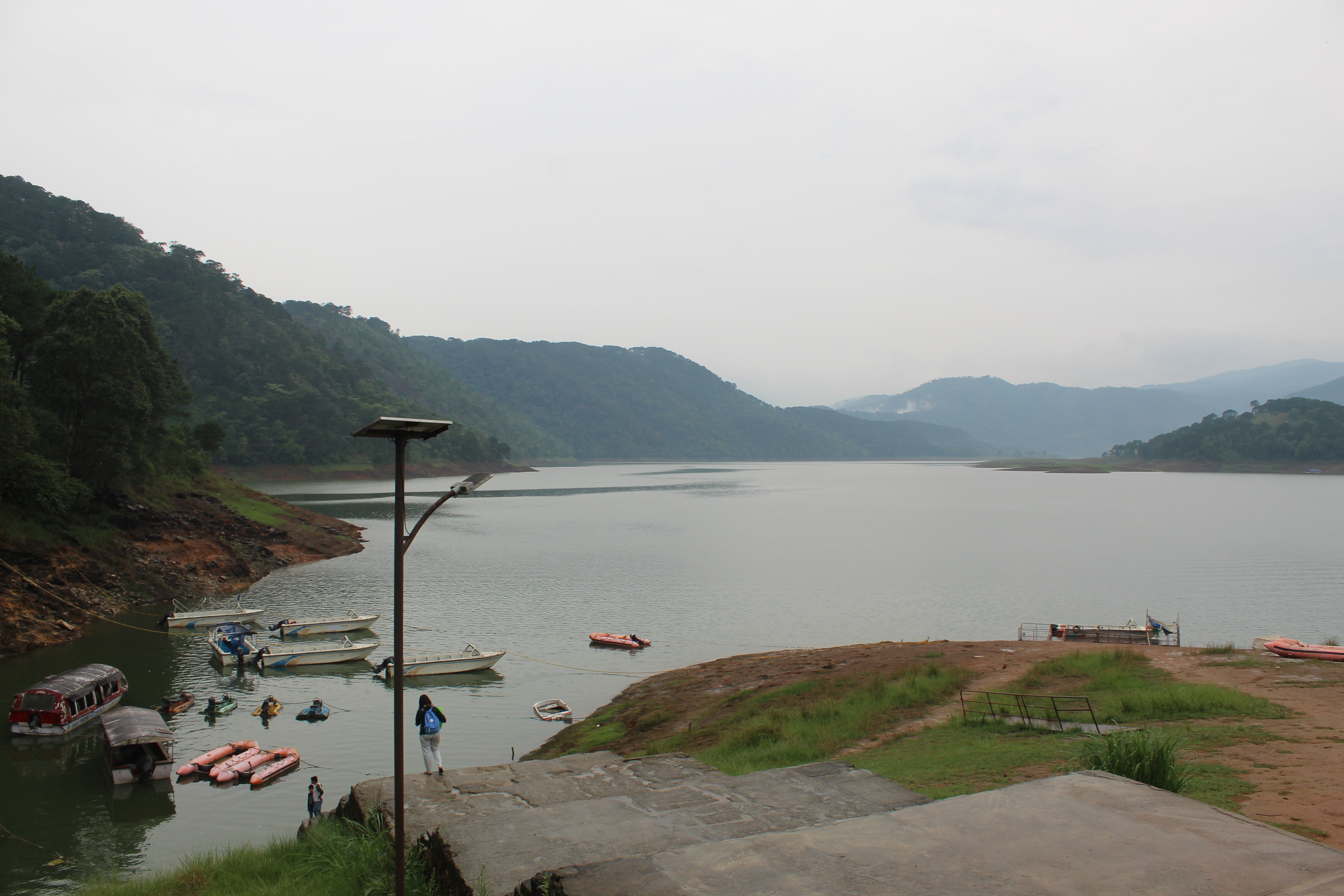
As you drive from Guwahati to Shillong, the first place you will stop at is the beautiful Umiam Lake. It was created by damming the Umiam river. It is a large river and so lovely.
We
met a Kannadiga family there. In fact, we met so many families and big
groups of Kannadiga travelers on this trip. Did not find any Malayali!



The view of the Shillong city from atop the Don Bosco Museum Skywalk. 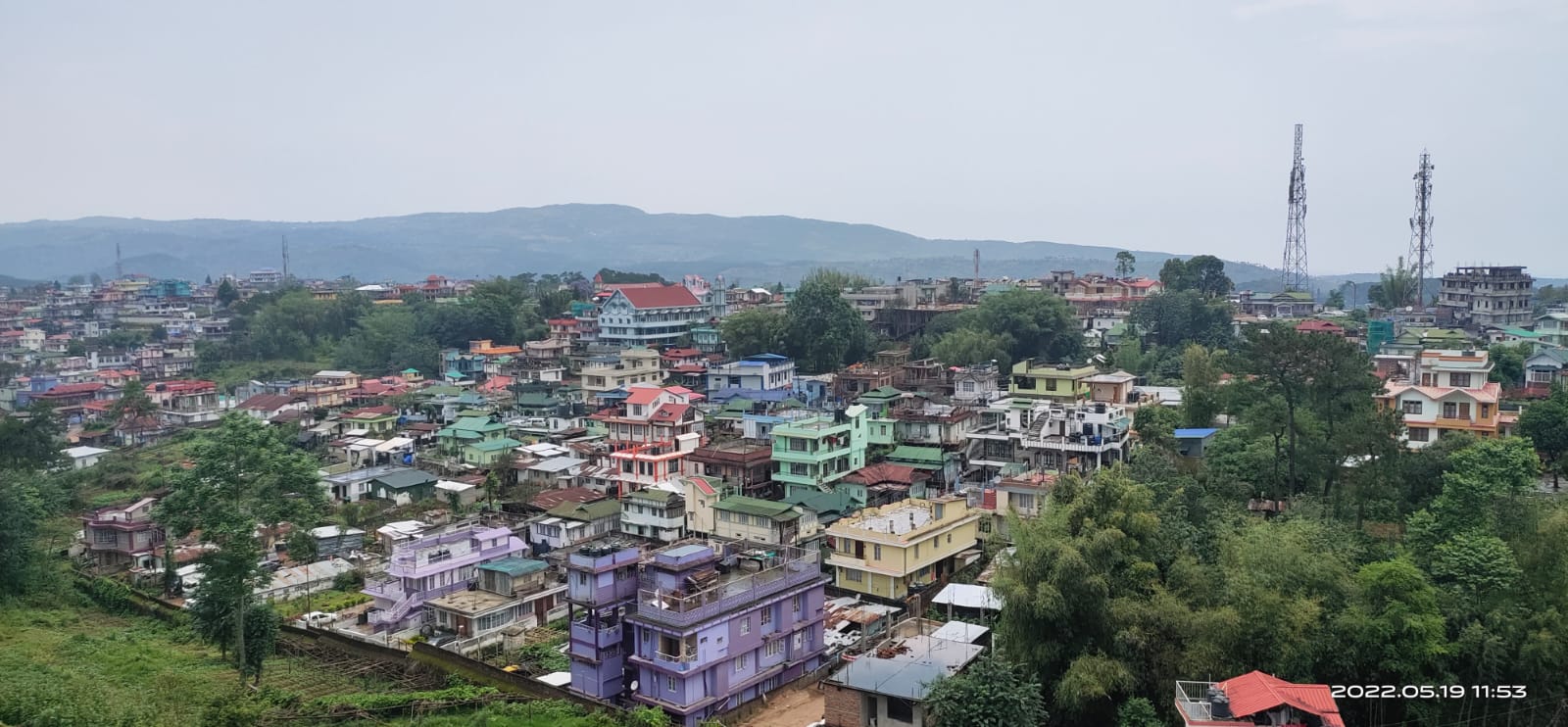

After the museum visit and lunch, we tried to drive to Police Bazaar where our hotel was.
And boy! Did we go round and round the mulberry bush or what! Shillong city, the capital of Meghalaya, is a small hill city, thickly populated and with numerous shops and buildings placed tightly together. There are so many "no-entry" roads and "one-way" roads and "not allowed" roads and "only one man can walk" roads and "only two-wheeler" roads, that if you take your eyes off the road for even ONE SECOND, you will go in circles. We came to the same spot 3 times and by then we knew every house and hotel on the way except the one we wanted to go to.
Lady Hydari Park
The
park was closing at 5 p.m. Everything in ML closes at 5! We reached at
4:30. The lady at the counter waved me to go in without the tickets. And
at sharp 4:55 the watchman started blowing the whistle asking everyone
to leave the park. 
This
is definitely a park for tourists and their restless children. There
were so many tourist parents in this park! Their kids were finally
having a good time in the kids' play area or simply running around in
the open grass or playing hide and seek or shuttle-cock. Hill stations
are not for little kids. My little one kept asking for "beach"!!

Black taxis in Cherrapunji and yellow taxis in Shillong. Strangely, we only found ML05 registrations initially. And after many thousand vehicles, we found one that had ML03.
At the Fast-tag counter of ML, we kept waiting for the fast-tag to be read. No one came. We continued to wait. Finally, we reversed the car and halted at the counter window. The lady lifted her head for exactly three seconds, said "Mouse not working" and went right back to doing whatever she was doing. She didn’t say, "Go to the next lane". Nothing. Frowned, Completely indifferent. What the hell!
The signboard read "Fasting is mandatory" instead of fast-tag. Great English for people who speak only English.
We visited ML twice. Monday and Tuesday we had driven with the tour operator in a Swift Dzire. Wednesday we were at Guwahati. Thursday Friday back again in ML. We were not satisfied with what we had experienced or seen with the tour thing. So in Guwahati we hired a Wagon R from Zoomcar for Rs 5000 for 3 days and went back to exploring ML some more. THAT is the draw of ML. The mountains call you!
When we had traveled by taxi, the driver started the journey at 7:00 in the morning and he reached Umiam Lake at 10:30.
When we drove, we started the journey at 8:45 and reached the same spot at the same time!
TWO hours difference! The driver was driving that slow! Even after starting in the wee hours of the morning when there was no traffic, no rain, no stopovers! He took two extra hours to reach the same spot. He was driving at 40 km/hr speed throughout! From 7 a.m to 4:30 p.m when the day ended it was 40 km speed. Calling it snail’s pace would be a hyperbole. Whatever he showed us in two days, we could have easily covered it in a day. We realized this after we drove on our own. Shit! With him, we did not enter Shillong city at all. He only showed the places outside Shillong en route to Cherrapunji. He said the places inside the city, he would show on the return journey tomorrow which of course he didn’t show.
We should have gone for the self-drive option from day one. Like we had done during our Mumbai-Lonavla-Matheran road trip.
Guwahati
to Shillong is a 100 km 3 hours drive. And Shillong to Cherrapunji one
and a half hours. The entire stretch is a dream ride. Like we in
Bangalore go to Mysore, the Guwahati people are lucky to be able to go
to Shillong.
My Impressions of Meghalaya
My earliest memory of the word 'Cherrapunji' was in school. We had a question in our General Knowledge test - "Which place in India gets the highest rainfall"? The answer was Cherrapunji. The spelling was difficult. It was a multiple-choice question. We only had to select the right option. I never learned the spelling.
Cherrapunji, for me, was a far away place, so far away that I could not place it on the map, so far away I could never visit. I don't remember memorizing anything else about this unknown place. Its only marker was the incessant rain that had found this village a spot in our NCERT school textbook.
I don't remember reading about Meghalaya, the name of the state to which Cherrapunji belonged. But I remember the word 'Cherrapunji' - vividly. It was etched in my memory.
So decades later, when I finally visited the state, what were some of my first impressions of this far-flung state in the extreme northeastern part of India, 3000+ kilometers from Bangalore, my city? As a first-time visitor to the state, was the trip fulfilling and worth the money?
Here are some of my immediate reactions to Meghalaya:
1. Scenic Beauty:
The meadows are beautiful. 

Here almost throughout the year the mountains are green due to the rains.
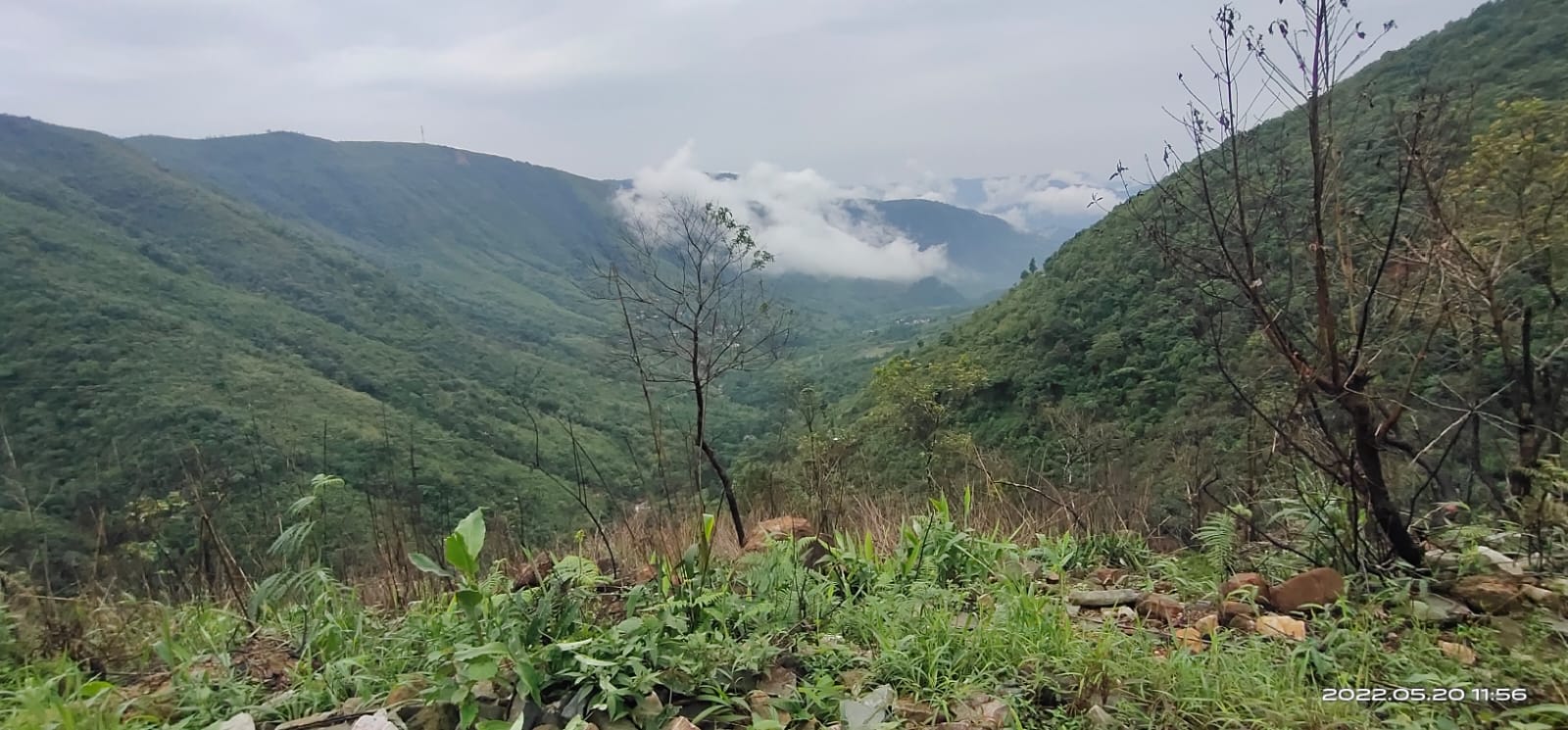
Mangalore, where I am from, is green during the monsoons and then it turns a sad brown and stays various shades of brown for almost 6 to 7 months, until next year, in June, the rain Gods come calling again. Brown is a depressing color. And to have to look at it for nearly two-thirds of the year is grief.
ML is not so. It is immediately pleasing to the eye - every inch of it.
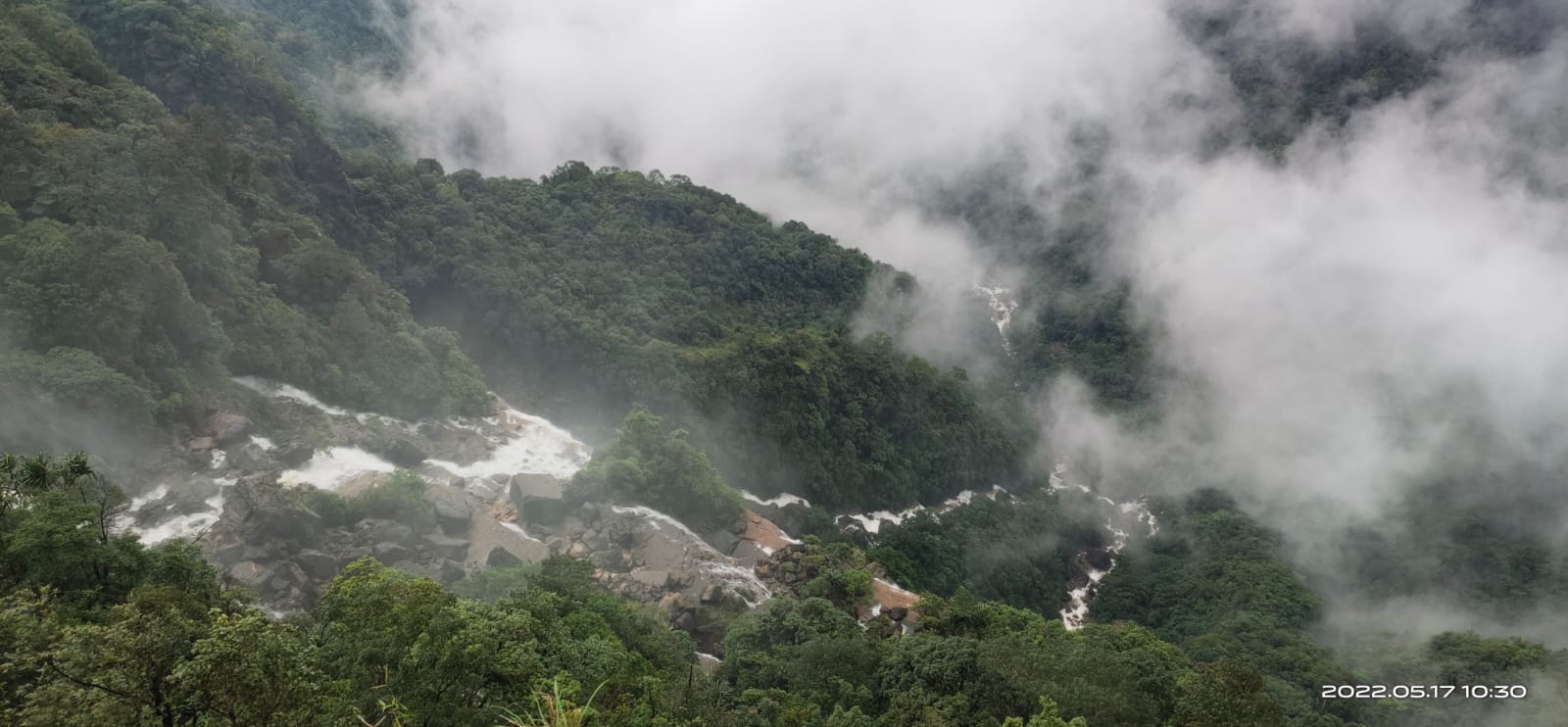
You will find many streams and waterfalls all along the drive. Here are a few I captured:


2. The Roads: The roads are fairly good everywhere in ML. You will not feel exhausted by the long hours spent driving.
I remember my trip to Sikkim in mid-November of 2016. The roads were bad. Or rather, there were no roads at all. Just mud and stones. And huge traffic on them. The journey was tiresome. Most of us suffered from nausea and dizziness. By the time, the vehicle would halt for the night in the hotel, we would rush to the bathroom to shower. All that vomiting and sitting in the cab for hours together, sometimes 4 hours just to move from point A to point B, took a toll on us.
Fortunately,
none of that terrible road experience here in ML. We traveled with our
4-year-old baby and it was smooth sailing all the way. 


3.
The Mist: There will be times when you will literally walk or drive
through the clouds. One moment, there will be zero visibility and at
others, you will not be able to see beyond 50 meters ahead of you. In
the next moment, the place turns bright and when you look back, you
realize you just passed through a moving cloud. 


Dawki, the place famous for the crystal clear lake, is in West Jaintia Hills.
As with most hill stations, the distance between two points may look small in kilometers but in terms of time, it takes many hours. For example, Shillong to Cherrapunji is just 50 kms. But takes upwards of 2 hours even with good roads, no hairpin bends, and no nasty curves.
In 4 days, you can cover only the capital city Shillong and places in East Khasi Hills. You need another week to cover Jaintia, Garo, and West Khasi Hills. And trust me, there is a whole world to explore out there in these hills.
7. The water makes your hair soft, and easier to untangle. You can remove the knots easily. All the local women had silky, straight hair. It looked like they had straightened it in a parlor. Impeccable. Even a girl I saw in a hut had parlor-type straight hair.
Wei Sawdong


The entire experience was surreal.
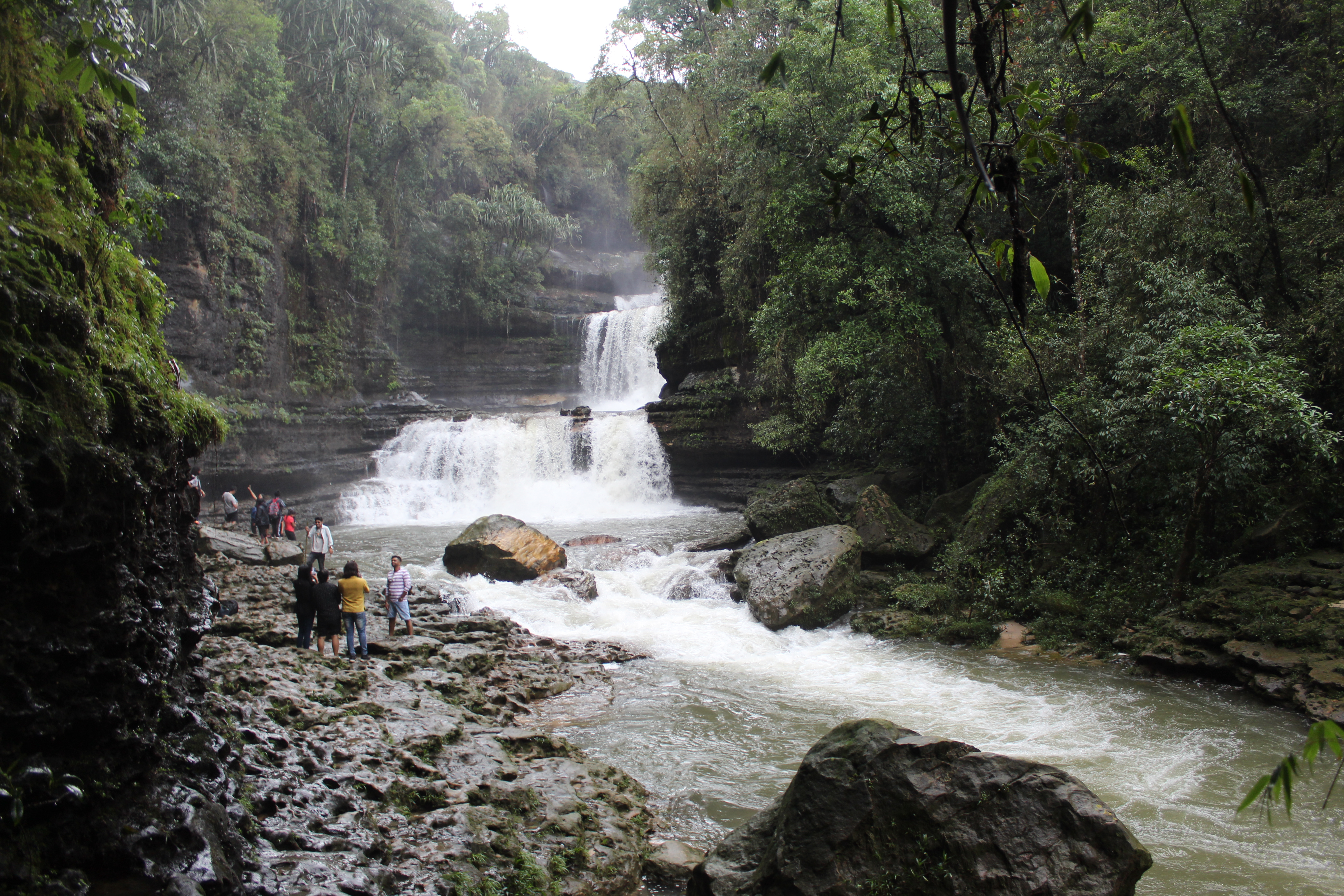


The Seven Sisters of Meghalaya
What is with the name Seven Sisters and the North-East? Sikkim has a famous waterfall by the same name and so does Meghalaya (ML).
We had booked a cab from a tour operator in Guwahati for Rs 8000 for 2 days. Day 1 Shillong and Day 2 Cheraapunji. Day 3 plan of Dawki River was canceled due to landslide and road closure that had happened a day before. How unfortunate!
Our driver had told us that tomorrow is a big day, with lots of places to see, the first place - the cave - opens at 9, so be ready at 8:00 a.m. We enjoyed the first rains of Cherrapunjee lashing at our windows and slept in great anticipation of what the next day would bring.

We were ready at 8:00. He dropped us at the cave at 8:03! Turns out, it was just a 3-minute-drive from our homestay. We could have practically walked to the place. Urgh!
For breakfast, we were at the mercy of the only restaurant that was open at the time.
The lady was so rude, that I thought one of the customers, who had come in a group of 5, would beat her up. He, however, decided to bite his tongue and eat his long-delayed roti quietly.
Like most other helpless tourists, who were woken up early and mercilessly dropped off here, we too ordered the only two safe options available in this part of the country - Maggi and Bread omelet. We were scared to ask the lady to give us another omelet lest she scolds us for ordering repeatedly (yes, that is a legitimate feeling here) and not making up our minds the first time around.
After a long wait, she decided to tell us the amount we had to pay. I mustered the courage to ask her what cost how much. She gave a death stare. That instantly shut me up, and we paid up without another word.

The picture below shows the interior of the limestone cave with the lights on, which, according to me, made it look ugly, though, I guess it was necessary.
Do
the cave only if it hasn't rained the previous night, which is highly
unlikely as this is Cherrapunji, the wettest place on earth and it
practically rains here every day. In our case, it had rained all night (mid-May
was supposedly peak summer) and the cave was flooded in places. With
elderly people or small kids, it can be difficult to explore it due to
the uneven footing, and the claustrophobic atmosphere. 
I
was least excited about the cave. In fact, I wanted to do the Wei
Sawdong Falls instead of the Cave. But our taxi driver refused to oblige
saying the roads are not good for "small cars". We were in a Swift
Dzire which he was driving at the speed of 40 km/hr.
We set off to the next item on our list. The Nohkalikai Falls which I have described in this post.
Next
up was the Seven Sisters, also called Mawsmai Falls or Nohsngithiang
(if you can pronounce that. Now I get why they simply call it Seven
Sisters. Easier on the tongue of the tourists). This is one of the
tallest waterfalls in India with a height of 1000 feet. We were
exploring the East Khasi Hills.



By 11:00 a.m, we had covered everything in the itinerary and the only thing left was to return to Guwahati. We realized that the Day 2 program was barely 3 hours!
Christianity and Meghalaya
95% of the world's Hindus live in India.
Hindus in India comprise 80% of the country's population.
In a supposedly Hindu majority country like this, Meghalaya is a state where Hindus are a minority!
In fact, Hindus are a minority in 3 of the North-Eastern states - Meghalaya, Mizoram, and Nagaland. At first, I found it incredulous that Hindus are a minority in these states. Then I learned that all of them are Christian majority states with 75% (in ML) to 90% (Nagaland) of the population being Christian.
In fact, in 2010, the ML government declared Christianity as the state religion!! Do we have officially declared state religions in other states?
Mizoram did not hold any International Yoga Day event! They said they are a Christian state.
I thought India and Indian states are secular. Am I wrong?
In India, only the Hindus are the "thekedaars" of secularism. We should not be surprised (but rather concerned) with Mizoram's rejection of Yoga. Secularism, tolerance, and acceptance work only when the majority population is Hindu. Once the demography changes to Islam or Christianity, the assertion of an Islamic state or Christian state is pronounced and quickly asserted.
Now, a decade later, I am convinced the numbers must have dwindled further.
Interestingly, the Chrisitan number has been steadily rising. In 1901, the Christian percentage was a meager 6%. In the first census of 1951, it had grown, almost quadrupled to 25%. In 1991, it had risen to 65 and as of 2011, it stands at 75%. What a meteoric rise, I must say.
So how did Meghalaya become Christian?
Some pictures from my trip.
This is the house of the first Christian missionary who came to Meghalaya in 1841 to convert people to Christianity.

Lavish, isn't it? And note the year 1841 !!!! Even today in the year 2022, it took us huge amounts of cash reserves and effort to plan the journey to this remote and far, far away state in the extreme north-eastern part of India. Even with flights, roads and overall better connectivity in today's times, travel to ML is still a lot of effort.

And above is the first church that was built.
Today, 75% of the state is Christian. Who does the credit go to? To this man - Thomas Jones. He came to India at the age of 31. Because he had a vision. To convert people to Christianity. To lead the sheep to the Shepherd. To bring the lost people to God. Of course, to the Christian God. The one and only savior of lost souls.

Even today, the state is thinly populated. Language is a barrier even between two Indians. The locals speak a few words of English and a few words of Hindi. "Yes, OK, Chai, Khana" rudimentary English, and Hindi. In 2022 we would find it difficult to live and survive here with relatively better roads and electricity. How did Thomas Jones and his ilk survive - the language, the rains, the isolation, the food, the rugged terrain, the 'lost in a no man's land desperation'? The Lord's blessings, of course.

Have I heard of any Hindus going to uninhabited villages of the world to convert the indigenous population to Hinduism? Hindu missionary is not even a word. Islamic missionary is not a word. Christian missionary - now that is a word. The words 'Christian' and 'missionary' always go together. Like the words 'Muslim' and 'Jihadi' do.
How strong must this calling be and the finances that backed it? The kind of political and monetary support he received!

Mawrynkhang Trek And Laitlum Canyon
We vacated our hotel in Shillong early in the morning. 7:00 a.m. We planned to do the Mawrynkhang trek which starts from Wahkhen village in East Khasi Hills. Wahkhen is 42 kms from Shillong, a 2 hours drive. We wanted to start the trek as early as we could.
We did reach there as planned. The drive was smooth, except after we reached Wahkhen, where in some places the rains had damaged the roads. We had to drive carefully at some of those points.
A few of the landslides we witnessed on our way. Just the first rain and havoc everywhere. What will the monsoon bring more!

The locals sitting at the edge of the landslide for a smoke and some quiet time, perhaps.
There was a fee to be paid for the trek. Rs 100 per person. I saw the entry book. 
Yesterday 18 people trekked. People came from Nagpur, Delhi, Mumbai, Gujarat. "Not bad", I thought. People have started discovering this place thanks to social media. And yet, 18 was a small number considering the reach of the internet today.
The
trek is actually built by the locals to go from Wahkhen to Mawrynkhang -
a distance of about 2 kms through this dense forest and across
mountains.
The
signboard is the starting point of the trek. We started at 9:15,
trekked for an hour, and took an hour more to return to the base. At
11:15, we were back at the car park. 


But in this
case, because it was raining we never felt the tiredness. Tanvi &I would have
trekked further but Sathya and Rutvi were waiting for us to return & that too in the rain. 


One piece of advice to those going to Mawynkhang: carry some water, lots of eatables, wear sturdy shoes, and keep fresh clothes handy to change after the trek.


.jpeg)


Land of Clouds & Waterfalls
Meghalaya (ML) binds you in a spell. It mesmerizes you. It truly is the abode of clouds.
Unexplored and unexploited, as yet, it is a beautiful state.
Looking at the crowds thronging ML, the rooms being full or running to full capacity, and every location with loads of vehicles and scores of tourists, I hope and pray ML does not end up being the victim of our greed for beautiful locations. Human beings can spoil everything they touch. Like we say in Kannada, there is no grass that a goat does not eat. There is no place a man will go to and leave it unspoiled as before.
One of the most beautiful waterfalls we went to in ML was the Nohkalikai Falls.
I must add here that in ML, every road, every mountain, holds in his womb, many a waterfall. Everywhere you go, you will find a lovely stream making its way down and if you are a thorough city-bred person, you will want to capture the picture of every fall you see as you traverse the landscape. It will be an irresistible feast to your eye and it will take super-human effort to not stop the vehicle you are traveling in everywhere and anywhere. In fact, some of the exquisite streams and falls can only be enjoyed in passing as the onward coming traffic will make it impossible for you to stop and click pictures.
There is one other thing: when you see the biggest or most majestic of all waterfalls, then the streams will look like regular fare. This is something you will experience a day or two into your travel in the region and you will learn to let go.
The drive to Nohkalikai is easy as the roads are good and the view itself is picturesque.
Green and white are the two dominant colors in Meghalaya. Large, green fields and the countryside below and misty, white clouds overhead.


When we reached the location, the clouds had engulfed the entire mountain range and it was hard to tell what was beneath those clouds. Except for the roar of the falls, one could never have guessed that there was such a majestic sight behind the spread of white.
Nohkalikai made us wait. We waited in the tea shop nearby and even as we took the last sip of our tea, the clouds started clearing.
Like
the regal, colored screens in single screen theaters of yesteryears,
that went up slowly and then the movie began, the clouds parted way
gently to reveal the sight of our lifetime. 
10 minutes apart and the scene changed completely. 

 Nohkalikai is the tallest plunge waterfall in India. It falls from a height of 340 meters.


.JPG)

.jpg)

No comments:
Post a Comment
Note: Only a member of this blog may post a comment.