Baneswar Temple, Baneswar, West Bengal
Baneswar Temple, Baneswar, West Bengal
Baneswar Temple is a Hindu Temple dedicated to Lord Shiva located in Baneswar Village in the Cooch Behar II CD block in the Cooch Behar Sadar subdivision of the Cooch Behar District in the state of West Bengal, India. The temple is one of the state protected monuments in West Bengal declared by Archaeological Survey of India.


Legends
As per legend, an asura named Banasura, an ardent devotee of Lord Shiva, requested Lord Shiva to come to earth with him. Lord Shiva agreed to his request with a condition that he would disappear if Banasura stopped his journey for whatsoever reason. Lord Shiva was following Banasura throughout his journey. Banasura suddenly stopped at Gordasandara, which was a breach of agreement. Lord Shiva instantly disappeared. Banasura installed a Shiva at this place on the banks of the Bangti River. Thus, the Lord Shiva of this temple and the place came to be called as Baneswar.


History
The temple is believed to be built by Raja Jalpeswar, who built the Jalpesh temple. He is believed to have ruled in the second century and is mentioned in Jalpesh Mahatmya. Few believe that Raja Nilambar of the Khen dynasty had built it. There is another school of thought that the temple was built by Maharaja Nara Narayan of the Koch dynasty. The temple was subsequently renovated by Maharaja Pran Narayan of the Cooch Behar State in 17th century CE. This temple is under the Cooch Behar Debuttor Sangstha.

The Temple
The current structure of the temple is square on plan with a domical roof and a slightly curved cornice. The temple has a height of 10.9 metres (36 ft) and the base measures 9.6 metres (31 ft) square. The walls are 2.5 metres (8 ft 2 in) thick. The temple was slightly tilted on the east during an earthquake in 1897. It has entrances from the eastern and western sides. The sanctum is situated at about 10 feet below the plinth level. The sanctum enshrines the presiding deity, Baneswar in the form of Shiva Linga within a yonipitha.


There are some decorated narrow strips on the walls. It has a raised platform in the front. There is a Nandi made of cement on the right. There is a tin shed housing idols of Shiva and Ardhanariswara on the northern side of the temple. There are few ancient idols including a Kali idol in another shed. There is a big pond namely Shiv Pukur nearby which is a habitat of many black softshell turtle, a critically endangered species of turtle. The turtles are locally known as Mohan and are sacred.


Festivals
A week-long fair is held every year during Shiva Chaturdashi (the 14th lunar day of the dark fortnight of the month of Magha) near this temple. On the occasions of Madan Chaturdashi and Dol Purnima, the idol is carried temporarily to the Madan Mohan Temple of Cooch Behar town. Hence, Lord came to be called as Movable Baneswar.
Connectivity
The temple is located at about 100 metres from Baneswar Railway Station, 2 Kms from New Baneswar Railway Station, 9 Kms from Cooch Behar, 12 Kms from Cooch Behar Bus Stand, 13 Kms from Cooch Behar Railway Station, 14 Kms from Alipurduar and 144 Kms from Bagdogra Airport. The temple is situated on Cooch Behar to Alipurduar route.
Durga Gudi Kalyani, Aihole, Karnataka
Durga Gudi Kalyani, Aihole, Karnataka
Durga Gudi Kalyani is an ancient stepwell, located on the banks of the Malaprabha river in the heart of Aihole, an historical town, in Bagalkot District in Karnataka, India. The stepwell is situated close to the Durga Temple.

The Stepwell
This Stepwell is smaller than the well near Badiger Gudi. It is situated close to the Durga Temple. This stepwell was built to ensure adequate water supply to the temples in the complex. The water stains on the walls clearly indicate dipping water-table over time in the region.

Connectivity
The temple complex is located at about 100 meters from Aihole Bus Stand. Aihole is located at about 13 Kms from Pattadakal, 30 Kms from Badami Railway Station, 33 Kms from Bagalkot Junction Railway Station, 34 Kms from Badami, 38 Kms from Bagalkot, 88 Kms from Gadag, 136 Kms from Hubballi Airport, 164 Kms from Belgaum Airport, 277 Kms from Goa and 446 Kms from Bengaluru. Aihole is situated on Pattadakal to Amingad route.
Sangameshwar Temple, Bevoor, Karnataka
Sangameshwar Temple, Bevoor, Karnataka
Sangameshwar Temple is a Hindu Temple dedicated to Lord Shiva located in Bevoor Village in Bagalkot Taluk in Bagalkot District in the Indian state of Karnataka. This temple is believed to be built in 12th century CE. This temple is a protected monument under the Karnataka state division of the Archaeological Survey of India.


The Temple
This temple is facing towards east and stands over a raised platform. The temple is constructed in trikutachala style, consisting of three shrines, one each on north, south and west. These three shrines were originally dedicated to Shiva, Vishnu, and Brahma. All these shrines connects to the navaranga via their respective antaralas. The navaranga has a mukha mandapa on its eastern side and serves at its main entrance.
The east facing shrine is the central shrine of this temple. This shrine houses a yonipitha without a Linga. The doorjamb of the sanctum has five bands of decoration. The lintel of the sanctum doorway has an image of Gaja Lakshmi. The antarala of the main shrine has two pillars at the entrance and its ceiling has an intricately carved full blown lotus. The south facing shrine houses an image of Lord Vishnu.
The north facing shrine houses a Shiva Linga on the yonipitha with a Nandi in antrala facing towards the sanctum. These two shrines with their respective antaralas are similar to the main shrine in architectural style. The navaranga is supported by four central pillars standing on slightly raised platform and twelve pilasters. The mukha mandapa is supported by two pillars and two pilasters standing on kakasanas.
The mukha mandapa is enclosed by parapet walls on all sides except its entrances. The mukha mandapa can be reached by a flight of steps. The ceiling of the mukha mandapa has an intricately carved lotus. The superstructure over the southern shrine is of stepped pyramidal style. The exterior walls of the temple are devoid of any decoration except the carvings of the pilasters at regular intervals.
Connectivity
The temple is located at about 750 metres from Bevoor Bus Stand, 23 Kms from Kudala Sangama, 26 Kms from Bagalkot Junction Railway Station, 29 Kms from Aihole, 30 Kms from Bagalkote, 52 Kms from Badami and 155 Kms from Hubbali Airport. The temple is situated on Bagalkot to Kudala Sangama route.
Rameshwar Temple, Bevoor, Karnataka
Rameshwar Temple, Bevoor, Karnataka
Rameshwar Temple is a Hindu Temple dedicated to Lord Shiva located in Bevoor Village in Bagalkot Taluk in Bagalkot District in the Indian state of Karnataka. This temple is believed to be built in 12th century CE. This temple is a protected monument under the Karnataka state division of the Archaeological Survey of India.

.jpg)

The Temple
This temple is facing towards east. The temple consists of sanctum, antrala and pillared sabha mandapa. The sabha mandapa is supported by thirty two pillars and eighteen pilasters. There are two varieties of pillars found in this mandapa. The first variety has a square base, cubical shaft, pointed circular mouldings and a beveled capital.
.jpg)
.jpg)
The other variety has square base with repeated pot designs. There are two pillars at the entrance of the antrala. The lintel of the antrala has carvings of Lord Shiva at the center flanked by Vishnu and Brahma at its terminal projections. The doorjamb of the sanctum has five bands of decoration.

.jpg)
The lintel of the sanctum doorway has an image of Gaja Lakshmi. The base of the doorjamb has carvings of dvarapalas on either side. The sanctum enshrines the presiding deity, Rameshwara in the form of Shiva Linga on a pedestal. A small Nandi can be seen in front of the Linga. The exterior of the temple is devoid of any decoration.
Connectivity
The temple is located at about 500 metres from Bevoor Bus Stand, 23 Kms from Kudala Sangama, 26 Kms from Bagalkot Junction Railway Station, 29 Kms from Aihole, 30 Kms from Bagalkote, 52 Kms from Badami and 155 Kms from Hubbali Airport. The temple is situated on Bagalkot to Kudala Sangama route.
Kalika Temple, Bevoor, Karnataka
Kalika Temple, Bevoor, Karnataka
Kalika Temple is a Hindu Temple dedicated to goddess Durga located in Bevoor Village in Bagalkot Taluk in Bagalkot District in the Indian state of Karnataka. This temple was constructed in 12th century CE by the western Chalukyas. This temple is a protected monument under the Karnataka state division of the Archaeological Survey of India.

.jpg)
The Temple
This temple is facing towards east. The temple consists of sanctum, navaranga and mukha mandapa. The mukha mandapa has four pillars in two rows and two pilasters in the side walls. The decoration of the pillars of the mukha mandapa is similar to pillars of the navaranga. The roof of the mukha mandapa is in slanting roof style. The navaranga is supported by four central pillars and twelve pilasters. The pillars have the square base and cubical shaft with pointed round kapota and beveled capital. The doorjamb of the navaranga has five bands of decoration.


A Bhairava in standing posture flanked by two female attendants can be seen on either side at the base of the doorjamb. The lintel of the navaranga doorway has an image of Gaja Lakshmi. The doorjamb of the sanctum has five bands of decoration. The lintel of the sanctum doorway has an image of Gaja Lakshmi. The sanctum enshrines a seated image of goddess Durga. There is no shikhara over the sanctum. The exterior of the temple is devoid of any decoration.
Connectivity
The temple is located at about 750 metres from Bevoor Bus Stand, 23 Kms from Kudala Sangama, 26 Kms from Bagalkot Junction Railway Station, 29 Kms from Aihole, 30 Kms from Bagalkote, 52 Kms from Badami and 155 Kms from Hubbali Airport. The temple is situated on Bagalkot to Kudala Sangama route.
Basaveshwara Temple, Basavana Bagewadi – History
Basaveshwara Temple, Basavana Bagewadi – History
The temple was constructed in 11th century by the Western Chalukyas. The temple is maintained by the Kudala Sangama Development Board. Basavana Bagewadi is considered as the birth place of Basavana, the philosopher of the Lingayat sect. The three important places connected with life of Basavanna are Basavana Bagewadi, the place of his birth, Kudala Sangama, the place of his spiritual education and where he spent his last days, and Basava Kalyana, where he served as a minister and started the social revolution.
Basaveshwara / Basavanna was a 12th century CE Indian statesman, poet, philosopher, social reformer and Lingayat saint in the Shiva focussed bhakti movement during the reign of the Kalyani Chalukya / Kalachuri dynasty. Basava was active during the rule of both dynasties but reached the peak of his influence during the rule of King Bijjala II in Karnataka, India. Basava spread social awareness through his poetry, popularly known as Vachanas.
He rejected gender or social discrimination, superstitions and rituals but introduced Ishta Linga necklace, with an image of the Shiva Linga, to every person regardless of his or her birth, to be a constant reminder of one's devotion to Lord Shiva. As the chief minister of his kingdom, he introduced new public institutions such as the Anubhava Mandapa which welcomed men and women from all socio-economic backgrounds to discuss spiritual and mundane questions of life, in open.
The traditional legends and hagiographic texts state Basava to be the founder of the Lingayats. However, modern scholarship relying on historical evidence such as the Kalachuri inscriptions state that Basava was the poet philosopher who revived, refined, and energized an already existing tradition. The Basavarajadevara Ragale (13 out of 25 sections are available) by the Kannada poet Harihara (1180 CE) is the earliest available account on the life of the social reformer and is considered important because the author was a near contemporary of his protagonist.
A full account of Basava's life and ideas are narrated in a 13th century CE sacred Telugu text, the Basava Purana by Palkuriki Somanatha. Basava literary works include the Vachana Sahitya in Kannada Language. He is also known as Bhakti Bhandari (the treasurer of devotion) and Basavanna. Basava was born in 1131 CE in the town of Basavanna Bagewadi in the northern part of Karnataka, to Maadarasa and Madalambike, a Kannada Orthodox Brahmin family devoted to Hindu deity Vishnu.
He was named Basava, a Kannada form of the Sanskrit Vrishabha in honour of Nandi bull (mount of Lord Shiva) and the local Shaivism tradition. Basava grew up in Kudalasangama, near the banks of rivers Krishna and its tributary Malaprabha. Basava spent twelve years studying in the Hindu temple in the town of Kudalasangama, at Sangameshwara then a Shaivite school of learning, probably of the Lakulisa Pasupatha tradition. Basava married Gangambike, a cousin from his mother's side.
Her father was the provincial prime minister of Bijjala, the Kalachuri king. He began working as an accountant to the court of the king. When his maternal uncle died, the king invited him to be the chief minister. The king also married Basava's sister named Nagamma. As chief minister of the kingdom, Basava used the state treasury to initiate social reforms and religious movement focussed on reviving Shaivism, recognizing, and empowering ascetics who were called Jangamas.
One of the innovative institutions he launched in the 12th century CE was the Anubhava Mandapa, a public assembly and gathering that attracted men and women across various walks of life from distant lands to openly discuss spiritual, economic, and social issues of life. He composed poetry in local language and spread his message to the masses. His teachings and verses such as Kayakave Kailasa (Work is Worship) became popular. He spent 12 years of his life at Kudalasangama and attained Jeeva Samadhi in Kudalsangama.
Several works are attributed to Basava, which are revered in the Virashaiva Lingayat community. These include various Vachana such as the Shat Sthala Vachana (discourses of the six stages of salvation), Kala Jnana Vachana (forecasts of the future), Mantra Gopya, Ghatachakra Vachana and Raja Yoga Vachana. The Basava Purana, a Telugu biographical epic poem, first written by Palkuriki Somanatha in 13th century CE and an updated 14th century CE Kannada version, written by Bhima Kavi in 1369 CE are sacred texts in Virashaiva Lingayat.
Other hagiographic works include the 15th century CE Mala Basava Raja Charitre and the 17th century CE Vrishabhendra Vijaya, both in Kannada. Basava's poem, such as Basavanna 703, speak of strong sense of gender equality and community bond, willing to wage war for the right cause, yet being a fellow devotees' bride at the time of his or her need.
Basaveshwara Temple, Basavana Bagewadi, Karnataka
Basaveshwara Temple, Basavana Bagewadi, Karnataka
Basaveshwara Temple is a Hindu Temple dedicated to Lord Shiva located in Basavana Bagewadi Town in Basavana Bagewadi Taluk in Vijayapura District in the Indian state of Karnataka. Basavana Bagewadi is the birthplace of 12th century CE social reformer, Basavanna. This temple is a protected monument under the Karnataka state division of the Archaeological Survey of India.


History
For brief details, please refer below link;
https://hindutemples-india.blogspot.com/2023/07/basaveshwara-temple-basavana-bagewadi-history.html
The Temple
This temple is facing towards east with an entrance arch. Though it is a shiva temple, the prominence is given to Nandi, the vehicle of Lord Shiva. The temple consists of sanctum, open vestibule, ranga mandapa, sabha mandapa and nandi mandapa. The sanctum, open vestibule, ranga mandapa and sabha mandapa were built with sandstone but the nandi mandapa was built with granite. The nandi mandapa is of later addition. The roof of the ranga mandapa has a carving of Lord Shiva in dancing posture surrounded by ashtadikpalas.


The sanctum enshrines a Shiva Linga. The doorjamb of the entrance of the sanctum have five bands of decoration. The lintel of the doorway has a carving of Gajalakshmi. Nandi enshrined in the nandi mandapa is worshipped like a separate deity. Nandi is praised as Moola Nandeeswara. Nandi is larger in size compared to the Linga in the sanctum. A marble sculpture of Basavanna can be seen in the sabha mandapa.

.jpg)
The actual house where he spent his childhood with his parents has been replaced by a modern structure called Basava Smarak. It is a large hall with a domed ceiling. There are reliefs depicting the important events in the life of Basavanna. Three life size idols of his Guru Jatavedamuni, Madalambike with infant Basava and Madiraja at the centre of the hall. It depicts the moment when Guru Jatavedamuni awakens the still-born infant.


Connectivity
The temple is located at about 500 metres from Basavana Bagewadi Bus Stand, 20 Kms from Basavana Bagewadi Road Railway Station, 20 Kms from Mangoli, 41 Kms from Talikoti, 46 Kms from Vijayapura, 60 Kms from Kudala Sangama and 190 Kms from Hubbali Airport. Basavana Bagewadi is situated on Vijayapura to Talikoti route.
Vishnu Temple, Gurha, Uttar Pradesh
Vishnu Temple, Gurha, Uttar Pradesh
Vishnu Temple is a Hindu Temple dedicated to Lord Vishnu located in Gurha Village in Mehrauni Tehsil in Lalitpur District in Uttar Pradesh, India. The temple is one of the state protected monuments in Uttar Pradesh declared by Archaeological Survey of India.
.jpg)

History
This temple is believed to be built in 11th century CE by the Chandelas of Jejakabhukti, an Indian dynasty ruled Central India particularly much of the Bundelkhand region (then called Jejakabhukti) between the 9th and the 13th centuries.
The Temple
This temple stands over a low raised platform. The temple consisted of sanctum and entrance porch. The entrance porch had been lost completely. The sanctum doorway is completely broken and can be found scattered around the temple. The base of the broken doorjamb carved with images of river goddesses Ganga & Yamuna with their attendants can be seen at the entrance of the sanctum. Though the temple is dedicated to Lord Vishnu, the sanctum enshrines a Shiva Linga. The shikara over the sanctum had been lost completely. The exterior of the temple is decorated with niches housing images of Hindu deities on three sides, pilasters, floral motifs and geometrical patterns.
.jpg)
.jpg)
Connectivity
The temple is located at about 12 Kms from Bachhrai, 21 Kms from Madawara, 28 Kms from Mahrauni, 30 Kms from Malthone, 51 Kms from Tikamgarh, 55 Kms from Lalitpur, 57 Kms from Lalitpur Junction Railway Station and 225 Kms from Bhopal Airport. The temple is situated at about 12 Kms to the east of Bachhrai on Malthone to Mahrauni route.
Mahadeva Temple, Gurha, Uttar Pradesh
Mahadeva Temple, Gurha, Uttar Pradesh
Mahadeva Temple is a Hindu Temple dedicated to Lord Shiva located in Gurha Village in Mehrauni Tehsil in Lalitpur District in Uttar Pradesh, India. The temple is one of the state protected monuments in Uttar Pradesh declared by Archaeological Survey of India.
.jpg)
History
This temple is believed to be built in 11th century CE by the Chandelas of Jejakabhukti, an Indian dynasty ruled Central India particularly much of the Bundelkhand region (then called Jejakabhukti) between the 9th and the 13th centuries.
.jpg)
The Temple
This temple stands over a low raised platform. The temple consists of sanctum and entrance porch. The entrance porch is supported by two pillars and two pilasters. The sanctum doorway is intricately carved and has carvings of river goddesses Ganga & Yamuna with their attendants at its base. There is an inscription dated to 1092 CE can be seen above the lintel of the sanctum doorway.
.jpg)
The sanctum enshrines a Shiva Linga. The sanctum is crowned with a nagara style shikara. The top portion of the shikara had been lost completely. The exterior of the temple is decorated with niches housing images of Hindu deities on three sides, pilasters, floral motifs and geometrical patterns. There is a Sati slab with inscriptions dated to 14th century CE can be seen in front of the temple.

Connectivity
The temple is located at about 12 Kms from Bachhrai, 21 Kms from Madawara, 28 Kms from Mahrauni, 30 Kms from Malthone, 51 Kms from Tikamgarh, 55 Kms from Lalitpur, 57 Kms from Lalitpur Junction Railway Station and 225 Kms from Bhopal Airport. The temple is situated at about 12 Kms to the east of Bachhrai on Malthone to Mahrauni route.
Chandel Temples, Gonda, Uttar Pradesh
Chandel Temples, Gonda, Uttar Pradesh
Chandel Temples is a Hindu Temple Complex located in Gonda Village in Karvi Tehsil in Chitrakoot District in the state of Uttar Pradesh, India. The temple complex is believed to be built by the Chandelas. The temple complex is protected as monuments of national importance by the central Archaeological Survey of India.
.jpg)
.jpg)
.jpg)
.jpg)
The Temple Complex
The temple complex consists of two shrines stands over a raised platform. Both shrines consists of sanctum, antrala and mandapa. One of the shrine has only sanctum and antrala with nagara style shikara but the mandapa has been lost completely. The other shrine has sanctum, antrala and mandapa. The superstructure over the sanctum and the walls of the mandapa had been lost completely.
.jpg)
.jpg)


Connectivity
The temple is located at about 4 Kms from Bharat Kup Bus Stand, 4 Kms from Bharat Kup Railway Station, 17 Kms from Chitrakoot, 18 Kms from Chitrakoot New Bus Stand, 20 Kms from Karvi, 23 Kms from Atarra and 123 Kms from Prayagraj Airport. The temple is situated at about 4 Kms to the south west of Bharat Kup Bus Stand on Karvi to Atarra route.
Garhwa Fort, Shankargarh, Uttar Pradesh
Garhwa Fort, Shankargarh, Uttar Pradesh
Garhwa Fort is a Hindu Temple Complex dedicated to Lord Shiva located in Garhwa Village near Shankargarh Town in Bara Tehsil in the Prayagraj District in the state of Uttar Pradesh, India. The fort complex is protected as monuments of national importance by the central Archaeological Survey of India.
.jpg)

History
The temple is believed to be built by the Guptas. The Shiva Linga was stolen by the British though the Sakthi Pita is seen among the recovered artefacts within the temple complex. Seven inscriptions from the reign of Chandra Gupta, Kumara Gupta and Skanda Gupta have been found in this site. Garhwa was called as Bhattagram / Bhattapraya during the Gupta period. The fortifications around the temple was built in 1750 CE by the Baghel King Vikramaditya.


The Fort Complex
The fort complex spreads over two-kilometer area. There are bastions on the four corners of the fort complex with easy access provided by a flight of steps. The most important structure in the fort complex is the Gupta era temple. It is situated in southwestern part of the fort. The temple measures about 55 feet in length and 30 feet in width with an east entrance. The temple was built in panchakona design. The temple consists of sanctum and a pillared mandapa.

.jpg)
The sanctum is square on plan. The Shiva Linga enshrined in the temple was stolen by the British, but the Sakthi Pita can be seen among the recovered artefacts within the complex. Two tanks can be seen on the eastern side of this temple. There are remains of medieval era structures in the complex. There are two stepwells in the complex. It is said that the stepwells never go dry. The temple has many relics dating from the Gupta period till British era.


The most notable relic in the complex is sculpture representing the ten incarnations (dasavathara) of Lord Vishnu, belonging to 11th or 12th century. There is a 10 feet tall image of four armed Vishnu in padmasana near the main temple. Sculptures of Lord Buddha, Ganesha & various other deities, architectural fragments, and inscriptions of Gupta period can be seen in the complex.
.jpg)
.jpg)
Most of the sculptures have been shifted to the State Museum of Lucknow for safety reasons. The sculptures of the Gupta period were made carved from pink sandstone while the sculptures of the medieval era were carved from grey sandstone. The Archaeological Survey of India (ASI) is planning to build a museum in the complex.


Connectivity
The fort complex is located at about 5 Kms from Shankargarh, 5 Kms from Shankargarh Bus Stand, 7 Kms from Shankargarh Railway Station, 18 Kms from Bara, 32 Kms from Mau, 44 Kms from Prayagraj Airport and 47 Kms from Prayagraj. The fort complex is situated at about 5 Kms to the north of Shankargarh Bus Stand on Mau to Prayagraj route.
Gupta Brick Temple, Bhitargaon, Uttar Pradesh
Gupta Brick Temple, Bhitargaon, Uttar Pradesh
Gupta Brick Temple is a Hindu Temple dedicated to Lord Vishnu located in Bhitargaon Village in Ghatampur Tehsil in Kanpur Nagar District in Uttar Pradesh, India. It is one of the earliest and the largest surviving brick temples of India. The temple is protected as monuments of national importance by the central Archaeological Survey of India.


Legends
As per legends, Lord Shiva decided to perform intense penance. Lord Shiva requested Lord Vishnu to take care of the burden of the earth in his absence. Initially, Lord Vishnu was reluctant to agree. Later he agreed with a condition that if Lord Shiva give his base for bearing the burden of the earth. In memory of this event, the idol of Lord Vishnu of this temple can be seen standing over the argha of the Linga.

History
The temple is believed to be built in 5th century CE during the Gupta period. It is one of the earliest surviving brick temples of India. Alexander Cunningham (First Director General of the Archaeological Survey of India, 1871) made two visits to this temple between November 1877 and February 1878. He recorded his visits in the report of the Gangetic Provinces 1875-76 and 1877-78.

The earliest photographs of the temple were taken by Beglar, assistant of Cunningham in 1878. The temple was in dilapidated state till the end of 19th century CE. The current structure was reconstructed from the remains in 1905. As per local folklore, the village was middle part of an ancient city named Pushpur / Phulpur.

The Temple
This temple is facing towards east and is a unique specimen of the brick architecture of the early Gupta period. The temple is about 68.25 feet tall. The temple stands over a low raised platform. The platform measures 36 feet x 47 feet. The temple is triratha on plan with projection on all sides. The temple is built on a square plan with double-recessed corners. The temple consists of sanctum, antrala and entrance porch.


The entrance into the antrala shows one of the first uses of a semicircular doorway. The sanctum is square on plan and measures 15 feet x 15 feet internally. The sanctum is empty now. The sanctum is crowned with a tall pyramidical shikhara. This shikhara became the standard feature of the Nagara temple architecture of India.
.jpg)

.jpg)
The interior of the temple is plain but on the outside it is decorated with carved brickwork and numerous terracotta panels. The external walls of the temple are decorated with terracotta panels enshrining images of Shiva & Parvati seated together, an eight-armed Vishnu, Mahishasura Mardini, Varaha and four armed Ganesha, etc. The panels are separated by ornamental pilasters.


.jpg)
Temple Opening Time
The temple remains open from 07.00 AM in the mornings till 07.00 PM in the evenings.
Connectivity
The temple is located at about 10 Kms from Sarh, 14 Kms from Ghatampur Bus Stand, 14 Kms from Ghatampur Railway Station, 15 Kms from Ghatampur, 17 Kms from Jahanabad, 33 Kms from Kanpur and 107 Kms from Lucknow Airport. The temple is situated on Ghatampur to Sarh route.
Chaturbhuj Vishnu Temple, Tenduli, Uttar Pradesh
Chaturbhuj Vishnu Temple, Tenduli, Uttar Pradesh
Chaturbhuj Vishnu Temple is a Hindu Temple dedicated to Lord Vishnu located in Tenduli Village in Bindki Tehsil in Fatehpur District in Uttar Pradesh, India. The temple is one of the state protected monuments in Uttar Pradesh declared by Archaeological Survey of India.

.jpg)


The Temple
This temple is facing towards north and stands over a raised platform. The platform can be reached after climbing flight of steps from the ground level. The temple consists of sanctum and antrala. The sanctum is square on plan internally but octagonal on plan externally. The sanctum enshrines an idol of Chaturbhuj Vishnu. The sanctum is crowned with a Latina shikara. The external walls have eight bhadras of which those on the cardinals are treated differently from the other. The exterior of the temple is decorated with Hindu deities, miniature niches, floral motifs and geometrical patterns.
.jpg)
.jpg)
.jpg)
Connectivity
The temple is located at about 4 Kms from Bindki Bus Stand, 5 Kms from Bindki, 8 Kms from Bindki Road Railway Station, 8 Kms from Choudagra, 32 Kms from Fatehpur, 57 Kms from Kanpur, 102 Kms from Lucknow Airport. The temple is situated on Bindki to Bindki Road Railway Station route.
Hateshwari Temple, Hatkoti – The Temple Complex
Hateshwari Temple, Hatkoti – The Temple Complex
The temple complex consists of main temple dedicated to Hateshwari, Shiva temple, Pandava Ka Khilona, official buildings, and other minor shrines & structures. The temple is completely enclosed by a 12-foot-high wall on all the three sides. The temple has two doorways. The doorway on the east serves as the main entrance to the temple and the doorway on the north serves as the entrance to the Dharamshala. The entrance gate is made up of walnut wood in a typical Pagoda style architecture, with a slate roof.

The temple follows classical shikara style of architecture. Both the main temple and Shiva temple faces towards east. The slate tiled pyramidal roof of the main temple was adorned with a marble amalaka and a golden kalasha. The original stone shikhara of the temple is now kept at the entrance to the premises. The original structure of the temple is enclosed with wood and stone walls to protect it from the damages of the harsh climate. There are two bronze statues of lions guarding the entrance of the main temple.
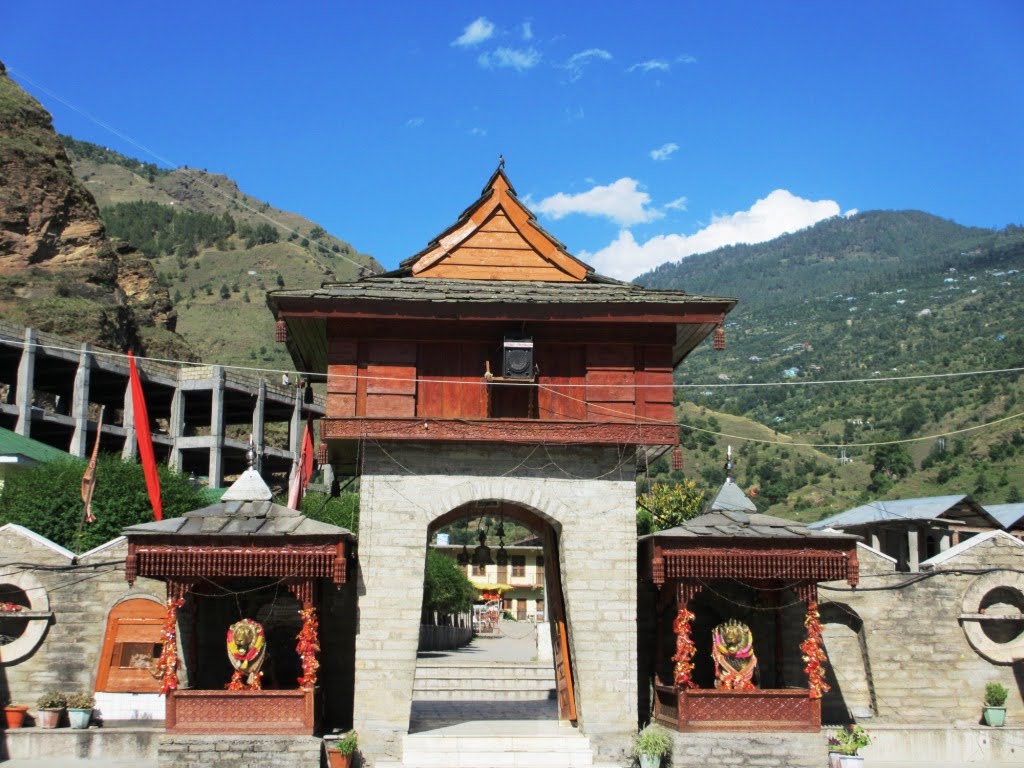
The door of the main temple are studded with coins. Many people who come here make a wish and if their wishes are fulfilled, they hammer coins on to the door of the main temple. The sanctum enshrines an image of Hateshwari / Mahishasura Mardini, an incarnation of goddess Durga. The idol is about 1.2 metres high and made of ashtadhatu (eight precious metals). The idol is said to be dated to the 7th century CE. She is depicted with eight arms holding various weapons. It is unique to note that she holds her chakra in prayoga mudra.

Also, one of her hand holds another demon Raktabija by a lock of his hair. Her left foot stands over the head of the demon Mahishasur while her right foot is said to extend underground. She is shown riding a lion with her spear piercing the heart of the demon Mahishasur. This idol emits a glow because of its metallic composition of eight metals. There are inscriptions on both sides of the idol, but the inscriptions could not be deciphered till date. It is said that the deity changes its expression, sometimes it has a smiling face and sometimes it is has an angry face.
.jpg)
There is a torana around the deity. Navadurga can be seen on the arch of the torana. Veendhari Shiva and devas led by Indra can be seen below the Navadurga. Hayagriva and Airavata can be seen on the two sides of the torana. Ganga and Yamuna are depicted on the left and right side of the arch. There is also a stone sculpture of goddess carrying a thunderbolt in one hand can be seen in the sanctum. The lips of the image are inlaid with copper and the eyes with silver.

A copper pitcher of Parasurama is kept beside the goddess in the sanctum. It is taken out in a procession during the fairs. There is a Shiva temple situated on the left side of the main shrine in the temple complex. This temple enshrines a huge Shiva Linga in its sanctum. The width of the Linga is larger than that of the entry door. The ceiling is carved with figures of Hindu deities, each figure carved out of a square block of wood and then fitted into a carved wooden frame.

There are five stone temples situated to the left side of the Shiva temple. These temples are locally called as Pandava Ka Khilona (toy houses of the five Pandava brothers). These five temples represent each of the Pandavas. These temples are arranged in the decreasing order of size. These shrines consists of sanctum and pillared mukha mandapa. A huge copper vessel called Charu is found chained to a ring in the niche in the antrala next to an idol of Lord Ganesha.

There were two such vessels on each side of the entrance, but one somehow rolled into the river one day. The second vessel was chained after this incident. There is a huge hall known as yagasala used to perform rituals. Havan Kund can be seen in the centre of the hall where the rituals are performed. The idols of Brahma, Vishnu, Shiva, and Ganesha can be seen near Havan Kund. There is a hall named Satsang Bhavan which can accommodate 350 devotees at a time.

There is a rest house (Dharamshala) for pilgrims and saints near Satsang Bhavan. There is a prayer hall named Girtan Ghar in the temple complex. There is a bhandargriha situated between the main shrine and the Shiva temple. It is used to store various objects used during festivals and fairs. It is said that there is a tunnel of about 6 feet high and 3.5 feet wide below the surface of the temple. Sculptures of Vishnu, Lakshmi Narayana, Ganesha, Durga, and other deities can be seen in the temple premises.
Hateshwari Temple, Hatkoti – Legends
Hateshwari Temple, Hatkoti – Legends
Mahishasura Mardini:
A small mountain known as fort of Rambhasur can be seen in front of the temple towards the eastern side. Mahishasur was born to Rambhasur due to his prayers to Lord Agni. Mahishasur performed intense penance on Lord Shiva and had gained the boon that no man could kill him. The devas led by Indra were utterly defeated by the Mahishasur and he conquered the three worlds. The defeated devas took refuge in the cave near Pabbar river. Further, they requested Mata Hateshwari here to protect them from Mahishasur. Acceding their request, Mata Hateshwari annihilated Mahishasur. Thus, she came to be called as Mahishasura Mardini.
A Huge Copper Vessel:
There is a huge copper vessel chained to a ring in the niche beside the entrance of the sanctum of Hateshwari Mata. As per local folklore, once, a priest decided to stay in the temple itself due to the heavy torrential rain. He went to sleep in the premises. He got up from his sleep due to a huge noise. He noticed two big copper vessels floating in the river. The priest picked the vessels from the river and offered the vessels to the goddess. During the next rain, one of the vessels floated away on the river. Due to this incident, the remaining vessel has been kept chained. Locals believe that they will be blessed with an abundant harvest if they spot the lost vessel while sowing their crops.
Feet of the deity:
Locals believe that no one has been able to view the feet of the deity, as they believe it touches the river Pabbar. It is said Gurkhas had established their stronghold in parts of Himachal Pradesh in the early 19th century CE. They wanted to move the deity to another place. The Gurkhas dug for days to uproot the deity, but they could not be able to locate the feet of the deity. Finally, they cancelled their plan and left the deity as it is.
Five Stone Temples:
There are about five stone temples in a row in the temple complex. These temples are in the decreasing order of size. It is believed that the Pandavas used to worship the goddess Hateshwari while sitting inside them. It is also said that the Pandavas spent considerable amount of time at Hatkoti, the capital of King Virata of Matsya Kingdom during their exile.
A chaste girl turning into an idol:
Once, a chaste girl performed meditation at this place and vanished with the intensity of her meditation. A stone idol was found at the spot where she performed meditation. Locals believed that the girl might have been an incarnation of goddess Durga. The villagers built a temple for the idol and named the deity as Hateshwari.
References in Bhagavat Gita:
As per fifth Kandh of Bhagavat Gita, the goddess Hateshwari is described as Shakti of Hateshwar and hence the place came to be called as Hateshwari, one of the main residences of Shiva and Shakthi.
Manifestation of the Goddess Hateshwari Devi:
As per legend, two sisters from Jubbal Valley together renounced the materialistic world and devoted their lives to the service of the mankind. The elder sister was accepted as a manifestation of the Goddess Hateshwari Devi and a temple built in her honour.
Charu:
There is a large metal pot tied with chains at the antrala of the Hateshwari temple. As per locals, a demon named Charu tried to escape from the valley in the form of a vessel. To stop him from escaping, the goddess tied him with the chain in the temple.
Adi Shankaracharya:
It is believed that Sri Adi Shankaracharya had established the temples of Hatkoti.
Hateshwari Temple, Hatkoti, Himachal Pradesh
Hateshwari Temple, Hatkoti, Himachal Pradesh
Hateshwari Temple is a Hindu Temple dedicated to goddess Durga located in Hatkoti Village in Jubbal Tehsil in Shimla District in Himachal Pradesh, India. The temple is situated at an altitude of about 1,442 metres. The temple is situated on the banks of Pabbar river.


Legends
For brief details, please refer below link;
https://hindutemples-india.blogspot.com/2023/06/hateshwari-temple-hatkoti-legends.html
History
The temples might have been constructed during the reign of Later Guptas between 6th century CE to 9th century CE.


The Temple Complex
For brief details, please refer below link;
https://hindutemples-india.blogspot.com/2023/06/hateshwari-temple-hatkoti-temple-complex.html
Festivals
Fairs are organized during Chaitra Navratra (Apr) and Aswin Navratra (Oct). Devotees sacrifice goats / sheep at this temple during these occasions.
Connectivity
The temple is located at about 1 Km from Hatkoti Bus Stand, 13 Kms from Jubbal, 13 Kms from Rohru, 22 Kms from Kharapathar, 39 Kms from Kotkhai, 67 Kms from Theog, 94 Kms from Shimla, 96 Kms from Shimla Railway Station and 111 Kms from Shimla Airport. The temple is situated on Shimla to Rohru route. Hatkoti is well connected to Himachal and rest of India through National Highway 707 and National Highway 705.
Dwat Mahadev Temple, Mani, Himachal Pradesh
Dwat Mahadev Temple, Mani, Himachal Pradesh
Dwat Mahadev Temple is a Hindu Temple dedicated to Lord Shiva located near Mani Village in Chamba Tehsil in Chamba District in Himachal Pradesh, India. The temple is situated at an elevation of 2300 metres.
.jpg)


Legends
As per legend, Pandavas built this temple in one night during their exile.


The Temple
This temple is facing towards east overlooking the wooded valley. The temple is surrounded by dense forest of deodar trees. Nandi can be found facing towards the sanctum. The temple consists of sanctum and entrance porch. The entrance porch is supported by two pillars. The entrance porch has a superstructure called sukanasi. The sanctum enshrines a Shiva Linga in it. The shikara over the sanctum is of pyramidal style. The magnificent view of the Chamba valley, Dhauladhar range and Pir Panjal range can be seen from this temple.


Connectivity
Mani is located at about 21 Kms from Chamba New Bus Stand, 22 Kms from Chamba, 22 Kms from Chamba Old Bus Stand, 24 Kms from Koti, 61 Kms from Dalhousie, 82 Kms from Bharmour, 122 Kms from Pathankot Junction Railway Station and 126 Kms from Pathankot Airport. Mani is situated at about 22 Kms to the north of Chamba on Chamba to Koti route. The temple can reached from Mani village after trekking of about 3.5 Kms or through vehicle from Mani village.
Devi Docha Mocha Temple, Karjan, Himachal Pradesh
Devi Docha Mocha Temple, Karjan, Himachal Pradesh
Devi Docha Mocha Temple is a Hindu Temple dedicated to goddesses Docha and Mocha located in Karjan Village near Manali Town in Manali Tehsil in Kullu District in Himachal Pradesh, India. The temple is situated on the banks of Beas river.

.jpg)
History
The temple is believed to be built during later Guptas period. It is said that the idols of Docha and Mocha represent Scythian donors but currently worshipped as goddesses in the temple. The two tankri inscriptions on the masks from Karjan confirm the name of goddesses as Docha and Mocha.
The Temple
This temple is single storied and constructed in alternate courses of stone and deodar beams on a rectangular ground plan. The vehicle of goddess Durga, lion is kept in the courtyard of the temple. The sanctum enshrines stone sculptures of goddesses Docha and Mocha. The temple has six ancient wooden sculptures. The largest sculpture has been identified as Surya and the other male sculpture is Kuber. Both the male sculptures are carved as stand-alone statues.

.jpg)
These male sculptures are dated to seventh century CE. The balance four are female sculptures identified as Yakshis. These sculptures appear to be part of a pillar or wall of the temple. These female sculptures are dated to 10th century CE. A new temple has been constructed recently near to the Docha Mocha temple. These wooden sculptures have been placed in this temple in a glass enclosure. There are four ancient stone idols kept in the new temple.
.jpg)
.jpg)
Festivals
A village fair known aa Chacholi Mela is celebrated on the full moon day (Purnima) during Chaitra month.
Connectivity
The temple is located at about 8 Kms from Naggar, 14 Kms from Manali, 14 Kms from Manali Bus Stand, 30 Kms from Kullu, 40 Kms from Kullu Manali Airport, 137 Kms from Joginder Nagar Railway Station and 237 Kms from Shimla. The temple is situated on Kullu to Manali route.
Mukteshvara Temple, Bhubaneswar – Connectivity
Mukteshvara Temple, Bhubaneswar – Connectivity
The temple is located at about 2 Kms from Lingaraj Temple, 4 Kms from Bhubaneswar Railway Station, 5 Kms from Bhubaneswar Airport, 5 Kms from Lingaraj Temple Road Railway Station, 9 Kms from Baramunda Bus Stand, 18 Kms from Bhubaneswar New Railway Station, 29 Kms from Cuttack and 54 Kms from Puri. The temple is situated close to Kedara Gouri Temple and Parasurameswara Temple on Bhubaneswar to Puri road. Bhubaneswar is well connected to rest of India by Train, Air and Land.
By Road:
Bhubaneswar is connected to the rest of Odisha and India by National Highway-NH 16, NH 203, State Highway 13 (Odisha) and State Highway 27 (Odisha). Asian Highway – AH 45 passes through the city. Baramunda Inter State Bus Terminus (ISBT) is the major bus terminus in the city from where buses ply to all the districts in Odisha as well as to neighboring state's cities like Hyderabad, Kolkata, Visakhapatnam, Raipur and Ranchi. City bus service (Mo Bus) runs across Bhubaneswar by Capital Region Urban Transport Authority run by Bhubaneswar Development Authority.
Nowadays popular online cab or auto transport system provided by Jugnoo, Ola, uber are widely used. Auto rickshaws are available for hire and on a share basis throughout the city. In parts of the city, cycle rickshaws offer short trips. Also, CRUT recently has launched Mo Cycle, a public bicycle Sharing platform to curb traffic, reducing pollution in city and providing last mile connectivity in city.
By Train:
Bhubaneswar railway station is one of the main stations of the Indian railway network. It is connected to major cities by daily express and passenger trains and daily service to all metro cities is available from here.
By Air:
Biju Patnaik International Airport, also known as Bhubaneswar Airport, located to the south of the city Centre, is the major and sole international airport in Odisha. There are daily domestic flights from Bhubaneswar to Delhi, Hyderabad, Mumbai, Kolkata, Vishakhapatnam, Chennai and Bangalore. There are international flights from Bhubaneswar to Bangkok, Dubai and Kualalumpur thrice a week.
Mukteshvara Temple, Bhubaneswar – The Temple Complex
Mukteshvara Temple, Bhubaneswar – The Temple Complex
The temple is situated in a garden complex known as Siddharanya (forest of siddhas) and is situated on the southeast corner of the garden. This temple is facing towards west and stands on a low platform. The temple is enclosed within a low octagonal compound wall. The compound wall is built with four courses of stones. The bottom-most course contains plain stones with gavaksha (window) design, many of these windows have standing figures.

The next course has niches set within two flanking pilasters. These niches have a male face or a lotus. The third course has plain stones with a small standing or seated figure at its top. The last course is plain and simple, curved at the top. There are thirty corner niches on this compound wall. These niches are decorated with images of Avalokiteshvara, Lakulisa, Buddha, Surya, Vishnu, Ganesha, Sarasvati, Varahi, Kartikeya, Chamunda and Parvati. The enclosure wall is plain from inside.

The space between the temple and the wall serves as the circumambulatory path. The temple has a torana (the arched gateway) at the entrance of the octagonal compound. The torana is heavily influenced by the Buddhist architecture style. The torana has two heavy pillars supporting a rounded arch on top. The pillars are square at base, consisting of two courses. These are decorated with miniature temple carvings. The square base is followed by a sixteen faceted shaft with its top and bottom decorated course.
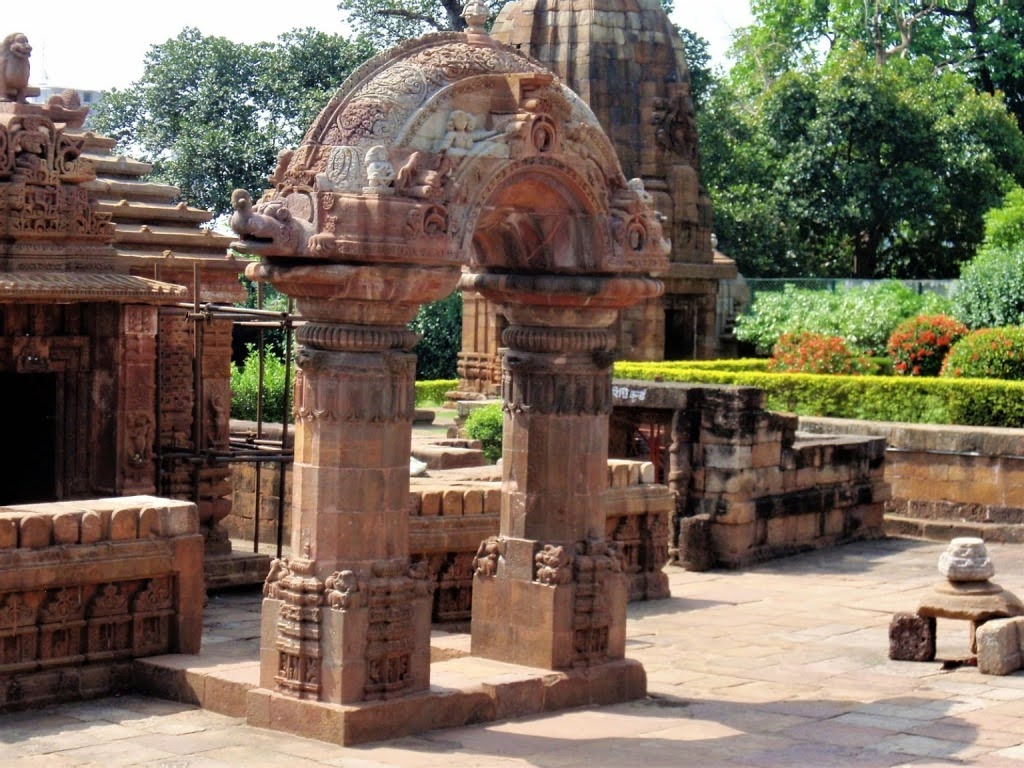
Above is the capital of the column in form of a ribbed cushion topped with an abacus. The torana arch is formed by two makaras, extending on opposite ends. At the bottom ends and at apex are three gavaksha (windows) or chaitya decoration. These chaityas have a male head inside. The torana is dominated by four, two on front and two at back side, reclining female figures, resembling voluptuous yakshis.

Such toranas were erected to facilitate dola-utsava ceremony where a movable image of the deity is placed over a swing for rituals. The temple is pancharatha on plan and triangabada in elevation. The temple consists of a rekha vimana, pidha jagamohana and a shallow frontal porch. The vimana is square on plan and the jagamohana is rectangular on plan. The jagamohana is triratha on plan. The superstructure over the jagamohana is of pidha (pyramidal style).

The pyramidal roof of the jagamohana was the first of its kind over the conventional two-tier structure. The roof is built with twelve tiers of pidhas topped with a kalasa. The northern and southern walls of the jagamohana has lattice windows of diamond patterns. The recess between the kanika and anuratha is decorated with naga pilasters. It has six pabhaga mouldings topped with a slim shaft entwined with a naga or nagini figure at the bottom.

These naga nagini pillars are said to have been introduced first in this temple, later became a norm in the Odishan temple art. The pillars are arranged in alternate manner. The mandapa ceiling has five receding stone courses of different shapes, and is heavily adorned with carvings of deities, dancers, musicians, heavenly beings, warriors, flying figures, floral motifs and geometrical patterns.

The entrance is preceded by a large Chandra shila (moonstone) followed by a doorway guarded by two dvarapalas. The figure of Lakulisa, seated in bhumispara mudra and holding a lakuta is present on the lintel of the jagamohana. A small extension from the side roof of the jagamohana has the image of a lion sitting on its hind legs. The exterior walls of the structure are decorated with pilasters with nagas and naginis.

The dedicatory block of the sanctum doorway has Gajalakshmi. Navagraha panel can be seen above the lintel. The base of the doorjamb has dvarapalas. The sanctum enshrines the presiding deity, Muktesvara, in the form of Shiva Linga within a circular yonipitha. All the niches around the sanctum are empty. The shikara over the sanctum follows rekha nagara style of architecture.

The shikara is about 34 feet tall and intricately carved with sculptures, decorative patters and architectural patterns. It has four Natarajas and four kirtimukhas on the four faces. It is a highly ornate chaitya window crowned by masked demon head and dwarf figures. The shikara is crowned with amalaka and kalasa on top of it.

The exterior of the temple is decorated with various deities, salabhanjikas, alasa kanyas, nayikas, ascetics in emaciated form, pancha tantra stories, animals, social scenes, chaitya motifs, scroll works, architectural motifs, floral motifs and geometrical patterns. There is a small tank called as Marichi Kunda, situated to the south of the main temple.
.jpg)
It is said that a dip in this kunda will cure infertility in women. The entrance doorway of the tank is carved with Ganga and Yamuna at the doorjambs and Lakulisa seated with his four disciples in the center of its lintel. There is a large tank situated on the eastern side of the temple. It is fed by a natural spring and might be the principal tank of the temple.

There is a raised terrace with six miniature temples in a row situated to the west of the main temple. These temples are arranged in two group, containing three temples each, and the space between the groups is aligned with the main entrance of the temple. There are four miniature temples situated on the south eastern side of the main temple. All these shrines are facing towards west.

For brief details, please refer below link;
https://hindutemples-india.blogspot.com/2023/05/mukteshvara-temple-bhubaneswar-banesvara-temple.html
For brief details, please refer below link;
https://hindutemples-india.blogspot.com/2023/05/mukteshvara-temple-bhubaneswar-khakhara-temple.html
For brief details, please refer below link;
https://hindutemples-india.blogspot.com/2023/05/mukteshvara-temple-bhubaneswar-pidha-temple.html
For brief details, please refer below link;
For brief details, please refer below link;
https://hindutemples-india.blogspot.com/2023/05/mukteshvara-temple-bhubaneswar-shiva-temple-i.html
Shiva Temple No II:
This temple is situated within the Muktesvara Temple Complex. The temple was constructed in 10th century CE by Somavamsis. This temple is considered as the parivara shrine of Muktesvara. The temple is facing towards east. The temple consists of a rekha vimana and square on plan. The temple is pancharatha on plan and triangabada in elevation. The sanctum enshrines a broken image of Ganesha. The exterior is devoid of any decoration except the chaitya medallion on the frontal raha projection.
Shiva Temple No III:
For brief details, please refer below link;
https://hindutemples-india.blogspot.com/2023/05/mukteshvara-temple-bhubaneswar-shiva-temple-iii.html
Shiva Temple No IV:
For brief details, please refer below link;
https://hindutemples-india.blogspot.com/2023/05/mukteshvara-temple-bhubaneswar-shiva-temple-iv.html
Shiva Temple No VI:
For brief details, please refer below link;
https://hindutemples-india.blogspot.com/2023/05/mukteshvara-temple-bhubaneswar-shiva-temple-vi.html
Shiva Temple No VII:
For brief details, please refer below link;
https://hindutemples-india.blogspot.com/2023/05/mukteshvara-temple-bhubaneswar-shiva-temple-vii.html
Shiva Temple No VIII:
For brief details, please refer below link;
Vishnu Temple No I:
This temple is situated within the Muktesvara Temple Complex. The temple was constructed in 10th century CE by Somavamsis. The temple is facing towards east. The temple consists of a rekha vimana and a shallow frontal porch. The temple is pancharatha on plan and triangabada in elevation. The sanctum is square on plan. The sanctum enshrines an image of Lord Vishnu with serpent hood as umbrella and holding nectar pot in his hands. The exterior is devoid of any decoration except the chaitya medallion at the central raha above the parsvadevta niches and series of chaitya medallion at the base of the gandi.
Mukteshvara Temple, Bhubaneswar – Banesvara Temple
Mukteshvara Temple, Bhubaneswar – Banesvara Temple
This temple is situated on the south eastern corner of the Muktesvara Temple Complex near the Ramakunda, the temple tank of Muktesvara Temple. This temple was constructed in 13th century CE by Gangas. This temple is facing towards west. The temple is saptaratha on plan and triangabada in elevation. The temple consists of a rekha vimana. The sanctum is square on plan. The sanctum enshrines the presiding deity, Banesvara, in the form of Shiva Linga within a circular yonipitha.

The exterior is devoid of any decorations except the raha niches decorated with talagarbhika & urdhagarbhika surmounted by a Kirtimukha. The doorjambs are crowned by three miniature pancharatha rekha vimana surmounted by vajramastaka in the frontal raha projections. The vajramastaka of each side is crowned by udyotasimha. An image of Lakulisa is found in the lalatabimba of the doorjamb.
Mukteshvara Temple, Bhubaneswar – Khakhara Temple
Mukteshvara Temple, Bhubaneswar – Khakhara Temple
This temple is situated within the Muktesvara Temple Complex. The temple was constructed in 10th century CE by Somavamsis. The temple is facing towards east. The temple consists of a khakhara vimana and square on plan. The temple is pancharatha on plan and triangabada in elevation. The sanctum enshrines an image of Lord Vishnu with serpent hood as umbrella and holding nectar pot in his hands. The exterior is devoid of any decoration except the three plain vertical bands at the doorjamb and a single miniature khakharamundi at the pabhaga of raha projection on southern side.

Mukteshvara Temple, Bhubaneswar – Shiva Temple No IV
Mukteshvara Temple, Bhubaneswar – Shiva Temple No IV
This temple is situated within the Muktesvara Temple Complex. The temple was constructed in 10th century CE by Somavamsis. The temple is facing towards east. The temple consists of a rekha vimana and a shallow frontal porch. The vimana is rectangular on plan. The temple is triratha on plan and triangabada in elevation. The sanctum enshrines a Shiva Linga within a circular yonipitha over a pedestal.
The pedestal and niche on the rear wall indicate that this shrine might have been dedicated to some other god or goddess of Hindu pantheon in earlier times. Dvarapalas at the base and Navagrahas on the architrave can be seen on the doorjambs. Ganesha, Kartikeya and Parvati are the parsvadevta niches located around the sanctum walls.
Mukteshvara Temple, Bhubaneswar, Odisha
Mukteshvara Temple, Bhubaneswar, Odisha
Mukteshvara Temple is a Hindu Temple dedicated to Lord Shiva located in Bhubaneswar, the state capital of Odisha, India. This temple is considered as the gem of Kalingan architecture. It is one of the oldest temples in Bhubaneswar and the most prominent tourist attractions of the city.


History
The temple was built in 950 CE by the King Yayati I Mahasivagupta (922 – 955 CE) of Somavamshi Dynasty. This temple is believed to be built after the Parashurameshvara Temple and built before the Brahmeswara Temple. This temple is protected as monuments of national importance by the central Archaeological Survey of India. This temple is also under the control of Lord Lingaraj Temple Management Trust.


The Temple Complex
For brief details, please refer below link;
https://hindutemples-india.blogspot.com/2023/05/mukteshvara-temple-bhubaneswar-temple-complex.html
Festivals
Shivarathri, Kartika Purnima, Sankranti, Sitalasasti, Durga Puja and Jalasaya are the festivals celebrated here. The Odisha tourism department organizes a three-day yearly dance festival called Mukteswara dance festival in the temple premises. This festival celebrates the features of Odissi, the classical dance form of Odisha and Odissi music, the classical music of the same tradition.
Connectivity
For brief details, please refer below link;
https://hindutemples-india.blogspot.com/2023/05/mukteshvara-temple-bhubaneswar-connectivity.html
Metakani Temple, Ulunda, Odisha
Metakani Temple, Ulunda, Odisha
Metakani Temple is a Hindu Temple dedicated to Goddess Metakani located at Rengali inside dense forest near Ulunda Village in Ulunda Block in Subarnapur District in Odisha, India. The name of the goddess is believed to have been originated from a lady called Meta. The temple is very famous among the local people. Animal sacrifices are performed in this temple on every Tuesdays and Saturdays. Photography is strictly prohibited inside the temple premises.
.jpg)


.jpg)


Connectivity
The temple is located at about 8 Kms from Ulunda, 22 Kms from Sonepur, 24 Kms from Sonepur Bus Stand, 59 Kms from Sambalpur, 62 Kms from Sambalpur Junction Railway Station, 110 Kms from Jharsuguda and 119 Kms from Jharsuguda Airport. The temple is situated at about 2 Kms through Rengali range from the Sambalpur to Sonepur road (SH 15).
Maninaga Temples, Raj Ranpur – Legends
Maninaga Temples, Raj Ranpur – Legends
Ranpur:
As per legend, two brothers of Benu Raj family namely Biswabasu and Biswabasab lived in the forest of Nilagiri hill but were driven out from the hill. The younger brother Biswabasab along with his attendants took refuge in the valley of Maninag hill. The Maninag Hill with its rich forest tracts were sparsely inhabited. He decided to the reclaim the region for himself. Subsequently, he subdued the Bhuiyas of the adjacent villages.
One day, while he was walking in the forest, he found an image of Goddess, brought the image and installed it in Maninag Hill. He named it as Goddess Maninaga and worshipped her sincerely. Pleased with his worship, she appeared before him and instructed him to establish a village on the eastern side of the hill. As per the divine instruction, he established the village and named it as Ranpur. He named it as Ranpur in praise of the Goddess Maninag who earlier killed a demon named Ranasura ruling at this region.
Maninaga:
As per legend, a piece of stone was originally worshipped as goddess on the hilltop. The offerings made to the goddess was eaten away by a cobra with a gem. Thus, the goddess came to be called as Maninag. The Bagedis ruling over this area were considered very powerful due to the grace of Maninaga. They were able to bring the surrounding region under their control due to the grace of the goddess. The neighboring kings were jealous of Bagedis success and attempted to steal the deity from the hill. Goddess disappeared leaving a hole on the top of the hill. This hole was subsequently covered with golden plate and worshipped.
Goddess worship from the period of Mahabharata:
As per legend, it is said that the goddess was getting worshipped in this region from the times of Mahabharata.
Maninaga Temples, Raj Ranpur, Odisha
Maninaga Temples, Raj Ranpur, Odisha
Maninaga Temples are group of two temples dedicated to goddess Maninaga located in Raj Ranpur Town in Ranpur Block in Nayagarh District in Odisha, India. These temples are considered as important temples in Odisha for the Shakta sect.


Legends
For brief details, please refer below link;
https://hindutemples-india.blogspot.com/2023/05/maninaga-temples-raj-ranpur-legends.html
History
The Mani Nag Temple at the top of the Maninag Hill was built by the King Udhbhava Singh Narendra of Ranpur State in 14th century CE. It is said that king arranged a tribal priest named Jani for the worship of the deity at the hill top temple. Due to the difficulties in climbing the mountain infested with wild animals, a temple was later built at the foot hills by the then king. The goddess is worshipped by both the Jani and the Brahmin priests at the foot hill temple. It is said, in the month of Magha, a man was offered to the goddess as sacrifice which was discontinued after independence. Maninaga is considered as the tutelary deity of Raj Ranpur and its surrounding region.
The Temples
There are two Maninaga Temples namely Lower Maninaga Temple and Upper Maninaga Temple at Raj Ranpur Town.


Lower Maninaga Temple:
The Lower Maninaga Temple is situated at the foothills of Maninaga Hills.
.jpg)

Upper Maninaga Temple:
The Upper Maninaga Temple is situated at the top of the Maninaga Hills. The temple can be accessed through flight of steps from the motorable road. There is a shrine for Lord Anjaneya on the way from the foot hills to the hill top. The temple consists of rekha vimana. The hill top provides panoramic view of the surrounding region.

.jpg)
Festivals
Raja festival is major festival here when a mela is organized.
Connectivity
The Upper Maninaga Temple is located at about 5 Kms from Raj Ranpur. Ranpur is located at about 13 Kms from Rajsunakhala Railway Station, 16 Kms from Kandhanayagarh, 27 Kms from Jankia, 31 Kms from Nayagarh, 70 Kms from Bhubaneswar Airport, 70 Kms from Bhubaneswar and 124 Kms from Brahmapur. The temple is situated at about 16 Kms from Kandhanayagarh on Bhubaneswar to Brahmapur route (NH 16).
Sharana Basaveshwara Temple, Kalaburagi, Karnataka
Sharana Basaveshwara Temple, Kalaburagi, Karnataka
Sharana Basaveshwara Temple is a Hindu Temple dedicated to Sharana Basaveshwara located in Kalaburagi City in Kalaburagi Taluk in Kalaburagi District in the Indian state of Karnataka. Sharana Basaveshwara was an 18th century CE Lingayat saint, eminent teacher and philosopher in the Hindu religion. The temple is situated at about 2 Kms from Gulbarga fort.

History
Shri Sharana Basaveshwara was an eminent Lingayat religious teacher and philosopher of 18th century CE. He is known for his Dasoha (charity) and Kayaka (removal of inequalities). The parents of Sharana Basaveshwara Sangamma and Malakkappa were the role model for his choice of his path to break the feudalism in the society. This temple is built in memory of him after his death. Sharana Basaveshwara Mahadasoha Peetha was established later. The Peetha currently supports many educational institutions.
.jpg)
The Temple
The temple follows Hindu style of architecture with influences from Mughal style. The temple consists of sanctum and sabha mandapa. There is a circumbulatory passage around the sabha mandapa. The circumbulatory passage around the sabha mandapa has around 36 arches. The sanctum enshrines the samadhi of Saint Sharana Basaveshwara. The interior of the temple is richly decorated with gold paint, chandeliers and glass mirrors.

There is a marble Nandi at the center of the sabha mandapa. There are several canvas paintings depicts the life story of the peetha leaders and artistic depiction of Hindu gods. The walls and pillars of the temple has carvings of Sharana Basaveshwara, peacock, entangled serpents, Garuda, parrots, flowers and elephants. The panchaloha kalasha can be found here.

There is a throne like seat, probably the seat of the head of the peetha, inside the temple. There is a neem tree inside the temple premises. The main temple is surrounded by Peetha offices, primary and high schools and pre-university college run by the temple administration. The peetha has a collection of antique items like sculptures, bells, electrical clock and paintings. There is a picturesque lake situated adjacent to the temple.

Festivals
The annual fair, Sharana Basaveshwara Jatra, is conducted in this temple to commemorate the death anniversary of Sharana Basaveshwara. A cattle fair is also held here every year. The festival witness huge gathering of people in the temple to offer their homage on the Samadhi of Sri Sharana Basaveshwara. The devotees also perform padayatra from their villages to the temple as a form of devotion to the saint. The farmers from the region donates a portion of their harvest to the temple for providing free food to pilgrims visiting the temple. People will also have a glimpse of the silver plate (Prasada Battala) used by the saint and Linga Sajjike (the cover used for keeping the Linga) made in Sandalwood on this occasion. The temple also conducts a cattle fair every year.
Connectivity
The temple is located at about 2 Kms from Gulbarga Central Bus Stand, 2.5 Kms from Gulbarga Railway Station, 15 Kms from Gulbarga Airport, 85 Kms from Basavakalyan, 124 Kms from Solapur, 213 Kms from Hyderabad and 213 Kms from Hyderabad Airport. Gulbarga is well connected to the major cities in Karnataka and Maharashtra. Frequent bus services are available from the nearby cities like Hyderabad, Solapur, Pune, Mumbai, Bijapur, Bangalore and Bidar.
Betteshvara Temple, Agrahara Belaguli – The Temple Complex
Betteshvara Temple, Agrahara Belaguli – The Temple Complex
This temple is facing towards east. The maha dwara is situated on the southern side. It is a two storeyed structure of the Hoysalas. The temple is constructed in dwikutachala style, consisting of two shrines, one on the western side and other on the northern side. The western shrine connects to navaranga via antrala, and the northern shrine is directly connected to navaranga. The navaranga is square on plan and has an entrance porch on the southern side. The navaranga is supported by four central pillars.
.jpg)
These pillars are bell shaped. The pilasters are designed in indented square shape. The ceilings of the navaranga which rise upon three sets of corner stones are variedly designed with shallow padma domes except the central one which is about four feet deep. Above the corner stones carved with lion faces and the images of dikpalas, stands a circle of sixteen turrets. Above there is a ribbed dome with three concentric circles and a pendant bud.

Images of Sarasvati, Ganesha, Shanmuka, Bhairava, Durga, Saptamatrikas and pedestals once housed the image of Surya and Mahishasura Mardini can be found in the Navaranga. The lintel of the eastern doorway of the navaranga is uncarved. The base of the doorjamb of the southern doorway of the navaranga is carved with dvarapalas. The lintel of the doorway has an image of Thandaveswara.

The navaranga is connected to a spacious mukha mandapa with an entrance porch on the southern side. There is a shrine without any image on the northern side of the mukha mandapa. A nandi mandapa is attached to the mukha mandapa on the eastern side with a four feet tall nandi. A parapet wall with kakasanas in the interior runs around the mukha mandapa. The pillars resting on the kakasanas are sixteen sided but unfinished.

The four central pillars are bell shaped and finely polished. The ceilings are flat except the one in the westernmost square which has a large shallow padma. The base of the doorjamb of the antrala has images of dvarapalas on either side. The lintel of the antrala doorway has carvings of Uma Mahesvara seated in sukhasana flanked by Vinayaga, Brahma, Nandi, Vishnu, Shanmuka, and celestial nymphs.

There is a series of nine towers with the central one is three tiered can be seen above the lintel. The antrala has a domed ceiling of concentric circles. The western shrine is considered as the main shrine of the temple complex. The lintel of the sanctum doorway has an image of Thandaveswara. The base of the doorjamb has images of dvarapalas on either side. The sanctum ceiling is flat and has nine panels, each having a lotus.
.jpg)
It enshrines the presiding deity, Betteshvara / Keshavesvara in the form of Shiva Linga. The Linga is about 3 feet tall and one feet in diameter. The northern shrine enshrines an image of Keshava. The idol is about 5.5 feet tall and stands on a 2.5 feet high pedestal. He is four armed holding conch, discus, club, and lotus. The prabhavali is highly ornamental with carvings depicting the ten avatars of Vishnu.

Of them, the representation of Matsya and Kurma shown as fish and tortoise, are simply grand in design. Buddha is represented here as the ninth manifestation of Lord Vishnu. The image is one of the best representations of Kesava in Hoysala style. The superstructure over the shrines are of brick structure built during the Vijayanagara period. The exterior of the temple is devoid of any decoration except the pilaster designs. There is a pond situated to the northeast of the temple.
.jpg)
Betteshvara Temple, Agrahara Belaguli, Karnataka
Betteshvara Temple, Agrahara Belaguli, Karnataka
Betteshvara Temple is a Hindu Temple dedicated to Lord Shiva located in Agrahara Belaguli Village in Channarayapatna Taluk in Hassan District in the Indian state of Karnataka. The temple is also called as Keshavesvara Temple and Belaguli twin temple. This temple is considered as one of the lesser known Hoysala temples in Karnataka. This temple is a protected monument under the Karnataka state division of the Archaeological Survey of India.
.jpg)

.jpg)
History
The temple was constructed in 1210 CE by Kesava Dandanayaka (Kesiraja), the minister of Hoysala King Veera Ballala II. Though the temple is called as Betteshvara now, it was originally called as Keshavesvara. Kesava Dandanayaka also excavated two large tanks in this place and named it as Kesava Samudra and Lakshmi Samudra. The place was called as Keshavapura during Hoysala period.


The place housed several Brahmin scholars and their families who performed Shatkarmas during Hoysala period. The temple was damaged during the Delhi Sultanate invasions. The Vijayanagara kingdom restored the attempted to repair and restore this temple, and ruins of several Vijayanagara style gopura and pillars can be seen here.
.jpg)

.jpg)
The Temple Complex
For brief details, please refer below link;
Connectivity
The temple is located at about 7 Kms from Nuggehalli, 26 Kms from Channarayapatna, 26 Kms from Channarayapatna Railway Station, 26 Kms from Channarayapatna Bus Stand, 29 Kms from Tiptur, 144 Kms from Bengaluru and 165 Kms from Bengaluru Airport. The temple is situated on Channarayapatna to Tiptur route via Nuggehalli.
Banashankari Amma Temple, Cholachagudda – Festivals
Banashankari Amma Temple, Cholachagudda – Festivals
Banashankari Jatra:
Banashankari Jatra is held as a religious cum cultural festival, at the temple precincts every year on the occasion of the Rath yatra, for a period of about three weeks starting from the Rath yatra. Its starts on 8th day of Pushya masa (Jan-Feb). It is celebrated on full moon day. Pilgrims from across Karnataka and also the neighboring state of Maharashtra belonging to different religious beliefs, congregate here in large numbers to celebrate the festival.
The time is considered auspicious to even fix marriages and purchase agricultural implements. Cultural programmes (music, drama, and circus) are held to entertain the largely rural community who flock the venue to not only worship their favorite deity but also for fun and frolic. It symbolizes cultural bonding between people of different communities here. A unique feature is that many shops and kiosks set up during the festival selling vermilion, clothing, sacred threads and sweets are operated by Muslims.
The shops run by Muslims also display a portrait of goddess Banashankari in their shops. Another interesting marketing activity seen at this venue is of the sale, by artisans of Holeyalur and surrounding areas, of elaborately engraved door frames and doors made in teak, acacia, and other varieties of wood. Cattle fair is also held during this festival. Speciality of the cattle fair is the focus on sale of white bulls. During the festival, the temple and town are decorated with hundreds of varieties of leaves and flowers.
In the fair, which starts on Bandhashtami day, a Palleda Habba or the Vegetable Utsava or festival is also held when at the start itself 108 varieties of food items (called bazi in local language) made of vegetables are offered to the deity. The festival also marks another unique event namely, the Theppothsava (the boat festival) held in the temple tank. During this event, parents use boats made of banana stems to ferry newly born children blessed by the grace of the goddess around the pond seeking good luck to their children.
Rath Yatra:
The Rath Yatra or chariot festival of the goddess held every year starts on the full moon day of the Hindu month Pausha (January) in which the temple goddess Parvati is taken in the chariot (a movable shrine) in a procession through the streets of the Cholachagudda village. The Rath yatra is witnessed by thousands of people, irrespective of their caste and creed from across the state. To see this cultural and religious extravaganza, people from adjacent villages come in colorfully decorated carts.
Banashankari Amma Temple, Cholachagudda – Legends
Banashankari Amma Temple, Cholachagudda – Legends
Annihilation of Durgamasura:
As per Skanda Purana and Padma Purana, a demon named Durgamasura harassed the people in the Tilakaaranya forest. The devas appealed to Lord Shiva for protection of the people from Durgamasura. Lord Shiva directed goddess Shakambhari to help the people. The goddess appeared through the fire of the Yagna (fire-sacrifice) in the form of the goddess Shakambhari. She then killed the demon after a fierce encounter and restored peace in the region.
Banashankari / Vanashankari:
As the temple is located in the Tilakaaranya forest, the goddess came to be called as Banashankari / Vanashankari (Vana / Bana means forest and Shankari means goddess Parvati).
Shakambhari:
As per legend, the goddess provided vegetables and food for the people during a severe famine and saved people from hungry. Hence, she came to be called as Shakambhari. The word Shakambhari is formed by joining tow Sanskrit words Shaka and Ambhari (Shaka means vegetable and Ambhari means one who bears to the hungry).
Incarnation of goddess Durga:
It is said that goddess Banashankari is the sixth incarnation of the warrior-goddess Durga.
Other Names:
The goddess is also called as Balavva, Banadavva, Sunkavva, Shiravanthi, Chowdamma and Vanadurge.
Banashankari Temple, Cholachagudda, Karnataka
Banashankari Temple, Cholachagudda, Karnataka
Banashankari Temple is a Hindu Temple dedicated to goddess Durga located in Cholachagudda Village in Badami Taluk in Bagalkot District in the Indian state of Karnataka. The temple is situated to the south of Badami Town. The temple is also called as Shakambhari Devi Shaktipeeth.


Legends
For brief details, please refer below link;
https://hindutemples-india.blogspot.com/2023/05/banashankari-temple-cholachagudda-legends.html
History
The original temple was built in 7th century CE by King Jagadekamalla I of Badami Chalukyas. Badami Chalukyas worshipped goddess Banashankari as their tutelary deity. There is an inscription dating back to 1019 CE describing the Rashtrakuta King Bhimadeva in a pillar on the northern side of the temple. The Deepa Stambhas at the entrance of the temple were built by a warrior named Ketimayya. The present structure was built in 1750 CE by Parashuram Agale, a Maratha chieftain.


The Temple
The temple follows dravidian style of architecture with heavy influences from Vijayanagara architectural style. The temple is enclosed by a high wall on all sides. The main shrine consists of sanctum, ardha mandapa and mukha mandapa. The sanctum enshrines an image of Banashankari / Vanashankari / Shakambhari. She is shown seated on a lion trampling a demon under her foot. She is eight armed and holds trishul (trident), damaru (hand drum), kapala patra (skull cup), ghanta (war bell), vedic scriptures, khadga kheta (sword & shield) and severed head of demon. The sanctum is crowned by a vimana. Idols of Bhima, Bhramari, Shatakshi and Ganesha can be found in the temple.


There is a 360 feet square water tank in the front of the temple at the entrance. The water tank is locally called as Haridra Tirtha, a corrupted version of the name Harishchandra Tirtha. The pond is enclosed with stone manḍapas (halls) on three sides. A pradakshina or circumambulatory path surrounds the tank. Deepa stambhas (Lamp towers) can be seen on the west bank of the pond and also at the entrance of the temple. The tower on the bank of the tank is also an uncommon guard tower which reflects the Vijayanagara blend of Hindu and Islamic style It is called the Victory Tower.


Temple Opening Time
The temple remains open from 06.00 am to 01.00 pm and 03.00 pm to 09.00 pm.
Festivals
For brief details, please refer below link;
https://hindutemples-india.blogspot.com/2023/05/banashankari-temple-cholachagudda-festivals.html
Contact
Banashankari Temple,
Cholachagudda, Badami Taluk,
Bagalkot District – 587 201
Karnataka, India
Phone: +91 8357 220 100 / 220 113
Connectivity
The temple is located at about 5 Kms from Badami Bus Stand, 6 Kms from Badami, 9 Kms from Badami Railway Station, 18 Kms from Pattadakal, 29 Kms from Aihole, 38 Kms from Bagalkote, 41 Kms from Naregal, 65 Kms from Gadag and 114 Kms from Hubbali Airport. The temple is situated to south of Badami Town on Badami to Gadag route.
Shakthi Devi Temple, Chhatrari – The Temple
Shakthi Devi Temple, Chhatrari – The Temple
The temple is situated at an altitude of 6000 feet above sea level. The temple consists of a sanctum surrounded on the four sides by a pillared ambulatory. The ambulatory is supported by twelve massive wooden columns. The open space between the columns has later filled in with masonry of rubble blocks and clay, strengthened by a number of horizontal beams. This rubble masonry was renewed after the earthquake of 1905.
.jpg)
.jpg)
The temple has two intricately carved doors, one for the sanctum and other for the ambulatory through which the temple was entered. Both doors are elaborately carved with sacred images. The pillars and the ceilings are adorned with floral and geometrical designs along with figures of yakshas, birds and animals. The sanctum is square on plan. The sanctum enshrines an ashtadhatu image of Shakti Devi.
.jpg)

This idol is about four feet six inches tall. She is four armed and holding lance, lotus, bell, and snake in her hands. There is an idol of the sculptor Gugga situated next to the presiding deity. The exterior walls of the sanctum are painted with vegetable dyes depicting various forms of Vishnu and other deities of Hindu pantheon. The temple is covered by flat pyramidical roof of well-cut slates.
.jpg)

There is a row of flying figures seen just over the entrance of the temple. Four figures each on both sides and two in the center with a crown in hand can be seen. There are 6 more figures which are accompanied by female characters. Beneath these figures are thirteen figures which are cross- legged and nine of them are navagrahas. Idols of six-faced Kartikeya, four-armed Brahma, three-faced Vishnu, Shiva and Mahishasura Mardini can be seen in the temple premises.

.jpg)
Shakthi Devi Temple, Chhatrari, Himachal Pradesh
Shakthi Devi Temple, Chhatrari, Himachal Pradesh
Shakthi Devi Temple is a Hindu Temple Complex to Lord goddess Shakthi Devi located in Chhatrari Village Bharmour Tehsil in Chamba District of Himachal Pradesh, India. The temple is situated at an altitude of 6000 feet above sea level. This temple is the oldest temple in the area and the only temple made of wood. This temple is protected as monuments of national importance by the central Archaeological Survey of India.
.jpg)
.jpg)

Legends
Once, King Balabhadra Varman of Mushana Rajput Dynasty (Chamba State) killed a cow mistakenly at this village. To get relief from the sin of killing a cow, he donated 36 larhis (1 larhi is equal to three acres of land) to the temple.

.jpg)
.jpg)
History
The temple was built by King Meru Varman of Bharmour in 680 CE. The image of the Shakti Devi was sculpted by Gugga during the reign of Meru Varman.

.jpg)

The Temple
For brief details, please refer below link;
https://hindutemples-india.blogspot.com/2023/05/shakthi-devi-temple-chhatrari-temple.html
Festivals
Chhatrari fair is organized every year in the month of September on the third day of Mani Mahesh Yatra in Bharmour. During this fair, the idol of Shakti Mata is bathed in the holy water brought from Manimahesh Lake. The local inhabitants, a Hindu Shepherd community locally known as Gaddi, dresses like a demon by wearing the masks and perform dances in the temple. They also offer sheep and goats as sacrifice to the goddess Sakthi Mata.
Connectivity
The temple is located at about 200 metres from Chhatrari Bus Stop, 27 Kms from Bharmour, 29 Kms from Bharmour Bus Stand, 54 Kms from Chamba, 97 Kms from Dalhousie, 137 Kms from Nurpur Road Railway Station, 157 Kms from Pathankot, 162 Kms from Pathankot Airport and 182 Kms from Kangra. The temple is situated on Chamba to Bharmour route.
Triloknath Temple, Mandi – The Temple Complex
Triloknath Temple, Mandi – The Temple Complex
Triloknath Temple Complex is one of the oldest temple complex in the Mandi town.


Triloknath Shrine:
Triloknath Shrine is situated inside the Triloknath Temple complex. This Shrine is considered as the prime shrine in the complex. The complex is named after this shrine. This Shrine is facing towards north east. This Shrine is in active worship. This shrine consists of Sanctum, Antrala and Maha Mandapa. The Maha Mandapa follows pidha (pyramidal) style architecture.


.jpg)
The Mandapa is flanked by miniature shrines on all its four corners and has balconies on each side. Nandi can be seen in the Maha Mandapa facing the sanctum. The Sanctum is square on plan. It houses the presiding deity, Triloknatha, three faced stone image of Lord Shiva, riding a bull with Parvati in his lap.

.jpg)

There is also a second image, probably of Lord Shiva, which, however is much worn. The niches on either sides are empty and an image of Kartikeya can be seen in the niche at the backside. This Shrine houses sculptures of Goddess Parvati, Goddess Narda, Goddess Sharda and along with few other Hindu deities.
Shiva Shrine I:
This Shrine is situated inside the Triloknath Temple complex. This Shrine is facing towards south west. This Shrine is no longer in worship. The Shrine consists of Sanctum and entrance porch. It is triratha on plan. The amalaka over shikara is crowned with Akasha Linga instead of Kalasha. A Nandi can be seen facing this shrine. This Shrine is believed to be built during 9th Century CE.

Shiva Shrine II:
This Shrine is situated inside the Triloknath Temple complex. This Shrine is facing towards south west. This Shrine is no longer in worship. The Shrine consists of Sanctum and entrance porch. The entrance arch is lost completely except the pilasters. It is triratha on plan. The Sanctum is square on plan. Brahma, Chamunda and unidentified idol can be seen in the niches around the walls of the shrine. This Shrine is believed to be built during 11th Century CE.

Shiva Shrine III:
This Shrine is situated inside the Triloknath Temple complex. This Shrine is facing towards south west. This Shrine is no longer in worship. The Shrine consists of Sanctum and pragriva. It is triratha on plan. The Sanctum is square on plan. This Shrine is believed to be built during 11th Century CE.

Triloknath Temple, Mandi, Himachal Pradesh
Triloknath Temple, Mandi, Himachal Pradesh
Triloknath Temple is a Hindu Temple dedicated to Lord Shiva located in Mandi Town in Mandi District in Himachal Pradesh, India. The Temple is situated on the banks of Beas River. This Temple is considered as one of the oldest temples and among the most visited tourist places in Mandi. Mandi is often referred to as Varanasi of Hills, or Choti Kashi, or Kashi of Himachal as the town hosts 81 temples spread across its area.


.jpg)

History
Triloknath Temple is considered as one of the oldest temples in Mandi. It was built in 1520 AD by Sultana Devi, queen of Raja Ajber Sen.
.jpg)
.jpg)

.jpg)

The Temple
For brief details, please refer below link;
https://hindutemples-india.blogspot.com/2023/05/triloknath-temple-mandi-temple-complex.html
Festivals
Shrawan Maas and Maha Shivrathri are the festivals celebrated here with much fanfare.
Connectivity
The Temple is located at about 2 Kms from Mandi Bus Stand, 54 Kms from Joginder Nagar Railway Station, 56 Kms from Kullu Manali Airport, 66 Kms from Kullu, 74 Kms from Baijnath, 91 Kms from Palampur and 132 Kms from Shimla. The Temple is located in area of Purani Mandi across the Old Victoria Bridge on Mandi Pathankot National Highway.
Panchvaktra Temple, Mandi, Himachal Pradesh
Panchvaktra Temple, Mandi, Himachal Pradesh
Panchvaktra Temple is a Hindu Temple dedicated to Lord Shiva located in Mandi Town in Mandi District in Himachal Pradesh, India. The Temple is situated at the confluence of the Rivers Suketi and Beas. This Temple is considered as one of the oldest temples and among the most visited tourist places in Mandi. Mandi is often referred to as Varanasi of Hills, or Choti Kashi, or Kashi of Himachal as the town hosts 81 temples spread across its area.

.jpg)
History
The temple was believed to be built by Raja Ajbar Sen in 16th century CE. The temple was destroyed due to the heavy floods in Beas river. The temple was reconstructed during Raja Sidh Sen reign in 17th century CE. It is one of the protected monuments under the control Archaeological Survey of India.
.jpg)

The Temple
This temple is facing towards north east. The architectural style of this temple is similar to the Triloknath Temple except the superstructure and the decorative patterns. The temple stands on a raised platform. This temple consists of Sanctum, Antrala and Maha Mandapa. The Maha Mandapa is supported on four heavy pillars, the capitals of which are carved in flower pot design and the bases in rosettes or lotuses. Nandi can be seen in the Maha Mandapa facing the sanctum.


The antrala is guarded by dvarapalas. The Sanctum is square on plan. It houses the presiding deity, Panchvaktra Shiva, five faced stone image of Lord Shiva. The five faces of the idol depicts the different character of Lord Shiva namely Aghora, Ishana, Tat Purusha, Vamadeva and Rudra. Only three faces can be seen when viewed from the front. The fourth face is on the reverse side and the fifth face is on the top of the image.

.jpg)
Batuk Bhairava Shrine:
This Shrine is situated inside the Panchvaktra Temple complex. This shrine is facing towards north east. The shrine consists of Sanctum and entrance porch. It is triratha on plan. The sanctum houses an idol of Batuk Bhairava. He is found seated cross legged on square plinth.

Festivals
Maha Shivrathri is the most famous festival celebrated here.
Connectivity
The Temple is located at about 750 metres from Mandi Bus Stand, 56 Kms from Joginder Nagar Railway Station, 59 Kms from Kullu Manali Airport, 69 Kms from Kullu, 76 Kms from Baijnath, 93 Kms from Palampur and 131 Kms from Shimla. The Temple is located in area of New Mandi on Mandi Pathankot National Highway.
Ardhnarishwar Temple, Mandi, Himachal Pradesh
Ardhnarishwar Temple, Mandi, Himachal Pradesh
Ardhnarishwar Temple is a Hindu Temple dedicated to Lord Shiva located in Mandi Town in Mandi District in Himachal Pradesh, India. The Temple is situated on the banks of Beas River. Mandi is often referred to as Varanasi of Hills, or Choti Kashi, or Kashi of Himachal as the town hosts 81 temples spread across its area.


History
The temple was built in 17th century CE during the reign of Raja Sidh Sen of Mandi. It is one of the protected monuments under the control Archaeological Survey of India.


.jpg)
The Temple
This temple is facing towards north east and in poor state of preservation. This temple consists of sanctum, antrala and maha mandapa. The roof over the maha mandapa is collapsed. The mandapa has four shrines at its corner. The sanctum is triratha on plan. The sanctum enshrines an image of Ardhnarishwar (Combined form of Lord Shiva & Parvati). The right half of the image represents Lord Shiva and the left half represents his consort Parvati.

.jpg)
.jpg)
Lord Shiva is depicted with his typical knotted hair and wearing a garland of skulls, an entwined serpent, a musical instrument in one hand and a Damru or drum in the other. His consort Parvati is shown wearing a diadem, a pair of earrings and a ring on the nose. There is a slab joined to the image on which the mounts of the deities namely the bull and the lion are artistically carved. Images of Bhairava and Hanuman can be also be seen.
Connectivity
The Temple is located at about 1.5 Kms from Mandi Bus Stand, 55 Kms from Joginder Nagar Railway Station, 56 Kms from Kullu Manali Airport, 66 Kms from Kullu, 74 Kms from Baijnath, 91 Kms from Palampur and 140 Kms from Shimla. The Temple is located in area of New Mandi on Mandi Pathankot National Highway. The temple is situated in the heart of the present town of Mandi very close to the Bhootnath Temple.
Tarna Devi Temple, Mandi – Legends
Tarna Devi Temple, Mandi – Legends
Raja Balbir Sen’s vow:
As per legend, Sikh kingdom went through a rough phase after the death of Maharaja Ranjit Singh in 1839. The army became uncontrollable during the reign of Maharaja Kharak Singh, son of Maharaja Ranjit Singh. Seeing the turmoil, Kharak Singh had left all the powers in the hands of his son Nau Nihal Singh. Nau Nihal Singh planned to invade Mandi and Kullu just to provide an opportunity for his army to fight. General Ventura of the Sikh army led a strong force to Mandi.
He stopped at outskirts of the Mandi town and demanded payment and the visit of Raja Balbir Sen of Mandi to the camp of the Sikh general. Accordingly, the payments were made and Raja Balbir Sen also came to visit the Sikh general. He was imprisoned upon his arrival and Mandi town was captured. The army also captured the Kamlah fortress and the Raja was sent as a prisoner to Amritsar and confined in the fort of Gobindgarh. Kullu was next invaded. A minister of Raja Balbir Sen left Mandi in the guise of a domestic servant and went to Lahore.
He successfully managed to gain the confidence of the rulers of the Sikh empire. He convinced them to send him to Gobindgarh fort to work for the prisoner. Once, he reached Gobindgarh, he spread a rumour that the Raja Balbir Sen had great spiritual powers and was capable of curing incurable diseases. Few case came to him and got cured. This news spread and reached Maharaja Sher Singh, the ruler of Sikh empire. Once, Lahore suffered due to heavy rains and floods, Maharaja Sher Singh summoned Raja Balbir Sen to stop the rain through his powers.
It is said that Raja Balbir Sen prayed to goddess Shyama Kali and took a vow that if the calamity was ended and if he would be released, he would decorate the sanctum of this temple with gold leaf. It is said that the prayer of Raja Balbir Sen were answered and the rains had stopped. Raja Balbir Sen was released with full honours and Mandi State was restored to him. The loots obtained during the invasion of Mandi was also returned back. In gratitude, Raja Balbir Sen fulfilled his vow.
Raja Shyam Sen of Mandi State defeated Jeet Sen of Suket with the blessings of Kali:
As per legend, Raja Shyam Sen (1664 – 1674 CE) was the 8th King of Mandi State. He was an ardent devotee of goddess Kali. Once, Raja Jeet Sen of Suket, ruler of the adjoining State, insulted Shyam Sen. Hence, Shyam Sen invaded Suket. It is said that Raja Shyam Sen prayed to goddess Kali and invoked the blessings of her before proceeding for the war with Jeet Sen. With the blessings of Kali, Raja Shyam Sen decisively defeated Raja Jeet Sen. To commemorate his victory, he built this temple and installed the deity.
Mandi Shivaratri Fair
Mandi Shivaratri Fair
Mandi Shivaratri Fair is an annual renowned international fair, held for 7 days starting with the Hindu festival of Shivaratri, in the Mandi town of the Indian state of Himachal Pradesh. The Mandi Shivaratri fair is held as per Hindu calendar every year on the Krishna paksha 13th day / 13th night of the waning moon in the month of Phalguna that corresponds to February / March as per Gregorian calendar. This festival invites participation from 81 temples in the region. The festival is centred on the protector deity of Mandi Madho Rai (Lord Vishnu) and Lord Shiva of the Bhootanatha temple in Mandi.
History
Mandi town, where the festival is held, was ruled by Raja Ajber Sen who was considered the first great ruler of Mandi State in the sixteenth century, since he not only combined the hereditary regions but also added to it by conquering new areas. Apart from his palace, he built the temple of Bhootanatha at the centre of the Mandi town, which is one of the two focal temples of the festival. In the theocratic state that evolved during this period, worship of Shiva and related goddesses was dominant.
However, the theocratic nature of the state received special emphasis when, during Raja Suraj Sen’s reign, Vishnu worship also became integral to the State. Raja Suraj Sen (1664 to 1679), who did not have an heir, built the temple known as Madhav Rai temple, dedicated to a form of Lord Vishnu, as protector of Mandi. An elegant silver image of Radha and Krishna was made by his goldsmith Bhima, in the year 1705, which was named Madho Rai and deified, and ordained as the King of the State of Mandi thereafter.
Since then the rulers served the state as servants of Madho Rai and custodians of the State. Suraj Sen’s successors have also held the deity of the temple in great reverence. This god is represented with precedence over all other gods on various religious occasions. The theocratic nature of the people of the state is amply reflected during the popular Mandi Shivrathri Fair, which is held every year with great fanfare.
However, the specific observance of this festival as a fair, starting with Shivaratri, is linked to its ruler Ishwari Sen. Ishawri Sen was held a prisoner for 12 years after he lost his kingdom in the war waged by Sansar Chand of Punjab, in 1792. He was released by the Gurkha invaders who had invaded the Kangra and Mandi states. Afterwards, the Gurkhas' restored the Mandi state to Ishwari Sen. He was given a reception on the occasion of his return to Mandi, his state capital.
On this occasion, the King invited all hill deities of the Kingdom and held a grand celebration, and this day happened to be the Shivrathri festival day. Since then the practice of holding the Mandi fair during Shivaratri has been observed every year at Mandi. In recent years, modernity has also set in with Bollywood artists performing at the fair at Paddal in the celebrations in the evenings.
Festival
The observance of the fair is marked on the Shivaratri day when the village gods are carried in palanquins or rathas (chariots by people) to Mandi to pay homage to Madho Rai and the Raja. Members of caste denominations such as Brahmin and Kshatriya carry their gods and goddesses by palanquins or on their back. However, some exceptions of carrying them in vehicles by some caste groups have been noted. Thereafter, the fair lasts for seven days.
It is an accepted practice that every deity that is brought to the festival (decorated with glittering embroidered drapery) visits Madho Rai temple first to pay obeisance to Lord Vishnu and then proceed to the palace in a colourful procession called the Shoba Yatra, known locally as Zareb, to honour the ruler (the regent of the Lord Madho Rai). It is said that Madho Rai comes out of his temple only once a year on the Shivaratri day and leads the procession. The ruler thereafter pay obeisance to Lord Shiva at the Bhootanatha temple where the main festival of Shivaratri is held.
The palanquins of the deities are swayed to the drum beats and folk music to indicate their happiness after visiting the temples of Vishnu and Shiva. There is pecking order that is maintained in the sequence of worship by the deities invited to the fair, based on rank and status. The day after the Shivaratri, on the second day of the fair, a pageant of gods with folk bands, dancers and devotees (all dressed in their colourful attire) and with lot of fanfare, is held in Paddal, a large open ground at the confluence of the Beas and Suketi rivers.
Some 200 deities arrive from shrines around Mandi town and are assigned places at the Paddal grounds as per the pecking order, where the devotees offer worship to all the deities. The pageant is held every day of the festival. The fair is also an occasion when local traders and people carry out brisk trade in local products such as wool, opium, honey, walnut, ghee (butter oil), and general merchandise from the region of Kangra, Kullu, Shimla, Bilaspur and from the neighboring state of Punjab.
It is said that the festivities promote handcrafted jewellery of the region. However, during the entire Mandi Shivaratri Fair, religiosity is the main theme. It is said that religious synthesis was achieved by combining the worship of Vishnu and Shiva cults during the seven-day fair. One day before the concluding day of the festival at the end of fanfare, music and dance, in the evening, Jagaran (night vigil, a nightlong worship) is held.
On this occasion, a guru and his disciple proclaim prophesies for the following year. On the last day of the festivities, prayers are chanted and, after paying obeisance to Lord Shiva, all the deities assembled in Mandi depart to their original abodes. On this occasion, chadars (a form of devotional drapery offering to the god) are offered. It is an occasion when the head of the state (now a governor) is normally present on the last day, joins the worship, and accompanies the pageant.
During all these festivities, it is said that Rishi Kamru Nag (local god of rains), the presiding deity of the Maha Shivaratri, after paying his obeisance to Madho Rai, moves to the Tarna ma temple at the top of the Tarna hill from where he watches the proceedings of the fair for seven days. People from all walks of life and belonging to all strata of the society from adjoining areas come to visit this fair and to seek the blessings of Lord Shiva on this auspicious day.
Tarna Devi Temple, Mandi, Himachal Pradesh
Tarna Devi Temple, Mandi, Himachal Pradesh
Tarna Devi Temple is a Hindu Temple dedicated to goddess Shyama Kali located on Tarna Hill in Mandi Town in Mandi District in Himachal Pradesh, India. The temple is also called as Shyama Kali Temple. The Temple is situated on the banks of Beas River. Mandi is often referred to as Varanasi of Hills, or Choti Kashi, or Kashi of Himachal as the town hosts 81 temples spread across its area.


.jpg)
Legends
For brief details, please refer below link;
https://hindutemples-india.blogspot.com/2023/05/tarna-devi-temple-mandi-legends.html
History
This temple was built by Raja Shyam Sen (1664 – 1674 CE) of Mandi state following a great battle victory over Raja Jeet Sen of Suket.


The Temple
The temple is situated on Tarna hill at an altitude of about 300 feet above the sea level in the middle of the dense forest. The temple can be reached through flight of 305 steps from the foothill. The temple consists of sanctum with circumbulatory path and mandapa. The sanctum is square on plan. The sanctum enshrines a three faced image of goddess Kali. There is another idol of Mahishasura Mardini in the temple premises. The walls of the temple has paintings of Lord Shiva, goddess Kali and Hindu spiritual Gurus. Devotees can have scenic view of the snow-capped mountains and panoramic view of Mandi Town from this temple.


Connectivity
The temple is located at about 2 Kms from Mandi Bus Stand, 57 Kms from Joginder Nagar Railway Station, 59 Kms from Kullu Manali Airport, 72 Kms from Kullu, 77 Kms from Baijnath, 94 Kms from Palampur and 131 Kms from Shimla. The temple is situated in Mandi on Shimla to Palampur route.
Bhootnath Temple, Mandi, Himachal Pradesh
Bhootnath Temple, Mandi, Himachal Pradesh
Bhootnath Temple is a Hindu Temple dedicated to Lord Shiva located in Mandi Town in Mandi District in Himachal Pradesh, India. The temple is situated in the heart of the present town of Mandi and located on the banks of Beas River. This Temple is considered as one of the oldest temples and among the most visited tourist places in Mandi. Mandi is often referred to as Varanasi of Hills, or Choti Kashi, or Kashi of Himachal as the town hosts 81 temples spread across its area.


Legends
As per legend, Raja Ajber Sen had a dream in which a cow is emptying her udder at a particular spot in a forest in Mandi. The king went to spot that appeared in his dreams next day. He carefully excavated the spot and found a Shivalinga after hours of digging. The King built this temple in honour of the Linga found in the woods and named it as Bhootanatha. He also shifted his capital from Bhiuli to Mandi and also initiated the observance of the Shivaratri festival at Mandi.


History
Bhootanatha Temple is considered as one of the oldest temples in Mandi. It was built in 1527 AD by Raja Ajber Sen.


The Temple
This Temple is facing towards south east. This Temple is in active worship. This Temple consists of Sanctum, Antrala and Maha Mandapa. Nandi can be seen before Maha Mandapam, facing the sanctum. The Maha Mandapa is a rectangular structure and follows pidha style architecture. The Mandapa is supported by 12 pillars. The sanctum is square on plan and is situated on little elevated position.


The Sanctum houses the presiding deity, Bhootanatha in Linga form. The Shikara over the sanctum is trianga in plan. An image of four headed Brahma can be seen in the niche at the backside of shikara. The shikara is crowned by an amalaka and kalasha. Idols of Vishnu, Durga and Hanuman can be seen in the temple premises.


Festivals
For brief details, please refer below link;
https://hindutemples-india.blogspot.com/2023/05/mandi-shivaratri-fair.html
Connectivity
The Temple is located at about 1 Km from Mandi Bus Stand, 55 Kms from Joginder Nagar Railway Station, 56 Kms from Kullu Manali Airport, 67 Kms from Kullu, 75 Kms from Baijnath, 91 Kms from Palampur and 132 Kms from Shimla. The temple is situated in the heart of the present town of Mandi to the right of the Palace which is now the Deputy Commissioner office.
Bhima Kali Temple, Mandi, Himachal Pradesh
Bhima Kali Temple, Mandi, Himachal Pradesh
Bhima Kali Temple is a Hindu Temple dedicated to goddess Kali located in Mandi Town in Mandi District in Himachal Pradesh, India. The temple is situated on the banks of Beas River. Goddess Bhima Kali is considered to be the family deity of the erstwhile Bushahar Rulers of Mandi. Mandi is often referred to as Varanasi of Hills, or Choti Kashi, or Kashi of Himachal as the town hosts 81 temples spread across its area.

Legends
As per legend, this temple is considered as the site where Lord Krishna fought against demon Banasura. It is said that the head of the Banasura was buried in the facade of the entry gate of the temple.

The Temple
The temple follows both Hinduism and Buddhism style of architecture. The temple is adorned of wooden carvings depicting the legends of goddess Bhima Kali. The sanctum enshrines an image of Bhima Kali. There is a huge museum inside the temple housing sculptures of various Hindu deities.

Festivals
Kali Pooja and Udyapan Jag are the festivals celebrated here with much fanfare.
Connectivity
The Temple is located at about 1.5 Kms from Mandi Bus Stand, 56 Kms from Joginder Nagar Railway Station, 57 Kms from Kullu Manali Airport, 70 Kms from Kullu, 76 Kms from Baijnath, 93 Kms from Palampur and 132 Kms from Shimla. The temple is situated in Mandi on Shimla to Palampur route.
Revanna Siddeshwara Temple, Kalale, Karnataka
Revanna Siddeshwara Temple, Kalale, Karnataka
Revanna Siddeshwara Temple is a Hindu Temple dedicated to Lord Shiva located in Kalale Village in Nanjangud Taluk in Mysore District in the Indian state of Karnataka. Kalale was the political and cultural capital of Kalale Dalavoys / Chiefs of Kalale. This temple is situated close to Kalale Lakshmikantha Swamy Temple.


The Temple
This temple is facing towards east and completely enclosed within compound wall. Nandi and Balipeedam can be found facing towards the sanctum. The temple consists of sanctum, ardha mandapa, maha mandapa and open mukha mandapa. The mukha mandapa is supported by four pillars and four pilasters. The sanctum enshrines the presiding deity, Revanna Siddeshwara in the form of Shiva Linga.
Connectivity
The temple is located at about 500 metres from Kalale Bus Stand, 7 Kms from Nanjangud, 8 Kms from Nanjangud Town Railway Station, 8 Kms from Nanjangud Old Bus Stand, 9 Kms from Nanjangud New Bus Stand, 21 Kms from Mysuru Airport, 30 Kms from Mysuru, 33 Kms from Gundlupet and 171 Kms from Bengaluru. The temple is situated immediately after Nanjangud on Mysuru to Ooty route.
Lakshmikantha Swamy Temple, Kalale, Karnataka
Lakshmikantha Swamy Temple, Kalale, Karnataka
Lakshmikantha Swamy Temple is a Hindu Temple dedicated to Lord Vishnu located in Kalale Village in Nanjangud Taluk in Mysore District in the Indian state of Karnataka. Presiding deity is called as Lakshmikantha Swamy and Mother is called as Aravinda Nayaki. The temple is a protected monument under the Karnataka state division of the Archaeological Survey of India.


Legends
Janamejaya, the builder of this temple:
As per legend, Sage Atri performed penance on Lord Srikantha installed by Lord Brahma in this place. He established his ashram here. Garuda, the mount of Lord Vishnu visited the place and blessed Atri & his son Dattatreya. Later, King Janamejaya of Kuru Kingdom came to this place and saw a beautiful image of Lord Narayana, amid bamboo forest. The king ordered his soldiers to clear the bamboo forest and built a temple for Lord Narayana.
Lakshmikantha:
As per local folklore, a cow belonged to the Kalale royal family used to graze the bamboo forest here. It was noticed that this particular cow emptied its udder at the place where the present temple stands. The royal excavated the place and found the image of Lakshmikantha. Later, the Kalale chief built a temple for enshrining this idol.
History
The temple is believed to be built by Kantha Wodeyar (1505 – 1527 CE), the first ruler of Kalale (Dalavoy). Lakshmikantha Swamy was the royal deity of the Kalale rulers and continues to be patronised by the descendants of the Kalale royal family. The temple was expanded by King Dodda Krishnaraja 1 (1714 – 1732 CE) of Mysore Wodeyar dynasty. Dalavoy Devarajiah of the Kalale family donated the impressive metallic figure of the Hindu god Rama to the temple in the early 18th century CE. Tipu Sultan (1782 – 1799 CE), the de facto ruler of Mysore gifted four silver cups, silver plate and a silver padiga (spittoon). Kalale was the political and cultural capital of Kalale Dalavoys / Chiefs of Kalale.


The Temple
This temple is facing towards east with five tiered rajagopuram. Dwaja Sthambam, Balipeedam and Garuda can be seen immediately after the rajagopuram facing towards the sanctum. The temple consists of sanctum, antrala, ardha mandapa and maha mandapa. The sanctum enshrines a 3.5 feet tall saligrama image of Lakshmikantha Swamy. He is flanked by his consorts Sridevi and Bhoodevi. There is a shrine for goddess Aravinda Nayaki, the consort of Lakshmikantha at the right corner of the temple premises.


Shrines & Idols of Koorathazhwar, Ramanuja, Vedanta Desikar, Anjaneya, Azhwars and Andal can be found in the temple premises. The mantapa outside has stone pillars that reveal some interesting carvings related to mythology, including the Ramayana. There are two mandapas namely Karthika Mantapa and Navaratri Mantapa in front of the temple. The pillars of the mandapa has intricate carvings depicting the legends of Ramayana and Mahabharata.


Connectivity
The temple is located at about 500 metres from Kalale Bus Stand, 7 Kms from Nanjangud, 8 Kms from Nanjangud Town Railway Station, 8 Kms from Nanjangud Old Bus Stand, 9 Kms from Nanjangud New Bus Stand, 21 Kms from Mysuru Airport, 30 Kms from Mysuru, 33 Kms from Gundlupet and 171 Kms from Bengaluru. The temple is situated immediately after Nanjangud on Mysuru to Ooty route.
Kalika Devi Temple, Shirasangi, Karnataka
Kalika Devi Temple, Shirasangi, Karnataka
Kalika Devi Temple is a Hindu Temple dedicated to Goddess Kalika located in Shirasangi Village in Savadatti Taluk in Belagavi District in the Indian state of Karnataka. The temple is situated at foothills in Shirasangi Village.


Legends
As per legend, Sage Rishyasringa performed penance at this place. However, three demons namely Narundasur, Bettasura, and Nalundasur disturbed his penance. The sage pleaded to the goddesses for intervention. Accordingly, the goddesses Chikkumbasura (Chikkumbi) and Hirekumbasura (Hirekumbi) intervened on behalf of the sage and annihilated the demons. The Sage requested the goddesses to stay here and bless the devotees. Acceding to his request, they decided to settle down here. Thus, the temple of Kalika Devi came into existence in Shirasangi.
History
The temple is believed to have been built in 1st century CE. The place was mentioned as Rishishringapura / Pirishingi / Hirishingi in two inscriptions recorded from Shirasangi dated to 1148 CE of Jagadhekamalla III and another dated to 1186 CE of Someshwara IV of western Chalukya Dynasty.

The Temple
The temple is situated at foothills in Shirasangi Village. The sanctum enshrines an image of presiding deity, Kalika Devi. She is about 6 feet tall. Shrines and Idols of Ganesha and Surya Narayana can be found in the temple premises. There are two small hillocks at the outskirts of the village, one having a cave locally called Maunappanagavi and the hillock is called Kallupuragudda. The cave can accommodate about 200 people inside it. The cave also a narrow passage leading to a small pit having water. There is another cave called Siddeshwaragavi in a hillock near the temple. The cave can be approached by flight of 200 steps. A Shiva Linga is enshrined inside the cave.


Festivals
Ugadi, Halegodi Amavasya and Vishwakarma Mahotsava are the festivals celebrated here. The palanquin festival is held at the Banni mantapa during the Ugadi Festival for five days.
Prayers
Devotees pray to the goddess for relief from their sins, problems and welfare. Once their wish fulfilled, they offer jaggery, wheat, coconuts, rice, edible oil, etc. equivalent to their weight in Tula Bhara Seva. Anna Dasoha seva is also a part of the worship.
Connectivity
The temple is located at about 2 Kms from Shirasangi Bus Stop, 8 Kms from Hoolikatti, 14 Kms from Hooli, 18 Kms from Ramdurg, 19 Kms from Ramdurg Old Bus Stand, 20 Kms from Ramdurg New Bus Stand, 24 Kms from Savadatti, 51 Kms from Hole Alur Railway Station, 62 Kms from Dharwad, 72 Kms from Hubballi, 77 Kms from Hubballi Airport and 100 Kms from Belagavi. The temple is situated on Ramdurg to Savadatti route.
Veniyar Group of Temples, Aihole, Karnataka
Veniyar Group of Temples, Aihole, Karnataka
Veniyar Group of Temples are group of ten Hindu Temples, located on the banks of the Malaprabha river in the outskirts of Aihole, an historical town, in Bagalkot District in Karnataka, India. Veniyar Group of Temples are also called as Veniyargudi, Vaniyavar, Veniyavur or Eniyar group. This temple complex is situated close to Ramalinga and Galaganatha Group of temples.
.jpg)

History
The temples in the complex were probably built between 9th and 11th Century CE. This temple is protected as monuments of national importance by the central Archaeological Survey of India.
.jpg)

The Temple Complex
This Temple complex consists of ten temples. The main temple of this group is facing towards east, but the entrance is facing towards south. The temple consists of Mukha Mandapa, Maha Mandapa and Sanctum. A stone Sthamba in damaged condition can be seen in front of the Mukha Mandapa. The Mukha Mandapa is supported by two pillars and two pilasters. The lintel on the entrance of the Maha Mandapa has Gajalakshmi.
.jpg)
.jpg)
The Maha Mandapa is square in plan. It is supported by four central pillars arranged in a square and ten pilasters on four sides. The lintel on the entrance of the sanctum has Gajalakshmi and lotus is carved on the ceiling. The sanctum houses a Shiva Linga. The shikara over the sanctum is of stepped pyramid of shrinking concentric squares as the tower rises towards the sky.
.jpg)
.jpg)
Temple No – 2:
This Temple is facing towards east. The Temple consists of Sanctum, Antrala and Mukha Mandapa. The Mukha Mandapa is supported by four central pillars. The sloping roof of the Mukha Mandapa is supported by eight pillars and two pilasters. The lintel on the entrance of the sanctum has Gajalakshmi. There is no Linga inside the sanctum. The shikara over the sanctum is in ruins, but it might have been a stepped pyramid variety.
Other Shrines:
The other shrines in the complex are mostly dedicated to Lord Shiva and one shrine is dedicated to Saptamatrikas. These shrines are mix of primitive and newer experimental designs.
Connectivity
The temple complex is located at about 2.5 Kms from Aihole Durga Temple and Aihole Bus Stand. Aihole is located at about 13 Kms from Pattadakal, 30 Kms from Badami Railway Station, 33 Kms from Bagalkot Junction Railway Station, 34 Kms from Badami, 38 Kms from Bagalkot, 88 Kms from Gadag, 136 Kms from Hubballi Airport, 164 Kms from Belgaum Airport, 277 Kms from Goa and 446 Kms from Bengaluru. Aihole is situated on Pattadakal to Amingad route.
Galaganatha Group of Temples, Aihole, Karnataka
Galaganatha Group of Temples, Aihole, Karnataka
Galaganatha Group of Temples are a group of ancient Hindu temples, located on the banks of the Malaprabha river in the heart of Aihole, an historical town, in Bagalkot District in Karnataka, India. It is a large cluster of over thirty medieval Hindu temples and monuments. The temple is located at about 2.5 Kms to the south of the Durga temple, near the river dam, close to the Veniyar and Ramalinga shrines.


History
The temples are dated between 7th and 12th centuries CE by the Chalukyas and Rashtrakutas. The temples are protected as monuments of national importance by the central Archaeological Survey of India.


The Group of Temples
The Galagnath Group of Temples has three main sub clusters of shrines. Almost all the shrines are aligned in east-west direction. The Galagnath Group consists of almost thirty shrines and most of them are in ruined state with signs of intentional damage. The main shrine is facing towards east and stands over a low raised platform. The main shrine consists of sanctum, sabha mandapa and mukha mandapa.

The mukha mandapa and sanctum are square on plan and sabha mandapa is rectangular on plan. The mukha mandapa is supported by four pillars. There is a sculpture of dvarapala to the left side of the mukha mandapa. The sabha mandapa is supported by eight pillars in two rows. The ceiling in front of the sanctum has an image of Lord Brahma seated on his mount, goose.

There is a slab with carvings of Sapta Matrikas can be seen on the left side of the sabha mandapa. The lintel of the door of the sanctum has an image of Garuda in flying posture holding two snakes in his two hands. Ganga and Yamuna can be seen on the doorjambs on either side. The sanctum enshrines a Shiva Linga. The sanctum is crowned with a Kadamba Nagara style pyramidal shikhara of shrinking squares concentrically placed.

The finial over the shikara is missing. The shikara of the shrine has images of Vishnu on three sides. The exterior walls of the sanctum has three niches on the three sides. There is a huge sculptural slab of Lord Vishnu on Garuda with attendants and devotees below and flying couples above is in front on the shikara over the roof of the sabha mandapa.

The Shiva panel from the ceiling of the main temple, along with several sculptures from this temple group has been moved to a Mumbai museum. The group of temples are decorated with deities from Hindu pantheon, Durga, Harihara, Maheshvari, Saptamatrikas, mythical makaras, foliage, various styles of auspicious pot motifs, floral motifs, birds and social life.

There is a 9th century CE temple with dravida style vimana and 10th CE century trikutachala temple found in this group. The archaeologists found the 7th century complete life-sized nude Lajja Gauri in birthing position with a lotus head in this temple site only. The sculpture is currently housed at ASI Aihole museum near Durga Temple.

Connectivity
The temple complex is located at about 2.5 Kms from Aihole Bus Stand. Aihole is located at about 13 Kms from Pattadakal, 30 Kms from Badami Railway Station, 33 Kms from Bagalkot Junction Railway Station, 34 Kms from Badami, 38 Kms from Bagalkot, 88 Kms from Gadag, 136 Kms from Hubballi Airport, 164 Kms from Belgaum Airport, 277 Kms from Goa and 446 Kms from Bengaluru. Aihole is situated on Pattadakal to Amingad route.
Ramalinga Temple Complex, Aihole, Karnataka
Ramalinga Temple Complex, Aihole, Karnataka
Ramalinga Temple Complex is a group of five Hindu Temples, located on the banks of the Malaprabha river in the outskirts of Aihole, an historical town, in Bagalkot District in Karnataka, India. The temple complex is also called as Ramalingeshvara temples. This temple complex is situated close to Veniyar and Galaganatha Group of temples.


History
This Temple Complex is believed to be built during 11th Century CE. This temple is protected as monuments of national importance by the central Archaeological Survey of India.


The Temple
This Temple complex is facing towards west. It consists of five temples and can be entered through a gate on the northern side. The temple follows trikutachala style of architecture. The entrance porch has carvings of Nataraja and two lions. The main temple consists of three shrines. All these shrines are connected to a common mandapa. Two of the shrines have pyramidal towers with shrinking squares concentrically placed, as does the main shrine, but two have their amalaka and kalasa a bit lower and intact. The mandapa is covered with a sloping stone roof. Two shrines houses Shiva Linga and the third shrine houses Parvathi. The temple has an arched gate with a path to the river. The temple has a modern wooden chariot with old stone wheels used for annual processions.


Connectivity
The temple complex is located at about 2.5 Kms from Aihole Durga Temple and Aihole Bus Stand. Aihole is located at about 13 Kms from Pattadakal, 30 Kms from Badami Railway Station, 33 Kms from Bagalkot Junction Railway Station, 34 Kms from Badami, 38 Kms from Bagalkot, 88 Kms from Gadag, 136 Kms from Hubballi Airport, 164 Kms from Belgaum Airport, 277 Kms from Goa and 446 Kms from Bengaluru. Aihole is situated on Pattadakal to Amingad route.
Meena Basati, Aihole, Karnataka
Meena Basati, Aihole, Karnataka
Meena Basati is a Jain cave temple dedicated to Mahavira, 24th Tirthankara of Jainism, located on the banks of the Malaprabha river in the heart of Aihole, an historical town, in Bagalkot District in Karnataka, India. This cave temple is situated on the southern façade of the Meguti Hill. This temple is considered as one of the earlier monuments of Aihole.

History
This cave temple could have been excavated towards the end of the 6th century CE or early 7th century CE. This temple is protected as monuments of national importance by the central Archaeological Survey of India.
The Cave Temple
The cave temple is facing towards south east and situated on the Meguti Hill. It consists of a narrow porch, a central hall opening into the main shrine and two side chambers. The porch is supported by four pillars and two pilasters. All the pillars are plain and square in section. The ceiling of the porch is decorated with delicate relief patterns of lotus petals, separated by panels with huge makaras (crocodiles) disgorging tiny human figures.

Sculptures of Gomateshwara flanked by his sisters Brahmi & Sundari and five hooded Parsvanatha along with Dharanendra, , Padmavati and Kamatha can be seen on the extreme right and extreme left of the porch respectively. The pillars of the side chambers and sanctum are similar in style. The ceiling of the hall is carved with a huge lotus inside a square at its centre. The four corners of the hall has carvings of lotus on the ceiling. There is another lotus carved at the centre of the floor in the hall.

The sanctum is guarded by dvarapalas on either side. The sanctum has a carving of Mahavira seated in padmasana in dyana mudra on a lion throne on the back wall. He rests under a triple umbrella canopy flanked by two whisk bearers on either side of him. The chamber on the left side has carving of Mahavira flanked by female worshippers. An elephant procession is also carved in this chamber. The chamber on the right side was never finished. There is a path to the left of this temple leads to the dolmens at the top of the Meguti hill.

Connectivity
The temple is located at about 1.5 Kms from Aihole Bus Stand. Aihole is located at about 13 Kms from Pattadakal, 30 Kms from Badami Railway Station, 33 Kms from Bagalkot Junction Railway Station, 34 Kms from Badami, 38 Kms from Bagalkot, 88 Kms from Gadag, 136 Kms from Hubballi Airport, 164 Kms from Belgaum Airport, 277 Kms from Goa and 446 Kms from Bengaluru. Aihole is situated on Pattadakal to Amingad route.
Yogi Narayana Group of Temples, Aihole, Karnataka
Yogi Narayana Group of Temples, Aihole, Karnataka
Yogi Narayana Group of Temples are group of four Jain Temples, located on the banks of the Malaprabha river in the heart of Aihole, an historical town, in Bagalkot District in Karnataka, India. This Group of Temples is situated close to Gauri Temple. The Temples were built in 11th century CE by Late Chalukyas. This temple is protected as monuments of national importance by the central Archaeological Survey of India.
.jpg)
.jpg)
.jpg)
The Temple Complex
The temple complex consists of four temples, dedicated to the Mahavira and the Parshvanatha. Two of these temples faces the north, one faces west and other faces east. The main temple follows trikutachala style architecture. The temple consists of Mukha Mandapa, Sabha Mandapa, Antrala and Sanctum. The Sabha Mandapa is square in plan and centrally supported by four pillars. The Sanctum houses a beautiful image of Parshvanatha.

.jpg)
Though Gajalakshmi presides over the door lintel of the sanctum, tirthankaras are also carved elsewhere. The pillars of the temples have intricate carvings. The shikaras are of stepped pyramidal variety. This temple complex has a polished basalt image of Parshvanatha, with a five-headed snake hood. He sits on a platform with lions carved in its niches. Another image from this Jain temples cluster is now at the ASI museum in Aihole.
.jpg)
.jpg)
Connectivity
The temple complex is located at about 500 meters from Aihole Bus Stand. Aihole is located at about 13 Kms from Pattadakal, 30 Kms from Badami Railway Station, 33 Kms from Bagalkot Junction Railway Station, 34 Kms from Badami, 38 Kms from Bagalkot, 88 Kms from Gadag, 136 Kms from Hubballi Airport, 164 Kms from Belgaum Airport, 277 Kms from Goa and 446 Kms from Bengaluru. Aihole is situated on Pattadakal to Amingad route.
Lakshmi Narasimha Temple, Shurpali, Karnataka
Lakshmi Narasimha Temple, Shurpali, Karnataka
Lakshmi Narasimha Temple is a Hindu Temple dedicated to Lord Vishnu located in Shurpali Village in Jamkhandi Taluk in Bagalkot District, in the Indian state of Karnataka. The temple is situated amidst cane fields on the banks of river Krishna. This Temple finds mention in the Skanda Purana.
.jpg)

.jpg)

Legends
Shurpali:
As per legend, a sage, an ardent devotee of Lord Vishnu, used to provide annadhana to the pilgrims regularly. One day, he found that he was not having any grains to prepare the annadhana. He prayed to Lord Narasimha to provide him with the supplies. He instructed him to go to the mid of the river Krishna and could get the requested supplies from Goddess Lakshmi. As instructed, he did and received a Shurpa (Mora) filled with grains from Goddess Lakshmi. Thus, the place came to be called as Shurpali.
Shurpalaya:
As per legend, river goddess Ganga came here to give Shurpa Dana to a brahmin to get relief from the sins she acquired. Hence, the place came to be called as Shurpalaya.
Ashwatha Vriksha:
It is said that Lord Parasurama shed tears out of joy on seeing the beauty of Shurpalaya. The tears when it fell on the ground gave birth to a Peepal tree (Ashwatha Vriksha).
Dakshina Kasi:
Shurpali is also referred to as Dakshina Kashi due the presence of Shiva Temples and eight Theerthas around the area. It is also said that Lord Shiva along with many Yakshas, Gandharvas and Sages are performing Tapasya at this place. Shurpali was the Tapobhumi of Shri Yadavaryaru.
The Temple
This temple is situated on the bank of river Krishna and surrounded by fort like structure. The sanctum enshrines an image of Lakshmi Narasimha. The presiding deity is considered as Kula Deivam for villagers. There is an Ashwatha Vriksham in front of the main deity. There is an Anjaneya idol in the temple premises. It is believed that the idol is one of the 732 idols consecrated by Sri Vyasaraja (1460 – 1539 CE).

.jpg)


Festivals
A big Jatra is observed during Narasimha Jayanti every year in this place.
Connectivity
The Temple is located at about 14 Kms from Savalagi, 17 Kms from Jamkhandi, 18 Kms from Jamkhandi Bus Stand, 37 Kms from Athani, 74 Kms from Mulvad Railway Station, 87 Kms from Bagalkot, 133 Kms from Kolhapur and 190 Kms from Hubli Airport. The temple is situated on Jamkhandi to Savalagi route.
Sangameshwara and Janneshwara Temples, Sindhaghatta, Karnataka
Sangameshwara and Janneshwara Temples, Sindhaghatta, Karnataka
Sangameshwara and Janneshwara Temples are group of two Hindu Temples dedicated to Lord Shiva located in Sindhaghatta Village in Krishnarajapet Taluk in Mandya District in the Indian state of Karnataka. This temple complex is a protected monument under the Karnataka state division of the Archaeological Survey of India.


History
The temple was constructed by Hoysala King Veera Ballala III in 1299 CE. Sindhaghatta was an important town during the Hoysala Empire.


The Temple
This temple complex is facing towards the east. The temple stands on a raised platform (jagati), a feature common to many Hoysala temples. The platform provides ample space for the devotess to circumbulate the temple. The temple is constructed in divikutachala style, consisting of two shrines. Both the shrines are of same size and faces towards east. Both the shrines consists of sanctum, antrala, navaranga and mukha mandapa respectively. The mukha mandapas are supported by two lathe turned pillars and two pilasters.


The navaranga of both the shrines are supported by four lathe turned pillars at the centre. Nandis are placed at the centre of these pillars, facing towards the sanctum. The navaranga of both the shrines are joined by a common verandah creating a spacious columned interior. One shrine houses Sangameshwara and other shrine houses Janneshwara in their respective sanctums in the form of Shiva Linga. The superstructure over the shrines were lost completely. The exterior of the temple is devoid of any decoration.


Connectivity
The temple is located at about 8 Kms from Krishnarajpete Bus Stand, 9 Kms from Krishnarajpete, 36 Kms from Pandavapura, 37 Kms from Pandavapura Railway Station, 40 Kms from Channarayapatna, 60 Kms from Mysuru, 73 Kms from Mysuru Airport, 151 Kms from Bengaluru and 175 Kms from Bengaluru Airport. The temple is situated at about 9 Kms to the east of Krishnarajpete on Pandavapura to Channarayapatna route.
Lakshmi Narayana Temple, Sindhaghatta, Karnataka
Lakshmi Narayana Temple, Sindhaghatta, Karnataka
Lakshmi Narayana Temple is a Hindu Temple dedicated to Lord Vishnu located in Sindhaghatta Village in Krishnarajapet Taluk in Mandya District in the Indian state of Karnataka. This temple is a protected monument under the Karnataka state division of the Archaeological Survey of India.


History
The temple was constructed by Hoysala King Veera Ballala II in 1179 CE. Sindhaghatta was an important town during the Hoysala Empire.


The Temple
The temple is facing towards east with a mahadvara. A tall Garuda pillar can be seen in front of the mahadvara outside the temple. The temple stands on a raised platform (jagati). There are steps from the ground level to the jagati. Miniature shrines can be seen on either side at the entrance steps. The platform provides ample space for the devotess to circumbulate the temple. The temple consists of sanctum, antrala, navaranga and mukha mandapa.
.jpg)


The mukha mandapa is open hall supported by six pillars and four pilasters. The mukha mandapa is provided with kakshasana on either side of the steps. The sanctum is square on plan. The sanctum enshrines the image of the presiding deity, Lakshminarayana. The vimana over the sanctum is of singe tier. The exterior of the temple is devoid of any decoration. There is an inscription on the entrance corridor.
.jpg)

.jpg)
Connectivity
The temple is located at about 8 Kms from Krishnarajpete Bus Stand, 9 Kms from Krishnarajpete, 36 Kms from Pandavapura, 37 Kms from Pandavapura Railway Station, 40 Kms from Channarayapatna, 60 Kms from Mysuru, 73 Kms from Mysuru Airport, 151 Kms from Bengaluru and 175 Kms from Bengaluru Airport. The temple is situated at about 9 Kms to the east of Krishnarajpete on Pandavapura to Channarayapatna route.
Parshvanatha Basadi, Bhatkal, Karnataka
Parshvanatha Basadi, Bhatkal, Karnataka
Parshvanatha Basadi is a Jain Temple dedicated to Jain Thirthankara, Parshvanatha located in Bhatkal Town in Bhatkal Taluk in Uttara Kannada District in the Indian state of Karnataka. This temple is protected as monuments of national importance by the central Archaeological Survey of India.

History
The temple was built in 1542 CE. Bhatkal was named after the ninth century Jain grammarian Bhattakalanka Deva, who hailed from Haduvalli, the capital of the Saluvas. Bhatkal was also called as Bhatta Kala / Batikula / Bhatkala / Batikala during ancient times. Bhatkal was also mentioned as Vrittapura in a 16th century CE inscription.
The Temple
This basadi is a rectangular structure measuring 58 feet in length and 18 feet in width. A tall dwaja sthamba can be seen in front of the basadi. Dikpalas of four cardinal directions are carved on the four sides of the sthamba near its base. The basadi consists of sanctum with circumbulatory path, antrala and mandapa. The mandapa can be entered through balustrade staircase. The doorway of the mandapa and antrala are flanked by dvarapalas on either side.

The mandapa is supported by four central pillars. There is an ornate window on the norther side of the mandapa. There is low sloping roof over tha mandapa. The sanctum enshrines a marble idol of Parshvanatha. The idol stands over a high pedestal. The superstructure over the sanctum had been lost completely. The exterior is devoid of any decoration. Nagas, hero stones and inscriptional slabs can be seen in the premises.
Connectivity
The temple is located at about 1.5 Kms from Bhatkal Bus Stand and 2 Kms from Bhatkal Railway Station. Bhatkal is located at about 14 Kms from Murdeshwar, 21 Kms from Baindur, 37 Kms from Honnavar, 55 Kms from Kundapura, 88 Kms from Gokarna, 90 Kms from Udupi, 128 Kms from Karwar, 142 Kms from Mangaluru Airport and 144 Kms from Mangaluru. Bhatkal is situated on Karwar to Mangalore route (NH – 66). Bhatkal Railway Station is one of the major railway stations along the Konkan Railway line, which runs between Mumbai and Mangalore.
Jettappa Nayakana Chandranathesvara Basadi, Bhatkal, Karnataka
Jettappa Nayakana Chandranathesvara Basadi, Bhatkal, Karnataka
Jettappa Nayakana Chandranathesvara Basadi is a Jain Temple dedicated to Jain Thirthankaras located in Bhatkal Town in Bhatkal Taluk in Uttara Kannada District in the Indian state of Karnataka. This basadi is protected as monuments of national importance by the central Archaeological Survey of India.


History
This basadi was built in 1556 CE by Narayana Nayaka, son of a commander of Chenna Bhairadevi (Pepper queen) of Gerusoppa as per the inscription in the basadi. This basadi was mentioned as Vardhamana Basadi in the inscriptions. Bhatkal was named after the ninth century Jain grammarian Bhattakalanka Deva, who hailed from Haduvalli, the capital of the Saluvas. Bhatkal was also called as Bhatta Kala / Batikula / Bhatkala / Batikala during ancient times. Bhatkal was also mentioned as Vrittapura in a 16th century CE inscription.


The Basadi
This basadi is facing towards east. The basadi consists of two blocks of buildings joined together by an intervening porch. Both these buildings are of two storeys. The lower storey is larger than the upper storey. Each storey of these buildings consists of three cells enshrining images of Jain Thirthankaras. The temple consists of agrasala, bhogamandapa and basadi. A dwaja sthamba stands on a platform of about 14 sq.ft can be seen in front of the main entrance.

.jpg)
.jpg)
The sthamba is about 21 feet tall and surmounted by a quadrangular capital. There is a small pillar called Yaksha Brahma Khamba behind the basadi. This pillar is about 19 feet tall. It stands on a platform with four pillars at the corners, with lintel laid over them. The temple is noted for its sloping roof and the arrangement of stone screens. There are two stone tablets with inscriptions on either side of the porch. The present entrance to the basadi is from its behind and the main entrance is at the rear of the complex.

.jpg)
.jpg)
Connectivity
The basadi is located at about 1.5 Kms from Bhatkal Bus Stand and 2 Kms from Bhatkal Railway Station. Bhatkal is located at about 14 Kms from Murdeshwar, 21 Kms from Baindur, 37 Kms from Honnavar, 55 Kms from Kundapura, 88 Kms from Gokarna, 90 Kms from Udupi, 128 Kms from Karwar, 142 Kms from Mangaluru Airport and 144 Kms from Mangaluru. Bhatkal is situated on Karwar to Mangalore route (NH – 66). Bhatkal Railway Station is one of the major railway stations along the Konkan Railway line, which runs between Mumbai and Mangalore.
Raghunath Temple, Bhatkal, Karnataka
Raghunath Temple, Bhatkal, Karnataka
Raghunath Temple is a Hindu Temple dedicated to Lord Vishnu located in Bhatkal Town in Bhatkal Taluk in Uttara Kannada District in the Indian state of Karnataka. This temple is protected as monuments of national importance by the central Archaeological Survey of India.

History
The temple was constructed in 1590 CE by Balakini, son of Anantakini as per the inscription found in the pillar of this temple. Bhatkal was named after the ninth century Jain grammarian Bhattakalanka Deva, who hailed from Haduvalli, the capital of the Saluvas. Bhatkal was also called as Bhatta Kala / Batikula / Bhatkala / Batikala during ancient times. Bhatkal was also mentioned as Vrittapura in a 16th century CE inscription.
The Temple
This temple follows dravidian style of architecture. The temple consists of sanctum, antrala and open mandapa. The antrala can be reached through balustrade staircase. The doorway of the antrala is flanked by two huge dvarapalas. The base of the doorjamb of the sanctum is carved with dvarapalas on either side. The dedicatory block of lintel of the sanctum doorway has an image of Gaja Lakshmi. The sanctum enshrines an image of Vishnu. The shikara over the sanctum is of two tiers.
Connectivity
The temple is located at about 1.5 Kms from Bhatkal Railway Station and 1.5 Kms from Bhatkal Bus Stand. Bhatkal is located at about 14 Kms from Murdeshwar, 21 Kms from Baindur, 37 Kms from Honnavar, 55 Kms from Kundapura, 88 Kms from Gokarna, 90 Kms from Udupi, 128 Kms from Karwar, 142 Kms from Mangaluru Airport and 144 Kms from Mangaluru. Bhatkal is situated on Karwar to Mangalore route (NH – 66). Bhatkal Railway Station is one of the major railway stations along the Konkan Railway line, which runs between Mumbai and Mangalore.
Choleeshwara Temple, Bhatkal, Karnataka
Choleeshwara Temple, Bhatkal, Karnataka
Choleeshwara Temple is a Hindu Temple dedicated to Lord Shiva located in Bhatkal Town in Bhatkal Taluk in Uttara Kannada District in the Indian state of Karnataka. This temple is protected as monuments of national importance by the central Archaeological Survey of India.
Legends
As per legend, a Chola King lost all his children by snake bite. He along with his pregnant queen came to the village of Hadili. She delivered his son at this village. Unfortunately, this child was also bit by the snake immediately after the birth but a brahmana belonged to this village skilled in the mantras for curing snake bites forced the snake to suck back its own poison and thus reviving the child. It is said that the Chola king erected this temple in memory of this event.
History
The temple is said to have been built during the Chola occupation of the region between 880 CE and 975 CE. There are few Tamil inscriptions can be found in the temple premises, but these inscriptions are of later period. Bhatkal was named after the ninth century Jain grammarian Bhattakalanka Deva, who hailed from Haduvalli, the capital of the Saluvas. Bhatkal was also called as Bhatta Kala / Batikula / Bhatkala / Batikala during ancient times. Bhatkal was also mentioned as Vrittapura in a 16th century CE inscription.
The Temple
The temple is facing towards east and built in Chola style of architecture. Dwaja Sthambam and Nandi housed in a nandi mandapa can be seen in front of the temple facing towards the sanctum. The temple is of two storeys in height. The lower storey is roofed with stone slabs and the upper storey is roofed with tiles. The entrance of the sanctum is flanked by dvarapalas standing on snakes on either side. The sanctum enshrines the presiding deity, Choleeswara in the form of Shiva Linga.
Connectivity
The temple is located at about 1.5 Kms from Bhatkal Railway Station and 2 Kms from Bhatkal Bus Stand. Bhatkal is located at about 14 Kms from Murdeshwar, 21 Kms from Baindur, 37 Kms from Honnavar, 55 Kms from Kundapura, 88 Kms from Gokarna, 90 Kms from Udupi, 128 Kms from Karwar, 142 Kms from Mangaluru Airport and 144 Kms from Mangaluru. Bhatkal is situated on Karwar to Mangalore route (NH – 66). Bhatkal Railway Station is one of the major railway stations along the Konkan Railway line, which runs between Mumbai and Mangalore.
Santappa Nayaka Temple, Bhatkal, Karnataka
Santappa Nayaka Temple, Bhatkal, Karnataka
Santappa Nayaka Temple is a Hindu Temple dedicated to Lord Vishnu located in Bhatkal Town in Bhatkal Taluk in Uttara Kannada District in the Indian state of Karnataka. This temple is protected as monuments of national importance by the central Archaeological Survey of India.

.jpg)
History
The temple was constructed in 1555 CE by Santappa. Bhatkal was named after the ninth century Jain grammarian Bhattakalanka Deva, who hailed from Haduvalli, the capital of the Saluvas. Bhatkal was also called as Bhatta Kala / Batikula / Bhatkala / Batikala during ancient times. Bhatkal was also mentioned as Vrittapura in a 16th century CE inscription.
The Temple
The temple measures 32 feet in length and 16 feet in breadth. An 18 feet tall dwaja sthamba can be seen in front of the temple. The top portion of the sthamba has been lost completely. The temple consists of sanctum and mandapa. The temple is surrounded by stone lattice windows and has a sloping roof. The mandapa can be entered through balustrade staircase. The doorway of the mandapa is flanked by dvarapalas on either side. The sanctum enshrines an image of Lord Vishnu. Sculptures depicting social life are carved on the exterior pillars.


Connectivity
The temple is located at about 1 Km from Bhatkal Railway Station and 2.5 Kms from Bhatkal Bus Stand. Bhatkal is located at about 14 Kms from Murdeshwar, 21 Kms from Baindur, 37 Kms from Honnavar, 55 Kms from Kundapura, 88 Kms from Gokarna, 90 Kms from Udupi, 128 Kms from Karwar, 142 Kms from Mangaluru Airport and 144 Kms from Mangaluru. Bhatkal is situated on Karwar to Mangalore route (NH – 66). Bhatkal Railway Station is one of the major railway stations along the Konkan Railway line, which runs between Mumbai and Mangalore.
Narasimha Temple, Bhatkal, Karnataka
Narasimha Temple, Bhatkal, Karnataka
Narasimha Temple is a Hindu Temple dedicated to Lord Vishnu located in Bhatkal Town in Bhatkal Taluk in Uttara Kannada District in the Indian state of Karnataka. This temple is protected as monuments of national importance by the central Archaeological Survey of India.
.jpg)

History
This temple was built in 1538 CE with donation from Narasimha Kini. Bhatkal was named after the ninth century Jain grammarian Bhattakalanka Deva, who hailed from Haduvalli, the capital of the Saluvas. Bhatkal was also called as Bhatta Kala / Batikula / Bhatkala / Batikala during ancient times. Bhatkal was also mentioned as Vrittapura in a 16th century CE inscription.
.jpg)
The Temple
The temple consists of sanctum with circumbulatory path, mandapa and front porch. The front porch is supported by two pillars and two pilasters. The mandapa can be entered through balustrade staircase. The ceiling of the mandapa depicts ashta dikpalas on their respective cardinal points. The mandapa and the sanctum are surrounded by stone lattice windows. The doorway of the sanctum is guarded by two dvarapalas on either side. The sanctum enshrines a black stone image of Vishnu in standing posture.


Connectivity
The temple is located at about 1 Km from Bhatkal Railway Station and 2.5 Kms from Bhatkal Bus Stand. Bhatkal is located at about 14 Kms from Murdeshwar, 21 Kms from Baindur, 37 Kms from Honnavar, 55 Kms from Kundapura, 88 Kms from Gokarna, 90 Kms from Udupi, 128 Kms from Karwar, 142 Kms from Mangaluru Airport and 144 Kms from Mangaluru. Bhatkal is situated on Karwar to Mangalore route (NH – 66). Bhatkal Railway Station is one of the major railway stations along the Konkan Railway line, which runs between Mumbai and Mangalore.
Lakar Kamati Narayana Temple, Bhatkal, Karnataka
Lakar Kamati Narayana Temple, Bhatkal, Karnataka
Lakar Kamati Narayana Temple is a Hindu Temple dedicated to Lord Vishnu located in Bhatkal Town in Bhatkal Taluk in Uttara Kannada District in the Indian state of Karnataka. This temple is protected as monuments of national importance by the central Archaeological Survey of India.

History
The temple was built in 1550 CE. Bhatkal was named after the ninth century Jain grammarian Bhattakalanka Deva, who hailed from Haduvalli, the capital of the Saluvas. Bhatkal was also called as Bhatta Kala / Batikula / Bhatkala / Batikala during ancient times. Bhatkal was also mentioned as Vrittapura in a 16th century CE inscription.

The Temple
The temple consists of sanctum and mandapa. The mandapa can be entered through a balustrade staircase. The mandapa is surrounded by stone lattice windows. The sanctum doorway is flanked by two dvarapalas on either side. The dedicatory block of the lintel of the sanctum has image of Gaja Lakshmi. The sanctum enshrines an image of Lakar Kamati Narayana. The exterior of the sanctum is devoid of any decoration.
.jpg)
Connectivity
The temple is located at about 1.5 Kms from Bhatkal Railway Station and 3 Kms from Bhatkal Bus Stand. Bhatkal is located at about 14 Kms from Murdeshwar, 21 Kms from Baindur, 37 Kms from Honnavar, 55 Kms from Kundapura, 88 Kms from Gokarna, 90 Kms from Udupi, 128 Kms from Karwar, 142 Kms from Mangaluru Airport and 144 Kms from Mangaluru. Bhatkal is situated on Karwar to Mangalore route (NH – 66). Bhatkal Railway Station is one of the major railway stations along the Konkan Railway line, which runs between Mumbai and Mangalore.
Joshi Shankara Narayana Temple, Bhatkal, Karnataka
Joshi Shankara Narayana Temple, Bhatkal, Karnataka
Joshi Shankara Narayana Temple is a Hindu Temple dedicated to combined form of Lord Vishnu and Lord Shiva located in Bhatkal Town in Bhatkal Taluk in Uttara Kannada District in the Indian state of Karnataka. This temple is protected as monuments of national importance by the central Archaeological Survey of India.

History
The temple was built in 1554 CE as per the inscription available in the temple. Bhatkal was named after the ninth century Jain grammarian Bhattakalanka Deva, who hailed from Haduvalli, the capital of the Saluvas. Bhatkal was also called as Bhatta Kala / Batikula / Bhatkala / Batikala during ancient times. Bhatkal was also mentioned as Vrittapura in a 16th century CE inscription.
The Temple
This temple is a small structure consists of two blocks. Both the blocks are joined together. Each block has pyramidal form of roof. The front block measures 32 feet in length and 13 feet in breadth and the block behind measures 12 feet in length and 10 feet in breadth. The sanctum enshrines an image of Harihara. He is four armed. He holds trisula & gada in his upper hands and aksha mala & another gada in his lower hands. Garuda and Nandi can be seen near his feet. A dwaja sthamba of about 14 feet tall can be seen in front of the temple. The top portion of the sthamba has been lost completely.

Connectivity
The temple is located at about 1 Km from Bhatkal Railway Station and 2.5 Kms from Bhatkal Bus Stand. Bhatkal is located at about 14 Kms from Murdeshwar, 21 Kms from Baindur, 37 Kms from Honnavar, 55 Kms from Kundapura, 88 Kms from Gokarna, 90 Kms from Udupi, 128 Kms from Karwar, 142 Kms from Mangaluru Airport and 144 Kms from Mangaluru. Bhatkal is situated on Karwar to Mangalore route (NH – 66). Bhatkal Railway Station is one of the major railway stations along the Konkan Railway line, which runs between Mumbai and Mangalore.
Ketpai Narayana Temple, Bhatkal, Karnataka
Ketpai Narayana Temple, Bhatkal, Karnataka
Ketpai Narayana Temple is a Hindu Temple dedicated to Lord Vishnu located in Bhatkal Town in Bhatkal Taluk in Uttara Kannada District in the Indian state of Karnataka. The temple is also called as Khetappayya Narayana Temple. This temple is protected as monuments of national importance by the central Archaeological Survey of India.
.jpg)

History
The temple was built in 1546 CE by Ketpai and his five sons as per the inscription available in this temple. Bhatkal was named after the ninth century Jain grammarian Bhattakalanka Deva, who hailed from Haduvalli, the capital of the Saluvas. Bhatkal was also called as Bhatta Kala / Batikula / Bhatkala / Batikala during ancient times. Bhatkal was also mentioned as Vrittapura in a 16th century CE inscription.
.jpg)
.jpg)
The Temple
This temple is facing towards east and enclosed within a laterite compound wall with stone foundations measuring approximately 40 feet in length and 60 feet in width. A Garuda Sthamba on a stepped basement can be seen facing towards the entrance on the outside. Carvings of the Ketpai with his wife and his five sons with their wives can be seen on the basement of the sthamba. The temple can be accessed through the entrance on the western side. This entrance has a stone-framed doorway flanked by dvarapalas on either side.

.jpg)
These dvarapalas are shown wearing Persian costumes. The temple measures 34.5 feet in length and 18 feet in width. The temple consists of sanctum with circumbulatory path, antrala and mandapa. The temple is surrounded by stone lattice windows. The mandapa can be accessed through balustrade staircase. Dvarapalas can be seen at the entrance of mandapa on either side. The mandapa is supported by four central pillars.

.jpg)
The ceiling of the mandapa has ashta dikpalas on their respective cardinal points. The doorway of the antrala has Garuda and Sesha as dvarapalas on either side. There are two panels depicting Venugopala and Gopikavastraharana above these dvarapalas on either side. The sanctum enshrines a black basalt image of Narayana. The base of the temple and interior of the compound wall has various small stone panels depicting Ramayana, daily life scenes, erotic scenes, dancers, musicians, warriors, wrestlers etc.
.jpg)
.jpg)
Connectivity
The temple is located at about 1 Km from Bhatkal Railway Station and 2.5 Kms from Bhatkal Bus Stand. Bhatkal is located at about 14 Kms from Murdeshwar, 21 Kms from Baindur, 37 Kms from Honnavar, 55 Kms from Kundapura, 88 Kms from Gokarna, 90 Kms from Udupi, 128 Kms from Karwar, 142 Kms from Mangaluru Airport and 144 Kms from Mangaluru. Bhatkal is situated on Karwar to Mangalore route (NH – 66). Bhatkal Railway Station is one of the major railway stations along the Konkan Railway line, which runs between Mumbai and Mangalore.
Adike Narayana Temple, Bhatkal, Karnataka
Adike Narayana Temple, Bhatkal, Karnataka
Adike Narayana Temple is a Hindu Temple dedicated to Lord Vishnu located in Bhatkal Town in Bhatkal Taluk in Uttara Kannada District in the Indian state of Karnataka. This temple is protected as monuments of national importance by the central Archaeological Survey of India.

History
The temple is believed to have been built by an arecanut (Adike) merchant in 1550 CE. Bhatkal was named after the ninth century Jain grammarian Bhattakalanka Deva, who hailed from Haduvalli, the capital of the Saluvas. Bhatkal was also called as Bhatta Kala / Batikula / Bhatkala / Batikala during ancient times. Bhatkal was also mentioned as Vrittapura in a 16th century CE inscription.

The Temple
The temple consists of sanctum, antrala and open mukha mandapa. The mukha mandapa can be accessed through balustrade stairs. The mukha mandapa is supported by four pillars. Out of the four pillars, the two pillars at the front side are intricately carved with legends of Bhakta Prahalada. The sanctum enshrines an image of Adike Narayana in sambhaga posture. The superstructure over the mandapa and sanctum are lost completely. The exterior of the temple is devoid of any decoration. There is a stone screen around the temple like a compound wall. This stone screen is available on all sides except the southern portion.
.jpg)
Connectivity
The temple is located at about 1 Km from Bhatkal Railway Station and 2.5 Kms from Bhatkal Bus Stand. Bhatkal is located at about 14 Kms from Murdeshwar, 21 Kms from Baindur, 37 Kms from Honnavar, 55 Kms from Kundapura, 88 Kms from Gokarna, 90 Kms from Udupi, 128 Kms from Karwar, 142 Kms from Mangaluru Airport and 144 Kms from Mangaluru. Bhatkal is situated on Karwar to Mangalore route (NH – 66). Bhatkal Railway Station is one of the major railway stations along the Konkan Railway line, which runs between Mumbai and Mangalore.
Kalleshwara Swamy Temple, Angoor, Karnataka
Kalleshwara Swamy Temple, Angoor, Karnataka
Kalleshwara Swamy Temple is a Hindu Temple dedicated to Lord Shiva located in Angoor Village in Hadagalli Taluk in Ballari District in the Indian state of Karnataka. The temple is situated on the banks of Tungabhadra river. The temple is believed to be built in 11th century CE by the Western Chalukyas. This temple is a protected monument under the Karnataka state division of the Archaeological Survey of India.
The Temple
This temple is facing towards south. The temple consists of sanctum, antrala, sabha mandapa and mukha mandapa. Nandi can be seen in the sabha mandapa facing towards the sanctum. The temple is constructed in trikutachala style, consisting of three shrines, one each on north, east and west. The northern shrine houses Kalleshwara in the form of Linga, eastern shrine houses Surya and western shrine houses Janardhana. The door jambs of the sanctums have five bands of decoration and the doorjambs of mukha mandapa has seven bands of decoration.
The exterior wall is devoid of any decoration. This temple has rare sculptures of Alingana Chandrasekara, Daksha Prajapati with his consort Prastuti and Manmatha with his consort Rati. Sculptures of Ganesha, Saptamatrikas and Mahishasura Mardini can be seen in the sabha mandapa. The superstructure over the temple has carvings of Veenadhara Dakshinamoorthy, Bhairava, Madhava, Narasimha, Ganesha, Sarasvati, Ashta Dikpalas, dancer, musicians, floral motifs, and geometrical patterns.
Connectivity
The temple is located at about 10 Kms from Hire Hadagali, 10 Kms from Hire Hadagali Bus Stand, 22 Kms from Mylara, 25 Kms from Huvina Hadagali, 30 Kms from Guttal, 38 Kms from Harapanahalli, 39 Kms from Harapanahalli Railway Station and 156 Kms from Ballari Airport. The temple is situated at about 10 Kms from Hire Hadagali towards Tungabhadra river on Huvina Hadagali to Guttal route.
Anantheshwara Temple, Udupi – Legends
Anantheshwara Temple, Udupi – Legends
Anantheshwara:
As per legend, Kartavirya Arjuna, the king of Heheya Kingdom along with his army visited the ashram of Sage Jamadagni. The sage fed the hungry king and his entire army with offerings from his divine cow Kamadhenu. Seeing the divine power of the cow, the king demanded the cow for the betterment of his subjects. Sage Jamadagni refused because he needed the cow for his religious ceremonies. King Arjuna sent his soldiers to take the cow by force. In the ensuing conflict, Kartavirya Arjuna chopped off the head of Jamadagni.
When Parashurama, son of Sage Jamadagni and one of the Dasavatharas of Vishnu, returned to the hermitage and found his father dead. His mother informed him about the atrocities committed by Kartavirya Arjuna. In revenge, Parashurama killed the entire clan of Kartavirya Arjuna with a battle axe given to him by Lord. Shiva. He eventually killed all kshatriyas barring the Ikshvaku dynasty, thus conquering the entire earth. He enacted this wholesale eradication of the kshatriyas for 21 generations. After the annihilation of kshatriyas, he performed a great Yagna.
He donated all the land he won and left with no land for himself. He reclaimed a strip of land from Arabian sea by throwing his battle axe. This reclaimed land from the sea came to be called as Parashurama Kshetra which extends from Gokarna to Kanyakumari. Ramabhoja, an ardent devotee of Lord Parashurama was proclaimed the king of Parashurama Kshetra. Once, Ramabhoja wished to perform a Yajna. He selected a place and ordered the site to be ploughed up for sacrificial fire. During the ploughing, a snake was killed accidently. The king was worried as it was a sin to kill a serpent.
He prayed to Lord Parasurama for relief. Lord Parasurama directed him to build a big silver pedestal (Rajatha Peetha) with the image of a serpent at each of its four corners and to worship him who would be seated in spirit on the pedestal. He further instructed him to distribute gold equal to his own weight (Thulabhara) to the deserving persons. As instructed, the king did and got relief from the sin. Also, he performed the Yagna successfully. Pleased with his devotion, Lord Parasurama appeared and declared that the sacrificial land, Rajatha Peetha (silver pedestal) would become a famous centre of pilgrimage.
The place came to be called as Rajatha Peetha Pura. This land also came to be called as Thuluva land as Ramabhoja performed Thulabhara. The king Ramabhoja also built four Durga temples and Subramanya temples one each in each direction. Later, Lord Shiva appeared in the form of Linga and occupied the silver pedestal. It is also said that Lord Parashurama was requested by Lord Shiva to be enshrined within the Linga in the form Lord Anantha. Thus, Lord Shiva came to be called as Anantheshwara.
Madhvacharya:
Madhvacharya (also known as Purna Prajna and Ananda Tirtha) was an Indian philosopher, theologian and the chief proponent of the Dvaita (dualism) school of Vedanta. Madhava called his philosophy Tattvavada meaning arguments from a realist viewpoint. Madhvacharya is said to have obtained his lessons from his Guru Achyuthaprekshacharya, of the Ekadandi order in this temple.
It is also said that Madhvacharya taught the holy scriptures to his disciples on the premises of this temple. There is a granite slab on which Acharya Madhwa sat while teaching his students in this temple. This slab is under under worship even today. There is no idol in the slab. It is believed that Madhvacharya is present in the slab in invisible form.
Ananthapadmanaba:
As per legend, the father of Madhvacharya served as priest in this temple. When he shifted to the holy Pajaka kshetra, he carried a replica of an idol of Ananthapadmanaba idol with him and installed it in Pajaka. It is said that the idol is still in worship. Madhwa Vijaya states that Madhvacharya was born to them as a reward of their unwavering devotion to Lord Vishnu.
Anantheshwara Temple, Udupi, Karnataka
Anantheshwara Temple, Udupi, Karnataka
Anantheshwara Temple is a Hindu Temple dedicated to Lord Shiva located in Udupi City in Udupi Taluk in Udupi District in the Indian state of Karnataka. The temple is also known as Manjula Kshetra. This temple is considered as the biggest temple in Udupi. The temple is situated diagonally opposite to the main entrance of Sri Krishna Mutt and located to western side of the Chandramouleeswara Temple.


Legends
For brief details, please refer below link;
https://hindutemples-india.blogspot.com/2023/05/anantheshwara-temple-udupi-legends.html
History
The temple is believed to be built in 8th century CE by the Alupas and is considered among the oldest in the Tulu Nadu region. The temple is under the custody of the Kaniyur Matha of Udupi. This place was called as Shivalli / Shiva Halli / Shiva Belli / Rajatha Peetha Pura during ancient times.


The Temple
This temple is facing towards east and can be accessed through kallu mandapa and maha dvara. Dwaja Sthamba and Balipeedam can be seen at the entrance to this temple. A tall deepa stambha can be seen immediately after the maha dwara. The sanctum enshrines the presiding deity, Anantheshwara in the form of Linga on a silver pedestal (Rajatha Peetha). The sanctum is in the form of Gajabrusta, the shape of an elephant in its sitting posture.


As the temple is situated in high rainfall region, the roof of the entire temple structure is covered with clay tiles. Though, it is a Shiva temple, the utsava idol is Lord Anantha Padmanabha. There are four shrines of Durga and a shrine for Subramanya in the temple. The disappearance spot of Madhwa can be seen in the temple premises. Chandramouleeswara Temple is situated adjacent to this temple on the eastern side.


Connectivity
The temple is located at about 750 metres from Udupi City Bus Stand, 3.5 Kms from Udupi Railway Station and 54 Kms from Mangaluru Airport. Udupi is located at about 37 Kms from Kundapura, 37 Kms from Karkala, 54 Kms from Agumbe, 56 Kms from Mangaluru, 90 Kms from Sringeri, 104 Kms from Dharmasthala and 403 Kms from Bengaluru. Udupi is situated on Mangaluru to Kundapura route. Udupi is well connected to Karnataka and rest of India by road and railways.
Bhabar Bhabani Temple, Kalna, West Bengal
Bhabar Bhabani Temple, Kalna, West Bengal
Bhabar Bhabani Temple is a Hindu Temple dedicated to goddess Sakthi located in Kalna Town in Purba Bardhaman District in the Indian state of West Bengal. The temple is situated on the banks of Hooghly river. The temple is situated on the eastern side of Kalna town.


History
Bhabapagla, a mystic from Bangladesh came to this place with an image of Mother Anandamayi of Amta Kalibari. He installed the image at Kalna and named her as Bhabar Bhabani. He made Kalna as his abode and led remainder of his life here. He attained Jeeva Samadhi at this place. His descendants look after the Bhabani temple and his Jeeva Samadhi currently.

The Temple
The temple enshrines a black stone image of Anandamayi / Bhabar Bhabani in its sanctum. The paintings and the needle works made by Bhaba are on display in the temple. The Jeeva Samadhi of the Bhaba can be found in the temple premises.

.jpg)
Festivals
Special Pooja is performed in this temple on the last Saturday of the Bengali month of Baisakh.
Connectivity
The temple is located at about 2.5 Kms from Kalna Old Bus Stand, 3 Kms from Kalna Railway Station and 3.5 Kms from Kalna New Bus Stand. Kalna is located at about 22 Kms from Pandua, 23 Kms from Boinchi, 26 Kms from Nabadwip, 26 Kms from Ranaghat, 27 Kms from Satgachia, 30 Kms from Krishnanagar, 33 Kms from Memari, 34 Kms from Purbasthali, 44 Kms from Bandel, 59 Kms from Burdwan, 63 Kms from Katwa, 95 Kms from Kolkata and 95 Kms from Kolkata Airport. Ambika Kalna Railway Station is situated on the Bandel – Katwa railway line.
There are many local trains (EMU) and a few express & passenger trains from Howrah and Sealdah Railway Stations. Kalna is well connected to Pandua, Boinchi, Memari, Krishnanagar, Katwa, Bandel, Bardhaman, Purbasthali and Kolkata. The main bus stand is situated beside the STKK Road (SH 6). Many private local and long route express buses are available. There is a Government bus depot operated by South Bengal State Transport Corporation (SBSTC) for long distance buses. Autos and Rickshaws are available for exploring this town.
Siddheshwari Kali Temple, Kalna, West Bengal
Siddheshwari Kali Temple, Kalna, West Bengal
Siddheshwari Kali Temple is a Hindu Temple dedicated to goddess Kali located in Kalna Town in Purba Bardhaman District in the Indian state of West Bengal. This temple is considered as the oldest temple of Ambika Kalna. It is said that the town name Ambika Kalna is named after the presiding deity of this temple. The temple is situated on the banks of Hooghly river. The temple is close to Anantabasudev Temple.
.jpg)

History
The temple was renovated by the King Chitrasen Rai in 1741 CE as per the per the inscription in its foundation stone. The foundation inscription also informs that the temple was constructed by Ramhari Mistri. This temple is considered as the oldest temple of Ambika Kalna. As per local folklore, the original temple was established by Ambu Rishi in the 7th century CE. The goddess was worshipped in the form of ghot (religious earthen pot) during the initial stage. Later, one of the disciples of Ambu Rishi made an idol of Kali from neem wood and installed in the sanctum.


The idol was named as Ambika Siddheshwari Kali in memory of Ambu Rishi. The presiding deity of the temple in is mentioned Dharma Mangal Kavya written by Rupram Chakraborty in 17th century CE. The temple was in dilapidated state during 18th century CE. King Chitrasen Rai came to know about this temple during his hunting expedition. He immediately ordered its renovation and the current structure is believed to be built by him. The temple is believed to be a seat of the Tantrik cult and believed that human sacrifices were offered here once.


The Temple
The main shrine in the temple complex follows Jor Bangla style of architecture. Jor Bangla consists of two huts (each hut with two sloping roofs). One hut forms the sanctum in the back and the other hut forms the porch in the front. The main shrine stands over a raised platform and can be accessed through flight of fourteen steps. These 14 steps represent the nine planets and the five tantric cults.


The sanctum enshrines an image of Goddess Kali / Siddheshwari, made from a single branch of a neem tree. The temple complex also has three atchala temples dedicated to Lord Shiva in its premises. The terracotta ornamentation on these temples were lost completely. Animal sacrifices are performed in this temple even today. There is a U-shaped structure in the temple premises meant for animal sacrifice.


Festivals
Kartika Poornima is celebrated in this temple with much fanfare. Animal sacrifices are performed during Kartika Poornima.
Connectivity
The temple is located at about 1 Km from Kalna Old Bus Stand, 2 Kms from Kalna New Bus Stand and 2 Kms from Kalna Railway Station. Kalna is located at about 22 Kms from Pandua, 23 Kms from Boinchi, 26 Kms from Nabadwip, 26 Kms from Ranaghat, 27 Kms from Satgachia, 30 Kms from Krishnanagar, 33 Kms from Memari, 34 Kms from Purbasthali, 44 Kms from Bandel, 59 Kms from Burdwan, 63 Kms from Katwa, 95 Kms from Kolkata and 95 Kms from Kolkata Airport. Ambika Kalna Railway Station is situated on the Bandel – Katwa railway line.
There are many local trains (EMU) and a few express & passenger trains from Howrah and Sealdah Railway Stations. Kalna is well connected to Pandua, Boinchi, Memari, Krishnanagar, Katwa, Bandel, Bardhaman, Purbasthali and Kolkata. The main bus stand is situated beside the STKK Road (SH 6). Many private local and long route express buses are available. There is a Government bus depot operated by South Bengal State Transport Corporation (SBSTC) for long distance buses. Autos and Rickshaws are available for exploring this town.
Anantabasudev Temple, Kalna, West Bengal
Anantabasudev Temple, Kalna, West Bengal
Anantabasudev Temple is a Hindu Temple dedicated to Lord Vishnu located in Kalna Town in Purba Bardhaman District in the Indian state of West Bengal. The temple was originally called as Baikunthanath Temple. The temple is situated on the banks of Hooghly river. The temple is situated at Shyamrai Para near to the Siddheshwari Kali Temple.

.jpg)
History
The temple was originally called as Baikunthanath Temple and was constructed by Trilokchand Rai, nephew of Chitrasen Rai. It is said that Trilokchand Rai built this temple in memory of Brajakishori Devi, the grandmother of Chitrasen Rai in 1754 CE. Most of the original terracotta ornamentation of the temple was lost due to the ravages of the time. The temple was renovated in 1964 by the Birla Trust.
The Temple
The temple follows atchala style of architecture and is about 60 feet tall. The atchala style is similar to the four-sided char chala temple style, but with a small replica of the base temple on top. The temple stands over a raised platform of about 5 feet tall. The temple consists of sanctum and verandah with triple arches. The temple can be accessed through the central arch. The sanctum enshrines a four feet tall black stone image of Ananta Basudev. The idol is flanked by idol of Saraswathi and Lakshmi on either side. The original terracotta ornamentation is completely except a few panels.
Connectivity
The temple is located at about 1 Km from Kalna Old Bus Stand, 2 Kms from Kalna New Bus Stand and 2 Kms from Kalna Railway Station. Kalna is located at about 22 Kms from Pandua, 23 Kms from Boinchi, 26 Kms from Nabadwip, 26 Kms from Ranaghat, 27 Kms from Satgachia, 30 Kms from Krishnanagar, 33 Kms from Memari, 34 Kms from Purbasthali, 44 Kms from Bandel, 59 Kms from Burdwan, 63 Kms from Katwa, 95 Kms from Kolkata and 95 Kms from Kolkata Airport. Ambika Kalna Railway Station is situated on the Bandel – Katwa railway line.
There are many local trains (EMU) and a few express & passenger trains from Howrah and Sealdah Railway Stations. Kalna is well connected to Pandua, Boinchi, Memari, Krishnanagar, Katwa, Bandel, Bardhaman, Purbasthali and Kolkata. The main bus stand is situated beside the STKK Road (SH 6). Many private local and long route express buses are available. There is a Government bus depot operated by South Bengal State Transport Corporation (SBSTC) for long distance buses. Autos and Rickshaws are available for exploring this town.
Adichunchanagiri Hills – The Math & Temple Complex
Adichunchanagiri Hills – The Math & Temple Complex
Adichunchanagiri Mahasamsthana Math is situated on a rocky hill at an altitude of about 3,300 feet above mean sea level. The math is the spiritual headquarters of the Natha Parampara and Jogi cult of Hindus of Karnataka. The hill can be approached from the western side. The hill itself is in the form of Athmalinga of Gokarna Kshetra. The hills appear like the moon crested Shiva at moon rise. Kalabhairaveshwara Temple is enclosed by a granite compound wall.
.jpg)

Kalabhairaveshwara is considered as the Kshetra Palaka of Sri Adichunchanagiri Mahasamsthana Math. The temple is situated at about 35 feet above the ground level. Dvarapalas can be seen at the entrance of the sanctum. Adichunchanagiri has Panchalingas namely Gangadhareshwara, Chandramouleshwara, Malleshwara, Siddeshwara and Someshwara. Of the Panchalingas, Lord Gangadhareshwara is known as the presiding deity and Chandramouleshwara is known as Atmartha Devatha.


Lord Gangadhareshwara is the presiding deity of the complex. The two natural cave temples here are dedicated to Siddheswara and Someshwara. Goddess Parvati resides here in the form of Stambambike / Kambadamma. Shrines of Ashta Bhairavas, Ganesha and Lord Subrahmanya can be seen in the complex. The peak point of the hillock is known as Akasha Bhairava. Theertham associated with this complex is Bindu Sarovara.

.jpg)
Two lakes have been built in the complex for the deepotsava programmes. The Math also runs a Medical College here. The temple is surrounded by dense forest with high population of the peacocks. This forest has been declared as peacock sanctuary. The altitude of the sanctuary may vary from 770 to 1000 meters. This sanctuary is formed to preserve animals like bonnet macaque, fruit bat, jungle cat, hare, and common mongoose.


Adichunchanagiri Hill, Karnataka
Adichunchanagiri Hill, Karnataka
Adichunchanagiri Hill is a hill township located in Nagamangala Taluk in Mandya District in Karnataka State, India. This hill is famous for Adichunchanagiri Mahasamsthana Math, Kalabhairaveshwara Swamy Temple, Pancha Lingas, and peacock sanctuary.
.jpg)


Legends
As per legend, two asuras namely Chuncha and Kancha were terrorizing the sages and people in this region. During that time, Lord Shiva came here for performing penance. The asuras started creating troubles for Lord Shiva also. Lord Shiva got angry and killed these asuras. After the annihilation of the asuras, Lord Shiva handed over this place to Siddha Yogi. Siddha Yogi founded a tradition of Natha. Thus, the place came to be called as Adichunchanagiri / Chunchanakote. Lord Shiva also assured Siddha Yogi that he would stay at Adichunchanagiri in the form of Panchalingas namely Gangadhareshwara, Chandramouleshwara, Malleshwara, Siddeshwara and Someshwara. Of the Panchalingas, Lord Gangadhareshwara is known as the presiding deity and Chandramouleshwara is known as Atmartha Devatha. Thus, the place came to be called as Panchalinga Kshetra.


History
Adichunchanagiri is the seat of Swami of Vokkaliga community. The temples and the matha of Adichunchanagiri received extensive patronage from Cholas, Hoysalas and Vijayanagara Kingdom. The present head of Adichunchanagiri Mahasamsthana Math is Sri Nirmalanandanatha Swamiji. He is the 72nd head of this Mutt. He became the head of the Mutt in 2013. The Mutt grew rapidly under the 71st pontiff Jagadguru Padma Bhushan Sri Dr. Balagangadharanatha Swamiji who headed the mutt from 1974 to 2013.


The Math & Temple Complex
For brief details, please refer below link;
https://hindutemples-india.blogspot.com/2023/05/adichunchanagiri-hills-math-temple.html
Festivals
Shivaratri, Navaratri and Jatrotsava are the festivals celebrated here with much fanfare.
Connectivity
The hill is located at about 750 metres from Adichunchanagiri Bus Stand, 2.5 Kms from Adichunchanagiri Cross Road Arch, 13 Kms from Bellur Cross, 26 Kms from Nagamangala, 49 Kms from Channarayapatna, 69 Kms from Mandya, 112 Kms from Bengaluru and 134 Kms from Bengaluru Airport. The temple is situated at about 13 Kms to the north of Bellur Cross on Bengaluru to Mangalore highway (NH 75).
Surya Sadashiva Temple, Nada, Karnataka
Surya Sadashiva Temple, Nada, Karnataka
Surya Sadashiva Temple is a Hindu Temple dedicated to Lord Shiva located in Nada Village in Belthangady Taluk in Dakshina Kannada District in the Indian state of Karnataka. The temple is called as Sadashiva Rudra Devasthana but is popularly called as Surya Temple.


Legends
Once, a woman was chopping grass with her son. She hit a stone and noticed blood was oozing out from the stone she had hit. She got afraid and cried out Sureya to her son. Thus, the place came to be called as Sureya. Later, the name got corrupted to Suriya and finally Surya now.
History
The temple is believed to be built in 13th century CE. The temple received extensive patronage from local Banga chieftains, who ruled over this region.


The Temple
The temple is built in traditional coastal architecture with tiled sloping roof. There is a small arch at the entrance of the temple. The arch has stucco images of Lord Shiva & Parvati flanked by Nandi and lion. A tall Dwaja Sthamba can be seen in front of the temple facing towards the sanctum. The temple consists of sanctum with circumbulatory path and mandapa. The sanctum enshrines the presiding deity, Surya Sadashiva in the form of Shiva Linga.


The priests performing the rituals here belong to the Madhwa community. There is a Kalyani (stepped well) outside the temple. This well is about 55 feet deep and has a narrow pathway leads to the well. There is a shine for Naga Devatas amidst a thickly forested area adjacent to the temple. There is a deep pit beyond this shrine. This pit has few rocks at the centre resembling Shiva Lingas.


Temple Opening Time
The temple remains open from 07.30 AM to 02.00 PM and 04.00 PM to 06.30 PM.
Prayers
This temple has a unique tradition of clay offerings to the Lord Shiva. Devotees offer the clay offerings if their wishes are fulfilled. The devotees along with their clay offerings have to go to the temple preferably on Mondays along with a coconut and a kilogram of rice. The priest accepts the offerings on behalf of god after a thorough examination. All the offerings are placed in a small place called Harake Bana (wish forest) near the temple. This place has thousands of clay models like children, cradles, limbs, houses, automobiles, coconuts, cattle, bullock carts, eyes, ears etc.
Connectivity
The temple is located at about 4 Kms from Ujire, 4 Kms from Ujire Bus Stand, 10 Kms from Belthangady, 13 Kms from Dharmasthala, 45 Kms from Bantawala Railway Station and 68 Kms from Mangalore Airport. The temple is situated at about 4 Kms to the north of Ujire on Dharmasthala to Belthangady route via Ujire. Autos & Jeeps are available from Ujire Bus Stop to reach this temple.
Surya Narayana Temple, Magala, Karnataka
Surya Narayana Temple, Magala, Karnataka
Surya Narayana Temple is a Hindu Temple dedicated to Lord Surya located in Magala Village in Hadagali Taluk in Ballari District in the Indian state of Karnataka. Though the main shrine is dedicated to Venugopala, the temple is famously called as Surya Narayana Temple. This temple is situated at the centre of the village. The temple is located on the banks of Tungabhadra river. This temple is a protected monument under the Karnataka state division of the Archaeological Survey of India.
History
The temple was constructed by Sameyada Garuda Marmmarasa of Magala in 1209 CE during the reign of Hoysala King Veera Ballala II
The Temple
This temple is facing towards east and follows Chalukyan style of architecture. The temple is constructed in trikutachala style, consisting of three shrines, one each on north, east and west. The main shrine (western shrine) houses Venugopala / Prasanna Kesava. He is about three feet tall and is four armed. He holds shanka & chakra in upper hands and flute in his lower hands. The eastern shrine houses a beautiful sculpture of Surya and the northern shrine houses Somanatha.
The doorjambs of the entrance of the sanctum and antrala have five bands of decoration. The base of the doorjambs have carvings of dvarapalas on either side. All the three shrines are connected to the common sabha mandapa via antrala. The ceiling of the sabha mandapa is divided in to twelve parts and each part is divided into twelve compartments. The central ceiling has a large lotus with beautiful ornamentation with a hanging lotus bud at the centre.
The sabha mandapa is connected to the courtyard via mukha mandapa facing towards south. A parapet wall with kakasanas can be seen running all around the mandapa except the entrance. The walls of the sabha mandapa have niches enshrining images of Hindu deities. The exterior walls are decorated with series of pilasters surmounted by miniature shikaras. There is a Jain temple with an image of Thirthankara situated at about 250 metres from this temple.
Connectivity
The temple is located at about 10 Kms from Hire Hadagali, 10 Kms from Hire Hadagali Bus Stand, 17 Kms from Huvina Hadagali, 29 Kms from Mylara, 37 Kms from Guttal, 40 Kms from Harapanahalli Railway Station, 140 Kms from Hubbali Airport and 150 Kms from Ballari. The temple is situated at about 10 Kms from Hire Hadagali towards Tungabhadra River on Huvina Hadagali to Mylara route.
Mahadeva Temple, Bajrakot, Odisha
Mahadeva Temple, Bajrakot, Odisha
Mahadeva Temple is a Hindu Temple dedicated to Lord Shiva located in Bajrakot Village in Rengali Damsite Block in Angul District in Odisha, India. The temple was constructed in 8th century CE by the Bhaumakaras. The temple is situated on the right bank of the Brahmani river in the outskirt of the Bajrakot village.
.jpg)
.jpg)
.jpg)
The Temple
This temple is facing towards west and in ruined condition. The temple might have consisted of rekha vimana and a shallow entrance porch. Only the base part and the doorjambs of the temple exists. The sanctum enshrines a Shiva Linga within a circular yonipitha. The architectural fragments of the temple are scattered in and around the temple.
.jpg)

.jpg)
Connectivity
The temple is located at about 10 Kms from Rengali Bus Stand, 10 Kms from Rengali, 49 Kms from Talcher, 51 Kms from Talcher Railway Station, 61 Kms from Angul, 177 Kms from Bhubaneswar and 183 Kms from Bhubaneswar Airport. The temple is situated on Talcher to Rengali Dam.
Sijari Temple, Sijari, Uttar Pradesh
Sijari Temple, Sijari, Uttar Pradesh
Sijari Temple is a Hindu Temple dedicated to Lord Shiva located in Behta Sijari Village in the Mahoba Tehsil in the Mahoba District in the state of Uttar Pradesh, India. The temple is situated on the banks of Ramsagar Lake. The temple is protected as monuments of national importance by the central Archaeological Survey of India.


History
The temple is believed to be built around 1100 CE. The nephew of Alha and Udal named Siya / Hari lived in this village. Hence, the village came to be called as Sijari. Alha and his brother Udal were legendary 12th century generals served the army of Chandela King Paramardi Deva of Mahoba.
The Temple
This temple is facing towards east and stands over a raised platform. The temple is constructed trikuta style of architecture. The temple consists of three shrines connected to navaranga via antrala of their respective shrines. The navaranga is connected to the outside via entrance porch on the eastern side. The shikara over the western and northern shrines are intact. The shikara over the southern shrine has been lost completely.
Connectivity
The temple is located at about 3 Kms from Basaora, 12 Kms from Srinagar, 12 Kms from Mahoba, 12 Kms from Mahoba Bus Stand, 13 Kms from Mahoba Junction Railway Station, 47 Kms from Chhatarpur, 72 Kms from Khajuraho and 79 Kms from Khajuraho Airport. The temple is situated at about 3 Kms to the northwest of Basaora on Mahoba to Chhatarpur route.
Kakora Baba Temple, Bahua, Uttar Pradesh
Kakora Baba Temple, Bahua, Uttar Pradesh
Kakora Baba Temple is a Hindu Temple dedicated to Lord Shiva located in Bahua Village in Fatehpur Tehsil in the Fatehpur District in the state of Uttar Pradesh, India. This temple is considered one of most important medieval brick temple in North India. The temple is protected as monuments of national importance by the central Archaeological Survey of India.
.jpg)

History
The temple was constructed in 10th century CE by the Pratiharas. The temple suffered destruction at the hands of Muslim invaders. The temple was renovated by the locals in 16th century CE and again renovated by a Britisher named Growse in 1887 CE.
.jpg)
The Temple
This temple is facing towards east and stands over a raised platform. The platform is approached by flight of steps. The temple consists of sanctum and an entrance porch. The doorjambs of the sanctum doorway has five bands of decoration. The dedicatory block in the lintel has an image of Shiva flanked by Brahma and Vishnu at the cardinal point. Images of navagrahas can be seen in the architrave. The sanctum is devoid of any decoration except the four pilasters and the ceiling.
.jpg)
The ceiling is carved with scrolls, foliage, and lotus. The base of the doorjamb has carvings of river goddesses Ganga and Yamuna. Though, the temple is dedicated to Lord Shiva, the sanctum enshrines an image of reclining Vishnu in upright position. The shikara over the sanctum was lost completely. A broken image of Uma Mahesvara and Nandi with broken head was recovered from the temple premises.

Connectivity
The temple is located at about 500 metres from Bahua Bus Stand, 22 Kms from Fatehpur, 23 Kms from Fatehpur Railway Station, 26 Kms from Bindki, 54 Kms from Banda, 100 Kms from Kanpur and 143 Kms from Lucknow Airport. The temple is situated on Fatehpur to Banda route.
Jarai Ka Math, Barua Sagar – The Temple
Jarai Ka Math, Barua Sagar – The Temple
This temple is facing towards east and considered as an excellent example of early Pratihara architecture. The temple stands on an elevated ground that dominates the surrounding area. This temple might have been built in panchayatana style of architecture. Panchayatana is an architectural style where the main shrine is built on a raised platform with four smaller subsidiary shrines at the four corners and making it a total of five shrines. However, only the subsidiary shrines on southwest and northwest corner survives at present.


The temple consists of sanctum, antrala and mukha mandapa. The mukha mandapa is completely lost except its foundation. The temple is pancharatha on plan. The doorjamb of the sanctum doorway has four bands of decoration. The lintel of the doorway has four rows of figures. The topmost row shows five dancing deities, one of them is goddess Sarasvati holding Veena. The next row below shows the ashtadikpalas riding on their respective mounts. Two images of Varahi facing each other can be seen at the centre of this row.
.jpg)

The next row below shows images of Brahma, Vishnu, and Shiva with two Bikshadana at the cardinal points. The lowest row depicts images of six goddesses namely Gaja Lakshmi, Brahmi, Maheshvari, Sarasvati, Vaishnavi, and Indrani. The lowest row has a mutilated image of sixteen-armed goddess at lalatabimba at center. The lower panel attached to the lalatabimba shows navagrahas on the left and Sapta Matrikas on the right accompanied by Veerabhadra & Ganesha flanked by Brahma and Shiva on the cardinal point.


Dvarapalas and river goddesses Ganga & Yamuna can be seen at the base of the doorjambs. An image of Lakulisa with his four disciples can be seen above the Yamuna. The sanctum is rectangular in plan. The main image of the deity is missing from the sanctum. Only the pedestal, and the jeweled right foot of a female placed on a lotus stalk, remains. The jeweled foot on the lotus stalk is associated with the Goddess Tara or Mateswari. The ashtadikpalas can be seen at their respective directions over the karna niches of the shikara.


The niches of the adhistana has images of Varahi, Durga & Chamunda on the south, images of four-armed Harihara, Kartikeya & Bhairava on the west and images of Kalyana Sundara, Kubera, Ardhanareesvara and Durga on the north. There is one Bhadra niche on each lateral side on south and north and two niches on the west due to the rectangular arrangement of the sanctum.


Images of Narasimha on the south, Surya riding chariot accompanied with Danda & Pingala and three-head & three-legged Shiva on the west, Lakshmi-Narayana accompanied with Shankha-purusha and Chakra-purusha on the north can be seen on these niches. The top portion of the shikara had been lost completely and only five tiers of the original shikara survived. The shikhara was probably reconstructed during 17th century CE by the Bundela rulers. Erotic sculptures similar to Khajuraho can be found in the exterior walls of the temple.
.jpg)
.jpg)
Jarai Ka Math, Barua Sagar, Uttar Pradesh
Jarai Ka Math, Barua Sagar, Uttar Pradesh
Jarai Ka Math is a Hindu Temple dedicated to goddess Amba located in Barua Sagar Town in Jhansi Tehsil in the Jhansi District in the Bundelkhand region of Uttar Pradesh, India. The temple is situated on the banks of Betwa river. The temple is protected as monuments of national importance by the central Archaeological Survey of India.


.jpg)
History
The temple was built in 860 CE by King Mihir Bhoj of Gurjara Pratihara Dynasty. The temple was declared a protected monument by the Archaeological Survey of India in 1928 CE.


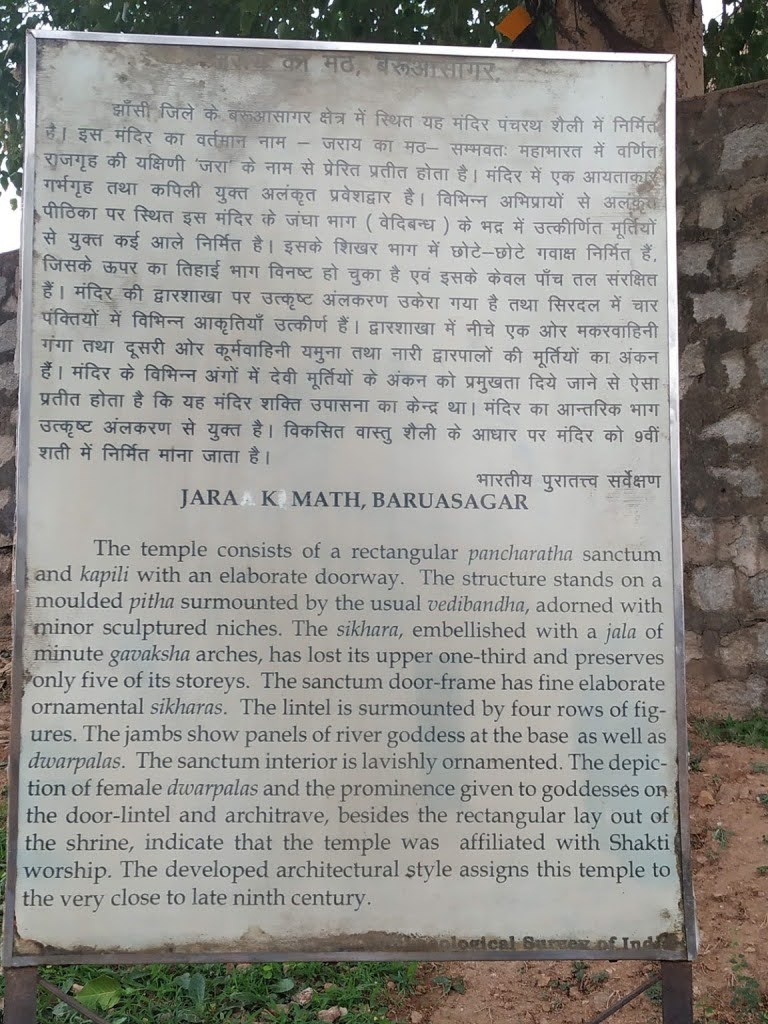

The Temple
For brief details, please refer below link;
https://hindutemples-india.blogspot.com/2023/04/jarai-ka-math-barua-sagar-temple.html
Connectivity
The temple is located at about 14 Kms from Orchha, 14 Kms from Jhansi Bus Stand, 16 Kms from Jhansi, 18 Kms from Jhansi Junction Railway Station, 49 Kms from Mauranipur and 128 Kms from Gwalior Airport. The temple is situated on Jhansi to Mauranipur route.
Jagannatha Temple, Behta Bujurg – The Temple
Jagannatha Temple, Behta Bujurg – The Temple
This temple is facing towards east and stands over a 10 feet tall raised platform. The platform is rectangular on plan. The temple measures 100 feet in length and 70 feet in breadth. The temple resembles like a Buddhist stupa. The temple appears like a chariot in the centre with lotus petalled shaped walls on the four corners. The pillar at the right side of the sanctum appears slender, circular and ordinary whereas the left side has intricately carved rectangular pillar in black stone.

.jpg)
The sanctum enshrines a seven-foot-tall image of Jagannatha flanked by Balabhadra and Subhadra. All the images are carved in the same rock. The images of Balabhadra and Subhadra are of two foot tall. The image is surrounded by a decorative structure with carvings of images of the ten incarnations of Lord Vishnu. It is to be noted that the idol stands atop the argha of the Linga. The discus mounted on the top of the temple is believed to be magnetic whose metal composition has not yet been identified.


Sculptures of Lakshmana and Lord Vishnu can be seen in the walls of the mandapa. There is a four feet tall lime stone image of Surya in the mandapa. The hands of the Surya are raised up to the shoulder. There is also a rare image of Panchmukhi Ganesha, made of lime stone. It is said that the idol has been stolen now. There is a sculpture of Lord Vishnu carved on a large block of stone depicting lord Vishnu in reclining posture on Sheshnaga in the temple premises.

.jpg)
There is an old well of about 100 feet deep can be seen in the temple premises. The temple is famous for its ability to accurately predict the monsoon in the region. It is said that water droplets start dripping from the monsoon stones present in the ceiling of the sanctum, seven days before the onset of the monsoon.
.jpg)

The quantum and size of the water droplets is an indication of the intensity of the rainfall expected. The larger the size and huge number of droplets predicts heavy rainfall in the region. The smaller size of droplets indicates less rainfall or a drought like condition. No water droplets indicate severe drought. It is said that the farmers in the region prepare their land and make necessary arrangements for sowing in accordance with this forecast only.

.jpg)
Jagannatha Temple, Behta Bujurg, Uttar Pradesh
Jagannatha Temple, Behta Bujurg, Uttar Pradesh
Jagannatha Temple is a Hindu Temple dedicated to Lord Vishnu, located in Behta Bujurg village in the Bhitargaon block in the Kanpur Nagar district in the state of Uttar Pradesh, India. The temple is famously called as the Rain Temple as the ceiling is said to drip water droplets seven days before the monsoon arrival. The temple is protected as monuments of national importance by the central Archaeological Survey of India.

.jpg)


History
The temple is believed to be built by Gupta Dynasty. The temple might have been renovated during the reign of the Emperor Harshavardhana of Vardhana Dynasty due to the presence of carvings of Chakra and peacock. The temple was finally renovated in the 11th century CE.


.jpg)

The Temple
For brief details, please refer below link;
https://hindutemples-india.blogspot.com/2023/04/jagannatha-temple-behta-bujurg-temple.html
Festivals
Lord Jagannath Rath Yatra is the most famous festival celebrated here. it is celebrated on the same day and with the same kind of rituals as the grand yatra in Puri Jagannath Temple.
Connectivity
The temple is located at about 4 Kms from Bhitargaon, 9 Kms from Patara Railway Station, 12 Kms from Ghatampur, 12 Kms from Ghatampur Bus Stand, 35 Kms from Kanpur and 113 Kms from Lucknow Airport. The temple is situated on Bhitargaon to Ghatampur route.
Karna Temple, Karanwas, Uttar Pradesh
Karna Temple, Karanwas, Uttar Pradesh
Karna Temple is a Hindu Temple dedicated to Karna, one of the main protagonists of the Hindu epic Mahabharata located in Karanwas Village in Debai Tehsil in the Bulandshahr District in the state of Uttar Pradesh, India. The temple is situated close to Kalyani Devi Temple on the banks of Ganga river.


Legends
As per legend, goddess Kalyani Devi of Karanwas was the favorite deity of Karna, one of the main protagonists of the Hindu epic Mahabharata. Karna used to offer oblations to the Ganga three times a day here. He used to donate 50 kg of gold every day to the brahmins and the poor. Thus, the place came to be called as Karanwas after Karna.

.jpg)

The Temple
The temple follows nagara style of architecture. The temple consists of sanctum and shallow porch. The sanctum enshrines an image of Karna. There is an ancient rock in the sanctum. It is believed that King Karna used to sit and donate 50 kg of gold daily to the poor.

.jpg)
.jpg)
Festivals
Navratri, Shivaratri, and Hanuman Jayanti are the festivals celebrated here with much fanfare.
Connectivity
The temple is located at about 6 Kms from Rajghat Narora Railway Station, 10 Kms from Narora, 11 Kms from Debai, 15 Kms from Anupshahar, 56 Kms from Bulandshahr, 119 Kms from Noida and 148 Kms from New Delhi Airport. The temple is situated on Anupshahar to Narora route.
Kalyani Devi Temple, Karanwas, Uttar Pradesh
Kalyani Devi Temple, Karanwas, Uttar Pradesh
Kalyani Devi Temple is a Hindu Temple dedicated to goddess Sakthi located in Karanwas Village in Debai Tehsil in the Bulandshahr District in the state of Uttar Pradesh, India. The temple is situated atop a small mound on the banks of the Ganga river.


Legends
Kalyani Devi of Karanwas:
As per legend, goddess Kalyani Devi of Karanwas was the favorite deity of Karna, one of the main protagonists of the Hindu epic Mahabharata. Karna used to offer oblations to the Ganga three times a day here. He used to donate 50 kg of gold every day to the brahmins and the poor sitting on a rock close to this temple.
Seth Bagla of Hathras was blessed with a son here:
As per legend, Seth Bagla of Hathras came here and worshipped goddess Kalyani Devi for a child. Pleased with his worship, goddess Kalyani Devi blessed him with a son. In gratitude, Seth Bagla reconstructed the temple.
Swami Dayanand Saraswathi performed meditation here:
As per legend, Swami Dayanand Saraswathi performed meditation here for a longer period.
History
The temple is believed to be built in 17th century CE amidst the ruins of a Kutcha fort by Kabir Shah, son of Rao Chandrabhanu Singh of Dodiya Kheda. Seth Bagla of Hathras reconstructed the temple in its current form in early 20th century CE.
The Temple
The temple enshrines an image of Kalyani Devi in its sanctum. She holds trishula, gada, chakra, shankha and madhu patra. There is an open courtyard for performing meditation by the devotees. There is a Yagasala in the temple premises. The foundation of an earlier brick-built temple and rare sculptures were found during the excavations conducted in the temple premises.
Festivals
Navaratri is the most famous festival celebrated here. Chaitra, Magha, and Shravan months are considered auspicious here.
Prayers
Devotees circumambulate goddess Kalyani Devi and draw a swastika on the wall of the temple with cow dung and pray for her blessings. People take holy bath in the Ganges and offer prayers to seek the blessings of goddess Kalyani Devi.
Connectivity
The temple is located at about 6 Kms from Rajghat Narora Railway Station, 10 Kms from Narora, 11 Kms from Debai, 15 Kms from Anupshahar, 56 Kms from Bulandshahr, 119 Kms from Noida and 148 Kms from New Delhi Airport. The temple is situated on Anupshahar to Narora route.
Dwadasha Jyotirlinga Temple, Karanwas, Uttar Pradesh
Dwadasha Jyotirlinga Temple, Karanwas, Uttar Pradesh
Dwadasha Jyotirlinga Temple is a Hindu Temple dedicated to Lord Shiva located in Karanwas Village in Debai Tehsil in the Bulandshahr District in the state of Uttar Pradesh, India. The temple is situated in Devatraya Ghat on the banks of the Ganga river.
.jpg)
Legends
As per legend, Sages, Siddhas and Yogis used to perform meditation at this place during ancient times.

The Temple
The temple complex consists of twelve shrines. All these shrines stands over a low raised platform. All these shrines consists of only sanctum and enshrines a Shiva Linga representing the Jyotirlingas. There is a main shrine dedicated to Shankar in the temple complex.

Connectivity
The temple is located at about 6 Kms from Rajghat Narora Railway Station, 10 Kms from Narora, 11 Kms from Debai, 15 Kms from Anupshahar, 56 Kms from Bulandshahr, 119 Kms from Noida and 148 Kms from New Delhi Airport. The temple is situated on Anupshahar to Narora route.
Kali Temple, Palpara, West Bengal
Kali Temple, Palpara, West Bengal
Kali Temple is a Hindu Temple dedicated to goddess Kali located in Palpara, an outskirt of Chakdaha Town in Kalyani subdivision of the Nadia district in the state of West Bengal, India. The temple is locally called as Moth Mandir and Kali Mandir. The temple is situated on the banks of Hooghly river.


History
The temple is believed to be built by Gandharba Roy in 17th century CE. The temple has been classified as a monument of national importance by the Archaeological Survey of India (ASI).

.jpg)
The Temple
This temple is facing towards south and stands over a raised platform. The temple follows charchala style of architecture (four sloped roofs meeting at a pinnacle). The temple is about 12 metres tall and enclosed within a compound wall. The temple is square on plan. The decorated arched entrance is flanked by two brick pillars on either side. The area above the arched entrance once contained intricately carved terracotta panels but only a few panels depicting scenes from Ramayana, geometric & floral design and lotus motif remains. There are lotus medallions of varying sizes at different places on the façade.

.jpg)
Festivals
Durga Pooja, Kali Pooja and Saraswathi Pooja are the festivals celebrated here with much fanfare.
Connectivity
The temple is located at about 500 metres from Palpara Railway Station, 3 Kms from Chakdaha, 3 Kms from Chakdaha Bus Stand, 3 Kms from Chakdaha Railway Station, 16 Kms from Ranaghat, 43 Kms from Krishnanagar, 56 Kms from Kolkata Airport and 66 Kms from Kolkata. Palpara is situated on the Sealdah - Krishnanagar railway line and can be reached in an hour and half by local train from Sealdah. Trains are frequently available from Sealdah.
Pathra Group of Temples – History
Pathra Group of Temples – History
Pathra was once an important gateway to the Tamralipta (now Tamluk), a flourishing port town during the golden era of Gupta period. Pathra was an important religious centre for Hindus, Jains and Buddhists from 8th century to 12th century CE. An idol of Vishnu Lokeshwar was excavated in this village in October 1961 revealed both Hindu and Buddhist influences, indicating that practitioners of both religions frequented Pathra.
Pathra once again came into prominence in 1732 CE, when Alivardi Khan, Nawab of Bengal appointed Bidyananda Ghoshal as the revenue collector of Ratnachawk Pargana. He constructed several temples in Pathra by utilizing the royal fund without any permission. He made Pathra a centre for Hindu pilgrimage. The nawab was not pleased with his works. He arrested Bidyananda Ghoshal for misusing the royal fund and sentenced him to death.
It is said that an elephant was brought to crush the head of Bidyananda Ghoshal, but the elephant refused to do so. The village got its name from this incident (Pathra from 'Paa-Utra' meaning survived from crushing due to withdrawal of elephant's foot). The Nawab was so overwhelmed with this incident, he pardoned him instantly and made him Subedar (revenue collector & administrator) of Ratanchawk Pargana and honoured him with the title Musamadar.
The Ghoshal family changed their surname to Majumdar after this incident and continued building temples till the end of the 18th century CE. Majumdar is said to have been derived from the word Musamadar. Later Bandopadhyay and Mukhopadhyay families were emerged from the original Zamindar (feudal lord) family and they also started constructing temples in Pathra.
Most of the temples in Pathra, primarily the cluster along the river, were built by Bidyananda Ghosal and his descendants. The decline started as the rich families shifted their base from the village and ignorant local residents started vandalizing the temples. Many of the structures were reduced to rubble.
Yeasin Pathan, a local Muslim resident of Pathra devoted his life for protecting the temples in Pathra. He formed an NGO, the Pathra Archaeological Preservation Committee (PAPC) in 1990 incorporating both Hindu and Muslim members which played an important role in strengthening the bond between these communities.
His efforts and lifelong struggle to save the temples were recognized by several awards including the Kabir Award for communal harmony from the President of India, in the year 2002. The Archaeological Survey of India has taken charge of 28 temples and has repaired 18 temples. Pathra Archeological Preservation Committee, a non-government organization, also looks after the structures.
Pathra Group of Temples – The Temples
Pathra Group of Temples – The Temples
The temples of Pathra can be classified into three complex, namely Navaratna Temple Complex, Kalachand Temple Complex and Bandopadhyay Temple Complex. Apart from these temple complexes, there are few individual temples namely Dharmaraj Temple, Shitala Temple, Durgeshwar Temple and Das Mahavidya Temple. Pathra also houses several ruined structures and dilapidated temples. The temples are dedicated to Lord Vishnu, Lord Shiva and Goddess Sakthi.
.jpg)
.jpg)
.jpg)
.jpg)

Most of the temples follow Bengal School of Architecture with Islamic influences. The terracotta sculptures from these temples depict the images of deities from Hindu pantheon, legends from Mahabharata & Ramayana, Dashavatar, Krishnalila, hunting scenes, Chaitanya, royal processions, social life, erotic scenes, floral motifs and geometrical patterns.
.jpg)

.jpg)
.jpg)

Navaratna Temple Complex:
The Navaratna Temple Complex consists of Navaratna Temple of Majumdar family, three square flat roofed Temples and one atchala brick-built Temple. This Temple Complex is situated opposite to the Kalachand Temple Complex. The Navaratna Temple is the only nine pinnacle temple of Pathra and the tallest of all the temples in the town.

.jpg)
This temple is believed to be built in 18th century CE by Majumdar family. This temple is facing towards west. The temple stands over a raised platform and can be entered via triple arched entrance. The façade of the entrance is richly decorated with terracotta ornamentation. The temple is about 55 feet tall and each of the nine ratna (pinnacle) are about 10 feet tall.
.jpg)

The exterior is richly decorated with terracotta panels depicting various legends from Puranas, Mahabharata and Ramayana. This temple complex also houses four flat roof Shiva temples. All these Shiva temples are rectangular in shape. It also has small decorative Tulsi Mancha. The temple complex also houses a small atchala temple built in 1816 CE.

.jpg)
Kalachand Temple Complex:
The temple complex is considered as the most elaborate of the temple complex in the Pathra village. The temple complex is situated on the northern side of the river embankment opposite to Navaratna Temple complex. It is situated on the left side of the pathway towards the Pathra village from Midnapore town. The major temple is a rectangular flat roofed structure (Dalan style of architecture) with decorative pillars supporting five arched gateways. The sanctum enshrines an image of Lakshmi Janardan / Kalachand.

.jpg)
.jpg)
The temple is devoid of terracotta decorations. There are three aatchala style (8 sloped roof) Shiva Temples and a Pancha Ratna (five pinnacle) style temple behind the temple complex. The dilapidated mansion of erstwhile Zamindar can be seen next to the three aatchala temples. The staircase of the mansion still exists and provide access to the roof. Apart from these structures, the complex also houses several ruined structures completely covered with vegetation.

.jpg)

Dharmaraja Temple:
This temple is facing towards south and situated on the northern bank of the Kansai river. This temple was built in the 19th century CE. The temple follows pancha ratna style of architecture. The temple has a square flat roof with curved cornices with a pinnacle at the centre flanked by four smaller pinnacles at the corner of the roof. The temple consists of sanctum and a verandah with triple arched entrances resting on columns.


The ceiling of the sanctum is dome shaped and above the verandah it is vaulted. The shikaras (pinnacles) follows rekha deula style. The main shikara is on saptaratha on plan while the corner shikaras are triratha on plan. The exterior is devoid of any terracotta ornamentation except the floral and geometrical stucco designs.
Durga Mandapa:
The Durga Mandapa is a rectangular roofless laterite structure fronted by a verandah. It is situated close to Kalachand Temple. This mandapa was the place of annual worship of Goddess Durga. The worship was discontinued for a longer period of time and after a gap of about 200 years puja (worship) has been started recently by the local people with the permission and participation of the descendants of the Zamindar family.
Shitala Temple:
The temple is famously called as Buri Maar Than. The temple is believed to be built in the 18th century CE. The temple is about 40 feet high and stands over a raised platform. The temple follows rekha deula style of architecture. It is the only deul style temple in Pathra. The temple is saptaratha on plan. The entrance door frame is slightly projected and is embellished with makara torana motif. The sanctum enshrines an image of Shitala, the family deity of Majumdar (Ghosal). There is a Kalasa on top of the shikhara. There is a ruined structure totally covered in vegetation next to the temple.
.jpg)

Raj Attalika:
Raj Attalika is a two storied structure (Mansion / Palace of erstwhile Zamindar). It is situated in front of the Rasmancha and next to the Durga Mandapa. The structure is in dilapidated condition and the roof has been completely collapsed and many portions of its walls are damaged. The staircase of the mansion still exists and provide access to the roof.

.jpg)
Bandopadhyay Temple Complex:
The temple complex was built by the Bandopadhyay family, another branch of the Zamindar family. The Temple complex consists of three Pancharatna Temples dedicated to Lord Shiva, Rasmancha, Kacharibari and two minor Shiva Temples. The three Pancharatna temples (five pinnacled) stands over a raised platform. The temples are decorated with rich terracotta ornamentation on their walls. Sculptures of Dvarapalas can be seen at the entrance of each temple.
.jpg)

Rasmancha:
The Rasamancha is an octagonal structure with nine pinnacles over its roof. The structure was built in 1832 CE by Bandyopadhyay family, another branch of the Zamindar family. The structure is situated beyond the Kalachand Temple complex and opposite to Raj Attalika.
.jpg)
Durgeshwar Temple:
This temple is situated at the northern end of the temple complex. the walls of the temple are decorated with images of incarnations of Lord Vishnu and erotic scenes. There are few inscriptions in this temple which includes its foundation inscription also.
Dasmahavidya Temple:
This temple was constructed by the Mukhopadhyay family, one of the branch of the Zamindar family. The temple is still in worship. The temple walls has beautiful terracotta panels depicting the goddesses Kali, Tara, Shodashi, Chinnamasta, Dhumabati, Durga, Bhubaneswari and Bhairavi.
Pathra Group of Temples, West Bengal
Pathra Group of Temples, West Bengal
Pathra Group of Temples are group of Hindu temples located in Pathra village in Midnapore Sadar CD block in the Medinipur Sadar subdivision of the Paschim Medinipur district in the state of West Bengal, India. The temples are dedicated to Lord Vishnu, Lord Shiva and Goddess Sakthi. The temples of Pathra can be classified into three complex, namely Navaratna Temple Complex, Kalachand Temple Complex and Bandopadhyay Temple Complex.
.jpg)
.jpg)


Apart from these temple complexes, there are few individual temples namely Dharmaraj Temple, Shitala Temple, Durgeshwar Temple and Das Mahavidya Temple. Pathra also houses several ruined structures and dilapidated temples. The temples are situated on the northern bank of the Kangsabati river. The temples are protected as monuments of national importance by the central Archaeological Survey of India.
.jpg)
.jpg)
.jpg)


History
For brief details, please refer below link;
https://hindutemples-india.blogspot.com/2023/04/pathra-group-of-temples-history.html
The Group of Temples
For brief details, please refer below link;
https://hindutemples-india.blogspot.com/2023/04/pathra-group-of-temples-temples.html
Connectivity
Pathra is located at about 12 Kms from Midnapore, 13 Kms from Midnapore Railway Station, 13 Kms from Midnapore Central Bus Stand, 25 Kms from Kharagpur, 136 Kms from Kolkata and 144 Kms from Kolkata Airport. Devotees need to travel from Kharagpur to Midnapore and take a right turn at Midnapore Khudiram Bose Park and travel for 9 Kms along the northern bank of the Kangsabati river to reach Pathra.

.JPG)

.jpg)

No comments:
Post a Comment
Note: Only a member of this blog may post a comment.