Newasa - Encountering an unique form of Vishnu, and Sant Jnaneshwar

The year was 1290. A crowd had gathered around a clearing, where broken down pillars marked the presence of an ancient temple, now long gone. A young boy, just 14 years old, leaned against one of those pillars, deep in thought. Then, he began speaking, and the crowd fell silent, listening to his every word. He spoke without any notes, translating the Bhagavat Gita, from Sanskrit, which only the pundits knew, to the language everyone in the village knew and spoke – a variety of Prakrit which developed into the Marathi language. Even as he spoke, one of the men in the audience realized how momentous this event was, and how important this composition would be. He began writing down the words the young boy spoke, and this composition was named by its author and composer, the Bhavartha Deepika – the enlightening meaning (of the Bhagavat Gita). Now, the ancient, holy text, was no longer restricted to the pundits, but accessible to all, understood easily by them, composed as it was, in their native language.
The young boy was none other than Sant Jnaneshwar (or Dnyaneshwar), and the text, his magnum opus, came to be known as the Jnaneshwari.
The sacred site where this event occurred is the present day Newasa, on the banks of the Pravara river, in Ahmednagar district of Maharashtra.
I was fortunate to visit this sacred site over the past weekend, on a trip to Shirdi. It all began a couple of months back, when Shankar’s friends got an opportunity to sing bhajans in Shirdi, in front of the Lord. They had sung bhajans at Shirdi before, and Shankar had attended a couple of times, but I hadn’t been blessed enough to join them. This year, despite a number of challenges, I booked the tickets, and prayed that nothing would come in the way. We planned a relaxed trip of three full days, not wanting to strain myself unduly. The first day was for our darshan of the Lord, the second for the bhajan. What about the third day then? The desire to go somewhere I hadn’t visited earlier, grew in my heart, and I set to looking around Shirdi for interesting places I could visit. Newasa propped up quite quickly, as an archaeological site, as well as the site of the composition of the Jnaneshwari, and I was hooked. A little further search revealed the presence of an ancient temple there, and that was it. We finalized the plan, hunted out a phone number for the temple, made arrangements for a puja at the temple, and waited for the date of our journey to arrive.
We travelled to Shirdi by the Vande Bharat train, checked into our hotel, and proceeded to set our travel plan into action. One darshan in the early evening, followed by the Shej aarti at night, and then the Kakad aarti the next morning – we were in bliss, especially since crowds weren’t as heavy as we had expected. We had the entire Saturday afternoon to rest and catch up on our sleep, before heading back to the temple for the bhajans. This was simply two hours in heaven, sunk as we were in the name of the Lord. The experience of sitting in the enclosure right opposite the Lord, listening to, and singing along with, the group, the visiting devotees joining in, repeating and clapping in tune with the bhajans, will remain one of my happiest memories forever. This is the same group that I travelled with, to Pandharpur and Vaishnodevi, so I already knew they were great singers, but they surpassed themselves this time. Bhajans were followed by darshan once again, and the memorable day ended on a high note.
On Sunday morning, we headed out to Newasa after breakfast. Our first halt was at the temple, which is dedicated to a unique form of Lord Vishnu – Mohini. The Lord is said to have taken the form of Mohini – the enchantress, at the time of the churning of the ocean (Sagar Manthan), to ensure that the gods got their share of the nectar (amrit) which came out of the ocean. The legend goes on to say that two demons, Rahu and Ketu tried to get their hands on the nectar, and were killed by Mohini. It is believed that this is the site where Mohini killed Rahu with the Sudarshana Chakra, and hence the Lord is seen here in an enchanting feminine form, with Rahu by his feet.
 |
| The Mohiniraj Temple, Newasa |
 |
| Lord Vishnu as Mohini (left) and Lakshmi (right) in the sanctum |
I was intrigued by this, and very curious to see the idol, which, as I anticipated, was covered by clothes and flowers, no detail visible. Hence, I had planned to attend the temple at the time of the abhishek, which, I thought would be the perfect opportunity to see the idol as it was, without the decorations. I had found a number online and spoken to a priest, who had told me that the abhishek would start around 10 AM. Unfortunately, we got a bit delayed, and reached just after it began. I was disappointed to see that there was no sign of abhishek to the main deity, and instead people were gathered in the small area just outside the garbagruha (the main shrine). Confused, I spoke to the priest whom I had communicated with earlier, and he explained that the abhishek would be done, not to the main deity, but only to a silver replica of the deity. This replica had been made a few years back, exactly duplicating the idol, since the ancient idol was getting eroded. Further, he said that this was just the first batch, and that we could join the second batch of abhishek. However, only gents could do the abhishek, so only Shankar could go in. Further, he had to take a bath, and wear a dhoti and angavastra, both of which were provided by the temple.
Having done the needful, we settled down to wait. The temple was way more crowded than I had expected, probably because it was a Sunday. There was a constant stream of visitors, from all across the state. We learnt that, for many, this was their kula deivat, their family deity, and others were drawn here for getting some respite from Rahu dosham. We also learnt that special prayers are offered for people with the dosham, during the period of Rahu kalam every day (a certain period in the day when Rahu is at his peak).
We stayed at the temple for over two hours – one hour as the first round of abhishekam took place, and then one hour of our round of abhishekam. All through this time, I watched people come and go, and offer a variety of pujas and offerings. The temple staff were curious about us, since we seemed the only obviously non-Maharashtrian family in attendance. Further, we weren’t there for any respite from Rahu dosham either. It was obvious that the temple has a steady stream of regular visitors and not many explorers like us! It was quite amusing to see the temple authorities try to wrap their head around the fact that a strange Tamil speaking family would want to come and do an abhishek here for no reason!
Finally, abhishek completed, we moved on to our next destination in the village – the site where the Jnaneshwari was composed.
The site is a little outside the village, in what seems to be quite a huge clearing. There is a temple built around the pillar that Jnaneshwar leaned against as he composed his magnum opus. A board at the site informed us that there was once an ancient temple of Karaveereshwar at this site. From the name, it appears that it might have been a temple of Shiva. At the time that Jnaneshwar came here, the temple was already gone, only a few pillars remained, strewed around the site. Jnaneshwar, his brothers and sister came here on their way back from Paithan to Alandi, having convinced the priests of Paithan of their abilities. Their fame spread as they travelled, and they decided to halt for some time at Newasa. While here, Jnaneshwar performed a miracle, raising a man thought to be dead. While staying here, he was inspired to compose the Bhavartha Deepika, his translation of the Bhagavad Gita, at the tender age of 14 years, leaning against one of the pillars of the ancient temple. It was the man he had raised from the dead, named Sachidananda, who wrote down the composition as he recited it.

Today, the temple stands in the middle of the huge clearing, part of which has been made into a garden with a towering statue of Jnaneshwar composing the Jnaneshwari, his disciple writing it down.

The temple has the pillar in the central shrine, along with other shrines, to Jnaneshwar as well as other deities.

Copies of the Jnaneshwari in Marathi are available for sale here.
It is a peaceful site, with few visitors. There is also a temple to Dattatreya, and also a small pathashala, teaching the varkari system to children. As we walked out, seeing the children run around and play during their lunch break was a happy sight. It was reassuring to see that something that began over 700 years back, was still kept alive in this tiny corner of Maharashtra.
We spent a little time, just sitting here, before turning back for Shirdi and home. But I took back with me, this vivid image in my mind, of the young boy leaning against an ancient pillar and composing what would become one of the greatest literary works in Marathi, one that endures more than seven centuries after him.
Prashanti Nilayam - Abode of Supreme Peace
Today, Prashanti Nilayam, his ashram is truly an abode of supreme peace, embodying the ideals he propagates, and attracts millions of people from every remote corner of the world. While once, years back, swami sat on the sands and spoke to his friends and the few who followed him about life and how to make it worthwhile, today, as he sits on his wheelchair and discourses in the beautifully decorated Kulwant Hall, we have to crane our necks to get a better glimpse of him.
While I am a comparatively new entrant into the fold, my genes did show the way, for my grandfather had a deep respect for Baba. My in-laws, however, have a much stronger bond with Him, for they have been his devotees for the last 3 generations, Samhith being the fourth. My husband escapes there as and when he has the chance, and comes back much more relaxed and happier than ever. It is almost like a second home for him – he studied in the college there…… now Samhith follows in his footsteps, wanting to bunk school and go along with him!
When our trip plans changed, and we were unable to get tickets to return to Bombay from Tiruppur, we found that a few tickets were available to Puttaparthi, and jumped at the chance to have darshan of Swami. Earlier, we had to make the journey to Puttaparthi from either Bangalore (120 Kms) or from Dharmavaram (40Kms). Today, the Sai Prashanti Nilayam Railway station is the nearest to the ashram (8 Kms), and has made travel much easier. There are also plenty of buses available from Bangalore and Chennai. There are also special trains running from Bangalore and Chennai. Many trains passing via Dharmavaram from Delhi and other states have been diverted to include Prashanti in their route.
There are also plenty of options for accommodation. While the ashram accommodation is certainly the best, it is also much in demand, and during festivals and crowded times, it is difficult to get rooms. There are, however, plenty of hotels and lodges outside the ashram, catering to all budgets.
Once at the ashram, your day is packed with activities. The day is greeted with Aumkaram (Chanting of Om) at 5:20AM, followed by the chanting of the Vedas and Nagar Sankeertanam (singing of bhajans while walking around the ashram). This is followed by darshan of Baba, when he comes to the Kulwant hall and gives interviews to the chosen few, and blesses the others by his presence. Earlier, this used to be early in the morning, and Baba used to walk around, talking to people as he moved among the rows and rows of people waiting for him, but today, age has taken a toll (He is now 83), and he comes in a wheelchair, and doesn’t mingle with the crowd, going straight to the dais where he sits for a while – sometimes a few minutes, sometimes as long as a couple of hours. This is followed by bhajans at 9:00AM, brought to an end by the Aarti at 9:30AM
A similar darshan takes place in the evenings (these days between 3 and 4 PM), followed by bhajans at 5:00PM and aarti at 5:30PM.
In between this, there are lots of things to do – there are lectures and discussions on spiritual topics, there are study circles, there is a library open to all, there is a shopping centre and book stall where one can spend hours and get stuff for a steal (all goods are at subsidized rates – these are actually meant for the ashram residents, most of whom are volunteers, but all visitors are free to make use of the bargains!)
There are also lots of places to see – places connected with Baba’s birth and childhood, with incidents which took place after he proclaimed himself to be an incarnation of Shirdi Baba. Baba’s personal elephant is Samhith’s favourite – he wants to see her at least once every time!
If you still have time, you can wander around, looking at the beautiful and up-to-date colleges, hostels and hospitals that Baba has built, in what was once a one-horse town! You will find it hard to believe, but all these are run free of cost! At specific times, you are even allowed inside the hospital and the newly constructed Indoor Sports Complex. It is a fascinating tour!
There are, of course, a few restrictions – the whole ashram is run on the concept of segregation of sexes. While, of course, a family can live together inside the ashram, men and women have to go for all activities separately, including darshan and food (yes, there are canteens catering to every kind of palate, all extremely subsidized). Another issue is that of silence. Since the darshan time is not certain, we have to wait in the hall for quite a while, sometimes hours, and it is a rule to keep silent during the whole time. It is not an easy task, and there are hundreds of volunteers, whose sole task is to keep the crowd quiet and controlled. At times, I feel sorry for them! Anyone who reads my blogs would know that my son is certainly not one to keep quiet, but surprisingly, this is the only place on earth that he sits still for hours at a time. We have been taking him to Parthi since he was just 6 months old, and not once has he caused anyone to reprimand us! This will give you an idea of the kind of atmosphere the place has- one of peace and tranquility, as the name suggests. To me, that is the greatest attraction this ashram has to offer – for every time I go there, I find myself at peace, relaxed, and ready to face the world when I get back!
I shall not waste words writing more about Baba or about the ashram, for there are plenty of websites giving all the information. Here are links to a few of them –
The Sathya Sai Central Trust: http://www.srisathyasai.org.in/
Radio Sai Global Harmony: http://www.radiosai.org/
Sathya Sai Books and Publication Trust: http://sssbpt.org/
If anyone has any questions about Prashanti Nilayam, I will be too happy to answer. Leave a comment with your e-mail address, or send me a mail here.
I apologize for having no photographs of Puttaparthi to attract you with. Cameras are not allowed, nor are mobiles, for that matter. One is allowed for darshan with only a small purse with nothing but money and keys… no water or foodstuffs, or handbags. Only those with small children are allowed to carry some water/milk and biscuits for the children.
Tirupati Part 1 - Some Temples around Tirupati
My mom and aunt had been planning a trip to Tirupati to perform certain sevas (religious rituals), for almost a year. At the beginning of this year, they finalised the dates and asked me to join. I wasn’t sure if I would be able to join them, since the dates clashed with my summer plans. By the time I decided to join them, tickets weren’t available. I only managed to get a return ticket to Bombay, but didn’t have tickets to go to Tirupati. I, however, have a firm faith in the lord, and decided that if he wanted me to come, he would provide me with the means to reach his abode, and set out for my holidays. As it turned out, we weren’t able to leave on the decided dates, and had to postpone our trip by a few days. Then we found that tickets were available for Tiruppur on the dates we wanted, and I decided to spend a few days with my sister-in-law there. Eventually, we decided to go to Puttaparthi and have darshan of Sri Sathya Sai Baba, and then head to Tirupati from there.
There are frequent buses from Puttaparthi to Tirupati, about eight buses a day. There are also a variety of buses, ranging from the usual ones to the so-called ‘Super Luxury’ buses. All the buses take around 8 to 9 hours to reach Tirupati, and most of them are day ones. There are only a couple which run at night, and these are the more expensive ones – the super luxury buses. Samhith was expecting a Volvo, but I told him to keep his expectations low, as they certainly wouldn’t be as comfortable as Volvos, and it was a good thing I restrained his expectations (and mine), for the bus turned out to be anything but luxury – forget ‘super luxury’!!!! The nomenclature apparently only meant that the normal seats had been replaced by push-back ones, and only reserved passengers were to be taken on board. Reality: the seats were bad, dirty, and uncomfortable…… and yes, even the unreserved managed to buy tickets in black and get on! Advice: Don’t ever get on to the bus unless you just HAVE to! Try out the day buses (except in summer, of course). They are apparently not so bad, since there are fewer pretensions…..
Anyway, we reached Tirupati at day break and headed to the hotel where my mom, my aunt and her brother’s family had already checked in. quickly freshening up, we were ready for the hectic day that lay ahead of us.
There are a number of temples in and around Tirupati, which are all very interesting and beautiful. I have visited many of them at different times, and shall, sometime, write about them all. At the moment, I am restricting myself to those temples we visited on this trip.
Sorry guys, very few photographs, as I was made to leave my camera in the car before entering the temple complex.
Tiruchanur – Padmavati Temple
Home of the lord’s consort, Padmavati, it is a custom to visit this temple after having darshan of Lord Venkateswara. However, time, and our schedule being what it is like these days, we often bend the traditions to suit ourselves, and we chose to visit the goddess before going on to meet her husband.
The temple is a huge and beautiful one, and over the years I have noticed less and less of it as the temple has become more and more crowded! This time, the crowd was surely the largest I have ever seen. After all, summer holidays are when people from remote corners of India come to pay their respects and mark their attendance for the year!
The main deity is Padmavati – the consort of Lord Venkateswara. According to mythology, she is Vedavati, a pious lady who performed austerities to win the hand of Lord Vishnu. When Ravana tried to molest her, she cursed him that his downfall would be brought about by her. According to one version of the Ramayana, it is Vedavati who takes the place of Sita when Ravana kidnaps her, while Sita remains in the care of Agni’s wife. After the war, when Ravana is killed, Agni returns both Sita and Vedavati to Rama after the Agnipariksha episode, and asks him to accept both of them as his wives. Rama, who has taken a vow of monogamy, refuses, but promises Vedavati to marry her in the kaliyuga. It is believed that Vedavati re-incarnated as Padmavati, and got to marry the lord during his decent on earth as Lord Venkateswara.
She remains in her hometown at Tiruchanur, while her Lord takes his abode on the seven hills, blessing the people who visit Him, and with their offerings, repaying the huge loan He took from Kubera, the lord of wealth, for His marriage. It is for this reason that a trip to Tirupati is incomplete without a visit to Tiruchanur, just 5 Kms away from Tirupati.
There are a couple of other smaller shrines in the temple – Balarama Swamy Krishna – no, not Balarama, but only Krishna – the lord of Balarama – and Sundara Raja Perumal. During recent visits, only the main shrine used to be packed to capacity, but this time, we met a crowd at each and every shrine, and had to wait in a long queue every time. The special darshan ticket helped us bypass the queue to some extent, but we had to join the normal queue in the end. What certainly works better is the usual incentive – holding out money to one of the numerous temple employees – it works like a charm!
Srinivasa Mangapuram
Srinivasa Mangapuram, about 12 Kms from Tirupati, has a beautiful temple of Kalyana Venkatramana Swamy. It is believed that the lord stayed here for a while after his marriage to Padmavati. When I first visited the temple, it was quite desolate, but now, it has been renovated, and again, there was quite a crowd there too……
Agasteeswarar temple
Most of the temples in and around Tirupati are, by default, related to the many legends about lord Venkateswara. This temple is also one of them, though the temple owes its origin to Sage Agasthya, who had his hermitage at this place long before the lord arrived here. The lord apparently arrived here after his marriage, and stayed at the ashram for 6 months. It is a popular belief that one does not climb a mountain just after marriage, and the lord couldn’t return to his home on the summit, so he chose to spend his time in this ashram.

The temple here, as the name suggests, is dedicated to lord Shiva as Agasteeswarar, the lord of Agasthya. The temple is a beautiful one, situated on the banks of the Swarnamukhi River. It must be really picturesque in the monsoons, but was completely dry since the summer was at its peak. The temple has the main sanctum dedicated to Shiva, with a smaller sanctum on the right for the Devi. On the outer prakaram are many smaller sanctums, dedicated to the navagrahas, Kamakshi and other forms of the Devi.
There is a small mandapam in the middle of the river which houses an interesting thing – there is a sort of footprint (if you can call it that), believed to be that of Lord Vishnu. Incidentally, this temple is the Kula deivam (family deity) of my aunt, and she says that the footprint looked quite natural when she used to come here as a child. Now, with all the attention drawn towards temples with the many magazines (and bloggers like me….) writing about temples and encouraging people to visit them, it has undergone some renovation, and has been well covered with concrete at the edges, making it look man-made. There is a small figurine of the lord inside this, which looks more authentic! There is also a statue with the front showing Lord Shiva and Lord Vishnu at the back. There was a lone priest sitting there, and he tried to convince us that the statue dated back to the days when the lord roamed around these places, but we weren’t buying that!!!! Recently, a few other statues of Ayyappan and some other deities have also been installed there….. It probably helps the priest to get a few more rupees every day!!!!!
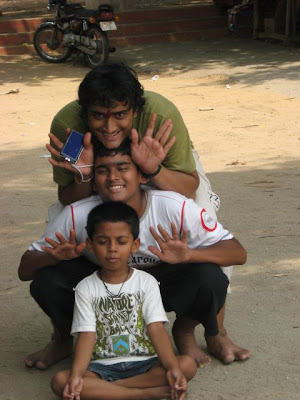
Meanwhile, here is Samhith with my cousins – all of them having a blast!!!
Govindaraja Perumal Temple
According to custom, this is the first temple to be visited during a pilgrimage to Tirupati. Govindaraja Perumal is also another form of the same lord, but he is considered the elder brother of lord Venkateswara, and it is considered respectful to visit him first. While I have visited Tirupati many times, I made the proper circuit only once. (Incidentally, for those who don’t know, the correct order of visiting the main temples is - Govindaraja Perumal, Varaha Swamy, Sri Venkateswara Swamy and finally Padmavati Amman.)
This is a huge temple, probably the biggest in the area, and has many sub-sanctums apart from the main one. I have never yet been all over the temple due to lack of time, but this time, we at least managed to see the main deities. Hopefully, someday I shall be able to visit the temple at leisure….. It is worth it!!
The main sanctum has Govindaraja Swamy in sleeping posture with Lord Brahma on the lotus coming out of the navel, Sridevi and Bhudevi at His feet. An interesting addition to this scene is the presence of Madhu and Kaitabha, the twin asuras who came out of the ear-wax of the lord and attempted to eat up Lord Brahma.
The next sanctum is that of Parthasarathy – Krishna, when he acted as the charioteer of Arjuna (Partha). Here, he is in sitting posture with his consorts Rukmini and Satyabhama on either side.
The next sanctum has Kalyana Venkatramana Swamy – in standing posture, looking almost exactly like the Venkateswara Swamy in the main temple.
Thus, this temple has an interesting array of deities – Lord Vishnu in 3 postures – sleeping, sitting and standing – all in one temple, and within the same prakaram. There are few other temples with a similar situation – to my knowledge, the temple at Tiruneer Malai at Pallavaram near Chennai has the lord in all 3 postures, but at different levels, and the temple at Thiruvallikeni(Triplicane) in Chennai has the lord in these postures in different prakarams. This however seems to be the only temple with the lord in the 3 postures within the same prakaram. If any of you have any more information about similar temples, I would love to here from you. Please send me a mail here.
The only sanctum dedicated to a goddess in the main prakaram is that of Andal, the foremost devotee of the lord.
In the outer prakaram are the other sanctums – the first being that of Pundareeka Valli Thayar – the wife of Govindaraja Perumal, followed by that of Sri Ramanujar. The other deities are Koorathalwar and Chakrathalwar, as well as other devotees of the lord.
The temple is huge, and it is quite a distance from the main entrance to the temple. Along the route from the gopuram to the temple, the pillared hall is filled with shops selling puja articles and articles made of wood. Walking along this hall, one can see beautiful wooden dolls, utensils and toys, all of them beckoning you to buy them and carry them home with you. This is a better place to buy wooden things, even better than the stalls outside the main temple on the hill. You not only get a variety of articles, even the price is lesser here. In our family, during navaratri, we keep wooden dolls in the golu, called marapachi, which are traditionally brought here. Go on, start your own collection…. And look out for a blog on mine later on…..
Meanwhile, for those of you who are unaware of the legends connected to Tirupati, and have trouble following the many stories mentioned here, look out for a post on the legends themselves. Samhith has been asking why I am not writing about the story of the temple, and I think it is a good idea to write it down.
Tirupati Part 2
Meanwhile, here is a photoblog of our Tirupati trip-
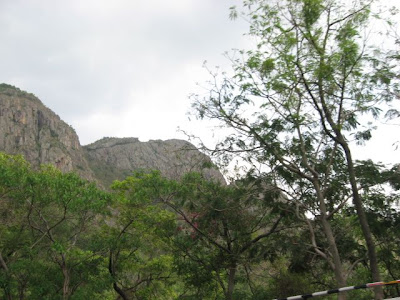
Here are the seven hills as seen from the car as we were going up the mountain......
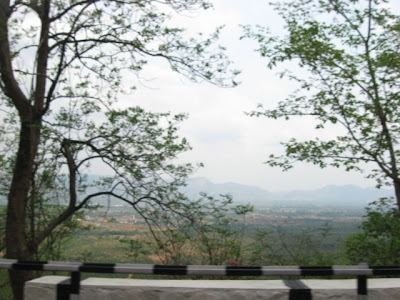 |
| From May 2009 Vacation -2 |
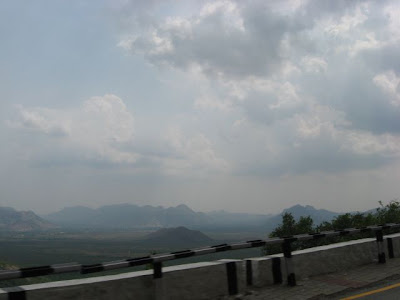
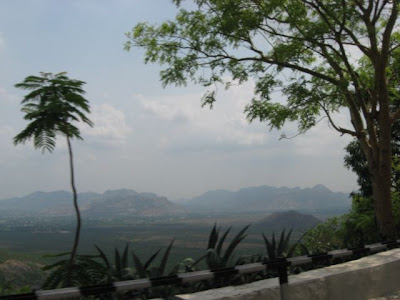
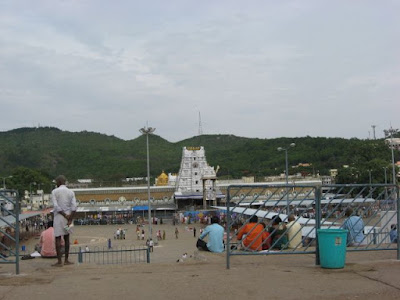
The next pictures of the temple were taken from the steps opposite the temple. Cameras are not allowed in the temple, and most of the time we left our cameras behind in the room, even when we went for meals. On the last day, I made a special trip to the steps outside the temple to get these pics.....
The main entrance of the temple....
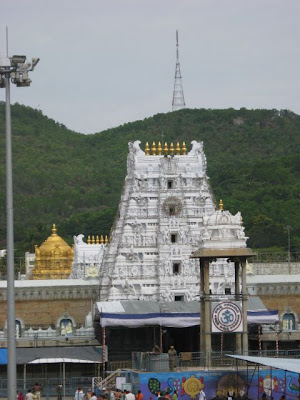
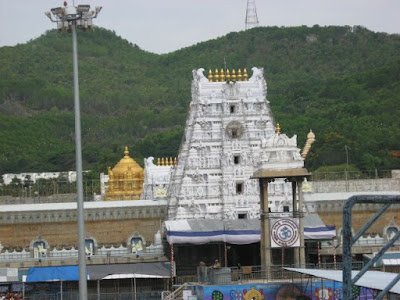
A Closer view of the 3 gopurams
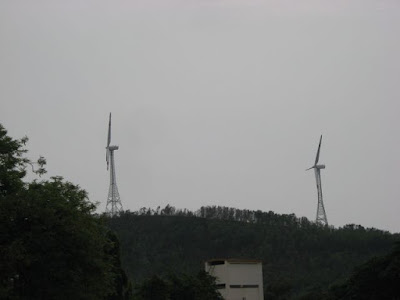
Windmills - always a big attraction for kids.... i remember this was the first place i saw a windmill... i was then in school, and we stopped on the way so that I could stare at them a while longer... now Samhith does the same.....
The food court- the lane opposite the one leading to the temple is full of foodstalls - their pongal is awesome!!!
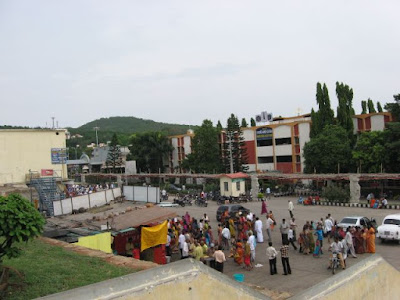
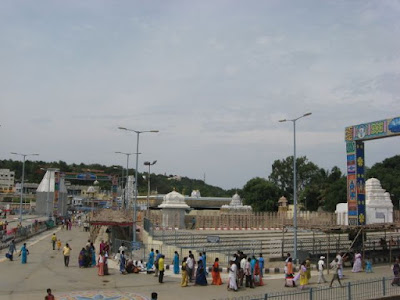
Roads have been widened all around the temple..
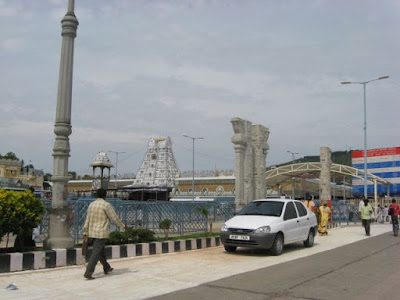
Devotees returning from darshan of the Lord
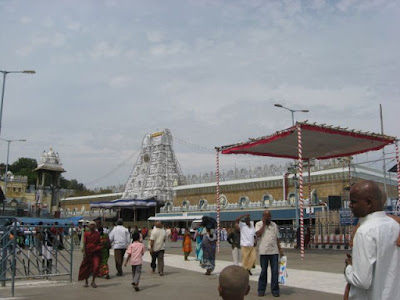
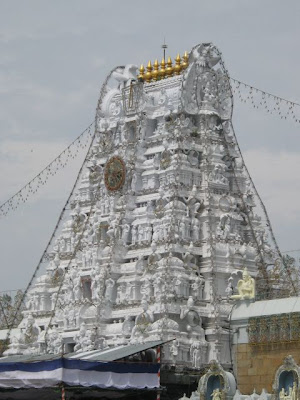
A closer look at the Gopuram - this was the nearest I could get to the Gopuram with my camera.....
The temple and the Pushkarini - the tank
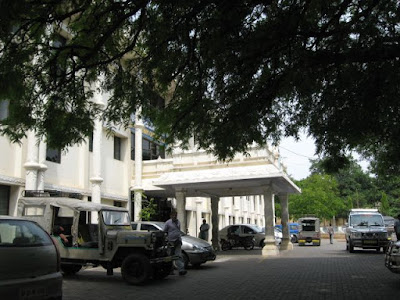
The Varaha Swamy Guest House - this is where we stayed... at Rs.100 per room per night, it was just great!
Samhith has been to so many temples since he was born, and has been hearing so many stories from Indian mythology; he loves to hear the stories of the temples he visits. At Tirupati, the prakaram surrounding the main sanctum has panels depicted the story of lord Venkateswara. He refused to leave the temple till I had read out each and every one of them! Then, he made me repeat the story to him again and again till he had the story firmly fixed in his mind. I told him the story so many times that I decided to write it down. So, coming up next are a series of posts where I shall relate the story of Sri Venkateswara or Srinivasa, as he is popularly known.

Comments
The Legend of Sri Venkateswara Part 1 - The Lord descends on Earth
The Legend of Sri Venkateswara Part 2- The Lord finds a mother.. and a wife too......
Please read the first part of the story before going further - Part 1 - The Lord descends on Earth
A lady named Vakula Devi attended to Varaha Swamy at his shrine. The arrival of the lord incited her maternal instincts, and she cared for him and nursed him back to good health. It was she who gave him the name – Srinivasa – the name by which He is now well known in this age.
कणखर सौंदर्याला भक्तीचा साज
Updated on:
ओंकार वर्तले-ovartale@gmail.com
मराठेशाहीतील पराक्रमी सरदार खंडेराव दाभाडे यांना इनामात मिळालेलं ‘तळेगाव’. त्यामुळेच या नावाचं ‘तळेगाव दाभाडे’ असं नामकरण लोकांच्या मुखी झालं. मावळ तालुक्यातील एक महत्त्वाचं शहर... तसंच मुंबई-पुणे या दोन शहरांदरम्यानच्या रस्ते आणि लोहमार्ग या दोहोंवरील मध्यभागी महत्त्वाचा थांबा असलेलं आवडीचं ठिकाण. तळेगावच्या वेशीवरून आपण जुन्या महामार्गाद्वारे बऱ्याचदा जात असतो. त्या वेळी तळेगावची भौगोलिक ओळख असलेली दोन तळी आपलं लक्ष वेधून घेतात. तळेगावला ओळखण्याची ही महत्त्वाची खूण. या तळेगावात इतिहासाच्या चष्म्यातून पाहण्यासारखं बरंच काही आहे.
गो. नी. दांडेकर, डॉ. बाबासाहेब आंबेडकर यांनी वास्तव्य केलेली निवासस्थाने, महाराष्ट्राच्या औद्योगिक क्षेत्रात एकेकाळी भर घालणारा पैसाफंड काच कारखाना, शिक्षणमहर्षी अण्णासाहेब विजापूरकर यांनी उभी केलेली शिक्षणसंकुले... असं बरंच काही. आता काळाच्या ओघात नव्याने विकसित होऊ घातलेली औद्योगिक वसाहत, शैक्षणिक संकुले यामुळे जुन्या तळेगावचं रूप झपाट्याने पालटू लागलं आहे. एकेकाळी इतिहासात प्रसिद्ध असलेलं हे गाव आता शहरीकरणाकडे वेगाने वाटचाल करू लागले आहे. तरीपण येथील काही ठिकाणे आणि स्थान मात्र अजूनही जुन्या काळाची साक्ष देत उभी आहेत. आडवाटेवर जाऊन काहीतरी वेगळं पाहायचं असेल तर तळेगाव दाभाडे निराश करणार नाही.
पाच पांडव मंदिर
‘पाच पांडव मंदिर’ हे नाव ऐकून आपण दचकतो. कारण गणपती, मारुती, विठोबा, रामराया, भवानी माता अशी मंदिरांची नावं ऐकायची सवय आपल्याला असते आणि त्यातच असं कधीही न ऐकलेल्या मंदिराचं नाव समोर येतं. खरंतर या पाच पांडव मंदिराचं वैशिष्ट्य येथेच संपत नाही. कारण हे मंदिर संपूर्ण भारतातील दुसरे आणि महाराष्ट्रातील एकमेव मंदिर असल्याची माहिती मिळते.
तळेगावला आलो की थेट चावडी चौक गाठायचा. या चावडीच्या मागेच नागरीवस्तीत सामावलेलं छोटेखानी मंदिर नजरेस पडते. साधारण साडेचार फूट उंचीच्या बैठ्या अवस्थेत असलेल्या पाच पांडवांच्या मूर्ती एकाशेजारी एक अशा एका ओळीत आहेत. डाव्या बाजूने सुरुवात केल्यास धर्मराज युधिष्ठिर, भीम, अर्जुन, नकुल, सहदेव अशा या मूर्ती पहिल्या खोलीत आहेत. धर्मराज युधिष्ठिर आणि भीम या दोन मूर्तींच्या मधोमध भिंतीला एक छोटीशी खिडकी दिसते. याच खिडकीतून आपल्याला द्रौपदीचे दर्शन होते; पण ही मूर्ती पूर्णपणे पाहण्यासाठी आपल्याला आतल्या खोलीत जावे लागते. आत गेलो की एका छोट्याशा चौथऱ्यावर द्रौपदी एका कुशीवर निजलेल्या अवस्थेत दिसून येते. या मंदिरात आलो की आपल्याला अनेक आख्यायिका ऐकवल्या जातात.
बनेश्वर मंदिर
छोटे बांधीव तळे (काही अभ्यासक याला पुष्कर्णीदेखील म्हणतात) नंदीमंडप, सभामंडप व गाभारा अशी या मंदिराची ढोबळ रचना आहे. या तळ्यावर पाणी उपसणाऱ्या मोटीसाठीची जागाही दिसून येते. या तळ्यातील पाणी शेतीसाठी बहुधा वापरले जात असण्याची शक्यता आहे; परंतु नंतरच्या काळात यातलं पाणी वापरण्याजोगे नसल्यामुळे या तळ्याला ‘नासके तळे’ असंही म्हटलं जायचं. या तळ्यात उतरण्यासाठी चहूबाजूंनी पायऱ्यादेखील दिसतात. हे तळे पाहून झाले की मग येतो नंदीमंडप. चार खांबांवर उभा असलेला हा संपूर्ण दगडात उभारला आहे. हा नंदीमंडप मुख्य मंदिराला न जोडता तो काहीसा अंतरावर उभारला आहे. यातील नंदीची मूर्ती तर त्याहूनही देखणी. रिवाजाप्रमाणे नंदीवर माथा टेकवून पूर्वाभिमुख असलेल्या बनेश्वर मंदिराच्या सभामंडपात प्रवेश करायचा.
संपूर्ण दगडात उभारल्या गेलेल्या या मंदिराची स्थापत्यरचना खूपच आकर्षक आहे. सभामंडपात एकूण १६ खांब असून यातील १२ खांब हे दगडी भिंतीत आणि प्रवेशद्वार यांच्या बांधणीत सामावलेले दिसतात व उरलेले चार खांब हे मधोमध पूर्णाकृती आहे. खांबावर विशेष नक्षीकाम जरी नसले तरी या खांबांना दिलेले चौकोनी आणि गोलाकार आकार मात्र पाहण्यासारखे आहेत. सभामंडपातील गाभाऱ्यासाठी असलेल्या प्रवेशद्वाराशेजारी दोन कोनाडी दिसतात. यामध्ये गणेश आणि हनुमानाच्या मूर्ती ठेवलेल्या दिसतात. सभामंडपापासून छोट्याशा प्रवेशद्वारातून आपण गाभाऱ्यात प्रवेश करतो. आतमध्ये खूपच सुंदर शिवपिंडी आहे. गाभाऱ्यातील धीरगंभीर वातावरण व थंडावा आवर्जून अनुभवावा असाच आहे. मंदिराच्या सभोवताली खूप झाडी
असून मंदिराशेजारीच सरदार खंडेराव दाभाडे यांची समाधीही दिसते. पराक्रमी सरदार खंडेराव दाभाडे यांच्या पत्नी असलेल्या उमाबाईंनी १७३२ मध्ये खान ए खान जोरावर खान बाबी याचा गुजरातेत जाऊन पराभव केला. एका महिला योद्ध्याची ही अतुलनीय कामगिरी पाहून छत्रपती शाहू महाराजांनी उमाबाईंना सोन्याचे तोडे, रत्नजडीत तलवार व मानाची वस्त्रे देऊन सन्मानित केले. या अशा योद्ध्याची समाधी बनेश्वर मंदिराच्या प्रवेशद्वाराजवळच दिसते.
घुमटाची विहीर
पराक्रमी सरदार खंडेराव दाभाडेंच्या काळात निर्मिली गेलेली आणि वास्तुस्थापत्याचा सुंदर आविष्कार असलेली ही विहीर खरंतर पर्यटनाच्या दृष्टीने दुर्लक्षित का राहिली, याचं आश्चर्यच वाटतं. विहिरीजवळच असणाऱ्या घुमटासारख्या वास्तूमुळे या विहिरीचं नाव ‘घुमटाची विहीर’ असं झालं, असं अभ्यासकांचं मत आहे. विहिरीचं बांधकाम घडीव दगडातच झालेलं आहे. विहिरीत उतरण्यासाठी पायऱ्यांचा मार्ग दिसतो. या विहिरीच्या आतील बाजूस मध्यभागी एक धक्का बांधलेला दिसतो. या विहिरीतच मध्यभागी दोन कमानी बांधलेल्या दिसतात. यावर शिलालेखही कोरलेला आहे. या विहिरीवर दोन मोटी चालायच्या. त्यांचे धक्केही दिसतात. इतिहासकारांच्या मते या मोटीद्वारे पाणी शेतीला पुरवले जाई. विहिरीच्या आत छोटे शिवमंदिरदेखील आहे. एका विहिरीच्या बांधणीत किती मुद्दे विचारात घेतले आहेत, हे पाहून आपण स्तंभित होतो.
बामणडोह
स्थानिकांमध्ये ही विहीर ‘बामणडोह’ म्हणून प्रसिद्ध आहे. शिवलिंगाच्या आकाराची ही विहीर ‘घुमटाच्या विहिरी’सारखीच सुंदर आहे. संपूर्ण दगडातच बांधलेल्या या विहिरीत उतरण्यासाठी पूर्वेकडून पायऱ्या आहेत. साधारण मध्यभागी आलो, की आश्चर्याचा धक्काच बसतो. तो म्हणजे विहिरीच्या आतमध्ये फिरण्यासाठी गवाक्षांचा अर्धवर्तुळाकार मार्ग आहे. विहिरीतून बाहेर आलो की विहिरीवर असलेल्या मोटेच्या धक्क्यापाशी यायचे. पाणी उपसण्यासाठी अशी बांधकामे महाराष्ट्रात बऱ्याच ठिकाणे आढळतात. ही वास्तू म्हणजे केवळ पाणी साठवण्याचे साधन नसून, ती एक ‘जलवास्तू’च असल्याचे भासते.

कुठल्याही गावाचे सांस्कृतिक वैभव हे तिथल्या प्राचीन मंदिराच्या अस्तित्वावरून ठरत असते. याचाच अर्थ असा की गावातली मंदिरे किंवा एखादी परंपरा खूपच प्राचीन असली तर त्या गावाची सांस्कृतिक ओळखही शेकडो वर्षापूर्वींची आहे, असे मानले जाते. मावळच्या वैभवात भर घालणारी अनेक मंदिरे आहेत. त्यातील एक आहे विठ्ठल मंदिर! हे ऐतिहासिक मंदिर आहे. जगद्गुरू तुकाराम महाराजांच्या कीर्तनाचा अद्भुत आणि श्रवणीय अनुभव या विठ्ठल मंदिराने घेतला होता. या मंदिराच्या समोरील सभामंडपात एकूण दहा पूर्णाकृती लाकडी खांब आहेत. या सभामंडपात वरच्या बाजूला जाण्याचा मार्ग आहे. अगदी वरूनसुद्धा या मंडपातील कार्यक्रम पाहता येईल, अशी व्यवस्था आहे. स्वतः तुकाराम महाराजांनी कितीतरी वेळा या विठ्ठल मंदिरात कीर्तन करून उपस्थित श्रोत्यांचे कान तृप्त केले होते. अशा तुकोबांच्या भक्तीचा महिमा पाहिलेल्या मूळ मंदिराची रचना अजूनही तशीच ठेवली असल्यामुळे हे मंदिर खूपच आकर्षक वाटते. हे ऐतिहासिक विठ्ठल मंदिर म्हणजे मावळच्या कणखर सौंदर्यावर भक्तीचा साज चढविणारे आहे. या वरील ठिकाणांव्यतिरिक्त अजून बरीच ठिकाणे पाहण्यासारखी आहेत. एक दिवसही अपुरा पडेल एवढं या तळेगावात फिरण्यासाठी आहे. त्यामुळेच एकदा तरी तळेगावचा ऐतिहासिक आणि वैभवसंपन्न वारसा असलेली ठिकाणे पाहण्यासाठी आपली पावले या गावात वळवलीच पाहिजेत.
वास्तुस्थापत्याचा सुंदर आविष्कार
Updated on:
- ओंकार वर्तले, ovartale@gmail.com
महाराष्ट्राच्या सीमेवर परंतु कर्नाटक राज्यात असलेले बेळगाव आणि मराठी माणसाचे अतूट असे नाते आहे. बेळगाव जिल्ह्यात मराठी टक्का तसा लक्षणीय आहे. त्यामुळे या भागात फिरताना अजिबात परके वाटत नाही. बेळगाव जिल्ह्यात पर्यटनाची अनेक ठिकाणे आहेत. अनेक मंदिरे पाहायला मिळतात. ऐतिहासिक ठिकाणांची रेलचेल आहे. याच पंक्तीत असणारे आणि जिल्ह्यातील कित्तूर गावचे नाव इतिहासकारांना अजिबात नवीन नाही. इतरांना मात्र ते तितकेसे ठाऊक नाही.
बेळगाव जिल्ह्यात पर्यटनाची अनेक ठिकाणे आहेत. अनेक मंदिरे पाहायला मिळतात. ऐतिहासिक ठिकाणांची रेलचेल आहे. याच पंक्तीत असणारे आणि जिल्ह्यातील कित्तूर आणि देगाव. या परिसरात वास्तुस्थापत्याचा सुंदर आविष्कार पाहायला मिळतो.
कित्तूरचे नाव घेताच आठवते ती राणी चेन्नम्मा. महाराष्ट्रात झाशीची राणी लक्ष्मीबाईंचे नाव जितक्या आदराने घेतले जाते, तितक्याच आदराने कर्नाटकात राणी चेन्नम्माचे नाव घेतले जाते. इंग्रजांविरुद्ध शस्त्र उचलत पराक्रम गाजवणारी स्त्री क्रांतिकारक चेन्नम्माविषयी भारतात फारशी माहिती नाही. इ. स. १८२४ मध्ये म्हणजेच इ. स. १८५७ मधील स्वातंत्र्यसंग्रामाच्याही ३३ वर्षे आधी एका स्त्रीने केलेला परकीय सत्तेविरुद्ध संघर्ष म्हणजे भारतीय इतिहासातील एक सोनेरी पान आहे. यासाठी कित्तूर गाठायलाच पाहिजे.
कित्तूर संस्थानचा राजा मल्लसर्जा याची पत्नी म्हणजे राणी चेन्नम्मा. या चेन्नम्माचा जन्म बेळगावजवळील काकती येथे झाला. या दोघांचा पुत्र अल्पायुषी ठरला. यानंतर लगेचच चेन्नम्मावर पती निधनाचं संकट कोसळलं. वैयक्तिक दुःख बाजूला सारून कित्तूरची गादी चालू राहावी म्हणून चेन्नम्माने एक मुलगा दत्तक घेतला, ताे वयाने लहान असल्यामुळे राणी चेन्नम्मा त्याच्या वतीने राज्यकारभार पाहू लागली.
ब्रिटिशांनी सदर दत्तक कृती ही बेकायदेशीर ठरवली आणि कित्तूर संस्थान खालसा करण्याचा प्रयत्न सुरू केला; पण राणीने मात्र याला विरोध केला. कित्तूर संस्थान छोटेसे आहे. आपण ते सहज जिंकू, असं ब्रिटिशांना वाटलं. म्हणूनच सैन्यासह ब्रिटिश कित्तूरवर चालून आले. त्याचवेळी राणी चेन्नम्मा तिच्या फौजेसह इंग्रजांच्या फौजेवर तुटून पडली. या युद्धात अनेक इंग्रज अधिकारी मारले गेले.
युद्धात ब्रिटिशांचा पराभव झाला. राणी चेन्नम्मा आणि किल्ला अजिंक्य ठरला. ही घटना १८२४ची. एका स्त्रीच्या हातून झालेला हा पराभव इंग्रजांना चांगलाच झोंबला. नंतर दगाबाजीने हा किल्ला ब्रिटिशांनी जिंकला आणि राणीला बेलहोंगलच्या किल्ल्यावर कैदेत ठेवण्यात आले. नंतर ती कैदेतच मरण पावली. स्त्री ही अबला नाही हे राणी चेन्नम्माने तिच्या कर्तृत्वाने, स्वपराक्रमाने दाखवून दिले. क्रांतीची ज्योत सर्व भारतीयांच्या मनात चेतवण्याची तिने केलेली कामगिरी अतुलनीय आहे.
राणी चेन्नम्माची कर्मभूमी म्हणजे कित्तूरचा भुईकोट किल्ला. या किल्ल्यास भेट देण्यासाठी आपल्याला कित्तूर शहर गाठावे लागते. बेळगाव ते कित्तूर हे अंतर ५० कि.मी. असून, बेळगावहून कित्तूरला जाण्यासाठी वाहनांची चांगली सोय आहे. किल्ला पाहायला जाताना कित्तूर शहराच्या मध्यभागी असलेल्या चौकात घोड्यावर स्वार असलेला राणी चेन्नम्माचा भव्य पुतळा पाहायला मिळतो. या पुतळ्याला वर्णन करूनच पुढे निघायचे.
इतिहास अभ्यासकांच्या मते किल्ला गौडा सरदेसाई यांनी सोळाव्या शतकात बांधला. हा किल्ला भुईकोट प्रकारात मोडतो. सध्या किल्ल्याची तटबंदी आता ढासळलेली पाहायला मिळते. मोठ्या प्रमाणात विखुरलेल्या या किल्ल्याच्या चारही बाजूस खंदक खोदलेला आहे. गडाच्या आत वस्तुसंग्रहालयसुद्धा उभारले आहे. हे संग्रहालय पाहण्यासारखे आहे.
सध्या किल्ल्यात राजवाड्याचे अवशेष पाहायला मिळतात आणि हेच किल्ल्याचे आकर्षण आहे. हा राजवाडा तीन मजली होता, ज्यामध्ये आत अनेक खोल्या होत्या. राजवाड्यातील खोल्यांमध्ये चर्चा कक्ष, पाहुण्यांसाठी कक्ष, अनेक शौचालये, पूजा कक्ष, भांडार कक्ष, अनेक स्वयंपाकघरे आणि स्नानगृहे आणि इतर विविध खोल्या होत्या. या साऱ्या इमारतींना नावाचे फलकही लावलेले दिसतात.
यातली एक वैशिष्ट्यपूर्ण गोष्ट म्हणजे पोल स्टार व्हिजन. या राजवाड्याबद्दल एक मनोरंजक गोष्ट अशी आहे की, त्यात एक प्राचीन दुर्बिण होती जी एका खास खोलीत ठेवली जात होती. ही खोली पोल स्टार व्हिजन रूम म्हणून ओळखली जात होती आणि राजवाड्यात राहणाऱ्या व्यक्ती दुर्बिणीच्या मदतीने पोल स्टार पाहण्यासाठी या दुर्बिणीचा वापर करायचे. याशिवाय राजवाड्यात एक भव्य दरबार हॉल किंवा कॉन्फरन्स हॉल होता.
दरबार हॉल, पाहुण्यांच्या खोल्या, जेवणाची खोली, स्टोअर रूम, स्वयंपाकघर इत्यादी खोल्या वास्तुशिल्पातील आविष्कार होते. राजवाड्यात पाणीपुरवठा करण्यासाठी भिंतींमध्ये बांधलेले पितळी पाइप वापरले जात होते. स्वयंपाकघरात चूल, चिमणी आणि वॉशबेसिन होते. राजवाड्यात पाणी साठवण्यासाठी विविध दगडी भांडे आणि टाक्या बांधण्यात आल्या होत्या. राजवाड्यात एक स्विमिंग पूलदेखील होता.
राजवाड्यासमोर एक सुंदर द्वार मंडप बांधण्यात आला होता. या मंडपाला उंच आणि सजवलेले खांब होते. राजवाड्याजवळ आणि किल्ल्याच्या आवारात एक वॉच टॉवर होता. सध्या या टॉवरवर जाता येत नाही.
कित्तूर किल्ला हा आता अवशेषांमधून पाहावा लागतो. राणी चेन्नम्मा हिची शौर्यभूमी असलेल्या या कित्तूरचे वेगळे स्थान भारतीय इतिहासात आहे. एका स्त्रीने इंग्रजांविरुद्ध दिलेला लढा हा भारतीय इतिहासात एक सोनेरी पान म्हणून लिहिला गेलाय. भटकंती करताना अशी ठिकाणे आवर्जून पाहिली पाहिजेत. बेळगावला अनेक पर्यटक येतच असतात; पण इथून अगदी जवळ असलेल्या कित्तूरकडे मात्र वळत नाहीत.
या कित्तूरजवळ आणखी एक भटकंतीचा बोनस दडला आहे. वास्तु-स्थापत्याचा सुंदर आविष्कार असलेले एक पाषाणातले मंदिर आपल्याला देगावजवळ पाहायला मिळते. कित्तूरपासून अवघ्या पाच किलोमीटर अंतरावर असलेल्या या ठिकाणाला भेट द्यायला मात्र विसरू नका.
कित्तूरजवळ अनेक पर्यटक येत असतात; पण देगाव या छोट्याशा गावात असणारे कमल नारायण स्वामी मंदिर मात्र बऱ्यापैकी दुर्लक्षित राहिले आहे. गोव्याच्या कदंब राजवटीत बांधले गेलेले हे मंदिर पाहताक्षणीच भुरळ पडणारे आहे. यासाठीच हजारो वर्षांपूर्वीची निर्मिती असलेली ही कलाकृती मात्र आपल्याला डोळ्याखालून घालावी लागतेच.
देगाव हे अतिशय छोटे गाव; पण मंदिराच्या कलाकृतीने श्रीमंत झालेले. ऐन मध्यवस्तीत असलेले मंदिर सध्या पुरातत्त्व खात्याच्या ताब्यात आहे. पूर्वाभिमुख असणाऱ्या या मदिराची रचना सभामंडप, गाभारा अशी असून, हे मंदिर दोन गर्भगृहांचे आहे. म्हणजेच द्विकुटाचल प्रकारचे आहे. फार कमी मंदिरात अशी रचना पाहायला मिळते.
ही दोन्ही गर्भगृह एका शेजारी एक सरळ रेषेत असून, दोन्हीस अर्ध मंडप आहेत. गर्भगृहाच्या चौकटीवर अत्यंत उत्कृष्ट दर्जाचे कलाकुसर काम केलेलं आहे. मुख्य मंडपाला नारंग मंडप म्हटले जाते. हा मंडप अतिशय भव्य असून, दोन्ही गर्भगृहासमोर एकसलग आहे. मंडपाचे वैशिष्ट्य म्हणजे हा मंडप तोलून धरलाय चाळीस अशा खांबांनी.
हे खांब म्हणजे कलाकुसरीत अतिशय चिंब असे भिजलेले पाहायला मिळतात. या दगडी खांबांच्या चार रांगांची रचनाही आपले डोळ्यांचे पारणे फेडते. यातल्या बाहेरील म्हणजे पूर्व दिशेला असणाऱ्या खांबांवर उतरत्या दगडी छ्परांचा आधार दिलेला आहे. ही रचनाही लांबून पाहण्यासारखी; पण यामुळे हे मंदिर काहीसे बसके वाटते.
याच मंडपात, दोन्ही गर्भगृहात प्रवेश करण्यासाठी दोन स्वतंत्र पूर्वाभिमुख मुख मंडप असून, त्याच्या मुखाशी दोन आडवे दगडी खांब आहेत. या प्रवेशद्वारास चौकटी दिसून येत नाहीत. दोन्ही गर्भगृहाच्या मधल्या भागात एक छोटेसे उप गर्भगृह असून, त्यात लक्ष्मी नारायणाची अतिशय देखणी मूर्ती आहे. एकंदरीतच तीन सुंदर मूर्ती आपल्याला पाहायला मिळतात. या मूर्ती शिव-पिंडीवर विराजमान आहेत.
या नवरंग मंडपाचे सर्वात मोठे वैशिष्ट्य म्हणजे तीन शिलालेख आपल्याला पाहायला मिळतात. या शिलालेखांचे संवर्धन काचेची तावदाने झाकून केलेले आहे. त्यामुळे याची पुढची झीज थांबली आहे. नवरंग मंडपातील कलाकुसर पाहताना आपले भान हरवून न गेले तरच नवल म्हणावे. जेवढे मंदिराचे अंतरंग सुंदर तेवढेच बाह्यरंगही देखणे आहे. दर्शनी भागावर अतिशय सुंदर शिल्प आहेत. कित्तूर आणि देगाव हा सारा परिसर अवघ्या एका दिवसात आरामात पाहून होतो.

.JPG)

.jpg)

Anu - It should have been very hot out there, the overcast skies are a little confusing though, was it raining !!
ReplyAnu, finally I can read your blog.. It works!! Yay!!
ReplyI've been to Tirupathi when I was little (years ago!!).. All I remember was the temple and the crowd! For some reason.. it was really crowded when we went.. .and there was lots of pushing... & bribery to enter the temple !! Which I wasnt particularly impressed with.. ie. My dad had to pay for us not to queue!! The food even then was awesome!!
Really. Its very good news and nice to hear. I am planning to go to tirupati in this season but i thought this is peak season. Now i got confidence to plan for tirupati trip. Thanks for sharing this nice information.