वास्तुस्थापत्याचा सुंदर आविष्कार
- ओंकार वर्तले, ovartale@gmail.com
महाराष्ट्राच्या सीमेवर परंतु कर्नाटक राज्यात असलेले बेळगाव आणि मराठी माणसाचे अतूट असे नाते आहे. बेळगाव जिल्ह्यात मराठी टक्का तसा लक्षणीय आहे. त्यामुळे या भागात फिरताना अजिबात परके वाटत नाही. बेळगाव जिल्ह्यात पर्यटनाची अनेक ठिकाणे आहेत. अनेक मंदिरे पाहायला मिळतात. ऐतिहासिक ठिकाणांची रेलचेल आहे. याच पंक्तीत असणारे आणि जिल्ह्यातील कित्तूर गावचे नाव इतिहासकारांना अजिबात नवीन नाही. इतरांना मात्र ते तितकेसे ठाऊक नाही.
बेळगाव जिल्ह्यात पर्यटनाची अनेक ठिकाणे आहेत. अनेक मंदिरे पाहायला मिळतात. ऐतिहासिक ठिकाणांची रेलचेल आहे. याच पंक्तीत असणारे आणि जिल्ह्यातील कित्तूर आणि देगाव. या परिसरात वास्तुस्थापत्याचा सुंदर आविष्कार पाहायला मिळतो.
कित्तूरचे नाव घेताच आठवते ती राणी चेन्नम्मा. महाराष्ट्रात झाशीची राणी लक्ष्मीबाईंचे नाव जितक्या आदराने घेतले जाते, तितक्याच आदराने कर्नाटकात राणी चेन्नम्माचे नाव घेतले जाते. इंग्रजांविरुद्ध शस्त्र उचलत पराक्रम गाजवणारी स्त्री क्रांतिकारक चेन्नम्माविषयी भारतात फारशी माहिती नाही. इ. स. १८२४ मध्ये म्हणजेच इ. स. १८५७ मधील स्वातंत्र्यसंग्रामाच्याही ३३ वर्षे आधी एका स्त्रीने केलेला परकीय सत्तेविरुद्ध संघर्ष म्हणजे भारतीय इतिहासातील एक सोनेरी पान आहे. यासाठी कित्तूर गाठायलाच पाहिजे.
कित्तूर संस्थानचा राजा मल्लसर्जा याची पत्नी म्हणजे राणी चेन्नम्मा. या चेन्नम्माचा जन्म बेळगावजवळील काकती येथे झाला. या दोघांचा पुत्र अल्पायुषी ठरला. यानंतर लगेचच चेन्नम्मावर पती निधनाचं संकट कोसळलं. वैयक्तिक दुःख बाजूला सारून कित्तूरची गादी चालू राहावी म्हणून चेन्नम्माने एक मुलगा दत्तक घेतला, ताे वयाने लहान असल्यामुळे राणी चेन्नम्मा त्याच्या वतीने राज्यकारभार पाहू लागली.
ब्रिटिशांनी सदर दत्तक कृती ही बेकायदेशीर ठरवली आणि कित्तूर संस्थान खालसा करण्याचा प्रयत्न सुरू केला; पण राणीने मात्र याला विरोध केला. कित्तूर संस्थान छोटेसे आहे. आपण ते सहज जिंकू, असं ब्रिटिशांना वाटलं. म्हणूनच सैन्यासह ब्रिटिश कित्तूरवर चालून आले. त्याचवेळी राणी चेन्नम्मा तिच्या फौजेसह इंग्रजांच्या फौजेवर तुटून पडली. या युद्धात अनेक इंग्रज अधिकारी मारले गेले.
युद्धात ब्रिटिशांचा पराभव झाला. राणी चेन्नम्मा आणि किल्ला अजिंक्य ठरला. ही घटना १८२४ची. एका स्त्रीच्या हातून झालेला हा पराभव इंग्रजांना चांगलाच झोंबला. नंतर दगाबाजीने हा किल्ला ब्रिटिशांनी जिंकला आणि राणीला बेलहोंगलच्या किल्ल्यावर कैदेत ठेवण्यात आले. नंतर ती कैदेतच मरण पावली. स्त्री ही अबला नाही हे राणी चेन्नम्माने तिच्या कर्तृत्वाने, स्वपराक्रमाने दाखवून दिले. क्रांतीची ज्योत सर्व भारतीयांच्या मनात चेतवण्याची तिने केलेली कामगिरी अतुलनीय आहे.
राणी चेन्नम्माची कर्मभूमी म्हणजे कित्तूरचा भुईकोट किल्ला. या किल्ल्यास भेट देण्यासाठी आपल्याला कित्तूर शहर गाठावे लागते. बेळगाव ते कित्तूर हे अंतर ५० कि.मी. असून, बेळगावहून कित्तूरला जाण्यासाठी वाहनांची चांगली सोय आहे. किल्ला पाहायला जाताना कित्तूर शहराच्या मध्यभागी असलेल्या चौकात घोड्यावर स्वार असलेला राणी चेन्नम्माचा भव्य पुतळा पाहायला मिळतो. या पुतळ्याला वर्णन करूनच पुढे निघायचे.
इतिहास अभ्यासकांच्या मते किल्ला गौडा सरदेसाई यांनी सोळाव्या शतकात बांधला. हा किल्ला भुईकोट प्रकारात मोडतो. सध्या किल्ल्याची तटबंदी आता ढासळलेली पाहायला मिळते. मोठ्या प्रमाणात विखुरलेल्या या किल्ल्याच्या चारही बाजूस खंदक खोदलेला आहे. गडाच्या आत वस्तुसंग्रहालयसुद्धा उभारले आहे. हे संग्रहालय पाहण्यासारखे आहे.
सध्या किल्ल्यात राजवाड्याचे अवशेष पाहायला मिळतात आणि हेच किल्ल्याचे आकर्षण आहे. हा राजवाडा तीन मजली होता, ज्यामध्ये आत अनेक खोल्या होत्या. राजवाड्यातील खोल्यांमध्ये चर्चा कक्ष, पाहुण्यांसाठी कक्ष, अनेक शौचालये, पूजा कक्ष, भांडार कक्ष, अनेक स्वयंपाकघरे आणि स्नानगृहे आणि इतर विविध खोल्या होत्या. या साऱ्या इमारतींना नावाचे फलकही लावलेले दिसतात.
यातली एक वैशिष्ट्यपूर्ण गोष्ट म्हणजे पोल स्टार व्हिजन. या राजवाड्याबद्दल एक मनोरंजक गोष्ट अशी आहे की, त्यात एक प्राचीन दुर्बिण होती जी एका खास खोलीत ठेवली जात होती. ही खोली पोल स्टार व्हिजन रूम म्हणून ओळखली जात होती आणि राजवाड्यात राहणाऱ्या व्यक्ती दुर्बिणीच्या मदतीने पोल स्टार पाहण्यासाठी या दुर्बिणीचा वापर करायचे. याशिवाय राजवाड्यात एक भव्य दरबार हॉल किंवा कॉन्फरन्स हॉल होता.
दरबार हॉल, पाहुण्यांच्या खोल्या, जेवणाची खोली, स्टोअर रूम, स्वयंपाकघर इत्यादी खोल्या वास्तुशिल्पातील आविष्कार होते. राजवाड्यात पाणीपुरवठा करण्यासाठी भिंतींमध्ये बांधलेले पितळी पाइप वापरले जात होते. स्वयंपाकघरात चूल, चिमणी आणि वॉशबेसिन होते. राजवाड्यात पाणी साठवण्यासाठी विविध दगडी भांडे आणि टाक्या बांधण्यात आल्या होत्या. राजवाड्यात एक स्विमिंग पूलदेखील होता.
राजवाड्यासमोर एक सुंदर द्वार मंडप बांधण्यात आला होता. या मंडपाला उंच आणि सजवलेले खांब होते. राजवाड्याजवळ आणि किल्ल्याच्या आवारात एक वॉच टॉवर होता. सध्या या टॉवरवर जाता येत नाही.
कित्तूर किल्ला हा आता अवशेषांमधून पाहावा लागतो. राणी चेन्नम्मा हिची शौर्यभूमी असलेल्या या कित्तूरचे वेगळे स्थान भारतीय इतिहासात आहे. एका स्त्रीने इंग्रजांविरुद्ध दिलेला लढा हा भारतीय इतिहासात एक सोनेरी पान म्हणून लिहिला गेलाय. भटकंती करताना अशी ठिकाणे आवर्जून पाहिली पाहिजेत. बेळगावला अनेक पर्यटक येतच असतात; पण इथून अगदी जवळ असलेल्या कित्तूरकडे मात्र वळत नाहीत.
या कित्तूरजवळ आणखी एक भटकंतीचा बोनस दडला आहे. वास्तु-स्थापत्याचा सुंदर आविष्कार असलेले एक पाषाणातले मंदिर आपल्याला देगावजवळ पाहायला मिळते. कित्तूरपासून अवघ्या पाच किलोमीटर अंतरावर असलेल्या या ठिकाणाला भेट द्यायला मात्र विसरू नका.
कित्तूरजवळ अनेक पर्यटक येत असतात; पण देगाव या छोट्याशा गावात असणारे कमल नारायण स्वामी मंदिर मात्र बऱ्यापैकी दुर्लक्षित राहिले आहे. गोव्याच्या कदंब राजवटीत बांधले गेलेले हे मंदिर पाहताक्षणीच भुरळ पडणारे आहे. यासाठीच हजारो वर्षांपूर्वीची निर्मिती असलेली ही कलाकृती मात्र आपल्याला डोळ्याखालून घालावी लागतेच.
देगाव हे अतिशय छोटे गाव; पण मंदिराच्या कलाकृतीने श्रीमंत झालेले. ऐन मध्यवस्तीत असलेले मंदिर सध्या पुरातत्त्व खात्याच्या ताब्यात आहे. पूर्वाभिमुख असणाऱ्या या मदिराची रचना सभामंडप, गाभारा अशी असून, हे मंदिर दोन गर्भगृहांचे आहे. म्हणजेच द्विकुटाचल प्रकारचे आहे. फार कमी मंदिरात अशी रचना पाहायला मिळते.
ही दोन्ही गर्भगृह एका शेजारी एक सरळ रेषेत असून, दोन्हीस अर्ध मंडप आहेत. गर्भगृहाच्या चौकटीवर अत्यंत उत्कृष्ट दर्जाचे कलाकुसर काम केलेलं आहे. मुख्य मंडपाला नारंग मंडप म्हटले जाते. हा मंडप अतिशय भव्य असून, दोन्ही गर्भगृहासमोर एकसलग आहे. मंडपाचे वैशिष्ट्य म्हणजे हा मंडप तोलून धरलाय चाळीस अशा खांबांनी.
हे खांब म्हणजे कलाकुसरीत अतिशय चिंब असे भिजलेले पाहायला मिळतात. या दगडी खांबांच्या चार रांगांची रचनाही आपले डोळ्यांचे पारणे फेडते. यातल्या बाहेरील म्हणजे पूर्व दिशेला असणाऱ्या खांबांवर उतरत्या दगडी छ्परांचा आधार दिलेला आहे. ही रचनाही लांबून पाहण्यासारखी; पण यामुळे हे मंदिर काहीसे बसके वाटते.
याच मंडपात, दोन्ही गर्भगृहात प्रवेश करण्यासाठी दोन स्वतंत्र पूर्वाभिमुख मुख मंडप असून, त्याच्या मुखाशी दोन आडवे दगडी खांब आहेत. या प्रवेशद्वारास चौकटी दिसून येत नाहीत. दोन्ही गर्भगृहाच्या मधल्या भागात एक छोटेसे उप गर्भगृह असून, त्यात लक्ष्मी नारायणाची अतिशय देखणी मूर्ती आहे. एकंदरीतच तीन सुंदर मूर्ती आपल्याला पाहायला मिळतात. या मूर्ती शिव-पिंडीवर विराजमान आहेत.
या नवरंग मंडपाचे सर्वात मोठे वैशिष्ट्य म्हणजे तीन शिलालेख आपल्याला पाहायला मिळतात. या शिलालेखांचे संवर्धन काचेची तावदाने झाकून केलेले आहे. त्यामुळे याची पुढची झीज थांबली आहे. नवरंग मंडपातील कलाकुसर पाहताना आपले भान हरवून न गेले तरच नवल म्हणावे. जेवढे मंदिराचे अंतरंग सुंदर तेवढेच बाह्यरंगही देखणे आहे. दर्शनी भागावर अतिशय सुंदर शिल्प आहेत. कित्तूर आणि देगाव हा सारा परिसर अवघ्या एका दिवसात आरामात पाहून होतो.
Thenginkal Betta
Sometime Dec 2002. Amma gave me a Prajavani newspaper cutting about Thenginakallu Betta. The article inspired me to plan a trip to this remote hill. I asked two of my office colleagues Girish and Rajesh to join me, they happily tagged along. We left Bangalore early, stopped at Sri Revana Siddeshwara Kshetra for a quick breakfast at a local eatery serving steaming hot tatte idli & sambar. Sri Revana Siddeshwara Kshetra is also known as SRS Betta because of the monolithic hill here. SRS Betta to Thenginkalbetta distance is about 2 km, a narrow rural road flanked by fields and plantations.
Before we explore the hill, let's take a look at it's name. Thenginakallu can be split into Thenginkayi & Kallu which means coconut & stone. There must be some historical connection to this name which I'm unaware of. Betta means a hill or a mountain.
One long look at the hill we couldn't figure out where to start the climb. So we decided to seek help. At the entrance of the village, on the right hand side was a house, we stopped to inquire. The house owner's name was Chandrashekhar, he seemed to be the village headman. He was kind enough to talk to a villager and appoint him as our guide. We were very happy that a local person would be leading / guiding us here.

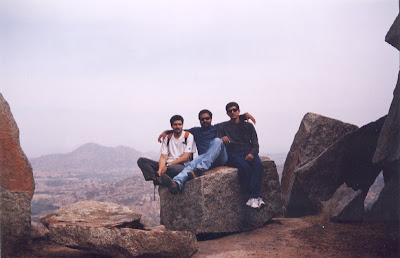
Thenginkalbetta is a merger of two hills into one. Meaning on a long base are two granite mounds. That's our guide leading us, Girish behind him and Rajesh was behind me.
Thenginkalbetta is peaceful and hardly touched by mankind, something rare in these times. Bottom half of the hill is green with lot of plant life. We had walk over rocks, through creepers and thorny bushes. It was one hell of an adventure. Without our guide, we would not have found the way to the top. By the time we reached the half way up, my exposed skin was covered with cuts. Our guide told us that there are leopards, bears, wolves and a host of wildlife in & around this hill. He told us that any wild animal coming from the side or diagonal generally do not attack, if we remain calm they might just go away. however, if you see it head on, it could spell trouble. Apparently when you face any wild animal head on they feel challenged or threatened and they tend to attack. As a precaution our guide had a well sharpened sickle in his hand. A sickle is a handy thing in a jungle trek, helps clear thorny limbs in the way.
Our guide, I think his name was Manjunath, showed us a dolmen concealed under a shrub. He told that Palegar soldiers hid weapons under the slabs for emergency use. That's Rajesh inspecting the secret spot. He's holding a small machete in his hand, so amongst the four of us there were two weapons.

A few minutes away from the dolmen were these memorial stones. As you see the bottom panels show battle scenes in which warriors were martyred and the upper panels show them merging with Paramaatma. Those days I used a Yashica film roll camera, so shooting pictures was always constrained hence no close ups.

This is the larger rock-hill to our right.

..and the the smaller hill to our left. We were heading into the valley between the hills.

Thenginkalbetta has played a role in history. It's natural caves were used as hideouts by Palaegars (local chieftains) during wars. Manjunath showed us one of the caves high up in the rocks. Bamboo ladders were used to climb and pulled up into the cave. It seems the cave can accommodate up to 60 people and has a source of fresh water as well.

Apart from the large cave, there are a few more smaller caves here. Clambering over the unstable stack of stones was a risky adventure but our Manjunath was very encouraging. This cave was large enough to accommodate a dozen adults.

Due to frequent thunderstorms, the cave's floor was water logged. That's Girish standing in cold water. Climbing down the stacked stone was even more scary but all of us descended safely.

This is another cave which doesn't have waterlogging issues. Here we had to negotiate the slope without steps.

Our guide mentioned that fugitives use these caves to avoid police. Even hunters use these shelters while waiting for a prey to get ensnared.
Now we are atop the smaller peak. The rock surface is not very smooth... it gave us good grip and we felt confident even on steep faces.

May be not long back the place would've been covered by thick forest.

Every step we could see something unique; here we have a T-shaped gap. A large boulder has split into three, a natural phenomena of disintegration.

A pool of rain water, still fresh & clear. A face-wash of this cool water refreshed us. Manjuntah on my right, and Girish on the left. From this spot, we caught a glimpse of three bears trying to get under cover... they are way down the hill.

We are standing in the valley of the two peaks.

This creeper born in the tiny gap! Look how it's clinging close to the rock.

More water... we reach a fresh water pond. This looked like a man made one, meaning a small has been built to harvest rain water. If you look carefully, you can see a stone pitching over the surface of the water.

A trisected rock still standing as one. I wonder how it was formed.

As we climbed further upto towards the bigger peak, entered a small wood of Neralaemara. A carpet of green grass and fruit bearing trees. I felt I was looking a paradise. My pictures hardly say anything. One should be in the place and feel it.

The shape of the rock is the effect of soldiers sharpening their swords. They would lie below the rock and rub their sword-edge against the rock's surface. I remember seeing similar stones at Chikkasiddarabetta fort.


Another grinding spot.

We had a wonderful time on the top. We climbed down the other face of the larger peak. It was quite steep but the surface gave us great grip.

Even nature draws and paints... see this painting created by flow of water. Such contrasting colors!

Once back down, Manjunath took us home, introduced his mother and wife. This simple mud & wood house has sheltered four generations. While we chatted away the ladies prepared coffee for us. It was the first time I had Bella-Coffee ~ jaggery sweetened coffee and loved it. We Thanked our host for their warm hospitality and said bye.

On the way back, we stopped at Sri Chandrashekhar's house, thanked him too and left.
Thenginkalbetta has been one of the most serene places I had ever been to.
Bicycle Ride - Bangalore to Mysore to Kallur to Bangalore
Soon after our PUC-I exams, during the summer of 1986, Babu Prasad and I, did some basic planning for the trip. A little village called Kallur near Mysore was our destination. Mom was against our idea while Dad was cool about it... We made sure our Hero cycles were in good condition, especially the brakes. We carried one back-pack each. Both of us had a Walkman each and a few cassettes.
We started our journey early morning since we had no idea how much time was required to cover 165 km. The first 20-30 km was mostly uphill, with the sun going up, the day was getting warm. Sweating and panting, I started wondering if I could ride all the way to Mysore. This is where our Walkman came handy, thoughts of giving up were blown away by the numbers blasting into our ears... we passed by Ramanagara and its hill ranges. Ramanagara is where the most of Sholay the blockbuster movie was shot.

We were yet to cover the last leg of our journey. The road to Babu's village Kallur. The road wasn't a flat one, we had to negotiate lot of uphill stretches. At one point, we both got cramps in our legs... what a coincidence! We almost fell off our bicycles by the sudden seizure and pain. We sat on the road until the muscles relaxed. It was dusk, it would be dark soon, so we had to resume riding. As we reached Kallur, the sky it was dark, we could see a few stars twinkling... we felt as though they were smiling at us. Babu and I were ecstatic!
Babu's relatives gave us a warm welcome. We freshened up, had coffee and went around the village... looking at the houses, light spilling out of them, people relaxing on the door steps, cattle tied to their posts, carts parked by... I was seeing rural life so closely after a long time. I enjoyed the dinner, which was ragi mudde and hurlikalu saaru, offered with so much of affection and care. After dinner we went out for a short walk in the village streets.
Next morning, we freshened up, had breakfast and we said bye to my hosts. Babu was familiar with the area. Our destination was KRS. We rode through a narrow dusty paths winding through the farm lands. At one point we were less than 50 meters from the backwaters of Krishna Rajendra Sagar reservoir. The reservoir is created by Kannambadi Katte (KRS Dam) across river Cauvery. The dam is almost 2 km long. Those days public were allowed on the dam without much restrictions. In fact for local village people the road on the dam was a shortcut. We rode our bikes end to end, back... it was a once in a lifetime opportunity. We went down to Brindavan gardens, found a cool spot under a rose apple tree. I think we managed to get a few rose apples. Around 3 pm or so we left KRS and rode towards Mysore. We went to Babu's friend's place where we had dinner and spent the night.
The following morning, our return journey started. Somewhere after Mandya, we passed by a cyclist on a regular cruiser, the rider was a 20+ year old. In a couple of minutes the cyclist was next to us, trying to overtake us... he was racing us! The race was fun for us though it was not fair, since our bikes were much lighter than our competitor's bike. Our friend was increasing the pace of the race... we picked up speed and left him behind. Then, slowed down to let him catch us... ride faster to stretch the gap... slow down again...let him close the gap... (guess it was mean of us to do this) I don't remember how long our race went on...the guy gave up...probably he had reached his destination. We missed his company. As we rode on and on... kilometer after kilometer... we were eager to end the countdown 80s, 70s, 60s... we counted down as long as we saw milestones.

A day at Sathodi Falls
A trip planned by colleagues- Ajay, Archana, Haseena, Mahesh, Preeti, Roopa, Shilpa, Shweta, Ushalata, Vani, Vidya, Vijayalaxmi, Yasmeen and I.


Weather was humid and getting warmer. We reached a point beyond which no vehicle could pass... Cruiser waiting for us. The falls was just another kilometer from here. We could hear the gushing water. We took our bags now and headed to the waters and falls. Vidya, Shilpa and I were the last ones to reach the falls.


looking around Sathodi Falls
 |
| a skeletal hand |
 |
| Nature creates the best spirals |
 |
| a type of moss |

 |
| like a Trishula stuck in Earth |


Shivagange
Shivagange looks like a 'Shiva Linga' as seen from the NH4 (before Dobbaspete). I've heard it also looks like a bull's profile from another angle. When it's cloudy the top part of the hill is covered in clouds giving it a heavenly look.

The
first time I had been was with Anish and Praveen but we stopped half
way up since it was getting dark. The next visit was with Gulveer and we
were determined to reach the top. The climb is not really tough. It
took us some 90 minutes. On the third or fourth climb we made it to
the top in 45 minutes.
The climb is a mix of both dirt and rocky surface unlike Savandurga
which is all rock surface. As we pass the half way mark, the climb gets
steeper with hardly anything to hold on. This part can be dicey during
rains. Grass and small shrubs are the only plant life... no trees on
this hill.
Just before we reach the top, we get to see Nandi statue on our left. It's perched on a small rock which acts like a private pedestal for Nandi. Once on the top, you can see a small temple and a shop, managed by the Swami and his son.

The Swami's been living there for more than 20 years. What a life! On top a hill breathing fresh air and seeing the sights we rarely get to see.

The summit is a small area with steep faces on three sides. We have to watch where we step. One wrong step... let me not imagine further.

One of the faces is a suicide spot... straight down several hundreds of feet. This is where queen Shantala, Hoysala king Vishuvardana's wife, ended her life by falling here. I stood two feet from the edge and took this picture.

When we looked around, we could see lot of smaller hills spread around. Many of them with little forts or watch houses on top. Palegars used these hills to keep watch over their territory and also as hideouts during wars. This whole area is one destination for nature lovers, adventure seekers and wild life enthusiasts but it's changing fast with the so called 'development activities'.

For people coming from Bangalore, there are two routes to reach Shivagange. The most travelled route is the one from Dobbaspet. the other one is from Bangalore-Hassan road which is less crowded. We always took this road which passed through country road. During one of the visits, on the way back, we saw a flock of vultures. This was the only time I ever saw vultures so closely. Huge and ugly and scary. The flock was a mix os all sizes and ages. They were busy feeding on a carcass... may be a cow or a buffalo. At first they did not notice us. I took out my aim-n-shoot Yashica and slowly went towards the flock... scared where they might attack me with their claws and beaks. But they were suddenly alert. They saw me and started leaving moving me away from me. I interrupted their party. Sorry guys. The next scene was some thing I'd never seen. The vultures started running picking speed, flapping their massive wings trying to lift their mass of the ground and then slowly took off the ground... like jumbo jets. I don't think I'll ever get to such a scene ever again.
Shivagange is a home to several temples. One of the temples is popular for it's underground spring. People throng here to touch the water which is supposed to be holy.
I've heard that a tunnel existed long time back which connected to Kashi. Hard to believe. I've also heard that another tunnel connected Shivagange to Gavigangadhareshwara Devastana, one of the cave temples in & around Bangalore. I've seen the tunnel's entrance which is just behind the Garbhagudi. It was blocked after few treasure seekers died of suffocation in the tunnel. Gavigangadhareshwara Gudi is worth a visit.
If you ever happen to visit Shivagange, make sure you carry sticks to scare the red-faced monkeys. They are rude. Last when I went, some time 1993, they ruled the place.
Chikkasiddarabetta


2 comments:
-
Guru said...

-
Hi, where exactly is this place?
i've never heard of this place. can you give me some info.. will b very helpful.
--Guru -
siddeshwar said...

-
Hello Guru,
It's easy to locate. Going towards Tumkur, just after Dobbasept, right opposite Kamat ___. You cannot really miss the hill.
Kurnool and Alampur
During one of the visits, we went for a walk in the river bed. Rivers in Rayalseema belt are mostly shallow and wide. The bridges across the rivers are long. I’ve hardly seen rivers flow in this region, except for this one- Tungabadhra and Krishna.
It was a summer evening; the breeze was refreshing after a day of traveling from Bangalore and then work at one of TGV factories. As we entered the river bed, we noticed musk melon creepers… it was towards the end of the season, most of them were dry. The Kurnool variety musk melon is very popular.
Walking on dry sand was fun and needed lot of effort. As we approached the waters, I noticed this lovely little anchor. It was a beautifully crafted piece.


The is Sangameshwara Gudi situated in the outskirts of the village. It was originally built at another place close by. The temple was moved to the present location since its former location is submerged in Tungabhadra backwaters. ASI had put in lots of efforts into this project; mark every stone and dismantle the temple, shift the stones and assemble it back at Alampur.


Edit:
I happened to visit Alampur two more times once in 2014 and again in 2015. Here are the links to the newer articles.
Sculptures at Archaeological museum, Alampur
Sangameshwara temple, Alampur
Papanashi group of temples near Alampur
3 comments:
-
Siva durga prasad Nayak said...

-
Nice article about Alampur.Alampur is called as city of temples.Jogulmba maata is main diety in Alampur.She is one of the 18 Shaktipeeth.
Lord Bala Brahmeshwara swamy is the form of Lord Shiva -
Unknown said...

-
alampur is called as city of temples,in alampur we have navabhrama temples to visit,a lot of peoples come from karanataka to see lord shiva at the time shivaratri,jogulamba mata is fifth shakti peteam in world we have totally 18 shakti petams
Kotilingakshetra and Bethamangala


 It was educative tour, the 30 minutes we spent there was worth it. We thanked the technician and headed back towards KGF town.
Kumbhakarna theme park

This is an attempt to create the scene from the mythological story Ramayana; the awakening of Kumbhakarna, the brother of the powerful demon king Ravana. According to the story, he was huge and was cursed to fall asleep immediately after a meal. Demon soldiers are trying to from his deep slumber using all possible ways… drumming into his ears, elephant prodding his head, pulling hair, poking with spears, tickling his sole, pulling hair, trying to get the aroma of food into his nose… The imagination is just too good.


2 comments:
-
gayathri said...
-
i expected it as jst a sculpture not a restaurant might b it is reallyyy amazing !!!!!!!!

.JPG)

.jpg)

16 comments:
Hello,
a great story! Especially with the pictures illustrating your trip!
Take care,
Joan
Thanks Joan. I'm looking at your blog. great pictures! I loved the hay stacks and the purple flowers. I'll take some time off this weekend and to spend time on your blog.
I think the stone structure in photo number 8 (from the top) could be a megalithic tomb.
Siddu,
Enjoyed reading this blog
thank you Subbu
Super ur jurny sir
That's a really good spot u have gone to Siddeshwar, write about the paleygars, the wild animals, the veergals are all so exciting, thank u for bringing this to us
Going through your blogs Siddu.. you sync your write ups alongwith the photos so well that we feel like we ourselves have visited the place.
Excellent debut @ the journey across Karnataka.. keep the ink flowing buddy!
- Ceeni ❤️
thank you dear friend
indeed an amazing place. thanks to Amma for keeping that newspaper cutting and giving it to me. and deep regards to our hosts Chandrashekhar & Manjunath. and of course, regards to you for reading and appreciating 🙏🏽
thank you Seeni buddy. While I sync up with photos, your poems sync up with the unseen.. magical compositions by you.
Nice to know about Palegars , very informative Siddeshwar Prasad (Sidds)
thank you Anant
Awesome, trip loved the experience
Thank you, dear friend.
Superb, Hope it has not become picnic crowds den littered with bottles and plastic.