
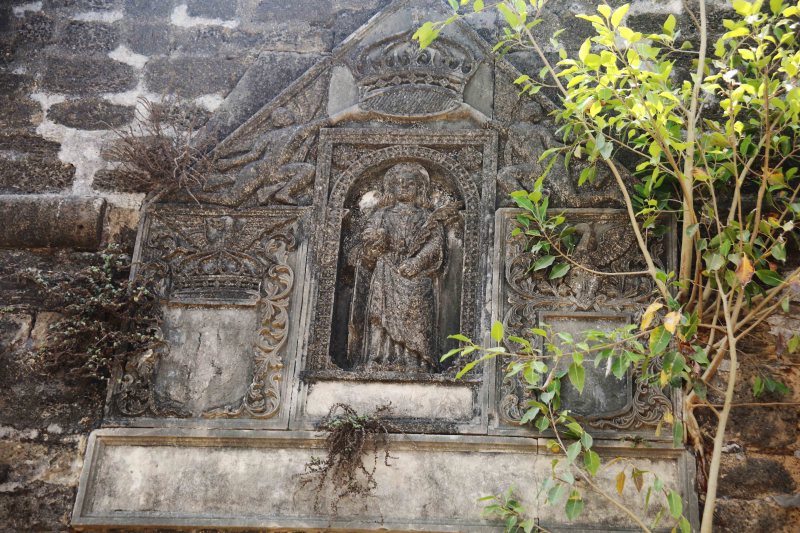
St. Paul’s church is a beautiful Portuguese baroque styled church built in the early seventeenth century … the construction started in 1601CE and was completed in 1610CE. The richly decorated facade and ornate wooden work are the special features of this church. There are several interesting motifs carved in the facade.


Inside the church we can see some interesting stucco work too. It is interesting to imagine how the local Indian artisans adopted and tempered the Portuguese style with their own perspective.

There are two more churches inside the Diu fort. The church of St. Francis of Assissi is said to be the oldest and currently being used as a hospital. I could not visit this church. St. Thomas church now home to the Diu Museum.


During our trip the museum was closed for renovation but it was interesting to see the freshly painted white interact with the clear blue summer skies … and if you want to take a bigger dose of colourful stucco work … you have to visit Nagarseth Ni Haveli in Panchawati area of Diu town.


From the man made vibrancy of the Haveli … lets go underground to explore what the nature has in store for us … quite literally underground … to visit the Naida caves.


I would love to know more about the geological phenomena behind the formation of these caves. It is fascinating to see several layers of rock sandwiched together forming these massive boulders. Every shade of yellow and orange can be seen here in the sandstone… and a dash of green … of the flora thriving in the gaps … plenty of openings for sunlight to trickle down and play hide & seek …


And take a half day drive around the island to explore many more … clean … pristine … quiet beaches … with white sand and gentle waves …


Do not miss the memorial site made for the martyrs of INS Khukri… an Indian Navy frigate that was sunk by PNS Hangor during the Indo-Pak war of 1971 … the incident took place few miles away from Diu coast.


From the west coast… time to move to central India … let us say bye to these blue waters and explore the heart of India … From spiritual Sanchi to the grandeur of Bhojpur … and the rock shelters of Bhimbetka…. see you soon!

Monuments are traces of our history … they preserve our cultural memories … and not all memories are pleasant … The British, Dutch, French and Portuguese buildings in India are symbols of those colonial powers who once ruled India. But holding on to a bitter feeling about the past is not what a wise student of history or culture should do. We can enrich our understanding if we accept our past and present and learn objectively from it. When I wrote about the Old Goa Churches .. Many commented about how I was celebrating the brutal conversions and barbaric inquisition campaign that tormented the goans under the Portuguese flag. While I empathize with the sentiment … I am a student of design and material culture and for me even a colonial monument is an Indian monument today.
The portuguese were perhaps the first European power to establish a colony here in India.. and were certainly the last power to leave India. At Diu … they ruled for 424 years. Perhaps the longest colonial occupation anywhere in the world. Today we explore the military garrison that was once symbol of the Portuguese might and dominance on global seas.
After my second trip to Gir, I decided to visit Somnath and Diu and fly back to Mumbai directly (Jet Airways used to operate an ATR via Porbandar .. can’t see that connection on itinerary now)

The castle of Diu stands strong since 1535CE … strong sea breeze and the powerful waves lashing the coastline have certainly damaged the outer walls to some extent … but the glory of its scale and form is still very much visible even to an untrained eye.
The location of this island of the Saurashtra coast was extremely important from the trade perspective. The Portuguese had quickly setup flourishing spice trade from India the Arabs were disturbed by this challenge to their trade monopoly. In 1509 CE the grand alliance of Gujrat sultanate+Mamluks of Egypt+Zamorin of Kochi+Venetians challenged the Portuguese in vain. However, much later the Portuguese built a castle after the treaty of Bassein in 1534CE with Sultan Bahadur Shah of Gujarat who needed help to counter the invading army of the Mughals under Humayun.


The walls of the fort look formidable even today and there is a ditch filled with water that protects the periphery of the fort from attackers. Simple but elegant geometric forms is the hallmark of the Portuguese fort architecture.


Again in 1539CE the Gujarat sultanate with help from the Ottoman empire attempted to capture Diu fort from the Portuguese but the defenders prevailed in a gritty naval battle. Dom Fransisco De Almeida prophetically wrote to his King Manuel Ist in 1509 – As long as you are a formidable naval power, you will continue to hold India.


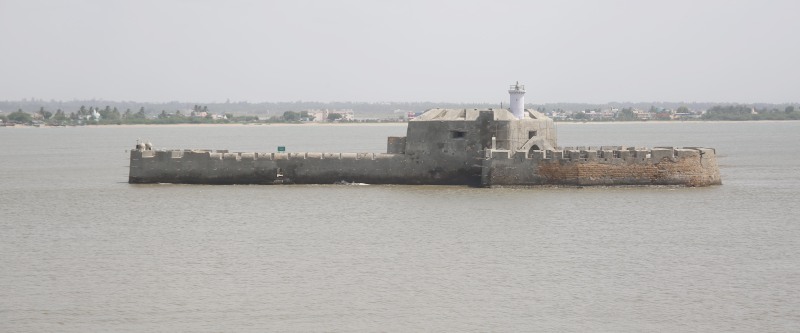
The fort is huge and the outer fortifications are built along the coastline. One can see a bastion built on a small rock in deep sea named Panikotha… visible behind the bastion is the coastline of Diu. There are several brass and bronze canons on the fort … many in good condition with markings and engravings still visible.


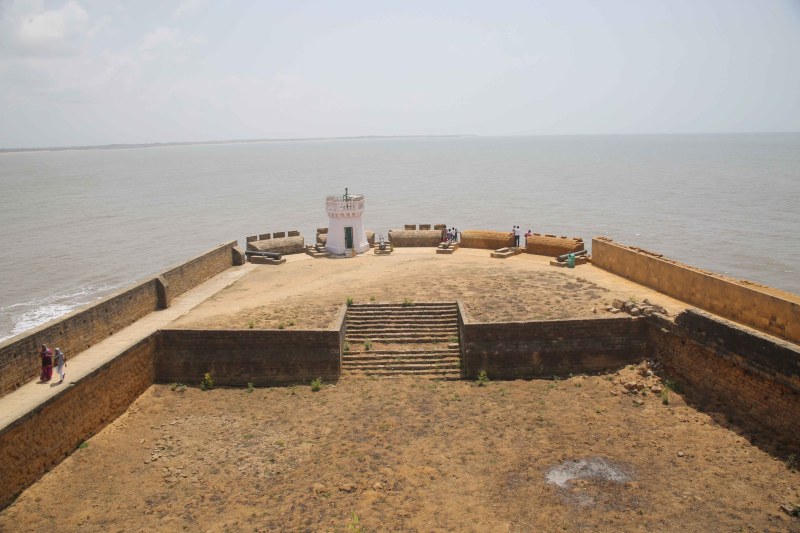

The fort was once a township and has several buildings … some with distinct religious marks and perhaps a little church too. There was a subjail inside the fort but seems to have been relocated elsewhere.


There are beautiful arches still visible … though the roofs of the buildings have collapsed. Local sandstone was perhaps used for the construction and it gives the fort a distinc yellow flavour.


This particular design for hanging bells is typical of Portuguese forts … When we visit the Worli Fort in Mumbai on this blog … we will notice a similar construct there too. Apart from the fort … there is a lot to explore in this laid back island … A Portuguese writer rightly called Diu – Ilha De Calma …. or the Island of Calm … See you soon on this blog!
https://chinmaye.com/2017/12/06/fort-diu/

.JPG)

.jpg)

No comments:
Post a Comment
Note: Only a member of this blog may post a comment.