Goddess Durga
 Goddess Durga
This is one of the masterpieces of the Chennai Museum. Carved out of a
solid block of granite, one of the hardest stone to work with, the
detailing if the jewellery is mind boggling. The dexterity of the
sculptor is clearly established. In South Indian sculptures the
complexity of the sculpture increases as the century rolled by. Thus,
the Pallava artists were beginning to learn how to carve in granite.
Their sculptures are plain and simple. The Chola sculptors were more apt
in dealing with granite. Their sculptures are more detailed than
Pallava ones. The Vijayanagar artist was at home with granite. Their
sculptures are most elaborately carved than either the Pallava or Chola
ones.
Another unique feature about this piece is that though she is called
Goddess Durga, she carries a conch and a disk in her hands, both weapons
of Lord Vishnu. Though She is part of the Shakti cult ( a cult of
Hinduism which believed in faminine divine), yet she carries weapons
associated with Vaishnavism. Thus, She appears to be a fusion of
Shaivism and Vaishnavism.
Durga is the eternal Mother Goddess. She protects and promotes us; She
destroys and annihilates what is evil. She is our inner mind. Like her,
we must learn to destroy what is bad in us. We must nurture what is
good in us. This is equally true of society. The society should protect
the good and destroy the bad. This is, in fact, the very basis of Rule
of Law in any nation. Goddess Durga, like other Gods and Goddesses, re -
establish the Rule of Law in the world at large. That is why we always
pray, " from darkness take me to light; from death take me to
immortality." Those who preserve and promote and observe the Rule of Law
continue to live in light and achieve immortality.
Ladies Worshipping the Buddha

Amravati Stupa, 2nd Century CE, Chennai Museum
Amravati lay in the heart of Andhra country. Although Sanchi in Madhya
Pradesh is the most well known Stupa of ancient India, but Amravati was
far bigger and more grand in its conception, design and execution. The
Stupa was originally constructed of bricks, but later encased with
highly carved white - green marble slabs. The diameter of the dome was
162 feet, a railing of 192 feet diameter surrounded the grand Stupa.
Thanks to its beautiful carvings, we almost lost the Stupa. As one of
the richest businessman began crushing the marbles for its commercial
values in the 19th century. Whatever could be saved was rushed to Madras
and housed in the Government Museum there. Thus, the Chennai has one of
the best collection of Amravati school of sculptures.
The Amravati school of sculptures is very easily recognizable : most of
the sculptures are done in whitish - green marble, the figures are
slender, tallish and carved in lyrical manner. The figures are carved
almost like flowing wax. The panels and medallions hum with human
activities. There is drama, yet there is peace, tranquillity and
serenity. Most of the pieces deal with the life of the Buddha.
Initially the Buddha was not shown in human form, as here. Later he is
depicted in human form.
Here we see four ladies worshipping two feet on a throne. The feet
symbolise the presence of Buddha. Humility at the feet of the Gods or
teachers or elder has been an ancient tradition in India. Humility
gives us the ability to accept various views and philosophies with a
sense of reverence and respect. This is the cause of pluralism in India.
Arrogance on the other hand leads to dischord and violence. Truth is
so hard to grasp, that it has multiple interpretations. But like the
proverbial seven blind men and the Elephant each man describes the truth
according to his perception. Yet, all perspectives are true. But in
our egoism and ethnocentrism we deny the truth asserted by others. We
assert our own superiority at the expense of others. But humility and
the Middle Path do lead to enlightenment.
Lord Ganesh
 Lord Ganesh
Chola Bronze,11th Century CE,Chennai Museum
Chennai Museum has a large collection of Chola Bronze. And naturally so
as Chennai is the capital of Tamil Nadu and Tamil Nadu was the seat of
the Chola dynasty.
India has an ancient tradition of bronze casting. The oldest metalic
statue comes from Indus Valley Civilisation : the Dancing Girl. But
there are also beautiful bronze sculptures from the post - Gupta Period
from Bihar and Bengal. In fact, there is a life - size Buddha in bronze
from Sultanganj, Bihar. The Pala Dynasty of Bengal has also produced
fine bronze sculptures. Even today Tamil Nadu continues to produce
exquisite bronze sculptures following the ancient method of lost wax
technique in casting the figure.
The figure is first made in wax, then covered with clay. When the clay
is fried, holes are left through which the melted wax would escape and
the impression of the sculpture would be left inside the hardened clay.
Thus the wax is lost. Then molten bronze is poured inside the cavity of
the mould. After the mould cools down, the baked clay is broken,
revealing the bronze statue. The Rough edges are filed, the finer
details are carved, the statue is polished, and sold. Chola Bronze are
considered to be masterpieces of Indian art.
Lord Ganesh is a popular God of the South. During the Vedic period,
Lord Vishnu in the form of a horse headed god was considered the God of
Wisdom. For according to the Vedic people, the horse was the most
intelligent animal. Till they domesticated the wild elephant. As
elephants became important, the God of wisdom changed from being horse
headed to an elephant headed. Most likely, some tribes in Maharashtra
used to worship the elephants as a tribal God. The Aryans adopted him as
their God of wisdom after the post - Gupta Period. For the oldest
statues of Lord Ganesh are discovered in Maharashtra from the post -
Gupta Period.
In South Indian art Lord Ganesh is depicted either standing, sitting or
dancing. He is a jovial god who amuses us with his childish images and
inspires us with his wisdom. Since wisdom can solve all the problems, He
is considered to be the God who solves our difficulties. Since no task
can be achieved without knowledge, He is the first God to be worshipped.
For action without knowledge and wisdom leads to chaos. Thus, He
creates harmony and order. He maintains the universe.
While we all worship him, at times, we forget the importance of knowledge and wisdom in our life.
Goddess Durga Fighting with Mahisasur

Goddess Durga Fighting with Mahisasur
Mahaballipuram, Pallava Dynasty, 7th Century CE
One of the most brilliantly executed panels of Mahaballipuram
is this one. We are all familiar with the killing of Mahisasur by
Goddess Durga. But here the sculptor has depicted the battle when the
tide has started turning against Mahisasur. He is on his back leg,
tilting back; his warriors have fallen, while the Devi ' s army is
advancing. There are dead bodies strewn in the battlefield. ( Notice
the corpse in the middle of the panel--a top view of a dead body). The
Pallava artist has used the cross diagnals to make the panel more
dynamic. The panel is full of fury and energy. It is a battle scene
frozen in stone.
Mahisasur Mardani sculptures capture the final act of killing
of the demon. Here the defeat has just begun. The artist has
purposefully depicted the story in the middle. Life itself is a
constant battle between good and bad. It is a fight which is uncertain.
When the tide may turn, we do not know. It took the Pandavas eighteen
days to defeat the Kauravs. But fight we must wage within ourselves to
cleanse the evil within us. Similarly a fight goes on within a society
with regard to its evil practices, with regard to class struggle, with
regard to ideologies. But we should not be overwhelmed by being in
middle of a battle. The fight should be with a sense of detachment.
The Pallavas could teach us many things about life through such stunning sculptures !
Dharmaraj Rath

Dharmaraj Rath
Mahaballipuram, Pallava Dynasty,7th Century CE
A larger version of the Arjun Rath, and the most imposing
structure is the Dharamraj Rath or the Yudhisthir Rath. It is a temple
dedicated to Lord Shiva. Like the other temples this temple is also
unfinished. But has sufficient number of sculptures of Lord Shiva in
his different manifestation to tell us that it is a Shiva temple. We
can see two images of Lord Shiva in this picture itself. On the left is
Bhairav, the violent form of Lord Shiva; on the right is his peaceful
form. Both co - exist side by side as the ancient Indians believed that
creativity and destruction go hand in hand.
Yudhisthir is an interesting character in Mahabharata. Said to be
the son of Yama, the Hindu god of Justice and death, Yudhisthir is
personification of Dharma ( righteous conduct ). If Bhim is brute
force, Arjun is intellectual, then Yudhisthir is wise. Yet, at times
his wisdom fails him and he gives into temptation as when he played the
dice game and wagered, his brothers, his wife and even his Kingdom. He
spends the rest of his life in remorse for his faults. Like us, he is
constantly caught up in dilemma about what is right and what is wrong.
But his answers to the questions posed by Dharamraj, Lord Yama prove his
steadfastness to Dharma.
After he has answered all the questions, Dharamraj asks him to
chose one of his brothers who should be resurrected as all the four
brothers were lying dead before him. Yudhisthir asks that Sehdev, the
youngest brother, should be revived. Dharamraj is puzzled at this
choice. He asks Yudhisthir to explain his choice. For, Yudhisthir has
not asked that Arjun or Bhim should be revived. Yudhisthir says, " in
the dice game I had waged my brothers. Arjun and Bhim and I are from
the same mother. But Nakul and Sehdev are from Madari, my younger mother
( step-mother). If I ask for Arjun or Bhim it would be unfair. For
neither of Madri 's children would live. I must be fair to both my
mothers. Sehdev is the yongest of us all. He has to be protected by the
eldest. Let him be resurrected. " Dharmaraj was pleased with Yudhisthir '
s sense of fairness and justice. He revived all the four brothers.
The sense of equality, of fairness is the heart and soul of
Justice. For justice cannot exist in their absence. We are duty bound
to protect and promote the "younger" brothers. If we don't, then we are
being a tyrant. Mahabharata teaches us that were Dharma exists, where
the sense of fairness lives, peace and prosperity thrive. As a nation,
we should not forget this.
Raths at Mahaballipuram

Pallava Dynasty, 7th Century CE
One of the greatest dynasties of South India was the Pallava
Dynasty (6th -8th Century CE ). They were the contemporaries of the
Chalukya Dynasty of Karnataka. There were incessant wars between the
two dynasties for 300 years. Not only the Royal egos, but also the
fertile lands of the Tungabhadra region caused these wars. While the
Pallavas wanted to expand their kingdom north westward, the Chalukyas
wanted to capture the Tamil lands to the south and to have the hegemony
of the sea.
Mahaballipuram is one of the most ancient ports of India.
Plinny the Yonger, the famous Roman historian mentions the Indian ports
of Baruch and Mahaballipuram in his book on Ports of the World. The
Romans had strong trade ties with South India, so much so, that under
Emperor Tiberius, the Roman Senate passed laws against import of import
of exotic Indian animals and cotton textile. This is one of the first
examples of protectionism in global market.
Mahaballipuram was a thriving port city. But these temples
called "Raths" were left unfinished. Five monolithic temples were carved
out of s single hill. Here we see three of them. Although these Raths
are named after the Pandav brothers, but the Pandavas never came this
far to the south. Interestingly each temple is carved in different
style. The first one, a Durga Temple has a hatched roof structure. The
long building we see here in this picture is like a long gallery from
Ajanta Caves. The Shiva temple, we see in the foreground, is built in
the Dravidian style. Like Pattadakal in Karnataka, here the architects
were experimenting with different styles of architecture. This not only
proves the dexterity, but also reveals the myriad imagination of the
Pallava architects. The adventurous spirit of the Pallavas is reflected
both in their art and in their seafaring to the East Indies. The Pallava
spirit or the Tamil spirit is indomitable.
Virupaksha Temple

Virupaksha Temple
Chalukya Dynasty, 745 CE
Chalukyans were bitter enemies of the Pallavas of Kanchipuram.
They fought each other for two hundred years. The balance would tilt at
times in favour of the Pallavas, at times in favour of the Chalukyans.
Raja Vikramaditya II (r. 733-744 CE) captured Kanchipuram thrice
in his life. Even as a Crown Prince he had subdued the might of the
Pallavas. As a king, he conquered them twice.
His wife, Queen Lokmahadevi built the Virupaksha Temple in order
to commemorate the King's victory over the Pallavas. The temple is the
finest example of Early Chalukyan architecture at Pattadakal.
Ironically while the temple commemorates the defeat of the Pallavas,
yet the Virupaksha Temple is a based on the Kailashnath Temple at
Kanchipuram. The conqueror had no hesitation to learn from the
conquered. This clearly proves the liberal spirit of the Chalukyan
mind.
The temple is a huge one, divided into different parts. It is the
first temple in Karnataka to have a large entrance gate, a precursor to
the lofty "gopuram " which will mark later Kannada architecture. Since
the temple is dedicated to Lord Shiva, it has a huge statue of Nandi,
the bull in the " Nandi Mandapa", or a temple dedicated to Nandi.
The temp is profusedly decorated with episodes of Lord Shiva.
But dedication to Lord Shiva did not exclude depiction of stories from
the Bhagwat Purana, the Ramayan, and the Mahabharata all of which deal
with Lord Vishnu. This clearly reveals the catholic vision of the
Chalukyans. While devoted to Lord Shiva, they were equally respectful
towards Lord Vishnu.
Pattadakal also has a Jain shrine. Thus different religions
could peacefully co - exists without any conflict or confrontation. The
magnanimous vision of the Chalukyans is woefully missing today. We have
much to learn from them.
Temples if Pattadakal

Temples if Pattadakal
Chalukya Dynasty, First Half of 8th Century CE
If Badami was the political capital of the Chalukyan Kingdom,
Pattadakal was the seat of the Royal coronation. The word "patta" means
title. About 22 kilometres away from Badami, it is the Westminster
Abbey of the Chalukyan Dynasty.
The site preserved by the ASI, and declared as UNESCO site
contains eight temples. All the temples are dedicated to Lord Shiva. The
two largest temples, Virupaksha and Mallikarjuna, are commemorative
temples. Vikramaditya II (r. 734-45 CE) defeated the Pallavas of
Kanchipuram. His two wives constructed these two temples in order to
commemorate his victory. They are the largest temples at Pattadakal.
But the importance of Pattadakal is lies elsewhere: it is the
cradle of Indian architecture. In India temples are constructed in
three styles: the Northern (Nagara ), the Dravidian ( in the South),
and the Eastern ( in Odisha ). The Nagara has a tower ( the Shikhar )
over the sanctum sanctorium. The Dravidian has a step- pyramidal roof;
the Eastern also has a tower ( the Shikhar ), but it is squat in size.
As Indian architecture evolved from the cave temples to the free
standing and construed temples, Pattadakal is the missing link. The
Chalukyan architects experimented with both the Northern and the
Dravidian styles simultaneously. Thus, in this picture you see the
Northern style with its tower ( Shikhar ) on the left, and the
Dravidian, with the pyramidal roof, on the right.
Experimentation is not the forte of Indian civilisation. In
fact, our civilisation is marked by what is termed as "sufficient
efficiency. " Once a thing has achieved sufficient efficiency, we do not
improve upon it any further. This is unlike the West where
experimtation and innovation are the hallmark of the civilisation.
But the Chalukyan mind is an innovative mind. It experimented
with different designs. It is a mind free of dogmas, free of prejudices.
It is a mind which is open to ideas from all sides. It is a mind which
is not afraid to experiment, to take chances. Its architecture, thus,
reflects a highly creative, innovative, liberal and visionary mind. A
rare mind indeed.
Lord Bahubali

Lord Bahubali
Cave No. 4, Badami, Chalukya Dynasty, 6th Century CE
While Cave No. 1 is dedicated to Lord Shiva, Cave Nos. 2 and 3
are dedicated to Lord Vishnu. Cave No. 4 is dedicated to Jainism. Here
we find sculptures of Jain Tirthankaras or Gurus.
Son of Rishabhadev, the first Jain Tirthankara, Bahubali
defeated his brother Bharata. But became disillusioned with the intra -
family feud. He abandoned his Kingdom and his clothes and became a Jain
monk. He stood in deep meditation for a year till vines grew from the
sides and enveloped him. His two sisters reminded him that he couldn't
reach enlightenment as he stood on an 'elephant'-- Ego. ( We see the two
sisters beseeching him). He also renounced Ego. He reached Moksha or
liberation from the cycle of life and death.
Renunciation has an ancient ancestry in India. The human mind is
obsessed with possession : my family, my house, my car, my laptop, my
ipad etc. But we are like tenants in a house. Nothing is ours as we are
not the owner. We are mere transit passengers. Yet we crave for
tangible objects.
Bahubali is a symbol of perfect renunciation, even of clothes and
Ego. His giving up clothes is similar to the story of St. Francis of
Assisi who also gave up his fine clothes when he lost a civil suit to
his own father. It is symbolic of giving up one's identity. To give up
ego, to see the world with equanimity is to realise the Tao-- all things
are interconnected. Hence, there can not ever be "we" and "them", or
"mine" and "his". Such a vision leads to the ultimate philosophy of
"Live and Let Live".
Lord Vishnu on Sheshnag

Lord Vishnu on Sheshnag
Cave No 3., Badam, Chalukya Dynasty,6th Century CE
This sculpture of Lord Vishnu is considered the masterpiece of
the Badami caves. It is a highly unusual sculpture. For, generally
Lord Vishnu is depicted as sleeping on the Serpant Sheshnag. But rarely
shown as sitting on him. Generally Goddess Lakshmi is shown as
massaging Lord Vishnu 's feet; Garuda, His vehicle, is usually shown in
half human form and standing in His attendance. But here the small
figure of Goddess Lakshmi sits casually, leaning against the coils of
the Serpant on the right hand side. Even Garuda is in a relaxed mood on
the left side. Even Lord Vishnu does not sit in a "regal" pose. Even
He sits casually as though freely conversing with the devotee. There is
an unusual informality in the divine group.
Perhaps God is portrayed not as an impersonal god, but as a
personal one. Unlike Judaism where God is a distant object of
veneration, in Hinduism, He is a personal God: intimate, friendly,
confidante.
But perhaps this sculpture is a political commentary and a
warning. The Chalukyan Kingdom had reached its zenith. Now the King and
the subject could relax. The guardians could take it easy. But too much
relaxation, too much carelessness can be dangerous. For, when Lord
Vishnu falls asleep on the Sheshnag, two demons arise from Him and
attack Him. Thus, this sculpture is a warning to the people to be ever
vigilant, lest the Pallavas attack again.
A nation cannot afford to relax. For there are endless troubles on
the horizon. Every citizen must contribute to the development of the
country. Be vigilant, be safe.
Mithuna Figures ( A Loving Couple)
 Mithuna Figures ( A Loving Couple)
Cave No 3, Badami, Chalukya Dynasty,6th Century CE
Every pillar in Cave No. 3 is crowned by a loving couple or
Mithuna. These figures are important both historically and artistically.
Historically they tell us about the lifestyle of India in 6th Century
CE. The couple is young and fashionable. The Chalukyan figures are
tallish in appearance. The men are not muscular but slim. Women are
voluptuous but slim. They are attired in the best of clothes and
jewellery. They reflect the prosperity of their Age. Artistically,
unlike the stout and short figures of North India, the figures are
tallish. Apparently the concept of beauty was different in the South and
the North. Moreover, these loving couples are the beginning of erotic
art in India. Eroticism will reach its climax at Khajaraho and Konark
temples in the North and East.
These couples also had a social and political significance.
Since the family is the smallest unit of the society, it was important
to emphasise on the "happy family." Politically, such couples and their
opulence stressed the political stability and the economic prosperity of
the Kingdom.
Unfortunately today we do not emphasise the unity of the
family. As we "progress" we are becoming more and more individualistic.
Instead of spending time with our wife and children, we would rather be
surfing the Internet or be in Facebook. The intimacy, the love and
affection between the couples is beginning to dry up. Perhaps we should
look at the Indian art and realise the importance of " Kama" ( desire),
of love and affection in our lives.
Lord Narsimha ( Lord Vishnu as the Half - man , Half - lion form)
 Lord Narsimha ( Lord Vishnu as the Half - man , Half - lion form)
Cave No 3,Badami. Chalukya Dynasty,6th Century CE
This Cave contains images of different incarnations of Lord
Vishnu. Here we have the fourth incarnation: Narsimha ( the half -
man, half - lion ). This is a unique incarnation as it was
instantaneous one. There were no long preparation for the incarnation
amongst the Gods. Hiranyakashipu, the demon, demanded to know from his
son, Prahlad, who was ever devoted to Lord Vishnu if his god was present
in a pillar of the palace as well. Prahlad said "yes He does."
Hiranyakashipu hit the pillar with his mace in order to prove that the
pillar did not contain any god. Out popped Narsimha incarnation. Here
we see the Lord in all his glory. Prahlad stands on the left side;
Hiranyakashipu on the right. The fight between Narsimha and
Hiranyakashipu is yet to begin.
This story has various meanings: it speaks of bhakti ( total
devotion to God) as portrayed in Prahlad ' s complete devotion to Lord
Vishnu; it proves that devotion is not by birth as Prahlad was born from
a demon. But is self - acquired. Thus, it challenges the Brahminical
belief that knowledge is the monopoly of only the Brahmins. It speaks
of the omnipresence of God--He is everywhere; it deals with generation
gap and with the concept of father and son conflict. The older
generation should not impose its dictates and thinking on the younger
generation. The young should be permitted to think out of the box. It
stresses on devotion, single mindedness, and hard work. It teaches us
that life is not easy, but is full of obstacles. However, eventually we
will overcome our troubles. It is an optimistic tale.
Drunken Courtesan
 Drunken Courtesan
Cave No 3, Badami, 6th Century CE, Chalukya Dynasty
Gods were not the only concern of the Chalukyan artist. The
social conditions also invited his attention. Drinking amongst the
women was a common phenomenon. Here we see a drunken woman being
supported by a man. The man could be a client of the courtesan, or a
paramour or even a husband of the woman. Although I have called this
sculpture "The Drunken Courtesan", but it might be a depiction of a
couple.
The artist has beautifully captured the collapsing body of the
woman: with one foot facing the onlooker, with a limp body, with on arm
dangling. The woman is ready to crash to the floor. Yet the woman is not
one belonging to a low class. Her jewelry, her youth, indicate her high
social status. But notwithstanding her social status, she is overtaken
by liquor.
The purpose of such sculpture could be to just portray the
reality. Or it could be a warning to the people not to get addicted to
alcohol. It is an anti - alcohol campaign. Or it could be a symbol of
the need to save the degraded environment or Nature. Since women were
seen as a symbol of Nature, here the Nature is degraded, is "falling"
due to excess. Hence the need to "prop her up". The need to save Nature
before it collapses completely.
The sculpture contains a message for all Ages.
Varaha Avtar ( The Boar Incarnation of Lord Vishnu )
 Varaha Avtar ( The Boar Incarnation of Lord Vishnu )
Cave No. 3 , Badami, 6th Century CE, Chalukya Dynasty
Of the four Cave Temples, Cave No. 3 is the largest and most
elaborate. It was commissioned by Raja Manglesh, the second son of
Pulkeshin I. An inscription in the cave tells us the date of
construction as 578 CE. Interestingly, the date is given in the Sakha
Era. Sakhas were foreigners who came after the Greeks and settled in
India. Surprisingly the Chalukyans have adopted their calender , but
have not created their own calender and Era.
This Cave is also dedicated to Lord Vishnu as the Chalukya
Dynasty were, at the time, Vaishnavites. The Chalukyan Royal emblem was
the Varaha Avtar of Lord Vishnu. For, they believed that like Lord
Varaha ( the Boar), they too have saved Earth from chaos. Hence, again
this sculpture was both a political statement and a sacred image.
The theme of saving the Mother Earth from danger is a recurring
theme in Hinduism. The Varaha incarnation is the classic story.
Hiranyaksha, the demon, dragged Earth into the ocean of chaos. Lord
Vishnu appeared as a Boar; he plunged into the ocean, killed the demon,
and brought the Earth out. She married Lord Vishnu. Bhodevi is His
second wife, after Godess Lakshmi.
Like demons, we too are destroying Mother Earth for our
insatiable greed. We mine her depths, we pollute the air, we pollute the
oceans, we kill the animals, we flatten the mountains. What we consider
to be the path of development is the path of our destruction. With
global warming, with high air, water, noise and light pollutions all
around us, with wars, and nuclear weapons where are we dragging Mother
Earth? Back to the ocean of chaos. But like the Varaha Avtar we have to
save her. We have only one home in the entire Universe: Mother Earth.
Trivikram: Dwarf (Vaman ) Incarnation of Lord Vishnu
 Trivikram: Dwarf (Vaman ) Incarnation of Lord Vishnu
Cave No 2, Badami, 6th Century CE
Cave No 2 is dedicated to Lord Vishnu. Thus, we find
different images of the God. The Chalukyan Dynasty was a native Dynasty
of Karnataka. Yet its Kingdom was not a local one. It had expanded its
limits to a large extent of the Deccan. Raja Pulkeshin II had even
crossed the Narmada River and had defeated Raja Harshvardhan of Kannauj.
Hence , its Kingdom had extended even to the North India.
For such a Dynasty, the Dwarf incarnation if Lord Vishnu
was an apt symbol. Like Vaman ( dwarf), the Dynasty had humble
beginnings. But like Lord Vishnu, it too had conquered "the earth and
the sky" and was still looking for a place to take its "third" step.
Raja Pulkeshin II must have seen himself as a "Chakravirtin " king (as
an all conquering king). Therefore, this over lifesize sculpture of Lord
Trivikram ( conqueror of the threw worlds) is as much a political
statement as it is a religious icon.
The story of Vaman is a reminder of the divinity within us.
We have the potential to grow and conquer. We just need a will power.
Like the son of King Bali, who is shown trying to hold back Lord Vishnu
from taking his third step over King Bali ' s head, obstacles are there
in the path of growth and development. But like the Lord we must
overcome them. As individuals we must reach our maximum capacity; as a
nation we must become an economic world power. But the path to growth is
not through endless squabbles, and through self - doubts, or through
the doomsday preaching. It is through self - confidence, self -
sacrifice, through zeal, compassion and kindness.
Cave No. 2
 Cave No. 2
Cave No. 2, Badami, 6th Century CE
In which chronological order these four caves were carved,
we do not know. Cave No 3 is the only 'dated' cave we have. An
inscription there gives its date as 578 CE. But when and by whom Cave
No. 2 was excavated, we do not know.
Compared to Ajanta, this Cave temple is a simple one. Cut
into the rugged reddish sandstone cliff, it has no ornamental facade as
do the Ajanta Caves. Perhaps the architect and the labour were trying to
get used to the idea of chiselling through the solid rocks. Thus, Cave
Nos. 1 and 2 are rather simple looking.
But the simplicity also hides the great achievements of the
builders. The ancients did not have the advantages that we have today:
no excavators, no earthmover, no explosives for blasting the rocks, no
instruments for seeing the geological formations of the inside of the
rocks. All the ancients had were chisels and hammers, a deep religious
faith, a zeal for perfection, and sheer hard work. For years the
faceless and voiceless labourer toiled at the site, hammering and
chiselling the rocks, till over lifesize figures could be carved in all
their divine beauty and grace.
These Cave temples are testimonies of our vision and endurance.
They are a living proof of the human spirit to tackle, to transform
Nature from its chaos and rugged surface into order and beauty. They are
source of eternal inspiration.
Lord Harihar with Goddesses Parvati and Lakshmi
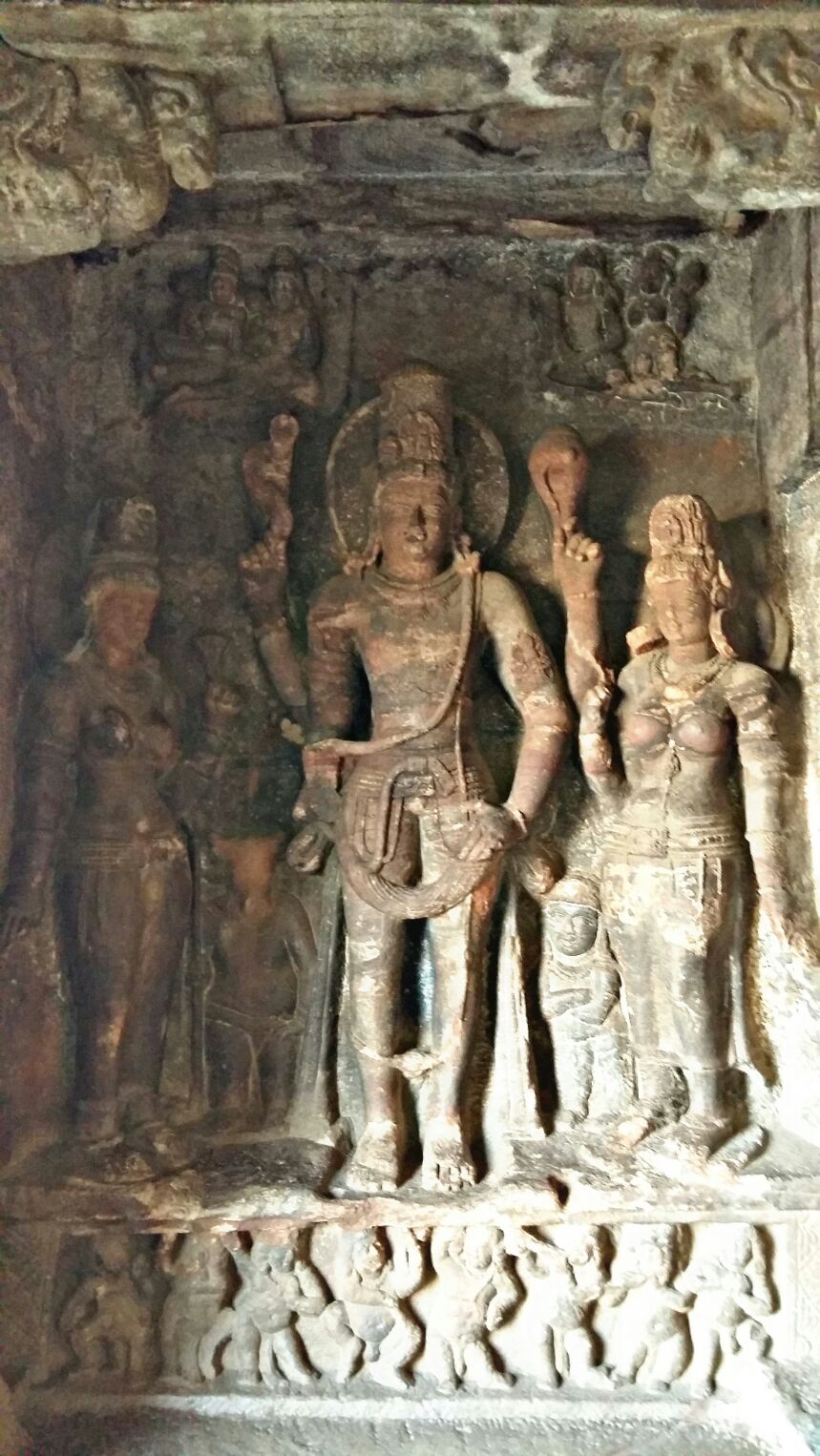 Lord Harihar with Goddesses Parvati and Lakshmi
Cave No. 1, Badami, 6th Century CE
This is one of the most unusual depiction of Lord Harihar.
Generally He is portrayed as a single figure where the left half is
Lord Shiva and the right half is Lord Vishnu. But here He is shown with
Goddess Parvati on the left side and Godess Lakshmi on the right side.
Thus both the halves are with their respective consorts, with their
"Shaktis". The two halves are also with their vehicles: Nandi , the bull
in a human form on the left, and Garuda, again in human form on the
right.
This is a fascinating group of sculptures: all the three
figures are over lifesize. In cave temples generally we have over
lifesize figures. This testifies to the confidence of the sculptor, to
the boldness of the people. They could think in large terms. They had a
broader vision.
Interestingly the early Rulers of Chalukyan Dynasty were
Vaishnavites. Later they worshipped Lord Shiva. Yet here in a cave
dedicated to Lord Shiva, they have commissioned a sculpture of Lord
Harihar. He is a figure who was invented in order to end the
controversy between the Vaishnavites and the Shaivites as to whose god
was greater. Hence, this group is socio-political statement that both
the factions are equal in the eyes of the King.
Other sculptures in Cave No. 1 also carry forward the
message of assimilation. Right opposite this group of Harihar, is an
equally over lifesize group of Lord Shiva as Ardhnarishwar-- as half
man, half woman. Ardhnarishwar not only portrays the unity in the
duality of Nature, but more importantly depicts gender equality and
gender fluidity. The ancient mind was far more liberal in accepting
genders of different types. It was comfortable with men turning into
woman and vice versa. In fact the birth of Harihar itself deals with
Lord Vishnu turning into Mohini, the enchantress, and having a physical
relationship with Lord Shiva to give birth to Harihar. Such liberal
thoughts are a rarity in Modern Age where one gender has seek equality,
and where a community of LGBT have to struggle for their rights. The
ancients would be amused by the "advanced" thinking of the moderns.
Natraj ( Lord Shiva Dancing )

Natraj ( Lord Shiva Dancing )
Cave No. 1 at Badami, 6th Century CE
Badami has four cave temples which were excavated during the
Chalukyan period ( 6th- 8th Century CE ). These cave temples were
carved after the Ajanta Caves. They may not be as elaborate as the
Ajanta Caves, but they continued the same traditions. In fact, the
Badami caves are influenced by the Ajanta Caves. But compared to the
Ajanta, these caves are modest in size, and in complexity. But
nonetheless, this is the beginning of Hindu art as compared to the
Buddhist art of Ajanta.
We do not know the chronological order in which the caves
were carved. But Cave No. 1 being the simplest may have been carved as
the first cave. Although the Chalukyan Royalty were Vaishnavites, but
Cave No. 1 is a Shaivite cave. It is dedicated to Lord Shiva.
On the outer wall of the Cave is this over life size sculpture
of Lord Shiva as a dancer or Natraj. The most famous Natrajs are of
course the Chola Bronze ones. But here we see Natraj depicted for the
first time. He has eighteen arms, he stands on a pedestal, while Lord
Ganesh, like a child, tries to imitate His father. Nandi, the bull,
stands quietly as though nothing is happening. A drummer beats the
rhythmic patterns of the music.
It is said that the eighteen arms capture different postures
of Bharatnatyam. It is not that the God has eighteen arms, He could have
just two arms. But the arms are shown in motion. It is a continuous
narrative, as it were. But the image is a dynamic one. The flaying arms
capture the fast movement, the rhythm ofthe dance.
It is dance which represents the whirling universe: it turns
and twists, it moves and swirls. It is still yet in movement. The
universe dances to Time ( the drummer). But a sense of calmness pervades
with a sense of wisdom ( Lord Ganesh). However, through life, through
its ups and downs, Nature is unmoved (Nandi, the bull ). The over
lifesize sculpture is not about a God who is merely dancing; it is an
existentialist statement. It is full of philosophy.
City of Badami

City of Badami
District Bagalkot, Karnataka
Badami is one of the most ancient cities of the Deccan.
Although the area around the city was inhabited since Mesolithic times,
it reached its zenith under the Chalukyan Dynasty (6th- 8th Century CE
). Before we explore the art treasures of Badami, it is imperative to
know a bit of its history. According to the Puranic lore, the area was
ruled by two demonic brothers, Vatapi and Ilvala. Ilvala would kill
Vatapi, and feed his meat to the guests. Then, he would ask Vatapi to
come out; Vatapi would come out, thereby killing the guest. Saint
Agastaya was also fed Vatapi ' s meat. But before Ilvala could call his
brother out, Agastaya said "Vatapi be digested." Vatapi never came out.
This myth clearly speaks of Aryanisation of this region.
Pulkeshin I (r. 544 - 67 CE) established Badami as the capital
of the Chalukyan Kingdom. He named the city as Vatapi. For two
centuries Vatapi was the seat of the Chalukyan Kingdom.
The Chalukyan Kings and Queens were great patrons of art,
architecture, literature, dance and music. They experimented with
architecture, excavating cave temples, and constructing free standing
temples. Their experiments can be found in Badami, Aihole and
Pattadakal. It is there architectural imagination which has given rise
to both the Northern (Nagara ) style, and to the Dravidian style of
architecture in India. Thus, they are the founders of Indian
architecture as we know it today.
Although initially the worshipped Lord Vishnu, but subsequently
they became worshippers of Lord Shiva. But their dedication to Hinduism
did not make them blind to other religions. In fact the equally
patronised Jainism and Buddhism. In fact one of their Kings has boasted
that different religions are peacefully coexisting and flourishing in
his Kingdom. Assimilation was the hallmark of the Chalukyan Dynasty.
But simultaneously Chalukyans were a proud race. The bitterly
fought with the Pallavas of Kanchipuram for two hundred years. The
constant warfare destroyed both the kingdoms. Both are in ruins today.
There is much to learn from the rise and fall of the Chalukyans!Lord Shiva as a Column of Fire

Lord Shiva as a Column of Fire
Virupaksha Temple at Pattadakal,8th Century CE
Raja Vikramaditya II ( r. 734- 45 CE) had finally defeated the
Pallava King of Kanchipuram. His two Queens, Lokmahadevi and
Trilokmahadevi erected two temples at Pattadakal. The Virupaksha temple
was commissioned by Queen Lokmahadevi. It is the pinnacle of Chalukyan
architecture. The fact that the queens commissioned the temples
clearly proves the harmony within the royal harem. It is also testifies
to the Socio-economic and political importance of the queens.
Since Goddess Lakshmi was the family Goddess, we see the
Gajalakshmi sitting at the top. She is being bathed by two elephants.
In the Shiva Purana there is a story about a pillar of fire
which had suddenly appeared. Both Lord Vishnu and Lord Brahma wanted to
prove that one was better than the other. Brahma went towards the top of
the flame ( the tiny figure on the left hand side), while Vishnu went
towards the bottom of the flame ( figure has been damaged towards the
right bottom). But neither could find the end of the flame. But to prove
His superiority, Brahma lied and claimed that he had discovered the
top of the flame as He brought a Kewada flower from the tip of the
flame. Lord Shiva appeared from the flame and cursed Brahma that He will
not be worshipped as He had lied. Kewada flower would not be offered to
the gods, only it's essence will be burned. For Kewada flower had
conspired with Brahma to cheat Vishnu.
This story proves the superiority of Lord Shiva over the other
two members of the Hindu Trinity. It also establishes the concept of
crime and punishment. Even the Creator can be punished. For Dharma (
the laws of righteous conduct ) are above Him. Rule of Law is eternal
and omnipresent.
Goddess Chamunda
 Goddess Chamunda
Bhopal Museum.
Goddess Chamunda is said to be a manifestation of Goddess
Durga. Sambhu and Nishambu were two great demons who constantly fought
with the gods and tortured humanity. All the Gods combined their
energies and from their energies Goddess Durga appeared. She fought with
the demons. Sambhu and Nishambu had two generals: Chanda and Munda. To
kill them, a goddess appeared from the brow of Durga, Chandika. When
She killed Chanda and Munda She came to be known as Chamunda.
Of the Seven Mothers ( Saptamatrikas ) Chamunda is the most
ferocious. She is easy to recognise as She is depicted as skeletal,
with flat drooping breasts, with sunken eyes, with a garland of skulls,
with eight or ten or twelve arms carrying different weapons, and corpse
as her vehicle. She was popular in Tantrism as a Goddess who frequented
the cremation ground and one who drank liquor and ate meat. During
Dashehra festival animals are sacrificed to her.
According to historians, originally she was a tribal goddess
of the Vindhyas region who was assimilated into mainstream Hinduism. She
was also adopted into Jainism, but as a benevolent goddess. She is the
Kuldevi ( the family goddess ) of the Oswal Jain.
She was misunderstood by the Westerners who mistook her for a
witch. She was also seen as a hedonistic goddess and thus a symbol of a
barbaric civilisation. But they failed to realise that at times
Nature takes on a demonic features in order to destroy evil itself. The
Mother continues to be loving and kind, but to fight evil She appears to
be angry and grotesque. But underneath the ferocious form is the
serenity and compassion of a Mother.
Lord Shiva as a Column of Fire
Lord Shiva as a Column of Fire
Virupaksha Temple at Pattadakal,8th Century CE
Raja Vikramaditya II ( r. 734- 45 CE) had finally defeated the
Pallava King of Kanchipuram. His two Queens, Lokmahadevi and
Trilokmahadevi erected two temples at Pattadakal. The Virupaksha temple
was commissioned by Queen Lokmahadevi. It is the pinnacle of Chalukyan
architecture. The fact that the queens commissioned the temples
clearly proves the harmony within the royal harem. It is also testifies
to the Socio-economic and political importance of the queens.
Since Goddess Lakshmi was the family Goddess, we see the
Gajalakshmi sitting at the top. She is being bathed by two elephants.
In the Shiva Purana there is a story about a pillar of fire
which had suddenly appeared. Both Lord Vishnu and Lord Brahma wanted to
prove that one was better than the other. Brahma went towards the top of
the flame ( the tiny figure on the left hand side), while Vishnu went
towards the bottom of the flame ( figure has been damaged towards the
right bottom). But neither could find the end of the flame. But to prove
His superiority, Brahma lied and claimed that he had discovered the
top of the flame as He brought a Kewada flower from the tip of the
flame. Lord Shiva appeared from the flame and cursed Brahma that He will
not be worshipped as He had lied. Kewada flower would not be offered to
the gods, only it's essence will be burned. For Kewada flower had
conspired with Brahma to cheat Vishnu.
Goddess Chamunda
Goddess ChamundaBhopal Museum.
Goddess Chamunda is said to be a manifestation of Goddess
Durga. Sambhu and Nishambu were two great demons who constantly fought
with the gods and tortured humanity. All the Gods combined their
energies and from their energies Goddess Durga appeared. She fought with
the demons. Sambhu and Nishambu had two generals: Chanda and Munda. To
kill them, a goddess appeared from the brow of Durga, Chandika. When
She killed Chanda and Munda She came to be known as Chamunda.
Of the Seven Mothers ( Saptamatrikas ) Chamunda is the most
ferocious. She is easy to recognise as She is depicted as skeletal,
with flat drooping breasts, with sunken eyes, with a garland of skulls,
with eight or ten or twelve arms carrying different weapons, and corpse
as her vehicle. She was popular in Tantrism as a Goddess who frequented
the cremation ground and one who drank liquor and ate meat. During
Dashehra festival animals are sacrificed to her.
According to historians, originally she was a tribal goddess
of the Vindhyas region who was assimilated into mainstream Hinduism. She
was also adopted into Jainism, but as a benevolent goddess. She is the
Kuldevi ( the family goddess ) of the Oswal Jain.
She was misunderstood by the Westerners who mistook her for a
witch. She was also seen as a hedonistic goddess and thus a symbol of a
barbaric civilisation. But they failed to realise that at times
Nature takes on a demonic features in order to destroy evil itself. The
Mother continues to be loving and kind, but to fight evil She appears to
be angry and grotesque. But underneath the ferocious form is the
serenity and compassion of a Mother.
Lord Vishnu in His Supreme Form

Lord Vishnu in His Supreme Form
Pratihara Dynasty, 10th Century CE, Bhopal Museum
King Bali was known for his generosity. In order to test his
commitment to his words, Lord Vishnu appeared as a dwarf (Vaman). He
asked for land which would be covered by just three steps of His. Bali
granted him His wish. The dwarf transformed himself into the supreme
form of Lord Vishnu. In one step He covered the earth; in second step
He covered the sky. He asked Bali " where shall I place my third step?"
In all humility, Bali offered his head. Lord Vishnu stepped on his
head. Bali went to the underworld. But Lord Vishnu was impressed by his
generosity and truthfulness and by his honouring his pledge. He granted
him the boon, that he could revisit Earth once in a year.
Here we see King Bali granting the wish to Vaman on the bottom
right side. Lord Vishnu has taken the Universal form and stretched his
leg to the moon. Besides Arjun, King Bali is another person who had seen
the the Lord's universal form.
This myth is full of symbolism. Like Abraham, King Bali is also
tested by God. But Bali is true to his words. Honouring one's word, or
truthfulness is important. The story also explains the rejuvenation of
Earth after the hot summer. In fact, Pongal in Kerala is celebrated in
order to mark the return of King Bali on Earth.
Most importantly, the story is about self - confidence. We are
dwarfed by our own psyche. At times, we lack confidence. Yet there is
infinite energy and faith within us. If we were to tap the inner
strength, we can take giant steps in our life. We too can take the
Universal form of the Lord.
Sadashiva ( A form of Lord Shiva)

Sadashiva ( A form of Lord Shiva)
Prathihara Dynasty, 10th Century CE, Bhopal Museum
One of the most unusual sculptures of the Bhopal Museum is
this figure of Sadashiva. Lord Shiva in his form as a Trinity, as the
creator, the preserver and as the destroyer, is called Sadashiva. In
the Elephanta Caves He is shown with three male heads. Surprisingly here
He is depicted with two female heads: of Parvati and Chamunda. This
clearly reflects the influence of Tantra art on this sculpture. The
influence of Tantrism is not surprising as Tantrism, an occult form of
Hinduism was at its zenith in the 10th Century CE. But the sheer size of
the sculpture, almost life - size, reveals the importance of the figure
in a temple.
The inclusion of Goddess Parvati and of Goddess Chamunda is
significant. Parvati holds a mirror on the left side of the figure;
Chamunda is drinking blood from a bowl on the right side of the figure.
While Parvati is depicted as a young and a beautiful woman, Chamunda is
portrayed as a hideous and ferocious looking woman. Both depict the twin
aspect of Nature: the calm, the serene, the benevolent is Parvati; the
destructive, the violent is Chamunda. The Lord sits calmly between the
two extremes.
Our mind is also like Sadashiva. It has both the creative
and the destructive sides to it. But a detached persons is full of
equanimity, full of serenity, full of compassion, like the Lord Himself.
Like Shiva we also have our desires around our neck/ waist (as in this
sculpture ). But a Yogi keeps the desires under control. This figure is
as much a reflection of the prevalent process in the Universe as it is
about human psychology. It, thus, represents both the micro and the
macro levels of existence.
Like all great Indian sculptures, this figure reflects a great philosophical concept.
Lord Kuber
 Lord Kuber
Pratihara Dynasty, 10th Century CE, Bhopal Museum
Lord Kuber is the Hindu God of Wealth. He is an interesting
character in Hindu pantheon. For, He is step-brother of Ravan. He is
said to live underground and not in the sky as other gods do. He is a
demi-god. It is easy to recognise him as he has a protruding belly (as
in this sculpture ), usually carries a bag full of money or gems; the
bag being made of a mongoose skin.
He lives underground as precious metals and gems are found
under the earth. Mongoose has the ability to burrow under the ground.
Hence, bag full of gems and money-- bag made of mongoose skin.
Kuber symbolises "arth" ( economics); the second goal of
Hindu life. The ancient Hindus recognised the importance of trade and
commerce, of money. Unlike the Greeks and Romans, we have two dieties
for wealth: Goddess Lakshmi and Kuber. But while Goddess Lakshmi
symbolises the benign aspect of money, Kuber depicts the voracious or
the greedy aspect of money. He is thus shown as indulging in drinking as
well: "drunk" with the power of money. His arrogance is also well
known. Thus His character is also a warning to the people, not to be
arrogant about one's wealth.
To acquire wealth is certainly a laudable goal. But to be
greedy and arrogant and ostentatious are wrong characteristics in a
person. Wealth which is hoarded is called "Kulakshmi", a sister of
Goddess Lakshmi who personifies poverty and pestilence. For money which
is locked up is useless to the society. Like blood, money too should
circulate to keep the society healthy. Money spent on charity, on the
poor and the downtrodden, earns good deeds or Karma. Money spent on
oneself is said to be wasted. It reflects egoism and arrogance. Money
spent wisely is a boon, spent foolishly, it is a curse.
Kuber symbolises both the be aspects of arth, money: the
beneficial and the destructive. This is why He is a demi-god, and yet
related to Ravan.
Uma - Maheshwar ( Lord Shiva with Goddess Uma)

Uma - Maheshwar ( Lord Shiva with Goddess Uma)
Prathihara Dynasty,10th Century CE, Bhopal Museum
After the sudden death of Sati, Lord Shiva retreated into
the Mt. Kailash and sat in deep meditation. His withdrawal froze the
landscape and everything became desolate. The gods were worried.
Absolute control over the desires leads to a lifeless existence. Shiva
had to be aroused from the deep meditation. Lord Kama was sent, but he
was burnt. Only Gauri or Uma could win his heart, but through austerity.
She won. She domesticated his wild nature.
Here They sit in each others company. She looks at Him with
deep reverence. He at Her, with deep love. The cosmos revolves around
them. Lord Brahma stands on top left, Lord Vishnu on top right, Ganesh
sits on bottom left, and Kartikeya on right bottom of the viewer.
When we lose someone, we too become shell shocked. We need to
be brought out of our mourning. The desire to live, to prosper, to
excel needs to be rekindled. Nature, in all Her splendour ( Goddess
Uma) smoothens the harsh edges of the intellect. She draws us back into
the beauty of life. We begin to create (Brahma), we begin to preserve
(Vishnu ); we work with wisdom (Ganesh ), and with force (Kartikeya ).
All is well.
Maithun Figures
 Maithun Figures
Chandela Dynasty, 10th Century CE, Bhopal Museum
Kama or desire was one of the four goals of ancient
Indians. But today it is misunderstood by the Indians themselves. To the
ancients Dharma (righteous conduct ), Artha (wealth), Kama (desire),
and Moksha (liberation from the cycle of life and death ) were the four
goals of life. But under the influence of other civilisation, and value
systems, Kama is becoming a taboo subject.
Buddhism too saw desire as the root cause of misery in the
world; Christianity and Islam equated desire with temptation. But for
Hinduism desire is essential. For without desire Nature ceases to
exist. It is desire which propagates a species. Thus, desire and sex are
fundamental to our existence.
Of course, when we speak of desire, it must be in moderation.
Love should not turn into lust, nor desire into greed. But to deny
desire is to cap human emotions, human capabilities, human
achievements. Desire is what fuels a civilisation to grow, to prosper.
Eroticism in Indian art has always raised eyebrows of the
conservatives and the vandals. But it is a celebration of life. For
without desire and emotions life is a Martian wasteland.
Ganga
 Ganga
GangaPratihara Dynasty, 8th Century CE.,Bhopal Museum
The holiest of the rivers in India, River Ganga (Ganges) adorns
the door bracket of the inner sanctum of a temple. Seen as a
beautiful damsel on a multi - bodied animal ( a Makar), She carries a
pot of the holy water of the river.
Hindus believe that a dip in the holy river cleans them of their
sins; immersion of the ashes of the dead, leads to liberation from the
cycle of life and death or to Moksha.
According to Hindu mythology Ganga descended from the heavens at
the request of Sage Bhagirath. In order to break it's velocity of
descent lest it should shatter earth, Lord Shiva received her in his
hair. Since the river begins it's journey in the Himalaya, she is said
to be lost in the locks of Lord Shiva.
Ganga has always symbolised purity, knowledge, truthfulness, and
spirituality. In 19th century India, a Hindu witness in a court would
swear the oath over a Gangajali ( a pot containing the water of the
Holy River).
But the modern Hindu is least bothered about the purity of the
river. Presently it is one of the most polluted rivers of India.
Warrior
 Warrior
13th century CE, Bhopal Museum
Warriors are an important class in every community and
country. It is they who keep us safe from external invasions and
internal disturbances. They have been praised in literature; they have
inspired generations; they have adorned the pages of world history--
from Ramses II of Egypt to Alexander the Great, from Julius Ceaser to
Samudragupta of India, from Neapoleon to General McCarther of USA.
Dronacharya, in Mahabharata, was not only a great teacher,
but was also a great warrior and strategist. Yet he was killed. Lord
Krishna was asked as to why Dronacharya had to be killed when he did no
wrong. Lord Krishna says Dronacharya did many things wrong : although a
Brahmin, he learned the use of arms; instead of teaching his students
about diplomacy, about love and compassion, he taught them about war and
only war; when the war began, although he was under no compulsion, he
choose to side with the Kauravs. He had to be killed.
It is good to be a warrior, but a true warrior should also
know the art of diplomacy. Today war is raging all around us. Yet no
one speaks of diplomacy. People invade, kill, rape and butcher, blow up
cities and spread terror. But the UNO, the best agency for maintaining
world peace has become a mute spectator. Within our country
polarisation is taking place, but no one speaks of fusion, of synthesis,
of peaceful cooperation and co - existence. The ways of the warrior
may be good, but too many wars annihilate civilisations.
Lord Harihar
 Lord Harihar
12th Century CE. Bhopal Museum
Splits within a religion is nothing new. Pharaoh Akhnatan
broke away from the traditional Egyptian religion in ancient Egypt and
established his own cult of Ra, the Sun God. In 1st Century CE Buddhism
split into two schools : the Hinyana and the Mahayana. Hinduism is no
exception. In ancient India we had two sects: the Shaivites and the
Vaishnavites. Those who believed in Lord Shiva and and those who
believed in Lord Vishnu. Like the Shias and the Sunnis, these two
groups in Hinduism also fought with each other, trying to prove the
superiority of one God over the other.
But in order to survive as a human race, we have learned to
synthesis opposing views. Lord Harihar is a byproduct of the synthesis
of Lord Shiva on the left and Lord Vishnu on the right side of the
viewer. Hence the trident and the Nandi, the bull on the left and the
disc and the conch shell on the right.
The debate within Hinduism is also between the aesetic and
the householder, between the pure intellect ( Shiva) and the emotions (
Vishnu), between the one who abandons the society ( Shiva) and one who
incarnates to save the society (Vishnu). But we did not waste too much
time trying to annihilate each others' sect. We assimilated. And we have
thrived as a 5000 year old civilisation.
Perhaps Harihar holds the solution to the problem of
"clashes of the civilisations ". On the one hand we are in the
globalisation age, yer there is fight and war all around us. We over -
react to every statement; we fight over the silliest issues only trying
to prove that our Gods are superior to theirs. Today the issue posed by
Galib, the great Urdu poet is relevant:
" Gar tujh bin nahi koi maauzood/ phir ye hangamma e-Khuda kya hai?" (
If there is no one but One God, then what is this fight about?).
Time has come to revive the concept of synthesis, of peace,
of prosperity. For the path of confrontation leads to total
annihilation.
Dancing Ganesh

Dancing Ganesh
Pratihara Dynasty, 10th Century CE, Bhopal Museum
Although Lord Ganesh is the God of wisdom, He is seen in
various forms: as a sleeping child, as a child worshipping a Shiva Ling,
as a dancing figure ( as in this figure), as an adult reading or
writing, and even playing cricket or sitting on a rocking chair. His
forms are as varied as human imagination permits. Wisdom is not a
monopoly of any age, or form. It is universal.
Here the Lord holds an axe in one hand and his broken tusk
in the other hand. The other two hands are striking a dancing pose. The
axe is symbol of wisdom 's ability to cut through any obstacle. Hence
He is the God who removes the obstacles. The broken tusk is symbolic
of His being a scriber. He records our deeds and awards or punishes us
accordingly.
He dances for the universe is in constant motion. While one
foot is firmly planted, symbolising stability, the other foot is
lifted and in motion, symbolising time and motion.
He is also surrounded by his parents : Goddess Parvati on
his right, and Lord Shiva on his left. This not only completes the Shiva
family, but also depicts Nature (Goddess Parvati ), and the intellect
(Lord Shiva). Wisdom is not isolated; it does not exist in a vacuum. It
thrives in the Nature and the intellect. It throbs and pulsates
throughout the universe. It is not the monopoly of a caste or a creed or
of a race. It is as universal as the universe.
Lord Surya ( The Sun God )

Lord Surya ( The Sun God )
Prathihara Dynasty, 10th Century CE, Bhopal Museum
One of the finest sculptures of the Bhopal Museum is this
small statue of Lord Surya. The museum has a good collection of
sculptures from Hinglajgarh in M. P. The history of the city of
Hinglajgarh is unknown. But it's sculptures can compete with the finest
sculptures of Khajaraho. Although both belong to the Khajaraho School,
the sculptures from Hinglajgarh are more finely chiselled, are more
delicate, and are more well proportioned than the figures from
Khajaraho. Whether these figures belong to the same temple or come from
different temples is also u known. But the high quality of work
testifies to the prosperity of the city, and to the high aesthetics of
the people.
Today is Lord Surya ' s day as today is Raviwaar. The Lord
holds two lotus in his hands. Like many flowers the lotus also opens and
closes according to the sun. Since it floats on murky water, it is the
symbol for the human mind and soul. It is said that when the highest
"Chakra" ( wheel) of the mind opens, it is like the blossoming of a
lotus with thousand petals. Thus, the mind has to be as wife
encompassing as the rays of the Sun.
Lord Ram and Goddess Sita

Lord Ram and Goddess Sita
13th century , CE,Bhopal Museum
The eternal pair of Ram and Sita is the ideal couple in Hindu
mythology. Ram is the most pious king as He upholds the Dharma (
righteous conduct) at every step of his life. He is the ideal son, and
the ideal brother. However, His credentials as an ideal husband have
been questioned. People claim that he was unkind to Sita on two
occasions : when He asked her to prove her chastity, and when He exiled
her to the forest.
What has been seen as a short coming in Ram's character, has
strengthened Sita as a character. In fact, Sita is considered one of
the five Satis (powerful women ) in Sanskrit literature. Born of
mother Earth, She has a will of her own. When Ram tries to persuade her
not to come to the forest with him, she tells him about the Dharma of a
wife ; when Lakshman hesitates to leave her alone when Ram has gone away
to chase the golden deer, she chides Lakshman; when Ram asks her to
prove her chastity, she chides Ram. Eventually as a sign of protest she
leaves Ram only to enter mother Earth. She is not a weakling, she is a
woman with an independent mind. Yet, she knows the limits placed by the
society. She balances her role as a wife, daughter-in-law, as a
sister-in-law, and as a mother. She is not a simple character, but is a
strong persona in Valmiki' s Ramayan. She can be a role model for the
modern woman: upright, independent, forthright, articulate, intelligent,
and one who stands up to question the orthodoxy of the society. She is
not the one to be confined by the artificial limits of the society. She
may be tolerant like mother Earth, but she is not docile and weak.
Goddess Gauri
 Goddess Gauri
Paramar Dynasty, 11th Century CE, Bhopal Museum.
Goddess Gauri is none other than Goddess Parvati. She seems
to be a popular diety in the 10th to 12th century as numerous sculptures
of hers can be found from this period. Here she is surrounded by the
Seven Mothers (Saptamatrikas) on the top, by Kartikeya on her right, by
Lord Ganesh on her left. She would have carried a Shiva Linga in one of
her hands. She is also surrounded by other maidens who are at her
service. Surprisingly her 'vehicle' (vahan) is a mongoose.
This sculpture is highly symbolic. Goddess Gauri is the
symbol of benevolence of Nature. Thus Her full bodied figure. Her inner
energy is depicted by the string of pearls which has moved to her left
side of the naval. Despite the fact that She stands erect, the pearl
string moves. This portrays the inner strength or the "inner Prana" of
the divinity.
Like the Seven Mothers, Nature sustains us. In her lap we
are protected and we grow as individuals and as a nation. But to grow we
need both wisdom and dynamism. Hence, Lord Ganesh (wisdom) and
Kartikeya (dynamism). But like the mongoose, we need a probing mind to
understand the beauty and mystery of Nature. Mongoose also symbolises
the riches which are buried in Nature. Thus an inquisitive mind
discovers the riches of Nature. Nature stands in all her glory in this
stunning sculpture.
Varaha Avtar (Lord Vishnu in His Third Incarnation as a Boar)

Varaha Avtar (Lord Vishnu in His Third Incarnation as a Boar)
Paramar Dynasty,11th Century CE
There was a time when Mother Earth was coveted by a demon.
He dragged her into the cosmic ocean. She pleaded to Lord Vishnu to save
her. Lord Vishnu emerged as a wild Boar. He fought with the Demon,
killed him, and brought Mother Earth out of the ocean on his tusk. Here
we see Him with the Mother Earth as He emerges from the ocean.
This pose of Lord Vishnu was created by the Gupta artists in
the 5th Century CE at Udaigiri Caves in Madhya Pradesh. Ever since
then, this pose has been used repeatedly by the Indian artists.
The wild Boar is a unique animal. While it lives on the
land, it can dive deep into the water. It is thus adjustable to both
land and water. Only those who are flexible in their thoughts can emerge
from the ocean.
Mother Earth is again under threat. On the one hand She is
constantly attacked, on the other hand She is ever exploited. Again she
awaits to be rescued from the senseless greed and hatred of mankind. She
again awaits for flexible thinking persons to rescue her from her
pitiable plight. But we are becoming blind to our myopic vision. The
totality of Oneness is lost upon us. And Mother Earth seems to further
sink into a quagmire.
Lord Ganesh with Siddhi

Lord Ganesh with Siddhi
Pratihara Dynasty, 9th Century AD, Bhopal Museum
Goddess Parvati was worried as to who would marry her elephant
headed son, Ganesh? She went to Lord Brahma. He said he would give two
of his daughters, Riddhi and Siddhi, in marriage to Ganesh. That is
how Lord Ganesh has two wives.
While Riddhi stands for spiritual wisdom, Siddhi stands for
intellectual wisdom. Since Lord Ganesh is the God of wosdom, He has to
have the two sides of wisdom with Him. While Riddhi sits on Ganesh 's
right, Siddhi sits on his left. Here we see Lord Ganesh with Siddhi. She
sits on Lord Ganesh 's thigh ( a usual convention to show the God and
his Shakti together). Siddhi holds a mirror. One has to reflect on
things, on different subjects before one becomes wise.
Wisdom is cherished in Hinduism as Hinduism speaks of
introspection and assimilation. Since wisdom can solve every problem,
Lord Ganesh is the remover of obstacles. Hence, in every function,
religious or secular, He is worshipped as the first god. When we pray to
Him, we merely invoke our inner wisdom.
Lord Shiva

Lord Shiva
Pratihara Dynasty,9th Century CE,Bhopal Museum
This is an unusual image of Lord Shiva. For while He holds a
trident (trishul), He carries a lotus bud (symbol of Lord Vishnu ), and
a pitcher of holy water ( symbol of Lord Brahma ). Thus it seems to be a
composite image of the Hindu Trinity of Brahma, Vishnu and Mahesh.
The Lord sits calmly, ever smiling and ever young. Like the
Lord, we too are the creator, the maintainer, and the destroyer. The
snake is the symbol of desire, of the changes in life. We too are full
of desires; we too are prone to changes in life. The trident is the
symbol of the three mental states: the sub - consciousness , the
unconsciousness, and the consciousness. All three are bound, like the
shaft of the trident, with superconsciousness. The holy water is a
symbol of the purity within us that is hidden from us and others. But it
has the capacity to cleanse us of our dilutions, of our egos, of our
desires. The end result is the reward of beauty ( the lotus). The lotus
of thousand petals is the symbol of superconsciousness which is
inherent in us, which we can achieve with some efforts. Divinity is
within us. It all depends which facet of the divinity we cherish and
cultivate.
Lord Buddha Returns to Kapilvastu
 Lord Buddha Returns to Kapilvastu
Ajanta Caves, Gupta Period,5th Century CE
The news has spread that Prince Siddharth as Buddha was
returning to his native city, Kapilvastu. His wife, Yashodhara decided
to take their son, Rahul to the Buddha. She taught the child to ask for
his inheritance. The Buddha says, "I have only my alms bowl which I can
give to you as your inheritance. " Both the mother and child look at
the Buddha. Yashodhara had decked up herself with the hope that she
would be able to induce the Buddha to stay back and become a
householder. But all in vain. Buddha left Kapilvastu in order to preach
the Dharma to the people.
Although greatly damaged, this fresco is considered one of the
most poignant paintings of Ajanta Caves. Siddharth 's family meets
momentarily and parts ways. The dilemma is between the life of monkhood
and of a householder. Which is more appropriate. The issue is between
the right of a wife and a child to have the husband and the father back,
and the right of a man to be free to preach his Dharma. Unlike
Hinduism, Buddhism emphasised the life of a monk over the life of a
householder. Perhaps this was one of the reason that Buddhism declined.
If everyone becomes a monk, how would the society survive?
Society is a mixture of the intellectuals and the labourers,
of the aesetic and the householder, of the industrialist and the
agriculturalist. It is a composite of different communities, different
philosophies, different life - styles. To impose one philosophy or
brand of thinking is to tear the social fabric. The middle path of
assimilation is the right path. Too many monks also spoil the stew!
Goverdhan Pooran ( Worshipping of Mt. Goverdhan)

Goverdhan Pooran ( Worshipping of Mt. Goverdhan)
Painting from Bhagwat Puran by Fattu, Kangra School,18th Century CE
Lord Krishna was surprised to see that the people of
Vrindavan prayed to Lord Indra, the God of rain. Instead of praying for
rain, it is better to pray to the mountain which with its green cover
invites the rain. He taught the people to worship the Goverdhan hill.
Here Fattu, the famous Kangra painter, depicts Nanda,
Krishna's father, and the people circumbulating the mountain. Lord
Vishnu sits on top of the mountain while Krishna and Balaram and Nanda
go around the mountain. To mark the festivities, there are musicians
playing the long horn and beating the drums. Ladies are carrying water
in the pots; the offering are kept on the ground. A young cowheard
points to Lord Vishnu sitting on top of the hill; an old man bends and
pays homage to Lord Vishnu.
Fattu has depicted different strata of society from the
village headman, Nanda, to the cowheard, from the young child in the
arms to the old man. The costumes of the people depicts the composite
culture of the people. Interestingly Nanda looks like a Mughal Emperor,
while the women are attired in lenhga and odhani (the long skirts and
the stoles) of Hindu womenfolk. All the cultures and community live
peacefully.
Rani Celebrating Deepavali in Her Palace

Rani Celebrating Deepavali in Her Palace
Attributed to Nainsukha, Kangra School,18th Century CE
Deepavali is an ancient festival. Initially it was
celebrated to mark Lord Ram's return to Ayodhya after spending fourteen
years in the forest. Subsequently, it became the festival for praying to
Goddess Lakshmi, the goddess of wealth. It also marks the beginning of
the Hindu financial year. In Bengal, on the other hand, Goddess Kali
is worshipped on Deepavali. While for North India Deepavali is a major
festival, in South India it is hardly celebrated.
Here we see the Rani sitting in a chair. Both she and
another Lady are busy with fire crackers. The maids have lit lamps all
over the palace. There is music and light, gaiety and celebrations all
around. Interestingly whole many women are wearing Hindu dresses, the
ghaghara and the odhani, ( the skirt and the stole), other women are
sporting the Mughal dress of the inner pajama and Mughal caps. The life
of the palace reflects the composite culture of its time.
Deepavali is a festival which celebrates our coming out of
the woods: of destroying the prejudices, the bad deeds, the evil spirit
in us. And thereby moving from the darkness of our personality to the
light within us. It is a celebration of our rebirth each year.
May the divine light inside you ever burn so brightly as to
light up every corner of your home, office and of our nation
Hamsa Jataka : A Tale of the Golden Ghoose

Hamsa Jataka : A Tale of the Golden Ghoose
Ajanta Caves,Gupta Period,5th Century CE
Once upon a time the Bodhisattva lived as a golden goose in a
lake with his flock. One day the Queen of Benaras had a dream where she
saw a golden goose. She asked the King to get her the golden goose. He
built a beautiful lake in order to attract the birds. One day the golden
goose landed with his flock. The goose realised it was a trap to
capture him. But he kept quiet till the flock had fed itself to its
satisfaction. Afterwards, the goose cried out about the danger. All the
geese flew off. But Sumukha, the minister of the golden goose refused
to leave his master. Both were caught and taken to the court. When the
King heard about Sumukha' s loyalty towards his King, he was
overwhelmed. He received both of them with great honour. The golden
goose taught the Dharma to the court.
Here we see the King with his courtiers listening to the
golden goose with rapt attention. The golden goose is sitting on a
throne to the bottom right corner of the painting. Faintly one can make
out two dark women who have brought a tray full of fruits. The pomp
and show of the court is well portrayed in the attire, the jewels and
the furniture of the court.
Loyalty is a virtue exhaulted by every civilisation :
loyalty to family, friends, community and to the nation. Sumukh is an
example of loyalty to the King and thus to the nation.
Further, in order to attract best ideas we have to create
the right environment. Only then do we receive the Dharma. We should be
open to receive ideas from all corners of the world. After all, the
court had received the sermon on Dharma from a bird!
Mrig Jataka : Taking Away the Golden Deer

Mrig Jataka : Taking Away the Golden Deer
Ajanta Caves,Gupta Period,5th Century CE
A golden Deer, a Bodhisattva, found a hunter lost in a
jungle. He guided the hunter to his village. He told the hunter not to
reveal his existence to anyone. The hunter promised to do so. But the
moment he reached his village, he informed the King's men. They informed
the King. Meanwhile the Queen saw a golden deer in her dream. She told
the King to search for the golden Deer. The hunter led the King into the
jungle. The golden Deer was captured and brought before the King. The
King was astonished when the Deer told him that the hunter had broken
his promise. The King ordered that the hunter be killed. But the Deer
interceded and asked the King to spare the hunter's life. The King
relented. The King told the Deer about the Queen's dream and asked the
Deer if he would return with him to the court. The Deer left with the
King. He taught the Dharma to the people and brought peace and
prosperity to the kingdom.
In this painting we see the Deer being carried away in a
cart. The hunter follows the cart. Notice the dog by the hunter's legs. A
rare depiction of a dog in Indian art.
The story is full of morality. It is about betrayal for money;
it is about greed. It is about compassion; it is about establishing
Dharma ( righteous duties).
Deepavali is also about establishing Dharma over Adharma
(evil acts). We must preserve, protect and propagate Dharma, the
golden Deer.
Kapi Jataka: The ungrateful Hunter

Kapi Jataka: The ungrateful Hunter
Ajanta Caves,Gupta Period, 5th Century CE
Once a hunter fell into a deep ditch in a forest. He shouted
for help as he could not come out of the ditch. The Bodhisattva who was a
golden monkey took pity. He pulled the hunter out and carried him
through the forest on his back. As night fell, both slept on the forest
floor. In the morning when the hunter got up he thought if I could kill
this golden monkey , I could earn a lot by selling his skin. He threw a
stone on the monkey 's head. The injured monkey ran to the lake near by
and washed his wounds. The hunter followed him. Feeling thirsty, the
hunter drank from the lake. Since the monkey's blood had mingled with
the water, the moment the hunter drank the water, he became a leaper.
He was shunned by others in the village.
Here we see the monkey sleeping on the forest floor and the
hunter about to hit him with a stone. The injured monkey admonishes the
hunter on the left side of the painting.
Many a times we hurt others out of greed or jealousy or
anger. But we don't realise that by our ungrateful acts we are hurting
ourself and our interests. We may see ourselves as winners, but slowly
people shun our company. Instead, we should be grateful to those who
have carried us through the difficult terrains of life. Rather than
think that by hurting them, we will gain wealth and fame. We will only
become an outcaste like the hunter.
The Buddha and the Elephant Nalagiri

The Buddha and the Elephant Nalagiri
Ajanta Caves,Gupta Period, 5th Century CE
Buddha's cousin brother, Devadatta was jealous of him. He
conspired with King Ajatshatru of Rajagraha to have Buddha trampled by a
mad elephant when Buddha comes to Rajagraha. They got the mad elephant
Nalagiri drunk and let him go scott free on the lane where Buddha was
coming. Nalagiri charged at the Buddha. Unmoved, and ever smiling the
Buddha gently patted Nalagiri. Overcome by Buddha's compassion and
kindness, Nalagiri bowed and touched Buddha's feet.
Here although Buddha's head is missing, but we do see a dark
hand gently caressing the huge elephant. The people in their homes are
awestruck by Buddha's power to overcome a mad elephant. One person even
folds his hands in reverence.
Problems are like the mad elephant. They come our ways. We
just need to be detached and calm to tackle them. With compassion and
kindness even our enemies can be won over. It is these two qualities of
Buddhism which spread the religion from India to Japan. One doesn't need
the sword to conquer; a beautiful smile is sufficient to disarm the
mighty and the unruly
The Loyalty of an Elephant towards His Blind Mother

The Loyalty of an Elephant towards His Blind Mother
From the Matriposhaka Jataka, Ajanta Caves, Gupta Period,5th Century CE
Once the Bodhisattva was born as a white elephant. One day a
hunter was lost in the jungle where the white elephant lived. The
elephant took the hunter back to his village. The hunter, instead of
being grateful to the white elephant, thought that he should tell the
King of Benaras about the existence of the white elephant and earn a
reward from the King. The King sent a few hunters into the jungle. The
white elephant was brought to the King's court. A huge crowd had
gathered to see the white elephant. But when the King tried to feed the
elephant, it refused all food. The King asked him why he was starving
himself. The elephant told the King, " I have a blind mother who cannot
eat without me. Then how can I eat without her? She must be starving in
the jungle." Hearing the love and affection, sensing his loyalty towards
his mother, the King freed the white elephant. Here we see the joy
amongst the elephant upon the return of the white elephant. The blind
mother elephant is caressing the white elephant.
The story is not just about the joy of a family reunion, but
it is more about family loyalty. However, loyalty in a positive way. It
is about sustaining each other emotionally and financially. But it is
not about hoarding things so as to leave riches for our children. As an
old Sanskrit saying goes " why leave riches for a good son? He can earn
on his own. Why leave riches for the bad son? He will squander away your
hard earned wealth."
But like Dhrastraraj we are blinded by our love for our
children. For their sake we harm our society and nation without
realising that without a strong nation our next generation has no
future. While we strengthen our family economically, we weaken our
nation.
The Elephant and the Hunter from Shaddanta Jataka Story
 The Elephant and the Hunter from Shaddanta Jataka Story
Ajanta Caves, Gupta Period,5th Century CE
In the Himalaya lived an elephant with six tusks,
Shaddanta. He had two wives. One day he showered his first wife with
the flowers of the Sal tree. He also presented her with lotus flowers
from a lake. The second wife felt jealous. She vowed to take revenge by
being born as Queen of Benaras.
As the queen of Benaras she feigned illness. She told the
king that she can be cured only if she had the six tusks of Shaddanta.
Hunters were sent to capture him and to bring his tusks. Here we see
the hunters around the huge Shaddanta. He asked them as to purpose of
their hunting him down. They told him about the queen's desire. Knowing
who she really was and what was her purpose, Shaddanta, the Bodhisattva,
himself cutoff his six tusks with an axe and gave them to the
hunters. When the Queen saw the six tusks, she was full of remorse. For,
she remembered Shaddanta, her loving husband from her previous life.
She died of grief.
At times out of jealousy and anger we do tend to take
revenge. But such anger boomerangs on us. Anger kills us and not the
person with whom we are angry. Thus, the need to control these two
emotions. For they lead to self - destruction.
On the other hand, by compassion we can win people over.
Like Shaddanta we become a hero. The choice again is ours.
Scene from the Simhala Avadana Jataka Story
 Scene from the Simhala Avadana Jataka Story
Ajanta Caves,Gupta Period, 5th Century CE
The story of Simhala, the merchant's son, is quite
instructive. Simhala sought his father's permission to travel abroad and
to establish his business overseas. But he, along with others, we're
shipwrecked on the island of Tamradvipa. The island was inhabited by
cannibalistic ogresses who disguised themselves as beautiful women.
Here we see Simhala sitting in a tent with a stunningly beautiful
woman, an ogress. Having lured the shipwrecked merchants, the ogress
makes a meal out of them. Seeing their pathetic condition, a Bodhisattva
in the form of a flying horse rescues many of the merchants including
Simhala. Simhala comes back home. But an ogress follows him to his
Kingdom. She appears before the King and tells him that Simhala has
abandoned her and her child in an island. She asks for justice. Simhala
tells the King that she is, in fact, an ogress who should be banished
from the kingdom. The King refuses to do so. At night the ogress
invites her other friends from the island. They kill the King and the
people. The kingdom is destroyed.
Similar story is also found in Homer's Ulysses.
The story is a warning about how beautiful ideas creep into a
Kingdom, how these innocuous ideas takeover the kingdom and destroy
it. But these ideas are like the Trojan Horse which we bring into our
Kingdom with jubilation and fanfare. Only to realise how these ideas of
exclusiveness, of 'we' versus 'them' have eventually torn the fabric of
our society and nation. The great destruction by such 'beautiful ideas'
leaves the nation desolate and destroyed. Like Simhala we should be
discerning enough to banish such 'beautiful ideas' from amongst our
midst.
Mambers of the Public

Mambers of the Public
Ajanta Caves,Gupta Period,5th Century CE
Besides the Buddhist figures, the Kings and Queens of Jataka
stories, the common man also invited the attention of the Ajanta
artists. Since the artists were themselves common man, they had the
sympathy for their own fellow beings. Thus, the members of public were
drawn with sympathy and care.
Here we see two persons who have approached a person in
authority. Although the stand with a sense of dignity, they are about to
address their problems. Thus, they are about to supplicate. That they
are from a rich class is well depicted from their attire and jewelery.
They may be businessman.
The relationship between the political power and the
business class is an ancient one. It is a symbiotic relationship. While
the business class oils the politicians, the latter protects the
interests of the former. This relationship has been commented upon both
by Machievelli and by Chanakya.
The Dharmashastras teach that the King is like the father
figure, the citizens like children. Thus, it is the duty of the King
to look after the interest of the people. But this has rarely been done
in history. The common man is merely the subject of political speeches,
but not the subject of our policies. He is like the prayer beads which
we twirl for our personal gains. It is only the artist who can capture
the agony and the extacy of the common man. The political class is
oblivious of their pain and pleasure. The political climate may warm up,
like the global climate, but it doesn't reinvent itself into something
new.
Queen Shivali from the Mahajanak Jataka

Queen Shivali from the Mahajanak Jataka
Ajanta Caves,Gupta Period, 5th Century CE
Besides painting innumerable Buddhas and Bodhisattvas, the
Ajanta artists have left a variety of sensuous women. Queen Sivali is
certainly one of them. Young, voluptuous, bejewelled, half nude, she is
the ideal of feminine beauty in Indian art. Since women were seen as
representing the Nature, they had to be well endowed in their beauty.
Queen Sivali belongs to the category of Yakshini ( the fertility
goddess ).
But the queen is not free from the pangs of life. Her
husband, King Mahajanak of Mithla, has just announced his intention to
abdicate the throne and to take Sanyas ( to renounce the world and to
become a buddhist monk). The Queen is perplexed by the decision. Her
well kept hair are becoming dishevelled; her string of pearls has
started swaying as she takes deep breath (notice the two pearl strings
in front of her stomach ). She looks at her husband in half disbelief.
Life can be uncertain at the best of the times. Sorrow can
come suddenly. The cheeze can be moved without any notice. Even the
rich and the beautiful, even the powerful and regal are subject to the
whims and caprice of life and Time.
Lord Indra with His Entourage
 Lord Indra with His Entourage
Ajanta Caves, Gupta Period,5th Century CE
As Buddhism spread it enveloped the Vedic Gods in its
pantheon. But the mighty Vedic Gods were reduced to the status of
guardians and door keepers. The Buddha and the Bodhisattvas held an
exhaulted position than the Hindu Gods. From the 2nd century BCE to 6th
Century CE Hinduism waned in India.
Here we see Lord Indra flying with his entourage of Apsaras (
divine dancers) and Gandharvas ( divine musicians ). The rippling
effect in blue colors are the monsoon clouds. When the monsoon finally
arrives, after the hot summer, it comes with cool breeze, like soothing
music, and with dancing clouds. It just not only brings the rains, but
more importantly ushers in joy and celebrations. The monsoon season is
the season of love and fun, of celebration and bliss. Lord Indra, as
the God of rain, could not be ignored even by the Buddhist. He is a god
of Nature.
The monsoon has attracted the imagination of the Indian
artists. Kalidas, the most famous Indian writer in Sanskrit literature,
composed Meghadoot ( the Cloud Messenger), and celebrated the beauty
of monsoon. Other poets, like Keshavdas, have written about the monsoon
in their poems on Barahmasa ( the Twelve months ). To the Kangra
painters the dark bulbous clouds were a symbol of the force of love and
passion which brooks no bound.
The Monkey and the Buffalo

The Monkey and the Buffalo
Ajanta Caves,Gupta Period, 5th Century CE
Jataka stories contained lots of wisdom in the form of
folklore. Here is the story of a mischievous monkey who would close the
eyes of a buffalo who was a Bodhisattva. The monkey would play with him
all day. One day another buffalo stood in place of the kind buffalo.
The monkey mistook him to be the kind buffalo. He closed the eyes of
the buffalo. The buffalo was enraged. He threw the monkey down and
gorged him to death.
The fable is both about compassion and anger. It is also
about genuine gurus and fake ones. We get entangled with fake gurus and
are gorged to death. It is also about trusting and not trusting the
people. One should be careful in choosing the right kind of friends. A
wrong company can lead to injury and death.
Through simple stories complex messages were given to the
common man. The stories are relevant even today as they contain the
wisdom of ages.
Dancers and Musicians

Dancers and Musicians
Ajanta Caves,Gupta Period,5th Century CE
Dance has an ancient ancestry in India. Said to originate
from Lord Shiva, it is a sacred art which began in the temples and
ended in the market. The "Dancing Girl " from Indus Valley Civilisation
(2500 BCE) is the first glimpse of this art form in India. In 2nd
Century BCE Bharat Muni is said to have written the first book on
Dramatology called the Bharat Natya Shastra. He dealt extensively with
dance.
Dance is an expression of joy, of love, of celebration. It
is part of human nature. The movement of the body frees the mind from
its captivity and releases myriad energies. According to the Darwishes
it is a medium of communication with God.
To the Indian dancer, dance is a form of worship where the
dancer surrenders himself/ herself to the diety. It is a sublime
prayer.
But here we see a court dancer entertaining King Mahajanak
in a Jataka story. While the dancer sways to the music of flutes, drums
and cymbals, the ladies orchestra plays on. Although stitched clothes
were an exception in ancient India, but here the dancer is in a tunic.
Surprisingly the musicians are all women. This painting is a testimony
of the talents of our women and of the liberal attitude of the society
to permit women to learn music.
But slowly the classical dance and music are fading away, just the way this painting has faded away.
Bodhisattva Vajrapani
 Bodhisattva Vajrapani
Ajanta Caves, Gupta Period, 5th Century CE
While Bodhisattva Padmpani is the embodiment of compassion,
Bodhisattva Vajrapani is of power and force. According to his name, he
is the weilder of the thunderbolt (Vajra). Thus, he is the symbol of
brute force of Nature. One who destroys evil by brute force.
Surprisingly for a dynamic figure, the image is rather placid. In his
hand, he holds an unclear object. Although in Ajanta he is depicted as a
graceful, quiet, peaceful figure, in Tibetan, Chinese and Japanese Art
he is a ferocious figure.
Both the Bodhisattvas depicted the twin aspect of Man: the
rational and the irrational or as the Greeks called it the Apollonaire
( named after God Apollo, their God of wisdom and poetry) and Dionysian
(named after God Dionysus, their God of wine). Psychologists also
deal with these two aspects of human nature, the constructive and the
destructive.
History too is a witness to such impulses. While Dara
Shikho, the elder son of Shah Jahan, championed compassion and unity of
the Mughal Empire, Aurangzeb advocated fundamentalism and terrorism.
The fundamentalist forces won the royal battle near Dholpur: the Mughal
Empire was shattered in few decades. The choice is ours whether to
encourage the irrational and the destructive forces, or to strengthen
the liberal and constructive forces.
Bodhisattva Padmpani
 Bodhisattva Padmpani
Ajanta Caves,Gupta Period,5th Century CE
The most famous face of Ajanta is Bodhisattva Padmpani. He is
Prince Siddharth in his palace, in deep contemplation. He is the
Bodhisattva of compassion.
The Bodhisattva has travelled the world over. When
Bodhisattva Padmpani went from India to China, he underwent a sex
change. In China he is the goddess of Compassion, Kuan Yin. The fact
that Kuan Yin was a male diety is reflected by the fact that Kuan Yin is
flat chested.
Compassion is central to Buddhism. If the universe is
created by a power, all the creation is His/ Her handiwork. We are all
created equal. We should, therefore, treat every one with same level of
love, respect and dignity as we treat ourself. Compassion is what unites
the universe in a single entity. It is the bonding force which keeps
the civilisation united; it is the only path to peace and prosperity,
the path to Nirvana.
Visvantara Jataka ( Story of Prince Visvantra)

Visvantara Jataka ( Story of Prince Visvantra)
Ajanta Caves, Gupta Period, 5th Century CE
Ajanta is known more for its frescoes than for its sculptures.
The discovery of the caves in early 19th century was an eye opening
event. Till then, no one knew about paintings of ancient India, though
paintings were mentioned in Sanskrit literature. The discovery of
Ajanta led to the emergence of the Bengal School of art founded by the
Tagore family.
The paintings in Ajanta depict the Jataka stories --tales about
the previous births of Lord Buddha. He is said to have narrated all his
previous births. The stories are moral paradigms for people. They
emphasise love, compassion, sacrifice, pity, generosity.
Prince Visvantra was a generous person to a fault. When Kalinga
suffered a famine, he gave away his magical elephant who could bring
the rains to Kalinga. His own people were enraged, as Kalinga Kingdom
was their enemy. The people demanded that the Prince be banished from
the kingdom.
In this painting, Prince Visvantra is shown in his palace with
his wife, Madri. They are busy in dalliance. On the left side, we see
the couple leaving the city. The cruel Brahmin, Jujuka, prays to the
Prince to give him the two young children of the Prince, so the children
can look after the physically challenged Brahmin. The Prince parts with
his children as well.
This is one of the finest paintings of Ajanta. The multiple
narrative is interesting. The artist has caught different strata of
society : from the Prince and the Princess to the servants in the
bedchamber to the ordinary citizens looking out of the window seeing the
Prince leaving the city to the Brahmin who intercepts the Prince and
the Princess. The naturalness of the beetle nut trees in the background
lends naturalism to the otherwise stylised painting.
The story highlights the importance of compassion, even for
one's enemies; it emphasises sacrifice of the political leader for the
welfare of the people. It stresses on equanimity despite the sudden
change of fortune: from palace to forest. These Jataka stories continue
to be relevant for our modern life as well.
The Temptation of Mara

The Temptation of Mara
Ajanta Caves,Gupta Period, 5th Century CE
Generally the walls of a Chaitya Halls are covered with
beautiful paintings. But there is one hall which has beautiful
sculptures all around the apse. The Archeological Survey of India,
which maintains the Ajanta Caves, has beautifully illuminated the
sculptures. The sculptures cover various events of Buddha's life.
While Buddha sat in deep meditation, he was tempted by Mara,
a demon. Mara sent his army of goblins to torment Buddha; he also sent
his beautiful daughter to tempt Buddha. We see his army of goblins in
the right; his beautiful daughters in the front. But despite the
torments and temptations, Buddha was steadfast in his meditation
Temptation is part of human nature. We easily get tempted
by material things or by sexual desire. Thus, temptation finds mention
in all the major religions of the world. While we meditate the
unconscious fears and desires come out. This is depicted in myths, and
the art as temptation.
A hero is one who does not succumb to temptation. Many of
us abandon our duty to be honest and yield to the temptation of material
wealth. We give into corruption. A nation, like a person, who gives
into temptation, can never reach Nirvana
A Pillar from Ajanta Caves

A Pillar from Ajanta Caves
Gupta Period,5th Century CE
While the three types of pillars invented by the Greeks are
well known, the variety of pillars invented by the Indian architect has
hardly been explored. And what a variety of pillars we have: from the
massive round pillars of Indus Valley to the simple pillars of Sanchi,
from the ornate pillars of Ellora to the hanging pillars of Lepakshi
Temple in Andhra Pradesh. There are pillars in animal forms in South
Indian Temples to the musical pillars of the Padmanabhan temple in
Trivendrum. There is the gallery of 1000 pillars in the Rameshvaram
Temple to the 1000 pillars of Ranakpur Temple in Rajasthan --and no two
pillars are alike ! But the ingenuity of the Indian architect is
forgotten.
Here is a pillar from Ajanta. The Ajanta Caves themselves
have about ten types of pillars. The beauty of this pillar is not only
it's simplicity, but also the use of sculpture in the square. The
sculpture depicts a young couple chatting with each other while two
servants stand by. The sculpture not just captures the opulence of the
golden age of Indian history, the Gupta Period, but also contains a
political message : all is well in the Gupta Empire. If couples have
time to chat, then there is peace and prosperity in the Empire. Since a
happy family is essential for the prosperity of the society, the family
had to be emphasised. No other pillar in the world carries a more
socio-political message than this pillar in Ajanta.
These days we do chatting, but no longer in the cosy
surrounding of a family. The family as a social unit is under danger.
Perhaps we need to learn something from the ancients.
Nagraj and His Wife ( The Royal Couple : The King and Queen of the Snakes)

Nagraj and His Wife ( The Royal Couple : The King and Queen of the Snakes)
Ajanta Caves,Gupta Period, 5th Century CE
Buddhism borrowed heavily from Hinduism. As Hinduism spread
throughout India, it assimilated the local gods and tradition. Since
the snake was a threat and a boon, it was worshipped in large parts of
India, specially in the South. The King of the Snake is considered the
guardian of the village. Small shrines of Nagraj are generally found
outside the villages. Since the snake has the ability to shed it's skin,
he also symbolises resurrection of life, or the ability to change
oneself. Since it crawls on the ground, he also symbolises desire. Thus,
it stands for myriad symbols.
Here we see a pensive Nagraj sitting with his consort. The
Queen is attentively looking at the Nagraj. Perhaps, the Nagraj has
decided to renounce the world and is about to take refuge in the Buddha.
He too seeks enlightenment and Nirvana. It is a crucial moment when a
difficult decision is to be taken. Prince Siddharth must have undergone
the same anxiety when he was contemplating leaving his wife and son.
To achieve greatness we have to sacrifice our interests. The
path to Nirvana is a difficult and arduous one. Only a few can
successfully complete this journey.
"To be or not to be, that is the question?"--to quote Hamlet.
Facade of a Cave in Ajanta

Facade of a Cave in Ajanta
Ajanta Caves,Gupta Period, 5th Century CE
Indian art, at times, deals with contradictions. Here in
the facade of a cave the artist has juxtaposed Kuber sitting with his
bag of gems with a large size standing Buddha. The message is loud and
clear: the wealthy versus the mendicant. The grahasthi ( the
householder ) versus the aesetic. While Hinduism has emphasised on the
householder by depicting the Trinity of Brahma, Vishnu and Mahesh (Lord
Shiva) as married gods, Buddhism has emphasised the monkhood.
Renunciation and detachment are essential to Buddhism. Although
detachment is emphasised in Hinduism, but renunciation is underplayed.
Buddhism, in a sense, is individualistic. For each individual is on his
inward journey of trying to find his own path to Nirvana. Hinduism, on
the other hand, is a religion which emphasises on the community and on
our duty towards the community. Since Man is a social animal, Buddhism
is a more difficult religion to follow than Hinduism. This may explain
the decline of Buddhism in India.
Although Buddhism has almost disappeared from India, it
has left an undeniable imprint on Indian art and philosophy.
Lord Kuber

Lord Kuber
Ajanta Caves, Gupta Period,5th Century CE
With the ascendence of Buddhism, Hinduism declined for many
centuries. Buddhism assimilated Hindu Gods, but assigned them
subordinate roles. Thus, the mighty Indra, an important Vedic god, was
reduced to the posoition of a door guardian. But surprisingly, Kuber, a
minor Hindu diety, the Hindu god of Wealth, was exhaulted as a major
diety of Buddhism. We find him all over the Ajanta Caves. Here He
stands at the enterence of a major cave. In one hand he holds a bag of
gems. He is a young plumpish man ( a sign of his prosperity ). He stands
elegantly, in the classical pose of "tribhang " ( or the body bending
at three places). The balanced pose lends a sense of serenity to the
figure. Although He is the God of Wealth, he is not dressed
ostentatiously. Despite His riches, he looks inward. And is calm and
tranquil.
The profuse images of Kuber reveal the fact that the caves
were commissioned by the business community. He is their God. His image
also reminds us that when one goes into a monastery, one has to
renounce wealth. And by turning inward, by discipline and meditation,
one has to discover the spiritual wealth which lies within us.
Chaitya Hall with a Stupa

Chaitya Hall with a Stupa
Ajanta Caves are a honeycomb of huge Chaitya halls ( prayer
halls ) and Viharas (monasteries ) which are interlinked. Prior to the
Gupta Period, buildings were constructed in wood. Therefore we do not
find remains of the wooden stryctures. During the Gupta Period we
started building cave temples. But these caves reflect the wooden
architecture. Notice the ribs in the ceiling. These ribs are not really
required as the ribs do not support any super - structure. They are
the imitation of wooden construction.
The huge halls were once plastered and painted with frescoes.
Frescoes are different from murals. While the former is done on fresh
plaster, the latter is done on dry plaster. Since the fresh plaster
soaks in the colours, frescoes last longer than murals. In Ajanta Caves
they have lasted for almost 1800 years!
The architecture of Ajanta was copied through Tibet, and
China. The concept of Stupa (the structure in the middle of the hall) is
central to Buddhist architecture. These stupid were constructed in
Afghanistan, Pakistan, Sikkim, Bhutan and China. The Chinese
subsequently invented the Pagoda which subsequently speed to Korea and
Japan.
A Stupa is basically a burial mound where either the relic
of a holy person (or of Buddha) or the ashes of such holy person is
kept. The Stupa at Sanchi contained the ashes of two of Buddha's
disciples. The oldest Stupa in India is in District Alwar in Rajasthan.
The largest Stupa is in Bangladesh. In ancient India Amravati had the
most grand Stupa. The new capital of Andhra Pradesh is also named
Amravati. Our ties with Buddhism are still alive.
Lord Buddha Delivering His First Sermon at Sarnath

Lord Buddha Delivering His First Sermon at Sarnath
Ajanta Caves, Gupta Period,3rd -5th Century CE
In order to understand Buddhist art it is essential to know the
use of hastamudra ( hand gestures) in the images. Here the hands are
interlocked; the hands depict the Dharma Chakra ( the wheel of Law ).
The two seated deers, at the base, indicate the Deer Park at
Sarnath--the place where Lord Buddha delivered his first sermon. The two
lions symbolize both his royal lineage and the fact that henceforth
Dharma shall "roar like a lion""---its message shall be carried
everywhere. It is looking at the iconography (the image) that we know
which episode of Buddha's life is being portrayed.
The images created during the Gupta Period had a great impact
on subsequent Indian art. The images are simple, bereft of
ornamentation, elegantly proportionate, serene, inward looking, and
full of harmony. This is considered the "classical" style of India.
These images were exported out of India both by our traders
and by the Chinese scholars who visited our country during the ancient
period. Such images can be found in Java and Cambodia. Near the
Indo-Afghan-China border there are 1000 caves carved by the Chinese.
Interestingly the first set of caves are copies of the Ajanta Caves.
The last set of caves have Chinese figures, but Indian attire. With the
spread of Buddhism, Indian art travelled throughout Asia.
A Chaitya Hall

A Chaitya Hall
Ajanta Caves,Gupta Period,5th Century CE
Unlike Ellora, Ajanta is completely devoted to Buddhism. It
not only traces the life of Prince Siddharth, from his birth to death,
it also depicts his previous births. It is said Lord Buddha could
remember all of his previous reincarnations. His previous lives are told
in the form of "Jataka" stories. Many of the stories all of us have
heard as children: about King Sebi who sacrificed his pound of flesh in
order to protect the pigeon who was chased by a hawk. These were moral
stories about love and compassion --the two main planks of Buddhism.
These stories not just reveal the Buddhist morality, but most
importantly unfold India of its time. The stories about traveller's
journeies to far of islands tell us about our seafaring to East Indies;
the depiction of the Persian Ambassador tells us about the world of
diplomacy between the Rashtrakuta kings and the outer world. These
stories also tell us about the society of its time: the Prince and the
princess, the entourage of the Kings, the humble villagers, the beggars
and the monks. Despite the fact Ajanta was inhabited by the Buddhist
monks who were to segregate themselves from the world at large, but the
paintings and sculptures have created a virtual reality of the world for
them.
Surprisingly sensuality and early form of eroticism are also
portrayed. The monks were aware both about the material world and about
their spiritual journey through it. There is neither a overwhelming
fanaticism, nor puritanism in these Caves. It is a world of peace and
harmony, of love and compassion, of serenity and spirituality.
Facade of a Cave Depicting Gautam Buddha Delivering His First Sermon at Sarnath

Facade of a Cave Depicting Gautam Buddha Delivering His First Sermon at Sarnath
Ajanta Caves, Gupta Period,5th Century CE
The Ajanta sculptor created various images of Lord Buddha. Here
we see him delivering his first sermon at Sarnath. This sermon is
called "setting the Dharma Chakra (the wheel of Law) in motion."
Dharma, in ancient India, did not mean religion. It meant
"righteous conduct." Buddha with his eight - fold path of righteous
conduct is said to have set the Dharma into motion. Dharma also means
"duty" as in your duty towards your family, community, and nation. It
also meant "Law" as in Dharmashastras ( Law Books). It was felt that if
everyone performed their assigned duties, society would function
without friction and factions. Unfortunately, today we are obsessed with
"right". But we are least bothered about "duties" which we to our
families, neighbourhood, community, and nation. Mahabharata says, "
where there is Dharma (duty or Law), there is peace and prosperity."
Dharmashastras claim "those who protect the Law, the Law protects
them."
Perhaps the time has come to restart the wheel of Dharma and to
follow the Middle Path annunciated by Lord Buddha. For, in ancient
wisdom lies our modern reality and practicality.
Detail of a Facade of a Cave

Detail of a Facade of a Cave
Ajanta Caves.Gupta Period, 3rd Century CE
Although the Ajanta Caves are said to be the pinnacle of
"Gupta art", but the ruling dynasty of the area was the Vakataka
dynasty. How built these Caves, why were they constructed in this area
can only be guessed. It seems no royal patronage was their for the
construction of these Buddhist caves. According to many historians, the
construction was commissioned by wealthy businessmen. According to the
historians this area was on a trade route and was a prosperous area.
However, there are no known city which has been discovered so far near
thus locality. This raises a number of questions: since the Buddhist
monks survive on alms, who gave them alms on daily basis, especially
when there were large number of monks living in the monks' quarters (
Viharas)? Where did the labourers live who carved out and sculpted and
painted these caved? Who fed them? The questions about the logistics
need to be explored.
What we do have is a finished product which is unsurpassable
in its beauty, serenity, and spirituality. It is a testimony of the
human genius in the fields of art and science. The solid rocks have
been transformed into intricate designs and lively sculptures. The
walls have been painted with all the variety of the social strata. It is
a journey into the mind and soul of a civilisation.
Ajanta Caves

Ajanta Caves
Gupta Period, 3rd to 5th Century CE
On a outing, in 1819, a British soldier accidently discovered
the Ajanta caves. The Caves were a shock to the British, and an eye -
opener to the rest of the world. The English had convinced us and
themselves that the Indian civilisation was decadent and barbaric. It
could not boast of any achievement either in science or in arts.
Ajanta Caves are a living testimony of our engineering, of our
arts, and of our spiritualism. Carved out of sheer rocks, at the bend
of a river, the thirty caves took two hundred years to be finished. Each
cave is a masterpiece of engineering. The intricate interrelationship
between the 'Chaityas ' ( the prayer halls), and the 'Viharas ' ( the
cells where the monks lived) is mind boggling. Full of paintings and
sculptures, the Ajanta artists have captured the minute details of the
world around them. The tranquility, the serenity of the images embibes
the place with great spirituality.
Till the discovery of Ajanta one did not know the foundation of art of
Asia. With its discovery, we have reached the basis of sacred art of
Asia. Its style, its iconography, its colours and contours have
travelled as far as Japan. To know Ajanta is to know Asian art.
Lord Surya ( The Sun God )
 Lord Surya ( The Sun God )
Konark Temple,Eastern Ganga Dynasty,13th Century CE, National Museum, New Delhi
Imported by the Kushan Kings in the 1st Century CE, from Iran,
Lord Surya is a late entry in the Hindu pantheon. As Hinduism developed,
He was fused with Lord Vishnu and came to be called Suryanarayan.
His western ancestry is reflected in His attire : usually He
wears a squarish crown. He is the only god who is depicted with boots.
He is shown either standing or squatting. His chariot is said to be
pulled by seven "green" horses.
Amongst the nine planets in Hindu astronomy, He is considered to
be the most powerful. Praying to Him is supposed to bring good health
and great wealth. Even according to science tells us that vitamin D is
essential for the body.
With the rise of scientific temper, with industrial revolution,
we had forgotten the importance of the Sun. But with concept of solar
energy gaining ground, again Sun has become important. The wisdom of the
ancients is dawning on the moderns.
Lord Shiva as Natraj ( Lord of Dance )

Lord Shiva as Natraj ( Lord of Dance )
Ellora Caves,Rashtrakuta Dynasty,8th Century CE
Popularly Natraj is associated with Tamil Nadu in general and with Chola
art in particular. But the popularity of Natraj is across the country.
Natraj has been depicted in the temples of Khajaraho in M. P. and in
Badoli in Rajasthan.
In the Kailash Temple at Ellora we find different versions of Natraj: as
performing in the assembly of the Gods, while performing the "Tandav",
the dance of destruction. Here is another example of Natraj performing
the Tandav dance. With arms moving like the spokes of a wheel, with the
body bent in three different direction, with the head looking skywards,
the Lord is in a frenzy.
To the Indian mind, Natraj is a summary of Hindu philosophy. While it
is a dance of destruction, it is the birth of creation. For the fire
and the drum, the two symbols of destruction and creation are at the
same level. Similarly while the skull tops the hair knot or is hidden in
the Crown, Ganges also flows from the hair. Thus death and
immortality are balanced. The dual aspect of Nature is beautifully
depicted in the image of Natraj.
Surprisingly while the Lord is in fury, Goddess Parvati is epitome of
calmness and tranquility. She quietly sits watching the dance of life
and death. Nature is detached from the mundane affairs of life and
death. So should we.
Lord Shiva and Goddess Parvati
 Lord Shiva and Goddess Parvati
Ellora Caves, Rashtrakuta Dynasty, 8th Century CE
Lord Shiva was not only a loner, but was also the one to
defy the social norms. A recluse, an ascetic, He is the symbol of pure
intellect. He is the 'mahayogi' (the great yogi). While the ancient
Indian society venerated the ascetic, it did not hold him as the ideal
person. It is the 'grahasthi ' ( the householder) who is the idol. Thus
Lord Shiva had to be transformed from the yogi to the grahasthi.
Goddess Parvati is the symbol of the benevolence of Nature.
She is the beauty of Nature, She is the opulence of Nature. She
represents the concepts of peace, harmony and beauty. She is the
emotional part of the human psychology. The task of transforming the
pure intellect into something more human, thus, fell on Her.
Here we see the happy couple together. Since Parvati
symbolises the fertile nature, the hearth and the home, since She is
mother Earth, She holds a stalk of sugarcane.
The sugarcane itself is symbolic. It belongs to the grass
family. Yet, it is useful to mankind. Like life, it undergoes an ordeal,
being crushed, to become valuable. We too have to undergo difficulties
in order to emerge as a useful person. Like sugarcane we have to lend
sweetness to people, to our relationships, to the world. Like Goddess
Parvati we are the providers of hearth and home. We have to maintain
harmony and peace like an ideal grahasthi. For, a house divided never
stands.
Lord Shiva Dancing within the Skin of an Elephant

Lord Shiva Dancing within the Skin of an Elephant
Ellora Caves, Rashtrakuta Dynasty, 8th Century CE
Gajasura, a demon in the form of an elephant (Gaj), attacked
Lord Shiva. The Lord killed him, skinned him, stretched his skin to the
end of the cosmos and danced within the skin. Here we see the colossal
form of Lord Shiva as he dances in his fury: his ten arms flaying in the
cosmos, his one foot trampling ignorance, his hair dishevelled and the
skin stretched to the frame of the panel. It is an image of fury,
anger, and total destruction. Yet Goddess Parvati just turns around to
see what all the fuss is about. Like her, the Seven Mothers quietly
sit as though nothing has happened.
The cosmos may be in turmoil, but there is a sense of
calmness. Even when we suffer tragedy in our lives and the world seems
to be crashing down, Nature continues to be tranquil. The sculpture is,
thus, an existentialist statement.
When the Europeans saw these sculptures they mistook them to
be demonic in nature. For it was difficult to imagine divinity as
having "octopus like" arms. But their art being realistic, they could
neither see the concept, nor the philosophy behind the Indian art. Our
art has always been "conceptual" whereas the western art was till the
20th century realistic. Our aesthetics are different. Hence it is
difficult for people to understand the mysteries of Indian Art. To
fully understand Indian Art one has to comprehend indian dance, music,
myths, and philosophy. It is a complex world.
Lord Narsimha Wrestling with Hiranyakashyap

Lord Narsimha Wrestling with Hiranyakashyap
Ellora Caves,Rashtrakuta Dynasty, 8th Century CE
In order to get rid of evil, the Lord has to undertake
different forms: the fish, the tortoise, the Lion. Narsimha is
considered the third incarnation of Lord Vishnu.
Hiranyakashyap had prayed to Lord Shiva. From Him he got the
boon that he could not be killed either by man or animal, either in day
or at night, either in a building or outside. Having gotten the boon,
power went to his head. Absolute power corrupted him absolutely. He
became an arrogant, ruthless ruler to such an extent that he was cruel
towards his own son (some claim his nephew) Prahlad.
He asked Prahlad to prove that God existed. For according
to Hiranyakashyap, he himself was god. From a pillar, Lord Narsimha
emerged as a half man, half lion.
Most of the time, the sculptors have depicted Hiranyakashyap
lying on the lap of Narsimha; the Lord tearing his stomach with his
sharp nails. But in Ellora, the sculptor has not depicted the last
gasping moments of Hiranyakashyap. Here both are wrestling with each
other.
Good and evil are equally matched. That is life where we
struggle with the good and evil in our mind and in our society. The
battle is eternal, full of struggle and fury. Every moment is ambiguous.
We do not know which of the two would win. The sculptor has caught the
uncertainty of life beautifully.
Lord Shiva Dancing as Natraj in the Assembly of Gods

Lord Shiva Dancing as Natraj in the Assembly of Gods
Ellora Caves,Rashtrakuta Dynasty,8th Century CE
According to legend Lord Shiva performed the first dance
in an assembly of gods. This over life size panel depicts the said
moment. While a few gods come flying in on their vehicles, Parvati and
others are already seated. In fact, Parvati is shown playing a harp in
the front row, while other gods are attentively watching the
performance.
It is said that Lord Shiva also taught dance to Bharat
Muni, who later wrote the first book on dramatology called the Bharat
Natya Shastra. Written in 2nd century BCE, the book not only deals with
drama, but also elaborately deals with dance. It divides dance into
three parts: pure dance, part pure dance and part expression, and pure
expression. It talks about the purpose of performing arts, about the
hastamudra (hand gestures), the movement of the body or body postures.
All the classical Indian dances today are based on Bharat
Natya Shastra. All with our art, our classical dances also travelled to
other parts of Asia in the ancient period. Thus, the dance forms of
China, Japan, Indo-China, and of East Indies are all derived from
Bharat Natya Shastra. Ironically, the Japanese have written the best
book on Hastamudras. We prefer not to talk about our own art and
achievements.
Natraj

Natraj
Ellora Caves, Rashtrakuta Dynasty, 8th Century CE
We are all used to seeing Lord Shiva as Natraj ( the Lord of
the dance ) dancing in a circle of fire. But here the sculptor has
captured a more dynamic (Tandav ) pose of the dancer. The Lord no longer
stands silently on one leg; instead he whirls around with his torso
twisted to the point that while we see his broad chest from the front,
we also see his hips from the side. He flays his six arms dramatically
in the air. One of the hands carries his 'damaru ' ( his small hand held
drum). The artist has contrasted the forceful movement of the dancer
with the quietly sitting figures at the bottom. The Lord is a huge
figure compared to the small figures in the forefront. This is one of
the most dynamic image of Lord Shiva as Natraj.
While we sit quietly at home, we don't realise the churning
that goes on either under our feet at the center of the earth, or
outside in the cosmos. But the concept embodied in the figure is about
the eternal cycle of life and death, of creation and destruction. The
forceful figure of the Lord symbolises the violent cycle of creation and
destruction. We passively sit as an audience viewing this immortal
cycle. But most of us ignorant of this eternal and natural cycle.
Detail of Kailash Temple

Detail of Kailash Temple
Ellora Caves,Rashtrakuta Dynasty,8th Century CE
If there is a marvellous piece of human engineering, it
is at Ajanta and Ellora Caves near Aurangabad in Maharashtra. While in
Ajanta, the architects have carved caves into the mountain, in Ellora an
entire slice of the mountain has been carved leaving a free standing
Temple dedicated to Lord Shiva--the Kailash Temple. In the picture you
can see the original mountain in the background and the carved out
building in the foreground.
Carving a building out of a mountain is a herculean task.
Firstly the building is not being constructed from foundation upward to
the ceiling --as is done in conventional method of constructing a house
or an apartment building. In fact the carving begins from top to bottom.
Therefore, the construction is reversed. Secondly, although the
building and sculptures may be planned, but while chiselling away the
stone, or while tunnelling into the mountain there is no way of finding
out what lies inside the mountain. Rocks might be missing, they may not
be of the right size for sculpting an image. Thirdly, in the 8th
Century one had neither electric drill, nor dinomite, nor remote sensing
devices, nor computers to analyse the mountain or to blow up parts of
it. The labour had to chip it away with hammar and chisel. The sheer
amount of rock to be carved and carted away is mind boggling!
Additionally, besides the main temple there are three huge
caves and a long ambulatory. There is also a free standing pillar and a
free standing image of an elephant. No wonder the Ellora Caves took two
hundred years to be carved out. One wonders how the designs of the
original architect were communicated to the generation of architects who
followed?
Ironically, although Ellora Caves are a triumph of Indian
engineering, of Indian aesthetics, yet the monument is not considered
one of the wonders of the world. We voted for the Taj, but not for
either Ajanta or Ellora. Sadly, we fleetingly mention Ellora Caves in
our history books.
The Temple of the Three Goddesses: Ganga, Yamuna and Swaraswati

The Temple of the Three Goddesses: Ganga, Yamuna and Swaraswati
Ellora Caves, Rashtrakuta Dynasty, 8th Century CE
Rivers have given us the fertile land and water for the
beginning of civilisation. All ancient civilisation, therefore, are
river based: Egyptian on the Nile, Indus Valley Civilisation on the
Indus. Thus it was but natural for the people to venerate the Rivers.
In the Ellora Caves we have temple dedicated to the three
famous rivers of the North: Ganga, Yamuna and Swaraswati. The temple is a
unique one. For the temple faces the Kailash Temple in the Ellora
Caves. Are the three holy rivers paying their homage to the main diety
of the temple, Lord Shiva? Moreover, instead of the squat, plumpish
ideal figure of woman, the River Goddesses are slim and tall nymphs.
While Ganga stands erect, in the central niche, Yamuna and Swaraswati
swagger in the left and right nitches. The elegance of their walk is
almost like a model's walk on a ramp. These women are not coy about
their sexuality. Since they are giver of life, they are confident of
their role and status.
Today while Swaraswati has disappeared, Ganga and Yammuna
still continue to irrigate our fields. But unfortunately the super
intelligent modern human beings no longer respect our rivers. We pollute
them; we contaminate them; we kill them. Perhaps the ancients were
wiser than us. They understood the value of water and importance of the
rivers in our lives
Lord Brahaspati

Lord Brahaspati
East Ganga Dynasty, 13th Century AD,From Konark
Brahaspati is the planet Jupiter. As the largest planet in
our solar system, it was well known to the ancient astronomers. It
funds prominence in ancient myths. In Hinduism Jupiter is the Guru of
the demons; in Roman mythology, he is the supreme God, better know as
Zeus in the Greek mythology.
As a 'guru' (teacher), Brahaspati is revered for his
knowledge. It is said that with his 'mantras' (chants), he could revive
the dead as well. In astrology, he is considered a benign planet which
influences the academic career of a person. A person with a strong
Brahaspati on his horoscope is said to have a fine mind and generally
goes either in academics or into administration.
Iconographically, Brahaspati is easy to recognise. For there
are only three gods in Hindu pantheon who support a beard: Lord Brahma,
Agni ( the God of Fire), and Brahaspati. He holds a rosary, which
symbolises repetition of mantras, or in other words, meditation. The
water pot he holds symbolises the ability to cleanse oneself of
illusions and delusions. It is the holy water which cleans our sins.
Water which is the elixir of life. He sits in the lotus position (Padam
aasan), as though he is about to reveal the secrets of life and about
to unravel the mysteries of the universe. Like a good teacher he has a
beautiful smile, full of calmness and detachment. The Guru has always
occupied a central position in our society. For it is they who convert
the beast (demons) in us into divinity. He is the teacher of the demons
Dancing Ganesh
 Dancing Ganesh
Hoysala Dynasty,13th Century AD
The Hoysala Dynasty although is a minor dyynasty compared to
the Imperial Cholas, but the Hoysala artists have left a treasure trove
for the country. The Hoysala Kings were great builders who have left
mind boggling temples at Belur, Halibedu and Somnathampuram. The
Hoysala temples dot the Karnataka landscape.
Unlike the rectangular floor plan of the Northern Indian
temples, unlike the square floor plans of the Dravidian temples, the
Hoysala architect invented a new floor plan for the temples : star
shaped. Two squat star shaped 'shikhars ' ( towers) are joined by a
middle rib. The multiple walls of the stars gave ample surface to the
sculptor to display his talent.
And what a display it is ! Carved out of a soft stone, the
soapstone, the sculptor could carve out the intricate details of the
jewellery, the foliage, the body of the figure. The Hoysala
sculptures are known for its details, intricacy, for its flowing forms,
and rhythmic patterns. The sculptor has carved the body of the stone,
the soul of the figures, the heart of Hindu philosophy.
Lord Ganesh dances to the rhythm of music, to the sounds of
the waves ( the Hoysala capital was Dwarsamudra ---the gateway to the
sea). With the joyous dance of the Lord the entire universe seems to
pulsate with energy and life.
Warrior
 Warrior
Pratihara Dynasty, 11th Century AD, Allahabad Museum
Like the Greeks and the Romans, the Hindus also treat the
plant Mars (Mangal) as the God of war. Mars is the slightly reddish
planet which is visible in the sky. Because of its color red, it is
seen as a fierce, violent warrior. In Hinduism he is generally painted
as a red figure. But unlike the Greco -Roman god, he is neither shown as
a muscular figure, nor as one eager to wage a war.
Warriors are important to every country or community. For
they protect us from internal disturbances and external threats. They
are commemorated in every village. They are worshipped as local diety
for the protect the village from possible harm. They are the local
guardian. Thus, they play a pivotal role in our lives. Nations who have
forgotten their warriors, like the Murayans, have paid heavily for
their fault. Those who have respected their warriors, like the Greeks
and the Romans, have established empires across the globe. Let us,
therefore, respect our defence forces. For they are the guardians of
our liberty and of our lives.
Sadashiva
 Sadashiva ( Lord Shiva as the Destroyer {left }, the creator {middle} and maintainer {right})
7th Century AD,From Northwest Frontier Province ( now Pakistan )
For the Shaivites, the worshipers of Lord Shiva, He is the
Supreme God. He manifests the Hindu Trinity of the creator, the
maintainer and the destroyer. These are the aspect of any god. For,
this is the process of life and death, the life story of the universe.
Interestingly, He holds a trident ( a trishul) symbol of
three stages if our mind: the conscious, the sub - conscious, and the
unconscious. He holds a rosary; the symbol of meditation. He holds a
water pot; symbol of life. He rests a hand on his vehicle, Nandi, the
bull; symbol of unruly Nature both within and without us. He also
displays an erect phallus; symbol of the productive power of Nature.
Without production and reproduction, the universe would be extinct.
This is a highly philosophical sculpture.
Indian art is littered in Afghanistan and Pakistan as it was
once part of Indian empire. We may have redrawn the map, but the
cultural currents continue to flow on both the sides of the border. Lord
Shiva teaches us to break the barriers of our mind and to behold the
divine vision. But the first step is to see the unity in humanity
itself.
The Seven Mothers ( Saptamatrika)

The Seven Mothers ( Saptamatrika)
Early Pratihara Dynasty, 8th -9th Century AD,Kannauj Museum
The concept of the seven mothers is an interesting one in
Hinduism. Initially they were seen as demonic characters who would
devour children. Subsequently, it is said that Skanda, the Hindu God
of War was born from seven mothers. Others claim that the responsibility
of bringing up Skanda was given to these seven mothers. Thus, they were
transformed from malevolent figures to benevolent one. Yet, others
claim that the Seven Mothers merely represent the powers (Shaktis ) of
male gods. Hence here we see, from left to right, Vaishnavi ( the power
of Lord Vishnu) on the far left; 'Varahi ' ( the power of the Boar
incarnation of Lord Vishnu ); 'Indrani' ( the power of Lord Indra, the
God of rain); 'Chamunda'--she is not a power of a particular god, but is
the most ferocious form of Goddess Durga.
These seven mothers reflect the ways the society views it's
women: from being a form of evil to being benevolent persons--full of
love and compassion to being the energy behind the very existence of our
society and our universe. This view of woman is a universal one. In
Christianity she is Eve, the cause of Man's downfall. In Islam, she is
the temptress. Thus she has to be cribbed, cabined and confined. In
Hinduism, she is the moving spirit, the energy which creates, maintains
and destroys the universe. For the Greeks, she was Athena, the goddess
of wisdom, and yet Venus, the goddess of love.
Such ambivalent attitudes towards women still create social
problems in our society. Despite 5000 years of history we don't know
where to place the status of woman in our society. While we celebrate
Navratra, we should ponder over the problem of how should we treat our
women in modern India?
Vrishabha
 Vrishabha
Prathihara Dynasty, 10th Century AD, Kolkata Museum
One of the most unique pieces of Hindu iconography: a goddess
with the head of a bull! This sculpture is highly symbolic. The goddess
is none other than Parvati who holds her infant child Ganesh in her arm.
She has the head of Nandi, the bull, Lord Shiva 's vehicle. The
vehicle of the goddess, the Lion, roars at her feet. Although the figure
must have been a ten - handed sculpture, but presently only three
hands survive.
The goddess symbolises Nature. Like the bull, it is
unpredictable; like the lion, it is all powerful. But it can be tamed
by wisdom. What is true of mother Nature is equally true of us. Our mind
is untamed, bull - headed, violent, deadly. But can be tamed by
wisdom.
Kumari
 Kumari
Lord Skanda, the Hindu god of war, is also called Kumar.
Besides Lord Hanuman, Skanda is a bachelor. Yet when his energy is to
be depicted, it is depicted in the form of a woman-- Kumari. What an
irony indeed!
War--an expression of Man's anger and greed towards others. It
seems suddenly to be waging all around us. Within our country and
without. Yet before Kumari we are all helpless. She sits with her
vehicle, the peacock, who is a beautiful bird with the ability to kill
the snake. Is the peacock a symbol of beauty that can kill? Kumari holds
a spear, but she is detached as though weapon and wars are common
events for her.
But her image is not symbolic of war and destruction. It is
an image of waging a war within ourself--of Jihad. To kill the snakes
within our psyche, within our personality and character. Having
conquered our snakes, we become as beautiful as the peacock, as serene
as an idolised woman. All of us have the energy to defeat our ghosts and
fears. We all have a Kumari inside us. We need to just discover her
beauty.
Lord Ganesh

Lord Ganesh
From Java, 10th Century AD
Indian art is not just restricted to the sub - continent,
but also spreads to other parts of Asia. The sea faerring kingdoms of
India, such as Kalinga ( Odisha ), the Pallavas, the Cholas carried
Indian art via the sea routes to the south Asian countries and to the
islands of East Indies. By land route, the Palas and the Sena dynasties
influenced the arts of Tibet, China, Korea and Japan. Indian art is,
thus, the foundation of the sacred art of the East.
Here is a fine example of a Ganesh idol from Java. The huge
bodied Ganesh sits quietly in meditation. Like a Buddha figure, He
turns inwards. He is neither the playful Ganesh, nor the dancing
Ganesh; He is the wise one, deep in thought.
Wisdom is a priced quality amongst the human beings. According
to the Greeks, Goddess Athena, their goddess of wisdom, was born from
the head of Zeus. Being the wisest of the gods, only she is permitted to
wield the thunderbolt of Zeus. In Greek art she is depicted in solemn
terms. Unlike Ganesh, she is never caricatured. By caricaturing Lord
Ganesh are we belittling wisdom or are we making it accessible to the
common Man ? Think about it.
Brahmani
 Brahmani
Pratihara Dynasty, 11th Century AD, From District Sorohi. Jaipur Museum.
Generally Goddess Swaraswati is seen as the energy (Shakti )
behind Lord Brahma, the creator. However here we see the inner Shakti of
Lord Brahma in a female form. Like Lord Brahma she has four heads. But
unlike him, she seems to be dancing. She is the kinetic energy of
creation--ever active and ever moving. The creative process is full of
vibrancy-- the inspiration, the vision, the transformation of the
vision into something more substantial, the process of transformation
and concretization. It is not a passive form of energy. Hence Brahmini
dances.
The feminine divine has an ancient ancestry in India-- from
Indus Valley Civilisation to the upcoming Navratra next month. We are
all worshipers of Shakti (energy). For the universe exists and dies due
to energy.
Dancing Ganesh

Dancing Ganesh
Prathihara Dynasty, 10th Century AD
With an ancient ancestry, with deep philosophical symbolism, with a wide range of devotees internationally, Lord Ganesh blesses us all. Seals of Indus Valley Civilisation have a man - elephant image. But as a god Lord Ganesh appears for the first time in the Deccan in post - Gupta period. Initially he is associated with crops and harvest, especially of sugar cane. He continues to be most popular in the sugarcane growing areas. Subsequently, he is transformed into god of wisdom.
Since Elephants have the best memory in the animal world, the elephant is seen as a symbol of wisdom. The large ears symbolise the ability to hear well; the trunk, the flexibility of the mind to pick up the slightest things; the half broken tusk, the ability to write; the pot belly, the ability to digest knowledge; the snake, the ever changing, rejuvenating life; the dancing Ganesh, the permanence and the ever changing nature of the universe. Dance is full of motion and rhythm --life is full of turns and twists. Rhythm--the sense of Time. The Lord represents our lives, our experiences, our world, our universe.
Lord Ganesh is not just confined to India, but is also worshipped in Indo-China, in Tibet, in Java, Sumatra, Bali and even in Japan.
He has been depicted from the most profane to the most sacred images: from riding bicycles and sitting on a rocking chair or playing cricket to the most abstract images in rocks to elaborately carved statues of Hoysala temples.
He continues to dance in our mind, heart and soul.
Lord Vishnu
 Lord Vishnu
Chola Dynasty,10th Century AD,National Museum, New Delhi
This is a fine example of Chola sculpture in stone. Although
the Chola Dynasty is more known for their bronzes, but being great
builders of huge temples, the Chola sculptors excelled in their art.
Granite is a hard stone to carve. While the Pallava artists had
difficulty in carving in granite, the Chola sculptors had mastered the
stone. From Pallava to Chola to Vijayanagar we move from simple carving
to more ornate to the most ornate sculptures in South India.
Lord Vishnu is the preserver of the universe. He teaches us to
preserve the civilisation through assimilation, through compassion and
and love. Instead of antagonism, he teaches us harmony in
relationship, in doing our duty, in accepting even those who are
different from us. Did Lord Ram not accept Sugrive and Hanuman? Did
Krishna not accept Sudama? If we wish to thrive and prosper, we have no
option but to accept assimilation as our philosophy. Those who believed
in annihilation, like the Greeks and Romans, they are in ruins. Choice
is ours!
Dvilingi Lakulisa
 Dvilingi Lakulisa
Gupta Dynasty, 4th Century AD,Bhopal Museum
Dvilingi Lakulisa is a rare figure in Hindu pantheon and
Indian art. According to legend he was anasetic with great spiritual
powers. But he was famous not only because of his powers, but also
because he has two Penis (dui-lings). Subsequently he was worshipped as a
form of Lord Shiva, although he is not mentioned as a form of Lord
Shiva in shivite literature. He seems to be a local diety who was merged
with the mainstream gods.
Religion has many layers: from the philosophical like the
Vedanta philosophy to the popular local cults to the mainstream Gods to
family gods or Kul Devata to tribal gods. The over - reach of religion
in every civilisation merely points to Man 's search for order and
protection, for peace and tranquillity. But the psychological need for
comfort through religion,at times, is over - shadowed by ritualism and
narrow mindedness. The vast universe of religion should teach us only
compassion and tolerance. Live and let live !
Mohini
 Mohini
Chalukya Dynasty,8th Century AD, National Museum, New Delhi
In order to steal nectar from the demons, Lord Vishnu turned
himself into a beautiful damsel. She entices the demons with her radiant
beauty. And at the appropriate moment runs away with the pitcher of
nectar. A few drops fall on earth on "Saradpurnima". The rest of the
nectar is given to the gods so they can become immortals.
Having adorned herself, Mohini puts on the last ornament on
her head, the "bendi". The mirror is the symbol of introspection. When
we introspect, we see the real self. We begin to remove our bad habits
and adorn ourselves with good deeds, and with goodness. Immortality is
reached when we gain higher consciousness. The nectar is within us. We
merely need to snatch it away from our demons. We are all Mohinis.
Although Mohini is an incarnation of Lord Vishnu, but it is
not counted as one of his ten incarnations. Is it that we don't wish to
give an important role to woman in our mythology. Is it that woman was
seen as merely enticing? Or women are seen as holder of elixir of life?
Why a minor role to Mohini amongst the incarnations of Lord Vishnu?
These are puzzling issues to ponder.
Ek Mukha Shiva Linga (One Faced Shiva Linga)
 Ek Mukha Shiva Linga (One Faced Shiva Linga)
Pre-Kushan Period, 1st Century AD, Bharatpur Museum
Worship of an erect phallus was common in ancient
civilisations. India was no exception. To the ancient mind, the phallus
represented the creative power of the universe. It creates life. It
was seen as a form of energy which pervades the universe and brings
forth life. Romans had dedicated temples to it; they would even display
images of the phallus in public squares.
In ancient India initially the phallus was depicted almost
realistically as in this piece. Later it was transformed into the
parabolic shape that we see today as the Shiva Ling. In its traditional
form the Shiva Ling represents the union of the phallus with the
Vagina-- the very process which begets life.
Since procreation is essential for the survival of life, it
is not only a natural urge, but is also critical for our very
existence. The Divine force is merely a form of energy which keeps the
universe alive and throbbing.
Those who do not understand the symbolism behind the Shiva
Ling, they miss the philosophical concept and are aghast at such "crude"
images. Look behind the image, and you will see the higher reality.
Birth of Lord Krishna

Birth of Lord Krishna
Kangra Miniature by Fattu. Mid- 1770s, National Museum, New Delhi
Today is Janamashthami, the birth day of Lord Krishna. The
famous painter of Kangra School, Fattu has illustrated the Bhagwat
Puran. Let me take you through his masterpieces.
Yashoda has woken up in the morning. She thinks she has
given birth to a male child. In the ladies quarter ( zannana) she sits
with Krishna, who is suckling her. Women have gathered. They offer her
the blades of 'Kush' grass. There is the old midwife who seems to be
instructing her in feeding technique.
Meanwhile, news has travelled through Vrindawan that Nanda
has been blessed with a son. The dancer, the musicians have started the
celebrations; the people are thronging the "palace". An old woman, a
Brahmin with his skull cap, a young woman have reached the door of the
"palace" only to be let in by the old doorkeeper and the maid.
The celebrations of Janamashthami have begun !
The painting is unique for its fusion of Mughal miniature
art with the Pahari art of Kangra School. Most importantly, it tells us
about the social customs, the social segregation, the social
relationship between the headman of the village, Nanda, and the
villagers. Fattu has a unique way of capturing the different strata of
society and presenting them in an interesting manner.
Lord Krishna has started showing his 'lela' ( illusions) the
moment he is born. Though not the son of Yashoda and Nanda, he is
Nandalal ( the son of Nanda). His divine presence attracts one and all.
In His presence we are all equal. Let us celebrate that equanimity.
Let us celebrate life!
Goddess Durga

Goddess Durga
Paramar Dynasty, 8th Century AD, Bhopal Museum, M. P.
A rather robust and full bodied Durga stands triumphantly
over the still struggling Mahisasur, the Buffalo demon. The battle
between the good and the evil is an eternal one. Since the Gods were
unable to defeat the demons, the Asuras, the contemplated together.
Their joint energy emerged in the form of Goddess Durga. Each God gave
her his weapons. Armed with the divine weapons, radiating with power
and unsurpassable beauty, She allured and challenged the demons. All who
fought her, perished at her feet. Although she triumphed, She is calm
and serene. She displays no arrogance or emotion. She is detached from
her action. While she protects the good, she destroys the evil. But like
Nature she is detached from her own activities.
Such sculptures teach us the importance of detachment, of introspection and of serenity in our life.
Lord Ganesh
 Lord Ganesh
Terracotta,7th Century AD.
With the approaching Ganesh Chaturthi, this piece has become
significant. For this is not a stone sculpture for a temple, but a
terracotta piece for the common man. Ganesh ji is no longer as ornate or
bejewelled as in temple sculptures. Bereft of jewellery, he is a simple
god for the people. While all his essential qualities are intact, his
sweets, his rosary, his broken tusk, his pot belly, but now he is more
earthy and closer to the common devotee.
Lord Surya ( The Sun God )

Lord Surya ( The Sun God )
Paramar Dynasty,9th Century AD
Lord Surya is unique to Hindu pantheon. Surprisingly
although the Vedic people worshipped the elements of Nature, the Rain,
the wind, fire and water, they did not worship the Sun. It is in 1st AD
that the Sun god is imported into India from Iran during the Kushan
period. Unlike the other Hindu Gods, He wears leather boots, and has a
square crown. But like Lord Vishnu, He holds lotus in his hands. But
instead of sitting comfortably, He is shown either squatting (as in this
sculpture ) or standing as in the Konark temple.
His seven horses symbolise the seven days of the week; the
twelve wheels of His chariot symbolise the twelve months of the year.
Later on, He loses his identity as an independent God. He is
fused with Lord Vishnu and is called Suryanarayan. According to Brahma
Puran, Lord Vishnu, Lord Shiva and Lord Brahma are His manifestations.
Valmiki in his Ramayan has written a beautiful hymn about Surya, called
the Surya Upasana.
The Sun god was worshipped in all the great civilisations of
the ancient world, as He is the sustainer of life. With solar power as a
renewable source of energy, He continues to be essential for us as
well.
Maharaja Narsimha on a Swing in His Harem
 Maharaja Narsimha on a Swing in His Harem
Eastern Ganga Dynasty, 13th Century AD,Konark, Odisha
Maharaja Narsimha was a great builder of temples. The
temple at Konark in Odisha was built by him. The existence of sculptures
depicting him in his daily activities are unique. For they not only
give us an insight into the royal life, but also tell us about the
Indian view of life. Here we see him sitting in a swing with his Ranis.
Swings inside the houses are still popular as in Gujarat. Therefore,
one can imagine such swings in the royal harem as well.
Many have wondered why such "domestic" or even "erotic "
scenes are depicted in Indian temples? The reason is simple: to depict
one of the four stages ( 'Ashrams' ) of life, Grahasth (householder )
ashram.
Such sculptures also had a political message: all is well in
the Kingdom as the Royal family is happy. This is similar to the Royal
family of England coming out on the balcony of the Buckingham Palace to
wave the the cheering subjects.
Goddess Lakshmi

Goddess Lakshmi
Wooden sculpture from Kerala, 19th century AD
Today Goddess Lakshmi is worshipped here in Karnataka. She
is the mother goddess who bestows wealth of every sort: of food, of
money, of children, of political power, of victory. As the Goddess of
wealth, she is the 'Shakti ' (power) behind the maintenance of the
universe. Hence, she is the wife of Lord Vishnu, the maintainer of the
universe.
But like wealth itself, the goddess can be very fickle. Here
today, gone tomorrow. In order to have Her, one requires learning (
hence she is shown with Goddess Swaraswati ) and wisdom ( hence with
Lord Ganesh).
If there is Lakshmi, then there is Kulakshmi also. She is
the goddess of famine, drought and poverty. If we imprison Lakshmi, do
not respect her, or ignore the well being of economy, we lead ourself to
poverty. Thus, black monet is antithesis of a robust economy. We
should respect and propagate free circulation of money in order to build
a strong economy and a strong nation.
Marriage of Lord Shiva and Goddess Parvati

Marriage of Lord Shiva and Goddess Parvati
Kerala Bronze, 14th Century AD, Thiruvananthapuram Museum, Kerala
A very unusual and certainly the best bronze piece in the
museum. It is unusual as the theme of marriage of Lord Shiva and Goddess
Parvati is not depicted even in Chola Bronze. Chola Bronze does depict
the family of Lord Shiva, but never his marriage.
The elegance of the pose, the gentle touch of the hand, the
beautiful facial expression, the details of the clothes worn by Goddess
Parvati make this a masterpiece.
The social status of woman is very clear : smaller in size
than Lord Shiva, her status is lesser than his. But she is not the shy
bride
She is confident; she is radiant. She is about to accept
him as her counterpart. But she is his equal in status. She may have
longed for him. But now he is hers.
Lord Vishnu
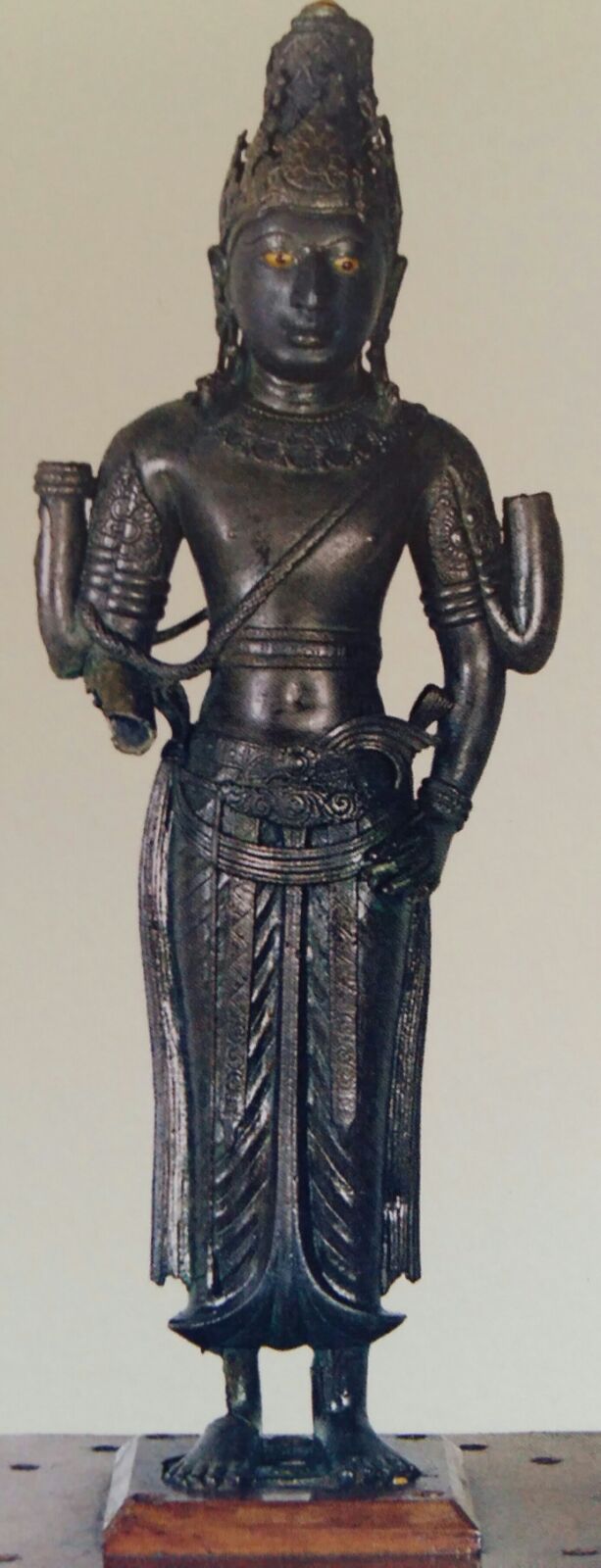 Lord Vishnu
Kerala Bronze, 8th Century AD, Thiruvananthapuram Museum
This is the oldest bronze sculpture of the museum. Although
this figure is from central Kerala, it shows the influence of Pallava
art of Tamil Nadu. The eyes are done in gold and red gemstone. There
is some gold in the Crown also.
Lord Vishnu is an important diety in Kerala as is evident
from the Padmanabhan temple in Thiruvananthapuram or Trivendrum.
Although the South has a strong following of Lord Shiva, Lord Vishnu is
equally important.
Here we see a slender version of the male figure. While in
North, Lord Vishnu is depicted as broad shouldered , and with a supple
body, in South slender figures are preferred.
This piece may not be a masterpiece, but it is important for its historical value.
Natraj

Natraj
Bronze Figure from South India, 18th Century AD,Thiruvananthapuram Museum, Kerala.
Although this a bronze figure, it is unclear as to which part of
South India it comes from. Whether it is a Chola Bronze or from Kerala
itself, this is an issue which is ambiguous. The fact that is claimed
to be from the 18th century certainly excludes it from being a Chola
Bronze for the Chola Dynasty was over by this age.
Despite its origin being unclear, the sculpture is lively and
unique. The turn of the body, the uplifted leg make the figure come
alive. It is unique as the ring of fire is not circular, but more
elliptical, more like an arch. The figure is more delicate. Notice the
way, the fire is held between two fingers as though a flame has been
plucked rather than being held in the hand. These differences clearly
point to the "formulistic " usage of the posture, rather than innovating
a new iconography. By the 18th century we has become imitators and
we're no longer inventors. The decline had set in.
Devi
 Devi
DeviBronze Figure, 17th Century AD, Thiruvananthapuram Museum, Kerala
The Chola artist were the famous sculptors in casting beautiful
bronze figures. But their techniques and influence went beyond the Chola
Kingdom. The other kingdoms of the South also picked up their concerns
and iconography and made the their own.
This figure of the Devi is a case in point. She stands in the
same pose as Goddess Parvati would have stood in Chola Bronze. But here
she holds a pair of cymbals. Cymbals are symbols of time and rhythm.
With the instrument one marks the time (beats) and yet with sequence of
beats, one creates a rhythm. The Devi is symbolises Nature in all its
benevolence. She is Time and yet She is the rhythm of Nature. She is
the Divine Mother.
Lord Sastha

Lord Sastha
Kerala Bronze,17th Century, Thiruvananthapuram Museum, Kerala
Lord Sastha is quite a unique figure in Hindu pantheon.
Initially, he was considered to be the son of Lord Shiva and Mohini (
the female form of Lord Vishnu ). Thus, he was the South Indian version
of Lord Harihar. But subsequently and presently Lord Sastha is
considered as the elder son of Lord Shiva, as a form of Skanda, the
Hindu god of war.
The Keralites are fierce warrior. They not only worship Skanda
in his form as Ayyappa, but also have war dances called, Kalaripayattu.
It is a dance form where high leaps and jumps are common, where the
dancer uses the sword and shields, the spear and the club.
But Lord Sastha is not the God of war. In this form he is seen
as a teacher. Here he sits with a halo, made out of his hair. He sits in
the 'Maharaja Lila ' pose or in the posture of a king. He smiles
benevolently towards the devotee, ready to impart his knowledge of how
to cope with the struggles, skirmishes and battles of life. He is the
true teacher.
Lord Brahma
 Lord Brahma
Chera Dynasty, 15th Century AD, Thiruvananthapuram Museum, Kerala
Lord Brahma is the most neglected of the Gods of the Hindu
Trinity. While Lord Vishnu and Lord Shiva are worshipped all over India,
there are hardly any temples dedicated to Lord Brahma.
According to Hindu mythology, Lord Brahma was born out of Lord Vishnu ' s
navel, while the latter slept on his snake, Sheshnag. Lord Brahma is
the creator of the universe. It is said, having created, He fell in love
with his creation. He chased his "daughter", wanting to have it. Seeing
his arrogance, seeing his mala fide intention, Lord Shiva cut off the
fifth head of Lord Brahma which used to look upwards towards the sky.
This story, like any other myth, is merely symbolic.
Arrogance and mala fide intention have no place in an orderly universe.
Rule of Law must prevail. Even the Gods are not above "Dharma "
(righteous acts). Lord Brahma has four heads in order to symbolise that a
given fact can have various interpretations. Different points of views
can co-exist. This is the foundation of our pluralism and of our
catholic world view.
Goddess Durga
 Goddess Durga
Wooden Sculpture, 15th Century, Kerala
Another beautiful and unusual sculpture in the
Thiruvananthapuram Museum. Wood is not as popular medium for sculpture
in India as is stone. But there is a continuous tradition of wood
carvings in India. Bengal, Gujarat, Karnataka and Kerala are centers
for exquisite wood work and wood sculpture. This statue of Goddess
Durga shows the dexterity of the sculptor in depicting not only the fine
jewellery, but also in portraying the fierce expression of the face.
This sculpture is unique in two ways: firstly, it does not
depict the Goddess riding the lion. But shows her standing on him.
Secondly, the ornate jewellery, the mask like face, the flamboyant
headress seems to show the influence of both Kathakali, a classical
dance from Kerala and of the folk dances of Kerala. Here one can see the
impact of folk culture on the classical tradition. The artist has to
speak the language of the common man in order to drive the story home.
The sculpture, thus, testifies to the fusion of the classical tradition
of Brahminism or Sanskritization of the south, and the strong
undercurrent of the local community. It is a proof of our ability to
assimilate different cultures and communities, traditions and
philosophies.
Lord Ganesh
 Lord Ganesh
Chola Bronze, 11th Century AD, Thiruvananthapuram Museum
Recently visited the Government Museum at Thiruvananthapuram.
Although the Museum has an excellent collection of Chola Bronze, but
the collection is hopelessly displayed. There are even mistakes about
the identity and importance of the images of the Gods of Hindu pantheon.
This figure of Lord Ganesh is described as holding a "horn" in his
front right hand. Wish they knew it is a broken "tusk" which He holds
and not a "horn".
The image is a beautiful one with Lord Ganesh standing on a
lotus pedestal. Since the sculpture was meant to be carried, it has two
prongs on the side. Images of the Gods are still carried in many parts
of the country so as to permit the devotees to have a glimpse (a
darshan) of the Gods. It is also a social means of conveying that all is
well in the city. Such social festivals not only permit us to be
together, but also allow us to celebrate the joys of life, itself.
Varunani (Goddess of the Ocean)
 Varunani (Goddess of the Ocean)
Eastern Ganga, 13th Century AD, Konark, Odisha
In the Vedas Varun is one of the great four gods. According to
many, He is the creator. According to some, He is the God of ocean. He
is generally shown riding a mixed animal who has the legs of a lion, has
a tusk of an elephant, the tail of a fish. This creature merely
suggests that life is a mystery, it is full of contradictions, but it
is acceptable.
Varunani is the Shakti (energy) of God Varun. She holds a noose
in one hand so as to symbolise her ability to catch and hold things.
She too sits on a hybrid animal called "Makar." This animal is also the
symbol for Capricorn sign of the zodiac.
The Konark sculptor has produced some of the most ornate and
lively sculptures of India. The eternal soft smile on the face imparts a
sense of compassion and serenity to the divine figures. The art of
Konark was to influence the art of Java and Sumatra where the Oriya
fleets went for trade.
Vajratara

Vajratara
Pratihara Dynasty, 12th Century AD
Goddess Tara is the goddess of compassion in Buddhist pantheon.
Vajratara is a manifestation of hers who protects the people from
natural calamities like floods and earthquakes. She also protects us
from inner illnesses.
This beautiful image speaks about the popularity of Buddhism even
in the 12th century. It is also a testimony of diversity of religion as
Buddhism was peacefully coexisting with Hinduism and Jainism.
Diversity and plurality arre part of our cultural genenorm.
Lord Shiva as Natraj (Lord of Dance)
 Lord Shiva as Natraj (Lord of Dance)
Dance in India has a divine and an ancient origin. According
to Bharat Muni's Natya Shastra dance was first performed by Lord Shiva.
It was a dynamic dance full of powerful movements. It was called
Tandav. It was first performed in an assembly of Gods. Goddess Parvati
then did the feminine form of dance, full of graceful and slow dance
called Lasya.
Lord Shiva has performed the Tandav on other occasions also, when he
killed the Elephant demon--Gajasura; when the sages were upset when Lord
Shiva walked naked near their helmet and the sages wives fell in love
with Him. And of course the Tandav dance of total destruction in a ring
of fire.
This sculpture also depicts the dance of destruction as here
Lord Shiva is dancing on the dwarf of ignorance. Here He does hold the
fire in one hand and 'damaru ' ( drum) in another hand. His front hands
are in the 'mudra' (gesture) called 'gajahasth ' (hand like the trunk of
an elephant), and in 'Abhaya Mudra ' ( fear not gesture).
This sculpture seems to depict the moment when Lord Shiva is
just about to lift his left leg and strike the "classic" pose of
Natraj.
This sculpture has the same message of Natraj: creation and
destruction are on same level. Come under my protection and fear not
either creation or destruction. Change is part of Nature. Impermanence
is life. But beyond the world of illusions there is eternity, beauty
and truth. God and soul dance together as a divine couple. We are
immortals and divine.
Flying Gandharva and Apsara

Flying Gandharva and Apsara
Lord Indra ' s palace is full of Gandharvas and Apsaras. They
are the musicians and the dancers of his court. They are the Hindu
counterpart of Christian angles. Like the angels they are divine beings
who are closer to the gods than mortals. Man is said to be between the
angels and the beast. It is up to us to ascend the ladder and become
angels, or to descend the ladder and become the beast.
Chalukyan art had a great influence both on Indian and Chinese
Art. These flying figures became the proto - type for divine beings
both in Hindu art and in Buddhist art of China and Japan. Globalisation
of Asian art began from India.
Dakhshinamurti ( Lord Shiva as a Teacher)
 Dakhshinamurti ( Lord Shiva as a Teacher)
Chola Dynast,11th Century AD
Today is Guru pornima, when we are supposed to remember our Gurus
or teachers. After our Gods and parents, gurus are the most venerated.
For it is they who educate us and civilise us. Without education, Man is
like a beast.
In Hinduism Lord Shiva as Dakhshinamurti, and Brahaspati are
considered the two foremost gurus. While Dakhshinamurti teaches the
mortals, Brahaspati is the guru of the demons.
Dakhshinamurti is a unique form of Lord Shiva. He faces the south
direction (dakhshin), the direction of death. He sits under the polar
star, symbol of unflinching devotion and determination. He holds the
Vedas in one of his hands, symbol of wisdom. His one foot rests on a
dwarf, symbol of ignorance. Lord Shiva as Guru teaches us how to cope
with impermanence, with mortality, with death. Impermanence and death
are the two most frightening fears we have. With devotion and
dedication, with wisdom and vision we shall overcome our ignorance about
impermanence. The world is an illusion. But beyond this illusion is
permanence, immortality and truth. For the soul is immortal, the body is
perishable.
It is for this knowledge and wisdom and vision that we bow
before our Gurus. Given a choice between God (Govind) and Guru, Saint
Katie says "Bow to your Guru.
Sada Shiva (Four headed Lord Shiva)

Sada Shiva (Four headed Lord Shiva)
Paramar Dynasty,11th Century AD
The four heads of Lord Shiva depict four different aspects of
His. The creator, the preserver, the destroyer. The fourth face is of
Devi or his Shakti (power). Without His Shakti, He is lifeless.
The four heads also depict the ideology that every fact or
situation can be interpreted in different ways. Thus there is no such
thing as "the truth." Multiple interpretations are welcome. It is this
thinking which has strengthened our civilisation of diversity and
unity.
Devi Crushing Lord Ganesh

Devi Crushing Lord Ganesh
Paramar Dynasty,10th Century AD,Indore Museum
A rare piece indeed. Lord Ganesh is generally shown as sitting
by a Devi, either with Goddess Swaraswati or Goddess Lakshmi or with the
Seven Mothers (Sapta Matrike ). But here He is being trampled under the
weight of the Goddess.
The Goddess here is a form of Shakti. Historically this piece
indicates the rise of the Shakti cult during the medieval period. But
philosophically it makes a very strong statement : when reason and
wisdom is crushed, destruction prevails. Destruction is important and
necessary to get rid of that which is bad or evil. But to destroy
reason, intellect and wisdom only invites chaos, anarchy and
annihilation.
Devki Feeding Lord Krishna

Devki Feeding Lord Krishna
Kalachuri Dynasty,11th Century AD,Bhopal Museum.
An unusual sculpture which depicts Devki feeding Krishna.
According to Bhagwat Puran Lord Krishna was born in prison where his
parents were detained by Kansa, the Raja of Mathura. There is no
mention of Devki feeding Krishna for the moment he was born, his father,
Vasudev carried him to Nanda 's house across Yamuna River. Yet here we
see Krishna not only being fed, but also protected by a five headed
snake. The guards stand outside while a maid massages Devki's foot. This
is called artistic licence!
Interestingly like our paintings, even in sculpture the
perspective is flat. Krishna is shown in side view, Devki in side and
frontal view. The concept of space is a complex one.
Also notice the simple furniture and utensils. With the amount
of jewellery worn by Devki, she is rich, yet the furniture is a simple
one. Simple living, high thinking ! We all live in a prison of our own.
Lord Harihar
 Lord Harihar
Pratihara Dynasty, 10th Century AD, Bhopal Museum
The Indian civilisation is a civilisation of assimilation and
not of extermination. While the West believes in exterminating those
who hold a different point of view, we merely assimilate those views and
move on. Our ability to accept different philosophies, different
cultures, traditions and communities is our strength.
Lord Harihar is a prime example of this innate quality. When a
division occurred in Hinduism between the Shaivites and the
Vaishnavites, we combined both the Gods to create a half - Shiva, half
- Vishnu image. Lord Harihar was born. Although he is not a very
popular god today, perhaps due to our unipolar thinking, but He is still
worshipped in the Lingraj temple at Bhuveneshwar.
Harihar is unique as he combines the quality of the intellect
(Shiva) and the quality of the heart (Vishnu). Here He holds the
trident and the rosary of Lord Shiva --the ability to control the mind
through meditation. He also holds the 'Sudarshan Chakra' and the conch
shell of Lord Vishnu--the ability to cut through difficulties and to
sustain things.
It is a sculpture with a powerful message and philosophy. Let
us celebrate the multi - dimensionality of our Indian civilisation.
Lord Shiva and Goddess Parvati Playing Chaupar
 Lord Shiva and Goddess Parvati Playing Chaupar
Kalachuri Dynasty,10th Century, Jabalpur Museum
According to Shiva Purana and Skanda Purana, the divine
couple plays 'Chaupar' a game of dice. In the game Lord Shiva wages his
trident, his drum and even Nandi, the bull. And loses them all to
Goddess Parvati. While he wants to quit the game, she wants to go on
playing. Meanwhile in the bottom row Ganesh and Skanda watch this divine
game of win and lose. Shiva 's 'ganas' try to play with the bull. It is
a joyous moment, full of fun and laughter. But the message is a serious
one : the dice is time, the pieces are the human being. Our fortunes
change as the time changes. Despite our intellect (Shiva), ultimately
Nature (Parvati) wins. Our creativity (Ganesh) our destructive impulse (
Skanda) merely watch from the sidelines. Like the bull, our senses need
to be controlled. Nature is supreme. Tao teaches us the same
philosophy : human beings are merely a speck of dust in Nature.
Vaman Avatar ( The Dwarf incarnation of Lord Vishnu )
 Vaman Avatar ( The Dwarf incarnation of Lord Vishnu )
Kalachuri Dynasty,11th Century AD
According to Hindu mythology Lord Vishnu has incarnated nine
times. His tenth incarnation, as Kali , is yet to come. Each of his
incarnation teaches something to us.
This is his fourth incarnation as Vaman ( the dwarf). In order to
humble King Bali, Lord Vishnu appeared as a dwarf. He asked King Bali
to grant him just three steps of land. Bali granted him the request.
Lord Vishnu covered the underworld in one step, the sky in the other
step and asked Bali where he should place his third step. Humbly Bali
offered his head. With the pressure of His step, King Bali went to the
underworld. He was given the boon to visit his Kingdom once in a year.
Hence spring when the earth resurrects itself.
The story teaches us that humility (having small ego--dwarf) is a
big thing. In order to subdue the arrogant, one should have humility
like a monk. King Bali was wealthy, but it is the intellect which
conquers the three spaces-- the underworld, the earth and the sky. As
the Chinese say "the bamboo is the perfect example of a gentleman. In
high winds, it touches the earth with humility. And raises its head
heavenward once the wind has died down.
Lord Ganesh

Lord Ganesh
Pratihara Dynasty, 8th Century AD, Bhopal Museum
The name Ganpati does occur in the Rig Veda but there is no
mention of Lord Ganesh in the Vedas. As a god, He emerges only in the
Post- Gupta Period. By the 8th Century, he is a popular god. His
popularity continues even today.
Since he is depicted both as a child and as an adult, since he
is a portly figure with an elephant head, he is the most caricatured of
the gods. He dances and plays musical instruments, he reads and writes,
he sleeps and crawls, he even sits in a rocking chair or plays cricket.
His manifestation are many. We see him everywhere and in every thing.
This is an unusual Ganesh for he holds a rosary and a flower in
his hands. With meditation we gain wisdom ( rosary); Wisdom is rewarded
(flower).
Woman Cajoling Her Lover

Woman Cajoling Her Lover
Kalachuri Dynasty, 11th Century AD
Not as well known as the Pratihara -Paramar Dynasty, but the Kalachuri Dynasty carried on the artistic traditions of the former two dynasties.
This is a unique piece of sculpture as it depicts a scene from King Hala's Gatha Saptashati, a love poem. Written in Shringar Ras (romantic mood), these poems deal with different aspects of love.
The heroine is lost in the company of her friends while the lover waits for her. When she reaches his house, he is angry with her. He lies on the bed unmindful of her presence. She cajoles him with kisses. But he pretends to be mad with her. The lover's game go on.
Notice the furniture depicted in this piece: the cushions on which the ladies sit, the bed on which the Hero lies. Also notice the pot of water under the bed. The lovers are under a tree. The presence of the water pot indicates that it might be the summer season. Such minute details liven up the sculpture.
Uma- Maheshwar on Nangi the Bull

Uma- Maheshwar on Nandi the Bull
Pratihara Dynasty, 8th Century AD
Seated under a mango tree, the divine couple of Lord Shiva and
Goddess Parvati, otherwise known as Uma - Maheshwar, sit on the bull,
Nangi. They are so lost in themselves that they don't notice their two
children, Kartikeya and Ganesh fighting at the bottom row. Helplessly
the devotee looks at the divine couple.
When the God of wisdom, Ganesh symbolising creativity, and
God of war, Kartikeya, symbolising destruction, clash with each other,
we can only look at our Gods. Is this a picture of an orphaned
universe, of chaos and anarchy? Is this a political comment about its
age? Or a warning to all of us about our future?
Kamadev with Two Women

Kamadev with Two Women
Pratihara Dynasty, 8th Century AD
Although Kamadev (the Hindu god of Love) is depicted often in
Indian miniature paintings, in sculpture he is seldom seen. Hence, this
sculpture from Madhya Pradesh is a unique one. Since love and sex was
one of the goals of a Hindu life in ancient India, it is surprising
that Kamadev I'd conspicuously missing from ancient sculptures. In
contrast, for the Greeks and the Romans, Cupid (their god of love and
sex ) was a popular image. Is this a reflection of hypocracy that
although we may have written the first book on sex, the Kama Sutra, but
publicly we will not acknowledge Kamadev?
Here Kamadev is being offered a glass of Soma, an ancient
Indian alcoholic drink. Is the sculptor hinting at the "heady" effect of
love? Is he comparing "spiritual Love" to a glass of while, like the
sufi mystics do? If Kamadev had only a single wife, Rati, then who is
the other woman sitting next to him? These perplexing questions tease
us. Only to remind us that Love is an intriguing feeling.
Natesh (Lord Shiva as a Dancer)

Natesh (Lord Shiva as a Dancer)
Pratihara Dynasty, 8th Century AD
The post- Gupta Period saw the resurgence of Hinduism.
Lord Vishnu and Lord Shiva emerged as two leading Gods of Hindu
Trinity. Initially called Rudra in the Vedas and Puranas, Lord Shiva
was seen as God of destruction. As Natraj (the God of Dance) he is
shown doing the 'Tandav' dance (dance full of energy and dynamism), the
dance of destruction itself.
But here He is shown in a more peaceful posture as a
dancer. He carries His trident and an axe. The trident symbolises the
three states of the mind, the conscious, the sub - conscious, and the
unconscious, all held by a single shaft--one mind. The axe stands for
our ability to cut through the illusionary world we live in--whether it
be a world we create for ourself or the impermanent world we see around
us. In His lower hand, He carries a bowl--the bowl has fire, the symbol
of our last destination, cremation or liberation of the soul. The
fourth hand is in 'Abhaya Mudra' meaning "fear not."
Trying to control the three states of the mind, trying to
cut through the illusionary world, trying to liberate the soul, you
have nothing to worry, once you have come to the refuge of the divinity.
This is the message of the calm dancer, Natesh ( the Dancer).
Goddess Parvati
 Goddess Parvati
Paramar Dynasty,11th Century AD
A highly well preserved statue, but for the two upper broken
hands. The sculpture depicts the goddess as a stout woman, holding a
pitcher of holy water, a rosary, carrying Lord Ganesh in her upper left
hand and a Shiva Linga in her upper right hand. Since Parvati created
Ganesh from herself, of the two children, he is her favorite. But the
sculpture is not just limited to that: Parvati is the symbol of Nature.
Nature also includes the creative and destructive powers. While the
Shiva Ling is the symbol for creativity, the mongoose at her feet is the
symbol of the destructive power. For, the mongoose can kill even a
snake. But both the powers have to be used with wisdom--hence, Lord
Ganesh. Wisdom doesn't come easily. It comes from right thoughts--the
pitcher of Holy water, and with deep meditation--the rosary. Nature is
mysterious, but beautiful, like the Goddess herself.
Lord Ganesh with Riddhi

Lord Ganesh with Riddhi
Paramar Dynasty, 11th Century AD
It is a rarity to see Lord Ganesh with Riddhi in a standing posture. Thus, this a unique piece.
Goddess Parvati was worried as to who would marry her elephant
headed son. Lord Brahma agreed not one, both of his daughters, Riddhi
and Siddhi to him. Riddhi and Siddhi stand for the material wisdom and
the spiritual one. Ganesh being the God of wisdom had to personify the
secular and the sacred wisdoms. The Greeks believed that there are two
sides of human personality: the rational ( God Apollo), and the
irrational (God Diyonesus ). But we believe there is also the spiritual
side. Hence, Siddhi.
We have been worshipping wisdom from time immemorial. Notice the devoted couple standing at the bottom.
The Hindu Trinity : Lord Brahma, Vishnu and Mahesh ( Shiva)

The Hindu Trinity : Lord Brahma, Vishnu and Mahesh ( Shiva)
Khajaraho School, 11th Century AD.
In Khajaraho School it is rare to see the Hindu Trinity together. Thus this is a unique piece of sculpture.
The creator, the maintainer, and the destroyer all three stand
together, thereby representing the process prevalent in the cosmos.
Since Lord Vishnu is the largest figure and is centrally placed, the
emphasis is on the one who maintains us. The bottom row of figures are
of couples thereby depicting the importance of "grahasth ashram" (The
householder). The family, being the smallest unit of the society, is the
most important stage of life which needs to be maintained, protected
and promoted. Lord Vishnu symbolises the perfect householder.
While we may have the creative and the destructive powers
within us, it is the power to maintain things which is the most
important power in us.
Ravan Shakes Mt. Kailash

Ravan Shakes Mt. Kailash
Khajaraho School,10th Century AD, From Hingalajgarh, Dist. Mandsaur, M. P.
The Bhopal Museum has a large collection of sculptures from
Hingalajgarh. This sculpture is considered the finest masterpiece of
the collection. It is the priced possession of the museum. Not much is
known about Hingalajgarh. But considering the vast collection, the
town must have boasted of great temples dedicated to both Hinduism and
Jainism. The jewel like quality of its sculptures place it on par with
the best of sculptures of Khajaraho temples. The delicacy, the intricacy
of its carving, at times surpasses Khajaraho sculptures. It must have
been the pride of its time.
Lord Shiva and Goddess Parvati, with their sons, quietly sit
on Mt. Kailash. The arrogant Ravan tries to lift the mountain with all
his might. But all in vain. The other gods, Lord Brahma and Lord Vishnu
silently watch the folly of an arrogant man.
We may consider ourselves the master of the Universe, the
center of the Earth, but that is our delusion. As Tao says we are an
insignificant part of Nature. Mere speck of dust in the vastness of
Nature. Like Ravan we have yet to learn this lesson.
Salabhanjika
 Salabhanjika
Prathihara Dynasty, 9th Century AD, Gwalior Museum
Considered the Mona Lisa of India, this sculpture of Salabhanjika is the best known sculpture of the Gwalior Museum.
The Yakshini is beautifully jewelled, bedecked with a heavy
coiffure --to the point that it tilts her head towards her left side;
she steps forward, revealing her thighs; her skirt is tide on the side,
but is just about to come off. She has a mysterious smile. As in Mona
Lisa we do not know the reason for her smile: is she thinking of a
lover, or of her husband--the Yaksha, or looking at the pranks of a
child, or thinking of her own beauty, or perhaps smiling at human
folly.
She is young and divine. She is a thing of beauty, a joy for ever.
Raja Playing with the Rani

Raja Playing with the Rani
Abhaneri, Rajasthan,8th - 9th Century AD
Since 'Kama' (Love or sex) was one of the four goals of Hindu
life, it was essential to show the Raja indulging in Kama. Thus,
depicting Kama here is a social statement. Politically a 'world
conquering King' ("chakravertin") was supposed to be verile. To depict
the Raja indulging in Kama is to testify to his verility. Hence the
presence of these images on the walls of temple.
Eroticism in Indian art has an ancient history. It begins
during the Mauryan period ( 3rd Century AD ) and culminates in the
Pratihara Paramar period ( 12th century AD). The earlier depictions
merely show a couple standing together, later the sculptors began
depicting foreplay. In Khajaraho and Konark it reaches the climax where
explicit scenes of eroticism are depicted. But then, Kama was
emphasised in India. For, without love civilisation would fall apart;
without sex the human spieces would be extinguished.
A Raja Listening to a Musical Concert

A Raja Listening to a Musical Concert
Abhaneri, Rajasthan,8th -9th Century AD
Abhaneri, originally called Abhbnagari, was the capital of a
Chauhan Kingdom in 8th Century Rajasthan. It is near Jaipur. It is not
only credited with having the oldest 'Step-well' in India, but also has
the only post - Gupta art in Rajasthan.
The temple here lies in ruins. It's sculptures are housed in
three galleries around the Step-well. The sculptures still left on the
walls of the temple are unique. Their focus is on the life of the Raja.
Here we see him seated in the garden with the Rani. The Rani leans over
to him while playing a musical instrument. There is the flutist at the
bottom and the drum player to the right of the Raja. The guard stands
with his sword and shield. It is a nice summer day as the tree is laden
with Mangoes.
Surprisingly the royal couple sits in very modest furniture:
cushions and stools. The kingdom could not be too prosperous.
These sculptures of the royal couple not only portrayed the life of the Raja, but also contained a political message: the royal couple is well. There is peace and prosperity in the kingdom. These sculptures are like pictures of President Obama and his wife smiling to the crowd, assuring the people that all is well despite the economic crisis.
These sculptures of the royal couple not only portrayed the life of the Raja, but also contained a political message: the royal couple is well. There is peace and prosperity in the kingdom. These sculptures are like pictures of President Obama and his wife smiling to the crowd, assuring the people that all is well despite the economic crisis.
Lord Vishnu Sleeping on Sheshnag

Lord Vishnu Sleeping on Sheshnag
Deogarh Temple, Gupta Dynasty, 5th Century AD
End of the Gupta dynasty saw the emergence of Hindu Gods
in human form. The Vedic gods, Indra, Agni, Varun, and Yama were now
forgotten. In their place Lord Vishnu and Shiva emerged as the two most
important Gods of Brahminism.
Here we see Lord Vishnu sleeping on Sheshnag, the multi -
headed snake. After the end of each 'yug', (age), Lord Vishnu sleeps for
dreaming the next 'yug'. Lord Bhrama rises from his naval to create the
next age. Sheshnag represents Time which is endless and is the only
thing which remains (shesh) after all matter is destroyed. From that
void, a new age, a new cosmos is created. The process of dreaming and
creation is witnessed by all the gods. But the process of creation is
not an easy one: from behind Lord Vishnu ' s ears two demons arise to
smite Him. In the bottom row we see five figures who are wrongly
identified as the Pandav Brothers and Draupadi. In fact, they are Lord
Vishnu ' s weapon personified as humans ready to fight the two demons
with swords. Mother Earth, the other wife of Lord Vishnu silently stands
to the right, while Goddess Lakshmi massages Lord Vishnu ' s leg.
The cosmic drama of endless destruction and creation, of Time and Matter is witnessed by the Gods.
Ceiling of Dilwara Temple Rajasthan

Ceiling of Dilwara Temple Rajasthan
13th Century AD
Numerous ancient temple complex dot the hills and dales and
the desert of Rajasthan : Osia in near Jodhpur , Kiradu in Barmer
District, Eklingji in Udaipur. But the best known temple complex are
the Dilwara temples of Mt Abu. Made of white marble, intricately
carved--like a filigree, these temples are mind bogling. Here we see a
temple ceiling. The thousand petal lotus is the center piece. It is
said that when one reaches the highest state of meditation, the mind
blossoms like a thousand petal lotus. Hence this image on the ceiling.
Like bees, the celestial beings havor around this lotus. That is the
power of the mind. As the Urdu poet said, "make thyself so strong that
even God should come and ask what is your wish."
Although Dilwara temples are known for their delicate
carvings, but they are like a Kathak dance: full of technical perfection
but without much substance. The sculptures are heavily laden with
jewellery, figures frozen in stereotyped postures. But the lack the
liveliness of the Khajaraho figures or the serenity of Chola Bronze.
These figures merely dazzle us with the virtuosity of the sculptor in
using the chisel and the hammer. But somehow the breath of life is
missing in these marble wonders.
Lord Shiva with Goddess Parvati

Lord Shiva with Goddess Parvati
Chola Bronze, 10th Century AD
One of the finest pairs of Lord Shiva and Goddess Parvati
amongst the Chola Bronze. The Chola sculptors introduced a new concept
of male and female beauty. While the rest of India has plump squat
figures as in Khajaraho and Konark, the Chola figures are lean and
thin, supple and graceful. The female ideal is no longer buxom and
broad. She is figure conscious and elegant. The male figure is not
muscular figure of Gandhar School; he too is well proportinate, tallish
and slim.
Lord Shiva stands in the posture of holding a Vina, an
instrument said to be invented by him when he saw Goddess Parvati
sleeping. He holds the deer in one hand, as he is the God of
wilderness, or of animals as He is Pashupatinath. In the other hand, He
holds an axe, to destroy our obstacles, illusions, pain and agony. To
free us from our worldly bonds.
Goddess Parvati holds a lotus (missing in the figure), to
symbolise the bounty of Nature which she represents, to symbolise
harmony, beauty and peace.
This world needs both of them to achieve peace, prosperity and liberation.
A Rani Watching a Dance Performance

A Rani Watching a Dance Performance
Sunga Dynasty, 2nd Century BC
A very interesting piece of sculpture which permits us to look
into the inner chambers of a Rani's palace. The Rani sits at the top.
She is being fanned by a maid. The orchestra of female musicians plays
different musical instruments : the harp, a mandolin like instrument
--looking like a Sarod, a flute, a drum. The dancer sways to the music
with her hands swinging and her feet in rhythm.
The sculptor has almost caught the perspective right. Since the
Rani is sitting further away from the viewer, she is smaller in size.
The dancer in front looms large. The sculptor, thus, does not depict the
figures from the point of view of the social status of the figures. But
portrays the figures from an artistic or visual angle.
Surprisingly the entire orchestra is of women. This shows that
women were trained in music and dance. But this may also indicate that
men were not allowed in the Rani's palace. Hence, this may reveal the
segregation of women and their confinement in a palace. This piece
reveals more than just a dance performance.
A Woman Painting Her Foot with Aalta
 A Woman Painting Her Foot with Aalta
Khajaraho School,10th Century AD
The Khajaraho temples are replete with sculptures of women at
their daily activities. The theme of women adorning themselves is a
popular one. Here we see a woman painting her feet with 'aalta', a
redish colored liquid used to paint one's hands and feet. Before henna
came to India, aalta was used for coloring the body.
Human beings love decorating their bodies. The fashion
continues even today. But here the decoration has a philosophical
concept. We 'decorate ' our lives with psychological constructs. With
our likes and dislikes, biases and prejudices, we construct a world of
our own. But the world we construct with our emotions and intelligence
is merely cosmetic. The deeper reality lies somewhere else. Now notice
the small nude figure to the right. He stands like a Tirthankar, the
Jain Saints. Having abandoned the material world he stands and
meditates. Behind him stands a divine figure. That is the path we must
take, rather than adorning our feet with aalta.
Lady Writing a Letter
 Lady Writing a Letter
Khajaraho School,10th Century AD
No other School paid as much attention to the world of woman as
Khajaraho did. The Khajaraho sculptors have captured her every nuance,
her every turn and twists, her grace and power. She is the Apsaras,
the Goddess, the queen, the common woman.
Here we see a woman who is busy writing a letter. To whom she
writes, we do not know: her husband, or a lover, her parents, or a
petition to the King? But her grace, her attention to her work captures
our imagination.
This sculpture is a classic piece of the Khajaraho School. It
has all the trademarks of the school. The arched eyebrows, the curls on
the forehead, the loose bun, the jewelled belt, the bare chest, the
see through sari as the lower garment, the broad hips, and the bare
feet. Her curved body lends a sense of grace and a sense of other
worldliness. She is one of us, yer she is divine.
Musician

Musician
Konark Temple, Eastern Ganga Dynasty,13th Century AD
The roof of the Sun Temple at Konark is decorated with lady
musicians. Here is a woman playing the cymbals. The sun rays spread
over the sky like music wafting through the air. The sunrise and music
are intermixed in our mind and soul. For, both represent life, energy
and creativity. Hence, the presence of musicians and dancers in Konark.
The Konark sculptures are easy to recognise with their large
almond like eyes, with their beautiful upturned smiles and their
ornaments, especially the two large earrings in the ears. The grace, the
style, the jewellery is also reflected in Odissi dance. To see an
Odissi dance is to see these Konark figures come alive.
Dancing Ganesh
 Dancing Ganesh
 Khajaraho School,11th Century AD
While an orchestra plays the flute, two large drums, Lord Ganesh
sways to the music. Surprisingly a child in the nude, seen from the
back, looks in awe at the huge figure of Lord Ganesh. The inclusion of
the child is highly unusual. For he cannot symbolise the donor, as a
doner would be depicted as an adult. Does the child then symbolise the
infantile Mankind looking at the vast universe? Or does the child stand
for the innocent and pure soul looking at divinity? The sculptor has
left all of us guessing at the meaning of the child in this
masterpiece.
The Drunken Courtesan
Mathura School,1st Century AD
Drinking by both the genders was quite popular in ancient India.
Although not approved as a civil behaviour, but it was popular
nonetheless. Here we see a courtesan deadly drunk who needs to be
supported and carried off to her bedroom. Such sculptures tell us not
only about the jewellery and clothes worn at that time, but also inform
us about the life - style. The man with his fingers on his face
symbolises the disapproval of such drunken state.

Lord Krishna Dancing on Kalia
 Lord Krishna Dancing on Kalia
Chola Bronze, 11th Century AD
Generally Lord Krishna is shown as a young child dancing on
the Serpant Kalia. But here He is shown as a teenage boy. The serpant
has been given a human form. Thus, this is a unique Chola Bronze.
The story of Kalia, of a deadly snake having polluted the
Yammuna River, is pertinent today. For the story teaches us to preserve
our rivers, lakes and oceans. It is a lesson on conserving our
environment.
Lord Vishnu

Lord Vishnu
Gupta Dynasty . 5th Century AD
Gupta art is world famous for its Buddhist sculptures,
paintings and architecture. The foremost example being the Ajanta
caves. But the Gupta age also saw the beginning of Hindu art as in this
example. A few art historians have suggested that Hindu iconography
comes from Buddhist art.
Gupta art is easy to recognise both from its style and spirit.
Its figures are well proportinate, lively yet calm and serene.
Stylistically, the ornamentation is simple. Pearls and pearl strings
tend to dominate rather than gold jewellery.
Here Lord Vishnu stands looking at the devotes below him.
There is a sense of tranquility, and gentleness in his glance. Just
looking at his divinity, the devotee forgets his troubles.
Lord Harihhar
 Lord Harihhar
Khajaraho School, 10th Century AD, National Museum, New Delhi
One of the most unique gods in India is Lord Harihar.
According to the Puranas Lord Shiva was struck by the beauty of Mohini
(Lord Vishnu in a female form). They had physical relationship.
Harihar is the child of that union. He is half Hari--Lord Vishnu, and
half Har--Lord Shiva. Thus he has the quality of both: he meditates, yet
he maintains the world with his powers.
Historically it was important to invent him. For in ancient
India disputes regularly erupted between Vaishnavs, the followers of
Lord Vishnu , and Shaivites, the followers of Lord Shiva. It was better
to assimilate them than to annihilate each other.
Although Harihar is hardly worshipped now except at
Bhuveneshwar, but he is the symbol of Hinduism ' s ability to absorb and
resolve conflicts. He is also an example of fluidity of sexual identity
in Indian mind. He is relevant for the post - modern world.
Salibhanjika
 Salibhanjika
Mathura School,1st Century AD
Mathura School of sculpture was the first school of
sculpture in India. It flourished during the Kushan Dynasty. It was
contemporaneous with the Gandhar School which flourished near Taxshila,
now in Afghanistan.
While the Gandhar School was heavily influenced by Greek art,
the Mathura School was indigenous. This sculpture depicts the Indian
concept of beauty: full bosoomed, heavy hipped, bejewelled, at times
even semi - nude (as here). It is very easy to identify sculptures of
Mathura School as they are done in red sandstone which is easily
available even today in the Mathura-Bharatpur area in U. P. and
Rajasthan.
Salibhanjika is the most beautiful woman of the village who
is asked to kick the Sal tree so it blossoms. She is a Yakshini who
symbolises mother Nature.
Lord Narsimha ( The third incarnation of Lord Vishnu as the half lion, half man)
 Lord Narsimha ( The third incarnation of Lord Vishnu as the half lion, half man)
Hoysala Dynasty,13th Century AD
The story of Lord Narsimha has caught the imagination of the
Indian artists. While the sculptors of Ellora have captured the
frightened look on the face of Harnakashyup when Narsimha touches him,
the Hoysala sculptor has depicted the final moment of his death.
The story of Harnakashyup is important. Having gained the boon
from Lord Shiva that he would not be killed either by man or animal,
neither in daytime nor at night, neither inside a building or under the
sky, he became demonic in his nature. Absolute power had corrupted
absolutely. But God has his way. A half lion, half man killed him at
the threshold of the Palace at twilight hours. Good always triumphs.
Lord Indra
 Lord Indra
Konark Temple, 13th Century AD
The most important god for the Vedic people, Lord Indra is the
God of rain. He holds a "vraj", a thunderbolt, in one hand, and a
batton in the other hand. He rides the seven tusked white elephant,
Aaravat. Lord Indra is the most powerful diety in the Vedas. Since the
Aryans were agriculturist, they were dependent on the rains. Like them
even we wait eagerly for Lord Indra to arrive.
The Konark sculpture can be recognised easily with their
upturned smile, their hair buns, and elaborate jewelry. Here while Lord
Indra rides on the elephant, he is accompanied by his entourage of
Apsaras and Gandharvas, the celestial dancers and musicians
respectively. Mansoon is the season for dancing and singing as mother
Nature rejuvenates herself.
Natraj

Natraj
South India
Lord Shiva as Natraj taught dance to the gods and mankind. But
he also danced on other occasions such as the dance of destruction and
dance in the skin of the elephant demon, Gajasura. These dances depict
the dynamic side of dance called "Tandav". They are full of movement,
energy and rhythm.
Here the sculptor has captured the ferocity of the figure by
the multiple arms moving in a circle, by the diagonal tilt of the body
and by the placid stand of goddess Parvati. The entire sculpture seems
to move with energy
The Courtesan and the Customer

The Courtesan and the Customer
South Indian Sculpture, 18th Century AD
Like Gujarat, South India is famous for its wood carvings.
Sociologically speaking, this is a very interesting piece. For it does
not depict gods or goddesses. It depicts the relationship between s
courtesan and her rich client. Having done with her, he turns to leave
her, still carrying his bag of monies. She continues to play the violin.
Interestingly she plays a Western instrument and not an Indian one. Has
the artist given her a Western instrument in order to depict her social
and cultural isolation? Her pitiable condition as a means of satisfying
people's lust is writ large. It is a sculpture which celebrate the
darker an tragic side of life.
Mahisasurmardani ( Goddess Durga Killing the Demon Mahisasur )

Mahisasurmardani ( Goddess Durga Killing the Demon Mahisasur )
Hoysala Dynasty,13th Century AD
One of the most beautiful and intricate carvings has been
done by the Hoysala sculptors. Working with soapstone which is soft,
they could carve fine details in the stone. Notice the elaborate jewelry
of the goddess.
Goddess Durga is the eternal mother who protects us from all
the evil. But psychologically she is the power within us who kills our
evil thoughts and deeds. We only need to look inward to discover the
shakti ( power ).
Dancing Ganesh

Dancing Ganesh
from Abhaneri, Rajasthan, 8th Century AD
Abhaneri, a town near Jaipur, has the distinction of having the
first step well of the country. It also had beautiful temples which
were influenced by Gupta art.
Here we see a dancing Ganesh. Whole he holds the axe, and the
broken tusk, in his hands, his usual attributes, he also holds a snake,
which is rather unusual. For snake is symbol of desires which sneak
into our minds and heart. The God of wisdom knows how to control them.
He rewards us with the bowl of 'ladoos' or 'modak'-- symbol of his
generosity.
Lord Shiva Dancing within the Skin of an Elephant
 Lord Shiva Dancing within the Skin of an Elephant
 Chola Bronze,11th Century AD
Gajasura, a demon in the form of an elephant attacked Lord
Shiva. Lord Shiva not only killed him, but also flayed him. Dancing
within his skin, He stretched the skin as far as the end of the
universe. He punctured the skin with His thumb and/or fingers.
Astonished, Goddess Parvati stands and stares at his infinite height
and at His feat.
The story has a philosophical meaning: divinity is beyond the
material world. The mind can travel beyond matter. Beyond the realities
of the finite world, there still exists the realities of the infinite.
The Chola artist was not merely depicting a dancing God, he was portraying a complex metaphysical concept.
Goddess Swaraswati

Goddess Swaraswati
Gupta Period, 3rd Century AD
Here the Goddess is depicted as goddess of music. For while
three figures play instruments, the fourth figure is dancing. Music is
integral for our existence. It permeates not only our mind and soul, but
also exists in outer space.
The Gupta sculptures are known for their simplicity and
elegance, for harmony and beauty. They are classical pieces of art.
Venugopal ( Lord Krishna in his universal form)
 Venugopal ( Lord Krishna in his universal form)
Vijayanagar Empire,16th Century AD
Things can be deceptive in life. A village boy, a cowherder, a
flutist, is none other than the maintainer of the Universe. Krishna was
beguiling. He ranged from the pranckster to a philosopher. He lures us
with the music of his own purity, with his endless mercies. He is the
charming gopa ( cowderder). We are his cows.
The Vijayanagar Empire sculptures are known for their ornate
detailing. Although carved in granite or in basalt rocks, the sculptures
are vibrant and lively. Devotion can turn the hardest rocks into gods.
Dancing Ganesh
 Dancing Ganesh
Pala Dynasty, 10th Century AD
While Lord Shiva is often portrayed as "Natraj", the Lord of
dancing, His son, Lord Ganesh is no less a dancer. While Shiva dances in
anger, Ganesh dances with a sense of joy.
He symbolises the universe in motion, full of energy, in
rhythm, ever changing and ever lasting. Here even Ganesh ' s vehicle,
the mouse, is keeping in step with his master. The mouse is the symbol
of a sharp and inquisitive mind. Like the mouse, the mind searches the
mysteries of the universe. It goes deep into a subject. It rejoices in
discoveries.
Lord Shiva as Veenadhar
 Lord Shiva as Veenadhar
Chola Bronze, 11th Century AD
Having looked at Godess Parvati sleeping, Lord Shiva was
inspired to invent the Veena, called the Rudra Veena (one of the
oldest known string instruments of India). Here although the Veena part
is missing, but the two front arms are held in a position as though the
Lord is playing the Veena.
Veena is a symbol of language, of creativity, of civilisation.
For language is an essential element of civilisation and of being
civil.
A Nymph
 A Nymph
Hoysala Dynasty,13th Century AD
Belur, a famous Hoysala temple, has numerous nymphs who are
either dancing, doing make up or even hunting. These sculptures depict
the myriad moods of women. Here we see a young woman standing under a
tree holding one of its branches. The image of a woman holding a tree
branch is ancient one in India going back to the Sanchi stupa of 2nd
century BC. Such a woman or "yakshini " was called "Salibhanjika" as
she would hold a branch of the Sal tree. These Yakshini symbolised the
mother goddesses who in turn stood for Nature, its regenerative and
creative powers. The feminine divine is a strong element in Hinduism. It
points to the ancient ancestry of the religion.
Kaliya Dahan ( Lord Krishna Dancing on the Serpant Kaliya
 Kaliya Dahan ( Lord Krishna Dancing on the Serpant Kaliya
Chola Bronze, 11th Century AD
Yammuna River was polluted by a large multi - headed King Cobra, Kaliya. Due to the poisoning of the water, Krishna's herd of cows died. Krishna jumped into the river, fought with Kaliya, and in triumph, danced on its hood. This sculpture depicts Krishna dancing on the hood.
This simple story works at different levels: it is as much about us conquering our inner demons, as it is about keeping our lakes and river free of pollution, as about Gods quelling our troubles for us.
Artistically this statue is a fine example of Chola Bronze. The figure stands on one leg. In order to depict Krishna as a child, He is shown in the nude, but for his waist band.
The Drummer

The Drummer
Gupta Dynasty,3rd Century AD, Kota Museum.
A horse shoe window, a common motif in Gupta art and
architecture, is the setting for a drummer. The body bent in a strong
'S' curve, the drummer beats out a rhythmic pattern. Indian music,
whether Hindustani or Karnataka, is known for its rich rhythmes. Music
was and is an integral part of life in India. Every auspicious occasion
is ushered in by music.
From artistic point of view this piece is unique. It depicts
two 'makars'. But the almost resemble the dragons of Chinese Art. Are
these images imported from or exported to China, we do not know. Or are
these two images created independently across the Himalay, we don't
have a clue.
Ek Mukhi Linga (One faced Linga)
.jpg)
Gupta Dynasty,3rd Century AD.,National Museum, New Delhi
Vedic people were perhaps not idol worshippers. The spoke of
God in abstract terms. He was 'nirguna' (one without specific
attributes). For, God is an amalgamation of opposites. It was only
after India went through the Buddhist phase, that Hinduism re - emerged
with 'saguna' Gods. The Gods were given specific attributes and were
seen in human form.
This sculpture depicts Lord Shiva both in his abstract form
as a 'linga'--a phallic symbol, and as a human face. Thus, it combines
both the nirguna and the saguna aspects of God. Here Lord Shiva is shown
as one faced. But a Shiva Linga can also be multifaced. The Shiva Linga
is a symbol of the creative, and generative energy of Nature: the most
powerful energy in the cosmos
A Lady Musician

A Lady Musician
Konark Temple,Eastern Ganga Dynasty,13th Century AD
Part of the Kalinga or Eastern school of architecture,
Konark temple is one of the finest temples of ancient India. Built in
the form of a moving chariot, with seven horses and twelve giant wheels,
the temples shows the imaginative leap of the architects. The fact
that the main tower collapsed, however, points to the technical flaw in
the design of the temple. But nonetheless it is a mesmerising piece of
architecture.
The temple is dedicated to Lord Surya, the Sun god. The lady
musician you see here are sculptures placed on the roof of the temple.
The heavenly musicians play the music as the sun chariot is pulled by
the seven horses.
The Konark sculpture is easy to recognise as the women have a
tied their hair in a tight bun, and have two large earrings in their
ears. The eyes are almond like, and there is a subtle smile on their
face. Even today Konark and Cuttack produce beautifully alive
sculptures.
Goddess Yamuna
 Goddess Yamuna
Terracotta, Gupta Dynasty, 4th Century AD.
Terracotta used to be a popular medium for small and large
sculpture. Once fired, the clay is strong enough to survive for
centuries unless intentionally or accidentally destroyed. Even if
broken into large pieces, it can be joined together to form the
original object. Although terracotta sculptures are now made in very
few places in India, but Bengal and Assam do have temples made out of
brick and dressed with terracotta sculptures.
The Hindu temples generally depict Ganga and Yammuna, the two
holy rivers, at the entrance of the sanctum sanctorium. While Ganga
rides ocn a 'Makar'( a compound animal--part crocodile, part elephant,
part lion), Yammuna rides on a tortoise, as in here. She carries a
pitcher of water with her, while the maid carries a royal embrella over
her. The voluptuous figure with down cast eyes exudes grace and
tranquility. Surprisingly, the almost life size sculpture has survived
centuries of destruction and devastation.
Lord Shiva Begging before Godess Parvati
 Lord Shiva Begging before Godess Parvati
This sculpture depicts a very unusual story: Lord Shiva
decides to have some fun at the expense of Godess Parvati. He
transforms himself into a dwarf and goes begging before the Godess.
Parvati not only gives him a basket full of rice, but also pours sambar
onto the rice. The dwarf tugs at her sari, and pulls it half off,
revealing her nakedness. Parvati realises that the dwarf could be no one
else than Lord Shiva himself.
The story is not glorifying the outraging of modesty of a
woman. It is a comment on the capacity of the intellect to strip nature
to unravel its secrets. Lord Shiva symbolises pure intellect,
undisturbed, controlled intelligence. Godess Parvati symbolises Nature
with all of its warmth, and emotions. To understand Nature the intellect
has to uncover its secrets. The story is a subtle way of telling people
to encourage scientific temper.
Lord Brahma Playing the Mridangam
 Lord Brahma Playing the Mridangam
Initially Lord Brahma had five heads. The fifth head looked
towards the sky. But when he chased his own daughter for lust, Lord
Shiva severed his fifth head off. Lord Brahma was left with four heads.
The fifth head is the symbol of ego. A creator or an artist does fall in
love with his/ her creation. For, creation feeds the ego. Hence, the
need to get rid of ego, the fifth head.
Lord Brahma is said to have four heads as truth is reality is
multi - dimensional. It can be appreciated from different angles. Thus,
the need to accept various perspectives
The Mridangam is the symbol of time--the rhythmic cycle of time, of creativity, of language, of civilisation. Therefore, Lord
The Mridangam is the symbol of time--the rhythmic cycle of time, of creativity, of language, of civilisation. Therefore, Lord
Dancing Ganesh

Dancing Ganesh
Khajaraho School. 11th Century AD.
An eight armed statue of Lord Ganesh is a rare one. Here we
have an eight armed dancing Ganesh. When the Westerners came to India
they were shocked by these "octopus "like images. To them, these were
"heathen " idols. They missed the entire basis of Indian art: art is at
the service of religion. What it depicts is not the material reality of
the world around us, but the metaphysical concepts of our religion.
Gods are symbolic of their qualities. Hence, their depiction is a
portrayal of a concept and not of empirical reality. To fully understand
this art one would have to know religion, mythology, philosophy, and
even dance--as the postures and gestures are based on Indian classical
dances. Such art takes you into a different realm
Das Avatar ( The Ten Incarnations of Lord Vishnu )
 Das Avatar
( The Ten Incarnations of Lord Vishnu )
At Karnataka Chitrakala Parishad, Bengaluru
A magnificent lifesize bronze sculpture of Lord Vishnu.
Lord Krishna is depicted as revealing the fact that he is incarnation
of Lord Vishnu. Thus, Lord Krishna is shown with four arms. The upper
two arms hold the conch shell and the discuss. At the bottom we see the
different incarnations of Lord Vishnu. Interestingly the main figure is
flanked by Lord Hanuman on the left, and Garuda on the right. Both great
devotees of Lord Vishnu.
This sculpture is a great testimony of the artistic tradition of metal sculptors of South India.
Lord Krishna Combing Radha's Hair
.jpg) Lord Krishna Combing Radha's Hair
Lord Krishna Combing Radha's Hair
From Nathdwara, Rajasthan, 19th Century AD
This image may appear to be an odd one, patriarchal as we
are, but it is God who adorns us with character, beauty, personality,
with dreams and achievements, with vision and wisdom. We are Radhas.
Madonna and the Child with St. Anne

Madonna and the Child with St. Anne
by Leonardo da Vinci, 16th Century AD.
St. Anne was Virgin Mary's mother. She sits in her mother's
lap while trying to pick up her son, Jesus who is playing with a
lamb--the sacrificial lamb--symbol of sacrifice of Jesus for Mankind.
After having painted Mona Lisa, all the figures of Leonardo
had the beguiling smile. The endless mountains and the smile are his
signature marks.
A Nayika ( A Heroine)
 A Nayika ( A Heroine)
From Lepakshi Temple in Andhra Pradesh, Vijayanagar Empire, 16th Century AD.
The Vijayanagar Empire was world known for its fabulous
riches. With its capital at Hampi, on the Tungabhadra River, it ruled
over the most fertile parts of the Deccan.
The opulence of its people is well reflected in this Nayika.
Young, tallish, stylish, bejewelled, poised, she stands with an air of
confidence and exuberance . She is not a docile woman, but one who
commands respect and obedience. She is the true woman.
Pillar in the form of Lord Brahma and Lord Vishnu
 Pillar in the form of Lord Brahma and Lord Vishnu
Pratihara Dynasty, 10th Century AD,Ajmer Museum.
The four important gods of Hinduism are Lord Brahma, Vishnu and Shiva. The fourth is Surya, the Sun god. These four gods provided the design for this huge pillar of a temple. The hugeness of the pillar reveals the weight it must have borne and possibly indicates the height of the temple itself.
Although pillars are not as important as the facade of the building, but they play a pivotal role in the structure of the building. While the Greeks invented four types of pillars, the Indians invented at least forty types of pillars. This not only proves the imagination of the architects, but also establishes the dexterity of the artisans.
Dancing Ganesh
.jpg)
Dancing Ganesh
Chola Bronze, 11th Century AD
Interestingly, here Ganesh ji holds a bunch of Mangoes in
His left upper hand: it symbolises fertility, the creative power. It is
balanced by His holding an axe in His right upper hand: it not only
symbolises the power of destruction, but also depicts the power to cut
through obstacles. Om Ganeshaya Namaha
Lord Yama
.jpg) Lord Yama
Lord YamaOdisha School, 12th Century AD, National Museum,New Delhi.
Having committed incest with his twin sister, Yami or
Yammuna, Yama was banished to the underworld. He became the God of
Death. Since he adjudges the deeds of each of us after our death, he is
also called Dharamraj or the God of Justice. In Mahabharata, the famous
Hindu epic, He is Yudhistir's father. He poses the most difficult
questions to Yudhistir in order to test his knowledge of Dharma.
Yama or Yamaraj is shown as a bearded person, riding a
water buffalo, carrying a rope with a loop, in order to drag the dead
to his Kingdom. There are few stories about Lord Yama such as the story
of Nachiketa, in Katho Upnishad, the story of Savitri, and the story of
Markandeyaha. In all of them Lord Yama plays a pivotal role.
Lord Yama is worshipped on Dhantaras that is two days before
Diwali, the festival of lights. It is believed that if we worship Him
on the said day, He will not visit our house for the rest of the year.
Gautam Buddha
 Gautam Buddha
 Gupta Dynasty,3rd Century AD, National Museum, New Delhi
Like Christianity and Islam, Buddhism spread all over the
world. Like Jesus and Prophet Muhammad, Buddha was a reformer who
established his own religion. Critical of ritualism of Hinduism,
questioning the elitist attitude of the Brahmins, Buddha taught simple
principles of life, in simple vernacular language of the people, while
defying the rigid caste system of the day. As a leader, he was pro -
people, pro-poor. He understood the pain and agony of the people. He
showed them the path of Liberation from the cycle of life and death.
The Gupta sculptor has caught the serenity, the humility,
and the divinity of Buddha. This image became the model of for most of
the artist of Asia. With spread of Buddhism, Indian art also travelled
throughout Asia. We were a global power in Philosophy, Religion and
Arts.
Goddess Swaraswati
.jpg) Goddess Swaraswati
Goddess Swaraswati Mt. Adu, Dilwara Temple,14th Century AD,National Museum, New Delhi
Considered to be the purest of the three Goddesses, Goddess
Swaraswati is the goddess of learning and wisdom. Without learning there
can be no creation. Thus, She is the shakti (power) of Lord Brahma, the
creator. According to Hindu iconography all goddesses are to be
depicted as eternally young, bejewelled, and bare chested. Here even
Goddess Swaraswati is shown as bare chested. But when M. F. Hussain
painted her thus, a national outcry was raised as offending religious
sentiments. Bare chest is merely symbolic of the life giving energy
which is so essential for survival. Goddesses personify the life energy.
Thus, they are bare from the top.
Despite the fact that Japan happens to be a Buddhist nation,
Goddess Swaraswati is the second most popular diety in Japan , after
Lord Buddha. We are progressively forgetting her as a Hindu diety.
Lord Ganesh
 Lord Ganesh
Kangra School, 18th Century AD, National Museum, New Delhi
A very unusual painting of Lord Ganesh. Generally He is shown as fair skinned person, but here He is shown in vermillion color. He rarely carries a rosary in his hand, yet here He does. He is hardly ever portrayed with a lotus, but He is carrying a lotus here. Although He does wear a serpant as a belt on his stomach, here the serpant is around his neck.
His vermilion color points towards the strength of wisdom; the rosary to meditation; the axe to the ability of learning and wisdom to cut through every difficulty / obstacles; lotus to beauty and reward; the snake to the ability to rejuvenate and life. He sits on a white lotus--pointing towards the ability to detach oneself from the material world. The image is as much of a God, as it is of a wise Man or a sage.
Bodhisattva Manjushri
 Bodhisattva Manjushri
Palau Dynasty,10th Century AD,National Museum, New Delhi
The Palate dynasty were great patrons of art and
architecture. The largest stupa was built under them and can be found in
what is today called Bangladesh. They patronised both Buddhism and
Hinduism. The figures in their sculptures are tallish, slim, graceful
and serene. In their simplicity and elegance and tranquility they carry
the tradition of Gutta art.
Bodhisattva are Buddhist figures who forgo Nirvana in order
to save the people from their miseries. We all are innate Bodhisattvas.
The need is merely to take on salvation of others on our shoulders.
Kal Bhairav
 Kal Bhairav
Khajaraho School, 11th Century AD, National Museum, New Delhi
Kal Bhairav represents the destructive side of Lord Shiva. In
order to destroy evil He causes natural calamities. Although he is
supposed to be ferocious looking, here he is represented as a bearded
young man. He holds a bell in his left upper hand, which symbolises
Time. In other hands, He would have held a bowl of fire, a severed head
of a demon, and an axe or other sharp edged weapon.
Although we mortals live as though we are immortals, but natural calamities remind us of our fragile existence.
Lord Vishnu and Goddess Lakshmi

Pratihara Dynasty, 10th Century AD, Ajmer Museum
One of the finest
sculptures of the Ajmer Museum. Lord Vishnu and Goddess Lakshmi quietly
sit over Garuda. The serenity of their face, the tranquility of their
pose imbibes a sense of divinity to the sculpture. The elaborate
jewelry, the young bodies of the God and Goddess makes them eternally
young and immortals. One can only bow in reverence to such idols
Lord Brahma, Lord Vishnu, and Lord Shiva with Goddess Parvati

Lord Brahma, Lord Vishnu, and Lord Shiva with Goddess Parvati
Pratihara Dynasty, 10th Century AD, Ajmer Museum
The Hindu Trinity
is depicted here. While Lord Brahma sits in meditation, Lord Vishnu
flies of on his vehicle, the Garuda. Meanwhile, Lord Shiva and Goddess
Parvati sit quietly. Interestingly, while Lord Shiva is shown with his
consort, the other two Gods are without their consorts. Is it that the
God of destruction requires more energy than the God of creation, and
the God of maintenance do? A point to ponder.
Mahadev
 Mahadev
Elephanta Caves,8th Century AD
The Rashtrakuta
dynasty were great builders. The Elephanta Caves, dedicated to Lord
Shiva, were carved during their period. When the Portuguese came, they
saw an island off the shore of Bombay, which had a sculpture of an
elephant standing on the shore. Hence, the name Elephanta.
This sculpture
depicts Lord Shiva in His three aspects as the creator, the maintainer,
and the destroyer. He is the Supreme Being or Mahadev. The sculpture
captures the eternal existence of the cosmos, where things are being
created, maintained and destroyed simultaneously. The sculpture is
symbolic and portrays a philosophical concept. The Europeans could not
understand the deep philosophical aspect of Indian art. Seeing art from
the prism of "realism", they found the Indian art as grotesque and
bizzar. But these sculpture depict the essence of Indian philosophy.
Bodhisattva Padampani

Bodhisattva Padampani
Pala Dynasty,10th Century AD
Bodhisattva
Padampani is known as the Bodhisattva of compassion. Hence his downward
gaze at the devotees. Bodhisattvas are unique to Buddhism. Like Lord
Buddha they can reach Nirvana (the final release from the cycle of life
and death), but they choose not to do so. They wish to come back to
this 'mrityulok' (world of death) in order to relieve the miseries of
the people. They are the noble souls we see around us. We can find them
in our parents and servants, in our teachers and friends. We ourselves
should strive to be like the Bodhisattva Padampani, the
compassionate.
Lord Vishnu with Godess Laxmi and Godess Saraswati
 Lord Vishnu with Godess Laxmi and Godess Saraswati
Pala Dynasty, 10th Century AD
According to
the belief prevalent during the 10th century, Lord Vishnu was married to
both Godesses Lakshmi and Saraswati. Hence, both the godesses are show
in this sculpture. After all you need both money (wealth ) and
learning in order to maintain the cosmos.
Lord Shiva and Goddess Parvati
 Lord Shiva and Goddess Parvati
Post-Gupta period, 6th Century AD.
The Gupta period is
considered the 'golden period' of India. In the fine arts it achieved
its zenith. It created an art of simplicity, harmony and tranquillity
where the figures were detached, serene, and inward looking. They were
simply dressed, but exuded noble souls. The iconography created during
this period, set the standard for art of Asia.
Here we see Lord
Shiva sitting with his wife, Goddess Parvati on Nandi, the bull.
Curiously, Goddess Parvati sits on a cushion even while she is mounted
on the bull ! Lord Shiva, known for his meditation and detachment, has
been transformed into a loving husband, for he gently embrasses Goddess
Parvati. The mind and the matter sit aloft the wild untamed Nature
keeping it under control.
Lord Shiva in Meditation

Lord Shiva in Meditation
Pala Dynasty,10th Century AD
Lord Shiva is the
Mahayogi, the great Yogi, who sits in eternal meditation at Mt. Kailash,
his abode. He is the ultimate symbol of a man who is able to control
all his senses, who is detached from the material world, who is pure
intellect or the mind. He is the ideal mendicant. In one hand, He holds
the trident, the symbol of three states of consciousness--but which is
controlled by the Mind--the staff of the trident. In another hand, He
holds a 'damaru' , a small drum, symbol of the cycles of Time; in the
third hand, He holds a rosary, symbol of deep concentration; in the
fourth hand, He holds a water container, symbol of His ability to purify
the world, to cleanse the world. He is the God of the gods, the
Mahadev.
But through Him, we are also warned about the adverse impact of
too much of intellectualism: it is a barren, lifeless world without
emotion, without warmth, without love and compassion. Objectivity has
its limits. Thus He sits in the barren snowclad landscape of Mt.
Kailash. In order to breath life into the cosmos, He had to be united
with love, compassion, beauty, with emotions: hence His marriage with
Godess Parvati.
The world
doesn't run just on pure intellectual thought, on mind; it has to be
balanced with emotions, with the heart. Objectivity and subjectivity
have to go hand in hand. Otherwise, it is a lifeless, a wild world, a
wasteland.
Manjushri (The Buddhist Bodhisattva of Wisdom)
.jpg) Manjushri (The Buddhist Bodhisattva of Wisdom)
Manjushri (The Buddhist Bodhisattva of Wisdom)Pala Dynasty,10th Century AD
Manjushri is the
counterpart of Godess Saraswati and Lord Ganesh of Hinduism. He
represents both learning and wisdom. For the latter is derived from the
former. He holds a burning sword, a symbol of learning which cuts
through our attachment to illusions (Maya) and makes us understand the
ultimate reality, the Truth. He holds a rope to tie things together. He
is, at times, shown as four headed, like Lord Brahma, as Truth can be
interpreted in various different ways.
Such figures taught
people to take to the path of enlightenment. They also taught the common
man to respect divergent views within the society. Pluralism is in our
blood.
Bhairav
.jpg) Bhairav
BhairavPala Dynasty, 10th Century AD
Born from twin locks
of Lord Shiva, Bhairav is a powerful deity. Like Rudra, he is god of
destruction. He destroys evil. Armed with a sword and a trident, he is
ready to smite the evil in and around us. When faced with problems we
beseech him to save us. Being a tantric figure, Bhairav drinks liquor
as in the famous Bhairav temple at Ujjain.
Pala art travelled to
Nepal, Sikkim and Bhutan. Through there it influenced the sacred art of
China, Korea and Japan. In China and Japan, Bhairav became door -
guardians of the Pagodas in order to ward off any evil spirit.
Lord Shiva 's Family

Lord Shiva 's Family
Chola Bronze,11th Century AD
Although Lord Vishnu
represents the ideal family man, but is Lord Shiva who is depicted
with his family. Here we see Lord Shiva with Goddess Parvati and his
son, Kartikaye. Surprisingly Lord Ganesh is conspicuously missing.
To the Indian mind
both the mendicant and the family man are important. While the former
keeps the society on the path of intellect and spiritualism, the latter
keeps it within the bounds of economic and social activities. In order
to emphasise the family bonding, in order to stress on family ties, the
gods were depicted in family groups.
Kartikaye is not an
important god in the North, but is worshiped as a popular god in the
South. Called Skanda, Kartikaye or Allaapa, he is the God of war. He is
the elder of the two siblings. Ganesh, of course, out does him as Ganesh
is the God of wisdom.
Dancing Apsara

Dancing Apsara
Khajaraho School, 11th Century AD, Metropolitan Museum, New York
Used to carving in soft
materials like wood and ivory, the Indian sculptors took some time to
understand the hardness of stone. But soon they could do wonders with
the material as this sculpture testifies.
Apsaras are the dancers at the court of Lord Indra. Here the
sculptor has caught the agile movement of the dancer, with her arms
flying in one direction, her torso turned in another direction. She
looks down as though looking down at the world from the height of
Indralok.
Apsara is an
enchantress as in Urvashi and Rambha. But they are enlightened souls who
reside in heaven. Along with the Gandharvas, the celestial muscians,
they entertain the gods.
Lord Kuber
 Lord Kuber
Bihar, 10th Century AD
Lord Kuber has almost
faded out of Hinduism. Yet once upon a time he was an important deity
as is evident from his numerous sculptures in Ajanta Caves.
A step-brother of
Ravana, a 'daitya' (an evil spirit), Kuber was worshiped as a benevolent
spirit as he is the god of wealth. Since he lives under the ground, he
is the lord of gems, and if precious metals. Thus, the Mongoose is his
vehicle. But unlike Goddess Lakshmi, he represents a man proud and
arrogant about his wealth. His arrogance gets him into trouble.
Here he is shown as a
benevolent figure: smiling and looking down at his worshippers. He
holds the Mongoose in his lap. Why the seven urns at his foot and why
one of them has fallen is unclear, unless they represent the seven days
of the week, hence Time. The transient nature of wealth.
Ravana Lifts Mt. Kailash
.jpg)
Ravana Lifts Mt. Kailash
Ellora Caves,8th Century AD
Full of strength and
arrogance, Ravana tried to lift Mt. Kailash, the abode of Lord Shiva.
But not a pebble moved. Lord Shiva sat smiling at Ravana's childishness.
Parvati, who was a bit frightened, cursed him that a woman shall be the
cause of his death. In order to teach Ravana a lesson, Lord Shiva
merely pressed his big toe and Mt. Kailash became so heavy for him, that
he almost got burried under it. Lord Brahma and Lord Vishnu sat quietly
watching the entire episode.
Arrogance is frowned
upon in every religion. For it leads to our destruction and demise. This
beautiful sculpture is a reminder of human folly which thinks of no end
of itself. But like Ravana we are arrogant, yet weak in front of
Nature. Humility is gold, arrogance is brass.
Dancer
 Dancer
Hoysalawara Temple,Hoysala Dynasty, 12th Century AD
The sculptures of dancers have preserved the legacy of classical Indian dances well. Classical dances have an ancient history and a modern rediscovery. Bharat Muni had written his Bharatnatya Shastra--a treatise on Drama--in 2nd century BC. But during the medieval period dance died out as a living art. It is only in the beginning of the 20th century that it was rediscovered by famous dancers like Uday Shankar and Rukmani Devi.
These dancers went back to the sculptures of temples at Tanjore and Chidambram to see the postures, the gestures of the dancers.
Today India has six classical dances: Kathak from Jaipur and Lucknow, Kathakali from Kerala, Bharatnatyam from Tamil Nadu, Manipuri from Manipur, Odissi from Odissa, Kuchipudi from Andhra Pradesh. The extent of dances from the four corners of the nation proves their lasting traditions and popularity.
A Princess
.jpg) A Princess
A PrincessAjanta Caves, 3rd century AD
Indian
painting reached its zenith in Ajanta Caves. These paintings portrayed
the essence of Indian aesthetics: art work should be subdued and
subtle; it should be calm, quiet and reflective; it should capture the
mood or essence of emotions called the "rasa".
Here we see a princess lost in her own thoughts. With her eyes lowered,
she is in a pensive mood. She is the ideal of a female
beauty--voluptuous, heavily jewelled, yet she is not hankering for
materialism. Instead, she is lost in her inner world of calm and
tranquillity.
The Gupta art is
the foundation of Asian tradition of sacred paintings. This art form
travelled to Tibet, China, Korea and Japan. It also travelled to Sri
Lanka, Saumatra, and into Indo-China. India has contributed as much to
Eastern art, as Greece has contributed to Western art.
A Lady with a Parrot
 A Lady with a Parrot
Belur Temple,Karnataka,Hoysala Dynasty,12th Century AD
The relationship
between woman and a bird is an ancient one. In Sanskrit literature
there are stories about women talking to a parrot. During the Mughal
period these stories were translated into Persian and came to be known
as "Tutinama".
Parrot is the
symbol of love in Hindu mythology as it is the vehicle of Kama, the god
of love. The lonely woman confined behind the walls of her palace, thus,
speaks to the parrot about her loneliness, about her desires and about
her love for the hero. In turn, the parrot tells her stories to keep
her entertained. Through this dialogue many practical tips, many
comments are made about the world at large. The parrot, therefore, is
not only a source of entertainment, but is also a source of
enlightenment.
The Hoysala
sculptor depicts the woman elegantly attired, standing solemnly, paying
attention to what the parrot has to say. The jewelery, the voluptuous
figure captures the yourh of the woman who is being made wiser by the
bird. It is a poignant moment of loneliness, of learning.
Lord Krishna with His Two Wives, Rukmani and Satyabhama
.jpg) Lord Krishna with His Two Wives, Rukmani and Satyabhama
Lord Krishna with His Two Wives, Rukmani and SatyabhamaChola Bronze,11th Century AD
Lord Krishna was the favourite of the 'gopis', the cowherdesses. Yet his name is attached with his two wives, Rukmani and Satyabhama. But he is most famous for his love affair with Radha.
Once both his wives wished to prove their undying love for Him. They made him sit in one of the scales of a balance and themself sat on the other scale. But the scale with Krishna would not rise. All 1600 wives loaded one of the scales with all their jewels. Still the scale with Krishna would not rise. Sage Narada came and put a Tulsi leaf, Vrinda--another name for Radha, and the scale with Krishna rose up and the balance was equal.
The love of Radha is selfless, and eternal. Others' love is selfish and temporary. This is why we worship Radha and Krishna and not Krishna with his two wives.
Dancing Ganesh
 Dancing Ganesh
Pala Dynasty,10th Century AD
The mouse has an
ability to burrow deep into the earth. Likewise a learned and wise man
can go deep into a subject. Thus, Lord Ganesh, the God of Wisdom, rides
on a mouse.
Here He dances to
the rhythm of time. While He holds an axe in one hand--symbol of his
ability to punish and to get rid of obstacles, He holds a bowl of
Ladoos--a sweet meat--symbol of his ability to give rewards for pious
and good deeds.
Pala sculptures can
be recognised easily as most of them are done in black stone. The Pala
art travelled to Nepal, Bhutan, Tibet and through there to China and
Japan. Thus, it is the foundation of the sacred art of the Orient.
Lord Hanuman
 Lord Hanuman
Chola Bronze,11th Century AD
Hanuman was
the best devotee of Lord Ram. For he never asked Lord Rama for a favour.
He is, thus, the symbol of selfless worshiper, something most of us are
not. For each prayer we ask a favour from the Lord. Though we worship
Lord Hanuman, yet we do not follow in his footsteps. What a great
difference in our preaching and our practice.
Lord Shiva

Chola Bronze,11th Century AD
Although the stance of this sculpture is more like that of Lord Krishna, but notice that the turban is made up of coiled snakes. A dead give away, it is Lord Shiva.
The Chola sculptor does not present Lord Shiva as a grown up man, but as a young lad. With his right arm resting on his Bull, the Nandi, he holds his left arm near his thigh, signifying that he is a devotee of Lord Vishnu. This sculpture is of a calm, handsome, young God who looks down at humanity. He is the deliverer. He is the saviour. Yet He is detached. He is the Mahayogi, Mahadev.
Goddess Chamunda

Hoysalawara Temple, Karnataka,12th Century AD
Considered the most ferocious form of Goddess Durga, Goddess Chamunda is depicted as a woman in
fury. Having decapitated the demon, she dances with time. She is
surrounded by skeletons representing death and total destruction. As the
protectress of the cosmos, the Great Mother destroys what is evil,
what is chaos. She restores order into disorder.
Although the Hoysala sculptor worked with medium size stones, he lent monumentality to the sculptures by contrasting small figures with large ones. This sculpture is awe inspiring. 
Laxman Pulls Out a Thorne from Lord Ram's Feet
.jpg) Laxman Pulls Out a Thorne from Lord Ram's Feet
Laxman Pulls Out a Thorne from Lord Ram's FeetKangra School,18th Century AD.
Today the ideal Man, Ram was born. But even the ideal Man had to suffer difficulties throughout his life. But he bore them heroically. The Crown Prince of Ayodhya has a thorn in his feet. While his dutiful wife fans him, Laxman pulls out his thorn. Hanuman ji is busy drinking water. A deer killed by the two brothers lies by their side. Surprisingly, the deer is their meal. Throughout our lives, we will meet our difficulties. But like Ram we must bear them stoically. Life is, at times, a wilderness.
Goddess Uma

Chola Bronze, 11th Century AD
After the death of
Sati, Lord Shiva went into deep meditation. The control of his mind,
his indifference to the cosmos freighted the Gods. Something had to be
done. He had to be married. But with whom?
Goddess Parvati or
Uma was born. After a long and arduous fasting, she convinced Him to
marry Her. Mind and matter were united. It is She who taught Him the
finer things of life, the Laasya dance, the ability to enjoy life. She
is the symbol of womanhood: the creator of civilizations. She is the
Great Goddess.
Goddess Durga Enters the Battlefield to Fight Mahisasur

Mahabalipuram, Pallava Dynasty,7th Century AD
The force of
Shakti can be felt palpably as the figures move from left to right. The
Great Goddess has just entered the battlefield. Mahisasur is already
on the back foot. But the battle has just begun. He does not lie
slaughtered and conquered. He stands heroically and faces his adversary.
The battle
between the good and evil is an eternal one. It rages all the time in
all of us. We require Shakti to overcome temptations, lust greed and
anger. We nees Shakti to overpower our ego. We are all Mahisasurs, our
Mind is the seat of Goddess Durga--ready to fight all evil. The Great
Mother is within us.
Lord Shiva and Goddess Parvati on Nandi, the Bull
.jpg)
Hoysalawara Temple, Karnataka, 12th Century AD
In Shiva Puran there is a story about Goddess Parvati ask Lord
Shiva to take her through a city after their marriage. At every step
the people criticised the couple for riding on the Bull or for not
riding on the Bull. No matter what ine does, you cannt please all the
people all the time is the message of the story and of this sculpture.
Durga Temple
.jpg)
Aihole, Karnataka, 8th Century AD
The first set of temples were either the Stupas or the Cave temples as in Ajanta and Ellora. The Durga Temple at Aihole is the first free standing temple we have. Interestingly, its apse (the passageway for circumbulation) is built like the Vihars in Ajanta. This clearly demonstrates that the floor plan continued to be of a cave temple, but in a free standing building. The Shikhar is a small one and is disproportionate to the length of the building. But the first step to construction of a free standing temple has been taken. The rest is history.
The first set of temples were either the Stupas or the Cave temples as in Ajanta and Ellora. The Durga Temple at Aihole is the first free standing temple we have. Interestingly, its apse (the passageway for circumbulation) is built like the Vihars in Ajanta. This clearly demonstrates that the floor plan continued to be of a cave temple, but in a free standing building. The Shikhar is a small one and is disproportionate to the length of the building. But the first step to construction of a free standing temple has been taken. The rest is history.
A Wall of the Somanathpuram Temple with Hindu Gods
.jpg)
A Wall of the Somanathpuram Temple with Hindu Gods
Hoysala Dynasty,12th century AD
The Hoysala Dynasty established a new trend in Indian architecture: the star shaped temples. The edges of the star gave ample surface to the sculptors to depict the Hindu Pantheon and to portray the Puranic stories. Made out of soap stone, these temples are full of intricate carvings. They are a marvellous fusion of art, architecture, sculpture, myth and engineering.
The Stone Chariot
.jpg)
Hampi, Vijaynagar
Empire, 16th Century AD
Huge wooden
chariots are common in South Indian and Eastern Indian temples. These chariots are used for taking the deity
out for his annual ride through the city. It was a means to bind the worshipers
and the worshiped. Here we see a
chariot done in stone. It was most likely carved out a single boulder.
Surprisingly the chariot is being pulled by two elephants. But the elephants
are dwarfed by the chariot. Although a
miniature model of the original wooden chariot, but by shrinking the elephants
the sculptor has made the chariot look huge. A huge endeavour has to be made to pull the 'rath' of faith on
the road to Nirvana or Moksha.
A Prince Celebrating Holi with the Ladies

18th Century AD
The
festivals of India have had a profound influence even on those who
came to India to settle. Emperor Akbar and Jahangir celebrated Holi
with all its gaiety, joy and fun. Here we see a Prince playing Holi with
his Harem.
Raga Hindola or The Month of Faghun

Kangra School, 18th Century AD
Depicting the joy and gaiety of Holi festival, this miniature painting depicts either Raga Hindola--as the swing is a prominent image, or if part of a Barahmasa series, then it depicts the month of Faghun.
The painting has all the colours and music, the young women and young men of Holi. Happy Holi
Ardhnareshwar

Ardhnareshwar
Chola Bronze, Chola Dynasty, 10th Century AD
The duality of Nature has captivated the human mind. Yet there is Oneness. To express this Oneness, the Chinese have their 'Ying and Yang', we have our 'Ardhnareshwar '. Here the dynamic (Lord Shiva) is combined with the passive (Goddess Parvati). This figure also represents the intellectual and the emotional. It symbolises the complete universe with all its variety of life. This sculpture depicts a deep philosophical idea.
A Bride Being Taken

A Bride Being Taken
Gandhar School. 1st Century CE
Interestingly
the bride is not being taken in a 'palaki', but covered in veils, she
goes standing on a wooden plank carried by the laborers. Another
glimpse of everyday life of 1st Century India.
A Wine Party with Musicians and Dancer
 A Wine Party with Musicians and Dancer
Gandhar School,1st Century CE
Entertainment is
essential for the human psyche. Since time immemorial we have danced,
and sung in order to express our joy and happiness. The art of wine
making, which according to the Greeks came from India, has only added
more to the sense of exuberance.
In this sculpture
we see all the figures in Roman costumes. While the lady plays a lute,
the boy plays the tambourine and dances to the rhythm of music. The man
holds a wine cup, the woman holds an amphora jar in which wine is
stored. A young child, either a cupid or the child of the woman looks
on. The child seems to symbolise the innocence of life. In times of joy,
life does look innocent.
A Group of Mendicants
 A Group of Mendicants
Gandhar School, 1st Century CE.
The Gandhar
artist was a keen ibserver of everyday life around him. He gives us
glimpses of the life of that time. Here are a group of Sadhus
(mendicants) walking in a circle, as though the were going around a
holy shrine. They are not Buddhist monks, but are Hindu Sadhus.
Surprisingly not much has changed in their attire or living
condition. In many ways, we are today, what we were then.
People Pay Homage to Lord Buddha

People Pay Homage to Lord Buddha
Gandhar School,1st Century CE
Having delivered
his first sermon at the Deer Park at Sarnath, Buddha gained quite a
following. Whether it is the mendicant, the soldiers, or the
householders, they all came undee his influence. At his sight, people
would literally fall at his feet.
Once while Buddha
walked in a town, there was a pool of mud and dirty water. One of his
devotees, did not want the Buddha to soil his feet. So the devotee
undid his long hair, spread them on the puddle and let Buddha walk over
it. This is the scene depicted in this panel. Also notice the muscular
soldier with his back to us.
Total surrender is needed in bhakti. This is the message of this panel.
Lord Buddha Preaching

Lord Buddha Preaching
Gandhar School,1st Century CE
Having attained enlightenment, having transformed himself from Prince Siddharth to Buddha, Buddha started preaching to the people about the Middle Path. Buddha wondered about the cause of misery in the world. His answer was "desire is the cause of misery." No desire, no misery is the answer. Buddha's first sermon was at Sarnath. There he set the wheels of law (Dharamchakra) into motion. Men and women were mesmerised by the simplicity of his language , by the greatness of his thoughts. In an age without social media, Buddhism swept the entire Asia.
The Wedding of Lord Shiva and Goddess Parvati

The Wedding of Lord Shiva and Goddess Parvati
Ellora Caves,8th Century AD
Marriage of the
two was critical for the the maintenance of the universe. For, while
Lord Shiva represents pure intellect, Goddess Parvati , the material
world. Mind and matter had to blend.
According to
Shiv Puran, Lord Brahma performed the marriage, while Lord Vishnu
(with Goddess Laxmi on the left side of the panel ) acted as Parvati's
brother and carried out the marriage rituals. All the gods have
gathered to witness this grand wedding. This is why we celebrate
Shivratri.
Fasting Lord Buddha
 Fasting Lord Buddha
Gandhar School,1st Century CE.
Austerities is part of achieving knowledge. It was one practice adopted by Prince Siddharth. Sitting in deep meditation, he did not eat till his body became skeletal.
The Greek knowledge of human anatomy is well proven here. The protruding rib cage, the sunken eyes, the depleted stomach all portray an emaciated body. It also proves the temporary status of the body. Only the soul is eternal.
Temptations of Mara

Temptations of Mara
Gandhar School, 1st Century CE
While Prince
Siddharth sat and meditated, he faced many temptations. As Arjun said
in the Bhagwat Gita, the mind is the most difficult to control. One is
tempted by one's repressed desires, by baser instincts. The inner
fears manifest themselves. Temptations are common to all religion. In
Christianity, both Jesus and St. Anthony were tempted. In Hinduism
Vishwamitra was tempted by an Apsara.
Here we see
the demon Mara tempting Prince Siddharth as he sits in the posture
called "touching the earth." In Ajanta there is a beautiful depiction
of Mara's voluptuous daughters dancing in front of Prince Siddharth.
Here we see a bear standing on the right side. These are the images of
a nightmare. We must conquer our minds to be victorious over ourself.
The Departure

The Departure
Gandhar School,1st Century CE.
At the dead of the night, leaving his wife, Yashoda and the new born child, Rahul fast asleep, Prince Siddharth left his palace at Kapilvastu. In order to make sure that the horse's hoofs did not make any noise, demi-gods lifted the horse (notice the 'man' lifting the horse's front leg). The other characters are the people of the night: a soldier, a woman. Whether these figures are actual people or the projections of the psyche of Prince Siddharth is an unanswered question. The artist leaves the answers to the viewer.
We have to leave behind our past in order to progress. We have to search within to discover the Divine. And the journey begins from home.
Two Episodes from Life of Prince Siddharth

Two Episodes from Life of Prince Siddharth
Gandhar School , 1st Century CE
Multiple narrations are the hallmark of Indian Art. Here the Gandhar sculptor simultaneously depicts two incidents from the life of Prince Siddharth : on the top the Prince is enjoying the palace life as a young man. In the bottom part, he is about to leave his sleeping wife, Yashoda and take to sanyasa ( the way of the mendicant ).
Sacrifice and seeking enlightenment is considered an important part of life. We have shunned materialism. The outward journey of trying to understand matter is immaterial for us. It is the inner journey of trying to control the mind, to discipline the instinct and to liberate the soul which is essential. For Prince Siddharth the journey has just begun.
Both these panels are interesting as they depict the life-style of 1st Century AD. Notice the horse-shoe shaped arches, the ones we find in Ajanta and Ellora. Notice the female guard on the left side. According to Kautilya, a King should have female guards as the are more loyal, more brave, more strong than men !
The Birth of Lord Buddha

The Birth of Lord Buddha
Gandhar School,1st Century CE
Buddhism had spread throughout India. The Gandhar artist was fascinated by the life of Buddha. Here he depicts the Birth of Buddha. On her way to her parental home, Queen Maya gave birth to Prince Siddharth in a grove of Sal trees. It was an unusual birth as the child was born from the side of Queen Maya. According to some stories Lord Indra had received the child--as shown here. But according to a few, Goddess Hariti, the indian version of the Greek Goddess of childbirth, had received the child.
Bodhisattva Maitre
 Bodhisattva Maitre
Gandhar School,1st Century CE
Not only did the Gandhar artist give Lord Buddha a human form, he also increased the Buddhist pantheon. The noble souls who could reach Nirvana, but prefer to stay back in this world, in order to relieve the pain of others--the Bodhisattvas found myriad expressions in the hands of the Gandhar artists. This was crucial for the development of Buddhist art. From Gandhar these sculptures of Bodhisattvas would travel thru China, Korea and Japan. Indian art would become the basis of Asian Art.
Bodhisattva Maitre is the future Buddha. He can be recognised easily with his amulets around his neck, and one especially to the side. He stands erect, with his young muscular body draped in dhoti and yards of clothes. He wears a pair of sandles. He appears like a true prince with all his material finery. Yet he is lost to the world, lost in his deep thoughts. His compassion is apparent from his gentle smile, under his moustache, and his half-closed eyes. He is the ideal Man.
Bodhisattva Maitre is the future Buddha. He can be recognised easily with his amulets around his neck, and one especially to the side. He stands erect, with his young muscular body draped in dhoti and yards of clothes. He wears a pair of sandles. He appears like a true prince with all his material finery. Yet he is lost to the world, lost in his deep thoughts. His compassion is apparent from his gentle smile, under his moustache, and his half-closed eyes. He is the ideal Man.
Lord Buddha
 Lord Buddha
Gandhar School, 1st Century CE
Unlike the Indian artist, the Greek artist emphasised the muscular structure of the body. Here we see a muscular Lord Buddha under his clothes. The rippling muscles of Greek art is combined with the serenity of Indian art. The 'abhay mudra' ( the gesture of blessing, of assurance, of saying 'fear not') is a typical gesture of Indian iconography. The Gandhar artist beautifully combined the materialism of the West with the spirituality of the East. That is the great achievement of this School of art.
Lord Buddha

Gandhar School, 1st Century CE
Another fine example of an exquisite Lord Buddha. This sculpture is more alive than yesterday's one. Here Lord Buddha looks directly at the devotee. There is one to one relationship between Him and us. It seems as though He is about to speak. The realism of Western Art has given voice and expression to Eastern philosophy and spirituality.
Lord Buddha

Lord Buddha
Gandhar School,1st Century CE.
The Gandhar artist soon fell in love with the lyrical quality of the Indian face: the quite, meditative eyes, the acquiline nose, the bow arched lips, the long ears, the slender neck caught his attention.
Believing in the Greek philosophy that Man is made in the image of the duvine, the Gandhar artist made Lord Buddha in human image. Till then, Lord Buddha was depicted symbolicly as in Sanchi. Gandhar artist gave Him an anthromorphic form. In fact, the iconography of Hindu art begins with Buddhist art-- a fact we rarely acknowledge.
The serenity, the tranquility, the realism of this piece is unsurpassable. To look at this sculpture of Lord Buddha is to realize the Divine, and to feel blessed.
Two Ladies in Conversation
 Two Ladies in Conversation
Gandhar School, 1st Century CE
In the ancient world the fine arts were dedicated to
religion. Thus, the awe inspiring temples of Egypt, Greece, India and
China. But the Greek artist during the period of Alexander the Great
started looking at the life around them. They started depicting the
ordinary people.
Here is an instance of two urbane women talking to each other. The flowing robes cover voluptuous bodies. The women are so lost in their conversation that they have forgotten their own beauty. They are oblivious of the world around them. The conversation could be from mundane to sacred.
Slowly the Gandhar artist will begin to notice the beauty of Indian culture and of its people. Already the transition has started. The voluptuousness of these ladies is more Indian than Greek. Gandhar will produce the most beautiful Buddha figures, will capture the humane quality of the Jataka stories, of the life of Buddha. It will give impetus to the Mathura School and the ancient Indian art will blossom under the Kushan dynasty.
Here is an instance of two urbane women talking to each other. The flowing robes cover voluptuous bodies. The women are so lost in their conversation that they have forgotten their own beauty. They are oblivious of the world around them. The conversation could be from mundane to sacred.
Slowly the Gandhar artist will begin to notice the beauty of Indian culture and of its people. Already the transition has started. The voluptuousness of these ladies is more Indian than Greek. Gandhar will produce the most beautiful Buddha figures, will capture the humane quality of the Jataka stories, of the life of Buddha. It will give impetus to the Mathura School and the ancient Indian art will blossom under the Kushan dynasty.
Panchala and Hariti

Panchala and Hariti
Gandhar School , 1st Century AD
Panchala was the god of wealth; his wife, Hariti was the
goddess of food and later on she became the goddess of children and
child bearing. Here the couple is shown as a Greek couple. While he
holds a cup of wine, and is offered a purse of money, she holds a
cornucopia, a basket which supplies endless food. We see two children
(one of them broken off) spilling water or milk from pots.
These dieties will find their way into Buddhist and Hindu iconography. In Buddhism they are Kuber and his wife Hariti. In Hinduism Hariti becomes either Annapurna--the goddess of food, or Bal-Lakshmi, the goddess of children.
This sculpture is a fine example of our ability to assimilate different cultures. We grow only when we learn from others.
These dieties will find their way into Buddhist and Hindu iconography. In Buddhism they are Kuber and his wife Hariti. In Hinduism Hariti becomes either Annapurna--the goddess of food, or Bal-Lakshmi, the goddess of children.
This sculpture is a fine example of our ability to assimilate different cultures. We grow only when we learn from others.
Heracles--A Greek God
 Heracles--A Greek God
1st Century BCE
The Greeks brought their gods with them. The army of
Alexander must have worshiped Heracles as He is the god of physical
strength.
This is a typical Greek sculpture with its attention to anatomical details of the body. Since the Greeks believed that God made Man in his own image, and that Man was the center of the universe, the nude body reflected the Divine spirit. Hence, the importance of the Nude figures in Western Art.
Here Heracles stands without his lion skin, and holds a club in his hand. Known for his brutish behaviour, He symbolises the brute force inside all of us--a force we need to civilise.
This is a typical Greek sculpture with its attention to anatomical details of the body. Since the Greeks believed that God made Man in his own image, and that Man was the center of the universe, the nude body reflected the Divine spirit. Hence, the importance of the Nude figures in Western Art.
Here Heracles stands without his lion skin, and holds a club in his hand. Known for his brutish behaviour, He symbolises the brute force inside all of us--a force we need to civilise.
Portrait of a Child
 Portrait of a Child
Gandhar School, 1st Century BCE
This is a portrait of a small child looking at the world
below. It is most likely a funerary figure, a sculpture which marks
the grave of a small child. This beautiful looking child must have
died early in life. He is a picture of innocence. Having gathered a
bed sheet about him, he looks out at the world from above, from heaven.
Or is it a portrait of an infantile Greek civilization taking ginger
steps in a new part of the world, India?
Bhairav

Bhairav
10th -11th Century AD. Kota Museum
Bhairav was born out of the locks of Lord Shiva. In anger,
Lord Shiva had struck a rock with his locks and out came Bhairav. This
character is recognised by his hair style. While the hair of the
gods are well kept and are tied in a bun, Bhairav 's hair are loose and
generally go upwards as in this piece. At times he is shown as a
bearded person with big eyes. He is an important figure in Tantrism. He
represents the destructive power--the power to kill evil. His "damaru"
represents 'Time'. For, Time kills every thing. Although a ferocious
figure, but he is a positive force which gets rid of the bad elements
Devta

Devta
10th -11th Century AD. Kota Museum.
Since the attributes of this God have been broken, it is
difficult to identify who He is. Most likely it is Lord Vishnu as He
has four arms, but does not have three heads. Lord Shiva generally is
not shown with a protruding belly. But this figure has a slightly
protruding belly. In fact, it is the belly which makes the sculpture
come alive. Since the stomach indicates the fact that a person is
breathing, the Indian artist, from the days of the Indus Valley
Civilization, has used the belly to breathe life into the figure. This
sculpture is a fine example of this technique.
Breath is the essence of life; so breathe easily! The Lion and the Warrior

The Lion and the Warrior
10th Century AD. Kota Museum.
Although this figure is supposed to represent a lion, but at
times it is a fusion of different animals. It symbolises the wild
untamed nature within us. We have to control our desires and instincts.
We constantly fight against it. We are the warriors. Since the warrior
is below the lion, he has not succeeded yet. There are other
sculptures where the warrior rides the lion. He has succeeded in
taming his instincts and desires. The
Lord Vishnu Sleeping on Sheshnaag

Lord Vishnu Sleeping on Sheshnaag
10th Century AD, Kota Museum
This is another beautiful sculpture in the museum. There
are various stories being narrated in this piece : firstly, Lord Vishnu
sleeping on the coils of Sheshnag. The birth of Lord Brahma from the
naval of Lord Vishnu. Goddess Lakshmi massaging Lord Vishnu's foot.
Two demons about to ensue a fight with Lord Vishnu. They are in the
background. They are the two 'asuras' who emerged from the dirt
accumulated behind Lord Vishnu's ears. Both are about to attack Lord
Vishnu. The ten incarnations of Lord Vishnu along with the nine planets
are on the top frieze. This is a piece with multiple narratives.
Life is not linear. Different events happen simultaneously. Life itself has multiple narrations. The sculptor has depicted the various layers of the cosmos.
Life is not linear. Different events happen simultaneously. Life itself has multiple narrations. The sculptor has depicted the various layers of the cosmos.
Agni Devta

Agni Devta ( God of Fire )
10th Century AD,Kota Museum
Notice the flames coming out of His head and the Ram at his
feet. These are the two attributes of god of fire. Initially Agni was a
very important Vedic god. But subsequently he was identified with
Surya, the Sun god and merged with Lord Vishnu. Like Lord Brahma and
Brahaspati, Agni also sports a beard. But due to the bad condition of
this sculpture, it is not very visible.
Agni is not only a natural element, but it is also a symbolic force which is suppose to burn our bad habits, bad thoughts and ego. Thus, He is a liberator.
Agni is not only a natural element, but it is also a symbolic force which is suppose to burn our bad habits, bad thoughts and ego. Thus, He is a liberator.
Apsara
 Apsara
10th Century AD, Kota Museum
This is the most stunning sculpture of the Kota Museum. An
Apsara with a lotus in her hand. She gently walks or sways to music.
Tallish, voluptuous, bejeweled, ever young, ever smiling, she is a
classic beauty. Surprisingly she is rather tallish which is unusual
in Indian Art. In Khajaraho School of sculpture the ideal woman is
plumpish, and of average height. Yet here the Apsara is slim,
curvaceous and tall. It is only in the Osia temple in western
Rajasthan that we find tallish figures.
The sculptor has subtly suggested the swaying movement of the
Apsara. With her left leg and foot bent, with her right hip to the side,
with her garment belt swinging in the opposite direction to the
jutting hip, one senses the swaying movement of the sculpture. A
frozen sculpture has come alive.
Apsaras are creatures of another world--of Indralok. The symbolise the bounty of Nature, the fertility of Nature, the beauty of Nature. They reflect the immortality of the spirit, the eternity of our soul. This figure has captured the philosophy of Hindu aesthetics. It is, indeed, a masterpiece!
Nav Grah

Nav Grah
( The Nine Planets )
12th Century AD, Kota Museum.
This piece is part of a roof as the small ceiling is
done as a blossoming lotus. Ketu' s figure is slightly damaged.
Otherwise the rest of the planetary figures stand as young gods. The
dance-like posture reflects the grace, movement and rhythm of life.
Four Apsaras

Four Apsaras
12th Century AD, Kota Museum.
Two Ladies and the Dwarpal

10th -11th Century AD, Kota Museum
Notice the two ladies are wearing wrap-arounds (lungi like garments).
This is similar to the national dress for women in South-East Asian
countries. There it is called "the Sarong". Indian art and culture has
strongly influnced the South-East Asian countries. That is why they
are called Indo-Chinese countries. Once we too influenced the global
fashion.
Dancing Ganesh

from Abhaneri near Jaipur, 10th Century AD, Kota Museum
Lord Brahma

Lord Brahma
10th Century AD, Kota Museum.
On both sides of Lord Brahma are Lord Vishnu and Lord
Shiva. Hence, again the Hindu Trinity is together. At His feet are two
ladies, perhaps they are His two wives: Goddess Saraswati and Goddess
Gayatri. The serenity of his face seems to show him in deep meditation
--as though he is in deep thoughts before he initiates creation. He is
the primordial God, the creator.
A Lintel of a Door

A Lintel of a Door Depicting Lord Brahma and Lord Vishnu along with Three Incarnations of Lord Vishnu: the Varha, the Narsimha, and the Vaman.
Lord Vishnu

Lord Vishnu
10th -11th Century AD, Kota Museum.
While the main figure is of Lord Vishnu, the two minor
figures on the left and right of Lord Vishnu are Lord Brahma and Lord
Shiva. Thus the Hindu trinity is sculpted here. The two minor figures
at the bottom are personification of Lord Vishnu's attributes --the
counch and the disc. The other figures at the bottom are the
worshipers or the patron of the temple.
In order to make the central figure look as though it is life-size figure, the Indian sculptor surrounded the central figure with small figures. Thereby playing on proportions. He creates an illusion. What we see is maya!
In order to make the central figure look as though it is life-size figure, the Indian sculptor surrounded the central figure with small figures. Thereby playing on proportions. He creates an illusion. What we see is maya!
A Drumer

A Drumer
Post-Gupta period,8th Century AD, Kota Museum
One of the rarest sculptures of the Kota Museum. In
Rajasthan we don't have too much of post-Gupta period art. This is a
rare example of that period. Secondly, the sculpture sits in a
horse-shoe window--a part of Gupta architecture. Thirdly, notice the
two dragon-like 'Makars' on both the sides of the Drumer. They seem to
be a motif from Chinese art. Fourthly, is the sculpture a depiction of
a Gandharva--a heavenly muscian, or of a mere mortal who is a muscian?
Has the artist elevated an ordinary muscian to the status of a
Gandharva? Fifthly, does the muscian symbolise the gaiety of life
amongst troubles and difficulties--the two 'Makars' on the sides? It is
an enigmatic piece of art.
Lord Mahavir

Lord Mahavir
10th- 11th Century AD. Kota Museum.
Lord Brahma with Goddess Saraswati

Lord Brahma with Goddess Saraswati
10th -11th Century AD, Kota Museum.
A rare sculpture. For while Lord Vishnu and Goddess Lakshmi are
shown in an embrace, Lord Brahma and Goddess Saraswati never are.
Goddess Saraswati is considered the purest of the Goddesses. But here
Lord Brahma embraces his wife, Goddess Saraswati. For without
learning there can be no creation.
Lord Ganesh with Ridhi

Lord Ganesh with Ridhi
10th Century AD, Kota Museum.
Agni Devta

10th Century AD, Kota Museum.
Lord Yama, the Lord of Death

Lord Yama, the Lord of Death
10th Century AD,Kota Museum
A frame of a Temple Door showing a Dwarpal and Two Ladies Walking to the Temple

10th Century AD, Kota
A Devta

11th Century AD, Kota Museum
Dancing Ganesh

Dancing Ganesh
from Abhaneri, 10th Century AD, Kota Museum
Apsara

Apsara
10th Century AD, Kota Museum
Lord Kartikay--The God of War
 Lord Kartikay--The God of War
10th -11th Century AD, Kota Museum
Lord Kartikay--The God of War
10th -11th Century AD, Kota Museum
A Composite Surya, Vishnu, Shiva and Brahma Image
 A Composite Surya, Vishnu, Shiva and Brahma Image
13th Century AD, Kota Museum
Generally each God is shown separately. But here the sculptor
has has given the attributes of each God to a single figure. Thus, the
figure holds two lotus--Surya; He holds a conch shell--Lord Vishnu; He
holds a trident --Lord Shiva; He holds a water jar--Lord Brahma. It is a
unique piece of art.
A Composite Surya, Vishnu, Shiva and Brahma Image
Generally each God is shown separately. But here the sculptor has has given the attributes of each God to a single figure. Thus, the figure holds two lotus--Surya; He holds a conch shell--Lord Vishnu; He holds a trident --Lord Shiva; He holds a water jar--Lord Brahma. It is a unique piece of art.
Varaha Avtar

Varaha Avtar
12th Century AD.
Ajmer Museum
Lord Vishnu in Boar incarnation.
Varaha Avtar
12th Century AD.
Ajmer Museum
Lord Vishnu in Boar incarnation.
Raga Basant
 Raga Basant
Bundi School. 18th Century AD.
May the music of Joy and Happiness resonate every moment. May Peace and Prosperity dance at each step. May the colors of life fill each second of this year. Happy New Year!
Bundi School. 18th Century AD.
May the music of Joy and Happiness resonate every moment. May Peace and Prosperity dance at each step. May the colors of life fill each second of this year. Happy New Year!
Natesh (Lord Shiva as a Dancer)
Natesh (Lord Shiva as a Dancer)
Pratihara Dynasty, 8th Century AD
The post- Gupta Period saw the resurgence of Hinduism.
Lord Vishnu and Lord Shiva emerged as two leading Gods of Hindu
Trinity. Initially called Rudra in the Vedas and Puranas, Lord Shiva
was seen as God of destruction. As Natraj (the God of Dance) he is
shown doing the 'Tandav' dance (dance full of energy and dynamism), the
dance of destruction itself.
But here He is shown in a more peaceful posture as a
dancer. He carries His trident and an axe. The trident symbolises the
three states of the mind, the conscious, the sub - conscious, and the
unconscious, all held by a single shaft--one mind. The axe stands for
our ability to cut through the illusionary world we live in--whether it
be a world we create for ourself or the impermanent world we see around
us. In His lower hand, He carries a bowl--the bowl has fire, the symbol
of our last destination, cremation or liberation of the soul. The
fourth hand is in 'Abhaya Mudra' meaning "fear not."
Trying to control the three states of the mind, trying to
cut through the illusionary world, trying to liberate the soul, you
have nothing to worry, once you have come to the refuge of the divinity.
This is the message of the calm dancer, Natesh ( the Dancer).
Flying Gandharva and Apsara
Flying Gandharva and Apsara
Lord Indra ' s palace is full of Gandharvas and Apsaras. They
are the musicians and the dancers of his court. They are the Hindu
counterpart of Christian angles. Like the angels they are divine beings
who are closer to the gods than mortals. Man is said to be between the
angels and the beast. It is up to us to ascend the ladder and become
angels, or to descend the ladder and become the beast.
Chalukyan art had a great influence both on Indian and Chinese
Art. These flying figures became the proto - type for divine beings
both in Hindu art and in Buddhist art of China and Japan. Globalisation
of Asian art began from India.
Dakhshinamurti ( Lord Shiva as a Teacher)
Dakhshinamurti ( Lord Shiva as a Teacher)Chola Dynast,11th Century AD
Today is Guru pornima, when we are supposed to remember our Gurus
or teachers. After our Gods and parents, gurus are the most venerated.
For it is they who educate us and civilise us. Without education, Man is
like a beast.
In Hinduism Lord Shiva as Dakhshinamurti, and Brahaspati are
considered the two foremost gurus. While Dakhshinamurti teaches the
mortals, Brahaspati is the guru of the demons.
Dakhshinamurti is a unique form of Lord Shiva. He faces the south
direction (dakhshin), the direction of death. He sits under the polar
star, symbol of unflinching devotion and determination. He holds the
Vedas in one of his hands, symbol of wisdom. His one foot rests on a
dwarf, symbol of ignorance. Lord Shiva as Guru teaches us how to cope
with impermanence, with mortality, with death. Impermanence and death
are the two most frightening fears we have. With devotion and
dedication, with wisdom and vision we shall overcome our ignorance about
impermanence. The world is an illusion. But beyond this illusion is
permanence, immortality and truth. For the soul is immortal, the body is
perishable.
It is for this knowledge and wisdom and vision that we bow
before our Gurus. Given a choice between God (Govind) and Guru, Saint
Katie says "Bow to your Guru.
Kalash ( A Pot)

Kalash ( A Pot)
Kachchhapaghata Dynasty, 9th -10th Century AD,Bhopal Museum
Invariably the top of a Hindu temple is crowned with a pot. This pot too must have crowned the main tower of a temple.
Although pots are ordinary objects, but they have extra -
ordinary meanings and symbolism. Pot is the symbol of Man's first
invention: the wheel. Without the potter's wheel a round pot is an
impossibility. The Mayan civilisation did not invent the wheel. It had
no round spherical pots. The pots in Mayan civilisation were hand
moulded into either faces of human beings or animals and birds.
Pot is also mass produced. Thus, it may be one of the first "industrial product" we produced as a species.
Pot is also commonly used as a symbol of good fortune--to find a pot of gold, a pot of luck.
In Hinduism it is a symbol of Nature. For it contains water,
Mango leaves and a coconut. It thus stands for the bounty of Nature.
In Hindu mythology it is connected with the pot of nectar which Lord Vishnu as Mohini had to lure from the demons.
It is also the last resting place as the ashes of the dead are
brought in a clay pot before the ashes are immersed in holy rivers.
It is, thus, a symbol of our achievement, our hopes and aspirations, our life and Nature.
Sada Shiva (Four headed Lord Shiva)
Sada Shiva (Four headed Lord Shiva)
Paramar Dynasty,11th Century AD
The four heads of Lord Shiva depict four different aspects of
His. The creator, the preserver, the destroyer. The fourth face is of
Devi or his Shakti (power). Without His Shakti, He is lifeless.
The four heads also depict the ideology that every fact or
situation can be interpreted in different ways. Thus there is no such
thing as "the truth." Multiple interpretations are welcome. It is this
thinking which has strengthened our civilisation of diversity and
unity.
Bhairav
 Bhairav
Paramar Dynasty,11th Century AD, Indore Museum
Lord Shiva was furious at the sudden death of Sati, his wife.
She had gone uninvited to her father's home. Hearing the insults about
her husband, Lord Shiva, she had jumped into the sacrificial fire. When
Lord Shiva realised that his wife had committed suicide he rushed to his
father -in- laws palace. It is said there he plucked two hair strands
from his head; from the hair strands arose Bhairav--a violent form of
Lord Shiva. He had eight arms, each carrying arms or drums (symbol of
time), he has a belt of bells ( symbol of eternal vibrations in Nature),
he is naked (symbol of total detachment ) has a dog as his vehicle
(symbol of attachment that mortals have).
In Hindu iconography it is easy to recognise an image of
Bhairav. He is naked, at times bearded, has dishevelled hair--or hair
protruding like a halo in the back of the head as in this sculpture ),
carries weapons and at times a skull or a bowl (the bowl of fire), at
times has bulging eyes and even fangs. The sculpture is supposed to
depict the violent side and is thus meant to look ferocious in
appearance.
Interestingly in order to appease Him, the devotee is to offer him
alcohol or drugs. The most famous temple of Bhairav is in Ujjain where
the image drinks liquor!
Goddess Chamunda

Goddess Chamunda
Paramar Dynasty,10th Century AD, Indore Museum
She is more ferocious than Goddess Kali. She is the most
frightening looking Goddess in the Hindu pantheon. She is Goddess
Chamunda. Skeltal in appearance, with protruding ribs, dried up hanging
breasts, a sunken face, with protruding eyes, laughing grotesquely,
with a garland of skulls, She depicts Nature in its most violent and
ferocious form.
According to legend Goddess Durga was proposed by two demons who
were brothers : Chand and Munda. She challenged them to a battle. Taking
on the grotesque form, She killed both of them. Hence, the name
Chamunda or 'Chand Munda Vinashni ' ( the slayer of Chand and Munda).
To tackle evil, one should also have the physical prowess like the evil.
But one must kill evil for the sake of protecting the good. The Divine
Mother transformed Herself, only in order to restore law and order in
the universe. She may be 'demonic looking', but She is Divinity in her
heart and soul.
Lord Vishnu in His Universal Form (Virat Swaroop )

Lord Vishnu in His Universal Form (Virat Swaroop )
Kachchhapaghata Dynasty,10th Century AD, Bhopal Museum
The Kachchhapaghata Dynasty is a minor dynasty which ruled
around Gwalior area of Madhya Pradesh in the 10th century AD. It has
left beautiful temples around this area.
The Universal form of Lord Vishnu is rarely depicted in Indian
art. It is described in Bhagwat Gita-- a form seen by Arjun.
God is said to be infinite, undesirable, an abstract entity. It is
formless, 'nirgun'--one without specific attributes. But in order to be
comprehensible, He takes human forms. The universal form is a human
display of the infinite form. In a way the concept is self -
contradictory. One who is infinite becomes finite to display His
infinity. But then the very concept of God is that He is an amalgamation
of contradictions.
Here we see a multi-armed Lord Vishnu. He holds a sword in His
right hand, and shield, 'pasha'(noose), bow, conch shell, and his blade
(Sudarshan Chakra) in his left hands. He appears to his devotees and to
the myriad gods who have assembled to witness the infinite aspect of
God.

.JPG)

.jpg)


No comments:
Post a Comment
Note: Only a member of this blog may post a comment.