Dhumaketu - sixth incarnation of Lord Vinayaka
या अवतारात विनायकाने धुमदैत्याला ठार मारले. त्याने आपले विशाल मुख उघडून सैन्यासहित धुमदैत्याला गिळून टाकले.
हा चिंतामणी स्वर्गाचा राजा इंद्र ह्याला श्री विष्णूंनी दिला होता. इंद्राने कपिलमुनींच्या आश्रमातील आतिथ्याने प्रसन्न होऊन त्यांना हा चिंतामणी दिला होता. हे कथानक ऐकल्याने श्रवण करणाऱ्यांची पापे नष्ट होतात. त्यांचे दोष नष्ट होतात. व त्यांना सुख लाभते. असा हा “चिंतामणी” अध्याय समाप्त.
The following table gives the details of above temples.
Athara sthalam indicates the places which are considered to be divine impersonification of Tantric chakras associated with human anatomy. For example Annamalaiyar temple is called the Manipooraga sthalam associated with Manipura, the human anatomical cause for the spiritual ignorance, thirst, jealousy, treachery, shame, fear, disgust, delusion, foolishness and sadness. Athara sthalam are six temples, out of which four temples are located in Tamil Nadu, one in Andhra Pradesh and one at Varanasi.

Following murtis are considered to be originated from Sadjyot murti.
(http://shrisainathmaharajtrust-sharing.blogspot.com/2016/09/lingothbhavar.html)
(http://shrisainathmaharajtrust-sharing.blogspot.com/2016/10/ardhanarishwara.html)
Here Lord Shiva manifested with right half of his body as Lord Shiva and the left half as Lord Vishnu. Hence this manifestation is known as Harihara Mukha Murti or Shankarnarayana Murti.
The place where this manifestation took place is at Shankarnarayankovil in Tamil Nadu.
Details of this manifestation may appear in our succeeding blogs.
In this murti, Lord Shiva's right hand is giving upadesh (upadesh mudra) and his left hand is around the waist of his consort Parvati.
According to Vedas and Purans, this idol represents the time when Lord Shiva gives upadesh to Parvati and he appears to be in a pleasant mood.
It is believed that worshiping this form of Lord Shiva brings peace and happiness.
It is believed that by worshiping this form, we attain success, peace and happiness.
This form is found in Shiva temples in southern India.
Following murtis are considered to be originated from Vamadeva murti.
In this form, he wears bones and skulls as ornaments and dances in high spirits.
This manifestation of Lord Shiva is discussed in detail at the time of destruction of whole universe. This form of Lord Shiva is rarely worshiped.
The idol is found at Uthrapathishwara Swami temple in Thiruchengattankudi in Tamil Nadu.
According to Shiva Purana, Sudarshan Chakra was given by Lord Shiva to Lord Vishnu. The murti depicting the scene is known as Chakradhara Murti.
Lord Vishnu, who is the protector of the universe, meditated on Lord Shiva and did penance to obtain a powerful weapon. He offered 999 or 1007 lotus flower to Lord Shiva but could not find the 1000th or 1008th lotus (reader may come across different numerical numbers). Hence he offered his own eye* as the final flower. Pleased with his devotion, Lord Shiva gave the Sudarshan Chakra to Lord Vishnu.
The literary meaning of Sudarshan (Su + Darshan) is Good-Vision which justifies the above legend.
(http://shrisainathmaharajtrust-sharing.blogspot.com/2016/08/chandikeshwara.html)
Hence in this idol, Lord Shiva is seen with the Elephant Airawat.
This idol represents the manifestation of Lord Shiva in which he destroys all beings (i.e. destruction of the universe).
In this form he had Lord Brahma on one side and Lord Vishnu on the other.
This aspect is mainly found in southern India, Odisha and occasionally in Rajasthan and Nepal.
In this form, Lord Shiva is often accompanied by ascetics (sages). This emphasizes His connection to severe penance and being a universal teacher.

As the legend goes, there was an asura named Marutwasura who caused trouble to sages. Responding to the prayers of sages, Lord Shiva commanded his vahana i.e. Nandi to go and defeat the demons. Nandi fought with demon and defeated him and threw demon into the sea. Still alive, Marutwasura performed penance by praying Shiva and as a result obtained a sula and again started troubling sages. Again responding to prayers, Lord Shiva sent Nandi. However this time Nandi could not defeat demon and demon caused hurt to Nandi using sula. This caused anger to Lord Shiva and he opened his third eye to kill demon. Since this manifestation is out of anger of Lord Shiva, it is called Aghoramurti.
Following murtis are considered to be originated from Aghoramurti.
When Lord Shiva was wandering in Darukhvanam as a lunatic, the sages over there performed a yagna in order to annihilate Him. From the yagna rose a gigantic, monstrous and ferocious elephant. This elephant started destruction all around. All the people around there, including Parvati (who was with child Skanda) were scared. Lord Shiva killed this rogue elephant. He had manifested in a manner by which even Goddess Parvati was scared. He tore that elephant and wrapped its skin around him. Then the sages realized that the lunatic was none other than Lord Shiva Himself. This manifestation of Lord Shiva is known as Gajasamhara Murti.
According to Kshetra Purana, Arjuna did penance at this place to obtain the Astra. To disturb his penance, Duryodhana sent an Asura (demon) in the form of a pig. In order to test Arjuna, Lord Shiva appeared as a hunter. Hence the manifestation is known as Kirata Murti.
Both Lord Shiva and Arjuna killed the pig with an arrow and each of them started claiming the honor. It resulted in a fierce battle between them. Finally Lord Shiva lifted Arjuna with his leg and blessed him for his valor and gave the Pashupata-astra.
In this place Lord Shiva is reclining on the lap of His consort Parvati. The Gods Ganesha, Karthikeya, Surya, Chandra, Indra and sages such as Narada are seen standing around Him. Lord Shiva consumed the Halahala poison during the Samudra Manthan to rescue the beings of the Universe. His consort Parvati stopped the poison from going down the throat by clutching His throat tightly. Due to this, Shiva’s neck became blue and He got the name Neelakantheshwara. Then Shiva proceeded to Kailash along with Parvati and others. On the way, He felt exhausted due to the effect of the poison and lied down to relax at this place that is Suruttappalli. This is depicted at the temple here.
b) Kamadahana Murti:
This
manifestation of Lord Shiva took place after the death of his consort
Parvati. In this manifestation, He gives Upadesha to Sanakadi Munis.
Then, He sits in deep meditation. Then Manmatha (Kamadeva) tried to
disturb His meditation. Lord Shiva opened His 3rd eye and burned
Manmatha. The place where this event is supposed to have taken place is
known as Thirukurukkavur in Tamil Nadu.
c) Kalasamhara Murti:
In
this manifestation, Lord Shiva rescued the boy Markandeya from death
(Yama). Markandeya was an ardent devotee of Lord Shiva. When Yama came
to take away his life, Markandeya clutched the Shiva Linga in a bid to
escape death. It is believed that Lord Shiva manifested and killed Yama
to save Markandeya. In different Puranas, this event is supposed to have
taken place in different places. Some believe that it took place at
Thirukadaiyur near Karikal in Tamil Nadu.
Lord Vishnu transformed Jalandhara’s wife Brindha (very staunch devotee of Lord Vishnu) into Tulsi at this place. Hence Lord Vishnu got a curse which was the cause of Lord Vishnu's Rama avataar.
This murti represents the state of Sat-Chit-Anand.
In this state, Shiva represents 'Sat', Lord Skanda represents 'Chit' and Parvati represents 'Ananda'. This indicates that the three states are united together. It is a family representation of LORD SHIVA. This idol is found in almost all the SHIVALAYAS in southern India, the most important place being THIRUVARUR in Tamil Nadu.
This manifestation of Lord Shiva clearly explains the PANCHAKSHARI MANTRA and PANCHAKRITIS (a set of 5 KRITIS in CARNATIC music).
Idols of this manifestation are found in SHIVA Temples in Ananda Tandava form.
The most important idol of NATARAJA is at CHIDAMBARAM in Tamil Nadu.
This place (CHIDAMBARAM) is one of the Five Stages (Sabha) where LORD SHIVA performed Nritya (Tandava).
After Samudra Manthan when LORD VISHNU went to Patala Loka he was infatuated by a beautiful woman. From her, he had many sons who were cruel and monstrous. LORD SIVA took form of an Ox and killed them.
In this manifestation, LORD SHIVA is depicted as sitting on an Ox.
This form represents the manifestation in which LORD SHIVA absolved the curse of CHANDRA (MOON).
LORD SHIVA gave a boon so that the MOON can wax and wane alternately for 15 days resulting in Full-MOON and New-MOON.
It depicts the marriage of LORD SHIVA with HIS consort PARVATI.
It shows LORD VISHNU along with HIS consort LAXMI giving away the bride.
LORD BRAHMA is depicted as the official priest. This temple is at THIRUMANANCHERI.
In coming articles we will provide information about following manifestations (2) TATPURUSHA, (3) AGHORESH, (4) VAMADEVA and (5) SADJYOT

* Source: https://en.wikipedia.org/wiki/Rudra
Sri
Nandikeshwara or Nandi is a very important deity, since he is the only
witness to the creation of the Universe and all beings therein through
Shiva-Shakthi. So praying to him will bestow us with spiritual
knowledge, and enhance our receptiveness of the Lord's grace. Nandi is
also the embodiment of intuition and instinct. That is why it is said
that we should look at Lord Shiva from in between Nandi's horns. That
way, we can perceive and receive the Lord's grace by maximizing our
instinctive and intuitive abilities.
An idol of Nandi is commonly seen at all Shiva temples facing Lord Shiva, signifying constant and silent conversation with the Lord. He is regarded as the Lord's mount, is the foremost of the Ganas (followers of Shiva), and is a gatekeeper at the Lord's door. He is most often depicted as a Divine Bull, and sometimes as having a human body with a Bull's face. There are temples in India solely dedicated to Nandi. Devotees are often seen whispering their wishes in Nandi's ears, since it is believed that all sincere & pure wishes conveyed to him will be granted. According to shaiva siddhanta Nandi is the chief Guru of 18 siddha munis. The word Nandi is derived from sanskrit word which means happy or joyous person.
Mythological Legend
To obtain the nectar of immortality Devas and Asuras performed the churning of the ocean using Mount Mandara for a churning rod, perched on Maha Vishnu in the form of the Kurma (Tortoise) Avatar for stability; and the serpent Vasuki for a churning rope. The asuras pulled the head-end of Vasuki, and the Devas took the tail-end. Several cosmic forces and divine objects emerged from the ocean.
During the process, Vasuki - the King of the serpents emitted out the deadly poison Hala-Hala, which represents the remaining karmic residuals of all living beings in the past creation and dissolution cycle, and which would have wiped out all earthly creations, and threatened the very existence of all divinities. Lord Shiva came to the rescue, along with Nandi. Lord Shiva collected the poison in the palm of his hand, drank it, and held it in his throat. Hence, he is also known as Neelakantha (one with a blue throat). At that time, Nandi observed some poison spilling out of Lord Shiva's mouth, and immediately drank it to prevent it from harming others. The Devas and Asuras were at once concerned if Nandi could survive the poison. Lord Shiva assured them that Nandi was so steeped in devotion towards him, that he had access to all of Lord Shiva's powers and his complete protection.
According to another legend Sage Shilada meditated on Lord Indra and did a severe tapasya to have a child with immortality. Indra advised him to pray to Lord Shiva to get the boon. After a long period of tapasya the body of the sage was eaten away by termites. Lord Shiva gave darshan to the sage and restored him to his old form. He gave him the boon to have a child with immortality. Shilada performed a yagnya for getting a child. From the yagnya a child appeared clad in the armor made of diamonds. After some years the deities Mitra and Varuna informed the sage that the boy would have a short life. Worried by the message of the deities Sage Shilada did tapas to please Lord Shiva. Lord Shiva blessed the child and declared that he would be worshipped along with him and will be his mount. There are other instances in the purana where Nandi is mentioned. In almost all the Shiva temples Nandi is located in front of Shiva Linga. Some puranas mention Nandi as the chief of Shiva’s army. Spiritually, Nandi represents an individual jiva (soul) and the message that the jiva should always be focused on Atman (Paramatma).
Some of the famous temples of Nandi are 1) Brahadiswara temple in Tamil Nadu. Chamundi hills in Mysore. Rameshwaram temple and Nandi temple at Khajuraho.

Lord Veerabhadra is one of the Shiva Ganas. He is considered to be leader of Shiva Ganas. Shiva Ganas along with Bhoot Ganas are the attendants of Lord Shiva. Nandi is Shiva’s primary Gana as well as his mount (vaahan). They are supposed to be residing in Chothonic and Liminal locations such as cemeteries, burial grounds and cremation grounds. They also attend Lord Shiva at Kailash Parvat.
Lord Veerabhadra is also referred as Veerabhadra Swamy. He originated from the lock of hair thrown on the ground by Lord Shiva on hearing the death of his wife Sati (Dakshayani) by self immolation at the yagna of Daksha. Rudra kali was born along with Veerabhadra who also helped in the destruction of yaagshala and Daksha by assuming the form of Bhadrakali. Thus Veerabhadra is the manifestation of Lord Shiva’s anger i.e. we can say human form of Shiva’s anger. Eventually Veerabhadra destroyed Daksha’s yagnya and some devas along with him. The destruction of Daksha-yagnya led to the formation of shakti peethas.
Kottiyoor in north Kerala is considered to be the place where Daksha yagnya was performed. It is a hilly region which is very attractive. A 27 day huge religious pilgrimage is held at this place in memory of the immolation of Sati Devi. The rites and rituals for this ceremony were classified by Shankaracharya.
Veerabhadra is worshiped mainly by the Veerashaiva cult, Lingayats, Pancha acharyas from Karnataka and Tamil Nadu. A temple dedicated to him is situated near Rishikesh in Uttar kashi. The notable temples of Veerabhadra are located at 1) Jejuri in Maharashtra 2) Vettanviduthi at Pudukottai district in Tamil Nadu 3) Vilanguppam at Mittur village in Vellore district in Tamil Nadu 4) Aghora Veerabhadra Swamy temple at Hanumanthapuram in Chengalpeth district of Tamil Nadu 5) Swetharanyeswarar temple at Thiruvenkadu in Tamil Nadu (this is one of the Navagraha sthalas notable for Budha) 6) Pasumbalur near Perambalur district in Tamil Nadu.
The worship of Veerabhadra is also found in Malaysia as well as Ceylon.

Lingothbhavar is one of the twenty-five manifestations of Lord Shiva, hence it is an iconic representation of Lord Shiva. The idol of Lingothbhavar can be found in first precinct around the sanctum (gabhara) wall, exactly behind the Shiva-Linga. This iconic representation is presumed to have taken place from the Shiva-linga. Lingothbavar always faces the west.
The legend of Lingothbhavar is as follows.
Lord Shiva had appeared as a column of fire in front of Lord Vishnu and Lord Brahma to settle the dispute between the two.

This
manifestation of Lord Shiva represents him in his aspect as an
universal teacher. The idol of Dakshinamurty is found in almost all
Shiva temples in Tamil Nadu. The only jyotirlinga which is depicted as
Dakshinamurty is at Mahakaleshwar Jyotirlinga. Most of the idols of
Dakshinamurty are found as Lord Shiva seated on a deer skin throne and
surrounded by munis. He is worshiped as god of wisdom. According to
puranas, anyone who is unable to get a Guru can consider and worship
Dakshinamurty as his guru. If they are worthy they will be blessed with a
self realized guru later. Dakshinamurty literally means one who is
facing south i.e. direction of death or change. In almost all Shiva
temples the idol of Dakshinamurty is installed facing south on the
southern pradakshina path around the sanctum-sanctorum. Shiva’s idol as
Dakshinamurty has the following iconograhic representation. Shiva is
depicted as seating on deer skin throne, surrounded by sages with his
right foot on the mythical Apasmara (a demon personifying ignorance) and
his left foot folded on the lap. There are other representations also
known as Gnyan Dakshinamurty, Yoga Dakshinamurty, Veena Dakshinamurty,
Rishabharudha Dakshinamurty etc. The fifth day of the week representing
planet Jupiter is also the day of Dakshinamurty hence the planet is also
known as Guru and the day is known as Guruwar. Hence there is a special
puja on Thursdays for Dakshinamurty in many Shiva temples. Some of the
famous temples of Dakshinamurty are

Would like to share some stories heard and inferences drawn on this seemingly Eternal Question.
Hopefully, the core message comes across in the narrative below. Here goes:
After the war, ShreeKrishna again met ShreeRadhe and received His Murali back. As He simply blew some air in, the Murali emitted the chant of His Name seeped in love. ShreeKrishna was spellbound by this divine phenomenon. He inquired of ShreeRadhe - Why do you chant my name incessantly? Doing so, what do you find that is so irresistible? What is the bliss, the allure in the chanting of the Name?
ShreeRadhe replied simply - This cannot be explained. Only doing so - chanting of the Name - can help You understand this phenomenon.
Now, ShreeKrishnaa had to action His own mantra of "karma".
Following this lead from ShreeRadhe, a guidance/directive actually, to satiate His own curiosity, ShreeKrishna reincarnated Himself has Chaitanya MahaPrabhu in Bengal. He indulged Himself with His own Naamahasmarnaa to realize the Truth, the bliss hidden in unconditional love -- the Name is inseparable from the person when remembered with unconditional love!
Thus through incessant Naamahasmarnaa, ShreeRadhe ensured that She was never separable from ShreeKrishnaa! Forever with Him!
Her Karma = Her Choice.
And chanting in the form of Chaitanya MahaPrabhu, ShreeKrishna became ShreeRadhe and again all duality ceased to exist!
Chanting helps elevate one to Bliss! It all becomes One! Or more correctly, Non-dual!
One could also use the term non-duel, but with caution! When there is no duel between the material and the spiritual... all layers of existence, verily, non-duel elevates to Non-dual!
Thus, when all duels cease to exist, one attains Bliss!
If the Lord Himself could not understand or be explained, and had to resort to doing His karma, how can one be helped to understand without one doing their karma? The taste of the pudding is in ...! Thus the revelation is in self-experience; self-purification through chanting/ doing one's karma!
Further:
Verily, there was no such place as the Lord is omnipresent, omniscient and omnipotent.
Also, may one elevate their surrender to the Lord (Bhakti) to a level where not only the Lord may perform a test but the Lord surrenders too, as if to a test by the Bhakta! (Gondavalekar Maharaj would not have started leaving had he not equated the idea to leave the village and his worship there as Lord Rama's will.)
His (Gondavalekar Maharaj's) Surrender = His (Lord Rama's) Surrender.

They say that if one wants to look for, in history of mankind, an example of marvelous engineering team work that marvels in all aspects of engineering and management then there is no better example than construction of bridge on the sea between Rameshwaram and Sri Lanka. In Ramayana itself the activity of construction of this bridge is described as achintya – unimaginable, asahyam – impossible to achieve, adbhutam – wonderful. It is mentioned that all those who witnessed that construction had their hair stand on end due to the amazement.
Everybody who was involved in construction had only one goal and that was to help Lord Rama in his effort to bring back his consort Sita who was abducted by Ravana.
When Rama came to know from Hanuman that Sita was indeed in Lanka, he started praying God of Ocean to help him cross the ocean. When ocean did not appear in person after repeated prayers by Rama, Rama got angry and resolved to dry up the ocean with his arrows. That very time God of Ocean appeared before Rama and told Rama that Nala, one of the vanaras (monkeys), is indeed son of Vishwakarma and he is capable of building bridge across ocean. God of Ocean promised that he will hold that bridge and then disappeared.
Then under the leadership of Nala all vanaras started constructing the bridge. Those huge bodied monkeys, while loudly chanting the name of Rama, literally uprooted huge mountains and trees and then transported them to the sight of bridge for use in the construction of bridge.
Those highly spirited moneys constructed the bridge in five days. Not only the monkeys but every animal was carrying equal spirit and finding joy in helping construction of bridge because it was being built for Rama and what could be better opportunity than opportunity of working for Lord Rama.
There is a very interesting story about a squirrel. While supervising construction of bridge, Rama saw a squirrel who was first rolling on sand, wetting it’s body and then going down the bridge and doing this repeatedly. Astonished by this scene Rama tried to find out what that squirrel was doing and to his amazement he found that that squirrel was actually collecting sand by rolling on the sand and then taking it between rocks of bridge to act as glue.
Even reading this story makes hair to stand on the end. What an amazing story. No wonder they say that there is no better elixir for mind than reading such enchanting stories from scriptures like Ramayana and in turn learning great lessons.
Complete Ramayana can be found online on this link - http://valmikiramayan.net/


To achieve grace or blessings of Guru it is important to remember Guru. And they say one remembers Guru only through Guru’s grace. The easiest way to attract grace or blessings of Guru is to stick to the upasana prescribed by him. It doesn’t matter if we have learned all scriptures or not, but it does matter if we are following or not following instructions of Guru. Guru instructs various upasana depending on personality of disciple. Instruction could be as short as lighting a lamp in front of God or as large as studying all scriptures. Difficulty or easiness of instruction does not matter, what matters is strict and sincere following of at least one instruction.
Guru Pournima is a day to examine ourselves and realign our efforts to perform upsasana. They say at least on this day if one does what Guru has instructed to do it helps in long way.
Wish you all Happy Guru Pournima which is occurring on this Friday July 31, 2015.

They say human birth is greatest of all births. Humans are the leaders of the universe. They are endowed with the unique ability to think and speak so that they can guide the self and other beings to higher purpose of life.
The goal of intellect and mind is to find out the purpose of human birth and live the life for that purpose. Living for the purpose is what is hitakaarak – beneficial, which is different from pleasing. What is pleasing may not be beneficial and vice versa. It is important to maintain the balance of pleasing and beneficial activities. For example bittergourd is bitter in taste but inclusion of small amount of it in diet is beneficial for health whereas spicy food is pleasing to tongue but excess intake of it can ruin the health. In the same way living for the higher purpose may not be pleasing as it demands sacrifice of personal selfish objectives. But the slow practice of this sacrifice is greatly beneficial in progress to the next desired higher level for human being. We have received this human body after going through the cycle of 84 lakhs of species. In all creations in this universe - i.e. in all 84 lakhs species - human specie is considered as zenith of creation. It is in human birth that, with the unique abilities of thinking and speaking, one can get to know the creator of this universe and become one with Him. Another great thing happens, in this effort of knowing creator, is the escape from the cycle of birth and death through 84 lakh species.
By nature the bodily actions are driven by trigunas – satvik, rajas and tamas. Each guna has its own purpose in the ecosystem. The mixture of these gunas in varied percentage drives the quality of action and hence its outcome. Scriptures advise that to elevate our consciousness we should develop satvik tendencies. It is the dominance of satvik guna that helps to experience the closeness with the creator of universe.
Usually when it comes to becoming satvik the first thing considered is food, that is eating satvik food. That is true. It is famous saying - you become what you eat. So eating satvik food is definitely the most important activity in an effort to become satvik. However food is just one part of it. Anna in Sanskrit is not limited to food. It means whatever we intake through ten senses. So in addition to food it is important to pay attention to other activities such as thinking, listening, speaking and daily duties. All these activities also need to be transformed into satvik activities. That is thinking, listening and reading satvik content, engaging into satvik activities and also being in company of satvik people.
To do this transformation Saints advise to use our own discretion to divide 24 hours of the day in such a way that one can practice spirituality. For example on an average one could spend 6 hours for sleep, 12 hours for worldly activities, 4 hours for family and remaining 2 hours for the spiritual pursuit. They say these 2 hours for spiritual pursuit can greatly help one to become strong and get the most required focus to achieve higher purpose of life.
Scriptures are the great sources of information to find out about not only spiritual activities but even how to conduct oneself in family and society. Two of the most important and widely read scriptures of Indian culture are Bhagwad Gita and Srimad Bhagwatam. Bhagwat Gita, as we all know, is the famous dialogue between Lord Shrikrishna and Arjuna on the battlefield. This dialogue reveals many secrets of creation and also describes in detail the goal of human birth and importance of satvik guna. Srimad Bhagwatam is known as literal incarnation of Lord Shrikrishna meaning Lord Shrikrishna in the form of book. It contains the glorifying stories of Lord Shrikrishna’s pastime as well as stories of all ten incarnations of Lord Vishnu.
Shravan i.e. listening to these glories of God is the first step from nine steps of devotion i.e. nava vidha bhakti. By regular listening of stories of God one gets into the second step i.e. kirtan i.e. singing the glory of God and by regular listening and singing glories of God one gets into third step i.e. Vishnu smaran i.e. continuous remembrance of Lord Vishnu. And once one gets established into this step, they say that one progresses through remaining six steps without much effort. Remaining six steps are archana (worship), vandana (salutation), paadsevana (worshiping lotus feet of God), dasya (serving the God ), sakhya (friendship with God) and atmanivedana (self surrender).
Engaging in spiritual activities is not only beneficial to an individual but it is beneficial to one’s own parents, family as well as society.

Every human being or for that matter every being is bound by effects of karma. This binding is called bhavabandha. Every karma, i.e. action, results in effects which in turn become cause for either binding or freedom depending on motive of karma.
There are three types of karmas
dushkarma – a bad karma, karma that is performed with an intention of hurting of other being and hence results in paapa (sin). paapa becomes cause for suffering.
sukarma – a good karma, karma performed with good intention in return expecting to earn punya (merit). punya becomes cause for material happiness.
akarma – a karma that is performed without any expectation. Because such karma is performed without any expectation this results neither in paapa nor in punya. Since the only intention of this karma is to please God, fruits of this karma are determined by God himself. People who perform such actions are indeed saints and they experience happiness that is not dependent on any matter.
One of the names of Lord Krishna is swabhakta-chittaranjana – i.e. one who takes responsibility of entertaining the mind of his devotees who perform all their actions only as a service to Lord Krishna without any expectation thereof.
To be able to reach a stage to perform akarma, i.e. karma without expectations, the mind should be filled with nothing but the form of God. When mind is filled with the thoughts of God, and God alone, then every karma performed becomes an offering to God and hence becomes a cause for freedom from all bad or good effects of karma and ultimately results in vishranti i.e. peaceful rest.
And this is where idol worship helps. It is a way to get into practice of performing dutiful actions with only intention of pleasing God which in turn results in mind occupying only thoughts of God.
Idol worship starts with inviting God and then performing sixteen or five rituals of hospitality as listed below.

aavahan (inviting God), aasan (offering seat to God), padyam (washing God’s feet), arghyam (offering water to God and washing hands of God) , achaman (offering God water for drinking), snaan (offering bath to God), vastra (offering clothes to God), upavita (offering sacred thread to God), gandha (applying sandalwood paste to God’s forehead), pushpa (offering flower to God), dhup (waving an incense stick in front of God), deep (waving light in front of God), anna or naivedya (offering food to God), pradakshina (circumventing God), namaskar (offering salute) and visarjan (offering bon voyage to God)

One of the very important concepts of Indian culture is idol worship. It is one of the nine steps of devotion nava vidha bhakti.
Idol worship is the way to establish loving relationship with God. It
is all about establishing mental relationship with God. All great sages,
devotees achieved success in their spiritual journey – a journey of
spirit towards God – through idol worship. For spiritual development it
is important to condition body, mind and speech. Idol worship greatly
helps in this process. When performed with devotion it can bring
positive transformation in individual and society.
There are two methods of performing idol worship. The main method is shodashopchar (shodash means sixteen and upachar means ritual) puja which is a detailed idol worship where sixteen rituals are performed and the other is panchopachar (pancha means five) puja where five rituals are performed.
Shodashopachar puja - This is a detailed puja in which following sixteen rituals are performed for God.


All the rituals in Indian culture start with sankalpa that describes when, where, why and what of that ritual. For example we say manmatha naam samvatsare meaning we are performing this ritual in the year with name manmatha. (More information about what is samvatsara can be found here). Then we say bharatakhande meaning we are performing this ritual in the region of bharata, then we say shri parameshwara prityartham meaning we are performing this ritual to please parameshwara and finally we mention actual ritual name for example shri satyanarayana pujanam karishye meaning we are performing satyanarayana puja. The key here is shri parameshwara prityartham which is the main objective of all these rituals – that is to please parameshwara. If parameshwara is pleased then the life becomes livable as it brings all the good things such as health, wealth, stability, knowledge, relations and most important fulfillment of life. All these things are very important for leading happy life. So, one can see that these rituals bring lot of benefits not only for individual but for whole family. If performed in the right spirit, these rituals can bring long lasting benefits not only to the family but to the society as well. One may wonder how society can benefit from the ritual performed by an individual. There is a famous proverb – “give a man a fish and you feed him for a day; teach a man to fish and you feed him for a lifetime”. The basis of all good things in life is earnings of punya (merit). It is because of punya that one is born healthy or one is born in good family or one is born with good intellect. Not only that, it is because of punya that there can be balance of all these things in life. By performing ritual one earns punya and becomes successful in life, and then when others look at the success of an individual and reason for that success, they are also inspired to perform such punya earning ritual and by doing that they also earn punya and eventually success. That is how individual and society are both benefited.
One of the most important point of these rituals is that these rituals cannot offer their desired benefits unless they reach their true completion. And the ritual cannot reach its true completion unless grihalakshmi i.e. wife of a family person, who is performing ritual, touches her right hand to her husband’s right hand at the end of ritual. Or for that matter every offering that a person makes to god during ritual can be said to be complete only when his wife touches his hand. That indicates what great role women play in the family. It shows that women have to be respected at all the times as without their support family and society cannot prosper.
The three main gods of Indian culture are Brahma, Vishnu and Mahesh and their respective consorts namely Saraswati, Lakshmi and Parvati. Establishing loving relationship with these gods can be greatly beneficial. However, ritual that is performed to please each of these gods is different. Brahma is to be pleased by performing rishi yadnya i.e. by studying religious scriptures. Vishnu is to be pleased by offering him tulasi patras (basil leaves) while chanting his thousand names (Vishnu sahasranaam) during Satyanarayana puja and Shiva is to be pleased by performing abhishek on shivalinga while chanting rudra (rudra namakam and rudra chamakam).
Importance of rituals is diminishing because their benefits are not well understood. It will be greatly beneficial to the society if everybody gets into practice of performing these rituals with devotion. Temples are the places that can play a great role of an educational institution to educate people about these rituals. It is the temple where people can see and learn the rituals and then perform them in their own home. Now one may wonder if temple is already performing rituals, why one again has to perform them in their homes. All these rituals contain steps to chant the suktas from vedas for example purusha sukta, shree sukta, rudra and divine stotras such as vishnusahasranaama, lalitasahasranaama etc. The sound waves that emanate while chanting these suktas and stotras help create positive environment that bring peace and that is why it is important to perform these rituals in individual homes as well. Shrine in home brings peace in home and shrine in temple brings peace in society.


Saints
advise to direct senses to their correct purpose. Let eyes see the
beautiful form of God. Let head always bend before the feet of Lord. Let
the tongue be always engaged in chanting the name of god or narrating
the stories of god. Let hands be engaged in worship of Lord. It can take
long time to establish such practice, but saints assure that such
practice will lead to sweet experiences. And not only that those who
follow such practice will leave behind a great legacy that will help
next generations.

The most important day in the life of university is the day of result. It is this day that determines the future. It is to experience joy of success on this day that we study hard throughout the life of university. Those who make good use of time in university and pass examination with merit, find it easier to succeed in professional life, whereas those who do not pay attention to studies, struggle to survive in professional life.
Human life is like a university. To get into good university one needs good merit. So also it is because of good merit that one gets human birth. After coming to university it is up to individual to make good use of it to progress further. Progress is usually thought of as material progress – that is to earn more and more. Certainly material progress is indeed necessary to succeed in life. But the real progress is much broader than that. Getting into good university is considered as golden opportunity to prepare oneself to fulfill all goals of life. So also human birth is considered as golden opportunity to fulfill the real goal of life and that is moksha. Progressing to achieve moksha is considered as real progress.

Saints caution that it is only in human birth that one gets chance to achieve this goal. It is not in human capacity to understand when and how one gets human birth. So it may be risky to assume that one may again get human birth to pursue this goal. That is why saints advise us to be alert and be focused on the goal of achieving moksha.

One gets this golden opportunity of human life by being born to mother and father. Mother goes through a lot of pain when giving birth to child. Both mother and father sacrifice their interests to provide all necessities for the child. One can repay for these sacrifices only by fulfilling the goal of human birth. Saints advise that it is possible to fulfill this goal by performing bhajan i.e. devotional service to god.
How to get into devotional service? By establishing discipline of reading or listening to the glories of god or simply offering at least a fruit, a leaf, a flower or even just water to god. It takes hardly few minutes to perform bhajan, but the benefits that one gets by performing it are immense.

All this effort of devotional service is for ensuring that the last day on earth goes sweet.


On
a very broad level, if the mind is filled with craving for material
things – material pleasures, wealth, fame etc. – it indicates the
predominance of paap. It is really about state of mind. There is a
subtle difference between enjoying material pleasures or being content
and being passionate about material pleasures. Saints, from their
experiences, advise to put ceiling on material desires, because if one
runs behind material desires there can never be an end to it. And they
say it is easily possible to put this ceiling if mind is gradually
diverted to devotional service to god while performing duties towards
family and fulfilling desires.

Punya results from good actions – sukrut - in past and present birth. Though the root cause of all material pleasures of life is punya, at a mental level the absence of craving for material pleasures and liking towards devotion to god indicates real fruition of punya. And so, the absence or reduction in craving for material desires is a symptom of punya.
Since it is not in human capacity to measure punya and paap, it is up to individual to first engage into sincere self-interrogation to recognize symptoms and then take appropriate measures to increase measure of punya.
The easiest way to engage into good actions is to act as per instructions of Guru. However if one does not have access to Guru in physical form, reading stories of saints or chanting the name of god and stotras that glorify god can help in transforming oneself to perform good acts.


We perform the worship of almighty by giving him various forms naming them Shiva, Ganesh, Devi, Karthikeyan, Vishnu and so on. We decorate them with flowers and ornaments (Alankar) so that they become attractive. We offer them naivedya. Worship is a way to exhibit our gratitude, love, respect towards God. Through such worship we develop the love for God. In our Hindu religion we also come across worship of Gods in “Yantra Roop”. We prepare metallic plates (of Silver or Copper or Gold), emboss them with the figure of God and other figures which involves secrets of Mathematical calculation & scientific reasoning. Their worship also involves Abhishek, Alankar, Avahan, etc.
Generally speaking any worship with idol or yantra or photo can be divided into 10 parts
The place where the puja is to be performed should be cleaned and washed. Then we draw Rangoli and light the lamp. The person who is going to perform the Puja has to take bath, wear fresh clothes, apply the sacred ash or wear other sacred symbols. This part is known as Puja Shuddhi. Then we clean the idol or photo or yantra and place them in proper position. Then we sit for performing the pooja on Aasan (or wooden plank preferred). We recite mantra and shlokas while performing this act. Then we pray to the deity to come and bless us) i.e. we recite the mantras for example “Shri MahaGanapatimAwahayami” which means we request the Lord Ganesha to come to our place of worship. Then we do the Alankar by applying Sandal paste or place the flowers or wreath. Then we do the Archana (Abhishek) by reciting various names (namavali 10 or 108 or 1008 times) with flowers. Then we offer Naivedya (e.g. Milk with sugar, fruits, etc.). Finally we perform Aarti with Dhoop, Deep and Camphor. At the end of prayer we do Prarthana.
At the end of puja we take leave of the deity by saying “Yathasthanam Pratishtapayami”. In some parts of India, there is a practice of saying goodbye with Mangalarathi i.e. aarti performed with Kumkum water on a plate.
Before we start any puja we have to arrange things in certain order which are stated below -
Above points are also applicable for daily worship.
Hope this article gives an idea of one of the methods in our worship.

Bhimashankar is one of the 5 jyotirlingas located in Maharashtra. It is located in Sahyadri hills, about 125 km from Pune, in Maharashtra.
According to Shiva Purana a demon named “Tripura” performed severe penance. All the Devas were disturbed by his penance & felt that he (Tripura) may become all powerful if he receives the boons he wished. They approached Devendra, who tried to stop the penance of Tripura. Before Indra could achieve this, Tripura had already conquered the Anger, Ego, lust, greed, envy etc by his tapas. Indra and gods approached Brahma for help. Assuring them of help Brahma came to the place where Tripura was performing his tapas. He offered his blessings to Tripura and granted him boons namely - 1) He will not be killed by Devas or Asuras or Yakshas etc. 2) He should get the power to travel to all worlds through air and water. 3) There should be nothing in the world that he cannot conquer including Indra and Amaravati. Besides granting 3 boons Brahma also gave one more on his own that he will be killed only when a person pierces his (Tripura) 3 sides with a single arrow.
Once Tripura was bestowed with these boons, he started troubling one and all, disturbed yagnas and insulted Brahmins. Hence the Rishis and Devas along with Indra started a penance to please Lord Shiva. Lord Shiva told Indra that if he performed Tapascharya at the foot of Sahyadri hills in front of his jyotirlinga, he will help in killing Tripura. When Indra was able to please Shiva by his tough penance, Shiva promised Indra to kill Tripura in 7 days.
Shiva appeared as big giant person mounted on his vehicle Nandi, with Trishul, drum (Damaru) and surrounded by his Devaganas, along with yoginis (Dakini and Shakini). At this juncture he resembled as one of the Pandava brothers namely Bhima. Hence Lord Shiva got the name Bhimashankar. He was able to kill Tripura and at the request of Devas and Rishis he stayed and thenceforth called Bhimashankar.
The temple at this place is very old dating back to several hundred years. The great Maratha king Chatrapati Shivaji is said to have made endowments to this temple for maintenance and worship. The Peshwa minister Nana Phadnavis is said to have done rebuilding of Shikhar of this temple.
The river Bhima has origin here. According to the legend during the war between Tripura and Bhimashankar, the sweat flowed from the body of Bhimashankar and formed the river Bhima. Parvati as Gauri came to the aid of Shankar during the war, mounted on Lion, she killed Tarakasur in the fight. The Devas and Rishis worshipped her with lotus flower and hence she is worshipped here as “Kamalaja”.
Shakini, Dakini and Shivaganas, who helped Shiva on the battle against demons, are also honored and worshipped here.
The Mokshakundatirtha is behind Bhimashankar temple and it is associated with Kaushik Rishi who worshipped the lord here. Besides this there are 2 more tirthas namely Sarvatirtha, Kusharanya tirtha and Jnyanakund. The river Bhima starts flowing towards east from Kusharanya tirtha.
Mahashivaratri and Mondays in Shravan month are considered as most important days for worship of Lord Shiva here.


In the journey of searching God through devotion it is a very natural question - how to recognize God?. They say God is everywhere. However it is not easy to reach that stage where one can experience presence of God everywhere. It requires long and consistent practice for mind to reach that stage.
So to start with they recommend to see God in the best of every creation. For example - in all mountains Himalaya is considered the best and divine mountain and hence it is worshiped as a form of God, in all trees Ashwattha (Pimpal) tree is considered as best and divine tree and hence it is worshiped as a form of God, in all rivers Bhagirathi river is considered as the best and divine river and hence it is worshiped as a form of God, in the vedic meters (verses in vedas have different meters) Gayatri meter is considered as the best and divine meter and hence it is considered as a form of God. And so on.
Similarly in all months of Hindu calendar, month of Margashirsha (part of November and part of December) is considered as best and divine month and hence it is considered a form of God.
Here are few important days in Margashirsha
Shukla Ekadashi (11th day of waxing phase of moon) of Margashirsha is celebrated as Gita Jayanti - birthday of the most popular scripture of Hindu dharma namely Bhagwad Gita.
Shukla Shashthi (6th day of waxing phase of moon) of Margashirsha is celebrated as Champa Shashthi. This is a very popular day in Maharashtra. On this day Lord Khandoba (aka Malhari Martanda) is worshiped. In south india this day is celebrated as Skanda Shashthi. On this day Karthikeya Swami is worshiped.


Delivery will be 3 weeks after confirmation of the order.
In USA $3.00. Will be available from Dec 15, 2014

 When
it comes to compassion there is no one equal to mother. Mother is ever
concerned about welfare of her children. The best well-wisher of any
person is his/her own mother. That’s why Upanishads say matru devo bhava
– revere mother as god. If this is the truth about compassion of one’s
own mother, what can we say of the mother of this universe – Mother
Parvati. Universe is her child and so she is ever concerned about all jivas in this universe.
When
it comes to compassion there is no one equal to mother. Mother is ever
concerned about welfare of her children. The best well-wisher of any
person is his/her own mother. That’s why Upanishads say matru devo bhava
– revere mother as god. If this is the truth about compassion of one’s
own mother, what can we say of the mother of this universe – Mother
Parvati. Universe is her child and so she is ever concerned about all jivas in this universe.
Once, out of great compassion, she asked Shri Shankara, guru of gurus, about the path to be pursued by all jivas so that they can attain the highest goal of life i.e. becoming one with Parabrahma.

 Great
are the parents whose children get into devotion to the Guru. Great is
that lineage where such devotees are born. They indeed please the Mother
Earth.
Great
are the parents whose children get into devotion to the Guru. Great is
that lineage where such devotees are born. They indeed please the Mother
Earth.

Throughout life we pursue the goal of earning wealth – that includes money, health, property, relations. These are all important earnings and one should pursue them with all dedication because these earnings make life livable, enjoyable. However there is one earning which is unseen and is the basis of all these earnings and that is punya. Punya is the basis of all good life experiences. Even the ability to earn earthly earnings results from savings of punya.
There is a difference between earthly earnings and earning of punya. The major difference is all earthly earnings cannot be carried beyond this life. Whereas one carries earnings of punya and papa beyond this life. The good experiences in this life are results of punya from previous life and so earnings of punya in this life become cause of good experiences in next life.
Like money punya is also to be earned. Don’t we earn and save money so that we have constant source of income? In the same way punya also has to be earned so that there is constant source of punya. Due to savings of money we experience uninterrupted joy. In the same way savings of punya help in having uninterrupted joy in this and next life.

However there is a challenge of how to measure punya? One may be able to measure all other earnings but punya. In fact it is not in human capacity to measure punya. The only action human is capable of performing is the act that can help earn punya.
Like there is a challenge to measure punya, there is a challenge in understanding what act should be performed to earn punya.

That is where guidance of saints and scriptures comes into play. Scriptures contain advises from Saints, who are authentic repositories of knowledge as well as experiences. Guidance of Saints, if followed with devotion, never goes waste. Saints advise us to perform rituals such as abhishek (offering sacred bath to idol of God while chanting veda suktas – hymns from Vedas). These rituals, if performed with devotion, are authentic ways of earning punya. Any effort in performing these acts never goes waste. These rituals act like a seed. A seed grows slowly to become a giant tree. In the same way effects of these rituals grow into giant tree of punya, the fruits of which are blissful experiences.

Like when one becomes successful in life one is able to help others to follow path of success. In the same way when one understands the importance of punya one can help others as well by introducing them to the ways of earning punya.

The great Sage Vyasa wrote 18 puranas and then summarized all puranas in just two sentences - Helping is punya and hurting is papa. Even not hurting is a great help. And so it is very important to refine speech and action so that one never hurts but always helps.

Puranas are authentic sources of rituals. Rituals are the actions that help us earn punya, essential for leading happy and contented life.
One of such ritual is worshiping Lord Ganapati on the day of Chaturthi. In fact there are numerous people who with devotion observe sankashti chaturthi vrat every month with a belief that all their desires are fulfilled by observing this vrat.
In all chaturthis two chaturthis are more widely celebrated all over world. One is chaturthi (fourth day) that falls in shukla paksha (waxing phase) of month Bhadrapada and second is chaturthi that falls in shukla paksha of month Magha (popularly known as Maghi Ganapati or Ganesh Jayanti).
The ritual includes making of idol of Lord Ganapati from clay and then performing shodashopchar puja (sixteen steps of hospitality) including abhishek (offering sacred bath to Lord while chanting of veda suktas). And then on second day perform farewell to Lord by immersing his idol in the river.
Lord Ganapati is considered presiding deity of intellect. It is the intellect that really helps us in life to achieve all success. And that is why children are encouraged from early age to chant Ganapati Atharvashirsha. Many people follow a practice of performing avartana (repeated chanting) of Ganapati Atharvashirsha on the day of chaturthi to firmly establish in devotion to Lord Ganapati.

One can imagine why worshiping Lord Ganapati is so popular and important. Ganapati has many forms. His main form is omkar, the primordial sound, which is the origin of this universe. From omkar all
gods emanated. Om letter is in itself combination of three letters –
AUM. A represents Lord Brahma, U represents Lord Vishnu and M represents
Lord Shivam. So worship of Ganapati is really worship of all three
gods.
Wishing you all happy Ganesh Chaturthi!!! May Lord Ganapati bring you and your beloved ones most auspicious gains.

Out of nine steps or nine forms of devotion (navavidha bhakti) eighth step is sakhya i.e. friendship – establishing friendship with God.
Friendship is the most important state of any relationship. If a relationship does not culminate into friendship then there is no fun in that relationship. Same is true with relationship with god.
How to establish friendship with God?
Establishing and maintaining friendship is a difficult task. To be able to become a friend one has to keep away one’s own likes and dislikes. The outcome of friendship is joy, which is a collective experience. Friendship cannot exist without joy and joy cannot exist without friendship. It’s a give and take relationship. One has to give up something to achieve something. That’s the usual nature of even worldly friendships. And friendship with God is not different. To be able to establish friendship with God it is important to find what god likes and dislikes and then do what God likes and avoid what He dislikes.

There is a difference between worldly friendship and friendship with God. In general there is a fine line between friendship with same age people versus friendship with elders. As a general guideline in Indian culture they say that one should bow down in front of the person who is more than 10 years elder than us. And so when establishing friendship with elder people it is important to maintain the line of respect. God is eldest of eldest and so obviously it is important to pay respect to his wishes.

All worldly friendships come to an end at one point. However friendship with God never ends. Though eldest of eldest God stays forever. Everything will come to an end but not God.
Friendship is the eighth step in the devotion to God. To reach that step one has to first go through seven steps and those are – shravan (listening to glory of God e.g. listening to Vishnusahasranama), kirtan (singing the glory of God e.g. chanting Vishnusahasranama), vishnusmaran (remembering god all the time, results from repeatedly listening and chanting Vishnusahasranama), archan (making offering to God e.g. performing puja), vandan (saluting god and godly people e.g. saluting Guru and elders), padasevan (worshiping lotus feet of God), dasya (serving God e.g. performing service in temple)
Eighth step is sakhya (friendship with God, results from serving God without any expectation) and final step is atmanivedan (complete surrender to God i.e. uniting with God).
Through these steps one becomes eligible to receive blessings of God that help to achieve never ending happiness.


Taking example of food – eating when hungry is an instinct common in human and animal, but satisfying hunger for food after first offering food to God is dharma and that differentiates human from animal. This differentiation is not to indicate that humans are superior to animals, but it indicates the opportunity that humans have to rise and achieve higher status by following dharma.
Now back to the three processes related to food.
Earning food – first, food has to be earned through honest ways. Food earned through dishonest ways cannot bring success.
Preparing food - food should be prepared with good thoughts. Thoughts have great impact on food and it can affect the health of all who consume that food.
Consuming food -And finally food should be offered to God before consuming it.
Saints recommend a very simple way of offering food to God.


When analyzing human life, one of the important questions that arise is “What does one leave behind when one leaves body?” They say that it is the character that one leaves behind when one leaves body.
That is why they say that the education that does not end in good character is not an education at all. The main purpose of education is building character.
Kirti does not mean fame. It means character. It means good name. All the actions have to be aligned to build character. Damages to physique, wealth can recover over the time, but damage to character is irrecoverable. It stays forever. Don’t we say – first impression is the last impression?
Like for building professional profile one must go through good professional education under good teachers. In the same way for building character one has to go through good education under good Guru.
The scriptures are the best sources to self-educate about building character. They contain important upadeshas that when followed one is assured of building a good character.


The great souls achieve their greatness because of their unselfish motives. Such a great soul was King Yudhishthira, the eldest of pandavas. After kurukshetra war was over Lord Krishna advised Yudhishthira and his brothers to visit Pitamaha Bhishma, who was lying on a bed of arrows counting his last days. Pitamaha Bhishma, an ardent devotee of Lord Krishna, was the most experienced and the most knowledgeable person in kuru lineage. As per advise, Yudhishthira and his brothers approached Pitamah Bhishma and they had a long dialogue with him. In this dialogue Pitamah Bhishma touched upon many subjects in detail – how to run kingdom, what are the prime duties of king, how king should manage calamities etc. Yushishthira very attentively listened to all to what Pitamaha said. But even after listening to all his duties as king, he was not completely satisfied. Out of his unselfish motive of helping all his fellow citizens, he was curious to know about that activity that is supposed to be the most righteous of all righteous activities, by performing which every person whether a king or a common person, man or woman, will achieve - freedom from all sorrows, success in their prescribed duties, fulfillment of all desires and finally the most important goal of human life and that is moksha.
Pitamaha, very pleased with Yudhishthira’s curiosity, revealed to Yudhishthira that activity that is supposed to be the most effective and beneficial to all persons – and that is – remembering and glorifying Lord Vishnu all the time. And then he narrated to Yudhishthira 1000 names of Lord Vishnu, each name of which glorifies Lord Vishnu’s divine characteristics. All these 1000 names were compiled by Sage Vyasa and this collection of 1000 names came to be known as Vishnusahasranama. It has become so popular that whenever “sahasranaama” is referred it is considered as Vishnusahasranaama. There are such collections of 1000 names for other gods as well. For example Lalita sahasranaama (1000 names of Goddess Lalita), Shiva sahasranaama (1000 names of Lord Shiva) etc.
Navavidha Bhakti is a system of devotion devised by great Sages to help all fellow beings to get into devotion through nine steps. They say, out of these nine steps the steps that require most efforts are first three steps i.e. shravana (listening to glories of Lord Vishnu), kirtana (Singing the glories of Lord Vishnu) and Vishnu smarana (Remembering glories of Lord Vishnu). Vishnusahasranaama helps in all these steps. By repeatedly listening (shravana) to recital of Vishnusahasranaama (kirtana) one slowly gets into practice of singing the glory of Lord Vishnu (kirtana). And repeatedly performing listening and singing glory of Lord Vishnu one slowly gets into practice of remembering Lord Vishnu and his glories (Vishnu smarana) and when one is firmly established in remembering Lord Vishnu and his glories (Vishnu smarana), remaining steps happen as natural course of actions namely paada sevanam (resorting to lotus feet of Lord Vishnu), archanam (worshiping Lord Vishnu), vandanam (saluting Lord Vishnu), daasyam (devotional service to Lord Vishnu), sakhyam (divine friendship with Lord Vishnu) and atma-nivedanam (complete surrender to Lord Vishnu).
Chapter 4 of Dasbodh describes each step in detail.


In the beginning of universe there was water everywhere and (Lord Vishnu) the divine essence slept on this water. Water is known as nara and ayana means bed. So Vishnu is known as Narayana. In the water there emerged a golden egg (i.e. Anda). Brahma was born inside this egg. Since he created himself, he is called swayambhu, born (Bhu) by himself (swayam). So Brahman is known as swayambhu. He then split egg into two and created heaven and the earth from the two parts of egg. Skies (air), direction, time, language, and senses were created in both heaven and earth.
This puran is about the God “Brahma”. It was told by Brahma himself and hence it got the name “Brahmam”. It contains 10000 shlokas, 243 chapters. Uttara khand contains 105 chapters. It contains “The Gautami mahatmya” which describes the holiness of Godavari.
The three actions in universe are Creation, Maintenance (Paripalan) and Destruction. Brahma is known as creator. Brahma Shrishti is explained in this purana. According to this purana he made it first as eggshaped with his power. It was then split into 2 parts. One above (swarga) and one below. It then formed into 14 Lokas.
This resulted in the creation of
When Kashyap’s wife was pregnant the god of wisdom (Dharma) came in the form of a Sage for bhiksha (alms). Kashyap’s wife came walking slowly to greet the sage as she did not want the fetus to get harmed. The sage got angry at this act of coming slowly and cursed fetus and it died. Kashyap saw all this through his divine vision (Dhyana Drishti) and he made the dead fetus come to live to be born as “Marthanda”. Marthanda created Vaivasvat manu, Yama, Yamuna, Savarni, Sani, Tapti, and Ashwin devatas.
The history of Sun (god), Surya Ashtottaram, Surya Upasana, is explained in this purana. It also contains the creation of 14 manus, the birth of “Samban” by Jhambavati, how Lord Shiva became a Linga, Kashi Mahima, details about Prayag, Meru, Jambhudwip, other Dweeps, mountains, plants etc. It also explains the Ekambara Purushottama Kshetra. It explains about the birth of Sage Akrura and shlokas written by him. It also gives the account of how Subhadra, who was a apsara, was reborn. It contains Shiva Sahasranaaam, life of Sage Kandu, who performed severe penance by which even Indra feared that sage may occupy his seat. It gives an account of Lord Krishna’s birth, history and death. It explains in details varna dharma, ashramas and practice of sadachar.
There is also detailed explanation of Ekasadi Vrat. It explains that if one fasts during Ekadasi while contemplating on the Lord and performs Dwadashi worship how one attains mukti. This is explained in the story.
Also they recommend to wear sovala (a silk cloth) while performing Japa or Puja. Again the same reason. Silk cloth is an insulator of electricity and helps preserve the charge developed during Japa or Puja.

Hindu Dharma lays high importance on concepts of Punya (Merit) and Papa (Sin). It is the Punya that helps - not only to enjoy all pleasures of life i.e. bhukti, but mainly to achieve the one and only goal of human birth i.e. mukti, meaning getting liberated from cycle of birth and death through 84 lakhs of species. Human birth is the only chance to achieve this goal. And so it is advised that one should adopt a lifestyle that helps reduce and eventually eradicate the measure of Papa (sin) and on the other hand increase the measure of Punya (merit).
The great sage (Bhagvan) Vyasa wrote 18 Puranas, mainly to help all human beings understand importance of human birth and its goal. He summarized all puranas in two sentences (sanskrit sentences mentioned above) - Helping others is Punya, hurting others is Papa. Content of puranas, in the form of mythological stories, helps to gain knowledge which empowers one to be of help to others as well as helps understand how to avoid hurting others.
This is a very humble & feeble attempt to bring forward a little portion of such a gigantic work of Sage Vyasa. To start with we will understand what it means by Puran and the names and categories of Puranas.
In some of the next articles we will try to get insight into Puranas.

Guru, like mother, is ever concerned about welfare of His disciples, at times even more than one’s own mother. Mother loves child irrespective of whether child is intelligent or not. Likewise Guru also loves disciple irrespective of whether disciple is spiritually learned or not. Like innocence of child attracts mother, innocence of disciple attracts Guru. He is ever on a lookout for an opportunity to introduce his disciple to the ways of achieving moksha i.e. freedom from the cycle of birth and death.
Madhavrao Deshpande, a village teacher in Shirdi, fondly called as Shama, was very dear to Saibaba. Everybody knew about this close relationship between Saibaba and Shama to the effect that anybody with whom Saibaba was reluctant to meet would ask Shama to mediate to have darshan of Saibaba and Saibaba would never let Shama down and then that person will definitely will get darshan of Baba.
Saibaba wished that Shama should get in the path of moksha and hence when He found an opportunity, He introduced Shama to the chanting and study of Vishnusahasranama. He gifted a book of Vishnusahasranama to Shama in a very funny incident described in Chapter 27 of Shri Saisatcharit.
Chanting and listening Vishnusahasranama is considered as the most authentic way to get into the practice of chanting the name of God. It is considered as the second most important spiritual scripture after Srimad Bhagwadgita. In fact they say Bhagwadgita tells what to do, whereas Vishnusahasranama helps to do what is told to do in Bhagwadgita i.e. perform every action by remembering God.
Mere chanting or listening to Vishnusahasranama offers great benefit. It’s like fire. Whether one has knowledge about characteristics of fire or not, whoever touches it, whether child or adult, gets burn. Same way whether one understands meaning of Vishnusahasranama or not, whoever chants or listens to it, whether man or woman or child or adult, gets benefited equally.
What are the benefits one gets by chanting Vishnusahasranama? To march towards moksha one should have ability to overcome obstacles. Desires are obstacles in moksha. To fulfill desires one needs to perform duties of life. And to perform duties of life one needs a support from God. And one gets support from God when one remembers Him. So the greatest benefit of chanting or listening to Vishnusahasranama is the support of God that one receives in fulfilling one’s own duties of life.
There are no restrictions to chant the name of god. For many rituals there are requirements such as to find an auspicious time and have bath before starting any spiritual exercise. But for chanting name of god, it’s not mandatory to find auspicious time or worry about whether one is pure or not. Name of god, whether Shrirama or Shrikrishna or Sairama or Saikrishna or any of the thousand names of God, can be chanted by anybody, anytime and anywhere.

They say that at the last moment on this earth the mind should be filled with the thought of God. That’s the success criteria of human life. The one and the only goal of human life is to merge with God. Everyone, whether man or woman or animal, is encouraged to merge with God. Of course humans stand better chance because of the unique characteristic they possess, which is intelligence. It is intelligence that helps man or woman to achieve the goal of merging with God.
How can we use intelligence to merge with God? With the help of intelligence one can direct mind to think about God. Mind as such does not have any direction. By nature mind follows desires. However saints, through experience, assert that it is possible to take control of mind and not only fulfill desires but also direct mind to the thoughts of God.
So, it’s all about practice. As the popular saying goes – practice makes man perfect. Nobody is perfect by birth. It is really the practice that makes one perfect. Having understood that at the last moment the mind should be filled thought of God, one can imagine how much practice one will need to ensure that the mind is filled with thought of God at that moment. One will obviously wonder how can one even perform this practice while executing all responsibilities of life.
Mind’s basic need is entertainment – manoranjan. Why do we see movies and commercials? For entertainment, is it not? After every episode of commercial we are curious about what will happen in next episode. So in a way our mind gets locked to those commercials even while we are performing our household duties.
Saints suggest us to utilize this same need, of the mind, for entertainment to our own benefit. They suggest us to slowly transform our need of entertainment. Nothing is possible overnight. A slow transformation always yields better results. So, while we continue to entertain ourselves with our usual entertainment sources, saints suggest us to slowly get into the habit of establishing habit for reading stories of saints. This habit, they say, will be the most beneficial habits of all habits.
Result is, the mind will slowly start recollecting stories of saints even while we are engaged in our household duties. And will automatically result in establishing practice of remembering god and saints, who are but living forms of God. And once one firmly gets established in this practice, the final goal is not difficult.

Saints and their great devotees assure that this is not suggestion in vain. It is proven. Many have already benefited from this. And so without any doubt one can rely on this practice.
They say that with this practice of reading Saisatcharit one can actually feel the presence of Saibaba while performing all household activities. Those who have travelled with Shri Raghupathi Sir have experienced this. On numerous occasions, whether it is padayatra or a casual travel with Shri Sir, accompanying students, with the blessings of Shri Sir, have experienced presence of Saibaba.

Human body is considered as boat. A boat that can help one cross bhava-sagar – a sea of samsara. However they warn that crossing this sea is not easy. This sea of samsara
is filled with all kinds of creatures, feelings, desires that create
delusion and hence drag one from the path of crossing this sea. They
also caution that if one drowns in this sea without reaching the other
shore or without ensuring that one gets a boat again, it can take
indefinite time to get
again an opportunity i.e. human body to cross this sea.
That is where Guru can help. Whether one wants to have joyful experience of samsara or whether one wants to renounce samsara, both can get guidance from Guru. They say Guru can safely escort his disciples through bhava-sagar to the final destination and that is merging with God.

To benefit from Guru and cross this sea of samsara Shri Saibaba has given us a very valuable mantra and that is – shraddha (faith) and saburi (patience). One should have faith in instructions of Guru and then patience to get results. This mantra is even important than mantras in Vedas as without this mantra all those mantras in Vedas cannot be grasped.

Indian culture highly talks about necessity of Guru. They say one should not remain without a Guru. Remaining without Guru is like travelling in a boat that does not have any direction whatsoever.
One need not go far in search of Guru. What one needs is knowledge that one is caught in bhava-sagar and then strong desire to cross this bhava-sagar. This strong desire is enough to attract Guru. In fact why go far? The pinnacle of great sentences in Indian culture is maatrudevo-bhava and pitrudevo-bhava – i.e. revere mother and father as God. Remembering and connecting to God is really a state of mind than state of body. Everybody has mother and father. Can anybody even come into this world without mother and father? But not everybody considers mother and father as God. Those who consider are immensely benefited. It is with blessings of mother and father that one gets in contact with Guru who then can escort one easily through this samsara.

It is not important whether one’s own Guru is famous or not. There may be many Gurus in the world who have achieved fame. But the crux of messages from all scriptures is that one should have strong faith only in one’s own Guru and nowhere else; and follow his instructions with utmost devotion. In fact it is really the undivided faith of disciple in his/her own Guru that brings the results and helps acquire blessings of Guru which then help in achieving one and only goal of human life and that is merging with God. But it is very difficult to find examples of such disciples. And that is why it is very easy to get deluded and lose faith in Guru and Indian culture. It is really the parents who can set good examples in front of their children by acting as per Guru’s instructions.
Indian calendar is filled with auspicious days that bring people of all ages together in joyous mood to remember one of the important aspects of Indian culture. Gurupournima is one of such auspicious days which is meant to remember one of the important aspects of Indian culture and that is remembering and paying homage to Guru.
Wish you all a very happy and joyous Gurupournima. May this Gurupournima (July 22) bring you all and your family members most auspicious gains
रक्तवर्ण
अंगकांतीचा, शुभ्रवस्त्र परिधान केलेला, चतुर्बाहु, त्रिनयन, मस्तकावर
किरीट-कुंडले धारण केलेला, दिव्य कांतीचा, कमल, परशु, मोदक, मुक्तामाला,
वनमाला हाती धारण केलेला, शुण्डाधारी, एकदंत, शूर्पकर्ण, विशालनेत्र असे
त्याचे स्वरूप आहे.
पूर्वी
विंध्याचल प्रांतात महीपार्वती नगरात धुमदैत्यराजा राज्य करीत होता.
आपल्या पराक्रमाने त्याने सर्व देवांना व राक्षसांना जिंकले होते. तो
काळ्या वर्णाचा, दांतही काळे असलेला असा दैत्यराज होता. त्याचा पूर्ण
त्रैलोक्यात दरारा होता. त्याच्या राज्याचे आठ प्रधान होते. सर्वच पराक्रमी
होते. चार शूर बलवान पुत्र होते व सुंदर अशी पट्टराणी होती. राज्य धनधान्य
संपत्तीने समृद्ध होते. हा धूम्रदैत्य शंकराचा भक्त होता. दिवसरात्र हा
श्री शंकराच्या आराधनेत मग्न असे.
एकदा
तो आपल्या सभामंडपात, आपल्या पुत्रांसमवेत व प्रधानासमवेत बसला असता
भृगुऋषी तेथे आले. अचानक भृगुऋषींना आलेले पाहताच दैत्यराजाला आनंद झाला.
त्याने भृगुऋषींना आपल्या सिंहासनावर बसवून त्यांचे यथाविधी पूजन केले.
भृगुऋषींना समाधान वाटले. त्यांनी आश्रमात जाण्यासाठी निरोप घेतला. तेव्हां
राजाने त्यांना विचारले "मी गेल्या जन्मी असे कोणते सत्कर्म केले होते की
या जन्मी धनधान्य संपत्तीने समृद्ध असलेल्या नगरावर मी राज्य करतो आहे. मला
सुशील पत्नी व शूर आज्ञाधारक असे चार पुत्र आहेत. दैत्य असूनही मला श्री
शंकरांचीच भक्ती करावीशी वाटते ते कां?"
भृगुऋषींनी
उत्तर दिले "गेल्या जन्मी तूं विकृती नामक राजा होतास. अत्यंत पराक्रमी
होतास. तसेच सत्यशील, सद्गुणी, परमेश्वराचा भक्त होतास. तू ऋषींच्या
परवानगीने नव्याण्णव यज्ञ केलेस. ते पाहून इंद्राला राग आला व त्याने
नारदाला शंभराव्या यज्ञात विघ्न निर्माण करण्यासाठी पाठवले. नारदाने
विप्रवेष धारण करून त्याच्याकडे विचित्र दान मागितले व ते न
दिल्याने नारदाने त्याला शाप देऊन त्याच्या यज्ञाचा विध्वंस केला. राजाला
आपला शंभरावा यज्ञ पूर्ण करता आला नाही. नव्याण्णव
यज्ञ केल्याच्या प्रभावाने त्याला वैभव प्राप्त झाले. पण नारदाच्या शापाने
त्याचा दैत्यकुळात जन्म झाला. अशी पूर्वजन्माची कथा सांगून भृगु ऋषी निघून
गेले.
ज्या
नगरात धुमदैत्य राज्य करीत होता त्याच नगरात माधव नावाचा श्रीमंत गुणवान
ब्राह्मण राहत होता. त्याच्या पत्नीचे नाव सुमदा होते. ती पतिव्रता होती.
त्या दोघांना मुलबाळ नव्हते म्हणून दोघेही दुःखी होते. पुत्रप्राप्तीसाठी
त्यांनी अनेक प्रयत्न केले पण ते सर्व व्यर्थ ठरले!
माधवास
अत्यंत राग आला. अविचाराने तो पत्नीस म्हणाला, तू वंध्या आहेस. तुझे
तोंडही बघायची माझी इच्छा नाही. सुमदेला दुःख झाले. तिने घर सोडले व
निर्बीड अरण्यात गेली. तेथे फिरणाऱ्या क्रूर पशूंची पर्वा न करता तिने
तपश्चर्येला सुरुवात केली व विष्णूचा जप करण्यास सुरुवात केली. बारा वर्षे
निराहार राहून रात्रंदिवस जप केल्यावर विष्णूने प्रसन्न होऊन तिला सगुण
रूपांत दर्शन दिले. सुमदेने आपले दुःख त्याला सांगितले. विष्णूने "मीच
तुझ्या पोटी जन्म घेईन" असे सांगून तो अंतर्धान पावला. सुमदा परत आपल्या
नगरात परतली. तपश्चर्येने तेजस्वी झालेली सुमदा पाहून नगरातील लोकांना
आश्चर्य वाटले. ते तिची विचारपूस करू लागले. ही वार्ता धुमराजालाही कळली.
तो सैन्यासह तेथे आला. दिव्यकांतीची, दाही दिशांना जिचे तेज व्यापले आहे
अशा सुमदेला बघून तोही आश्चर्यचकित झाला. त्याने वस्त्रालंकार देऊन तिचा
गौरव केला. दिव्य यान पाठवून माधवास आणले. मग दोघांना त्या यानात बसवून
त्यांच्या घरी पाठवले.
घरी
आल्यावर सुमदेने सर्व वृत्तांत माधवाला कथन केला. श्री विष्णूंनी दिलेले
वरदान ऐकून माधवाला फार आनंद झाला. पुढे काही दिवस गेल्यावर सुमदा गर्भवती
झाली. दोघांना आनंद झाला. ते आपला सर्व वेळ धर्माचरणात घालवू लागले.
इकडे
शरद ऋतू येताच धूम्रदैत्य आपले पुत्र, अमात्य व प्रचंड सैन्य घेऊन विजय
प्राप्त करण्यास निघाला. वाटेत आकाशवाणी झाली "सुमदेपोटी जो पुत्र होईल तो
धुमाला ठार मारेल." ही आकाशवाणी ऐकून धूम्रदैत्य बेशुद्ध झाला. पुत्रांनी व
प्रधानांनी त्याला परत राजवाड्यात आणले.
शुद्धीवर
आल्यावर धूम्रदैत्याला आकाशवाणीचे स्मरण झाले. तो भयाने पछाडला व भयभीत
झालेल्या दैत्याने मृत्यू टाळण्यासाठी काय करावे यासाठी सभा बोलावली.
सभेमध्ये त्याचे आठही प्रधान व चार पुत्र होते.
प्रधानांनी
आपापली मते दैत्याला ऐकवली. कुणी म्हणे, मृत्यूचे भय बाळगू नये, कुणी
म्हणे सुमदेला न मारता फक्त तिच्या बाळास मारावे. कुणी सांगितले स्वतः
विष्णू सुमदेच्या उदरी जन्म घेणार आहे तेव्हां तो पुत्र आधी पहावा,
त्याच्याकडे सूक्ष्म दृष्टीने पहावे, त्याच्याशी बोलून बघावे. एका
प्रधानाने सांगितले शत्रूला मारणे हे पाप ठरत नाही, तर एका प्रधानाने
कपटाने शत्रूचा नाश करावा असे सुचवले. दैत्याच्या मुलांनी सुमदेला तिच्या
गर्भासहीत आत्ताच मारावे नाहीतर अनर्थ होईल असेही सांगितले. सर्वांची
चांगली वाईट मते ऐकून दैत्यराजाने सभा विसर्जन केली व खेदाने तो उठून
गेला.
धुमदैत्याने अखेर सुमदेला गर्भासहीत मारण्याचे
ठरवले व विद्रुम नावाच्या आपल्या प्रधानाला मध्यरात्री पाचशे सैनिक घेऊन
माधवाच्या घरी धाडले. विद्रुम माधवाच्या घरी आला व त्याने गृहद्वार फोडून
घरात प्रवेश केला. त्याच्या सैनिकांनी गाढ सुखनिद्रेत असलेल्या सुमदा व
माधवला त्यांच्या मंचकासहीत उचलले व घोर अरण्यात आणले. सुमदेला मारणे
त्याला अनुचित वाटले पण राजाची आज्ञा पाळणे भाग होते.
इतक्यात
सुमदेला जाग आली. तिने पाहिले हे आपले घर नसून आपण निर्बीड अरण्यात आहोत.
तिने घाबरून माधवास उठवले. दोघांनी आपल्या सभोवताली असलेल्या विद्रुमाच्या
सैनिकांना व विद्रुमास पाहिले व अरण्यात आणण्याचे कारण विचारले. विद्रुमाने
तिला दैत्याने ऐकलेली आकाशवाणी सांगितली व राजाज्ञेने तुला गर्भासहीत
मारण्यास मी आलो आहे. सुमदेने, अपराध नसतांना मारणे हे पाप आहे, तेव्हां
तूं राजाला सुमदेला मारली असे खोटें सांग. चांगल्या कामाकरता खोटे बोलणे
पाप ठरत नाही, असे विद्रुमाला विनवले. शेवटी तू ऐकले नाहीस तर शाप देऊन
तुझे तात्काळ भस्म करीन असेही धमकावले. पण विद्रुमाने तिचे ऐकले नाही.
शेवटी हताश होऊन तिने विष्णूचा धावा सुरु केला. तिच्या विष्णुस्मरणाच्या प्रभावाने अनेक अक्राळ विक्राळ हातात शस्त्रे घेतलेले भयंकर वीर निर्माण झाले. त्यांच्या सिंहगर्जनेने आभाळ व्यापले. ते अक्राळ विक्राळ भयंकर सैन्य पाहून विद्रुमाचे सैन्य घाबरून पळू लागले. स्वतः विद्रुमाने घाबरून पलायन केले व तो राजसदनात परत आला.
विद्रुमाचा पराभव झाला हे दैत्यराजाला हेरांकरवी समजले. तो अत्यंत क्रोधीत झाला व मान खाली घालून उभा असलेल्या विद्रुमाला त्याने आपल्या खड्गाने ठार मारले. सन् नावाच्या अमात्याने ते पाहून धुमदैत्यास सांगितले "सुमदे भोवती चोवीस तास सर्व विश्वासू सैनिकांचा पहारा ठेवा व बालक जन्माला आले की लगेच त्याला ठार मारावे. हे ऐकून धुमदैत्याला अतिशय आनंद झाला. तो सन्ला म्हणाला तूंच हे कार्य गुप्तपणे कर. धुमदैत्याच्या आज्ञेवरून सन् अमात्याने अरण्याच्या चारही वाटा रोखल्या. पूर्व - पश्चिम दिशांचे सैन्यासहित तो स्वतः रक्षण करीत होता. दक्षिण उत्तर दिशांना त्याने त्याचे विश्वासू सैनिक ठेवले. ते सर्वजण बालकाचा जन्म होताच त्याला मारण्यासाठी जागृत होते. माधव-सुमदा दुःखमग्न अवस्थेत कंदमुळे भक्षण करून राहत होते.
नऊ मास भरतांच सुमदा प्रसूत झाली व तिने एका तेजस्वी बालकाला जन्म दिला. रक्तासारखी लाल अंगकांती असलेला, मुक्तिमाला धारण केलेला, श्वेत वस्त्र परिधान केलेला, चार बाहू असलेला, हातात कमल, परशु, मोदक, मुक्तामाला ही आयुधे, शुण्डाधारी, एकदंत, कानात कुंडले, डोक्यावर मुकुट, असे हे दैदिप्यमान बालक जन्माला आले. सुमदेला वर मिळाल्याप्रमाणे विष्णुरूपाने तिच्या पोटी विनायक जन्मला. माधव-सुमदेला अत्यंत आनंद झाला. "इहलोकी सुख भोगून अंती मोक्ष पावाल" असे वरदान विनायकाने दोघांना दिले. "आता मी धुमदैत्याला ठार मारतो" असे बालकाचे भाषण ऐकतांच सुमदा शंकित झाली. हे कळतांच विनायक धरणीवर निश्चेष्ट पडला. ते पहाताच सुमदा घाबरली व त्याच्या मुखाकडे पाहू लागली. तो तिने त्याच्या मुखात अष्टवसू, इंद्रादी देव, चौदा भुवने, पर्वत, नद्या पाहिल्या. तिचा संशय निवळला. मोठ्या प्रेमाने तिने देवाला स्तनपान दिले. त्याने तृप्ती न होता बालक मोठ्याने रडू लागले. बालकाचे रुदन ऐकून पहारा ठेवून असलेले सर्व रक्षक धावले व त्यांनी सुमदे भोवती वेढा घातला. पण ते तेजपूर्ण, अलौकिक बालक पहाताच सर्वजण घाबरले व ओरडत, धावत, अडखळत, पडत कसेतरी दैत्यराजाकडे पोहोचले व ही जन्माची वार्ता त्यांनी दैत्यराजाला सांगितली.
प्रथम ती वार्ता ऐकून धुमदैत्य मूर्च्छित झाला. परंतु नंतर सावध होऊन आवेशाने हातात शस्त्रास्त्रे घेऊन सिंहगर्जना करीत निघाला. तो अरण्यात वेगाने पोहोचला. सुमदेच्या बाळाकडे त्याने रागाने पाहिले. पण तो भयकंपितही झाला. त्याने तीक्ष्ण शस्त्र हातात घेऊन अचूक नेम धरला, तोच सुमदेचा बालक गगनापर्यंत वाढला व त्याने आपले विशाल मुख उघडले व धुमदैत्याला, त्याच्या प्रधाना आणि सैन्यासहित गिळून टाकले. धुमदैत्याचा विनायकाने नाश केल्यावर देवादिकांनी स्वर्गातून विनायकावर पुष्पवृष्टी केली. त्याच्या जयजयकाराने दशदिशा दुमदुमल्या. सगळीकडे आनंदीआनंद झाला. ब्राह्मणांनी, ऋषींनी धावत येऊन विनायकाचे पूजन व स्तवन केले. अशातऱ्हेने धूमाचे हनन करून विनायकाने त्रैलोक्याला सुखी केले. धुमाचे हनन केले म्हणून विनायकाचे नांव धूमकेतू पडले. आपले कार्य करून विनायक अंतर्धान पावला.
अशातऱ्हेने विनायकाचा धूमकेतू अवतार संपन्न झाला!
शेवटी हताश होऊन तिने विष्णूचा धावा सुरु केला. तिच्या विष्णुस्मरणाच्या प्रभावाने अनेक अक्राळ विक्राळ हातात शस्त्रे घेतलेले भयंकर वीर निर्माण झाले. त्यांच्या सिंहगर्जनेने आभाळ व्यापले. ते अक्राळ विक्राळ भयंकर सैन्य पाहून विद्रुमाचे सैन्य घाबरून पळू लागले. स्वतः विद्रुमाने घाबरून पलायन केले व तो राजसदनात परत आला.
विद्रुमाचा पराभव झाला हे दैत्यराजाला हेरांकरवी समजले. तो अत्यंत क्रोधीत झाला व मान खाली घालून उभा असलेल्या विद्रुमाला त्याने आपल्या खड्गाने ठार मारले. सन् नावाच्या अमात्याने ते पाहून धुमदैत्यास सांगितले "सुमदे भोवती चोवीस तास सर्व विश्वासू सैनिकांचा पहारा ठेवा व बालक जन्माला आले की लगेच त्याला ठार मारावे. हे ऐकून धुमदैत्याला अतिशय आनंद झाला. तो सन्ला म्हणाला तूंच हे कार्य गुप्तपणे कर. धुमदैत्याच्या आज्ञेवरून सन् अमात्याने अरण्याच्या चारही वाटा रोखल्या. पूर्व - पश्चिम दिशांचे सैन्यासहित तो स्वतः रक्षण करीत होता. दक्षिण उत्तर दिशांना त्याने त्याचे विश्वासू सैनिक ठेवले. ते सर्वजण बालकाचा जन्म होताच त्याला मारण्यासाठी जागृत होते. माधव-सुमदा दुःखमग्न अवस्थेत कंदमुळे भक्षण करून राहत होते.
नऊ मास भरतांच सुमदा प्रसूत झाली व तिने एका तेजस्वी बालकाला जन्म दिला. रक्तासारखी लाल अंगकांती असलेला, मुक्तिमाला धारण केलेला, श्वेत वस्त्र परिधान केलेला, चार बाहू असलेला, हातात कमल, परशु, मोदक, मुक्तामाला ही आयुधे, शुण्डाधारी, एकदंत, कानात कुंडले, डोक्यावर मुकुट, असे हे दैदिप्यमान बालक जन्माला आले. सुमदेला वर मिळाल्याप्रमाणे विष्णुरूपाने तिच्या पोटी विनायक जन्मला. माधव-सुमदेला अत्यंत आनंद झाला. "इहलोकी सुख भोगून अंती मोक्ष पावाल" असे वरदान विनायकाने दोघांना दिले. "आता मी धुमदैत्याला ठार मारतो" असे बालकाचे भाषण ऐकतांच सुमदा शंकित झाली. हे कळतांच विनायक धरणीवर निश्चेष्ट पडला. ते पहाताच सुमदा घाबरली व त्याच्या मुखाकडे पाहू लागली. तो तिने त्याच्या मुखात अष्टवसू, इंद्रादी देव, चौदा भुवने, पर्वत, नद्या पाहिल्या. तिचा संशय निवळला. मोठ्या प्रेमाने तिने देवाला स्तनपान दिले. त्याने तृप्ती न होता बालक मोठ्याने रडू लागले. बालकाचे रुदन ऐकून पहारा ठेवून असलेले सर्व रक्षक धावले व त्यांनी सुमदे भोवती वेढा घातला. पण ते तेजपूर्ण, अलौकिक बालक पहाताच सर्वजण घाबरले व ओरडत, धावत, अडखळत, पडत कसेतरी दैत्यराजाकडे पोहोचले व ही जन्माची वार्ता त्यांनी दैत्यराजाला सांगितली.
प्रथम ती वार्ता ऐकून धुमदैत्य मूर्च्छित झाला. परंतु नंतर सावध होऊन आवेशाने हातात शस्त्रास्त्रे घेऊन सिंहगर्जना करीत निघाला. तो अरण्यात वेगाने पोहोचला. सुमदेच्या बाळाकडे त्याने रागाने पाहिले. पण तो भयकंपितही झाला. त्याने तीक्ष्ण शस्त्र हातात घेऊन अचूक नेम धरला, तोच सुमदेचा बालक गगनापर्यंत वाढला व त्याने आपले विशाल मुख उघडले व धुमदैत्याला, त्याच्या प्रधाना आणि सैन्यासहित गिळून टाकले. धुमदैत्याचा विनायकाने नाश केल्यावर देवादिकांनी स्वर्गातून विनायकावर पुष्पवृष्टी केली. त्याच्या जयजयकाराने दशदिशा दुमदुमल्या. सगळीकडे आनंदीआनंद झाला. ब्राह्मणांनी, ऋषींनी धावत येऊन विनायकाचे पूजन व स्तवन केले. अशातऱ्हेने धूमाचे हनन करून विनायकाने त्रैलोक्याला सुखी केले. धुमाचे हनन केले म्हणून विनायकाचे नांव धूमकेतू पडले. आपले कार्य करून विनायक अंतर्धान पावला.
अशातऱ्हेने विनायकाचा धूमकेतू अवतार संपन्न झाला!
Ballaleshwar - fifth incarnation of Lord Vinayaka
अवतार पांचवा - बल्लाळेश्वर (तसेच मयुरेश्वर) - अध्याय १३ ते १६
यात शंखासूर दैत्य व कमलासूर दैत्य यांनी वेदादि ग्रंथ नष्ट करून विद्येचा लोप केला. त्यावेळी विनायकाने दशभुज रूप धारण करून कमलासुराशी युद्ध करून त्याचा वध केला. मयुरेश्वर क्षेत्राची स्थापना केली (मोरगाव).
दिव्य भीमकाय शरीर, दहा बाहु, भयानक रूप, पाश, अंकुश, परशु, कमळ, चक्र ही आयुधे उजव्या हातात, तर गदा, खङग, त्रिशूल, तोमर, डमरू ही आयुधे डाव्या हातात असे त्याचे स्वरूप आहे.
एकदा ब्रह्मदेव तपश्चर्येत मग्न असतांना शंखासूर दैत्य अचानक तेथे आला व त्याचे वेद, शास्त्रे, पुराण ग्रंथ त्याने चोरून नेले व सागरात ठेवले. ध्यान संपल्यावर ब्रह्मदेवांना जेव्हां हे समजले तेव्हा त्यांना फार दुःख झाले. हे शंखासुराचे कृत्य आहे हे त्यांना कळले. ते चिंतेत पडले. वेदशास्त्र पठण व ब्राह्मणांची नित्यनैमित्तिक कर्मे बंद झाली. ब्रह्मदेव क्षीरसागरी विष्णूंकडे गेले. तेथे श्री विष्णूंना योगनिद्रेत पाहून ते ही समस्या घेऊन कैलास पर्वतावर गेले. तेथे श्रीशंकरांना साष्टांग नमस्कार करून सर्व वृत्तांत सांगितला. श्री शंकर म्हणाले "योगनिद्रेतून बाहेर आल्यावर श्री विष्णू शंखासुराला मारतील व कमलासूराला मारण्यासाठी विनायक अवतार घेतील."
श्री ब्रह्मदेव स्वस्थानी परत गेले व ओंकाराचा एकाक्षरी मंत्र जपून त्यांनी विनायकास प्रसन्न करून घेतले. विनायकाने चारी वेद शास्त्रे पुराणे चोरणाऱ्या शंखासुराचे कृत्य मला कळले असून, त्याच्या बंधूचा कमलासूराचा मी वध करीन असे आश्वासन ब्रह्मदेवांना दिले. तसेच सर्व वेदादि ग्रंथ मी परत आणीन, ब्राह्मणांची नित्यनैमित्तिक कर्मे पूर्ववत सुरु होतील असे पाहीन व या करीता मी जो अवतार तो घेईन तो "मयुरेश्वर" या नावाने प्रसिद्ध होईल. असे बोलून विनायक अंतर्धान पावला.
पुढे विनायकाने स्वतःच्या मायेने पुन्हा वेदशास्त्रे पुराणे यांची निर्मिती केली. स्नान, संध्या, जप, हवन, स्वाध्याय, देवतार्चन, वैश्वदेव, अतिथीपूजन ही अष्टकर्मे लोप पावल्याने ब्राह्मण, ऋषी चिंतीत झाले होते. तोच त्यांच्या समोर विनायक ब्राह्मण रूपाने अत्यंत तेजस्वी रूप घेऊन उभा राहिला. त्याने त्यांची शास्त्रे पुराणे वेदादि ग्रंथ त्यांना परत केले व ब्राह्मणांना त्यांची नैमित्तिक कर्मे परत सुरु करण्यास सांगितले. ऋषी ब्राह्मणांस अत्यंत आनंद झाला. त्यांनी त्या बल्लाळास आसनावर बसवून त्याचे पूजन स्तवन केले. पृथ्वीवर परत सर्व कर्मे यथासांग सुरु झाली.
दूतांकरवी हे वर्तमान कमलासूराला काळातच तो क्रोधीत झाला व शंखासुराच्या आज्ञेने प्रचंड सैन्यासह घोड्यावर बसून बल्लाळास (ब्राह्मणास) मारण्यासाठी निघाला. हे वृत्त ऐकताच ऋषी मुनी संतत्प झाले व त्यांनी बल्लाळास हे वृत्त कळवले. बल्लाळाने त्यांना शांत केले व स्वतःच प्रचंड सैन्य निर्माण केले व स्वतः दहा बाहुंचे भीमकाय शरीर प्रकट केले. दहा हातात दहा आयुधे होती. बल्लाळास व त्याच्या सेनेस बघून कमलासूर सेना भयकंपित झाली पण कमलासूराने त्यांना धीर दिला. घनघोर युद्ध झाले. कमलासूराने सर्पास्त्र सोडून सर्व बल्लालसैन्यामध्ये हा:हा:कार माजवला. कित्येक जण विषाग्निने मेले. उरले ते भीतीने पळू लागले. स्वतःच्या सैन्याची अशी दशा बघून बल्लाळाने रागाने स्वतःच्या बाणाने एक चक्र सोडले. त्यातून असंख्य चक्रे निर्माण झाली व त्याचे दैत्यसैन्य कुणाचे शीर, कुणाचे हातपाय तुटून बरेच जण धारातीर्थी पडले. ते पाहून कमलासूराने गदायुद्धाचे आव्हान बल्लाळास दिले. परंतु कमलासुराचे देवापुढे काही चालेना. शेवटी त्याने रणातून पलायन केले. बल्लाळ आश्रमात परत आला. स्वतःचे इतके सैन्य रणांत पडलेले पाहून प्रथम त्यास फार वाईट वाटले, पण ऋषींच्या प्रार्थनेनुसार त्याने संजीवनी मंत्र जपून पुन्हा आपल्या सैन्यास नवनवीन दिले. ऋषींनी बल्लाळास हवन करण्यास सांगितले. यज्ञाची सांगता होताच त्यातून मयूर उत्पन्न झाला. त्या मयूरावर विनायक आरूढ होऊन कमलासूराचा वध करण्यासाठी निघाला. मयूरावर बसला म्हणून त्याला "मयुरेश्वर" नाव पडले.
मयुरेश्वर-विनायक सिद्धी बुद्धीसहित रणांगणावर निघाला. बुद्धीने स्वतः कमलासूराला माशीसारखा मारीन, मला आज्ञा द्या अशी विनायकास प्रार्थना केली. विनायकाने आनंदाने ते मान्य केले. बुद्धी भयंकर देह धारण करून व मायेने प्रचंड सैन्य निर्माण करून ती रणांगणावर पोहोचली. पण कमलासूर व त्याच्या सैन्यापुढे तिचा टिकाव लागेना. तिने पुन्हा सैन्य निर्माण केले. पण तेही पराजित होऊ लागले. शेवटी बुद्धीने "लाभ" नामक मानसपुत्र निर्माण केला. तो धनुर्विद्या निपुण होता. बुद्धीला विचारून ऋषींच्या आश्रमात जाऊन मयूरावर आरूढ झालेल्या आपल्या पित्याचे विनायकाचे दर्शन घेऊन तो युद्धास निघाला.
तो कोवळा कुमार पाहून कमलासूर प्रथम उपहासाने हसला व त्याला स्वगृही परत जाण्यास, पण तोपर्यंत लाभाने कमलासुराचे असंख्य सैनिक मारले. कमलासूराने मोहिनी अस्त्राचा मंत्र जपून लाभाच्या सैन्याला मोहनिद्रेत नेले. एकटा लाभ व विनायक सोडून सर्व सैन्य मोहनिद्रेत गेले. विनायकानेही लाभाची परीक्षा घेण्यासाठी मोहनिद्रेत गेल्याचे नाटक केले. लाभ शोकाकुल झाला. पण त्याला हे संकट दूर करण्याची युक्ती आठवली. त्याने मोहिनीअस्त्राचा संहार करणारा मंत्र जपून मोहनिद्रेत गेलेल्या सैन्यास उठवले. पण विनायक काही उठला नाही. ते पाहून लाभ अत्यंत दुःखी झाला व त्याने आत्मदहन करण्याचे ठरवले. त्याने सैनिकांकडून लगेच काष्ठे जाणवली व त्यास अग्नी लावून चितेत उडी मारणार तोच विनायकाने आपले नाटक संपवून लाभास आवरले. लाभाला अत्यंत आनंद झाला. नंतर विनायक मयूरावर बसून प्रचंड सैन्यासह परत कमलासुरावर चाल करून गेला.
विनायकाने विशाल रूप धारण केले. त्याचे मस्तक आकाशापर्यंत उंच पोहोचले. ते पाहून कमलासूराने त्याची निर्भत्सना करण्यास सुरुवात केली. तेव्हा क्रोधीत होऊन विनायक म्हणाला "एका नेत्रकटाक्षात पूर्ण त्रैलोक्याचा मी संहार करीन. तुझ्यासारखे दैत्य मरण्यासाठीच माझा अवतार झाला आहे." दोघांत घनघोर युद्ध झाले. कमलासूर देवासमोर उभा न राहता सैन्यात शिरला व बाणाने अनेक शूरवीर मारले. ते पाहून लाभ धावून आला व कमलासुरावर मुष्टिप्रहार केला. कमलासूराने आकाशात उड्डाण केले व शुक्राचार्यांनी दिलेला मंत्र जपून योगसामर्थ्याने आकाशातच राहिला. तेथून त्याने बाणांचा वर्षाव करण्यास सुरुवात केली. विनायकाने पाश टाकून कमलासूरास आपल्यासमोर आणले. दैत्याने केलेल्या गदेचा प्रहार मोडून काढत त्याने कमलासुरावर अमोघ शास्त्रे सोडली व त्यास मारले. पण जेथे जेथे कमलासुराचे रक्त सांडे तेथे तेथे परत प्रति कमलासूर उत्पन्न होई. ते पाहून देवाच्या साहाय्यासाठी सिद्धी बुद्धी त्वरित धावून आल्या. त्यांनी आपल्या सामर्थ्याने दहा हजार किरात निर्माण केले व शत्रुसैन्यावर सोडले. शत्रुसैन्यात हा:हा:कार माजला. ते सैरावरा पळू लागले. सिद्धीबुद्धीने नवकोटी भूतगण निर्माण केले व दैत्यसैन्यास भक्षिण्यास सांगितले. भूतगण दैत्यसैन्यास भक्षू लागले. त्यांनी प्रति कमलासुरांचेही भक्षण करण्यास सुरुवात केली. रणांगण पूर्ण रिकामे झाले. कमलासूराचा रक्तबिंदू पडतांना दिसताच तो जमिनीवर पडण्याआधीच भूतगणाने वरच्यावर चारण्यास सुरुवात केली. शेवटी एकटा कमलासूर रणांगणात उरला. तरीही त्याने धीर सोडला नाही. दोघांत घनघोर युद्ध झाले. सरतेशेवटी विनायकाने त्रिशुळाने आघात करून कमलासुराच्या देहाचे तीन तुकडे केले. जेथे कमलासुराचे शीर पडले तेथे विनायकाने आपले क्षेत्र निर्माण केले.
कमलासूराचा वध झालेला पाहून सर्व देवांना आनंद झाला. सर्व देवादिकांनी विनायकाची पूजा केली. पूजा करीत असताना नकळत ब्रह्मदेवाचा कमंडलू कलंडला व तेथे नदी निर्माण झाली. तिला कमंडलू तीर्थ म्हणतात.
ते स्थान त्या दिवसापासून "मोरगाव" क्षेत्र म्हणून विख्यात झाले व विनायक मयुरेश्वर नांवाने प्रसिद्ध झाला.
यात शंखासूर दैत्य व कमलासूर दैत्य यांनी वेदादि ग्रंथ नष्ट करून विद्येचा लोप केला. त्यावेळी विनायकाने दशभुज रूप धारण करून कमलासुराशी युद्ध करून त्याचा वध केला. मयुरेश्वर क्षेत्राची स्थापना केली (मोरगाव).
दिव्य भीमकाय शरीर, दहा बाहु, भयानक रूप, पाश, अंकुश, परशु, कमळ, चक्र ही आयुधे उजव्या हातात, तर गदा, खङग, त्रिशूल, तोमर, डमरू ही आयुधे डाव्या हातात असे त्याचे स्वरूप आहे.
एकदा ब्रह्मदेव तपश्चर्येत मग्न असतांना शंखासूर दैत्य अचानक तेथे आला व त्याचे वेद, शास्त्रे, पुराण ग्रंथ त्याने चोरून नेले व सागरात ठेवले. ध्यान संपल्यावर ब्रह्मदेवांना जेव्हां हे समजले तेव्हा त्यांना फार दुःख झाले. हे शंखासुराचे कृत्य आहे हे त्यांना कळले. ते चिंतेत पडले. वेदशास्त्र पठण व ब्राह्मणांची नित्यनैमित्तिक कर्मे बंद झाली. ब्रह्मदेव क्षीरसागरी विष्णूंकडे गेले. तेथे श्री विष्णूंना योगनिद्रेत पाहून ते ही समस्या घेऊन कैलास पर्वतावर गेले. तेथे श्रीशंकरांना साष्टांग नमस्कार करून सर्व वृत्तांत सांगितला. श्री शंकर म्हणाले "योगनिद्रेतून बाहेर आल्यावर श्री विष्णू शंखासुराला मारतील व कमलासूराला मारण्यासाठी विनायक अवतार घेतील."
श्री ब्रह्मदेव स्वस्थानी परत गेले व ओंकाराचा एकाक्षरी मंत्र जपून त्यांनी विनायकास प्रसन्न करून घेतले. विनायकाने चारी वेद शास्त्रे पुराणे चोरणाऱ्या शंखासुराचे कृत्य मला कळले असून, त्याच्या बंधूचा कमलासूराचा मी वध करीन असे आश्वासन ब्रह्मदेवांना दिले. तसेच सर्व वेदादि ग्रंथ मी परत आणीन, ब्राह्मणांची नित्यनैमित्तिक कर्मे पूर्ववत सुरु होतील असे पाहीन व या करीता मी जो अवतार तो घेईन तो "मयुरेश्वर" या नावाने प्रसिद्ध होईल. असे बोलून विनायक अंतर्धान पावला.
पुढे विनायकाने स्वतःच्या मायेने पुन्हा वेदशास्त्रे पुराणे यांची निर्मिती केली. स्नान, संध्या, जप, हवन, स्वाध्याय, देवतार्चन, वैश्वदेव, अतिथीपूजन ही अष्टकर्मे लोप पावल्याने ब्राह्मण, ऋषी चिंतीत झाले होते. तोच त्यांच्या समोर विनायक ब्राह्मण रूपाने अत्यंत तेजस्वी रूप घेऊन उभा राहिला. त्याने त्यांची शास्त्रे पुराणे वेदादि ग्रंथ त्यांना परत केले व ब्राह्मणांना त्यांची नैमित्तिक कर्मे परत सुरु करण्यास सांगितले. ऋषी ब्राह्मणांस अत्यंत आनंद झाला. त्यांनी त्या बल्लाळास आसनावर बसवून त्याचे पूजन स्तवन केले. पृथ्वीवर परत सर्व कर्मे यथासांग सुरु झाली.
दूतांकरवी हे वर्तमान कमलासूराला काळातच तो क्रोधीत झाला व शंखासुराच्या आज्ञेने प्रचंड सैन्यासह घोड्यावर बसून बल्लाळास (ब्राह्मणास) मारण्यासाठी निघाला. हे वृत्त ऐकताच ऋषी मुनी संतत्प झाले व त्यांनी बल्लाळास हे वृत्त कळवले. बल्लाळाने त्यांना शांत केले व स्वतःच प्रचंड सैन्य निर्माण केले व स्वतः दहा बाहुंचे भीमकाय शरीर प्रकट केले. दहा हातात दहा आयुधे होती. बल्लाळास व त्याच्या सेनेस बघून कमलासूर सेना भयकंपित झाली पण कमलासूराने त्यांना धीर दिला. घनघोर युद्ध झाले. कमलासूराने सर्पास्त्र सोडून सर्व बल्लालसैन्यामध्ये हा:हा:कार माजवला. कित्येक जण विषाग्निने मेले. उरले ते भीतीने पळू लागले. स्वतःच्या सैन्याची अशी दशा बघून बल्लाळाने रागाने स्वतःच्या बाणाने एक चक्र सोडले. त्यातून असंख्य चक्रे निर्माण झाली व त्याचे दैत्यसैन्य कुणाचे शीर, कुणाचे हातपाय तुटून बरेच जण धारातीर्थी पडले. ते पाहून कमलासूराने गदायुद्धाचे आव्हान बल्लाळास दिले. परंतु कमलासुराचे देवापुढे काही चालेना. शेवटी त्याने रणातून पलायन केले. बल्लाळ आश्रमात परत आला. स्वतःचे इतके सैन्य रणांत पडलेले पाहून प्रथम त्यास फार वाईट वाटले, पण ऋषींच्या प्रार्थनेनुसार त्याने संजीवनी मंत्र जपून पुन्हा आपल्या सैन्यास नवनवीन दिले. ऋषींनी बल्लाळास हवन करण्यास सांगितले. यज्ञाची सांगता होताच त्यातून मयूर उत्पन्न झाला. त्या मयूरावर विनायक आरूढ होऊन कमलासूराचा वध करण्यासाठी निघाला. मयूरावर बसला म्हणून त्याला "मयुरेश्वर" नाव पडले.
मयुरेश्वर-विनायक सिद्धी बुद्धीसहित रणांगणावर निघाला. बुद्धीने स्वतः कमलासूराला माशीसारखा मारीन, मला आज्ञा द्या अशी विनायकास प्रार्थना केली. विनायकाने आनंदाने ते मान्य केले. बुद्धी भयंकर देह धारण करून व मायेने प्रचंड सैन्य निर्माण करून ती रणांगणावर पोहोचली. पण कमलासूर व त्याच्या सैन्यापुढे तिचा टिकाव लागेना. तिने पुन्हा सैन्य निर्माण केले. पण तेही पराजित होऊ लागले. शेवटी बुद्धीने "लाभ" नामक मानसपुत्र निर्माण केला. तो धनुर्विद्या निपुण होता. बुद्धीला विचारून ऋषींच्या आश्रमात जाऊन मयूरावर आरूढ झालेल्या आपल्या पित्याचे विनायकाचे दर्शन घेऊन तो युद्धास निघाला.
तो कोवळा कुमार पाहून कमलासूर प्रथम उपहासाने हसला व त्याला स्वगृही परत जाण्यास, पण तोपर्यंत लाभाने कमलासुराचे असंख्य सैनिक मारले. कमलासूराने मोहिनी अस्त्राचा मंत्र जपून लाभाच्या सैन्याला मोहनिद्रेत नेले. एकटा लाभ व विनायक सोडून सर्व सैन्य मोहनिद्रेत गेले. विनायकानेही लाभाची परीक्षा घेण्यासाठी मोहनिद्रेत गेल्याचे नाटक केले. लाभ शोकाकुल झाला. पण त्याला हे संकट दूर करण्याची युक्ती आठवली. त्याने मोहिनीअस्त्राचा संहार करणारा मंत्र जपून मोहनिद्रेत गेलेल्या सैन्यास उठवले. पण विनायक काही उठला नाही. ते पाहून लाभ अत्यंत दुःखी झाला व त्याने आत्मदहन करण्याचे ठरवले. त्याने सैनिकांकडून लगेच काष्ठे जाणवली व त्यास अग्नी लावून चितेत उडी मारणार तोच विनायकाने आपले नाटक संपवून लाभास आवरले. लाभाला अत्यंत आनंद झाला. नंतर विनायक मयूरावर बसून प्रचंड सैन्यासह परत कमलासुरावर चाल करून गेला.
विनायकाने विशाल रूप धारण केले. त्याचे मस्तक आकाशापर्यंत उंच पोहोचले. ते पाहून कमलासूराने त्याची निर्भत्सना करण्यास सुरुवात केली. तेव्हा क्रोधीत होऊन विनायक म्हणाला "एका नेत्रकटाक्षात पूर्ण त्रैलोक्याचा मी संहार करीन. तुझ्यासारखे दैत्य मरण्यासाठीच माझा अवतार झाला आहे." दोघांत घनघोर युद्ध झाले. कमलासूर देवासमोर उभा न राहता सैन्यात शिरला व बाणाने अनेक शूरवीर मारले. ते पाहून लाभ धावून आला व कमलासुरावर मुष्टिप्रहार केला. कमलासूराने आकाशात उड्डाण केले व शुक्राचार्यांनी दिलेला मंत्र जपून योगसामर्थ्याने आकाशातच राहिला. तेथून त्याने बाणांचा वर्षाव करण्यास सुरुवात केली. विनायकाने पाश टाकून कमलासूरास आपल्यासमोर आणले. दैत्याने केलेल्या गदेचा प्रहार मोडून काढत त्याने कमलासुरावर अमोघ शास्त्रे सोडली व त्यास मारले. पण जेथे जेथे कमलासुराचे रक्त सांडे तेथे तेथे परत प्रति कमलासूर उत्पन्न होई. ते पाहून देवाच्या साहाय्यासाठी सिद्धी बुद्धी त्वरित धावून आल्या. त्यांनी आपल्या सामर्थ्याने दहा हजार किरात निर्माण केले व शत्रुसैन्यावर सोडले. शत्रुसैन्यात हा:हा:कार माजला. ते सैरावरा पळू लागले. सिद्धीबुद्धीने नवकोटी भूतगण निर्माण केले व दैत्यसैन्यास भक्षिण्यास सांगितले. भूतगण दैत्यसैन्यास भक्षू लागले. त्यांनी प्रति कमलासुरांचेही भक्षण करण्यास सुरुवात केली. रणांगण पूर्ण रिकामे झाले. कमलासूराचा रक्तबिंदू पडतांना दिसताच तो जमिनीवर पडण्याआधीच भूतगणाने वरच्यावर चारण्यास सुरुवात केली. शेवटी एकटा कमलासूर रणांगणात उरला. तरीही त्याने धीर सोडला नाही. दोघांत घनघोर युद्ध झाले. सरतेशेवटी विनायकाने त्रिशुळाने आघात करून कमलासुराच्या देहाचे तीन तुकडे केले. जेथे कमलासुराचे शीर पडले तेथे विनायकाने आपले क्षेत्र निर्माण केले.
कमलासूराचा वध झालेला पाहून सर्व देवांना आनंद झाला. सर्व देवादिकांनी विनायकाची पूजा केली. पूजा करीत असताना नकळत ब्रह्मदेवाचा कमंडलू कलंडला व तेथे नदी निर्माण झाली. तिला कमंडलू तीर्थ म्हणतात.
ते स्थान त्या दिवसापासून "मोरगाव" क्षेत्र म्हणून विख्यात झाले व विनायक मयुरेश्वर नांवाने प्रसिद्ध झाला.
Vighneshwar - fourth incarnation of Lord Vinayaka
अवतार चौथा - विघ्नेश्वर - अध्याय ११ व १२ - श्री विनायक विजय
या अध्यायात विनायकाने विघ्नासुराचा पराभव केला. त्याने प्रार्थना केल्याने देवाने विघ्नराज हे धारण केले. मूषक हे वाहन आरोहणासाठी घेतल्याने "मूषकवाहन" नांव पडले.
चतुर्भुज, पाश, अंकुश, परशु, कमल ही आयुधे धारण केलेला, मूषकावर आरूढ झालेला असे विनायकाचे या अवतारात स्वरूप आहे.
पूर्वी हिमालयात सौभरी नांवाचे ऋषी रहात होते. त्यांच्या भार्येचे नांव सुशीलमति. ते दोघेही कंदमुळे व शेतातील एकेक दाणा जमवून त्यावर उदरनिर्वाह करीत. एके दिवशी एक गंधर्व त्यांच्या पर्णकुटीत आला. ऋषीपत्नी सुशीलमतिला पाहून तो मोहित झाला व तिला आपल्याबरोबर चलण्याविषयी बोलू लागला. सुशीलमतिने क्रोधाने म्हटले "माझा हात सोड नाहीतर मी तुला शाप देईन". तेवढ्यात सौभरीं ऋषीही तेथे आले व क्रोधीत होऊन "तू मूषकरूप होशील" असा शाप दिला. गंधर्वाने शापवाणी ऐकताच तो घाबरला व उ:शाप मागू लागला. ऋषींना दया आली व त्याला उ:शाप दिला "तू पार्श्वाश्रमाजवळ राहशील व जेव्हां परमात्मा विनायक अवतार घेईल तेव्हां नित्य त्यांच्या चरणाजवळ वास करशील!". उ:शाप मिळवून गंधर्वाने प्रयाण केले व ऋषी भार्येसह आश्रमात परतले.
एकदा स्वर्गात नारद इंद्राला भेटायला इंद्रसभेत आले. त्यांनी इंद्राला सांगितले "भूतलावर अभिनंदन नावाचा राजा आहे. त्याने ब्राह्मणांना यज्ञयागात इंद्राला हविर्भाग देऊ नका असे सांगितले आहे." हे ऐकताच इंद्राला राग आला व त्याने काळशक्तीला आवाहन केले. तिच्या साहाय्याने त्याने विघ्नदैत्य निर्माण केला. विघ्नदैत्याने भूतलावर यज्ञयागाचा विध्वंस करण्यास सुरुवात केली. ब्राह्मण त्रासले व सर्व मिळून जगन्नाथाला शरण गेले. त्याची प्रार्थना केली. स्तुती केली. ते ऐकून देव प्रकट झाला व वरेण्य राजाच्या घरी अवतार घेऊन मी विघ्नदैत्याचा नाश करीन असे त्याने सांगितले" अशी अभयवाणी ऐकताच ब्राह्मण निश्चिन्त झाले.
विनायकाने वरेण्यराजाच्या घरी पुष्पिका राणीच्या पोटी जन्म घेतला. जन्मताच गजवदन असलेली व चतुर्भुज, सुनयन असलेली बालमूर्ती पाहताच पुष्पिका राणी घाबरली व तिने रडत रडत राजाला बोलावले. असे विचित्र बालक पाहताच राजाही घाबरला व त्याने बालकाला अरिष्ट समजून सैनिकांना सरोवरात सोडून देण्यास सांगितले. सैनिकांनी बालकास पाण्यात सोडून दिले. दुसरे दिवशी पार्श्वमुनी तळ्यावर स्नानास गेले असतांना त्यांना ते विचित्र बालक दिसले. पार्श्वमुनी प्रथम भयचकीत झाले पण नंतर सावध होऊन स्वतःशीच विचार करू लागले "कुणी अभाग्याने अरिष्ट समजून हे बालक या सरोवरात सोडून दिले खरे, पण मला मात्र हे जपतपाचे फळ द्यायला आलेले सुखदायक बालक वाटते आहे. असं वाटत आहे की अधर्माचा नाश करून धर्मस्थापनेसाठी परमात्म्यानेच अवतार घेतला आहे." ऋषींनी बालक आश्रमात नेऊन आपल्या पत्नीला दीपवत्सेला दाखवला. ती म्हणाली "हा बालक सूर्यासारखा तेजस्वी आहे. आपल्या तपाचे फळ देण्यासाठी प्रत्यक्ष विनायकच अवतरला आहे." पुत्रजन्माचा सोहळाच त्या दोघांनी अनुभवला.
विनायक त्या आश्रमातच वाढू लागला. इकडे सौभरीऋषींच्या शापाने तो गंधर्व तत्काळ मूषक झाला व पार्श्वमुनींच्या आश्रमात येऊन गुप्त रूपाने राहिला. त्याने आपल्या दातांनी जागोजागी खणले. यज्ञवेदिकेत बिळे केली. कुरतडून वृक्षही पाडले. यज्ञपात्रे चावून चावून खराब केली. या उपद्रवांनी पार्श्वमुनी त्रस्त झाले. विनायक जवळच खेळत होता. त्याने जवळच्या पाशाने मूषकाला जवळ ओढून आणले. मूषकाने विनायकाला मिळालेल्या शापाबद्दल व उ:शापाबद्दलही सांगितले व त्याच्या चरणांजवळ जागा मागितली. विनायकाने मूषकाला आनंदाने आपले वाहन म्हणून स्वीकारले व त्याच्यावर आरूढ झाला. पार्श्वमुनी विनायकाच्या या लीलेने आश्चर्यचकित झाले. विनायकाने विघ्नासुराचा वध करून, अधर्माचा नाश करून, धर्मस्थापनेचे कार्य करून देवांना सुखी करीन असे आश्वासन दिले.
पृथ्वीवरचे ब्राह्मण, ऋषी विघ्नासुराच्या त्रासाने भयभीत होऊन ब्रह्मदेवाकडे गेले. ब्रह्मदेवाने "पार्श्वमुनींच्या आश्रमातील विनायक या विघ्नासुराचा वध करील" असे सांगितले.
सर्व ब्राह्मण ऋषी विनायकाच्या दर्शनाकरिता व पार्श्वमुनींना भेटण्यासाठी त्यांच्या आश्रमात गेले. सर्व वेदतुल्य ऋषी, ब्राह्मण एकत्र आलेले पाहून पार्श्वमुनींना आनंद झाला. त्यांचा योग्य तो आदरसत्कार करून त्यांनी सर्वांना एकत्र येण्याचे कारण विचारले. तितक्यात विनायकही तेथे आला. ऋषींनी येण्याचे कारण सांगितले व विघ्नासुराचा नाश करण्यास विनायकास विनविले. चतुर्भुज विनायक मूर्ती चारही हातात आयुधे घेऊन, मूषकावर आरूढ होऊन ब्राह्मणांसमवेत निघाली.
विनायकाने ब्राह्मणांना युद्ध पाहण्यास सांगून विघ्नासुरावर आपला अंकुश सोडला. तो अंकुश त्याच्या कंठाला लागून तो विनायकाजवळ खेचला गेला. त्याचे अक्राळविक्राळ रूप, भयानक दात-दाढा, लोंबणारी लांब लाल जिव्हा पाहून ऋषी चकीतच झाले.
तोच विघ्नासुराने जलरूप होऊन सर्व त्रैलोक्य व्यापले. विनायकाने ते सर्व जल प्राशन केले. विघ्नासुराने पक्ष्याचे रूप घेतले तर विनायकाने त्याच्यावर कमल सोडले. विघ्नासुराने अग्नीचे रूप घेऊन ब्रह्माण्ड जाळण्यास सुरुवात केली तो विनायकाने मेघ वर्षवून अग्नीस शांत केले. विघ्नासुराने वायूचे रूप घेऊन मेघांना पळवून लावले तर विनायकाने वायूस अडवण्यासाठी पर्वत निर्माण केले. दैत्य वज्ररूप झाला व त्याने सर्व पर्वतांचे चूर्ण केले. विनायकाने निर्वाणशक्ती सोडली. ती भक्षिण्यासाठी दैत्याने आपले मुख पसरले. ती सूर्यासारखी तेजस्वी क्रूर शक्ती पाहून दैत्याने आपले नेत्र झाकले व त्याचा सर्व गर्व उतरला. तो विनायकास शरण आला व त्याची स्तुती करू लागला. त्याची क्षमा मागू लागला. दैत्याची स्तुती ऐकून विनायकास संतोष झाला. तो म्हणाला "तूला मी ठार मारणार होतो, पण तू शरण आलास म्हणून मी तुला जीवदान देतो. परंतु माझे एक वचन तुला पाळले पाहिजे. जेथे जेथे माझे नामस्मरण चालू असेल, भक्तिभावाने पूजा होत असेल ते स्थान तू तत्काळ सोडले पाहिजेस" विघ्नासुराने मान्य करून विनायकास मागणे मागितले "तुझ्या नावाच्या आधी माझे नांव आले पाहिजे" विनायकाने त्याचे मागणे मान्य केले व विनायक "विघ्नेश्वर" या नांवाने ओळखला जाऊ लागला.
हे वर्तमान ऐकताच राजा वरेण्यही आपल्या पत्नीसह तेथे आला. विनायकाने त्यासही अनेक वर दिले. विघ्नेश्वराच्या नावाने विनायकाचा सर्वजण जयजयकार करीत असतानाच विनायक अंतर्धान पावला.
असा हा विनायकाचा विघ्नेश्वर अवतार अध्याय समाप्त!
या अध्यायात विनायकाने विघ्नासुराचा पराभव केला. त्याने प्रार्थना केल्याने देवाने विघ्नराज हे धारण केले. मूषक हे वाहन आरोहणासाठी घेतल्याने "मूषकवाहन" नांव पडले.
चतुर्भुज, पाश, अंकुश, परशु, कमल ही आयुधे धारण केलेला, मूषकावर आरूढ झालेला असे विनायकाचे या अवतारात स्वरूप आहे.
पूर्वी हिमालयात सौभरी नांवाचे ऋषी रहात होते. त्यांच्या भार्येचे नांव सुशीलमति. ते दोघेही कंदमुळे व शेतातील एकेक दाणा जमवून त्यावर उदरनिर्वाह करीत. एके दिवशी एक गंधर्व त्यांच्या पर्णकुटीत आला. ऋषीपत्नी सुशीलमतिला पाहून तो मोहित झाला व तिला आपल्याबरोबर चलण्याविषयी बोलू लागला. सुशीलमतिने क्रोधाने म्हटले "माझा हात सोड नाहीतर मी तुला शाप देईन". तेवढ्यात सौभरीं ऋषीही तेथे आले व क्रोधीत होऊन "तू मूषकरूप होशील" असा शाप दिला. गंधर्वाने शापवाणी ऐकताच तो घाबरला व उ:शाप मागू लागला. ऋषींना दया आली व त्याला उ:शाप दिला "तू पार्श्वाश्रमाजवळ राहशील व जेव्हां परमात्मा विनायक अवतार घेईल तेव्हां नित्य त्यांच्या चरणाजवळ वास करशील!". उ:शाप मिळवून गंधर्वाने प्रयाण केले व ऋषी भार्येसह आश्रमात परतले.
एकदा स्वर्गात नारद इंद्राला भेटायला इंद्रसभेत आले. त्यांनी इंद्राला सांगितले "भूतलावर अभिनंदन नावाचा राजा आहे. त्याने ब्राह्मणांना यज्ञयागात इंद्राला हविर्भाग देऊ नका असे सांगितले आहे." हे ऐकताच इंद्राला राग आला व त्याने काळशक्तीला आवाहन केले. तिच्या साहाय्याने त्याने विघ्नदैत्य निर्माण केला. विघ्नदैत्याने भूतलावर यज्ञयागाचा विध्वंस करण्यास सुरुवात केली. ब्राह्मण त्रासले व सर्व मिळून जगन्नाथाला शरण गेले. त्याची प्रार्थना केली. स्तुती केली. ते ऐकून देव प्रकट झाला व वरेण्य राजाच्या घरी अवतार घेऊन मी विघ्नदैत्याचा नाश करीन असे त्याने सांगितले" अशी अभयवाणी ऐकताच ब्राह्मण निश्चिन्त झाले.
विनायकाने वरेण्यराजाच्या घरी पुष्पिका राणीच्या पोटी जन्म घेतला. जन्मताच गजवदन असलेली व चतुर्भुज, सुनयन असलेली बालमूर्ती पाहताच पुष्पिका राणी घाबरली व तिने रडत रडत राजाला बोलावले. असे विचित्र बालक पाहताच राजाही घाबरला व त्याने बालकाला अरिष्ट समजून सैनिकांना सरोवरात सोडून देण्यास सांगितले. सैनिकांनी बालकास पाण्यात सोडून दिले. दुसरे दिवशी पार्श्वमुनी तळ्यावर स्नानास गेले असतांना त्यांना ते विचित्र बालक दिसले. पार्श्वमुनी प्रथम भयचकीत झाले पण नंतर सावध होऊन स्वतःशीच विचार करू लागले "कुणी अभाग्याने अरिष्ट समजून हे बालक या सरोवरात सोडून दिले खरे, पण मला मात्र हे जपतपाचे फळ द्यायला आलेले सुखदायक बालक वाटते आहे. असं वाटत आहे की अधर्माचा नाश करून धर्मस्थापनेसाठी परमात्म्यानेच अवतार घेतला आहे." ऋषींनी बालक आश्रमात नेऊन आपल्या पत्नीला दीपवत्सेला दाखवला. ती म्हणाली "हा बालक सूर्यासारखा तेजस्वी आहे. आपल्या तपाचे फळ देण्यासाठी प्रत्यक्ष विनायकच अवतरला आहे." पुत्रजन्माचा सोहळाच त्या दोघांनी अनुभवला.
विनायक त्या आश्रमातच वाढू लागला. इकडे सौभरीऋषींच्या शापाने तो गंधर्व तत्काळ मूषक झाला व पार्श्वमुनींच्या आश्रमात येऊन गुप्त रूपाने राहिला. त्याने आपल्या दातांनी जागोजागी खणले. यज्ञवेदिकेत बिळे केली. कुरतडून वृक्षही पाडले. यज्ञपात्रे चावून चावून खराब केली. या उपद्रवांनी पार्श्वमुनी त्रस्त झाले. विनायक जवळच खेळत होता. त्याने जवळच्या पाशाने मूषकाला जवळ ओढून आणले. मूषकाने विनायकाला मिळालेल्या शापाबद्दल व उ:शापाबद्दलही सांगितले व त्याच्या चरणांजवळ जागा मागितली. विनायकाने मूषकाला आनंदाने आपले वाहन म्हणून स्वीकारले व त्याच्यावर आरूढ झाला. पार्श्वमुनी विनायकाच्या या लीलेने आश्चर्यचकित झाले. विनायकाने विघ्नासुराचा वध करून, अधर्माचा नाश करून, धर्मस्थापनेचे कार्य करून देवांना सुखी करीन असे आश्वासन दिले.
पृथ्वीवरचे ब्राह्मण, ऋषी विघ्नासुराच्या त्रासाने भयभीत होऊन ब्रह्मदेवाकडे गेले. ब्रह्मदेवाने "पार्श्वमुनींच्या आश्रमातील विनायक या विघ्नासुराचा वध करील" असे सांगितले.
सर्व ब्राह्मण ऋषी विनायकाच्या दर्शनाकरिता व पार्श्वमुनींना भेटण्यासाठी त्यांच्या आश्रमात गेले. सर्व वेदतुल्य ऋषी, ब्राह्मण एकत्र आलेले पाहून पार्श्वमुनींना आनंद झाला. त्यांचा योग्य तो आदरसत्कार करून त्यांनी सर्वांना एकत्र येण्याचे कारण विचारले. तितक्यात विनायकही तेथे आला. ऋषींनी येण्याचे कारण सांगितले व विघ्नासुराचा नाश करण्यास विनायकास विनविले. चतुर्भुज विनायक मूर्ती चारही हातात आयुधे घेऊन, मूषकावर आरूढ होऊन ब्राह्मणांसमवेत निघाली.
विनायकाने ब्राह्मणांना युद्ध पाहण्यास सांगून विघ्नासुरावर आपला अंकुश सोडला. तो अंकुश त्याच्या कंठाला लागून तो विनायकाजवळ खेचला गेला. त्याचे अक्राळविक्राळ रूप, भयानक दात-दाढा, लोंबणारी लांब लाल जिव्हा पाहून ऋषी चकीतच झाले.
तोच विघ्नासुराने जलरूप होऊन सर्व त्रैलोक्य व्यापले. विनायकाने ते सर्व जल प्राशन केले. विघ्नासुराने पक्ष्याचे रूप घेतले तर विनायकाने त्याच्यावर कमल सोडले. विघ्नासुराने अग्नीचे रूप घेऊन ब्रह्माण्ड जाळण्यास सुरुवात केली तो विनायकाने मेघ वर्षवून अग्नीस शांत केले. विघ्नासुराने वायूचे रूप घेऊन मेघांना पळवून लावले तर विनायकाने वायूस अडवण्यासाठी पर्वत निर्माण केले. दैत्य वज्ररूप झाला व त्याने सर्व पर्वतांचे चूर्ण केले. विनायकाने निर्वाणशक्ती सोडली. ती भक्षिण्यासाठी दैत्याने आपले मुख पसरले. ती सूर्यासारखी तेजस्वी क्रूर शक्ती पाहून दैत्याने आपले नेत्र झाकले व त्याचा सर्व गर्व उतरला. तो विनायकास शरण आला व त्याची स्तुती करू लागला. त्याची क्षमा मागू लागला. दैत्याची स्तुती ऐकून विनायकास संतोष झाला. तो म्हणाला "तूला मी ठार मारणार होतो, पण तू शरण आलास म्हणून मी तुला जीवदान देतो. परंतु माझे एक वचन तुला पाळले पाहिजे. जेथे जेथे माझे नामस्मरण चालू असेल, भक्तिभावाने पूजा होत असेल ते स्थान तू तत्काळ सोडले पाहिजेस" विघ्नासुराने मान्य करून विनायकास मागणे मागितले "तुझ्या नावाच्या आधी माझे नांव आले पाहिजे" विनायकाने त्याचे मागणे मान्य केले व विनायक "विघ्नेश्वर" या नांवाने ओळखला जाऊ लागला.
हे वर्तमान ऐकताच राजा वरेण्यही आपल्या पत्नीसह तेथे आला. विनायकाने त्यासही अनेक वर दिले. विघ्नेश्वराच्या नावाने विनायकाचा सर्वजण जयजयकार करीत असतानाच विनायक अंतर्धान पावला.
असा हा विनायकाचा विघ्नेश्वर अवतार अध्याय समाप्त!
Gajanan - third incarnation of Lord Vinayak
अवतार तिसरा - गजानन - अध्याय ७ ते १० - श्री विनायक विजय
या अवतारात विनायकाने सिंदुरासूराचा वध केला. शस्त्राने त्याला मरण नसल्यामुळे विनायकाने दोन्ही हातांनी धरून त्याचे मर्दन केले. पिळून त्याचे चूर्ण करून तो सिंदूर आपल्या सर्वांगाला लावला. तेव्हांपासून देवाला सिंदूर आवडू लागला.
शंकर पार्वतीच्या पुत्राला गजासुराचे मस्तक लावल्याने देवांनी व ऋषींनी गजानन नाव ठेवले. किरीट कुंडले धारण केलेला, पितांबर नेसलेला, चतुर्बाहु, दिव्य आयुधे धारण केलेला असे ह्या गजाननाचे स्वरूप आहे. जवळ सिद्धी बुद्धी आहेत. विराट रूप म्हणून "विकट" नाव. भव्य देह म्हणून "महाकाय". शंकराने प्रेमाने आपली चंद्रकला त्याच्या मस्तकावर ठेवली म्हणून "भालचंद्र" अशी नावे पडली. जन्म भाद्रपद शुक्ल चतुर्थीला!
एकदा ब्रह्मदेवांना जांभई आली. तेव्हां त्यांच्या मुखातून एक रक्तवर्णाचा, क्रूर चेहरा असलेला पुरुष बाहेर पडला. त्याच्या शरीराला येणाऱ्या सुगंधाने दाही दिशा व्यापल्या होत्या. ब्रह्मदेवाने आश्चर्याने विचारले "तू कोण? कुठून आलास?" त्या पुरुषाने उत्तर दिले "मी तुमचाच पुत्र आहे. तुमच्या मुखातून मी जन्म घेतला आहे. आता माझे नाव ठेवा व मला राहण्यासाठी उत्तम स्थान द्या. तुमच्या कृपेने माझा चरितार्थ मी स्वतः चालवीन."
ब्रह्मदेव म्हणाला "तुझे नांव सिंदूर. पृथ्वीवर हव्या त्या स्थानी तू रहा. तुला मी आणखी एक वर देतो. तुला शस्त्रास्त्रांपासून, विष्णू इंद्र आदी देवांपासून मृत्यूचे भय नाही. तू ज्याला मिठी मारशील त्याचे तात्काळ भस्म होईल!" सिंदुराला आनंद झाला. जे तपश्चर्येने व यज्ञ करूनही मिळायला अवघड असे दुर्लभ वर त्याला विनासायास मिळाले होते.
परत फिरताना त्याला दुर्बुद्धी सुचली व तो आपल्या वराची प्रचिती पाहण्यासाठी प्रत्यक्ष ब्रह्मदेवाला मिठी मारायला निघाला. ब्रह्मदेवाला आता वर दिल्याचा पश्चात्ताप झाला. तो क्रोधाने म्हणाला "तुझा संहार करण्यासाठी विनायक अवतार घेईल". या शापाने भयभीत न होता सिंदूर पुढे सरसावला. ब्रह्मदेव आपल्या आसनासहित वैकुंठमार्गाने श्री विष्णूंकडे निघाला. मागोमाग सिंदुरही गेला. ब्रह्मदेवाने सर्व वृत्तांत श्री विष्णूला कथन केला. श्री विष्णू म्हणाले "तुम्ही जरी अविचाराने वर दिला तरी तो खोटा होंणार नाही. हा दैत्य सर्व त्रैलोक्याचा नाश करेल. जर विनायकाने अवतार घेतला तरच याचा नाश होईल." इतक्यात सिंदूर दैत्य तेथे पोहोचला व त्याने श्री विष्णू व ब्रह्मदेव यांना युद्धाचे आव्हान दिले. श्री विष्णू म्हणाले "मी सत्वापासून निर्माण झालो आहे. निर्गुण, निरिच्छ आहे. ब्रह्मदेव वेदशास्त्रसंपन्न आहेत. आम्हाला दोघांनाही युद्धात स्वारस्य नाही. तू श्री शंकरांकडे जाऊन त्यांना युद्धाचे आव्हान दे"
उन्मत्त असा तो सिंदूर दैत्य कैलासावर गेला. शिवमंदिरात पोहोचला. भस्म चर्चित, गजचर्म परिधान केलेली, हातात खट्वाङ्ग असलेली, जटेत गंगा असलेली चंद्रमौळी श्री शंकरांची ध्यानस्थ सुंदर मूर्ती बघून, सिंदूर दैत्याचे मन फिरले. त्याला वाटले त्याला मिठी मारण्यापेक्षा याच्या मांडीवर बसलेल्या पार्वतीलाच न्यावे. त्याने पार्वतीची वेणी ओढून तिला जबरदस्तीने घेऊन जाऊ लागला. भयभीत होऊन पार्वतीने आक्रोश केला. श्री शंकरांची कळवळून प्रार्थना केली पण श्री शंकर ध्यानातून जागे झाले नाहीत.
ध्यानातून जागे झाल्यावर शिवगणांनी श्री शंकरांना सर्व वृत्त सांगितले. अत्यंत क्रोधित होऊन श्री शंकर हातात डमरू व त्रिशूल घेऊन नंदीवर बसून सिंदूर दैत्याकडे निघाले. त्याने आपल्या डमरूचा प्रहार सिंदुरावर केला. सिंदूर क्षणभर थांबला व श्री शंकरांना मिठी मारायला निघाला, तितक्यात एक दिव्य ब्राह्मण दोघांमध्ये प्रकट झाला. तो ब्राह्मण सिंदुराला म्हणाला "तू माझ्या समक्ष शंकरांना जिंकलेस तर पार्वती तुझी झाली." बोलता बोलता ब्राह्मणाने गुप्त परशु सिंदुरासुरावर सोडला. तो लागताच सिंदुरासूर शक्तिहीन झाला. दिव्य ब्राह्मणाने म्हटले "सिंदुरासुरा आता प्राण वाचवायचे असतील तर सत्वर पलायन कर, नाहीतर श्री शंकरांच्या त्रिशुळाच्या आघाताने तू मरशील" ते ऐकून पार्वतीला सोडून देऊन, पण क्रोधाने सिंदूर दैत्य पृथ्वीवर परतला.
पार्वतीने ब्राह्मणाला विचारले "या दुष्टापासून मला सोडवलेत. आपण कोण आहात?" उत्तरादाखल ब्राह्मण आपल्या मूळ रूपात प्रकट झाला. पार्वती समोर सगुण रूपात विनायक प्रकट झाला. चतुर्भुज, किरीट कुंडले घातलेली, सिद्धी बुद्धी दोन बाजूस असलेली, सिंहावर आरूढ झालेली अशी विनायकाची मूर्ती बघताच पार्वतीला आनंद झाला. विनायक पार्वतीला म्हणाला "तुला दुःख देणाऱ्या सिंदूर दैत्याचा मी नाश करिन. त्याकरता मी तुझ्याच पोटी जन्म घेईन" हे बोलून विनायक अंतर्धान पावले.
इकडे सिंदुरासुराने सर्वांना त्रास देण्यास सुरुवात केली. कित्येकांना मिठी मारून भस्म केले. कित्येक ब्राह्मणांना जीवे मारले. कित्येक क्षत्रियांचा वध केला. कित्येकांचे पुत्र मारले. यज्ञयागांचा विध्वंस केला. देव ब्राह्मण संत संन्यासी, पृथ्वीवरील शूर राजे, कुणालाच सोडले नाही. शेवटी सर्व देवांनी विनायकाची प्रार्थना केली. विनायकाने पार्वतीच्या पोटी जन्म घेऊन सिंदुरासुराचा वध करेन असे आश्वासन दिले.
पार्वतीला डोहाळे लागले. दिवसेंदिवस गर्भ वाढू लागला. एकदा पृथ्वीवर रमणीय उपवनात जाऊन कांही दिवस राहावे असे वाटू लागले. तिने श्री शंकरांना सांगितले. दोघेही नदीवर बसून पृथ्वीवर आले. तिथले दाट, सुगंधी झाडांनी वेलींनी युक्त असे रमणीय पर्यळी उपवन त्यांना दिसले. त्यांनी आपल्या सर्व शिवगणांसह तिथेच मुक्काम करण्याचे ठरवले.
एकदा गजासुर नावाच्या श्री शंकरांच्या भक्ताने, जो हत्ती होता, त्याने पर्यळी उपवनात शिवगणांनी खास पार्वतीकरता उभारलेला मंडप आपल्या सोंडेने उध्वस्त केला. हा गजासुर गतजन्मात महेश नांवाचा राजा होता. अत्यंत देवभक्त, पुराणे ऐकणारा, जपजाप्य करणारा, असा त्रिभुवनात प्रख्यात होता. एकदा त्याच्या राजवाडयात देवगुरु बृहस्पती आले. त्यांची राजाने यथाविधी पूजा केली. त्यांच्या पायावर स्वतःचे मस्तक ठेऊन त्यांना वंदन केले. बृहस्पतीने त्याच्या आदरातिथ्याने भारावून जात त्याला आशीर्वाद दिला "जे मस्तक माझ्या पायावर ठेवलेस ते मस्तक तिन्ही जगतात सर्व देव ऋषींना पूज्य होईल. पुढच्या जन्मी तू गजराजाच्या योनीत जन्माला येशील तेव्हां तुझे मस्तक छेदून स्वतः श्री शंकर तुला मुक्ती देतील.
एकदा महेश राजाने मार्गाने जात असलेल्या नारदमुनींना वंदन केले नाही. तेव्हां रागावून नारदमुनींनी त्याला पुढच्या जन्मी तुझे मुख हत्तीचे होईल व शंकर तुला कैलासात नेतील असा शाप देऊन निघून गेले.
पुढे महेश राजा मरण पावला व पर्यळी वनात गजमुखाने जन्मला. हत्तीचे मुख सोडल्यास देह नराचा होता. देव राक्षस गंधर्व कुणीच त्याच्या बरोबरीला नव्हते. असा हा गजासुर! त्याने मंडप तोडला. शिवगण त्याला पाहून भयभीत होऊन सैरावैरा पळू लागले. पार्वतीने हे श्री शंकरांना सांगताच श्री शंकरांनी क्रोधीत होऊन त्रिशुळाने त्याचे मस्तक छेदले. अंतःसमयी त्या गजासुराने "ॐ नमः शिवाय" म्हणून प्राण सोडला.
श्री शंकर म्हणाले "मग मी त्याच्यावर प्रसन्न होऊन त्याला मुक्ती दिली व त्याचे गजमुख माझ्या पूजास्थानी ठेवले. त्याचे चर्म मी स्वतः पांघरले. त्याचे चर्म पांघरले म्हणून माझे नांव महेश पडले."
इकडे सिंदुरासूर गर्वाने म्हणत होता "मला देव मनुष्य राक्षस यांपासून मृत्यू नाही." तोच आकाशवाणी झाली "मुर्खा तुझा वध करण्याकरता स्वतः परमात्मा विनायकाने पार्वतीच्या पोटी जन्म घेतला आहे. तिच्या उदरात त्याचा गर्भ वाढतो आहे." ते ऐकून क्रोधीत होऊन गर्भातच शत्रूचा नाश करण्यासाठी तो कैलासावर गेला. तेथे कुणी नाही हे पाहून पर्यळी उपवनात आला. श्री शंकर व पार्वती निद्रिस्त होते हे पाहून तो वायुरूपाने पार्वतीच्या उदरात शिरला व नखाने गर्भाचे शिर तोडून बाहेर आला. ते शिर त्याने नर्मदेच्या कुंडात टाकले. त्यामुळे नर्मदेतील पाषाणही रक्तासारखे लाल झाले. सर्व लाल पाषाण नर्मदी गणपती म्हणून प्रसिद्ध झाले. तो दैत्य आपले काम करून गेला. पण निद्रावस्थेत असल्याने कुणाला काही कळले नाही.
काही दिवस उलटल्यावर पार्वतीच्या इच्छेनुसार सर्व परत कैलासावर पोहोचले. नऊ मास भरल्यावर पार्वतीने एका बालकास जन्म दिला. पण ते बालक मस्तकविरहित होते. ते पाहून पार्वतीस अनावर शोक झाला व तिने शंकरांना बोलावले. श्री शंकरही दुःखाने व्याकुळ झाले व नंदीला बोलावून त्यांनी सर्व देवांना हे मस्तक विरहित बालक बघण्यास बोलावले.
सर्व देव धावून आले. ते मस्तक विरहित बालक बघून सर्वांनाच आश्चर्य वाटले. तेवढ्यात ते बालक बोलू लागले. "सिंदुरासुराचा वध करण्यासाठी मी पार्वतीच्या पोटी जन्म घेतला आहे." बृहस्पतीने त्याच्या मस्तकाविषयी विचारले असता विनायकाने बृहस्पतीस महेश राजाची आठवण दिली व श्री शंकरांच्या पूजास्थानीचे गजमुख लावण्यास सांगितले. आपले मस्तक सिंदुरासुरानेच कुणाच्याही नकळत गर्भावस्थेतच नखाने छेदले हेही सांगितले.
नारदाने सांगितले "आम्ही कुणीच गजमुख लावण्याच्या योग्यतेचे नाही. केवळ आपल्या प्रभावानेच ते शक्य होईल." असे सांगितल्यावर काहीच क्षणात गजमुख धारण केलेले विनायक, चतुर्भुज अवतारात, सिद्धीबुद्धी सह प्रकट झाले.
नारदांनी सिंदुरासुराकडे जाऊन त्याला तुझ्या शत्रूचा जन्म कैलासावर झाला आहे असे सांगितले. सिंदुरासूर क्रोधीत झाला व आपल्या शत्रूला मारण्यासाठी कैलासावर चाल करून गेला. विनायकाला बालरुपात पाहून "तू अंगणात खेळण्याऐवजी इथे कसा आलास?" असे विचारले. ते ऐकून विनायकाने महाकाय रूप प्रकट केले. ते पाहून सिंदुरासूर भयकंपित झाला. विनायकाने दोन्ही हातांनी सिंदुरासुराचे मर्दन केले व त्याच्या सर्व रक्तांगाचे चूर्ण करून आपल्या अंगास लावले. सर्व दिशांत सुगंध भरून राहिला. सर्व देव ऋषी यांना आनंद झाला. सर्वांनी विनायकाचे पूजन केले. तोच सर्वांदेखत गजानन अवतार धारण केलेला विनायक अंतर्धान पावला. असा हा गजानन अवतार अध्याय समाप्त!
या अवतारात विनायकाने सिंदुरासूराचा वध केला. शस्त्राने त्याला मरण नसल्यामुळे विनायकाने दोन्ही हातांनी धरून त्याचे मर्दन केले. पिळून त्याचे चूर्ण करून तो सिंदूर आपल्या सर्वांगाला लावला. तेव्हांपासून देवाला सिंदूर आवडू लागला.
शंकर पार्वतीच्या पुत्राला गजासुराचे मस्तक लावल्याने देवांनी व ऋषींनी गजानन नाव ठेवले. किरीट कुंडले धारण केलेला, पितांबर नेसलेला, चतुर्बाहु, दिव्य आयुधे धारण केलेला असे ह्या गजाननाचे स्वरूप आहे. जवळ सिद्धी बुद्धी आहेत. विराट रूप म्हणून "विकट" नाव. भव्य देह म्हणून "महाकाय". शंकराने प्रेमाने आपली चंद्रकला त्याच्या मस्तकावर ठेवली म्हणून "भालचंद्र" अशी नावे पडली. जन्म भाद्रपद शुक्ल चतुर्थीला!
एकदा ब्रह्मदेवांना जांभई आली. तेव्हां त्यांच्या मुखातून एक रक्तवर्णाचा, क्रूर चेहरा असलेला पुरुष बाहेर पडला. त्याच्या शरीराला येणाऱ्या सुगंधाने दाही दिशा व्यापल्या होत्या. ब्रह्मदेवाने आश्चर्याने विचारले "तू कोण? कुठून आलास?" त्या पुरुषाने उत्तर दिले "मी तुमचाच पुत्र आहे. तुमच्या मुखातून मी जन्म घेतला आहे. आता माझे नाव ठेवा व मला राहण्यासाठी उत्तम स्थान द्या. तुमच्या कृपेने माझा चरितार्थ मी स्वतः चालवीन."
ब्रह्मदेव म्हणाला "तुझे नांव सिंदूर. पृथ्वीवर हव्या त्या स्थानी तू रहा. तुला मी आणखी एक वर देतो. तुला शस्त्रास्त्रांपासून, विष्णू इंद्र आदी देवांपासून मृत्यूचे भय नाही. तू ज्याला मिठी मारशील त्याचे तात्काळ भस्म होईल!" सिंदुराला आनंद झाला. जे तपश्चर्येने व यज्ञ करूनही मिळायला अवघड असे दुर्लभ वर त्याला विनासायास मिळाले होते.
परत फिरताना त्याला दुर्बुद्धी सुचली व तो आपल्या वराची प्रचिती पाहण्यासाठी प्रत्यक्ष ब्रह्मदेवाला मिठी मारायला निघाला. ब्रह्मदेवाला आता वर दिल्याचा पश्चात्ताप झाला. तो क्रोधाने म्हणाला "तुझा संहार करण्यासाठी विनायक अवतार घेईल". या शापाने भयभीत न होता सिंदूर पुढे सरसावला. ब्रह्मदेव आपल्या आसनासहित वैकुंठमार्गाने श्री विष्णूंकडे निघाला. मागोमाग सिंदुरही गेला. ब्रह्मदेवाने सर्व वृत्तांत श्री विष्णूला कथन केला. श्री विष्णू म्हणाले "तुम्ही जरी अविचाराने वर दिला तरी तो खोटा होंणार नाही. हा दैत्य सर्व त्रैलोक्याचा नाश करेल. जर विनायकाने अवतार घेतला तरच याचा नाश होईल." इतक्यात सिंदूर दैत्य तेथे पोहोचला व त्याने श्री विष्णू व ब्रह्मदेव यांना युद्धाचे आव्हान दिले. श्री विष्णू म्हणाले "मी सत्वापासून निर्माण झालो आहे. निर्गुण, निरिच्छ आहे. ब्रह्मदेव वेदशास्त्रसंपन्न आहेत. आम्हाला दोघांनाही युद्धात स्वारस्य नाही. तू श्री शंकरांकडे जाऊन त्यांना युद्धाचे आव्हान दे"
उन्मत्त असा तो सिंदूर दैत्य कैलासावर गेला. शिवमंदिरात पोहोचला. भस्म चर्चित, गजचर्म परिधान केलेली, हातात खट्वाङ्ग असलेली, जटेत गंगा असलेली चंद्रमौळी श्री शंकरांची ध्यानस्थ सुंदर मूर्ती बघून, सिंदूर दैत्याचे मन फिरले. त्याला वाटले त्याला मिठी मारण्यापेक्षा याच्या मांडीवर बसलेल्या पार्वतीलाच न्यावे. त्याने पार्वतीची वेणी ओढून तिला जबरदस्तीने घेऊन जाऊ लागला. भयभीत होऊन पार्वतीने आक्रोश केला. श्री शंकरांची कळवळून प्रार्थना केली पण श्री शंकर ध्यानातून जागे झाले नाहीत.
ध्यानातून जागे झाल्यावर शिवगणांनी श्री शंकरांना सर्व वृत्त सांगितले. अत्यंत क्रोधित होऊन श्री शंकर हातात डमरू व त्रिशूल घेऊन नंदीवर बसून सिंदूर दैत्याकडे निघाले. त्याने आपल्या डमरूचा प्रहार सिंदुरावर केला. सिंदूर क्षणभर थांबला व श्री शंकरांना मिठी मारायला निघाला, तितक्यात एक दिव्य ब्राह्मण दोघांमध्ये प्रकट झाला. तो ब्राह्मण सिंदुराला म्हणाला "तू माझ्या समक्ष शंकरांना जिंकलेस तर पार्वती तुझी झाली." बोलता बोलता ब्राह्मणाने गुप्त परशु सिंदुरासुरावर सोडला. तो लागताच सिंदुरासूर शक्तिहीन झाला. दिव्य ब्राह्मणाने म्हटले "सिंदुरासुरा आता प्राण वाचवायचे असतील तर सत्वर पलायन कर, नाहीतर श्री शंकरांच्या त्रिशुळाच्या आघाताने तू मरशील" ते ऐकून पार्वतीला सोडून देऊन, पण क्रोधाने सिंदूर दैत्य पृथ्वीवर परतला.
पार्वतीने ब्राह्मणाला विचारले "या दुष्टापासून मला सोडवलेत. आपण कोण आहात?" उत्तरादाखल ब्राह्मण आपल्या मूळ रूपात प्रकट झाला. पार्वती समोर सगुण रूपात विनायक प्रकट झाला. चतुर्भुज, किरीट कुंडले घातलेली, सिद्धी बुद्धी दोन बाजूस असलेली, सिंहावर आरूढ झालेली अशी विनायकाची मूर्ती बघताच पार्वतीला आनंद झाला. विनायक पार्वतीला म्हणाला "तुला दुःख देणाऱ्या सिंदूर दैत्याचा मी नाश करिन. त्याकरता मी तुझ्याच पोटी जन्म घेईन" हे बोलून विनायक अंतर्धान पावले.
इकडे सिंदुरासुराने सर्वांना त्रास देण्यास सुरुवात केली. कित्येकांना मिठी मारून भस्म केले. कित्येक ब्राह्मणांना जीवे मारले. कित्येक क्षत्रियांचा वध केला. कित्येकांचे पुत्र मारले. यज्ञयागांचा विध्वंस केला. देव ब्राह्मण संत संन्यासी, पृथ्वीवरील शूर राजे, कुणालाच सोडले नाही. शेवटी सर्व देवांनी विनायकाची प्रार्थना केली. विनायकाने पार्वतीच्या पोटी जन्म घेऊन सिंदुरासुराचा वध करेन असे आश्वासन दिले.
पार्वतीला डोहाळे लागले. दिवसेंदिवस गर्भ वाढू लागला. एकदा पृथ्वीवर रमणीय उपवनात जाऊन कांही दिवस राहावे असे वाटू लागले. तिने श्री शंकरांना सांगितले. दोघेही नदीवर बसून पृथ्वीवर आले. तिथले दाट, सुगंधी झाडांनी वेलींनी युक्त असे रमणीय पर्यळी उपवन त्यांना दिसले. त्यांनी आपल्या सर्व शिवगणांसह तिथेच मुक्काम करण्याचे ठरवले.
एकदा गजासुर नावाच्या श्री शंकरांच्या भक्ताने, जो हत्ती होता, त्याने पर्यळी उपवनात शिवगणांनी खास पार्वतीकरता उभारलेला मंडप आपल्या सोंडेने उध्वस्त केला. हा गजासुर गतजन्मात महेश नांवाचा राजा होता. अत्यंत देवभक्त, पुराणे ऐकणारा, जपजाप्य करणारा, असा त्रिभुवनात प्रख्यात होता. एकदा त्याच्या राजवाडयात देवगुरु बृहस्पती आले. त्यांची राजाने यथाविधी पूजा केली. त्यांच्या पायावर स्वतःचे मस्तक ठेऊन त्यांना वंदन केले. बृहस्पतीने त्याच्या आदरातिथ्याने भारावून जात त्याला आशीर्वाद दिला "जे मस्तक माझ्या पायावर ठेवलेस ते मस्तक तिन्ही जगतात सर्व देव ऋषींना पूज्य होईल. पुढच्या जन्मी तू गजराजाच्या योनीत जन्माला येशील तेव्हां तुझे मस्तक छेदून स्वतः श्री शंकर तुला मुक्ती देतील.
एकदा महेश राजाने मार्गाने जात असलेल्या नारदमुनींना वंदन केले नाही. तेव्हां रागावून नारदमुनींनी त्याला पुढच्या जन्मी तुझे मुख हत्तीचे होईल व शंकर तुला कैलासात नेतील असा शाप देऊन निघून गेले.
पुढे महेश राजा मरण पावला व पर्यळी वनात गजमुखाने जन्मला. हत्तीचे मुख सोडल्यास देह नराचा होता. देव राक्षस गंधर्व कुणीच त्याच्या बरोबरीला नव्हते. असा हा गजासुर! त्याने मंडप तोडला. शिवगण त्याला पाहून भयभीत होऊन सैरावैरा पळू लागले. पार्वतीने हे श्री शंकरांना सांगताच श्री शंकरांनी क्रोधीत होऊन त्रिशुळाने त्याचे मस्तक छेदले. अंतःसमयी त्या गजासुराने "ॐ नमः शिवाय" म्हणून प्राण सोडला.
श्री शंकर म्हणाले "मग मी त्याच्यावर प्रसन्न होऊन त्याला मुक्ती दिली व त्याचे गजमुख माझ्या पूजास्थानी ठेवले. त्याचे चर्म मी स्वतः पांघरले. त्याचे चर्म पांघरले म्हणून माझे नांव महेश पडले."
इकडे सिंदुरासूर गर्वाने म्हणत होता "मला देव मनुष्य राक्षस यांपासून मृत्यू नाही." तोच आकाशवाणी झाली "मुर्खा तुझा वध करण्याकरता स्वतः परमात्मा विनायकाने पार्वतीच्या पोटी जन्म घेतला आहे. तिच्या उदरात त्याचा गर्भ वाढतो आहे." ते ऐकून क्रोधीत होऊन गर्भातच शत्रूचा नाश करण्यासाठी तो कैलासावर गेला. तेथे कुणी नाही हे पाहून पर्यळी उपवनात आला. श्री शंकर व पार्वती निद्रिस्त होते हे पाहून तो वायुरूपाने पार्वतीच्या उदरात शिरला व नखाने गर्भाचे शिर तोडून बाहेर आला. ते शिर त्याने नर्मदेच्या कुंडात टाकले. त्यामुळे नर्मदेतील पाषाणही रक्तासारखे लाल झाले. सर्व लाल पाषाण नर्मदी गणपती म्हणून प्रसिद्ध झाले. तो दैत्य आपले काम करून गेला. पण निद्रावस्थेत असल्याने कुणाला काही कळले नाही.
काही दिवस उलटल्यावर पार्वतीच्या इच्छेनुसार सर्व परत कैलासावर पोहोचले. नऊ मास भरल्यावर पार्वतीने एका बालकास जन्म दिला. पण ते बालक मस्तकविरहित होते. ते पाहून पार्वतीस अनावर शोक झाला व तिने शंकरांना बोलावले. श्री शंकरही दुःखाने व्याकुळ झाले व नंदीला बोलावून त्यांनी सर्व देवांना हे मस्तक विरहित बालक बघण्यास बोलावले.
सर्व देव धावून आले. ते मस्तक विरहित बालक बघून सर्वांनाच आश्चर्य वाटले. तेवढ्यात ते बालक बोलू लागले. "सिंदुरासुराचा वध करण्यासाठी मी पार्वतीच्या पोटी जन्म घेतला आहे." बृहस्पतीने त्याच्या मस्तकाविषयी विचारले असता विनायकाने बृहस्पतीस महेश राजाची आठवण दिली व श्री शंकरांच्या पूजास्थानीचे गजमुख लावण्यास सांगितले. आपले मस्तक सिंदुरासुरानेच कुणाच्याही नकळत गर्भावस्थेतच नखाने छेदले हेही सांगितले.
नारदाने सांगितले "आम्ही कुणीच गजमुख लावण्याच्या योग्यतेचे नाही. केवळ आपल्या प्रभावानेच ते शक्य होईल." असे सांगितल्यावर काहीच क्षणात गजमुख धारण केलेले विनायक, चतुर्भुज अवतारात, सिद्धीबुद्धी सह प्रकट झाले.
नारदांनी सिंदुरासुराकडे जाऊन त्याला तुझ्या शत्रूचा जन्म कैलासावर झाला आहे असे सांगितले. सिंदुरासूर क्रोधीत झाला व आपल्या शत्रूला मारण्यासाठी कैलासावर चाल करून गेला. विनायकाला बालरुपात पाहून "तू अंगणात खेळण्याऐवजी इथे कसा आलास?" असे विचारले. ते ऐकून विनायकाने महाकाय रूप प्रकट केले. ते पाहून सिंदुरासूर भयकंपित झाला. विनायकाने दोन्ही हातांनी सिंदुरासुराचे मर्दन केले व त्याच्या सर्व रक्तांगाचे चूर्ण करून आपल्या अंगास लावले. सर्व दिशांत सुगंध भरून राहिला. सर्व देव ऋषी यांना आनंद झाला. सर्वांनी विनायकाचे पूजन केले. तोच सर्वांदेखत गजानन अवतार धारण केलेला विनायक अंतर्धान पावला. असा हा गजानन अवतार अध्याय समाप्त!
Kapil Chintamani - second incarnation of Lord Vinayak
अवतार दुसरा - कपिल चिंतामणी - अध्याय २ ते ६ - विनायक विजय
या अवतारात श्री गणेशाने द्रविडदेशीचा राजा अभिजित व राणी गुणवती यांचा पुत्र गणदैत्य, ज्याने कपिल ऋषींच्या आश्रमातून त्यांचा चिंतामणी नावाचा रत्नमणी जबरदस्तीने हिरावून घेतला, त्याच्याशी युद्ध करून व त्याचा वध करून कपिलऋषींना त्यांचा चिंतामणी त्यांना परत आणून दिला. कपिलऋषींनी तोच चिंतामणी श्री गणेशाच्या कंठात घातला, म्हणून सर्व ऋषींनी त्याचे नाव चिंतामणी असे ठेवले.
या अवतारात श्री गणेश सिंहावर बसलेला, दिव्यवस्त्रे व अलंकार धारण केलेला, चतुर्भुज - चार हातात परशु, कमल, मोदक व गदा हि आयुधे धारण केलेला, असा आहे. कपिल मुनींच्या अनुष्ठानाने यज्ञकुंडातून प्रकट झाला म्हणून याचे नाव कपिल, असा हा कपिल चिंतामणी अवतार.
पूर्वी द्रविड देशात अभिजित नावाचा राजा राज्य करत होता. त्याच्या राणीचे नांव गुणवती. दोघेही धर्मशील, व्रती आणि दानशूर होते. राज्यात सुख, समृद्धी व समाधान होते. प्रजा सुखी होती. एकच दुःख होते. राजाला मुलबाळ नव्हते. विविध व्रते, दाने, होम हवन करूनही उपयोग झाला नाही. शेवटी तपाकरिता आपण अरण्यात जावे असा विचार करून प्रधानावर राज्य सोपवून राजाराणी बाहेर पडले. फिरता फिरता एका उपवनात एक शोभिवंत आश्रम त्यांनी पाहिला. तो वैशंपायन ऋषींचा आश्रम होता. राजाने त्यांना साष्टांग नमस्कार केला. वैशंपायन ऋषींनी अंतर्ज्ञानाने राजाचे दुःख जाणले व त्या दोघांना सिंधुतीरी जाऊन तिथल्या सरोवराकाठी हवन व जप करण्यास सांगितले. चार महिने व्रतस्थ राहून मग घरी जाण्यास सांगितले. वैशंपायन ऋषींनी सांगितल्याप्रमाणे राजाने सरोवराच्या तीरावर जप होम हवन केले. चार महिने दोघे व्रतस्थ राहिले. मध्यंतरीच्या काळात ब्रह्मदेव वासनांध होऊन आपल्याच कन्येच्या सरस्वतीच्या मागे लागला. पण नंतर त्याला पश्चात्ताप होऊन त्याने आपले दुर्वीर्य त्या सरोवराच्या पाण्यात टाकून दिले. योगायोगाने त्याच सरोवरतीरी राहणाऱ्या गुणवती राणीने ते पाणी प्यायले व तिला गर्भ राहिला. राजाला फार आनंद झाला. चार महिनेही पूर्ण झाले होते. दोघेहीजण हर्षभरित होऊन नगरात परतले. नऊ मास पूर्ण झाल्यावर गुणवतीला पुत्र झाला. त्याचे नाव गण असे ठेवले. लहानपणापासूनच तो बलाढ्य होता. पूर्वसुकृतानुसार गणाला वनात जाऊन तपश्चर्या करावेसे वाटले. आई वडिलांची आज्ञा घेऊन तो घोर अरण्यात गेला. “ॐ नमः शिवाय” या पंचाक्षरी जपाने त्याने एकाग्रमनाने तपश्चर्येला प्रारंभ केला. दहा वर्षे एका पायावर उभे राहून व तितकीच वर्षे वायुभक्षण करून व तीस वर्षे केवळ पाणी पिऊन काढली. थंडी वारा ऊन पाऊस यांची पर्वा केली नाही. गणाचे उग्रतप बघून इंद्राला आपलेच इंद्रपद जाईल अशी भीती वाटली व सर्व देव मिळून शिवशंकराला शरण गेले व त्यांना सर्व हकीकत निवेदन केली. शिवशंकर तप करणाऱ्या गणाजवळ गेले व संतुष्ट होऊन त्यास वर मागण्यास सांगितले. त्याने तुझी कृपादृष्टी माझ्यावर नेहमीच राहो असा वर मागितला. शंकराने तो वर तर दिलाच शिवाय तू त्रैलोक्यात विजयी होशील, तुला देवांकडून मरण येणार नाही असा वर देऊन शंकर अंतर्धान पावले. गणाला अत्यंत आनंद झाला. नगरात परत जाऊन त्याने आपल्या आईवडिलांना हे वृत्त सांगितले. अभिजित राजानेही आनंदून त्याच्यावर सर्व राज्यकारभार सोपविला. राजा होताच गण दैत्य उन्मत्त झाला. त्यात शंकराचे वरदान असल्याने तो स्वतःला अजेय समजू लागला. त्याने आपले सैन्य अपरिमित वाढविले. शस्त्रास्त्रांनी परिपूर्ण केले. त्याला कुणाचीच भीती वाटेनाशी झाली.
एकदा त्याने स्वर्गावर वारी करून इंद्रालाही हरवले व परत त्याला त्याचे इंद्रपद देऊन टाकले. दिवसेंदिवस गणदैत्य अहंकारी व उन्मत्त झाला. एकदा तो सैन्य घेऊन शिकारीसाठी अरण्यात गेला. तिथे त्याने कपिलमुनींचा आश्रम पाहिला. तो कपिलमुनींना भेटण्यास गेला. त्याने कपिलमुनींच्या कंठात दिव्य रत्नमणी पाहिला. त्या रत्नमणीच्या तेजाने सर्व आश्रम उजळला होता. त्या रत्नमणीचे नाव चिंतामणी असे होते. कपिलमुनींचे दर्शन घेऊन गणदैत्याने परत जाण्याची अनुज्ञा मागितली. कपिलमुनींनी मध्यान्ह समय असल्याने दैत्यराजाला जेऊन जाण्यास सांगितले. दैत्यराजाने आपले सैन्य बरोबर असल्याने सैन्याला उपाशी ठेऊन भोजन करणे योग्य नाही असे सांगितले. त्यावर कपिलमुनींनी दैत्यराजाला ससैन्य भोजनाचे निमंत्रण दिले व सर्वांना चविष्ट भोजनही दिले. गणदैत्याला आश्चर्य वाटले. मग त्याला समजले कि हि त्या चिंतामणीची किमया आहे. त्याने तो चिंतामणी कपिलमुनींजवळ मागितला. कपिलमुनींनी नकार दिला. गणदैत्याने रागावून जबरदस्तीने तो चिंतामणी हिरावून घेतला. कपिलमुनींनी क्रोधीत होऊन गणदैत्याला शाप दिला “त्रैलोक्याला छळणारा तू कृतघ्न आहेस. माझ्या आश्रमात तू मला छळण्यासाठी का आलास? तुझा वध करण्यासाठी परमात्मा अवतार घेईल. लवकर तुझे तोंड काळे कर, नाहीतर भस्म होशील.” शापवाणी ऐकून गणदैत्य खिन्न झाला, पण तो दिव्य चिंतामणी घेऊन तो नगरात परत आला. आश्रमातील वृत्त ऐकून अभिजित राजाला दुःख झाले, पण गणदैत्य मात्र निर्भयपणे राज्यकारभार करीत होता. त्यात तो चिंतामणी मिळाल्याने तो पूर्ण ब्रह्माण्डात प्रसिद्ध झाला. इकडे आश्रमात चिंतामणी पळवून नेल्याने कपिलमुनी दुःखाने मूर्च्छित झाले. सावध झाल्यावर पूर्ण एकाग्रतेने ध्यानास बसले. त्यांच्यापुढे आदिमाया प्रकट झाली. शंकरांनी त्रैलोक्यात अजिंक्य होशील असा वर दिल्यानेच गणदैत्य उन्मत्त झाला आहे असे तिने सांगितले. परमात्मा विनायकच त्याचा नाश करेल असेही सांगितले. कपिलमुनींनी विचारले कि त्याला किती अवधी लागेल? आदिमायेने कपिलमुनींना “गं” या मंत्राचा उपदेश दिला. कपिलमुनींनी अहोरात्र एकाग्र मनाने हा जप केल्यास होमकुंडातून स्वतः विनायकाची चतुर्भुज मूर्ती प्रकट होईल असे सांगितले. आदिमायेने सांगितल्याप्रमाणे कपिलमुनींनी अनुष्ठान सुरु केले. अहोरात्र हवन, जप, ब्राह्मण भोजन सुरु ठेवले. शेवटी होमकुंडातून दैदिप्यमान विनायकमूर्ती प्रकट झाली. त्रैलोक्यास पिडणाऱ्या, देव संन्यासी ब्राह्मण व संत सज्जनांना छळणाऱ्या गणदैत्याचा नाश करून तुझा चिंतामणी तुला परत आणून देण्यासाठीच मी अवतार घेतला आहे असे विनायकाने सांगितले.
इकडे गणदैत्याला स्वप्न पडले. एका चतुर्भुज दिव्य तेजस्वी पुरुषाने, ज्याच्या हातात परशु कमल मोदक अशी आयुधे विजेसारखी लवलवत आहेत, त्याने कपिलमुनींसह येऊन माझे सर्व सैन्य भक्षण केले व माझे मस्तक छेदले. स्वप्नाने भयकंपित होऊन गणदैत्याने आपल्या प्रधानांना व पुत्रांना आपले स्वप्न सांगितले. प्रधानांच्या व पुत्रांच्या इच्छेनुसार गणदैत्य क्रोधीत होऊन स्वतःच प्रचंड सैन्य घेऊन वडिलांच्या विरोधाला न जुमानता, कपिल मुनींच्या आश्रमावर चाल करून गेला. वेदिकेमध्ये त्याने चतुर्भुज, विक्राळ शरीराचा, चारही हातात आयुधे असलेला, रक्तरंगी वस्त्र नेसलेला, रक्तरंगी पुष्पे धारण केलेला, सिंहावर बसलेला गणपती पाहिला जो त्याने स्वप्नात पाहिला होता. गणपतीसहित बसलेल्या सिध्दीने युद्ध करण्याची अनुज्ञा गणपतीस मागितली. गणपतीने ती आनंदाने दिल्यावर सिध्दीने रणांगणात जाऊन तीन पायांचे, चार पायांचे, तसेच चतुर्मुखी, पंचमुखी, बारामुखी असे अक्राळविक्राळ देहाचे प्राणी शस्त्रांसहित निर्माण केले. परंतु सिद्धीच्या सैन्याचा गणदैत्याच्या सैन्यापुढे टिकाव लागेना. तेंव्हा सिध्दीने मानससुत निर्माण केला. त्याचे नाव लक्ष. हा महाशूर होता. त्याने आपल्या दिव्य अस्त्रांनी असंख्य दैत्य मारले. त्याच्या बाणांनी अवघे आकाश भरले. सूर्यालाही त्यांनी व्यापून टाकले. दैत्यसैन्य धारातीर्थी पडू लागले. उरलेसुरले सैन्य सैरावैरा पळू लागले. गणदैत्याचे फक्त दोन पुत्र रणांगणावर उरले, सुलभ व शूलपाणी. तेही पलायनाचा विचार करू लागले., तेवढ्यात वाऱ्याच्या गतीने लक्ष धावला, त्यांच्या रथासहित त्या दोघांना पकडून त्याने स्वतःच्या सैन्यात आणले. पित्याला वंदून लक्ष म्हणाला, “आपण गणदैत्याला ठार करून ह्यांना राज्यावर बसवावे”
इकडे रणांगणावर कुणीही दैत्यसैन्य उरले नाही. एका सैनिकाने ही सर्व वार्ता व दोन्ही पुत्रांना धरून नेल्याची वार्ता गणदैत्यास सांगितली. गणदैत्यावर वज्राघात झाला. तो मूर्च्छित झाला. दुःखाने व्याकुळ झाला. परंतु त्याच्या प्रधानांनी त्याला समजावल्यावर त्वेषाने पुन्हा सैन्य घेऊन रणांगणावर गेला, ती मी मरेन अथवा मारिन अशी प्रतिज्ञा करूनच. कपिलमुंनींच्या आश्रमात जाऊन बघितले असता त्याने ती चतुर्भुज मूर्ती पाहिली. त्याच्या दोन्ही बाजूस सिद्धीबुद्धी होत्या व ती सूर्याहूनही अति तेजस्वी अशी विनायकाची मूर्ति सिंहावर आरूढ झाली होती. ती मूर्ति पाहताक्षणी गणदैत्याची सेना भयकंपित झाली. गणदैत्याने कपिलमुनींना क्रोधाविष्ट होऊन विचारले “हा पुरुष कोणीकडून आला आहे? सांग नाहीतर एकाच बाणाने तुम्हा दोघांचा मी प्राण घेईन.” ते ऐकून कपिल ऋषी क्रोधाने म्हणाले “दुष्टा, तू सर्व देव, गायी, ब्राह्मण, संत, सज्जन ह्यांना छळलेस, त्याची फळे भोग! तुला मारण्यासाठी हा प्रत्यक्ष परमात्मा अवतरला आहे!” हे ऐकून क्रोधीत होऊन गणदैत्याने पांच बाण विनायकावर सोडले. दोन वाया गेले. तीन विनायकाला लागले. विनायकाने मूर्च्छित झाल्याचे नाटक केले. ते बघून दैत्याने विजयाची आरोळी मारली. त्या संधीचा फायदा घेऊन विनायकाने परशुने त्याला कंठस्नान घातले. त्याचा शिरच्छेद केला. त्याचे मस्तक आभाळात उडाले व धड धरणीवर पडले. ऋषी जयजयकार करू लागले. दैत्यसैन्यात हा:हा:कार माजला.
गणदैत्य रणांगणावर पडल्याचे समजल्यावर त्याच्या पित्याला राजा अभिजीतला अतोनात दुःख झाले. पण ही पुत्राच्याच कर्माची फळे आहेत हे त्याने जाणले. अभिजित राजा तो चिंतामणी घेऊन स्वतः कपिलमुनींच्या आश्रमात गेला व विनायक आणि कपिलमुनींना दोघांना वंदन करून त्याने तो चिंतामणी कपिलमुनींच्या हवाली केला. कपिलमुनींनी विनायकाच्याच गळ्यात तो चिंतामणी घातला व म्हटले “तू दुष्ट दैत्याला मारून हा चिंतामणी माझ्याकरता परत मिळविलास म्हणून आजपासून चिंतामणी ह्या नावाने ब्रह्माण्डात ख्यात होशील”
हा चिंतामणी स्वर्गाचा राजा इंद्र ह्याला श्री विष्णूंनी दिला होता. इंद्राने कपिलमुनींच्या आश्रमातील आतिथ्याने प्रसन्न होऊन त्यांना हा चिंतामणी दिला होता. हे कथानक ऐकल्याने श्रवण करणाऱ्यांची पापे नष्ट होतात. त्यांचे दोष नष्ट होतात. व त्यांना सुख लाभते. असा हा “चिंतामणी” अध्याय समाप्त.
Pancha Mayana Sthalam
Mayanam
in tamil means cremation ground. It is generally believed that Lord
Shiva loves cremation ground. He resides there along with his Ganas. In
Tamil Nadu, South India, temples were constructed in these places and
were known as Mayanams. There are five such temples where according to
Puranas there is a high cosmic energy and have highest spiritual
importance. These five places together are known as Pancha Mayanas or
Pancha Mayana Sthalams.
Following are five Mayanams
Following are five Mayanams
Name of Mayanam
|
Name of the temple
|
Name of Lord Shiva
|
Name of consort
|
Sthala Vriksha
|
Location
|
Kanchi Mayanam
|
Ekambareshwar Temple
|
Ekambarnathan
|
Kamakshi Amman
|
Mango
|
Kanchipuram
|
Kazi Mayanam
|
Brahmapurishwarar Temple
|
Periyanayakar (Thoniyappar)
|
Periyanayaki
|
Parijatam
|
Sirkazhi (Tanjavur)
|
Veezhi Mayanam
|
Nethrarbaneswarar Temple
|
Nethrarbaneswarar (Veezhinathar)
|
Brahat Sundarakusambikai
|
Sandalwood tree, Jackfruit tree, Champak
|
Tanjavur (Thiruveezhimizhalai)1
|
Nallur Mayanam
|
Kalyanasundareshwarar Temple
|
Kalyanasundareshwar
|
Kalanasundari
|
Bilva
|
Kumbhakonam
|
Kadavur Mayanam
|
Amirthakadeswarar Temple
|
Amirthakadeswarar
|
Abirami Amman
|
Gulabi Chameli (Jaadhi Malli)
|
Thirukkadaiyur2
|
1Once this place was dense forest with sandalwood, jackfruit, champak and Vila (Kavatha trees). Hence this place is known as Veezhi
2Near this place, there is one more temple which is locally known as Mayanam i.e. Brahmapurishwarar temple. Water from this temple pond is taken to Thirukkadaiyur daily for abhishek. It is about 10 mins from Thirukkadaiyur.
Pancha Aranya Sthalangal
There
are 5 Shiva temples on the southern bank of river Kaveri which are
collectively known as Pancha Aaranya (forest) Sthalangal. It is believed
that if one visits all these temples in a single day (at the times
mentioned in table below) that it is considered equivalent to having a
darshan at Haridwar.
Now with all transportation available it has become easy to visit these places in a single day. We will try to give details of these temples in our blogs in future. At this time we list all these temples in table below.
Now with all transportation available it has become easy to visit these places in a single day. We will try to give details of these temples in our blogs in future. At this time we list all these temples in table below.
Name of Place
|
Location
|
Name of Temple
|
Name of Forest (Vanam)
|
Sthalavruksha (Tree / Plant)
|
Name of Lord
|
Name of his Consort
|
Special Deity
|
Time of worship
|
Thirukkarugavur
|
Papanasam Taluka, Dist
Tanjore, TN
|
Shri Mullai
Vana
Nathar
|
Jasmine
|
Jasmine
|
Mullai Vana
Nathar
|
Karukatha-nayaki (Tamil)
Garbha-Raksha-Ambigai (Sanskrit)
|
Karpaga
Vinayagar
|
6 am
|
Avalivanallur
|
Papanasam Taluka, Dist
Tanjore, TN
|
Shri
Sakshi
Nathar
Temple
|
Trumpet
flower
tree
|
Trumpet
flower
|
Sakshi Nathar
|
Soundarya-nayaki
|
Murugan
|
8 am
|
Haridwaramangalam
|
Haridwaramangalam
|
Shri
Paathala
Eshwarar
|
Sami tree
|
Sami tree
|
Pataleshwarar
|
Alangaravalli
|
Pataleshwarar
|
Noon
|
Alangudi
|
Alangudi
|
Shri
Apath
Sahayar
Eshwarar
|
Silk
Cotton
tree
|
Silk Cotton
tree
|
Apath Sahayar
Eshwarar
|
Elavarkuzhali
|
Dakshina-moorthy
|
5.30 pm
|
Thirukkollambudhur
|
Nannilam, Taluka-
Tanjore, TN
|
Shri
Bilvavan
Eshwarar temple
|
Bilva
tree
forest
|
Bilva tree
forest
|
Bilvavaneshwarar
|
Soundarya-ambika
|
Natraj
|
8.30 pm
|
Saptha Vidangam
The
word Vidangam means something which is not chiseled or created by hand.
The whole Lingam i.e the base and the top elliptical portion are in one
piece i.e. Swayambhoo. There are 7 temples in South India around
Thanjavur which are together known as Saptha Vidanga Sthalam. In all
these places the Linga is made of either of Emerald or Jade. The main
deity in all these temples is Lord Shiva known as Thyagaraja. As legend
goes, to beget a son, Lord Vishnu prayed on an idol (moorthy) of
Somaskanda (Shiva, Parvati and Skanda together). As a result He got
Manmada (Kaama) as his son. During this period he also prayed on a
Vidanga. Later on Lord Bramha got the Somaskanda moorthy along with
Vidanga from Lord Vishnu who in turn gave it to Lord Indra. King
Muchukunda (who has a face of monkey) helped Indra in defeating the
Asuras. Indra wished to give a gift to Muchukunda for the help rendered
by him. Being a staunch devotee of Lord Shiva, Muchukunda knew about the
Thyagaraja moorthy (Vidanga Lingam) and asked for the same from Indra.
Indra did not want to part with the same. So he made 6 more identical
Vidangas and placed them before King Muchukunda and asked him to choose
the real one from the lot. The King prayed to Lord Shiva and identified
the correct one. So Indra gave all the 7 Vidangas to King Muchukunda. He
kept all these moorthys in 7 temples which are together known as Saptha
Vidanga which are listed below. A separate Sannidhi (Gabhara) is made
for Somaskanda moorthy and the Vidanga is kept there. There will be
Nandi in front of Somaskanda moorthy. These temples were in existence
even before the installation of Vidanga lingam. All these temples are
located along river Kaveri. At present it is believed that only 2 of the
original Vidangas are left. Hence there is a strict timing for taking
their Darshan. The 2 places are namely Thiruvarur and Thirunallar.
(Ref. Wikipedia for further details)
(Ref. Wikipedia for further details)
Temple
|
Vidangar Temple
|
Name of Lord
|
Name of Goddess
|
Location
|
Dance Pose
|
Meaning
|
Thyagarajar
Temple
|
Vidhividangar
|
Valmikinadar
|
Kamalambikai
|
Thiruvarur
|
Ajaba Natanam
|
Dance without chanting, resembling the dance of Sri Thyagaraja resting on Lord Vishnu’s chest
|
Dharbaranyeswarar
Temple
|
Nagaravidangar
|
Dharbaranyeswarar
|
Pranaambikai
|
Thirunallar
|
Unmatha Natanam
|
Dance of an intoxicated person
|
Kayarohaswamy
Temple
|
Sundaravidangar
|
Kayarohanaswamy
|
Neelayadhakshi
|
Nagapattinam
|
Vilathi natanam
|
Dancing like waves of sea
|
Kannayariamudayar
|
Adhividangar
|
Sahastra-netranaada-swamy (Kannayira-nadar)
|
Kailashnayaki
|
Thirukkaravasal
|
Kukudanatanam
|
Dancing like a cock
|
Brahmapureeswarar
Temple
|
Avanividangar
|
Brahmapureeswarar
|
Brahmakujalambigai
|
Thirukuvalai
|
Brunga
natanam
|
Dancing like a bee that hovers over a flower
|
Vaimoornaathar Temple
|
Nallavidangar
|
Vaimoornaathar
|
Palinumnanmozhial
|
Thiruvaimur
|
Kamala
natanam
|
Dance like lotus that
moves in a breeze
|
Vedaranyeswarar Temple
|
Bhuvanivividangar
|
Vedaranyeswarar
|
Vedanayaki
|
Thirumaraikkadu (Vedaranyam)
|
Hamsapathanatanam
|
Dancing with the gait of
a swan
|
Sapta Mangai and Athara Sthalams
Sapta Mangai
There are five places in Thanjavur district in Tamil Nadu in which there are Shiva temples which are more than 1000 years old. These places have lot of architectural, puranik, vedic importance attached to them. According to the Puranas, Parvati Devi (Uma Devi) along with Sapta Matrikas performed sharad navaratri at these temples. Hence these temples are collectively known as Sapta Mangai Sthalams.The following table gives the details of above temples.
Temple
|
Presiding Deity / Consort
|
Mangai
|
Location
|
Chakravageshwarar Temple
|
Chakravageshwarar / Devanayagi
|
Chakramangai
|
Chakkarapalli. Thanjavur
|
Arimutheeswarar Temple
|
Arimutheeswarar / Gnambikai
|
Harimangai
|
Ariyamangai, Thanjavur
|
Krithivageswarar Temple
|
Krithivageswarar / Alangaravalli
|
Soolamangai
|
Soolamangalam, Thanjavur
|
Jambugeswarar Temple
|
Jambugeswarar / Akilandeswari
|
Nandimangai
|
Tirupullamangai, Thanjavur
|
Pasumangai Temple
|
Pasupatiswarar / Palvalainayagi
|
Pasumangai
|
Thirukkandiyur, Thanjavur
|
Chandramouliswarar Temple
|
Chandramouliswarar / Rajarajeswari
|
Thazhamangai
|
Thazhamangai, Thanjavur
|
Tirupullamangai Temple
|
Alandurainathar / Soundaranayagi
|
Pullamangai
|
Pullamangai, Thanjavur
|
Athara Sthalams
They are the abodes of Lord Shiva in various manifestations. They are considered to be the guardians of particular chakra.Athara sthalam indicates the places which are considered to be divine impersonification of Tantric chakras associated with human anatomy. For example Annamalaiyar temple is called the Manipooraga sthalam associated with Manipura, the human anatomical cause for the spiritual ignorance, thirst, jealousy, treachery, shame, fear, disgust, delusion, foolishness and sadness. Athara sthalam are six temples, out of which four temples are located in Tamil Nadu, one in Andhra Pradesh and one at Varanasi.
Tantric Chakra
|
Description
|
Temple
|
Location
|
Symbol
|
Anthagam (Sanskrit आज्ञा, ājňā)
|
Brain directly behind eyebrow
|
Natarajar Temple
|
Chidambaram
|  |
Visuthi (Sanskrit विशुद्ध, Viśuddha)
|
Neck region near spine
|
Sri Kalahastheeswara Swami Temple
|
Kalahasthi
|  |
Anahata (Sanskrit अनाहत, Anāhata)
|
Central Channel behind spine
|
Kashi Vishwanath Temple
|
Varanasi
|  |
Manipooragam (Sanskrit मणिपूर, Manipūra)
|
Spine directly behind navel
|
Arunachaleshwarar Temple
|
Thiruvannamalai
|  |
Swasthistanam (Sanskrit स्वाधिष्ठान, Svādhişthāna)
|
One’s own abode
|
Thiruvanaikaval
|
Trichy
|  |
Moolatharam (Sanskrit मूलाधार Mūlādhāra)
|
Basal end of the spinal column
|
Thyagaraja Swamy Temple
|
Tiruvarur
|  |
Rudragni Dakshinmukhi Maruti Jirnoddhar Mahakumbhabhishek
Mahakumbhishek ceremony of Rudragni Dakshinmukhi Maruti is planned on
April 29 and Arpil 30 of this year. Below are the details of the event.
Pancha Sabhai Sthalangal
There are five places in Tamil Nadu where
Lord Shiva is believed to have performed the Cosmic Dance. These 5 places are
known as Pancha (5) Sabhai – Sthalams. Sabhai in Tamil means Stage and Sthalam
means places. The Shiva temples in these places are more than 1000 years old
and are believed to be at the same locations where these cosmic dances were
performed.
|
Category
|
Temple
|
Location
|
Element
|
Shiva (name)
|
Name of consort
|
Kshetra-vriksha
|
|
Ratna-sabai
(stage of the Jewel)
|
Emerald
|
Vadaranyeswar
|
Vandarkuzli
|
Jackfruit
tree
|
||
|
Por-chabai
|
Gold
|
Moolatandavar
|
Shiva-kamasundari
|
Thillai
(Geva Gangiva)
|
||
|
Velli-chabai
|
Silver
|
Sundareswar
(Chokkanathar)
|
Meenakshi
|
Kadamba
|
||
|
Thamira-chabai
|
Copper
|
Nellai appar
|
Kanthimati Amman
|
Bamboo
(Vennivanam)
|
||
|
Chithira-chabai
|
Kutralanathar Temple
|
Art
|
Kutralanathar
|
Parashakti Kuzalvaimozi
|
Jackfruit
tree (Kurumpala)
|
Besides these there are a number
of Tandava Nritya attributed to Lord Shiva at various places. All these are the
foundational steps for Bharatanatyam. He performed Tandava at Mayil-adu-thurai
at the request of Parvathi – this Tandava is known as Gauri-tandava. This
Sabhai is known as Adi-sabhai. Besides this, some of the other Tandavas are
Lakshmi Tandava, Kaali Tandava, Sandhya Tandava, Tripura Tandava, Ananda
Tandava and Muni Tandava.
Ashta Veerattanam Sthalangal
There
are 8 Shiva temples in Tanjavur district of Tamil Nadu along the banks
of river Kaveri. These temples were built about more than 1000 years
ago. In all these places, Lord Shiva has performed destruction and has
shown exemplary valor. Here he took these actions to destroy Asuras and
evil forces. These temples were built to commemorate the triumph of
victory over evil i.e. to remove the negative features like ego,
ignorance, lust and fear of death, etc. In one place, Lord Shiva cut one
of Lord Brahma’s head and gave him life again (Brahma is a Brahmin and
also responsible for creation – hence it was appropriate that he was
brought back to life by Shiva).
These events indicate that evil or ego will not go un-punished. In all these temples, the special feature is that there exists various Shiva idols known as Samhara moortis.
These events indicate that evil or ego will not go un-punished. In all these temples, the special feature is that there exists various Shiva idols known as Samhara moortis.
Temple
|
Location
|
Name of
Lord Shiva
|
Name of
Goddess
|
Sthala
Vruksha
|
Name of
Special
Moorthy
|
Importance
of the place
|
Thiruvadigai Veerattaaneswara
Temple
|
Thiruvadigai,
|
Veerattaneshwar
|
Periya-nayaki
|
Bahava
(Sara Kondrai)
|
Tripurantaka
Moorthy
|
Tripura samharak
place
|
Tirukovilur
Veerateshwarar
Temple
|
Veeratteswarar
|
Shivananda-valli
|
Bahava
(Sara Kondrai)
|
Gangala
Moorthy
|
Andhakasura samharak
place
| |
Amirta-ghateswarar
|
Abhirami
Amman
|
Bilva,
Pinjalam
(Gulabi Chameli)
|
Kalasamhara
moorthy
|
Markandeya was
saved by Shiva
by killing Yama
| ||
Krithivasar
|
Ilankilai-naayaki
|
Shami,
Deodar
(Indian teak wood),
Kapurimadura
(Jadi)
|
Gaja samhara
moorthy
|
The rogue
elephant created
by sages at
Darukh van was
slain by Lord Shiva
| ||
Tirupariyalur
|
Veerateshwar
(Daksha-kurishwar)
|
Ilam Kobanayal
– Balambika
|
Bilva,
Jackfruit
|
Daksha samhara
moorthy
|
Daksha samhara
place
| |
Brahma-sira-
kandeeswarar
|
Mangala-nayaki
|
Bilva
|
Brahma-shiracheda
moorthy,
Hara Saabha
Vimochana moorthy
|
Place where
Brahma’s 5th
head was cut
by Lord Shiva
| ||
Thiruvirkudi
|
Thiruvirkudi,
Tiruvarur
|
Veerataneshwar
|
Parimala nayaki
|
Tulasi
|
Jalandarasura samhara
moorthy
|
Jalandarasura
samhar place
|
Thirukkurakkai
|
Korukkai,
Nagapattinam
|
Yogeshwarar
|
Gnanambika
|
Harada,
Punniai
(Alexandrian
Lourel)
|
Kamadahan Moorthy
|
Kamadahan
(Manmada)
dahan place
|
Pancha Bhoota Sthalams
The five basic elements in nature are - Earth, Water, Air, Fire and Aakash (Space). Pancha
Bhoota Sthalams refer to the five Shiva temples each of which
represents the manifestation of each of the above five elements. All
these temples are located in South India – 4 in Tamil Nadu and 1 in
Andhra Pradesh. It is believed that above 5 elements are enshrined in
the Shiva Lingas at these temples. The following chart refers to these
five Stalams
Elements
|
Shiva Linga
|
Temple
|
Name of Consort (Devi) of Shiva
|
Location
|
Earth
|
Prithvi Lingam
|
Ekambareshwar
|
Kamakshi
|
Kanchipuram, TN
|
Water
|
Appu (Jambu) Lingam
|
Jambukeshwar
|
Akhilandeshwari
|
Thiruvanaikaval (near Trichi), TN
|
Fire
|
Agni Lingam
|
Arunachaleshwar
|
Unnamalai Devi
|
Thiruvannamalai, TN
|
Air
|
Vaayu Lingam
|
Srikalahasteeshwar
|
Jananaprasannamba
|
Srikalahastee, (near Tirupati), AP
|
Space
|
Aakash Lingam
|
Thillainataraja
|
Sivakami
|
Chidambaram, TN
|
Thiruvannamalai
It is one of the Pancha Bhoota Sthalams representing fire element (Agni). It is believed that Lord Shiva appeared as column of Fire
whose ends could not be gauged by Lord Vishnu and Lord Bramha. On the request
of Lords Bramha and Vishnu, the column of Fire became a Hill. The Hill itself
is considered as Lord Shiva. Since Shiva manifested in a column of Fire at this
place, it is known as Arunachalam and hence the Lingam is known as “Agni
Lingam”.
Kanchipuram
It is one of the Pancha Bhoota Sthalams representing Earth
element (Prithvi). The temple is dedicated to Lord Shiva (Ekambareshwar). According to
Puranas, Parvati worshiped Shiva in the form of Lingam made of sand (known as
Prithvi Lingam) under a mango tree. According to another Sthala Puran, Prithvi
Lingam is located at Thiruvarur, TN.
Thiruvanaikaval
It is one of the Pancha Bhoota Sthalams representing the water element (Jala). The name of this Lingam is Jambookeshwarar. The
sanctum of Jambookeshwarar has an underground water spring. Parvati was
directed by Lord Shiva to do penance for her misconduct. As per his directions,
she found Jamboo forest (Thiruvanaikaval) and made a Lingam of water from the
river Kaveri under a white jamboo tree. This place is located near Trichi.
Srikalahastee
It
is one of the Pancha Bhoota Sthalams representing air element (Vaayu).
This place is named after 3 staunch devotees of Shiva namely
the spider (Sri), the serpent (Kala) and the elephant (Hasti). Pleased
by
their devotion Lord Shiva gave them the boon that their names will be
merged
with the Vaayu Linga and it will be called as Srikalahasteeswara. There
are
several legends connected with the glory of this temple. This kshetra is
reputed
to be Raahu-Ketu kshetra where people perform rituals to get rid of
Raahu-Ketu
dosh and Sarpa dosh.
Chidambaram
Shiva
temple at Chidambaram represents the space element (Akash). In
the Shiva puran this place is referred as the place where Lord Shiva
strolled
into Thillaivanam (spacey of Mangrove trees). He was followed by Lord
Vishnu as
Mohini. The rishis who were performing Tapas in this forest were
disturbed by
presence of Mohini and Lord Shiva. They tried to drive away Lord Shiva
and Lord Vishnu by their magical rituals and failed in their attempts.
Then Lord
Shiva with gentle smile and a serpent around his neck performed Aanand
Tandava
on the body of the demon (apasmara) under his foot. Hence deity is known
as
Thillainatarajan.
Paadal Petra Sthalam
In previous article - Nayanmars, we mentioned about Paadal Petra Sthalam where Nayanmars sang hymns praising Lord Shiva. These
are 275 Shiva temples which were revered by Nayanmars in their hymns
(sacred songs). These temples are considered to be among the greatest
Shiva temples in the country. They, Nayanmars, had sung the sacred hymns
in these temples during 6th and 9th century. The complete list of
temples can be found with their location in WikiPedia. A short summary
of all these is as follows
- Temples in North of river Kaveri – This area is known as Cholanadu. There are 63 temples in this region. The districts of Chidambaram, Sirkazi, Mayiladurai; Vaitheeswaran Kovil, Kumbhakonam, Thanjavur, Trichi
- South of river Kaveri – This area is known as Cholanadu. There are 128 temples in this region. It includes Trichi, Thanjavur, Kumbhakonam, Mayiladurai; Vaitheeswaran Kovil, Thiruvarur, Nagapattinam.
- Eezanadu – This is the current Srilanka. There are 2 temples in this region
- Pandya Nadu – This region is around Madurai. There are 14 temples in this region. This includes Madurai, Rameshwarm, Karaikudi, Thirunelveli,
- Malai Nadu (Hilly Terrain) – There is only 1 temple at Kodungkolur
- Kongu Nadu – There are 76 temples in this region. This area also includes Erode, Karur
- Nadu (middle region) Nadu – There are 22 temples here. They include the regions Virudachalam, Cuddlore, Panruti, Ulundurpet, Vizupuram, Thiruvanamalai
- Tondai Nadu – There are 32 temples in this region. They include Kanchipuram, Velore, Chennai, Thiruvallur, Chengalpet, Kalahasti (Andhra Pradesh), Tindivanam
- Tulu Nadu – This is the present day Gokarna in Karnataka. The temple is known as Gokarna Mahabaleshwar.
- Vada (North) Nadu – This covers all area north of Tamilnadu. There are 5 temples in this region. They are at Shri Shailam (Andhra Pradesh), Badrinath, Gauri kund, Mount Kailash
Nayanmars
During
the period 5th and 10th century there lived a number of saintly
devotees. They were staunch devotees of Lord Shiva. They were
responsible to a large extent in spreading the Shaivism in South India
(especially in TamilNadu). They were 63 in numbers and together they are
known as Nayanmars. They hailed from almost all walks of life. Some of
them were kings, farmers and so on. Some of them were bramhacharis,
grahasthis, sanyasis and so on. In them also included some females.
Besides these, wives of Nayanmars were also equally devoted to Lord
Shiva. Some of the Nayanmars were highly learned scholars whereas some
of them had not learnt any scripture and some of them were illiterate.
They excelled in their poetic skills due to the grace of Lord Shiva.
They sang a number of sacred hymns but all of them were devoted to Lord
Shiva in their own way. They followed their routine service, profession
but had a lot of time for their devotion to Lord Shiva. They visited
number of temples and sang hymns in praise of Lord Shiva. The places
where they sang hymns are 275 in numbers and are known as Paadal Petra
Sthalam.
The volumes of Tamil Saiva hymns sung by them are known as Tirumurai. In almost all these 275 Shiva temples and some other famous temples we find the idols of these 63 Naynmars. There we also come across, along with their idols, the Tamil month and Nakshatra in which they were born. During the festivals in most of the temples the idols of Nayanmars are also taken in procession along with idols of Shiva, Parvati, Ganapati and Skanda.
The life story of all Nayanmars can be found in Periya Puranam.
The names of Nayanmars and other relevant details can be found in Wikipedia – https://en.wikipedia.org/wiki/Nayanars
The volumes of Tamil Saiva hymns sung by them are known as Tirumurai. In almost all these 275 Shiva temples and some other famous temples we find the idols of these 63 Naynmars. There we also come across, along with their idols, the Tamil month and Nakshatra in which they were born. During the festivals in most of the temples the idols of Nayanmars are also taken in procession along with idols of Shiva, Parvati, Ganapati and Skanda.
The life story of all Nayanmars can be found in Periya Puranam.
The names of Nayanmars and other relevant details can be found in Wikipedia – https://en.wikipedia.org/wiki/Nayanars
Santhana Kuravars
The Kuravars may mean Gurus.
Those who were cause of spreading the Shaiva Sidhanta were called as Shaiva
Gurus (Kuravars). The Shaiva philosophy was given to the world by
Santhana Kuravars. It is believed that this philosophy was given by Lord Shiva
himself in his Dakshinamurty form. The Santhana Kuravars were classified in 2 categories, namely –
1) Agama Santhana Kuravars – They were 4 and they
were not considered as normal human beings and are believed to be residing in
Mount Kailash. They are as follows
a.
Thiru (Shri) Nandidev
b.
Shri Sanatakumara
c.
Satya-gyana-darshi
d.
Sage Paranjyoti
It is believed that the
Guru-Shishya parampara started from Dakshinamurty and passed on in the
order stated above.
2) Pura Santhana Kuravars – The job of spreading
Shaiva Sidhanta was carried forward from Sage Paranjyoti by the following 4 kuruwars. They
are namely
a.
Meykandar
b.
Arul Nandi Shivam
c.
Maraigyana Sambandhar
d.
Umapathi Shivachariyar
They resided in Tamilnadu and were responsible for spreading the Shaiva Sidhanta. Their disciples carried forward the
tradition and established Mathas at Thiruvadurai and Dharmapuram. These 2 Mathas
are known as Kailash parampara, as the tradition starts from Lord
Dakshinamurty.
The
4 great saints who carried forward the parampara in 7th & 12th
century are known as Samayshaivakuravars. They are also known as Nalwar. They
are namely –
- Thirugyana Sambandhar
- Thirunavukkarasar
- Sundara Murty Nayanar
- Manikka vachakar
During 4th, 5th
& 6th century Budhism and Jainism were spreading very fast in
south India and many rulers got converted. During this period the religious
activity almost dwindled and came to a stop. But from 7th & 12th
century due to the great effort of these 4, Shaiva Sidhanta attained glory
again and many of the rulers came back into Shaiva Sidhanta.
Thevaram
(Garland of divine songs / hymns) was sung in praise of Lord Shiva. The first 3
are considered foremost among the 63 Nayanmars. The Manikka vachakar composed
verses known as Thiruvasagam.
Thiruvasagam
– There are 12 volumes of hymns (sacred songs) sung by the Nayanmars in praise
of Lord Shiva. These were sung in 275 Shaiva Sthalams. They are collectively
known as Thirumurai.
Parts
|
Name
|
Author
|
1,2,3
|
Tirukadaikkappu
|
|
4,5,6
|
||
7
|
Tirupaatu
|
|
8
|
Tiruvacakam
and
Tirukkovaiyar |
|
9
|
Tiruvisaippa
and
Tiruppallaandu |
Various
|
10
|
||
11
|
Various
|
|
12
|
||
Manifestations of Lord Shiva - Sadjyot Mukha Murti
5. Sadjyot Mukha Murti
During the 19th Kalpa, that is Shwetakalpa, Lord Shiva manifested in meditation form. This manifestation is known as Sadjyot. The direction of this face is west. This face represents Lord Shiva's Power of Creation. It is considered to be the first manifestation of Lord Shiva.Following murtis are considered to be originated from Sadjyot murti.
(a) Lingothbhava Mukha Murti
This manifestation has been discussed in our earlier blog.(http://shrisainathmaharajtrust-sharing.blogspot.com/2016/09/lingothbhavar.html)
(b) Ardhanarishwar Murti
This manifestation has been discussed in our earlier blog.(http://shrisainathmaharajtrust-sharing.blogspot.com/2016/10/ardhanarishwara.html)
(c) Harihara Murti
In this form, Lord Shiva manifested before Parvati at her request.Here Lord Shiva manifested with right half of his body as Lord Shiva and the left half as Lord Vishnu. Hence this manifestation is known as Harihara Mukha Murti or Shankarnarayana Murti.
The place where this manifestation took place is at Shankarnarayankovil in Tamil Nadu.
Details of this manifestation may appear in our succeeding blogs.
 |
| Photo Source: https://en.wikipedia.org/wiki/Harihara 1. https://en.wikipedia.org/wiki/Harihara#/media/File:British_Museum_Harihara.JPG 2. https://en.wikipedia.org/wiki/Harihara#/media/File:Harihara_Badami.jpg |
(d) Sukhasana Murti
In this manifestation, Lord Shiva is seen sitting with his consort Parvati.In this murti, Lord Shiva's right hand is giving upadesh (upadesh mudra) and his left hand is around the waist of his consort Parvati.
According to Vedas and Purans, this idol represents the time when Lord Shiva gives upadesh to Parvati and he appears to be in a pleasant mood.
It is believed that worshiping this form of Lord Shiva brings peace and happiness.
 |
| Photo Source: 1. http://collections.artsmia.org/art/5369/uma-maheshvara-india 2. http://www.metmuseum.org/toah/works-of-art/1987.218.1/ |
(e) Umamaheshwar MurtiI
This is the 6th manifestation of Lord Shiva. Here He is seen sitting with his consort Uma, in an embracing position.It is believed that by worshiping this form, we attain success, peace and happiness.
This form is found in Shiva temples in southern India.
 |
| Photo Source: http://www.simbolarium.ru/iconography/hinduism/icon/siva/chandrashekhara-murti.htm |
Manifestations of Lord Shiva - Vamadeva Murti
4. Vamadeva Mukha Murti
During the 20th Kalpa, known as Raktakalpa, the manifestation of Lord Shiva took place with Red complexion. This manifestation os known as Vamadeva. The direction of this face is north. This face represents Lord Shiva's Power of Preservation.Following murtis are considered to be originated from Vamadeva murti.
(a) Kankala Murti (Gangala Murti)
This manifestation of Lord Shiva highlights him as destroyer of evil forces.In this form, he wears bones and skulls as ornaments and dances in high spirits.
This manifestation of Lord Shiva is discussed in detail at the time of destruction of whole universe. This form of Lord Shiva is rarely worshiped.
The idol is found at Uthrapathishwara Swami temple in Thiruchengattankudi in Tamil Nadu.
 |
| Photo
Source: 1.
https://en.wikipedia.org/wiki/Kankalamurti#/media/File:Kankalamurti.jpg
(https://en.wikipedia.org/wiki/Kankalamurti) 2.http://static.panoramio.com/photos/large/44806109.jpg |
(b) Chakradhara Murti
According to Shiva Purana, Sudarshan Chakra was given by Lord Shiva to Lord Vishnu. The murti depicting the scene is known as Chakradhara Murti.
Lord Vishnu, who is the protector of the universe, meditated on Lord Shiva and did penance to obtain a powerful weapon. He offered 999 or 1007 lotus flower to Lord Shiva but could not find the 1000th or 1008th lotus (reader may come across different numerical numbers). Hence he offered his own eye* as the final flower. Pleased with his devotion, Lord Shiva gave the Sudarshan Chakra to Lord Vishnu.
The literary meaning of Sudarshan (Su + Darshan) is Good-Vision which justifies the above legend.
 |
| Vishnu’s Eligibility / Devotion & Shiva’s Reciprocation (*Beautiful Nayan/ Eyes are known as Kamal-Nayan/ Lotus-Eyed. Pictorial representation instead of Murti.) Photo Source: http://2.bp.blogspot.com/fSoEqZJ82xg/T7jILn9NLJI/AAAAAAAACbo/ 1hUgfIeoczc/s1600/ShivaVishnuSudarshanChakra.jpg (http://hindumythologybynarin.blogspot.ae/ 2012/05/lord-vishnu-receives-sudarshan-chakra.html?view=magazine) |
(c) Chandikeshwar Murti
This manifestation has been discussed in our earlier blog.(http://shrisainathmaharajtrust-sharing.blogspot.com/2016/08/chandikeshwara.html)
(d) Gajantika Murti
In this manifestation Lord Shiva bestowed his grace on Indra's Mount i.e. the Elephant Airawat.Hence in this idol, Lord Shiva is seen with the Elephant Airawat.
 |
| Photo Source: http://indianmandirs.blogspot.com/2014/03/the-world-heritage-place-of.html |
(e) Ekapada Murti
In this manifestation Lord Shiva is seen standing on one leg.This idol represents the manifestation of Lord Shiva in which he destroys all beings (i.e. destruction of the universe).
In this form he had Lord Brahma on one side and Lord Vishnu on the other.
This aspect is mainly found in southern India, Odisha and occasionally in Rajasthan and Nepal.
In this form, Lord Shiva is often accompanied by ascetics (sages). This emphasizes His connection to severe penance and being a universal teacher.
 |
| Photo Source: https://en.wikipedia.org/wiki/Ekapada 1. https://en.wikipedia.org/wiki/Ekapada#/media/File:Ekapada_shiva.jpg 2. https://en.wikipedia.org/wiki/Ekapada#/media/File:Ekapada.JPG 3. https://aryayogi.wordpress.com/2014/03/11/ekapada-shiva-an-unusual-yogic-form/ |
Ekapada Shiva – An Unusual Yogic Form

Manifestations of Lord Shiva - Aghoramukha Murti
3. Aghoramurti
This manifestation of Lord Shiva, i.e. Aghoramurti, took place after Peetvasa Kalpa. It is one of the five faces of Lord Shiva. This faces south direction. This face represents Lord Shiva's Power of Dissolution.As the legend goes, there was an asura named Marutwasura who caused trouble to sages. Responding to the prayers of sages, Lord Shiva commanded his vahana i.e. Nandi to go and defeat the demons. Nandi fought with demon and defeated him and threw demon into the sea. Still alive, Marutwasura performed penance by praying Shiva and as a result obtained a sula and again started troubling sages. Again responding to prayers, Lord Shiva sent Nandi. However this time Nandi could not defeat demon and demon caused hurt to Nandi using sula. This caused anger to Lord Shiva and he opened his third eye to kill demon. Since this manifestation is out of anger of Lord Shiva, it is called Aghoramurti.
Following murtis are considered to be originated from Aghoramurti.
a) Gajasamhara Murti
The idol of this manifestation is located at a temple in Vazhvoor in Tamil Nadu, about 9 kms from Mayiladuthurai.When Lord Shiva was wandering in Darukhvanam as a lunatic, the sages over there performed a yagna in order to annihilate Him. From the yagna rose a gigantic, monstrous and ferocious elephant. This elephant started destruction all around. All the people around there, including Parvati (who was with child Skanda) were scared. Lord Shiva killed this rogue elephant. He had manifested in a manner by which even Goddess Parvati was scared. He tore that elephant and wrapped its skin around him. Then the sages realized that the lunatic was none other than Lord Shiva Himself. This manifestation of Lord Shiva is known as Gajasamhara Murti.
 |
| Photo Source: https://kshetrapuranas.wordpress.com/2009/06/26/to-kill-a-rogue-elephant-vazhuvoor/ |
b) Veerbhadra Murti:
(mentioned in our earlier blogs http://shrisainathmaharajtrust-sharing.blogspot.com/2016/09/veerabhadrar.html)c) Dakshina Murti:
(mentioned in our earlier blogs http://shrisainathmaharajtrust-sharing.blogspot.com/2016/09/dakshinamurty.html)d) Kirata (Hunter) Murti:
This manifestation of Lord Shiva depicts wherein He grants Astra to Arjuna during the Mahabharata war. The idol depicting this incident is found at the Shiva Temple at Thiruverkalam near Chidambaram in Tamil Nadu.According to Kshetra Purana, Arjuna did penance at this place to obtain the Astra. To disturb his penance, Duryodhana sent an Asura (demon) in the form of a pig. In order to test Arjuna, Lord Shiva appeared as a hunter. Hence the manifestation is known as Kirata Murti.
Both Lord Shiva and Arjuna killed the pig with an arrow and each of them started claiming the honor. It resulted in a fierce battle between them. Finally Lord Shiva lifted Arjuna with his leg and blessed him for his valor and gave the Pashupata-astra.
 |
| Photo Source: https://commons.wikimedia.org/wiki/File:Kiratarjuna.jpg (https://en.wikipedia.org/wiki/Kir%C4%81t%C4%81rjun%C4%ABya) |
e) Neelkantha Murti:
The temple at Suruttappalli in Chithoor district of Andhra Pradesh is the place where the idol of Lord Shiva is known as Neelakantheshwara (Pallikondeshwara as it is in lying position) Murti.In this place Lord Shiva is reclining on the lap of His consort Parvati. The Gods Ganesha, Karthikeya, Surya, Chandra, Indra and sages such as Narada are seen standing around Him. Lord Shiva consumed the Halahala poison during the Samudra Manthan to rescue the beings of the Universe. His consort Parvati stopped the poison from going down the throat by clutching His throat tightly. Due to this, Shiva’s neck became blue and He got the name Neelakantheshwara. Then Shiva proceeded to Kailash along with Parvati and others. On the way, He felt exhausted due to the effect of the poison and lied down to relax at this place that is Suruttappalli. This is depicted at the temple here.
 |
| Photo Source: http://hindumythologybynarin.blogspot.com/?view=classic |
Manifestations of Lord Shiva - Tatpurusha Murti
2. Tatpurusha Murti
This is the most popular 3rd manifestation of Lord Shiva in the 21st Kalpa known as Peetvasa. Tatpurusha, one of the five faces of Shiva, represents Power of Concealment which limits individual jiva's awareness about its true nature, its past and future, and thus allowing jiva to evolve itself. The following murtis are considered to be originated from Tatpurusha.a) Bhikshatana Murti:
Lord Shiva, in order to teach a lesson to the sages in Darukhvanam takes this manifestation. He appears as a nude lunatic with the Brahma Kapal in his hand and enchants the wives of the sages and ladies of the Darukhvanam. |
| Photo Source: https://kshetrapuranas.wordpress.com/2009/06/26/to-kill-a-rogue-elephant-vazhuvoor/ |
b) Kamadahana Murti:
This
manifestation of Lord Shiva took place after the death of his consort
Parvati. In this manifestation, He gives Upadesha to Sanakadi Munis.
Then, He sits in deep meditation. Then Manmatha (Kamadeva) tried to
disturb His meditation. Lord Shiva opened His 3rd eye and burned
Manmatha. The place where this event is supposed to have taken place is
known as Thirukurukkavur in Tamil Nadu. |
| Photo Source: https://en.wikipedia.org/wiki/Kamadeva#/media/File:Madan-Bhasma_(Shiva_Turns_to_Ashes).jpg (https://en.wikipedia.org/wiki/Kamadeva) |
c) Kalasamhara Murti:
In
this manifestation, Lord Shiva rescued the boy Markandeya from death
(Yama). Markandeya was an ardent devotee of Lord Shiva. When Yama came
to take away his life, Markandeya clutched the Shiva Linga in a bid to
escape death. It is believed that Lord Shiva manifested and killed Yama
to save Markandeya. In different Puranas, this event is supposed to have
taken place in different places. Some believe that it took place at
Thirukadaiyur near Karikal in Tamil Nadu. |
| Photo Source: https://en.wikipedia.org/wiki/Amritaghateswarar-Abirami_Temple,Thirukkadaiyur#/media/File:Raja_Ravi_Varma,_Markandeya.jpg |
d) Jalandhara (Salandhara) Samhara Murti:
In this manifestation, Lord Shiva slays the demon Jalandhhar (Salandhara) with the help of Lord Vishnu. The demon was supposed to have manifested from Lord Shiva’s sweat. When the demon tried to remove from Lord Shiva’s feet the Sudarshan Chakra given to Lord Shiva by Lord Vishnu (for slaying the demon), he was slayed by Him. The place where this Samhara took place is Verkudi near Thiruvarur in Tamil Nadu.Lord Vishnu transformed Jalandhara’s wife Brindha (very staunch devotee of Lord Vishnu) into Tulsi at this place. Hence Lord Vishnu got a curse which was the cause of Lord Vishnu's Rama avataar.
 |
| Photo Source: https://kshetrapuranas.wordpress.com/2009/06/26/to-kill-a-rogue-elephant-vazhuvoor/ |
c) Tripurari Murti:
This manifestation of Lord Shiva was to annihilate the three demon sons of Tarakasur. They represent the Ego, the Karma and the Maya. This manifestation implies that it is necessary to overcome these three impurities in life. The temple town of Banrutti in Cuddalore district (Tamil Nadu) celebrates the slaying of Tripuras by Lord Shiva. |
| *Tripura Vijaya Deva Koneri Rajapuram Tanjore Dist. Sembiyan Mahadevi Concecration. 990 C.E *Photo Source: http://tamilartsacademy.com/journals/volume2/articles/tripurantaka.html |
Manifestations of Lord Shiva - Ishan Mukha Murti
1. ISHAN MUKHA MURTI
In the VISHWAROOPA KALPA, ISHAN was manifested from LORD SHIVA. Ishan, one of the five faces of Lord Shiva, signifies the subtle and ethereal form of Shiva that represents transcendental knowledge. It also represents Power of Revelation, one of five powers of Lord Shiva namely Power of Creation, Power of Sustenance, Power of Dissolution, Power of Concealment and Power of Revelation. Also, the direction Ishanya (North-East) represents prosperity and knowledge. The following murtis are considered to be originated from Ishana.(a) SOMASKANDA MURTI:
This murti represents the state of Sat-Chit-Anand.
In this state, Shiva represents 'Sat', Lord Skanda represents 'Chit' and Parvati represents 'Ananda'. This indicates that the three states are united together. It is a family representation of LORD SHIVA. This idol is found in almost all the SHIVALAYAS in southern India, the most important place being THIRUVARUR in Tamil Nadu.
 |
| *A Depiction of Somaskanda with a dancing Skanda (Lord Murugan) in the middle of Uma and Shiva. *Photo Source: https://en.wikipedia.org/wiki/Somaskanda |
(b) NATARAJA MURTI:
This manifestation of Lord Shiva clearly explains the PANCHAKSHARI MANTRA and PANCHAKRITIS (a set of 5 KRITIS in CARNATIC music).
Idols of this manifestation are found in SHIVA Temples in Ananda Tandava form.
The most important idol of NATARAJA is at CHIDAMBARAM in Tamil Nadu.
This place (CHIDAMBARAM) is one of the Five Stages (Sabha) where LORD SHIVA performed Nritya (Tandava).
 |
| *A 10th century Chola dynasty bronze sculpture of Shiva, the Lord of the Dance at the Los Angeles County Museum of Art. *Photo Source: https://en.wikipedia.org/wiki/Nataraja#/media/File:Shiva_as_the_Lord_of_Dance_LACMA_edit.jpg (https://en.wikipedia.org/wiki/Nataraja) |
(c) RISHABHA ARUDH MURTI:
After Samudra Manthan when LORD VISHNU went to Patala Loka he was infatuated by a beautiful woman. From her, he had many sons who were cruel and monstrous. LORD SIVA took form of an Ox and killed them.
In this manifestation, LORD SHIVA is depicted as sitting on an Ox.
 |
| *Ancient Khmer sculpture of the Hindu god Lord Shiva riding a bull. Pediment at Banteay Samre Temple, part of the Angkor complex, Siem Reap, Cambodia. Ancient sculpture, hundreds of years old. *Photo Source: http://www.featurepics.com/online/Shiva-Sculpture-2255126.aspx |
(d) CHANDRASHEKAR MURTI:
This form represents the manifestation in which LORD SHIVA absolved the curse of CHANDRA (MOON).
LORD SHIVA gave a boon so that the MOON can wax and wane alternately for 15 days resulting in Full-MOON and New-MOON.
 |
| Photo Source: https://commons.wikimedia.org/wiki/ File:Lord_Shiva_Images__An_artistic_representation_of_Lord_Shiva_and_the_12_Jyotirlingas_associated_with_him.jpg (https://en.wikipedia.org/wiki/Shiva) |
(e) KALYANSUNDARA MURTI:
This is also known as PANIGRAHA MURTI.It depicts the marriage of LORD SHIVA with HIS consort PARVATI.
It shows LORD VISHNU along with HIS consort LAXMI giving away the bride.
LORD BRAHMA is depicted as the official priest. This temple is at THIRUMANANCHERI.
 |
| *Kalyanasundara scene, Ellora Caves *Photo Source: https://commons.wikimedia.org/wiki/File:Ellora-caves-1.jpg (https://en.wikipedia.org/wiki/Kalyanasundara) |
In coming articles we will provide information about following manifestations (2) TATPURUSHA, (3) AGHORESH, (4) VAMADEVA and (5) SADJYOT
Manifestations of Lord Shiva - Introduction
We had listed 64 manifestations (MURTHAMS) of LORD SHIVA in our Forms (Murtis) of Lord Shiva article. It is stated in SHIVA PURANA, that 25 of them are most significant.
According to scriptures, these manifestations have originated from 5 different faces of LORD SHIVA. They are (1) ISHAN, (2) TATPURUSHA, (3) AGHORESH, (4) VAMADEVA and (5) SADJYOT.
Photo Sources:
In the next few articles, we will try to enumerate some of these manifestations.
Please note that these write-ups are brief introductions/pointers to the Vedic/Puranic repository of Hindu religion and culture so that interested readers are encouraged to explore further.
According to scriptures, these manifestations have originated from 5 different faces of LORD SHIVA. They are (1) ISHAN, (2) TATPURUSHA, (3) AGHORESH, (4) VAMADEVA and (5) SADJYOT.
|
*1

Five-faced Mukhalinga, Himachal Pradesh;
currently in LACMA
|
*2

The 10th century five headed Shiva, Sadashiva, Cambodia.
|
Photo Sources:
- https://en.wikipedia.org/wiki/File:Shivalinga_Cover_with_Five_Faces_LACMA_M.85.279.5.jpg
(https://en.wikipedia.org/wiki/Mukhalinga) - https://en.wikipedia.org/wiki/Shiva#/media/File:10th_century_five_headed_Shiva_Sadashiva_Cambodia_Metmuseum.jpg
(https://en.wikipedia.org/wiki/Shiva)
In the next few articles, we will try to enumerate some of these manifestations.
Please note that these write-ups are brief introductions/pointers to the Vedic/Puranic repository of Hindu religion and culture so that interested readers are encouraged to explore further.
Eleven Rudrars
According
to Vishnu Purana, Rudra (Shiva) was born from the anger of the creator,
Brahma. Rudra was in the ArdhaNari (half male and half female) form.
The male half form split into eleven forms forming eleven Rudrars. Some
of them had white complexion and were gentle. The others were dark in
complexion and were fierce. These Rudrars were named as:
From the female half form, Rudranis were formed and they became the consorts of Rudrars. Their names (may not be in the 1:1 order of Rudrars) are:
According to other Puranas, the Rudrars are named as:
In Vedic mythology, Rudrars are considered as attendants of Rudra (Shiva). Mahabharata describes Rudrars as companions of Indra and also as servants of Shiva and Skanda. In Matsya Purana, Kapali, Pingala, Bhima, Virupaksa, Vilohita, Ajesha, Shasana, Shasta, Shambu, Chanda and Durva are mentioned as the ferocious Rudrars who aid Lord Vishnu in his fight against demons.
- Manyu
- Manu
- Mahmasa
- Mahan
- Siva
- Rtudhvaja
- Ugraretas
- Bhava
- Kama
- Vamadeva
- Dhrtavrata
From the female half form, Rudranis were formed and they became the consorts of Rudrars. Their names (may not be in the 1:1 order of Rudrars) are:
- Dhi
- Vrtti
- Usana
- Urna
- Niyuta
- Sarpis
- Ila
- Ambika
- Iravati
- Sudha
- Diksa
According to other Puranas, the Rudrars are named as:
- Aja
- Ekapada
- Ahirbudhnya
- Tvasta
- Rudra
- Hara
- Shambhu
- Tryambaka
- Aparajita
- Isana
- Tribhuvana
In Vedic mythology, Rudrars are considered as attendants of Rudra (Shiva). Mahabharata describes Rudrars as companions of Indra and also as servants of Shiva and Skanda. In Matsya Purana, Kapali, Pingala, Bhima, Virupaksa, Vilohita, Ajesha, Shasana, Shasta, Shambu, Chanda and Durva are mentioned as the ferocious Rudrars who aid Lord Vishnu in his fight against demons.
Rudra

Shiva
shares many features with Vedic Rudra. In Hindu scriptures (Purana)
both are viewed as the same personality. Hence, Shiva is the Puranic
form of Vedic Rudra. The earliest mention of Rudra is found in Rigveda,
Yajurveda and Atharvaveda.
The
evolution of Hindu Religion centers around two important periods,
namely Vedic Period and Puranic period. During Vedic period, God was
represented by nature and emotions. For example Indra was God of
Thunder, Agni was God of Fire, etc.
Rudra represents God of Fear and things that create fear, such as high winds, storms, hurricane, typhoon, lightening, etc.
In
Sanskrit, RU means frightening and DRA is superlative meaning –
mightiest or greatest. Hence Rudra can be concluded as mightiest or
greatest roarer or creator of fear. During the Puranic period, Brahma,
Vishnu, Shiva and Shakti (divine feminine power) came into existence as
the greatest powers. At the same time, the Vedic Gods were transformed
into Puranic Gods.
Both
Rigveda and Yajurveda recommend the worship of Rudra (Shiva) to get
Moksha, by reciting what is popularly known as Maha Mritunjaya mantra.
In the various recital recensions (shloka, mantra, etc.) of Yajurveda, a
number of stanzas praising Rudra are found. Together they are known as
Shata Rudriyam. On Mondays, Lord Shiva is worshiped by reciting what is
known as Rudra Namakam and Rudra Chamakam.
* Source: https://en.wikipedia.org/wiki/Rudra
Nandikeshwar
 |
| Nandi idol at Shri Sai Temple at Dapoli, Maharashtra. Courtesy: Shri Sainath Maharaj Trust Dapoli |
An idol of Nandi is commonly seen at all Shiva temples facing Lord Shiva, signifying constant and silent conversation with the Lord. He is regarded as the Lord's mount, is the foremost of the Ganas (followers of Shiva), and is a gatekeeper at the Lord's door. He is most often depicted as a Divine Bull, and sometimes as having a human body with a Bull's face. There are temples in India solely dedicated to Nandi. Devotees are often seen whispering their wishes in Nandi's ears, since it is believed that all sincere & pure wishes conveyed to him will be granted. According to shaiva siddhanta Nandi is the chief Guru of 18 siddha munis. The word Nandi is derived from sanskrit word which means happy or joyous person.
Mythological Legend
To obtain the nectar of immortality Devas and Asuras performed the churning of the ocean using Mount Mandara for a churning rod, perched on Maha Vishnu in the form of the Kurma (Tortoise) Avatar for stability; and the serpent Vasuki for a churning rope. The asuras pulled the head-end of Vasuki, and the Devas took the tail-end. Several cosmic forces and divine objects emerged from the ocean.
During the process, Vasuki - the King of the serpents emitted out the deadly poison Hala-Hala, which represents the remaining karmic residuals of all living beings in the past creation and dissolution cycle, and which would have wiped out all earthly creations, and threatened the very existence of all divinities. Lord Shiva came to the rescue, along with Nandi. Lord Shiva collected the poison in the palm of his hand, drank it, and held it in his throat. Hence, he is also known as Neelakantha (one with a blue throat). At that time, Nandi observed some poison spilling out of Lord Shiva's mouth, and immediately drank it to prevent it from harming others. The Devas and Asuras were at once concerned if Nandi could survive the poison. Lord Shiva assured them that Nandi was so steeped in devotion towards him, that he had access to all of Lord Shiva's powers and his complete protection.
According to another legend Sage Shilada meditated on Lord Indra and did a severe tapasya to have a child with immortality. Indra advised him to pray to Lord Shiva to get the boon. After a long period of tapasya the body of the sage was eaten away by termites. Lord Shiva gave darshan to the sage and restored him to his old form. He gave him the boon to have a child with immortality. Shilada performed a yagnya for getting a child. From the yagnya a child appeared clad in the armor made of diamonds. After some years the deities Mitra and Varuna informed the sage that the boy would have a short life. Worried by the message of the deities Sage Shilada did tapas to please Lord Shiva. Lord Shiva blessed the child and declared that he would be worshipped along with him and will be his mount. There are other instances in the purana where Nandi is mentioned. In almost all the Shiva temples Nandi is located in front of Shiva Linga. Some puranas mention Nandi as the chief of Shiva’s army. Spiritually, Nandi represents an individual jiva (soul) and the message that the jiva should always be focused on Atman (Paramatma).
Some of the famous temples of Nandi are 1) Brahadiswara temple in Tamil Nadu. Chamundi hills in Mysore. Rameshwaram temple and Nandi temple at Khajuraho.
Ardhanarishwara
 |
| Source: wikipedia |
Ardhanarishwara is one of the manifestations of Lord Shiva. Literally it means the lord who is half male and half female. The legend behind this form of Lord Shiva has its reference in several puranas and the epic Mahabharata. In almost all the major puranas there is the mention of Ardhanarishwara. The kshetra-purana in Tamil narrates the event that led to this manifestation. Once, all the sages and munis gathered at Kailash to pay their respects to Lord Shiva and Parvati. Sage Bhringi, who had vowed to worship only Lord Shiva, ignored Parvati. Enraged by this sage's behavior Parvati cursed Bhringi Rishi to become only a skeleton losing all his flesh and blood. On seeing this condition of sage Lord Shiva blessed him with a third leg so that he could stand erect. Parvati who felt defeated performed severe tapasya to please Lord Shiva. Lord Shiva granted her the boon of uniting with him so that Bhringi Rishi will be compelled to worship her along with Lord Shiva in the form of Ardhanarishwara. But the sage assumed the form of bumblebee and circumambulated only the male half of idol by drilling the hole in idol of the deity. Amazed by the devotion of the sage Parvati reconciled with the sage and blessed him.
In the Kalika purana, Gauri is set to have suspected Lord Shiva of infidelity when she saw her own reflection in the breast of Lord Shiva. A conjugal dispute erupted and was resolved quickly. Parvati expressed a wish to fuse with Lord Shiva. Accepting her request Lord Shiva fused with Parvati to form Ardhanarishwar. In Shiva Purana the legend states that Brahma created Prajapatis who were all males so they were unable to create. Brahma approached Lord Shiva for help. Lord Shiva appeared as Ardhanarishwara at the request of Lord Brahma and a number of female beings were created to Ardhanarishwara for the creation to progress.
The idol of Shiva in Ardhanarishwara form is found in almost all Shiva temples in South India and South East Asia. The main temple is at Thiruchengode in Namakkal disctrict in Tamil Nadu and also in Rishivandiam near Kallakurichi in Tamil Nadu.
Navaratri
Navaratri
festival is dedicated to Goddess “Durga”. During this festival, Devi is
worshiped in 9 different forms. This festival generally lasts for 9
nights and 10 days. Sometimes it may last for 9 to 11 days. Last day
i.e. 10th day (generally, but this time as per tithi it is 11th day) is
celebrated as Dasera. This festival is celebrated all over India, Nepal
and wherever Hindus reside in the world. There are 5 different
Navaratris mentioned in Puranas. Of these, Sharad Navaratri is the most
popular one and also known as Maha-Navaratri.
- Shakambari Navaratri (Paush Navaratri) – This is celebrated in the month of Paush. It begins on Paush-sukla Ashtami and ends on Paush Pournima. Paush Shukla Ashtami is also known as “Banada Ashtami”. Shakambari Devi is an incarnation of Devi Bhagawati. She took this incarnation to feed the sages and all living beings during the great famine. Presently this is celebrated in Karnataka, Andhra, Maharashtra, Uttar Pradesh, Rajasthan and West Bengal.
- Vasant Navaratri – This is spread over 9 days during which Shakti is worshiped. It is observed in the month of Chaitra Shukla Paksha. The beginning of Vasant Navaratri also marks the beginning of Lunar calendar Vikrami Samvatsar. This Navaratri is also known as Chaitra Navaratri as it occurs in month of Chaitra.
- Aashadha Navaratri – It is also known as Gupt Navaratri. It is a 9 day festival dedicated to Goddess Varaahi. Generally this is performed by sadhakas. It involves tantrik rituals for Satkarma (good deeds).
- Sharad Navaratri – This is commonly known as Maha Navaratri and celebrated all over the world by Hindus. It is considered to be most important. It begins on Shukla Pratipada in month of Ashwin and may last 9/10/11 days according to Tithi.
- Maagh Navaratri – It’s a Gupt (गुप्त) Navratri celebrated mostly in Punjab, Haryana, Himachal Pradesh, Uttar Pradesh and Uttarakhand. It is celebrated during the Shukla Paksha in the month of Maagh. It is generally observed for getting protection from evil forces, danger, injury and destruction etc. It is observed by the sadhakas for obtaining Riddhi & Siddhi.
Below is table that lists different offerings on each day of Navaratri
|
Day
|
Devi
|
Navratri Color
|
Devi’s Pooja name
|
Flower
|
Specialty of day
|
Naivedya
|
|
Day 1
|
Durga
|
Grey
|
Maheshwari/ Koumari
|
Jasmine (Mogra)/ Bilva
|
Madhu-Kaitabh Samhar
|
Fruits
|
|
Day 2
|
Durga
|
Orange
|
Trimurtini
|
Jasmine (Chameli)/ Tulsi
|
|
Mango & Tamarind rice
|
|
Day 3
|
Durga
|
White
|
Varahi/ Kalyani
|
Champak/ Sweet majoram (Murwa)
|
Mahishasur Vadh
|
Sweet Pongal
|
|
Day 4
|
Laxmi
|
Red
|
Mahalaxmi / Rohini
|
Pink Jasmine (Gulabi Chameli)
|
Mahalaxmi Avatar
|
Curd Rice
|
|
Day 5
|
Laxmi
|
Royal Blue
|
Vaishnavi/ Kalika
|
Fragrant flowers
|
Shumbh-Nishumbh meet Devi
|
Pongal (Rice with Toor daal, black pepper & salt)
|
|
Day 6
|
Laxmi
|
Yellow
|
Indrani/ Chandika
|
Parijat, Saffron flower
|
Chandika Avatar
|
Orange & Coconut rice; Pomegranate
|
|
Day 7
|
Sarswati
|
Green
|
Mahasaraswati/ Shambhavi
|
Jaswanti, Ketaki, Tamba flower
|
Maheshwari Avatar
|
Lemon rice
|
|
Day 8
|
Sarswati
|
Peacock Green
|
Narasimhi
|
Champa, Henna flower
|
Sarswati Avatar
|
Kheer made of rice, milk & sugar
|
|
Day 9
|
Sarswati
|
Purple
|
Subhadra/ Chamundi
|
Lotus, Dawana
|
Tripursundari Avatar
|
Sweet Pongal
|
|
Day 10
|
Mahishasur Mardini
|
|
Ambika
|
|
|
|
Mostly in North India during the Navaratri 2016, the pooja will be performed as given below.
Day 1 – Shailputri Pooja
Day 2 – Chandra Darshan
Day 3 – Bramhacharini Pooja
Day 4 – Chandraghanta Pooja
Day 5 – Kushmanda Pooja
Day 6 – Skandamata Pooja
Day 7 – Katyayani Pooja (Saraswati avaahan)
Day 8 – Kalaratri Pooja
Day 9 – Saraswati Pooja, Durga Ashtami, Mahagauri Pooja
Day 10 – Mahanavami Pooja
Day 11 – Vijayadashami Pooja
Veerabhadrar

Lord Veerabhadra is one of the Shiva Ganas. He is considered to be leader of Shiva Ganas. Shiva Ganas along with Bhoot Ganas are the attendants of Lord Shiva. Nandi is Shiva’s primary Gana as well as his mount (vaahan). They are supposed to be residing in Chothonic and Liminal locations such as cemeteries, burial grounds and cremation grounds. They also attend Lord Shiva at Kailash Parvat.
Lord Veerabhadra is also referred as Veerabhadra Swamy. He originated from the lock of hair thrown on the ground by Lord Shiva on hearing the death of his wife Sati (Dakshayani) by self immolation at the yagna of Daksha. Rudra kali was born along with Veerabhadra who also helped in the destruction of yaagshala and Daksha by assuming the form of Bhadrakali. Thus Veerabhadra is the manifestation of Lord Shiva’s anger i.e. we can say human form of Shiva’s anger. Eventually Veerabhadra destroyed Daksha’s yagnya and some devas along with him. The destruction of Daksha-yagnya led to the formation of shakti peethas.
Kottiyoor in north Kerala is considered to be the place where Daksha yagnya was performed. It is a hilly region which is very attractive. A 27 day huge religious pilgrimage is held at this place in memory of the immolation of Sati Devi. The rites and rituals for this ceremony were classified by Shankaracharya.
Veerabhadra is worshiped mainly by the Veerashaiva cult, Lingayats, Pancha acharyas from Karnataka and Tamil Nadu. A temple dedicated to him is situated near Rishikesh in Uttar kashi. The notable temples of Veerabhadra are located at 1) Jejuri in Maharashtra 2) Vettanviduthi at Pudukottai district in Tamil Nadu 3) Vilanguppam at Mittur village in Vellore district in Tamil Nadu 4) Aghora Veerabhadra Swamy temple at Hanumanthapuram in Chengalpeth district of Tamil Nadu 5) Swetharanyeswarar temple at Thiruvenkadu in Tamil Nadu (this is one of the Navagraha sthalas notable for Budha) 6) Pasumbalur near Perambalur district in Tamil Nadu.
The worship of Veerabhadra is also found in Malaysia as well as Ceylon.
Lingothbhavar

Lingothbhavar is one of the twenty-five manifestations of Lord Shiva, hence it is an iconic representation of Lord Shiva. The idol of Lingothbhavar can be found in first precinct around the sanctum (gabhara) wall, exactly behind the Shiva-Linga. This iconic representation is presumed to have taken place from the Shiva-linga. Lingothbavar always faces the west.
The legend of Lingothbhavar is as follows.
Lord Shiva had appeared as a column of fire in front of Lord Vishnu and Lord Brahma to settle the dispute between the two.
Shiva-linga is presumed to be representation of cosmic form of column of fire. Shiva
appeared out of this column of fire with 1000 arms and legs with Sun,
Moon and Fire as his three eyes, wearing hide of elephant, bearing the
Trishul in his hand and settled the dispute with an explanation that the
two were born out of Him and that the three were then separated out
into three different aspects of divinity. This
episode was supposed to have taken place at present Arunachaleshwar
temple complex in Thiruvallamalai in Tamilnadu. It is believed that
after the incident Lord Vishnu and Lord Brahma devotedly prayed to Lord
Shiva to remain at the foot of the hill, in the form of Linga. This is
where Arunachaleshewar temple is located.
This
episode relating to Lingothbavar form of Shiva can be found in
Shiva-Puran as well as Puranik verses of Shaiva-saint APPAR in 17th
century.
Another
Shaiva-saint SAMBANDAR refers to this form of Shiva as the nature of
light which could not be comprehended by Brahma and Vishnu.
Dakshinamurty
- Mahakaleshwar of Ujjain
- Shiva Temple of Alangudi, Tamilnadu (which is one of the Navagraha temples)
- Mahadev temple at Ettumanoor in Kerala
- Pragya Dakshinamurty at Theni in Western Tamilnadu
- Thiruvotriyur near Chennai. Here Dakshinamurty idol faces the north and the place is known as Vada Gurusthalam (north place)
Vakratunda - first incarnation of Lord Vinayak
या अवतारात वक्रतुंड उपासना करून
ब्रह्मदेवाने सृष्टी निर्माण करण्याचे सामर्थ्य कसे मिळवले याची कथा आहे.
हा अवतार हा या आद्यदेवतेचा म्हणजेच श्री गणेशाचा पहिला अवतार आहे.
याचे स्वरूप - रक्तवर्ण अंगकांती, हत्तीचे तोंड व सर्वांगी शेंदूर चर्चिलेली अशी चतुर्भुज सगुण मूर्ती आहे.
सृष्टीमध्ये एकदा महाप्रलय झाला. सर्व ब्रह्मांड जलमय झाले. फक्त शिल्लक राहिले ते चराचरात व्यापून राहिलेले शुद्ध चैतन्य. तोच परमात्मा अथवा परमेश्वर.
अशा या परमेश्वराला पुन्हा सृष्टी निर्माण करण्याची इच्छा झाली. त्याने आपल्या मायेने सत्व, रज आणि तम असे तीन गुण निर्माण केले. सत्वापासून ब्रह्मदेव निर्माण झाला. रजापासून श्रीविष्णू प्रकट झाला. तमापासून शिव-शंकर प्रकट झाला. याच परमेश्वराच्या इच्छेने ब्रह्मदेवाला ज्ञानप्राप्ती झाली. सृष्टी पुन्हा निर्माण करण्याचे कार्य ब्रह्मदेवाला सांगून परमेश्वर अंतर्धान पावला.
त्या ईश्वराच्या इच्छेनुसार ब्रह्मदेवाने पुन्हा सृष्टी निर्माण करण्याचे कार्य सुरु केले. कार्यारंभ सुरु केल्यावर त्यात भयंकर विघ्ने निर्माण होण्यास सुरुवात झाली. त्या सृष्टीनिर्मितीच्या कामात अडथळा निर्माण करू लागली. ब्रह्मदेवाचे सृष्टी निर्मितीचे काम पुढे सरकेनाच. कोणी ब्रह्मदेवाचा हात ओढू लागले. तर कोणी त्याची शेंडी खेचून त्यास दुःख देऊ लागले. कुणी मेघांच्या गडगडाटासारखे भयंकर गर्जना करू लागले. कुणी प्रत्यक्ष डोळ्यांना दिसत तर कुणी गुप्तपणे वार करत. ब्रह्मदेव अतिशय भयभीत झाला. संकट निवारण करण्यासाठी त्याने अनेक उपाय केले. पण व्यर्थ! या संकंटांपुढे त्याचे काहीही चालेना. त्याच्या सृष्टी निर्मितीचे काम पुढे सरकेना. परमेश्वर अंतर्धान पावला होता. हे दुःख सांगावे कुणाला हे ब्रह्मदेवाला समजेना.
अखेर ब्रह्मदेवाने अतिशय गोड शब्दात परमात्म्याची करूणा भाकली. त्याची प्रार्थना करून ब्रह्मदेव म्हणाला "हे परमेश्वरा, तुझ्या आज्ञेने मी सृष्टी निर्माण करण्यास प्रारंभ केला खरा, पण हे कार्य करण्यात अत्यंत अडथळे येत आहेत. दुष्ट शक्ती नाना संकटे आणून माझ्या कार्यात विघ्ने आणत आहेत. त्यांच्या पुढे माझे वेदमंत्रही कुंठित झाले आहेत. ही विघ्ने निवारण्यास मी खरोखरच असमर्थ आहे. आणि म्हणूनच हे परमात्म्या, मी तुला अनन्य शरण आलो आहे."
ब्रह्मदेवाची स्तुती ऐकून विनायक संतुष्ट झाला आणि सगुणरूपाने प्रकट झाला. त्याने ब्रह्मदेवाला "ॐ नमो वक्रतुंडाय" हा जप करण्यास सांगितले. त्याने सांगितले "हा मंत्र जपल्यास तुझे इच्छित कार्य पूर्ण होईल. वक्रतुंडाच्या कृपेने तुझे कार्य निर्विघ्न पार पडेल." असे अभयवचन देऊन विनायक अंतर्धान पावला. विनायकाने दिलेल्या वराने ब्रह्मदेव आनंदित होऊन तपश्चर्येला बसला. एकाग्र मनाने दिवसरात्र त्याने वक्रतुंड मंत्राचा जप चालू केला. बारा वर्षे तपश्चर्या केल्यावर त्याच्या तपश्चर्येने प्रसन्न होऊन वक्रतुंड विनायक महाकाय रूपाने प्रकट झाला. रक्तासारखी लाल अंगकांती, क्रूर नेत्र, सोंड आणि संपूर्ण तोंडावर शेंदूर चर्चिलेला, असा तो कोटीसूर्याहूनही तेजस्वी असा विनायक प्रकट झाला. त्याच्या दिव्य तेजाने सर्व त्रैलोक्य भरून गेले. ब्रह्मदेव भारावून गेला. हात जोडून उभा राहिला. वक्रतुंडाने आशीर्वाद दिला "तू तुझे सृष्टी निर्मितीचे कार्य सुरु कर. जी विघ्ने येतील त्यांचा मी संहार करीन." हे ऐकून ब्रह्मदेवास आनंद झाला. त्याक्षणी विनायक अंतर्धान पावला.
मग ब्रह्मदेवाने वक्रतुंडास स्मरून सत्व, रज आणि तम या तीन गुणांनी युक्त अशी सृष्टी निर्माण करण्यास सुरुवात केली. प्रथम वृक्ष, लता वेली निर्माण केल्या. झरे, नद्या, तलाव निर्माण केले. तऱ्हेतऱ्हेचे पक्षी, सरपटणारे प्राणी, किडे, जीव जंतू निर्माण केले. लहान मोठे तऱ्हेतऱ्हेचे अनेक पशु निर्माण केले. पण त्याच्या मनाचे समाधान झाले नाही. त्याला स्वतःच्या बुद्धीने काम करणारा, स्वतःच्या विचाराने चालणारा, आत्मकल्याणासाठी प्रयत्न करणारा प्राणी निर्माण करायचा होता. मग वक्रतुंडाला स्मरून महत् प्रयासाने त्याने हा मनुष्य प्राणी निर्माण केला. तो निर्माण करूनच ब्रह्मदेवाला समाधान झाले. म्हणूनच मनुष्य जन्म दुर्लभ आहे असे व्यासांनी लिहून ठेवले आहे. जेव्हा पाप आणि पुण्य समसमान होते तेव्हाच मनुष्यदेह लाभतो. म्हणूनच मनुष्याने आत्मकल्याणासाठी वक्रतुंडाची नेहमी भक्ती करावी. त्याचे सतत नामस्मरण करावे.
वक्रतुंड हा दयाळू आहे. भक्तांचा कैवारी आहे. विघ्नविनाशक असा हा वक्रतुंड भक्तांची संकटे दूर करतो. त्यांचा उद्धार करतो. म्हणून "श्री वक्रतुंडाय नमः" हा जप सतत करून वक्रतुंडाला स्मरावे. त्यातच मनुष्याचे कल्याण आहे.
स्कंद पुराणातील वक्रतुंड चरितामृताचा हा गोड प्रथम अध्याय समाप्त.
याचे स्वरूप - रक्तवर्ण अंगकांती, हत्तीचे तोंड व सर्वांगी शेंदूर चर्चिलेली अशी चतुर्भुज सगुण मूर्ती आहे.
सृष्टीमध्ये एकदा महाप्रलय झाला. सर्व ब्रह्मांड जलमय झाले. फक्त शिल्लक राहिले ते चराचरात व्यापून राहिलेले शुद्ध चैतन्य. तोच परमात्मा अथवा परमेश्वर.
अशा या परमेश्वराला पुन्हा सृष्टी निर्माण करण्याची इच्छा झाली. त्याने आपल्या मायेने सत्व, रज आणि तम असे तीन गुण निर्माण केले. सत्वापासून ब्रह्मदेव निर्माण झाला. रजापासून श्रीविष्णू प्रकट झाला. तमापासून शिव-शंकर प्रकट झाला. याच परमेश्वराच्या इच्छेने ब्रह्मदेवाला ज्ञानप्राप्ती झाली. सृष्टी पुन्हा निर्माण करण्याचे कार्य ब्रह्मदेवाला सांगून परमेश्वर अंतर्धान पावला.
त्या ईश्वराच्या इच्छेनुसार ब्रह्मदेवाने पुन्हा सृष्टी निर्माण करण्याचे कार्य सुरु केले. कार्यारंभ सुरु केल्यावर त्यात भयंकर विघ्ने निर्माण होण्यास सुरुवात झाली. त्या सृष्टीनिर्मितीच्या कामात अडथळा निर्माण करू लागली. ब्रह्मदेवाचे सृष्टी निर्मितीचे काम पुढे सरकेनाच. कोणी ब्रह्मदेवाचा हात ओढू लागले. तर कोणी त्याची शेंडी खेचून त्यास दुःख देऊ लागले. कुणी मेघांच्या गडगडाटासारखे भयंकर गर्जना करू लागले. कुणी प्रत्यक्ष डोळ्यांना दिसत तर कुणी गुप्तपणे वार करत. ब्रह्मदेव अतिशय भयभीत झाला. संकट निवारण करण्यासाठी त्याने अनेक उपाय केले. पण व्यर्थ! या संकंटांपुढे त्याचे काहीही चालेना. त्याच्या सृष्टी निर्मितीचे काम पुढे सरकेना. परमेश्वर अंतर्धान पावला होता. हे दुःख सांगावे कुणाला हे ब्रह्मदेवाला समजेना.
अखेर ब्रह्मदेवाने अतिशय गोड शब्दात परमात्म्याची करूणा भाकली. त्याची प्रार्थना करून ब्रह्मदेव म्हणाला "हे परमेश्वरा, तुझ्या आज्ञेने मी सृष्टी निर्माण करण्यास प्रारंभ केला खरा, पण हे कार्य करण्यात अत्यंत अडथळे येत आहेत. दुष्ट शक्ती नाना संकटे आणून माझ्या कार्यात विघ्ने आणत आहेत. त्यांच्या पुढे माझे वेदमंत्रही कुंठित झाले आहेत. ही विघ्ने निवारण्यास मी खरोखरच असमर्थ आहे. आणि म्हणूनच हे परमात्म्या, मी तुला अनन्य शरण आलो आहे."
ब्रह्मदेवाची स्तुती ऐकून विनायक संतुष्ट झाला आणि सगुणरूपाने प्रकट झाला. त्याने ब्रह्मदेवाला "ॐ नमो वक्रतुंडाय" हा जप करण्यास सांगितले. त्याने सांगितले "हा मंत्र जपल्यास तुझे इच्छित कार्य पूर्ण होईल. वक्रतुंडाच्या कृपेने तुझे कार्य निर्विघ्न पार पडेल." असे अभयवचन देऊन विनायक अंतर्धान पावला. विनायकाने दिलेल्या वराने ब्रह्मदेव आनंदित होऊन तपश्चर्येला बसला. एकाग्र मनाने दिवसरात्र त्याने वक्रतुंड मंत्राचा जप चालू केला. बारा वर्षे तपश्चर्या केल्यावर त्याच्या तपश्चर्येने प्रसन्न होऊन वक्रतुंड विनायक महाकाय रूपाने प्रकट झाला. रक्तासारखी लाल अंगकांती, क्रूर नेत्र, सोंड आणि संपूर्ण तोंडावर शेंदूर चर्चिलेला, असा तो कोटीसूर्याहूनही तेजस्वी असा विनायक प्रकट झाला. त्याच्या दिव्य तेजाने सर्व त्रैलोक्य भरून गेले. ब्रह्मदेव भारावून गेला. हात जोडून उभा राहिला. वक्रतुंडाने आशीर्वाद दिला "तू तुझे सृष्टी निर्मितीचे कार्य सुरु कर. जी विघ्ने येतील त्यांचा मी संहार करीन." हे ऐकून ब्रह्मदेवास आनंद झाला. त्याक्षणी विनायक अंतर्धान पावला.
मग ब्रह्मदेवाने वक्रतुंडास स्मरून सत्व, रज आणि तम या तीन गुणांनी युक्त अशी सृष्टी निर्माण करण्यास सुरुवात केली. प्रथम वृक्ष, लता वेली निर्माण केल्या. झरे, नद्या, तलाव निर्माण केले. तऱ्हेतऱ्हेचे पक्षी, सरपटणारे प्राणी, किडे, जीव जंतू निर्माण केले. लहान मोठे तऱ्हेतऱ्हेचे अनेक पशु निर्माण केले. पण त्याच्या मनाचे समाधान झाले नाही. त्याला स्वतःच्या बुद्धीने काम करणारा, स्वतःच्या विचाराने चालणारा, आत्मकल्याणासाठी प्रयत्न करणारा प्राणी निर्माण करायचा होता. मग वक्रतुंडाला स्मरून महत् प्रयासाने त्याने हा मनुष्य प्राणी निर्माण केला. तो निर्माण करूनच ब्रह्मदेवाला समाधान झाले. म्हणूनच मनुष्य जन्म दुर्लभ आहे असे व्यासांनी लिहून ठेवले आहे. जेव्हा पाप आणि पुण्य समसमान होते तेव्हाच मनुष्यदेह लाभतो. म्हणूनच मनुष्याने आत्मकल्याणासाठी वक्रतुंडाची नेहमी भक्ती करावी. त्याचे सतत नामस्मरण करावे.
वक्रतुंड हा दयाळू आहे. भक्तांचा कैवारी आहे. विघ्नविनाशक असा हा वक्रतुंड भक्तांची संकटे दूर करतो. त्यांचा उद्धार करतो. म्हणून "श्री वक्रतुंडाय नमः" हा जप सतत करून वक्रतुंडाला स्मरावे. त्यातच मनुष्याचे कल्याण आहे.
स्कंद पुराणातील वक्रतुंड चरितामृताचा हा गोड प्रथम अध्याय समाप्त.
Chandikeshwara
Chandikeshwara
is a form of Lord Shiva. There are 63 Nayanmars who attained liberation
through their devotion to Lord Shiva. Chandikeshwara is one of them. In
south india in every Shiva temple there is a shrine of Chandikeshwara.
He is considered as guardian of not only temple's wealth but also of
Lord Shiva.
The legend of Chandikeshwara is as follows.
Chandikeshwara was a boy born to a Brahmin. As a child boy he used to be always in daydreams and worshiped Lord Shiva all the time. Every day he used to make a shiva lingam from sand and then worship it. Since his family did not support him and did not give him anything for his puja, he used to milk the cow and use that milk to perform abhisheka on lingam. One day when his father saw this he got raged and kicked lingam made by the boy. Boy was interrupted in meditation and when he realized that his father has destroyed the lingam that he made, he became furious and cut his father's leg with axe. His mother came rushing to the incident. Boy was emanating so much anger that she could not even recognize him. She prayed to Lord Shiva to save her family. At that time Lord Shiva appeared at the incident. Pleased by boy's devotion to him Lord Shiva restored leg of boy's father and permanently employed Chandikeshwara as a guard not only of him but also his wealth. From that time in all Shiva temples there is always a shrine of Chandikeshwara. Chandikeshwara guards not only Lord Shiva but also all wealth of the temple. It is a custom that after taking darshan of Lord Shiva and other deities, at the end devotees take darshan of Chandikeshwara and clap or scrub their hands in front of him to indicate that they are not taking anything from temple except prasadam.

The legend of Chandikeshwara is as follows.
Chandikeshwara was a boy born to a Brahmin. As a child boy he used to be always in daydreams and worshiped Lord Shiva all the time. Every day he used to make a shiva lingam from sand and then worship it. Since his family did not support him and did not give him anything for his puja, he used to milk the cow and use that milk to perform abhisheka on lingam. One day when his father saw this he got raged and kicked lingam made by the boy. Boy was interrupted in meditation and when he realized that his father has destroyed the lingam that he made, he became furious and cut his father's leg with axe. His mother came rushing to the incident. Boy was emanating so much anger that she could not even recognize him. She prayed to Lord Shiva to save her family. At that time Lord Shiva appeared at the incident. Pleased by boy's devotion to him Lord Shiva restored leg of boy's father and permanently employed Chandikeshwara as a guard not only of him but also his wealth. From that time in all Shiva temples there is always a shrine of Chandikeshwara. Chandikeshwara guards not only Lord Shiva but also all wealth of the temple. It is a custom that after taking darshan of Lord Shiva and other deities, at the end devotees take darshan of Chandikeshwara and clap or scrub their hands in front of him to indicate that they are not taking anything from temple except prasadam.

Bhairavar
He is the manifestation of Lord Shiva who oversees the march of time (काळ). He is also the guardian of the temple (Khestrapal क्षेत्रपाल). In honor of his position, as chief of temple guards, the keys to the temple are ceremonially submitted to him, at the closing time of temple. They are received ceremonially at the time of opening of temple. As he is the person who oversees the march of time, many pray to him for help in effectively using the time in spiritual path. He is also considered as guardian of travelers. The Siddhas (Shaiva munis) advise us to light a lamp in his name before starting a journey especially if it is a night journey. Lord Kalabhairav has the dog as his mount (वाहन), hence feeding of dog is recommended in puranas. In almost all the temples in south india, we come across the idol of kalabhairav. The notable ones are at arunachala temple in Thiruvannamalai and Kalabhairav temple at Kashi.
There are eight manifestations of bhairav. They guard and control eight directions and are known as Ashta-bhairav. These ashtabhairav have eight more sub-bhairavas under them to assist. Following table gives the names of ashtabhairavas.
Sr No
|
Name of the Bhairav
|
Name of his consort
|
Vahan (mount)
|
Direction
|
Temple
location
|
Birth star whom they favor
|
Gems stone
|
1
|
Asithaanga-bhairav
|
Bhrami
|
Swan
|
East
|
Sarkazi, Thirukandiyur
|
Punarvasu, Vishakha, Purva-bhadrapada
|
Yellow Sapphire
|
2
|
RuRu-bhairav
|
Maheshwari
|
Rishabh
|
South east
|
Thiru-marugal
|
Krithika, Uttar-falguni, Uttar-ashadha
|
Ruby
|
3
|
Chand-bhairav
|
Koumari
|
Peacock
|
South
|
Vaitheeshwaran-koil
|
Mruga, Chitra, Dhanishtha
|
Coral
|
4
|
Krodhana-bhairav
|
Vaishnavi
|
Eagle (garud)
|
South-west
|
Thiru-naraiyur
|
Rohini, Hasta, Sharavan
|
Pearl
|
5
|
Unmatha-bhairav
|
Varahi
|
Horse
|
West
|
Thiru-veezimizalar
|
Pushya, Anuradha, Uttar-bhadrapada
| |
6
|
Kapaal-bhairav
|
Indrani
|
Elephant
|
North-west
|
Thiru-panthuruthi,
Thiruvirkudi
|
Bharani, Purva falguni, Purva-shadha
|
Diamond
|
7
|
Bheeshana- bhairav
|
Chamundi
|
Lion
|
North
|
Rameshwar, Piranmalai
|
Ardra,
Swati, Shata-taraka, Ashvini,
Magha,
Mul
| |
8
|
Samhar bhairav
|
Chandi
|
Dog
|
North-east
|
Ashlesha, Jyeshtha,
Revati
|
Shaivam (Shaivism)
Shaivism
Shaivam or Shaivism is one of the four most widely followed sects in Hinduism. Followers of this sect are known as Shaivaites or Shaivam. They revere Lord Shiva as the Supreme Being. This path is also known as Shaivapantha or Saivam as in Tamil. The followers believe that Shiva is All in All. Shaivism spread to other parts of Southeast Asia including Java, Bali and Cambodia. It is widely practiced in India, Sri Lanka and Nepal. Shaivism has a vast literature. They represent multiple philosophical schools which include non-dualist, dualist as well as combination of both principles. Sacred ash is used as a sign of Shivaism. This sacred ash is worn as a mark on the forehead and other parts of the body. This Sacred ash is also known as Bhasma or Vibhuti. The method and the mantras to be recited while wearing this Vibhuti are clearly mentioned in the scriptures. Shiva worship was found to be in existence during Indus valley civilization dating to about 2500 BC. Artifacts have been found at Mohanjodaro, Harappa, and archaeological sites in northwestern India and Pakistan. The Shaiva traditions began to occur during the period between 200 BC and 100 AD. It developed and spread rapidly during Gupta period (320 - 500 BC). Its rise can be attributed to singers and composers of Puranik narrations.
The development of Shiva can be shown as

Smartas
Another branch of Shaiva worship is known as Smartas (Smartism). This places emphasis on the group of deities - Shiva, Ganesha, Vishnu, Devi, and Surya instead of just a single deity. This worship of 5 forms is known as Panchayatana Puja. It was popularized by Adishankara 788 - 820 AD. This was preached by Shankaracharya which enables one to choose one of the 5 as principle deity and worship the other 4 deities as different form of the same. Shaiva siddhanta has more influence in southern India hence we find numerous Shiva temples in South India especially Tanjore district of Tamilnadu. This region was major
part of Chola empire between 800-1200 A.D. Shaivasiddhanta is popular in South India, Sri Lanka, Malaysia, Singapore, and wherever the Tamils are living. In the 6th and 7th century there were 63 traditional poet-saints in South India known as Nayanmars. They had their focus on Lord Shiva only and they composed devotional poems. There are 11 collections of these poems.
Branches of Shaivism
1. Vedic-Puranik Shaivism: This branch has its origin in vedas. This was practiced by Smartha brahmins in South as well as North India. This propagates the practice of Vedic religion known as Sanatana Dharma. In this practice the Shiva Purana is the ultimate resource.
2. Non-puranik Shaivism: In this practice the devotees undergoes Diksha (initiation). This is further divided into Atimarga (seeking only liberation) and Mantra marga (seeking both liberation and worldly objectives).
3. Pashupathshaivism : It is the oldest form of Shaivism practiced by ascetics. This had its influence in Gujarat, Kashmir, and Nepal.
4. ShaivaSiddhanta : This is considered as normative tantrik shaivism. This tradition was once practiced all over India. It is restricted to South where it merged with Tamil Saiva cult. Hence this is commonly considered as Southern tradition and it is still very much alive.
5. KashmirShaivism: It is strongly based on monastic interpretation of Bhairava tantras. They were written by Kapalikas.
6. NathSiddhaSidhanta: This was founded by Matsyendranath (800-1000 AD). It was expanded by Gorakhnath in 950 AD. The influential areas are Nepal, Uttar Pradesh, Bihar, West Bengal and parts of Maharashtra.
7. Lingayatism: This was made popular by Basavanna in 1105-1167. This primarily found in Karnataka and some parts of Andhra Pradesh.
8. Shiva Advaita: This was formulated by Srikantha (1050 AD). Its influence is mostly found in Karnataka. Appaya Dikshit (1554 - 1626) attempted to resolve concept of Shiva Advaita.
Shaivam or Shaivism is one of the four most widely followed sects in Hinduism. Followers of this sect are known as Shaivaites or Shaivam. They revere Lord Shiva as the Supreme Being. This path is also known as Shaivapantha or Saivam as in Tamil. The followers believe that Shiva is All in All. Shaivism spread to other parts of Southeast Asia including Java, Bali and Cambodia. It is widely practiced in India, Sri Lanka and Nepal. Shaivism has a vast literature. They represent multiple philosophical schools which include non-dualist, dualist as well as combination of both principles. Sacred ash is used as a sign of Shivaism. This sacred ash is worn as a mark on the forehead and other parts of the body. This Sacred ash is also known as Bhasma or Vibhuti. The method and the mantras to be recited while wearing this Vibhuti are clearly mentioned in the scriptures. Shiva worship was found to be in existence during Indus valley civilization dating to about 2500 BC. Artifacts have been found at Mohanjodaro, Harappa, and archaeological sites in northwestern India and Pakistan. The Shaiva traditions began to occur during the period between 200 BC and 100 AD. It developed and spread rapidly during Gupta period (320 - 500 BC). Its rise can be attributed to singers and composers of Puranik narrations.
The development of Shiva can be shown as

Smartas
Another branch of Shaiva worship is known as Smartas (Smartism). This places emphasis on the group of deities - Shiva, Ganesha, Vishnu, Devi, and Surya instead of just a single deity. This worship of 5 forms is known as Panchayatana Puja. It was popularized by Adishankara 788 - 820 AD. This was preached by Shankaracharya which enables one to choose one of the 5 as principle deity and worship the other 4 deities as different form of the same. Shaiva siddhanta has more influence in southern India hence we find numerous Shiva temples in South India especially Tanjore district of Tamilnadu. This region was major
part of Chola empire between 800-1200 A.D. Shaivasiddhanta is popular in South India, Sri Lanka, Malaysia, Singapore, and wherever the Tamils are living. In the 6th and 7th century there were 63 traditional poet-saints in South India known as Nayanmars. They had their focus on Lord Shiva only and they composed devotional poems. There are 11 collections of these poems.
Branches of Shaivism
1. Vedic-Puranik Shaivism: This branch has its origin in vedas. This was practiced by Smartha brahmins in South as well as North India. This propagates the practice of Vedic religion known as Sanatana Dharma. In this practice the Shiva Purana is the ultimate resource.
2. Non-puranik Shaivism: In this practice the devotees undergoes Diksha (initiation). This is further divided into Atimarga (seeking only liberation) and Mantra marga (seeking both liberation and worldly objectives).
3. Pashupathshaivism : It is the oldest form of Shaivism practiced by ascetics. This had its influence in Gujarat, Kashmir, and Nepal.
4. ShaivaSiddhanta : This is considered as normative tantrik shaivism. This tradition was once practiced all over India. It is restricted to South where it merged with Tamil Saiva cult. Hence this is commonly considered as Southern tradition and it is still very much alive.
5. KashmirShaivism: It is strongly based on monastic interpretation of Bhairava tantras. They were written by Kapalikas.
6. NathSiddhaSidhanta: This was founded by Matsyendranath (800-1000 AD). It was expanded by Gorakhnath in 950 AD. The influential areas are Nepal, Uttar Pradesh, Bihar, West Bengal and parts of Maharashtra.
7. Lingayatism: This was made popular by Basavanna in 1105-1167. This primarily found in Karnataka and some parts of Andhra Pradesh.
8. Shiva Advaita: This was formulated by Srikantha (1050 AD). Its influence is mostly found in Karnataka. Appaya Dikshit (1554 - 1626) attempted to resolve concept of Shiva Advaita.
Forms (Murtis) of Lord Shiva
Shiva Siddhanta - Considers the Lord Shiva to be arupa (formless). It is stated that for
the salvation of human kind he took the form of Lingam (It is
considered as Arupa of Arup Rupa). Lingam is considered as SadaShiva
murti. From this SadaShiva murti, Lord Shiva manifested in various
forms. These murtis are known as Maheshwara murtis. Of these 25 are
known but there may be more. These murtis can be classified into
Bhogamurtis, Yogamurtis, Vegamurtis. Generally SadaShiva murti is found
in Sanctum Sanctorum (Gabhara). The Maheshwara murtis are found in the
Prahaaram i.e. outside the Sanctum Sanctorum.
25 Maheshwara murtis are as follows
1. Bhikshatanar
2. Kamari
3. Kalari
4. Kalyanasundarar
5. Rishabharuder
6. Chandrasekharar
7. UmaMaheshwarar
8. Natarajar
9. Tripurantkar
10. Jalandhari
11. GajaSamharmurty
12. Veerabhadrar (Karalar)
13. ShankarNarayan
14. ArdhaNarishwarar
15. Kiratar
16. Kankalar
17. Chandeshanugrahar
18. Chakrapradar
19. Somaskandar
20. Ekapadar
21. Vighneshanugrahar
22. Dakshinamurthy
23. Neelkanthar
24. Lingodbavar
25. Sukhasanar
Besides these it is customary in the Shiva temples of South India to list the following 64 murtis also. These are kept in the Prahaaram (Parikrama) along with 63 ShaivaSiddhanta saints knows as Nayanmars.
1. Shivalingam
2. Lingodbhavar
3. Mukhalingam
4. SadaShivam
5. MahaSadaShivam
6. Uma Maheshwar
7. Sukasanamurty
8. Umeshmurty
9. Somaskandamurty
10. Chandrasekharmurty
11. Vrishabharudmurty
12. Vrishantikarmurty
13. Bhujangalitmurty
14. Bhujangastarmurty
15. Sandhiyanrittamurty
16. Sadanrittamurty
17. Chandatanadamurty
18. Gangadharmurty
19. Gajavisarjanamurty
20. Tripurantakamurty
21. KalyanSundarmurty
22. Ardhanarishwarmurty
23. Gajasamharmurty
24. Jvarabhagnamurty
25. Shardhulharamurty
26. Pasupatmurty
27. Gangalmurty
28. Keshavarthamurty
29. Bhikhatanamurty
30. Simhaganamurty
31. Chandeshwaranugrahamurty
32. Vyakhyahadakshinamurty
33. YogaDakshinamurty
34. Veenadhardakshinamurty
35. Kaiantakamurty
36. Kamanmurty (Kamadhanamurty)
37. Vaghuleshwaramurty
38. Bhairavamurty
39. Apatuddranamurty
40. Vadukamurty
41. Kshetrepalmurty
42. Veerbhadramurty
43. Agorastramurty
44. Dakshinagyaharamurty
45. Kiratamurty
46. Gurumurty
47. Ashwarudhamurty
48. Gajantikamurty
49. Jalandharvatamurty
50. Ekpadatrimurty
51. Tripadatrimurty
52. Ekpadmamurty
53. Gaurivarapradamurty
54. Chakradaneshwarswarupamurty
55. Gaurisamanavitmurty
56. Vrishbharanmurty
57. Garudanikmurty
58. Brahasirchetakamurty
59. kurmasamharmurty
60. Matsyrimurty
61. Varaharimurty
62. Prarthamurty
63. Raktabhisekhapradhanmurty
64. Shishyabhavmurty
There are other swarupas also found in the temples of south India.
25 Maheshwara murtis are as follows
1. Bhikshatanar
2. Kamari
3. Kalari
4. Kalyanasundarar
5. Rishabharuder
6. Chandrasekharar
7. UmaMaheshwarar
8. Natarajar
9. Tripurantkar
10. Jalandhari
11. GajaSamharmurty
12. Veerabhadrar (Karalar)
13. ShankarNarayan
14. ArdhaNarishwarar
15. Kiratar
16. Kankalar
17. Chandeshanugrahar
18. Chakrapradar
19. Somaskandar
20. Ekapadar
21. Vighneshanugrahar
22. Dakshinamurthy
23. Neelkanthar
24. Lingodbavar
25. Sukhasanar
Besides these it is customary in the Shiva temples of South India to list the following 64 murtis also. These are kept in the Prahaaram (Parikrama) along with 63 ShaivaSiddhanta saints knows as Nayanmars.
1. Shivalingam
2. Lingodbhavar
3. Mukhalingam
4. SadaShivam
5. MahaSadaShivam
6. Uma Maheshwar
7. Sukasanamurty
8. Umeshmurty
9. Somaskandamurty
10. Chandrasekharmurty
11. Vrishabharudmurty
12. Vrishantikarmurty
13. Bhujangalitmurty
14. Bhujangastarmurty
15. Sandhiyanrittamurty
16. Sadanrittamurty
17. Chandatanadamurty
18. Gangadharmurty
19. Gajavisarjanamurty
20. Tripurantakamurty
21. KalyanSundarmurty
22. Ardhanarishwarmurty
23. Gajasamharmurty
24. Jvarabhagnamurty
25. Shardhulharamurty
26. Pasupatmurty
27. Gangalmurty
28. Keshavarthamurty
29. Bhikhatanamurty
30. Simhaganamurty
31. Chandeshwaranugrahamurty
32. Vyakhyahadakshinamurty
33. YogaDakshinamurty
34. Veenadhardakshinamurty
35. Kaiantakamurty
36. Kamanmurty (Kamadhanamurty)
37. Vaghuleshwaramurty
38. Bhairavamurty
39. Apatuddranamurty
40. Vadukamurty
41. Kshetrepalmurty
42. Veerbhadramurty
43. Agorastramurty
44. Dakshinagyaharamurty
45. Kiratamurty
46. Gurumurty
47. Ashwarudhamurty
48. Gajantikamurty
49. Jalandharvatamurty
50. Ekpadatrimurty
51. Tripadatrimurty
52. Ekpadmamurty
53. Gaurivarapradamurty
54. Chakradaneshwarswarupamurty
55. Gaurisamanavitmurty
56. Vrishbharanmurty
57. Garudanikmurty
58. Brahasirchetakamurty
59. kurmasamharmurty
60. Matsyrimurty
61. Varaharimurty
62. Prarthamurty
63. Raktabhisekhapradhanmurty
64. Shishyabhavmurty
There are other swarupas also found in the temples of south India.
Shri Ghrushneshwar
This
is the twelfth Jyotirlinga. According to Madhwamunishwar there is no
other place on earth except this where Lord Ghrushneshwar resides. This
Jyotirlinga is located at Verul in Aurangabad district of Maharashtra.
It is about 30 km west of Aurangabad.
Legends
This place was original settlement of Naga tribes. The place was known as Bambi (place of Nagas) which is "Varul" in Marathi. With passing of time, the name changed to Verul or Yelur.
There are number of legends associated with this place. A king that had gone on a hunting spree killed animals belonging to Rishis and Munis along with other animals. Due to the curse of Rishis, his whole body was infected with insects. After searching the entire forest for water, he found a water hole. When he drank water from the hole, he was cured of the disease. He did severe penance at that place and got the divine vision of Lord Brahma. Lord Brahma created Parastha-theertha at this place, which later became known as Brahma-Sarovar or Shivalay.
According to another legend in the puranas, the nearby Yelaganga river which takes its origins in the forest known as Kamyakavana. Once Parvati was about to fill her hair parting with vermilion and saffron. She mixed them with water from Shivalay. The vermilion turned into Shivalinga with a great light emanating from it. Lord Shiva removed this linga with his trident. Parvati installed this linga here and named it Kumkumeshwar. Since this was created with the thumb of her hand while mixing the vermillion, she named the linga Grushneshwar.
Another legend from the puranas, there was a pious brahmin named Sudharma who had no issue. His wife Sudeha made him marry her sister Ghushma, a staunch devotee of lord Shiva. Ghushma gave birth to a boy, but her elder sister Sudeha, out of jealousy, threw the boy in a pond where a shivalinga was immersed earlier by Ghushma. After the death of her son, Ghushma started worshiping Lord Shiva more intensely. Lord Shiva granted his vision to Ghushma who requested to forgive her sister. Highly merciful Lord Shiva brought the boy to life and stayed at that place as Ghushmeshwar which later became known as Ghrushneshwar. Devi Parvati accompanied Lord Shiva as Ghrushneshwari. The present temple was constructed by the patel of the village who had secured a treasure in a snake pit. The Ajanta and Ellora caves are close to this place.
This completes a small narration about the twelve Jyotirlingas. We have tried out level best to present the details.

Legends
This place was original settlement of Naga tribes. The place was known as Bambi (place of Nagas) which is "Varul" in Marathi. With passing of time, the name changed to Verul or Yelur.
There are number of legends associated with this place. A king that had gone on a hunting spree killed animals belonging to Rishis and Munis along with other animals. Due to the curse of Rishis, his whole body was infected with insects. After searching the entire forest for water, he found a water hole. When he drank water from the hole, he was cured of the disease. He did severe penance at that place and got the divine vision of Lord Brahma. Lord Brahma created Parastha-theertha at this place, which later became known as Brahma-Sarovar or Shivalay.
According to another legend in the puranas, the nearby Yelaganga river which takes its origins in the forest known as Kamyakavana. Once Parvati was about to fill her hair parting with vermilion and saffron. She mixed them with water from Shivalay. The vermilion turned into Shivalinga with a great light emanating from it. Lord Shiva removed this linga with his trident. Parvati installed this linga here and named it Kumkumeshwar. Since this was created with the thumb of her hand while mixing the vermillion, she named the linga Grushneshwar.
Another legend from the puranas, there was a pious brahmin named Sudharma who had no issue. His wife Sudeha made him marry her sister Ghushma, a staunch devotee of lord Shiva. Ghushma gave birth to a boy, but her elder sister Sudeha, out of jealousy, threw the boy in a pond where a shivalinga was immersed earlier by Ghushma. After the death of her son, Ghushma started worshiping Lord Shiva more intensely. Lord Shiva granted his vision to Ghushma who requested to forgive her sister. Highly merciful Lord Shiva brought the boy to life and stayed at that place as Ghushmeshwar which later became known as Ghrushneshwar. Devi Parvati accompanied Lord Shiva as Ghrushneshwari. The present temple was constructed by the patel of the village who had secured a treasure in a snake pit. The Ajanta and Ellora caves are close to this place.
This completes a small narration about the twelve Jyotirlingas. We have tried out level best to present the details.

Shri Vaidyanath
There
are three locations that are considered for this Jyotirlinga. There is a
legend associated with each location. Three locations are Parali near
Ambejogai in Maharashtra, Deogarh in Jharkhand and Baijanath in Himachal
Pradesh.
Baijanath in Himachal Pradesh is considered as one of the most scared abodes of Lord Shiva. The Demon king Ravana was a staunch worshiper for Shiva. By cutting his ten heads one after the other he offered them as a sacrifice to Lord Shiva during a Tapasya. Pleased by his devotion, Lord Shiva cured Ravana of his injury. As Lord Shiva acted as a doctor in this case, he is known as Baijanath in Himachal Pradesh.
The second legend is associated with the Jyotirlinga at Parali. Devi Yogeshwari of Ambejogai was to be married to Lord Vaidyanatha of Parali. The marriage party arrived late at Ambejogai as a result of which the marriage party members were turned into stone by Yogeshwari (Parvati). Another legend at this place is attributed to Samudra-Manthan. After Samudra-Manthan, Lord Vishnu hid Danavantri, along with other gems, inside the Shivalinga. When the demons tried to snatch away the gems, huge flames came out of the linga and the demons had to retreat. Therefore there is a belief that the abhishek teertha that comes out from the shivalinga has properties to cure diseases. A banyan tree (Vata-Vruksha) near the vataveshwar temple is believed to be the spot where the incident of Savitri and Satyavan took place. A pond nearby is named after Markandeya rishi. This spot is believed to the place where the rishi got the boom of eternal life (Chiranjeevi) from Lord Shiva.
At Deogarh the legend is that, Ravana desired to perform ablutions and as there was no water nearby he hit the ground with his fist. Then there emerged a pond called ShivaGanga. He worshiped sivalinga and sacrificed his hands one by one. Finally Lord Shiva appeared and gave him a boom of invincibility and restored his hands. Hence the shivalinga is known as Vaidyanath.

Baijanath in Himachal Pradesh is considered as one of the most scared abodes of Lord Shiva. The Demon king Ravana was a staunch worshiper for Shiva. By cutting his ten heads one after the other he offered them as a sacrifice to Lord Shiva during a Tapasya. Pleased by his devotion, Lord Shiva cured Ravana of his injury. As Lord Shiva acted as a doctor in this case, he is known as Baijanath in Himachal Pradesh.
The second legend is associated with the Jyotirlinga at Parali. Devi Yogeshwari of Ambejogai was to be married to Lord Vaidyanatha of Parali. The marriage party arrived late at Ambejogai as a result of which the marriage party members were turned into stone by Yogeshwari (Parvati). Another legend at this place is attributed to Samudra-Manthan. After Samudra-Manthan, Lord Vishnu hid Danavantri, along with other gems, inside the Shivalinga. When the demons tried to snatch away the gems, huge flames came out of the linga and the demons had to retreat. Therefore there is a belief that the abhishek teertha that comes out from the shivalinga has properties to cure diseases. A banyan tree (Vata-Vruksha) near the vataveshwar temple is believed to be the spot where the incident of Savitri and Satyavan took place. A pond nearby is named after Markandeya rishi. This spot is believed to the place where the rishi got the boom of eternal life (Chiranjeevi) from Lord Shiva.
At Deogarh the legend is that, Ravana desired to perform ablutions and as there was no water nearby he hit the ground with his fist. Then there emerged a pond called ShivaGanga. He worshiped sivalinga and sacrificed his hands one by one. Finally Lord Shiva appeared and gave him a boom of invincibility and restored his hands. Hence the shivalinga is known as Vaidyanath.

Shri Tryambakeshwar
This
is the tenth of the twelve Jyotirlignas. It is located on the banks of
river Godavari, also known as Gautami, at Tryambakeshwar near Nashik in
state of Maharashtra.
The Linga has unique shape which resembles the bottom part of a
founding stone (Ukhal) with a hollow portion in the middle. Inside this
hole, there are three lingas having shape of the thumb, hence the linga
is known as Tryambakeshwar. There is a constant water flow from an
orifice (hole) located above the ShivaLinga. The place attracts
thousands of people as darshan of this linga helps satisfy their
material desire and find spiritual solace. Every twelve years, when the
planet Jupiter comes in the zodiac sign of Leo, Kumbha Mela is held
throughout the period when Jupiter is transiting through Leo.
Legends
Sage Gautama and his wife Ahilya were doing penance in Dakshina mountains. Once there was a long spell of drought in that region. They pleased Lord Varuna (Rain God) by their severe penance. They got a boon from him, which blessed them with constant flow of abundant water at their place resulting in abundant growth of grains in their ashram. This abundance of grain and water in the ashram of Gautam rishi caused jealousy in the minds of co-sages and their wives. They created a cow by their Maya (magic) which started destroying the grains. When Gautam rishi threw a small twig at thin cow to drive it away, the cow fell dead. The other sages accused Gautam rishi of go-hatya and banished him to a lonely place on the mountain named Bramhagiri.
Gautam rishi did severe penance at this place and worshiped Lord Shiva with ParthivaLinga. Lord Shiva was pleased by the penance and bestowed two boons. One was to create ganga in the form of Gautami and the other was to manifest as a JyotirLanga at Tryambakeshwar. According to another legend, Lord Bramha gave a curse to Lord Shiva during the manifestation of the first JyotirLinga of Ardra Nakshatra that Tryambakeshwar Linga should be pushed under the ground. Hence this linga is small in size in a depression on the floor with water flowing constantly on it from the top.
There is a teertha known as varaha-teertha where Lord Vishnu had a bath in river Gautami during Varaha-Avatar. The spring at Bramhagiri from where Godavari emerges is known as Ganga-Dwar. After emerging at this place Godavari almost disappears and re-appears at Tahalhati.
When Gautami Ganga, that was received as boon, started flowing, due to its flow Sage Gautam could not take a bath in it and so he threw Darbha (Kusha) in the way of Ganga to stop her. The place is known as Kushavarta-teertha.
On the parikrama path there are number of holy teerthas namely Ram teertha, Prayag teertha, Narasimha teertha etc.
According to puranas, people can absolve of sarpa-dosha by performing Narayan-Naag bali and Pitru Dosha by performing Tri-Pindi Shraddha at Tryambakeshwar.

Legends
Sage Gautama and his wife Ahilya were doing penance in Dakshina mountains. Once there was a long spell of drought in that region. They pleased Lord Varuna (Rain God) by their severe penance. They got a boon from him, which blessed them with constant flow of abundant water at their place resulting in abundant growth of grains in their ashram. This abundance of grain and water in the ashram of Gautam rishi caused jealousy in the minds of co-sages and their wives. They created a cow by their Maya (magic) which started destroying the grains. When Gautam rishi threw a small twig at thin cow to drive it away, the cow fell dead. The other sages accused Gautam rishi of go-hatya and banished him to a lonely place on the mountain named Bramhagiri.
Gautam rishi did severe penance at this place and worshiped Lord Shiva with ParthivaLinga. Lord Shiva was pleased by the penance and bestowed two boons. One was to create ganga in the form of Gautami and the other was to manifest as a JyotirLanga at Tryambakeshwar. According to another legend, Lord Bramha gave a curse to Lord Shiva during the manifestation of the first JyotirLinga of Ardra Nakshatra that Tryambakeshwar Linga should be pushed under the ground. Hence this linga is small in size in a depression on the floor with water flowing constantly on it from the top.
There is a teertha known as varaha-teertha where Lord Vishnu had a bath in river Gautami during Varaha-Avatar. The spring at Bramhagiri from where Godavari emerges is known as Ganga-Dwar. After emerging at this place Godavari almost disappears and re-appears at Tahalhati.
When Gautami Ganga, that was received as boon, started flowing, due to its flow Sage Gautam could not take a bath in it and so he threw Darbha (Kusha) in the way of Ganga to stop her. The place is known as Kushavarta-teertha.
On the parikrama path there are number of holy teerthas namely Ram teertha, Prayag teertha, Narasimha teertha etc.
According to puranas, people can absolve of sarpa-dosha by performing Narayan-Naag bali and Pitru Dosha by performing Tri-Pindi Shraddha at Tryambakeshwar.

Shri Rameshwar
It
is the ninth Jyotirlinga out of the twelve Jyotirlingas. It is located
on the southern tip of India in Ramnad district of Tamilnadu. It is
considered that the Char Dhaam yatra is complete only when the water
from Ganga is carried to Rameshwar and offered to Lord Shiva. Then a
little sand is taken from Rameshwar and immersed back in Ganga.
Rameshwar is depicted as important holy place in Skanda Purana and Shiva purana. After the victory over Ravana, Lord Rama decided to install a Shivalinga in gratitude and dutiful homage to Lord Shiva. He sent Hanuman to bring a facsimile of Kasi Vishveswara linga after due prayer at Varanasi. Hanuman could not return to Rameshwar before the auspicious time (muhurtha). Hence Sita devi created linga swarupa out of seashore sand. It was formally consecrated amid chanting of veda mantras. After returning from Kasi, Hanuman was not happy to see that Shiva Linga was already installed. Lord Rama told Hanuman that already installed Shiva Linga can be removed to install Shiva Linga brought by Hanuman. Hanuman tried with all his power to uproot Shiva linga already installed with no success. He realized the importance of Shiva Linga created by Sita. However, Lord Rama instructed to install Shiva Linga brought by Hanuman by the side of Shiva Linga created by Sita. He also instructed that one should first take darshan of Vishwalinga (linga brought by Hanuman) before taking darshan of Ramalinga (linga created by Sita). This custom is followed till date.
According to another legend, searching for Sita, Lord Rama reached Rameshwar. When he was about to drink water, he remembered that he had not performed Shiva pooja. Rama prayed to Lord Shiva who appeared before him. Shiva granted the wish of Rama and stayed as Rameshwar linga.
There are 24 odd holy water springs around here known as Rama tirtha, Seeta tirtha, Kapi teertha, Brahmakunda, and so on…
It is customary to take bath in these wells before going for darshana of Jyotirlinga in Rameshwar. It is believed that pitrukarma performed on the shores of Rameshwar relieves the pitrus from their Karma and help them attain the Moksha.

Rameshwar is depicted as important holy place in Skanda Purana and Shiva purana. After the victory over Ravana, Lord Rama decided to install a Shivalinga in gratitude and dutiful homage to Lord Shiva. He sent Hanuman to bring a facsimile of Kasi Vishveswara linga after due prayer at Varanasi. Hanuman could not return to Rameshwar before the auspicious time (muhurtha). Hence Sita devi created linga swarupa out of seashore sand. It was formally consecrated amid chanting of veda mantras. After returning from Kasi, Hanuman was not happy to see that Shiva Linga was already installed. Lord Rama told Hanuman that already installed Shiva Linga can be removed to install Shiva Linga brought by Hanuman. Hanuman tried with all his power to uproot Shiva linga already installed with no success. He realized the importance of Shiva Linga created by Sita. However, Lord Rama instructed to install Shiva Linga brought by Hanuman by the side of Shiva Linga created by Sita. He also instructed that one should first take darshan of Vishwalinga (linga brought by Hanuman) before taking darshan of Ramalinga (linga created by Sita). This custom is followed till date.
According to another legend, searching for Sita, Lord Rama reached Rameshwar. When he was about to drink water, he remembered that he had not performed Shiva pooja. Rama prayed to Lord Shiva who appeared before him. Shiva granted the wish of Rama and stayed as Rameshwar linga.
There are 24 odd holy water springs around here known as Rama tirtha, Seeta tirtha, Kapi teertha, Brahmakunda, and so on…
It is customary to take bath in these wells before going for darshana of Jyotirlinga in Rameshwar. It is believed that pitrukarma performed on the shores of Rameshwar relieves the pitrus from their Karma and help them attain the Moksha.
Shri Nageshwar
This
is the eighth in the series of twelve Jyotirlingas. The manifestation
of Nageshwar Jyotirlinga has three distinct school of thoughts as stated
in the Puranas. Hence there is a controversy over location of Nageshwar
Jyotirlinga.
As per first school of thought, Naganath at Aundha in Prabhasha-Kshetra in Maharashtra is considered as Nageshwar jyotirlinga. As per second school of thought, Jageshwar at Almorha in Uttarakhand and as per third school of thought, Dwarka in Gujarath.
According to Kshetra-Puran, the pandavas during their aranynavas (exile), came to Aundha. During their visit to Aundha forest, Bhima discovered that the cows used to go to the river bank for drinking water and there the milk used to flow automatically from their udder. He tried to dig at that place with his mace. After digging for some time, he came across blood gushing out of a Shivalinga of extreme radiance (Jyotirlinga). In this manner the Nageshwar Jyotirlinga was discovered.
Another legend states that when Saint Namdev was singing in Aundha, the Brahmin priest asked him to go away as he felt that Namdev was disturbing their routine. Namdev and his followers went to the back side of the temple and sang bhajans. Due to this the entire temple turned back. As a testimonial to this miracle, Nandi is located at the back of this temple.
The school of thought about Dwarka in Gujarat says that the Nageshwar linga located here is one of the Jyotirlingas. The demon Daruka and Daruki did severe penance and obtained a boom from Parvati that wherever they travel, the forest will travel with them. The demons used to harass the hermits by destroying their yagna and penance. Hermits sought refuge with Orva muni who cursed the demons that they will be destroyed on earth. The demons lifted the entire forest and put it in the middle of the sea. They started harassing the merchants traveling with their ships and imprisoned them in the islands. A hermit named Supriya, also a prisoner, prayed to Lord Shiva. Lord Shiva answered his prayers and destroyed all the demons. Parvati granted a boon to Daruka that at the end of the era, only demons will be created on this island and Parvati will rule over them. Shiva and Parvati stayed on the island. Lord Shiva assumed the form of Jyotirlinga Nageshwar and Parvati as Nageshwari on the sea coast.
The third legend pertains to Bala Jageshwar Jyotirlinga at Daruk-vana at Almorha. Here Lord Shiva appeared as Jyotirlinga due to the penance of Balakhilyas (dwarf maharishis). The main mantra that is recited at this temple is “Tryambakam Yajamahe Sugandhim Pushtivardhanam Urvarukamiva Bandhanaan Mrityor MukshiyaMaamritaat” (Maha Mritunjay jaap) (we pray to Mahadeva whose eyes are Sun, Moon and the Fire, may he protect us from disease, poverty and fear and bless us with prosperity and longevity).

As per first school of thought, Naganath at Aundha in Prabhasha-Kshetra in Maharashtra is considered as Nageshwar jyotirlinga. As per second school of thought, Jageshwar at Almorha in Uttarakhand and as per third school of thought, Dwarka in Gujarath.
According to Kshetra-Puran, the pandavas during their aranynavas (exile), came to Aundha. During their visit to Aundha forest, Bhima discovered that the cows used to go to the river bank for drinking water and there the milk used to flow automatically from their udder. He tried to dig at that place with his mace. After digging for some time, he came across blood gushing out of a Shivalinga of extreme radiance (Jyotirlinga). In this manner the Nageshwar Jyotirlinga was discovered.
Another legend states that when Saint Namdev was singing in Aundha, the Brahmin priest asked him to go away as he felt that Namdev was disturbing their routine. Namdev and his followers went to the back side of the temple and sang bhajans. Due to this the entire temple turned back. As a testimonial to this miracle, Nandi is located at the back of this temple.
The school of thought about Dwarka in Gujarat says that the Nageshwar linga located here is one of the Jyotirlingas. The demon Daruka and Daruki did severe penance and obtained a boom from Parvati that wherever they travel, the forest will travel with them. The demons used to harass the hermits by destroying their yagna and penance. Hermits sought refuge with Orva muni who cursed the demons that they will be destroyed on earth. The demons lifted the entire forest and put it in the middle of the sea. They started harassing the merchants traveling with their ships and imprisoned them in the islands. A hermit named Supriya, also a prisoner, prayed to Lord Shiva. Lord Shiva answered his prayers and destroyed all the demons. Parvati granted a boon to Daruka that at the end of the era, only demons will be created on this island and Parvati will rule over them. Shiva and Parvati stayed on the island. Lord Shiva assumed the form of Jyotirlinga Nageshwar and Parvati as Nageshwari on the sea coast.
The third legend pertains to Bala Jageshwar Jyotirlinga at Daruk-vana at Almorha. Here Lord Shiva appeared as Jyotirlinga due to the penance of Balakhilyas (dwarf maharishis). The main mantra that is recited at this temple is “Tryambakam Yajamahe Sugandhim Pushtivardhanam Urvarukamiva Bandhanaan Mrityor MukshiyaMaamritaat” (Maha Mritunjay jaap) (we pray to Mahadeva whose eyes are Sun, Moon and the Fire, may he protect us from disease, poverty and fear and bless us with prosperity and longevity).

Shri Kashi Vishwanath
This
temple is located at Varanasi in Uttar Pradesh on the sangam of rivers
where Varana and Assi rivers join river Ganga. Varanasi is supposed to
be founded by lord Shiva 1000s of year ago. It has a lot of legends
associated with it. It is one of the most sacred pilgrimage centers. A
tribe known as Kasha used to live here hence it is named as ‘Kashi’.
Kashi Puran mentions that Purusha (Man) and Prakruti (Nature) (Shiva and Shakti) were ordained by Lord Shiva to perform tapas in the universe to create best being at a specified place. Nirgun Shiva created a city called PanchaKoshi. Vishnu did tapas at this place and hence a number of water springs originated. As Lord Vishnu was admiring this, a gemstone fell from his ear. Hence this place was called ManiKarnika. All the water in this panchakoshi was gathered in his trident by Lord Shiva. Then Bramha was born on the Lotus flower from the navel of Lord Vishnu. Bramha created this world as ordained by Shiva. According to purana, this world has 50 crore Yojanas of area and 14 lokas. In order to save life of those bound by karma, Shiva kept Panchakoshi city away from the entire universe. In this city he established the MuktiDayak Jyotirlinga. Shiva removed Kashi from his trident and set it on this mortal world. So Kashi is known as Vimukta-Kshetra. The Avimukteshwar linga is in Kashi. This city is ruled by Bramha, Vishnu and Mahesh according to legends. It is a belief that those who live in Kashi attain Mukti. According to another legend, the city is guarded by Dandapani and KalaBhairav. Hence it will not get destroyed during Pralay. On the banks of Ganga there are 84 bathing ghats and innumerable tirtha kundas which are supposed to exist from Vedic period.
There is also another legend associated with this place from puran. Brahma made a great tapasya at a spot in Kasi. Once Brahma recited veda in praise of Lord Shiva. He recited a stanza in a misleading and a wrong way. For this mistake Shiva sliced one of his heads. This head found a lasting place known as Brahmakunda.
Varanasi is also one of the Shakti peetha where Devi’s one of earrings fell. At this place we have the string of Devi VishalAkshi. During a long spell of famine in Kasi, Devi served food to all. At this place we have the shrine of Annapurna Devi. Mahadeva as a beggar was also a beneficiary of this food served by the Devi. Lord Shiva had to beg for alms to atone sin of Brahmahatya. Due to Brahmahatya Brahma's skull got stuck in Lord Shiva's left palm (BrahmKapala). This skull fall off when Lord Shiva received alms from Devi.
Harishchandra ghat is the place where Raja Harishchandra was posted as a slave at the smashaan (cremation place).
Varanasi was also plundered by Moguls a number of times and the shrine of Lord Vishwanath was destroyed. It was rebuilt later during the Maratha and Rajput period.

Kashi Puran mentions that Purusha (Man) and Prakruti (Nature) (Shiva and Shakti) were ordained by Lord Shiva to perform tapas in the universe to create best being at a specified place. Nirgun Shiva created a city called PanchaKoshi. Vishnu did tapas at this place and hence a number of water springs originated. As Lord Vishnu was admiring this, a gemstone fell from his ear. Hence this place was called ManiKarnika. All the water in this panchakoshi was gathered in his trident by Lord Shiva. Then Bramha was born on the Lotus flower from the navel of Lord Vishnu. Bramha created this world as ordained by Shiva. According to purana, this world has 50 crore Yojanas of area and 14 lokas. In order to save life of those bound by karma, Shiva kept Panchakoshi city away from the entire universe. In this city he established the MuktiDayak Jyotirlinga. Shiva removed Kashi from his trident and set it on this mortal world. So Kashi is known as Vimukta-Kshetra. The Avimukteshwar linga is in Kashi. This city is ruled by Bramha, Vishnu and Mahesh according to legends. It is a belief that those who live in Kashi attain Mukti. According to another legend, the city is guarded by Dandapani and KalaBhairav. Hence it will not get destroyed during Pralay. On the banks of Ganga there are 84 bathing ghats and innumerable tirtha kundas which are supposed to exist from Vedic period.
There is also another legend associated with this place from puran. Brahma made a great tapasya at a spot in Kasi. Once Brahma recited veda in praise of Lord Shiva. He recited a stanza in a misleading and a wrong way. For this mistake Shiva sliced one of his heads. This head found a lasting place known as Brahmakunda.
Varanasi is also one of the Shakti peetha where Devi’s one of earrings fell. At this place we have the string of Devi VishalAkshi. During a long spell of famine in Kasi, Devi served food to all. At this place we have the shrine of Annapurna Devi. Mahadeva as a beggar was also a beneficiary of this food served by the Devi. Lord Shiva had to beg for alms to atone sin of Brahmahatya. Due to Brahmahatya Brahma's skull got stuck in Lord Shiva's left palm (BrahmKapala). This skull fall off when Lord Shiva received alms from Devi.
Harishchandra ghat is the place where Raja Harishchandra was posted as a slave at the smashaan (cremation place).
Varanasi was also plundered by Moguls a number of times and the shrine of Lord Vishwanath was destroyed. It was rebuilt later during the Maratha and Rajput period.

Shri Bhimashankar
Bhimashankar
is one of the 5 jyotirlingas located in Maharashtra. It is located in
Sahyadri hills, about 125 km from Pune, in Maharashtra.
According to Shiva Purana a demon named “Tripura” performed severe penance. All the Devas were disturbed by his penance and felt that he (Tripura) may become all powerful if he receives the boons he wished. They approached Devendra, who tried to stop the penance of Tripura. Before Indra could achieve this, Tripura had already conquered the Anger, Ego, lust, greed, envy etc by his tapas. Indra and gods approached Brahma for help. Assuring them of help Brahma came to the place where Tripura was performing his tapas. He offered his blessings to Tripura and granted him boons namely - 1) He will not be killed by Devas or Asuras or Yakshas etc. 2) He should get the power to travel to all worlds through air and water. 3) There should be nothing in the world that he cannot conquer including Indra and Amaravati. Besides granting 3 boons Brahma also gave one more on his own that he will be killed only when a person pierces his (Tripura) 3 sides with a single arrow.
Once Tripura was bestowed with these boons, he started troubling one and all, disturbed yagnas and insulted Brahmins. Hence the Rishis and Devas along with Indra started a penance to please Lord Shiva. Lord Shiva told Indra that if he performed Tapascharya at the foot of Sahyadri hills in front of his jyotirlinga, he will help in killing Tripura. When Indra was able to please Shiva by his tough penance, Shiva promised Indra to kill Tripura in 7 days.
Shiva appeared as big giant person mounted on his vehicle Nandi, with Trishul, drum (Damaru) and surrounded by his Devaganas, along with yoginis (Dakini and Shakini). At this juncture he resembled as one of the Pandava brothers namely Bhima. Hence Lord Shiva got the name Bhimashankar. He was able to kill Tripura and at the request of Devas and Rishis he stayed and thenceforth called Bhimashankar.
The temple at this place is very old dating back to several hundred years. The great Maratha king Chatrapati Shivaji is said to have made endowments to this temple for maintenance and worship. The Peshwa minister Nana Phadnavis is said to have done rebuilding of Shikhar of this temple.
The river Bhima has origin here. According to the legend during the war between Tripura and Bhimashankar, the sweat flowed from the body of Bhimashankar and formed the river Bhima. Parvati as Gauri came to the aid of Shankar during the war, mounted on Lion, she killed Tarakasur in the fight. The Devas and Rishis worshipped her with lotus flower and hence she is worshipped here as “Kamalaja”.
Shakini, Dakini and Shivaganas, who helped Shiva on the battle against demons, are also honored and worshipped here.
The Mokshakundatirtha is behind Bhimashankar temple and it is associated with Kaushik Rishi who worshipped the lord here. Besides this there are 2 more tirthas namely Sarvatirtha, Kusharanya tirtha and Jnyanakund. The river Bhima starts flowing towards east from Kusharanya tirtha.
Mahashivaratri and Mondays in Shravan month are considered as most important days for worship of Lord Shiva here.


According to Shiva Purana a demon named “Tripura” performed severe penance. All the Devas were disturbed by his penance and felt that he (Tripura) may become all powerful if he receives the boons he wished. They approached Devendra, who tried to stop the penance of Tripura. Before Indra could achieve this, Tripura had already conquered the Anger, Ego, lust, greed, envy etc by his tapas. Indra and gods approached Brahma for help. Assuring them of help Brahma came to the place where Tripura was performing his tapas. He offered his blessings to Tripura and granted him boons namely - 1) He will not be killed by Devas or Asuras or Yakshas etc. 2) He should get the power to travel to all worlds through air and water. 3) There should be nothing in the world that he cannot conquer including Indra and Amaravati. Besides granting 3 boons Brahma also gave one more on his own that he will be killed only when a person pierces his (Tripura) 3 sides with a single arrow.
Once Tripura was bestowed with these boons, he started troubling one and all, disturbed yagnas and insulted Brahmins. Hence the Rishis and Devas along with Indra started a penance to please Lord Shiva. Lord Shiva told Indra that if he performed Tapascharya at the foot of Sahyadri hills in front of his jyotirlinga, he will help in killing Tripura. When Indra was able to please Shiva by his tough penance, Shiva promised Indra to kill Tripura in 7 days.
Shiva appeared as big giant person mounted on his vehicle Nandi, with Trishul, drum (Damaru) and surrounded by his Devaganas, along with yoginis (Dakini and Shakini). At this juncture he resembled as one of the Pandava brothers namely Bhima. Hence Lord Shiva got the name Bhimashankar. He was able to kill Tripura and at the request of Devas and Rishis he stayed and thenceforth called Bhimashankar.
The temple at this place is very old dating back to several hundred years. The great Maratha king Chatrapati Shivaji is said to have made endowments to this temple for maintenance and worship. The Peshwa minister Nana Phadnavis is said to have done rebuilding of Shikhar of this temple.
The river Bhima has origin here. According to the legend during the war between Tripura and Bhimashankar, the sweat flowed from the body of Bhimashankar and formed the river Bhima. Parvati as Gauri came to the aid of Shankar during the war, mounted on Lion, she killed Tarakasur in the fight. The Devas and Rishis worshipped her with lotus flower and hence she is worshipped here as “Kamalaja”.
Shakini, Dakini and Shivaganas, who helped Shiva on the battle against demons, are also honored and worshipped here.
The Mokshakundatirtha is behind Bhimashankar temple and it is associated with Kaushik Rishi who worshipped the lord here. Besides this there are 2 more tirthas namely Sarvatirtha, Kusharanya tirtha and Jnyanakund. The river Bhima starts flowing towards east from Kusharanya tirtha.
Mahashivaratri and Mondays in Shravan month are considered as most important days for worship of Lord Shiva here.

Shri Kedareshwar
Kedarnath
in Uttarkhand is the closest Jyotirlinga to Mount Kailash. It is
surrounded by snow clad Himalayas at a height of about 3590 meters
(10,500 ft). It is a part of Chaar Dhaam yatra. It is rich in legend and
tradition. It is accessible for only six month in a year. It is one of
the 275 Padal Petra Sthalams (places that were praised by scared
hymns).
There are various stories about formation of this Linga.
As per one story Nara and Narayana, two incarnations of Lord Vishnu, performed severe penance by meditating on Lord Shiva. Pleased with their penance Lord Shiva asked them to ask for boon. Nara and Narayana requested Lord Shiva to take the permanent form of Jyotirlinga so that anybody who worships that Linga will be freed from all miseries.
As per another story Pandavas performed penance and meditated on Lord Shiva for the welfare of humanity. Pleased with their penance, Lord Shiva manifested as Swayambhu Linga - lord Kedareshwar (a large expanse of black stone).
According to another legend, Lord Shiva wishing to elude the Pandavas during their final journey, came to Kedarnath as bull (or wild boar). The Pandavas reached Kedarnath temple and Bhima tried to pull the tail of the bull and failed, leaving a hump. It is presumed that the bull went straight to Nepal and formed PashuPatiNath. On this hind part, Mahesha appeared as Jyotirlinga. Lord Shiva promised to remain there as a triangular shaped Jyotirlinga. The mountain top where the Pandavas went to Swarga is located off Badrinath. It is believed that Bhima massaged Lord Shiva with Ghee after his fight. Hence there is a practice to massage the triangular Jyotirlinga with Ghee. According to another legend, Nara-Narayan went to Badri village and started worship of Parthivalinga. Shiva appeared before them full-filling their wish, Mahesha stayed at Kedar at Jyotirlinga and he is known as Kedareshwar. It is believed that AdiShankara attained his Moksha on the mountain top. Around Kedarnath temple there are many holy places.
Location - height of 3583 meters, 223 KM from Rishikesh on the shores of Mandakini river, a tributary of Ganges.

There are various stories about formation of this Linga.
As per one story Nara and Narayana, two incarnations of Lord Vishnu, performed severe penance by meditating on Lord Shiva. Pleased with their penance Lord Shiva asked them to ask for boon. Nara and Narayana requested Lord Shiva to take the permanent form of Jyotirlinga so that anybody who worships that Linga will be freed from all miseries.
As per another story Pandavas performed penance and meditated on Lord Shiva for the welfare of humanity. Pleased with their penance, Lord Shiva manifested as Swayambhu Linga - lord Kedareshwar (a large expanse of black stone).
According to another legend, Lord Shiva wishing to elude the Pandavas during their final journey, came to Kedarnath as bull (or wild boar). The Pandavas reached Kedarnath temple and Bhima tried to pull the tail of the bull and failed, leaving a hump. It is presumed that the bull went straight to Nepal and formed PashuPatiNath. On this hind part, Mahesha appeared as Jyotirlinga. Lord Shiva promised to remain there as a triangular shaped Jyotirlinga. The mountain top where the Pandavas went to Swarga is located off Badrinath. It is believed that Bhima massaged Lord Shiva with Ghee after his fight. Hence there is a practice to massage the triangular Jyotirlinga with Ghee. According to another legend, Nara-Narayan went to Badri village and started worship of Parthivalinga. Shiva appeared before them full-filling their wish, Mahesha stayed at Kedar at Jyotirlinga and he is known as Kedareshwar. It is believed that AdiShankara attained his Moksha on the mountain top. Around Kedarnath temple there are many holy places.
Location - height of 3583 meters, 223 KM from Rishikesh on the shores of Mandakini river, a tributary of Ganges.

Shri Omkareshwar
Omkareshwar
is one of the 12 jyotirlingas. It is situated on the banks of river
Narmada on Mandhata (Shivapuri) island in Madhya Pradesh. The island has
shape of Om. There are a number of legends attached to this place, of
these three are considered to be very prominent.
Once
Narada provoked Vindhya Parvat stating that Mount Meru was greater than
Vindhya Parvat. Though Vindhya mountain was tall it was not as great as
Meru. This made Vindhya jealous of Meru. In order to become greater,
Vindhya practiced severe Tapasya and worshipped Parvat Linga. As a
result of this Tapasya, Lord Shiva granted request of Vindhya parvat to
establish a Shiva Linga on the banks of river Narmada. At the request of
Devas and Rishis, he made two part of the Linga. One half is called
Omkareshwar and the other is known Mamleshwar (or Amareshwar). In this manner, Jyotirlinga Omkareshwar came into existence. Also, Shiva granted a boon for the Parvat to grow with a promise that it will not hinder his devotees from crossing over. Puffed
by Shiva’s boon, Vindhya parvat started growing. It obstructed even the
Sun and the Moon. Hence Devi Bhagawati sent Sage Agatsya along with his
wife to stop Vindhya parvat from growing. Agatsya rishi convinced
Vindhya parvat and got a promise that it will not grow till Sage Agastya
returns from the south. They never returned and stayed at SriSailam,
which is considered as Dakshin-Kashi.
The
second story relates to King Mandhata of Ikshvaku clan (Lord Rama also
belonged to this clan). He worshiped Lord Shiva at this place till Lord
Shiva manifested as Jyotirlinga. It is also believed that the sons of
King Mandhata did severe penance and austerities and pleased Lord Shiva.
Hence the mountain peak is known as Mandhata Mountains.
The
third story states that, in a war between Devas and Asuras the Asuras
were victorious. The Devas made severe penance and pleased lord Shiva.
Lord Shiva manifested as Omkareshwar Jyotirlinga and defeated the
Asuras.

Shri Mahakaleshwar
This
is one of the 12 Jyotirlingas located at Ujjain in Madhya Pradesh. It
is believed to be swayambhoo linga. It is very difficult to estimate
when this temple was built. It finds reference dating back to 5th
century. The idol of Mahakaleshwar is Dakshinamurti, meaning facing
south. It is an unique feature upheld by Tantri Shiva Netra tradition.
Shiva Netra is a sacred dialogue between Lord Shiva and Mother Parvati.
This place is revered as one of the Shakti peethas. Ujjain was formerly
known as Avanti and we can find many references to it in Puranas. This
is the place where poet Kalidasa has wrote his famous works. After
1234/35 A.D. the structure was rebuilt as the earlier structures were
destroyed by Mughal invaders. The present temple was maintained by the
Maratha kings of Gwalior.
There are number of legends connected with this temple. According to the Puranas, a ruler of Ujjain known as Chandrasena worshiped Lord Shiva. A boy named Shrikhar was attracted by the King's worship. When he tried to enter the palace he was prevented by the guards and they sent him to the banks of river Kshipra outside the city. When the kingdom was attacked by invaders, Shrikhar and priest named Vidhi prayed Lord Shiva on the banks of Kshipra river and Lord Shiva appeared in the form of Mahakala and destroyed the enemies. Lord Shiva manifested here as a Swayambhoo linga. This Jyotirlinga is maintained by Tantrik Principle.
Till date, the custom of Bhasmabhishek is performed in this temple on early morning of every day. Bhasma (sacred ash) for abhisheka is collected from the funeral pyre of first cremated body in the day and then it is purified by mantra and sacred water of river Shipra before using for abhisheka.
There are caves which are known as Bhartrihari caves. Sage Bhartrihari was a step brother of Raja Vikramaditya. It is believed that he performed meditation here after renouncing worldly life.
The Kalabhairava idol in the nearby temple accepts half of any intoxicating liquid and leaves behind the other half as Prasad.
Ujjain is one of the 7 mukti-sthalas.

There are number of legends connected with this temple. According to the Puranas, a ruler of Ujjain known as Chandrasena worshiped Lord Shiva. A boy named Shrikhar was attracted by the King's worship. When he tried to enter the palace he was prevented by the guards and they sent him to the banks of river Kshipra outside the city. When the kingdom was attacked by invaders, Shrikhar and priest named Vidhi prayed Lord Shiva on the banks of Kshipra river and Lord Shiva appeared in the form of Mahakala and destroyed the enemies. Lord Shiva manifested here as a Swayambhoo linga. This Jyotirlinga is maintained by Tantrik Principle.
Till date, the custom of Bhasmabhishek is performed in this temple on early morning of every day. Bhasma (sacred ash) for abhisheka is collected from the funeral pyre of first cremated body in the day and then it is purified by mantra and sacred water of river Shipra before using for abhisheka.
There are caves which are known as Bhartrihari caves. Sage Bhartrihari was a step brother of Raja Vikramaditya. It is believed that he performed meditation here after renouncing worldly life.
The Kalabhairava idol in the nearby temple accepts half of any intoxicating liquid and leaves behind the other half as Prasad.
Ujjain is one of the 7 mukti-sthalas.

Shri Shailam
This is one of the twelve Jyotirlingas. The temple of Lord Mallikarjuna
is on the top of Nallamala hills in Kurnool district, Andhra Pradesh.
Its on the bank of river Krishna about 210 km south of Hyderabad. This
place was known earlier as Srigiri. The Bhramaramba temple located here
is one of the shaktipeethas. This is one of the 275 Paadal Petra
Sthalam. It dates back to about 1 A.D.
Lord Shiva and Pravati appeared here as Mallikarjuna and Bhramaramba. As the story goes, upon disagreement with his parents and his brother Lord Ganesh over circumambulation around earth (bhu-pradakshina), Kartikeya left for tapasya on the Krouncha mountain. Shiva and Parvati tried to reach Kartikeya to pacify him. But Kartikeya left for another mountain close by. On the request of Devas, Kartikeya stayed close by. According to the legend, Lord Shiva visits Lord Kartikeya on every Amavasya and Parvati visits him every Pournima at this place.
Parvati took avatar as Bhramaramba (bees all over her body) to kill Mahishasura. It is stated in Puranas that Lord Shiva as Mallikarjuna and Parvati as Bhramaramba obliged Vrishabha Deva by giving darshan in appreciation of his tapasya at this place. Lord Rama installed a Sahasra Linga and Pandavas installed Pancha-pandava Linga here.
Adi Shakaracharya is stated to have scripted his memorable work Shivanand Lahari at this place.
Paadal Petra Sthalams - There are 275 Shiva temples that are revered in the hymns composed by 63 Shaiva Nayanmars (known as Shaiva siddhas) in the 6-9th century. These 275 temples are considered to be the greatest among the Shiva temples. Similarly there are 108 Vishnu temples glorified by hymns. These are known as Divya Desams. These places were glorified by Vaishnav sidhantas known as Vaishnav alwars.

Lord Shiva and Pravati appeared here as Mallikarjuna and Bhramaramba. As the story goes, upon disagreement with his parents and his brother Lord Ganesh over circumambulation around earth (bhu-pradakshina), Kartikeya left for tapasya on the Krouncha mountain. Shiva and Parvati tried to reach Kartikeya to pacify him. But Kartikeya left for another mountain close by. On the request of Devas, Kartikeya stayed close by. According to the legend, Lord Shiva visits Lord Kartikeya on every Amavasya and Parvati visits him every Pournima at this place.
Parvati took avatar as Bhramaramba (bees all over her body) to kill Mahishasura. It is stated in Puranas that Lord Shiva as Mallikarjuna and Parvati as Bhramaramba obliged Vrishabha Deva by giving darshan in appreciation of his tapasya at this place. Lord Rama installed a Sahasra Linga and Pandavas installed Pancha-pandava Linga here.
Adi Shakaracharya is stated to have scripted his memorable work Shivanand Lahari at this place.
Paadal Petra Sthalams - There are 275 Shiva temples that are revered in the hymns composed by 63 Shaiva Nayanmars (known as Shaiva siddhas) in the 6-9th century. These 275 temples are considered to be the greatest among the Shiva temples. Similarly there are 108 Vishnu temples glorified by hymns. These are known as Divya Desams. These places were glorified by Vaishnav sidhantas known as Vaishnav alwars.
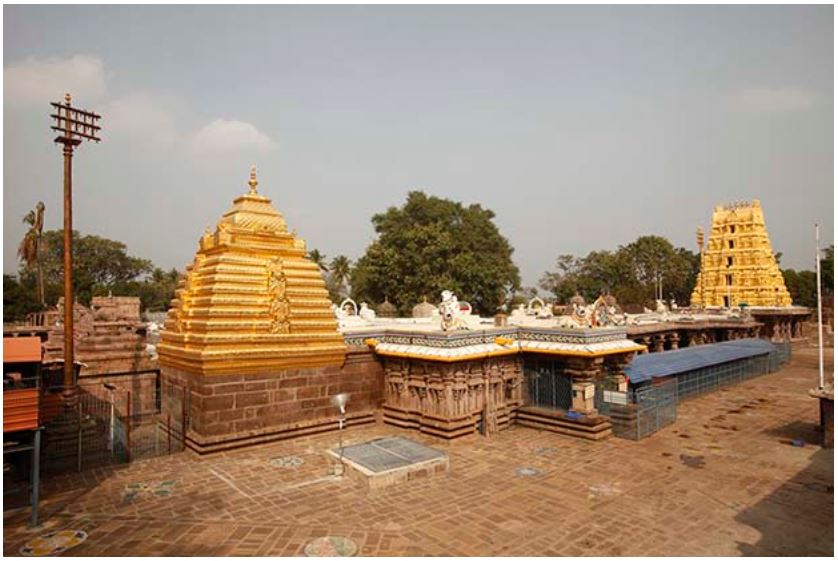
Somnath Temple
According
to the Puranas, Somnath is the first Jyotirlinga. Somnath means Lord of
Soma and temple is an eternal shrine. It is located on the southern tip
of Saurashra (Gujarat). Its reference is found in vedas and
Mahabharata. In older days it was believed that the water for Linga
abhishek was brought from Kashi daily. This temple was a target for
plunder during the Mugal invasion for a number of times. The temple has
been rebuilt or renovated at least 7 times. There are still the telltale
marks of the invasion and the plunder. Near this temple there is also
another temple built by Maharani of Holkar. In this temple, the deities
and valuables of Somnath temple were preserved to protect them from
Mugal raids. Near this place and Veraval port lies Balakateertha where
Lord Krishna met his end. At the triveni sangam of the rivers Hiranya,
Saraswati and Kapila, the final rights of Lord Krishna were supposed to
have been performed.
The Linga at Somnath temple is a Sparsha Linga. There is a kunda known as Chandra Kunda which is believed to cure leprosy and tuberculosis. According to the Puranas, Chandra (Soma) performed severe penance to get rid of a curse. He was cursed by his father in-law – Daksha for paying more attention to Revathi than his other 26 wives. All 27 wives of Soma were daughters of Daksha. According to the curse, Chandra was to disappear completely. Lord Shiva was pleased by Soma’s penance and relieved him from the curse and granted a boon. According to this, he was to wane for 15 days and wax for 15 days i.e. he created Shukla paksha and Krishna paksha. The full moon was known as Pournima and new moon was Amavasya. Thus the Somanath Linga got its name due to the tapasya of Soma.

The Linga at Somnath temple is a Sparsha Linga. There is a kunda known as Chandra Kunda which is believed to cure leprosy and tuberculosis. According to the Puranas, Chandra (Soma) performed severe penance to get rid of a curse. He was cursed by his father in-law – Daksha for paying more attention to Revathi than his other 26 wives. All 27 wives of Soma were daughters of Daksha. According to the curse, Chandra was to disappear completely. Lord Shiva was pleased by Soma’s penance and relieved him from the curse and granted a boon. According to this, he was to wane for 15 days and wax for 15 days i.e. he created Shukla paksha and Krishna paksha. The full moon was known as Pournima and new moon was Amavasya. Thus the Somanath Linga got its name due to the tapasya of Soma.

Jyotirlingas
Jyotirlinga
represents the Lord Shiva in the form of Linga. It represents Lord
Shiva in the form of radiant energy. According to Shiva Purana, Lord
Shiva first manifested in the form of Jyotirlinga on the night of Ardra
Nakshatra. It is believed that when a person reaches the highest level
in the spiritual path, he can perceive (see) the lingam as column of
fire piercing the earth and reaching great height. Jyotirlinga are
explained in detail in Shiva Purana.
According to the purana, once Brahma and Vishnu had an argument over the supremacy of creation. They approached Shiva, who manifested in the form of huge pillar of light without ends i.e. jyotirlinga piercing the three worlds. Vishnu and Brahma split their ways to find the ends of this huge pillar. Brahma lied that he has found one end i.e. the top, whereas Vishnu accepted that he could not find the lower end. Shiva appeared as a second jyotirlinga and cursed Brahma that he would have no place in any ceremonies and blessed Vishnu that he would be worshiped till the end of eternity.
Jyotirlingas are the places where Shiva has appeared as Jyoti (a fiery column of light). It was believed that there were 64 Jyotirlingas. Of these 12 are considered as very auspicious and holy. These are mentioned in Dvadasha Jyotirlinga stotra available here.
Here is a list of 12 jyotirlingas.
In our succeeding articles we will try to give summary of each of the 12 Jyotirlingas.
According to the purana, once Brahma and Vishnu had an argument over the supremacy of creation. They approached Shiva, who manifested in the form of huge pillar of light without ends i.e. jyotirlinga piercing the three worlds. Vishnu and Brahma split their ways to find the ends of this huge pillar. Brahma lied that he has found one end i.e. the top, whereas Vishnu accepted that he could not find the lower end. Shiva appeared as a second jyotirlinga and cursed Brahma that he would have no place in any ceremonies and blessed Vishnu that he would be worshiped till the end of eternity.
Jyotirlingas are the places where Shiva has appeared as Jyoti (a fiery column of light). It was believed that there were 64 Jyotirlingas. Of these 12 are considered as very auspicious and holy. These are mentioned in Dvadasha Jyotirlinga stotra available here.
Here is a list of 12 jyotirlingas.
Name of Jyotirlinga
|
Location
|
Somnath
|
Saurashtra, Gujarat
|
Mallikarjuna
|
Shri Shailam, Andhra Pradesh
|
Mahakaleshwar
|
Ujjain, Madhya Pradesh
|
Omkareshwar
|
Mandhata, Madhya Pradesh
|
Kedarnath
|
Himalayas
|
Bhimashankar
|
Maharashtra
|
Kashi Vishwanath
|
Varanasi, Uttar Pradesh
|
Trimbakeshwar
|
Nashik, Maharashtra
|
Vaidyanath (Vaijnath)
|
Parali, Maharashtra
|
Nageshwar
|
Gujarat
|
Rameshwar
|
Tamilnadu
|
Ghrishneshwar
|
Aurangabad, Maharashtra
|
In our succeeding articles we will try to give summary of each of the 12 Jyotirlingas.
Shata Rudriyam - Part 2
In the last article - Shata Rudriyam
- we provided first 50 of 100 names of Shiva Lingas together referred
as Shata Rudriyam. In this article we provide names of remaining 50
shiva lingas.
Noe: The content for this and previous article is based on content from kamakoti.org
Noe: The content for this and previous article is based on content from kamakoti.org
Worshiper
|
Material (Name) of Linga
|
Name of Linga Swaroop
|
Yogi Purush
|
Sarvabhuthatha
|
Sthaanu
|
Human beings
|
Wide variety of lingas
|
Purusha
|
Nakshatras
|
Tejomaya (full of radiance)
|
Bhaga / Bhaskara
|
Kinnaras
|
Dhaatumaya
|
Sudeepth
|
Brahma Rakshasa Ganas
|
Asthimaya (Bones)
|
Deva Deva
|
Charanas
|
Dantamaya (full of teeth)
|
Ramhas
|
Sadhya Ganas
|
Saptaloka Maya
|
Bahurupa
|
Ritus
|
Doorvaankura Maya
|
Sarva
|
Celestial Damsel Urvashi
|
Sindhura Linga
|
Priya Vasan
|
Apsaras
|
Kumkuma Linga
|
Abhushana
|
Guru Deva
|
Brahmachari Linga
|
Ushnivi
|
Yoginis
|
Alakthak
|
Swabhruk
|
Siddha Yoginis
|
Srikhanda Linga
|
Sahasraaksha
|
Dakinis
|
Mamsa
|
Sumidhsha
|
Manna Ganas
|
Annamaya Linga
|
Girisha
|
Agasthya Muni
|
Vreehimaya Linga
|
Sushanth
|
Muni Devala
|
Yavamaya Linga
|
Pathi
|
Valmiki Muni
|
Linga of Valmikas
|
Chira Vasa
|
Pratardan
|
Baana Linga
|
Hiranyabhuj
|
Daityagana
|
Rayi
|
Ugra
|
Daanavas
|
Nishpaavaj Linga
|
Dikpathi
|
Baadal (Clouds)
|
Niramaya (Waterful) Linga
|
Parjanya
|
Yaksharaj
|
Maashmaya
|
Bhutapathi
|
Pitruganas
|
Tilmaya (sesame Seeds) Linga
|
Vrishapathi
|
Gautama Muni
|
Godhulimaya Linga
|
Gopathi
|
Vanaprastha Ganas
|
Phalamaya Linga (Full of fruits)
|
Vrikshavrita
|
Karthikeya
|
Stone
|
Senanya
|
Ashtavatar Nag
|
Dhanya Linga
|
Madhyama
|
Yagna Karta
|
Purusha Linga
|
Sthruva hasta
|
Yama
|
Kalaay Samay
|
Dhanvi
|
Prashurama
|
Yavaankura Linga
|
Bhargava
|
Pururava
|
Ghritmaya (Gheefull) Linga
|
Bahurupa
|
Mandhata
|
Sugary Linga
|
Bahuyug
|
Clan of Cows
|
Dugdhamaya Linga (full of milk)
|
Nethra Sahasrak
|
Pativrata Stree (Women devoted to their husband)
|
Bhatrumaya
|
Viswapati
|
Nara and Narayana
|
Mounji Linga
|
Sahasra Shirsha
|
Pruthu
|
Thaaksharya Linga
|
Sahasra charan
|
Birds
|
Vyoma Linga
|
Sarvatmaka
|
Prithvi
|
Gandhamaya Linga
|
Dvithanu
|
The entire animal kingdom
|
Bhasmamaya Linga
|
Maheshwara
|
Rishiganas
|
Jnanamaya Linga
|
Chirasthan
|
Brahmanas
|
Brahma Linga
|
Jyeshtha
|
Shesha Nag
|
Gorochanmaya Linga
|
Pashupathi
|
Vasuki Nag
|
Visha (Poison) Linga
|
Shankara
|
Takshak Nag
|
Kaalakutamaya Linga
|
Bahurup
|
Karkotaka Nag
|
Halahalamaya Linga
|
Pingaksha
|
Shringi
|
Vishamaya Linga
|
Dhurjati
|
Puthras (Sons)
|
Pitrumaya Linga (Fathers)
|
Vishwarupa
|
Shiva Devi
|
Parama Maya
|
Vyambak
|
Matsya and other jeevas
|
Shastramaya Linga
|
Vrishakapi
|
Upalingas and the procedure of Shiva linga worship
The total number of Jyotirlingas is estimated to be 64. Of these 12 are prominent which we have described earlier in article Story of Jyotirlinga.
The details of other lingas are not known. Besides these, there are
some more Lingas known as Upalingas. Some of them, listed below, are
mentioned in our Puranas.
It is believed that the best time for worship of Shiva Lingam is mid-night. The mantra “OM NAMAH SHIVAY” is chanted continuously throughout the worship. It is a belief that chanting the mantra 5 crore times is highly fruitful. Worship consists of following essential steps.
It is believed that it is more beneficial and fruitful to perform worship on the bank of a river, particularly the bank of holy rivers like Ganga, Narmada, Yamuna, Kaveri, Godavari etc. People often go on pilgrimage to Pancha bhoota sthala Jyotirlinga to perform the worship. It is considered ten times beneficial and fruitful if worship is performed in cow shades, tulsi vrindavan, sea shores or mountain tops. Worship of Shiva Linga made in sphatika (quartz) is considered to be the holiest. The months of Kartik and Magh are considered to be holy periods for worship of Shiva.
In the upcoming articles we will give locations of Jyotirlinga and Pancha Bhootha sthalam.
- Atrishwar Linga – worshiped by Sage Atri in the Chitrakoot mountain forest. According to the Puranas, Devi Ganga appeared there and offered water from the spring to the Muni. It was from that spring, the river Mandakini emerged.
- Mahabaleshwar Linga – This emerged mainly at Gokarna at Karnataka and parts of it at Murudeshwar, Dhareshwar & Gunavante in Karnataka. The incident behind appearance of this Linga is mentioned in Ramayana.
- Batuknath Linga – appeared due to the intense tapasya of Sudarshan – son of Dadhichi muni.
- Lord Shiva manifested as Hatakeshwar Linga in Daruka forest of Uttaranchal.
- Rishishwar Linga manifested at Naimisha Aaranya.
- Laliteshwar Linga manifested on the way from Devaprayag and Kedarnath.
- Pashupatinath Linga manifested at Kathmandu, Nepal.
Procedure of Shiva Linga worship as mentioned in Puranas
As mentioned in previous article - Structure of Shiva Linga - worship of Shiva Linga is worship of Lord Shiva. It was also mentioned that Lingas are made of different materials. While constructing / manufacturing the Shiva Linga, it is necessary to continuously chant the mantra “OM NAMAH SHIVAY”. This makes the Lingam holy and sacred.It is believed that the best time for worship of Shiva Lingam is mid-night. The mantra “OM NAMAH SHIVAY” is chanted continuously throughout the worship. It is a belief that chanting the mantra 5 crore times is highly fruitful. Worship consists of following essential steps.
- Avahana (Inviting)
- Aasana (Seating),
- Padyam (Washing feet of God)
- Argya (Offering water)
- Snanam (Offering bath)
- Anulepana (Applying sacred ash)
- Gandham (Applying kumkum, sandlewood paste, etc)
- Naivedyam (Offering fruit, food, etc)
- Tambulam (Offering beatle leaves and nuts)
- Paneeyam (Offering of Ganga water, coconut water etc)
- Vastram (Offering clothing)
- Alaankar (Decorating with flowers, bilva leaves, white flowers, etc)
- Aachamya (Offering Ganga water for sipping)
- Aarti (Offering camphor, dhoop or deep)
- Mantrapushpa (Offering vedic hymns)
- Namaskar
It is believed that it is more beneficial and fruitful to perform worship on the bank of a river, particularly the bank of holy rivers like Ganga, Narmada, Yamuna, Kaveri, Godavari etc. People often go on pilgrimage to Pancha bhoota sthala Jyotirlinga to perform the worship. It is considered ten times beneficial and fruitful if worship is performed in cow shades, tulsi vrindavan, sea shores or mountain tops. Worship of Shiva Linga made in sphatika (quartz) is considered to be the holiest. The months of Kartik and Magh are considered to be holy periods for worship of Shiva.
In the upcoming articles we will give locations of Jyotirlinga and Pancha Bhootha sthalam.
Structure of Shiva Linga
According
to ancient Hindu scriptures the 3 fundamental states of cosmic reality
are Sristi (Evolution), Sthiti (Existence) & Samhar (Destruction).
They are controlled by Lord Bramha (Sristi i.e. creation), Lord Vishnu
(Sthiti i.e. preservation), Lord Shiva (Samhar i.e. destruction),
together known as Trinity. Lord Shiva is the cause of beginning as well
as completion of cosmic cycle and so he is known as Mahadev. The iconic
form of Shiva is known as Linga and it represents the unity of 3
fundamental cosmic states.

Thus the Linga consists of 3 parts
1) It has a base of 3 layers at bottom representing 3 lokas and it symbolizes Lord Bramha.
2) The middle is Octagonal round form. It represents 8 directions symbolizing Lord Vishnu.
3) The top cylindrical part represents the completion of the cycle symbolizing Lord Shiva.
The word Lingam in Sanskrit means Symbol. Hence it stands for symbol of Lord Shiva. Worship of Shiva Lingam is the worship of Lord Shiva. It is regarded as most sacred and superior by Shaivaites according to Shiva Puran. Lord Shiva is represented as Linga as he is Sadashiva (eternal reality). As a destroyer he is known as Rudra with Kali as his consort. As a terrible destroyer he is known as Bhairava with Durga as his consort. As a jovial god he lives in Himalayas with his consort Parvati. As he possesses all forms of divine power he is called Ishwara and his consort is Ishwari. He is also depicted as cosmic dancer Natraja as Lingodbava. He symbolizes the superiority. According to Linga Puran, Shiva Linga symbolizes infinite nature of Shiva. Shiva Linga found in most of the temples is rounded or elliptical set on a circular base known as Peetham. This Peetham represents Parashakti- the manifesting power of god.
Shiva Lingas are usually made of stone (carved into shape). Some are naturally occurring in swift flowing river-beds (river Narmada). They may be made of metals, gems, crystals, wood, earth, ice etc. According to some scholars the material may be sand, rice, cooked food, river clay, cow dung, butter, rudraksha, ash, sandlewood, darbha grass, etc. The naturally occurring Linga at Amarnath in Himalayas is made of ice. Besides the above explanation, religious scholars have given a number of different interpretations.
According to some, Linga worship is considered as worship of reproductive function. They believe the base corresponds to Yoni (female reproductive organ) and top corresponds to Phallus (male reproductive organ). Hence Shiva Linga is considered to be representation of process of reproduction.

Thus the Linga consists of 3 parts
1) It has a base of 3 layers at bottom representing 3 lokas and it symbolizes Lord Bramha.
2) The middle is Octagonal round form. It represents 8 directions symbolizing Lord Vishnu.
3) The top cylindrical part represents the completion of the cycle symbolizing Lord Shiva.
The word Lingam in Sanskrit means Symbol. Hence it stands for symbol of Lord Shiva. Worship of Shiva Lingam is the worship of Lord Shiva. It is regarded as most sacred and superior by Shaivaites according to Shiva Puran. Lord Shiva is represented as Linga as he is Sadashiva (eternal reality). As a destroyer he is known as Rudra with Kali as his consort. As a terrible destroyer he is known as Bhairava with Durga as his consort. As a jovial god he lives in Himalayas with his consort Parvati. As he possesses all forms of divine power he is called Ishwara and his consort is Ishwari. He is also depicted as cosmic dancer Natraja as Lingodbava. He symbolizes the superiority. According to Linga Puran, Shiva Linga symbolizes infinite nature of Shiva. Shiva Linga found in most of the temples is rounded or elliptical set on a circular base known as Peetham. This Peetham represents Parashakti- the manifesting power of god.
Shiva Lingas are usually made of stone (carved into shape). Some are naturally occurring in swift flowing river-beds (river Narmada). They may be made of metals, gems, crystals, wood, earth, ice etc. According to some scholars the material may be sand, rice, cooked food, river clay, cow dung, butter, rudraksha, ash, sandlewood, darbha grass, etc. The naturally occurring Linga at Amarnath in Himalayas is made of ice. Besides the above explanation, religious scholars have given a number of different interpretations.
According to some, Linga worship is considered as worship of reproductive function. They believe the base corresponds to Yoni (female reproductive organ) and top corresponds to Phallus (male reproductive organ). Hence Shiva Linga is considered to be representation of process of reproduction.
Story of origin of Shiva Linga
In
the thick forest of Darukavan,
rishis, munis & yogis were engaged in Tapasya. Their wives were
assisting them. To test devotion of these rishis, Lord Shiva appeared
there as a semi-lunatic. He appeared very handsome but half naked,
laughing sometimes and crying sometimes. Due to his handsome
appearance the women folks got attracted towards him to such an extent
that they started neglecting their
duties. At the same time the men folks found his presence a distraction
and a
nuisance. Seeing a pitiable condition of their wives, the rishis got
annoyed and they
confronted the semi-lunatic and ordered him to leave the place. When he
did not
obey their order they cursed him so that his linga will fall. At this
juncture
Lord Bramha appeared and admonished the sages for their miss-conduct
towards
their guest who was none other than Lord Shiva. Bramha apologized to
Lord Shiva
for the miss-conduct of the sages. The rishis realized their mistake and
apologized
to Lord Shiva for their attitude and behavior. Lord Shiva explained to
them
that the Srishti occurred due to this Stri & Pulingas and one should
not hurry
to a wrong conclusion without ascertaining the truth.
Lord
Shiva explained how not to get confused between Maya for Satya and Illusion for
Reality. He suggested that Karma-kanda is definitely a foundation for path of
self-realization or a means of salvation, but it’s not the end. Thus Linga
formation represents, Lord Mahadeva and worship of Linga is the worship of
Mahadeva.

Shaktipeeth - Part 1
Historical background of Shakti-peethas
In Bramhanda Purana we come across the Shakti-peethas, their importance and epics about their origin. According to Bramhanda Purana, there are 64 Shaktipeethas of Godess Parvati. Sage Markandeya composed the Devi Saptashati which relates the virtues of divine goddess of Shakti (Parvati). According to Shiva Purana, Devi Bhagwata and Kalika Purana there are 4 major Shaktipeethas namely Puri (inside Jagannath temple, Orissa), Behrampur (Orissa), Guwahati (Assam), Kolkata (Kali temple, West Bengal).
According
to the epics, the following story is related to the formation of
Shaktipeethas.
King Daksha’s daughter, Sati was wife of Lord Shiva. The King did not
like his
son-in-law because of his attire and dwelling. Once he arranged a great
Yagnya and did not invite his son-in-law i.e. Lord Shiva. Sati went to the Yagnya in
spite of advice from Lord Shiva for not doing so. She questioned her
father for not inviting Lord Shiva. She was insulted and her husband was
belittled at Yagnya by her father. So she jumped into the Yagnya fire.
When Lord Shiva came to know about his wife jumping into
fire, he became furious and destroyed the Yagnya through Shivaganas. He
performed Ugra-tandava holding his wife’s lifeless body. Lord Vishnu
pacified Lord Shiva.
During Ugra-tandav, Parvati’s body got cut into pieces and fell at 52
places on
the earth and each of those places became Shaktipeethas. It is presumed
that the place where heart of Parvati
fell is where Ambaji temple at Mt. Abu was constructed.
According to another epic when Shiva was performing Ugra-tandav with Sati’s body, Vishnu, Brahma, other Gods and sages gathered at Yagynashala and started praying Aadi-shakti with bowed head. At the same time, the head was severed from Daksha’s body. Due to the prayers of Gods and others, the body of Sati started disintegrating into drops of Shakti-swaroop. They started scattering all over the world and became Shaktipeethas. In Bharata they fell from Himalayas to Kanyakumari. Thus we have many forms of Shakti as Vaishnavi, Varahi, Vishalakshi, Kali, Mukambika, Kanyakumari and so on.
When Shiva calmed down from his Ugra-tandava, Shakti entered the body of Shiva (i.e. she married after taking re-birth as Uma) and became part of Shiva. Due to Shiva’s divine grace, all those were killed at Yagnya became alive. Bowing to the request of Uma, Shiva brought King Daksha back to life and made him one of the Ganas. It is believed that Daksha’s head resembled that of a goat after he came back to life.
According to another epic when Shiva was performing Ugra-tandav with Sati’s body, Vishnu, Brahma, other Gods and sages gathered at Yagynashala and started praying Aadi-shakti with bowed head. At the same time, the head was severed from Daksha’s body. Due to the prayers of Gods and others, the body of Sati started disintegrating into drops of Shakti-swaroop. They started scattering all over the world and became Shaktipeethas. In Bharata they fell from Himalayas to Kanyakumari. Thus we have many forms of Shakti as Vaishnavi, Varahi, Vishalakshi, Kali, Mukambika, Kanyakumari and so on.
When Shiva calmed down from his Ugra-tandava, Shakti entered the body of Shiva (i.e. she married after taking re-birth as Uma) and became part of Shiva. Due to Shiva’s divine grace, all those were killed at Yagnya became alive. Bowing to the request of Uma, Shiva brought King Daksha back to life and made him one of the Ganas. It is believed that Daksha’s head resembled that of a goat after he came back to life.
Shakti-peethas with shakti temple
Some of the Shaktipeethas that are mentioned in epics (where we find the Shakti temple) are listed below –
Name of Shaktipeetha
|
Name of presiding Deity
|
Place
|
Sharadapeetha
|
Shri Sharada
|
Shringeri, Karnataka
|
Kamarajpeetha
|
Shri Kamakshi
|
Kancheepuram, Tamil Nadu
|
Dharmapeetha
|
Shri Dharmavardhini
|
Thiruvaiaru, Tamil Nadu
|
Manikarnika peetha
|
Shri Vishalakshi
|
Kashi, Uttar Pradesh
|
Chitrambala peetha
|
Shri Shivakashi
|
Chidambaram, Tamil Nadu
|
Mantrini peetha
|
Shri Minakshi
|
Madurai, Tamil Nadu
|
Kumari peetha
|
Shri Kanyakumari
|
Kanyakumari, Tamil Nadu
|
Shivashakti peetha
|
Shri Akilandeshwari
|
Thiruvannamalai, Tamil Nadu
|
Vishnushakti peetha
|
Shri Mangalambika
|
Kumbhakonam, Tamil Nadu
|
Aruna peetha
|
Shri Abidambal
|
Thiruvannamalai, Tamil Nadu
|
Kamali peetha
|
Shri Kamalambal
|
Thiruvarur, Tamil Nadu
|
Setu peetha
|
Shri Parvat Vardhini
|
Rameshwaram, Tamil Nadu
|
Besides these there are 4 shakti peethas in
Maharashtra.
Karveer peeth,
Mahalakshmi, Kolhapur; Tuljapur peeth, Tulja bhavani (Mahishasur mardini),
Tuljapur; Mahurgadh peetha,
Shri Renuka devi, Mahur; Saptashrungi peetha, Shri Jaydurga, Vani
Shaktipeethas in Ashta-dashashakti-peetha stotra
There is disagreement in understanding if some modern cities correspond to the 64 locations mentioned in Puranas. However there seems to be agreement about 18 locations as mentioned by Adi Shankaracharya in his Ashta-dashashakti-peetha stotra.
Below is the list mentioned by Shri Shankaracharya. It indicates the location where the part of
the body (of Sati) fell.
Peetha
|
Location
|
Part of body which fell
|
Name of Deity (Shakti)
|
Lanka peetha
|
Tricomalee, Sri Lanka
|
Groin
|
Shankari devi
|
Kanchikaamkoti peetha
|
Kanchipuram, Tamil Nadu
|
Back part
|
Kamakshi devi
|
Pradyumna peetha
|
Pandua, West Bengal
|
Stomach
|
Shrigala devi
|
Crounja peetha
|
Maisur, Karnataka
|
Hair
|
Chamundeshwari devi
|
Yogini peetha
|
Alampur, Telangana
|
Upper teeth
|
Yogamba devi
|
Shrishaila peetha
|
Shri Shailam, Andhra Pradesh
|
Neck part
|
Bharamaramba devi
|
Shri peetha
|
Kolhapur, Maharashatra
|
Eyes
|
Mahalakshmi
|
Renuka peetha
|
Mahur, Maharashtra
|
Left hand
|
Renuka devi
|
Ujjaini peetha
|
Ujjain,
Madhya Pradesh
|
Tonge
|
Mahakali devi
|
Pushkarini peetha
|
Pithapuram, Andhra Pradesh
|
Back portion
|
Puruhutika devi
|
Oddyana peetha
|
Jaipur, Orissa
|
Hip bone
|
Biraja devi
|
Draksharama peetha
|
Draksharamam, Andra Pradesh
|
Naval
|
Manikyamba devi
|
Kaamroopa peetha
|
Guwahati, Aasam
|
Vulva
|
Kamaroopa devi
|
Prayaga peetha
|
Prayag, Uttar Pradesh
|
Fingers
|
Madhaveshwari devi
|
Jwalamukhi peetha
|
Kangra / Jwalamukhi, Himachal Pradesh
|
Head
|
Vaishnavi devi
|
Gaya peetha
|
Gaya, Uttar Pradesh
|
Breast part
|
Sarva-mangala devi
|
Varanasi peetha
|
Varanasi, Uttar Pradesh
|
Toes
|
Vishalakshi devi
|
Sharada peetha
|
Sharada peeth, Aazaad Kashmir
|
Right hand
|
Saraswati devi
|
Sharada peetha temple has become
non-existent. It lies in the line of control between India & Pakistan.
Shringeri Sharda peetha at Shringeri, Karnataka is not a Shakti peetha but is the
aspect of Goddess Sharada.
Details about four major shaktipeethas
Here
are more details - the name of deity, location and the body part /
ornament fell at that location - about 4 major shaktipeethas mentioned
above.
|
Location
|
Body part/ ornament
|
Name of Goddess
|
|
Puri
|
Bimla
|
|
|
Behraampur
|
||
|
Kamakshya
|
||
Consolidated list of all shaktipeethas
As mentioned above there are supposed to be total of 64 shakti peethas, however we are able to gather list of only 51 shakti peethas. We will cover consolidated list of all shakti-peethas in our next article post. The list will include name of temple that was built on each part of the body of goddess or on the ornaments that fell during ugra-tandava and the name of manifestation of Lord Shiva at that place.
Contd...
Shaktipeeth - Part 2
In previous
part we mentioned that we will cover consolidated list of 51 Shakti
Peethas. Since the list is big we are dividing it in two articles
Shaktipeeth Part 2 (1 to 26 of 51) and Shaktipeeth Part 3 (27 to 51 of
51).
List (1 to 26 of 51)
Sr. No
|
Place
|
Body Part or Ornament
|
Shakti
|
Bhairava
| |
1
|
16 km by walk
|
Throat
|
Mahamaya
|
Trisandhyeshwar
| |
2
|
Dakshindihi in the
district of Birbhum,
| West Bangal
| Lips
| Phullara
| Vishvesh |
3
|
Left arm
|
Goddess Bahula
|
Bhiruk
| ||
4
|
Bakreshwar, on the banks of Paaphara river, 24 km distance from Siuri Town, district Birbhum, 7 km from Dubrajpur Rly. Station
|
Portion between the eyebrows
|
Mahishmardini
|
Vakranath
| |
5
|
Bhairavparvat, at Bhairav
hills on the banks
|
Elbow
|
Avanti
|
Lambkarna
| |
6
|
Bhabanipur, located in the Upazilla of Sherpur, Bogra,Rajshahi Division. Also located at Karatoyatat, it is about 28 km distance from the town of Sherpur.
|
Left anklet (ornament)
|
Arpana
|
Vaman
| |
7
|
Feet
|
Chhinnamastika
|
Rudra Mahadev
| ||
8
|
Gandaki, Pokhara about 125 km on the banks of Gandaki river where Muktinath temple is situated
|
Temple
|
Gandaki Chandi
|
Chakrapani
| |
9
|
Chin (2 parts)
|
Bhramari
|
Vikritaksh
| ||
10
|
Hinglaj (Or Hingula), southern Baluchistan a few hours North-east of Gawadar and about 125 km towards North-west fromKarachi
|
Bramharandhra (Part of the head)
|
Kottari
|
Bhimlochan
| |
11
|
Jayanti at Nartiang village in the Jaintia Hills district. This Shakti Peetha is locally known as the Nartiang Durga Temple.
|
Left thigh
|
Jayanti
|
Kramadishwar
| |
12
|
Jessoreswari, situated at Ishwaripur, Shyamnagar Upazila,Khulna Division. The temple complex was built by Maharaja Pratapaditya, whose capital was Ishwaripur.
|
Palms of hands and soles of the feet
|
Jashoreshwari
|
Chanda
| |
13
|
Jwalaji, Kangra from
Pathankot alight at Jwalamukhi
Road Station from there 20 km
|
Tongue
|
Siddhida (Ambika)
|
Unmatta Bhairav
| |
14
|
Right Toes
|
Kalika
|
Nakuleshwar
| ||
15
|
a cave over hills near to Amarkantak
|
Left buttock
|
Kali
|
Asitang
| |
16
|
Genitals
|
Kamakhya
|
Umanand
| ||
17
|
Kankalitala, on the banks of Kopai River 10 km north-east ofBolpur station in Birbhum district, Devi locally known as Kankaleshwari
|
Bone
|
Devgarbha
|
Ruru
| |
18
|
Back
|
Sarvani
|
Nimish
| ||
19
|
Karnat, Brajeshwari Devi,
Kangra
|
Both ears
|
Jayadurga
|
Abhiru
| |
20
|
3 km from Lalbag Court Road station under district Murshidabad
|
Crown
|
Vimla
|
Sanwart
| |
21
|
Locally known as
Anandamayee Temple. Ratnavali,
|
Right Shoulder
|
Kumari
|
Shiva
| |
22
|
Locally known as Bhramari Devi. In Jalpaiguri near a small village Boda on the bank
of river Teesta or Tri-shrota (combination of three flows) mentioned in Puranas
|
Left leg
|
Bhraamari
|
Ambar
| |
23
|
Right hand
|
Dakshayani
|
Amar
| ||
24
|
Two Bracelets
|
Gayatri
|
Sarvanand
| ||
25
|
Left shoulder
|
Uma
|
Mahodar
| ||
26
|
Located 36 km from the ancient capital of the Jaffna kingdom,Nallur. The murti of the Goddess is believed to have been consecrated and worshipped by Lord Indra. The protagonist,Lord Rama and antagonist, Ravana of the Sanskrit epicRamayana have offered obeisances to the Goddess. Nāgaand Garuda of the Sanskrit epic Mahabharata; resolved their longstanding feuds after worshipping this Goddess.
|
Silambu(Anklets)
|
Indrakshi (Nagapooshani /Bhuvaneswari)
|
Rakshaseshwar (Nayanair)
|
Continuing
from previous article - Shaktipeeth Part 2 - here is a part 2 (27 to 51
of 51) of consolidated list of Shakti peethas.
Source of lists: Wikipedia
Sr. No
|
Place
|
State in India
|
Body Part or Ornament
|
Shakti
|
Bhairava
|
27
|
Nepal,
near Pashupatinath
Temple at Guhyeshwari Temple
|
Both Knees
|
Mahashira
|
Kapali
|
|
28
|
On Chandranath hill near Sitakunda station
of
Chittagong Division. The famous
on the top of the hill is the
Bhairav temple of this
Shakti Peetha, not the
Shakti Peeth itself.
|
Right arm
|
Bhawani
|
Chandrashekhar
|
|
29
|
Panchsagar Near Lohaghat (in Champawat District
of
Uttarakhand) nearly
100 km from nearest
railway station Tanakpur.
|
Lower teeth
|
Varahi
|
Maharudra
|
|
30
|
Prabhas, 4 km from
Veraval station
near
Somnath temple
in
Junagadh district
|
Stomach
|
Chandrabhaga
|
Vakratund
|
|
31
|
Prayag near
|
Finger
|
Lalita
|
Bhava
|
|
32
|
Present day
Kurukshetra town or Thanesar ancient
Sthaneshwar
|
Ankle bone
|
Savitri/
BhadraKali
|
Sthanu
|
|
33
|
Ramgiri, at
Chitrakuta on the Jhansi Manikpur
railway line
|
Right breast
|
Shivani
|
Chanda
|
|
34
|
Sainthia,
locally Known as Nandikeshwari temple.
Only 1.5 km from the
railway
station under a
banyan tree within a
boundary wall, Birbhum district
|
Necklace
|
Nandini
|
Nandikeshwar
|
|
35
|
Sarvashail or Godavaritir,
at Kotilingeswar temple
on the banks of
Godavari river near Rajamundry
|
Cheeks
|
Rakini or Vishweshwari
|
Vatsnabh or Dandpani
|
|
36
|
Eyes
|
Mahishmardini
|
Krodhish
|
||
37
|
Shondesh, at the
source point of
|
Right buttock
|
Narmada
|
Bhadrasen
|
|
38
|
Shri Parvat,
near
Another belief:
at Srisailam in
Shriparvat hills under Kurnool district
|
Right anklet (ornament)
|
Shrisundari
|
Sundaranand
|
|
39
|
Shri
Shail, at Joinpur village,
Dakshin Surma, near Gotatikar,
3 km
north-east
of Sylhet town
|
Neck
|
Mahalaxmi
|
Sambaranand
|
|
40
|
Shuchi, in
a Shiva temple at Suchindrum 11 km
onKanyakumari
Trivandrum road
|
Upper teeth
|
Narayani
|
Sanhar
|
|
41
|
Sugandha, situated in
Shikarpur, Gournadi, about
20 km fromBarisal town,
on the banks of Sonda river.
|
Nose
|
Sugandha
|
Trayambak
|
|
42
|
Udaipur, Tripura, at
the top of the hills known as Tripura Sundari temple near
village, a little distance away from Udaipur town
|
Right leg
|
Tripuresh
|
||
43
|
Right wrist
|
Mangal Chandika
|
Kapilambar
|
||
44
|
Earring
|
Vishalakshi &
Manikarni
|
Kalbhairav
|
||
45
|
Vibhash, at Tamluk under
district Purba Medinipur
|
Left ankle
|
Kapalini (Bhimarupa)
|
Sarvanand
|
|
46
|
Left toes
|
Ambika
|
Amriteshwar
|
||
47
|
Vrindavan,
near
new bus stand on Bhuteshwar road within Bhuteshwar Mahadev Temple,
Katyayanipeeth.
|
Ringlets of hair
|
Uma
|
Bhutesh
|
|
48
|
Jalandhar,
from Jalandhar Cantonment Station to Devi Talab.
|
Left Breast
|
Tripurmalini
|
Bhutesh
|
|
49
|
Heart
|
Jaya Durga
|
Baidyanath
|
||
50
|
Birajong in Paro
|
Bamonbonsham
|
Paropit
|
||
51
|
Jugaadya at Kshirgram near Kaichar under Burdwan district
|
West Bengal
|
Great toe
|
Jugaadya | Ksheer Kantak |
Worship of Hanuman
 |
| Image source: https://www.youtube.com/watch?v=BzPbfftJ8Ho |
Worship of Hanuman gives immense benefits and is done in various ways. Here are two recommended ways.
Panchamukhi Hanumat Kavach:
Chanting
of this stotra offers various benefits. It is recommended that it
should be chanted 108 times. Such chanting offers much needed strength
and stamina to achieve success in one's endeavor.
There are 3 Gayatri mantras of Hanuman. These are also to be chanted 108 times to gain strength and stamina for achieving success in life.
One can even chant individual shloka for each face. Below are shlokas and benefits of worshiping each of fives faces of Hanuman
East Facing
- Represents Maruti
- Worshiped for warding of troubles from enemies
- Shloka:
- ॐ नमो भगवते पञ्चवदनाय पूर्वकपिमुखे सकलशत्रूसंहारणाय स्वाहा
South Facing
- Represents Naarasimha
- Worshiped to get rid of fear, all types of doshas due to bhut, pret, durdevata
- Shloka:
- ॐ नमो भगवते पञ्चवदनाय दक्षिणमुखे करालवदनाय नरसिंहाय सकलभूतप्रेतदमनाय स्वाहा
West Facing
- Represents Eagle (गरुड)
- Worshiped for eradication of all diseases connected with the body, bites due to poisonous insects and viral fever etc
- Shloka:
- ॐ नमो भगवते पञ्चवदनाय पश्चिममुखे गरुडाय सकलविषहरणाय स्वाहा
North facing
- Represents Varaha
- Worshiped for eradication of poverty and obtaining riches
- Shloka:
- ॐ नमो भगवते पञ्चवदनाय उत्तरमुखे आदिवराहाय सकलसम्पत्कराय स्वाहा
Top Facing
- Represents Hayagriva
- Worshiped for obtaining vaaksiddhi (mastery in speech), to build charisma, for gaining knowledge
- Shloka:
- ॐ नमो भगवते पञ्चवदनाय ऊर्ध्वमुखे हयग्रीवाय सकलजनवशीकरणाय स्वाहा
Maruti Gayatri
- ॐ आंजनेयाय विद्महे वायुपुत्राय धीमहि तन्नो हनुमान प्रचोदयात् ||
- ॐ आंजनेयाय विद्महे महावीराय धीमहि तन्नो हनुमान प्रचोदयात् ||
- ॐ आंजनेयाय विद्महे रामदुताय धीमहि तन्नो हरि: प्रचोदयात् ||
Nine forms of Devi during Navaratri
Navaratri
literally means nine divine nights of Goddess. Each day different form
of Goddess is worshiped with different offerings.
Below is a chart that
describes various forms of Goddess, goal of her each incarnation, power that is
predominant in that incarnation, her appearance and benefits of worshiping that
form and offerings prescribed for each day.
The source of these
details is Srimad Devi Bhagwatam
|
Day
|
Avatar of Devi
|
Shakti
|
Goal
|
Devi's Form
|
Devi's appearance
|
Benefits of worshiping Devi on this day
|
|
1
|
Durga
|
Icchashakti
|
Vadha of demons Madhu and
Kaitabha
|
Maheshwari
|
Abhaya hasta, varada hasta, book, akshamala (kumari durga bearing akshamala)
|
Get rid of poverty Increase in the life span
|
|
2
|
Durga
|
Icchashakti
|
Begins the journey for killing Mahishasura
|
Kaumari
|
Rajeshwari holding sugarcane, bow, flower and parashu
|
Get rid of diseases and improvement in health
|
|
3
|
Durga
|
Icchashakti
|
Vadha of demon Mahishasura
|
Vaaraahi
|
Kalyaan Durga having
trishula and standing on the
head of
Mahishasura
|
Increase in the wealth and food grain
|
|
4
|
Lakshmi
|
Kriyashakti
|
She accepts the various obeisances paid by Devas
|
Mahalakshmi
|
She is sitting on lion as Jai Durga
|
Getting rid of enmity
|
|
5
|
Lakshmi
|
Kriyashakti
|
Hears the message from messenger Sugriva
|
Vaishnavi
|
Kali Durga
|
Achieving the desired wealth
|
|
6
|
Lakshmi
|
Kriyashakti
|
Vadha of demon
Dhumralochana
|
Indrayani
|
Chandika Devi with a serpent, akshamala,
skull,
and lotus
flower
|
Win in disputes. Prosperity
|
|
7
|
Saraswati
|
Dnyanashakti
|
Vadha of demons Chanda and
Munda
|
Brahmi
|
She is in the form of Shambhavi Durga, sitting on
diamond throne
with one leg on lotus flower and
playing veena
|
Will get mukti and siddhi
|
|
8
|
Saraswati
|
Dnyanashakti
|
Vadha of demon Raktabija
|
Narasimhi
|
Karuna Durga with a sugarcane bow, surrounded by
ashta maha
shakti
|
Will get all boons that you ask for
|
|
9
|
Saraswati
|
Dnyanashakti
|
Vadha of demons Shumbha and
Nishumbha
|
Chamundeshwari
|
She is in the form of Subhadra Devi having
bow and arrow, trishula and
ankusha
in
her hand
|
Will get desired siddhi
|
|
10
|
Mahashakti
(Mahisha-sur-mardini)
|
Mahashakti
(Ambika)
|
The day on which she wins
|
Shivashakti
|
In the form of sthoola rupa
|
Get all the happiness and wealth etc
|
Details about flowers,
saree and naivedya to be offered for each day.
|
Day
|
1
|
2
|
3
|
4
|
5
|
6
|
7
|
8
|
9
|
10
|
|
Flower
|
Mogara
|
Jai-Juee
|
Chapha
|
Double Mogara
(Double layered mogara)
|
Lata Kanheri Phul
|
Jaswand
|
Ketaki
|
Gulab
|
Lotus
|
Lotus
|
|
Saree
|
Green
|
Green
|
Yellow
|
Blue
|
Indigo or Navy blue
|
Red
|
Tarrot Green
|
Red or Orange
|
Green with Dark Border
|
Pale Pink
|
|
Naivedya
|
Khara Pongal (Ven Pongal)
|
Green Gram (Matki Usal)
|
Sweet Pongal
|
Sambar Rice
|
Curd Rice
|
Coconut Rice
|
Lemon Rice
|
Milk and Rice Kheer
|
Payasam (Kheer)
|
Milk Payasam (Pudding)
|
Why Naamahasmarnaa? (Chanting of the Name!)
Preface:
This is seemingly an Eternal Question, even asked by the Eternal Purusha/Nara - ShreeKrishna - Himself. Of course the answer was provided Him by the Eternal Stree/Naari Herself.Would like to share some stories heard and inferences drawn on this seemingly Eternal Question.
Hopefully, the core message comes across in the narrative below. Here goes:
A.
ShreeKrishna met ShreeRadhe before the start of the Epic War Mahabharata. During that meeting, He handed over His Murali (Flute) to ShreeRadhe for safe-keeping and only adorned His ShreeChakra. (Well, all resorts to avoid the war had been exhausted - as if the song of His Murali had fallen on deaf ears. What else could possibly lead to the declaration of war?)After the war, ShreeKrishna again met ShreeRadhe and received His Murali back. As He simply blew some air in, the Murali emitted the chant of His Name seeped in love. ShreeKrishna was spellbound by this divine phenomenon. He inquired of ShreeRadhe - Why do you chant my name incessantly? Doing so, what do you find that is so irresistible? What is the bliss, the allure in the chanting of the Name?
ShreeRadhe replied simply - This cannot be explained. Only doing so - chanting of the Name - can help You understand this phenomenon.
Now, ShreeKrishnaa had to action His own mantra of "karma".
Following this lead from ShreeRadhe, a guidance/directive actually, to satiate His own curiosity, ShreeKrishna reincarnated Himself has Chaitanya MahaPrabhu in Bengal. He indulged Himself with His own Naamahasmarnaa to realize the Truth, the bliss hidden in unconditional love -- the Name is inseparable from the person when remembered with unconditional love!
Thus through incessant Naamahasmarnaa, ShreeRadhe ensured that She was never separable from ShreeKrishnaa! Forever with Him!
Her Karma = Her Choice.
And chanting in the form of Chaitanya MahaPrabhu, ShreeKrishna became ShreeRadhe and again all duality ceased to exist!
Chanting helps elevate one to Bliss! It all becomes One! Or more correctly, Non-dual!
One could also use the term non-duel, but with caution! When there is no duel between the material and the spiritual... all layers of existence, verily, non-duel elevates to Non-dual!
Thus, when all duels cease to exist, one attains Bliss!
If the Lord Himself could not understand or be explained, and had to resort to doing His karma, how can one be helped to understand without one doing their karma? The taste of the pudding is in ...! Thus the revelation is in self-experience; self-purification through chanting/ doing one's karma!
Further:
B.
In recent past, when a devotee asked Gondavalekar Maharaj about the way of Naamahasmarnaa, its effect or outcome, Maharaj offered his finger to be taken close to the ear of the curious devotee. The devotee heard the incessant chant/Naamahasmarnaa of "Ram" emanating from the finger!C.
Once it so transpired that being fed up of the incessant ill-treatment by certain members of the Gondavale village, and seemingly all prayers to Lord Rama to intervene being ineffective; Gondavalekar Maharaj started on his exit journey, as if to a place where his Lord Rama would allow him to do His Naamahasmarnaa in peace. He had not even reached the outskirts when the very same members who were rejoicing their success on his departure came rushing to plead for forgiveness and implore him to come back. Their gross folly was revealed to them when they saw tears roll down Lord Rama eyes in the temple sanctum sanctorum!Verily, there was no such place as the Lord is omnipresent, omniscient and omnipotent.
Also, may one elevate their surrender to the Lord (Bhakti) to a level where not only the Lord may perform a test but the Lord surrenders too, as if to a test by the Bhakta! (Gondavalekar Maharaj would not have started leaving had he not equated the idea to leave the village and his worship there as Lord Rama's will.)
His (Gondavalekar Maharaj's) Surrender = His (Lord Rama's) Surrender.
D.
Reportedly, the city officials of San Francisco supported the ISKCON movement and its chanting of the Hare Krishna Mahamantra - where all else was failing to solve the problem of (LSD) drug-addiction and similar social issues, the chanting of the Mahamantra was leading to an unimaginable, unforeseen, fundamentally positive transformation. It was alleviating human suffering and bringing peace back to individuals and the city.Significance of Varalakshmi Vrata
Mother
Parvati once asked Lord Shiva if there is any way by which women can
obtain all auspiciousness and prosperity which will in turn help them to
live happily with their husband, children, grandchildren, relatives and
friends. Pleased by selfless desire of Parvati, Lord Shiva revealed
to her Varalakshmi Vrata, performance of which can help all women to
satisfy their wishes and lead a happy life full of joy.
This vrata is performed by married women on Friday that comes before Sharaavan Pournima. Vrata procedure itself is very short but the benefits it confers are great. It involves prayers to Goddess Mahalakshmi, consort of Lord Mahavishnu, to provide all things needed to lead happy and prosperous life.
They say that many women in the past have received grace of Goddess Mahalakshmi by performing this vrata and achieved all happiness.
The story of origin of this vrata goes like this. When Lord Shiva revealed this vrata to Parvati, he also narrated the story to illustrate its significance. There was a lady named Charumati who was very pious and devoted. Pleased with her devotion Goddess Lakshmi appeared in her dreams and instructed her to perform Varalaskhmi Vrat. Charumati, as per instructions of Goddess Laskhmi, performed vrat and invited all her neighbors to participate. Not only Charumati but all who participated in that vrat achieved happiness and prosperity.
Here are few links that have more stories of Varalaskhmi Vrata and its significance.
https://en.wikipedia.org/wiki/Varalakshmi_Vratam
http://www.hindu-blog.com/2009/07/story-of-varalakshmi-vratam.html
This vrata is performed by married women on Friday that comes before Sharaavan Pournima. Vrata procedure itself is very short but the benefits it confers are great. It involves prayers to Goddess Mahalakshmi, consort of Lord Mahavishnu, to provide all things needed to lead happy and prosperous life.
They say that many women in the past have received grace of Goddess Mahalakshmi by performing this vrata and achieved all happiness.
The story of origin of this vrata goes like this. When Lord Shiva revealed this vrata to Parvati, he also narrated the story to illustrate its significance. There was a lady named Charumati who was very pious and devoted. Pleased with her devotion Goddess Lakshmi appeared in her dreams and instructed her to perform Varalaskhmi Vrat. Charumati, as per instructions of Goddess Laskhmi, performed vrat and invited all her neighbors to participate. Not only Charumati but all who participated in that vrat achieved happiness and prosperity.
Here are few links that have more stories of Varalaskhmi Vrata and its significance.
https://en.wikipedia.org/wiki/Varalakshmi_Vratam
http://www.hindu-blog.com/2009/07/story-of-varalakshmi-vratam.html
Rama Setu – great example of extraordinary team work

They say that if one wants to look for, in history of mankind, an example of marvelous engineering team work that marvels in all aspects of engineering and management then there is no better example than construction of bridge on the sea between Rameshwaram and Sri Lanka. In Ramayana itself the activity of construction of this bridge is described as achintya – unimaginable, asahyam – impossible to achieve, adbhutam – wonderful. It is mentioned that all those who witnessed that construction had their hair stand on end due to the amazement.
Everybody who was involved in construction had only one goal and that was to help Lord Rama in his effort to bring back his consort Sita who was abducted by Ravana.
When Rama came to know from Hanuman that Sita was indeed in Lanka, he started praying God of Ocean to help him cross the ocean. When ocean did not appear in person after repeated prayers by Rama, Rama got angry and resolved to dry up the ocean with his arrows. That very time God of Ocean appeared before Rama and told Rama that Nala, one of the vanaras (monkeys), is indeed son of Vishwakarma and he is capable of building bridge across ocean. God of Ocean promised that he will hold that bridge and then disappeared.
Then under the leadership of Nala all vanaras started constructing the bridge. Those huge bodied monkeys, while loudly chanting the name of Rama, literally uprooted huge mountains and trees and then transported them to the sight of bridge for use in the construction of bridge.
Those highly spirited moneys constructed the bridge in five days. Not only the monkeys but every animal was carrying equal spirit and finding joy in helping construction of bridge because it was being built for Rama and what could be better opportunity than opportunity of working for Lord Rama.
There is a very interesting story about a squirrel. While supervising construction of bridge, Rama saw a squirrel who was first rolling on sand, wetting it’s body and then going down the bridge and doing this repeatedly. Astonished by this scene Rama tried to find out what that squirrel was doing and to his amazement he found that that squirrel was actually collecting sand by rolling on the sand and then taking it between rocks of bridge to act as glue.
Even reading this story makes hair to stand on the end. What an amazing story. No wonder they say that there is no better elixir for mind than reading such enchanting stories from scriptures like Ramayana and in turn learning great lessons.
Complete Ramayana can be found online on this link - http://valmikiramayan.net/
Guru – given by nature upon birth
Guruvirahita aso naye (from Daasbodh)
– one should not remain without Guru – advise saints. Having Guru is
more a mental state than physical state. Nature already provides Guru to
every human being. But to know this Guru requires great learning,
blessings of elders and faith in scriptures and saints. Scriptures
describe about this guru, given by nature, through three important
sentences – maatrudevo bhava, pitrudevo bhava and acharya devo bhava.
First guru for every person is his/her mother. With the blessings of
mother one gets to know the second guru i.e. father and with the
blessings of father one gets to know third guru i.e. acharya (teacher or preceptor) and through preceptor one gets on the path to the knowledge of Self – atmagyan, the ultimate knowledge that one can achieve in human birth.
Being born with human body is just a natural phenomenon. But the real birth is the birth of desire for moksha.
If this birth does not take place then all the time spent on earth is a
waste of time. Through mother’s body a human body is born, but with
mother’s blessings a desire for moksha is born. The success of
all great people can be attributed to their mother’s blessings. It was
Mother Jijabai who, through story telling, instilled in her faithful son
Shivaba the desire to establish a great ethical kingdom. Shivaba became
known to the world as Chhatrapati Shivaji Maharaj. It was Mother
Putlibai whose strict insistence on speaking truth instilled
truthfulness in Mohandas who became known to the world as Mahatma
Gandhi.
There are four goals prescribed for every human being – dharma, artha, kama and moksha. Through one’s own efforts one may be able to achieve success in first three goals i.e. dharma, artha, kama.
We may find many examples who have achieved success in these goals. But
it is very difficult to achieve success in the fourth goal i.e. moksha.
The challenge is it is not possible to find examples of achievers of
this goal or to put it in other words it is very difficult to recognize
the achiever of this goal because it is about getting liberation from
the cycle of birth and death. This is where the line of faith starts.
One needs a great faith in understanding the importance of this goal and
also faith in scriptures that prescribe this goal. In fact one may even
read all scriptures that prescribe this goal, but to really appreciate
and pursue this goal one needs grace of Guru.

To achieve grace or blessings of Guru it is important to remember Guru. And they say one remembers Guru only through Guru’s grace. The easiest way to attract grace or blessings of Guru is to stick to the upasana prescribed by him. It doesn’t matter if we have learned all scriptures or not, but it does matter if we are following or not following instructions of Guru. Guru instructs various upasana depending on personality of disciple. Instruction could be as short as lighting a lamp in front of God or as large as studying all scriptures. Difficulty or easiness of instruction does not matter, what matters is strict and sincere following of at least one instruction.
Guru Pournima is a day to examine ourselves and realign our efforts to perform upsasana. They say at least on this day if one does what Guru has instructed to do it helps in long way.
Wish you all Happy Guru Pournima which is occurring on this Friday July 31, 2015.
Hitakaarak karma makes life worthwhile

They say human birth is greatest of all births. Humans are the leaders of the universe. They are endowed with the unique ability to think and speak so that they can guide the self and other beings to higher purpose of life.
The goal of intellect and mind is to find out the purpose of human birth and live the life for that purpose. Living for the purpose is what is hitakaarak – beneficial, which is different from pleasing. What is pleasing may not be beneficial and vice versa. It is important to maintain the balance of pleasing and beneficial activities. For example bittergourd is bitter in taste but inclusion of small amount of it in diet is beneficial for health whereas spicy food is pleasing to tongue but excess intake of it can ruin the health. In the same way living for the higher purpose may not be pleasing as it demands sacrifice of personal selfish objectives. But the slow practice of this sacrifice is greatly beneficial in progress to the next desired higher level for human being. We have received this human body after going through the cycle of 84 lakhs of species. In all creations in this universe - i.e. in all 84 lakhs species - human specie is considered as zenith of creation. It is in human birth that, with the unique abilities of thinking and speaking, one can get to know the creator of this universe and become one with Him. Another great thing happens, in this effort of knowing creator, is the escape from the cycle of birth and death through 84 lakh species.
By nature the bodily actions are driven by trigunas – satvik, rajas and tamas. Each guna has its own purpose in the ecosystem. The mixture of these gunas in varied percentage drives the quality of action and hence its outcome. Scriptures advise that to elevate our consciousness we should develop satvik tendencies. It is the dominance of satvik guna that helps to experience the closeness with the creator of universe.
Usually when it comes to becoming satvik the first thing considered is food, that is eating satvik food. That is true. It is famous saying - you become what you eat. So eating satvik food is definitely the most important activity in an effort to become satvik. However food is just one part of it. Anna in Sanskrit is not limited to food. It means whatever we intake through ten senses. So in addition to food it is important to pay attention to other activities such as thinking, listening, speaking and daily duties. All these activities also need to be transformed into satvik activities. That is thinking, listening and reading satvik content, engaging into satvik activities and also being in company of satvik people.
To do this transformation Saints advise to use our own discretion to divide 24 hours of the day in such a way that one can practice spirituality. For example on an average one could spend 6 hours for sleep, 12 hours for worldly activities, 4 hours for family and remaining 2 hours for the spiritual pursuit. They say these 2 hours for spiritual pursuit can greatly help one to become strong and get the most required focus to achieve higher purpose of life.
Scriptures are the great sources of information to find out about not only spiritual activities but even how to conduct oneself in family and society. Two of the most important and widely read scriptures of Indian culture are Bhagwad Gita and Srimad Bhagwatam. Bhagwat Gita, as we all know, is the famous dialogue between Lord Shrikrishna and Arjuna on the battlefield. This dialogue reveals many secrets of creation and also describes in detail the goal of human birth and importance of satvik guna. Srimad Bhagwatam is known as literal incarnation of Lord Shrikrishna meaning Lord Shrikrishna in the form of book. It contains the glorifying stories of Lord Shrikrishna’s pastime as well as stories of all ten incarnations of Lord Vishnu.
Shravan i.e. listening to these glories of God is the first step from nine steps of devotion i.e. nava vidha bhakti. By regular listening of stories of God one gets into the second step i.e. kirtan i.e. singing the glory of God and by regular listening and singing glories of God one gets into third step i.e. Vishnu smaran i.e. continuous remembrance of Lord Vishnu. And once one gets established into this step, they say that one progresses through remaining six steps without much effort. Remaining six steps are archana (worship), vandana (salutation), paadsevana (worshiping lotus feet of God), dasya (serving the God ), sakhya (friendship with God) and atmanivedana (self surrender).
Engaging in spiritual activities is not only beneficial to an individual but it is beneficial to one’s own parents, family as well as society.
Idol worship – the path to never ending happiness
Every human being or for that matter every being is bound by effects of karma. This binding is called bhavabandha. Every karma, i.e. action, results in effects which in turn become cause for either binding or freedom depending on motive of karma.
There are three types of karmas
dushkarma – a bad karma, karma that is performed with an intention of hurting of other being and hence results in paapa (sin). paapa becomes cause for suffering.
sukarma – a good karma, karma performed with good intention in return expecting to earn punya (merit). punya becomes cause for material happiness.
akarma – a karma that is performed without any expectation. Because such karma is performed without any expectation this results neither in paapa nor in punya. Since the only intention of this karma is to please God, fruits of this karma are determined by God himself. People who perform such actions are indeed saints and they experience happiness that is not dependent on any matter.
One of the names of Lord Krishna is swabhakta-chittaranjana – i.e. one who takes responsibility of entertaining the mind of his devotees who perform all their actions only as a service to Lord Krishna without any expectation thereof.
To be able to reach a stage to perform akarma, i.e. karma without expectations, the mind should be filled with nothing but the form of God. When mind is filled with the thoughts of God, and God alone, then every karma performed becomes an offering to God and hence becomes a cause for freedom from all bad or good effects of karma and ultimately results in vishranti i.e. peaceful rest.
And this is where idol worship helps. It is a way to get into practice of performing dutiful actions with only intention of pleasing God which in turn results in mind occupying only thoughts of God.
Idol worship starts with inviting God and then performing sixteen or five rituals of hospitality as listed below.
aavahan (inviting God), aasan (offering seat to God), padyam (washing God’s feet), arghyam (offering water to God and washing hands of God) , achaman (offering God water for drinking), snaan (offering bath to God), vastra (offering clothes to God), upavita (offering sacred thread to God), gandha (applying sandalwood paste to God’s forehead), pushpa (offering flower to God), dhup (waving an incense stick in front of God), deep (waving light in front of God), anna or naivedya (offering food to God), pradakshina (circumventing God), namaskar (offering salute) and visarjan (offering bon voyage to God)
Methods of performing idol worship
There are two methods of performing idol worship. The main method is shodashopchar (shodash means sixteen and upachar means ritual) puja which is a detailed idol worship where sixteen rituals are performed and the other is panchopachar (pancha means five) puja where five rituals are performed.
Shodashopachar puja - This is a detailed puja in which following sixteen rituals are performed for God.
aavahan (inviting God), aasan (offering seat to God), padyam (washing God’s feet), arghyam (offering water to God and washing hands of God) , achaman (offering God water for drinking), snaan (offering bath to God), vastra (offering clothes to God), upavita (offering sacred thread to God), gandha (applying sandalwood paste to God’s forehead), pushpa (offering flower to God), dhup (waving an incense stick in front of God), deep (waving light in front of God), anna or naivedya (offering food to God), pradakshina (circumventing God), namaskar (offering salute) and visarjan (offering bon voyage to God)
Panchopachar puja – This is a puja in which following five rituals are performed for God. In fact one can quickly perform panchopachar puja by chanting following shloka and offering five rituals.
gandha (applying sandalwood paste to God’s forehead), pushpa (offering flower to God), dhup (waving an incense stick in front of God), deep (waving light in front of God), naivedya (offering food to God)
One can choose to perform a type of puja as per time available. Panchopachar puja takes hardly five minute, however these five minutes can bring gradual positive transformation in the performer of puja
Rituals - the beneficial activities
All the rituals in Indian culture start with sankalpa that describes when, where, why and what of that ritual. For example we say manmatha naam samvatsare meaning we are performing this ritual in the year with name manmatha. (More information about what is samvatsara can be found here). Then we say bharatakhande meaning we are performing this ritual in the region of bharata, then we say shri parameshwara prityartham meaning we are performing this ritual to please parameshwara and finally we mention actual ritual name for example shri satyanarayana pujanam karishye meaning we are performing satyanarayana puja. The key here is shri parameshwara prityartham which is the main objective of all these rituals – that is to please parameshwara. If parameshwara is pleased then the life becomes livable as it brings all the good things such as health, wealth, stability, knowledge, relations and most important fulfillment of life. All these things are very important for leading happy life. So, one can see that these rituals bring lot of benefits not only for individual but for whole family. If performed in the right spirit, these rituals can bring long lasting benefits not only to the family but to the society as well. One may wonder how society can benefit from the ritual performed by an individual. There is a famous proverb – “give a man a fish and you feed him for a day; teach a man to fish and you feed him for a lifetime”. The basis of all good things in life is earnings of punya (merit). It is because of punya that one is born healthy or one is born in good family or one is born with good intellect. Not only that, it is because of punya that there can be balance of all these things in life. By performing ritual one earns punya and becomes successful in life, and then when others look at the success of an individual and reason for that success, they are also inspired to perform such punya earning ritual and by doing that they also earn punya and eventually success. That is how individual and society are both benefited.
One of the most important point of these rituals is that these rituals cannot offer their desired benefits unless they reach their true completion. And the ritual cannot reach its true completion unless grihalakshmi i.e. wife of a family person, who is performing ritual, touches her right hand to her husband’s right hand at the end of ritual. Or for that matter every offering that a person makes to god during ritual can be said to be complete only when his wife touches his hand. That indicates what great role women play in the family. It shows that women have to be respected at all the times as without their support family and society cannot prosper.
The three main gods of Indian culture are Brahma, Vishnu and Mahesh and their respective consorts namely Saraswati, Lakshmi and Parvati. Establishing loving relationship with these gods can be greatly beneficial. However, ritual that is performed to please each of these gods is different. Brahma is to be pleased by performing rishi yadnya i.e. by studying religious scriptures. Vishnu is to be pleased by offering him tulasi patras (basil leaves) while chanting his thousand names (Vishnu sahasranaam) during Satyanarayana puja and Shiva is to be pleased by performing abhishek on shivalinga while chanting rudra (rudra namakam and rudra chamakam).
Importance of rituals is diminishing because their benefits are not well understood. It will be greatly beneficial to the society if everybody gets into practice of performing these rituals with devotion. Temples are the places that can play a great role of an educational institution to educate people about these rituals. It is the temple where people can see and learn the rituals and then perform them in their own home. Now one may wonder if temple is already performing rituals, why one again has to perform them in their homes. All these rituals contain steps to chant the suktas from vedas for example purusha sukta, shree sukta, rudra and divine stotras such as vishnusahasranaama, lalitasahasranaama etc. The sound waves that emanate while chanting these suktas and stotras help create positive environment that bring peace and that is why it is important to perform these rituals in individual homes as well. Shrine in home brings peace in home and shrine in temple brings peace in society.
Purer the seed purer the fruit
They
say that every action sows the seed which grows into another action
which sows the seed that grows in another action and so on. This happens
almost every moment. The experience we get at the present moment is the
fruit of past action and experience that we will get in the future is
the fruit of present action. This period of experience can range from
next moment to anytime in the future, or even past current birth. The
results of present action remain in the form of seeds and when the
appropriate environment is ready for those seeds to ripe, the results
manifest in the form of action and experience. Experience can be sour or
sweet depending on the purity of action. If the seed is pure the fruit
is pure.
One
cannot control the experience in the past but definitely the future, by
being careful about present action. The senses tend to drag one into
impulsive or unthoughtful actions which become cause for sour
experiences. These are the tendencies carried over from past births. One
may not be able to stop these tendencies abruptly but definitely can
direct them so that the seeds sown by actions are pure.
The day of result
The most important day in the life of university is the day of result. It is this day that determines the future. It is to experience joy of success on this day that we study hard throughout the life of university. Those who make good use of time in university and pass examination with merit, find it easier to succeed in professional life, whereas those who do not pay attention to studies, struggle to survive in professional life.
Human life is like a university. To get into good university one needs good merit. So also it is because of good merit that one gets human birth. After coming to university it is up to individual to make good use of it to progress further. Progress is usually thought of as material progress – that is to earn more and more. Certainly material progress is indeed necessary to succeed in life. But the real progress is much broader than that. Getting into good university is considered as golden opportunity to prepare oneself to fulfill all goals of life. So also human birth is considered as golden opportunity to fulfill the real goal of life and that is moksha. Progressing to achieve moksha is considered as real progress.
Saints caution that it is only in human birth that one gets chance to achieve this goal. It is not in human capacity to understand when and how one gets human birth. So it may be risky to assume that one may again get human birth to pursue this goal. That is why saints advise us to be alert and be focused on the goal of achieving moksha.
One gets this golden opportunity of human life by being born to mother and father. Mother goes through a lot of pain when giving birth to child. Both mother and father sacrifice their interests to provide all necessities for the child. One can repay for these sacrifices only by fulfilling the goal of human birth. Saints advise that it is possible to fulfill this goal by performing bhajan i.e. devotional service to god.
How to get into devotional service? By establishing discipline of reading or listening to the glories of god or simply offering at least a fruit, a leaf, a flower or even just water to god. It takes hardly few minutes to perform bhajan, but the benefits that one gets by performing it are immense.
All this effort of devotional service is for ensuring that the last day on earth goes sweet.
Symptoms of punya and paap
The root cause of all good and bad experiences of life is the measures of punya (merit) and paap (sin). As per theory of karma, one carries these savings from birth to birth. Punya gets consumed through pleasures whereas paap gets consumed through suffering. So if we want to always experience pleasures or happiness it is important to earn punya.
However it is not in human capacity to measure punya and paap. So how do we know if we are adding to punya or paap. It is through symptoms.
Since it is not in human capacity to measure punya and paap, it is up to individual to first engage into sincere self-interrogation to recognize symptoms and then take appropriate measures to increase measure of punya.
The easiest way to engage into good actions is to act as per instructions of Guru. However if one does not have access to Guru in physical form, reading stories of saints or chanting the name of god and stotras that glorify god can help in transforming oneself to perform good acts.
Upasana – upa near and asana seat. Continuous effort of focusing mind on higher goals of life is the upasana.
The life becomes worthwhile when time is spent in achieving higher
goals of life. Saints are the people who can guide us in this journey
and so it is very beneficial to establish good relationship with saints
and engage into work started by them for example supporting construction
and operation of temples and charitable hospitals etc. The beauty of
such engagement is that it helps in all – fulfillment of material
desires, reduction of craving for such desires and achievement of higher
goal.
Visit to divine places in divine company
Between
Mar 4 to Mar 12 of 2015 we had a great opportunity of travelling with
Shri Sir to three interesting places in south India. One is Velliangiri, second Guruvayur Sri Krishna Temple and third Seven Great Shiva Temples of Mylapur, Chennai
Each hill on the path of Lord Shiva temple is considered as a chakra in the body. On each hill there is a small temple accordingly. More information about these temples on each hill can be found on this link.
It is believed that because these mountains carry such a great spiritual importance many siddha purushas (enlightened souls) chose these mountains as their place for performing penance.
While chatting with one of the priest from Vinayaka temple on the first hill, we got to know a very interesting story of how this shiva linga on mountains became known around couple of hundred years back. There was a merchant in the village who maintained many cows. Daily, these cows used to go to mountains for grazing. On return, cows would refuse to give milk. Merchant was wondering about this strange act of cows. So to find out the reason, on one day he chased cows and to his surprise he discovered that the cows were actually offering milk to shiva linga, in essence performing abhisheka of milk on the shiva linga. This story is also one of indications of why this place carries such a great spiritual significance.
Velliangiri:
As mentioned in this link, this place is considered as Kailash of South, abode of Lord Shiva. Based in mountains, the temple is located at 6000 ft high from sea level and 6 km from Poondi village which is at foothills of mountains. One has to cross seven hills to reach the main temple. The darshan of Lord Shiva here is considered as equivalent to darshan of Lord Shiva in Mount Kailash. Devotees of Shiva believe that there are three Kailash on earth. Uttar Kailash which is in subtle form. Madhya Kailash which is located in Tibet (Mount Kailash) and Dakshin Kailash (Velliangiri).Each hill on the path of Lord Shiva temple is considered as a chakra in the body. On each hill there is a small temple accordingly. More information about these temples on each hill can be found on this link.
It is believed that because these mountains carry such a great spiritual importance many siddha purushas (enlightened souls) chose these mountains as their place for performing penance.
While chatting with one of the priest from Vinayaka temple on the first hill, we got to know a very interesting story of how this shiva linga on mountains became known around couple of hundred years back. There was a merchant in the village who maintained many cows. Daily, these cows used to go to mountains for grazing. On return, cows would refuse to give milk. Merchant was wondering about this strange act of cows. So to find out the reason, on one day he chased cows and to his surprise he discovered that the cows were actually offering milk to shiva linga, in essence performing abhisheka of milk on the shiva linga. This story is also one of indications of why this place carries such a great spiritual significance.
Guruvayur Shri Krishna Temple:
After Velliangiri we went to Guruvayur Shri Krishna Temple. This is a very beautiful temple with a great history behind it. It is believed that the idol worshiped here is more than 5000 years old. This place is often referred as "Bhuloka Vaikuntha" i.e. "Holy Abode of Vishnu on Earth". More information about this temple can be found here.Seven Great Shiva Temples of Mylapur:
After Guruvayur we visited Seven Great Shiva Temples of Mylapur, Chennai. The seven temples are as follows
1. Sri Karaneeswarar Temple
2. Sri Theerthapaleeswarar Temple
3. Sri Velleeswarar Temple4. Sri Virupaksheeswarar Temple
2. Sri Theerthapaleeswarar Temple
3. Sri Velleeswarar Temple4. Sri Virupaksheeswarar Temple
5. Sri Valeeswarar Temple
6. Sri Malleeswarar Temple
7. Sri Kapaleeswarar Temple
As per information in this link, the visit to these temples, that too in particular sequence, carries a lot of spiritual significance.
What is Dharma and what is not?
The
fundamental principles of dharma were visualized by the Sages and laid
down in 'Vedas'. Hence Veda can be considered to be the root of Dharma.
The principles laid down in Vedas help us decide what is right and what
is wrong. This analysis of what is right and what is wrong has to be
done in each particular case by analyzing particular context with a
reference to the fundamental principles. In the episodes of Mahabharata
we come across this analysis as explained by Lord Krishna.
Human actions have to be chastened (purified), controlled and guided along proper channels, otherwise it will bring disaster, just like a flooded river. The human tendency to secure a short term advantage in a hurry has to be curbed. A tendency to secure long term advantage may be more lasting and more healthy for the human race. Individual benefits have to be sacrificed for the benefit of human race as a whole. Ideals, principles, laws, customs, codes, habits, actions are to be judged on the intention and consequence. The intention should be pure, born out of love and should be based on the Truth. This will result in everlasting peace.
How are we to decide in any particular case, what is dharma and what is not? First, that which does not inflict pain on you and on others is right i.e. dharma. So we should act in such a way that we give joy to others and in return we get joy in the form of satisfaction.
Two, we should make our thought, word and action (manas, vacha and kaya) to agree in harmony and work together i.e. we must act as we say, say as we feel. We must not cover our thoughts in falsehood, we must not play false to our own conscience and we must not suppress our conscience by embarking on actions that are not approved by it. Frequently doing right things makes it easier. This develops into a habit which in turn grows into conscience. Once we are accustomed to doing right conduct, automatically our actions and thought follow the right path.
Doing right thing and thinking of right thing i.e. Dharma, makes us calm, level-headed, and secure in equanimity. We firmly get the conviction that success or failure, riches or poverty, joy or grief, elation or disappointment are only transitory i.e. not everlasting. Hence we do not get affected by them. We are secured and unmoved. Anything that helps to reach this unruffled stability is Dharma.
In short we can say sensual life is adharma and spiritual life is Dharma. Dharma is that which sustains, saves and sanctifies. We should not have double standards. We should treat others as our own self. Unless we have faith in us we can't have faith in others. We must respect ourselves and others. Treat mankind as one community. The vedas, upanishads and the Upasana section of Sanathana Dharma are the best guides to the path of dharma for mankind. It is the responsibility of every Indian to demonstrate in their lives that Dharma confers peace and happiness so that the whole world gets inspiration to follow the same path.
Human actions have to be chastened (purified), controlled and guided along proper channels, otherwise it will bring disaster, just like a flooded river. The human tendency to secure a short term advantage in a hurry has to be curbed. A tendency to secure long term advantage may be more lasting and more healthy for the human race. Individual benefits have to be sacrificed for the benefit of human race as a whole. Ideals, principles, laws, customs, codes, habits, actions are to be judged on the intention and consequence. The intention should be pure, born out of love and should be based on the Truth. This will result in everlasting peace.
How are we to decide in any particular case, what is dharma and what is not? First, that which does not inflict pain on you and on others is right i.e. dharma. So we should act in such a way that we give joy to others and in return we get joy in the form of satisfaction.
Two, we should make our thought, word and action (manas, vacha and kaya) to agree in harmony and work together i.e. we must act as we say, say as we feel. We must not cover our thoughts in falsehood, we must not play false to our own conscience and we must not suppress our conscience by embarking on actions that are not approved by it. Frequently doing right things makes it easier. This develops into a habit which in turn grows into conscience. Once we are accustomed to doing right conduct, automatically our actions and thought follow the right path.
Doing right thing and thinking of right thing i.e. Dharma, makes us calm, level-headed, and secure in equanimity. We firmly get the conviction that success or failure, riches or poverty, joy or grief, elation or disappointment are only transitory i.e. not everlasting. Hence we do not get affected by them. We are secured and unmoved. Anything that helps to reach this unruffled stability is Dharma.
In short we can say sensual life is adharma and spiritual life is Dharma. Dharma is that which sustains, saves and sanctifies. We should not have double standards. We should treat others as our own self. Unless we have faith in us we can't have faith in others. We must respect ourselves and others. Treat mankind as one community. The vedas, upanishads and the Upasana section of Sanathana Dharma are the best guides to the path of dharma for mankind. It is the responsibility of every Indian to demonstrate in their lives that Dharma confers peace and happiness so that the whole world gets inspiration to follow the same path.
To be a human being
To live like human being it will be very useful to ponder upon following points
- Who to be respected most - father and mother
- The best day is today
- Biggest gift is forgiveness
- That which is most required - humbleness
- That which is not required at all - hate
- Most important strength - confidence
- Most severe disease - greed
- That which is most easy - to find fault in others
- That which should be avoided - jealousy
- That which should not be believed - gossip
- That which puts one in danger - loose talk
- That which should not be done - betraying
- That which should be done - help
- That which should be overcome - laziness
- That which should be raised in life - hard work
- That which should not be lost - opportunity
- That which should not be parted - friendship
- That which should not be forgotten - help rendered by others
Gayatri mantras for planets
Horoscope - janmakundali
is an astrological chart that represents the positions of planets at
the time of birth of a person. From the horoscope it can be known which
planet will rule for how much time during the lifespan of the person.
These planetary periods are known as dashas or mahadashas. Person may go through favorable or unfavorable experiences during these mahadashas depending on positions and other aspects of the planets. To remedy unfavorable effects, shastras recommend 108 times chanting of gayatri mantra of ruling planet.
Gayatri mantra for each planet is as follows
Gayatri mantra for each planet is as follows
|
सूर्य (Sun)
|
ॐ अश्वध्वजाय विद्महे पाशहस्ताय धीमहि तन्नो सूर्य
प्रचोदयात् |
Om Ashwadhwajay Vidmahe Pasha Hastaya
Dheemahi Tanno Soorya Prachodayat
|
|
चंद्र (Moon)
|
ॐ पद्मध्वजाय विद्महे
हेमरुपाय धीमहि तन्नो सोम प्रचोदयात् |
Om Padmadhwajaya Vidmahe Hema Roopaya Dheemahi Tanno Soma Prachodayat
|
|
मंगळ (Mars)
|
ॐ वीरध्वजाय विद्महे विघ्नहस्ताय
धीमहि तन्नो भौम प्रचोदयात् |
Om Veeradhwajaya Vidmahe Vighna Hastaya Dheemahi Tanno Bhauma Prachodayat
|
|
बुध (Mercury)
|
ॐ गजध्वजाय विद्महे शुकहस्ताय
धीमहि तन्नो बुध प्रचोदयात् |
Om Gajadhwajaya Vidmahe Shuka Hastaya Dheemahi Tanno Budha Prachodayat
|
|
गुरु (Jupiter)
|
ॐ वृषभध्वजाय विद्महे घ्रिणीहस्ताय
धीमहि तन्नो गुरु प्रचोदयात् |
Om Vrishabhadhwajaya Vidmahe Ghrini Hastaya Dheemahi Tanno Guru Prachodayat
|
|
शुक्र (Venus)
|
ॐ अश्वध्वजाय विद्महे धनुर्हस्ताय धीमहि तन्नो शुक्र
प्रचोदयात् |
Om Ashwadhwajaya Vidmahe Dhanur Hastaya Dheemahi Tanno Shukra Prachodayat
|
|
शनि (Saturn)
|
ॐ काकध्वजाय विद्महे खड्गहस्ताय धीमहि तन्नो मंद प्रचोदयात् |
Om Kakadhwajaya Vidmahe Khadga Hastaya Dheemahi Tanno Manda
Prachodayat
|
|
राहु (Rahu)
|
ॐ नागध्वजाय विद्महे पद्महस्ताय धीमहि तन्नो राहु
प्रचोदयात् |
Om Nagadhwajaya Vidmahe Padma Hastaya Dheemahi Tanno Rahu Prachodayat
|
|
केतु (Ketu)
|
ॐ अश्वध्वजाय विद्महे शूलहस्ताय धीमहि तन्नो केतु
प्रचोदयात् |
Om Ashwadhwajaya Vidmahe Shoola Hastaya Dheemahi Tanno Ketu Prachodayat
|
Why we should save trees
It is very important to save trees. Trees help in many ways to maintain and improve ecosystem.
Below are some benefits that one tree offers in its lifespan of 50 years. Also mentioned are equivalent costs required to receive same benefits without tree.
Below are some benefits that one tree offers in its lifespan of 50 years. Also mentioned are equivalent costs required to receive same benefits without tree.
- Provides oxygen required for survival of all beings. The amount of oxygen it provides is worth Rs 50 lakhs
- Purifies surrounding air - worth Rs 10,50,000 (10 lakhs 50 thousand)
- Stops soil erosion - worth Rs 6,40,000 (6 lakhs 40 thousand)
Mahashivaratri on Tuesday - rare combination
In Indian culture every
lunar day carries some importance. For example fourteenth day of Krishna paksha
of every lunar month is called shivaratri. In one lunar year there are 12 shivaratri.
Out of all these 12 shivaratris, one that occurs in the month of Maagh is considered very special and is called Mahashivaratri – the great
night of Lord Shiva.
Additionally, as per
Shripad Shrivallabh Charitamrut, Mahashivaratri that falls on Tuesday is
considered as very auspicious.
Lord Shiva is considered
as a god who destroys. What does he destroy? He destroys the effects of great
sins of his devotees, the effects that otherwise can become the cause of
suffering.
In general one should
worship Lord Shiva on every day. However if it is not possible, at least on Mahashivaratri
it is recommended that one should worship Lord Shiva by chanting his holy name while
keeping vigil throughout the night. By doing this it is believed that one can
not only get rid of great sins but also sow the seeds for new auspicious vibrations
that can give perpetual joy and peace of mind.
Here are few useful
links for performing worship of Lord Shiva.
Three ways to reach God
The
ultimate goal of human life is to attain God. The task is gigantic. But
there is ample guidance available through scriptures and godly persons.
The beauty of sanatana dharma is that to achieve this ultimate goal one can choose the path that is suitable to one’s personality.
They say there are primarily three ways to reach God – karma marga (path of performing actions prescribed by scriptures)), bhakti marga (path of devotion) and yoga marga
(path of controlling senses and channelizing energy through body to
take it to the highest point where union with god is achieved). What is
achieved by all paths is actually same and that is self-realization i.e.
knowledge about the self.
In karma marga
one is supposed to perform actions such as fasting, daily rituals as
prescribed by scriptures or Guru. The more strict and dedicated the
person is in performing these actions, the more eligible the person
becomes for attaining final goal. In karma marga it is important to maintain cleanliness of speech and body.
In bhakti marga
it is important to maintain purity of mind. Liking towards listening to
glories of god and chanting name of god are prime qualities of bhakti marga. Bhakti marga is actually simple than karma marga
in terms of actions, but it is quite difficult in terms of
implementation. Development of love, compassion towards all beings and
humility in behavior are prime indications that person has progressed on
bhakti marga.
Of all paths yoga marga is the most difficult. Actually one need not go anywhere to perform yoga. Just by seating at one place one can perform yoga. However it is important to have thorough knowledge about various asanas (postures) and channels (naadis such as ida, pingala, sushumna) in the body through which subtle energy flows.
All
these paths take one to the same milestone and that is self-realization
i.e. achieving knowledge about the self. However, they say, that the
most important thing to achieve is love for god and hence all beings. If
after achieving knowledge one has not developed love for all beings
then one can be said not to have really achieved the goal.
Surya Yantra and Surya Worship
In our country (the great Bharat), Surya worship was prevalent from good old days. The Temple at Konark is an example. In this temple there was a Surya Yantra which was sculptured by Rishis according to Yantra shastra.
Surya Yantra is very powerful yantra. It was made taking into consideration the yantra shashtra, the main Peethas of the Aadi-devata & Navagraha devatas. These are incorporated in the yantra in the form of triangles, circles & rose petals. We find these sculptures in the yantra at various Surya temples.
At present there is a Surya temple near Kumbhakonam in Tamilnadu where we come across this Surya yantra.

There is small circle at center of yantra which is considered as the place of chaya & maya.
There is a dot at the center which is supposed to be the energy point
of Sun. Surrounding the circle there are 6 triangles which are
considered as the abode of the Gods – Mahaganapati, Rudra, Ambika (devi), Vishnu, Dakshinamoorti & Maruti.
Surrounding these triangles there are 3 circles. Within the next
circular path there are 8 lotus petals. They are considered as the
petals of Ashtadikpals (guards of eight directions) namely Eshana, Indra, Agni, Yama, Niruthi, Varun, Vaayu & Kuber. Surrounding these there are 4 circles. Within the next adjoining circular path there are 12 lotus petals. They represent 12 rashis namely – Mesha, Rishabha, Mithun, Karka, Sinha, Kanya, Thula, Vrishachik, Dhanu, Makara, Kumbha, Meena. They also indicate 27 stars associated with these rashis. Beyond this circular path there are 2 more circles.
Thus there are 9 circles which indicate path of planets. The Surya yantra is used for Navagraha worship. In the colored design of this yantra (in the picture above) we come across that they are identical to the colors in the white ray of the Sun when it splits.
This yantra can be drawn on a paper and used for meditation purpose. Hang the colored picture given below on a wall at eye level. Sit in front of this wall about 2 feet away from the wall. Then concentrate on the center point of yantra & recite the mantra or the shlokas given by your Guru or follow the procedure for meditation as taught by the Guru. When we start concentrating the point at center of the picture we may feel that the colors, circles & other drawings in the yantra may be moving around. It is the belief the meditation performed in this manner increases concentration, control over the mind, memory and will power etc.
Surya Yantra is very powerful yantra. It was made taking into consideration the yantra shashtra, the main Peethas of the Aadi-devata & Navagraha devatas. These are incorporated in the yantra in the form of triangles, circles & rose petals. We find these sculptures in the yantra at various Surya temples.
At present there is a Surya temple near Kumbhakonam in Tamilnadu where we come across this Surya yantra.
Details about Surya Yantra
Thus there are 9 circles which indicate path of planets. The Surya yantra is used for Navagraha worship. In the colored design of this yantra (in the picture above) we come across that they are identical to the colors in the white ray of the Sun when it splits.
This yantra can be drawn on a paper and used for meditation purpose. Hang the colored picture given below on a wall at eye level. Sit in front of this wall about 2 feet away from the wall. Then concentrate on the center point of yantra & recite the mantra or the shlokas given by your Guru or follow the procedure for meditation as taught by the Guru. When we start concentrating the point at center of the picture we may feel that the colors, circles & other drawings in the yantra may be moving around. It is the belief the meditation performed in this manner increases concentration, control over the mind, memory and will power etc.
Surya Namaskar
As stated earlier Surya Namaskaar is one of the methods of worshiping Sun god. It can be performed by yoga or worshiping by offering Arghya and reciting the mantras.
After taking bath early in morning, just at time of sunrise facing the east, we recite the surya gayatri 3 times which is the 1st step towards Surya namaskar.
Bhaskarayvidhmahe
Mahatvidhikaraye dheemahi
Tanno adityaya prachodayat
We recite the following mantra which was given as upadesh to Shri Rama by Sage Agastya.
Om Dinakaraya Bhaskaraya
Jyotiswaroopaya
Surya narayan devaaya
Namo namaha
Then offer Arghya by reciting following mantra.
Om Mitraya Namah
Om Ravaye Namah
Om Suryaya Namah
Om Bhanave Namah
Om Khagaya Namah
Om Pushne Namah
Om Hiranyagarbhaya Namah
Om Marichaye Namah
Om Adityaya Namah
Om Savitraye Namah
Om Arkaya Namah
After performing Surya Namaskar in above manner, we recite following shlokas to pay our respect to Navagrahas.
Nama suryaaya somaay
Angaarakaay budhaayach
Guru shukra shanibyascha
Raaghave ketave namah.
Benefits of giving alms
Giving
alms is considered as a divine act. It is an act of showing gratitude
towards God for all good things of life. Havan or yagya is also an act
of showing gratitude where we offer things such as ghee, honey etc to
God of Fire. Performer of these acts accrues benefits as well. Shastras
categorize benefits as per type of alms. Some of the benefits are listed
below –
Sr No
|
Type of alms
|
Benefits
|
1
|
Anna (Food)
|
Eradication of poverty, debts
|
2
|
Vastra (Clothes)
|
Increase in life span
|
3
|
Bhu (Land)
|
Will have darshan of brahmalok and vision of God
|
4
|
Honey
|
Putra bhagya (Birth of son)
|
5
|
Cow
|
Will get rid of debts to rishi, God & ancestors
(Pitru)
|
6
|
Gooseberry(Amla)
|
Will help in getting enlightenment
|
7
|
Deep (Lamp)
|
Eyesight
|
8
|
Rice
|
Gets rid of sins
|
9
|
Ghee
|
Gets rid of diseases
|
10
|
Milk
|
Gets rid of sorrow
|
11
|
Curd
|
Helps in improving relationship between husband and wife
|
12
|
Coconut
|
Karyasiddhi (Fruition of work)
|
13
|
Fruits
|
Intelligence & siddhi prapti
|
14
|
Gold
|
Gets rid of curses (Pitrudosh)
|
15
|
Silver
|
Gets rid of mental worries
|
Worship of God
We perform the worship of almighty by giving him various forms naming them Shiva, Ganesh, Devi, Karthikeyan, Vishnu and so on. We decorate them with flowers and ornaments (Alankar) so that they become attractive. We offer them naivedya. Worship is a way to exhibit our gratitude, love, respect towards God. Through such worship we develop the love for God. In our Hindu religion we also come across worship of Gods in “Yantra Roop”. We prepare metallic plates (of Silver or Copper or Gold), emboss them with the figure of God and other figures which involves secrets of Mathematical calculation & scientific reasoning. Their worship also involves Abhishek, Alankar, Avahan, etc.
Generally speaking any worship with idol or yantra or photo can be divided into 10 parts
- Puja Shuddhi (Purification)
- Dhyaan
- Aavahan
- Alankar (Upachar)
- Archana or Abhishek (Pooja)
- Naivedya (Aradhana))
- Aarti with camphor, dhoop or with a Jyoti
- Prarthana
- Yathasthanam
- Mangala Aarti
The place where the puja is to be performed should be cleaned and washed. Then we draw Rangoli and light the lamp. The person who is going to perform the Puja has to take bath, wear fresh clothes, apply the sacred ash or wear other sacred symbols. This part is known as Puja Shuddhi. Then we clean the idol or photo or yantra and place them in proper position. Then we sit for performing the pooja on Aasan (or wooden plank preferred). We recite mantra and shlokas while performing this act. Then we pray to the deity to come and bless us) i.e. we recite the mantras for example “Shri MahaGanapatimAwahayami” which means we request the Lord Ganesha to come to our place of worship. Then we do the Alankar by applying Sandal paste or place the flowers or wreath. Then we do the Archana (Abhishek) by reciting various names (namavali 10 or 108 or 1008 times) with flowers. Then we offer Naivedya (e.g. Milk with sugar, fruits, etc.). Finally we perform Aarti with Dhoop, Deep and Camphor. At the end of prayer we do Prarthana.
At the end of puja we take leave of the deity by saying “Yathasthanam Pratishtapayami”. In some parts of India, there is a practice of saying goodbye with Mangalarathi i.e. aarti performed with Kumkum water on a plate.
Before we start any puja we have to arrange things in certain order which are stated below -
- On the left of (in front) photo or idol we have to keep Dhoop plate.
- On the right side (in front) place the plate in which we light the Camphor
- On the left place the fruits & on the right place the Naivedya. Wash the fruits before offering them for Puja
- Next day the left over tirtha (water) should be poured to plants or trees
- The photo, idols & table etc. (Puja articles) should be cleaned daily/at least once a week.
- Small lamp (Samai) should be cleaned daily and large one can be cleaned once a week
- Shloka & stotras should be recited loudly while performing the puja vidhi. It is for benefit of one and all that all the members be present during the Puja and participate in the recital.
Above points are also applicable for daily worship.
Hope this article gives an idea of one of the methods in our worship.
Story of Bhimashankar
Bhimashankar is one of the 5 jyotirlingas located in Maharashtra. It is located in Sahyadri hills, about 125 km from Pune, in Maharashtra.
According to Shiva Purana a demon named “Tripura” performed severe penance. All the Devas were disturbed by his penance & felt that he (Tripura) may become all powerful if he receives the boons he wished. They approached Devendra, who tried to stop the penance of Tripura. Before Indra could achieve this, Tripura had already conquered the Anger, Ego, lust, greed, envy etc by his tapas. Indra and gods approached Brahma for help. Assuring them of help Brahma came to the place where Tripura was performing his tapas. He offered his blessings to Tripura and granted him boons namely - 1) He will not be killed by Devas or Asuras or Yakshas etc. 2) He should get the power to travel to all worlds through air and water. 3) There should be nothing in the world that he cannot conquer including Indra and Amaravati. Besides granting 3 boons Brahma also gave one more on his own that he will be killed only when a person pierces his (Tripura) 3 sides with a single arrow.
Once Tripura was bestowed with these boons, he started troubling one and all, disturbed yagnas and insulted Brahmins. Hence the Rishis and Devas along with Indra started a penance to please Lord Shiva. Lord Shiva told Indra that if he performed Tapascharya at the foot of Sahyadri hills in front of his jyotirlinga, he will help in killing Tripura. When Indra was able to please Shiva by his tough penance, Shiva promised Indra to kill Tripura in 7 days.
Shiva appeared as big giant person mounted on his vehicle Nandi, with Trishul, drum (Damaru) and surrounded by his Devaganas, along with yoginis (Dakini and Shakini). At this juncture he resembled as one of the Pandava brothers namely Bhima. Hence Lord Shiva got the name Bhimashankar. He was able to kill Tripura and at the request of Devas and Rishis he stayed and thenceforth called Bhimashankar.
The temple at this place is very old dating back to several hundred years. The great Maratha king Chatrapati Shivaji is said to have made endowments to this temple for maintenance and worship. The Peshwa minister Nana Phadnavis is said to have done rebuilding of Shikhar of this temple.
The river Bhima has origin here. According to the legend during the war between Tripura and Bhimashankar, the sweat flowed from the body of Bhimashankar and formed the river Bhima. Parvati as Gauri came to the aid of Shankar during the war, mounted on Lion, she killed Tarakasur in the fight. The Devas and Rishis worshipped her with lotus flower and hence she is worshipped here as “Kamalaja”.
Shakini, Dakini and Shivaganas, who helped Shiva on the battle against demons, are also honored and worshipped here.
The Mokshakundatirtha is behind Bhimashankar temple and it is associated with Kaushik Rishi who worshipped the lord here. Besides this there are 2 more tirthas namely Sarvatirtha, Kusharanya tirtha and Jnyanakund. The river Bhima starts flowing towards east from Kusharanya tirtha.
Mahashivaratri and Mondays in Shravan month are considered as most important days for worship of Lord Shiva here.
Divine dialogue between Lord Shripad Shrivallabha and Lord Hanuman
Story of Jyotirlinga
Jyotirlinga represents the Lord Shiva in the form of Linga. It
represents Lord Shiva in the form of radiant energy. According to Shiva Purana,
Lord Shiva first manifested in the form of Jyotirlinga on the night of Ardra
Nakshatra. It is believed that when a person reaches the highest level in the
spiritual path, he can perceive (see) the lingam as column of fire piercing the
earth and reaching great height. Jyotirlinga are explained in detail in Shiva
Purana.
According to the purana, once Brahma and Vishnu had an
argument over the supremacy of creation. They approached Shiva, who manifested
in the form of huge pillar of light without ends i.e. Jyotirlinga piercing the
three worlds. Vishnu and Brahma split their ways to find the ends. Brahma lied
that he has found one end i.e. the top, whereas Vishnu accepted that he could
not find the lower end. Shiva appeared as a second jyotirlinga and cursed
Brahma that he would have no place in any ceremonies and blessed Vishnu that he
would be worshiped till the end of eternity.
Jyotirlingas are the places where Shiva has appeared as
Jyoti (a fiery column of light). It was believed that there were 64
Jyotirlingas. Of these 12 are considered as very auspicious and holy. These are
mentioned in Dvadasha Jyotirlinga stotra available here.
Here are locations of 12
jyotirlingas and their names
|
Name of Jyotirlinga
|
Location
|
|
Somnath
|
Saurashtra, Gujarat
|
|
Mallikarjuna
|
Shri Shailam, Andhra Pradesh
|
|
Mahakaleshwar
|
Ujjain, Madhya Pradesh
|
|
Omkareshwar
|
Mandhata, Madhya Pradesh
|
|
Kedarnath
|
Himalayas
|
|
Bhimashankar
|
Maharashtra
|
|
Kashi Vishwanath
|
Varanasi, Uttar Pradesh
|
|
Trimbakeshwar
|
Nashik, Maharashtra
|
|
Vaidyanath (Vaijanath)
|
Parali, Maharashtra
|
|
Nageshwar
|
Gujarat
|
|
Rameshwar
|
Tamil Nadu
|
|
Ghrishneshwar
|
Aurangabad, Maharashtra
|
The divine month of Margashirsha
In the journey of searching God through devotion it is a very natural question - how to recognize God?. They say God is everywhere. However it is not easy to reach that stage where one can experience presence of God everywhere. It requires long and consistent practice for mind to reach that stage.
So to start with they recommend to see God in the best of every creation. For example - in all mountains Himalaya is considered the best and divine mountain and hence it is worshiped as a form of God, in all trees Ashwattha (Pimpal) tree is considered as best and divine tree and hence it is worshiped as a form of God, in all rivers Bhagirathi river is considered as the best and divine river and hence it is worshiped as a form of God, in the vedic meters (verses in vedas have different meters) Gayatri meter is considered as the best and divine meter and hence it is considered as a form of God. And so on.
Similarly in all months of Hindu calendar, month of Margashirsha (part of November and part of December) is considered as best and divine month and hence it is considered a form of God.
Here are few important days in Margashirsha
Shukla Ekadashi (11th day of waxing phase of moon) of Margashirsha is celebrated as Gita Jayanti - birthday of the most popular scripture of Hindu dharma namely Bhagwad Gita.
Shukla Shashthi (6th day of waxing phase of moon) of Margashirsha is celebrated as Champa Shashthi. This is a very popular day in Maharashtra. On this day Lord Khandoba (aka Malhari Martanda) is worshiped. In south india this day is celebrated as Skanda Shashthi. On this day Karthikeya Swami is worshiped.
Vinayak Vijay
Vinayak
Vijay - is a granth written by Shri Narayanshastri Joshi, grandfather
of our priest Shri Bhaskar Joshi. Information to purchase is available
at the bottom of this post.
Stories
in this book are based on Ganesh Mahatmya as written in the Skanda
Purana. These stories provide a detailed description of the seven
incarnations of Lord Ganesh. Proper method of reading the book
"anushthan paddhati" while performing an anushthan is described as well.
Here is a chronology of incarnations and index of chapters
Chapter 1 – first incarnation – “Vakratunda”
Chapter 2 to 6 – second incarnation – “Kapil Chintamani”
Chapter 7 to 10 – third incarnation – “Gajanan”
Chapter 11 and 12 – fourth incarnation – “Vighneshwar”
Chapter 13 to 16 – fifth incarnation – “Ballaleshwar” aka “Mayureshwar”
Chapter 17 to 20 – sixth incarnation – “Dhumaketu”
Chapter 21 – seventh incarnation – “Ganesh”
The books are available for purchase at
In India available
with
|
|
Shri Bhaskar Joshi
At post Anjarle. Taluka: Dapoli Dist Ratnagiri, Maharashtra, India |
Shri Sainath Maharaj
Trust
Boricha Mal, Palavani Road, Near Bondivali Ice Factory, At Post Karanjani, Dapoli 415 712, Dist: Ratnagiri, Maharashtra, India |
In USA available with
|
|
Mahesh Bhide
918 Plymouth Rd, North Brunswick, NJ 08902, USA |
Delivery will be 3 weeks after confirmation of the order.
Price:
In India Rs 150.00 +
postage. Will be available from Nov 16, 2014In USA $3.00. Will be available from Dec 15, 2014
Teachings of Ramayana
Here are few takeaways from one of the most popular epics of Indian culture - Ramayana!
- By the birth of great souls, the world gets peace. Lord Rama's birth brought a peace on earth. That is why word Rama Rajya is often used to indicate peace in society.
- By the grace of great souls, people get salvation. Example is Ahilya, who got liberated from the curse by mere touch of Lord Rama.
- Lord Rama set an example that obedience to the wishes of elders is the top priority of every human being. Example is his going to exile for 14 years to fulfill wish of his parents.
- By the association of wicked people even good people lose their good quality. Example Kaikeyi's association with Manthara. Kaikeyi was a great soul. But by paying heed to wicked Manthara's advise she received bad name.
- All brothers should remain united even in adverse circumstances. Example - sons of Dasharatha namely Rama, Lakshmana, Bharata and Shatrughna remained united even after going through all adverse circumstances.
- Husband and wife should live virtuous life by complementing each other. Example life of Rama and Sita.
- Giving equal treatment to all. Example - Rama's friendship with Sugriva, Vibhishana and Guha. They were all of different nature. But Rama treated them all equally.
- Use of harsh words always brings misery. Example of Ravana. He was great soul but the way he addressed his people brought him down. He even lost respect in his own family.
- One should be ready to sacrifice even one's own life when helping for good cause. Example Jatayu. He wanted to save Sita and in order to do that he sacrificed his life.
- Those who come to us for help with faith should not be returned empty handed or betrayed. For example Sugriva came to Rama for help. Till last Rama made sure that Sugriva was helped.
- Devotion to great souls helps to achieve success even in impossible tasks. Example Hanuman. With devotion to Rama, he achieved success in otherwise impossible tasks.
- Anyone who surrenders, even if he is enemy, should be protected. Example Vibhishana. Rama protected Vibhishana, even when he was enemy, since Vibhishana surrendered to Rama.
- Under any circumstances we must stick to our commitment. The whole life of Lord Rama is an example of commitment. He was committed to live life by following highest virtue.
Forms of Devi During Navaratri
They say this universe was created out of God's will. Any creation needs three powers - power of will - icchashakti, power of knowledge - dnyanashakti and power of action - kriyashakti.
The source of all these powers is Goddess Lalita. Navaratri - nine
divine nights - is a time when each day a different form of Devi, that
represents her unique aspect, is worshiped.
Method of worshiping Devi during Navaratri
Devi can be worshiped during Navaratri as follows:
- Reading Devi Mahatmya, Devi Bhagwat
- Reciting Mahakalistortra, Mahalakshmi stotra, Maha Sarasvati stotra, Soundarya lahari shlok
- Reciting Lalita sahastranama daily is considered most auspicious.
- Performing suvasini puja and kanya puja at least once during the 9 days of Navaratra.
Flowers to be used while worshiping Devi during Navaratri
Day 1,2,3 – Red, yellow and blue colored flowers
Day 4,5,6 – Jasvanti,
bilva, red lotus, red rose
Day 7,8,9 – Jaai,
Mogara, Tagar, white lotus, tulas etc
Benefits of worshiping Devi during Navaratri
Below
is a day by day chart that describes various forms of Goddess, her
incarnation, her goal, her appearance and benefits, of worshiping her,
on each day.
| Day | Avatar of Devi | Shakti | Goal | Devi's Form | Devi's appearance | Benefits of worshiping Devi on this day |
|---|---|---|---|---|---|---|
| 1 | Durga | Icchashakti | Vadha of demons Madhu and Kaitabha | Maheshwari | Abhaya hasta, varada hasta, book, akshamala (kumari durga holding akshamala) | Get rid of poverty Increase in the life span |
| 2 | Durga | Icchashakti | Begins the journey for killing Mahishasura | Kaumari | Rajeshwari holding sugarcane bow, flower arrow and parashu | Get rid of diseases and improvement in health |
| 3 | Durga | Icchashakti | Vadha of demon Mahishasura | Vaaraahi | Kalyaan Durga having trishul and standing on the head of Mahishasura | Increase in the wealth and food grain |
| 4 | Lakshmi | Kriyashakti | She accepts the various obeisances paid by Devas | Mahalakshmi | She is sitting on lion as Jai Durga | Getting rid of enmity |
| 5 | Lakshmi | Kriyashakti | Hears the message from messenger Sugriva | Vaishnavi | Kali Durga | Achieving the desired wealth |
| 6 | Lakshmi | Kriyashakti | Vadha of demon Dhumralochana | Indrayani | Chandika Devi with a serpent, akshamala, skull, and lotus flower | Win in disputes. Prosperity |
| 7 | Saraswati | Dnyanashakti | Vadha of demons Chanda and Munda | Brahmi | She is in the form of Shambhavi Durga, sitting on diamond throne with one leg on lotus flower and playing veena | Will get mukti and siddhi |
| 8 | Saraswati | Dnyanashakti | Vadha of demon Raktabija | Narasimhi | Karuna Durga with a sugarcane bow, surrounded by ashta maha shakti | Will get all boons that you ask for |
| 9 | Saraswati | Dnyanashakti | Vadha of demons Shumbha and Nishumbha | Chamundeshwari | She is in the form of Subhadra Devi having bow and arrow, trishula and ankusha in her hand | Will get desired siddhi |
| 10 | Mahashakti | Mahashakti | The day on which she wins | Shivashakti | In the form of sthoola rupa | Get all the happiness and wealth etc |
Compassionate concern of the great mother
Once, out of great compassion, she asked Shri Shankara, guru of gurus, about the path to be pursued by all jivas so that they can attain the highest goal of life i.e. becoming one with Parabrahma.
In
his answer Shri Shankara revealed about the path of serving Guru, to
achieve the highest goal of life. This great dialogue between mother of
the universe and guru of gurus is popularly known as Guru Gita.Punya – an earning that can be carried
Throughout life we pursue the goal of earning wealth – that includes money, health, property, relations. These are all important earnings and one should pursue them with all dedication because these earnings make life livable, enjoyable. However there is one earning which is unseen and is the basis of all these earnings and that is punya. Punya is the basis of all good life experiences. Even the ability to earn earthly earnings results from savings of punya.
There is a difference between earthly earnings and earning of punya. The major difference is all earthly earnings cannot be carried beyond this life. Whereas one carries earnings of punya and papa beyond this life. The good experiences in this life are results of punya from previous life and so earnings of punya in this life become cause of good experiences in next life.
Like money punya is also to be earned. Don’t we earn and save money so that we have constant source of income? In the same way punya also has to be earned so that there is constant source of punya. Due to savings of money we experience uninterrupted joy. In the same way savings of punya help in having uninterrupted joy in this and next life.
However there is a challenge of how to measure punya? One may be able to measure all other earnings but punya. In fact it is not in human capacity to measure punya. The only action human is capable of performing is the act that can help earn punya.
Like there is a challenge to measure punya, there is a challenge in understanding what act should be performed to earn punya.
That is where guidance of saints and scriptures comes into play. Scriptures contain advises from Saints, who are authentic repositories of knowledge as well as experiences. Guidance of Saints, if followed with devotion, never goes waste. Saints advise us to perform rituals such as abhishek (offering sacred bath to idol of God while chanting veda suktas – hymns from Vedas). These rituals, if performed with devotion, are authentic ways of earning punya. Any effort in performing these acts never goes waste. These rituals act like a seed. A seed grows slowly to become a giant tree. In the same way effects of these rituals grow into giant tree of punya, the fruits of which are blissful experiences.
Like when one becomes successful in life one is able to help others to follow path of success. In the same way when one understands the importance of punya one can help others as well by introducing them to the ways of earning punya.
The great Sage Vyasa wrote 18 puranas and then summarized all puranas in just two sentences - Helping is punya and hurting is papa. Even not hurting is a great help. And so it is very important to refine speech and action so that one never hurts but always helps.
Ganapati Bappa Moraya
Puranas are authentic sources of rituals. Rituals are the actions that help us earn punya, essential for leading happy and contented life.
One of such ritual is worshiping Lord Ganapati on the day of Chaturthi. In fact there are numerous people who with devotion observe sankashti chaturthi vrat every month with a belief that all their desires are fulfilled by observing this vrat.
In all chaturthis two chaturthis are more widely celebrated all over world. One is chaturthi (fourth day) that falls in shukla paksha (waxing phase) of month Bhadrapada and second is chaturthi that falls in shukla paksha of month Magha (popularly known as Maghi Ganapati or Ganesh Jayanti).
The ritual includes making of idol of Lord Ganapati from clay and then performing shodashopchar puja (sixteen steps of hospitality) including abhishek (offering sacred bath to Lord while chanting of veda suktas). And then on second day perform farewell to Lord by immersing his idol in the river.
Lord Ganapati is considered presiding deity of intellect. It is the intellect that really helps us in life to achieve all success. And that is why children are encouraged from early age to chant Ganapati Atharvashirsha. Many people follow a practice of performing avartana (repeated chanting) of Ganapati Atharvashirsha on the day of chaturthi to firmly establish in devotion to Lord Ganapati.
Wishing you all happy Ganesh Chaturthi!!! May Lord Ganapati bring you and your beloved ones most auspicious gains.
The everlasting friendship
Out of nine steps or nine forms of devotion (navavidha bhakti) eighth step is sakhya i.e. friendship – establishing friendship with God.
Friendship is the most important state of any relationship. If a relationship does not culminate into friendship then there is no fun in that relationship. Same is true with relationship with god.
How to establish friendship with God?
Establishing and maintaining friendship is a difficult task. To be able to become a friend one has to keep away one’s own likes and dislikes. The outcome of friendship is joy, which is a collective experience. Friendship cannot exist without joy and joy cannot exist without friendship. It’s a give and take relationship. One has to give up something to achieve something. That’s the usual nature of even worldly friendships. And friendship with God is not different. To be able to establish friendship with God it is important to find what god likes and dislikes and then do what God likes and avoid what He dislikes.
There is a difference between worldly friendship and friendship with God. In general there is a fine line between friendship with same age people versus friendship with elders. As a general guideline in Indian culture they say that one should bow down in front of the person who is more than 10 years elder than us. And so when establishing friendship with elder people it is important to maintain the line of respect. God is eldest of eldest and so obviously it is important to pay respect to his wishes.
All worldly friendships come to an end at one point. However friendship with God never ends. Though eldest of eldest God stays forever. Everything will come to an end but not God.
Friendship is the eighth step in the devotion to God. To reach that step one has to first go through seven steps and those are – shravan (listening to glory of God e.g. listening to Vishnusahasranama), kirtan (singing the glory of God e.g. chanting Vishnusahasranama), vishnusmaran (remembering god all the time, results from repeatedly listening and chanting Vishnusahasranama), archan (making offering to God e.g. performing puja), vandan (saluting god and godly people e.g. saluting Guru and elders), padasevan (worshiping lotus feet of God), dasya (serving God e.g. performing service in temple)
Eighth step is sakhya (friendship with God, results from serving God without any expectation) and final step is atmanivedan (complete surrender to God i.e. uniting with God).
Through these steps one becomes eligible to receive blessings of God that help to achieve never ending happiness.
A little haste is needed
They
say there are 84 lakhs of species in the universe. In the sequence of
creation of these species human being is at the last number. Creation
stopped after human being was created. There remained nothing to be
created. Human is the only specie that has all the characteristics of
the creator. And that is why it is only in the human birth that one gets
an opportunity to become one with the creator of the universe.
They
also say that a soul goes through a cycle of births and deaths of 84
lakhs species before achieving human body. And finally in human birth
one gets an opportunity to liberate from this cycle.
That’s
why saints urge us to take advantage of this human birth. It is a
golden opportunity. If this opportunity is lost one may or may not get
this opportunity soon. And that is why a little haste is needed to
prepare to utilize this opportunity. The earlier one starts in life to
prepare for this opportunity the easier it is. It’s never too early and
it’s never too late to start preparation.
To utilize this golden opportunity one needs to do abhaysa – study of knowledge of self i.e. atmadnyana.
The easiest way to achieve this knowledge is to surrender to Guru and
then follow his teachings without any lapse. In fact they say that it is
not even possible to achieve liberation without surrendering to Guru.
Guru seamlessly takes his devoted disciples through all steps through
liberation.
Food - a very important source of success
Being
successful in life is very important. In general, success brings joy
and peace. Success is contagious too. Success of one person inspires
others to follow that path. And that is why one should take every effort
to be successful in life.
Success is about utkarsha.
It is about gradually rising to something better than current status -
in terms of wealth, in terms of emotion, in terms of satisfaction and in
terms of consciousness, till one achieves highest possible state of
consciousness.
Success
is a journey. If choice of destination and the choice of transportation
is correct then the journey assures not only timely arrival to the
destination but it also assures that one will enjoy all the pleasures
from the attractions along the route.
However,
journey of success depends on many factors. First, a good health –
mental and physical. Second, blessings from everybody around. That is
why success is a collective and cooperative effort.
And
that is where importance of food comes in. Good food is a source of
many things that help in achieving overall success in life – a good
physical health, a good mental health, and even good relationships. To
understand why food is important source of success we need to understand
three important processes related to food, namely – earning food,
preparing food and consuming food and also the difference between human
and animal. Why do we need to understand difference between human and
animal? Achieving human body after going through many animal births is
in itself a step in overall success. So the next expected step is
obviously not going back to animal body but rising above human.
As per wise people, there are four instincts which are common to humans and animals – ahaar (instinct to consume food), nidra (instinct to sleep), bhaya (instinct to defend) and maithun (instinct to have sexual intercourse).
The only instinct that differentiates humans from animals is the instinct to follow dharma (eternal
code of conduct). If this instinct is missing, then there is no
difference between human and animal. Having a physical body, these four
instincts cannot be avoided, but only when these instincts are satisfied
as per dharma then that consumption qualifies as human way of consumption.
Taking example of food – eating when hungry is an instinct common in human and animal, but satisfying hunger for food after first offering food to God is dharma and that differentiates human from animal. This differentiation is not to indicate that humans are superior to animals, but it indicates the opportunity that humans have to rise and achieve higher status by following dharma.
Now back to the three processes related to food.
Earning food – first, food has to be earned through honest ways. Food earned through dishonest ways cannot bring success.
Preparing food - food should be prepared with good thoughts. Thoughts have great impact on food and it can affect the health of all who consume that food.
Consuming food -And finally food should be offered to God before consuming it.
Saints recommend a very simple way of offering food to God.
Before
partaking food just chant the name of God, which is free and does not
require much effort. This way, food is offered to God and it
automatically helps to perform yadnya which is the main cause of
success. In fact, not just when partaking food but one should chant the
name of God even while earning as well as preparing food. By chanting
the name of God the action gets transformed into yadnya karma.
As
mentioned above, success is about gradual rising to higher status. And
so, it is very interesting to understand how Gods achieved there Godly
status. Scriptures say that Gods achieved their godly status by
performing Yadnya. Yadnya is the main dharmic activity.
Every activity can be transformed into yadnya by chanting name of God before and after performing the activity. Yadnya is the way to success.
Character - stays forever
When analyzing human life, one of the important questions that arise is “What does one leave behind when one leaves body?” They say that it is the character that one leaves behind when one leaves body.
That is why they say that the education that does not end in good character is not an education at all. The main purpose of education is building character.
Kirti does not mean fame. It means character. It means good name. All the actions have to be aligned to build character. Damages to physique, wealth can recover over the time, but damage to character is irrecoverable. It stays forever. Don’t we say – first impression is the last impression?
Like for building professional profile one must go through good professional education under good teachers. In the same way for building character one has to go through good education under good Guru.
The scriptures are the best sources to self-educate about building character. They contain important upadeshas that when followed one is assured of building a good character.
Scriptures such as
Ramayana and Mahabharata contain characters that indicate dos and donts. Ravana
from Ramayana epic is a classic example of donts. Ravana, they say, was very
well educated in all vedas and shastras. He was a great devotee of Lord Shiva. But
in spite of having all this knowledge he failed to leave a good name. He lost
respect even in his own family. Vibhishana, Ravana’s real brother and an ardent
devotee of Rama, tried his best to amend Ravana's ways and direct him back to
the path of righteous conduct. But Alas!,
Ravana did not pay heed to any of those good advises and he lost everything he
earned. He left bad example and so nobody dares to name their child as Ravana.
Whereas Rama, Laxmana,
Hanuman left good name. People take pride in naming their children as Rama or
Laxmana or Hanuman.
To achieve a good
character one should pursue a goal of earning respect among Saints and
Satpurushas. Saints are the living Gods on earth. It is not easy to earn respect
among Saints. Saints are all knowing people. They know ins and outs of a person
who approaches them and so cleverness which helps to achieve respect in society
does not work when achieving respect among saints. What is needed is a pure
heart. To achieve pure heart the only way is the devotion and dedication. When one develops
liking for chanting the name of God, all other likings slowly diminish. In fact,
diminishing of all other likes while developing a liking for chanting the name
god is an important indication that one is on the right path of building a
character.
The goal is to have the name of god in the mind at the last
moment on earth. That is the success criteria of the human birth. The slow
repetition of name of God in the mind while performing all other mundane activities
helps to achieve this goal.
Human birth - a rare opportunity
They
say out of all births a soul goes through, the human birth is the most
important birth. It is only in human birth that one gets an opportunity
to escape from the cycle of birth and death through 84 lakhs of
species. Even higher species such as demi gods yearn for an opportunity
to get human birth. Though human body is perishable, it is the only
instrument to achieve the final goal of the journey and that is – paramatmaprapti – attainment of union with God. By attaining union with God one also attains the moksha – liberation from the cycle of birth and death.
As the money is important for achieving material goals of life, punya is important to achieve main goals of human life namely – dharma (virtue), artha (wealth), kama (desires) and moksha (liberation from the cycle of birth and death).
However, there is a difference between these two earnings. Money is measurable by human whereas punya is not. One can only see or experience signs of punya but cannot measure it. Being born as human, being born with no handicap, being born to good parents are all signs of punya.
Every human is born with mixture of punya (merit) and papa (sin). For availing the great opportunity of human birth, it is important to reduce measure of papa and increase the measure of punya. Like saving of money is consumed through expenditures, punya and papa are also consumed. Punya is consumed through enjoyment and papa is
consumed through suffering. Like one needs never ending source of money
so that one can enjoy life by spending money and still can have savings
of money, in the same way one needs never ending source of punya so that one can enjoy life and still have savings of punya. Like one needs good planning and knowledge to earn money before spending the money, one needs good knowledge about earning punya while enjoying effect of punya.
And this is where importance of spiritual guidance and scriptures comes
into play. Scriptures contain information about actions that can help
earn punya and reduce measure of papa. They indicate signs of punya and papa.
For example having too much desire for material objects is a sign of papa. How can one overcome these desires? It is through earning of punya.
Usually there is a tendency to postpone activities of earning punya.
Even to achieve success in material world the successful people advise
that one should never keep anything for tomorrow, because tomorrow is
always uncertain. So also one should not keep anything for old age or
next birth. For example we keep on postponing reading of scriptures to
old age. These scriptures contain knowledge about earning punya. Like one can learn and earn money only when one is in good health, so also one can earn punya only
when one is in good health. And that is why it is very important to
establish practice of reading scriptures early in life. The best way is
to be in a company of people who have already established such practice.
Even simpler way is to chant the name of Rama.
Benefits of Chanting Vishnusahasranaam stotra
Phalashruti* of Vishnusahasranaam stotra
(* usually all stotras are followed by phalashruti that describes the benefits of chanting that stotra). Here attempt has been made to understand phalashruti of Vishnusahasranaam stotra.
In this stotra, the great Keshava, who is worthy of praising, has been praised through His 1000 beautiful names.
One who sings or listens to these 1000 names everyday will never experience any inauspiciousness.
By
chanting these 1000 names, Brahmin will become adept in chanting Vedas
and will achieve all knowledge, Kshatriya will achieve victory in their
duty, Vaishya will gain all wealth they seek for and Shudra will achieve
happiness. In essence everyone will achieve success in their prescribed
duties.
By
chanting these 1000 names one will get whatever they seek for. One who
seeks dharma will achieve success in dharma, one who seeks wealth will
obtain wealth, one who seeks happy family life will lead happy family
life.
One
who sings these 1000 names of Vasudeva with utmost devotion, will
achieve immense success, will gain knowledge that lasts, will attain
best and beneficial, will be always fearless, will achieve valor, will
attain all good qualities needed for leading virtuous life. One who is
diseased will get relief from disease, one who is bound will achieve
freedom, one who has fears will achieve freedom from fears, one who is
affected by calamity will be protected.
One who chants these 1000 names of best of best purushas will cross all miseries of life.
One who seeks refuge in Vasudeva will achieve purest mind and at the end will become one with Brahma.
Devotees
of Vasudeva never experience any inauspiciousness. They never
experience any fear that usually results from birth, death and diseases
caused due to old age.
One
who such praises Vasudeva with utmost devotion attains all happiness,
achieves all good qualities such as tolerance, valor, good memory and as
a result achieves fame among fellow beings.
As
a result of great merit, those who become devotees of Vasudeva, do not
imbibe any bad qualities such as anger, jealousy, greed or desire to
perform bad action.
All this universe – sun, moon, space, directions, earth are born out of valor of great Vasudeva.
All beings, all gods, all demigods and all demons seek refuge in all pervasive Lord Krishna.
The senses, mind, intellect, valor, body and knower of body are all pervaded by Vasudeva.
Righteous
action is the basis of life. Virtue is born out of righteous action and
by virtue Lord of this universe, the protector of virtue, is
propitiated
Sages, departed souls, gods, the five great elements, the movable and immovable, all are born of Narayana.
Yoga, knowledge, saankhya, all arts, sciences are sprouted from Lord Janardana
Lord
Vishnu is the one and only great being, yet he pervades all human
beings, all lokas. He is the cause of all these and protector too. And
still He is not affected by any of these.
One who wants to achieve all happiness in the world, should chant these 1000 names of Lord Vishnu compiled by Sage Vyasa.
The
Lord of the Universe is devoid of birth and death. He is the cause of
the creation and dissolution of this universe. Those who praise him by
chanting these 1000 names will never incur defeat in any of their
endeavors.
Glorifying god - the most beneficial activity
The great souls achieve their greatness because of their unselfish motives. Such a great soul was King Yudhishthira, the eldest of pandavas. After kurukshetra war was over Lord Krishna advised Yudhishthira and his brothers to visit Pitamaha Bhishma, who was lying on a bed of arrows counting his last days. Pitamaha Bhishma, an ardent devotee of Lord Krishna, was the most experienced and the most knowledgeable person in kuru lineage. As per advise, Yudhishthira and his brothers approached Pitamah Bhishma and they had a long dialogue with him. In this dialogue Pitamah Bhishma touched upon many subjects in detail – how to run kingdom, what are the prime duties of king, how king should manage calamities etc. Yushishthira very attentively listened to all to what Pitamaha said. But even after listening to all his duties as king, he was not completely satisfied. Out of his unselfish motive of helping all his fellow citizens, he was curious to know about that activity that is supposed to be the most righteous of all righteous activities, by performing which every person whether a king or a common person, man or woman, will achieve - freedom from all sorrows, success in their prescribed duties, fulfillment of all desires and finally the most important goal of human life and that is moksha.
Pitamaha, very pleased with Yudhishthira’s curiosity, revealed to Yudhishthira that activity that is supposed to be the most effective and beneficial to all persons – and that is – remembering and glorifying Lord Vishnu all the time. And then he narrated to Yudhishthira 1000 names of Lord Vishnu, each name of which glorifies Lord Vishnu’s divine characteristics. All these 1000 names were compiled by Sage Vyasa and this collection of 1000 names came to be known as Vishnusahasranama. It has become so popular that whenever “sahasranaama” is referred it is considered as Vishnusahasranaama. There are such collections of 1000 names for other gods as well. For example Lalita sahasranaama (1000 names of Goddess Lalita), Shiva sahasranaama (1000 names of Lord Shiva) etc.
Navavidha Bhakti is a system of devotion devised by great Sages to help all fellow beings to get into devotion through nine steps. They say, out of these nine steps the steps that require most efforts are first three steps i.e. shravana (listening to glories of Lord Vishnu), kirtana (Singing the glories of Lord Vishnu) and Vishnu smarana (Remembering glories of Lord Vishnu). Vishnusahasranaama helps in all these steps. By repeatedly listening (shravana) to recital of Vishnusahasranaama (kirtana) one slowly gets into practice of singing the glory of Lord Vishnu (kirtana). And repeatedly performing listening and singing glory of Lord Vishnu one slowly gets into practice of remembering Lord Vishnu and his glories (Vishnu smarana) and when one is firmly established in remembering Lord Vishnu and his glories (Vishnu smarana), remaining steps happen as natural course of actions namely paada sevanam (resorting to lotus feet of Lord Vishnu), archanam (worshiping Lord Vishnu), vandanam (saluting Lord Vishnu), daasyam (devotional service to Lord Vishnu), sakhyam (divine friendship with Lord Vishnu) and atma-nivedanam (complete surrender to Lord Vishnu).
Chapter 4 of Dasbodh describes each step in detail.
Panchayatan Puja Padhhati
As per Hindu religion for every householder it is advised to perform panchayatan puja. This puja they say includes worshiping of five major deities namely - Surya, Devi, Vishnu, Ganapati and Shiva.

It is recommended that one should keep idols of these five deities in the shrine in the specific arrangement.
Depending on one's aradhya or ishta daivat
the arrangement of these deities varies. For example devotees of Lord
Ganapati, almost all Maharashtrians, will keep idol of Ganapati at the
center and then idols of other deities around Ganapati. This is called Ganesh Panchayatan. In this way there are four more panchayatan arrangements - Shiva panchayatan (Shiva at center), Vishnu panchayatan (Vishnu at center), Surya panchayatan (Surya at center) and Devi panchayatan (Devi at center).
Typical Ganesh panchayatan arrangement will look like below
Who is Vaishnava?
One who considers others problems and suffering as his own and then helps those suffering people without any pride, that person is called Vaishnava.
One who considers nobody as lower than him, never talks ill of anybody, never criticizes, keeps his mind, body and speech pure, is called Vaishnava and indeed that person gives greatest satisfaction and joy to his parents.
One who keeps same loving feeling for his friends as well as foes, who looks at other women as his mothers, who never lies, who never desires for other’s property, is called Vaishnava.
One who does not get affected by greed and delusion, who has achieved firmness in practicing vairagya, who forgets himself when he listens to the chanting of divine name Shrirama, is called Vaishnava. His body is considered as the holy place. One can get same benefit by seeing such Vaishnava as one would get by visiting all tirthakshetras.
One who is un-deceitful by nature, one who has achieved victory over anger and greed, is indeed called Vaishnava. By mere darshan of such person one can help his 71 previous generations, meaning entire lineage, to get into the path of liberation.
Importance of worshiping cow
Importance of worshiping cow
Content of this article is based on discussions with Shri Raghupathi Sir.
We all know that Indian culture considers cow as God. From the old time Sages have been worshiping cow.
Here are few acts of worshiping cow and the benefits of those acts:
- One who daily worships cow i.e. performs puja of cow, receives blessings of Lord Shrikrishna, who is also known as Gopala i.e protector of cow
- One who daily offers a byte of food to a cow, Lord Shrikrishna fulfills all desires of that person
- One who performs abhishek of cow’s milk on Shaligrama, gets rid of all sins of past and present birth and hereafter goes in deva loka
- One who daily takes darshan of cow first thing in the morning, gets rid of all sorrows of life.
- One who daily performs circumambulation (pradakshina) around cow and its calf together, gets punya of visiting all tirtha kshetras
Best practice for performing and counting japa
The content of this article is based on discussions with Shri Raghupathi Sir
Performing japa or namasmaran is supposed to be the best sadhana to focus mind on God.
Here is some information about methods of performing and counting japa.
The first method of japa is uttering name of god aloud. In this method though one is chanting the name of god, it does not fetch much benefit. The second method is chanting the name of god without making any noise though making movement of lips. This method fetches medium benefits. The best method of chanting is when the name is chanted in the mind itself. This method, they say, fetches us the best results of chanting. Essentially for best results mind should be completely focused on the name of god.
Like methods for performing japa, there are also methods of counting japa. First method is when one counts japa by finger. This method though helps count japa it does not fetch us much benefit. Second method is to count japa with beads of japamala (garland). This method fetches us medium benefits. The best method of counting is to count by touching upper part of thumb to selected joints on the fingers, in the sequence shown in picture below.
For example, if one wants to complete some japa (e.g. Gayatri mantra japa) 108 times, then by using above diagram, it will be 10 rounds of 10 plus one round of 8. For the first round start from 1 and end at 10, for second round start from 10 and end at 1 and for third round start from 1 and end at 10 and so on.
Divine touch is necessary
सामर्थ्य आहे चळवळीचे । जो जे करील तयाचे ।
परी त्यास भगवंताचे । अधिष्ठान पाहिजे ।।
- दासबोध
परी त्यास भगवंताचे । अधिष्ठान पाहिजे ।।
- दासबोध
The content in this article is based on notes captured during travel with Shri Raghupathi Sir. It is also based on discourses of Shankaracharya and other great spiritual persons.
For this article we are considering a common question - does listening to Veda mantras or puranas through recorded media yield desired results?
The answer is no.
Listening to the words in actual presence of a person versus listening to the recorded voice of person is much different.
To start with, let’s take a simple example in day to day life. For example if we record a sentence of mother “oh son, come here”, will it have same effect as when mother is actually present and she is calling her son. The physical presence carries lot of other things, such as warmth of voice which makes great difference.
Similarly listening to vedamantras, stotras or scriptures directly from Guru or person of caliber carries a lot of importance versus listening to the same through recorded media.
Lets take another example of upanayana ceremony. The most important event of this ceremony is father acting as guru initiates his son in his bramhacharya phase by whispering Gayatri mantra in the ear of his son. Here there are two requirements to benefit from upanayana ceremony. One - father must have been consistent enough in his practice of chanting gayatri mantra and two - son must be ready to receive this mantra from his father. One may perform this ceremony in most pompous way, but if the two basic requirements mentioned are not satisfied then the ceremony is of no use. In this case also if we make the boy listen to recorded Gayatri mantra, it will not be same as father telling this mantra in the ear. The voice of father who is physically present contains his love for his son which makes a lot of difference.
Similarly vedamantras and stotras need to be learned directly from Guru or by attending vedapathashala - schools where vedamantras are taught. When Guru initiates disciple in chanting of vedamantras he adds his own divine touch to that mantra. Guru assumes complete responsibility of all mistakes that disciple commits while learning to chant the mantra which gives a protection to disciple which is not possible by learning the same by listening to recorded media.
Guru’s words carry a lot of power. We all know the story in Saisatcharit. Once when heavy rain was pouring over Shirdi, all Shirdi residents were quite worried about the storm and they approached Saibaba. Saibaba, out of compassion for all Shirdi residents, gazed at sky and just said “Stop your fury and stay calm”. And the wonder of wonders, the storm came to stop immediately. Such is the power of Guru’s words.
Another example, of recorded media versus actual presence of person, is performing puja. Nowadays due to difficulty in finding priest many people perform puja by playing recorded instructions. All pujas contain mantras to invite gods, called as avaahan mantras. Will the recorded mantras be able to invite gods? It is not possible. That's why priests are usually initiated by Guru. The mantras chanted by such priests carry a lot weight and warmth needed to invite gods. Actually the priest seat carries a lot of importance. In case of difficulty in finding priest one may even make a family member e.g. young boy to act as priest, but there should be somebody acting as priest. In such cases kula daivat (family deity) assumes complete responsibility of the priest’s performance in puja.
Not just vedamantras, even activity of reading scriptures also needs to be initiated and blessed by Guru. In Saisatcharit, we come across stories where devotees asked permission from Saibaba for reading certain scripture e.g. Dnyaneshwari and only when Saibaba blessed that devotee and gave permission to read it then devotee read it and could understand the meaning of content.
So in essence, in all spiritual efforts one needs divine touch which is nothing but initiation from Guru and his blessings. Only then the spiritual activity can yield desired and best results.
Kanyakumari trip report - Part 1
With the blessings of Shri Raghupathi Sir, we, Dhananjay Gogate, Mandar Vaze, Sudhakar, Bhatia Uncle and Mahesh Bhide had a great trip to Kanya Kumari accompanied by Shri Sir himself. We drove from Dapoli all the way to Kanya Kumari and other places on the way back.
Thanks to Bhatia uncle who untiringly drove the car throughout the journey
And thanks to Shri Sir who gave us opportunity to travel with him to holy places.
Here is a short report of the trip.
We started from Dapoli in the morning of February 9 and on the way picked up Mahesh Bhide who joined us at Karhad. It took us 2 days to reach Kanya Kumari.
After reaching Kanyakumari on Feb 10 at around 4 PM, we visited Thanumalayan temple in Suchindram, 13 km from Kanyakumari. This temple is unique in the sense that the linga here represents three gods Shiva, Vishnu and Brahma. It is a belief that Lord Indra himself installed this linga after performing severe penance to get rid of the curse on him by Sage Gautama. Because Lord Indra was purified in this place the place got the name Suchi-Indran (Suchi - pure, Indran - Lord Indra) meaning the place where Lord Indra got purified. This temple is famous for its architectural excellence. Another attraction in this temple is 18 feet tall Hanuman idol completely carved in stone.
After getting darshan of Suchindram temple we came back to Kanya Kumari. As everybody knows Kanya Kumari is a south tip of India. Three seas meet at this point - Bay of Bengal, Indian Ocean and Arabian Sea. Difference of color in the waters in these seas is quite visible.
The major religious attraction in Kanya Kumari is Bhagawathy Temple situated right on beach. This temple along with Suchindram temple mentioned above is one of the 51 Shakti Peethas distributed across India.
The story of the temple goes like this. Goddess Bhagawathy, as an adolescent girl, had an immense devotion towards Lord Shiva. Lord Shiva decided to marry Goddess Bhagawathy. Lord Shiva started his journey for marriage, however in the meantime Sage Narada, realizing that Goddess Bhagawathy had incarnated to kill Bhanasur, skillfully indicated that it was too late for marriage and marriage procession returned. Goddess Bhagawathy waited for long time, but since Lord Shiva never turned, she remained unmarried (Kanya Kumari) and finally chose to be sanyasin forever. She killed Bhanasur and remained in this place forever. That is how this place got its name.
Another attraction here is Swami Vivekananda rock. The story goes like this. On instruction from Shri Ramakrishna Paramahansa, Swami Vivekananda travelled to Kanya Kumari to seek blessings of Goddess Bhagawathy. He meditated in this place for almost three days before he got a vision of Goddess who made him realize the mission of his life. There is a statue of Swami Vivekananda and Dhyan Mandir below that.
After taking overnight halt in Kanya Kumari, next day we started our journey to Thiruchendur, 55 km north-east of Kanya Kumari. Another place of religious importance. The place is famous for Lord Murugan temple. This temple is one of six abodes of Lord Murugan (Karthikeya Swami), remaining five are Palani, Swamimalai, Thiruthani, Pazhamudircholai, Thirupparamkunram, all in Tamil Nadu. According to Purana this temple is in existence for hundreds of years. The temple is located beside sea. Very recently this temple came into limelight during Tsunami that hit the Indian coast on December 26, 2004. Despite being on the sea shore, the temple remained completely unaffected, though nearby areas were affected by Tsunami.
From Thiruchendur we started our journey to Chennai. On our way we took overnight halt at famous Madurai, known as city of temples, particularly famous for Meenakshi Amman Temple. This temple is considered as a marvel in temple architecture. The temple is humongous. It is spread over 15 acres of land.
The main deity of this temple is Meenakshi, incarnation of Goddess Parvati. The story of the temple goes like this. King Pandya of this land performed Putra Kameshthi Yadnya. During yadnya Goddess Parvati appeared as a little girl. After this girl grew young she got married to Lord Sundareshwara, incarnation of Lord Shiva. It is believed that whole world turned for this marriage. It is also believed that Lord Vishnu performed kanya daan during this marriage. Inside temple the scenes of this marriage are carved in stone.
After taking awesome darshan of Meenakshi Amman temple we started our journey to Chennai and reached Chennai in the evening of Feb 12.
On next day we started our journey to Mosur, native place of Shri Raghupathi Sir and Sudhakar. In this village there are two temples of Lord Shiva. First temple that we visited is believed to be very old. They say that Adi Shakaracharya visited this temple. The priest here showed us Shri Yantra that was presented by Shri Adi Shankaracharya. This yantra is placed beside idol of Shri Dnyanambika, goddess of knowledge. It is believed that this Goddess fulfills demands of the devotee without any condition meaning it is not necessary to promise anything in return (navas). The only condition is that the demand has to come from a mind with no trace of hatred or jealousy.
In the next article we will cover remaining places.
Sincerity is what matters
The text in this article is from notes captured during travel with Shri Raghupathi Sir.
Performing acts that help earn merit (punya) is a concern for every person. Learning to earn punya is the best education. For better future here and hereafter the most important thing is savings of punya. In fact whatever wealth we earn and whatever pleasures we enjoy in life are the results of punya earned previously. However this punya gets consumed through acts of enjoyment. Like if no effort is made to save money for future then one day there will be nothing left and life will be in crisis. In the same way if no effort is made to earn punya, existing savings of punya will be consumed and one day no punya will be left and life will be in crisis.
Giving alms (offering food), charity, worship are all acts that help earn punya. Out of these acts of earning punya giving alms is considered as best deed. However question arises as what about people who cannot give alms, people who do not have enough money to offer food to others, will they remain deprived of earning punya?
Or lets take an example of worship. To perform worship one has to take bath first. But what about the people who cannot take bath due to health reasons? Will they remain deprived of earning punya that is earned from worship? Shastra provides workaround for this. Such people who cannot take bath can just sprinkle water on their head, a ritual called as prokshan, and by doing that they will earn the same punya of taking bath as earned by person who has taken a full body bath and will be eligible to perform worship. Another workaround is to apply bhasma at designated places on the body, forehead being the primary place. This act also helps earn same punya that is earned through full body bath.
Again lets take an example of worship. What if a person does not have enough money or physically unfit to gather all paraphernalia for worship such as fruits, flowers, lamp, gandha, dhoop etc? Such people can still perform worship entirely through mind. This is called manas puja. In this puja the form of deity to be worshiped is completely imagined in the mind and once the image of deity is in front of mind, all the acts of worship such as applying gandha, offering flower, offering dhoop, waving lamp and offering naivedya are performed through mind. Such act of worship offers same punya as earned through external worship performed using actual worship materials. In fact they say that this, manas puja, is a purest form puja when performed with complete concentration.
In the same way if one does not have enough money to offer alms, or to perform charity, the strong desire itself to perform such an act helps earn the same punya as earned by performing actual act.
Shastra provides workarounds for the people who are unable to perform good deeds due to unavoidable circumstances. What is required is strong desire to perform good deed and sincerity.
Performing acts that help earn merit (punya) is a concern for every person. Learning to earn punya is the best education. For better future here and hereafter the most important thing is savings of punya. In fact whatever wealth we earn and whatever pleasures we enjoy in life are the results of punya earned previously. However this punya gets consumed through acts of enjoyment. Like if no effort is made to save money for future then one day there will be nothing left and life will be in crisis. In the same way if no effort is made to earn punya, existing savings of punya will be consumed and one day no punya will be left and life will be in crisis.
Giving alms (offering food), charity, worship are all acts that help earn punya. Out of these acts of earning punya giving alms is considered as best deed. However question arises as what about people who cannot give alms, people who do not have enough money to offer food to others, will they remain deprived of earning punya?
Or lets take an example of worship. To perform worship one has to take bath first. But what about the people who cannot take bath due to health reasons? Will they remain deprived of earning punya that is earned from worship? Shastra provides workaround for this. Such people who cannot take bath can just sprinkle water on their head, a ritual called as prokshan, and by doing that they will earn the same punya of taking bath as earned by person who has taken a full body bath and will be eligible to perform worship. Another workaround is to apply bhasma at designated places on the body, forehead being the primary place. This act also helps earn same punya that is earned through full body bath.
Again lets take an example of worship. What if a person does not have enough money or physically unfit to gather all paraphernalia for worship such as fruits, flowers, lamp, gandha, dhoop etc? Such people can still perform worship entirely through mind. This is called manas puja. In this puja the form of deity to be worshiped is completely imagined in the mind and once the image of deity is in front of mind, all the acts of worship such as applying gandha, offering flower, offering dhoop, waving lamp and offering naivedya are performed through mind. Such act of worship offers same punya as earned through external worship performed using actual worship materials. In fact they say that this, manas puja, is a purest form puja when performed with complete concentration.
In the same way if one does not have enough money to offer alms, or to perform charity, the strong desire itself to perform such an act helps earn the same punya as earned by performing actual act.
Shastra provides workarounds for the people who are unable to perform good deeds due to unavoidable circumstances. What is required is strong desire to perform good deed and sincerity.
Anand Ki Anubhuti - Journey to Bliss
Ekadasi Vrat Story
As mentioned in the last article, if one fasts on Ekadasi while contemplating on the Lord and then performs Dwadashi worship one attains Mukti. The following story from Brahma Purana explains this.
In Avanthi city there was a chandal (person who looks after the burial ground). Though chandal he sincerely used to perform Ekadasi Vrat followed by Dwadasi worship. On one of the Ekadasis he was approached by a “Brahmarakshas” with the intention of consuming him. The chandal requested Brahmarakshas that he will be ready for him after the completion of his vrat. Brahmarakshas conceded to his request. Chandal completed his vrat and came to Brahmarakshas. On seeing him Brahmarakshas changed his mind and instead of eating him he wanted the punya accumulated by this vrat. Chandal also readily conceded to his request. Because of this act both got Mukti and reached Vaikuntha (Lord Vishnu’s abode).
The answer to the question how a chandal and Brahmarakshas could get salvation like this is explained in Brahma Purana with the help of another fable which deals with rebirths. We know that in hindu religion it is believed that there is rebirth. This Brahmarakshas was son of brahmin purohit in his last birth. The purohit was in the service of the king. Son of purohit, i.e. Brahmarakshas, became the raj-purohit after his father’s death and started performing the duties. But he was not learned well in veda-mantras and had no proper education to become purohit. Because of this he committed lot of mistakes in performing the rites and in reciting veda mantras. Due to this act he was born as a brahmarakshas in this birth. Because of punya he got from chandal, who performed Ekadasi vrat, he reached Vaikuntha.
The chandal was a well versed Brahmin, in the previous birth, who lived according to law of Vedas. He used to live by taking alms (Bhiksha). One day when he was coming back after getting alms, a herd of cows passed by which caused dust to spread in air. Due to this his Bhiksha got covered by dust. He threw that Bhiksha away. On account of this deed he was born as a chandal. Because of Brahmin profession of previous birth he had a knowledge of Ekadasi Vrat. Hence he performed that vrat with dedication in this birth and eventually attained moksha.
In this manner Brahma Purana explains lot of religious principles, the procedures of religious rites, fasts etc.
Ekadasi Vrat
The period from new moon to full moon is known as Shukla Paksha. The period from full moon to new moon is known as Krishna Paksha. The movement of moon from full moon to new moon is divided into 15 equal cores. Each core corresponds to lunar day or Tithi. Thus the 11th Tithi is known as Ekadashi. It corresponds to a precise phase in the waxing (Shukla) and waning (Krishna) of moon. The moon will be almost ¾ dark in Krishna Paksha and ¾ full in Shukla Paksha. In puranas there is a reference regarding the importance of Ekadasi Fast (vrat). in Bhagavatha Purana there is a note on the fast observed by Ambarisha (devotee of Vishnu). The importance of Ekadashi vrat is highlighted in Brahma Purana as well as Padma Purana.
The following table lists the Ekadasis according to lunar month.
Month
|
Presiding Deity
|
Krishna Paksha Ekadasi Name
|
Shukla Paksha Ekadasi Name
|
Chaitra (March-April)
|
Vishnu
|
Papamochani
|
Kamada
|
Vaishakh (April-May)
|
Madhusudan
|
Varuthini
|
Mohini
|
Jyeshtha (May-June)
|
Trivikrama
|
Apara
|
Nirjala
|
Ashadh (June-July)
|
Vamana
|
Yogini
|
Shayani
|
Shravan (July-Aug)
|
Sridhar
|
Kamika
|
Putrada
|
Bhadrapada (Aug-Sept)
|
Hrishikesh
|
Ananda
|
Parsva
|
Ashwin (Sept-Oct)
|
Padmanabha
|
Indira
|
Passhunkusha
|
Karthik (Oct-Nov)
|
Damodara
|
Rama
|
Prabodhini
|
Margashirsha (Nov-Dec)
|
Keshava
|
Utpanna
|
Mokshada
|
Pausha (Dec-Jan)
|
Narayana
|
Saphala
|
Putrada
|
Maagh (Jan-Feb)
|
Madhava
|
Sat tila
|
Bhaimi
|
Phalgun (Feb-Mar)
|
Govinda
|
Papamokshada
|
Amalaki
|
Adhik Masa (once in 2-3 years)
|
Purushottama
|
Parama
|
Padmini Vishuddha
|
The observance of Ekadasi vrat for Vaishnavites and Smarthas differ slightly.
According to puranas Ekadasi is the name of the Goddess who rose from Lord Vishnu to defeat the demon “MURA”. Lord Vishnu granted her a boon for defeating the demon. According to this boon those who observed a fast on the Ekadasi day (i.e.) the day on which the Goddess appeared should be absolved of all the sins and should go to the abode of Lord Vishnu i.e. Vaikuntha.
Vaikuntha Ekadasi
The Ekadasi that occurs during the month Dhanurmaas (according to Solar calendar late Dec-Jan) in Shukla paksha is known as Vaikuntha Ekadasi.
Vaishnavas believe that Gate of Lord Vishnu’s abode (Vaikuntha Dwar) is opened on this day. The margashirsha shukla paksha Ekadasi in lunar calendar is known as Mokshada or Vaikuntha Ekadasi. Fasting on Vaikuntha Ekadasi is equivalent of fasting on other 23 ekadasis of the Hindu year according to Vishnu Purana. Fasting on Ekadasi is considered to be holier than any other religious observation.
This year Vaikuntha Ekadasi falls on January 11 th 2014 (Saturday) and December 31st 2014 (Wednesday).
We will describe the mythological details of Ekadasi Vrat in one of our future articles
Bhavishya Purana
It is one of major puranas. This was composed by Vyasa. The name itself suggests that this Puran is about prophecies (Predictions) about the future. This contains a list of royal dynasties of the past and future. Padma puran classifies this as Rajas Puran. It is also classified as one of the 10 Shaiva Puranas. The central deity of this puran is Brahma. In all Rajas Purans the central deity is Brahma.
This is divided into
- Brahmaparvan
- Madhyamaparvan
- Pratisargaparvan
- 1st Khanda
- 2nd Khanda
- 3rd Khanda
- 4th Khanda
- Uttaraparvan
In Brahmaparvan we come across ceremonies and feasts of Bramham, duties of castes and about snake myths. It also deals with the worship of Brahma, Ganesha, Skanda, Naga and Sun worship. Madhyamaparvan deals in Tantrikas. 1st three parts of Pratisargaparvan deals with the kings, dynasties, Sages of old time. The 4th part deals with new era (age). There is a mention of Isa Masih (Jesus Christ) and Prophet Mohammad in 3rd Khanda. There is also mention of Queen Victoria in mid 18th to 19th century.
1st Khanda deals with Rajputs who were born from the fire and hence they are called as Agnivamsis (from family of Lord of Fire). The 3rd Khanda mentions the destruction of Agnivamsa and the rise of mlecchas (moguls). 4th Khanda deals with mogul rulers Qutubuddin, Timur, Akbar and so on. This also contains account of acharyas like Sankara, Krishna Chaitanya, Nanak and Kabir. Last, it deals with British rule of India.
According to theory this Puran occupies 6th position in the listing of 18 puranas. This purana was told by Shiva to Brahma and Brahma told it to Narada, Narada to Sakra, Sakra to Parashara and finally Parashar to Vyasa.
In this there is a mention of Kaliyug, Kalki Avatar, duration of dynasty rules. It also mentions about foreign invasion and their religion etc. It mentions Chandra dynasty. It mentions the names of Kings in Dwaparyuga. Besides there is mention of Kali’s birth, languages spoken at that time, etc. There is also mention of Dhanvantari, Sant Namdev, Sant Ramdas and other Saints. This proves that this puran is rightly known as Bhavishya puran. This puran explains, through some fables, the importance of fasting. It also mentions about the fasting on Chaturthi, Panchami, Shasthi, Saptami, Ashtami, Chaturmas etc along with about 200 fasts and method to be adopted for the same. It states that Dharma in Kritayuga will be on 4 legs, Tretayug on 3, Dwaparyuga on 2 and Kaliyuga on 1 leg. In the Kritayuga the main Dharma will be Tapascharya, in Treta it will be Dhyan, in Dwapara it will Yagna (yag) and in Kali it will be daan.
It gives an account of how to pay respect to elders. We have to bow down to pay respect to those who are 10 years elder to us, or those who are highly knowledgeable and intelligent even if they are young.
There is a mention that Brahma took various avatars in number of holy places and performed lot of religious ceremonies and also explains about Brahmanotsav at the end.
The most interesting part of this puran is most of the things mentioned here are what we have learned or heard as history.
Skanda Purana
Skanda Purana is the largest Mahapuran. It can be considered to be the collection of 18 hindu religious texts. They mainly pertain to Lord Karthikeya (Skanda), the son of Lord Shiva and Goddess Parvati. This purana was recited by Sage Vyasa. This also narrates a lot of legends of Shiva and holy places associated with him. This describes “Hemakuta” regions near Vijayanagar. In Kashi Khanda we come across Shaiva tradition around Varanasi. This purana is considered as Tamas purana. In uttarakhanda there is complete “Purushottam Mahatreya”. This purana has seven Khandas
- Maheshwara Khanda (138 chapters)
- Kedar Khanda (35 chapters)
- Kaumarika Khanda (66 chapters)
- Arunachala Mahima
- Purvardha (13 chapters)
- Uttarardha (24 chapters)
- Vishnu Khanda (Vaishanava Khanda) (221 chapters)
- Venkatachala Mahatmya (40 chapters)
- Purushottam Kshetra Mahatmya (49 chapters)
- Badrikaashram Mahatmya (8 chapters)
- Kartikmasa Mahtamya (36 chapters)
- Margashirshamasa Mahtamya (17 chapters)
- Bhagwat Mahatmya (4 chapters)
- Vaishakhamasa Mahatmya (25 chapters)
- Ayodhya Mahima (10 chapters)
- Vasudeva Mahima (32 chapters)
- Brahma Khanda (114 chapters)
- Setu mahatmya (52 chapters)
- Dharmaranya Khanda (40 chapters)
- Uttara Khanda or Bramhottara Khanda (22 chapters)
- Kasi Khanda (100 chapters)
- Purvardha (50 chapters)
- Uttarardha (50 chapters)
- Avantya Khanda (387 chapters)
- Avantikshetra Mahatmya (71 chapters)
- Chaturashitilinga Mahatmya (84 chapters)
- Reva Khanda (232 Chapters)
- Nagara Khanda (279 chapters)
- Tirtha mahatmya
- Prabhasa Khanda (491 chapters)
- Prabhasakshetra Mahatmya (365 chapters)
- Vastrapathakshetra Mahatmya (19 chapters)
- Arvuda Khanda (63 chapters)
- Dvaraka Mahatmya (44 chapters)
In another form of this purana the division is by Samhitas. According to this division there are six samhitas.
- Sanatkumar Samhita
- Suta Samhita
- Shankari Samhita
- Vaishnavi Samhita
- Brahmi Samhita
- Saura Samhita
Some highlights of this puran are:
- Churning of ocean and emergence of amrit
- Pradosha vrat details
- Demon Tarakasura vadha by Karthikeya
- Ashtottara namavali and phalasruti of Karthikeya
- Explanation of “Daan” and its benefits
- “Shatarudra” details
- Procedure of “Shiva puja”
- How “Mahisagara Sangam Kshetra” became “Gupt Kshetra”
- Eight folded approach to Venkateshwara
- Details of Setu Teertha
- Chaaturmas Mahatmya and “Shodashopachar”
- Details about Shiva Mantra, Shiva Ratri, Shiva Pradosh Vrat and Shiva Kavach
- Description of celestial worlds
- Narmada’s origin and Narmada Mahatmya
- Details about significant Shiva Kshetras
- Kedar Kshetra and its importance
- Birth of Vishwamitra and his curse to Saraswati
It will be impossible to summarize all the details into one article. To understand importance of Skanda Purana one has to read himself or herself. Skanda Purana can be found online at following locations
- www.astrojyoti.com > Scriptures > The puranas
- www.gita-society.com > Scriptures > All 18 major puranas
In all these sites most of the puranas are available.
Shiva Purana
This puran was told by Lord Shiva himself and it explains the “Shiva Mahima” and hence it is known as Shiv Purana or Shaiva Purana. This puran was told by Lord Shiva in 1 lakh shlokas and 12 samhitas. Sage Vyasa converted it into 24000 shlokas and 7 samhitas. This puran is categorized as tamas puran. Several versions of this puran exist with variation in number of samhitas. The most recent and popular versions are published by venkateshwara press and Pandita Pustakalaya.
They contain 7 samhitas (section)
Samhita (section)
|
Chapters
|
| 1. Vidyeshwara Samhita |
25
|
| 2. Rudra Samhita This is divided into 5 khandas
|
197
|
| 3. Satarudra Samhita |
42
|
| 4. Kotirudra Samhita |
43
|
| 5. Uma Samhita |
51
|
| 6. Kailasha samhita |
23
|
| 7. Vajaviya Samhita
This is divided into Purva bhaga (35) and Uttara Bhaga (41) |
76
|
Besides these there are other samhitas too - Isana Samhita, Ishvara Samhita, Surya Samhita, Tirthakshetra Samhita and Manav Samhita are also ascribed to this Purana.
It is said that those who worship Lord Shiva by Panchakshari Mantra get all benefits. This puran explains the method of worshipping Parthiv Linga and benefits derived from this worship. This also contains the details of Parvati’s marriage to Lord Shiva. In this puran Lord Shiva also gives an account of importance of Navagraha Pooja.
In Kumara Khanda, we come across story of how Lord Ganesha got elephant head. It also gives the interesting narrations about Lord Kartikeya. This contains a lot of narration pertaining to stories, we heard in our young days, with proper reference and explanations. After Purva Bhag we come across the Uttara Bhag. This explains incarnations of Lord Shiva, Lord Nandi and their importance (mahima). The importance of Lord Shiva lies in Shiva Linga. Those Lingas which appeared on their own are known as Swyambhu linga. Besides these when Lord Shiva is appears in the form of flame (Jyoti) those are known as Jyotirlinga. There are 12 Jyotirlingas (Somnath in Sourashtra, Mallikarjun at Shri Shail, Mahakaleshwar at Ujjain, Omkareshwar at Amaleshwar, Vaijnath at Parali, Bhimashankar in Sahyadri, Rameshwar in Tamilnadu, Nageshwar at Dwaraka, Kashi Vishweshwar at Varanasi, Tryambakeshwar near Nashik, Kedareshwar in Himalayas, Ghrushneshwar near Daulatabad)
The details of these Jyotirlingas are found in this puran, This puran explains number of details that are followed in day to day worship as well as in the spiritual path.
We will not be able to do justice in explaining any of these purans unless and until we we read and find out the details. This is a feeble attempt to give a short summary so that people may get interested in reading this purana
Brahma Purana
It
is the 1st amongst 18 puranas. It is a major puran. It consists of 2
parts - Purva Bhag and Uttar Bhag. The Purv Bhag narrates the
creation of cosmos, Krishna’s and Rama’s charithra, Goutami
Mahatmya (glorification of River Godavari). In the 2nd part we have
details of Purushottam Tirtha. According to Padma purana this is a
Rajas Purana.
In the beginning of universe there was water everywhere and (Lord Vishnu) the divine essence slept on this water. Water is known as nara and ayana means bed. So Vishnu is known as Narayana. In the water there emerged a golden egg (i.e. Anda). Brahma was born inside this egg. Since he created himself, he is called swayambhu, born (Bhu) by himself (swayam). So Brahman is known as swayambhu. He then split egg into two and created heaven and the earth from the two parts of egg. Skies (air), direction, time, language, and senses were created in both heaven and earth.
This puran is about the God “Brahma”. It was told by Brahma himself and hence it got the name “Brahmam”. It contains 10000 shlokas, 243 chapters. Uttara khand contains 105 chapters. It contains “The Gautami mahatmya” which describes the holiness of Godavari.
The three actions in universe are Creation, Maintenance (Paripalan) and Destruction. Brahma is known as creator. Brahma Shrishti is explained in this purana. According to this purana he made it first as eggshaped with his power. It was then split into 2 parts. One above (swarga) and one below. It then formed into 14 Lokas.
This resulted in the creation of
- Sapta rishis namely :- Marichi, Atri, Angirasa, Pulasthya, Pulaha, Kratu, and Vashishtha rishis
- Ashta vasus namely :- Apa, Dhruva, Soma, Dhara, Salila, Anala, Pratyusha, Prabhasa
- Eleven rudras namely :- Ajaikpad, Ahirbudhnya, Virupaksh, Raivat, Har, Bahuroop, Trayambak, Savitra, Jayant, Pinaki and Aparajit.
- 12 Adithyas namely :- Amsha, Dhata, Bhaga, Tvashta, Mitra, Varuna, Aryama, Vivasvana, Savita, Pusha, Amshumana and Vishnu.
When Kashyap’s wife was pregnant the god of wisdom (Dharma) came in the form of a Sage for bhiksha (alms). Kashyap’s wife came walking slowly to greet the sage as she did not want the fetus to get harmed. The sage got angry at this act of coming slowly and cursed fetus and it died. Kashyap saw all this through his divine vision (Dhyana Drishti) and he made the dead fetus come to live to be born as “Marthanda”. Marthanda created Vaivasvat manu, Yama, Yamuna, Savarni, Sani, Tapti, and Ashwin devatas.
The history of Sun (god), Surya Ashtottaram, Surya Upasana, is explained in this purana. It also contains the creation of 14 manus, the birth of “Samban” by Jhambavati, how Lord Shiva became a Linga, Kashi Mahima, details about Prayag, Meru, Jambhudwip, other Dweeps, mountains, plants etc. It also explains the Ekambara Purushottama Kshetra. It explains about the birth of Sage Akrura and shlokas written by him. It also gives the account of how Subhadra, who was a apsara, was reborn. It contains Shiva Sahasranaaam, life of Sage Kandu, who performed severe penance by which even Indra feared that sage may occupy his seat. It gives an account of Lord Krishna’s birth, history and death. It explains in details varna dharma, ashramas and practice of sadachar.
There is also detailed explanation of Ekasadi Vrat. It explains that if one fasts during Ekadasi while contemplating on the Lord and performs Dwadashi worship how one attains mukti. This is explained in the story.
Vishnu Purana
Vishnu Purana
This purana ranks 3rd in all the 18 puranas. It contains 23000 shlokas in Purva Bhag (1st Part). The last part i.e. Uttar Bhag contains 9033 chapters. This last part is also known as “Vishnu Dharmottaram”. In the 10th part of this puran, the life of Lord Krishna is depicted. The importance of this puran is also highlighted by Adi Shankaracharya. The 1st part is explained as 6 amsas and last part has 3 khandas. In Vishnu Dharmottaram Hansa Gita is explained in 115 chapters. This puran was given as upadesh to Maitreya by Parashar Rishi.
In the 1st amsa it is explained how Brahma appeared from the naval of Lord Vishnu and different avataras of Mahalaxmi and how she was born as the daughter of Bhrigu Rishi. Besides this it also states how Agni appeared from Brahma, story of Prahlad etc are explained .
In 2nd amsa - Bharatvardhan, Bharat, Bharat Dynasty, Swayambhu Manu, Sapta Dweep, Bharatkhanda, Varnashram dharma, about Punyatirthas, Sapta Pada, different kinds of hell, Sapta lokas, the Zodiac, the stars, and how long the union of Sun and Moon on Amavasya takes place are all explained. A very rare narration states that the Sun exists as Rigveda in the morning, as Yajurveda in the afternoon and as Samaveda in the evening. The 2nd amsa ends with the story of Jadabharat of Bharat dynasty.
In the 3rd amsa we come to know about the 14 manus. It is stated that they existed for 1000 yugas which is known as one kalpa. The mathematical calculation of this is also explained. We come to know that God (Lord Vishnu) spreads the “Gyan” as Kapila in Kritayuga, as Sri Rama in Tretayuga, as Vyasa in Dwaparyuga and as Kalki in Kaliyuga. 3rd amsa ends with the details of how four vedas were separated, the people who were given these vedas, about 18 arts and the importance of Namasmaran of Vishnu.
In the 4th amsa we come across the legends about Trishanku and Parikshit raja. At the end of this part it is narrated that at the end of Kaliyuga, Lord Vishnu will be born as Kalki.
In the 5th amsa Shri Krishna avatar is explained in full. In the 6th amsa Vyasa explains to the sages how one can attain great Bhagya by doing small Punya. He explains how you can attain large amount of punya by chanting Bhagwan Vishnu's nama without doing puja or Yagna or Dhyan. This part ends with the description of Kali's greatness.
In the purva bhag and in all places, rather than fables (stories) the explanation is about Devotion, Vairagya and Dnyan.
There are 3 types of Gita – namely
- Bhagwad Gita
- Sankara Gita (In this Lord Parameshwara initiates the secrets to Parashara)
- Hamsa Gita (In this Lord explains all the Dharmas in the form of Swan)
We are able to learn about the secrets by which the paintings at Ajantha and Ellora are preserved.(i.e. Colors that were used etc). It also describes about certain plants, leaves etc which can keep you without hunger, how to have normal pregnancy etc. When we read this Vishnu Puran, we get a feeling whether this book is on Religion or Dhrama or Science.
This puran ends with details of dynasty and names of kings in Kali and how this Kali will end.
The translation of the puran is available on the net @
Importance of Asan and Sovala
Scriptures and Guru advise not to sit directly on the ground while performing Japa or Puja. Whats the reason behind this?
When one performs Japa or Puja as per shastra or Guru's instructions, an electric charge is developed on the body of the performer. This positive charge helps regulate flow of oxygen throughout the body to various organs that are in need of oxygen. This flow of oxygen as well as electrical energy helps remove blocks within the body.
However, when one sits directly on the ground the positive charge developed during japa can get discharged. That is why while doing puja or japa they recommend to sit on asan or wooden plank (paat) which is good insulator and prevents discharge caused due to the touch to the earth which is a good conductor of electricity. They also recommend not to touch anybody while doing Japa or Puja. This is not because the other person is inferior, which is usual understanding, but because it may cause discharge as the body is a good conductor of electricity.
Sage Vyasa and the Puranas
Hindu Dharma lays high importance on concepts of Punya (Merit) and Papa (Sin). It is the Punya that helps - not only to enjoy all pleasures of life i.e. bhukti, but mainly to achieve the one and only goal of human birth i.e. mukti, meaning getting liberated from cycle of birth and death through 84 lakhs of species. Human birth is the only chance to achieve this goal. And so it is advised that one should adopt a lifestyle that helps reduce and eventually eradicate the measure of Papa (sin) and on the other hand increase the measure of Punya (merit).
The great sage (Bhagvan) Vyasa wrote 18 Puranas, mainly to help all human beings understand importance of human birth and its goal. He summarized all puranas in two sentences (sanskrit sentences mentioned above) - Helping others is Punya, hurting others is Papa. Content of puranas, in the form of mythological stories, helps to gain knowledge which empowers one to be of help to others as well as helps understand how to avoid hurting others.
This is a very humble & feeble attempt to bring forward a little portion of such a gigantic work of Sage Vyasa. To start with we will understand what it means by Puran and the names and categories of Puranas.
The word Puran means a very old
thing. It also means “Though old it is New”. The 18 puranas are namely – 1) Bhavishya Puran 2) Bhagwad Puran 3) Matsya Puran 4)
Markandeya Puran 5) Varah Puran 6) Vaman Puran 7) Vaayu Puran 8)
Vishnu Puran 9) Bramhanda Puran 10) Bramha Puran 11) Bramha-vaivarta
Puran 12) Narad Puran 13) Kurma Puran 14) Linga Puran 15) Padma Puran
16) Agni Puran 17) Skandha Puran and 18) Garud Puran.
Of these, Garud Puran (18th puran) is generally read during the period of mourning of a person. That is during 10 days after a person departs this world.
Of these 18, 10 puranas are considered as Shaiva Puran namely – 1) Shaiva 2) Bhavishya 3) Markandeya 4) Linga 5) Varah 6) Skandha 7) Kurma 8) Vaman 9) Bramhand & 10) Matsya.
4 puranas are considered as Vaishnav Puranas namely 1) Vishnu 2) Bhagwad 3) Narad & 4) Garud Puran.
Bramha Puranas are 1) Bramha & 2) Padma.
Agni Puran is also known as Agneya Puran.
Bramha-viavartana Puran is also known as Surya Puran.
Of these, Garud Puran (18th puran) is generally read during the period of mourning of a person. That is during 10 days after a person departs this world.
Of these 18, 10 puranas are considered as Shaiva Puran namely – 1) Shaiva 2) Bhavishya 3) Markandeya 4) Linga 5) Varah 6) Skandha 7) Kurma 8) Vaman 9) Bramhand & 10) Matsya.
4 puranas are considered as Vaishnav Puranas namely 1) Vishnu 2) Bhagwad 3) Narad & 4) Garud Puran.
Bramha Puranas are 1) Bramha & 2) Padma.
Agni Puran is also known as Agneya Puran.
Bramha-viavartana Puran is also known as Surya Puran.
Besides these, there are 23
Upa-puranas namely 1) Shiv 2) Narsimha 3) Sanathkumar 4) Bharagav 5)
Vashistha 6) Maheshwar 7) Saura 8) Naradiya 9) Parashar 10) Durvasa
11) Kapil 12) Ausanasa 13) Manav 14) Vaarun 15) Sambha 16) Nandi 17)
Aditya 18) Tulasi 19) Ganesh 20) Devi 21) Kalika 22) Devibhagvad &
23) Renuka.
All these are written by the great Sage Vyasa. Sage Vyasa is considered an incarnation of Sriman Narayan (Lord Vishnu) himself born to Parashar rishi in Vidwath dynasty.
All these are written by the great Sage Vyasa. Sage Vyasa is considered an incarnation of Sriman Narayan (Lord Vishnu) himself born to Parashar rishi in Vidwath dynasty.
Vyasa is given the credit of
collating Vedas in four parts namely Rigveda, Yajurveda, Saamaveda and Atharvana veda and also laying down the principles of Veda known as "Bramhasutras" & making them known to the world.
According to the Puranas he poses supreme intelligence, strength to
understand and analyze the "Bramhasutras". He is
considered equal to the "Trimurtis" namely Shiva, Vishnu &
Bramha. And that is why he is considered as the Guru of all. In fact the Guru Poornima, that we celebrate every year, is known as Vyasa
Poornima. Even saints, sages and
rishi-munis pay their respect to him on that day.
In some of the next articles we will try to get insight into Puranas.
Importance of Japa and how to do it
This article is based on the lectures of great saints like Sankaracharya and Swami Chinmayanda......
The
thoughts that emanate in our mind are difficult to control. This is
much more experienced when we sit for contemplation (or meditation or
prayer). During these acts, the mind starts wandering. Japa, that is chanting the Name of the Lord again and again, helps in controlling this wandering mind to a very great extent.
Dhyana is nothing but seamless Japa i.e. chanting the name of Lord, also called as Namasmaran, with unwavering mind. One needs a great degree of control to perform Dhyana.
When we start our journey in Bhakti Marga, the best way to begin this journey is to start with performing Japa. We can call Japa as the stepping stone of spiritual path. Once we are able to control our mind by Japa, the path towards meditation becomes easy.
It
is the long association and interaction between individuals that
creates mutual love and affection among individuals. So is true when
creating love and affection for God. By reciting God's Name and
centering our thoughts on Him, we can have long association and
interaction with Him which will eventually create mutual love and
affection between us and God. Hence Japa can be considered as an act of preparing for the love of God.
Practice of Japa leads to Dhyana where one masters the art of controlling the mind at will. Hence Japa is considered to be the guide which leads to Dhyana Marga. It does not mean that the Japa is inferior to meditation or contemplation. This is explained in Bhagwad Gita.
Now we come to the common question - how to perform Japa?
The right moment for starting the Japa
is the time you start feeling that you want to do it. Choose a place
(in your house or anywhere) where you can sit alone without any
disturbance. Select
a picture or idol of the God or saint whom you adore. Hang it in front
of the place where you propose to sit, in such a way that the feet of
the idol or the picture is at your eye level.
You sit, with leg crossed, on an "aasan" (seat) preferably a blanket or wool or a mat. Take a Japa Maal (garland) of 108 beads.
First
start observing the feet of God and then slowly raise your eye till you
reach the eye of the picture or idol of God. Then you start
concentrating on the face till you come to a stage where you can look at
the face without blinking. It may take few days to reach this stage.
Now you start imagining that the God is on the right side of the heart.
When you have reached this stage it means you are fit for starting the Namasmaran (Japa).
To count the beads hold the Japa Maala in right hand between the thumb and the ring finger. Choose the Naam or Mantra you want to recite and then roll the beads one after the other. When you come to the last bead (108th) known as Meru you have completed one Maala. Don’t cross the Meru bead but reverse the Japa Maala and start all over again. Starting from 1 or 2 Maala twice a day, go on increasing in stages till you reach 20 Maalas per day. In this manner you can perform the Japa. This can be achieved only after constant and regular practice. It is better to start by doing 1 or 2 Maalas a day and then slowly increase the count, rather than jumping to the higher count right at the beginning.
Also, we should stick to the time while performing Japa i.e. there should be strict discipline.
There are two types of Mantras which are generally used in Namasmaran - namely Vedanta Mantra and Religious Mantra.
Some Vedanta Mantras are
- Tat-tatvamassi
- Aham Brahmhassmi
- Iyyam Aatma Brahman
Etc.
The religious chants are
- OM Namo Narayana
- Sri Ram Jai Ram Jai Jai Ram
- OM Namah Shivay
Etc....
Generally these chants are given by a Guru so that they attain more power. Still, anyone can start doing the Japa on his own.
For a Mantra to kindle the fire (thought) of spiritualism, a Guru is essential. Because of his powers, Guru gives life to Mantra and ignites the flame of spiritualism which is buried in shishya. Hence it is also advisable to get the Upadesh from Guru. As Mantra helps in dhyana, upasana i.e. worship also helps in dhyana. This can be considered as idol worship (also known as Bhakti-marga).
It is not important whether it is an idol or a picture but the
importance lies in the thought which should be centered on the GOD.
When we perform Japa or Upasana we must pray with love, compassion and affection. At the same time mind should not wander away. The Mantra or Naam should be recited in such a way that it becomes an offering to the GOD.
While doing meditation or Japa or dhyan, we may come across some obstacles.
- We may feel sleepy
- We may feel annoyed or angry for no reason against anyone we come across after completing the Japa or dhyan
It
is necessary to guard against these obstacles.We should strive to lose
the feeling of “I” or “Me” in our thoughts and actions.
In one of the next articles I will explain about which Maala to use and also the importance of seating on aasan and wearing sovala (sacred silk cloth).
Characteristics of good Guru, and good disciple
As per Shankaracharya, a good Sadguru is the
one who talks nothing but only spiritual subjects and whose sole goal is to
promote spirituality.
In the history and even now there are many examples of good
Sadgurus. We will visit examples of two Sadgurus.
First is Sage Vyasa. Known for his most famous book in the
history, none other than Mahabharata. He collated 18 puranas. He also wrote
Brahmasutras to explain in easy language the great Brahma tatvas. He divided
Vedas into four parts. For such a gigantic work that he accomplished, he achieved the
title of Jagadguru. In fact Gurupournima that we celebrate every year is also
known as Vyasapournima primarily to remember Sage Vyasa and his work and pay
homage to him.
Sage Vyasa is like a root of a tree of Hindu dharma. We call
ourselves as followers of Hindu dharma because we attempt to follow at least
some principles of Hindu dharma. All these principles are branches of Hindu dharma.
And the root of all these principles can be found in scriptures written by Sage
Vyasa.
They say Guru protects those who completely surrender to
him. Whether it is material world or spiritual world, one attains security
because the knowledge that one achieves. Do we not see the examples of people
who survive through ups and downs of market because of the mere strength of
knowledge they possess? Similarly to survive in life, whether here or
hereafter, one needs a knowledge. And this knowledge can be achieved by serving
Guru.
Guru-Shishya parampara (tradition) is a very important part of Indian
culture. As per Indian culture the knowledge is subtle and it is transferred as
well through subtle methods.
Let’s take an example of Sage Dhoumya from the age of
Dwapara Yuga. He had three disciples – Arun, Baidra and Upamanyu.
Sage Dhoumya was a good Guru, as per definition by Shanakaracharya
that we learned previously i.e. he was only interested in spiritual subject and
his sole goal was to promote spirituality. Shankaracarya also defines characteristics of good
disciple. A good disciple is the one who is only interested in nothing but
spiritual upliftment.
In those days the knowledge was not transferred through
books. Disciples used to serve Guru in his house. Disciple used to do all
household chores in Guru’s house. At the end of their stay in Guru’s house, Guru
used to transfer or implant the knowledge to disciple by merely placing his right hand on
disciple’s head. Disciple received knowledge as per his capacity. It is the
intensity of devotion of disciple that decides how much and what knowledge received.
Lets visit the stories of three disciples of Sage Dhoumya.
First is Arun. Sage Dhoumya asked Arun to water the farms. The
farms were not receiving water. Water had to be stopped so that it could be
directed to farms. Arun tried all the ways he could to stop and direct the water, but when finally he could not stop
water, he himself lied down in canal to stop water and direct it to farm. Sage
Dhoumya was moved by this devotion of Arun and implanted all knowledge in him and sent
him back to his home.
He asked his second disciple Baidra to bring grains collected
from farms back to home. Baidra collected
all grains, filled them in bullock cart and started back to home. On his way
back, one of the wheels of the cart got stuck in the mud. One of the bullock
could not pull the cart and so finally Baidra replaced that bullock and he
himself pulled the cart. Sage Dhoumya was also moved by this devotion of Baidra and
he implanted all knowledge in him and sent him back home.
To
his third disciple Upamanyu, Sage Dhoumya asked to take cows to
the forest for grazing. While in forest, when Upamanyu became hungry he
asked for bhiksha from nearby
village. This was not approved by his Guru i.e. Sage Dhoumya. Sage came
to know
about this Upamanyu's act, of asking bhiksha, through his divine vision.
He asked Upamanyu to bring back bhiksha to
home. Baidra followed that instruction and started bringing back bhiksha
to ashram. However, while out in the forest, unable to control his
hunger Upmanyu started asking two bhikshas.
One to bring back home and one for himself. Sage again came to know this
through
his divine vision. And
he asked Upamanyu to bring back home both bhikshas. Again Upamanyu
followed instruction and started bringing back both bhikshas to home.
However still he could not control his hunger while he was out in the
forest. He saw some calves drinking milk from cow’s udder.
While calves were drinking milk
few
drops were falling on ground. Hungry Upamanyu collected those drops and
satisfied
his hunger. Sage again came to know this and scolded Upamanyu and asked
him to
stop this. Upamanyu followed instruction and stopped drinking milk. On
his next visit he found one juicy plant and he started drinking juice of
that plant taking
it as milk. Unfortunately while drinking juice some drops fell in his
eyes. He could
not see anything. Still, in this condition he went searching for grazing
cows. On his way he fell
in a well. With great intensity he called his Guru for help. When Guru
came to know
the condition of Upamanyu through his divine vision he immediately came
to rescue Upamanyu
and not only he rescued him but cured his eye vision as well. The story
shows that Sage was always scolding
Upamanyu. But in reality Sage was very pleased by Upamanyu as he never
rebelled
against his Guru. Upamanyu found news ideas of satisfying his hunger but
he never
disregarded his Guru. That’s why Sage was very pleased with Upamanyu and
sent
back him home after implanting all knowledge in him.
These
stories show how a real Guru is only interested in nothing but
spiritual upliftment of his disciples and how real disciples are only
interested in nothing but spiritual upliftment.
Importance of worship - from Sagun to Nirgun
There are two aspects of Brahman, namely Sagun (with form)
and Nirgun (without form). Sai with form was non-attachment incarnate.
Sagun worship includes the worship of image, altar, fire,
light, Sun, water and Brahma. But, Guru is better than all these objects of
worship, because we can bring image of our Guru in front of our eyes. It is
important to note that whether it is Sagun worship or Nirgun worship, it has to
be whole-hearted. Though Sagun and Nirgun are one and the same, it is advisable
to start with Sagun worship.
There are several reasons for starting with Sagun bhakti. It
is easy to get associated with Sagun through Sagun worship, as it is easily
possible to develop love and devotion towards Sagun. We can prostrate at the
feet of one whom we can see i.e. Sagun, and develop love for it. We can offer
fruits, flower, apply sandal paste to Sagun. We can talk with those with form
e.g. Sai. As we advance, we get attracted to Nirgun. It is necessary to
understand that frozen ghee and melted ghee are one and the same. Similarly
Sagun and Nirgun worship are one and the same.
In Saileela there are several instances where Baba makes
deliberate attempts so that devotees tend to tilt towards Nirgun. He made
some leave Shirdi, did not allow some to leave, kept some in isolation, and
directed some to read religious books only. He would disallow his darshan for
some. All this was done with a view to bring home importance of Nirgun bhakti.
To show that Nirgun bhakti and Sagun bhakti are same, he allowed Dr. Pandit to
apply sandal paste on his forehead. This was because Dr. Pandit saw his guru
Kaka Puranik in Sai. There are several mentions of Sagun worship in Saileela.
Thus we find that it is necessary for one to start with Sagun worship and
finally reach Nirgun worship.
Saibaba's gift to Shama - Vishnusahasranama
Guru, like mother, is ever concerned about welfare of His disciples, at times even more than one’s own mother. Mother loves child irrespective of whether child is intelligent or not. Likewise Guru also loves disciple irrespective of whether disciple is spiritually learned or not. Like innocence of child attracts mother, innocence of disciple attracts Guru. He is ever on a lookout for an opportunity to introduce his disciple to the ways of achieving moksha i.e. freedom from the cycle of birth and death.
Madhavrao Deshpande, a village teacher in Shirdi, fondly called as Shama, was very dear to Saibaba. Everybody knew about this close relationship between Saibaba and Shama to the effect that anybody with whom Saibaba was reluctant to meet would ask Shama to mediate to have darshan of Saibaba and Saibaba would never let Shama down and then that person will definitely will get darshan of Baba.
Saibaba wished that Shama should get in the path of moksha and hence when He found an opportunity, He introduced Shama to the chanting and study of Vishnusahasranama. He gifted a book of Vishnusahasranama to Shama in a very funny incident described in Chapter 27 of Shri Saisatcharit.
Chanting and listening Vishnusahasranama is considered as the most authentic way to get into the practice of chanting the name of God. It is considered as the second most important spiritual scripture after Srimad Bhagwadgita. In fact they say Bhagwadgita tells what to do, whereas Vishnusahasranama helps to do what is told to do in Bhagwadgita i.e. perform every action by remembering God.
Mere chanting or listening to Vishnusahasranama offers great benefit. It’s like fire. Whether one has knowledge about characteristics of fire or not, whoever touches it, whether child or adult, gets burn. Same way whether one understands meaning of Vishnusahasranama or not, whoever chants or listens to it, whether man or woman or child or adult, gets benefited equally.
What are the benefits one gets by chanting Vishnusahasranama? To march towards moksha one should have ability to overcome obstacles. Desires are obstacles in moksha. To fulfill desires one needs to perform duties of life. And to perform duties of life one needs a support from God. And one gets support from God when one remembers Him. So the greatest benefit of chanting or listening to Vishnusahasranama is the support of God that one receives in fulfilling one’s own duties of life.
There are no restrictions to chant the name of god. For many rituals there are requirements such as to find an auspicious time and have bath before starting any spiritual exercise. But for chanting name of god, it’s not mandatory to find auspicious time or worry about whether one is pure or not. Name of god, whether Shrirama or Shrikrishna or Sairama or Saikrishna or any of the thousand names of God, can be chanted by anybody, anytime and anywhere.
Why to read stories of Saints
They say that at the last moment on this earth the mind should be filled with the thought of God. That’s the success criteria of human life. The one and the only goal of human life is to merge with God. Everyone, whether man or woman or animal, is encouraged to merge with God. Of course humans stand better chance because of the unique characteristic they possess, which is intelligence. It is intelligence that helps man or woman to achieve the goal of merging with God.
How can we use intelligence to merge with God? With the help of intelligence one can direct mind to think about God. Mind as such does not have any direction. By nature mind follows desires. However saints, through experience, assert that it is possible to take control of mind and not only fulfill desires but also direct mind to the thoughts of God.
So, it’s all about practice. As the popular saying goes – practice makes man perfect. Nobody is perfect by birth. It is really the practice that makes one perfect. Having understood that at the last moment the mind should be filled thought of God, one can imagine how much practice one will need to ensure that the mind is filled with thought of God at that moment. One will obviously wonder how can one even perform this practice while executing all responsibilities of life.
Mind’s basic need is entertainment – manoranjan. Why do we see movies and commercials? For entertainment, is it not? After every episode of commercial we are curious about what will happen in next episode. So in a way our mind gets locked to those commercials even while we are performing our household duties.
Saints suggest us to utilize this same need, of the mind, for entertainment to our own benefit. They suggest us to slowly transform our need of entertainment. Nothing is possible overnight. A slow transformation always yields better results. So, while we continue to entertain ourselves with our usual entertainment sources, saints suggest us to slowly get into the habit of establishing habit for reading stories of saints. This habit, they say, will be the most beneficial habits of all habits.
Result is, the mind will slowly start recollecting stories of saints even while we are engaged in our household duties. And will automatically result in establishing practice of remembering god and saints, who are but living forms of God. And once one firmly gets established in this practice, the final goal is not difficult.
Saints and their great devotees assure that this is not suggestion in vain. It is proven. Many have already benefited from this. And so without any doubt one can rely on this practice.
They say that with this practice of reading Saisatcharit one can actually feel the presence of Saibaba while performing all household activities. Those who have travelled with Shri Raghupathi Sir have experienced this. On numerous occasions, whether it is padayatra or a casual travel with Shri Sir, accompanying students, with the blessings of Shri Sir, have experienced presence of Saibaba.
Guru - the captain of the boat

again an opportunity i.e. human body to cross this sea.
That is where Guru can help. Whether one wants to have joyful experience of samsara or whether one wants to renounce samsara, both can get guidance from Guru. They say Guru can safely escort his disciples through bhava-sagar to the final destination and that is merging with God.

To benefit from Guru and cross this sea of samsara Shri Saibaba has given us a very valuable mantra and that is – shraddha (faith) and saburi (patience). One should have faith in instructions of Guru and then patience to get results. This mantra is even important than mantras in Vedas as without this mantra all those mantras in Vedas cannot be grasped.
Indian culture highly talks about necessity of Guru. They say one should not remain without a Guru. Remaining without Guru is like travelling in a boat that does not have any direction whatsoever.
One need not go far in search of Guru. What one needs is knowledge that one is caught in bhava-sagar and then strong desire to cross this bhava-sagar. This strong desire is enough to attract Guru. In fact why go far? The pinnacle of great sentences in Indian culture is maatrudevo-bhava and pitrudevo-bhava – i.e. revere mother and father as God. Remembering and connecting to God is really a state of mind than state of body. Everybody has mother and father. Can anybody even come into this world without mother and father? But not everybody considers mother and father as God. Those who consider are immensely benefited. It is with blessings of mother and father that one gets in contact with Guru who then can escort one easily through this samsara.
It is not important whether one’s own Guru is famous or not. There may be many Gurus in the world who have achieved fame. But the crux of messages from all scriptures is that one should have strong faith only in one’s own Guru and nowhere else; and follow his instructions with utmost devotion. In fact it is really the undivided faith of disciple in his/her own Guru that brings the results and helps acquire blessings of Guru which then help in achieving one and only goal of human life and that is merging with God. But it is very difficult to find examples of such disciples. And that is why it is very easy to get deluded and lose faith in Guru and Indian culture. It is really the parents who can set good examples in front of their children by acting as per Guru’s instructions.
Indian calendar is filled with auspicious days that bring people of all ages together in joyous mood to remember one of the important aspects of Indian culture. Gurupournima is one of such auspicious days which is meant to remember one of the important aspects of Indian culture and that is remembering and paying homage to Guru.
Wish you all a very happy and joyous Gurupournima. May this Gurupournima (July 22) bring you all and your family members most auspicious gains
Divine miracles - result of yearning of devotee
Once
Dasaganu Maharaj, ardent devotee of Shri Saibaba, and known for his
numerous writings on saints, the most famous one being Shri Gajanan
Vijay, visited Saibaba to take His permission to visit Prayag, a holy
place usually visited by devotees during parva, a holy occasion, when devotees take a dip in river Ganga with a belief that whoever takes a dip in Ganga during parva
time gets rid of all of his/her sins. Saibaba, instead of giving
Dasaganu permission to visit Prayag, asked him to give up that wish and
stay at His feet and assured him that if his devotion is real, His
(Saibaba’s) feet will give him same benefit and experience that of
visiting Prayag. Dasaganu without any delay fell at the feet of Saibaba
and voila, water started flowing from thumbs of Saibaba’s both feet.
Astonished by that unusual and awesome phenomenon, Dasaganu was filled
with extraordinary feeling of devotion and impromptu sang a poem on
Saibaba as follows:


Usually nobody likes binding. There is always an inner urge to have freedom to do what one wishes to do without any binding. Eager wait for Friday – is that not an urge for freedom from routine work? Weekend is the time when we are ourselves and hence we enjoy it most. However, while we enjoy weekend, there is also a hidden consideration to the fact that it is that work that we do on weekdays is what enables us to enjoy weekend. The result of the hard work on those week days entitles us to spend a time with family without any bindings of work.
If we apply weekday weekend analogy to life, the young age can be considered as weekdays whereas old age can be considered as weekend. It is the hard work that is performed during young age entitles one to have leisure time during old age. Old age is not just about enjoying the saved money, but enjoying the respect and love earned throughout life.
That is why though it is important to pay attention to savings for a worry free old age, it is equally important to pay attention to earning respect and love, as without respect and love life cannot be worthwhile. What is the strategy to be adapted to earn respect and love?
 If
one wants to earn respect and love in society, one has to perform acts
that are respected by society and discard acts that are disrespected by
society. From the ages it is the known fact that people who follow dharma eventually earn respect and love in the society. They earn respect not only from people who follow dharma but even from people who do not follow dharma. Classic example is that of Lord Rama. He earned respect not only among people who were sincere followers of dharma but also from his enemy, Ravana. During
war between Rama and Ravana, at a time when Ravana’s ministers objected
decision of Ravana to send his daughter-in-law to Rama’s camp to bring
his son’s remains, Ravana remained firm on his decision to allow his
daughter-in-law to visit Rama’s camp, as he had faith that Rama would
not do the same that Ravana himself did and that is abducting woman.
If
one wants to earn respect and love in society, one has to perform acts
that are respected by society and discard acts that are disrespected by
society. From the ages it is the known fact that people who follow dharma eventually earn respect and love in the society. They earn respect not only from people who follow dharma but even from people who do not follow dharma. Classic example is that of Lord Rama. He earned respect not only among people who were sincere followers of dharma but also from his enemy, Ravana. During
war between Rama and Ravana, at a time when Ravana’s ministers objected
decision of Ravana to send his daughter-in-law to Rama’s camp to bring
his son’s remains, Ravana remained firm on his decision to allow his
daughter-in-law to visit Rama’s camp, as he had faith that Rama would
not do the same that Ravana himself did and that is abducting woman.
On the contrary Ravana, lost respect even from his own family. His own brother Vibhishana criticized and condemned him for his act of abducting Sita.
To summarize, people who ignore dharma eventually lose respect in society, whereas people who follow dharma eventually earn respect and love in society.

Binding that unbinds
Usually nobody likes binding. There is always an inner urge to have freedom to do what one wishes to do without any binding. Eager wait for Friday – is that not an urge for freedom from routine work? Weekend is the time when we are ourselves and hence we enjoy it most. However, while we enjoy weekend, there is also a hidden consideration to the fact that it is that work that we do on weekdays is what enables us to enjoy weekend. The result of the hard work on those week days entitles us to spend a time with family without any bindings of work.
If we apply weekday weekend analogy to life, the young age can be considered as weekdays whereas old age can be considered as weekend. It is the hard work that is performed during young age entitles one to have leisure time during old age. Old age is not just about enjoying the saved money, but enjoying the respect and love earned throughout life.
That is why though it is important to pay attention to savings for a worry free old age, it is equally important to pay attention to earning respect and love, as without respect and love life cannot be worthwhile. What is the strategy to be adapted to earn respect and love?
On the contrary Ravana, lost respect even from his own family. His own brother Vibhishana criticized and condemned him for his act of abducting Sita.
To summarize, people who ignore dharma eventually lose respect in society, whereas people who follow dharma eventually earn respect and love in society.
To understand and follow dharma
the best way is to surrender to the Guru and act as per His
instructions. Where to find Guru? They say one need not go in search of
Guru. Rather than disciple searching for Guru, usually Guru is in search
of disciples who have sincere urge to know dharma. Developing
that sincere urge is what is required to attract Guru. Once one earns
respect and love of Guru, one is done, as with Guru’s blessings one gets
respect everywhere.
Navagraha Yatra Report
After Pranapratishtha ceremony of Datta and Shiva Temple in Dapoli,
under the guidance of Shri Raghupathi Sir we – Sudhakar, Mahesh Bhide
and Bhatia Uncle - had a great opportunity to visit places below,
accompanied by Shri Sir himself.
Nava Graha Sthalas:
Near Chennai, around Kumbakonam city, in the radius of about 65 km, there are nine temples, each temple dedicated to each graha. They say whoever visits and worships these navagrahas with utmost devotion and sincerity, not only gets relief from all kinds of suffering but also gets speed in the progress towards higher goals of life.
Here is a list of temples and some details about each temple
Some other facts:
We
stayed in a place called Swamimalai, famous for the temple of Lord
Murugan, one of the six most sacred places of Lord Murugan, known as
Aarupadai veedu in Tamil.
Rameshwaram :
Of course there is no need to give information about this famous place, but here are some worth mentioning points.
In Rameswaram we also saw following two places:
Kodandaramar Temple: Temple dedicated to Lord Shrirama and Mother Sita
- Nava Graha Sthalas near Chennai
- Rameshwaram
Nava Graha Sthalas:
Near Chennai, around Kumbakonam city, in the radius of about 65 km, there are nine temples, each temple dedicated to each graha. They say whoever visits and worships these navagrahas with utmost devotion and sincerity, not only gets relief from all kinds of suffering but also gets speed in the progress towards higher goals of life.
Here is a list of temples and some details about each temple
|
Graha
|
Place
|
Day
|
Distance from Kumbakonam
|
|
Sun
|
Suriyanarkoil
|
Sunday
|
15 Km
|
|
Chandran (Moon)
|
Thingalur
|
Monday
|
43 Km
|
|
Sevvai (Mangal, Mars)
|
Vaitheeswaran Koil
|
Tuesday
|
51 Km
|
|
Budhan (Budha, Mercury)
|
Thiruvenkadu
|
Wednesday
|
52 Km
|
|
Guru
|
Alangudi
|
Thursday
|
17 Km
|
|
Sukkiran (Shukra, Venus)
|
Kanchanur
|
Friday
|
21 Km
|
|
Sani (Shani, Saturn)
|
Thirunallar
|
Saturday
|
56 Km
|
|
Raghu (Rahu)
|
Thirunageswaram
|
Sunday
|
5 Km
|
|
Kedhu (Ketu)
|
Keezha Perumpallam
|
Sunday
|
55 Km
|
Dhanush
Kodi: South most tip of India. It is a belief that this is a place from
where Sethu was built between Indian and Shri Lanka by vanaras under
the supervision of Lord Shrirama.

.JPG)

.jpg)


No comments:
Post a Comment
Note: Only a member of this blog may post a comment.