Rudraksha and its importance
The following story illustrates the origin of Rudraksha.
During the Vedic period there were 3 asuras named – Tarkasur, Kamalaksh, Vidunmali. They did severe penance and obtained boon from Shiva. He gave them 3 gopurams (shikharas) made of Gold, Silver and Iron respectively. Along with that he gave a boon that they can fly anywhere and get any weapon with the help of these shikharas. The 3 asuras conquered all the 3 worlds and tormented Rishis, Munis and Devataas with the help of the boon. Rishis, Munis and Devataas who could not bear this torture did penance to please Lord Shiva. They prayed and stated that he should get back the boons granted to asuras as they were mis-using those to torture them. Lord Shiva agreed to annihilate these asuras. For that purpose he emitted fire from his 3rd eye and destroyed 3 asuras and shikharas. But in the process he felt sorry for the death of the asuras. So droplets of tear fell from his eyes. These tear droplets were known as Rudra-aksha (tear). They later on became Rudraksha.
It is mentioned in old text and Purans that 12 different types of Rudraksha originated from the Sun, 16 different from the Moon and 10 different from the Agni. Those that appeared from the Sun were blood red in color. Those from the Moon were white in color. Those from the Agni were reddish-black.
Rudraksha trees are found in Asia, Malaysia, Australia and Pacific islands. Besides they are also found in Nepal and in India, especially in Bihar, West Bengal, Aasam, Madhya Pradesh and Maharashtra.
There are grooves running horizontally from the top to the bottom of the Rudraksha. The faces formed due to these grooves are known as Mukh. The importance of the Rudraksha depends upon the number of grooves (Mukhs). Rudraksha may contain a number of faces which may be unfinished or incomplete. For the sake of spiritual purpose only those faces that are fully developed are considered. A fully developed Rudraksha will be hard and the face will be a well-developed groove. Rudraksha are generally strung on a silk or cotton thread. Copper, silver or gold wire may also be used. Most of the Rudraksha garlands contain 108 beads as this number is considered as sacred among Hindus. The extra bead in the garland is known as Meru, Bindu or Gurubindu. The number of faces (Mukh) may vary from 1 to 25.
It is observed that Shaivaites wear Rudraksha garlands. In Padma Puran it is mentioned that using Rudraksha garland of 27 beads is very beneficial from spiritual point of view. According to Shiva Puran, a Rudraksha garland of 25 different faces is beneficial from spiritual point, health and prosperity. This garland is known as Indramala. It is believed that only 5 people have this in the entire world. Among them 4 are in India. When Rudraksha mala is used for doing Japa, it is stated in Puran that the mantras attain more power and energy.
Rudraksha can be worn as garland around the neck or in ears or head or on wrist. Sadhus and saints wear 3 in each ear, twelve on each wrist, 36 on head, 27-36 as garland around the neck. According to Skanda puran and Padma puran, wearing Rudraksha mala leads to Moksha. In Upadesh Khanda of Suta Samhita, the names of great sages and elders who attained Moksha by using Rudraksha is mentioned.
Though red color seeds are found commonly, white and golden color seeds are very rare. The importance of the Rudraksha does not depend upon its skull.
Rudraksha garland has to be worn only after purifying it by reciting proper mantras and proper ritual. In Shiva puran, the procedure, the ritual and the mantras are mentioned in detail. In Yoga Shastra the details of ruling Deity, ruling planet, Beej mantra and benefit of Rudraksha are stated. They are also mentioned in Bhagwat Puran and Shiva Puran.
Besides these, some special names are also mentioned in Purans. 1 mukhi is known as Bramharoop; 2 mukhis are known as Gauri-Shankar. It is stated in Purans that Rudraksha is the abode of Bramha, Vishnu and Shiva. Mere sight of Rudraksha is supposed to remove sins. It is also mentioned that those who wear Rudraksha garland can perform Japa and recite mantra with calmness and peace of mind.
(Source: Old spiritual Tamil magazine)
A comprehensive chart of Rudraksha is given below -
# of Mukh
|
Ruling Daity
|
Ruling Planet
|
Beej Mantra
|
Benefit
|
1
|
Shiva
|
Ravi
|
Om Hreem Namaha
|
Improves concentration during meditation. Brings detachment from worldly things.
|
2
|
Ardha-narishwar
|
Chandra
|
Om Namaha
|
Brings Guru-shishya unity. Cohesion between husband and wife; cohesion between parents and& children – i.e. it brings oneness in everything
|
3
|
Agni
|
Mangal
|
Om Kleem Namaha
|
Helps in attaining purity, overcoming inferiority complex, subjective fear, guilt feeling and depression
|
4
|
Bramha
|
Budh
|
Om Hreem Namaha
|
Helps in obtaining creative skills, increases memory power and intelligence
|
5
|
Kalagni
rudra
|
Guru
|
Om Hreem Namaha
|
Helps in getting peace, improving health and reduces BP
|
6
|
Kartikeya (Shanmuga)
|
Shukra
|
Om Hreem Namaha
|
Removes emotional sorrows, gives knowledge, wisdom and helps in learning, reduces understanding, appreciation of love, sexual pleasure, music and relationship
|
7
|
Maha-laxmi
|
Shani
|
Om Hum Namaha
|
Helps those having miseries due to body illness, financial difficulties, improves the business
|
8
|
Ganesha
|
Rahu
|
Om Hum Namaha
|
Removes obstacles, helps in getting Riddhi and Siddhi and overcoming opponents
|
9
|
Durga
|
Ketu
|
Om Hreem Hum Namaha (Marathi)
|
Gives lot of energy, power, dynamism and fearlessness
|
10
|
Vishnu
|
Om Hreem Namaha
|
Helps in overcoming evils
| |
11
|
Hanuman
|
Om Hreem Hum Namaha
|
Gives wisdom, vocabulary, adventurous life, fearlessness and protects from accidental deaths
| |
12
|
Sun
|
Om Sraum Raum Kraum Suryaya Namaha
|
Gives radiance and strength, removes worries, suspicion and fear
| |
13
|
Indra
|
Shukra
|
Om Hreem Namaha
|
Gives all comforts of life, fulfills earthly desires, gives ashtamahasiddhi, useful in meditation, spiritual and materialistic attainments
|
14
|
Hanuman
|
Saturn
|
Om Namaha
|
This is known as Dev Mani. It gives sixth sense. Helps in foreseeing things that are to happen, helps in overcoming calamity, misery, worry. Protects from ghosts, evil spirits and black magic
|
15
|
Lord Pashupati
|
-
|
Om Namaha Shivaya
|
Economic progress and helps in overcoming skin diseases
|
16
|
Lord Shriram
|
-
|
Om Namaha Shivaya
|
Useful for saints and sadhus, gives victory and protects from heat and cold
|
17
|
Vishwa-karma
|
-
|
Om Namaha Shivaya
|
Gaining property, vehicle and physical assets
|
18
|
Mother Earth
|
-
|
Om Namaha Shivaya
|
Gives happiness and health, helps in protecting child during pregnancy
|
19
|
Lord Narayana
|
-
|
Om Namaha Shivaya
|
No scarcity in lift, gains all worldly pleasures
|
20
|
Vishvasu Sadhu and Narayana
|
-
|
(secret)
|
Speaks truth, keeps his word. These qualities one gets due to grace of Lord Shiva. His words come true. He gets 21 mukhi rudraksha and attains Moksha
|
21
|
Ekahi
Alakh Niranjan
|
-
|
(secret)
|
Very rare, belongs to shakti of all Daities. Bearer gets all comforts, pleasures and finally mukti
|
Gauri-Shankar (Shiv-Parvati) – it’s a very rare Rudraksha. It is considered to be bestowing peace, comfort, pleasure for the whole family as well as the place it is kept and worshiped.
Another seed similar to Rudraksha is known as Badraksha is found abundantly but it has no spiritual/medicinal value.
Though a number of tests are stated for determining the originality of Rudraksha, it seems none are conclusive. I feel only the grace of Guru can help in getting genuine Rudraksha.
How to worship in a temple
- First we have to take bath and wear washed and dried clothes.
- The symbolic on the forehead has to be worn, i.e. we have to apply vibhuti (sacred ash) or kumkum (vermilion) as per the custom. Besides this, rudraksha or sphatika has to be worn as per the direction of Guru or as the family custom.
- We have to take offerings like coconut, betel leaves, betel nut, flowers, fruits, garlands etc as per our capacity or wish.
- Before entering the temple we have to take gopuram darshan i.e. Rajagopuram and then proceed towards the parikrama.
- Once we reach the first parikrama, we have to bow down to the dhwajasthambha (flagstaff)
- Next we have to bow down at the balipitha (sacred sacrificial stone) and offer a token of offering there. Then we enter the main temple (inner parikrama) with hands above our head. Here we pay homage to the deity in the following manner.
- For Shri Ganapati - one or three pradakshina
- For Shri Shiva (wherever it can be done) - five or seven or nine or fifteen or twenty one
- Shri Vishnu - four pradakshina
- All devis (goddesses) - four pradakshina
- Shri Somaskanda, Shri Dakshinamurti and Shri Subramaniam - three pradakshina
- For Shri Maruti - 11 or 16 pradakshina
- Where we cannot do pradakshina we have to do pradakshina around ourselves three times.
- Then we accept the archana, abhishek and prasad after taking the arti. It is essential to fully concentrate on the idol at the time of worship, archana and abhishek.
- Please note that we have to take the darshan of Shri Nandi dev first in a Shiva temple
- If there is Shri Chandikeshwar idol we have to take leave from him finally by clapping hands once in front of idol.
- Finally all men folk have to do sashtang namaskar in front of dhawajasthambha (called kodimaram in Tamil). Ladies have to perform namaskar three times with their head, two hands and two knees touching the ground. If the temple is in the east west direction, namaskar should be done towards the north. If the temple is in the north south direction, then namaskar should be done towards east.
Navagraha Temples - Ketu
Information about Ketu graha
Temple Information:
Temple Name: KEERPERUDPALLAM KETU Temple [KEEDIL (lower)]
Village Location: KEERPERUDPALLAM, Tamil Nadu 609105, India
Historical/ Scriptural Name: NAGANATHAR SWAMY Temple
Deities: Lord Shiva is known as Sri NAGANATHAR and ParvatiJi is known as NAGAVALLI.
In this particular temple, Abhishek is performed daily during Rahu Kaal.
How to reach the Temple:
It is situated on MAYILADUTHURAI – POOMPUHAR highway.
History of Ketu Graha Temple:
According to Scriptures, this place has great importance. During Samudra Manthan, the great churning of the ocean, Vasuki nag became unconscious and the Asuras cut him into pieces and threw him into this place which was a bamboo forest. Due to grace of Lord Shiva, he became alive again. He did penance at this place and requested Lord Shiva to come stay at this place and grace anyone who worships here. The sacred tree is bamboo.
Ketu Puran: When Rahu and Ketu came to life (refer previous story on Rahu), nobody was ready to accept them. Ketu was brought up by a Brahmin so he acquired Gyan (Knowledge/Higher Learning/Wisdom) from his foster father (Brahmin). He did penance at this place and acquired the status of a Graham (Celestial Body). Ketu’s wife is Chitralekha. His son is Avamrut. There is one more place where there is Ketu temple.
Teerth/ sacred Pond: There is one teerth called Naga Teerth. It is presumed that it was created by Vasuki. On the western side of the Teerth, there are a Pipal and a Neem tree conjoined together. Naga Puja is done at this place.
Importance of Ketu Graha - Astrological Perspective:
According to Astrology, Ketu is MokshaKarak (Harbinger[Karak] of Liberation[Moksha]).

Village Location: KEERPERUDPALLAM, Tamil Nadu 609105, India
Historical/ Scriptural Name: NAGANATHAR SWAMY Temple
Deities: Lord Shiva is known as Sri NAGANATHAR and ParvatiJi is known as NAGAVALLI.
In this particular temple, Abhishek is performed daily during Rahu Kaal.
It is situated on MAYILADUTHURAI – POOMPUHAR highway.
History of Ketu Graha Temple:
Ketu Puran: When Rahu and Ketu came to life (refer previous story on Rahu), nobody was ready to accept them. Ketu was brought up by a Brahmin so he acquired Gyan (Knowledge/Higher Learning/Wisdom) from his foster father (Brahmin). He did penance at this place and acquired the status of a Graham (Celestial Body). Ketu’s wife is Chitralekha. His son is Avamrut. There is one more place where there is Ketu temple.
Teerth/ sacred Pond: There is one teerth called Naga Teerth. It is presumed that it was created by Vasuki. On the western side of the Teerth, there are a Pipal and a Neem tree conjoined together. Naga Puja is done at this place.
Importance of Ketu Graha - Astrological Perspective:
According to Astrology, Ketu is MokshaKarak (Harbinger[Karak] of Liberation[Moksha]).
He is very powerful (uchcha) in Vrishchik rashi/ zodiac (by Moon based astrology) and powerless (neech) in Rishabh rashi. Mesh, Karka, Simha, and Kumbha are house of enemy. He gives his benefits in the house in which he stays (as he has no house of his own). Ketu is friendly with Shukra. Surya, Chandra and Mangala are his enemies. Ketu Mahadasha is for 7 years.
His AdhiDevata (Presiding Lord) is Chitragupta and PratyadhiDevata is Ganapati. His Vahan/Mount is Vulture/ Frog.
He is responsible for sudden wealth, hidden wealth, associated with criminal involvement.
Nivritti (Absolution) from Ketu Dosha:
On every Chaturthi, worship Lord Ganesha by performing Abhishek with Durva (sacred grass). Ketu’s cereal is Urad Dal and favored cloth is printed cloth. Giving alms of coconut, cooked rice and fruits to saints (not beggars) also leads to Ketu Dosha Nivritti (Absolution).
His AdhiDevata (Presiding Lord) is Chitragupta and PratyadhiDevata is Ganapati. His Vahan/Mount is Vulture/ Frog.
He is responsible for sudden wealth, hidden wealth, associated with criminal involvement.
On every Chaturthi, worship Lord Ganesha by performing Abhishek with Durva (sacred grass). Ketu’s cereal is Urad Dal and favored cloth is printed cloth. Giving alms of coconut, cooked rice and fruits to saints (not beggars) also leads to Ketu Dosha Nivritti (Absolution).
NavaGraha Aspect/ Characteristics Summary – Ketu:
#
Navagraha Aspect
Ketu
1
Consort
Chitralekha
2
Cloth color
Multi-
Colored
Flower
Design
3
Gender
Male
4
Element
Earth
5
God
Ganesh
6
Mounts
Vulture/
Frog
7
Presiding Deity
Chitragupta
8
Metal
Mercury
9
Gemstone
Cat's Eye
10
Body Part
Skin
11
Taste
Sour
12
Grain
Horse
Gram
13
Season
Autumn
14
Graha deities face this direction
Center East
15
Flower
Red Lily
16
Kshetra vruksha (tree)
Bamboo
17
Week day
Tuesday and Sunday
18
Sound
-
Rangoli for Ketu Graha:
To be drawn when worshiping Ketu god

Mantra for Ketu Graha:
Below is mantra for Ketu god.

NavaGraha Aspect/ Characteristics Summary – Ketu:
#
|
Navagraha Aspect
|
Ketu
|
1
|
Consort
|
Chitralekha
|
2
|
Cloth color
|
Multi-
Colored
Flower
Design
|
3
|
Gender
|
Male
|
4
|
Element
|
Earth
|
5
|
God
|
Ganesh
|
6
|
Mounts
|
Vulture/
Frog
|
7
|
Presiding Deity
|
Chitragupta
|
8
|
Metal
|
Mercury
|
9
|
Gemstone
|
Cat's Eye
|
10
|
Body Part
|
Skin
|
11
|
Taste
|
Sour
|
12
|
Grain
|
Horse
Gram
|
13
|
Season
|
Autumn
|
14
|
Graha deities face this direction
|
Center East
|
15
|
Flower
|
Red Lily
|
16
|
Kshetra vruksha (tree)
|
Bamboo
|
17
|
Week day
|
Tuesday and Sunday
|
18
|
Sound
|
-
|
To be drawn when worshiping Ketu god
Mantra for Ketu Graha:

Navagraha temples - Rahu
Information about Rahu graha

Temple Information:
Temple Name: THIRUNAGESHWARAM Temple
Village Location: THIRUNAGESHWARAM, Tamil Nadu 614014, India
Historical/ Scriptural Name: SRI SHENBAGA* ARANYESHWARA Temple
Deities: Lord Shiva is known as SHENBAGA ARANYESHWARA and His Consort Parvati as SRI GIRI GUJAMBIKA.
* SHENBAGA = Hibiscus.
Note: A Nag bears sign and can form a hood but a Sarp neither has a sign nor can form a hood. The milk offered to the deity (poured over) turns bluish after flowing over the deity.
How to reach the Temple:
The temple is about 6 kms to the east from KUMBHAKONAM.
History of Rahu Graha Temple:
According to Scriptures, the serpent king (Nagraj) from Patal (Patal Lok), on one ShivaRatri day, selected four forests in KUMBHAKONAM to perform puja in four Prahars (segments) of the night (Ratri): 1. Bilwa Forest 2. Hibiscus Forest 3. Vanni Forest 4. Nagapatanam. Nagraj constructed temples in each of these four places and worshiped Lord Shiva there. According to mythology, Ganapati, Nandi, Brahma, Sun-god, Vashishtha Muni and Indra also worshiped Lord Shiva here. It is also said that Gautam Muni got his wife back after performing worship here. Pandavas also visited this place during adnyatwas (period in which they were to be incognito).

History of Rahu Graha:
Because
Rahu worshiped here, and as this place was created by serpent king,
this place is considered to be the place where Rahu Dosh can be got rid
off. Nagaraj and Rahu not only got the benefit by prayer/ worship over
here, they also got a boon from the Lord (Shiva) that those who worship
them in this place will get rid of all Doshas (all malefic effects of
all Grahams).
It is believed that on Sunday, during RahuKal, i.e. between 4:30 pm to 6:00 pm, if one does Abhishek with milk, one can get complete relief from the malefic effects of Rahu, Ketu and SarpDosh.
Kashyap Muni had a daughter from his second wife. The daughter Simhika was a devil. From his fifth wife, Kashyap Muni had a son Viprajeet who was a demon. Simhika and Viprajeet married and had a son called SwaraBhanu.
During the time of Samudra Manthan, the great churning of the ocean, Vasuki nag was used as rope
for churning and the mountain Mandar was used as the churner. To pacify
the Devas/ Sur and Danavas/ Asur when they started fighting over the
yield of Amrutam, Lord Vishnu took the form of Mohini, took the pot of Amrutam and made them sit in two separate rows. Then she (Mohini) commenced the distribution of Amrutam starting with the Devas. SwaraBhanu sneaked in with the Devas and had a helping of Amrutam. When Surya came to know about this, he complained to Mohini (Lord Vishnu). Mohini (Lord Vishnu) severed the head of SwaraBhanu with the ladle. Because SwaraBhanu had already partaken the Amrutam, he did not die. His face remained alive and the bottom grew like serpent body, black in color – Rahu. The body of SwaraBhanu (decapitated body) developed a five headed serpent (nag) head – Ketu.
Rahu and Ketu asked for forgiveness from Brahma and Vishnu. They did penance, obtained Gyan (Knowledge) so that they could give Moksha (Liberation) to others.
Rahu has two wives – Nagavalli and Nagakanni. He has a son.
Importance of Rahu Graha:
Rahu and Ketu do not have any house of their own in the horoscope. Rahu is the owner in Aries and Scorpio, exalted in Taurus and debilitated in Sagittarius. He gives prosperity, wealth, positions. Adverse effects – gives arrogance and jealousy. Responsible for fever, leprosy and restlessness.
Rahu Mahadasha is for 19 years. According to some theory it is on an average of 18 years.
Nivritti (Absolution) from Rahu Dosha:
The only place where Rahu has a temple along with his wife is at THIRUNAGESHWARAM (this place). Hence, according to spiritual belief: 1. He has the power of curing/removing RahuDosh if one does Abhishek with milk and Puja and Archana in this place. 2. One more belief is, if a person lights a lamp with Ghee in a lemon shell and worships Goddess Durga (Rahu’s Presiding Deity) for Eleven Weeks, it will eliminate RahuDosh. 3. Place black color cloth and Urad Dal in front of Rahu idol. One can use a blue color cloth also.
Note: It is a belief that during RahuKal, given below, no auspicious act should be done.
Sunday 4:30 pm to 6:00 pm, Monday 7:30 am to 9:00 am, Tuesday 3:00 pm to 4:30 pm, Wednesday 12:00 noon to 1:30 pm, Thursday 1:30 pm to 3:00 pm, Friday 10:30 am to 12:00 noon, Saturday 9:00 am to 10:30 am.
Because Rahu worshiped here, and as this place was created by serpent king, this place is considered to be the place where Rahu Dosh can be got rid off. Nagaraj and Rahu not only got the benefit by prayer/ worship over here, they also got a boon from the Lord (Shiva) that those who worship them in this place will get rid of all Doshas (all malefic effects of all Grahams).
NavaGraha Aspect/ Characteristics Summary – Rahu:
#
Navagraha Aspect
Rahu
1
Consort
Nagavalli
and
Nagakanni
2
Cloth color
Black/
Blue
3
Gender
4
Element
Air
5
God
Nirrati
6
Mounts
Blue/
Black
Lion
7
Presiding Deity
Durga
8
Metal
Blue
Metal
(Basalt,
broken
pieces of
black
rock)
9
Gemstone
Gomedha
(Gomed)/
Honey-
Colored
Hessonit
e
10
Body Part
Head
11
Taste
-
12
Grain
Black
Gram
13
Season
-
14
Graha deities face this direction
South
15
Flower
White
Mandara-Rui
16
Kshetra vruksha (tree)
1. Bel/
Bilwa/ Aegle
Marmelos/
Wood Apple
2. Champak
3. Shami
(Vanni) 4.
Punnai
Temple Tree
(Alexandrian
Laurel Tree)
17
Week day
-
18
Sound
-
Rangoli for Rahu Graha:
To be drawn when worshiping Rahu god

Mantra for Rahu Graha:
Below is mantra for Rahu god.
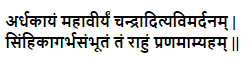
NavaGraha Aspect/ Characteristics Summary – Rahu:
#
|
Navagraha Aspect
|
Rahu
|
1
|
Consort
|
Nagavalli
and
Nagakanni
|
2
|
Cloth color
|
Black/
Blue
|
3
|
Gender
| |
4
|
Element
|
Air
|
5
|
God
|
Nirrati
|
6
|
Mounts
|
Blue/
Black
Lion
|
7
|
Presiding Deity
|
Durga
|
8
|
Metal
|
Blue
Metal
(Basalt,
broken
pieces of
black
rock)
|
9
|
Gemstone
|
Gomedha
(Gomed)/
Honey-
Colored
Hessonit
e
|
10
|
Body Part
|
Head
|
11
|
Taste
|
-
|
12
|
Grain
|
Black
Gram
|
13
|
Season
|
-
|
14
|
Graha deities face this direction
|
South
|
15
|
Flower
|
White
Mandara-Rui
|
16
|
Kshetra vruksha (tree)
|
1. Bel/
Bilwa/ Aegle
Marmelos/
Wood Apple
2. Champak
3. Shami
(Vanni) 4.
Punnai
Temple Tree
(Alexandrian
Laurel Tree)
|
17
|
Week day
|
-
|
18
|
Sound
|
-
|
To be drawn when worshiping Rahu god
Below is mantra for Rahu god.
Navagraha temples - Shani
Information about Shani (Saturn) graha

Temple Information:
Temple Name: THIRUNALLAR SHANI Temple
Village Location: THIRUNALLAR, Tamil Nadu 609607, India
Historical/ Scriptural Name: DARBHARANYESHWARA (Darbha + Aranya + Ishwara)
Deities: SANESHWARAN and SRI BHOGA MARTA POON MULAIYAL
How to reach the Temple:
It is on the highway between KUMBHAKONAM and KARAIKAL. The temple is 25 kms from NAGAPATTINAM by road.
History of Shani Graha Temple:
According to Scriptures, Brahma, after having created the world, went around to tour it. When he came to this forest (Aranya) full of Durbha, he was enchanted by its beauty and performed a penance and worshiped a SwayamBhu*1 Shiva Lingam*2.
The Lord appeared and explained to Brahma the inner meaning of Vedas and taught him other shastras. Brahma stayed in this place for a long time worshiping Shiva-Parvati and built temples for them. Brahma created Brahma Teerth and Saraswati created Vani Teerth. Indra, AshtaDikPal (eight directions) and the sacred swan (Hansa) established their own Shiva Lingam and worshipped.
Nomenclature: Because Brahma worshipped at this place long ago, the place is known as AadiPuri (Aadi = Beginning, Puri = City). As, the sacred grass Durbha (not Durva used in Ganesh Puja) was abundant, this place was called DurbhaAranyam. Because Nala had also worshipped here, the place used to be called Nallar and Shiva here called Nalleshwara.
*1 SwayamBhu: Not created by human hand or touched by chisel; Swayam = Self and Bhu = Be, SwayamBhu = Be by self.
*2 Shiva Lingam Worship:
Shiva = Cosmic Reality (Form) created by AadiParaShakti (Aadi = Beginning, Para = Beyond and Shakti = Energy) ie Paravati. AadiParaShakti = Energy beyond beginning (of matter), The Essence/ Truth (state of no matter, only energy). Energy, in and of itself cannot be perceived without a Form. Therefore AadiParaShakti created Cosmic Reality to manifest itself.
Lingam = Leen (Become One With) + Gamya (navigable), Lingam = To navigate and become one with. Thus Shiva/ Shiva Lingam worship is a way of becoming one with the Cosmic Reality/ AadiParaShakti (Truth). Shiva, by Himself cannot do anything without AadiParaShakti. Same is true for AadiParaShakti. Therefore, The ArdhaNariIshwara manifestation (Advaita in the Dwaita) is THE (fundamental/ eternal) TRUTH.
History of Shani Graha:
Sun had one wife called Sanchika (Usha Devi). He had two sons from her, namely Vaivastamadhu and Yama and a daughter named Yamuna. Because Sanchika could not bear the heat of the Sun, she made Chhaya Devi from her shadow and asked her to stay with Sun-god and she went to her father’s place. The father reprimanded her and asked her to go back to her husband. Because of fear of her husband, she went to North Pole and started doing penance in the form of a horse (mare). Chhaya Devi bore two sons, namely Savarni (Manu) and Shani and a daughter, namely Bhadra.
Chhaya Devi used to trouble Yama, son of the first wife Sanchika. Yama kicked Chhaya Devi and she cursed him to become lame. When Sun-god came to know of this, he cured Yama’s lameness; he came to know about the story about Chhaya and Sanchika; he went to North Pole to bring back Sanchika (therefore Surya Deva is Uttarayana here) and upon return lived with two wives.
Because of the anger of Yama (stemming from the treatment from Chhaya Devi), Yama kicked her son Shani and thereby Shani became lame. Sun-god granted a boon to Shani to become a Graham. Shani went to Kashi and performed penance to attain strength.
Importance of Shani Graha:
He is the Lord of Makar (Capricorn) and Kumbh (Aquaries) rashi/ zodiac, by Moon (Sun) based astrology. He is exalted in Tula (Libra) and Neech in Mesh (Aries).
He decides life span. He is responsible for an individual’s service, fear from disgrace and disrespect, coveting sleep and killing of living beings. He controls Nerves, Skin, Hair, Nails Intestine, Teeth and Joints.
He oversees 3rd, 7th, and 10th houses. When he is in 12th, 1st, and 2nd of Chandra rashi (i.e. where moon is placed), the period is known as SAADESAATI. It lasts for 7.5 years. He stays in each rashi for 2.5 years.
Shani Mahadasha is for 19 years.
Nivritti (Absolution) from Shani Dosha:
It is through SHANI Upasana which one can do by one and/or all of the following ways:
1) Worship Hanuman
2) Recite Hanuman Stotra
3) Recite Shani Stotra
4) Read Shani Mahatmya on Saturdays
5) Fast on Saturdays (avoid taking salt on Saturday)
6) Perform Shani Mantra jaap
7) Donate black til (sesame seed), black cloth, a piece of nail (iron), a blue flower (blue gokarna flower) and light a lamp with a piece of black cloth as wick and using til or sesame oil in a temple.
NavaGraha Aspect/ Characteristics Summary – Shani (Saturn):
#
Navagraha Aspect
Saturn
1
Consort
Neela
Devi
2
Cloth color
Black/
Blue
3
Gender
Neutral
4
Element
Air
5
God
Brahma
6
Mounts
Crow
(Raven)
7
Presiding Deity
Yama
8
Metal
Iron
9
Gemstone
Blue
Sapphire
10
Body Part
Muscles
11
Taste
Astringent
12
Grain
Black
Seasame
13
Season
All
Seasons
14
Graha deities face this direction
West
15
Flower
Blue
Gokarna
16
Kshetra vruksha (tree)
Durbha/
Kusha
Grass
17
Week day
Saturday
18
Sound
Pa
Rangoli for Shani Graha:
To be drawn when worshiping Saturn god

Mantra for Shani Graha:
Below is mantra for Saturn god.


Village Location: THIRUNALLAR, Tamil Nadu 609607, India
Historical/ Scriptural Name: DARBHARANYESHWARA (Darbha + Aranya + Ishwara)
Deities: SANESHWARAN and SRI BHOGA MARTA POON MULAIYAL
The Lord appeared and explained to Brahma the inner meaning of Vedas and taught him other shastras. Brahma stayed in this place for a long time worshiping Shiva-Parvati and built temples for them. Brahma created Brahma Teerth and Saraswati created Vani Teerth. Indra, AshtaDikPal (eight directions) and the sacred swan (Hansa) established their own Shiva Lingam and worshipped.
Nomenclature: Because Brahma worshipped at this place long ago, the place is known as AadiPuri (Aadi = Beginning, Puri = City). As, the sacred grass Durbha (not Durva used in Ganesh Puja) was abundant, this place was called DurbhaAranyam. Because Nala had also worshipped here, the place used to be called Nallar and Shiva here called Nalleshwara.
*1 SwayamBhu: Not created by human hand or touched by chisel; Swayam = Self and Bhu = Be, SwayamBhu = Be by self.
*2 Shiva Lingam Worship:
Shiva = Cosmic Reality (Form) created by AadiParaShakti (Aadi = Beginning, Para = Beyond and Shakti = Energy) ie Paravati. AadiParaShakti = Energy beyond beginning (of matter), The Essence/ Truth (state of no matter, only energy). Energy, in and of itself cannot be perceived without a Form. Therefore AadiParaShakti created Cosmic Reality to manifest itself.
Lingam = Leen (Become One With) + Gamya (navigable), Lingam = To navigate and become one with. Thus Shiva/ Shiva Lingam worship is a way of becoming one with the Cosmic Reality/ AadiParaShakti (Truth). Shiva, by Himself cannot do anything without AadiParaShakti. Same is true for AadiParaShakti. Therefore, The ArdhaNariIshwara manifestation (Advaita in the Dwaita) is THE (fundamental/ eternal) TRUTH.
Sun had one wife called Sanchika (Usha Devi). He had two sons from her, namely Vaivastamadhu and Yama and a daughter named Yamuna. Because Sanchika could not bear the heat of the Sun, she made Chhaya Devi from her shadow and asked her to stay with Sun-god and she went to her father’s place. The father reprimanded her and asked her to go back to her husband. Because of fear of her husband, she went to North Pole and started doing penance in the form of a horse (mare). Chhaya Devi bore two sons, namely Savarni (Manu) and Shani and a daughter, namely Bhadra.
Chhaya Devi used to trouble Yama, son of the first wife Sanchika. Yama kicked Chhaya Devi and she cursed him to become lame. When Sun-god came to know of this, he cured Yama’s lameness; he came to know about the story about Chhaya and Sanchika; he went to North Pole to bring back Sanchika (therefore Surya Deva is Uttarayana here) and upon return lived with two wives.
Because of the anger of Yama (stemming from the treatment from Chhaya Devi), Yama kicked her son Shani and thereby Shani became lame. Sun-god granted a boon to Shani to become a Graham. Shani went to Kashi and performed penance to attain strength.
He decides life span. He is responsible for an individual’s service, fear from disgrace and disrespect, coveting sleep and killing of living beings. He controls Nerves, Skin, Hair, Nails Intestine, Teeth and Joints.
He oversees 3rd, 7th, and 10th houses. When he is in 12th, 1st, and 2nd of Chandra rashi (i.e. where moon is placed), the period is known as SAADESAATI. It lasts for 7.5 years. He stays in each rashi for 2.5 years.
Shani Mahadasha is for 19 years.
It is through SHANI Upasana which one can do by one and/or all of the following ways:
1) Worship Hanuman
2) Recite Hanuman Stotra
3) Recite Shani Stotra
4) Read Shani Mahatmya on Saturdays
5) Fast on Saturdays (avoid taking salt on Saturday)
6) Perform Shani Mantra jaap
7) Donate black til (sesame seed), black cloth, a piece of nail (iron), a blue flower (blue gokarna flower) and light a lamp with a piece of black cloth as wick and using til or sesame oil in a temple.
#
|
Navagraha Aspect
|
Saturn
|
1
|
Consort
|
Neela
Devi
|
2
|
Cloth color
|
Black/
Blue
|
3
|
Gender
|
Neutral
|
4
|
Element
|
Air
|
5
|
God
|
Brahma
|
6
|
Mounts
|
Crow
(Raven)
|
7
|
Presiding Deity
|
Yama
|
8
|
Metal
|
Iron
|
9
|
Gemstone
|
Blue
Sapphire
|
10
|
Body Part
|
Muscles
|
11
|
Taste
|
Astringent
|
12
|
Grain
|
Black
Seasame
|
13
|
Season
|
All
Seasons
|
14
|
Graha deities face this direction
|
West
|
15
|
Flower
|
Blue
Gokarna
|
16
|
Kshetra vruksha (tree)
|
Durbha/
Kusha
Grass
|
17
|
Week day
|
Saturday
|
18
|
Sound
|
Pa
|

Pradakshina
Circumambulation
of a temple or idol or mountain is called as Pradakshina. When it is
done around a temple, situated on a mountain, it is known as
Giri-Pradakshina or Giri-Valam. Performing Pradakshina is considered to
be beneficial and culmination of a worship or a ritual. In Puran we come
across, the greatness of Pradakshina when Lord Ganesha went around the parents i.e. performed a Pradakshina and got highest benefit. This can also be considered as a Giri-Valam as the parents were seated in mount Kailash.
Typically the Pradakshina is done bear feet. Generally the Giri-Valam is done with hill on the right side. i.e. clockwise. Shri Raman Maharshi explained the meaning of Pradakshina in following manner. "PRA" - stands for removal of all kinds of sins, "DA" – stands for fulfilling the desires of a person, "KSI" – stands for freedom from future births, "NA" – stands for giving deliverance through gyana.
The following benefits were enumerated by Shri Raman Maharshi.
By walking one step in Pradakshina, one gets happiness in the world. By walking two steps, gives happiness in heaven. Walking three steps gives, bliss of SatyaLoka which can be attained.
It is stated in Purans that doing Pradakshina in certain Shiva temples in South India gives benefits more than that of performing Ashwamedha yadnyas.
One should go around in silence (mauna) or meditation (dhyan) or japa (naamsmaran) or doing bhajan.
This makes us think of the Lord all times. It is stated once should
walk slowly like a woman in ninth month of pregnancy.
People
perform Giri-Valam at Girnaar in Gujraat, Arunachala mountain at
Tiruvannamalai and at a number of other places like Harharishwar and
Ganapatipule in Maharashtra, Shrisailam in Andhra Pradesh and
Pakshitirtha (Tiruparmkundram) in Tamil Nadu.
Typically the Pradakshina is done bear feet. Generally the Giri-Valam is done with hill on the right side. i.e. clockwise. Shri Raman Maharshi explained the meaning of Pradakshina in following manner. "PRA" - stands for removal of all kinds of sins, "DA" – stands for fulfilling the desires of a person, "KSI" – stands for freedom from future births, "NA" – stands for giving deliverance through gyana.
The following benefits were enumerated by Shri Raman Maharshi.
By walking one step in Pradakshina, one gets happiness in the world. By walking two steps, gives happiness in heaven. Walking three steps gives, bliss of SatyaLoka which can be attained.
It is stated in Purans that doing Pradakshina in certain Shiva temples in South India gives benefits more than that of performing Ashwamedha yadnyas.
One should go around in silence (mauna) or meditation (dhyan) or japa (naamsmaran) or doing bhajan. This makes us think of the Lord all times. It is stated once should walk slowly like a woman in ninth month of pregnancy.
People perform Giri-Valam at Girnaar in Gujraat, Arunachala mountain at Tiruvannamalai and at a number of other places like Harharishwar and Ganapatipule in Maharashtra, Shrisailam in Andhra Pradesh and Pakshitirtha (Tiruparmkundram) in Tamil Nadu.
प्रदक्षिणा
देऊळ, मूर्ती किंवा ज्या पर्वतावर देऊळ आहे अशा पर्वताला पायी फेरी मारणे ह्याला प्रदक्षिणा म्हणतात. जेव्हा पर्वताला, ज्यावर देऊळ आहे, त्याला प्रदक्षिणा घातली जाते तेव्हा त्याला गिरीप्रदक्षिणा किंवा गिरीवलम असं म्हणतात. प्रदक्षिणा हे एक पुण्यकारक कर्म आहे. पुराणांमध्ये प्रदक्षिणेची महती आपल्या सर्वांना माहिती असलेल्या श्री गणेशाच्या कथेतून कळते. जेव्हा भगवान शंकर आणि माता पार्वतींनी आपल्या दोन मुलांमध्ये पृथ्वी प्रदक्षिणेची स्पर्धा घोषित केली तेव्हा श्री गणेशाचे बंधू श्री कार्तिकेय पृथ्वी प्रदक्षिणेसाठी त्वरित निघाले. पण श्री गणेशांनी विचार केला की आपलं विश्व म्हणजे कैलास पर्वतावर बसलेले आपले मातापिताच आहेत आणि हा विचार करून त्यांनी आपल्या मातापितां भोवती म्हणजेच कैलाश पर्वतालाच प्रदक्षिणा घातली. श्री गणेशाच्या ह्या कृतीमुळे त्यांनी अर्थातच प्रदक्षिणा आपल्या बंधूच्या आधीच पूर्ण केली. शिव आणि पार्वती श्री गणेशावर प्रसन्न झाले आणि त्यांनी श्री गणेशाला विजेता म्हणून घोषित केलं. ह्या गोष्टीतून प्रदक्षिणेचं आणि मुख्यतः गिरिप्रदक्षिणेचं महत्व प्रदर्शित होतं.
विशेषतः प्रदक्षिणा ही अनवाणी केली जाते. साधारणतः पर्वताभोवतीची प्रदक्षिणा ही पर्वत उजवीकडे धरून म्हणजे घड्याळाच्या काट्यांच्या फिरण्याच्या दिशेने केली जाते.
श्री रमण महर्षींनी प्रदक्षिणेचा अर्थ फार छान सांगितला आहे. “प्र” हे अक्षर सर्व प्रकारच्या पापांचं क्षालन दर्शवतं, “द” अक्षर सर्व कामनापूर्ती दर्शवतं, “क्षि” अक्षर जन्म मृत्यूच्या फेऱ्यातून मुक्ती दर्शवतं, तर “णा” हे अक्षर ज्ञानप्राप्ती होऊन मोक्षसिद्धी दर्शवतं.
श्री रमण महर्षींच्या मते प्रदक्षिणेचे फायदे किंवा फळं अशी आहेत - प्रदक्षिणेच्या दिशेनं एक पाऊल चाललं की मनुष्याला जगातल्या सर्व आनंदांची प्राप्ती होते, दोन पाऊलं चालली की स्वर्गातल्या आनंदाची प्राप्ती होते, आणि तीन पाऊलं चालली की सत्यलोकातील आनंदाची प्राप्ती होते.
पुराणांमध्ये असं नमूद केलं आहे की दक्षिण भारतातल्या काही शंकराच्या देवळांभोवती प्रदक्षिणा घातल्यास अश्वमेध यज्ञ केल्यावर मिळणाऱ्या फळांपेक्षाही अधिक फळं मिळतात.
प्रदक्षिणा घालताना मौन व्रत पाळून ध्यान किंवा नामस्मरण करावं किंवा भजन करावं. त्यामुळे सतत परमेश्वराचं स्मरण राहतं. असं म्हणतात की नववा महिना लागलेल्या गर्भवती स्त्रीच्या चालण्याच्या वेगाने प्रदक्षिणा घालावी.
गिरीप्रदक्षिणा घालण्याची काही प्रसिद्ध ठिकाणं अशी - गुजरात मधील गिरनार पर्वत, तिरुवन्नमलै मधील अरुणाचल पर्वत, महाराष्ट्रामधील हरिहरेश्वर, गणपतीपुळे, आंध्र प्रदेश मधील श्री शैलम आणि तामिळनाडू मधील पक्षीतीर्थ (तिरुक्कळूकुंद्रम).
विशेषतः प्रदक्षिणा ही अनवाणी केली जाते. साधारणतः पर्वताभोवतीची प्रदक्षिणा ही पर्वत उजवीकडे धरून म्हणजे घड्याळाच्या काट्यांच्या फिरण्याच्या दिशेने केली जाते.
श्री रमण महर्षींनी प्रदक्षिणेचा अर्थ फार छान सांगितला आहे. “प्र” हे अक्षर सर्व प्रकारच्या पापांचं क्षालन दर्शवतं, “द” अक्षर सर्व कामनापूर्ती दर्शवतं, “क्षि” अक्षर जन्म मृत्यूच्या फेऱ्यातून मुक्ती दर्शवतं, तर “णा” हे अक्षर ज्ञानप्राप्ती होऊन मोक्षसिद्धी दर्शवतं.
श्री रमण महर्षींच्या मते प्रदक्षिणेचे फायदे किंवा फळं अशी आहेत - प्रदक्षिणेच्या दिशेनं एक पाऊल चाललं की मनुष्याला जगातल्या सर्व आनंदांची प्राप्ती होते, दोन पाऊलं चालली की स्वर्गातल्या आनंदाची प्राप्ती होते, आणि तीन पाऊलं चालली की सत्यलोकातील आनंदाची प्राप्ती होते.
पुराणांमध्ये असं नमूद केलं आहे की दक्षिण भारतातल्या काही शंकराच्या देवळांभोवती प्रदक्षिणा घातल्यास अश्वमेध यज्ञ केल्यावर मिळणाऱ्या फळांपेक्षाही अधिक फळं मिळतात.
प्रदक्षिणा घालताना मौन व्रत पाळून ध्यान किंवा नामस्मरण करावं किंवा भजन करावं. त्यामुळे सतत परमेश्वराचं स्मरण राहतं. असं म्हणतात की नववा महिना लागलेल्या गर्भवती स्त्रीच्या चालण्याच्या वेगाने प्रदक्षिणा घालावी.
गिरीप्रदक्षिणा घालण्याची काही प्रसिद्ध ठिकाणं अशी - गुजरात मधील गिरनार पर्वत, तिरुवन्नमलै मधील अरुणाचल पर्वत, महाराष्ट्रामधील हरिहरेश्वर, गणपतीपुळे, आंध्र प्रदेश मधील श्री शैलम आणि तामिळनाडू मधील पक्षीतीर्थ (तिरुक्कळूकुंद्रम).
Navagraha temples - Shukra
Information about Shukra (Venus) graha

Temple Information:
Temple Name: KANJANUR SHUKRA Temple
Village Location: KANJANUR, Tamil Nadu 609804, India
Historical/ Scriptural Name: SHREEAGNIPURISHWARA Temple
Deities: Lord Shiva is known as SHREEAGNIPURISHWARA (Shree + Agni + Puri + Ishawara) and Consort Parvati as SHREEKARPAGAMAMBAL (Shree + Karpagam + Ambal)
How to reach the Temple:
It is on the highway between KUMBHAKONAM and MAYILADUTHURAI. The temple is 17 kms from KUMBHAKONAM and about 3 kms from SURYANAR KOVIL by road.
History of Shukra Graha Temple:
According to Scriptures, Shukra (Shukracharya) was Guru of demons and had Sanjeevani mantra by which he would bring to life demon who had died in fight.
Once, Brahma performed penance at this place to see ShivaParvati in their wedding attire and for others to witness the glorious vision too. Because of this, the Shiva temple is to the right and Parvati temple is to the left.
Local folklore has it that sugarcane and honey were plentiful here – river of honey – therefore the name Kanjanur. It is further believed that AadiParaShakti (Parvati) created the TriMurtis (Brahma, Vishnu and Mahesh) at this place.
According to history, Chandra (Moon), Parashar Muni, Kansa (Lord Krishna’s maternal uncle) had worshipped Lord Shiva here. Hence, there are three separate Shiva-Lingams present here.
There are three Punya-Teerth or sacred ponds here – 1.Brahma Teerth created by Brahma, 2. Agni Teerth created by Agni and 3. Parash Teerth created by Parashar Muni. River Cauvery runs nearby and it is also considered a Teerth.
History of Shukra Graha:
According to Scriptures, Shukra is son of Bhrigu Rishi and his wife Pulomisha. When Shukracharya was performing penance to get Sanjeevani matra, Indra’s daughter Jayanti performed seva (service) to Shukracharya. After the birth of their daughter Devayani, Jayanti went back to Devalok.
Shukra got his name because of his (silver) light complexion. Shukracharya had obtained the Sanjeevani mantra from Lord Shiva by which he could bring to life the dead demons. Brihaspati (Guru of Devas) sent his son Kacha to learn the Sanjeevani mantra from Shukracharya. Kacha served Shukracharya with all his might and won over the hearts of Shukracharya and his daughter Devayani. Because of this, the demons killed Kacha and mixed his ashes in water and gave it to Shukracharya to drink. Because of Devayani’s insistence, Shukracharya got Kacha out of his stomach. In the process, the Sanjeevani mantra lost its power.
Shukracharya had three wives, one son and two daughters. He wrote a book (in Sanskrit/ North-Indian language) on law known as Shukra Neeti.
Shukracharya went to Kashi, performed penance and got a boon to become a Graham (Celestial Body).
Importance of Shukra Graha:
Shukra is a Shubha Graham. He is the Lord of Rishabh and Tula rashi/ zodiac (by Moon based astrology). He is very powerful in Meen and Kanya rashi/ zodiac. In Rigveda, he is known as God Vena. Generally Shukra Mahadasha comes only once in life and is for 20 years. Shukra is responsible for marriage. Shukra’s grace can remove infertility. His benefits can be felt in the months of November, December, March and April and also when he is in Rishabh, Tula and Meen rashi.
Nivritti (Absolution) from Shukra Dosha:
DeviUpasana is advised (prayer/worship of GajaLakshmi and/or RajRajeshwari). Also parayana (regular reading) of DeviMahatamya. Fasting on Friday and wearing of white clothes, use of white color lotus flower and white cloth in puja is also advised.
The sacred tree is Pipul/ Pimpla.
NavaGraha Aspect/ Characteristics Summary – Shukra (Venus):
#
Navagraha Aspect
Venus
1
Consort
Sukirti and
Urjaswati
2
Cloth color
White
3
Gender
Female
4
Element
Water
5
God
Indrani
6
Mounts
Horse/
Camel/
Crocodile
7
Presiding Deity
MahaLaks
hmi
8
Metal
Silver
9
Gemstone
Diamond
10
Body Part
Semen
11
Taste
Sour
12
Grain
Flat White
Beans/
Lima
Beans
13
Season
Spring
14
Graha deities face this direction
East
15
Flower
White
Lotus
16
Kshetra vruksha (tree)
Pipul
17
Week day
Friday
18
Sound
Ni
Rangoli for Shukra Graha:
To be drawn when worshiping Venus god

Mantra for Shukra Graha:
Below is mantra for Venus god.


Temple Name: KANJANUR SHUKRA Temple
Village Location: KANJANUR, Tamil Nadu 609804, India
Historical/ Scriptural Name: SHREEAGNIPURISHWARA Temple
Deities: Lord Shiva is known as SHREEAGNIPURISHWARA (Shree + Agni + Puri + Ishawara) and Consort Parvati as SHREEKARPAGAMAMBAL (Shree + Karpagam + Ambal)
Once, Brahma performed penance at this place to see ShivaParvati in their wedding attire and for others to witness the glorious vision too. Because of this, the Shiva temple is to the right and Parvati temple is to the left.
Local folklore has it that sugarcane and honey were plentiful here – river of honey – therefore the name Kanjanur. It is further believed that AadiParaShakti (Parvati) created the TriMurtis (Brahma, Vishnu and Mahesh) at this place.
According to history, Chandra (Moon), Parashar Muni, Kansa (Lord Krishna’s maternal uncle) had worshipped Lord Shiva here. Hence, there are three separate Shiva-Lingams present here.
There are three Punya-Teerth or sacred ponds here – 1.Brahma Teerth created by Brahma, 2. Agni Teerth created by Agni and 3. Parash Teerth created by Parashar Muni. River Cauvery runs nearby and it is also considered a Teerth.
History of Shukra Graha:
According to Scriptures, Shukra is son of Bhrigu Rishi and his wife Pulomisha. When Shukracharya was performing penance to get Sanjeevani matra, Indra’s daughter Jayanti performed seva (service) to Shukracharya. After the birth of their daughter Devayani, Jayanti went back to Devalok.
Shukra got his name because of his (silver) light complexion. Shukracharya had obtained the Sanjeevani mantra from Lord Shiva by which he could bring to life the dead demons. Brihaspati (Guru of Devas) sent his son Kacha to learn the Sanjeevani mantra from Shukracharya. Kacha served Shukracharya with all his might and won over the hearts of Shukracharya and his daughter Devayani. Because of this, the demons killed Kacha and mixed his ashes in water and gave it to Shukracharya to drink. Because of Devayani’s insistence, Shukracharya got Kacha out of his stomach. In the process, the Sanjeevani mantra lost its power.
Shukracharya had three wives, one son and two daughters. He wrote a book (in Sanskrit/ North-Indian language) on law known as Shukra Neeti.
Shukracharya went to Kashi, performed penance and got a boon to become a Graham (Celestial Body).
Importance of Shukra Graha:
Shukra is a Shubha Graham. He is the Lord of Rishabh and Tula rashi/ zodiac (by Moon based astrology). He is very powerful in Meen and Kanya rashi/ zodiac. In Rigveda, he is known as God Vena. Generally Shukra Mahadasha comes only once in life and is for 20 years. Shukra is responsible for marriage. Shukra’s grace can remove infertility. His benefits can be felt in the months of November, December, March and April and also when he is in Rishabh, Tula and Meen rashi.
Nivritti (Absolution) from Shukra Dosha:
DeviUpasana is advised (prayer/worship of GajaLakshmi and/or RajRajeshwari). Also parayana (regular reading) of DeviMahatamya. Fasting on Friday and wearing of white clothes, use of white color lotus flower and white cloth in puja is also advised.
The sacred tree is Pipul/ Pimpla.
NavaGraha Aspect/ Characteristics Summary – Shukra (Venus):
#
|
Navagraha Aspect
|
Venus
|
1
|
Consort
|
Sukirti and
Urjaswati
|
2
|
Cloth color
|
White
|
3
|
Gender
|
Female
|
4
|
Element
|
Water
|
5
|
God
|
Indrani
|
6
|
Mounts
|
Horse/
Camel/
Crocodile
|
7
|
Presiding Deity
|
MahaLaks
hmi
|
8
|
Metal
|
Silver
|
9
|
Gemstone
|
Diamond
|
10
|
Body Part
|
Semen
|
11
|
Taste
|
Sour
|
12
|
Grain
|
Flat White
Beans/
Lima
Beans
|
13
|
Season
|
Spring
|
14
|
Graha deities face this direction
|
East
|
15
|
Flower
|
White
Lotus
|
16
|
Kshetra vruksha (tree)
|
Pipul
|
17
|
Week day
|
Friday
|
18
|
Sound
|
Ni
|
To be drawn when worshiping Venus god
Below is mantra for Venus god.

Navagraha temples - Guru
Information about Guru (Jupiter) graha

Temple Information:
Temple Name: APATSAHAYESVARAR Temple, Alangudi
Deity at place: Sri Apatsahayeswarar
Goddess: Elavarkuzhali Ammai or Umayammai
Ganapati: Kaatha Vinayakar
Village Location: ALANGUDI, Tamil Nadu 612801, India
Historical/ Scriptural Name: APATSAHAYESVARAR Temple, Alangudi
Other Deities: 1. Ravi/ Sun, 2. Sapta Linga 3. Murugan, 4. Lakshmi, 5. NavaGraha, 6. Kaal Bhairava and 7. Guru Dakshinamoorthy (main idol)
How to reach the Temple:
It is on the KUMBHAKONAM – NEEDAMANGALAM highway, about 17 kms south of KUMBHAKONAM.
History of Guru Graha Temple:
According to Scriptures:
1. Once when Goddess Parvati was playing with a ball made of flowers and had thrown it up, and had raised Her hands to catch it, the Sun-God who was passing by, mistook the raised hands as a signal to stop and he stopped out of reverence. Sun’s stopping, however brief, was a cause for great turmoil for all in the universe (Sun is in constant relative motion with Earth). When Lord Shiva came to know of this inadvertent folly, He asked Parvati to take birth and she followed.
This temple is where Goddess Parvati did Her penance to please Lord Shiva and eventually remarried with Him. During this marriage, all Gods were present – Ganesh, Murugan etc. This
temple, created by Parvati, was known as KashiAranya and the place considered equivalent to Kashi.
2. Lord Shiva drank the poison that (Alam) came out during the churning of the ocean by the Suras (Gods) and Asuras (Demons). It is believed that this is the place where Parvati had pressed her hand on Lord Shiva’s throat to stop the flow of poison. That is why this place is known as Alangudi (in Tamil, Alam = Poison and Kudi = Drink).
3. A demon named Gajamukha was troubling people and Gods. Lord Shiva sent His son Ganapati to punish him. Therefore, there is a Ganapati temple here and Ganapati is known as Kaatha Vinayakar (Kaatha = Protector, Vinayak = Ganapati and Aakar = Form).
Inside the temple compound there are temples for 1. Ravi/ Sun, 2. Sapta Linga 3. Murugan, 4. Lakshmi, 5. NavaGraha, 6. Kaal Bhairava and 7. Guru Dakshinamoorthy (main idol) which is
considered to be The Guru. There is no separate idol for Guru. Here they light 28 lamps with ghee. The sacred tree here is Poolai shrub.
Punya Teerth (Sacred Ponds): It is said that there were 15 sacred ponds around the temple. Currently, only a few are in existence. Some 9 ponds are in the villages surrounding the temple. All NavaGraha got their PaapaVimochan, their absolution through their penance. Pilgrims stay at a place called Swami Malai (Swami = God and Malai = Hill).
The temple is controlled by the Tamil Nadu Endowment Trust. It is very well maintained.
Importance of Guru Graha:
He gives prospects, peace, progress and health. He rules over higher learning, intelligence, spirituality and long distance travel. It takes 12 years for him to complete one cycle. Guru Mahadasha is for 16 years. He is the Lord of DHANU and MEEN rashi/ zodiac (by Moon based astrology). By Sun based astrology, its SAGITTARIUS and PISCES zodiac. He is Uchcha (Exalted) in Karka (Cancer) and Neech (in Recession) in Makar (Capricorn).
Nivritti (Absolution) from Guru Dosha:
The following remedies are recommended – Fasting on Thursdays; donating turmeric, gur, gram dal, pale yellow cloth and copper on Thursdays; Chanting the mantra of Guru on Thursdays.
NavaGraha Aspect/ Characteristics Summary – Guru (Jupiter):
#
Navagraha Aspect
Jupiter
1
Consort
Tara
2
Cloth color
Yellow/
Gold
3
Gender
Male
4
Element
Sky/ Ether
5
God
Indra/
Brahma
6
Mounts
Elephant
7
Presiding Deity
Dakshinamoorthy
8
Metal
Gold
9
Gemstone
Yellow
Sapphire
10
Body Part
Brain
11
Taste
Sweet
12
Grain
Bengal
Gram
13
Season
Winter
14
Graha deities face this direction
North
15
Flower
Jasmine/
Jai-Jui
16
Kshetra vruksha (tree)
Alstonia
Scholaris/
Indian
Pulai/
Devil
Tree/
Milky
Pine
17
Week day
Thursday
18
Sound
Dha
Rangoli for Guru Graha:
To be drawn when worshiping Jupiter god

Mantra for Guru Graha:
Below is mantra for Jupiter god.


Temple Name: APATSAHAYESVARAR Temple, Alangudi
Deity at place: Sri Apatsahayeswarar
Goddess: Elavarkuzhali Ammai or Umayammai
Ganapati: Kaatha Vinayakar
Village Location: ALANGUDI, Tamil Nadu 612801, India
Historical/ Scriptural Name: APATSAHAYESVARAR Temple, Alangudi
Other Deities: 1. Ravi/ Sun, 2. Sapta Linga 3. Murugan, 4. Lakshmi, 5. NavaGraha, 6. Kaal Bhairava and 7. Guru Dakshinamoorthy (main idol)
1. Once when Goddess Parvati was playing with a ball made of flowers and had thrown it up, and had raised Her hands to catch it, the Sun-God who was passing by, mistook the raised hands as a signal to stop and he stopped out of reverence. Sun’s stopping, however brief, was a cause for great turmoil for all in the universe (Sun is in constant relative motion with Earth). When Lord Shiva came to know of this inadvertent folly, He asked Parvati to take birth and she followed.
This temple is where Goddess Parvati did Her penance to please Lord Shiva and eventually remarried with Him. During this marriage, all Gods were present – Ganesh, Murugan etc. This
temple, created by Parvati, was known as KashiAranya and the place considered equivalent to Kashi.
2. Lord Shiva drank the poison that (Alam) came out during the churning of the ocean by the Suras (Gods) and Asuras (Demons). It is believed that this is the place where Parvati had pressed her hand on Lord Shiva’s throat to stop the flow of poison. That is why this place is known as Alangudi (in Tamil, Alam = Poison and Kudi = Drink).
3. A demon named Gajamukha was troubling people and Gods. Lord Shiva sent His son Ganapati to punish him. Therefore, there is a Ganapati temple here and Ganapati is known as Kaatha Vinayakar (Kaatha = Protector, Vinayak = Ganapati and Aakar = Form).
Inside the temple compound there are temples for 1. Ravi/ Sun, 2. Sapta Linga 3. Murugan, 4. Lakshmi, 5. NavaGraha, 6. Kaal Bhairava and 7. Guru Dakshinamoorthy (main idol) which is
considered to be The Guru. There is no separate idol for Guru. Here they light 28 lamps with ghee. The sacred tree here is Poolai shrub.
Punya Teerth (Sacred Ponds): It is said that there were 15 sacred ponds around the temple. Currently, only a few are in existence. Some 9 ponds are in the villages surrounding the temple. All NavaGraha got their PaapaVimochan, their absolution through their penance. Pilgrims stay at a place called Swami Malai (Swami = God and Malai = Hill).
The temple is controlled by the Tamil Nadu Endowment Trust. It is very well maintained.
Importance of Guru Graha:
He gives prospects, peace, progress and health. He rules over higher learning, intelligence, spirituality and long distance travel. It takes 12 years for him to complete one cycle. Guru Mahadasha is for 16 years. He is the Lord of DHANU and MEEN rashi/ zodiac (by Moon based astrology). By Sun based astrology, its SAGITTARIUS and PISCES zodiac. He is Uchcha (Exalted) in Karka (Cancer) and Neech (in Recession) in Makar (Capricorn).
Nivritti (Absolution) from Guru Dosha:
The following remedies are recommended – Fasting on Thursdays; donating turmeric, gur, gram dal, pale yellow cloth and copper on Thursdays; Chanting the mantra of Guru on Thursdays.
NavaGraha Aspect/ Characteristics Summary – Guru (Jupiter):
#
|
Navagraha Aspect
|
Jupiter
|
1
|
Consort
|
Tara
|
2
|
Cloth color
|
Yellow/
Gold
|
3
|
Gender
|
Male
|
4
|
Element
|
Sky/ Ether
|
5
|
God
|
Indra/
Brahma
|
6
|
Mounts
|
Elephant
|
7
|
Presiding Deity
|
Dakshinamoorthy
|
8
|
Metal
|
Gold
|
9
|
Gemstone
|
Yellow
Sapphire
|
10
|
Body Part
|
Brain
|
11
|
Taste
|
Sweet
|
12
|
Grain
|
Bengal
Gram
|
13
|
Season
|
Winter
|
14
|
Graha deities face this direction
|
North
|
15
|
Flower
|
Jasmine/
Jai-Jui
|
16
|
Kshetra vruksha (tree)
|
Alstonia
Scholaris/
Indian
Pulai/
Devil
Tree/
Milky
Pine
|
17
|
Week day
|
Thursday
|
18
|
Sound
|
Dha
|
To be drawn when worshiping Jupiter god
Below is mantra for Jupiter god.

Navagraha temples - Budha
Information about Budha (Mercury) graha

Temple Information:
Temple Name: THIRUVENKADU BUDHA Temple
Deities at place (Sthala devata): Lord Shiva as SHWETHARANYESHWARA (Shwetha + Aranya + Ishwara) and consort Parvati as SHREEBRAHMAVIDHYAMBIKA (Shree + BrahmaVidhya + Ambika)
Graha name: Budhan
Village Location: THIRUVENKADU, Tamil Nadu 609114, India
How to reach the Temple:
It is about 17 kms SouthEast of SIRKAZHI, about 10 kms to the West of POOMBUKAR bus stop (HWY 22) and about 11 kms from VAITHEESWARANKOIL.
History of Budha Graha Temple:
According to Scriptures, a demon known as Maruthuvasuran got a number of boons from the Gods and then went on to engage them in war. So Lord Shiva advised the Gods to stay at Thiruvenkadu in disguise. The demon came to know about this and troubled Gods. Lord Shiva sent Nandi to fight the demon. The demon had acquired a Trishul (Trident) from Lord Shiva as boon. The demon inflicted 9 wounds on the Nandi. When Lord Shiva came to know about the plight of Nandi and the misuse of the trishul, His face took a ferocious countenance. In this ferocious manifestation, He fought with demon. The demon could not withstand Lord Shiva's ferocity and eventually surrendered to Lord Shiva. The temple sculpture portrays this - Lord Shiva in His ferocious manifestation with the demon at His feet and the Nandi alongside with 9 wounds.
On all four sides there are roads for Rathayatra. The RajaGopuram is on both east and west side.
There are 3 teerthas (pond) here. According to fable, when Lord Shiva performed His Celestial Rudra dance, 3 drops of water fell down and formed these 3 kunda/ teerth/ pond, namely Agni Teerth, Surya Teerth and Chandra Teerth.
Sacred Tree: 3 types – 1. Bel/ Bilwa/ Vilwa (Tamil) 2. Vadaval (Tamil) and 3. Konnai (Tamil).
Importance of Budha Graha:
Budha is Jnani (Learned), well versed in all arts. He is son of Chandra and Tara. Chandra had taken Guru (Brihaspathi) as his Guru. Chandra had married 27 daughters of Daksha. He performed a Yagya to please Lord Vishnu. At that time, Guru’s wife Tara was enchanted by the beauty of Chandra and stayed with him. She delivered a son, namely Budha. Under the orders of Brahma, Lord Shiva handed over Tara back to Guru and the boy Budha to Chandra. When Budha grew up, he got dejected with Chandra and went to Himalayas to perform penance. He became well versed in all arts and received a boon from Lord Shiva and became Graham (Celestial Body).
Budha is a ShubhaGraham responsible for knowledge, intelligence, astrological wisdom, debating skills etc.
Nivritti (Absolution) from Budha Dosha:
He is the Lord of Mithun and Kanya rashi/ zodiac (by Chandra/ Moon based astrology). The controlling/ presiding deity (AadhiDevata) is MahaVishnu.
Budha Mahadasha is for 17 years.
When Budha is in the sixth, eighth or twelfth position, generally he gives adverse results. According to Astrology, Budha is responsible for mental disorders, anemia, nervous disorders, leucoderma (white patches), leprosy etc.
NavaGraha Aspect/ Characteristics Summary – Budha (Mercury):
#
Navagraha Aspect
Mercury
1
Consort
Ila
2
Cloth color
Green
3
Gender
Neutral
4
Element
Earth
5
God
Vishnu
6
Mounts
Lion
7
Presiding Deity
Vishnu
8
Metal
Bronze
9
Gemstone
Emerald
10
Body Part
Skin
11
Taste
Mixed
12
Grain
Green Gram
13
Season
Autumn
14
Graha deities face this direction
East
15
Flower
White Oleander/
Kanthal/ Kaner
16
Kshetra vruksha (tree)
Bel/ Bilwa/ Aegle
Marmelos/ Wood
Apple
17
Week day
Wednesday
18
Sound
Sa
Rangoli for Budha Graha:
To be drawn when worshiping Mercury god

Mantra for Budha Graha:
Below is mantra for Mercury god.


Temple Name: THIRUVENKADU BUDHA Temple
Deities at place (Sthala devata): Lord Shiva as SHWETHARANYESHWARA (Shwetha + Aranya + Ishwara) and consort Parvati as SHREEBRAHMAVIDHYAMBIKA (Shree + BrahmaVidhya + Ambika)
Graha name: Budhan
Village Location: THIRUVENKADU, Tamil Nadu 609114, India
On all four sides there are roads for Rathayatra. The RajaGopuram is on both east and west side.
There are 3 teerthas (pond) here. According to fable, when Lord Shiva performed His Celestial Rudra dance, 3 drops of water fell down and formed these 3 kunda/ teerth/ pond, namely Agni Teerth, Surya Teerth and Chandra Teerth.
Sacred Tree: 3 types – 1. Bel/ Bilwa/ Vilwa (Tamil) 2. Vadaval (Tamil) and 3. Konnai (Tamil).
Importance of Budha Graha:
Budha is Jnani (Learned), well versed in all arts. He is son of Chandra and Tara. Chandra had taken Guru (Brihaspathi) as his Guru. Chandra had married 27 daughters of Daksha. He performed a Yagya to please Lord Vishnu. At that time, Guru’s wife Tara was enchanted by the beauty of Chandra and stayed with him. She delivered a son, namely Budha. Under the orders of Brahma, Lord Shiva handed over Tara back to Guru and the boy Budha to Chandra. When Budha grew up, he got dejected with Chandra and went to Himalayas to perform penance. He became well versed in all arts and received a boon from Lord Shiva and became Graham (Celestial Body).
Budha is a ShubhaGraham responsible for knowledge, intelligence, astrological wisdom, debating skills etc.
Nivritti (Absolution) from Budha Dosha:
He is the Lord of Mithun and Kanya rashi/ zodiac (by Chandra/ Moon based astrology). The controlling/ presiding deity (AadhiDevata) is MahaVishnu.
Budha Mahadasha is for 17 years.
When Budha is in the sixth, eighth or twelfth position, generally he gives adverse results. According to Astrology, Budha is responsible for mental disorders, anemia, nervous disorders, leucoderma (white patches), leprosy etc.
NavaGraha Aspect/ Characteristics Summary – Budha (Mercury):
#
|
Navagraha Aspect
|
Mercury
|
1
|
Consort
|
Ila
|
2
|
Cloth color
|
Green
|
3
|
Gender
|
Neutral
|
4
|
Element
|
Earth
|
5
|
God
|
Vishnu
|
6
|
Mounts
|
Lion
|
7
|
Presiding Deity
|
Vishnu
|
8
|
Metal
|
Bronze
|
9
|
Gemstone
|
Emerald
|
10
|
Body Part
|
Skin
|
11
|
Taste
|
Mixed
|
12
|
Grain
|
Green Gram
|
13
|
Season
|
Autumn
|
14
|
Graha deities face this direction
|
East
|
15
|
Flower
|
White Oleander/
Kanthal/ Kaner
|
16
|
Kshetra vruksha (tree)
|
Bel/ Bilwa/ Aegle
Marmelos/ Wood
Apple
|
17
|
Week day
|
Wednesday
|
18
|
Sound
|
Sa
|
To be drawn when worshiping Mercury god
Below is mantra for Mercury god.

Goddess Durga Devi
The word Durga, itself is considered to possess, the Shakti (strength) to destroy asuras (demons) and remove
obstacles, distress and fear. It also means She who is invincible or
indestructible. In Shakti worship she is the main form of Goddess.
According to Srimad Devi Purana, Durga is the manifestation of
Aadishakti. She is considered as the Divine Mother of the Universe. She
in fact is Mother Parvati (Aadi-Parashakti). She occupies the primary
position in Shaktism. According to Skandha Purana, the Goddess Parvati
was accorded the name Durga after She slayed the the asura Mahishasur.
Durga is also identified by various names like Devi, Shakti, Bhavani and
so on. According to Devi Purana, Mother Durga manifests in different
forms as Kali, Ambika to destroy evil and asuras.
She is depicted as fearless woman riding a tiger or lion. She is depicted as having four to twelve arms.
In each arm she carries weapons like sword, bow, noose, axe, shield,
etc. She is portrayed in many Puranas as Parvati (wife of Shiva). In
Devi Mahatmya (Durga Saptashati) she is personified as Supreme Being who
created the Universe. In Shakti worship there is mention of Durga Devi
in different forms. In Rigveda there is sacred hymn call Shri Suktam. In
Markandeya Purana, Devi Purana and Skandha Purana there are references
to Durga worship. In Mahabharata war, Arjuna and Yudhisthira also prayed
to Durga Devi for success. She is considered to be benevolent, lovable
except when she fights evil and asuras. At that time She is considered
to be ferocious and destructive. Hindus also worship her in Yantra form.
The 2 dimensional yantra is known as Srichakra and 3 dimensional yantra
is known as MahaMeru.
10 days long Navaratri festival is major annual worship of Durga Mata. During the nine days, nine aspects of the Devi are worshiped. In Nepal, during these 9 days, the worship of goddess Laxmi, Saraswati
and God Ganesh, Shiva and Kartikeya are also worshiped. Navaratri
festivals are held in the month of Ashwin (English month of September
and October). There are in fact 4 Navaratri festivals observed in India
and Nepal.
- Sharada Navaratri – September and October i.e. month of Ashwin
- Vasanta Navaratri (March-April) i.e. month of Chaitra
- Shakambari Navaratri (Jan-Feb) i.e. Magh Navratri
- Aashadha Navaratri (Jun - July)
Nine forms of Durga Devi worshiped during Navaratri are known as Nava-Durgas1. They are as follows
- Devi
Siddhidatri – Devi Parvati (Aadi Parashakti) is supposed to have
appeared from left side of Lord Shiva and is known as Devi Siddhidatri
- Devi Kushmanda – After taking form of Siddhidatri, Parvati started living in Sun. Hence She is known as Devi Kushmanda.
- Devi
Bramhacharini – After taking form of Devi Kushmanda, Parvati took birth
in Daksha Prajapati’s place and lived there. Before her marriage to
Lord Shiva, she was worshiped as Devi Bramhacharini.
- Devi Shailaputri – When Parvati took birth as daughter of Lord Himalaya, she was known as Devi Shailputri.
- Devi
Mahagauri – When Devi Shailputri was 16 years old, she was extremely
beautiful and fair complexion. Hence She was worshiped as Devi
Mahagauri.
- Devi
Chandraghanta – When Devi Mahagauri married Lord Shiva, She adorned a
half moon and a bell on her head. Hence She was known as Devi
Chandraghanta.
- Devi Skandhamata – In this form She is worshiped as Mother of Skandha (Lord Kartikeya).
- Devi Katyayani – When Parvati took form of warrior Goddess to destroy Mahishasur, she was known as Devi Katyayani.
- Devi Kalaratri – When Goddess Parvati shed her outer skin to destroy demons Shumbh-Nishumbh. She was known as Kalaratri
It is customary to recite Lalitha Sahastranaam, Durga Ashtottara Namavali2 (108 names of Goddess Durga) during Navaratri. People also read Durga Saptashati and Devi Mahatmya during Navratri to invoke blessings of Goddess Durga.
1 Besides
these NavaDurga, we come across a number of instances in Shiva Purana
where Shakti manifests from Lord Shiva OR Goddess Parvati. These are
considered as manifestations for Goddess Durga.
- Vanadurga
– When Vindhya parvat stood in the way of Sage Agstya’s journey towards
South, Vanadurga helped him to overcome the obstacle.
- Shoolinidurga – Lord Shiva sought the help of Shoolinidurga to annihilate demon Tripurasur
- Durga
Jataveda – In Kumarsambavam, it is stated that Durga Jataveda held the
spark from the third eye of Lord Shiva and poured same in river Ganges.
- Shantadurga
– After Parvati immolated herself in the Yagnya fire of Daksha
Prajapati, Lord Shiva got angry and performed Rudra Tandava. He was
calmed down by Shantadurga who mediated between Him and Lord Vishnu.
१. ॐ श्रियै नमः।
२१. ॐ चण्डयै नमः।
४१. ॐ सुमुख्यै नमः।
६१. ॐ त्रिलोकपालिन्यै नमः।
८१. ॐ मालिन्यै नमः।
१०१. ॐ भुवनेश्वर्यै नमः।
२. ॐ उमायै नमः।
२२. ॐ कुण्डल्यै नमः।
४२. ॐ मैत्र्यै नमः।
६२. ॐ उद्भूतायै नमः।
८२. ॐ चर्चायै नमः।
१०२. ॐ नित्यायै नमः।
३. ॐ भारत्यै नमः।
२३. ॐ वैष्णव्यै नमः।
४३. ॐ त्रिनेत्रायै नमः।
६३. ॐ त्रिसन्ध्यायै नमः।
८३. ॐ क्रव्यादोप निबर्हिण्यै नमः।
१०३. ॐ सानन्दविभवायै नमः।
४. ॐ भद्रायै नमः।
२४. ॐ क्रियायै नमः।
४४. ॐ विश्वरूपिण्यै नमः।
६४. ॐ त्रिपुरान्तक्यै नमः।
८४. ॐ कामाक्ष्यै नमः।
१०४. ॐ सत्यज्ञानायै नमः।
५. ॐ शर्वाण्यै नमः।
२५. ॐ श्रियै नमः।
४५. ॐ आर्यायै नमः।
६५. ॐ त्रिशक्त्यै नमः।
८५. ॐ कामिन्यै नमः।
१०५. ॐ तमोपहायै नमः।
६. ॐ विजयायै नमः।
२६. ॐ ऐन्द्रयै नमः।
४६. ॐ मृडान्यै नमः।
६६. ॐ त्रिपदायै नमः।
८६. ॐ कान्तायै नमः।
१०६. ॐ महेश्वरप्रियंकर्यै नमः।
७. ॐ जयायै नमः।
२७. ॐ मधुमत्यै नमः।
४७. ॐ हींकार्यै नमः।
६७. ॐ दुर्गायै नमः।
८७. ॐ कामदायै नमः।
१०७. ॐ महात्रिपुरसुन्दर्यै नमः।
८. ॐ वाण्यै नमः।
२८. ॐ गिरिजायै नमः।
४८. ॐ क्रोधिन्यै नमः।
६८. ॐ ब्राह्मयै नमः।
८८. ॐ कलहंसिन्यै नमः।
१०८. ॐ दुर्गापरमेश्वर्यै नमः।
९. ॐ सर्वगतायै नमः।
२९. ॐ सुभगायै नमः।
४९. ॐ सुदिनायै नमः।
६९. ॐ त्रैलोक्यवासिन्यै नमः।
८९. ॐ सलज्जायै नमः।
९. ॐ गौर्यै नमः।
३०. ॐ अंबिकायै नमः।
५०. ॐ अचलायै नमः।
७०. ॐ पुष्करायै नमः।
९०. ॐ कुलजायै नमः।
११. ॐ वाराह्यै नमः।
३१. ॐ तारायै नमः।
५१. ॐ सूक्ष्मायै नमः।
७१. ॐ अत्रिसुतायै नमः।
९१. ॐ प्राज्ञ्यै नमः।
१२. ॐ कमलप्रियायै नमः।
३२. ॐ पद्मावत्यै नमः।
५२. ॐ परात्परायै नमः।
७२. ॐ गूढ़ायै नमः।
९२. ॐ प्रभायै नमः।
१३. ॐ सरस्वत्यै नमः।
३३. ॐ हंसायै नमः।
५३. ॐ शोभायै नमः।
७३. ॐ त्रिवर्णायै नमः।
९३. ॐ मदनसुन्दर्यै नमः।
१४. ॐ कमलायै नमः।
३४. ॐ पद्मनाभसहोदर्यै नमः।
५४. ॐ सर्ववर्णायै नमः।
७४. ॐ त्रिस्वरायै नमः।
९४. ॐ वागीश्वर्यै नमः।
१५. ॐ मायायै नमः।
३५. ॐ अपर्णायै नमः।
५५. ॐ हरप्रियायै नमः।
७५. ॐ त्रिगुणायै नमः।
९५. ॐ विशालाक्ष्यै नमः।
१६. ॐ मातंग्यै नमः।
३६. ॐ ललितायै नमः।
५६. ॐ महालक्ष्म्यै नमः।
७६. ॐ निर्गुणायै नमः।
९६. ॐ सुमंगल्यै नमः।
१७. ॐ अपरायै नमः।
३७. ॐ धात्र्यै नमः।
५७. ॐ महासिद्धयै नमः।
७७. ॐ सत्यायै नमः।
९७. ॐ काल्यै नमः।
१८. ॐ अजायै नमः।
३८. ॐ कुमार्यै नमः।
५८. ॐ स्वधायै नमः।
७८. ॐ निर्विकल्पायै नमः।
९८. ॐ महेश्वर्यै नमः।
१९. ॐ शांकभर्यै नमः।
३९. ॐ शिखवाहिन्यै नमः।
५९. ॐ स्वाहायै नमः।
७९. ॐ निरंजिन्यै नमः।
९९. ॐ चण्ड्यै नमः।
२०. ॐ शिवायै नमः।
४०. ॐ शांभव्यै नमः।
६०. ॐ मनोन्मन्यै नमः।
८०. ॐ ज्वालिन्यै नमः।
१००. ॐ भैरव्यै नमः।
She is depicted as fearless woman riding a tiger or lion. She is depicted as having four to twelve arms. In each arm she carries weapons like sword, bow, noose, axe, shield, etc. She is portrayed in many Puranas as Parvati (wife of Shiva). In Devi Mahatmya (Durga Saptashati) she is personified as Supreme Being who created the Universe. In Shakti worship there is mention of Durga Devi in different forms. In Rigveda there is sacred hymn call Shri Suktam. In Markandeya Purana, Devi Purana and Skandha Purana there are references to Durga worship. In Mahabharata war, Arjuna and Yudhisthira also prayed to Durga Devi for success. She is considered to be benevolent, lovable except when she fights evil and asuras. At that time She is considered to be ferocious and destructive. Hindus also worship her in Yantra form. The 2 dimensional yantra is known as Srichakra and 3 dimensional yantra is known as MahaMeru.
10 days long Navaratri festival is major annual worship of Durga Mata. During the nine days, nine aspects of the Devi are worshiped. In Nepal, during these 9 days, the worship of goddess Laxmi, Saraswati and God Ganesh, Shiva and Kartikeya are also worshiped. Navaratri festivals are held in the month of Ashwin (English month of September and October). There are in fact 4 Navaratri festivals observed in India and Nepal.
- Sharada Navaratri – September and October i.e. month of Ashwin
- Vasanta Navaratri (March-April) i.e. month of Chaitra
- Shakambari Navaratri (Jan-Feb) i.e. Magh Navratri
- Aashadha Navaratri (Jun - July)
Nine forms of Durga Devi worshiped during Navaratri are known as Nava-Durgas1. They are as follows
- Devi Siddhidatri – Devi Parvati (Aadi Parashakti) is supposed to have appeared from left side of Lord Shiva and is known as Devi Siddhidatri
- Devi Kushmanda – After taking form of Siddhidatri, Parvati started living in Sun. Hence She is known as Devi Kushmanda.
- Devi Bramhacharini – After taking form of Devi Kushmanda, Parvati took birth in Daksha Prajapati’s place and lived there. Before her marriage to Lord Shiva, she was worshiped as Devi Bramhacharini.
- Devi Shailaputri – When Parvati took birth as daughter of Lord Himalaya, she was known as Devi Shailputri.
- Devi Mahagauri – When Devi Shailputri was 16 years old, she was extremely beautiful and fair complexion. Hence She was worshiped as Devi Mahagauri.
- Devi Chandraghanta – When Devi Mahagauri married Lord Shiva, She adorned a half moon and a bell on her head. Hence She was known as Devi Chandraghanta.
- Devi Skandhamata – In this form She is worshiped as Mother of Skandha (Lord Kartikeya).
- Devi Katyayani – When Parvati took form of warrior Goddess to destroy Mahishasur, she was known as Devi Katyayani.
- Devi Kalaratri – When Goddess Parvati shed her outer skin to destroy demons Shumbh-Nishumbh. She was known as Kalaratri
It is customary to recite Lalitha Sahastranaam, Durga Ashtottara Namavali2 (108 names of Goddess Durga) during Navaratri. People also read Durga Saptashati and Devi Mahatmya during Navratri to invoke blessings of Goddess Durga.
1 Besides these NavaDurga, we come across a number of instances in Shiva Purana where Shakti manifests from Lord Shiva OR Goddess Parvati. These are considered as manifestations for Goddess Durga.
- Vanadurga – When Vindhya parvat stood in the way of Sage Agstya’s journey towards South, Vanadurga helped him to overcome the obstacle.
- Shoolinidurga – Lord Shiva sought the help of Shoolinidurga to annihilate demon Tripurasur
- Durga Jataveda – In Kumarsambavam, it is stated that Durga Jataveda held the spark from the third eye of Lord Shiva and poured same in river Ganges.
- Shantadurga – After Parvati immolated herself in the Yagnya fire of Daksha Prajapati, Lord Shiva got angry and performed Rudra Tandava. He was calmed down by Shantadurga who mediated between Him and Lord Vishnu.
१. ॐ श्रियै नमः।
|
२१. ॐ चण्डयै नमः।
|
४१. ॐ सुमुख्यै नमः।
|
६१. ॐ त्रिलोकपालिन्यै नमः।
|
८१. ॐ मालिन्यै नमः।
|
१०१. ॐ भुवनेश्वर्यै नमः।
|
२. ॐ उमायै नमः।
|
२२. ॐ कुण्डल्यै नमः।
|
४२. ॐ मैत्र्यै नमः।
|
६२. ॐ उद्भूतायै नमः।
|
८२. ॐ चर्चायै नमः।
|
१०२. ॐ नित्यायै नमः।
|
३. ॐ भारत्यै नमः।
|
२३. ॐ वैष्णव्यै नमः।
|
४३. ॐ त्रिनेत्रायै नमः।
|
६३. ॐ त्रिसन्ध्यायै नमः।
|
८३. ॐ क्रव्यादोप निबर्हिण्यै नमः।
|
१०३. ॐ सानन्दविभवायै नमः।
|
४. ॐ भद्रायै नमः।
|
२४. ॐ क्रियायै नमः।
|
४४. ॐ विश्वरूपिण्यै नमः।
|
६४. ॐ त्रिपुरान्तक्यै नमः।
|
८४. ॐ कामाक्ष्यै नमः।
|
१०४. ॐ सत्यज्ञानायै नमः।
|
५. ॐ शर्वाण्यै नमः।
|
२५. ॐ श्रियै नमः।
|
४५. ॐ आर्यायै नमः।
|
६५. ॐ त्रिशक्त्यै नमः।
|
८५. ॐ कामिन्यै नमः।
|
१०५. ॐ तमोपहायै नमः।
|
६. ॐ विजयायै नमः।
|
२६. ॐ ऐन्द्रयै नमः।
|
४६. ॐ मृडान्यै नमः।
|
६६. ॐ त्रिपदायै नमः।
|
८६. ॐ कान्तायै नमः।
|
१०६. ॐ महेश्वरप्रियंकर्यै नमः।
|
७. ॐ जयायै नमः।
|
२७. ॐ मधुमत्यै नमः।
|
४७. ॐ हींकार्यै नमः।
|
६७. ॐ दुर्गायै नमः।
|
८७. ॐ कामदायै नमः।
|
१०७. ॐ महात्रिपुरसुन्दर्यै नमः।
|
८. ॐ वाण्यै नमः।
|
२८. ॐ गिरिजायै नमः।
|
४८. ॐ क्रोधिन्यै नमः।
|
६८. ॐ ब्राह्मयै नमः।
|
८८. ॐ कलहंसिन्यै नमः।
|
१०८. ॐ दुर्गापरमेश्वर्यै नमः।
|
९. ॐ सर्वगतायै नमः।
|
२९. ॐ सुभगायै नमः।
|
४९. ॐ सुदिनायै नमः।
|
६९. ॐ त्रैलोक्यवासिन्यै नमः।
|
८९. ॐ सलज्जायै नमः।
| |
९. ॐ गौर्यै नमः।
|
३०. ॐ अंबिकायै नमः।
|
५०. ॐ अचलायै नमः।
|
७०. ॐ पुष्करायै नमः।
|
९०. ॐ कुलजायै नमः।
| |
११. ॐ वाराह्यै नमः।
|
३१. ॐ तारायै नमः।
|
५१. ॐ सूक्ष्मायै नमः।
|
७१. ॐ अत्रिसुतायै नमः।
|
९१. ॐ प्राज्ञ्यै नमः।
| |
१२. ॐ कमलप्रियायै नमः।
|
३२. ॐ पद्मावत्यै नमः।
|
५२. ॐ परात्परायै नमः।
|
७२. ॐ गूढ़ायै नमः।
|
९२. ॐ प्रभायै नमः।
| |
१३. ॐ सरस्वत्यै नमः।
|
३३. ॐ हंसायै नमः।
|
५३. ॐ शोभायै नमः।
|
७३. ॐ त्रिवर्णायै नमः।
|
९३. ॐ मदनसुन्दर्यै नमः।
| |
१४. ॐ कमलायै नमः।
|
३४. ॐ पद्मनाभसहोदर्यै नमः।
|
५४. ॐ सर्ववर्णायै नमः।
|
७४. ॐ त्रिस्वरायै नमः।
|
९४. ॐ वागीश्वर्यै नमः।
| |
१५. ॐ मायायै नमः।
|
३५. ॐ अपर्णायै नमः।
|
५५. ॐ हरप्रियायै नमः।
|
७५. ॐ त्रिगुणायै नमः।
|
९५. ॐ विशालाक्ष्यै नमः।
| |
१६. ॐ मातंग्यै नमः।
|
३६. ॐ ललितायै नमः।
|
५६. ॐ महालक्ष्म्यै नमः।
|
७६. ॐ निर्गुणायै नमः।
|
९६. ॐ सुमंगल्यै नमः।
| |
१७. ॐ अपरायै नमः।
|
३७. ॐ धात्र्यै नमः।
|
५७. ॐ महासिद्धयै नमः।
|
७७. ॐ सत्यायै नमः।
|
९७. ॐ काल्यै नमः।
| |
१८. ॐ अजायै नमः।
|
३८. ॐ कुमार्यै नमः।
|
५८. ॐ स्वधायै नमः।
|
७८. ॐ निर्विकल्पायै नमः।
|
९८. ॐ महेश्वर्यै नमः।
| |
१९. ॐ शांकभर्यै नमः।
|
३९. ॐ शिखवाहिन्यै नमः।
|
५९. ॐ स्वाहायै नमः।
|
७९. ॐ निरंजिन्यै नमः।
|
९९. ॐ चण्ड्यै नमः।
| |
२०. ॐ शिवायै नमः।
|
४०. ॐ शांभव्यै नमः।
|
६०. ॐ मनोन्मन्यै नमः।
|
८०. ॐ ज्वालिन्यै नमः।
|
१००. ॐ भैरव्यै नमः।
|
Navagraha Temples - Mangala
Information about Mangala (Mars) graha

Temple Information:
Temple Name: VAITHEESWARANKOIL [VAIDH (Cure Provider) + ISHWARAN (God/Lord) + KOIL (Temple)]
Deity at place (Sthala devata): Shri Vaidyanath
Goddess: Thaiyal Nayaki
Ganapati: Karpaga Vinayaka
Graha name: Angarakan (Chevvai in Tamil)
Village Location: Vaitheeswarankoil, Tamil Nadu 609117, India
How to reach the Temple:
This place is located on SIRKAZHI – MAYILADUTHURAI highway.
History of Mangala Graha Temple:
According
to scriptures, this place was originally known in history as
PULLIRUKKUVELUR [PULL (name of Jatayu) + IRUKKU (Rig Veda) + VEL
(Murugan/ Kartikeyan Swami) + UR (Village)]
i.e. town where Jatayu fought with Ravana to protect Sita, and where
Brahma created Rig Veda, and where Vel (weapon of Lord Muruga) is
worshiped.
Reportedly, all Vedas were initially Brahmin/ Human Being/ God.
All 3 (Jatayu, Rig Veda and Murugan) have worshiped Lord Shiva at this place. Besides these three, Parvati and Angarakan have also worshiped Lord Shiva here.
Rig Veda worshiped here and got rid of his deficiency.
Also at this place, Lord Shreeram
cremated Jatayu (mentioned in Valmiki Ramayan). Jatayu fought with
Ravana to protect Sita and in that battle lost his life.
Also at this place, Lord Murugan got the sacred spear (Vel), from Parvati, for annihilation (samhar) of demon ShuraPadhman. It is believed that Gods who were injured in the battle with ShuraPadhman were cured by Lord Shiva while His Consort Parvati helped by attending/ nursing them at this place. The
name VAITHEESWARAN signifies the nature of work done here by
ShivaShakti as a VAIDH – healing/ tending to wounds, restoration of
health/ well-being, providing cure/ remedy.
There used to be 18 sacred ponds (Punya Teerth) here, some of which are not traceable. Some of the known ones are
1. SiddhaAmritTeerth – the first teerth created by KAMADHENU.
2. GoDandTeerth – (Dand = Bow/Stick) According to mythology, Shree Ram had taken a bath here when He was en route to Lanka.
3. GautamTeerth – Created by Gautam Muni (Sage).
4. BilwaTeerth,
and so on.
History of Mangala Graha:
According to scriptures, Lord Shiva was in meditation on Meru mountain. From His Third Eye, a drop of water fell on Earth and transformed into an extremely beautiful boy. Mother Earth
took him into Her care and raised that child. At a very tender age, the boy performed penance and received boon from Lord Shiva – 1) His Darshan and 2) designation of a Graham.
Importance of Mangala Graha:
Mangala
graha is lord (swami) of Mesha and Vrishchik rashi. Mithun and Kanya
rashi are enemies of Mangala whereas Dhanu and Meen are his friends. In horoscope, Mangala graha is responsible (to make happen) for status of brother, land, house, courage to face the enemy/ adversity, winning a battle and for those diseases that are caused by fire and for making one a debtor.
Mangala Mahadasha is for 7 years.
Nivritti (Absolution) from Mangala Dosha:
If a person is Mangalik, i.e has Mangala Graha Dosha, he/she has to wear red dress or red coral.
Naivaideya: Mix Toor-dal powder with rice and distribute it.
Naivaideya is always cooked. Uncooked is given as daan.
Fasting on Kritika nakshatra is recommended. Salt and Black-Pepper offerings are made to Mangala.
NavaGraha Aspect/ Characteristics Summary – Mangala (Mars):
#
Navagraha Aspect
Mars
1
Consort
Shakti Devi
2
Cloth color
Red / Maroon
3
Gender
Male
4
Element
Fire
5
God
Subramanya
6
Mounts
Ram (male goat)
7
Presiding Deity
Murugan / Kumaran
8
Metal
Brass / Copper
9
Gemstone
Red Coral
10
Body Part
Marrow
11
Taste
Acidic
12
Grain
Red Gram
13
Season
Summer
14
Graha deities face this direction
South
15
Flower
Magnolia / Champa
16
Kshetra vruksha (tree)
Babul/Acacia Arabica
17
Week day
Tuesday
18
Sound
Re
Rangoli for Mangala Graha:
To be drawn when worshiping Mars god

Mantra for Mangala Graha:
Below is mantra for Mars god.


Temple Name: VAITHEESWARANKOIL [VAIDH (Cure Provider) + ISHWARAN (God/Lord) + KOIL (Temple)]
Deity at place (Sthala devata): Shri Vaidyanath
Goddess: Thaiyal Nayaki
Ganapati: Karpaga Vinayaka
Graha name: Angarakan (Chevvai in Tamil)
Village Location: Vaitheeswarankoil, Tamil Nadu 609117, India
Reportedly, all Vedas were initially Brahmin/ Human Being/ God.
All 3 (Jatayu, Rig Veda and Murugan) have worshiped Lord Shiva at this place. Besides these three, Parvati and Angarakan have also worshiped Lord Shiva here.
Rig Veda worshiped here and got rid of his deficiency.
Also at this place, Lord Shreeram cremated Jatayu (mentioned in Valmiki Ramayan). Jatayu fought with Ravana to protect Sita and in that battle lost his life.
Also at this place, Lord Murugan got the sacred spear (Vel), from Parvati, for annihilation (samhar) of demon ShuraPadhman. It is believed that Gods who were injured in the battle with ShuraPadhman were cured by Lord Shiva while His Consort Parvati helped by attending/ nursing them at this place. The name VAITHEESWARAN signifies the nature of work done here by ShivaShakti as a VAIDH – healing/ tending to wounds, restoration of health/ well-being, providing cure/ remedy.
There used to be 18 sacred ponds (Punya Teerth) here, some of which are not traceable. Some of the known ones are
1. SiddhaAmritTeerth – the first teerth created by KAMADHENU.
2. GoDandTeerth – (Dand = Bow/Stick) According to mythology, Shree Ram had taken a bath here when He was en route to Lanka.
3. GautamTeerth – Created by Gautam Muni (Sage).
4. BilwaTeerth,
and so on.
History of Mangala Graha:
According to scriptures, Lord Shiva was in meditation on Meru mountain. From His Third Eye, a drop of water fell on Earth and transformed into an extremely beautiful boy. Mother Earth
took him into Her care and raised that child. At a very tender age, the boy performed penance and received boon from Lord Shiva – 1) His Darshan and 2) designation of a Graham.
Importance of Mangala Graha:
Mangala graha is lord (swami) of Mesha and Vrishchik rashi. Mithun and Kanya rashi are enemies of Mangala whereas Dhanu and Meen are his friends. In horoscope, Mangala graha is responsible (to make happen) for status of brother, land, house, courage to face the enemy/ adversity, winning a battle and for those diseases that are caused by fire and for making one a debtor.
Mangala Mahadasha is for 7 years.
Nivritti (Absolution) from Mangala Dosha:
If a person is Mangalik, i.e has Mangala Graha Dosha, he/she has to wear red dress or red coral.
Naivaideya: Mix Toor-dal powder with rice and distribute it.
Naivaideya is always cooked. Uncooked is given as daan.
Fasting on Kritika nakshatra is recommended. Salt and Black-Pepper offerings are made to Mangala.
NavaGraha Aspect/ Characteristics Summary – Mangala (Mars):
#
|
Navagraha Aspect
|
Mars
|
1
|
Consort
|
Shakti Devi
|
2
|
Cloth color
|
Red / Maroon
|
3
|
Gender
|
Male
|
4
|
Element
|
Fire
|
5
|
God
|
Subramanya
|
6
|
Mounts
|
Ram (male goat)
|
7
|
Presiding Deity
|
Murugan / Kumaran
|
8
|
Metal
|
Brass / Copper
|
9
|
Gemstone
|
Red Coral
|
10
|
Body Part
|
Marrow
|
11
|
Taste
|
Acidic
|
12
|
Grain
|
Red Gram
|
13
|
Season
|
Summer
|
14
|
Graha deities face this direction
|
South
|
15
|
Flower
|
Magnolia / Champa
|
16
|
Kshetra vruksha (tree)
|
Babul/Acacia Arabica
|
17
|
Week day
|
Tuesday
|
18
|
Sound
|
Re
|
To be drawn when worshiping Mars god
Below is mantra for Mars god.

Navagraha Temples - Chandra
Information about Chandra (Moon) graha

Temple Information:
Temple Name: Kailasanathar Temple
Deity at place (Sthala devata): Kailasanathar
Goddess: Periya Nayaki
Ganapati: Sankatvimochan Ganapati
Graha name: Chandran
Village Location: Kailasanathar Devasthanam, Thingalur, Tamil Nadu 612204, India
How to reach the Temple:
This place is on the highway Thiruvaiyaru – Kumbhakonam highway in Tamil Nadu, India. It is 2 kms from Thirupazhanam.
History of Chandra Graha Temple:
According
to Scriptures, Chandra was very beautiful. So, many girls wanted to
marry him. Thakkan, namely Prajapati had 27 beautiful daughters who were
enchanted by Chandra’s beauty. Hence they all wanted to marry him.
Chandra had more love for his last wife namely Revathi. This broke the
agreement he had made with all his other wives and Prajapati. Therefore
the girl’s father (Prajapati) cursed him stating that he will lose all
of his 16 kalas (arts) one after the other, daily. He surrendered to
Lord Shiva and performed penance at this place. It is presumed that the
pond on the eastern side of the temple – Chandra Teerth – was created by
Chandra himself. He took bath in that pond and worshiped Lord Shiva to
get rid of his curse. Lord Shiva, on getting pleased by his
penance/worship, gave him a boon that his kalas will increase and
decrease alternatively – the waxing and waning of moon (Chandra).
Importance of Chandra Graha:
Chandra
occupies the next position to Surya in astrology as a Shubha Graha with
Sattwik Vritti. In a horoscope, Chandra is supposed to be responsible
for mother’s position, bhoga (life events), bhagya (fortune), auspicious
food, sorrow, diseases (like cold, cough), ones fame, strength, sleep,
left eye, balance of mind, control of brain.
He is the Lord of Karka rashi (i.e. zodiac sign Cancer). Chandra Mahadasha is for 10 years.
Nivritti (Absolution) from Chandra Dosha:
To maximize good effects and minimize bad effects of Chandra Mahadasha,
one should fast on Full-Moon day and offer cooked white rice to Lord
Chandra as Naivedeya and then distribute it away (it should not be
partaken by the devotee). According to scriptures, all auspicious tasks
(Shubha Karma) should be performed during Shukla-Paksha (i.e. waxing
moon period after Amavasya till Poornima). In this temple, during the
Tamil month of Panguni, the Sun rays fall on the Shiva Linga at 6 am in
the morning on Full-Moon day. And the next day (Prathama/ First Day of
Krishna-Paksha), in the evening at 6:30 pm. Hence, special puja is
performed on that day (Prathama/ First Day of Krishna-Paksha).
NavaGraha Aspect/ Characteristics Summary – Chandra (Moon):
#
Navagraha Aspect
Chandra
1
Consort
Rohini
2
Cloth color
Silver (White)
3
Gender
Male
4
Element
Water
5
God
Varun
6
Mounts
Ten White Antelope/Horse Chariot
7
Presiding Deity
Gowri (Parvati)
8
Metal
Silver
9
Gemstone
Pearl
10
Body Part
Blood
11
Taste
Salty
12
Grain
Paddy (Husked rice)
13
Season
Winter
14
Graha deities face this direction
West
15
Flower
White Oleander/Kanthal/Kaner
16
Kshetra vruksha (tree)
Banana, Bel/Bilwa/Aegle Marmelos/Wood Apple
17
Week day
Monday
18
Sound
Ma
Rangoli for Chandra Graha:
To be drawn when worshiping Moon god

Mantra for Chandra Graha:
Below is mantra for Moon god.

Temple Name: Kailasanathar Temple
Deity at place (Sthala devata): Kailasanathar
Goddess: Periya Nayaki
Ganapati: Sankatvimochan Ganapati
Graha name: Chandran
Village Location: Kailasanathar Devasthanam, Thingalur, Tamil Nadu 612204, India
Importance of Chandra Graha:
Chandra occupies the next position to Surya in astrology as a Shubha Graha with Sattwik Vritti. In a horoscope, Chandra is supposed to be responsible for mother’s position, bhoga (life events), bhagya (fortune), auspicious food, sorrow, diseases (like cold, cough), ones fame, strength, sleep, left eye, balance of mind, control of brain.
He is the Lord of Karka rashi (i.e. zodiac sign Cancer). Chandra Mahadasha is for 10 years.
Nivritti (Absolution) from Chandra Dosha:
To maximize good effects and minimize bad effects of Chandra Mahadasha, one should fast on Full-Moon day and offer cooked white rice to Lord Chandra as Naivedeya and then distribute it away (it should not be partaken by the devotee). According to scriptures, all auspicious tasks (Shubha Karma) should be performed during Shukla-Paksha (i.e. waxing moon period after Amavasya till Poornima). In this temple, during the Tamil month of Panguni, the Sun rays fall on the Shiva Linga at 6 am in the morning on Full-Moon day. And the next day (Prathama/ First Day of Krishna-Paksha), in the evening at 6:30 pm. Hence, special puja is performed on that day (Prathama/ First Day of Krishna-Paksha).
NavaGraha Aspect/ Characteristics Summary – Chandra (Moon):
#
|
Navagraha Aspect
|
Chandra
|
1
|
Consort
|
Rohini
|
2
|
Cloth color
|
Silver (White)
|
3
|
Gender
|
Male
|
4
|
Element
|
Water
|
5
|
God
|
Varun
|
6
|
Mounts
|
Ten White Antelope/Horse Chariot
|
7
|
Presiding Deity
|
Gowri (Parvati)
|
8
|
Metal
|
Silver
|
9
|
Gemstone
|
Pearl
|
10
|
Body Part
|
Blood
|
11
|
Taste
|
Salty
|
12
|
Grain
|
Paddy (Husked rice)
|
13
|
Season
|
Winter
|
14
|
Graha deities face this direction
|
West
|
15
|
Flower
|
White Oleander/Kanthal/Kaner
|
16
|
Kshetra vruksha (tree)
|
Banana, Bel/Bilwa/Aegle Marmelos/Wood Apple
|
17
|
Week day
|
Monday
|
18
|
Sound
|
Ma
|
To be drawn when worshiping Moon god
Below is mantra for Moon god.

Navagraha Temples - Surya
Information about Surya (Sun) graha

Temple Information:
Temple Name: SURYANAR KOVIL
Deity at place (Sthala devata): Suryanadar
Goddess: Prakash Ambika
Ganapati: Lokatirtha Vinayaka (Icchapurti Ganapati)
Graha name: Shivasuryanarayana Swami (Sun performed here penance by worshiping Shiva, hence the name).
Names of wives of Sun: Ushadevi, PratiUsha Devi
Village Location: THIRUMANGALAKUDI, P.O, Thanjavur D.T, Thiruvidaimaruthur, Tamil Nadu 612102, India
Historical/ Scriptural Name: ARGHAVANAM (ARGHA (durva -- a specific type of blade of grass) + VANAM (jungle/forest))
Deities: (TWO) 1. (ShivaParvati) 2. (Sun God, Ganesha)
How to reach the Temple:
One
can travel by road to SURYANAR KOVIL from KUMBHAKONAM or
MAYILADUTHURAI. One can also take a train to ADUTHURAI station but it is
not so convenient. The temple is 3 km north of ADUTHURAI railway
station by road.
Prasad Distribution:
After
the noon puja, prasad of curd-rice is served on mandar leaf (white
cotton leaf). This is helpful specially to sick devotees who have come
to pray for their recovery.
History of Surya Graha Temple:
According
to Scriptures, once upon a time, there was a Kaal Rishi (Samaya/ Time)
who studied his own horoscope. While studying he found Graha Doshas. To
remove these doshas he performed penance and pleased the nine celestial
bodies (NavaGraha) and got their blessings that his descendants will not
suffer from these Graha Doshas. Thus, he and his family were relieved
from Pitru Dosha. Pitru Dosha comes from ancestry.
After
knowing about this boon given by Navagrahas, the presiding deities of
Navagrahas, namely Shiva, Parvati, Kartik Swami (Murugan), Thirumal
(Vishnu), Brahma, Valli (wife of Kartik Swami) got angry. They chided
the NavaGrahas that they (the NavaGrahas) do not have the right to grant
boon to forgive the Graha Doshas. Therefore, their presiding deities
ordained that the NavaGrahas will suffer from leprosy. Realizing that
they had gone beyond their bounds to grant the boon, the NavaGrahas
asked for forgiveness from their presiding deities. Finding the
NavaGrahas to be genuinely repentant, they were told to go to
Arghyavanam and to perform penance there. They were told to take vow to
fast, to take bath in the Tirth (pond/ lake) there for 11 (eleven)
Sundays and afterwards worship Lord Shiva and Parvati and on Monday take
only curd rice on the leaf of Mandara. Then they can get rid of this
disease. The NavaGrahas did this penance and got rid of their leprosy.
Thus there are 9 holy places, one for each of the Grahams, where they
performed their penance and attained their salvation.
Importance of Surya Graha:
Surya
(Sun) is considered ShubhaGraha, Satwik. In one's horoscope he rules
Atma, Father, Head, Body, Employment, Right Eye, Boldness, Fame, Health.
Among the Hindi zodiacs, Sun rules very powerfully in the Simha rashi,
in Mesha rashi it is very strong (uchcha) and in Tula it is weak
(neech). Surya Mahadasha is for 6 years.
Nivritti (Absolution) from Surya Dosha:
If
there is PatrikaDosha related to Surya (Sun) then Sun worship should be
done in the following manner -- wear (adorn) red color cloth, wear ring
with red color stone and worship the Sun god - offer a red color dress
for the idol; worship with red color flower; offer prasad/ naivaidhyam
-- sweet made of cracked wheat/ semolina, sweet porridge, pongal;
worship of Shiva/ Rudra/ Agni also pleases Sun-god and acts as remedy
for SuryaGrahaDosha. Temples of other planets (NavaGrahas) are also
located on either side of the Sun temple which is very unique. In front
of Sun's idol, Guru's idol is also kept signifying that the heat of the
Sun is nullified by Guru (normally, one cannot bear the energy emanating
from the Sun; Guru acts in between as a necessary filter allowing only
those energies to pass through disciple that they can tolerate/ won’t
get burnt by). In this temple, all the deities are present without any
shastras (their weapons).
NavaGraha Aspect/ Characteristics Summary – Surya (Sun):
#
Navagraha Aspect
Surya
1
Consort
Usha Devi & Prati Usha Devi
2
Cloth color
Red
3
Gender
Male
4
Element
Fire
5
God
Fire
6
Mounts
Seven Horse Chariot
7
Presiding Deity
Shiva (Rudra)
8
Metal
Gold/Brass
9
Gemstone
Ruby
10
Body Part
Bone
11
Taste
Pungent
12
Grain
Wheat
13
Season
Summer
14
Graha deities face this direction
East
15
Flower
Red lotus
16
Kshetra vruksha (tree)
Durva
17
Week day
Sunday
18
Sound
Ga
Rangoli for Surya Graha:
To be drawn when worshiping Sun god

Shloka for Surya Graha:
This is mantra for Sun god. It is very effective mantra to please Sun god.


Temple Name: SURYANAR KOVIL
Deity at place (Sthala devata): Suryanadar
Goddess: Prakash Ambika
Ganapati: Lokatirtha Vinayaka (Icchapurti Ganapati)
Graha name: Shivasuryanarayana Swami (Sun performed here penance by worshiping Shiva, hence the name).
Names of wives of Sun: Ushadevi, PratiUsha Devi
Village Location: THIRUMANGALAKUDI, P.O, Thanjavur D.T, Thiruvidaimaruthur, Tamil Nadu 612102, India
Historical/ Scriptural Name: ARGHAVANAM (ARGHA (durva -- a specific type of blade of grass) + VANAM (jungle/forest))
Deities: (TWO) 1. (ShivaParvati) 2. (Sun God, Ganesha)
After knowing about this boon given by Navagrahas, the presiding deities of Navagrahas, namely Shiva, Parvati, Kartik Swami (Murugan), Thirumal (Vishnu), Brahma, Valli (wife of Kartik Swami) got angry. They chided the NavaGrahas that they (the NavaGrahas) do not have the right to grant boon to forgive the Graha Doshas. Therefore, their presiding deities ordained that the NavaGrahas will suffer from leprosy. Realizing that they had gone beyond their bounds to grant the boon, the NavaGrahas asked for forgiveness from their presiding deities. Finding the NavaGrahas to be genuinely repentant, they were told to go to Arghyavanam and to perform penance there. They were told to take vow to fast, to take bath in the Tirth (pond/ lake) there for 11 (eleven) Sundays and afterwards worship Lord Shiva and Parvati and on Monday take only curd rice on the leaf of Mandara. Then they can get rid of this disease. The NavaGrahas did this penance and got rid of their leprosy. Thus there are 9 holy places, one for each of the Grahams, where they performed their penance and attained their salvation.
Importance of Surya Graha:
Surya (Sun) is considered ShubhaGraha, Satwik. In one's horoscope he rules Atma, Father, Head, Body, Employment, Right Eye, Boldness, Fame, Health. Among the Hindi zodiacs, Sun rules very powerfully in the Simha rashi, in Mesha rashi it is very strong (uchcha) and in Tula it is weak (neech). Surya Mahadasha is for 6 years.
Nivritti (Absolution) from Surya Dosha:
If there is PatrikaDosha related to Surya (Sun) then Sun worship should be done in the following manner -- wear (adorn) red color cloth, wear ring with red color stone and worship the Sun god - offer a red color dress for the idol; worship with red color flower; offer prasad/ naivaidhyam -- sweet made of cracked wheat/ semolina, sweet porridge, pongal; worship of Shiva/ Rudra/ Agni also pleases Sun-god and acts as remedy for SuryaGrahaDosha. Temples of other planets (NavaGrahas) are also located on either side of the Sun temple which is very unique. In front of Sun's idol, Guru's idol is also kept signifying that the heat of the Sun is nullified by Guru (normally, one cannot bear the energy emanating from the Sun; Guru acts in between as a necessary filter allowing only those energies to pass through disciple that they can tolerate/ won’t get burnt by). In this temple, all the deities are present without any shastras (their weapons).
NavaGraha Aspect/ Characteristics Summary – Surya (Sun):
#
|
Navagraha Aspect
|
Surya
|
1
|
Consort
|
Usha Devi & Prati Usha Devi
|
2
|
Cloth color
|
Red
|
3
|
Gender
|
Male
|
4
|
Element
|
Fire
|
5
|
God
|
Fire
|
6
|
Mounts
|
Seven Horse Chariot
|
7
|
Presiding Deity
|
Shiva (Rudra)
|
8
|
Metal
|
Gold/Brass
|
9
|
Gemstone
|
Ruby
|
10
|
Body Part
|
Bone
|
11
|
Taste
|
Pungent
|
12
|
Grain
|
Wheat
|
13
|
Season
|
Summer
|
14
|
Graha deities face this direction
|
East
|
15
|
Flower
|
Red lotus
|
16
|
Kshetra vruksha (tree)
|
Durva
|
17
|
Week day
|
Sunday
|
18
|
Sound
|
Ga
|
To be drawn when worshiping Sun god
This is mantra for Sun god. It is very effective mantra to please Sun god.

Navagraha - an introduction
When human
being is born, so also is born the effect of his/her past karmas to be
experienced throughout the life. These consist of good as well as bad
effects of karmas and are said to be influenced by nine planets or
rather by their planetary positions at the time of birth of an
individual. These nine planets are collectively known as Navagrahas, (Nava = Nine, Grahas = Planets).
Of these nine planets seven planets (Ravi - Sun, Chandra - Moon,
Mangala - Mars, Budha - Mercury, Brihaspati/Guru - Jupiter, Shani -
Saturn) are celestial bodies whereas the last two (Rahu and Ketu) are
ascending and descending nodes of Chandra. They are imaginary points of
intersections of paths of Ravi and Chandra in the celestial sphere.
From astronomical perspective these planets are celestial bodies
but from human experience perspective they are considered as nine
potencies or nine ideas that influence the good and bad experiences of
human life. Per Indian belief, each of these planets (potencies)
manifests as a deity and it is believed that worshiping these deities
can help to palliate ill effects of karmas and reduce suffering caused
by it. Though it is not possible to completely get rid of suffering, it
is believed that intensity of suffering can be reduced to large extent
with sincere devotion, particularly if the worship is done per
scriptures or per instructions of one's own Guru.
As mentioned in Navagraha Sthalams in South India, in south India there
is a dedicated temple for each of these nine planets (graha). In
upcoming articles we will post information about each place with details
such as - name of place and temple, deities worshiped there, how to
reach the place, shloka to be chanted to worship the graha etc
Of these nine planets seven planets (Ravi - Sun, Chandra - Moon, Mangala - Mars, Budha - Mercury, Brihaspati/Guru - Jupiter, Shani - Saturn) are celestial bodies whereas the last two (Rahu and Ketu) are ascending and descending nodes of Chandra. They are imaginary points of intersections of paths of Ravi and Chandra in the celestial sphere.
From astronomical perspective these planets are celestial bodies but from human experience perspective they are considered as nine potencies or nine ideas that influence the good and bad experiences of human life. Per Indian belief, each of these planets (potencies) manifests as a deity and it is believed that worshiping these deities can help to palliate ill effects of karmas and reduce suffering caused by it. Though it is not possible to completely get rid of suffering, it is believed that intensity of suffering can be reduced to large extent with sincere devotion, particularly if the worship is done per scriptures or per instructions of one's own Guru.
As mentioned in Navagraha Sthalams in South India, in south India there is a dedicated temple for each of these nine planets (graha). In upcoming articles we will post information about each place with details such as - name of place and temple, deities worshiped there, how to reach the place, shloka to be chanted to worship the graha etc
Phalasruti - fruits of reading Shri Vinayak Vijay Granth

श्री विनायक विजय हा स्कंद पुराणातील गणेश महात्म्यावर आधारित ग्रंथ आहे. श्री भास्कर जोशी ह्यांच्या आजोबांनी हा ग्रंथ लिहिला आहे.
श्री विनायक विजय ग्रंथाची फलश्रुती
श्री गणेश याच्या नुसत्या नामाने पातकांचा
नाश होतो. हा सर्व चल अचल यांचा ईश आहे. जगाचा प्रारंभ याच्यापासून आहे.
कार्यारंभी याचे स्मरण केल्यास कार्यात कुठलेही विघ्न येत नाही.
हा श्री विनायक विजय ग्रंथ जो मनोभावे ऐकेल त्याची सर्व पापांपासून मुक्तता होईल व त्याला मोक्षप्राप्ती होईल.
सर्व तीर्थक्षेत्रांच्या ठिकाणी स्नान
केल्याने जे पुण्य लाभते ते श्री विनायक विजय ग्रंथ वाचल्याने मिळेल. हा
श्री विनायक विजय ग्रंथ जो नित्य पठण करेल व श्रवण करेल त्यास विनायकाची
कृपा सदैव लाभेल. हा ग्रंथ घरी ठेवल्यास चोर, अग्नी यापासून भय राहत नाही.
घरात सदैव लक्ष्मीचा वास राहील.
हे व्रत करायचे असल्यास ह्या ग्रंथपठणास
श्रावण शुद्ध चतुर्थीपासून सुरुवात करावी व भाद्रपद चतुर्थीला समाप्त
करावा. ब्राह्मणाची पूजा करून त्यास यथाशक्ती दक्षिणा द्यावी. शक्य असल्यास
सवत्स धेनु ब्राह्मणास दान द्यावी. पंचमीला दोन ब्राह्मणांसह पारणे करावे.
या व्रताने विनायक प्रसन्न होऊन सर्व
मनोरथ पूर्ण करेल. पुत्रपौत्रादी संतती वाढेल, विविध सुखे प्राप्त होतील.
त्रिभुवनात कीर्ती होईल व लक्ष्मीचे घरात सदैव वास्तव्य राहील.
श्री
विनायक विजय ग्रंथ नित्य श्रवण केल्यास चारही पुरुषार्थांचा (धर्म, अर्थ,
काम, मोक्ष)) लाभ होईल. विद्यार्थी निपुण होईल. ज्ञानार्थीला ज्ञानाचा लाभ
होईल.
असा हा सर्व संकटांचा नाश करणारा श्री विनायक विजय ग्रंथ नित्य पठण वा श्रवण करावा.
हा श्री विनायक विजय ग्रंथ श्री शंकरांनी कार्तिकेयास सांगितला व व्यासमुनींनी ऋषीमुनींना सांगितला.
श्री विनायक विजय हा स्कंद पुराणातील गणेश महात्म्यावर आधारित ग्रंथ आहे. श्री भास्कर जोशी ह्यांच्या आजोबांनी हा ग्रंथ लिहिला आहे.
श्री गणेश याच्या नुसत्या नामाने पातकांचा नाश होतो. हा सर्व चल अचल यांचा ईश आहे. जगाचा प्रारंभ याच्यापासून आहे. कार्यारंभी याचे स्मरण केल्यास कार्यात कुठलेही विघ्न येत नाही.
हा श्री विनायक विजय ग्रंथ जो मनोभावे ऐकेल त्याची सर्व पापांपासून मुक्तता होईल व त्याला मोक्षप्राप्ती होईल.
सर्व तीर्थक्षेत्रांच्या ठिकाणी स्नान केल्याने जे पुण्य लाभते ते श्री विनायक विजय ग्रंथ वाचल्याने मिळेल. हा श्री विनायक विजय ग्रंथ जो नित्य पठण करेल व श्रवण करेल त्यास विनायकाची कृपा सदैव लाभेल. हा ग्रंथ घरी ठेवल्यास चोर, अग्नी यापासून भय राहत नाही. घरात सदैव लक्ष्मीचा वास राहील.
हे व्रत करायचे असल्यास ह्या ग्रंथपठणास श्रावण शुद्ध चतुर्थीपासून सुरुवात करावी व भाद्रपद चतुर्थीला समाप्त करावा. ब्राह्मणाची पूजा करून त्यास यथाशक्ती दक्षिणा द्यावी. शक्य असल्यास सवत्स धेनु ब्राह्मणास दान द्यावी. पंचमीला दोन ब्राह्मणांसह पारणे करावे.
या व्रताने विनायक प्रसन्न होऊन सर्व मनोरथ पूर्ण करेल. पुत्रपौत्रादी संतती वाढेल, विविध सुखे प्राप्त होतील. त्रिभुवनात कीर्ती होईल व लक्ष्मीचे घरात सदैव वास्तव्य राहील.
श्री विनायक विजय ग्रंथ नित्य श्रवण केल्यास चारही पुरुषार्थांचा (धर्म, अर्थ, काम, मोक्ष)) लाभ होईल. विद्यार्थी निपुण होईल. ज्ञानार्थीला ज्ञानाचा लाभ होईल.
असा हा सर्व संकटांचा नाश करणारा श्री विनायक विजय ग्रंथ नित्य पठण वा श्रवण करावा.
हा श्री विनायक विजय ग्रंथ श्री शंकरांनी कार्तिकेयास सांगितला व व्यासमुनींनी ऋषीमुनींना सांगितला.
Ganesh - seventh incarnation of Lord Vinayaka
या
अवतारात श्री शंकरांनी जो त्रिपुरासुराचा वध केला तो करण्याचे सामर्थ्य
श्री शंकरांनी प्रत्यक्ष विनायकाची एकाक्षर मंत्रानेच म्हणजेच "ॐ गं" ह्या
मंत्राची उपासना करून श्री विनायकाकडूनच मिळवले. त्यांच्या मुखातूनच विनायक
श्री गणेशरूपाने प्रकट झाला.
दशभुजा, पंचमुखी, पीतवर्ण अंगकांती, रत्नमौक्तिक धारण करणारा असे या अवतारात श्री गणेशाचे रूप आहे.
पूर्वयुगात
त्रिपुर नांवाचा दैत्य होऊन गेला. तो अत्यंत दुष्ट व क्रूर होता. त्याने
बळजबरी करूनच राक्षस व देव यांना जिंकून त्यांच्यावर आपले स्वामित्त्व
प्रस्थापित केले. अगदी पाताळातील तक्षक, वासुकी यांनाही त्याने सोडले नाही.
सर्व देवांना राजा इंद्रासहित त्याने स्वर्गातून पळवून लावले.
त्याने
अंतराळात तीन गोपुरे असलेले नगर बांधून तो स्वतः त्या सुंदर अशा नगरात
वास्तव्य करीत असे. त्याच्या या नगराला त्रिपुर असे नांव त्याने दिले होते.
एक दिवस हिमालयातील मंदर पर्वताच्या गुहेत सर्व देव एकत्र जमले. त्या वेळी श्री शंकरांना एक कल्याणकारी अशी कल्पना सुचली.
त्यांनी स्वतः विनायकाचा "ॐ गं" हा एकाक्षरी मंत्र एकाग्रमनाने, निराहार, दिवसरात्र शुद्ध अंतःकरणाने करण्यास सुरुवात केली. ज्या ॐ
या बीजापासून सर्व वेदांची निर्मिती झाली त्याचा त्यांनी जप सुरु केला.
थंडी, ऊन पाऊस यांतही त्यांचे उग्र तप चालू होते. शेवटी त्यांनी त्या
परमात्म्याची स्तुती करण्यास सुरुवात केली. "तुझे अहोरात्र मी ध्यान करत
आहे कारण सर्व देव संकटात आहेत. ते स्वर्ग सोडून हिमालयात वास करत आहेत.
त्रिपुरासुरापासून त्यांचे रक्षण करून त्यांची ह्या संकटातून तूंच सुटका
करू शकतोस. तुझी भक्ती केल्यास उपनिषदांबद्दल प्रेम उत्पन्न होते. योगी,
तापसी यांना कठोर तपश्चर्येनंतरच तुझी प्राप्ती होते. मलाही तुझे वरदान हवे
आहे." अशी विनायकाची स्तुती केल्यानंतर प्रसन्न होऊन प्रत्यक्ष विनायक
त्यांच्या मुखातून श्री गणेशाच्या रूपाने प्रकट झाला. तो दहा हातांचा, पांच
मुखांचा, सोन्यासारखी कांती असलेला, दशदिशा उजळून टाकणारा दिव्य पुरुष
पहाताच श्री शंकरांनी त्याला "आपण कोण? कुठून आलात? आपले नाव काय?" असे
विचारले.
श्री
शंकरांनी असे विचारताच विनायकाला आश्चर्य वाटले. तो म्हणाला "तूं माझे
सदासर्वकाळ एकाग्रमनाने ध्यान केलेस तो मी, ब्रह्माण्ड व्यापून उरणारा,
त्रिगुणात वास करणारा, सर्वांच्या अंतरात्म्यात वास करणारा, जगच्चालक असा
परमात्मा "श्री गणेश" या नांवाने तुझ्या मुखातूनच प्रकट झालो आहे. तुझी
इच्छा असेल ते तू माग"
श्री
शंकरांनी विनायकाला साष्टांग नमस्कार करून त्याच्याकडे त्रिपुरासुराला
मारण्यासाठी शक्ती मागितली. विनायकाने प्रसन्न मनाने त्याला वरदान दिले.
विनायकाने "तू बीजमंत्राचा तीन वेळा उच्चार करून बाण किंवा त्रिशूल
सोडल्यास तुला जय मिळेल" असे सांगितले.
श्री शंकरांना आनंद झाला व देवांबरोबर जाऊन त्यांनी त्रिपुरासुराला युद्धाचे आव्हान करून त्याचा त्रिशुळाने वध केला.
असा हा विनायकाचा श्री गणेश अवतार संपन्न झाला!
अशा तऱ्हेने विनायकाने नाना अवतार धारण करून दुष्ट दैत्य मारले व जगताचे रक्षण केले.
पुढल्या आठवड्यात श्री विनायक विजय ग्रंथाची फलश्रुती प्रस्तुत करू.
दशभुजा, पंचमुखी, पीतवर्ण अंगकांती, रत्नमौक्तिक धारण करणारा असे या अवतारात श्री गणेशाचे रूप आहे.
पूर्वयुगात त्रिपुर नांवाचा दैत्य होऊन गेला. तो अत्यंत दुष्ट व क्रूर होता. त्याने बळजबरी करूनच राक्षस व देव यांना जिंकून त्यांच्यावर आपले स्वामित्त्व प्रस्थापित केले. अगदी पाताळातील तक्षक, वासुकी यांनाही त्याने सोडले नाही. सर्व देवांना राजा इंद्रासहित त्याने स्वर्गातून पळवून लावले.
त्याने अंतराळात तीन गोपुरे असलेले नगर बांधून तो स्वतः त्या सुंदर अशा नगरात वास्तव्य करीत असे. त्याच्या या नगराला त्रिपुर असे नांव त्याने दिले होते.
एक दिवस हिमालयातील मंदर पर्वताच्या गुहेत सर्व देव एकत्र जमले. त्या वेळी श्री शंकरांना एक कल्याणकारी अशी कल्पना सुचली.
त्यांनी स्वतः विनायकाचा "ॐ गं" हा एकाक्षरी मंत्र एकाग्रमनाने, निराहार, दिवसरात्र शुद्ध अंतःकरणाने करण्यास सुरुवात केली. ज्या ॐ या बीजापासून सर्व वेदांची निर्मिती झाली त्याचा त्यांनी जप सुरु केला. थंडी, ऊन पाऊस यांतही त्यांचे उग्र तप चालू होते. शेवटी त्यांनी त्या परमात्म्याची स्तुती करण्यास सुरुवात केली. "तुझे अहोरात्र मी ध्यान करत आहे कारण सर्व देव संकटात आहेत. ते स्वर्ग सोडून हिमालयात वास करत आहेत. त्रिपुरासुरापासून त्यांचे रक्षण करून त्यांची ह्या संकटातून तूंच सुटका करू शकतोस. तुझी भक्ती केल्यास उपनिषदांबद्दल प्रेम उत्पन्न होते. योगी, तापसी यांना कठोर तपश्चर्येनंतरच तुझी प्राप्ती होते. मलाही तुझे वरदान हवे आहे." अशी विनायकाची स्तुती केल्यानंतर प्रसन्न होऊन प्रत्यक्ष विनायक त्यांच्या मुखातून श्री गणेशाच्या रूपाने प्रकट झाला. तो दहा हातांचा, पांच मुखांचा, सोन्यासारखी कांती असलेला, दशदिशा उजळून टाकणारा दिव्य पुरुष पहाताच श्री शंकरांनी त्याला "आपण कोण? कुठून आलात? आपले नाव काय?" असे विचारले.
श्री शंकरांनी असे विचारताच विनायकाला आश्चर्य वाटले. तो म्हणाला "तूं माझे सदासर्वकाळ एकाग्रमनाने ध्यान केलेस तो मी, ब्रह्माण्ड व्यापून उरणारा, त्रिगुणात वास करणारा, सर्वांच्या अंतरात्म्यात वास करणारा, जगच्चालक असा परमात्मा "श्री गणेश" या नांवाने तुझ्या मुखातूनच प्रकट झालो आहे. तुझी इच्छा असेल ते तू माग"
श्री शंकरांनी विनायकाला साष्टांग नमस्कार करून त्याच्याकडे त्रिपुरासुराला मारण्यासाठी शक्ती मागितली. विनायकाने प्रसन्न मनाने त्याला वरदान दिले. विनायकाने "तू बीजमंत्राचा तीन वेळा उच्चार करून बाण किंवा त्रिशूल सोडल्यास तुला जय मिळेल" असे सांगितले.
श्री शंकरांना आनंद झाला व देवांबरोबर जाऊन त्यांनी त्रिपुरासुराला युद्धाचे आव्हान करून त्याचा त्रिशुळाने वध केला.
असा हा विनायकाचा श्री गणेश अवतार संपन्न झाला!
अशा तऱ्हेने विनायकाने नाना अवतार धारण करून दुष्ट दैत्य मारले व जगताचे रक्षण केले.
पुढल्या आठवड्यात श्री विनायक विजय ग्रंथाची फलश्रुती प्रस्तुत करू.
Why do we do, what we do?
 Why do we do, what we do? To become happy - sukhi.
Is it not? That’s the prime most goal of every living being. There is
no living being on earth that does not strive to achieve happiness.
In
general if we attempt to define happiness it could mean combination of
many things. Happiness could mean – to be able to safeguard self-esteem
for self and family by becoming self-sufficient; to be able to make
parents happy; to be able find good life partner; to be able to raise,
feed and maintain family; to be able to get a good food on the table for
self and all dependents; and above all, to be able to earn good name
for family and lineage. In fact earning good name is the tip of
happiness as the good name is what we leave behind at the end of life.
After doing all hard work if one is not able to achieve these goals, then something is missing. And that is punya. All material earnings including the ability to earn material wealth are the result of punya, merit. Wise say that to achieve all above goals one should focus on earning punya.
Why do we do, what we do? To become happy - sukhi.
Is it not? That’s the prime most goal of every living being. There is
no living being on earth that does not strive to achieve happiness.
In
general if we attempt to define happiness it could mean combination of
many things. Happiness could mean – to be able to safeguard self-esteem
for self and family by becoming self-sufficient; to be able to make
parents happy; to be able find good life partner; to be able to raise,
feed and maintain family; to be able to get a good food on the table for
self and all dependents; and above all, to be able to earn good name
for family and lineage. In fact earning good name is the tip of
happiness as the good name is what we leave behind at the end of life.
After doing all hard work if one is not able to achieve these goals, then something is missing. And that is punya. All material earnings including the ability to earn material wealth are the result of punya, merit. Wise say that to achieve all above goals one should focus on earning punya.

To achieve punya, wise recommend to have just one goal. This one goal can help to earn punya which in turn helps to achieve all of the above goals. And that goal is, to make God happy by serving Him.

Service
is very important in life. Without service we cannot earn anything in
life. That’s the most common known true fact of life. One has to
dedicate body and mind, without any complaint, to an organization who
gives food or essentially salary to purchase food.
If
this is the case with organization that gives remuneration to keep up
the body and bodily relations, what about persons who gave birth to this
body itself or the higher power who has provided us all necessary
things for living such as air, water, vegetables, material for shelter,
rain, breeze, light? How can we forget to serve that higher power which
is introduced to us through our parents.
The
beautiful fact is that to serve that higher power, called God, one does
not have to do any extra effort. Just remembrance, while performing all
mundane tasks, is enough to make him happy. What an easy task?
Saints have given a very simple solution to remember God. Choose any one from his thousands of holy names, be it Shrirama, be it Shrikrishna, be it Sai and go on chanting it incessantly while performing all tasks.
 Name
of God is a very powerful resource available to mankind. It helps to
remove all faults in one’s own personality, it helps to get a speed in
progress and above all it helps to earn the base of all happiness, i.e. punya – merit.
Name
of God is a very powerful resource available to mankind. It helps to
remove all faults in one’s own personality, it helps to get a speed in
progress and above all it helps to earn the base of all happiness, i.e. punya – merit.
To achieve punya, wise recommend to have just one goal. This one goal can help to earn punya which in turn helps to achieve all of the above goals. And that goal is, to make God happy by serving Him.
Service is very important in life. Without service we cannot earn anything in life. That’s the most common known true fact of life. One has to dedicate body and mind, without any complaint, to an organization who gives food or essentially salary to purchase food.
If this is the case with organization that gives remuneration to keep up the body and bodily relations, what about persons who gave birth to this body itself or the higher power who has provided us all necessary things for living such as air, water, vegetables, material for shelter, rain, breeze, light? How can we forget to serve that higher power which is introduced to us through our parents.
The beautiful fact is that to serve that higher power, called God, one does not have to do any extra effort. Just remembrance, while performing all mundane tasks, is enough to make him happy. What an easy task?
Saints have given a very simple solution to remember God. Choose any one from his thousands of holy names, be it Shrirama, be it Shrikrishna, be it Sai and go on chanting it incessantly while performing all tasks.
The best recreational activity

Mind,
when it gets tired by engaging in day to day routine activities, needs
recreation. Do we not long for weekend to come? Weekend is a time when
we engage into recreational activities that help refresh the mind and
make ourselves ready again for the routine essential duties. Routine
duties, though essential, may not always be pleasing. One has to
interact with so many people of different personalities. All this
interaction puts a heavy stress on mind.
That
is why recreation of mind is necessary. It is necessary for every
family to spend time together in some recreational activity along with
family friends. Without it the life will be boring. Festivals, occasions
are meant for recreation and strengthening family and societal ties in
happy mood.
To
ever keep the mind refreshed and happy, wise and experienced people
recommend an additional recreational activity that can serve multiple
purposes. It can give equal joy to all, irrespective of their age, and
so, all family members can perform this activity, together. They
recommend to take some time from your routine duties - होऊनी क्षणैक
संसारावेगळे – and spend it in reading and listening to beautiful stories
of saints. This recreational activity is so simple that it does not
require any costly paraphernalia. What is needed is just a strong desire
for uninterrupted happiness for self and others. That desire alone can
give one inspiration not only to read these stories but to inspire
others as well.
Mere
reading and listening, attentively, to the stories of saints, purifies
the mind of all involved in reading and listening, and they receive most
auspicious gains that are usually received by visiting holy places or
by observing vows of fasts.
Mind, when it gets tired by engaging in day to day routine activities, needs recreation. Do we not long for weekend to come? Weekend is a time when we engage into recreational activities that help refresh the mind and make ourselves ready again for the routine essential duties. Routine duties, though essential, may not always be pleasing. One has to interact with so many people of different personalities. All this interaction puts a heavy stress on mind.
That is why recreation of mind is necessary. It is necessary for every family to spend time together in some recreational activity along with family friends. Without it the life will be boring. Festivals, occasions are meant for recreation and strengthening family and societal ties in happy mood.
To ever keep the mind refreshed and happy, wise and experienced people recommend an additional recreational activity that can serve multiple purposes. It can give equal joy to all, irrespective of their age, and so, all family members can perform this activity, together. They recommend to take some time from your routine duties - होऊनी क्षणैक संसारावेगळे – and spend it in reading and listening to beautiful stories of saints. This recreational activity is so simple that it does not require any costly paraphernalia. What is needed is just a strong desire for uninterrupted happiness for self and others. That desire alone can give one inspiration not only to read these stories but to inspire others as well.
Mere reading and listening, attentively, to the stories of saints, purifies the mind of all involved in reading and listening, and they receive most auspicious gains that are usually received by visiting holy places or by observing vows of fasts.
The great escape, go slow and steady

When
Bhaskar Patil, beloved devotee of Shri Gajanan Maharaj, was bitten by
dog, other devotees, out of love, requested Shri Gajanan Maharaj to save
Bhaskar from death. Maharaj asked Bhaskar what he wanted. Bhaskar, a
completely surrendered devotee of Maharaj, requested Maharaj to do what
He, Maharaj, thought best for him, Bhaskar. Shri Gajanan Maharaj,
pleased by Bhaskar’s answer, explained other devotees in detail why
Bhaskar’s death was inevitable and how he, Bhaskar, was destined for The
Great Escape namely moksha.
The
desire makes one go through the cycle of birth and death. Any desire
left at the time of death becomes a reason for the next birth. But
Bhaskar had no desire left. When one achieves such a stage one does not
take birth again for fulfilling one's own desire, but rather takes birth
as per God's will. Maharaj, himself a God sent satpurusha, advised Bhaskar
to spend his emaining time in remembering God till he, Bhaskar, faced
his natural death and requested others not to stop Bhaskar from his
escape from the routine cycle of birth and death.
The
birth and death are in themselves, they say, an illusion. In theory one
may understand this but it’s not easy to bring this understanding into
practice. Unless one gets rid of moha (greed) from its root, it is not possible to bring this understanding into practice.
This is where paramartha has been recommended by shastras. Paramartha helps one achieve a state of desireless-ness, slowly. But paramartha may not be that easy.

Hence shastras recommend balance of prapancha and paramartha. They say that only those who are adept in living balanced societal life by keeping their mental equilibrium are qualified for paramartha and slowly they achieve the state of desirelessness and hence moksha.

Prapancha is where one gets an opportunity to fulfill all their desires. If one leaves prapancha without fulfilling desires, those unfulfilled desires will eventually become roadblocks in moksha. So they do not recommend doing paramartha by leaving prapancha.

On the other hand if one does not do any paramartha while doing prapancha
they may end up in a miserly state of getting entangled in perpetual,
never ending cycle of desire. So they recommend to do some paramartha while doing prapancha with the help of which one can naturally set ceiling on one’s own desires.

Even at times prapancha may not be that easy as it seems. When going gets tough, people think of ending their lives to get rid of the suffering. But shastras
say that performing suicide is nothing but postponing the suffering.
One way or the other that suffering will come back. On another occasion
Bandutatya, a simple hearted Brahmin from Kherdegaon, unable to bear the
suffering being caused in the prapancha due to lack of money,
decided to commit suicide. He lost all his wealth and so he lost his
value in the family and society. He realized that person has value only
till he has wealth, once wealth is lost nobody gives a respect. He could
not bear the abuse by his family members and society and so decided to
commit suicide. Shri Gajanan Maharaj, all knower of the happenings, made
Bandutatya to come in his presence and stopped Bandutatya from
committing suicide. He explained him how suicide is sin and it is
nothing but postponing the suffering. He revealed to Bandutatya’s about
hidden treasure lying beneath Bandutatya’s home that even Bandutatya
didn’t know about and advised him to be cautious about spending money
henceforth and do prapancha with care and to be always grateful to Lord Shrihari, bestower of wealth.
When Bhaskar Patil, beloved devotee of Shri Gajanan Maharaj, was bitten by dog, other devotees, out of love, requested Shri Gajanan Maharaj to save Bhaskar from death. Maharaj asked Bhaskar what he wanted. Bhaskar, a completely surrendered devotee of Maharaj, requested Maharaj to do what He, Maharaj, thought best for him, Bhaskar. Shri Gajanan Maharaj, pleased by Bhaskar’s answer, explained other devotees in detail why Bhaskar’s death was inevitable and how he, Bhaskar, was destined for The Great Escape namely moksha.
The desire makes one go through the cycle of birth and death. Any desire left at the time of death becomes a reason for the next birth. But Bhaskar had no desire left. When one achieves such a stage one does not take birth again for fulfilling one's own desire, but rather takes birth as per God's will. Maharaj, himself a God sent satpurusha, advised Bhaskar to spend his emaining time in remembering God till he, Bhaskar, faced his natural death and requested others not to stop Bhaskar from his escape from the routine cycle of birth and death.
The birth and death are in themselves, they say, an illusion. In theory one may understand this but it’s not easy to bring this understanding into practice. Unless one gets rid of moha (greed) from its root, it is not possible to bring this understanding into practice.
This is where paramartha has been recommended by shastras. Paramartha helps one achieve a state of desireless-ness, slowly. But paramartha may not be that easy.
Hence shastras recommend balance of prapancha and paramartha. They say that only those who are adept in living balanced societal life by keeping their mental equilibrium are qualified for paramartha and slowly they achieve the state of desirelessness and hence moksha.
Prapancha is where one gets an opportunity to fulfill all their desires. If one leaves prapancha without fulfilling desires, those unfulfilled desires will eventually become roadblocks in moksha. So they do not recommend doing paramartha by leaving prapancha.
On the other hand if one does not do any paramartha while doing prapancha they may end up in a miserly state of getting entangled in perpetual, never ending cycle of desire. So they recommend to do some paramartha while doing prapancha with the help of which one can naturally set ceiling on one’s own desires.
Even at times prapancha may not be that easy as it seems. When going gets tough, people think of ending their lives to get rid of the suffering. But shastras say that performing suicide is nothing but postponing the suffering. One way or the other that suffering will come back. On another occasion Bandutatya, a simple hearted Brahmin from Kherdegaon, unable to bear the suffering being caused in the prapancha due to lack of money, decided to commit suicide. He lost all his wealth and so he lost his value in the family and society. He realized that person has value only till he has wealth, once wealth is lost nobody gives a respect. He could not bear the abuse by his family members and society and so decided to commit suicide. Shri Gajanan Maharaj, all knower of the happenings, made Bandutatya to come in his presence and stopped Bandutatya from committing suicide. He explained him how suicide is sin and it is nothing but postponing the suffering. He revealed to Bandutatya’s about hidden treasure lying beneath Bandutatya’s home that even Bandutatya didn’t know about and advised him to be cautious about spending money henceforth and do prapancha with care and to be always grateful to Lord Shrihari, bestower of wealth.
श्री अरुलमीगु त्यागराजर कोविल
सप्त विडंग स्थळांमधलं हे पहिलं मंदिर आहे. ह्या मंदिराला श्री त्यागराज मंदिर असं पण म्हणतात. २०००
वर्षे जुनं असलेलं हे मंदिर तामिळनाडूमधल्या थिरुवरुर ह्या गावात वसलेलं
आहे. कावेरी नदीच्या दक्षिण काठावर तंजावूर पासून ७० किलोमीटर्स तर
कुंभकोणम पासून ४२ किलोमीटर्स वर थिरुवरुर गाव आहे. हे नायनमारांनी ज्या
मंदिरांमध्ये भगवान शिवांची स्तुती केली त्या २७६ पाडळ पेथ्र स्थळांपैकी पण
एक स्थळ आहे. तसेच सप्त विडंग स्थळांपैकी पण एक स्थळ आहे. श्री संबंधर,
श्री अप्पर, श्री सुंदरर आणि श्री माणिकवाचगर ह्या नायनमारांनी ह्या
मंदिरामध्ये भगवान शिवांची स्तुती गायली आहे.
मुलवर: श्री त्यागराजर, श्री वान्मिकनादर
देवी: श्री कमलांबिका, श्री नीलोत्पलअंबल
पवित्र तीर्थ: कमलालयं, शंख तीर्थ, गया तीर्थ, वाणी तीर्थ
क्षेत्र वृक्ष: पाद्री वृक्ष (मराठी मध्ये टेटू)
पुराणिक नाव: अरूर
क्षेत्र पुराण:
एकदा
त्र्यैलोकामध्ये सर्वात न्यायी व्यक्ती कोण आहे असा वाद निर्माण झाला.
तेव्हां नारद मुनी म्हणाले पृथ्वीवरील चोळा साम्राज्याचा राजा मनूनिधी हा
सर्वात न्यायी आहे. श्री यमदेव मनूनिधी राजाची परीक्षा घेण्यासाठी एका
गायीचं रूप घेऊन मनूनिधी राजाची राजधानी थिरुवरुर येथे आले. आपल्याबरोबर ते
एक वासरू पण घेऊन आले. त्यांनी थिरुवरुर मध्ये असताना एक लीला घडवली.
राजाचा पुत्र रथामधून जात असताना ते वासरू त्या रथाच्या खाली आणवलं
त्यामुळे ते वासरू रथाखाली चिरडून मरण पावलं. ती गाय राजाच्या दरबारात
न्याय मागण्यासाठी गेली. राजाला गायीचं दुःख लक्षात आलं. त्या गायीला जे
क्लेश झाले त्याला न्याय देण्यासाठी म्हणून राजाने आपल्या मुलाला रथाखाली
चिरडून मारले कि ज्यामुळे स्वतः राजाला ते क्लेश भोगायला लागले. ह्या
राजाच्या न्याय देण्याच्या बुद्धीवर श्री यमदेव प्रसन्न झाले आणि ते
त्यांच्या मूळ रूपामध्ये राजाच्या समोर आले. त्यांनी मनूनिधी राजा हाच
त्र्यैलोकामध्ये सर्वात न्यायी आहे हे मान्य केलं.
मंदिराची वैशिष्ट्ये:
भगवान शिवांच्या गाभाऱ्यामध्ये श्री त्यागराज ह्यांची मूर्ती आहे. श्री त्यागराज हे देवाधिदेव आहेत.
हे मंदिर सर्वात जुन्या मंदिरांपैकी एक आहे तसेच सर्वात भव्य मंदिर आहे.
असा
समज आहे की शनिदोषाचे निवारण करण्यासाठी थिरुनल्लर येथील मंदिराचे दर्शन
घेतल्यानंतर थिरुवरुर येथील मंदिराचे दर्शन घेतल्यानंतरच पूर्ण दोषनिवारण
होते.
पुराणांनुसार
सद्यगुप्त नावाचा एक राजा होता. त्याच्या पत्रिकेमध्ये शनिदोष होता.
त्याने नवग्रहांबरोबर युद्ध पुकारले. नवग्रहांनी घाबरून भगवान शिवांकडे
रक्षणाची याचना केली. भगवान शिवांनी त्यांचं रक्षण केलं. म्हणून इथे सगळे
नवग्रह हे सरळ रेषेमध्ये असून ते भगवान शिवांकडे मुख करून उभे आहेत. नवग्रह
संनिधीमध्ये श्री गणेशांची मूर्ती आहे. असा समज आहे की ते नवग्रहांवर लक्ष
ठेवतात जेणेकरून भगवान शिवांच्या भक्तांना नवग्रह त्रास देणार नाहीत.
श्री
विनायकांच्या ८४ प्रसिद्ध देवालयांपैकी चार देवालये ह्या मंदिरामध्ये
आहेत. १) श्री नडूक्कम विनायक २) पश्चिमेकडील गोपुराजवळ श्री मातृ-उरैथ
विनायक. भगवान शिव जेव्हा सुंदरर ह्यांना सोनं देत होते त्यावेळी ह्यांनी
त्या सोन्याची पवित्रता पारखलीं. ३) श्री मूलाधार गणपती - भगवान शिवांच्या
देवालयाच्या पहिल्या परिक्रमेमध्ये हि मूर्ती आहे. पंच मुखे असलेल्या
वेटोळे घातलेल्या सापावर श्री गणपती नृत्य करीत आहेत असे ह्या मूर्तीचे
दृश्य आहे. ४) श्री वातापी गणपती - श्री मुथुस्वामि दीक्षितर ह्यांनी
पूजिलेली मूर्ती.
श्री
अष्ट दुर्गा देवी ह्यांच्या देवालयामध्ये श्री मुथुस्वामि दीक्षितर
ह्यांनी श्री महालक्ष्मी आणि श्री अष्ट दुर्गा ह्यांची स्तुती गायली आहे.
ह्या
देवालयाच्या वायव्येकडील परिक्रमेमध्ये एक दगडी रथ आहे. श्री
इंद्रदेवांकडून मिळालेले विडंग मुचुकुंद राजाने थिरुवरुर येथे स्थापन केले.
असा समज आहे की पूर्वे कडून विडंगाची रथयात्रा निघाल्यावर तिथून ते परत
मिळविता येईल ह्या आशेने श्री इंद्रदेव पूर्वेकडील प्रवेशद्वाराजवळ
थांबतात. म्हणून येथील विडंगाची रथयात्रा पूर्वेच्या ऐवजी ईशान्येच्या
प्रवेशद्वारावरून निघते. बहुतेक भक्तजन पूर्वेकडील प्रवेशद्वार टाळतात.
श्री
ललितासहस्रनामामध्ये उल्लेखल्या प्रमाणे श्री कमलांबिका देवी इथे वास्तव्य
करतात. म्हणून येथील कमलालयं तीर्थ हे खूप पवित्र मानलं जातं. महामाघम
उत्सवाच्या वेळेस कुंभकोणम येथील महामाघम तीर्थामध्ये जेवढं पुण्य मिळतं
त्यापेक्षा १२ पटीने जास्त पुण्य ह्या तीर्थामध्ये स्नान केल्यामुळे मिळतं
असा समज आहे. ह्या तीर्थाच्या मध्यभागी श्री नागदेवता ह्यांचे देवालय आहे.
नागदोषांचे निवारण करण्यासाठी भाविक जन इथे पूजा करतात.
इथे
संध्याकाळी ४.३० ते ६.३० मध्ये प्रदोष पूजा केली जाते ज्याला नित्य
प्रदोषपूजा म्हणतात. असा समज आहे की सर्व ३३ कोटी देव ह्या पूजेच्या वेळेस
दर्शनासाठी येतात.
भगवान
शिव जसे चंद्रकोर धारण करतात तसेच श्री कमलांबिका पण इथे चंद्रकोर धारण
करतात. त्यांच्या उजव्या हातामध्ये एक फुल आहे आणि त्यांचा डावा हात
कंबरेवर आहे आणि त्या योगासनामध्ये बसल्या आहेत. ह्या मुद्रेमध्ये त्या
राज्ञी दिसतात.
हे
मंदिर सर्व मंदिरांमध्ये जुनं मंदिर मानलं जातं. इथला रथ ९० फूट उंचीचा
आहे आणि तो तामिळ नाडूमधल्या सर्व मंदिरातल्या रथांमध्ये मोठा रथ मानला
जातो आणि आशिया खंडामध्ये दुसऱ्या क्रमांकाचा मोठा रथ मनाला जातो. असा समज
आहे की भगवान शिवांनी येथे ३६४ चमत्कार केले आहेत. असा समज आहे की जे
थिरुवरुर येथे जन्म घेतात ते मुक्ती पावतात आणि म्हणून इथे श्री यमदेवांना
काही काम नाही. म्हणून श्री यमदेव इथे श्री चंडिकेश्वर ह्यांची भूमिका
निभावतात.
येथील गाभाऱ्याच्या मागे दैव रहस्य आहे असा समज आहे.
हे स्थळ शक्ती पीठांपैकी एक मानलं जातं. ह्याचे नाव कमला शक्ती पीठ आहे.
मंदिराबद्दल माहिती:
ह्या स्थळाला पूर्वी क्षेत्रवरपुरम, देवगयापुरम, मुकुंदपुरम अशी पण नावे होती.
इथल्या
विडंगाचे म्हणजेच शिवलिंगाचे नाव विधिविडंगर असे आहे. इथल्या उत्सवामध्ये
इथले शिवाचार्य जे नृत्य सादर करतात त्याचं नाव आहे अजपनटनं म्हणजे
जपाशिवाय केलेले नृत्य. अजप म्हणजे जपाशिवाय जप. ह्या स्थितीमध्ये जप
केल्याशिवाय जप होतो म्हणजेच भक्त विनासायास भगवान विष्णूंच्या सान्निध्यात
म्हणजेच त्यांच्या हृदयात वास करतो. हीच स्थिती श्री त्यागराजांची आहे आणि
ती ह्या नृत्यामधून प्रदर्शित होते.
हे स्थळ मूलाधार चक्राचे प्रतीक आहे म्हणून ह्या स्थळाला मूलाधारस्थळ असं पण म्हणतात.
वर्तमान
मंदिर चोळा साम्राज्यातल्या नवव्या शतकातल्या राजांनी बांधलं. त्या नंतर
तेराव्या शतकामध्ये विजयनगर साम्राज्यातल्या राजांनी ह्या मंदिरामध्ये अधिक
बांधकाम केलं. पुराणकाळापासून हे मंदिर नृत्य आणि गीतांच्या उत्सवांसाठी
प्रसिद्ध आहे.
हे
मंदिर साधारण ३० एकरवर पसरलेलं आहे. त्याला चार गोपुरे आहेत आणि चार
प्रवेशद्वारे आहेत. पूर्वेकडील प्रवेशद्वारावरील गोपुर ११८ फूट उंच असून
चार स्तरांचे आहे. ह्या मंदिराच्या संकुलामध्ये बरीच छोटी देवालये आहेत.
त्यात सर्वात महत्वाची देवालये श्री त्यागराज (विधीविडंगर) आणि श्री
नीलोत्पलअंबल ह्यांची आहेत. मुख्य देवता श्री वान्मिकनादर (भगवान शिव)
आहेत. मंदिराच्या आतमध्ये ९ गोपुरे आणि पांच परिक्रमा आहेत. श्री
वान्मिकनादर (भगवान शिव) ह्यांची मूर्ती खूप प्राचीन आहे आणि ती वारुळावर
आहे. पहिल्या परिक्रमेच्या वायव्य दिशेच्या कोन्यामध्ये नवग्रह संनिधी आहे.
इथे सर्व नवग्रह हे सरळ रेषेमध्ये असून ते दक्षिणाभिमुख आहेत. इथे १३ मंडप
आहेत. वर्षाच्या प्रत्येक दिवसाचे प्रतीक म्हणून इथे ३६५ शिव लिंगे आहेत.
साधारण १०० देवालये आहेत त्यात ८ गणपतीच्या मूर्ती आहेत. मुख्य देवालये -
श्री नीलोत्पलअंबल, श्री असलेश्वरर, श्री अडगेश्वरर, श्री कमलांबल आणि श्री
अन्नमलेश्वरर. श्री त्यागराजांचे पदकमल हे सतत फुलांनी आच्छादलेले असतात.
पंगूनी महिन्यातल्या उत्तरा नक्षत्राच्या दिवशी आणि थिरुवथीराई ह्या
उत्सवाच्या रात्री श्री त्यागराजांचे डावे पाऊल मोकळे ठेवले जाते. भाविक जन
इथून ३ किलोमीटर्स वर असलेल्या विलमल येथे श्री त्यागराजांच्या पाऊलांचे
दर्शन घेऊ शकतात. ह्या मंदिरामध्ये श्री नंदि हे उभ्या मुद्रेमध्ये आहेत.
इथे बरेच स्तंभ आहेत ज्यावर दगडाचे कोरीव काम केले आहे आणि भिंतींवर बरीच
शिल्पे कोरलेली आहेत.
मंदिराचे
आवार श्री चक्राच्या आकाराचे आहे. यातील दुसरे स्तर श्री चक्राचे सात
आधारस्थळं दर्शवते. आतल्या परिक्रमेला ओलांडल्यावर आपल्याला श्री कमलांबल
संनिधी दिसते. ह्या देवालयामध्ये एक जागा अशी आहे की जिथे उभे राहिल्यावर
सात गोपुरांचं दर्शन घडतं.
येथील कमलायलं तलाव (तीर्थ) हा देशातला सर्वात मोठा तलाव आहे.
इथे श्री विधिविडंगर, श्री विनायक आणि श्री अचलेश्वरर ह्यांची स्वतंत्र देवालये आहेत.
ह्या
शिवाय इथे श्री कमलांबल, श्री नीलोत्पलअंबल, श्री रुद्र दुर्गा, श्री
ऋणविमोचनं, श्री दक्षिणामूर्ती, श्री अन्नमलेश्वरर आणि श्री
वोट्टू-त्यागराजेश्वरर ह्यांची देवालये आहेत. त्याचबरोबर श्री आनंदेश्वरर
आणि श्री सिद्धेश्वरर ह्यांची पण देवालये आहेत. परिक्रमेमध्ये श्री इंद्र,
श्री चेरनाथ, श्री पांड्यनाथ, श्री आदिकेश्वरर, श्री पुलस्त्य ऋषी, श्री
लंकेश्वर ह्यांनी पूजिलेली शिव लिंगे आहेत. ह्या शिवाय श्री भास्करेश्वरर,
श्री विश्वनाथेश्वरर आणि श्री पाडाळेश्वरर ही पण लिंगे आहेत. मुख्य
प्रवेशद्वाराच्या इथे राजगोपुराच्या जवळ श्री अंजनेय ह्यांचे देवालय आहे.
असा समज आहे की इथे श्री अंजनेयांची पूजा केल्याने गेलेले राज्य परत
मिळते.
श्री देवीच्या देवालयाच्या परिक्रमेमध्ये श्री धर्मशास्ता आणि श्री विनायक ह्यांची देवालये आहेत.
सहसा
जेव्हा मंदिर पूर्वाभिमुख असते तेव्हा रथयात्रा पूर्वेच्या
प्रवेशद्वारावरून निघते, पण इथे रथयात्रा ईशान्येच्या प्रवेशद्वारापासून
निघते. श्री देवीच्या देवालयामधील श्री दक्षिणामूर्तींच्या मूर्तीमध्ये
त्यांच्या बरोबर सहा शिष्य आहेत. सहसा चार शिष्य दाखवतात. श्री
नीलोत्पलअंबल ह्यांचे स्वतंत्र देवालय आहे. ह्या देवालयामध्ये एका दासीने
श्री मुरुगन ह्यांना आपल्या हातामध्ये घेतले आहे असं दृश्य आहे. श्री
सरस्वती देवींची मूर्ती अभय मुद्रेमध्ये आहे. ह्या मूर्तीमध्ये त्यांच्या
हातात वीणा नसून त्या तपश्चर्या करत आहेत असा समज आहे. श्री हयग्रीवांच्या
मूर्तीमध्ये ते भगवान शिवांची पूजा करत आहेत असं चित्रित केलं आहे. श्री
आकाशभैरव, जे संरक्षक देव आहेत, त्यांची मूर्ती श्री कमलांबिका देवीच्या
देवालयाच्या गोपुराजवळ आहे. इथे श्री भैरवांना श्री सिद्धीभैरव असं संबोधलं
जातं. श्री कमलांबिका ह्यांच्या गाभाऱ्याच्या उजव्या बाजूला श्री कमलामुनी
सिद्धर ह्यांचे पीठ आहे. भगवान शिवांच्या देवालयाच्या परिक्रमेमध्ये श्री
सूर्यदेवांची एक उंच मूर्ती आहे. ह्या शिवाय इथे श्री गणपती, श्री
आदिकेश्वरर, श्री चंडिकेश्वरर, श्री दुर्गा देवी, श्री कमलांबल, श्री
अचलेश्वरर, श्री त्यागराज, श्री वान्मिकनादर ह्यांची देवालये आहेत. तसेच रथ
आणि दगडात केलेली कोरीव कामे पण दिसतात.
हे मंदिर एवढं मोठं आहे की पूर्ण मंदिराचे दर्शन घ्यायला एक पूर्ण दिवस लागू शकतो.
प्रार्थना:
भाविक
जन येथे वरदान प्राप्त करण्यासाठी राहू काळामध्ये श्री दुर्गा देवींची
पूजा करतात. पूरत्तासी महिन्याच्या नवमी तिथीला भाविक जन विविध वरदाने
प्राप्त करण्यासाठी उदाहरणार्थ शत्रुत्वाचा नाश करण्यासाठी श्री
वान्मिकनादर ह्यांची दूध आणि भात अर्पण करून पूजा करतात. तसेच भाविक जन
अपत्यप्राप्ती, विवाह, शिक्षणात प्रगती आणि ऐश्वर्य प्राप्तीसाठी श्री
त्यागराजांची पूजा करतात. पर्जन्य प्राप्ती साठी इथे श्री नंदिदेवांची पूजा
केली जाते.
पूजा:
दररोज
४.३० ते ६.३० दरम्यान प्रदोष पूजा. इथे श्री त्यागराजांना दररोज अभिषेक
होत नाही. श्री इंद्रदेवांनी पुजीलेल्या छोट्या शिव लिंगावर सकाळी ८.३० ला
आणि संध्याकाळी ७ ला अभिषेक केला जातो. नंतर हे शिव लिंग फुलांनी आच्छादित
चांदीच्या डब्यामध्ये सुरक्षित ठेवलं जातं. हा डबा नेहमी श्री
त्यागराजांच्या उजव्या बाजूला ठेवला जातो.
दिवाळी, पोंगल, मकर संक्रांति, तामिळ आणि इंग्लिश नववर्ष ह्या दिवशी इथे पूजा साजरी होते.
ह्या शिवाय इथे दिवसातून ६ वेळा पूजा केली जाते.
मंदिरात साजरे होणारे सण:
चित्राई (एप्रिल-मे): रथोत्सव
आडी (जुलै-ऑगस्ट): १० दिवसांचा आडी पुरम उत्सव, हा उत्सव श्री देवींच्या उत्सव मूर्तीसाठी साजरा होतो
मारगळी (डिसेंबर-जानेवारी): अरुद्र उत्सव. भगवंताच्या पाउलांचं दर्शन ह्या दिवशी मिळतं, थिरुवथीराई उत्सव
मासी (फेब्रुवारी-मार्च): हस्त नक्षत्रावर पंगूनी उत्तरम ह्या उत्सवासाठी ध्वजारोहण साजरं होतं. महामाघम उत्सव
पंगूनी
(मार्च-एप्रिल): १० दिवसांचा पंगूनी उत्तरम उत्सव. ह्या उत्सवासाठीचं
ध्वजारोहण मासी महिन्यामध्ये हस्त नक्षत्रावर केलं जातं. दहाव्या दिवशी
श्री व्याघ्रपाद ऋषींना भगवान शिवांनी दर्शन दिलं हे दर्शविण्यासाठी
रथोत्सव साजरा होतो, वसंतोत्सव - हा उत्सव प्रथम श्री मन्मद (श्री कामदेव)
आणि त्यांची पत्नी श्री रतीदेवी ह्या समवेत त्यांचं पुनर्मीलन झालं म्हणून
श्री त्यागराजांसाठी साजरा केला होता
सप्त विडंग स्थळांमधलं हे पहिलं मंदिर आहे. ह्या मंदिराला श्री त्यागराज मंदिर असं पण म्हणतात. २००० वर्षे जुनं असलेलं हे मंदिर तामिळनाडूमधल्या थिरुवरुर ह्या गावात वसलेलं आहे. कावेरी नदीच्या दक्षिण काठावर तंजावूर पासून ७० किलोमीटर्स तर कुंभकोणम पासून ४२ किलोमीटर्स वर थिरुवरुर गाव आहे. हे नायनमारांनी ज्या मंदिरांमध्ये भगवान शिवांची स्तुती केली त्या २७६ पाडळ पेथ्र स्थळांपैकी पण एक स्थळ आहे. तसेच सप्त विडंग स्थळांपैकी पण एक स्थळ आहे. श्री संबंधर, श्री अप्पर, श्री सुंदरर आणि श्री माणिकवाचगर ह्या नायनमारांनी ह्या मंदिरामध्ये भगवान शिवांची स्तुती गायली आहे.
मुलवर: श्री त्यागराजर, श्री वान्मिकनादर
देवी: श्री कमलांबिका, श्री नीलोत्पलअंबल
पवित्र तीर्थ: कमलालयं, शंख तीर्थ, गया तीर्थ, वाणी तीर्थ
क्षेत्र वृक्ष: पाद्री वृक्ष (मराठी मध्ये टेटू)
पुराणिक नाव: अरूर
क्षेत्र पुराण:
एकदा त्र्यैलोकामध्ये सर्वात न्यायी व्यक्ती कोण आहे असा वाद निर्माण झाला. तेव्हां नारद मुनी म्हणाले पृथ्वीवरील चोळा साम्राज्याचा राजा मनूनिधी हा सर्वात न्यायी आहे. श्री यमदेव मनूनिधी राजाची परीक्षा घेण्यासाठी एका गायीचं रूप घेऊन मनूनिधी राजाची राजधानी थिरुवरुर येथे आले. आपल्याबरोबर ते एक वासरू पण घेऊन आले. त्यांनी थिरुवरुर मध्ये असताना एक लीला घडवली. राजाचा पुत्र रथामधून जात असताना ते वासरू त्या रथाच्या खाली आणवलं त्यामुळे ते वासरू रथाखाली चिरडून मरण पावलं. ती गाय राजाच्या दरबारात न्याय मागण्यासाठी गेली. राजाला गायीचं दुःख लक्षात आलं. त्या गायीला जे क्लेश झाले त्याला न्याय देण्यासाठी म्हणून राजाने आपल्या मुलाला रथाखाली चिरडून मारले कि ज्यामुळे स्वतः राजाला ते क्लेश भोगायला लागले. ह्या राजाच्या न्याय देण्याच्या बुद्धीवर श्री यमदेव प्रसन्न झाले आणि ते त्यांच्या मूळ रूपामध्ये राजाच्या समोर आले. त्यांनी मनूनिधी राजा हाच त्र्यैलोकामध्ये सर्वात न्यायी आहे हे मान्य केलं.
मंदिराची वैशिष्ट्ये:
भगवान शिवांच्या गाभाऱ्यामध्ये श्री त्यागराज ह्यांची मूर्ती आहे. श्री त्यागराज हे देवाधिदेव आहेत.
हे मंदिर सर्वात जुन्या मंदिरांपैकी एक आहे तसेच सर्वात भव्य मंदिर आहे.
असा समज आहे की शनिदोषाचे निवारण करण्यासाठी थिरुनल्लर येथील मंदिराचे दर्शन घेतल्यानंतर थिरुवरुर येथील मंदिराचे दर्शन घेतल्यानंतरच पूर्ण दोषनिवारण होते.
पुराणांनुसार सद्यगुप्त नावाचा एक राजा होता. त्याच्या पत्रिकेमध्ये शनिदोष होता. त्याने नवग्रहांबरोबर युद्ध पुकारले. नवग्रहांनी घाबरून भगवान शिवांकडे रक्षणाची याचना केली. भगवान शिवांनी त्यांचं रक्षण केलं. म्हणून इथे सगळे नवग्रह हे सरळ रेषेमध्ये असून ते भगवान शिवांकडे मुख करून उभे आहेत. नवग्रह संनिधीमध्ये श्री गणेशांची मूर्ती आहे. असा समज आहे की ते नवग्रहांवर लक्ष ठेवतात जेणेकरून भगवान शिवांच्या भक्तांना नवग्रह त्रास देणार नाहीत.
श्री विनायकांच्या ८४ प्रसिद्ध देवालयांपैकी चार देवालये ह्या मंदिरामध्ये आहेत. १) श्री नडूक्कम विनायक २) पश्चिमेकडील गोपुराजवळ श्री मातृ-उरैथ विनायक. भगवान शिव जेव्हा सुंदरर ह्यांना सोनं देत होते त्यावेळी ह्यांनी त्या सोन्याची पवित्रता पारखलीं. ३) श्री मूलाधार गणपती - भगवान शिवांच्या देवालयाच्या पहिल्या परिक्रमेमध्ये हि मूर्ती आहे. पंच मुखे असलेल्या वेटोळे घातलेल्या सापावर श्री गणपती नृत्य करीत आहेत असे ह्या मूर्तीचे दृश्य आहे. ४) श्री वातापी गणपती - श्री मुथुस्वामि दीक्षितर ह्यांनी पूजिलेली मूर्ती.
श्री अष्ट दुर्गा देवी ह्यांच्या देवालयामध्ये श्री मुथुस्वामि दीक्षितर ह्यांनी श्री महालक्ष्मी आणि श्री अष्ट दुर्गा ह्यांची स्तुती गायली आहे.
ह्या देवालयाच्या वायव्येकडील परिक्रमेमध्ये एक दगडी रथ आहे. श्री इंद्रदेवांकडून मिळालेले विडंग मुचुकुंद राजाने थिरुवरुर येथे स्थापन केले. असा समज आहे की पूर्वे कडून विडंगाची रथयात्रा निघाल्यावर तिथून ते परत मिळविता येईल ह्या आशेने श्री इंद्रदेव पूर्वेकडील प्रवेशद्वाराजवळ थांबतात. म्हणून येथील विडंगाची रथयात्रा पूर्वेच्या ऐवजी ईशान्येच्या प्रवेशद्वारावरून निघते. बहुतेक भक्तजन पूर्वेकडील प्रवेशद्वार टाळतात.
श्री ललितासहस्रनामामध्ये उल्लेखल्या प्रमाणे श्री कमलांबिका देवी इथे वास्तव्य करतात. म्हणून येथील कमलालयं तीर्थ हे खूप पवित्र मानलं जातं. महामाघम उत्सवाच्या वेळेस कुंभकोणम येथील महामाघम तीर्थामध्ये जेवढं पुण्य मिळतं त्यापेक्षा १२ पटीने जास्त पुण्य ह्या तीर्थामध्ये स्नान केल्यामुळे मिळतं असा समज आहे. ह्या तीर्थाच्या मध्यभागी श्री नागदेवता ह्यांचे देवालय आहे. नागदोषांचे निवारण करण्यासाठी भाविक जन इथे पूजा करतात.
इथे संध्याकाळी ४.३० ते ६.३० मध्ये प्रदोष पूजा केली जाते ज्याला नित्य प्रदोषपूजा म्हणतात. असा समज आहे की सर्व ३३ कोटी देव ह्या पूजेच्या वेळेस दर्शनासाठी येतात.
भगवान शिव जसे चंद्रकोर धारण करतात तसेच श्री कमलांबिका पण इथे चंद्रकोर धारण करतात. त्यांच्या उजव्या हातामध्ये एक फुल आहे आणि त्यांचा डावा हात कंबरेवर आहे आणि त्या योगासनामध्ये बसल्या आहेत. ह्या मुद्रेमध्ये त्या राज्ञी दिसतात.
हे मंदिर सर्व मंदिरांमध्ये जुनं मंदिर मानलं जातं. इथला रथ ९० फूट उंचीचा आहे आणि तो तामिळ नाडूमधल्या सर्व मंदिरातल्या रथांमध्ये मोठा रथ मानला जातो आणि आशिया खंडामध्ये दुसऱ्या क्रमांकाचा मोठा रथ मनाला जातो. असा समज आहे की भगवान शिवांनी येथे ३६४ चमत्कार केले आहेत. असा समज आहे की जे थिरुवरुर येथे जन्म घेतात ते मुक्ती पावतात आणि म्हणून इथे श्री यमदेवांना काही काम नाही. म्हणून श्री यमदेव इथे श्री चंडिकेश्वर ह्यांची भूमिका निभावतात.
येथील गाभाऱ्याच्या मागे दैव रहस्य आहे असा समज आहे.
हे स्थळ शक्ती पीठांपैकी एक मानलं जातं. ह्याचे नाव कमला शक्ती पीठ आहे.
मंदिराबद्दल माहिती:
ह्या स्थळाला पूर्वी क्षेत्रवरपुरम, देवगयापुरम, मुकुंदपुरम अशी पण नावे होती.
इथल्या विडंगाचे म्हणजेच शिवलिंगाचे नाव विधिविडंगर असे आहे. इथल्या उत्सवामध्ये इथले शिवाचार्य जे नृत्य सादर करतात त्याचं नाव आहे अजपनटनं म्हणजे जपाशिवाय केलेले नृत्य. अजप म्हणजे जपाशिवाय जप. ह्या स्थितीमध्ये जप केल्याशिवाय जप होतो म्हणजेच भक्त विनासायास भगवान विष्णूंच्या सान्निध्यात म्हणजेच त्यांच्या हृदयात वास करतो. हीच स्थिती श्री त्यागराजांची आहे आणि ती ह्या नृत्यामधून प्रदर्शित होते.
हे स्थळ मूलाधार चक्राचे प्रतीक आहे म्हणून ह्या स्थळाला मूलाधारस्थळ असं पण म्हणतात.
वर्तमान मंदिर चोळा साम्राज्यातल्या नवव्या शतकातल्या राजांनी बांधलं. त्या नंतर तेराव्या शतकामध्ये विजयनगर साम्राज्यातल्या राजांनी ह्या मंदिरामध्ये अधिक बांधकाम केलं. पुराणकाळापासून हे मंदिर नृत्य आणि गीतांच्या उत्सवांसाठी प्रसिद्ध आहे.
हे मंदिर साधारण ३० एकरवर पसरलेलं आहे. त्याला चार गोपुरे आहेत आणि चार प्रवेशद्वारे आहेत. पूर्वेकडील प्रवेशद्वारावरील गोपुर ११८ फूट उंच असून चार स्तरांचे आहे. ह्या मंदिराच्या संकुलामध्ये बरीच छोटी देवालये आहेत. त्यात सर्वात महत्वाची देवालये श्री त्यागराज (विधीविडंगर) आणि श्री नीलोत्पलअंबल ह्यांची आहेत. मुख्य देवता श्री वान्मिकनादर (भगवान शिव) आहेत. मंदिराच्या आतमध्ये ९ गोपुरे आणि पांच परिक्रमा आहेत. श्री वान्मिकनादर (भगवान शिव) ह्यांची मूर्ती खूप प्राचीन आहे आणि ती वारुळावर आहे. पहिल्या परिक्रमेच्या वायव्य दिशेच्या कोन्यामध्ये नवग्रह संनिधी आहे. इथे सर्व नवग्रह हे सरळ रेषेमध्ये असून ते दक्षिणाभिमुख आहेत. इथे १३ मंडप आहेत. वर्षाच्या प्रत्येक दिवसाचे प्रतीक म्हणून इथे ३६५ शिव लिंगे आहेत. साधारण १०० देवालये आहेत त्यात ८ गणपतीच्या मूर्ती आहेत. मुख्य देवालये - श्री नीलोत्पलअंबल, श्री असलेश्वरर, श्री अडगेश्वरर, श्री कमलांबल आणि श्री अन्नमलेश्वरर. श्री त्यागराजांचे पदकमल हे सतत फुलांनी आच्छादलेले असतात. पंगूनी महिन्यातल्या उत्तरा नक्षत्राच्या दिवशी आणि थिरुवथीराई ह्या उत्सवाच्या रात्री श्री त्यागराजांचे डावे पाऊल मोकळे ठेवले जाते. भाविक जन इथून ३ किलोमीटर्स वर असलेल्या विलमल येथे श्री त्यागराजांच्या पाऊलांचे दर्शन घेऊ शकतात. ह्या मंदिरामध्ये श्री नंदि हे उभ्या मुद्रेमध्ये आहेत. इथे बरेच स्तंभ आहेत ज्यावर दगडाचे कोरीव काम केले आहे आणि भिंतींवर बरीच शिल्पे कोरलेली आहेत.
मंदिराचे आवार श्री चक्राच्या आकाराचे आहे. यातील दुसरे स्तर श्री चक्राचे सात आधारस्थळं दर्शवते. आतल्या परिक्रमेला ओलांडल्यावर आपल्याला श्री कमलांबल संनिधी दिसते. ह्या देवालयामध्ये एक जागा अशी आहे की जिथे उभे राहिल्यावर सात गोपुरांचं दर्शन घडतं.
येथील कमलायलं तलाव (तीर्थ) हा देशातला सर्वात मोठा तलाव आहे.
इथे श्री विधिविडंगर, श्री विनायक आणि श्री अचलेश्वरर ह्यांची स्वतंत्र देवालये आहेत.
ह्या शिवाय इथे श्री कमलांबल, श्री नीलोत्पलअंबल, श्री रुद्र दुर्गा, श्री ऋणविमोचनं, श्री दक्षिणामूर्ती, श्री अन्नमलेश्वरर आणि श्री वोट्टू-त्यागराजेश्वरर ह्यांची देवालये आहेत. त्याचबरोबर श्री आनंदेश्वरर आणि श्री सिद्धेश्वरर ह्यांची पण देवालये आहेत. परिक्रमेमध्ये श्री इंद्र, श्री चेरनाथ, श्री पांड्यनाथ, श्री आदिकेश्वरर, श्री पुलस्त्य ऋषी, श्री लंकेश्वर ह्यांनी पूजिलेली शिव लिंगे आहेत. ह्या शिवाय श्री भास्करेश्वरर, श्री विश्वनाथेश्वरर आणि श्री पाडाळेश्वरर ही पण लिंगे आहेत. मुख्य प्रवेशद्वाराच्या इथे राजगोपुराच्या जवळ श्री अंजनेय ह्यांचे देवालय आहे. असा समज आहे की इथे श्री अंजनेयांची पूजा केल्याने गेलेले राज्य परत मिळते.
श्री देवीच्या देवालयाच्या परिक्रमेमध्ये श्री धर्मशास्ता आणि श्री विनायक ह्यांची देवालये आहेत.
सहसा जेव्हा मंदिर पूर्वाभिमुख असते तेव्हा रथयात्रा पूर्वेच्या प्रवेशद्वारावरून निघते, पण इथे रथयात्रा ईशान्येच्या प्रवेशद्वारापासून निघते. श्री देवीच्या देवालयामधील श्री दक्षिणामूर्तींच्या मूर्तीमध्ये त्यांच्या बरोबर सहा शिष्य आहेत. सहसा चार शिष्य दाखवतात. श्री नीलोत्पलअंबल ह्यांचे स्वतंत्र देवालय आहे. ह्या देवालयामध्ये एका दासीने श्री मुरुगन ह्यांना आपल्या हातामध्ये घेतले आहे असं दृश्य आहे. श्री सरस्वती देवींची मूर्ती अभय मुद्रेमध्ये आहे. ह्या मूर्तीमध्ये त्यांच्या हातात वीणा नसून त्या तपश्चर्या करत आहेत असा समज आहे. श्री हयग्रीवांच्या मूर्तीमध्ये ते भगवान शिवांची पूजा करत आहेत असं चित्रित केलं आहे. श्री आकाशभैरव, जे संरक्षक देव आहेत, त्यांची मूर्ती श्री कमलांबिका देवीच्या देवालयाच्या गोपुराजवळ आहे. इथे श्री भैरवांना श्री सिद्धीभैरव असं संबोधलं जातं. श्री कमलांबिका ह्यांच्या गाभाऱ्याच्या उजव्या बाजूला श्री कमलामुनी सिद्धर ह्यांचे पीठ आहे. भगवान शिवांच्या देवालयाच्या परिक्रमेमध्ये श्री सूर्यदेवांची एक उंच मूर्ती आहे. ह्या शिवाय इथे श्री गणपती, श्री आदिकेश्वरर, श्री चंडिकेश्वरर, श्री दुर्गा देवी, श्री कमलांबल, श्री अचलेश्वरर, श्री त्यागराज, श्री वान्मिकनादर ह्यांची देवालये आहेत. तसेच रथ आणि दगडात केलेली कोरीव कामे पण दिसतात.
हे मंदिर एवढं मोठं आहे की पूर्ण मंदिराचे दर्शन घ्यायला एक पूर्ण दिवस लागू शकतो.
प्रार्थना:
भाविक जन येथे वरदान प्राप्त करण्यासाठी राहू काळामध्ये श्री दुर्गा देवींची पूजा करतात. पूरत्तासी महिन्याच्या नवमी तिथीला भाविक जन विविध वरदाने प्राप्त करण्यासाठी उदाहरणार्थ शत्रुत्वाचा नाश करण्यासाठी श्री वान्मिकनादर ह्यांची दूध आणि भात अर्पण करून पूजा करतात. तसेच भाविक जन अपत्यप्राप्ती, विवाह, शिक्षणात प्रगती आणि ऐश्वर्य प्राप्तीसाठी श्री त्यागराजांची पूजा करतात. पर्जन्य प्राप्ती साठी इथे श्री नंदिदेवांची पूजा केली जाते.
पूजा:
दररोज ४.३० ते ६.३० दरम्यान प्रदोष पूजा. इथे श्री त्यागराजांना दररोज अभिषेक होत नाही. श्री इंद्रदेवांनी पुजीलेल्या छोट्या शिव लिंगावर सकाळी ८.३० ला आणि संध्याकाळी ७ ला अभिषेक केला जातो. नंतर हे शिव लिंग फुलांनी आच्छादित चांदीच्या डब्यामध्ये सुरक्षित ठेवलं जातं. हा डबा नेहमी श्री त्यागराजांच्या उजव्या बाजूला ठेवला जातो.
दिवाळी, पोंगल, मकर संक्रांति, तामिळ आणि इंग्लिश नववर्ष ह्या दिवशी इथे पूजा साजरी होते.
ह्या शिवाय इथे दिवसातून ६ वेळा पूजा केली जाते.
मंदिरात साजरे होणारे सण:
चित्राई (एप्रिल-मे): रथोत्सव
आडी (जुलै-ऑगस्ट): १० दिवसांचा आडी पुरम उत्सव, हा उत्सव श्री देवींच्या उत्सव मूर्तीसाठी साजरा होतो
मारगळी (डिसेंबर-जानेवारी): अरुद्र उत्सव. भगवंताच्या पाउलांचं दर्शन ह्या दिवशी मिळतं, थिरुवथीराई उत्सव
मासी (फेब्रुवारी-मार्च): हस्त नक्षत्रावर पंगूनी उत्तरम ह्या उत्सवासाठी ध्वजारोहण साजरं होतं. महामाघम उत्सव
पंगूनी (मार्च-एप्रिल): १० दिवसांचा पंगूनी उत्तरम उत्सव. ह्या उत्सवासाठीचं ध्वजारोहण मासी महिन्यामध्ये हस्त नक्षत्रावर केलं जातं. दहाव्या दिवशी श्री व्याघ्रपाद ऋषींना भगवान शिवांनी दर्शन दिलं हे दर्शविण्यासाठी रथोत्सव साजरा होतो, वसंतोत्सव - हा उत्सव प्रथम श्री मन्मद (श्री कामदेव) आणि त्यांची पत्नी श्री रतीदेवी ह्या समवेत त्यांचं पुनर्मीलन झालं म्हणून श्री त्यागराजांसाठी साजरा केला होता
Shri Kaaraneeswarar Temple
This
is the first Sapta Sthana temple of Mylapore. Sapta Sthana temple yatra
begins from this temple. It is located on Bazargate street at Mylapore
in Chennai in Tamil Nadu. This temple is the 12th century temple and the
present temple structure is about 700 years old. This temple has been
rebuilt a number of times from bygone days. The architecture is Chola
architecture.
Moolavar: Shri KaaraneeshwararDevi: Shri Porkodi Amman, Shri Swarnalalitambika
It
has five tiered Rajagopuram at the entrance and faces the east. The
temple has two parikramas inner and outer. Balipeeth, Dhwajastambha and
Nandi face the main shrine. We come across at the entrance to the
sanctum, idol of Lord Vinayaka and Lord Dandapani. Shiva linga is on a
square shaped Avudayar (base). Lord Shiva is considered as the cause
(kaaran) for everything in Purana. Hence he is praised as Lord
Karaneeshwarar. Koshta murtis are Nardana Vinayaka, Lord Dakshinamurti,
Lord Mahavishnu, Lord Brahma and Goddess Durga and Lord Chandikeshwar
shrine is in usual position. Ambika is in a separate shrine. Besides
this we come across, the shrines of Lord Sarvamangala Vinayaka, Lord
Dandapani, Goddess Durga, Goddess Lakshmi and Goddess Saraswati. There
is a mandap in the outer parikrama and we come across the following
shrines in the parikrama - Lord Nataraja with Goddess Shivagami, Lord
Anjaneya, Lord Bhairav, Lord Arunachaleshwarar (Shiva linga) along with
his consort Unnamulai. Lord Subramanya with his consorts, Lord Ganesha
with his consorts Riddhi and Siddhi, Lord Shanishwarar, and Navagraha.
We come across several idols in the parikrama namely Lord Ganesha,
Shaiva saint Nalawar, Shaiva saint and poet Sekkizhar, and Lord Surya.
There are some Shiva lingas under a tree.
Kshetra Purana:A
young Brahmin of Mylapore used to worship a Shiva linga, by performing
puja and abhishek daily. He used to do penance at that place and
finally he realized that for all creations, protection and destruction
of the universe the cause was Lord Shiva. Later he named Shiva Linga he
was worshiping as Karaneeshwarar. This is the same Shiva linga in this
temple.
According
to some purana, as the temple was constructed according to the agama
known as Karana (one of the twenty eight agamas) Lord is praised as
Karaneeshwarar.
Those who worshiped at this place: Sage Vasishtha
Prayers: 1. Devotees believe that worshiping at this temple brings peace and happiness. They light oil lamps for the same. 2. Pradakshina is considered to be very important as it is believed to be a cure for many ailments.
Timing: 6.30 am to 11 am, 4.30 pm to 8.30 pm
Address: Shri Karaneeshwarar Temple, Bazargate Street, Tyagaraja puram, Mylapore, TN 600004
Phone: 44 24985112
सप्त विडंग क्षेत्र पुराण
क्षेत्र
पुराणे, ज्यांना स्थळ पुराणे असं पण म्हणतात, ही त्या क्षेत्राशी किंवा
स्थळाशी निगडित पुराणे किंवा कथा. शंकराचार्यांच्या मते धर्मतत्वे
समजावण्याच्या क्षमते मध्ये ही पुराणे मुख्य पुराणांएवढीच तुल्यबळ मानली
जातात.
सप्त
विडंग स्थळांशी निगडित पण पुराण आहे जे आम्ही आधीच्या लेखामध्ये समाविष्ट
केलं होतं. पण तेच पुराण परत आता ह्या स्वतंत्र लेखाद्वारे प्रकाशित करत
आहोत कारण त्याची महती खूप आहे.
एकदा
भगवान विष्णूंना आपल्याला पुत्र असावा अशी इच्छा झाली. त्यांनी देवांचा
वास्तुविशारद आणि शिल्पकार श्री विश्वकर्मा ह्यांना एक मूर्ती बनवण्यास
विनंती केली ज्या मूर्तीमध्ये भगवान शिव, श्री पार्वती देवी आणि त्या
दोघांमध्ये त्यांचा पुत्र मुरुगन बसले आहेत. ह्या मूर्तीला सोमस्कंद मूर्ती
असं म्हणतात. सोमस्कंद मध्ये स म्हणजे भगवान शिव म्हणजेच सत्, उमा म्हणजे
श्री पार्वती देवी म्हणजेच चित्त आणि स्कंद म्हणजे आनंद. म्हणजे सोमस्कंद
मूर्ती ह्याचा अर्थ सत्-चित्-आनंद मूर्ती.
भगवान
विष्णूंच्या पूजेवर प्रसन्न होऊन भगवान शिवांनी त्यांना पुत्रप्राप्तीचं
वरदान दिलं. तो पुत्र म्हणजे दुसरा तिसरा कोणी नसून श्री मन्मद म्हणजेच
श्री कामदेव होते.
कालांतराने
भगवान विष्णूंनी सोमस्कंद मूर्ती श्री ब्रम्हदेवांना दिली आणि कालांतराने
श्री ब्रम्हदेवांनी ती मूर्ती श्री इंद्रदेवांना दिली.
पुढे
कधी काळी वल्लन (वालासुर) ह्या राक्षसाने इंद्रपुरीवर म्हणजेच श्री
इंद्रदेवांच्या राज्यावर आक्रमण केलं. श्री इंद्रदेवांनी भगवान शिवांकडे
मदत मागितली. भगवान शिवांनी त्यांना मुचुकुंद राजाची मदत घ्यायला
सांगितली.
मुचुकुंद
राजा हे आधीच्या जन्मामध्ये एक नरमाकड होते. एकदा ते माकड एका झाडावर बसून
पाने जमिनीवर फेकत होते. पण त्या झाडाखाली भगवान शिव आणि श्री पार्वती
देवी विश्रांती घेत होते. आपल्या विश्रांती मध्ये ते माकड व्यत्यय आणत आहे
हे पाहून श्री पार्वती देवींनी भगवान शिवांना त्या माकडाला पळवून लावण्याची
विनंती केली. पण त्या दिवशी शिवरात्र असल्याकारणाने आणि माकडाकडून भगवान
शिवांवर झाडाची पाने अर्पण झाल्यामुळे भगवान शिव त्या माकडावर प्रसन्न झाले
आणि त्या माकडाला त्यांनी वरदान मागण्यास सांगितले. त्या माकडाने पुढच्या
जन्मी माकडाचे मुख असलेला राजा व्हावं अशी इच्छा दर्शवली. भगवान शिवांनी
त्या माकडाला त्याची इच्छा पूर्ण होण्याचा आशीर्वाद दिला. त्या
आशीर्वादाच्या प्रभावाने ते माकड पुढच्या जन्मी चोळा कुळामध्ये जन्माला आले
पण त्यांचे मुख मात्र माकडाचे होते. तेच पुढे मुचुकुंद चक्रवर्ती म्हणून
प्रसिद्ध झाले. त्यांची राजधानी करूवरै होती.
श्री
इंद्रदेवांच्या विनंतीवरून मुचुकुंद राजाने श्री इंद्रदेवांना मदत केली
आणि वालासुर राक्षसाचा पराभव केला. श्री इंद्रदेव मुचुकुंद राजावर प्रसन्न
झाले आणि कृतज्ञतेच्या भावाने त्यांनी मुचुकुंद राजाला एक भेट देण्याचे
ठरवले.
त्यांनी
मुचुकुंद राजाला त्यांना हवी ती भेट मागण्याची विनंती केली. भगवान शिवांनी
गुप्तपणे मुचुकुंद राजाला श्री इंद्रदेवांकडे असलेल्या सोमस्कंद मूर्तीची
भेट मागण्यास सांगितले. श्री इंद्रदेवांना ती मूर्ती कोणाला देण्याची इच्छा
नव्हती. म्हणून त्यांनी एक युक्ती केली. त्यांनी त्या मूर्तीच्या अजून ६
हुबेहूब प्रतिकृती केल्या. आणि मुचुकुंद राजाला त्यातील मूळ मूर्ती
ओळखण्यास सांगितले. मुचुकुंद राजाने भगवान शिवांना प्रार्थना केली. भगवान
शिवांनी त्यांना मूळ मूर्ती ओळखायला मदत केली. त्यामुळे श्री इंद्रदेवांना
आता ती मूर्ती भेट देणे भाग पडले. त्यांनी त्या बरोबर उरलेल्या ६ मूर्तीपण
मुचुकुंद राजाला भेट दिल्या.
मुचुकुंद
राजाने ह्या सात मूर्तींची सात ठिकाणी स्थापना केली. ह्या सात ठिकाणांना
एकत्रित पणे सप्त विडंग स्थळं असा संबोधलं जातं. विडंग म्हणजे भगवान
शिवांचे त्यागराज रूप. ही सर्व विडंगे पाचूची (मरगद) साधारण हाताच्या
पंज्याएवढी आहेत. आणि ती चांदीच्या डब्यामध्ये ठेवली जातात. सणांच्या दिवशी
श्री त्यागराज मूर्तीची पालखी निघते. आणि ह्या मिरवणुकीमध्ये भक्तगण विशेष
मुद्रा असलेली नृत्ये सादर करतात. प्रत्येक विडंगाशी काही विशिष्ट नृत्य
मुद्रा निगडित आहेत.
येणाऱ्या सप्ताहांमध्ये आम्ही सप्त विडंग स्थळांमधल्या प्रत्येक मंदिराची ओळख करून देणार आहोत.
क्षेत्र पुराणे, ज्यांना स्थळ पुराणे असं पण म्हणतात, ही त्या क्षेत्राशी किंवा स्थळाशी निगडित पुराणे किंवा कथा. शंकराचार्यांच्या मते धर्मतत्वे समजावण्याच्या क्षमते मध्ये ही पुराणे मुख्य पुराणांएवढीच तुल्यबळ मानली जातात.
सप्त विडंग स्थळांशी निगडित पण पुराण आहे जे आम्ही आधीच्या लेखामध्ये समाविष्ट केलं होतं. पण तेच पुराण परत आता ह्या स्वतंत्र लेखाद्वारे प्रकाशित करत आहोत कारण त्याची महती खूप आहे.
एकदा भगवान विष्णूंना आपल्याला पुत्र असावा अशी इच्छा झाली. त्यांनी देवांचा वास्तुविशारद आणि शिल्पकार श्री विश्वकर्मा ह्यांना एक मूर्ती बनवण्यास विनंती केली ज्या मूर्तीमध्ये भगवान शिव, श्री पार्वती देवी आणि त्या दोघांमध्ये त्यांचा पुत्र मुरुगन बसले आहेत. ह्या मूर्तीला सोमस्कंद मूर्ती असं म्हणतात. सोमस्कंद मध्ये स म्हणजे भगवान शिव म्हणजेच सत्, उमा म्हणजे श्री पार्वती देवी म्हणजेच चित्त आणि स्कंद म्हणजे आनंद. म्हणजे सोमस्कंद मूर्ती ह्याचा अर्थ सत्-चित्-आनंद मूर्ती.
भगवान विष्णूंच्या पूजेवर प्रसन्न होऊन भगवान शिवांनी त्यांना पुत्रप्राप्तीचं वरदान दिलं. तो पुत्र म्हणजे दुसरा तिसरा कोणी नसून श्री मन्मद म्हणजेच श्री कामदेव होते.
कालांतराने भगवान विष्णूंनी सोमस्कंद मूर्ती श्री ब्रम्हदेवांना दिली आणि कालांतराने श्री ब्रम्हदेवांनी ती मूर्ती श्री इंद्रदेवांना दिली.
पुढे कधी काळी वल्लन (वालासुर) ह्या राक्षसाने इंद्रपुरीवर म्हणजेच श्री इंद्रदेवांच्या राज्यावर आक्रमण केलं. श्री इंद्रदेवांनी भगवान शिवांकडे मदत मागितली. भगवान शिवांनी त्यांना मुचुकुंद राजाची मदत घ्यायला सांगितली.
मुचुकुंद राजा हे आधीच्या जन्मामध्ये एक नरमाकड होते. एकदा ते माकड एका झाडावर बसून पाने जमिनीवर फेकत होते. पण त्या झाडाखाली भगवान शिव आणि श्री पार्वती देवी विश्रांती घेत होते. आपल्या विश्रांती मध्ये ते माकड व्यत्यय आणत आहे हे पाहून श्री पार्वती देवींनी भगवान शिवांना त्या माकडाला पळवून लावण्याची विनंती केली. पण त्या दिवशी शिवरात्र असल्याकारणाने आणि माकडाकडून भगवान शिवांवर झाडाची पाने अर्पण झाल्यामुळे भगवान शिव त्या माकडावर प्रसन्न झाले आणि त्या माकडाला त्यांनी वरदान मागण्यास सांगितले. त्या माकडाने पुढच्या जन्मी माकडाचे मुख असलेला राजा व्हावं अशी इच्छा दर्शवली. भगवान शिवांनी त्या माकडाला त्याची इच्छा पूर्ण होण्याचा आशीर्वाद दिला. त्या आशीर्वादाच्या प्रभावाने ते माकड पुढच्या जन्मी चोळा कुळामध्ये जन्माला आले पण त्यांचे मुख मात्र माकडाचे होते. तेच पुढे मुचुकुंद चक्रवर्ती म्हणून प्रसिद्ध झाले. त्यांची राजधानी करूवरै होती.
श्री इंद्रदेवांच्या विनंतीवरून मुचुकुंद राजाने श्री इंद्रदेवांना मदत केली आणि वालासुर राक्षसाचा पराभव केला. श्री इंद्रदेव मुचुकुंद राजावर प्रसन्न झाले आणि कृतज्ञतेच्या भावाने त्यांनी मुचुकुंद राजाला एक भेट देण्याचे ठरवले.
त्यांनी मुचुकुंद राजाला त्यांना हवी ती भेट मागण्याची विनंती केली. भगवान शिवांनी गुप्तपणे मुचुकुंद राजाला श्री इंद्रदेवांकडे असलेल्या सोमस्कंद मूर्तीची भेट मागण्यास सांगितले. श्री इंद्रदेवांना ती मूर्ती कोणाला देण्याची इच्छा नव्हती. म्हणून त्यांनी एक युक्ती केली. त्यांनी त्या मूर्तीच्या अजून ६ हुबेहूब प्रतिकृती केल्या. आणि मुचुकुंद राजाला त्यातील मूळ मूर्ती ओळखण्यास सांगितले. मुचुकुंद राजाने भगवान शिवांना प्रार्थना केली. भगवान शिवांनी त्यांना मूळ मूर्ती ओळखायला मदत केली. त्यामुळे श्री इंद्रदेवांना आता ती मूर्ती भेट देणे भाग पडले. त्यांनी त्या बरोबर उरलेल्या ६ मूर्तीपण मुचुकुंद राजाला भेट दिल्या.
मुचुकुंद राजाने ह्या सात मूर्तींची सात ठिकाणी स्थापना केली. ह्या सात ठिकाणांना एकत्रित पणे सप्त विडंग स्थळं असा संबोधलं जातं. विडंग म्हणजे भगवान शिवांचे त्यागराज रूप. ही सर्व विडंगे पाचूची (मरगद) साधारण हाताच्या पंज्याएवढी आहेत. आणि ती चांदीच्या डब्यामध्ये ठेवली जातात. सणांच्या दिवशी श्री त्यागराज मूर्तीची पालखी निघते. आणि ह्या मिरवणुकीमध्ये भक्तगण विशेष मुद्रा असलेली नृत्ये सादर करतात. प्रत्येक विडंगाशी काही विशिष्ट नृत्य मुद्रा निगडित आहेत.
येणाऱ्या सप्ताहांमध्ये आम्ही सप्त विडंग स्थळांमधल्या प्रत्येक मंदिराची ओळख करून देणार आहोत.
About the puranic importance of Mylapore
The name
Mylapore actually means Mayil (peacock in Tamil), arpu (dancing or
making a noise), oor (place or a village). It seems in bygone days there
were lot of peacocks at this place and hence it was known as Mylapore.
The name finds mention in the hymns of Shaiva saints Sambandhar,
Sundarar and Vaishnav Azhwars. The puranik names of this place are
Punnagavanam, Vedanagar, Shukrapuri, Brahmapuri, Skandapuri, and
Kapilacharam. The jain munis identified this place as Padmanaabhpuram
and Vamanathpuram.
Kshetra Purana of Mylapore: Once
Lord Shiva was explaining to Goddess Parvati the greatness of Shiva
panchakshari and Bhasma (thiruneer in Tamil). At that time a peacock was
dancing nearby with its feather spread in the form of an umbrella with
very beautiful steps. Goddess Parvati was attracted by beauty of
Peacock. She got distracted from the upadesha of Lord Shiva which made
him angry. He cursed her to become a peahen on the earth (bhuloka). When
she requested for atonement, he directed her to Thondainadu (Chennai
and its surroundings) and perform penance. She came to this place and
installed shiva linga under a Punnaga tree and performed a penance. Lord
Shiva graced her and pardoned her. He informed her that from that
moment she will be known as Karpagavalli. Goddess Parvati requested Lord
Shiva that he should reside at this place along with her and grace the
devotees. She also requested that henceforth this place should be known
as Mayilai (mylapore). Due to the sacredness of this place it became
Thirumayilai. Later it became Thirumayilapur.
In
Garud Purana, Vrindaranya kshetra mahatmya’s second chapter, the
greatness of this place is explained under the heading Mayurapuri
Mahatmya. According to Vashishtha Purana, peacock mount of Lord Skanda
(Lord Muruga) felt pride and became egoistic as it was carrying Lord
Subramanya. Lord Subramanya noticed this change and arrogance and drove
away the peacock. The peacock came to this place and did penance for
atonement. By Lord Brahma’s grace it was restored back to its original
position as a mount of Lord Subramanya. Hence this place is known as
Skandapuri or Mylapore.
सप्त विडंगम प्रस्तावना
दक्षिण
भारतामध्ये तंजावूर च्या आसपास अशी सात मंदिरे आहेत ज्या मंदिरांमधली
लिंगे विडंग आहेत आणि म्हणून त्यांना ह्या सात मंदिरांना एकत्रित सप्त
विडंग स्थळं असं संबोधलं जातं. ह्या सर्व मंदिरांमधली शिव लिंगे ही हिरव्या
पाचूची किंवा हिऱ्याची बनली आहेत. ह्या मंदिरामध्ये भगवान शिवांना श्री
त्यागराज असं संबोधलं जातं. ह्या मंदिरामधली विडंग ही सोमस्कंद मूर्ती
किंवा त्यागराज मूर्ती आहेत.
विडंग
म्हणजे सोमस्कंद मूर्ती. स-उमा-स्कंद (सोमस्कंद) म्हणजेच भगवान शिव आणि
श्री पार्वती देवींसमवेत स्कंद (कार्तिकेय). ह्या मूर्तीचं मूळ नाव श्री
त्यागराज मूर्ती असे आहे. ही मूर्ती लिंग रुपातलीच आहे. ह्या लिंगाचा
अर्धवर्तुळाकार भाग स्वयंभू आहे तर पाया (ज्याला तामिळ मध्ये अवूदयार
म्हणतात) हाताने बनवला आहे. पण सप्त विडंग मधली सर्व लिंगे ही पूर्ण
स्वयंभू आहेत म्हणजेच अर्धवर्तुळाकार भाग तसेच पाया हे दोन्ही एकाच दगडात
छिन्नी न वापरता तयार झाले आहेत. ही सर्व लिंगे पाचूपासून बनवली असून ती
विविध लांबी आणि रुंदीची आहेत. त्यातलं सर्वात मोठ्ठं लिंग थिरुनल्लर मध्ये
आहे तर मध्यम आकाराचे लिंग थिरुवरुर मध्ये आहे. असा समज आहे की श्री
इंद्रदेव दर संध्याकाळी थिरुवरुर येथे शिवलिंगाची पूजा करतात. म्हणून
थिरुवरुर येथील लिंग हे खूप शुभ मानलं जातं. ह्या लिंगांवर दिवसातून दोन
वेळा अभिषेक केला जातो. ही लिंगे खूप मूल्यवान असल्याकारणाने अभिषेक आणि
पूजेनंतर ही लिंगे सुरक्षित जागी ठेवली जातात. सहसा शिवलिंगासमोर श्री
नंदीदेव हे बसलेल्या मुद्रेमध्ये असतात. पण सप्त विडंग स्थळांमध्ये श्री
नंदीदेव उभ्या मुद्रेमध्ये आहेत.
सप्त विडंगांबद्दल पुराणांमधली माहिती:
पुराणांनुसार
एकदा एक माकड झाडावर बसून झाडाची पाने काढून जमिनीवर फेकत होतं. त्या
झाडाखाली भगवान शिव आणि श्री पार्वतीदेवी विश्रांती घेत होते. पानांमुळे
आपल्या विश्रांतीमध्ये व्यत्यय आल्यामुळे श्री पार्वती देवींनी भगवान
शिवांना त्या माकडाला पळविण्याची विनंती केली. पण तो दिवस (रात्र) शिवरात्र
असल्यामुळे भगवान शिव म्हणाले कि त्या माकडाकडून ती पाने त्यांच्यावर
पडल्यामुळे त्यांची त्या माकडाकडून पूजा झाली आहे आणि म्हणून ते त्या
माकडावर प्रसन्न आहेत. ते त्या माकडासमोर प्रकट झाले आणि त्या माकडाला
त्यांनी वरदान मागण्यास सांगितले. त्या माकडाला लौकिक गोष्टींची इच्छा
नसल्याने त्याने भगवान शिवांकडे माकडाचे मुख असलेला राजा बनण्याची इच्छा
दर्शवली. भगवान शिवांनी ती विनंती मान्य करून त्याला राजा होण्याचे वरदान
दिले. कालांतराने ते माकड चोळा कुळात जन्माला येऊन पुढे मुचुकुंद चक्रवर्ती
म्हणून प्रसिद्धी पावला.
भगवान
विष्णूंनी आपल्याला पुत्र प्राप्त व्हावा ह्या इच्छेने भगवान शिवांच्या
सोमस्कंद मूर्तीची पूजा केली. ह्या पूजेच्या प्रभावाने त्यांना मन्मद
(कामदेव) हा पुत्र प्राप्त झाला. ह्या समयामध्ये त्यांनी विडंगमूर्तीची पण
पूजा केली. कालांतराने श्री ब्रह्मदेवांना श्री सोमस्कंद आणि त्याबरोबर
विडंग मूर्ती भगवान विष्णूंकडून प्राप्त झाल्या. आणि कालांतराने श्री
ब्रह्मदेवांनी त्या श्री इंद्रदेवांना दिल्या. श्री इंद्रदेव ह्यांचं
जेव्हा वालासुर ह्या राक्षसाबरोबर युद्ध झालं त्यावेळी मुचुकुंद राजाने
वालासुराला पराभूत करण्यासाठी श्री इंद्रदेवांना मदत केली. मुचुकुंद
राजाच्या मदतीने कृतज्ञ होऊन श्री इंद्रदेवांनी मुचुकुंद राजाला भेटवस्तू
देण्याचे ठरवले. स्वतः भगवान शिवांचा कट्टर भक्त असल्याकारणाने मुचुकुंद
राजाला श्री इंद्रदेवांजवळच्या श्री त्यागराज मूर्तीबद्दल माहिती होती.
मुचुकुंद राजाने श्री इंद्रदेवांना ती मूर्ती भेट देण्याची विनंती केली. पण
श्री इंद्रदेवांना ती मूर्ती अतिशय प्रिय असल्याकारणाने त्यांना ती मूर्ती
द्यायची इच्छा नव्हती. त्यांनी त्या मूर्तीच्या अजून ६ हुबेहूब प्रतिकृती
तयार केल्या. आणि मुचुकुंद राजाला त्यातून मूळ मूर्ती शोधायला सांगितले.
मुचुकुंद राजाने भगवान शिवांची प्रार्थना केली आणि मूळ मूर्ती शोधून काढली.
त्यामुळे श्री इंद्रदेवांनी मूळ मूर्तीबरोबर उरलेल्या सर्व ६ मूर्ती पण
मुचुकुंद राजाला भेट दिल्या. मुचुकुंद राजाने त्या सात मुर्तींची थिरुवरुर
च्या आसपासच्या भागात स्थापना करायचे ठरवले. स्वतः जरी कोंगू भागाचे
रहिवासी असले तरी मुचुकुंद राजाला कावेरी नदीच्या आसपासच्या प्रदेशाच्या
अध्यात्मिक महतीची जाणीव होती म्हणून त्यांनी कावेरी नदीच्या काठावरील
थिरुवरुर ह्या भागात स्थापना करण्याचे ठरवले. थिरुवरुर येथे त्यांनी मूळ
मूर्तीची स्थापना केली. थिरुवरुर येथे स्थापना केलेल्या पाचूच्या मूर्तीचे
नाव त्यागराज किंवा मरगद (पाचू) नटराज असे आहे. तर उरलेल्या ठिकाणी स्थापना
केलेल्या मूर्तींचे श्री सोमस्कंद असे नाव आहे. ह्या सर्व सात लिंगांना
एकत्रित सप्त विडंग असे नाव प्रसिद्ध झाले. ह्या सात विडंगांची संक्षिप्त
माहिती खालील तक्त्यामध्ये दिली आहे. येणाऱ्या सप्ताहांमध्ये आम्ही ह्यातील
प्रत्येक मंदिराची सविस्तर माहिती मराठी मध्ये देण्याचा प्रयत्न करणार
आहोत.
दक्षिण भारतामध्ये तंजावूर च्या आसपास अशी सात मंदिरे आहेत ज्या मंदिरांमधली लिंगे विडंग आहेत आणि म्हणून त्यांना ह्या सात मंदिरांना एकत्रित सप्त विडंग स्थळं असं संबोधलं जातं. ह्या सर्व मंदिरांमधली शिव लिंगे ही हिरव्या पाचूची किंवा हिऱ्याची बनली आहेत. ह्या मंदिरामध्ये भगवान शिवांना श्री त्यागराज असं संबोधलं जातं. ह्या मंदिरामधली विडंग ही सोमस्कंद मूर्ती किंवा त्यागराज मूर्ती आहेत.
विडंग म्हणजे सोमस्कंद मूर्ती. स-उमा-स्कंद (सोमस्कंद) म्हणजेच भगवान शिव आणि श्री पार्वती देवींसमवेत स्कंद (कार्तिकेय). ह्या मूर्तीचं मूळ नाव श्री त्यागराज मूर्ती असे आहे. ही मूर्ती लिंग रुपातलीच आहे. ह्या लिंगाचा अर्धवर्तुळाकार भाग स्वयंभू आहे तर पाया (ज्याला तामिळ मध्ये अवूदयार म्हणतात) हाताने बनवला आहे. पण सप्त विडंग मधली सर्व लिंगे ही पूर्ण स्वयंभू आहेत म्हणजेच अर्धवर्तुळाकार भाग तसेच पाया हे दोन्ही एकाच दगडात छिन्नी न वापरता तयार झाले आहेत. ही सर्व लिंगे पाचूपासून बनवली असून ती विविध लांबी आणि रुंदीची आहेत. त्यातलं सर्वात मोठ्ठं लिंग थिरुनल्लर मध्ये आहे तर मध्यम आकाराचे लिंग थिरुवरुर मध्ये आहे. असा समज आहे की श्री इंद्रदेव दर संध्याकाळी थिरुवरुर येथे शिवलिंगाची पूजा करतात. म्हणून थिरुवरुर येथील लिंग हे खूप शुभ मानलं जातं. ह्या लिंगांवर दिवसातून दोन वेळा अभिषेक केला जातो. ही लिंगे खूप मूल्यवान असल्याकारणाने अभिषेक आणि पूजेनंतर ही लिंगे सुरक्षित जागी ठेवली जातात. सहसा शिवलिंगासमोर श्री नंदीदेव हे बसलेल्या मुद्रेमध्ये असतात. पण सप्त विडंग स्थळांमध्ये श्री नंदीदेव उभ्या मुद्रेमध्ये आहेत.
सप्त विडंगांबद्दल पुराणांमधली माहिती:
पुराणांनुसार एकदा एक माकड झाडावर बसून झाडाची पाने काढून जमिनीवर फेकत होतं. त्या झाडाखाली भगवान शिव आणि श्री पार्वतीदेवी विश्रांती घेत होते. पानांमुळे आपल्या विश्रांतीमध्ये व्यत्यय आल्यामुळे श्री पार्वती देवींनी भगवान शिवांना त्या माकडाला पळविण्याची विनंती केली. पण तो दिवस (रात्र) शिवरात्र असल्यामुळे भगवान शिव म्हणाले कि त्या माकडाकडून ती पाने त्यांच्यावर पडल्यामुळे त्यांची त्या माकडाकडून पूजा झाली आहे आणि म्हणून ते त्या माकडावर प्रसन्न आहेत. ते त्या माकडासमोर प्रकट झाले आणि त्या माकडाला त्यांनी वरदान मागण्यास सांगितले. त्या माकडाला लौकिक गोष्टींची इच्छा नसल्याने त्याने भगवान शिवांकडे माकडाचे मुख असलेला राजा बनण्याची इच्छा दर्शवली. भगवान शिवांनी ती विनंती मान्य करून त्याला राजा होण्याचे वरदान दिले. कालांतराने ते माकड चोळा कुळात जन्माला येऊन पुढे मुचुकुंद चक्रवर्ती म्हणून प्रसिद्धी पावला.
भगवान विष्णूंनी आपल्याला पुत्र प्राप्त व्हावा ह्या इच्छेने भगवान शिवांच्या सोमस्कंद मूर्तीची पूजा केली. ह्या पूजेच्या प्रभावाने त्यांना मन्मद (कामदेव) हा पुत्र प्राप्त झाला. ह्या समयामध्ये त्यांनी विडंगमूर्तीची पण पूजा केली. कालांतराने श्री ब्रह्मदेवांना श्री सोमस्कंद आणि त्याबरोबर विडंग मूर्ती भगवान विष्णूंकडून प्राप्त झाल्या. आणि कालांतराने श्री ब्रह्मदेवांनी त्या श्री इंद्रदेवांना दिल्या. श्री इंद्रदेव ह्यांचं जेव्हा वालासुर ह्या राक्षसाबरोबर युद्ध झालं त्यावेळी मुचुकुंद राजाने वालासुराला पराभूत करण्यासाठी श्री इंद्रदेवांना मदत केली. मुचुकुंद राजाच्या मदतीने कृतज्ञ होऊन श्री इंद्रदेवांनी मुचुकुंद राजाला भेटवस्तू देण्याचे ठरवले. स्वतः भगवान शिवांचा कट्टर भक्त असल्याकारणाने मुचुकुंद राजाला श्री इंद्रदेवांजवळच्या श्री त्यागराज मूर्तीबद्दल माहिती होती. मुचुकुंद राजाने श्री इंद्रदेवांना ती मूर्ती भेट देण्याची विनंती केली. पण श्री इंद्रदेवांना ती मूर्ती अतिशय प्रिय असल्याकारणाने त्यांना ती मूर्ती द्यायची इच्छा नव्हती. त्यांनी त्या मूर्तीच्या अजून ६ हुबेहूब प्रतिकृती तयार केल्या. आणि मुचुकुंद राजाला त्यातून मूळ मूर्ती शोधायला सांगितले. मुचुकुंद राजाने भगवान शिवांची प्रार्थना केली आणि मूळ मूर्ती शोधून काढली. त्यामुळे श्री इंद्रदेवांनी मूळ मूर्तीबरोबर उरलेल्या सर्व ६ मूर्ती पण मुचुकुंद राजाला भेट दिल्या. मुचुकुंद राजाने त्या सात मुर्तींची थिरुवरुर च्या आसपासच्या भागात स्थापना करायचे ठरवले. स्वतः जरी कोंगू भागाचे रहिवासी असले तरी मुचुकुंद राजाला कावेरी नदीच्या आसपासच्या प्रदेशाच्या अध्यात्मिक महतीची जाणीव होती म्हणून त्यांनी कावेरी नदीच्या काठावरील थिरुवरुर ह्या भागात स्थापना करण्याचे ठरवले. थिरुवरुर येथे त्यांनी मूळ मूर्तीची स्थापना केली. थिरुवरुर येथे स्थापना केलेल्या पाचूच्या मूर्तीचे नाव त्यागराज किंवा मरगद (पाचू) नटराज असे आहे. तर उरलेल्या ठिकाणी स्थापना केलेल्या मूर्तींचे श्री सोमस्कंद असे नाव आहे. ह्या सर्व सात लिंगांना एकत्रित सप्त विडंग असे नाव प्रसिद्ध झाले. ह्या सात विडंगांची संक्षिप्त माहिती खालील तक्त्यामध्ये दिली आहे. येणाऱ्या सप्ताहांमध्ये आम्ही ह्यातील प्रत्येक मंदिराची सविस्तर माहिती मराठी मध्ये देण्याचा प्रयत्न करणार आहोत.
Saptasthana Shiva temples of Mylapore:
According to
Siddhas, there is an old saying which says Mylai is Kylai. This means
that Mylapore is Kailash itself. This is attributed to the fact that
there are seven great Shiva temples in this town. This can be understood
from the fact that Shri Shrirama visited this place, and worshiped Shri
Skanda at Shingar Velan shrine in the Kapalishwarar temple in this
place before proceeding to Sri Lanka. The deities (idols) in these
ancient temples are timeless which indicate the sacredness of the seven
temples. Hence it is considered to be sacred duty of us to revive the
Saptasthana worship. The sapta rishis worshiped at these temples in
Mylapore. Originally all these temples were part of a single temple
namely Kapalishwarar temple. They got separated due to various reasons
like the occupation of Portugese around the Mylapore port. The sapta
sthana worship of Mylapore includes the following temples according to
the order mentioned in Puranas. It is advisable to do this Sapta Sthana
worship in a single day if possible.
We will give a small account about these temples in our subsequent blogs.
According to Siddhas, there is an old saying which says Mylai is Kylai. This means that Mylapore is Kailash itself. This is attributed to the fact that there are seven great Shiva temples in this town. This can be understood from the fact that Shri Shrirama visited this place, and worshiped Shri Skanda at Shingar Velan shrine in the Kapalishwarar temple in this place before proceeding to Sri Lanka. The deities (idols) in these ancient temples are timeless which indicate the sacredness of the seven temples. Hence it is considered to be sacred duty of us to revive the Saptasthana worship. The sapta rishis worshiped at these temples in Mylapore. Originally all these temples were part of a single temple namely Kapalishwarar temple. They got separated due to various reasons like the occupation of Portugese around the Mylapore port. The sapta sthana worship of Mylapore includes the following temples according to the order mentioned in Puranas. It is advisable to do this Sapta Sthana worship in a single day if possible.
We will give a small account about these temples in our subsequent blogs.
Shri Naganatha Swamy / Ramanathar temple at Nagapattinam
This
is one of the 12 Shiva temples around Nagapattinam. It is situated near
Neelayadakshi-Kayarohanar Swamy temple. It is about 1 kilometer from
Nagappatinam new bus stand. This is one of the rare Shiva temples which
have two Shiva shrines inside the temple. Though this is an ancient
temple, there are no details available for the same. But there are few
inscriptions mentioned about the Pallava kings and buddhas. It is
believed that the name of the city Nagapattinam was given due to the
presence of this temple in this area. This temple is a parihar sthala
for those born under Krittika nakshatra.
Mulavar: Shri Naganathar, Shri RamanatharDevi: Shri Akhilandeshwari, Shri ParvatavardhiniKshetra Vruksha: Bahava (Kondrai in Tamil) (Indian Laburnum tree)Sacred Teertha: NagateerthaPuranik Name: Nagapattinam
At
the entrance of the temple, there is a three tiered Rajagopuram. At the
entrance we have the sculptures of Dwarapalakas. As soon as we enter we
come across a granite temple where we find idol of Shri Vinayaka,
shrine of Nandi and Balipeeth. On the right hand side wall, there is a
painting which depicts a Naga King Adishesha worshiping Shri Shiva. On
the left hand side we come across the painting which depicts a
Nagakannika (with the three breasts worshiping Shri Shiva).
In
the main shrine we come across a Shiva linga known as Naganathar which
is seven feet in height. On the southern side there is a another Shiva
shrine known as Shri Ramanathar. There is a foot print believed to be
that of Prabhu Shriram in front of Shiva Linga. There are number of
anthills in the complex. And it is believed that serpents (Nagas) reside
in them. We have the koshta murtis including Shri Chandikeshwar in
their usual positions. There are two shrines for Shri Ambal namely Shri
Akhilandeshwari and Shri Parvatvardhini. In this temple we have a
separate shrine for Shri Vinayaka in the southwest corner. Shrine of
Shri Subramanya with his consorts is found in the northern side of the
sanctum. There are shrines for panchabhuta lingas, Shri Durga Devi, Shri
Chandikeshwar, Shri Surya, Shri Shanishwar and Shri Chandra. The
special feature is that there is a separate shrine for Shri
Dakshinamurti. Shri Vinayaka in this temple is addressed as Shri
Valanchuzhi Vinayaka (ujavya sondecha ganapati). There are shrines for
Shri Shanmukha, Shri Chandikeshwar, Shri Bhairav in the parikrama. There
is no Navagraha shrine in this temple. Near the shrine of Ramanathar
swamy, we come across a banyan tree and the neem tree entwined together.
There is an idol of Shri Vinayaka installed under it. The nagateertha
is at the Ishanya corner (Northeast) of the temple complex.
Kshetra Purana:
According
to purana, at this place, heeding to the request of Sanatkumars, the
divine Shri Nandikeshwarar had narrated the greatness of Shri Naganathar
to them.
As
mentioned in the earlier blog, the King of serpents Shri Adishesha used
to worship Shri Shiva at five places including this place regularly on a
Shivaratri day for a child boon. He used to take bath in a devateertha
and worship Shri Kayarohaneshwarar swamy and Shri Neelayadakshi
according to the rules for a child boon. By the grace of Shri Shiva he
got a female child with a three breasts instead of two. A celestial
voice informed him that the third breast will vanish when the girl sees a
male on attaining puberty and she will marry the same person.
Adishesha’s daughter used to worship Shri Shiva regularly with great
devotion. One day she saw a Chola prince named Saalisugan on the bank of
devateertha. At that very instance the third breast vanished
automatically. She immediately realized that he would be her husband.
The prince also fell in love with her. She went to Nagaloka to inform
her parents and get their consent. As she did not return for a long time
the prince was in deep sorrow. He worshiped Shri Shiva for guidance.
Shri Shiva showed his the way to Nagaloka. He reached Nagaloka and
married Naga princess. Nagaraja came to this place after handing over
the kingdom to Saalisugan. He took bath in the Devateertha, established a
Shiva linga and worshiped Shri Shiva. He obtained the following boons
from Shri Shiva. 1. Nobody should die of snake bite at this place. 2.
This place should be named after him. 3. Shri Shiva should reside at
this place and grace the devotees and fulfill their wishes.
Prabhu
Shriram came to this place on his way to Shri Lanka. He was searching
along the east coast for a suitable place to cross over to Shri Lanka.
He took bath in the Kaveri sangam and worshiped Shri Kayarohanar swamy
by reciting panchakshari shiva mantra. He then worshiped Shri Naganathar
at this place. He established a shiva linga on the southern side of
this temple and worshiped Shri Shiva. Shri Shiva manifested from the
shiva linga and directed him to the place from where to build the bridge
to Shri Lanka. He also narrated to him the importance and the
sacredness of the this place. He stated that the area of 12 miles around
this place is under Shri Parvati Devi’s grace. Area upto 2.25 miles in
the sea is purified by river Ganga and Yamuna. A large number of Siddhas
performed penance in this area in the gupta rupa. Sage Agastya has also
graced this place. The sacred place Vedaranya is to the south of this
place. Shri Durga Devi resides to the south of Vedaranya. You go to that
place and build the bridge with her grace. On your way back to Ayodhya
you worship at this place again. He stated that those who worship the
Ramanatha Linga at this place on eclipse days during Arthodaya and
Mahadaya punyakaal after taking bath in the sea will get their wishes
fulfilled.
Special features:
Shri Ambika Akhilandeshwari is in a separate shrine.
We
come across the idols of Rahu and Ketu near Shri Shiva’s shrine. This
indicates that this is a parihar sthala for sarpadosha.
This is a parihar sthala for Krittika nakshatra.
The shrine of Shri Ramanathar was established by Shri Ram.
It is very auspicious to worship Shri Shiva during the eclipse, during Arthodaya and Mahodaya punyakaal.
There is a separate shrine for Shri Dakshinamurti.
Prayers:
Devotees
pray for removal of obstacles in marriage, child birth and relief from
ailments. Devotees pray here for relief from Nagadosha.
Festivals:
Chitrai (April-May): Annual Brahmostav festivalAadi (July-August): Puram festival Thai (Jan-Feb): Thai pusam and PongalKarthigai (Nov-Dec): Thiru karthigai, Puja on SomwarPanguni (March-April): Panguni Uttaram
Those who worshiped:
The
seven celestial serpents (Vasuki, Takshak, Karkotaka, Airavatam, Kulig,
Shankhapal, Adishesha, Nagavalli and Nagakannika), Prabhu Shriram
Timing: 7 am to 12 noon, 5 pm to 8 pm
Address: Shri Naganathar Swamy temple, Naga Sannadhi, Nagapattinam, Tamil Nadu - 611 001
Courtesy: Various websites and blogs

.JPG)

.jpg)

No comments:
Post a Comment
Note: Only a member of this blog may post a comment.