What to see in Badami
Badami, originally named Vatapi, was the capital of Chalukya kingdom from the mid of VI century to VIII century i.e. 540 CE to 757 CE. However, going back in time, the place was active right from early Stone Age. The sandstone hill of Badami, known as Hiregudda was home to prehistoric people. The sprawling hill has a number of natural shelters, streams, ponds, vegetation, plenty of animals for hunting, maybe fish in streams & pond too, and almost everything humans needed back then. As human population increased groups were formed which gradually led to forming territories. The strongest group led by a powerful leader might have taken over smaller territories forming dynasty & kingdoms. Meanwhile, humans had started stone tombs for the deceased. The tombs, though crude formations required immense skill in shaping the stone and positioning them in the required manner. The megalithic tombs, over a period of time, evolved into finer structures. It's my imagination that the megalithic tomb builders graduated to temple builders over centuries. Probably in the IV or V century or early VI century, Chalukya dynasty came into being which led to the establishment of a Chalukya empire. During the Chalukyan reign temple building was a state program. The builders created countless rock-cut cave temples, structural temples, combination temples, stepped wells & tanks and mantapas. Chalukyan temples are just not limited to Badami, builders crafted their creations across the empire. Those creations have withstood the forces of Nature, and destructive forces of human beings. To be visiting centuries old Chalukyan sites one should be fortunate... to see, touch & feel the marvelous creations. They make us wonder how ancient builders worked... how stone was extracted, sculpted and assembled. Probably the team consisted hundreds of members, each having a specific responsibility. Well, we may never know how they functioned but we can definitely see their creations.
Here is a list of things- individual & group -to see while you are at Badami:
Rock-cut cave shrines in south hill - These four cave shrines dedicated to Shiva, Vishnu, Mahavishnu and Jain Thirthankar were made between VI Century and VIII Century CE. They are situated at different elevations of the sandstone rock formation.

Natural cave in south hill - Between rockcut cave-2 and cave-3 is a natural shelter with a triangular mouth. Inside the cave is an image sculpted into a wall. Also there seems to be an inscription near the image. Probably monks inhabited this cave before the manmade caves came into existence.

Ruins of fort on south hill - Badami fortifications are spread over the northern hill and southern hill. In the land between the two hills also has some rampart walls and a gateway. The original fort was built during Chalukyan times. Surely the fortifications would've seen repairs & renovation during subsequent takeovers. However, the major changes happened in the late XVII century or early XVIII century. In facts the two small canons seen here seem to be of XVII century. There are three ways to reach this fort- one are steps starting near cave-3 however the gates have been permanently locked considering tourists' safety. The second path is a bit of adventure that too under a local person's guide. The last route is a huge round about starting near Tattukoti temple group.

Arali Theerta - Located high up on the edge of southern hill is this little rockcut shrine situated within a natural cavern with a pond. The shrine consists of sculptures of a reclining Vishnu who is flanked by other legendary characters including Suryadeva. Also there's an inscription in Devanagari script. Apart from the natural cavern, there's a small simple structure situated at the edge of the cliff. The structure, though there's no deity inside, was meant to be a temple.

Agastya Thirta - Badami's sandstone formation has a bay-like space which is dominated by a waterbody called Agastya Thirta, the ancient rainwater harvesting pond. Though it seems like a manmade tank, I think a natural pond existed here before the stepped embankment was constructed. Rainwater flowing down the cliff flows into this waterbody. In fact after a good rainfall, water gushes down in two great falls. On the eastern bank is Bhootanth temple group and on the embankment is Yellamma Gudi. On the southern of the embankment is a series of small shrines.

Ancient diving stone - On the southern shore is this rock with a projecting rock atop it. The elongated rock could be a natural formation brought from a nearby spot and skillfully placed creating a diving spot. The stone wall seen below is a recent addition. Originally water would fill up partly submerging the massive ribbed boulder. Anyone diving off the stone didn't have to worry about hitting the ground below. I think this is a prehistoric creation,

Yellamma Devastana - As per an inscription found here at this site, Yellamma Gudi was built in 1139 CE by an ascetic named Paramanandadeva during the reign of Kalyana Chalukya king Jagadekamalla II. This temple was originally dedicated to Yoga Narayana hence called Yogeshwara Narayana Gudi.

Tattukoti temple complex - This is a group of four temples on the northern shore of Agastya Thirta. The temples are of same architecture but different plans. These temples are well preserved and maintained. This is a nice place to rest since the temples have comfortable Sukhanasi i.e. seating platform with backrest.

Bhootnath temple complex - Situated at the far end of the bay, this place sees the least number of tourists hence it remains peaceful most times. This group is made of around twelve temples of different sizes. One of the temples here is said to be built during Rastrukuta times, it has an image of Lakulisha the 28th avatar of Shiva.

Rock-cut shrines near Bhootnath group - A stone's throw away from Bhootnath group is a large boulder on which images of Hindu deities such as Boovaraha, Ganapati, Brahma, Maheshwara, Vishnu, Mahishamarshini, Ugranarasimha and a number of Shiva Linga. This group of sculptures are very interesting. Also atop this boulder are two small structural temples however they are out of bound for tourists.

Vishnu Gudi - Here's another rockcut shrine housed inside a natural rock-shelter. The central deity of is Vishnu reclining on Adishesha i.e. Anantashayana.

Kostarayana Gudi - A minute's walk from Vishnu Gudi is yet another rock shelter called Koshthraya Cave. On the rear wall is a relief sculpture of a man seated on a lion-throne under a peepul tree. There are Shankha & Chakra, symbols of Vishnu. Then there is an imaginary creature to the man's left which is seen in Jain shrines.

Jambulinga Gudi - This temple is situated amidst the old town settlement. As per ASI booklet, Jambulinga temple was constructed in 699 CE at the behest of rani Vinayavati, mother of Chalukyan king Vijayaditya. Dedicated to Brahma, Vishnu & Maheshwara, this east-facing temple is a Trikutachala i.e. a temple with three sanctums.
Virupaksha Gudi - This XI century temple constructed by Kalyana Chalukya rulers is situated close to Jambulinga Gudi.
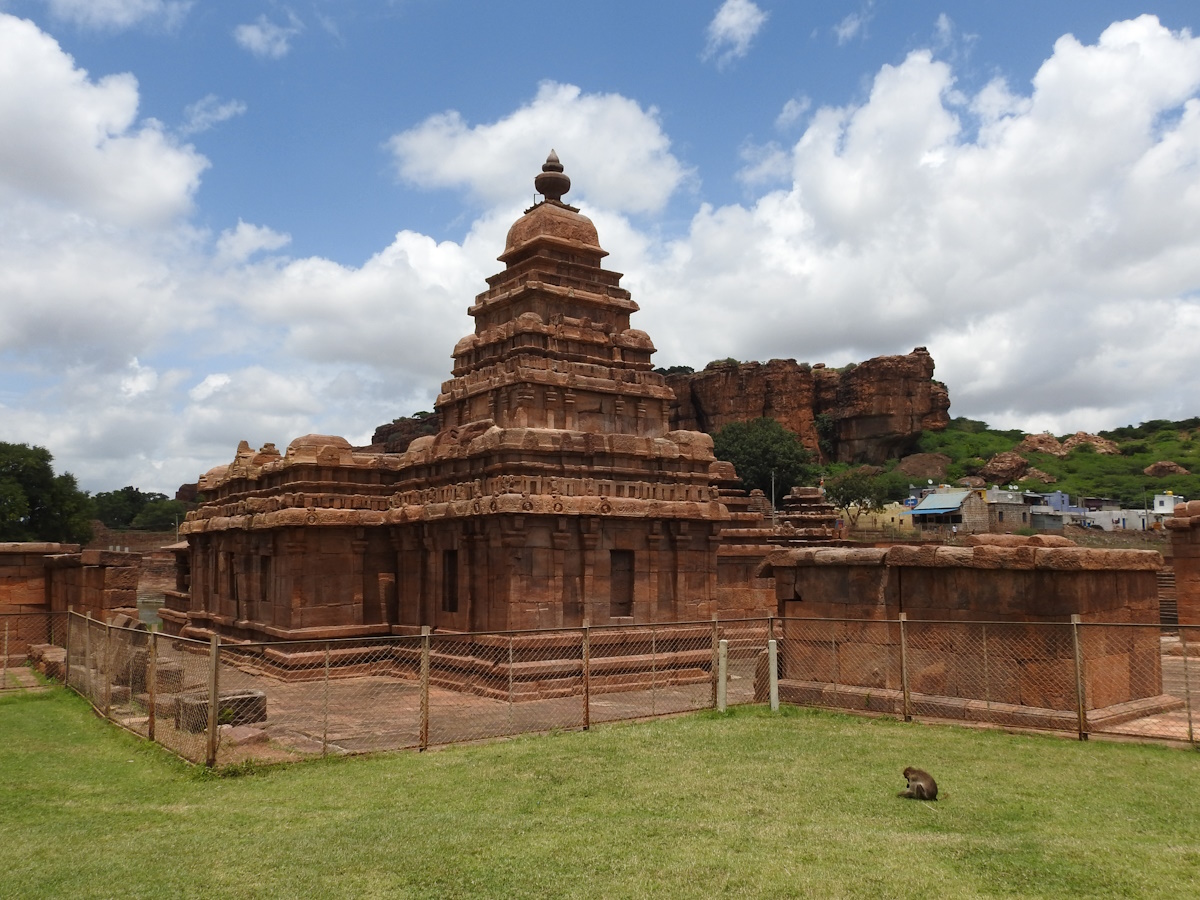
Malegitti Shivalaya - Situated on a massive monolith on the northern hill, Malgitti Shivalaya is probably the best preserved structural temple at Badami. This east-facing temple was constructed in the VII Century. As per an inscription here the architect of this temple is Aryamanchi Upadhyaya, and the sculptor is Singamanchi. The exterior is covered with a lot of interesting sculptures depicting human beings and Hindu legendary characters. A few tourists bother to visit this spot hence it is usually peaceful here.

Archaeological Museum - Badami historical museum is one of the most important museums in northern Kaernataka. It's artifacts includes prehistoric tools & implements, historically important sculptures and a scale model of Sidlapadi, the natural rock arch in a remote part of Badami hills. The museum is situated at the base of northern hill, right besides the fort entrance. The museum is a good place to rest after a tiring tour of northern fort.
Inscription of Pulakeshi I - Dating back to the VI Century this is said to be the first inscription of Chalukyas. The lines have been inscribed on a rock face at a significant height inside Badami's northern fort.
Kappe Arbhatta Shasana - This is considered as one of the most important inscriptions of Badami. This inscription is situated close to the museum, at the base of the hill where Badami-Mahakoota footpath begins. This inscription consists of ten lines text and a drawing. As per historians, Kappe Arabhatta was a heroic figure from Chalukyan times. This inscription outlines his personality.

Inscription of Mangalesha - Pulakeshi I's son Mangalesha had his message inscribed on a rock face close to Cave-III. This four-line inscription at Badami is about the grant from the income of a village named Lannjigesara, present day Nandikeshwara.
North fort - Unlike the southern fort which is restricted to regular tourists, north fort is open and tourists can explore the ruins freely. Presently, six gateways can be seen i.e. from the street level to the summit. This ancient fort is 90% natural and remaining manmade. As you see here, a simple wall across the passage was enough to regulate movement within. The only major construction is at the top which happens to be a huge turret with a commanding view of the town and plains on the western side. Within the fort are two Shivalayas, two huge Mantapas, granaries and few other ruins.

Lower Shivalaya - This structural temple was built in the latter half of VI Century CE. It was in a badly damaged state before it was restored to this form. Originally it had an enclosed Pradakshinapatha, now only a column and beam remain of it. As you see the temple is two storied, but there's no staircase to access the upper level. The structure is crowned by an octagonal dome which is said to be made during Vijayanagara period.

King's secure meeting place - Reaching this spot involves a bit of adventure since the path is a narrow slanting passage in the massive monolith. And, that's the only way a normal human being can reach this place. All that pain to see these two Mantapa. Since this place is hard to reach and surrounding rocks are out of earshot, this place is said to be Chalukyan kings' meeting place to discuss secret matters.

Granaries & other ruins - These domes are said to be ancient granaries, two of them have been restored to near original condition, while only a part of the third one remains. Going by their construction these might have been created during Chalukyan times. This is the highest point of northern fort, very close to Upper Shivalaya. In the vicinity of these domes are ruins of living quarters which seem to be of the XVII Century.

Upper Shivalaya - This is the structural temple at the highest elevation in Badami. It may be built in the middle of VI Century CE when Chalukyan kings were worshippers of Vishnu. It is said that the original deity of this temple was Vishnu however the sanctum now has only a pedestal but no deity. A good portion of the structure has gone missing, yet the ruins are beautiful. The exterior walls are decorated with interesting sculptures. On three sides of the platform base are a series of panels depicting scenes from Sri Krishna Charitha and Ganas. On the southern wall is a sculpture of Govardhana Giridhari. On the west wall is Kaliyamardini Krishna. Also the windows of this temple are of different designs.

With this the list of identified or marked spots in Badami comes to an end. However, the boundaries can be stretched which adds three more places spots.
Sidlapadi - Situated in a remote location on the northern side of Hiregudda plateau is a natural sandstone arch. Sidlapadi literally means lightening rock. Apparently a lightening struck this arch which resulted in a small opening in the roof, hence the name. Apart from this arch there are a number of small caves and caverns around Sidlapadi. Archaeological evidence collected from here indicates this was inhabited during prehistoric times. It's an hour long trek to reach this spot.

Guddada Ranganatha Gudi - Here we have an ancient shrine in a cleft situated about two kilometers from Badami town. There are two or three natural sources of water, rainwater stored in pockets in sandstone formations. This shrine dates back to prehistoric times however the structural temple might go back to Chalukyan times.

Prehistoric rock-paintings - One could call this set of paintings as out of the world since they depict alien creatures, a rocket and an astronaut too. The rock is somewhere near Gudda Ranganatha Gudi, known to a few people this remains as one of the least known prehistoric sites.

Apart from these spots & sites, the natural rock formations one can gaze at for minutes on and be amazed. Form a large group and explore the plateau, you'll get to see the natural beauty of sandstone rocks closely. And then maybe you could do Badami-Mahakoota trek.
Malaprabha at Pattadakal
During the last week of September 2023, Sridhar mentioned his plan of visiting Dharwad, a two-day visit. Over a couple of more phone calls, it became a 5-day visit with a tour of Chalukyan realm in between. I was glad that Sridhar extended his trip, he had not seen any of the Chalukyan monuments and I was happy that he would be seeing them with me.
Oct 5, 2023. We left Dharwad early morning morning, reached Badami by 8-30, had breakfast at a Udupi restaurant and we started the tour of rock-cut caves around 9 AM. After the caves, we headed to the north hill and visited all the monuments- lower Shivalaya, kings' meeting place, Upper Shivalaya, the granaries and a massive turret & fortifications. Then back at the base of the rock formation, we saw the artifacts collection in the museum. Having done with Badami, we headed towards Shivayogi Mandira where we had lunch- Anna Prasada. It was a satisfying meal of uppit and anna-saru. We got a chance to see the Vibhuti making unit within the campus. Then we rested for a while and headed towards Mahakoota. We parked and cooled off with a refreshing nimbu-soda. As we entered the temple complex, I was shocked to see the metal grills around the pond, it was eyesore but it was needed to keep out unruly crowds. Sridhar was very happy here since he could touch many of the Shivalinga idols. We spent almost an hour seeing the temples in detail. We left Mahakoota around 3-30 pm, headed towards Pattadakal which would be the last place for the day.
As we entered Pattadakal temple complex, we covered the first half, and as we came to the middle of the complex, I got an idea- take a break from the temples and see Malaprabha. Pattadakal is situated on the left bank of river Malaprabha. The river flows in the general direction of west but here it takes a ninety degree turn, flows northward for a short distance and then turns west again. In Hindu traditions, the place where a river flows northwards is considered holy. Based on this belief, such places usually have temples and remains a place of significance. It is said that Chalukyan princes' Patthabhishekha (coronation ceremony) took place at this place hence the name Pattadakal.
During one of the earlier visits here, I had come to see the river however I can't recall much. On the eastern side of the temple complex is a gateway which leads to the river, barely a hundred meters away. Treading on wet cool sand on a warm day is so relaxing! Then stepping into the gracefully flowing clear water took me to another level.. felt rejuvenating. We waded across ankle deep water, crossed the stream and stepped on to a tiny island. That's Sridhar with his Nikon. A group of kids were within talking distance and a group of ladies were washing upstream.

Waters flowing into the northerly direction. That's the bridge across Malaprabha connecting Pattadakal and Aihole. Water was shallow where I stood. However, beyond the rocks, most of the water flowed on the left side of the bed, water was deep there. After a less than normal rainfall, Malaprabha's water level is low. In the past I've seen this stream flowing bank to bank. In fact, in 2010 a heavy rainfall caused to heavy flooding. Pattadakal village and temple complex were in 8 to 9 feet water. Most places on Malaprabha banks were flooded including Shivayogi Mandir and a few temple complexes at Aihole.

Looking in the southerly direction. If we go along the river we'll pass by Bachingudda, one of the historical places and then reach Shivayogi Mandira.

Insect tracks in the riverbed. I have no clue as to what insect created it beautiful maze. Possibly it could be more than two of the same type of insect.

While we moved around in the water and chatted with the kids, a group of boys had crossed over from the opposite bank. One of the boys approached me with this sword asking for a picture.

That encouraged the other boys to join that boy for a group shot. After taking a few shots, I asked the eldest of them to take the sword and middle position. This bodybuilder may not be the sword owner but he seems to be the group leader. The guy with saffron stole must be his righthand man. The group left after exchanging mobile numbers with me to share the pictures.

Meanwhile the kids kept away from the gang. Looks like the kids were scared of the boys. Local politics in play. The eldest of the kids was trying to make something out of sand, or was he trying to catch fish. I'm not sure.

These three must be really thick friends. One of them had left his slippers on the island and playing a distance away. One of the other kids smiled at each other, unspoken mischief in play. The kid gave a light push and one of the slippers started floating away. The slipper owner had to chase his slipper to retrieve it. We had a good laugh as the slipper owner hurled abuses.

This is the gateway which connects the temple group and Malaprabha. To my knowledge, this is probably the largest gateway in Chalukyan monuments. There's an inscription on one of the blocks in one of the pillars. This gateway is proportional to the temples of this complex.

Right next to the gateway is this badly eroded idol of Nandi and the Ficus with long curvy arms.

View of the gateway from inside the complex. It was meant to be a grand structure, a befitting accompaniment to the grand temples here.

We spent another hour seeing the temples, marvelous sculptures on their exteriors and interiors as well. For some reason I've never been able to photograph these temples satisfactorily. During my previous visits, I faced one or the other issue.. once my camera battery ran out, on another occasion dark clouds formed and it rained. I have to plan another visit and make sure to be present here early morning, would like to shoot these temples in morning light since all these temples are east-facing.
Anantashayana and Koshtharaya rock-cut shrine, Badami
At the southeastern end of Bhootnath group is a cave shrine in which have rock-cut relief sculptures, the prominent one being of Vishnu. Hence this is shrine called Vishnu Gudi. Just above the steps, the small opening between the floor and boulder is the temple entrance. One has to crouch to enter it.

Once inside, adults cannot really remain erect because of the low ceiling. We had to remain bent or had to kneel down. This temple is a combination of rock-cut and structural. Only the side walls have been built hence this is more of a rock-cut shrine. On the center wall is Anantashayana i.e. Vishnu reclining on the seven headed serpent Adishesha. Vishnu is attended by Sridevi, Bhoodevi and Gaurda. Vishnu's symbols Shankha & Chakra are clearly seen.

A closer look at Anantashayana. On the arch above are miniature images of Dashavatara i.e. the ten incarnations of Vishnu- Matsya, Kurma, Varaha, Narasimha, Vamana, Parashurama, Rama, Krishna, Buddha and Kalki.

The side walls are also decorated with relief sculptures. On the left are the Trimurti- Vishnu, Maheshwara & Brahma. On the space below Trimurti are incomplete images of Basavanna and unknown characters. Over the Trimurti is a grand looking Shikhara & Kalasha.

On the right is an interesting image of a seemingly royal couple seated in half-lotus posture. With the couple is a cow & nursing calf. Next to the cow is a plant.. coconut sapling? Then there are two other plants which seem like stalks of food grains. Is this possibly a scene of Sankranti being celebrated. There's another plant behind the cow which seems like a Peepul tree. Would be nice to an expert historians opinion.

Also in this cave shrine was a niche with a circular embossing. Since there's no deity in it, this seems like a nest to place an oil lamp.

A short distance from Vishnu Gudi is another rock shelter called Koshthraya's Cave. On the rear wall is an image of a man seated in half-lotus posture on a lion-throne under a peepul tree. There's a halo around his head. Apparently there are Shankha & Chakra, symbols of Vishnu. Then there is an imaginary creature to the man's left which is usually seen in Jaina images. For example- similar creature can be seen at the rock-cut Jaina Basadi at Aihole. Also there are two attendants both holding fans. He has a sacred thread around his torso. I'm not clear whose image this is.

One of the side walls has this image of a well built man sporting long hair and a well shaped beard. He's seated in half-lotus position. There's a symbol on his forehead but it isn't clear. Next to him is a staff. Again no idea who this man depicts.

There are several rock shelter shrines on the slopes of Hiregudda, the sandstone hill of Badami. While on this topic I must mention Arali Honda or Aralikatte rock-cut shrine a the edge of the sandstone formation. It's not visible from here. To access it one has to reach the plateau and walk along the edge overlooking Agastyatirtha.
Rock-cut shrines near Bhootnath temple complex
Right besides Bhootnath group is this huge sandstone boulder on which relief sculptures are present.
On the northern face are four Shivalinga, two of the Shivalinga have their own Nandi.

Closer look at the sculptures. Shivalingas are housed in Garbhagudi, complete with Shikhara.

Another view of the northern face. On the extreme left is an image of four-armed standing Vishnu.

As we go around the rock formation, a natural shelter is seen. The rock faces under the overhang are filled with sculptures of Hindu gods.

There are two rows; the lower row consists of ten male characters in seated position, mostly in meditative position. Most of the images have been damaged, seemingly an intentional act of vandalism. The upper row, left to right, has Boovaraha, Ganapati, Brahma, Maheshwara, Vishnu, Mahishamarshini and Ugranarasimha. To the extreme right is a Shivalinga inside a Garbhagudi. Each of the characters have an arch, probably incomplete arches. Just above the arches are inscriptions of signatures in Kannada. I guess those are sculptors' banes. Over the inscriptions are seven square holes, five small and two large. It's my guess those are meant for placing oil lamps.

On the other face under the overhang are three images; one complete and two incomplete. On the left is Shivalinga inside Garbhagudi; in the middle is standing Vishnu with incomplete housing; and to the right is an image in very early stages. For some reason work was abandoned. On the lower part of the face is a small Shivalinga. Further lower and to the left is a square outline. Looks like that's another incomplete Shivalinga.

As we go around the boulder to the opposite side. a small structural temple is present. The temple has been built in a very tight space. From here it looks as though a cube has been pushed into the boulder.


Caretakers have maintained a neat lawn and flowering plants here. The pink Oleanders and green leaves enhance the place's charm.

Another look at the squeezed in temple. The more I look at this temple, the more I admire the clever idea.

This seems to be another incomplete rock-cut shrine. Not sure is this was meant to be a rock-cut shrine or a combination of rock-cut and structural temple.

View of the spot from an elevated spot.

This is my friend Srini from Hyderabad. Srinu and I were on a two-day tour of Badami, Pattadakal and Aihole. Our tour had started from the four cave temples. Then we drove around to the North fort side. We had done quite a bit of walking under the blazing sunlight. We took a short break while it was partly cloudy. This waterbody is home to water fowls and other water birds.

At a distance was a flock of cormorants resting on rocks amidst the waters. Cormorants are good fliers and swimmers. With their webbed feet, they swim well on the surface and even underwater. The way they take from water is a sight to behold.

Turning back the sandstone formations, I noticed a unique feature here. On the surface were irregular lines which looked like dried sticky matter.

On the lower part of this picture, there are bands of lighter shades. Amazing how this texture came into being. Sandstone, a sedimentary rock, is formed when grains of quartz or feldspar are held together under pressure for millions of years. During the process other minerals too get trapped and remain embedded in sandstones.

A closer look at the dripping and sliding lines. Is it possible that some matter were squeezed out under pressure, like concrete escaping through gaps of centering plates.


In the above picture, on the left hand side are two incomplete images. Once is Ganapati for sure. The other image could be meant to be Vishnu. Having written this post, I feel I must visit Bhootnath group again and catch up with missed out sculptures.
Bhootnath temple complex, Badami
Situated at one corner of Badami, Bhootnath group receives the least number of visitors. Of the tourists coming here, most are city folks or foreigners since the place is mostly free from hordes, most times it has a peaceful ambiance. The best part is the charm of the waterbody - Agastyatirtha. Then there are young couples looking for privacy find this place convenient.

This group consists of 8 temples including the small ones. The largest structure of the group is Bhootnath Gudi and other would be dedicated to other deities. Then there are a dozen or so relief sculptures on the huge boulder a stone's throw away. On the boulder are two small structures as well. I'm not sure if those rock-cut shrines and smaller temples are part of Bhootnath group. Totally there are 12 structural temples and more than a dozen rock-cut shrines.

I've visited this group three or four times, the memorable ones being in Sept 2012 and Aug 2023. During my earlier visit there were information boards which describe this monument as below.
ಭೂತನಾಥ ಸಂಕೀರ್ಣ
ಶ್ರೀ
ಪೈಗರ ಶ್ರೀಧರ ಭೂತೇಶ್ವರ' ಎಂದು ಎಂಟನೆಯ ಶತಮಾನದ ಶಾಸನದಲ್ಲಿ ಉಲ್ಲೇಖಿತವಾದ ಭೂತನಾಥ
ದೇವಾಲಯವು ಮುಖ್ಯವಾಗಿರುವ ಈ ದೇವಾಲಯಗಳ ಸಂಕೀರಣದಲ್ಲಿನ ಈ ದೇವಾಲಯ ಹಲವು ಬಾರಿ
ಜೀರ್ಣೋದ್ದಾರಗೊಂಡಿದೆ. ಇದರ ಮುಂದಣ ಒಂದು ಶಾಸನದಲ್ಲಿ "ಕರಿಯಮ್ಮ ಸ್ಥಾನದ ದೀವಿಗೆ"
ಎಂದಿದೆ. ಈ ಸಂಕಿರಣದ ಈಶಾನ್ಯಕ್ಕೆ ಒಂದು ರಾಷ್ಟ್ರಕೂಟರ ಕಾಲದ ಮಂದಿರವಿದ್ದು ಅದರಲ್ಲಿ
ಲಕುಳೀಶನ 7 ಇಲ್ಲವೇ 8ನೆಯ ಶತಮಾನದ ಪೂಜಾ ಮೂರ್ತಿಯಿದೆ. ಇಲ್ಲಿ ಕಲ್ಯಾಣ ಚಾಳುಕ್ಯರ ಕಾಲದ
ಹಲವು ಗುಡಿಗಳಿದೆ.
The Bhutanatha Group
This
group has the main temple called 'Sri Paigara Shridhara Bhuteshwara' in
a record of the eighth century. The temple has undergone repairs many
times, and is a simple structure. An inscription in front speaks of
"Kariyamma Sthanada Divige." There is a Rashtrakuta temple to its
north-east with Lakulisha image within and the image is assigned to the
7th or 8th Century. There are many shrines of Kalyana Chalukya times
around this.
The temples in this group are either west-facing or south-facing except one north-facing temple. The temple seen here in the background is the second largest here. In the background is the boulder with two temples on its top.


Turning our attention to the main cluster. The temples ate packed together leaving ample space around the cluster. As you see, this group of temples have access to the waters of Agstyatirtha. This waterbody is fed by the streams flowing down the sandstone hill.

When there's a good rainfall, a waterfall appears on the cliff. It's a sight to behold. This is the entrance to Bhootnath group. On the left is a special pillar, unsure of its purpose.

The first temple as we enter the cluster. This could be the Rastrukuta temple with an image of Lakulisha. Lakulisha is said to be the 28th and the avatar of Shiva. He is depicted with a lakut (mace) hence the name. Lakulisha is considered as the founder of the Pashupata sect and propounder of Yoga system.

A smaller temple with a sloping canopy.

Rear view of the group. The well preserved Shikhara of Bhootnath temple seems to be a Vimananagari type. Shikhara of smaller temples are stepped pyramids. I feel these are experimental models like the temples of Galaganatha group at Aihole.

Rear diagonal view of Bhootnath Gudi. It's a beautiful structure with a wide pillared hall with two side entrances i.e. northern and southern sides.
At the southern entrance is a pillar similar to the one seen at the group entrance (fourth picture). At the first glance they look similar but with a small difference in the orientation of drilled holes . The pillar here seems to be a torch holder.

The side entrances are right next to the Antarala walls (vestibule). On the right hand side is a damaged sculpture. The reminder of the image is intriguing... what could that have been? Going by the looks of the interior, it seems this temple has been modified at least once. May be this hall was extended to accommodate more people.

Right opposite the Garbhagudi (sanctum) sits Nandi, and behind Nandi is a chamber which seems like a secondary sanctum. If it is another sanctum, we could call this temple a Dwikutachala.

A view of the packed space between the structures.

There goes Srinu my friend from Hyderabad. We were on a tour of the Chalukyan realm- Badami, Pattadakal and Aihole, Srinu's first visit here.

These small structures can be seen even at Pattadakal temple complex. In fact there are even smaller ones, 2" cubical temples. I feel these little structures were assignments or projects for apprentice sculptors.

Ancient builders planning was so careful, every little detail was looked into. Ancient temple sites rarely disrupted natural flow of rainwater around them. Same applies to Bhootnath group. The rainwater flows downhill forming a stream which joins Agstyatirtha right next to the group. On the left side of the picture is a small bridge, that's where the water flows in from. I really must visit here during a rainy season... wishing, hoping & praying for good rains this season.

Done with Bhootanath group of structural temples we move ahead to see the rock-cut shrines.
inscription-stone hunt at Bhogasandra
During the Dec 2023 visit to Bhogasandra, while at Kote Ranganatha Swami Devastana, our friend Sidramanna mentioned about the presence of an inscription stone outside the village. The only person who would be able to show me that artifact would be Sidramanna's uncle Eshanna. Since that was a busy month for coconut farmers here, we could not find a convenient time. Even on normal days Eshanna is busy, always on the move by foot from one plantation to another. With a bag full of tools and pipeline spare parts, Eshanna checks drip irrigation lines daily. Besides the pipelines, he also checks the trees and fallen coconuts. Basically very dedicated to work, lives up to Jagatjyoti Basaveshwara's quote "Kayakave Kailasa" which means "work is worship."
In the third week I visited Bangalore, just a day. The following day Sridhar and I travelled to Bhogasandra with a short detour near Tumkur to see historical monuments of Gulur and Kaidala. Later in the day Satyaprakash, our friend from Bengaluru, joined us at Bhogasandra. The following day Venugopal from Mysuru joined us. It was a gathering of four primary school friends at Sridhar's farm, deep inside a rural realm. That evening we four went to Bhogasandra lake by walk. On the way we saw a flock of peacocks & peahens.
 |
| Sridhar, Venu, Satyaprakash |
Jan 19, we all went for an early morning walk deeper into the farm lands. Purpose of the outing was to pick & gather a citrus fruit called Yeralikayi. We happened to meet Eshanna near the target tree. He helped us pick two bag full Yeralikayi and accompanied us till Sridhar's house. On the way, the matter of inscription stone came up and luckily Eshanna obliged to take us to the spot. After breakfast. Satya left to Bengaluru and we went to catch up with Eshanna.
 |
| Venu hauling two bag full Yealikayi |
After walking for about 15 minutes we reached a barren spot next to a coconut plantation. Eshanna looked around, under the bushes but unable to find the slab he had seen. Apparently the place had been disturbed by an excavator during while making a trench here. Eshanna felt the slab might've been buried when the trench was closed, he was disappointed. So was I. However, there was a rough granite slab with engraving on one face.
 |
| Eshanna and Venugopal |
This is the best I could do with sunlight blazing down. Since the surface is coarse, the engraving is kind of camouflaged.

Here's a cropped version. On the top is a Shivalinga, surely Sun and Moon would also be present. Below the Shivalinga are five or six horizontal lines, between the lines there seems to be some text. As per Eshanna, a habitat existed here once upon a time. The place was abandoned during a scrouge. Looks like the habitat was mainly temporary structures since there are no ruins here except for this stone inscription.

That rear view of the slab. Geologically this stone is a fusion of granite and some other stone. Between this block and the bush were a few slimmer slabs buried in dirt. We tried to dislodge one of them but it wouldn't budge. To excavate we would require a lot of tools including a machete to clear the bush. A work for some other time.

Hoping to unearth the inscription some other time, we left and headed towards another coconut plantation of Eshanna. On the way we passed by a pond. On the pond banks was this anthill.

That's the pond. Eshanna said this pond was fed by canal water and rainwater too. This anthill with so many spikes has a special look.

From the opposite side it feels as though we are looking at a bull's horns.

Another 15 mins walk, we reached Eshanna's plantation where he plucked tender coconuts and opened them for us. The fresh cool drink was rejuvenating. We were thankful to Eshanna for taking out time from his busy schedule. I feel he walks 8 to 10 km daily and his mind is always engrossed with work. BTW, Sridhar tried to install a steps tracking app in Eshanna's smart phone, unsure if the installation was successful.
Chatrapati Shivaji sculpture at Yadwad
Feb 12th 2024. The wait to meet the great traveler Pramod Potdar ended with his arrival at Dharwad. We met close to Pushpa's workplace, came home, rested for a while and planned to visit Yadwad village to see the sculpture of Chatrapati Shivaji situated inside a Hanuman temple. I was ignorant of this sculpture until Pramod mentioned it.
Yadwad is about 16 km north of Dharwad, off Dharwad-Uppinabetageri road. Hanuman Mandir is a stone's throw away from Yadwad bus-stand, one cannot really miss it. The structure is new but the deity is ancient. On inquiring, village folks pointed us to a spot next to the steps where Chatrapati's sculpture is kept.

The simple shrine housing the ancient and important artifact from the early 18th Century CE. This sculpture is special because it was made during Chatrapati's lifetime. The story goes like this: During the Maratha campaign, Belawadi a small kingdom in the present day Belagavi district was attacked. Belawadi king Ishaprabhu Desai died during a battle with Maratha army. Then Ishaprabhu Desai's wife Mallamma, daughter of Raja Madhulinga Nayaka of Sodhe kingdom, continued the war. However Mallamma had to concede defeat to the powerful Maratha army. Chatrapati Shivaji after meeting Mallamma, restored the kingdom to Desai family. Rani Mallamma, out of respect for Shivaji's kind gesture, got this sculpture made.

That's my friend Pramod bowing out of respect to his idol.

The three feet tall sculpture made of granite depicts Chatrapati astride a horse, wielding a sword and accompanied by his guards. The lower panel depicts Chatrapati and Mallamma engaged in conversation in the presence of two other people, probably their aides.

One thought is how or why this sculpture is at Yadwad instead of Belawadi. I'm assuming Rani Mallamma got the sculpture made at Belawadi since it was her kingdom's capital. So how did the sculpture reach a place 23 km away? Well, that's something to research about. While I was happy to be seeing this important artifact I was also concerned about the way it was placed. This sculpture deserves a better location and a small writeup for people's benefit. One point I would like to mention here is: Belwadi Rani Mallamma was Kittur Rani Chennamma's senior by at least seven decades. I do not remember seeing any ancient memorial of Rani Mallamma. Present day Belwadi is known for Sri Veerabhadreshwara Devastana.
Next to Chatrapati's sculpture, is this broken memorial-stone depicting a very handsome warrior engaged in a fierce battle.

Another artifact, a blank inscription stone is placed next to a building in a negligent manner. I wish villagers remove it from here, and place it next to the temple.

Having thanked the village people, Pramod and I left Yadwad. Since we were in the vicinity of Amminabavi, I felt Pramod might be interested in seeing the rock-cut underground temple and the massive open-well there.
Cheluru Oora Bagilu
Chelur is a small town in Tumkur district. A small one but its location is strategic. Basically the town is a junction of five roads and known for it's coconut market. People traveling from Nittur to Sira have to pass through Chelur. I'd driven through it in Jan 2023 while driving from Bhogasandra to Dharwad. The town's commercial significance was obvious. I was ignorant of it's historical monuments until my friend Siddaramanna told me about the town's gateway and a prophecy attached to it. That sparked curiosity about the place. Also I was told about a Kalyani and Maralu Siddeshwara Devastana.
Jan 20, 2024. After a 3-day gathering of school friends at Sridhar's farm at Bhogasandra, I was heading back to Dharwad. Bhogasandra to Chelur is just 17 km but took about 25 minutes because of rural roads passing through several villages. The coconut-betelnut belt of Tumkur district extends up to Chelur. At the five-road junction of Chelur, I got directions to Cheluru Ooru Bagilu which means Cheluru town gateway. To me the name Cheluru brings scorpions to mind because Kannada word for scorpion is Chelu. That's my imagination, Chelur may not have any historical connection to scorpions.
So here we are looking at the historical landmark of Chelur, probably built during Hoysala or Vijayanagara period. Some people of the town have taken steps to protect the monument but then there are people who don't realize its importance.

Chelur Ooru Bagilu seems like a stone-mortar structure originally. Now it's covered in a thick layer of enamel. As you see two bikes are parked inside. People living around use this monument like personal property.

Presently the spaces within this gateway are being used offices of some public department. On the left hand side wall the popular quote of Chelur in text.

Below is the transcription of the quote:
ಚೇಳೂರು ಊರು ಬಾಗಿಲು ಕಲ್ಲುಕೋಳಿ ಮೇಲ್ಪಾಗದ ಬಂಡೆಯಲ್ಲಿದೆ
ಚೇಳೂರು ಬಾವಿ ತುಂಬಿ ಹರಿದಾಗ
ಕಲ್ಲು ಕೋಳಿ ನೇರವಾಗಿ ನಿಂತು ಕೂಗಿದಾಗ
ಮರಳು ಬಸವಣ್ಣ ಎದ್ದು ನಿಂತು ಗುಟುರಿಕೆ ಹಾಕಿದಾಗ
ಪ್ರಪಂಚ ಪ್ರಳಯ
Here's the rough translation of the above:
The time when Peepul leaves become rounded, the stepped well overflows, the stone fowl stands erect and crows, and the sand bull stands up and bellows, this world will end.

Here's the sculpted stone fowl on one of the columns inside the gateway.

The space on the opposite side seems to be used like a store room.

The gateway is oriented in the east-west direction. This is the western side, behind me is the older parts of Chelur.

This gate is actually situated on the eastern side of the town, however presently it may seem center of the town since the town grown with time. A vegetable vendor has erected a shelter for his shop right next to the monument. What an eyesore!

I move on to see the two other items mentioned in the quote- the well and sand bull. The well is just 400 meters away, any local person can give directions to these spots. The sight of the stone well made me sad. People simply don't care for heritage.

Going by the stone wall around the well, one can tell it's an ancient structure. The well is situated on a raised ground on which is a small temple and a larger temple under construction.

The plight of the stepped well is pathetic, a jungle grown into it. Roots will dislodge the stone slabs and eventually the walls will collapse. Since the well was dry, it's bottom was visible.

Close to one of the corners of the well I saw stone steps descending into the ground. I thought these steps could be connected to the well, but when I checked the well again I couldn't see any opening in the walls.

This small structure is Bairaveshwara Devalaya, an active shrine. In the background is the construction site of a larger temple, probably for Bairaveshwara.

One final look at the walls around the wall. One of the articles on Chelur says this well was probably constructed during Chola period. Hoping people find enough resources and will to clean up this well and preserve them for the future generations. With that thought I move on towards the last item i.e. Maralu Siddeshwara Devalaya which is another 400 meters down the same road.

Though Maralu Basaveshwara is an ancient shrine, it has been heavily modified in the recent times. Only the temple Poojari was present here and he too didn't seem to be in a nice mood.

This is the deity. It's texture and color seems stony but it's actually sand. As per local people this idol was made by Shiva Sharanas in the XII Century in memory of a bull which died by ingesting poisoned food. The idol has turned black and glossy due to oily offerings.

ಮಾನ್ಯರೆ,
ಐತಿಹಾಸಿಕ ಪರಂಪರೆ ಹಿನ್ನಲೆಯುಳ್ಳ ಪವಾಡಸದೃಶವಾದ ಮರಳು ಬಸವೇಶ್ವರ ಸ್ವಾಮಿಯು ಸುಮಾರು 800 ವರ್ಷಗಳ ಹಿಂದೆ (ಬಸವಯುಗ) ಕಲ್ಯಾಣಪಟ್ಟಣದಲ್ಲಿ ಕ್ರಾಂತಿಯಾದ ಬಳಿಕ ಅಲ್ಲಿಂದ ಬಡ ಶಿವಶರಣರಾದ ಶ್ರೀ ಸಂಗಮೇಶ್ವರರು ಇಲ್ಲಿ 3 ಹಿಡಿ ಮರಳನ್ನು ಇಟ್ಟು, 101 ಕೊಡ ನೀರನ್ನು ಧಾರೆಯೆರೆದರು. ಅವರಿಂದ ಪ್ರತಿಷ್ಠಾಪಿಸಲ್ಪಟ್ಟು, ಬಸವನ ಆಕಾರವನ್ನು ಧರಿಸಿ, ದಿನ ದಿನಕ್ಕೂ ಬೆಳೆದು ವೃದ್ಧಿಯಾಗುತ್ತಿರುವಾಗ ಶ್ರೀ ಸ್ವಾಮಿಗೆ ಹುಚ್ಚೆಳ್ಳೆಣ್ಣೆ ಮತ್ತು ಜೇನುತುಪ್ಪಗಳ ಅಭಿಷೇಕ ಮಾಡುತ್ತಿರುವುದರಿಂದ ನೋಡಲು ಕಪ್ಪು ಕಲ್ಲಿನ ಶಿಲೆಯಂತೆ ಕಾಣುತ್ತಾರೆ ಆದರೆ ಶ್ರೀ ಸ್ವಾಮಿಯವರು ಬೆಳೆಯುತ್ತಿರುವುದು ಸಂಪೂರ್ಣವಾಗಿ ಮರಳೇ ! ಅಂದಿನಿಂದ ಶ್ರೀ ಮರಳುಬಸವೇಶ್ವರ ಎಂಬ ಅಭಿದಾನದಿಂದ.
ಹೀಗೆ ಮರಳಲ್ಲಿ ಬಸವನ ಆಕಾರದಲ್ಲಿ ಬೆಳೆಯುತ್ತಿರುವ ಶ್ರೀ ಸ್ವಾಮಿಗೆ ದೇವಾಲಯವನ್ನು ಲಿಂಗ ಶ್ರೀ ತೋಟದ ಸಿದ್ದೇಗೌಡರು ನಿರ್ಮಾಣಮಾಡಿ ಪ್ರತಿವರ್ಷ ವೈಶಾಖ ಮಾಸದ ಬಸವಜಯಂತಿಯಲ್ಲಿ ಭಾರೀ ದನಗಳ ಜಾತ್ರೆ ಮತ್ತು ರಥೋತ್ಸವ ಹಾಗೂ ಜಾನಪದ ಸಾಂಸ್ಕೃತಿಕ ಕಾರ್ಯಕ್ರಮಗಳನ್ನು ಪ್ರಾರಂಭಿಸಿದರು. ಅವು ಇಂದಿಗೂ ಪ್ರತಿವರ್ಷವೂ ನಿರಂತರವಾಗಿ ನಡೆಯುತ್ತಾ ಬಂದಿರುತ್ತವೆ.
ಸದರಿ ದೇವಾಲಯವು ಶಿಥಿಲವಾಗಿತ್ತು ಶರಣ್ಯರಾದ ಶ್ರೀಮತಿ ಶ್ರೀ ನಂಜುಂಡಪ್ಪನವರು ಸಾತನಹಳ್ಳಿ, ಚೇಳೂರು ಹೋಬಳಿ ಇವರ ಮಾತಾಪಿತೃಗಳ ಸ್ಮರಣಾರ್ಥವಾಗಿ ಗರ್ಭಾ ಅಂಕಣವನ್ನು ನಿರ್ಮಿಸಿದ್ದಾರೆ.
ಈ ಪುಣ್ಯ ಕ್ಷೇತ್ರವನ್ನು ಕುರಿತು ಕಾಲಜ್ಞಾನಿಗಳ ಭವಿಷ್ಯವಾಣಿ
ಚೇಳೂರು ಊರುಬಾಗಿಲಲ್ಲಿ ಇರುವ ಕಲ್ಲು ಕೋಳಿಯು ಕೂಗಿದಾಗ ಶ್ರೀ. ಮರಳು ಬಸವಣ್ಣ ಹುದ್ರಿಕೆ ಹಾಕಿ ಹೊರಬಂದಾಗ, ಬೇಳೂರು ಕಲ್ಲು ಬಾವಿಯ ನೀರು ಉದ್ಭವಿಸಿಹರಿದಾಗ ಕಲಿಯುಗ ಸಮಾಪ್ತಿಯಾಗುವುದೆಂದು ಕಾಲಜ್ಞಾನಿಗಳಾದ ಕೈವಾರದ ಶ್ರೀ ಅಮರನಾರಾಯಣ ಯತೀಶ್ವರರ ಗ್ರಂಥದಲ್ಲಿ ಉಲ್ಲೇಖವಾಗಿರುತ್ತದೆ ಮತ್ತು ಇದು ನಾಣ್ಣುಡಿಯಾಗಿ ಜನಜನಿತವಾಗಿದೆ.
Flanking the Gabhagudi are idols of Ganesha and a Devi.


Apparently within the temple premises is a shrine dedicated to Gangambike, one of the two wives of Jagatjyoti Basaveshwara. I missed it completely. Anyway, I'll try to revisit this temple when I visit Bhogasandra again. While checking online for Chelur history I happened to stumble upon an article titled "A Study of Historical Remains of Chelur and its Surroundings by Prasanna Kumar S R, ICHR – Junior Research Fellow, Dept. of Studies and Research in History and Archaeology, Tumkur University. Quoting a paragraph which mentioned Chelur and a few other nearby places.
Chelur is one of the hoblies of Gubbi thaluk in Tumkur district of Karnataka, presently it is a commercial semi urban area, from the historical view, it was played major role in this region and it was situated in the center of many regional administrative powers like, the Hagalawadi Nayakas, the Navabs of Sira, the Gowdas of Gubbi Hosahalli (Rao, 1969), the Nadaprabus of Bidare, and itself it comes under the reign of Gowdas of Chelur. Chelur region have large number of heritage, historically and archaeological materials through the ages, presently we seen many historical monument which were belongs to Hoysalas, Nayakas, Mysore Odeyars, and other local contributors. In this region we found many historical monuments in different places like, from Chelur - Chelur Bavi, Dristeshvara temple, inscription at Honnadevi temple, stone hen, sand Bull, hero stone, Bairaveshvara temple, at Kodiyala – Hoysala style Nandi Sculpture, hero stone, in Bidare- Kalleshvara temple, Veerabadreshvara temple, Hoysala style Nandi and Veerabadra sculpture, unique Ganapathi sculptures (Rao, 1916), Vijayanagara Queen Kamaladevi inscription (Rice, 1904), Jain Basadi, at Hagalavadi- Two Gate ways, Mathas of Veerashaivas (Yogeeshvarappa, D. N,2004), hero stone with inscription, Junjappa temple, in Guddadahalli- Nayakas period temple and pavilion, at Sanabanahalli- memorial stones and grooves on rock (Prasanna Kumar,2018), at Lakkenahalii- hero stones and temple and many other monuments are give evidences to historical richness of this region (Sheshashastri, 2004).
I always felt that this area was historically significant. Having read the article, I've added a few more items to my list of places to see.
Sri Gangadhareshwara Devalaya, Kaidala
Right besides Kaidala Chennakesaava Devalaya is Ganagdareshwara Devalaya, a relatively smaller structure. This too is a protected monument.

A board planted in front of the temple describes this temple as below:
Sri Gangadhareshwara temple, Kaidala, Tumkur
Gangadhareshwara temple on the east of Chennakesavatemple is also of Dravidian style. Its Navaranga has nice pillars of black stone carved in the Hoysala style. On the four sides of the pillars are inscriptions depicting the deities of Brahma, Vishnu, Bhairava, Krishna, Ganapati and Veerabhadra in plaque reliefs the outer zone of the Navaranga is decorated with elephant and floral four Shivas and other walls. - Commissioner Dept. of Archaeology Museums & Heritage Mysore.
An inscribed stone plaque embedded into the temple wall gives additional info, mostly of recent times.
||ಓಂ ಶ್ರೀ ಮಂಜುನಾಥಾಯ ನಮಃ||

In the facade the most interesting part is the balustrade.

The temple's external walls are mostly plain except for floral motifs on the front walls.

A diagonal view of the balustrade.


The temple is symmetric in plan in both axis except for the Shikhara which is present over the west-facing sanctum and absent on the east-facing sanctum.

A view of the Navaranga, the pillared space described in the board. These pillars are made of a stone which is darker & harder compared to granite. These pillars are fine examples of Hoysala design and can be seen even in Chalukyan temples which underwent renovation during Hoysala period.

That's it about this temple for now. Besides Chennakesava and Gangadhareshwara, Kaidala has another ancient temple which is dedicated to Rameshwara. The last temple is a few minutes walk away and I completely missed it. Hoping to visit Gullur and Kaidala again between Ganesh Chaturti and Navaratri to see Maha Ganapati and also Rameshwara Devalaya.
Sri Channakesava Devastana, Kaidaala
...continued from Gangadareshwara Devalaya, Gulur. Our next stop i.e. Kaidala Chennakesava was just 2 km away, about 5 minute drive by car. Since the temple is on the outskirts, we did not enter Kaidala village. Around the temple is plenty of open space and trees. We parked the car under and headed towards the Gopura. Honestly I hadn't expected to see such a well maintained monument. Good work by the concerned government department and village people.
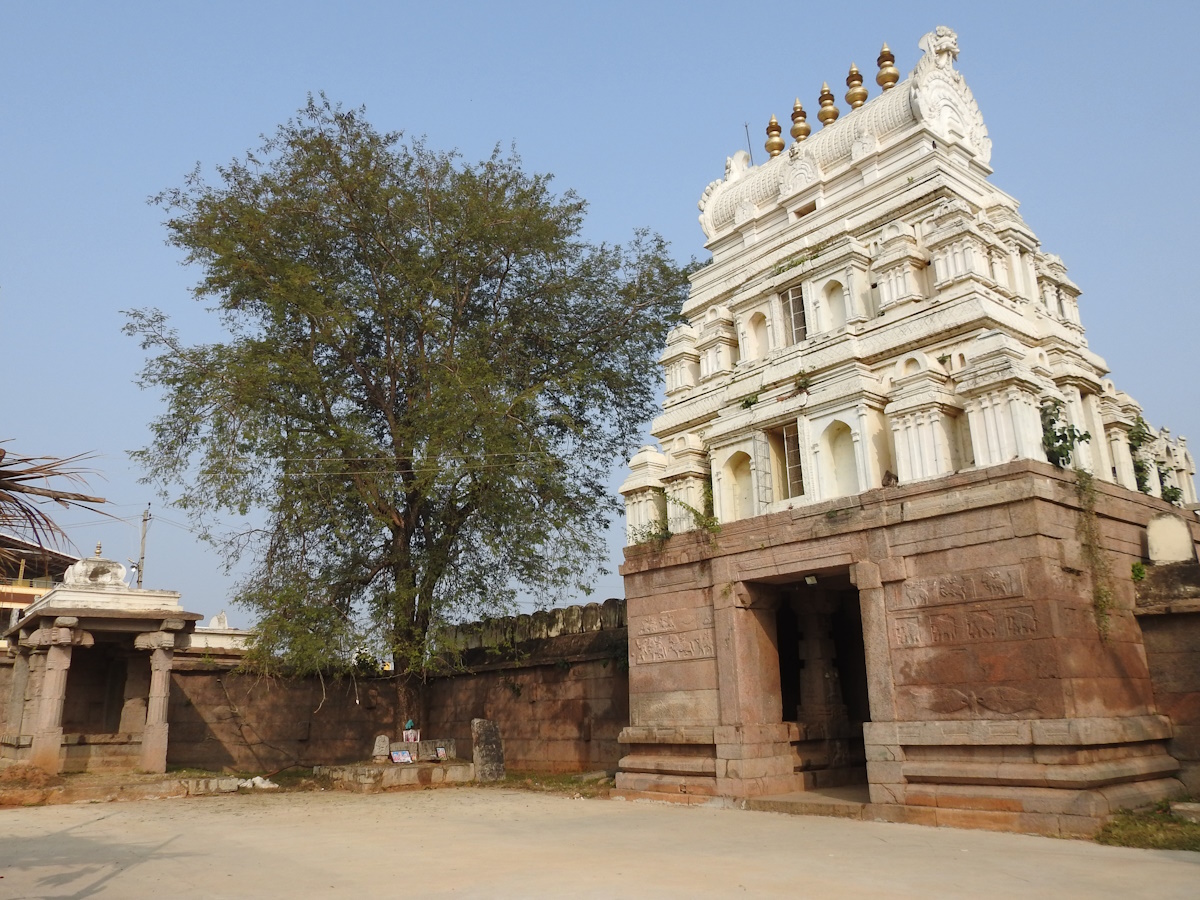
Sri Chennakesava Devalaya Gopura is a three tier tower, it's design is a fine example of Hoysala / Vijayanagara architecture. While the temple was constructed during Hoysala period, the Gopura was either constructed / renovated during the Vijayanagara period. Let's take a look at the historical information provided on the boards planted here by state govt.

Below are the transcriptions of Kannada and English boards by Tumakuru District Tourism Development Committee:
ಕೈದಾಳ : ಇದು ಅತ್ಯಂತ ಪ್ರಾಚೀನ ಚಾರಿತ್ರಿಕ ಸ್ಥಳವಾಗಿದೆ. ಇಲ್ಲಿ ಹೊಯ್ಸಳ ದೊರೆ ಮೊದಲನೇಯ ನರಸಿಂಹನ ಸಾಮಂತ ಗೂಳಿಬಾಚಿದೇವನು ಕ್ರಿ.ಶ.1150 ರಲ್ಲಿ ನಿರ್ಮಿಸಿದ ಗಂಗಾಧರೇಶ್ವರ, ರಾಮೇಶ್ವರ ಮತ್ತು ಚನ್ನಕೇಶವ ದೇವಾಲಯಗಳಿವೆ. ಪಶ್ಚಿಮಾಭಿಮುಖವಾಗಿರುವ ಚನ್ನಕೇಶವ ದೇವಾಲಯದ ಗರ್ಭಗುಡಿಯಲ್ಲಿ 167.64 ಸೆ.ಮಿ. ಎತ್ತರದ ಸುಂದರವಾದ ಚನ್ನಕೇಶವ ಮೂರ್ತಿಯು ಗರುಡ ಪೀಠದ ಮೇಲಿದೆ. ಪೀರದಮೇಲೆ, ತ್ರಿಮೂರ್ತಿ-ಬ್ರಹ್ಮ, ವಿಷ್ಣು ಮತ್ತು ಮಹೇಶ್ವರರ ಶಿಲ್ಪಗಳಿವೆ. ಇಕ್ಕೆಲಗಳಲ್ಲಿ ಶ್ರೀದೇವಿ ಮತ್ತು ಭೂದೇವಿಯರ ಸುಂದರವಾದ ಶಿಲ್ಪಗಳಿವೆ. ಮಕರ ಸಂಕ್ರಾಂತಿಯ ದಿನ ಸೂರ್ಯಾಸ್ತದ ಕಿರಣಗಳು ಕೇಶವನ ಎದುರಿಗಿರುವ ಗರುಡಮೂರ್ತಿಯ ಕಿವಿಯ ಕೆಳಭಾಗದಿಂದ ಮುಖ್ಯ ದೇಗುಲದ ಗೋಡೆಯಲ್ಲಿನ ಎರಡು ರಂಧ್ರಗಳ ಮೂಲಕ ದೇಗುಲದ ಒಳಕ್ಕೆ ಪ್ರವೇಶಿಸಿ ಚನ್ನಕೇಶವ ಮೂರ್ತಿಯ ಪಾದವನ್ನು ಸ್ಪರ್ಶಿಸುವಂತೆ ನಿರ್ಮಿಸಿರುವುದು ಈ ದೇವಾಲಯದ ವಾಸ್ತು ವಿಶೇಷವಾಗಿದೆ. - ಜಿಲ್ಲಾಧಿಕಾರಿಗಳು ಹಾಗೂ ಅಧ್ಯಕ್ಷರು, ಜಿಲ್ಲಾ ಪ್ರವಾಸೋದ್ಯಮ ಅಭಿವೃದ್ಧಿ ಸಮಿತಿ ತುಮಕೂರು ಜಿಲ್ಲೆ.
Kaidala: It is a very ancient historical place. Here there are Gangadhareshwar, Rameshwar and Channakesava temples built in 1150 AD by Gulibachideva, a colon of the first Hoysala ruler Narasimha. 167.64 cm in the sanctum sanctorum of Channakesava temple facing west. A tall and beautiful idol of Channakesava stands on the Garuda Peetha. On the pedestal, there are sculptures of Trimurti- Brahma, Vishnu and Maheswara. Both have beautiful sculptures of Sridevi and Bhudevi. The special feature of this temple is that the sunset rays of Makar Sankranti enter the temple through two holes in the wall of the main temple from the bottom of the ear of the Garudamurthy in front of Keshava and touch the feet of Channakesavamurthy. - Deputy Commissioner and Chairman, District Tourism Development Committee, Tumakuru District.

Below is the transcription of the board planted by the Department of Archaeology Museums & Heritage:
ಶ್ರೀ ಚೆನ್ನಿಗರಾಯ ದೇವಾಲಯ, ಕೈದಾಳ, ತುಮಕೂರು
ಕೈದಾಳಕ್ಕೆ ಕ್ರೀಡಾಪುರವೆಂಬ ಹೆಸಡಿತ್ತು. ಇದು ಶಿಲ್ಪಿ ಜಕವಾಚಾರಿಯ ಜನ್ಮ ಸ್ಥಳ ಎನ್ನಲಾಗಿದೆ. ಚಿಕ್ಕಸಿಕಾರಿಯ ಮಗ ಸಂಕಣಾಚಾರಿ ಬೇಲೂರು ಚೆನ್ನಿಗರಾಯ ಮೂತಿಯಲ್ಲಿ ದೋಷವನ್ನು ಕಂಡು ಅದನ್ನು ತೋರಿಸಿದಾಗ ಜಕಣಾಚಾರಿ ತನ್ನ ಬಲಗೈಯನ್ನು ಕತ್ತರಿಸಿಕೊಂಡ, ಅನಂತರ ತನ್ನ ಹುಟ್ಟೂರಾದ ಕೈದಾಳಕ್ಕೆ ಬಂದು ಅಲ್ಲಿ ಚೆನ್ನಿಗರಾಯನ ದೇವಾಲಯ ನಿರ್ಮಿಸಲು, ಜಕಣಾಚಾರಿಗೆ ಪುನಃ ಕೈ ಬಂತು. ಆದ್ದರಿಂದ ಆ ಊರಿಗೆ ಕೈದಾಳವೆಂಬ ಹೆಸರಾಯಿತು ಎಂದು ಐತಿಹ್ಯವಿದೆ. 1150-51ಲ್ಲಿ ಹೊಯ್ಸಳ ೧ನೆಯ ನರಸಿಂಹನ ಸಾಮಂತನಾಗಿದ್ದ ಬಾಚಿ ಅಥವಾ ಗೂಳಿಬಾಚಿ ಎಂಬುವನು ಇಲ್ಲಿ ಶಿವ, ವಿಷ್ಣು ಮತ್ತು ಜಿನ್ ದೇವಾಲಯಗಳನ್ನು ಕಟ್ಟಿಸಿದನೆಂದು ಇಲ್ಲಿನ ಒಂದು ಶಾಸನದಿಂದ ತಿಳಿದುಬರುತ್ತದೆ. ಈಗ ಚೆನ್ನಕೇಶವ ಮತ್ತು ಗಂಗಾಧರೇಶ್ವರ ದೇವಾಲಯುಗಳು ಮಾತ್ರ ಉಳಿದಿವೆ.
ಚೆನ್ನಕೇಶವ ದೇವಾಲಯ ದ್ರಾವಿಡ ವಾಸ್ತುಶೈಲಿಯಲ್ಲಿದೆ. ಮೂಲತಃ ಇದು ಹೊಯ್ಸಳ ಕಾಲದ ದೇವಾಬದುವಾಗಿದ್ದರೂ ಅನಂತರದ ಕಾಲಗಳಲ್ಲಿ ಬಹುವಾಗಿ ನವೀಕೃತವಾಗಿರುವಂತೆ ತೋರುತ್ತದೆ. ದೇವಾಲಯದ ಮಹಾದ್ವಾರದ ಮೇಲಿನ ಗೋಪುರ ವಿಜಯನಗರ ಕಾಲದಲ್ಲಿ ನಿರ್ಮಿತವಾದದ್ದು, ಚೆನ್ನಿಗರಾಯನ ಮೂಲವಿಗ್ರಹ ಬಹು ಸುಂದರವಾಗಿದೆ. ವಿಗ್ರಹ 5.1 ಅಡಿ ಎತ್ತರವಿದ್ದು 2.1 ಅಡಿ ಎತ್ತರದ ಪೀಠದ ಮೇಲೆ ಸ್ಥಾಪಿತವಾಗಿದೆ. ವಿಗ್ರಹದ ಪ್ರಭಾವಳಿಯಲ್ಲಿ ದಶಾವತಾರದ ಚಿತ್ರಗಳಿವೆ. ಮಹಾದ್ವಾರದ ಬಲಬದಿಯ ಕಂಬವೊಂದರ ಮೇಲೆ ಪತ್ನಿಸಹಿತವಿರುವ ಚೆನ್ನಕೇಶವನ ವಿಗ್ರಹವಿದೆ. ಎಡಗಡೆಯ ಕಂಬದ ಮೇಲೆ ಅಂಜಲಿಬದ್ದನೂ ಉತ್ತರೀಯಧಾರಿಯೂ ಖಡ್ಗಭೂಷಿತನ ಆದ ಮೂರ್ತಿಯನ್ನು ಕೆತ್ತಲಾಗಿದೆ. ಇದು ಜಕಣಾಚಾರಿಯ ಶಿಲ್ಪ ಎಂದು ಐತಿಹ್ಯ. ಆದರೆ ಇದು ಗೂಳಿ ಬಾಚಿಯ ಮೂರ್ತಿಯಾಗಿರುವ ಸಂಭಾವ್ಯತೆ ಇದೆ.
ಆಯುಕ್ತರು ಪ್ರಾಚ್ಯವಸ್ತು ಸಂಗ್ರಹಾಲಯಗಳು ಮತ್ತು ಪರಂಪರೆ ಇಲಾಖೆ, ಮೈಸೂರು.
Sri Chennigaraya temple, Kaidal, Tumkur
Kaidal was known as Kreedapura, it is said to be the birthplace of sculptor Jakanachari when Jakanachari's son Dankanachari found a defect in the idol of Belur Chennigaraya and showed Jakanachari cut off his own right hand, then came back to his hometown Kaidala and built the temple of Chennigaraya, he regot his cut-off hand. Afterwards legend he says that the town became known as Kaidala.
One inscription shows that Bachi or Gulibachi, a Kaidala ruler of Hoysala Narasimhai built the shrines of Shiva, Vishnu and Jina in 1150-51 CE. Now only the Chennakesava and Gangadhareshwara temples remain.
Chennakeshava temple is in Dravidian architectural style although originally a temple of the Hoysala period, it seems to have been largely renovated in later times. The tower on the temple main gateway was built during the Vijayanagara period and the original idol Chennigaraya is very attraction. The idol is 5.1 feet high and is installed on a 2.1 feet high pedestal. There are idol of Dasavatara in the Prabahavali of the image on one of the pillars on the right side of the gateway is a idol of Chennakeshava, who is with wife. On the pillar of the left side idol is a darned with Uttanga sword and folded palms itis said to be sculpture of Jakanachari but it has the possibility to be the idol of Gulibachi.
Commissioner, Dept. of Archaeology Museums & Heritage, Mysore.
The first writeup seems to be erroneous, looks like it wasn't proofread prior to inscribing it in stone. The second writeup has interesting information, particularly the story of Jakanachari regrowing hands.
Below is a collage of pictures of the columns in the doorframe of the Gopura. The columns feature a pair of beautiful girls in a graceful pose, flowery creepers and imaginary creature. The girls, adorned in jewelry from head to toe, are standing on Yali, the imaginary creature. Going by the looks of the sculptures, one can say these are Vijayanagara time creations.

Here's another collage showing the two middle columns inside the Gopura. Lord Vishnu and Garuda adorn one of the pillars. The other pillar has a stout well built male figure, no idea who it is. At the pillar base is a Yali.

The inner side of the Gopura. The base of the Gopura i.e. the stone walls have some interesting sculptures... men of horses and camels. elephants and fishes.

The elephants on the right hand side wall look like they are in a stable. Coming to the fishes, two large fish are competing each other for a smaller fish.

The left hand side has a pair of Yali, a fish, and the third sculpture seems like a lion. Then we have what seems like a procession of important people. The procession is led by a footman, followed by warriors on decorated horses. The troupe ends with a camel, it isn't clear if the rider is a man or woman.

A diagonal view of the Gopura. That's a Banni tree, an important plant in Hindu traditions.
The temple's rear view. The Shikhara seems to be Vimana type. The walls are plain and simple, not like the heavily sculpted exteriors of other Hoysala temples seen in Tumkur district.

In my tours, I have rarely seen a Shikhara and Gopura of the same temple in good condition. One must appreciate the efforts of local people in maintaining this temple's cleanliness.

This is the rear door, placed on the southern side of the temple. Even though the temple's main entrance is north-facing, the sanctum is west-facing which is quite rare.

Coming to the western side, there's a smaller temple dedicated to Garuda, Vishnu's vehicle.

The temple is unique. It's basically a sanctum with a wide Mukhamantapa. The deity, Garuda Murti is about 3' tall (see inset). Also in front of this little temple is a stubby little pillar.

Next to Garuda Devastana is a small mantapa which is fused into the compound wall. The mantapa's stage is elevated. This could be a stage for special occasions like weddings or birthdays.

Next to the little mantapa is the Banni Mara, almost in the northwestern corner of the temple premises. Under the Banni tree are two ancient sculptures. The horizontal one is Saptamatrika and the vertical slab is a memorial stone. The former is broken into two pieces. The latter is in memory of two lady warriors. The lowest panel shows one of the warriors armed with a bow. The middle panel shows fairies accompanying the two warriors. Between the lower and middle panels is and inscription. In the upper panel, the two warriors have merged into Shivalinga.

Lastly coming to the temple's main entrance.. the elephant balustrade is an interesting creation. If you ignore the trunk, you'll be looking at a boar. Well, that's my imagination, may not be the sculptor's intention to create an illusion.

Since the temple door was closed we hadn't seen the interior. We had moved on to see the neighboring temple Gangadareshwara Devalaya which too was closed. A group of seven or eight people had come to see Chennakesava Devalaya, apparently they had requested the poojari for a darshan. Fortunately for us, we got an opportunity to see Chennakesava Murti. The idol is an amazing piece of art, decorated with fresh flowers and glittering jewels. I was captivated by the shimmering diamonds as the poojari did arti... the warm light from oil lamp reflecting off the gems was a sight to behold. No photography inside, so no pictures of the interior.
The four wheels must belong to the temple chariot. I do not remember seeing the 'Theru' here, maybe I missed it. On the Gopura outer walls are relief sculptures of battle... two swordsmen, elephants charging at each other and horses leaping. Also a group of musicians are shown in niches.

A stone's throw from the Gopura is an small incomplete temple. On it's front walls are two relief sculptures of Vishnu.

That's it about Chennakesava Devalaya. Right in front of the temple is a 30+ acre plot under the state forest department. The gates were open, I went in with a hope of seeing Krishna Ficus. I searched the part closer to the gates, around the pergola but no such luck. One of the local guy who hung around with me out of curiosity, I showed him a picture of Krishna Ficus leaves on my mobile phone. He doesn't remember seeing any cup-shaped leaf here but he did say that this was a large area to check. I aborted the search since it was getting warm and we wanted to reach Bhogasandra by noon.
When I started this post, I realized missing out Rameshwara Devalaya at Kaidala. I'll have to make another trip a week or two after Ganesh Chaturti to see the making of Maha Ganapati at Gulur, and also visit Rameshara Gudi at Kaidala.
Ishwara Devastana and Nagara Katte, Guluru
...continued from Sri Maha Ganapati Devastana and Sri Beteraya Swami Devastana. Just after seeing Beteraya Devastana, we learned about Ishwara Devastana. another ancient temple a two-minute walk away. The temple literally the northeastern corner of the village. Also the temple site is situated right besides Gulur Kere bund. This is the Shivalaya, it's ancient but it has almost lost it's original form. Thanks to the maintenance work with modern material. Anyway, one has to admire the villager's will to preserve this temple.

The temple's yard is occupied aby an ancient Peepul tree, a Banni tree, a Neem tree and few banana plants. The temple gates were locked and inner doors were shut. I think this temple gets visitors once a week i.e. on Shiva's day Monday.

We step out the temple premises and climb the tank bund steps. This is the view of the Shivalaya from the bund. The curved wall seen here also seems ancient, may be a hundred years old. I guess it was built when Gulur Kere bund underwent maintenance. Originally this Shivalaya sat on the lake shore. A bund was built to increase the lake's storage but the temple was left as it is. The engineers put a retaining wall instead of earthen bund. Thanks to the engineers for preserving this holy place's sanctity.

Taking a few steps backwards, the Shivalaya's Stambha comes into view. Only the Stambha has been removed and fixed at a slightly elevated position. The Stambha design and texture gives a clue of it's age. I'm guessing it's around 500 years old i.e. Vijayanagara period.

Also there's an idol of Nandi seated on a pedestal. This Nandi idol is similar in looks & size to the pair of Nandi marking the ancient entrance of Gulur i.e. near Beteraya Devastana. That's my friend Sridhar, from here we could be heading to his farm in Bhogasandra village.

In the background is a walled enclosure which evoked curiosity. Inside the enclosure are rows of stones fixed into the ground.

The enclosure is called Nagara Katte which literally means serpents' platform. Almost all ancient temples had a raised platform dedicated to serpent idols. Also on the platform would be a Peepul tree. Somehow here we have a huge plot dedicated to Naga stones. According to the stone plaque on the wall, this place was reconsecrated on June 18th 2008.

At the far end of the enclosure are larger stones with faded sculptures of serpents i.e. Nagas.

Lastly, before I close this post, a view of Gulur Kere. This waterbody is quite big, about 1500m long and 600m wide. I guess this is one of the sources of water for Gulur village.

Done with Gulur village for the time being. From here we head towards Kaidaala to see Sri Chennakesaava Devastana. It is said that Kaidala is the legendry sculptor Jakanachari's hometown.
Maha Ganapati Devalaya, Guluru
Jan 17, 2024. Sridhar and I were traveling from Bangalore to Bhogasandra by car. Since we had our own transportation, we had planned to see two historical places on the way- Guluru and Kaidaala, both situated close to Tumkur city. We left NH48 just after Chokkenahalli toll plaza, by passing Tumkur city. At he next major junction on the bypass road we entered Kunigal road, a couple of kilometers from the junction was Guluru village. Finding the way to Ganapati temple was easy since the village is small and the temple is situated on the main street. There's plenty of open space next to the temple where I parked the car. A colorfully painted Gopura welcomes visitors here.

Though this temple has a long history, the structure is a recent creation. As per a video, history of this temple is connected to Bhrigu Maharishi, one of the Saptarishi. It seems Guluru was known as Gulipattana. Bhrigu Maharishi happened to come here on the day of Ganesha Chaturti. Unable to find a Ganesh temple here. So the Maharishi makes an idol of Ganesha using clay from Guluru lake and worships the idol. Village people having seen Ganesha pooja, request Maharishi to teach them the pooja. Maharishi obliges and shares the knowledge with the village people. He also advises them to make an idol of Ganesha on Bhadrapadi Chaturti day itself. Apparently the idol made by the Maharishi was 3m tall and 3m wide hence Guluru Ganesha is approximately of that size even to this day. However, the practice here is that a smaller idol is made on Chaturti day which worshipped in the sanctum of the temple. Then on the same day, a huge lump of clay is brought to the temple and work of making the Maha Ganapati idol commences. By Navaratri, Maha Ganapti idol is close to completion. The smaller Ganesha idol along with pooja prasad is placed inside Maha Ganapati's hollow tummy, and then the hollow space is closed with clay. The completed idol is allowed to dry for a few days. Then it is painted & decorated with ornaments. The idol is consecrated on Deepwali and worshipped until the end of Kartikamasa. The village has a festive feel for the entire period. After Kartika Amavasya, Maha Ganapati is taken on a procession in the village and immersed in Guluru lake. A noteworthy point is that the erstwhile Jayachamaraja Wodeyar had participated in Guluru Ganeshotsava.

Having learned the temple's history, I realized that another visit is a must around the Navaratri. Opposite the temple is a monolithic Stambha.

Next to the Stambha is an idol of Ganesha made of granite. The idol is ancient, probably four or five centuries old.

This is the temple's main hall having two levels. The upper level is where Maha Ganapati idol is made and stays there Kartika Amavasya. The idol is so huge that it conceals the sanctum completely.

A black stone idol inside the sanctum.

This
is one of the unique Ganeshotsavs of our country. Hoping to visit
Guluru again during Navaratri / Deepawali and see Maha Ganapati once.
Sri Beteraya Devalaya, Gulur
...continued from Guluru Maha Ganapati Devastana.
After Maha Ganapati darshan we came back to the spot which happens to be the ancient entrance of Gulur village. A twin Nandi and a cobble-stoned ramp marks the place. We came back here to take pictures of the ancient gateway, that's when I noticed another ancient temple to my left. A board planted close to this Dwara stated two names- 1. Sri Byateraya Swami Devalaya and 2. Basavanna Swami Devalaya. The latter was already known hence the former is the temple we are about to see. The gateway is a Mantapa made of 8 columns, it's architecture is Vijayanagara. That's Sridhar posing in front of the gateway.

The gateway passage is flanked by raised platforms spacious enough to seat a dozen adults. The lime coating on the pillars is concealing it's features. If not for the lime, the relief sculptures would be visible easily. One of the columns has sculptures of Ganesha and Anjaneya. Also several musicians and dancers depicted on the columns.

The gateway as seen from the inside. Between the temple and the gateway is the Stambha which seems pretty ancient, probably of the same time as rest of the structures here.

At the base of the Stambha is an image of Anjaneya Swami. Also present here is a lotus stone.

The temple structure is simple but it's large enough to accommodate a hundred people inside. Also the temple has sufficient open space around it for a larger crowd. Unfortunately the temple gates were locked, we could see a pair of closed doors through the gates.

This space, i.e. between the gates and doors is the Sabhamantapa. Beyond the closed doors, I'm guessing is another hall, and at the end is the sanctum of Beteraya, a form of Vishnu.

Rear view of Beteraya Devastana. I was happy to see a well maintained structure..

Back at the temple front, we get another of the gateway & Stambha.

On the left side of the temple is a tiled-roof house which seemed vacant. I guess the house is part of the temple, probably for the priest. Going by the looks of this place, I feel Gulur was a prosperous village, a place of significance.

This is the board I mentioned earlier... written on it are the names of two temples in the vicinity. If you look to the right of the board, there are two short pillars each having Nandi idols.

A closer looks at the passage. This is supposed to be the ancient entrance of Gulur. By the way, this happens to be the north-eastern corner of Gulur.

The twin Nandi idols of Gulur. Going by the flowers and banana plant, the idols have been revered during Makara Sankranti festival.

This is Sri Basavanna Swami Devalaya. It's under renovation. One might miss the large Nandi idol atop the structure. Hoping to see a renovated Basavanna Gudi during my visit here.

Also, hoping to see the inside of Beteraya Devastana and the making of Maha Ganapati which commences on Ganesh Chaturti. Navaratri should be the right time to catch a glimpse of Maha Ganapati.
Rajagopala Beerangi, Thanjavur fort
Cannons are deadly weapons yet they are fascinating objects. During my historical tours I made sure to check out the cannons in and around my routes. The largest ones I'd seen were in Bidar, Vijayapura (Bijapur) and Kalburgi (Gulbarga). I've collated the information in the post: Largest cannons of Karnataka. My curiosity about cannons isn't limited to just Karnataka. I've seen photos of Jaivana cannon at Jaigarh fort, Rajasthan. Apart from that I'd not come across any other large gun...
On Dec 28th while seeing Whatsapp status of my friend Pramod a set of pictures caught my attention. In those pictures was a massive cannon. The cannon was seriously huge, as large as Badi Tope at Bidar fort or even larger. Wondering how I missed this massive cannon. Now the question where is it situated? Since Pramod was touring Thanjavur the previous day, I guessed it must've been a cannon from Thanjavur fort and later confirmed it. Here's Pramod Potdar posing with Rajagopala Beerangi, the cannon of Thanjavur fort.

The cannon is situated on a turret on the eastern side of Thanjavur fort. It is said to be manufactured in 1620 CE by Tamil engineers during the rule of King Raghunatah Nayak. Presently the cannon is mounted on three stone-pedestals. The original mounting arrangement would have a swivel system to adjust its aim on to the target. Coming to it's name, Beerangi is the Tamil word for cannon, which is similar to it's Kannada counterpart Pirangi. This cannon is a fine example of forge-welding technology of the XVII Century. Unlike the commonly seen cast metal guns at some of the forts / museums, this is a forge-welded steel cannon. If you look at its surface, you see a series of rings welded together. Other examples of forge-welded cannons are: 1. 20' long cannon at Kalburgi fort and 2. Landa Kasab Tope on the southern ramparts of Bijapur fort.

Coming to its physical dimensions, it is approximately 7m (23') long with 1m (3.5') diameter barrel. The bore diameter is approximately 0.5 m (20"). Going by these dimensions, its weight is approximately 32 tons. And going by its estimated bore diameter, a 500 kg steel ball would be a projectile for this cannon. Imagine the scene of a 500 kg steel ball flying a few kilometers and the havoc when it bombards its target! In the picture below, the curved iron strips strengthen the mouth of the bore to withstand forced while loading the steel ball, and also when the ball is discharged.

Though this cannon is a protected artifact, there seems to be no information board at the site. ASI / Tourism department must post a short writeup for the benefit of tourists. Just like our ancient sculptures, temples, palaces, & forts, cannons are also engineering marvels. They need to be highlighted since they are potentially case studies for students of metallurgy.
Before closing this post I would like to thank Pramod for the photos. I would also like to mention that photos of Bonsai Baobab of Shukavana, Mysuru are his. Based out of Pune, Pramod is an avid traveler & trekker, traveling in every possible direction of our diverse country. He and his friends form a wonderful team, they've done some serious trekking in the Himalayas and Sahyadri Ghats.
Taale Gida of Bhogasandra and Bommarasanahalli
During the fourth visit to Bhogasandra, somehow the matter of Taalegari Lipi came into one of the evening chats. Sridhar mentioned that they had some Taalegari strips at home. I think it was our friend Siddaramanna who mentioned about Taalegeri plants close to Sridhar's land. Being a rare plant people from far away places come in search of its flowers during Aug - Sept months which happens to be Hindu festive season. The flower has a unique form and fragrant, it is used as an offering to religious idols at home and temples. A decade ago I'd seen a Taalegari plant in the forest path on the way to Sirle waterfall near Yellapur in Uttara Kannada district. After some discussion with Siddaramanna it was clear that the plant seen near Sirle and the ones here were two different plants. So it's not just one type of leaf was used to make writing medium, different leaves were used. Probably the leaves of Tati Nungu (toddy palm or ice apple) were also used as writing medium. I eagerly waited for daybreak to take a look at the Taale plants here.
The following morning another friend Shivappa showed me the plants which I remember seeing earlier but I'd not paid attention to them. These plants were present along the banks of the stream. Some of the plants are rooted in the streambed itself. Basically this plant requires high moisture hence grows along rivers and streams, maybe near ponds as well.

Taale is also known as Kewda plant and Fragrant Screw Pine. Taale leaves are long-pointed, dark green, has barbs along the edges. The leaves emerge from the stem like a fountain. Each clump could have 100 to 120 leaves. A mature leaf can be a meter long i.e. about 3' feet. A single plant can have several branches and grows up to 15' tall.

As per my observation, there are 8 to 10 clusters, each cluster comprising of 5 to 6 plants. These plants flower between July and September. The flowers transform into fruits which resemble small pineapples when raw. On ripening, they turn bright orange. Apparently the screw pine is edible but it must be cooked and eaten.

We managed to get close to one of the plants which was reachable to our hands. Luckily Shivappa had a kudlu, a long sickle with which he cut a bunch of young leaves. Carrying the bunch from here to the farmhouse was something. I'd hold it up with my arm stretched out fully so that the thorny edges don't tear into my skin or clothes.

This is the bunch I go home and placed in a water filled pot. That was an attempt to keep it fresh for a day. Leaves could be peeled out easily since their bases formed a cylindrical stack. That gave me an idea of the leaves were separated, then dried out. However, to make them a long lasting writing medium, there must be a an elaborate procedure starting with removing the thorns.

Hoping to see a flowered plant this August or September. Or I can ask one of our friends to check out the plant and take pictures of flowers and fruits.
Ranganathaswami Devastana, Kote Gudda
Besides the Chalukyan realm, the most visited place of the Year 2023 has been Bhogasandra where I could taste the remote rural life in Tumkur district. I was happy to visiting it again, Bhogasandra is another home for me.
December 4th morning I met Sridhar again at Mysuru. We were at Mysuru to attend a wedding. The venue was in a rural location, some 17 km away from Mysuru city center, it was peaceful, had a nice view of Chamundi Betta. Soon after lunch, we returned to Mysuru, checked out from the hotel and hired a taxi to drop us to Nittur. We had thought of going by bus, since we got delayed at the wedding we opted for a quicker mode for the 140 km journey. The cab dropped us off near Nittur bus-stand by 6-30 pm. From here we would be proceeding to Bhogasandra by Sridhar's scooter. We picked up groceries and then walked a kilometer to the lodge where the scooter was parked, a 15 minute walk. The 15 km scooter journey with two stops for more groceries lasted about 45 minutes. In between, we had to be really cautious on the diversion because of the ongoing canal work related to Yettinahole project. After being outdoors for almost 24 hours, I felt relieved to be home again. After freshening up, we prepared rice & rasam. The steaming hot rice-rasam mixture on banana leaves was a satisfactory meal. We hit the sack by 9-30, lying down in the dark, in complete silence barring the sounds of insects ...this is one of the things which pulls me to this place.
Being accustomed to waking up early, I was awake by 4-30 am but remained in the bed until about 5 am. I saw Sridhar stirring, wished him good morning, that ended his sleep. After freshening up, I made tea, we sipped the hot brew and chatted about work. As the first light appeared, we started removing wild plants which were taking over the open space in front of the house. We pulled the plants along with their roots and dumped them in small heaps. This work requires some effort, warming us up rapidly. One of the farmers wrapped up in a jacket and riding a bike to his plantation stopped by and asked us if the cold weather wasn't bothering us. Forget the cold, I was already sweating. We cleaned up the entire front yard by 7-30 or so. We called it a session and headed to the kitchen for another tea. This was a good way to start a day. Time for bath & breakfast. I prepared uppit, Sridhar fetched banana leaves and our friend Siddaramanna happened to come by, we had the slightly pasty uppit. After breakfast Sridhar and I picked tomatoes and chilies. Around 11-30 we went to the neighboring farmer Shivappa's home, just a casual meeting for an hour or so. Back home, we cooked rice & rasam, had them piping hot over banana leaves and napped till 3-30 PM. While we had tea, Sridhar planned a trip to Kote Gudda. Our friend Siddaramanna would be taking us there.
We left the farm by 4 PM, paused at Bhogasandra for Siddaramanna to join us. There are two routes to Kote Gudda, one via Sagasandra and the other one is an interior route. We opted for the former. About 1.5 km from Sagasandra towards Adalagere lake, there's a dirt road on the right hand side which goes towards the hill. The dirt track is suitable for walking, mountain bikes, motorcycles and SUVs. At one point I shifted from Sridhar's scooter to Siddaramanna's motorcycle. The dirt track surface was mostly hard, it was littered with pebbles, also there were patches of loose mud, riders had to deal with varying conditions. The track snakes it way up the eastern slope, since it was afternoon we were riding in shade. About 90% of the way up, we stopped to admire the views.


A minute's ride we reached the end of the path, Ranganatha Swamy Devastana was there. Bikes were parked close to the temple, we went to the southern side of the summit which gave a commanding view of the surroundings. The waterbody seen in the background is Adalagere lake.

Looking towards the south-eastern side, the aqueduct of Yettinahole project comes into view. The pale white band is the aqueduct. The project is still under construction phase which might on for another 3 to 4 years. Beyond the aqueduct are plains and then further away are hills and forest area. Bhogasandra is one of the few villages on the border between the plains & hills.

A hillock in the path of the canal has been cut open exposing the innards.

Panning to the right, now we are almost looking in the westerly direction. The waterbody seen here is Bhogasandra lake. The tiny white dot beyond the waterbody is one of the houses of Bhogasandra. mostly Channabasava's house, very close to Sridhar's farmhouse. Between this hill and the edge of those hills, the plains are covered mostly by coconut and betelnut plantations. Somewhere in the plains we spotted a herd of sheep, we could hear the shepherd's cry clearly.

This hill has some interesting flora, mostly planted by the state forest department. This tree full of dry beans caught my attention. I tried to find the name of this plant, the closest I could get is Indian Bean tree however I'm not sure if that's the correct name.

Around the temple were a few outcrops of lava rocks. The surface, due to the color and texture, has a woody look.

This is the temple Shikhara, the tower over the sanctum. The walls are made of granite blocks, has a thick layer of plaster and coated with lime. The Shikhara is made of brick and mortar. Going by the structure's design, this seems to be built during Vijayanagara time. Most of our temples histories date back to a few thousand years, however we tend to assign the period of structure's construction.

Coming to the front of the temple. There are two pillars, approximately 6' and 15' tall. The temple is situated on the highest place of this hill. The hill is about 2 km long (north-south) and 800 meters wide (east-west). The temple is situated close to the southern end of the hill.

The temple doorway had a metal gate and it was locked, however we could see through the gate, deity and guards were visible. This temple sees activity for a few days in a year, during festivals or significant days. Otherwise this place doesn't have any visitors, looks like even shepherds avoid this hill because of leopard attacks. Apparently bears used to take shelter in this temple during rains or cold winters. Hence a gate was installed and kept locked.

A peek through the gate. Nice to see the clean interior. The deity is a blur due to low light in the sanctum. The Dwarapala i.e. the guards are clearer. These three idols are quite big, approximately 4' tall. It's my guess that these idols date back to Hoysala period. May be the temple structure was smaller originally. Later during the Vijayanagara time the temple was renovated hence the brick-mortar Shikhara over the sanctum.
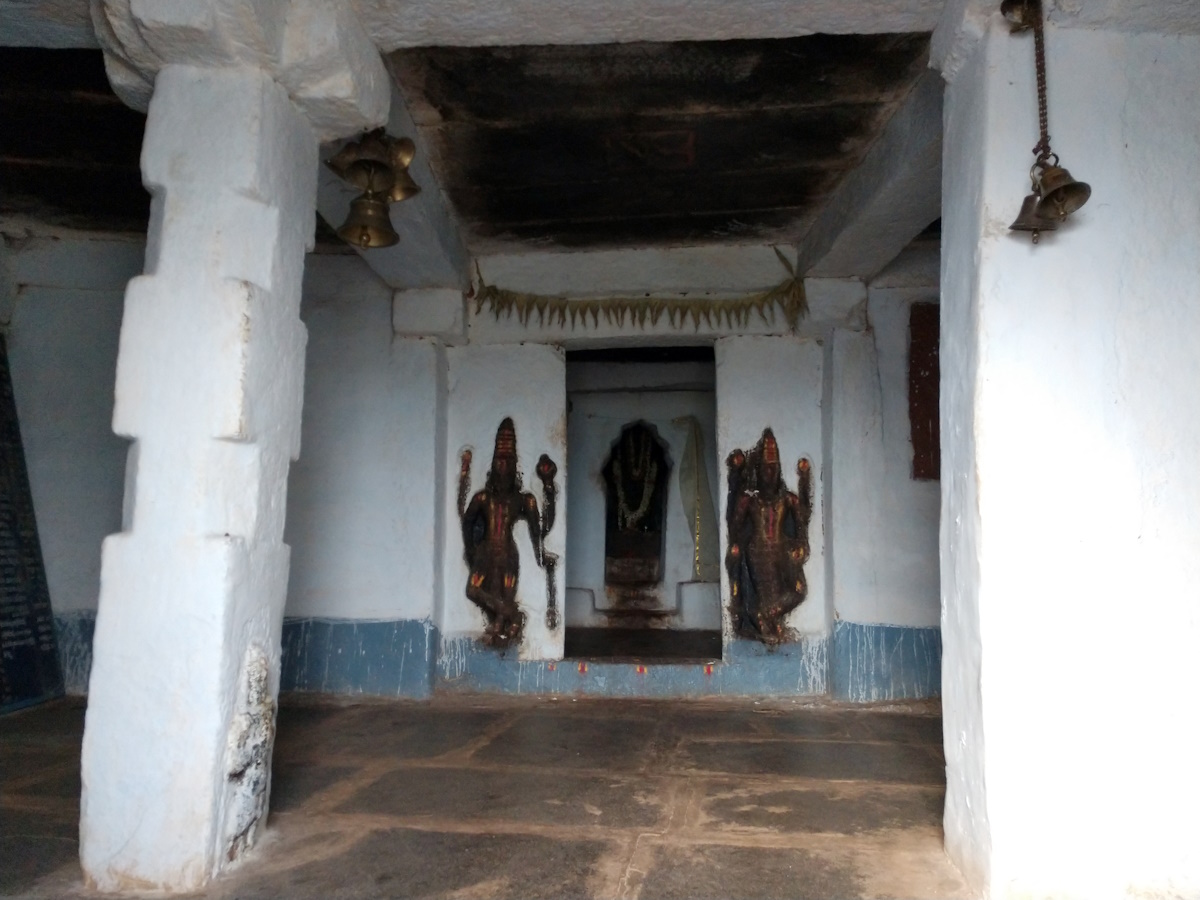
A zoomed in picture, the features are no better. One must come early in the morning when sunrays are directly on the idol, to get a clearer look. We offer our Namaskara from outside and leave.

Another view of the Stambha. The taller pillar has plain faces. The shorter pillar has a female humanoid sculpture close to its base (see inset).

Meanwhile, in the sky high altitude clouds had formed an interesting pattern.

The Shikhara is very interesting pyramid. The transition from a square base to circular top is smooth and elegant. I'm guessing it's a Vimananagara Shikhara. Vimana is an ancient flying machine often mentioned in our country's history. That's it about this temple. People here do not know much about this temple's history. We have to form our own opinions based on observations. Maybe talking to elderly folks in surrounding villages may yield some info.

The light and shadow game of clouds was a spectacle. A sight to behold.

Siddramanna said time to leave, this place is known for animal attacks. We start our downhill journey.

The downhill journey was smooth despite the pebble ridden track and the payload, thanks to Siddaramanna's expert riding. At Sagasandra we stopped at Kempamma Devastana, another ancient shrine however the structure has been renovated in the recent past. Having seen Sagasandra several times, I feel this village was a place of importance in the past. Close to the village's main junction (Aralikatte) is a hero-stone. Also, there seems to be another shrine dating back to Hoysala period. Something to checkout during my future visits.
Mastigudi at Haradagere
During my fourth visit to Sridhar's betelnut farm at Bhogasandra, Sridhar and I had made a social call on an acquaintance from the neighboring village Hardagere. Our acquaintance Indrakumar is a farmer growing mainly coconut and betelnut. While at his place, we chatted mostly about farming and general stuff. I asked if there was any historical place at his village and he mention Mastigudi. After snacks & tea we decided to check out Mastigudi which is situated a minutes walk away. Here we are- a sculptur edepicting a royal couple under a Kirtimukha. According to Indrakumar, this sculpture was housed under a proper shelter made of stone slabs. Presently the roof is gone, only the walls are remaining. In the past this was like a shrine, rituals happened on a regular basis. Now it's in a state of neglect.

The word Mastigudi is a sum of Masti and Gudi. Masti or Mastikallu means a sculpted stone pillar / slab erected in memory of a woman who immolated herself on her husband's funeral pyre. Mastikallu is also known as Sati-kallu. However this sculpture doesn't have the features of a Mastikallu. This seems to be more like a memorial to a couple of a royal family who ruled over this place. By it's looks this sculpture seems to be from Hoysala period. In fact there are several temples in the surrounding region dating back to Hoysala period. To the south of this region are well known Hoysala centers like Turuvekere, Aralaguppe, Nagalapura, etc.

Indrakumar and an elderly person of Hardagere did admit that this monument needs to be cared for. I was gald that such a thought occurred. Perhaps I'll remind them about it during my next visit. Talking about historical places in this region, there are several of them, let me mention a few here. Kempamma Devastana at Kote village, Guddada Ranganatha Swami Devastana near Kote and the Veeragllu of Sagasandra. I've also heard that there are a few ancient sculptures at Bhogasandra village which I'm yet to see.
Trimurti at Chandalingeshwar temple complex
These pictures of Trimurti were shot on Nov 24, 2012 at the remotely situated Sri Chandalingeshwar temple complex near Bilagi. This sandstone sculpture depicts a ten-armed Nataraja in the middle, Brahma on the left and Vishnu on the right. Nandi, Parvati and Ganesha are present near Shiva. Going by the looks of the surfaces, the sculpture could be from Chalukyan times, probably between VII or VIII Century CE.

Chandalingeshwar temple complex is a rectangular enclosure bounded by walls made of sandstone blocks. In the entrance is an open yard. Further inside is a sub-enclosure in which temples are present. This particular sculpture of Trimuti can be on a wall binding the open space. Locals have marked it as Sri Shankaralingeshwara shrine. There could be a deity inside, I'm not sure though.


.JPG)

.jpg)

2 comments:
As usual, an excellent blog on historical places & more interestingly on cannons. Am really amazed at your knowledge on cannons, their history & their metallurgy. Now this has piqued my interest on cannons & let’s see how far my interest in cannons & cannon balls are fired by this article. Excellent article Siddu..keep going.