http://www.rahulsblogandcollections.com/
Seville Cathedral and Giralda Tower
 |
| Seville Cathedral |
 |
| Facade of the Cathedral |
It was built as a mosque in 1172 AD and completed in 1198 AD. Soon after the conquest of Seville by King Ferdinand, it was converted into a cathedral in 1248 AD. The interiors were converted into huge chapels. According to the cathedral chapter, it was said that 'Let us build a church so beautiful and so grand that those who see it finished will take us for mad'. The construction of the Gothic cathedral continued till 1511.
 |
| Giralda Tower |
Among the most noticeable features of the cathedral are its huge area of around 15000 square metres, a great boxlike choir loft, and vast carved scenes from the life of Jesus Christ, The builders preserved some parts of the mosque like the courtyard for ablutions, the huge minaret( converted to bell tower called Giralda) and patios with orange trees. The cathedral has 15 doors on its surrounding four facades. Each of these doors has unique carvings and scenes from Bible depicted on them. The cathedral has 80 chapels in its precincts.
 |
| A View from Giralda Tower |
A climb on the Girala Tower is a must to appreciate the beauty of not only the tower but also the views of the city from the windows and from the top. The decorated facades and the windows on the tower are stepped to match the ramps and maximise the light inside the chamber. After the conversion of the mosque to a church the minaret underwent a change as a bell tower. A cross and a bell were mounted in 1400. This iconic structure became an inspiration for several more buildings that were constructed using similar designs like the Country Club Plaza in Kansas City, The Freedom Tower in Miami, both in the USA and the clock tower at the University of Puerto Rico.
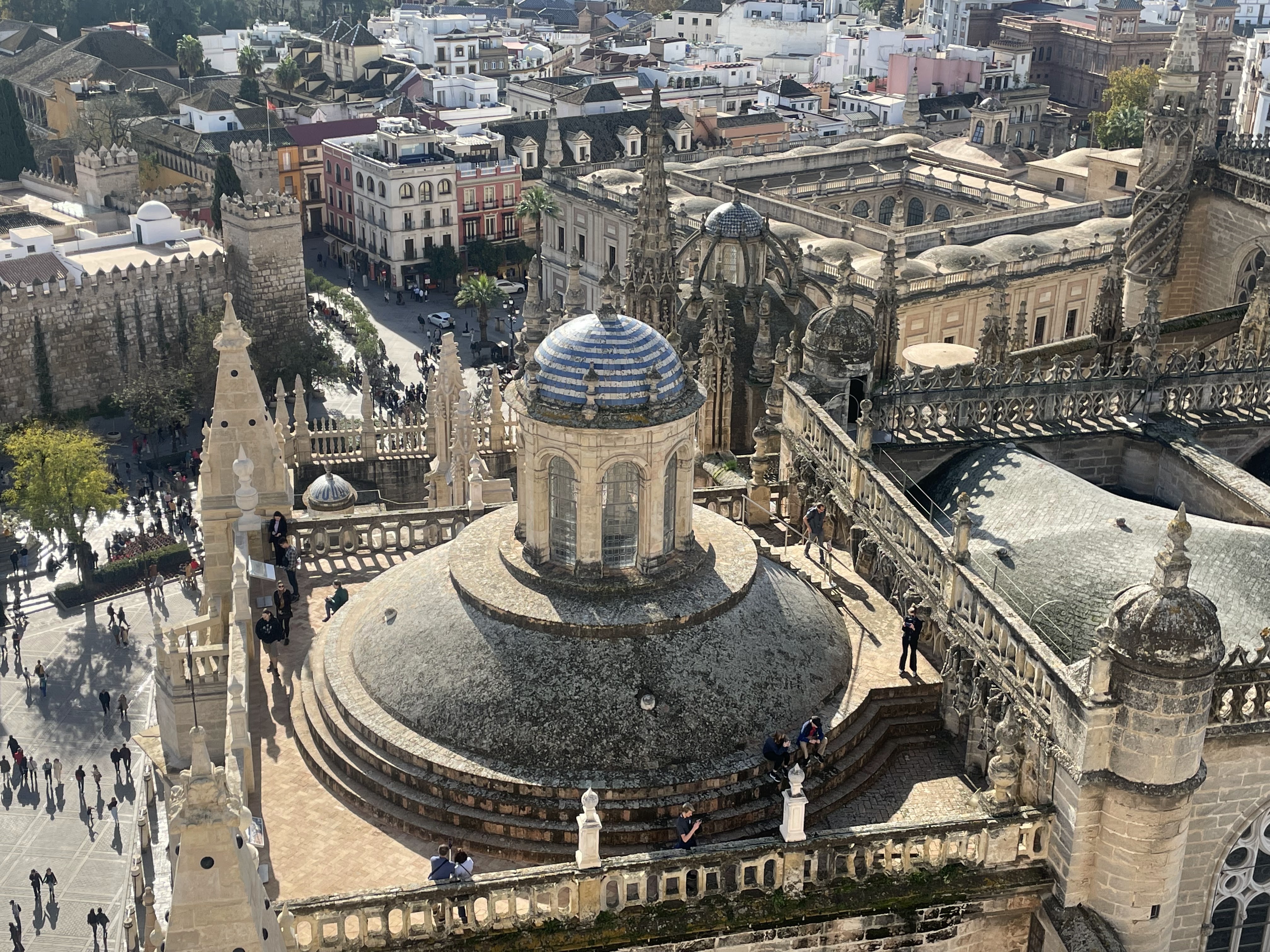 |
| A view of the roofs of the Cathedral |
Some tips for the people who would like to visit the cathedral when in Seville is to visit in the early hours of the day to avoid the rush and also book the tickets online in advance. The 35 sloping ramps take the visitor atop the viewing gallery on the Giralda Tower, The place is restricted so best avoid rush hour to soak the beauty of the city on reaching the top. Finally do not forget to see the final burial place of one of the greatest navigators Christopher Columbus!
PS: All pictures are mine
Real Alcazar- A Treat for the Senses
 |
| The Royal Alcazar |
 |
| The Main Courtyard |
 |
| The intricate tapestry on dome |
The influence of the Crown of Spain is visible in the buildings of Alcazar due to its relationship ever since its creation. The influence of the changing fashion with times is visible in the intricate interiors. One such example is the Courtyard of Maidens which was refurbished in the Renaissance style.
 |
| The lovely inlay work |
 |
| An immaculate tiling work |
The upper floors of the place are still reserved for the monarchy to stay when visiting Sevilla. This place is renowned for its artistic tiles. Different forms of tiles can be seen as one moves from one end to the other end of this palace, Puerta del Leon or the Main Entrance has a huge figure of a Lion holding a cross in its claws. A little further is the Courtyard of the Maidens where according to a legend,
 |
| The beautiful gardens of the Alcazar |
 |
| The jaw-dropping beauty of the gardens |
PS- All pics are mine
Sabores de Seville
 |
| A View from Giralda Tower |
Sabores de Seville, translated as 'flavours of Seville', comes to mind when visiting this splendid city in Spain. The range of exotic flavours especially during the Christmas festive time is a wide array of choices, be it food, the flavour of music and dance, fairs, or illumination in a truly magnificent way. Every nook and corner was vibrant with activity.
 |
| The historic La Campana |
A day spent exploring the magnificent castle and Giralda tower was soul-enriching, The intricate mosaic inlay work in the cathedral, the huge tinted glass, the coffin of Christopher Columbus and bird's eye views of the city from the Giralda Tower were enough to take the breath away. I will devote a full post to sharing my experience of this huge edifice in the forthcoming post. After a walk around, the hunger pangs took over and a quick search brought us to ' La Campana' in the heart of the city. This shop has been in existence since 1885 and the decor has not changed much over time. The beautiful glass cases show off the delicious selections of cakes and pastries. Don't forget to seek the opinion of friendly salespeople who can suggest some exotic treats that will go down memory lane, with the flavours igniting the taste buds. There is a galore of Tortillas, Empanadas and a lot more besides the sweet savouries.
 |
| The Bullfight Arena |
 |
| A Flamenco performance in Sevilla |
A
fitting finale to an eventful day ended on a slightly dark end of a
street where the theatre staging a ' Flamenco Dance' was to be held.
There are several such performances held every evening in Seville and we
were fortunate to attend one. Nobody knows the exact origin of this
electrifying dance but origins can be traced back to the Andalucian
region of Spain, Latin America or the Caribbean. An interesting fact
that I learnt was that around the 9th-14th century, some migrants from
Rajasthan ( yes in India) migrated to Spain. They brought with them
tambourines, bells and wooden castanets and with a repertoire of dances
and music set the stage ablaze. The passage of time with the Jewish and
Moorish influences brought these dances to the present form. The
underlying beauty of these performances is the 'cante' or the song in
its different forms, the rhythm and synchronization of tapping of feet
and gyrations of the performers. The ' baile' or the dance leaves
spectators asking for more.
Alluring Kolkata
 |
| A view of Hoogly |
 |
| The new bridge on Hoogly |
A morning walk to Middleton Street, Victoria and nearby parks like Elliot Park, Ho Chin Minh Sarani, Shakespeare Sarini and Minto Park, which I have done countless times stirs up some lovely memories. The enormous palatial houses built during the colonial era like Kankaria House with sprawling green gardens rub shoulders with the towering edifices of Tata Steel and Virginia House, the headquarters of ITC. The street vendors have lit up their stoves for the preparation of egg rolls, luchi and dum aloo, the fragrance of which starts filling the air. The greatest dichotomy is to see the US Consulate office guarded with uniformed men has an address of Ho Chin Minh Sarani ( the leading communist)!
 |
| A scene of morning Adda on the Theatre Road |
 |
| The legendary tram at Garihat |
On this visit, I travelled to a busy suburb Garihat, known for its huge market for shopping, but with a different agenda. I walked to the 'tram depot' where several trams more than a century old still plying on a few routes were parked. They evolved from horse-drawn trams to steam trains from early 1880 to 1904 when the electric tram got introduced. I boarded the one which was on the Esplanade route and the thrill of riding to Park Circus was akin to a five-year-old on a train ride.
 |
| Inside the Kolkata tram |
 |
| An array of Sandesh at Nepal Sweets |
There are literally hundreds of sweet shops with names like Balram Mallick, Haldiram. Nobin Chandra Das, and some hidden gems all over the city. One such gem is Nepal Sweets on Elgin Road which makes the unique Rose Sandesh, Nalin Gur Sandesh and Kesar Pedas. The sweets in Kolkata need several posts to flavour just a few delicacies.
 |
| Pakuria Salasar Dham temple |
On the way back, the road was slightly crowded and a unique style of overtaking that I witnessed, was the waving of red cloth from the window by the vehicle intending to overtake, A brief halt by the side of the mighty Hoogly was mandatory to soak in the beauty of the old Howrah bridge and the new one. The sight of small boats cast alongside adds to the beauty. The glowing solar panels on the boats were an indicator that the city is not dying but changing with the modern times like many things one sees here. It was a trip where I was rewarded several times with new discoveries.
PS- All pics are mine
The Kissing Street of Seville
 |
| The Kissing Street |
 |
| Juderia |
Just a stone's throw away from the Giralda Tower lies the entrance to the old Juderia, or the Jewish quarters. Once it was the second biggest in Spain after the one in Toledo till the expulsion of Jews in 1483. The neighbourhood is seeping in history, legends of the past and intrigue.
 |
| The Mill Stones on the Walls |
A very lesser-known fact that left me wondering was the sight of round grinding mill stones on the outer facades of some houses in Barrio Santa Cruz. A little probing revealed that these were built into the walls to reinforce them from constant rubbing due to lesser spaces in the narrow streets and to prevent the destruction of the buildings during carnages. The street winds into picturesque alleyways and is sometimes so narrow that on stretching arms both ends of the street can be reached. Probably this is the reason that Al Antiguo Ricon del Besso got its name as the 'Kissing Corner'. It is not difficult to envision illicit lovers on opposite balconies stretching themselves in an embrace.
 |
| Colourful Houses |
Most of the street names are displayed in decorative ceramics adding to the decor. The streets are named after saints, holy orders, or trades performed there. such as Calle Abades Alta( the Upper Abbot Street), Calle de los Boteros(the Street of Wineskin makers), Calle de Azafaran(the Saffron Street) or Calle de las Ropas Viejas( the street where old clothes are sold), The unusual list is fairly long one, but in all fairness need to add one of the best one called Calle de Quebrantahuesos or the Bone Breaking Street. ( maybe because there was a bone-setting hospital that needed to be set up to treat the broken bones by the mafia?). Many of the streets have Arabic names due to the Moorish influence like Calle de la Medina(Meaning the Walled Town in Arabic). A return back to Juderia remains incomplete without seeing Calle de la Vida( or Street of Life) and finally Calle de la Muert( Street of the Dead),
 |
| Beautiful Patios |
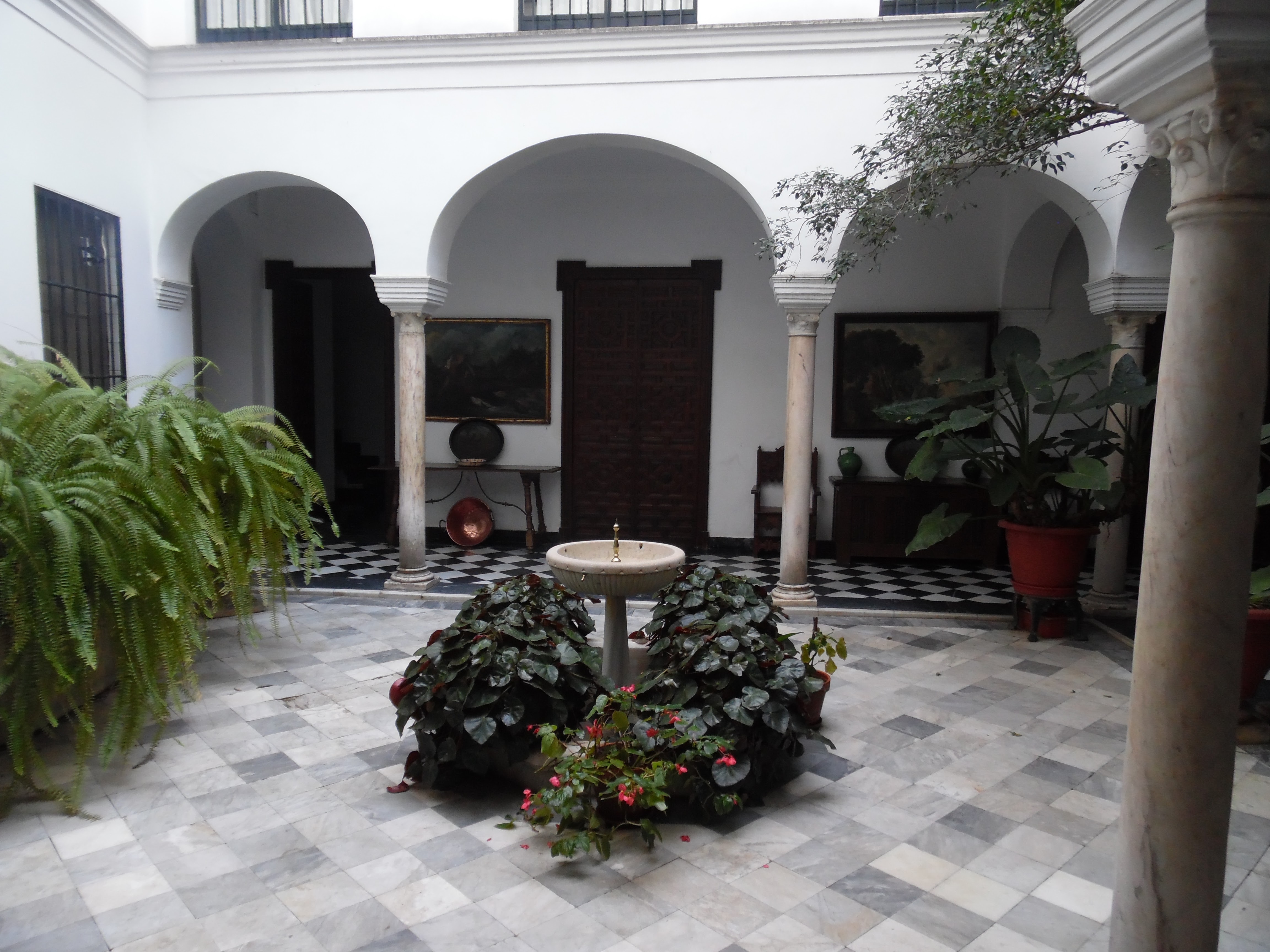
The patios of this neighbourhood have lovely plazas with doors peeking into the houses with beautiful patios complete with columns and potted germanium, bougainvillaeas, and roses of different hues. A white tile outside the house painted in hand with a symbol of a crescent, a cross or a Star of David indicates the owner is a Muslim, a Christian or a Jew.
 |
| The Aqua ducts |
 |
| Jardines de Murilo( Christopher Columbus Memorial) |
It was a day packed with surprises and in my next post I will take you to some more memorable places in Seville
PS All pics are mine
Hola Seville
 |
| The Guadiana International Bridge |
" Hola! Como Se llama"? I asked. ( Hello, what is your name?)
" Mi nombre es Gabreilla" y tu? She replied( My name is Gabriella and yours?)
At last, I was getting to practice the Spanish that I have tried to learn during the times of confinement at home during the Covid times, which has fortunately gotten eclipsed with time. After deboarding the bus we headed for the AirBnB accommodation in the heart of the city. I exchanged a few pleasantries with the cab driver in Spanish before meeting Gabriella, the owner of the accommodation. It felt extremely gratifying to see someone understand what I was saying!
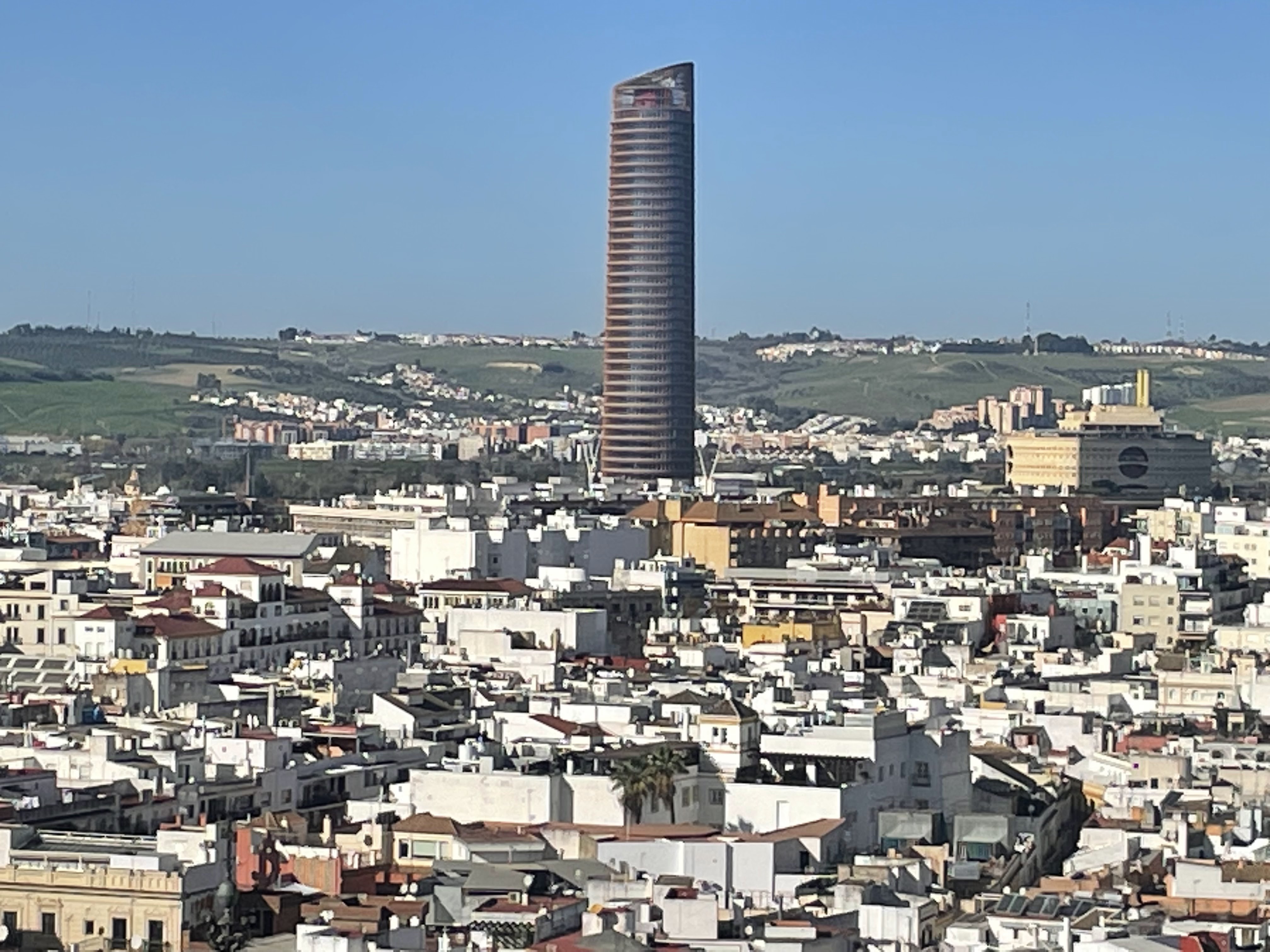 |
| Torren Seville |
It was Christmas eve in the year that just ended when I was travelling from Faro to Seville in Spain. It is a journey of 2 hours and 45 minutes by road and I had chosen Flixbus which was not only comfortable but also provided great scenic views en route. The sight of the orchards of oranges/ tangerines in lush green fields were very captivating. We passed by the impressive Guaidana International bridge spanning over the Guaidana River, with one end in Portugal and the other end in Spain(at Ayamonte). This bridge which is toll-free has drastically cut down the travel time between the two countries. After almost one and a half hours of travel, the bus halted at Huelva, a small port town, The town is surrounded by beautiful beaches making it an ideal place for beach lovers in summer. The journey continued till we sighted Torren Seville( or the Seville Tower, the tallest building in the Andalusia region of Spain) which is very close to the Plaza de Armas bus station.
 |
| The Cathedral |
Quickly, after going around the beautiful accommodation we headed for the town. The narrow cobbled streets of the downtown were humming with activity and we were eager to buy some groceries as otherwise, the stores would close in a few hours for Christmas only to reopen after two days.
 |
| The Christmas Illuminations in the City Centre |
Barrio Santa Cruz is the heart of Seville, centred around the Cathedral with a maze of winding streets. It is home to excellent dining places, museums, and the nightlife of the city. The first glimpse of the cathedral and the towering Giralda tower left us wonder-struck just for its sheer size and opulence. Seville is world-renowned for its majestic architecture, and flamenco dancing. A visit remains incomplete without flavouring the tapas in one of the hundreds of tapas bars that are an integral part of life here. The overwhelming Plaza de Espana built-in Renaissance style with a diameter of 200m is the hub of most of the activities in the city centre.
 |
| The Giralda Tower |
While we were still exploring the city hundreds of neon lights were switched on that illuminated the city like a fairyland. Every street was crammed with onlookers and tourists and music blared from the cafes and cafeterias adding to the charm. It is one of the safest cities for women solo travellers as even during the late hours of the night the place remains peaceful.
It was a long day full of assimilating different cultures and meeting friendly people. We returned back to our place by a different route as it is very easy to get lost in the maze of streets here. I will take you to the beautiful places and the experiences devoured during my stay in Seville in the next post.
PS- All pics are mine
Tavira- A Little Portuguese Jewel
 |
| The Roman Bridge |
Our final destination in Portugal was a place we missed visiting by a whisker as we missed the right connection. Luckily, the disappointment did not last long as after a quick snack at our favourite Urban Bakery in Faro we headed to the tiny railway station along the coastline. It is one of the prettiest railway stations I have seen, overlooking the sea and the rail line passing over a tiny bridge. This was a compelling reason to travel to Tavira by train. There were very few people at the station and the train was to arrive in half an hour. We enjoyed the uninterrupted view of the sea from the railway platform and basked in the sun. A forty-minute train ride from Faro to Tavira is full of surprises as the lovely views of lagoons, quaint villages en route, marshes, and brooks greet the visitors. We passed by the small towns of Olahao, Quelfes, Luz, and Santa Luz till we arrived at Tavira
Tavira is a small town on the Algarve coast nestled along the sea inlets and lagoons of the Ria Formosa natural reserve. Tavira is known for amazing beaches, salt pans that attract flamingoes and spoonbills and other wading birds. A fifteen-minute walk from the railway station through the town that resembles parts of Goa brought is to the city centre. The town was festooned with buntings, Christmas lights and decorations welcoming Santa. The first picturesque sight that greeted us was the Medieval Roman Bridge across the Gialo River, which links the two ends of the town. It is said that long before the Romans that had occupied this town hundreds of years back, the Moors who had migrated from Africa, had constructed this bridge.
 |
| The Excavation site |
The lovely town's origin date back to Phonecians who had settled here in the 8th Century. While exploring the town we came across a recently excavated site where the constructions and artefacts of the era have been excavated.
After the 11 century, this little town grew in prominence in the region. The Moorish occupation from the 8th to 13th century BC left a mark on agriculture, architecture and culture. The influence is visible even today in form of whitewashed buildings, Moorish-style windows and rooftops of the buildings.
 |
| Misericordia church |
Much of the beauty of this place was knocked down by a terrible earthquake in 1755.
 |
| The Clock Tower |
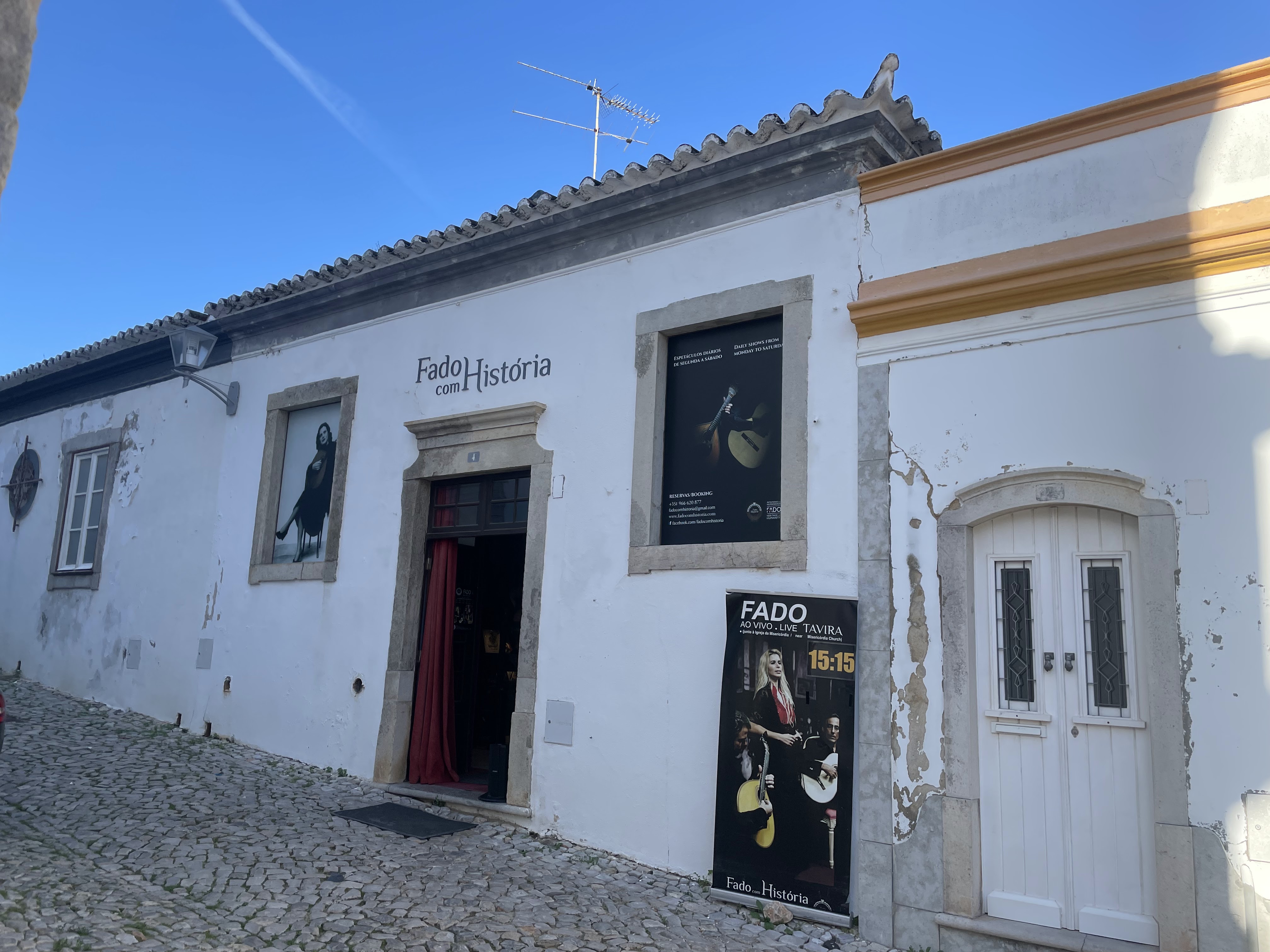 |
| Fado Com Historia |
While exploring the botanical gardens and the old town and immersing in the panoramic views from the elevated old city, we came across Fado com Historia a tourist attraction next to Misericordia church. The stylish place has a capacity of around 50 people where Fado music performances are held every evening to celebrate the form of mournful tunes and lyrics about the sea or the lives of poor people which originated in the 19th century
 |
| The Gran Market Plaza |
The beautiful beaches can be visited by half an hour's boat ride. The turquoise blue sea looks very inviting with boats bobbing on the crest of tiny waves of water. A walk through the Gran Plaza is a must to have a glimpse of cafes, bars vending Sangria( a popular drink), shops and curio sellers lined along. The economy of the place has greatly benefited from the rush of tourists to this town in summer.
This region produces a rich variety of fruits. It is also known for the Mel da Serra de Monchique variety of honey prepared from lavender, citrus plums etc and is used in a large variety of cakes and cookies. The sea salt, sweet potatoes and citrus fruits of this region are also well known.
 |
| A view of the setting sun at Faro lagoon |
After a very satisfying day, we headed back to Tavira railway station to take the return train to Faro, We were rewarded to see the splendid view of the sun at different parts of the lagoon and finally viewing the setting sun at the Faro railway station from where we had commenced our journey. In my next post, I will take you to yet another lovely destination
PS- All pics are mine
Sagres- Where the World Ends
 |
| A Panoramic view of the Atlantic Ocean from Fort Sagres |
After spending the day in Lagos, we decided to hop over to Sagres, another 30 km from there. Sitting at the most south-westerly point of Europe it is a small settlement. It was the most explored point in the ancient world, and we knew little about the place. Perhaps for this reason, the Romans called Sagres the Promontouirm Sacrum or the end of the world. This wind-swept high cliffed region is at the end of the Algarve region in Portugal and is known for the breathtaking views of the surroundings. The place has remained an important location, especially for the sailors, before attempting long voyages.
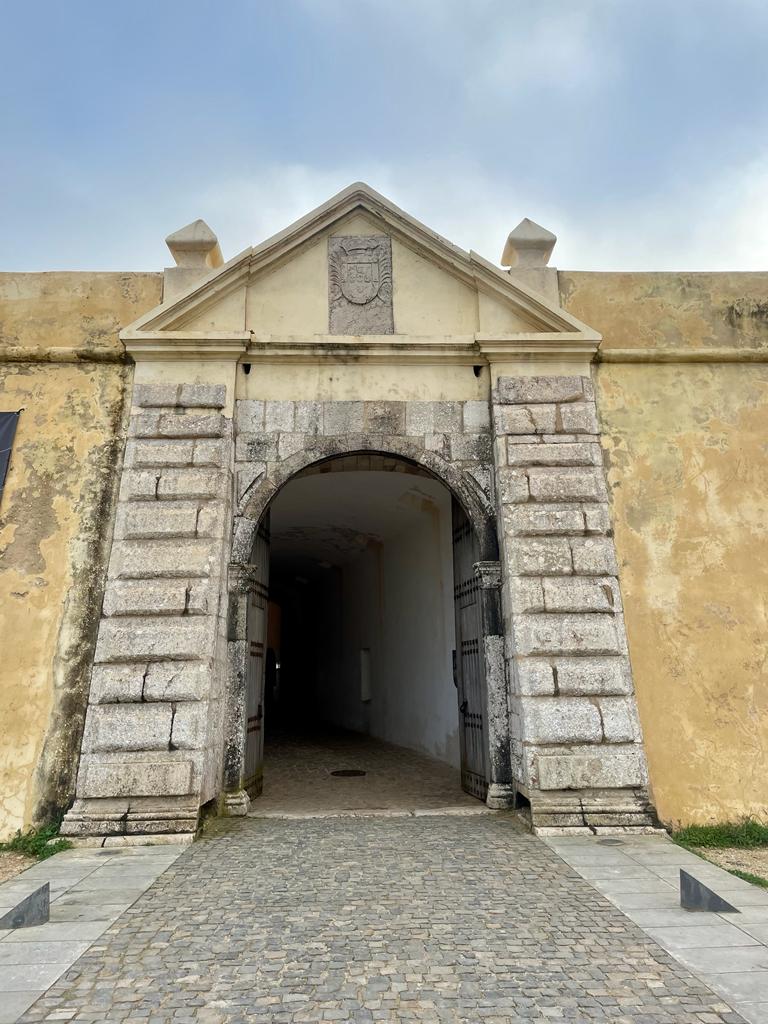 |
| The Main entrance to the fort |
The moment we stepped out of the car at the fag end of a drive, a huge fort appeared before us. Before entering the huge sentinel, we looked around to see the unending view of the Atlantic ocean around us, the huge boulders and hills where the sea waves crashed on either side of the rocky coastline, sending a huge spray of misty water all around. The deep gorges looked very inviting to explore but since we had limited time we had to make the best use of it. So we headed towards the huge entry gate.
 |
| The walls of the fort |
This huge fortress was uniquely designed to protect the town from the raiders from North Africa in ancient times. From this very place Henery - The Navigator planned the trips to explore the continents around the world.
 |
| The Mariner's Compass Dial |
In 1919 a Mariner's Compass ( Rosa dos Ventos) that has a diameter of 50 m was excavated and still stands as a testimony of the marine pursuits from the 16th century. There is also a small chapel in the vicinity, Nossa Senhora da Gracas. Fortaleza de Sagres or the Sagres fort has high walls around the periphery which offer some of the most stunning views of the Atlantic Ocean and the flora and fauna here. The strategic importance of the place was well understood in the 15th century to establish the trade links with adjoining Africa and the Mediterranean coast.
 |
| The Lighthouse |
There is also a lighthouse inside Fort Sagres. In 1587 Sir Frances Drake an English Captain mounted an attack on Fort Sagres when it was under Spanish rule, The place saw several tsunamis and earthquakes and suffered severe damages. Though it has been repaired, the old glory could never be restored.
The Nautical School of Sagres was set up during the time of Henery The Navigator. Many important discoveries, cartography, improved sundials and maps were regularly updated at this school. A number of sailors like Ferdinand Magellan( circumnavigation), Vasco da Gama( found the sea route to India), Pedro Cabral ( discovered Brazil), and Bartoloemu Dias ( went around Africa) had all studied at this Navigation School in Sagres. In 1476, Christopher Columbus was also washed ashore here after being shipwrecked.
It is said that the pilgrims who used to visit the place in the olden days were not allowed to stay at night here, as the place was for God alone! Rick Steves the well-known travel writer has collaborated with Smithsonian Institute to write lucid accounts of this place.
 |
| Lovely views of the coastline and sea |
The sun was setting in the west and the birds returning to their nests when we decided to pack up and head back to Faro after a very satisfying day. In my next post, I will take you to another amazing destination in Portugal.
PS- All pics are mine
A Gateway to the Slave Market- Lagos
 |
| The streets of Lagos decorated for Christmas |
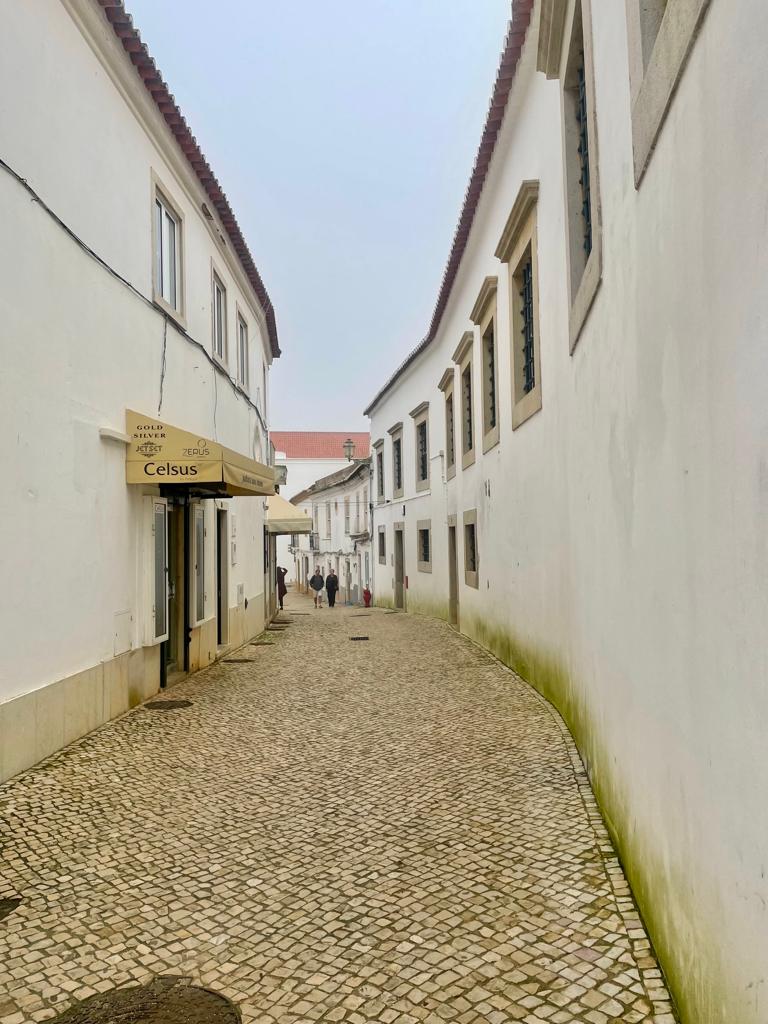 |
| The pretty cobbled streets of Lagos |
 |
| A toiling slave at Mercado de Escravos or the Slave Market |
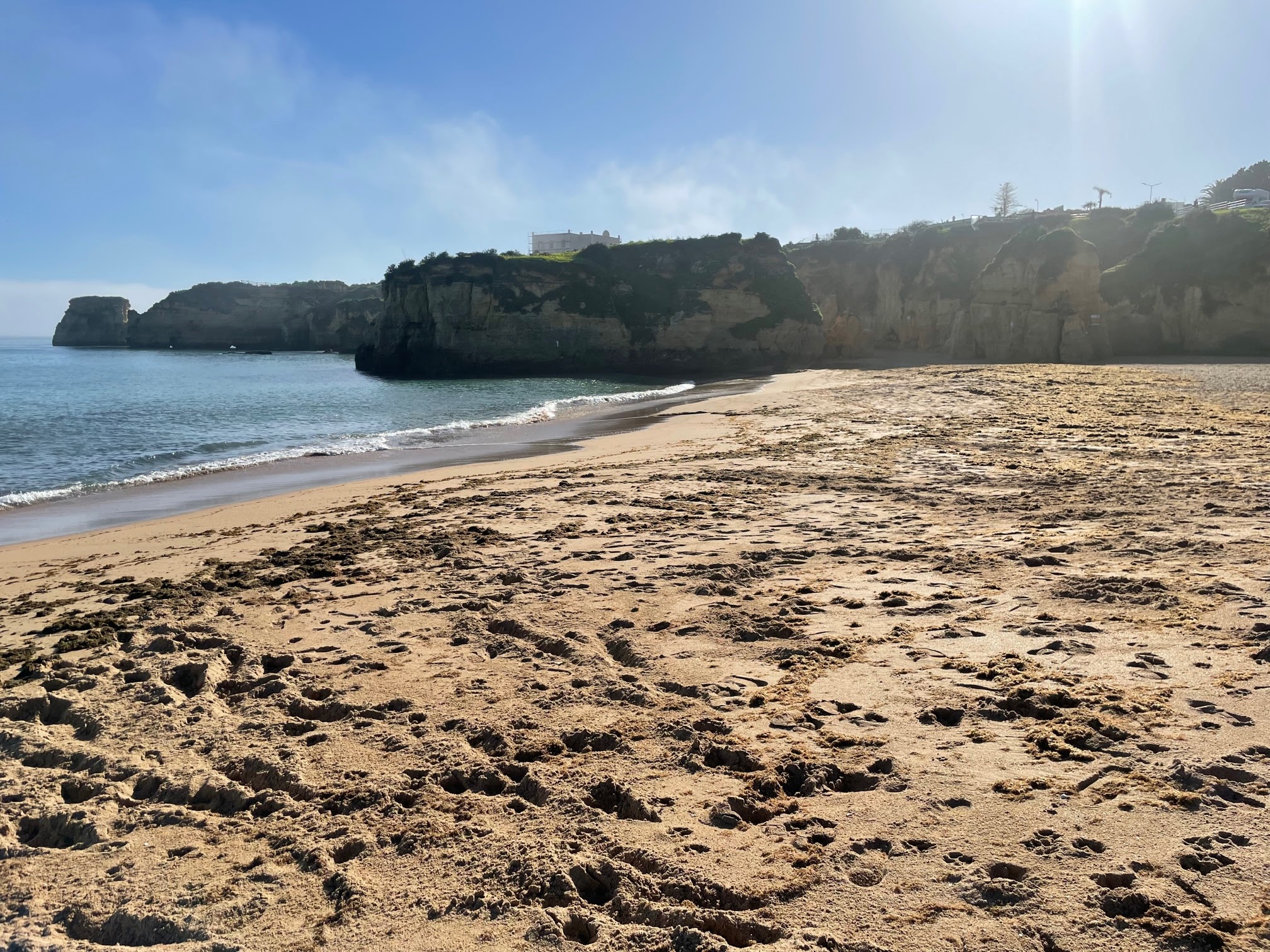 |
| The Potato beach at Lagos |
 |
| A White Rainbow |
 |
| Igrejia de Santa Antonio |
 |
| The statue of King Sebastian |
The Lagoon of Ria Foromsa
 |
| The boat jetty at Faro |
Portugal is blessed with an abundance of natural beauty beside historic monuments, great food and friendly people. I had given a glimpse of Faro, a small town in the Algarve region, in my previous post. Picking the thread from there I continue with the day one proceeding of the evening in Faro. After a quick walk around the Old Town, we headed for the boat jetty which was a short walk from the Old Town. In fact, the entire lagoon of the Faro overlooks the town and is known as Ria Formosa.
 |
| The boats berthed in the lagoon |
Ria Farmsoa in Faro is made up of a cluster of small islands and some are so small that they disappear when there is a high tide. The barrier islands are connected with the six inlets through the sea. Of these, the five inlets have mobility characteristics. The sixth inlet is an artificial one or manmade which was created as an engineering marvel in 1952. The lagoon has a triangular shape with the smallest distance being 100m and the farthest being 6 km. In the year 2010, this lagoon was recognized among the seven natural wonders of Portugal. Ria Formosa gives economic impetus to the region as a number of people are engaged in fishing, seafood, chain of small restaurants around the area. Since this area is a protected one, no polluting boats are allowed to operate to preserve the frail ecosystem. It also serves as a stopping place for the migratory birds. Over 200 migratory birds can be spotted in the region.
 |
| A view of Faro town from the Ria Formosa lagoon |
We had an English-speaking guide who heralded us into a small 75-ton boat of which the weight of rechargeable copper batteries was around 50 tons! It had a noiseless engine and a smooth cruising speed of about 6 knots. It was a bright sunny afternoon as the boat sailed through silent waters manoeuvring through the little islands. It was an incredible experience to see rare birds, flora, and fauna. We were lucky to spot the rare purple swamphen which is also the mascot of the national park. There are a number of salt pans in the area and has a long history of salt production from the Roman times. The barrier islands have an exciting topography ranging from marshes, mudflats, swamps, dunes and tidal channels. The trip lasted around 2 hours and we managed to get a glimpse of some unique things like a lighthouse, some small beaches, an old fort, and water-operated mills that work on the principle of difference in heights of water levels during low and high tides.
 |
| The Old Town as seen from the boat |
 |
| The magical sunset over the Ria Formosa lagoon |
The boat slowly brought us back to the pier from where we had left with some beautiful memories of rare sights and an amazing sunset happening right before us. I will write about more interesting places in Portugal in the next post.
PS- All pics are mine
A Flavour of Faro
 |
| The town of Faro |
It seldom happens that after an almost crystal clear plan to travel, everything turns upside down and a hard course correction is needed. A trip was planned well in advance to visit Israel after more than twenty years but for reasons beyond control had to be abandoned and a new itinerary was worked out in a jiffy. The new trip would entail travel to the Algarve region of Portugal and parts of Spain. After all the preparatory work was done, on a cold winter morning in Amsterdam we boarded a flight to Faro in Portugal. The Schiphol airport was swarming with people as many holidaymakers were leaving for destinations to celebrate Christmas. It was still dark at 7AM when the EasyJet flight took off!
The hangover of having woken up at an unearthly hour was still there when the aircraft landed in Faro. The bright sunny day was a welcome change from the cold days I had witnessed in the Netherlands. Faro is the capital of the Southern Algarve region of Portugal. It seeps with rich history, beautiful beaches, colourful architecture, delicious food, and architecture. Soon after checking in at the place where we were to stay, we set out to explore the town. The small cobbled streets resembled the parts of Goa, where I had lived for over two years a long time back. The nostalgia and aroma from the nearby cafeteria worked like a magnet. The ‘Demo Urban Bakery’ was crowded with people which was an indication of its popularity. We were informed that we will have to wait for about half an hour to be served, but we decided to wait and enjoy the sun. The choice of Bolo Fatia( a pastry), Pao de Deus( the bread of Gods as translated from Portuguese) and Almond Chocolate Croissant with seaming hot coffee more than made up for the wait. Each of these dishes melted in the mouth with a rush of flavours hitherto not known. The place was literally a paradise for food lovers.
 |
| The plaque of Christopher Columbus |
After a fill, we decided to explore the old town where a huge imposing gate marks the entrance to the Old Town. Just before we entered the Old Town, we came across a huge Plaque embedded on a wall at the nearby Tourist Office that tells the story of the life of Christopher Columbus who discovered America. A little-known fact is that the actual name was Christopher Colon which got distorted and he gained popularity around the world with the name Christopher Columbus. I will cover more stories on Christopher Columbus in the blogs that will follow.
The huge gate of the Old Town is known as Cidade Velha. As you look up at the imposing gate, you cannot miss the huge stork nests atop the gate. It is said that a few years ago the largest stork’s nest weighing over 800 kg was brought down in the town. The storks can be found all over the Algarve region and their nests can sometimes be even 9 feet deep and 6 ft wide. The walk up a small climb on the cobbled streets did not last long as we had earlier booked a boat trip to see the shallow lagoons of Rio Formosa that overlook the Faro town. It is one of the most stunning locations which I will describe in the next post.
 |
| The main entrance to Old Town- notice the stork nests atop! |
The Phoenix Rises- Commissioning of INS Vikrant
 |
| INS Vikrant |
Just over a year ago, the reports of Sea Trials of the indigenous aircraft carrier INS Vikrant appeared in the newspapers. I was overwhelmed with nostalgia due to my past association with the earlier aircraft carrier with the same name almost thirty years back. I even wrote a blog post-http://www.rahulsblogandcollections.com/2021/08/ins-vikrant-reincarnated.html recounting my association with the ship which was like a second home to me for almost five years that I had served on her. Little did I realize that I would be fortunate amongst a handful of those who would attend the new ship's commissioning on 2 Sep 22. The thrill of seeing the new ship was akin to a kid being promised a surprise gift. I saw the names of several colleagues and seniors with whom I had rubbed shoulders, and who would be participating in the event.
 |
| A Plaque of some brave men who laid down their lives- At the Maritime Museum |
The impeccable arrangements by the Navy for the event deserve all the praise. On a preceding day, a visit to the new Maritime Museum which has been created at Fort Kochi was organized. It dwells on the history of how the Navy evolved over the centuries. Some rare collections of models of the ships, actual weapons, beautiful replicas of the seafarers and battle honours are on display. It is a treasure trove for those desiring to know more about maritime history.
 |
| The huge hangar side of the ship |
Later in the evening, an Icebreaker event of a get-together of the veterans was a perfect occasion to catch up with those with whom I had spent time onboard as well as other locations. In some cases, the faces were recognizable while in others the names were familiar. Regardless, the love and warmth were rekindled despite the flow of time. The flood of memories and recollections of the times made the time fly. When the earlier INS Vikrant was laid to rest in 1997, the captain of the ship had mentioned in his last dispatch to the men that the Phoenix will rise again, and sure enough, it had. The ladies added colour to the event. It was reassuring to see the determined young men and women in the uniform to whom the mantle had been handed down who would be steering the new ship from the next day post-commissioning. On the way back after the party, the silhouette of the massive new INS Vikrant berthed at the Cochin Shipyard came into the view amidst twinkling lights. It looked formidable and majestic.
 |
| The ship's crest on the flight deck |
At the crack of dawn, the next day, all the invitees for the event had assembled under the tricolour shamiana where the Prime Minister would dedicate the ship in a few hours to the nation. The shipyard had been transformed into an impregnable fortress by the security men. The dignitaries present for the event included the press, school children, veterans, police, paramilitary, the armed forces, bureaucrats, diplomats, the state government, and central government ministers. The pride of joining the ranks of the developed nations who have the capability to make an indigenous aircraft carrier was visible on every face. After, the impressive commissioning and an inspiring speech by the Prime Minister, there were ceremonies on the flight deck of the ship. The new Naval Ensign and the Tricolor were hoisted. A fly-past by different squadrons of helicopters and jets thundered past leaving the audience in awe.
 |
| The Prime Minister dedicated the ship to the nation |
Most of the information related to the huge ship built indigenously are indicators of the advances made in cutting-edge technologies which a handful of advanced nations possess. A feeling of immense pride swept me off my feet as I explored the lower decks, the mammoth hangar, a massive flight deck with an array of weapons, aircraft and navigational aids. The name Vikrant means "courageous" and the motto of the ship is "Jayema Sam Yudhi Sprdhah", which is taken from Rigveda and can be translated as "I defeat those who fight against me". The visit will go down memory lane as one of the finest moments of my association with the navy\

.JPG)

.jpg)

No comments:
Post a Comment
Note: Only a member of this blog may post a comment.