Top 10 temples in Hong Kong
Everyone should visit the Hong Kong temples and these are the top 10 temples to visit:
1. Po Lin Monastery (Big Buddha) in Lantau Island:

The temple is home to three big golden Buddha statues as well as the 34-meter high, 250-ton bronze Tan Tien Buddha statue, which can be seen for miles around. Originally, this temple was opened to the public in 1970, but after the completion of the Big Buddha in 1993, this temple became the mainstay of tourists.
2. Wong Tai Sin Temple in Kowloon:

The 18,000sqm temple is the most popular temple in Hong Kong. This temple is dedicated to the three major religions in China –Confucianism (Confucius), Taoism (Wong Tai Sin), and Buddhism (Guanyin).
3. Man Mo Temple in Central:

This temple is the oldest and certainly one of the most sacred Hong Kong temples. People are captivated by the mystical ambiance that is created by the smell of incense and the lingering smoke. It is named after its two principal deities: Man, the god of literature, who is dressed in red and holds a calligraphy brush; and Mo, the god of war, wearing a green robe and holding a sword. If you want to visit any Hong Kong temples, then this one is highly recommended.
4. Ten Thousand Buddha’s Monastery in Sha Tin (New Territories):

The Ten Thousand Buddhas Monastery (called Man Fat Tsz in Cantonese) is a fascinating Buddhist temple located in Sha Tin in the New Territories. This temple is spread over 8 hectares of land and houses a sprawling collection of Buddha images. This is one of Hong Kong’s popular tourist attractions and most famous Buddhist temples too.
5. Pak Tai Temple in Cheung Chau Island:

This temple is most popular during the Bun Festival which takes place in the fourth lunar month each year, usually in April or May. Many people come down to the small island of Cheung Chau Island. They enjoy a cacophony of percussion drums, a colourful parade, lion dancing, and loads of buns and baked snacks.
6. Che Kung Temple at Sha Tin:

This temple is listed as a grade II historic building in Hong Kong. It dates back more than 300 years, marking the precious cultural value of the structure.
7. Ching Chung Koon:

Ching Chung literally means ‘evergreen pine tree’ and Koon means ‘Daoist Temple.’ The temple also holds a lot of precious relics including lanterns bestowed by the Beijing Imperial Palace and elegant Chinese calligraphy.
8. Fung Ying Seen Koon:

Fung Ying Seen Koon is a sacred spot for Daoism in Hong Kong. This temple is one of the best places to visit in Hong Kong and is named after two divine mountains, Ying Chau Mountain and Fung Lai Mountain. Traditional Chinese culture is illustrated perfectly in the colour scheme of the temple.
9. Hung Shing Temple:

The remote island of Kau Sai Chau is where this temple is located. This temple is one of the Declared Monuments in Hong Kong. It has attained the third place in UNESCO’s Asia-Pacific Heritage Awards in 2000. It is an interesting stop-off to see the seafaring collectibles and dragon boat models that are displayed throughout.
10. Tin Hau Temple:

Tin Hau Temple at Lam Tsuen is the most popular among all the Tin Hau Temples in and around Hong Kong. This is because of the two well-known wishing trees growing within its boundaries. The goddess of the sea, Tin Hau, who has magical powers to protect the fishermen is enshrined in the temple.
Apart from the remarkable skyline, mouth-watering street food courts, luxurious shopping malls, and Chinese structures, the Hong Kong temples are also worth visiting.
Coorg - A refreshing monsoon gateaway


With our happy tummies, we headed to the Ingalakere lake (man-made reservoir), a couple of kms from Nandroling. The lake was a chilled out place with benches and a small walkway. The lake has abundant fish and people come here to feed them.


As we explored the complex (did not go inside the monastery), being the only tourists 9that too girls!), we did feel a bit awkward, but curiosity kept us going. The complex was huge and offered lots of open space. It seems like there were several living quarters just outside the boundary wall too!


Sri Channakesava Devastana, Kaidaala
...continued from Gangadareshwara Devalaya, Gulur. Our next stop i.e. Kaidala Chennakesava was just 2 km away, about 5 minute drive by car. Since the temple is on the outskirts, we did not enter Kaidala village. Around the temple is plenty of open space and trees. We parked the car under and headed towards the Gopura. Honestly I hadn't expected to see such a well maintained monument. Good work by the concerned government department and village people.
Sri Chennakesava Devalaya Gopura is a three tier tower, it's design is a fine example of Hoysala / Vijayanagara architecture. While the temple was constructed during Hoysala period, the Gopura was either constructed / renovated during the Vijayanagara period. Let's take a look at the historical information provided on the boards planted here by state govt.

Below are the transcriptions of Kannada and English boards by Tumakuru District Tourism Development Committee:
ಕೈದಾಳ : ಇದು ಅತ್ಯಂತ ಪ್ರಾಚೀನ ಚಾರಿತ್ರಿಕ ಸ್ಥಳವಾಗಿದೆ. ಇಲ್ಲಿ ಹೊಯ್ಸಳ ದೊರೆ ಮೊದಲನೇಯ ನರಸಿಂಹನ ಸಾಮಂತ ಗೂಳಿಬಾಚಿದೇವನು ಕ್ರಿ.ಶ.1150 ರಲ್ಲಿ ನಿರ್ಮಿಸಿದ ಗಂಗಾಧರೇಶ್ವರ, ರಾಮೇಶ್ವರ ಮತ್ತು ಚನ್ನಕೇಶವ ದೇವಾಲಯಗಳಿವೆ. ಪಶ್ಚಿಮಾಭಿಮುಖವಾಗಿರುವ ಚನ್ನಕೇಶವ ದೇವಾಲಯದ ಗರ್ಭಗುಡಿಯಲ್ಲಿ 167.64 ಸೆ.ಮಿ. ಎತ್ತರದ ಸುಂದರವಾದ ಚನ್ನಕೇಶವ ಮೂರ್ತಿಯು ಗರುಡ ಪೀಠದ ಮೇಲಿದೆ. ಪೀರದಮೇಲೆ, ತ್ರಿಮೂರ್ತಿ-ಬ್ರಹ್ಮ, ವಿಷ್ಣು ಮತ್ತು ಮಹೇಶ್ವರರ ಶಿಲ್ಪಗಳಿವೆ. ಇಕ್ಕೆಲಗಳಲ್ಲಿ ಶ್ರೀದೇವಿ ಮತ್ತು ಭೂದೇವಿಯರ ಸುಂದರವಾದ ಶಿಲ್ಪಗಳಿವೆ. ಮಕರ ಸಂಕ್ರಾಂತಿಯ ದಿನ ಸೂರ್ಯಾಸ್ತದ ಕಿರಣಗಳು ಕೇಶವನ ಎದುರಿಗಿರುವ ಗರುಡಮೂರ್ತಿಯ ಕಿವಿಯ ಕೆಳಭಾಗದಿಂದ ಮುಖ್ಯ ದೇಗುಲದ ಗೋಡೆಯಲ್ಲಿನ ಎರಡು ರಂಧ್ರಗಳ ಮೂಲಕ ದೇಗುಲದ ಒಳಕ್ಕೆ ಪ್ರವೇಶಿಸಿ ಚನ್ನಕೇಶವ ಮೂರ್ತಿಯ ಪಾದವನ್ನು ಸ್ಪರ್ಶಿಸುವಂತೆ ನಿರ್ಮಿಸಿರುವುದು ಈ ದೇವಾಲಯದ ವಾಸ್ತು ವಿಶೇಷವಾಗಿದೆ. - ಜಿಲ್ಲಾಧಿಕಾರಿಗಳು ಹಾಗೂ ಅಧ್ಯಕ್ಷರು, ಜಿಲ್ಲಾ ಪ್ರವಾಸೋದ್ಯಮ ಅಭಿವೃದ್ಧಿ ಸಮಿತಿ ತುಮಕೂರು ಜಿಲ್ಲೆ.
Kaidala: It is a very ancient historical place. Here there are Gangadhareshwar, Rameshwar and Channakesava temples built in 1150 AD by Gulibachideva, a colon of the first Hoysala ruler Narasimha. 167.64 cm in the sanctum sanctorum of Channakesava temple facing west. A tall and beautiful idol of Channakesava stands on the Garuda Peetha. On the pedestal, there are sculptures of Trimurti- Brahma, Vishnu and Maheswara. Both have beautiful sculptures of Sridevi and Bhudevi. The special feature of this temple is that the sunset rays of Makar Sankranti enter the temple through two holes in the wall of the main temple from the bottom of the ear of the Garudamurthy in front of Keshava and touch the feet of Channakesavamurthy. - Deputy Commissioner and Chairman, District Tourism Development Committee, Tumakuru District.

Below is the transcription of the board planted by the Department of Archaeology Museums & Heritage:
ಶ್ರೀ ಚೆನ್ನಿಗರಾಯ ದೇವಾಲಯ, ಕೈದಾಳ, ತುಮಕೂರು
ಕೈದಾಳಕ್ಕೆ ಕ್ರೀಡಾಪುರವೆಂಬ ಹೆಸಡಿತ್ತು. ಇದು ಶಿಲ್ಪಿ ಜಕವಾಚಾರಿಯ ಜನ್ಮ ಸ್ಥಳ ಎನ್ನಲಾಗಿದೆ. ಚಿಕ್ಕಸಿಕಾರಿಯ ಮಗ ಸಂಕಣಾಚಾರಿ ಬೇಲೂರು ಚೆನ್ನಿಗರಾಯ ಮೂತಿಯಲ್ಲಿ ದೋಷವನ್ನು ಕಂಡು ಅದನ್ನು ತೋರಿಸಿದಾಗ ಜಕಣಾಚಾರಿ ತನ್ನ ಬಲಗೈಯನ್ನು ಕತ್ತರಿಸಿಕೊಂಡ, ಅನಂತರ ತನ್ನ ಹುಟ್ಟೂರಾದ ಕೈದಾಳಕ್ಕೆ ಬಂದು ಅಲ್ಲಿ ಚೆನ್ನಿಗರಾಯನ ದೇವಾಲಯ ನಿರ್ಮಿಸಲು, ಜಕಣಾಚಾರಿಗೆ ಪುನಃ ಕೈ ಬಂತು. ಆದ್ದರಿಂದ ಆ ಊರಿಗೆ ಕೈದಾಳವೆಂಬ ಹೆಸರಾಯಿತು ಎಂದು ಐತಿಹ್ಯವಿದೆ. 1150-51ಲ್ಲಿ ಹೊಯ್ಸಳ ೧ನೆಯ ನರಸಿಂಹನ ಸಾಮಂತನಾಗಿದ್ದ ಬಾಚಿ ಅಥವಾ ಗೂಳಿಬಾಚಿ ಎಂಬುವನು ಇಲ್ಲಿ ಶಿವ, ವಿಷ್ಣು ಮತ್ತು ಜಿನ್ ದೇವಾಲಯಗಳನ್ನು ಕಟ್ಟಿಸಿದನೆಂದು ಇಲ್ಲಿನ ಒಂದು ಶಾಸನದಿಂದ ತಿಳಿದುಬರುತ್ತದೆ. ಈಗ ಚೆನ್ನಕೇಶವ ಮತ್ತು ಗಂಗಾಧರೇಶ್ವರ ದೇವಾಲಯುಗಳು ಮಾತ್ರ ಉಳಿದಿವೆ.
ಚೆನ್ನಕೇಶವ ದೇವಾಲಯ ದ್ರಾವಿಡ ವಾಸ್ತುಶೈಲಿಯಲ್ಲಿದೆ. ಮೂಲತಃ ಇದು ಹೊಯ್ಸಳ ಕಾಲದ ದೇವಾಬದುವಾಗಿದ್ದರೂ ಅನಂತರದ ಕಾಲಗಳಲ್ಲಿ ಬಹುವಾಗಿ ನವೀಕೃತವಾಗಿರುವಂತೆ ತೋರುತ್ತದೆ. ದೇವಾಲಯದ ಮಹಾದ್ವಾರದ ಮೇಲಿನ ಗೋಪುರ ವಿಜಯನಗರ ಕಾಲದಲ್ಲಿ ನಿರ್ಮಿತವಾದದ್ದು, ಚೆನ್ನಿಗರಾಯನ ಮೂಲವಿಗ್ರಹ ಬಹು ಸುಂದರವಾಗಿದೆ. ವಿಗ್ರಹ 5.1 ಅಡಿ ಎತ್ತರವಿದ್ದು 2.1 ಅಡಿ ಎತ್ತರದ ಪೀಠದ ಮೇಲೆ ಸ್ಥಾಪಿತವಾಗಿದೆ. ವಿಗ್ರಹದ ಪ್ರಭಾವಳಿಯಲ್ಲಿ ದಶಾವತಾರದ ಚಿತ್ರಗಳಿವೆ. ಮಹಾದ್ವಾರದ ಬಲಬದಿಯ ಕಂಬವೊಂದರ ಮೇಲೆ ಪತ್ನಿಸಹಿತವಿರುವ ಚೆನ್ನಕೇಶವನ ವಿಗ್ರಹವಿದೆ. ಎಡಗಡೆಯ ಕಂಬದ ಮೇಲೆ ಅಂಜಲಿಬದ್ದನೂ ಉತ್ತರೀಯಧಾರಿಯೂ ಖಡ್ಗಭೂಷಿತನ ಆದ ಮೂರ್ತಿಯನ್ನು ಕೆತ್ತಲಾಗಿದೆ. ಇದು ಜಕಣಾಚಾರಿಯ ಶಿಲ್ಪ ಎಂದು ಐತಿಹ್ಯ. ಆದರೆ ಇದು ಗೂಳಿ ಬಾಚಿಯ ಮೂರ್ತಿಯಾಗಿರುವ ಸಂಭಾವ್ಯತೆ ಇದೆ.
ಆಯುಕ್ತರು ಪ್ರಾಚ್ಯವಸ್ತು ಸಂಗ್ರಹಾಲಯಗಳು ಮತ್ತು ಪರಂಪರೆ ಇಲಾಖೆ, ಮೈಸೂರು.
Sri Chennigaraya temple, Kaidal, Tumkur
Kaidal was known as Kreedapura, it is said to be the birthplace of sculptor Jakanachari when Jakanachari's son Dankanachari found a defect in the idol of Belur Chennigaraya and showed Jakanachari cut off his own right hand, then came back to his hometown Kaidala and built the temple of Chennigaraya, he regot his cut-off hand. Afterwards legend he says that the town became known as Kaidala.
One inscription shows that Bachi or Gulibachi, a Kaidala ruler of Hoysala Narasimhai built the shrines of Shiva, Vishnu and Jina in 1150-51 CE. Now only the Chennakesava and Gangadhareshwara temples remain.
Chennakeshava temple is in Dravidian architectural style although originally a temple of the Hoysala period, it seems to have been largely renovated in later times. The tower on the temple main gateway was built during the Vijayanagara period and the original idol Chennigaraya is very attraction. The idol is 5.1 feet high and is installed on a 2.1 feet high pedestal. There are idol of Dasavatara in the Prabahavali of the image on one of the pillars on the right side of the gateway is a idol of Chennakeshava, who is with wife. On the pillar of the left side idol is a darned with Uttanga sword and folded palms itis said to be sculpture of Jakanachari but it has the possibility to be the idol of Gulibachi.
Commissioner, Dept. of Archaeology Museums & Heritage, Mysore.
The first writeup seems to be erroneous, looks like it wasn't proofread prior to inscribing it in stone. The second writeup has interesting information, particularly the story of Jakanachari regrowing hands.
Below is a collage of pictures of the columns in the doorframe of the Gopura. The columns feature a pair of beautiful girls in a graceful pose, flowery creepers and imaginary creature. The girls, adorned in jewelry from head to toe, are standing on Yali, the imaginary creature. Going by the looks of the sculptures, one can say these are Vijayanagara time creations.

Here's another collage showing the two middle columns inside the Gopura. Lord Vishnu and Garuda adorn one of the pillars. The other pillar has a stout well built male figure, no idea who it is. At the pillar base is a Yali.

The inner side of the Gopura. The base of the Gopura i.e. the stone walls have some interesting sculptures... men of horses and camels. elephants and fishes.

The elephants on the right hand side wall look like they are in a stable. Coming to the fishes, two large fish are competing each other for a smaller fish.

The left hand side has a pair of Yali, a fish, and the third sculpture seems like a lion. Then we have what seems like a procession of important people. The procession is led by a footman, followed by warriors on decorated horses. The troupe ends with a camel, it isn't clear if the rider is a man or woman.

A diagonal view of the Gopura. That's a Banni tree, an important plant in Hindu traditions.
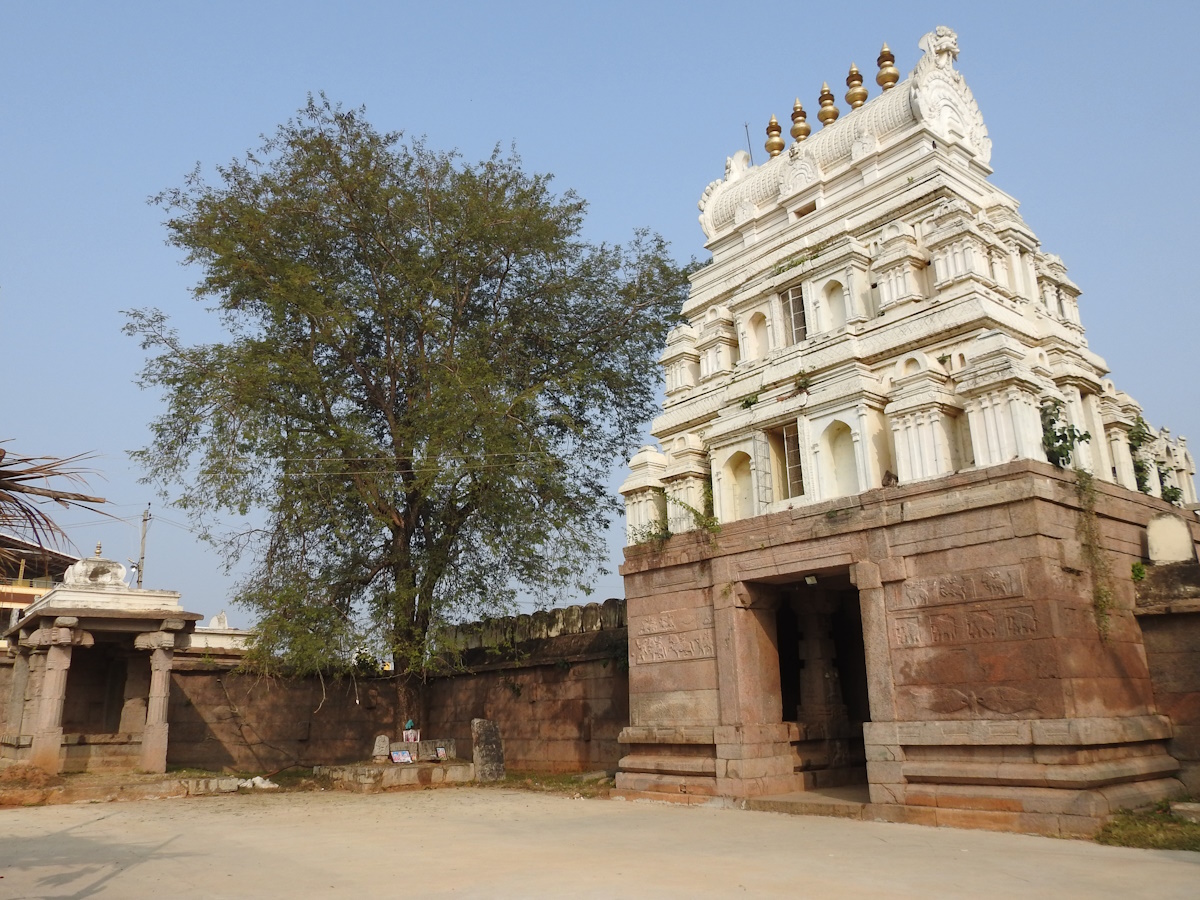
The temple's rear view. The Shikhara seems to be Vimana type. The walls are plain and simple, not like the heavily sculpted exteriors of other Hoysala temples seen in Tumkur district.

In my tours, I have rarely seen a Shikhara and Gopura of the same temple in good condition. One must appreciate the efforts of local people in maintaining this temple's cleanliness.

This is the rear door, placed on the southern side of the temple. Even though the temple's main entrance is north-facing, the sanctum is west-facing which is quite rare.

Coming to the western side, there's a smaller temple dedicated to Garuda, Vishnu's vehicle.

The temple is unique. It's basically a sanctum with a wide Mukhamantapa. The deity, Garuda Murti is about 3' tall (see inset). Also in front of this little temple is a stubby little pillar.

Next to Garuda Devastana is a small mantapa which is fused into the compound wall. The mantapa's stage is elevated. This could be a stage for special occasions like weddings or birthdays.

Next to the little mantapa is the Banni Mara, almost in the northwestern corner of the temple premises. Under the Banni tree are two ancient sculptures. The horizontal one is Saptamatrika and the vertical slab is a memorial stone. The former is broken into two pieces. The latter is in memory of two lady warriors. The lowest panel shows one of the warriors armed with a bow. The middle panel shows fairies accompanying the two warriors. Between the lower and middle panels is and inscription. In the upper panel, the two warriors have merged into Shivalinga.

Lastly coming to the temple's main entrance.. the elephant balustrade is an interesting creation. If you ignore the trunk, you'll be looking at a boar. Well, that's my imagination, may not be the sculptor's intention to create an illusion.

Since the temple door was closed we hadn't seen the interior. We had moved on to see the neighboring temple Gangadareshwara Devalaya which too was closed. A group of seven or eight people had come to see Chennakesava Devalaya, apparently they had requested the poojari for a darshan. Fortunately for us, we got an opportunity to see Chennakesava Murti. The idol is an amazing piece of art, decorated with fresh flowers and glittering jewels. I was captivated by the shimmering diamonds as the poojari did arti... the warm light from oil lamp reflecting off the gems was a sight to behold. No photography inside, so no pictures of the interior.
The four wheels must belong to the temple chariot. I do not remember seeing the 'Theru' here, maybe I missed it. On the Gopura outer walls are relief sculptures of battle... two swordsmen, elephants charging at each other and horses leaping. Also a group of musicians are shown in niches.

A stone's throw from the Gopura is an small incomplete temple. On it's front walls are two relief sculptures of Vishnu.

That's it about Chennakesava Devalaya. Right in front of the temple is a 30+ acre plot under the state forest department. The gates were open, I went in with a hope of seeing Krishna Ficus. I searched the part closer to the gates, around the pergola but no such luck. One of the local guy who hung around with me out of curiosity, I showed him a picture of Krishna Ficus leaves on my mobile phone. He doesn't remember seeing any cup-shaped leaf here but he did say that this was a large area to check. I aborted the search since it was getting warm and we wanted to reach Bhogasandra by noon.
When I started this post, I realized missing out Rameshwara Devalaya at Kaidala. I'll have to make another trip a week or two after Ganesh Chaturti to see the making of Maha Ganapati at Gulur, and also visit Rameshara Gudi at Kaidala.
Ishwara Devastana and Nagara Katte, Guluru
...continued from Sri Maha Ganapati Devastana and Sri Beteraya Swami Devastana. Just after seeing Beteraya Devastana, we learned about Ishwara Devastana. another ancient temple a two-minute walk away. The temple literally the northeastern corner of the village. Also the temple site is situated right besides Gulur Kere bund. This is the Shivalaya, it's ancient but it has almost lost it's original form. Thanks to the maintenance work with modern material. Anyway, one has to admire the villager's will to preserve this temple.

The temple's yard is occupied aby an ancient Peepul tree, a Banni tree, a Neem tree and few banana plants. The temple gates were locked and inner doors were shut. I think this temple gets visitors once a week i.e. on Shiva's day Monday.

We step out the temple premises and climb the tank bund steps. This is the view of the Shivalaya from the bund. The curved wall seen here also seems ancient, may be a hundred years old. I guess it was built when Gulur Kere bund underwent maintenance. Originally this Shivalaya sat on the lake shore. A bund was built to increase the lake's storage but the temple was left as it is. The engineers put a retaining wall instead of earthen bund. Thanks to the engineers for preserving this holy place's sanctity.

Taking a few steps backwards, the Shivalaya's Stambha comes into view. Only the Stambha has been removed and fixed at a slightly elevated position. The Stambha design and texture gives a clue of it's age. I'm guessing it's around 500 years old i.e. Vijayanagara period.

Also there's an idol of Nandi seated on a pedestal. This Nandi idol is similar in looks & size to the pair of Nandi marking the ancient entrance of Gulur i.e. near Beteraya Devastana. That's my friend Sridhar, from here we could be heading to his farm in Bhogasandra village.

In the background is a walled enclosure which evoked curiosity. Inside the enclosure are rows of stones fixed into the ground.

The enclosure is called Nagara Katte which literally means serpents' platform. Almost all ancient temples had a raised platform dedicated to serpent idols. Also on the platform would be a Peepul tree. Somehow here we have a huge plot dedicated to Naga stones. According to the stone plaque on the wall, this place was reconsecrated on June 18th 2008.

At the far end of the enclosure are larger stones with faded sculptures of serpents i.e. Nagas.

Lastly, before I close this post, a view of Gulur Kere. This waterbody is quite big, about 1500m long and 600m wide. I guess this is one of the sources of water for Gulur village.

Done with Gulur village for the time being. From here we head towards Kaidaala to see Sri Chennakesaava Devastana. It is said that Kaidala is the legendry sculptor Jakanachari's hometown.
Sri Beteraya Devalaya, Gulur
...continued from Guluru Maha Ganapati Devastana.
After Maha Ganapati darshan we came back to the spot which happens to be the ancient entrance of Gulur village. A twin Nandi and a cobble-stoned ramp marks the place. We came back here to take pictures of the ancient gateway, that's when I noticed another ancient temple to my left. A board planted close to this Dwara stated two names- 1. Sri Byateraya Swami Devalaya and 2. Basavanna Swami Devalaya. The latter was already known hence the former is the temple we are about to see. The gateway is a Mantapa made of 8 columns, it's architecture is Vijayanagara. That's Sridhar posing in front of the gateway.

The gateway passage is flanked by raised platforms spacious enough to seat a dozen adults. The lime coating on the pillars is concealing it's features. If not for the lime, the relief sculptures would be visible easily. One of the columns has sculptures of Ganesha and Anjaneya. Also several musicians and dancers depicted on the columns.

The gateway as seen from the inside. Between the temple and the gateway is the Stambha which seems pretty ancient, probably of the same time as rest of the structures here.

At the base of the Stambha is an image of Anjaneya Swami. Also present here is a lotus stone.

The temple structure is simple but it's large enough to accommodate a hundred people inside. Also the temple has sufficient open space around it for a larger crowd. Unfortunately the temple gates were locked, we could see a pair of closed doors through the gates.

This space, i.e. between the gates and doors is the Sabhamantapa. Beyond the closed doors, I'm guessing is another hall, and at the end is the sanctum of Beteraya, a form of Vishnu.

Rear view of Beteraya Devastana. I was happy to see a well maintained structure..

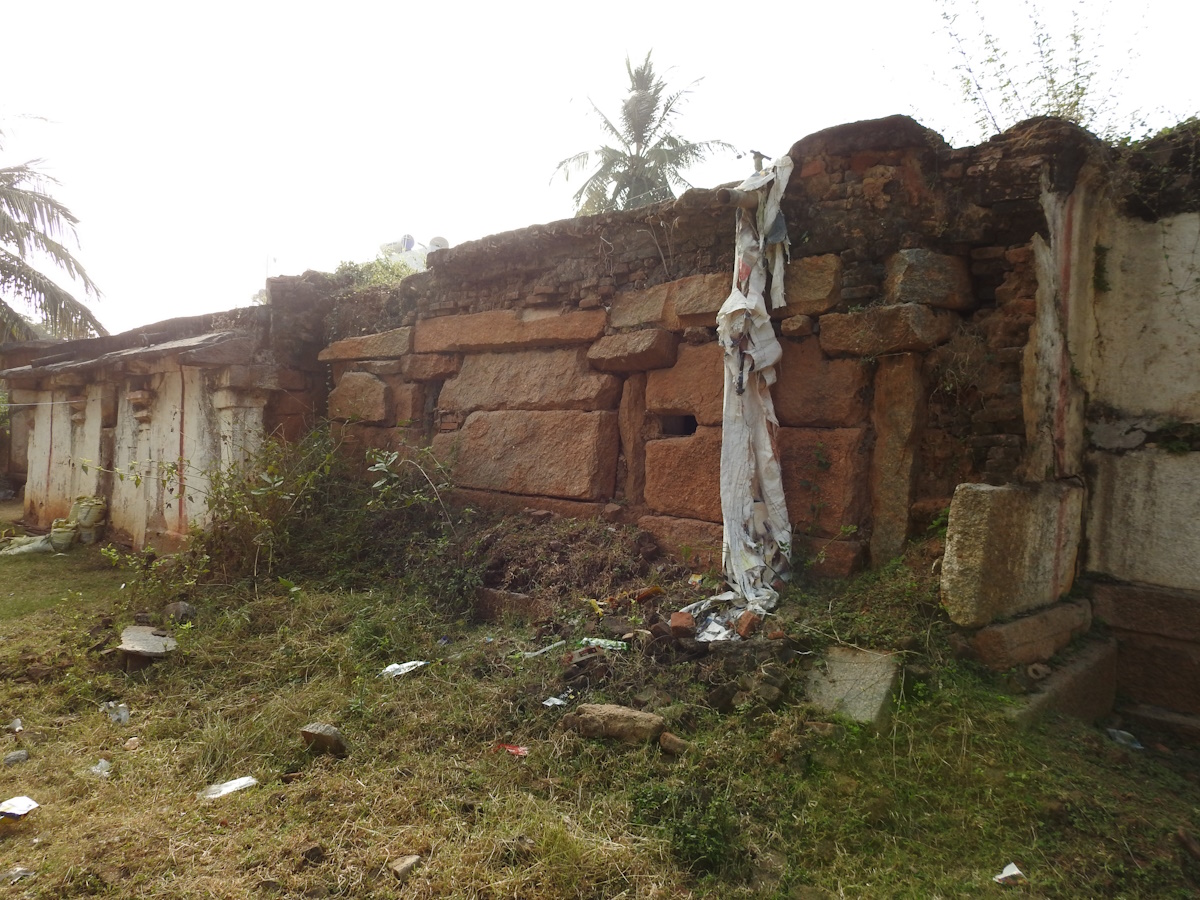
Back at the temple front, we get another of the gateway & Stambha.

On the left side of the temple is a tiled-roof house which seemed vacant. I guess the house is part of the temple, probably for the priest. Going by the looks of this place, I feel Gulur was a prosperous village, a place of significance.

This is the board I mentioned earlier... written on it are the names of two temples in the vicinity. If you look to the right of the board, there are two short pillars each having Nandi idols.

A closer looks at the passage. This is supposed to be the ancient entrance of Gulur. By the way, this happens to be the north-eastern corner of Gulur.

The twin Nandi idols of Gulur. Going by the flowers and banana plant, the idols have been revered during Makara Sankranti festival.

This is Sri Basavanna Swami Devalaya. It's under renovation. One might miss the large Nandi idol atop the structure. Hoping to see a renovated Basavanna Gudi during my visit here.

Also, hoping to see the inside of Beteraya Devastana and the making of Maha Ganapati which commences on Ganesh Chaturti. Navaratri should be the right time to catch a glimpse of Maha Ganapati.
Maha Ganapati Devalaya, Guluru
Jan 17, 2024. Sridhar and I were traveling from Bangalore to Bhogasandra by car. Since we had our own transportation, we had planned to see two historical places on the way- Guluru and Kaidaala, both situated close to Tumkur city. We left NH48 just after Chokkenahalli toll plaza, by passing Tumkur city. At he next major junction on the bypass road we entered Kunigal road, a couple of kilometers from the junction was Guluru village. Finding the way to Ganapati temple was easy since the village is small and the temple is situated on the main street. There's plenty of open space next to the temple where I parked the car. A colorfully painted Gopura welcomes visitors here.

Though this temple has a long history, the structure is a recent creation. As per a video, history of this temple is connected to Bhrigu Maharishi, one of the Saptarishi. It seems Guluru was known as Gulipattana. Bhrigu Maharishi happened to come here on the day of Ganesha Chaturti. Unable to find a Ganesh temple here. So the Maharishi makes an idol of Ganesha using clay from Guluru lake and worships the idol. Village people having seen Ganesha pooja, request Maharishi to teach them the pooja. Maharishi obliges and shares the knowledge with the village people. He also advises them to make an idol of Ganesha on Bhadrapadi Chaturti day itself. Apparently the idol made by the Maharishi was 3m tall and 3m wide hence Guluru Ganesha is approximately of that size even to this day. However, the practice here is that a smaller idol is made on Chaturti day which worshipped in the sanctum of the temple. Then on the same day, a huge lump of clay is brought to the temple and work of making the Maha Ganapati idol commences. By Navaratri, Maha Ganapti idol is close to completion. The smaller Ganesha idol along with pooja prasad is placed inside Maha Ganapati's hollow tummy, and then the hollow space is closed with clay. The completed idol is allowed to dry for a few days. Then it is painted & decorated with ornaments. The idol is consecrated on Deepwali and worshipped until the end of Kartikamasa. The village has a festive feel for the entire period. After Kartika Amavasya, Maha Ganapati is taken on a procession in the village and immersed in Guluru lake. A noteworthy point is that the erstwhile Jayachamaraja Wodeyar had participated in Guluru Ganeshotsava.

Having learned the temple's history, I realized that another visit is a must around the Navaratri. Opposite the temple is a monolithic Stambha.

Next to the Stambha is an idol of Ganesha made of granite. The idol is ancient, probably four or five centuries old.

This is the temple's main hall having two levels. The upper level is where Maha Ganapati idol is made and stays there Kartika Amavasya. The idol is so huge that it conceals the sanctum completely.

A black stone idol inside the sanctum.

This is one of the unique Ganeshotsavs of our country. Hoping to visit Guluru again during Navaratri / Deepawali and see Maha Ganapati once.
Tanarika Resort, is one of the most prominent holiday resorts in Bhusawal
Tanarika Resort, is one of the most prominent holiday resorts in Bhusawal, Maharashtra, offering world-class services, recreation facility, accommodation facility, luxurious accommodation facility, resort recreation facility to the clients, visiting the exotic locations around during their vocational holidays and occasional tours.
Client Satisfaction
In cuisines, all these arrangements provide an opportunity for our clients to enjoy every moment of their stay with us. We consider the budgetary constraints of our clients and offer personalized services along with affordable rooms to stay in. In our entire operational activities and arrangements, we ensure that we follow all the necessary safety and quality norms in strict adherence to international standards.Our Services
We offer a wide range of hospitality services that is well planned and served to make a truly memorable and rewarding experience for our valued clients. Our personalized services are delivered in strict compliance with our clients’ specified requirements. The assortment of services offered by us comprises Accommodation Facility, Dining Facility, Recreation Facility & Gym, Event Management Facility and Conference Facility.Some of the special features of our services are:
• Timely execution
• Facilities as per individual and budgetary specifications
• Friendly behaviour of staffs
• Customized services
• Tension free stay
Great Hotel for Family near Ajanta Caves
Tanarika Resort Sakri Phata, NH -06, Kandari Shivar, Bhusawal - 425201. Maharashtra, India Telephone : 02582 - 249015, 249016 Mobile : +91 - 9370848915, 9370848908 Email : info@tanarikahotels.com | Hotel Premier Near Nahata Collage, Saket Society, Jamner Road, Bhusawal - 425201. Maharashtra, India Telephone : 02582 - 240422, 645266, 699266 Mobile : +91 - 9325375802, 9370848917 Email : hotelpremier@tanarikahotels.com | Hotel Aditya Palace Beside Pandurang Theatre, Jamner Road Bhusawal - 425201. Maharashtra, India Telephone : 02582 - 226755, 227966 Mobile : +91 - 9326172069, 9370848920 Email : aadityapalace@tanarikahotels.com |

.JPG)

.jpg)

No comments:
Post a Comment
Note: Only a member of this blog may post a comment.